In the Spring 2022 semester, Dr. Nancy Hagedorn of the Department of History led a group of history students to develop a Digital History of Slavery and Runaways in New York.
As part of the history department’s efforts to help students develop historical research and digital technology skills, students created an innovative, public history using arcGIS Story Maps.
The project was conceived as an applied history course to introduce students to digital history methods and techniques by focusing on New York runaway ads. The class began by reading about digital history and its methods and uses, and then extensively about the history of runaways and slavery generally. Finally, the class focused on slavery in New York and New York City specifically. To facilitate the class’ digital history research and answer questions about slavery and runaways in New York, members compiled a database of New York runaway ads using transcribed ads culled primarily from the Freedom on the Move database at Cornell University. The class input data on 641 runaways between 1730 and 1811, and also compiled census data on slaveholding in New York State using the Northeast Slave Records Index at Lloyd Sealy Library and John Jay College of Criminal Justice.
More information on the project can be found online.
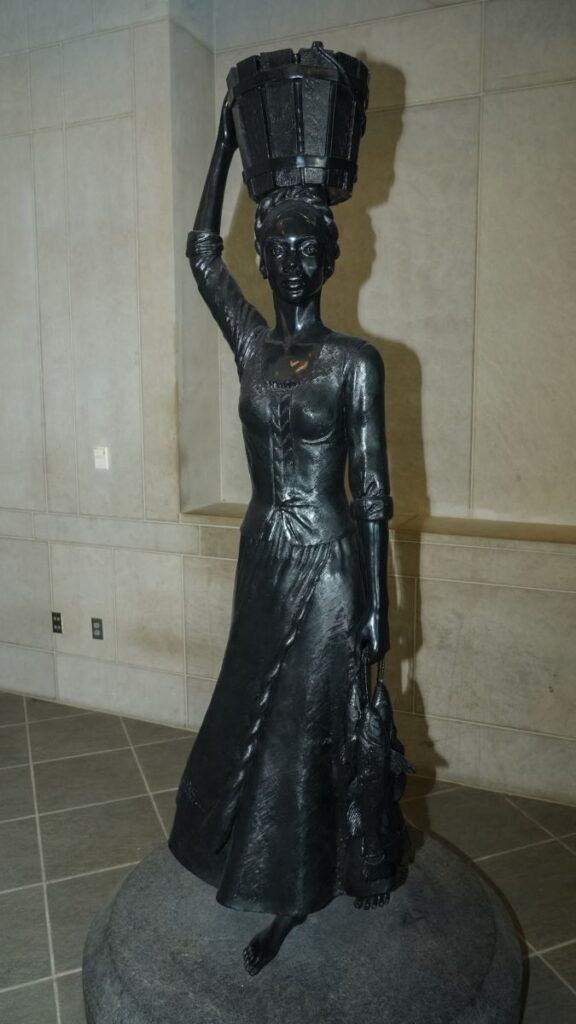
For Juneteenth 2022, the City of Yonkers debuted a permanent art exhibit honoring the legacy of the nation’s first freed slaves. The Enslaved Africans’ Rain Garden includes five life-size bronze sculptures created by artist Vinnie Bagwell depicting formerly enslaved Africans. The sculpture garden is located along the Yonkers Hudson River esplanade. According to Bagwell, “Public art sends a message about the values and priorities of a community. In the spirit of transformative justice for acts against the humanity of black people, I am grateful for those who supported this collective effort. The strongest aspect of the Enslaved Africans’ Rain Garden coming to fruition is that it begins to address the righting of so many wrongs by giving voice to the previously unheard via accessible art in a public place while connecting the goals of artistic and cultural opportunities to improving educational opportunities and economic development.”
In Yonkers, Philipse Manor Hall was the seat of the Philipsburg Manor, a colonial estate that covered more than 52,000 acres of Westchester land. The Philipse family was involved in the trans-Atlantic slave trade and probably as many as two-dozen enslaved African slaves worked and lived at the manor. The enslaved Africans were freed in 1799, one of the first large emancipations in the United States. New York State finally ended slavery in 1827.
For nearly a century, the Monmouth County Historical Association (MCHA) has told the story of the Taylor family at Marlpit Hall, the c. 1760 historic house museum in Middletown, NJ. It is a fascinating story indeed, and speaks to the strife between Patriots and Loyalists in Monmouth County, a hotbed of activity during the Revolutionary War. Until recently, however, a chapter of the house’s history had gone untold. In October of 2021, MCHA unveiled the exhibit
BeneaththeFloorboards:Whispers of the EnslavedatMarlpitHall to include this forgotten chapter. This award-winning exhibit was the culmination of two years of extensive research done by curators Bernadette Rogoff and Joe Zemla to interpret the home to include the long-silenced voices of the enslaved who lived there.
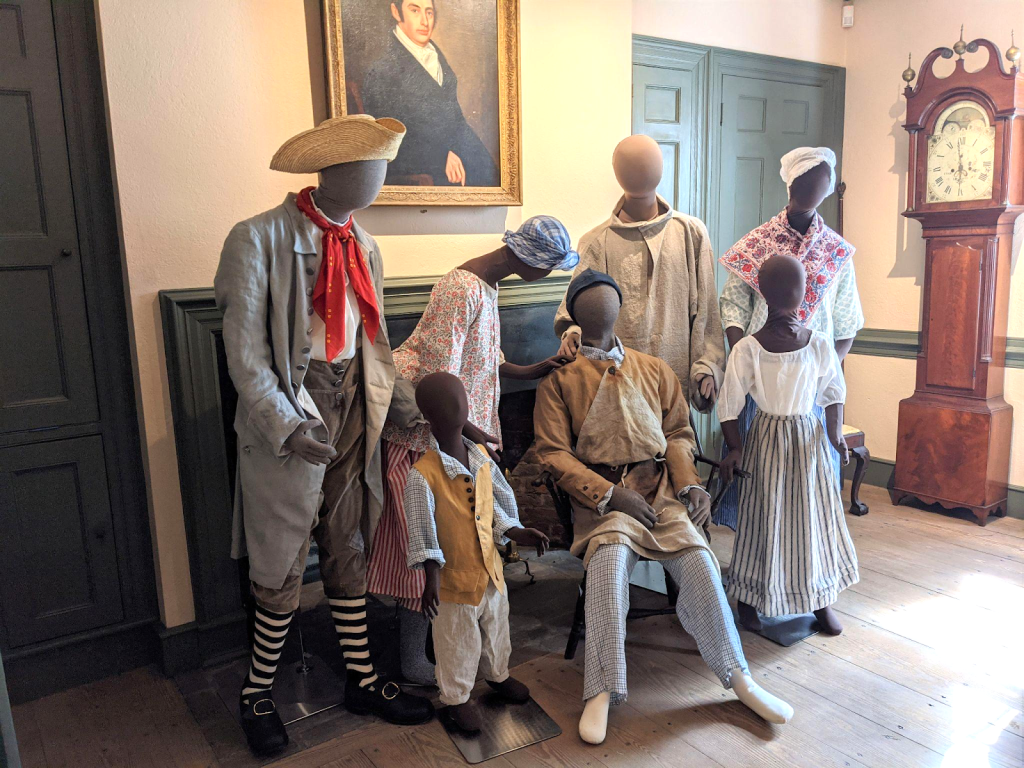
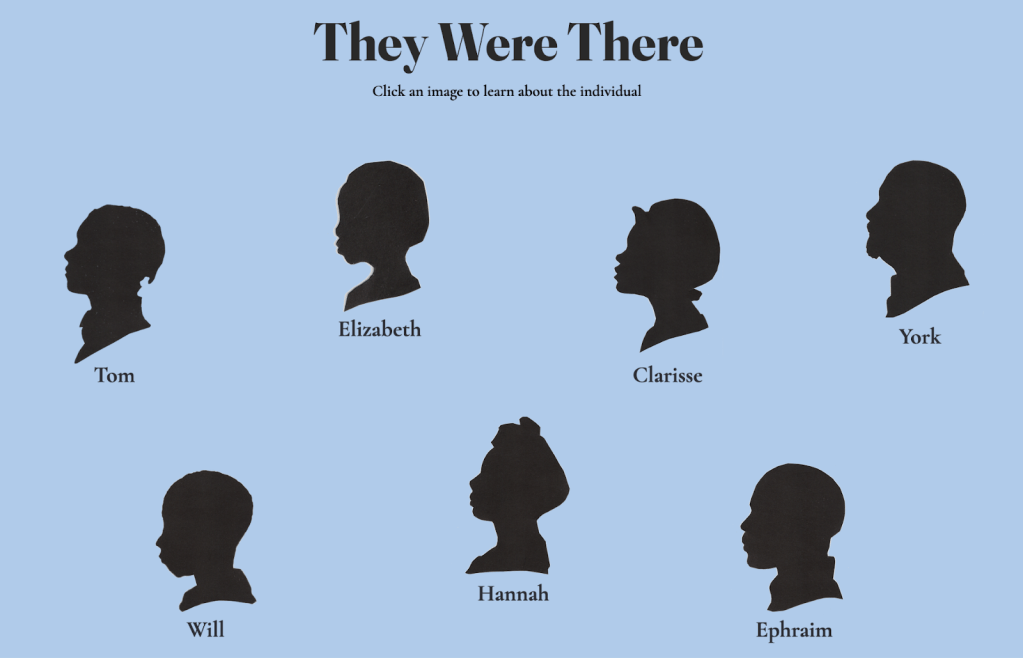
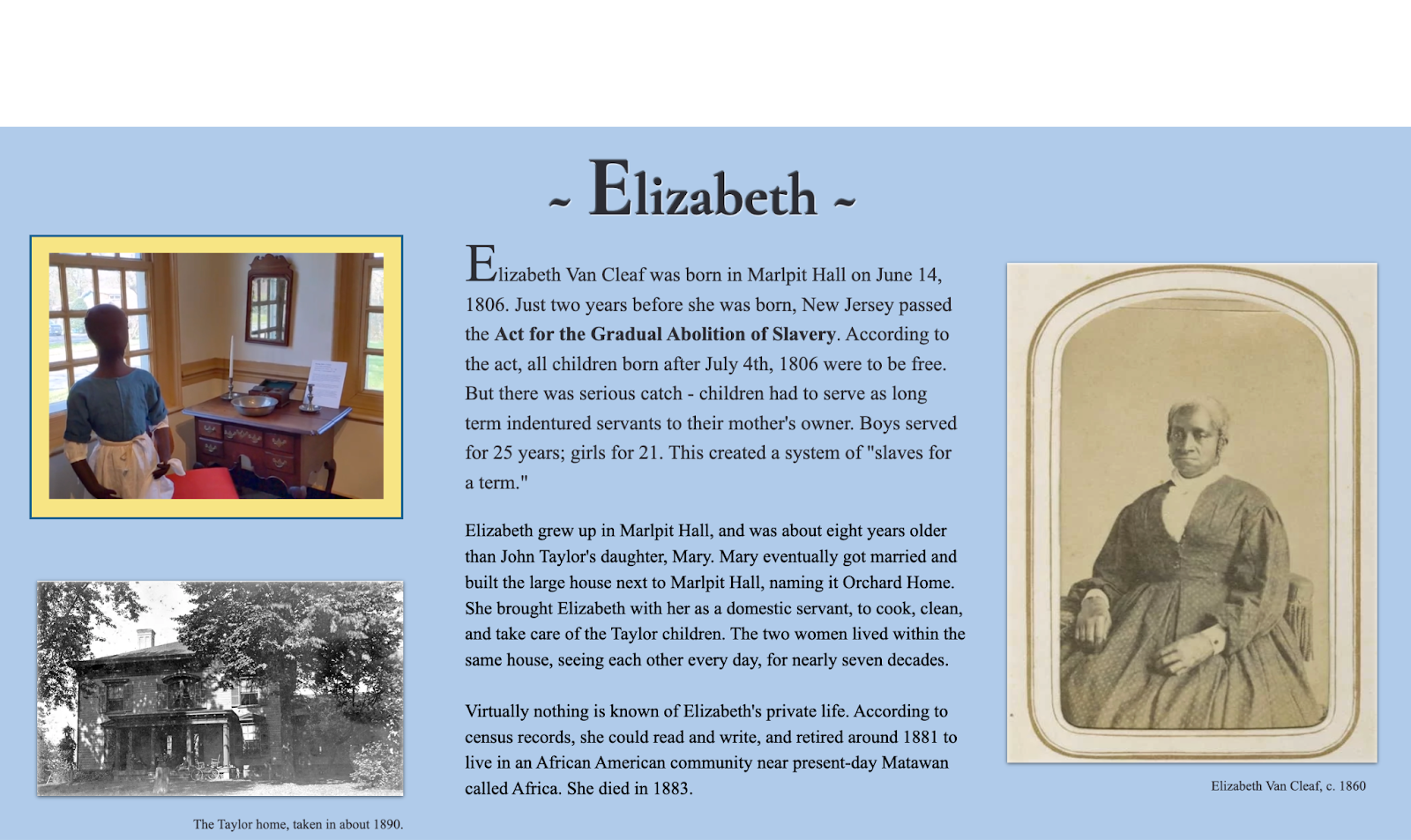
Primary source documentation and discoveries of material culture were the foundations of the research done to uncover the lives of seven of the twelve known enslaved individuals at Marlpit. Birth, death and census records, wills, runaway ads, inventories, bills of sale, and manumissions (or freedom papers) shed light on the experiences of Tom, York, Ephraim, Clarisse, Hannah, Elizabeth, and William. In 2020, Joe Zemla discovered secret caches of artifacts hidden beneath the floorboards of the kitchen loft living quarters that spoke to their religion and protective rituals, while archaeological digs supervised by Dr. Rich Veit of Monmouth University provided further evidence to piece together what life may have looked like for the enslaved. Throughout the house, mannequins dressed in
historically accurate reproduction clothing bring each individual to life, supplemented by their carefully researched biographical panels. The artifacts they left behind are now on display; there is no longer a need for them to be hidden from view.
One of the most prevalent comments made by visitors is that they were unaware that slavery existed in New Jersey. For many years, our educational system had been complacent with the general notion that the northern states were free, while the South had enslaved labor. New Jersey has been referred to as the “most southern of the northern states,” second only to New York in the number of enslaved persons and the very last to legally abolish the institution on January 23rd, 1866.
Comparatively, little has been written about slavery in the North. We can read about the facts of the matter, but the personal stories in the Floorboards exhibit make an impact that no textbook or blog can. The enslaved are presented without any form of politicization, but rather from an evidence-based and humanized lens. Students are able to connect with them, particularly with Elizabeth and William, who were born in the home and are represented as children – another sad fact of slavery that often goes overlooked. It is a unique opportunity to be able to mentally place these individuals in surroundings which are familiar to the student, albeit long ago. The students learn that we can make educated guesses about what life was like during the time in which the enslaved lived and explore the spaces they inhabited, but we can never truly understand their experiences as enslaved human beings. The only thing we can do is try to imagine it, using historical evidence from primary sources as our guide.
There is a sad deficit in age-appropiate classroom resources to teach slavery, and almost none that cover slavery in the North. This deficit creates roadblocks for public school teachers who are mandated to teach these topics as required by the NJ Department of Education’s 2020 Student Learning Standards, incorporating the 2002 Amistad Law.
monmouthhistory.org/intermediate-btf
While nothing can compare to the experience of actually visiting Marlpit Hall, the opportunity to do so poses challenges for many school districts. In order to make the fascinating information in the exhibit as accessible as possible to students, MCHA has created two NJ standards-based digital education resources adapted for the elementary and middle/high school levels. Created under the advisorship of respected professionals in the fields of education and African American history, both age-appropriate resources provide background on the system of slavery in New Jersey with a focus on the enslaved at Marlpit Hall. In it, they will be introduced to each individual, along with the primary sources that helped to build their stories. Dr. Wendy Morales, Assistant Superintendent of the Monmouth Ocean Educational Services Commission, notes “The questions and activities included in this resource are standards-aligned and cross-curricular. This means students will not only learn historical facts, but will be challenged to think like historians, analyzing primary sources and making connections between historical eras.” Creative writing, art, music, and civics are all explored.
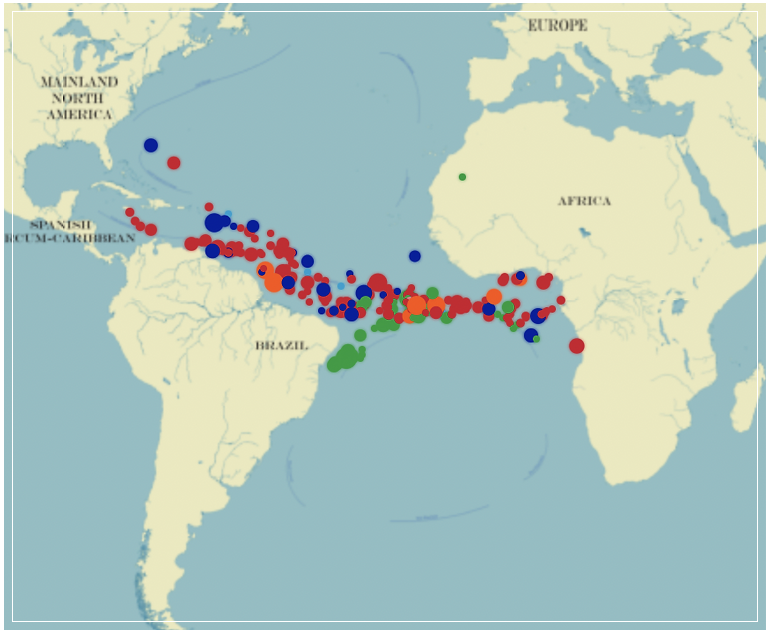
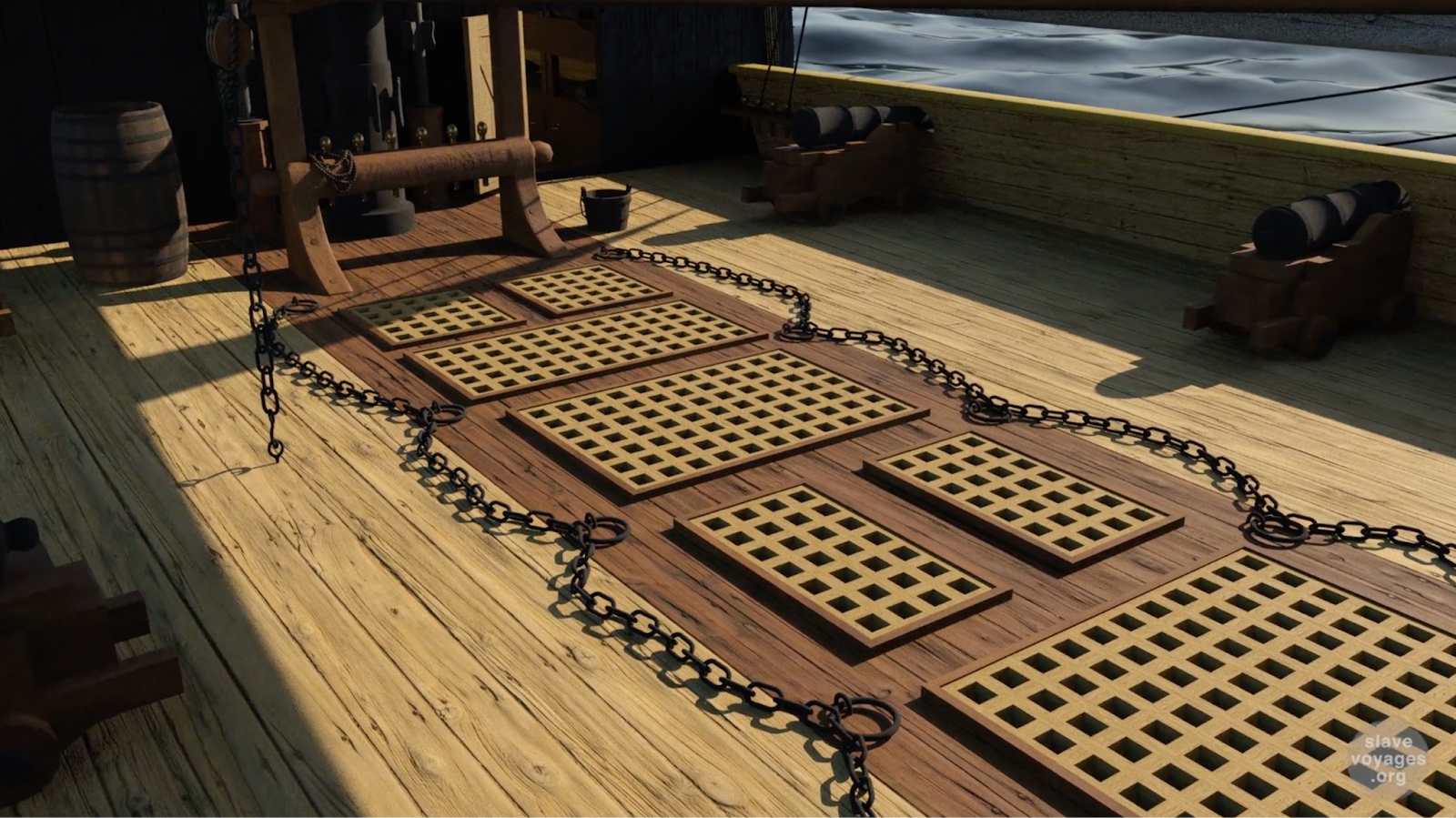
The section on the origins of slavery in New Jersey stress that the enslaved came here not as slaves, but as individuals who were taken from a homeland that had its own culture and civilization. Two videos, courtesy of slavevoyages.org, make a powerful impact. Students will get to view a timelapse of the paths of over 35,000 slave ship voyages, plotted in an animated graph. This visual representation helps students visually process the magnitude of the forced migration of the enslaved, while a 3-D modeling of an actual slave ship offers a uniquely realistic view of these vessels.
Time lapse of plotted slave ships Video featuring 3-D model of slave ship
Both grade level resources come with downloadable worksheets that can be customized to accommodate differentiated learning strategies, and submitted through Google Classroom. Teacher answer keys are provided for guidance as well. MCHA is proud to provide these resources free of charge to aid educators in their responsibility to teach slavery. The resources offer a guided approach to help educators navigate this sensitive and often difficult topic in the classroom. The new mandates are an excellent start to correcting the record on New Jersey’s history of enslavement, but it is truly New Jersey’s educators who will place their personal marks on bringing relevance and reverence to the topic in the classroom.
A few minutes outside the small town of Peru in New York’s Champlain Valley, there is a small farm that looks like any other in the area. A cluster of silos and red barns with fading paint are flanked by snow-covered fields and apple orchards, dormant for the winter. But this farm has something unique. A blue and yellow New York State historical marker identifies the property as a stop on the Underground Railroad, where “runaway slaves were concealed and protected on their way to freedom in Canada.”
There was no actual train involved in the network, explains Jacqueline Madison, the President of the North Country Underground Railroad Historical Association. “It was a trail of conductors who helped them along the way [and] safe houses where they could stay,” she notes.
Communities from Watertown to Lake Champlain were part of that network of safe houses that helped people escape slavery in the American south during the decades leading up to the Civil War. Escapees typically traveled by foot or water. The railroad moniker was part of a secret code: safe places to stay were called stations and the owners of those properties were known as conductors. A full journey on the Underground Railroad typically took several months.
This is the history that Madison and the North Country Underground Railroad Historical Association are dedicated to preserving. The group operates a museum in Keeseville, in the Champlain Valley south of Plattsburgh. It features the stories from both sides of the Underground Railroad: Black passengers and white conductors. One exhibit is dedicated to the former owner of that historic Peru farmhouse, a man named Stephen Keese Smith. The abolitionist Quaker purchased the property in 1851 and quickly established one of the barns as a hiding place for runaway slaves headed to Canada. There is no way to know with certainty exactly how many people Keese Smith aided while working as a conductor. But his later writings provide an estimate. “He talked about helping people get to freedom and he thinks he spent about $1000 doing that,” Madison explained. “And if we spent $2.50 per person, he would have helped over 400 people.”
Exact numbers are nearly impossible to come by in historical records because those helping escaped slaves often avoided keeping a paper trail. Involvement in the Underground Railroad was extremely dangerous for everyone, black or white. The Fugitive Slave Act of 1850 required that escaped slaves be returned to their former owners – and carried stiff penalties for anyone who aided them. “If you were caught helping someone get to freedom,” Madison noted, “you could lose your property, you could be jailed, you could be fined. Terrible things could happen to you, your family, and friends if they suspected them of helping as well.”
The North Star Underground Railroad Museum fills up the bottom floor of an old 19th Century house. It’s packed with maps, faded newspaper articles, and portraits of notable members of the North Country section of the covert network. Standing before a map, Madison explains the various routes freedom-seekers would have followed to reach Canada. A western path originating in Pennsylvania went through Buffalo, up to Watertown, and crossed the St. Lawrence River at Ogdensburg. Two escape routes followed Lake Champlain: one through Vermont and another running from Albany to Rouse’s Point along the lake’s western shore. To find their way, escapees used folk songs learned on the southern plantations. They worked as a kind of secret oral map; with coded lyricsguiding freedom seekers on their journey north. One such tune called Follow the Drinking Gourd referenced landmarks like certain rivers and offered hints for how to identify friendly conductors. Drinking gourd was code for the Big Dipper – a celestial constellation that can be used to identify the North Star.
Although details can be hard to piece together, some stories of those who passed through the North Country to freedom have been recovered. An article written in 1837 by Vermont-born abolitionist Alvan Stewart for an anti-slavery newspaper recounts the story of an anonymous man who travelled through the North Country on his way to Canada. “I was headed to Ogdensburg, on my way north to Canada from South Carolina,” an actor declares in a re-enactment exhibit at the North Star Museum. “I had come up through the Champlain Canal, and then gone through Clinton and Franklin County.” That unknown man did eventually reach freedom north of the border, but his quest nearly ended in disaster just a few miles from his destination.
Outside of Ogdensburg, he stopped into a post office looking for work. Since New York had outlawed slavery in 1827, that would not necessarily have been out of place. However, slave owners offered rich rewards for the return for those who escaped, and slave catchers were permitted to operate even in anti-slavery states under the Fugitive Slave Act. When the anonymous freedom seeker entered the post office near Ogdensburg, the postmaster recognized him and explained that a reward for his capture had been posted. “I said to him, if you send me back then they’ll do terrible things to me,” the re-enactment continues. “Whip me. Hang me. Skin me alive. I begged him not to turn me in.” In this case, the postmaster ignored the reward, worth about $20,000 in today’s terms, and helped the man cross the St. Lawrence River into Canada.
Other escaped slaves decided to settle in North Country. In 1840, a Franklin County landowner named Gerrit Smith pledged to donate more than 120,000 acres of wilderness land in the Adirondacks to free black men. It would eventually become a settlement known as Timbuctoo. A man namedJohn Thomas received 40 acres of un-cleared land from Smith. Thomas later sold that to buy a larger plot near Bloomingdale, NY, which he turned into a successful farm. Many years later, Thomas wrote his benefactor a letter, thanking Smith for the “generous donation” and revealing that he and his family greatly enjoyed the peace and prosperity of their “rural home.” Although Thomas was successfully established himself in the region, that was not the case for most recipients of Smith’s land. Harsh winters and tough soil drove many of the Black farmers to sell the land they had received and move away. The climate was not the only danger; at least once, slave catchers came to the area looking for Thomas. According to Madison, they first approached his neighbors seeking their help. As Madison tells it, Thomas’ neighbors informed the slave catchers that he was armed, would forcibly resist capture, and declared their intention to assist Thomas in repelling the catchers. The slave catchers are believed to have given up their pursuit.
In his later letter to Smith, Thomas hinted that his adopted community had begun to treat him as one of their own. “I have breasted the storm of prejudice and opposition until I began to be regarded as an American citizen,” he wrote. This may also be a reference to civic participation. At the time, New York State required men to own at least $250 worth of land to obtain the right to vote. Thomas’ obituary was published in the Malone Palladium in May 1895. It described him as “much respected in the community where he lived so long.” His descendants still live in that community. Through genealogy research, Madison and the North Star Museum discovered that two of John Thomas’ great-great grandsons still reside in the North Country. One of the descendants lives less than two miles from the cemetery in Vermontville where Thomas and his wife are buried.
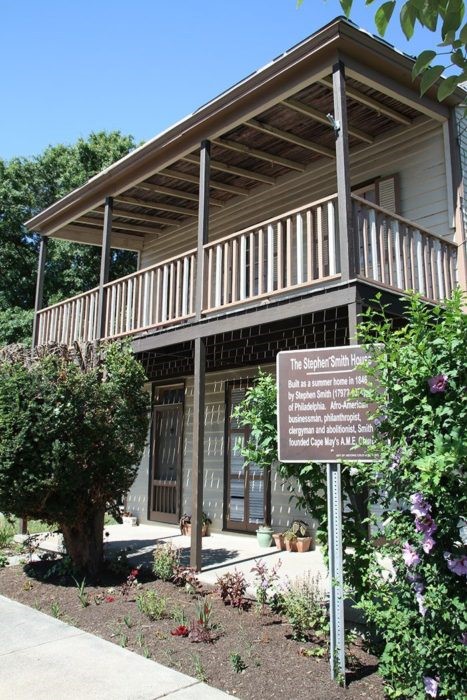
Stephen Smith was the original owner and builder of a summerhouse in Cape May, New Jersey.
Although born in the late eighteenth century, Smith was a nineteenth century philanthropist. During his lifetime, he was said to be the wealthiest Black American in the nation. He established the first home in the United States for aged and indigent Colored people. This home is still in existence today.
An energetic businessman, Mr. Smith had a coal mine, stone quarry and lumber yards in Philadelphia and Columbia, Pennsylvania. His business activities led to many real estate holdings. He established Smith, Whipple & Co. with his cousin William Whipper. Stephen Smith was a devoted church and family man; married to Harriet Lee, they lived in a stone mansion on Lombard Street in Philadelphia, Pennsylvania. The vacation house was built by him in Cape May, New Jersey using material from his lumber yard. This house is still standing except for the carriage house, kitchen and fireplace room once visible in the rear of the building. Not having children of his own, he welcomed the offspring of his wife’s secretary and friends; namely the Bascoms and Harlans. His secretary Anna Vidal, wife of Ulysses B. Vidal, brought their three children, Etienne, Marie and Anna Clorise to Cape May. Etienne engraved his name in a small glass windowpane with his diamond ring at this house. In later years Marie would point out the pane and recall the prank, for Etienne had long since emigrated to France. Stephen Smith was called “Daddy” Smith by the children and he relished the time consuming carriage ride to Cape May with them. Portraits of Stephen and Harriet were painted by the noted Black artist Edward Stridom and are today the property of the Pennsylvania Historical Society. An avid abolitionist and agent in the Underground Railroad, Mr. Smith was active in politics and church affairs. Records of the AME church attest to his generosity.
Stephen Smith was born October 13, 1795 in Columbia, PA. At the age of nine he was purchased by an officer who was a Revolutionary War general named Thomas Boude. His mother escaped from her owner, found her son, and was taken in by Boudes. Weeks later her mistress (owner) followed and demanded her property. The Boudes’ refused and were supported by the townspeople who believed in aiding a fugitive. Raised by the General Thomas Boude, in time, Stephen purchased his freedom. Before the general died, he set Stephen up in the lumber business. Stephen earned the respect and confidence of the people of Columbia, PA and they supported his endeavors. At age 21, he was inspired by the eminent minister, Richard Allen, founder of the AME church, and at age 31 became licensed to preach. He was a Teller in the election of every Bishop since Richard Allen until his death in 1873. Smith built a public hall in Philadelphia for the use of the “People of Color”; but this was destroyed by fire in the riots of 1842. Stephen Smith was one of the Signers of Frederick Douglas’ Men of Color to Arms appeal during the early part of the Civil War calling on Black Americans to join the Union Army.
An Educator’s Perspective on Teaching the Voices of Enslaved People in New Jersey as Part of Local History
by Robert Fenster
Few high school history textbooks have much to say about Black people in the northern colonies and states. While coverage of the evils of slavery has dramatically increased since I was a student in the 1980s, the focus has predominantly been on enslaved people in the south and not enslaved northerners nor free Black people. Slavery is mentioned 14 times in the New Jersey Student Learnings Standards from 2020, but the only connection to slavery in New Jersey is 6.1.8.History CC.4.a: “Explain the growing resistance to slavery and New Jersey’s role in the Underground Railroad.”[1] The standard implies that New Jersey was a hotbed of abolitionism instead of the dark reality: the gradual abolition law in 1804 maintained slavery for life for those born before its passage[2], and the so-called Act to Abolish Slavery in 1846 replaced slavery with apprenticeship for life. The ratification of the 13th Amendment didn’t merely free the slaves in states that were in rebellion, but also 16 people who remained enslaved in New Jersey in December of 1865.[3]
Is it at all surprising that most students graduate high school in New Jersey unaware of the enduring nature of this institution or the experience of Blacks in the north? Although it might be argued that malignant forces are behind a whitewashing of New Jersey history, it seems more likely that a collective reductionism is at work here. There are only so many days to “cover” the curriculum, so some simplification is necessary. It’s easier for students to understand the binary depiction of the southern enslaver states being evil while the north is celebrated as the home of abolition. That sort of teaching is oversimplified and not only does injustice to actual history, but to the lives of thousands of men and women who were enslaved in New Jersey, as well as the lives of free Black people. This essay shares my ongoing pedagogical journey, and provides some suggestions for my fellow educators who wish to improve student understanding of the history of Black people in New Jersey.
Although modern textbooks include the death of biracial Crispus Attucks at the Boston Massacre, overall Black participation in the actual American Revolution is typically relegated to a sidebar or absent altogether. Graham Russell Hodges describes the American Revolution as a Black revolution, “the largest slave revolt before the Civil War.” Hodges indicates there is documentation for at least 18,000 Black individuals who fought for the British, with the possibility of tens of thousands more having served in an effort to throw off the oppressive shackles of the colonial governments.[4]
At a week-long National Endowment for the Humanities seminar on Slavery in the Colonial North in 2020 at Philipsburg Manor in Sleepy Hollow, New York run by Leslie Harris and Jacqueline Simmons, I saw the buildings where enslaved people toiled, and heard from expert tour guides who shared how historians pieced together so much of the history of the manor. It inspired me to focus more on slavery in New Jersey. I went to my county clerk’s office and found birth certificates and manumission records of enslaved people from our town and prepared a lesson plan incorporating these primary sources. My students were taken aback especially to see names familiar to them among the enslavers. In addition to discussing how the descendants of the enslaved people might feel about their history, the students also considered what the descendants of enslavers might think about their family’s past. That lesson in and of itself was impactful, but I was acutely aware it didn’t do enough to explore the lives of enslaved men and women.
Well-intentioned teachers sometimes make cringe-worthy mistakes. There are lessons I did early in my career (and, truth be told, even more recently) that were tone deaf at best. It seems as if every year there’s another incident where a misguided teacher somewhere in the United States steps knee deep into controversy by running a slavery simulation. The vast majority of teachers know such a lesson has no pedagogical value and runs the risk of inducing trauma. A cursory search for lesson plans online still finds dozens of “walk a mile in their shoes” lessons, where educators think they can responsibly and effectively get students to learn by pretending they understand what an enslaved person went through, usually done through some kind of journaling activity. Although I believe it can be useful to consider what enslaved people might have been feeling, it’s ultimately presumptuous and reductive to suggest students would be able to have that level of empathy and understanding. The temptation to work solely in the affective domain when dealing with slavery and other atrocities should be resisted.
Many enslaved people were actively prevented from learning how to write, creating a dearth of first-person documents in comparison to white contemporaries who kept journals and wrote letters. There are a number of insightful enslaved person narratives, but when trying to keep to New Jersey history it is a bit challenging. There are a handful of narratives written by white contemporaries, like William Allinson’s Memoir of Quamino Buccau, A Pious Methodist. Although Allinson is an abolitionist, he uses his subject as a prop to further his political cause rather than illuminate the individual he is writing about. This focus belies an utter lack of interest in the enslaved person’s internal life and somewhat limits the usefulness of the text.[5] Historians are left to construct meaning out of other resources like fugitive notices, laws, tax registers, censuses, travel logs, registers of free Black people, and manumission records. New Jersey has a fairly robust set of available documents, making the work of historians easier than in several neighboring states.[6]
My evolving goal as a history teacher is three-fold: depict enslaved people as complex individuals who exercised their agency in a variety of ways, examine the ugly reality of slavery in our town, county, and state, and empower students to become historians themselves by examining the wealth of resources available to them on local history.
# # #
The study of agency is absolutely essential to shift student understanding from a one-dimensional conception of hapless victims to recognizing the humanity and complexity of individuals. Enslaved people’s agency was exhibited on a daily basis in a wide variety of ways. When students would ask me “Why didn’t they fight back?” I used to foolishly accept their premise and engage in a conversation about weaponry, psychology, and geography. Although those are all worthy of examination in a larger conversation on the subject, the fact is they fought back in innumerable ways. Agency was exhibited through armed revolt, breaking equipment, arson, working slowly or poorly, poisoning, feigning illness, self-harm, self-liberation, negotiation, and the development of an enslaved culture through language, families, community, religion, and music.
Jigsaw lesson plans are best used when the specific content is less important than the larger concepts. Examining the organized rebellions of enslaved people is an excellent opportunity to use this approach to its maximum efficacy. Students can research the Stono Rebellion, the New York Conspiracy of 1741, Gabriel’s Conspiracy, the German Coast Uprising, and Nat Turner’s Rebellion, for example. I have my students identify key figures, provide a description of the events, and then require them to find a way to frame the event as a successful endeavor. Students, of course, recognize the limits to their success, but by going beyond the reductionism of “Were they emancipated as a result of their rebellion?” it provides a key lesson.
Incidents of self-harm present a challenge to educators. We want students to understand the lengths to which enslaved people would go to assert their agency, but want to be careful about triggering existing trauma on the subject of self-harm. I’m still grappling with how much focus to put on the subject, but have used some narratives of enslaved people and newspaper articles to at least touch on the subject, if not dwell on it. The National Humanities Center has a collection of suicide-related items for teachers to consider using in their curriculum.[7] There are also an array of primary and secondary accounts of self-mutilation, such as the report of the “Desperate Negro Woman” in the Staunton Vindicator who “deliberately cut three of her fingers off, taking two licks at them” with an axe.[8] Needless to say, educators should tread lightly in this area, keeping a keen eye out for the reactions of their students.
Small acts of sabotage are more challenging to document as they likely would be chalked up to accidents or the natural wear and tear on equipment when tools would break. I don’t use any primary sources for this, but there are quite a few descriptions in narratives of enslaved people describing particular incidents that occurred prior to their emancipation. More dramatic forms of resistance like arson tend to capture students’ imagination such as the Albany fires of 1793.[9]
We used to speak of “runaway slaves,” but both terms have undergone a transition for similar reasons. As Katy Waldman pointed out, “To reduce the people involved to a nonhuman noun was to reproduce the violence of slavery on a linguistic level; to dispense with it amounted to a form of emancipation.”[10] Similarly, Daina Ramey Berry writes about the self-liberated: “[T]heir emancipation reflected a level of agency—a public showing of their personhood—and for them, escape was not a crime.”[11] Students can benefit by examining enslavers’ advertisements about the self-liberated which reveal so much about their assumptions and beliefs about their “property,” and often unintentionally expose the skills and accomplishments of the individuals in question.[12]
Giles Wright wrote that the American Revolution was “the cultural metamorphosis of Africans into African Americans.”[13] However, students rarely consider the creation of a common culture to be a form of resistance without being led to that conclusion. I’m still working on developing plans to help students see enslaved people as something more than one-dimensional figures. I found the Historic Hudson Valley’s People Not Property interactive website particularly useful in helping students make the connection.[14] Modules on the poetry of Phylis Wheatley, the celebration of Pinkster, and the role of extralegal marriages help students better understand how oppressed people can offer resistance through assertions of their own humanity. It helps students understand that these individuals were not passive victims who allowed their oppressors to defeat them at every turn.
# # #
When I was given the opportunity to participate in the New Jersey Council For Social Studies grant “Telling our Story: Living in New Jersey in the 1770s” focusing on the lives of lesser known individuals during the American Revolution, I knew from the outset I wanted to research Black people from Somerset County, and ideally, from Hillsborough, the town I teach in. I’d read Elaine Buck and Beverly Mills’ powerful book If These Stones Could Talk. The Revolutionary War service of William Stives gets particular attention along with his decision to settle near Hillsborough after the war.[15] The Sourland Mountain ridge runs 17 miles from Lambertville to the western end of Hillsborough, so my students would recognize various geographic locations from his life story. However, since the authors’ work had gained significant attention, I wasn’t sure my focusing on his life would do much to elevate Stives’ story.
I spent several afternoons at the Somerset County Library in Bridgewater, poring over their local history holdings. Having never done much in the way of local history research, it took awhile to orient myself as to what was available, but before long I encountered a number of promising leads. The most significant came from the Somerset County Historical Quarterly, an outstanding publication compiling historical essays and primary source documents, which ran from 1912 to 1919. It was all I could do not to get lost reading unrelated articles about Hillsborough and nearby towns. However, the article entitled “Revolutionary War Record of a Somerset County Slave” in the 1914 edition utterly captivated me.[16] The story of an enslaved man named Samuel who served as a substitute for his enslaver in exchange for the promise of freedom takes several awful, though not surprising twists. Samuel’s two years of service, including fighting at the battles of Long Island, Princeton, Monmouth — and the very local Millstone — ended in two leg wounds and the broken promise of his enslaver. Decades later, in his mid-80s, Samuel sought a pension for his service, but was repeatedly denied his just due because the pensions board claimed he had not proven his service. Ultimately, the New Jersey legislature passed a law specific to Samuel, providing him $50 a year for the remaining few years of his life.
Chasing down information on Samuel Sutphen (as he came to be called later in his life) was both challenging and invigorating. It’s been decades since I was a college student doing research in the basement of Alexander Library at Rutgers University. I had hoped to revisit the same location for both nostalgic and practical reasons (the holdings at Rutgers are quite impressive), but Hurricane Ida made that an impossibility. Instead I relied mostly on internet-based research and was able to gain enough materials to prepare a structured academic controversy for my students. The activity incorporated materials on the multiracial Marbleheaders, and Black participants Benjamin Whitecuff, Colonel Tye, and Prime. Frankly it is a work in progress in need of development, but my students saw the breadth of Black participation in the war instead of merely seeing the battles through the eyes of the white officers.
When I mentioned my desire to learn about enslaved people in Hillsborough, I was pointed towards the biography of Silvia Dubois, a formerly enslaved woman who received her freedom after a physical altercation with her enslaver. Dubois self-liberated after the encounter and negotiated her freedom in exchange for promising never to return.[17] Her story is remarkable, but chronologically was outside the purview of the grant. Nonetheless I read a series of items about her story and took notes for a future lesson plan. In the meantime, I encountered an article about her grandfather Harry Compton written by Kenneth E. Marshall. In turn, this led me to Marshall’s book Manhood Enslaved: Bondmen in Eighteenth- and Early Nineteenth Century New Jersey, in which he focuses on the lives of three enslaved men, including the aforementioned Quamino Buccau. I liked the idea of examining a second Black man from the time period who had not served, but instead experienced changing circumstances during the American Revolution. With many enslavers off serving in the militia or Continental Army, numerous enslaved people used the opportunity to liberate themselves, negotiate better conditions for themselves, or rebel in other ways.
In examining the experiences of various individuals based on limited and sometimes questionable documentation, it is crucial that students understand that there are limits to what we can definitively know. Many students struggle with history because they struggle with nuance, wanting everything to be crystal clear. For me, the shades of grey are what make history fascinating, and the use of deductive reasoning a great and wonderful challenge. The best conversations in the classroom are the ones where students have honest disagreements about historical interpretations with equally compelling logical arguments to support their positions. What we can do to help them is to identify particular facts and events that serve as anchors. Quamino Buccau, in his teens, was forced to watch executions of enslaved people accused of arson and other crimes.[18] Because Allinson never bothered to ask his subject how he felt about his experiences, we are left to speculate about how such experiences would impact an individual and their subsequent behavior. When he converts to Christianity after hearing what he believed to be the voice of God, a fascinating dichotomy occurs. Some, like Allinson, hold him up to be a model enslaved person, the very proof the abolitionist is seeking to demonstrate the notion that Black people could become responsible citizens imbued by their faith in religion. His subsequent enslaver, however, looked at his religiosity as something inappropriate and suspect. Kenneth Marshall raises fascinating questions about how an enslaved person might show interest in Christianity to curry favor with their enslaver, and how that in and of itself might be an assertion of agency.[19] There’s a lot to unpack here and it may be something that cannot be easily converted into a one- or two-day lesson plan. That being said, a discussion of religion and agency is definitely important in the coverage of slavery.
Conducting this type of research and lesson planning is simultaneously rewarding and humbling. Even as I create a useful lesson plan that I will share with other educators and likely use for the rest of my career, I reflect on how many years I didn’t adequately address the subject matter in my classes. And I recognize that despite including them in the opening paragraphs of the essay, I have yet to develop resources and lessons on the lives of free Blacks in New Jersey. There is always more work to do, but at least we’re going in the right direction.
# # #
We want our students to be more than passive receptacles of knowledge that we distill. There are myriad critical thinking activities we can provide, but perhaps nothing could surpass doing the actual work of historians. There are thousands of primary and secondary source documents available online, in historical society archives, and in government offices. For example, in West Hartford, Connecticut, students participated in the Witness Stones Project, researching their town’s sordid history in connection to slavery. Beginning with an Advanced Placement US History class and then spreading out to lower grade levels, students dug into historical archives to learn more about the lives of enslaved people, commemorate their lives, and create lasting tributes through the placement of historical markers.[20] Although Covid-19 continues to present obstacles for some research, there’s no reason that our students here in New Jersey can’t start doing similar work to the West Hartford students in an effort to elevate the stories and voices of forgotten people from our local communities.
[4] Hodges, Graham Russell. Interview with the author. Bob’s Just Asking podcast, January 27, 2022.
[5]Kenneth E. Marshall, Manhood Enslaved: Bondmen in Eighteenth- and Early Nineteenth-Century New Jersey (Rochester: University of Rochester Press, 2011), 18
[13] Giles Wright, “Moving Toward Breaking the Chains: Black New Jerseyans and the American Revolution,” in New Jersey in the American Revolution, ed. Barbara J. Mitnick (New Brunswick, NJ, Rivergate Books, 2005), 113.
[15] Elaine Buck and Beverly Mills, If These Stones Could Talk: African American Presence in the Hopewell VAlley, Sourland Mountain, and Surrounding Regions of New Jersey, (Lambertville, NJ, Wild River Books, 2018).
[16] Abraham Van Doren, “Revolutionary War Record of a Somerset County Slave,” Somerset County Historical Society, Volume III (1914), accessed February 6, 2022, http://hdl.handle.net/10929/46268.
Quamino was born near New Brunswick, New Jersey in 1762. Young Quamino had a complete family unit when he was living in Somerset County. Despite describing Quamino as “compliant,” his contemporary biographer William Allinson described a horrific episode where young Quamino was forced to watch a fellow enslaved person burned at the stake as punishment for alleged crimes. At no point in the memoir or in any other documentation is Quamino described as rebellious or uncooperative. Much of this is attributed to his religious conversion and subsequent piety. Allinson essentially uses Quamino as the model version of a benign, non-threatening Black man as a means of condemning the institution of slavery, consistent with Allinson’s abolitionist views. Allinson’s book is described as a memoir, including numerous quotations directly from Quamino, but neglects to offer a physical description of the man, the names of his siblings, or many of his inner emotions and rationale for his behavior.
At age nine, Quamino was essentially rented out to an enslaver in Poughkeepsie, New York. He was separated from his family and upon the commencement of the Revolutionary War was unable to have any communication with his “master” (and thereby his family). From roughly age 9 to 18, he remained in New York, but in 1780 was unexpectedly returned to his original enslaver and reunited with his family. Allinson wrote, “Overcome with this too sudden announcement, he burst into a violent and uncontrollable fit of crying, and for hours cried aloud as though he had been beaten — unable to answer questions, or to stay his emotions at the kindest efforts to pacify him.”[2]
How do you think each of the following may have contributed to his uncontrollable response to the news?
Shock that his situation would ever improve.
Joy at the prospect of being reunited with his family.
Separation from his family caused emotional deprivation.
The experience of enslavement is a form of mental and physical torture.
Consider the implications of each of the items in a response of two or three sentences.
Back in Somerset County, Quamino had a religious experience, claiming that God had spoken to him, thus beginning his period of devout faith in the Methodist religion. His enslaver looked suspiciously upon enslaved people’s faith, believing it could interfere with maintaining a degree of ignorance and thus make them less “serviceable” as workers. He even suspected Quamino’s position was a pose, designed to gain a level of respect from others in the community. Consequently, he would criticize and may have beaten Quamino for participating in religious services, but Quamino accepted the consequences and maintained his personal beliefs.
As there is only one source for this information, we have no idea of how sincere Quamino’s religious conversion was, but either way, one could argue that maintaining his faith was an exercise of autonomy and personal agency.
Two Options to Consider:
A. Quamino was wholly genuine in his religious conversion, and was willing to deal with any obstacles in his path to exercise his faith.
B. Quamino was less than 100% genuine in his conversion, but believed that some degree of deception would provide him some degree of social standing.
Describe in two to three sentences how each of the options would mean that Quaminowas exercising personal agency.
In 1788, he married Sarah, an enslaved woman who lived nearby. She was soon sold and moved five miles away, allowing them to see one another as infrequently as once a week. When Quamino’s enslaver died around 1789, he was passed onto one of the enslaver’s sons. Several years later, he was beaten by his enslaver. Quamino told him he refused to work for him further, a tactic that some other enslaved people had used to demand being sold to a new owner. In some locations, the relationship between enslaver and enslaved was perceived as a sort of social contract with obligations flowing in both directions. “Unjustified” abuse might be grounds for “slave quitting” depending on local customs. Although enslaved people might be aware of instances of slave quitting via word of mouth, nothing was in the law, thus employing this tactic was enormously risky for Quamino.
Consider the possible outcomes of this risky decision.
Three Possible Outcomes to Consider:
A. His enslaver could have rejected the claim and then worsened his treatment of Quamino.
B. His enslaver could agree to sell him to a new enslaver whose treatment of Quamino could be the same (or worse).
C. His enslaver could agree to sell him to a new enslaver whose treatment of Quamino would be an improvement.
Which of the following seems the most likely outcome?
If you think the outcome would have been A or B, would Quamino have regretted his decision of refusing to work?
Why was it difficult for Black Americans to enjoy the ideals of life, liberty, and the pursuit of happiness as stated in the Declaration of Independence?
Quamino was sold to a new enslaver, who did not seem to have used physical violence against those he enslaved. Quamino even arranged for his new enslaver to purchase Sarah, allowing the couple to live together as husband and wife. In 1806, Quamino was manumitted through an elaborate process that included having to testify before a committee to demonstrate that his freedom would not be a burden upon the state of New Jersey. Sarah died in 1842 and Quamino lived to around 1850 (age 88). They had at least two sons together, although it appears at least one of them was sold as an infant.
[1] Frontispiece of William Allinson, Memoir of Quamino Buccau, A Pious Methodist
After a month’s service in the militia, Casper Berger had had enough. He was in his 50s and the physical labor and drudgery were beyond him after a career as a stonemason. Given a break from service, he returned to his home in Readington, desperate for a way out of the remaining months of his obligation. He was more than willing to pay his way out of service and return to his current vocation as a tavern operator.
Berger’s neighbor, Guisbert Bogart, enslaved a man in his late 20s named Samuel. Berger knew that it was legal to provide an able-bodied substitute for militia service, so he inquired with Bogart whether he could purchase Samuel. The two arrived at a payment of $92.10, but Berger knew that Samuel would need to be at least somewhat willing to serve as a substitute. An unwilling enslaved person would be rejected, as the militia wouldn’t have time to deal with forcing someone to work. Berger promised Samuel his freedom at the war’s end in exchange for consenting to the deal.
It would be inappropriate and presumptuous for individuals in the 21st century to try to imagine what it was like to be an enslaved person — let alone second guess their decisions — but Samuel’s options were limited:
Consent to the deal based on the promise of freedom when the war eventually ends.
Reject the deal.
Describe the potential ramifications of each in 2 to 3 sentences.
Reflecting on this decision, Samuel said, “I believed the white man’s word, hoping to be free when the fight was over. I took no paper to show the bargain, but trusted to my master.”
Samuel fought in the Battle of Long Island (August 1776), the Battles of Princeton (January 1777), the Battle of Millstone, where he captured a prisoner of war (January 1777), and the Battle of Monmouth (June 1778), among others. On sentry duty at West Point in New York, he was shot twice in his leg, one wound driving a bullet into his leg, thereby ending his active militia service. At the end of the war he asked his enslaver Casper Berger to grant him his freedom as promised. Berger had three choices:
Grant Samuel his freedom as promised.
Renege on the deal and sell Samuel to a new owner.
Renege on the deal and keep a disgruntled enslaved person in his service.
Describe the potential ramifications of each in 2 to 3 sentences.
Despite support from neighbors and fellow veterans, Samuel’s enslavement would continue for another 20 years as Berger opted to sell him to Peter Sutphen. Eventually, Samuel was allowed to purchase his freedom using money he saved up by selling rabbit, raccoon, and muskrat fur.
An Act of Congress in 1832 provided a pension to enlisted men who had served for at least two years. Although the federal government wanted to do right by veterans, it also required adequate proof that the claims were valid. According to the pension board, “It must, in every case, be clearly shown under what officers the applicant served: the duration of each term of engagement; the particular place or places where the service was performed; that the applicant served with an embodied corps called into serve by competent authority; that he was either in the field or in garrison; and for the time during which the service was performed, he was not employed in any civil pursuit.”
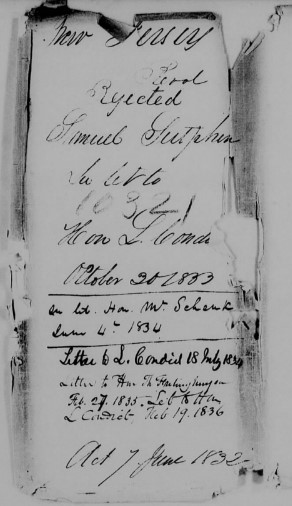
Samuel first applied for a pension in 1832 at age 85, but a lack of specificity in his testimony, perhaps compounded by a failing memory, led to a series of rejections from the pension board. Samuel’s name did not appear on any official roster, though it is unknown what last name he might have been listed under. In 1775 Samuel also only spoke broken English, using primarily Dutch to communicate up to that point. That he would have difficulty remembering specific names is unsurprising as a result, particularly at his advancing age.
In 1834, former Congressman Lewis Condict offered his support. Condict, who was also a doctor, examined Samuel’s scars and testified that they were wholly consistent with the injuries Samuel had described in his previous testimony. Witnesses even testified seeing him at particular battles and many of his neighbors testified as character witnesses.
DECISION ACTIVITY
Imagine you are a member of the pension board. Select one option and explain your answer in 4 to 6 sentences.
Abide by the guidelines provided by the War Department and reject any claim that does not meet the letter of the law.
Appeal to your superiors to approve the pension based on the particular circumstances and weight of the evidence.
Grant the pension and suffer whatever consequences might arise as a result of your bending of the rules.
Samuel’s fifth petition was ultimately denied, but some important individuals became aware of his plight. Both Dr. Condict and New Jersey Governor Peter Vroom took up his case, and the New Jersey General Assembly passed an act providing Samuel a pension of $50 per year until his death in 1841.
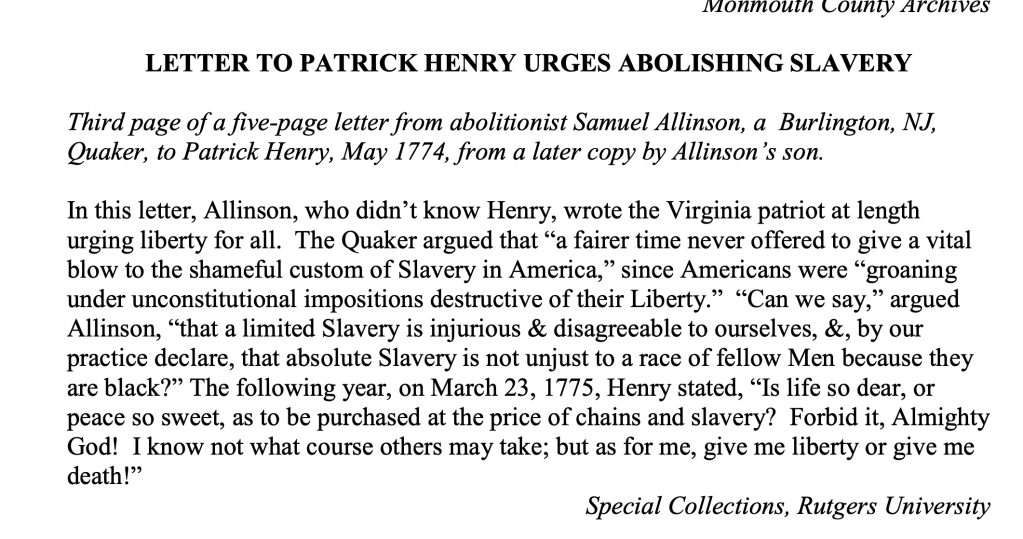
My name is Samuel Allinson. I was born in 1739, and lived in Burlington County New Jersey. Professionally, I was a lawyer who was considered to be very talented during my career. I was an abolitionist and Quaker. During the Revolution, I was a supporter of Loyalist ideals because enslaved peoples who were able to get to England in the late 1700s would be offered freedom. In my life, I worked to manumit the enslaved with my father-in-law, David Cooper. I worked hard to give freedom to Catherine and her daughter Esther in 1774. In 1782, I manumitted Jean and her three children Deborah, Violetta, and Edward.
As a prominent member of the Quaker community in Burlington County, I led meetings in the 1780s to help members of my religion understand the immorality of slavery. More importantly, I used these meetings as an opportunity to help educate free blacks in my community-an unprecedented option at the time.
During the revolution, I wrote letters to two well-known founding fathers: William Livingston and Patrick Henry. In my letter to Livingston, I explained why the institution of slavery was immoral. I was hoping that New Jersey would lead the way of abolition for the new nation, but unfortunately, Governor Livingston would not be able to do this during his time in office. I didn’t know Patrick Henry, but my words to him were adamant about the abolition of slavery.
So, knowing all of this about me, I ask you: When have you taken a stand for what you know is morally right?
Why did Samuel Allinson decide to contact prominent menduring the Revolutionary War era?
Did Samuel Allinson’s decision to speak out against slavery have any benefit?
If you could ask Samuel Allinson one question today, what would it be?
What causes do you believe in or support?
What factors influence our decisions to stand up for what is morally right?
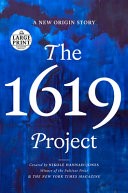
by Nikole Hannah-Jones, Caitlin Roper, Ilena Silverman, and Jake Silverstein
Review by Alan Singer
The 1619 Project was released as an issue of the Sunday New York Times Magazine on August 18, 2019, 400 years after the arrival of the first slave ship at the British Virginia colony. It is now published in book formats. According to the Times, the project’s goal is to “reframe American history by considering what it would mean to regard 1619 as our nation’s birth year. Doing so requires us to place the consequences of slavery and the contributions of black Americans at the very center of the story we tell ourselves about who we are as a country” (4-5). The introductory essay by project director Nikole Hannah-Jones opens with a full-page bold-faced headline, “Our founding ideals of liberty and equality were false when they were written. Black Americans fought to make them true. Without this struggle, America would have no democracy at all” (14). For the essay, Hannah-Jones received a 2020 Pulitzer Prize for Commentary.
Other essays in the issue covered the role capitalism played in the establishment of chattel slavery and the plantation system in British North America; persistent racism after the Civil War that continues to shape the current era including Jennen Interlandi on unequal health care; Jamelle Bouie on undemocratic democracy; Brian Stevenson on mass incarceration; Trymaine Lee on the racial wealth gap; and African America contributions to America, especially American culture.
The 1619 Project has been criticized from across the political spectrum since it was released. Former President Donald Trump denounced it as anti-American propaganda in his call for “patriotic history,” former Secretary of Education Betsy DeVos described it as “insidious lies,” and the World Socialist website branded it as a “politically motivated falsification of history” The New York Times Magazine printed a letter from five prominent American historians along with a response by the magazine’s editor-in-chief. The historians, who demanded corrections be made in the 1619 Project, applauded “efforts to address the enduring centrality of slavery and racism to our history,” but were “dismayed at some of the factual errors in the project” that “suggest a displacement of historical understanding by ideology.” Their claims, however, were at least as ideological in nature. The historians charged the “project asserts that the United States was founded on racial slavery, an argument rejected by a majority of abolitionists and proclaimed by champions of slavery like John C. Calhoun.” Actually, that was the position taken by William Lloyd Garrison, who publicly burned a copy of the United States Constitution on July 4, 1854, a document he called “a covenant with death, and an agreement with Hell.” The group also ignored Frederick Douglass’ 1852 Independence Day speech where he calls the Fourth of July a day that reveals the “gross injustice and cruelty” of American society. For Douglass, “There is not a nation of the earth guilty of practices more shocking and bloody than are the people of these United States at this very hour.”







 njcssjournal