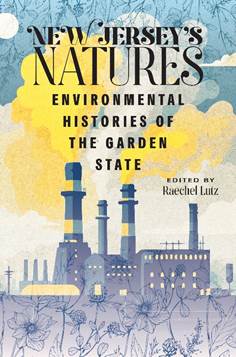
Book Review – New Jersey’s Natures Environmental Histories of the Garden State

The names of the Copper Tree Mall, Powder Mill Lane, Cannonball Trail, and Campgaw Mountain in Oakland, New Jersey reveal the mysteries of the environmental history of the town where I live. When a new septic was installed on our property, the excavation revealed sand about ten feet under the soil. This discovery explained why half of the houses on our block did not have full basements and why homes with basements often had water seepage from a hidden underground stream.

Environmental history is exciting for students who enjoy the role of historical detective. The names on our street signs, the boardwalk, the Great Swamp, and utility poles, train tracks, and churches are evidence of environmental history. There is likely evidence of trees where you live that are 300 years old and the trees that are less than 100 years old reveal evidence of deforestation or the presence of invasive species. The names of many places in New Jersey reveal an environmental history of past centuries from the Native Americans who walked on the land where we walk or drive today:

Absecon (little stream)

Mahwah (meeting place)

Passaic (valley)

Paramus (wild turkeys)

Pequannock (cleared land)

Piscataway (large deer)

Pompton (place of soft fish)

Wyckoff (high ground)

“In the twenty-first century, the state has it all: protected ecological environments, active agricultural tracts, preserved farmland, contemporary industrial landscapes, postindustrial landscapes, mid-century Levittown-inspired suburbs, elite rolling estates, historic sites, tribal lands, massive interstate highways, and many, many other features of a cultural landscape that has been inexorably changed by humanity.  These factors make New Jersey, as this book argues, a prime site for the study of environmental history.” (page 2)

The articles in New Jersey’s Natures are organized geographically. They reveal a history that has been ignored, unimagined, or recently revealed. The stories of the Meadowlands and Pinelands may be familiar, the articles on the forests of Joseph Bonaparte and the landscape of the diaries of William Livingston may be new, and the research on industrial pollution, agricultural economics, and the migration of populations may prove shocking.

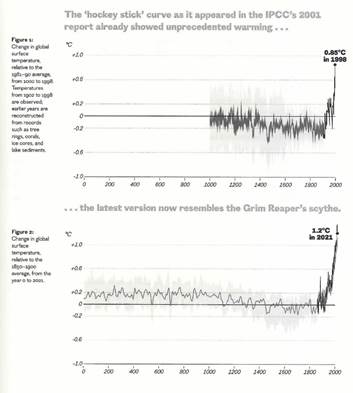
The environmental history of New Jersey (and the world) is dramatically changing as we are already living in a world that is 1.2C degrees warmer than when most of us were born. A warmer climate leads to atmospheric changes affecting crops and trees, rising sea levels, droughts, fires, and the migration of populations. The evidence we currently have in the oral histories of our collective memories, historical sites, landscape paintings, photographs, and newspaper articles are in need of documentation, organization, and publication. Teachers are the catalyst for inspiring and encouraging this in their school and community.

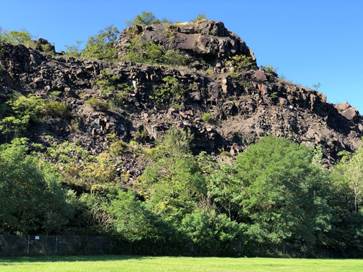
For example, perhaps every person living in New Jersey has looked out of the window in their vehicle when driving on the New Jersey Turnpike between Exit 15 and 16. They see the landscape of Jersey City and New York City and the strange landscape of the rock known as Snake Hill or Laurel Hill. The environmental history of the roads and railroads, the memories of people seeking cleaner air for relief from lung diseases and the importance of this rock as a sacred place for burial, the presence of water snakes, oysters, clams, and fish are part of the story of our history. Raechel Lutz inspires us to think and discover.

Snake Hill Rock

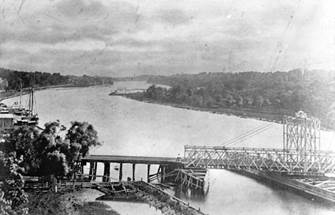
My early years were in Paterson, and I watched the construction of Route 20 and 21 along the banks of the Passaic River. Many American cities constructed highways next to rivers to avoid the demolition of neighborhoods in towns that were established before the automobile. These highways were built at the time Rachel Carson was writing about water runoff and the pollution of rivers. I remember the clean and clear waters of Greenwood Lake before the speedboats came, the fresh waters of the reservoirs that provided potable water to Newark, Hackensack, Jersey City, and Paterson, and the dangers of eating fish or swimming in the Passaic River.  Unfortunately, the pollution of this scenic river uncovers a frightening history.

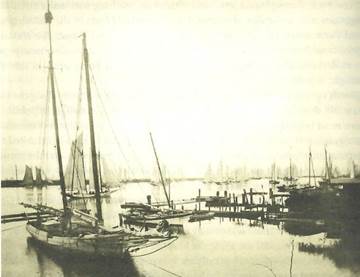
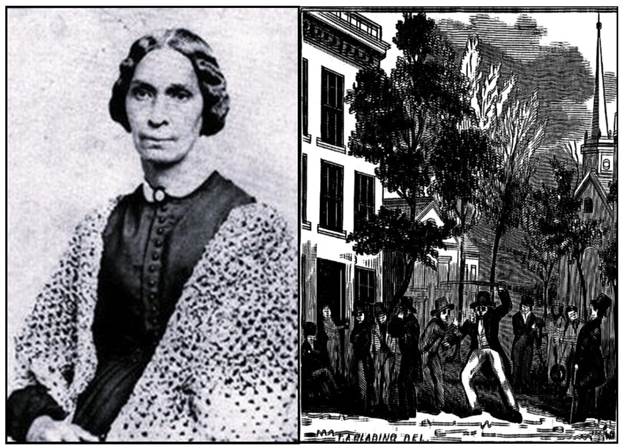
Passaic River in Newark, circa, 1875

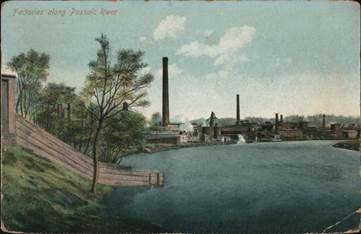
“The river’s pollution problems worsened right around the time the Essex County Park Commission first convened, in 1894, as oil refining and trade activities in the Newark area picked up and a drought lowered water levels in the Passaic.  That summer, acid fumes caused paint to peel from riverside structures, triggering nosebleeds and nausea.  Meanwhile, oil products, sewage, and factory waste continued to cause the river’s quality to plummet, so that by 1897 the local sewerage commission declared its “fisheries…destroyed.” The river’s recreational value also declined: Boating clubs stopped holding regattas along the Lower Passaic in 1900, children swimming in its waters at the turn of the century emerged “covered with oil and tar,” and many residents living along the river abandoned their homes.”  (page 43)

Passaic River in Newark, circa 1940

New Jersey is the most densely populated state in the United States and one of the most densely populated regions in the world. The people of New Jersey depend on reservoirs and ground water for potable drinking water. Our potable water is threatened by droughts, the movement of salt water into ground water, pollution, and depleted oxygen from warmer temperatures. The effects of a changing climate are the biggest threat to New Jersey, which makes the study of our environmental history an urgent priority.

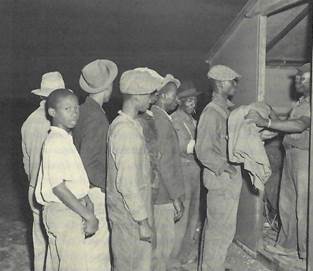
The two chapters on agricultural history include information on Seabrook Farms, the challenges facing small truck farms in New Jersey, and the conditions experienced by migrant workers from the South, Italy, and the Caribbean. For social studies teachers these chapters provide a perspective on loans provided by the Reconstruction Finance Corporation in the Hoover Administration and the effects of the Great Depression, wars, technology, and weather on Seabrook Farms and New Jersey agriculture. The research is commended and the personal stories and images are powerful.

Migrant workers receiving blankets in 1942 (page 123)

The New Jersey Social Studies Standards provide sufficient emphasis on labor history, transportation history, and immigration history. The chapters in New Jersey’s Natures on the agricultural history of New Jersey and the debate over state financial assistance to control the mosquito and drain the stagnant water of our salt marshes provide information leading to the decisions of local, county, and state governments regarding the Jersey shore, agriculture, and fisheries. Social Studies instruction about the significance of the Morrill Act (1862) and the Smith-Lever Act (1914) should include the contributions of Rutgers University to dairy and vegetable farmers today as each year average temperatures are increasing and sea levels rising.  The environmental history of New Jersey in the next decade is likely to see dramatic changes and challenges for our state government.

“In the 20th century, sea level rose by 12 inches at bedrock locations (Bayonne, Trenton, and Camden). Along the Jersey shore from Sandy Hook to Cape May, it rose an additional four inches due to compaction of sediments caused by natural effects and groundwater withdrawal. There is a 95% probability that the 20th century rate of sea-level rise along the New Jersey shore was faster than it was in any century in the last 4,000 years.” Source (Rutgers University)

The teaching of the market revolution in middle and high school focuses on the Erie Canal and manufacturing in New England. An important contribution in this book is the forgotten story of oysters, muskrats, and sturgeons in Delaware Bay.  Bivalve was the center of the oyster market and with the Central Railroad connections to major carriers, annual production exceeded one million oysters annually.  Teachers looking for a local history lesson emphasizing the importance of civic engagement will also find the chapter on the arguments for and against a jetport in the Pine Barrens to have value. The information in “The End of These Woods: The Pinelands Jetport and Grassroots Environmentalism in the New Jersey Pine Barrens” will find the debate over housing, economic growth, and the need for a large airport to serve Atlantic City and Philadelphia to be informative. The Pine Barrens are a protected area that comprises 20% of the land in our state and includes populated towns in seven counties. In New Jersey, then and today, the protection of the environment appears to be a lower priority in the debate for economic growth and personal opportunity. The debate regarding the development of the Pine Barrens did not end with Governor William Cahill in the 1960s and the current threats from recreation, pollution, illegal dumping, lack of leadership, fires, and water use are topics every student needs to be informed about.

Photograph by Harvey W. Porch, (c. 1905-1915(page 178)

The Beach Park Act of 1894 from an environmental perspective provides another opportunity for analysis of the Jersey shore economy over time. The Jersey Shore is the one geographic location in New Jersey that every student from kindergarten through college can identify with. The article “Reclaiming the Boardwalk” includes case studies of Atlantic City and Asbury Park. The development of these resorts’ centers on the issue of private v. public ownership. For teachers who value interdisciplinary instruction during the Industrial Revolution and the Progressive Era, this article prompts a search for literature, Protestant religion (Methodist Church), economics, art, music, and science.

I was impressed with the number of questions that came to my mind as I was reading New Jersey’s Natures. Some of my questions were:

  1. How have people used this brook, stream, or river over time?
  2. Why does the Garden State Parkway divide a cemetery in Newark?
  3. Why do our state roads have many curves?
  4. Why do many towns in New Jersey have names with Biblical references? (Zarephath, Mount Olive, Asbury, Shiloh, Tabernacle, Brainard, Churchtown, Galilee, etc.)
  5. What did people from the past see and think as they travel through New Jersey?
  6. What changes have I seen to the landscape of New Jersey in my lifetime?

Environmental history prompts thinking about the human impact on place, the shaping of policy decisions by government over time, and the importance of nature in shaping the historical record.

New Jersey’s Natures: Environmental Histories of the Garden State is available from Rutgers University press, ISBN: 9781978836433  Published: May 12, 2026, 280 pages.

Book Review – Revisiting Jared Diamond’s Guns, Germs and Steel

Jared Diamond’s Guns, Germs, and Steel (New York: Norton, 1997) is one of those books that feels revelatory the first time you read it. It takes a question that most people rarely stop to ask, “Why some societies ended up rich and powerful while others did not?,” and reframes it in a way that is both unsettling and reassuring. Unsettling, because it strips away comforting myths about cultural superiority and human exceptionalism, and reassuring, because it offers an explanation that does not rely on racism, divine favor, or civilizational destiny. Diamond’s central claim is that geography, rather than biology or culture, played the decisive role in shaping global inequality. In the epilogue, he steps back to defend this framework, clarify its limits, and argue that history itself can be studied scientifically.

Diamond’s ambition is enormous; he is trying to explain a great deal of human history with a single organizing framework. Geography, in his telling, shapes the availability of domesticable plants and animals, the timing of agriculture, population density, technological development, and ultimately conquest. By the time Europeans reached the Americas, the outcome was already largely predetermined by thousands of years of environmental advantage. Diamond is careful to insist that geography constrains rather than dictates outcomes, but it is hard to miss how much explanatory weight geography is made to carry.


In the epilogue, Diamond anticipates the charge of environmental determinism and pushes back. History, he argues, can still be studied scientifically, even if we cannot run controlled experiments. Continents and societies function as natural experiments, allowing historians to compare different environments and identify broad, recurring patterns. Diamond is explicit about what he believes his framework does and does not explain. He is not accounting for individual leaders, specific events, or moral responsibility. Instead he is explaining why some societies had early advantages and others did not.


When Diamond stays within these bounds, his arguments are often extremely persuasive. His comparison between Eurasia and the Americas is a good example. Eurasia benefited from an abundance of domesticable plants and animals, including wheat, barley, cattle, pigs, and horses, which supported early agriculture, large populations, and dense settlements. Dense populations, in turn, produced epidemic diseases, and over time, immunity. When Europeans arrived in the Americas, they brought not only steel weapons and guns, but germs to which they had long been exposed. Indigenous populations, lacking similar disease histories, were devastated. Diamond’s point is not that Europeans were smarter or more capable, but that they inherited a vastly different historical trajectory shaped by their environment.


The same logic applies to Diamond’s discussion of continental axes, particularly the
contrast between Eurasia’s east-west orientation and the Americas’ north-south orientation. Eurasia’s east-west axis allowed crops, animals, and technologies to spread across similar latitudes and climates with relative ease. Innovations could diffuse over thousands of miles without needing to adapt to radically different environments. In the Americas, by contrast, north-south diffusion meant crossing deserts, jungles, mountains, and sharp climatic transitions. This slowed the spread of
agriculture and technology and limited large scale integration. Over millennia, these differences compounded. Geography, in Diamond’s account, does not merely shape local conditions, it shapes connectivity itself.


Where Diamond’s framework begins to strain is when it starts to feel like a master key rather than one tool among many. In the epilogue, he insists that geography is not destiny, yet culture often appears in his account as a thin downstream effect of environmental constraints. Culture adapts to geography, rather than actively shaping how societies respond once similar options exist. This is where the model starts to feel incomplete. Culture is not just decoration layered on top of material conditions. It is the air we breathe, the water we swim in, and the lens through which material realities are interpreted. Societies facing similar geographic constraints can still make very different choices, build different institutions, and value different outcomes.


Diamond acknowledges this problem in theory but tends to underplay it in practice. He is strongest at explaining origins and weakest at explaining persistence and divergence. Geography helps explain why certain possibilities existed, but it does not fully explain why some societies embraced particular paths while others did not, even when those paths were available. Once agriculture, technology, and states exist, culture feeds back into material conditions in complex ways. Institutions, norms, and values can amplify or blunt geographic advantages, and these feedback loops receive less attention than they deserve.


This tension becomes even more apparent when Diamond’s framework is applied to
contemporary global developments. Geography still matters enormously. Climate vulnerability, access to arable land, exposure to disease, and proximity to trade routes continue to shape global inequality. The uneven impact of climate change, for example, follows geographic lines Diamond would immediately recognize. At the same time, globalization, technology, and political institutions complicate the picture. Some societies have used technology and collective action to mitigate geographic disadvantages, while others have failed to do so despite favorable conditions. Here again, culture and politics mediate geography’s effects.


Diamond deserves credit for what he is trying to do. He offers a corrective to explanations that blame the victims of history for their own misfortune or attribute inequality to inherent superiority. His framework insists that history’s winners were not morally better or biologically superior, merely luckier in where they happened to have been born. That insight alone makes Guns, Germs, and Steel worth reading.


The epilogue clarifies what Diamond believes his project to be. Geography is not the whole story, but it is an essential part of it. Diamond is at his best when he treats geography as an ingredient rather than a recipe. History is shaped by environments, material conditions, and culture together. No single theory explains everything. Diamond’s contribution is to remind us how much of the story begins long before anyone makes a conscious choice, and how deeply the ground beneath our feet has shaped the world we inherited.

Book Review – Take Back the Power: The Fall and Rise and Fall of NYC’s Transport Workers Union Local 100,1975-2009

Marc Kagan, the author of Take Back the Power, and I share what I suspect is a pretty
unusual work history, we were both New York City transit workers and New York City high school social studies teachers, and we currently both teach at colleges. Kagan was a mechanic and forklift operator at the 207th Street subway yard in Upper Manhattan and a local union activist. He later taught social studies at the Bronx High School of Science where New York City Mayor Zohran Madani was one of his students. Kagan has a PHD in History from the CUNY Graduate Center and is an adjunct professor at the City University. I was an MTA bus driver for only a year in the 1970s after being laid off as a teacher when New York City went bankrupt. Kagan, however, spent twenty years as a union activist while a member of Local 100 of the
Transit Workers Union (TWU) fighting against on site management authoritarianism, trade union bureaucracy, and broader anti-worker austerity
economics.


In this book Kagan draws on his own experience as an organizer, interviews with TWU activists, and the history of the TWU to present a strategy for revitalizing the labor movement. The book is volume 7 of Studies in Political Economy of Global Labor and Work. Part 1 analyzes “The Fall of the House of Labor” and the “New Directions Project” that helped radicalized transit union members, and “Local 100, the Transit Industry, and New York City’s Fiscal Crisis.” Part 2 focuses on “The Fall of TWU Local 100, Part 3 on the local’s resurrection, and Part 4 on internal conflicts that contributed to its defeat. The text is 438 pages with additional appendixes.


After college, Kagan, a graduate of Yale University and a self-identified “enthusiastic
communist,” joined the working class as a leftist organizer and trade union activist and in 1984 he starting working for the New York City Metropolitan Transit Authority (MTA). At the MTA and as a member of the TWU worked was aligned
with Roger Toussaint, who would become the local President, to shape the program of the TWU union’s progressive New Directions caucus. Kagan reported that he and Toussaint were part of the same “left organization” that decided to colonize the TWU, a small group known as the Marxist-Leninist Party. There were also other left factions active in the TWU at the same time.


The New Directions caucus appealed to transit workers disenchanted with the union
leadership and demoralized by defeat in a 1980 strike. Promising to promote union democracy, “take back the power” through shop floor militancy and in the process gain “dignity and respect” for transit workers, New Directions members were elected officers of the 35,000-person local in 2001. However, transformation of the work place proved difficult as they faced an entrenched bureaucratic MTA and a hostile political climate. Reform efforts sputtered and an unsuccessful 2005 strike by the local, what Kagan describes as largely a defensive effort, failed to secure contract demands satisfactory to the rank-and-file.


The problems faced by the New Directions caucus in transforming TWU Local 100 into a militant working-class organization were similar to situations in other labor unions. Leftist union activists have to combat powerful national anti union trends and “neo-liberal” ideas and organizations that shape government policy. Kagan and other labor union leftists believed that worker engagement is key to greater union power but found that their co-workers tend to accept workplace conditions and even when “restive about even egregious violations of safety or elimination of long-observed work routines,” their upset is often temporary and does not contribute to a broader understanding of the power they could marshal as a class-conscious union. In many cases, workers turn apathetic or even hostile towards union leadership as shop stewards become seen as agents of corporations and government agencies, enforcing contractual work rules that workers found unfair and instead of issues being resolved on the shop floor, they became enmeshed in long, drawn out, multi-layered, grievance procedures.


Part of the problem Kagan sees is that even if reformers gain power within unions like the TWU they can grow distant from their rank-and-file roots and are perceived as partners with management in enforcing contractual guidelines on union members. This problem eventually led to Kagan’s split with Roger Toussaint who he argues once in office shifted away from democratic unionism to a more autocratic top-down style. The acquisition of power in the union also led to the demise of the TWU New Directions caucus as the conflicting agendas of different factions broke up what was essentially a coalition. The collapse of New Directions prevented what could have been a potential break on Toussaint’s drift away from democratic unionism.


An additional problem in organizing in the TWU is related to the nature of the work, which is similar to other industrial unions with diverse job categories and pay scales. Kagan worked in a shop where workers could congregate, bullshit with each other, and develop relationships. Much of his experience as a transit worker was shaped by shop comradery. Bus drivers like me drove alone and saw each other only briefly during short breaks. With little experience or job protection, I was very dependent on the shop steward when I was involved in a fender bender and when I tried to shift my days off to a weekend because of family responsibilities.


Once I was late for a midnight shift and the dispatcher covered for me, reassigning me to a later route. In some ways the dispatcher was more of a friend to me as a worker than was the shop steward who represented the union. I learned from a friend that many of the dispatchers had been stewards before being promoted, so that steward was seen as a path to advancement.


I had planned to work for the MTA much longer and become involved with union organizing, but the hiring freeze at the New York City public school system was lifted and I returned to teaching. The most important thing I learned as a bus driver is that my co-workers on the midnight shift at the East New York Brooklyn garage (who were almost all African Americans) were very proud of being transit workers. It was a decent paying job with health benefits. It gave them the ability to be homeowners and many were deacons in their churches and active in local youth sports. These were not things they were willing to jeopardize through union militancy.


Kagan does discuss racial/ethnic division within the union. When I was at transit, shop or operating authority (OA) workers were much more likely to be white than bus drivers. Many were Irish and still had connections to radical union leadership
with communist ties that led a successfully 1966 mass transit strike. Kagan believes these divisions became less pronounced in later decades, but there were always new divisions as more women entered the MTA workforce as well as Latinx and South Asians.


Kagan titled his last chapter, Chapter 12, “The Dilemmas of Union Revitalization.” He
opened the chapter with an insightful and problematic quote from Paulo Freire’s Pedagogy of the Oppressed (NY: Continuum, 2005). “Since the leaders need the adherence of the people so the revolution can be achieved (but at the same time mistrust the mistrustful people), they are tempted to utilize the same procedures used by the dominant elites to oppress.” Of course this is not just a problem for union organizers, but it is a problem in every successful revolutionary movement. “By advancing along these paths, the paths of oppression, they will not achieve revolution; or if they do, it will not be authentic revolution” (166).


In this chapter Kagan discusses the dilemmas that face union activists, conflicts that
need to be resolved, pathways that need to be established, but given the broader conditions, may not be resolvable. Kagan believes New Directions was too focused on fighting the established TWU leadership and not focused enough on fighting management so when it elected new leaders its energy dissipated. Because of the focus on getting rid of the old guard, New Directions did not invest enough time and effort on educating union members on the importance of union militancy and the need for broader worker consciousness. Most workers were concerned with bread-and-butter demands, while the left activists had broader aims for transforming work and potentially society.

A commitment to participatory democracy also created problems for progressives who thought there plan of action was the correct path but were not necessarily able to convince people to go along with them. Participatory democracy also could lead to endless and crippling factional debates. Even within a leftwing group like the Marxist-Leninist Party, the demand for group disciple once decisions were made bridled people who felt the decision was undemocratic or unwise and continued to disagree.


I’m from the 1960s radical generation that Kagan describes shaping New Directions in the TWU, although my commitment was to community organizing rather than Kagan’s decision to try to build a radical union movement. I think we both saw teaching as a way to continue our progressive agendas after organizing efforts stalled. In much of this book, Kagan rechews the battles he fought and I was glad to revisit them with him. Sometimes it seems he was stuck in refighting them, however for me, and I think Marc Kagan, the reason to write this book was to influence the next generation of progressive organizers so hopefully they will be more successful than we were. Kagan’s analysis of the history and the squabbles within New Directions and the TWU leadership provides incredibly valuable lessons for organizers and I am very glad he chose to share them with us.

First-Hand Accounts of the European Holocaust


These books are first-person testimonies from survivors of the World War II European Holocaust. Most, but not all, of the survivor stories were written by Jews. The ability of students to meet survivors will soon end, so these accounts take on
even greater historical and educational significance. The reviews are ordered by publication date.


The books reviewed are:

  • Smoke Over Birkenau, Seweryna Szmaglewska
  • Five Chimneys, Olga Lengyel
  • The Diary of a Young Girl, Anne Frank
  • Man’s Search for Meaning, Viktor Frankl
  • Night, Elie Wiesel
  • Auschwitz, Miklos Nyiszli
  • I Cannot Forgive, Rudolf Vrba and Alan Bestic
  • Auschwitz and After, Charlotte Delbo
  • Eyewitness Auschwitz, Filip Müller
  • Survival in Auschwitz, Primo Levi
  • Smoke Over Birkenau, Liana Millu
  • There Is a Place on Earth: A Woman in Birkenau, Giuliana Tedeschi
  • Europa, Europa, Shlomo Perel
  • A Gypsy in Auschwitz, Otto Rosenberg
  • People in Auschwitz, Hermann Langbein
  • A Lucky Child, Thomas Buergenthal
  • At the Mind’s Limits, Jean Amery
  • First One In, Last One Out, Marilyn Shimon
  • The Survivor, Josef Lewkowicz with Michael Calvin
  • Lipstick in Auschwitz, Miriam Nick Smoke Over Birkenau, Seweryna Szmaglewska (Holt, 1945)
  • Seweryna Szmaglewska was a Polish Catholic writer and journalist arrested in 1942 and imprisoned at Auschwitz-Birkenau. She survived and was liberated in January 1945. Her account of the camp was published in Polish in 1945 making it one of the earliest first-hand descriptions of the extermination process to reach the public. She later testified before the Nuremberg Military Tribunal where her book was entered into the trial record as evidence. Her account focuses on daily life in the women’s section of Birkenau. She explores the routines, the hunger, the selections, and the constant visibility of death. The title of the book refers to the smoke rising continuously from the crematoria that prisoners could see from across the camp. This account shaped the historical and legal understanding of the Holocaust in the years following the war. Its use at Nuremberg gives it a significance beyond testimony alone.
  • Five Chimneys, Olga Lengyel (Original English edition, Ziff-Davis, 1947)
  • Five Chimneys: The Story of Auschwitz is a memoir by Olga Lengyel, a Jewish woman from Transylvania who survived the Auschwitz-Birkenau concentration camp. Lengyel was deported to Auschwitz in 1944 along with her parents, husband,
    and two young sons. Upon arrival, her children and parents were immediately murdered in the gas chambers. Lengyel was assigned to the women’s section of the camp where she endured forced labor, starvation, disease, and constant terror. The title of the book refers to the crematoria at Auschwitz, whose chimneys continually released smoke from the bodies of murdered prisoners. In her memoir, Lengyel describes the daily life of female prisoners and the brutal system that governed the camp. She recounts the roles played by prisoner functionaries,
    including kapos, as well as the complex moral choices people faced in order to survive. The book also describes the medical experiments and mass killings carried out by the Nazis. Published shortly after the war in 1947, Five Chimneys was one of the earliest detailed accounts of Auschwitz written by a survivor. Lengyel later devoted much of her life to Holocaust education and remembrance. Her memoir remains an important testimony about the experiences of women in Nazi concentration camps.
  • The Diary of a Young Girl, by Anne Frank (Original English edition, New York: Doubleday, 1952 with an introduction by Eleanor Roosevelt)
  • The Diary of a Young Girl by Anne Frank was originally published in The Netherlands in 1947 as The Annex (Het Achterhuis). Anne Frank was a thirteen-year-old Jewish girl who hid from the Nazis with her family and others in Amsterdam during occupation by Nazi Germany. Anne’s diary documents life in hiding ranging from the food they ate to the interpersonal dynamics within the Annex. The diary serves as a historical document, but also a deeply personal narrative that brings to life the fears of a young person amidst the Holocaust. Anne was captured in a Nazi raid on the secret annex in August 1944 and she died in Bergen-Belsen concentration camp in either February or March 1945.
  • Man’s Search for Meaning, Viktor Frankl (Original English edition, Beacon, 1959)


Man’s Search for Meaning by Viktor Frankl combines memoir and psychological reflection based on the author’s experiences in Nazi concentration camps during World War II. Frankl was an Austrian psychiatrist who was deported to camps including Auschwitz, Dachau, and other Nazi labor camps between 1942 and 1945. Much of his family perished in the Holocaust, including his parents and pregnant wife. In the first section of the book, Frankl describes daily life in the camps,
including forced labor, starvation, disease, and the constant presence of death. He recounts how prisoners struggled to maintain hope and dignity under brutal conditions. Frankl observed that, while prisoners could not control their circumstances, they could still choose their attitude toward suffering.
The second part of the book introduces Frankl’s psychological theory known as logotherapy, which argues that the primary human drive is the search for meaning in life. According to Frankl, individuals who were able to find purpose, whether through love, faith, or future goals, were often better able to endure the extreme hardships of camp life. First published in 1946, Man’s Search for Meaning became one of the most influential psychological and philosophical works of the twentieth century. It offers both a personal account of survival and a reflection on how humans can find meaning in even the most tragic of circumstances.

Night, Elie Wiesel (Original English edition, Hill and Wang, 1960)

Elie Wiesel’s Night is one of the most widely read Holocaust memoirs and recounts his experiences as a Jewish teenager during the Nazi genocide. Wiesel grew up in Sighet, a small town in Transylvania that was then part of Romania. In 1940 the village became part of Hungary and in 1944, when he was fifteen, German forces occupied Hungary and quickly began deporting Jews to concentration camps. Wiesel and his family were sent to Auschwitz, where his mother and younger sister were immediately murdered in the gas chambers. Wiesel remained with his father and endured forced labor, starvation, brutality, and constant fear of death. The memoir follows his movement from Auschwitz to the Buchenwald concentration camp as the Nazis evacuated prisoners during the final months of the war.
Throughout the narrative, Wiesel describes the physical and psychological trauma of camp life, including the breakdown of moral norms among prisoners struggling to survive. The book also explores Wiesel’s crisis of faith as he witnesses immense suffering and cruelty. His relationship with his father becomes the emotional center of the story as they try to survive together in the camps.
Published in 1956 in Yiddish and later translated into many languages, Night became one of the defining literary accounts of the Holocaust and is widely used in schools to teach about genocide and memory. After reading Night in its original Yiddish, I understand why the versions meant for mass consumption were heavily edited. Setting aside the length, the Yiddish version is more than 800 pages, the content, style and references are way too Jewish for a non-Jewish audience, and way too subversive and racy for the Orthodox world. I suspected few religious Jews could appreciate his yeshiva boy style, while not being scandalized at references to sex, or confronting God, or some Jews for not being “ideal victims.”

Auschwitz: A Doctor’s Eyewitness Account, Miklos Nyiszli (Original English edition, Crest, 1961)

Auschwitz: A Doctor’s Eyewitness Account is the memoir of Miklos Nyiszli, a Hungarian Jewish doctor who was deported to Auschwitz in 1944. Upon arrival, Nyiszli was selected to work as a pathologist for the notorious SS doctor Josef Mengele. Because of his medical training, Nyiszli was forced to assist Mengele with examinations and autopsies related to the doctor’s experiments on prisoners. This position allowed Nyiszli to witness many aspects of the camp’s operations, including
medical experiments and the functioning of the crematoria. Although his role gave him slightly better living conditions than most prisoners, Nyiszli remained a prisoner under constant threat of death.
His memoir describes both the horrors of the camp and the moral dilemmas he faced while being forced to participate in the Nazi system. Nyiszli’s testimony provides a rare perspective on the camp from the viewpoint of a prisoner who worked within the medical system of the camp administration. The memoir remains an
important historical source about the activities of Nazi doctors during the Holocaust.

I Cannot Forgive, Rudolf Vrba and Alan Bestic (Sidgwick and Jackson, 1963)

Rudolf Vrba was a Slovakian Jew born Walter Rosenberg in 1924. He was deported to
Auschwitz in 1942 where he worked in various parts of the camp including the section where arriving transports were processed. In April 1944, he and fellow prisoner Alfred Wetzler successfully escaped from Auschwitz. After their escape, Vrba and Wetzler compiled a detailed thirty-page report documenting the layout of the camp and the systematic mass murder taking place there. The Vrba-Wetzler Report was delivered to Allied governments and Jewish leaders. Vrba spent the rest
of his life as a scientist and pharmacologist and died in 2006. His memoir was written with journalist Alan Bestic. I Cannot Forgive recounts Vrba’s two years inside Auschwitz and the planning and execution of the escape. This book addresses the role of bystanders and the failure of international institutions to respond. It questions the moral responsibilities of governments and organizations that received evidence of genocide and did not act.

Auschwitz and After, Charlotte Delbo (French edition, 1965. Original English Edition, Yale University Press, 1995)

Charlotte Delbo was a French writer and member of the resistance. She was arrested in 1942 and was deported to Auschwitz as part of a convoy of 230 French women. Of the 230 women only 49 survived. Delbo was later transferred to Ravensbrück before being released through a Red Cross negotiation in April 1945. She wrote her account of the camps immediately after the war but chose not to publish it until 1965, believing the story needed time after the war to be fully understood. She went on to write plays and essays and remained a committed voice against fascism until her death in 1985. Auschwitz and After is a three-part work that combines prose and poetry to recount Delbo’s experience in Birkenau. The story explores her transfer, death march, and the long years of psychological aftermath that followed liberation. The final section deals with the difficulty of returning to ordinary life and is one of the most powerful literary testaments of survivor trauma ever written. This account is significant because Delbo approached the Holocaust not only as a witness, but
also as a literary artist. The book supports interdisciplinary instruction across history and literature. Her poem “O You Who Know,” (“Vous qui saviez”) challenges the reader to consider the inadequacy of what they think they understand. “O you who know / Could you know that hunger makes the eyes sparkle? / While thirst makes them dim? / You who know, / Could you know that you can see your mother dead, / Without shedding a tear? / You who know, / Could you know how in the morning you crave death, / Only to fear it by evening?”

Eyewitness Auschwitz: Three Years in the Gas Chambers, Filip Müller (Original English edition, Stein, 1979)

Eyewitness Auschwitz is the memoir of Filip Müller, one of the very few members of the Sonderkommando who survived the Holocaust. Müller was a Slovak Jewish prisoner deported to Auschwitz in 1942. Shortly after arriving, he was forced into the Sonderkommando, a special unit of prisoners compelled to work in the gas chambers and crematoria. Members of the Sonderkommando were forced to remove bodies from the gas chambers, extract gold teeth, and burn the corpses in crematoria. Because they witnessed the mass murder of prisoners, the Nazis regularly killed Sonderkommando workers to eliminate witnesses. Müller survived this position for three years, an extremely rare occurrence. In his memoir, Müller provides one of the most detailed first-hand descriptions of how the extermination process at Auschwitz functioned. He describes the arrival of transports, the deception used to send victims into gas chambers, and the mechanics of the crematoria.
The book is particularly significant because it reveals the psychological burden faced by prisoners forced to assist in the killing process. Müller’s testimony became an important historical source and was later used in trials against Nazi war criminals. His memoir remains one of the most powerful and disturbing eyewitness accounts of the Holocaust.

Survival in Auschwitz, Primo Levi (Original English edition, Summit, 1986)

Survival in Auschwitz, also known as If This Is a Man, is a memoir by Italian Jewish chemist Primo Levi about his imprisonment in the Auschwitz concentration camp. Levi was arrested by Italian Fascists in 1943 and deported to Auschwitz the following year. Upon arrival, most of the people on his transport were immediately murdered, while Levi was selected for forced labor. Levi spent approximately eleven months in
Auschwitz before the camp was liberated by Soviet forces in January 1945. His background as a chemist eventually allowed him to work in a laboratory, which slightly improved his chances of survival. In the memoir, Levi describes the harsh
realities of camp life, including starvation, disease, violence from guards, and the constant struggle among prisoners for survival. Unlike some memoirs that focus mainly on emotional responses, Levi carefully analyzes the social structure of the camp system. He explains how the Nazis created a brutal hierarchy among prisoners and how survival often depended on luck, resourcefulness, and small advantages. First published in Italy in 1947, the book is widely considered one of the most important literary testimonies of the Holocaust. Levi’s clear and analytical writing style provides readers with a detailed picture of the daily functioning of Auschwitz and the moral challenges faced by those imprisoned there.


Smoke Over Birkenau, Liana Millu (Original English edition, Jewish Publication Society, 1991)

Smoke Over Birkenau is a collection of short memoir stories written by Liana Millu, an Italian Jewish survivor of the Auschwitz-Birkenau concentration camp. Millu was deported to Auschwitz in 1944 after being arrested for her involvement with the Italian resistance against Nazi occupation. Unlike many memoirs that follow a single chronological narrative, this book consists of several short accounts describing the lives of women prisoners in Birkenau. Each story focuses on a different individual and highlights the emotional struggles faced by women trying to survive in the camp. Millu writes about friendships, hopes, betrayals, and the desperate attempts by prisoners to maintain dignity in an environment designed to destroy humanity. The stories reveal how small acts of kindness or solidarity sometimes helped prisoners endure the brutal conditions of camp life. First published in Italy in 1947, the book was one of the earliest literary accounts of women’s experiences in Auschwitz. Millu’s writing combines personal memory with a reflective style that captures the emotional impact of life in the camp. The memoir remains an important contribution to Holocaust literature, particularly for its focus on the perspective of female prisoners.

There Is a Place on Earth: A Woman in Birkenau, Giuliana Tedeschi (Random House, 1993)

Giuliana Tedeschi was an Italian Jewish woman and mother of two from Turin who was a teacher and a writer. She was deported from Italy to Auschwitz in April 1944 along with her husband and mother-in-law. Neither of them survived the
Holocaust. After liberation, she returned to Italy and
dedicated much of her life to Holocaust education
and public testimony. Tedeschi died in 2010 at the age of 96. In her memoir, Tedeschi described the squalor, starvation, and torment of the camps and
living in the shadow of the crematorium. She
explored the daily struggle for survival, the solidarity formed between women prisoners, and
the effort to hold onto identity and dignity inside a system built to destroy both. It is an important memoir because it describes relationships between
women and solidarity as the basis for psychological
survival. During her imprisonment, Tedesci’s
daughters were hidden by a Catholic family. Mother and daughters were reunited after the war.

Europa, Europa, Shlomo Perel (Original English edition, Trade Paper, 1999)

Europa, Europa is the memoir of Shlomo Perel, a Jewish boy who survived the Holocaust by hiding his identity and posing as a German. Perel was born in Germany in 1925 to a Jewish family. When the Nazis came to power, his family fled to
Poland to escape persecution. After Germany invaded Poland in 1939, Perel became separated from his family and was captured by Soviet forces. Later he fell into German hands but managed to convince them that he was an ethnic German rather than a Jew. Because he spoke fluent German and knew the culture, the Nazis accepted his claim. Perel spent several years living among Germans, even attending a Hitler Youth school while hiding the fact that he was Jewish. His survival depended on constant deception and the fear that his identity might be discovered at any moment.
The memoir describes the strange and dangerous situation of a Jewish teenager living inside Nazi society while secretly belonging to the
group the Nazis sought to destroy. After the war, Perel eventually emigrated to Israel. His story was later adapted into a successful film, also titled
Europa, Europa, which helped bring his extraordinary survival story to a wider audience.

A Gypsy in Auschwitz, Otto Rosenberg (Original English edition, Allison and Busby, 2001)

A Gypsy in Auschwitz is the memoir of Otto Rosenberg, a member of the Roma community who survived Nazi persecution during the Holocaust. Rosenberg was born in Germany in 1927 and was targeted by the Nazi regime because the Roma were considered racially inferior under Nazi ideology. During World War II, Rosenberg was arrested and eventually deported to Auschwitz-Birkenau, where the Nazis had established a special section for Roma prisoners known as the “Gypsy camp.” Conditions in this camp were extremely harsh, with overcrowding, disease, and starvation common among prisoners. Rosenberg describes witnessing the destruction of the Roma section of the camp in 1944, when thousands of Roma men, women, and children were murdered in the gas chambers. He survived by being transferred to other camps, including Buchenwald, before eventually being
liberated near the end of the war. His memoir highlights the often overlooked genocide of the Roma people during the Holocaust. After the war, Rosenberg became an advocate for Roma rights and worked to educate others about the persecution his community suffered under the Nazi regime.

People in Auschwitz, Hermann Langbein (North Carolina Press, 2004)

Hermann Langbein was an Austrian communist who was imprisoned at Dachau before being transferred to Auschwitz. At Auschwitz he worked as a clerk for SS physician Dr. Eduard Wirths. His administrative position gave him access to records, personnel, and encounters with both perpetrators and prisoners. After the war he became one of the most important figures in documenting Nazi crimes and played a central role in organizing the Frankfurt Auschwitz Trials of the 1960s. While Langbein draws on his own experience, People in Auschwitz is not a personal memoir, but a sweeping historical account of the entire Auschwitz camp complex that covers its administration, its prisoner population, its SS personnel, and the social structures that developed within its walls. This account is important because it documents how Auschwitz functioned as a system, bureaucratic, hierarchical, and deliberately organized. It is an invaluable reference for teachers and students engaged in serious research about the Holocaust.

A Lucky Child: A Memoir of Surviving Auschwitz as a Young Boy, Thomas Buergenthal (Original English edition, Hachette, 2007)

A Lucky Child tells the story of Thomas Buergenthal, who survived the Holocaust as a young boy. Buergenthal was born in 1934 to a Jewish family in Czechoslovakia. When the Nazis occupied the region during World War II, his family was forced into a Jewish ghetto and later deported to Auschwitz. At Auschwitz, Buergenthal was separated from his mother and endured harsh conditions typical of concentration camps, including forced labor, starvation, and illness. As a child prisoner, survival was especially difficult, yet Buergenthal managed to endure through a combination of luck, resilience, and help from other prisoners. Later in the war, he was transferred to another camp and eventually survived a Nazi death march before
being liberated by Allied forces. After the war, Buergenthal eventually emigrated to the United States. He went on to become an important figure in international law and human rights, serving as a judge on the International Court of Justice. His memoir reflects not only on his childhood survival, but also on how those experiences shaped his later commitment to justice and human rights. The book
provides a unique perspective on the Holocaust through the eyes of a child survivor.

At the Mind’s Limits: Contemplations by a Survivor on Auschwitz and Its Realities, Jean Amery (Indiana University Press, 2009)

Jean Amery was born Hans Maier in Vienna in 1912. After Nazi Germany annexed Austria, he joined the Belgian resistance and was ultimately captured by the Gestapo in 1943. He was tortured by the SS and then deported to Auschwitz and later Bergen-Belsen. He did not publish his reflections on Auschwitz until 1966 and he took his own life in 1978. The book was written under a French name he adopted to conceal his German and Jewish origins. At the Mind’s Limits is a collection of philosophical essays where Amery explores what the Holocaust did to human consciousness. He
writes about torture, about being a Jewish intellectual in the camps, about the experience of aging as a survivor, and about resentment. He argued that survivors have a moral obligation not to forgive their persecutors. His essay on torture, in which he wrote, “I dare to assert that torture is the most horrible event a human being can retain within himself,” is considered one of the most important
texts ever written on the subject. He argued that “torture was not an accidental quality of this Third Reich, but its essence” and compares it to “rape, a sexual act without the consent of one of the two partners.” This account is important because it moves beyond testimony into analysis.

First One In, Last One Out: Auschwitz Survivor 31321, Marilyn Shimon (Create Space, 2016)

Marilyn Shimon is a Holocaust educator, retired teacher, and volunteer gallery educator at the Museum of Jewish Heritage in New York. She holds a certificate in Holocaust and Genocide Studies from Georgetown University as well as a master’s
degree from Hofstra University. Her book explores the story of her own uncle, Murray Scheinberg.
Scheinberg was a Polish Jew who received prisoner number 31321 and was among the first eight men to enter Auschwitz as a political prisoner in 1940 and was also among the last to escape Dachau in 1945. The memoir traces Scheinberg’s journey through a variety of locations including Pawiak prison in Warsaw, Tarnow prison, Auschwitz-Birkenau, Sachsenhausen, and Dachau. Shimon reconstructed this story from various sources including family testimony and historical records. A publisher
originally rejected the manuscript in the 1960s finding the details too extraordinary to be believed. Scheinberg was one of Auschwitz’s earliest prisoners which helps to offer a rare chronological view of how the camp system was built and expanded. The book illustrates how the Holocaust did not begin with gas chambers but with a deliberate and escalating system of imprisonment and dehumanization.

The Survivor: How I Survived Six Concentration Camps and Became a Nazi Hunter, Josef Lewkowicz with Michael Calvin (HarperCollins, 2025)

Josef Lewkowicz was a Polish Jew who was born near Krakow, Poland in 1926. When German forces occupied Poland in 1939, Lewkowicz was just thirteen years old and he and his family were deported to a Nazi concentration camp. Before being liberated by Allied forces in 1945, Lewkowicz passed through six concentration camps. He was the only member of his extended family of 150 people to survive. After the war Lewkowicz became a Nazi hunter who worked to identify and bring SS perpetrators to justice. Among those he pursued was Amon Goeth, the SS commandant of the Plaszow camp who was later depicted in the film Schindler’s List. Goeth was tried by a Polish court and executed in 1946.
Lewkowicz passed away in December 2024 at the age of 98, just weeks before his memoir was published. The memoir was co-written with British journalist Michael Calvin and follows Lewkowicz from the occupation of Krakow through liberation and his postwar pursuit of Nazi perpetrators. The book is as much an account of survival as it is a story of justice. The book is exceptionally useful because it raises questions that go beyond survival.
What does justice look like after genocide? What is the difference between simply getting revenge and accountability? The connection to Schindler’s List
provides students with a recognizable cultural entry
point into a deeper historical discussion.

Lipstick in Auschwitz, Miriam Nick (Valcal, 2025)

Miriam Nick was born and raised in Krakow, Poland and was seventeen when Germany invaded in 1939. She was relocated to the Krakow ghetto with her mother and subsequently deported through a series of seven concentration camps. She survived two death marches over five years of imprisonment. After the war, she studied at the Paris Academy of Arts and later taught art history in Israel. The memoir was originally written for her grandchildren before she died in 2012. The book centers on Nick’s experience alongside her mother in Auschwitz and other camps. The title refers to a pivotal moment upon arrival: facing the SS selection process that would determine whether they lived or died, Nick found a discarded tube of lipstick and applied it to both their cheeks to make them appear healthier and more capable of work. That small act may have saved both their lives. The book is particularly effective for discussing woman centric experiences in the Holocaust, the moral weight of everyday decisions under Nazi rule, and the meaning of resistance.

Albert Einstein and the Problem of War


Although Albert Einstein is best-known as a theoretical physicist, he also spent much of his life grappling with the problem of war. In 1914, shortly after he moved to Berlin to serve as director of the Kaiser Wilhelm Institute of Physics, Einstein
was horrified by the onset of World War I. “Europe, in her insanity, has started something unbelievable,” he told a friend. “In such times one realizes to what
a sad species of animal one belongs.” Writing to the French author Romain Rolland, he wondered whether “centuries of painstaking cultural effort” have “carried us no further than . . . the insanity of nationalism.”


As militarist propaganda swept through Germany, accompanied that fall by a heated
patriotic “Manifesto” from 93 prominent German intellectuals, Einstein teamed up with the German pacifist Georg Friedrich Nicolai to draft an antiwar response, the “Manifesto to Europeans.” Condemning “this barbarous war” and the “hostile spirit” of its intellectual apologists, the Einstein Nicolai statement maintained that “nationalist passions cannot excuse this attitude which is unworthy of what the world has heretofore called culture.”


In the context of the war’s growing destructiveness, Einstein also helped launch and
promote a new German antiwar organization, the New Fatherland League, which called for a prompt peace without annexations and the formation of a
world government to make future wars impossible. It engaged in petitioning the Reichstag, challenging proposals for territorial gain, and distributing statements by British pacifists. In response, the German government harassed the League and, in
1916, formally suppressed it.


After the World War came to an end, Einstein became one of the Weimar Republic’s
most influential pacifists and internationalists. Despite venomous attacks by Germany’s rightwing nationalists, he grew increasingly outspoken. “I believe the world has had enough of war,” he told an American journalist. “Some sort of international agreement must be reached among nations.” Meanwhile, he promoted organized war resistance, denounced military conscription, and, in 1932, drew
Sigmund Freud into a famous exchange of letters, later published as Why War.


Although technically a Zionist, Einstein had a rather relaxed view of that term, contending that it meant a respect for Jewish rights around the world. Appalled by Palestinian-Jewish violence in British ruled Palestine, he pleaded for cooperation between the two constituencies. In 1938, he declared that he would “much rather see reasonable agreement with the Arabs on the basis of living together in peace than the creation of a Jewish state.” He disliked “the idea of a Jewish state with borders, an army, and a measure of temporal power,” plus “the development of a narrow nationalism within our own ranks.”

The most serious challenge to Einstein’s pacifism came with the Nazi takeover of Germany in 1933 and the advent of that nation’s imperialist juggernaut. “My views have not changed,” he told a French pacifist, “but the European situation has.” As long as “Germany persists in rearming and systematically indoctrinating its citizens in preparation for a war of revenge, the nations of Western Europe depend, unfortunately, on military defense.” In his heart, he said, he continued to
“loathe violence and militarism as much as ever; but I cannot shut my eyes to realities.” Consequently, Einstein became a proponent of collective security against fascism.


Fleeing from Nazi Germany, Einstein took refuge in the United States, which became his new home. Thanks to his renown, he was approached in 1939 by one of his former physics students, Leo Szilard, a Hungarian refugee who brought ominous
news about advances in nuclear fission research in Nazi Germany. At Szilard’s urging, Einstein sent a warning letter to President Franklin Roosevelt about German nuclear progress. In response, the U.S. government launched the Manhattan Project, a secret program to build an atomic bomb. Einstein, like Szilard, considered the Manhattan Project necessary solely to prevent Nazi Germany’s employment of nuclear weapons to conquer the world. Therefore, when Germany’s war effort neared collapse and the U.S. bomb project neared completion, Einstein helped facilitate a mission by Szilard to Roosevelt with the goal of preventing the use of atomic bombs by the United States. He also fired off an impassioned appeal to the prominent Danish physicist, Niels Bohr, urging scientists to take the lead in heading off a dangerous postwar nuclear arms race. Neither venture proved successful, and the U.S. government, under the direction of the new president, Harry Truman, launched the nuclear age with the atomic bombing of Japan. Einstein later remarked that his 1939 letter to Roosevelt had been the worst mistake of his life.


Convinced that humanity now faced the prospect of utter annihilation, Einstein resurrected one of his earlier ideas and organized a new campaign against war. “The only salvation for civilization and the human race,” he told an interviewer in September 1945, “lies in the creation of a world government, with security of nations
founded upon law.” Again and again, he reiterated this message. In January 1946, he declared: “As long as there exist sovereign states, each with its own, independent armaments, the prevention of war becomes a virtual impossibility.” Consequently, humanity’s “desire for peace can be realized only by the creation of a world government.”


In 1946, he and other prominent scientists, fearful of the world’s future, established the Emergency Committee of Atomic Scientists. As chair of the new venture, Einstein repeatedly assailed militarism, nuclear weapons, and runaway nationalism. “We shall require a substantially new manner of thinking,” he said, “if mankind is to survive.”


Until his death in 1955, Einstein continued his quest for peace, criticizing the Cold War and the nuclear arms race and calling for strengthened global governance as the only “way out of the impasse.” Today, as we face a violent, nuclear armed world, Einstein’s warnings about unrestrained nationalism and his proposals to control it are increasingly relevant.

  • Einstein-Szilard Letter to President Franklin D. Roosevelt, August 2, 1939

    Background: Albert Einstein was the world’s most renowned physicist and a Nobel Prize winner. He fled Germany in the 1930s and established himself in the United States. Nuclear scientists Leo Szilard, Eugene Wigner, and Edward Teller, refugees from Nazi occupied Europe, persuaded Einstein to send a letter to President Franklin D. Roosevelt warning him of the possibility that Germany could develop an atomic bomb. In this letter, Einstein urged Roosevelt to support a program to develop atomic weapons.
    “Some recent work by E. Fermi and L. Szilard, which has been communicated to me in manuscript, leads me to expect that the element uranium may be turned into a new and important source of energy in the immediate future. Certain aspects of the situation which has arisen seem to call for watchfulness and, if necessary, quick action on the part of the Administration. I believe therefore that it is my duty to bring to your attention the following facts and recommendations:
    “In the course of the last four months it has been made probable — through the work of Joliot in France as well as Fermi and Szilard in America— that it may become possible to set up a nuclear chain reaction in a large mass of uranium by which vast amounts of power and large quantities of new radium-like elements would be generated. Now it appears almost certain that this could be achieved in the immediate future. This phenomenon would also lead to the construction of bombs, and it is conceivable — though much less certain — that extremely powerful bombs of a new type may thus be constructed. A single bomb of this type, carried by boat and exploded in a port, might very well destroy the whole port together with some of the surrounding territory. However, such bombs might very well prove to be too heavy for transportation by air. The United States has only very poor ores of uranium in moderate quantities. There is some good ore in Canada and the former Czechoslovakia, while the most important source of uranium is Belgian Congo.
    “In view of this situation you may think it desirable to have some permanent contact
    maintained between the Administration and the group of physicists working on chain reactions in America. One possible way of achieving this might be for you to entrust with this task a person who has your confidence and who could perhaps serve in an unofficial capacity. His task might comprise the following:
    “a) to approach Government Departments, keep them informed of the further development, and put forward recommendations for Government action, giving particular attention to the problem of securing a supply of uranium ore for the United States.
  • “b) to speed up the experimental work, which is at present being carried on within the limits of the budgets of University laboratories, by providing funds, if such funds be required, through his contacts with private persons who are willing to make contributions for this cause, and perhaps also by obtaining the co-operation of industrial laboratories which have the necessary equipment.
    “I understand that Germany has actually stopped the sale of uranium from the Czechoslovakian mines which she has taken over. That she should have taken such early action might perhaps be understood on the ground that the son of the German Under-Secretary of State, von Weizsäcker, is attached to the Kaiser-Wilhelm Institute in Berlin where some of the American work on uranium is now being repeated.”
  • The Franck Report, Report of the Committee on Political and Social Problems
  • Manhattan Project “Metallurgical Laboratory,” University of Chicago, June 11, 1945
  • Background: As the U.S. drew up plans to drop the first atomic bomb in August 1945, a group of scientists at the University of Chicago prepared a report arguing against the use of the bomb. Headed by James Franck and including notable scientists such as Leo Szilard and Glenn Seaborg, a Nobel laureate. The classified document was submitted to the Interim Committee, a group appointed by President Truman to advise him on the use of the bomb, in June 1945, one month before the Trinity
    test and two months before Hiroshima and Nagasaki. The Interim Committee rejected their recommendations.
  • A) “The development of nuclear power not only constitutes an important addition to the technological and military power of the United States, but also creates grave political and economic problems for the future of this country.”
  • B) “Nuclear bombs cannot possibly remain a ‘secret weapon’ at the exclusive disposal of this country, for more than a few years. The scientific facts on which their construction is based are well known to scientists of other countries. Unless an effective international control of nuclear explosives is instituted, a race of nuclear armaments is certain to ensue following the first revelation of our possession of nuclear weapons to the world. Within ten years other countries may have nuclear bombs, each of which, weighing less than a ton, could destroy an urban area of more than ten square miles. In the war to which such an armaments race is likely to lead, the United States, with its agglomeration of population and industry in comparatively few metropolitan districts, will be at a disadvantage compared to the nations whose population and industry are scattered over large areas.”
  • C) “We believe that these considerations make the use of nuclear bombs for an early, unannounced attack against Japan inadvisable. If the United States would be the first to release this new means of indiscriminate destruction upon mankind, she
    would sacrifice public support throughout the world, precipitate the race of armaments, and prejudice the possibility of reaching an international
    agreement on the future control of such weapons.”
  • D) “Much more favorable conditions for the eventual achievement of such an agreement could be created if nuclear bombs were first revealed to the world by a demonstration in an appropriately selected uninhabited area.”
  • Recommendation of the Scientific Panel of the Interim Committee
  • Background: The panel that issued this report to Secretary of War Henry Stimson consisted of four prominent physicists who were part of the Manhattan Project, J. Robert Oppenheimer, Director of the Los Alamos Laboratory; Enrico Fermi, lead scientist for the first nuclear reactor at the University of Chicago Met Lab; Arthur Compton, Nobel laureate and head of the Metallurgical Laboratory; and Ernest Lawrence, Nobel laureate and head of the Radiation Laboratory at UC Berkeley.
    “You have asked us to comment on the initial use of the new weapon. This use, in our
    opinion, should be such as to promote a satisfactory adjustment of our international relations. At the same time, we recognize our obligation to our nation to use the weapons to help save American lives in the Japanese war.

    (1) To accomplish these ends we recommend that before the weapons are used not
    only Britain, but also Russia, France, and China be advised that we have made considerable progress in our work on atomic weapons, and that we would
    welcome suggestions as to how we can cooperate in making this development contribute to improved international relations.
  • (2) The opinions of our scientific colleagues on the initial use of these weapons are not unanimous: they range from the proposal of a purely technical demonstration to that of the military application best designed to induce surrender. Those who advocate a purely technical demonstration would wish to outlaw the use of
    atomic weapons, and have feared that if we use the weapons now our position in future negotiations will be prejudiced. Others emphasize the opportunity of saving American lives by immediate military use, and believe that such use will improve
    the international prospects, in that they are more concerned with the prevention of war than with the elimination of this specific weapon. We find ourselves closer to these latter views; we can propose no technical demonstration likely to bring
    an end to the war; we see no acceptable alternative to direct military use.
    (3) With regard to these general aspects of the use of atomic energy, it is clear that we, as scientific men, have no proprietary rights. It is true that we are among the few citizens who have had occasion to give thoughtful consideration to these problems during the past few years. We have, however, no claim to special competence in solving the political, social, and military problems which are presented by the advent of atomic power.”
  • Petition to the President of the United States, July 17, 1945
  • Background: Nuclear physicist Leo Szilard, a refugee from Hungary who worked on the Manhattan Project, drafted a petition to President Harry Truman in the summer of 1945 hoping to avert the use of the atomic bomb against Japan. The petition was signed by seventy other scientists but was not seen by the President or the Secretary of War before the first atomic bomb was dropped on Hiroshima. Albert Einstein and Robert Oppenheimer were not listed as signers.
    “Discoveries of which the people of the United States are not aware may affect the welfare of this nation in the near future. The liberation of the atomic power which has been achieved places atomic bombs in the hands of the Army. It places in
    your hands, as Commander-in-Chief, the fateful decision whether or not to sanction the use of such bombs in the present phase of the war against Japan. We, the undersigned scientists, have been working in the field of atomic power. Until recently we have had to fear that the United States might be attacked by atomic bombs during this war and that her only defense might lie in a counterattack by the same means. Today, with the defeat of Germany, this danger is averted and we feel impelled to say what follows: The war has to be brought speedily to a successful conclusion and attacks by atomic bombs may very well be an effective method of warfare.
    We feel, however, that such attacks on Japan could not be justified, at least not until the terms which will be imposed after the war on Japan were made public in detail and Japan were given an opportunity to surrender. If such public announcement gave assurance to the Japanese that they could look forward to a life devoted to peaceful pursuit in their homeland and if Japan still refused to surrender, our
    nation might then, in certain circumstances, find itself forced to resort to the use of atomic bombs. Such a step, however, ought not to be made at any time without seriously considering the moral responsibilities which are involved.

    “The development of atomic power will provide the nations with new means of destruction. The atomic bombs at our disposal represent only the first step in this direction, and there is almost no limit to the destructive power which will become available in the course of their future development. Thus a nation which sets the precedent of using these newly liberated forces of nature for purposes of destruction may have to bear the responsibility of opening the door to an era of devastation on an unimaginable scale.
    “If after the war a situation is allowed to develop in the world which permits rival powers to be in uncontrolled possession of these new means of destruction, the cities of the United States as well as the cities of other nations will be in continuous danger of sudden annihilation. All the resources of the United States, moral and material, may have to be mobilized to prevent the advent of such a world situation. Its prevention is at present the solemn responsibility of the United States—singled out by virtue of her lead in the field of atomic power. The added material strength which this lead gives to the United States brings with it the obligation of restraint and if we were to violate this obligation our moral position would be weakened in the eyes of the world and in our own eyes. It would then be more difficult for us to live up to our responsibility of bringing the unloosened forces of destruction under control.
    “In view of the foregoing, we, the undersigned, respectfully petition: first, that you
    exercise your power as Commander-in-Chief, to rule that the United States shall not resort to the use of atomic bombs in this war unless the terms which will be imposed upon Japan have been made public in detail and Japan knowing these terms has refused to surrender; second, that in such an event the question whether or not to use atomic bombs be decided by you in the light of the consideration presented in this petition as well as all the other moral responsibilities which are involved.”
  • “A Policy for Survival: A Statement by the Emergency Committee of Atomic Scientists,” published in the June 1948 issue of the Bulletin of the Atomic Scientists
    Background: The Emergency Committee of Atomic Scientists was formed in May, 1946, by Albert Einstein, R.F. Bacher, Hans A. Bethe, Edward U. Condon, R. Hogness, Leo Szilard, Harold C. Urey, and V.F. Weisskopf. Their objective was to encourage and further the peaceful uses of atomic energy and to do this they would solicit private contributions in support of the work of the National Committee for Atomic Information.
    “Two years ago this month the United Nations Atomic Energy Commission was in process of formation. Now the discussions on international control of atomic energy are about to be adjourned indefinitely, perhaps never again to be resumed. One of the most fateful events in history has passed almost unnoticed. Its importance must be realized: its lesson for mankind must be made clear. To clarify the importance of the collapse of these discussions, we reiterate here our Six Point Statement published originally on November 17, 1946:
  1. Atomic bombs can now be made cheaply and in large number. They will become more destructive.
  2. There is no military defense against atomic bombs and none is to be expected.
  3. Other nations can rediscover our secret processes by themselves.
  4. Preparedness against atomic war is futile, and if attempted, will ruin the structure of our social order.
  5. If war breaks out, atomic bombs will be used and they will surely destroy our civilization. There is no solution to this problem except international control of atomic energy, and ultimately, the elimination of war.”

Book Review-The Climate Book by Greta Thunberg

In 2097, on the 100th anniversary of the Kyoto Protocol, historians will ask why did we not do something to prevent the warming of the planet.  After all, we experienced record breaking temperatures every year, were the most educated population in world history, and had the technology and economic resources to reduce carbon emissions. They will likely establish an historical argument based on our obsession with laissez-faire economics and consumer spending.

Will the people at the beginning of the 21st century blame the scientists, economists, and politicians or will they blame misinformation, self-interest, and neglect of spiritual perspective? Fortunately, there is substantial evidence to support the contributions of the government, business, and educational leaders from New Jersey and New York in addressing the crisis of climate that has already defined the 21st century.

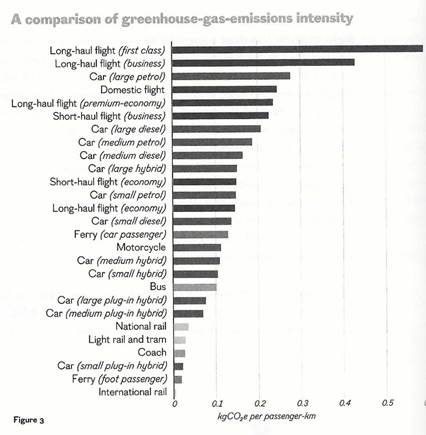
Greta Thunberg’s The Climate Book is a collection of articles that future historians will read in their inquiry into the decisions of the top 1% of the population of the “Global North” and everyone else with a net worth over $1 million in 2026. The data will serve as evidence of how we abused carbon.  In 1900- the cumulative carbon emissions totaled 45 billion tons and in 2000 it was1,000 gigatons. In 2026, it doubled to 2,000 gigatons. (Page 14) The question on the 2097 AP World History exam will be, “Why?”

This book is the “go to” book for educators.  Climate education is relevant to history, science, economics, sociology, literature, art, math, and civics. The problem of climate cannot be debated as there is no place for compromise. Greta Thunberg’s analogy made this clear to me:

“It is like walking on thin ice – either it carries your weight, or it does not. Either you make it to the shore, or you fall into the deep dark, cold waters.” (page 2)

Teachers are the first responders who need to make students aware by teaching the importance of sustainability, understanding that the economic freedom we value is changing our environment, that the problem with carbon is one of chemistry and physics. The slightest increase in temperature changes the composition of oceans and our atmosphere. According to Thuberg, since most political and business leaders are not able to address the problem; the collective action of the global population is our best hope. This is why teachers and curriculum matter!

The book is organized into five sections with concise articles of three or four pages explaining and analyzing the theme of each section. Each article provides excellent information for discussion, further exploration, and cooperative learning.  For example, Section 2, “How Our Planet is Changing”, includes articles on heat, methane, air pollution, clouds, the jet stream, polar ice caps, acidification, droughts, floods, fresh water, and microplastics. These articles explain the fragile nature of our atmosphere, how small changes over time lead to major changes in food production, and the economic and human cost of extreme weather events.

“A new line of research has also uncovered a summer connection that contributes to recent severe heatwaves, wildfires, droughts and deluges.  These extreme events are more likely when the jet stream splits, with one branch flowing across the middle of the continent and another along the Arctic coast.  These splits tend to occur when the spring snow cover on high-latitude land areas melts earlier than normal, a strong trend observed in recent decades.  When the snow disappears early, underlying soils dry out and warm sooner, creating a belt of abnormally high temperatures over high latitude land areas.  This warm belt favors jet-stream splits. Rossby waves can then become trapped between the two jet-stream branches, causing stagnant weather conditions that can cause persistent heatwaves, dry periods and rain spells, often leading to extreme summer events.” (Page 65)

If all the ice in Greenland and Antarctica melt, sea levels have the potential to rise by 65 meters or 200 feet. (page 83)  According to the New Jersey Department of Environmental Protection, “As identified in the New Jersey’s Rising Seas and Changing Coastal Storms: Report of the Science and Technical Advisory Panel and the New Jersey Scientific Report on Climate Change, sea-levels are increasing at a greater rate in New Jersey than other parts of the world. By 2050, it is likely that sea-level rise will meet or exceed 1.7 feet and increase to 3.8 feet by the end of the century. “Sunny day flooding” will occur more often across the entire coastal area with Atlantic City experiencing “sunny day flooding” 131 days a year and a 50% chance it will experience 326 days a year by 2100.”  (A sea level rise of 1.7 feet is less than one meter.) Source

Every article in Chapter 3, “How It Affects US” explicitly documents the reality of climate change. Here are some examples:

“Up to one fifth of the global land surface was affected by extreme drought in 2020, leading to a stark rise in food and water shortages.” (page 134)

“Anthropogenic climate change is responsible for one in three deaths due to heat today – accounting for 37 percent of heat-related deaths between 1991 and 2018.” (page 137)

“Malaria and dengue may spread into temperate areas such as France, Bulgaria, Hungary, Germany and the eastern coast of the Ununited states extending from south of Atlanta to north of Boston.” (page 245)

“We grew crops at a carbon dioxide concentration of 550 parts per million (ppm), the level the world is expected to reach around the middle of this century.  We found that crops grown at these elevated CO2 concentrations had significantly lower amounts of iron, zinc and protein than identical cultivators of those crops grown at today’s CO2 levels.” (page 149)

“The fact that 3 billion people use less energy, on an annual per capita basis, than a standard American refrigerator gives you an idea of how far away from global equity and climate justice we currently are.” (page 154)

“With current warming trends, 1.2 billion people could be forced to migrate by 2050.” (page 180)

The content in this chapter relating to disappearing insects, deforestation, rising sea levels, psychology of violence related to temperature increases, and political instability should be considered as essential reading. Although our goal is to keep temperatures below 1.50C in this century, Greta Thunberg explains that this is an average and some areas will see up to 4.0oC temperatures and others closer to 10C. “In 2021, Moody Analytics estimated that the global economic toll of 20C of warming would be $69 trillion.” (page 192)

Chapter 4 provided me with valuable insights that I can use as a social studies teacher.  These insights provide information on the changes in carbon emissions between 1970 and 2025 and how consumption in OECD countries is contributing to the coming crisis on our planet. The information in this section is also important if individuals are going to educate the adult population. The population of the United States is in denial about what is happening and the fact that in approximately 20 years, 1.5 billion people will need to relocate to a different location within the United States as a result of water shortages, transportation costs, rising sea levels, crop failures, dangerous insects, extreme heat, and unprecedented storms! The target of a 1.5oC increase by 2050 is likely unattainable and we need to expect an average temperature increase of 2.5oC or higher by 2100.  While civic engagement by individuals and families is important, the hope for the future will require action by local, state, and national governments.

“The carbon dioxide safety level for such climate stability is often considered to be around 350 parts per million (ppm) – a  level we passed in around 1987. In February 2022, we surpassed 421 ppm. At current emission levels, our remaining carbon budgets for a decent change of staying below 1.5oC and, by doing so, minimizing the risk of setting off irreversible chain reactions beyond human control, will be gone before the end of this decade. There are no effective policies in place.” (page 241)

The complexity of the problem is difficult to understand. As populations increase, food production requires more land for agricultural production. As a result species migrate, trees are removed, fertilizer production increases, and the shipping of food to where the people are living increases. The two graphs below include significant data.  The first graph, “Greenhouse gas emissions from transport subsectors in 1970, 1990, and 2010” provides evidence on the increase in emissions as the population of the world increased from approximately 3 billion in 1970 to 8 billion today. The graph also provides evidence of the problem of global equity as the amount of emissions in 2010 is that to the total emissions from Latin America, Middle East and Africa, and Asia total 2.75 gigatons is less than the amount of 3.14 gigatons emitted from the 38 OECD countries with market-based economies and democratic forms of government.

(page 266)

The second graph, “A comparison of greenhouse-gas-emissions intensity”, illustrates the emissions from airplanes, automobiles, and trains. The graph does not include the cost of international shipping, a decision made by the Kyoto Protocol in 1997. “This is extremely problematic since international aviation and shipping together contribute the equivalent amount of CO2 as Japan, the fifth biggest CO2-emitting nation in the world.” (page 269)

The greenhouse gas emissions form airplanes is greater than the emissions from automobiles.  Students need to understand the paradox of buying an EV or hybrid vehicle for transportation to reduce carbon emissions and then taking a plane to the Caribbean for Spring Break or a trip to Europe is counterproductive. We need to change our behavior. Education has the potential to change behavior!

(page 267)

Perhaps the most important insight for me in this section was the information on consumerism. A household in the United States contains, on average, 300,000 individual items,…” (page 282)  Teachers need to bring awareness about human behavior and the impact of production and disposal, and life expectancy and efficiency.

“An American one-percenter accounts for ten times the greenhouse gas emissions of the average American; the average American is responsible for three times the emissions of the average person in France; the average French person accounts for ten times that of the typical person in Bangladesh.” (page 282)  This section provides perspectives that are excellent resources for teachers.

Students need information about solutions for living in a world that is 1.5oC warmer and likely closer to 2.0oC. Solutions are more than wind turbines, solar panels, and electric vehicles. The psychology of human behavior, the importance of civic engagement, preparation for a sudden crisis, the economic potential of incentives, awareness of the role of the media, and an understanding of the actions of citizens are essential understandings for students.

“The wealthiest 10 percent of people globally produce around half of all greenhouse gas emissions, as well as having more to do to achieve a sustainable way of life,….” (page 330) The graph below clearly explains why climate education for students in the United States should be a curriculum mandate. The graph also illustrates the problems of inequality and injustice as a result of the economic system that currently dominates our world. An understanding of the big picture from 19th century colonialism and imperialism to the global supply chains of the 21st century are essential for understanding the invisible atmospheric changes that have been taking place for 150 years. The existential crisis that threatens to disrupt the comfortable lives of the students we are teaching will take place in the next few years or decades. This is the “inconvenient truth!”

As social studies educators we are responsible for teaching the lessons of the past, especially as they relate to the rise and fall of civilizations. The discovery of fire, writing, cement, crop rotation, the three-part plow, animal, water, and steam power, fossil fuels, electricity, nuclear energy, the automobile, department stores, credit cards, e-commerce, and artificial intelligence are curriculum topics that need to be carefully reviewed in how we are teaching them because they cumulatively contribute to a warmer planet. The graph below illustrates why this is a critical curriculum topic for social studies educators.

The great migrations in history are the result of wars, trade, investments, escape from authoritarian rulers, genocide, poverty, and extreme weather events. We teach about the migrations from the Irish famine, religious wars in Europe, African Slave Trade, European migration to the United States, Harlem Renaissance, Dust Bowl, Partition of India, Resettlement after World War II, and the urbanization of China. If history is a guide, the largest migration will occur in the 21st century because of the impact of extreme weather on agriculture, potable water, heat-related deaths, and higher sea levels.

The Climate Book is essential reading for teachers. The section on solutions (Chapter 5) provides critical information for debate and discussion with your students.

Revisiting Jared Diamond’s Guns, Germs and Steel

Jared Diamond’s Guns, Germs, and Steel (New York: Norton, 1997) is one of those books that feels revelatory the first time you read it. It takes a question that most people rarely stop to ask, “Why some societies ended up rich and powerful while others did not?,” and reframes it in a way that is both unsettling and reassuring. Unsettling, because it strips away comforting myths about cultural superiority and human exceptionalism, and reassuring, because it offers an explanation that does not rely on racism, divine favor, or civilizational destiny. Diamond’s central claim is that geography, rather than biology or culture, played the decisive role in shaping global inequality. In the epilogue, he steps back to defend this framework, clarify its limits, and argue that history itself can be studied scientifically.

Diamond’s ambition is enormous; he is trying to explain a great deal of human history with a single organizing framework. Geography, in his telling, shapes the availability of domesticable plants and animals, the timing of agriculture, population density, technological development, and ultimately conquest. By the time Europeans reached the Americas, the outcome was already largely predetermined by thousands of years of environmental advantage. Diamond is careful to insist that geography constrains rather than dictates outcomes, but it is hard to miss how much explanatory weight geography is made to carry.

In the epilogue, Diamond anticipates the charge of environmental determinism and pushes back. History, he argues, can still be studied scientifically, even if we cannot run controlled experiments. Continents and societies function as natural experiments, allowing historians to compare different environments and identify broad, recurring patterns. Diamond is explicit about what he believes his framework does and does not explain. He is not accounting for individual leaders, specific events, or moral responsibility.Instead he is explaining why some societies had early advantages and others did not.

When Diamond stays within these bounds, his arguments are often extremely persuasive. His comparison between Eurasia and the Americas is a good example. Eurasia benefited from an abundance of domesticable plants and animals, including wheat, barley, cattle, pigs, and horses, which supported early agriculture, large populations, and dense settlements. Dense populations, in turn, produced epidemic diseases, and over time, immunity. When Europeans arrived in the Americas, they brought not only steel weapons and guns, but germs to which they had long been exposed. Indigenous populations, lacking similar disease histories, were devastated. Diamond’s point is not that Europeans were smarter or more capable, but that they inherited a vastly different historical trajectory shaped by their environment.

The same logic applies to Diamond’s discussion of continental axes, particularly the contrast between Eurasia’s east-west orientation and the Americas’ north-south orientation. Eurasia’s east-west axis allowed crops, animals, and technologies to spread across similar latitudes and climates with relative ease. Innovations could diffuse over thousands of miles without needing to adapt to radically different environments. In the Americas, by contrast, north-south diffusion meant crossing deserts, jungles, mountains, and sharp climatic transitions. This slowed the spread of agriculture and technology and limited large scale integration. Over millennia, these differences compounded. Geography, in Diamond’s account, does not merely shape local conditions, it shapes connectivity itself.

Where Diamond’s framework begins to strain is when it starts to feel like a master key rather than one tool among many. In the epilogue, he insists that geography is not destiny, yet culture often appears in his account as a thin downstream effect of environmental constraints. Culture adapts to geography, rather than actively shaping how societies respond once similar options exist. This is where the model starts to feel incomplete. Culture is not just decoration layered on top of material conditions. It is the air we breathe, the water we swim in, and the lens through which material realities are interpreted. Societies facing similar geographic constraints can still make very different choices, build different institutions, and value different outcomes.

Diamond acknowledges this problem in theory but tends to underplay it in practice. He is strongest at explaining origins and weakest at explaining persistence and divergence. Geography helps explain why certain possibilities existed, but it does not fully explain why some societies embraced particular paths while others did not, even when those paths were available. Once agriculture, technology, and states exist, culture feeds back into material conditions in complex ways. Institutions, norms, and values can amplify or blunt geographic advantages, and these feedback loops receive less attention than they deserve.

This tension becomes even more apparent when Diamond’s framework is applied to contemporary global developments. Geography still matters enormously. Climate vulnerability, access to arable land, exposure to disease, and proximity to trade routes continue to shape global inequality. The uneven impact of climate change, for example, follows geographic lines Diamond would immediately recognize. At the same time, globalization, technology, and political institutions complicate the picture. Some societies have used technology and collective action to mitigate geographic disadvantages, while others have failed to do so despite favorable conditions. Here again, culture and politics mediate geography’s effects.

Diamond deserves credit for what he is trying to do. He offers a corrective to explanations that blame the victims of history for their own misfortune or attribute inequality to inherent superiority. His framework insists that history’s winners were not morally better or biologically superior, merely luckier in where they happened to have been born. That insight alone makes Guns, Germs, and Steel worth reading.

The epilogue clarifies what Diamond believes his project to be. Geography is not the whole story, but it is an essential part of it. Diamond is at his best when he treats geography as an ingredient rather than a recipe. History is shaped by environments, material conditions, and culture together. No single theory explains everything. Diamond’s contribution is to remind us how much of the story begins long before anyone makes a conscious choice, and how deeply the ground beneath our feet has shaped the world we inherited.

Spreading ‘Liberty’: Chautauqua County Women were a Force in the Underground Railroad

(Reprinted from Observer Today, January 18, 2026) https://www.observertoday.com/news/top-stories/2026/01/spreading-liberty-chautauqua-county-women-were-a-force-in-the-underground-railroad/

From left: Carloyn E. Storum Loguen about 1860; Mary Ann Brigham Brown’s husband Rev. Abel Brown under assault in Westfield NY about 1835.

Chautauqua County women Carolyn Loguen (1817-1867) and Mary Ann Brown (1814-1842) were active in New York state’s anti-slavery movement and in the Underground Railroad. Working mostly in the shadows of their widely known husbands, the women themselves were locally famous for their own efforts in the cause of freedom.

Carolyn E. Storum Loguen of Busti married the formerly enslaved minister Jermain Wesley Loguen (1813-1872). The couple then operated an Underground Railroad station in Syracuse. They had six children, and their daughter, Amelia, married the eldest son of the nationally known abolitionist Frederick Douglass (1818-1895), who also was formerly enslaved.

In 1851, the Rev. Loguen assisted in the rescue of William Henry, a formerly enslaved cooper working in Syracuse. Henry had been arrested under America’s Fugitive Slave Law of 1850, but he was rescued by abolitionists and then sheltered in Canada. Also in 1851, Harrison Williams was arrested under the same law, on Carolyn’s childhood farm in Busti, where her parents operated an Underground Railroad Station. In spite of several attempts to rescue him, Harrison Williams was returned to slavery. The historical marker paying tribute to Harrison Williams and the Storums stands today on Sanbury Road near Northrup Road in Busti. Another historical marker, to both Caroline Loguen and her husband, stands today at NYS Route 92 and Pine Street in Syracuse.

In 1854, Carolyn’s parents coordinated the widely attended Anti-Slavery Convention in Sugar Grove Pa., near Busti. Both Rev. Loguen and Frederick Douglass were featured speakers at that major event. However, Mary Ann Brigham Brown and her husband had been deceased long before the significant convention in Sugar Grove. Mary Ann was from nearby Fredonia, and she married another famous abolitionist, Rev. Abel Brown, Jr. (1810-1844) of nearby Forestville.

In the early 1830s, Mary Ann had met her future husband, while both attended the Fredonia Academy, which formerly stood on the site of today’s Opera House and Village Hall. The couple then traveled throughout the northeast, active in the Underground Railroad. Scholars have speculated that when the Western New Yorker Eber M. Pettit mentioned in his 1879 anti-slavery memoir that there was a “President” of the Underground Railroad, he was referring to the martyr Rev. Brown. Rev. Brown was so outspoken in his beliefs that he was often beaten by angry dissenters. His 1844 death in Canandaigua was said to have been from injuries sustained in just such a beating.

Another assault upon Brown had occurred in Chautauqua County a few years earlier, while he was preaching in Westfield. That was the period when New York State’s Anti-Slavery Society was being organized in central New York State, an endeavor also met with violent protests. However, within a few years of Brown’s beating in Westfield, the collected voices of Chautauqua County’s other abolitionists attracted increasingly more of their neighbors into what became known as “the liberty cause,” and the Underground Railroad became more safely active here, until the 1850 law. Although that law, signed by New York’s own Millard Filmore, generally made life dangerous for those involved in the Underground Railroad, the same law actually backfired in Chautauqua County, by drawing even more people into the anti-slavery movement.

Mary Ann died two years before her husband, shortly after the birth of their second child. Her children were then raised in Fredonia by her mother Mary (Polly) Dix Brigham Taylor (1790-1857), who also opened her home to a freedom seeker in 1844. There is no historical marker to memorialize Mary Ann, her husband, her children, or her mother, but a Fredonia mansion stands today where Mary Ann’s children grew up. The former Taylor farm is located on U.S. Route 20, just west of Fredonia.

After the Civil War, Daniel Fairbanks greatly expanded and modernized the former Taylor home. For the 1881 Chautauqua County Atlas, the elegant, new house was illustrated in the name of Sayles Aldrich.

In the late 20th and early 21st centuries, Wilda B. and J. Carter Rowland operated a gift shop behind the mansion, at the approximate location of part of the former Taylor home.

The Schaghticoke Tree of Peace and Welfare

This essay is drawn from The Northern Inland Passage: An Interpretive Guide to the Champlain Canal Region published by Lakes to Locks Passage in 2019.

During the Beaver Wars the Haudenosaunee (Iroquois), supplied by Dutch weapons, decimated the Mohican along the Hudson River. A Mohican effort to regain control of land taken from them by the Mohawk left their strength so severely depleted that they refused to join their eastern Algonquin speaking allies in fighting King Philip’s War (1675-1676) — a war that marked the last major effort by the Native Americans of New England to drive out the English settlers. Following that bloody conflict, defeated Indigenous refugees fled west from New England along the Hoosic River into the Province of New York. Edmund Andros, Governor of the Province, saw this exodus as an opportunity to thwart the territorial ambitions of Massachusetts.

Many residents in Massachusetts believed their colony should extend all the way to the Hudson, so Andros invited displaced Mohicans, along with Wampanoags, Narragansetts, Skokis, and Nipmucks, to settle on the meadows between the mouth of the Hoosic River and Tomhannock Creek. He believed they would prevent squatters and act as a barrier against French raids from the north. This assemblage of peoples became known as Schaghticoke.

Governor Andros negotiated peace with several tribes and then created a reserve on the west side of the Hudson and offered it to the Mohawk as a homeland. This, combined with the expanded settlement of Schaghticokes, created an early warning system for Albany in the case of hostile raids by the French and their Indigenous allies from the north. To cement the alliance, the governor convened a peace council in 1676. Representatives of the English Crown and as many as a thousand Native People, along with Jesuits from the Mohawk villages, gathered to smoke calumet (peace) pipes and promise to keep the covenant made there.

During the ceremony they planted an oak sapling — which later became known as the Witenagemot Oak — and named the place “the Vale of Peace.” Witenagemot is an old English word that means “Council of the Wise.” In England, a Witenagemot was called to help settle a dispute peacefully by discussion.

The tree stood for nearly 300 years. One hundred years later Johannes Knickerbocker III built his house at this place. The ancient tree stood behind the Knickerbocker Mansion until 1949, when it was uprooted during a winter flash flood. Saplings of the original oak now grow in its place. Although the Schaghticoke eventually moved west, many have made pilgrimages back to this symbol of the pact.

Schaghticoke is on NY-40 about 20 miles north of Albany.

This essay is drawn from The Northern Inland Passage: An Interpretive Guide to the Champlain Canal Region published by Lakes to Locks Passage in 2019.

Lessons for Today from a Landmark New Jersey Desegregation Case

Education has the potential to be the great equalizer that truly changes the trajectory of people’s lives. The struggle to realize that potential has a long history here in New Jersey. Looking back, we know Black activists were demanding civil rights reform in education here in the Garden State more than a decade before the landmark Brown v. Board of Education decision desegregated public schools across the nation in 1954. Concerted efforts by the NAACP, other advocates and mothers weary from discrimination in education led to legal battles that paved the way for changes and pivotal federal legislation. One of the precedent-setting cases that helped the arc of the moral universe bend toward justice, to paraphrase Dr. Martin Luther King Jr., was New Jersey’s Hedgepeth and Williams v. Board of Education (1944).

In 1943, two mothers from Trenton, Gladys Hedgepeth and Berline Williams, attempted to enroll their children in a neighborhood middle school. The school, the women were told, wasn’t “built for Negroes.” As a result, they enrolled their children in a Blacks-only school more than two miles away while simultaneously filing lawsuits against the Board of Education of Trenton. Represented by Robert Queen of the NAACP, the case made its way to the United States Supreme Court, which ruled intentional segregation in public schools to be a violation of New Jersey law. Schools in New Jersey would no longer be segregated.

In the courts, the Hedgepath-Williams decision proved to be a precedent on which proponents of desegregation could build the historic case that ended legal racial segregation in schools across the nation, Brown v. Board of Education. In his legal brief for that case, attorney Thurgood Marshall cited the Hedgepeth–Williams decision. Ultimately, racial segregation was deemed unconstitutional -– even if the segregated schools were otherwise equal in quality.

The broader impact of the historic ruling was profound. It resulted in a massive shift in the national landscape of racial justice and the American judicial system as a whole. The next year, New Jersey’s state legislature passed a fair employment practices act, with a fledgling enforcement division, that prohibited racial discrimination in hiring practices. The number of Black teachers rose exponentially.

Further racial barrier-breaking developments also occurred. New Jersey’s State Constitution of 1947 codified the desegregation of public schools. In 1949, a civil rights bill in the state banned discrimination in public accommodations. New Jersey became a model for New York and Pennsylvania, and ultimately the federal Civil Rights Act of 1964.

Today, nearly eight decades since the Hedgepeth-Williams ruling laid the groundwork for even more dramatic reforms nationwide, race-based inequalities remain pervasive in our schools. How do we follow in the footsteps of our predecessors and fulfill the mandate secured by trailblazers like Gladys Hedgepeth and Berline Williams? We need to compensate teachers equitably across districts to attract and retain quality candidates of all races to the field, but specifically Black educators. We must offer professional development, research opportunities, and holistic support to new and early-stage educators so they can succeed. Without these resources, we are setting young teachers up for failure before they even begin. When our educators feel whole, their students can be at the top of their game, too.

Furthermore, we cannot underestimate the power and importance of Black students seeing people who look like them in the classroom and in leadership positions across academia. Last year, according to the U.S. Census Bureau, Trenton’s population was nearly 50 percent Black, 37 percent Hispanic and 13 percent white, yet the hiring of teachers of color there and elsewhere is slow to catch up to the diversity of its students. Imagine how much greater our students’ academic achievement will be when more Black educators teach Black children Black history, as well as all of the other subjects they are taught in school. Or how high their standards and visions of self-actualization will soar when students of color see themselves more fully represented in the sciences and research, the arts, business, sports, civil rights and in positions of leadership in these fields and others.

It’s also high time we invest more in higher education. We must continue to demand funding and resource allocations for our schools and universities, particularly prioritizing underserved communities. From pre-K through college and into graduate school, we must find and reach the undiscovered brilliant minds, the dreamers, the entrepreneurs, the leaders who are right there in our midst waiting to be put on an educational path that lets them become their full selves. Education is a pathway to upward mobility. It is a way for students to break free from the cycle of poverty and oppression in order to achieve their dreams. When we invest in equal education for all, we are building a stronger future for all of us.

In God’s eyes, we are created equal. However, history and current events remind us that we are not all treated equally. Everyone hears a lot about self-determination and being the architect of their own future. That’s easy to say when you are born into privilege and opportunity. It is a much more difficult proposition for anyone facing racism, systemic negligence and prejudice throughout their lives. We as a community cannot ignore the disadvantages that hold so many of our people back. Instead, we must leverage our positions as educators to create programs and deliver resources that will make a difference in students’ lives. Like the activists of today and decades past, we must work relentlessly to make sure that governments and systems of education do their part. Hedgepeth and Williams v. Board of Education is a call to equity in action as much now as it was in 1944, and we must rededicate ourselves to its moral imperative.