Lessons for Today from a Landmark New Jersey Desegregation Case

Education has the potential to be the great equalizer that truly changes the trajectory of people’s lives. The struggle to realize that potential has a long history here in New Jersey. Looking back, we know Black activists were demanding civil rights reform in education here in the Garden State more than a decade before the landmark Brown v. Board of Education decision desegregated public schools across the nation in 1954. Concerted efforts by the NAACP, other advocates and mothers weary from discrimination in education led to legal battles that paved the way for changes and pivotal federal legislation. One of the precedent-setting cases that helped the arc of the moral universe bend toward justice, to paraphrase Dr. Martin Luther King Jr., was New Jersey’s Hedgepeth and Williams v. Board of Education (1944).

In 1943, two mothers from Trenton, Gladys Hedgepeth and Berline Williams, attempted to enroll their children in a neighborhood middle school. The school, the women were told, wasn’t “built for Negroes.” As a result, they enrolled their children in a Blacks-only school more than two miles away while simultaneously filing lawsuits against the Board of Education of Trenton. Represented by Robert Queen of the NAACP, the case made its way to the United States Supreme Court, which ruled intentional segregation in public schools to be a violation of New Jersey law. Schools in New Jersey would no longer be segregated.

In the courts, the Hedgepath-Williams decision proved to be a precedent on which proponents of desegregation could build the historic case that ended legal racial segregation in schools across the nation, Brown v. Board of Education. In his legal brief for that case, attorney Thurgood Marshall cited the Hedgepeth–Williams decision. Ultimately, racial segregation was deemed unconstitutional -– even if the segregated schools were otherwise equal in quality.

The broader impact of the historic ruling was profound. It resulted in a massive shift in the national landscape of racial justice and the American judicial system as a whole. The next year, New Jersey’s state legislature passed a fair employment practices act, with a fledgling enforcement division, that prohibited racial discrimination in hiring practices. The number of Black teachers rose exponentially.

Further racial barrier-breaking developments also occurred. New Jersey’s State Constitution of 1947 codified the desegregation of public schools. In 1949, a civil rights bill in the state banned discrimination in public accommodations. New Jersey became a model for New York and Pennsylvania, and ultimately the federal Civil Rights Act of 1964.

Today, nearly eight decades since the Hedgepeth-Williams ruling laid the groundwork for even more dramatic reforms nationwide, race-based inequalities remain pervasive in our schools. How do we follow in the footsteps of our predecessors and fulfill the mandate secured by trailblazers like Gladys Hedgepeth and Berline Williams? We need to compensate teachers equitably across districts to attract and retain quality candidates of all races to the field, but specifically Black educators. We must offer professional development, research opportunities, and holistic support to new and early-stage educators so they can succeed. Without these resources, we are setting young teachers up for failure before they even begin. When our educators feel whole, their students can be at the top of their game, too.

Furthermore, we cannot underestimate the power and importance of Black students seeing people who look like them in the classroom and in leadership positions across academia. Last year, according to the U.S. Census Bureau, Trenton’s population was nearly 50 percent Black, 37 percent Hispanic and 13 percent white, yet the hiring of teachers of color there and elsewhere is slow to catch up to the diversity of its students. Imagine how much greater our students’ academic achievement will be when more Black educators teach Black children Black history, as well as all of the other subjects they are taught in school. Or how high their standards and visions of self-actualization will soar when students of color see themselves more fully represented in the sciences and research, the arts, business, sports, civil rights and in positions of leadership in these fields and others.

It’s also high time we invest more in higher education. We must continue to demand funding and resource allocations for our schools and universities, particularly prioritizing underserved communities. From pre-K through college and into graduate school, we must find and reach the undiscovered brilliant minds, the dreamers, the entrepreneurs, the leaders who are right there in our midst waiting to be put on an educational path that lets them become their full selves. Education is a pathway to upward mobility. It is a way for students to break free from the cycle of poverty and oppression in order to achieve their dreams. When we invest in equal education for all, we are building a stronger future for all of us.

In God’s eyes, we are created equal. However, history and current events remind us that we are not all treated equally. Everyone hears a lot about self-determination and being the architect of their own future. That’s easy to say when you are born into privilege and opportunity. It is a much more difficult proposition for anyone facing racism, systemic negligence and prejudice throughout their lives. We as a community cannot ignore the disadvantages that hold so many of our people back. Instead, we must leverage our positions as educators to create programs and deliver resources that will make a difference in students’ lives. Like the activists of today and decades past, we must work relentlessly to make sure that governments and systems of education do their part. Hedgepeth and Williams v. Board of Education is a call to equity in action as much now as it was in 1944, and we must rededicate ourselves to its moral imperative.
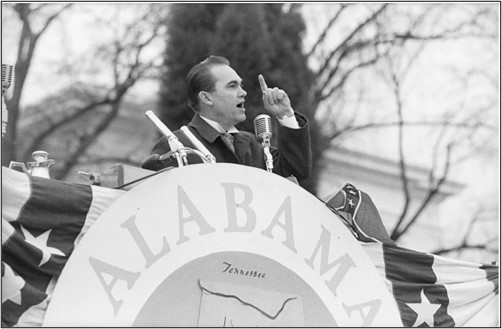
Teaching with Documents: Wallace’s Defense of Segregation

Alabama Governor George Wallace delivers his first inaugural address.

In Freedom’s Dominion: A Saga of White Resistance to Federal Power (Basic Books, 2002), Jefferson Cowie focused on the history Barbour County, Alabama, to document the way a deeply self-serving concept of “freedom” was used by whites to justify racist policies. It was all about their “freedom.” White freedom meant freedom from government restraints; freedom from taxes to support public institutions and services; freedom to own and use guns; and freedom to mistreat African Americans without federal intervention. White freedom, dating to the era of Black enslavement and Jim Crow segregation, equated with racism. Source:https://www.nytimes.com/2022/12/12/books/review/freedoms-dominion-jefferson-cowie.html

Sadly, fear of federal imposition on white freedom remains alive and well today and was part of the justification for the January 6, 2021 insurrection at the United States Capitol building in Washington DC and is the ideological underpinning for the attack on Critical Race Theory by Florida Governor Ron DeSantis and other conservative Republicans. When DeSantis was reelected in November 2022, he declared that his election signified “Freedom is here to stay!” Polls repeatedly show that a large majority of white voters who identify as Republican believe that there is discrimination against white people in the United States and that little or nothing needs to be done to ensure equal rights for African Americans and other minority groups.

Sources: https://www.local10.com/vote-2022/2022/11/08/is-desantis-on-path-to-remain-governor-of-florida/https://thehill.com/hilltv/what-americas-thinking/433270-poll-republicans-and-democrats-differ-strongly-on-whether-white/https://www.pewresearch.org/politics/2021/08/12/deep-divisions-in-americans-views-of-nations-racial-history-and-how-to-address-it/

Barbour County’s best-known native son was George Wallace, Governor of Alabama from 1963 to 1967, 1971 to 1979, and 1983 to 1987. Wallace was also a candidate for President of the United States four times, both in Democratic Party primaries and as an independent candidate. In June 1963, while Governor of Alabama, Wallace staged standing in the entrance to the University of Alabama in Tuscaloosa to block the enrollment of Black students. In defiance of a federal court order, he accused the federal government of usurping state authority in the field of education by calling for desegregation. Wallace finally backed down when the Kennedy Administration federalized Units of the 31st (Dixie) Division of the Alabama National Guard.

Source: https://archive.nytimes.com/www.nytimes.com/library/national/race/061263race-ra.html

For Black History Month, students, Black, white, Asian, and Latinx, should read texts and listen to speeches by inspiring Black authors and orators. But to understand the depth of racism in the past and today, they also need to read and understand racist texts that defended slavery and racial segregation. In his January 1963 inaugural address, George Wallace, as the newly elected governor of Alabama, issued a defiant defense of racial segregation. At the time, only fourteen percent of eligible Black citizens were registered to vote in Alabama although at least 30% of the population was Black. Poll taxes, literacy tests, and hostile registrars effectively ensured white supremacy, white freedom, in the state. Sources: https://rediscovering-black-history.blogs.archives.gov/2016/10/25/voting-rights-in-the-early-1960s-registering-who-they-wanted-to/; http://www.bplonline.org/resources/government/AlabamaPopulation.aspx

“Segregation Now, Segregation Forever” (1963)

By Alabama Governor George Wallace

A. “Before I begin my talk with you, I want to ask you for a few minutes patience while I say something that is on my heart: I want to thank those home folks of my county who first gave an anxious country boy his opportunity to serve in State politics. I shall always owe a lot to those who gave me that first opportunity to serve . . . This is the day of my Inauguration as Governor of the State of Alabama. And on this day I feel a deep obligation to renew my pledges, my covenants with you . . . the people of this great state.”

B. “General Robert E. Lee said that ‘duty’ is the sublimest word on the English language and I have come, increasingly, to realize what he meant. I SHALL do my duty to you, God helping . . . to every man, to every woman . . . yes, to every child in this state . . . I shall fulfill my duty in working hard to bring industry into our state, not only by maintaining an honest, sober and free­ enterprise climate of government in which industry can have confidence . . . but in going out and getting it . . . so that our people can have industrial jobs in Alabama and provide a better life for their children.”

C. “Today I have stood, where once Jefferson Davis stood, and took an oath to my people. It is very appropriate then that from this Cradle of the Confederacy, this very Heart of the Great Anglo­ Saxon Southland, that today we sound the drum for freedom as have our generations of forebears before us done, time and time again through history. Let us rise to the call of freedom­ loving blood that is in us and send our answer to the tyranny that clanks its chains upon the South. In the name of the greatest people that have ever trod this earth, I draw the line in the dust and toss the gauntlet before the feet of tyranny . . . and I say . . . segregation today . . . segregation tomorrow . . . segregation forever.”

  1. Who did Wallace quote on the importance of “duty”? What signal was Wallace sending to his audience by quoting him?
  2. What other references does Wallace make in the speech to ensure his audience understands his political point of view?
  3. How does Wallace propose to battle “tyranny” and defend “freedom”?
  4. Wallace pledged to honor “covenants with you . . . the people of this great state.” In your opinion, to who was Wallace referring? What evidence in the text supports this interpretation?