My Story: George Morgan White Eyes, Princeton, NJ, 1778-1790

My Story: George Morgan White Eyes

Princeton, Mercer County

1778-1790

Koquethagechton, also known as White Eyes, was a Lenape chief living in Ohio Country. He married Rachel Doddridge, a white woman who had been taken captive by the Lenape at age 5 and had become fully assimilated to Lenape life. As an adult, Doddridge chose to remain an adopted Lenape.

When the American Revolution began, Koquethagechton initially tried to remain neutral, but before long it became evident that he would have to take sides. In 1777, Koquethagechton addressed the Continental Congress, and the following year negotiated a peace treaty with American representatives.

Which of the following provisions should Koquethagechton have sought in a peace treaty?

Select one option and explain your answer in 3 to 5 sentences.

  • A new state shall be created for the Lenape, incorporating the nation into the United States with representation in Congress.
  • The United States must build a fort in Lenape territory to help protect the Lenape from attacks by other Native American nations or from the British.
  • The United States shall provide the Lenape with clothing, utensils, and weapons as needed.

Amazingly, the Treaty of Fort Pitt, signed September 17, 1778, included all of these provisions. The promise of a 14th state along with Congressional representation is something that was never promised to any other Native American group, but relied upon the further approval of Congress. Unfortunately, the treaty never received the support of Congress and was ultimately rendered meaningless.

Later that year, while accompanying American soldiers in Ohio Country, Koquethagechton died at the age of 48. Initially the cause of death was reported as smallpox, but eventually it was revealed he had been murdered by the American militia. Nearly ten years later (circa 1788), Rachel Doddridge was murdered in the course of a robbery by white men disguised as Native Americans. Both of their stories are compelling and worthy of more examination, but our focus here turns to their son, George Morgan White Eyes, partly named for Koquethagechton’s American friend, who would become the boy’s guardian.

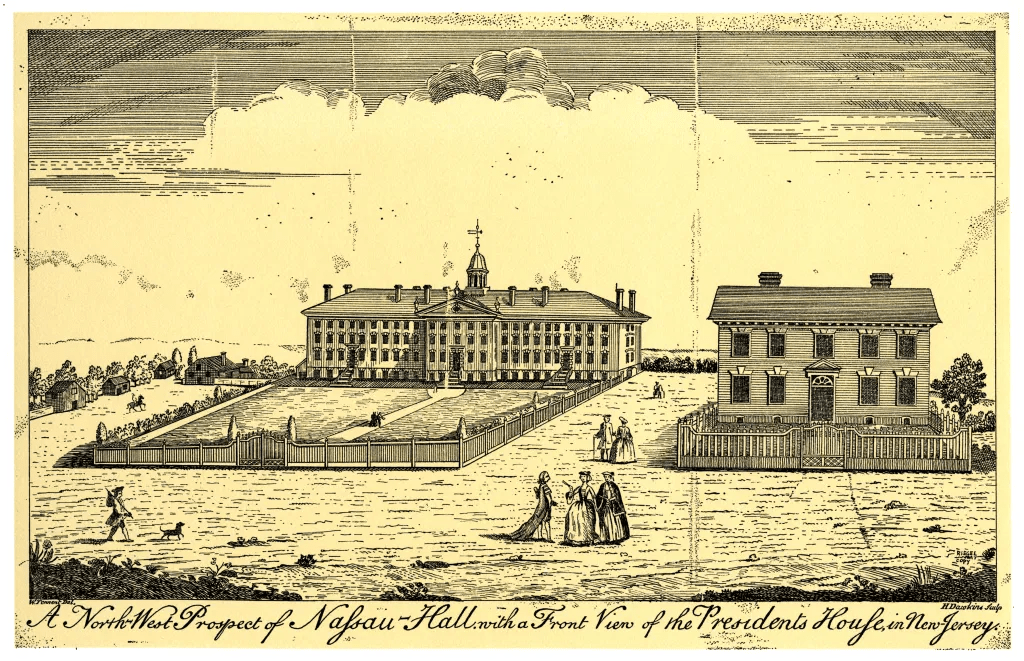
White Eyes was seven years old when his father died. The Continental Congress assumed financial responsibility for the upbringing of the chief’s son. White Eyes was likely the first recipient of government-based student financial aid from the U.S. government. After completing grammar school, he was enrolled at the College of New Jersey in Princeton in 1785.

In December 1787, he and three other students were summoned before a disciplinary committee for insolence towards a tutor. Apparently, it wasn’t the only time he’d gotten in trouble at school. His guardian decided to remove him from Princeton and sent him to New York City to temporarily be under the care of a merchant tailor while awaiting instructions from Congress on what to do with young White Eyes. His guardian explained in a letter to Congress that White Eyes’ misbehavior may have had to do with his learning the news of his mother’s recent death and the long-concealed truth about his father’s murder. Morgan suggested that instead of sending him back to Princeton – or back to his nation – that White Eyes be sent to a different institution of higher learning, like Yale.

Which of the following choices do you think 18-year-old George Morgan White Eyes would make?

Select one option and explain your answer in 3 to 5 sentences.

  • Go back to Ohio Country to live among his own people.
  • Let his future be decided by George Morgan and the decision of Congress.
  • Strike out on his own in the New York to find a job and be independent.
  • Appeal directly to someone in power, explaining his desire to either be given a job or further education.

On June 2, 1789, George Morgan White Eyes wrote to President George Washington:

“[N]ot the severest Want shall make me return to my native Country—Tis thought from the Behaviour of my Colleagues while at Princeton that I will follow their Example—but never—I shall say but little but I trust my heart is fixed, & the time may come that this now feeble Arm, may be stretched out in the Service of America; & render the United or Individual States essential Service.

My humble request is & has this some Months past, that if the Burthen (sic) is too great on the United States that some kind of Employment may be pointed in order that I thereby may obtain a Living a[long] the Line that Congress probably first intended—That is agreeably to the Education they have been pleased to bestow upon me—I care not what [it] is I am willing to do what I am able, & you should think necessary to my future Welfare—[E]ntreating your Excellency’s kind Patronage on this Occasion I have the Honor to remain With the most perfect Respect, Sir, Your most Obedient & most devoted Servant”

Congress did not act quickly, and as the weeks went by, ‘the severest want” apparently changed White Eyes’ mind. He wrote President Washington again:

“The treatment I met with at Princeton & the Character I bear (which I know I am innocent of) here, are great Grievances to me, especially as I have undergone a great many Difficulties, I shall stear (sic) my Course towards my native [country] let the Consequence be what it will.

For it is better for me to live in Contentment & Quietude, than a life Contempt & Ignominy.1 I have not had any thing this while past & I am almost naked, thro’ some guile or other, for what I know. I believe they are tired of doing any thing for me & I am tired waiting for their duty which is incumbent on them by a resolve of Congress.

I am now to look out for myself since I cannot behave myself, better than I have done; for all that I do is in vain, yet all these things are not discourages of my staying here any longer, but I am [anxious] to return & see my Mother & Friends, as it ought to become every person who has a regard for their Nation. I beg you would assist me in my return as I have no other person to apply to; but if not I must do as well as I can.” Source

In March of 1790, George Morgan White Eyes returned to his nation in Ohio Country.

Sadly, his story has an ignominious ending. Eight years later (1798) in West Point, Ohio, an intoxicated White Eyes ran at 17-year-old William Carpenter Jr. with a tomahawk. Fearing for his life, Carpenter shot White Eyes, killing him instantly. Initially the boy and his father were charged with murder and aiding and abetting, but the case never came to trial.

To GEORGE MORGAN Mount Vernon, August 25, 1788.

Sir: The letter which you did me the favor of writing to me the 31st. of last month, with a Postscript to it on the 5th. of this, came duly to hand; as did a small parcel of wheat, forwarded some time before, by the Post Master General from New York. For your polite attention to me in these instances I pray you to accept my best acknowledgments and Thanks. With much concern I have heard of the ravages of the Hessian fly on the wheaten Crops in the States East of the Delaware and of the progress of this distructive (sic) insect Southerly; but I congratulate with you sincerely on your successful endeavors in the management of your measures &c. to counteract them. If the yellow bearded wheat from a continuation of experiments is found no matter from what cause, to be obnoxious to and able to withstand this all devouring insect [it] must indeed be valuable; but I have paid too little attention to the growth of this particular kind hitherto, to inform you in what degree of cultivation it is in this State, I may venture, at a hazard, however, to add that it is rare: because it is unusual to see fields of bearded wheat of any kind growing with us, particularly in the Western parts of the State, which falls more immediately under my observation. I will distribute the Seed which you have sent me; make enquiry into this matter and communicate the result, begging in the meantime, if any further observations on this insect, and the means of guarding against him should be made by you that you will have the goodness to communicate them to. 67 Source

I am an American: The Wong Kim Ark Story

I am an American: The Wong Kim Ark Story

by Martha Brockenbrough with Grace Lin (Little, Brown, 2021)

Review by Valerie Ooka Pang

This review was originally published in the International Examiner and is
republished with permission.
https://iexaminer.org/honoring-remembering-and-sharing-the-life-of-kim-arkand-his-fight-for-justice/

Has anyone questioned your citizenship? Has anyone ever said to you, “You don’t belong here. Go back to where you came from!”? Meaning you are not an American and should go back to where you came from. This happened to me often in Eastern Washington where I grew up, yet if I was to go back to where I came from, that would have been Seattle, Washington, where I was born. Why didn’t other youngsters think of me as an American? I could also be an immigrant who became an American like Wing Luke, who was the first person of color elected to the Seattle City Council.

Race is a powerful element of American society. People judge others based on their skin color, physical characteristics, stature and cultural practices. I am Japanese American and many of the young people I grew up with did not think of Japanese Americans as Americans. I was seen as a foreigner and so did not belong in the United States, though I lived in the state of Washington all of my
life. I wish there had been a book like I am an American: The Wong Kim Ark Story so their teachers could read it to their students. The book is about how Wong Kim Ark went to court and fought for his right as an American citizen.

In 1873, Wong Kim Ark was born in San Francisco, California to parents from China.
Chinese immigrants suffered much prejudice living in California. His parents left San Francisco in 1890 to go back to China while he stayed with relatives in California. Wong Kim Ark visited his parents in 1894 on a temporary trip. When he returned to San Francisco, he was not allowed to enter the United States because officials said he was not a citizen. He was put in prison because of the 1882 Chinese Exclusion Law that did not allow Chinese workers into the United States. Lawyers sued to get him out of prison in district court.

At that time Wong Kim Ark was about 21 years old. He argued that since he was born in San Francisco, he was a citizen. Members of the Chinese community pooled their finances and hired several lawyers to represent Wong Kim Ark. His case went all the way to the Supreme Court, and the U.S. Supreme Court ruled that due to the Fourteenth Amendment of the U.S. Constitution, since Wong Kim Ark was born in the United States, he was a citizen even though his parents were from China.

The Supreme Court decision of Wong Kim Ark is important because often race is used as an obstacle in establishing citizenship for other Asian Americans and people of color. The Supreme Court ruled that birth in the United States establishes citizenship. The Wong Kim Ark case supports his statement of “I am an American.” Even after the Supreme Court ruled in favor of Kim Ark, he had to carry a certificate of identity “to prove he was an American.” Racism was still strong in the United States.

This is an excellent story to read to children to show that the United States is a diverse country, and its citizens are members of many different ethnic and racial groups. Every student and teacher should know who Wong Kim Ark is and how he
helped to establish citizenship rights for people of color in the United States. Most learners and educators do not know about the contributions that many Asian American and Pacific Islander people have made to our civil rights.

Consider purchasing this book for your children or educators. There should be more AAPI role models presented in school. This book is an exceptional resource. There is additional information about the case at the end of the text. The timeline of historical events is especially informative. It includes dates about Wong Kim Ark’s life and different immigration legislation. As Wong Kim Ark said, “I am an American.”

New York Local History: Yonkers Sculpture Garden

New York Local History: Yonkers Sculpture Garden

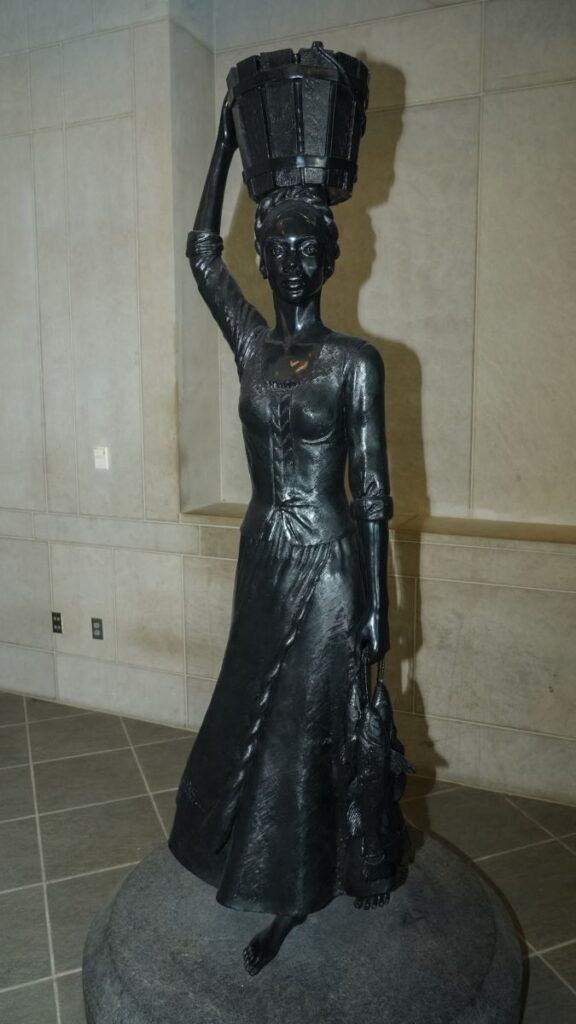
For Juneteenth 2022, the City of Yonkers debuted a permanent art exhibit honoring the legacy of the nation’s first freed slaves. The Enslaved Africans’ Rain Garden includes five life-size bronze sculptures created by artist Vinnie Bagwell depicting formerly enslaved Africans. The sculpture garden is located along the Yonkers Hudson River esplanade. According to Bagwell, “Public art sends a message about the values and priorities of a community. In the spirit of transformative justice for acts against the humanity of black people, I am grateful for those who supported this collective effort. The strongest aspect of the Enslaved Africans’ Rain Garden coming to fruition is that it begins to address the righting of so many wrongs by giving voice to the previously unheard via accessible art in a public place while connecting the goals of artistic and cultural opportunities to improving educational opportunities and economic development.”

In Yonkers, Philipse Manor Hall was the seat of the Philipsburg Manor, a colonial estate that covered more than 52,000 acres of Westchester land. The Philipse family was involved in the trans-Atlantic slave trade and probably as many as two-dozen enslaved African slaves worked and lived at the manor. The enslaved Africans were freed in 1799, one of the first large emancipations in the United States. New York State finally ended slavery in 1827.

Slavery in New Jersey: Teaching Hard History Through Primary Sources

Slavery in New Jersey: Teaching Hard History Through Primary Sources

by Dana Howell

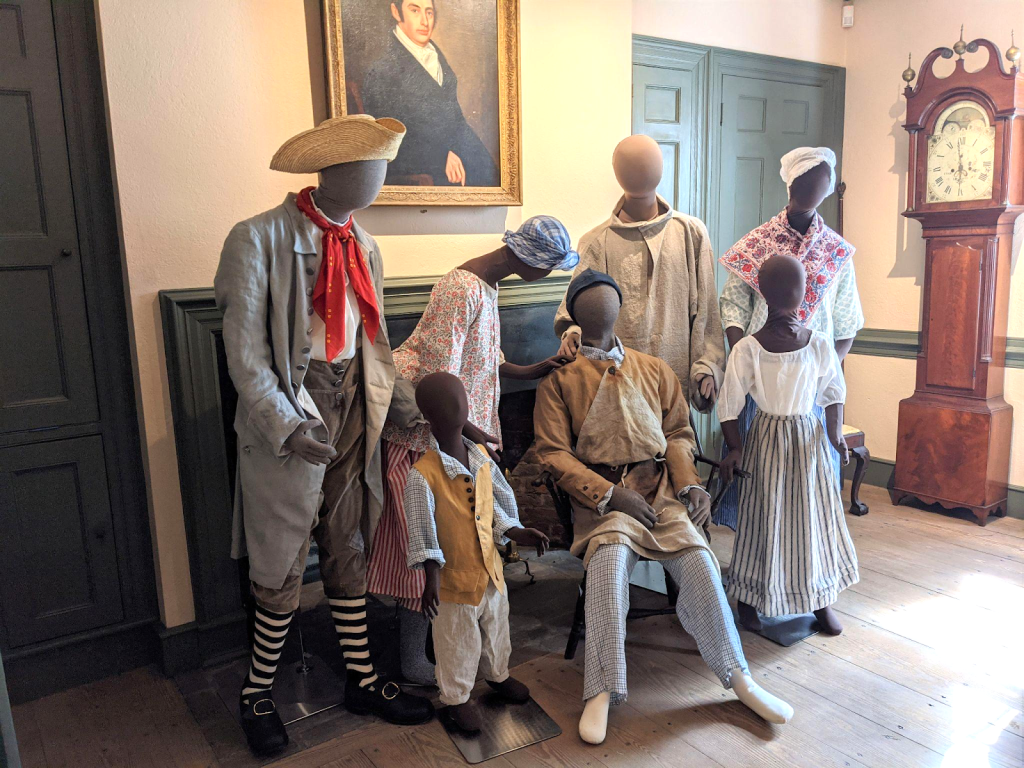
Photo of the Marlpit Hall Family

For nearly a century, the Monmouth County Historical Association (MCHA) has told the story of the Taylor family at Marlpit Hall, the c. 1760 historic house museum in Middletown, NJ. It is a fascinating story indeed, and speaks to the strife between Patriots and Loyalists in Monmouth County, a hotbed of activity during the Revolutionary War. Until recently, however, a chapter of the house’s history had gone untold. In October of 2021, MCHA unveiled the exhibit 

Beneath the Floorboards: Whispers of the Enslaved at Marlpit Hall to include this forgotten chapter. This award-winning exhibit was the culmination of two years of extensive research done by curators Bernadette Rogoff and Joe Zemla to interpret the home to include the long-silenced voices of the enslaved who lived there.

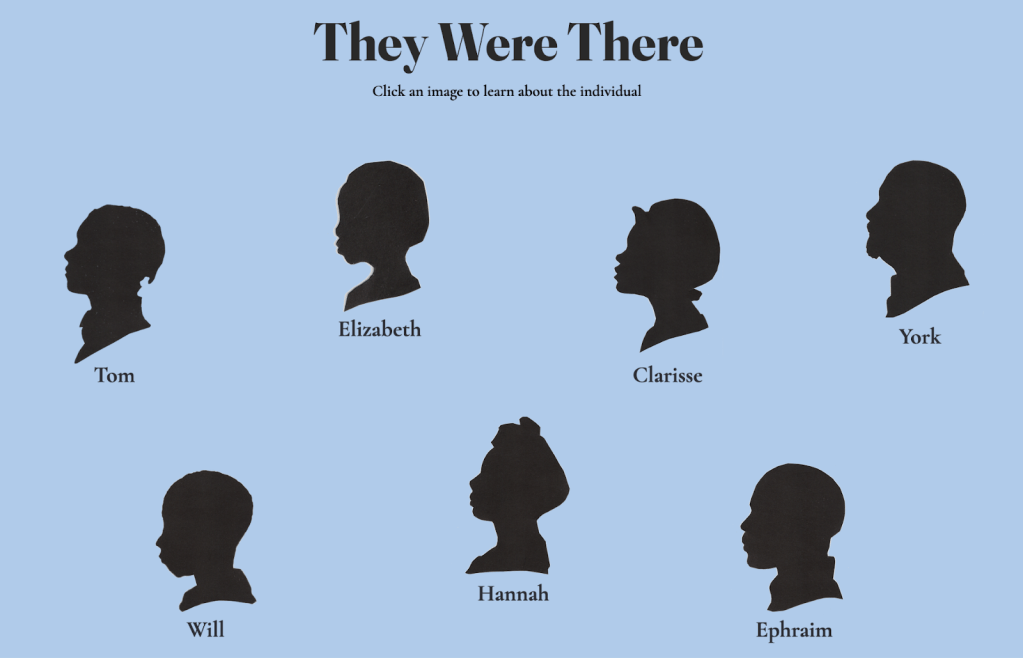
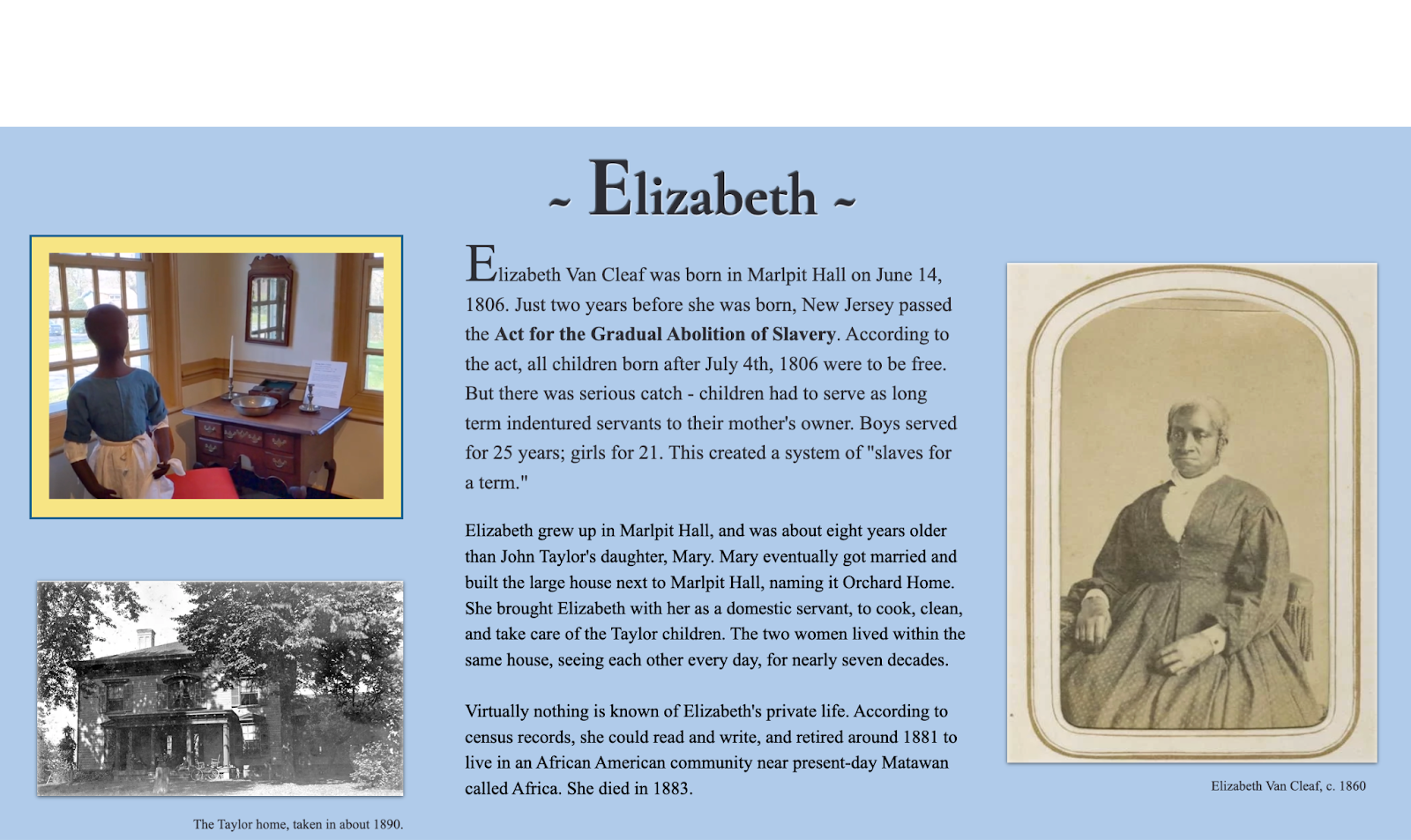
Primary source documentation and discoveries of material culture were the foundations of the research done to uncover the lives of seven of the twelve known enslaved individuals at Marlpit. Birth, death and census records, wills, runaway ads, inventories, bills of sale, and manumissions (or freedom papers) shed light on the experiences of Tom, York, Ephraim, Clarisse, Hannah, Elizabeth, and William. In 2020, Joe Zemla discovered secret caches of artifacts hidden beneath the floorboards of the kitchen loft living quarters that spoke to their religion and protective rituals, while archaeological digs supervised by Dr. Rich Veit of Monmouth University provided further evidence to piece together what life may have looked like for the enslaved. Throughout the house, mannequins dressed in                        

historically accurate reproduction clothing bring each individual to life, supplemented by their carefully researched biographical panels. The artifacts they left behind are now on display; there is no longer a need for them to be hidden from view.

One of the most prevalent comments made by visitors is that they were unaware that slavery existed in New Jersey. For many years, our educational system had been complacent with the general notion that the northern states were free, while the South had enslaved labor. New Jersey has been referred to as the “most southern of the northern states,” second only to New York in the number of enslaved persons and the very last to legally abolish the institution on January 23rd, 1866.

Comparatively, little has been written about slavery in the North. We can read about
the facts of the matter, but the personal stories in the Floorboards exhibit make an impact that no textbook or blog can. The enslaved are presented without any form of politicization, but rather from an evidence-based and humanized lens. Students are able to connect with them, particularly with Elizabeth and William, who were born in the home and are represented as children – another sad fact of slavery that often goes overlooked. It is a unique opportunity to be able to mentally place these individuals in surroundings which are familiar to the student, albeit long ago. The students learn that we can make educated guesses about what life was like during the time in which the enslaved lived and explore the spaces they inhabited, but we can never truly understand their experiences as enslaved human beings. The only thing we can do is try to imagine it, using historical evidence from primary sources as our guide.

There is a sad deficit in age-appropiate classroom resources to teach slavery, and almost none that cover slavery in the North. This deficit creates roadblocks for public school teachers who are mandated to teach these topics as required by the NJ Department of Education’s 2020 Student Learning Standards, incorporating the 2002 Amistad Law.

 monmouthhistory.org/intermediate-btf

While nothing can compare to the experience of actually visiting Marlpit Hall, the opportunity to do so poses challenges for many school districts. In order to make the fascinating information in the exhibit as accessible as possible to students, MCHA has created two NJ standards-based digital education resources adapted for the elementary and middle/high school levels. Created under the advisorship of respected professionals in the fields of education and African American history, both age-appropriate resources provide background on the system of slavery in New Jersey with a focus on the enslaved at Marlpit Hall. In it, they will be introduced to each individual, along with the primary sources that helped to build their stories. Dr. Wendy Morales, Assistant Superintendent of the Monmouth Ocean Educational Services Commission, notes “The questions and activities included in this resource are standards-aligned and cross-curricular. This means students will not only learn historical facts, but will be challenged to think like historians, analyzing primary sources and making connections between historical eras.” Creative writing, art, music, and civics are all explored.

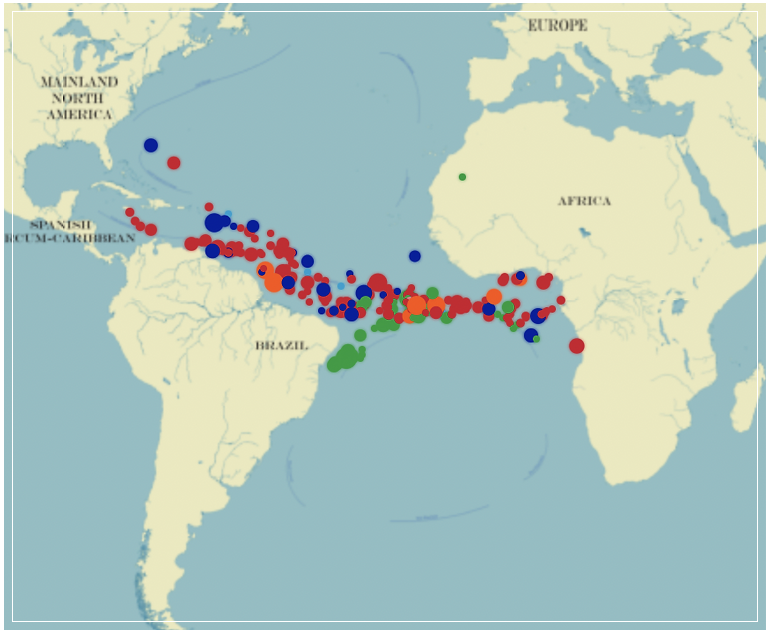
The section on the origins of slavery in New Jersey stress that the enslaved came here not as slaves, but as individuals who were taken from a homeland that had its own culture and civilization. Two videos, courtesy of slavevoyages.org, make a powerful impact. Students will get to view a timelapse of the paths of over 35,000 slave ship voyages, plotted in an animated graph. This visual representation helps students visually process the magnitude of the forced migration of the enslaved, while a 3-D modeling of an actual slave ship offers a uniquely realistic view of these vessels.

 Time lapse of plotted slave ships         Video featuring 3-D model of slave ship

Both grade level resources come with downloadable worksheets that can be customized to accommodate differentiated learning strategies, and submitted through Google Classroom. Teacher answer keys are provided for guidance as well. MCHA is proud to provide these resources free of charge to aid educators in their responsibility to teach slavery. The resources offer a guided approach to help educators navigate this sensitive and often difficult topic in the classroom. The new mandates are an excellent start to correcting the record on New Jersey’s history of enslavement, but it is truly New Jersey’s educators who will place their personal marks on bringing relevance and reverence to the topic in the classroom.

These resources can be found under the education tab at monmouthhistory.org/education-homepage. MCHA welcomes all questions and comments to dhowell@monmouthhistory.org.

New York Local History: Underground Railroad in the North Country

New York Local History: Underground Railroad in the North Country

Source: North Country Public Radio https://www.northcountrypublicradio.org/news/story/45430/20220224/remembering-the-secret-history-of-the-underground-railroad-in-the-north-country

A few minutes outside the small town of Peru in New York’s Champlain Valley, there is a small farm that looks like any other in the area. A cluster of silos and red barns with fading paint are flanked by snow-covered fields and apple orchards, dormant for the winter. But this farm has something unique. A blue and yellow New York State historical marker identifies the property as a stop on the Underground Railroad, where “runaway slaves were concealed and protected on their way to freedom in Canada.”

There was no actual train involved in the network, explains Jacqueline Madison, the President of the North Country Underground Railroad Historical Association. “It was a trail of conductors who helped them along the way [and] safe houses where they could stay,” she notes.

Communities from Watertown to Lake Champlain were part of that network of safe houses that helped people escape slavery in the American south during the decades leading up to the Civil War. Escapees typically traveled by foot or water. The railroad moniker was part of a secret code: safe places to stay were called stations and the owners of those properties were known as conductors. A full journey on the Underground Railroad typically took several months.

This is the history that Madison and the North Country Underground Railroad Historical Association are dedicated to preserving. The group operates a museum in Keeseville, in the Champlain Valley south of Plattsburgh. It features the stories from both sides of the Underground Railroad: Black passengers and white conductors. One exhibit is dedicated to the former owner of that historic Peru farmhouse, a man named Stephen Keese Smith. The abolitionist Quaker purchased the property in 1851 and quickly established one of the barns as a hiding place for runaway slaves headed to Canada. There is no way to know with certainty exactly how many people Keese Smith aided while working as a conductor. But his later writings provide an estimate. “He talked about helping people get to freedom and he thinks he spent about $1000 doing that,” Madison explained. “And if we spent $2.50 per person, he would have helped over 400 people.”

Exact numbers are nearly impossible to come by in historical records because those helping escaped slaves often avoided keeping a paper trail. Involvement in the Underground Railroad was extremely dangerous for everyone, black or white. The Fugitive Slave Act of 1850 required that escaped slaves be returned to their former owners – and carried stiff penalties for anyone who aided them. “If you were caught helping someone get to freedom,” Madison noted, “you could lose your property, you could be jailed, you could be fined. Terrible things could happen to you, your family, and friends if they suspected them of helping as well.”

The North Star Underground Railroad Museum fills up the bottom floor of an old 19th Century house. It’s packed with maps, faded newspaper articles, and portraits of notable members of the North Country section of the covert network. Standing before a map, Madison explains the various routes freedom-seekers would have followed to reach Canada. A western path originating in Pennsylvania went through Buffalo, up to Watertown, and crossed the St. Lawrence River at Ogdensburg. Two escape routes followed Lake Champlain: one through Vermont and another running from Albany to Rouse’s Point along the lake’s western shore. To find their way, escapees used folk songs learned on the southern plantations. They worked as a kind of secret oral map; with coded lyrics guiding freedom seekers on their journey north. One such tune called Follow the Drinking Gourd referenced landmarks like certain rivers and offered hints for how to identify friendly conductors. Drinking gourd was code for the Big Dipper – a celestial constellation that can be used to identify the North Star.

Although details can be hard to piece together, some stories of those who passed through the North Country to freedom have been recovered. An article written in 1837 by Vermont-born abolitionist Alvan Stewart for an anti-slavery newspaper recounts the story of an anonymous man who travelled through the North Country on his way to Canada. “I was headed to Ogdensburg, on my way north to Canada from South Carolina,” an actor declares in a re-enactment exhibit at the North Star Museum. “I had come up through the Champlain Canal, and then gone through Clinton and Franklin County.” That unknown man did eventually reach freedom north of the border, but his quest nearly ended in disaster just a few miles from his destination.

Outside of Ogdensburg, he stopped into a post office looking for work. Since New York had outlawed slavery in 1827, that would not necessarily have been out of place. However, slave owners offered rich rewards for the return for those who escaped, and slave catchers were permitted to operate even in anti-slavery states under the Fugitive Slave Act. When the anonymous freedom seeker entered the post office near Ogdensburg, the postmaster recognized him and explained that a reward for his capture had been posted. “I said to him, if you send me back then they’ll do terrible things to me,” the re-enactment continues. “Whip me. Hang me. Skin me alive. I begged him not to turn me in.” In this case, the postmaster ignored the reward, worth about $20,000 in today’s terms, and helped the man cross the St. Lawrence River into Canada.

Other escaped slaves decided to settle in North Country. In 1840, a Franklin County landowner named Gerrit Smith pledged to donate more than 120,000 acres of wilderness land in the Adirondacks to free black men. It would eventually become a settlement known as Timbuctoo. A man named John Thomas received 40 acres of un-cleared land from Smith. Thomas later sold that to buy a larger plot near Bloomingdale, NY, which he turned into a successful farm. Many years later, Thomas wrote his benefactor a letter, thanking Smith for the “generous donation” and revealing that he and his family greatly enjoyed the peace and prosperity of their “rural home.” Although Thomas was successfully established himself in the region, that was not the case for most recipients of Smith’s land. Harsh winters and tough soil drove many of the Black farmers to sell the land they had received and move away. The climate was not the only danger; at least once, slave catchers came to the area looking for Thomas. According to Madison, they first approached his neighbors seeking their help. As Madison tells it, Thomas’ neighbors informed the slave catchers that he was armed, would forcibly resist capture, and declared their intention to assist Thomas in repelling the catchers. The slave catchers are believed to have given up their pursuit.

In his later letter to Smith, Thomas hinted that his adopted community had begun to treat him as one of their own. “I have breasted the storm of prejudice and opposition until I began to be regarded as an American citizen,” he wrote. This may also be a reference to civic participation. At the time, New York State required men to own at least $250 worth of land to obtain the right to vote. Thomas’ obituary was published in the Malone Palladium in May 1895. It described him as “much respected in the community where he lived so long.” His descendants still live in that community. Through genealogy research, Madison and the North Star Museum discovered that two of John Thomas’ great-great grandsons still reside in the North Country. One of the descendants lives less than two miles from the cemetery in Vermontville where Thomas and his wife are buried.

Academic Freedom: Are American Teachers Free? Should They Be?

Academic Freedom: Are American Teachers Free? Should They Be?

James K. Daly

In 1936 Howard Beale asked if American teachers were free. It is a question that still resonates today. The issue is entangled in the complex and ever-changing world of educational policy, political pressures, and cultural tensions. A second question to Beales earlier one could very well ask, should they be? What does it mean for teachers to be free? How do cultural expectations impact on what schools, communities, and larger groups perceive as appropriate for examination in public schools?

Many suggest topics, issues, and claims to truth should not be examined at all. Those who know the truth often feel compelled to teach it. Educational orthodoxy, whether of the political Left or the political Right, can silence opposing views, materials, attention. There is a long history of efforts to suppress perspectives. Legislation in many states has institutionalized restrictions on viewpoints, and textbook publishers have complied. Practitioners supporting the status quo, or the work of activist special interest groups have also contributed to censoring views (Jenkinson, 1979, 1985; O’Neil, 1984; Parker and Weiss 1983; Merry, 2009; Fallace, 2011; Hill, 2020, Nelson, 2021).

The essentiality of critical thinking

Critical thinking is regularly cited as an essential skill for preparing the young to succeed in the 21st century. The NCSS C3 framework identifies critical thinking as a key element in developing engagement and participation among citizens (NCSS 2013). Nelson et al. (2021) cite critical thinking as among the most important issues in schools.

Scholars have long stressed the need for schools to move away from indoctrination, the antithesis of critical thinking. Social studies is where young people must examine conflicts in beliefs and values (Hunt & Metcalf, 1955). Any belief not carefully examined is by definition a prejudice. Oliver and Shaver (1966) assert that the ability to choose on issues of public importance depends on awareness of alternatives. Schools must not just tolerate but encourage the examination of these alternatives. To accomplish this critical thinking is essential.

Critical thinking in schools allows individuals to scrutinize information and claims to truth. Learners explore what can be demonstrated, proved, and accepted using the best available information. Views are challenged, defended, discarded, or temporarily accepted. Learners recognize that acceptance of truth may well be tentative, pending additional knowledge (Pinker 2018).

Critical thinking skills are essential to examining topics on which society is divided (Nelson, 2021a). They protect against propaganda and conspiracy theories. Without these students are simply told what is correct, and which views are to be accepted. Recent years show the danger of this.  In a world of rapid fire media proclaiming new truths throughout the day, with little or poorly supported evidence, students can be ignorant of their own ignorance. This may be welcomed by any number of special interest groups but is anathema to maintaining democracy. 

Critical thinking takes a great deal of time. It requires considerable financial and other resources, from purchasing tools and materials to providing professional development opportunities. The amount of energy needed to do this in a field not easily measured is a challenge (Nelson et al., 2021).

Critical thinking and critical issues

Can critical thinking be promoted when only one or a narrow range of similar views are explored? Can critical thinking be developed for transfer to authentic settings if current critical issues are not examined? Traditionally many ‘givens’ are found both in the formal and the hidden curriculum. They are drawn from the dominant political and cultural perspectives reflecting the larger community. Scholars have consistently asserted that discussing controversy is essential in a diverse democratic society. Critical thinking needs to be about issues that in themselves are critical, with many and competing views. Critical thinking helps students explore different outlooks, and constructively consider consequences of alternative views. Ettinger (2004) refers to this a “constructive harnessing of conflict”. Conflict can be embraced as offering opportunities for exchanging information, evidence, and making tentative conclusions on actions.

Barton and Levstik (2004) state that the aim of history education, and indeed for social studies, is preparing the young to act. Actions and consequences of historic challenges can be scaffolded to frame current day issues. They cite Newman (1975) and his call for intelligent action, the ability to use knowledge and skills to develop a commitment for addressing social problems. The context in which critical thinking skills evolve is pivotal. Barton and Levstik mention Parker and others in advancing the need for the young to understand and experience participatory democracy. Students need to be taught, and practice critical thinking skills on topics where disagreements are analyzed.  They refer to McCully (2002) suggesting that just working on critical thinking skills may not help in examining current divisive topics. Building critical thinking skills without an exploration of authentic current issues may fall far short of what is needed.

Claims to truth need to be analyzed, with critical thinking skills scaffolded, enhanced, and regularly practiced. These skills support conflict resolution strategies, utilizing active listening and clear communication (Katz, 2020). This reinforces what Lortie (1975) referred to as the apprenticeship of observation. Learners routinely experience situations in which these skills are refined and improved. They grapple with different views and competing sources of evidence. The routine and expected school experience would demonstrate a respectful appreciation of diverse views. The hidden curriculum would be supportive of the intellectual work of considering conflicting opinions. The norm would be examining issues in practiced and familiar patterns, respectful of opinions, while accepting disagreement on conclusions. Democratic principles and foundational documents along with Human Rights concepts need to provide the context in which critical thinking evolves. Examining how well these principles, documents and concepts have demonstrated themselves over time provides framing for analyzing current issues.

The need to address critical thinking skills, and the need to do so when addressing current controversial topics puts the teacher at the center of public scrutiny. It is in the larger public arena that controversy is housed, and from which it enters classrooms.

The preponderance of scholarship supports dealing with controversy. Schools must offer individuals opportunity to escape the limitations of the group into which they were born (Dewey, 1916). Schools should create awareness of the larger society. Few other institutions can guide an analysis of past events, an exploration of current considerations, with a focus on the future. 

In a nation as diverse as ours, and in the current political and cultural climate, controversy enters schools and classrooms. The interactions between teachers, administrators, professional organizations, and the public are fraught with complex and often contradictory expectations. Sustaining a democratic republic in this context requires citizens who can examine topics on which there is disagreement (Lynd, 1939; Selakovich, 1967; Newman and Oliver, 1970; Shermis and Barth, 1979; Berlak, 1977; O’Neil, R.M.,1981); Apple, 1982; Besag and Nelson, 1984; Engle and Ochoa, (1986); Daly, et al., 2001; Underwood, 2017; Nelson 2021a).

Are American teachers free?

Teachers appear to be willing to address controversy but often don’t because of concerns about the consequences (Byford, 2009). Nelson (1992) writes that many report they have academic freedom. However, when questioned about teaching specific issues, a typical response was that they were too controversial to teach. Teacher belief in their ability to address controversy does necessarily translate to their doing do (Daly, 1986; Mitchell, Evans, Daly, & Roach, 1997; Misco and Patterson 2007). Patterson (2010) reveals that while 98% of teachers in one study reported they had academic freedom (of varying degrees), over 93% indicated limits to what can be taught. Some of those restrictions might be called self-censorship. Limitations included barriers raised (or anticipated) from community members, administrators, and students. Girard and Harris (2021) describe that teachers in one study found it easy to add topics and issues to provide a more inclusive view. However, they were unwilling to examine contemporary society and power relationships. The local commuity was cited as a significant influence on what teachers address.  In an Education Week article considerable percentages of teachers disclosed they avoided teaching many topics (Pendharkar, 2021). 

Potential Sources supporting teacher freedom

Decisions made by practitioners have consequences for what is taught and how it is taught. State curriculum standards impact those decisions. An analysis of state standards for History indicated clear and opaque support for teacher decision making and selection in many states (Girard and Harris, 2020). The impact on teacher freedom ranged from rigid specificity to almost limitless choice for teachers. Standards may well support considerable freedom in many states; however, more is needed.

Academic Freedom is a philosophical framework buttressing teacher freedom. There are legal decisions that help uphold it. Philosophical views without more compelling legal support cannot be relied upon. They can and should be used to engage educators and communities in discussions on exploring difficult topics. Language supporting academic freedom needs to be in district policy manuals and guides. Hess (2009) reminds us that controversy is a socially constructed phenomenon. She recognizes that the public has a right to have an influence on what is taught in the schools. Engaged and systematic review of the need for, the limits on, and the student benefits of academic freedom need to be promoted. While the specific topics may change, controversy is a given.  Underwood (2017) recognizes that many who would restrict teacher freedom fear indoctrination. They feel left out of curriculum discussions, unaware of pedagogical strategies, and suspicious of views other than their own. Discussions on the nature and purpose of academic freedom may ease that fear.

Academic freedom

The National Council for the Social Studies advocates teacher freedom. The organization issued Position Statements on Academic Freedom in 1969, revised in 2007 (National Council for the Social Studies, 2010).  The most recent maintains that teachers should be free to create settings that foster democratic processes (Social Education, 2016)). Academic Freedom for teachers is necessary to create citizens aware of contentious issues and positions on them. Students need to examine factual claims, discuss competing perspectives, investigate, and analyze topics of concern. This promotes understanding of the relationship between past and present, providing skills and dispositions for grasping local, national, and global views. Truth is difficult to discover and claims to it need to be thoughtfully considered.

Affirming academic freedom is important, as it informs educators and the larger community of its twin features. Academic freedom is not just a concept addressing the teacher, but one focused on the student (Hofstadter and Metzger (1968). Emerging from early German universities, the right of the student to learn was essential. The student was free to explore ideas and not simply compelled to accept all that teachers, text and school presented.

Reassuring the public that academic freedom does not promote indoctrination is critical when many believe schools are overtly trying to impose views antithetical to them. Compelling acceptance of views can create a spiral of silence (Noelle-Neumann, 1977; Journell, 2017). Students presented with one perspective, taught by teachers supporting and promoting that perspective, may feel themselves to be in a minority. That perception can lead to silence. Anecdotal evidence suggests that students, and families, know what teachers expect, what outlooks are correct, and often the moral value attached to various views. With academic freedom the constraints of local perspectives are open to be examined in a wider context, but student acceptance or belief in those viewpoints is not required. Those who embrace Academic Freedom recognize it is not a license for teachers to force views on students or to limit the issues examined. The concept is a defense against the imposition of certainty, which seems to be an objective of many along the political continuum.

The role of school boards

School Boards approve curricula, resources, and materials. Board meetings often have limited time for public discussion of issues, let alone providing for discussions and examination of curricula content. Entering the term Teacher Academic Freedom on the National School Boards website had no hits. Under one heading on that site Boards were urged to say no to any Federal intrusion of local decision making authority (School Boards Association, 2021). That would seem to provide support for considerable community influence on what is taught, and how it is taught. In the Advocacy Agenda for 2019-2020 (the only one on the website as of 2/16/22), there does not appear to be much about how to work with communities beyond the traditional interactions. No role for the larger public is evident.

Recently local Boards have addressed concerns about what may inappropriately be referred to as Critical Race Theory. A quick google or YouTube search provides evidence that the issue is one generating considerable conflict, and political action at the local and state level. The many YouTube videos, and anecdotal evidence suggest that school board meetings are not the best time or place for discussion. The very structure of public input at Board meetings seems to add frustration and anger to already potentially confrontational topics. Limited time, and the lack of a structure to permit significant and sustained conversation suggests other approaches need to be explored.

A memo from the FBI Director provides evidence that the anecdotal and social media reports of Board confrontations are accurate. The memo cites a spike in harassment, intimidation, and threats of violence against school employees and officials. It indicates that the agency will use FBI agents to discourage, identify and prosecute such threats. (Federal Bureau of Investigation, 2021).

What is the role of the larger community? Are they to be relegated to sporadic outbursts on social or traditional media, angry statements at school board meetings? How should public views be identified, shared, and considered. Who decides what is controversial, what gets addressed, and how, or if, opposing views are examined, welcome or tolerated?

Should American teachers be free?

American teachers should be free to foster citizens who can critically examine current controversial topics that divide the society. There is a need to protect the right of the student to learn. Teacher freedom brings responsibilities. There is a responsibility to ensure that practitioners and those preparing to practice are knowledgeable about the need for such freedom. There is a responsibility for practitioners to be open to guidance in planning, teaching, and assessing when focused on controversy. Administrators and Boards need to support teachers engaged in this work. They have a responsibility to create environments in which teachers work with colleagues, administrators, and the larger public to build support for addressing controversy. There are too few fora in which such conversation occurs. Those promoting teacher freedom and the right of students to learn beyond indoctrination need to work with school board members and the school community. Together those in schools must actively seek to find opportunities to have difficult conversations about the need for teacher and student freedom.

Preparing teachers for these challenges

Those planning to teach must understand the nature of academic freedom, recognize the need for dealing with controversial issues, and their relationship to citizenship education. Research on teacher preparation in this effort is mixed. Misco and Patterson (2007) report that teacher education candidates understand the concept of academic freedom but believe that it offers only limited protection. Some revealed they would not exercise those freedoms for several reasons, including fear of reprisals. Uncertainty about how to properly deal with controversy led to a deference to community preferences. The majority were aware of constraints on what and how issues could be addressed.

Even after completing a social studies methods course, participants in a study by Nganga et al. (2020) displayed limited awareness and understanding of teaching controversial issues. Most were unwilling or cautious about addressing issues with which they did not feel comfortable, or about which they had little experience. There was acceptance of the need to conform to the views and values dominant in the community (Engebretson, 2018; Hess 2002).

Teacher education programs themselves may not model ways to deal with alternative perspectives. The spiral of silence found in other settings may also be present within these programs (Journell, 2017). Holding conversations and exploring differing perspectives on foundational ideas may not be a priority. There may be ‘single stories’ (Adichie, 2009) in teacher preparation. Divergent views need to be shared and explored.  Doing so would model how to examine differences in the schools in which students will work.

Education programs may be one of many ‘silo’s’ within the university, with their own “silo’s’. Conversation and collaboration between the programs for administrators and other specialists is essential. Counselors, teachers, administrators in training all benefit from examining the nature of controversy, community engagement, and the benefits to teachers and students of academic freedom. There are overlapping interests, and common audiences. This collaboration would help explore ways to engage with the communities in which they already work and those in which they will work.

What needs to be done?

Little in the larger culture provides examples of how people can discuss deeply held and contrary views. The skills of active listening and clear communication need to be practiced examining issues of current importance, even when presented in an historic setting. Students need experience checking the validity of various claims. They need practice within agreed upon ground rules. Time needs to be provided for researching evidence on topics and discussing views. Students require opportunities to analyze issues using various strategies. Students need structure and practice in hearing contrasting views and doing so in respectful ways.

Teachers need to be free to select books, resources, materials, and strategies. This must support the curriculum and be consistent with state standards. Approaches on how to navigate those requirements is needed. Pre-service training and professional development for practitioners needs to be authentic, providing active participation in using various strategies. Routine focus is needed on the rationale for dealing with controversy. Pre-service training needs consistent and collaborative support from professors, clinical field supervisors, cooperating teachers and their administrators. Practitioners need support from colleagues, administrators, and local community members. These groups, committed to democracy, are essential to promoting conversation instead of confrontation on issues of significant disagreement.

References

Adichie, C. N. (2009, July). The danger of a single story [Video]. TED Conferences. https://www.ted.com/talks/chimamanda_ngozi_adichie_the_danger_of_a_single_story

Apple, M.W. (1982). Education and power. Routledge and Kegan Paul. https://doi.org/10.4324/9780203143124

Barton, K. C. (2005). “Best not to forget them”: Secondary students’ judgments of historical significance in Northern Ireland. Theory and Research in Social Education, 33(1), 9–44. https://doi.org/10.1080/00933104.2005.10473270

Barton, K. C., & Levstik, L. S. (2004). Teaching history for the common good. Routledge. https://doi.org/10.4324/9781410610508

Beale, H. K. (1936). Are American teachers free: An analysis of restraints upon the freedom of teaching in American schools. C. Scribner’s Sons. https://doi.org/10.1086/ahr/43.1.177

Berlak, H. (1977). Human consciousness, social criticism, and civic education. In J. P. Shaver (Eds.), Building rationales for citizenship education. Bulletin 52 (pp. 34-47). National Council for the Social Studies.

Besag, F. P., & Nelson, J. L. (1984). The foundations of education: Stasis and change. Random House.

Byford, J., Lennon, S., & Russell, W. B. (2009). Teaching controversial issues in the social studies: A research study of high school teachers. The Clearing House: A Journal of Educational Strategies, Issues and Ideas, 82(4), 165-170. https://doi.org/10.3200/TCHS.82.4.165-170

Collum, M. (2016). Academic freedom and the social studies educator. Social Education, 80(3), 186. https://www.socialstudies.org/social-education/80/03/academic-freedom-and-social-studies-teacher

Cruz, T., Lee, M., Blackburn, M. (2021, October 8). [Letter to Merrick Garland, Attorney General of the United States]. Senate Judiciary Committee. https://www.blackburn.senate.gov/services/files/1DA3DAA8-2087-4DDD-9BE9-0A4E7E3B9F0B

Daly, J. (1986). Patterns and perceptions of censorship among secondary educators: Censorship in New Jersey Schools [Unpublished doctoral dissertation]. Rutgers University.

Daly, J. K., Schall, P. L., & Skeele, R. W. (2001). Protecting the right to teach and learn: Power, politics, and public schools. Teachers College Press.

Dewey, J. (1916). Democracy and education: An introduction to the philosophy of education. Macmillan.

Engebretson, K. E. (2018). One novice teacher and her decisions to address or avoid controversial issues. The Journal of Social Studies Research, 42(1), 39-47. https://doi.org/10.1016/j.jssr.2017.03.001

Engle, S. H., & Ochoa, A. (1986). A curriculum for democratic citizenship. Social Education, 50(7).

Fallace, T. D. (2011). The effects of life adjustment education on the US history curriculum, 1948-1957. The History Teacher, 44(4), 569-589. http://www.jstor.org/stable/41304011

Girard, B., Harris, L. M., Mayger, L. K., Kessner, T. M., & Reid, S. (2021). “There’s no way we can teach all of this”: Factors that influence secondary history teachers’ content choices. Theory & Research in Social Education, 49(2), 227-261. https://doi.org/10.1080/00933104.2020.1855280

Harris, L. M., & Girard, B. (2020). Evaluating the support of teacher choice in state history standards. The History Teacher, 53(4), 613-633.

Hess, D. E. (2009). Controversy in the classroom: The democratic power of discussion. Routledge. https://doi.org/10.4324/9780203878880

Hill, R. (2020). The problem of self-censorship. In A. M. Dawkins (Eds.), Intellectual freedom issues in school libraries (pp. 88-98). Libraries Unlimited

Ho, L., McAvoy, P., Hess, D., & Gibbs, B. (2017). Teaching and learning about controversial issues and topics in the social studies. The Wiley handbook of social studies research, 319-335. https://www.perlego.com/book/994195/the-wiley-handbook-of-social-studies-research-pdf  (Original work published 2017)

Hunt, M.P., & Metcalf, L.E. (1955). Teaching high school social studies. Problems in reflective thinking and social understanding. Harper and Row.

Jenkinson, E. B. (1979). Censors in the classroom: The mind benders. Southern Illinois University Press.

Journell, W. (2017). Politically conservative preservice teachers and the spiral of silence: Implications for teacher education. Teacher Education Quarterly, 44(2), 105-129. https://www.jstor.org/stable/90010520

Katz, N. H., Lawyer, J. W., Sosa, K. J., Sweedler, M., & Tokar, P. (2020). Communication and conflict resolution skills. Kendall Hunt Publishing. Retrieved from https://nsuworks.nova.edu/shss_facbooks/177

Lortie, D. C. (1975). Schoolteacher: A sociological study. University of Chicago Press.

McCully, A., Nigel Pilgrim, A. S., & McMinn, T. (2002). ‘Don’t worry, Mr. Trimble. We can handle it’ Balancing the rational and the emotional in teaching of contentious topics. Teaching History, 106, 6-12.

Merry, M. S. (2009). Patriotism, history and the legitimate aims of American education. Educational Philosophy and Theory, 41(4), 378-398. https://doi.org/10.1111/j.1469-5812.2007.00363.x

Mitchell, G., Evans, S., Daly, J., & Roach, P. (1997). Academic freedom and the preparation of social studies teachers. Theory & Research in Social Education, 25(1), 54-66. https://doi.org/10.1080/00933104.1997.10505790

National Council for the Social Studies. (2013). The college, career, and civic life (C3) framework for social studies state standards: Guidance for enhancing the rigor of K-12 civics, economics, geography, and history. https://www.socialstudies.org/standards/c3 

National School Boards Association. (2021, December 14). Local school board governance and flexibility. https://www.nsba.org/Advocacy/Federal-Legislative-Priorities/Local-School-Board-Governance-and-Flexibility

Nelson, J. L. (1992a). Social studies and history: A response to Whelan. Theory & Research in Social Education, 20(3), 318-326. https://doi.org/10.1080/00933104.1992.10505672

Nelson, J. L. (2021b). Academic freedom and issues-based social education. In R. W. Evans (Ed.), Handbook on teaching social issues (2nd ed., pp. 37-49). Information Age Publishing.

Nelson, J. L., Palonsky, S. B., & McCarthy, M. R. (2021). Critical issues in education. Dialogues and dialectics (9th ed.). Waveland Press.

Newman, F. (1975). Education for citizen action: Challenge for secondary curriculum. McCutchan Publishing Corporation.

Noelle-Neumann, E. (1977). Turbulences in the climate of opinion: Methodological applications of the spiral of silence theory. Public Opinion Quarterly, 41(2), 143-158. https://doi.org/10.1086/268371

O’Neil, R. M. (1981). Classrooms in the crossfire. The rights and interests of students, parents, teachers, administrators, librarians, and the community. Indiana University Press.

Oliver, D. W., & Shaver, J. P. (1966). Teaching public issues in the high school. Utah State University Press.

Parker, B. & Weiss, S. (1983). Protecting the freedom to learn: A citizen’s guide. People for the American Way.

Parker, W. (Ed.). (1996). Educating the democratic mind. SUNY Press.

Pendharkar, E. (2021, December 10). You’re not going to teach about race. You’re going to go ahead and keep your job. Education Week. https://www.edweek.org/leadership/youre-not-going-to-teach-about-race-youre-going-to-go-ahead-and-keep-your-job/2021/12

Pinker, S. (2018). Enlightenment now: The case for reason, science, humanism, and progress. Penguin UK.

Selakovich, D. (1967). The schools and American society. Blaisdell Publishing Co.

Shermis, S. S., & Barth, J. L. (1979). Defining social problems. Theory & Research in Social Education, 7(1), 1-19. https://doi.org/10.1080/00933104.1979.10506047

Underwood, J. (2017). Under the law: School districts control teachers’ classroom speech. Phi Delta Kappan, 99(4), 76-77. https://doi.org/10.1177/0031721718808270

New York State’s Birthday and First Constitution

New York State’s Birthday and First Constitution

Bruce W. Dearstyne

Social studies and history teachers routinely cover the Declaration of Independence and the U.S. Constitution in their courses. But every state also has a “birthday” (the day it got started as a state) and its own state constitution. The origins of states and their first constitutions can be very useful teaching tools, adding a new dimension to students’ historical insight and understanding.

New York State is an outstanding example. April 20 is New York’s Birthday! That was the date in 1777 when the Convention of Representatives of the State of New York, an ad hoc group elected the previous year to guide New York’s Revolutionary War efforts and develop its first constitution, finished work on that document.

The story of New York’s first state constitution is a dramatic one. New York had moved from steadfast loyalty to Britain to reluctant rebelling colony to a full-scale push for independence through the actions of three Provincial Congresses, the first elected in 1775, to guide New York in the growing alienation from Britain. The “Convention of Representatives” had been elected the year before as New York’s fourth Provincial Congress. Meeting initially in White Plains, they authorized New York’s representatives to the Continental Congress to approve the Declaration of Independence in early July, then, to keep out of reach of British forces, fled north to Fishkill and finally to Kingston where they completed their work. Along the way, they changed their name from Provincial Congress to Convention of Representatives of the State of New York. 

When they began their work it wasn’t entirely clear just what a “state” was. People knew about colonies/provinces (New York had been one), and nations or nation-states as they were sometimes called (such as Britain). There were few precedents of models to draw on. Other colonies-becoming-states were writing their own first constitutions. The Articles of Confederation, which would link the new states together, was not completed until November 1777. The U.S. Constitution was a decade in the future. The creative New York drafters drew on their own experience in colonial government, their knowledge of European writers on the concepts of natural rights and representative government, and  a few American leading-edge advocates such as Massachusetts’ John Adams. But mostly they drew on their own creativity and improvisation.

The delegates worked in haste and approved the final draft of their document, which still had strikeouts and marginal notes when they signed it. There was no time to make a clean copy before sending the document to the printer. They took a day off but the next day, April 22, the convention’s secretary mounted a flour barrel outside the court house where the group had worked and read it aloud to Kingston citizens.

New York State had in effect proclaimed itself into existence.

The document began by quoting the Declaration of Independence. This connected New York with the other colonies asserting their independence. It stated that the convention acting “in the name and by the authority of the good people of this State doth ordain, determine, and declare that no authority shall on any pretense whatever shall be exercised over the people or members of this State, but such as shall be derived from and granted by them.” In 1777, a document purporting to represent the consensus and will of the people, and their right to govern themselves,  was a startling, radical departure from the past.

The original copy of the first constitution is preserved in the State Archives.   The Archives has provided a scanned version at https://digitalcollections.archives.nysed.gov/index.php/Detail/objects/10485.You can read it online in typed form at the Yale Law School Avalon Project. William A. Polf’s 1777:  The Political Revolution and New York’s First Constitution, also available online, provides a good introduction. It is also described in Peter Galie, Ordered Liberty: A Constitutional History of New York and in my book, The Spirit of New York: Defining Events in the Empire State’s History.

The 1777 constitution is just over 5000 words in length, It outlined the structure and purposes of state government but did not provide much detail.

It created a two-house legislature — one house, the Assembly, to be more numerous and more broadly representative of the people, and the other, the Senate, to be smaller and more attuned to the interests and property. That basic structure is still in place today.

It declared that “the supreme executive power and authority of this State shall be vested in a governor” who “shall take care that the laws are faithfully executed.” That wording is similar to what exists in the current State Constitution. But the 1777 writers had had enough experience with the King of England and some colonial governors who had over-asserted their power that they hedged the authority of New York State’s governor. Instead of giving the governor veto power over bills passed by the legislature, they created a “Council of Revision” consisting of the governor, chancellor, and judges of the supreme court with veto power. Rather than giving the governor sole appointment power, they vested that in a “Council of Appointment,” consisting of the governor and four senators chosen annually by the Assembly,  to approve all appointments.

The document made only a brief reference the courts; fleshing that out later would require legislative action. Voting rights were restricted to men who met certain property-holding or other requirements.

The Constitution was not very long but it was a sound beginning. Hastily-organized elections were held in the spring and summer. The first legislature assembled in Kingston in September and got to work. The newly-elected governor, General George Clinton, had to await a lull in the fighting to come to Kingston, take the oath office, make  the first gubernatorial address, and then hurry back to lead troops again.

The fledgling government did not have tranquility for long. It had to flee as British troops arrived and assaulted and burned Kingston on October 16. The legislature soon re-assembled in Poughkeepsie and resumed work. By then, patriot forces had defeated British incursions from the west (at Oriskany, August 6), the east (at Bennington, on August 16) and the north (at Saratoga, October 17, a major victory that became the turning point of the Revolution).

1777 turned out to be something of a “miracle year.” New York State was here to stay. The new constitution endured without major changes until 1821.

There are many ways of approaching the use of the first State Constitution in social studies and history courses. Some possibilities:

*It is an inspiring, against-the-odds story. It is a story of people determined to control their own collective affairs through representative government.  At the beginning of 1777, the odds of New York’s success did not seem great. By the end of the year, New had written a constitution, established a government, held elections, fended off invasions from three directions, and survived invasion and destruction of its capital.

*It represented compromise and consensus. The writers had a number of disagreements and varying viewpoints and perspectives going into the process. But along the way they put aside their differences, compromised, and came together to develop a consensus document. That process is worthy of study now, when too often it seems difficult to reach agreement on divisive political issues.

*It was successful, flexible, and enduring. The first constitution proved to be a viable framework for years when New York grew remarkably fast. Even when the first major revisions came in 1821, the structural changes were relatively modest. The revisions abolished the Council of Revision and the Council of Appointment and replaced them with procedures more similar to what we have today.

*It left important work undone. The convention discussed abolishing the horrible practice of slavery but in the end it did not. That had to await legislation in 1799 and slavery was not formally abolished until 1827. Restrictions on men’s voting rights were gradually abolished in ensuing decades. Women finally got the right to vote in 1917. The constitution had no bill of rights other than protection of freedom of religion. The legislature enacted a bill of rights in 1787 and they were embodied in the 1821 constitutional revision. Since then, the constitution has been revised, updated, changed, and amended many times. That is a reminder that constitutions are subject to update and change over time, with voters’ approval.

*It was influential. The New York constitution includes some of the principles that were embodied in the U.S. Constitution a decade later, 1787. New York led the way in a sense. That is not surprising because New York patriot Gouverneur Morris was one of the principal writers of the New York document and a decade later, then a delegate to the Constitutional Convention from Pennsylvania, he was also one of the writers of the U.S. Constitution.

*It is a source for teaching about self-government, constitutional law, and civic responsibilities. The constitution could be a source for deepening students’ understanding of self-government and their roles and  responsibilities as citizens. Educating for American Democracy , a recent report on civics education, notes that students need more study of “the social, political, and institutional history of the United States in its founding era, as well as the theoretical underpinnings of our constitutional design. The state constitutions and the federal 1787 Constitution, as amended, form diverse peoples and places into an American people: one overarching political community.”

An Educator’s Perspective on Teaching the Voices of Enslaved People in NewJersey as Part of Local History

An Educator’s Perspective on Teaching the Voices of Enslaved People in New
Jersey as Part of Local History

by Robert Fenster

Few high school history textbooks have much to say about Black people in the northern colonies and states. While coverage of the evils of slavery has dramatically increased since I was a student in the 1980s, the focus has predominantly been on enslaved people in the south and not enslaved northerners nor free Black people. Slavery is mentioned 14 times in the New Jersey Student Learnings Standards from 2020, but the only connection to slavery in New Jersey is 6.1.8.History CC.4.a: “Explain the growing resistance to slavery and New Jersey’s role in the Underground Railroad.”[1] The standard implies that New Jersey was a hotbed of abolitionism instead of the dark reality: the gradual abolition law in 1804 maintained slavery for life for those born before its passage[2], and the so-called Act to Abolish Slavery in 1846 replaced slavery with apprenticeship for life. The ratification of the 13th Amendment didn’t merely free the slaves in states that were in rebellion, but also 16 people who remained enslaved in New Jersey in December of 1865.[3]

            Is it at all surprising that most students graduate high school in New Jersey unaware of the enduring nature of this institution or the experience of Blacks in the north? Although it might be argued that malignant forces are behind a whitewashing of New Jersey history, it seems more likely that a collective reductionism is at work here. There are only so many days to “cover” the curriculum, so some simplification is necessary. It’s easier for students to understand the binary depiction of the southern enslaver states being evil while the north is celebrated as the home of abolition. That sort of teaching is oversimplified and not only does injustice to actual history, but to the lives of thousands of men and women who were enslaved in New Jersey, as well as the lives of free Black people. This essay shares my ongoing pedagogical journey, and provides some suggestions for my fellow educators who wish to improve student understanding of the history of Black people in New Jersey.

Although modern textbooks include the death of biracial Crispus Attucks at the Boston Massacre, overall Black participation in the actual American Revolution is typically relegated to a sidebar or absent altogether. Graham Russell Hodges describes the American Revolution as a Black revolution, “the largest slave revolt before the Civil War.” Hodges indicates there is documentation for at least 18,000 Black individuals who fought for the British, with the possibility of tens of thousands more having served in an effort to throw off the oppressive shackles of the colonial governments.[4]

            At a week-long National Endowment for the Humanities seminar on Slavery in the Colonial North in 2020 at Philipsburg Manor in Sleepy Hollow, New York run by Leslie Harris and Jacqueline Simmons, I saw the buildings where enslaved people toiled, and heard from expert tour guides who shared how historians pieced together so much of the history of the manor. It inspired me to focus more on slavery in New Jersey. I went to my county clerk’s office and found birth certificates and manumission records of enslaved people from our town and prepared a lesson plan incorporating these primary sources. My students were taken aback especially to see names familiar to them among the enslavers. In addition to discussing how the descendants of the enslaved people might feel about their history, the students also considered what the descendants of enslavers might think about their family’s past. That lesson in and of itself was impactful, but I was acutely aware it didn’t do enough to explore the lives of enslaved men and women.

            Well-intentioned teachers sometimes make cringe-worthy mistakes. There are lessons I did early in my career (and, truth be told, even more recently) that were tone deaf at best. It seems as if every year there’s another incident where a misguided teacher somewhere in the United States steps knee deep into controversy by running a slavery simulation. The vast majority of teachers know such a lesson has no pedagogical value and runs the risk of inducing trauma. A cursory search for lesson plans online still finds dozens of “walk a mile in their shoes” lessons, where educators think they can responsibly and effectively get students to learn by pretending they understand what an enslaved person went through, usually done through some kind of journaling activity. Although I believe it can be useful to consider what enslaved people might have been feeling, it’s ultimately presumptuous and reductive to suggest students would be able to have that level of empathy and understanding. The temptation to work solely in the affective domain when dealing with slavery and other atrocities should be resisted.

            Many enslaved people were actively prevented from learning how to write, creating a dearth of first-person documents in comparison to white contemporaries who kept journals and wrote letters. There are a number of insightful enslaved person narratives, but when trying to keep to New Jersey history it is a bit challenging. There are a handful of narratives written by white contemporaries, like William Allinson’s Memoir of Quamino Buccau, A Pious Methodist. Although Allinson is an abolitionist, he uses his subject as a prop to further his political cause rather than illuminate the individual he is writing about. This focus belies an utter lack of interest in the enslaved person’s internal life and somewhat limits the usefulness of the text.[5] Historians are left to construct meaning out of other resources like fugitive notices, laws, tax registers, censuses, travel logs, registers of free Black people, and manumission records. New Jersey has a fairly robust set of available documents, making the work of historians easier than in several neighboring states.[6]

My evolving goal as a history teacher is three-fold: depict enslaved people as complex individuals who exercised their agency in a variety of ways, examine the ugly reality of slavery in our town, county, and state, and empower students to become historians themselves by examining the wealth of resources available to them on local history.

# # #

The study of agency is absolutely essential to shift student understanding from a one-dimensional conception of hapless victims to recognizing the humanity and complexity of individuals. Enslaved people’s agency was exhibited on a daily basis in a wide variety of ways. When students would ask me “Why didn’t they fight back?” I used to foolishly accept their premise and engage in a conversation about weaponry, psychology, and geography. Although those are all worthy of examination in a larger conversation on the subject, the fact is they fought back in innumerable ways. Agency was exhibited through armed revolt, breaking equipment, arson, working slowly or poorly, poisoning, feigning illness, self-harm, self-liberation, negotiation, and the development of an enslaved culture through language, families, community, religion, and music.

Jigsaw lesson plans are best used when the specific content is less important than the larger concepts. Examining the organized rebellions of enslaved people is an excellent opportunity to use this approach to its maximum efficacy. Students can research the Stono Rebellion, the New York Conspiracy of 1741, Gabriel’s Conspiracy, the German Coast Uprising, and Nat Turner’s Rebellion, for example. I have my students identify key figures, provide a description of the events, and then require them to find a way to frame the event as a successful endeavor. Students, of course, recognize the limits to their success, but by going beyond the reductionism of “Were they emancipated as a result of their rebellion?” it provides a key lesson.

Incidents of self-harm present a challenge to educators. We want students to understand the lengths to which enslaved people would go to assert their agency, but want to be careful about triggering existing trauma on the subject of self-harm. I’m still grappling with how much focus to put on the subject, but have used some narratives of enslaved people and newspaper articles to at least touch on the subject, if not dwell on it. The National Humanities Center has a collection of suicide-related items for teachers to consider using in their curriculum.[7] There are also an array of primary and secondary accounts of self-mutilation, such as the report of the “Desperate Negro Woman” in the Staunton Vindicator who “deliberately cut three of her fingers off, taking two licks at them” with an axe.[8] Needless to say, educators should tread lightly in this area, keeping a keen eye out for the reactions of their students.

Small acts of sabotage are more challenging to document as they likely would be chalked up to accidents or the natural wear and tear on equipment when tools would break. I don’t use any primary sources for this, but there are quite a few descriptions in narratives of enslaved people describing particular incidents that occurred prior to their emancipation. More dramatic forms of resistance like arson tend to capture students’ imagination such as the Albany fires of 1793.[9]

We used to speak of “runaway slaves,” but both terms have undergone a transition for similar reasons. As Katy Waldman pointed out, “To reduce the people involved to a nonhuman noun was to reproduce the violence of slavery on a linguistic level; to dispense with it amounted to a form of emancipation.”[10] Similarly, Daina Ramey Berry writes about the self-liberated: “[T]heir emancipation reflected a level of agency—a public showing of their personhood—and for them, escape was not a crime.”[11] Students can benefit by examining enslavers’ advertisements about the self-liberated which reveal so much about their assumptions and beliefs about their “property,” and often unintentionally expose the skills and accomplishments of the individuals in question.[12]

Giles Wright wrote that the American Revolution was “the cultural metamorphosis of Africans into African Americans.”[13] However, students rarely consider the creation of a common culture to be a form of resistance without being led to that conclusion.  I’m still working on developing plans to help students see enslaved people as something more than one-dimensional figures. I found the Historic Hudson Valley’s People Not Property interactive website particularly useful in helping students make the connection.[14] Modules on the poetry of Phylis Wheatley, the celebration of Pinkster, and the role of extralegal marriages help students better understand how oppressed people can offer resistance through assertions of their own humanity. It helps students understand that these individuals were not passive victims who allowed their oppressors to defeat them at every turn.

# # #

            When I was given the opportunity to participate in the New Jersey Council For Social Studies grant “Telling our Story: Living in New Jersey in the 1770s” focusing on the lives of lesser known individuals during the American Revolution, I knew from the outset I wanted to research Black people from Somerset County, and ideally, from Hillsborough, the town I teach in. I’d read Elaine Buck and Beverly Mills’ powerful book If These Stones Could Talk. The Revolutionary War service of William Stives gets particular attention along with his decision to settle near Hillsborough after the war.[15] The Sourland Mountain ridge runs 17 miles from Lambertville to the western end of Hillsborough, so my students would recognize various geographic locations from his life story. However, since the authors’ work had gained significant attention, I wasn’t sure my focusing on his life would do much to elevate Stives’ story.

            I spent several afternoons at the Somerset County Library in Bridgewater, poring over their local history holdings. Having never done much in the way of local history research, it took awhile to orient myself as to what was available, but before long I encountered a number of promising leads. The most significant came from the Somerset County Historical Quarterly, an outstanding publication compiling historical essays and primary source documents, which ran from 1912 to 1919. It was all I could do not to get lost reading unrelated articles about Hillsborough and nearby towns. However, the article entitled “Revolutionary War Record of a Somerset County Slave” in the 1914 edition utterly captivated me.[16] The story of an enslaved man named Samuel who served as a substitute for his enslaver in exchange for the promise of freedom takes several awful, though not surprising twists. Samuel’s two years of service, including fighting at the battles of Long Island, Princeton, Monmouth — and the very local Millstone — ended in two leg wounds and the broken promise of his enslaver. Decades later, in his mid-80s, Samuel sought a pension for his service, but was repeatedly denied his just due because the pensions board claimed he had not proven his service. Ultimately, the New Jersey legislature passed a law specific to Samuel, providing him $50 a year for the remaining few years of his life.

            Chasing down information on Samuel Sutphen (as he came to be called later in his life) was both challenging and invigorating. It’s been decades since I was a college student doing research in the basement of Alexander Library at Rutgers University. I had hoped to revisit the same location for both nostalgic and practical reasons (the holdings at Rutgers are quite impressive), but Hurricane Ida made that an impossibility. Instead I relied mostly on internet-based research and was able to gain enough materials to prepare a structured academic controversy for my students. The activity incorporated materials on the multiracial Marbleheaders, and Black participants Benjamin Whitecuff, Colonel Tye, and Prime. Frankly it is a work in progress in need of development, but my students saw the breadth of Black participation in the war instead of merely seeing the battles through the eyes of the white officers.

            When I mentioned my desire to learn about enslaved people in Hillsborough, I was pointed towards the biography of Silvia Dubois, a formerly enslaved woman who received her freedom after a physical altercation with her enslaver. Dubois self-liberated after the encounter and negotiated her freedom in exchange for promising never to return.[17] Her story is remarkable, but chronologically was outside the purview of the grant. Nonetheless I read a series of items about her story and took notes for a future lesson plan. In the meantime, I encountered an article about her grandfather Harry Compton written by Kenneth E. Marshall. In turn, this led me to Marshall’s book Manhood Enslaved: Bondmen in Eighteenth- and Early Nineteenth Century New Jersey, in which he focuses on the lives of three enslaved men, including the aforementioned Quamino Buccau. I liked the idea of examining a second Black man from the time period who had not served, but instead experienced changing circumstances during the American Revolution. With many enslavers off serving in the militia or Continental Army, numerous enslaved people used the opportunity to liberate themselves, negotiate better conditions for themselves, or rebel in other ways.

            In examining the experiences of various individuals based on limited and sometimes questionable documentation, it is crucial that students understand that there are limits to what we can definitively know. Many students struggle with history because they struggle with nuance, wanting everything to be crystal clear. For me, the shades of grey are what make history fascinating, and the use of deductive reasoning a great and wonderful challenge. The best conversations in the classroom are the ones where students have honest disagreements about historical interpretations with equally compelling logical arguments to support their positions. What we can do to help them is to identify particular facts and events that serve as anchors. Quamino Buccau, in his teens, was forced to watch executions of enslaved people accused of arson and other crimes.[18] Because Allinson never bothered to ask his subject how he felt about his experiences, we are left to speculate about how such experiences would impact an individual and their subsequent behavior. When he converts to Christianity after hearing what he believed to be the voice of God, a fascinating dichotomy occurs. Some, like Allinson, hold him up to be a model enslaved person, the very proof the abolitionist is seeking to demonstrate the notion that Black people could become responsible citizens imbued by their faith in religion. His subsequent enslaver, however, looked at his religiosity as something inappropriate and suspect. Kenneth Marshall raises fascinating questions about how an enslaved person might show interest in Christianity to curry favor with their enslaver, and how that in and of itself might be an assertion of agency.[19] There’s a lot to unpack here and it may be something that cannot be easily converted into a one- or two-day lesson plan. That being said, a discussion of religion and agency is definitely important in the coverage of slavery.

            Conducting this type of research and lesson planning is simultaneously rewarding and humbling. Even as I create a useful lesson plan that I will share with other educators and likely use for the rest of my career, I reflect on how many years I didn’t adequately address the subject matter in my classes. And I recognize that despite including them in the opening paragraphs of the essay, I have yet to develop resources and lessons on the lives of free Blacks in New Jersey. There is always more work to do, but at least we’re going in the right direction.

# # #

We want our students to be more than passive receptacles of knowledge that we distill. There are myriad critical thinking activities we can provide, but perhaps nothing could surpass doing the actual work of historians. There are thousands of primary and secondary source documents available online, in historical society archives, and in government offices. For example, in West Hartford, Connecticut, students participated in the Witness Stones Project, researching their town’s sordid history in connection to slavery. Beginning with an Advanced Placement US History class and then spreading out to lower grade levels, students dug into historical archives to learn more about the lives of enslaved people, commemorate their lives, and create lasting tributes through the placement of historical markers.[20] Although Covid-19 continues to present obstacles for some research, there’s no reason that our students here in New Jersey can’t start doing similar work to the West Hartford students in an effort to elevate the stories and voices of forgotten people from our local communities.

References


[1]New Jersey Student Learning Standards – Social Studies, accessed January 8, 2022, https://www.state.nj.us/education/cccs/2020/2020%20NJSLS-SS.pdf.

[2]An Act For the Gradual Abolition of Slavery (1804), accessed January 8, 2022, https://www.loc.gov/resource/rbpe.0990100b/?sp=1; Selected New Jersey Laws related to slavery and Free People of Color, accessed January 8, 2022, https://www.montclair.edu/anthropology/wp-content/uploads/sites/36/2021/06/Slavery-in-New-Jersey-Literature-Review-Appendix-B-Slave-Codes_Remediated.pdf

[3] Julia Martin, “Slavery’s legacy is written all over North Jersey, if you know where to look,” NorthJersey.com, accessed January 8, 2022, https://www.northjersey.com/story/news/essex/montclair/2021/02/28/american-dream-paramus-nj-part-north-jersey-slavery-legacy/4212248001. In addition, the work of James J. Gigantino Jr. provides extensive resources on this subject.

[4] Hodges, Graham Russell. Interview with the author. Bob’s Just Asking podcast, January 27, 2022.

[5]Kenneth E. Marshall, Manhood Enslaved: Bondmen in Eighteenth- and Early Nineteenth-Century New Jersey (Rochester: University of Rochester Press, 2011), 18

[6] Hodges Interview.

[7]National Humanities Center, “Suicide among Slaves: A “Very Last Resort,” accessed February 5, 2022, http://nationalhumanitiescenter.org/pds/maai/emancipation/text2/suicide.pdf.

[8]PBS, Slavery and the Making of America, “Responses to Enslavement,” accessed February 5, 2022,  https://www.thirteen.org/wnet/slavery/experience/responses/docs8.html

[9]New York State Education Department, “The Conflagration of 1793,” accessed February 5, 2022, https://exhibitions.nysm.nysed.gov//albany/doc/fire1793.html

[10] Katy Waldman, “Slave or Enslaved Person? It’s not just an academic debate for historians of American slavery,” Slate, May 19, 2015, https://slate.com/human-interest/2015/05/historians-debate-whether-to-use-the-term-slave-or-enslaved-person.html.

[11] Daina Ramey Berry, “The Truth About Black Freedom,” The Atlantic, June 18, 2021, https://www.theatlantic.com/ideas/archive/2021/06/what-freedom-really-meant-juneteenth/619239.

[12]Arlene Balkansaky, “Runaway! Fugitive Slave Ads in Newspapers,” Library of Congress, accessed February 5, 2022,  https://blogs.loc.gov/headlinesandheroes/2019/10/runaway-fugitive-slave-ads-in-newspapers/

[13] Giles Wright, “Moving Toward Breaking the Chains: Black New Jerseyans and the American Revolution,” in New Jersey in the American Revolution, ed. Barbara J. Mitnick (New Brunswick, NJ, Rivergate Books, 2005), 113.

[14]Historic Hudson Valley, “People Not Property: Stories of Slavery int he Colonial North,” accessed February 6, 2022, https://peoplenotproperty.hudsonvalley.org.

[15] Elaine Buck and Beverly Mills, If These Stones Could Talk: African American Presence in the Hopewell VAlley, Sourland Mountain, and Surrounding Regions of New Jersey, (Lambertville, NJ, Wild River Books, 2018).

[16] Abraham Van Doren, “Revolutionary War Record of a Somerset County Slave,” Somerset County Historical Society, Volume III (1914), accessed February 6, 2022, http://hdl.handle.net/10929/46268.

[17] Greg Gillette, “The View From Hillsborough: Silvia Dubois,” My Central Jersey, February 4, 2016, https://www.mycentraljersey.com/story/news/local/view-from-hillsborough/2017/02/07/silvia-dubois/97586960.

[18] William Allinson, Memoir of Quamino Buccau, A Pious Methodist, accessed February 6, 2022, https://docsouth.unc.edu/neh/allinson/allinson.html, 4-5.

[19] Marshall, 100.

[20] Witness Stones Project: Students Find and Share an Untold History of the Enslaved People of West Hartford, accessed February 6, 2022, https://we-ha.com/witness-stones-project-students-find-and-share-an-untold-history-of-the-enslaved-people-of-west-hartford.

Origin and Meaning of Critical Race Theory

Origin and Meaning of Critical Race Theory

Alan Singer

On a November 2021 CNN broadcast, host Chris Cuomo interviewed comedian/commentator Bill Maher about a supposed leftwing peril threatening the United States, feeding him a series of softball questions and responding with “Oh my God” facial expressions. After acknowledging “I’m not in schools” and “I have no interaction with children,” Maher announced that he has heard from people all over the country that “kids are sometimes separated into groups, oppressor and oppressed” and being taught “racism is the essence of America.” He derided this practice as “just silly, it’s just virtue-signaling” and accused people advocating for curriculum revision of being “afraid to acknowledge progress,” a psychological disorder he alternately labeled “wokeness” and “progressophobia.” Maher’s comments on “wokeness” and “progressophobia” reminded me of a 19th century medical condition described by Dr. Samuel Cartwright from Louisiana in DeBow’s Review in 1851 as “Drapetomania, the disease causing Negroes to run away from slavery.”

I kept waiting for Chris Cuomo to ask Maher to provide an example, any example, to support his claims, but Cuomo never did and Maher never felt compelled to offer any evidence. On his television show, Maher promotes a group of contrarians that want to start their own college where they will be free to present offensive ideas and dismiss objections without having to provide supporting evidence or answer to anyone. Cuomo never asked Maher about that either.

In August 2021, the Brookings Institute reported that at least eight states had passed legislation banning the teaching of Critical Race Theory, although only Idaho actually used the phrase. The modern iteration of Critical Race Theory began in the 1980s when legal scholars followed by social scientists and educational researchers employed CRT as a way of understanding the persistence of race and racism in the United States. Kimberlé Crenshaw, who teaches law at UCLA and Columbia University and was an early proponent of critical race theory, described it as “an approach to grappling with a history of white supremacy that rejects the belief that what’s in the past is in the past, and that the laws and systems that grow from that past are detached from it.” Basically, Critical Race Theory disputes the idea of colorblindness or legal neutrality and argues that race and racism have always played a major role in the formulation of American laws and the practices of American institutions. It is a study of laws and institutions that sifts through the surface cover to look for underlying meaning and motivation. In my work as a historian, I traced the current debate over “citizen’s arrest” back to its implementation in the South during the Civil War when it was used to prevent enslaved Africans from fleeing bondage. It essentially empowered any white person to seize and hold any Black person they suspected of a crime, stealing white property by stealing themselves As an academic discipline CRT does not claim that everything about the United States is racist or that all white people are racist. The CRT lens examines laws and institutions, not people, certainly not individual people.

What has come to be known as a CRT approach to understanding United States history and society actually has much deeper roots long before the 1980s. A 19th century French observer of American society, Alexis De Tocqueville, in the book Democracy in America published in 1835, wrote: “I do not believe that the white and black races will ever live in any country upon an equal footing . . . But I believe the difficulty to be still greater in the United States than elsewhere . . . [A]s long as the American democracy remains at the head of affairs . . . [I]t may be foreseen that the freer the white population of the United States becomes, the more isolated will it remain.

In an 1852 Independence Day speech delivered in Rochester, New York, Frederick Douglass rhetorically asked, “What to the Slave is the Fourth of July?” Douglass then answered his own question. “The blessings in which you this day rejoice are not enjoyed in common. The rich inheritance of justice, liberty, prosperity, and independence [given] by your fathers is shared by you, not by me . . . What to the American slave is your Fourth of July? I answer, a day that reveals to him more than all other days of the year, the gross injustice and cruelty to which he is the constant victim. To him your celebration is a sham; your boasted liberty an unholy license; your national greatness, swelling vanity; your sounds of rejoicing are empty and heartless; your denunciation of tyrants, brass-fronted impudence; our shouts of liberty and equality, hollow mockery; your prayers and hymns, your sermons and thanksgivings, with all your religious parade, and solemnity, are, to him, mere bombast, fraud, deception, impiety, and hypocrisy — a thin veil to cover up crimes which would disgrace a nation of savages.”

In the 19th century, a reverse CRT lens was openly used by racists to justify the laws and institutions derided by Alexis De Tocqueville and Frederick Douglass. In the majority opinion of the Supreme Court in its 1857 Dred Scott decision, Chief Justice Roger Taney claimed, and the Court ruled, that “A free negro of the African race, whose ancestors were brought to this country and sold as slaves, is not a ‘citizen’ within the meaning of the Constitution of the United States” because “When the Constitution was adopted, they were not regarded in any of the States as members of the community which constituted the State, and were not numbered among its ‘people or citizens.’ Consequently, the special rights and immunities guaranteed to citizens do not apply to them.”

The deep roots of racism were recognized by the United States Congress when it drafted the 13th, 14th, and 15th amendments after the American Civil War. Abolitionist and civil rights proponent Congressman Thaddeus Stevens issued a warning in December 1865. We have turned, or are about to turn, loose four million slaves without a hut to shelter them or a cent in their pockets. The infernal laws of slavery have prevented them from acquiring an education, understanding the common laws of contract, or of managing the ordinary business of life. This Congress is bound to provide for them until they can take care of themselves. If we do not furnish them with homesteads, and hedge them around with protective laws; if we leave them to the legislation of their late masters, we had better have left them in bondage. If we fail in this great duty now, when we have the power, we shall deserve and receive the execration of history and of all future ages.” Stevens was right. Enforcement legislation was gutted by the Supreme Court making way for Jim Crow segregation, Klan terrorism, and the disenfranchisement of Black voters for the next 100 years. The power of racism was so great that in 1903, W.E.B. DuBois wrote in the forethought to The Souls of Black Folk that “the problem of the Twentieth Century is the problem of the color-line.”

The legal system recognizing the legitimacy of racial distinction was affirmed by the Supreme Court in the 1896 Plessy v. Ferguson decision. Although the Supreme Court reversed itself with the Brown v. Topeka Kansas ruling in 1954, legal action to change American society really started with the Civil Rights Act of 1964 and the Voting Rights Act of 1965, both designed to enforce the 14th Amendment prohibition that states could not make or enforce laws that “abridge the privileges or immunities of citizens of the United States.” Section 2 of the Voting Rights Act, as amended in 1982, outlawed laws and practices that had the result of denying a racial or language minority an equal opportunity to participate in the political process, even if the wording of the law did not expressly mention race. A racist result was racism.

The New York State Court of Appeals also argued that under Title VI of the Civil Rights Act a law could be challenged as discriminatory if the “practice has a sufficiently adverse racial impact–in other words, whether it falls significantly more harshly on a minority racial group than on the majority . . . Proof of discriminatory effect suffices to establish liability under the regulations promulgated pursuant to Title VI.” Governments have the obligation to demonstrate that “less discriminatory alternatives” were not available. This is the modern origin of Critical Race Theory.

According to the Texas Tribune, the “new Texas law designed to limit how race-related subjects are taught in public schools comes with so little guidance, the on-the-ground application is already tying educators up in semantic knots as they try to follow the Legislature’s intent.” In one Texas district, a director of Curriculum and Instruction notified teachers that they had to provide students with “opposing” perspectives on the World War II era European Holocaust, presumably Holocaust-denial voices. It remains unclear if science teachers will now have to legitimize social media claims that the COVID-19 virus arrived on Earth from outer space.

In her blog, Heather Cox Richardson, an American historian and professor of history at Boston College, focused on subjects that were crossed out of the law, which listed topics permissible to teach. The dropped topics included the history of Native Americans, the writings of founding “mothers and other founding persons,” Thomas Jefferson on religious freedom, Frederick Douglass articles in the North Star, William Still’s records for the Underground Railroad, the Fifteenth Amendment to the United States Constitution, documents related to women’s suffrage and equal rights, and documents on the African American Civil Rights movement and the American labor movement, including Martin Luther King Jr.’s “Letter from a Birmingham Jail” and his 1963 “I Have a Dream” speech. The Texas legislature also crossed out from the list of topics that are permissible to teach the “history of white supremacy, including but not limited to the institution of slavery, the eugenics movement, and the Ku Klux Klan, and the ways in which it is morally wrong.”

What caught my attention more though was what the Texas legislators decided to include on the permissible list, documents that they apparently had never read. The “good” topics and documents include the Declaration of Independence, the United States Constitution, the Federalist Papers “including essays 10 and 51,” excerpts from Alexis de Tocqueville’s Democracy in America, and the transcript of the first Lincoln-Douglas debate from 1858 when Abraham Lincoln and Stephen Douglas ran against each other for Senator from Illinois. When you read these documents through a Critical Race Theory lens or any critical lens, they expose the depth of racism in America’s founding institutions.

The Declaration of Independence includes a passage that has stuck with me since I first read it as a high school student in the 1960s. “That whenever any Form of Government becomes destructive of these ends, it is the Right of the People to alter or to abolish it, and to institute new Government, laying its foundation on such principles and organizing its powers in such form, as to them shall seem most likely to effect their Safety and Happiness.” I was always impressed by the vagueness of the passage. Who has the right to abolish a government? Did they mean the majority of the people, some of the people, or did the decision have to approach near unanimity? Did enslaved Africans share this right to rebel? Very unlikely.

The words “slave” and “slavery” do not appear in the United States Constitution until passage of the 13th Amendment in 1865 that banned slavery. However, a number of clauses in the original document were intended to protect the institution. The three-fifths compromise, which refers to “other Persons,” gave extra voting strength to slave states in the House of Representatives and the Electoral College.  Another clause forbade Congress from outlawing the trans-Atlantic slave trade for at least twenty years. A fugitive slave clause required that freedom-seekers who fled slavery to states where it was outlawed had to be returned to slavery if they were apprehended. The Constitution also mandates the federal government to suppress slave insurrections and the Second Amendment protected the right of slaveholders and slave patrols to be armed.

Both Federalists 38 and 54, which were most likely written by future President James Madison, himself a slaveholder, justified slavery. Madison first mentioned slavery in Federalist 38 where he defended the right of the national government to regulate American participation in the trans-Atlantic slave trade. In Federalist 54, Madison explained the legitimacy of the Constitution’s three-fifths clause and of slavery itself. According to Madison, “In being compelled to labor, not for himself, but for a master; in being vendible by one master to another master; and in being subject at all times to be restrained in his liberty and chastised in his body, by the capricious will of another, the slave may appear to be degraded from the human rank, and classed with those irrational animals which fall under the legal denomination of property. In being protected, on the other hand, in his life and in his limbs, against the violence of all others, even the master of his labor and his liberty; and in being punishable himself for all violence committed against others, the slave is no less evidently regarded by the law as a member of the society, not as a part of the irrational creation; as a moral person, not as a mere article of property. The federal Constitution, therefore, decides with great propriety on the case of our slaves, when it views them in the mixed character of persons and of property.”

In the first Lincoln-Douglas debate on August 21, 1858, Stephen Douglas accused Lincoln of trying to “abolitionize” American politics and supporting a “radical” abolitionist platform. Lincoln responded that he was “misrepresented.” While Lincoln claimed to hate slavery, he did not want to “Free them, and make them politically and socially our equals? My own feelings will not admit of this; and if mine would, we well know that those of the great mass of white people will not . . . We cannot, then, make them equals . . . anything that argues me into his idea of perfect social and political equality with the negro, is but a specious and fantastic arrangement of words . . . I have no purpose, directly or indirectly, to interfere with the institution of slavery in the States where it exists.” Lincoln then added in words that show the depth of American racism, “I have no purpose to introduce political and social equality between the white and the black races. There is a physical difference between the two, which, in my judgment, will probably forever forbid their living together upon the footing of perfect equality.”

The real question is why the big outrage about Critical Race Theory today? A group of traditional historians was infuriated by claims in the New York Times 1619 Project that race and racism have played a significant role in throughout American history, including as a motivation for the War for Independence. Whatever you think about that claim in the 1619 Project, I don’t think anyone seriously believes that opposition by a small group of historians is the basis for the assault on CRT. The much-criticized opening essay by Nikole Hannah-Jones does not even mention Critical Race Theory.

I believe the public attacks on Critical Race Theory, including in school board meetings, are a rightwing response to challenges to police actions following the murder of George Floyd and to the Black Lives Matter movement’s demands for racial justice. They have nothing to do with what or how we teach.

CRT became controversial when President Trump denounced it in an effort to rally his supporters during his re-election campaign. Trump declared, without any evidence, that “Critical race theory is being forced into our children’s schools, it’s being imposed into workplace trainings, and it’s being deployed to rip apart friends, neighbors and families.” According to Professor Crenshaw, acknowledging racism was being defined by President Trump and his supporters as racism. Racial equity laws and programs were called “aggression and discrimination against white people.”

We don’t teach CRT in the Pre-K to 12 curriculum because we don’t teach theory. We certainly don’t teach children to hate themselves or this country. What we do teach is critical thinking, and a critical race theory approach is definitely part of critical thinking.

Critical thinking means asking questions about text and events and evaluating evidence. It is at the core of Common Core and social studies education. I like to cite the conservative faction of the Supreme Court that claims to be “textualists,” meaning they carefully examine the text of laws to discover their meaning. Because they will need to become active citizens defending and extending democracy in the United States, we want young people to become “textualists,” to question, to challenge, to weigh different views, to evaluate evidence, as they formulate their own ideas about America’s past, the state of the nation today, and the world they would like to see.

The Texas anti-CRT law also includes more traditional social studies goals, “the ability to: (A) analyze and determine the reliability of information sources; (B) formulate and articulate reasoned positions;  (C) understand the manner in which local, state, and federal government works and operates through the use of simulations and models of governmental and democratic processes; (D) actively listen and engage in civil discourse, including discourse with those with different viewpoints; (E) responsibly participate as a citizen in a constitutional democracy; and (F) effectively engage with governmental institutions at the local, state, and federal levels.” It also includes an appreciation of “(A) the importance and responsibility of participating in civic life; (B) a commitment to the United States and its form of government; and (C) a commitment to free speech and civil discourse.”

Given these very clearly stated civics goals, I recommend that Texas social studies teachers obey the civics legal mandate by organizing with their students a mass campaign to challenge restrictions in the Texas law, including classroom “civil disobedience” by reading the material that was crossed out of the law. Maybe someday Texas students can share Martin Luther King’s “dream.”

AIM: How enlightened was the European Enlightenment? A CRT Lens Lesson

This lesson on the European Enlightenment is for the high school World History curriculum. The European Enlightenment is one of the first topics explored in the New York state 10th grade social studies curriculum. This lesson uses a CRT lens to build on understandings about the Scientific Revolution and the trans-Atlantic slave trade that were studied in the 9th grade. It establishes themes that reemerge in units on European Imperialism in Africa and Asia and lessons on Social Darwinism. Many scholars credit the European Enlightenment with establishing modern ideas like liberty and democracy. But it also defended gender inequality and attempted to establish a scientific basis for racism. Students are asked to take a closer look and decide: “How enlightened was the European Enlightenment?”

Do Now: The European Enlightenment is often known as the Age of Reason because Enlightenment thinkers tried to apply scientific principles to understand human behavior and how societies work. Many of the earliest Enlightenment thinkers were from England, Scotland, and France but the idea of using reason and a scientific approach spread to other European countries and their colonies. In the United States, Thomas Jefferson and Benjamin Franklin are considered Enlightenment thinkers. While there are no firm dates, most historians argue that the European Enlightenment started in the mid-17th century building on the Scientific Revolution, and continued until the mid-19th century. Some historians have pointed out that the Age of Reason in Europe was also the peak years of the trans-Atlantic slave trade when millions of Africans were transported to the Americas as unfree labor on plantations.

One of the first major European Enlightenment thinkers was John Locke of England. Read the excerpt from Locke’s Second Treatise on Civil Government, written in 1690, and answer questions 1-4.

John Locke: “Liberty is to be free from restraint and violence from others . . . Good and evil, reward and punishment, are the only motives to a rational creature: these are the spur and reins whereby all mankind are set on work, and guided . . . Man . . . hath by nature a power . . . to preserve his property – that is, his life, liberty, and estate – against the injuries and attempts of other men . . . The end of law is not to abolish or restrain, but to preserve and enlarge freedom . . . All mankind . . . being all equal and independent, no one ought to harm another in his life, health, liberty or possessions.”

Questions

  1. According to Locke, what is the most important human value?
  2. How does Locke believe this value is preserved?
  3. What document in United States history draws from Locke? Why do you select that document?
  4. In your opinion, why is John Locke considered a European Enlightenment thinker?

Activity: You will work with a team analyzing a quote from one of these European Enlightenment thinkers and answer the following questions. Select a representative to present your views to class. After presentations and discussion, you will complete an exit ticket answering the question, “How enlightened was the European Enlightenment?”

Questions

  1. Where is the author from? What year did they write this piece?
  2. What is the main topic of the excerpt?
  3. What does the author argue about the topic?
  4. Why is this author considered a European Enlightenment thinker?
  5. In your opinion, what do we learn about the European Enlightenment from this except?
 David Hume (Scotland, Dialogues Concerning Natural Religion, 1779): “What truth so obvious, so certain, as the being of a God, which the most ignorant ages have acknowledged, for which the most refined geniuses have ambitiously striven to produce new proofs and arguments? What truth so important as this, which is the ground of all our hopes, the surest foundation of morality, the firmest support of society, and the only principle which ought never to be a moment absent from our thoughts and meditations? . . . Throw several pieces of steel together, without shape or form; they will never arrange themselves so as to compose a watch. Stone, and mortar, and wood, without an architect, never erect a house.”  
Baron de Montesquieu (France, The Spirit of the Laws, 1748): “Political liberty in a citizen is that tranquility of spirit which comes from the opinion each one has of his security, and in order for him to have this liberty the government must be such that one citizen cannot fear another citizen. When the legislative power is united with the executive power in a single person or in a single body of the magistracy, there is no liberty, because one can fear that the same monarch or senate that makes tyrannical laws will execute them tyrannically. Nor is there liberty if the power of judging is not separate from legislative power and from executive power. If it were joined to legislative power, the power over life and liberty of the citizens would be arbitrary, for the judge would be the legislator. If it were joined to executive power, the judge could have the force of an oppressor. All would be lost if the same man or the same body of principal men, either of nobles or of the people exercised these three powers: that of making the laws, that of executing public resolutions, and that of judging the crimes or disputes of individuals.”
Marquis de Lafayette (France, The Declaration of the Rights of Man and of the Citizen, 1789): “Therefore the National Assembly recognizes and proclaims, in the presence and under the auspices of the Supreme Being, the following rights of man and of the citizen: Men are born and remain free and equal in rights. Social distinctions may be founded only upon the general good. The aim of all political association is the preservation of the natural and imprescriptible rights of man. These rights are liberty, property, security, and resistance to oppression. Liberty consists in the freedom to do everything which injures no one else; hence the exercise of the natural rights of each man has no limits except those which assure to the other members of the society the enjoyment of the same rights. These limits can only be determined by law.”
Jean-Jacques Rousseau (France, Emile, or Education, 1762): “Women have ready tongues; they talk earlier, more easily, and more pleasantly than men. They are also said to talk more; this may be true, but I am prepared to reckon it to their credit; eyes and mouth are equally busy and for the same cause. A man says what he knows, a woman says what will please; the one needs knowledge, the other taste; utility should be the man’s object; the woman speaks to give pleasure. There should be nothing in common but truth . . . The earliest education is most important and it undoubtedly is woman’s work. If the author of nature had meant to assign it to men he would have given them milk to feed the child. Address your treatises on education to the women, for not only are they able to watch over it more closely than men, not only is their influence always predominant in education, its success concerns them more nearly, for most widows are at the mercy of their children, who show them very plainly whether their education was good or bad.”
Mary Wollstonecraft (England, A Vindication of the Rights of Woman, 1792): “Till women are more rationally educated, the progress in human virtue and improvement in knowledge must receive continual checks . . . The divine right of husbands, like the divine right of kings, may, it is to be hoped, in this enlightened age, be contested without danger . . . It would be an endless task to trace the variety of meannesses, cares, and sorrows, into which women are plunged by the prevailing opinion that they were created rather to feel than reason, and that all the power they obtain, must be obtained by their charms and weakness . . . It is justice, not charity, that is wanting in the world. . . . How many women thus waste life away the prey of discontent, who might have practiced as physicians, regulated a farm, managed a shop, and stood erect, supported by their own industry, instead of hanging their heads surcharged with the dew of sensibility, that consumes the beauty to which it at first gave lustre.”
Immanuel Kant (Germany, 1761, quoted in Achieving Our Humanity): “All inhabitants of the hottest zones are, without exceptions, idle . . . In the hot countries the human being matures earlier in all ways but does not reach the perfection of the temperate zones. Humanity exists in its greatest perfection in the white race. The yellow Indians have a smaller amount of Talent. The Negroes are lower and the lowest are a part of the American peoples . . . The race of the Negroes, one could say, is completely the opposite of the Americans; they are full of affect and passion, very lively, talkative and vain. They can be educated but only as servants (slaves), that is they allow themselves to be trained. They have many motivating forces, are also sensitive, are afraid of blows and do much out of a sense of honor.”
Thomas Jefferson (British North America, Preamble, Declaration of Independence, 1776): “We hold these truths to be self-evident, that all men are created equal, that they are endowed by their Creator with certain unalienable Rights, that among these are Life, Liberty and the pursuit of Happiness. That to secure these rights, Governments are instituted among Men, deriving their just powers from the consent of the governed, — That whenever any Form of Government becomes destructive of these ends, it is the Right of the People to alter or to abolish it, and to institute new Government, laying its foundation on such principles and organizing its powers in such form, as to them shall seem most likely to effect their Safety and Happiness.”
Thomas Jefferson (Virginia, Notes on the State of Virginia, 1785): “The first difference which strikes us is that of colour. Whether the black of the negro resides in the reticular membrane between the skin and scarf-skin, or in the scarf-skin itself; whether it proceeds from the colour of the blood, the colour of the bile, or from that of some other secretion, the difference is fixed in nature, and is as real as if its seat and cause were better known to us. And is this difference of no importance? Is it not the foundation of a greater or less share of beauty in the two races? Are not the fine mixtures of red and white, the expressions of every passion by greater or less suffusions of colour in the one, preferable to that eternal monotony, which reigns in the countenances, that immovable veil of black which covers all the emotions of the other race? . . . Their griefs are transient. Those numberless afflictions, which render it doubtful whether heaven has given life to us in mercy or in wrath, are less felt, and sooner forgotten with them. In general, their existence appears to participate more of sensation than reflection . . . Comparing them by their faculties of memory, reason, and imagination, it appears to me, that in memory they are equal to the whites; in reason much inferior, as I think one could scarcely be found capable of tracing and comprehending the investigations of Euclid; and that in imagination they are dull, tasteless, and anomalous.”

Exit ticket: “In your opinion, how enlightened was the European Enlightenment?”

What did Thomas Jefferson Buy in October 1803?

The Louisiana Purchase is generally presented to students as a land deal between the United States and France. Napoleon’s hope for a French New World empire collapsed when formerly enslaved Africans on the western third of the Caribbean island of Hispaniola defeated French forces and established an independent republic. The United States was anxious to purchase the French port of New Orleans near the mouth of the Mississippi River to open up the river to U.S. settlers west of the Appalachian Mountains.  Napoleon made a counter-offer and for $15 million the U.S. acquired over 800,000 square miles of land stretching from the Mississippi River to the Rocky Mountains. Or did it?

In middle school, students generally trace the expansion of American territory on maps and may read a biography of explorers Meriwether Lewis and William Clark and their First Nation guide and translator Sacagawea. Sacagawea was a Shoshone woman who had been kidnapped by another tribe. At the time of the expedition, she was married to a French fur-trapper and pregnant. Her baby, a son, was born during the expedition.

In high school students often examine the constitutional debate surrounding the purchase. President Thomas Jefferson was generally a strict constructionist who believed in limited federal authority. Although the Constitution did not expressly authorize the federal government to purchase territory, Jefferson and his special envoy James Monroe argued it was permissible under the government’s power to negotiate treaties with foreign powers. Parts or all of the present day states of Arkansas, Missouri, Iowa, Oklahoma, Kansas, Nebraska, North Dakota, South Dakota, Montana, Wyoming, Colorado, Minnesota, New Mexico, Texas, and Louisiana, were acquired by the United States.

However, despite claims to the territory between the Mississippi River and the Rocky Mountains by both Spain and France, there were very few European settlers in the region outside of the area near New Orleans where the non-native population was about 60,000 people, including 30,000 enslaved Africans. During the expedition west, Lewis, Clark, and Sacagawea encountered members of at least fifty different Native American tribes, some of whom had never met Europeans before, most of whom had never heard of France or Spain, and none of whom recognized Spanish, French, or American sovereignty over their homelands. The Native American population of the region included the Quapaw and Caddo in Louisiana itself, and the Shoshone, Pawnee, Osages, Witchitas, Kiowas, Cheyenne, Crow, Mandan, Minitari, Blackfeet, Chinook, and different branches of the Sioux on the Great Plains.

The reality is that for $15 million the United States purchased French claims to land that belonged to other people and was not France’s to sell and then used military force to drive the First Nations into restricted areas and instituted policies designed to destroy their cultures. Middle school students should consider how they would you feel if someone from someplace else who they had never met knocked on their door and told their family that they all had to leave because a King across the ocean or a President thousands of miles away gave them ownership over their house and the land it stood on? High school students should discuss whether Manifest Destiny, American expansion west to the Pacific, was a form of imperialism, and how it was similar or different from European colonization in the Americas, Africa, and Asia? High school students should also discuss whether United States treatment of the First Nations constitutes genocide and what would be an appropriate recompense for centuries of abuse.

As many areas of the United States shift from celebrating Columbus Day to Indigenous People’s Day, a good question to start with is to ask students exactly what did Thomas Jefferson buy in October 1803?

Using Literature to Teach about Race in America

Using Literature to Teach about Race in America

Stephanie Rosvoglou, Debra Willett, and Melissa Wilson

African American authors use the genre of historical fiction to highlight the experiences of their communities, urban, suburban or rural. Using short stories and novels, ordinary and sometimes not so ordinary events are relayed through the actions of fictional characters. Contemporary authors Colson, Whitehead, Walter Mosley and Guy Johnson use imaginary people in real-life settings that are reflections of African American life past and present, as did Zora Neale Hurston writing in the 1930s and Toni Morrison in the 1970s. Throughout these novels, racism and the inevitable cycle of abuse and poverty are present. Fiction can be used to help students develop a better understanding of race and racism in the United States past and present. These books can either be assigned as supplemental reading in a social studies class or in an English class paired with American history.

Their Eyes Were Watching God by Zora Neale Hurston (Lippincott, 1937)

Zora Neale Hurston, a Columbia University trained anthropologist, explores racism and gender bias through the eyes and voice of her character Janie Crawford. Their Eyes Were Watching God is set in 1937 in Eatonville, Florida. It serves as a reminder of the brutalities that the plantation owners once caused to the previously enslaved community and how reminders of enslavement continue to haunt the community.

Janie’s grandmother was born into slavery and was raped by a plantation owner. His wife was suspicious and questioned why Janie’s mother looked white and had yellow hair. The wife threatened to whip her and sell her mother. This didn’t happen because African Americans were freed after the “Big Surrender at Richmond.” Janie’s grandmother and mother settled in West Florida. At seventeen, Janie’s mother was raped by her schoolteacher. As a result, Leafy started drinking and abandoned Janie. Because of the disadvantages that both Janie’s grandmother and mother faced, they were trapped in a class and cycle of abuse, hard labor, and poverty.

Through her relationships with men, especially the affluent Joe Starks, Janie is able to break the cycle of poverty and abuse that both her mother and grandmother faced, however she remained isolated from the Black community. After Starks death, Janie marries a younger and darker skinned man known as Tea Cake. Tea Cake is bit by a rabid dog. As he plunges into insanity, he attacks Janie who shoots him. Janie is put on trial, charged with his death, in a trial marked by all of the racial prejudice of the period. Janie is finally acquitted by an all-white jury. In this novel we learn how race prejudice has been absorbed by the Black community and fuels resentment against a lighter-skinned woman.

The Bluest Eye by Toni Morrison (Holt, Rinehart and Winston, 1970)

Toni Morrison also exams how racial prejudice is absorbed by the Black community. The novel takes place in Ohio during 1940 and 1941 and is told through the voice of Claudia McTeer, the foster-sister of Pecola Breedlove. Pecola endures hatred, prejudice, and racism, including from the Black community, because she is dark skinned and considered unattractive. She dreams of having blue eyes, which symbolize whiteness. When Pecola goes to a candy store, the owner of the store looks at her with disgust. Pecola wonders how a white immigrant storekeeper could possibly understand a little black girl. Pecola is eventually raped and impregnated by her drunk and abusive father. The baby is born prematurely and dies as Pecola drifts into insanity. The abuse of Pecola and her insanity are attributed to racism that infests the Black community because of the racial hierarchy in American society.

Always Outmanned and Always Outgunned by Walter Mosley (Norton, 1997)

Walter Mosley is a bi-racial author born in California in 1952. His mother is of Russian Jewish linage and his father is African American World War II veteran from Louisiana. Mosley grew up in South Central L.A and witnessed many of the situations he writes about. His family eventually moved to a middle-class community bordering on affluent west L.A. Mosley is not only an award- winning author of crime novels, but he has also written for young adults, produced and written for motion pictures and television.

Always Outnumbered, Always Outgunned follows the life of Socrates Fortlow, an ex-convict who battles to live a moral life in the city of Los Angeles. In the 1990s, 5.7 million people in the United States were under a form of correctional supervision. About 30% were white, 38% were black and 27% were Hispanic, but blacks made up only 12% of the general population. Overwhelmingly these jail sentences were due to drug arrests. Mosley uses an incident with a drug dealer to highlight Fortlow’s violent but moral code of life.

The setting for the novel is the poor L.A. neighborhood of Watts. Fortlow, who is now fifty-eight, has been released from prison after serving a sentence for a double homicide. He has been living in LA for the past eight years still encumbered by guilt and regret. He occasionally thinks about what transpired and what could have occurred if he made a different choice. Walter Mosley gives a sympathetic and compassionate account of Fortlow’s experience. We see him grow from a hard criminal to a person who tries to live the years he has left with moral conviction. He makes decisions and handles situations using methods that are unorthodox but necessary for the greater good of his neighborhood. Along the way, Fortlow meets young Darryl, an eleven-year-old that reminds him of himself. He feels obligated to save Darryl from a life of hardship and crime to ensure that he does not spend his life in prison. While struggling with the idea that he still viewed himself as a murderer, Fortlow mentors Darryl to keep him out of trouble. He ultimately saves Darryl and eventually finds self-identity, self-love, and self-confidence.

Mosley pulls you into the story with the astonishing developments of his main character, Socrates Fortlow. The reader can see the character transformation from a murder convict into a compassionate man that finds himself while helping others. I would have high school students read and study this novel to better understand the experiences of some African Americans living in poor neighborhoods and the struggles they go through throughout much of their lives. The teaching of this novel gets easier once the use of some of the difficult language is discussed, so that the students may better understand what terms are used and the context of those terms.

The Hate You Give by Angie Thomas (Balzer Bray, 2017)

Starr Carter is a sixteen-year-old Black girl who lives in the poor neighborhood of Garden Heights while attending an all-white preparatory school across town. She decides to attend a party with her friends and runs into Khaill, a long-time childhood friend. They began to hang out and he offers her a ride home. While on the way, a white police officer pulls them over. Khaill gets out of the car awaiting the return of the officer. Khalil then opens the car door just to check on Starr and he was immediately shot and killed by the officer, badge number One-Fifteen. Khalil’s death makes national news and Starr wants justice. She wants people to know who he really was, not what the media is portraying him to be. While fighting for justice, Starr realizes that no one can shut her up. Her voice can be used as a weapon. She ultimately finds her voice and uses it to inform others of what really happened to Khalil and what happens to many black men and women in today’s society. Justice must prevail.

This book gives the reader the felt experience of Starr and how she deals with seeing her best friend get shot right in front of her. She has to deal with the implications of the media and police trying to dictate who he was and to justify the need to kill him. Starr’s greatest challenge is using her voice to bring justice to Khalil. It is often taught that black voices don’t matter, but through risk taking, bravery, and extreme strength and power, she finally recognizes the importance of speaking up for who you are and what you believe in, no matter the consequences. I would definitely allow my high school students to read and study this book. It gives an account of Starr’s experiences and the struggles she went through to speak to the world about who Khalil was and to get him true justice. Never stop using your voice and never give up.

The Nickel Boys by Colson Whitehead (Doubleday, 2019)

The Nickel Boys follows the life of Elwood Curtis, a business owner living in New York City. In the present day, an investigation takes place into the Nickel Academy that had been closed for several years. The investigation exposes the school’s hidden history of brutalities, including many bodies that were secretly buried on the grounds. Many men who were jailed at Nickel Academy are deciding to come forward to share their experiences of what happened there. Elwood Curtis is forced to tackle the long-term impacts of his experiences.

In 1960s Tallahassee, Elwood Curtis is a hardworking high school student with an idealistic sense of justice. Motivated by Martin Luther King Jr. and the civil rights movement, he always tried to speak out about injustices. When he was chosen to attend a university to start earning credits for college, he was very excited. However, on the first day, he decides hitchhike with an African American man. When they are pulled over, it is revealed that the vehicle was stolen. Elwood is arrested and convicted. He is sent to Nickel Academy, a juvenile detention center. Most boys at Nickel Academy receive poor education, are made to perform hard labor, and regularly receive harsh physical reprimands. The staff ignores and conceals sexual abuse and visits to the “White House,” from which some boys never come back. The children are segregated by race, with black boys facing the worst treatment. Elwood makes friends with another boy by the name of Turner. Turner has been in the Nickel Academy for a while and knows how everything works. Elwood tries to serve his time while keeping his head down but is gravely beaten on two instances: once for interfering when a young boy was being attacked by sexual predators, and once after writing a letter to inspectors describing the facility’s inadequate conditions and mistreatment. Turner overhears the administration’s plan to have Elwood killed and they decide to try to escape. Elwood is shot and killed while Turner avoids being captured. We then discover that Turner has been using Elwood’s name and tried to live up to his principles. In the present day, he finally exposes his history and real name, Jack Turner, to his wife, then heads back to Florida to tell his friend’s story.

Colson Whitehead reveals the truth about a reform school that operated for 111 years. He revealed the harsh and unjust treatment of young black boys that destroyed their lives. This book gives very descriptive imagery on how these boys were treated and the condition they were in. If this book is taught, students could see the harsh treatments that these black children faced. It also shows how in society today, hanging out in a wrong crowd, or being in the wrong place at the wrong time, could ruin your entire life in just an instant. It shows the injustices of what happens to black children. They are not even given a chance. They are sent straight to jail without anyone defending them and without anyone telling judges and authority figures who they really are as a person, or who they can be.