New York Archives Junior (https://considerthesourceny.org/new-york-archives-jr/fall-2023): Designed for grades 4-8, NY Archives JR! The Fall 2023 theme issue is on the Haudenosaunee (Iroquois) people. Some Haudenosaunee people sided with the British. In 1777, colonists attacked Haudenosaunee homes.
Treason of the Blackest Dye (https://www.youtube.com/watch?v=b4SGafhwyfo) This video was created as a companion to the Fall 2024 NY Archives JR! and tells the story of the capture of John Andre and the area known as the Neutral Zone during the Revolution.
Created for teachers of the 4th and 7th grades, this educational guide provides five lessons that introduce students to Fort Orange and the world of New Netherland.
Washington’s Headquarters State Historic Site (https://parks.ny.gov/historic-sites/17/details.aspx): In the critical months that General George Washington spent at Newburgh, he made some of his most important contributions to shaping the American republic. It was here that Washington rejected the idea of an American monarchy.
Theme 4: We the People
Federal Hall (https://parks.ny.gov/historic-sites/17/details.aspx): On Wall Street in Lower Manhattan, George Washington took the oath of office as our first President. The building serves as a museum and memorial to our first President and the beginnings of the United States of America.
First Steps to Freedom (https://nysm.nysed.gov/sites/default/files/ep_teachers-guide_final_links_a_1.pdf): The educational materials in this guide were developed around President Abraham Lincoln’s Preliminary Emancipation Proclamation of 1862, a draft of which is in the collections of the New York State Library in Albany, New York.
The Fifteenth Amendment Educator Guide (https://nysm.nysed.gov/fifteenth-amendment): On February 3, 1870, the United States ratified the 15th Amendment, which allowed all African American men the right to vote. The educational materials in these activities were developed to explore the ratification of the 15th Amendment.
Fraunces Tavern Museum (https://www.frauncestavernmuseum.org/history): Built by the De Lancey family in 1719, 54 Pearl Street has been a private residence, hotel, and one of the most important taverns of the Revolutionary War. The Fraunces Tavern Museum website featuring educational resources focused on the taverns impact during the American Revolution and its’ evolving legacy today.
Review by Linda Rice (reposted from the Journal of the American Revolution)
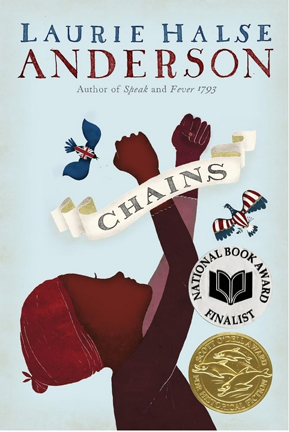
Set in New York at the time of the American Revolution, Chains spans May 27, 1776 to January 19, 1777. As the novel opens, the young teenage protagonist, Isabel, is optimistic about her future as her owner, Miss Mary Finch, has died and had let Isabel know beforehand that she and her five-year old sister Ruth would be free upon her passing. Unfortunately, no lawyer is present to produce the will that shows Miss Finch’s wishes. Mr. Robert Finch, Mary’s nephew and only surviving relative, has come to claim Isabel and Ruth and accuses Isabel of lying about the will. He proceeds to sell Isabel and her sister to Elihu and Anne Lockton from New York. The couple are Loyalists, and while Mrs. Lockton treats Ruth as a kind of pet that she shows off to friends she entertains, she treats Isabel, whom she refers to as “Sal,” in a harsh and degrading fashion, always showing her disfavor.
Isabel has two aims: to protect her sister and to gain freedom. She lives in fear that the Locktons will sell Ruth and thus separate them. At one point Mrs. Lockton provides sweets to them, something that was unusual. But she had laced them with something to make Isabel fall into a deep sleep. When Isabel awakens she learns that Mrs. Lockton has sold Ruth into slavery in the West Indies. This crushes Isabel, who is unable to escape due to constant monitoring by the Locktons.
While doing errands in town for Mrs. Lockton, Isabel meets Curzon, a teenage slave of Mr. Bellingham, a Patriot. Curzon asks Isabel if she would be willing to spy on the Locktons to get information to the Patriots. Initially Isabel refuses but then begins doing so. Mrs. Lockton finds out and punishes her by branding her cheek with an “I” for “insolence.” It takes Isabela six days to regain consciousness after the branding.
Mrs. Lockton makes Isabel care for Lady Seymour, Elihu’s aunt, who lives in town. As Isabel goes to town she is able to deliver messages about Loyalist activities to the Patriot soldiers. Lady Seymour has compassion for Isabel, treating her with kindness and feeding her well. Her house burned in the great fire of New York (September 21, 1776), and Isabel saves her as well as a portrait of her husband and some letters that were dear to her. This becomes important late in the book as Lady Seymour, then an invalid and unable to speak, gestures to Isabel that she approves of her taking coins that she had saved.
The Locktons don’t recognize Isabel as intelligent, which works to her advantage when she is in the room delivering food or waiting for orders when Mr. Lockton is talking with other Loyalists. Isabel learns of the plot to kill Gen. George Washington and shares this with Patriots who come and arrest Mr. Lockton. However, he is soon released and later escapes by hiding in a barrel of cheese. Readers learn that Ruth has not been sold to the West Indies but rather sent to Charleston, South Carolina. Isabel plots her escape for the night that people are distracted by a celebration of Queen Charlotte of Great Britain’s birthday. Though Mrs. Lockton had Isabel locked in a potato bin during the ceremonies, she manages to dig her way out, find a pass and forge papers showing she is free.
Curzon, who had fought in battle for the Patriots, was shot in the leg and held at Bridewell as a prisoner of war. Isabel is able to see him by bribing the guards with food. On the night of her escape, she goes to Bridewell and says she was sent to clean the cells where “prisoners been dropping dead like flies. Fever.” “Curzon lay insensible, his skin burning with fever, his eyes rolled up into his head. I called his name and pinched him, but he did not look my way nor speak a word.” Isabel claims Curzon is dead, loads him in a wheelbarrow and covers him with a filthy blanket. The two manage to make it to the wharf and to a boat. “I rowed that river like it was a horse delivering me from the Devil. My hands blistered, the blisters popped, they re-formed and popped again. I rowed with my hands slick with blood … The sun rose beyond the water, at the other side of the river. I was on the west bank. I was in Jersey. I had set myself free.” At this point Curzon awakes asking where they are, and Isabel replies “I think we just crossed the river Jordan.” The book ends with Isabel asking Curzon if he can walk and with an advertisement for the sequel Forge that gives the account of Isabel Gardner (formerly Sal Lockton) and companion Curzon Bellingham.
The first teaching strategy for Chains is a set of ten questions designed to guide students in a close reading and deeper study of the novel. These questions may be used as the basis of class discussions, exams or essays.
Questions for Study and Discussion for Chains 1. How do Isabel’s and Curzon’s views of freedom differ in chapter 6? Also consider whether this changes as the novel progresses. 2. What evidence exists that Mr. Lockton is conspiring against the Patriots? Trace his journey from the point that he is arrested to the last mention of him. 3. In chapter 29 Isabel speaks of being “chained between two nations.” What does this mean? 4. Isabel’s grandfather speaks to her about the river Jordan in chapter 26, and in the last paragraph of the book, Isabel states “I think we just crossed the river Jordan.” What is the significance of the river Jordan?
5. Discuss the circumstances by which Isabel secures a copy of Thomas Paine’s Common Sense in chapter 39. How does the pamphlet influence her in later chapters? 6. How does the author contrast Lady Seymour and Mrs. Lockton in chapter 41? 7. In what ways was the relationship between Isabel and Lady Seymour a reciprocal one where each benefited? Consider especially the events of chapters 31 and 44. 8. It may be said that at the time of Chains, both Isabel and America are rebellious, young, and conflicted. Explain. 9. Identify three scenes that you believe are the most important in Chains and explain why each is key to the novel. 10. The trilogy of which Chains is book one is called Seeds of America. What role do seeds play in the novel?
While these questions help to ensure close reading and provide opportunities to check for student understanding in a traditional way, the next activity engages students in a more creative, nontraditional manner as they use symbolic thinking and hands-on creativity.
Coat of Arms Overview and Instructions
A coat of arms is a visual design in the form of a shield, that goes back to Medieval days when families and communities used them to show their identity. The coat of arms includes a motto or slogan that captures the important essence of the family, nation, school, or in our case, Chains. A coat of arms can be elaborate, including features such as “supporters” (visuals on each side of the shield) and “toppers” (one or more visuals at the top such as a crest, torse, helmet, or crown).
This assignment consists of three parts: 1) Pre-writing via the writing frames for the coat of arms; 2) The visual coat of arms; 3) A paper that explains the symbols chosen in connection with the character the student chose from Chains.
Visual Coat of Arms
The slogan “Per Aspera ad Astra” is Latin for “Through hardships to the stars” which is why the top of the crest features stars. There are three stars, each with an initial, representing Isabel in the middle and Curzon and Ruth on each side. The pre-writing in Table 1 provides additional insights about the symbols and colors used in Isabel’s shield.
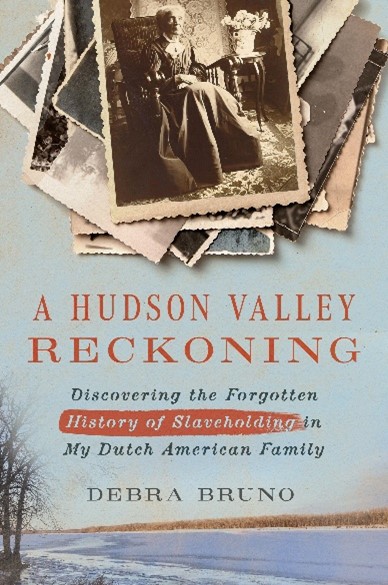
A Hudson Valley Reckoning: Discovering the Forgotten History of Slaveholding in My Dutch American Family
by Debra Bruno (Three Hills, 2024)
Reviewed by Imani Hinson
For many, slavery in the North is nothing but a long-ago memory, a story that is often untold due to the cruelties of enslavement in the South and the long-lasting impact of enslavement in the Southern part of the United States. The general public is not always aware of the enslavement of African people in the North with only recent discoveries being brought to light. A Hudson Valley Reckoning: Discovering the Forgotten History of Slaveholding in My Dutch American Family showcases the stories of enslaved people who lived in Greene County, New York. The author, Debra Bruno, offers a new perspective on the enslaved in New York by exploring her own lineage and that of a distant cousin named Eleanor.
In this thirteen-chapter narrative, Bruno tells the story of her slave-holding Dutch family and the connection between her relatives and those who they might have enslaved. Eleanor is a descendant of the individuals whom Bruno’s family enslaved. Bruno discusses how historians, politicians, journalists, and every day people have erased significant features of enslavement in the North and painted a quaint picture of enslaved people helping the Dutch with their farms, houses, and livestock. Bruno, however, provides a much clearer picture of the reality of slavery in Dutch New York. She visited Macon, Georgia, and Curacao as she dug deeper into her family’s history.
In the introduction, Bruno describes her upbringing and the proud nature of her family’s Dutch heritage. She draws the reader in by describing her hometown of Athens and Coxsackie, places located along the Hudson River. Her American family began with Lambert Van Valkenburg, who settled in New Amsterdam in the early 1600s and later sold this land relocated on the North River, now the Hudson River. Her ancestor originally owned land in New Amsterdam where the where Empire State Building is located.
While digging into the history of her family, Bruno decided to explore whether they were enslavers. Bruno used Ancestry.com where she found various records including newspaper clippings, census data, photographs, and wills. Valkenburg did not provide significant results, so she searched under Collier, her grandmother’s family name. Bruno found a will from what would be her Great Grandfather five times back. He had many children and grandchildren around the Coxsackie area and left a will bequeathing much of his property to them. As Bruno combed through the pages of the will she saw it, “detailed like inventory along with his property and cows were slaves” (6).
Chapter four illustrates enslavement in the North with an analysis of a painting. “Van Bergen Overmantel” was commissioned by the Van Bergen family in the early 1700s to hang in the family home. It depicted what life was like in 18th century Hudson Valley and “is the first visual evidence of slavery on a New York farm” (56). According to Bruno, in 1714 Coxsackie’s population was 21% enslaved people. and by the 1790s in places such as Brooklyn, New York that number went up to 30%. In the late 18th century New York had an enslaved population of 319,000 enslaved people.
In the following chapters Bruno describes the challenges she faced in finding sources from the enslaved that could detail what their life was like on these farms. She notes that they were threatened with being sold down South or the Caribbean, some ran away killing their masters in the escape, and these details just go to show that enslaved life in the North was not a cakewalk as some may think. Even after being emancipated, African Americans still struggled in New York as they fought their right to be citizens and gain full citizenship rights as discussed in chapter nine.
In a discussion of why this history was so important to recover, Bruno emphasized that the Declaration of Independence and the Constitution, the nation’s founding documents, not grant the same freedoms to all people living on this land, and that individuals must “accept that only some people have benefited from their promises. To deny that and to distance ourselves from that truth is to misunderstand how our county grew, prospered, and exists today” (233.
The Hall of Fame for Great Americans in Bronx, New York opened in 1901. It is now located on the Bronx Community College campus. It currently has 96 busts; busts of Southern Generals Robert E. Lee and Stonewall Jackson were removed. Busts for an additional four people elected to the hall were never installed because organizers ran out of money. You can view a virtual tour of the Hall of Fame for Great Americans. https://www.bcc.cuny.edu/wp-content/uploads/2022/04/virtual-hall-of-fame-website.pdf
National Baseball Hall of Fame and Museum in Cooperstown, New York opened in 1939 with its first five inductees, Ty Cobb, Babe Ruth, Honus Wagner, Christy Mathewson, and Walter Johnson. As of July 2024, the hall honored 244 former major league players, 39 Negro league players and executives, 24 managers, 10 umpires, and 36 “pioneers, executives and organizers.” The Hall of Fame includes one female member, Effa Manley, a Negro League executive. The museum displays baseball memorabilia. https://baseballhall.org/
National Women’s Hall of Fame in Seneca Falls, New York opened in 1973. The inaugural Induction Class included Jane Addams, Marian Anderson, Susan B. Anthony, Clara Barton, Mary McLeod Bethune, Elizabeth Blackwell, Pearl Buck, Rachel Carson, Mary Cassatt, Emily Dickinson, Amelia Earhart, Alice Hamilton, Helen Hayes, Helen Keller, Eleanor Roosevelt, Florence Sabin, Margaret Chase Smith, Elizabeth Cady Stanton, Helen Brooke Taussig, and Harriet Tubman. In 2020, it opened to the public in its new home at the former Seneca Knitting Mill. https://www.womenofthehall.org/
A Little Less Famous
North American Fiddlers Hall of Fame is in rural Redfield, New York in the Adirondack region. It is located in a converted farmhouse. It houses artifacts, pictures, AV tapes, records, and memorabilia of old time fiddling & fiddlers and has free concerts. Famous inductees include “Chubby” Wise who recorded nearly 50 albums. https://www.facebook.com/p/North-American-Fiddlers-Hall-of-Fame-and-Museum-100063476745882/
National Abolition Hall of Fame in Peterboro, New York is located near the Finger Lakes region in the building where the first meeting of the New York State Anti-Slavery Society was held in 1835. Currently 28 anti-slavery activists are honored. https://www.nationalabolitionhalloffameandmuseum.org/
National Soaring Hall of Fame and Museum established in 1969 is an aviation museum that preserves the history of motorless flight. It is located on top of Harris Hill near Elmira, New York. https://www.soaringmuseum.org/
National Toy Hall of Fame in Rochester, New York is part of the Strong Museum of Play. It celebrates toys that have inspired creative play and enjoyed popularity. The Magic 8 Ball was inducted in 2018. Millions of the hand-held fortune telling toy have been sold since it was first marketed in 1945.
Bare Knuckle Boxing Hall of Fame is located in Belfast, New York in Allegany County. The museum and Hall of Fame are in the training barns of the great champion John L. Sullivan. Famous Inductees include George Godfrey, “The Leiperville Shadow,” one of the best African American bare knuckle fighters of his era. https://wnywilds.com/listing/bare-knuckle-boxing-hall-of-fame/
D.I.R.T. Stock Car Hall of Fame and Classic Car Museum is located next to the Weedsport Speedway in the Adirondack Park. It honors the achievements of modified stock car drivers. Famous inductees include “Barefoot” Bob McCreadie who broke his back five times while racing. https://www.discoverupstateny.com/packages/3566/dirt-hall-of-fame-classic-car-museum/
International Boxing Hall of Fame in Canastota, New York honors boxers, trainers, and other contributors to the sport. Famous inductees include Muhammed Ali, Carmen Basilo, Ezzard Charles, Joe Frazier, Emile Griffith, Jake LaMotta, Joe Louis, Rocky Marciano, Sugar Ray Robinson, Marvin Hagler, Sugar Ray Leonard, George Foreman, Roberto Duran, and Joe “Newsboy” Brown, who was born in Russia, and boxed at the opening of the Olympic Auditorium in Los Angeles in 1925. http://www.ibhof.com/
International Maple Hall of Fame in Croghan, New York honors people who “excelled in research, development, and leadership in the North American Maple Industry.” Its most famous inductee is Lloyd Sipple of Bainbridge, N.Y. who began making maple syrup during World War II to address a nationwide shortage of sugar. https://maplemuseumcentre.org/post.php?pid=14
National Purple Heart Hall of Honor in New Windsor) New York honors award recipients to “remind us of human sacrifices and the cost of freedom.” Ensign Jesse Brown’s citation (Korea-U.S.N.) reads: “Ensign Jesse L. Brown was the first African American naval aviator. While flying a mission 4 December 1950 his aircraft was hit, causing him to crash land in enemy territory.” https://www.thepurpleheart.com/
Catskill Fly Fishing Hall of Fame in Livingston Manor, New York, preserves the “heritage of fly fishing in the Catskills” and educates the “next generation of anglers.” https://cffcm.com/
New York State Country Music Hall of Fame in Cortland, New York pays tribute to the legacy of New York State and national country music performers. Hall of Fame members include Glen Campbell, Tammy Wynette, and many Grand Ole opry stars. https://www.iloveny.com/listing/new-york-state-country-music-hall-of-fame/2897/
New York State Convenience Store Hall of Fame in Albany, New York was established in 1996 to honor retailers and suppliers for exceptional achievement in and service to New York State’s convenience store industry.” https://nyacs.org/hall-of-fame?layout=adgcreative:grid#
National Stand-Up Comedy Hall of Fame is located in Jamestown, New Yor’s National Comedy Center. Its first inductee’s included George Carlin, Joan Rivers, Richard Pryor, and Robin Williams. https://comedycenter.org/
National Museum of Racing and Hall of Fame in Saratoga Springs, New York was founded in 1950 and is currently located by the Saratoga Race Course. Among the horses inducted here are Man O’ War (1957), Exterminator (1957), Citation (1959), Spectacular Bid (1982), American Pharoah (2021), Secretariat (1974), and Seabiscuit (1958). https://www.racingmuseum.org/
International Professional Wrestling Hall of Fame in Albany, New York was established in 2019. It is located on the mezzanine level of the MVP Arena. Inductees include Bobo Brazil, “Stone Cold” Steve Austin, Bret Hart, and “Gorgeous George” Wagner. International Maple Hall of Fame in Croghan, New York honors people who “excelled in research, development, and leadership in the North American Maple Industry.” Its most famous inductee is Lloyd Sipple of Bainbridge, N.Y. who began making maple syrup during World War II to address a nationwide shortage of sugar.https://maplemuseumcentre.org/post.php?pid=14
Online Halls of Fame
Long Distance Runners Hall of Fame in Utica, New York was formed in 1971. The building is currently closed. Famous inductees include Frank Shorter who won the marathon gold medal at the 1972 Olympics in Munich. This hall of fame can be viewed at https://www.rrca.org/about/hall-of-fame/
New York State Golf Hall of Fame: Famous inductee include Joey Sindelar, a major contender in the U.S. Open and Masters tournaments in early to mid-1990s. Find information and inductees at https://nysga.org/about-hall-of-fame
In Levittown’s Shadow: Poverty in America’s Wealthiest Postwar Suburb
by Tim Keogh
There is a familiar narrative about American suburbs: after 1945, white residents left cities for leafy, affluent subdivisions and the better life they seemed to embody. In Levittown’s Shadow tells us there is more to this story, offering an eye opening account of diverse, poor residents living and working in those same neighborhoods. Tim Keogh shows how public policies produced both suburban plenty and deprivation—and why ignoring suburban poverty doomed efforts to reduce inequality. Keogh focuses on the suburbs of Long Island, home to Levittown, often considered the archetypal suburb. Here military contracts subsidized well-paid employment like welding airplanes or filing paperwork, while weak labor laws impoverished suburbanites who mowed lawns, built houses, scrubbed kitchen floors, and stocked supermarket shelves. Federal mortgage programs helped some families buy orderly single-family homes and enter the middle class but also underwrote landlord efforts to cram poor families into suburban attics, basements, and sheds.
Keogh explores how policymakers ignored suburban inequality, addressing housing segregation between cities and suburbs rather than suburbanites’ demands for decent jobs, housing, and schools. By turning our attention to the suburban poor, Keogh reveals poverty wasn’t just an urban problem but a suburban one, too. In Levittown’s Shadow deepens our understanding of suburbia’s history—and points us toward more effective ways to combat poverty today.
From Scratch: Adventures in Harvesting, Hunting, Fishing, and Foraging on a Fragile Planet, by David and Jon Moscow (New York: Permuted Press, 2022)
Review by Alan Singer
Jon Moscow is the co-executive director of the Ethics in Education Network located in New York City and a podcaster. David Moscow is an actor and producer. Jon and David are father and son. In the preface to From Scratch they wrote “There are also many meals in here. Some are unique. Some are gut-turning. Most are great.” They are clearly more adventurous than me. I recommend staying with the less gut-turning suggestions.
The first gastronomical adventure is in New York City and it is about harvesting and eating oysters from Long Island Sound. David claims he dreamed about oysters since his boyhood in the Bronx with trips to Orchard Beach. I also grew up in the Bronx, back in the 1950s, frequented Orchard Beach, and I warn readers, nothing good comes out of those waters that I would eat, then and now. Today the water is considered clean, but when I was a boy we frequently saw raw sewage and condoms on the waves.
The best part of this chapter, and every chapter, are the gastronomical history lessons. The original inhabitants of the New York metropolitan region were the Lenni-Lanape who harvested oysters before the water was polluted and cooked them by wrapping them in seaweed and tossing them into a fire. We also learn that Pearl Street in Manhattan was “paved” by burning oyster shells to create lime that was mixed with broken oyster shells, sand, ash, and water. New York continued to be the oyster capital of the world until the early 20th century when New York City oyster beds were closed because of toxicity. David does admit that New York City oysters are still considered unfit to eat so that he and friends actually harvested oysters further east on Long Island.
Other adventures in harvesting and eating include trips to South Africa for avocados and “dune spinach,” to Mediterranean Malta and Sardinia for octopus and snails, Peru with its thousands of potato varieties, Kenya for barley and honey, and back to New York after a stop on the Amalfi Coast and Naples to savor pizza. David discusses some of his favorite New York pizza parlors including his childhood haunt, Three Brothers, on Kingsbridge Road. Brother’s Pizza is still located at 27 E. Kingsbridge Rd. Another noteworthy Bronx pizza destination is Catania’s Pizzeria & Café at 2307 Arthur Avenue. However my favorite is Pizza Plus on 359 7th Avenue in Brooklyn because their pizza has the best red sauce. The best part of this chapter is the authors’ discussion of the history of the tomato, which traveled from the Americas to Europe as part of the Columbian Exchange. Who knew there were over 15,000 varieties of tomatoes?
Fred Ende, Director of Curriculum and Instructional Services at Putnam/Northern Westchester BOCES, who also reviewed the book, points out that in the first and second chapters the authors show that the history of both Long Island and South Africa was influenced, in some cases deeply, by food, and that food was influenced by history. Ende appreciated the interdisciplinary nature of the story the Moscows are telling because too often secondary schools disciplines are taught in isolation. Elde likes that the book melds science, art, culture and history pretty seamlessly.
The book ends with recipes including a Philippine dish, Kilawin made with mackerel, tuna and coconut, a Native American trout and potato dish from Utah, and D Michele’s famous pizza dough. I make my own pizza from scratch and I do all my foraging at a local supermarket.
Alan’s Homemade Pizza
Ingredients for the dough
2 cups flour, plus more for rolling
1/2 tsp. sugar
1 tbs. dry yeast
1 tsp. salt
3/4 cups warm water (body temperature)
2 tbs. olive oil to mix into the dough and 2 tsp. to oil the bowl
Instructions
1. Combine and stir the dry ingredients and then add the water and oil. Stir and knead the dough until it is smooth with a slight gleam. If the dough is too sticky add a little more flour. If it is too dry, add a very small amount of water. I rub a little flour on my hands as I knead the dough. After about ten minutes I roll the dough into a ball and place it in a covered oiled bowl for about an hour and keep the bowl in a warm place; sometimes in the oven with the temperature set at the lowest level.
2. While the dough rises I prepare my toppings. I use sliced olives, mushrooms, and green peppers After an hour, preheat the oven to 475°F. I usually use a commercial sauce; my preferred one is Barilla. I roll out the dough as flat as I can with a rolling pin (without tossing it up and down) and put it on a large oiled baking sheet. I brush a light oil coat on the dough, cover the pie with sauce leaving a thin 1/2 crust on the edges, sprinkle with lots of thinly sliced mozzarella, feta bits, oregano, and parmesan, and add the toppings.
3. Now its time to bake the pizza in the 475°F oven for about 15 minutes until the crust is brown and the cheese is melted. Magnifico!
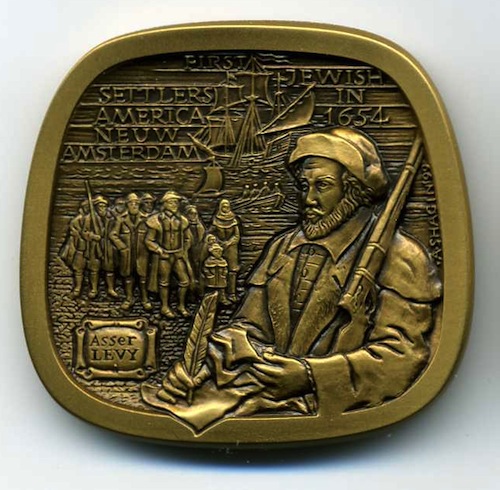
The Diary of Asser Levy: First Jewish Citizen of New York
By Daniela Weil
Reviewed by Hank Bitten, Executive Director NJ Council for the Social Studies
In the teaching of world history or global studies, the concept of continuity and change over time is important for students in understanding the big picture of history. In learning about the American colonies, the migration of populations and the perspectives of ordinary people are important in understanding the diversity of the people living in the New World.
Teachers are able to understand the big picture of the 20th century and the rise of the United Kingdom, Germany, Japan, Soviet Union, India, China, Israel, and the United States. Some teachers may also understand how the fall of Austria Hungary, Tsarist Russia, Ottoman Empire, Japan, and Germany changed the world. We teach about the permanent members of the UN Security Council but also recognize the power and influence of the media, investment firms, energy cartels, and technology firms. History is complicated.
The Diary of Asser Levy provides an opportunity to understand the big picture of European history in the context of Brazil, the western Caribbean, the Dutch colonies in America, and the Roman Catholic Church. The book is less than 100 pages and packed with a chronological memory over a period of twelve years. Students can easily read the accounts of a day in the life of Asser Levy, or a week or a month in a matter of a few minutes. The photographs and images are designed to connect students with the historical content and promote inquiry, literacy, and memory.
The book is written from the perspective of a teenager or young adult about age 16-18. He lived in Recife, Brazil in a prosperous Jewish community. In the 17th century, the Dutch were a powerful empire and one in competition with Portugal, Britain and the Holy Roman Empire. The entries of the diary take place only six years after the signing of the Treaty of Westphalia ending the Thirty Years War in Europe and marking the “Golden Age” of the Netherlands and the Dutch empire in Europe, East Asia, Africa, and the Americas. The Spanish Century of the 16th century was characterized by “God, gold, and glory” was now declining in influence as new states were rising.
The conflict between the Dutch and Portugal is an extension of the Thirty Years War in Europe and a victory for the Protestant beliefs a century after the Protestant Reformation. The ‘new economy” in Europe was based on their global markets. For Portugal and Netherlands, it was the spice trade in East Asia and sugar and sweets in the New World. Most teachers do not even mention the trade wars of the 17th century and the Diary of Asser Levy provides a point of inquiry for students to ask, “why do the Dutch want Salvador or Recife in Brazil?”
The military operations by the Dutch in Brazil took less than two weeks and 10,000 soldiers. Although the control of Salvador and Recife would be difficult to maintain over time, it changed the way of life for ordinary people who were citizens of the Dutch empire! Conflict is always unsettling because it separates families, postpones dreams, and presents challenges to the spiritual beliefs ordinary people value. This is the point of entry of Daniel Weil into your classroom and her influence on what your students will be thinking.
The Evacuation
“The Dutch have waged war against the crown of Portugal,” Barreto proclaimed, “yet we shall not retaliate. I will give all foreigners a period of three months to leave Brazil. You may take back any possessions you can carry. We shall provide additional ships needed to return you to your homeland.” (January 26, 1654, Page 16)
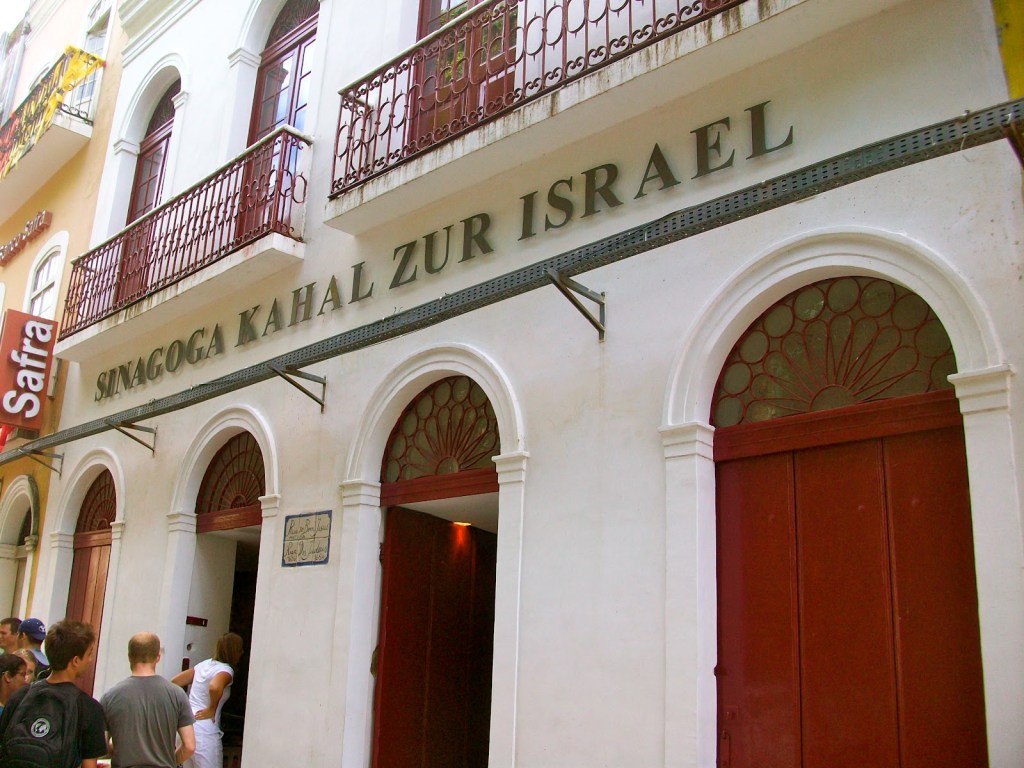
Although this appears a welcome gesture and is better than imprisonment or death, it uprooted the lives of more than 1,600 Jews living a prosperous life after a century of persecution in Europe under the Inquisition. Many Jews were forced to be baptized in Spain and Portugal and as a result many fled to Amsterdam. Under the protection of Dutch laws, the Jews in Recife were allowed to openly practice their religious beliefs and established, Kahal Zur Yisrael, the first synagogue in the New World. Isaac Aboab da Fancseca was the first rabbi in the New World. The Kahal Zur Israel congregation had an elementary and secondary school and supported charities in Recife. Many textbooks call attention to the Touro Synagogue in Newport, Rhode Island, which was built more than one hundred years later in 1763.
The Jewish population of Recife had to sell possessions, close their businesses, end the education of their children, and return to Amsterdam, a place they left more than twenty years ago. Middle school students familiar with the voyage of Columbus, Virginia Company, Pilgrims, and the Massachusetts Bay Company might speculate what the voyage back to Amsterdam in February, 1654. Use this situation to simulate the family discussions in the homes of Recife.
What were the sleeping accommodations like?
Was there adequate food on the ship?
Were the ships seaworthy in storms?
Did people experience sickness?
Was there danger from enemies or pirates?
Were families together or separated?
What dangers did young men and women experience?
Stranded in the Caribbean
Asser Levy wrote in his diary on March 20, 1654, “This morning, the Falcon rocked harder than usual. I fumbled my way up to the deck to see what was going on. An ominous grey sky had replaced the blue, and strong winds howled. Ripples turned into waves, and waves into giant swells. The captain ordered all passengers to take cover below. Lightning exploded over the ship. The Falcon was being tossed around like a toy boat.” (Page 27)
What choices did passengers who are also refugees have at sea? Did they have any rights as Dutch citizens? Would their religious beliefs sentence them to prison, would able workers be kidnapped, could they be killed? Would they feel safe in a Spanish or Portuguese port in the Caribbean?
Five days later on March 25th, Asser Levy wrote with an exclamation, “Red flag!” Pirates! The most likely encounter middle and high school students have with pirates, is the Disney experience of ‘Pirates of the Caribbean.’ For Asser Levy and the other refugees fleeing Brazil, this was a death sentence, perhaps their greatest fear. They would lose their possessions, men might be kidnapped, women raped, and death or injury to anyone who dared challenge the pirates.
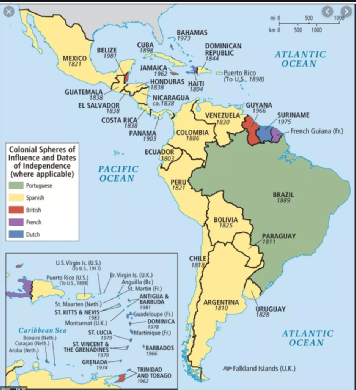
Use the two maps below for students to make a claim about the voyage from Recife, to the place of the storm, the boarding of the ship by pirates, and arriving in Jamaica. [On the first map, Jamaica is just south of the eastern end of Cuba and Recife is not visible. In the second map, Recife is on the most extreme end of the eastern coast of Brazil and Jamaica is south of Cuba.]
On April 1, about one week later, the Falcon, in need of repairs, drifted close to Jamaica. Understanding the geography of the Caribbean, especially the journey of approximately 40 days at sea from Recife to Jamaica should result in many questions and arguments that need evidence. Try to follow the diary and map the intended route of the Falcon with the actual route taking them to Jamaica.
Students studying colonial America are generally familiar with the religious exodus of people with Protestant faiths coming to Virginia, Massachusetts, New Sweden, and Connecticut. They likely understand the settlement of Maryland and the passing of the Toleration Act, 1648. Ask your students if people kept or lost their rights when their ship docked in a Spanish port. How did the Inquisition play out in real time when their ‘passports’ were checked? Asser Levy and the Jewish passengers on the Falcon were now under interrogation and the penalty of imprisonment or death for heresy.
Frustrated in New Amsterdam
This morning, September 5, 1654, “the St. Catherine turned and entered a large bay. The ship slipped through a narrow passage between two forested hills. We drifted into calm, sheltered waters, leaving the agitated open ocean behind, In the distance, the top of an island covered in mist slowly became visible. All the passengers came up on deck to witness the sight.” (Page 41)
When studying the past, we do not have all the answers. In fact, asking the right questions is necessary to the historical context when documents and artifacts are not available or never existed. Ask your students to draw a picture of Asser Levy who departed Cuba on August 15 and now, 21 days later, has arrived in New Amsterdam.
Draw a line from the place in the image of Asser Levy to answer the following questions:
What does he see with his eyes?
What is he thinking in his head?
What sounds does he hear with his ears?
What sentences will he write with his hand and pen?
What does he smell with his nose?
What does he feel in his heart?
When he arrives on shore, where will his feet take him?
What are his fears?
Why is he holding a weapon?
What are his hopes?
The traditional opportunities to learn about diversity in the American colonies focus on Roman Catholics in Maryland and the banishment of Anne Hutchinson and Roger Williams from Massachusetts Bay, it is 1654, so the Charter of Liberties has not been adopted in Philadelphia, and a safe haven for debtors in Georgia is still 80 years in the future. The evidence in Asser Levy’s diary provides inquiry into the lives of Jews who were Dutch citizens.
There are also clues in this book about self-government in the colonies. Most students learn about the representative government in Virginia’s House of Burgesses, the Mayflower Compact, the town meetings in New England, the power of the purse in determining local taxes, and the Fundamental Orders of Connecticut. The Diary of Asser Levy provides a unique look into the authority of judges and the colonial court system. It also provides a prompt for discussions about civic engagement to correct what Asser Levy believes to be arbitrary or unfair decisions.
September 9, 1654: “Two days have passed since our trial. Today, we had to return to court with Mr. Petersen and face La Motthe again.
The captain made his case. He had not been paid the remaining guilders. Mr. Pietersen begged for a little more time.
“’The Jews have not paid their legal debt to Captain La Motthe,” Stuyvesant declared. “However, they have sufficient property on the St. Catherine. I will allow the captain to sell all of the Jews’ belongings at public auction within four days.’” (Page 51)
For high school students, consider comparing the court system in New Amsterdam with the experiences of four enslaved persons in the courts of Virginia around 1650. (Source). The arrival of the 23 Jewish refugees from Brazil corresponds directly with the arrival of 300 enslaved individuals from Brazil in New Amsterdam. The double arrival presented problems for this colony of 1,000 residents regarding diversity, language barriers, housing, and work. By 1660, New Amsterdam was considered the most significant slave port in North America. (Source) These ‘threads,’ or themes, that are part of the historical tapestry of the colonial experience are available to your students through supplementary texts, The Diary of Asser Levy, and digital resources.
The information in The Diary of Asser Levy is a rich resource for student inquiry, especially for teachers who want to involve their students with guided research, interdisciplinary connections, understanding the diversity of the American experience, and evaluating decisions. The illustrations in the book from colonial New York, with specific street addresses, also provides information for teaching how communities have changed over time. For example, the history behind Pearl Street, Mill Lane, Maiden Lane, William Street, Water Street, and Wall Street are part of the local historical narrative.
Resilience and Restoration
The subtitle of The Diary of Asser Levy is, “First Jewish Citizen of New York.” Brainstorm with your students if it should be changed to, “First Jewish Dutch citizen of New York,” “First Citizen Advocate,” “First Jewish Homeowner in America,” “First Refugee in New York,” “First Jewish Banker,” etc. According to the author, Daniela Weil, Asser Levy was the 38th wealthiest person in America. History comes to life for our students when they make connections with the relevance of today. The websites in the Works Cited section provide digital resources for further exploration and investigation. Of particular note are www.newmasterdamhistorycenter.org, www.unsung.nyc/#home, and www.archives.nyc/newamsterdam.
It is the resilience and civic engagement of Asser Levy as a young man under age 20 who spoke for justice, pursued equality, advocated for the right to employment, homeownership, freedom of religious expression, and made the colony of New Amsterdam, and after 1664 the colony of New York, a safer and better place. This is not a book or lesson about any one person or group of people. Instead, it is a starting point for a deeper discussion about the ordinary people who are the ‘soul’ of America more than a century before the Declaration of independence and the birth of a United States of America.
In this context, students might reflect on the legacy of Asser Levy and how history and New York remember him, when his memory was first discovered, if communities outside of New York have places named in his honor, and how he will most likely be remembered in the future of this century and specifically on August 22, 2054, the 400th anniversary of his arrival in New Amsterdam!
Asser Levy Park, Brooklyn, NY (near Coney Island)
Weil, Daniela, The Diary of Asser Levy, Pelican Publishing, New Orleans, 2020.
Jacob Wynkoop (1829-1912) was born in New Paltz two years after slavery was legally abolished in New York State. Jacob had an exceptional and varied life for any man of his time, black or white. Among the first African Americans to buy land in the community, he also served in the Union Army during the Civil War, organized politically on behalf of black citizens in town, and built a series of homes that today still define a neighborhood in the village of New Paltz. Unlike countless other Africans and African Americans from the dawn of European colonization through the 19th century and beyond, Jacob’s story is fairly well documented in the historical record. This exhibit, curated by Josephine Bloodgood, Director of Curatorial and Preservation Affairs, was originally installed in the DuBois Fort Visitor Center in 2019, but has been expanded online.
Huguenot Street is proud to offer a new walking tour app titled “Jacob Wynkoop: Building a Free Black Neighborhood,” narrated by Chaundre Hall-Broomfield, a Newburgh native and performer known for his dual roles as Hercules Mulligan and James Madison in the national tour of “Hamilton” with the Angelica company. This new addition to the app (available now at the App Store and Google Play) takes visitors on a guided tour of the Broadhead-Church-Mulberry neighborhood of New Paltz, highlighting the houses built by 19th-century Black carpenter and Civil War veteran Jacob Wynkoop (https://www.huguenotstreet.org/app).
The Historic Huguenot Street Walking Tour app provides succinct narratives for each of the historic buildings on the street with information about the architecture, past residents, and multicultural history of New Paltz. While using the app, you can view archival photos, images of the buildings’ interiors, and the collections pieces within. The tour features the Crispell Memorial French Church, the replica Esopus Munsee wigwam, and all seven historic house museums. Development of the app was made possible in part through support from the County of Ulster’s Ulster County Cultural Services & Promotion Fund administrated by Arts Mid-Hudson. Narration by Grace Angela Henry.
Hinchliffe Stadium near the Great Falls in Paterson, New Jersey, was placed on the State and National Registers of Historic Places in 2004. It has a permanent niche in the nation’s sports and social history as one of a handful of surviving stadiums that were home to professional black sports during the “Jim Crow” era. At a time when baseball was an indisputable game of greats, Hinchliffe featured some of the greatest ballplayers in America, players who ironically had no access to the major leagues
Hinchliffe was built by public funds at the start of the Great Depression. It was meant as a sports haven for a generation of working-class kids struggling through hard times in a city dependent on industry. But financial reality demanded it also be a “paying investment,” and the City made it one. Its 10,000-seat capacity (more with temporary bleacher seating) proved an instant draw not just for baseball but for a wide range of sports: football, boxing, auto-racing, and major track and field meets, plus star-studded musical and entertainment events. The stadium’s heyday lasted well into the 1950s.
The Journey to the North is a six-panel traveling exhibit about the Underground Railroad. The exhibit uses the story of one fictitious character to convey real events experienced by freedom seekers during their journey to freedom. Much of the narrative is told from the point of view of Sarah, a fifteen-year-old fictional escaped slave. As students read the text they are encouraged to imagine themselves in her situation and faced with her decisions. Each of the 6 panels are 84”h x 40”w. with an approximate overall Footprint of 18’ in length.
The exhibition was developed for the New York State Historical Association by the Cooperstown Graduate Program in History Museum Studies. Generous support for the exhibition came from the NY Council for the Humanities and Heritage New York.
New York State was at the forefront of the Underground Railroad movement. It was a major destination for freedom-seekers for four main reasons:
Destination & Gateway: New York was a gateway to liberation for freedom-seekers (often referred to as escaped slaves). Its prime location, with access to Canada and major water routes, made it the destination of choice for many Africans fleeing slavery along the eastern seaboard.
Safe Haven: Freedom-seekers knew they would be protected in New York’s many black communities as well as Quaker and other progressive white and mixed race communities. A large and vocal free black population was present after the manumission (freeing) of slaves in New York State in 1827.
Powerful Anti-Slavery Movement: Anti-slavery organizations were abundant in New York State – more than any other state. The reform politics and the progressive nature of the state gave rise to many active anti-slavery organizations.
Strong Underground Railroad Leaders: Many nationally-known and locally influential black and white abolitionists chose to make their homes in New York. Among them were: Harriet Tubman, Frederick Douglass, Gerrit Smith, Henry Ward Beecher, Sojourner Truth and John Brown.
The “Journey to the North: New York’s Freedom Trail” exhibit is available for loan to not-for-profit educational institutions. Those interested must meet the loan requirements. For exhibit details and a loan application please contact Cordell Reaves at Cordell.Reaves@oprhp.state.ny.us.
I didn’t know much about my Dutch ancestry when I was growing up in New York’s Hudson Valley in the 1960s and ’70s. I thought of myself as Italian. My father was the second son of an immigrant named Pasquale Bruno, who had made his way to New York as a teenager from southern Italy’s impoverished Calabria region. Our holidays were feasts of pasta, meatballs and eggplant Parmesan. The smell of tomato sauce simmering on a Sunday is all I need to feel at home.
But of course, there is also my mother’s side. Her maiden name is Van Valkenburg. All I really knew about her ancestors was that they had helped settle New Netherland, as New York State and the surrounding territory was called in the 1600s. “Think Rip Van Winkle,” I would tell people about that part of my heritage. The Dutch side, I thought, was more white-bread plain. Yet I did wonder about those Dutch, and when the boom in companies like Ancestry turned millions of Americans into amateur genealogists, I joined the trend and started researching. I imagined I’d find a string of farmers and housewives and shopkeepers and laborers, living modest, quiet lives.
Then one day, scrolling through the Ancestry website, I came upon the 1796 last will and testament of one Isaac Collier, born in 1725 in a place called Loonenburg, which is today named Athens. That’s my hometown. And Collier is my grandmother’s maiden name. Isaac was my five-times-great-grandfather.
Isaac was thinking about his legacy. In his will, the 70-year-old carefully divided his land, working out in precise detail where his property lines extended and to which of his five surviving sons each parcel went. Then he got to other items: to his son Joel, “one other Feather Bed, one Negro Boy named Will and my sorrel mare and sorrel stallion, one wagon and harrow.” To his granddaughter Christina Spoor went a “negro wench named Marie.”
“The remains of my negro slaves male and female,” I read, were to be “equally divided” among his remaining sons and one grandson, “share and share alike.”
I sat very still. This will, written in a beautiful, sweeping script, with elegant phrases like “whenever it shall please the Almighty to take me to himself,” hit me with a gut punch. Here was a man blithely imagining his reception into heaven while painstakingly leaving this permanent record of sin.
Here, in the branches of my family tree, was incontrovertible evidence that my Dutch ancestors weren’t just innocent farmers. That I was the descendant of people who enslaved others. How could this be? Growing up in the North, I’d rarely thought about slavery, and the civil rights struggles of the 1960s seemed as distant as the moon landing. But suddenly, slavery was as real as the rolling hills beside the Hudson River that flowed past my parents’ home. Suddenly, my sense of Northern disengagement from our country’s original sin was snapped away.
As a child, I’d learned nothing about New York state’s history of slavery. I didn’t even know that there had been enslaved people in the North. We weren’t like those racist Southerners, or so we thought.
In elementary school, we took the requisite trips to places like the Bronck House in Coxsackie, built in 1663 for one of the region’s first families, from whom the Bronx gets its name. Low beams, enormous fireplaces, historians wearing colonial dress. No one mentioned slavery other than in relation to the Civil War, a war that happened elsewhere and much later in history. Northern slavery wasn’t part of our school lessons. Only since about 2016 has New York state slavery been listed as a small part of the seventh-grade social studies curriculum.
Some scholars believe that Northern slavery was deliberately whitewashed from the history books. Leslie M. Harris, a professor of history at Northwestern University and author of “In the Shadow of Slavery: African Americans in New York City, 1626-1863,” says that the idea of a free North that helped end slavery is “one of the most powerful elements of our culture.” Adding in Northern slavery “complicates what is otherwise a simple, heroic story.”
But slavery was not only a powerful institution in New York; it lasted for nearly 200 years there. Not long after colonizing New Netherland in the 1600s, Dutch settlers, needing to fill a labor shortage, began buying enslaved people from traders with the Dutch West India Company. (The Dutch also tried to enslave the Native Americans who lived nearby, but many of them escaped. They also tried using indentured servants imported from Europe, but those people also tended to die very young or run off, according to Historic Hudson Valley, an organization with a website dedicated in part to teaching about slavery in New York. Of course, it was impossible for Africans to blend in and escape in the same way.)
New York was one of the last Northern states to outlaw slavery. But instead of a sudden explosion of freedom, the state passed the Gradual Emancipation Act of 1799, which slow-rolled freedom over nearly 30 years. It was a compromise measure designed to placate the Dutch farmers reluctant to give up their property.
My roots in the mid-Hudson Valley run deep, and now I suspected that if one family in my tree enslaved people, there had to be others. So I dove in. The more I dug, the more enslavers I found in wills and census records: Hallenbeck, Vosburgh, Van Petten, Van Vechten, Conine, Brandow, Houghtaling and, yes, Bronck.
I also realized that I was not alone. Jonathan Palmer, archivist at the Vedder Research Library in Coxsackie, says that anyone with deep-enough Dutch roots in the region will eventually find enslavers. “For them to have that moment when they confront that is special for me as an archivist,” he says, “for them to stare at a mirror and realize this was the side they were on.”
Castle Garden: An Early Gateway to the United States
Jenny Ashcraft
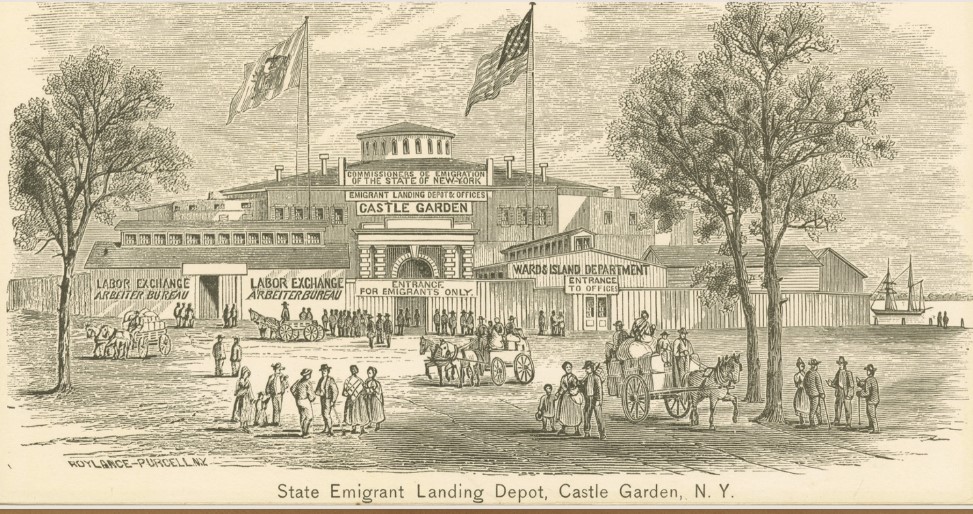
Since the founding of the United States, millions of people hoping for a brighter future left their home countries and immigrated to the United States. The number of immigrants increased dramatically after the Civil War with nearly 12 million arriving between 1870-1900. More than 70% of all immigrants entered through New York City. Castle Garden opened in 1855 as the primary immigration processing center and operated as such until Ellis Island’s opening in 1892 (though from 1890-1892, the center was moved to the U.S. Barge Office). These are some of the stories behind some of those immigrants’ arrivals.
Source: New York Public Library: Drawing c. 18611870 Currier and Ives map of Lower Manhattan. Castle Garden is the circular building on the southwest side of the island. This brief notice, published in 1855 described the arrival experience for immigrants. They registered their names, the amount of money they carried was recorded, and were taken to a bathhouse where up to twenty-four people bathed at the same time, men and women in separate compartments.An 1884 article in the New York World told the story of Maggie and Mary Slinsby who arrived at Castle Garden from County Tipperary in Ireland. The sisters, aged 9 and 10, traveled alone and were on their way to meet their parents in Urbana, Ohio. The children were wearing cardboard breastplates with their identification.
Prospective immigrants to the United States had to be careful about swindlers who preyed on immigrants unfamiliar with English. This 1884 clipping from the New York Tribune warns of a swindler selling fraudulent railroad tickets.
Documents A-H
A. Sisters Arrive at Castle Garden with Names Painted on Boards Attached Like Breastplates, Boston Globe, September 6, 1884: 4 (reprinted from the New York World)
“Maggie and Mary Slinsby, 9 and 10 years old, from Tipperary, Ireland. arrived at Castle Garden yesterday on the steamer Republic. They are going to their parents in Urbana, O. The most noticeable feature about them was an elaborate, heavy cardboard breast-plate on which the name of each child was neatly printed, evidently by a professional painter. The cards were attached to the body by a profusion of green ribbons. Clerk Kilroy. who took charge of the children, declared the cardboard breast-plates to be “the high – tonedest [sic] affairs he had ever seen at the Garden.”
B. Unaccompanied small children arrive at Castle Garden, The Inter Ocean, Chicago, Illinois, April 17, 1887: 6 “Among the passenger of the steamship Britannic, which arrived at Castle Garden to-day, were two children. James and Annie Morris, 9 and 11 year old. Eight years ago their parent left Ireland to seek fortune in his country. They left their children with a grandmother and recently sent for them. There was no one at the Garden to welcome too children after their long and stormy voyage. Their parents live in Cleveland, Ohio. They were at once notified by telegraph. The children will be cared for at Castle garden until their parents send money for their fare to Cleveland.
C. Three children tagged and shipped to Chicago to meet their father after arriving at Castle Garden, New York Times, August 9, 1887: 3.
“Otto Heinzman, Superintendent of the Castle Garden Landing Bureau, placed tags yesterday on Louisa Schmidt, aged 8, and her brothers, who are twins, several years younger than herself, and shipped them to their father, who resides in Chicago. They arrived at Castle Garden Saturday.”
D. A 10-year-old girl arrives at Castle Garden to reunite with her mother, Boston Globe, September 14, 1887: 4
Among the crowd of immigrants who arrived at Castle Garden today were two more remarkable than the rest. One was a woman over 80 years of age; the other a child of 10. The old woman was going to Elmira to die with her only daughter and two sons. The little girl was on her way to her mother. who is living in Webster, Mass. The two are from the same barony in county Clare, Ireland, but are wholly unknown to each other. The old woman. whose name is Margaret Collins, cannot speak a word of English; but the little girl speaks it with a fluency and vivaciousness that interested everybody in the garden. Her name is Mary Whalen. Twenty-three years ago, Mrs. Collins said, her three children, Patrick. John and Jane, left her and their father to try their fortune in America, and settled in Elmira. Herself and the old man, Pat, remained on the old sod, cultivating the little farm they had held ever since they were married, and on which their children had been born. She received a letter, she said, every Michaelmas. Christmas and Lady day from her children, bringing her money to make herself and the old man comfortable, and to pay the landlord the rent of the little patch of land. But on Lady day last year the old man died, and then she had no one in the old land on whom she could rely. Her children learned of their father’s death and insisted on her coming to this country. One of them, Mrs. Jane Costello, wife of Martin Costello, South Main street, Elmira. is herself a grandmother. As soon as the old lady arrived at Castle Garden word was sent to her children at Elmira, and a grave-looking old gentleman presented himself, stating that he wanted his mother. She was given to him, and be took her away to die amid her children, grandchildren and great grandchildren. The other immigrant was born after her father’s death, and, after being nursed for a little over four years by her mother, was left in the care of the nuns at Kilrush. in the County Clare, in which the child was born. Her mother. with her two eider children, boys, at that time immigrated hither and settled in Webster, Mass. Mrs. Whalen worked as a dressmaker and nut her two boys to the tailoring business, and will now be happy in the possession of her little daughter.”
E. “To Meet Her Lover,” The Oakes Times, Oakes, North Dakota, December 12, 1890: 5.
At 5:30 in the morning a well-dressed young woman arrived in Utica from Castle Garden. He had come all this way from a place in western Russia, and was on her way to meet her lover in Duluth, Minn., who had left her two years before to find a home for both of them in the New World. He went to Duluth and became fairly prosperous. As soon as he was able he wrote to his sweetheart and urged her to come to him, but the age and sickness of her parents kept her in Russia until this year. Both her parents having died, the young man sent her tickets to bring her to America, with what was supposed to be sufficient money for the journey. The young woman began her journey more than a month ago, and when she arrived at Castle Garden thought she must be within a few hours’ journey of her friend. She came on to Utica, as stated, and was taken to the Central depot, whence she was to proceed on her journey by another train. She waited about the depot all day, and at night in broken German told Leonard Pruey, the baggage master, that she had not had anything to eat all day, and had only twenty cents in her purse. When she had recited the whole story, and Mr. Pruey told her that instead of a few hours she would yet have several days of travel, her distress was pitiful. The kind hearted baggageman promised to do all he could for her, and began his ministrations by giving her a square meal. He then interested himself in bettering her financial condition, and told Conductor John Unser, of Rome, Watertown and Ogdensburg, about it. Mr. Unser was bound north with his train and made no promises, but early the next morning when he came to Utica again, he gave Mr. Pruey a purse of money which he had collected on his train to help the girl on her way. She finally left Utica, after a delay of about twenty-four hours, with a big bag of provisions and many good wishes.”
F. New immigrants visit bathhouse at Castle Garden, New York Times, August 4, 1855: 1.
“Next, the emigrant is shown to the baths. We join the crowd of males that flock in to the right. Here we find a large room, in the centre of which hang several coarse roller towels, and along the side is a deep trough of running Croton. This is the wash-room. Soap abounds- we hope no motives of niggardly economy will ever make it less plenty. Behind a screen that reaches across the room is the basin for bathing. A dozen or two can be accommodated in it at the same time. Indeed, every facility is granted the new corner, whatever may be his condition on entering it, to leave Castle Garden personally clean. The female bath and wash-room were the counterpart of the male, but as it was in use at the time, we consented to take the statement of our conductor and forego a personal investigation.”
G. “A Pitiful Story, If True,” Oakland Tribune, Oakland, California, January 14, 1879: 3
“An old man yesterday morning appealed to Superintendent Jackson of Castle Garden, for assistance to reach, his home in Hungary. His name is Paul Ostrich, 66 years old. He arrived at Castle Garden, he says, on the steamship Pennsylvania last March, with $500 in money, having been told by immigrant agents in Hungary that he would soon become a wealthy man in America. He was a farmer, and finally hired a few acres of ground in Washington Territory, but on account of lack of rain his crops failed, and he lost everything. He then wandered to San Francisco, and, applying to a German society, was furnished with a ticket to Omaha and $3 in money. Letters were given him by railroad agents in San Francisco to those in Omaha, asking them to help him on, but at Omaha all assistance was refused him. Ostrich then started on foot September 17th for New York, inquiring his way as he went along. With the exception of two nights, when he was entertained by German families, he slept either in the fields or barns. He walked the entire distance to New York barefooted and scantily clothed, his food consisting of bread and pork, which he was able to buy with his small pittance, and which lasted him until a few days ago. Sometimes he picked up a few apples. He could not describe the route by which he came, but remembers passing through Chicago. Upon his arrival here, his limbs were swollen and his feet blistered and sore. Dr. Villaniyi gave him food, doctored his wounds and gave him two dollars. The doctor also took him to a clergyman, who gave him a pair of shoes and a supply of clothing, and then directed him to Castle Garden.
H. A Castle Garden Romance, New York Times, October 1, 1878: 8
“A little over five years ago Michael O’Brien left his wife and four children in Tipperary and came to this country to seek his fortune. For a while he corresponded with and sent money to his family. Suddenly both letters and remittances ceased, and they heard nothing more from him until recently, when his wife received information that he had married again. She immediately resolved to seek him out, and on Wednesday last she and the children landed at Castle Garden from the Bothnia. She knew that he had worked at one time in a dyeing factory at Glenwood, NJ, near Fort Lee; so on Friday she took the boat to the latter place in the hope of tracing him. On the boat she met some persons who knew him, and when they heard her story they directed her to the factory where he was still employed. She walked up to where he was working in ignorance which must have been blissful, and quietly tapped him on the back. She says he confessed his fault with many tears and promised reformation, but she is reticent as to whether any arrangement looking towards a happy reunion was arrived at. The Castle-Garden officials are of the opinion that this is so, and that she is trying to shield him from the consequences of his bigamy and the wrath of her rival.”









 njcssjournal