Revisiting Jared Diamond’s Guns, Germs and Steel

Jared Diamond’s Guns, Germs, and Steel (New York: Norton, 1997) is one of those books that feels revelatory the first time you read it. It takes a question that most people rarely stop to ask, “Why some societies ended up rich and powerful while others did not?,” and reframes it in a way that is both unsettling and reassuring. Unsettling, because it strips away comforting myths about cultural superiority and human exceptionalism, and reassuring, because it offers an explanation that does not rely on racism, divine favor, or civilizational destiny. Diamond’s central claim is that geography, rather than biology or culture, played the decisive role in shaping global inequality. In the epilogue, he steps back to defend this framework, clarify its limits, and argue that history itself can be studied scientifically.

Diamond’s ambition is enormous; he is trying to explain a great deal of human history with a single organizing framework. Geography, in his telling, shapes the availability of domesticable plants and animals, the timing of agriculture, population density, technological development, and ultimately conquest. By the time Europeans reached the Americas, the outcome was already largely predetermined by thousands of years of environmental advantage. Diamond is careful to insist that geography constrains rather than dictates outcomes, but it is hard to miss how much explanatory weight geography is made to carry.

In the epilogue, Diamond anticipates the charge of environmental determinism and pushes back. History, he argues, can still be studied scientifically, even if we cannot run controlled experiments. Continents and societies function as natural experiments, allowing historians to compare different environments and identify broad, recurring patterns. Diamond is explicit about what he believes his framework does and does not explain. He is not accounting for individual leaders, specific events, or moral responsibility.Instead he is explaining why some societies had early advantages and others did not.

When Diamond stays within these bounds, his arguments are often extremely persuasive. His comparison between Eurasia and the Americas is a good example. Eurasia benefited from an abundance of domesticable plants and animals, including wheat, barley, cattle, pigs, and horses, which supported early agriculture, large populations, and dense settlements. Dense populations, in turn, produced epidemic diseases, and over time, immunity. When Europeans arrived in the Americas, they brought not only steel weapons and guns, but germs to which they had long been exposed. Indigenous populations, lacking similar disease histories, were devastated. Diamond’s point is not that Europeans were smarter or more capable, but that they inherited a vastly different historical trajectory shaped by their environment.

The same logic applies to Diamond’s discussion of continental axes, particularly the contrast between Eurasia’s east-west orientation and the Americas’ north-south orientation. Eurasia’s east-west axis allowed crops, animals, and technologies to spread across similar latitudes and climates with relative ease. Innovations could diffuse over thousands of miles without needing to adapt to radically different environments. In the Americas, by contrast, north-south diffusion meant crossing deserts, jungles, mountains, and sharp climatic transitions. This slowed the spread of agriculture and technology and limited large scale integration. Over millennia, these differences compounded. Geography, in Diamond’s account, does not merely shape local conditions, it shapes connectivity itself.

Where Diamond’s framework begins to strain is when it starts to feel like a master key rather than one tool among many. In the epilogue, he insists that geography is not destiny, yet culture often appears in his account as a thin downstream effect of environmental constraints. Culture adapts to geography, rather than actively shaping how societies respond once similar options exist. This is where the model starts to feel incomplete. Culture is not just decoration layered on top of material conditions. It is the air we breathe, the water we swim in, and the lens through which material realities are interpreted. Societies facing similar geographic constraints can still make very different choices, build different institutions, and value different outcomes.

Diamond acknowledges this problem in theory but tends to underplay it in practice. He is strongest at explaining origins and weakest at explaining persistence and divergence. Geography helps explain why certain possibilities existed, but it does not fully explain why some societies embraced particular paths while others did not, even when those paths were available. Once agriculture, technology, and states exist, culture feeds back into material conditions in complex ways. Institutions, norms, and values can amplify or blunt geographic advantages, and these feedback loops receive less attention than they deserve.

This tension becomes even more apparent when Diamond’s framework is applied to contemporary global developments. Geography still matters enormously. Climate vulnerability, access to arable land, exposure to disease, and proximity to trade routes continue to shape global inequality. The uneven impact of climate change, for example, follows geographic lines Diamond would immediately recognize. At the same time, globalization, technology, and political institutions complicate the picture. Some societies have used technology and collective action to mitigate geographic disadvantages, while others have failed to do so despite favorable conditions. Here again, culture and politics mediate geography’s effects.

Diamond deserves credit for what he is trying to do. He offers a corrective to explanations that blame the victims of history for their own misfortune or attribute inequality to inherent superiority. His framework insists that history’s winners were not morally better or biologically superior, merely luckier in where they happened to have been born. That insight alone makes Guns, Germs, and Steel worth reading.

The epilogue clarifies what Diamond believes his project to be. Geography is not the whole story, but it is an essential part of it. Diamond is at his best when he treats geography as an ingredient rather than a recipe. History is shaped by environments, material conditions, and culture together. No single theory explains everything. Diamond’s contribution is to remind us how much of the story begins long before anyone makes a conscious choice, and how deeply the ground beneath our feet has shaped the world we inherited.

Book Reviews on First-Hand Accounts of the European Holocaust

These books are first-person testimonies from survivors of the World War II European Holocaust. Most, but not all, of the survivor stories were written by Jews. The ability of students to meet survivors will soon end, so these accounts take on even greater historical and educational significance. The reviews are ordered by publication date.

The books reviewed are:

Smoke Over Birkenau, Seweryna Szmaglewska

Five Chimneys, Olga Lengyel

The Diary of a Young Girl, Anne Frank

Man’s Search for Meaning, Viktor Frankl

Night, Elie Wiesel

Auschwitz, Miklos Nyiszli

I Cannot Forgive, Rudolf Vrba and Alan Bestic

Auschwitz and After, Charlotte Delbo

Eyewitness Auschwitz, Filip Müller

Survival in Auschwitz, Primo Levi

Smoke Over Birkenau, Liana Millu

There Is a Place on Earth: A Woman in Birkenau, Giuliana Tedeschi

Europa, Europa, Shlomo Perel

A Gypsy in Auschwitz, Otto Rosenberg

People in Auschwitz, Hermann Langbein

A Lucky Child, Thomas Buergenthal

At the Mind’s Limits, Jean Amery

First One In, Last One Out, Marilyn Shimon

The Survivor, Josef Lewkowicz with Michael Calvin

Lipstick in Auschwitz, Miriam Nick

Smoke Over Birkenau, Seweryna Szmaglewska (Holt, 1945)

Seweryna Szmaglewska was a Polish Catholic writer and journalist arrested in 1942 and imprisoned at Auschwitz-Birkenau. She survived and was liberated in January 1945. Her account of the camp was published in Polish in 1945 making it one of the earliest first-hand descriptions of the extermination process to reach the public. She later testified before the Nuremberg Military Tribunal where her book was entered into the trial record as evidence. Her account focuses on daily life in the women’s section of Birkenau. She explores the routines, the hunger, the selections, and the constant visibility of death. The title of the book refers to the smoke rising continuously from the crematoria that prisoners could see from across the camp. This account shaped the historical and legal understanding of the Holocaust in the years following the war. Its use at Nuremberg gives it a significance beyond testimony alone.

Five Chimneys, Olga Lengyel (Original English edition, Ziff-Davis, 1947)

Five Chimneys: The Story of Auschwitz is a memoir by Olga Lengyel, a Jewish woman from Transylvania who survived the Auschwitz-Birkenau concentration camp. Lengyel was deported to Auschwitz in 1944 along with her parents, husband, and two young sons. Upon arrival, her children and parents were immediately murdered in the gas chambers. Lengyel was assigned to the women’s section of the camp where she endured forced labor, starvation, disease, and constant terror. The title of the book refers to the crematoria at Auschwitz, whose chimneys continually released smoke from the bodies of murdered prisoners. In her memoir, Lengyel describes the daily life of female prisoners and the brutal system that governed the camp. She recounts the roles played by prisoner functionaries, including kapos, as well as the complex moral choices people faced in order to survive. The book also describes the medical experiments and mass killings carried out by the Nazis. Published shortly after the war in 1947, Five Chimneys was one of the earliest detailed accounts of Auschwitz written by a survivor. Lengyel later devoted much of her life to Holocaust education and remembrance. Her memoir remains an important testimony about the experiences of women in Nazi concentration camps.

The Diary of a Young Girl, by Anne Frank (Original English edition, New York: Doubleday, 1952 with an introduction by Eleanor Roosevelt)

The Diary of a Young Girl by Anne Frank was originally published in The Netherlands in 1947 as The Annex (Het Achterhuis). Anne Frank was a thirteen-year-old Jewish girl who hid from the Nazis with her family and others in Amsterdam during occupation by Nazi Germany. Anne’s diary documents life in hiding ranging from the food they ate to the interpersonal dynamics within the Annex. The diary serves as a historical document, but also a deeply personal narrative that brings to life the fears of a young person amidst the Holocaust. Anne was captured in a Nazi raid on the secret annex in August 1944 and she died in Bergen-Belsen concentration camp in either February or March 1945.

Man’s Search for Meaning, Viktor Frankl (Original English edition, Beacon, 1959)

Man’s Search for Meaning by Viktor Frankl combines memoir and psychological reflection based on the author’s experiences in Nazi concentration camps during World War II. Frankl was an Austrian psychiatrist who was deported to camps including Auschwitz, Dachau, and other Nazi labor camps between 1942 and 1945. Much of his family perished in the Holocaust, including his parents and pregnant wife. In the first section of the book, Frankl describes daily life in the camps, including forced labor, starvation, disease, and the constant presence of death. He recounts how prisoners struggled to maintain hope and dignity under brutal conditions. Frankl observed that, while prisoners could not control their circumstances, they could still choose their attitude toward suffering. The second part of the book introduces Frankl’s psychological theory known as logotherapy, which argues that the primary human drive is the search for meaning in life. According to Frankl, individuals who were able to find purpose, whether through love, faith, or future goals, were often better able to endure the extreme hardships of camp life. First published in 1946, Man’s Search for Meaning became one of the most influential psychological and philosophical works of the twentieth century. It offers both a personal account of survival and a reflection on how humans can find meaning in even the most tragic of circumstances.

Night, Elie Wiesel (Original English edition, Hill and Wang, 1960)

Elie Wiesel’s Night is one of the most widely read Holocaust memoirs and recounts his experiences as a Jewish teenager during the Nazi genocide. Wiesel grew up in Sighet, a small town in Transylvania that was then part of Romania. In 1940 the village became part of Hungary and in 1944, when he was fifteen, German forces occupied Hungary and quickly began deporting Jews to concentration camps. Wiesel and his family were sent to Auschwitz, where his mother and younger sister were immediately murdered in the gas chambers. Wiesel remained with his father and endured forced labor, starvation, brutality, and constant fear of death. The memoir follows his movement from Auschwitz to the Buchenwald concentration camp as the Nazis evacuated prisoners during the final months of the war. Throughout the narrative, Wiesel describes the physical and psychological trauma of camp life, including the breakdown of moral norms among prisoners struggling to survive. The book also explores Wiesel’s crisis of faith as he witnesses immense suffering and cruelty. His relationship with his father becomes the emotional center of the story as they try to survive together in the camps. Published in 1956 in Yiddish and later translated into many languages, Night became one of the defining literary accounts of the Holocaust and is widely used in schools to teach about genocide and memory. After reading Night in its original Yiddish, I understand why the versions meant for mass consumption were heavily edited. Setting aside the length, the Yiddish version is more than 800 pages, the content, style and references are way too Jewish for a non-Jewish audience, and way too subversive and racy for the Orthodox world. I suspected few religious Jews could appreciate his yeshiva boy style, while not being scandalized at references to sex, or confronting God, or some Jews for not being “ideal victims.”

Auschwitz: A Doctor’s Eyewitness Account, Miklos Nyiszli (Original English edition, Crest, 1961)

Auschwitz: A Doctor’s Eyewitness Account is the memoir of Miklos Nyiszli, a Hungarian Jewish doctor who was deported to Auschwitz in 1944. Upon arrival, Nyiszli was selected to work as a pathologist for the notorious SS doctor Josef Mengele. Because of his medical training, Nyiszli was forced to assist Mengele with examinations and autopsies related to the doctor’s experiments on prisoners. This position allowed Nyiszli to witness many aspects of the camp’s operations, including medical experiments and the functioning of the crematoria. Although his role gave him slightly better living conditions than most prisoners, Nyiszli remained a prisoner under constant threat of death. His memoir describes both the horrors of the camp and the moral dilemmas he faced while being forced to participate in the Nazi system.

Nyiszli’s testimony provides a rare perspective on the camp from the viewpoint of a prisoner who worked within the medical system of the camp administration. The memoir remains an important historical source about the activities of Nazi doctors during the Holocaust.

I Cannot Forgive, Rudolf Vrba and Alan Bestic (Sidgwick and Jackson, 1963)

Rudolf Vrba was a Slovakian Jew born Walter Rosenberg in 1924. He was deported to Auschwitz in 1942 where he worked in various parts of the camp including the section where arriving transports were processed. In April 1944, he and fellow prisoner Alfred Wetzler successfully escaped from Auschwitz. After their escape, Vrba and Wetzler compiled a detailed thirty-page report documenting the layout of the camp and the systematic mass murder taking place there. The Vrba-Wetzler Report was delivered to Allied governments and Jewish leaders. Vrba spent the rest of his life as a scientist and pharmacologist and died in 2006. His memoir was written with journalist Alan Bestic. I Cannot Forgive recounts Vrba’s two years inside Auschwitz and the planning and execution of the escape. This book addresses the role of bystanders and the failure of international institutions to respond. It questions the moral responsibilities of governments and organizations that received evidence of genocide and did not act.

Auschwitz and After, Charlotte Delbo (French edition, 1965. Original English Edition, Yale University Press, 1995)

Charlotte Delbo was a French writer and member of the resistance. She was arrested in 1942 and was deported to Auschwitz as part of a convoy of 230 French women. Of the 230 women only 49 survived. Delbo was later transferred to Ravensbrück before being released through a Red Cross negotiation in April 1945. She wrote her account of the camps immediately after the war but chose not to publish it until 1965, believing the story needed time after the war to be fully understood. She went on to write plays and essays and remained a committed voice against fascism until her death in 1985. Auschwitz and After is a three-part work that combines prose and poetry to recount Delbo’s experience in Birkenau. The story explores her transfer, death march, and the long years of psychological aftermath that followed liberation. The final section deals with the difficulty of returning to ordinary life and is one of the most powerful literary testaments of survivor trauma ever written. This account is significant because Delbo approached the Holocaust not only as a witness, but also as a literary artist. The book supports interdisciplinary instruction across history and literature. Her poem “O You Who Know,” (“Vous qui saviez”) challenges the reader to consider the inadequacy of what they think they understand. “O you who know / Could you know that hunger makes the eyes sparkle? / While thirst makes them dim? / You who know, / Could you know that you can see your mother dead, / Without shedding a tear? / You who know, / Could you know how in the morning you crave death, / Only to fear it by evening?

Eyewitness Auschwitz: Three Years in the Gas Chambers, Filip Müller (Original English edition, Stein, 1979)

Eyewitness Auschwitz is the memoir of Filip Müller, one of the very few members of the Sonderkommando who survived the Holocaust. Müller was a Slovak Jewish prisoner deported to Auschwitz in 1942. Shortly after arriving, he was forced into the Sonderkommando, a special unit of prisoners compelled to work in the gas chambers and crematoria. Members of the Sonderkommando were forced to remove bodies from the gas chambers, extract gold teeth, and burn the corpses in crematoria. Because they witnessed the mass murder of prisoners, the Nazis regularly killed Sonderkommando workers to eliminate witnesses. Müller survived this position for three years, an extremely rare occurrence. In his memoir, Müller provides one of the most detailed first-hand descriptions of how the extermination process at Auschwitz functioned. He describes the arrival of transports, the deception used to send victims into gas chambers, and the mechanics of the crematoria. The book is particularly significant because it reveals the psychological burden faced by prisoners forced to assist in the killing process. Müller’s testimony became an important historical source and was later used in trials against Nazi war criminals. His memoir remains one of the most powerful and disturbing eyewitness accounts of the Holocaust.

Survival in Auschwitz, Primo Levi (Original English edition, Summit, 1986)

Survival in Auschwitz, also known as If This Is a Man, is a memoir by Italian Jewish chemist Primo Levi about his imprisonment in the Auschwitz concentration camp. Levi was arrested by Italian Fascists in 1943 and deported to Auschwitz the following year. Upon arrival, most of the people on his transport were immediately murdered, while Levi was selected for forced labor. Levi spent approximately eleven months in Auschwitz before the camp was liberated by Soviet forces in January 1945. His background as a chemist eventually allowed him to work in a laboratory, which slightly improved his chances of survival. In the memoir, Levi describes the harsh realities of camp life, including starvation, disease, violence from guards, and the constant struggle among prisoners for survival. Unlike some memoirs that focus mainly on emotional responses, Levi carefully analyzes the social structure of the camp system. He explains how the Nazis created a brutal hierarchy among prisoners and how survival often depended on luck, resourcefulness, and small advantages. First published in Italy in 1947, the book is widely considered one of the most important literary testimonies of the Holocaust. Levi’s clear and analytical writing style provides readers with a detailed picture of the daily functioning of Auschwitz and the moral challenges faced by those imprisoned there.

Smoke Over Birkenau, Liana Millu (Original English edition, Jewish Publication Society, 1991)

Smoke Over Birkenau is a collection of short memoir stories written by Liana Millu, an Italian Jewish survivor of the Auschwitz-Birkenau concentration camp. Millu was deported to Auschwitz in 1944 after being arrested for her involvement with the Italian resistance against Nazi occupation. Unlike many memoirs that follow a single chronological narrative, this book consists of several short accounts describing the lives of women prisoners in Birkenau. Each story focuses on a different individual and highlights the emotional struggles faced by women trying to survive in the camp. Millu writes about friendships, hopes, betrayals, and the desperate attempts by prisoners to maintain dignity in an environment designed to destroy humanity. The stories reveal how small acts of kindness or solidarity sometimes helped prisoners endure the brutal conditions of camp life. First published in Italy in 1947, the book was one of the earliest literary accounts of women’s experiences in Auschwitz. Millu’s writing combines personal memory with a reflective style that captures the emotional impact of life in the camp. The memoir remains an important contribution to Holocaust literature, particularly for its focus on the perspective of female prisoners.

There Is a Place on Earth: A Woman in Birkenau, Giuliana Tedeschi (Random House, 1993)

Giuliana Tedeschi was an Italian Jewish woman and mother of two from Turin who was a teacher and a writer. She was deported from Italy to Auschwitz in April 1944 along with her husband and mother-in-law. Neither of them survived the Holocaust. After liberation, she returned to Italy and dedicated much of her life to Holocaust education and public testimony. Tedeschi died in 2010 at the age of 96. In her memoir, Tedeschi described the squalor, starvation, and torment of the camps and living in the shadow of the crematorium. She explored the daily struggle for survival, the solidarity formed between women prisoners, and the effort to hold onto identity and dignity inside a system built to destroy both. It is an important memoir because it describes relationships between women and solidarity as the basis for psychological survival. During her imprisonment, Tedesci’s daughters were hidden by a Catholic family. Mother and daughters were reunited after the war.

Europa, Europa, Shlomo Perel (Original English edition, Trade Paper, 1999)

Europa, Europa is the memoir of Shlomo Perel, a Jewish boy who survived the Holocaust by hiding his identity and posing as a German. Perel was born in Germany in 1925 to a Jewish family. When the Nazis came to power, his family fled to Poland to escape persecution. After Germany invaded Poland in 1939, Perel became separated from his family and was captured by Soviet forces. Later he fell into German hands but managed to convince them that he was an ethnic German rather than a Jew. Because he spoke fluent German and knew the culture, the Nazis accepted his claim. Perel spent several years living among Germans, even attending a Hitler Youth school while hiding the fact that he was Jewish. His survival depended on constant deception and the fear that his identity might be discovered at any moment.

The memoir describes the strange and dangerous situation of a Jewish teenager living inside Nazi society while secretly belonging to the group the Nazis sought to destroy. After the war, Perel eventually emigrated to Israel. His story was later adapted into a successful film, also titled Europa, Europa, which helped bring his extraordinary survival story to a wider audience.

A Gypsy in Auschwitz, Otto Rosenberg (Original English edition, Allison and Busby, 2001)

A Gypsy in Auschwitz is the memoir of Otto Rosenberg, a member of the Roma community who survived Nazi persecution during the Holocaust. Rosenberg was born in Germany in 1927 and was targeted by the Nazi regime because the Roma were considered racially inferior under Nazi ideology. During World War II, Rosenberg was arrested and eventually deported to Auschwitz-Birkenau, where the Nazis had established a special section for Roma prisoners known as the “Gypsy camp.” Conditions in this camp were extremely harsh, with overcrowding, disease, and starvation common among prisoners. Rosenberg describes witnessing the destruction of the Roma section of the camp in 1944, when thousands of Roma men, women, and children were murdered in the gas chambers. He survived by being transferred to other camps, including Buchenwald, before eventually being liberated near the end of the war. His memoir highlights the often overlooked genocide of the Roma people during the Holocaust. After the war, Rosenberg became an advocate for Roma rights and worked to educate others about the persecution his community suffered under the Nazi regime.

People in Auschwitz, Hermann Langbein (North Carolina Press, 2004)

Hermann Langbein was an Austrian communist who was imprisoned at Dachau before being transferred to Auschwitz. At Auschwitz he worked as a clerk for SS physician Dr. Eduard Wirths. His administrative position gave him access to records, personnel, and encounters with both perpetrators and prisoners. After the war he became one of the most important figures in documenting Nazi crimes and played a central role in organizing the Frankfurt Auschwitz Trials of the 1960s. While Langbein draws on his own experience, People in Auschwitz is not a personal memoir, but a sweeping historical account of the entire Auschwitz camp complex that covers its administration, its prisoner population, its SS personnel, and the social structures that developed within its walls. This account is important because it documents how Auschwitz functioned as a system, bureaucratic, hierarchical, and deliberately organized. It is an invaluable reference for teachers and students engaged in serious research about the Holocaust.

A Lucky Child: A Memoir of Surviving Auschwitz as a Young Boy, Thomas Buergenthal (Original English edition, Hachette, 2007)

A Lucky Child tells the story of Thomas Buergenthal, who survived the Holocaust as a young boy. Buergenthal was born in 1934 to a Jewish family in Czechoslovakia. When the Nazis occupied the region during World War II, his family was forced into a Jewish ghetto and later deported to Auschwitz.

At Auschwitz, Buergenthal was separated from his mother and endured harsh conditions typical of concentration camps, including forced labor, starvation, and illness. As a child prisoner, survival was especially difficult, yet Buergenthal managed to endure through a combination of luck, resilience, and help from other prisoners. Later in the war, he was transferred to another camp and eventually survived a Nazi death march before being liberated by Allied forces. After the war, Buergenthal eventually emigrated to the United States. He went on to become an important figure in international law and human rights, serving as a judge on the International Court of Justice. His memoir reflects not only on his childhood survival, but also on how those experiences shaped his later commitment to justice and human rights. The book provides a unique perspective on the Holocaust through the eyes of a child survivor.

At the Mind’s Limits: Contemplations by a Survivor on Auschwitz and Its Realities, Jean Amery (Indiana University Press, 2009)

Jean Amery was born Hans Maier in Vienna in 1912. After Nazi Germany annexed Austria, he joined the Belgian resistance and was ultimately captured by the Gestapo in 1943. He was tortured by the SS and then deported to Auschwitz and later Bergen-Belsen. He did not publish his reflections on Auschwitz until 1966 and he took his own life in 1978. The book was written under a French name he adopted to conceal his German and Jewish origins. At the Mind’s Limits is a collection of philosophical essays where Amery explores what the Holocaust did to human consciousness. He writes about torture, about being a Jewish intellectual in the camps, about the experience of aging as a survivor, and about resentment. He argued that survivors have a moral obligation not to forgive their persecutors. His essay on torture, in which he wrote, “I dare to assert that torture is the most horrible event a human being can retain within himself,” is considered one of the most important texts ever written on the subject. He argued that “torture was not an accidental quality of this Third Reich, but its essence” and compares it to “rape, a sexual act without the consent of one of the two partners.” This account is important because it moves beyond testimony into analysis.

First One In, Last One Out: Auschwitz Survivor 31321, Marilyn Shimon (Create Space, 2016)

Marilyn Shimon is a Holocaust educator, retired teacher, and volunteer gallery educator at the Museum of Jewish Heritage in New York. She holds a certificate in Holocaust and Genocide Studies from Georgetown University as well as a master’s degree from Hofstra University. Her book explores the story of her own uncle, Murray Scheinberg. Scheinberg was a Polish Jew who received prisoner number 31321 and was among the first eight men to enter Auschwitz as a political prisoner in 1940 and was also among the last to escape Dachau in 1945. The memoir traces Scheinberg’s journey through a variety of locations including Pawiak prison in Warsaw, Tarnow prison, Auschwitz-Birkenau, Sachsenhausen, and Dachau. Shimon reconstructed this story from various sources including family testimony and historical records. A publisher originally rejected the manuscript in the 1960s finding the details too extraordinary to be believed. Scheinberg was one of Auschwitz’s earliest prisoners which helps to offer a rare chronological view of how the camp system was built and expanded. The book illustrates how the Holocaust did not begin with gas chambers but with a deliberate and escalating system of imprisonment and dehumanization.

The Survivor: How I Survived Six Concentration Camps and Became a Nazi Hunter, Josef Lewkowicz with Michael Calvin (HarperCollins, 2025)

Josef Lewkowicz was a Polish Jew who was born near Krakow, Poland in 1926. When German forces occupied Poland in 1939, Lewkowicz was just thirteen years old and he and his family were deported to a Nazi concentration camp. Before being liberated by Allied forces in 1945, Lewkowicz passed through six concentration camps. He was the only member of his extended family of 150 people to survive. After the war Lewkowicz became a Nazi hunter who worked to identify and bring SS perpetrators to justice. Among those he pursued was Amon Goeth, the SS commandant of the Plaszow camp who was later depicted in the film Schindler’s List. Goeth was tried by a Polish court and executed in 1946. Lewkowicz passed away in December 2024 at the age of 98, just weeks before his memoir was published. The memoir was co-written with British journalist Michael Calvin and follows Lewkowicz from the occupation of Krakow through liberation and his postwar pursuit of Nazi perpetrators. The book is as much an account of survival as it is a story of justice. The book is exceptionally useful because it raises questions that go beyond survival. What does justice look like after genocide? What is the difference between simply getting revenge and accountability? The connection to Schindler’s List provides students with a recognizable cultural entry point into a deeper historical discussion.

Lipstick in Auschwitz, Miriam Nick (Valcal, 2025)

Miriam Nick was born and raised in Krakow, Poland and was seventeen when Germany invaded in 1939. She was relocated to the Krakow ghetto with her mother and subsequently deported through a series of seven concentration camps. She survived two death marches over five years of imprisonment. After the war, she studied at the Paris Academy of Arts and later taught art history in Israel. The memoir was originally written for her grandchildren before she died in 2012. The book centers on Nick’s experience alongside her mother in Auschwitz and other camps. The title refers to a pivotal moment upon arrival: facing the SS selection process that would determine whether they lived or died, Nick found a discarded tube of lipstick and applied it to both their cheeks to make them appear healthier and more capable of work. That small act may have saved both their lives. The book is particularly effective for discussing woman-centric experiences in the Holocaust, the moral weight of everyday decisions under Nazi rule, and the meaning of resistance.

Book Review – Chains

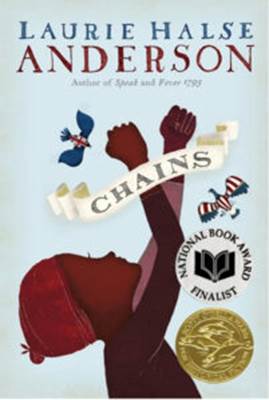
Set in New York at the time of the American Revolution, Chains spans May 27, 1776 to January 19, 1777. As the novel opens, the young teenage protagonist, Isabel, is optimistic about her future as her owner, Miss Mary Finch, has died and had let Isabel know beforehand that she and her five-year old sister Ruth would be free upon her passing. Unfortunately, no lawyer is present to produce the will that shows Miss Finch’s wishes. Mr. Robert Finch, Mary’s nephew and only surviving relative, has come to claim Isabel and Ruth and accuses Isabel of lying about the will. He proceeds to sell Isabel and her sister to Elihu and Anne Lockton from New York. The couple are Loyalists, and while Mrs. Lockton treats Ruth as a kind of pet that she shows off to friends she entertains, she treats Isabel, whom she refers to as “Sal,” in a harsh and degrading fashion, always showing her disfavor.

Isabel has two aims: to protect her sister and to gain freedom. She lives in fear that the Locktons will sell Ruth and thus separate them. At one point Mrs. Lockton provides sweets to them, something that was unusual. But she had laced them with something to make Isabel fall into a deep sleep. When Isabel awakens she learns that Mrs. Lockton has sold Ruth into slavery in the West Indies. This crushes Isabel, who is unable to escape due to constant monitoring by the Locktons.

While doing errands in town for Mrs. Lockton, Isabel meets Curzon, a teenage slave of Mr. Bellingham, a Patriot. Curzon asks Isabel if she would be willing to spy on the Locktons to get information to the Patriots. Initially Isabel refuses but then begins doing so. Mrs. Lockton finds out and punishes her by branding her cheek with an “I” for “insolence.” It takes Isabela six days to regain consciousness after the branding.

Mrs. Lockton makes Isabel care for Lady Seymour, Elihu’s aunt, who lives in town. As Isabel goes to town she is able to deliver messages about Loyalist activities to the Patriot soldiers. Lady Seymour has compassion for Isabel, treating her with kindness and feeding her well. Her house burned in the great fire of New York (September 21, 1776), and Isabel saves her as well as a portrait of her husband and some letters that were dear to her. This becomes important late in the book as Lady Seymour, then an invalid and unable to speak, gestures to Isabel that she approves of her taking coins that she had saved.

The Locktons don’t recognize Isabel as intelligent, which works to her advantage when she is in the room delivering food or waiting for orders when Mr. Lockton is talking with other Loyalists. Isabel learns of the plot to kill Gen. George Washington and shares this with Patriots who come and arrest Mr. Lockton. However, he is soon released and later escapes by hiding in a barrel of cheese. Readers learn that Ruth has not been sold to the West Indies but rather sent to Charleston, South Carolina. Isabel plots her escape for the night that people are distracted by a celebration of Queen Charlotte of Great Britain’s birthday. Though Mrs. Lockton had Isabel locked in a potato bin during the ceremonies, she manages to dig her way out, find a pass and forge papers showing she is free.

Curzon, who had fought in battle for the Patriots, was shot in the leg and held at Bridewell as a prisoner of war. Isabel is able to see him by bribing the guards with food. On the night of her escape, she goes to Bridewell and says she was sent to clean the cells where “prisoners been dropping dead like flies. Fever.” “Curzon lay insensible, his skin burning with fever, his eyes rolled up into his head. I called his name and pinched him, but he did not look my way nor speak a word.” Isabel claims Curzon is dead, loads him in a wheelbarrow and covers him with a filthy blanket. The two manage to make it to the wharf and to a boat. “I rowed that river like it was a horse delivering me from the Devil. My hands blistered, the blisters popped, they re-formed and popped again. I rowed with my hands slick with blood … The sun rose beyond the water, at the other side of the river. I was on the west bank. I was in Jersey. I had set myself free.” At this point Curzon awakes asking where they are, and Isabel replies “I think we just crossed the river Jordan.” The book ends with Isabel asking Curzon if he can walk and with an advertisement for the sequel Forge that gives the account of Isabel Gardner (formerly Sal Lockton) and companion Curzon Bellingham. 

The first teaching strategy for Chains is a set of ten questions designed to guide students in a close reading and deeper study of the novel. These questions may be used as the basis of class discussions, exams or essays.

Questions for Study and Discussion for Chains
1. How do Isabel’s and Curzon’s views of freedom differ in chapter 6? Also consider whether this changes as the novel progresses.
2. What evidence exists that Mr. Lockton is conspiring against the Patriots? Trace his journey from the point that he is arrested to the last mention of him.
3. In chapter 29 Isabel speaks of being “chained between two nations.” What does this mean?
4. Isabel’s grandfather speaks to her about the river Jordan in chapter 26, and in the last paragraph of the book, Isabel states “I think we just crossed the river Jordan.” What is the significance of the river Jordan?

5. Discuss the circumstances by which Isabel secures a copy of Thomas Paine’s Common Sense in chapter 39How does the pamphlet influence her in later chapters?
6. How does the author contrast Lady Seymour and Mrs. Lockton in chapter 41?
7. In what ways was the relationship between Isabel and Lady Seymour a reciprocal one where each benefited? Consider especially the events of chapters 31 and 44.
8. It may be said that at the time of Chains, both Isabel and America are rebellious, young, and conflicted. Explain.
9. Identify three scenes that you believe are the most important in Chains and explain why each is key to the novel.
10. The trilogy of which Chains is book one is called Seeds of America. What role do seeds play in the novel?

While these questions help to ensure close reading and provide opportunities to check for student understanding in a traditional way, the next activity engages students in a more creative, nontraditional manner as they use symbolic thinking and hands-on creativity.

A coat of arms is a visual design in the form of a shield, that goes back to Medieval days when families and communities used them to show their identity. The coat of arms includes a motto or slogan that captures the important essence of the family, nation, school, or in our case, Chains. A coat of arms can be elaborate, including features such as “supporters” (visuals on each side of the shield) and “toppers” (one or more visuals at the top such as a crest, torse, helmet, or crown).

This assignment consists of three parts: 1) Pre-writing via the writing frames for the coat of arms; 2) The visual coat of arms; 3) A paper that explains the symbols chosen in connection with the character the student chose from Chains.

A drawing of a coat of arms

AI-generated content may be incorrect.

The slogan “Per Aspera ad Astra” is Latin for “Through hardships to the stars” which is why the top of the crest features stars. There are three stars, each with an initial, representing Isabel in the middle and Curzon and Ruth on each side. The pre-writing in Table 1 provides additional insights about the symbols and colors used in Isabel’s shield.

Book Review – Our Fragile Freedoms

Four books that have influenced my teaching of U.S. history are: the volumes in the Jefferson Papers Project, The Life of Henry Adams, The Life of Arthur Schlesinger, and Our Fragile Freedoms. These books have left a profound influence on me because each of them included a perspective of 50 years or more.

Eric Foner’s Our Fragile Freedoms is a series of selected documents and book reviews that he has authored over 250 years of our history.  It is a collection of human stories in addition to documents, perspectives, historiography, and scholarly insights. In my reading I discovered new information and perspectives about enslaved persons, laborers, immigrants, and women.  I have also met Eric Foner, our lives share a similar chronology of the second half of the 20th century and the first 25 years of the 21st century.  Just when I thought I had mastered everything that needs to be taught in high schools, colleges, and in public discussions, I discovered somethings that are new and important in his book.

Our Fragile Freedoms gathers together nearly sixty book reviews and opinion pieces I have written over the past quarter century,  Originally published in venues such as the New York Review of Books, London Review of Books, The Nation, and The New York Times, they reflect a period of remarkable creativity among  American historians but also intense controversy over the teaching, writing and public presentation of history.  The book examines history as refracted through the prism of some of the most influential recent works of scholarship, while at the same time shedding light on my own evolution as an historian.” (Introduction, page xv)

The insights into the U.S. history curriculum are helpful to teachers who want to engage their students in investigating history and discussing the concept of freedom.  Here are some examples:

1.Colonial America: “In South Carolina and Georgia, however, the disruption of the War for independence produced not a weakening of commitment to slavery, but the demand that the Atlantic slave trade be reopened.  At the insistence of these states, the Constitutional Convention of 1787 forbade Congress from abolishing the importation of slaves until 1808. Given this window of opportunity, South Carolina brought in tens of thousands of new slaves, further reinforcing the African presence in the low country Black society.” (page 22)

    2. President Washington: “Thompson (Mary Thompson, author of “The Only Unavoidable Subject of Regret: George Washington, Slavery, and the Enslaved Community at Mount Vernon”, 2019) offers various explanations for Washington’s refusal to speak or act publicly against slavery.  She points out that freeing his slaves would have meant financial disaster for his family.  Like other Virginia planters, Washington was chronically in debt, largely because of his taste for luxury goods imported from Britain. Indeed, in 1789 he had to borrow money to pay for his journey to New York where his inauguration as the first president was to take place.” (page 35)

    3. Fugitive Slave Law: “The first arrest under the Fugitive Slave Act of 1850 took place in New York-a city whose economic fortunes were closely tied to the cotton trade, and whose political establishment was decidedly pro-southern. On September 16, 1850, eight days after President Millard Fillmore signed the measure, two deputy U.S. marshals arrested James Hamlet at his job as a porter in a local store. Hamlet had escaped from Baltimore two years earlier and settled in Williamsburg, a Brooklyn village with a small Black population, along with his wife and three children, all born in Maryland.” (page 53)

    4. Emancipation Proclamation: “’I cannot make it better known than it already is, that I strongly favor colonization,” Lincoln said in a message to Congress less than a month before he issued the Emancipation Proclamation.  Oakes (Professor James Oakes, CUNY) calls Lincoln’s August 1862 meeting with Black leaders (not including Douglass), where he urged them to support colonization, “bizarre,” and explains it as an effort to “make emancipation more palatable to white racists.” And he notes, Douglass reacted with one of his most bitter criticisms of the president, “Mr. Lincoln,” he wrote, “assumes the language and arguments of an itinerant colonization lecturer shows all his inconsistencies, his pride of race and blood, his contempt for Negroes and his canting hypocrisy.  (page 72)

    5. Reconstruction: “Grant’s contemporaries recognized the Civil War as an event of international significance.  One hundred and fifty years after the conflict began, the meanings they ascribed to it offer a useful way if outlining why it was so pivotal in our own history.  The Civil War changed the nature of warfare, gave rise to an empowered nation-state, vindicated the idea of free labor, and destroyed the modern world’s greatest slave society. Each of these outcomes laid the foundation for the country we live in today. But as with all historical events, each outcome carried with it ambiguous, even contradictory, consequences.” (page 85)

    As teachers, we need to understand the big picture of historical decisions and events over time.  This is why it is important for students to learn about continuity and change as one of the core skills of our discipline. Our Fragile Freedoms helped me to grasp the complexity of the concepts of freedom and equality that social studies teachers introduce in kindergarten.

    An important article and commentary in the book is “Everyday Violence in the Jim Crow South.” (pp. 201-210) This review of By Hands Now Known: Jim Crow’s Legal Executioners, by Margaret A. Burnham, New York Review of Books, April 6, 2023, provides specific examples of the abuse of power by people in local and state government against innocent citizens.

    “In Westfield, a town near Birmingham, a female white clerk at a local store, claiming that a Black customer, William Daniel, had insulted her, called the police.  When an officer arrived, he almost immediately shot and killed the alleged offender, even though, as Burnham laconically remarks, Daniel had committed no crime: ‘even in Alabama, there was no law against, ‘insulting a white woman.’” (p. 203)

    Another commentary that engaged my interest as a high school teacher was “Tulsa: Forgetting and Remembering.” (pp. 211-220) The information in the Review of The Ground Breaking: An American City and Its Search for Justice by Scott Ellsworth in the London Review of Books, September 9, 2011, provides new insights and perspectives to this horrific tragedy that began with a minor encounter between two teenagers. Scott Ellswoth is from Tulsa and became interested in this race riot in his research for a high school history paper.  He pursued his passion of this massacre as a college student at Reed College, and throughout his adult life. The discussion about the importance of local research has relevance to the teaching of history and its relevance to project-based learning.

    The review of Half American: The Epic Story of African Americans Fighting World War II at Home and Abroad by Matthew F. Delmont and An Army Afire: How the U.S. Army Confronted Its Racial Crisis in the Vietnam Era by Beth Bailey 2023) left me feeling uncomfortable. I think many teachers emphasize the role of the Tuskegee Airmen in teaching World War II and follow it up with a five-minute talk on President Truman’s Executive Order to embrace “equality of treatment and opportunity” in the military regardless of race, religion, and national origin. Because of my ignorance in this area, I never included examples of Jim Crow discrimination and the race problem in our armed forces. Our Fragile Freedoms provides graphic examples. (pp. 232-243)

    In the middle of the book there are some of the most important insights and perspectives for teachers of 20th century United States History. They have a direct relationship to what students are thinking about today as they listen to or witness events that are challenging the values of liberty, equality and social justice.  They offer teachers critical questions of inquiry regarding the continuity and change of America’s core values from the Declaration of Independence, Reconstruction Era, and Civil Rights movement. Allow me to summarize from examples on the New Deal and Civil Rights era from pages 243-267.

    “We will never know precisely why Parks refused to leave her seat when ordered to do so, her decision was not premeditated but neither was it completely spontaneous.  Perhaps it was because an all-white jury in Mississippi had just acquitted the murderers of Emmett Till, a Black teenager who had allegedly whistled at a white woman.  Perhaps the reason was that she had inadvertently boarded a bus driven by the same driver who had evicted her twelve years earlier.  Parks knew that talk of a boycott was in the air.  In any event, in the wake of her arrest the boycott began.” (p. 248)

    In the review of Riding for Freedom, teachers might ask if the foreign policy of the Kennedy Administration on the Cold War was mutually exclusive from the domestic policy of integration and racial justice. Many American presidents have faced challenging decisions regarding their promise for domestic reforms and unexpected international conflicts. Kennedy experienced this in his first year as president.

    “Certainly, the photographs that flashed across the world embarrassed the White House.  But the conflict with the Soviets also inspired deep distrust of any movement that included critics of American foreign policy.  After a telephone conversation in which he urged Martin Luther King Jr. to restrain the riders, Robert Kennedy remarked to an aide, ‘I wonder whether they have the best interest of their country at heart.’” (pp. 253-254).

    “The continuing distortion of the period (Reconstruction) by historians raised a troubling question, King had long identified the movement with core American values inherited from the nation’s founding. But what, in fact, were the nation’s deepest values? All men are created equal? Or something more sinister, exemplified by Reconstruction’s violent overthrow? King had originally believed, he told the journalist David Halberstam, that American society could be reformed through many small changes. Now, he said, he felt ‘quite differently,’ ‘I think you’ve got to have a reconstruction of the entire society, a revolution of values.’ Was the movement the fulfilment of American values or their repudiation?” (pp. 263-264)

    These excerpts are only appetizers for the full meal that is within each review and the entire book. As students think about and debate the civil rights era, they gain an understanding of the civil rights movement, its brutality, its injustice, its inequality, and its struggle. Unfortunately, too many students only know one sentence from Martin Luther King’s speech, “I have a dream….” Teachers should have students read or watch the entire speech.

    “We must forever conduct our struggle on the high plane of dignity and discipline. We must not allow our creative protests to degenerate into physical violence. . . . The marvelous new militancy which has engulfed the Negro community must not lead us to distrust all white people, for many of our white brothers, as evidenced by their presence here today, have come to realize that their destiny is tied up with our destiny. . . .

    We cannot walk alone. And as we walk we must make the pledge that we shall always march ahead. We cannot turn back. There are those who are asking the devotees of civil rights, “When will you be satisfied?” We can never be satisfied as long as the Negro is the victim of the unspeakable horrors of police brutality.

    (https://www.gilderlehrman.org/sites/default/files/inline-pdfs/king.dreamspeech.excerpts.pdf)

    The genius of this book is that each chapter offers a new insight, a scholarly perspective, and a valuable lesson. I learned something new about integration, voting, the censorship of speech, the Chicago riots in 1968, and progressivism. The section on History, Memory, Historians is a must read for every pre-service teacher and every social studies teacher. The lessons here about historical omissions, social and intellectual history, and the lessons of history. Our Fragile Freedoms should shape the generation of social studies/history teachers who will be teaching students in the second quarter of the 21st century!

    Book Review: The Leadership Journey: How Four Kids Became President

    I decided to read this book after listening to Doris Kearns Goodwin speak about this on television following the inauguration of President Donald Trump. After reading the first few pages, I decided to write a review of this book as it should be ‘required’ reading for every social studies teacher, student, parent, and grandparent.

    One reason for encouraging teachers, pre-service teachers. students, parents, and grandparents to read this book is in the truisms that are embedded in the stories about each president. For example, in introducing Abraham Lincoln’s decision to enter politics as a Whig candidate, these few sentences should engage young minds in reflective thinking:

    As a teacher, I would discuss with my class, why did Lincoln join the new Whig Party and not the popular Democratic Party? Why did he announce his decision to run for the assembly in a pamphlet compared to a letter, newspaper, or verbal announcement? How does Lincoln understand public service?

    As a parent or grandparent, I would discuss the political parties we have today and what they stand for. How do candidates in our community or state get elected and announce their decision to run for office? Is it possible for elected representatives to represent the interests and needs of the majority in their community or is it best for them to advance their own beliefs on the issues or vote for the position of their political party?

    The reading level of The Leadership Journey: How Four Kids Became President is for middle school students. Each chapter is just a few pages and should take a middle school student about 20-30 minutes to read and comprehend. This book is a valuable resource for a student research assignment, teaching about the reliability of sources, civics, an afterschool history club such as Rho Kappa or Phi Alpha Theta, a summer reading list activity, or a Saturday Seminar roundtable discussion. The applications of this book are unlimited.

    One of the hidden gems in the life of Lincoln is with his learning style, character, persistence, and ability to handle disappointments. These examples are often only a few sentences, but they are prompts to initiate discussion and empathy between students in your class. For example, “The key to Lincoln’s success as a lawyer was his ability to break down the most complex case or issue ‘into its simplest elements.’ He never lost a jury by fumbling or reading from a prepared argument, relying instead ‘on his well-trained memory. (Page 47)

    Another example that I found interesting was the evolution of how President Lincoln’s views changed about the emancipation of enslaved persons by listening to others.

    The second president in Doris Kearns Goodwin’s book is Theodore Roosevelt. There are multiple connections for students in the leadership journey of Teddy Roosevelt. These include living with a disability, coping with personal loss, understanding the issues, the importance of integrity, and the challenges and opportunities of the experiences in one’s life.

    Although born into a family with wealth, as a child he faced frightening attacks of bronchial asthma. His childhood and teenage years were limited. By age 10, he had opportunities to be home schooled, enjoy summer vacations on Long Island, and travel to Africa, Europe, and the Middle East. However, participating in activities was limited because of his health.

    The lesson of how Teddy Roosevelt voted in the New York State Assembly, especially on the bill to stop the manufacture of cigars in tenement houses is one that will likely engage students in a thoughtful discussion or debate about how elected officials represent constituents today. Roosevelt opposed all government supervision and regulations regarding limiting the hours worked, a minimum wage, or prices. Samuel Gompers invited him to visit the places where the cigars were made.

    On February 14, 1884, Valentine’s Day, Teddy Roosevelt place a large X in his diary followed by the words “The light has gone out of my life.”  His mother, Mittie, and his wife, Alice Hathaway Lee, died. He was 25 years old and had been married for less than four years.

    These are stories students relate to. They encourage discussions about loss, grief, empathy, confusion, resilience, and life. The leaders Doris Kearns Goodwin writes about are very human and their experiences in life are similar to those of many young adults. Abraham Lincoln also lost his mother and fiancé and his son, Willie, died at age 11 in the White House.

    Three examples from the book that should interest middle and high school students are Teddy Roosevelt’s use of the Executive Order renaming the Executive Mansion to the White House in 1901, his daily schedule, and a bizarre episode running naked in Rock Creek Park. Source

    The information on the Spanish American War in 1898, settling the coal strike in 1902, nine-week train trip around the United States in 1903, are also presented in a descriptive narrative that will interest students with events in the social studies curriculum.

    Although most middle school students do not study Franklin Delano Roosevelt as part of U.S. History, this chapter will engage high school students. The importance of reading is to ignite inquiry through questions and thinking about the historical era, the individual, and American government.

    Franklin was born into a wealthy family with a large estate about 90 miles north of New York City, where they also had a home on 65th Street near Fifth Avenue and Central Park.

    The chapters about Roosevelt are powerful and insightful because they are filled with stories about his character. While most readers will find value and insights into his youth, college years, marriage and positions in the state legislature and federal government, the chapter on his perseverance regarding his paralysis from polio is unusually compelling. Here is an example of how FDR faced the news of his permanent disability as a 39-year-old man with a promising future:

    In another chapter Doris Kearns Goodwin portrays FDR’s trait of courage.  His courage was both political courage as he risked everything to hide his disability of crippled legs and physical courage.  He was fortunate to have the friendship and guidance of Louis Howe, Sam Rosenman, Frances Perkins, and his wife, Eleanor. Here is an example of how Franklin handled every situation with grace, humor, and strength: (This is six years after he was infected by the polio virus, 1928)

    These two excerpts are only an introduction to what is revealed in his campaign for governor, acceptance speech in Chicago as the Democratic Party candidate for president, his inauguration speech at the Capitol, and his leadership as president. Facts and historical examples are important, but FDR’s personality traits will likely have a lasting impact on students.

    Although many students are likely less familiar with the presidency of Lyndon B. Johnson than the presidency of Lincoln, T.R. or F.D.R., they will identify with his character, commitment to civic engagement, and experience as a teacher. As a young child, he moved from a small cabin in a rural area to Johnson City. For various reasons, Lyndon’s activities changed, and he became interested in the activities of his father who was a member of the state legislature in Texas.

    Lyndon’s Johnson’s role as a teacher and school principal reveals his work ethic and characteristic as a caring and dedicated public servant.

    He was also the debate coach at Sam Houston High School. He coached the debate team through city, district and state tournaments.

    “Johnson appeared to his students ‘a human dynamo,’ a steam engine in pants,’ driven by a work ethic and unlimited enthusiasm that proved contagious.” (Page 269)

    I enjoyed reading about how he used his social capital in Washington to advance his goals. Lady Bird and Lyndon moved to Washington where he was the chief of staff to a Texas congressman. He became friends with Sam Rayburn who lived alone and invited him to dinner in his home with his wife, Lady Bird. Through this connection, Lyndon became the director of the National Youth Administration in Texas. When his congressman James Buchanan passed away unexpectedly, Johnson campaigned for his seat. Two days before the election he had emergency surgery to remove his appendix. He won, likely on a promise to bring electricity to the farmers in his area of Texas.

    Johnson’s personality traits of empathy, enthusiasm, perseverance, and ‘grit’ are important for students to understand, apply to their own experiences, and engage in discussion with their peers. He lost his bid for re-election by 1,311 votes and a few years later won his election as senator by only 87 votes. As a senator, he was the youngest majority leader in the history of the Senate at age 46 and was considered as a presidential candidate for the 1956 election. Then, suddenly everything changed when he had a devasting heart attack. This event transformed his life and behavior.  A lesson about the trait of resiliency.

    If a teacher elected to use the resource of this book for just one day, perhaps the most compelling pages are found on pages 317-328. His passion, legislative skill, and personal conviction are important for every student to understand. It is also important for students to understand the long struggle to pass and implement civil rights laws. In our classrooms, the lessons of Freedom Riders, marches, boycotts, and the emotional scars of segregation are too often taught passively through slide presentations and vocabulary terms. Doris Kearns Goodwin captures some of the emotion that led to the Civil Rights Act of 1964 and the Voting Rights Act of 1965. Everyone should read Chapter 24.

    “Like a tailor stitching a custom suit, Johnson took measure of Dirksen.  A decade of working together had taught Johnson that Dirksen had no hesitation asking for ‘a laundry list’ of favors in return for his support on legislation.  But this time, Johnson offered Dirksen something far more important than perks and favors; he appealed to Dirksen’s hunger to be remembered, honored. ‘I saw your exhibit at the World’s Fair, and it said, ‘The Land of Lincoln,’ Johnson pointed out. And the man from Lincoln is going to pass this bill and I’m going to see that he gets proper credit. With a gift for flattery equal to Dirksen’s vanity, he assured the senator ‘if you come with me on this bill, two hundred years from now there’ll be only two people they’ll remember from the state of Illinois: Abraham Lincoln and Everett Dirksen!” (Page 321)

    I found value in the leadership journey of these four presidents. Although my review focuses on students and teachers, adults will also enjoy reading what Doris Kearns Goodwin has written. In the closing pages, Doris Kearns Goodwin describes a dinner meeting with her “guys.’  What an opportunity to discuss the historical context of 100 years of American history, the goals of the Declaration of Independence, how each president mastered the communication platforms of newspapers, stories, radio, and television. Perhaps the most significant question is what makes a good leader and a good president? What a nice segway to understanding empathy!

    Visit the resources of the Miller Center at the University of Virginia to learn about the American presidents.