New York Local History: Underground Railroad in the North Country

New York Local History: Underground Railroad in the North Country

Source: North Country Public Radio https://www.northcountrypublicradio.org/news/story/45430/20220224/remembering-the-secret-history-of-the-underground-railroad-in-the-north-country

A few minutes outside the small town of Peru in New York’s Champlain Valley, there is a small farm that looks like any other in the area. A cluster of silos and red barns with fading paint are flanked by snow-covered fields and apple orchards, dormant for the winter. But this farm has something unique. A blue and yellow New York State historical marker identifies the property as a stop on the Underground Railroad, where “runaway slaves were concealed and protected on their way to freedom in Canada.”

There was no actual train involved in the network, explains Jacqueline Madison, the President of the North Country Underground Railroad Historical Association. “It was a trail of conductors who helped them along the way [and] safe houses where they could stay,” she notes.

Communities from Watertown to Lake Champlain were part of that network of safe houses that helped people escape slavery in the American south during the decades leading up to the Civil War. Escapees typically traveled by foot or water. The railroad moniker was part of a secret code: safe places to stay were called stations and the owners of those properties were known as conductors. A full journey on the Underground Railroad typically took several months.

This is the history that Madison and the North Country Underground Railroad Historical Association are dedicated to preserving. The group operates a museum in Keeseville, in the Champlain Valley south of Plattsburgh. It features the stories from both sides of the Underground Railroad: Black passengers and white conductors. One exhibit is dedicated to the former owner of that historic Peru farmhouse, a man named Stephen Keese Smith. The abolitionist Quaker purchased the property in 1851 and quickly established one of the barns as a hiding place for runaway slaves headed to Canada. There is no way to know with certainty exactly how many people Keese Smith aided while working as a conductor. But his later writings provide an estimate. “He talked about helping people get to freedom and he thinks he spent about $1000 doing that,” Madison explained. “And if we spent $2.50 per person, he would have helped over 400 people.”

Exact numbers are nearly impossible to come by in historical records because those helping escaped slaves often avoided keeping a paper trail. Involvement in the Underground Railroad was extremely dangerous for everyone, black or white. The Fugitive Slave Act of 1850 required that escaped slaves be returned to their former owners – and carried stiff penalties for anyone who aided them. “If you were caught helping someone get to freedom,” Madison noted, “you could lose your property, you could be jailed, you could be fined. Terrible things could happen to you, your family, and friends if they suspected them of helping as well.”

The North Star Underground Railroad Museum fills up the bottom floor of an old 19th Century house. It’s packed with maps, faded newspaper articles, and portraits of notable members of the North Country section of the covert network. Standing before a map, Madison explains the various routes freedom-seekers would have followed to reach Canada. A western path originating in Pennsylvania went through Buffalo, up to Watertown, and crossed the St. Lawrence River at Ogdensburg. Two escape routes followed Lake Champlain: one through Vermont and another running from Albany to Rouse’s Point along the lake’s western shore. To find their way, escapees used folk songs learned on the southern plantations. They worked as a kind of secret oral map; with coded lyrics guiding freedom seekers on their journey north. One such tune called Follow the Drinking Gourd referenced landmarks like certain rivers and offered hints for how to identify friendly conductors. Drinking gourd was code for the Big Dipper – a celestial constellation that can be used to identify the North Star.

Although details can be hard to piece together, some stories of those who passed through the North Country to freedom have been recovered. An article written in 1837 by Vermont-born abolitionist Alvan Stewart for an anti-slavery newspaper recounts the story of an anonymous man who travelled through the North Country on his way to Canada. “I was headed to Ogdensburg, on my way north to Canada from South Carolina,” an actor declares in a re-enactment exhibit at the North Star Museum. “I had come up through the Champlain Canal, and then gone through Clinton and Franklin County.” That unknown man did eventually reach freedom north of the border, but his quest nearly ended in disaster just a few miles from his destination.

Outside of Ogdensburg, he stopped into a post office looking for work. Since New York had outlawed slavery in 1827, that would not necessarily have been out of place. However, slave owners offered rich rewards for the return for those who escaped, and slave catchers were permitted to operate even in anti-slavery states under the Fugitive Slave Act. When the anonymous freedom seeker entered the post office near Ogdensburg, the postmaster recognized him and explained that a reward for his capture had been posted. “I said to him, if you send me back then they’ll do terrible things to me,” the re-enactment continues. “Whip me. Hang me. Skin me alive. I begged him not to turn me in.” In this case, the postmaster ignored the reward, worth about $20,000 in today’s terms, and helped the man cross the St. Lawrence River into Canada.

Other escaped slaves decided to settle in North Country. In 1840, a Franklin County landowner named Gerrit Smith pledged to donate more than 120,000 acres of wilderness land in the Adirondacks to free black men. It would eventually become a settlement known as Timbuctoo. A man named John Thomas received 40 acres of un-cleared land from Smith. Thomas later sold that to buy a larger plot near Bloomingdale, NY, which he turned into a successful farm. Many years later, Thomas wrote his benefactor a letter, thanking Smith for the “generous donation” and revealing that he and his family greatly enjoyed the peace and prosperity of their “rural home.” Although Thomas was successfully established himself in the region, that was not the case for most recipients of Smith’s land. Harsh winters and tough soil drove many of the Black farmers to sell the land they had received and move away. The climate was not the only danger; at least once, slave catchers came to the area looking for Thomas. According to Madison, they first approached his neighbors seeking their help. As Madison tells it, Thomas’ neighbors informed the slave catchers that he was armed, would forcibly resist capture, and declared their intention to assist Thomas in repelling the catchers. The slave catchers are believed to have given up their pursuit.

In his later letter to Smith, Thomas hinted that his adopted community had begun to treat him as one of their own. “I have breasted the storm of prejudice and opposition until I began to be regarded as an American citizen,” he wrote. This may also be a reference to civic participation. At the time, New York State required men to own at least $250 worth of land to obtain the right to vote. Thomas’ obituary was published in the Malone Palladium in May 1895. It described him as “much respected in the community where he lived so long.” His descendants still live in that community. Through genealogy research, Madison and the North Star Museum discovered that two of John Thomas’ great-great grandsons still reside in the North Country. One of the descendants lives less than two miles from the cemetery in Vermontville where Thomas and his wife are buried.

New Jersey Local History: Stephen Smith House and Underground Railroad at Cape May

New Jersey Local History: Stephen Smith House and Underground Railroad at Cape May

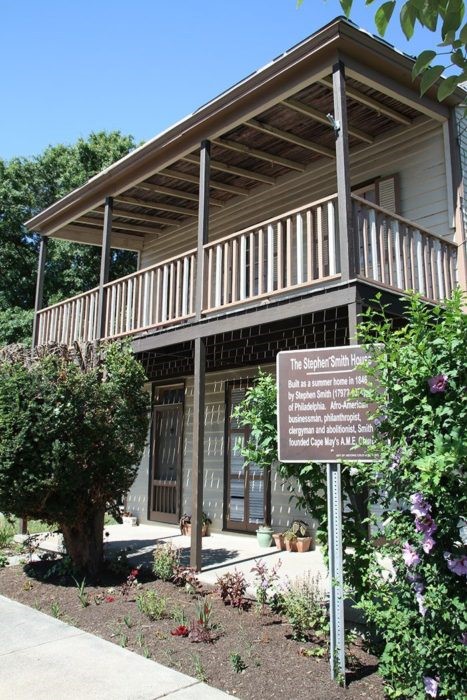
Stephen Smith was the original owner and builder of a summerhouse in Cape May, New Jersey.

Although born in the late eighteenth century, Smith was a nineteenth century philanthropist. During his lifetime, he was said to be the wealthiest Black American in the nation. He established the first home in the United States for aged and indigent Colored people. This home is still in existence today.

An energetic businessman, Mr. Smith had a coal mine, stone quarry and lumber yards in Philadelphia and Columbia, Pennsylvania. His business activities led to many real estate holdings. He established Smith, Whipple & Co. with his cousin William Whipper. Stephen Smith was a devoted church and family man; married to Harriet Lee, they lived in a stone mansion on Lombard Street in Philadelphia, Pennsylvania. The vacation house was built by him in Cape May, New Jersey using material from his lumber yard. This house is still standing except for the carriage house, kitchen and fireplace room once visible in the rear of the building. Not having children of his own, he welcomed the offspring of his wife’s secretary and friends; namely the Bascoms and Harlans. His secretary Anna Vidal, wife of Ulysses B. Vidal, brought their three children, Etienne, Marie and Anna Clorise to Cape May. Etienne engraved his name in a small glass windowpane with his diamond ring at this house. In later years Marie would point out the pane and recall the prank, for Etienne had long since emigrated to France. Stephen Smith was called “Daddy” Smith by the children and he relished the time consuming carriage ride to Cape May with them. Portraits of Stephen and Harriet were painted by the noted Black artist Edward Stridom and are today the property of the Pennsylvania Historical Society. An avid abolitionist and agent in the Underground Railroad, Mr. Smith was active in politics and church affairs. Records of the AME church attest to his generosity.

Stephen Smith was born October 13, 1795 in Columbia, PA. At the age of nine he was purchased by an officer who was a Revolutionary War general named Thomas Boude. His mother escaped from her owner, found her son, and was taken in by Boudes. Weeks later her mistress (owner) followed and demanded her property. The Boudes’ refused and were supported by the townspeople who believed in aiding a fugitive. Raised by the General Thomas Boude, in time, Stephen purchased his freedom. Before the general died, he set Stephen up in the lumber business. Stephen earned the respect and confidence of the people of Columbia, PA and they supported his endeavors. At age 21, he was inspired by the eminent minister, Richard Allen, founder of the AME church, and at age 31 became licensed to preach. He was a Teller in the election of every Bishop since Richard Allen until his death in 1873. Smith built a public hall in Philadelphia for the use of the “People of Color”; but this was destroyed by fire in the riots of 1842. Stephen Smith was one of the Signers of Frederick Douglas’ Men of Color to Arms appeal during the early part of the Civil War calling on Black Americans to join the Union Army.

How the First African American Doctor Fought for Women’s Rights in Glasgow

How the First African American Doctor Fought for Women’s Rights in Glasgow

Mathew D. Eddy

(This essay was originally published in The Conversation)

James McCune Smith was the first African American to receive a medical doctorate from a university. Born in 1813 to a poor South Carolina runaway slave who had escaped to New York City, he went on to attend Glasgow University during the 1830s. When he returned to America, he became a leading black physician, a tireless abolitionist, activist and journalist. McCune Smith led an amazing life. He exposed false medical data in the 1840 American census. He supported women’s suffrage alongside the noted feminist Susan B. Anthony. And he wrote the introduction to Frederick Douglass’s sensational 1855 autobiographical slave narrative, My Bondage and My Freedom. Now, for the first time, my research has revealed that McCune Smith was also the first African American known to be published in a British medical journal – and that he used this platform to reveal a cover-up by an ambitious medical professor who was experimenting on vulnerable women in Glasgow in the 1830s.

I am a historian of science and medicine. I study how people learned scientific skills and I am especially intrigued by the history of how scientists and physicians made discoveries and how that knowledge then circulated between the academy and the public. One way to track this process is to compare what students learned in educational settings to how they used their scientific training to solve problems and make decisions later in life. My forthcoming book, Media and the Mind (2020, Chicago University Press), for example, uses school and university notebooks to reconstruct how students historically learned to create, analyze and visualize scientific data in ways that helped them understand the human body and the natural world when they finished their education.

Several years ago, I decided to investigate the history of how the testimony of hospital patients was transformed into scientific data by physicians. I eventually stumbled across the 1837 case of a young Glasgow doctor who sought to expose painful experimental drug trials that had been conducted on the impoverished women of a local hospital. That doctor was James McCune Smith. He had written articles detailing how the women of a local charity hospital were being subjected to a painful experimental drug. It was a career changing moment for me because I had not encountered this kind of activism in my previous research on medical education.

Who was this doctor? What led him to speak out? Where did he learn to place his knowledge of science and medicine in the service of equality and justice? Upon closer examination, despite his many accomplishments, virtually nothing had been written about McCune Smith’s time in Glasgow or about his work as a practicing physician in New York. Like the children of many runaway slaves in New York, McCune Smith grew up in Five Points, Lower Manhattan, one of the poorest and most densely populated urban areas of America at that time. Though the state fully emancipated all former slaves in 1827,  when McCune Smith was a teenager, discriminatory educational policies, unsanitary living conditions, chronic illness and infectious diseases ensured that the prospects for a free African American teenager in the early part of the 19th century were limited. Indeed, in an article entitled “Freedom and Slavery for African-Americans,” published in the New York Tribune in 1844, McCune Smith observed that only six of the 100 boys who attended school with him from 1826 to 1827 were “still now living”. He noted further that they were “all white.”

Though technically “free,” the lives of African Americans in New York during the 1820s and 1830s were marred by the legacy of slavery and discrimination. Runaway slaves were openly hunted in the city’s alleys, streets and wharves. McCune Smith reflected on these events in an essay that he wrote about the life of his school classmate, Henry Highland Garnet. An abolitionist and Presbyterian minister, Garnet was the first African American to speak before Congress. McCune Smith recalled the trauma experienced by Garnet’s family in 1829 when they were tracked by slave-hunters. They barely escaped by jumping out of a two-story building and hiding in the house of a local grocer. When they returned to their home they found, in the words of McCune Smith: “The entire household furniture of the family was destroyed or stolen; and they were obliged to start anew in life empty-handed.”

Despite many challenges, New York’s African Americans founded their own businesses, churches, political associations, printing presses and more. In addition to receiving support and encouragement from a community of relatives and friends, McCune Smith’s path to becoming a doctor was significantly aided by his education at the African Free School. Older students were taught penmanship, drawing, grammar, geography, astronomy, natural philosophy and navigation. When American universities denied his medical school applications, the free school community played a role in raising funds for him to attend Glasgow University.

After sailing from New York to Liverpool, McCune Smith arrived in Glasgow in 1832. Thanks to maritime trade, it was one of the largest cities in the country and the university’s medical school was one of the best in Europe. Britain had prohibited the slave trade in 1807 and it fully abolished slavery the year after his arrival in 1833. Though there were not many African Americans in Glasgow, black writers, had been operating in Britain since the 1770s. Then, in 1809 Edinburgh University admitted William Fergusson who was from Jamaica and was the university’s first student of African descent. Though he took medical courses at the university, Fergusson did not stay to complete a medical doctorate. Instead, he received a license from the Royal College of Surgeons in Edinburgh in 1813. He then practiced as a surgeon in the British military and eventually became governor of the then-British colony of Sierra Leone. McCune Smith joined the ranks of these torchbearers and became the first African American known to graduate with a BA, MA, and medical doctorate from Glasgow University. By the time McCune Smith began his studies in Glasgow, opposition to slavery had moved beyond the walls of the university. There was an active abolitionist community and it founded the Glasgow Emancipation Society in 1833. McCune Smith, still only an undergraduate, was one of the founding members. After he graduated, a number of black students attended the university over the course of the century.

Despite living in a foreign country, McCune Smith excelled at his studies and received several academic awards. The Glasgow medical faculty placed equal emphasis on scientific rigor and hands-on clinical experience. In addition to learning chemistry, anatomy and physiology from some of Britain’s leading doctors, he witnessed cutting-edge experiments and new medical technologies being demonstrated in his lectures. He graduated with honors in 1837 and was immediately given a prestigious clinical residency in Glasgow’s Lock Hospital. He worked there alongside the eminent Scottish obstetrician and gynecologist, William Cumin, treating women who had contracted venereal diseases.

The difficulty in pursuing a project of this nature is that many of the scientific papers and publications of black physicians have been lost to the sands of time. Unlike the many collections that university libraries have dedicated to preserving the legacy of white doctors who were alumni or donors, there is no “James McCune Smith Medical Collection” where scholars can go to study his medical career and scientific ideas. No one has yet told the full story of how African Americans like McCune Smith became doctors or how they used their knowledge of medical science to fight injustice and prejudice. The hidden histories of these black physicians based in countries spread around the Atlantic Ocean led me to start my current research project on how they used their scientific training to counter the rise of racist medical theories -theories which erroneously suggested that black bodies were physically different from other bodies and could more easily withstand the stress, pain and labour of enslavement.

Though a number of McCune Smith’s articles were republished several years ago, the whereabouts of his personal medical library, clinical notebooks, patient records, office ledgers and article drafts are unknown. Likewise, his manuscript Glasgow diary and letters have been lost. Though aspects of his career have received attention from historians in recent years, a biography of his extraordinary life has not been written.

This was the situation when I discovered his efforts to expose the harmful drug trials that were being conducted on the women of the Glasgow Lock Hospital. The evidence consisted of two articles that he had published during the spring and summer of 1837 in the London Medical Gazette, a weekly journal with articles about medicine and science.

I originally came upon these articles by reading page after page of medical journals housed in the National Library of Scotland in Edinburgh. When I found them, they immediately stood out because they took the testimony of poor female patients seriously. When I realized that McCune Smith was the first African American to graduate from a Scottish university, I could not believe what I had discovered.

New discoveries

Discovering McCune Smith’s articles was momentous because they are the first currently known to have been published by an African American medical doctor in any scientific journal. Scientists in the 19th century published articles for many reasons. Some wanted to popularize their research in a way that advanced their careers. Others hoped their research would benefit the general public.

The fascinating aspect about McCune Smith’s articles in relation to the historical emergence of the scientific journal is that they were published to expose the unethical misapplication of scientific experiments. This means that they offer new insight into how he learned to combine the power of the press with his medical training to fight inequality and injustice in Britain prior to returning to New York.

The story they tell is extraordinary. The events occurred in the spring and summer of 1837 while McCune Smith was serving in the Glasgow Lock Hospital as a resident physician in gynecology. The hospital was a charity institution set up by the city for impoverished women suffering from acute venereal diseases such as gonorrhea and syphilis.

After consulting the ward’s records and speaking with the patients, McCune Smith discovered that Alexander Hannay, a senior doctor in the hospital, was treating women suffering from gonorrhea with an experimental drug called silver nitrate, a compound that a handful of doctors used as a topical treatment for infected skin tissue or to stop bleeding. But it was normally used in low concentrations mixed into a solution, with doctors emphasizing that it should be applied with caution and as a last resort.

But Hannay was administering the drug in a solid form, which meant that it was highly concentrated and caused a terrible burning sensation. He fancied this usage to be innovative and was relatively unfazed when his patients repeatedly asked for less painful forms of treatment. After speaking with the women and further consulting the hospital’s records, McCune Smith realized that Hannay was effectively treating the women as guinea pigs – as non-consenting participants – in an experimental trial that involved a very painful drug.

At that time, silver nitrate was a newly available substance and its long-term effects were relatively unknown. There were a handful of military doctors who used it experimentally to cauterize skin ulcers or wounds of soldiers that would not stop bleeding. But some medical books classified it as a poison. Glasgow’s medical students, particularly those who studied with Prof William Cumin, avoided using it on internal organs due to its unknown effects. Instead, when it came to gynecological cases involving ulcers or infections, students learned to use an alum solution because its effects were generally considered to be effective and less painful.

Hannay went beyond using the silver nitrate on the skin. He applied it to the internal reproductive organs of women, at least one of whom was pregnant. McCune Smith’s article pointed out that the baby subsequently died through complications surrounding a miscarriage. It also intimates that a few women died after the application of silver nitrate. Since the drug’s effect on internal organs was unknown, he believed that that the deaths could not be treated as a separate occurrence.

In addition to being McCune Smith’s superior, Hannay was a medical professor at Glasgow’s newly established Anderson University. The easiest thing for McCune Smith to do was to say nothing. The plight of the Lock Hospital patients would not have been a major concern for many medical men at the time. The patients were impoverished women and most doctors assumed they were former prostitutes.

But McCune Smith’s perspective was different. Unlike his peers, he had spent his early years in New York City witnessing the pain and suffering caused by poverty, inequality and exploitation. So he decided to place his knowledge of medical science in the service of these women.

McCune Smith knew that there were other effective treatments for gonorrhea. This allowed him to see that Hannay was more interested in bolstering his reputation with a pharmaceutical discovery than helping his patients. But his studies had given him another equally powerful tool – data analysis. His ability to use this tool can be seen in his London Medical Gazette articles. The gazette was a journal of some repute, serving the British medical community as well as physicians based in Europe and America. In his article, he wrote: “The materials of my paper on the subject of gonorrhea of women were collected whilst I held the office of clerk to the Glasgow Lock Hospital.”

He made his case against the experiments by extracting figures from handwritten registers that recorded the condition of patients being treated in the hospital over an entire year. He had learned to collect, categorize, and analyze data in the clinical lectures that were required for graduation. This method was part of the new science of “vital statistics” that used medical data to predict or prevent disease in people, cities and even countries. Known as “medical statistics” today, it was becoming more commonly used in journals that published articles on medical science.

McCune Smith’s articles showed that the drug trials were ineffective and presented an unwarranted risk. They also revealed that Hannay and his team of assistants had attempted to cover up data in the hospital records that damaged their claims about the drug’s efficacy and their position that its side effects were minimal. McCune Smith did not mince his words. He wrote: “By this novel and ingenious mode of recording the Hospital transactions for 1836, [Prof Hannay’s team] keeps out of view the evidence of the severity of the treatment, and the amount of mortality, while, at the same time, the residence of the patients in the house seems shorted, the cost of each diminished, and the treatment made to appear more than usually successful.”

Accordingly, he called for the trials to stop immediately. But McCune Smith was not happy to simply cite statistics. He wanted to give these women a voice too. To achieve this, he emphasized the extreme pain that they were experiencing. Their suffering had been played down by those conducting the experimental trials. Hannay even suggested that the women were dishonest and unreliable witnesses. To counter this suggestion, McCune Smith quoted the women themselves, some of whom said that the drug felt like it was “burning their inside with caustic”. This was strong language. They were effectively saying that the drug felt like a flame being applied to their bodies.

McCune Smith’s decision to use this kind of visceral language on behalf of impoverished women in a scientific article was rare at the time. Nor was it common in the lengthy, fact-laden lectures given at Glasgow’s medical school. So where did McCune Smith learn to write like this? Finding an answer to this question has been difficult because hardly any of McCune Smith’s manuscripts from his Glasgow years are known to have survived. But thanks to a recent discovery that I made with the rare books librarian Robert MacLean in the Archives and Special Collections of Glasgow University, a better picture is starting to emerge.

Based on my previous research on Scottish student notekeeping, I knew that Glasgow University kept handwritten registers of books borrowed by students from its libraries during the 19th century. Luckily, it turned out that McCune Smith’s manuscript library borrowing record did, in fact, still exist. It was a gem that had remained hidden for the past two centuries in the dusty pages of Glasgow’s library registers.

The discovery was historic because it revealed that he definitely took the university’s moral philosophy class. The course was taught by James Mylne and it encouraged students to judge the accuracy of statistical data when making moral decisions. The registers also showed that McCune Smith consulted the Lancet, the leading medical journal of research and reform that promoted the same kind of public health activism evinced in his 1837 Gazette articles.

Finding the student reading record for any historical figure is like striking gold. In McCune Smith’s case it was doubly exciting because so little is known about his intellectual development. In addition to literature relevant to his studies, he checked out several 1835 issues of the Lancet which regularly identified links between pain and maltreatment.

It is likely these accounts inspired him to use a similar approach in his gazette articles. But even the Lancet’s references to pain and cruelty barely addressed the plights of impoverished women, let alone those who had been regularly subjected to experimental drugs. In this respect McCune Smith’s concern for the Lock Hospital patients surpassed the reform agenda promoted by Britain’s most progressive medical journal.

Further investigations have revealed that there were many other black physicians who lived in America in the decades after McCune Smith became a doctor. As revealed in research by the Massachusetts Historical Society, there was, for example, John van Surly DeGrasse. He studied at Bowdoin College in Maine, received a medical doctorate in the 1840s, set up a practice in Boston and became the first African American member of the Massachusetts Medical Association.

There was also Alexander Thomas Augusta, who, despite Virginia laws that banned free blacks from learning to read, was educated by a minister, moved to Toronto and graduated from Trinity College’s medical school in 1856. Notably, both Augusta and DeGrasse served in the union army as physicians with the rank of major during the American Civil War.

After McCune Smith returned to America in the autumn of 1837, he served as a professional role model for African Americans who studied medicine from the 1840s onward. By the time younger black physicians such as DeGrasse and Augusta began their studies, McCune Smith had already opened a practice that served patients from both sides of the color line and had published several scientific articles. For the rest of his career his name was a frequent byline in articles about health and society published by the African American press, as well as larger newspapers with mixed readership, like the New York Tribune.

An excellent example of McCune Smith’s later medical activism is the collection of articles that he published during the 1840s about the national census. The main issue was that slavery advocates had noticed that the mortality rates of African Americans in northern asylums were higher than those of black people in the southern states. This led them to conclude, erroneously, that freedom somehow damaged their mental and physical health.

Rather than engage with their desire to co-opt convenient data, McCune Smith used his knowledge of medical statistics to skillfully undermine their attempts to find scientific data that fit their discriminatory world view. He conducted his own investigation and proved that the original collection of the figures on site in the northern asylums had been flawed and that, as a result, the data was incorrect and could not be used to accurately determine the health of black asylum patients.

McCune Smith did not stop there. He turned the tables on slavery advocates by transforming the new accurate mortality statistics into a tool that could be used to fight inequality. His 1844 New York Tribune article about the census concluded: “These facts prove that within 15 years after it became a Free State, a portion of the Free Black Population of New York have improved the ratio of their mortality 13.28% – a fact without parallel in the history of any People.”

Put simply, the correct data revealed that the health of African Americans unburdened by the deprivation and forced labour of slavery thrived once they left the south and lived lives as free citizens in the north.

McCune Smith’s publications are a significant early chapter in the history of how black activists have worked tirelessly over the past two centuries to disentangle erroneous interpretations of scientific data from discriminatory claims about poverty, gender and race. They provide crucial historical insight into the relationships between race, science and technology that exist today.

In many respects McCune Smith’s desire to locate and publicize correct data about asylum patients built on the approach that he had developed in his articles about the mistreatment of women in Glasgow’s Lock Hospital. He continued to publish articles throughout his career that challenged those who sought to use science to justify discrimination and inequality. In 1859 he even went so far as to challenge former President Thomas Jefferson’s discriminatory racial assumptions when he wrote: “His arrangement of these views is so mixed and confused, that we must depart from it.”

McCune Smith’s activism showed aspiring African Americans that becoming a professional black physician could be more than simply treating patients. For him, being an expert in medical science also included using his training to fight injustice and inequality.

His publications are an indispensable chapter in the American history of science and medicine. But they are an important part of British history too. Because it was in Britain where he first published articles that placed his knowledge of medicine in the service of equality and justice. It was the libraries of Glasgow University – which now has a building named in his honor – and the wards of the Lock Hospital, which fed his towering intellect and fired his passion for medical knowledge, as well as the pursuit of justice for the powerless and oppressed.

New York Survived the 1832 Cholera Epidemic

New York Survived the 1832 Cholera Epidemic

Daniel S. Levy

 (originally published in History News Network)

After sweeping through Asia and killing hundreds of thousands in Europe, cholera neared New York in the spring of 1832. The city had long been afflicted by diseases like yellow fever, smallpox, diphtheria, Scarlet Fever and measles, but this ungodly pandemic would be like none it had ever experienced. New Yorkers tried to prepare as this new sickness spread south from Canada and fanned across the United States, with Thomas Wharton noting in his diary on June 19 how citizens kept busy “cleaning the streets and alleys, strewing the gutters with Chlorine of Lime, and After sweeping through Asia and killing hundreds of thousands in Europe, cholera neared New York in the spring of 1832. The city had long been afflicted by diseases like yellow fever, smallpox, diphtheria, Scarlet Fever and measles, but this ungodly pandemic would be like none it had ever experienced. New Yorkers tried to prepare as this new sickness spread south from Canada and fanned across the United States, with Thomas Wharton noting in his diary on June 19 how citizens kept busy “cleaning the streets and alleys, strewing the gutters with Chlorine of Lime, and the druggists busily occupied in … specifies and prescriptions.” Little, though, could slow its advance, and six days later a Mr. Fitzgerald who lived on Cherry St. became ill. While he recovered, his wife, Mary, and children, Margaret and Jeremiah, soon died. The disease progressed quickly. When Dr. John Stearns jotted down his observations on his visit with John Coldwell on Maiden Lane, he noted how the patient reported that “The attack was sudden & violent—his impression was that ‘he fell as if knocked down with an ax.’”

Churches, offices, warehouse and shops shuttered as 100,000 residents, half the city’s population, fled. Departing carts, carriages and people jammed the streets. Passengers packed ferries, and the Evening Post wrote on July 3 how “Almost every steamboat which left New York yesterday was crowded with a dense mass of fugitives flying in alarm from the imaginary pestilence.” But what they ran away from proved to be far from chimerical. Those who remained cowered at home. James Riker Jr. wrote that his family “scarcely ventured farther than the apothecary’s opposite to obtain drugs, or examine the daily report of deaths by cholera.” Like others, the Rikers didn’t know what to do. Then his grandmother took sick on July 15. “As the day passed on she grew worse notwithstanding the efforts of a number of physicians to check the disease, and died in the night.” Riker’s uncle also perished “that gloomy night,” and the family “packed furniture enough to serve us… closed the house, and left the city in several wagons.”

Many believed cholera sprang from moral faults, drinking, depravity and filthy living. A report by hospital physicians noted how, “The disease fell in a very remarkable degree upon the dissolute and the intemperate.” The New York Mercury blamed places of “infamy,” commenting on a prostitute on Mott St. “who was decking herself before the glass at 1 o’clock yesterday, was carried away in a hearse at half past 3 o’clock.” And yet, pillars of society—doctors, alderman, clergymen and businessmen, along with Magdalen Astor Bristed, the eldest child of John Jacob Astor, the richest man in America—also died. Playwright William Dunlap wrote how “we begin to be reconciled to being killed.”

Ministers preached throughout that only the righteous would be saved, with Episcopal Bishop Benjamin Onderdonk imploring citizens to pray “in a truly devout and Christian frame of mind, with deep repentance for your sins.” While their congregations scattered, many religious figures stayed, with those like Father Félix Varela and the Sisters of Charity caring for the physical and spiritual needs of their flocks.

People had no concept of cholera’s origins or how to treat such a plague. Most did sense the existence of a link between filth and sickness. Yet unbeknownst to the most learned doctors and scientists of the time, a microscopic comma-shaped bacterium called Vibrio cholerae caused the malady. The devastating sickness spreads through water tainted by human waste and brings on nausea, vomiting, leg cramps and diarrhea. The victim’s blood pressure drops, their eyes assume a hollow, sunken look and their skin wrinkles. Subsequent dehydration bestows on the flesh a bluish hue, thus earning cholera the name the “Blue Death.”

Even though they lacked real knowledge of what to do, doctors did their best. The Board of Health set up hospitals, while physicians searched for treatments. Most proved brutal. The evangelist Rev. Charles Grandison Finney recalled how “the means used for my recovery, gave my system a terrible shock.” The most widely attempted remedy was calomel, a chalky mercury-chloride compound, and when doctors saw their patients developing pus on the gums—a sign of mercury poisoning—they believed that their treatment had worked. Physicians also did bloodletting, applied mustard poultices, immersed patients in icy water, administered powdered camphor and had patients inhale nitrous oxide and drink brandy.

Homemade cures circulated around town. The Evening Post recommended that their readers drink strained gruel, sago or tapioca. Some businesses offered disinfecting solutions, and the chemist Lewis Feuchtwanger sold cholera lamps to purify rooms by spreading “Perfumes, Scents, Essences, Aromatic Vinegar, Chloride of Soda and Lime.” And while physicians and pharmacists tried to save people, E.T. Coke commented on how quacks “flocked into the city from all quarters.”

Unfortunately, little that doctors, citizens or hucksters tried had positive effects. Death came painfully, often in just two days to a week. The minister Henry Dana Ward wrote of a friend named Maynard who “took the cholera bad.” Ward’s wife Abigail was “very attentive to him. And we were able to soothe the last moments of an invaluable life.” Yet “in the morning we buried him cold in the grave.” As painter John Casilear would note, “There is no business doing here if I except those done by Cholera, Doctors, Undertakers, Coffin makers.” Cemeteries became overwhelmed. So many bodies filled the areas that grave diggers found it easier to simply dig large trenches. In untended parts of the city, corpses lay in gutters. By the time the cholera had run its course in late August, the city of more than 200,000 residents saw the death of 3,513.

It would take years before doctors and researchers understood the cause of the disease. In 1854 Dr. John Snow studied the pattern of deaths during a cholera outbreak in London. By mapping out the location of the stricken, he showed that the disease originated from a specific polluted street water pump. When officials closed the source, cases dropped. At the same time, the Italian microbiologist Filippo Pacini first identified the cholera bacterium, and in 1885 the Spanish physician Jaime Ferrán created the first vaccine. Yet despite newer and more effective vaccines, the sickness still takes the lives of some 120,000 people around the world each year.

While cholera continued to visit New York into the late 19th century—in 1849 it killed 5,071 citizens—New York always recovered. On August 25, 1832 merchant John Pintard wrote of his relief that the disease had finally quit the city. “The stores are all open, foot walks lined with bales & Boxes & streets crowded with carts & porters cars… Now all life & bustle, smiling faces, clerks busy in making out Bills, porters in unpacking & repacking Boxes, joy & animation in every countenance.”

Reframing How to Become More Inclusionary in Social Studies: An Educator and an Expert Reflect

Reframing How to Become More Inclusionary in Social Studies: An Educator and an Expert Reflect

Casey T. Jakubowski

The inclusion or exclusion of people, places, and events from history and a state’s designated social studies curriculum is a political decision, made fraught with what makes the final cut is telling about a system or society (Osler, 2009).  As a New York State certified social studies teacher, and now a teacher educator, I recognize the need to broaden the State’s inclusion of so many different people, events, and history. Usually the addition of underrepresented voices to the predominant narrative focuses on peoples from outside European backgrounds. With the recent passing of my great aunt, and her connection to our family, and my exploration of genealogy, I was wondering  why does Poland not appear as a large empire, and its accomplishments not recorded in the New York State Social Studies Standards? I am also concerned that Poland’s narrative is cast as a victim of world history, and its large and cohesive diaspora ignored?

I was concerned, due to the positionality that I hold as a member of the educated elite (Camicia,2015) raising this exclusion as a “minor complaint” since my ethnic backgrounds (Polish, Irish, and other European nations) are robustly included in the state standards. Yet, I was bothered, remembering what I knew, and what I taught in 9th and 10th grade social studies, and when I was an adjunct college professor teaching introductory world history and United States History (Jakubowski, 2016). Most American students do not know “their history” (Heafner & Fitchett, 2018). As I now have an opportunity to teach future elementary teachers with responsibility to implement social studies, my students and I are partially aware of European history, and the diaspora of most Euro- American Immigrant history, so our pasts are not excluded from most classrooms. Yet  Poles and Polonia have often been treated as “others” due to their Eastern European backgrounds, Catholic and Jewish religions, and the tragedy of the Polish nation forced into the Soviet Sphere of influence after World War II (Davies, 2005). 

In the historiography of the empire, and its diaspora, Poland, has since 1066, leaned west with its culture, language, and religion (Davies, 2005). The nation of Poland uses Latin script, and adopted Western Christianity (Davies, 2005). Historically, its rulers, when not native Polish, have originated from France, the Holy Roman Empire, and western leaning states (Davies, 2005)

The Polish military, from the Siege of Vienna to World War II, have fought valiantly, and often against foreign aggressors (Davies, 2005).  With the Cold War ramping up, and  a desire by the US and the UK to appease Stalin, Poland’s government in exile, its historical contributions to the Western War effort in World War II, and other places were erased from the textbooks (Olsen & Cloud, 2003).

Unfortunately, in New York’s social studies curriculum and framework, a real exclusion of a large and resilient ethnic culture is missing. The importance and impact of Poland and Polonia to the growth and development of the United States needs telling, and it is really concerning that there is a large gap in the curriculum (Thompson, 2005).  This paper serves as a review, from my lens as an ethnically identifying Polish American (Polonia) to examine one of the five largest states (by population) treatment of a large ethnic minority in its history education curriculum.

Literature review

This is a two part brief literature  review. First is a brief introduction to some texts which may help teachers understand the significance of Poland and Polonia in history. The second part is a brief discussion of how exclusion from curricula can impact students. It is important to note, that while all history is significantly political, a question emerges: with almost 1 million Poles and Polonia in New York State, why is such a significant percentage of the population excluded from the social studies curriculum?

Poland and Polonia’s history is robust, and reflects many advances and challenges. Polonia is defined as the diaspora of the Polish Ethnic population into the world (Davies, 2005).  Very little of this profoundly engaging history, culture, and society is intentionally included in the New York State K-12 social studies frameworks. As I have written elsewhere (Jakubowski, 2021; 2020), teacher’s backgrounds are critical and crucial to understanding their professional pathways. Further, the exclusion of Polish and Polonia’s impact on world and US history is very disconcerting, especially as the role which the Pope, the nation, and its American diaspora played in ending the western-eastern cold war (Ubrico, 2006; Weigel, 2010).  I would recommend that we create a more balanced approach to European history, and offer additional opportunities for students to learn about places beyond France, Britain, and Germany.  One place to start is the extraordinary readable work by Bukowczyk (2017) which examines the Polish diaspora to the United States.  Recently published (Bukowczyk, 2021) work concerning Polish and Polonia women is a short, yet extraordinarily useful resource for teachers.

From the  American Revolution (Pulaski & Kosciuszko) Polish nobility heroically assisted Washington and others to fight for American independence.  Marie nee Sklodowska Curie, became the only winner of the Nobel prize in Chemistry and Physics. Poland was viewed as the breadbasket of Eastern Europe, and provided significant grains to Europe. After the division of Poland and the late 1800s uprisings, millions of Poles immigrated to the United States, where they became workers and leaders in the industrialization of cities in the Northeast. Through their ancestors’ hard work, and creation of religious and cultural communities, especially in urban areas, Polonia anchored the rise in industry and community architecture with the soaring churches and foods which are hearty and now part of American foods.  Dr Francis Fronczak, the first Polish American awarded a medical doctor degree, and became the Commissioner of Health, and led efforts during World War I and II for relief both in Europe and in the United States for displaced persons (Dabrowski, 2018).

When called upon to serve its adopted homeland in the trenches of World War I and II, as well as Korea, Vietnam, and the Middle East, Polonia produced statesmen, leaders,  heroes, like LT. COL.  Matthew Urban, and General John Shalikashvilli (Bukowicz, 2017). With so much history to select, it is upsetting that Poland and Polonia are not a greater part of New York State’s social studies curriculum (Jakubowski, 2016).

Literature review: Exclusions

There has recently been significant national debate on who, what, and why certain aspects of teaching are acceptable.  As revealed by the debate over critical race theory, slavery, and under represented communities, many conservative state legislatures have enacted legislation banning the teaching of controversy. The public debate has led to a number of critiques of not only state legislatures, but of state standards in social studies, and who is included, who is excluded, and the politics behind the decisions (Popp, et al, 2021)

As one leading article reported (Au & Apple, 2009), all curriculum is designed to include or exclude people, events and memory for a multitude of reasons. With the current debates concerning Critical Race Theory, and what the term means, and the legality of teaching the topic in schools, many social studies teachers and elementary educators are concerned that a heritage crusade is emerging from the conservative powers to limit exposure to a wide range of topics, including slavery in the United States’ schools (Giroux, 2021).   Harris & Reynolds, (2014) in their review and study of history curriculum discovered that  “feel a lack of personal connection to the past, as they do not see themselves in the history they are taught.”  The need to ensure students understand history is crucial and critical. It is even more important that as the United States, and New York diversify, the increase of historically marginalized groups are included in the curriculum.  In a profoundly important study, Levstik (2008), investigated and found how absences in the state sponsored curriculum extended into the textbook, and classroom repertoire of teachers. Barton & Levstik (2018) also found this phenomena in a second study, and discovered that adolescents who are excluded from the curriculum as an identity group seek to understand what happened, both positively and negatively.

 Where there is absence, there is silence. And silence, especially among Polonia, has historical roots in discriminiation. As Pula (1995) and many others have reported, early Polish immigrants, and then later  Polish Americans faced significant discrimination from the more settled white, Anglo-Saxon Protestants, and others. The anti-Eastern European, anti-Catholic, and other forms of bigotry in the nation created burdens within the communities. In Buffalo, Rochester, Syracuse, Utica, Albany, and New York City, many Polonia members created their own communities, civic societies, and schools, as the education system was charged with creating Americans, and recruiting for the Protestant churches through public bible readings. As Bukowczyk (1998) revealed in his work, the Polish American Community was othered deeply and with true discrimination across the north eastern United States, as labor looked upon these post 1890 immigrants as obsticles towards increasing pay, benefits, and unionization.

Therefore, a rich historical tradition is missing from the United States and world, with the exclusion of this literature. And, with significant numbers of Polish Americans in the New York State cities, suburbs, and rural areas, we now turn to the actual study of New York State’s Social Studies Curriculum.

The study

Utilizing critical discourse analysis (Gee, 2014) this paper examines the New York State Social Studies framework.  Critical Discourse Analysis is the examination of the materials and resources within a document. Critical Discourse Analysis further asks why documents were created, and what the significant purpose for the communication to a broader range of people beyond the initial stakeholders who created the document. The framework is crucial, as New York is one of the largest states in the United States, and is influential in publishing classroom resources such as textbooks. Further, many New York teachers are part of larger, national professional groups in the teaching of education majors, and social studies groups. This study reviewed the 2021 updates of the New York State Social Studies frameworks, or (NYSSSF, 2021) the guiding document for teachers and students in the 600+ school districts in New York State. 

The genesis for the latest social studies framework was the desire of the New York State Education Department, in the Board of Regents action plan to update the framework after the release of the Common Core State Learning Standards, identified the need to include more “history” post 9-11.  It was decided in 2014 to empanel a list of experts in multiple fields to create a more robust social studies curriculum, and a new set of Regents Exams, which are the penultimate end of course exams. With significant criticism of past regents exams by scholars (Dozono, 2020; Grant, 2001; Hursh, 2001; Maestri, 2006) the decision was made to implement new regents exam format, and mandate teachers and students, alike, focus on content specifications which was explicitly spelled out under broader  key ideas and  conceptual understandings (NYSSSF, 2021, p. 10).  The new framework retained the 10 areas of core knowledge and skills from the National Council for the Social Studies, and implemented five skills of an engaged scholar, as part of the national College, Career, and Civic Life standards (Swan & Griffin, 2013). An Inquiry Arc suggested to teachers that the C3 Standards, along with state specific content, would create a “ better social studies” experience for students (Swan & Griffin, 2013).

Undertaking Discourse Analysis, I started with an overall read of the K-12 New York State Framework. From the initial read, I explored for specific words related to Poland, the grade level of their first appearance, and then their frequency.

Results

Poland specifically appears once in the entire 150+ page document. In 11th grade United States history and geography, Poland is included as a “throwaway” to the cold war, specifically how decisions were made to impact people following World War II. The point of the specific bullet is focused on America, and its Cold War conflict with the USSR. While 11th grade is focused on the United States, the unit wants students to understand how the previously “insulated” United States was forced onto the world stage as an emerging superpower. What does this significant lack of content mean? An over 1000 year old empire, the home to a number of scientific, political, religious, cultural, environmental and archeological treasures is absent. 

Discussion

How can teachers be helped, educated, and resourced when there is a glaring and profound absence of one of the more significant ethic groups in the state? First, throughout the document, there are “latitudes’ ‘ given to teachers to allow them to focus on “local history” as necessary.  In the 2000 census, almost one million Polish and Polonia lived in New York State. Polish Americans are local to the State. Therefore, it is up to teachers in the classroom to include the Polish and Polish Americans across the curriculum, with little formal resources and training.

Second, the state of the current curriculum must be revised. With the (renewed) rise of Russian aggression in Eastern Europe, and the continued immigration of Poles to North America as the European Union and the United Kingdom have reduced acceptance of Polonia migrants. The state education department’s curriculum office must ensure that in their next revision to the state social studies scope and sequence, the Polish and Polish American community is represented in the topics covered.

Third, most students are unprepared with understanding the role of Eastern Europeans in US and American culture from the second great immigration wave post 1890. While the Irish, Armenian, Bosnian, and other tragedies are included, why are the achievements, and repression of the Polish not? Why does the 9th and 10th grade World history and Geography curriculum not include mention of the founding of Jagiellon University, the Liberal Veto by the Sejim? Why are the Western  names of the scholars, such as Copernicus and Curie included, but not their Polish ones?  The Polish Americans contribution to US history is profoundly lacking as well. Many immigrant Poles were part of the farming communities, the second industrialization in the United States, and the suburbanization following World War II. Many Polish American communities in the Northeast built the large churches which dot city skylines. The laborers, families, and homesteaders contributed to the growth and economic prosperity of the post World War II era. The Polonia community actively sent monetary aid to relatives in Poland suffering under communism. These Americans witnessed, supported and thrived, using their limited influence to help Pope John Paul II end communism in the Eastern European nations. Their Polish Language newspapers spread the business advertisements of local entrepreneurs, and their choices of houses, often vacated by previous immigrant communities enlivened downtowns, until the Post World War II suburbanization efforts and red lining led to the decay we see today. Yet the Polish culture and tradition of many communities is rebounding, and there is hope that the revitalization of historic Polonia will lead to more knowledge and understanding (Pienkos, 2019). 

Conclusion

History and Social Studies are an ever evolving part of the New York State school curriculum and standards. As literature reviewed above explains, excluding students from the curriculum leads to disengagement, and disassociation. In New York, one of the largest ethic groups, the Polish and Polish Americans, are de facto excluded from over 99% of the curriculum. In reviewing the 2021 New York State Social Studies Frameworks, the total number of times Poland, Polish Americans, or related content is explicitly covered is once. Therefore, the State of New York is excluding one of the largest and most significant groups from study. The lack of inclusion of Polish and Polish American history effectively excludes future generations an opportunity to explore the contributions, interdisciplinary, of one of the largest empires, and important immigrant communities to the United States. It is imperative that the New York State Education Department right this wrong, in order to increase the inclusivity in its guide to teaching and learning for the fourth largest state in the nation.

References

Au, W. W., & Apple, M. W. (2009). The curriculum and the politics of inclusion and exclusion. In Beyond Pedagogies of Exclusion in Diverse Childhood Contexts (pp. 101-116). Palgrave Macmillan, New York.

Barton, K. C., & Levstik, L. S. (2018). “It  wasn’ta good part of history”: National identity and students’ explanations of historical significance. In Researching history education (pp. 240-272). Routledge.

Bukowczyk, J. J. (1998). Polish Americans, Ethnicity and Otherness. The Polish Review, 43(3), 299-313.

Bukowczyk, J. J. (2017). A history of the Polish Americans. Routledge.

Bukowczyk, J. Ed. (2021). Through Words and Deeds: Polish and Polish American Women in History. University of Illinois Press.

Camicia, S. P. (2015). Positionality, recognition, and dialogue in democratic education. The importance of teaching social issues, 166-175.

Davies, N. (2005). God’s playground a history of Poland: Volume 1 & 2). Oxford University Press.

Dabrowski, S. (2018). Francis Eustachius Fronczak 1874-1955″ A Loyal Buffalonian” Study in Cultural Dualism. Buffalo State College, Fronczak collection. https://digitalcommons.buffalostate.edu/cgi/viewcontent.cgi?article=1000&context=fronczak-publications

Dozono, T. (2020). The passive voice of White supremacy: Tracing epistemic and discursive violence in world history curriculum. Review of Education, Pedagogy, and Cultural Studies, 42(1), 1-26.

Gee, J. (2014). Discourse Analysis. New York: Sage.

Giroux, H. (2021). The Plague of White Supremacy in the Age of Fascist Politics. Fast Capitalism, 18(1).

Grant, S. G. (2001). An uncertain lever: Exploring the influence of state-level testing in New York State on teaching social studies. Teachers College Record, 103(3), 398-426.

Harris, R., & Reynolds, R. (2014). The history curriculum and its personal connection to students from minority ethnic backgrounds. Journal of Curriculum Studies, 46(4), 464-486.

Heafner, T. L., & Fitchett, P. G. (2018). US history content knowledge and associated effects of race, gender, wealth, and urbanity: Item Response Theory (IRT) modeling of NAEP-USH achievement. The Journal of Social Studies Research, 42(1), 11-25.

Hursh, D. (2001). Social studies within the neo-liberal state: The commodification of knowledge and the end of imagination. Theory & Research in Social Education, 29(2), 349-356.

Jakubowski, C. (2016). The Polish Americans and American History. Social Science Docket 16(1) pp. 31-32.

Jakubowski, C. (2020). Thinking about Teaching. Alexandra, VA: Edumatch

Jakubowski, C. (2021). A Cog in the Machine. Alexandra, VA: Edumatch.

Levstik, L. S. (2018). Articulating the silences: Teachers’ and adolescents’ conceptions of historical significance. In Researching history education (pp. 273-291). Routledge.

Maestri, M. A. (2006). The myth of a multicultural curriculum: An analysis of New York State US history regents. The History Teacher, 39(3), 381-402.

NYSSSF (2021) . The New York State Social Studies Frameworks. Albany: New York State Education Department. Retrieved from www.engageny.org

Olson, L., & Cloud, S. (2003). A Question of Honor: The Koâsciuszko Squadron: the Forgotten Heroes of World War II. Alfred a Knopf Incorporated.

Osler, A. (2009). Patriotism, multiculturalism and belonging: political discourse and the teaching of history. Educational Review, 61(1), 85-100.

Pienkos, D. E. (2019). The New Ethnicity Movement and Polish Americans: Its Coming, Going, Significance, Consequences. Polish American Studies, 76(2), 64-79.

Popp, J. S., Montgomery, J., Hoard, J., & Brock, C. (2021). Transforming social studies curriculum to integrate a social justice framework. Social Studies Research and Practice.

Pula, J. S. (1995). Polish Americans: An Ethnic Community. NY: Simon and Schuster.

Swan, K., & Griffin, S. (2013). Beating the odds: The college, career, and civic life (C3) framework for social studies state standards. Social Education, 77(6), 317-317.

Thompson, E. M. (2005). Ways of Remembering: The Case of Poland. Toronto Slavic Quarterly, 12, 1-14.

Ubriaco, R. D. (2006). Giving Credit Where Credit Is Due: Cold War Political Culture, Polish American Politics, the Truman Doctrine, and the Victory Thesis. The Polish Review, 51(3/4), 263-281.

Weigel, G. (2010). The End and the Beginning: Pope John Paul II–The Victory of Freedom, the Last Years, the Legacy. Image.

Soldiers of Peace in Wartime: A Lesson from World War I

Soldiers of Peace in Wartime: A Lesson from World War I

Charles F. Howlett

American Friends Service Committee Bulletin Detailing the First Year of War Relief Service, 1917-1918. Available online.

Humanitarian relief efforts in time of war have their own important message to tell. While so much attention is devoted to soldiers in combat, campaigns, and military victories, students of history are entitled to know more about the other side of the story: heroes who risked their own lives within earshot of cannons to save and assist innocent victims of the horrors of war. It is the other side of history most know little about, but should. Even in the throes of war’s damnation there are humans out there willing to demonstrate why peace should be valued above all else.

Human civilization’s first total war began in 1914 and ended in 1918, barely one hundred and four years ago. That war traversed the globe, ravaged the European landscape, tumbled dynastic empires, and brought death and destruction to millions of people. Some 8.5 million combatants were killed alone, and nearly twice as many casualties. The civilian death toll was even more staggering as disease and starvation, let alone the bombing of cities, sucked the lifeblood from those caught in the crossfire of opposing armies. At that time no one could even imagine such an outcome. But while the war was raging on in the fields and valleys of northern Europe, the Middle East, and on the high seas, the Religious Society of Friends in America (or Quakers as they are more popularly referred to) teamed up with the Red Cross to provide aid and comfort to those directly impacted by the war. American Friends decided to take a more active role by performing noncombatant service in the theater of war. They truly risked their lives in the name of peace.

The establishment of the American Friends Service Committee (AFSC) was inspired by a similar organization in Great Britain, the British Friends Service Committee. The British committee was already performing relief work since the war in Europe had been raging almost three years prior to U.S. military involvement. What is most impressive about the American Friends overseas adventure is how quickly they mobilized their efforts and logistically carried out in impressive fashion their own relief efforts. 

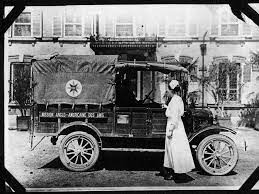
During the war the Committee sent many young men and women to feed and care for refugees, build maternity hospitals, and repair and even rebuild destroyed homes. Reconstruction and medical care highlighted a major part of the Committee’s relief efforts. As religious pacifists many draft-eligible Quaker men refused induction into the military, but were willing to perform alternative civilian service, including dangerous humanitarian work in war zones. Similarly, Quaker women volunteers, although not subject to conscription (draft), willingly enlisted in overseas relief and reconstruction work. In France, in particular, these noncombatant volunteers drove ambulances, rebuilt damaged homes, roadways, and villages; they also were instrumental in assisting refugees fleeing from war zones as well as providing funds to staff and supply maternity hospitals and relief stations.

AFSC Volunteers in France, 1917, AFSC Archives, Philadelphia

All told, close to six hundred, mostly male, volunteers worked endlessly in France where most of the fighting took place within the shadow of aerial bombing and roaring cannons. Even when the war ended the Committee extended its work in Russia where relief workers helped fight famine and disease; in Serbia and Poland where they assisted in agricultural development and constructed orphanages; and, finally, into Austria and Germany where they fed hungry children.

In the spirit of Florence Nightengale, the subject of many biographies for her courage and training of nurses during the Crimean War in the nineteenth century, these relief workers in World War I became notable crusaders for humanitarianism. They worked in combat zones with courage, conviction, and compassion. As soldiers of peace their equipment was first aid kits, shovels, buckets, hammers, and nails.

At the same time, the actions of AFSC highlight as very important distinction between an antiwar movement and a peace movement—a distinction students and scholars should understand. An antiwar movement is a short-lived crusade aimed specifically at ending military hostilities and lasts only as long as the conflict endures. A peace movement, however, is continuous and extends well beyond simply ending the conflict—it seeks social justice and reform as well as calling for war to be abolished. That is why it is ever present and has existed in the United States as an organized endeavor since the early nineteenth century—in fact the first established peace society in  world history was founded in New York City in 1815 by the merchant, David Low Dodge. Indeed, AFSC, is an excellent example of what a peace movement is because its work continued long after the “guns of August” were silenced at the eleventh hour of the eleventh day in the eleventh month of 1918.   

The following excerpts from the letters and accounts written by Friends can be used by teachers for Document Based Questions explaining the other side of war. They help demonstrate how humanitarian relief work plays a vital role in restoring the lives and stability of those directly impacted by the horrors and costs of war.

Document 1: Letters from Katherine W. Elkington to Parents (August-September 1917)

[Katherine W. Elkington grew up in Germantown, Pennsylvania. She worked at the hospital at Chalons-sur-Marne, in the Champagne-Ardenne region and wrote these letters from the Mission de la Société des Amis in Chalons-sur-Marne]

August 10, 1917: American nerve should count for something, and as I am the only one in all the town as far as I can make out, and there are 40,000 people here—I will have some responsibility. There are about thirteen workers all together here, counting those in the Maternity Ward, those in the creche, and those with older children. Just at present my work lies with the babies whose mothers are here, or who are refugees or something of that stripe. The oldest is three and the youngest a few months, and so as there are about thirty in between, you can see we have some job to keep all fed and clean….Not far away is a factory that tourns out machine guns, and every hour you can hear the pop, pop, pop of the new ones being tested. Besides this there is the never ending trial of soldiers and camions [trucks] going to the front, so one feels quite in the atmosphere of la guerre.     

August 17, 1917: This morning…for just as we were feeding the kids their dinner we heard the anti-air guns in the field next to us go pop, pop, pop, and as this is the signal to rush the children under cover we were all on the run. As soon as they were safe we flew out…and there way up above the clouds was our “Boche” foiled of his prey, and turned homeward by the quick work of the gunners. The smoke from the bursting shells hung in the air like little white puff-balls, perfectly still, five in a row. This, I am assured, is only a teaser and nothing to what they have had.

August 27, 1917: You can’t imagine the ruin, which after three years is still almost untouched. The little church has been patched up and we struck the 1st Mass held there since the catastrophe in 1914. We took several pictures of the wreck, and one of an old woman standing in the door of a new little shanty that has been raised over the cellar of the old home….{W]e stopped to photo one of the numerous wayside crosses that mark the last resting place of some fleeing Germans, and found near it a hastily dug grave apparently abandoned before their man could be interred. It is a gruesome reminder of the shadow that lies over these bright and sunny fields, and one cannot help but feel suddenly shivery as one turns away.

September 20, 1917: For the past few nights there has been a never ending grumble of cannon just out of sight over the hills, and all night long from the windows. I could see the flashes of light that preceded the boom. Also the star bombs were much in evidence, shooting up to consort with their brothers in the sky….

Boom! There the guns are beginning again—big fellows this time whose reverberations shake these walls fifteen miles away….

Source: American Friends Service Committee Records, Box General Administration 1917: Foreign Country—France, American Friends Service Committee Archives, Philadelphia.

Questions:

  1. How does Elkington contrast her work in the maternity ward with a nearby factory making guns for the war?
  2. What does she mean by feeling “quite in the atmosphere of las guerre”?
  3.  What do you think her feelings were when coming upon a makeshift grave of German soldiers?
  4. How many miles away were the big guns, which rattled her windows?
  5. Do you think she was proud of the work she was doing and did she feel that her contributions would further the cause of peace?
  6. Who did she refer to as “Boche” and what new weapon of war was first introduced during this conflict?

Document 2: Joseph H. Haines, Letter to his Father (April 6, 1918)

[Joseph Haines, like Elkington was a member of the Germantown Monthly Meeting (Quaker Meeting House) and a graduate of Haverford College in 1898. He served in a Reconstruction Unit at Gruny (Somme), France, where he built and repaired houses and schools and assisted local citizens]

When night came we were naturally tired; so tired that I can hardly remember who was there or what we did. All this time others were securing the country side with automobiles to evacuate threatened villages, and they were often under shell fire. We had to load the trains with old people women and children, decrepit, sick or dying….

I could not think of the loss of our material work that has come but only of the tremendous gain we have made in friendship and goodwill among a people to whom we cannot even yet speak plainly. There is one thought ingrained in every one of us, and that is that we must go back to help them set their homes in order and begin life anew as soon as we can. If the people back of us in America give us half a chance, we can, when we do so, accomplish, I think twice the good that we have in the past….

We found the town we were to help clear up entirely deserted—I mean this literally. There were perhaps half a dozen civilians left and the Red Cross was in possession of the Hotel which they were running for themselves. I set to the next morning—after the town had been shelled and we had all taken refuge in the wine cellar down fifty steps and cut out of solid rock where most of the hotel (it was full of Red Cross workers) slept. But I went back to bed after having helped fit up a camion as ambulance to carry the dead and wounded from the shelling….

Source: American Friends Service Committee Records, Box General Administration 1918: Foreign Service Country—France Individuals: Joseph Haines to L. Ralston, American Friends Service Committee Archives, Philadelphia.

Questions:

  1. How did Haines demonstrate his courage under fire? As a noncombatant did he see himself as a brave soldier without arms?
  2. Did he believe that his example would inspire Americans critical of those who were conscientious objectors to reconsider their opinion?
  3. Why did he want the people back in America to give him half a chance when it came to accomplishing good over evil?
  4. What was the one thought ingrained in each and every one of these volunteers?

Document 3: Edward C.M. Richards, “Reminiscences of Wartime Relief Work in Persia [n.d.]

[During World War I Richards performed missionary and relief work in Persia (now Iran). In 1923, he published a longer account of his experiences; this excerpt is from his unpublished reflections]

At that time, April 1917, many sincere men believed that the most Christian thing to do was to give their lives in the front trenches, believing that in that way they were helping to do away with the evil of war. To hold my position honestly, and meet such men face to face, it was necessary for me to be willing to do something at least as disagreeable and dangerous, and to do it with the motive of keeping people alive, of bringing reconciliation and good will between hostile factions, and to do it using only methods which were uplifting and helpful and beneficial to everybody concerned. I had to be willing to get killed, but to do so living everybody and trying to help everybody, including the Germans and the Turks, and all other people….

At that time, 1917, there was in West Persia a combination of war, racial antipathies and religious fanaticism which had come down through hundreds of years. That area had been the fighting ground of the Turkish and Russian armies since the beginning of the war. Massacres and flights of people had taken place, and were liable to occur at any time….There were only a few hospitals run by American missionary doctors, and most of the worst diseases were continually present: smallpox, cholera, typhoid, typhus, malaria, etc…

In July I arrived in Urumia (now Rezaiah) West Persia, where I was made secretary of the Relief Committee. During the summer , autumn, and early winter, I was busy riding from village to village over the plains, visiting, classifying, and arranging for feeding, clothing, and general care of the 500 odd orphans scattered through this stricken area. I organized some of the refugee Assyrians into a cloth-industry, giving several hundred women work weaving the native cloth which for countless generations had been an important material for men’s clothing in the high mountains of Kurdistan….

Later on, I took charge of cleaning up the streets of the city of Urumia. This included one very unpleasant task; namely, the collecting and reburying of bodies dug up by the dogs in the graveyards, and partly eaten. The cleaning-up and keeping clean…of the yards filled with refugees also fell on my shoulders, as did the care of the relief-transportation equipment of autos, horses, carts, harness, and the rest….

Source: American Friends Service Committee, Collected Records, CDG-A, Box 1, Swarthmore College Peace Collection, Swarthmore, PA.

Questions:

  1. What position did Richards take that he believed was honest and “unpleasant”?
  2. Why were the Turks fighting the Russians when most of the battles took place in northern Europe?
  3. What do you think was Richards’ most difficult assignment?
  4. In terms of history, did Richards’ work also highlight the tragedy associated with the Armenian genocide that occurred as a result of World War I?

Document 4: Ruth Rose Hoffman, “Report to the Friends Committee of the Year’s Work Done in Siberia under the American Red Cross {July 1919]

[During the Russian Civil War Siberia was a battle zone between Bolshevik and anti-Red forces. The United States, Japan, and several European nations sent troops to support the anti-Bolshevik forces. Hoffman , a nurse working with the American Red Cross, apparently with Friends Committee support, reported on her work in public health and with refugees in the Siberian port city of Vladivostok]

As there were no available doctors in the unit at that time for giving medical assistance, I began to visit these barracks, August 15, 1918; I had done as much as I could in the way of making the lives of these refugees healthier, mostly first aid treatment and taking the very sick into the hospitals….

My work was very difficult but most interesting….All the temporary lodging houses and prisons had to be investigated periodically. We had the most sick cases in the poorest Russian, Chinese and Korean sections of the city….

From January 1st up to July 26 I had located and admitted to the hospital five hundred (500) patient of whom two hundred and seventy-six (276) were Typhus fever cases. Nine hundred and seventy-five visits were made, mostly with the ambulance; six hundred (600) were instructed in the prevention and isolation of disease; four hundred and sixty-seven (467) patients were sent to clinics; clothing given to one hundred and fifty-five (155) bedridden patients, the other being referred to the city office. Medications, eggs and milk were taken to the home of one hundred and seventy-six (176). I also visited many city institutions, which asked for help and made recommendations as to what they really needed.

AFSC Volunteers in France, 1917, AFSC Archives, Philadelphia

As I did not have a physician in my work I had to diagnose and treat some quite serious patients.

In the Spring epidemic of measles, I had a small isolation war of eight (8) beds with a Russian girl in charge of it, whom I trained for the work. We had about thirty (30) cases of measles. The Russian girl proved to be very good along this line and she obtained work after the clinic was closed in the American Red Cross Hospital. Right along in my work I tried to teach child Hygiene to the Russian mothers, who listened to me eagerly but in their everyday struggle for existence they could not remember it very long….

Source: American Friends Service Committee Records, Box General Administration 1919: Foreign Service Country—Germany to Russia, American Friends Service Committee Archives, Philadelphia]

Questions:

  1. How did Hoffman feel about her work in Russia?
  2. How difficult was it for her to communicate with so many patients speaking different languages?
  3. Did she mind assuming the role of physician under most difficult circumstance and why was she willing to do so?
  4. Why did she feel so compelled to try to teach Russian mothers the importance of child hygiene?
  5. What happened to cause Russia to leave the war and how did this impact the Allied war effort against the Central Powers.

Document 5: Carlton McDowell, Motives of Humanitarian Service (1918)

[McDowell, a Quaker zoologist and relief worker explains his reasons why he and his companions sought to promote understanding, reconciliation, and peace through humanitarian service]       

We went to mend houses; but the reason we wanted to mend houses was that it would give us a chance to try to mend hearts. Much of our work on houses has been lost; but I do not believe that any amount of cannonading will break down whatever influence we had on these people’s hearts. We cannot say how much cheerfulness, hope and love we brought them—surely some reached them. I believe it possible that even now, when their troubles are keener than ever, their experience with us boys may somehow be giving them a little mental comfort. However that may be, the whole perplexing question of our coming will remain in the back of their minds. From time to time it will claim attention until finally a light dawns, until they finally realize why we came—why we crossed the ocean voluntarily, why we worked without pay, why in order to do this we were willing to leave our homes and our professionals and take up jobs we never tried before. And when this answer comes to them it will never be forgotten; in the intimate traditions of these families will be handed down the account of the little group of men who worked for strangers because of their belief in the Great Brotherhood.

Source: Rufus Jones, A Service of Love in War Time: American Friends Relief Work in Europe, 1917-1919. New York: Macmillan Co., 1920, p. 226

Questions

  1. What did McDowell consider the greater good to civilization? 
  2.  What did he hope his service without pay would eventually accomplish?
  3. What did he mean by the Great Brotherhood?
  4. What legacy did McDowell wish to convey to those who question his true motivations?

Essay Question

Based on your knowledge of history and events surrounding World War I, what lessons can be learned from the role that noncombatant humanitarian relief workers played when assessing the consequences of war on innocent civilians? How important is humanitarian relief efforts in times of war? Cite specific examples from the documents above where heroes of peace risked their lives to help others.

Further Reading

Bennett, S.H. and Howlett, C.F.(2014). Antiwar dissent and peace activism in World War 1 America: A documentary reader. Lincoln: University of Nebraska Press, 2014.

Chatfield, C. For peace and justice: Pacifism in America, 1914-1941. Knoxville: University of Tennessee Press, 1971.

Hirst, M. E. (1923). The Quakers in peace and war. London: The Swarthmore Press.

Jones, M. H. (1937). Swords into ploughshares: An account of the American Friends Service Committee, 1917-1937. New York: Macmillan & Co.

 Jones, R.(1920).  A service of love in war time: American Friends relief work in Europe, 1917-1919. New York: Macmillan Co.

Teaching Controversial Issues: Teachers’ Freedom of Speech in the Classroom

Teaching Controversial Issues: Teachers’ Freedom of Speech in the Classroom

Arlene Gardner

What is the purpose of education? The conventional answer is the acquisition of knowledge. Looking beyond this facile response, most people will agree that the true purpose of education is to produce citizens. One of the primary reasons our nation’s founders envisioned a vast public education system was to prepare youth to be active participants in our system of self-government.  John Dewey makes a strong case for the importance of education not only as a place to gain content knowledge, but also as a place to learn how to live. In his eyes, the purpose of education should not revolve around the acquisition of a predetermined set of skills, but rather the realization of one’s full potential and the ability to use those skills for the greater good.

Democratic self-government requires constant discussions and decisions about controversial issues. There is an intrinsic and crucial connection between the discussion of controversial political issues and the health of democracy. If we want our students to become informed, engaged citizens, we need to teach them how to “do” democracy by practicing the skills of discussing controversial issues in the classroom and learning how to respectfully disagree.

Research has demonstrated that controversy during classroom discussion also promotes cognitive gains in complex reasoning, integrated thinking, and decision-making. Controversy can be a useful, powerful, and memorable tool to promote learning. In addition to its value in promoting skills for democracy, discussing current controversial public issues:

  • Is authentic and relevant
  • Enhances students’ sense of political efficacy
  • Improves critical thinking skills
  • Increases students’ comfort with conflict that exists in the world outside of the classroom
  • Develops political tolerance
  • Motivates students
  • Results in students gaining greater content knowledge.

(Diana Hess, Controversy in the Classroom: The Democratic Power of Discussion (2009); Nel Noddings and Laurie Brooks, Teaching Controversial Issues: The Case for Critical Thinking and Moral Commitment in the Classroom (2017); “Guardian of Democracy: The Civic Mission of Schools” (2011); Center for Research on Learning and Teaching, University of Michigan at https://crlt.umich.edu/tstrategies/tsd).

Yet, teachers may consciously (or unconsciously) avoid controversial issues in the classroom because of the difficulty involved in managing heated discussions and/or for fear that parents will complain or that the school administration will admonish or punish them for “being controversial.” These concerns are certainly not groundless. How well are teachers protected from negative repercussions if they address controversial issues in their classrooms? How extensive are teachers’ First Amendment rights to free speech? How can heated disagreements among students be contained in the classroom?

Two different legal issues exist regarding free speech rights of teachers: The First Amendment directly protects a teacher’s personal right to speak about public issues outside of the classroom and “Academic Freedom” protects a teacher’s right and responsibility to teach controversial issues in the classroom.  However, both have certain limitations.

First Amendment protection of public speech by teachers

Although the First Amendment free speech protection is written in absolute terms (“Congress shall make no law…”), the courts have carved out several exceptions (for national security, libel and slander, pornography, imminent threats, etc.).  The courts have also carved out a limited “government employee” exception based on the rationale that a government employee is paid a salary to work and contribute to an agency’s effective operation and, therefore, the government employer must have the power to prevent or restrain the employee from doing or saying things that detract from the agency’s effective operation.  Thus, the government has been given greater latitude to engage in actions that impose restrictions on a person’s right to speak when the person is a governmental employee, which includes teachers who work in public schools.

Some of the earliest threats to the free speech rights of public school teachers were the loyalty oaths that many states imposed on government employees during the ‘‘red scare’’ and early ‘‘cold war’’ years of American history. In Adler v. Board of Education (1952), the Supreme Court in a 6-3 decision rejected First Amendment claims and upheld a New York statute designed to enforce existing civil service regulations to prevent members of subversive groups, particularly of the Communist Party, from teaching in public schools. The Supreme Court effectively overturned this ruling in the 1960s and declared several loyalty oath schemes to be unconstitutional because they had chilling effects on individuals which violated their First Amendment rights (Baggett v. Bullitt (1964); Cramp v. Board of Public Instruction (1961); and Keyishian v. Board of Education (1967)).

Much of the reasoning regarding the “government employee” exception to the First Amendment outlined in Adler was abandoned altogether in the 1968 U.S. Supreme Court decision in Pickering v. Board of Education. Teacher Marvin Pickering had written a letter complaining about a recently defeated school budget proposal to increase school taxes. The school board felt that the letter was “detrimental to the efficient operation and administration of the schools” and decided to terminate Pickering, who sued claiming his letter was protected speech under the First Amendment. The U.S. Supreme Court held that Pickering’s dismissal violated his First Amendment right to free speech because public employees are entitled to the same measure of constitutional protection as enjoyed by their civilian counterparts when speaking as “citizens” and not as “employees.”

In Mt. Healthy City School District v. Doyle (1977), non-tenured teacher Fred Doyle conveyed the substance of an internal memorandum regarding a proposed staff dress code to a local radio station, which released it. When the board of education refused to rehire him, Doyle claimed that his First and Fourteenth Amendment rights had been violated. The court developed a “balancing test” that required the teacher to demonstrate that the speech act was a ‘‘substantial’’ or ‘‘motivating factor’’ in the administration’s decision and gave the school board the opportunity to demonstrate, based on the preponderance of the evidence, that the teacher’s speech act was not the ‘‘but for’’ cause of the negative consequences imposed on the teacher by the school board. Finally, the court would “balance” the free speech interests of the teacher and the administrative interests of the school district to determine which carried more weight.  Based on this test, the U.S. Supreme Court found that the teacher’s call to the radio station was protected by the First Amendment, that the call played a substantial part in the board’s decision not to rehire Doyle, and that this action was a violation of Doyle’s rights under the First and Fourteenth Amendments.

In a 5/4 decision in Connick v. Meyers (1983), the U.S. Supreme Court held that speech by public employees is generally only protected when they are addressing matters of public concern, not personal issues. Sheila Meyers was an Assistant District Attorney who had been transferred.  She strongly opposed her transfer and prepared a questionnaire asking for her co-workers views on the transfer policy, office morale and confidence in supervisors.  She was terminated for insubordination. Meyers alleged her termination violated her First Amendment right to free speech. The district court agreed and the Fifth Circuit affirmed. However, the U.S. Supreme Court reversed because Meyer’s speech only dealt with personal not public issues.  “When a public employee speaks not as a citizen upon matters of public concern, but instead as an employee upon matters only of personal interest, absent the most unusual circumstances, a federal court is not the appropriate forum in which to review the wisdom of a personnel decision taken by a public agency allegedly in reaction to the employee’s behavior.” Although the case involved an Assistant District Attorney, it is applicable to all public employees: teachers must demonstrate that their speech is of public concern.

This was confirmed in Kirkland v. Northside Independent School District (1989) where the school district did not rehire non-tenured teacher Timothy Kirkland because of poor performance and substandard teaching evaluations. Kirkland filed a lawsuit in federal district court against Northside, claiming that he was not rehired in violation of his First Amendment rights after he gave his students a reading list that was different from Northside’s list. Northside argued that Kirkland had no right to substitute his list without permission or consent and he had failed to obtain either. The district court ruled in favor of Kirkland and Northside appealed. The Fifth Circuit Court of Appeals reversed and dismissed Kirkland’s complaint, holding that Kirkland’s “speech” did not infringe on any matter of public concern and was in fact “private speech.” If the nature of the speech is purely private, such as a dispute over one employee’s job performance, judicial inquiry then comes to an end, and the question of whether the employee’s speech was a substantial or motivating factor in the decision not to rehire him need not even be reached. The U.S. Supreme Court denied cert, leaving this decision in place.

Academic freedom

Although primarily used in the context of university faculty rights, “Academic Freedom” protects a teacher’s ability to determine the content and method of addressing controversial issues in the classroom.  This is more limited at the K-12 level because the courts have long held the view that the administration of K-12 public schools resides with state and local authorities. Primary and secondary education is, for the most part, funded by local sources of revenue, and it has traditionally been a government service that residents of the community have structured to fit their needs. Therefore, a teacher’s “Academic Freedom” is limited to his or her content and method of teaching within the policies and curriculum established by the state and local school board. By finding no First Amendment violation, the court in Kirkland implicitly held that he had no right to substitute his own book list for the one approved by the district without permission or consent, which he failed to obtain. 

In an early case, following the end of World War I, Nebraska had passed a law prohibiting teaching grade school children any language other than English and Robert Meyer was punished for teaching German at a private Lutheran school. The court held that the Nebraska law was an unnecessarily restrictive way to ensure English language learning and was an unconstitutional violation of the 14th Amendment due process clause (the 14th Amendment had not yet applied the First Amendment to the states until Gitlow v.  New York in 1925) that exceeded the power of the state (Meyer v. Nebraska, 262 U.S. 390 (1923).

“The Fourteenth Amendment, as now applied to the States, protects the citizen against the State itself and all of its creatures-Boards of Education not excepted. These have, of course, important, delicate, and highly discretionary functions, but none that they may not perform within the limits of the Bill of Rights. That they are educating the young for citizenship is reason for scrupulous protection of Constitutional freedoms of the individual, if we are not to strangle the free mind at its source and teach youth to discount important principles of our government as mere platitudes.” Justice Jackson in West Virginia Board of Education v. Barnett (1943)(holding unconstitutional a requirement that all children in public schools salute the flag).

The Supreme Court has more than once instructed that “[t]he vigilant protection of constitutional freedoms is nowhere more vital than in the community of American schools” (Shelton v. Tucker (1960)). In Epperson v. Arkansas (1968)(a reprise of the famous 1927 “Scopes Trial”), the Arkansas legislature had passed a law prohibiting teachers in public or state-supported schools from teaching, or using textbooks that teach, human evolution. Sue Epperson, a public school teacher, sued, claiming that the law violated her First Amendment right to free speech as well as the Establishment Clause. A unanimous U.S. Supreme Court declared the state law unconstitutional. The Court found that “the State’s undoubted right to prescribe the curriculum for its public schools does not carry with it the right to prohibit, on pain of criminal penalty, the teaching of a scientific theory or doctrine where that prohibition is based upon reasons that violate the First Amendment.” Seven members of the court based their decision on the Establishment Clause, whereas two concurred in the result based on the Due Process clause of the 14th Amendment (because it was unconstitutionally vague) or the Free Speech clause of the First Amendment.

The Supreme Court, however, has not clearly defined the scope of academic freedom protections under the First Amendment, and commentators disagree about the scope of those protections. (See, e.g., William W. Van Alstyne, “The Specific Theory of Academic Freedom and the General Issue of Civil Liberty,” in The Concept of Academic Freedom 59, 61-63 (Edmund L. Pincoffs ed., 1972); J. Peter Byrne, “Academic Freedom: A ‘Special Concern of the First Amendment’,” 99 Yale L.J. 251 (1989); and Neil Hamilton, Zealotry and Academic Freedom: A Legal and Historical Perspective (New Brunswick, 1998). 

Whatever the legal scope, it is clear that the First Amendment protection of individual academic freedom is not absolute. For example, in Boring v. Buncombe County Board of Education (1998), the Fourth Circuit Court of Appeals held that a teacher could be reprimanded (in this case transferred) because she sponsored the performance of a play that school authorities subsequently deemed inappropriate for her students and inconsistent with the curriculum developed by the local school authorities. This judicial deference toward K through 12 institutions often can be seen in cases involving teachers who assert that their First Amendment rights were violated when school administrators imposed punishments on them for engaging—while they taught their classes—in some form of expressive activity that the administrators disapproved.

The content

While cases about academic freedom, such as Epperson,  involved state laws that limited or prohibited certain content being taught (in this case prohibiting teachers in public or state-supported schools from teaching, or using textbooks that teach, human evolution); New Jersey has taken a very broad approach to classroom content.  Since 1996, New Jersey has established state standards (currently called “Student Learning Standards”) that set a framework for each content area.  Unlike many other states, New Jersey does not establish a state curriculum but rather leaves this to local school boards. Subject to applicable provisions of state law and standards set by the State Department of Education, district school boards have control of public elementary and secondary schools.  How much protection do New Jersey teachers have when they address controversial topics?  Most First Amendment education cases in New Jersey involve students’ rights rather than teachers’ rights (e.g., school dress, vulgar language, threats, religious speech, equal access, See http://www.njpsa.org/documents/pdf/lawprimer_FirstAmendment.pdf). However, several recent cases from the Third Circuit (which includes New Jersey) provide some parameters.

In Edwards v. California University of Pennsylvania (3rd Cir. 1998), a tenured professor in media studies sued the administration for violating his right to free speech by restricting his choice of classroom materials in an educational media course. Instead of using the approval syllabus, Edwards emphasized the issues of “bias, censorship, religion and humanism.” Students complained that he was promoting religious ideas in the class. The U.S. Supreme Court declined to review the Third Circuit’s summary judgement against Edwards, holding that a university professor does not have a First Amendment right to choose classroom materials and subjects in contravention of the University’s dictates.

A very recent decision regarding a New Jersey teacher confirms the fact that the First Amendment does not provide absolute protection for teachers in public schools to decide the content of their lessons if it is not within the curriculum set by the school district.  In Ali v. Woodbridge Twp. School District (3rd Cir. April 22, 2020) a non-tenured public high school teacher at Woodbridge High School was teaching Holocaust denial to his students and was posting links to articles on the school’s website saying things such as, “The Jews are like a cancer” and expressing conspiracy theories accusing the United States of planning a 9/11-style attack. When the Board of Education fired Ali, he sued claiming that his employment was terminated on the basis of his race and religion, and that defendants had violated his rights to free speech and academic freedom, among other claims. The District Court rejected all of Ali’s claims, awarding summary judgment to the school board, and the Third Circuit affirmed.

These are extreme cases where a teacher is addressing issues that are NOT within the curriculum set by the university or within the state social studies standards and the local school district’s curriculum.  When teachers are teaching a controversial topic that is included in the New Jersey Student Learning Standards for Social Studies and their school district’s social studies curriculum, the existing case law seems to support the fact that they would be protected by the Fourteenth Amendment, unless they are violating school policies that require teaching in a neutral, balanced manner that does not seek to indoctrinate students.

For example, what if a teacher wants to assign a research paper about the Stonewall Riots or the Lavender Project?   Since the history of LGBT rights is in the state standards and supposed to be included in local school district social studies curriculum, the Stonewell Riots and Lavender Project would be part of this history. This is not a situation like Ali where the materials were beyond the scope of the local curriculum (as well as being taught in an indoctrinating manner—see below). If the teacher fears that the topics will be controversial with the community, he or she should make the school administration aware of what he or she is planning to do.  Since here, what the teacher plans to teach is within the state standards and the local school district curriculum, the school administration should support the teacher.  If parents object, the real issue is one of policy (Should LGBT history be taught?), which is decided by the state and local boards of education, not the teacher. Therefore, the parents’ argument should be with the state and local boards of education.

What if a teacher wants to show scenes of an R-rated movie in the classroom (i.e. Revolutionary War scenes from The Patriot or D-Day from Saving Private Ryan?) Obviously, the American Revolution and World War II are part of the state standards for U.S. History and in every local school district’s curriculum.  The movie scenes would need to relate to the district curriculum and the teacher should get prior administrative and parental approval if some movie scenes are going to be very graphic.

How should a teacher prepare lessons on Nazi Germany during the 1930s? Nazi Germany is also part of the state history standards and every school district’s curriculum. It should be taught in a way so that students can understand how the Nazis came to power and the prejudices they carried.  Some of the World War II footage and movies may be shocking but our students will not be able to become informed, engaged citizens if we hide the past from them. 

An ounce of prevention beforehand will help.  Before starting, teachers should be clear about the goal of their lesson: The classroom activities should encourage critical thinking. You are not trying to convince students of any particular point of view. Preview any materials, especially visual media which may be very powerful or provocative. Be aware of the biases of the sources of information that will be used by students.

Teaching Tolerance suggests in Civil Discourse in the Classroom that “Teachers can effectively use current and controversial events instruction to address a wide variety of standards and even mandated content. To do so, however, teachers must work carefully and incrementally to integrate this new approach in their classrooms.”  The University of Michigan’s Center for Research on Learning and Teaching offers guidance for how instructors (offered for college instructors but applicable for K-12) can successfully manage discussions on controversial topics. See Center for Research on Learning and Teaching, University of Michigan at https://crlt.umich.edu/tstrategies/tsd). The “Statement on Academic Freedom and Tenure” of the American Association of University Professors, suggests that teachers should be careful to avoid controversial matters that are unrelated to the subject discussed.

Before engaging students in an activity or discussion involving a controversial subject, tell your supervisor and/or principal what you are planning on teaching and, if necessary, reference the district policy on teaching controversial issues, explain the lesson’s connection with the district social studies curriculum and explain the goal and value of what you plan to do.  Then, consider the demographics of your community. If you anticipate that the topic of your lesson will be controversial with the community, send a note and/or talk with your students’ parents and/or the Parent Teacher Organization.

In an informative piece titled “Do You Have the Right to be an Advocate?,” published by EdWeek, Julie Underwood, a professor of law and educational leadership and policy analysis at the School of Education, University of Wisconsin-Madison, explains that the “district or the state can regulate employee speech during school hours or at school-sponsored activities to protect their own interests in instruction and political neutrality.” Despite the ambiguity in the laws protecting a teacher’s freedom of speech, Underwood concludes: “If it relates to the in class instruction and is age appropriate there is a good rationale for having a political discussion”.

Teaching in a Neutral or Balanced Manner

If the teacher has created a supportive, respectful classroom climate and built tolerance for opposing views, it will be easier to consider controversial topics. For example, considering historical controversies might be good background as practice for looking at current controversies. Establish a process and rules of adequate evidence or support so that the discussion is based on facts rather than simply opinions. To help maintain classroom order even when students are having heated disagreements, set clear rules for discussions or use activities that require students to use active listening skills when considering controversial issues, such as:

  • Continuum/Take a Stand
  • Civil Conversations
  • C3 Inquiries
  • Guided discussions
  • Socratic Smackdown
  • Moot courts—structured format for considering constitutional issues
  • Philosophical Chairs discussion
  • Legislative hearings—structured format for considering solutions to problems

Carefully consider how students are grouped if they are to work cooperatively.  Provide closure (which may be acknowledging the difficulty of the issue).

School boards work primarily through policies which set guidelines for principals, teachers, parents and students, as well as the district curriculum. To avoid a problem afterwards, the teacher should make sure that the controversial topic is within the state standards and the curriculum adopted by their local school board. Then the teacher should consult the school district’s policy regarding the teaching of controversial issues. Most school districts have a policy (usually #2240) that supports and encourages the teaching of controversial issues and sets guidelines for teaching controversial issues, including a process for dealing with challenges.  Although the language may differ, policies dealing with controversial issues generally focus on the need for the classroom lesson to be balanced, unprejudiced, fair, objective, and not aimed at indoctrinating students to a particular point of view.

Clearly, the type of indoctrination attempted by the teachers in the Edwards or Ali cases is beyond protected speech.  In addition to avoiding indoctrination, teachers should avoid telling a joke in the classroom that might imply a negative characterization of an ethnic group, religion or gender.  A “joke” that might be a put down of any ethnic group, religion or gender told in the classroom to students is never a good idea. It is not even a good idea for a teacher to post such a “joke” on Facebook because such speech might be considered as not addressing a matter of public concern and would not be protected by the First Amendment. However, using an historical photo, engraving or picture that included a negative image of an ethnic, racial or religious group might be okay in the context of examining what was seen as humor in the past and understanding the prejudice that existed during a particular time period. For example, when teaching about the Holocaust, a teacher might carefully use Nazi cartoons to demonstrate the high level of prejudice at the time. Another example might be using images of blackface or corporate ad campaigns to show racial attitudes when teaching about Jim Crow. The teacher does not need many examples to make the point. Know your audience. Choose carefully and be aware that certain advertising images from the Jim Crow era may offend some students in the class. The purpose of using controversial issues is important. At the core of deciding what a teacher should or should not say or do in the classroom is good judgment.

Should a teacher share his or her viewpoint on a controversial issue with the students?

Whether a teacher should share his or her opinion or viewpoint on a controversial issue will depend on the age of the students, if the opinion was requested by the students, and the comfort-level of the teacher.  A teacher’s opinion may have too much influence on younger students and should probably be avoided. What if a middle or high school student specifically asks for your opinion? Such “natural disclosures” in response to a direct question by a student should be accompanied by a disclaimer, such as “This is my view because…” or “Other people may have different views”.  If you prefer not to disclose your view, explicitly state that and explain why. Remember, the goal is to help students develop their own well-informed positions. Be mindful of your position as the “classroom expert” and the potential impact on the students. If you decide to disclose your own view, do it carefully and only after the students have expressed their views. Unrequested disclosures may be seen as preachy, or may stop the discussion. (See Hess, Controversy in the Classroom)

So, for example, should a teacher take a position on climate change?  In terms of content, climate change is in the state standards and should be in the local school curriculum. If parents disapprove of this topic, this disagreement is really with the curriculum set by the school board, not with the teacher.  However, the teaching strategy is important. Rather than taking a position, which may be seen as indoctrination or may simply stop the classroom inquiry, the better approach might be to have the students examine the issue and let the facts speak for themselves.  Let students use the facts that exist to construct their own arguments about whether or not climate change is the result of mankind’s use of fossil fuels in industry and transportation.  If the topic is presented in a balanced, neutral, non-indoctrinating manner, the teacher should not be subject to discipline. Objections by parents should be referred to the school administration because it is a matter of policy (Should climate change be taught?), which is decided by the state and local boards of education, not the teacher.

How should teachers address questions from students regarding Black Lives Matter and racial inequality? The ACLU in the state of Washington prepared a short online article, “Free Speech Rights of Teachers in Washington State” (NJ’s ACLU only has a publication about students’ rights) with a related hypothetical:  The teacher is instructed not to discuss personal opinions on political matters with students.  In a classroom discussion on racial issues in America, the teacher tells the class that he/she has recently participated in a Black Lives Matter demonstration.  Revealing this is the same as giving an opinion and may not be protected speech. Teachers can be disciplined for departing from the curriculum adopted by the school district and this would be a departure.

Can a teacher state that New Jersey is a segregated state when it comes to communities? Is the teacher stating this as a personal opinion or as a fact related to a topic of learning? There is no reason to simply state that NJ is segregated unless it is in the context of helping students understand and appreciate the history of segregation in NJ consistent with state standards and district curriculum. (For example, see “Land Use in NJ” and “School Desegregation and School Finance in NJ” for history, context and facts at http://civiced.rutgers.edu/njlessons.html).

Is a teacher permitted to take a stand on the issue of removing public monuments? Assuming that this is part of a current events lesson, it would be better if the teacher remained neutral and let the students’ voice differing views. If the students all have one position, perhaps the teacher can take a position as “devil’s advocate,” but it should be made clear that this is what the teacher is doing.

Can a teacher assign blame to protests to specific groups or left or right extremist groups? Assigning blame is the same as a teacher giving his or her personal opinion. The better approach would be to have students look at the actions of specific groups and determine their appropriateness.

Can a teacher assign blame to Associate Justice Amy Coney Barrett regarding a Supreme Court decision that is 5-4 and against the teacher’s preference (i.e. Affordable Care Act, marriage, etc.).  Assuming that this is part of a classroom lesson about the Supreme Court, the teacher should refrain from “assigning blame” because this is expressing his or her opinion, but should instead let the students consider the reasoning and impact of the decisions.

Is a teacher permitted to criticize or defend the government’s policies or actions on immigration? Outside the classroom, a teacher has a first amendment right to express his or her views on public issues. As part of a classroom lesson about immigration, rather than criticizing or defending the government’s policies or actions on immigration, the better approach would be to present or let students research the history of immigration policy and its impact and let the students discuss and draw their own conclusions (For example, see “Immigration Policy and its impact on NJ” at http://civiced.rutgers.edu/njlessons.html).

Can a teacher show a video clip from a specific news station (Fox, CNN) or assign students to watch a specific news program as an assignment?  As long as the purpose is not indoctrination to any particular point of view and the assignments are balanced. If the teacher wants students to see and compare various media views on the same topic, that would be a valuable classroom activity. (For example, see “Educating for Informed, Engaged Citizens” virtual workshop, for background on helping students understand bias in news, at the New Jersey Council for the Social Studies website at http://www.njcss.org/;  also see Choices Program at Brown University: Teaching with the News at https://www.choices.edu/teaching-with-the-news/;   and Constitutional Rights Foundation Fake News at https://www.crf-usa.org/images/pdf/challenge/Understanding-Fake-News1.pdf and https://www.crfusa.org/images/pdf/challenge/Tackling-Fake-News.pdf).

Conclusions

A teacher has a personal right under the First Amendment to share his view on public policy issues in public but NOT in the classroom.  A teacher sharing his opinion or viewpoint in the classroom may be seen as indoctrination. So, for example, teachers should avoid sharing personal views on one’s sexual preference, regarding a particular candidate, President Trump’s taxes, a decision by a Grand Jury, prosecutor, FBI on racial issues, etc. Your school district may even have an explicit policy that teachers should not discuss personal views on political matters in the classroom, in which case, this policy should be followed.  Everything a teacher says or does in the classroom should be considered based on the possible impact on the students.

This does not mean that teachers should avoid having students examine and discuss controversial topics. Encouraging the development of civic skills and attitudes among young people has been an important goal of education since the start of the country.  Schools are communities in which young people learn to interact, argue, and work together with others, an important foundation for future citizenship.  Since the purpose of social education is to prepare students for participation in a pluralist democracy, social studies classes NEED to address controversial issues.  Teachers have the right and the responsibility to help their students understand controversial topics and to develop critical thinking skills.  However, the controversial topics should relate to the broad scope of subjects included in the NJ Student Learning Standards and the local school district curriculum.  And controversial subjects should be addressed in a neutral or balanced manner, without any effort to indoctrinate students, but rather to help them develop the knowledge and skills they will need as workers, parents and citizens in a democratic society.

Background Materials

Meyer v. Nebraska, 262 U.S. 390 (1923)

West Virginia Board of Education v. Barnett, 319 U.S. 624 (1943)

Adler v. Board of Education, 342 U.S. 485 (1952)

Shelton v. Tucker, 364 U.S. 479 (1960)

Cramp v. Board of Public Instruction, 368 U.S. 278 (1961)

Baggett v. Bullitt, 377 U.S. 360(1964)

Keyishian v. Board of Regents, 385 U.S. 589 (1967)

Pickering v. Board of Education, 391 U.S. 563 (1968)

Epperson v. Arkansas, 393 U.S. 97 (1968)

Mt. Healthy City School District Board of Education v. Doyle, 429 U.S. 274 (1977)

Connick v. Meyers, 461 U.S. 138 (1983)

Kirkland v. Northside Independent School District, 890 F.2d 694 (5th Cir. 1989), cert. denied (1990)

Bradley v. Pittsburgh Bd. of Educ., 910 F.2d 1172 (3d Cir.1990)

Boring v. Buncombe County Board of Education, 136 F.3d 364 (4th Cir. 1998)

Edwards v. California University of Pennsylvania, 156 F.3d 488 (3rd Cir. 1998), cert. denied, 525 U.S. 1143 (1999)

Ali v. Woodbridge Twp. School District, 957 F.3d 174 (3rd Cir. April 22, 2020)

Keith Barton and Linda Levstik, Teaching History for the Common Good (Erlbaum, 2004)

Diana E. Hess, Controversy in the Classroom: The Democratic Power of Discussion (New York: Routledge, 2009)

Nel Noddings and Laurie Brooks, Teaching Controversial Issues: The Case for Critical Thinking and Moral Commitment in the Classroom (New York:  Teacher’s College Press, 2017).

William W. Van Alstyne, “Academic Freedom and the First Amendment in the Supreme Court of the United States:

An Unhurried Historical Review,” 53 Law and Contemp. Probs. 79 (1990)

ACLU-Washington at https://www.aclu-wa.org/docs/free-speech-rights-public-school-teachers-washington-state

American Association of University Professors, “Academic Freedom of Professors and Institutions,” (2002) at https://www.aaup.org/issues/academic-freedom/professors-and-institutions

Center for Research on Instruction and Teaching, University of Michigan at https://crlt.umich.edu/tstrategies/tsd

Choices Program at Brown University: Teaching with the News at https://www.choices.edu/teaching-with-thenews/

Constitutional Rights Foundation at https://www.crf-usa.org/

EdSurge at https://www.edsurge.com/news/2018-01-17-why-we-need-controversy-in-our-classrooms

Facing History at https://www.facinghistory.org/educator-resources

Find Law at https://www.findlaw.com/education/teachers-rights/teachers-different-freedoms-and-rightsarticle.html

Forbes at https://www.forbes.com/sites/jessicabohrer/2020/09/14/teaching-children-about-freedom-ofspeech/#25cb6ff07101

John Goodlad, “Fulfilling the Public Purpose of Schooling: Educating the Young in Support of Democracy May Be Leadership’s Highest Calling,” School Administrator, v61 n5 p14 May 2004.

Jonathan Gould, Kathleen Hall Jamieson, Peter Levine, Ted McConnell, and David B. Smith, eds. “Guardian of

Democracy: The Civic Mission of Schools, Philadelphia: Annenberg Public Policy Center, 2011

Amanda Litvinov, “Forgotten Purpose: Civic Education in Public Schools, NEA Today, Mar 16, 2017 at https://www.nea.org/advocating-for-change/new-from-nea/forgotten-purpose-civics-education-publicschools#

New Jersey Center for Civic Education (New Jersey lessons) at http://civiced.rutgers.edu/njlessons.html

New Jersey Law Journal at https://www.law.com/njlawjournal/2020/06/28/as-woodbridge-teachers-case-showsfacts-do-matter/?slreturn=20200929134110

New Jersey Principals and Supervisors Association at http://www.njpsa.org/documents/pdf/lawprimer_FirstAmendment.pdf

Phi Delta Kappa, “Do you have the right to be an Advocate?, at https://kappanonline.org/underwood-schooldistricts-control-teachers-classroom-speech/

Poorvu Center, Yale University at https://poorvucenter.yale.edu/teaching/ideas-teaching/teaching-controversialtopics

Teaching Tolerance at https://www.tolerance.org/magazine/publications/civil-discourse-in-theclassroom/chapter-4-teaching-controversy

Texas Association of School Boards at https://www.tasb.org/services/legal-services/tasb-school-lawesource/personnel/documents/employee_free_speech_rights.aspx

The First Amendment Encyclopedia at https://www.mtsu.edu/first-amendment/article/973/rights-of-teachers U.S. Civil Liberties at https://uscivilliberties.org/themes/4571-teacher-speech-in-public-schools.html

Academic Freedom: Are American Teachers Free? Should They Be?

Academic Freedom: Are American Teachers Free? Should They Be?

James K. Daly

In 1936 Howard Beale asked if American teachers were free. It is a question that still resonates today. The issue is entangled in the complex and ever-changing world of educational policy, political pressures, and cultural tensions. A second question to Beales earlier one could very well ask, should they be? What does it mean for teachers to be free? How do cultural expectations impact on what schools, communities, and larger groups perceive as appropriate for examination in public schools?

Many suggest topics, issues, and claims to truth should not be examined at all. Those who know the truth often feel compelled to teach it. Educational orthodoxy, whether of the political Left or the political Right, can silence opposing views, materials, attention. There is a long history of efforts to suppress perspectives. Legislation in many states has institutionalized restrictions on viewpoints, and textbook publishers have complied. Practitioners supporting the status quo, or the work of activist special interest groups have also contributed to censoring views (Jenkinson, 1979, 1985; O’Neil, 1984; Parker and Weiss 1983; Merry, 2009; Fallace, 2011; Hill, 2020, Nelson, 2021).

The essentiality of critical thinking

Critical thinking is regularly cited as an essential skill for preparing the young to succeed in the 21st century. The NCSS C3 framework identifies critical thinking as a key element in developing engagement and participation among citizens (NCSS 2013). Nelson et al. (2021) cite critical thinking as among the most important issues in schools.

Scholars have long stressed the need for schools to move away from indoctrination, the antithesis of critical thinking. Social studies is where young people must examine conflicts in beliefs and values (Hunt & Metcalf, 1955). Any belief not carefully examined is by definition a prejudice. Oliver and Shaver (1966) assert that the ability to choose on issues of public importance depends on awareness of alternatives. Schools must not just tolerate but encourage the examination of these alternatives. To accomplish this critical thinking is essential.

Critical thinking in schools allows individuals to scrutinize information and claims to truth. Learners explore what can be demonstrated, proved, and accepted using the best available information. Views are challenged, defended, discarded, or temporarily accepted. Learners recognize that acceptance of truth may well be tentative, pending additional knowledge (Pinker 2018).

Critical thinking skills are essential to examining topics on which society is divided (Nelson, 2021a). They protect against propaganda and conspiracy theories. Without these students are simply told what is correct, and which views are to be accepted. Recent years show the danger of this.  In a world of rapid fire media proclaiming new truths throughout the day, with little or poorly supported evidence, students can be ignorant of their own ignorance. This may be welcomed by any number of special interest groups but is anathema to maintaining democracy. 

Critical thinking takes a great deal of time. It requires considerable financial and other resources, from purchasing tools and materials to providing professional development opportunities. The amount of energy needed to do this in a field not easily measured is a challenge (Nelson et al., 2021).

Critical thinking and critical issues

Can critical thinking be promoted when only one or a narrow range of similar views are explored? Can critical thinking be developed for transfer to authentic settings if current critical issues are not examined? Traditionally many ‘givens’ are found both in the formal and the hidden curriculum. They are drawn from the dominant political and cultural perspectives reflecting the larger community. Scholars have consistently asserted that discussing controversy is essential in a diverse democratic society. Critical thinking needs to be about issues that in themselves are critical, with many and competing views. Critical thinking helps students explore different outlooks, and constructively consider consequences of alternative views. Ettinger (2004) refers to this a “constructive harnessing of conflict”. Conflict can be embraced as offering opportunities for exchanging information, evidence, and making tentative conclusions on actions.

Barton and Levstik (2004) state that the aim of history education, and indeed for social studies, is preparing the young to act. Actions and consequences of historic challenges can be scaffolded to frame current day issues. They cite Newman (1975) and his call for intelligent action, the ability to use knowledge and skills to develop a commitment for addressing social problems. The context in which critical thinking skills evolve is pivotal. Barton and Levstik mention Parker and others in advancing the need for the young to understand and experience participatory democracy. Students need to be taught, and practice critical thinking skills on topics where disagreements are analyzed.  They refer to McCully (2002) suggesting that just working on critical thinking skills may not help in examining current divisive topics. Building critical thinking skills without an exploration of authentic current issues may fall far short of what is needed.

Claims to truth need to be analyzed, with critical thinking skills scaffolded, enhanced, and regularly practiced. These skills support conflict resolution strategies, utilizing active listening and clear communication (Katz, 2020). This reinforces what Lortie (1975) referred to as the apprenticeship of observation. Learners routinely experience situations in which these skills are refined and improved. They grapple with different views and competing sources of evidence. The routine and expected school experience would demonstrate a respectful appreciation of diverse views. The hidden curriculum would be supportive of the intellectual work of considering conflicting opinions. The norm would be examining issues in practiced and familiar patterns, respectful of opinions, while accepting disagreement on conclusions. Democratic principles and foundational documents along with Human Rights concepts need to provide the context in which critical thinking evolves. Examining how well these principles, documents and concepts have demonstrated themselves over time provides framing for analyzing current issues.

The need to address critical thinking skills, and the need to do so when addressing current controversial topics puts the teacher at the center of public scrutiny. It is in the larger public arena that controversy is housed, and from which it enters classrooms.

The preponderance of scholarship supports dealing with controversy. Schools must offer individuals opportunity to escape the limitations of the group into which they were born (Dewey, 1916). Schools should create awareness of the larger society. Few other institutions can guide an analysis of past events, an exploration of current considerations, with a focus on the future. 

In a nation as diverse as ours, and in the current political and cultural climate, controversy enters schools and classrooms. The interactions between teachers, administrators, professional organizations, and the public are fraught with complex and often contradictory expectations. Sustaining a democratic republic in this context requires citizens who can examine topics on which there is disagreement (Lynd, 1939; Selakovich, 1967; Newman and Oliver, 1970; Shermis and Barth, 1979; Berlak, 1977; O’Neil, R.M.,1981); Apple, 1982; Besag and Nelson, 1984; Engle and Ochoa, (1986); Daly, et al., 2001; Underwood, 2017; Nelson 2021a).

Are American teachers free?

Teachers appear to be willing to address controversy but often don’t because of concerns about the consequences (Byford, 2009). Nelson (1992) writes that many report they have academic freedom. However, when questioned about teaching specific issues, a typical response was that they were too controversial to teach. Teacher belief in their ability to address controversy does necessarily translate to their doing do (Daly, 1986; Mitchell, Evans, Daly, & Roach, 1997; Misco and Patterson 2007). Patterson (2010) reveals that while 98% of teachers in one study reported they had academic freedom (of varying degrees), over 93% indicated limits to what can be taught. Some of those restrictions might be called self-censorship. Limitations included barriers raised (or anticipated) from community members, administrators, and students. Girard and Harris (2021) describe that teachers in one study found it easy to add topics and issues to provide a more inclusive view. However, they were unwilling to examine contemporary society and power relationships. The local commuity was cited as a significant influence on what teachers address.  In an Education Week article considerable percentages of teachers disclosed they avoided teaching many topics (Pendharkar, 2021). 

Potential Sources supporting teacher freedom

Decisions made by practitioners have consequences for what is taught and how it is taught. State curriculum standards impact those decisions. An analysis of state standards for History indicated clear and opaque support for teacher decision making and selection in many states (Girard and Harris, 2020). The impact on teacher freedom ranged from rigid specificity to almost limitless choice for teachers. Standards may well support considerable freedom in many states; however, more is needed.

Academic Freedom is a philosophical framework buttressing teacher freedom. There are legal decisions that help uphold it. Philosophical views without more compelling legal support cannot be relied upon. They can and should be used to engage educators and communities in discussions on exploring difficult topics. Language supporting academic freedom needs to be in district policy manuals and guides. Hess (2009) reminds us that controversy is a socially constructed phenomenon. She recognizes that the public has a right to have an influence on what is taught in the schools. Engaged and systematic review of the need for, the limits on, and the student benefits of academic freedom need to be promoted. While the specific topics may change, controversy is a given.  Underwood (2017) recognizes that many who would restrict teacher freedom fear indoctrination. They feel left out of curriculum discussions, unaware of pedagogical strategies, and suspicious of views other than their own. Discussions on the nature and purpose of academic freedom may ease that fear.

Academic freedom

The National Council for the Social Studies advocates teacher freedom. The organization issued Position Statements on Academic Freedom in 1969, revised in 2007 (National Council for the Social Studies, 2010).  The most recent maintains that teachers should be free to create settings that foster democratic processes (Social Education, 2016)). Academic Freedom for teachers is necessary to create citizens aware of contentious issues and positions on them. Students need to examine factual claims, discuss competing perspectives, investigate, and analyze topics of concern. This promotes understanding of the relationship between past and present, providing skills and dispositions for grasping local, national, and global views. Truth is difficult to discover and claims to it need to be thoughtfully considered.

Affirming academic freedom is important, as it informs educators and the larger community of its twin features. Academic freedom is not just a concept addressing the teacher, but one focused on the student (Hofstadter and Metzger (1968). Emerging from early German universities, the right of the student to learn was essential. The student was free to explore ideas and not simply compelled to accept all that teachers, text and school presented.

Reassuring the public that academic freedom does not promote indoctrination is critical when many believe schools are overtly trying to impose views antithetical to them. Compelling acceptance of views can create a spiral of silence (Noelle-Neumann, 1977; Journell, 2017). Students presented with one perspective, taught by teachers supporting and promoting that perspective, may feel themselves to be in a minority. That perception can lead to silence. Anecdotal evidence suggests that students, and families, know what teachers expect, what outlooks are correct, and often the moral value attached to various views. With academic freedom the constraints of local perspectives are open to be examined in a wider context, but student acceptance or belief in those viewpoints is not required. Those who embrace Academic Freedom recognize it is not a license for teachers to force views on students or to limit the issues examined. The concept is a defense against the imposition of certainty, which seems to be an objective of many along the political continuum.

The role of school boards

School Boards approve curricula, resources, and materials. Board meetings often have limited time for public discussion of issues, let alone providing for discussions and examination of curricula content. Entering the term Teacher Academic Freedom on the National School Boards website had no hits. Under one heading on that site Boards were urged to say no to any Federal intrusion of local decision making authority (School Boards Association, 2021). That would seem to provide support for considerable community influence on what is taught, and how it is taught. In the Advocacy Agenda for 2019-2020 (the only one on the website as of 2/16/22), there does not appear to be much about how to work with communities beyond the traditional interactions. No role for the larger public is evident.

Recently local Boards have addressed concerns about what may inappropriately be referred to as Critical Race Theory. A quick google or YouTube search provides evidence that the issue is one generating considerable conflict, and political action at the local and state level. The many YouTube videos, and anecdotal evidence suggest that school board meetings are not the best time or place for discussion. The very structure of public input at Board meetings seems to add frustration and anger to already potentially confrontational topics. Limited time, and the lack of a structure to permit significant and sustained conversation suggests other approaches need to be explored.

A memo from the FBI Director provides evidence that the anecdotal and social media reports of Board confrontations are accurate. The memo cites a spike in harassment, intimidation, and threats of violence against school employees and officials. It indicates that the agency will use FBI agents to discourage, identify and prosecute such threats. (Federal Bureau of Investigation, 2021).

What is the role of the larger community? Are they to be relegated to sporadic outbursts on social or traditional media, angry statements at school board meetings? How should public views be identified, shared, and considered. Who decides what is controversial, what gets addressed, and how, or if, opposing views are examined, welcome or tolerated?

Should American teachers be free?

American teachers should be free to foster citizens who can critically examine current controversial topics that divide the society. There is a need to protect the right of the student to learn. Teacher freedom brings responsibilities. There is a responsibility to ensure that practitioners and those preparing to practice are knowledgeable about the need for such freedom. There is a responsibility for practitioners to be open to guidance in planning, teaching, and assessing when focused on controversy. Administrators and Boards need to support teachers engaged in this work. They have a responsibility to create environments in which teachers work with colleagues, administrators, and the larger public to build support for addressing controversy. There are too few fora in which such conversation occurs. Those promoting teacher freedom and the right of students to learn beyond indoctrination need to work with school board members and the school community. Together those in schools must actively seek to find opportunities to have difficult conversations about the need for teacher and student freedom.

Preparing teachers for these challenges

Those planning to teach must understand the nature of academic freedom, recognize the need for dealing with controversial issues, and their relationship to citizenship education. Research on teacher preparation in this effort is mixed. Misco and Patterson (2007) report that teacher education candidates understand the concept of academic freedom but believe that it offers only limited protection. Some revealed they would not exercise those freedoms for several reasons, including fear of reprisals. Uncertainty about how to properly deal with controversy led to a deference to community preferences. The majority were aware of constraints on what and how issues could be addressed.

Even after completing a social studies methods course, participants in a study by Nganga et al. (2020) displayed limited awareness and understanding of teaching controversial issues. Most were unwilling or cautious about addressing issues with which they did not feel comfortable, or about which they had little experience. There was acceptance of the need to conform to the views and values dominant in the community (Engebretson, 2018; Hess 2002).

Teacher education programs themselves may not model ways to deal with alternative perspectives. The spiral of silence found in other settings may also be present within these programs (Journell, 2017). Holding conversations and exploring differing perspectives on foundational ideas may not be a priority. There may be ‘single stories’ (Adichie, 2009) in teacher preparation. Divergent views need to be shared and explored.  Doing so would model how to examine differences in the schools in which students will work.

Education programs may be one of many ‘silo’s’ within the university, with their own “silo’s’. Conversation and collaboration between the programs for administrators and other specialists is essential. Counselors, teachers, administrators in training all benefit from examining the nature of controversy, community engagement, and the benefits to teachers and students of academic freedom. There are overlapping interests, and common audiences. This collaboration would help explore ways to engage with the communities in which they already work and those in which they will work.

What needs to be done?

Little in the larger culture provides examples of how people can discuss deeply held and contrary views. The skills of active listening and clear communication need to be practiced examining issues of current importance, even when presented in an historic setting. Students need experience checking the validity of various claims. They need practice within agreed upon ground rules. Time needs to be provided for researching evidence on topics and discussing views. Students require opportunities to analyze issues using various strategies. Students need structure and practice in hearing contrasting views and doing so in respectful ways.

Teachers need to be free to select books, resources, materials, and strategies. This must support the curriculum and be consistent with state standards. Approaches on how to navigate those requirements is needed. Pre-service training and professional development for practitioners needs to be authentic, providing active participation in using various strategies. Routine focus is needed on the rationale for dealing with controversy. Pre-service training needs consistent and collaborative support from professors, clinical field supervisors, cooperating teachers and their administrators. Practitioners need support from colleagues, administrators, and local community members. These groups, committed to democracy, are essential to promoting conversation instead of confrontation on issues of significant disagreement.

References

Adichie, C. N. (2009, July). The danger of a single story [Video]. TED Conferences. https://www.ted.com/talks/chimamanda_ngozi_adichie_the_danger_of_a_single_story

Apple, M.W. (1982). Education and power. Routledge and Kegan Paul. https://doi.org/10.4324/9780203143124

Barton, K. C. (2005). “Best not to forget them”: Secondary students’ judgments of historical significance in Northern Ireland. Theory and Research in Social Education, 33(1), 9–44. https://doi.org/10.1080/00933104.2005.10473270

Barton, K. C., & Levstik, L. S. (2004). Teaching history for the common good. Routledge. https://doi.org/10.4324/9781410610508

Beale, H. K. (1936). Are American teachers free: An analysis of restraints upon the freedom of teaching in American schools. C. Scribner’s Sons. https://doi.org/10.1086/ahr/43.1.177

Berlak, H. (1977). Human consciousness, social criticism, and civic education. In J. P. Shaver (Eds.), Building rationales for citizenship education. Bulletin 52 (pp. 34-47). National Council for the Social Studies.

Besag, F. P., & Nelson, J. L. (1984). The foundations of education: Stasis and change. Random House.

Byford, J., Lennon, S., & Russell, W. B. (2009). Teaching controversial issues in the social studies: A research study of high school teachers. The Clearing House: A Journal of Educational Strategies, Issues and Ideas, 82(4), 165-170. https://doi.org/10.3200/TCHS.82.4.165-170

Collum, M. (2016). Academic freedom and the social studies educator. Social Education, 80(3), 186. https://www.socialstudies.org/social-education/80/03/academic-freedom-and-social-studies-teacher

Cruz, T., Lee, M., Blackburn, M. (2021, October 8). [Letter to Merrick Garland, Attorney General of the United States]. Senate Judiciary Committee. https://www.blackburn.senate.gov/services/files/1DA3DAA8-2087-4DDD-9BE9-0A4E7E3B9F0B

Daly, J. (1986). Patterns and perceptions of censorship among secondary educators: Censorship in New Jersey Schools [Unpublished doctoral dissertation]. Rutgers University.

Daly, J. K., Schall, P. L., & Skeele, R. W. (2001). Protecting the right to teach and learn: Power, politics, and public schools. Teachers College Press.

Dewey, J. (1916). Democracy and education: An introduction to the philosophy of education. Macmillan.

Engebretson, K. E. (2018). One novice teacher and her decisions to address or avoid controversial issues. The Journal of Social Studies Research, 42(1), 39-47. https://doi.org/10.1016/j.jssr.2017.03.001

Engle, S. H., & Ochoa, A. (1986). A curriculum for democratic citizenship. Social Education, 50(7).

Fallace, T. D. (2011). The effects of life adjustment education on the US history curriculum, 1948-1957. The History Teacher, 44(4), 569-589. http://www.jstor.org/stable/41304011

Girard, B., Harris, L. M., Mayger, L. K., Kessner, T. M., & Reid, S. (2021). “There’s no way we can teach all of this”: Factors that influence secondary history teachers’ content choices. Theory & Research in Social Education, 49(2), 227-261. https://doi.org/10.1080/00933104.2020.1855280

Harris, L. M., & Girard, B. (2020). Evaluating the support of teacher choice in state history standards. The History Teacher, 53(4), 613-633.

Hess, D. E. (2009). Controversy in the classroom: The democratic power of discussion. Routledge. https://doi.org/10.4324/9780203878880

Hill, R. (2020). The problem of self-censorship. In A. M. Dawkins (Eds.), Intellectual freedom issues in school libraries (pp. 88-98). Libraries Unlimited

Ho, L., McAvoy, P., Hess, D., & Gibbs, B. (2017). Teaching and learning about controversial issues and topics in the social studies. The Wiley handbook of social studies research, 319-335. https://www.perlego.com/book/994195/the-wiley-handbook-of-social-studies-research-pdf  (Original work published 2017)

Hunt, M.P., & Metcalf, L.E. (1955). Teaching high school social studies. Problems in reflective thinking and social understanding. Harper and Row.

Jenkinson, E. B. (1979). Censors in the classroom: The mind benders. Southern Illinois University Press.

Journell, W. (2017). Politically conservative preservice teachers and the spiral of silence: Implications for teacher education. Teacher Education Quarterly, 44(2), 105-129. https://www.jstor.org/stable/90010520

Katz, N. H., Lawyer, J. W., Sosa, K. J., Sweedler, M., & Tokar, P. (2020). Communication and conflict resolution skills. Kendall Hunt Publishing. Retrieved from https://nsuworks.nova.edu/shss_facbooks/177

Lortie, D. C. (1975). Schoolteacher: A sociological study. University of Chicago Press.

McCully, A., Nigel Pilgrim, A. S., & McMinn, T. (2002). ‘Don’t worry, Mr. Trimble. We can handle it’ Balancing the rational and the emotional in teaching of contentious topics. Teaching History, 106, 6-12.

Merry, M. S. (2009). Patriotism, history and the legitimate aims of American education. Educational Philosophy and Theory, 41(4), 378-398. https://doi.org/10.1111/j.1469-5812.2007.00363.x

Mitchell, G., Evans, S., Daly, J., & Roach, P. (1997). Academic freedom and the preparation of social studies teachers. Theory & Research in Social Education, 25(1), 54-66. https://doi.org/10.1080/00933104.1997.10505790

National Council for the Social Studies. (2013). The college, career, and civic life (C3) framework for social studies state standards: Guidance for enhancing the rigor of K-12 civics, economics, geography, and history. https://www.socialstudies.org/standards/c3 

National School Boards Association. (2021, December 14). Local school board governance and flexibility. https://www.nsba.org/Advocacy/Federal-Legislative-Priorities/Local-School-Board-Governance-and-Flexibility

Nelson, J. L. (1992a). Social studies and history: A response to Whelan. Theory & Research in Social Education, 20(3), 318-326. https://doi.org/10.1080/00933104.1992.10505672

Nelson, J. L. (2021b). Academic freedom and issues-based social education. In R. W. Evans (Ed.), Handbook on teaching social issues (2nd ed., pp. 37-49). Information Age Publishing.

Nelson, J. L., Palonsky, S. B., & McCarthy, M. R. (2021). Critical issues in education. Dialogues and dialectics (9th ed.). Waveland Press.

Newman, F. (1975). Education for citizen action: Challenge for secondary curriculum. McCutchan Publishing Corporation.

Noelle-Neumann, E. (1977). Turbulences in the climate of opinion: Methodological applications of the spiral of silence theory. Public Opinion Quarterly, 41(2), 143-158. https://doi.org/10.1086/268371

O’Neil, R. M. (1981). Classrooms in the crossfire. The rights and interests of students, parents, teachers, administrators, librarians, and the community. Indiana University Press.

Oliver, D. W., & Shaver, J. P. (1966). Teaching public issues in the high school. Utah State University Press.

Parker, B. & Weiss, S. (1983). Protecting the freedom to learn: A citizen’s guide. People for the American Way.

Parker, W. (Ed.). (1996). Educating the democratic mind. SUNY Press.

Pendharkar, E. (2021, December 10). You’re not going to teach about race. You’re going to go ahead and keep your job. Education Week. https://www.edweek.org/leadership/youre-not-going-to-teach-about-race-youre-going-to-go-ahead-and-keep-your-job/2021/12

Pinker, S. (2018). Enlightenment now: The case for reason, science, humanism, and progress. Penguin UK.

Selakovich, D. (1967). The schools and American society. Blaisdell Publishing Co.

Shermis, S. S., & Barth, J. L. (1979). Defining social problems. Theory & Research in Social Education, 7(1), 1-19. https://doi.org/10.1080/00933104.1979.10506047

Underwood, J. (2017). Under the law: School districts control teachers’ classroom speech. Phi Delta Kappan, 99(4), 76-77. https://doi.org/10.1177/0031721718808270

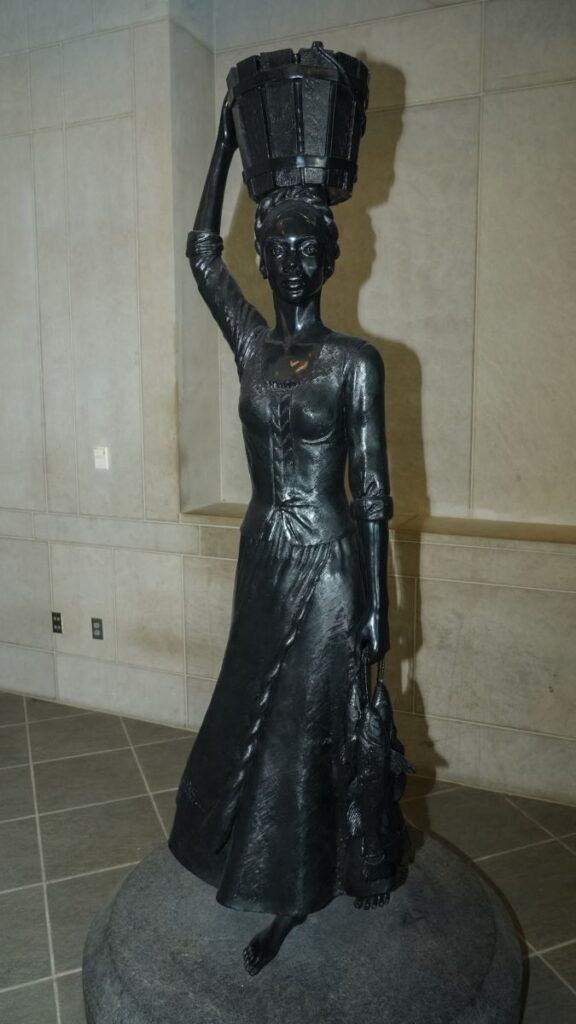
An Educator’s Perspective on Teaching the Voices of Enslaved People in NewJersey as Part of Local History

An Educator’s Perspective on Teaching the Voices of Enslaved People in New
Jersey as Part of Local History

by Robert Fenster

Few high school history textbooks have much to say about Black people in the northern colonies and states. While coverage of the evils of slavery has dramatically increased since I was a student in the 1980s, the focus has predominantly been on enslaved people in the south and not enslaved northerners nor free Black people. Slavery is mentioned 14 times in the New Jersey Student Learnings Standards from 2020, but the only connection to slavery in New Jersey is 6.1.8.History CC.4.a: “Explain the growing resistance to slavery and New Jersey’s role in the Underground Railroad.”[1] The standard implies that New Jersey was a hotbed of abolitionism instead of the dark reality: the gradual abolition law in 1804 maintained slavery for life for those born before its passage[2], and the so-called Act to Abolish Slavery in 1846 replaced slavery with apprenticeship for life. The ratification of the 13th Amendment didn’t merely free the slaves in states that were in rebellion, but also 16 people who remained enslaved in New Jersey in December of 1865.[3]

            Is it at all surprising that most students graduate high school in New Jersey unaware of the enduring nature of this institution or the experience of Blacks in the north? Although it might be argued that malignant forces are behind a whitewashing of New Jersey history, it seems more likely that a collective reductionism is at work here. There are only so many days to “cover” the curriculum, so some simplification is necessary. It’s easier for students to understand the binary depiction of the southern enslaver states being evil while the north is celebrated as the home of abolition. That sort of teaching is oversimplified and not only does injustice to actual history, but to the lives of thousands of men and women who were enslaved in New Jersey, as well as the lives of free Black people. This essay shares my ongoing pedagogical journey, and provides some suggestions for my fellow educators who wish to improve student understanding of the history of Black people in New Jersey.

Although modern textbooks include the death of biracial Crispus Attucks at the Boston Massacre, overall Black participation in the actual American Revolution is typically relegated to a sidebar or absent altogether. Graham Russell Hodges describes the American Revolution as a Black revolution, “the largest slave revolt before the Civil War.” Hodges indicates there is documentation for at least 18,000 Black individuals who fought for the British, with the possibility of tens of thousands more having served in an effort to throw off the oppressive shackles of the colonial governments.[4]

            At a week-long National Endowment for the Humanities seminar on Slavery in the Colonial North in 2020 at Philipsburg Manor in Sleepy Hollow, New York run by Leslie Harris and Jacqueline Simmons, I saw the buildings where enslaved people toiled, and heard from expert tour guides who shared how historians pieced together so much of the history of the manor. It inspired me to focus more on slavery in New Jersey. I went to my county clerk’s office and found birth certificates and manumission records of enslaved people from our town and prepared a lesson plan incorporating these primary sources. My students were taken aback especially to see names familiar to them among the enslavers. In addition to discussing how the descendants of the enslaved people might feel about their history, the students also considered what the descendants of enslavers might think about their family’s past. That lesson in and of itself was impactful, but I was acutely aware it didn’t do enough to explore the lives of enslaved men and women.

            Well-intentioned teachers sometimes make cringe-worthy mistakes. There are lessons I did early in my career (and, truth be told, even more recently) that were tone deaf at best. It seems as if every year there’s another incident where a misguided teacher somewhere in the United States steps knee deep into controversy by running a slavery simulation. The vast majority of teachers know such a lesson has no pedagogical value and runs the risk of inducing trauma. A cursory search for lesson plans online still finds dozens of “walk a mile in their shoes” lessons, where educators think they can responsibly and effectively get students to learn by pretending they understand what an enslaved person went through, usually done through some kind of journaling activity. Although I believe it can be useful to consider what enslaved people might have been feeling, it’s ultimately presumptuous and reductive to suggest students would be able to have that level of empathy and understanding. The temptation to work solely in the affective domain when dealing with slavery and other atrocities should be resisted.

            Many enslaved people were actively prevented from learning how to write, creating a dearth of first-person documents in comparison to white contemporaries who kept journals and wrote letters. There are a number of insightful enslaved person narratives, but when trying to keep to New Jersey history it is a bit challenging. There are a handful of narratives written by white contemporaries, like William Allinson’s Memoir of Quamino Buccau, A Pious Methodist. Although Allinson is an abolitionist, he uses his subject as a prop to further his political cause rather than illuminate the individual he is writing about. This focus belies an utter lack of interest in the enslaved person’s internal life and somewhat limits the usefulness of the text.[5] Historians are left to construct meaning out of other resources like fugitive notices, laws, tax registers, censuses, travel logs, registers of free Black people, and manumission records. New Jersey has a fairly robust set of available documents, making the work of historians easier than in several neighboring states.[6]

My evolving goal as a history teacher is three-fold: depict enslaved people as complex individuals who exercised their agency in a variety of ways, examine the ugly reality of slavery in our town, county, and state, and empower students to become historians themselves by examining the wealth of resources available to them on local history.

# # #

The study of agency is absolutely essential to shift student understanding from a one-dimensional conception of hapless victims to recognizing the humanity and complexity of individuals. Enslaved people’s agency was exhibited on a daily basis in a wide variety of ways. When students would ask me “Why didn’t they fight back?” I used to foolishly accept their premise and engage in a conversation about weaponry, psychology, and geography. Although those are all worthy of examination in a larger conversation on the subject, the fact is they fought back in innumerable ways. Agency was exhibited through armed revolt, breaking equipment, arson, working slowly or poorly, poisoning, feigning illness, self-harm, self-liberation, negotiation, and the development of an enslaved culture through language, families, community, religion, and music.

Jigsaw lesson plans are best used when the specific content is less important than the larger concepts. Examining the organized rebellions of enslaved people is an excellent opportunity to use this approach to its maximum efficacy. Students can research the Stono Rebellion, the New York Conspiracy of 1741, Gabriel’s Conspiracy, the German Coast Uprising, and Nat Turner’s Rebellion, for example. I have my students identify key figures, provide a description of the events, and then require them to find a way to frame the event as a successful endeavor. Students, of course, recognize the limits to their success, but by going beyond the reductionism of “Were they emancipated as a result of their rebellion?” it provides a key lesson.

Incidents of self-harm present a challenge to educators. We want students to understand the lengths to which enslaved people would go to assert their agency, but want to be careful about triggering existing trauma on the subject of self-harm. I’m still grappling with how much focus to put on the subject, but have used some narratives of enslaved people and newspaper articles to at least touch on the subject, if not dwell on it. The National Humanities Center has a collection of suicide-related items for teachers to consider using in their curriculum.[7] There are also an array of primary and secondary accounts of self-mutilation, such as the report of the “Desperate Negro Woman” in the Staunton Vindicator who “deliberately cut three of her fingers off, taking two licks at them” with an axe.[8] Needless to say, educators should tread lightly in this area, keeping a keen eye out for the reactions of their students.

Small acts of sabotage are more challenging to document as they likely would be chalked up to accidents or the natural wear and tear on equipment when tools would break. I don’t use any primary sources for this, but there are quite a few descriptions in narratives of enslaved people describing particular incidents that occurred prior to their emancipation. More dramatic forms of resistance like arson tend to capture students’ imagination such as the Albany fires of 1793.[9]

We used to speak of “runaway slaves,” but both terms have undergone a transition for similar reasons. As Katy Waldman pointed out, “To reduce the people involved to a nonhuman noun was to reproduce the violence of slavery on a linguistic level; to dispense with it amounted to a form of emancipation.”[10] Similarly, Daina Ramey Berry writes about the self-liberated: “[T]heir emancipation reflected a level of agency—a public showing of their personhood—and for them, escape was not a crime.”[11] Students can benefit by examining enslavers’ advertisements about the self-liberated which reveal so much about their assumptions and beliefs about their “property,” and often unintentionally expose the skills and accomplishments of the individuals in question.[12]

Giles Wright wrote that the American Revolution was “the cultural metamorphosis of Africans into African Americans.”[13] However, students rarely consider the creation of a common culture to be a form of resistance without being led to that conclusion.  I’m still working on developing plans to help students see enslaved people as something more than one-dimensional figures. I found the Historic Hudson Valley’s People Not Property interactive website particularly useful in helping students make the connection.[14] Modules on the poetry of Phylis Wheatley, the celebration of Pinkster, and the role of extralegal marriages help students better understand how oppressed people can offer resistance through assertions of their own humanity. It helps students understand that these individuals were not passive victims who allowed their oppressors to defeat them at every turn.

# # #

            When I was given the opportunity to participate in the New Jersey Council For Social Studies grant “Telling our Story: Living in New Jersey in the 1770s” focusing on the lives of lesser known individuals during the American Revolution, I knew from the outset I wanted to research Black people from Somerset County, and ideally, from Hillsborough, the town I teach in. I’d read Elaine Buck and Beverly Mills’ powerful book If These Stones Could Talk. The Revolutionary War service of William Stives gets particular attention along with his decision to settle near Hillsborough after the war.[15] The Sourland Mountain ridge runs 17 miles from Lambertville to the western end of Hillsborough, so my students would recognize various geographic locations from his life story. However, since the authors’ work had gained significant attention, I wasn’t sure my focusing on his life would do much to elevate Stives’ story.

            I spent several afternoons at the Somerset County Library in Bridgewater, poring over their local history holdings. Having never done much in the way of local history research, it took awhile to orient myself as to what was available, but before long I encountered a number of promising leads. The most significant came from the Somerset County Historical Quarterly, an outstanding publication compiling historical essays and primary source documents, which ran from 1912 to 1919. It was all I could do not to get lost reading unrelated articles about Hillsborough and nearby towns. However, the article entitled “Revolutionary War Record of a Somerset County Slave” in the 1914 edition utterly captivated me.[16] The story of an enslaved man named Samuel who served as a substitute for his enslaver in exchange for the promise of freedom takes several awful, though not surprising twists. Samuel’s two years of service, including fighting at the battles of Long Island, Princeton, Monmouth — and the very local Millstone — ended in two leg wounds and the broken promise of his enslaver. Decades later, in his mid-80s, Samuel sought a pension for his service, but was repeatedly denied his just due because the pensions board claimed he had not proven his service. Ultimately, the New Jersey legislature passed a law specific to Samuel, providing him $50 a year for the remaining few years of his life.

            Chasing down information on Samuel Sutphen (as he came to be called later in his life) was both challenging and invigorating. It’s been decades since I was a college student doing research in the basement of Alexander Library at Rutgers University. I had hoped to revisit the same location for both nostalgic and practical reasons (the holdings at Rutgers are quite impressive), but Hurricane Ida made that an impossibility. Instead I relied mostly on internet-based research and was able to gain enough materials to prepare a structured academic controversy for my students. The activity incorporated materials on the multiracial Marbleheaders, and Black participants Benjamin Whitecuff, Colonel Tye, and Prime. Frankly it is a work in progress in need of development, but my students saw the breadth of Black participation in the war instead of merely seeing the battles through the eyes of the white officers.

            When I mentioned my desire to learn about enslaved people in Hillsborough, I was pointed towards the biography of Silvia Dubois, a formerly enslaved woman who received her freedom after a physical altercation with her enslaver. Dubois self-liberated after the encounter and negotiated her freedom in exchange for promising never to return.[17] Her story is remarkable, but chronologically was outside the purview of the grant. Nonetheless I read a series of items about her story and took notes for a future lesson plan. In the meantime, I encountered an article about her grandfather Harry Compton written by Kenneth E. Marshall. In turn, this led me to Marshall’s book Manhood Enslaved: Bondmen in Eighteenth- and Early Nineteenth Century New Jersey, in which he focuses on the lives of three enslaved men, including the aforementioned Quamino Buccau. I liked the idea of examining a second Black man from the time period who had not served, but instead experienced changing circumstances during the American Revolution. With many enslavers off serving in the militia or Continental Army, numerous enslaved people used the opportunity to liberate themselves, negotiate better conditions for themselves, or rebel in other ways.

            In examining the experiences of various individuals based on limited and sometimes questionable documentation, it is crucial that students understand that there are limits to what we can definitively know. Many students struggle with history because they struggle with nuance, wanting everything to be crystal clear. For me, the shades of grey are what make history fascinating, and the use of deductive reasoning a great and wonderful challenge. The best conversations in the classroom are the ones where students have honest disagreements about historical interpretations with equally compelling logical arguments to support their positions. What we can do to help them is to identify particular facts and events that serve as anchors. Quamino Buccau, in his teens, was forced to watch executions of enslaved people accused of arson and other crimes.[18] Because Allinson never bothered to ask his subject how he felt about his experiences, we are left to speculate about how such experiences would impact an individual and their subsequent behavior. When he converts to Christianity after hearing what he believed to be the voice of God, a fascinating dichotomy occurs. Some, like Allinson, hold him up to be a model enslaved person, the very proof the abolitionist is seeking to demonstrate the notion that Black people could become responsible citizens imbued by their faith in religion. His subsequent enslaver, however, looked at his religiosity as something inappropriate and suspect. Kenneth Marshall raises fascinating questions about how an enslaved person might show interest in Christianity to curry favor with their enslaver, and how that in and of itself might be an assertion of agency.[19] There’s a lot to unpack here and it may be something that cannot be easily converted into a one- or two-day lesson plan. That being said, a discussion of religion and agency is definitely important in the coverage of slavery.

            Conducting this type of research and lesson planning is simultaneously rewarding and humbling. Even as I create a useful lesson plan that I will share with other educators and likely use for the rest of my career, I reflect on how many years I didn’t adequately address the subject matter in my classes. And I recognize that despite including them in the opening paragraphs of the essay, I have yet to develop resources and lessons on the lives of free Blacks in New Jersey. There is always more work to do, but at least we’re going in the right direction.

# # #

We want our students to be more than passive receptacles of knowledge that we distill. There are myriad critical thinking activities we can provide, but perhaps nothing could surpass doing the actual work of historians. There are thousands of primary and secondary source documents available online, in historical society archives, and in government offices. For example, in West Hartford, Connecticut, students participated in the Witness Stones Project, researching their town’s sordid history in connection to slavery. Beginning with an Advanced Placement US History class and then spreading out to lower grade levels, students dug into historical archives to learn more about the lives of enslaved people, commemorate their lives, and create lasting tributes through the placement of historical markers.[20] Although Covid-19 continues to present obstacles for some research, there’s no reason that our students here in New Jersey can’t start doing similar work to the West Hartford students in an effort to elevate the stories and voices of forgotten people from our local communities.

References


[1]New Jersey Student Learning Standards – Social Studies, accessed January 8, 2022, https://www.state.nj.us/education/cccs/2020/2020%20NJSLS-SS.pdf.

[2]An Act For the Gradual Abolition of Slavery (1804), accessed January 8, 2022, https://www.loc.gov/resource/rbpe.0990100b/?sp=1; Selected New Jersey Laws related to slavery and Free People of Color, accessed January 8, 2022, https://www.montclair.edu/anthropology/wp-content/uploads/sites/36/2021/06/Slavery-in-New-Jersey-Literature-Review-Appendix-B-Slave-Codes_Remediated.pdf

[3] Julia Martin, “Slavery’s legacy is written all over North Jersey, if you know where to look,” NorthJersey.com, accessed January 8, 2022, https://www.northjersey.com/story/news/essex/montclair/2021/02/28/american-dream-paramus-nj-part-north-jersey-slavery-legacy/4212248001. In addition, the work of James J. Gigantino Jr. provides extensive resources on this subject.

[4] Hodges, Graham Russell. Interview with the author. Bob’s Just Asking podcast, January 27, 2022.

[5]Kenneth E. Marshall, Manhood Enslaved: Bondmen in Eighteenth- and Early Nineteenth-Century New Jersey (Rochester: University of Rochester Press, 2011), 18

[6] Hodges Interview.

[7]National Humanities Center, “Suicide among Slaves: A “Very Last Resort,” accessed February 5, 2022, http://nationalhumanitiescenter.org/pds/maai/emancipation/text2/suicide.pdf.

[8]PBS, Slavery and the Making of America, “Responses to Enslavement,” accessed February 5, 2022,  https://www.thirteen.org/wnet/slavery/experience/responses/docs8.html

[9]New York State Education Department, “The Conflagration of 1793,” accessed February 5, 2022, https://exhibitions.nysm.nysed.gov//albany/doc/fire1793.html

[10] Katy Waldman, “Slave or Enslaved Person? It’s not just an academic debate for historians of American slavery,” Slate, May 19, 2015, https://slate.com/human-interest/2015/05/historians-debate-whether-to-use-the-term-slave-or-enslaved-person.html.

[11] Daina Ramey Berry, “The Truth About Black Freedom,” The Atlantic, June 18, 2021, https://www.theatlantic.com/ideas/archive/2021/06/what-freedom-really-meant-juneteenth/619239.

[12]Arlene Balkansaky, “Runaway! Fugitive Slave Ads in Newspapers,” Library of Congress, accessed February 5, 2022,  https://blogs.loc.gov/headlinesandheroes/2019/10/runaway-fugitive-slave-ads-in-newspapers/

[13] Giles Wright, “Moving Toward Breaking the Chains: Black New Jerseyans and the American Revolution,” in New Jersey in the American Revolution, ed. Barbara J. Mitnick (New Brunswick, NJ, Rivergate Books, 2005), 113.

[14]Historic Hudson Valley, “People Not Property: Stories of Slavery int he Colonial North,” accessed February 6, 2022, https://peoplenotproperty.hudsonvalley.org.

[15] Elaine Buck and Beverly Mills, If These Stones Could Talk: African American Presence in the Hopewell VAlley, Sourland Mountain, and Surrounding Regions of New Jersey, (Lambertville, NJ, Wild River Books, 2018).

[16] Abraham Van Doren, “Revolutionary War Record of a Somerset County Slave,” Somerset County Historical Society, Volume III (1914), accessed February 6, 2022, http://hdl.handle.net/10929/46268.

[17] Greg Gillette, “The View From Hillsborough: Silvia Dubois,” My Central Jersey, February 4, 2016, https://www.mycentraljersey.com/story/news/local/view-from-hillsborough/2017/02/07/silvia-dubois/97586960.

[18] William Allinson, Memoir of Quamino Buccau, A Pious Methodist, accessed February 6, 2022, https://docsouth.unc.edu/neh/allinson/allinson.html, 4-5.

[19] Marshall, 100.

[20] Witness Stones Project: Students Find and Share an Untold History of the Enslaved People of West Hartford, accessed February 6, 2022, https://we-ha.com/witness-stones-project-students-find-and-share-an-untold-history-of-the-enslaved-people-of-west-hartford.

Boosting Reading Skills Through Social Studies at the Elementary Level

Boosting Reading Skills through Social Studies at the Elementary Level

Karissa Neely

Want to improve students’ reading scores? Incorporate more social studies into their instruction.

“The Early Childhood Longitudinal Study shows that social studies is the only subject with a clear, positive, and statistically significant effect on reading improvement. In contrast, extra time spent on English Language Arts (ELA) instruction has no significant relationship with reading improvement,” Adam Tyner and Sarah Kabourek explain in their 2021 Social Education journal article, “How Social Studies Improves Elementary Literacy.”

According to the study, social studies has the power to boost literacy and student language acquisition. Because of its focus on people and the world around us, social studies gives students context for their ELA learning. As students use background knowledge to decipher informational text, they build real-world vocabulary and gain stronger reading comprehension skills.

In many elementary schools, where teachers have very limited social studies instruction time, they can use informational text from social studies during their language arts block.

“Integration of ELA strategies into social studies gives students an opportunity to use and refine ELA skills while using relevant content,” says Kelly Jeffery, ELA curriculum director at Studies Weekly.

Beyond reading, social studies instruction can also be more deeply blended with ELA, and support reading, writing, listening and speaking skills. Here are four tips for further integrating social studies and ELA:

1. Use Interactive Notebooks

“[I]nteractive notebooks are simple spiral-bound notebooks into which students glue or tape my handouts,” says Christina Gil in a 2016 article for Edutopia. “It’s just a simple, functional way for students to create, write, and explore ideas all in the same place.”

Jeffery adds that interactive notebooks are a way for both the teacher to see what students are learning and thinking. Students use them to take notes, explore ideas, ask questions, reflect and respond. They then become a sourcebook for students as they review for assessments.

“They pair very well with Studies Weekly because it is a perfect way to consume our publications,” Jeffery explains.

2. Create a Presentation

Students need different types of opportunities to share their understanding and presentations are perfect for this.

Brochures, posters, Google Slides, Nearpods, etc. are all interactive avenues for students to work individually or collaborate together to demonstrate knowledge. Similarly, students can create video journals to storyboard events and their responses. The goal is not a perfect analysis of the event or the historical figure they are studying, but a reflection on it.

Additionally, students can create readers’ theaters or short plays based on historic events, and perform them for the class. Others might opt to write a poem about a historic figure or create a children’s book explaining about an even


Three examples of easy ways students can show learning (from top left): file folders used to summarize information, popsicle puppets to share information from a historical figure’s point of view, and trioramas used for summarizing, fact/opinion, analyzing a primary source, or as a mini-report.

3. Create a Supported Response

Using informational texts, students can create a reasoned persuasive argument sharing their opinion on an event or person.

One form of supported response is a small paragraph following the TEES Template as explained by Jeannette Balantic and Erica Fregosi in their 2012 article, “Strengthening Student Thinking and Writing about World History,” for Social Studies and the Young Learner.

The TEES Template helps students strengthen their thinking, reasoning, and responses to open-ended assessments. With this exercise students go beyond learning historical facts — instead they use these facts to form arguments and support.

4. Hold Collaborative Groups

After reading an article, students may analyze the information and reflect on it within their interactive notebook.

With their notebooks and/or articles in front of them, teachers can guide students in opening up a dialogue about what they read with a small group or the entire class. Students should consider all voices and sides to an issue or event, and use additional sources, if needed, to deepen their understanding.

As they share their opinions and factual evidence, students should also be instructed to actively listen to the other side. The goal of this exercise is not to win but to try to find a compromise between both positions.

These four tips are only just few options to help teachers blend social studies and ELA in the elementary classroom. Even more, in addition to integrating with ELA, social studies is also the gateway to deeper learning in all subjects. For example, as students learn geography, they learn spatial math concepts. Or as they learn about historical developments in technology, they develop background knowledge for science. Even within the study of social studies, students learn how to make connections between a specific topic and its effect on people, events, and society. They begin to understand how geography affects a region’s economics, history affects governments, and governments affect society.

Teaching social studies with an integrated learning approach strengthens students’ ability to reason and think critically, gain a deeper understanding of the content, and transfer information to solve new problems. This knowledge can prepare them for the future as they become the world’s government, business, and family leaders.

References:

Balantic, J., & Fregosi, E. (2012, November). Strengthening student thinking and writing about world history. Social Studies and the Young Learner, National Council for the Social Studies. Retrieved May 27, 2022, from https://www.socialstudies.org/social-studies-and-young-learner/25/2/strengthening-student-thinking-and-writing-about-world

Gil, C. (2016, August 30). Interactive notebooks: No special hardware required. Edutopia. Retrieved May 27, 2022, from https://www.edutopia.org/blog/interactive-notebooks-no-special-hardware-christina-lovdal-gil

Tyner, A., & Kabourek, S. (2021, January). How social studies improves elementary literacy. Social Education, National Council for the Social Studies. Retrieved May 27, 2022, from https://www.socialstudies.org/social-education/85/1/how-social-studies-improves-elementary-literacy