My Story: George Morgan White Eyes, Princeton, NJ, 1778-1790

My Story: George Morgan White Eyes

Princeton, Mercer County

1778-1790

Koquethagechton, also known as White Eyes, was a Lenape chief living in Ohio Country. He married Rachel Doddridge, a white woman who had been taken captive by the Lenape at age 5 and had become fully assimilated to Lenape life. As an adult, Doddridge chose to remain an adopted Lenape.

When the American Revolution began, Koquethagechton initially tried to remain neutral, but before long it became evident that he would have to take sides. In 1777, Koquethagechton addressed the Continental Congress, and the following year negotiated a peace treaty with American representatives.

Which of the following provisions should Koquethagechton have sought in a peace treaty?

Select one option and explain your answer in 3 to 5 sentences.

  • A new state shall be created for the Lenape, incorporating the nation into the United States with representation in Congress.
  • The United States must build a fort in Lenape territory to help protect the Lenape from attacks by other Native American nations or from the British.
  • The United States shall provide the Lenape with clothing, utensils, and weapons as needed.

Amazingly, the Treaty of Fort Pitt, signed September 17, 1778, included all of these provisions. The promise of a 14th state along with Congressional representation is something that was never promised to any other Native American group, but relied upon the further approval of Congress. Unfortunately, the treaty never received the support of Congress and was ultimately rendered meaningless.

Later that year, while accompanying American soldiers in Ohio Country, Koquethagechton died at the age of 48. Initially the cause of death was reported as smallpox, but eventually it was revealed he had been murdered by the American militia. Nearly ten years later (circa 1788), Rachel Doddridge was murdered in the course of a robbery by white men disguised as Native Americans. Both of their stories are compelling and worthy of more examination, but our focus here turns to their son, George Morgan White Eyes, partly named for Koquethagechton’s American friend, who would become the boy’s guardian.

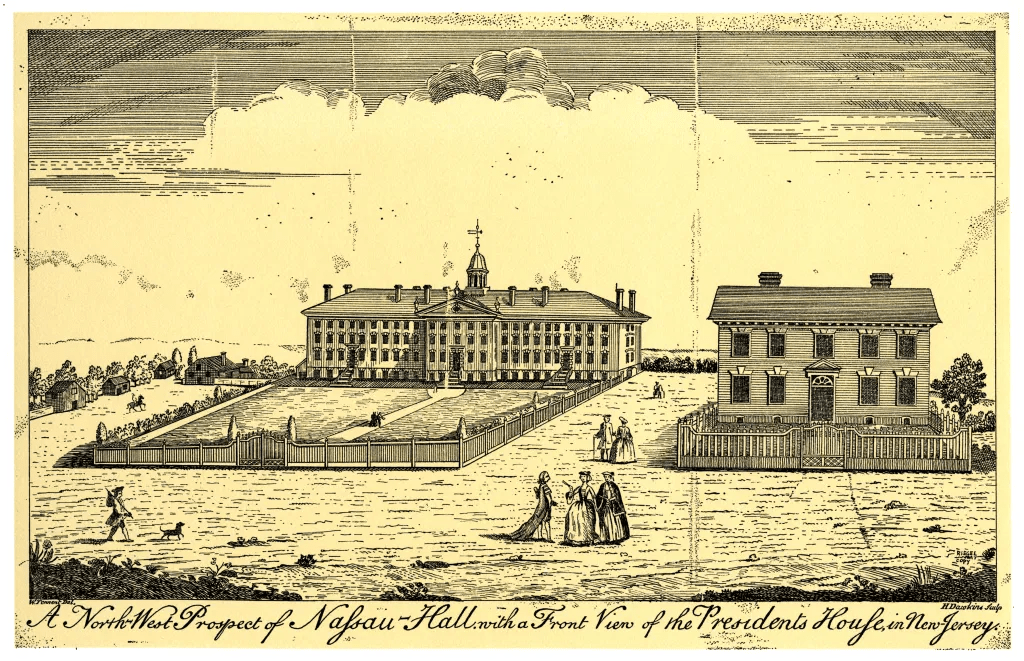
White Eyes was seven years old when his father died. The Continental Congress assumed financial responsibility for the upbringing of the chief’s son. White Eyes was likely the first recipient of government-based student financial aid from the U.S. government. After completing grammar school, he was enrolled at the College of New Jersey in Princeton in 1785.

In December 1787, he and three other students were summoned before a disciplinary committee for insolence towards a tutor. Apparently, it wasn’t the only time he’d gotten in trouble at school. His guardian decided to remove him from Princeton and sent him to New York City to temporarily be under the care of a merchant tailor while awaiting instructions from Congress on what to do with young White Eyes. His guardian explained in a letter to Congress that White Eyes’ misbehavior may have had to do with his learning the news of his mother’s recent death and the long-concealed truth about his father’s murder. Morgan suggested that instead of sending him back to Princeton – or back to his nation – that White Eyes be sent to a different institution of higher learning, like Yale.

Which of the following choices do you think 18-year-old George Morgan White Eyes would make?

Select one option and explain your answer in 3 to 5 sentences.

  • Go back to Ohio Country to live among his own people.
  • Let his future be decided by George Morgan and the decision of Congress.
  • Strike out on his own in the New York to find a job and be independent.
  • Appeal directly to someone in power, explaining his desire to either be given a job or further education.

On June 2, 1789, George Morgan White Eyes wrote to President George Washington:

“[N]ot the severest Want shall make me return to my native Country—Tis thought from the Behaviour of my Colleagues while at Princeton that I will follow their Example—but never—I shall say but little but I trust my heart is fixed, & the time may come that this now feeble Arm, may be stretched out in the Service of America; & render the United or Individual States essential Service.

My humble request is & has this some Months past, that if the Burthen (sic) is too great on the United States that some kind of Employment may be pointed in order that I thereby may obtain a Living a[long] the Line that Congress probably first intended—That is agreeably to the Education they have been pleased to bestow upon me—I care not what [it] is I am willing to do what I am able, & you should think necessary to my future Welfare—[E]ntreating your Excellency’s kind Patronage on this Occasion I have the Honor to remain With the most perfect Respect, Sir, Your most Obedient & most devoted Servant”

Congress did not act quickly, and as the weeks went by, ‘the severest want” apparently changed White Eyes’ mind. He wrote President Washington again:

“The treatment I met with at Princeton & the Character I bear (which I know I am innocent of) here, are great Grievances to me, especially as I have undergone a great many Difficulties, I shall stear (sic) my Course towards my native [country] let the Consequence be what it will.

For it is better for me to live in Contentment & Quietude, than a life Contempt & Ignominy.1 I have not had any thing this while past & I am almost naked, thro’ some guile or other, for what I know. I believe they are tired of doing any thing for me & I am tired waiting for their duty which is incumbent on them by a resolve of Congress.

I am now to look out for myself since I cannot behave myself, better than I have done; for all that I do is in vain, yet all these things are not discourages of my staying here any longer, but I am [anxious] to return & see my Mother & Friends, as it ought to become every person who has a regard for their Nation. I beg you would assist me in my return as I have no other person to apply to; but if not I must do as well as I can.” Source

In March of 1790, George Morgan White Eyes returned to his nation in Ohio Country.

Sadly, his story has an ignominious ending. Eight years later (1798) in West Point, Ohio, an intoxicated White Eyes ran at 17-year-old William Carpenter Jr. with a tomahawk. Fearing for his life, Carpenter shot White Eyes, killing him instantly. Initially the boy and his father were charged with murder and aiding and abetting, but the case never came to trial.

To GEORGE MORGAN Mount Vernon, August 25, 1788.

Sir: The letter which you did me the favor of writing to me the 31st. of last month, with a Postscript to it on the 5th. of this, came duly to hand; as did a small parcel of wheat, forwarded some time before, by the Post Master General from New York. For your polite attention to me in these instances I pray you to accept my best acknowledgments and Thanks. With much concern I have heard of the ravages of the Hessian fly on the wheaten Crops in the States East of the Delaware and of the progress of this distructive (sic) insect Southerly; but I congratulate with you sincerely on your successful endeavors in the management of your measures &c. to counteract them. If the yellow bearded wheat from a continuation of experiments is found no matter from what cause, to be obnoxious to and able to withstand this all devouring insect [it] must indeed be valuable; but I have paid too little attention to the growth of this particular kind hitherto, to inform you in what degree of cultivation it is in this State, I may venture, at a hazard, however, to add that it is rare: because it is unusual to see fields of bearded wheat of any kind growing with us, particularly in the Western parts of the State, which falls more immediately under my observation. I will distribute the Seed which you have sent me; make enquiry into this matter and communicate the result, begging in the meantime, if any further observations on this insect, and the means of guarding against him should be made by you that you will have the goodness to communicate them to. 67 Source
Our Story: Prisoner Exchange, September 1776, Middlesex County, NJ

Our Story: Prisoner Exchange

Middlesex County, NJ September 1776

In the summer of 1776, the American Patriots were struggling to hold British attacks off with their meager forces. The capital city of New Jersey is Perth Amboy, a short distance from New York Harbor where the opening battle of the American revolution took place.

After the Battle of Brooklyn Heights on Long Island on August 27-29, 1776 over 20,000 American soldiers in General Washington’s army were captured and sent to prison ships and prisons in New York. (Lurie, 72). The conditions in these prisons were deadly due to overcrowding, unsanitary conditions, and lack of food. According to Alexander Coffin Jr., 

“But to cap the climax of infamy we were fed (if fed it might be called) with provisions not fit for any human being to make use of—putrid beef and pork, and worm-eaten bread.” (Thompson, 241)

 The prison ship, the Jersey

Would you like to be…  
An officer in General Washington’s army stationed near Perth Amboy?An enlisted soldier from Middlesex County captured by the British and held captive on the Jersey, prison ship stationed in the Atlantic near Perth Amboy?

You face challenges and officers and enlisted men alike struggle to survive for the next few months, but during the disastrous Battle of Long Island, many in your battalion are taken prisoner by the British. On September 11, two weeks after the Battle of Long Island, and five days before the Battle of Harlem Heights, Ben Franklin, John Adams, and Edward Rutledge secretly met with British Admiral Richard Howe to discuss the release of the prisoners held by the British. The British have captured thousands of Americans and there are perhaps hundreds of British citizens (Loyalists) and several British officers held in detention in different colonies, including some in prisons in Perth Amboy and Burlington, New Jersey. 

If you are an officer, you were able to escape, but now you have to decide if and how to negotiate for the release of others held in captivity. The winter months are coming and the prisons in New York have no heat and the prison ships on the open seas are subject to extreme weather conditions. The fate of all prisoners is at risk.If you are an enlisted man, you were captured and taken to the prison ship Jersey, where you are forced to endure terrible conditions that you may not survive. You can either wait for your release to be negotiated and hope for the war to end soon or disavow your loyalty to the Continental Army and join the British.
Quote to consider:   Adams’ description of his meeting with General Howe on September 9, 1776 “Lord Howe had sent over an Officer as a Hostage for our Security. I said to Dr. Franklin, it would be childish in Us to depend upon such a Pledge and insisted on taking him over with Us, and keeping our Surety on the same side of the Water with Us. …We walked up to the House between Lines of Guards of Grenadiers, looking as fierce as ten furies, and making all the Grimaces and Gestures and motions of their Musquets with Bayonets fixed, which I suppose military Ettiquette requires but which We neither understood nor regarded.”   Frazza,Quote to consider:   Captain Thomas Dring on his imprisonment on the Jersey prison ship “Thousands there suffered and died, whose names have never been known to their countrymen. They died where no eye could witness their fortitude, no tounge could describe their sufferings, or praise their devotion to their country. For years, the very name of ‘the Old Jersey,’ seemed to strike a terror to the hearts of those whose necessities required to venture upon the ocean; the mortality which prevailed on board her was well known throughout the country; and to be confined within her dungeons, was considered equal to a sentence of death, from which but little hope of escape remained.” Thompson, 240
Your Choices: Your Choices:
Why should the British consider soldiers captured in battle as prisoners of war since England does not recognize the independence of their American colonies?   How will you convince the British to provide for humanitarian conditions for the prisoners they have without any means to enforce a code of conduct?   If you have a British officer in an American jail would you be willing to negotiate the release of one officer for a number of enlisted soldiers in the Continental Army?   How will you prevent the British from going house to house and arresting innocent Americans in the territories they hold, potential to trade for British officers and soldiers held in American prisons?   Should you provide a guarantee to the British that American soldiers will not return to the battlefield if released?   If you were traveling with Franklin, Adams, and Rutledge when they were leaving Perth Amboy to meet with the British on Staten Island to discuss the release of prisoners, what would you do to ensure your own safety?In the face of death from starvation or unsanitary conditions in a British prison ship, would you be willing to sign the Oath of Abjuration and Loyalty to the British government or would you remain loyal to your comrades?   When faced with the brutal reality of prison and the potential of death by disease, what would you do to try to save your friend’s life?   The prisoners also include women and children. Women and children were also captured in the battles of New York and northern New Jersey.  Would you be willing to sacrifice some of your already limited food to help a woman feed her starving child?   Would you be willing to risk hanging for treason or additional punishment by sending a message to the Americans begging for release?   Should the Continental Congress request the help of a foreign government to negotiate with England on the release of American prisoners or negotiate for improved humanitarian conditions? Which country would you recommend and why? What is the incentive for this government to support the Americans?   If you were to negotiate a prisoner exchange, what should the Continental Congress offer for the release of enlisted American soldiers? 

Oath of Allegiance (Lurie, p.81)

Interior of Jersey (Darley and Bookhaut)

Sources

The History of Long Island; from its Discovery and Settlement, to the Present Time. With Many Important and Interesting Matters; Including Notices of Numerous Individuals and Families; Also a Particular Account of the Different Churches and Ministers, by Benjamin Franklin Thompson, 1843. Linked here

Taking Sides in Revolutionary New Jersey: Caught in the Crossfire, by Maxine N. Lurie, 2022.

“Revolutionary War Sites in Perth Amboy, New Jersey,” by Al Frazza, 2022. Linked here

Interior of the old Jersey prison ship, in the Revolutionary War, Edward Bookhout, engraver, and

Felix Octavius Carr Darley, artist, 1855. Linked here

My Story: Joshua Huddy, April, 1782, Monmouth County, NJ

Decision Activity

Captain Joshua Huddy, Monmouth County April 12, 1782

The wooden Block House in Toms River was a target of the Loyalists since it was erected in 1777 at the intersection of Main and Water Streets. It was a fortress defended by Patriots to protect the salt produced in this area and to protect the Patriot privateers in Barnegat Bay.  Salt was necessary to preserve fish and meat and produced in Toms River for about $15 a barrel but controlled by the British. It sold in Morristown, New Jersey for $35 a barrel. Because of inadequate military forces and the lack of an economy during the war, corruption was widespread in New Jersey. This was a dangerous stretch of coastline in North America, and Captain Huddy had previously defended it against several British attacks, in April and August of 1778.

As a result, on September 1, 1780, the home of Captain Joshua Huddy in Colts Neck was attacked by 72 men. They were all Loyalist rebels or Refugees, under the command of Lieutenant Joseph Parker and William Hewlett. The Refugee Club was organized by John McKinley, former President of Delaware, after his release from prison in Flatbush, New York.  In a fight that lasted for two hours, Captain Huddy was captured and his home was burned and plundered. He escaped by jumping from a boat as he was being taken prisoner.

Captain Huddy was a privateer who was commissioned by the Continental Congress as a privateer to attack British ships along the Jersey coast and in Barnegat Bay. He was captain of the Black Snake, a whaleboat and conducted raids after his escape.

After the British surrender at Yorktown, Captain Joshua Huddy was assigned to protect the Block House in Toms River on January 1, 1782 with a small arsenal of ammunition and the support of several local Patriots living in the Toms River area.  The Loyalist refugees gathered at Sandy Hook under the command of Lieutenant Blanchard. Their journey to Toms River was delayed by storms but they arrived at midnight on March 23, 1782.  The Loyalists marched to the Block House where Captain Huddy and about 15 Americans engaged in fighting until they had no more ammunition. Captain Huddy was captured and taken to prison in New York.

Joshua Huddy was accused of executing Stephen Edwards a Loyalist from Middletown, NJ, who was found guilty of treason as a British spy. The British wanted revenge against Huddy and former the royal governor of New Jersey, William Franklin, ordered Captain Richard Lippincott to hang him.

“That the governor judging it proper that retaliation should take place sent for me upon the occasion and gave me orders (which I supposed were authorized by the Board) for the execution of Huddy.”

There were negotiations for Captain Huddy’s release. Captain Charles Asgill, age 19, was held in an American prison in the Chathams with other British officers. He was selected to be executed in exchange for the release of Captain Huddy and 13 other British officers held in American prisons.   Captain Asgill received the sympathy of the American people and his mother, Lady Theresa Asgill, asked the Count de Vergennes, foreign minister to King Louis XVI, to obtain her son’s release. This was granted.

As a result, Captain Huddy remained in prison with undocumented charges against him regarding the murder of Philip White, a refugee who was captured by Patriot forces in the area of Colts Neck. During his transport to jail, he jumped from his horse and was shot and wounded. After he was captured again, he was violently abused and died on March 30, 1782.  During this time, Captain Huddy was a prisoner from March 26, 1782 until his execution on April 12 of the same year. He was not near the area of Colts Neck or able to witness the atrocity that came to Philip White.

The British then accused Captain Huddy of boasting of the hanging of Stephen Edwards while in prison, an event that occurred five years earlier in September 1777. Stephen Edwards was arrested and found guilty of treason during his trial and sentenced to death.  Captain Huddy claimed his words were twisted by Captain William Cunningham because of his statement, under oath, that “I greased the Rope that it might slide more easily.” I did not hang Stephen Edwards. There is a difference between approving of an execution by a rope that would intentionally be an act of mercy in a death by hanging. Captain Huddy claimed he did not physically take part in the execution.

On April 8, 1782 Huddy was transferred from the Sugar House prison in New York to the prison ship, Brittanie, which was stationed off the Sandy Hook coast.  On April 12, 1782, Captain Huddy was taken ashore at Gravelly Point, near Sandy Hook, from the British prison ship. He was carried to the beach and they pinned to his chest the following:

“We, the Refugees, having long with grief beheld the cruel murders of our brethren, and find nothing but such measures daily carried into execution, therefore determined not to suffer without taking vengeance for the numerous cruelties; and this being, having made us of Captain Huddy as the first object to present to your view; and we further determine to hang man for man wile (sic) there is a Refugee existing. Up goes Huddy, for Philip White.”

He stated in his Will: “In the name of God, Amen.  I, Joshua Huddy of Middletown in the County of Monmouth, being of sound mind and memory, but expecting shortly to depart this life, I declare this my last will and testament.

First, I commit my soul unto the hands of Almighty God hoping he may receive it in mercy; and next, I commit my body to the earth, do also appoint my trusty friend Samuel Forman to be my lawful executor and after all my debts be paid, I desire that he divide the rest of my substance whether by book debts, note, or any effects whatever, my children, Elizabeth and Martha Huddy. In witness whereof, I have hereunto signed my name this 12th day of April, in the year of our Lord one thousand seven hundred and eighty-two.”

He was hanged at 10:00 in the morning and left on the tree until friends removed his body to Freehold after 4:00 p.m.

“This murder was attended with so much deliberate injustice and wanton cruelty, that the circumstances ought to be preserved and made publick, not only to call upon the vengeance of his countrymen to expiate the names of the sufferer, but as a shocking instance of the blackness of that guilt which human nature is capable…

Over 400 respectable citizens met in Monmouth on April 14, 1782 approving an appeal to General Washington:

“To his Excellency, George Washington, Esq., Commander-in-chief pf the combined armies of America and France, acting in North America, etc., etc.

“the inhabitants of the County of Monmouth, being assembled on account of the horrid and almost unparallel murder of Captain Joshua Huddy by the Refugees from New York, and, as we presume, by approbation, if not by the express command of the British Commander-in-chief, Sir Henry Clinton; hold it as out indispensable duty, as well to the United States in general as ourselves in particular, to show to your Excellency that the aforesaid Captain Joshua Huddy, late commanding the post at Toms River, was after a brave and gallant defense, made a prisoner of war, together with fifteen of his men, by a party of refugees from New York, on Sunday, the 24th of March last past. That five of the said Huddy’s men were most inhumanely murdered after the surrender; that the next day, at night, to wit, on Monday, the 25th of March aforesaid, the said Captain Huddy and the other prisoners who had been spared from the bayonet, arrived at New York, and were lodged in the main guard during that night; that on Tuesday morning, the 26th of the same month, the said Huddy was removed from the main guard to the Sugar-House.” 

On April 19th at West Point a Council of War met an informed General Washington that Captain Richard Lippincott needed to be released to them. On April 21 General Washington notified British commander Sir Henry Clinton. The British refused to turn Captain Lippincott over to the Americans. Instead, they ordered a court martial of Captain Lippincott and an investigation of the execution of Captain Huddy.  In May, Sir Henry Clinton was replaced by Sir Guy Carleton, who condemned the execution of Joshua Huddy.

Captain Joshua Huddy was buried on April 15, 1782 with the honors of war. The funeral sermon was preached by Reverend John Woodhull, pastor of the Tennent Church. There is Huddy Park on Bay Ave. in Highlands, NJ in remembrance of Joshua Huddy.  Even after the Battle of Yorktown, over 5,000 Americans remained in British prisons and on prison ships under inhumane and horrible conditions of abuse.

Decisions:

If you were General Washington…

  1. Would you have tolerated war crimes by Loyalists and Refugees following the surrender of Lord Cornwallis at Yorktown?
  2. Would you have been stronger in your demand for the release of Captain Joshua Huddy after he was taken prisoner?
  3. Would you have allowed the British to incarcerate more than 5,000 Americans in their prisons under cruel and deadly conditions? How would you handle this?
  4. Did you commit a crime by not demanding justice for the immoral actions against Captain Joshua Huddy, his wife and two daughters?

If you were Captain Richard Lippincott….

  1. Are you at peace in carrying out the orders to execute Captain Joshua Huddy for his acts against British soldiers and Loyalists?
  2. Is your execution justified If evidence is produced that Captain Joshua Huddy operated a black market in salt and supported illegal actions of the privateers in Barnegat Bay?
  3. Who do you say is responsible for the murder of the Captain Joshua Huddy? Why?

https://www.accessible-archives.com/2017/02/execution-stephen-edwards-spy/

On February 14, 1837, The United States Congress granted the heirs of Captain Huddy (his daughters Elizabeth and Martha), the benefits of existing pension laws. The same as if he had been an officer of the regular Continental service; also giving them six hundred acres of the public lands and the sum of twelve hundred dollars, it being the amount due to him for seven years’ service as captain of artillery.

Discussion: Do you agree with this resolution?

I am an American: The Wong Kim Ark Story

I am an American: The Wong Kim Ark Story

by Martha Brockenbrough with Grace Lin (Little, Brown, 2021)

Review by Valerie Ooka Pang

This review was originally published in the International Examiner and is
republished with permission.
https://iexaminer.org/honoring-remembering-and-sharing-the-life-of-kim-arkand-his-fight-for-justice/

Has anyone questioned your citizenship? Has anyone ever said to you, “You don’t belong here. Go back to where you came from!”? Meaning you are not an American and should go back to where you came from. This happened to me often in Eastern Washington where I grew up, yet if I was to go back to where I came from, that would have been Seattle, Washington, where I was born. Why didn’t other youngsters think of me as an American? I could also be an immigrant who became an American like Wing Luke, who was the first person of color elected to the Seattle City Council.

Race is a powerful element of American society. People judge others based on their skin color, physical characteristics, stature and cultural practices. I am Japanese American and many of the young people I grew up with did not think of Japanese Americans as Americans. I was seen as a foreigner and so did not belong in the United States, though I lived in the state of Washington all of my
life. I wish there had been a book like I am an American: The Wong Kim Ark Story so their teachers could read it to their students. The book is about how Wong Kim Ark went to court and fought for his right as an American citizen.

In 1873, Wong Kim Ark was born in San Francisco, California to parents from China.
Chinese immigrants suffered much prejudice living in California. His parents left San Francisco in 1890 to go back to China while he stayed with relatives in California. Wong Kim Ark visited his parents in 1894 on a temporary trip. When he returned to San Francisco, he was not allowed to enter the United States because officials said he was not a citizen. He was put in prison because of the 1882 Chinese Exclusion Law that did not allow Chinese workers into the United States. Lawyers sued to get him out of prison in district court.

At that time Wong Kim Ark was about 21 years old. He argued that since he was born in San Francisco, he was a citizen. Members of the Chinese community pooled their finances and hired several lawyers to represent Wong Kim Ark. His case went all the way to the Supreme Court, and the U.S. Supreme Court ruled that due to the Fourteenth Amendment of the U.S. Constitution, since Wong Kim Ark was born in the United States, he was a citizen even though his parents were from China.

The Supreme Court decision of Wong Kim Ark is important because often race is used as an obstacle in establishing citizenship for other Asian Americans and people of color. The Supreme Court ruled that birth in the United States establishes citizenship. The Wong Kim Ark case supports his statement of “I am an American.” Even after the Supreme Court ruled in favor of Kim Ark, he had to carry a certificate of identity “to prove he was an American.” Racism was still strong in the United States.

This is an excellent story to read to children to show that the United States is a diverse country, and its citizens are members of many different ethnic and racial groups. Every student and teacher should know who Wong Kim Ark is and how he
helped to establish citizenship rights for people of color in the United States. Most learners and educators do not know about the contributions that many Asian American and Pacific Islander people have made to our civil rights.

Consider purchasing this book for your children or educators. There should be more AAPI role models presented in school. This book is an exceptional resource. There is additional information about the case at the end of the text. The timeline of historical events is especially informative. It includes dates about Wong Kim Ark’s life and different immigration legislation. As Wong Kim Ark said, “I am an American.”

Finding Our Place in Revolutionary History

Finding Our Place in Revolutionary History
Karen Parker

All human beings want to feel like they belong to something bigger. This is
especially true when students reach adolescence, their whole psyche revolves around being liked, accepted, and belonging to a group. The importance of that “place” that they hold is the driving force held together by peers, social media, cliques, fashion, and home. Relating part of their place to history and pique that sense of belonging to that history, not feeling left out of it as a spectator, not feeling odd or different from the people and feeling like they are connected with the locations, can be the key to the level of engagement. Luckily, in New Jersey, it is not difficult to find Revolutionary era connections in our backyards and neighborhoods.

There is a disconnect with children during their education of history. Students often feel disconnected because of the difficulties in relating to elapsed time, distant places, and unfamiliar habits and customs. As educators, it is our challenge to create as many opportunities for connections as possible, to have the students relate to some “thin and brittle” threads of familiarities, and often we can wrestle grudging interest in the topics presented.

History, unlike active experimentation in science and the excitement of fiction in
language arts, is unsurprisingly often deposited toward the end of the favorite subject list, to muddle around in student’s heads where they view the facts as dull lists of events and dates of forced importance with scattered entertaining facts – more so if they relate to a holiday that includes time off from school.

To connect with people from generations past, it is important to find that common ground with today. Where I grew up in Morris County, I lived a short drive from an active and preserved area of Revolutionary history, spending many hours of my childhood roaming the woods and fields of Revolutionary significance, taking short field trips to Jockey Hollow, Fort Nonsense, and the Ford Mansion. Where I teach in Hunterdon County, the most notable area is Washington’s Crossing State Park, with which many of my students are completely unfamiliar, and the war to them
seems very distant. It is important to find nearby locations and people that are
connected to the Revolution era.

In my research for the New Jersey Council for the Social Studies, I was looking
for information on people from Hunterdon County who were actively involved in the
Revolutionary War. There were many references to soldiers, the Commissary General for Washington’s army and the local militia, but I came across one primary
source that I thought might catch the interest of my students.

Through researching into the life of this average local person, James Parker, reading about his daily missives on the management of the property, connections to the effects that the war had on the common people became evident. Parker’s
connections began as a proprietor whose primary residence was in one of the colonial capitals, Perth Amboy. He was a major landowner in Hunterdon County, owning land in what is now Kingwood, Union, Bethlehem, and Tewksbury Townships and built a large stone house in Union Township called Shipley. It is interesting to note that many people in this local area were not following the political patriots, but many had loyalist leanings or were ambivalent.

Mr. Parker was one of those who did not support the patriotic feelings and was
sentenced and jailed by the New Jersey Council of Safety during the summer of 1777, in Morristown, for refusing to take an oath renouncing loyalty to Britain. He was paroled and exchanged for a Patriot held in New York in 1778. At this time, he spent
more and more of his time in Hunterdon County, overseeing his lands. Some think
that he was avoiding the political climate of the large shore town of Perth Amboy,
though he documents in his farm journal his travels back and forth to his original home for proprietor meetings.

Some other examples of Parker’s political leanings come from an entry in his journal that appeared sympathetic to a local loyalist family, the Voughts who lived in Clinton, known then as Hunt’s Mill, about three miles away from Parker’s home in Pittstown.. On December 18, 1778, Doc Smith took his contribution to a relief fund for women, wives of people gone into the British line and had all of their effects sold. This is the same date that the Voughts had all of their belongings auctioned off. These families were considered traitors by the New Jersey Legislature, which allowed all of their property and possessions to be confiscated. At this time, a large amount of the British army and many of their sympathizers occupied areas of New York and Staten
Island) (Gigantino 2015)

The farm journal expresses many tasks that most would take for granted at the
time, documented in amazing detail, though commonplace and ordinary back then.
These entries in this primary source give glimpses of insight on the challenges of
conducting business during the Revolutionary War. He notes that on July 1, 1778, he was in the meadow with great firing heard at a distance, “Regulars and Continental troops engaged in general or skirmishes since Sunday last.” He notes that it was a “severe engagement” and we can assume that he was hearing the Battle of Monmouth and he must have been at Perth Amboy to be in the proximity to hear the
fighting, even though he does not mention it. There are no references of any major
engagement during this time period anywhere near his lands in Hunterdon County.

Financial struggle, even for wealthy proprietors, was a part of daily life. The
farm journal mentions the use of many different denominations of hard currency:
Continental Dollars, Johannes and Moidore, which were Portuguese gold coins, English Guineas, New York Currency, English Pounds and Spanish dollars. In January of 1779, Parker discusses an issue with the prevalence of counterfeiting, by mentioning that he was buying land from Abraham Bonnell. He could not confirm if the money he was paying with was counterfeit. Bonnell said he didn’t believe any was, due to being very careful to examine the bills and that the mark of a printer was not necessarily a proof of authenticity. At one point he mentions, “Paid for bushel of wheat in hard money.”

This may have been noted because of the general lack of coinage and the use of
continental paper money. He noted on March 5, 1780 that taxes were collected but there was a scarcity of money, and on March 13 taxes were collected on his Bethlehem property, and he complains about having no money until he could collect on his debts. On March 23, taxes were collected on Tewksbury property, and he mentions that he is owed more money than he can pay; he can’t pay the taxes until his debtors pay. For the same year, he was taxed on 200 acres, was able to pay three-quarters of the bill but had no continental money, so he borrowed it.

Everyone knows that Continental and British troops moved all around New Jersey. It is common knowledge that they were located near the famous areas of conflict such as Monmouth, Trenton, Princeton, and Washington’s Crossing at the Delaware River. Troops on both sides of the war marched through Hunterdon County and
stopped to rest their soldiers and horses.

On December 4, 1778, Parker mentions being told by Moore Furman, a local miller and merchant who was well connected as a Deputy Quartermaster General for New Jersey, that Gen. Burgoyne’s army was marching to Virginia and would be quartered in the neighborhood as they marched along. On December 5, troops of the 1st Division came down with three companies of men, eight officers. He notes little business was conducted due to attending the troops. On December 6th, the 1st Division “marcht” off and the 2nd division came in. Charles Stewart (local and
the Commissary General of Washington’s army) spared a gallon of spirits. On
December 7th the 2nd division left, no others came, on December 8th, the 3rd
division troops came with six companies and five officers of the 62nd regiment, on
December 9th, the 3rd division left. Parker noted that the Brunswick troops arrived with three officers and 78 men on the 10th and that little work was accomplished when troops were there. December 11th was active with part of a company of ‘foreign troops” that were there with a major, two horses, a baggage wagon with four more horses; this group left on December 13th.

Imagine the disruption of regular life and business when these troops had been
quartered on the property. May 15, 1779 brought troops from the Continental army through the Pittstown area. James Parker notes that the Regiment of the New Jersey Brigade, commanded by Colonel Ogden, marched to Pittstown on the way to Easton with 300-350 men. The Continental troops pastured horses in local fields. Parker notes that he put into pasture twelve Continental horses, then took on
seven more Continental horses, ending the day with a total of twenty. On August 25th, he received from Nehemiah Dunham, who built the stone mill in nearby Clinton, five barrels of flour for Continental service. On August 25th, he put into pasture 12 Continental horses. On August 26th he took seven more Continental horses, September 4th put up nine more Continental horses and on September 18th, all Continental horses left.

In today’s military, food and supplies are provided by the government, but back in
Revolutionary times, troops were expected to be supplied by local people, sometimes
with promissory notes, sometimes by donation with no recompense. Sometimes a
tax was paid to help sponsor troops. In Parker’s journal he mentions that on July
12,1779, he paid Adam Hope a tax toward raising a state regiment, as assessed by
Colonel Beavers and Charles Coke, of 45 dollars. On August 25th, he received from
Nehemiah Dunham of Clinton five barrels of flour for Continental service. He noted a meeting in Pittstown on January 18, 1780, “Spent day in Pittstown where residents met to deliver cattle and grain collected for the army.”

Students need to imagine for themselves that not all of the population of New Jersey followed the Patriot cause, most sources agree that in the colonies they made up only about thirty to forty percent of the population. They believe that around twenty
percent were acknowledged Loyalists, while the remaining population were neutral.
There were many risks on both ends of the political spectrum, with neighbors who
harassed or reported neighbors, or turned their coats when it was to their benefit.

They need to experience the feelings of taking sides, or remaining neutral in situations. It is important to realize that everyone in New Jersey was involved in the Revolutionary War because it influenced their ordinary lives in ways that did not directly involve battles, shooting, famous officers and other incidents memorialized with statues and National Parks. The areas right around the corner, a barn down the street, an old house, mill or tavern, a name of a road in New Jersey, may have been owned or named after ordinary people whose stories were intimately intertwined with the Revolutionary War.

The decisions of James Parker and others were difficult for them and they have
relevance for us today whenever we receive criticism for our decisions.


References
Gigantino, J.J. (2015). The American
Revolution in New Jersey: Where the
Battlefront Meets the Home Front. Rutgers
University Press.


Stevens, S.B. (2015). All Roads Lead to
Pittstown. Hunterdon County Historical
Commission

Teaching Asian American History

Teaching Asian American History

Alan Singer

This article was originally published in History News Network https://historynewsnetwork.org/article/183088

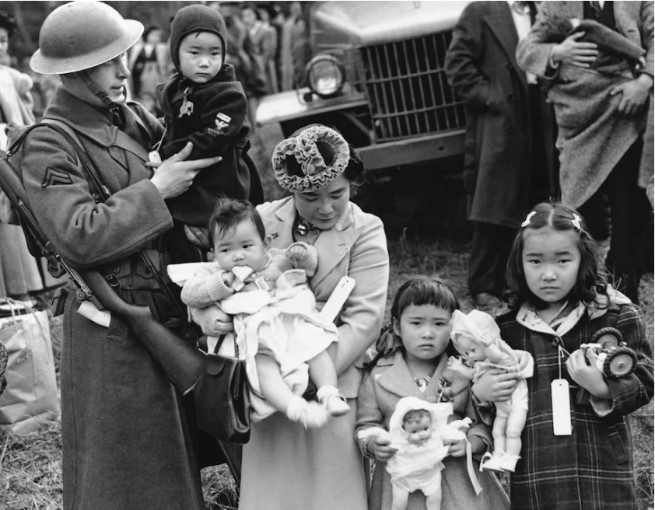
Corporal George Bushy holds the youngest child of Shigeho Kitamoto as she and her children are forced to leave Bainbridge Island, Washington. In 1942, the Kitamoto family was sent to an internment camp. (LOC)

The focus of Critical Race Theory has been on the treatment of people of African ancestry as the United States has been pressed to come to terms with its racist past and lingering racism today. It also should include the long history of anti-Asian violence and discrimination in this country. Asian American and Pacific Islander Heritage Month in May is a time for teachers and students to highlight the contributions and influence of Asian Americans and Pacific Islander Americans on the history, culture, and achievements of the United States.

Ex-President Donald Trump exacerbated anti-Asian hostility in this country with specious statements blaming China for the COVID-19 pandemic and the calling it the  “Chinese virus” and “Kung Flu” for the COVID-19 pandemic. The Republican Party has tried to divide potential Democratic Party voters by arguing that affirmative action programs and school reforms addressing past discrimination against African Americans and Latinos are anti-Asian.

Recent deadly attacks on Asian Americans, in San Francisco, New York City, and one in Atlanta where six women were murdered, have been committed by very disturbed people who were agitated by a climate that allows anti-Asian stereotypes to go largely unchallenged. An article in the journal Education Week calls on schools to play a larger role in combatting the stereotypes and anti-Asian racism by making Asian immigrants and their experience more prominent in the United States history curriculum. This would be an important corrective.

On the 2020 Federal Census, people who identified as Asian or of Asian ancestry made up approximately 6% of the U.S. population or almost 20 million people. The Asian American population grew by 35.5% between 2010 and 2020. Another 4 million Americans identified as mixed ancestry with a partial Asian heritage. The three largest groups were Chinese, about 5.4 million people, South Asians from India, 4.6 million, and Filipinos, 4.2 million. Chinese are the second largest immigrant group in the country. In 2019, California had the largest Asian American population, about of 6.7 million people followed by New York (1.9 million), Texas (1.6 million), and New Jersey (958,000)

The first large influx of people from Asia into territories that would become the United States occurred during the California gold rush starting in 1849. Chinese contract workers were brought to the United States to take low paying, dangerous jobs in mining and railroad construction. Most were male and planned to return home after earning enough money to buy land and start a family. In 1850, the Chinese population of the United States was only 3,227 people. It increased to 35,000 in 1860, a little over 60,000 in 1870, and just over 100,000 in 1880, when anti-Asian laws blocked new Chinese arrivals. In 1857, Harper’s Weekly reported, “The immigration of Chinese into California has attracted the attention of Congress. It appears that the Chinese immigrants, on settling there, persist in maintaining their allegiance to China; and under these circumstances the Senate voted on a resolution, December 19, making inquiry into the propriety of discouraging such emigration.”

From the 1850s through the 1870s, the California state government systematically discriminated against Chinese. Among other actions, it required special licenses for Chinese owned businesses and Chinese were not permitted to testify in court against a white person. In 1875, Congress passed and President Grant signed the Page Act, the first federal immigration law. It prohibited immigrants considered “undesirable” including any individual from Asia who was coming to the United States as a contract laborer, any Asian woman who would engage in prostitution, and all people considered to be convicts in their own country. In 1882, Congress passed the Chinese Exclusion Act suspending the immigration of Chinese laborers for a period of 10 years. It was the first law in American history to place broad restrictions on immigration and the first law to ban a specific ethnic group. The law remained in effect until 1943.

Japanese Americans are a small immigrant group that has had a major role in United States history. In 1870, there were only 55 Japanese in the United States, not counting Hawaii which was not yet an American colony. In 1900, there were still only 24,000 Japanese in the continental United States, but Japanese were the largest ethnic group in Hawaii. By 1960, when Hawaii was admitted as a state, there were 464,000 Japanese in the United States. In 2019, under 1.5 million Americans claimed partial or full Japanese ancestry, less than 1/2 of a percent of the US population. The largest Japanese American communities are in California and Hawaii.

In Hawaii, Japanese immigrants labored on sugar and pineapple plantations where they were subject to harsh rules and exploitation by armed European American overseers. On the plantation, Japanese workers had three to five year binding contracts and were jailed if they tried to leave. Those who eventually migrated to the mainland were subject to discriminatory laws and practices. California passed a law in 1913 banning Japanese from purchasing land.

Under the notorious Gentlemen’s Agreement of 1907 between the United States and Japan, Japanese officials stopped issuing passports for new laborers. Federal legislation in 1924 completely banned any immigration from Japan.

The situation worsened with Japan’s attack on Pearl Harbor in 1941 and U.S. involvement in World War II. Dr. Seuss posted racist caricatures of Japanese and Japanese Americans as part of wartime propaganda and Executive Order 9066 which eliminated all civil rights for Japanese immigrants and their families living on the West Coast. An estimated 120,000 people were branded as risks and forced to abandon homes and businesses and relocate to concentration camps, mostly in inhospitable areas of the Rocky Mountains. This action was taken despite the fact that there was not a single case of espionage ever established against Japanese Americans or Japanese immigrants living in the United States. Over two-thirds of those forced into concentration camps were American born citizens. The fenced in camps were located in harsh terrain and patrolled by armed guards. Ironically, Japanese Americans in Hawaii were not imprisoned because they were needed to rebuild areas destroyed by the attacks. Young Japanese American men were permitted to leave the concentration camps if they enlisted in the U.S. military. Japanese American soldiers served in a segregated unit, the 442nd, stationed in Italy and France. It was the most decorated American combat unit during World War II.

In 1944, in Korematsu vs. United States, the Supreme Court ruled by 6-3 that the detention of Japanese Americans was a “military necessity” and not based on race. In a dissent, Justice Robert Jackson called the exclusion order “the legalization of racism” and a violation of the 14th amendment. Fred Korematsu, who challenged the evacuation order and forced internment, was “convicted of an act not commonly thought a crime. It consists merely of being present in the state whereof he is a citizen, near the place where he was born, and where all his life he has lived.” In 1983, a federal judge overturned Korematsu’s conviction and in 1988, President Reagan signed the Civil Liberties Act compensating more than 100,000 people of Japanese descent who were incarcerated in the World War II concentration camps.

Since 1965, the United States has large immigrant populations from Korea, the Philippines, Southeast Asia, Bangladesh, India, and Pakistan. Each group has its own history in the United States, however all have faced stereotypes and discrimination and been stereotyped. South Asian Americans, often identified as Moslems even when they are not, were targeted after the 9/11/2001 attack on the World Trade Center in New York. A case involving an immigrant from India in the 1920s, United States v. Bhagat Singh Thind, established that people from the Indian sub-continent could not become naturalized citizens of the United States because they were not a “white person” in the sense intended in the Naturalization Act of 1790.

One of the most important constitutional decisions about citizenship was a Supreme Court ruling in the case of the United States vs. Wong Kim Ark was a Chinese American born in San Francisco, California in 1873. His parents were Chinese immigrants who returned to China about 1890. In 1894, Wong Kim Ark traveled to China to visit them and was not allowed to reenter to the United States because officials at the arrival center claimed he was not a citizen. In 1898, the Supreme Court in a 6-2 decision ruled that he was a citizen of the United States because he was born in this country.

Despite decades of prejudice, Asian Americans have made major contributions to life in the United States. They include Vice-President Kamala Harris whose mother was an immigrant from India, Eric S. Yuan, the CEO of Zoom, Steven Chen, co-founder of YouTube, Nobel Prize winning scientists Chen Ning Yang and T. D. Lee, physicistChien-Shiung Wu who worked on the Manhattan Project developing the atomic bomb,U.S. Senators Daniel Inouye (Dem-HI) and Tammy Duckworth (Dem-Ill), film director Ang Lee, astronaut Kalpana Chawla, architect I. M. Pei, authors Maxine Hong Kingston, Jhumpa Lahiri, and Amy Tan, athletes Tiger Woods, Kristi Yamaguchi, and Michelle Kwan, musician Yo-Yo Ma, and actors Sandra Oh, Lucy Liu, Haing Somnang Ngor, George Takei (Mr. Sulu), and Bruce Lee.

New York Local History: Yonkers Sculpture Garden

New York Local History: Yonkers Sculpture Garden

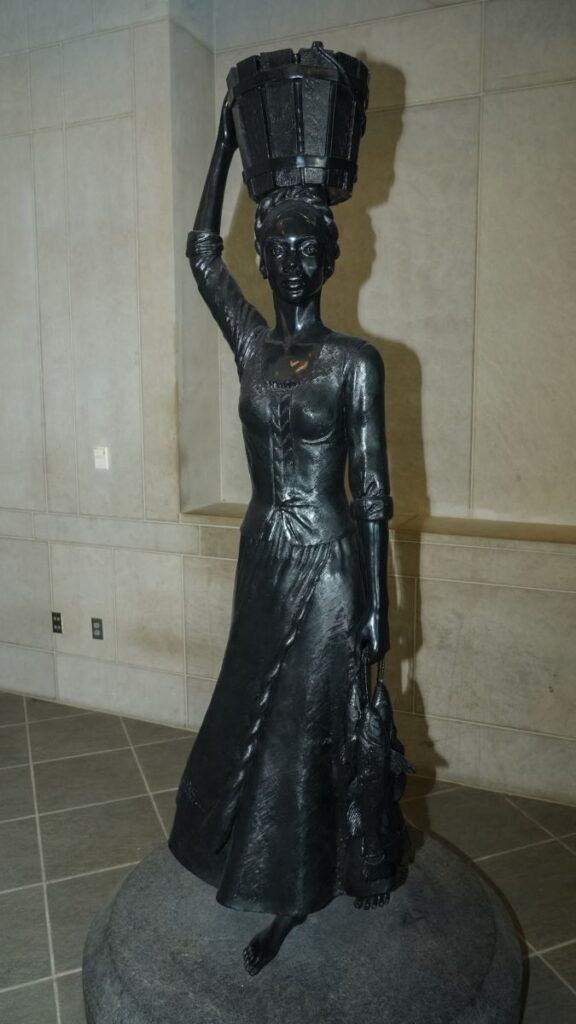
For Juneteenth 2022, the City of Yonkers debuted a permanent art exhibit honoring the legacy of the nation’s first freed slaves. The Enslaved Africans’ Rain Garden includes five life-size bronze sculptures created by artist Vinnie Bagwell depicting formerly enslaved Africans. The sculpture garden is located along the Yonkers Hudson River esplanade. According to Bagwell, “Public art sends a message about the values and priorities of a community. In the spirit of transformative justice for acts against the humanity of black people, I am grateful for those who supported this collective effort. The strongest aspect of the Enslaved Africans’ Rain Garden coming to fruition is that it begins to address the righting of so many wrongs by giving voice to the previously unheard via accessible art in a public place while connecting the goals of artistic and cultural opportunities to improving educational opportunities and economic development.”

In Yonkers, Philipse Manor Hall was the seat of the Philipsburg Manor, a colonial estate that covered more than 52,000 acres of Westchester land. The Philipse family was involved in the trans-Atlantic slave trade and probably as many as two-dozen enslaved African slaves worked and lived at the manor. The enslaved Africans were freed in 1799, one of the first large emancipations in the United States. New York State finally ended slavery in 1827.

Slavery in New Jersey: Teaching Hard History Through Primary Sources

Slavery in New Jersey: Teaching Hard History Through Primary Sources

by Dana Howell

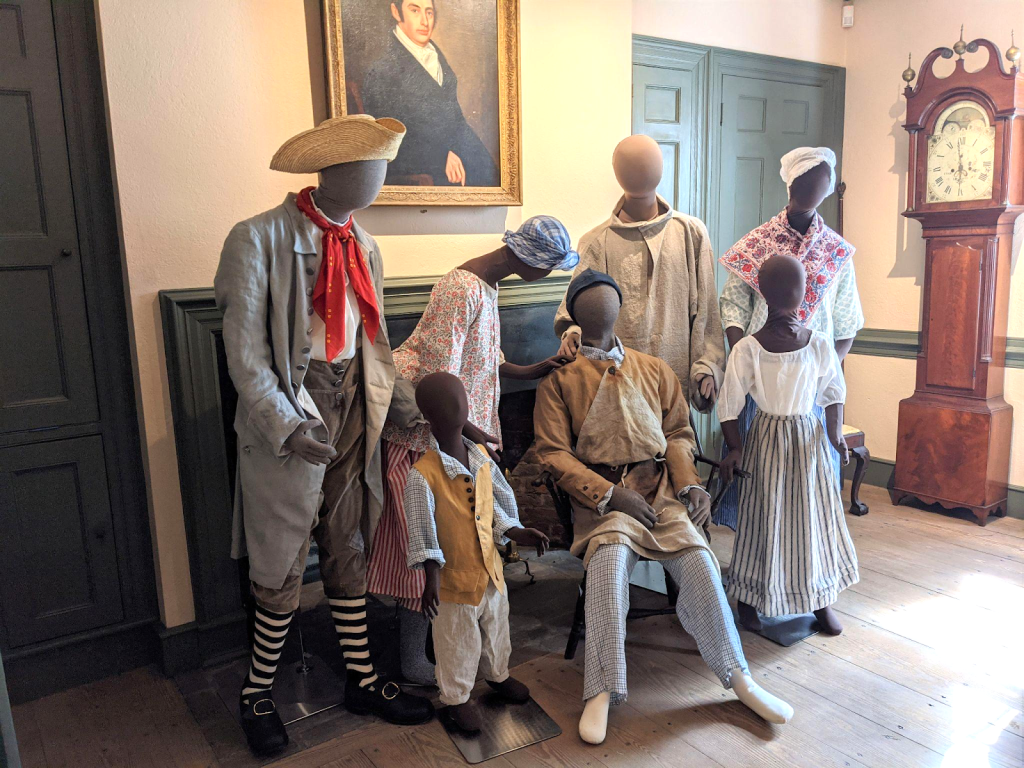
Photo of the Marlpit Hall Family

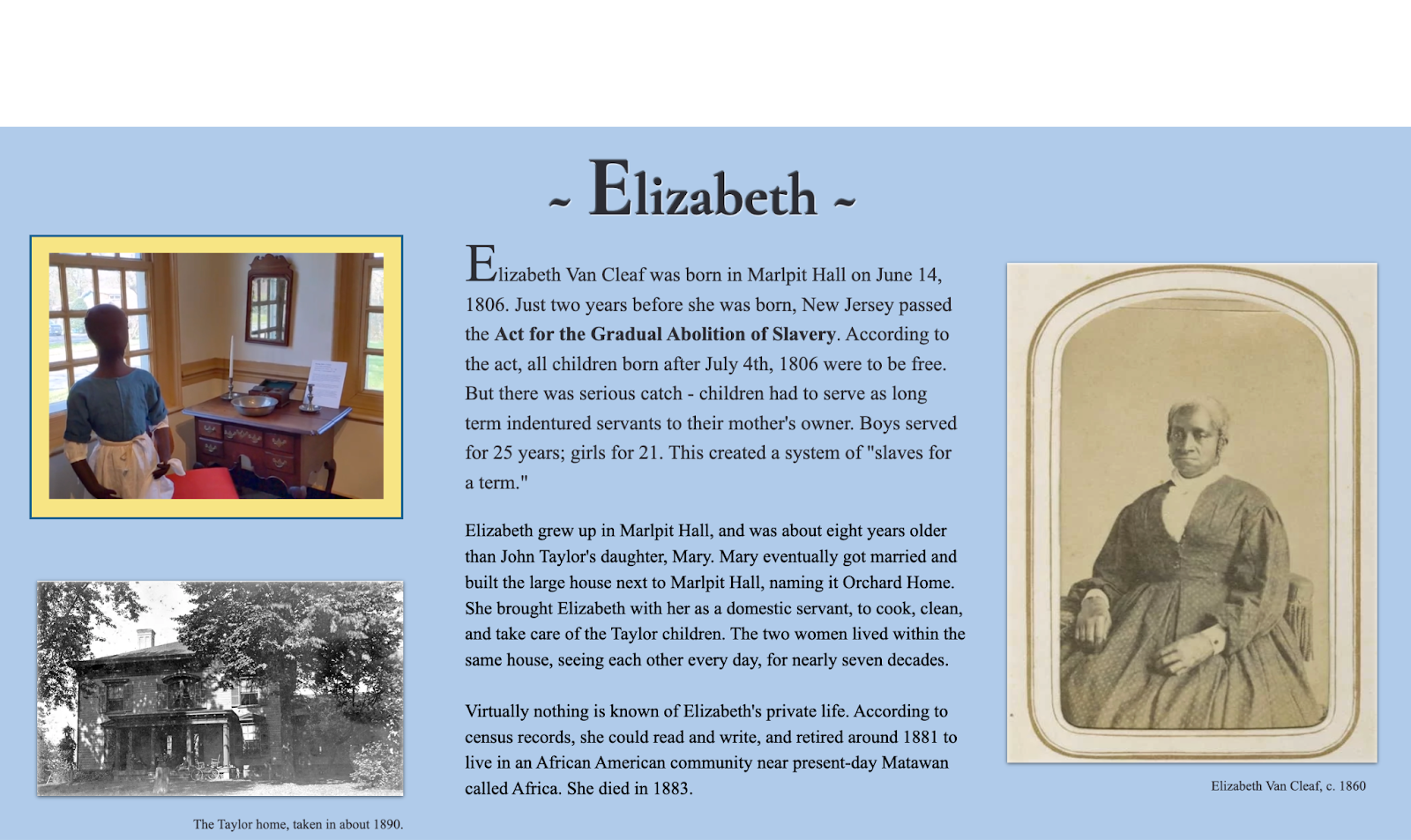
For nearly a century, the Monmouth County Historical Association (MCHA) has told the story of the Taylor family at Marlpit Hall, the c. 1760 historic house museum in Middletown, NJ. It is a fascinating story indeed, and speaks to the strife between Patriots and Loyalists in Monmouth County, a hotbed of activity during the Revolutionary War. Until recently, however, a chapter of the house’s history had gone untold. In October of 2021, MCHA unveiled the exhibit 

Beneath the Floorboards: Whispers of the Enslaved at Marlpit Hall to include this forgotten chapter. This award-winning exhibit was the culmination of two years of extensive research done by curators Bernadette Rogoff and Joe Zemla to interpret the home to include the long-silenced voices of the enslaved who lived there.

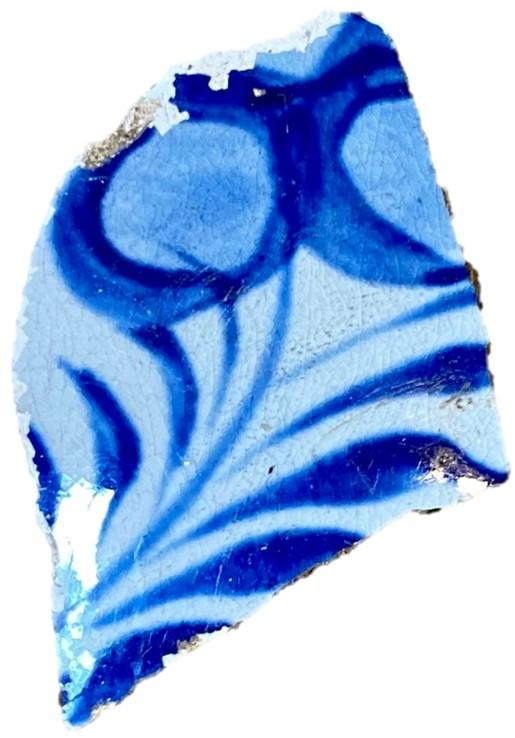
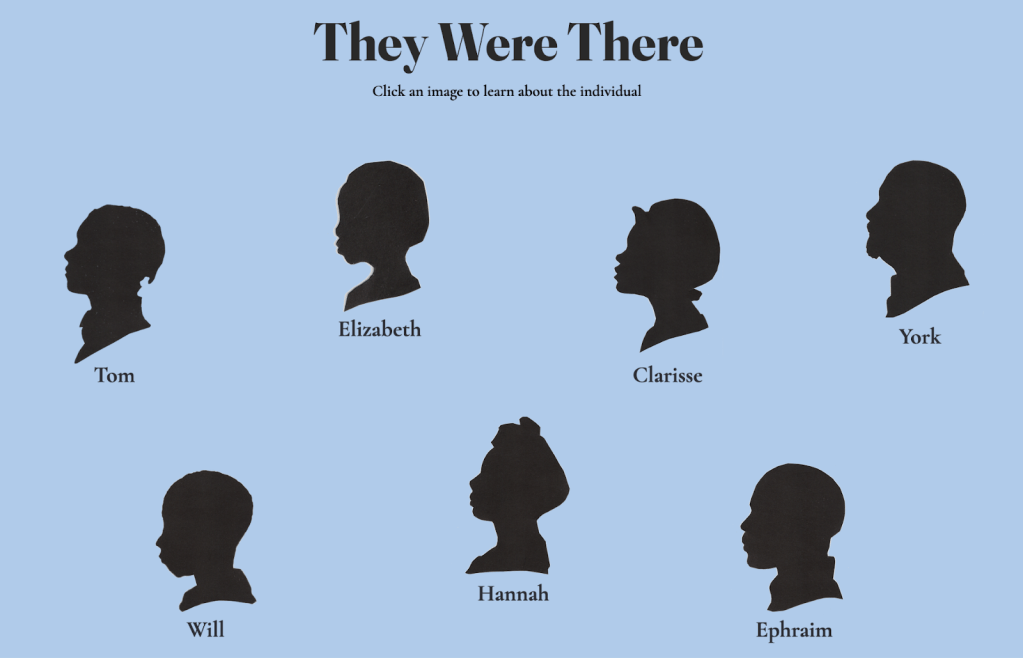
Primary source documentation and discoveries of material culture were the foundations of the research done to uncover the lives of seven of the twelve known enslaved individuals at Marlpit. Birth, death and census records, wills, runaway ads, inventories, bills of sale, and manumissions (or freedom papers) shed light on the experiences of Tom, York, Ephraim, Clarisse, Hannah, Elizabeth, and William. In 2020, Joe Zemla discovered secret caches of artifacts hidden beneath the floorboards of the kitchen loft living quarters that spoke to their religion and protective rituals, while archaeological digs supervised by Dr. Rich Veit of Monmouth University provided further evidence to piece together what life may have looked like for the enslaved. Throughout the house, mannequins dressed in                        

historically accurate reproduction clothing bring each individual to life, supplemented by their carefully researched biographical panels. The artifacts they left behind are now on display; there is no longer a need for them to be hidden from view.

One of the most prevalent comments made by visitors is that they were unaware that slavery existed in New Jersey. For many years, our educational system had been complacent with the general notion that the northern states were free, while the South had enslaved labor. New Jersey has been referred to as the “most southern of the northern states,” second only to New York in the number of enslaved persons and the very last to legally abolish the institution on January 23rd, 1866.

Comparatively, little has been written about slavery in the North. We can read about
the facts of the matter, but the personal stories in the Floorboards exhibit make an impact that no textbook or blog can. The enslaved are presented without any form of politicization, but rather from an evidence-based and humanized lens. Students are able to connect with them, particularly with Elizabeth and William, who were born in the home and are represented as children – another sad fact of slavery that often goes overlooked. It is a unique opportunity to be able to mentally place these individuals in surroundings which are familiar to the student, albeit long ago. The students learn that we can make educated guesses about what life was like during the time in which the enslaved lived and explore the spaces they inhabited, but we can never truly understand their experiences as enslaved human beings. The only thing we can do is try to imagine it, using historical evidence from primary sources as our guide.

There is a sad deficit in age-appropiate classroom resources to teach slavery, and almost none that cover slavery in the North. This deficit creates roadblocks for public school teachers who are mandated to teach these topics as required by the NJ Department of Education’s 2020 Student Learning Standards, incorporating the 2002 Amistad Law.

 monmouthhistory.org/intermediate-btf

While nothing can compare to the experience of actually visiting Marlpit Hall, the opportunity to do so poses challenges for many school districts. In order to make the fascinating information in the exhibit as accessible as possible to students, MCHA has created two NJ standards-based digital education resources adapted for the elementary and middle/high school levels. Created under the advisorship of respected professionals in the fields of education and African American history, both age-appropriate resources provide background on the system of slavery in New Jersey with a focus on the enslaved at Marlpit Hall. In it, they will be introduced to each individual, along with the primary sources that helped to build their stories. Dr. Wendy Morales, Assistant Superintendent of the Monmouth Ocean Educational Services Commission, notes “The questions and activities included in this resource are standards-aligned and cross-curricular. This means students will not only learn historical facts, but will be challenged to think like historians, analyzing primary sources and making connections between historical eras.” Creative writing, art, music, and civics are all explored.

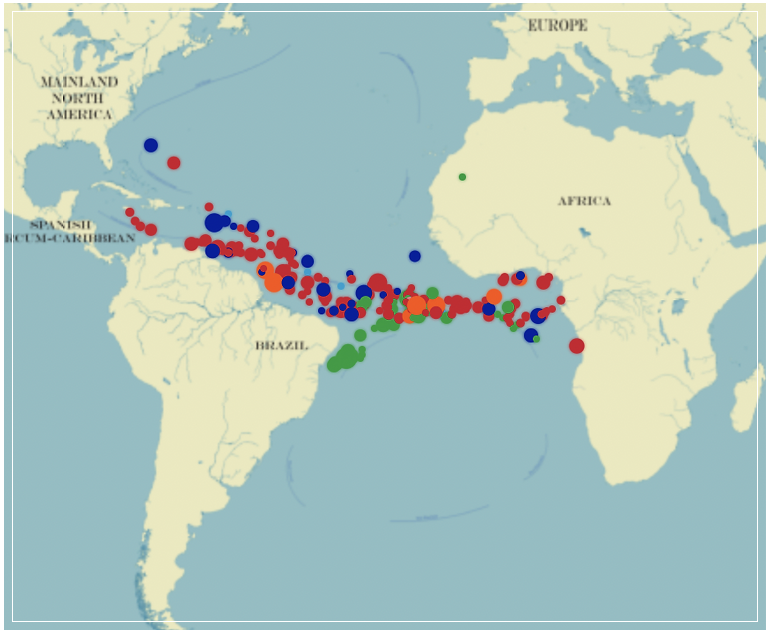
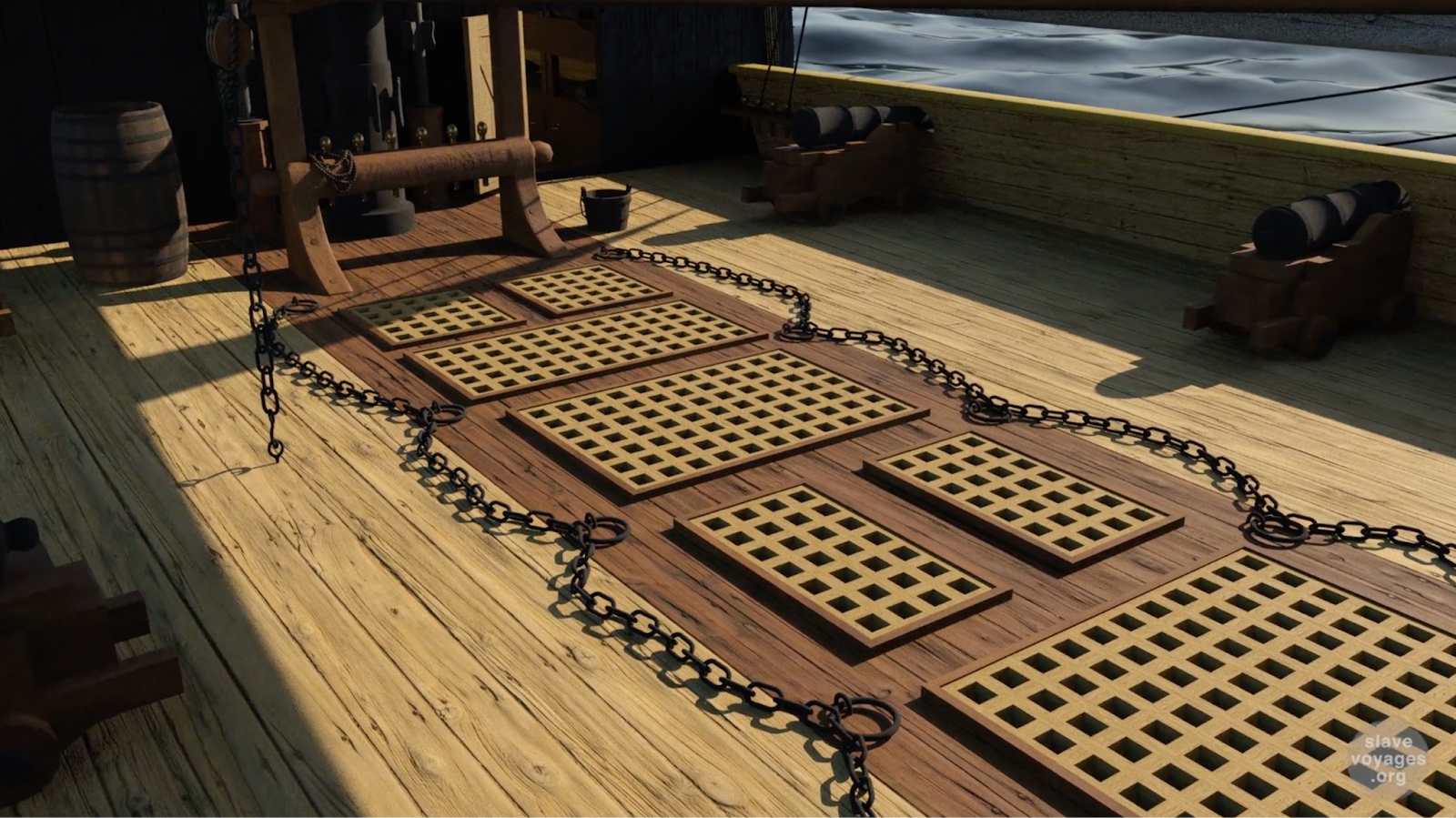
The section on the origins of slavery in New Jersey stress that the enslaved came here not as slaves, but as individuals who were taken from a homeland that had its own culture and civilization. Two videos, courtesy of slavevoyages.org, make a powerful impact. Students will get to view a timelapse of the paths of over 35,000 slave ship voyages, plotted in an animated graph. This visual representation helps students visually process the magnitude of the forced migration of the enslaved, while a 3-D modeling of an actual slave ship offers a uniquely realistic view of these vessels.

 Time lapse of plotted slave ships         Video featuring 3-D model of slave ship

Both grade level resources come with downloadable worksheets that can be customized to accommodate differentiated learning strategies, and submitted through Google Classroom. Teacher answer keys are provided for guidance as well. MCHA is proud to provide these resources free of charge to aid educators in their responsibility to teach slavery. The resources offer a guided approach to help educators navigate this sensitive and often difficult topic in the classroom. The new mandates are an excellent start to correcting the record on New Jersey’s history of enslavement, but it is truly New Jersey’s educators who will place their personal marks on bringing relevance and reverence to the topic in the classroom.

These resources can be found under the education tab at monmouthhistory.org/education-homepage. MCHA welcomes all questions and comments to dhowell@monmouthhistory.org.

New York Local History: Underground Railroad in the North Country

New York Local History: Underground Railroad in the North Country

Source: North Country Public Radio https://www.northcountrypublicradio.org/news/story/45430/20220224/remembering-the-secret-history-of-the-underground-railroad-in-the-north-country

A few minutes outside the small town of Peru in New York’s Champlain Valley, there is a small farm that looks like any other in the area. A cluster of silos and red barns with fading paint are flanked by snow-covered fields and apple orchards, dormant for the winter. But this farm has something unique. A blue and yellow New York State historical marker identifies the property as a stop on the Underground Railroad, where “runaway slaves were concealed and protected on their way to freedom in Canada.”

There was no actual train involved in the network, explains Jacqueline Madison, the President of the North Country Underground Railroad Historical Association. “It was a trail of conductors who helped them along the way [and] safe houses where they could stay,” she notes.

Communities from Watertown to Lake Champlain were part of that network of safe houses that helped people escape slavery in the American south during the decades leading up to the Civil War. Escapees typically traveled by foot or water. The railroad moniker was part of a secret code: safe places to stay were called stations and the owners of those properties were known as conductors. A full journey on the Underground Railroad typically took several months.

This is the history that Madison and the North Country Underground Railroad Historical Association are dedicated to preserving. The group operates a museum in Keeseville, in the Champlain Valley south of Plattsburgh. It features the stories from both sides of the Underground Railroad: Black passengers and white conductors. One exhibit is dedicated to the former owner of that historic Peru farmhouse, a man named Stephen Keese Smith. The abolitionist Quaker purchased the property in 1851 and quickly established one of the barns as a hiding place for runaway slaves headed to Canada. There is no way to know with certainty exactly how many people Keese Smith aided while working as a conductor. But his later writings provide an estimate. “He talked about helping people get to freedom and he thinks he spent about $1000 doing that,” Madison explained. “And if we spent $2.50 per person, he would have helped over 400 people.”

Exact numbers are nearly impossible to come by in historical records because those helping escaped slaves often avoided keeping a paper trail. Involvement in the Underground Railroad was extremely dangerous for everyone, black or white. The Fugitive Slave Act of 1850 required that escaped slaves be returned to their former owners – and carried stiff penalties for anyone who aided them. “If you were caught helping someone get to freedom,” Madison noted, “you could lose your property, you could be jailed, you could be fined. Terrible things could happen to you, your family, and friends if they suspected them of helping as well.”

The North Star Underground Railroad Museum fills up the bottom floor of an old 19th Century house. It’s packed with maps, faded newspaper articles, and portraits of notable members of the North Country section of the covert network. Standing before a map, Madison explains the various routes freedom-seekers would have followed to reach Canada. A western path originating in Pennsylvania went through Buffalo, up to Watertown, and crossed the St. Lawrence River at Ogdensburg. Two escape routes followed Lake Champlain: one through Vermont and another running from Albany to Rouse’s Point along the lake’s western shore. To find their way, escapees used folk songs learned on the southern plantations. They worked as a kind of secret oral map; with coded lyrics guiding freedom seekers on their journey north. One such tune called Follow the Drinking Gourd referenced landmarks like certain rivers and offered hints for how to identify friendly conductors. Drinking gourd was code for the Big Dipper – a celestial constellation that can be used to identify the North Star.

Although details can be hard to piece together, some stories of those who passed through the North Country to freedom have been recovered. An article written in 1837 by Vermont-born abolitionist Alvan Stewart for an anti-slavery newspaper recounts the story of an anonymous man who travelled through the North Country on his way to Canada. “I was headed to Ogdensburg, on my way north to Canada from South Carolina,” an actor declares in a re-enactment exhibit at the North Star Museum. “I had come up through the Champlain Canal, and then gone through Clinton and Franklin County.” That unknown man did eventually reach freedom north of the border, but his quest nearly ended in disaster just a few miles from his destination.

Outside of Ogdensburg, he stopped into a post office looking for work. Since New York had outlawed slavery in 1827, that would not necessarily have been out of place. However, slave owners offered rich rewards for the return for those who escaped, and slave catchers were permitted to operate even in anti-slavery states under the Fugitive Slave Act. When the anonymous freedom seeker entered the post office near Ogdensburg, the postmaster recognized him and explained that a reward for his capture had been posted. “I said to him, if you send me back then they’ll do terrible things to me,” the re-enactment continues. “Whip me. Hang me. Skin me alive. I begged him not to turn me in.” In this case, the postmaster ignored the reward, worth about $20,000 in today’s terms, and helped the man cross the St. Lawrence River into Canada.

Other escaped slaves decided to settle in North Country. In 1840, a Franklin County landowner named Gerrit Smith pledged to donate more than 120,000 acres of wilderness land in the Adirondacks to free black men. It would eventually become a settlement known as Timbuctoo. A man named John Thomas received 40 acres of un-cleared land from Smith. Thomas later sold that to buy a larger plot near Bloomingdale, NY, which he turned into a successful farm. Many years later, Thomas wrote his benefactor a letter, thanking Smith for the “generous donation” and revealing that he and his family greatly enjoyed the peace and prosperity of their “rural home.” Although Thomas was successfully established himself in the region, that was not the case for most recipients of Smith’s land. Harsh winters and tough soil drove many of the Black farmers to sell the land they had received and move away. The climate was not the only danger; at least once, slave catchers came to the area looking for Thomas. According to Madison, they first approached his neighbors seeking their help. As Madison tells it, Thomas’ neighbors informed the slave catchers that he was armed, would forcibly resist capture, and declared their intention to assist Thomas in repelling the catchers. The slave catchers are believed to have given up their pursuit.

In his later letter to Smith, Thomas hinted that his adopted community had begun to treat him as one of their own. “I have breasted the storm of prejudice and opposition until I began to be regarded as an American citizen,” he wrote. This may also be a reference to civic participation. At the time, New York State required men to own at least $250 worth of land to obtain the right to vote. Thomas’ obituary was published in the Malone Palladium in May 1895. It described him as “much respected in the community where he lived so long.” His descendants still live in that community. Through genealogy research, Madison and the North Star Museum discovered that two of John Thomas’ great-great grandsons still reside in the North Country. One of the descendants lives less than two miles from the cemetery in Vermontville where Thomas and his wife are buried.

New York Local History: Water from the Catskills

New York Local History: Water from the Catskills

Michelle Young

Source: https://untappedcities.com/2015/06/22/some-of-nycs-drinking-water-comes-from-drowned-towns-in-the-catskills/

Ashokan Reservoir in the Catskills

New York City has some of the best drinking water in the country, but it did not come without a price. Most are familiar with the Croton Aqueduct, the first to bring fresh water to the city in 1842 and updated in 1890. Catskill Aqueduct was next (a push after Brooklyn was incorporated into the City of New York), built between 1917 and 1924, bringing 40% of New York City’s water from a series of reservoirs 163 miles away in upstate New York. New Yorkers may not know the six reservoirs of the Catskill Aqueduct, including Ashokan Reservoir, New York City’s largest, were formed by flooding a dozen towns.

The plan for the Catskill Aqueduct began in 1905 when the New York City Board of Water Supply was formed, allowing for the acquisition of property by eminent domain and the construction of dams, reservoirs, and aqueducts. The area in question was formerly a farming area, with logging and the quarrying of bluestone, some of which ended up on the Brooklyn Bridge. Two thousand people were relocated, including a thousand New Yorkers with second homes. Thirty-two cemeteries were unearthed and the 1,800 residents reburied elsewhere, to limit water contamination. Residents were offered $15 by the city ($65 later for the Delaware Aqueduct) to disinter their relatives and move them elsewhere.

Buildings and industries were relocated or burned down, trees and brush were removed from the future reservoir floor–all the work done predominantly by local laborers, African-Americans from the south and Italian immigrants. To control the fighting that arose between labor groups, a police force that became the New York City Department of Environmental Protection (NYCDEP) Police, was created. In sum, four towns were submerged while eight were relocated to build the Ashokan  Reservoir. When the dam was completed, steam whistles were blown for an hour warning residents that the water was coming. Today, remnants of foundations, walls, and more can still be seen, particularly when water levels are lower–often in the fall. Although access to the reservoirs has been limited since 9/11, you can see some of those archeological finds from bridges. You can also hike and bike along a ridge of the reservoir.

The last of the eminent domain lawsuits in the Ashokan Reservoir area was not settled in 1940 and it was not until 2002 that New York City made any moves to acknowledge the history in the Esopus Valley. The NYCDEP installed an outdoor exhibition in Olive, New York that commemorated the lost towns and the feat of the aqueduct itself, with the intention to add exhibits at five other reservoirs (although we were not able to find that the exhibition or any others are still available). Signage now shows the sites of the former towns.

The Delaware Aqueduct is the most recent of the city’s aqueducts and its story is similar to the Catskill Aqueduct. The Pepacton Reservoir (aka the Downsville Reservoir or the Downsville Dam) was formed by flooding four towns and submerging half of the existing Delaware and Northern Railroad. This reservoir provides 25% of the city’s drinking water, and combined the Catskill and Delaware Aqueduct provides 90% of the city’s water. In total, the construction of these reservoirs and aqueducts resulted in the destruction of 25 communities and the relocation of 5,500 across five New York State counties. Something to think about the next time you run the tap in New York City.