Suppressing or Inhibiting Teaching

Suppressing or Inhibiting Teaching

 Cynthia Vitere

I have been teaching history on the secondary and college level for almost thirty years. Much of this time has been spent as a teacher on Long Island, New York where my area of expertise has ranged from contemporary issues and criminal justice to leading the International Baccalaureate program in history in my current district. As a trained historian, educator and administrator I bring all of these mindsets to my curriculum and pedagogy.

In considering the question of how one addresses attempts to suppress or inhibit teaching I believe it is essential to first discuss one’s understanding of the discipline of history, why we teach it and how we teach it. Why do we ask students to take a history course? I believe the most important function of history education is to establish the foundations for informed democratic citizenship. In the primary grades, students develop a narrative of U.S. history and at the secondary level they acquire the tools to examine and critically analyze that narrative. This critically thinking student is empowered and encouraged to then articulate multiple narratives which reflect our pluralistic society. Education is no longer a hierarchical relationship between the teacher and student, but a collaborative relationship where knowledge can be nourished and exercised through regular open discourse.

When I first engage students in my classroom, too many of them assume that history is a set narrative with established facts that must be memorized. Very few students like history. Many adults I meet say they hated history class as children but now appreciate it because they finally see its utility. It is not their fault; as that educational experience is the rule for most of us, rather than the exception. For me, it wasn’t until pursuing my graduate degree in history that I was truly engaged in thinking and acting like a historian. I quickly learned that the historical narratives we tell are governed by time and place, by the perspectives of the historians and their audience, and by the availability of evidence. Historiography, or the study of how history is written, tells us that this process of continuity and change results in fantastic disputes among scholars; disputes that rarely trickle down to the high school classroom. For many, this critical history is not welcome in the classroom because it is perceived as being “too hard” or “too nuanced for the high school student”. Since “that’s not going to be on the test” it is deemed irrelevant, or worse yet, an expression of the teacher’s political agenda.

I do have a point of view. I want my students to take a seat at the historians’ communal roundtable, use the critical thinking skills particular to history, and contest our curriculum. By acknowledging the role of race, gender, class, ethnicity and every other “divisive” lens students confront the fullness of our sometimes painful past and forge a meaningful place for their own individual narrative in our shared story. For much of my career this approach to history education was not controversial but encouraged and valued as an essential component of civics education.

When I first started teaching history I was asked to create and implement a course in Multiculturalism. This course was initiated in response to racial and ethnic tensions in my district. This senior elective was seen as a corrective to those divisions. There was a desire to confront racism, ethnocentrism and sexism head on. While this was a challenging course, I felt fully supported by my administrators to engage my students with challenging readings and to moderate discourse which was frequently impassioned, sometimes tense, but ultimately a source of greater understanding and community building.

Since 9/11 the question about what should be taught in a history classroom became more problematic. With so many of my students’ families directly or indirectly affected by 9/11, history was no longer a distant topic. One had to regularly question how your topics and discussions might upset students or community members. I began to introduce trigger warnings into my practice as a way to acknowledge students’ emotional challenges, sensitively modify my instruction, but not silence necessary discourse.

With the election of President Obama the issue of race became more problematic but not one to be avoided. In my economics and history classes I freely used the PBS program entitled “Race: The power of an Illusion”. This program and its complementary website provided interactive resources which challenged student preconceptions about race and how it has influenced government legislation and programs in the 20th century. Students were challenged to critically examine, discuss and assess the subject matter. Although this curriculum demanded careful implementation, I never felt significantly anxious about the curriculum or my pedagogy. I never experienced any negative feedback or reproach. When I consider using those resources today, a paralyzing doubt stops me. Even though my graduate mentor and acclaimed historian Ira Berlin is a source in the program, the current political educational environment stops me from freely using him. Why? The website explicitly addresses the structural and historical nature of racism. Simply put, I would be targeted as a practitioner of critical race theory and pilloried.

If I were to teach the transformation of my pedagogy I would ask my students to identify a chronology of contributing factors. I would introduce the following: the emergence of Donald Trump as the voice of the Republican Party, the 1619 Project, the Black Lives Matter Movement and the Covid-19 Pandemic. When the 1619 Project was published in August of 2019 I was excited by the opportunity to introduce a reframing of American history. The beginning of my year focused on having students examine, discuss and evaluate the use of 1619 and 1776 as the defining dates in our national origin story. Excerpts from Nicole Hannah Jones’s introduction, as well as the rebuttal by Marxist and conservative historians were considered. We replicated the debate that ensued among historians. Students were not insulted, nor did they feel bad about themselves or experience any less pride as Americans. What they did do was engage in a lively critical discussion. With this introductory unit I sought to establish the transitory nature of history and the importance of critical thinking. I was neither worried or challenged by this lesson.

This, of course, is not the world we live in today. As 2019 turned into the presidential election year of 2020, the critical engagement of race became much more politicized. Still, I did not veer away from the lens of race as it is a foundational factor for historical inquiry, especially American history. After four years of the Trump Administration’s attack on evidence-based reasoning, the engagement of history became much more problematic. The normalization of framing evidence that you don’t like as fake by politicians and members of the media on both sides of the political spectrum impacted the classroom. Students would actually respond to historical evidence and claims in class with “fake news” as a silencing response. When silence is the aim, discourse itself is the problem. As a practitioner of critical thinking and discourse, my pedagogy became increasingly problematic. By 2021, I would become a target in our contemporary political culture wars.

As a teacher of the two-year IB History of the Americas curriculum, we examine U.S. history in year one and the emergence and consolidation of 20th century authoritarian regimes in year two. As I was teaching the Reichstag Fire and Hitler’s Enabling Act the January 6 insurrection took place. The continuity of this contemporary event and our historical inquiry provided a teachable moment. Students read contemporary German authors’ examination of American events from their unique historical perspective. The narratives were examined, interrogated and disputed. The sources were used to stimulate discussion, not as an equation of Nazi Germany 1931 and the United States 2021. I believed that I had a responsibility to my students to address what was happening around them, but felt that I had to mediate it through the lens of the past. Unfortunately, silence, self-censorship and discomfort became an unwelcome norm. I increasingly incorporated student writing in private blogs so that they could safely and critically engage history and contemporary events. Increasingly, I, too, self-censored in response to my discomfort. In speaking with colleagues both in the United States and on international IB web spaces, the professional fear was palpable. Was it possible to address these momentous events or was it best to safely stick to the proscribed curriculum? While many departments worked collectively to navigate a response, many others avoided discussion and left pedagogic choices to the conscience of individual teachers. In collective avoidance of this thorny issue, many hoped to protect themselves from acrimony.

Ultimately, the practitioner of critical pedagogy will be targeted by those who choose to close the door on the past, no matter how carefully they tread. My public crucible was in response to a lesson which asked students to assess the impact of racism. I did not feel comfortable or safe directly addressing the George Floyd/Derrick Chauvin trial but I did feel a professional responsibility to address the deep threads of racism and division. As a way to displace the dialogue, I focused on student generated claims which judged quantitative analysis to be more objective and useful than qualitative analysis. I asked students to apply these lenses to the impacts of racism. Students did engage in critical discourse, but what I found is that many do not want critical discourse to be taking place in public schools. If we cannot engage in critical discourse then we as educators have lost our most important teaching tool.

In historical retrospect, what have I learned? I would like to say that the experience of having my curriculum and pedagogy subjected to media and community scrutiny and attack would energize my efforts as a democratic educator. The reality is not so heroic. Much like the American Revolution, ⅓ of my professional and personal community supported me, ⅓ actively opposed me and ⅓ avoided me at all costs. This did not surprise me. When nations slide towards authoritarianism, teachers are often the first targets. The public attack on my pedagogy made this slide harder to deny and avoid. It made all teachers the target.

As teachers we are public figures who are under incredible pressure and scrutiny. One can hope to lay low and never make a mistake or misstep. One can stick to the text and avoid anything that hints of controversy, but this is not tenable. I came into education with a toolbox. The tools have evolved over time, but their purpose remains the same. My use of these tools in our current climate is much riskier. My curricular choices are more conservative, I hesitate to bring contemporary documents into our discussions of the past. I speak obliquely and ask neutered questions. To do differently is too charged, too dangerous, and too divisive but I must also acknowledge that there is a point at which I cannot surrender who I am as a critical educator. History itself calls on me to hone my critical pedagogy for these challenging times. The risk of not doing so is too great. The challenge for today’s social studies educators is how to cultivate democratic students in a world that is increasingly opposed to democracy? I do not have a singular answer, but I commit myself to seeking new methods and mediums so that we as social studies educators can reject complicity and collectively facilitate the better angels of our nature.

The History of the Lenni Lenape Before, During, and After the American Revolution

The History of the Lenni-Lenape Before, During, and After the American Revolution

(Image courtesy of Legends of America)

By Mr. David A. Di Costanzo, M. Ed Social Studies Department Chair Vineland High School

Introduction:

During the first year of this grant, seven Social Studies teachers from around the state conducted research for the New Jersey Council for the Social Studies (NJCSS). The teachers examined the histories of ordinary people in New Jersey and how the events leading up to and during the Revolutionary War impacted their lives. The grant, “Telling Our Story: Living in New Jersey Before and During the American Revolution”, is an ongoing effort by the NJCSS to prepare educators in New Jersey for the 250th anniversary of the American Revolution during the 2025-26 school year. The 250th anniversary celebrations will continue through 2031 and is part of the overall mission of the NJCSS to provide and make available meaningful lessons and activities to students, teachers, and the public.

During Year Two of the grant, the focus of the research has shifted to include the role and contributions of African Americans, Native Americans, and prisoners of war before, during, and after the American Revolution. An emphasis on the experiences of women and children during this time period will also be researched. The lives of the Lenni-Lenape from New Jersey before, during, and after the American Revolution is a fascinating and important part of American history. Professor of History and Native American Studies Colin G. Calloway from Dartmouth University said, “with few exceptions, the Indian story in the Revolution remains relegated to secondary importance and easy explanation: The Indians chose the wrong side and lost. To better understand the reality of the Revolution for American Indians, we need to shift our focus to Indian country and to the Indian community.” [1] Sadly, the story of the Lenni-Lenape during this time period has been “relegated to secondary importance” and not been told enough.

The role of Lenni-Lenape is crucial in our understanding of the American experience. What was lifelike for the Lenni-Lenape in New Jersey?  Unfortunately, the Lenni-Lenape, dealt with racist mindsets which were the primary impetus that led to a negative and mostly superficial historiography of their culture that took centuries to completely shift. Historical perceptions and the racial mindsets of Native Americans did eventually change but only after they were deprived of their land, forced to live on reservations, and required to assimilate into mainstream American culture.  

It’s also important to note that for Native Americans the Revolutionary War began way before Lexington and Concord.  Most historians agree that the American Indians had been fighting for their own independence since the Europeans made contact.  Accepting and embracing the fate of the Lenni-Lenape and discovering how people lived before and during the American Revolution in New Jersey is important work. It allows students and residents in various counties throughout New Jersey to discover a more objective truth about Native Americans before and during the American Revolution. This more objective truth is an honest attempt to provide greater transparency for everyone, whether they agree with it or not.

Historical Background:

The cultural history of Native Americans is interesting for a variety of reasons. The treatment of Native Americans is viewed by most historians as horrific. Native Americans were systematically excluded from having a true voice during European exploration and colonization as well as after the United States was founded. The explorers ravaged the indigenous people of this continent with violence, disease and deprivation.  Native Americans had non-Christian spiritual beliefs which went against the religious doctrine of the early explorers. This difference in cultures created a severe spiritual divide.  Later on, colonists traded with Native Americans but European settlers viewed them as nothing more than savages and barbarians. 

            By the nineteenth century, Native Americans had no choice but to assimilate in order to survive. Forced assimilation in order to survive is not the same thing as having a legitimate stake in the system.  Time has made most ethnicities, including American Indians, a larger part of the American landscape. All of these factors created a system of severe limitations for most Native Americans that still lingers today.  The situation in New Jersey regarding the treatment of the Lenni-Lenape was similar to the way Native Americans were dealt with throughout the colonies and the United States.

            The Lenni-Lenape of New Jersey are descendants of the Paleo-Indian whose history on this continent has been traced back to 13,000 years ago.  The Lenni-Lenape were also referred to as the Delaware Indians by the English and the Dutch.  Professor of History Maxine Lurie from Seton Hall University and Professor of Anthropology Richard Veit from Monmouth University said, “the first settlers to reach what is now New Jersey probably did so during or before the Paleo-Indian period.  Archaeological sites from this period are quite rare.” [2] Nevertheless, Paleo-Indian artifacts have been found across New Jersey as well as in New York and Pennsylvania. Excavations during the nineteenth and twentieth centuries confirmed the presence of Paleo-Indians throughout New Jersey.

            Various cultural periods would ensue for the next several thousand years leading to the final phase prior to European contact which is referred to as the Woodland Period.  This period began roughly a thousand years ago and continued until contact with Europeans during the early sixteenth century. [3] The earliest reports of contact with European explorers occurred in 1524 when Giovanni da Verrazano explored the Atlantic coast of North America. He described the natives in and around what today is New Jersey as “most loving”. [4]  Contact with whites was sporadic until the early 1600’s. The interactions with the Lenni-Lenape and the explorers increased and progressed during the early seventeenth century and beyond. 

            The Dutch and English had a sincere desire to trade with the American Indians from the Garden State.  It’s well documented that, “the Dutch West India Company, formed in Holland in 1621 to develop commerce, especially fur trading, constituted the present New Jersey Hudson River area into the province of New Nether (often “New Netherlands”) in 1623.” [5]  Furs, cooper, and other perishable commodities, such as alcohol, were all eagerly exchanged.  It became clear almost immediately that most Native Americans didn’t react well to the consumption of alcohol.  This inability to consume alcohol in moderation was something European traders would quickly learn to take advantage of without hesitation. The Dutch and English traded with the Lenni-Lenape of New Jersey in spite of the animosity and racism that existed.  Most Dutch traders had very little respect for the American Indians.

This map is from John Snyder’s The Story of New Jersey Civil Boundaries 1202-1968 

This map shows various Indian trails that crisscrossed New Jersey. The Assunpink Trail goes from the lower left on the Delaware River and continues northward, crosses the Raritan River and heads for Staten Island.

            An unintended consequence or impact of European exploration was the massive spread of numerous diseases. Professor Lurie and Professor Veit, said that in and around New Jersey

“The impact of disease on Native American populations was disastrous. Population estimates for the Lenape vary significantly, with some scholars arguing for 12,000 natives at the time of European contact and others for much smaller numbers.  In the seventeenth century smallpox epidemics, malaria, measles, and influenza significantly reduced the Native American population” [6]

Like all of the other Native American tribes in North America, disease had a devastating effect on the Lenni-Lenape of New Jersey that would linger on for decades.  It put the indigenous people of this continent at a serious disadvantage from the beginning of their contact with the Europeans.

            In spite of the effects of alcohol and disease on the Lenni-Lenape of New Jersey, they maintained a serious control of trade during most of the seventeenth century. Professor of History Jean Soderlund from Lehigh University said that

“Because of mythology, the Lenape are often portrayed as a weak people lacking the numbers and fortitude to defend their homeland.  The prevailing narrative ignores the period of 1615-1681 when the Lenape dominated trade and determined if, when and where Europeans could travel and take up land.” [7] 

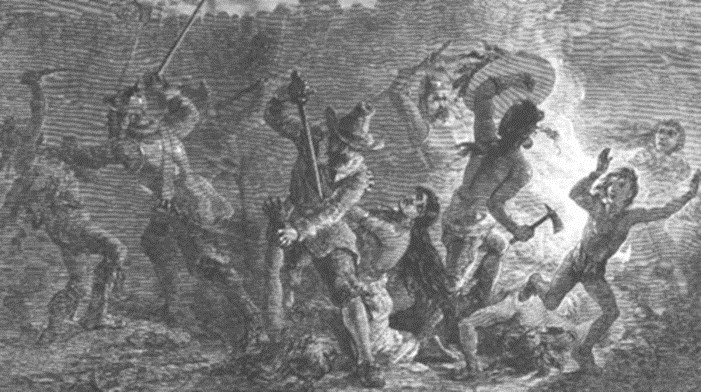
Except for the Pavonia Massacre in February of 1643, the Lenni-Lenape avoided major conflicts during this time period. This was in stark contrast to the Anglo-Powhatan War and Bacon’s Rebellion in Virginia which were both larger in terms of the number of people that were killed. [8]  The Pavonia Massacre was the first known attack led by Dutch soldiers that saw over one hundred Native American men, women, and children slaughtered in the area of what is today Jersey City.  After the massacre, hostilities would remain for almost three years until a truce was agreed to in 1645.

A Depiction of the Pavonia Massacre in 1643 (Image courtesy of Timetoast)

Professor Soderlund said “the Lenapes’ firm grip on south and central New Jersey is clear in a map from 1670 created by a merchant named Augustine Herrman, who had settled in New Amsterdam in 1644 and then established his plantation, Bohemia Manor, on the Maryland Eastern Shore in 1661.” [9] The map below shows New Jersey illustrated on the lower right-side of the map.  Numerous Lenape populated the area shown on the map that constitutes most of present-day New Jersey. This map is definitive evidence of the control the Lenni-Lenape had over New Jersey during the late seventeenth century.  

A map by Augustine Hermann of Virginia and Maryland and New Jersey as it was planted and inhabited in 1670, W. Faithorne, sculpt.  (Map courtesy of the Library of Congress)

            The Lenni-Lenape had an interesting relationship with the Quakers, especially in West Jersey. The influence of the Quakers could be felt throughout New Jersey during the colonial period.  Professor of History Richard McCormick from Rutgers University said

“Lacking the peculiar fervor that had stamped them as religious radicals in the previous century, the Quakers manifested increasing concern with social problems and took leadership in many areas of humanitarian reform.  Impelled by that saintly friend, John Woolman, of Mount Holly that came out firmly against slave holding in 1758, displayed a deep concern for the plight of the Indians, developed a system of education, and even began to withdraw from political activities because of their opposition to the war and military preparations.” [10]

Unfortunately, the Quakers, as well as other religious groups were guilty of displacing the Lenni-Lenape particularly in West Jersey and in Pennsylvania.  Professor McCormick made it clear that the Quakers weren’t transparent with the Native Americans of New Jersey and Pennsylvania, including the Lenni-Lenape, in various land deals.

            During the eighteenth century, the relationship between the Lenni-Lenape and the colonists would continue to deteriorate. Land ownership became a major issue throughout New Jersey, as well as the rest of the colonies, as the English took over control and established their dominance throughout the continent.             Several Lenape chiefs attempted to secure land deals with the New Jersey, Pennsylvania and Delaware colonies. These efforts culminated in the Walking Purchase of 1737. Chief Tishcohan (or He Who Never Blackens Himself) was one of the signers of the Walking Purchase of 1737, a treaty with the Penn family that later caused the Lenape to lose most of their land in the Delaware Valley.  It’s certain that “the infamous Walking Purchase defrauded them of considerable land in eastern Pennsylvania.  The Walking Purchase led to years of recriminations and bad feelings. [11] 

Delaware Chief Tishcohan

Tishcohan by Gustavus Hesselius. A 1735 portrait of the Delaware chief Tishcohan, commissioned by John Penn. William Penn’s son. (Portrait courtesy of the Millstone Valley Scenic Byway)

            Another victim of the Walking Purchase, Chief Teedyuscung would eventually leave New Jersey and make his way to Bensalem and align himself with the Moravians. Prior to the American Revolution Chief Teedyuscung would be killed by white vigilantes.  These killings made it clear that it was in the best interest of the Lenape to continue moving west. The legacies of both Chief Tishcohan and Chief Teedyuscung  include their efforts in trying to preserve the culture and legal rights of the Lenape.

Chief Teedyuscung

A depiction of Teedyuscung (Image courtesy of the Wissahickon Valley Park)

            The role of religion became even more prominent during this time period.  Missionaries from various Christian faiths made attempts at converting numerous Native American tribes including the Lenni-Lenape. Associate Professor of History Linford D. Fisher from Brown University said “the rich, overlapping worlds of Native spirituality and Christian practice, one in which the rituals, symbols, and beliefs of European Christianity were adopted by Indians over time, either voluntarily or in response to the overtures of English missionaries.” [12]

One missionary, David Brainerd, played an important role in attempting the religious conversion of the Lenni-Lenape. Professor Lurie and Professor Veit said that “Presbyterian missionaries also were active among the Delaware.  In 1745, David Brainerd, a young Presbyterian minister who belonged to the New Light faction of the church, which emphasized personal salvation and evangelical zeal, began mission work among the Lenape.” [13]  David Brainerd died in 1747 and was succeeded by his brother John who held similar beliefs regarding personal salvation and missionary work.  John Brainerd would be instrumental in the conferences the New Jersey Colonial government held in 1756 and 1758 in which the colony attempted to address the Native Americans consumption of alcohol and made clear the process for selling Indian lands. [14] 

            Throughout the French and Indian War, countless Native American tribes fought on the side of the British and the French. Numerous tribes, including the Lenni-Lenape of New Jersey, signed the Treaty of Easton of 1758. Part of the treaty included a provision that the Lenni-Lenape avoid alliances with the French during the war. They also had to forfeit their eastern lands. In return, the British promised to stop expeditions into Indian territory west of the Alleghenies. As a result, many Lenape left New Jersey.  It was around this time that New Jersey created its first Indian reservation, which was called “Brotherton,” and was located in the present-day Indian Mills section of Shamong in Burlington County.   Reverend John Brainerd assisted in the settlement of the reservation. [15] A result of the Treaty of Easton was the establishment of a permanent home for the Lenape that initially saw some success but was ultimately unsuccessful.       

            The Native Americans throughout the colonies had a very distinct role during the American Revolution.  Professor Wilcomb E. Washburn, the former Director for the Smithsonian’s American Studies Program said, “it was a shadowy role, but an important one. It was shadowy not only because the Indian operated physically from the interior forests of North America and made his presence felt suddenly and violently on the seaboard settlements, but because the Indian was present also in the subconscious mind of the colonists as a central ingredient in the conflict with the Mother Country.” [16]  The British and the Colonists made numerous attempts to form alliances with various tribes throughout the colonies.  There was some success in getting the Indians to align with one side or the other. 

            The Lenni-Lenape from New Jersey had already begun to leave by the start of the American Revolution. The Lenape were a divided people with only a small number remaining in the Garden State, while most moved north or west. [17] The Lenni-Lenape that remained in New Jersey during the American Revolution played a significant role. Professor Lurie said,

“During the Revolution, the western Delaware at first tried to stay neutral, but then split as some joined with the British, while others sided with the Patriots.  Thus, this also became a civil war for them.  The United States signed a treaty in 1778 with the chiefs who sided with the Patriots, but White Eyes, the strongest supporter, was murdered, promised supplies were not delivered, and villages of friendly natives were attacked.  In the end, the results were disastrous for the Delaware, whichever side they took, as well as for members of other Indian nations.” [18] 

Following the Revolution, the Lenni-Lenape of New Jersey suffered through more broken promises first by the British, who basically abandoned them, and then by the United States government.  By the early nineteenth century, most of the Lenni-Lenape either integrated into the local communities in New Jersey or left the state.  Many went to Canada or the Kansas Territory while others joined other Native American tribes such as the Cherokee.  Others ventured west to “Indian territory” which is today Oklahoma.

            During the nineteenth century, Native Americans, including the Lenni-Lenape, were instrumental in shaping abolitionism, both as participants in antislavery activities and as objects of concern.  In fact, abolitionist support for Native Americans before the Civil War did exist.  Unfortunately, it’s made clear that not all politicians from New Jersey supported both Native American rights and the abolition of slavery. Associate Professor of History Natalie Joy from Northern Illinois University said,

“Especially disappointing was New Jersey senator Theodore Frelinghuysen, among the most vociferous congressional opponents of removal and yet an avowed supporter of the American Colonization Society. Though they praised his “unwearied zeal in the cause of the injured and insulted Cherokees, abolitionists highlighted Frelinghuysen’s continued disengagement with the antislavery cause.” [19]

It appears that Congressman Frelinghuysen was against Indian removal but refused to support the abolition of slavery. This is not surprisingly particularly since New Jersey was the last northern state to abolish slavery following the Civil War. After rejecting the 13th Amendment, New Jersey did finally ratify it on January 23, 1866. 

            By the conclusion of the Civil War, many Lenni-Lenape were living in Kansas. Professor of History C.A. Weslager from Widener University said, “in the winter of 1866, the Department of Indian Affairs brought to Washington the chiefs and councils representing the Indian tribes living in Kansas for the purpose of persuading them to sell their reservations and move to new homes in what was then called Indian Territory, or even further west.” [20]  Treaties were made with various Native American tribes including the Lenni-Lenape.  The Lenni-Lenape sold or gave up their land holdings in Kansas and settled in Oklahoma.

Jennie Bobb, and her daughter, Nellie Longhat, both Delaware (Lenape), Oklahoma, 1915. (Photo courtesy of the National Anthropological Archives, Smithsonian Institution, Washington)

            The remaining Lenni-Lenape that stayed in Oklahoma were the final collective remnants of a once proud, dominant, and successful people.  Many had already assimilated into American culture by the end of the nineteenth century.  Continued pressure from the United States government would force even more Lenni-Lenape to integrate into white communities.  Sadly, this indigenous group, like the vast majority of other Native American tribes, were systematically deprived of their land, forced to live on reservations, and required to assimilate into mainstream American culture. Professor Weslager said, “by 1946, Congress established the Indian Claims Commission to act as a court and provide a regular means of adjudicating claims involving injuries to Indian tribal groups.” [21]  Historians have surmised that this commission was essentially an admission of guilt by the United States Government. The Indian Claims Commission would go on to adjudicate hundreds of claims and award millions of dollars to various Native Americans.  Reparations would be awarded to the Lenni-Lenape and start to be distributed during the late 1960s. 

Conclusion:

            The lives of the Lenni-Lenape from New Jersey before, during, and after the American Revolution is a fascinating and important part of American history. They were a thriving and successful culture until European contact. The Lenni-Lenape were able to remain successful in New Jersey for over a century after European colonization. The Lenni-Lenape had largely left by the beginning of the American Revolution.  However, those who remained did play a role.  During the American Revolution, there was some success in getting the Indians to align with one side or the other.  Regardless, as the United States continued to develop and grow the Native Americans of this continent were deprived of their natural and lawful rights. Native Americans were systematically excluded from having a true voice during European exploration and colonization as well as after the United States was founded.

            By the nineteenth century, Native Americans had no choice but to assimilate in order to survive. Forced assimilation in order to survive is not the same thing as having a legitimate stake in the system.  Time has made most ethnicities, including American Indians, a larger part of the American composition. The role of Lenni-Lenape is crucial in our understanding of the American experience. Regrettably, the Lenni-Lenape, dealt with racist mindsets which were the primary impetus that led to a negative and mostly superficial historiography of their culture that took centuries to completely shift. Historical perceptions and the racial mindsets of Native Americans did eventually change but only after they were deprived of their land, forced to live on reservations, and required to assimilate into mainstream American culture.

Works Cited

Calloway, Colin G. “‘We Have Always Been the Frontier’: The American Revolution in Shawnee Country.” American Indian Quarterly 16, no. 1 (1992): 39–52. https://doi.org/10.2307/1185604.

Fisher, Linford D. “Native Americans, Conversion, and Christian Practice in Colonial New England, 1640-1730.” The Harvard Theological Review 102, no. 1 (2009): 102.

Joy, Natalie. “The Indian’s Cause: Abolitionists and Native American Rights.” Journal of the Civil War Era 8, no. 2 (2018).

Lurie, Maxine N., and Richard F. Veit. New Jersey: A History of the Garden State. New Brunswick, NJ: Rutgers   University Press, 2018.

Lurie, Maxine N. Taking Sides in Revolutionary New Jersey Caught in the Crossfire. New Brunswick: Rutgers University Press, 2022

McCormick Richard P. New Jersey from Colony to State 1609 to 1789. The New Jersey Historical Series, Rutgers University Press, New Brunswick, New Jersey 1964.

Snyder, John Parr. The Story of New Jersey’s Civil Boundaries, 1606-1968. Trenton: New Jersey Dept. of Environmental Protection, Division of Water Resources, Geological Survey, 1969.

Soderlund, Jean R. Lenape Country: Delaware Valley Society Before William Penn. Philadelphia, PA: University of Pennsylvania Press, 2015.

Washburn, Wilcomb E. Indians and the American Revolution. Accessed December 14, 2022. https://www.americanrevolution.org/ind1.php. 

 Weslager, C. A. The Delaware Indians: A History. Rutgers University Press, 1972.


[1] Calloway, Colin G. “‘We Have Always Been the Frontier’: The American Revolution in Shawnee Country.” American Indian Quarterly 16, no. 1 (1992): 39–52. https://doi.org/10.2307/1185604.

[2] Lurie, Maxine N., and Richard F. Veit. New Jersey: A History of the Garden State. New Brunswick, NJ: Rutgers   University Press, 2018, 11.

[3] Lurie & Veit, 16.

[4] Lurie & Veit, 18.

[5] Snyder, John Parr. The Story of New Jersey’s Civil Boundaries, 1606-1968. Trenton: New Jersey Dept. of Environmental Protection, Division of Water Resources, Geological Survey, 1969.

[6] Lurie & Veit, 20.

[7] Soderlund, Jean R. Lenape Country: Delaware Valley Society Before William Penn. Philadelphia, PA: University of Pennsylvania Press, 2015, 5.

[8] Soderlund, 5.

[9] Soderlund, 2.

[10] McCormick Richard P. New Jersey from Colony to State 1609 to 1789. The New Jersey Historical Series, Rutgers University Press, New Brunswick, New Jersey 1964, 95.

[11] Lurie & Veit, 25.

[12] Fisher, Linford D. “Native Americans, Conversion, and Christian Practice in Colonial New England, 1640-1730.” The Harvard Theological Review 102, no. 1 (2009): 102.

[13] Lurie & Veit, 24.

[14] Lurie & Veit, 24.

[15] Lurie & Veit, 25.

[16] Washburn, Wilcomb E. Indians and the American Revolution. Accessed December 14, 2022. https://www.americanrevolution.org/ind1.php

[17] Lurie, Maxine N. Taking Sides in Revolutionary New Jersey Caught in the Crossfire. New Brunswick: Rutgers University Press, 2022, 107.

[18] Lurie, 8.

[19] Joy, Natalie. “The Indian’s Cause: Abolitionists and Native American Rights.” Journal of the Civil War Era 8, no. 2 (2018): 222.

[20] Weslager, C. A. The Delaware Indians: A History. Rutgers University Press, 1972, 421.

[21] Weslager, 457.

The Hanoi Train Station: Perspectives and Empathy in Social Studies Education

The Hanoi Train Station: Perspectives and Empathy in Social Studies Education

Jonathan Lee Lancaster

The picture above is “Hanoi station,” which is one of the main train stations in Hanoi, the capital of Vietnam. The train station has keenly unique features; it is centered with a modern, cement block-style design, which is flanked by stunningly ornate yellow wings.

Having conducted research in Vietnam for a few months earlier in the year, I had walked by the Hanoi train station dozens of times without taking much notice; the train station was simply just another building that I passed on my way to my favorite cafe. It wasn’t until I was sitting on the back of a motorbike with a Vietnamese friend while passing the train station that I inquired further about the building. My friend told me that the building was originally built by the French in the early 1900s during France’s colonization of the country; it was then bombed during the war with the United States in the early 1970s; then, it was reconstructed with the help of the Soviet Union later in the 1970s. All of these foreign influences throughout the course of Vietnamese history have given the Hanoi train station its unique look, with its French-style wings and cold, Soviet-looking center. I was baffled at this revelation. For months, I had naively walked by this building without an ounce of knowledge of its origin, supremely oblivious to the historical factors that created it, and – despite being a social studies teacher – ignorant to ask about it earlier.

The Hanoi train station became a symbol to me. It symbolized all of the history that I, as an American, had the privilege to be unaware of. I did not have to live the realities of the Vietnam War’s destruction of Vietnam or its legacies, even if my father’s generation were the ones who perpetrated it. I could simply walk by that history and move on with my day, while the Vietnamese people truly lived in the reality of the wake of the war. Though this was simply a building that embodied the legacies of the war, it symbolized the ongoing Agent Orange effects from the Vietnam War – which continue to produce birth defects – and the thousands of unexploded ordinances (UXOs) that continue to kill people yearly in Southeast Asia. These were the realities that I lived outside, never having to confront.

A few months later, after finishing my research and returning home to New Jersey, I met with some social studies colleagues who were planning their classes for the upcoming year. The overarching topic of discussion was making our social studies classes engaging and interesting for students. While our conversation ebbed and flowed between how to teach colonial American history, the Civil War, the Great Depression, and more, the topic of the Vietnam War emerged.

One colleague was passionately lobbying others to implement an engaging game that he had developed for students last year, in which students were to attempt to create the best strategy for Americans in Vietnam. Students would be put into groups and earn points depending on the evidence and argument for their strategy. The conversation continued, with sprinkled remarks from the other teachers about how they had overheard students talking about the game the previous year, and how students were so engaged. While the discussion continued, my mind started to stray back to one thing in particular: the Hanoi train station.

While American students have the luxury to make a game – no matter the intent or effectiveness – out of the Vietnam War, the Vietnamese people do not. While American students can, in their groups, pitch their argument for the best war strategy for 4 points and then proceed to hurry off to biology class, completely forgetting about the Vietnam War until the 41-minute block the next day, the Vietnamese people do not. While American students can “walk by” the realities of the war and move on with their days, as I had done, the Vietnamese people must live the reality of a post-war torn nation.

This is not a story of Vietnamese pain, nor an attempt to highlight the struggle for recovery of Vietnam after the war. This is about how we, as educators, frame and conceptualize history for our students. It seems that, especially with the passage of time, our empathetic sense weakens; educators are more prone to create seemingly harmless simulations and games in the name of “engagement” out of truly devastating historical events. When we, as educators, have students conduct a “World War II Twitter Project” where student groups embody different nations that fought in the war that must post “comments” to each other, or when students must engage in a simulation in which they are meant to see what it feels like to be {insert some group from history here}, or when we create games for students out of history, we are communicating that the history isn’t reality – it is entertainment. We are, in fact, hurting students’ abilities to empathize with others, as it promotes a dissociative outlook on history where the people described in their textbooks (which hopefully we have moved away from already) or readings are nothing more than mere ink blots on a page. It blends the line between reality and fiction, leading students to believe that it is appropriate to be ignorant of historical processes and products.

Though this is focused mostly on international events, the same applies with domestic history. The sad reality is that if you search for news articles regarding social studies teachers in New Jersey attempting simulations, a number of incredibly grotesque articles will appear of teachers having students do a “simulation” of a slave auction or having students lay on the ground to “simulate” being whipped after picking cotton.

For example, in March of 2017, a Maplewood, NJ teacher held a mock slave auction. Moreover, in the same year, a teacher in South Orange, NJ had students create slave auction posters. More recently, a Toms River teacher had students “pick cotton” and simulate being whipped through sounds of cracking whips. Though these selection of stories are from my home state of New Jersey, this phenomenon is occurring nationwide.

These examples are products of our distorted view of “engagement” in social studies education. It is simply not possible for students to “feel” what it was like to be in any historical event in which a peoples suffer, and it is problematic to attempt to do so. Our attempts to “engage” students seemingly to trick them into learning history while doing so hurts our students’ formulation of their worldview.

While making sure students have “fun” is an important element of a successful classroom, we must ensure that “fun” does not come at the expense of empathy. Unfortunately, the topics that are in humanities’ curricula are seldomly “fun.” It is not easy teaching about wars, plagues, racism, and more; however, social studies provides educators with the ability to leverage those underbellies of our societies and histories to promote cultural competencies, perspective-taking, and contextualization.

While I am not claiming that every simulation or game in social studies is inherently bad, I am saying we have to be very, very careful about what we are doing when we incorporate them. Is the point of the simulation or game merely engagement? If so, it could be extremely problematic. If the point of the simulation or game is towards genuine understanding and empathy, then it may be a sound pedagogical choice.

Nonetheless, bear in mind that history is real, tangible, and has consequences – even if those consequences aren’t felt by you, your students, or in your nation. Just because an event happened long ago or in some other area of the world does not mean we should feel tempted to take it less seriously. Truly reflect on if that game or simulation is presenting history as it should be: a tool to build empathy, analyze the past, and understand our contemporary realities.

So, I urge you to think of the Hanoi train station. What history are you possibly “walking by”? What history are you tempted to represent through a game, simulation, or creative project and what is it truly communicating to students? To what extent can we have “fun” in social studies classrooms while also staying true to fostering the cultural competencies and perspective-taking elements we are striving for? And how can we teach social studies in a manner that promotes global empathy?

The Nazi in the Classroom

The Nazi in the Classroom

Gary Ostrower

(Reprinted with permission from History News Network)

Three days after World War II began, as Nazi troops stormed into Poland, Ohio-born Edward Vieth Sittler (1916-1975), a 23-year-old study-abroad student in Germany, applied for German citizenship. Not only did he become a German citizen; he renounced his American citizenship, became a member of the Nazi Party, and then broadcasted Hitler’s propaganda to American troops in Europe. 

What kind of propaganda? Among other things, he had denounced FDR as a traitor, called for his impeachment, denounced Jews as war profiteers, and predicted that the US would suffer defeat and partition unless it surrendered. Sittler had company. A number of other Americans also served Hitler, including the notorious Axis Sally. After VE-Day, they were arrested by the American military. The Department of Justice charged all but one with treason; the one was Edward Sittler.

Why not Sittler? Because he was no longer a U.S. citizen and only citizens can commit treason.

Sittler soon returned to the United States. Odd that he would be invited back, but the Department of Justice wanted him to testify against the others. He did, sort of. He testified for both the prosecution and the defense. He also used the technicalities of American immigration law to remain in the U.S., perhaps aided by his anti-communism during the 1950s. During that decade, he taught at a number of small colleges including Shurtleff College in Illinois, Thiel in Pennsylvania, Alfred University in western NY, and in 1959, C.W. Post College on Long Island (part of Long Island University today). 

In December 1959 an enterprising reporter for the Long Island Daily Press discovered that he had a Nazi past, the story went national. Protests from veterans’ groups and Jewish organizations flooded into the CW Post president’s office. The college allowed him to “resign.” But Sittler wasn’t about to fade away. He initiated efforts to regain his American citizenship. The Immigration and Naturalization Service investigated him. It recommended against granting him citizenship. Was this proper? Immigration law states that citizenship shall be conferred if an applicant has shown “good moral character” and attachment “to the principles of the Constitution” and has been “well disposed to the good order and happiness of the United States” for five years preceding his or her application. Sittler argued that he met this requirement, and nothing suggests otherwise. But when Sittler went to Federal Court to reverse the verdict of the Immigration Service, the highly respected Judge Lloyd McMahon of the US District Court in New York rejected his petition. The judge wrote in a blistering opinion that Sittler’s testimony to the Immigration Service was riddled with “distortions, half-truths, incomplete answers, misleading responses, evasion, [and] concealment” so that “the court can give it no credence whatever.” 

In fact, Sittler claimed that he had simultaneously been loyal to both U.S. constitutional principles and to Nazi Germany. What the judge understood, but Sittler did not, is that he could indeed be loyal to the Constitution or to Nazi ideology, but not to both at the same time. Sittler then appealed to the second highest court in the land, the U.S. Court of Appeals. Same result. He didn’t help himself by asserting that that he had believed stories about Nazi persecution of Jews were just communist propaganda.

One other corner of this story bears mention. Sittler had told C.W. Post’s Dean L. Gordon Hoxie before he was hired about his Nazi past. Then why hire him in the first place? The college president, “The Admiral” Richard L. Conolly, later explained that everyone has the right to “repent [and] mend his ways.” Only after publicity about Sittler threatened to embarrass the college — and President Conolly – did CW Post demand his resignation. 

And then we have the matter of academic freedom. The American Association of University Professors (AAUP) strongly criticized CW Post because Sittler had not been granted a hearing before the college cut ties with him. The fact that Sittler had agreed in advance to resign if his Nazi background became a problem was considered irrelevant. To the AAUP, the college had violated his “due process” rights. The AAUP viewed this as abridging the principle of academic freedom.

Was Sittler still a Nazi at heart after he returned to the US in 1946? The answer remains murky. Apparently, nothing he did at any of the colleges where he taught revealed Nazi sympathies. Even Jewish students found him unobjectionable. Did he lie when he applied for naturalization? Sure, for he undoubtedly knew that telling “the whole truth, and nothing but the truth” would doom his application. Today, his case is forgotten. It shouldn’t be. It raises questions that are still relevant about the law of treason, of citizenship, and about the meaning and limits of academic freedom.[1]

Twists and Turns in the Sittler Saga as Reported in the New York Times

Questions to Consider

  1. Why was Sittler originally permitted to return to the United States?
  2. Why wasn’t Sittler prosecuted for treason?
  3. Should Sittler have been allowed to teach in the United States?
  4. Should Sittler’s United States citizenship have been restored?
  5. Did U.S. officials act responsibly in their treatment of Sittler?
Treason Case Jury to Hear 3 Germans, Will Testify in Capital as U.S. Moves to Reindict Chandler, Best for Nazi Broadcasts New York Times, October 19, 1946    Three Germans will arrive in about a week to testify before a Federal Grand Jury in the cases of Robert Best and Douglas Chandler, American citizens who are charged with broadcasting Nazi propaganda directed against this country from a Berlin radio station. The Justice Department also stated today that new indictments would be sought against the two men, who with six other persons were indicted three years ago for treason in their broadcasts. Under present plans, the Department expects to bring Best and Chandler to trial sometime in November. They will be flown to this country from an Army prison camp at Obresul, Germany. The Germans are Karl Linnard Schotte, an actor and employee of the German broadcasting system in the American Occupation Zone; Edward Vieth Sittler, a singer born in this country, but who has renounced his citizenship, and Margaret Eggers of Hamburg, now an employee of the British Military Government. They will presumably testify to having seen or known that the broadcasts were made by the prisoners. In treason cases, the Government must present two witnesses to an overt act.
Chandler Accused by ‘Best Friend,’ He Testifies that he Watched U.S. Writer Broadcast Propaganda for Nazis New York Times, June 14, 1947          That he had seen Douglas Chandler, American writer on trial here in Federal Court here on charges of treason, speaking into the microphone of the German Broadcasting Corporation was testified today by Edward Veith Sittler, American-born German naturalized Nazi. By his and Chandler’s own statements, Sittler was Chandler’s best friend in Berlin. This did not keep Sittler, born in Baltimore and initiated as a member of Hitler’s party in 1940, from testifying against Chandler on fifteen counts which the Government contends were “overt.” Two persons must provide direct testimony against any person charged with treason if he is to be sentenced to the ultimate penalty – death – or for imprisonment for treason. This was repeatedly emphasized to the jury by the presiding judge as phonograph records bearing what was testified to be Chandler’s voice condemning “the Jews” and warning of the “menace of communism” were played in court. Sittler testified today that his wife, Margaret, was with him on most of the occasions when he observed Chandler’s activities directly. It was thought, therefore, that she would be the second eyewitness. The Sittlers have four children who were brought to this country with him for the trial.
Hopes to Fight Deportation New York Times, February 16, 1950 Edward V. Sittler, former college professor, and admitted wartime Nazi, said today he would fight deportation to Germany if he could raise the money. Told that the Government had ordered him deported, the former professor at Michigan College of Mining and Technology said he would appeal “if at all possible.”
Sittler Appeals Deportation New York Times, December 22, 1950 Edward V. Sittler, former Michigan college teacher who worked for the Nazis in World War II, today appealed from a Nov. 29 deportation order. Mr. Sittler, a native American, went to Germany in 1939, became a German citizen and worked for the Nazi radio. He was brought to tis country by the Justice Department in 1946 to testify in treason trials. He got teaching jobs at Northwestern University and the Michigan College he of Mining and technology.
School to Review Hiring of Ex-Nazi, Post College staff Meets Today on Case of Teacher Who Broadcast in War By Roy R Silver, New York Times, December 15, 1959 Officials of C.W. Post College will meet with the faculty here tomorrow to review the college’s appointment of a former Nazi-party member. Admiral Richard L. Coolly, retired, president of Long Island University, Post College’s parent school, said today that the meeting would cover particulars on the appointment of Dr. Edward V. Sittler as Associate Professor of English and Modern Languages. Dr. Sittler, a 43-year-old native of Delaware, Ohio, has been attacked as having renounced his American citizenship in 1939 propaganda during World War II. The attacks, made in anonymous letters to the college, also said Dr. Sittler has been dismissed from two teaching positions because of his past activities. Dr. Sittler said he had been a news commentator and not a political analyst. He said he had “tried to be as factual as I could.” “I don’t think I ever broadcast deliberately and false information,” Dr. Sittler said. Dean R. Gordon Hoxie of Post College and Admiral Conolly said that Dr. Sittler’s background had been thoroughly investigated before he had been named to the faculty in September. Dr. Sittler said that he had gone to Germany to study in 1937. Two years later he renounced his American citizenship and became a citizen of Germany, where he became a civilian employee of the radio office. He was returned to this country in 1946 as a German national to testify in the treason trial of two Americans who had broadcast for the Nazis. No charge was made against Dr. Sittler. Dr. Sittler was dismissed from Northwestern University, from which he had received his Ph.D., and the Michigan Institute of Mining and Technology. Since then, he said, he has worked at odd jobs and taught at four small colleges. His last employment before Post was at Alfred College, Alfred, N.Y.
Post Faculty Backs Hiring of an Ex-Nazi New York Times, December 16, 1959 The faculty of C. W. Post College in Brookville, L. I. endorsed yesterday the college’s hiring of Dr. Edward V. Sittler, a former Nazi party member. Meanwhile Senator Jacob K. Javits, Assemblyman Alfred Lerner of Jamaica, Queens, and six veterans’ organizations demanded a Federal investigation of the appointment. Admiral Richard L. Connolly, retired, the president of Long Island University, Post College’s parent school, said in a statement that “there was no evidence of sedition or sub version against the United States involved.” Senator Javits has requested details from the Immigration and Naturalization Service on Dr. Sittler’s entry into this country as an immigrant from Cuba in 1954. Meanwhile, the Civil Liberties Union said a teacher should be judged on his competence, not on his political associations.
Former Nazi Voluntarily Quits as a Professor at College on L. I., Dr. Sittler Resigns to Avoid Embarrassing C. W. Post, L. I. U. Chief Says New York Times, December 17, 1959 Dr. Edward V. Sittler, a former Nazi party member, resigned from the faculty of C. W. Post College here today. In announcing the resignation, which had not been requested, Admiral Richard L. Conolly, retired, the president of Long Island University, said: “In order to relieve the college and the university of embarrassment incidental to the recent publicity concerning his case, Dr. Sittler has tendered his resignation as a member of the faculty of the college. “This action came at a time when I was engaged in restudying his suitability as a faculty member. I have accepted his resignation. “I want to make it perfectly clear that in defending Dr. Sittler the university in no sense had any sympathy for his former Nazi viewpoint, but was concerned only for his rights as an individual and member of an academic faculty.” Dr. Sittler had been hired in September by C. W. Post College, a branch of Long Island University, for a one-year term as associate professor of English and modern languages.
Ohioan Explains Work for Nazis, Ex-Professor, in Citizenship Bid, Says He Was Misled on Trip to Germany New York Times, March 30, 1960 An Ohio-born broadcaster for Nazi Germany who is seeking to recover his American citizenship offered his explanation yesterday for renouncing it in Berlin in the spring of 1940. Dr. Edward V. Sittler, the appellant, resigned from the faculty of C. W. Post College of Long Island University last December when his past came under attack. He testified at a hearing on his petition at the Immigration and Naturalization Service, 20 West Broadway. He said he applied for German citizenship in the fall of 1939 because he thought Germany was “up against a crucial test” with enemies in Europe and “needed a helping hand.” He said that on receiving his certificate of German nationality he notified the American Embassy in Berlin that he was giving up American citizenship. He said he had scarcely imagined that Germany might later be at war with the United States. Dr. Sittler said he was drafted briefly into the German army, but was deferred against his wishes and returned to his former duties. He was a translator and later an announcer and commentator for the “U.S.A. Zone” of the Reichsrundfunkgesellschaft, the German state broadcasting corporation in Berlin. He emphasized the immaturity and the superficiality of his political understanding when he went to Germany at the age of 21 in 1937 to study German with a view to teaching comparative literature. He acknowledged joining the Nazi party in 1942 or 1943. His present view, he said, is that “the only genuine security lies in a constitution and a legal system.”
Nazis’ Radio Aide Cites his Naivete, Disbelieved Wartime Report of Death Camps, Sittler Tells Inquiry Here New York Times, March 31, 1960                                                                                                                                                                                                                                                                                                             Dr. Edward V. Sittler, who became a German citizen and broadcast over the Nazi radio in World War II, said yesterday that during the war he had heard only one report of extermination camps. “I thought it was incredible,” he told a preliminary hearing at the Immigration and Naturalization Service, 20 West Broadway, on his petition to regain the citizenship he renounced in 1940. He said the report came in 1943 from Gerhardt Wagner, his immediate superior in the Berlin broadcasts beamed to the United States. He said Wagner had heard on a trip to northern Poland and Lithuania that German Jews ostensibly sent there for resettlement were actually being put to death. Dr. Sittler later testified that he had suggested that Wagner be investigated “to see if he was a Communist agent.” He told also of his wartime friendship with and assistance to Douglas Chandler, an American-born broadcaster for the Germans who was sentenced to life imprisonment by the United States. Mitchel Levitas, reporter for The New York Post, testified under subpoena to the accuracy of quotations in an account he and Ted Poston of the same paper published Dec. 15 following an interview with Dr. Sittler. These included statements by Dr. Sittler that Hitler had the good of his country at heart, that Hitler and National Socialism were a tragic and disgraceful chapter in many respects, and that the influence of the Jewish community on President Roosevelt was one of the prime reasons the United States had become involved in World War II. Dr. Sittler, under questioning by his attorney, William Stringfellow, acknowledged “errors” in his past, then said, “I look on America as my home and want to re-establish my citizenship with it.”
Sittler Loses Citizenship Plea; His Activities as Nazi are Cited, Examiner Rules He Does Not Deserve to Regain His Rights as American New York Times, September 2, 1960 Dr. Edward V. Sittler’s plea for the restoration of his United States citizenship should be denied, an examiner of the Immigration and Naturalization Service recommended yesterday. Dr. Sittler, a 44-year old native of Delaware, Ohio, lost his citizenship in 1940 when he became a German citizen. During World War II he was a radio broadcaster for the Nazis. The examiner, William J. Kenville, said the applicant’s wartime conduct, including membership in the Nazi party, “must be regarded as indicative of an utter and complete lack of faith in the democratic way of life under which he had been reared in the United States, and of completely embracing the diametrically opposed totalitarian form of government then existing in Nazi Germany.” Mr. Kenville also reported that Dr. Sittler’s testimony was “not at all convincing that he has changed his mind or altered his philosophy since 1945.”  

Citizenship Plea Lost by Ex-Nazi, Ban on Renaturalization of Sittler is Upheld By Edward Ranzal, New York Times, April 13, 1963. The United States Court of Appeals refused yesterday to restore citizenship to an American who became a Nazi propaganda broadcaster in Germany during World War II. The judges were divided 2 to 1. The 47-year old American, Edward Vieth Sittler, became a German citizen in 1940, but returned here after the war and sought to regain his American citizenship. Since his return he has been a professor or instructor in various colleges and universities in this country. In each instance he lost his position when it was learned that he had been a Nazi. Sittler, who has five children – two born here and three in Germany — is residing with his family in West Germany, according to Roy S. Babitt, assistant United States Attorney.

[1] Note from Gary B. Ostrower: I was a student at Alfred University when Sittler taught here in 1958-59. My roommate, a Jewish student from Yonkers, was a student in a German class that Sittler taught. I know even today a number of people—former colleagues and neighbors—who knew and continue to think highly of Sittler. I think it is fair to say that we all were stunned when news broke in 1959 about Sittler’s Nazi past.

I am an American: The Wong Kim Ark Story

I am an American: The Wong Kim Ark Story

by Martha Brockenbrough with Grace Lin (Little, Brown, 2021)

Review by Valerie Ooka Pang

This review was originally published in the International Examiner and is
republished with permission.
https://iexaminer.org/honoring-remembering-and-sharing-the-life-of-kim-arkand-his-fight-for-justice/

Has anyone questioned your citizenship? Has anyone ever said to you, “You don’t belong here. Go back to where you came from!”? Meaning you are not an American and should go back to where you came from. This happened to me often in Eastern Washington where I grew up, yet if I was to go back to where I came from, that would have been Seattle, Washington, where I was born. Why didn’t other youngsters think of me as an American? I could also be an immigrant who became an American like Wing Luke, who was the first person of color elected to the Seattle City Council.

Race is a powerful element of American society. People judge others based on their skin color, physical characteristics, stature and cultural practices. I am Japanese American and many of the young people I grew up with did not think of Japanese Americans as Americans. I was seen as a foreigner and so did not belong in the United States, though I lived in the state of Washington all of my
life. I wish there had been a book like I am an American: The Wong Kim Ark Story so their teachers could read it to their students. The book is about how Wong Kim Ark went to court and fought for his right as an American citizen.

In 1873, Wong Kim Ark was born in San Francisco, California to parents from China.
Chinese immigrants suffered much prejudice living in California. His parents left San Francisco in 1890 to go back to China while he stayed with relatives in California. Wong Kim Ark visited his parents in 1894 on a temporary trip. When he returned to San Francisco, he was not allowed to enter the United States because officials said he was not a citizen. He was put in prison because of the 1882 Chinese Exclusion Law that did not allow Chinese workers into the United States. Lawyers sued to get him out of prison in district court.

At that time Wong Kim Ark was about 21 years old. He argued that since he was born in San Francisco, he was a citizen. Members of the Chinese community pooled their finances and hired several lawyers to represent Wong Kim Ark. His case went all the way to the Supreme Court, and the U.S. Supreme Court ruled that due to the Fourteenth Amendment of the U.S. Constitution, since Wong Kim Ark was born in the United States, he was a citizen even though his parents were from China.

The Supreme Court decision of Wong Kim Ark is important because often race is used as an obstacle in establishing citizenship for other Asian Americans and people of color. The Supreme Court ruled that birth in the United States establishes citizenship. The Wong Kim Ark case supports his statement of “I am an American.” Even after the Supreme Court ruled in favor of Kim Ark, he had to carry a certificate of identity “to prove he was an American.” Racism was still strong in the United States.

This is an excellent story to read to children to show that the United States is a diverse country, and its citizens are members of many different ethnic and racial groups. Every student and teacher should know who Wong Kim Ark is and how he
helped to establish citizenship rights for people of color in the United States. Most learners and educators do not know about the contributions that many Asian American and Pacific Islander people have made to our civil rights.

Consider purchasing this book for your children or educators. There should be more AAPI role models presented in school. This book is an exceptional resource. There is additional information about the case at the end of the text. The timeline of historical events is especially informative. It includes dates about Wong Kim Ark’s life and different immigration legislation. As Wong Kim Ark said, “I am an American.”

Teaching Asian American History

Teaching Asian American History

Alan Singer

This article was originally published in History News Network https://historynewsnetwork.org/article/183088

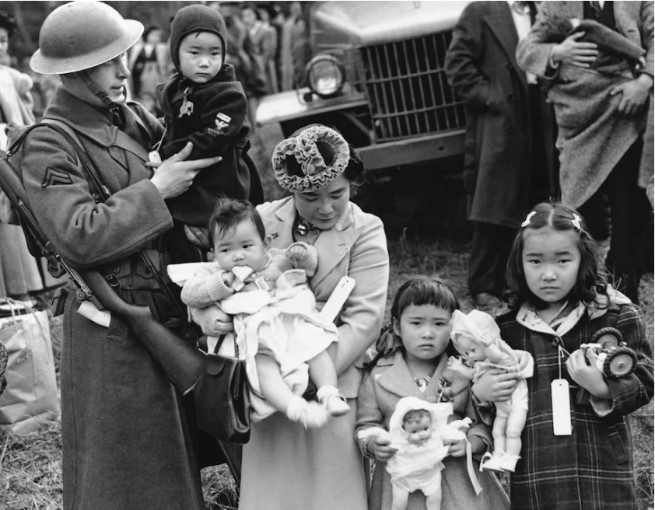
Corporal George Bushy holds the youngest child of Shigeho Kitamoto as she and her children are forced to leave Bainbridge Island, Washington. In 1942, the Kitamoto family was sent to an internment camp. (LOC)

The focus of Critical Race Theory has been on the treatment of people of African ancestry as the United States has been pressed to come to terms with its racist past and lingering racism today. It also should include the long history of anti-Asian violence and discrimination in this country. Asian American and Pacific Islander Heritage Month in May is a time for teachers and students to highlight the contributions and influence of Asian Americans and Pacific Islander Americans on the history, culture, and achievements of the United States.

Ex-President Donald Trump exacerbated anti-Asian hostility in this country with specious statements blaming China for the COVID-19 pandemic and the calling it the  “Chinese virus” and “Kung Flu” for the COVID-19 pandemic. The Republican Party has tried to divide potential Democratic Party voters by arguing that affirmative action programs and school reforms addressing past discrimination against African Americans and Latinos are anti-Asian.

Recent deadly attacks on Asian Americans, in San Francisco, New York City, and one in Atlanta where six women were murdered, have been committed by very disturbed people who were agitated by a climate that allows anti-Asian stereotypes to go largely unchallenged. An article in the journal Education Week calls on schools to play a larger role in combatting the stereotypes and anti-Asian racism by making Asian immigrants and their experience more prominent in the United States history curriculum. This would be an important corrective.

On the 2020 Federal Census, people who identified as Asian or of Asian ancestry made up approximately 6% of the U.S. population or almost 20 million people. The Asian American population grew by 35.5% between 2010 and 2020. Another 4 million Americans identified as mixed ancestry with a partial Asian heritage. The three largest groups were Chinese, about 5.4 million people, South Asians from India, 4.6 million, and Filipinos, 4.2 million. Chinese are the second largest immigrant group in the country. In 2019, California had the largest Asian American population, about of 6.7 million people followed by New York (1.9 million), Texas (1.6 million), and New Jersey (958,000)

The first large influx of people from Asia into territories that would become the United States occurred during the California gold rush starting in 1849. Chinese contract workers were brought to the United States to take low paying, dangerous jobs in mining and railroad construction. Most were male and planned to return home after earning enough money to buy land and start a family. In 1850, the Chinese population of the United States was only 3,227 people. It increased to 35,000 in 1860, a little over 60,000 in 1870, and just over 100,000 in 1880, when anti-Asian laws blocked new Chinese arrivals. In 1857, Harper’s Weekly reported, “The immigration of Chinese into California has attracted the attention of Congress. It appears that the Chinese immigrants, on settling there, persist in maintaining their allegiance to China; and under these circumstances the Senate voted on a resolution, December 19, making inquiry into the propriety of discouraging such emigration.”

From the 1850s through the 1870s, the California state government systematically discriminated against Chinese. Among other actions, it required special licenses for Chinese owned businesses and Chinese were not permitted to testify in court against a white person. In 1875, Congress passed and President Grant signed the Page Act, the first federal immigration law. It prohibited immigrants considered “undesirable” including any individual from Asia who was coming to the United States as a contract laborer, any Asian woman who would engage in prostitution, and all people considered to be convicts in their own country. In 1882, Congress passed the Chinese Exclusion Act suspending the immigration of Chinese laborers for a period of 10 years. It was the first law in American history to place broad restrictions on immigration and the first law to ban a specific ethnic group. The law remained in effect until 1943.

Japanese Americans are a small immigrant group that has had a major role in United States history. In 1870, there were only 55 Japanese in the United States, not counting Hawaii which was not yet an American colony. In 1900, there were still only 24,000 Japanese in the continental United States, but Japanese were the largest ethnic group in Hawaii. By 1960, when Hawaii was admitted as a state, there were 464,000 Japanese in the United States. In 2019, under 1.5 million Americans claimed partial or full Japanese ancestry, less than 1/2 of a percent of the US population. The largest Japanese American communities are in California and Hawaii.

In Hawaii, Japanese immigrants labored on sugar and pineapple plantations where they were subject to harsh rules and exploitation by armed European American overseers. On the plantation, Japanese workers had three to five year binding contracts and were jailed if they tried to leave. Those who eventually migrated to the mainland were subject to discriminatory laws and practices. California passed a law in 1913 banning Japanese from purchasing land.

Under the notorious Gentlemen’s Agreement of 1907 between the United States and Japan, Japanese officials stopped issuing passports for new laborers. Federal legislation in 1924 completely banned any immigration from Japan.

The situation worsened with Japan’s attack on Pearl Harbor in 1941 and U.S. involvement in World War II. Dr. Seuss posted racist caricatures of Japanese and Japanese Americans as part of wartime propaganda and Executive Order 9066 which eliminated all civil rights for Japanese immigrants and their families living on the West Coast. An estimated 120,000 people were branded as risks and forced to abandon homes and businesses and relocate to concentration camps, mostly in inhospitable areas of the Rocky Mountains. This action was taken despite the fact that there was not a single case of espionage ever established against Japanese Americans or Japanese immigrants living in the United States. Over two-thirds of those forced into concentration camps were American born citizens. The fenced in camps were located in harsh terrain and patrolled by armed guards. Ironically, Japanese Americans in Hawaii were not imprisoned because they were needed to rebuild areas destroyed by the attacks. Young Japanese American men were permitted to leave the concentration camps if they enlisted in the U.S. military. Japanese American soldiers served in a segregated unit, the 442nd, stationed in Italy and France. It was the most decorated American combat unit during World War II.

In 1944, in Korematsu vs. United States, the Supreme Court ruled by 6-3 that the detention of Japanese Americans was a “military necessity” and not based on race. In a dissent, Justice Robert Jackson called the exclusion order “the legalization of racism” and a violation of the 14th amendment. Fred Korematsu, who challenged the evacuation order and forced internment, was “convicted of an act not commonly thought a crime. It consists merely of being present in the state whereof he is a citizen, near the place where he was born, and where all his life he has lived.” In 1983, a federal judge overturned Korematsu’s conviction and in 1988, President Reagan signed the Civil Liberties Act compensating more than 100,000 people of Japanese descent who were incarcerated in the World War II concentration camps.

Since 1965, the United States has large immigrant populations from Korea, the Philippines, Southeast Asia, Bangladesh, India, and Pakistan. Each group has its own history in the United States, however all have faced stereotypes and discrimination and been stereotyped. South Asian Americans, often identified as Moslems even when they are not, were targeted after the 9/11/2001 attack on the World Trade Center in New York. A case involving an immigrant from India in the 1920s, United States v. Bhagat Singh Thind, established that people from the Indian sub-continent could not become naturalized citizens of the United States because they were not a “white person” in the sense intended in the Naturalization Act of 1790.

One of the most important constitutional decisions about citizenship was a Supreme Court ruling in the case of the United States vs. Wong Kim Ark was a Chinese American born in San Francisco, California in 1873. His parents were Chinese immigrants who returned to China about 1890. In 1894, Wong Kim Ark traveled to China to visit them and was not allowed to reenter to the United States because officials at the arrival center claimed he was not a citizen. In 1898, the Supreme Court in a 6-2 decision ruled that he was a citizen of the United States because he was born in this country.

Despite decades of prejudice, Asian Americans have made major contributions to life in the United States. They include Vice-President Kamala Harris whose mother was an immigrant from India, Eric S. Yuan, the CEO of Zoom, Steven Chen, co-founder of YouTube, Nobel Prize winning scientists Chen Ning Yang and T. D. Lee, physicistChien-Shiung Wu who worked on the Manhattan Project developing the atomic bomb,U.S. Senators Daniel Inouye (Dem-HI) and Tammy Duckworth (Dem-Ill), film director Ang Lee, astronaut Kalpana Chawla, architect I. M. Pei, authors Maxine Hong Kingston, Jhumpa Lahiri, and Amy Tan, athletes Tiger Woods, Kristi Yamaguchi, and Michelle Kwan, musician Yo-Yo Ma, and actors Sandra Oh, Lucy Liu, Haing Somnang Ngor, George Takei (Mr. Sulu), and Bruce Lee.

New York Local History: Yonkers Sculpture Garden

New York Local History: Yonkers Sculpture Garden

For Juneteenth 2022, the City of Yonkers debuted a permanent art exhibit honoring the legacy of the nation’s first freed slaves. The Enslaved Africans’ Rain Garden includes five life-size bronze sculptures created by artist Vinnie Bagwell depicting formerly enslaved Africans. The sculpture garden is located along the Yonkers Hudson River esplanade. According to Bagwell, “Public art sends a message about the values and priorities of a community. In the spirit of transformative justice for acts against the humanity of black people, I am grateful for those who supported this collective effort. The strongest aspect of the Enslaved Africans’ Rain Garden coming to fruition is that it begins to address the righting of so many wrongs by giving voice to the previously unheard via accessible art in a public place while connecting the goals of artistic and cultural opportunities to improving educational opportunities and economic development.”

In Yonkers, Philipse Manor Hall was the seat of the Philipsburg Manor, a colonial estate that covered more than 52,000 acres of Westchester land. The Philipse family was involved in the trans-Atlantic slave trade and probably as many as two-dozen enslaved African slaves worked and lived at the manor. The enslaved Africans were freed in 1799, one of the first large emancipations in the United States. New York State finally ended slavery in 1827.

Slavery in New Jersey: Teaching Hard History Through Primary Sources

Slavery in New Jersey: Teaching Hard History Through Primary Sources

by Dana Howell

Photo of the Marlpit Hall Family

For nearly a century, the Monmouth County Historical Association (MCHA) has told the story of the Taylor family at Marlpit Hall, the c. 1760 historic house museum in Middletown, NJ. It is a fascinating story indeed, and speaks to the strife between Patriots and Loyalists in Monmouth County, a hotbed of activity during the Revolutionary War. Until recently, however, a chapter of the house’s history had gone untold. In October of 2021, MCHA unveiled the exhibit 

Beneath the Floorboards: Whispers of the Enslaved at Marlpit Hall to include this forgotten chapter. This award-winning exhibit was the culmination of two years of extensive research done by curators Bernadette Rogoff and Joe Zemla to interpret the home to include the long-silenced voices of the enslaved who lived there.

Primary source documentation and discoveries of material culture were the foundations of the research done to uncover the lives of seven of the twelve known enslaved individuals at Marlpit. Birth, death and census records, wills, runaway ads, inventories, bills of sale, and manumissions (or freedom papers) shed light on the experiences of Tom, York, Ephraim, Clarisse, Hannah, Elizabeth, and William. In 2020, Joe Zemla discovered secret caches of artifacts hidden beneath the floorboards of the kitchen loft living quarters that spoke to their religion and protective rituals, while archaeological digs supervised by Dr. Rich Veit of Monmouth University provided further evidence to piece together what life may have looked like for the enslaved. Throughout the house, mannequins dressed in                        

historically accurate reproduction clothing bring each individual to life, supplemented by their carefully researched biographical panels. The artifacts they left behind are now on display; there is no longer a need for them to be hidden from view.

One of the most prevalent comments made by visitors is that they were unaware that slavery existed in New Jersey. For many years, our educational system had been complacent with the general notion that the northern states were free, while the South had enslaved labor. New Jersey has been referred to as the “most southern of the northern states,” second only to New York in the number of enslaved persons and the very last to legally abolish the institution on January 23rd, 1866.

Comparatively, little has been written about slavery in the North. We can read about
the facts of the matter, but the personal stories in the Floorboards exhibit make an impact that no textbook or blog can. The enslaved are presented without any form of politicization, but rather from an evidence-based and humanized lens. Students are able to connect with them, particularly with Elizabeth and William, who were born in the home and are represented as children – another sad fact of slavery that often goes overlooked. It is a unique opportunity to be able to mentally place these individuals in surroundings which are familiar to the student, albeit long ago. The students learn that we can make educated guesses about what life was like during the time in which the enslaved lived and explore the spaces they inhabited, but we can never truly understand their experiences as enslaved human beings. The only thing we can do is try to imagine it, using historical evidence from primary sources as our guide.

There is a sad deficit in age-appropiate classroom resources to teach slavery, and almost none that cover slavery in the North. This deficit creates roadblocks for public school teachers who are mandated to teach these topics as required by the NJ Department of Education’s 2020 Student Learning Standards, incorporating the 2002 Amistad Law.

 monmouthhistory.org/intermediate-btf

While nothing can compare to the experience of actually visiting Marlpit Hall, the opportunity to do so poses challenges for many school districts. In order to make the fascinating information in the exhibit as accessible as possible to students, MCHA has created two NJ standards-based digital education resources adapted for the elementary and middle/high school levels. Created under the advisorship of respected professionals in the fields of education and African American history, both age-appropriate resources provide background on the system of slavery in New Jersey with a focus on the enslaved at Marlpit Hall. In it, they will be introduced to each individual, along with the primary sources that helped to build their stories. Dr. Wendy Morales, Assistant Superintendent of the Monmouth Ocean Educational Services Commission, notes “The questions and activities included in this resource are standards-aligned and cross-curricular. This means students will not only learn historical facts, but will be challenged to think like historians, analyzing primary sources and making connections between historical eras.” Creative writing, art, music, and civics are all explored.

The section on the origins of slavery in New Jersey stress that the enslaved came here not as slaves, but as individuals who were taken from a homeland that had its own culture and civilization. Two videos, courtesy of slavevoyages.org, make a powerful impact. Students will get to view a timelapse of the paths of over 35,000 slave ship voyages, plotted in an animated graph. This visual representation helps students visually process the magnitude of the forced migration of the enslaved, while a 3-D modeling of an actual slave ship offers a uniquely realistic view of these vessels.

 Time lapse of plotted slave ships         Video featuring 3-D model of slave ship

Both grade level resources come with downloadable worksheets that can be customized to accommodate differentiated learning strategies, and submitted through Google Classroom. Teacher answer keys are provided for guidance as well. MCHA is proud to provide these resources free of charge to aid educators in their responsibility to teach slavery. The resources offer a guided approach to help educators navigate this sensitive and often difficult topic in the classroom. The new mandates are an excellent start to correcting the record on New Jersey’s history of enslavement, but it is truly New Jersey’s educators who will place their personal marks on bringing relevance and reverence to the topic in the classroom.

These resources can be found under the education tab at monmouthhistory.org/education-homepage. MCHA welcomes all questions and comments to dhowell@monmouthhistory.org.

New York Local History: Underground Railroad in the North Country

New York Local History: Underground Railroad in the North Country

Source: North Country Public Radio https://www.northcountrypublicradio.org/news/story/45430/20220224/remembering-the-secret-history-of-the-underground-railroad-in-the-north-country

A few minutes outside the small town of Peru in New York’s Champlain Valley, there is a small farm that looks like any other in the area. A cluster of silos and red barns with fading paint are flanked by snow-covered fields and apple orchards, dormant for the winter. But this farm has something unique. A blue and yellow New York State historical marker identifies the property as a stop on the Underground Railroad, where “runaway slaves were concealed and protected on their way to freedom in Canada.”

There was no actual train involved in the network, explains Jacqueline Madison, the President of the North Country Underground Railroad Historical Association. “It was a trail of conductors who helped them along the way [and] safe houses where they could stay,” she notes.

Communities from Watertown to Lake Champlain were part of that network of safe houses that helped people escape slavery in the American south during the decades leading up to the Civil War. Escapees typically traveled by foot or water. The railroad moniker was part of a secret code: safe places to stay were called stations and the owners of those properties were known as conductors. A full journey on the Underground Railroad typically took several months.

This is the history that Madison and the North Country Underground Railroad Historical Association are dedicated to preserving. The group operates a museum in Keeseville, in the Champlain Valley south of Plattsburgh. It features the stories from both sides of the Underground Railroad: Black passengers and white conductors. One exhibit is dedicated to the former owner of that historic Peru farmhouse, a man named Stephen Keese Smith. The abolitionist Quaker purchased the property in 1851 and quickly established one of the barns as a hiding place for runaway slaves headed to Canada. There is no way to know with certainty exactly how many people Keese Smith aided while working as a conductor. But his later writings provide an estimate. “He talked about helping people get to freedom and he thinks he spent about $1000 doing that,” Madison explained. “And if we spent $2.50 per person, he would have helped over 400 people.”

Exact numbers are nearly impossible to come by in historical records because those helping escaped slaves often avoided keeping a paper trail. Involvement in the Underground Railroad was extremely dangerous for everyone, black or white. The Fugitive Slave Act of 1850 required that escaped slaves be returned to their former owners – and carried stiff penalties for anyone who aided them. “If you were caught helping someone get to freedom,” Madison noted, “you could lose your property, you could be jailed, you could be fined. Terrible things could happen to you, your family, and friends if they suspected them of helping as well.”

The North Star Underground Railroad Museum fills up the bottom floor of an old 19th Century house. It’s packed with maps, faded newspaper articles, and portraits of notable members of the North Country section of the covert network. Standing before a map, Madison explains the various routes freedom-seekers would have followed to reach Canada. A western path originating in Pennsylvania went through Buffalo, up to Watertown, and crossed the St. Lawrence River at Ogdensburg. Two escape routes followed Lake Champlain: one through Vermont and another running from Albany to Rouse’s Point along the lake’s western shore. To find their way, escapees used folk songs learned on the southern plantations. They worked as a kind of secret oral map; with coded lyrics guiding freedom seekers on their journey north. One such tune called Follow the Drinking Gourd referenced landmarks like certain rivers and offered hints for how to identify friendly conductors. Drinking gourd was code for the Big Dipper – a celestial constellation that can be used to identify the North Star.

Although details can be hard to piece together, some stories of those who passed through the North Country to freedom have been recovered. An article written in 1837 by Vermont-born abolitionist Alvan Stewart for an anti-slavery newspaper recounts the story of an anonymous man who travelled through the North Country on his way to Canada. “I was headed to Ogdensburg, on my way north to Canada from South Carolina,” an actor declares in a re-enactment exhibit at the North Star Museum. “I had come up through the Champlain Canal, and then gone through Clinton and Franklin County.” That unknown man did eventually reach freedom north of the border, but his quest nearly ended in disaster just a few miles from his destination.

Outside of Ogdensburg, he stopped into a post office looking for work. Since New York had outlawed slavery in 1827, that would not necessarily have been out of place. However, slave owners offered rich rewards for the return for those who escaped, and slave catchers were permitted to operate even in anti-slavery states under the Fugitive Slave Act. When the anonymous freedom seeker entered the post office near Ogdensburg, the postmaster recognized him and explained that a reward for his capture had been posted. “I said to him, if you send me back then they’ll do terrible things to me,” the re-enactment continues. “Whip me. Hang me. Skin me alive. I begged him not to turn me in.” In this case, the postmaster ignored the reward, worth about $20,000 in today’s terms, and helped the man cross the St. Lawrence River into Canada.

Other escaped slaves decided to settle in North Country. In 1840, a Franklin County landowner named Gerrit Smith pledged to donate more than 120,000 acres of wilderness land in the Adirondacks to free black men. It would eventually become a settlement known as Timbuctoo. A man named John Thomas received 40 acres of un-cleared land from Smith. Thomas later sold that to buy a larger plot near Bloomingdale, NY, which he turned into a successful farm. Many years later, Thomas wrote his benefactor a letter, thanking Smith for the “generous donation” and revealing that he and his family greatly enjoyed the peace and prosperity of their “rural home.” Although Thomas was successfully established himself in the region, that was not the case for most recipients of Smith’s land. Harsh winters and tough soil drove many of the Black farmers to sell the land they had received and move away. The climate was not the only danger; at least once, slave catchers came to the area looking for Thomas. According to Madison, they first approached his neighbors seeking their help. As Madison tells it, Thomas’ neighbors informed the slave catchers that he was armed, would forcibly resist capture, and declared their intention to assist Thomas in repelling the catchers. The slave catchers are believed to have given up their pursuit.

In his later letter to Smith, Thomas hinted that his adopted community had begun to treat him as one of their own. “I have breasted the storm of prejudice and opposition until I began to be regarded as an American citizen,” he wrote. This may also be a reference to civic participation. At the time, New York State required men to own at least $250 worth of land to obtain the right to vote. Thomas’ obituary was published in the Malone Palladium in May 1895. It described him as “much respected in the community where he lived so long.” His descendants still live in that community. Through genealogy research, Madison and the North Star Museum discovered that two of John Thomas’ great-great grandsons still reside in the North Country. One of the descendants lives less than two miles from the cemetery in Vermontville where Thomas and his wife are buried.