My Story: Elizabeth Beatty Fithian, Burlington County, October 1776

My Story: Elizabeth Beatty Fithian

Burlington County, NJ  October 1776

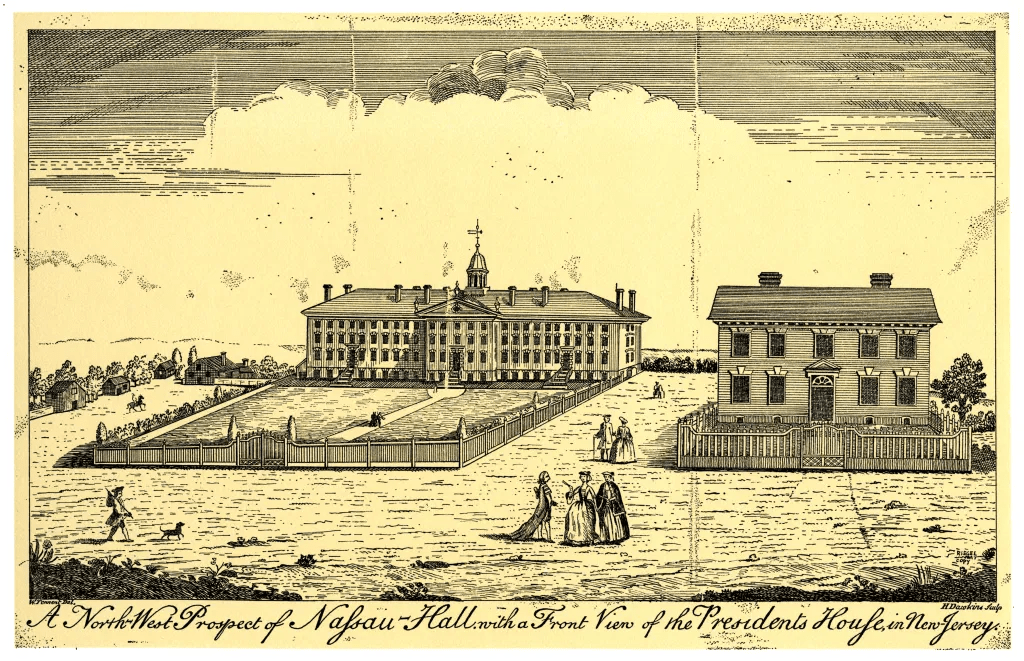
I was born on March 26, 1752 in Neshaminy, Pennsylvania.  I was the fourth child of Charles and Ann Beatty. My father was a highly respected clergyman from Neshaminy. He was also a huge supporter of the College of New Jersey (Princeton). He served as a trustee for the college for several years. Sadly, my father would die prematurely of yellow fever while on a visit to Barbados trying to raise money for the college in 1772.  His death devastated our family. After a long courtship, I would marry Reverend Philip Vickers Fithian on October 27, 1775, eight months before the signing of the Declaration of independence.

Following Philip’s death from exposure while serving as a military chaplain in New York, I would go on to marry Philip’s second cousin Joel Fithian. Joel and I would have nine children together. 

The death of my husband Philip on October 8, 1776, at the age of 29, affected me deeply. My husband and I were huge supporters of the revolutionary cause.  He lived his life with a belief in duty and service as well as a strong religious devotion and commitment. Philip’s death made me question my support for America’s fight for independence.  My faith had already been tested by the premature death of my father in 1772. Going forward, I had to find a way to carry on in order to live a life devoted to God and country!

What should Elizabeth do, in the middle of the Revolutionary War, following the tragic death of her husband Philip?

  Select one option and explain your answer in 4 to 6 sentences.

  • Remarry in order to have a family of her own.
  • Move in with her brother Dr. John Beatty in Princeton, New Jersey.
  • Move to another area of New Jersey to begin a new life.
  • Continue to live in her husband’s home in Greenwich, New Jersey.
  • Other.

Interview Elizabeth shortly after the death of her husband in 1776. Select one question below and write or record what might have been her response.

  • Would you put your personal welfare and interests before those of your country?
  • Are your religious convictions more important than your family?
  • As a widow, would you risk your life in support of the revolutionary cause?

Below is one of the last letters Philip Fithian wrote to his wife Elizabeth prior to his death.  He wrote this letter 19 days before he died.  Read and analyze the letter and answer the following guided questions:

1. Write a one sentence summary of this letter.

2. What was happening at the time this letter was written?

3. What did you find out from this letter that you might not learn anywhere else?

Camp Near Kings-Bridge, Sept. 19: 1776.

My dear Betsey.

Amidst all the Distress & Ruins of this dreadful War I am yet alive & yours. Our Enemies pursue us close on from Place to place. But we drubbed them well last Monday since which they have laid quiet. Your Brothers John, Reading & Arckee are well, I saw them since the Battle. We expect to have a general Engagement soon, & are not dispirited in the least by our late Losses. I hope to see my dear Betsey by the tenth of December & not before— But wonder much that  I do not hear from her; as it is now more than a Month since she wrote me a Word that I have received:—And since that time I have wrote with this seven long Epistles, a full sheet in each— One Aug.19—One 21st—26th— Sept: 1st 3d 9th & now the 19th.

I pray God daily that you may be preserved & in Health. My Duty to Mr. Green & Family. Last Sund. & Monday were two terrible Days; But on Monday our brave Heroes made them give Way. The English Army, Tories & All, is not supposed to be less than 30,000 strong. But our Army wishes to attack them. Peace, & God’s Blessing be with my Betsey, my dear Wife, forever may you be happy.

Philip V. Fithian.

Mrs. Betsey Fithian

Deerfield, West Jersey

Teaching Controversial Issues: Teachers’ Freedom of Speech in the Classroom

Teaching Controversial Issues: Teachers’ Freedom of Speech in the Classroom

by Arlene Gardner

Executive Director, New Jersey Center for Civic Education

What is the purpose of education? The conventional answer is the acquisition of knowledge. Looking beyond this facile response, most people will agree that the true purpose of education is to produce citizens. One of the primary reasons our nation’s founders envisioned a vast public education system was to prepare youth to be active participants in our system of self-government.  John Dewey makes a strong case for the importance of education not only as a place to gain content knowledge, but also as a place to learn how to live. In his eyes, the purpose of education should not revolve around the acquisition of a pre-determined set of skills, but rather the realization of one’s full potential and the ability to use those skills for the greater good.

Democratic self-government requires constant discussions and decisions about controversial issues. There is an intrinsic and crucial connection between the discussion of controversial political issues and the health of democracy. If we want our students to become informed, engaged citizens, we need to teach them how to “do” democracy by practicing the skills of discussing controversial issues in the classroom and learning how to respectfully disagree.

Research has demonstrated that controversy during classroom discussion also promotes cognitive gains in complex reasoning, integrated thinking, and decision-making. Controversy can be a useful, powerful, and memorable tool to promote learning. In addition to its value in promoting skills for democracy, discussing current controversial public issues:

  • Is authentic and relevant
  • Enhances students’ sense of political efficacy
  • Improves critical thinking skills
  • Increases students’ comfort with conflict that exists in the world outside of the classroom
  • Develops political tolerance
  • Motivates students
  • Results in students gaining greater content knowledge.

(Diana Hess, Controversy in the Classroom: The Democratic Power of Discussion (2009); Nel Noddings and Laurie Brooks, Teaching Controversial Issues: The Case for Critical Thinking and Moral Commitment in the Classroom (2017); “Guardian of Democracy: The Civic Mission of Schools” (2011); Center for Research on Learning and Teaching, University of Michigan at https://crlt.umich.edu/tstrategies/tsd).

Yet, teachers may consciously (or unconsciously) avoid controversial issues in the classroom because of the difficulty involved in managing heated discussions and/or for fear that parents will complain or that the school administration will admonish or punish them for “being controversial.” These concerns are certainly not groundless. How well are teachers protected from negative repercussions if they address controversial issues in their classrooms? How extensive are teachers’ First Amendment rights to free speech? How can heated disagreements among students be contained in the classroom?

Two different legal issues exist regarding free speech rights of teachers: The First Amendment directly protects a teacher’s personal right to speak about public issues outside of the classroom and “Academic Freedom” protects a teacher’s right and responsibility to teach controversial issues in the classroom.  However, both have certain limitations.

First Amendment Protection of Public Speech by Teachers

Although the First Amendment free speech protection is written in absolute terms (“Congress shall make no law…”), the courts have carved out several exceptions (for national security, libel and slander, pornography, imminent threats, etc.).  The courts have also carved out a limited “government employee” exception based on the rationale that a government employee is paid a salary to work and contribute to an agency’s effective operation and, therefore, the government employer must have the power to prevent or restrain the employee from doing or saying things that detract from the agency’s effective operation.  Thus, the government has been given greater latitude to engage in actions that impose restrictions on a person’s right to speak when the person is a governmental employee, which includes teachers who work in public schools.

Some of the earliest threats to the free speech rights of public school teachers were the loyalty oaths that many states imposed on government employees during the ‘‘red scare’’ and early ‘‘cold war’’ years of American history. In Adler v. Board of Education (1952), the Supreme Court in a 6-3 decision rejected First Amendment claims and upheld a New York statute designed to enforce existing civil service regulations to prevent members of subversive groups, particularly of the Communist Party, from teaching in public schools. The Supreme Court effectively overturned this ruling in the 1960s and declared several loyalty oath schemes to be unconstitutional because they had chilling effects on individuals which violated their First Amendment rights (Baggett v. Bullitt (1964); Cramp v. Board of Public Instruction (1961); and Keyishian v. Board of Education (1967)).

Much of the reasoning regarding the “government employee” exception to the First Amendment outlined in Adler was abandoned altogether in the 1968 U.S. Supreme Court decision in Pickering v. Board of Education. Teacher Marvin Pickering had written a letter complaining about a recently defeated school budget proposal to increase school taxes. The school board felt that the letter was “detrimental to the efficient operation and administration of the schools” and decided to terminate Pickering, who sued claiming his letter was protected speech under the First Amendment. The U.S. Supreme Court held that Pickering’s dismissal violated his First Amendment right to free speech because public employees are entitled to the same measure of constitutional protection as enjoyed by their civilian counterparts when speaking as “citizens” and not as “employees.”

In Mt. Healthy City School District v. Doyle (1977), non-tenured teacher Fred Doyle conveyed the substance of an internal memorandum regarding a proposed staff dress code to a local radio station, which released it. When the board of education refused to rehire him, Doyle claimed that his First and Fourteenth Amendment rights had been violated. The court developed a “balancing test” that required the teacher to demonstrate that the speech act was a ‘‘substantial’’ or ‘‘motivating factor’’ in the administration’s decision and gave the school board the opportunity to demonstrate, based on the preponderance of the evidence, that the teacher’s speech act was not the ‘‘but for’’ cause of the negative consequences imposed on the teacher by the school board. Finally, the court would “balance” the free speech interests of the teacher and the administrative interests of the school district to determine which carried more weight.  Based on this test, the U.S. Supreme Court found that the teacher’s call to the radio station was protected by the First Amendment, that the call played a substantial part in the board’s decision not to rehire Doyle, and that this action was a violation of Doyle’s rights under the First and Fourteenth Amendments.

In a 5/4 decision in Connick v. Meyers (1983), the U.S. Supreme Court held that speech by public employees is generally only protected when they are addressing matters of public concern, not personal issues. Sheila Meyers was an Assistant District Attorney who had been transferred.  She strongly opposed her transfer and prepared a questionnaire asking for her co-workers views on the transfer policy, office morale and confidence in supervisors.  She was terminated for insubordination. Meyers alleged her termination violated her First Amendment right to free speech. The district court agreed and the Fifth Circuit affirmed. However, the U.S. Supreme Court reversed because Meyer’s speech only dealt with personal not public issues.  “When a public employee speaks not as a citizen upon matters of public concern, but instead as an employee upon matters only of personal interest, absent the most unusual circumstances, a federal court is not the appropriate forum in which to review the wisdom of a personnel decision taken by a public agency allegedly in reaction to the employee’s behavior.” Although the case involved an Assistant District Attorney, it is applicable to all public employees: teachers must demonstrate that their speech is of public concern.

This was confirmed in Kirkland v. Northside Independent School District (1989) where the school district did not rehire non-tenured teacher Timothy Kirkland because of poor performance and substandard teaching evaluations. Kirkland filed a lawsuit in federal district court against Northside, claiming that he was not rehired in violation of his First Amendment rights after he gave his students a reading list that was different from Northside’s list. Northside argued that Kirkland had no right to substitute his list without permission or consent and he had failed to obtain either. The district court ruled in favor of Kirkland and Northside appealed. The Fifth Circuit Court of Appeals reversed and dismissed Kirkland’s complaint, holding that Kirkland’s “speech” did not infringe on any matter of public concern and was in fact “private speech.” If the nature of the speech is purely private, such as a dispute over one employee’s job performance, judicial inquiry then comes to an end, and the question of whether the employee’s speech was a substantial or motivating factor in the decision not to rehire him need not even be reached. The U.S. Supreme Court denied cert, leaving this decision in place.

Academic Freedom

Although primarily used in the context of university faculty rights, “Academic Freedom” protects a teacher’s ability to determine the content and method of addressing controversial issues in the classroom.  This is more limited at the K-12 level because the courts have long held the view that the administration of K-12 public schools resides with state and local authorities. Primary and secondary education is, for the most part, funded by local sources of revenue, and it has traditionally been a government service that residents of the community have structured to fit their needs. Therefore, a teacher’s “Academic Freedom” is limited to his or her content and method of teaching within the policies and curriculum established by the state and local school board. By finding no First Amendment violation, the court in Kirkland implicitly held that he had no right to substitute his own book list for the one approved by the district without permission or consent, which he failed to obtain. 

In an early case, following the end of World War I, Nebraska had passed a law prohibiting teaching grade school children any language other than English and Robert Meyer was punished for teaching German at a private Lutheran school. The court held that the Nebraska law was an unnecessarily restrictive way to ensure English language learning and was an unconstitutional violation of the 14th Amendment due process clause (the 14th Amendment had not yet applied the First Amendment to the states until Gitlow v.  New York in 1925) that exceeded the power of the state (Meyer v. Nebraska, 262 U.S. 390 (1923).

“The Fourteenth Amendment, as now applied to the States, protects the citizen against the State itself and all of its creatures-Boards of Education not excepted. These have, of course, important, delicate, and highly discretionary functions, but none that they may not perform within the limits of the Bill of Rights. That they are educating the young for citizenship is reason for scrupulous protection of Constitutional freedoms of the individual, if we are not to strangle the free mind at its source and teach youth to discount important principles of our government as mere platitudes.” Justice Jackson in West Virginia Board of Education v. Barnett (1943)(holding unconstitutional a requirement that all children in public schools salute the flag).

The Supreme Court has more than once instructed that “[t]he vigilant protection of constitutional freedoms is nowhere more vital than in the community of American schools” (Shelton v. Tucker (1960)). In Epperson v. Arkansas (1968)(a reprise of the famous 1927 “Scopes Trial”), the Arkansas legislature had passed a law prohibiting teachers in public or state-supported schools from teaching, or using textbooks that teach, human evolution. Sue Epperson, a public school teacher, sued, claiming that the law violated her First Amendment right to free speech as well as the Establishment Clause. A unanimous U.S. Supreme Court declared the state law unconstitutional. The Court found that “the State’s undoubted right to prescribe the curriculum for its public schools does not carry with it the right to prohibit, on pain of criminal penalty, the teaching of a scientific theory or doctrine where that prohibition is based upon reasons that violate the First Amendment.” Seven members of the court based their decision on the Establishment Clause, whereas two concurred in the result based on the Due Process clause of the 14th Amendment (because it was unconstitutionally vague) or the Free Speech clause of the First Amendment.

The Supreme Court, however, has not clearly defined the scope of academic freedom protections under the First Amendment, and commentators disagree about the scope of those protections. (See, e.g., William W. Van Alstyne, “The Specific Theory of Academic Freedom and the General Issue of Civil Liberty,” in The Concept of Academic Freedom 59, 61-63 (Edmund L. Pincoffs ed., 1972); J. Peter Byrne, “Academic Freedom: A ‘Special Concern of the First Amendment’,” 99 Yale L.J. 251 (1989); and Neil Hamilton, Zealotry and Academic Freedom: A Legal and Historical Perspective (New Brunswick, 1998).  

Whatever the legal scope, it is clear that the First Amendment protection of individual academic freedom is not absolute. For example, in Boring v. Buncombe County Board of Education (1998), the Fourth Circuit Court of Appeals held that a teacher could be reprimanded (in this case transferred) because she sponsored the performance of a play that school authorities subsequently deemed inappropriate for her students and inconsistent with the curriculum developed by the local school authorities. This judicial deference toward K through 12 institutions often can be seen in cases involving teachers who assert that their First Amendment rights were violated when school administrators imposed punishments on them for engaging—while they taught their classes—in some form of expressive activity that the administrators disapproved.

The content

While cases about academic freedom, such as Epperson, involved state laws that limited or prohibited certain content being taught (in this case prohibiting teachers in public or state-supported schools from teaching, or using textbooks that teach, human evolution); New Jersey has taken a very broad approach to classroom content.  Since 1996, New Jersey has established state standards (currently called “Student Learning Standards”) that set a framework for each content area.  Unlike many other states, New Jersey does not establish a state curriculum but rather leaves this to local school boards. Subject to applicable provisions of state law and standards set by the State Department of Education, district school boards have control of public elementary and secondary schools.  How much protection do New Jersey teachers have when they address controversial topics?  Most First Amendment education cases in New Jersey involve students’ rights rather than teachers’ rights (e.g., school dress, vulgar language, threats, religious speech, equal access, See http://www.njpsa.org/documents/pdf/lawprimer_FirstAmendment.pdf). However, several recent cases from the Third Circuit (which includes New Jersey) provide some parameters.

In Edwards v. California University of Pennsylvania (3rd Cir. 1998), a tenured professor in media studies sued the administration for violating his right to free speech by restricting his choice of classroom materials in an educational media course. Instead of using the approval syllabus, Edwards emphasized the issues of “bias, censorship, religion and humanism.” Students complained that he was promoting religious ideas in the class. The U.S. Supreme Court declined to review the Third Circuit’s summary judgement against Edwards, holding that a university professor does not have a First Amendment right to choose classroom materials and subjects in contravention of the University’s dictates.

A very recent decision regarding a New Jersey teacher confirms the fact that the First Amendment does not provide absolute protection for teachers in public schools to decide the content of their lessons if it is not within the curriculum set by the school district.  In Ali v. Woodbridge Twp. School District (3rd Cir. April 22, 2020) a non-tenured public high school teacher at Woodbridge High School was teaching Holocaust denial to his students and was posting links to articles on the school’s website saying things such as, “The Jews are like a cancer” and expressing conspiracy theories accusing the United States of planning a 9/11-style attack. When the Board of Education fired Ali, he sued claiming that his employment was terminated on the basis of his race and religion, and that defendants had violated his rights to free speech and academic freedom, among other claims. The District Court rejected all of Ali’s claims, awarding summary judgment to the school board, and the Third Circuit affirmed.

These are extreme cases where a teacher is addressing issues that are NOT within the curriculum set by the university or within the state social studies standards and the local school district’s curriculum.  When teachers are teaching a controversial topic that is included in the New Jersey Student Learning Standards for Social Studies and their school district’s social studies curriculum, the existing case law seems to support the fact that they would be protected  by the Fourteenth Amendment, unless they are violating school policies that require teaching in a neutral, balanced manner that does not seek to indoctrinate students.

For example, what if a teacher wants to assign a research paper about the Stonewall Riots or the Lavender Project?   Since the history of LGBT rights is in the state standards and supposed to be included in local school district social studies curriculum, the Stonewell Riots and Lavender Project would be part of this history. This is not a situation like Ali where the materials were beyond the scope of the local curriculum (as well as being taught in an indoctrinating manner—see below). If the teacher fears that the topics will be controversial with the community, he or she should make the school administration aware of what he or she is planning to do.  Since here, what the teacher plans to teach is within the state standards and the local school district curriculum, the school administration should support the teacher.  If parents object, the real issue is one of policy (Should LGBT history be taught?), which is decided by the state and local boards of education, not the teacher. Therefore, the parents’ argument should be with the state and local boards of education.

What if a teacher wants to show scenes of an R-rated movie in the classroom (i.e. Revolutionary War scenes from The Patriot or D-Day from Saving Private Ryan?) Obviously, the American Revolution and Would War II are part of the state standards for U.S. History and in every local school district’s curriculum.  The movie scenes would need to relate to the district curriculum and the teacher should get prior administrative and parental approval if some movie scenes are going to be very graphic.

How should a teacher prepare lessons on Nazi Germany during the 1930s? Nazi Germany is also part of the state history standards and every school district’s curriculum. It should be taught in a way so that students can understand how the Nazis came to power and the prejudices they carried.  Some of the World War II footage and movies may be shocking but our students will not be able to become informed, engaged citizens if we hide the past from them.  

An ounce of prevention beforehand will help.  Before starting, teachers should be clear about the goal of their lesson: The classroom activities should encourage critical thinking. You are not trying to convince students of any particular point of view. Preview any materials, especially visual media which may be very powerful or provocative. Be aware of the biases of the sources of information that will be used by students.

Teaching Tolerance suggests in Civil Discourse in the Classroom that “Teachers can effectively use current and controversial events instruction to address a wide variety of standards and even mandated content. To do so, however, teachers must work carefully and incrementally to integrate this new approach in their classrooms.”  The University of Michigan’s Center for Research on Learning and Teaching offers guidance for how instructors (offered for college instructors but applicable for K-12) can successfully manage discussions on controversial topics. See Center for Research on Learning and Teaching, University of Michigan at https://crlt.umich.edu/tstrategies/tsd). The 1940 “Statement on Academic Freedom and Tenure” of the American Association of University Professors, suggests that teachers should be careful to avoid controversial matters that are unrelated to the subject discussed.

Before engaging students in an activity or discussion involving a controversial subject, tell your supervisor and/or principal what you are planning on teaching and, if necessary, reference the district policy on teaching controversial issues, explain the lesson’s connection with the district social studies curriculum and explain the goal and value of what you plan to do.  Then, consider the demographics of your community. If you anticipate that the topic of your lesson will be controversial with the community, send a note and/or talk with your students’ parents and/or the Parent Teacher Organization.

In an informative piece titled “Do You Have the Right to be an Advocate?,” published by EdWeek.org, Julie Underwood, a professor of law and educational leadership and policy analysis at the School of Education, University of Wisconsin-Madison, explains that the “district or the state can regulate employee speech during school hours or at school-sponsored activities to protect their own interests in instruction and political neutrality.” Despite the ambiguity in the laws protecting a teacher’s freedom of speech, Underwood concludes: “If it relates to the in class instruction and is age appropriate there is a good rationale for having a political discussion”.

Teaching in a Neutral or Balanced Manner

If the teacher has created a supportive, respectful classroom climate and built tolerance for opposing views, it will be easier to consider controversial topics. For example, considering historical controversies might be good background as practice for looking at current controversies. Establish a process and rules of adequate evidence or support so that the discussion is based on facts rather than simply opinions. To help maintain classroom order even when students are having heated disagreements, set clear rules for discussions or use activities that require students to use active listening skills when considering controversial issues, such as:

  • Continuum/Take a Stand
  • Civil Conversations
  • C3 Inquiries
  • Guided discussions
  • Socratic Smackdown
  • Moot courts—structured format for considering constitutional issues
  • Philosophical Chairs discussion
  • Legislative hearings—structured format for considering solutions to problems

Carefully consider how students are grouped if they are to work cooperatively.  Provide closure (which may be acknowledging the difficulty of the issue).

School boards work primarily through policies which set guidelines for principals, teachers, parents and students, as well as the district curriculum. To avoid a problem afterwards, the teacher should make sure that the controversial topic is within the state standards and the curriculum adopted by their local school board. Then the teacher should consult the school district’s policy regarding the teaching of controversial issues. Most school districts have a policy (usually #2240) that supports and encourages the teaching of controversial issues and sets guidelines for teaching controversial issues, including a process for dealing with challenges.  Although the language may differ, policies dealing with controversial issues generally focus on the need for the classroom lesson to be balanced, unprejudiced, fair, objective, and not aimed at indoctrinating students to a particular point of view.

Clearly, the type of indoctrination attempted by the teachers in the Edwards or Ali cases is beyond protected speech.  In addition to avoiding indoctrination, teachers should avoid telling a joke in the classroom that might imply a negative characterization of an ethnic group, religion or gender.  A “joke” that might be a put down of any ethnic group, religion or gender told in the classroom to students is never a good idea. It is not even a good idea for a teacher to post such a “joke” on Facebook because such speech might be considered as not addressing a matter of public concern and would not be protected by the First Amendment. However, using an historical photo, engraving or picture that included a negative image of an ethnic, racial or religious group might be okay in the context of examining what was seen as humor in the past and understanding the prejudice that existed during a particular time period. For example, when teaching about the Holocaust, a teacher might carefully use Nazi cartoons to demonstrate the high level of prejudice at the time. Another example might be using images of blackface or corporate ad campaigns to show racial attitudes when teaching about Jim Crow. The teacher does not need many examples to make the point. Know your audience. Choose carefully and be aware that certain advertising images from the Jim Crow era may offend some students in the class. The purpose of using controversial issues is important. At the core of deciding what a teacher should or should not say or do in the classroom is good judgment.

Should a teacher share his or her viewpoint on a controversial issue with the students?

Whether a teacher should share his or her opinion or viewpoint on a controversial issue will depend on the age of the students, if the opinion was requested by the students, and the comfort-level of the teacher.  A teacher’s opinion may have too much influence on younger students and should probably be avoided. What if a middle or high school student specifically asks for your opinion? Such “natural disclosures” in response to a direct question by a student should be accompanied by a disclaimer, such as “This is my view because…” or “Other people may have different views”.  If you prefer not to disclose your view, explicitly state that and explain why. Remember, the goal is to help students develop their own well-informed positions. Be mindful of your position as the “classroom expert” and the potential impact on the students. If you decide to disclose your own view, do it carefully and only after the students have expressed their views. Unrequested disclosures may be seen as preachy, or may stop the discussion. (See Hess, Controversy in the Classroom)

So, for example, should a teacher take a position on climate change?  In terms of content, climate change is in the state standards and should be in the local school curriculum. If parents disapprove of this topic, this disagreement is really with the curriculum set by the school board, not with the teacher.  However, the teaching strategy is important. Rather than taking a position, which may be seen as indoctrination or may simply stop the classroom inquiry, the better approach might be to have the students examine the issue and let the facts speak for themselves.  Let students use the facts that exist to construct their own arguments about whether or not climate change is the result of mankind’s use of fossil fuels in industry and transportation.  If the topic is presented in a balanced, neutral, non-indoctrinating manner, the teacher should not be subject to discipline. Objections by parents should be referred to the school administration because it is a matter of policy (Should climate change be taught?), which is decided by the state and local boards of education, not the teacher.

How should teachers address questions from students regarding Black Lives Matter and racial inequality? The ACLU in the state of Washington prepared a short online article, “Free Speech Rights of Teachers in Washington State” (NJ’s ACLU only has a publication about students’ rights) with a related hypothetical:  The teacher is instructed not to discuss personal opinions on political matters with students.  In a classroom discussion on racial issues in America, the teacher tells the class that he/she has recently participated in a Black Lives Matter demonstration.  Revealing this is the same as giving an opinion and may not be protected speech. Teachers can be disciplined for departing from the curriculum adopted by the school district and this would be a departure.

Can a teacher state that New Jersey is a segregated state when it comes to communities? Is the teacher stating this as a personal opinion or as a fact related to a topic of learning? There is no reason to simply state that NJ is segregated unless it is in the context of helping students understand and appreciate the history of segregation in NJ consistent with state standards and district curriculum. (For example, see “Land Use in NJ” and “School Desegregation and School Finance in NJ” for history, context and facts at http://civiced.rutgers.edu/njlessons.html).

Is a teacher permitted to take a stand on the issue of removing public monuments? Assuming that this is part of a current events lesson, it would be better if the teacher remained neutral and let the students’ voice differing views. If the students all have one position, perhaps the teacher can take a position as “devil’s advocate,” but it should be made clear that this is what the teacher is doing.

Can a teacher assign blame to protests to specific groups or left or right extremist groups? Assigning blame is the same as a teacher giving his or her personal opinion. The better approach would be to have students look at the actions of specific groups and determine their appropriateness.

Can a teacher assign blame to Associate Justice Amy Coney Barrett regarding a Supreme Court decision that is 5-4 and against the teacher’s preference (i.e. Affordable Care Act, marriage, etc.).  Assuming that this is part of a classroom lesson about the Supreme Court, the teacher should refrain from “assigning blame” because this is expressing his or her opinion, but should instead let the students consider the reasoning and impact of the decisions.

Is a teacher permitted to criticize or defend the government’s policies or actions on immigration? Outside the classroom, a teacher has a first amendment right to express his or her views on public issues. As part of a classroom lesson about immigration, rather than criticizing or defending the government’s policies or actions on immigration, the better approach would be to present or let students research the history of immigration policy and its impact and let the students discuss and draw their own conclusions (For example, see “Immigration Policy and its impact on NJ” at http://civiced.rutgers.edu/njlessons.html).

Can a teacher show a video clip from a specific news station (Fox, CNN) or assign students to watch a specific news program as an assignment?  As long as the purpose is not indoctrination to any particular point of view and the assignments are balanced. If the teacher wants students to see and compare various media views on the same topic, that would be a valuable classroom activity. (For example, see “Educating for Informed, Engaged Citizens” virtual workshop, for background on helping students understand bias in news, at the New Jersey Council for the Social Studies website at http://www.njcss.org/;  also see Choices Program at Brown University: Teaching with the News at https://www.choices.edu/teaching-with-the-news/;   and Constitutional Rights Foundation Fake News at https://www.crf-usa.org/images/pdf/challenge/Understanding-Fake-News1.pdf and https://www.crf-usa.org/images/pdf/challenge/Tackling-Fake-News.pdf).

Conclusions

A teacher has a personal right under the First Amendment to share his view on public policy issues in public but NOT in the classroom.  A teacher sharing his opinion or viewpoint in the classroom may be seen as indoctrination. So, for example, teachers should avoid sharing personal views on one’s sexual preference, regarding a particular candidate, President Trump’s taxes, a decision by a Grand Jury, prosecutor, FBI on racial issues, etc. Your school district may even have an explicit policy that teachers should not discuss personal views on political matters in the classroom, in which case, this policy should be followed.  Everything a teacher says or does in the classroom should be considered based on the possible impact on the students.

This does not mean that teachers should avoid having students examine and discuss controversial topics. Encouraging the development of civic skills and attitudes among young people has been an important goal of education since the start of the country.  Schools are communities in which young people learn to interact, argue, and work together with others, an important foundation for future citizenship.  Since the purpose of social education is to prepare students for participation in a pluralist democracy, social studies classes NEED to address controversial issues.  Teachers have the right and the responsibility to help their students understand controversial topics and to develop critical thinking skills.  However, the controversial topics should relate to the broad scope of subjects included in the NJ Student Learning Standards and the local school district curriculum.  And controversial subjects should be addressed in a neutral or balanced manner, without any effort to indoctrinate students, but rather to help them develop the knowledge and skills they will need as workers, parents and citizens in a democratic society.

Background Materials

Meyer v. Nebraska, 262 U.S. 390 (1923)

West Virginia Board of Education v. Barnett, 319 U.S. 624 (1943)

Adler v. Board of Education, 342 U.S. 485 (1952)

Shelton v. Tucker, 364 U.S. 479 (1960)

Cramp v. Board of Public Instruction, 368 U.S. 278 (1961)

Baggett v. Bullitt, 377 U.S. 360(1964)

Keyishian v. Board of Regents, 385 U.S. 589 (1967)

Pickering v. Board of Education, 391 U.S. 563 (1968)

Epperson v. Arkansas, 393 U.S. 97 (1968)

Mt. Healthy City School District Board of Education v. Doyle, 429 U.S. 274 (1977)

Connick v. Meyers, 461 U.S. 138 (1983)

Kirkland v. Northside Independent School District, 890 F.2d 694 (5th Cir. 1989), cert. denied (1990)

Bradley v. Pittsburgh Bd. of Educ., 910 F.2d 1172 (3d Cir.1990)

Boring v. Buncombe County Board of Education, 136 F.3d 364 (4th Cir. 1998)

Edwards v. California University of Pennsylvania, 156 F.3d 488 (3rd Cir. 1998), cert. denied, 525 U.S. 1143 (1999)

Ali v. Woodbridge Twp. School District, 957 F.3d 174 (3rd Cir. April 22, 2020)

Keith Barton and Linda Levstik, Teaching History for the Common Good (Erlbaum, 2004)

Diana E. Hess, Controversy in the Classroom: The Democratic Power of Discussion (New York: Routledge, 2009)

Nel Noddings and Laurie Brooks, Teaching Controversial Issues: The Case for Critical Thinking and Moral Commitment in the Classroom (New York:  Teacher’s College Press, 2017).

William W. Van Alstyne, “Academic Freedom and the First Amendment in the Supreme Court of the United States: An Unhurried Historical Review,” 53 Law and Contemp. Probs. 79 (1990)

ACLU-Washington at https://www.aclu-wa.org/docs/free-speech-rights-public-school-teachers-washington-state

American Association of University Professors, “Academic Freedom of Professors and Institutions,” (2002) at https://www.aaup.org/issues/academic-freedom/professors-and-institutions

Center for Research on Instruction and Teaching, University of Michigan at https://crlt.umich.edu/tstrategies/tsd

Choices Program at Brown University: Teaching with the News at https://www.choices.edu/teaching-with-the-news/

Constitutional Rights Foundation at https://www.crf-usa.org/

EdSurge at https://www.edsurge.com/news/2018-01-17-why-we-need-controversy-in-our-classrooms

Facing History at https://www.facinghistory.org/educator-resources

Find Law at https://www.findlaw.com/education/teachers-rights/teachers-different-freedoms-and-rights-article.html

Forbes at https://www.forbes.com/sites/jessicabohrer/2020/09/14/teaching-children-about-freedom-of-speech/#25cb6ff07101

John Goodlad, “Fulfilling the Public Purpose of Schooling: Educating the Young in Support of Democracy May Be Leadership’s Highest Calling,” School Administrator, v61 n5 p14 May 2004.

Jonathan Gould, Kathleen Hall Jamieson, Peter Levine, Ted McConnell, and David B. Smith, eds“Guardian of Democracy: The Civic Mission of Schools, Philadelphia: Annenberg Public Policy Center, 2011

Amanda Litvinov, “Forgotten Purpose: Civic Education in Public Schools, NEA Today, Mar 16, 2017 at https://www.nea.org/advocating-for-change/new-from-nea/forgotten-purpose-civics-education-public-schools#:~:text=Research%20into%20this%20long%2Dneglected,it%20holds%20for%20student%20achievement.

New Jersey Center for Civic Education (New Jersey lessons) at http://civiced.rutgers.edu/njlessons.html

New Jersey Law Journal at https://www.law.com/njlawjournal/2020/06/28/as-woodbridge-teachers-case-shows-facts-do-matter/?slreturn=20200929134110

New Jersey Principals and Supervisors Association at http://www.njpsa.org/documents/pdf/lawprimer_FirstAmendment.pdf

Phi Delta Kappa, “Do you have the right to be an Advocate?, at https://kappanonline.org/underwood-school-districts-control-teachers-classroom-speech/

Poorvu Center, Yale University at https://poorvucenter.yale.edu/teaching/ideas-teaching/teaching-controversial-topics

Teaching Tolerance at https://www.tolerance.org/magazine/publications/civil-discourse-in-the-classroom/chapter-4-teaching-controversy

Texas Association of School Boards at https://www.tasb.org/services/legal-services/tasb-school-law-esource/personnel/documents/employee_free_speech_rights.aspx

The First Amendment Encyclopedia at https://www.mtsu.edu/first-amendment/article/973/rights-of-teachers

U.S. Civil Liberties at https://uscivilliberties.org/themes/4571-teacher-speech-in-public-schools.html

Prepared by Arlene Gardner, Executive Director, New Jersey Center for Civic Education, Rutgers-The State University, Piscataway, NJ (2020)

The Real Historians of New Jersey: How to Connect with the Past in 170 Miles

The Real Historians of New Jersey: How to Connect with the Past in 170 Miles

Susan Soprano

How often do you get the opportunity to “practice what you preach?” After a decade of teaching social studies, writing social studies curriculum, and leading professional development, I couldn’t tell you how many times I’ve discussed the importance of thinking like a historian. After years of working so hard in my career, I was looking forward to spending the first part of the 2021-2022 school year bonding with my new son on maternity leave. As I dreamed of spending my days in pajamas, drinking coffee that has gone cold, an email comes in from Hank Bitten at the NJ Council for Social Studies. The email contained an application for a grant project to commemorate the 250th anniversary of the American Revolution. The project would focus specifically on the work and decisions of lesser-known NJ citizens during the war. As I took another sip of my cold coffee, I thought, “Yeah! I can make some time for this!” I realized that after so many years of promoting research, citing sources, making history come to life, etc., I’ve had less time than I’d care to admit actually doing it. I saw this grant project as an opportunity to bring my knowledge of early American history to life.

My work on this project began in November 2021 at the Dey Mansion in Totowa, NJ. The mansion served as Washington’s headquarters during the Revolution in 1780. Over 600 pieces of correspondence from Washington are a part of the artifacts in the mansion’s collection. Me and other members of the grant project worked with educational director Jessica Bush for a day of learning and engaging with history at the Dey Mansion. Bush spoke candidly about slavery at the Dey Mansion and about how the institution of slavery was prevalent in New Jersey during the war. History books do not often discuss this. My interest was piqued here and I planned on focusing on slavery for my part of the project. As a teacher in Passaic County, I planned to focus on slavery and early abolition here.

            The next day, the grant team met at the Monmouth County Historical Association (MCHA) in Freehold, NJ. We worked with Reference Librarian and Archivist, Dana Howell. She led us upstairs to a table filled with documents, many of which could take hours, even days to read. I cautiously walked up to the table and scooped up some primary sources thinking, “Well, I’ll start here.” The very first document I picked up was a manumission paper written by this man named Samuel Allinson. He’s not a Passaic County man, but somehow, I was led right to the topic I planned to focus on. Right here, I was hooked on Allinson. I began to look for more documents containing his name, and I dove into the internet to learn more. I left the Monmouth County Historical Association pleased with the work I had done.

            Over the next several weeks, I put together an activity and documentary on Samuel Allinson that could be utilized by New Jersey middle school students, and their families alike. Through this project, I am helping NJ residents understand the significance of the lesser known Samuel Allinson. He was a Burlington County native (fun fact: never been there!) who was a Quaker, lawyer, and abolitionist. He helped provide education to free blacks living in his county, and he was a supporter of the Loyalist cause during the Revolution. He was able to manumit over 30 slaves. There is evidence of his correspondence with George Washington, William Livingston, and Patrick Henry. His correspondence speaks to his beliefs that liberty for all included the enslaved, thus leading him to question the ideals of liberty that the Patriots were fighting vehemently for. In many ways, we are still discussing the very questions that Allinson had about freedom in his time.

 I had an opportunity to review excerpts from The Ragged Road to Abolition by Jim Gigantino. I was thankful enough to speak with Jim virtually in mid-January to review some final details about Allinson’s work, and about the early abolitionist cause of Quakers like him. He describes Allinson as being “savvy” and “astute”, knowing that he was fighting for an unpopular cause. He stood out in Burlington County and among the Quaker community.

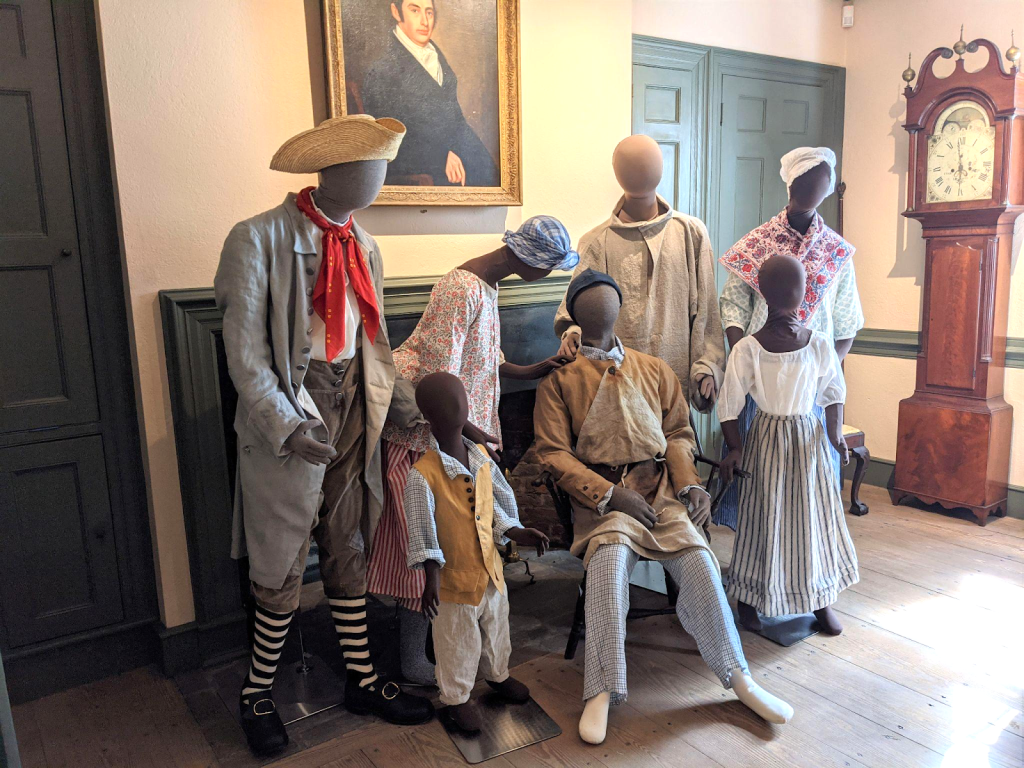
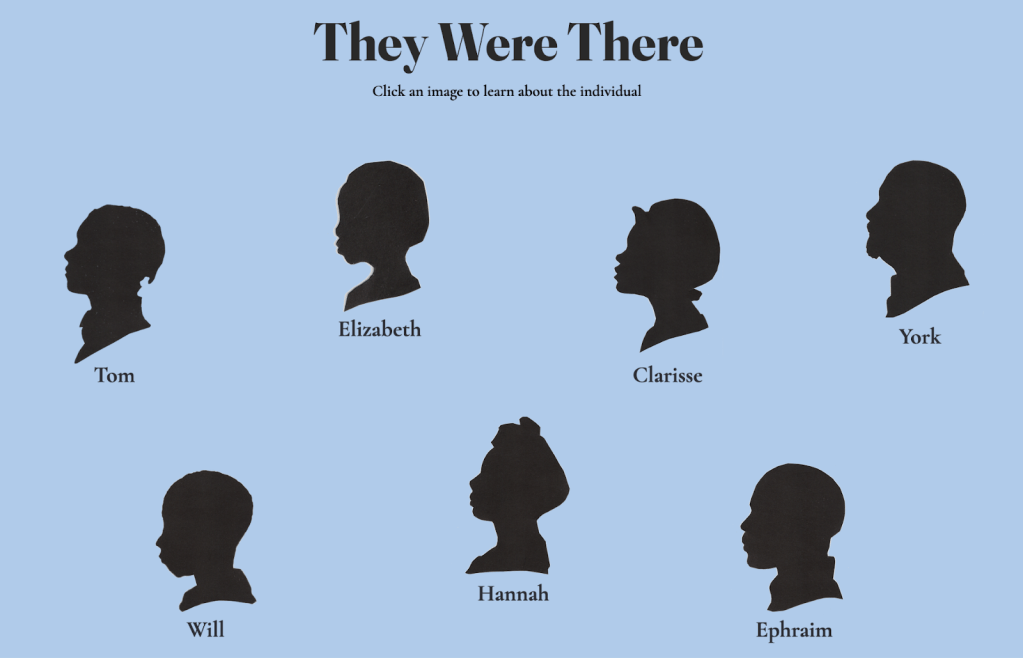
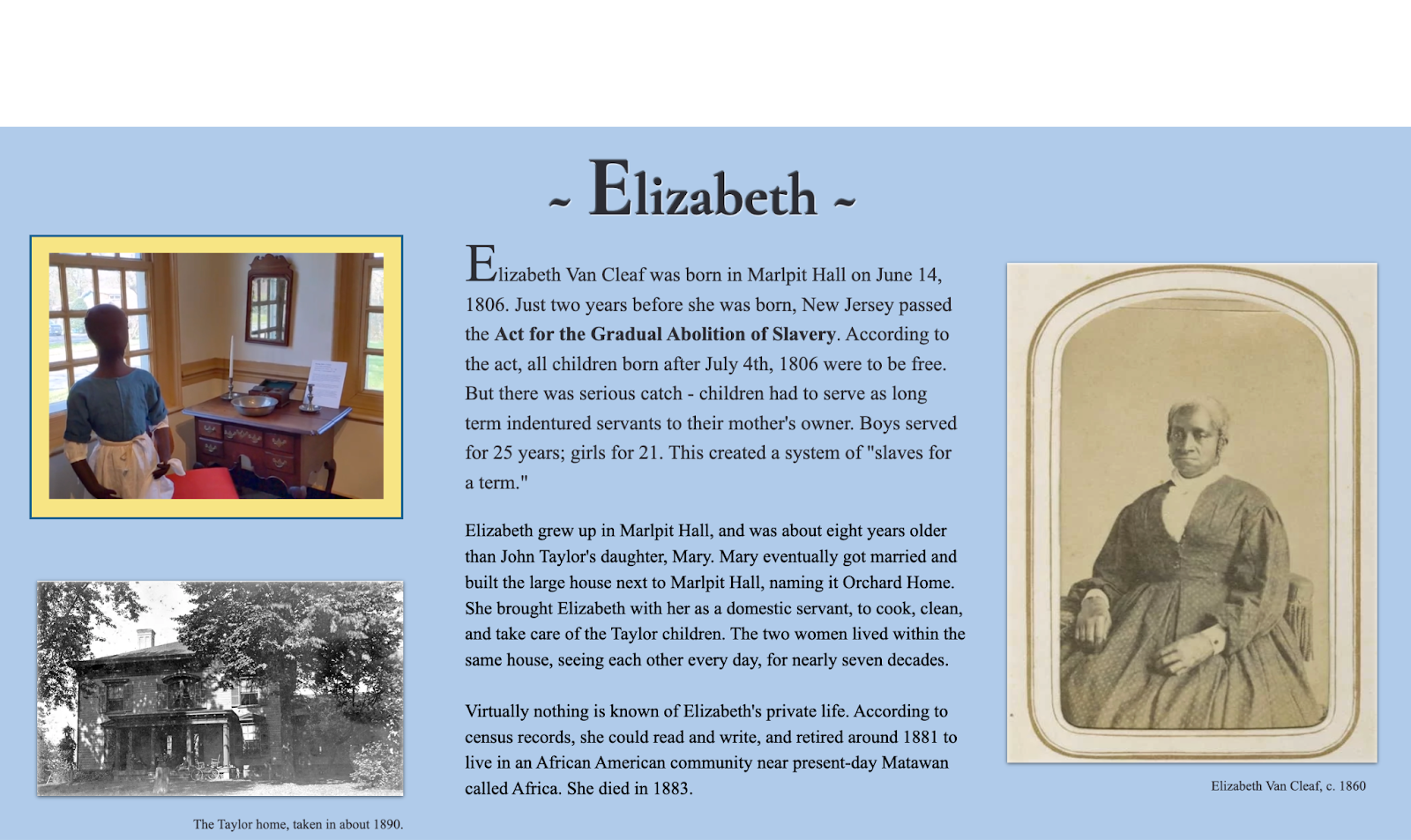
Before I finalized my project, I took another trip back to MCHA where I again met with Dana. I went there wondering if there was any more information available on Allinson’s work as an abolitionist. At first, Dana thought she wouldn’t have much on a Burlington County resident, but within no time, she located the Freedom Papers-a collection of 37 manumission documents all finalized by Samuel Allinson! This gave me the evidence I needed to show the abolitionist work he was doing in the late 1700s. An added bonus of working with Dana was getting an opportunity to view the Beneath the Floorboard exhibit at Marlpit Hall, a property that is maintained by the MCHA. Artifacts here show how slavery is a part of Monmouth County’s history, and tells the story of seven slaves who lived in this home. For more information on this exhibit, see ​​https://www.monmouthhistory.org/beneath-the-floorboards

Beneath the Floorboards: History of Enslaved Persons in Marlpit Hall
Opportunity to Learn the story of enslaved individuals living in Marlpit Hall in Monmouth County

Ultimately, the team working on this grant project will introduce you to lesser known “heroes” of the Revolution who lived all over the state. This is such important work for educators to take part in. From my experience in this project, I have two main points to reflect on:

1. Don’t miss any opportunity to learn more! The experiences that I had doing research were hands-on and challenging. Aside from the work I’ve created, I’m left with unanswered questions about abolition and lives of the enslaved in NJ that have been hidden for far too long. I can’t help but wonder what could have happened in our country if only abolition was fought for more feverishly at the Constitutional Convention. Knowing about the work of Samuel Allinson will enrich my teaching of the American Revolution and early abolition in the United States. These new insights will allow students to engage with primary texts that support the work of Quakers right here in their own state.

2. Make connections! Because I decided to work on this project, I am now connected with historians all around NJ, and in Arkansas (Jim Gigantino). Hopefully these relationships will grow, and it’s worth will be reflected in my teaching. In the near future, I hope to plan and lead professional development that will allow my colleagues to become teacher-scholars, similar to the experience I had on this project. It is my hope that this type of “hands-on” learning will ignite passion, and will remind educators why they do what they do.

And who knows, maybe one day I’ll take a drive to Allinson’s old haunts (with cold coffee in hand, obviously).

Reflections on the 1770’s: Diaries of New Jersey Quakers

Reflections on the 1770’s: Diaries of New Jersey Quakers

Robert Ciarletta

It is thrilling to go back in time and encounter writing from a few hundred years ago. I love uncovering the stories, experiences, and feelings embedded there. For those of us who love language, we can also use these texts to observe how the language we use changes just as human life evolves. For my research, I read the diaries of two New Jersey Quakers (the Religious Society of Friends). The writers are John Hunt, a farmer who regularly partook in meetings with other friends in Evesham, now part of Moorestown; the other is Margaret Hill Morris, a nurse practitioner and widow who had four children and lived in Burlington. When reading these diaries, I had to adjust to the different spellings, sounds, diction, and structure, since it is so different from how we write today. To fully appreciate these diaries, you must also recognize that the Quakers wrote in a sort of language of faith. Faith encompassed their lives so much so that it became a central theme in their diaries, arguably just as much as the American Revolution itself. No matter what subject these people wrote about, they constantly alluded to passages from the Bible and looked up to God as a way to make sense of their world.

As you dive in, the language reveals that New Jerseyans used to have a lot of daily items and objects that are so unfamiliar to a reader today. Many of us buy our food pre-packaged at the grocery store, or we order items through online marketplaces like Amazon. Though all of this is convenient, we tend to know little about the processes that go into creating our necessities. On the other hand, early Americans like Hunt must have been quite skilled since they produced numerous things for themselves. For instance, he wrote about tools like a sider press (another way to write cider), a cheespress, silk reel, and others. It is beneficial to expose students to texts like this because it adds a level of dignity to another way of living, and may spark students’ interest in old tools and artifacts.

It is also fun to pick up on the patterns that differentiate someone else’s English from our own. One common quirk is that Hunt used the letter ‘d’ as an inflectional suffix to signal the past tense of verbs, whereas we use ‘e’d. For instance, prayed, composed, and stayed were written as prayd, composd, and stayd in Hunt’s diary. What great, local proof to our students that our language is dynamic! His diary also proves that the names of our places have changed in history; he spelled Moorestown as Mourstown.

These diaries also show that sometimes life can seem ordinary until the moment when it suddenly is not so, anymore. After the French and Indian war, the Friends promoted pacifism with new vigor[1], intending to be a light to the world. But peace did not last, and they felt helpless when the war reached a point of no return. It was impossible to feel safe; their beliefs could only remove them from the war so much. And if you choose to help neither side, does that create zero enemies for you? Or does it possibly create two? There is danger in a decision to declare yourself neutral, and Hunt and Morris had to navigate the war this way.

The Quakers were appalled at the effects of the war on their communities and lives. When John Hunt entered the Evesham meeting house on January 1, 1777, he found soldiers lying in filth, comparing them to animals in a stable. He also writes about the tense situations a year later in 1778, when people around him are dying from a smallpox epidemic, and British soldiers are plundering neighboring homes. It was dismal –the townspeople dying around him, and always on edge anticipating the soldiers coming. He kept these entries brief, not wanting to give the bad all of his focus. The next day he would be back to normal again, and write about farming or attending a meeting.

Hunt’s diary reveals his industry too. A single task occupied him for days on end. For example, he wrote 2-4 mowing to signify that mowing dominated the second through fourth days of the month. And he not only labored physically but also in thought. William Penn said that Quakers should write at least one line in a journal daily[2], and this inspired Hunt. I would get bored writing the same things every day, but Hunt wrote continually to keep track of his days and gain wisdom from a holistic view of his life. He wrote for the sake of writing, and I find that beautiful.

And, you can find duality in Margaret Morris’ diary if you choose to read it. At first, she was overwhelmed by the war, but writing her diary helped her to think clearly and grasp this reality. As you read her diary, you see her use words like ‘terrible and horrid’ to describe the war, and she seems scared. She also writes about seeing soldiers march past her town on their way to meet death, and this suggests an emotional, fearful side of Morris. And then as I read further, she had a similar moment to John Hunt that caught my interest. On January 3, 1777, Morris sneaks into a house next door at night and finds soldiers sprawled on the floor, “like animals”. Yes, one part of her pitied these men. But this was also the moment when I knew Morris was not the kind of woman to just sit home scared during a war, but she also wanted to make sense of things for herself. A light bulb went off in her mind that the soldiers were deserters since she realized that they shouldn’t have been around. Morris does not shy away from what she sees but keeps it to herself in her diary, a form of secret knowledge. 

By the end of the war, Morris gained boldness and found herself. While her neighbors were able to leave for the countryside, she had to stay with her family. She survived cannon fire, evaded a hunt for Tories, and hid one of them in her home. Moreover, she followed her own convictions and gave generously to American troops, despite the mandate in 1776 that Quakers who gave to either side (non-civilians) would be disowned[3]. In chronicling extensive information daily about the war in her diary, she found a sense of confidence and purpose. Later, Morris opened her own medical and apothecary practice in Burlington, in 1779[4]. Morris was well-equipped to provide for her family and protect them. 

So, when people read your diary centuries later, are you still an ordinary person? And what if you provide insight about a time so critical to our nation’s story, like the American Revolution? Hunt and Morris’ slice of the human experience represents something greater, even if the impact of their writing seemed insignificant to themselves at the time. Their diaries tell us about the whole New Jersey revolution experience. And when one’s experiences are immortalized like this, you do in fact become a bit more than ordinary.


[1] Kashatus, William C. “Quakers’ painful choice during the american revolution.” The Philadelphia Inquirer, Jul. 5, 2015.

[2] “John Hunt Papers.” TriCollege Libraries, https://archives.tricolib.brynmawr.edu/resources/5240johu.

[3] Mekeel, Arthur J. “The Relation of the Quakers to the American Revolution.” Quaker History, 65(1), pp. 3-18. Friends Historical Association.

[4] Brandt, Susan. “‘Getting into a Little Business’: Margaret Hill Morris and Women’s Medical Entrepreneurship during the American Revolution.”  Early American Studies, 13(4), pp. 774-807. University of Pennsylvania Press.

Conflicted Vision: Thomas Jefferson and the University of Virginia

Conflicted Vision: Thomas Jefferson and the University of Virginia

by Alan Taylor

Review by James J. Carpenter

            In any discussion of early America and public education, Thomas Jefferson inevitably plays a central role. For many, he “remains one of democratic education’s founding fathers” (Neem, 2013, p. 3). Jefferson’s Bill for the General Diffusion of Knowledge called for a three-tiered system of public schooling that would, according to Wagoner (2004), “elevate the mass of people to the moral status necessary to insure good government and public safety and happiness” (p. 34). Jefferson’s vision for Virginia schools would fall victim to the political realities of that state, save for the eventual establishment of the University of Virginia in 1819. Indeed, the university is one of three accomplishments Jefferson had engraved on his tomb, along with being the author of the Declaration of Independence and of the Virginia Statute for Religious Freedom.

            Like most of Jefferson’s life, there is a considerable volume of literature on his educational views and his plans for improving education in his beloved Virginia (e.g. Addis, 2003; Conant, 1962; Gilreath, 1999; Heslep, 1969; and Wills, 2002). I was curious, therefore, to read Alan Taylor’s latest work entitled Thomas Jefferson’s Education. Was this a description of Jefferson’s personal educational odyssey or was this another discourse on his educational philosophy and plans for public schooling in Virginia?  I was pleasantly surprised to find it was both and more. Taylor successfully weaves Jefferson’s fight to advance public education in Virginia with stories of a wide variety of individuals who supported or resisted his goals. Furthermore, he situates these often bitter political struggles in the context of a stratified Virginia society built on a foundation of enslaved labor.    

Indeed, Taylor’s description of a complicated social milieu often seems to be the real subject of his book. At first, as a reader, I was distracted by the many anecdotes and stories Taylor offers as illustrations for the contesting forces that impacted Jefferson’s goal of free public education for white males. It is only when the reader sits back and focuses on the entire mosaic rather than on the individual tesserae that Taylor’s story becomes clear. He rather quickly addresses the failure of Virginia’s legislature to approve Jefferson’s plans for publicly funded elementary and secondary schools and focuses on Jefferson’s goal for a public university that would rival Harvard and Yale.

            Taylor places this struggle to create the University of Virginia in the context of powerful cultural forces within the state – and by extension throughout the South – and thereby creates a fascinating subtext for his book. The primary forces at work were the increasingly rigid attitudes regarding slavery and the strict adherence to the gentry’s belief in their privileged status including their preference for drinking, gambling, and dueling in defense of their honor. Taylor masterfully posits these societal flaws against Jefferson’s wishes to create a university which would train leaders who would reform Virginia. Jefferson envisioned this next generation of leaders would further republicanism by adopting “a more democratic state constitution for white men,” by embracing his goals for public education for all white children, and by emancipating but deporting slaves (p. 307). Jefferson’s hopes for the future evolved during a period where regional bitterness was hardening at an alarming rate, an extreme bitterness Joanne Freeman (2018) has described as a violent “cultural federalism” (p. 50). Southern politicians increasingly saw the Union as endangered by northern political and economic interests which would put the South at a distinct disadvantage. Southern fathers did not want their sons attending northern institutions of higher learning for fear they would be corrupted by antislavery ideas and dangerous democratic ideas of equality. Instead, southern “gentlemen attended college to hone social skills and cultivate social networks” (p. 82). Additionally, “fathers wanted sons to develop a robust sense of honor,” including choosing dueling over accepting insults (p. 83). And, as Taylor describes, their sons whole-heartedly bought into their privileged status; to the extent that they believed themselves exempt from obeying rules and policies implemented by those they believed to be of inferior status including their professors. Indeed, according to Taylor, this strategy at times worked all too well. Most of Virginia’s young gentlemen “became petty tyrants” to the state’s enslaved population (p. 83).

            It was in this social and cultural milieu that Jefferson and others in Virginia’s founding generation tried to re-establish that state’s prestige. As other states, especially in the North, gained in population and in political influence, these aging leaders identified education as the means to restore Virginia to what they believed to be her rightful status. The College of William and Mary was in decline since the state capitol had moved from Williamsburg to Richmond and Jefferson saw this as an opportunity to build a new university, one that would embody his philosophical beliefs and be free from any religious connections. Taylor describes Jefferson’s reliance on his chief lieutenant in the state legislature, Joseph C. Cabell, and his efforts to thwart other attempts to construct a university in locations other than Charlottesville. Many personalities are presented in this account; some famous like James Madison, Patrick Henry, and James Monroe and others less so, such as the Scottish teacher James Ogilvie, the mercurial John Randolph, and Jefferson’s rival for controlling the fledgling university, John Hartwell Cocke.

In detailing how he secured his beloved university, Taylor sheds light on Jefferson’s complex personality. For example, in constructing the university Jefferson dismissed the idea of sharing state education allocations with two other campuses he ridiculed as “’local interests’” while remaining oblivious to the parochial nature of his own plans (p. 198). Believing “that only architectural grandeur could attract many students” (p. 211), Jefferson’s construction costs exceeded both the state appropriations and private monies raised through subscriptions leaving the university with no money for scholarships for deserving students. As a result, only sons of the wealthiest Virginia families could afford to attend causing the university to “suffer from their homogeneity and sense of entitlement” (p. 214).

            Known for his pleasing manners and hospitable nature, Jefferson could also be sharp and intransient on issues he deemed important. His insistence that the university be free from religious influence and that there be no professor of divinity alienated many Virginia Christians, especially Evangelical Episcopalians and Presbyterians, leading to contentious struggles with the university’s Board of Visitors and state political leaders. Though he expressed a faith in the free expression of ideas, Taylor describes how Jefferson “assumed that the free pursuit of truth always led to his conclusions.” His university would be a bastion of republican orthodoxy free from “Federalist “’heresies.’” For example, Jefferson selected political readings that “favored states’ rights over national consolidation” as texts for the professor of law to use (p. 238, emphasis added to first quote). Republicanism was the litmus test in hiring for Jefferson. Therefore “no Federalist need apply to become professor of law at the University of Virginia,” regardless of his qualifications (p. 239). Far from promoting a democratic education, Jefferson often endorsed a more authoritarian approach in managing the day to day issues at his university.

            Today the University of Virginia is one of the most respected public universities in the United States. It is fondly referred to as Mr. Jefferson’s university. The picture Taylor paints of the early days of the university is at odds with what it has become. Plagued by low enrollments and financial problems, it initially housed a student population more dedicated to drinking, gambling, and carousing than to studying. Students accustomed to privilege and power frequently fought, rioted, mistreated slaves, and disrespected faculty, with one student actually fatally shooting a professor. Following Jefferson’s death in 1826, things began to change, albeit slowly. By the mid-1840s, the university could afford to grant scholarships to deserving but less affluent students. Increasing enrollments led to greater numbers of Christian students who would have been unacceptable to Jefferson. Faculty hires became less political and rule changes on campus led to less violent and more sober student behavior. By the eve of the Civil War, the University of Virginia was becoming a major academic institution though not as envisioned by its famous founder.

            The evolution Taylor describes contains many ironies. For example, while largely ignoring the need to educate women beyond what was required to be a good wife (though he did promote learning for his own daughters and granddaughters), it was Jefferson’s daughters and granddaughters who became “teachers of a new generation of women” and who managed to save their family financially after the Civil War (p. 315). And Taylor masterfully describes the problematic relationship between Jefferson’s primary objectives for students who attended the University of Virginia. One goal was to produce republican leaders who would protect the rights of states against what he perceived as an increasingly threatening union controlled by northern politicians. His second objective was that these more enlightened leaders would reform Virginia, especially by first ending slavery and then deporting the formerly enslaved out of the United States, thereby ridding the country of its original sin. Jefferson failed to see these two goals as being contradictory. As Taylor demonstrates, the next generation did defend states’ rights in ways Jefferson could not have imagined. And rather than seeing slavery as a sin to be abolished, Virginia leaders promoted slavery as a positive institution which protected an inferior race. Ultimately, the university students did not “uproot slavery as Jefferson had hoped,” but instead “defended it and served the Confederacy in the Civil War” (p. 307). In delineating this progression to the potential dissolution of the union Jefferson had helped create, Taylor not only has made a valuable contribution to the literature on Thomas Jefferson’s impact on education but also to that of the history of education in the United States and to that of sectional development in ante-bellum America.    

References

Addis, C. (2003). Jefferson’s Vision for Education, 1760-1845. New York, NY: Peter Lang.

Conant, J. B. (1962), Thomas Jefferson and the Development of American Public Education. Berkeley, CA: University of California Press.

Freeman, J. B. (2018). The field of blood: Violence in Congress and the road to civil war. New York NY: Farrar, Straus and Giroux.

Gilreath, J. (Ed.). (1999). Thomas Jefferson and the Education of a Citizen. Washington, D. C.: The Library of Congress.

Heslep, R. D. (1969). Thomas Jefferson & Education. New York, NY: Random House.

Neem, J. (2013). Is Jefferson a founding father of democratic education? A response to “Jefferson and the ideology of democratic schooling.” Democracy and Education, 21 (2), Article 8. Available at https://www.democracyandeducationjournal.org/home/vol21/iss2/8.

Wagoner, J. L., Jr. (2004). Jefferson and education. (Monticello monograph series). Chapel Hill, NC: University of North Carolina Press.

Wills, G. (2002). Mr. Jefferson’s University. Washington, D.C.: National Geographic Society.

Sense of Origins: A Study of New York’s Young Italian Americans

Sense of Origins: A Study of New York’s Young Italian Americans

by Rosemary Serra, translated by Scott R. Kapuscinski

In Sense of Origins, Rosemary Serra explores the lives of a significant group of self-identified young Italian Americans residing in New York City and its surrounding areas. The book presents and examines the results of a survey she conducted of their values, family relationships, prejudices and stereotypes, affiliations, attitudes and behaviors, and future perspectives of Italian American culture. The core of the study focuses on self-identification with Italian cultural heritage and analyzes it according to five aspects—physical, personality, cultural, psychological, and emotional/affective. The data provides insights into today’s young Italian Americans and the ways their perception of reality in everyday interactions is affected by their heritage, while shedding light on the value and symbolic references that come with an Italian heritage. Through her rendering of relevant facets that emerge from the study, Serra constructs interpretative models useful for outlining the physiognomy and characterization of second, third, fourth, and fifth generations of Italian Americans. In the current climate, questions of ethnicity and migrant identity around the world make Sense of Origins useful not only to the Italian American community but also to the descendants of the innumerable present-day migrants who find themselves living in countries different from those of their ancestors. The book will resonate in future explorations of ethnic identity in the United States. Rosemary Serra is Associate Professor of Sociology at the University of Trieste, Italy. Scott R. Kapuscinski teaches English at Queens College, City University of New York.

Heroes of Ireland’s Great Hunger

Heroes of Ireland’s Great Hunger

Edited by Christine Kinealy, Gerard Moran, and Jason King

Review by Alan Singer (originally published at The History News Network)

Christine Kinealy, professor of history and the founding director of Ireland’s Great Hunger Institute at Quinnipiac University in Connecticut, has created an impressive academic juggernaut for the study of the mid-19th century Great Irish Famine and for bringing the famine to the attention of a broader public. Her more recent published work includes The Bad Times. An Drochshaol (2015), a graphic novel for young people, developed with John Walsh, Private Charity to Ireland during the Great Hunger: The Kindness of Strangers (2013), Daniel O’Connell and Anti-Slavery: The Saddest People the Sun Sees (2011), and War and Peace: Ireland Since the 1960s (2010). She recently released a collection of essays, prepared with Jason King and Gerard Moran, Heroes of Ireland’s Great Hunger (2021, co-published by Quinnipiac University Press and Cork University Press). In Ireland, it is available through Cork University Press. In the United States, it is available in paperback on Amazon. Co-editor Jason King is the academic coordinator for the Irish Heritage Trust and the National Famine Museum in Strokestown, County Roscommon, Ireland. Co-editor Gerard Moran is a historian and senior researcher based at the National University of Ireland – Galway.

Sections in Heroes of Ireland’s Great Hunger include “The Kindness of Strangers,” with chapters on Quaker philanthropy, an exiled Polish Count who distributed emergency famine relief, and an American sea captain who arranged food shipments to Ireland; “Women’s Agency,” with three chapters on women who “rolled up her linen sleeves” to aid the poor; “Medical Heroes,” with five doctors who risked their own lives to aid the Irish; and sections on the role of religious orders in providing relief and Irish leadership. Final reflections include a chapter on “The Choctaw Gift.” The Choctaw were an impoverished Native American tribe who suffered through the Trail of Tears displacement to the Oklahoma Territory. They donated more than they could afford to Irish Famine Relief because they understood the hardship of oppression and going without. Kinealy, King, and Moran managed to enlist some of the top scholars in the field of Irish Studies from both sides of the Atlantic to document how individuals and groups made famine relief a priority, despite official government reticence and refusal in Great Britain and the United States. In her work, Kinealy continually draws connections between the Great Irish Famine and current issues, using the famine as a starting point for addressing problems in the world today. The introduction to the book opens with a discussion of the global response to the COVID-19 pandemic.

Readers meet powerful individuals who deserve a special place in the history books. James Hack Tuke, a Quaker, not only provided and distributed relief, but he attempted to address the underlying issues that left Ireland, a British colony, impoverished. His reports from famine inflicted areas highlighted pre-existing social conditions caused by poverty, not just famine related hunger. His reports challenged the stereotype popularized in the British press that the Irish were lazy and stressed the compassion the Irish showed for their neighbors. While working with famine refugees in his British hometown of York, Tuke became ill with typhus, also known as “Famine Fever,” a disease that caused him to suffer from debilitating after-effects for the rest of his life. After the famine subsided in the 1850s, Tuck continued his campaign for Irish independence from the British yoke.

Count Pawl de Strzelecki of Poland was an adopted British citizen who documented the impact of the Great Irish Famine so that British authorities could not ignore what was taking place and who spoke out against the inadequacy of British relief efforts. Strzelecki was a geographer, geologist, mineralogist, and explorer. As an agent for the British Association for the Relief of Distress in Ireland and the Highlands of Scotland, he submitted reports on conditions in County Donegal, Mayo and Sligo. The reports challenge the British government’s effort to minimize the impact of the famine on the Irish people. On a personal level, Strzelecki provided direct aid to impoverished Irish children and lobbied before Parliamentary committees for increased governmental and institutional attention to their plight. He later worked to provide assistance to women who were emigrating to Australia.

The chapter on Asenath Nicholson was written by my colleague at Hofstra University, Maureen Murphy, Director of the New York State Great Irish Famine Curriculum and author of Compassionate Stranger: Asenath Nicholson and the Great Irish Famine. Nicholson was an American Protestant evangelical who traveled the Irish countryside delivering relief packets and sending reports home to the United States in an effort to raise more money. While she distributed Bibles, she did not make participation in Protestant services a condition of aid, unlike a number of British aid workers. Murphy describes Nicholson as a “woman who was ahead of her time – a vegetarian, a teetotaler, a pacifists, and an outdoor exercise enthusiast” (96). Nicholson’s achievements were largely ignored by a male-dominated world until brought to public attention by Murphy’s work.

Daniel Donovan was a workhouse medical doctor in Skibbereen, perhaps the hardest hit town in County Cork and in all of Ireland. I consider him one of the most significant heroes included in the book. As epidemic diseases devoured the countryside, Dr. Dan, as he was known locally, treated the poor and documented conditions for the outside world. Donovan’s diary reported on the impact of the famine in Skibbereen was published in 1846 as Distress in West Carberry – Diary of a Dispensary Doctor and sections were reprinted in a number of newspapers in Ireland and England, including The Illustrated London News. Dr. Dan, who became a major international medical commentator on famine, fever, and cholera, continued to serve the people of Skibbereen until his death in 1877.

I do have one area of disagreement with the editors. I would have included a section on the leaders of Young Ireland and the 1848 rebellion against British rule, including William Smith O’Brien, John Blake Dillon, John Mitchel, and Thomas Meagher. Rebellion, as well as relief, was an important and heroic response to the Great Irish Famine.

Columbus Day or Indigenous Peoples Day?

Columbus Day or Indigenous Peoples Day?

On October 11, 2021, cities across the United States celebrated Indigenous People’s Day. The idea of a day celebrating the indigenous peoples of the Americas was first introduced at the United Nations in 1977. In 2007, a UN Declaration on the Rights of Indigenous People declared that October 12 would be an International Day of Solidarity with the Indigenous Peoples of the Americas. On October 12, 2021, New York Governor Kathy Hochul signed a proclamation recognizing Indigenous Peoples’ Day. However, Hochul also marched in a Columbus Day parade. President Joe Biden issued a similar proclamation declaring that “On Indigenous Peoples’ Day, our Nation celebrates the invaluable contributions and resilience of Indigenous peoples, recognizes their inherent sovereignty, and commits to honoring the Federal Government’s trust and treaty obligations to Tribal Nations.”

In New Jersey, legislation was introduced in the State Assembly to replace Columbus Day with Indigenous People’s Day as an official state holiday but it did not pass. Newark has recognized Indigenous People’s Day since 2017 and Princeton since 2019. New Jersey has three state-recognized tribes, the Nanticoke Lenni-Lenape Tribal Nation, the Powhatan Renape Nation, and the Ramapough Lunaape Nation. It also has the largest concentration of people of Italian ancestry in the United States. Columbus Day has been celebrated since 1937. Jameson Sweet, a Rutgers University professor, argues that switching from Columbus Day to Indigenous People’s Day is “about acknowledging this difficult past that is usually erased.” Joseph Pennacchio, a Republican state senator from Morris County, responds that Columbus’ voyages “The bottom line is that little flicker of flame started what we now know as America.”

Lisa DuBois, New York–based artist curator and photojournalist, Social Documentary Network: “We are at the start of a new age in American history, one in which the past will be examined more closely. Thirteen states do not observe Columbus Day as a public holiday. Indigenous Peoples’ Day or Native American Day is observed and celebrated in Alaska, Hawaii, Iowa, Louisiana, Maine, Michigan, New Mexico, North Carolina, Oregon, South Dakota, Vermont, Washington, D.C., and Wisconsin and South Dakota instead of Columbus Day. For centuries, we have been misled by skewed interpretations of historical events, and fiction has turned into perceived facts. We as a society recoil when confronted with unpleasant realities, and a minority must bear the responsibility of enlightening others with the truth, due to multigenerational impressions carried along with the fervor of religious and or political convictions on topics such as slavery and Native American genocide. Columbus Day will evolve into an Italian American appreciation day as the focus shifts to the magnificent contributions that Italian Americans have made to the diversity of a new multicultural America, and Columbus will claim his rightful place in history as a ruthless explorer.

Karla Freire, Metropolitan Expeditionary Learning School, Queens, New York: “I firmly believe that Columbus Day should be permanently renamed “Indigenous Peoples Day” in order to commemorate the millions of lives that were lost in the Americas during European conquest in the 15th and 16th centuries. Additionally, it should be a day to openly acknowledge and reflect upon the traumatic effects of colonialism that are still felt by Indigenous peoples and people of indigenous descent, today. The name “Columbus Day” needs to become a remnant of the past. It should be referred to as “Indigenous Peoples Day” on a national level. To continue to honor Columbus, as a country, is deeply harmful and offensive to indigenous peoples of the United States, as well as some within the Latinx community, like Latinx people of indigenous descent. As a Latina of indigenous descent, it pains me to think about anyone honoring Columbus or when people are upset regarding its name change. Many people in “defense” of Columbus Day do not realize or fully process the horrific, dishonorable behavior Columbus and his men carried out in the Americas after 1492. According to historical accounts, written by Columbus himself, the peoples Europeans first encountered were peaceful, gentle, and even generous towards them. Yet, Columbus and his men, fueled by greed and cruelty, tortured and murdered them. They brutally raped women and young girls. Dogs, trained to kill, were brought from Spain to attack and murder any “disobedient” or “rebellious” indigenous peoples. To defend Columbus and regard him as a man that deserves statues and a holiday dedicated to him, demonstrates a fundamental lack of historical knowledge, depth, and empathy.

For those that state it is unfair to Italians, it denies them an opportunity to celebrate their heritage – I ask the following questions: Do you really want to celebrate your heritage using a despicable person, like Columbus, as your cultural representative? There are so many other Italian figures who can be honored and used to represent your culture, who are not problematic–why not pick someone, like Mother Cabrini, to honor instead? Finally, the most important question for Columbus Day defenders is: Why are you still so willing to celebrate your heritage through Columbus, even though he was a man who tried to erase my own heritage and culture?”

Should Chief Daniel Nimham Be Honored or Erased?

Should Chief Daniel Nimham Be Honored or Erased?

Peter Feinman

This article is reprinted with permission from the Institute of History, Archaeology, and Education.

“Chief Daniel Nimham was the last grand Sachem of the Wappinger Confederacy. While Nimham and other Wappingers fought against the French in the French and Indian War, their lands [in what became] Putnam County [NY] were usurped by Adolph Philipse. In 1766, Nimham traveled to England to challenge these fraudulent land titles in the British courts. In 1774, the Stockbridge Indians—a community of Wappinger, Munsee and Mohicans living in Massachusetts—organized a militia or community defense an in solidarity with the American cause of independence. Capt. Daniel Nimham and his son Capt. Abraham [they were Christians], along with the rest of the Stockbridge Militia, served in every major campaign in the eastern theater of the Revolution. By the summer f 1778, the Stockbridge Militia was stationed at an outpost near Fort Independence in the Bronx. This area—between British-occupied Manhattan and the main American forces in White Plains—was a no man’s land and the scene of constant skirmishes and ambushes from both sides. On August 31, 1778, Chief Nimham and the Stockbridge Militia were surrounded and killed by British Dragoons and Hessians under the command of Lt. Col. John Graves Simcoe [best known as an evil villain in the AMC series “Turn” and as a hero and founder in Toronto].” Source: DAR/SAR Brochure

Daniel Nimham has been honored. A cairn of boulders and plaque at Indian Field in Van Cortlandt Park in the Bronx near the site of Nimham’s death, honors him and his fellow warriors. In 1906, the Westchester Historical Society and the Mount Vernon Chapter of the Daughters of the American Revolution created this historical honor. On August 31, 2021, there was a ceremony at the Nimham Monument (which I attended). The event was organized by the Col. Benjamin Tallmadge Bronx Chapter of the Daughters of the American Revolution, the Albuquerque Chapter of the Sons of the American Revolution, and the Knightsbridge Historical Society. In the dedication of Seven Wappinger Stones, the following nations within the Confederacy were honored: Wappingers (Wappingers Falls, Dutchess County); Nochpeem (Carmel, Nimham Mountain, Putnam County); Siwanoy (Bronx, Hunters Island); Weckqueskee (Dobbs Ferry, Westchester County); Sink Sink (Ossining, Westchester County); and Rechewani (Manhattan).

As you can see from the list, there is a mountain in Putnam County named after Nimham. It is near where the Nimham Mountain Singers hold an annual pow-wow in August for the public. The headquarters for the organization is located on Chief Nimham Drive in Carmel, NY. By coincidence, I had alerted a colleague in Fishkill about the event in the Bronx. He arranged to have the municipality present at the event and to participate. They did so because Nimham had either had been born there or lived there. The municipality is arranging to dedicate an eight-foot tall bronze statue in his likeness probably in the spring, 2022. The statue will be located in the hamlet of Wiccopee, in East Fishkill, named after a Wappinger sub-tribe. So there are multiple ways in which Chief Daniel Nimham has been honored. But would you name a school after him and have him as your school mascot?

At the same time Nimham has been honored and in the same area of the Wappinger Confederacy, there also has been an ongoing effort to erase the Indian presence from school mascots. True the examples of the dispute are not for Nimham himself or either for the Wappingers. It is not my intention here to chronicle chapter-and-verse the various community fights over the maintenance or removal of Indian mascots particularly as they relate to high school football teams and other sports. These include the

Cross River John Jay High School Indians, the Mahopac Indians, the Nyack Indians, and the Wappinger Roy C. Ketcham Indians. According to a student petition in Wappinger: “The Roy C Ketcham High School and Wappingers Junior High School both have the mascot the Wappinger Indians. A human being should not be a mascot. This is offensive and damaging to students and community members who are Indigenous people.”

This is an example of teenage idealism at its purest. However, an adult version of these sentiments has been proposed as well in the state legislature that would ban New York schools from using Indian names, logos, and mascots beginning in 2024. Dr. Ian Record of the National Congress of American Indians said in July 2021: “The use of Native American sports mascots, logos or symbols perpetuates stereotypes of American Indians that are harmful. The ‘warrior savage’ myth has plagued this country’s relationship with the Indian people as it reinforces the racist view that Indians are uncivilized and uneducated.”

Heather Bruegel, a historian and cultural affairs director of the Stockbridge-Munsee community now based in Wisconsin said the people were not honored by names such as “Chiefs,” “Warriors,” and “Braves” which are offensive. She would prefer that the history would be taught accurately in the schools.

The Stockbridge Indians are aware of the honoring of Chief Nimham for his actions as a presumably brave warrior. To the best of my knowledge they have launched no campaign to topple the monument and markers to Nimham and his fellow warriors in the Bronx and Putnam nor to the statue to him being planned for the spring.

It seems that words like “warrior,” chiefs,” and “braves” only apply to Indians and to no other peoples. Apparently Achilles was not a warrior. It remains to be seen what would happen if a school or sports team kept the warrior name and changed the mascot. Klingons anyone? One suggestion made in the discussion was that Nyack Indians become the Nyack Lenape after the people who lived there.  That suggestion failed. The dominant decision is the best Indian is an erased Indian.

Consider for example, the Tappan Zee Bridge. It famously combines the Dutch and Tappan Indian heritages in its name – the name of a people and the Dutch word for “sea” at this wide point in the Hudson River. However the mascot of the Tappan Zee High School recognizes the Dutch heritage but ignores the Tappan. They have been erased. The Village of Ossining, named after one of the people part of the Wappinger Confederacy, is debating removing the Indian profile from its seal. It already changed the nick name of the high school from Indians. While the erasure of the Indian heritage is not complete in the village, one can anticipate that it will occur. Most likely the same fate awaits the Lenape, the Stockbridge Indians, and the Wappinger Confederacy wherever the name changes have occurred. The purification process leaves no trace behind. Perhaps Sing Sing, Wappingers, Wiccopee, Tappan, and Katonah will have to change their names as well when the next generation of idealistic teenagers finds a cause.

The Chicago Blackhawks are a hockey team named after an individual named “Black Hawk.” According to a team statement: “The Chicago Blackhawks’ name and logo symbolizes an important and historic person, Black Hawk of Illinois’ Sac & Fox Nation, whose leadership and life has inspired generations of Native Americans, veterans and the public. We celebrate Black Hawk’s legacy by offering ongoing reverent examples of Native American culture, traditions and contributions, providing a platform for genuine dialogue with local and national Native American groups. As the team’s popularity grew over the past decade, so did that platform and our work with these important organizations.” Needless-to-say the team is under pressure to change the name and mascot.

The Spokane Indians, a minor league baseball team, has a similar experience to the Chicago Black Hawks except it is named after a people and not an individual. At one time, the Indian mascot had nothing to do with the actual Spokane Indians located approximately 40 miles away. Now there are regular meetings between the tribe and the team. The mascot has been changed to a trout for a traditional food source of the people. The name on the team uniform is in Salish the language of the Spo-ka-NEE. Exhibits of the culture and history of the people have been placed in the stadium. An advertisement on the scoreboard depicts a traditional Spokane tribe person in headdress. And the nickname of the high school on the Spokane reservation is “Redskins” which does not seem to bother the people there. Obviously both the team and the people are in major need of cleansing and purification to meet Woke standards. A reporter spoke to the chairwoman of the Spokane Tribal Business Council, Carol Evans: “she expressed great pride in the partnership and emphasized the fundamental difference between the Spokane Indians baseball club and other teams. “We are not their mascot,” she said. “They’re named after our tribe.”

The Florida State University provides another example of a win-win solution. From its website:

“In the late 1960s and early 1970s, FSU’s campus became a learning ground with regard to the Florida Seminole Indians. Several key people were directly responsible for the new awareness. Joyotpaul “Joy” Chaudhuri, an American Indian expert and FSU professor of political science, and his wife, Jean, an American Indian activist, came to the university during this period. They helped establish an American Indian Fellowship at FSU. This influential group led the campus and the community toward a better understanding of Native Americans in general and the Florida Seminoles in particular. The group was instrumental in mediating between the university and the Florida Seminole Indians. There were several meetings between the two, and problems were addressed to the satisfaction of both. As a result, FSU retired certain images that were offensive to the tribe, and began consulting with the tribe regularly on all such matters.

By the late 1970s, FSU’s campus, like the rest of country, had become more educated about Indians in general and the Florida Seminoles in particular. Along with this new understanding came major changes in the university’s mascots. It became very important to portray the university’s namesake with dignity and honor, and to do it with the graces of the Florida Seminole tribe. This attitude culminated in a mutual respect between the two institutions, and further tied their futures to one another.

In 1978, FSU embarked upon a new tradition — one that had the full endorsement of the Seminole Tribe of Florida. A Seminole warrior riding a horse, to become known as Osceola and Renegade, was introduced at FSU home football games, and soon became one of the most enduring and beloved symbols of the university. For more than 30 years, FSU has worked closely with the Seminole Tribe of Florida to ensure the dignity and propriety of the various Seminole symbols used by the university. The university’s goal is to be a model community that treats all cultures with dignity while celebrating diversity.”

A recent article provided these quotations: “Florida State University’s official use of the Seminole name is different from other names in that it does not perpetuate offensive racial stereotypes nor is it meant to diminish or trivialize any Native American or indigenous peoples. Instead, it is used with explicit tribal permission and involvement to honor and promote the Seminole Tribe of Florida’s unconquered history and spirit that persists to this day,” Elizabeth Hirst, FSU’s chief of staff and liaison to the Seminole Tribe, told the Tampa Bay Times in 2020.

“The Tribe views the relationship as a multi-dimensional collaboration that provides meaningful educational opportunities and other positive outcomes,” tribe spokesman Gary Bitner told The Times.

One would think that the same such partnerships could be created elsewhere even at the high school level. The fact that such partnerships are never even considered is a sign of how the dialog has degenerated.

During all these confrontations over Indian logos, they remain quite common for Indian organizations and colleges. Two observations come to mind here. One big difference between Americans and Indians in logos relates to individuals. Americans love individual symbols. Think of Uncle Sam and Liberty as symbols of the country as examples. Even our nation’s capital is named after an individual. By contrast the Indian logos seem more symbolic or metaphorical. I suspect there is a real cultural difference here. That is why in the land of Daniel Nimham a school can be named after fellow American Revolution hero John Jay but not after Nimham.

Second, all these Indian organizations are still named “Indians.” By contrast when Negroes became African American, all Negro organizations were obligated to change their names accordingly. Apparently white people have yet to be as successful in getting Indians to abandon their names and become “Indigenous.” Dr. Ian Record of the National Congress of American Indians used the term “Indians” three times in two sentences (above). On the other hand as the student petition suggests (above), idealized (white) teenagers have now been educated to never use the word “Indian.”

In a previous blog,  (What Are You Doing for the Indian Citizenship Act (1924) Centennial?), I suggested that the Indian Citizen Act centennial provided a convenient opportunity to discuss the ongoing problems related to the place of Indian Nations and Indian individuals in America. Lord knows, there is plenty to discuss. As I read the plethora of news articles from my local paper about mascots, I realize that such discussions are a farfetched pipedream. There can be no “come-let-us-reason-together” in a moral cultural war. There can be no healing in zero-sum confrontations. The stories of Daniel Nimham, Chief Katonah, and the Wappinger Confederacy provide an excellent example of the potential opportunity to begin such a dialog. The absence of his name from the mascot discussions which have been held so far reveal that there is no chance of such healing discussions even being started yet alone succeeding.

Origin and Meaning of Critical Race Theory

Origin and Meaning of Critical Race Theory

Alan Singer

On a November 2021 CNN broadcast, host Chris Cuomo interviewed comedian/commentator Bill Maher about a supposed leftwing peril threatening the United States, feeding him a series of softball questions and responding with “Oh my God” facial expressions. After acknowledging “I’m not in schools” and “I have no interaction with children,” Maher announced that he has heard from people all over the country that “kids are sometimes separated into groups, oppressor and oppressed” and being taught “racism is the essence of America.” He derided this practice as “just silly, it’s just virtue-signaling” and accused people advocating for curriculum revision of being “afraid to acknowledge progress,” a psychological disorder he alternately labeled “wokeness” and “progressophobia.” Maher’s comments on “wokeness” and “progressophobia” reminded me of a 19th century medical condition described by Dr. Samuel Cartwright from Louisiana in DeBow’s Review in 1851 as “Drapetomania, the disease causing Negroes to run away from slavery.”

I kept waiting for Chris Cuomo to ask Maher to provide an example, any example, to support his claims, but Cuomo never did and Maher never felt compelled to offer any evidence. On his television show, Maher promotes a group of contrarians that want to start their own college where they will be free to present offensive ideas and dismiss objections without having to provide supporting evidence or answer to anyone. Cuomo never asked Maher about that either.

In August 2021, the Brookings Institute reported that at least eight states had passed legislation banning the teaching of Critical Race Theory, although only Idaho actually used the phrase. The modern iteration of Critical Race Theory began in the 1980s when legal scholars followed by social scientists and educational researchers employed CRT as a way of understanding the persistence of race and racism in the United States. Kimberlé Crenshaw, who teaches law at UCLA and Columbia University and was an early proponent of critical race theory, described it as “an approach to grappling with a history of white supremacy that rejects the belief that what’s in the past is in the past, and that the laws and systems that grow from that past are detached from it.” Basically, Critical Race Theory disputes the idea of colorblindness or legal neutrality and argues that race and racism have always played a major role in the formulation of American laws and the practices of American institutions. It is a study of laws and institutions that sifts through the surface cover to look for underlying meaning and motivation. In my work as a historian, I traced the current debate over “citizen’s arrest” back to its implementation in the South during the Civil War when it was used to prevent enslaved Africans from fleeing bondage. It essentially empowered any white person to seize and hold any Black person they suspected of a crime, stealing white property by stealing themselves As an academic discipline CRT does not claim that everything about the United States is racist or that all white people are racist. The CRT lens examines laws and institutions, not people, certainly not individual people.

What has come to be known as a CRT approach to understanding United States history and society actually has much deeper roots long before the 1980s. A 19th century French observer of American society, Alexis De Tocqueville, in the book Democracy in America published in 1835, wrote: “I do not believe that the white and black races will ever live in any country upon an equal footing . . . But I believe the difficulty to be still greater in the United States than elsewhere . . . [A]s long as the American democracy remains at the head of affairs . . . [I]t may be foreseen that the freer the white population of the United States becomes, the more isolated will it remain.

In an 1852 Independence Day speech delivered in Rochester, New York, Frederick Douglass rhetorically asked, “What to the Slave is the Fourth of July?” Douglass then answered his own question. “The blessings in which you this day rejoice are not enjoyed in common. The rich inheritance of justice, liberty, prosperity, and independence [given] by your fathers is shared by you, not by me . . . What to the American slave is your Fourth of July? I answer, a day that reveals to him more than all other days of the year, the gross injustice and cruelty to which he is the constant victim. To him your celebration is a sham; your boasted liberty an unholy license; your national greatness, swelling vanity; your sounds of rejoicing are empty and heartless; your denunciation of tyrants, brass-fronted impudence; our shouts of liberty and equality, hollow mockery; your prayers and hymns, your sermons and thanksgivings, with all your religious parade, and solemnity, are, to him, mere bombast, fraud, deception, impiety, and hypocrisy — a thin veil to cover up crimes which would disgrace a nation of savages.”

In the 19th century, a reverse CRT lens was openly used by racists to justify the laws and institutions derided by Alexis De Tocqueville and Frederick Douglass. In the majority opinion of the Supreme Court in its 1857 Dred Scott decision, Chief Justice Roger Taney claimed, and the Court ruled, that “A free negro of the African race, whose ancestors were brought to this country and sold as slaves, is not a ‘citizen’ within the meaning of the Constitution of the United States” because “When the Constitution was adopted, they were not regarded in any of the States as members of the community which constituted the State, and were not numbered among its ‘people or citizens.’ Consequently, the special rights and immunities guaranteed to citizens do not apply to them.”

The deep roots of racism were recognized by the United States Congress when it drafted the 13th, 14th, and 15th amendments after the American Civil War. Abolitionist and civil rights proponent Congressman Thaddeus Stevens issued a warning in December 1865. We have turned, or are about to turn, loose four million slaves without a hut to shelter them or a cent in their pockets. The infernal laws of slavery have prevented them from acquiring an education, understanding the common laws of contract, or of managing the ordinary business of life. This Congress is bound to provide for them until they can take care of themselves. If we do not furnish them with homesteads, and hedge them around with protective laws; if we leave them to the legislation of their late masters, we had better have left them in bondage. If we fail in this great duty now, when we have the power, we shall deserve and receive the execration of history and of all future ages.” Stevens was right. Enforcement legislation was gutted by the Supreme Court making way for Jim Crow segregation, Klan terrorism, and the disenfranchisement of Black voters for the next 100 years. The power of racism was so great that in 1903, W.E.B. DuBois wrote in the forethought to The Souls of Black Folk that “the problem of the Twentieth Century is the problem of the color-line.”

The legal system recognizing the legitimacy of racial distinction was affirmed by the Supreme Court in the 1896 Plessy v. Ferguson decision. Although the Supreme Court reversed itself with the Brown v. Topeka Kansas ruling in 1954, legal action to change American society really started with the Civil Rights Act of 1964 and the Voting Rights Act of 1965, both designed to enforce the 14th Amendment prohibition that states could not make or enforce laws that “abridge the privileges or immunities of citizens of the United States.” Section 2 of the Voting Rights Act, as amended in 1982, outlawed laws and practices that had the result of denying a racial or language minority an equal opportunity to participate in the political process, even if the wording of the law did not expressly mention race. A racist result was racism.

The New York State Court of Appeals also argued that under Title VI of the Civil Rights Act a law could be challenged as discriminatory if the “practice has a sufficiently adverse racial impact–in other words, whether it falls significantly more harshly on a minority racial group than on the majority . . . Proof of discriminatory effect suffices to establish liability under the regulations promulgated pursuant to Title VI.” Governments have the obligation to demonstrate that “less discriminatory alternatives” were not available. This is the modern origin of Critical Race Theory.

According to the Texas Tribune, the “new Texas law designed to limit how race-related subjects are taught in public schools comes with so little guidance, the on-the-ground application is already tying educators up in semantic knots as they try to follow the Legislature’s intent.” In one Texas district, a director of Curriculum and Instruction notified teachers that they had to provide students with “opposing” perspectives on the World War II era European Holocaust, presumably Holocaust-denial voices. It remains unclear if science teachers will now have to legitimize social media claims that the COVID-19 virus arrived on Earth from outer space.

In her blog, Heather Cox Richardson, an American historian and professor of history at Boston College, focused on subjects that were crossed out of the law, which listed topics permissible to teach. The dropped topics included the history of Native Americans, the writings of founding “mothers and other founding persons,” Thomas Jefferson on religious freedom, Frederick Douglass articles in the North Star, William Still’s records for the Underground Railroad, the Fifteenth Amendment to the United States Constitution, documents related to women’s suffrage and equal rights, and documents on the African American Civil Rights movement and the American labor movement, including Martin Luther King Jr.’s “Letter from a Birmingham Jail” and his 1963 “I Have a Dream” speech. The Texas legislature also crossed out from the list of topics that are permissible to teach the “history of white supremacy, including but not limited to the institution of slavery, the eugenics movement, and the Ku Klux Klan, and the ways in which it is morally wrong.”

What caught my attention more though was what the Texas legislators decided to include on the permissible list, documents that they apparently had never read. The “good” topics and documents include the Declaration of Independence, the United States Constitution, the Federalist Papers “including essays 10 and 51,” excerpts from Alexis de Tocqueville’s Democracy in America, and the transcript of the first Lincoln-Douglas debate from 1858 when Abraham Lincoln and Stephen Douglas ran against each other for Senator from Illinois. When you read these documents through a Critical Race Theory lens or any critical lens, they expose the depth of racism in America’s founding institutions.

The Declaration of Independence includes a passage that has stuck with me since I first read it as a high school student in the 1960s. “That whenever any Form of Government becomes destructive of these ends, it is the Right of the People to alter or to abolish it, and to institute new Government, laying its foundation on such principles and organizing its powers in such form, as to them shall seem most likely to effect their Safety and Happiness.” I was always impressed by the vagueness of the passage. Who has the right to abolish a government? Did they mean the majority of the people, some of the people, or did the decision have to approach near unanimity? Did enslaved Africans share this right to rebel? Very unlikely.

The words “slave” and “slavery” do not appear in the United States Constitution until passage of the 13th Amendment in 1865 that banned slavery. However, a number of clauses in the original document were intended to protect the institution. The three-fifths compromise, which refers to “other Persons,” gave extra voting strength to slave states in the House of Representatives and the Electoral College.  Another clause forbade Congress from outlawing the trans-Atlantic slave trade for at least twenty years. A fugitive slave clause required that freedom-seekers who fled slavery to states where it was outlawed had to be returned to slavery if they were apprehended. The Constitution also mandates the federal government to suppress slave insurrections and the Second Amendment protected the right of slaveholders and slave patrols to be armed.

Both Federalists 38 and 54, which were most likely written by future President James Madison, himself a slaveholder, justified slavery. Madison first mentioned slavery in Federalist 38 where he defended the right of the national government to regulate American participation in the trans-Atlantic slave trade. In Federalist 54, Madison explained the legitimacy of the Constitution’s three-fifths clause and of slavery itself. According to Madison, “In being compelled to labor, not for himself, but for a master; in being vendible by one master to another master; and in being subject at all times to be restrained in his liberty and chastised in his body, by the capricious will of another, the slave may appear to be degraded from the human rank, and classed with those irrational animals which fall under the legal denomination of property. In being protected, on the other hand, in his life and in his limbs, against the violence of all others, even the master of his labor and his liberty; and in being punishable himself for all violence committed against others, the slave is no less evidently regarded by the law as a member of the society, not as a part of the irrational creation; as a moral person, not as a mere article of property. The federal Constitution, therefore, decides with great propriety on the case of our slaves, when it views them in the mixed character of persons and of property.”

In the first Lincoln-Douglas debate on August 21, 1858, Stephen Douglas accused Lincoln of trying to “abolitionize” American politics and supporting a “radical” abolitionist platform. Lincoln responded that he was “misrepresented.” While Lincoln claimed to hate slavery, he did not want to “Free them, and make them politically and socially our equals? My own feelings will not admit of this; and if mine would, we well know that those of the great mass of white people will not . . . We cannot, then, make them equals . . . anything that argues me into his idea of perfect social and political equality with the negro, is but a specious and fantastic arrangement of words . . . I have no purpose, directly or indirectly, to interfere with the institution of slavery in the States where it exists.” Lincoln then added in words that show the depth of American racism, “I have no purpose to introduce political and social equality between the white and the black races. There is a physical difference between the two, which, in my judgment, will probably forever forbid their living together upon the footing of perfect equality.”

The real question is why the big outrage about Critical Race Theory today? A group of traditional historians was infuriated by claims in the New York Times 1619 Project that race and racism have played a significant role in throughout American history, including as a motivation for the War for Independence. Whatever you think about that claim in the 1619 Project, I don’t think anyone seriously believes that opposition by a small group of historians is the basis for the assault on CRT. The much-criticized opening essay by Nikole Hannah-Jones does not even mention Critical Race Theory.

I believe the public attacks on Critical Race Theory, including in school board meetings, are a rightwing response to challenges to police actions following the murder of George Floyd and to the Black Lives Matter movement’s demands for racial justice. They have nothing to do with what or how we teach.

CRT became controversial when President Trump denounced it in an effort to rally his supporters during his re-election campaign. Trump declared, without any evidence, that “Critical race theory is being forced into our children’s schools, it’s being imposed into workplace trainings, and it’s being deployed to rip apart friends, neighbors and families.” According to Professor Crenshaw, acknowledging racism was being defined by President Trump and his supporters as racism. Racial equity laws and programs were called “aggression and discrimination against white people.”

We don’t teach CRT in the Pre-K to 12 curriculum because we don’t teach theory. We certainly don’t teach children to hate themselves or this country. What we do teach is critical thinking, and a critical race theory approach is definitely part of critical thinking.

Critical thinking means asking questions about text and events and evaluating evidence. It is at the core of Common Core and social studies education. I like to cite the conservative faction of the Supreme Court that claims to be “textualists,” meaning they carefully examine the text of laws to discover their meaning. Because they will need to become active citizens defending and extending democracy in the United States, we want young people to become “textualists,” to question, to challenge, to weigh different views, to evaluate evidence, as they formulate their own ideas about America’s past, the state of the nation today, and the world they would like to see.

The Texas anti-CRT law also includes more traditional social studies goals, “the ability to: (A) analyze and determine the reliability of information sources; (B) formulate and articulate reasoned positions;  (C) understand the manner in which local, state, and federal government works and operates through the use of simulations and models of governmental and democratic processes; (D) actively listen and engage in civil discourse, including discourse with those with different viewpoints; (E) responsibly participate as a citizen in a constitutional democracy; and (F) effectively engage with governmental institutions at the local, state, and federal levels.” It also includes an appreciation of “(A) the importance and responsibility of participating in civic life; (B) a commitment to the United States and its form of government; and (C) a commitment to free speech and civil discourse.”

Given these very clearly stated civics goals, I recommend that Texas social studies teachers obey the civics legal mandate by organizing with their students a mass campaign to challenge restrictions in the Texas law, including classroom “civil disobedience” by reading the material that was crossed out of the law. Maybe someday Texas students can share Martin Luther King’s “dream.”

AIM: How enlightened was the European Enlightenment? A CRT Lens Lesson

This lesson on the European Enlightenment is for the high school World History curriculum. The European Enlightenment is one of the first topics explored in the New York state 10th grade social studies curriculum. This lesson uses a CRT lens to build on understandings about the Scientific Revolution and the trans-Atlantic slave trade that were studied in the 9th grade. It establishes themes that reemerge in units on European Imperialism in Africa and Asia and lessons on Social Darwinism. Many scholars credit the European Enlightenment with establishing modern ideas like liberty and democracy. But it also defended gender inequality and attempted to establish a scientific basis for racism. Students are asked to take a closer look and decide: “How enlightened was the European Enlightenment?”

Do Now: The European Enlightenment is often known as the Age of Reason because Enlightenment thinkers tried to apply scientific principles to understand human behavior and how societies work. Many of the earliest Enlightenment thinkers were from England, Scotland, and France but the idea of using reason and a scientific approach spread to other European countries and their colonies. In the United States, Thomas Jefferson and Benjamin Franklin are considered Enlightenment thinkers. While there are no firm dates, most historians argue that the European Enlightenment started in the mid-17th century building on the Scientific Revolution, and continued until the mid-19th century. Some historians have pointed out that the Age of Reason in Europe was also the peak years of the trans-Atlantic slave trade when millions of Africans were transported to the Americas as unfree labor on plantations.

One of the first major European Enlightenment thinkers was John Locke of England. Read the excerpt from Locke’s Second Treatise on Civil Government, written in 1690, and answer questions 1-4.

John Locke: “Liberty is to be free from restraint and violence from others . . . Good and evil, reward and punishment, are the only motives to a rational creature: these are the spur and reins whereby all mankind are set on work, and guided . . . Man . . . hath by nature a power . . . to preserve his property – that is, his life, liberty, and estate – against the injuries and attempts of other men . . . The end of law is not to abolish or restrain, but to preserve and enlarge freedom . . . All mankind . . . being all equal and independent, no one ought to harm another in his life, health, liberty or possessions.”

Questions

  1. According to Locke, what is the most important human value?
  2. How does Locke believe this value is preserved?
  3. What document in United States history draws from Locke? Why do you select that document?
  4. In your opinion, why is John Locke considered a European Enlightenment thinker?

Activity: You will work with a team analyzing a quote from one of these European Enlightenment thinkers and answer the following questions. Select a representative to present your views to class. After presentations and discussion, you will complete an exit ticket answering the question, “How enlightened was the European Enlightenment?”

Questions

  1. Where is the author from? What year did they write this piece?
  2. What is the main topic of the excerpt?
  3. What does the author argue about the topic?
  4. Why is this author considered a European Enlightenment thinker?
  5. In your opinion, what do we learn about the European Enlightenment from this except?
 David Hume (Scotland, Dialogues Concerning Natural Religion, 1779): “What truth so obvious, so certain, as the being of a God, which the most ignorant ages have acknowledged, for which the most refined geniuses have ambitiously striven to produce new proofs and arguments? What truth so important as this, which is the ground of all our hopes, the surest foundation of morality, the firmest support of society, and the only principle which ought never to be a moment absent from our thoughts and meditations? . . . Throw several pieces of steel together, without shape or form; they will never arrange themselves so as to compose a watch. Stone, and mortar, and wood, without an architect, never erect a house.”  
Baron de Montesquieu (France, The Spirit of the Laws, 1748): “Political liberty in a citizen is that tranquility of spirit which comes from the opinion each one has of his security, and in order for him to have this liberty the government must be such that one citizen cannot fear another citizen. When the legislative power is united with the executive power in a single person or in a single body of the magistracy, there is no liberty, because one can fear that the same monarch or senate that makes tyrannical laws will execute them tyrannically. Nor is there liberty if the power of judging is not separate from legislative power and from executive power. If it were joined to legislative power, the power over life and liberty of the citizens would be arbitrary, for the judge would be the legislator. If it were joined to executive power, the judge could have the force of an oppressor. All would be lost if the same man or the same body of principal men, either of nobles or of the people exercised these three powers: that of making the laws, that of executing public resolutions, and that of judging the crimes or disputes of individuals.”
Marquis de Lafayette (France, The Declaration of the Rights of Man and of the Citizen, 1789): “Therefore the National Assembly recognizes and proclaims, in the presence and under the auspices of the Supreme Being, the following rights of man and of the citizen: Men are born and remain free and equal in rights. Social distinctions may be founded only upon the general good. The aim of all political association is the preservation of the natural and imprescriptible rights of man. These rights are liberty, property, security, and resistance to oppression. Liberty consists in the freedom to do everything which injures no one else; hence the exercise of the natural rights of each man has no limits except those which assure to the other members of the society the enjoyment of the same rights. These limits can only be determined by law.”
Jean-Jacques Rousseau (France, Emile, or Education, 1762): “Women have ready tongues; they talk earlier, more easily, and more pleasantly than men. They are also said to talk more; this may be true, but I am prepared to reckon it to their credit; eyes and mouth are equally busy and for the same cause. A man says what he knows, a woman says what will please; the one needs knowledge, the other taste; utility should be the man’s object; the woman speaks to give pleasure. There should be nothing in common but truth . . . The earliest education is most important and it undoubtedly is woman’s work. If the author of nature had meant to assign it to men he would have given them milk to feed the child. Address your treatises on education to the women, for not only are they able to watch over it more closely than men, not only is their influence always predominant in education, its success concerns them more nearly, for most widows are at the mercy of their children, who show them very plainly whether their education was good or bad.”
Mary Wollstonecraft (England, A Vindication of the Rights of Woman, 1792): “Till women are more rationally educated, the progress in human virtue and improvement in knowledge must receive continual checks . . . The divine right of husbands, like the divine right of kings, may, it is to be hoped, in this enlightened age, be contested without danger . . . It would be an endless task to trace the variety of meannesses, cares, and sorrows, into which women are plunged by the prevailing opinion that they were created rather to feel than reason, and that all the power they obtain, must be obtained by their charms and weakness . . . It is justice, not charity, that is wanting in the world. . . . How many women thus waste life away the prey of discontent, who might have practiced as physicians, regulated a farm, managed a shop, and stood erect, supported by their own industry, instead of hanging their heads surcharged with the dew of sensibility, that consumes the beauty to which it at first gave lustre.”
Immanuel Kant (Germany, 1761, quoted in Achieving Our Humanity): “All inhabitants of the hottest zones are, without exceptions, idle . . . In the hot countries the human being matures earlier in all ways but does not reach the perfection of the temperate zones. Humanity exists in its greatest perfection in the white race. The yellow Indians have a smaller amount of Talent. The Negroes are lower and the lowest are a part of the American peoples . . . The race of the Negroes, one could say, is completely the opposite of the Americans; they are full of affect and passion, very lively, talkative and vain. They can be educated but only as servants (slaves), that is they allow themselves to be trained. They have many motivating forces, are also sensitive, are afraid of blows and do much out of a sense of honor.”
Thomas Jefferson (British North America, Preamble, Declaration of Independence, 1776): “We hold these truths to be self-evident, that all men are created equal, that they are endowed by their Creator with certain unalienable Rights, that among these are Life, Liberty and the pursuit of Happiness. That to secure these rights, Governments are instituted among Men, deriving their just powers from the consent of the governed, — That whenever any Form of Government becomes destructive of these ends, it is the Right of the People to alter or to abolish it, and to institute new Government, laying its foundation on such principles and organizing its powers in such form, as to them shall seem most likely to effect their Safety and Happiness.”
Thomas Jefferson (Virginia, Notes on the State of Virginia, 1785): “The first difference which strikes us is that of colour. Whether the black of the negro resides in the reticular membrane between the skin and scarf-skin, or in the scarf-skin itself; whether it proceeds from the colour of the blood, the colour of the bile, or from that of some other secretion, the difference is fixed in nature, and is as real as if its seat and cause were better known to us. And is this difference of no importance? Is it not the foundation of a greater or less share of beauty in the two races? Are not the fine mixtures of red and white, the expressions of every passion by greater or less suffusions of colour in the one, preferable to that eternal monotony, which reigns in the countenances, that immovable veil of black which covers all the emotions of the other race? . . . Their griefs are transient. Those numberless afflictions, which render it doubtful whether heaven has given life to us in mercy or in wrath, are less felt, and sooner forgotten with them. In general, their existence appears to participate more of sensation than reflection . . . Comparing them by their faculties of memory, reason, and imagination, it appears to me, that in memory they are equal to the whites; in reason much inferior, as I think one could scarcely be found capable of tracing and comprehending the investigations of Euclid; and that in imagination they are dull, tasteless, and anomalous.”

Exit ticket: “In your opinion, how enlightened was the European Enlightenment?”

What did Thomas Jefferson Buy in October 1803?

The Louisiana Purchase is generally presented to students as a land deal between the United States and France. Napoleon’s hope for a French New World empire collapsed when formerly enslaved Africans on the western third of the Caribbean island of Hispaniola defeated French forces and established an independent republic. The United States was anxious to purchase the French port of New Orleans near the mouth of the Mississippi River to open up the river to U.S. settlers west of the Appalachian Mountains.  Napoleon made a counter-offer and for $15 million the U.S. acquired over 800,000 square miles of land stretching from the Mississippi River to the Rocky Mountains. Or did it?

In middle school, students generally trace the expansion of American territory on maps and may read a biography of explorers Meriwether Lewis and William Clark and their First Nation guide and translator Sacagawea. Sacagawea was a Shoshone woman who had been kidnapped by another tribe. At the time of the expedition, she was married to a French fur-trapper and pregnant. Her baby, a son, was born during the expedition.

In high school students often examine the constitutional debate surrounding the purchase. President Thomas Jefferson was generally a strict constructionist who believed in limited federal authority. Although the Constitution did not expressly authorize the federal government to purchase territory, Jefferson and his special envoy James Monroe argued it was permissible under the government’s power to negotiate treaties with foreign powers. Parts or all of the present day states of Arkansas, Missouri, Iowa, Oklahoma, Kansas, Nebraska, North Dakota, South Dakota, Montana, Wyoming, Colorado, Minnesota, New Mexico, Texas, and Louisiana, were acquired by the United States.

However, despite claims to the territory between the Mississippi River and the Rocky Mountains by both Spain and France, there were very few European settlers in the region outside of the area near New Orleans where the non-native population was about 60,000 people, including 30,000 enslaved Africans. During the expedition west, Lewis, Clark, and Sacagawea encountered members of at least fifty different Native American tribes, some of whom had never met Europeans before, most of whom had never heard of France or Spain, and none of whom recognized Spanish, French, or American sovereignty over their homelands. The Native American population of the region included the Quapaw and Caddo in Louisiana itself, and the Shoshone, Pawnee, Osages, Witchitas, Kiowas, Cheyenne, Crow, Mandan, Minitari, Blackfeet, Chinook, and different branches of the Sioux on the Great Plains.

The reality is that for $15 million the United States purchased French claims to land that belonged to other people and was not France’s to sell and then used military force to drive the First Nations into restricted areas and instituted policies designed to destroy their cultures. Middle school students should consider how they would you feel if someone from someplace else who they had never met knocked on their door and told their family that they all had to leave because a King across the ocean or a President thousands of miles away gave them ownership over their house and the land it stood on? High school students should discuss whether Manifest Destiny, American expansion west to the Pacific, was a form of imperialism, and how it was similar or different from European colonization in the Americas, Africa, and Asia? High school students should also discuss whether United States treatment of the First Nations constitutes genocide and what would be an appropriate recompense for centuries of abuse.

As many areas of the United States shift from celebrating Columbus Day to Indigenous People’s Day, a good question to start with is to ask students exactly what did Thomas Jefferson buy in October 1803?