The Use of Social Framework as an Analysis of a Historical Event
Jakob Morrissey
A “social framework” is a way that the public perceives a specific event that is ongoing or is being analyzed. Learning how something is socially constructed is by analyzing the primary sources of the specific event one is talking about. Primary sources include newspaper clippings, speeches, government documents, etc.… Social framework determines if a historical event is genuinely bad or genuinely good, but sometimes social frameworks of historical events are not completely true. When analyzing traditional history, generally speaking, top-down, it’s difficult to see what is going on at the smaller more local levels of society. Put this way, traditional history is usually analyzed from the top-down perspective, an analogy would be looking at a battle and looking at the battle from the general’s perspective. So an alternate way to determine the social framework would be taking the social-historical route where when analyzing an event, again back to the battle example, one can see the soldier’s perspective of the battle and how bullets were flying by, no food, seeing their friends being killed. Taking the social history route is key when discussing a lot of historical events. For example, during the crack epidemic, many politicians and rich people were not affected and they are at the top of society, therefore they never realized what life was like for people in those positions. During the crack epidemic, there were not many primary sources that were actually showing and displaying some of the characteristics that were shown during the heroin epidemic. So, the differences between the crack epidemic and the heroin epidemic were that first off there was a racialized component, and second that the crack epidemic was seen from that top-down analysis, and the heroin epidemic was seen from the social history approach
A way to show the racial privilege effect of the crack epidemic is the way that the epidemic was framed socially compared to other drug epidemics. Sadé L. Lindsay, author of Drug Epidemics and Moral Crusades: The Role of Race in Framing Issues of Substance Abuse explains the idea of public perception perfectly. Lindsay discusses the crack epidemic and the heroin epidemic and how they were both framed in the public eye. In one section of her research, Lindsay describes her findings on personal narratives in newspaper articles. Prior, Lindsay discusses how the heroin epidemic primarily hit suburban neighborhoods which are predominantly areas that affect white people, and how the crack epidemic hit inner cities which predominantly affect areas of African Americans. In her findings, Lindsay cited an article from the New York Times that stated “Everyone’s dream child… She was in the honor society, a cheerleader, and sang the national anthem at school events” (Sade, 2017, p.2) and described this quote as a “positive characterization of heroin addicts was common from family and friends who were given the opportunity to discuss their heroin-addicted loved ones.” (Sade, 2017 Page24) When a media outlet describes victims of a drug-related death as positive, it gives a sense that what’s going on is a tragedy which is true. A tragedy in one drug-related death during a drug epidemic should be applied across the board regardless of what drug caused the death, but when it comes to the crack epidemic, Lindsay quoted an article from the Washington Post stating “[Crack] users typically binge without eating, sleeping, or bathing until their crack and money are gone and they collapse physically… addicts break into vacant buildings to smoke and share pipes. They also share common squalor (WP 1988).”(Sade, 2017 Page 26) Stating that the victims of a drug epidemic are unhygienic and physically unhealthy gives a negative connotation to them and is completely opposite of the heroin epidemic. With the heroin epidemic affecting whites, the media gives sympathy for them and praises the victims for how good their life was and how they got ruined by heroin. When the media covers the crack epidemic, there is no sympathy at all but rather a somewhat condescending attitude toward victims and most of the victims of the crack epidemic were blacks in inner cities.
To prove the difference in the social framework of the two drug epidemics, an article by the New York Times and by STAT news were drawn. Crack’s Destructive Sprint Across America written by Michael Massing, in 1989, discusses the effects of the crack epidemic while Behind the photo: How heroin took over an Ohio town written by Casey Ross, in 2016, discusses the heroin epidemic and its effects in small towns in Ohio. In Massing’s article, he stated many negative connotations of the crack epidemic specifically drawn into New York City. Massing discusses how the neighborhood of Washington Heights used to be an excellent vibrant cultural melting pot then states now if you “Wander off Broadway, though, and the neighborhood quickly seems like an American nightmare” (Massing 1989) giving a bad reputation to a neighborhood and people that lived in it as a whole. Massing also went on to state that “in Harlem, in South Jamaica, Queens, in the Brooklyn neighborhoods of Bushwick and Brownsville, poor young blacks – jobless, uneducated and desperate – hungered for a piece of the ”crazy money” crack offered”(Massing 1989) again going back to what Sade stated, the use of condescending labels was put onto the people who were affected even going as far to state that “the gangs did their job only too well, killing 800 people by election day” (Massing 1989). In Ross’s article about the heroin epidemic, they hone in on a personal narrative rather than the heroin epidemic as a whole, again a statistic that Sade stated would be popular in comparison to the articles. The heroin epidemic has caused many people to overdose right in front of their children, in an interview with paramedic Christine Lerussi she stated “do you know how many houses we go into that the kids are sitting on the couch watching us?” (Ross,2016) as the newspaper article is sort of portraying a need for sympathy. A photo was taken by police of two parents overdosed in a car with a child in the back screaming for help, and the police department decided to put it on their Facebook as “Their decision to put it on Facebook was, in some ways, a cry for help.”(Massing 1989) It’s understandable to seek sympathy for victims in all aspects of a drug epidemic, but when the epidemic gets racialized, it’s seen that there is no sympathy for African Americans. Referring back to Sade she states that “largely frame the heroin epidemic as a public health concern by humanizing heroin addicts through personal narratives and advocating for collective action” (Massing 1989) but “the crack epidemic was framed as a public safety concern that emphasized punishment and crime prevention” (Sade,2017, p. 2), which is what can be seen between an analysis of both of these articles. Crack was dehumanizing, patronizing, and condescending acting as if the victims were not to be cared about. A drug epidemic again is a sad deal, but the application of sympathy through personal narratives should be applied equally when discussing both of them.
The Schlieffen Plan was an offensive military strategy that contributed to Germany’s defeat in World War I. The purpose of this plan was for Germany to break up a two-front war between France and Russia. Germany produced the idea of the Schlieffen Plan due to Field Marshal Alfred von Schlieffen. Alfred Von Schlieffen was a former Chief and General Staff of the German Army. Schlieffen was successful as a Chief and General Staff. For example, before World War I began, Germany was successful in battles such as “smashing the Danes in 1864, the Austrians in 1866, and the French in 1870-71.” (Bolger, 1). Instead of continuing to run the same plan, Schlieffen was overconfident that he wanted to design a new plan for Germany. The Schlieffen plan according to Schlieffen took inspiration from “Hannibal Barca of Carthage during the Battle of Cannae.” (Bolger, 1). Hannibal during the Battle of Cannae inspired Schlieffen that Hannibal was known for attacking such as “swinging in both of his flanking contingents, bagging the stunned Roman legionaries.” (Bolger, 1). Germany agreed to an alliance with Austria-Hungary, which led them to a two-front war between France and Russia.
Not only did Germany have to deal with France and Russia, but the plan also failed dramatically in World War I due to them entering through Belgium, not having enough resources, and underestimating France and Russia.
The Schlieffen Plan was designed for Germany to defeat France in six weeks before Russia could mobilize. The reason Schlieffen gave an estimated timeline of six weeks is that Russia suffered considerable damage to Japan during the Russo-Japanese War. While Schlieffen was planning to attack France, he had to think about where he had to send his troops to. Schlieffen decided to send his troops up North instead of South because the Swiss army was “ready for war and the passes through the Jura mountains.” (Foley, 226). So, they decided to enter through Luxembourg and Belgium. His reasoning behind this is that Luxembourg “possesses no army, and through Belgium, which will withdraw its relatively weak army into its fortress.” (Foley, 226). While the Schlieffen Plan initially seemed that it was going to be successful, when the Germans entered Belgium, it violated a treaty forcing Britain to declare World War I. The significance of the Schlieffen Plan was for Germany to “capture Paris before France’s allies could join the battle.” (Reid,1). Due to Britain declaring war, the plan was less likely to be successful because the purpose of the plan was for Germany to conquer Paris without one of their alliances joining them. Not only did Germany incite Britain to declare war by entering Belgium, but they also underestimated Russia and France throughout World War I. This led to the Schlieffen Plan being a failure in World War I. The failure of the Schlieffen Plan illustrates how a lack of planning and respect for the opposition had repercussions that led to the greater conflict of World War I.
The Schlieffen Plan was a failure in World War I due to Kaiser Wilhelm II being overconfident. For example, before World War I began, the French were not successful when it came to wars. Daniel Bolger, a writer for the Army Magazine, discussed “Schlieffen’s Perfect Plan” and “the war of 1870-71 indicated that France could not beat Germany.” (Bolger, 1). The purpose of the Schlieffen Plan was for Germany to “keep France isolated.” (Bolger, 1). Instead, what happened to Germany was that Kaiser Wilhelm II did not keep good relations with the Russians. The reason he did not keep good relations with Russia is that he believed that the Russians were not prepared for war after the outcome of the Russo-Japanese War. Not only did Wilhelm II believe that Russia was not prepared for war, but he was also overconfident and not afraid of a two-front war between France and Russia. Before Wilhelm II took office, Germans such as Chancellor Otto von Bismarck were trying to keep a good relationship with Russia. Since the goal of the Schlieffen Plan was to “isolate France,” “Bismarck wove elaborate diplomatic schemes to ensure good relations with Russia.” (Bolger, 1). Germany had a good relationship with Russia before Wilhelm II took office. The reason Wilhelm II was a major problem for Germany was that he did not agree with Bismarck’s idea of keeping an alliance with the Russians. When Wilhelm II took over, “he dumped Bismarck, while he watched Russia and France create an alliance.” (Bolger, 1). Not only did Wilhelm fire Chancellor Bismarck, but he was also overconfident in World War I, which gave Germany a huge disadvantage. For example, Daniel Bolger on page one emphasizes that “Wilhelm II didn’t fear a two-front war and was confident in Germany’s burgeoning strength, he intended to win it.” Not only was Kaiser Wilhelm II overconfident in World War I, but General Alfred Moltke was also guilty of being overconfident with the Schlieffen Plan.
Moltke’s overconfidence in the Schlieffen Plan resulted in its failure. Since Wilhelm II burned bridges with the Russians, Alfred Von Schlieffen had to produce a plan to defeat a two-front war between France and Russia. Before Wilhelm burned bridges with Russia, the Schlieffen Plan was designed for Germany so that they “must make our right-wing strong and extend it as far west as possible.” (Foley, 225). So, what Schlieffen did with the plan is that he attacked up North through Belgium and Luxembourg. The reason Schlieffen did this was due to the mountainous terrain of Switzerland, as well as their army. In addition, Schlieffen wanted to do this due to the flat terrain of Belgium and Luxembourg helping the Germans send their troops. Another reason Schlieffen attacked through Belgium instead of France was to avoid the strong defended French Border fortifications through the South.” (Reid, 10). On the other hand, the problem with Wilhelm II was that he made things complicated after not setting up good relationships with Russia. This led to General Moltke staying offensive in a two-front war between France and Russia. Due to the German’s overconfidence in World War I, they continued to use the Schlieffen Plan. General Moltke was overconfident in World War I because he continued to use the Schlieffen Plan in 1915 when it was proven to be a failure in 1905. The Schlieffen Plan was a failure since Alfred Von Schlieffen left his own plan. For example, “some surviving military leaders blamed the deceased Moltke, claiming he perversely ignored a plan for sure victory that Schlieffen supposedly left.” (O’Neil, 806). What Moltke did to the Schlieffen Plan is that he changed the plan, which made the plan a failure during World War I. Before World War I even began, General Moltke “weakened the Schlieffen Plan even before the start of World War by Tannenberg worries and had a nervous collapse before the two sides made their race to the Channel.” (Gadfly). The French were not good compared to the Germans but their leaders being incompetent, helped the French defeat the Germans.
Alfred Von Schlieffen was also to blame for the Schlieffen Plan. Even though the Schlieffen Plan was designed for Germany to beat France in six weeks and then defeat Russia, “Schlieffen did not give any instructions for adhering to a precise and imperative timetable; he even allowed for the whole advance to be brought to a temporary halt if it became necessary to deal with a British landing on the northern coast of France.” (Holmes, 514). For example, the reason Schlieffen said six weeks is that it was an estimate. According to Buchholz, “Russian forces were expected to cross the German border by the fortieth day after mobilization.” (Holmes, 514). This quote supports that Schlieffen estimated that it would take six weeks to beat France while Russia would take a long time to mobilize. Schlieffen’s switching to a new plan cost Germany from being successful during World War I. Even though Schlieffen took many years to prepare for the war, it was not successful due to the plan being reckless. For example, the Schlieffen Plan was not “a rational war plan but a reckless adventure: In Herwig’s words, “fourteen years of General Staff work came down to a gambler’s dice.” (Holmes, 514). The reason the Schlieffen Plan is described as a “gamblers dice” is that the plan did not give any timeline on when Russia would mobilize, how long it would take for them to defeat France and they underestimated Belgium, France, and Russia during World War I. For example, some “German commanders like Cluck and Bulow, as well as the royal commanders, were either too old (them) or not fully competent for general reasons (some of the royals).” (Gadfly). Another reason Schlieffen was overconfident about his own plan is that he was confident to switch things up. Historians believed that the Schlieffen Plan was “a sobering reminder of the high price of military arrogance.” (Bolger, 76). Since Schlieffen wanted the Germans to march through Belgium, the Schlieffen Plan became one of the causes of World War I.
Since the Germans were afraid of Switzerland due to its terrain as well as their army, the Germans decided to enter through Belgium. When the Germans marched through Belgium, they violated a treaty that England had with them in 1839. The treaty of London was to make Belgium neutral throughout World War I. The reason Great Britain wanted Belgium to stay neutral throughout World War I is that Great Britain was afraid of the expansion of Germany through Western Europe. Since Schlieffen decided to enter Belgium, Britain decided to join forces with France in World War I. The purpose of the Schlieffen Plan for Germany was for them to capture France without one of their allies joining them. Germany should have done a better job on “geopolitics such as not doing international law violations of Britain’s blockade by extension later in the war.” (Gadfly). Due to the Germans trying to expand through Western Europe through the Schlieffen Plan, caused the plan to fail drastically as well as it made Great Britain join forces with France. Not only did the Schlieffen Plan cause Great Britain to join World War I, but Germany also had a lack of resources that caused the plan to fail dramatically during World War I.
Germany’s lack of resources, including the number of railroads and troops, resulted in the plan’s failure. The Schlieffen Plan was a big project that needed several pieces of equipment. For example, what Schlieffen was trying to do was build a railroad through Luxembourg as well as Belgium. Building a railroad takes a long time and it was difficult for Germany to build one on Belgium territory. The reason it was difficult for the Germans to build a railroad in Belgium is that “Belgium refused Germany’s request to match troops through Belgian territory.” (Reid, 10). When the Germans tried to build railroads, Belgium destroyed them. Another reason General Moltke was overconfident during World War I is that the Germans did not have enough resources such as troops to be sent over to France. According to Schlieffen, “the German army would need at least 48.5 corps to succeed with an attack on France by way of Belgium.” (Holmes, 193). Instead, General Moltke switched up the plan by changing the original plan that Schlieffen had. The difference between what General Moltke did compared to Schlieffen is that Moltke “reduces the strength of the right-wing.” (Holmes, 193). What Holmes is referring to in his book is Moltke having fewer troops compared to Schlieffen. While Schlieffen said that the Germans need “48.5” troops for the plan to be successful, Moltke had different ideas. Instead, General Moltke had only, “34 corps at his disposal in the west.” (Holmes, 193). Not only did Moltke have fewer troops than Schlieffen intended to have, but he also had troops in a different location than Schlieffen such as being in the West rather than the North. Due to Moltke being overconfident, he believed that the Germans would be fine with a lack of troops. For example, Schlieffen believed that “the defensive is the stronger form of war.” (Holmes, 213). Moltke on the other hand believed that “the stronger form of combat lies in the offensive’ because it represents a striving after positive goals.” (Holmes, 213). Moltke later explains that the “offensive could make up for a lack of numbers.” (Holmes, 213). Terrence Holmes is not the only author that highlights Germany’s lack of troops during World War I. Since Germany was suffering from a lack of troops, it made it difficult for them to “invade Belgium, Germany’s advance was slow.” (Reid, 10). Not only did the Germans suffer from a lack of resources, but the Schlieffen Plan also failed due to aerial reconnaissance.
The Germans were superior on land rather than air. The Germans were successful due to aerial reconnaissance, which helped them win the Battle of Tannenberg. For example, “The combined result of German radio intelligence and aerial reconnaissance by both aircraft and Zeppelin dirigibles enabled General von Hindenburg to score a stunning victory over the Russian forces at Tannenberg.” (Hussain). Even though aerial reconnaissance helped the Germans win the Battle of Tannenberg, it gave France and England a huge advantage while the Germans tried to do the Schlieffen Plan. The importance of aerial reconnaissance for the British and French is that it helped them find “the change in orientation of von Kluck’s formation towards the new axis was spotted.” (Hussain). Since the British and French knew where the Germans were going due to aerial reconnaissance, it helped them win the Battle of Marne. For example, “Paris was saved, and the war shifted from the Schlieffen Plan to the bloody trench warfare.” (Hussain). Not only did aerial reconnaissance help the French and British understand where the Germans were, aerial reconnaissance actually “stalled the German offensive at Marne that ground the revolving door at a halt.” (Hussain). As Hussain later says in his article, the Germans were stuck in trench warfare rather than using the Schlieffen Plan. Aerial reconnaissance forced the Germans to stop being offensive as well as it helped stalled them during World War I. Although aerial reconnaissance was a key factor as to why the Schlieffen Plan failed, geography was also a key factor for them.
The geography made it difficult for Germany to deal with a two-front war between Russia and France. Since Kaiser Wilhelm II fired Otto von Bismarck, the Germans did not have good relations with Russia. This made the Schlieffen Plan difficult because the plan was originally designed for the Germans to just capture Paris before an alley joined them. The reason the Germans went through Luxembourg and Belgium was that they were both neutral and flat countries. In addition, the Germans did not go through France because the Germans wanted to “avoid the strongly defended French border fortifications through the South.” (Reid, 10). The reason the French improved their borders was that the French lost to the Germans in 1870- 71 and lost the “provinces of Alsace and Lorraine.” (Bolger, 10). Not only could the Germans not go through France due to their improved borders, but they would also have had a tough time if they had gone through Switzerland.
The reason Schlieffen did not consider Switzerland for the Schlieffen Plan to set his troops to mobilize into France was two things, their army as well as location. Even though Switzerland was neutral during World War I, it had a powerful army. For example, if Schlieffen decided to send his troops down to Switzerland, the Swiss would have been “ready for war.” (Foley, 226). Since the Germans did not want to attack a neutral country, they decided to go through Belgium and Luxembourg. Also, Switzerland is known for its elevation such as the Jura Mountains. The importance of Switzerland’s geography is that it would have been difficult for Germany to mobilize their troops due to the Swiss mountains. Not only would it have been difficult for Germany to mobilize their troops, but it would also have been difficult for them to build railroads on steep mountains.
The significance of the railroad is that it helped Germany mobilize their troops faster rather than taking a car, plane, or walking. For example, after Germany was faced with a two-front war, the railroad was designed in the Schlieffen Plan to help the Germans give them a huge advantage during the war “by rail to deal with the slower arriving Russians.” (Bolger, 10). Even though Germany did not expect Russia to mobilize faster than they expected, the Schlieffen Plan was a clever idea but due to their geographical location, it was difficult for the Schlieffen Plan to work during World War I due to France improving their borders as well as Switzerland’s army and geography. Germany instead had to send their troops through Luxembourg and Belgium. Since Germany sent their troops through Belgium, Great Britain declared World War I. Kaiser Wilhelm II burning bridges with the Russians made geography a disadvantage for Germany during World War I.
Kaiser Wilhelm II made it difficult for the Germans during World War I is that he destroyed the relationship that Germany had with Russia. The Schlieffen Plan was designed to be a one-front war instead of a two-front war. The purpose of the plan was to defeat France before an ally joined them. Things changed when the Germans entered Belgium and Luxembourg as Britain decided to join forces with the French. The reason Britain joined France is that the British had a deal with Belgium in the Treaty of London. The Treaty of London was a treaty that forced Belgium to be neutral during the war but since Germany went through Belgium, it violated the Treaty of London, which forced Great Britain to declare World War I. Not only did the Schlieffen Plan cause World War I, countries also such as Britain and France were afraid of Germany due to them creating an alliance with Austria- Hungary. Germany and Austria-Hungary formed an alliance, which led Britain, France, and Russia to create their own alliance before World War I even started. Wilhelm II, Moltke, and Schlieffen being overconfident in World War I, led the Schlieffen Plan to fail.
The reason Wilhelm II was overconfident is that he created a two-front war after firing Otto von Bismarck. The importance of Otto von Bismarck is that he set up good relationships with Russia so Schlieffen could use his original plan, a one-front war. Moltke throughout World War I was overconfident by “weakening the right flanks.” (Hussain). Not only did Moltke weaken the right flanks, but he also revised the Schlieffen Plan. For example, Schlieffen said that for the plan to work, the Germans needed “48.5 troops.” (Holmes, 193). Instead, General Moltke had different ideas. For example, the Germans only had “34 corps at his disposal in the west.” (Holmes, 193). Moltke continued to run the Schlieffen Plan even though the Germans did not have a lot of resources such as troops. During World War I, the Schlieffen Plan was a failure due to the founder, Alfred von Schlieffen leaving his own plan. The overconfidence from Moltke forced the Germans to continue to run the Schlieffen Plan during World War I. The reason Schlieffen was overconfident in the Schlieffen Plan is that he did not produce the plan. For example, Hannibal in the Battle of Carthage inspired the Schlieffen Plan.
Instead of producing his own plan as he did in battles before World War I, Germany might have been successful during World War I. Looking back at the Schlieffen Plan, historians believed that Schlieffen could have done a better job with the Schlieffen Plan during World War I. For example, the Schlieffen Plan was described as “a sobering reminder of the high price of military arrogance.” (Bolger, 76). The failure of the Schlieffen Plan illustrates how a lack of planning and respect for the opposition had repercussions that led to the greater conflict of World War I and contributed to Germany’s defeat.
Foley, Robert T. “The Origins of the Schlieffen Plan.” War in History 10, no. 2 (2003): 222-32. Accessed April 9, 2021. http://www.jstor.org/stable/26061643.
Holmes, Terence M. “”One Throw of the Gambler’s Dice”: A Comment on Holger Herwig’s View of the Schlieffen Plan.” The Journal of Military History 67, no. 2 (2003): 513-16. Accessed April 13, 2021. http://www.jstor.org/stable/3093466.
The Revolt that Changed Everything:The Haitian Revolution’s Immediate Effect on the United States
Noah Phayre
The year is 1804, and the New World is functioning as it had for the past thirty years since the American Revolution. After the war, a new constitution, and three presidential administrations, America had begun to find its footing as a new nation. With this, many Americans began to get used to their existence as a small democratic nation. However, whether the American people knew it or not, their world was about to drastically change. 1,888 miles south of the US, another revolution had been fought and won on the island of Saint-Domingue. The rebels, much like the US patriots, were able to cast off the yoke of a powerful European empire and establish the second democracy in the Western Hemisphere. However, this rebellion was much different than the one that occurred back in 1776. Unlike the US driving out the British and establishing a new government, the rebels of 1804 were living under much harsher oppression. These rebels were slaves who were living on Saint-Domingue under French colonial rule. In 1791, the slaves revolted against the French starting a twelve year bloodbath that would end in the abolition of slavery on the island and the establishment of the Empire of Haiti.
The United States, though in theory should be very pleased with another democracy emerging nearby, were none too happy about this development. This mostly stemmed from the fact that the Haitian government were all freed slaves. This idea of a successful African rebellion was so foreign to the American government. The success of a slave revolt also flew in the face of the then legal practice of slavery in the United States. This caused the US to avoid recognizing Haiti as a nation until the start of the Civil War. However, despite all of this, the US was greatly affected by the Haitian Revolution as well as their early interactions with the new nation. First, the Louisiana Purchase, which was caused due to the French needing money after the war’s economic devastation on the nation. This exchange doubled the US’ size and allowed it to begin expanding as a nation, taking its first steps to becoming a world power. But even beyond the Louisiana Purchase, the Haitian Revolution and its aftermath still affected the US greatly in terms of trade, foreign policy, and thoughts on how to deal with the issue of slavery.
Sadly, the Haitian Revolution as well as its profound impact on the United States is often not talked about when discussing how America became what it is today. It is very important that these effects be discussed and understood by a broader audience. There is a lack of awareness in terms of the connections between the Haitian Revolution and the growth of America. This proposal aims to answer the question of just how the Haitian Revolution impacted the United States in its immediate aftermath. Ultimately, through qualitative research this paper attempts to explain that the Haitian Revolution affected the United States in a way that caused it to grow into a far more powerful nation.
Teaching this event is an undertaking, as there are many ins and outs in regards to this revolution. Educating students based on the historiographic data found in this paper can actually prove to be a superior style as opposed to an ordinary lesson. With the information gleaned from the historians that are cited in this essay, students can achieve a much deeper understanding of the Haitian Revolution as well as its impact that it had on the United States.
Historiography
Beyond just simply understanding the events, impact, and significance of certain episodes in history, there is a much deeper understanding one can acquire when studying certain key events. In the craft of historiography, a deeper analysis of history is made, where instead of reading for the information about a topic, the purpose is to understand how historians wrote and by extension, felt about said topic. In the case of the Haitian Revolution and its immediate effect of the United States, scholars range in their specific takes on the topic. Scholarship on the topic also has numerous areas of interest that different authors focus on. While some focus on the economic implications, others focus on the racial statements that the revolution made to the US. Other scholars fixate on the level of coverage the Haitian Revolution receives and how it reflects a larger issue with how history is written. These numerous points of focus often shed light on the historians who are behind them, as educators it is important to look past what the author is saying and think about why they are saying it.
However, all of these scholars touch on specifics that merely scrape the surface in regards to correlation of the Haitian Revolution to the US. But what is not touched on is how these numerous aspects and results of the conflict helped jumpstart the US into becoming the powerhouse it is today. This fact is often overlooked in classrooms, hence why many teachers breeze through the Revolution during lessons or just omit it from their courses entirely. Upon deeper inspection, many sources about the Haitian Revolution fail to elaborate on just how significant the slave insurrection was when it comes to paving the way for America to expand. While many authors like to praise and critique many aspects of the Revolution’s significance they often ignore how their many points of interest come together to reveal a much grander impact on America. A plethora of sources that has been compiled helps shed light on the absence of scholarship on this matter. Moreover, this will show why further research into how the Haitian Revolution molded America is certainly necessary and lastly how more teaching on this subject is also important.
Most scholars see the Haitian Revolution as a landmark event in terms of the fight against slavery. However, certain authors tend to lean more towards how the fight against racism was affected by the revolution. For example, Philippe Girard notes how after only two years into the Haitian Revolution, the First French Republic declared slavery an abolished practice. Girard discusses this in his piece, “Making Freedom Work: The Long Transition from Slavery to Freedom during the Haitian Revolution.” and goes on to explain how racism was talked about much more after the revolution. He backs this up by going through the long history of the fight against different forms of slavery and racism that were seen during the years during and after the revolution.[1]
Mitch Katchun builds off of Girard’s focus on racism in his own work, “Antebellum African Americans, Public Commemoration, and the Haitian Revolution: A Problem of Historical Mythmaking.”. In Katchun’s piece, he elaborates on how the revolution had an effect on the fight against slavery and racism, but specifically in Antebellum America. Katchun complements the ideas of Girard but goes deeper when discussing how the revolution specifically started conversations about racism in enslaved African American circles. Citing the 1811 slave march in Louisiana led by Charles Deslondes, the author puts a lot of emphasis on how the events in Haiti inspired the fight against slavery to be expanded but in a more tangible way, such as another revolution.[2] This facet of the impact of the revolution is one of the most widely discussed, however it can be expanded upon in numerous ways as shown by other scholars. It must also be noted that accounts such as this are valuable for teachers. This showcases how the Haitian Revolution influenced the slaves in the southern United States and was an early seed that was planted in their minds that would eventually grow into slave revolts within the US.
Numerous other authors chime in on the discussion of the Haitian Revolution’s impact (racially speaking) on the US. Tim Matthewson dives into this racial layer with his piece “Abraham Bishop, ‘The Rights of Black Men,’ and the American Reaction to the Haitian Revolution.”. In his writing, Matthewson discusses Abraham Bishop, an American man who wrote three pieces regarding the Haitian Revolution in the 1790s. Bishop supported the revolution and urged America as a whole to get behind the rebel’s cause. He stated how the US supported the French Revolution and also staged their very own revolution as well. With that said, Bishop argued that the US should support the similar cause in Haiti, but stated that it was due to the issue of slavery that prevented the US from doing that.[3] Unlike the previous two scholars, Matthewson uses Bishop’s writings to showcase how white people were affected by the events in Haiti and started to defend the black people in the US. Overall, this subset of scholarship on the Haitian Revolution’s impact on the US was heavily focused on race which played a large role in the narrative of the event. However, other scholars attempt to break away from the ever prominent racial aspect and focus on other areas such as economic and political effects.
When looking at how the Haitian Revolution changed the US economically and politically, certain authors touch on a bevy of policy changes, and repercussions during and after the war. An example of this comes in the form of Robin Blackburn, a scholar who in her piece “Haiti, Slavery, and the Age of the Democratic Revolution.” touches on how the US had to begin forming its own international policies. One such policy was its refusal to recognize Haiti. This included an embargo on the new nation, despite it being a massive trading partner when under French control. This changed the US’s treatment of other nations when it came to trade as it set a precedent with Haiti that essentially states that the US will not trade with another nation and ignore what’s beneficial for itself if it does not support the government of that nation. This stems from the statement made by the success of the slave rebels.
This is focused on by Blackburn who infuses the issue of race and slavery but adds an economic/political spin to it. She notes how the US put itself in a bizarre situation by supporting other democratic revolutions (Like the French) but not ones such as Haiti. This is due to the fact that the US would be forced to admit (in a sense) that the black slaves were capable trading partners, which flies in the face of the notion that black people were sub-human and deserved to be nothing more than slaves. And as Blackburn points out, it only became worse when Haiti survived for decades after the revolution. So the US opted to simply not recognize the island nation, something that would continue up until 1862.[4] This is interesting for educators as it can be used by teachers to explain two layers of the issue that the US was faced with during this time. The US’ problem was not just a racial one, it was an economic one as well. Author Tim Matthewson brings up how the US immediately reacted to the revolution and what he states is very telling. In his piece “George Washington’s Policy Towards the Haitian Revolution ” the author states that under the first presidential administration in the US, American merchants actually were allowed to aid the French with supplies and even men. This was in hopes to defeat the slaves, showing that the US had been willing to help squash all slave revolts in the name of maintaining the practice.[5] Matthewson uses this little known fact to highlight the idea that the US was very much a pro slavery nation, and that even before the revolution had been won, the US had already been trying to put it down.
Another scholar adds to the discussion by way of citing the particular benefits and unintentional problems that the rebellion had on America. This scholar is Jim Thomson, author of “The Haitian Revolution and the Forging of America.”
In his piece, Thompson adds to the discussion of the Haitian Revolution’s effect on the US by highlighting a few results of the conflict. One was how France had to sell the Louisiana Territory to the US to get money to fund Napoleon’s conquest of Europe. This important moment for the US, a moment that doubled its size was caused by the Haitian Revolution’s economic impact on France. This dent in the already fragile economy of France caused Napoleon to work with the US which resulted in the monumental Louisiana Purchase.[6]
These particular scholars prefer to highlight why Haiti changed the United States’ political and economic status in the world. Whereas previous authors focused on race, this group, specifically Thompson who really hones in on that aspect of the relationship between Haiti and America. Blackburn is different as she focuses on the impacts politically and economically, however she infuses a bit of race into her point of study. Citing how the political relationship between the two nations was tense due to the issues of race and slavery, Blackburn connects what the previous scholars have noted about the revolution with her own part of the conversation. This blends the two areas of study together and actually shows how these different impacts (racial, political, economic) did not exist apart from each other but rather built off each other to make a much larger impact on the United States.
The final area of study that scholars seem to focus on, is the historiography of this tense relationship between Haiti and the United States. Many scholars often go into why the revolution has not been noted as a larger event historically and why the aforementioned impacts it had on other nations (specifically the US) have often been downplayed. John E. Baur makes mention of this in his piece “International Repercussions of the Haitian Revolution.”. In it Baur states that there has never been a full scale study of the impacts of the Revolution and just rather numerous articles and pieces about certain aspects of it and its impact.[7] This gets at exactly what this proposal aims to achieve, putting those pieces together to create a full scale study on the topic of Haiti’s impact on the US. With more study into this topic, teachers can better utilize this monumental moment from history by implementing it into their curriculums.
This historiographical aspect to the topic is unique as it explains why the topic of the revolution and its effects has not been given the recognition it deserves. Thomas Reinhardt answers this question in his piece “200 Years of Forgetting: Hushing up the Haitian Revolution.”. In his work, Reinhardt states that the authors who wrote about the revolution spoke of it in a demeaning manner. The brutality of the insurrection was what most scholars used as their rationale for why black people are barbaric and without Western guidance they will act savagely as they did back in Africa. Reinhardt notes how the success of the rebellion and establishment of the Haitian nation was completely undercut by these writers who simply wanted to discredit black people.[8] Reinhardt asserts that writings like those were why many people did not pay much attention to the Haitian Revolution and its significance.
Adding to the idea that there was a concerted effort to diminish the importance of the Haitian Revolution is author Manuel Barcia. Barcia agrees with the ideas of Reinhardt in that white historians were made uncomfortable by the success of the uprising. In his piece “Comment: From Revolution to Recognition: Haiti’s Place in the Post-1804 Atlantic World.” Barcia particularly takes note of what the success of black people meant for the rest of the world. Barcia notes that acknowledging the fact that the Haitian rebels won and were able to run a sustainable nation would mean that one would have to acknowledge the fact that black people were just as skilled as anyone else. This of course threatened the status quo of white people dominating black people in society, which Barcia says is why it has not been touched upon by mainstream history. One interesting point made by the author is how the US in particular would trade with Haiti (covertly) but still not recognize them as a nation. This, according to Barcia, helped justify the lack of coverage writers gave Haiti as it was not recognized by the US until decades after the revolution.[9]
The final historian being examined is Shannon Marie Peck-Bartle. In her piece “Toussaint L’Ouver-Who? An Anthropological Approach to Infusing the African Diaspora into Caribbean History.” Peck-Bartle adds to the discussion on the lack of recognition the rebellion has received. The piece pushes that the reason why the impact of Haiti has not fully been appreciated is because the Western world has spun a Eurocentric narrative of the events since 1804. This is to say that the West essentially took credit for Haiti’s success by asserting that without their European philosophies and culture, the Haitians could never have been able to successfully stage an insurrection and maintain a stable society for as long as they did. Peck-Bartle challenges this notion by pushing that rather than European culture creating the revolution, it was African culture that actually helped unite the Haitian rebels to be able to succeed.[10] This information is valuable for teachers as it offers the opportunity to look at what is being taught in schools and see how culturally imbalanced the material is. The Eurocentric nature of most classes is unfortunate but also a very real thing and topics like the Haitian Revolution and its historiography help show teachers that there is not a lot of representation for numerous cultures around the world.
This third subsection of scholarship on the Haitian Revolution is unique as it focuses on the historiography of the event. Different scholars discuss different avenues of why this topic isn’t explored as often as it should. While people like Baur point out how there has been no full scale look into this event and its impact, people like Reinhardt and Barcia provide the reasons why. With Reinhardt asserting that the West simply went out of its way to paint the revolution in a bad light and Barcia explaining that this was because the alternative was to acknowledge the fact that black people were capable of both freeing and governing themselves. Peck-Bartle actually veers from this and states that actually the West chose to take credit for the Haitian’s success instead of outright ignoring or demonizing it. Overall, these scholars helped explain why the revolution doesn’t get as much attention and just why its impact on the US is not highlighted as often as it should.
Conclusion
Upon review of all ten sources it is quite clear that they all have their merits and add to the discussion about Haiti’s revolution and its impact on the US. The sources focusing on race helped explain why the US had such an awkward relationship with the new nation. Girard and Katchun particularly provided strong arguments that supported their theses. The economic/politically based scholars helped pinpoint what changes occurred in the US because of the revolution. Blackburn is the most prominent of these scholars as she mixes both the racial component previously discussed along with the political components. She successfully adds to the discussion and links two different areas of study. The final section is the historiographical section that hones in on why the impacts of the Haitian Revolution aren’t discussed as much as they should be. Again, these scholars connect the two other areas of study, the racial and economic/political by explaining why racism and Eurocentrism created a historiography that neglects the Haitian Revolution’s impact. This section seems to have the most debate over the truth behind why Haiti has been neglected. While Reinhardt and Barcia seem to agree with Peck-Bartle that race plays a major role in the downplaying of Haiti’s significance, they disagree with her when she says the West took credit for Haiti’s success and impact.
With the exception of the historiographical section, the scholarship on Haiti and its impact on the US is rather cohesive. The scholars mostly agree with each other and some of the different subsets actually blend well with each other, creating a clearer image of what the effects the Haitian Revolution had on the US were. The biggest issue these authors have is that they do not go deeper with their claims. They state that the revolution impacted the United States and list examples of how it did so. They also explain why there hasn’t been much research done on the topic. But the scholarship lacks one major point of focus, and that is how all of these subsets come together. What this proposal attempts to explore is how the Haitian Revolution immediately affected the United States. Furthermore, upon answering that question, this proposal aims to show how this impact absolutely molded the US into the world power that it is today. By infusing the three most prominent areas of study in regards to the revolution, this proposal will expand upon what has already been stated. The large scale implications for the United States brought on because of the Haitian Revolution and its success will be uncovered and ultimately show how a seemingly insignificant slave revolt changed the trajectory of a country that would become one of the most powerful nations on Earth.
Educational value
The Haitian Revolution serves as a historic reminder of the triumphs of African people. It also serves as an interesting point of study when examining its relationship with the United States. The revolution’s mere existence shed light on the US’ own issues with slavery as well as early signs of the nation’s hypocrisy. The issues of racism and slavery are interconnected to the revolution; these two topics envelop the history of the modern west and cannot be ignored. With this said, these topics can be showcased through lessons about the Haitian Revolution as well as the island nation’s relationship with the United States.
The beauty of this topic is that it goes even deeper than that as it can also be used as a way to examine the historiography of the subject, something that is often overlooked in classes today. Examining how people have written history helps show students how people viewed a certain topic back then as well as how they view it now. These are valuable for both students and educators alike. Lastly, the study into the Haitian Revolution helps show how the US became the nation that it is today. Looking at the success of the US through the lens of the Haitian Revolution can help expand students’ understanding of the success of other people outside of the US. It can also showcase some of the inspiration for change in the US, namely the fight to end slavery. Overall, the educational value of the Haitian Revolution stretches far beyond its use as a fun and exciting historic episode. Through its links to race relations, slavery, economics and historiography, the Haitian Revolution truly makes for a great area of focus for educators who want to make their students better and more well-rounded scholars in the field of history.
References
Barcia, Manuel. “Comment: From Revolution to Recognition: Haiti’s Place in the Post-1804 Atlantic World.” American Historical Review 125, no. 3 (June 2020): 899–905. doi:10.1093/ahr/rhaa240.
Baur, John E. “International Repercussions of the Haitian Revolution.” The Americas 26, no. 4 (1970): 394–418. https://doi.org/10.2307/980183.
Blackburn, Robin. “Haiti, Slavery, and the Age of the Democratic Revolution.” The William and Mary Quarterly 63, no. 4 (2006): 643–74. http://www.jstor.org/stable/4491574.
Girard, Philippe. “Making Freedom Work: The Long Transition from Slavery to Freedom during the Haitian Revolution.” Slavery & Abolition 40, no. 1 (March 2019): 87–108. doi:10.1080/0144039X.2018.1452683.
Kachun, Mitch. “Antebellum African Americans, Public Commemoration, and the Haitian Revolution: A Problem of Historical Mythmaking.” Journal of the Early Republic 26, no. 2 (2006): 249–73. http://www.jstor.org/stable/30043409.
Matthewson, Tim. “Abraham Bishop, ‘The Rights of Black Men,’ and the American Reaction to the Haitian Revolution.” The Journal of Negro History 67, no. 2 (1982): 148–54. https://doi.org/10.2307/2717572.
Matthewson, Timothy M. “George Washington’s Policy Toward the Haitian Revolution.” Diplomatic History 3, no. 3 (1979): 321–36. http://www.jstor.org/stable/24910116.
Reinhardt, Thomas. “200 Years of Forgetting: Hushing up the Haitian Revolution.” Journal of Black Studies 35, no. 4 (2005): 246–61. http://www.jstor.org/stable/40027220.
[1] Girard, Philippe. “Making Freedom Work: The Long Transition from Slavery to Freedom during the Haitian Revolution.” Slavery & Abolition 40, no. 1 (March 2019): 87–108.
[2] Kachun, Mitch. “Antebellum African Americans, Public Commemoration, and the Haitian Revolution: A Problem of Historical Mythmaking.” Journal of the Early Republic 26, no. 2 (2006): 249–73.
[3] Matthewson, Tim. “Abraham Bishop, ‘The Rights of Black Men,’ and the American Reaction to the Haitian Revolution.” The Journal of Negro History 67, no. 2 (1982): 148–54.
[4] Blackburn, Robin. “Haiti, Slavery, and the Age of the Democratic Revolution.” The William and Mary Quarterly 63, no. 4 (2006): 643–74.
[5] Matthewson, Timothy M. “George Washington’s Policy Toward the Haitian Revolution.” Diplomatic History 3, no. 3 (1979): 321–36.
[6] Thomson, Jim. “The Haitian Revolution and the Forging of America.” History Teacher 34, no. 1 (January 1, 2000): 76–94.
[7] Baur, John E. “International Repercussions of the Haitian Revolution.” The Americas 26, no. 4 (1970): 394–418.
[8] Reinhardt, Thomas. “200 Years of Forgetting: Hushing up the Haitian Revolution.” Journal of Black Studies 35, no. 4 (2005): 246–61.
[9] Barcia, Manuel. “Comment: From Revolution to Recognition: Haiti’s Place in the Post-1804 Atlantic World.” American Historical Review 125, no. 3 (June 2020): 899–905.
[10] Peck-Bartle, Shannon Marie. “Toussaint L’Ouver-Who? An Anthropological Approach to Infusing the African Diaspora into Caribbean History.” Social Studies 111, no. 3 (January 1, 2020): 155–62.
The Forgotten Lessons: The Teaching of Northern Slavery
Andrew Greenstein
In the winter of 2021, a dark discovery took Rider University by storm and sparked a revelation amongst many of the students in attendance. After over a century of being hidden in the darkness, the secret that Rider University was once a slave-owning plantation was revealed to the world. A place of advanced education and diversity was once an institution of oppression. The university has since changed the name of the building from the name of the slave owner, Van Cleve, to the Alumni House. It is important that history not be forgotten, but instead brought to the forefront. The university will not erase the history but rather use it as a way to teach about the complicated history of slavery in the state of New Jersey[1]. To many of the students attending the university, this came as a surprise. The students who were history majors were astonished by the fact that slavery occurred in the state of New Jersey, let alone on Rider University’s property. The reason for this lack of information stems from the collective lack of education on the subject.
With a basic understanding of American history, one would be led to believe that slavery was a southern issue and continues to be a contentious history when taught in those states. The reality was that slavery was a nationwide institution. Though schools in the south are vocal about the unwillingness to teach the subject, schools in the north are silent. There is continuous hypocrisy in deflecting all discussions of the matter to the south while ignoring what happened in their own backyards. Walking through any school teaching U.S. history, one may hear a line like “The north were free states and the south were slave states.” Similarly, worded statements can be found within schools in New Jersey all across the state. It implies that Northern states had no slaves at the time of the civil war and were actively fighting the good fight. When the 14th Amendment comes into discussion, one may have the impression that it directly pertained to the freeing of enslaved people in the south, rather than the north as they were already free. This simplification of the issue is far from the truth. To this day, many students will never learn that slavery took place in the north at all, let alone that New Jersey was the last state to abolish the practice. The nation now celebrates Juneteenth to “commemorate an effective end of slavery in the United States”[2]. The stark reality is that slavery persisted after Juneteenth in the state of New Jersey legally for almost a full year, and illegally for another year. That dark history is often forgotten within classrooms throughout the state of New Jersey and the nation.
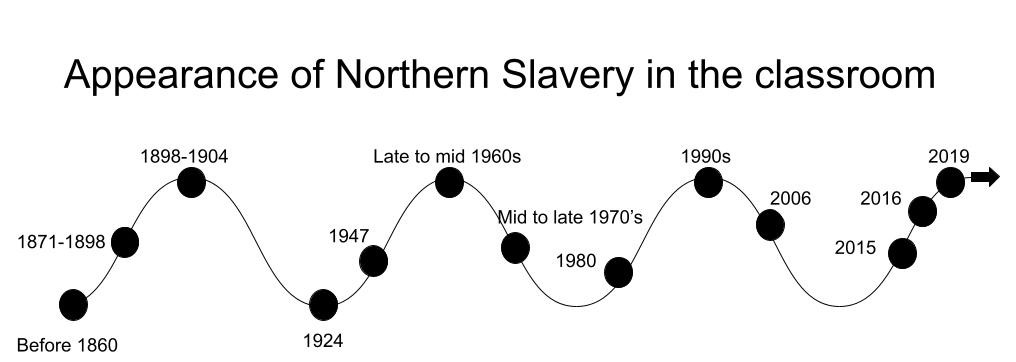
The lack of national attention to this critical issue does beg the question of how it happened. Many historians argue that the lack of discussion on the institution of northern slavery was due to the racist beliefs of historians in the 19th and 20th centuries.[3] The voices of those early historians often get blamed for creating the view that slavery was only relevant when discussing the civil war as it was undeniably a major cause[4]. As time progressed, one would assume the material on northern slavery would become more prevalent, however, that is not the case. As the discussion both in the classroom and by historians on the institution of slavery has expanded, northern slavery still remains for the most part absent. The question remains: did this critical part of the establishment of the nation go untaught? The only way to answer that question is by examining the teaching of slavery in New Jersey and the Tri-state area. This will open that gateway to a deeper understanding of how this history could be erased from the collective memory.
Before proceeding, it is imperative to understand what the discussion of the education on northern slavery has been. Though the discussion on northern slavery began in the late 1940s alongside the civil rights movement, the conversation about its absence in the classroom does not begin until 1991 due to a shocking discovery in Manhattan, New York[5]. As the federal government was constructing a 275 million dollar project, they stumbled upon “the largest and oldest collection of colonial-era remains of free and enslaved Africans in the United States, according to the National Park Service”. This discovery of the cemetery caused massive protests to fight the city to halt the construction and the removal of the bodies from the site[6]. Following this event, the New York City public schools began to look for a way to incorporate the material into the class and teach this reality that was just revealed to them[7]. This started a growing push from schools across the nation to try to incorporate this reality.
The conversation on northern slavery would continue over a decade later when Professor Alan Singer of Hofstra University would guest teach in New York City public schools. When teaching less than a mile away from the enslaved African cemetery, most of the students were completely oblivious to the reality that not only were slaves in New York but how the reality of slavery was visible in their own community[8]. Though many decisions on how to tackle such an issue were made to teach this material, over a decade later the students still had no idea about northern slavery. The discussions on the material did not translate into the classroom to a sufficient extent. The debate on how to successfully teach northern slavery in the classroom ensued and ultimately lead to the discussion on how to teach this history appropriately.
The content of northern slavery required a restructuring in order to successfully teach the material. Previously, slavery was only taught at the establishment of European colonies in the New World and before the American Civil War. What this divide does is creates the material into another unit, a separate event rather than a continuous struggle. The 2016 book Understanding and Teaching American Slavery by Bethany Jay and Cynthia Lyerly attempt to illustrate the best organization for discussing the topic and the history of the institution of slavery in classrooms. In their analysis of the history of teaching the institution of slavery, they regard the idea of teaching slavery exclusively at those points during early American Colonization and the Civil War to “severely hinder its importance.”[9] What is the best way to teach the institution of slavery is discussing the enslaved perspective threw out the development of the nation.[10] The benefits of this method allow the longevity of the issue and the hardships faced by those affected to be well articulated amongst the students. This is due to its constant presence and the reminder that liberty and freedom were not for all[11]. This revelation in adding the enslaved perspective to early American history would spark further development in tools and resources to bring northern slavery into the classroom.
An initiative would be enacted to bring northern slavery and the massive scope of the institution of slavery to the forefront. This would come in the form of The New York Times 1619 Project. This resource marks an incredible stride in the conversation on teaching northern slavery. The project’s purpose is “to reframe the country’s history by placing the consequences of slavery and the contributions of black Americans at the very center of our national narrative”[12]. This comes out of a series of historians and teachers discussing how the realities and the true institution of slavery were untaught to them in the classroom. The project’s aim is to bring these lost lessons of slavery such as its true cruelty and its widespread adoption throughout the nation, not just exclusively in the south. It is built off of the ideals proposed in Understanding and Teaching American Slavery and other books with the same idea tofollow this notion that slavery is an integral part of the nation as a whole, rather than at specific points in U.S. history[13]. The combination of all these ideas paints a picture of the flaws of the teaching of slavery threw out the nation. The current discussion’s main focus is looking at what is absent in the current classroom. The smaller conversation that pertains to the material taught in the past primarily revolves around racism and the Klan[14]. The discovery of a 1904 textbook that details the brutality of northern slavery pushes back on this notion[15]. It begs the question of whether the subject was truly untaught or if another force was responsible for its absence. Looking at the material present in the classroom in the past may prove an insight into northern slavery’s appeared absence.
An analysis of the classroom material available to students is key to understanding the absence of northern slavery. To find these answers, understanding what material was being taught in classrooms from the 1860s and beyond. A method to understand the content of the classroom is by looking at textbooks. Many school notes and lesson plans have been lost to time, but what remains are textbooks. The work of Dr. Pearcy shows the indicator tool that can be used to understand their effect on the content being taught in schools. He states clearly in his article, “Textbooks are, ultimately, tools, for student use. Their utility can only be measured by the degree to which they offer teachers the opportunity to build student-centered inquiry”[16]. From this notion, we can conclude that textbooks are just an object and a tool for students to use. Their content is meaningless unless given a purpose by the teacher. Everything learned in the classroom is under the teachers’ control and they possess the option to use or discard the textbook. However, textbooks do tell us something else depending on where they are. His research looks at ten different U.S. history textbooks of different authors that are widely adopted and compares their tellings of the Battle of Fort Sumter[17]. After analyzing each of the tellings, an interesting trend occurs. This trend is in the bias of the author and how they pick and choose what details to keep and leave out of the telling of the event. This bias could affect the leanings of anyone reading and coerce their perspective of the events that unfolded. These different depictions of the conflict in different areas can have effects on the material discussed in class or reflect it. Companies such as Pearson publish multiple textbooks by different authors to capitalize mainly on the market, however, what market are they capitalizing on?
Looking at the rationale behind the variation of textbooks based on location can assist in understanding why certain content is missing. The findings by Goldstein in his article Two States. Eight Textbooks. Two American Stories sheds light on the issue of why these publishing companies hire multiple historians and interpretations of the same material. This article focuses on eight different textbooks found within the states of Texas and California. The issues arise when looking at the same textbook in multiple states. The textbooks are by the exact same author but have different versions for each state. The variations were created by request of school districts or even the book’s own editor. These individuals remove or request additions of material to allow the book to be adopted in a particular area[18]. The best evidence to illustrate this divide between locations is that of the Harlem Renaissance. Examples of this are found in Pearson’s United States History: The Twentieth Century 19th edition. On the subject of the Harlem Renaissance, the Californian edition features a section on the debate within the African American community over its overall impact on them and the nation as a whole. The Texas version only includes the line “some critics ‘dismissed the quality of literature produced’”[19]. What these two distinct changes, along with many more, indicate is the presence of the political atmosphere of the area and the belief of the people the textbook is serving to reinforce. The textbook adopted by a particular state or district reflects the information a school is teaching in the classroom.
With an understanding of the behind-the-scenes crafting of textbooks, there can be the formulation of the content of northern slavery in school. Combining the findings of Dr. Pearcy and Goldstein, textbooks can provide insight into the classroom. The selection of the historian and the version adopted by the school reflect what the administration desired its teachers to instruct in the classroom. Though it may not be a perfect indicator of what was taught in classrooms, as it’s a tool for teachers to use, it gives an idea of what is being taught in the classroom. Examining textbooks from the past used in classrooms within the Tristate area can reveal if northern slavery was taught, and to what extent.
Examining the earliest textbook may yield an understanding of the lack of teaching, not only about northern slavery but slavery as a whole. An example of the content of what was taught in the classroom after the Civil War and in the years following can be found in The New England Primer. This book originated in 1690 and was a fixture in the classroom until the 1930s, a well over 200-year run. The textbook served as the basis of elementary education instruction. By looking at these textbook translations, historians get a sense of what was required of the majority of students at this time, along with what was taught in classrooms. Looking at the 1802 edition, the book opens with an alphabet chart. This gets taught through prayers that become progressively more complex as they go[20]. This information indicates that understanding the alphabet was key. Depending on the quantity available, the school could have focused on reading and potentially writing to utilize this book. Within the context of these prayers, one learns about the calendar and days of the week, counting and basic mathematics, and a small amount of history[21]. This stresses the importance of religion in the classroom at this time. The underlying message throughout the book is that God is more important than any other subject or material in the classroom. The small amount of history included is more biblical in nature but does include the basics of the American government system[22]. The addition of the U.S. system of government is the only change from the 1773 edition, replacing prayers outlining the functions and structure of the parliament system[23]. What this shows is that history was really not a focus in this era of education. Only those who would exceed the basic knowledge of the time would learn about more advanced information. With the perpetuation of this book into the 20th century, this basic education would be what was taught to many poor American individuals and black Americans. More fortunate areas would receive new textbooks and educational material, phasing this material out or relying on it less exclusively. Those less fortunate areas would be using this information exclusively until the 1930s. The New England Primer is referred to as the “Bible of one-room schoolhouse education”[24]. The lack of history not only assists in the loss of the knowledge of northern slavery but of the entire institution of slavery as a whole. These individuals would want the history they learned as children in school. A slow creep of this altered history would make its way to the north.
Movements were made to suppress and remove the teaching of not only northern slavery but all of black history. The most prominent of these would be “The Lost Cause”, the movement to honor the legacy of the confederacy. This movement would begin in the 1870s as reconstruction would begin to fail. The lost cause mentality would paint the black community as unable to attain the same equality as white individuals due to the efforts attempting to create equality failed[25]. This gave rise to the notion that the confederates were noble in their sacrifice to fight for slavery. It rewrites the telling of the history that “there was nothing ‘lost’ about the southern cause”[26]. This was due to the mindset that black Americans were only good at being servants to white men. Monuments and memorials to honor the confederacy would be constructed such as the statues of Stonewall Jackson, Jefferson Davis, and Robert E. Lee. By the 1890s this movement would sink its teeth into the education system of the north. The goal was to rewrite history books to reflect the southern perspective and preserve its honor. This movement is regarded as a reunion of America’s racist mentality as it proposed the Civil War was caused by other factors, not slavery. It also created this idea of the “happy slave”, the idea that there were enslaved individuals that loved slavery and serving the white man[27]. Women’s organizations and the state department of education were the ones in charge of advocating for approving educational material for schools. Many became strong supporters of the lost cause and by the 1920’s it would be integrated into schools across the north and especially in New Jersey[28].
Before the alteration of the history would appear, strides were made to bring the history of northern slavery to the forefront. In the 1870s history books began to include slavery within their content. The oldest examined history textbook to bear mention of slavery is the Condensed History of The United States from 1871. This book was used in a classroom in Norristown, Pennsylvania, as demonstrated by the address of the school on the front cover pages with the initial date of October 31, 1888. On the page adjacent, student names are written, with the last one being 1899, giving the text an eleven-year confirmed usage in the classroom. The cover pages are full of notes made by students long past, however, one stands out amongst the rest. This particular note is a prayer, one found word for word from the 1812 edition of the New England Primer. This detail establishes that in this classroom, the two books were in fact utilized together. This class was learning American history alongside the basics in the New England Primer. The town had the economic resources present to invest in its youth’s education. The students within this town received a higher quality of education than those of poorer communities. However, what did these students learn about not only northern slavery but the institution of slavery as a whole?
This history tells a very interesting version of America’s past, but what is interesting is what is left out. There is no mention of slavery until what they call the “War of Secession” is discussed[29]. The book starts with the discovery of the new world and the establishment of each American state at the time of its publication, but not one mention of slavery till that point. The book does establish that there was northern slavery by directly stating “At the time of adoption of the Constitution, slavery existed in the Northern as well as the Southern States”[30]. It provides an impressive analysis for its time detailing the various legal cases pertaining to slavery such as Dred Scott v. Sanford. There is a fascinating inaccuracy with the passing of the 13th, 14th, and 15th amendments; as the book details that Johnson was president for their passing. It details that the passing of these amendments was the cause of the issues between the President and the other two branches, rather than Reconstruction. In fact, the only mention of Reconstruction at all is Johnson vetoing the Reconstruction Act of 1865 rather than discussing any of the programs created by it[31]. This alteration to history has two possible reasons for the inaccuracy. The first is more innocent, being in the title of the book “condensed”. Reconstruction not only is a long process and would officially end in 1877. The book was written in 1874 meaning that reconstruction was still ongoing at the time. Writing on its effects could be taken as more speculatory and not factual information as the book attempts to stick exclusively to. The second is the seed of the lost cause making its way into the material. The ideology of the lost cause deemed Reconstruction a failure and did not warrant time discussion. Its omission is telling that this influence was seeping into the education of these students. However, what is most interesting is what it says about how slavery ended in the north. After detailing the increase of southern populations due to the cotton gin, it stated, “In the North, on the other hand, where slave labor was not profitable, slavery soon died out”[32]. It leads to the idea that in the 1850s slavery was extinct in the north, however, the reality was quite different. Slavery was very much alive in the north during the 1850s.
Looking at the history of just New Jersey alone, there is a far different reality of northern slavery from this telling in the textbook. Starting as far back as the 1790s, New Jersey was split over the issue of slavery. Quakers were strongly against it; they interpreted enslaved people as people due to the wording of the constitution. The three-fifths compromise of 1787 also reinforced their claim that enslaved individuals were people. The opposition viewed freedom as an economic catastrophe. The labor force for the majority of the state’s highest-grossing markets were nearly entirely enslaved or indentured servant individuals. They saw that liberation would make the industries of agriculture, ironworking, and factory manufacturing unprofitable. The debate over a compromise began in 1797 but would reach its conclusion in 1804 with the gradual abolition act, also referred to as the “free womb” act[33]. This legislation gave freedom to all enslaved individuals born after July 4th, 1804 on their 21st birthday[34]. This allowed slave owners to have the labor force they needed to make up for the economic loss of abolition and granted enslaved people their freedom at a set point. The average life expectancy of an enslaved individual in New Jersey at this time was forty-one years. This meant that they would likely have had only half their life to live if they even made it to freedom. The act was filled with loopholes that allowed the continuation of slavery in the state well after the projected period of total abolition. The idea was to have all enslaved individuals freed by the 1830s. The issue was with the clause that allowed children born while in the period of the enslavement term were to be placed in the care of the local principality[35]. Principalities were the townships and counties that reside within the State of New Jersey. Many of the individuals in charge of managing the treatment of these children would give them right back into the hands of their masters, making them slaves till their 21st birthday. This is how the enslaved population grew far larger than it was in 1804 by the 1860s[36].
The inaccuracies of the teaching of northern slavery would have disastrous consequences to its very existence by later generations. The pervasive belief that slavery was all but extinct in the north by the 1860s is evidence of the start of the “the amnesia of slavery”[37]. This is a term coined by historian James Gigantino II in his book The Curious Memory of Slavery in New Jersey, 1865-1941. What he seeks to illustrate is how Northern states such as New Jersey with such a large and prosperous enslaved population forgot that slavery even occurred in their own backyards. The reason for this was that slavery was looked at as an “insignificant sideshow” in the state. Many northern slaveowners owned only one or two slaves, thus making the reminders of an enslaved past virtually nonexistent to those that were not directly affected by it[38]. What the Condensed U.S. History textbook shows us is this amnesia occurring. In a time when enslaved individuals and their children were very much still alive, their suffering is being forgotten. There is no active backlash as those with the ability to change the material have little to no interest. This early removal of teaching about what occurred beneath these students’ feet will send shockwaves to later generations and reach into the modern classroom.
There would be a push to expand the teaching of northern slavery upon the turn of the century before the influence of the Klan would take hold. This is evident in the textbook Stories of New Jersey by Frank R. Stockton. This book was published in 1896 and the copy analyzed was printed in 1904. The inside cover indicates the book originated from a Princeton classroom before finding its way into the Library of Congress. It is worth noting that this book is back in reproduction and the Amazon description of the book reads that it was “so popular over the years in NJ schools that it has in itself become a part of New Jersey’s history”[39]. This book possesses a unique feature that is exclusive to this book and none other, even textbooks today. This feature is an entire chapter dedicated to the history of enslaved individuals in the state from 1626-1867[40]. What this chapter says about slavery in the state is incredibly unique, especially for its time of publication. The section begins with Dutch settlers bringing enslaved individuals over with them in 1626 to develop the inhospitable land and form their colony. Enslaved individuals were expendable and would do the labor that would normally require a far more physical toll on the body. They became the largest group of workers in the booming iron industry, logging, and of course, the plantations popping up across the land. In 1664, the Dutch surrendered their colonies to the English empire. In this exchange, many changes would appear in the lives of those original settlers, but slavery was not changed[41]. Slavery remained in this state for over 200 years after this point. This early slavery history even includes an entire section on how Perth Amboy, New Jersey, was the slave trade capital in the north and distributed enslaved individuals throughout the northern colonies[42]. This was all true. While other texts around this period ignore this history, this book sought to put a spotlight on it. Following details of the atrocious conditions the enslaved people in the state faced and the lack of large plantations like the south, it noted that large numbers of individuals owned one or two enslaved individuals[43]. This kept slavery as a pivotal force in the community and essential to its economy. If this text was utilized in the classroom to the fullest, many students would have learned a genuine and dark history of the establishment of the state’s institutions. However, this very insightful history becomes inaccurate regarding the abolition of slavery.
The first half of the telling of northern slavery from Stories of New Jersey is remarkable with its depiction of northern slavery for its time, but that narrative falls apart when reaching the abolition of slavery in the state. While it does portray an accurate picture, much of it is far from the truth. The first comes in the debates over the gradual abolition act of 1804. The book describes it as Quakers becoming abolitionists; the three-fifths compromise made their view under the law that these were people, not property, and entitled to the same rights. The opposition saw slavery as an economic necessity as the work they were doing was dangerous. These were undesirable jobs no one wanted to do in their society. This debate over the issue does remain close to the reality that transpired. The text makes a crucial error in stating the gradual abolition bill that allowed the abolition of slavery on one’s twenty-first birthday passed in 1820 rather than 1804[44]. This alteration of the date creates a precedent that the abolition of slavery was far faster and more efficient. It creates the idea that New Jersey’s policy was successful and had no issues with its implementation. Further errors found in the section support this idea that the solution the state implemented was successful. When discussing the results of the act it directly states, “in 1840 there were still six-hundred and seventy-four slaves in the state, and by 1860 only eighteen slaves remained, and these must have been very old”[45]. These numbers couldn’t be further from the truth as slavery was still going strong by the 1850s.
What is missing from the Stories of New Jersey textbook are those who were wrongfully enslaved. The text leaves out the dark reality that a percentage of slavery occurring in the state was children who were supposed to be free. The 1804 Gradual abolition act forced some of the children born to enslaved mothers into a life of enslavement until their twenty-first birthday. The census of children being born from 1804-1835 to exclusively enslaved mothers shows five hundred and forty-one documented children. It is estimated that in the year 1850, while documentation may say two hundred and thirty-six, far more were illegally in service. The text also does not acknowledge the abolition of slavery in its entirety in 1866. The wording makes it appear it ended gradually by 1860 citing the success of the gradual abolition act[46]. This misinformation will impact generations to come as it was the definitive history of the state. It took until 2008 for the New Jersey government to finally formally apologize for its slave-owning past and its failure to step in and end its illegal perpetuation[47]. Though it may not be the most perfect telling of the history, it’s evidence that people were trying to teach the injustice that happened within their state. Slavery was not relegated to a small part of the civil war, rather it merited its own chapter dedicated to the hardships and debate over its abolishment. While this book is making its way into classrooms, so is the Klan. The Klan would attempt to rapidly spread in the education field and in the coming decades as part of its resurgence. This growth would ultimately transform the history of northern slavery.
The Klans’ takeover of northern education and purging of the history of not just northern slavery, but the entire institution is seen within the textbooks of the 1920s. The 1924 textbook An Elementary History of New Jersey by Earle Thomson is dramatically different from the textbook from 1904. What distinguishes this book aside is absolutely no mention of slavery of any kind. This textbook was definitely used within the state, as in the preface the author thanked superintendents and principals who commissioned a book to express their shared view of the truly important history and to add tools that would enhance student understanding[48]. The schools this particular book was used in included Union, Hackensack, Newark, and Westfield[49]. There may have been more schools adopting this book, however, those are unmentioned by the author, and no indication is left on any of the Library of Congress documentation. The book directly states that “children should be taught in some detail the history of their own state and of its part in the development and progress of the country” while omitting a major part of their history[50]. The larger shocking piece is that only the conflict of the Civil War is discussed. There is no lead-up; it just dropped the reader right into the conflict[51]. It appears that only the victory of the war was significant, but not what they were fighting for or even the amendments that followed. This text is pivotal to understanding the shift in the classroom. The lost cause ideology had reached the apex of its hold on the classroom. The removal of all mention of slavery or black Americans was done to illustrate how unimportant the black community was and how futile any action to promote equality was. However, its removal may have been far more purposeful than just a desire to push this lost cause ideology.
The Klan had far larger ambitions than just the omission of slavery from educational material during the 1920s. The book The Second Coming of the KKK: The Ku Klux Klan of the 1920s and the American Political Tradition by Linda Gordon sheds light on this exact time period. The Klan was a notorious hate group created in the aftermath of the Civil War but it saw a resurgence in the 1920s. This revived Klan was stronger in the North than in the southern states of the nation and focused on the education system of the time[52]. Their priority was the recruitment of white American youth to continue their organization into the coming generations. This involved integration of the Klan into the material taught in schools. The Klan and those associated with them edited the material to reflect the beliefs of the organization. This makes recruitment easier as the Klan reflects the morals and values secretly supplanted into the minds of susceptible students[53]. This was most evident in the teaching of history in the classroom. Klansmen in positions of authority in schools such as superintendents used their influence to alter texts found in the classroom. This involved the recreation of textbooks to fit their nefarious agenda[54]. The lack of a mention of slavery or even the leadup or aftermath of the civil war in the 1924 textbook is evidence of known involvement. It’s unclear if any of the principals or superintendents credited in the textbook are Klansmen, but the influence is quite evident. The textbook states, “This book is in no sense a complete history of New Jersey, the author hopes that its study may prove an inspiration to the purple to become an upright citizen of his community or state”[55]. The absence of this major time period in the state’s history is done in a way to not invoke question. Unless there is other supplemental material taught in the classroom, the dark history of the state and the nation are removed from the collective memory. This book directly shows how “the amnesia of slavery”[56] occurred not only in the state of New Jersey but across northern states. With the widespread recruitment push for new Klansmen, anyone learning in schools around this time would have no recollection of northern slavery’s existence. All the work in the decades past to bring this history into the classroom has been completely undone. Any book touching on the subject would have to start from scratch if the goals of those behind the book were successful.
Following the end of the Second World War, the U.S. would revisit the teaching of northern slavery. The post-war U.S. began to enter a period of civil rights and reforms as the Truman administration began to assist in the abolishment of segregation. This gets reflected in the 1947 U.S. history textbook American History by Howard Wilson and Wallice Lamb. This textbook is fascinating due to its creation. The book states that the author’s intentions for writing the textbook were to “include history and perspectives from this great nation that have been forgotten or removed over the years”[57]. This indicates that the creation of the book was to teach a history that includes information removed by the Klan and other parties. The authors attempted to devise a history from the ground up that includes lost information including slavery. It kept its promise by including a simplified version of the slave trade and the quantity of forced labor employed. The text also looked into how the institution of slavery was a fundamental part of colonization in the Americas[58]. It may not be the most perfect of tellings as it leaves the atrocities that faced the enslaved individuals out. This is significant as it leaves out the horrors that faced enslaved individuals. It creates the notion that this was a great injustice on the part of the colonists but was not as horrific as the reality of the situation. It keeps the reader, most likely a white student, separated from the event allowing no remorse for the actions of their forefathers to the black community. This was the last instance of slavery mentioned till the causes of the Civil War. There are two chapters dedicated to the development of agriculture and industry in the northern states and the southern states, but there is no mention of slavery whatsoever[59]. What this does is reinforces the idea that slavery was there, but it wasn’t important in the continued development of the nation. The practice of slavery was only significant in establishing a foothold on the land. It makes the institution and the horrors faced by the enslaved people insignificant to economic development. However, coverage of the Civil War period possessed an interesting take on the content.
The 1947 textbooks’ stance on the Civil War and its aftermath indicate a deviation from the stranglehold of the Klan in education. The period leading up to the war has an interesting take on slavery. The text neither condemns nor supports either side of the debate on slavery. It creates this awkwardly neutral state when describing the situation that caused the suffering of so many[60]. This is important as the goal appears to not anger those with sentiment in support of slavery. The author appears to be holding back their opinion on the matter and not getting into depth on the horrific reality. The text does have an allusion to the idea that the northern states either abandoned or abolished the practice. It describes this trope of the north being “abolitionist”, that there was no one within the state that opposed slavery. Following the end of the war, it does something unique to this text. The textbook described the reconstruction period in a way to appear successful rather than what happened in reality. The book described Reconstruction as establishing property in the south with 40 acres and a mule proposition. It describes how many would remain in the south as they were given property. What is also interesting is that it discusses the surge of newly freed black individuals getting into office as they finally received the right to vote. The book describes the downfall of the reconstruction as due to irresponsible spending of tax dollars and the creation of the Klan forcing black Americans to stay out of government and politics[61]. The text portrays the Klan as the villain in reconstruction. It signifies a shift in public opinion and the elimination of their grasp on the education system. Information that pushes back on the lost cause narrative by showing that Reconstruction was sabotaged is making its way into schools. The neutral dialog however does indicate their presence is still there. The Klans’ limited presence is also indicated by the book leaving out many important details such as lynchings, or even the Great Migration of Black Americans to the north for work. These events had the potential to paint the Klan that existed at this time rather than the early organization during the reconstruction era in a negative light. The Klan may not have been as strong as they were in the previous decades, but was still a prominent organization throughout the nation, especially in the north. The textbooks telling of slavery does reinforce the notion that slavery was exclusively a southern problem, but this is not the first time this will occur.
Northern slavery’s absence in the classroom may not have been excluded due to racist involvement in the material. The relegation to slavery being exclusively southern is an issue that perpetuates to this modern day. This trend is one that Mr.Vikos, a former high school history teacher is very familiar with the pattern of returning to relegating slavery to exclusively the south. Mr. Vikos taught in Brooklyn from the late 1960s to the late 1990s. His insight into the teaching of northern slavery illustrates how racism is not the only factor in the removal of this information. In the late 60s, his school was facing a large influx of black students due to the end of segregation in 1963. The school would become nearly 100% black by 1975 and the teachers wanted to teach material that reflected the classroom’s demographics. This involved teaching northern slavery when the pre-Civil War era would arise in the classroom. “Students did enjoy the content at first, but as the years went on there were an increasing number of issues. The first was general confusion as students would get confused on what side slavery was on during the actual conflict. The second and most important issue was the lack of care. The students had no interest in learning about slavery that occurred here (New York)”[62]. Eventually the teaching of northern slavery would be reduced as issues with the content would arise. “Readings on northern slavery were present in the classroom, but the likelihood anyone of the students remembered them a decade later is highly unlikely”[63]. The teaching of northern slavery was present, but students would be the driving factor in its reduction. Eventually, the material would return to the idea that the north were free states and the south was slave states. There is a cycle of the subject of northern slavery appearing and then disappearing. The topic becomes introduced, it reaches a height where the issue is really focused on, and then an outside force acts, reducing the discussion back to the beginning. This trend can be seen between the textbooks from 1874 to 1924 with the Klan removing the material and again from 1947 to the 1970s when student interest would reduce its discussion. This trend would continue into the modern day. This becomes evident with the current lack of understanding of northern slavery even though the material is now present in almost every classroom in northern schools. The decades from the 1980s to the mid-2010s only serve to continue this trend.
To prove this theory of the teaching of northern slavery being a cycle, the decade of the 1980s serves as a point to see the material reintroduced. The 1980 textbook American History Review Text by Irving Gordon illustrates an interesting trend in the telling of history. This book was used in Port Richmond High School in Staten Island, New York throughout the 1980s and into the early 90s. The textbook immediately began with the colonization of America and the triangle trade after establishing a background on the New World. It also does a fantastic job of illustrating the population differences between the enslaved population and the white Europeans[64]. This detail is that “slavery was found as a common practice throughout all English thirteen colonies”[65].Through discussing early American slavery, the inclusion that it existed within the entirety of the nation does allow the student reading to understand that the institution of slavery was in fact present in the north. Continuing the traditional organization structure, the textbook only mentions slavery only at the colonization of America and prior to the Civil War. This structure continues to assist in undermining the severity and longevity of the institution of slavery. When it begins to discuss the pre-Civil war era, it does call out hypocrisy. Though it may be two paragraphs, it sheds light on the hypocrisy of northern slavery[66]. This hypocrisy was the north participating in slavery while simultaneously vilifying the south for participating in the exact same practice. This is significant as this is the first textbook examined to touch upon this issue. Not only does it bring to light northern slavery, but the textbook condemns the north for criticizing southern slavery before it abolished the practice fully within its states. Upon reaching the point of reconstruction, the textbook’s messages begin to shift.
Though time long since passed the time of Klan involvement, the telling of the history still bears its scars. The language of the text leads to assumptions with the vocabulary used to describe the black community at different points. In the beginning, they were described as “Africans” who then transitioned into being referred to as “enslaved” individuals. In the years during reconstruction, they are referred to as “Black”. However, once reconstruction ends they become “negros”[67]. What this shows is the perpetuation of the lost cause mentality through the vocabulary. The idea of referring to black individuals as “negros” in this text is to establish the notion that the black community during the point of reconstruction and after are two different kinds of people. There also are present many allusions to what is going on in the north but the reality is vastly different. An example of this is the education system constructed in the south during Reconstruction. It stated “Negros, as well as whites, were guaranteed free compulsory public education by the reconstruction constitutions of the southern states. However, after the southern whites regained control, Negros received schooling that was segregated and inferior”[68]. This line does highlight the notion that there was segregation and inferior education in the south but makes it appear that it was not a problem in the north. Segregated schools were prominent in the north as well and in some cases persisted far longer than they were legally able to. What this wording does that becomes commonplace is make the south sound like a racist and discriminatory place and paint the northern states in a light that is far from the reality that existed. The textbook does a decent job of illustrating the regression of the discussion of northern slavery. It may establish the institution existed in the north, but it lacks descriptions of the conditions. The text also regresses to race-charged wording linking its connection to the history of previous Klan-influenced textbooks. This would change as the nation entered the 1990s.
The discussion on northern slavery would continue due to its prioritization. The 90s would be a point where the material on northern slavery would begin to grow once again. Starting in 1996, Mr.Vikos would be responsible for approving textbooks for schools in the central headquarters. When asked about the criteria for what textbooks got approved, he would respond with the topic of slavery. He recalled how “many textbooks would just have a paragraph or two on the subject of slavers as a whole. It is impossible to cover all of the slavery in a single book, how do you do it in one paragraph? A textbook would only get passed if it discussed the social, political, and economic factors of both the north and the south”[69]. He would stress the economic section as this would be the deciding factor of slavery’s perpetuation for both the north and the south. What was illustrated was a reinvigoration of the content. This was an individual who was passionate about bringing this information to the classroom and was in a place to do so. With the discovery of the massive burial of enslaved individuals in Manhattan a few years prior, there was a draw into teaching northern slavery.
As time progresses into the modern day, the pattern of the rise and fall of northern slavery’s discussion in the classroom only becomes more rapid of a cycle. Three different versions of the American Pageant textbook by Thomas Bailey, David Kennedy, and Lizabeth Cohen illustrate the perpetuation of the rise and fall of northern slavery in the classroom. The editions in question are the 2006, 2013, and 2016 versions. What makes these books unique is that they are currently in use in schools in New Jersey. The ones examined were in the possession of students actively using them in the classroom. What makes this even more interesting is the parts that were changed. The beginning chapters detail the triangle trade and the enslavement of the native American populations and the African populations. It even includes how slavery reach the American colonies in 1619 from captured slaves en route to Spanish colonies diverted to Virginia[70]. The wording is almost exactly word for word between editions, so uniform it’s almost conspicuous. The differences become starkly relevant when the discussion of American slavery comes to question.
The three discussed American Pageant textbooks present differences that illustrate the increase and decline of the topic of northern slavery. Each book possessed a section dedicated to slavery between the founding of the nation and the civil war, slavery prior to the civil war, and a chapter on reconstruction. The differences become apparent in the first few paragraphs of the section. The 2006 edition was altered to include a deeper perspective of northern slavery following the revelation that attempts to include the material were unsuccessful. This is evident as the edition remarked that in the north there was freedom being attained, but there was more hatred of black Americans than in the south[71]. This gets reinforced by the story of an individual who was born enslaved in the south, sold in New York City, and was eventually freed after eight years of servitude and the conditions she lived in after gaining freedom. The textbook accurately portrayed the conditions of slavery, and by covering the north before the south in the description of slavery, it gives the impression that slavery was equally horrible in practice throughout the nation[72]. The 2013 edition states that northern slavery was just small farms with no large-scale plantations. It goes into detail about how New York abolished all of its slavery and possessed far better-living conditions than the south[73]. This entirely changes the established narrative that slavery was a horrible practice. The text almost glorifies the practice of slavery in the state of New York. The 2016 edition resolves these issues by taking the best aspects of the two together. It largely emphasizes the story of the enslaved woman by giving it its own dedicated page[74]. It includes an interesting insight into the northern slavery perspective. It does an excellent job of discussing how “few northerners were prepared for the outright abolition of slavery”. It goes in-depth at looking at the economic issues facing the north if it were to abolish slavery and the general view of the population wanting reform rather than abolition[75]. The description of the popular view of the time feeds into a clearer understanding of the northern hypocrisy. This being the desire to abolish slaves in the south rather than within their own borders. The combining of the best of the two prior editions is the greatest strength of the sixteenth edition. Due to its publication date, the revised text containing a large amount of northern slavery material could be due to the political climate in 2016. The contentious political election sought to reinvigorate the discussion of slavery, especially that of northern states. This may be only speculation due to the recentness of this change, but outside forces like that are indicators of material like this being reintroduced based on the previously analyzed patterns in the earlier textbooks discussed. The three different textbooks indicate a falling point in the 2006 edition due to the reinvigoration in the 90s, a low point in 2015 as northern slavery was no longer in style, and then a spike in 2016 due to a shifting political climate.
What the analysis of these texts indicate is a disturbing trend of periodically increasing and decreasing the teaching of northern slavery in the northern states. There are large and periodic appearances of this under-discussed material and it appears to almost be predictable.
We begin to see it untaught in the classroom in the immediate aftermath of the Civil War[76]. This was due to the material being largely sourced from the New England Primer, a book that focused on basic language, mathematics, and civic education[77]. The exclusivity of this textbook would fuel the “lost cause” ideology. This ideology was the belief that the south was justified in fighting for slavery as reconstruction failed, proving black individuals could never be equal to their white counterparts[78].The discussion of northern slavery begins to increase in the mid-1870s based on the material from Condensed U.S. History from 1874. Though the description of events leads much of the history of northern slavery out, it does make its appearance known[79]. Entering the 20th century we see a boom in the discussion of the material. In the textbook of the history of New Jersey, Stories of New Jersey, there is a detailed history of slavery in the state. It goes as far back as the Dutch and only gets slightly inaccurate in the end with the eventual abolition of the institution[80]. This revolutionary discussion of the material comes crashing down in the 1920s. This is illustrated by the 1924 textbook An Elementary History of New Jersey[81]. Its lack of not only the discussion of slavery in the north, but the absence of the entire practice is the ultimate goal of the “lost cause”. It indicates the idea of the Klan using education as a way to indoctrinate young and new members, and this came at the price of editing textbooks to reflect their views on society[82]. Textbooks and educational material would bear the scars from this alteration for dedicated to come.
The coming age of civil rights reform would attempt to distance itself from the past. The restructuring of this discussion of northern slavery is illustrated in the 1947 textbook American History[83]. Its limited appearance shows that the topic once again rose into the discussion. From the perspective of a history teacher from the late 60s to the mid-1970s, coverage began to increase once again to a clear point in the late 60s as schools finally began to become more diverse due to an end of segregation. Northern slavery’s discussion then began to fall in the 70s as the civil rights movement would lose its ground in the years following Martin Luther King Jr.’s assassination[84]. The discussion on northern slavery would reach a low in the 1980s and gets illustrated by the 1980 history textbook American History Review Text. It may call out the North but it shows clear evidence of promoting the “lost cause” mentality due to its racially charged language[85]. The 90’s would see a rise in the discussion of northern slavery again as the discovery of the largest enslaved cemetery in the nation would be found under Manhattan. The depth of the discussion on northern slavery reached a height in 2006 with the American Pageant 13th edition. It includes a detailed section on slavery in New York and that the horrors of slavery were present in the north. It even details how northerners viewed the practice as unjust but did little to nothing to end it within their states while criticizing the south[86]. From this height there is a dramatic fall in the 2013 edition of the same textbook. It led to the idea that slavery was small in the north and that it was far better in conditions than in the south. It also creates the illusion that it was abolished by the 1860s rather than continuing throughout the civil war[87]. Lastly, we see a jump in the discussion emerging in 2016. The American Pageant textbook’s 16th edition rectifies this issue of a decrease in the discussion. It adds material from the 2006 edition and expands on the practice and conditions of northern slavery[88]. It’s unclear what the cause of this shift could be, but one could only speculate it was done out of a response to the changing climates and the increased national discussion on the longevity of the impacts the institution of slavery had on the nation.
With these trends highlighted, it’s important to note that there has never been a steady teaching of the material. Teachers have struggled with finding ways to get the material across without creating unnecessary confusion. The importance of this subject is unparalleled as its atrocities have never truly been righted[89]. The perpetuation of these trends creates a lost history of the horrifying events that unfolded beneath the feet of students. They can adequately describe the atrocities that happened in distant states but are oblivious to the same atrocities that happened only a few miles away. The lack of a focus or understanding of what happened in the backyards of both teachers and students alike truly creates and perpetuates the “the amnesia of slavery”[90].
There is hope however that this continuous issue does get brought to light in the classroom. The awareness on the part of the students and teachers alike can see an end to its repetition. Teachers bringing this issue to the forefront and explaining to students that slavery happened here, and that it goes undiscussed, may inspire students to speak up when this topic is left out. Activism on this issue is key to maintaining its presence in the classroom and that these forgotten lessons never become forgotten again.
References:
Bailey, Thomas, David Kennedy, and Lizabeth Cohen. The American Pageant. 13th ed. Stamford, CT: Cengage Learning, 2006.
Bailey, Thomas, David Kennedy, and Lizabeth Cohen. The American Pageant. 15th ed. Stamford, CT: Cengage Learning, 2013.
Bailey, Thomas, David Kennedy, and Lizabeth Cohen. The American Pageant. 16th ed. Stamford, CT: Cengage Learning, 2016.
Blight, David W. Race, and Reunion: The Civil War in American Memory. Cambridge, MA: Belknap Press of Harvard University Press, 2001.
Gigantino II, James J. “The Curious Memory of Slavery in New Jersey, 1865-1941.” New Jersey Studies: An Interdisciplinary Journal 6 (1): 35–55. 2020, Academic Search Premier doi:10.14713/njs.v6i1.188. Accessed 9/28/22.
Gigantino II, James J. The Ragged Road to Abolition: Slavery and Freedom in New Jersey, 1775-1865. Philadelphia: University of Pennsylvania Press, 2016.
Gigantino II, James J.“‘’The Whole North Is Not Abolitionist’’.” Journal of the Early Republic 34 (3): 411–37. 2014, Academic Search Premier doi:10.1353/jer.2014.0040. Accessed 9/28/22
Gordon, Irving L. Review Text in American History. New York, NY: AMSCO School Publications, 1980.
Gordon, Linda. The Second Coming of the KKK: The Ku Klux Klan of the 1920s and the American Political Tradition. New York: Liveright Publishing Corporation, a division of W.W. Norton & Company, 2018.
Jay, Bethany, and Cynthia Lynn Lyerly. Understanding and Teaching American Slavery. Madison, WI: The University of Wisconsin Press, 2016.
Lapsansky-Werner, Emma J., Peter B. Levy, Randy Roberts, Alan Taylor, and Kathy Swan. United States History: The Twentieth Century. 19th ed. California. New York, NY: Pearson Education, Inc., 2019.
Lapsansky-Werner, Emma J., Peter B. Levy, Randy Roberts, Alan Taylor, and Kathy Swan. United States History: The Twentieth Century. 19th ed. Texas. New York, NY: Pearson Education, Inc., 2019.
Mydland, Leidulf. “The Leg of One-Room Schoolhouses: A Comparative Study of the AME…” European journal of American studies. European Association for American Studies, February 24, 2011. https://journals.openedition.org/ejas/9205.
New Jersey. Laws, Statutes, Etc. An act for the gradual abolition of slavery … Passed at Trenton . Burlington, S. C. Ustick, printer 1804. Burlington, 1804. Pdf. https://www.loc.gov/item/rbpe.0990100b/.
Pearcy, Mark, “We Are Not Enemies”: An Analysis of Textbook Depictions of Fort Sumter at the beginning of the Civil War, The History Teacher, Volume 52 Number 4, Society for History Education, August 2019
Samuel Wood & Sons, Publisher. Beauties of the New-England primer. [New York: Published by Samuel Wood & Sons, 261 Pearl-Street, 1818] Pdf. https://www.loc.gov/item/10011910/.
Swinton, William. Swinton’s Condensed United States: A Condensed School History of the United States: Constructed for Definite Results in Recitation and Containing a New Method of Topical Reviews. New York, Chicago: Ivinson, Blakeman & Co., 1871.
The Associated Press.“Teachers Shed Light on Slavery in the North.” NBCNews.com. NBCUniversal News Group, March 18, 2006. https://www.nbcnews.com/id/wbna11883116.
Thomson, Jay Earle. An elementary history of New Jersey. [New York, Philadelphia, etc. Hinds, Hayden & Eldredge, inc, 1924] Image. https://www.loc.gov/item/24011186/.
Vikos, George and Greenstein, Andrew. Conversation at Marina Cafe, Staten Island NY, November 14th, 2022
Westminster Assembly. The New England primer improved: for the easy attaining the true reading of English, to which is added, the Assembly of Divines, and Mr. Cotton’s catechism. Boston: Printed for and sold by A. Ellison, in Seven-Star Lane, 1773. Pdf. https://www.loc.gov/item/22023945/.
Wilson, Howard E, and Wallice E Lamb. American History. Schoharie, NY: American Book Company, 1947.
Wolinetz, Gary K., When Slavery Wasn’t a Dirty Word in NJ, New Jersey Lawyer, February 15th, 1999
[16]Pearcy, Mark, “We Are Not Enemies”: An Analysis of Textbook Depictions of Fort Sumter at the beginning of the Civil War, The History Teacher, Volume 52 Number 4, Society for History Education, August 2019, p.611
[17] Pearcy, “We Are Not Enemies”: An Analysis of Textbook Depictions of Fort Sumter at the beginning of the Civil War, p.596
[19] Goldstein, “Two States. Eight Textbooks. Two American Stories.”
[20]Samuel Wood & Sons, Publisher. Beauties of the New-England primer. [New York: Published by Samuel Wood & Sons, 261 Pearl-Street, 1818] Pdf. https://www.loc.gov/item/10011910/.p.1-32
[21] Samuel Wood & Sons, Beauties of the New-England primer p.4-21
[22] Samuel Wood & Sons, Beauties of the New-England primer p.22-30
[23]Westminster Assembly. The New-England primer improved: for the more easy attaining the true reading of English, to which is added, the Assembly of Divines, and Mr. Cotton’s catechism. Boston: Printed for and sold by A. Ellison, in Seven-Star Lane, 1773. Pdf. https://www.loc.gov/item/22023945/ ,p.29-31
[24]Mydland, Leidulf. “The Legacy of One-Room Schoolhouses: A Comparative Study of the AME…” European journal of American studies. European Association for American Studies, February 24, 2011. https://journals.openedition.org/ejas/9205.
[25]Blight, David W. Race and Reunion: The Civil War in American Memory. Cambridge, MA: Belknap Press of Harvard University Press, 2001.p.255
[26]Blight, Race and Reunion: The Civil War in American Memory p.257
[27]Blight, Race and Reunion: The Civil War in American Memory p.287
[28] Blight, Race and Reunion: The Civil War in American Memory p.283
[29]Swinton, William. Swinton’s Condensed United States: A Condensed School History of the United States: Constructed for Definite Results in Recitation and Containing a New Method of Topical Reviews. New York, Chicago: Ivinson, Blakeman & Co., 1871, p. 235
[30] Swinton, Swinton’s Condensed United States: A Condensed School History of the United States p. 236
[31] Swinton, Swinton’s Condensed United States: A Condensed School History of the United States p. 288-291
[32] Swinton, Swinton’s Condensed United States: A Condensed School History of the United States p. 237
[33] Wolinetz, When Slavery Wasn’t a Dirty Word in NJ
[34] New Jersey. Laws, Statutes, Etc. An act for the gradual abolition of slavery … Passed at Trenton . Burlington, S. C. Ustick, printer 1804. Burlington, 1804. Pdf. https://www.loc.gov/item/rbpe.0990100b/.
[35] New Jersey, An act for the gradual abolition of slavery.
[36] Gigantino II, James J. “The Curious Memory of Slavery in New Jersey, 1865-1941.” New Jersey Studies: An Interdisciplinary Journal 6 (1): 35–55. 2020, Academic Search Premier doi:10.14713/njs.v6i1.188. Accessed 9/28/22.
[37] Gigantino II, James J. “The Curious Memory of Slavery in New Jersey, 1865-1941.” p.36
[38] Gigantino II, James J. “The Curious Memory of Slavery in New Jersey, 1865-1941.” p.37
[42] Stockton, Frank R. “Stories of New Jersey.” p. 86
[43] Stockton, Frank R. “Stories of New Jersey.” p. 86-89
[44] Stockton, Frank R. “Stories of New Jersey.” p. 92
[45] Stockton, Frank R. “Stories of New Jersey.” p. 92
[46] Stockton, Frank R. “Stories of New Jersey.” p. 92
[47] Gigantino II, James J.“‘’The Whole North Is Not Abolitionist’’.” Journal of the Early Republic 34 (3): 411–37. 2014, Academic Search Premier doi:10.1353/jer.2014.0040. Accessed 9/28/22, P.38
[48]Thomson, Jay Earle. An elementary history of New Jersey. [New York, Philadelphia etc. Hinds, Hayden & Eldredge, inc, 1924] Image. https://www.loc.gov/item/24011186/. P.iv
[49] Thomson, An elementary history of New Jersey P.v
[50] Thomson, An elementary history of New Jersey P.ix
[51] Thomson, An elementary history of New Jersey P.150
[52]Gordon, Linda. The Second Coming of the KKK: The Ku Klux Klan of the 1920s and the American Political Tradition. New York: Liveright Publishing Corporation, a division of W.W. Norton & Company, 2018. p.2
[53] Gordon, Linda. The Second Coming of the KKK: The Ku Klux Klan of the 1920s and the American Political Tradition p.65
[54] Gordon, Linda. The Second Coming of the KKK: The Ku Klux Klan of the 1920s and the American Political Tradition p.67
[55] Thomson, An elementary history of New Jersey P.iv
[56] Gigantino II, James J. “The Curious Memory of Slavery in New Jersey, 1865-1941.” p.36
In the Spring 2022 semester, Dr. Nancy Hagedorn of the Department of History led a group of history students to develop a Digital History of Slavery and Runaways in New York.
As part of the history department’s efforts to help students develop historical research and digital technology skills, students created an innovative, public history using arcGIS Story Maps.
The project was conceived as an applied history course to introduce students to digital history methods and techniques by focusing on New York runaway ads. The class began by reading about digital history and its methods and uses, and then extensively about the history of runaways and slavery generally. Finally, the class focused on slavery in New York and New York City specifically. To facilitate the class’ digital history research and answer questions about slavery and runaways in New York, members compiled a database of New York runaway ads using transcribed ads culled primarily from the Freedom on the Move database at Cornell University. The class input data on 641 runaways between 1730 and 1811, and also compiled census data on slaveholding in New York State using the Northeast Slave Records Index at Lloyd Sealy Library and John Jay College of Criminal Justice.
More information on the project can be found online.
The 21st century has witnessed a resurgence in authoritarian and potentially fascist movements in many parts of the world including in the United States. As a result of Congressional hearings and judicial action we know that armed militias like the Proud Boys and the Oath Keepers were active participants in the January 6, 2021 assault on the United States Capitol Building. They wanted to overturn the results of the 2020 Presidential election and threatened to murder the Vice-President of the United States. Commentators like Madeleine Albright (2018) and Timothy Snyder (2017; 2018) make the point that Fascists pretend to respond to public sentiment and populist movements, but that is really just a strategy to achieve power by stirring popular discontent, resentment and fear to undermine democratic institutions. Snyder believes that in the twenty-first century, the gravest threat to democracy is virulent nationalist populism and sees the potential for the rise of authoritarianism in the United States as a response to a real or perceived danger. He quotes Hannah Arendt, who wrote that after the Reichstag fire in Germany, “I was no longer of the opinion that one can simply be a bystander” (Snyder, 2017: 110; Arendt, 2003: 6). Arendt’s statement highlights the need for an activist component in civics education as well as a deeper understanding of how fascists came to power in Europe during the 1920s and 1930s. During that period in the west many commentators misjudged the threat of fascism to world peace. Snyder and Albright call for promoting active citizenship and resistance against tyranny by educators committed to democracy and liberty, important goals in the National Council for the Social Studies College, Career, and Civic Life (C3) Framework for Social Studies State Standards.
Adolf Hitler was born in 1889 to a German speaking family in a region that was then part of the Austro-Hungarian Empire and later became part of Austria. He did not become an actual German citizen until February 1932. In 1913, Hitler moved from Vienna in Austria to Munich in Germany and with the outbreak of World War I he enlisted in the German Army. In the army Hitler rose to the rank of corporal and received the Iron Cross for service on the Western Front. Just before an armistice was signed in November 1918, Hitler was temporarily blinded and hospitalized following a British gas attack on German troops in occupied Belgium.
While still in the army, Hitler became part of the military’s propaganda department, and was assigned to speak to troops promoting nationalism and anti-Socialism. He also joined an anti-communist, anti-Semitic right wing political party. Under Hitler’s direction the party changed its name to the National Socialist German Workers Party or Nazi Party and in 1921 Hitler became its official leader. In 1923, Hitler participated in the unsuccessful Beer Hall Putsch that tried to take over the government of the German state of Bavaria. He was captured, convicted of treason, and spent nine months in prison where he wrote Mein Kampf (My Struggle), a manifesto of Nazi ideology. In a September 1930 election, the Nazi Party increased its representation in the German parliament, the Reichstag, from 14 to 107 seats, making Hitler the leader of the second largest party in Germany. In January 1933, with the Nazis Party holding a third of the seats in parliament, Adolf Hitler became chancellor, or Prime Minister, of a coalition government. Once in office, Hitler quickly moved to ban all opposition and in July 1934 he proclaimed himself “Fuehrer and Reich Chancellor.”
Dorothy Thompson of the United States and Gareth Jones of Wales were two of the earliest western reporters to meet with and speak to Adolf Hitler. In their reports, they misjudged his threat to democracy, world peace, and human rights in their reporting. In 1931, the Nazi Party invited Thompson to interview Hitler for Cosmopolitan magazine and in 1932, Thompson republished the interview as part of a book, I Saw Hitler! (New York: Farrar & Rinehart). Much of the article and book are dismissive of Hitler as a person. Thompson described him as a man of “startling insignificance,” “inconsequent and voluble,” and “the very prototype of the Little Man” (13-14). She characterized the interview with Hitler as “difficult, because one cannot carry on a conversation with Adolf Hitler. He speaks always as though he were addressing a mass meeting . . . a hysterical note creeps into his voice, which rises sometimes almost to a scream. He gives the impression of a man in a trance” (16).
Hitler, not surprisingly, was offended by his depiction in the Cosmopolitan article and Thompson was forced to leave Germany. In the foreword to the book, Thompson wrote. “My offense was to think that Hitler was just an ordinary man, after all. That is a crime in the reigning cult in Germany, which says Mr. Hitler is a Messiah sent by God to save the German people” (v). To her credit, Thompson later became an anti-Nazi activist in the United States, denouncing fascism in public addresses, her magazine and newspaper columns, and on radio broadcasts.
In a February 1933 article for The Western Mail & South Wales News, Gareth Jones described his meeting with Adolf Hitler during a shared airplane ride. Jones, like Thompson, was not initially impressed with Hitler, writing “When his car arrived on the airfield about half an hour ago and he stepped out, a slight figure in a shapeless black hat, wearing a light mackintosh, and when he raised his arm flabbily to greet those who had assembled to see him, I was mystified. How had this ordinary-looking man succeeded in becoming deified by fourteen million people?” Later on the flight, Jones discovered what he considered the other Hitler and reevaluated him. “Hitler steps out of the aeroplane. But he is now a man spiritually transformed. His eyes have a certain fixed purpose. Here is a different Hitler. There are two Hitlers – the natural boyish Hitler, and the Hitler who is inspired by tremendous national force, a great Hitler. It is the second Hitler who has stirred Germany to an awakening.” Jones had just completed a tour of the famine-ravished Soviet Union, especially Ukraine, and viewed Hitler and Germany positively in comparison.
The West’s uncertainty about Hitler’s threat to world peace comes across in Time magazine’s selection of him as its 1938 “Man of the Year.” It conveyed a sense that Americans should be impressed by the figure of Adolf Hitler as he strides “over a cringing Europe with all the swagger of a conqueror.” Hitler, in five years, “lifted the nation from post-War defeatism” and transformed it into “one of the great military powers of the world today.” Time editors considered Nazi rule in Germany “no ordinary dictatorship, but rather one of great energy and magnificent planning.” The article was published in January 1939, eight months before Germany invaded Poland igniting World War II.
In November 1938, during a parliamentary debate, future British Prime Minister Winston Churchill stated: “I have always said that if Great Britain were defeated in war I hoped we should find a Hitler to lead us back to our rightful position among the nations . . . Hitler is Fuehrer because he exemplifies and enshrines the will of Germany.” As closure for lessons on the rise to power of fascists in Europe on the 1920s and 1930s, students should discuss why Churchill, Jones, Time magazine, and Thompson, at least initially, seemed to misunderstand and minimized Hitler’s threat to democracy in Germany and world peace.
References
Albright, M. 2018. Fascism: A Warning. New York: HarperCollins.
Arendt, H. 2003. The Portable Hannah Arendt. New York: Penguin Books.
Snyder, T. 2017. On Tyranny: Twenty Lessons from the Twentieth Century. New York: Penguin.
Snyder, T. 2018. The Road to Unfreedom: Russia, Europe, America. New York: Penguin.
Instructions: Dorothy Thompson interviewed Adolf Hitler in 1931 for an article in Cosmopolitan magazine. Read excerpts A, B, C and D and answer questions 1 – 3. (Note: Hitler spelled his first name Adolf. Thompson wrote his name as Adolph in the magazine and book.)
A. “When finally I walked into Adolph Hitler’s salon in the Kaiserhof Hotel, I was convinced that I was meeting the future dictator of Germany. In something less than fifty seconds I was quite sure that I was not. It took just about that time to measure the startling insignificance of this man who has set the world agog. He is formless, almost faceless, a man whose countenance is a caricature, a man whose framework seems cartilaginous, without bones. He is inconsequent and voluble, ill-poised, insecure. He is the very prototype of the Little Man. A lock of lank hair falls over an insignificant and slightly retreating forehead. The back head is shallow. The face is broad in the cheek-bones. The nose is large, but badly shaped and without character. His movements are awkward, almost undignified and most un-martial. There is in his face no trace of any inner conflict or self-discipline” (13-14). B. “And yet, he is not without a certain charm. But it is the soft, almost feminine charm of the Austrian! When he talks it is with a broad Austrian dialect. The eyes alone are notable. Dark gray and hyperthyroid—they have the peculiar shine which often distinguishes geniuses, alcoholics, and hysterics. There is something irritatingly refined about him. I bet he crooks his little finger when he drinks a cup of tea. His is an actor’s face. Capable of being pushed out or in, expanded or contracted at will, in order to register facile emotions” (14). C. “The interview was difficult, because one cannot carry on a conversation with Adolph Hitler. He speaks always, as though he were addressing a mass meeting. In personal intercourse he is shy, almost embarrassed. In every question he seeks for a theme that will set him off. Then his eyes focus in some far corner of the room; a hysterical note creeps into his voice which rises sometimes almost to a scream. He gives the impression of a man in a trance. He bangs the table. ‘Not yet is the whole working class with us…we need a new spirit…Marxism has undermined the masses…rebirth in a new ideology…not workers, not employers, not socialists, not Catholics…But Germans!’ This, in answer to the question: What will you do for the working masses when you come to power?” (16-17) D. “It is an important question. Millions of Germans follow Hitler because he has proclaimed war upon the banks, upon the trusts, upon “loan-capital.” He has asserted time and time again that he will abolish the rule of one class by another. What actually do these statements mean, in terms of practical politics? I couldn’t find out, and anyone who can is a better interviewer than I. When I dared to interrupt the stream of eloquence by bluntly repeating my question, he replied (rather coyly) that he didn’t intend to hand his program over to his enemies (the German Chancellor) for them to ‘steal’” (17).
Questions:
What was Thompson’s initial reaction to Adolf Hitler?
Why does Thompson describe the interview as difficult?
In your view, why would Adolf Hitler be annoyed or angry at his portrayal by Thompson?
In your view, based on these excerpts and your knowledge of German history between World War I and World War II, should Thompson have issued a warning about the Adolf Hitler? Explain.
Document 2. “A Welshman Looks At Europe, With Hitler Across Germany” by Gareth Jones (Excerpts), The Western Mail And South Wales News, February 28, 1933
Instructions: Gareth Jones met Adolf Hitler in February 1933 a month after Hitler became German Chancellor. Read excerpts A, B and C and answer questions 1 – 3.
A. “If this aeroplane should crash then the whole history of Europe would be changed. For a few feet away sits Adolf Hitler, Chancellor of Germany and leader of the most volcanic nationalist awakening which the world has seen. Six thousand feet beneath us, hidden by a sea of rolling white clouds, is the land which he has roused to a frenzy. We are rushing along at a speed of 142 miles per hour from Berlin to Frankfurt-on-Main, where Hitler is to begin his lightning election campaign. The occupants of the aeroplane are, indeed, a mass of human dynamite. I can see Hitler studying the map and then reading a number of blue reports. He does not look impressive. When his car arrived on the airfield about half an hour ago and he stepped out, a slight figure in a shapeless black hat, wearing a light mackintosh, and when he raised his arm flabbily to greet those who had assembled to see him, I was mystified.” B. “How had this ordinary-looking man succeeded in becoming deified by fourteen million people? He was more natural and less of a poseur than I had expected; there was something boyish about him as he saw a new motor-car and immediately displayed a great interest in it. He shook hands with the Nazi chief and with those others of us who were to fly with him in the famous “Richthofen,” the fastest and most powerful three-motored aeroplane in Germany. His handshake was firm, but his large, outstanding eyes seemed emotionless as he greeted me. Standing around in the snow were members of his bodyguard in their black uniform with silver brocade. On their hats there is a silver skull and crossbones, the cavities of the eyes in the skull being bright red.” C. “We are now descending, however. Frankfurt is beneath us. A crowd is gathered below. Thousands of faces look up at us. We make a smooth landing. Nazi leaders, some in brown, some in black and silver, all with a red swastika arm-band, await their chief. Hitler steps out of the aeroplane. But he is now a man spiritually transformed. His eyes have a certain fixed purpose. Here is a different Hitler. There are two Hitlers – the natural boyish Hitler, and the Hitler who is inspired by tremendous national force, a great Hitler. It is the second Hitler who has stirred Germany to an awakening.”
Questions
What was Jones’ initial reaction to Adolf Hitler?
Why does Jones decide there are two Hitlers?
In your view, based on these excerpts and your knowledge of German history between World War I and World War II, should Jones have issued a warning about the second Hitler? Explain.
Document 3. Time Magazine’s Man of the Year (1938), January 2, 1939 (Excerpt)
Instructions: For it’s January, 1939 edition, Time magazine selected Adolf Hitler as its 1938 “Man of the Year. “Read excerpts A and B and answer questions 1 – 3.
A. Adolf Hitler without doubt became 1938’s Man of the Year . . . [T]he figure of Adolf Hitler strode over a cringing Europe with all the swagger of a conqueror . . . Hitler became in 1938 the greatest threatening force that the democratic, freedom-loving world faces today . . . Rant as he might against the machinations of international Communism and international Jewry, or rave as he would that he was just a Pan-German trying to get all the Germans back in one nation, Fuehrer Hitler had himself become the world’s No. 1 International Revolutionist. B. That the German people love uniforms, parades, military formations, and submit easily to authority is no secret . . . What Adolph Hitler & Co. did to Germany in less than six years was applauded wildly and ecstatically by most Germans. He lifted the nation from post-War defeatism. Under the swastika Germany was unified. His was no ordinary dictatorship, but rather one of great energy and magnificent planning . . . Germany has become a nation of uniforms, goose-stepping to Hitler’s tune, where boys of ten are taught to throw hand grenades, where women are regarded as breeding machines. In five years under the Man of 1938, regimented Germany had made itself one of the great military powers of the world today.
Questions:
According to this article, what are the key achievements of Adolf Hitler?
Based on these achievements, do you think Hitler merited selection as “Man of the Year“? Explain.
Write a Letter-to-the-Editor of Time explaining your point of view.
The issue of alleged Russian war crimes in Ukraine highlights the decades-long reluctance of today’s major military powers to support the International Criminal Court. In 1998, the International Criminal Court (ICC) was established by an international treaty, the Rome Statute. Coming into force in 2002 and with 123 nations now parties to it, the treaty provides the ICC, headquartered at the Hague, may investigate and prosecute individuals for war crimes, genocide, crimes against humanity, and the crime of aggression. As a court of last resort, the ICC may only initiate proceedings when a country is unwilling or unable to take such action against its nationals or anyone else on its territory. In addition, although the ICC is authorized to initiate investigations anywhere, it may only try nationals or residents of nations that are parties to the treaty, unless it is authorized to investigate by the nation where the crimes occurred.
The development of a permanent international court dealing with severe violations of human rights has already produced some important results. Thirty-one criminal cases have been brought before the ICC, resulting, thus far, in ten convictions and four acquittals. The first ICC conviction occurred in 2012, when a Congolese warlord was found guilty of using conscripted child soldiers in his nation. In 2020, the ICC began trying a former Islamist militant alleged to have forced hundreds of women into sexual slavery in Mali. This April, the ICC opened the trial of a militia leader charged with 31 counts of war crimes and crimes against humanity committed in Darfur, Sudan. Parliamentarians from around the world have lauded “the ICC’s pivotal role in the prevention of atrocities, the fight against impunity, the support for victims’ rights, and the guarantee of long-lasting justice.”
Despite these advances, the ICC faces some serious problems. Often years after criminal transgressions, it must locate the criminals and people willing to testify in their cases. Furthermore, lacking a police force, it is forced to rely upon national governments, some with a minimal commitment to justice, to capture and deport suspected criminals for trial. Governments also occasionally withdrew from the ICC, when angered, as the Philippines did after its president, Rodrigo Duterte, came under investigation.
The ICC’s most serious problem, however, is that 70 nations, including the world’s major military powers, have refused to become parties to the treaty. The governments of China, India, and Saudi Arabia never signed the Rome Statute. Although the governments of the United States, Russia, and Israel did sign it, they never ratified it. Subsequently, in fact, they withdrew their signatures.
The motive for these holdouts is clear enough. In 2014, Russian President Vladimir Putin ordered the withdrawal of his nation from the process of joining the ICC. This action occurred in response to the ICC ruling that Russia’s seizure of Crimea amounted to an “ongoing occupation.” Such a position, said Kremlin spokesman Dmitry Peskov, “contradicts reality” and the Russian foreign ministry dismissed the court as “one-sided and inefficient.” Understandably, governments harboring current and future war criminals would rather not face investigations and possible prosecutions.
The skittishness of the U.S. government toward the ICC is illustrative. Even as he signed the treaty, President Bill Clinton cited “concerns about significant flaws” in it, notably the inability to “protect US officials from unfounded charges.” Thus, he did not submit the treaty to the Senate for ratification and recommended that his successor, George W. Bush, continue this policy “until our fundamental concerns are satisfied.” Bush, in turn, “unsigned” the treaty in 2002, pressured other governments into bilateral agreements that required them to refuse surrender of U.S. nationals to the ICC, and signed the American Servicemembers Protection Act (sometimes called the “Hague Invasion Act”), which authorized the use of military force to liberate any American being held by the ICC.
Although subsequently the Bush and Obama administrations grew more cooperative with the court, aiding it in the prosecution of African warlords, the Trump administration adopted the most hostile stance toward it yet. In September 2018, Donald Trump told the UN General Assembly that the United States would provide “no support” to the ICC, which had “no jurisdiction, no legitimacy, and no authority.” In 2020, the Trump administration imposed economic sanctions and visa restrictions on top ICC officials for any efforts to investigate the actions of U.S. personnel in Afghanistan.
Under the Biden administration, however, U.S. policy swung back toward support. Soon after taking office, Biden—in line with his more welcoming approach to international institutions ― dropped the Trump sanctions against ICC officials. Then, in March 2022, when the Russian invasion of Ukraine produced widely reported atrocities in the Ukrainian town of Bucha, the U.S. president labeled Putin a “war criminal” and called for a “war crimes trial.”
The ICC was the obvious institution for action. That March, the U.S. Senate unanimously passed a resolution backing an investigation into Russian war crimes in Ukraine and praising the ICC. Weeks before this, in fact, the ICC did open an investigation.
Even so, it is unclear what the U.S. government can or is willing to do to aid the ICC in Ukraine. After all, U.S. legislation, still on the books, bars substantial U.S. assistance to the ICC. Also, Pentagon officials are reportedly opposed to action, based on the U.S. government’s long-time fear that U.S. troops might some day be prosecuted for war crimes.
For their part, Russian officials have claimed that the widely-recognized atrocities were a complete “fake,” a “fabrication,” and a “provocation.” In Bucha, stated the Russian defense ministry, “not a single local resident has suffered from any violent action.” Not surprisingly, Russian authorities have refused to cooperate with the ICC investigation.
Isn’t it time for the major military powers to give up the notion that their war criminals should be allowed to operate with impunity? Isn’t it time these countries joined the ICC?
The six-hour documentary film on the U.S. and the Holocaust produced by Ken Burns, Lynn Novick, and Sarah Botstein has many merits. It vividly portrays and personalizes the horrors and inhumanity of the Nazi murder machine, examines the diversity of responses within the United States, and highlights the State Department’s resistance to allowing more Jewish refugees into the country. Inspired by an exhibition of the U.S. Holocaust Memorial Museum, the film reflects the museum’s extraordinary cache of recorded interviews and resources.
Most importantly, it teaches the right lessons. When asked what she hoped people would gain from viewing the film, Botstein, the child of Jewish refugees on her father’s side, said, “I hope they learn something and have conversations about their role in a democratic society and their responsibilities to fellow human beings. To be kind to your neighbor, to think about what you would do and what you should do when things get hard and complicated. How can we work together?”
Yet I also agree with critic Martin Ostrow, the director of a previous PBS film on America’s response to the Holocaust aired in 1994, that Burns and company treated President Franklin D. Roosevelt with kid gloves. “It’s a shame,” wrote Ostrow, “the series brings nothing new to understanding Roosevelt’s troubling decisions and motivations.”
To understand the Roosevelt administration’s motivations and actions – or non-actions – one has to examine the U.S. and British policy of appeasement toward fascist states during the 1920s and 1930s. This larger story has been explored by a number of scholars, including Arnold Offner in American Appeasement: United States Foreign Policy and Germany, 1933-1938 (1969), David Schmitz in Thank God They’re on Our Side: The United States and Right-Wing Dictatorship, 1921-1963 (1999), Jacques Pauwels in Big Business and Hitler (2017), and Jonathan Haslam, The Spectre of War: International Communism and the Origins of World War II (2021).
Essentially, the policy of appeasement was based on the view that communism constituted a mortal threat to Western society, whereas fascism was acceptable, if not a positive antidote to communism. Indeed, when Benito Mussolini came to power in Italy in 1922, U.S. officials welcomed his National Fascist Party as a force for stability and a bulwark against Bolshevism (communism). “In developing American policy,” writes Schmitz, “officials in Washington were mainly influenced by Mussolini’s establishment of a stable, noncommunist government that welcomed American trade and investments.” This view, in turn, “allowed American officials to ignore Mussolini’s brutal repression of all opposition groups, destruction of Italy’s constitutional government, and rule by violence.”
Conservative British leader Winston Churchill was of a similar mind. Following a meeting with Mussolini in Rome in January 1927, Churchill praised the dictator at a press conference, saying, “If I had been an Italian, I am sure that I should have been whole-heartedly with you from start to finish in your triumphant struggle against the bestial appetites and passions of Leninism.”
Mussolini provided the role model for Adolf Hitler’s rise to power in Germany. Upon Hitler’s appointment as Chancellor in January 1933, the American ambassador to Germany, Frederic Sackett, wrote, “From the standpoint of stable political conditions, it is perhaps well that Hitler is now in a position to wield unprecedented power.”
In 1937, after more than four years of Nazi dictatorial rule and anti-Jewish policies and propaganda, the U.S. State Department continued to maintain that fascist-type governments were compatible with U.S. interests, free trade, and the international order. A February 1937 report written by the department’s European Division defined fascism as a respectable movement of the propertied classes aimed at defending the existing order and private property against Bolshevism. Where fascism was in power, the authors judged that “it must succeed or the masses, this time reinforced by the disillusioned middle classes, will again turn to the Left.” The goal of the United States, as such, was to ensure that Germany would recover economically. Should the economy falter, they warned, “war is possible, if not probable.”
Some members of the U.S. diplomatic corps pushed in the opposite direction. Most prescient was George Messersmith. He had been in the Foreign Service since 1914 and served as the consul general in Berlin from 1930 to April 1934 before becoming minister to Austria. In March 1934, he strongly advised that the U.S. not renew the major trade agreement with Germany, the Treaty of Friendship, Commerce, and Consular Rights, ratified in 1925, which was due to expire in 1935.
Messersmith argued that the treaty would only spur German rearmament. He pointed out that the long-range “mail planes” recently purchased by Germany were “easily convertible to bombers.” Contrary to Secretary of State Cordell Hull’s benefic view of international trade, he wrote in May 1934 that “a government with really peaceable intentions does not produce armaments, train its people in military exercises, and create such an extraordinary spirit in the schools, even among the very young.” Rather than build up the German economy, Messersmith hoped that economic instability would bring down the Hitler regime.
Disregarding Messersmith’s pleas, a special State Department committee recommended approval of the trade treaty, noting that trade warfare would mean the loss of nearly one billion dollars in American investments. The U.S. and Germany renewed the treaty in June 1935, which in turn enabled U.S. corporations to trade and invest in Germany without restriction. Messersmith lamented in 1936 that American firms were allowing their capital to be “used for the maintenance of the German industrial program and in some important directions for German rearmament, which is obviously not intended for defensive but for aggressive measures.” American business leaders, he added, “are not blind to all of this.”
U.S. business investments in Germany were substantial when Hitler took over in 1933, and continued to grow thereafter. “Perhaps the Germans could have assembled vehicles and airplanes without American assistance,” writes Pauwels. “But Germany desperately lacked strategic raw materials, such as rubber and oil, which were needed to fight a war predicated on mobility and speed. American corporations came to the rescue.”
As Nazi repression and militarization proceeded, U.S. corporate leaders faced the choice of whether to continue their operations in Germany or pull up stakes and take a financial loss. Virtually all remained. The reigning philosophy in Corporate America was expressed by Alfred Sloan, Jr., chairman of the General Motors board of directors, in a letter to a stockholder in April 1939: “According to my belief . . . an international business operating throughout the world should conduct its operations in strictly business terms, without regard to the political beliefs of its management, or the political beliefs of the country in which it is operating.”
Ambassador William Dodd in Berlin criticized this economic appeasement. He wrote to President Roosevelt on October 19, 1936: “At the present moment more than a hundred American corporations have subsidiaries here or cooperative understandings. The DuPonts have three allies in Germany that are aiding in the armaments business. Their chief ally is the I. G. Farben Company, a part of the Government which gives 200,000 marks a year to one propaganda operation on American opinion.” Dodd also noted the investments of Standard Oil, International Harvester, and General Motors in German rearmament.
Another mark of appeasement was Roosevelt’s appointment of Hugh R. Wilson to replace Dodd. Ambassador Dodd had been a thorn in the side of the Nazi regime, avoiding Nazi celebratory events and beseeching the Roosevelt administration to protest Germany’s remilitarization of the Rhineland in March 1936, albeit to no avail. Wilson, during his first meeting with Hitler on March 3, 1938, complimented the dictator as “a man who had pulled his people from moral and economic despair into the state of pride and evident prosperity which they now enjoyed,” according to his own account. Eight days after the meeting, German troops marched into Austria.
U.S. diplomatic and economic appeasement carried over into the muted U.S. responses to Jewish repression as well as the establishment of strict immigration quotas. On June 16, 1933, Roosevelt effectively established his administration’s policy with respect to Jewish persecution in Germany in a missive to Dodd in Berlin: “The German authorities are treating Jews shamefully and the Jews in this country are greatly excited. But this is also not a government affair. We can do nothing except for American citizens who happen to be made victims. We must protect them, and whatever we can do to moderate the general persecution by unofficial and personal influence ought to be done.”
Roosevelt began to have second thoughts about the policy of appeasement in 1937. In February, he questioned a State Department report which concluded that “economic appeasement should prove to be the surest route to world peace.” In May, he wrote in a letter to William Phillips, ambassador to Italy, saying that the “more I study the situation, the more I am convinced that an economic approach to peace is a pretty weak reed for Europe to lean on. It may postpone war but how can it avert war in the long run if the armament process [in Germany] continues at its present pace – or even at a slower pace?”
The U.S. and Great Britain abandoned the policy of appeasement only after Germany invaded Czechoslovakia in March 1939. Thereafter the policy became anathema. During the war, the U.S. aligned with the communist Soviet Union and fought against Germany and Italy, thus reversing its prewar orientation. The foreign policy establishment, meanwhile, blamed its abandoned appeasement policy on the antiwar movement rather than its own anti-communist vendetta – which it revived after the war.
“During the Second World War, millions of Americans fought and sacrificed to defeat fascism,” writes Lynn Novick, “but even after we began to understand the scope and scale of what was happening to the Jewish people of Europe, our response was inadequate and deeply flawed.”
Indeed, it was inadequate in a number of dimensions. The Roosevelt administration could have prevented U.S. corporations from aiding the Nazi state, particularly in rearmament. It could have united with the Soviet Union early on in opposing German expansionism. It could have spoken out strongly against Germany’s human rights abuses and opened the doors of immigration wider, even on a temporary basis, fulfilling the promise set in the bronze base of the Statue of Liberty, written by Jewish immigration activist Emma Lazarus in 1883, “Give me your tired, your poor, your huddled masses yearning to breathe free.”
Born in 1917 in Atlantic City, New Jersey, Jacob Lawrence moved to Harlem with his family in 1930 where he benefited from WPA projects. He studied art at the WPA Harlem Art Workshop in the New York Public Library’s 135th Street branch while he was still in high school. He continued his studies in art at the Workshop, despite dropping out of school to work part-time to help support his family when his mother lost her job. At the age of 21, he joined the easel division of the WPA and then the WPA Harlem Mural Project. Harlem, a destination for people of African descent from other parts of the U.S. and the Caribbean, provided Lawrence with a continual source of stimulation for his art. During the 1930s and 1940s, one of Lawrence’s major themes was working Americans, and unlike many artists, he created images of female workers, including teachers and domestic workers. The Shoemaker, 1945, is one of his images of men working.
Here, Lawrence depicts the strong physique and concentration of a lone worker, an artisan with powerful arms. Lawrence focuses especially on the man’s hands, rendered in exaggerated size and the largest element in the painting. It’s a serious subject, but Lawrence paints the background in the brilliant and joyous colors and patterns that he had noticed in many poor Harlem homes. Lawrence was well acquainted with the lives of laborers; his mother had been a domestic worker. In 1941 Lawrence was the first African American represented by a major New York City gallery. He was also the first to be exhibited in major museums and to enjoy patronage both within and outside the Black community.
Dorothea Lange (1895-1965)
In 1932, Lange photographed unemployed men in New York City on food line
Lange, born to German immigrants in Hoboken, New Jersey, is best known for her photographs taken during the Depression. A childhood case of polio left Lange with a limp that contributed to her sensitivity to the plight of others and her commitment to social justice. Deserted by her father and raised in the home of her alcoholic grandmother, Lange had a lonely childhood. She trained in several photographers’ studios, studied photography at Columbia University, and established a very successful photography studio in San Francisco. Lange’s early photos of labor demonstrations in San Francisco came to the attention of Paul Taylor, an economist at UCLA, who later became her second husband. An advocate for establishing camps for migrant workers, Taylor encouraged Lange to become a photographer for the State Emergency Relief Administration. The potency of these photos prompted Roy Stryker, the director of the Farm Security Administration, an agency that examined issues of rural poverty, to employ Lange in its historical division. Lange’s images became a source of inspiration for John Steinbeck’s The Grapes of Wrath. Her photograph, Migrant Mother, came to epitomize the Depression. This migrant mother was only 32 years old and had just sold the tires from her car to purchase food. Lange’s photographs later documented the injustice of Japanese internment during World War II.
Ben Shahn (1898-1969)
As a young boy Ben Shahn immigrated to the United States with his mother from Lithuania. When he was 14, he left school to become a lithographer’s assistant. He eventually attended New York University, CCNY, the Art Students League, and the National Academy of Design. His study of Jewish traditions, examined while the Depression developed, reinforced a concern for the plight of workers. He became known for his political subject matter, especially his series on the Sacco and Vanzetti court case that grappled with the trial and execution of Italian immigrants. Shahn worked on many WPA projects as both a painter and a photographer, chronicling the relocation of poor families to new federally sponsored communities through the Resettlement Administration. Shahn created a series of murals for a subsistence homesteading community in Roosevelt, New Jersey. The community was founded by the Farm Security Administration in 1936 to house New York City garment workers and their families, who would farm while off from work in the summer.
Images of starving Ukrainian peasant children, c. 1932-1933
Animosity between Russia and Ukraine has deep roots. This “Father Stalin” children’s song is from the 1930s when Soviet Union policies created famine in Ukraine. Father Stalin is Josef Stalin, head of the Communist Party and government in the Soviet Union that was dominated by Russia. The author of the poem is unknown. This version is from the 2012 book Bloodlands: Europe Between Hitler and Stalin (Basic Books, 2012: 36) by Timothy Snyder. A “kolkhoz” is a collective farm.