Civics – Era 11 The Great Depression and World War II (1929-1945)

www.njcss.org

The relationship between the individual and the state is present in every country, society, and civilization. Relevant questions about individual liberty, civic engagement, government authority, equality and justice, and protection are important for every demographic group in the population.  In your teaching of World History, consider the examples and questions provided below that should be familiar to students in the history of the United States with application to the experiences of others around the world.

These civic activities are designed to present civics in a global context as civic education happens in every country.  The design is flexible regarding using one of the activities, allowing students to explore multiple activities in groups, and as a lesson for a substitute teacher. The lessons are free, although a donation to the New Jersey Council for the Social Studies is greatly appreciated. www.njcss.org

Era 11 The Great Depression and World War II (1929–1945)

*  
*  

The beginning of the 20th century marks the foundation of the transformation of the United States into a world power by the middle of the century. In this era industrialization, urbanization, and rapid immigration changed America from an agrarian to an urban society as people lived and worked in cities. The development of the new technologies of electricity, transportation, and communication challenged our long-held traditional policies of limited government, neutrality, and laissez-faire capitalism. The lesson of the Great Depression was that capitalism and free markets did not enable everyone to attain the American Dream. As a result, Americans looked to their government for help with the problems of unemployment, poverty, old age. Housing, and the supply of food.

During the Great Depression, the unemployment rate was 24.9% in the United States (about 13 million people). Without income, there was very limited private consumption. President Roosevelt identified the South as the number one “problem region” of the U.S. for poverty and economic distress. In 1933, President Roosevelt signed the Tennessee Valley Authority Act, a federally funded program to protect  the environment from floods, encourage economic development, and produce electric power.

In 1934, Shareholders of the Alabama Power Company sued to prevent the TVA from acquiring over half of the company’s property and equipment. The sale would allow the government agency to allocate electric power to consumers. The shareholders argued that Congress exceeded its authority.

The U.S. Supreme Court in Ashwander v. Tennessee Valley Authority, held that Congress did not abuse its power. Justice Hughes argued that the Wilson Dam, the location where the TVA was in the business of generating electricity, had been built originally in the interest of national defense because it produced materials involved in the production of munitions. The government could sell excess electricity to consumers without violating the Constitution. The majority concluded that Congress had the authority to construct the Wilson Dam. The majority also found that the disposal of the electric energy generated was lawful. 

This Supreme Court decision is also known for the reasoning of Justice Louis Brandeis regarding conflicts when one branch exceeds its power and infringes on another branch. Justice Brandeis adopted the criteria which has become known as the ‘avoidance doctrine.“One branch of the government cannot encroach upon the domain of another, without danger. The safety of our institutions depends in no small degree on a strict observance of this salutary rule.”

The legacy of the Tennessee Valley Authority brought electricity to the southeastern United States increasing the productivity of farming and transforming this region from poverty to sustainable economic development. Before the Tennessee Valley Authority, electric power was generated by private companies. (e.g. Westinghouse, Edison Electric Illuminating Company, Public Service Corporation, etc.) Private companies are concerned with making a profit instead of investing in public areas such as street lights or rural areas. The first buildings to have electricity around 1880 were often hotels and commercial buildings. Wabash, IN, Appleton, WI, Cleveland, OH, and lower Manhattan were some of the first towns and cities to have electric power. Some members in Congress, namely Senator George Norris, favored public utility companies as the most efficient way to bring this new invention to everyone in the United States.

Since the Russian Revolution of 1917, Lenin prioritized the electrification of the Soviet Union as essential for economic and industrial development.  Each of the 12 Five Year Plans included the expansion of power through the construction of dams, fossil fuels, natural gas, and since 1975, nuclear energy. The Soviet state planning committee, Gosplan, developed these plans with clearly stated production goals.

One of the problems with the energy plan of the Soviet Union is the transmission of electricity from the generating plant to other regions of the country. Russia depends on a unified power system and the complexity of its geography and use of different energy sources (fossil fuels, hydropower, natural gas, and nuclear) makes it difficult to transfer power from one source to another efficiently.  The heaviest demand for electricity is in the western or European side of the country.  However, as electricity became accessible to rural areas, agricultural production became dependent on electricity. The largest nuclear power plant in Europe is on the Dnieper River in Ukraine. It was constructed in 1985.

The Soviet Union could benefit from the computer software used in the United States, but the Five-Year Plan model is dependent on Soviet Union computers and boilers. Some of the Five-Year Plans were completed ahead of schedule, some did not meet their goals, and they also included social changes such as closing houses of worship, providing child care, and using large collective farms. The goals of most of the plans were to transform the Soviet Union into a major industrial and economic power.

The Debate Between Private and Public Electric Companies

Russia’s 12 5 year plans

The Soviet Electric Power Industry

Questions:

  1. How is a market economy different from a command economy? What are the advantages and disadvantages of both models?
  2. Why did the United States and Soviet Union experience challenges or problems with electrifying their countries?
  3. Is a monopoly or market competition the most efficient economic model for providing utilities to the people in a country? (water, electric, phone, education, etc.)
  4. Is a market or command economy the most efficient model to address the expected problems from climate change in the next 25 years?
  5. Which economic model (market, command, or mixed) is the most efficient one to increase worker productivity?

On January 6, 1940, about three months after Hitler’s attack on Poland, President Franklin Roosevelt gave his Four Freedoms speech as part of his State of the Union address. This was during a time when many people in America wanted to remain neutral and isolated from the European conflict which expanded in September 1939 with Germany’s blitzkrieg attack and occupation of independent Poland.

1940 was also a presidential election year. In the mid-term election of 1938, the Republican Party became the majority in the House and Senate.  The Republican Party had several contenders for the nomination, notably Governor Thomas Dewey (NY) Senator Robert Taft (OH), and Wendell Wilkie, a businessman from Kansas. When the Republican Party convention was held in June in Philadelphia, Wendell Wilkie’s popularity had increased significantly, while the popularity of Thomas Dewey and Robert Taft was declining. 

“In the future days, which we seek to make secure, we look forward to a world founded upon four essential human freedoms.

The first is freedom of speech and expression–everywhere in the world.

The second is freedom of every person to worship God in his own way–everywhere in the world.

The third is freedom from want–which, translated into world terms, means economic understandings which will secure to every nation a healthy peacetime life for its inhabitants-everywhere in the world.

The fourth is freedom from fear–which, translated into world terms, means a world-wide reduction of armaments to such a point and in such a thorough fashion that no nation will be in a position to commit an act of physical aggression against any neighbor–anywhere in the world.

That is no vision of a distant millennium. It is a definite basis for a kind of world attainable in our own time and generation. That kind of world is the very antithesis of the so-called new order of tyranny which the dictators seek to create with the crash of a bomb.

To that new order we oppose the greater conception–the moral order. A good society is able to face schemes of world domination and foreign revolutions alike without fear.

Since the beginning of our American history, we have been engaged in change — in a perpetual peaceful revolution — a revolution which goes on steadily, quietly adjusting itself to changing conditions–without the concentration camp or the quick-lime in the ditch. The world order which we seek is the cooperation of free countries, working together in a friendly, civilized society.

This nation has placed its destiny in the hands and heads and hearts of its millions of free men and women; and its faith in freedom under the guidance of God. Freedom means the supremacy of human rights everywhere. Our support goes to those who struggle to gain those rights or keep them. Our strength is our unity of purpose. To that high concept there can be no end save victory.”

Historical perspectives were important in 1941, and they are important today. The United States, including President Roosevelt, presented a perspective of Japanese superiority and a destiny to rule the world. He also called America’s citizens to accept the importance of a new moral order that included the religious concept of faith in freedom under the guidance of God. This perspective of American superiority is built on a commitment to an idea and an ideal.

A Life Magazine article about Emperor Hirohito in 1937 stated “To Japanese he is, in all seriousness, a divine descendent of the Sun goddess, the incarnate head of the Japanese divinity idea that makes the conquest of Asia a holy destiny for the Japanese race.” For ordinary Americans, the concept of kami in Japanese culture was not comprehendible. Instead of understanding a perspective of divinity as present everywhere, they accepted Hirohito as a son of a god or goddess or someone connected with divinity.

After the bombing at Pearl Harbor tensions between the United States and Japan escalated. Through the lens of war, the Japanese emperor’s god-like status became a more serious issue because they perceived Japan’s war objectives connected with their religious beliefs.  A 1945 United States News story explains, “Shintoism has no religious content and has ethical content to the extent that it is designed to support the idea of the divine origin of the Emperor.”  A 1945 article in Life Magazine stated, “The Emperor of Japan is neither a man nor a ruler. Nor is he simply a god living in Tokyo. He is a spiritual institution in which center the energy, the loyalty and even the morality of the Japanese.” He is supreme in all temporal matters of state as well as in all spiritual matters, and he is the foundation of Japanese social and civil morality.

American and Japanese civilians had very opposite reactions following the events of December 7, 1941. For Americans, Pearl Harbor represented “A Day Which Will Live in Infamy.” For citizens of Japan, Pearl Harbor represented the success of a justified military retaliation. The American and Japanese governments both utilized nationalism to their advantage, and implemented various forms of propaganda as tools for shaping their civilians’ perspectives.  

     “What an uproar! Japan’s Imperial Forces got things off to a quick start with one splendid strike then another in historic surprise attacks on Pearl Harbor, where the bravado of the US Asia fleet met with sudden defeat, and off the Malaya Coast, where the main forces of the British Asia fleet were utterly annihilated. Word has it that Roosevelt and Churchill were shaken up and went pale upon hearing of the defeats. In a third strike, Hong Kong Island, England’s strategic base for its 100-year exploitation of East Asia, fell into ruin in only a matter of ten days. During this time, Churchill was sent reeling, cutting off contact with others and showing up in Washington.

     What these two headstrong countries are striving for will only lead them on a downhill path to military defeat. Our barbaric enemies are already cowering in fear in the Pacific, and the fall of Manila shall mark the day of the Philippines’ subjugation and reversion back to Greater East Asia. The enemy power of Singapore, which was—alas—boasting of its impenetrable stronghold before the Imperial Forces penetrated the jungle area of the Malay Peninsula and advanced southward like a raging tide, shall also vanish into nothingness in the midst of this glorious chapter in history.

     The military gains of the glorious Imperial Forces are truly great, and the army, navy, and air force should be given our heartfelt gratitude. We should also honor our courageous men who are ready to lay down their lives when charging enemy lines, as well as those who went out to conquer but never returned.”

On January 1, 1946, four months after the surrender on September 2, 1945, Emperor Hirohito made the following statement in Japan’s newspapers.

“I stand by my people. I am ever ready to share in their joys and sorrows. The ties between me and my people have always been formed by mutual trust and affection. They do not depend upon mere legends or myths. Nor are they predicated on the false conception that the Emperor is divine, and that the Japanese are superior to other races and destined to rule the world.

FDR Four Freedoms Speech

FDR Annual Message to Congress, January 6, 1940

Japanese vs. American Perspectives on Pearl Harbor

Japan’s Announcement Following Pearl Harbor, December 8, 1941

President Roosevelt’s Speech Following Pearl Harbor (video:4:48)

Eleanor Roosevelt’s Radio Address on the Evening of Pearl Harbor (transcript)

Eleanor Roosevelt’s Radio Address on the Evening of Pearl Harbor (audio, 2:57)

Questions:

  1. How was the rise of dictators after World War 1 an existential threat? How did ordinary American citizens understand the conflict in Europe and Asia before and after the attack on Poland and the attack on Pearl Harbor?
  2. If you were the President of the United States in 1940, would you deliver the Four Freedoms speech or one that is similar in content and context?
  3. Do you accept President Roosevelt’s statement following Pearl Harbor that before the attack the United States was at peace with Japan? (see video clip above)
  4. Are elected leaders elevated by people and the press or are they criticized to the extent that their decisions and motives are questioned?
  5. Which government delivered the best message to its citizens based on factual evidence and an understanding of the importance of the attack on Pearl Harbor?

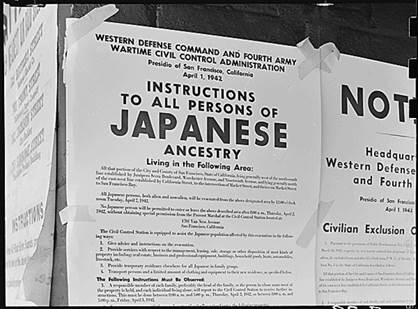
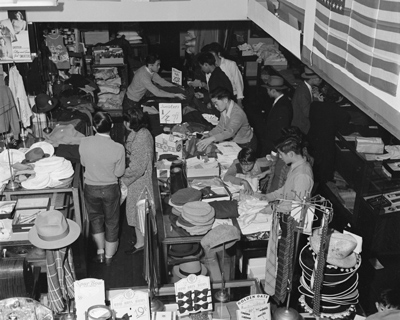
Two months after the attack on Pearl Harbor, February 19, 1942, President Franklin Roosevelt signed Executive Order 9066 to relocate approximately 117,000 Japanese Americans living on the west coast.  At first, the order was voluntary and Japanese Americans had time to sell their property and comply in an orderly manner.

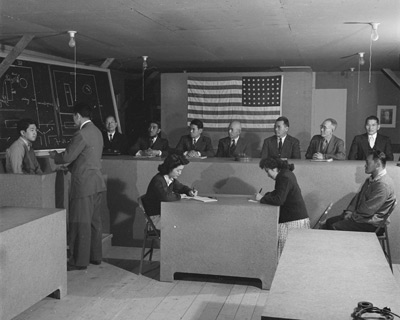
Unfortunately, many did not comply voluntarily, and the relocation became mandatory. Thousands of people lost their homes and businesses due to “failure to pay taxes.” The relocation of Japanese Americans in the United States for safety and security reasons was controversial during World War II and for the decades that followed.  The internment camps provided educational and recreational activities, adequate heat, and a process to hear complaints and address concerns.

There were 12 camps located all over the United States, with the Seabrook Farms camp in New Jersey.

President Truman rescinded the Executive Order on June 25, 1946 allowing the Japanese Americans to return to their homes. They were in relocation camps for more than four years. When they returned home, most found their belongings stolen and their homes and property sold. They also faced prejudice and discrimination for years, even though Japanese Americans were combat soldiers during the war. 

In 1988, President Ronald Reagan signed the Civil Liberties Act. The remaining survivors of the relocation camps were sent formal letters of apology and were awarded $20,000 in restitutions from the United States government.

On February 23, 1944, the Chechens were exiled from their ancestral lands and deported to Siberia and the northern regions of Kazakhstan. The entirety of the Chechen nation was accused of collaborating with the Fascists, even though there is no evidence to support this. The German advance into the Soviet Union never came close to Chechnya. The Chechen deportation of almost 400,000 men, women, and children is the largest Soviet deportation and occurred in a matter of days. Many Chechens had in fact fought on the front lines of the Soviet war against the German aggressor.

On September 1, 1941 the mass evacuation was announced for the approximately 440,000 Volga Germans. Ten days later they began their forced deportation to Kazakhstan and Siberia. Many were forced to work in ‘labor camps’  such as Kolyma. The Volga Germans were then stripped of their citizenship and did not regain their civil rights until after Stalin’s death. Most estimates indicate that close to 40 percent of the affected population perished.

In 1944, Joseph Stalin ordered the deportation of the entire Crimean Tatar community (roughly 200,000), falsely accusing them of collaborating with the Nazis. Reports suggest that nearly half of the deported died during the ordeal. Ukraine, Latvia, Lithuania, and Canada have all formally recognized Stalin’s brutal deportation as a crime of genocide. During this same period, the Soviet Union adopted a policy of “Russification” for the peninsula. Crimea was “Russified” and any study of the Tatar’s native language was banned, ancient Tatar names were erased, Tatar books were burned, and their mosques were destroyed. Nikita Khrushchev transferred Crimea from Soviet Russia to Soviet Ukraine.

Behind Barbed Wire: Japanese American Camps

Japanese American Internment Camps

Soviet Union Deportation of Volga Germans

Soviet Union Deportation of Chechnyas

Soviet Union Deportation of Crimean Tatars

Questions:

  1. Is it possible for a government to correct something it did that was morally or legally wrong?
  2. Do governments need to justify the actions they take during a time of war or a national crisis?
  3. Are there significant differences in the actions of the United States and the Soviet Union in the relocation or deportation of innocent people, many who were citizens?
  4. Do ordinary people have any rights during a war or crisis (i.e. Ukraine, Gaza, Sudan, Congo, Rwanda, etc.)?
  5. How and who determines if and when a government exceeds its authority?

In World War II, the Japanese were fighting for the Emperor who convinced them that it was better to die than surrender. Women and children had been taught how to kill with basic weapons. kamikaze pilots crashed their planes into American ships. A land invasion would be costly with estimates of more than one million American lives lost.

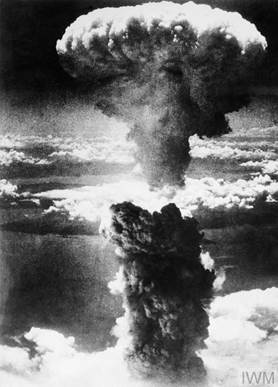
After a successful test of a nuclear bomb at Los Alamos, New Mexico on July 16, 1945, the United States, China, and the United Kingdom issued the Potsdam Declaration on July 26 demanding the unconditional surrender of the Japanese government, warning of “prompt and utter destruction.” On the morning of August 6, 1945, the first atomic bomb was dropped on Hiroshima. The result was approximately 80,000 deaths in just the first few minutes. Thousands died later from radiation sickness. On August 9, 1945, a second atomic bomb was dropped on Nagasaki. The result was 39,000 men, women and children were killed and 25,000 more were injured. Both cities were leveled and Japan surrendered to the United States.

After the news of the atomic bombs that were dropped on Hiroshima on August 6, 1945 and on Nagasaki on August 9, 1945, Lieutenant General Leslie R Groves, director of the `Manhattan Project’ that had developed the atomic bomb, commented:

“The atomic bombings of Hiroshima and Nagasaki ended World War II. There can be no doubt of that. While they brought death and destruction on a horrifying scale, they averted even greater losses – American, English, and Japanese”.

This justification that the use of the bomb saved lives, even though it killed innocent civilians, has haunted the world into our present time.  It was a view that generated controversy then and after as to the justification or otherwise of the use of such weapons on largely defenseless civilian targets, at such Mutual Assured Destruction (MAD) that has haunted the world into our present times.

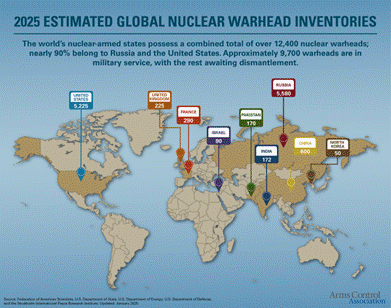
Following World War 2, there was an arms race between the Soviet Union and the United States. Although there were threats of war and conflicts in Korea, Southeast Asia, the Congo and other places, this period was called the Cold War. Other countries also developed nuclear weapons leading to concerns of a global conflict.

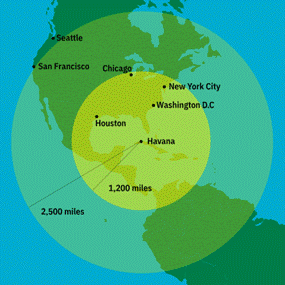
The world came close to a nuclear attack during the Cuban Missile Crisis. In 1962, nuclear weapons could be delivered by airplanes, missiles, and submarines. The Soviet Union placed nuclear warheads in Cuba and the United States had some in Turkey. These missiles could attack cities in both countries within a range of 1,200 miles. Fortunately, the Soviet Union began to withdraw its ships and missiles from Cuba and an agreement was made.

In the 1960s, the military strategy of Mutual Assured Destruction (MAD) was debated, In this strategy, two opposing forces, the Soviet Union and the United States, had enough nuclear weapons to completely destroy each other. This deterrence theory assumed that neither side would initiate a nuclear attack because the resulting retaliation would lead to their own destruction.  The concept, first discussed in the 1960s during the Cold War, is based on the idea that the devastating consequences of nuclear war would outweigh any potential gains for either side. 

As a result, the United Nations initiated the process to limit the production of nuclear testing and weapons.  Since the first test ban treaty, several agreements have been ratified to control the proliferation of nuclear and chemical weapons. The threat from atomic, hydrogen, neutron, and cobalt nuclear weapons is a concern to every person and every country because of the fallout from dangerous levels of radiation. There are still detectable effects of radiation in our atmosphere today from the 1945 explosion. The effects of radiation from a thermonuclear weapon (Hydrogen bomb) will likely last for hundreds of years and affect every living organism and human.

Following the Attack on the World Trade Center on September 11, 2001, the world became concerned about a terrorist group having access to a smaller nuclear weapon, a dirty bomb, that might be detonated in an urban area. The effects of a dirty bomb would likely be limited to the immediate area of the explosion but the damage to property and the cleanup of radioactive elements would be significant and costly.

Nuclear Arms Race and Treaties: 1949-2021 (Council on Foreign Relations)

Timeline of the Nuclear Non-Proliferation Treaty (Arms Control Association)

Devastating Effects of Nuclear Weapons

Questions:

  1. Why did an arms race between the USA and the USSR begin after 1945?
  2. How sane was the policy of MAD?
  3. What factors sustained the arms race for so long?
  4. Is a limited nuclear war a plausible scenario or would it quickly lead to an all-out war?
  5. What would life on Earth be like after a nuclear war? What geographic regions might have a chance of survival?
  6. Should the civil defense from a nuclear war or dirty bomb explosion be best coordinated by local, state, or the federal government in the United States?
  7. How would the governments of Europe or the Middle East, where there are many countries within a small geographic area respond to a nuclear war or explosion from a bomb or nuclear power plant?
  8. What is the most likely scenario for a nuclear explosion in the 21st century?

Civics Era 10 – The Great Depression and the New Deal (1929-1945)

www.njcss.org

The relationship between the individual and the state is present in every country, society, and civilization. Relevant questions about individual liberty, civic engagement, government authority, equality and justice, and protection are important for every demographic group in the population.  In your teaching of World History, consider the examples and questions provided below that should be familiar to students in the history of the United States with application to the experiences of others around the world.

These civic activities are designed to present civics in a global context as civic education happens in every country.  The design is flexible regarding using one of the activities, allowing students to explore multiple activities in groups, and as a lesson for a substitute teacher. The lessons are free, although a donation to the New Jersey Council for the Social Studies is greatly appreciated. www.njcss.org

The beginning of the 20th century marks the foundation of the transformation of the United States into a world power by the middle of the century. In this era economic prosperity and depression, the ability of our government to provide for the needs of people experiencing economic hardship, and the rise of dictators attacking innocent civilians and threatening the existence of democratic governments leading to a second world war dominate the narrative of this historical period. The development of the new technologies of electricity, transportation, and communication challenged our long-held traditional policies of limited government, neutrality, and laissez-faire capitalism.

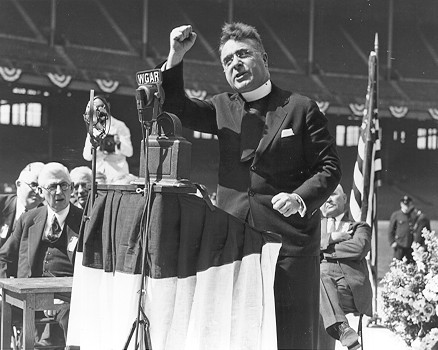
In the 1930s, Father Charles Coughlin, a Roman Catholic priest, had a weekly radio program with millions of listeners in the United States. In 1926 he broadcast weekly sermons but as the economy shifted into a recession and depression, his broadcast became more political and economic. They also reflected anti-Semitism with verbal attacks on prominent Jewish citizens. His broadcast following Kristallnacht on November 10, 1938 was particularly divisive. The owner of WMCA, a New York station, refused to broadcast Father Coughlin’s messages

The owner of WMCA, the New York station that carried his program, refused to broadcast Coughlin’s next radio message. The Nazi press reacted to the news with fury: “America is Not Allowed to Hear the Truth” declared one headline. “Jewish organizations camouflaged as American…have conducted such a campaign…that the radio station company has proceeded to muzzle the well-loved Father Coughlin.” A “New York Times” correspondent in Germany noted that Coughlin had become for the moment “the hero of Nazi Germany.” 

In the United States the Federal Communications Act of 1934 and subsequent additions regarding television and quiz shows mostly protects licenses, ensures equal access to all geographic areas, and provides for a rapid communications system regarding emergencies and national defense. It protects First Amendment rights regarding content, with some restrictions regarding profanity or inappropriate sexual content or images. The absence of specific content regulations allowed Orson Welles in 1938 to produce “War of the Worlds” over the radio leading to a panic by many citizens regarding their fear of an alien invasion.  The Fairness Doctrine of 1949 requires broadcasters to allow responses to personal attacks and controversial opinions. In 1969, the U.S. Supreme Court’s decision in Red Lion Broadcasting Co., Inc. v. Federal Communications Commission challenged the constitutionality of the Fairness Doctrine allowing the popularity of political radio and television talk and news programs.

Federal Communications Act of 1934

Broadcast Media Policy in the United Kingdom

The use of public media in the United Kingdom has specific statues to balance the perspectives of opinions and to prevent or limit the public broadcast media as a platform to present the views of the government, propaganda, or to advocate for a particular point of view on a controversial issue. The diversity of opinion in the United Kingdom for the BBC must respect opinions reflecting urban and rural populations, age, income, geography, culture, and political affiliations. There are also reasonable guidelines regarding the editor’s judgment to exclude a particular perspective. Facts and opinions must be defined and clearly stated.   Section 4 Impartiality: 4.3.14     BBC Editorial Policy

In the United States, deposits in most banks are protected up to $250,000 for each investor. This protection restored confidence in American banks during the Great Depression and is an important reason for a sound financial system in the United States. Investments in stocks and bonds fluctuate with market conditions.  Every bank in the United States also has deposits that are not insured. Investments in stocks, mutual funds, and corporate bonds are not insured by the Federal Deposit Insurance Corporation.

The Federal Reserve Bank establishes a reserve requirement, currently 10%, for banks to maintain to ensure adequate funds for withdrawals. The Federal Reserve Bank also monitors the member banks in the Federal Reserve System. Banks are assessed on all of their deposits quarterly and a formula is used to calculate their insurance payment. The FDIC is self-insured, although backed by Congress in the event of a catastrophic collapse of the banking system.

In Japan, the Deposit Insurance Act was enacted in 1971. The DIA fully insures deposits that do not earn interest.  In the United States amounts in checking, savings, money market accounts, and Certificates of Deposit are insured. Deposits that earn interest in Japan are insured up to 10 million yen, or about $70,000.

The most recent crisis in Japan is the exposure of the Aozora Bank to bad loans and investments in the United States. In 2024, it posted a net loss of 28 billion Japanese yen or about $191 million in U.S. dollars. A major earthquake in Japan, effects from extreme weather, or a military conflict would likely present major risks to Japan’s banks.

Examples of countries without any defined deposit insurance are China, Egypt, Israel, Pakistan, and South Africa. Perhaps one-third of the countries in the world do not protect deposits in their banks.

Failed Banks in the U.S. by Year (Forbes)

Federal Deposit Insurance Corporation

Video: FDIC (13 minutes)

Japan’s Banking Crisis in the 1990s (Video)

Huey P. Long is a challenging person for historians and educators. His ‘Share the Wealth’ program, use of the media, authoritarian actions, and criticisms of voter manipulation provide for diverse perspectives. However, he improved healthcare in Louisiana by expanding the Charity Hospital System, creating the Louisiana State University Medical School, reforming institutions to care for the disabled and mentally challenged, and providing free health clinics and immunizations. As a result, many lives were saved.

As governor, Long tripled funding for public healthcare. The state’s free health clinics grew from 10 in 1926 to 31 in 1933, providing free immunizations to 67 percent of the rural population. By building bridges and paving new roads, he made it possible for the rural poor to have access to medical and dental health care and hospitals. In the long historical timeline toward universal health care insurance in the United States, Huey P. Long is a pioneer.

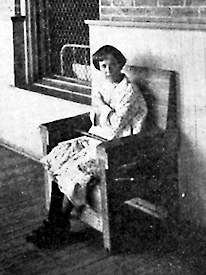
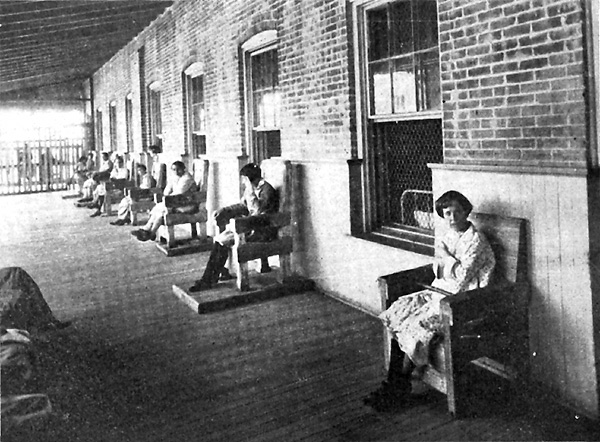
Before Huey Long’s reforms, patients at the Central Hospital for the Insane were locked in chairs during their ‘recreation’ time.  from Every Man a King by Huey Long; reproduced by permission.

Long by-passed the negative press by distributing his own newspaper, “The American Progress,” and he spoke directly to a national audience through radio speeches and speaking engagements. In a national radio broadcast on February 23, 1934, Huey Long unveiled his “Share Our Wealth” plan a program designed to provide a decent standard of living to all Americans by spreading the nation’s wealth among the people. Long proposed capping personal fortunes at $50 million each (roughly $600 million in today’s dollars) through a restructured, progressive federal tax code and sharing the resulting revenue with the public through government benefits and public works. In addition, he advocated for a 30 hour work week, four weeks of paid vacation for every worker, free college or vocational educational and limiting annual incomes to $1 million or about $60 million in today’s dollars. He also advocated for pensions and health care provided by businesses and the government.

Long believed that it was morally wrong for the government to allow millions of Americans to suffer in poverty when there existed a surplus of food, clothing, and shelter. By 1934, nearly half of all American families lived in poverty, earning less than $1,250 annually.  He supported a health care system for all people using government funds.  Long’s authoritarian use of power helped him achieve his goals until his assassination in 1935.

There are four basic health care models

The United States has one of the most expensive health care systems in the world. It invests in research,

However, in 2021, 8.6 percent of the U.S. population was uninsured.  The U.S. is the only country where a substantial portion of the population lacks any form of health insurance. The U.S. has the lowest life expectancy at birth, the highest death rates for avoidable or treatable conditions, the highest maternal and infant mortality, and one of the highest suicide rates in the world. It also has the highest rate of people with multiple chronic conditions and an obesity rate nearly twice the average of other developed countries.

The current programs provided by Medicare (for people over age 65), Medicaid (for people with low incomes), and the Affordable Care Act (current program for most people) are each under attack because of the high costs associated with them and government regulation of the prices paid.

In your research and discussion consider the following models of health insurance and the programs Gov. Huey P. Long implemented in Louisiana in the 1930s.

The Beveridge Model

This model is named after William Beveridge, the social reformer who designed Britain’s National Health Service. In this system, health care is provided and financed by the government through tax payments, just like the police force or the public library.

Many, but not all, hospitals and clinics are owned by the government; some doctors are government employees, but there are also private doctors who collect their fees from the government. This system has the lowest costs per person, because the government controls what doctors can do and what they can charge. Great Britain, Spain, most Scandinavian countries, New Zealand, and Cuba are countries using this model or one that is similar.

The Bismarck Model

The Bismarck models uses an insurance system financed jointly by employers and employees through payroll deduction. Every person is covered. Doctors and hospitals are private operators. Although there are many payers to this model, costs tend to be regulated by the government. Germany, France, Belgium, the Netherlands, Japan, Switzerland, and some Latin American are countries that use this model.
The National Health Insurance Model

This system has elements of both Beveridge and Bismarck models. It uses private-sector providers, but payment comes from a government-run insurance program that every citizen pays into. Costs are considered low because there are no profits, no advertising, and claims are pre-approved. It is a single payer system and as a monopolist it is in a position to negotiate for the lowest prices. This system also has the ability to limit the medical services it will pay for, such as preventive care or what is considered elective procedures. Canada, Taiwan, and South Korea are countries using this model. For Americans over the age of 65, Medicare is similar to this model.

Health insurance is mostly a benefit for industrialized countries. Of the 195 countries on planet Earth, about 40 or 25% have established health care systems. In countries using this model, the poor are neglected.  This is a problem for hundreds of millions of people who have low incomes or are living below the poverty line.

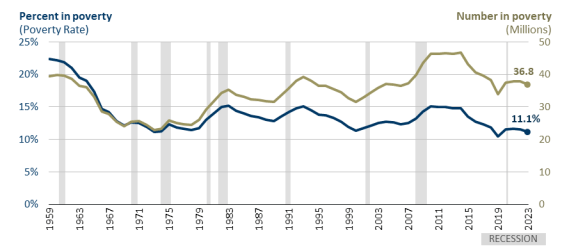
In 2023, the offi­cial pover­ty thresh­old in the United States was $30,900 for a fam­i­ly of two adults and two chil­dren. Fam­i­lies can earn well over this amount and still find they cannot pay all of their bills.

Poverty is relative.  Someone in your class, school, community, etc. will be in the bottom 25% of income earners. An individual earning an hourly wage of $20.00 an hour who works for 35 hours a week earns $700 a week or $36,400 a year. This total is reduced by state and federal taxes and a 7.65% tax on Medicare and Social Security. Although $20 an hour is higher than the minimum wage in every state, it is not considered a living wage.

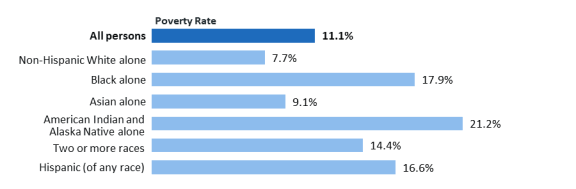
About one in sev­en (14%) of children under age 16 are in pover­ty in the United States.  This means that about 10 mil­lion kids in 2023 were liv­ing in house­holds that did not have enough resources for basic needs such as food, hous­ing and utilities.  The poverty rate in New Jersey is 10% of the population or about 950,000.  See the SPM child pover­ty rate in your state   The high­est rates of pover­ty gen­er­al­ly occur for the youngest chil­dren — under age 5 — kids in sin­gle-moth­er fam­i­lies, chil­dren of col­or and kids in immi­grant families. The numbers of children and adults living in poverty are increasing and they are a serious problem. The effects of living in poverty are the concern of your discussion as is the most effective way to reduce or eliminate it.

The effects of eco­nom­ic hard­ship dis­rupt the cog­ni­tive devel­op­ment, phys­i­cal and men­tal health, edu­ca­tion­al suc­cess of children. Researchers esti­mate the total U.S. cost of child pover­ty ranges from $500 bil­lion to $1 tril­lion per year based on lost pro­duc­tiv­i­ty and increased health care expenses.

In the United Kingdom, the poverty rate for children is 31% or double the rate in the United States. There is no single, universally accepted definition of poverty for the world.  The United States identifies an income level for family categories and the United Kingdom uses a measure of disposable income (after taxes) below 60% of the median income (income of the largest group in the population) on an annual basis.

For example, the median income in the United States is $40,000. If we used this formula, the poverty level would be $24,000 (after taxes). If we consider a 20% federal tax, 8% FICA and Medicare tax, and a 5% state tax for a person employed in New Jersey making $40,000, their disposable income would be approximately $27,000 or similar to the measure used in the United Kingdom.  If you consider the cost of rent at $2,000 a month, transportation costs at $200 a month, and food at $500 a month for a family or individual in New Jersey, these expenses are $2,700 a month or $32,400 a year. An income threshold of $30,000 a month is not practical.

Dr. Francis Townsend, a medical doctor living in Long Beach, California, introduced a plan in 1933 to provide direct payments to people over the age of 60. The money would be raised through a national sales tax, which in some countries is labeled a Value Added Tax of VAT.

“It is estimated that the population of the age of 60 and above in the United States is somewhere between nine and twelve millions. I suggest that the national government retire all who reach that age on a monthly pension of $200 a month or more, on condition that they spend the money as they get it. This will ensure an even distribution throughout the nation of two or three billions of fresh money each month. Thereby assuring a healthy and brisk state of business, comparable to that we enjoyed during war times.

“Where is the money to come from? More taxes?” Certainly. We have nothing in this world we do not pay taxes to enjoy. But do not overlook the fact that we are already paying a large proportion of the amount required for these pensions in the form of life insurance policies, poor farms, aid societies, insane asylums and prisons. The inmates of the last two mentioned institutions would undoubtedly be greatly lessened when it once became assured that old age meant security from want and care. A sales tax sufficiently high to insure the pensions at a figure adequate to maintain the business of the country in a healthy condition would be the easiest tax in the world to collect, for all would realize that the tax was a provision for their own future, as well as the assurance of good business now.”

Dr. Townsend’s plan became popular with the people and became known as The Townsend Movement.  Although it was criticized by President Franklin Roosevelt, the Social Security Administration is similar to what Dr. Townsend proposed.  He published a newsletter, The Modern Crusader, to promote his plan. The Social Security plan is funded by a tax on incomes because the burden is shared proportionately by different income levels. 

Welfare, unemployment compensation, Medicaid, Medicare, and Social Security are payments to United States’ citizens that are currently being discussed and evaluated. The average monthly payment is slightly less than $2,000. These are direct payments to people from the government, which also benefit local communities as the money is spent on food, housing, and basic needs, and provides a safeguard against bankruptcy and financial hardship. They may also increase the federal debt of a country in times of high unemployment or a pandemic.

Policy makers and economists must also consider public policies regarding the poor and senior citizens. The discussion questions below address the question of poverty for the young, disabled, and elderly and how to finance them.

  1. Do governments have a responsibility to provide financial assistance or a guaranteed living wage to individuals or families with inadequate finances for basic needs?
  2. Are direct income payments a burden on a government or do they provide an efficient return on their investment over time?
  3. Is the question of how to reduce or prevent poverty a matter of taxation or a a matter relating to the priorities of the federal budget?
  4. When people with mortgages apply the cost of interest as a deduction on their income tax, should this be considered an income transfer policy of the government providing assistance to people who are able to own property or their own home?
  5. Should income transfers be made in cash or in-kind benefits such as food stamps, vouchers for health care, etc.?
  6. Should the government regulate the consumption expenses of people receiving income transfers?
  7. Should income transfers be financed by income taxes, consumption taxes, or another method?

https://www.ssa.gov/history/towns5.html (The Townsend Plan)

https://www.ssa.gov/history/towns8.html (Francis Townsend’s Autobiography)

https://socialwelfare.library.vcu.edu/eras/great-depression/townsend-dr-francis/ (Social Welfare History Project)

https://lordslibrary.parliament.uk/child-poverty-statistics-causes-and-the-uks-policy-response/#heading-2 (House of Lords Library)

Civics Era 9 The Great Depression and World War II (1929–1945)

www.njcss.org

The relationship between the individual and the state is present in every country, society, and civilization. Relevant questions about individual liberty, civic engagement, government authority, equality and justice, and protection are important for every demographic group in the population.  In your teaching of World History, consider the examples and questions provided below that should be familiar to students in the history of the United States with application to the experiences of others around the world.

These civic activities are designed to present civics in a global context as civic education happens in every country.  The design is flexible regarding using one of the activities, allowing students to explore multiple activities in groups, and as a lesson for a substitute teacher. The lessons are free, although a donation to the New Jersey Council for the Social Studies is greatly appreciated. www.njcss.org

The Great Depression brought about significant changes in the regulatory power of the federal government of the United States. The reforms of the New Deal were to stabilize the capitalistic economics system of the United States and they also imposed a mild form of welfare state capitalism that was prevalent in European countries. As a result, this era provides students with several opportunities to test their analytical skills regarding presidential power, the effectiveness of a democracy in addressing a major crisis, and the effect of the reforms of the New Deal on racial minorities, women, children and other groups.

The Constitution does not stipulate the number of Supreme Court Justices; the number is set by Congress. There have been as few as six, but since 1869 there have been nine Justices, including one Chief Justice. All Justices are nominated by the President, confirmed by the Senate, and hold their offices under life tenure. Justices may remain in office until they resign, pass away, or are impeached and convicted by Congress.

After winning a landslide election in 1936, President Franklin D. Roosevelt introduced the Judicial Procedures Reform Act which would allow the president to nominate an additional judge to the Court for every sitting judge who had served at least ten years and reached the age of 70. The initial reason that was explained by President Roosevelt was that the aging justices could not keep up with their caseload. Roosevelt changed his reasoning when this argument appeared flawed because the additional judges would likely increase deliberations and delay the time to make a decision. The new argument that the appointed justices did not reflect the will of the people at a time when the United States faced unprecedented economic problems was explained to the people in a Fireside Chat.

President Roosevelt continued to advocate for the Judicial Procedures Reform Act until the Senate voted 70-20 to send the bill back to committee in July, 1937. It was never passed.

The individual states determine the number of judges on their state supreme courts. The number varies between five and nine justices. The Supreme Court of New Jersey has seven judges.

The Supreme Court is the highest Court in the administration of justice in Ghana.

The Court is presided over by the Chief Justice and in his absence the most senior of the Justices of the Supreme Court, as constituted shall preside. Judges who sit in the Supreme Court are referred to as Justices of the Supreme Court.

The Supreme Court consists of the Chief Justice and not less than nine Justices. It has exclusive original jurisdiction in all matters relating to the enforcement or interpretation of the 1992 Constitution. It also has supervisory jurisdiction over all the Courts in Ghana. It is located only at the Headquarters in Accra.

  1. In the United States, should the final decision on legislation be made by non-elected judges on the U.S. Supreme Court?
  2.  If the United States Congress was to reform the U.S. Supreme Court, what changes would you recommend they consider?
  3. Does the Tenth Amendment best serve the interests of representative democracy by allowing the individual states to make decision on issues not specifically delegated to Congress or is popular sovereignty served through the popular vote of the election of congressional representatives and senators?
  4. Do you prefer the structure of the Supreme Court in Ghana, which establishes a minimum number of judges, to be a better plan for decision making than how the United States structures its Supreme Court?
  5. Can Ghana prevent a president from adding judges with a similar political philosophy?

National Constitution Center

Information on State Supreme Courts

The Structure and Jurisdiction of the Courts of Ghana

To Cap or Not Cap the Justices on the Supreme Court of Ghana

The right of parents to take advantage of the productive capacity of their children was long recognized both in the United States and abroad. The perceived value of the child can be viewed through how the legal system treated the wrongful death of a child and the damages the parents could hope to recover. Courts of that period usually found that the proper amount due was “the probable value of the services of the deceased from the time of his death to the time he would have attained his majority, less the expense of his maintenance during the same time.” The courts recognized that the parent naturally benefited from the productive labors of his child until the child reached the age of majority.

The wages the child earned served the common purpose of supporting the family. The wages of a child generally became the property of the parents and often were the key to survival for many working-class families. Rather than the wife being the secondary wage earner, as became the case in the 1970s, for many families the child performed this role in American history.

Today, states have moved to extending working hours for children, eliminate work permit requirements and lower the age for teens to handle alcohol or work in hazardous industries. At the same time, there has been a 69% increase in children employed illegally by companies since 2018, according to the U.S. Department of Labor.” Source 

New Jersey: 34:2-21.2. Minors under 16 not to be employed; exceptions; nonresidents.

“No minor under 16 years of age shall be employed, permitted, or suffered to work in, about, or in connection with any gainful occupation at any time; provided, that minors between 14 and 16 years of age may be employed, permitted or suffered to work outside school hours and during school vacations but not in or for a factory or in any occupation otherwise prohibited by law or by order or regulation made in pursuance of law; and provided, further, that minors under 16 years of age may engage in professional employment in theatrical productions upon the obtaining of a permit therefor and may engage outside school hours and during school vacations in agricultural pursuits or in street trades and as newspaper boys as defined in this act, in accordance with the provisions of section 15 of this act.”

Except as to the employment of a minor for whom a theatrical employment permit has been issued, no minor under 16 years of age not a resident of this State shall be employed, permitted or suffered to work in any occupation or service whatsoever at any time during which the law of the state of his residence required his attendance at school, or at any time during the hours when the public schools in the district in which employment in such occupation or services may be available are in session.

NLS data show that 52 percent of 12- and 13-year-olds in its 1997 cohort had paid work experience. The work performed at these ages was found to be freelance in nature. Babysitting and yardwork accounted for more than 70 percent of the work they performed.  For 14- and 15-year-olds, the dominant form of work remains freelancing. When children do work, it is most commonly when school is out of session. Children have largely shifted to the service industries.

Due to security issues in both Mali and Burkina Faso, Côte d’Ivoire has an estimated 13,214 refugees (2,489 households), of which an estimated 59 percent are children. Children are also brought to Côte d’Ivoire from those countries for commercial sexual exploitation and forced labor, including in begging, cocoa production, and mining. Children from Côte d’Ivoire are also subjected to human trafficking for forced labor in domestic work within the country and North Africa. Although the minimum age for a child to work is 16, this law lacks enforcement.

School is mandatory for children ages 6 to 16 in Côte d’Ivoire. Although the Law on Education provides for free education, students are often required to pay for textbooks and uniforms, which may be prohibitive to some families. A shortage of teachers, poor school infrastructure, lack of transportation systems in rural areas, and inadequate sanitation facilities have negatively impacted children’s ability to attend school.  Research also suggests that some students are physically and sexually abused at school, which may deter some students from attending school. Because of this, roughly one in four girls (25%) in Côte d’Ivoire are not able to attend primary school.

The UN Special Rapporteur, Tomoya Obokata, reported in November 2023 on the progress the government is making:

“I commend Côte d’Ivoire for its solid legal and institutional architecture on child labor and trafficking in persons. But the Government needs to do more to lift people, including in rural areas, out of poverty, promote the economic empowerment of women and ensure access to decent work, particularly for young people,” the expert said.

“Despite the efforts undertaken, I was informed that instances of child labor persist in various sectors of the economy including agriculture, domestic work, street vending and in artisanal gold mining. I am also concerned about the fate of girls who have either been trafficked from countries in the region for the purpose of sexual exploitation or who are subject to forced and early marriage in the country,” Obokata said.”

Questions:

  1. Should the state or federal government regulate child labor laws?
  2. Should the government have any authority over parental decisions regarding child labor?
  3. Should children be protected from working in unhealthy or dangerous occupations? (serving alcohol, casinos, nail salons, landscaping, etc.)

History of Child Labor in the United States (Part 1, Bureau of Labor Statistics)

History of Child Labor in the United States, (Part 2, Bureau of Labor Statistics)

Child Labor in America, 1920 (NPR)

The Unjust Cost of Child Labor (Roosevelt Institute)

Hammer v. Dagenhart (U.S. Supreme Court, 1918)

Child Labor and Forced Labor Reports in Côte d’Ivoire  (U.S. Department of Labor)

Child Labor Rises to 160 Million-First Increase in Two Decades (UNICEF)

The U.S. government influences private business through compulsory taxes by spending the tax revenues on public functions such as parks, roads and other infrastructure, schools, law enforcement, homeland security, and scientific research, as well as welfare and social insurance programs such as Social Security, Medicare, Medicaid, food stamps, and unemployment assistance. The federal government also issues and enforces standards ranging from environmental quality, to consumer protection, business and banking practices, nondiscrimination in employment, Internet privacy, and safety for food, drugs, manufactured products, and the places where people work.

Chinese tech giant ByteDance, in 2017, purchased the popular karaoke app Musical.ly and relaunched the service as TikTok. Since then, the app has been under the microscope of national security officials in Washington fearing possible influence by the Chinese government.

India began its regulatory reforms in the early 1990s, reducing state involvement through the privatization of companies, by putting in place independent regulatory mechanisms to boost competition and private-sector-led growth, and to strengthen consumer protection. But the reform efforts lacked coherence and have stalled. Even though the economy grew rapidly over the past decade, the slowing-down of reforms created an image of a country where doing business is difficult.

India lacks a modern regulatory governance regime. Based on the Constitution, all levels of government can regulate, including the Central Government and 29 state governments. Regulatory barriers to competition are high and rule-making in India is complex due to the different layers of government.

India needs to further strengthen the governance of state-owned enterprises, simplify regulations, and reduce administrative burdens on firms. India should develop and implement a regulatory governance system following international good practices such as regulatory impact assessment, public consultation, and administrative simplification. The creation of national Regulatory Commissions since 2005 was a positive move, but there is lack of accountability and consistency of the overall regulatory system.

Establishing a whole-of-government approach to regulation, using international best practice tools and systems such as regulatory impact assessments and public consultation, and building effective institutions for regulatory quality management, are key. In this sense, India needs to catch up with other emerging economies such as China, Mexico and Vietnam, which have already taken important steps in that direction, in line with the OECD’s 2012 Recommendation on Regulatory Policy and Governance.

In 2019, India passed a new Consumer Protection Act which streamlined all methods of exchanges relating to the purchase of merchandise and e-commerce. It also expanded the protections for deceptive trade practices and introduced product liability laws for the first time.

  1. Should governments encourage or restrict startup businesses?
  2. Is it possible for governments to regulate the safety of products manufactured and sold withing their country?
  3. Are government requirements for minimum wage, social security, safety, equal opportunity in hiring, necessary or should they be optional?

Examples of Government Regulation of Business in the United States

The Role of the U.S. Government in the Economy

Consumer Protection Act of 2019 in India

Consumer Handbook in India

OCED Regulatory Reform in India

The Roosevelt Corollary signaled an important shift in the economic and diplomatic policy of the United States in Latin America at the beginning of the 20th century. In its efforts to ensure that Latin and Central American governments repaid their debts, the United States also used its military power to protect its hegemony or interests. By doing this the Roosevelt Corollary also negatively affected our diplomatic relations with Europe and set a precedent for the foundation for the Fourteen Points after World War I.

There are different perspectives about the impact of the Roosevelt Corollary in policy regarding its history of imperialism, limitations on self-government, and the impact it had on the social order and culture in Latin and Central America.  The U.S. Constitution is silent on a president acting as the international policeman to correct wrong behaviors in another country. President Roosevelt changed the original interpretation of the Monroe Doctrine from keeping foreign powers out of the western Hemisphere to justifying America’s intervention in independent countries in Latin America.

This set a precedent for future presidents who sent American troops into Latin American countries eight times.

In the beginning of the 21st century, China expanded its naval power and influence in the Pacific and Indian Oceans. Since 2016, China has constructed naval ports in an around the Spratly Islands. China’s actions impinge in the maritime entitlements and legal claims of Malaysia, the Philippines, and Vietnam for fishing and oil exploration. The South China Sea may have billions of barrels of untapped oil and trillions of cubic feet of natural gas.

China should consider the economic cost of its investments in these small islands as the impact of rising sea levels is likely to limit their economy and increase their debt. Will the economic costs weaken instead of strengthening China in the future?  The security of Australia, Taiwan, and Japan is a concern as military support from the United States may be limited by China’s presence in this area. The distance from the United States to Japan, Taiwan, and Australia is much further than it is for its rivals of North Korea, Russia, and China.

The novel legal argument is that under the Belt and Road Initiative, China is providing economic assistance to these small island in exchange for a ‘good neighbor’ policy with Beijing.

  1. Does the Roosevelt Corollary set a precedent for giving the president of the United States too much authority in foreign affairs?
  2. How should situations of violations of international laws regarding financial matters and human rights be addressed in the 21st century?
  3. Is China’s policy of expanding its military and economic influence into the South China Sea a violation of the UN’s Law of the Sea?

President Theodore Roosevelt’s State of the Union Address: The Roosevelt Corollary (1904)

How Theodore Roosevelt Changed the Way America Operated in the World

Council of Foreign Relations Perspective on the Roosevelt Corollary to the Monroe Doctrine

Book Review: The Leadership Journey: How Four Kids Became President

I decided to read this book after listening to Doris Kearns Goodwin speak about this on television following the inauguration of President Donald Trump. After reading the first few pages, I decided to write a review of this book as it should be ‘required’ reading for every social studies teacher, student, parent, and grandparent.

One reason for encouraging teachers, pre-service teachers. students, parents, and grandparents to read this book is in the truisms that are embedded in the stories about each president. For example, in introducing Abraham Lincoln’s decision to enter politics as a Whig candidate, these few sentences should engage young minds in reflective thinking:

As a teacher, I would discuss with my class, why did Lincoln join the new Whig Party and not the popular Democratic Party? Why did he announce his decision to run for the assembly in a pamphlet compared to a letter, newspaper, or verbal announcement? How does Lincoln understand public service?

As a parent or grandparent, I would discuss the political parties we have today and what they stand for. How do candidates in our community or state get elected and announce their decision to run for office? Is it possible for elected representatives to represent the interests and needs of the majority in their community or is it best for them to advance their own beliefs on the issues or vote for the position of their political party?

The reading level of The Leadership Journey: How Four Kids Became President is for middle school students. Each chapter is just a few pages and should take a middle school student about 20-30 minutes to read and comprehend. This book is a valuable resource for a student research assignment, teaching about the reliability of sources, civics, an afterschool history club such as Rho Kappa or Phi Alpha Theta, a summer reading list activity, or a Saturday Seminar roundtable discussion. The applications of this book are unlimited.

One of the hidden gems in the life of Lincoln is with his learning style, character, persistence, and ability to handle disappointments. These examples are often only a few sentences, but they are prompts to initiate discussion and empathy between students in your class. For example, “The key to Lincoln’s success as a lawyer was his ability to break down the most complex case or issue ‘into its simplest elements.’ He never lost a jury by fumbling or reading from a prepared argument, relying instead ‘on his well-trained memory. (Page 47)

Another example that I found interesting was the evolution of how President Lincoln’s views changed about the emancipation of enslaved persons by listening to others.

The second president in Doris Kearns Goodwin’s book is Theodore Roosevelt. There are multiple connections for students in the leadership journey of Teddy Roosevelt. These include living with a disability, coping with personal loss, understanding the issues, the importance of integrity, and the challenges and opportunities of the experiences in one’s life.

Although born into a family with wealth, as a child he faced frightening attacks of bronchial asthma. His childhood and teenage years were limited. By age 10, he had opportunities to be home schooled, enjoy summer vacations on Long Island, and travel to Africa, Europe, and the Middle East. However, participating in activities was limited because of his health.

The lesson of how Teddy Roosevelt voted in the New York State Assembly, especially on the bill to stop the manufacture of cigars in tenement houses is one that will likely engage students in a thoughtful discussion or debate about how elected officials represent constituents today. Roosevelt opposed all government supervision and regulations regarding limiting the hours worked, a minimum wage, or prices. Samuel Gompers invited him to visit the places where the cigars were made.

On February 14, 1884, Valentine’s Day, Teddy Roosevelt place a large X in his diary followed by the words “The light has gone out of my life.”  His mother, Mittie, and his wife, Alice Hathaway Lee, died. He was 25 years old and had been married for less than four years.

These are stories students relate to. They encourage discussions about loss, grief, empathy, confusion, resilience, and life. The leaders Doris Kearns Goodwin writes about are very human and their experiences in life are similar to those of many young adults. Abraham Lincoln also lost his mother and fiancé and his son, Willie, died at age 11 in the White House.

Three examples from the book that should interest middle and high school students are Teddy Roosevelt’s use of the Executive Order renaming the Executive Mansion to the White House in 1901, his daily schedule, and a bizarre episode running naked in Rock Creek Park. Source

The information on the Spanish American War in 1898, settling the coal strike in 1902, nine-week train trip around the United States in 1903, are also presented in a descriptive narrative that will interest students with events in the social studies curriculum.

Although most middle school students do not study Franklin Delano Roosevelt as part of U.S. History, this chapter will engage high school students. The importance of reading is to ignite inquiry through questions and thinking about the historical era, the individual, and American government.

Franklin was born into a wealthy family with a large estate about 90 miles north of New York City, where they also had a home on 65th Street near Fifth Avenue and Central Park.

The chapters about Roosevelt are powerful and insightful because they are filled with stories about his character. While most readers will find value and insights into his youth, college years, marriage and positions in the state legislature and federal government, the chapter on his perseverance regarding his paralysis from polio is unusually compelling. Here is an example of how FDR faced the news of his permanent disability as a 39-year-old man with a promising future:

In another chapter Doris Kearns Goodwin portrays FDR’s trait of courage.  His courage was both political courage as he risked everything to hide his disability of crippled legs and physical courage.  He was fortunate to have the friendship and guidance of Louis Howe, Sam Rosenman, Frances Perkins, and his wife, Eleanor. Here is an example of how Franklin handled every situation with grace, humor, and strength: (This is six years after he was infected by the polio virus, 1928)

These two excerpts are only an introduction to what is revealed in his campaign for governor, acceptance speech in Chicago as the Democratic Party candidate for president, his inauguration speech at the Capitol, and his leadership as president. Facts and historical examples are important, but FDR’s personality traits will likely have a lasting impact on students.

Although many students are likely less familiar with the presidency of Lyndon B. Johnson than the presidency of Lincoln, T.R. or F.D.R., they will identify with his character, commitment to civic engagement, and experience as a teacher. As a young child, he moved from a small cabin in a rural area to Johnson City. For various reasons, Lyndon’s activities changed, and he became interested in the activities of his father who was a member of the state legislature in Texas.

Lyndon’s Johnson’s role as a teacher and school principal reveals his work ethic and characteristic as a caring and dedicated public servant.

He was also the debate coach at Sam Houston High School. He coached the debate team through city, district and state tournaments.

“Johnson appeared to his students ‘a human dynamo,’ a steam engine in pants,’ driven by a work ethic and unlimited enthusiasm that proved contagious.” (Page 269)

I enjoyed reading about how he used his social capital in Washington to advance his goals. Lady Bird and Lyndon moved to Washington where he was the chief of staff to a Texas congressman. He became friends with Sam Rayburn who lived alone and invited him to dinner in his home with his wife, Lady Bird. Through this connection, Lyndon became the director of the National Youth Administration in Texas. When his congressman James Buchanan passed away unexpectedly, Johnson campaigned for his seat. Two days before the election he had emergency surgery to remove his appendix. He won, likely on a promise to bring electricity to the farmers in his area of Texas.

Johnson’s personality traits of empathy, enthusiasm, perseverance, and ‘grit’ are important for students to understand, apply to their own experiences, and engage in discussion with their peers. He lost his bid for re-election by 1,311 votes and a few years later won his election as senator by only 87 votes. As a senator, he was the youngest majority leader in the history of the Senate at age 46 and was considered as a presidential candidate for the 1956 election. Then, suddenly everything changed when he had a devasting heart attack. This event transformed his life and behavior.  A lesson about the trait of resiliency.

If a teacher elected to use the resource of this book for just one day, perhaps the most compelling pages are found on pages 317-328. His passion, legislative skill, and personal conviction are important for every student to understand. It is also important for students to understand the long struggle to pass and implement civil rights laws. In our classrooms, the lessons of Freedom Riders, marches, boycotts, and the emotional scars of segregation are too often taught passively through slide presentations and vocabulary terms. Doris Kearns Goodwin captures some of the emotion that led to the Civil Rights Act of 1964 and the Voting Rights Act of 1965. Everyone should read Chapter 24.

“Like a tailor stitching a custom suit, Johnson took measure of Dirksen.  A decade of working together had taught Johnson that Dirksen had no hesitation asking for ‘a laundry list’ of favors in return for his support on legislation.  But this time, Johnson offered Dirksen something far more important than perks and favors; he appealed to Dirksen’s hunger to be remembered, honored. ‘I saw your exhibit at the World’s Fair, and it said, ‘The Land of Lincoln,’ Johnson pointed out. And the man from Lincoln is going to pass this bill and I’m going to see that he gets proper credit. With a gift for flattery equal to Dirksen’s vanity, he assured the senator ‘if you come with me on this bill, two hundred years from now there’ll be only two people they’ll remember from the state of Illinois: Abraham Lincoln and Everett Dirksen!” (Page 321)

I found value in the leadership journey of these four presidents. Although my review focuses on students and teachers, adults will also enjoy reading what Doris Kearns Goodwin has written. In the closing pages, Doris Kearns Goodwin describes a dinner meeting with her “guys.’  What an opportunity to discuss the historical context of 100 years of American history, the goals of the Declaration of Independence, how each president mastered the communication platforms of newspapers, stories, radio, and television. Perhaps the most significant question is what makes a good leader and a good president? What a nice segway to understanding empathy!

Visit the resources of the Miller Center at the University of Virginia to learn about the American presidents.

Era 9 The Great Depression and World War 2

The relationship between the individual and the state is present in every country, society, and civilization. Relevant questions about individual liberty, civic engagement, government authority, equality and justice, and protection are important for every demographic group in the population.  In your teaching of World History, consider the examples and questions provided below that should be familiar to students in the history of the United States with application to the experiences of others around the world.

These civic activities are designed to present civics in a global context as civic education happens in every country.  The design is flexible regarding using one of the activities, allowing students to explore multiple activities in groups, and as a lesson for a substitute teacher. The lessons are free, although a donation to the New Jersey Council for the Social Studies is greatly appreciated. www.njcss.org

See the source image

The Great Depression brought about significant changes in the regulatory power of the federal government of the United States. The reforms of the New Deal were to stabilize the capitalistic economics system of the United States and they also imposed a mild form of welfare state capitalism that was prevalent in European countries. As a result, this era provides students with several opportunities to test their analytical skills regarding presidential power, the effectiveness of a democracy in addressing a major crisis, and the effect of the reforms of the New Deal on racial minorities, women, children and other groups.

The Constitution does not stipulate the number of Supreme Court Justices; the number is set by Congress. There have been as few as six, but since 1869 there have been nine Justices, including one Chief Justice. All Justices are nominated by the President, confirmed by the Senate, and hold their offices under life tenure. Justices may remain in office until they resign, pass away, or are impeached and convicted by Congress.

After winning a landslide election in 1936, President Franklin D. Roosevelt introduced the Judicial Procedures Reform Act which would allow the president to nominate an additional judge to the Court for every sitting judge who had served at least ten years and reached the age of 70. The initial reason that was explained by President Roosevelt was that the aging justices could not keep up with their caseload. Roosevelt changed his reasoning when this argument appeared flawed because the additional judges would likely increase deliberations and delay the time to make a decision. The new argument that the appointed justices did not reflect the will of the people at a time when the United States faced unprecedented economic problems was explained to the people in a Fireside Chat.

President Roosevelt continued to advocate for the Judicial Procedures Reform Act until the Senate voted 70-20 to send the bill back to committee in July, 1937. It was never passed.

The individual states determine the number of judges on their state supreme courts. The number varies between five and nine justices. The Supreme Court of New Jersey has seven judges.

The Supreme Court of Ghana

The Supreme Court is the highest Court in the administration of justice in Ghana.

The Court is presided over by the Chief Justice and in his absence the most senior of the Justices of the Supreme Court, as constituted shall preside. Judges who sit in the Supreme Court are referred to as Justices of the Supreme Court.

The Supreme Court consists of the Chief Justice and not less than nine Justices. It has exclusive original jurisdiction in all matters relating to the enforcement or interpretation of the 1992 Constitution. It also has supervisory jurisdiction over all the Courts in Ghana. It is located only at the Headquarters in Accra.

Questions:

  1. In the United States, should the final decision on legislation be made by non-elected judges on the U.S. Supreme Court?
  2.  If the United States Congress was to reform the U.S. Supreme Court, what changes would you recommend they consider?
  3. Does the Tenth Amendment best serve the interests of representative democracy by allowing the individual states to make decision on issues not specifically delegated to Congress or is popular sovereignty served through the popular vote of the election of congressional representatives and senators?
  4. Do you prefer the structure of the Supreme Court in Ghana, which establishes a minimum number of judges, to be a better plan for decision making than how the United States structures its Supreme Court?
  5. Can Ghana prevent a president from adding judges with a similar political philosophy?

National Constitution Center

Information on State Supreme Courts

The Structure and Jurisdiction of the Courts of Ghana

To Cap or Not Cap the Justices on the Supreme Court of Ghana

The right of parents to take advantage of the productive capacity of their children was long recognized both in the United States and abroad. The perceived value of the child can be viewed through how the legal system treated the wrongful death of a child and the damages the parents could hope to recover. Courts of that period usually found that the proper amount due was “the probable value of the services of the deceased from the time of his death to the time he would have attained his majority, less the expense of his maintenance during the same time.” The courts recognized that the parent naturally benefited from the productive labors of his child until the child reached the age of majority.

The wages the child earned served the common purpose of supporting the family. The wages of a child generally became the property of the parents and often were the key to survival for many working-class families. Rather than the wife being the secondary wage earner, as became the case in the 1970s, for many families the child performed this role in American history.

Today, states have moved to extending working hours for children, eliminate work permit requirements and lower the age for teens to handle alcohol or work in hazardous industries. At the same time, there has been a 69% increase in children employed illegally by companies since 2018, according to the U.S. Department of Labor.” Source 

New Jersey: 34:2-21.2. Minors under 16 not to be employed; exceptions; nonresidents.

“No minor under 16 years of age shall be employed, permitted, or suffered to work in, about, or in connection with any gainful occupation at any time; provided, that minors between 14 and 16 years of age may be employed, permitted or suffered to work outside school hours and during school vacations but not in or for a factory or in any occupation otherwise prohibited by law or by order or regulation made in pursuance of law; and provided, further, that minors under 16 years of age may engage in professional employment in theatrical productions upon the obtaining of a permit therefor and may engage outside school hours and during school vacations in agricultural pursuits or in street trades and as newspaper boys as defined in this act, in accordance with the provisions of section 15 of this act.”

Except as to the employment of a minor for whom a theatrical employment permit has been issued, no minor under 16 years of age not a resident of this State shall be employed, permitted or suffered to work in any occupation or service whatsoever at any time during which the law of the state of his residence required his attendance at school, or at any time during the hours when the public schools in the district in which employment in such occupation or services may be available are in session.

NLS data show that 52 percent of 12- and 13-year-olds in its 1997 cohort had paid work experience. The work performed at these ages was found to be freelance in nature. Babysitting and yardwork accounted for more than 70 percent of the work they performed.  For 14- and 15-year-olds, the dominant form of work remains freelancing. When children do work, it is most commonly when school is out of session. Children have largely shifted to the service industries.

Child Labor in Côte d’Ivoire

Due to security issues in both Mali and Burkina Faso, Côte d’Ivoire has an estimated 13,214 refugees (2,489 households), of which an estimated 59 percent are children. Children are also brought to Côte d’Ivoire from those countries for commercial sexual exploitation and forced labor, including in begging, cocoa production, and mining. Children from Côte d’Ivoire are also subjected to human trafficking for forced labor in domestic work within the country and North Africa. Although the minimum age for a child to work is 16, this law lacks enforcement.

School is mandatory for children ages 6 to 16 in Côte d’Ivoire. Although the Law on Education provides for free education, students are often required to pay for textbooks and uniforms, which may be prohibitive to some families. A shortage of teachers, poor school infrastructure, lack of transportation systems in rural areas, and inadequate sanitation facilities have negatively impacted children’s ability to attend school.  Research also suggests that some students are physically and sexually abused at school, which may deter some students from attending school. Because of this, roughly one in four girls (25%) in Côte d’Ivoire are not able to attend primary school.

The UN Special Rapporteur, Tomoya Obokata, reported in November 2023 on the progress the government is making:

“I commend Côte d’Ivoire for its solid legal and institutional architecture on child labor and trafficking in persons. But the Government needs to do more to lift people, including in rural areas, out of poverty, promote the economic empowerment of women and ensure access to decent work, particularly for young people,” the expert said.

“Despite the efforts undertaken, I was informed that instances of child labor persist in various sectors of the economy including agriculture, domestic work, street vending and in artisanal gold mining. I am also concerned about the fate of girls who have either been trafficked from countries in the region for the purpose of sexual exploitation or who are subject to forced and early marriage in the country,” Obokata said.”

Questions:

  1. Should the state or federal government regulate child labor laws?
  2. Should the government have any authority over parental decisions regarding child labor?
  3. Should children be protected from working in unhealthy or dangerous occupations? (serving alcohol, casinos, nail salons, landscaping, etc.)

History of Child Labor in the United States (Part 1, Bureau of Labor Statistics)

History of Child Labor in the United States, (Part 2, Bureau of Labor Statistics)

Child Labor in America, 1920 (NPR)

The Unjust Cost of Child Labor (Roosevelt Institute)

Hammer v. Dagenhart (U.S. Supreme Court, 1918)

Child Labor and Forced Labor Reports in Côte d’Ivoire  (U.S. Department of Labor)

Child Labor Rises to 160 Million-First Increase in Two Decades (UNICEF)

The U.S. government influences private business through compulsory taxes by spending the tax revenues on public functions such as parks, roads and other infrastructure, schools, law enforcement, homeland security, and scientific research, as well as welfare and social insurance programs such as Social Security, Medicare, Medicaid, food stamps, and unemployment assistance. The federal government also issues and enforces standards ranging from environmental quality, to consumer protection, business and banking practices, nondiscrimination in employment, Internet privacy, and safety for food, drugs, manufactured products, and the places where people work.

Chinese tech giant ByteDance, in 2017, purchased the popular karaoke app Musical.ly and relaunched the service as TikTok. Since then, the app has been under the microscope of national security officials in Washington fearing possible influence by the Chinese government.

Government Regulation of Private Enterprise in India

India began its regulatory reforms in the early 1990s, reducing state involvement through the privatization of companies, by putting in place independent regulatory mechanisms to boost competition and private-sector-led growth, and to strengthen consumer protection. But the reform efforts lacked coherence and have stalled. Even though the economy grew rapidly over the past decade, the slowing-down of reforms created an image of a country where doing business is difficult.

India lacks a modern regulatory governance regime. Based on the Constitution, all levels of government can regulate, including the Central Government and 29 state governments. Regulatory barriers to competition are high and rule-making in India is complex due to the different layers of government.

India needs to further strengthen the governance of state-owned enterprises, simplify regulations, and reduce administrative burdens on firms. India should develop and implement a regulatory governance system following international good practices such as regulatory impact assessment, public consultation, and administrative simplification. The creation of national Regulatory Commissions since 2005 was a positive move, but there is lack of accountability and consistency of the overall regulatory system.

Establishing a whole-of-government approach to regulation, using international best practice tools and systems such as regulatory impact assessments and public consultation, and building effective institutions for regulatory quality management, are key. In this sense, India needs to catch up with other emerging economies such as China, Mexico and Vietnam, which have already taken important steps in that direction, in line with the OECD’s 2012 Recommendation on Regulatory Policy and Governance.

In 2019, India passed a new Consumer Protection Act which streamlined all methods of exchanges relating to the purchase of merchandise and e-commerce. It also expanded the protections for deceptive trade practices and introduced product liability laws for the first time.

Questions:

  1. Should governments encourage or restrict startup businesses?
  2. Is it possible for governments to regulate the safety of products manufactured and sold withing their country?
  3. Are government requirements for minimum wage, social security, safety, equal opportunity in hiring, necessary or should they be optional?

Examples of Government Regulation of Business in the United States

The Role of the U.S. Government in the Economy

Consumer Protection Act of 2019 in India

Consumer Handbook in India

OCED Regulatory Reform in India

The Roosevelt Corollary signaled an important shift in the economic and diplomatic policy of the United States in Latin America at the beginning of the 20th century. In its efforts to ensure that Latin and Central American governments repaid their debts, the United States also used its military power to protect its hegemony or interests. By doing this the Roosevelt Corollary also negatively affected our diplomatic relations with Europe and set a precedent for the foundation for the Fourteen Points after World War I.

There are different perspectives about the impact of the Roosevelt Corollary in policy regarding its history of imperialism, limitations on self-government, and the impact it had on the social order and culture in Latin and Central America.  The U.S. Constitution is silent on a president acting as the international policeman to correct wrong behaviors in another country. President Roosevelt changed the original interpretation of the Monroe Doctrine from keeping foreign powers out of the western Hemisphere to justifying America’s intervention in independent countries in Latin America.

This set a precedent for future presidents who sent American troops into Latin American countries eight times.

China’s Hegemony in the South Pacific

In the beginning of the 21st century, China expanded its naval power and influence in the Pacific and Indian Oceans. Since 2016, China has constructed naval ports in an around the Spratly Islands. China’s actions impinge in the maritime entitlements and legal claims of Malaysia, the Philippines, and Vietnam for fishing and oil exploration. The South China Sea may have billions of barrels of untapped oil and trillions of cubic feet of natural gas.

China should consider the economic cost of its investments in these small islands as the impact of rising sea levels is likely to limit their economy and increase their debt. Will the economic costs weaken instead of strengthening China in the future?  The security of Australia, Taiwan, and Japan is a concern as military support from the United States may be limited by China’s presence in this area. The distance from the United States to Japan, Taiwan, and Australia is much further than it is for its rivals of North Korea, Russia, and China.

The novel legal argument is that under the Belt and Road Initiative, China is providing economic assistance to these small island in exchange for a ‘good neighbor’ policy with Beijing.

Questions:

  1. Does the Roosevelt Corollary set a precedent for giving the president of the United States too much authority in foreign affairs?
  2. How should situations of violations of international laws regarding financial matters and human rights be addressed in the 21st century?
  3. Is China’s policy of expanding its military and economic influence into the South China Sea a violation of the UN’s Law of the Sea?

President Theodore Roosevelt’s State of the Union Address: The Roosevelt Corollary (1904)

How Theodore Roosevelt Changed the Way America Operated in the World

Council of Foreign Relations Perspective on the Roosevelt Corollary to the Monroe Doctrine

Era 8 The Twenties (1920–1930)

New Jersey Council for the Social Studies

www.njcss.org

The relationship between the individual and the state is present in every country, society, and civilization. Relevant questions about individual liberty, civic engagement, government authority, equality and justice, and protection are important for every demographic group in the population.  In your teaching of World History, consider the examples and questions provided below that should be familiar to students in the history of the United States with application to the experiences of others around the world.

These civic activities are designed to present civics in a global context as civic education happens in every country.  The design is flexible regarding using one of the activities, allowing students to explore multiple activities in groups, and as a lesson for a substitute teacher. The lessons are free, although a donation to the New Jersey Council for the Social Studies is greatly appreciated. www.njcss.org

The Twenties were the first time that more Americans lived in cities than on farms. It was a decade of social, economic and political change following the devastating effects of World War I, the mass production of the automobile, and the radio brought news, sports, and entertainment into the homes of people. The way people understood information was changing as newspapers and advertisements supported a “consumer culture.”  It was also a time when many people were uncomfortable with the secular lifestyle and attitudes rejected alcohol, even though it was the fifth largest industry in the country and restrictive laws were passed regarding immigration as the country favored isolationist policies.

Education in the United States is under the control of local communities and each of the 50 states. The federal government tries to influence education with financial assistance and has authority to enforce national laws that apply to civil and human rights. In 1923, Tennessee became the first state to ban the teaching of evolution. Tennessee had the legal authority to determine the content of the curriculum in public schools. The legal issues would test the freedom of speech for teachers and the right of the state to respect the views of many citizens and state legislators, regarding their understanding of the Holy Bible.

Fundamentalism represented the literal interpretation of the Holy Bible and had been gaining popularity in American culture for 40 years before the Scopes Trial. The philosophy of communism in the Soviet Union opposed the freedom of religious expression and the unprecedented death in World War I prompted many to question the existence of God. It was also a time of spiritual evangelism when people used the teachings of the Holy Bible to counter the modern ideas of jazz music, sexual promiscuity, and secularism.

The jury found Scopes guilty of violating the law and fined him $100. Bryan and the anti-evolutionists claimed victory, and the Tennessee law would stand for another 42 years.  The ACLU publicized scientific evidence for evolution. The verdict did have a chilling effect on teaching evolution in the classroom, however, and not until the 1960s did it reappear in schoolbooks. It continues as an issue in some states today.

Kenya has an educational system that is considered one of the best in the world. Education is controlled by the government and changes take time to make. Recently, Kenya made significant changes in the curriculum with a vision to make Kenya a leader in Africa by 2063, the next 40 years. “The overall aim of the new curriculum is to equip citizens with skills for the 21st century and hinges on the global shift towards education programs that encourage optimal human capital development. Education should be viewed in a holistic spectrum that includes schooling and the co-curriculum activities that nurture, mentor, and mold the child into productive citizens.”

There are advantages and disadvantages to both a national and federal system of education. Canada, Australia, and Germany have federal systems of education that might be compared to the United States. The majority of countries in the world have a national system similar to the one in Kenya.  U.S. News & World Report published a study of the education in 87 countries. For discussion, consider if the goal of a well-developed educational system is to prepare students for higher education, support employment, educate citizens, teach values, access, efficiency of costs, etc.  Another area for discussion could be if the purpose of education is the focus on the well-being and development of the individual or if the emphasis is on subject matter content.

  1. Who should decide matters of content in the curriculum?
  2. Should parents have the authority to ‘opt out’ of lessons?
  3. Should teachers or assessments determine what is taught?
  4. What is the purpose of education?
  5. Is the primary purpose of education to teach skills, content, or to prepare children to be citizens?
  6. Should the U.S. government limit or empower the U.S. Department of Education in the area of curriculum?

The Scopes Trial (National Constitution Center)

The Scopes Trial (History Channel)

The Scopes Trial (Bill of Rights Institute)

On the evening of the president’s death, Herbert Hoover sent out the official news that the president had died of “a stroke of cerebral apoplexy.” But it was most likely a heart attack, that ended Harding’s life at the age of 58, two years more than the average life span for an American male in 1923 (56.1 years).

President Harding’s Vice President was Calvin Coolidge. He was from Massachusetts and at the time of Harding’s death he was visiting his family at their home in Plymouth, Vermont. He issued the following statement:

“Reports have reached me, which I fear are correct, that President Harding is gone. The world has lost a great and good man. I mourn his loss. He was my chief and my friend.

It will be my purpose to carry out the policies which he has begun for the service of the American people and for meeting their responsibilities wherever they may arise. For this purpose I shall seek the cooperation of all those who have been associated with the President during his term of office. Those who have given their efforts to assist him I wish to remain in office that they may assist me. I have faith that God will direct the destinies of our nation.

It is my intention to remain here until I can secure the correct form for the oath of office, which will be administered to me by my father, who is a notary public, if that will meet the necessary requirement. I expect to leave for Washington during the day.”


CALVIN COOLIDGE

Calvin Coolidge’s father was a notary public and administered the Oath of office at 2:47 a.m. in the middle of the night in his home. President Coolidge addressed Congress for the first time when it returned to Washington D.C. on December 6, 1923, expressing support for many of Harding’s policies and he continued with most of Harding’s advisors. The transfer of political power was orderly.

Vladimir Lenin died at age 58 on January 21, 1924, less than six months after President Harding. He had suffered from three strokes and his death was expected. Lenin did not name a successor and the transition to power was contentious between Joseph Stalin and Leon Trotsky.

Alexsei Rykov and V.M Molotov were technically the leaders of the Soviet Union. Joseph Stalin was the General Secretary of the Central Committee of the Communist Party and Leon Trotsky was the Minister of War. As party secretary Stalin controlled appointees and used the position to install people loyal to him. Trotsky represented the faction that favored the spread of socialism in a world revolution. He believed this was necessary for the Soviet Union to develop a stronger economy. In contrast, Stalin did not see a world revolution as probable and favored the gradual economic development through a series of five-year plans with quotas and state ownership of land. Leon Trotsky was exiled to Mexico in 1928 and Josef Stalin became the de facto leader of the Soviet Union.

  1. Is it likely that the death of an American president in this decade would result in an orderly transfer of power or would it be contentious between leaders within the Democratic and Republican Party?
  2. Should the successor of an American president be expected to continue with the appointed advisors and policies of the Administration, or should the new president be encouraged to develop policies consistent with his or her political views?
  3. Is Russia at risk of a contentious transition to a new government in the event of the unexpected death of Vladimir Putin?
  4. Is a parliamentary system of government more effective and efficient in the transfer of political power than the government of the United States, Russia, or China?

How does a government protect the equality and presumed innocence of individual citizens and also protect the general welfare and safety of the public?  On May 1, 1919 (May Day), postal officials discovered 20 bombs in the mail of prominent capitalists, including John D. Rockefeller and J. P. Morgan, Jr., as well as government officials like Supreme Court Justice Oliver Wendell Holmes. A month later, bombs exploded in eight American cities. In 1919 and 1920, President Wilson’s attorney general, A. Mitchell Palmer, led raids on the Communist Party and the International Workers of the World.

In November 1919, Palmer ordered government raids that resulted in the arrests of 250 suspected radicals in 11 cities. The Palmer Raids reached their height on January 2, 1920, when government agents made raids in 33 cities.  More than 4,000 alleged communists were arrested and jailed and 556 immigrants were deported.

The secret police in the Soviet Union is sometimes called or associated with the Checka, Red Terror, Gulag, KGB, or state police.  The Bolsheviks formed the Cheka when Vladimir Lenin was wounded in an assassination attempt in 1918. After the October Revolution in 1917, Russia was in a civil war. The OGPU was commissioned in November 15, 1923 and conducted mass shootings and hangings without trials. It is estimated that the revolutionary tribunals executed 100,000.  The tribunals sanctioned purges of everyone including Russia’s imperial family, land-owning peasants, journalists, priests, scholars, and the homeless.  

The operations of the OGPU reflected decisions of the Party leadership. It was directed to check on church activities, foreigners, and members of opposition parties. It supervised kept a watchful eye on the morale, loyalty, and efficiency or workers.

  1. Do governments have a responsibility to secretly observe the activities of any of its people?
  2. How can a government responsibly protect its citizens from terrorist or subversive activities?
  3. Is the suspension of habeas corpus and individual liberties justified in times of war or civil unrest?
  4. In the United States does the federal government (President) have the authority to send the National Guard or armed forces into a city or state without the approval of the governor or state government?

Palmer Raids (Chronicling America)

The Red Scare (Digital History)

Bombing on Wall Street (You Tube, American Experience, PBS)

Authority of the President to Use the National Guard and Army to Control the Border (CRS)

Establishment of the OGPU (November 15, 1923)

In 1965, the United States passed the Immigration and Nationality Act ending all quotas based on national origin and replacing them with a system of preferences based on family relations to US residents and labor qualifications. Total immigration was limited to 170,000 annually for the Eastern Hemisphere; and 120,000 for the Americas.  The flow of immigrants to the southern border of the United States has exceeded this number for decades. It is now almost one million a year, with about 40% of this number coming from Central America and Mexico. It is also difficult to hire border patrol officers to process the requests for asylum and legal entry. The population of the United States is declining and immigration is the reason for the small increase.  Immigrants also fill needed jobs. Most of the migrant population is living in six states.

In 2021, political tensions between Lithuania and Belarus flared, precipitating a crisis at the borders during which more than 4 000 migrants largely from the Middle East and South Asia were stranded facing inadequate food, water, clothing, or shelter.  Lithuania is a country of about 4 million people and the government did not welcome the surge of immigrants The Lithuanian Red Cross provided humanitarian assistance in the form of non-food items, medicine, and food, as well as mental health care. Since 2021, Lithuanian border guards have prevented around 20,000 people from crossing the border from Belarus. They check the documents of each individual and have permitted asylum seekers to enter.

“The protection of the right to life and the prohibition of torture or inhuman or degrading treatment or punishment provide the cornerstones of any human rights compliant response to border crossing and must be fully upheld at all times, including in emergency situations. I have received consistent worrying reports of patterns of violence and other human rights violations committed against migrants, including in the context of pushbacks at Lithuania’s border with Belarus. Parliament should contribute to putting a stop to these human rights violations and take the lead in guaranteeing a human rights compliant migration policy.” (European Union Commissioner on Human Rights, 2023)

The Lithuanian parliament adopted a law on Tuesday (25 April, 2023) legalizing the turning away of irregular migrants at the border under a state-level extreme situation regime or a state of emergency.

  1. Do nations have the right to stop people from entering their country or does the need to provide humanitarian care take precedence?
  2. Many countries are facing large numbers of immigrants for economic and political reasons. How can countries manage this population movement?
  3. How would you define a humanitarian immigration policy?
  4.  Which countries have the most humane and effective immigration policies?

https://www.cgdev.org/blog/which-countries-have-best-migration-policies

Era 7 The Emergence of Modern America: World War I (1890–1930)

New Jersey Council for the Social Studies

www.njcss.org

The relationship between the individual and the state is present in every country, society, and civilization. Relevant questions about individual liberty, civic engagement, government authority, equality and justice, and protection are important for every demographic group in the population.  In your teaching of World History, consider the examples and questions provided below that should be familiar to students in the history of the United States with application to the experiences of others around the world.

These civic activities are designed to present civics in a global context as civic education happens in every country.  The design is flexible regarding using one of the activities, allowing students to explore multiple activities in groups, and as a lesson for a substitute teacher. The lessons are free, although a donation to the New Jersey Council for the Social Studies is greatly appreciated. www.njcss.org

The beginning of the 20th century marks the foundation of the transformation of the United States into a world power by the middle of the century. In this era industrialization, urbanization, and rapid immigration changed America from an agrarian to an urban society as people lived and worked in cities. The development of the new technologies of electricity, transportation, and communication challenged our long-held traditional policies of limited government, neutrality, and laissez-faire capitalism.

President Theodore Roosevelt’s foreign policy was popularized with a 20th century interpretation of the Monroe Doctrine. The Roosevelt Corollary (1904) stated that the United States would intervene as a last resort to ensure that other nations in the western Hemisphere fulfilled their obligations to international creditors and did not violate the rights of the United States or invite foreign aggression to the detriment of the entire body of American nations.  The expansion of our navy changed the Monroe Doctrine from a passive to an assertive policy that justified the intervention of the United States in Cuba, Haiti, Nicaragua, and the Dominican Republic, as well as an American presence in Panama, China, and the Philippines. When President William Howard Taft became president in 1909, his foreign policy substituted dollars for bullets. He formalized his vision in his 1912 State of the Union Address:

“The diplomacy of the present administration has sought to respond to modern ideas of commercial intercourse. This policy has been characterized as substituting dollars for bullets. It is one that appeals alike to idealistic humanitarian sentiments, to the dictates of sound policy and strategy, and to legitimate commercial aims.”

President Taft focused on trade and he refinanced the debts of several countries in Central America who were at risk of default. He supported private economic investment in China to counter the aggression of Japan and maintain the balance of power in East Asia.

Taft’s policy led to the rise of nationalist movements who opposed the influence or interference of the United States and in China where the investments in infrastructure by Americans and American companies led to mistrust.  His successor, President Wilson introduced “Moral Diplomacy” as his vision for diplomatic leadership, which included sending American troops to Haiti, Nicaragua, the Dominican Republic, and Mexico.

Dollar Diplomacy in Qatar

Qatar is a small Persian Gulf state with a population of less than 3 million and one of the highest per capita GDPs in the world at $85,500 USD. It is about half the size of New Jersey and close in size to Connecticut. It is the richest country in the world and most of its wealth comes from natural gas and petroleum.

In 2017 Saudi Arabia, Egypt, the United Arab Emirates, and Bahrain imposed a blockade on Qatar because of their support for the Muslim Brotherhood and Iran. Qatar is currently using its wealth to promote international relations and trade and investment agreements with Russia, Central America, South Africa, Europe, and several U.S. energy companies. Qatar produces Liquefied Natural Gas (LNG) which is becoming more popular to offset carbon emissions. In 2021, the blockade ended.

Qatar has hosted the Doha trade talks, the World Cup, pledged $500 million to the United Nations’ programs, and has been central to the negotiations between Israel and Hamas on the release of hostages and humanitarian supplies.

  1. Is there a difference between Dollar Diplomacy and economic imperialism?
  2. Why did Dollar Diplomacy fail in the Taft Administration and is it likely to meet with failure in Qatar?
  3. What is the most effective way to change the position of a country that supports terrorist organizations?
  4. Does the richest country in the world have more power than the country with the strongest military?
  5. Should the United States become less trustworthy of Qatar or does pragmatism suggest that by increasing our economic agreements we will attain more benefits than disappointments?
  6. Is it the role and responsibility of the Legislative or Executive Branch to decide foreign policy in the United States?

William Howard Taft’s Dollar Diplomacy

Dollar Diplomacy

The Qatar Blockade is over but the Gulf Crisis Lives On

U.S. Relations with Qatar

From a Civics perspective, the issue of child labor is about the amount of regulation by the federal and state government that is necessary to protect children from exploitation under the Commerce Clause. The United States v. Darby decision by the U.S. Supreme Court (1941) is a landmark case that supports federal regulation of child labor.

Food insecurity is a problem for more than 10% of American families who might benefit from additional income. The historically low unemployment rate of 4% or less in the United States also creates demand for additional workers. National Labor Statistical (NLS) data show that 52% of 12 and 13-year-olds have paid work experience. The work performed at these ages was found to be freelance in nature. Babysitting and yardwork accounted for more than 70 percent of the work they performed. For 14 and 15-year-olds, the dominant form of work is also freelancing.  It is estimated that 153,600 children are employed at an activity in violation of the FLSA or state law on a weekly basis. Many are children of migrant families whose labor may be exploited. The most common violations entail working excessive hours or engaging in a hazardous occupation before the age of 18.

Child Labor in the Ivory Coast

Children in Côte d’Ivoire are subjected to the worst forms of child labor, including in the harvesting of cocoa and coffee, sometimes as a result of human trafficking. Children who work in cocoa production are often deprived of adequate schooling. Children who carry heavy loads of cocoa are exposed to pesticides, insect and snake bites, machete wounds, fatigue and leg and back problems.

In 2016, in light of the Harkin-Engel Agreement, the National Plan for fighting Against Child Labor and Child Trafficking, numerous Government, NGO and private sector initiatives and projects were being implemented in Cote d’Ivoire to improve productivity, community development and child rights in cocoa producing areas.

  1. Should states be allowed to make their own laws about child labor laws when work is being done only withing their state?
  2. Should parents be empowered to make the decisions regarding employment for their children under age 16 or another age?
  3. Do you agree with the federal District Court or the U.S. Supreme Court’s decision on Darby?
  4. Should volunteer work under the supervision of a nonprofit organization be exempt from child labor law requirements? (soccer referee v. construction of affordable houses)
  5. Should there be a requirement by the government for employers to monitor and report child employment?

History of Child Labor in the United States

Child Labor Laws are Under Attack in the United States

United States v. Darby

New Jersey Child Labor Laws

Child Labor in the Côte d’lvoire

U.S. State Department Report on Trafficking in Cote  d’Ivore in 2022

Harkin-Engel Protocol

The Framework for Private Enterprise in the United States

The government of the United States regulates businesses by taxing them. There are income taxes, employment taxes, excise taxes, and local and state taxes. The government also offers tax incentives for businesses to locate in areas of poverty and to hire veterans, women, minorities, and individuals with disabilities.  The federal and state governments also regulate price increases for public utilities, credit and have laws to prevent monopolies or price-fixing.  Health and safety regulations are regulated to protect workers from injury, toxic substances, excessive noise, and a safe and clean environment. There are also regulations on equal pay for jobs with the same or similar skills and the hours worked. The government requires retirement programs for larger businesses and has laws to protect consumers.

The Framework for Private Enterprise in India

In India, it is in the interest of the government and private sector to improve the productive capacity of the country and its citizens. This improvement leads to real wage growth, more competition and increased consumption.

The top 5 companies in India have a total market value of 20% of India’s GDP.  The government needs these industries to create jobs.

Chips were originally developed for the American government and then were licensed out to benefit consumer technology products, Mobile networks were originally built for the defense need in America and Finland, and GPS was broad based by President Clinton after Russia shot down a Korean 747 for straying into their airspace.

India needs to further strengthen the governance of state-owned enterprises, simplify regulations, and reduce administrative burdens on firms. India should also review its institutions responsible for regulation and compliance.

  1. Should the primary focus of government regulation emphasize the protection of workers and consumers or to increase innovation and economic growth?
  2. Does the cost of regulation through the payment of taxes limit economic growth or is it necessary to develop a balanced economy?
  3. Investigate areas in public education that are regulated by the local, state, or federal government and identify which regulations are helpful and which are harmful to students and teachers?

Examples of Government Regulation of Business in the United States

Where does the Public Sector End and the Private Sector Begin?

Regulatory Reform in India

The Roosevelt Corollary (1904)

The Roosevelt Corollary of December 1904 stated that the United States would intervene as a last resort to ensure that other nations in the Western Hemisphere fulfilled their obligations to international creditors. The United States was concerned that other nations might take advantage of the default on debts by some countries in the Caribbean.  The United States considered the islands in the Caribbean to be of strategic commercial and military importance.  President Roosevelt’s position justified U.S. intervention in Cuba, Nicaragua, Haiti, and the Dominican Republic.

The United States is concerned about the increased economic investment by China in several countries in the South Pacific and the diplomatic changes by these island countries ending their support for Taiwan and agreements with China.

Since World War II the Pacific has largely enjoyed independence from foreign influence. There are 14 independent island countries in this area and although they are at risk of rising sea levels and natural disasters, they also have strategic military importance. This has all changed with China’s growing presence in the region.

Australia is an ally of the United States through the Southeast Asia Treaty Organization (SEATO). A military base by China would present a serious threat to its security. However, China’s interests may also be economic. China is investing in infrastructure projects in the South Pacific with investments on an equal level with Australia and the United States.

In 2022, China entered into a security agreement with the Solomon Islands. This agreement provides China with an operational military base about 2,000 miles from Australia. There is no definitive understanding of why China is increasing its presence in this region and the risks may be minimal. The importance for a conversation about civics is about  the right of a major global power to enter into secret or public diplomatic, military, or commercial agreements with other nations. For the United States, should our foreign policy regarding South Korea, Japan, Taiwan, Guam, and Australia be determined by the Executive or Legislative Branch in our government?

China needs to consider the economic cost of its investments in these small islands that are in debt as the impact of rising sea levels is likely to limit their economy and increase their debt. Will the economic costs weaken instead of strengthening China in the future?

Australia also needs to re-evaluate its objectives for security as naval and air support from the United States and other countries may be limited by China’s presence in this area. The distance from the United States to Japan, Taiwan, and Australia is much further than it is for its rivals of North Korea, Russia, and China.

  1. Do countries have the right to extend their economic, military, or diplomatic influence to advance their own security or objectives? (Israel, Russia, China, Iran, United States, etc.)
  2. How should the United States determine its foreign policy when Congress and the President cannot agree?
  3. How important is geography in developing a country’s foreign policy?
  4. Does an authoritarian government have an advantage or disadvantage in developing its foreign policy?
  5. Do the foreign policies and laws for countries change as the 21st century military utilizes artificial intelligence and space?

President Theodore Roosevelt’s State of the Union Address: The Roosevelt Corollary (1904)

The Roosevelt Corollary (1904)

The Roosevelt Corollary to the Monroe Doctrine

China’s Security Agreement with the Solomon Islands

U.S. and China Security Review Commission Report

Era 6 The Emergence of Modern America: Progressive Reforms (1890–1930)

New Jersey Council for the Social Studies

www.njcss.org

The relationship between the individual and the state is present in every country, society, and civilization. Relevant questions about individual liberty, civic engagement, government authority, equality and justice, and protection are important for every demographic group in the population.  In your teaching of World History, consider the examples and questions provided below that should be familiar to students in the history of the United States with application to the experiences of others around the world.

These civic activities are designed to present civics in a global context as civic education happens in every country.  The design is flexible regarding using one of the activities, allowing students to explore multiple activities in groups, and as a lesson for a substitute teacher. The lessons are free, although a donation to the New Jersey Council for the Social Studies is greatly appreciated. www.njcss.org

Era 6 The Emergence of Modern America: Progressive Reforms (1890–1930)

The development of the industrial United States is a transformational period in our history. The United States became more industrial, urban, and diverse during the last quarter of the 19th century. The use of fossil fuels for energy led to mechanized farming, railroads changed the way people traveled and transported raw materials and goods, the demand for labor saw one of the largest migrations in world history to America, and laissez-faire economics provided opportunities for wealth while increasing the divide between the poor and rich. During this period local governments were challenged to meet the needs of large populations in urban areas regarding their health, safety, and education.  

Read the information below from the constitutions of the United States and Israel on the election of the head of State and discuss the similarities and differences. Until the 20th Amendment was ratified, the United States did not have a designated date for the transfer of power from one elected leader to the next.

Twentieth Amendment

Section 1

The terms of the President and the Vice President shall end at noon on the 20th day of January, and the terms of Senators and Representatives at noon on the 3d day of January, of the years in which such terms would have ended if this article had not been ratified; and the terms of their successors shall then begin.

Section 2

The Congress shall assemble at least once in every year, and such meeting shall begin at noon on the 3d day of January, unless they shall by law appoint a different day.

Section 3

If, at the time fixed for the beginning of the term of the President, the President elect shall have died, the Vice President elect shall become President. If a President shall not have been chosen before the time fixed for the beginning of his term, or if the President elect shall have failed to qualify, then the Vice President elect shall act as President until a President shall have qualified; and the Congress may by law provide for the case wherein neither a President elect nor a Vice President elect shall have qualified, declaring who shall then act as President, or the manner in which one who is to act shall be selected, and such person shall act accordingly until a President or Vice President shall have qualified. (See the 25th Amendment, ratified on February 10, 1967)

Section 4

The Congress may by law provide for the case of the death of any of the persons from whom the House of Representatives may choose a President whenever the right of choice shall have devolved upon them, and for the case of the death of any of the persons from whom the Senate may choose a Vice President whenever the right of choice shall have devolved upon them. Ratified: January 23, 1933 (See the 25th Amendment, ratified on February 10, 1967)

BASIC LAW. THE PRESIDENT OF THE STATE OF ISRAEL (1964)

1. A President shall stand at the head of the State.

2.The place of residence of the President of the State shall be Jerusalem.

3.The President of the State shall be elected by the Knesset for seven years.The President will serve for one term only.

4.Every Israel national who is a resident of Israel is qualified to be a candidate for the office of President of the State.

5.The election of the President of the State shall be held not earlier than ninety days and not later than thirty days before the expiration of the period of tenure of the President in office. If the place of the President of the State falls vacant before the expiration of his period of tenure, the election shall be held within forty-five days from the day on which such place falls vacant. The Chairman of the Knesset, in consultation with the Vice-Chairmen, shall fix

the day of the election and shall notify it to all the members of the Knesset in writing at least three weeks in advance. If the day of the election does not fall in one of the session terms of the Knesset, the Chairman of the Knesset shall convene the Knesset for the election of the President of the State.

6. Proposal of Candidates (Amendment 8)

A proposal of a candidate for President of the State shall be submitted in writing to the Chairman of the Knesset, together with the consent of the candidate in writing, on the fourteenth day before the day of the election;

A member of the Knesset shall not sponsor the proposal of more than one candidate; A person that any ten or more members of the Knesset proposed his candidacy shall be candidate for President of the State, except if the number of sponsors decreased below ten because of the deletion of the name of a member of the Knesset as described in subsection (3);

Where a member of the Knesset sponsored the proposal of more than one candidate, the name of that member of the Knesset shall be deleted from the list of sponsors for all candidates he sponsored; Where the number of sponsors of a candidate decreased below ten because of the deletion of a name from the list of sponsors, a member of the Knesset who did not sponsor any proposal may add his name to the list of sponsors of that candidate, no later than eight days before the day of the election.

The Chairman of the Knesset shall notify all the members of the Knesset, in writing, not later than seven days before the day of the election, of every candidate proposed and of the names of the members of the Knesset who have proposed him and shall announce the candidates at the opening of the meeting at which the election is held.

7. The election of the President of the State shall be by secret ballot at a meeting of the Knesset assigned only for that purpose.

8.If there are two candidates or more, the candidate who has received the votes of a majority of the members of the Knesset is elected. If no candidate receives such a majority, a second ballot shall be held. At the second ballot only the two candidates who received the largest number of votes at the first ballot shall stand for election. The candidate who at the second ballot receives a majority of the votes of the members of the Knesset who take part in the voting and vote for one of the candidates is elected. If two candidates receive the same number of votes, voting shall be repeated.

If there is only one candidate, the ballot will be in favor or against him and he is elected if the number of votes in his favor outweighs the number of votes against him. If the number of votes in his favor equals the number of votes against him, a second ballot shall be held.

1. What was the main problem the 20th Amendment solved? Was this a significant concern at the time?

      2. How did the 20th Amendment solve that problem and what problems were not solved?

      3. Should the United States consider amending the Constitution to provide for the election of the president and vice-president by the House and Senate?

      4. Are the limitations or weaknesses in the way Israel is currently governed or is there system superior to others with popular elections?

      Presidential Term and Succession

      Date Changes for Presidency, Congress, and Succession

      Interpretation and Debate of the 20th Amendment

      Historical Background to the 20th Amendment

      Democracy and Elections in Israel

      Israel’s Elections

      Reforming the Israeli Electoral System

      Regulating communications in the United States has been going on since the Radio Act of 1912. The military, emergency responders, police, and entertainment companies each wanted to get their signals out over the airwaves to the right audiences without interference. The Radio Act of 1912 helped to establish a commission that would designate which airwaves would be for public use and which airwaves would be reserved for the various commercial users who needed them.

      In 1926, the Federal Radio Commission was established to help handle the growing complexities of the country’s radio needs. In 1934, Congress passed the Communications Act, which replaced the Federal Radio Commission with the Federal Communications Commission. The Communications Act also put telephone communications under the FCC’s control. The FCC broke up some of the communications monopolies, such as the National Broadcasting Company (NBC) which part of it became the American Broadcasting Company (ABC).  

      The FCC has been in the middle of controversial decisions. In 1948, the FCC put a freeze on awarding new television station licenses because the fast pace of licensing prior to 1948 had created conflicts with the signals. The freeze was only supposed to last a few months but was extended to four years.

      The breakup of the telephone monopoly AT&T into a series of smaller companies is another example of a controversial decision. The Telecommunications Act of 1996 allowed competition by mandating that the major carriers allow new companies to lease services off of their lines and they could then sell those services to customers.

      Another area where the FCC has been criticized is in regulating the content (“decency”) of radio and television broadcasts. There was an incident at the 2004 Super Bowl halftime show when the wardrobe of Janet Jackson malfunctioned, and part of her breast was exposed. The FCC does not set the content standards for movies but has the authority to issue fines.

      Since 2014, the idea of “net neutrality” has been before the federal courts regarding an open and free internet and permission for providers to charge subscription fees.

      British Broadcasting Corporation (BBC)

      Daily broadcasting by the BBC began on November 14, 1922. John Reith was appointed as the director. There were no rules or standards to guide him. He began experimenting and published the Radio Times.

      The BBC was established by Royal Charter as the British Broadcasting Corporation in 1927. Sir John Reith became the first Director-General. The Charter defined the BBC’s objectives, powers and obligations. It is mainly concerned with broad issues of policy, while the Director-General and senior staff are responsible for detailed fulfilment of that policy.

      1. Is the regulation of radio, television, telephone and internet communications democratic?
      2. Should the freedom of speech be unlimited in the United States or does the government have the responsibility and authority to control the content and images?
      3. Do the Regulatory Agencies of the United States promote the general welfare, or do they restrict the blessings of liberty?
      4. Are monopolies in the communications and technology industries justified because of the expense and protection of patents?
      5. Does the United Kingdom have a state sponsored news media in the BBC?
      6. Which country’s policies on communications do you agree with? Why?

      BBC Guidelines for Inappropriate Content

      The Communications Act of 1934

      History of the Federal Communications Commission

      History of Commercial Radio

      Suez Canal Crisis (1956)

      On July 26, 1956, Egyptian President Gamal Abdel Nasser announced the nationalization of the Suez Canal Company, which was jointly operated by a British and French company since its construction in 1869. The British and French held secret military consultations with Israel, who regarded Nasser as a threat to its security. Israeli forces attacked Egypt’s Sinai Peninsula on October 29, 1956, advancing to within 10 miles of the Suez Canal. Britain and France landed troops of their own a few days later.

      The relations between the United States and Britain weakened when Britain bombed Egypt over their blockade of the Suez Canal. The United Nations threatened Britain with sanctions if there were any civilian casualties. This led to economic panic and Britain faced having to devalue its currency. President Eisenhower was shocked that he was not informed of the British military response and put pressure on the International Monetary Fund to deny Britain any financial assistance. The British reluctantly accepted a UN proposed ceasefire. Under Resolution 1001 on 7 November 1956 the United Nations deployed an emergency force (UNEF) of peacekeepers into Egypt.

      The canal was closed to traffic for five months by ships sunk by the Egyptians during the operations. British access to fuel and oil became limited and resulted in shortages. Egypt maintained control of the canal with the support of the United Nations and the United States. Under huge domestic pressure and suffering ill-health Eden resigned in January 1957, less than two years after becoming prime minister.

      1. Does the United States have a responsibility to support its allies even when our policies do not agree with their policies or actions?
      2. Did President Eisenhower overstep his authority by asking for economic sanctions against Britain?
      3. Did President Roosevelt overstep his constitutional authority in signing the Hay-Bunau-Varilla Treaty or was the overstep committed by the Philip Bunau-Varilla, Panama’s ambassador to the United States?
      4. In matters of foreign policy, do economic interests justify military actions?

      History of the Panama Canal

      The Panama Canal

      International Law and the Panama Canal

      The Suez Canal Crisis

      Why was the Suez Canal Crisis Important?

      Poll Taxes and the 24th Amendment

      The US Constitution leaves voter qualifications, except for age, to individual states. By the mid-19th century, however, most states did not limit voting by property ownership or poll taxes. A poll tax of $2 in 1962 would convert to approximately $17 in 2020 dollars. After the ratification of the 15th Amendment, in an attempt to limit Black voter registration and turnout, many states re-established poll taxes. The combination of poll taxes, literacy tests, White primaries (permitting only Whites to vote in primary elections), intimidation, violence, and disqualification of people convicted of felonies succeeded in reducing voter participation.

      In his 1962 State of the Union Address, President Kennedy put the issue on the national agenda when he called for the elimination of poll taxes and literacy tests, stating that voting rights “should no longer be denied through such arbitrary devices on a local level.” The proposal to ban literacy tests did not make it past a Senate filibuster, but after debating the substance of the proposal to end the poll tax and whether or not the tax should be eliminated by a Constitutional amendment, Congress passed the 24th Amendment, abolishing poll taxes in federal elections on August 27, 1962.

      The passage of the 24th Amendment and the Voting Rights Act of 1965 did not completely eliminate the obstacles for voter registration or voting. On March 24, 1966, the Supreme Court ruled in Harper v. Virginia Board of Elections that poll taxes could not be collected in any election, including state and local elections, since they violated the 14th Amendment’s Equal Protection Clause. The 19th Amendment gave women the right to vote but enforcement is dependent on congressional legislation. To what extent are citizens denied the right to vote today?

      Chartist Movement in the United Kingdom

      In 1838 a People’s Charter was drawn up for the London Working Men’s Association (LWMA) by William Lovett and Francis Place, two self-educated radicals, in consultation with other members of LWMA. The Charter had six demands:

      All men to have the vote (universal manhood suffrage)

      Voting should take place by secret ballot.

      Parliamentary elections every year, not once every five years

      Constituencies should be of equal size.

      Members of Parliament should be paid.

      The property qualification for becoming a Member of Parliament should be abolished.

      The Chartists’ petition was presented to the House of Commons with over 1.25 million signatures. It was rejected by Parliament. This provoked unrest which was swiftly crushed by the authorities. A second petition was presented in May 1842, signed by over three million people but again it was rejected, and further unrest and arrests followed. In April 1848 a third and final petition was presented. The third petition was also rejected but there were no protests. Why did this movement fail to complete its objectives?

      1. Should the requirement of having a birth certificate or another state ID document as proof of residency a modern-day poll tax? In all states these documents have a cost.
      2. Does the Voting Rights Act of 1965 need to be updated with the John R. Lewis Voting Rights Advancement act?
      3. Was the poll tax a financial burden on a low-income family? (In today’s currency about $34 for two adults)
      4. What led to the rise of the Chartists Movement?
      5. Why did the Chartist Movement fail to achieve its objectives?
      6. With the many criticisms of a democracy and a republic, is it the preferred form of government?

      Barriers to Voting: Poll Taxes

      Abolition of Poll Taxes: 24th Amendment

      Voting Rights for African Americans

      Equal Protection Clause of the 14th Amendment

      Voting Rights Act of 1965

      The Chartist Movement

      The Importance of the Chartist Movement

      Teaching with Documents: Wallace’s Defense of Segregation

      Alabama Governor George Wallace delivers his first inaugural address.

      In Freedom’s Dominion: A Saga of White Resistance to Federal Power (Basic Books, 2002), Jefferson Cowie focused on the history Barbour County, Alabama, to document the way a deeply self-serving concept of “freedom” was used by whites to justify racist policies. It was all about their “freedom.” White freedom meant freedom from government restraints; freedom from taxes to support public institutions and services; freedom to own and use guns; and freedom to mistreat African Americans without federal intervention. White freedom, dating to the era of Black enslavement and Jim Crow segregation, equated with racism. Source:https://www.nytimes.com/2022/12/12/books/review/freedoms-dominion-jefferson-cowie.html

      Sadly, fear of federal imposition on white freedom remains alive and well today and was part of the justification for the January 6, 2021 insurrection at the United States Capitol building in Washington DC and is the ideological underpinning for the attack on Critical Race Theory by Florida Governor Ron DeSantis and other conservative Republicans. When DeSantis was reelected in November 2022, he declared that his election signified “Freedom is here to stay!” Polls repeatedly show that a large majority of white voters who identify as Republican believe that there is discrimination against white people in the United States and that little or nothing needs to be done to ensure equal rights for African Americans and other minority groups.

      Sources: https://www.local10.com/vote-2022/2022/11/08/is-desantis-on-path-to-remain-governor-of-florida/https://thehill.com/hilltv/what-americas-thinking/433270-poll-republicans-and-democrats-differ-strongly-on-whether-white/https://www.pewresearch.org/politics/2021/08/12/deep-divisions-in-americans-views-of-nations-racial-history-and-how-to-address-it/

      Barbour County’s best-known native son was George Wallace, Governor of Alabama from 1963 to 1967, 1971 to 1979, and 1983 to 1987. Wallace was also a candidate for President of the United States four times, both in Democratic Party primaries and as an independent candidate. In June 1963, while Governor of Alabama, Wallace staged standing in the entrance to the University of Alabama in Tuscaloosa to block the enrollment of Black students. In defiance of a federal court order, he accused the federal government of usurping state authority in the field of education by calling for desegregation. Wallace finally backed down when the Kennedy Administration federalized Units of the 31st (Dixie) Division of the Alabama National Guard.

      Source: https://archive.nytimes.com/www.nytimes.com/library/national/race/061263race-ra.html

      For Black History Month, students, Black, white, Asian, and Latinx, should read texts and listen to speeches by inspiring Black authors and orators. But to understand the depth of racism in the past and today, they also need to read and understand racist texts that defended slavery and racial segregation. In his January 1963 inaugural address, George Wallace, as the newly elected governor of Alabama, issued a defiant defense of racial segregation. At the time, only fourteen percent of eligible Black citizens were registered to vote in Alabama although at least 30% of the population was Black. Poll taxes, literacy tests, and hostile registrars effectively ensured white supremacy, white freedom, in the state. Sources: https://rediscovering-black-history.blogs.archives.gov/2016/10/25/voting-rights-in-the-early-1960s-registering-who-they-wanted-to/; http://www.bplonline.org/resources/government/AlabamaPopulation.aspx

      “Segregation Now, Segregation Forever” (1963)

      By Alabama Governor George Wallace

      A. “Before I begin my talk with you, I want to ask you for a few minutes patience while I say something that is on my heart: I want to thank those home folks of my county who first gave an anxious country boy his opportunity to serve in State politics. I shall always owe a lot to those who gave me that first opportunity to serve . . . This is the day of my Inauguration as Governor of the State of Alabama. And on this day I feel a deep obligation to renew my pledges, my covenants with you . . . the people of this great state.”

      B. “General Robert E. Lee said that ‘duty’ is the sublimest word on the English language and I have come, increasingly, to realize what he meant. I SHALL do my duty to you, God helping . . . to every man, to every woman . . . yes, to every child in this state . . . I shall fulfill my duty in working hard to bring industry into our state, not only by maintaining an honest, sober and free­ enterprise climate of government in which industry can have confidence . . . but in going out and getting it . . . so that our people can have industrial jobs in Alabama and provide a better life for their children.”

      C. “Today I have stood, where once Jefferson Davis stood, and took an oath to my people. It is very appropriate then that from this Cradle of the Confederacy, this very Heart of the Great Anglo­ Saxon Southland, that today we sound the drum for freedom as have our generations of forebears before us done, time and time again through history. Let us rise to the call of freedom­ loving blood that is in us and send our answer to the tyranny that clanks its chains upon the South. In the name of the greatest people that have ever trod this earth, I draw the line in the dust and toss the gauntlet before the feet of tyranny . . . and I say . . . segregation today . . . segregation tomorrow . . . segregation forever.”

      1. Who did Wallace quote on the importance of “duty”? What signal was Wallace sending to his audience by quoting him?
      2. What other references does Wallace make in the speech to ensure his audience understands his political point of view?
      3. How does Wallace propose to battle “tyranny” and defend “freedom”?
      4. Wallace pledged to honor “covenants with you . . . the people of this great state.” In your opinion, to who was Wallace referring? What evidence in the text supports this interpretation?

      New Jersey Women Who Belong in the Curriculum

      Katharine E. White (1906-1985). White was Mayor of Red Bank from 1951 to 1956 and then was chairman of the New Jersey Highway Authority. From 1964 until 1968 she was United States Ambassador to Denmark. Source: https://dk.usembassy.gov/ambassador-katharine-elkus-white/