Albert Einstein and the Problem of War

Reposted from the Peace and Health Blog of the International Physicians for the Prevention of Nuclear War (https://peaceandhealthblog.com/2025/10/11/albert-einstein-and-the-problem-of-war/)

Although Albert Einstein is best-known as a theoretical physicist, he also spent much of his life grappling with the problem of war. In 1914, shortly after he moved to Berlin to serve as director of the Kaiser Wilhelm Institute of Physics, Einstein was horrified by the onset of World War I. “Europe, in her insanity, has started something unbelievable,” he told a friend. “In such times one realizes to what a sad species of animal one belongs.” Writing to the French author Romain Rolland, he wondered whether “centuries of painstaking cultural effort” have “carried us no further than . . . the insanity of nationalism.”

As militarist propaganda swept through Germany, accompanied that fall by a heated patriotic “Manifesto” from 93 prominent German intellectuals, Einstein teamed up with the German pacifist Georg Friedrich Nicolai to draft an antiwar response, the “Manifesto to Europeans.” Condemning “this barbarous war” and the “hostile spirit” of its intellectual apologists, the Einstein-Nicolai statement maintained that “nationalist passions cannot excuse this attitude which is unworthy of what the world has heretofore called culture.”

In the context of the war’s growing destructiveness, Einstein also helped launch and promote a new German antiwar organization, the New Fatherland League, which called for a prompt peace without annexations and the formation of a world government to make future wars impossible. It engaged in petitioning the Reichstag, challenging proposals for territorial gain, and distributing statements by British pacifists. In response, the German government harassed the League and, in 1916, formally suppressed it.

After the World War came to an end, Einstein became one of the Weimar Republic’s most influential pacifists and internationalists. Despite venomous attacks by Germany’s rightwing nationalists, he grew increasingly outspoken. “I believe the world has had enough of war,” he told an American journalist. “Some sort of international agreement must be reached among nations.” Meanwhile, he promoted organized war resistance, denounced military conscription, and, in 1932, drew Sigmund Freud into a famous exchange of letters, later published as Why War.

Although technically a Zionist, Einstein had a rather relaxed view of that term, contending that it meant a respect for Jewish rights around the world. Appalled by Palestinian-Jewish violence in British-ruled Palestine, he pleaded for cooperation between the two constituencies. In 1938, he declared that he would “much rather see reasonable agreement with the Arabs on the basis of living together in peace than the creation of a Jewish state.” He disliked “the idea of a Jewish state with borders, an army, and a measure of temporal power,” plus “the development of a narrow nationalism within our own ranks.”

The most serious challenge to Einstein’s pacifism came with the Nazi takeover of Germany in 1933 and the advent of that nation’s imperialist juggernaut. “My views have not changed,” he told a French pacifist, “but the European situation has.” As long as “Germany persists in rearming and systematically indoctrinating its citizens in preparation for a war of revenge, the nations of Western Europe depend, unfortunately, on military defense.” In his heart, he said, he continued to “loathe violence and militarism as much as ever; but I cannot shut my eyes to realities.” Consequently, Einstein became a proponent of collective security against fascism.

Fleeing from Nazi Germany, Einstein took refuge in the United States, which became his new home. Thanks to his renown, he was approached in 1939 by one of his former physics students, Leo Szilard, a Hungarian refugee who brought ominous news about advances in nuclear fission research in Nazi Germany. At Szilard’s urging, Einstein sent a warning letter to President Franklin Roosevelt about German nuclear progress. In response, the U.S. government launched the Manhattan Project, a secret program to build an atomic bomb.

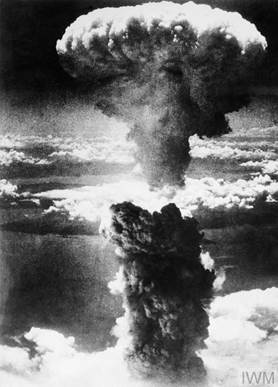
Einstein, like Szilard, considered the Manhattan Project necessary solely to prevent Nazi Germany’s employment of nuclear weapons to conquer the world. Therefore, when Germany’s war effort neared collapse and the U.S. bomb project neared completion, Einstein helped facilitate a mission by Szilard to Roosevelt with the goal of preventing the use of atomic bombs by the United States. He also fired off an impassioned appeal to the prominent Danish physicist, Niels Bohr, urging scientists to take the lead in heading off a dangerous postwar nuclear arms race. Neither venture proved successful, and the U.S. government, under the direction of the new president, Harry Truman, launched the nuclear age with the atomic bombing of Japan. Einstein later remarked that his 1939 letter to Roosevelt had been the worst mistake of his life.

Convinced that humanity now faced the prospect of utter annihilation, Einstein resurrected one of his earlier ideas and organized a new campaign against war. “The only salvation for civilization and the human race,” he told an interviewer in September 1945, “lies in the creation of a world government, with security of nations founded upon law.” Again and again, he reiterated this message. In January 1946, he declared: “As long as there exist sovereign states, each with its own, independent armaments, the prevention of war becomes a virtual impossibility.” Consequently, humanity’s “desire for peace can be realized only by the creation of a world government.”

In 1946, he and other prominent scientists, fearful of the world’s future, established the Emergency Committee of Atomic Scientists. As chair of the new venture, Einstein repeatedly assailed militarism, nuclear weapons, and runaway nationalism. “We shall require a substantially new manner of thinking,” he said, “if mankind is to survive.”

Until his death in 1955, Einstein continued his quest for peace, criticizing the Cold War and the nuclear arms race and calling for strengthened global governance as the only “way out of the impasse.” Today, as we face a violent, nuclear-armed world, Einstein’s warnings about unrestrained nationalism and his proposals to control it are increasingly relevant.

Einstein-Szilard Letter to President Franklin D. Roosevelt, August 2, 1939

Source: https://ahf.nuclearmuseum.org/ahf/key-documents/einstein-szilard-letter/

Background: Albert Einstein was the world’s most renowned physicist and a Nobel Prize winner. He fled Germany in the 1930s and established himself in the United States. Nuclear scientists Leo Szilard, Eugene Wigner, and Edward Teller, refugees from Nazi occupied Europe, persuaded Einstein to send a letter to President Franklin D. Roosevelt warning him of the possibility that Germany could develop an atomic bomb. In this letter, Einstein urged Roosevelt to support a program to develop atomic weapons.

“Some recent work by E. Fermi and L. Szilard, which has been communicated to me in manuscript, leads me to expect that the element uranium may be turned into a new and important source of energy in the immediate future. Certain aspects of the situation which has arisen seem to call for watchfulness and, if necessary, quick action on the part of the Administration. I believe therefore that it is my duty to bring to your attention the following facts and recommendations:

In the course of the last four months it has been made probable — through the work of Joliot in France as well as Fermi and Szilard in America — that it may become possible to set up a nuclear chain reaction in a large mass of uranium by which vast amounts of power and large quantities of new radium-like elements would be generated. Now it appears almost certain that this could be achieved in the immediate future. This phenomenon would also lead to the construction of bombs, and it is conceivable — though much less certain — that extremely powerful bombs of a new type may thus be constructed. A single bomb of this type, carried by boat and exploded in a port, might very well destroy the whole port together with some of the surrounding territory. However, such bombs might very well prove to be too heavy for transportation by air. The United States has only very poor ores of uranium in moderate quantities. There is some good ore in Canada and the former Czechoslovakia, while the most important source of uranium is Belgian Congo.

In view of this situation you may think it desirable to have some permanent contact maintained between the Administration and the group of physicists working on chain reactions in America. One possible way of achieving this might be for you to entrust with this task a person who has your confidence and who could perhaps serve in an unofficial capacity. His task might comprise the following:

a) to approach Government Departments, keep them informed of the further development, and put forward recommendations for Government action, giving particular attention to the problem of securing a supply of uranium ore for the United States.

b)  to speed up the experimental work, which is at present being carried on within the limits of the budgets of University laboratories, by providing funds, if such funds be required, through his contacts with private persons who are willing to make contributions for this cause, and perhaps also by obtaining the co-operation of industrial laboratories which have the necessary equipment.

I understand that Germany has actually stopped the sale of uranium from the Czechoslovakian mines which she has taken over. That she should have taken such early action might perhaps be understood on the ground that the son of the German Under-Secretary of State, von Weizsäcker, is attached to the Kaiser-Wilhelm-Institut in Berlin where some of the American work on uranium is now being repeated.

Manhattan Project “Metallurgical Laboratory,” University of Chicago, June 11, 1945

Sources: https://ahf.nuclearmuseum.org/ahf/key-documents/franck-report/; https://thebulletin.org/2020/08/prominent-nuclear-scientists-did-not-recommend-the-atomic-bombings-of-japan/

Background: As the U.S. drew up plans to drop the first atomic bomb in August 1945, a group of scientists at the University of Chicago prepared a report arguing against the use of the bomb. Headed by James Franck and including notable scientists such as Leo Szilard and Glenn Seaborg, a Nobel laureate. The classified document was submitted to the Interim Committee, a group appointed by President Truman to advise him on the use of the bomb, in June 1945, one month before the Trinity test and two months before Hiroshima and Nagasaki. The Interim Committee rejected their recommendations.

A) “The development of nuclear power not only constitutes an important addition to the technological and military power of the United States, but also creates grave political and economic problems for the future of this country.”

B) “Nuclear bombs cannot possibly remain a ‘secret weapon’ at the exclusive disposal of this country, for more than a few years. The scientific facts on which their construction is based are well known to scientists of other countries. Unless an effective international control of nuclear explosives is instituted, a race of nuclear armaments is certain to ensue following the first revelation of our possession of nuclear weapons to the world. Within ten years other countries may have nuclear bombs, each of which, weighing less than a ton, could destroy an urban area of more than ten square miles. In the war to which such an armaments race is likely to lead, the United States, with its agglomeration of population and industry in comparatively few metropolitan districts, will be at a disadvantage compared to the nations whose population and industry are scattered over large areas.”

C) “We believe that these considerations make the use of nuclear bombs for an early, unannounced attack against Japan inadvisable. If the United States would be the first to release this new means of indiscriminate destruction upon mankind, she would sacrifice public support throughout the world, precipitate the race of armaments, and prejudice the possibility of reaching an international agreement on the future control of such weapons.”

D) “Much more favorable conditions for the eventual achievement of such an agreement could be created if nuclear bombs were first revealed to the world by a demonstration in an appropriately selected uninhabited area.”

Sources: https://nsarchive2.gwu.edu/NSAEBB/NSAEBB162/19.pdf; https://teachingamericanhistory.org/document/recommendations-on-the-immediate-use-of-nuclear-weapons/

Background: The panel that issued this report to Secretary of War Henry Stimson consisted of four prominent physicists who were part of the Manhattan Project, J. Robert Oppenheimer, Director of the Los Alamos Laboratory; Enrico Fermi, lead scientist for the first nuclear reactor at the University of Chicago Met Lab; Arthur Compton, Nobel laureate and head of the Metallurgical Laboratory; and Ernest Lawrence, Nobel laureate and head of the Radiation Laboratory at UC Berkeley.

“You have asked us to comment on the initial use of the new weapon. This use, in our opinion, should be such as to promote a satisfactory adjustment of our international relations. At the same time, we recognize our obligation to our nation to use the weapons to help save American lives in the Japanese war.

(1) To accomplish these ends we recommend that before the weapons are used not only Britain, but also Russia, France, and China be advised that we have made considerable progress in our work on atomic weapons, and that we would welcome suggestions as to how we can cooperate in making this development contribute to improved international relations.

(2) The opinions of our scientific colleagues on the initial use of these weapons are not unanimous: they range from the proposal of a purely technical demonstration to that of the military application best designed to induce surrender. Those who advocate a purely technical demonstration would wish to outlaw the use of atomic weapons, and have feared that if we use the weapons now our position in future negotiations will be prejudiced. Others emphasize the opportunity of saving American lives by immediate military use, and believe that such use will improve the international prospects, in that they are more concerned with the prevention of war than with the elimination of this specific weapon. We find ourselves closer to these latter views; we can propose no technical demonstration likely to bring an end to the war; we see no acceptable alternative to direct military use.

(3) With regard to these general aspects of the use of atomic energy, it is clear that we, as scientific men, have no proprietary rights. It is true that we are among the few citizens who have had occasion to give thoughtful consideration to these problems during the past few years. We have, however, no claim to special competence in solving the political, social, and military problems which are presented by the advent of atomic power.”

Source: https://ahf.nuclearmuseum.org/ahf/key-documents/szilard-petition/

Background: Nuclear physicist Leo Szilard, a refugee from Hungary who worked on the Manhattan Project, drafted a petition to President Harry Truman in the summer of 1945 hoping to avert the use of the atomic bomb against Japan. The petition was signed by seventy other scientists but was not seen by the President or the Secretary of War before the first atomic bomb was dropped on Hiroshima. Albert Einstein and Robert Oppenheimer were not listed as signers.

Discoveries of which the people of the United States are not aware may affect the welfare of this nation in the near future. The liberation of the atomic power which has been achieved places atomic bombs in the hands of the Army. It places in your hands, as Commander-in-Chief, the fateful decision whether or not to sanction the use of such bombs in the present phase of the war against Japan. We, the undersigned scientists, have been working in the field of atomic power. Until recently we have had to fear that the United States might be attacked by atomic bombs during this war and that her only defense might lie in a counterattack by the same means. Today, with the defeat of Germany, this danger is averted and we feel impelled to say what follows: The war has to be brought speedily to a successful conclusion and attacks by atomic bombs may very well be an effective method of warfare. We feel, however, that such attacks on Japan could not be justified, at least not until the terms which will be imposed after the war on Japan were made public in detail and Japan were given an opportunity to surrender. If such public announcement gave assurance to the Japanese that they could look forward to a life devoted to peaceful pursuit in their homeland and if Japan still refused to surrender, our nation might then, in certain circumstances, find itself forced to resort to the use of atomic bombs. Such a step, however, ought not to be made at any time without seriously considering the moral responsibilities which are involved.

The development of atomic power will provide the nations with new means of destruction. The atomic bombs at our disposal represent only the first step in this direction, and there is almost no limit to the destructive power which will become available in the course of their future development. Thus a nation which sets the precedent of using these newly liberated forces of nature for purposes of destruction may have to bear the responsibility of opening the door to an era of devastation on an unimaginable scale.

If after the war a situation is allowed to develop in the world which permits rival powers to be in uncontrolled possession of these new means of destruction, the cities of the United States as well as the cities of other nations will be in continuous danger of sudden annihilation. All the resources of the United States, moral and material, may have to be mobilized to prevent the advent of such a world situation. Its prevention is at present the solemn responsibility of the United States—singled out by virtue of her lead in the field of atomic power. The added material strength which this lead gives to the United States brings with it the obligation of restraint and if we were to violate this obligation our moral position would be weakened in the eyes of the world and in our own eyes. It would then be more difficult for us to live up to our responsibility of bringing the unloosened forces of destruction under control.

In view of the foregoing, we, the undersigned, respectfully petition: first, that you exercise your power as Commander-in-Chief, to rule that the United States shall not resort to the use of atomic bombs in this war unless the terms which will be imposed upon Japan have been made public in detail and Japan knowing these terms has refused to surrender; second, that in such an event the question whether or not to use atomic bombs be decided by you in the light of the consideration presented in this petition as well as all the other moral responsibilities which are involved.

Published in the June 1948 issue of the Bulletin of the Atomic Scientists

Source: https://thebulletin.org/archive/a-policy-for-survival-a-statement-by-the-emergency-committee-of-atomic-scientists/

Background: The Emergency Committee of Atomic Scientists was formed in May, 1946, by Albert Einstein, R.F. Bacher, Hans A. Bethe, Edward U. Condon, R. Hogness, Leo Szilard, Harold C. Urey, and V.F. Weisskopf. Their objective was to encourage and further the peaceful uses of atomic energy and to do this they would solicit private contributions in support of the work of the National Committee for Atomic Information. 

“Two years ago this month the United Nations Atomic Energy Commission was in process of formation. Now the discussions on international control of atomic energy are about to be adjourned indefinitely, perhaps never again to be resumed. One of the most fateful events in history has passed almost unnoticed. Its importance must be realized: its lesson for mankind must be made clear. To clarify the importance of the collapse of these discussions, we reiterate here our Six Point Statement published originally on November 17, 1946:

  1. Atomic bombs can now be made cheaply and in large number. They will become more destructive.
  2. There is no military defense against atomic bombs and none is to be expected.
  3. Other nations can rediscover our secret processes by themselves.
  4. Preparedness against atomic war is futile, and if attempted, will ruin the structure of our social order.
  5. If war breaks out, atomic bombs will be used and they will surely destroy our civilization.
  6. There is no solution to this problem except international control of atomic energy, and ultimately, the elimination of war.”
Era 15 – Contemporary United States: International Policies (1970-Today)

www.njcss.org

The relationship between the individual and the state is present in every country, society, and civilization. Relevant questions about individual liberty, civic engagement, government authority, equality and justice, and protection are important for every demographic group in the population.  In your teaching of World History, consider the examples and questions provided below that should be familiar to students in the history of the United States with application to the experiences of others around the world.

These civic activities are designed to present civics in a global context as civic education happens in every country.  The design is flexible regarding using one of the activities, allowing students to explore multiple activities in groups, and as a lesson for a substitute teacher. The lessons are free, although a donation to the New Jersey Council for the Social Studies is greatly appreciated. www.njcss.org

The middle of the 20th century marks the foundation of the transformation of the United States into a world power. In this era the United States developed alliances, promoted free trade agreements, advocated for human rights, and assisted developing countries.  Toward the end of the century, the United States was a target of terrorist organizations, had and increasing national debt, and saw its power as a world leader challenged by China and Russia. As the United States entered the 21st century, its role as a leader in the international community was questioned by the Republican Party,

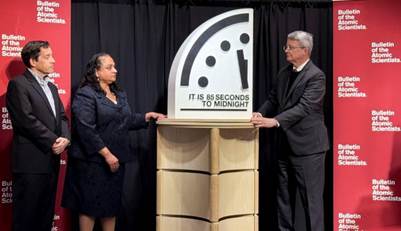
In 2026, the Domesday Clock was set at 85 seconds to midnight, the end of the civilized world as we know it.The primary reasons for this are the threats of a nuclear arms race, climate change, and bioterrorism.As a result, every major country is re-evaluating its national security plans at the domestic and international level.  

“Doomsday Clock on Jan. 27, 2026.Reuters/Kevin Fogarty

In your United States History classes, you have likely discussed national security strategies since the end of World War II in 1945.  These include containment, brinkmanship NSC-68, co-existence, Mutually Assured Destruction collective security, human rights, and the United States as the world’s policeman. Each of these policies have been rigorously debated within the government and in public opinion.  The debate is often framed in the context of isolationism (U.S. has the military strength to protect itself) and internationalism (U.S. needs the support of alliances and international organizations).  The central part of America’s new strategy is our economic strength. The 2025 National Security Strategy rightly asserts that “strength is the best deterrent,” and elevates economic vitality as central to that strength.

The policy announced by the Trump administration in December 2025 diminishes the threat of Russia and China as a top priority. “Mass migration” is deemed to be the major external threat to the United States—more than China, Russia, or terrorism. The document makes clear that the divide is political between transatlantic liberals and authoritarians.

The Western Hemisphere is the new priority and immigration is elevated to a major national security concern. The U.S. military will focus on the Western Hemisphere. The rules of international law are considered less important than the interests of peace, diplomacy, or human rights. Cybersecurity is considered a major threat and the strategy of the United States will become dependent on the private sector.

It is difficult to identify an exact amount for spending by Homeland Security in the United States because of the increased emphasis on immigration. We will use the number of $332 billion or 2.9% of GDP as a comparison to the 2.5% spent by the United Kingdom.

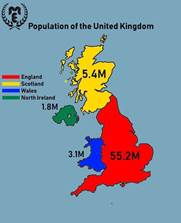
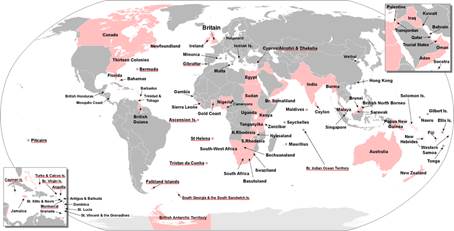
The population of the United Kingdom is about 70 million. In addition, the United Kingdom also includes territories around the globe. National security threats include terrorism, organized immigration crime, cybersecurity, bioterrorism, exposure to nuclear radiation, and effects from climate change.  The United Kingdom in 2025 announced a new long-range security strategy for homeland security at a cost of 2.5% of GDP or about 62 billion euros annually.

The strategy involves a network of alliances to address these threats. The recent announcement by the United States to acquire Greenland by purchase or military action has caused the United Kingdom and other NATO countries to increase financial investments in military equipment, NATO, and other regional alliances. The Calais Group is committed to preventing organized immigration crime, the Joint Migration Taskforce addresses human trafficking, and the Border Security Pact targets smuggling.  Homeland security for the United Kingdom also includes agreements promoting economic and financial stability regarding technology, energy, access to minerals, and renewable energy.  Russia, China, North Korea, and Iraq are viewed as the biggest threats to homeland security.

The priorities for Homeland Security in the United Kingdom include the following:

  • Identify and prevent terrorist actors and criminal gangs from entering.
  • Increased investment in armed forces.
  • Strengthen existing alliances (NATO, AUKUS, and GCAP) and form new ones.
  • Pursue deeper trade, technology, and security agreements with the United States, European Union, and India.
  • Protect its underwater fiber optic network and natural gas pipelines.
  • The UK has created a new Border Security Command to secure its borders.
  1. What are the advantages and disadvantages of the new national security strategies by the United States and the United Kingdom?
  2. How dependent is each country on economic growth to support its strategy?
  3. How significant are the lessons of history regarding national security based on internationalism through alliances and isolationism through dependence on geography and military strength?
  4. Is one strategy better poised for success than the other or are both strategies poised for disappointment or failure?

Breaking Down Trump’s 2025 National Security Strategy (Brookings)

Department of Homeland Security Budget (USA Spending)

National Security Strategy: 2025: Security for the British People in a Dangerous World (UK Cabinet Office)

UK Defense Spending (House of Commons Library)

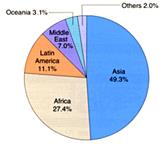
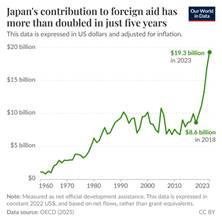
Japan provides significant economic aid to Africa. In 2018, Japan gave $8.6 billion and is currently giving $20 billion. Japan’s foreign aid budget is equal to 0.44% of its gross national income, which is almost double the 0.24% from the United States.

The Japanese government values its relationship with Africa. It understands the importance of rare earth minerals, specifically lithium, nickel, and cobalt. In August 2023 Japan signed contracts with Namibia, Angola, and the Democratic Republic of the Congo (DRC) to secure minerals. The 54 African countries account for more than a quarter of the 193 members in the United Nations. Japan’s foreign policy values free and open markets based on the rule of law, which is viewed as a deterrent to the coercion used by China in Africa.

Norway’s oil reserves enabled it to maintain financial assets in its Wealth Management Fund. The fund is valued at $1.8 trillion (USD) Norway contributes 3.1 billion krone to the African Development Fund. There are about 30 Western and non-Western countries contributing to this fund annually, including some countries in Africa. Norway places a high priority on providing Africa’s 300 million people with access to electricity, potable water, and food,. In addition, Norway is actively providing financial resources for sustainable living, women’s rights, education, and human rights.

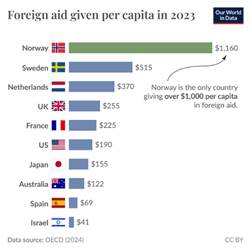
On a per capita basis, Norwegians contribute $1,160, and Japan contributes $155. The United States was contributing $190 per person before its recent withdrawal of funds in 2025.

Norway’s foreign policy includes the following: 

  1. Multilateral and regional cooperation: Strengthen cooperation in multilateral forums, enhance African representation, and continue close collaboration with the AU (African Union);
  2. Security and peace efforts: Support African-led peace initiatives, integrate gender perspectives in decision-making, and bolster cooperation with the AU and UN on security;
  3. Democracy, human rights, and gender equality: Promote democracy, human rights, and gender equality through civil society engagement, justice reform, and educational access;
  4. Business, clean energy, and knowledge: Boost economic cooperation, promote Norwegian solutions, and support renewable energy development in African markets; and
  5. Climate, environment, food security, and health: Collaborate on climate action, sustainable food systems, and resilient health systems to address environmental and health challenges.
  1. How significant are the foreign policy differences of investment in Africa between Japan, and Norway?
  2. How are the foreign policy initiatives of China, Russia, and the United States influencing the foreign policy of Japan?
  3. Why do you think the people of Japan are supporting additional investment in Africa compared to reducing tariffs or improving the quality of life for the people of Japan?
  4. Which foreign policy strategy is aligned with your values?
  5. In 2000, the United Nations adopted ambitious Millennial Development Goals which were on target until the global financial crisis of 2008. Is it possible in today’s political and economic environment to return to them and improve the quality of life for people in the global South?

Japan’s Strategic Interests in Africa

Countering China’s Expansionism: Japan-India Synergy in Africa Amid U.S. Retrenchment

Norway Gives More Foreign Aid Per Capita Than any other OCED Country

Norway to Increase Support for African Development Fund

Strategy for Norwegian Engagement with African Countries

Authoritarian governments also have constitutions.  Dictatorships may divide power between the supreme ruler, political party, army, or another group.  Democracies may divide power between legislative and judicial branches with the chief executive. The people and media may also have power in a society. A constitution reflects the values of the State and is still one of the best ways to understand how it manages problems and provides for its citizens.

The KPG (Korean Provisional Government) was organized in 1919 and was a government in exile as a result of Japan’s imperialism.  It ended on August 15, 1945 with the surrender of Japan and the Republic of Korea became the new government. A new constitution was ratified on August 15, 1948 and Syngman Rhee was elected as President.After the occupation of Korea during World War II ended, Korea adopted a constitution in 1948. Power was given to the SPA (Supreme People’s Assembly) This Assembly was given the authority to enact basic domestic and foreign policies; create a Presidium to operate on its behalf when the Assembly was not in session; approve laws; revise and amend the Constitution; approve the budget; elect or recall a Prime Minister; and appoint officials such as the Chief Justice of the Supreme Court.

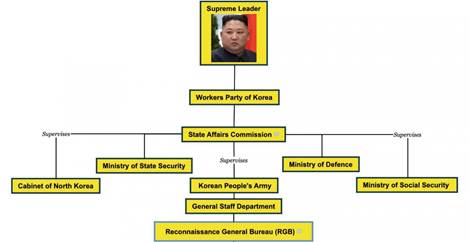
The 1972 Constitution stated that the Democratic People’s Republic of Korea (DPRK) was an independent socialist state representing all the Korean people. The constitution is based on democratic centralism, which states that citizens must obey all the decisions of their elected leaders. There is no system of checks and balances, only submission and loyalty. The Constitution of North Korea gives absolute power to the Workers’ Party. It follows the ‘juche’ ideology of self-reliance and is above the law. It fosters Korean nationalism and requires absolute loyalty to the ruler, currently Kim Jong Il. The Constitution values the superiority of the State over its citizens.  In theory, the cabinet, military, and party check each other, although the loyalty of the military to Kim Jong Il has ended this system of checks and balances. These three groups could conceivably fight one another in a civil war for control or support each other, which they currently are doing.

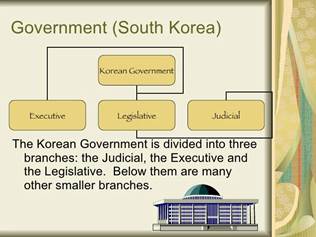
The Constitution of the Republic of Korea (South Korea) has been amended nine times since 1948 and reflects six republics which reflect political changes. The Constitution of The Democratic People’s Republic of Korea (North Korea) was completely replaced in 1972 and this constitution has had significant amendments.  In contrast, the Constitution of the United States has made changes through 27 amendments and judicial decisions by the Supreme Court. The Constitution of the United States was meant to be flexible.

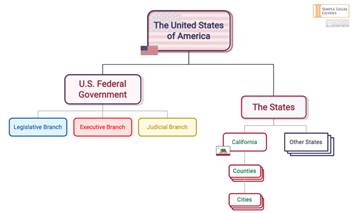
The powers of government in the United States are also divided between the states and the federal government and between the three branches of the federal government. The framework of the constitution specifically limits the power of the national government and allows the three branches of government to ‘check and balance’ the power of the legislative, executive, and judicial branches.

The principle of popular sovereignty gives power to the people to make changes to their government every two years through the election of their representatives to Congress and the election of one-third of their senators.  Currently, the United States has a two-party system with the Republican Party and democratic Party as the two major political parties, Although inn theory, the individual members in each party have independence and vote on the interests of the people they represent; in practice they form caucuses or alliances supporting an ideology or regional interest. Currently, the members of the Republican Party are demonstrating loyalty to the agenda of President Trump and the members of the Democratic Party have caucuses representing different views on immigration, the economy, health care, and the role of the federal government.

  1. How important is the role of the political party to the stability of the government?
  2. Are there inherent weaknesses in the Constitution of The Republic of Korea (South Korea) and the Democratic People’s Republic of Korea (North Korea)?
  3. How important is a strong executive to a stable government?
  4. How has President Trump increased the authority of the executive Branch more than previous presidents? (party loyalty, the media, support from the Supreme Court, etc.)

The Constitution of North Korea: Its Changes and Implications

Foreign Relations of the United States, 1948, The Far East and Australasia

Case Studies: Checks and Balances(United States)

How the U.S. Constitution Has Changed and Expanded Since 1787

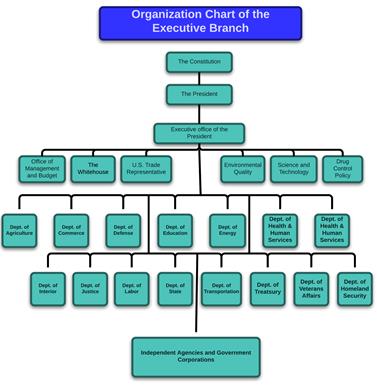
The United States is the largest country in the Americas with a population of 340 million. It has the largest military and economy in the world. The U.S. GDP is approximately 32 trillion followed by China at 21 billion USD. The power of the Executive Branch is vested in the President of the United States, who is the head of state and Commander-in-Chief of the armed forces. The President is responsible for implementing and enforcing the laws written by Congress.

The President must be 35 years of age, a natural born citizen, and must have lived in the United States for at least 14 years. The people elect the president every four years by voting for members in their state who are part of the Electoral College. The Electors vote for President. There are currently 538 electors in the Electoral College representing the 435 members of the House of Representatives, the 100 senators, and the three representatives of the District of Columbia (Washington, D.C.).

The Cabinet and independent federal agencies are responsible for the enforcement and administration of federal laws. Examples are the Department of Defense, Environmental Protection Agency, Homeland Security, and Social Security Administration.

The President has the power either to sign legislation into law or veto bills passed by Congress, although Congress may override a veto with a two-thirds vote of both houses. The Executive Branch

  • conducts diplomacy with other nations,
  • negotiates and signs treaties, which must be ratified by two-thirds of the Senate,
  • issues executive orders, which may clarify and implement existing laws,
  • extend pardons for federal crimes, and
  • gives an annual address to Congress outlining the agenda for the coming year.

The president is subject to impeachment for treason, bribery, or high crimes and misdemeanors or smaller crimes. The process to remove a president from office requires a two-thirds vote of the Senate. No American president has been removed from office through the impeachment process, although three presidents have been impeached.

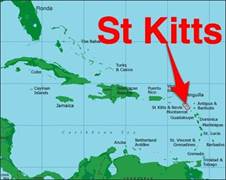
The islands of Saint Kitts and Nevis were created as a federation in 1983 after centuries of British colonial rule. They have the smallest population in the Americas with 46,000, with 11,000 on the island of Nevis and 35,000 on St. Kitts. The population is expected to decline by 20% over the next decade. Nevis has its own assembly, an elected premier and a deputy-governor-general. Tourism, finance, and service sector businesses are the main sources of income.  In 1998, Nevis voted to secede but the resolution did to receive the required 2/3 majority vote of the people.

The Government of St. Kitts and Nevis is a parliamentary democracy within the framework of a constitutional monarchy with King Charles III (United Kingdom) as the head of state. The Governor-General represents the monarch, and the Prime Minister is the head of government and leader of the majority party in the National Assembly. The Cabinet is appointed by the Governor-General on the advice of the Prime Minister.

The National Assembly is unicameral, consisting of 15 members: 11 elected representatives, 3 senators appointed by the Governor-General, and the Attorney General. Elections are held every five years.  The judiciary is independent and based on the British legal system and uses the Eastern Caribbean Supreme Court, which serves several islands in the region.

Main PowersElection ProcessElection Cycle 1
ExecutiveMonarch of the United Kingdom acts as a ceremonial figurehead, governor-general represents the king, and prime minister provides advice for the governor-general and leads the cabinet of ministers.Governor-general is appointed by the monarch and prime minister is appointed by the governor-general.Governor-General and Prime Minister: At His Majesty’s discretion
JudicialEastern Caribbean Supreme Court presides over multiple countries, one justice resides in St. Kitts.Appointed by British monarch and the Judicial and Legal Services Commission.Mandatory retirement age of 65
LegislativeResponsible for drafting legislation.National Assembly has 11 members elected by plurality vote in single-member constituencies and 3 members are appointed by the governor-general.5 years
  1. What are the advantages and disadvantages of a constitutional monarchy, federal parliamentary democracy, and a representative democracy?
  2. Is a government of three branches an effective and efficient structure of government for the 21st century?
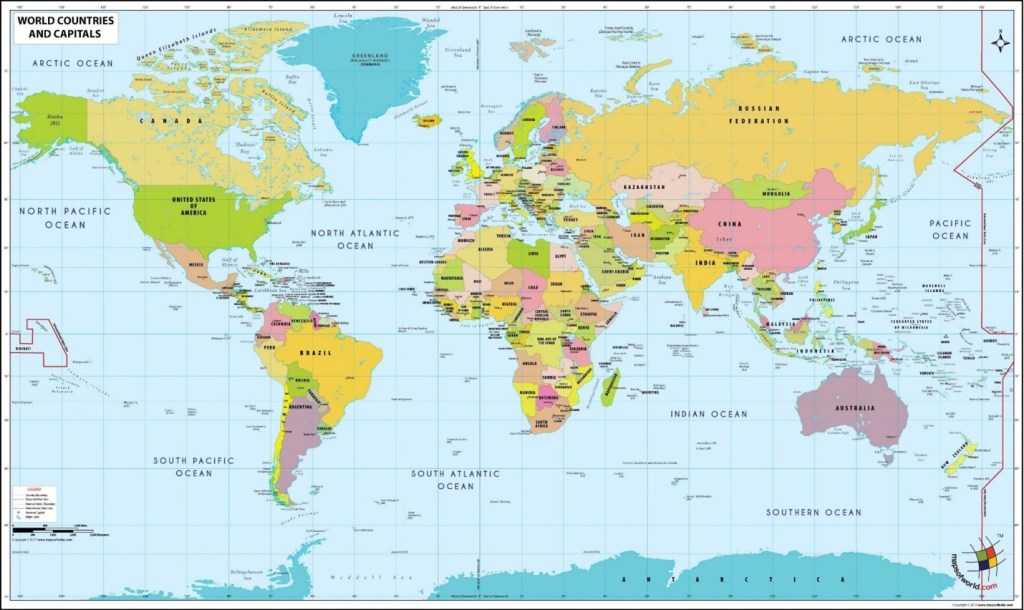
  3. Is one government structure better for countries with smaller populations of under 100 million than countries with larger populations? (Only 16 countries have populations larger than 100 million.  The ten largest countries are: India, China, U.S. Indonesia, Pakistan, Nigeria, Brazil, Bangladesh, Russia, and Mexico)
  4. How frequently and for how many years should the President, Prime Minister or Governor serve?
  5. Should the President of the United States be given any additional powers?

The Government of St. Kitts and Nevis (Official Website of the Government of St. Kitts and Nevis)

Political Database of the Americas (Georgetown University)

The Executive Branch (White House)

The Executive Branch (National Constitution Center)

Era 12 Postwar United States: Cold War (1945 to early 1970s)

New Jersey Council for the Social Studies

www.njcss.org

The relationship between the individual and the state is present in every country, society, and civilization. Relevant questions about individual liberty, civic engagement, government authority, equality and justice, and protection are important for every demographic group in the population.  In your teaching of World History, consider the examples and questions provided below that should be familiar to students in the history of the United States with application to the experiences of others around the world.

These civic activities are designed to present civics in a global context as civic education happens in every country.  The design is flexible regarding using one of the activities, allowing students to explore multiple activities in groups, and as a lesson for a substitute teacher. The lessons are free, although a donation to the New Jersey Council for the Social Studies is greatly appreciated. www.njcss.org

The middle of the 20th century marks the zenith of American power in the world. Following World War 2, international organizations were established to maintain a stable world order. The United States developed alliances to counter the threat of communism and authoritarian governments.  The cost of the arms race and role as ‘global policeman’ was costly for the government of the United States and as a result its defense of democracy and human rights faced criticisms from its elected representatives and people.

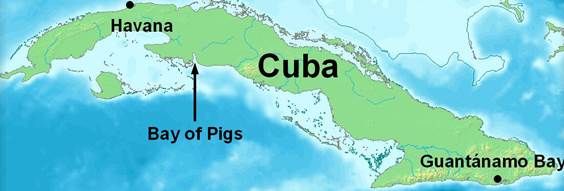
In 1959, Fidel Castro came to power in an armed revolt that overthrew Cuban dictator Fulgencio Batista. The U.S. government distrusted Castro and was wary of his relationship with Nikita Khrushchev, the leader of the Soviet Union. President Eisenhower approved the training of a small army for an assault landing and guerilla warfare. The success of the plan depended on the Cuban population joining the invaders.

On April 17, 1961 the Cuban-exile invasion force landed at beaches along the Bay of Pigs and immediately came under heavy fire.  Within 24 hours, about 1,200 members of the invasion force surrendered, and more than 100 were killed. The Bay of Pigs invasion was a disaster for the United States and President Kennedy.

In 2014, Russia invaded the Crimean Peninsula in Ukraine. Russia annexed Ukraine but the international community did not support or recognize the actions of Russia. Since 2014, Russia has tightened its grip on Crimea. It has transformed the occupied Ukrainian peninsula into a military base, utilizing it for the full-scale invasion of Ukraine in 2022. Crimea currently serves as an important logistical hub for the Russian military, acting as an airbase and naval base while playing a key role in the resupply of the Russian army in Ukraine.

Bay of Pigs Invasion

Russia’s Invasion of Crimea in 2014

  1. Did the United States have a right to overthrow an unelected ruler in Cuba who supported the Soviet Union?
  2. To what extent does geography, national security, or economic stability justify actions of large sovereign states interfering in domestic affairs in smaller states?
  3. Why did the international community fail to challenge Russia’s invasion of Ukraine in 2014?
  4. Why does Russia want territory in Crimea and Ukraine?
  5. How can the international community best address the situation in Ukraine?
  6. If the international community accepts Russia’s illegal annexation of territory in a neighboring state, does this allow or encourage other countries to annex territories. (i.e. China, United States, etc.)

As Americans enjoyed their new prosperity and role as the leader of the free world, there were voices for equality from women, African Americans, and people of color. The US also embraced global responsibilities and the threat posed by the expansion of communism.

Most Americans believe that freedom is a fundamental human right. In the post-World War 2 era, The United States found that the cost of defending democracy and human rights was expensive and difficult. In the first quarter of the 21st century, the United States experienced a state sponsored terririst attack on New York City and Washington D.C., threats of international terrorism, a divided Congress, unprecedented national debt, and conflicts in the Middle East. In 2025, there were 59 violent conflicts in the world. The interests of Russia and China are in conflict with the interests of the United States to defend democratic values and institutions and human rights.

The United States has not ratified the following international agreements on human rights:

  • International Criminal Court
  • Convention on the Elimination of All Forms of Discrimination against Women (CEDAW)
  • Convention on the Rights of the Child (CRC)
  • Convention for the Protection of all Persons from Enforced Disappearance
  • Mine Ban Treaty
  • Convention on Cluster Munitions
  • Convention on the Rights of Persons with Disabilities (CRPD)
  • Optional Protocol to the Convention against Torture

Source

Before 1950, the United States had no stated policy on asylum. However, between 1933-1945, about 200,000 refugees fleeing the violence of war, immigrated to the United States. The American people were opposed to changing the National Origins Quota System enacted in 1924.

The 1952 McCarran-Walter Act was passed over President Truman’s veto. It continues to serve as the basis of our immigration laws and policies.

“The bill would continue, practically without change, the national origins quota system, which was enacted, into law in 1924, and put into effect in 1929. This quota system—always based upon assumptions at variance with our American ideals—is long since out of date and more than ever unrealistic in the face of present world conditions.

This system hinders us in dealing with current immigration problems, and is a constant handicap in the conduct of our foreign relations.” 

In 1965 Immigration and Nationality Act (Hart-Celler Act) eliminated the quota system that was part of the McCarran-Walter Act. The Act opened immigration to people of different racial and ethnic populations, especially Asians and Africans, it continued the quotas for Mexicans and Hispanic populations and favored visas for skilled workers over agricultural or domestic workers.  

According to the UN refugee agency, a record-breaking 3.6 million new individual asylum applications were registered worldwide in 2023 with most new asylum claims made by nationals of Afghanistan, Colombia, Sudan, Syria, and Venezuela. At the close of 2023, 6.9 million asylum seekers worldwide still had pending asylum claims.

In the United States in 2023, nearly half of all asylum approvals were for people fleeing Afghanistan, China, El Salvador, and Venezuela from violence, poverty, and political upheaval.

  1. Why has the United States refused to support international laws on human rights and crimes against humanity since World War 2?
  2. Is there evidence that the United States violates the human rights of some of its own citizens?
  3. Why have the American people reflected a restrictive immigration policy over time, even for refugees facing death or abuse in their home country?
  4. Who should be granted asylum in the United States?

History of Child Labor in the United States

Truman Library Institute

Brown University’s Slavery and Justice Report

The National Council of La Raza

The War Refugee Board

The Immigration and Nationality Act of 1952(McCarran-Walter Act)

The 1965 Immigration Act: Opening the Nation to Immigrants of Color(Gilder Lehrman Institute of American History)

How Should Americans Remember the 1965 Immigration and Nationality Act?(Organization of American Historians)

How the U.S. Asylum Process Works(Council on Foreign Relations)

In the years after World War 2, especially after Churchill’s Iron Curtain Speech in 1946, the United States feared a global domination of communism. This belief gained popularity after China became communist in 1949. The current administration of President Trump is identifying the Democratic party with Marxist-Leninist ideology or progressive ideas for universal health care, helping students to repay college loans, raising the minimum wage, labor unions, and deporting immigrants with legal visas and some who are not documented.

This has a ‘chilling effect’ on people, especially educators and college professors who teach about communism and Marxist socialism. It is important to understand the historical perspective over time regarding how the government of the United States has responded to situations which have called for a change in our government through elections and the violent overthrow of our Constitution and democratic institutions.

Congress has the power to protect the Government of the United States from armed rebellion. The Insurrection Act of 1807 combined a series of statues to protect the United States from angry citizens following the Embargo Act. The issue for debate is when does the protection of free speech regarding criticism of government policies and organizing plans to change government policies or elected leaders become a matter permitting the government to use military force to protect itself.

The Posse Comitatus Act forbids the U.S. military, including federal armed forces and National Guard from enforcing civil law. The reason for this is to protect the First Amendment rights of citizens to express their beliefs. The Stafford Act (1988) permits the use of the military in times of natural disasters or public health epidemics. 

Section 252 the Insurrection Act allows the president to deploy troops without a request from the state and provides the authority to send in troops against the state’s wishes to enforce the laws of the United States or to suppress rebellion.  President Eisenhower used this power to enforce the decision of the U.S. Supreme Court to desegregate the public schools in Little Rock, AK.  In 1992, the governor of California requested President George H.W. Bush to send troops to control the rioting in Los Angeles following the acquittal of four white police officers on the beating of Rodney King. Section 253 allows the president to suppress domestic violence, a conspiracy to overthrow the government, or an insurrection.  John Brown’s raid in 1859 and the Civil War are examples.

The Smith Act was passed in 1940 making it a crime for any person knowingly or willfully to advocate the overthrow or destruction of the Government of the United States by force or violence. This Act led to the arrest of leaders of the Communist Party who were advocating to overthrow the government of the United States by force.

In 1951, the Court ruled in a 6-2 decision that the conviction of Eugene Dennis of conspiring and organizing for the overthrow and destruction of the United States government by force and violence under provisions of the Smith Act.  In 1967, the decision was overturned by the Brandenburg v. Ohio when the Supreme Court held that “mere advocacy” of violence was protected speech. 

In New York, the Feinberg Law banned from the teaching of the violent overthrow of the government of the United States. Several other states adopted similar measures. When a group of teachers and parents challenged this law, the Supreme Court upheld it in Adler v. Board of Education of the City of New York, (1952) In 1967, another Supreme Court overturned the Adler decision.

  1. If the Declaration of Independence states the right of people to dissent and overthrow an unjust government, should school teachers be allowed to teach this to young students?

“That whenever any Form of Government becomes destructive of these ends, it is the Right of the People to alter or to abolish it, and to institute new Government, laying its foundation on such principles and organizing its powers in such form, as to them shall seem most likely to effect their Safety and Happiness. Prudence, indeed, will dictate that Governments long established should not be changed for light and transient causes; and accordingly all experience hath shewn, that mankind are more disposed to suffer, while evils are sufferable, than to right themselves by abolishing the forms to which they are accustomed. But when a long train of abuses and usurpations, pursuing invariably the same Object evinces a design to reduce them under absolute Despotism, it is their right, it is their duty, to throw off such Government, and to provide new Guards for their future security.”

2. Why do you think the U.S. Supreme Court overturned the Dennis and Adler decisions years later? Do these reversals have a strong foundation in American law?

3. Is it possible to use the Smith Act and the Insurrection Act to bring about a change in government that would embrace a more authoritarian government and a less democratic one?

4. How can the Smith Act and Insurrection Act be abolished?  Should they be abolished?

5. What is the biggest threat facing the United States in the future? (natural disaster, political violence, artificial intelligence, public health emergency, economic crisis, etc.)   Will the best solutions to this threat come from the Executive, Legislative, or Judicial branch of our government?

Thomas Jefferson Signs the Insurrection Act into Law, March 3, 1807

The Insurrection Act Explained  (Brennan Center for Justice)

Dennis v. United States

Supreme Court Rules on Communist Teachers (Adler v. Board of Education of City of New York)

Insubordination And ‘Conduct Unbecoming’: Purging New York’s Communist Teachers at the Start of the Cold War (The Gotham Center for New York City History)

Mass Deportation: Analyzing the Trump’s Adminsitration’s Attacks on Immigrants, Democracy, and America(American Immigration Council)

Japan officially surrendered on September 2, 1945. More than 400,000 Americans, and an estimated 65 million people worldwide, died during the war. After the surrender, the repatriation of the soldiers to their home country began. Refugees also began to return to their homes. The return of the soldiers to Japan, Soviet Union, European countries, and the United States was very different. In this activity, you will compare the return of 7 million soldiers to Japan and the United States. The United States had 16 million soldiers in uniform and 8 million of them were overseas. Operation Magic Carpet was the program to transport Japan’s soldiers to their homeland. There were also millions of Korean and Chinese civilians the Japanese used as slave labor during the war who needed to be repatriated.

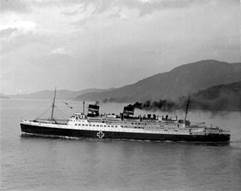
Japan’s navy and merchant marine navy had been destroyed during the war. The carriers Hosho and Katsuragi, the destroyer, Yoizuki, and the passenger ship, Hikawa Maru, were able to transport some Japanese soldiers. The United States, Soviet Union, and England used their ships to bring 6.6 million Japanese soldiers back to Japan. The Japanese government designated 18 ports to receive their soldiers. The U.S. role was completed by the end of 1947. The Soviet Union’s role continued through 1957. The port of Maizuru was the largest port.

The Japanese soldiers were sprayed with the chemical DDT (dichloro-diphenyl-trichloro-ethane) to kill fleas and lice. At the time, DDT was considered a ‘safe’ chemical but in 1972 it was known to be harmful. Welcome towers were erected where citizens welcomed the retuning soldiers.

The United States also used Nisei interpreters during the years after the surrender of Japan (1945-1952) to prosecute Japan’s military leaders for war crimes, detect subversive activities and help with the drafting of Japan’s new constitution.

Most cities and homes in Japan were destroyed as a result of the war and the destruction of the two atomic bombs. Almost every family experienced the death of a loved one and they did not have a proper burial or the return of their personal belongings (sword, identification, notebooks, clothing, etc.) The new government in Japan changed the family structure which encouraged marriage and children.

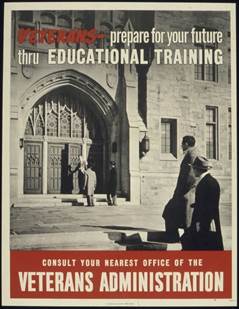
The return of veterans to the United States began in 1944, shortly after D-Day. The government instituted a point system based on battles for the return home after the war ended and the GI Bill, which provided for education and vocational training, credit towards loans, one year of unemployment compensation, and counseling. The purpose of the GI Bill was to avoid the high unemployment and inflation that followed World War I.

“Veterans Prepare for Your Future thru Educational Training, Consult Your Nearest Office of the Veterans Administration,” n.d. Courtesy of NARA, 44-PA-2262, NAID

The repatriation of American soldiers was very successful and the income taxes from their wages paid back the cost of the GI Bill within the first few years. Veterans also purchased new homes which also increased the GDP.  Similar benefits were provided to American soldiers who served in Korea and Vietnam. New car sales also quadrupled in the first ten years following World War 2 and by 1960 about 75 percent of American households owned a car.

  1. Why did the United States spend millions of dollars to repatriate Japanese soldiers to Japan after the surrender and why did our government pay for the inoculations and transportation of Korean and Chinese from Taiwan?
  2. What would the post-war years in Japan be like without the financial and technical assistance of the United States and the Allied Powers?
  3. As a member of Congress, would you have supported the GI Bill in 1944 knowing that the national debt of the United States was 120% above our GDP?
  • Was it fair to provide ships to transport Japanese soldiers home before all of the American soldiers were repatriated?
  • Should the United States have done more (or less) to repatriate the soldiers from Japan?

Maizuru Repatriation Memorial Museum

Return to Maizuri Port: Documents Related to the Repatriation and Internment Experiences of Japanese (1945-1956)   (UNESCO)

The Afterlife of Families in Japan (Texas A&M University, Corpus Christi)

U.S. Naval Institute

The American Soldier in World War 2

Veterans Return Home From World War 2 (U.S. Army Documentary)

Serviceman’s Readjustment Act, 1944 (National Archives)

Civics – Era 11 The Great Depression and World War II (1929-1945)

www.njcss.org

The relationship between the individual and the state is present in every country, society, and civilization. Relevant questions about individual liberty, civic engagement, government authority, equality and justice, and protection are important for every demographic group in the population.  In your teaching of World History, consider the examples and questions provided below that should be familiar to students in the history of the United States with application to the experiences of others around the world.

These civic activities are designed to present civics in a global context as civic education happens in every country.  The design is flexible regarding using one of the activities, allowing students to explore multiple activities in groups, and as a lesson for a substitute teacher. The lessons are free, although a donation to the New Jersey Council for the Social Studies is greatly appreciated. www.njcss.org

Era 11 The Great Depression and World War II (1929–1945)

*  
*  

The beginning of the 20th century marks the foundation of the transformation of the United States into a world power by the middle of the century. In this era industrialization, urbanization, and rapid immigration changed America from an agrarian to an urban society as people lived and worked in cities. The development of the new technologies of electricity, transportation, and communication challenged our long-held traditional policies of limited government, neutrality, and laissez-faire capitalism. The lesson of the Great Depression was that capitalism and free markets did not enable everyone to attain the American Dream. As a result, Americans looked to their government for help with the problems of unemployment, poverty, old age. Housing, and the supply of food.

During the Great Depression, the unemployment rate was 24.9% in the United States (about 13 million people). Without income, there was very limited private consumption. President Roosevelt identified the South as the number one “problem region” of the U.S. for poverty and economic distress. In 1933, President Roosevelt signed the Tennessee Valley Authority Act, a federally funded program to protect  the environment from floods, encourage economic development, and produce electric power.

In 1934, Shareholders of the Alabama Power Company sued to prevent the TVA from acquiring over half of the company’s property and equipment. The sale would allow the government agency to allocate electric power to consumers. The shareholders argued that Congress exceeded its authority.

The U.S. Supreme Court in Ashwander v. Tennessee Valley Authority, held that Congress did not abuse its power. Justice Hughes argued that the Wilson Dam, the location where the TVA was in the business of generating electricity, had been built originally in the interest of national defense because it produced materials involved in the production of munitions. The government could sell excess electricity to consumers without violating the Constitution. The majority concluded that Congress had the authority to construct the Wilson Dam. The majority also found that the disposal of the electric energy generated was lawful. 

This Supreme Court decision is also known for the reasoning of Justice Louis Brandeis regarding conflicts when one branch exceeds its power and infringes on another branch. Justice Brandeis adopted the criteria which has become known as the ‘avoidance doctrine.“One branch of the government cannot encroach upon the domain of another, without danger. The safety of our institutions depends in no small degree on a strict observance of this salutary rule.”

The legacy of the Tennessee Valley Authority brought electricity to the southeastern United States increasing the productivity of farming and transforming this region from poverty to sustainable economic development. Before the Tennessee Valley Authority, electric power was generated by private companies. (e.g. Westinghouse, Edison Electric Illuminating Company, Public Service Corporation, etc.) Private companies are concerned with making a profit instead of investing in public areas such as street lights or rural areas. The first buildings to have electricity around 1880 were often hotels and commercial buildings. Wabash, IN, Appleton, WI, Cleveland, OH, and lower Manhattan were some of the first towns and cities to have electric power. Some members in Congress, namely Senator George Norris, favored public utility companies as the most efficient way to bring this new invention to everyone in the United States.

Since the Russian Revolution of 1917, Lenin prioritized the electrification of the Soviet Union as essential for economic and industrial development.  Each of the 12 Five Year Plans included the expansion of power through the construction of dams, fossil fuels, natural gas, and since 1975, nuclear energy. The Soviet state planning committee, Gosplan, developed these plans with clearly stated production goals.

One of the problems with the energy plan of the Soviet Union is the transmission of electricity from the generating plant to other regions of the country. Russia depends on a unified power system and the complexity of its geography and use of different energy sources (fossil fuels, hydropower, natural gas, and nuclear) makes it difficult to transfer power from one source to another efficiently.  The heaviest demand for electricity is in the western or European side of the country.  However, as electricity became accessible to rural areas, agricultural production became dependent on electricity. The largest nuclear power plant in Europe is on the Dnieper River in Ukraine. It was constructed in 1985.

The Soviet Union could benefit from the computer software used in the United States, but the Five-Year Plan model is dependent on Soviet Union computers and boilers. Some of the Five-Year Plans were completed ahead of schedule, some did not meet their goals, and they also included social changes such as closing houses of worship, providing child care, and using large collective farms. The goals of most of the plans were to transform the Soviet Union into a major industrial and economic power.

The Debate Between Private and Public Electric Companies

Russia’s 12 5 year plans

The Soviet Electric Power Industry

Questions:

  1. How is a market economy different from a command economy? What are the advantages and disadvantages of both models?
  2. Why did the United States and Soviet Union experience challenges or problems with electrifying their countries?
  3. Is a monopoly or market competition the most efficient economic model for providing utilities to the people in a country? (water, electric, phone, education, etc.)
  4. Is a market or command economy the most efficient model to address the expected problems from climate change in the next 25 years?
  5. Which economic model (market, command, or mixed) is the most efficient one to increase worker productivity?

On January 6, 1940, about three months after Hitler’s attack on Poland, President Franklin Roosevelt gave his Four Freedoms speech as part of his State of the Union address. This was during a time when many people in America wanted to remain neutral and isolated from the European conflict which expanded in September 1939 with Germany’s blitzkrieg attack and occupation of independent Poland.

1940 was also a presidential election year. In the mid-term election of 1938, the Republican Party became the majority in the House and Senate.  The Republican Party had several contenders for the nomination, notably Governor Thomas Dewey (NY) Senator Robert Taft (OH), and Wendell Wilkie, a businessman from Kansas. When the Republican Party convention was held in June in Philadelphia, Wendell Wilkie’s popularity had increased significantly, while the popularity of Thomas Dewey and Robert Taft was declining. 

“In the future days, which we seek to make secure, we look forward to a world founded upon four essential human freedoms.

The first is freedom of speech and expression–everywhere in the world.

The second is freedom of every person to worship God in his own way–everywhere in the world.

The third is freedom from want–which, translated into world terms, means economic understandings which will secure to every nation a healthy peacetime life for its inhabitants-everywhere in the world.

The fourth is freedom from fear–which, translated into world terms, means a world-wide reduction of armaments to such a point and in such a thorough fashion that no nation will be in a position to commit an act of physical aggression against any neighbor–anywhere in the world.

That is no vision of a distant millennium. It is a definite basis for a kind of world attainable in our own time and generation. That kind of world is the very antithesis of the so-called new order of tyranny which the dictators seek to create with the crash of a bomb.

To that new order we oppose the greater conception–the moral order. A good society is able to face schemes of world domination and foreign revolutions alike without fear.

Since the beginning of our American history, we have been engaged in change — in a perpetual peaceful revolution — a revolution which goes on steadily, quietly adjusting itself to changing conditions–without the concentration camp or the quick-lime in the ditch. The world order which we seek is the cooperation of free countries, working together in a friendly, civilized society.

This nation has placed its destiny in the hands and heads and hearts of its millions of free men and women; and its faith in freedom under the guidance of God. Freedom means the supremacy of human rights everywhere. Our support goes to those who struggle to gain those rights or keep them. Our strength is our unity of purpose. To that high concept there can be no end save victory.”

Historical perspectives were important in 1941, and they are important today. The United States, including President Roosevelt, presented a perspective of Japanese superiority and a destiny to rule the world. He also called America’s citizens to accept the importance of a new moral order that included the religious concept of faith in freedom under the guidance of God. This perspective of American superiority is built on a commitment to an idea and an ideal.

A Life Magazine article about Emperor Hirohito in 1937 stated “To Japanese he is, in all seriousness, a divine descendent of the Sun goddess, the incarnate head of the Japanese divinity idea that makes the conquest of Asia a holy destiny for the Japanese race.” For ordinary Americans, the concept of kami in Japanese culture was not comprehendible. Instead of understanding a perspective of divinity as present everywhere, they accepted Hirohito as a son of a god or goddess or someone connected with divinity.

After the bombing at Pearl Harbor tensions between the United States and Japan escalated. Through the lens of war, the Japanese emperor’s god-like status became a more serious issue because they perceived Japan’s war objectives connected with their religious beliefs.  A 1945 United States News story explains, “Shintoism has no religious content and has ethical content to the extent that it is designed to support the idea of the divine origin of the Emperor.”  A 1945 article in Life Magazine stated, “The Emperor of Japan is neither a man nor a ruler. Nor is he simply a god living in Tokyo. He is a spiritual institution in which center the energy, the loyalty and even the morality of the Japanese.” He is supreme in all temporal matters of state as well as in all spiritual matters, and he is the foundation of Japanese social and civil morality.

American and Japanese civilians had very opposite reactions following the events of December 7, 1941. For Americans, Pearl Harbor represented “A Day Which Will Live in Infamy.” For citizens of Japan, Pearl Harbor represented the success of a justified military retaliation. The American and Japanese governments both utilized nationalism to their advantage, and implemented various forms of propaganda as tools for shaping their civilians’ perspectives.  

     “What an uproar! Japan’s Imperial Forces got things off to a quick start with one splendid strike then another in historic surprise attacks on Pearl Harbor, where the bravado of the US Asia fleet met with sudden defeat, and off the Malaya Coast, where the main forces of the British Asia fleet were utterly annihilated. Word has it that Roosevelt and Churchill were shaken up and went pale upon hearing of the defeats. In a third strike, Hong Kong Island, England’s strategic base for its 100-year exploitation of East Asia, fell into ruin in only a matter of ten days. During this time, Churchill was sent reeling, cutting off contact with others and showing up in Washington.

     What these two headstrong countries are striving for will only lead them on a downhill path to military defeat. Our barbaric enemies are already cowering in fear in the Pacific, and the fall of Manila shall mark the day of the Philippines’ subjugation and reversion back to Greater East Asia. The enemy power of Singapore, which was—alas—boasting of its impenetrable stronghold before the Imperial Forces penetrated the jungle area of the Malay Peninsula and advanced southward like a raging tide, shall also vanish into nothingness in the midst of this glorious chapter in history.

     The military gains of the glorious Imperial Forces are truly great, and the army, navy, and air force should be given our heartfelt gratitude. We should also honor our courageous men who are ready to lay down their lives when charging enemy lines, as well as those who went out to conquer but never returned.”

On January 1, 1946, four months after the surrender on September 2, 1945, Emperor Hirohito made the following statement in Japan’s newspapers.

“I stand by my people. I am ever ready to share in their joys and sorrows. The ties between me and my people have always been formed by mutual trust and affection. They do not depend upon mere legends or myths. Nor are they predicated on the false conception that the Emperor is divine, and that the Japanese are superior to other races and destined to rule the world.

FDR Four Freedoms Speech

FDR Annual Message to Congress, January 6, 1940

Japanese vs. American Perspectives on Pearl Harbor

Japan’s Announcement Following Pearl Harbor, December 8, 1941

President Roosevelt’s Speech Following Pearl Harbor (video:4:48)

Eleanor Roosevelt’s Radio Address on the Evening of Pearl Harbor (transcript)

Eleanor Roosevelt’s Radio Address on the Evening of Pearl Harbor (audio, 2:57)

Questions:

  1. How was the rise of dictators after World War 1 an existential threat? How did ordinary American citizens understand the conflict in Europe and Asia before and after the attack on Poland and the attack on Pearl Harbor?
  2. If you were the President of the United States in 1940, would you deliver the Four Freedoms speech or one that is similar in content and context?
  3. Do you accept President Roosevelt’s statement following Pearl Harbor that before the attack the United States was at peace with Japan? (see video clip above)
  4. Are elected leaders elevated by people and the press or are they criticized to the extent that their decisions and motives are questioned?
  5. Which government delivered the best message to its citizens based on factual evidence and an understanding of the importance of the attack on Pearl Harbor?

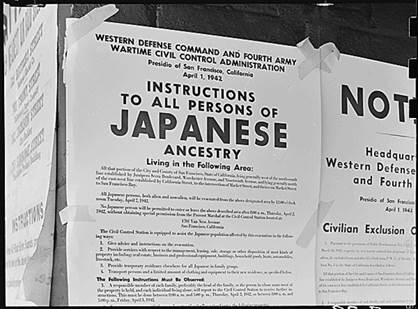
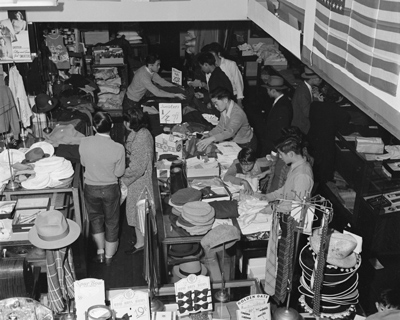
Two months after the attack on Pearl Harbor, February 19, 1942, President Franklin Roosevelt signed Executive Order 9066 to relocate approximately 117,000 Japanese Americans living on the west coast.  At first, the order was voluntary and Japanese Americans had time to sell their property and comply in an orderly manner.

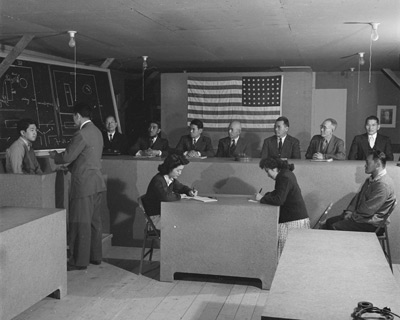
Unfortunately, many did not comply voluntarily, and the relocation became mandatory. Thousands of people lost their homes and businesses due to “failure to pay taxes.” The relocation of Japanese Americans in the United States for safety and security reasons was controversial during World War II and for the decades that followed.  The internment camps provided educational and recreational activities, adequate heat, and a process to hear complaints and address concerns.

There were 12 camps located all over the United States, with the Seabrook Farms camp in New Jersey.

President Truman rescinded the Executive Order on June 25, 1946 allowing the Japanese Americans to return to their homes. They were in relocation camps for more than four years. When they returned home, most found their belongings stolen and their homes and property sold. They also faced prejudice and discrimination for years, even though Japanese Americans were combat soldiers during the war. 

In 1988, President Ronald Reagan signed the Civil Liberties Act. The remaining survivors of the relocation camps were sent formal letters of apology and were awarded $20,000 in restitutions from the United States government.

On February 23, 1944, the Chechens were exiled from their ancestral lands and deported to Siberia and the northern regions of Kazakhstan. The entirety of the Chechen nation was accused of collaborating with the Fascists, even though there is no evidence to support this. The German advance into the Soviet Union never came close to Chechnya. The Chechen deportation of almost 400,000 men, women, and children is the largest Soviet deportation and occurred in a matter of days. Many Chechens had in fact fought on the front lines of the Soviet war against the German aggressor.

On September 1, 1941 the mass evacuation was announced for the approximately 440,000 Volga Germans. Ten days later they began their forced deportation to Kazakhstan and Siberia. Many were forced to work in ‘labor camps’  such as Kolyma. The Volga Germans were then stripped of their citizenship and did not regain their civil rights until after Stalin’s death. Most estimates indicate that close to 40 percent of the affected population perished.

In 1944, Joseph Stalin ordered the deportation of the entire Crimean Tatar community (roughly 200,000), falsely accusing them of collaborating with the Nazis. Reports suggest that nearly half of the deported died during the ordeal. Ukraine, Latvia, Lithuania, and Canada have all formally recognized Stalin’s brutal deportation as a crime of genocide. During this same period, the Soviet Union adopted a policy of “Russification” for the peninsula. Crimea was “Russified” and any study of the Tatar’s native language was banned, ancient Tatar names were erased, Tatar books were burned, and their mosques were destroyed. Nikita Khrushchev transferred Crimea from Soviet Russia to Soviet Ukraine.

Behind Barbed Wire: Japanese American Camps

Japanese American Internment Camps

Soviet Union Deportation of Volga Germans

Soviet Union Deportation of Chechnyas

Soviet Union Deportation of Crimean Tatars

Questions:

  1. Is it possible for a government to correct something it did that was morally or legally wrong?
  2. Do governments need to justify the actions they take during a time of war or a national crisis?
  3. Are there significant differences in the actions of the United States and the Soviet Union in the relocation or deportation of innocent people, many who were citizens?
  4. Do ordinary people have any rights during a war or crisis (i.e. Ukraine, Gaza, Sudan, Congo, Rwanda, etc.)?
  5. How and who determines if and when a government exceeds its authority?

In World War II, the Japanese were fighting for the Emperor who convinced them that it was better to die than surrender. Women and children had been taught how to kill with basic weapons. kamikaze pilots crashed their planes into American ships. A land invasion would be costly with estimates of more than one million American lives lost.

After a successful test of a nuclear bomb at Los Alamos, New Mexico on July 16, 1945, the United States, China, and the United Kingdom issued the Potsdam Declaration on July 26 demanding the unconditional surrender of the Japanese government, warning of “prompt and utter destruction.” On the morning of August 6, 1945, the first atomic bomb was dropped on Hiroshima. The result was approximately 80,000 deaths in just the first few minutes. Thousands died later from radiation sickness. On August 9, 1945, a second atomic bomb was dropped on Nagasaki. The result was 39,000 men, women and children were killed and 25,000 more were injured. Both cities were leveled and Japan surrendered to the United States.

After the news of the atomic bombs that were dropped on Hiroshima on August 6, 1945 and on Nagasaki on August 9, 1945, Lieutenant General Leslie R Groves, director of the `Manhattan Project’ that had developed the atomic bomb, commented:

“The atomic bombings of Hiroshima and Nagasaki ended World War II. There can be no doubt of that. While they brought death and destruction on a horrifying scale, they averted even greater losses – American, English, and Japanese”.

This justification that the use of the bomb saved lives, even though it killed innocent civilians, has haunted the world into our present time.  It was a view that generated controversy then and after as to the justification or otherwise of the use of such weapons on largely defenseless civilian targets, at such Mutual Assured Destruction (MAD) that has haunted the world into our present times.

Following World War 2, there was an arms race between the Soviet Union and the United States. Although there were threats of war and conflicts in Korea, Southeast Asia, the Congo and other places, this period was called the Cold War. Other countries also developed nuclear weapons leading to concerns of a global conflict.

The world came close to a nuclear attack during the Cuban Missile Crisis. In 1962, nuclear weapons could be delivered by airplanes, missiles, and submarines. The Soviet Union placed nuclear warheads in Cuba and the United States had some in Turkey. These missiles could attack cities in both countries within a range of 1,200 miles. Fortunately, the Soviet Union began to withdraw its ships and missiles from Cuba and an agreement was made.

In the 1960s, the military strategy of Mutual Assured Destruction (MAD) was debated, In this strategy, two opposing forces, the Soviet Union and the United States, had enough nuclear weapons to completely destroy each other. This deterrence theory assumed that neither side would initiate a nuclear attack because the resulting retaliation would lead to their own destruction.  The concept, first discussed in the 1960s during the Cold War, is based on the idea that the devastating consequences of nuclear war would outweigh any potential gains for either side. 

As a result, the United Nations initiated the process to limit the production of nuclear testing and weapons.  Since the first test ban treaty, several agreements have been ratified to control the proliferation of nuclear and chemical weapons. The threat from atomic, hydrogen, neutron, and cobalt nuclear weapons is a concern to every person and every country because of the fallout from dangerous levels of radiation. There are still detectable effects of radiation in our atmosphere today from the 1945 explosion. The effects of radiation from a thermonuclear weapon (Hydrogen bomb) will likely last for hundreds of years and affect every living organism and human.

Following the Attack on the World Trade Center on September 11, 2001, the world became concerned about a terrorist group having access to a smaller nuclear weapon, a dirty bomb, that might be detonated in an urban area. The effects of a dirty bomb would likely be limited to the immediate area of the explosion but the damage to property and the cleanup of radioactive elements would be significant and costly.

Nuclear Arms Race and Treaties: 1949-2021 (Council on Foreign Relations)

Timeline of the Nuclear Non-Proliferation Treaty (Arms Control Association)

Devastating Effects of Nuclear Weapons

Questions:

  1. Why did an arms race between the USA and the USSR begin after 1945?
  2. How sane was the policy of MAD?
  3. What factors sustained the arms race for so long?
  4. Is a limited nuclear war a plausible scenario or would it quickly lead to an all-out war?
  5. What would life on Earth be like after a nuclear war? What geographic regions might have a chance of survival?
  6. Should the civil defense from a nuclear war or dirty bomb explosion be best coordinated by local, state, or the federal government in the United States?
  7. How would the governments of Europe or the Middle East, where there are many countries within a small geographic area respond to a nuclear war or explosion from a bomb or nuclear power plant?
  8. What is the most likely scenario for a nuclear explosion in the 21st century?