Review of From the Republic of the Rio Grande: A Personal History of the Place and the People, by Beatriz de la Garza. Austin: University of Texas Press. 2013.
Reviewed by Thomas Hansen. Ph.D.
This interesting account of a small republic that existed only briefly between Mexico and the USA shows some very interesting histories and traditions that can teach us a lot. From 1839 to 1840, there was a nation between Mexico and the Republic of Texas called the Republic of the Rio Grande, with its capital in Laredo. Some do not know of this temporary republic, jostled between two mega-powers but firmly connected to both by trade, tradition, and blood.
Families from this region had connections to both other republics, often, and there are many documents still in existence showing sale and purchase of land, marriages, and bills becoming laws—all relating to the inhabitants of the area that was called briefly the Republic of the Rio Grande. The author does a very good job of painting a full picture that not involves commerce, history, culture, and politics, but also connects the story of this republic to the author’s own family.
De la Garza mixes the history of the republic with the family history she is able to ascertain through personal records, archives, and the story of the region as found on legal and financial documents. The story is very important to the author, and it can tell us very much about human nature—and about different political forces brought into conflict by a variety of factors: war, environment, need, tradition, and hope.
The author uses vivid language to tell us of the days of the republic, explaining details down to how the dwellings were constructed and including notes on dating, courting, and marriage traditions. The author also shows us the connections among families and the ironic way in which things can change over time, enemies becoming connected in ways their ancestors would have never imagined. There are also stories of love, of loss, and of hope.
The author provides a very valuable service indeed, reminding us of the republic and explaining so much about its short life. We owe her a lot, and we need to teach young people about this important chapter in history lest it be forgotten.
I will not give away the content of the book, something I always avoid doing in my reviews, but will urge teachers of history, of social studies, and of geography to consider reading the book. Both cultural and physical geography are involved in the story, as the people in the region had come from different lands to reach the site and the environment plays a huge role in the commerce and the very existence of the republic. The damming of rivers and the role of agriculture are two central issues in the story of this region.
I would recommend this story be read by all educators near where the republic once existed. It is important history and it is also an important way to enrich one’s perspective of the region. In addition, teachers of the subjects mentioned above can use the book as background reading, to build lessons and units on the history and geography of the area, and to enrich the curriculum on Texas, Mexico, and immigration.
Erasing History: How Fascists Rewrite the Past to Control the Future
By Jason Stanley
Reviewed by Hank Bitten, NJCSS Executive Director
“Wars are won by teachers.” Vladimir Putin
This quote published in the Washington Post on May 7, 2024 is the opening statement in Chapter 1 of Erasing History. It is a powerful statement and thesis for this book and a compelling reason for teachers to read the arguments presented by Jason Stanley, Yale University Professor of Philosophy. There are numerous examples in this book explaining the biased perspective of American history regarding Black Americans, Latinx, Native Americans, women, children, etc. and there are examples of how history has been erased in Kenya, Palestine, India, China, and Ukraine.
Every teacher of U.S. history teaches the different views of Booker T. Washington and W.E.B. Dubois to assimilate into American society at the turn of the 20th century. However, the perspective presented by Jason Stanley offers students in our classes the opportunity for a critical debate regarding two different paths towards assimilation.
“In his public writings, Washington urged Black Americans to prioritize industrial education over political education, and thus to place greater emphasis on their productive potential as workers than on their identity as democratic citizens. As Du Bois saw it, this approach served white supremacy. He counseled Black American citizens instead to seek a liberal education, whose purpose was not only to elevate the soul but also to give them skills to democratically advance their own interests.” (page 39)
Some societies and governments favor a part of their population as the dominant or protected class and discount or “erase” the contributions of other people in their state. The technological advances of artificial intelligence present new challenges for teachers as history can easily be revised from quoting textbooks, historical papers, and extremist views from the past and make them appear as valid scholarship. The increasing popularity of PraegerU is an example of how school districts, Departments of Education, and individual teachers are accepting the information and lessons provided by non-academic institutions. Teachers have a unique responsibility and position because they are trusted by students and what they say is transformed from sight and sound to memory.
Teachers will find the historiography and analysis of the concepts of nationalism, American exceptionalism, and colonialism to be helpful for the development of lesson plans in both U.S. history and world history. It is less about ‘erasing’ history than changing history or emphasizing certain historical themes while ignoring others. Curriculum designers and teachers have both power and responsibility in how lessons are structured, implemented, and assessed. One example from the book is including the “I Have a Dream” speech by Dr. Martin Luther King, Jr. and ignoring his many contributions in the civil rights movement.
This is an important debate regarding assimilation in a society with a dominant class. A current example is the debate of how the working class earning an hourly wage without benefits can assimilate into the middle class. Is the best way to address this through subsidized education, new tax policies, or paying a living wage?
Teachers must have a strong content background in the westward movement, labor, Reconstruction, civil rights, Ukraine, Palestine, etc. to be aware of what is missing in the sources and resources they are using with students. The example below provides different points of view on the 1932-33 engineered famine that killed millions of people in Ukraine.
“The most significant of these omissions pertains to Holodomor a genocide of the Ukrainian people, in which millions of Ukrainian peasants starved to death after Stalin demanded draconian requisitions of grain from them, knowing full well that this would have devastating consequences. In Ukrainian and Russian, the term “Holodomor” consists of two parts: “famine” and “to kill” or “make someone suffer” – the closest translation is essentially “someone making others starve intentionally.” Importantly, although the word “Holodomor” and the tragedy it represents are well known throughout both countries, Russian textbooks describe the event using the generic term for “famine,” implying that Holodomor was merely a bureaucratic accident, and one that affected all of the USSR equally. In Ukrainian textbooks, it is represented as a famine that Stalin inflicted specifically upon the Ukrainians, which is considerably closer to the truth.”(pages 67-68)
Fascism is not taught is most high schools and college courses may not have provided this instruction for teachers. Fascism, socialism, Marxism, communism, and Naziism are critical movements in world history and they are complicated to teach because the are not monolithic. Professor Stanley provides five major themes that are part of a fascist education: (page 78)
National greatness
National purity
National innocence
Strict gender roles
Vilification of the left
The strategy that wins the support of people is often fear and patriotism. In the United States, the theme of national greatness is most visible with “Make America Great Again” and defining the United States as the greatest nation or what is defined as American exceptionalism. However, associating crime, poverty, homelessness, unemployment, etc. with a specific demographic group is part of the fascist goal of national purity. In Germany, it was the Aryan population. In the United States it is critical race theory, structural racism, and making white Americans feel guilty. We see the theme of strict gender roles in the directives to teach traditional roles of women and banning references to the contributions of the LGBTQ persons. The placing of blame for everything on a past president or a specific political party is another effective strategy. Teachers should be aware of these five signs and why populations embrace it.
President Trump delivered a speech in September 2020 when he introduced the White House Conference on American History. Particularly, in the 250th anniversary year of the signing of the declaration of Independence, teachers need to be aware of how President Trump understands the teaching of patriotic history.
“Our mission is to defend the legacy of America’s founding, the virtue of America’s heroes, and the nobility of the American character. We must clear away the twisted web of lies in our schools and classrooms, and teach our children the magnificent truth about our country. We want our sons and daughters to know that they are citizen of the most exceptional nation in the history of the world.” (page 81)
Erasing History dedicates three chapters to the importance of education in both preventing and promoting authoritarian rulers or advocating against democracy and for authoritarianism. Teachers of social studies, history, and literature have a responsibility to recognize bias and ignorance and to select the sources and perspectives that lead to an understanding of the American values of equality, liberty, and the rule of law.
“The dismantling of public education is backed by oligarchs and business elites alike, who see in democracy a threat to their power, and in the taxes required for public goods a threat to their wealth. Public schools are the foundational democratic public good. It is therefore perfectly logical that those who are opposed to democracy, including fascist and fascist-leaning movements, would join forces with right-wing libertarians in undermining the institution of public education entirely.” (pages 121,122)
The movement for school vouchers, criticisms of curriculum, the attack on the 1619 Project, and the emphasis on America’s greatness contribute to distrust about public schools and confuses parents.
“The goal of anti-education is not only to render a population ignorant of the nation’s history and problems but also to fracture those citizens into a multitude of different groups with no possibility of mutual understanding, and hence no possibility of mass unified action. As a consequence, anti-education renders a population apathetic – leaving the task of running the country to others, be they autocrats, plutocrats, or theocrats.” (page 133)
I found Professor Stanley’s analysis of classical education to be exceptional. The extreme right and the extreme left (and those in between) support the teaching of Greek and Roman civilizations. What I found interesting is how each side selects the leaders and documents that support their perspective of government. For example, Pericles Funeral Oration describes Athenian democracy:
“Its administration favors the many instead of the few; this is why it is called a democracy. If we look to the laws, they afford equal justice to all in their private differences; if to social standing, advancement in public life fall to reputation for capacity, class considerations not being allowed to interfere with merit; nor again does poverty bar the way, if a man is able to serve the state, he is not hindered by the obscurity of his condition….We throw open our city to the world, and never by alien acts exclude foreigners from any opportunity of learning or observing…while in education, where our rivals from their very cradles by a painful discipline seek after manliness, at Athens we live exactly as we please, and yet are just as ready to encounter every legitimate danger.” (page 143)
While the above speech favors democracy, others look to Plato as evidence of a strong ruler with a clear authoritarian philosophy. The Greeks and Romans supported gender and racial superiority, owned slaves, favored landowners and intellectuals, and had colonies. These examples support a fascist ideology. Teachers have the responsibility to teach historical context, provide the reasons for social changes, help students to analyze how freedom is related to continuity and change over time, and an understanding of equality, reason, liberty, and power. Concepts we thought had clear definitions have become complicated.
There are more compelling insights in this book than I can comment on in a book review. Teachers of all subjects should read this book, but in particular history, social studies, and teachers of literature. Pre-service teachers also need to read and discuss this book. Let me conclude with these observations:
Critical thinking is essential.
Understanding a point of view and historical perspective are essential.
The current movement away from democracy has been part of our American history for a long time. We see it in the separate but equal policy on race, segregation laws, imperialism, xenophobia, criticisms of the New Deal, Brown v. Board of Education decision, McCarthyism, civil rights protests, Nixon’s imperial presidency, supply-side economics, and in the reaction to the decline of the United States as a world power.
Democracy ended in Athens, and in the Roman Republic. We need to understand how and why this happened.
As a teacher of history and/or social studies, you are on the front line and can expect to be criticized! Our responsibility as teachers is to include the experiences and contributions of all people – especially women, children, immigrants, people of different faiths, Black and Native Americans, laborers, individuals with disabilities, individuals who are LGBTQ, etc. Teaching history includes compassion, empathy, struggles, contributions, and the untold stories that you will discover. Erasing History is about forgotten and neglected history.
The opening chapters of The Taking of Manhattan provide a descriptive account fitting for a Netflix documentary. The wealth of information about the geography, demography, economy, and social life provides an accurate description for students living in New York and New Jersey today about the changes that have taken place over 400 years.
“New York is all about water. Reasonable people may disagree with this assertion. Surely New York is about trade, finance, power. Fashion food, art, media, design. Fusions and factions. Wall Street and Broadway, Skyscrapers and boroughs.
Yes, but water flows beneath and around all of these. If the coastline of the New York Harbor region were stretched out, it would be loner than the state of California. New York City’s waterfront is bigger than those of Miami, San Francisco, Los Angeles, and Boston combined.” (page 15)
The Taking of Manhattan begins on Tuesday, August 26, 1664. It is a dramatic and enjoyable read that provided me with a fresh perspective of world history in addition to the local history of northern New Jersey, Staten Island, Manhattan, Long Island, and the Hudson River valley north to Beverwijck (Albany.) Regarding world history, it is the story of conflicts and opportunities of numerous indigenous populations bearing the names of local cities, the economic monopoly of the Dutch and British East and West India companies, the military rivalries of the Dutch, British, and French, the trafficking of enslaved persons, and the rivalry between the New England colonists and the Dutch of New Amsterdam.
The events leading to August 27, 1664 around New York Harbor also provide a context for discussing the experiences of the people living in England from 1625 to 1664. In 1603, the Stuart Dynasty began to rule and by 1630 they had three colonies in North America. The book provides a context for a discussion about religious differences, corruption, and political rivalry between the French, Dutch, and British states. The “Make England Great Again Movement” that began in 1649 with Oliver Cromwell had lost the support of the people within a few years and ended in 1660 with the Restoration. Charles II was 19 when his brother, King Charles I, was executed and age 21. He was coronated king in 1651, although living in France. For world history teachers the narrative on the Restoration of the monarchy with Charles II is detailed and informative.
These were challenging and difficult years for ordinary people trying to raise a family and earn a living wage. This was also an opportunity for the Dutch to consolidate their power in Asia, Africa, and the Americas. The first half of the 17th century is the Golden Age for the Dutch!
New York City was the home of the Dutch, thanks to Henry Hudson in1607. Peter Stuyvesant and his wife, Judith, arrived in May 1647. He is a legend in New York history where his name and legacy continue in the neighborhoods of Bedford Stuyvesant, Stuyvesant Town, and Stuyvesant High School. Although disabled with one leg, he built this city into a thriving economic port, made deals with the Native American leaders in this area, traveled to Albany, Staten Island, Long Island, New Jersey, and made the Dutch Reformed church the dominant houses of worship in this area. There are also references to locals living in New Amsterdam and Fort Orange, namely Asser Levy (from Lithuania), Dorothea Angola (born in Africa), and Catalina Trico (from Paris). These references provide insight into the pluralistic society that is an important part of the American experience. He also understood the future threat from the presence of English colonies in Boston and Williamsburg. The narrative includes a perspective of the independence of the Massachusetts Bay Colony and the concerns by the leaders who replaced Cromwell and governed from Whitehall.
New Amsterdam, circa, 1685
The teaching of Native Americans, even the Lenape, is often taught in the limited context of the French and Indian War (1754-63) or the culture of indigenous populations. This book includes narratives of local history that should engage students in reflective thinking about the meeting of different cultures. For example, the attack on Lenape at a fresh water pond on Manhattan in 1626 by Dutch traders who took their beaver pelts. A young boy who witnessed the brutal murder of his uncle recognized the attacker some 15 years later at a tavern in New Amsterdam and viscously murdered him with an axe. The Dutch responded with massacres of Lenape at Pavonia, present day Hoboken and Jersey , and Corlears Hook, just south of the Williamsburg Bridge. Anne Hutchinson, and her five children, were also victims of these Dutch massacres. The impact of diseases on Native Americans is also clearly explained.
Russell Shorto begins the historical account with an understanding of the difficulty of communication in the 17th century. The students we teach receive communications and information instantly and the perspective of the past is important regarding the meaning of words and how time influences the process of making decisions. Today, students are faced with the credibility of information and they need to be taught the skills of discernment and analysis. For Peter Stuyvesant, the calculus was understanding the reasons the British were sending Captain Richard Nicolls and the Guinea across the Atlantic.
The drama begins 18 months before the ships of Richard Nicolls arrive in the last week of August 1664. These events are dramatic, provide information on Dutch spy networks and translators, behind-the-scenes conversations between Peter Stuyvesant and Connecticut’s Governor Jonathan Winthrop, Jr., the financial interests of powerful businessmen in London and Amsterdam, life in New Dorp and Gravesend, and the slave trade port of Goree Island of the African coast. I am a novice regarding these insights that are an important part of the American experience and I also enjoyed the references of the military captains with Isaac Newton, Robert Boyle, and Samuel Hartlib, 17th century names in the social studies curriculum.
The instructions prepared for Richard Nicolls were both public and private. Officially, he was sailing to Boston to bring the ‘independent’ Puritans into the party line of the new king, Charles II. His private instructions were to advance the interests of England and the new king.
“Then there was the second task stipulated in the instructions: the possessing Long Island, and reduceing (sic) that people in an entire submission and obedience to us & and our government…that the Dutch may noe (sic) longer ingrosse (sic) and exercise that trade which they have wrongfully possessed themselves of.” (page 174) (Long Island included the colony of New Amsterdam.) The government of England claimed the charter of the Virginia Company gave them all the land of North America.
This claim provides teachers with the framework for a mini-simulation or a structured decision-making activity is a possible activity based on the information provided in the chapter, “White Flag.” Students might research and discuss some (or all) of these questions:
How would the government of the Netherlands and the West Indies Company react to the decision of Peter Stuyvesant to avoid a fight and give Captain Nicolls and the British control of New Amsterdam?
Would the hired soldiers with Captain Nicolls release canon fire without orders and cause the conflict to escalate?
How would history judge a battle for Manhattan knowing that Peter Stuyvesant and the Dutch lacked the weapons, preparation, and supplies for a reasonable defense?
What could the Dutch gain as a result of a negotiated settlement?
Would the words in the exchange of corresppondence between Stuyvesant and Captain Nicolls be misinterpreted?
“The only part of the letter to which he (Captain Nicolls) felt obliged to pay attention, he said, was the conclusion, in which Stuyvesant declared he had no choice but to defend the island. Nicoll’s answer, therefore, was that he ‘must and should take the place, refusing henceforth to permit any parleys.’”
What would life be like in the future for the 2,500 people living in Manhattan under British rule? How would the decision affect their right to worship freely, conduct business, and personal liberty?
How would the Dutch living along the Hudson River north to Albany react to a negotiated agreement to avoid a military showdown? How did they understand the terms of the First Anglo-Dutch War of 1655 and was the taking of Manhattan a prelude to a Second Anglo-Dutch War?
Would the Council at City Hall view this as a surrender or a corporate merger?
This is a fascinating account of a unique colony in the 17th century with applications to understanding deals, land swaps, negotiations, the role of citizens, and conflict. New York was a pluralistic community then and continues to be a cosmopolitan center of finance and cultures today.
As a social studies teacher I taught the migration of Europeans to the New World, the Atlantic Slave Trade Migration, Oregon Trail, Trail of Tears, construction of canals, steamboats and railroads, land at $1.60 an acre, Underground Railroad, Manifest Destiny, Great Migration after the Civil War, Frederick Jackson Turner’s thesis on the frontier, immigration, analyzed The Warmth of Other Suns, Harlem Renaissance, interstate highway system, Federal Housing Authority, selected excerpts from Crabgrass Frontier, and the migration to the Sun Belt. However, Stuck presented me with a new perspective about the importance of mobility in America and its relationship to the American Dream! This is why I am encouraging every social studies teacher to read Stuck.
Yoni Applebaum clearly presents the economics, sociological, historical perspective to the demographics in the 18th, 19th, and 20th centuries in American history and the opportunities that became available for millions of young Americans. The wealthy Americans remained in Boston, New York, Monticello, Charleston, and Savannah as they had no reason to seek a better life. However, agricultural workers, manufacturing workers, civil servants, and immigrants moved to multiple locations to find better homes, more money, and new social connections. Immigrants moved west and contributed to farming, canals, roads, and railroads. New communities were built on democratic values and traditions and the importance of civics is equally important to the historical, sociological, and economic perspectives.
“Some Americans have become so accustomed to the places with the greatest opportunities being effectively reserved for the rich that it somehow seems natural that they should be. In fact, it represents a recent and profound inversion. For centuries, Americans at the bottom of the economic ladder moved toward such places, not away from them, searching for a foothold on the first rung of that ladder, looking for a chance to climb. Entrepreneurs raced to erect housing to hold them.” (page 4)
“’When the mobility of population was always so great,” the historian Carl Becker observed, “the strange face, the odd speech, the curious custom of dress, and the unaccustomed religious faith ceased to be a matter of comment or concern.” A mobile population opened the possibilities of pluralism as diverse peoples learned to live alongside each other, The term ‘stranger,’ Becker wrote, in other lands synonymous with ‘enemy,’ instead became ‘a common form of friendly salutation.’ In a nation where people are forever arriving and departing, a newcomer can seem less a threat to the settled order than a welcome addition to a growing community: ‘Howdy, stranger.’ Mobility has long been the shaper of American character and the guarantor of its democracy.’” (page 9)
The industrialization of the United States following the Civil War placed us on a trajectory to become more urban and less rural. Frederick Jackson Turner in 1893 presented a thesis based on the 1890 U.S. Census that claimed the frontier of the United States was closed at the 100th meridian. Although his thesis would eventually be challenged, it revealed divisions of values and new ways of living.
Cities also required investments in public utilities, and in finding solutions to poverty, crime, and places for the homeless. The story of the 20th century is one of urban problems, flight to the suburbs, increasing home values as homes were purchased, destroyed, and rebuilt and sold or rented for higher prices. The story of the 21st century is one where housing has become unaffordable for a majority of Americans, who understand what it means to be ‘stuck’ with limited options or no options for the pursuit of happiness.
Stuck also provides an insightful historical context of the historical experiences of Chinese immigrants living in California and Jewish immigrants in New York City in the late 19th and early 20th century. The two chapters dedicated to the personal experiences of immigrants and immigrant families provided me with new information that directly applies to the teaching of immigration in a U.S. History class. The new information that I learned related to the racist decisions of local governments regarding zoning, housing, and the regulation of family-operated businesses. The exposure about immigration for students is at the national level in the news and most classroom lessons. The chapter on “Dirty Laundry” references Modesto, California in 1885.
“In 1884, more than a hundred men in ‘mostly ghostly attire’ wearing black masks and calling themselves the San Joaquin Valley Regulators, rampaged through Chinatown. They raided opium houses, knocked down one Chinese man who attempted to flee, and even assaulted a white police officer who tried to stop them. In June 1885, a washhouse and a store in Chinatown burned down, in an apparent arson attack. Despite the unrelenting assaults, Modesto’s Chinese residents held fast. And following the familiar pattern, they began to set up their laundries in residential neighborhoods….
Two weeks later, the city council obliged, passing its zoning ordinance. The Chinese were not mentioned in the legislation. Instead, it simply designated a district for laundries, one whose boundaries happened to be precisely the same as those of Chinatown. The ghetto that Modesto had failed to impose with violence, it would now attempt to enforce with land-use law.’ (pp. 90-91)
It is important for students to understand the power of local governments and the importance of understanding local laws they may not hear on social media or local news networks. The story of Hang Kie is told as a story that students will find interesting and compelling for discussion and debate. He was arrested within five days of the implementation of Modesto’s new zoning law. His landlord wanted him to continue operating his business to collect the rent. He was arrested, fined $100 dollars (perhaps three months income) and sentenced to 20 days in jail. His case went to the California Supreme Court on the grounds that the Modesto law was unreasonable because it was not applied equally to all residents, and the right to use your own property providing it did not injure others or negatively harm the general population. The California Supreme Court upheld Hang Kie’s conviction as a reasonable exercise of police powers to safeguard the general population of Modesto from the threat of fire. (pp. 94-95). In the middle of the legal arguments, the men in Modesto could not get their white shirts for Sunday worship cleaned so they adopted colored shirts to hide the dirt.
The use of land-use laws spread to other California towns as the state’s population increased by more than two million between 1900 and 1920. In California, 20% were born in another country and 25% had one immigrant parent. The 1906 San Francisco earthquake displaced thousands of Chinese who relocated in communities across the bay. A lesson for students is the context of the expansion of the powers of the executive branch of our federal government is the elasticity of police powers.
The eastern European Jews who immigrated to the Lower East Side of Manhattan presented situations for local government that had not previously been encountered in the United States. The Jewish population was transitory with perhaps 50% returning to their homeland as they accumulated enough cash to travel back to Europe. They crowded into small apartments and were willing to tolerate unsanitary conditions. They valued education and economic success and were passionate about living in America. (p.116) The historical record of the experiences of Jewish immigrants is documented with the photographs of Jacob Riis, personal stories in the Library of Congress resource, Chronicling America, and the National Museum of Immigration (Ellis Island) and the Tenement Museum in New York City.
The issues of immigration, affordable housing, and the segregation of the rich from the poor in 1900 offer interesting lessons for the students of this century, 125 years later. New York City faced a surging population that increased from 3.4 million in 1900 to 4.8 million in 1910. An increase of 67%. The density of population in lower Manhattan increased with the construction of six story apartment buildings on every available piece of vacant land. The area north of 42nd street and areas of Brooklyn saw an increase in single family homes and mansions. The top floor of the mansions were designed for offices. The Panic of 1907 left many of these offices vacant and they became occupied with immigrants in need of places to live.
Henry Sinclair House, Fifth Avenue and 79th Street, NYC (Ukraine Consulate)
There were three solutions to New York’s immigrant problem: exclusion of immigrants with literacy tests and quotas, the expansion of immigrant populations to accelerate economic growth through housing construction and employment opportunities, or regulation regarding labor, health, and zoning. (page 124) Congress created the Dillingham Commission in 1911, which offered a detailed report on the enormous contributions of immigrants but concluded that immigration restriction was in the interest of the country. (Page 125)
Report from the Dillingham Commission
An interesting discussion or debate for students studying the living conditions of immigrants is the argument that fire safety justified the police powers of the state to enforce laws regulating businesses, construction, and population density. In Modesto, California, fire regulations were applied to laundries in buildings and in New York City, fire regulations were applied to the height of buildings. While public safety is in the interest of the public it also justified the power of the state to regulate the free enterprise of individuals and influenced the segregation of neighborhoods by income and ethnicity. These arguments were made by the tenement reformers, although the proposed solutions of the reformers favored one economic group over others.
I included Henry George and the single property tax movement in my U.S. History lessons. My students understood this as a socialist reform to redistribute wealth from the millionaire class to the working class. Yoni Applebaum in Stuck offers this perspective:
“The Georgists argued that if the density of people per acre were to rise, it should be seen not as congestion but as efficiency-with tall buildings allowing families to live in desirable neighborhoods while providing them with ample space, and office skyscrapers doing the same for workers. And if people truly objected to this, well, Bassett‘s commission could impose height limits that would spread the most intensive development over a somewhat broader area. The Georgists were confident in the city’s future and in its capacity to provide opportunities to the next generation of residents. The solution to congestion, they argued, was construction.” (page 126)
The land tax of Henry George lost to the zoning plan of Edward Murray Bassett. The leaders of New York City would decide what could and could not be built on any piece of property. The solution to the influx of immigrants in New York was to limit affordable housing. In 1913, the Woolworth building was built at 233 Broadway, within walking distance of City Hall. It was 60 stories, included both residential and office spaces, and for 17 years it was the tallest building in the world at a height of 792 feet.
F.W. Woolworth Building in New York City
A unique and important perspective of the author, Yoni Applebaum, is the interdisciplinary connections relating to geography, economics, sociology, and civics. These are transparent in the chapter on “Tenementophobia.”
Regarding geography, students can easily follow the building of houses and neighborhoods along colonial post roads, rivers and canals, railroads, and highways. In the 19th century, houses were built near factories and ports enabling workers to walk to work. The Utopian Socialists built model communities where factories were located. With the arrival of the automobile in the 20th century, people with money moved uptown and later to suburbs to escape the sights of factories, apartments, and the noise of densely populated neighborhoods. Students will see the evolution of apartment houses near the business district, then two-family homes, and then single residence homes, perhaps with winding streets aligned with trees.
The economic perspective is very important and interesting. Many immigrants saved money with the hope of renting a larger space for their families and later a home with a backyard play area. These middle-class homes were available to families with incomes that could sustain the expenses of a downpayment, mortgage, taxes, insurance, and repairs. Many of these homes in cities across the United States were built by independent carpenters or homeowners using models in the Sears Catalog. Students can create a digital museum of these houses with images of wider streets with picturesque views as they follow the construction of homes from the central business district to the outer boundaries of the city. Low incomes kept people ‘stuck’ in their neighborhoods. One of the significant contributions of unions was their ability to get living wages for many workers allowing workers to move from crowded apartments to single or double family homes, Unfortunately, the cost of selling a home made movement to a new neighborhood difficult or impossible.
Sears Catalog, circa, 1910
The sociological perspective on the quality of life should prompt an engaging discussion with students leading to relevant applications today.
“Homeownership promoted personal investment in family, child-rearing, school, church, and community; it safeguarded ‘manhood and womanhood’; it protected the ‘civic and social valiues of the American home….” (pages 152-53).
The single-family home, the belief that a ‘home was a castle’ that living in tenements or public housing was harmful, is a critical issue for students to understand even though it likely is not one of the learning standards in the curriculum. Did the zoning laws that were put in place in the early 20th century support the American Dream or did they segregate our population by income, race, ethnicity, and access to education. Students need to search for answers regarding how poverty should be addressed and eradicated. Is the answer with income and property tax policies, the quality of education, affordable housing, higher incomes, or something else? In their search for answers, students should investigate the quality of life regarding marriage, cancer, crime, addiction, mental health, infant mortality, attendance in houses of worship, and life expectancy rates. They also need to discuss how their neighborhood or community has changed in the past 25 years (since 2000) and what it might look like in 2050. They also need to consider the economic and sociological impact of vacant stores in strip malls, where affordable homes are being built, and the quality of life in older homes.
The information about how state and the U.S. Supreme Court viewed zoning laws was fascinating to me. The case study in Stuck references Euclid v. Amber Realty Company (1926). The decision supported the constitutionality of zoning laws at a time when state courts were rejecting them. The basis of this case was the claim that zoning parts of the land owned by Ambler depressed property values by as much as two-thirds. (page 149) Euclid is a community east of Cleveland, Ohio and one of its inner suburbs.
The areas marked U2, U3, and U6 were the areas owned by Ambler Realty. Note the areas across Euclid Avenue with the curved streets with single family residences. If the areas of U2, U3, and U6 were zoned for industry, the view and noise for the residences across the street would see this as undesirable or as a nuisance. What and who determines property use? (1922)
Note the development of the land after the Supreme Court’s decision
Students discussing the implications of police power of the state to determine land use, the public interest regarding health, safety, and welfare. Should the Court protect the public good by limiting the property rights of an individual or should the Court protect the sanctity of the family against unsightly encroachments of noise, traffic, and smoke? Another consideration is that in 1926, the U.S. Supreme justices lived in communities that were zoned with neighborhoods of single-family homes and perhaps large homes for families with wealth.
The chapter titled “Auto Emancipation” offers new insights into the ‘great migration’ that followed Reconstruction. The railroads and manufacturing of automobiles in Michigan provided opportunities for Black Americans that could not be realized because of segregation, low wages, violence, and unfair mortgages. For me, the perspective was a nice addition to my knowledge from reading The Warmth of Other Suns and Caste by Isabel Wilkerson.
The following two quotes might be used for student inquiry and discussion regarding the experiences of Black Americans and today’s immigrants.
“It was mobility-specifically, the defiant exercise of the freedom of movement-that ultimately brough down the slave system. Human beings are difficult to hold in bondage, even if half a continent has been turned into a vast, open-air prison. As long as some place of refuge where people can claim greater freedom and opportunity exists, no system of repression can wholly immobilize a population.” (page 161)
“Black residents earned more than they had in the South, but when housing costs ate up roughly half their gains, they found themselves with few options. They couldn’t build up, and they couldn’t move out. The policy choices made by Flint’s elite left them kettled in a handful of districts, paying high rents for aging homes. But as bad as things were, the federal government was about to make things worse.” (i.e. FHA mortgages) (page 177)
Teaching the domestic issues facing the United States is a challenge for most teachers. This unit includes the civil rights movement, women’s rights, education, space exploration, political challenges, inflation, environment, Great Society, U.S. Supreme Court decisions, and the changes with transportation and communication. The post-World War II economic boom is often lost or marginalized in the teaching of this unit. In my classes, students read excerpts from John Kenneth Galbraith’s The AffluentSociety, Michael Harrington’s The Other America, and Kenneth Jackson’s Crabgrass Frontier. The chapter titled “A Plague of Localists” offers the perspective of Frank Duncan, a working Black American living in Flint, Michigan.
I was not aware of the Edwards. v. California (1941) U.S. Supreme Court decision regarding the freedom of an indigent to move to another state. The Dust Bowl provided an incentive for unemployed and financially challenged U.S. citizens to move to other states. In 1936, the city of Los Angeles police turned indigent migrants away. The U.S. Supreme Court affirmed the right of U.S. citizens to choose where they wanted to live but the conflicting arguments date back to 1823.
“In 1940, America was still a nation of renters-some 56 percent of households leased their dwellings…. The government could have met the demand for rentals by investing in public housing projects or providing cheap loans to real estate developers to build multifamily apartment buildings close to centers of employment. Instead, as the war came to an end, it chose to subsidize the purchase of free standing single-family homes.
Millions of Americans used FHA and VA loans to buy houses. In 1944, America built 114,00 new homes; in 1950 it built 1.7 million.” (page 208)
The economics of housing relating to banks, credit unions, balloon loans, redlining, zero interest loans, mortgage insurance, and itemized tax deductions are essential topics for U.S. History students because they likely are living in communities with public housing, multifamily apartments, gated communities, cape cod houses built after World War 2, and houses in need of repairs.
The study of the housing crisis in America is also one students need to understand because the current scarcity of affordable housing directly affects them. College graduates with a starting salary of $125,000 are not able to save enough money for a downpayment in the community where they are currently living. In fact, they are also unlikely to afford renting at this income level either.
The solutions proposed in the last chapter, “Building a Way Out” include connections to history, civics, economics, and sociology. Some of these solutions include building more housing units to increase supply and reduce the costs of purchase and rent. Another solution is to have consistent rules for housing construction to reduce bureaucracy and encourage affordable housing near employment opportunities. Other solutions include subsidies for housing or increased wages for people below certain income thresholds, tolerance for different kinds of housing, and acceptance of a pluralistic community. The chapter includes case studies of Tokyo and New York City. The bias of the author is that America has a mobility crisis and mobility is what stimulates the American economy.
Ring Shout, Wheel About: The Racial Politics of Music and Dance in North American Slavery, by Katrina Dyonne Thompson (University of Illinois Press, 2014)
Reviewed by Dr. Thomas Hansen
Katrina Dyonne Thompson draws on her work over the years as a student and then a faculty member doing research on not only the role of African music and dance in the lives of Black slaves in the US but also on the impressions made upon White observers. The lack of the background music of slaves singing while picking cotton in the fields is an important factor in the scenery. There were 200 years of song and dance among the slaves. Some Whites clung to the stereotype of the “irrepressibly cheerful” Black man singing in the streets despite how “ragged or forlorn” he might actually be (p. 1). However, the days of the happy singing slave who had a natural talent for performing and appearing light-hearted (p. 2) were disappearing.
At the same time Blacks were becoming more successful financially as bondsmen, and as they connected with the entertainment world and more able to access highly successful careers in music and dance, the image of the docile Black who loved to sing and accept their abuse was fading quickly.
Already by the early 20th Century in America, White observers noticed a change in the thrill level of Blacks vis-à-vis their celebrations. Laments one White Georgian on this noticeable change in that they “…don’t sing as they used to… (p. 1) and telling the readers they should have seen the dancing “…of the old darkeys on the plantation.” This change in demeanor and enthusiasm was happening at the same time Blacks were beginning to speak up for themselves as a group.
The “New Negro” was threatening to the established order and some Whites were nervous, indeed. There were a lot of Black persons in the US by the end of the 19th Century, and the notion they were more and more of them unhappy was unsettling to many Whites. Lack of enthusiasm in their dance and movement was a strong and obvious reminder there were many Blacks who were losing their sense of humor.
Actually more a part of an “imagined South” with happy slaves singing in the fields, the music and dance with an African beat often celebrated not only the culture from another continent but also hidden meanings and realities among the slaves here in the US. Many readers have probably heard that the lyrics and melodies had a varity of “hidden meanings” (pp. 108-109). They could be used simply for relating information from farm to farm or in other cases making fun of the White owner being so down on his luck he could not contribute to the holiday celebrations of the slaves.
Still more well-known are the songs of chariots coming to whisk the slaves away to freedom. Ironically, it is some of these songs with the most dramatic lyrics that came to be the most well-loved. With great passion, the slaves sang and danced as they prayed for better lives—usually far from the often rapacious and abusive owners. Slave owners could break up families, selling different members to the highest bidder. Thus, slave auction days came to symbolize frightening events indeed to families with “marketable” workers and healthy children.
Regarding the more technical aspects of the book, Katrina Dyonne Thompson frames the story told here as a performance, dividing into steps the art to be revealed. The author organizes her work into six chapters and an epilogue: 1) The Script: “Africa was but a blank canvas for Europe’s imagination;” 2) Casting: “They sang their home-songs, and danced, each with his free foot slapping the deck;” 3) Onstage: “Dance you damned n’s, dance;” 4. Backstage: “White folks do as they please, and the darkies do as they can: 5) Advertisement: “Dancing through the Streets and act lively;” 6) Same Script, Different Actors: “Eb’ry time I wheel about, I jump Him Crow;” and Epilogue: The Show Must Go On.
Without giving too much of the content away, I will say the book provide a great deal of information in a short space and the author demonstrates the changes of a People as their lives, livelihood, and status change immensely.
The author does a good job of showing how the Blacks transitioned away from giving off images of the happy and irrepressibly cheerful slaves and embracing their roles as performers, becoming successful business people, and welcoming their new voice as they created a distinct sound. They had taken the complex patterns of the West African song and dance (pp. 23-24) of their past, tied to new styles of Native American and other rhythms, and developed a rich urban beat with stylized sequences and a completely new sound.
It is this great change in the origins of the music to something very modern sounding that makes this book a good candidate for use in courses and seminars on the history of the Black sound in the US.
A second use of the book is the connection of music, dance, and historical events.
A third use is the insight the book gives into cultural and linguistic changes of Blacks as they and their art moved away from plantations and into urban centers.
A fourth use of this book is a sort of guide for setting out some basics that could be used in interdisciplinary units and lesson plans in K-12 classrooms.
A fifth use of the book is background reading for educators contemplating making the connections among slavery as a social studies and history topic to other fields (e.g., music, movement, singing).
I recommend the book for these five uses and also for a clear candidate for professional development (PD) sessions. The book would work well in a basic reading course for discussion over 2 to 3 sessions. The book would also work well over 5 to 6 longer sessions during which lesson plans, assignments, and assessment instruments could be developed—whether on site or through a hybrid course structure.
Enrique’s Journey: The True Story of a Boy Determined to Reunite with His Mother, edition adapted for young people, by Sonia Nazario. (Delacorte Press/Random House. 2006)
Reviewed by Dr. Thomas Hansen
I was very happy to come across this young readers’ version of this book, giving the background of who Enrique is, his family, the mother who works in the United States, and the famous journey to the US to reunite. This story, which covers about five years of time, is an important one for understanding why people leave children in other countries to come to the US to work, what such distances can provoke in the human spirit, and the complex means of trying to legally reunite family members living on opposite sides of a major border.
This story deals with Enrique’s mother leaving him and three other children in Guatemala to come to the US and work. This move will allow her to make a great deal more than the money available in her own country. It is only 12 years later that Maria breaks down and tells the woman she cleans house for about the four children in another land. A single mother with four kids and a husband who has run off with another woman, she must do whatever she can to support them. She tells the story as her employer listens.
Astonished, the employer embraces the story and makes it her mission not just to try to reunite the estranged family but also to get any and all legal charges dropped against the parents. This book provides some explanations on why immigrants face great danger to come here, take on work, and try to move ahead despite missing family members, their home, and their way of life. The children and other family members in the other country are going through their own loss, confusion, and grief as they try to choke down the tears, study hard in school, work, and persevere as well as they can.
The book presents very clearly some of the most common problems felt on both sides of the border. The grief and the daily burden of being so far away from their kin are two sources of psychological stress that can show up in a myriad of ways—including Post Traumatic Stress Disorder (PTSD). The separation is dramatic for children, and for their parents.
I discovered hints of PTSD among the 11 students I myself conducted for my dissertation on Generation 1.5 Mexican American students learning English in two different Illinois community colleges (2010).
This book by Nazario is full of great social sciences content, cross cultural issues, federal legal procedures, and other information good for use in units and lessons in the regular classroom, social studies classes, and course time in general for students to do the readings and prepare for class projects and discussions.
I recommend the book as a “first source social studies text” for students old enough to appreciate what is here. Teachers and parents can review the book to look at the usual language issues and other considerations used to evaluate and recommend or not recommend the book for the classroom.
The book can also be used as good professional development source for conversations among educators because of the content found here.
Yet another use is personal reading for educators, parents, and stakeholders who can benefit from getting a better handle on the causes and attractions of immigration to this country. My job is to get people thinking about these kinds of books and the benefits for students.
Civic Capitalism, by Colin Hay andAnthony Payne (Polity Press, 2015)
Reviewed by Dr. Thomas Hansen
Hay and Payne have assembled in this brief book 11 readings about capitalism and the realities of looking at modern economies through the lens of capitalism. The book is a result of a blog created and refreshed on the topic of the global crisis of the last few years.
Hay and Payne discuss and assemble readings here related to what they call “civic capitalism.” This is the “governance of the market, by the state, in the name of the people, to deliver collective public goods, equity, and social justice” (p. 3). They explain that this term has as its core the requirement that citizens must now “…ask what we can do for us and not what capitalism can do for us” (p. 4). Citizens must turn around the notion that they serve capitalism and must respond to its rules
This, in a nutshell, describes what the spirit of this book is and what the readings cover. The book deals further with the implications for all economies since commerce among nations is so complex now.
The book has to do with getting right what was done wrong. The book contains a variety of readings current on the disastrous complications of the recent recession and away from a traditional growth model and toward one that takes into account more cultural differences worldwide, the context in which growth (or on-growth happens) and the social side of capitalism.
Without giving away too much content in this review, I will say that there is very interesting information to read about here related to the workings of civic capitalism, and one does not need to be an expert in Economics to understand the explanations and recommendations coming from these savvy people. This is a readable and essential book for educators to grab onto. We must understand much more about the world economic situation if we are to be able to help struggling families, sway political thought, make changes in society, influence others, and convince elected officials how to vote.
These are all activities in which educators must be involved. I maintain that we must be involved in them at least to some extent. Teachers, administrators, and others who teach other persons at whatever level need to have a good sense of how we got to where we are financially and some ideas on how to move ahead.
Although the contributors are a little idealistic at some points (can one person really change the international flow of dollars for investment? Really?) they nonetheless do explain a great deal of information that is essential for understanding the benefits, drawbacks, workings, and potential of capitalism.
It is up to the educator to read this assembly of authentic texts and see how to incorporate them in their own worldview, use them in their plans to influence others, write lesson plans for more advanced level high school courses, make use of them in courses for college students, and take from the readings information good for use in debates and negotiations with other professionals interested in discussing and working on the work world economy. At least in some smaller fashion.
I recommend the book and especially the introductory chapter on “civic capitalism” because of the clarity and the definitions found there. Hay and Payne are able to explain a great deal of technical information in that chapter so that the reader will be comfortable diving into the discussions of big changes. Those big changes—mainly in perspective—make up the rest of the readings in the book.
Award-winning author Laurie Lawlor’s full-color narrative nonfiction explores how this monumental, 363-mile canal was built across a daunting upstate New York landscape at a time when America had no trained engineers, no idea how to make water-proof concrete, no modern mechanical tools, and no reliable source of workers.
Many Voices takes a deep dive into how canal construction altered the environment and uprooted the Haudenosaunee from their long-standing homeland in New York.
Linking the Great Lakes and the Atlantic Ocean, the Erie Canal boosted the global economic status of New York City, expanded Westward settlement deep inside America’s farming heartland, and spiked growth in cities as varied as Chicago, Milwaukee, Toledo, Rochester, Duluth, and Toronto.
Just as today’s Internet has created a “superhighway” of purchasing possibilities and an array of political, social, cultural, and religious ideas from around the globe, the Erie Canal propelled nationwide trade and a network of new ideas — everything from abolition of slavery to promoting women’s right to vote .
Many Voices: Building Erie, the Canal that Changed America includes more than ninety photos, maps, and artwork, detailed timeline, suggestions for visiting today’s canal, complete bibliography, endnotes, and index. The book has been listed as aJunior Library Guild Gold Standard Selection.
What did Sojourner Truth really say at theWoman’s Rights Convention in Akron, Ohio on May 28, 1851?
Historical Mystery: Read these two accounts of Truth’s speech and analyze their reliability* using the sourcing form. Then answer the question: Did Sojourner Truth really utter the famous phrase: “Ar’n’t I a woman?”
**Reliable: Historians use “reliable” to mean that a source is the most accurate or honest depiction or account of something from the past.
Version 1, written by Reporter, Marius Robinson, for Salem Anti-Slavery Bugle in June 21, 1851:
One of the most unique and interesting speeches of the Convention was made by Sojourner Truth, an emancipated slave. It is impossible to transfer it to paper, or convey any adequate idea of the effect it produced upon the audience. Those only can appreciate it who saw her powerful form, her whole-souled, earnest gestures, and listened to her strong and truthful tones…May I say a few words? Receiving an affirmative answer, she proceeded: “I want to say a few words about this matter. I am a woman’s rights. I have as much muscle as any man, and can do as much work as any man. I have plowed and reaped and husked and chopped and mowed, and can any man do more than that? I have heard much about the sexes being equal; I can carry as much as any man, and can eat as much too, if I can get it. I am as strong as any man that is now…The poor men seem to be all in confusion, and don’t know what to do. Why children, if you have woman’s rights give it to her and you will feel better…But man is in a tight place, the poor slave is on him, woman is coming on him, and he is surely between a hawk and a buzzard.”
Version 2, written April 23, 1863 for the New York Independent by Frances Dana Gage, who had presided over the convention:
“Well, chillen, whar dar’s so much racket dar must be som’ting out o’ kilter. I tink dat, ‘twixt the niggers of de South and de women at de Norf, all a-talking ‘bout rights, de white men will be in a fix pretty soon…Dat man over dar say dat woman needs to be helped into carriages, and lifted over ditches…Nobody eber helps me into carriages or ober mud-puddles, or gives me any best place;” and, raising herself to her full height, and her voice to a pitch like rolling thunder, she asked, “And ar’n’t I a woman? Look at me. Look at my arm,” and she bared her right arm to the shoulder, showing its tremendous muscular power, “I have plowed and planted and gathered into barns, and no man can head me—and ar’n’t I a woman? I could work as much and eat as much as a man, (when I could get it,) and bear de lash as well—and ar’n’t I a woman? I have borne thirteen chillen and seen ‘em mos’ all sold off into slavery, and when I cried out with a mother’s grief, none but Jesus heard—and ar’n’t I a woman?”
Version 1
Version 2
What is the document?
Context:
What event is it describing and when did that event take place?
When was the account written?
Text:
How are these two accounts similar (facts, tone, etc.)?
How are they different?
Subtext:
Who wrote the document?
Are there any clues about who the author was?
Based on your comparison of the sources, what do you think the author’s purposes might have been?
What more do you wish you knew so that you could determine which source is most reliable?
Analysis:Did Sojourner Truth really utter the famous phrase: “Ar’n’t I a woman?” Explain your answer.
History of America’s Immigration: The Background to Today’s Border and Asylum Crises
Dr. Harry Stein
Defining American: The Bureau of Naturalization’s Attempt to Standardize Citizenship Education and Inculcate ‘the Soul of America’ in Immigrants during World War 1
In this wood engraving caricaturing the Chinese Exclusion Act, a well-dress Chinese man embodying “Order” and “Industry” sits outside the Golden Gate of Liberty. The sign to his right declares “Communists, Nihilist, Socialist, Fenian & Hoodlum Welcome but no Admittance to Chinamen.”
Four Eras of U.S. Immigration History
The following is a description with vocabulary for each era. Following the four eras is a collection of data that students can use to learn more about each time period. In each era examine who came to the United States, why, and how did government policy favored or discouraged immigration.
Era #1: Populating the Continent-Colonial to 1875
Authority was with individual states, not the Federal Government. States used what was then called “state police power” to set and enforce rules. States set rules stopping the admission of convicts, free Blacks, paupers, diseased, sick or disabled persons or passengers on ships who tried to enter without the captain posting a bond on their behalf. No free person whether black, mulatto, or colored from a Caribbean country, especially Haiti, could enter some states. Haitian seamen on a ship entering Charleston, S.C., could not leave the ship. These powers were confirmed by a Supreme Court decision (Miln Decision, 1837) and the Passenger Cases decision (1849) approved state laws on bonding and taxing incoming passengers. The 1830 Indian Removal Act was another example of state police power. The movement of free Blacks within Missouri and Ohio was also regulated.
There were also federal laws in 1793, 1842 (Prigg decision), and 1850 concerning the return of runaway slaves to their owners. Legislation in 1809 prevented the importing of additional slaves from west Africa. In 1817 the Liberia colony was established and federally funded for free Black who wished to return to Africa. 13,000 did.
Federal laws permitting or excluding contract labor from China and Europe were enacted. In 1862 the Coolie importation from China was stopped under the logic that since slavery was illegal in northern states and Coolies were slaves therefore, they could not get into the USA. In 1867 contract labor was permitted from Europe. In conclusion, high, consistent demand for labor led to favorable State and federal immigration policies.
Northern European Migration from Ireland, UK, Germany, Netherlands
Era #2: Opening and Closing the Immigration Doors, 1875 – 1924
During this era, the power to legislate and enforce laws came totally to the national government. Immigration power resided in the Federal government’s ability to control commerce, Gibbons v. Ogden (1824) and the theory of national sovereignty critical for national security through border control. Between 1871 and 1914, 23.5 million Europeans entered. Eastern and southern Europeans joined those from Ireland, the U.K. and northern Europe. 1.7 million entered in 1907.
The country was industrializing and urbanizing. Labor demand was high. But gradually laws were established excluding some and regulating the entry of others. Many Americans wanted more immigration. Other Americans were critical of who were admitted. By 1924 the doors were almost closed to many Jews, Catholics, Hindus, and Chinese. See the Page Act (1875) and the Chinese Exclusion Act (1882). Research the Foran Act (1885) and the Dillingham Commission (1911).
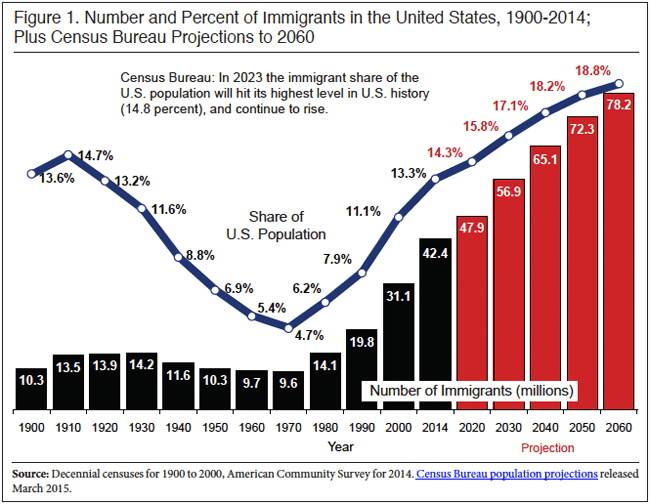
A 1917 law aimed at South Asians, Indians, who settled in California and Washington and spoke out against British control of their homeland. This was part of a broader American nativist movement merging with white supremacy ideology, anti-communism and earlier opposition to immigrants with physical or mental disabilities. A literacy test was passed. A “barred” zone was created stopping all Asian entry except from the Philippines and Japan, already excluded by an informal 1907 “Gentlemen’s Agreement.” Mexicans were turned into temporary labor migrants. There was also the fear that if the US entered the League of Nations this could endanger national security. In 1920, 16% of the US population was foreign born. Bad foreigners = crime, immorality, and labor conflict.
A 1921 law closed loopholes in the 1917 law and established the first national origin quotas. This law fused beliefs about eugenics, racial bigotry, anti-disabilities prejudice, mixed racial marriages into a category of undesirable immigrant groups. The Johnson-Reed Act (1924) created quotas by ethnic origin. The Border Patrol created an illegal entry called a misdemeanor and felony (1929) if done twice.
The Johnson-Reed Act (1924) confined immigration mainly to northern Europe. National quotas were based on ethnic origins of the 1890 census. Through the Depression of the 1930s and World War II, immigration was severely curtailed. Following World War II, the law remained intact and parallel laws dealing with World War II refugees were created that bypassed but did not displace the 1925 Law.
In 1948, Congress passed the Displaced Persons Act permitting European refugees to enter. In 1948 the law was amended permitting refugees from camps in western Germany who could not return to their former homes in Poland and the USSR to enter the USA. 332,000 arrived including 141,000 Jewish Holocaust survivors between June 1948 and December 1951.
Era #4: Broader Opening of the Doors, 1965 – Present
The 1925 law was replaced by the Hart/Cellar Act of 1965. Racial and ethnic quotas were eliminated. Numerical quotas were retained. Entrance was open to people from anywhere. The law favored family unification, preference for specific occupations, and a new side variety of visas. In 1950, the USA was 90% white with a European origin. By 2000, 50% of new immigrants were from Latin America and 27% from Asia. In 2020, the USA population was 69% European white. This law changed the racial composition and, some say, the national identity of the USA. The acrid, hot odor of 1924 bigotry and nativism returned magnified and channeled through social media. By 2020, some Americans were talking of white racial suicide and replacement theory. Politicians pointed to the loss of border control. The 9/11 Attack on America led to Islamophobia and Muslin immigration bans. Many Americans supported legal immigration and the use of work visas for both unskilled and professional work. Most wanted to stop migration but the government system to judge asylum claims became broken. Since May 2022, a 1.85 million undocumented refugees have been permitted to remain in the country following a favorable “credible fear” claim. By September 2022, 86,815 immigrants were deported and 1.7 million were approved to stay. 200,149 immigrants came to New York City.
More Data:
From February 2021 to September 2023, Border Patrol arrested 6 million migrants who crossed the border illegally.
1.7 million immigrants were released to stay in the USA.
There were about 1,500 immigration judges and asylum officers available to decide these immigrant cases.
People apply for asylum at the border or if they are caught illegally in the country or overstay a visa. They have up to one year to apply. 800,000 applied in 2022.
It could cost $2 billion to hire more staff to eliminate the 2 million backlog of cases.
In some cities, it will take up to ten years to hear a case.
1.3 million have been told they must leave the USA. They have 90 days to do so.
Many do not leave and they disappear. There is no national ID in the United States to identify them.
Some marry Americans and become parents of children who are natural born citizens.
All of this data is used by politicians running for federal office. Some promise to clear them ‘out.’ How they will do this is not clear.
Many local officials run to Washington, D.C., seeking money to care for migrants in their cities. There is a deadlock in Washington, D.C. Many do not want to tax the many to pay for the foreign immigrants. The memory of 1924 is in the air and a chaotic border has become a drug channel.
Our laws were not designed to deal with BOTH old and new reasons for migrations. The latest reasons are climate change, corruption in many countries, and the development of the smartphone, which immediately connected migrants with friends already in the USA who send money to assist migrants in their journey. Migration used to be single men seeking jobs who would then return home. Now, it is entire families seeking a new life in the USA. Many Americans do not know what to make of it and they will vote their hopes and fears.