Teaching “What to the Slave Is the 4th of July?” by Frederick Douglass: A Two-Part Student Led Lesson

Reprinted with permission (https://historyideasandlessons.substack.com/p/teaching-what-to-the-slave-is-the-66e?r=710fi&utm_campaign=post&utm_medium=web)

Now that Ron DeSantis has caused a widespread walkout by Florida college students defending both their right to diversity and the free exchange of ideas in the classroom, and he virtually outlawed any teaching of conflict in Black history, it is evident that he will run into serious roadblocks in his campaign to rule the whole country with an iron fist. The increasingly cloudy and claustrophobic atmosphere emanating from the formerly sunny state of Florida begs for an eloquent and big-hearted response. The following two-day student-led lesson will introduce American history students to one of our leading intellectuals and, arguably, the greatest speaker of the 19th century: America’s teacher, Frederick Douglass. He never fails to impress.

The assignment I give the students for the first day is to download and read the first 10 pages of “What to the Slave Is the Fourth of July?” They choose one sentence from each page for homework, write it down on a separate sheet of paper, and explain underneath each one why they chose it. They are to read to the end of the top paragraph of the second column of page 10. The students are asked to underline their sentences on the PDF. It is necessary to collect the homework at the beginning of the class in order to make sure each one of them did their own work. Since they had underlined their sentences on the PDF, the students did not need their homework for class. I asked the students to write the first 5 words of those sentences on the blackboard. I picked the students randomly by jumping around asking for their fifth sentence or their first sentence or their eighth sentence and so on. Each student was to sign their name and sit down. Before class I had drawn 10 vertical lines with one horizontal line across the middle, forming 20 boxes on the board for the students to write in. I placed two pieces of chalk under each vertical group of two boxes so that the writing could go faster. The teacher should know the speech inside and out to create an ease of discussion. It makes the class more interesting. While the students were writing the words they had to start at the beginning of their sentence and make sure that no one else had picked the same sentence. From the time the students were entering the class through the writing on the board, I played a song by the Melodians called “By the Rivers of Babylon.”

Once the students had finished writing on the board, they sat down, and I asked literally “Who has comments or questions?” Nothing more: no suggestions or hints. Usually, they remarked how impressed they were by Douglass’ intelligence and language, or they mentioned how understandable the speech was. They found it a shock to read the work of an escaped slave who could write with clarity and on such a high level of complexity. After the comments died down, I would ask the class to turn to page 6 and look at the bold indented passage in the first column. The students recognize the words of the tune they had just listened to. They appeared in the speech from 1852! I played the song again and asked why Douglass had quoted the verse. Some students might have heard the song because their parents or grandparents had played it at home: It is from the soundtrack of the movie “The Harder they Come” from 1972. Alternatively, some might know that it is the Old Testament Psalm 137 that Douglass quoted. I asked if there were any words they did not understand in the passage, or if someone had picked that passage or would like to comment on it, even if they had not picked it. Someone might want to know what Zion was or eventually someone would notice that the exiled Jews were asked to sing one of the songs of Zion, their homeland. Many thousands of Jews were enslaved in Babylon from 586 BCE to about 538 BCE. It was great insult to be asked to sing for their enslavers the students could conclude. Africa is Zion for Douglass someone might say.

Now it was time to begin analyzing the sentences that the members of the class had chosen. As I called on the students to read their sentences, I asked them to point out the page, the column, and first words of the paragraph where the sentence appeared. The students must read slowly and loudly so that the others can get the meaning. “Why did you choose that?” I asked. Often the student explained what it meant but not what attracted them to it. I would ask what they thought or why they liked it or impressed them or not. Sometimes, I would ask who else wanted to comment, but it is not possible to do that more than a few times because there is not enough time in a period to keep discussing one sentence. The students did not often choose the long period sentences that took up whole paragraphs. Most of those we would pick up later because they are the emotional heart of the speech.

When there is time at the end of each class, I asked the students for their favorite sentences and had them read these out loud. The speech is so powerful partly because the rhythm of the words, the internal rhymes and alliterations drive you on. Reading the “Fourth of July Oration” is a real learning experience: Douglass employs grand and deeply affecting rhetoric to illuminate wrongs of slavery. It also shows the great power of the Declaration of Independence despite its obvious hypocrisy. These contradictions have led to tragic cancellations of the Declaration by Nikole Hannah-Jones of The 1619 Project and others. The importance of the study of slavery and of the Declaration has been confused by these journalists who are not trained historians.

In the course of this exposition of my lesson on Douglass’s speech, I will discuss sentences frequently chosen by the students. We had to leave out much of the speech, but what we did in class explored the breadth and depth of the oration giving the students giving them the confidence that they had discussed the work in detail and that they had directed the learning themselves. I had them write a paper on the speech by first summarizing it, choosing 2 ideas in the speech and explaining what each meant and why they were important. They often produced wonderful papers because we had gone over the Oration in sufficient detail. They were comfortable in their interpretations and almost everyone was excited by the assignment. I chose one essay each year to go in our social studies magazine.

Now we are ready to dive into the speech itself.

At the beginning of the Oration, Douglass confesses his trepidations about the task before him. Despite his close relationship with the Rochester Ladies Anti-Slavery Society and the Corinthian Hall, where he had spoken many times, he declared, “The fact is ladies and gentlemen the distance between this platform and the plantation from which I escaped, is considerable. . .  That I am here today is a matter of astonishment as well as gratitude.” The students will know that he was born into slavery. “This, for the purpose of this celebration, is the Fourth of July.” “Why did you choose that?” I asked. The students will realize he is not speaking on July 4th. Instead, he said that he is protesting the day right from the start. Many versions of the speech on the web, in fact, begin with that sentence. He continues, “It is the birthday of your political independence and political freedom,” starkly using the second person plural that he was not speaking of his liberation, but theirs. All this the students can glean after you ask why did you choose that? He then compares the day to Passover when the Jews, the “emancipated people of God,” were delivered from bondage in Egypt. The students will notice that there are numerous quotes from and references to the Bible.

Douglass’ writing is so densely packed that the ideas rush at you as you read. He points out that the country is “young,” only “76 years old,” in 1852; That it is a topic for rejoicing, noting that a young river that can change its course more easily than an old river or a country thousands of years old. He adds that the nation is still in the “impressible stage of its existence . . . Great rivers are not easily torn from their channels worn deep by the ages . . . [but while] refreshing and fertilizing the earth . . . they may also rise in wrath and fury and bear away on their angry waves the accumulated wealth of years toil and hardship. . . As with rivers so with nations.” Recently floods and tornadoes have been ravaging wide swaths of land and forests in nearly every part of the US. From the waters and winds of Hurricane Katrina to the floods of Hurricane Sandy to the fires and droughts in the far West, we have seen unprecedented levels of destruction. Eliciting these resonances with open-ended questions such as why did you choose that or what does that remind you of should be straight forward. At some point in discussing the speech it will be clear that Douglass is setting the context for discussing the effects of the multifarious and wholly predictable dangers of slavery to the body politic of the young nation.

In the second paragraph of the second page, he turns to his duty to the 4th of July itself. Addressing his “Fellow citizens,” he introduces the history of the Revolution explaining that in 1776 “your fathers were British subjects” who “esteemed the English Government as the home government” which “imposed upon…its colonial children such restraints, burdens and limitations…it deemed wise, right and proper.” However, these acts produced a widespread reaction by the future revolutionists not “fashionable in its day” because the colonists did not believe in the “infallibility of government” but “pronounced the measures unjust, unreasonable and oppressive.”

“To side with the right against the wrong, the weak against the strong and with the oppressed against the oppressor! here lies the merit and one which seems unfashionable in our day . . .” Here, is the first burst of eloquence from Frederick Douglass. The internal rhyme and the rhythm of these lines stand out. Douglass could astound the listener in just a few words. His eloquence matched the gravity of the cause. His description of the Stamp Act protests and the protests against the Townshend Acts and the Tea Tax bring us back to the streets and the harbors of our colonial past connecting his listeners to our heritage of activism.

But the colonists “saw themselves treated with sovereign indifference, coldness and scorn . . . As the sheet anchor [heaviest anchor] takes a firmer hold when the ship is tossed by the storm, so did the cause of your fathers grow stronger as it breasted the chilling blasts of kingly displeasure.” But “like the Pharaoh whose hosts were drowned in the Red Sea, the British Government persisted in the exactions complained of . . . Oppression makes a wise man mad. Your fathers were wise men. They did not go mad . . . They became restive under this treatment . . . With brave men there is always a remedy for oppression. Just here the (startling) idea of the separation of the colonies from Britain was born!” However, the opposition Loyalists or Tories “hate all changes . . .  (b)ut silver gold and copper change! . . . amid all their terror and affrighted vociferations against it the alarming and revolutionary idea moved on and the country with it.” Are there words here you do not know, I ask. Mad of course refers to mental illness and restive means to be agitated. Vociferations are chants shouted by the demonstrators.

The revolutionists’ solution was to “solemnly publish and declare that these united colonies are and of right ought to be free and independent states and that they are absolved from all allegiance to the British Crown.” This is the famous core of the Declaration by Richard Henry Lee that is in the penultimate paragraph of the document. It rings with preternatural force shocking the sleepy 18th century kings and subjects in the monarchies of Europe. Many American and British historians who still claim in 2023 that the Americans were provincials who had no good reason to rebel, but over the course of the next 7 years the British learned they had to accept the wishes of these “naive” colonists.

Douglass continues “I have said that the Declaration of Independence is the ring-bolt [fastener] to the chain of your nation’s destiny, so, indeed I regard it. The principles contained in that instrument are saving principles. Stand by those principles, be true to them on all occasions in all places, against all foes and at whatever cost.” Students will realize that Douglass had great respect for the Declaration and the dogged persistence of the revolutionary forces.

Douglass says, “My business, if I have any this day, is with the present. The accepted time with God and His cause is the ever-living now.” A phrase I had to look up to confirm that it was Douglass”! “We have to do with the past only as we can make it useful to the present . . . Washington could not die until he had broken the chains of his slaves. Yet his monument is built up by the price of human blood and the traders in the bodies and souls of men shout — ‘We have Washington to our father.’– Alas that it should be so, yet so it is. ‘The evil that men do, lives after them, The good is oft’ interred in their bones.’” Douglass challenges his audience with that quote from Shakespeare: Mark Antony’s funeral oration for Julius Caesar.

He praises Washington for freeing some of his stolen human “property” before he died, but immediately pulls the compliment back by condemning the first president’s admirers for employing enslaved workers to build the Washington monument. “Can anyone comment on that?” I asked the students. Some members of the class might know that later the capitol building and the White House were also built by slaves. Now he is done with his task of recalling the Fourth of July.

“Fellow-citizens, pardon me, allow me to ask why am I called upon to speak here today? What have I, or those I represent, to do with your national independence? . . . I am not included within the pale of this glorious anniversary! Your high independence only reveals the immeasurable distance between us . . . The rich inheritance of justice, liberty, prosperity and independence bequeathed by your fathers is shared by you, not by me. The sunlight that brought light and healing to you, has brought stripes and death to me. This Fourth of July is yours not mine. You may rejoice, I must mourn. to drag a man in fetters into the grand illuminated temple of liberty and call upon him to join you in joyous anthems were inhuman mockery and sacrilegious irony. Do you mean, citizens, to mock me by asking me to speak here today?”

In discussing these lines above someone will point out that the stripes are the wounds caused by whips and also are the stripes on the flag. This was a common abolitionist trope utilized even in an Abecedarium, an alphabet book for children. 

“Are there any words you do not know?” I asked. The students will probably not know what a pale is. Those were the segregated areas where Jews were confined in the shtetls of Russian-Poland, but also more precisely in this case the English confined themselves in a pale after conquering Northern Ireland. The idea of “American exceptionalism” was clearly a commonplace in 1852. His sarcastic description of the “grand illuminated temple of liberty” is shocking to see in his 1852 speech. Americans, even then, had a bloated idea of the purity of American democracy. He goes right for the jugular: Douglass states his thesis as his duty to defend the slave and his condition.

He refers in the paragraph above the Psalm to the violent retribution that Yahweh ( a Jewish name for God) at the Hebrews’ request to be visited upon the Babylonians for enslaving them and mocking them, which is rarely quoted by Christians. The shocking lines which Douglass avoided are in the King James Version of the Old Testament. 

Then he quotes the first parts of Psalm 137 that we have encountered before: “By the rivers of Babylon, there we sat down. Yea! we wept when we remembered Zion. We hanged our harps upon the willows in the midst thereof. For there, they that carried us away captive, required of us a song; and they who wasted us required of us mirth, saying, Sing us one of the songs of Zion. How can we sing the Lord’s song in a strange land? If I forget thee, O Jerusalem, let my right hand forget her cunning. If I do not remember thee, let my tongue cleave to the roof of my mouth.”

I asked the students to recall the song we heard at the beginning of the class in the light of our analysis so far. “How can you interpret these words now?” I asked. The students will conclude that the enslaved Jews were mocked by the Babylonians who asked them to sing a song of their homeland, Zion – just as he is in America singing the praises of the white people’s freedom document while his people are enslaved.

“My subject, then fellow-citizens is American slavery. I shall see this day . . . from the slave’s point of view . . . I do not hesitate to declare… that the character and conduct of this nation never looked blacker to me than it does on this 4th of July! . . . (T)he conduct of the nation seems equally hideous and revolting. America is false to the past, false to the present, and solemnly binds herself to be false to the future.” He dares to “call into question and to denounce . . . everything that serves to perpetuate slavery, the great sin and shame of America.” Then, quoting his teacher, William Lloyd Garrison, “’I will not equivocate, I will not excuse’ . . . and yet no one word shall escape me that any man whose judgment is not blinded by prejudice, or who is not at heart a slaveholder, shall not confess to be right and just.”

The students will conclude that the Declaration from the past is the founding document but has been desecrated and tossed aside by the slave holders in power in the country from then, through the present and into the future. Anyone who finds slavery to be repugnant will discern the truth in his arguments.

In order to continue with the lesson, over the next few pages (from the last paragraph of 6 to the middle of the second column on page 9), every sentence and every word is crafted to thrill the reader with Douglass’s intelligence and skill and cringe in horror as he speaks the truth of the brutality of American slavery. Each passage is another lesson in the illogic of the excuses for the system and cruel treatment perpetrated on the Black population in our so-called democratic and freedom-loving land. I will provide the teacher with sentences and clauses comprising a bare bones narrative. But most of this, must be read aloud in class. These paragraphs are too dramatic and inspiring to skip over. Here is a precis of the next few pages. I quote some of the sentences, but the full power is in the reading. Be sure to have the students read them. They will be shocked at how the words help them keep the rhythm with both understanding and expression: The images, the sounds, and the meters carry them, pushing and pulling them along. Douglass’s energy is so intense that the quotes never lose their power.

“Must I undertake to prove that the slave is a man? . . . Nobody doubts it . . . There are seventy-two crimes in the State of Virginia, which, if committed by a black man . . . (no matter how ignorant he be), . . . (acknowledging) that the slave is a moral, intellectual and responsible being . . . It is admitted in the fact that Southern statute books are covered with enactments forbidding, under severe fines and penalties, the teaching of the slave to read or to write… When you can point to any such laws, in reference to the… dogs in your streets, (or) when the fowls of the air, when the cattle on your hills, when the fish of the sea, and the reptiles that crawl, shall be unable to distinguish the slave from a brute, then will I argue with you that the slave is a man!”

When you ask how the students understand this sentence you are not done until they can say “Even animals see the enslaved as men, but the slaveholders cannot.” The students discover that the enslaved are expected to know right from wrong, but animals are not expected to. “For the present, it is enough to affirm the equal manhood of the Negro race. Is it not astonishing that, while we are ploughing, planting and reaping, using all kinds of mechanical tools, erecting houses, constructing bridges, building ships, working in metals of brass, iron, copper, . . . having among us lawyers, doctors, ministers, poets, authors, . . . living, moving, acting, thinking, planning, living in families as husbands, wives and children, and, above all, confessing and worshipping the Christian’s God, . . . we are called upon to prove that we are men! . . . Would you have me argue that man is entitled to liberty? that he is the rightful owner of his own body?”

All the verbs, all the verbs strung together: An astonishing effect! So many powerful images in this paragraph.

“There is not a man beneath the canopy of heaven, that does not know that slavery is wrong for him.”

Here we must stop and make sure the last thought is clear. The students must interpret this last sentence. Is there a word you do not know in this? A canopy is a covering. All men are beneath the canopy of heaven. The analysis is not complete until the students state that no man wants to be a slave. The listeners are cornered. The orator has taken their minds hostage.

And now one of the most powerful passages of all. “[T]o work them without wages . . . to beat them with sticks, to flay their flesh with the lash, to load their limbs with irons, to hunt them with dogs, to sell them at auction, to sunder their families.” The paragraph is a masterpiece. This is a sonorous but brutal description of violence complete with startling images, crafted with alliterations and internal rhymes. As above the reader must ask: Is he arguing or not while he claims not to argue at all? “What, then, remains to be argued? Is it that slavery is not divine; that God did not establish it; that our doctors of divinity are mistaken? . . . Who can reason on such a proposition? They that can, may; I cannot. The time for such argument is past.”

And now the most famous paragraph: “What, to the American slave, is your Fourth of July? I answer: a day that reveals to him, more than all other days in the year, the gross injustice and cruelty to which he is the constant victim. To him, your celebration is a sham; your boasted liberty, an unholy license; your national greatness, swelling vanity; your sounds of rejoicing are empty and heartless . . . your prayers and hymns, your sermons and thanksgivings, with all your religious parade, and solemnity, are, to him, mere bombast, fraud, deception, impiety, and hypocrisy—a thin veil to cover up crimes which would disgrace a nation of savages. There is not a nation on the earth guilty of practices, more shocking and bloody, than are the people of these United States, at this very hour.”

“How do you comment on this?” I asked. It is a perfect description of systemic racism: Incontrovertible intersectionality. It is where Governor DeSantis’s views come to die.

“Go where you may, . . . for revolting barbarity and shameless hypocrisy, America reigns without a rival. Take the American slave-trade, . . . This trade is one of the peculiarities of American institutions. It is carried on in all the large towns and cities in one-half of this confederacy; and millions are pocketed every year, by dealers in this horrid traffic.”

Here Douglass refers to the euphemism, “the peculiar institution,” which is supposed to assuage the guilt of the leaders of the so-called southern “civilization.” It is the hackneyed trope of a racist attempting to endear himself to his audience by turning slavery into a peccadillo. Continuing, he quotes the proposed paragraph written by Thomas Jefferson for the Declaration of Independence but rejected by the Continental Congress calling slavery “piracy” [manstealing] and “execrable commerce.” “Are there words here you do not know?” I asked. Excrement is human waste. Nearing the end of this paragraph, he denounces the scheme of colonization that our “colored brethren should leave this country and establish themselves on the western coast of Africa!”

“Behold the practical operation of this internal slave-trade, (The slave drivers) perambulate the country, and crowd the highways of the nation, with droves of human stock…They are food for the cotton-field, and the deadly sugar-mill. . . Cast one glance, if you please, upon that young mother, whose shoulders are bare to the scorching sun, her briny tears falling on the brow of the babe in her arms. See, too, that girl of thirteen, weeping, yes! weeping, as she thinks of the mother from whom she has been torn! . . . suddenly you hear a quick snap, like the discharge of a rifle; the fetters clank, and the chain rattles simultaneously; your ears are saluted with a scream, that seems to have torn its way to the center of your soul! The crack you heard, was the sound of the slave-whip; the scream you heard, was from the woman you saw with the babe. Her speed had faltered under the weight of her child and her chains! that gash on her shoulder tells her to move on.”

The students will comment that this paragraph is filled with images and rings with sounds of whips and clanging chains. The powerful ideas are matched by the thundering rhetoric keep you on the edge of your seat.

Then: “I was born amid such sights and scenes. To me the American slave-trade is a terrible reality. When a child, my soul was often pierced with a sense of its horrors. I lived on Philpot Street, Fell’s Point, Baltimore, and have watched…this murderous traffic (which) is, to-day, in active operation in this boasted republic. In the solitude of my spirit . . . My soul sickens at the sight.”

Students will see how he brings this experience directly to our hearts. Is this the land your fathers loved, the freedom which they toiled to win? Is this the earth whereon they moved? Are these the graves they slumber in? Students will react to the emotion in the lines of his childhood memories. The paragraph and the lines of the poem are poignance beyond measure. The lines by the abolitionist poet, John Greenleaf Whittier, are a tribute to the lost glory of the American promise. It can make the reader cry. When activists say that the “personal is political” there is no better example than this memory of Douglass’s childhood traumas. This concludes the first day of the lesson.

The second day I would ask the students to finish the speech, choosing 5 more sentences from pages 11 to 15 and to find places in the first 10 pages that explain that the slave is a man. They also were asked to point out the structure of the speech: where does the introduction end and the conclusion begin? Where is the thesis? Here we discussed the major sections of the speech which they could identify as the introduction, the Revolution, the section in which the thesis is stated and the proofs of why the slave is a man and why slavery is wrong. The speech’s final sections Douglass argues that slavery is not divine, examines the politics of slavery, and the Constitution, delivers a summary, and a peroration (conclusion).

“But a still more inhumane, disgraceful, and scandalous state of things remains to be presented. By an act of the American Congress, not yet two years old, slavery has been nationalized . . .  (T)he Mason & Dixon’s line has been obliterated; New York has become as Virginia; and the power to hold, hunt, and sell men, women, and children as slaves . . . the liberty and person of every man are put in peril…. The oath of any two villains is sufficient, for black men there are neither law, justice, humanity, not religion. The Fugitive Slave Law makes mercy to them a crime; and bribes the judge who tries them. An American judge gets ten dollars for every victim he consigns to slavery, and five, when he fails to do so.”

“How can you comment on this?” I asked. This bribe is rarely mentioned in the standard discussion of the odious Fugitive Slave Law of 1850, which of course, was part of the Compromise of 1850. In 2021 the vicious Texas anti-abortion bill borrowed its form and method of enforcement to this law. The reward of $10,000 has been substituted for the $10 in the 19th century law. It deputizes the whole population of Texas to arrest anyone who aids in arranging for an abortion. Douglass points out that the magistrates for the fugitive slave law were acting like the Protestant, John Knox, denouncing the Catholic supporters of Mary Queen of Scots who were threatening to murder Queen Elizabeth.

The leading American ministers “have taught that man may properly be a slave that the relation of master and slave is ordained of God . . . and this horrible blasphemy is palmed off upon the world for Christianity.” “How do you think about this,” I asked. Black men slave or free walking down the street even in the North were subject to false identification, imprisonment, and enslavement. It became a religious duty to show no mercy! What an abomination and evisceration of religious belief and practice. Are these Evangelical Christians in the Texas legislature or in 1852 practicing the teachings of mercy and forgiveness?

Douglass answers the question: “For my part, I would say, Welcome infidelity! welcome atheism! welcome anything—in preference to the gospel, as preached by those divines. They convert the very name of religion into an engine of tyranny, and barbarous cruelty, and serve to confirm more infidels, in this age, than all the infidel writings of Thomas Paine, Voltaire, and Bolingbroke, put together, have done! These ministers make religion a cold and flinty-hearted thing, having neither principles of right action, nor bowels of compassion.”

“Do you know these names,” I asked? Some students might know Thomas Paine or Voltaire. Bolingbroke was also a free thinker, an 18th century term for atheists, agnostics, and deists. Here Douglass claims he would favor these anti-slavery free thinkers, Thomas Paine, and Voltaire and he adds the dissenter Viscount Bolingbroke, claiming they were all three at least sympathetic to the plight of the enslaved. If students have a question, bowels of compassion refers to the deepest recesses of the human body, a common 18th and 19th century expression. These last lines are really shocking coming from such a religious man as Frederick Douglass.

“At the very moment that they are thanking God for the enjoyment of civil and religious liberty, and for the right to worship God according to the dictates of their own consciences, they are utterly silent in respect to a law which robs religion of its chief significance and makes it utterly worthless to a world lying in wickedness.” “How would you interpret that,” I asked. The students will come to the conclusion that Douglass is emphasizing the hypocrisy of the leaders of the congregations and denominations in the United States.

Douglass continues: “The American theologian, Albert Barnes uttered what the common sense of every man at all observant of the actual state of the case will receive as truth, when he declared that ‘There is no power out of the church that could sustain slavery an hour, if it were not sustained in it.’” “How do you understand that?” I asked. The students will reach a conclusion that this is a very broad statement. It is a condemnation undercutting all the pronouncements of the pro-slavery divines. In contemporary terms, this is a thought based in the ideas of systemic racism and embedded in the American economy and society. It is an example of intersectionality between religion and politics, an unmistakable interdependence, however much Ron DeSantis might argue to the contrary. In a previous passage, Douglass had pointed out that there were many minister abolitionists in Britain where the monarchy opposed slavery since the 1820s but very few in America where the weight of the church was behind the slaveholders. Above on page 12 of the speech he calls them out: the many pro-slavery American ministers and the few anti-slavery heroes in the United States.

And now we are coming to the ending of the speech. There are just two topics left before the Summary and Conclusion: America’s hypocrisy toward foreign nations and the nature of the Constitution.

Douglass turns to yet another theater of hypocrisy in the United States. “Americans! your republican politics, not less than your republican religion, are flagrantly inconsistent. You boast of your love of liberty, your superior civilization . . . You hurl your anathemas [condemnations] at the crowned headed tyrants of Russia and Austria, and pride yourselves on your democratic institutions, while you yourselves consent to be the mere tools and bodyguards of the tyrants of Virginia and Carolina. You invite to your shores fugitives of oppression from abroad, honor them with banquets, greet them with ovations, cheer them, toast them, salute them, protect them . . . You profess to believe ‘that, of one blood, God made all nations of men to dwell on the face of all the earth’ . . . yet, you hold securely, in a bondage [a seventh part of the inhabitants of your country] which, according to your own Thomas Jefferson ‘is worse than ages of that which your fathers rose in rebellion to oppose’.”

The students will understand that Douglass contrasted the boasts of equality including in the Declaration of Independence that “‘all men are created equal’ yet (they) steal Black wages and deny the common ancestry of Adam that all men are of one blood.” “How do you interpret that quote from the Bible?” I asked. The students will conclude that a single origin for all humanity [Adam], which we now know to be African, proves the equality of all men. Finally, Douglass quotes Jefferson’s comments in his book, Notes on the State of Virginia, on the oppression of the enslaved as being worse than the so-called slavery of the Patriots to England.

If a student chooses the sentence containing “as it ought to be interpreted the Constitution is a glorious liberty document,” it is likely they will not agree with Douglass. Currently, almost all textbooks and historians contend that the Constitution is pro-slavery. Douglass’s interpretation is frankly a surprise for Americans even in 2023. The great abolitionist has been criticized for the latter statement by everyone from William Lloyd Garrison in the 1850s to Nicole Hannah-Jones in The 1619 Project, but his argument has a more complex basis that has not been brought to light except in the most recent academic monographs on abolitionism. 

Douglass debated for more than two years until he became exhausted with his friend and ardent supporter, Gerrit Smith, whether there existed a morally justified position that the founders opposed slavery. In the oration he said, “if the Constitution were intended to be, by its framers and adopters, a slave-holding instrument, why neither slavery, slave holding, nor slave can anywhere be found in it.” Students might know that the words slave or slavery are never mentioned in the Constitution. Instead in the 3/5 Compromise slaves are called “other persons.” In the international slave trade compromise in Article I section 9, slaves are called “such persons.” Finally in the fugitive slave clause in Article 4 the escaped slave is called “no person.” Douglass was still hesitant in 1852 about this position as you can see when he continued, that the founders were not to blame for the apparent support of slavery “or at least so I believe.” But after such a long struggle he was relieved to be able to support a fight in the Congress (i.e., politically) and not just by “moral suasion,” as Garrison had taught. The Constitution, then, was not Garrison’s “covenant with death,” but became a “glorious liberty document” that he could use to fight for the freedom of his people. 

“Fellow-citizens! I will not enlarge further on your national inconsistencies. The existence of slavery in this country brands your republicanism as a sham, your humanity as a base pretence, and your Christianity as a lie. It destroys your moral power abroad; it corrupts your politicians at home.

“How do you interpret that sentence?” I asked. The students will realize that Douglass is signaling he is coming to the end of the oration: he is ready to conclude. Here he lists the topics of the oration after the recital of the facts and ideas of the Revolution. At this point he adds one powerful metaphor relating to slavery that we have before encountered in the raging rivers and their dangerous floods in the introduction. Now these dangers have become one “horrible reptile…coiled up in your nation’s bosom; the venomous creature is nursing at the tender breast of your youthful republic; for the love of God, tear away, and fling from you the hideous monster, and let the weight of twenty millions crush and destroy it forever!” “How do you interpret this?” I asked. The students will realize that the twenty million was the northern majority. The undemocratic nature of the slave power is reminiscent of the white nationalist minority we are suffering from today in the arguments about abortion, the warming of the planet and the massive inequality to which our mainstream politicians are bowing today.

Here is where Douglass defends the founders as blameless, as above, for the pro-slavery Constitution, “at least, so I believe,” he maintained. “Allow me to say, in conclusion, notwithstanding the dark picture I have this day presented of the state of the nation, I do not despair of this country. There are forces in operation, which must inevitably work the downfall of slavery. ‘The arm of the Lord is not shortened,’ and the doom of slavery is certain. I, therefore, leave off where I began, with hope.” “How can you comment on this,” I ask. The students will remember that at the beginning Douglass, pointed out that the young country was only 76 years old in 1852. God’s arm is all powerful. “The arm of commerce has borne away the gates of the strong city. Intelligence is penetrating the darkest corners of the globe. It makes its pathway over and under the sea, as well as on the earth. Wind, steam, and lightning are its chartered agents. Oceans no longer divide, but link nations together . . . Thoughts expressed on one side of the Atlantic are, distinctly heard on the other.”

The students will interpret these ideas as the familiar causes and effects of globalization. “Wind, steam, and lightning” are boats and telegrams. These are all causes of optimism the students will conclude.

“The fiat of the Almighty, ‘Let there be Light,’ has not yet spent its force. No abuse, no outrage whether in taste, sport or avarice, can now hide itself from the all-pervading light. The iron shoe, and crippled foot of China must be seen, in contrast with nature. Africa must rise and put on her yet unwoven garment. ‘Ethiopia shall stretch out her hand unto God.’” “Are there words here you do not know?” I ask. A fiat is a command. The passage also refers to foot-binding in China that ended only with the revolution in 1911, and Ethiopia is a reference to all of Africa and the effects of imperialism and racism. The very last part of the speech is a poem by William Lloyd Garrison who was Douglass’ teacher and mentor from early in his life as a free man. Here is an excerpt:

“How would you interpret that?” I asked. Certainly, first of all the speech has been about freedom for the slaves, but second as a personal and political gesture Douglass showed his respect and admiration for Garrison even though their interpretations of the Constitution conflicted. Jubilee is the abolitionist term for emancipation which originated among the secular kings in the ancient holy land of the Hebrews as a 50-year celebration of forgiveness of slaves, debts, and debtors. There is a similar concession to Garrison’s leadership of the abolitionist movement when Douglass states his thesis later on.

Now that we are at the end of the speech, it is time to go back and figure out how Douglass put the speech together. Seeing the speech as a whole is a revelation for the students. After the rhetorical apologies at the very beginning, the speech proper begins: “This, for the purpose of this celebration, is the 4th of July” is near the top of the second column of the first page of the speech. The students have realized that he begins with a protest, it is the 5th. The first extended section is about the Revolution which comes after the context of the young nation and the hopes and dangers of rivers with their dual roles of fertility and flooding. His recounting of the floods includes power of the Red Sea. “How do you understand his reasoning?” I ask.

To begin with these stories, the students might say that he is clearly paying respect to the tradition of July 4th celebrations. But the great upheaval of 1776 was marked by patriotic sacrifice and brave action by the ancestors of the whites. There is a strong and dangerous undertow preceding the discussion of the Revolution. Douglass is setting a context unique to his purpose in the speech.

In the next section Douglass introduces his Thesis. He leads up to it from the first full paragraph on the left column of page 5 of the document. The thesis itself is on the bottom of the right column on page 6.

“My subject, then fellow-citizens, is American slavery . . . Standing with God and the crushed and bleeding slave on this occasion, I will, in the name of humanity which is outraged, in the name of liberty which is fettered, in the name of the constitution and the Bible, which are disregarded and trampled upon, dare to call in question and to denounce, with all the emphasis I can command, everything that serves to perpetuate slavery—the great sin and shame of America!” It is a bold and dramatic period sentence. Next is his first quote from Garrison, his mentor. “I will not equivocate; I will not excuse.” This is one of the most famous lines from the great leader.

The optimism Douglass feels for the young country at the “impressible stage of its existence” only 76 years old at the beginning is always in conflict in the speech with the dangers of nature and the wrath of God against the Egyptians and Babylonians. Similarly at the end he describes his feeling of possibility for peace and abolition despite the “dark picture” he has painted. But this joy in the chances for change are abruptly flung aside as he describes the “horrible reptile . . . coiled up in your nation’s bosom,” of the “youthful” republic. However, again, the “arm of the Lord is not shortened” and change can be part of the work of history and if Americans “act in the living present.”

Douglass signals many of the sections by using the phrase, “My fellow citizens” or directly addressing his audience as “Americans.” He introduces the section on the Revolution with “Fellow-citizens.”  He asks, “Fellow-citizens, pardon me, allow me to ask why am I called upon to speak here today?” after the description of the Revolution to introduce the central conflict of the speech with Psalm 137 that identifies the oppression of the Jews during the Babylonian Captivity with his cause as a representative of the American slaves. We have quoted the thesis above that contains the same signal. Again, as he begins the topic of slavery: “Fellow-citizens; above your national, tumultuous joy, I hear the mournful wail of millions!” right under the quote of Psalm 137. It is in this section that Douglass proves that the Slave is a Man despite his protestations to the contrary and then he describes the slave trade in Bringing Slavery Before the Eyes saying, “Behold the practical operation of this internal slave-trade.”

Finally, Douglass introduces his Summary and Conclusion going back to the very same call to attention. This time with a deeply sarcastic turn of phrase: “Fellow-citizens! I will not enlarge further on your national inconsistencies. The existence of slavery in this country brands your republicanism as a sham, your humanity as a base pretence, and your Christianity as a lie.”

This statement shows the power behind the ideas of systemic racism. The teacher is now prepared to take on the machinations of Ron DeSantis. The self-educated escaped slave puts the Governor’s inhumane and frankly ignorant ideas in the dustbin of history. Frederick Douglass oration, “What to the Slave is the Fourth of July?” is a powerful antidote to DeSantis’ anti-woke bullying. Douglass’s descriptions make you feel their power. They will entrance your students and leave them ready to defend their values as learners and humanitarians. Douglass’ oration shows Ron DeSantis to be a man of limited intellectual force and a mean spirited and dangerous leader who acts with thoughtless abandon. His actions are the very definition of performative. He is an authoritarian poseur. In the face of Douglass’s oration DeSantis is shamed and outclassed.

I dedicate this this lesson to the brave students and educators who are in the classrooms fighting for the truth and complexity in the study of history. Remember that Frederick Douglass believed, “If there is no struggle, there is no progress.”

New Jersey’s Slavery Past

Deborah P. Carter

The Howe House on Claremont Avenue in Montclair

Reprinted with permission from New Jersey Monthly, “Montclair’s Howe House a Testament to NJ’s Uncomfortable and Dark Past,” https://njmonthly.com/articles/towns-schools/history/montclair-howe-house/

In 1831, James Howe was deeded 6 acres and a small house on Claremont Avenue in Montclair. That house still stands. For many years, the worn clapboard house was known locally as the slave house. James Howe was owned by Nathaniel Crane. A member of one of the town’s founding families, Crane left the property to Howe (rumored to be his son) upon his death.

American slavery began in 1619 and eventually spread to all 13 colonies. By the late 1700s, Garden State neighbors like Pennsylvania, New Hampshire, and Massachusetts, followed 20 years later by New York, began adopting policies to abolish legal human bondage. New Jersey, however, was slow to outlaw the practice and adopted brutal laws restricting rights, including reading, writing, and ownership of firearms and property, for the nearly 12,000 enslaved Africans who lived here at the turn of the 19th century. After 185 years of slavery in New Jersey, in 1804 the state passed the Act for the Gradual Abolition of Slavery. The mandate required enslaved men born after July 4, 1804, to serve 25 years, and enslaved women, 20 years before manumission. By the start of the Civil War in 1861, records indicate slavery in New Jersey had dwindled, but remained legal. In 1866, the state ratified the Thirteenth Amendment to the Constitution, making it the last Northern state to end slavery.

Today, historically significant properties like the Howe House bear witness to New Jersey’s past. The nonprofit Friends of Howe House (FHH) are seeking historic landmark status and recently rallied support to purchase the building. “We are forming a steering committee and seeking community input to determine the next steps for Howe House,” says committee member Kimberly Latortue, adding turning it into a house museum is an option. The town “prides itself on being the epitome of diversity,” says Aminah Toler, a Montclair native and founding member of FHH. “We want to ensure that the Howe House remains to tell the story of the African American history that shaped this town and this country.”

Lesson Based on the Movie Glory

“Let the black man get upon his person the brass letter, U.S., let him get an eagle on his button, and a musket on his shoulder and bullets in his pocket, there is no power on earth that can deny that he has earned the right to citizenship.” – Frederick Douglass

  • Read the packet prior to our class viewing of the Edward Zwick’s film Glory (1989)
  • Highlight/underline and annotate the most important points; be sure you review the questions before we view the film.
  • Pay attention and answer the questions in the time allotted following the end of the film.

Background: The issues of emancipation and military service were intertwined from the onset of the Civil War. News from Fort Sumter set off a rush by free Black men to enlist in U.S. military units. They were turned away, however, because a federal law barred Negroes from bearing arms for the U.S. Army. The Lincoln administration was concerned that the recruitment of Black troops would prompt the Border States (Delaware, Maryland, Kentucky, and Missouri) to secede. By mid-1862, however, the escalating number of former slaves (contrabands), the declining number of white volunteers, and the needs of the Union Army pushed the Government into reconsidering the ban. As a result, on July 17, 1862, Congress passed the Second Confiscation and Militia Act, freeing slaves who had masters in the Confederate Army. Two days later, slavery was abolished in all the territories of the United States. In the Emancipation Proclamation, issued on January 1, 1863, President Lincoln announced that Black men would be recruited into the U.S. Army and Navy. Abolitionist leaders such as Frederick Douglass encouraged Black men to become soldiers to ensure eventual full citizenship (two of Douglass’s own sons enlisted). By the end of the Civil War, roughly 188,000 Black men (10% of the Union Army) served as soldiers and another 19,000 served in the Navy. 40,000 Black soldiers died over the course of the war. There were 80 Black commissioned officers; 21 Black soldiers and sailors won the Medal of Honor by the time it ended. Black women could not formally join the Army but served as nurses, spies, and scouts, the most famous scout being Harriet Tubman. In addition to the perils of war faced by all Civil War soldiers, Black soldiers faced additional problems stemming from racial prejudice. Segregated units were formed with Black enlisted men commanded by white officers. Black soldiers were initially paid $10 per month from which $3 was automatically deducted for clothing, resulting in a net pay of $7. In contrast, white soldiers received $13 per month from which no clothing allowance was drawn. In June 1864, Congress granted equal pay to the U.S. Colored Troops.

The film: Glory tells the story of the 54th Colored Massachusetts Infantry Regiment, one of the most celebrated regiments of Black soldiers that fought in the Civil War. Known simply as “the 54th,” this regiment became famous after the heroic, but ill-fated, assault on Fort Wagner, South Carolina. Leading the direct assault under heavy fire, the 54th suffered enormous casualties before being forced to withdraw. The courage and sacrifice of the 54th helped to dispel doubt within the Union about the fighting ability of Black soldiers and earned this regiment undying battlefield glory. Of the 5,000 Federals who took part, 1,527 were casualties: 246 killed, 890 wounded and 391 captured. The 54th lost a stunning 42 percent of its men: 34 killed, 146 wounded and 92 missing and presumed captured. By comparison, the Confederates suffered a loss of just 222 men. Despite the 54th’s terrible casualties, the battle of Fort Wagner was a watershed for the regiment. Civil War scholar James McPherson states, that the “significance of the 54th’s attack on For Wagner was enormous. Its sacrifice became the war’s dominant positive symbol of Black courage. Their sacrifice sparked a huge recruitment drive of Black Americans. It also allowed Lincoln to make the case to whites that the North was in the war to help bring a “new birth of freedom” to all Americans.

  1. List 2 reasons why men joined the 54th?
  2. Why do you think the white officers volunteered to lead them?
  3. Why do you think Colonel Shaw wants his regiment to lead the deadly assault on Fort Wagner?
  4. In the scene just before the final attack, Shaw approaches a reporter and says, “Remember what you see here.” Write a brief newspaper entry including a headline, dateline, photo (or drawing, engraving, map, etc.) and caption, and a brief (3-4 sentences) description stating what the reporter saw at the Battle of Fort Wagner.

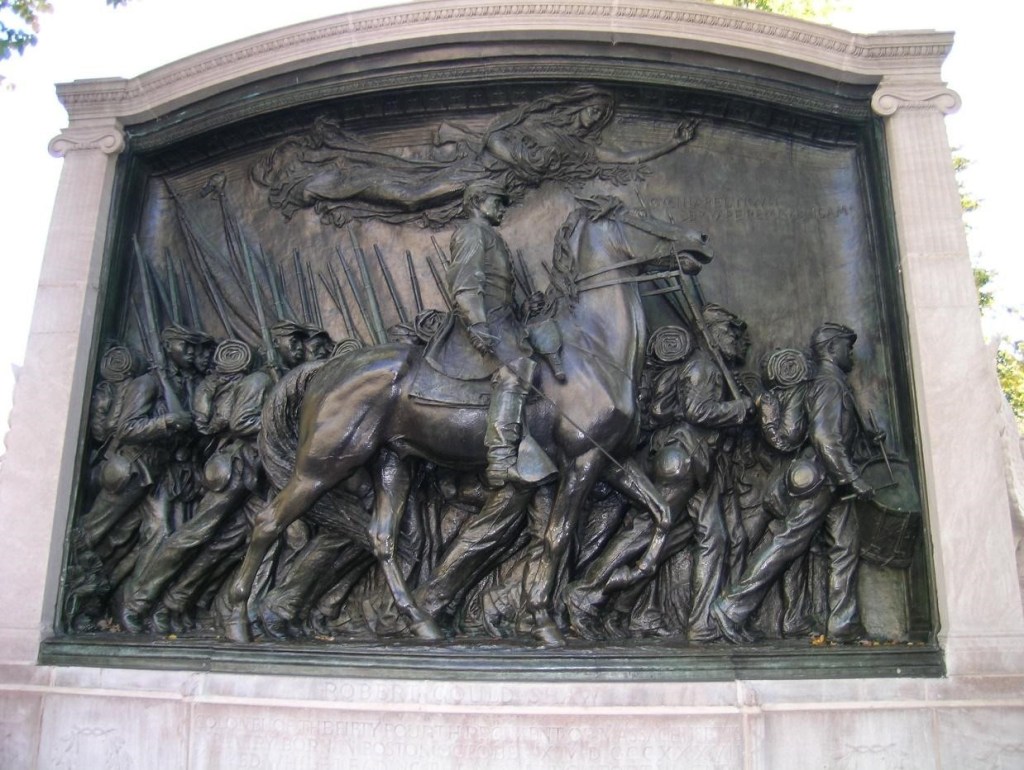
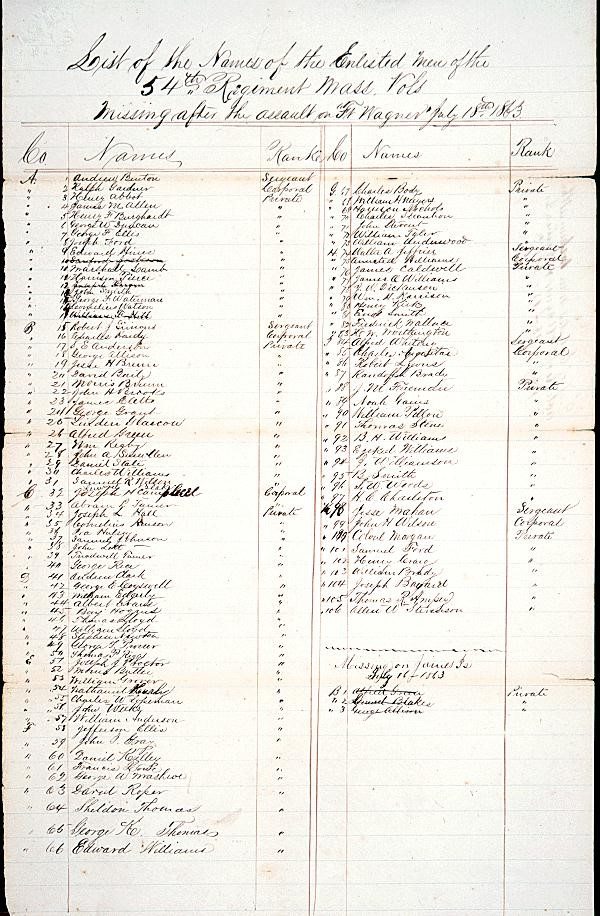
In-class group activity: We will divide randomly into 4 groups. Each group will be assigned one of the images below. Your group will determine how the image represents the significance of the 54th’s achievements and legacy. Each group will then report back to the rest of the class.

Russell Duncan. Blue-Eyed Child of Fortune: The Civil War Letters of Robert Gould Shaw. This book contains a 67-page biography of Shaw as well as 300 additional pages featuring the various letters Shaw wrote to family members, some of which are read in the movie.

Joseph T. Glatthaar. Forged in Battle: The Civil War Alliance of Black Soldiers and White Officers. Paperback. Louisiana State University Press (April 2000).

David Blight’s article, “Race and Reunion: Soldiers and the Problem of the Civil War in American Memory” (6, no. 3 [2003]: 26-38).

A: Storming Fort Wagner. Lithograph by Kurz & Allison, 1890

Image B: Civil War photograph of Sergeant-Major Lewis H. Douglas, one of the first troops of the 54th to climb over the walls of Fort Wagner during the attack.

Image C: Augustus Saint-Gaudens (one of the premier artists of his day) took nearly fourteen years to complete this high-relief bronze monument, which celebrates the valor and sacrifices of the Massachusetts 54th. Colonel Shaw is shown on horseback and three rows of infantrymen march behind. This scene depicts the 54th Regiment marching down Beacon Street on May 28, 1863 as they left Boston to head south. The monument was unveiled in a ceremony on May 31, 1897.

Image D: One of the 54ths casualty lists with the names of 116 enlisted men who died at the battle for Fort Wagner. National Archives, Records of the Adjutant General’s Office, 1780’s-1917

Disciplinary Literacy, Trade Books, and Culturally Responsive Teaching in Middle Grades Social Studies

Disciplinary literacy, which emphasizes teaching students the skills and strategies used by practitioners, has become more prevalent in U.S. schools over the last 15 years. Therefore, teachers need to be deliberate as they assist students to think and write like practitioners (Shanahan & Shanahan, 2008). The National Council for the Social Studies (NCSS) has placed an emphasis on disciplinary literacy in its College, Career, and Civic Life (C3) Framework for Social Studies State Standards (NCSS, 2013a).

            Emphasizing disciplinary literacy means social studies teachers need to give careful thought and consideration in designing learning experiences to develop their students’ historical, civic, economic, and geographic thinking skills (NCSS, 2013a). For some, this will mean redefining their classroom practices. Incorporating disciplinary literacy practices is complicated by the fact that many students are not reading on grade level.

Our intervention is centered on using trade books focusing on civil rights activists that address the racial discrimination Black Americans faced immediately after the U.S. Civil War. Students read excerpts of the trade books and additional sources as a whole class and in groups. They utilized these texts to answer analysis prompts where they used evidence to support their arguments. In this article, we share both our intervention and the successes from the project.

The demographics in U.S. public schools have dramatically changed in the 21st century. White majorities in schools have given way to student populations that are more diverse. This is due in part to immigration patterns to the United States. With the changing demographics in the United States, social studies teachers need to reconsider how they design classroom instruction. One approach is to incorporate culturally responsive teaching, which is defined by Geneva Gay (2000) as “using the cultural knowledge, prior experiences, frames of reference, and performance styles of ethnically diverse student to make learning encounters more relevant to and effective for them” (pg. 29). Additionally, culturally responsive teaching emphasizes the need for high expectations and academic achievement for culturally diverse students, which reflects the empowered school culture described by Banks (2019). 

Gay (2000) calls for teachers to scaffold and connect ethnically and culturally diverse students with the curriculum of the varied academic subjects. Doing so helps teachers to achieve the transformative approach to multicultural education described by Banks (2019). In the transformative approach, “the structure of the curriculum is changed to enable students to view concepts, issues, events, and themes from the perspective of diverse ethnic and cultural groups” (Banks, 2019, p. 64). If social studies teachers are to move beyond the additive and contributions approaches to multicultural education, it is necessary to consider how to incorporate the experiences and viewpoints of minorities beyond a single month in the year (King & Brown, 2014). In the social studies, this would entail using a variety of resources to authentically represent different groups’ values and perspectives throughout the curriculum. Texts that reflect students’ cultures act as mirrors. This allows students to see themselves in their U.S. history curriculum (Bishop, 1990).

There are several key components of culturally responsive teaching for social studies teachers to consider. Effective instruction in the social studies includes primary and secondary sources that allow students to analyze different groups’ perspectives and beliefs about historical and contemporary issues. Doing so provides students with the information to develop a nuanced understanding of an issue and helps to prepare them to work with people from different backgrounds in our pluralistic democratic society (Banks, 2019; Gay, 1994). By focusing on their culture through reading assignments, students can also analyze and critique historical and contemporary power structures in U.S. society and thus equip them with the knowledge to take civic action to address social, cultural, economic, and political inequities (Ochoa-Becker, 1996). One of the approaches to addressing ethnic and cultural diversity in the classroom identified by Gay (2000) is the use of trade books as instructional tools.

            The term trade book refers to books, other than textbooks, that are available in retail establishments. Trade books include informational texts, picture books, and graphic novels (McGowan & Guzzetti, 1991). Not only are trade books more engaging than the typical social studies textbook, but they are also better written (Palmer & Stewart, 1997). Trade books highlight individuals and events frequently excluded from traditional textbooks (Chick, 2008). Trade books are not shallow in content and difficult to read (Berkeley et al., 2016; Tracy, 2003).

Trade books enable teachers to focus on a specific individual or event in depth. Diverse perspectives can be accessed by using several trade books in a curated text set about a specific event or time (Palmer & Stewart, 1997). The diversity of available trade books, in content, format, and readability, offers teachers an opportunity to select texts that best match their students’ reading and learning needs (Liang, 2002; Saul & Dieckman, 2005).

For social studies teachers, trade books offer students a chance to step into a new time or place (Beck & McKeown, 1991) to meet lesser-known historical figures and make emotional connections to the events depicted (Chisholm et al., 2017). It is through this emotional connection that trade books can be used as tools to develop students’ historical empathy skills, which is the effort to better understand historical figures, their actions, decisions, and lived experiences (Endacott & Brooks, 2013). Trade books also offer social studies teachers a way to teach disciplinary literacy by requiring students to analyze for perspective, bias, and purpose (Shanahan & Shanahan 2008).

            As mentioned previously, in culturally responsive pedagogy, teachers employ varied sources that celebrate the history and lived experiences of the culturally diverse students in the classroom. Trade books are an excellent way to do this. For students of color, historical figures who look like them are often portrayed as victims, with little agency and impact on U.S. history (King, 2020). This is not the mirror we want our students to see. To counter this image, teachers should use texts that present people of color impacting their world. This is the framework we utilized to design our study.

We designed a year-long project for the 2021-2022 academic year in which a sixth-grade teacher would use trade books to thematically teach the concept of civil rights in the United States from Reconstruction to the present. We envisioned thematic teaching to be the examination of a specific concept, in this case civil rights, while still teaching U.S. history chronologically. Thus, the thematic teaching approach was embedded into the existing content taught in the grade level. We chose to focus on the civil rights theme because we wanted students to recognize that the civil rights movement in the 1950s and 1960s did not exist in a vacuum. There were events, individuals, and groups who strove for civil rights long before Dr. King.

We determined that trade books would be an effective way to address this theme, as there are books written for young people that address all of the eras of U.S. history. Many of them highlight the struggles and achievements of culturally diverse individuals. To identify high quality trade books aligned with the sixth-grade curriculum and the civil rights theme, we first referred to the NCSS Notable Trade Book lists. All trade books were read, evaluated with regard to both project goals and text quality, and were agreed upon by the two researchers and the teacher.

The thematic teaching through our project was conducted at the Academy (a pseudonym), a new public charter school located in a medium-size city in the Southern United States. At the time of this project, there is only a sixth-grade class of 100 students at the time of our project. The Academy’s mission statement is clearly aligned with the principles of culturally responsive teaching. The school mission is socially justice oriented, seeking to empower their students to be agents of change.

Black students represent 93% of the Academy’s sixth grade class. The remaining 7% include students who identify as Latinx, white, and Asian. The social studies teacher, Ms. Edwards (a pseudonym), identifies as a white female and has more than ten years of experience teaching social studies in both middle school and high school settings. We should acknowledge that both researchers identify as white, one a white male and the other a white female.

            The learning activities were co-constructed with the participating teacher. The three of us crafted an instructional plan that was both reflective of content that addressed the state standards, incorporated the selected trade book, reflected both the school’s mission, and the teacher’s understanding of the students’ learning needs. We helped the teacher monitor student work and aided with instruction, when requested. Based on the fact that the students’ completed work when we were present did not greatly differ from their work when we were not in the classroom, we posit that our participation in class instruction had little impact on the students’ performance.

This paper explores the results of the first two eras addressed in curriculum: Reconstruction and the Progressive Era. The trade books chosen for these units included Henry Louis Gates, Jr.’s (2019) Dark Sky Rising: Reconstruction and the Dawn of Jim Crow and Walter Dean Myers and Bonnie Christensen’s (2008) Ida B. Wells: Let the Truth Be Told. Dark Sky Rising, a non-fiction chapter book, is written for the young adolescent reader and contains numerous primary sources embedded into the narrative. It explores the rise and fall of African American civil liberties during the Reconstruction era. Ida B. Wells: Let the Truth Be Told (Myers & Christensen, 2008) is a 2009 NCSS Notable Trade Book. It is a picture biography of Ida B. Wells’s life and includes her childhood, education, work as a journalist and suffragette, as well as her efforts fighting the lynching of Black Americans.

We used the trade books as anchor texts in the two units. In the Reconstruction unit, Dark Sky Rising (Gates, Jr., 2019). was used to explore literacy tests, poll tax, Plessy v. Ferguson, and Jim Crow segregation laws designed to keep African Americans second-class citizens in the latter 1800s. During the second unit, students read the trade book Ida B. Wells (Myers & Christensen, 2008) and watched videos about Wells to examine how violence was used as a tool to maintain white hegemony in the South.

Excerpts from Dark Sky Rising (Gates Jr., 2019) were used due to the book’s length. A whole class read-aloud strategy was used for both Dark Sky Rising (Gates Jr., 2019) and Ida B. Wells (Myers & Christensen, 2008). Students also did partner readings of sections from both trade books. They worked together to complete tasks that required them to synthesize information found in the trade books to explain how policies were created to disenfranchise African Americans and how violence was used to maintain these social inequalities.

There was evidence that two years’ worth of disruptions due to the COVID-19 pandemic impacted the students’ literacy skills. It was apparent in the interactions between the teacher and students that there was also a discrepancy between expectations in the middle school and the elementary school. Students were initially resistant to reading informational texts, synthesizing information, and writing to convey their understanding. Over the course of the year, the students’ resistance was reduced, and their work reflected improved literacy skills.

It was clear that they were not used to completing tasks like the ones assigned. Their written responses were short and rarely in complete sentences (see Figure 1):

Figure 1: Student Example 1, Impact of Plessy vs. Ferguson

Despite the brevity of the students’ answers, the majority of students’ responses were correct, indicating that they were able to successfully read the trade books and articulate responses to questions focusing on the obstacles African Americans faced.

There were encouraging signs from the first two handouts that with simple modeling from the teacher and researchers, some of the students included references from the trade book and primary sources to support their arguments. Students would add the page number where they found their answers to the questions (See Figure 2):

Figure 2: Student Example 2, Impact of Poll Taxes and Literacy Tests

By the end of the first two units, almost all students were consistently using evidence from sources to support their arguments, and they were doing so in complete sentences. Additionally, students made subtle thematic arguments regarding how different civil rights activists worked to address racial discrimination.

One other item of note was that in addition to strengthening students’ disciplinary literacy and historical thinking skills, they also started to discuss historical figures in three dimensional terms. Often, middle school students see historical figures as dead characters who lacked hopes and dreams (Clabough et al., 2017). These students started talking about the historical figures, Frederick Douglass from the first project and Ida B. Wells from the second project, in three dimensional terms in the second unit’s summative assessment. That assignment tasked students with drawing a Janus figure for Frederick Douglass and Ida B. Wells while also answering questions about these two individuals’ backgrounds and advocacies. The trade books and resources selected through the first two units were designed to highlight how and why both historical figures advocated for civil rights.

The students’ writing showed tremendous progress within the course of a month. Most were writing in complete sentences by the end of the Janus figure activity (See Figure 3):

Figure 3: Student Example 3, Janus Figure Assessment

 The majority of the students cited evidence at the end of the sentences from the trade books and the resources used. The students consistently wrote about Frederick Douglass and Ida B. Wells in three dimensional terms by capturing events in their childhood and family life, as well as their values and beliefs about civil rights issues.

            When social studies teachers talk about thematic teaching, they often speak of a dichotomy between chronological instruction and thematic instruction (Turan, 2020). Our work in this project suggests a different approach, one where teachers do not have to sacrifice chronological teaching to embrace thematic instruction. The units highlighted in this project were taught in a chronological order. However, they both included a focus on the struggle for African American civil rights, using the selected trade books as anchor texts. As demonstrated in their Janus figures, the students were able to make thematic connections between the two individuals. The theme was not diluted by teaching the units chronologically, and the chronology of the content was not lost in examining a theme. This project demonstrates that, at least in thematic teaching, you can have your cake and eat it too.

            Social studies education has long embraced using trade books as instructional tools. There are quite a few articles describing the potential benefits of using trade books in the middle grades social studies class (Clabough & Sheffield, 2022; Wilkins et al., 2008). However, there is little research within the last twenty years that outlines how these potential benefits play out in the middle school classroom.

We found in our work at the Academy that using the trade books was an effective method to engage students in disciplinary literacy. The students demonstrated the ability to gather information from sources and draw informed and supported conclusions. They also began to employ historical empathy, a highly complex skill, with regard to the African American leaders studied in the Reconstruction and Progressive Era units. The results from this project indicate that the articles extolling the potential benefits of trade books in the social studies classroom were well-founded.

Students need opportunities to explore their culture in meaningful ways (Gay, 2000). The exploration of culturally responsive trade books offers students a way to empathize with varied groups’ lived experiences, which is also an important aspect of historical empathy (Endacott & Brooks, 2013). Additionally, drawing on trade books that address diverse cultures helps to cultivate an inclusive learning environment that values all students.

The sixth-grade students were actively engaged in our project through class discussions during read alouds and group work analyzing trade books and supplementary sources. The content being explored focused on African Americans’ lived experiences with racial discrimination. Students were able to see how historical figures analyzed public policies and took civic action, thus demonstrating for the students the practical necessity of being able to complete complex reading tasks. Finally, students gained the skills needed as future democratic citizens to take civic action as change agents to address social injustices (NCSS, 2013b).

            During our time with the students at the Academy, the importance of starting small with building students’ disciplinary literacy skills and giving them space to grow became increasingly obvious. Within a month, the students went from writing sentence fragment responses in the first two tasks to consistently articulating their answers in complete sentences with references to support their arguments. This transformation was accomplished from support and modeling by the teacher and researchers. The exploration of culturally responsive trade books also allowed the students’ historical empathy skills to be strengthened as they could articulate historical figures’ values, beliefs, and advocacies. Social studies teachers need to strive for students to engage in disciplinary literacy in order to examine the experiences and achievements of marginalized groups and to explore complex topics within the U.S. history curriculum. Avoid the assumption that just because students are not reading on grade level, or struggle with writing, that they cannot engage in historical analysis. The students’ growth and engagement with the content that we observed in the first month of school suggests that with the right support, students can successfully grapple with complex historical content.

Banks, J. (2019). An introduction to multicultural education (6th ed.). Pearson.

Beck, I. L., & McKeown, M.G. (1991). Research directions: Social studies texts are hard to understanding: Mediating some of the difficulties. Language Arts, 68(6), 482-490.

Berkeley, S., King-Sears, M.E., Vilbas, J., & Conklin, S. (2016). Textbook characteristics that support or thwart comprehension: The current state of social studies texts. Reading and Writing Quarterly, 32(3), 247-272.

Bishop, R.S. (1990). Windows and mirrors: Children’s books and parallel cultures. In K. Holmes (Ed.), Perspectives on teaching and assessing language arts (pp. 83-92). Illinois Association of Teachers of English.

Chick, K.A. (2008). Teaching women’s history through literature: Standards-based lesson plans for grades K-12. NCSS.

Chisholm, J.S., Shelton, A.L., & Sheffield, C.C. (2017). Mediating emotive empathy with informational text: Three students’ think-aloud protocols of Gettysburg: The Graphic Novel. Journal of Adolescent & Adult Literacy, 61(3), 289-298.

Clabough, J., & Sheffield, C. (2022). An unspeakable act: Disciplinary literacy, racial literacy, and the Tulsa Race Massacre. Research Issues in Contemporary Education, 7(3), 67-103.

Clabough, J., Turner, T., & Carano, K. (2017). When the lion roars everyone listens: Scary good middle school social studies. Association for Middle Level Education.

Endacott, J., & Brooks, S. (2013). An updated theoretical practical model for promoting historical empathy. Social Studies Research and Practice, 8(1), 41-58.

Gates Jr., H.L. (2019). Dark sky rising: Reconstruction and the dawn of Jim Crow. Scholastic Focus.

Gay, G. (1994). At the essence of learning: Multicultural education. Kappa Delta Pi.

Gay, G. (2000). Culturally responsive teaching: Theory, research, and practice. Teachers College Press.

King, L.J. (2020). Black history is not American history: Toward a framework of Black historical consciousness. Social Education, 84(6), 335-341.

King, L.J., & Brown, K. (2014). Once a year to be black: Fighting against typical Black History Month Pedagogies. The Negro Educational Review, 65(1-4), 23-43.

Liang, L.A. (2002). On the shelves of the local library: High-interest, easy reading trade books for struggling middle and high school readers. Preventing School Failure, 46(4), 183-188.

McGowan, T., & Guzzetti, B. (1991). Promoting social studies understanding through literature-based instruction. The Social Studies, 82(1), 16.

Myers, W.D., & Christensen, B. (2008). Ida B. Wells: Let the truth be told. Amistad.

NCSS. (2013a). The College, Career, and Civic Life Framework for Social Studies State Standards: Guidance for enhancing the rigor of K-12 civics, economics, geography, and history. Author.

NCSS. (2013b). Revitalizing civic learning in our schools. Retrieved from https://www.socialstudies.org/position-statements/revitalizing-civic-learning-our-schools

Ochoa-Becker, A. (1996). Building a rationale for issues centered education. In R. Evans & D.W. Saxe (Eds.), Handbook on teaching social issues (pp. 6–13). NCSS.

Palmer, R.G., & Stewart, R.A. (1997). Nonfiction trade books in content area instruction: Realities and potential. Journal of Adolescent & Adult Literacy, 40(8), 630-641.

Saul, E.W., & Dieckman, D. (2005). Choosing and using information trade books. Theory and Research into Practice, 40(4), 502-513.

Shanahan, T., & Shanahan, C. (2008). Teaching disciplinary literacy to adolescents: Rethinking content-area literacy. Harvard Educational Review, 78(1), 40-59.

Tracy, J. (2003). Racing through history. Journal of Education, 184(2), 63-68.

Turan, B. (2020). Thematic vs. chronological history teaching debate: A social media research. Journal of Education and Learning, 9(1), 205-216.

Wilkins, K.H., Sheffield, C.C., Ford, M.B. & Cruz, B.C. (2008). Images of struggle and triumph: Using picture books to teach about the civil rights movement in the secondary classroom. Social Education, 72(4), 177-180.

Why We Must Teach African American History

Recent years have seen efforts to include African American history as part of the American cultural heritage in school curriculums nationwide. A few examples include an elective 2020 African American studies course in Texas for the 10th-12th grade, in 2018 the adoption of a curriculum entitled Developing Black Historical Consciousness in Kentucky’s Jefferson County Public Schools, and in 2005, an African American history course as a high school graduation requirement in the Philadelphia school district (Pew Trust, 2020). These efforts suggest that progress has been made in the century-long struggles of African American communities to include African American history in the mainstream narrative of American history. In this light, the controversy surrounding Florida Governor Ron DeSantis’s administration’s decision to publicly censor parts of the College Board’s Advanced Placement (AP) African American Studies Curriculum and the College Board’s seemingly capitulation is puzzling. Including an AP African American studies curriculum in the College Board’s offering legitimizes the experiences and histories of African American communities. According to the College Board site, the curriculum has been in the making for over a decade. Respected scholars such as Henry Louis Gates and Evelyn Brooks Higginbotham have been part of the effort. However, the DeSantis administration’s attempt to censor aspects of the curriculum where they cite violates the provision of “principles of freedom” in newly passed laws (State Board of Education rule 6A-1.094124, and Florida laws including 1003.42, F.S., and House Bill 7.), and has little “educational value” demonstrates the cost of legitimation is an erasure of ideas and events that compete with the mainstream historical consciousness of American exceptionalism and harmony.

It is critical to recognize the importance of legitimizing African American studies as part of the American mainstream historical consciousness. E pluribus unum, out of many one, is a critical conceptual frame in American democracy rooted in two foundational ideas. (1) Citizenship and fundamental citizenship rights  are available to all regardless of race, ethnicity, religion, and gender. (2) Diverse groups can coexist as long as we respect the rights of one another.

Enacting a culturally pluralistic society requires constant negotiation on the following two questions. (1) What are our ideas about America? and (2) What does it mean to be an American. Dill and Hunter (2010) describe e pluribus unum as “the central and enduring conundrum of American democracy. How much plurality? What kind of unity? On whose terms?”

To answer the above two questions, we turn to our historical consciousness to make sense of our past and to inform our future. Our individual experiences and our interpretations of those experiences constitute our historical consciousness. The DeSantis administration’s new laws require a singular historical consciousness that does not allow for dialogue on these questions or the introduction of a Black historical consciousness about the past and present. The Florida Department of Education (FLDOE) Commissioner of Education, in a tweet, provided a one-page handout with a table listing six problematic areas that the state wanted expunged (out of 19 identified in their correspondence with the College Board over the 2022 calendar year) (Diaz, 2023). These areas explored the roots of institutional racism, contemporary African American resistance movements, and the involvement of marginalized communities. According to a FLDOE memo, these topics specifically violated Florida law because of “Instruction rule, 6A-1.094124, which requires that “instruction on required topics must be factual and objective and may not suppress or distort significant historical events” and in the same memo, FLDOE cited the material as conflicting with Florida law because it contained “discriminatory and historically fictional topics” (Meckler, 2023).

Labeling the topics of institutional racism and contemporary African American resistance movements as fictional does not allow Americans to have an informed conversation on what it means to be an American or the nature of American society past and present. The DeSantis administration is unwilling to have students engage in the historical process, engaging in intellectual debates to explore contentious interpretations of histories. They are using state power to discredit the work of credible scholars, deny the complexity of the lived experiences of African Americans in the United States, and they are trying to present a singular and inaccurate historical consciousness. The message it sends to all Americans is that the banned topics are not plausible and promote an uncritical examination of history and the DeSantis administration’s censorship undermines the ability of the youth of Florida to analyze, integrate, and form their own the historical consciousness.

Censoring these topics dismisses the necessity of Black historical consciousness. LaGarrett King (2017) argues that Black historical consciousness is essential because African American history includes critical events in its communities. For example, significant to African American history are traditions of Black liberation such as Juneteenth (among a few holidays celebrated as Emancipation holidays) and the loss of African American educators due to the Brown vs. Board of Education decision which led to the push for integrated schools by discriminatory school boards. Blatantly ignoring the histories of African American communities is intolerance.

The DeSantis administration is using the law to impose a false consensus on what they see as the “true” narrative of American history. The FLDOE’s correspondence with the College Board suggests that the AP African American studies curriculum pushed the boundaries of legitimation to far. The initial version of the African American studies pilot challenged the DeSantis administration and their supporters’ understanding of America’s historical consciousness by questioning the American collective identity and civic culture. The challenge to e pluribus unum continues. 

Diaz Jr. Manny [@SenMannyDiazJr](2023,Jan 20) Concerns found within College Board’s submitted AP African American Studies Course. [Image Attached] [Tweet] Twitter. twitter.com/SenMannyDiazJr/status/161656504876738560  

Dill, J.S., Hunter, J.D. (2010). Education and the Culture Wars. In: Hitlin, S., Vaisey, S. (eds) Handbook of the Sociology of Morality. Handbooks of Sociology and Social Research. Springer, New York, NY. https://doi.org/10.1007/978-1-4419-6896-8_15

King, LaGarrett. (2017). Black History is Not American History: Toward a Framework of Black Historical Consciousness. Social Education 84(6) , pp. 335–341

Meckler, Laura A. (2023, February 9). Florida details months of complaints about the AP African American studies course. Washington Post. Retrieved from https://www.washingtonpost.com/education/2023/02/09/florida-ap-african-american-studies-complaints-college-board/

Mercer, Marsha (2020, August) “Black History Instruction Gets New Emphasis in Many States” Pew Trusts. Retrieved from https://www.pewtrusts.org/en/research-and-analysis/blogs/stateline/2020/08/20/black-history-instruction-gets-new-emphasis-in-many-states

Missing in Action: Africans in History Textbooks

(Reprinted from World History Connected Vol. 18, no. 1 February 2021)

In American schools, the history of transatlantic slavery often begins with the terrors experienced by enslaved persons in ships across the Atlantic or on auction blocks in the Americas. This means that students do not learn about processes of capturing and selling people in Africa, let alone the African societies that were present when Europeans arrived. These knowledge gaps were present among the secondary and college students I have taught and observed. For example, in a seventh grade class on civil disobedience, a black student asked his teacher for details about how slave trading operated in Africa. He was curious about how people were captured—in wars or “just walking along?” The student yearned for historical context about how the monumental trade in the Atlantic worked and what Africans brought with them to the US. We teachers owe this student a fuller history, one that can combat longstanding beliefs that ‘uncivilized’ Africans were just waiting to be taken when Europeans came along.

Omissions, silences, and mystifications have plagued stories of slavery told in school textbooks and lessons. For example, curriculum and textbook writers avoid directly naming those who participated in trading or imply that the slave trade simply involved “theft” by Europeans. As David Northrup (2017) explains, “The records of the slave trade into the Atlantic make it clear that Europeans did not steal slaves but bought them for prices negotiated with their African trading partners.” Beyond historical inaccuracy, says Northrup, the myth that Europeans “stole” Africans prolongs erroneous notions that “Africans were easily exploited, and that their societies were weak and brittle.” Such conceptions “underestimate Africans’ strength, intelligence, and adaptability.” In reality, after initial attempts to kidnap slaves, the Portuguese built “permanent, as opposed to haphazard, commercial ties” by seeking out African leaders with whom they could trade in a peaceful manner. As historian Herman L. Bennett (2018) explains, West Africa’s “sovereigns regulated the slave trade, like all trade, and indeed during the earliest phase of the encounter with Europeans . . . [African leaders] bore responsibility for those deprived of their African mooring.”

The erasure of Africans as traders and trading nations denies them a place as central players in world history. Enslaved Africans are often portrayed as lacking agency as well. School materials, films, and books for popular audiences perpetuate the narrow image that slavery was based on southern plantation life and focus mostly on the terrors of enslavement, pursuing a victim narrative that can “[rob] black people of humanity.” Indeed, teaching materials “tend to center on the white experience” of planters and small farmers rather than the diverse experiences of enslaved people. These shortcomings can make it difficult for teachers seeking to tell a fuller story. As one teacher explained, “I don’t . . . understand where the proper ‘balance’ is between getting across the physical and psychological pain of slavery without losing sight of the efforts made by enslaved people to build emotional, spiritual and family and community resources to cope with the institution” (SPLC, 2018: 28).

Seeking to learn whether other countries brought Africans “onto the stage as fully drawn historical actors” in the story of Atlantic trading, I conducted a textbook analysis using the collection at the Georg Eckert Institute for International Textbook Research (GEI) in Braunschweig, Germany. I found secondary history textbooks from countries at each point of the triangle of trade—England, Ghana, and Jamaica and the Caribbean (test preparation guides for Caribbean Secondary Education Certificate [CSEC] exams for 16 West Indian countries, including Jamaica). The textbook analysis focused on African agency on two levels. First, I asked how African traders and their actions were portrayed. I took note of the names and numbers of African and European trading nations or ethnic groups identified by the authors, reasoning that equal numbers showed that authors acknowledged a trading partnership. Next, I looked for representation of enslaved people as individuals, not simply helpless victims, by examining how much space and description the authors gave to the lives of enslaved people outside of their work and their contributions to present-day society.

English accounts reflected a Eurocentric perspective that focused mostly on the actions of Europeans and rendered African traders as invisible. For example, they named far more European nations than African nations. In addition, enslaved persons appeared primarily as brutalized victims, with little to no discussion of their social, cultural, or economic lives before, during, or after slavery. In Ghana, authors named equal numbers of trading nations and ethnic groups in the transatlantic trade. But in promoting a story of African innocence, they tended to overlook or underplay African involvement in trans-Saharan slaving that predated the Atlantic trade, suggesting instead that Africans began slave trading in the Atlantic due to a temporary bout of immorality. Their accounts also gave little space to the lives of enslaved people. Only in Jamaican and Caribbean textbooks did African traders appear as full participants in the Atlantic trade. Moreover, the diverse lives and experiences of enslaved people across time and space were described, presenting them as historical actors even amidst the terrible conditions of enslavement.

As “the self-descriptions of nation-states,” textbooks and curricula represent a country’s official stance on what and how children should learn. Textbook authors write narratives to legitimize existing political, social, and economic systems, so they often “forget” history that might undermine governmental authority or exacerbate social divisions. In the US, for example, textbook authors have presented slavery as “an aberration” rather than at the “heart of [American] history.” Authors use passive sentence constructions to avoid identifying slave traders, as in “Africans ‘were brought’ to the colony.” Many Africans have struggled with acknowledging their part in this history as well. Roger Gnoan M’Bala, an Ivory Coast filmmaker who made a movie about African slave traders, urged Africans “to open the wounds of what we have always hidden and stop being puerile when we put responsibility on others . . . In our own oral tradition, slavery is left out purposefully because Africans are ashamed.”

The complexity of slaving practices and the justifications for it are staggering: slavery has taken place across most societies throughout the history of humanity, and continues today. Captive people were significant sources of change in the societies where they lived. They provided “knowledge of new technologies, design styles, foodways, religious practices, and more.” Despite these enduring creations, there is often little discussion in American textbooks of the diversity and depth of the lives of enslaved people across time and locations. Instead, textbooks and other media propagate stereotypes that enslaved Africans were passive victims working on large plantations.

Representations of the slave trade are also limited. In many textbooks, ‘triangle of trade’ maps are used to illustrate the trans-Atlantic slave trade. According to this map, Africans were enslaved and brought to the Americas to produce raw materials that were shipped to Europe, where these materials were turned into manufactured goods to sell back to Africans. This simple image diminishes the massive scope of global trading and slaving taking place during this period. People of all ‘races’ traded for slaves and were taken into slavery between the 14th and 19th centuries. Muslim and Christian corsairs raided for slaves in the Mediterranean Sea and European coasts; European and Arab slavers traded for Indians, Tamils, and other Asians in the Indian Ocean; and Ottomans enslaved Mongols, Tatars, and others. Meanwhile, Africans had long experience with slaving before Europeans arrived on the Atlantic coastline. North and east Africans and Arabs sent about 10 million Africans across the Sahara, Red Sea, and Indian Ocean between 650 and 1900. Then, starting in 1500, Europeans and Americans transported about 10–15 million Africans across the Atlantic from 1500–1800. When slavery was abolished in Europe and the Americas, internal African slavery grew and many pre-existing trades continued. These facts are part of the historical record, but are often omitted from the story of early modern slavery. Without this context, cruel ideas circulate, such as the falsehood that “black people were meant to be slaves,” as one British teacher told his students.

England, Ghana, and Jamaica and the Caribbean were deeply interconnected during the transatlantic trade. The Portuguese began trading for captives on the west coast of Africa in the late 1400s. As British colonizers opened sugar plantations in Jamaica and the Caribbean in the mid-1600s, people in England increased their involvement in the Atlantic trade to obtain enslaved labor. Africans tended to set the terms of trade with Europeans, who paid tribute, gave gifts, signed treaties and contracts, and engaged in other diplomacy with African leaders. Europeans built castles along the coast of Ghana to conduct trading and hold captives. Some former slave castles are now used as tourist sites, enduring reminders of the slave trade. Various African ethnic groups, as well as individual merchants who led small armies, captured slaves from among other groups that are all now part of the modern nation of Ghana. They also traded with Muslims to the north. At the end of the 19th century, Britain took control of the region and called the colony the Gold Coast.

In the GEI library, I found at least three recent textbooks for each country and region. For Ghana, there were two textbooks for junior high and one senior secondary textbook covering African and Ghanaian history for the West African Secondary School Certificate Exam (WASSCE). There were three junior high school texts on Jamaican history and three Caribbean history textbooks meant to prepare students for the Caribbean Secondary Education Certificate (CSEC) exams. Among these were two older Jamaican junior high textbooks that provided compelling stories of slave trading. Finally, four textbooks from England were reviewed: One covered the years 1509–1745 for Key Stage 3 (KS3—local, British, and world history from 1066–1901); another for KS3 provided an in-depth topic study on whether Britain should pay reparations for the slave trade; one textbook was for the International Baccalaureate middle year program, 1700 to present; and the last was for the General Certificate of Secondary Education (GCSE) for ages 15–16, 790 to present.

These questions guided analysis of each textbook’s sections on slavery and the slave trade: How was slave trading explained? In what roles did Africans appear in the story? How were enslaved Africans represented? Did authors move beyond the labor and harsh conditions of enslavement to describe enslaved people’s cultural and social lives, gender relations, and other experiences across different places and times? I looked for historically accurate details that provided insight into how trading worked and the lives of enslaved people. Sentence structures and language used to characterize trading and slavery were also examined—for example, did authors use passive construction to mask perpetrators? Did they use language that was dated or colonialist? Below, I present my analysis and provide excerpts to illustrate how the authors told the stories of slave trading and slavery.

The review starts with Jamaica and the Caribbean, as these narratives stood out for their representations of Africans and their history.

The curriculum for Jamaica and the Caribbean countries reflected a willingness to fully embrace the history of slavery that gave rise to their contemporary nations. As the vast majority of the populations in Jamaica and the other 15 Caribbean nations in the secondary examination community (CSEC) are descendants of enslaved Africans, their citizens have a personal stake in telling a richer, more complex story about how their ancestors came to the Americas. The exams cover nine themes, four of which are directly related to enslavement of Africans: Caribbean economy and slavery; resistance and revolt; metropolitan movements toward emancipation; and adjustments to emancipation, 1838–1876. Jamaica’s curriculum is closely linked to the CSEC program.

In the textbooks, West Africans emerged as full participants in the trade. Caribbean authors Kevin Baldeosingh and Radica Mahase (2011) explained, “as the Europeans could not invade and settle within Africa, they had to depend on African rulers to supply them with slaves.” Jamaican author Philip M. Sherlock (1966) acknowledged African power by noting that when Europeans arrived, “they [often] had to get permission from the chief or king before they dared to start trading.” Caribbean authors Brian Dyde et al. (2008) evoked historians like John Thornton (1998) and Toby Green (2019) by stressing African development and skills in trading: “Along the [African] coast during the fifteenth century, they [Portuguese] found a recognizable commercial organization in existence. This was equally capable of distributing the European goods . . .and of providing the slaves.”

Baldeosingh and Mahase provided detailed economic explanations for the growth in trade, such as African consumers’ desires for brass pots, basins, and bracelets from Germany. Their accounts contradict stereotypes of an uncivilized continent by explaining that Africans had “a fairly developed manufacturing capability [and] African goldsmiths’ skills reportedly surpassed the Europeans.” However, they contended, Europeans could produce certain goods more cheaply, which explains why those goods were more valuable than slaves to Africans. Jamaican and Caribbean authors also took note of changes over time, revealing slavery as “temporally- and spatially-changing” rather than a monolithic, static condition. According to Dyde et al., although Europeans initially kidnapped victims “during raids on coastal towns,” later, “kidnapping was carried out by Africans.” Presented as shrewd decision-makers, Africans actively shaped the trade. For example, the trade “encouraged African chiefs and headmen to distort and alter the local sanctions that led to enslavement,” the profits from which led to the rise of kingdoms like Asante and Dahomey.

Jamaican authors acknowledged that their nation was founded on the labor of captives and made the story of enslaved Africans central to their narratives. Sherlock tried to find the “balance” that eluded the teacher quoted in the introduction: “The story of slavery . . . is a story of endurance and of triumph. The African fitted himself [sic] to life in a strange land far from his own home and loved ones; he cleared the forests and tamed the land, grew food crops and made for himself a new way of life. By his strength of spirit he rose above the brutality of the system into which he was forced.”

This focus on enslaved Africans and their actions sets the tone for a narrative that included enslaved people as multifaceted individuals: terrorized laborers, but also resistors, artists, entrepreneurs, and people with flaws. Dyde et al. devoted entire sections to work and life on sugar, coffee, and cotton plantations as well as in logging and shipping industries. In addition to explaining differences in status between enslaved people working in homes and the elds, they noted political sources for divisions: “In the early days, the mistrust felt by Africans toward other Africans helped to divide slave society.” Baldeosingh and Mahase explained that such disunity was encouraged by planters, who tried to buy Africans from different regions to inhibit communication. They also included a lengthy section on “Women’s situation under slavery,” describing how women “played a significant role in undermining the system” by “spreading messages of revolt” in the markets. But enslaved and freed people were not idealized—they had to make tough decisions to survive, as when women practiced “abortion and infanticide to deprive the master of gaining more slaves” or collaborators reported on “escape plots” in forts and plantations. By portraying enslaved people as historical actors within the terrible constraints of their circumstances, Jamaican and Caribbean authors refuted more meager accounts of Africans as solely victims.

Textbook authors in Ghana reflected the nation’s ambivalence about slavery and the slave trade. The senior secondary author provided a strong discussion of how trading worked, but none of the authors expanded on lives of slaves in the Americas or fully confronted the long-running trans-Saharan trade that involved West Africans. Ghana was the first country in Africa to gain independence from their colonizer, England. The country recognizes nine ethnic groups, many of whom were slavers in the Atlantic trade and enemies. For teachers, sustaining national citizenship amidst this animosity required the reduction of ethnic ties in favor of African and Ghanaian pride. To promote unity, teachers emphasized that their diverse cultures were “almost the same” and taught a “national story of subjugation, struggle, and sacrifice” in which heroic Ghanaians overcame deceptive, cruel, and racist Britons. The desire to minimize past transgressions like slave raiding was reflected in the junior high textbooks. In brief histories of Ghana’s ethnic groups, Nikoi A. Robert’s (2010) textbook named only the Denkyiras as slavers during the Atlantic trade. Junior high textbook author Agyare Konadu (2014) did not acknowledge any group as engaged in transatlantic slave trading and veiled the involvement of Africans in this awkward sentence: “The European merchants exchanges [sic] their goods such as guns, gun powder, drinks, beads, etc. with slaves [sic] from Africa and sold them to North America.” African traders were later described as undifferentiated “chiefs” or “middlemen” who were “very greedy for more money” and “enrich[ed] themselves by selling domestic slaves and captives of wars.”

Though junior high students would learn little about who was involved in trading and how it worked, high school students had the opportunity to learn the active roles of traders during the Atlantic trade. Senior secondary school author Prince A. Kuffour (2015) noted that, “Ghanaians were deeply involved in ethnic wars, slave raids and kidnapping just to satisfy the unjusti able demands by the European merchants.” Ethnic groups like the Fante, Asante, and Akwamu were named as raiders in the Atlantic trade. Kuffour also argued that Africans controlled the trade, explaining “As Africans violently resisted against [kidnapping of Africans], the Europeans came to the realization that the only practical way to obtain slaves was to bring items the Africans wanted . . . Within a short time, Europeans and Africans established a systematic way of trading that changed little over centuries.”

But Ghanaian authors downplayed centuries-long slave trading across the Sahara that demonstrates Africans’ long experience with slaving and helps explain the shift to Atlantic trading. Europeans sailed along the coast in an effort to circumvent the Saharan trade and gain direct access to African markets. West Africans also gained by this, as they could purchase trade goods more cheaply. Ghana’s founders took the name of the great trans-Saharan gold and slave-trading kingdom to the north of present-day Ghana. Robert did not mention slave trading by ancient Ghana, though Konadu said the empire became “very great as it had a lot of gold, grew a lot of food, fought many wars, conquered many states and captured a lot of slaves.” Kuffuor explained that Western Sudanese states “participated in and controlled the Trans-Saharan trade” and this “trade brought wealth . . . and enabled them to sustain, expand and consolidate their territories.” But given his stance on European slavers as “brutal and immoral” and African chiefs’ “diabolical intentions” in trading with them, it is notable that Kuffour made no mention of the cruelties committed by North African and Arab traders during the deadly journey across the desert. In fact, he emphasized African innocence prior to the arrival of Europeans, noting that greed caused by the Atlantic trade “forced the naturally moral-minded peoples of Africa to throw morality to the wind.”

The junior high textbooks did not cover the lives of enslaved Africans in the Americas, focusing instead on the trade’s negative effects on Africa, including depopulation, increased warfare, and discrimination. Kuffour’s longer textbook included sections on how captives were obtained and traded in Africa, conditions in the slave castles, and the horrific journey across the Atlantic. Kuffour introduced slave life in the Americas by stating that “Slaves faced a variety of experiences in the Americas . . . [and] nearly all involved heavy physical labour, poor housing, and insufficient medical care.” But he devoted only one paragraph to this topic, focusing on numbers of captives, mortality rates, and types of work. Kuffour included six paragraphs on achievements and contributions in arts, politics, science, and sports in the African diaspora. So while Ghanaian students had little opportunity to learn about life once Africans left the continent, high school students could get some sense of the enduring impact of Africans on American life.

Starting in 2008, British teachers were mandated to teach “the nature and effects of the [Atlantic] slave trade, resistance to it and its abolition.” In explaining this change, Children’s Minister Kevin Brennan (BBC, 2008) stated, “Although we may sometimes be ashamed to admit it, the slave trade is an integral part of British history.” Given the duration and impact of the slave trade on England’s history, politics, economy, and culture, it is shocking that this topic had not already been required. Nevertheless, these curriculum reforms could not overcome the textbook authors’ Eurocentric focus on the actions of white people. Most authors detailed diverse European beneficiaries of the slave trade and took full responsibility for English people having been slavers, but there was far less discussion of African participants. For example, besides “ship owners, slave traders and slave owners,” Aaron Wilkes (2014) named “many other Britons . . . linked to slavery,” including “dockworkers unloading ships full of cotton the slaves had grown, workers turning the cotton into shirts and even the shop owners selling sugar and tobacco.” On the other hand, Wilkes identified only “local African tribesmen” as involved in “swap[ping] the goods in the ship for prisoners from other tribes.” Besides being the only reference to Africans, the designation of ‘tribesmen’ by Wilkes (and Bruce et al. 2016) replicated colonialist language. Jo Thomas and Keely Rogers (2015) included a source explaining that “The economics of slavery permeated American and European life,” listing wealthy merchants from Liverpool and Bordeaux, banks, insurance companies, and universities like Yale and Brown as beneficiaries. These authors pointed out that the “only beneficiaries in Africa were the rulers and wealthy merchants who engaged in the slave trade,” otherwise it “had a wholly negative impact on African nations.”

John D. Clare’s (2010) textbook on the trade provided more coverage of European and African participation. The author provided a two-page discussion of the vicious cycle of violence caused by slave trading, focusing on the Ceddo wars in Senegal and exploits of traders like Lat Sukkabe Faal. In a listing of “Arguments against the British paying reparations” at the end of the book, Clare hinted at African motives and gains in the trade: “The British did not steal the slaves—they bought them from the African rulers in what both sides regarded as a business deal, and pumped millions of pounds into the African economy of the time.” However, in most of the 48 pages, Europeans were the primary historical actors, and students would search in vain for African agency. This is starkly illustrated in the names of African nations identified by the authors in texts (I did not count names on maps). Ghanaian, Jamaican, and Caribbean authors named equal numbers of African and European trading nations, while British author Clare named only two African regions (Senegambia and the Kingdom of Futu Toro) as involved in trading.

All the English textbooks discussed the transatlantic journey and noted that most slaves were destined to work on cotton and sugar plantations, but they provided no coverage of enslaved people’s social or cultural lives. There was little discussion of their oppression either. Wilkes did not mention any cruelty or difficulty in the lives of slaves. Bruce et al. said that enslaved Africans lived “short and brutal lives of hard work and extreme misery . . . [ate] a poor diet, faced tough punishments, and had no proper medical attention.” Thomas and Rogers provided a paragraph from Olaudah Equiano about oppressive slave ship conditions. Clare’s book on the slave trade also used Equiano’s diary to illustrate life in Africa before capture, the process of enslavement in Africa, and the journey across the Atlantic. But while the author devoted eight pages to abolition and its heroes, most of whom were white, there were only three paragraphs about Africans’ daily lives once they arrived in the Americas. Life was portrayed as unrelentingly harsh: “house slaves . . . were often better treated, but even small mistakes might result in terrible punishment—the law allowed a slave-owner to beat a slave to death.” While it is important for students to understand the cruelties suffered by enslaved people, an emphasis solely on victimization defines people only by what is done to them. It is no wonder that an African-Caribbean student in Britain reported feeling bad “about being black when we did the slave trade . . . They [teachers] made me feel ashamed.”

Citizens in Jamaica and other Caribbean countries have the opportunity to learn the most comprehensive accounts of transatlantic slave trading. African nations and traders were presented as sophisticated actors in the trade. Enslaved Africans were portrayed in nuanced ways, as people who overcame terrible oppression to create independent nations. Only the Jamaican and Caribbean textbooks provided coverage of the diversity of enslaved people’s experiences outside of their work—and in most of their textbooks, coverage far exceeded two sentences about the topic, the standard counted as covering these topics. Most of the other textbooks could not meet this standard.

Ghana’s colonial-era border brought together former slave traders and societies who were victimized by those traders. For junior high textbook authors, creating a nation out of this diversity meant ignoring inter-ethnic slaving that could stir up old wounds. None of the authors fully confronted West Africans’ complicity in the trans-Saharan trade either. In the postcolonial period, Africans found allies among Middle Eastern nations who had also suffered under European imperialism. As Simon Simonse (2005) argued, “In the context of this African-Arab solidarity there was no place for discussing the crimes committed in a period when Arabs enslaved Africans on a large scale.” Silence about this trading helps sustain the idea that Africans were innocent and morally pure before Europeans arrived.

Bennett argued that a “savage-to-slave trajectory” continues to contort Western ideas of Africa. In this conception, African history is wrongly viewed as in a state of savagery that became a source of slaves when Europeans showed up. Today, this narrative continues to obscure the history and politics of African civilizations whose interactions with Europeans and others shaped the modern world. In England, white citizens took full responsibility for engaging in and pro ting from slavery—ultimately comforting themselves that British people ended slavery in the Atlantic world. But in telling this story, they presented African traders as undifferentiated middlemen or kings, and enslaved people as brutalized victims, sidelining black people and their agency in the national narrative.

Acknowledgment of African agency would help teachers tell a more robust, candid, and humanistic story of slavery. To do this, textbook authors should identify and describe the roles of African as well as European traders (and also name Africans who tried to stop slave trading, as was done by Ghanaian author Kuffour). I argue for including African trading nations and traders not to assuage the guilt of white people by calling out African slavers or as an argument against reparations. Rather, to be viewed as participants in history, Africans need to be acknowledged as political actors—they too engaged in diplomacy, trade, oppression, and manipulation to serve their interests. Current conceptions “grant Europeans far too much power.” At the same time, educators need to be clear that enslaved people were not simply acted upon by white people. They lived rich lives before they were captured, created societies and cultures amidst the terrors of slavery, and faced additional struggles once slavery ended. Because most of the authors included very little about slaves’ lives beyond their arduous labors and vicious punishments, the image of enslaved people as brutalized victims remained unchanged. As Toby Green explained, a focus only on slavery when teaching about Africa and Africans replicates “an old trope of primitivism and oppression.” Jamaican and Caribbean textbooks stood out for their honesty, depth, and attention to historical change. Students learned about life in Africa before capture, the complex and varied lives of enslaved people, the long and contested process of emancipation, cultural and other achievements, and enduring racism.

The aims of critical linguistic analysis of materials like textbooks, according to Ruth Wodak (1989), are “to uncover and de-mystify certain social processes . . .to make mechanisms of manipulation, discrimination, demagogy, and propaganda explicit and transparent.” In the US, myths about African history and persistent racism can hinder the efforts of teachers to fully address the tragedy of the Atlantic slave trade. This study of textbooks reveals that citizens in other nations are also denied a full accounting of slavery and slave trading. I urge teachers to join with their students to bring forms of discrimination and propaganda to light. Students can evaluate the accounts below to determine which tells a better story. They could also find equivalent passages from their textbooks to compare to the narratives in other countries. In this way, students provide their own analyses of why authors write the ways they do: How do their textbooks compare with others? Do US textbook narratives support historical agency? What story should textbooks tell?

BBC News (2008, August 26). “All Pupils to Learn about Slavery,” BBC News.

Bennett, Herman (2018). African Kings and Black Slaves: Sovereignty and Dispossession in the Early Modern Atlantic. Princeton NJ: Princeton University Press.

Green, Toby (2019). A Fistful of Shells: West Africa from the Rise of the Slave Trade to the Age of Revolution. Chicago IL: University of Chicago Press.

Northrup, David (2017). Seven Myths of Africa in World History. Indianapolis IN: Hackett Publishing Company.

Simonse, Simon (2005). “Addressing the Consequences of Arab Enslavement of Africans: The 
Impasse of Postcolonial Cultural Relativism,” in Kwesi Kwaa Prah, ed., Reflections on Arab-Led Slavery of Africans. Cape Town, South Africa: Centre for the Advanced Studies of African Society.

SPLC (2018). Teaching Hard History: American Slavery. Montgomery AL: Southern Poverty Law Center.

Thornton, John (1998). Africa and Africans in the Making of the Atlantic World, 1400–1650. Cambridge UK: Cambridge University Press.

Wodak, Ruth, ed. (1989). Language, Power, and Ideology: Studies in Political Discourse. Philadelphia PA: John Benjamins Publishing.

Textbooks in this Study Caribbean Baldeosingh & Mahase (2011), Caribbean History for CSEC Dyde et al. (2008), History for CSEC Exams: Amerindians to Africans, Book 1 (Grades 10-11) Dyde et al. (2008), History for CSEC Exams: Emancipation to Emigration, Book 2 (Grades 10-11) England Bruce et al. (2016), Oxford AQA GSCE History: Thematic Studies c790 to Present Day (Grade 10) Clare (2010), The Slave Trade: Should Britain Pay Compensation for the Slave Trade (Grade 7-9) Thomas and Rogers (2015), History: MYP by Concept 4 & 5
(Grade 6-10) Wilkes (2014), Key Stage 3 History: Renaissance, Reformation, and Revolution: Britain 1509–1795 (Grade 7-9) Ghana Konadu (2014), Effective Social Studies for Junior High Schools, 1, 2 & 3 (Grade 7-9) Kuffour (2015), Concise Notes on African and Ghanaian History, for Senior High Schools (Grade 12) Robert (2010), Social Studies for Junior High Schools (Forms 1–3) (Grade 7-9) Jamaica Bell-Coates et al. (2008), Living Together: Social Studies for Grade 7 (Grade 7) Black (1993), History of Jamaica
(Grade 7-9) Sherlock (1966), Jamaica: A Junior History (Grade 7-9)

Excerpts from Textbooks

1. Accounts from middle school textbooks about how the triangular trade operated.

Ghanaian textbook by Konadu (2014)Jamaican textbook by Bell-Coates (2008)
“The Transatlantic slave trade involved the buying and selling of slaves across the Atlantic Ocean to America and West India . . . The European merchants exchanged their goods such as guns, gun powder, drinks, beads etc. for slaves from Africa and sold them to North America for raw materials to feed their industries in Europe” (65).  “The Africans were snatched from their village homes along the coast of West Africa to be sold as slaves, first to the Spanish settlers, then, from 1665, to the English . . . Captains of slave ships would offer [goods], many of them manufactured in Britain, to African slave dealers” (31).  

2. Accounts from high school textbooks on how Europeans and Africans became involved in slave trading.

Ghanaian textbook by Kuffour (2015)Caribbean textbook by Dyde et al (2008)
“The first Europeans to sail down Africa’s west coast in the mid- fifteenth century attempted to acquire slaves by means of force . . . As Africans violently resisted, the Europeans came to the realization that the only practical way to obtain slaves was to bring items the Africans wanted in exchange. Within a short time, Europeans and Africans established a systematic way of trading that changed little over centuries” (272).“To begin with, slaves were obtained by
the snatching and kidnapping of suitable victims by Europeans but . . . after about 1700, although kidnapping continued, it
was carried out by Africans. The desire of European traders for large numbers of slaves, in exchange for a wide range of goods, stimulated slave raiding in the interior. It also encouraged African chiefs and headmen to distort and alter the local sanctions which led to enslavement” (123).

3. Accounts from middle school textbooks explaining what happened when British colonists in the Caribbean began buying enslaved Africans.

Jamaican textbook by Sherlock (1966)British textbook by Bruce et al. (2016)
“The story of slavery . . . is a story of endurance and of triumph. The African fitted himself to life in a strange land far from his own home and loved ones; he cleared the forests and tamed the land, grew food crops and made for himself a new way of life.
By his strength of spirit he rose above the brutality of the system into which he was forced” (62).“By 1619, African slaves were introduced to British plantations . . . Slaves had no legal rights and had to work their whole lives without payment. Any slave children born became slave owners’ property too. Purchasing slaves allowed plantations to become more pro table, as the unpaid workforce increased in size” (203).

Why CRT Belongs in the Classroom, and How to Do It Right

Right wing politicians in eight states have enacted laws and mandates banning Critical Race Theory (CRT) from their schools, and since 2021 an astounding total of 42 states have seen bills introduced in their legislatures that would restrict the teaching of CRT and limit how teachers can discuss the history of racism and sexism in public schools. This has been done on the dubious grounds that such teaching amounts to left wing indoctrination, which they denounce as divisive, anti-American, racist, and damaging to white students’ self-esteem. Such gags on teachers constitute the greatest violation of academic freedom since the McCarthy era. The hysteria against CRT has been so extreme that Republican legislators in states such as North Dakota enacted anti-CRT bans while publicly acknowledging that there was no evidence that their state’s public schools even taught CRT. The bans amount to a new front in the culture wars, designed to preemptively strike against critical historical thinking and sow political division at the expense of meaningful learning experiences.

Though we are veteran teacher educators, we never taught CRT to our student teachers prior to this era of anti-CRT hysteria. This was not because we disdained CRT, but rather because secondary school history tends to be atheoretical, focusing primarily on the narration of political – and to a lesser extent social – history.[1] We thought of CRT primarily as a set of ideas taught at the graduate level, especially in law schools, and of little use for high school teachers. Though we observed New York City public school history teachers for years, we never saw one teach CRT. But all the controversy about CRT provoked us to explore its origins and meaning, which led us to realize our error in failing to see CRT’s utility for teaching U.S. history, debating the history of racism, and exploring the theory itself. Note that we speak here of having students debate the history of racism and CRT, not indoctrinating students, as right-wing politicians imagine. We are convinced that CRT, with its controversial assertion that racism is a permanent feature of American society, is a powerful tool that enables students to analyze, discuss, and debate the meaning of some central events and institutions in U.S. history, including slavery, Indian Removal, Jim Crow, Chinese Exclusion, Japanese internment, mass incarceration of Black men, and the Trumpist movement to bar Latinx immigrants. Those seeking to ban CRT either do not understand it or distort its meaning to obfuscate the educational benefits of discussing and debating its provocative perspective. We witnessed this positive impact firsthand as we piloted a unit on the uses and debates about and criticism of CRT in a high school class.

Based as we are in New York, we were drawn to study and teach about the writings of the late New York University law professor Derrick Bell– a widely admired teacher and mentor–regarded as Critical Race Theory ‘s intellectual godfather.[2] Un-American? Hardly. Hired as a civil rights attorney by Thurgood Marshall for the NAACP’s Legal Defense Fund, Bell spent years championing equal opportunity in historic desegregation cases. But Bell was troubled by the fact that even when he won such cases, whites evaded school integration to the extent that, by the early 21st century, many school systems remained de facto segregated and scholars wrote about the re-segregation of American public education. Seeking an explanation for this persistent, effective white resistance to racial integration, Bell argued that racism was a permanent feature of American society, and any anti-racist court victories and political reforms would have limited impact since whites would always find ways to avoid integration and limit progress towards racial equality.

Was Bell right? This question has great potential to spark historical debate in our nation’s classrooms because his perspective offers one possible explanation for key events in African American history. Think, for example, of the emancipation of enslaved Blacks at the end of the Civil War, which the white South quickly limited by adopting Black Codes. Congress responded by enacting Radical Reconstruction to empower and enfranchise formerly enslaved people, but this multiracial democracy was overthrown violently by white supremacists and replaced with what became the South’s Jim Crow regime. The dynamic of racial progress yielding white backlashes–asserted by Bell and documented exhaustively in Carol Anderson’s recent study, White Rage: The Unspoken Truth of Our Racial Divide (2016) – can be seen in the way the Supreme Court’s 1954 Brown v. Board of Education, Topeka, Kansas decision sparked a furious massive resistance movement in the South, the Supreme Court’s refusal in Milliken v. Bradley (1974) to mandate busing to integrate schools across municipal lines, and the Court’s assault on affirmative action. Think, too, of how Barack Obama’s two terms as America’s first Black president were followed by Donald Trump’s presidency, which championed white grievance, flirted with white nationalism, and demonized the Black Lives Matter movement and the national wave of protests following the police murder of George Floyd, culminating in banishing CRT from schools. How do we account for this pattern of racial progress followed quickly by reversals? And what are we to make of the fact that this pattern seems to conform to Bell’s argument about the permanence of racism in America? In confronting, rather than evading or banning these questions, we enable students to probe some of the central questions in American history.

Discussing and debating Bell and CRT works best when we also explore their most perceptive critics’ arguments. Harvard Law School Professor Randall Kennedy, for example, charges that Bell was too pessimistic in his outlook on the history of racial progress and unrealistic in his yardstick for measuring the impact of civil rights law. According to Kennedy, Bell

 …was drawn to grand generalities that crumple under skeptical probing. He wrote, for example, that “most of our civil rights statutes and court decisions have been more symbol than enforceable laws, but none of them is … fully honored at the bank.” Yet consider that phrase “fully honored at the bank.” It does suggest a baseline – perfect enforcement. But such a standard is utopian. All law is under-enforced; none is “fully’” honored.[3]

Kennedy draws upon voting rights to support this critique, finding that deep South Black voter registration skyrocketed thanks to the Voting Rights Act of 1965. Whereas in 1965 Black voter registration in Alabama was meager, with only 19.3% of Blacks registered, by 2004 72.9% were registered. In Mississippi the percentage rose from 6.7% in 1965 to nearly 70% in 2004.[4] Kennedy viewed such statistics as proof that civil rights law worked over the long run, undermining Bell’s pessimistic claim that “Racism in America is not a curable aberration. [O]ppression on the basis of race returns time after time – in different guises, but it always returns.”[5]

Clearly, then, debates about Bell and CRT are thought provoking and merit inclusion in high school history classes since they challenge students to assess the trajectory of a central theme in American history: the ongoing struggle for racial equity. We partnered with a New York City high school teacher in designing a unit on debating Derrick Bell and Critical Race Theory. We describe this unit below, but we would like to preface this summary by assuring you that – contrary to the hysterical fears of right-wing politicians – no students found these lessons anti-American, racist, divisive, or emotionally disturbing. To the contrary, the students learned a great deal of history from this unit and came to see it as foolish, even outrageous, that teaching about CRT was banned from many school systems.

As we began to plan the unit, certain things were clear: students needed to learn about Bell’s ideas, life, experiences, and intellectual turning points; the unit had to include resources and information that explained CRT in a way that high school students could understand; we needed to include a range of views on CRT from those who support it, to scholars who critiqued it, to polemics against it from the Right; and it was essential for students to evaluate historical and current events and decide for themselves if Critical Race Theory is, in fact, persuasive. We were intentional in our planning–this could not be a unit that explicitly or implicitly steered students’ thinking in one way or another. Our goal was to enable students – with proper support and resources – to discuss and debate CRT and its use as a tool for assessing key patterns in American history, arriving at their own conclusions. The unit, therefore, gave students the tools to engage in this work.

We worked with an AP Government teacher at a large comprehensive Brooklyn high school. He taught this unit over three days to his senior-level class, whose racial composition was 50% white, 29% Black, 14% Asian, and 7% Latinx. The teacher was white. Students previously learned about racial conflict in the United States, including lessons on slavery, Reconstruction, segregation, violence against Black people, and resistance to each; this unit built on that prior knowledge. The readings and resources, though used here a senior class, could be used in any high school class.

We established two Essential Questions to frame the unit: “To what extent is backlash an inevitable response to Black Americans’ legal and societal progress?” and “To what extent does Critical Race Theory (CRT) provide an accurate framework for the U.S.’s relationship to and problems with race in the past and present?” These questions challenged students to assess historical developments and CRT’s validity as an overarching theory. To help students answer these questions, the lessons explored Bell’s central claim about the permanence of racism in the United States, and the ways racism is institutionalized. We were mindful of planning a unit for high school students and tailored our intended understandings about Bell and CRT to that audience; we focused on Bell’s most important argument about the endurance of racism and chose not to explore his secondary arguments (such as his claim that fleeting moments of Black progress only occur when they align with white self-interest). At the end of this unit students would understand the most important component of a nuanced and complicated legal theory and, through historical analysis, be able assess the extent to which it explained the role of race and racism in the United States.

Students navigated a variety of resources including biographical information on Derrick Bell, videos of scholars explaining CRT, excerpts from Randall Kennedy’s critical essay on Bell, primary sources focused on instances of progress and backlash in Black history, and statistics and media reports on school segregation and recent attempts to prohibit discussions of CRT in classrooms. Ultimately, students used all that they learned to evaluate CRT. At the unit’s end, students responded to two prompts: “To what extent does history align with Bell’s ‘one step forward, two steps back’ argument?” and “Indicate the extent which you agree with the following statement: ‘Critical Race Theory accurately depicts the impact of racism in the United States.’” Additionally, the students responded to a scenario addressing the New York State Assembly’s proposal to ban discussions of Critical Race Theory from schools, drawing upon information from the lessons to support their positions.

Most students knew little about CRT before the unit began. Four recalled hearing of it but were not sure of its precise meaning. Their previous study of racial conflict in American history – from slavery through and beyond the Jim Crow era– made them more open to learning about this and understanding Bell’s views. Three surmised, based on prior study, that it was related to systemic racism. Students participated in discussions and group work, volunteering to share their thoughts with their peers. From the first day of the unit, when students learned about Derrick Bell and the origins and critiques of Critical Race Theory, takeaways included: “Derrick Bell was one the first people to discuss this theory” and “Racism is more than just how people talk to each other. It’s more systemic.” Students were especially animated on Day Two, when they watched video of North Dakota legislators debate banning CRT in classrooms and worked in groups to apply CRT to pairs of historical events.

Overall, students gained an understanding of the debate over Critical Race Theory and the extent to which arguments and theories on the permanence of racism in the U.S. explain Black Americans’ struggles. Through historical analysis they made connections between events that signified progress towards racial equality, such as the Fourteenth Amendment, Brown v. Board of Education, and Obama’s election, and the backlash that curtailed that progress – Jim Crow laws, massive resistance, and the way Trump’s “birther” slander against America’s first Black president helped make Trump a popular figure on the right, paving the way for his presidential campaign and ascendance to the presidency. Seventy-five percent of the students identified “one step forward, two steps back” as a trend over time, claiming, for example, “I think throughout most events in history involving race, there had been more setbacks than step forwards for people of color.” Of course, this pessimism merits critical interrogation since such steps forward as the abolition of slavery and Jim Crow were not followed by a “two steps” return to that degree of racial oppression.

Clearly, the CRT argument about the endurance of racism resonated with many students who had come to political consciousness in a city where there had been vocal opposition to Trump and his rhetoric of white racial backlash. When asked if CRT accurately depicts the impact of racism in the United States, about 75% of the students wholeheartedly agreed that it does, positing, for example, “One of the main points of CRT is that racism is fundamentally and deliberately worked into our government and society, and I think that that is absolutely true in the United States. A variety of factors, including healthcare outcomes, educational attainment, average income, and incarceration rates, all indicate that there is a disparity in opportunities offered to white people versus people of color.”

But on the other hand, twenty-five percent of the students took more moderate stances, asserting, “Regression does happen but that does not mean that substantial progress has not/ can’t be made.” Just under a fifth of the class aligned with Kennedy and his critique of Bell. One student, for example, stated, “While racism was indubitably present in society, I don’t completely agree with it being embodied in law and government institutions because people have tried making some progress by passing laws that would make people more equal.” 

Learning about CRT did not offend students, and none felt pressured to agree with Bell. Students’ differences of opinion indicate that this unit, which provided plenty of room for debate and discourse, didn’t indoctrinate students. Though the students’ views on Bell/ CRT differed, evidence suggests that they found these ideas intellectually stimulating and so were unanimous in their belief that they should be taught. The same student who critiqued CRT said, “People have to be aware of darker aspects of history so they remember those bad times and prevent them from happening; it encourages understanding of each other.” A classmate who agreed with CRT’s assessment of U.S. history connected what happens in classrooms to society at large, stating, “I would say that for the sake of our democracy, it is always better to err on the side of protecting free speech. This is especially true when it comes to students and teachers.” 

As students became more familiar with the critique of American racism offered by Bell and CRT and with the movement to ban CRT in schools, they grew more vocally critical of that movement, which they saw as “an attack on unbiased education” and proof that “the system has been working against people of color up until even now.” They reacted passionately when asked how they felt about New York considering such a ban, saying, “It’s not right to pass laws saying we can’t learn about it in school” and “CRT is as much a part of history as everything else we learn about. We should learn about virulent racism happening at the same time as all these other events.” Students also questioned, “What is education if we erase history?”

None of the students’ comments disparaged the country or sought to evoke white guilt. Rather, learning about CRT and historical evidence that supports and contradicts it enabled students to better investigate and understand events of the past and develop informed conclusions about the present. We observed a huge chasm between anti-CRT polemics, such as that of North Dakota Representative Terry Jones (R), who compared teaching CRT to “feeding our students… poison,” and our class sessions, where students were not poisoned but intellectually stimulated by engaging in open discussion and drawing their own evidenced-based conclusions. Such open-minded inquiry is, after all, a goal of historical and social studies education.[6]

Creating this unit and working with a high school teacher to implement it demonstrated the possibilities and benefits of exploring Bell and CRT’s claims about the permanence of racism in America. Students learned about figures and ideas omitted from their textbooks and most curricula and engaged with multiple and diverse resources. Did every student agree with Bell? No. Did that indicate that the unit failed? Of course not – and such disagreement attests that the lesson succeeded in fostering debate. Did students walk away with a better understanding of Bell and CRT’s critical take on racism and the way it might be applied to U.S. historical events? Certainly. Whether or not students’ analysis of racism aligned with Bell’s, they had the time and space to think deeply about CRT, its roots, and the debate over its place in education in the last year and a half.

If classroom realities matter at all to those governors and state legislators who imposed CRT bans on schools, they ought to be embarrassed at having barred students in their states from the kind of thought provoking teaching we witnessed in this project.

“Black [Americans] Upbeat about Black Progress, Prospects.” Pew Research Center, January 12, 2010. https://www.pewresearch.org/social-trends/2010/01/12/blacks-upbeat-about-black-progress-prospects/.

Calixte, Christiane. “Take it from a high schooler who’s actually learned about CRT: Adults need to chill out.” Washington Post, January 14, 2022. https://www.washingtonpost.com/opinions/2022/01/14/high-school-critical-race-theory-message-to-protesters/.

Cobb, Jelani. “The Man Behind Critical Race Theory.” The New Yorker, September 13, 2021. https://www.newyorker.com/magazine/2021/09/20/the-man-behind-critical-race-theory.

“Critical race theory: Experts break down what it actually means.” Washington Post, July 13, 2021. https://www.youtube.com/watch?v=svj_6w0EUz4.

Delgado, Richard & Stefancic, Jean, eds. The Derrick Bell Reader. New York: NYU Press, 2005.

Fortin, Jacey. “Critical Race Theory: A Brief History.” New York Times, November 8, 2021. https://www.nytimes.com/article/what-is-critical-race-theory.html.

“Most Americans Say Trump’s Election Has Led to Worse Race Relations in the U.S.” Pew Research Center, December 19, 2017. https://www.pewresearch.org/politics/2017/12/19/most-americans-say-trumps-election-has-led-to-worse-race-relations-in-the-u-s/.

Schwartz, Sarah. “Who’s Really Driving Critical Race Theory Legislation?: An Investigation.” Education Week, July 19, 2021. https://www.edweek.org/policy-politics/whos-really-driving-critical-race-theory-legislation-an-investigation/2021/07.

Stout, Cathryn and Wilburn, Thomas. “CRT Map: Efforts to restrict teaching racism and bias have multiplied across the U.S.” Chalkbeat, updated February 1, 2022. https://www.chalkbeat.org/22525983/map-critical-race-theory-legislation-teaching-racism.


[1] Though CRT has been applied to analyses of educational inequities, it is not a pedagogical practice or topic that most American students encountered in K-12 education prior to this. As Stephen Sawchuk wrote in Education Week, “much scholarship on CRT is written in academic language or published in journals not easily accessible to K-12 teachers.” (Stephen Sawchuk, “What Is Critical Race Theory, and Why Is It Under Attack?” Education Week, May 18, 2021, https://www.edweek.org/leadership/what-is-critical-race-theory-and-why-is-it-under-attack/2021/05.)

[2] “Tributes,” Derrick Bell Official Site, 2014, accessed August 10, 2022, https://professorderrickbell.com

[3] Randall Kennedy, Say It Loud!: On Race, Law, History, and Culture (New York: Pantheon Books, 2021), 45.

[4] Kennedy, 50-51.

[5] Kennedy, 44.

[6] Maddie Biertempfel, “North Dakota Senate passes bill banning critical race theory, heads to governor’s desk,” KX News, November 12, 2021, https://www.kxnet.com/news/local-news/north-dakota-senate-passes-bill-banning-critical-race-theory-heads-to-governors-desk/.

New York History: “A White Man Imprisoned 17 Years for Helping Enslaved People Escape to Freedom”

New York History: “A White Man Imprisoned 17 Years for Helping Enslaved People Escape to Freedom”

Reprinted with permission by the editorial staff of the New York Almanack.

Rev. Calvin Cornelius Fairbank was born November 3, 1816 in Pike, Wyoming County, NY. He began his academic studies at a seminary in Lima, Livingston County, NY, and became a licensed preacher in 1840. In 1842 he was ordained an elder in the Methodist Episcopal Church, and he graduated Oberlin College in Ohio two years later. At Oberlin he met John Mifflin Brown (1817-1893), a bishop in the African Methodist Episcopal (AME) Church and an Underground Railroad activist.

Fairbank was a radical abolitionist who not only spoke out against slavery, but actively worked to free as many enslaved people as he could. “Forty-seven slaves I guided toward the North Star, in violation of the state codes of Kentucky and Virginia,” he wrote. “I piloted them through the forests, mostly by night, – girls fair and white, dressed as ladies; men and boys, as gentlemen or servants – men in women’s clothes, and women in men’s clothes; on horseback, in buggies, in carriages, common wagons, in and under loads of hay, straw, old furniture, boxes and bags; crossed the Jordan of the slave, swimming, or wading chin deep, or in boats, or skiffs, on rafts, and often on a pine log. And I never allowed one to be recaptured. For aiding these slaves to escape from their bondage, I was twice imprisoned, – in all seventeen years and four months; and received… thirty-five thousand, one hundred and five stripes from a leather strap…”

Fairbank helped free an enslaved person for the first time in 1837. While piloting a lumber raft down the Ohio River he ferried a slave across the river into free territory. He often guided escaped slaves to Levi Coffin who helped arrange further transportation north for thousands of people.

Fairbank was arrested for helping to transport Lewis Hayden, his wife Harriet and Harriet’s son Joseph by carriage to freedom in Ohio. He was tried in 1845 and sentenced to 15 years, five years for each of the slaves he helped free. Serving his sentence in the Kentucky State Penitentiary in Frankfort, he was pardoned in 1849 using money raised by Hayden from his new neighbors in Boston. Two years later he was arrested again for helping an enslaved man named Tamar escape Kentucky to Indiana. In November 1851, marshals from Kentucky, with the help of the sheriff of Clark County, Indiana and Indiana Governor Joseph A. Wright, abducted Fairbank and took him back to Kentucky. In 1852, he was again sentenced to 15 years. While imprisoned in the Frankfort Penitentiary he was the victim of harsh treatment, including being frequently whipped (he believed he had received some 35,000 lashes while imprisoned). From 1844 to 1870, Kentucky imprisoned at least 44 people for helping to free enslaved people. The last man was released in 1870, five years after the end of the Civil War. Eight of those imprisoned died prisoners. 

Late in the Civil War, in 1864, Fairbank was pardoned by Acting Kentucky Governor Richard T. Jacob. He later wrote a memoir, published in 1890, Rev. Calvin Fairbank During Slavery Times: How He “Fought the Good Fight” to Prepare “the Way.” He died in near-poverty in Angelica, Allegany County, NY. Rev. Calvin Cornelius Fairbank was inducted to the National Abolition Hall of Fame and Museum in Peterboro, New York in October 2022.

Rev. Calvin Fairbank During Slavery Times (1890) (Excerpts)

  1. “I took license to preach in 1840, and in 1842 was ordained an elder in the Methodist Episcopal Church, and closed my course of study, graduating in 1844. One incident, more than anything else outside of my organization, controlled and intensified my sentiments on the slavery question. It was this: I went with my father and mother to Rushford to quarterly meeting when a boy, and we were assigned to the good, clean home of a pair of escaped slaves. One night after service I sat on the hearthstone before the fire, and listened to the woman’s story of sorrow. It covered the history of thirty years. She had been sold from home, separated from her husband and family, and all ties of affection broken. My heart wept, my anger was kindled, and antagonism to slavery was fixed upon me. “Father,” I said, on going to our room, “when I get bigger they shall not do that;” and the resolve waxed stronger with my growth.”
  2. I grew to manhood with a positive, innate sense of impartial liberty and equality, of inalienable right, without regard to race, color, descent, sex or position. I never trained with the strong party simply because it was strong. From the time I heard that woman’s story I felt the most intense hatred and contempt for slavery, as the vilest evil that ever existed; and yet I supposed the institution provided for and protected by the United States Constitution, and legally established by every slave state; and when, previous to investigation, I repeatedly aided the slaves to escape in violation of law, I did it earnestly, honestly, in all good conscience toward God and man.
  3. Coming within the influence of active anti-slavery men at Oberlin, Ohio, I was led to examine the subject in the light of law and justice, and soon found the United States Constitution anti-slavery, and the institution existing in violation of law. My conclusion in regard to the anti-slavery character of the Constitution of the United States was based on common law, on its interpretation by the whole civilized world, and the recognition of self-evident truth as the basis of that interpretation, viz.: “Where rights are infringed, where fundamental principles are overthrown, where the general system of the law is departed from, the legislative intention must be expressed with irresistible clearness, in order to induce a court of justice to suppose a design to effect such object.”
  4. This conclusion enabled me to act without misgiving, as to my obligation to the General Government. I was no longer under obligation to respect the evil institution as protected by the Government, but was free to condemn slavery and the slave code, — free to follow the promptings of duty.
  5. Finding, then, the diabolical institution unprovided for — finding it positively prohibited—finding it to be a conceded fact by our best statesmen, North and South, that not a state in the Union had slavery established by law, I concluded, upon the highest authority in the universe, that slavery was chronic rebellion, and that I was not only justified, but bound by the “higher law,” to oppose it in defense of an oppressed people. From that time I never allowed an opportunity to aid the fugitives to pass unimproved; but when men and women came to me, pleading the “Fatherhood of God,” and the brotherhood of man, I did all in my power to set them free, subjecting myself to imprisonment and the deepest suffering.
  6. Forty-seven slaves I guided toward the North Star, in violation of the state codes of Virginia and Kentucky. I piloted them through the forests, mostly by night, — girls, fair and white, dressed as ladies; men and boys, as gentlemen, or servants, — men in women’s clothes, and women in men’s clothes; boys dressed as girls, and girls as boys; on foot or on horseback, in buggies, carriages, common wagons, in and under loads of hay, straw, old furniture, boxes, and bags; crossed the Jordan of the slave, swimming, or wading chin deep, or in boats, or skiffs, on rafts, and often on a pine log. And I never suffered one to be recaptured. None of them, so far as I have learned, have ever come to poverty, or to disgrace. I have visited a score of those families, finding them all industrious, frugal, prosperous, respectable citizens.
  7. For aiding those slaves to escape from their bondage, I was twice imprisoned — in all seventeen years and four months; and received, during the eight years from March first, 1854, to March first, 1862, thirty-five thousand, one hundred and five stripes from a leather strap fifteen to eighteen inches long, one and a half inches wide, and from one-quarter to three-eighths of an inch thick. It was of half-tanned leather, and frequently well soaked, so that it might burn the flesh more intensely. These floggings were not with a rawhide or cowhide, but with a strap of leather attached to a handle of convenient size and length to inflict as much pain as possible, with as little real damage as possible to the working capacity.

Questions

  1. In what decade did Calvin Fairbank become a member of the clergy?
  2. What “incident’ convinced Rev. Fairbank to organize his life to oppose slavery?
  3. Rev. Fairbank believed in a “positive, innate sense of impartial liberty and equality, of inalienable right, without regard to race, color, descent, sex or position.” In which foundational American document(s) do those ideas appear?
  4. What was his initial view of the United States Constitution?
  5. How did his view of the Constitution and the government change?
  6. How many freedom seekers did Fairbank assist on the Underground Railroad?
  7. What happened to Fairbank as a result of his activity on the Underground Railroad?
  8. Rev. Calvin Fairbank was recently inducted into the National Abolition Hall of Fame and Museum in Peterboro, New York. In your opinion, did he merit this honor? Explain.

The Revolt That Changed Everything: The Haitian Revolution’s Immediate Effect on the United States

The Revolt that Changed Everything: The Haitian Revolution’s Immediate Effect on the United States

Noah Phayre

The year is 1804, and the New World is functioning as it had for the past thirty years since the American Revolution. After the war, a new constitution, and three presidential administrations, America had begun to find its footing as a new nation. With this, many Americans began to get used to their existence as a small democratic nation. However, whether the American people knew it or not, their world was about to drastically change. 1,888 miles south of the US, another revolution had been fought and won on the island of Saint-Domingue. The rebels, much like the US patriots, were able to cast off the yoke of a powerful European empire and establish the second democracy in the Western Hemisphere. However, this rebellion was much different than the one that occurred back in 1776. Unlike the US driving out the British and establishing a new government, the rebels of 1804 were living under much harsher oppression. These rebels were slaves who were living on Saint-Domingue under French colonial rule. In 1791, the slaves revolted against the French starting a twelve year bloodbath that would end in the abolition of slavery on the island and the establishment of the Empire of Haiti.

The United States, though in theory should be very pleased with another democracy emerging nearby, were none too happy about this development. This mostly stemmed from the fact that the Haitian government were all freed slaves. This idea of a successful African rebellion was so foreign to the American government. The success of a slave revolt also flew in the face of the then legal practice of slavery in the United States. This caused the US to avoid recognizing Haiti as a nation until the start of the Civil War. However, despite all of this, the US was greatly affected by the Haitian Revolution as well as their early interactions with the new nation. First, the Louisiana Purchase, which was caused due to the French needing money after the war’s economic devastation on the nation. This exchange doubled the US’ size and allowed it to begin expanding as a nation, taking its first steps to becoming a world power. But even beyond the Louisiana Purchase, the Haitian Revolution and its aftermath still affected the US greatly in terms of trade, foreign policy, and thoughts on how to deal with the issue of slavery.

Sadly, the Haitian Revolution as well as its profound impact on the United States is often not talked about when discussing how America became what it is today. It is very important that these effects be discussed and understood by a broader audience. There is a lack of awareness in terms of the connections between the Haitian Revolution and the growth of America. This proposal aims to answer the question of just how the Haitian Revolution impacted the United States in its immediate aftermath. Ultimately, through qualitative research this paper attempts to explain that the Haitian Revolution affected the United States in a way that caused it to grow into a far more powerful nation.

Teaching this event is an undertaking, as there are many ins and outs in regards to this revolution. Educating students based on the historiographic data found in this paper can actually prove to be a superior style as opposed to an ordinary lesson. With the information gleaned from the historians that are cited in this essay, students can achieve a much deeper understanding of the Haitian Revolution as well as its impact that it had on the United States.

Historiography

Beyond just simply understanding the events, impact, and significance of certain episodes in history, there is a much deeper understanding one can acquire when studying certain key events. In the craft of historiography, a deeper analysis of history is made, where instead of reading for the information about a topic, the purpose is to understand how historians wrote and by extension, felt about said topic. In the case of the Haitian Revolution and its immediate effect of the United States, scholars range in their specific takes on the topic. Scholarship on the topic also has numerous areas of interest that different authors focus on. While some focus on the economic implications, others focus on the racial statements that the revolution made to the US. Other scholars fixate on the level of coverage the Haitian Revolution receives and how it reflects a larger issue with how history is written. These numerous points of focus often shed light on the historians who are behind them, as educators it is important to look past what the author is saying and think about why they are saying it.

However, all of these scholars touch on specifics that merely scrape the surface in regards to correlation of the Haitian Revolution to the US. But what is not touched on is how these numerous aspects and results of the conflict helped jumpstart the US into becoming the powerhouse it is today. This fact is often overlooked in classrooms, hence why many teachers breeze through the Revolution during lessons or just omit it from their courses entirely. Upon deeper inspection, many sources about the Haitian Revolution fail to elaborate on just how significant the slave insurrection was when it comes to paving the way for America to expand. While many authors like to praise and critique many aspects of the Revolution’s significance they often ignore how their many points of interest come together to reveal a much grander impact on America. A plethora of sources that has been compiled helps shed light on the absence of scholarship on this matter. Moreover, this will show why further research into how the Haitian Revolution molded America is certainly necessary and lastly how more teaching on this subject is also important.

Most scholars see the Haitian Revolution as a landmark event in terms of the fight against slavery. However, certain authors tend to lean more towards how the fight against racism was affected by the revolution. For example, Philippe Girard notes how after only two years into the Haitian Revolution, the First French Republic declared slavery an abolished practice. Girard discusses this in his piece, “Making Freedom Work: The Long Transition from Slavery to Freedom during the Haitian Revolution.” and goes on to explain how racism was talked about much more after the revolution. He backs this up by going through the long history of the fight against different forms of slavery and racism that were seen during the years during and after the revolution.[1]

Mitch Katchun builds off of Girard’s focus on racism in his own work, “Antebellum African Americans, Public Commemoration, and the Haitian Revolution: A Problem of Historical Mythmaking.”. In Katchun’s piece, he elaborates on how the revolution had an effect on the fight against slavery and racism, but specifically in Antebellum America. Katchun complements the ideas of Girard but goes deeper when discussing how the revolution specifically started conversations about racism in enslaved African American circles. Citing the 1811 slave march in Louisiana led by Charles Deslondes, the author puts a lot of emphasis on how the events in Haiti inspired the fight against slavery to be expanded but in a more tangible way, such as another revolution.[2] This facet of the impact of the revolution is one of the most widely discussed, however it can be expanded upon in numerous ways as shown by other scholars. It must also be noted that accounts such as this are valuable for teachers. This showcases how the Haitian Revolution influenced the slaves in the southern United States and was an early seed that was planted in their minds that would eventually grow into slave revolts within the US.

Numerous other authors chime in on the discussion of the Haitian Revolution’s impact (racially speaking) on the US. Tim Matthewson dives into this racial layer with his piece “Abraham Bishop, ‘The Rights of Black Men,’ and the American Reaction to the Haitian Revolution.”. In his writing, Matthewson discusses Abraham Bishop, an American man who wrote three pieces regarding the Haitian Revolution in the 1790s. Bishop supported the revolution and urged America as a whole to get behind the rebel’s cause. He stated how the US supported the French Revolution and also staged their very own revolution as well. With that said, Bishop argued that the US should support the similar cause in Haiti, but stated that it was due to the issue of slavery that prevented the US from doing that.[3] Unlike the previous two scholars, Matthewson uses Bishop’s writings to showcase how white people were affected by the events in Haiti and started to defend the black people in the US. Overall, this subset of scholarship on the Haitian Revolution’s impact on the US was heavily focused on race which played a large role in the narrative of the event. However, other scholars attempt to break away from the ever prominent racial aspect and focus on other areas such as economic and political effects.

When looking at how the Haitian Revolution changed the US economically and politically, certain authors touch on a bevy of policy changes, and repercussions during and after the war. An example of this comes in the form of Robin Blackburn, a scholar who in her piece “Haiti, Slavery, and the Age of the Democratic Revolution.” touches on how the US had to begin forming its own international policies. One such policy was its refusal to recognize Haiti. This included an embargo on the new nation, despite it being a massive trading partner when under French control. This changed the US’s treatment of other nations when it came to trade as it set a precedent with Haiti that essentially states that the US will not trade with another nation and ignore what’s beneficial for itself if it does not support the government of that nation. This stems from the statement made by the success of the slave rebels.

This is focused on by Blackburn who infuses the issue of race and slavery but adds an economic/political spin to it. She notes how the US put itself in a bizarre situation by supporting other democratic revolutions (Like the French) but not ones such as Haiti. This is due to the fact that the US would be forced to admit (in a sense) that the black slaves were capable trading partners, which flies in the face of the notion that black people were sub-human and deserved to be nothing more than slaves. And as Blackburn points out, it only became worse when Haiti survived for decades after the revolution. So the US opted to simply not recognize the island nation, something that would continue up until 1862.[4] This is interesting for educators as it can be used by teachers to explain two layers of the issue that the US was faced with during this time. The US’ problem was not just a racial one, it was an economic one as well. Author Tim Matthewson brings up how the US immediately reacted to the revolution and what he states is very telling. In his piece “George Washington’s Policy Towards the Haitian Revolution ” the author states that under the first presidential administration in the US, American merchants actually were allowed to aid the French with supplies and even men. This was in hopes to defeat the slaves, showing that the US had been willing to help squash all slave revolts in the name of maintaining the practice.[5] Matthewson uses this little known fact to highlight the idea that the US was very much a pro slavery nation, and that even before the revolution had been won, the US had already been trying to put it down.

Another scholar adds to the discussion by way of citing the particular benefits and unintentional problems that the rebellion had on America. This scholar is Jim Thomson, author of “The Haitian Revolution and the Forging of America.”

 In his piece, Thompson adds to the discussion of the Haitian Revolution’s effect on the US by highlighting a few results of the conflict. One was how France had to sell the Louisiana Territory to the US to get money to fund Napoleon’s conquest of Europe. This important moment for the US, a moment that doubled its size was caused by the Haitian Revolution’s economic impact on France. This dent in the already fragile economy of France caused Napoleon to work with the US which resulted in the monumental Louisiana Purchase.[6]

These particular scholars prefer to highlight why Haiti changed the United States’ political and economic status in the world. Whereas previous authors focused on race, this group, specifically Thompson who really hones in on that aspect of the relationship between Haiti and America. Blackburn is different as she focuses on the impacts politically and economically, however she infuses a bit of race into her point of study. Citing how the political relationship between the two nations was tense due to the issues of race and slavery, Blackburn connects what the previous scholars have noted about the revolution with her own part of the conversation. This blends the two areas of study together and actually shows how these different impacts (racial, political, economic) did not exist apart from each other but rather built off each other to make a much larger impact on the United States.

The final area of study that scholars seem to focus on, is the historiography of this tense relationship between Haiti and the United States. Many scholars often go into why the revolution has not been noted as a larger event historically and why the aforementioned impacts it had on other nations (specifically the US) have often been downplayed. John E. Baur makes mention of this in his piece “International Repercussions of the Haitian Revolution.”. In it Baur states that there has never been a full scale study of the impacts of the Revolution and just rather numerous articles and pieces about certain aspects of it and its impact.[7] This gets at exactly what this proposal aims to achieve, putting those pieces together to create a full scale study on the topic of Haiti’s impact on the US. With more study into this topic, teachers can better utilize this monumental moment from history by implementing it into their curriculums.

This historiographical aspect to the topic is unique as it explains why the topic of the revolution and its effects has not been given the recognition it deserves. Thomas Reinhardt answers this question in his piece “200 Years of Forgetting: Hushing up the Haitian Revolution.”. In his work, Reinhardt states that the authors who wrote about the revolution spoke of it in a demeaning manner. The brutality of the insurrection was what most scholars used as their rationale for why black people are barbaric and without Western guidance they will act savagely as they did back in Africa. Reinhardt notes how the success of the rebellion and establishment of the Haitian nation was completely undercut by these writers who simply wanted to discredit black people.[8] Reinhardt asserts that writings like those were why many people did not pay much attention to the Haitian Revolution and its significance.

Adding to the idea that there was a concerted effort to diminish the importance of the Haitian Revolution is author Manuel Barcia. Barcia agrees with the ideas of Reinhardt in that white historians were made uncomfortable by the success of the uprising. In his piece “Comment: From Revolution to Recognition: Haiti’s Place in the Post-1804 Atlantic World.” Barcia particularly takes note of what the success of black people meant for the rest of the world. Barcia notes that acknowledging the fact that the Haitian rebels won and were able to run a sustainable nation would mean that one would have to acknowledge the fact that black people were just as skilled as anyone else. This of course threatened the status quo of white people dominating black people in society, which Barcia says is why it has not been touched upon by mainstream history. One interesting point made by the author is how the US in particular would trade with Haiti (covertly) but still not recognize them as a nation. This, according to Barcia, helped justify the lack of coverage writers gave Haiti as it was not recognized by the US until decades after the revolution.[9]

The final historian being examined is Shannon Marie Peck-Bartle. In her piece “Toussaint L’Ouver-Who? An Anthropological Approach to Infusing the African Diaspora into Caribbean History.” Peck-Bartle adds to the discussion on the lack of recognition the rebellion has received. The piece pushes that the reason why the impact of Haiti has not fully been appreciated is because the Western world has spun a Eurocentric narrative of the events since 1804. This is to say that the West essentially took credit for Haiti’s success by asserting that without their European philosophies and culture, the Haitians could never have been able to successfully stage an insurrection and maintain a stable society for as long as they did. Peck-Bartle challenges this notion by pushing that rather than European culture creating the revolution, it was African culture that actually helped unite the Haitian rebels to be able to succeed.[10] This information is valuable for teachers as it offers the opportunity to look at what is being taught in schools and see how culturally imbalanced the material is. The Eurocentric nature of most classes is unfortunate but also a very real thing and topics like the Haitian Revolution and its historiography help show teachers that there is not a lot of representation for numerous cultures around the world.

This third subsection of scholarship on the Haitian Revolution is unique as it focuses on the historiography of the event. Different scholars discuss different avenues of why this topic isn’t explored as often as it should. While people like Baur point out how there has been no full scale look into this event and its impact, people like Reinhardt and Barcia provide the reasons why. With Reinhardt asserting that the West simply went out of its way to paint the revolution in a bad light and Barcia explaining that this was because the alternative was to acknowledge the fact that black people were capable of both freeing and governing themselves. Peck-Bartle actually veers from this and states that actually the West chose to take credit for the Haitian’s success instead of outright ignoring or demonizing it. Overall, these scholars helped explain why the revolution doesn’t get as much attention and just why its impact on the US is not highlighted as often as it should.

Conclusion

Upon review of all ten sources it is quite clear that they all have their merits and add to the discussion about Haiti’s revolution and its impact on the US. The sources focusing on race helped explain why the US had such an awkward relationship with the new nation. Girard and Katchun particularly provided strong arguments that supported their theses. The economic/politically based scholars helped pinpoint what changes occurred in the US because of the revolution. Blackburn is the most prominent of these scholars as she mixes both the racial component previously discussed along with the political components. She successfully adds to the discussion and links two different areas of study. The final section is the historiographical section that hones in on why the impacts of the Haitian Revolution aren’t discussed as much as they should be. Again, these scholars connect the two other areas of study, the racial and economic/political by explaining why racism and Eurocentrism created a historiography that neglects the Haitian Revolution’s impact. This section seems to have the most debate over the truth behind why Haiti has been neglected. While Reinhardt and Barcia seem to agree with Peck-Bartle that race plays a major role in the downplaying of Haiti’s significance, they disagree with her when she says the West took credit for Haiti’s success and impact.

With the exception of the historiographical section, the scholarship on Haiti and its impact on the US is rather cohesive. The scholars mostly agree with each other and some of the different subsets actually blend well with each other, creating a clearer image of what the effects the Haitian Revolution had on the US were. The biggest issue these authors have is that they do not go deeper with their claims. They state that the revolution impacted the United States and list examples of how it did so. They also explain why there hasn’t been much research done on the topic. But the scholarship lacks one major point of focus, and that is how all of these subsets come together. What this proposal attempts to explore is how the Haitian Revolution immediately affected the United States. Furthermore, upon answering that question, this proposal aims to show how this impact absolutely molded the US into the world power that it is today. By infusing the three most prominent areas of study in regards to the revolution, this proposal will expand upon what has already been stated. The large scale implications for the United States brought on because of the Haitian Revolution and its success will be uncovered and ultimately show how a seemingly insignificant slave revolt changed the trajectory of a country that would become one of the most powerful nations on Earth. 

Educational value

The Haitian Revolution serves as a historic reminder of the triumphs of African people. It also serves as an interesting point of study when examining its relationship with the United States. The revolution’s mere existence shed light on the US’ own issues with slavery as well as early signs of the nation’s hypocrisy. The issues of racism and slavery are interconnected to the revolution; these two topics envelop the history of the modern west and cannot be ignored. With this said, these topics can be showcased through lessons about the Haitian Revolution as well as the island nation’s relationship with the United States.

The beauty of this topic is that it goes even deeper than that as it can also be used as a way to examine the historiography of the subject, something that is often overlooked in classes today. Examining how people have written history helps show students how people viewed a certain topic back then as well as how they view it now. These are valuable for both students and educators alike. Lastly, the study into the Haitian Revolution helps show how the US became the nation that it is today. Looking at the success of the US through the lens of the Haitian Revolution can help expand students’ understanding of the success of other people outside of the US. It can also showcase some of the inspiration for change in the US, namely the fight to end slavery. Overall, the educational value of the Haitian Revolution stretches far beyond its use as a fun and exciting historic episode. Through its links to race relations, slavery, economics and historiography, the Haitian Revolution truly makes for a great area of focus for educators who want to make their students better and more well-rounded scholars in the field of history. 

References

Barcia, Manuel. “Comment: From Revolution to Recognition: Haiti’s Place in the Post-1804 Atlantic World.” American Historical Review 125, no. 3 (June 2020): 899–905. doi:10.1093/ahr/rhaa240.

Baur, John E. “International Repercussions of the Haitian Revolution.” The Americas 26, no. 4 (1970): 394–418. https://doi.org/10.2307/980183.

Blackburn, Robin. “Haiti, Slavery, and the Age of the Democratic Revolution.” The William and Mary Quarterly 63, no. 4 (2006): 643–74. http://www.jstor.org/stable/4491574.

Girard, Philippe. “Making Freedom Work: The Long Transition from Slavery to Freedom during the Haitian Revolution.” Slavery & Abolition 40, no. 1 (March 2019): 87–108. doi:10.1080/0144039X.2018.1452683.

Kachun, Mitch. “Antebellum African Americans, Public Commemoration, and the Haitian Revolution: A Problem of Historical Mythmaking.” Journal of the Early Republic 26, no. 2 (2006): 249–73. http://www.jstor.org/stable/30043409.

Matthewson, Tim. “Abraham Bishop, ‘The Rights of Black Men,’ and the American Reaction to the Haitian Revolution.” The Journal of Negro History 67, no. 2 (1982): 148–54. https://doi.org/10.2307/2717572.

Matthewson, Timothy M. “George Washington’s Policy Toward the Haitian Revolution.” Diplomatic History 3, no. 3 (1979): 321–36. http://www.jstor.org/stable/24910116.

Peck-Bartle, Shannon Marie. “Toussaint L’Ouver-Who? An Anthropological Approach to Infusing the African Diaspora into Caribbean History.” Social Studies 111, no. 3 (January 1, 2020): 155–62. https://search-ebscohost-com.rider.idm.oclc.org/login.aspx?direct=true&db=eric&AN=EJ1246807&site=ehost-live&scope=site.

Reinhardt, Thomas. “200 Years of Forgetting: Hushing up the Haitian Revolution.” Journal of Black Studies 35, no. 4 (2005): 246–61. http://www.jstor.org/stable/40027220.

Thomson, Jim. “The Haitian Revolution and the Forging of America.” History Teacher 34, no. 1 (January 1, 2000): 76–94. https://search-ebscohost-com.rider.idm.oclc.org/login.aspx?direct=true&db=eric&AN=EJ649663&site=ehost-live&scope=site.


[1] Girard, Philippe. “Making Freedom Work: The Long Transition from Slavery to Freedom during the Haitian Revolution.” Slavery & Abolition 40, no. 1 (March 2019): 87–108.

[2] Kachun, Mitch. “Antebellum African Americans, Public Commemoration, and the Haitian Revolution: A Problem of Historical Mythmaking.” Journal of the Early Republic 26, no. 2 (2006): 249–73.

[3] Matthewson, Tim. “Abraham Bishop, ‘The Rights of Black Men,’ and the American Reaction to the Haitian Revolution.” The Journal of Negro History 67, no. 2 (1982): 148–54.

[4] Blackburn, Robin. “Haiti, Slavery, and the Age of the Democratic Revolution.” The William and Mary Quarterly 63, no. 4 (2006): 643–74.

[5] Matthewson, Timothy M. “George Washington’s Policy Toward the Haitian Revolution.” Diplomatic History 3, no. 3 (1979): 321–36.

[6] Thomson, Jim. “The Haitian Revolution and the Forging of America.” History Teacher 34, no. 1 (January 1, 2000): 76–94.

[7] Baur, John E. “International Repercussions of the Haitian Revolution.” The Americas 26, no. 4 (1970): 394–418.

[8] Reinhardt, Thomas. “200 Years of Forgetting: Hushing up the Haitian Revolution.” Journal of Black Studies 35, no. 4 (2005): 246–61.

[9] Barcia, Manuel. “Comment: From Revolution to Recognition: Haiti’s Place in the Post-1804 Atlantic World.” American Historical Review 125, no. 3 (June 2020): 899–905.

[10] Peck-Bartle, Shannon Marie. “Toussaint L’Ouver-Who? An Anthropological Approach to Infusing the African Diaspora into Caribbean History.” Social Studies 111, no. 3 (January 1, 2020): 155–62.

The Forgotten Lessons: The Teaching of Northern Slavery

The Forgotten Lessons: The Teaching of Northern Slavery

Andrew Greenstein

In the winter of 2021, a dark discovery took Rider University by storm and sparked a revelation amongst many of the students in attendance. After over a century of being hidden in the darkness, the secret that Rider University was once a slave-owning plantation was revealed to the world. A place of advanced education and diversity was once an institution of oppression. The university has since changed the name of the building from the name of the slave owner, Van Cleve, to the Alumni House. It is important that history not be forgotten, but instead brought to the forefront. The university will not erase the history but rather use it as a way to teach about the complicated history of slavery in the state of New Jersey[1]. To many of the students attending the university, this came as a surprise. The students who were history majors were astonished by the fact that slavery occurred in the state of New Jersey, let alone on Rider University’s property. The reason for this lack of information stems from the collective lack of education on the subject.

With a basic understanding of American history, one would be led to believe that slavery was a southern issue and continues to be a contentious history when taught in those states. The reality was that slavery was a nationwide institution. Though schools in the south are vocal about the unwillingness to teach the subject, schools in the north are silent. There is continuous hypocrisy in deflecting all discussions of the matter to the south while ignoring what happened in their own backyards. Walking through any school teaching U.S. history, one may hear a line like “The north were free states and the south were slave states.” Similarly, worded statements can be found within schools in New Jersey all across the state. It implies that Northern states had no slaves at the time of the civil war and were actively fighting the good fight. When the 14th Amendment comes into discussion, one may have the impression that it directly pertained to the freeing of enslaved people in the south, rather than the north as they were already free. This simplification of the issue is far from the truth. To this day, many students will never learn that slavery took place in the north at all, let alone that New Jersey was the last state to abolish the practice. The nation now celebrates Juneteenth to “commemorate an effective end of slavery in the United States”[2]. The stark reality is that slavery persisted after Juneteenth in the state of New Jersey legally for almost a full year, and illegally for another year. That dark history is often forgotten within classrooms throughout the state of New Jersey and the nation.

The lack of national attention to this critical issue does beg the question of how it happened. Many historians argue that the lack of discussion on the institution of northern slavery was due to the racist beliefs of historians in the 19th and 20th centuries.[3] The voices of those early historians often get blamed for creating the view that slavery was only relevant when discussing the civil war as it was undeniably a major cause[4]. As time progressed, one would assume the material on northern slavery would become more prevalent, however, that is not the case. As the discussion both in the classroom and by historians on the institution of slavery has expanded, northern slavery still remains for the most part absent. The question remains: did this critical part of the establishment of the nation go untaught? The only way to answer that question is by examining the teaching of slavery in New Jersey and the Tri-state area. This will open that gateway to a deeper understanding of how this history could be erased from the collective memory.

Before proceeding, it is imperative to understand what the discussion of the education on northern slavery has been. Though the discussion on northern slavery began in the late 1940s alongside the civil rights movement, the conversation about its absence in the classroom does not begin until 1991 due to a shocking discovery in Manhattan, New York[5]. As the federal government was constructing a 275 million dollar project, they stumbled upon “the largest and oldest collection of colonial-era remains of free and enslaved Africans in the United States, according to the National Park Service”. This discovery of the cemetery caused massive protests to fight the city to halt the construction and the removal of the bodies from the site[6]. Following this event, the New York City public schools began to look for a way to incorporate the material into the class and teach this reality that was just revealed to them[7]. This started a growing push from schools across the nation to try to incorporate this reality.

The conversation on northern slavery would continue over a decade later when Professor Alan Singer of Hofstra University would guest teach in New York City public schools. When teaching less than a mile away from the enslaved African cemetery, most of the students were completely oblivious to the reality that not only were slaves in New York but how the reality of slavery was visible in their own community[8]. Though many decisions on how to tackle such an issue were made to teach this material, over a decade later the students still had no idea about northern slavery. The discussions on the material did not translate into the classroom to a sufficient extent. The debate on how to successfully teach northern slavery in the classroom ensued and ultimately lead to the discussion on how to teach this history appropriately.

The content of northern slavery required a restructuring in order to successfully teach the material. Previously, slavery was only taught at the establishment of European colonies in the New World and before the American Civil War. What this divide does is creates the material into another unit, a separate event rather than a continuous struggle. The 2016 book Understanding and Teaching American Slavery by Bethany Jay and Cynthia Lyerly attempt to illustrate the best organization for discussing the topic and the history of the institution of slavery in classrooms. In their analysis of the history of teaching the institution of slavery, they regard the idea of teaching slavery exclusively at those points during early American Colonization and the Civil War to “severely hinder its importance.”[9] What is the best way to teach the institution of slavery is discussing the enslaved perspective threw out the development of the nation.[10] The benefits of this method allow the longevity of the issue and the hardships faced by those affected to be well articulated amongst the students. This is due to its constant presence and the reminder that liberty and freedom were not for all[11]. This revelation in adding the enslaved perspective to early American history would spark further development in tools and resources to bring northern slavery into the classroom.

An initiative would be enacted to bring northern slavery and the massive scope of the institution of slavery to the forefront. This would come in the form of The New York Times 1619 Project. This resource marks an incredible stride in the conversation on teaching northern slavery. The project’s purpose is “to reframe the country’s history by placing the consequences of slavery and the contributions of black Americans at the very center of our national narrative”[12]. This comes out of a series of historians and teachers discussing how the realities and the true institution of slavery were untaught to them in the classroom. The project’s aim is to bring these lost lessons of slavery such as its true cruelty and its widespread adoption throughout the nation, not just exclusively in the south. It is built off of the ideals proposed in Understanding and Teaching American Slavery and other books with the same idea tofollow this notion that slavery is an integral part of the nation as a whole, rather than at specific points in U.S. history[13]. The combination of all these ideas paints a picture of the flaws of the teaching of slavery threw out the nation. The current discussion’s main focus is looking at what is absent in the current classroom. The smaller conversation that pertains to the material taught in the past primarily revolves around racism and the Klan[14]. The discovery of a 1904 textbook that details the brutality of northern slavery pushes back on this notion[15]. It begs the question of whether the subject was truly untaught or if another force was responsible for its absence. Looking at the material present in the classroom in the past may prove an insight into northern slavery’s appeared absence.

An analysis of the classroom material available to students is key to understanding the absence of northern slavery. To find these answers, understanding what material was being taught in classrooms from the 1860s and beyond. A method to understand the content of the classroom is by looking at textbooks. Many school notes and lesson plans have been lost to time, but what remains are textbooks. The work of Dr. Pearcy shows the indicator tool that can be used to understand their effect on the content being taught in schools. He states clearly in his article, “Textbooks are, ultimately, tools, for student use. Their utility can only be measured by the degree to which they offer teachers the opportunity to build student-centered inquiry”[16]. From this notion, we can conclude that textbooks are just an object and a tool for students to use. Their content is meaningless unless given a purpose by the teacher. Everything learned in the classroom is under the teachers’ control and they possess the option to use or discard the textbook. However, textbooks do tell us something else depending on where they are. His research looks at ten different U.S. history textbooks of different authors that are widely adopted and compares their tellings of the Battle of Fort Sumter[17]. After analyzing each of the tellings, an interesting trend occurs. This trend is in the bias of the author and how they pick and choose what details to keep and leave out of the telling of the event. This bias could affect the leanings of anyone reading and coerce their perspective of the events that unfolded. These different depictions of the conflict in different areas can have effects on the material discussed in class or reflect it. Companies such as Pearson publish multiple textbooks by different authors to capitalize mainly on the market, however, what market are they capitalizing on?

Looking at the rationale behind the variation of textbooks based on location can assist in understanding why certain content is missing. The findings by Goldstein in his article Two States. Eight Textbooks. Two American Stories sheds light on the issue of why these publishing companies hire multiple historians and interpretations of the same material. This article focuses on eight different textbooks found within the states of Texas and California. The issues arise when looking at the same textbook in multiple states. The textbooks are by the exact same author but have different versions for each state. The variations were created by request of school districts or even the book’s own editor. These individuals remove or request additions of material to allow the book to be adopted in a particular area[18]. The best evidence to illustrate this divide between locations is that of the Harlem Renaissance. Examples of this are found in Pearson’s United States History: The Twentieth Century 19th edition. On the subject of the Harlem Renaissance, the Californian edition features a section on the debate within the African American community over its overall impact on them and the nation as a whole. The Texas version only includes the line “some critics ‘dismissed the quality of literature produced’”[19]. What these two distinct changes, along with many more, indicate is the presence of the political atmosphere of the area and the belief of the people the textbook is serving to reinforce. The textbook adopted by a particular state or district reflects the information a school is teaching in the classroom.

With an understanding of the behind-the-scenes crafting of textbooks, there can be the formulation of the content of northern slavery in school. Combining the findings of Dr. Pearcy and Goldstein, textbooks can provide insight into the classroom. The selection of the historian and the version adopted by the school reflect what the administration desired its teachers to instruct in the classroom. Though it may not be a perfect indicator of what was taught in classrooms, as it’s a tool for teachers to use, it gives an idea of what is being taught in the classroom. Examining textbooks from the past used in classrooms within the Tristate area can reveal if northern slavery was taught, and to what extent.

Examining the earliest textbook may yield an understanding of the lack of teaching, not only about northern slavery but slavery as a whole. An example of the content of what was taught in the classroom after the Civil War and in the years following can be found in The New England Primer. This book originated in 1690 and was a fixture in the classroom until the 1930s, a well over 200-year run. The textbook served as the basis of elementary education instruction. By looking at these textbook translations, historians get a sense of what was required of the majority of students at this time, along with what was taught in classrooms. Looking at the 1802 edition, the book opens with an alphabet chart. This gets taught through prayers that become progressively more complex as they go[20]. This information indicates that understanding the alphabet was key. Depending on the quantity available, the school could have focused on reading and potentially writing to utilize this book. Within the context of these prayers, one learns about the calendar and days of the week, counting and basic mathematics, and a small amount of history[21]. This stresses the importance of religion in the classroom at this time. The underlying message throughout the book is that God is more important than any other subject or material in the classroom. The small amount of history included is more biblical in nature but does include the basics of the American government system[22]. The addition of the U.S. system of government is the only change from the 1773 edition, replacing prayers outlining the functions and structure of the parliament system[23]. What this shows is that history was really not a focus in this era of education. Only those who would exceed the basic knowledge of the time would learn about more advanced information. With the perpetuation of this book into the 20th century, this basic education would be what was taught to many poor American individuals and black Americans. More fortunate areas would receive new textbooks and educational material, phasing this material out or relying on it less exclusively. Those less fortunate areas would be using this information exclusively until the 1930s. The New England Primer is referred to as the “Bible of one-room schoolhouse education”[24]. The lack of history not only assists in the loss of the knowledge of northern slavery but of the entire institution of slavery as a whole. These individuals would want the history they learned as children in school. A slow creep of this altered history would make its way to the north.

Movements were made to suppress and remove the teaching of not only northern slavery but all of black history. The most prominent of these would be “The Lost Cause”, the movement to honor the legacy of the confederacy. This movement would begin in the 1870s as reconstruction would begin to fail. The lost cause mentality would paint the black community as unable to attain the same equality as white individuals due to the efforts attempting to create equality failed[25]. This gave rise to the notion that the confederates were noble in their sacrifice to fight for slavery. It rewrites the telling of the history that “there was nothing ‘lost’ about the southern cause”[26]. This was due to the mindset that black Americans were only good at being servants to white men. Monuments and memorials to honor the confederacy would be constructed such as the statues of Stonewall Jackson, Jefferson Davis, and Robert E. Lee. By the 1890s this movement would sink its teeth into the education system of the north. The goal was to rewrite history books to reflect the southern perspective and preserve its honor. This movement is regarded as a reunion of America’s racist mentality as it proposed the Civil War was caused by other factors, not slavery. It also created this idea of the “happy slave”, the idea that there were enslaved individuals that loved slavery and serving the white man[27]. Women’s organizations and the state department of education were the ones in charge of advocating for approving educational material for schools. Many became strong supporters of the lost cause and by the 1920’s it would be integrated into schools across the north and especially in New Jersey[28].

Before the alteration of the history would appear, strides were made to bring the history of northern slavery to the forefront. In the 1870s history books began to include slavery within their content. The oldest examined history textbook to bear mention of slavery is the Condensed History of The United States from 1871. This book was used in a classroom in Norristown, Pennsylvania, as demonstrated by the address of the school on the front cover pages with the initial date of October 31, 1888. On the page adjacent, student names are written, with the last one being 1899, giving the text an eleven-year confirmed usage in the classroom. The cover pages are full of notes made by students long past, however, one stands out amongst the rest. This particular note is a prayer, one found word for word from the 1812 edition of the New England Primer. This detail establishes that in this classroom, the two books were in fact utilized together. This class was learning American history alongside the basics in the New England Primer. The town had the economic resources present to invest in its youth’s education. The students within this town received a higher quality of education than those of poorer communities. However, what did these students learn about not only northern slavery but the institution of slavery as a whole?

 This history tells a very interesting version of America’s past, but what is interesting is what is left out. There is no mention of slavery until what they call the “War of Secession” is discussed[29]. The book starts with the discovery of the new world and the establishment of each American state at the time of its publication, but not one mention of slavery till that point. The book does establish that there was northern slavery by directly stating “At the time of adoption of the Constitution, slavery existed in the Northern as well as the Southern States”[30]. It provides an impressive analysis for its time detailing the various legal cases pertaining to slavery such as Dred Scott v. Sanford. There is a fascinating inaccuracy with the passing of the 13th, 14th, and 15th amendments; as the book details that Johnson was president for their passing. It details that the passing of these amendments was the cause of the issues between the President and the other two branches, rather than Reconstruction. In fact, the only mention of Reconstruction at all is Johnson vetoing the Reconstruction Act of 1865 rather than discussing any of the programs created by it[31]. This alteration to history has two possible reasons for the inaccuracy. The first is more innocent, being in the title of the book “condensed”. Reconstruction not only is a long process and would officially end in 1877. The book was written in 1874 meaning that reconstruction was still ongoing at the time. Writing on its effects could be taken as more speculatory and not factual information as the book attempts to stick exclusively to. The second is the seed of the lost cause making its way into the material. The ideology of the lost cause deemed Reconstruction a failure and did not warrant time discussion. Its omission is telling that this influence was seeping into the education of these students. However, what is most interesting is what it says about how slavery ended in the north. After detailing the increase of southern populations due to the cotton gin, it stated, “In the North, on the other hand, where slave labor was not profitable, slavery soon died out”[32]. It leads to the idea that in the 1850s slavery was extinct in the north, however, the reality was quite different. Slavery was very much alive in the north during the 1850s. 

Looking at the history of just New Jersey alone, there is a far different reality of northern slavery from this telling in the textbook. Starting as far back as the 1790s, New Jersey was split over the issue of slavery. Quakers were strongly against it; they interpreted enslaved people as people due to the wording of the constitution. The three-fifths compromise of 1787 also reinforced their claim that enslaved individuals were people. The opposition viewed freedom as an economic catastrophe. The labor force for the majority of the state’s highest-grossing markets were nearly entirely enslaved or indentured servant individuals. They saw that liberation would make the industries of agriculture, ironworking, and factory manufacturing unprofitable. The debate over a compromise began in 1797 but would reach its conclusion in 1804 with the gradual abolition act, also referred to as the “free womb” act[33]. This legislation gave freedom to all enslaved individuals born after July 4th, 1804 on their 21st birthday[34]. This allowed slave owners to have the labor force they needed to make up for the economic loss of abolition and granted enslaved people their freedom at a set point. The average life expectancy of an enslaved individual in New Jersey at this time was forty-one years. This meant that they would likely have had only half their life to live if they even made it to freedom. The act was filled with loopholes that allowed the continuation of slavery in the state well after the projected period of total abolition. The idea was to have all enslaved individuals freed by the 1830s. The issue was with the clause that allowed children born while in the period of the enslavement term were to be placed in the care of the local principality[35]. Principalities were the townships and counties that reside within the State of New Jersey. Many of the individuals in charge of managing the treatment of these children would give them right back into the hands of their masters, making them slaves till their 21st birthday. This is how the enslaved population grew far larger than it was in 1804 by the 1860s[36].

The inaccuracies of the teaching of northern slavery would have disastrous consequences to its very existence by later generations. The pervasive belief that slavery was all but extinct in the north by the 1860s is evidence of the start of the “the amnesia of slavery”[37]. This is a term coined by historian James Gigantino II in his book The Curious Memory of Slavery in New Jersey, 1865-1941. What he seeks to illustrate is how Northern states such as New Jersey with such a large and prosperous enslaved population forgot that slavery even occurred in their own backyards. The reason for this was that slavery was looked at as an “insignificant sideshow” in the state. Many northern slaveowners owned only one or two slaves, thus making the reminders of an enslaved past virtually nonexistent to those that were not directly affected by it[38]. What the Condensed U.S. History textbook shows us is this amnesia occurring. In a time when enslaved individuals and their children were very much still alive, their suffering is being forgotten. There is no active backlash as those with the ability to change the material have little to no interest. This early removal of teaching about what occurred beneath these students’ feet will send shockwaves to later generations and reach into the modern classroom.

There would be a push to expand the teaching of northern slavery upon the turn of the century before the influence of the Klan would take hold. This is evident in the textbook Stories of New Jersey by Frank R. Stockton. This book was published in 1896 and the copy analyzed was printed in 1904. The inside cover indicates the book originated from a Princeton classroom before finding its way into the Library of Congress. It is worth noting that this book is back in reproduction and the Amazon description of the book reads that it was “so popular over the years in NJ schools that it has in itself become a part of New Jersey’s history”[39]. This book possesses a unique feature that is exclusive to this book and none other, even textbooks today. This feature is an entire chapter dedicated to the history of enslaved individuals in the state from 1626-1867[40]. What this chapter says about slavery in the state is incredibly unique, especially for its time of publication. The section begins with Dutch settlers bringing enslaved individuals over with them in 1626 to develop the inhospitable land and form their colony. Enslaved individuals were expendable and would do the labor that would normally require a far more physical toll on the body. They became the largest group of workers in the booming iron industry, logging, and of course, the plantations popping up across the land. In 1664, the Dutch surrendered their colonies to the English empire. In this exchange, many changes would appear in the lives of those original settlers, but slavery was not changed[41]. Slavery remained in this state for over 200 years after this point. This early slavery history even includes an entire section on how Perth Amboy, New Jersey, was the slave trade capital in the north and distributed enslaved individuals throughout the northern colonies[42]. This was all true. While other texts around this period ignore this history, this book sought to put a spotlight on it. Following details of the atrocious conditions the enslaved people in the state faced and the lack of large plantations like the south, it noted that large numbers of individuals owned one or two enslaved individuals[43]. This kept slavery as a pivotal force in the community and essential to its economy. If this text was utilized in the classroom to the fullest, many students would have learned a genuine and dark history of the establishment of the state’s institutions. However, this very insightful history becomes inaccurate regarding the abolition of slavery.

The first half of the telling of northern slavery from Stories of New Jersey is remarkable with its depiction of northern slavery for its time, but that narrative falls apart when reaching the abolition of slavery in the state. While it does portray an accurate picture, much of it is far from the truth. The first comes in the debates over the gradual abolition act of 1804. The book describes it as Quakers becoming abolitionists; the three-fifths compromise made their view under the law that these were people, not property, and entitled to the same rights. The opposition saw slavery as an economic necessity as the work they were doing was dangerous. These were undesirable jobs no one wanted to do in their society. This debate over the issue does remain close to the reality that transpired. The text makes a crucial error in stating the gradual abolition bill that allowed the abolition of slavery on one’s twenty-first birthday passed in 1820 rather than 1804[44]. This alteration of the date creates a precedent that the abolition of slavery was far faster and more efficient. It creates the idea that New Jersey’s policy was successful and had no issues with its implementation. Further errors found in the section support this idea that the solution the state implemented was successful. When discussing the results of the act it directly states, “in 1840 there were still six-hundred and seventy-four slaves in the state, and by 1860 only eighteen slaves remained, and these must have been very old”[45]. These numbers couldn’t be further from the truth as slavery was still going strong by the 1850s.

 What is missing from the Stories of New Jersey textbook are those who were wrongfully enslaved. The text leaves out the dark reality that a percentage of slavery occurring in the state was children who were supposed to be free. The 1804 Gradual abolition act forced some of the children born to enslaved mothers into a life of enslavement until their twenty-first birthday. The census of children being born from 1804-1835 to exclusively enslaved mothers shows five hundred and forty-one documented children. It is estimated that in the year 1850, while documentation may say two hundred and thirty-six, far more were illegally in service. The text also does not acknowledge the abolition of slavery in its entirety in 1866. The wording makes it appear it ended gradually by 1860 citing the success of the gradual abolition act[46]. This misinformation will impact generations to come as it was the definitive history of the state. It took until 2008 for the New Jersey government to finally formally apologize for its slave-owning past and its failure to step in and end its illegal perpetuation[47]. Though it may not be the most perfect telling of the history, it’s evidence that people were trying to teach the injustice that happened within their state. Slavery was not relegated to a small part of the civil war, rather it merited its own chapter dedicated to the hardships and debate over its abolishment. While this book is making its way into classrooms, so is the Klan. The Klan would attempt to rapidly spread in the education field and in the coming decades as part of its resurgence. This growth would ultimately transform the history of northern slavery.

The Klans’ takeover of northern education and purging of the history of not just northern slavery, but the entire institution is seen within the textbooks of the 1920s. The 1924 textbook An Elementary History of New Jersey by Earle Thomson is dramatically different from the textbook from 1904. What distinguishes this book aside is absolutely no mention of slavery of any kind. This textbook was definitely used within the state, as in the preface the author thanked superintendents and principals who commissioned a book to express their shared view of the truly important history and to add tools that would enhance student understanding[48]. The schools this particular book was used in included Union, Hackensack, Newark, and Westfield[49]. There may have been more schools adopting this book, however, those are unmentioned by the author, and no indication is left on any of the Library of Congress documentation. The book directly states that “children should be taught in some detail the history of their own state and of its part in the development and progress of the country” while omitting a major part of their history[50]. The larger shocking piece is that only the conflict of the Civil War is discussed. There is no lead-up; it just dropped the reader right into the conflict[51]. It appears that only the victory of the war was significant, but not what they were fighting for or even the amendments that followed. This text is pivotal to understanding the shift in the classroom. The lost cause ideology had reached the apex of its hold on the classroom. The removal of all mention of slavery or black Americans was done to illustrate how unimportant the black community was and how futile any action to promote equality was. However, its removal may have been far more purposeful than just a desire to push this lost cause ideology.

The Klan had far larger ambitions than just the omission of slavery from educational material during the 1920s. The book The Second Coming of the KKK: The Ku Klux Klan of the 1920s and the American Political Tradition by Linda Gordon sheds light on this exact time period. The Klan was a notorious hate group created in the aftermath of the Civil War but it saw a resurgence in the 1920s. This revived Klan was stronger in the North than in the southern states of the nation and focused on the education system of the time[52]. Their priority was the recruitment of white American youth to continue their organization into the coming generations. This involved integration of the Klan into the material taught in schools. The Klan and those associated with them edited the material to reflect the beliefs of the organization. This makes recruitment easier as the Klan reflects the morals and values secretly supplanted into the minds of susceptible students[53]. This was most evident in the teaching of history in the classroom. Klansmen in positions of authority in schools such as superintendents used their influence to alter texts found in the classroom. This involved the recreation of textbooks to fit their nefarious agenda[54]. The lack of a mention of slavery or even the leadup or aftermath of the civil war in the 1924 textbook is evidence of known involvement. It’s unclear if any of the principals or superintendents credited in the textbook are Klansmen, but the influence is quite evident. The textbook states, “This book is in no sense a complete history of New Jersey, the author hopes that its study may prove an inspiration to the purple to become an upright citizen of his community or state”[55]. The absence of this major time period in the state’s history is done in a way to not invoke question. Unless there is other supplemental material taught in the classroom, the dark history of the state and the nation are removed from the collective memory. This book directly shows how “the amnesia of slavery”[56] occurred not only in the state of New Jersey but across northern states. With the widespread recruitment push for new Klansmen, anyone learning in schools around this time would have no recollection of northern slavery’s existence. All the work in the decades past to bring this history into the classroom has been completely undone. Any book touching on the subject would have to start from scratch if the goals of those behind the book were successful.

Following the end of the Second World War, the U.S. would revisit the teaching of northern slavery. The post-war U.S. began to enter a period of civil rights and reforms as the Truman administration began to assist in the abolishment of segregation. This gets reflected in the 1947 U.S. history textbook American History by Howard Wilson and Wallice Lamb. This textbook is fascinating due to its creation. The book states that the author’s intentions for writing the textbook were to “include history and perspectives from this great nation that have been forgotten or removed over the years”[57]. This indicates that the creation of the book was to teach a history that includes information removed by the Klan and other parties. The authors attempted to devise a history from the ground up that includes lost information including slavery. It kept its promise by including a simplified version of the slave trade and the quantity of forced labor employed. The text also looked into how the institution of slavery was a fundamental part of colonization in the Americas[58]. It may not be the most perfect of tellings as it leaves the atrocities that faced the enslaved individuals out. This is significant as it leaves out the horrors that faced enslaved individuals. It creates the notion that this was a great injustice on the part of the colonists but was not as horrific as the reality of the situation. It keeps the reader, most likely a white student, separated from the event allowing no remorse for the actions of their forefathers to the black community. This was the last instance of slavery mentioned till the causes of the Civil War. There are two chapters dedicated to the development of agriculture and industry in the northern states and the southern states, but there is no mention of slavery whatsoever[59]. What this does is reinforces the idea that slavery was there, but it wasn’t important in the continued development of the nation. The practice of slavery was only significant in establishing a foothold on the land. It makes the institution and the horrors faced by the enslaved people insignificant to economic development. However, coverage of the Civil War period possessed an interesting take on the content.

The 1947 textbooks’ stance on the Civil War and its aftermath indicate a deviation from the stranglehold of the Klan in education. The period leading up to the war has an interesting take on slavery. The text neither condemns nor supports either side of the debate on slavery. It creates this awkwardly neutral state when describing the situation that caused the suffering of so many[60]. This is important as the goal appears to not anger those with sentiment in support of slavery. The author appears to be holding back their opinion on the matter and not getting into depth on the horrific reality. The text does have an allusion to the idea that the northern states either abandoned or abolished the practice. It describes this trope of the north being “abolitionist”, that there was no one within the state that opposed slavery. Following the end of the war, it does something unique to this text. The textbook described the reconstruction period in a way to appear successful rather than what happened in reality. The book described Reconstruction as establishing property in the south with 40 acres and a mule proposition. It describes how many would remain in the south as they were given property. What is also interesting is that it discusses the surge of newly freed black individuals getting into office as they finally received the right to vote. The book describes the downfall of the reconstruction as due to irresponsible spending of tax dollars and the creation of the Klan forcing black Americans to stay out of government and politics[61]. The text portrays the Klan as the villain in reconstruction. It signifies a shift in public opinion and the elimination of their grasp on the education system. Information that pushes back on the lost cause narrative by showing that Reconstruction was sabotaged is making its way into schools. The neutral dialog however does indicate their presence is still there. The Klans’ limited presence is also indicated by the book leaving out many important details such as lynchings, or even the Great Migration of Black Americans to the north for work. These events had the potential to paint the Klan that existed at this time rather than the early organization during the reconstruction era in a negative light. The Klan may not have been as strong as they were in the previous decades, but was still a prominent organization throughout the nation, especially in the north. The textbooks telling of slavery does reinforce the notion that slavery was exclusively a southern problem, but this is not the first time this will occur.

Northern slavery’s absence in the classroom may not have been excluded due to racist involvement in the material. The relegation to slavery being exclusively southern is an issue that perpetuates to this modern day. This trend is one that Mr.Vikos, a former high school history teacher is very familiar with the pattern of returning to relegating slavery to exclusively the south. Mr. Vikos taught in Brooklyn from the late 1960s to the late 1990s. His insight into the teaching of northern slavery illustrates how racism is not the only factor in the removal of this information. In the late 60s, his school was facing a large influx of black students due to the end of segregation in 1963. The school would become nearly 100% black by 1975 and the teachers wanted to teach material that reflected the classroom’s demographics. This involved teaching northern slavery when the pre-Civil War era would arise in the classroom. “Students did enjoy the content at first, but as the years went on there were an increasing number of issues. The first was general confusion as students would get confused on what side slavery was on during the actual conflict. The second and most important issue was the lack of care. The students had no interest in learning about slavery that occurred here (New York)”[62]. Eventually the teaching of northern slavery would be reduced as issues with the content would arise. “Readings on northern slavery were present in the classroom, but the likelihood anyone of the students remembered them a decade later is highly unlikely”[63]. The teaching of northern slavery was present, but students would be the driving factor in its reduction. Eventually, the material would return to the idea that the north were free states and the south was slave states. There is a cycle of the subject of northern slavery appearing and then disappearing. The topic becomes introduced, it reaches a height where the issue is really focused on, and then an outside force acts, reducing the discussion back to the beginning. This trend can be seen between the textbooks from 1874 to 1924 with the Klan removing the material and again from 1947 to the 1970s when student interest would reduce its discussion. This trend would continue into the modern day. This becomes evident with the current lack of understanding of northern slavery even though the material is now present in almost every classroom in northern schools. The decades from the 1980s to the mid-2010s only serve to continue this trend.

To prove this theory of the teaching of northern slavery being a cycle, the decade of the 1980s serves as a point to see the material reintroduced. The 1980 textbook American History Review Text by Irving Gordon illustrates an interesting trend in the telling of history. This book was used in Port Richmond High School in Staten Island, New York throughout the 1980s and into the early 90s. The textbook immediately began with the colonization of America and the triangle trade after establishing a background on the New World. It also does a fantastic job of illustrating the population differences between the enslaved population and the white Europeans[64]. This detail is that “slavery was found as a common practice throughout all English thirteen colonies”[65].Through discussing early American slavery, the inclusion that it existed within the entirety of the nation does allow the student reading to understand that the institution of slavery was in fact present in the north. Continuing the traditional organization structure, the textbook only mentions slavery only at the colonization of America and prior to the Civil War. This structure continues to assist in undermining the severity and longevity of the institution of slavery. When it begins to discuss the pre-Civil war era, it does call out hypocrisy. Though it may be two paragraphs, it sheds light on the hypocrisy of northern slavery[66]. This hypocrisy was the north participating in slavery while simultaneously vilifying the south for participating in the exact same practice. This is significant as this is the first textbook examined to touch upon this issue. Not only does it bring to light northern slavery, but the textbook condemns the north for criticizing southern slavery before it abolished the practice fully within its states. Upon reaching the point of reconstruction, the textbook’s messages begin to shift.

Though time long since passed the time of Klan involvement, the telling of the history still bears its scars. The language of the text leads to assumptions with the vocabulary used to describe the black community at different points. In the beginning, they were described as “Africans” who then transitioned into being referred to as “enslaved” individuals. In the years during reconstruction, they are referred to as “Black”. However, once reconstruction ends they become “negros”[67]. What this shows is the perpetuation of the lost cause mentality through the vocabulary. The idea of referring to black individuals as “negros” in this text is to establish the notion that the black community during the point of reconstruction and after are two different kinds of people. There also are present many allusions to what is going on in the north but the reality is vastly different. An example of this is the education system constructed in the south during Reconstruction. It stated “Negros, as well as whites, were guaranteed free compulsory public education by the reconstruction constitutions of the southern states. However, after the southern whites regained control, Negros received schooling that was segregated and inferior”[68]. This line does highlight the notion that there was segregation and inferior education in the south but makes it appear that it was not a problem in the north. Segregated schools were prominent in the north as well and in some cases persisted far longer than they were legally able to. What this wording does that becomes commonplace is make the south sound like a racist and discriminatory place and paint the northern states in a light that is far from the reality that existed. The textbook does a decent job of illustrating the regression of the discussion of northern slavery. It may establish the institution existed in the north, but it lacks descriptions of the conditions. The text also regresses to race-charged wording linking its connection to the history of previous Klan-influenced textbooks. This would change as the nation entered the 1990s.

The discussion on northern slavery would continue due to its prioritization. The 90s would be a point where the material on northern slavery would begin to grow once again. Starting in 1996, Mr.Vikos would be responsible for approving textbooks for schools in the central headquarters. When asked about the criteria for what textbooks got approved, he would respond with the topic of slavery. He recalled how “many textbooks would just have a paragraph or two on the subject of slavers as a whole. It is impossible to cover all of the slavery in a single book, how do you do it in one paragraph? A textbook would only get passed if it discussed the social, political, and economic factors of both the north and the south”[69]. He would stress the economic section as this would be the deciding factor of slavery’s perpetuation for both the north and the south. What was illustrated was a reinvigoration of the content. This was an individual who was passionate about bringing this information to the classroom and was in a place to do so. With the discovery of the massive burial of enslaved individuals in Manhattan a few years prior, there was a draw into teaching northern slavery.

As time progresses into the modern day, the pattern of the rise and fall of northern slavery’s discussion in the classroom only becomes more rapid of a cycle. Three different versions of the American Pageant textbook by Thomas Bailey, David Kennedy, and Lizabeth Cohen illustrate the perpetuation of the rise and fall of northern slavery in the classroom. The editions in question are the 2006, 2013, and 2016 versions. What makes these books unique is that they are currently in use in schools in New Jersey. The ones examined were in the possession of students actively using them in the classroom. What makes this even more interesting is the parts that were changed. The beginning chapters detail the triangle trade and the enslavement of the native American populations and the African populations. It even includes how slavery reach the American colonies in 1619 from captured slaves en route to Spanish colonies diverted to Virginia[70]. The wording is almost exactly word for word between editions, so uniform it’s almost conspicuous. The differences become starkly relevant when the discussion of American slavery comes to question.

The three discussed American Pageant textbooks present differences that illustrate the increase and decline of the topic of northern slavery. Each book possessed a section dedicated to slavery between the founding of the nation and the civil war, slavery prior to the civil war, and a chapter on reconstruction. The differences become apparent in the first few paragraphs of the section. The 2006 edition was altered to include a deeper perspective of northern slavery following the revelation that attempts to include the material were unsuccessful. This is evident as the edition remarked that in the north there was freedom being attained, but there was more hatred of black Americans than in the south[71]. This gets reinforced by the story of an individual who was born enslaved in the south, sold in New York City, and was eventually freed after eight years of servitude and the conditions she lived in after gaining freedom. The textbook accurately portrayed the conditions of slavery, and by covering the north before the south in the description of slavery, it gives the impression that slavery was equally horrible in practice throughout the nation[72]. The 2013 edition states that northern slavery was just small farms with no large-scale plantations. It goes into detail about how New York abolished all of its slavery and possessed far better-living conditions than the south[73]. This entirely changes the established narrative that slavery was a horrible practice. The text almost glorifies the practice of slavery in the state of New York. The 2016 edition resolves these issues by taking the best aspects of the two together. It largely emphasizes the story of the enslaved woman by giving it its own dedicated page[74]. It includes an interesting insight into the northern slavery perspective. It does an excellent job of discussing how “few northerners were prepared for the outright abolition of slavery”. It goes in-depth at looking at the economic issues facing the north if it were to abolish slavery and the general view of the population wanting reform rather than abolition[75]. The description of the popular view of the time feeds into a clearer understanding of the northern hypocrisy. This being the desire to abolish slaves in the south rather than within their own borders. The combining of the best of the two prior editions is the greatest strength of the sixteenth edition. Due to its publication date, the revised text containing a large amount of northern slavery material could be due to the political climate in 2016. The contentious political election sought to reinvigorate the discussion of slavery, especially that of northern states. This may be only speculation due to the recentness of this change, but outside forces like that are indicators of material like this being reintroduced based on the previously analyzed patterns in the earlier textbooks discussed. The three different textbooks indicate a falling point in the 2006 edition due to the reinvigoration in the 90s, a low point in 2015 as northern slavery was no longer in style, and then a spike in 2016 due to a shifting political climate.

What the analysis of these texts indicate is a disturbing trend of periodically increasing and decreasing the teaching of northern slavery in the northern states. There are large and periodic appearances of this under-discussed material and it appears to almost be predictable.

We begin to see it untaught in the classroom in the immediate aftermath of the Civil War[76]. This was due to the material being largely sourced from the New England Primer, a book that focused on basic language, mathematics, and civic education[77]. The exclusivity of this textbook would fuel the “lost cause” ideology. This ideology was the belief that the south was justified in fighting for slavery as reconstruction failed, proving black individuals could never be equal to their white counterparts[78].The discussion of northern slavery begins to increase in the mid-1870s based on the material from Condensed U.S. History from 1874. Though the description of events leads much of the history of northern slavery out, it does make its appearance known[79]. Entering the 20th century we see a boom in the discussion of the material. In the textbook of the history of New Jersey, Stories of New Jersey, there is a detailed history of slavery in the state. It goes as far back as the Dutch and only gets slightly inaccurate in the end with the eventual abolition of the institution[80]. This revolutionary discussion of the material comes crashing down in the 1920s. This is illustrated by the 1924 textbook An Elementary History of New Jersey[81]. Its lack of not only the discussion of slavery in the north, but the absence of the entire practice is the ultimate goal of the “lost cause”. It indicates the idea of the Klan using education as a way to indoctrinate young and new members, and this came at the price of editing textbooks to reflect their views on society[82]. Textbooks and educational material would bear the scars from this alteration for dedicated to come.

The coming age of civil rights reform would attempt to distance itself from the past. The restructuring of this discussion of northern slavery is illustrated in the 1947 textbook American History[83]. Its limited appearance shows that the topic once again rose into the discussion. From the perspective of a history teacher from the late 60s to the mid-1970s, coverage began to increase once again to a clear point in the late 60s as schools finally began to become more diverse due to an end of segregation. Northern slavery’s discussion then began to fall in the 70s as the civil rights movement would lose its ground in the years following Martin Luther King Jr.’s assassination[84]. The discussion on northern slavery would reach a low in the 1980s and gets illustrated by the 1980 history textbook American History Review Text. It may call out the North but it shows clear evidence of promoting the “lost cause” mentality due to its racially charged language[85]. The 90’s would see a rise in the discussion of northern slavery again as the discovery of the largest enslaved cemetery in the nation would be found under Manhattan. The depth of the discussion on northern slavery reached a height in 2006 with the American Pageant 13th edition. It includes a detailed section on slavery in New York and that the horrors of slavery were present in the north. It even details how northerners viewed the practice as unjust but did little to nothing to end it within their states while criticizing the south[86]. From this height there is a dramatic fall in the 2013 edition of the same textbook. It led to the idea that slavery was small in the north and that it was far better in conditions than in the south. It also creates the illusion that it was abolished by the 1860s rather than continuing throughout the civil war[87]. Lastly, we see a jump in the discussion emerging in 2016. The American Pageant textbook’s 16th edition rectifies this issue of a decrease in the discussion. It adds material from the 2006 edition and expands on the practice and conditions of northern slavery[88]. It’s unclear what the cause of this shift could be, but one could only speculate it was done out of a response to the changing climates and the increased national discussion on the longevity of the impacts the institution of slavery had on the nation.

With these trends highlighted, it’s important to note that there has never been a steady teaching of the material. Teachers have struggled with finding ways to get the material across without creating unnecessary confusion. The importance of this subject is unparalleled as its atrocities have never truly been righted[89]. The perpetuation of these trends creates a lost history of the horrifying events that unfolded beneath the feet of students. They can adequately describe the atrocities that happened in distant states but are oblivious to the same atrocities that happened only a few miles away. The lack of a focus or understanding of what happened in the backyards of both teachers and students alike truly creates and perpetuates the “the amnesia of slavery”[90].

There is hope however that this continuous issue does get brought to light in the classroom. The awareness on the part of the students and teachers alike can see an end to its repetition. Teachers bringing this issue to the forefront and explaining to students that slavery happened here, and that it goes undiscussed, may inspire students to speak up when this topic is left out. Activism on this issue is key to maintaining its presence in the classroom and that these forgotten lessons never become forgotten again.

References:

Bailey, Thomas, David Kennedy, and Lizabeth Cohen. The American Pageant. 13th ed. Stamford, CT: Cengage Learning, 2006.

Bailey, Thomas, David Kennedy, and Lizabeth Cohen. The American Pageant. 15th ed. Stamford, CT: Cengage Learning, 2013.

Bailey, Thomas, David Kennedy, and Lizabeth Cohen. The American Pageant. 16th ed. Stamford, CT: Cengage Learning, 2016.

Blight, David W. Race, and Reunion: The Civil War in American Memory. Cambridge, MA: Belknap Press of Harvard University Press, 2001.

Ellis, Nicole. “How the Discovery of an African Burial Ground in New York City Changed the Field of Genetics.” The Washington Post. WP Company, December 20, 2019. https://www.washingtonpost.com/nation/2019/12/20/how-discovery-an-african-burial-ground-new-york-city-changed-field-genetics/.

Gigantino II, James J. “The Curious Memory of Slavery in New Jersey, 1865-1941.” New Jersey Studies: An Interdisciplinary Journal 6 (1): 35–55. 2020, Academic Search Premier doi:10.14713/njs.v6i1.188. Accessed 9/28/22.

Gigantino II, James J. The Ragged Road to Abolition: Slavery and Freedom in New Jersey, 1775-1865. Philadelphia: University of Pennsylvania Press, 2016.

Gigantino II, James J.“‘’The Whole North Is Not Abolitionist’’.” Journal of the Early Republic 34 (3): 411–37. 2014, Academic Search Premier doi:10.1353/jer.2014.0040. Accessed 9/28/22

Goldstein, Dana. “Two States. Eight Textbooks. Two American Stories.” The New York Times. The New York Times, January 12, 2020. https://www.nytimes.com/interactive/2020/01/12/us/texas-vs-california-history-textbooks.html.

Gordon, Irving L. Review Text in American History. New York, NY: AMSCO School Publications, 1980.

Gordon, Linda. The Second Coming of the KKK: The Ku Klux Klan of the 1920s and the American Political Tradition. New York: Liveright Publishing Corporation, a division of W.W. Norton & Company, 2018.

Jay, Bethany, and Cynthia Lynn Lyerly. Understanding and Teaching American Slavery. Madison, WI: The University of Wisconsin Press, 2016.

Lapsansky-Werner, Emma J., Peter B. Levy, Randy Roberts, Alan Taylor, and Kathy Swan. United States History: The Twentieth Century. 19th ed. California. New York, NY: Pearson Education, Inc., 2019.

Lapsansky-Werner, Emma J., Peter B. Levy, Randy Roberts, Alan Taylor, and Kathy Swan. United States History: The Twentieth Century. 19th ed. Texas. New York, NY: Pearson Education, Inc., 2019.

Mydland, Leidulf. “The Leg of One-Room Schoolhouses: A Comparative Study of the AME…” European journal of American studies. European Association for American Studies, February 24, 2011. https://journals.openedition.org/ejas/9205.

New Jersey. Laws, Statutes, Etc. An act for the gradual abolition of slavery … Passed at Trenton . Burlington, S. C. Ustick, printer 1804. Burlington, 1804. Pdf. https://www.loc.gov/item/rbpe.0990100b/.

Nix, Elizabeth, What Is Juneteenth?, History.com, A&E Television Networks, June 19th, 2015, Accessed October 31st, 2022, https://www.history.com/news/what-is-juneteenth

Pearcy, Mark, “We Are Not Enemies”: An Analysis of Textbook Depictions of Fort Sumter at the beginning of the Civil War, The History Teacher, Volume 52 Number 4, Society for History Education, August 2019

Pender, Tori, Slaveowner’s name removed from campus’ alumni house, The Rider News, Rider University, November 17th, 2021, Accessed October 31st, 2022, https://www.theridernews.com/slaveowners-name-removed-from-campus-alumni-house/

Samuel Wood & Sons, Publisher. Beauties of the New-England primer. [New York: Published by Samuel Wood & Sons, 261 Pearl-Street, 1818] Pdf. https://www.loc.gov/item/10011910/.

Stewart, Nikita. “Why Can’t We Teach Slavery Right in American Schools?” The New York Times. The New York Times, August 19, 2019. https://www.nytimes.com/interactive/2019/08/19/magazine/slavery-american-schools.html.

Stockton, Frank R. “Stories of New Jersey.” Amazon. OUTLOOK VERLAG, 2020. https://www.amazon.com/Stories-New-Jersey-Frank-Stockton/dp/0813503698.

Stockton, Frank R. Stories of New Jersey. American book company, 1896. Pdf. https://www.loc.gov/item/01007755/.

Swinton, William. Swinton’s Condensed United States: A Condensed School History of the United States: Constructed for Definite Results in Recitation and Containing a New Method of Topical Reviews. New York, Chicago: Ivinson, Blakeman & Co., 1871.

The Associated Press.“Teachers Shed Light on Slavery in the North.” NBCNews.com. NBCUniversal News Group, March 18, 2006. https://www.nbcnews.com/id/wbna11883116.

The New York Times. “The 1619 Project.” The New York Times. The New York Times, August 14, 2019. https://www.nytimes.com/interactive/2019/08/14/magazine/1619-america-slavery.html.

Thomson, Jay Earle. An elementary history of New Jersey. [New York, Philadelphia, etc. Hinds, Hayden & Eldredge, inc, 1924] Image. https://www.loc.gov/item/24011186/.

Vikos, George and Greenstein, Andrew. Conversation at Marina Cafe, Staten Island NY, November 14th, 2022

Westminster Assembly. The New England primer improved: for the easy attaining the true reading of English, to which is added, the Assembly of Divines, and Mr. Cotton’s catechism. Boston: Printed for and sold by A. Ellison, in Seven-Star Lane, 1773. Pdf. https://www.loc.gov/item/22023945/.

Wilson, Howard E, and Wallice E Lamb. American History. Schoharie, NY: American Book Company, 1947.

Wolinetz, Gary K., When Slavery Wasn’t a Dirty Word in NJ, New Jersey Lawyer, February 15th, 1999


[1] Pender, Tori, Slaveowner’s name removed from campus’ alumni house, The Rider News, Rider University, November 17th, 2021, Accessed October 31st, 2022, https://www.theridernews.com/slaveowners-name-removed-from-campus-alumni-house/

[2] Nix, Elizabeth, What Is Juneteenth?, History.com, A&E Television Networks, June 19th, 2015, Accessed October 31st, 2022, https://www.history.com/news/what-is-juneteenth

[3]Wolinetz, Gary K., When Slavery Wasn’t a Dirty Word in NJ, New Jersey Lawyer, February 15th, 1999

[4] Wolinetz, When Slavery Wasn’t a Dirty Word in NJ

[5]  Wolinetz, When Slavery Wasn’t a Dirty Word in NJ

[6] Ellis, Nicole. “How the Discovery of an African Burial Ground in New York City Changed the Field of Genetics.” The Washington Post. WP Company, December 20, 2019. https://www.washingtonpost.com/nation/2019/12/20/how-discovery-an-african-burial-ground-new-york-city-changed-field-genetics/.

[7]Stewart, Nikita. “Why Can’t We Teach Slavery Right in American Schools?” The New York Times. The New York Times, August 19, 2019. https://www.nytimes.com/interactive/2019/08/19/magazine/slavery-american-schools.html.

[8] The Associated Press.“Teachers Shed Light on Slavery in the North.” NBCNews.com. NBCUniversal News Group, March 18, 2006. https://www.nbcnews.com/id/wbna11883116.

[9] Jay, Bethany, and Cynthia Lynn Lyerly. Understanding and Teaching American Slavery. Madison, WI: The University of Wisconsin Press, 2016. p.32

[10] Jay, Lyerly. Understanding and Teaching American Slavery p.11

[11] Jay, Lyerly. Understanding and Teaching American Slavery p.14-17

[12] The New York Times. “The 1619 Project.” The New York Times. The New York Times, August 14, 2019. https://www.nytimes.com/interactive/2019/08/14/magazine/1619-america-slavery.html. P.1

[13] Jay, Bethany, and Cynthia Lynn Lyerly. Understanding and Teaching American Slavery. Madison, WI: The University of Wisconsin Press, 2016.

[14] Blight, David W. Race and Reunion: The Civil War in American Memory. Cambridge, MA: Belknap Press of Harvard University Press, 2001.

[15] Stockton, Frank R. Stories of New Jersey. American book company, 1896. Pdf. https://www.loc.gov/item/01007755/.

[16]Pearcy, Mark, “We Are Not Enemies”: An Analysis of Textbook Depictions of Fort Sumter at the beginning of the Civil War, The History Teacher, Volume 52 Number 4, Society for History Education, August 2019, p.611

[17] Pearcy, “We Are Not Enemies”: An Analysis of Textbook Depictions of Fort Sumter at the beginning of the Civil War, p.596

[18] Goldstein, Dana. “Two States. Eight Textbooks. Two American Stories.” The New York Times. The New York Times, January 12, 2020. https://www.nytimes.com/interactive/2020/01/12/us/texas-vs-california-history-textbooks.html.

[19]  Goldstein, “Two States. Eight Textbooks. Two American Stories.”

[20]Samuel Wood & Sons, Publisher. Beauties of the New-England primer. [New York: Published by Samuel Wood & Sons, 261 Pearl-Street, 1818] Pdf. https://www.loc.gov/item/10011910/.p.1-32

[21]  Samuel Wood & Sons, Beauties of the New-England primer p.4-21

[22] Samuel Wood & Sons, Beauties of the New-England primer p.22-30

[23]Westminster Assembly. The New-England primer improved: for the more easy attaining the true reading of English, to which is added, the Assembly of Divines, and Mr. Cotton’s catechism. Boston: Printed for and sold by A. Ellison, in Seven-Star Lane, 1773. Pdf. https://www.loc.gov/item/22023945/ ,p.29-31

[24]Mydland, Leidulf. “The Legacy of One-Room Schoolhouses: A Comparative Study of the AME…” European journal of American studies. European Association for American Studies, February 24, 2011. https://journals.openedition.org/ejas/9205.

[25]Blight, David W. Race and Reunion: The Civil War in American Memory. Cambridge, MA: Belknap Press of Harvard University Press, 2001.p.255

[26]Blight, Race and Reunion: The Civil War in American Memory p.257

[27]Blight, Race and Reunion: The Civil War in American Memory p.287

[28] Blight, Race and Reunion: The Civil War in American Memory p.283

[29]Swinton, William. Swinton’s Condensed United States: A Condensed School History of the United States: Constructed for Definite Results in Recitation and Containing a New Method of Topical Reviews. New York, Chicago: Ivinson, Blakeman & Co., 1871, p. 235

[30] Swinton, Swinton’s Condensed United States: A Condensed School History of the United States p. 236

[31] Swinton, Swinton’s Condensed United States: A Condensed School History of the United States p. 288-291

[32] Swinton, Swinton’s Condensed United States: A Condensed School History of the United States p. 237

[33] Wolinetz, When Slavery Wasn’t a Dirty Word in NJ

[34] New Jersey. Laws, Statutes, Etc. An act for the gradual abolition of slavery … Passed at Trenton . Burlington, S. C. Ustick, printer 1804. Burlington, 1804. Pdf. https://www.loc.gov/item/rbpe.0990100b/.

[35] New Jersey, An act for the gradual abolition of slavery.

[36] Gigantino II, James J. “The Curious Memory of Slavery in New Jersey, 1865-1941.” New Jersey Studies: An Interdisciplinary Journal 6 (1): 35–55. 2020, Academic Search Premier doi:10.14713/njs.v6i1.188. Accessed 9/28/22.

[37] Gigantino II, James J. “The Curious Memory of Slavery in New Jersey, 1865-1941.” p.36

[38] Gigantino II, James J. “The Curious Memory of Slavery in New Jersey, 1865-1941.” p.37

[39] Stockton, Frank R. “Stories of New Jersey.” Amazon. OUTLOOK VERLAG, 2020. https://www.amazon.com/Stories-New-Jersey-Frank-Stockton/dp/0813503698.

[40] Stockton, Frank R. Stories of New Jersey. American book company, 1896. Pdf. https://www.loc.gov/item/01007755/.p. 6

[41] Stockton, Stories of New Jersey, p.84-85

[42] Stockton, Frank R. “Stories of New Jersey.” p. 86

[43] Stockton, Frank R. “Stories of New Jersey.” p. 86-89

[44] Stockton, Frank R. “Stories of New Jersey.” p. 92

[45] Stockton, Frank R. “Stories of New Jersey.” p. 92

[46] Stockton, Frank R. “Stories of New Jersey.” p. 92

[47] Gigantino II, James J.“‘’The Whole North Is Not Abolitionist’’.” Journal of the Early Republic 34 (3): 411–37. 2014, Academic Search Premier doi:10.1353/jer.2014.0040. Accessed 9/28/22, P.38

[48]Thomson, Jay Earle. An elementary history of New Jersey. [New York, Philadelphia etc. Hinds, Hayden & Eldredge, inc, 1924] Image. https://www.loc.gov/item/24011186/. P.iv

[49] Thomson, An elementary history of New Jersey P.v

[50] Thomson, An elementary history of New Jersey P.ix

[51] Thomson, An elementary history of New Jersey P.150

[52]Gordon, Linda. The Second Coming of the KKK: The Ku Klux Klan of the 1920s and the American Political Tradition. New York: Liveright Publishing Corporation, a division of W.W. Norton & Company, 2018. p.2

[53] Gordon, Linda. The Second Coming of the KKK: The Ku Klux Klan of the 1920s and the American Political Tradition p.65

[54] Gordon, Linda. The Second Coming of the KKK: The Ku Klux Klan of the 1920s and the American Political Tradition p.67

[55] Thomson, An elementary history of New Jersey P.iv

[56] Gigantino II, James J. “The Curious Memory of Slavery in New Jersey, 1865-1941.” p.36

[57] Wilson, American History p.iv

[58]Wilson, Howard E, and Wallice E Lamb. American History. Schoharie, NY: American Book Company, 1947. p.27-29

[59] Wilson, American History p. 209-236

[60] Wilson, American History p.249-257

[61] Wilson, American History p. 280-286

[62] Vikos, George and Greenstein, Andrew. Conversation at Marina cafe, Staten Island NY, November 14th, 2022

[63] Vikos, Conversation at Marina cafe, Staten Island NY, November 14th, 2022

[64]Gordon, Irving L. Review Text in American History. New York, NY: AMSCO School Publications, 1980 p.21-25

[65] Gordon, Review Text in American History p.22

[66]  Gordon, Review Text in American History p.157

[67] Gordon, Review Text in American History p.184

[68] Gordon, Review Text in American History p.186

[69] Vikos, Conversation at Marina cafe, Staten Island NY, November 14th, 2022

[70] Bailey, Thomas, David Kennedy, and Lizabeth Cohen. The American Pageant. 13th ed., 15th ed, 16th ed, Stamford, CT: Cengage Learning, 2006, 2013, 2016.

[71]Bailey, Thomas, David Kennedy, and Lizabeth Cohen. The American Pageant. 13th ed. Stamford, CT: Cengage Learning, 2006. p.356

[72] Bailey, Thomas, David Kennedy, and Lizabeth Cohen. The American Pageant. 13th ed. p.357-358

[73]Bailey, Thomas, David Kennedy, and Lizabeth Cohen. The American Pageant. 15th ed. Stamford, CT: Cengage Learning, 2013 p.341-344

[74] Bailey, Thomas, David Kennedy, and Lizabeth Cohen. The American Pageant. 16th ed. Stamford, CT: Cengage Learning, 2016. p.352

[75]  Bailey, Thomas, David Kennedy, and Lizabeth Cohen. The American Pageant. 16th ed. p.355-359

[76] Gigantino II,“‘’The Whole North Is Not Abolitionist’’, P.46

[77]  Samuel Wood & Sons, Beauties of the New-England primer

[78]Blight,Race and Reunion: The Civil War in American Memory .P.255

[79] Swinton, Swinton’s Condensed United States: A Condensed School History of the United States p. 236-291

[80] Stockton, Stories of New Jersey, p.84-85

[81] Thomson, An elementary history of New Jersey P.4-157

[82] Gordon, The Second Coming of the KKK: The Ku Klux Klan of the 1920s and the American Political Tradition p.2-47

[83] Wilson, American History p.27-29, 209-257

[84] Vikos, George. Conversation at Marina cafe, Staten Island NY, November 14th, 2022

[85] Gordon, Review Text in American History p.21-25, 157-186

[86] Bailey, Thomas, David Kennedy, and Lizabeth Cohen. The American Pageant. 13th ed. p.356-462

[87] Bailey, Thomas, David Kennedy, and Lizabeth Cohen. The American Pageant. 15th ed. p.341-442

[88] Bailey, Thomas, David Kennedy, and Lizabeth Cohen. The American Pageant. 16th ed. p.343-435

[89] Jay, Lyerly. Understanding and Teaching American Slavery p.9

[90] Gigantino II, James J. “The Curious Memory of Slavery in New Jersey, 1865-1941.” p.36