Original and deeply researched, The Slow Death of Slavery in Dutch New York: A Cultural, Economic, and Demographic History, 1700–1827 (Cambridge University Press, 2025) provides a new interpretation of Dutch American slavery which challenges many of the traditional assumptions about slavery in New York. With an emphasis on demography and economics, Michael J. Douma shows that slavery in eighteenth-century New York was mostly rural, heavily Dutch, and generally profitable through the cultivation of wheat. Slavery in Dutch New York ultimately died a political death in the nineteenth century, while resistance from enslaved persons, and a gradual turn against slavery in society and in the courts, encouraged its destruction.
This important study is expected to reshape the historiography of slavery in the American North. It joins several recently published works in the same subject area:
Twenty-five years before Frederick Douglass gave his famous “What to the Slave is the Fourth of July” speech in Rochester, the enslaved population of New York contemplated a similar question as they prepared to celebrate the abolition of slavery, on July 4, 1827.
As communities across the state decorated to honor the birthday of the new nation, it became increasingly clear to the state’s Black communities that perhaps parading and celebrating in public space to honor their own freedom, had the potential to not end well if they did so on the 4th, the official day of the legal end of slavery in the state. They feared being attacked and suffering other types of violence from the White community because they too would call upon the words their enslavers had shouted so long ago.
They had waited 28 years for legal slavery to end, the time clock started in 1799 with the passing of the Act of Gradual Abolition, which gave no end date for their emancipation, but bound their unborn children to their mother’s enslavers until they were in their mid to late 20s. The Act that opened the way for their children, but not for anyone else. Those who toiled inside and outside for the benefit of others, would be left behind, to continue raising other people’s children, while theirs, at some point in the future could walk unfettered by the unseen, but ever-present chains they wore.
Then came the 1810 law that required the people holding those born free to teach them to read and write. This law was largely ignored, in spite of the fact that not doing so would allow those born free to see emancipation earlier at 18. Something that the New York Manumission Society helped a number of them do, by taking their enslavers to court and proving that at 18, they could neither read nor write. Then it was seven more years to get to the 1817 Act relative to Servants and Slaves that actually set a date for abolition, even though it was ten years in the future. It also pave the way for those born before July 4, 1799, and called “slaves” to be released. Finally, there was more than just hope.
But things rarely play out as smoothly as we would like. Weeks before the day was to arrive the conversations started happening. I imagine them beginning as whispered conversations, shared on the fly, when they were out and about working. Then in a somewhat louder voice when they were alone. Their conversations grew until preachers began talking about it. Up and down the road as they moved about, between those enslaved and those already freed, they continued.
They found themselves debating if it was wise for them to celebrate in mass on the official day, because it was the new nation’s birthday, and racism was increasingly a cause for worry as more and more were manumitted, and the presence of free Blacks walking the streets, starting businesses, living their lives began to grind on people’s nerves. Not to mention it had been against the law from the early 1690s for enslaved people to make noise on Sundays. It even appeared in the nation’s first Black owned newspaper which was published in New York City.
These conversations about when to celebrate happened years after many of them had overheard their enslavers talking about obtaining their freedom from Britain in the years leading up to the Revolutionary War. Even as their enslavers tossed around words suggesting that they were being treated like slaves and would not have it, as if taxation without representation equaled being seen as property and not people. I imagine that many enslaved men who had replaced their enslavers on the battlefield thought about their own freedom for the eight years of the war. I’m sure they wondered if the promise of their own freedom given to them when they put on the uniforms, either red coats, or blue jackets, would truly play out.
During the war years as separation from Britain reigned supreme, the large population of enslaved had to manage not only their own lot in life, but the stress and anger of their enslavers who lost homes, crops, animals, stored food, family members, and even other enslaved as various parts of the state were burned out or stolen as troops from both sides, passed by or engaged in battle.
Years after in 1783, at end of the war when Loyalists and British troops were leaving New York, some enslaved may have begun grieving the loss of family or friends who did gain their freedom and may have been aboard one of the ships that took thousands of newly freed Black people from New York’s harbor to Nova Scotia and other ports on evacuation day. After all that time, the enslaved, longing to finally be free, found themselves debating whether it was safe for them to rejoice in their own freedom on the actual day it was given.
As we approach the 200th anniversary of the abolition of slavery in New York on July 4/5 of 2027, many of us find ourselves contemplating some of the same thoughts the waiting to be free people of Albany and New York in general, did. Thinking on some of the sentiments Douglass shared in his 4th of July oration. Asking ourselves, what does the 4th of July mean to us? As my colleagues and I delve deeper into the mountains of documents related to the long history of chattel slavery in New York, and the cumbersome process of dismantling a portion of the institution of slavery, we find ourselves constantly amazed that so many people are still unaware of the deep roots slavery has in our state’s history.
Every once in a while, I find myself thinking that surely it is not so. To figure it out I began talks on occasion with a short three to five question survey. Answers given simply by raising a hand. Unfortunately, when I did this recently before giving an overview of Slavery in New York at Riverbank State Park, the audience of fifty or so people proved that things remained the same. That no matter if the audience is Black or White, or a mixture of our state’s wonderful cultural rainbow, the awareness of New York as a place of enslavement remains too hidden.
I can ask about the 1619 Project and people are aware of it, even if they have not read it. But if I ask when the first enslaved arrived in New Netherland, there generally is silence. I have learned to also ask them if they know what the original colonial name of New York was. Then I generally get a few hands, but not many. So, we are all clear, for years we danced around the year, finally settling on 1626, but after years of wondering, we know now that on August 29, 1627, 22 African men and women arrived in New Amsterdam on a Dutch privateer and became the first of the Dutch West India company’s slaves. We know the name of the ship and the circumstance surrounding how they ended up on a Dutch privateer. Currently we are awaiting the publishing of a paper that will also give us the name of the Portuguese ship they were taken from. Those 22 were part of a larger cargo of over 200 people headed to Brazil. Those 22 men and women were the first, but they would not be the last.
From that day forward, for 200 years, West Central, West, and Malagasy Africans would become the dominant labor force in the colony of New Netherland that would ultimately become the state of New York. Although this truth has been shared for years, it is still too common for people to say that slavery was not part of our state’s history. Part of that is due to the use of the word servant(s) instead of slave(s). In document collections across the state, in maps referring to burial grounds, the servants take up a lot of space. And with our love of British history, we imagine programs like Upstairs, Downstairs, or more recently Downton Abbey, where the servants are White making a decent wage, not enslaved Africans or their descendants. So, we read or listen to Douglass’ speech and say, well…it didn’t happen here. New York was a place of freedom, or a landmass that needed to be crossed to take people to the freedom they’d find in Canada. But it did. And it happened in Canada too.
The enslavement of thousands is only one part of the institution of slavery that graced New York. During the 200 years of forced servitude and long after 1827 ended the law of holding people as property, wealth flowed into the state as it had for decades because of the multiple economic links to the transatlantic slave trade, the ties that bound New York to the rest of the world. The wheat economy that was birthed in the 1630s with the establishment of Rensselaerwijck would spread southward down the Hudson River Valley and out to Long Island, and thousands of tons of wheat would flow from the harbors of New York to the Caribbean and West Indies to feed those bound to sugar and salt plantations. Money from the coffers of New York’s elite families would purchase sugar plantations in Jamaica, Barbados, and on other islands, and that wealth would create beautiful homes well into the 19th century like Hyde Hall on Glimmerglass Lake. As the years rolled along, enslaved from those sugar plantations would flow in and out of New York to serve in one way or another their enslavers or their relatives. Or to be sold, bequeathed or rented out, depending upon the need.
The ties to Southern tobacco and later sugar plantations that began during the Dutch period would continue to grow throughout the 200-year history, as people were brought directly from Africa and sold in the South, leaving New York City with the legacy of being the second largest slave market in the 13 colonies. And later in the 19thcentury, Brooklyn would flourish as more of that sugar would arrive to be processed there. As southern cotton expanded, after slavery had ended here, New Yorkers would build factories up and down the Hudson River for processing it. Political dances would be done, to hide the collusions between a free state and southern slavery. Profits would not be forfeited.
Insurance companies based in New York would grow bigger to cover cargo on ships flowing in and out including slave ships. More slave traders would move to New York, the ancestral home of many, in the early 19th century, where ships were easier to get and sail from the state’s harbors to the coasts of West Africa and even though they could not bring Africans into the US any longer, they were fine taking them into Cuba. Fine, until Lincoln finally said no more and the last of New York’s slave traders was hanged in 1861.
The New York Stock Exchange would grow out of these economic links to slavery, and more money would be made. Continuing the process began by the Dutch of individual investors, buying stock in the shipments, just one of many commodities on the world market. The underbelly of slavery would continue to grow fat, well past the years of Douglass’ speech and eventually the history of New York slavery would try to be buried in the early 20th century as the colonial revival period saw many people rewriting their family’s early stories, removing the names of women who raised children, or men who plowed fields, or just burn the wills to hide the numbers of people passed on. But even as hard as they tried, the history of slavery would not be buried for long. Bones were unearthed as villages grew into towns, then into cities and land, once considered worthless was needed. In the expansion, the presence of unmarked graves sent people to maps, which showed African burial grounds or Colored or Negro ones. But that would not stop the desecration. The projects would just move on with remains being dug up and discarded or just covered over.
The legacy of 200 years of slavery has increasingly caught up with many, as more people delve into their family histories and find that their ancestors were not as pristine as once believed, and the money they bequeathed across the generations came tainted with blood, sweat and a lot of tears. Or they run into someone with the same last name but not the same color skin which has resulted in the messages on many DNA companies which inform people of that before they are shocked by the discovery of who they really are.
What to the slave is the 4th of July is a question that haunts us even today, as we are challenged by the rewriting of our nation’s history by those who live in a settler’s colonized world. The foundation of our nation did not bypass New York. And, it reminds us daily that our state was built on a slave society even as we try to pretend, we were a society with just a few slaves.
2027 is just around the corner, and July 4th will echo Douglass’ time, and fall on a Sunday. A day sacred in its own right. And like the ancestors, across the state, including the folks right here in Albany, many of us will bypass it as the day to honor the abolition of slavery in New York, because well…some history does seem to repeat itself. And like them, we will take to the streets on Monday, July the 5th, and we will listen as bells ring in the air and from our hands at 12:00 noon, for one minute, to remind those who know, and educate those who do not, that slavery was part of New York’s history, and it will never be forgotten again.
Review by Linda Rice (reposted from the Journal of the American Revolution)
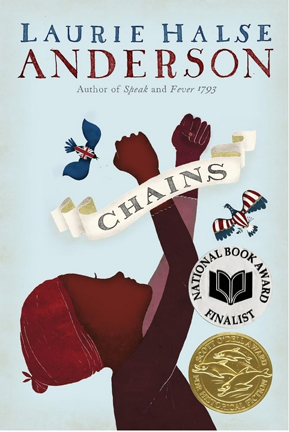
Set in New York at the time of the American Revolution, Chains spans May 27, 1776 to January 19, 1777. As the novel opens, the young teenage protagonist, Isabel, is optimistic about her future as her owner, Miss Mary Finch, has died and had let Isabel know beforehand that she and her five-year old sister Ruth would be free upon her passing. Unfortunately, no lawyer is present to produce the will that shows Miss Finch’s wishes. Mr. Robert Finch, Mary’s nephew and only surviving relative, has come to claim Isabel and Ruth and accuses Isabel of lying about the will. He proceeds to sell Isabel and her sister to Elihu and Anne Lockton from New York. The couple are Loyalists, and while Mrs. Lockton treats Ruth as a kind of pet that she shows off to friends she entertains, she treats Isabel, whom she refers to as “Sal,” in a harsh and degrading fashion, always showing her disfavor.
Isabel has two aims: to protect her sister and to gain freedom. She lives in fear that the Locktons will sell Ruth and thus separate them. At one point Mrs. Lockton provides sweets to them, something that was unusual. But she had laced them with something to make Isabel fall into a deep sleep. When Isabel awakens she learns that Mrs. Lockton has sold Ruth into slavery in the West Indies. This crushes Isabel, who is unable to escape due to constant monitoring by the Locktons.
While doing errands in town for Mrs. Lockton, Isabel meets Curzon, a teenage slave of Mr. Bellingham, a Patriot. Curzon asks Isabel if she would be willing to spy on the Locktons to get information to the Patriots. Initially Isabel refuses but then begins doing so. Mrs. Lockton finds out and punishes her by branding her cheek with an “I” for “insolence.” It takes Isabela six days to regain consciousness after the branding.
Mrs. Lockton makes Isabel care for Lady Seymour, Elihu’s aunt, who lives in town. As Isabel goes to town she is able to deliver messages about Loyalist activities to the Patriot soldiers. Lady Seymour has compassion for Isabel, treating her with kindness and feeding her well. Her house burned in the great fire of New York (September 21, 1776), and Isabel saves her as well as a portrait of her husband and some letters that were dear to her. This becomes important late in the book as Lady Seymour, then an invalid and unable to speak, gestures to Isabel that she approves of her taking coins that she had saved.
The Locktons don’t recognize Isabel as intelligent, which works to her advantage when she is in the room delivering food or waiting for orders when Mr. Lockton is talking with other Loyalists. Isabel learns of the plot to kill Gen. George Washington and shares this with Patriots who come and arrest Mr. Lockton. However, he is soon released and later escapes by hiding in a barrel of cheese. Readers learn that Ruth has not been sold to the West Indies but rather sent to Charleston, South Carolina. Isabel plots her escape for the night that people are distracted by a celebration of Queen Charlotte of Great Britain’s birthday. Though Mrs. Lockton had Isabel locked in a potato bin during the ceremonies, she manages to dig her way out, find a pass and forge papers showing she is free.
Curzon, who had fought in battle for the Patriots, was shot in the leg and held at Bridewell as a prisoner of war. Isabel is able to see him by bribing the guards with food. On the night of her escape, she goes to Bridewell and says she was sent to clean the cells where “prisoners been dropping dead like flies. Fever.” “Curzon lay insensible, his skin burning with fever, his eyes rolled up into his head. I called his name and pinched him, but he did not look my way nor speak a word.” Isabel claims Curzon is dead, loads him in a wheelbarrow and covers him with a filthy blanket. The two manage to make it to the wharf and to a boat. “I rowed that river like it was a horse delivering me from the Devil. My hands blistered, the blisters popped, they re-formed and popped again. I rowed with my hands slick with blood … The sun rose beyond the water, at the other side of the river. I was on the west bank. I was in Jersey. I had set myself free.” At this point Curzon awakes asking where they are, and Isabel replies “I think we just crossed the river Jordan.” The book ends with Isabel asking Curzon if he can walk and with an advertisement for the sequel Forge that gives the account of Isabel Gardner (formerly Sal Lockton) and companion Curzon Bellingham.
The first teaching strategy for Chains is a set of ten questions designed to guide students in a close reading and deeper study of the novel. These questions may be used as the basis of class discussions, exams or essays.
Questions for Study and Discussion for Chains 1. How do Isabel’s and Curzon’s views of freedom differ in chapter 6? Also consider whether this changes as the novel progresses. 2. What evidence exists that Mr. Lockton is conspiring against the Patriots? Trace his journey from the point that he is arrested to the last mention of him. 3. In chapter 29 Isabel speaks of being “chained between two nations.” What does this mean? 4. Isabel’s grandfather speaks to her about the river Jordan in chapter 26, and in the last paragraph of the book, Isabel states “I think we just crossed the river Jordan.” What is the significance of the river Jordan?
5. Discuss the circumstances by which Isabel secures a copy of Thomas Paine’s Common Sense in chapter 39. How does the pamphlet influence her in later chapters? 6. How does the author contrast Lady Seymour and Mrs. Lockton in chapter 41? 7. In what ways was the relationship between Isabel and Lady Seymour a reciprocal one where each benefited? Consider especially the events of chapters 31 and 44. 8. It may be said that at the time of Chains, both Isabel and America are rebellious, young, and conflicted. Explain. 9. Identify three scenes that you believe are the most important in Chains and explain why each is key to the novel. 10. The trilogy of which Chains is book one is called Seeds of America. What role do seeds play in the novel?
While these questions help to ensure close reading and provide opportunities to check for student understanding in a traditional way, the next activity engages students in a more creative, nontraditional manner as they use symbolic thinking and hands-on creativity.
Coat of Arms Overview and Instructions
A coat of arms is a visual design in the form of a shield, that goes back to Medieval days when families and communities used them to show their identity. The coat of arms includes a motto or slogan that captures the important essence of the family, nation, school, or in our case, Chains. A coat of arms can be elaborate, including features such as “supporters” (visuals on each side of the shield) and “toppers” (one or more visuals at the top such as a crest, torse, helmet, or crown).
This assignment consists of three parts: 1) Pre-writing via the writing frames for the coat of arms; 2) The visual coat of arms; 3) A paper that explains the symbols chosen in connection with the character the student chose from Chains.
Visual Coat of Arms
The slogan “Per Aspera ad Astra” is Latin for “Through hardships to the stars” which is why the top of the crest features stars. There are three stars, each with an initial, representing Isabel in the middle and Curzon and Ruth on each side. The pre-writing in Table 1 provides additional insights about the symbols and colors used in Isabel’s shield.
The White House has issued complaints about the history on display in our national museums, complaining that it is too negative, that it portrays the past as a place of hurt. Yet, I would argue that historians, those in the academic world, museum directors, and local historians have been doing their job — and doing it well.
I am a local historian in Ithaca, New York, writing mostly about the place where I live and the region that surrounds it. By listening and observing the work of others, I have learned about Rosie, a young immigrant woman who led a strike in 1913 in Auburn, New York. I have come to see H. H. Coleman as an inadvertent historian whose columns in the Colored American in the 1880s, described the social life of Black people in my town. I have learned about Juanita Breckenridge Bates who led the fight for suffrage in my town and the curious fact, that her husband, in 1917, forgot to turn over his ballot to affirm the fact that women should have the vote. I have learned about Lizzy the enslaved woman who was suddenly “disappeared” from her home in Caroline and sold in the south just as New York was passing a law in 1827 to abolish slavery in the state. I have come to know about Rev. Henry Johnson who brought the AME Zion church in Ithaca into being, but while lecturing around the state was beaten 17 times. I know that the first Jewish rabbi in Ithaca arrived in 1915 where he and his wife had a child; then moving on to Alabama his family was listed as having a child born in Ithaca — with Greece written in pencil above young David’s name, no one in Alabama knowing about Ithaca, New York.
Small things. But they tell a greater picture. That life in the past was not always a rosy place, that laborers had to strike for better working conditions, that Black people fled here and then away again because this was not far enough away from the federal marshals unleashed by the Fugitive Slave Act of 1850. I learned that local women worked hard to achieve equality in the law by sending a petition to Albany in 1878 asking that the word male be removed from the state constitution, and that petition, while registered, was then deposited in the trash and never heard of again. So, the women had to go to work again to gain equal rights.
Opening up the faults of the past does not tear down our country but rather it aids us in rising above it. It allows us to see that we can change for the better, recognize our faults, and strive to bring about a pluribus unum. The truth of the past allows us to see that problems and faults can be overcome, that there are moral truths worth fighting for, that individuals matter. It is this diversity that has been uncovered over the past 50 years that has broadened our view of the past and is displayed in museums across the land.
This country was not a place of peace and harmony but a place where individuals had to step out of line to make “good trouble” to bring about necessary change. That story needs to be told ‘lest we believe that the past was unlike the present where there are tensions and contests and inequities that need to be resolved for this be a true democracy.
Historians are doing their job. It is now up to those in power and voters to see that where there is inequity we work for fairness, where there is harm, we bring balm, where there is strife we talk to each other to make the country and the world better places.
How Rightwing Money Tries to Shape the Teaching of American History
By Alan Singer
The Bill of Rights Institute sponsors events and provides scholarships for the annual conference of the National Council for the Social Studies. On the face of it, it seems innocuous, until you dig a little deeper. The NCSS sells sponsorships, display booths, and sessions that combined can cost a publisher or an organization almost $15,000 which it uses to cover the cost of the convention. At the 2024 NCSS National Conference in Boston, Bill of Rights Institute representatives conducted ten sessions. I have no idea what the Bill of Rights Institute actually pays, but I do know the money and their curriculum initiatives come from the rightwing Koch Foundation and its network of aligned organizations including Americans for Prosperity and the Stand Together Trust. In a 2017 interview with the conservative research group Accuracy in Academia, the President of the Bill of Rights Institute claimed it was working with “approximately one-quarter of the nation’s secondary school teachers in American history, civics, and social studies.”
Koch Industries, the second largest privately held company in the United States, is a $115 billion conglomerate that owns oil refineries and pipelines, markets oil, coal, and chemicals, wood pulp and paper. It uses the Koch Foundation and network to fund conservative causes including challenges to climate science, support for corporate tax cuts, and eliminating federal regulations and environmental controls. The Koch network channeled over $9 million to Project 2025 advisory groups. Other major financial backers of the Bill of Rights Institute include the Adolph Coors Foundation, the Lynde and Harry Bradley Foundation and the Bradley Impact Fund, and the Sarah Scaife Foundation, all donors to the Heritage Foundation for creation of Project 2025. Much of that money was channeled through and the Donors Capital Fund.
In 2014, Bill Bigelow, writing for the Zinn Education Project, accused the Koch Brothers of trying to shape social studies curriculum through their Arlington, Virginia-based Bill of Rights Institute, founded in 1999. According to Bigelow, the Bill of Rights Institute’s tactics to infiltrate social studies include presentations at conferences, essay contests for students, and free seminars for teachers on topics like “Being an American,” “Preserving the Bill of Rights,” and “Heroes and Villains: The Quest for Civic Virtue.” Bigelow argued that their curriculum material “cherry-picks the Constitution, history, and current events to hammer home its libertarian message that the owners of private property should be free to manage their wealth as they see fit.” In one lesson students learn, “The Founders considered industry and property rights critical to the happiness of society.” Of course in many cases their belief in individual property rights included the right to enslave Africans and confiscate land from North America’s indigenous population. In his review of Bill of Rights Institute curriculum and background material, Bigelow found “nothing that could help teachers show students how race and social class shaped the U.S. Constitution” and “nothing that invites students to think about the Constitution from the point of view of anyone other than the elites who drafted it,” including the new nation’s enslaved population.
I attended a regional social studies council conference where a representative from the Bill of Rights Institute made multiple presentations including one on African American participation in the American War for Independence. The lesson plan and supplementary material is available of the Bill of Rights Institute’s website (https://billofrightsinstitute.org/lessons/paths-to-freedom-african-americans-and-the-revolutionary-war). With the Trump administration’s war on museum displays and social studies curriculum that portray negative aspects of U.S. history like the brutality of chattel slavery, I think it is a good example of how the Bill of Rights Institute skews the teaching of American history in line with patriotic history as championed by Project 2025 and the Trump administration’s The 1776 Report. This lesson acknowledges slavery but emphasizes, I believe incorrectly, how the American Revolution was a significant step towards emancipation using isolated examples to support its contentions. The reality is that with the development of the cotton gin in the 1790s and the expansion of cotton production and textile manufacturing at the start of the 19th century slavery in the United States expanded exponentially.
Excerpts from a statement by the Bill of Rights Institute followed by my comments in italics.
The resistance against Great Britain and the Revolutionary War inspired American colonists to think about their natural and constitutional rights. The language and principles of liberty, equality, and self-governance led White and Black Americans to question the institution of slavery and to challenge it more directly. Their diverse efforts led to the largest emancipation in world history at that time and freed an estimated 100,000 enslaved people.
This is misleading. Neither the Declaration of Independence nor the Constitution challenged the existence of slavery in what would become the United States. A majority of the men who wrote both documents were slaveholders. A statement blaming the King of England for imposing the slave trade on British colonies was removed from the Declaration of Independence. The Constitution indirectly acknowledged the legitimacy of slavery with the three-fifth compromise and provisions for the capture and return of freedom-seekers.
Some colonists acknowledged the moral wrong of slavery while protesting British violations of their rights in the 1760s and 1770s. Pamphleteer James Otis wrote that, “The Colonists are by the law of nature free born, as indeed all men are, white or black.” Pennsylvanian Benjamin Rush wrote, “It would be useless for us to denounce the servitude to which the Parliament of Great Britain wishes to reduce us, while we continue to keep our fellow creatures in slavery just because their color is different from ours.” While some colonists addressed the contradiction of slavery and freedom, Black Americans challenged the institution.
Neither George Washington nor Thomas Jefferson freed enslaved Africans that they owned during their lifetimes. A 1773 letter written by Patrick Henry, who is remembered for declaring “Give Me Liberty Or Give Me Death,” is telling about the attitudes of white colonialists about the institution of slavery. In the letter, Henry wrote “Would any one believe that I am Master of Slaves of my own purchase! I am drawn along by ye. general inconvenience of living without them.”
Enslaved persons appealed to revolutionary ideals to argue for their natural rights. In 1773, four enslaved persons in Massachusetts petitioned the legislature for their freedom “which, as men, we have a natural right to.” The following year, a group of enslaved men presented a freedom petition claiming their natural rights and right to consent. “We have in common with all other men a natural right to our freedom without being deprived of them by our fellow men.” The legislature did not yet act upon the petitions, but Black Americans continued to petition for their freedom during the war as did Nero Brewster and 19 other enslaved individuals in New Hampshire in 1779.
The petitions were almost always unsuccessful.Only one of the original thirteen colonies, Massachusetts, outlawed slavery. Most of the enslaved Africans emancipated during the war were emancipated by the British.
Once the Revolutionary War began in 1775 at Lexington and Concord, free and enslaved Blacks joined both the patriot and British sides. Several Black patriots fought bravely at the Battle of Bunker Hill alongside White soldiers, but General George Washington forbade their service in the Continental Army that fall. However, dire manpower needs caused Washington and Congress soon to reverse that policy. The differing states had varied recruiting policies during the war: only South Carolina and Georgia prevented all Blacks from serving. A total of 5,000 free and enslaved Blacks fought for the patriot side throughout the war.
After Lord Dunmore offered freedom to any enslaved Africans who escaped to the British lines, an estimated 20,000 former slaves fought for their freedom by joining the British. The most famous of these was Titus Cornelius, Colonel Tye, who initially fought with Virginia’s Ethiopian Regiment and later led the New Jersey region’s Black Brigade.
Three Pounds Reward – Run away from the subscriber, living in Shrewsbury, in the county of Monmouth, New Jersey, a Negroe man, named Titus, but may probably change his name; he is about 21 years of age, not very black, near 6 feet high; had on a grey homespun coat, brown breeches, blue and white stockings, and took with him a wallet, drawn up at one end with a string, in which was a quantity of clothes. Whoever takes said Negroe, and secures him in any gaol, or brings him to me, shall be entitled to the above reward of Three Pounds, proc. And all reasonable charges paid by John Corlis. Nov. 8, 1775.
The British consistently encouraged enslaved persons to escape to support the British war effort and disrupt the American cause rather than out of a sincere desire for Black freedom.
During peace negotiations George Washington demanded that the British return formerly enslaved Africans including people he claimed to own as contraband. The British refused and evacuated as many as 20,000 Black Loyalists to Nova Scotia and other parts of the British empire.
During the war, General Washington’s aides, John Laurens and his friend Alexander Hamilton, developed an emancipation plan. In 1779, Congress endorsed their plan to raise a contingent of 3,000 enslaved men in South Carolina and Georgia who would be granted their freedom in exchange for military service. The legislatures of those two southern states rejected the scheme because of their opposition to emancipation and to arming enslaved persons.
In November 1775, George Washington issued an order barring both free and enslaved Black men from serving in the colonial army. In January 1776, Washington permitted the enlistment of free Black men who already were serving in the army and in 1777, all free Black men were permitted to join. Only Rhode Island offered freedom to enslaved men who joined the army. In a letter to Laurens’ father, Washington explained his fear that if the colonists did not arm enslaved Africans and offer them freedom, the British would and the war could be lost. Despite Washington’s pragmatic change of position, the plan was never implemented.
Bill of Rights Institute Guiding Questions:
How did African Americans participate in the Revolutionary War?
How did their actions reflect a desire to enjoy their natural rights?
Objectives:
Students will be able to connect actions taken by African Americans during the Revolutionary War to an understanding of natural rights of equality and justice.
Students will summarize the main ideas of historic texts.
Students will create an argument supported by evidence from primary sources. How did African Americans participate in the Revolutionary War? How did their actions reflect a desire to enjoy their natural rights?
These materials are missing from the Bill of Rights Institute’s suggested documents.
A. This charge against the King of England was removed from the original draft of the Declaration of Independence before it was signed on July 4, 1776:“He has waged cruel war against human nature itself, violating its most sacred rights of life and liberty in the persons of a distant people who never offended him, captivating and carrying them into slavery in another hemisphere, or to incur miserable death in their transportation thither . . . Determined to keep open a market where men should be bought and sold, he has suppressed every legislative attempt to prohibit or to restrain this execrable commerce.”
B. Boston King’s Escape to the British Lines (1779): “As I was at prayer one evening, I thought the Lord Heard Me, and would mercifully deliver me. [P]utting my confidence in him, about one o’clock in the morning, I went down to the river side and found the guards were either asleep or in the tavern. I instantly entered the water, but when I was a little distance from the opposite shore, I heard the sentinels disputing among themselves. One said, I am sure I saw a man cross the river. Another replied, there is no such thing. When I got a little distance from the shore I got down on my knees and thanked God for this deliver-ance. I traveled until five o’clock in the morning and then concealed myself until seven o’clock at night, when I proceeded forward thro’ brushes and marshes for fear of being discovered. When I came to the river, opposite Staten Island, I found a boat and altho it was near a whale-boat, I ventured into it and cutting the rope, I got safe over. The commanding officer, when informed of my case, gave me a passport and I proceeded to New York.”
C. Pennsylvania Gazette on April 12, 1780 reported on a Monmouth County raid led by Colonel Tye:On the 30th ult. a party of Negroes and Refugees, from the Hook, landed at Shrewsbury in order to plunder. During their excursion, a Mr. Russel, who attempted to make some resistance to their depredations, was killed, and his grandchild had five balls shot through him, but is yet living.” On September 9, 1780, Philadelphia Gazette reported: “One of these attempts (and one which very nearly proved successful) was made about the 1st of September, 1780, by a body of Refugees black and white, including among the former the mulatto leader known as “Colonel Tye.” The party made an unexpected attack on Huddy’s house, which was bravely defended by himself and a girl of about twenty years of age, named Lucretia Emmons. The house had been a station for a detachment of the militia, and fortunately the guard had left there several muskets, which the girl now loaded as rapidly as possible and handed to Huddy, who fired them successively from different windows, wounding several of the assailants and causing them to greatly overestimate the number of defenders. This caused them to shrink from further direct attack, and they then set fire to the house, which, of course, ended all hope of successful resistance on Huddy’s part, and seeing the flames beginning to spread, he, to save his house, agreed to surrender on condition that they would extinguish the fire, which terms they accepted.”
D. George Washington, while headquartered at Newburgh, New York, objected to British plans to evacuate formerly enslaved Africans as a violation of the provisional peace agreement and he sought to find and reacquire people he claimed as his own property. In an April 1783 letter to Benjamin Harrison, the Governor of Virginia, Washington wrote: “I transmitted the list of your Slaves to a Gentleman; a worthy active Man, of my acquaintance in New York and requested him to use his endeavors to obtain and forward them to you. All that can be done, I am sure he will do, but I have but little expectation that many will be recovered; several of my own are with the Enemy but I scarce ever bestowed a thought on them; they have so many doors through which they can escape from New York, that scarce any thing but an inclination to return, or voluntarily surrender of themselves will restore many to their former Masters, even supposing every disposition on the part of the Enemy to deliver them.”
E. Virginians Petition to Protect Slavery (1784):“Some men of considerable weight to wrestle from us, by an Act of the legislature, the most valuable and indispensable Article of our Property, our SLAVES by general emancipation of them. … such a scheme indeed consists very well with the principles and designs of the North, whose Finger is sufficiently visible in it. … No language can express our indignation, Contempt and Detestation of the apostate wretches. … It therefore cannot be admitted that any man had a right … to divest us of our known rights to property which are so clearly defined.”
F. Article in the New-York Packet, April 4, 1785:“It would be greatly injurous to this state if all the Negroes should be allowed the privileges of white men, unless there could be derived some possible means consistent with liberty, to separate them from white people, and prevent them from having any connection or intercourse with them . … [I]f they are emancipated on any other terms, it must be evident to the most common understanding, what will be the consequence in a short time; besides the shame we should most inevitably incur from a mixture of complexions, and their participating in government, … still greater consequence is to be dreaded, which is a total subversion of our liberties.”
G. Jupiter Hammon, poet and minister, was enslaved on Long Island. In 1786, he addressed this statement on slavery to the African population of New York State:“Now I acknowledge that liberty is a great thing, and worth seeking for, if we can get it honestly, and by our good conduct, prevail on our masters to set us free. That liberty is a great thing we may know from our own feelings, and we may likewise judge so from the conduct of the white people, in the late war. How much money has been spent, and how many lives have been lost, to defend their liberty. I must say that I have hoped that God would open their eyes, when they were so much engaged for liberty, to think of the state of the poor blacks, and to pity us. He has done it in some measure, and has raised us up many friends, for which we have reason to be thankful, and to hope in his mercy.”
H. According to the Mount Vernon library, seventeen members of the Mount Vernon enslaved population, fourteen men and three women escaped, many to a British warship anchored in the Potomac River. Hercules Posey, George Washington’s cook, and Ona Judge, Martha Washington’s personal servant successfully escaped bondage during Washington’s Presidency while the family was in Philadelphia. They fled to freedom when Washington tried to rotate them back to Virginia to avoid Pennsylvania’s emancipation laws. Posey was later sighted in New York City. Frederick Kitt, who oversaw the executive residence in Philadelphia, placed an advertisement in the Philadelphia Gazette and Daily Advertiser offering a $10 reward for Judge’s capture. In 1847, The Liberator published a letter from Reverend Benjamin Chase describing a visit with Ona Judge Staines who was now elderly where she recounted her escape. From Philadelphia Judge secured passage on a ship bound for Portsmouth, New Hampshire. A few months after arriving in Portsmouth, Judge was recognized by a friend of Martha Washington’s granddaughter and George Washington enlisted the customs collector there, a federal employee, in an unsuccessful effort to capture Judge. The runaway slave ad and The Liberator article are included on the Bill of Rights Institute web page as “Further Reading,” but not the letter from Washington to the Portsmouth Customs Collector.
I. Letter from President George Washington to Joseph Whipple, Customs Collector, Portsmouth, New Hampshire, November 28, 1796:I regret that the attempt you made to restore the girl (Oney Judge as she called herself while with us, and who, without the least provocation absconded from her Mistress) should have been attended with so little success. To enter into such a compromise, as she has suggested to you, is totally inadmissible, for reasons that must strike at first view: for however well disposed I might be to a gradual abolition, or even to an entire emancipation of that description of People (if the latter was in itself practicable at this Moment) it would neither be politic or just, to reward unfaithfulness with a premature preference; and thereby discontent, beforehand, the minds of all her fellow Servants; who by their steady adherence, are far more deserving than herself, of favor. … If she will return to her former Service, without obliging me to resort to compulsory means to effect it, her late conduct will be forgiven by her Mistress; and she will meet with the same treatment from me, that all the rest of her family (which is a very numerous one) shall receive. If she will not, you would oblige me, by pursuing such measures as are proper, to put her on board a Vessel bound either to Alexandria or the Federal City.”
Four books that have influenced my teaching of U.S. history are: the volumes in the Jefferson Papers Project, The Life of Henry Adams, The Life of Arthur Schlesinger, and Our Fragile Freedoms. These books have left a profound influence on me because each of them included a perspective of 50 years or more.
Eric Foner’s Our Fragile Freedoms is a series of selected documents and book reviews that he has authored over 250 years of our history. It is a collection of human stories in addition to documents, perspectives, historiography, and scholarly insights. In my reading I discovered new information and perspectives about enslaved persons, laborers, immigrants, and women. I have also met Eric Foner, our lives share a similar chronology of the second half of the 20th century and the first 25 years of the 21st century. Just when I thought I had mastered everything that needs to be taught in high schools, colleges, and in public discussions, I discovered somethings that are new and important in his book.
“Our Fragile Freedoms gathers together nearly sixty book reviews and opinion pieces I have written over the past quarter century, Originally published in venues such as the New York Review of Books, London Review of Books, The Nation, and The New York Times, they reflect a period of remarkable creativity among American historians but also intense controversy over the teaching, writing and public presentation of history. The book examines history as refracted through the prism of some of the most influential recent works of scholarship, while at the same time shedding light on my own evolution as an historian.” (Introduction, page xv)
The insights into the U.S. history curriculum are helpful to teachers who want to engage their students in investigating history and discussing the concept of freedom. Here are some examples:
1.Colonial America:“In South Carolina and Georgia, however, the disruption of the War for independence produced not a weakening of commitment to slavery, but the demand that the Atlantic slave trade be reopened. At the insistence of these states, the Constitutional Convention of 1787 forbade Congress from abolishing the importation of slaves until 1808. Given this window of opportunity, South Carolina brought in tens of thousands of new slaves, further reinforcing the African presence in the low country Black society.” (page 22)
2.President Washington:“Thompson (Mary Thompson, author of “The Only Unavoidable Subject of Regret: George Washington, Slavery, and the Enslaved Community at Mount Vernon”, 2019) offers various explanations for Washington’s refusal to speak or act publicly against slavery. She points out that freeing his slaves would have meant financial disaster for his family. Like other Virginia planters, Washington was chronically in debt, largely because of his taste for luxury goods imported from Britain. Indeed, in 1789 he had to borrow money to pay for his journey to New York where his inauguration as the first president was to take place.” (page 35)
3. Fugitive Slave Law:“The first arrest under the Fugitive Slave Act of 1850 took place in New York-a city whose economic fortunes were closely tied to the cotton trade, and whose political establishment was decidedly pro-southern. On September 16, 1850, eight days after President Millard Fillmore signed the measure, two deputy U.S. marshals arrested James Hamlet at his job as a porter in a local store. Hamlet had escaped from Baltimore two years earlier and settled in Williamsburg, a Brooklyn village with a small Black population, along with his wife and three children, all born in Maryland.” (page 53)
4. Emancipation Proclamation: “’I cannot make it better known than it already is, that I strongly favor colonization,” Lincoln said in a message to Congress less than a month before he issued the Emancipation Proclamation. Oakes (Professor James Oakes, CUNY) calls Lincoln’s August 1862 meeting with Black leaders (not including Douglass), where he urged them to support colonization, “bizarre,” and explains it as an effort to “make emancipation more palatable to white racists.” And he notes, Douglass reacted with one of his most bitter criticisms of the president, “Mr. Lincoln,” he wrote, “assumes the language and arguments of an itinerant colonization lecturer shows all his inconsistencies, his pride of race and blood, his contempt for Negroes and his canting hypocrisy. (page 72)
5. Reconstruction:“Grant’s contemporaries recognized the Civil War as an event of international significance. One hundred and fifty years after the conflict began, the meanings they ascribed to it offer a useful way if outlining why it was so pivotal in our own history. The Civil War changed the nature of warfare, gave rise to an empowered nation-state, vindicated the idea of free labor, and destroyed the modern world’s greatest slave society. Each of these outcomes laid the foundation for the country we live in today. But as with all historical events, each outcome carried with it ambiguous, even contradictory, consequences.” (page 85)
As teachers, we need to understand the big picture of historical decisions and events over time. This is why it is important for students to learn about continuity and change as one of the core skills of our discipline. Our Fragile Freedoms helped me to grasp the complexity of the concepts of freedom and equality that social studies teachers introduce in kindergarten.
An important article and commentary in the book is “Everyday Violence in the Jim Crow South.” (pp. 201-210) This review of By Hands Now Known: Jim Crow’s Legal Executioners, by Margaret A. Burnham, New York Review of Books, April 6, 2023, provides specific examples of the abuse of power by people in local and state government against innocent citizens.
“In Westfield, a town near Birmingham, a female white clerk at a local store, claiming that a Black customer, William Daniel, had insulted her, called the police. When an officer arrived, he almost immediately shot and killed the alleged offender, even though, as Burnham laconically remarks, Daniel had committed no crime: ‘even in Alabama, there was no law against, ‘insulting a white woman.’” (p. 203)
Another commentary that engaged my interest as a high school teacher was “Tulsa: Forgetting and Remembering.”(pp. 211-220) The information in the Review of The Ground Breaking: An American City and Its Search for Justice by Scott Ellsworth in the London Review of Books, September 9, 2011, provides new insights and perspectives to this horrific tragedy that began with a minor encounter between two teenagers. Scott Ellswoth is from Tulsa and became interested in this race riot in his research for a high school history paper. He pursued his passion of this massacre as a college student at Reed College, and throughout his adult life. The discussion about the importance of local research has relevance to the teaching of history and its relevance to project-based learning.
The review of Half American: The Epic Story of African Americans Fighting World War II at Home and Abroad by Matthew F. Delmont and An Army Afire: How the U.S. Army Confronted Its Racial Crisis in the Vietnam Era by Beth Bailey 2023) left me feeling uncomfortable. I think many teachers emphasize the role of the Tuskegee Airmen in teaching World War II and follow it up with a five-minute talk on President Truman’s Executive Order to embrace “equality of treatment and opportunity” in the military regardless of race, religion, and national origin. Because of my ignorance in this area, I never included examples of Jim Crow discrimination and the race problem in our armed forces. Our Fragile Freedoms provides graphic examples. (pp. 232-243)
In the middle of the book there are some of the most important insights and perspectives for teachers of 20th century United States History. They have a direct relationship to what students are thinking about today as they listen to or witness events that are challenging the values of liberty, equality and social justice. They offer teachers critical questions of inquiry regarding the continuity and change of America’s core values from the Declaration of Independence, Reconstruction Era, and Civil Rights movement. Allow me to summarize from examples on the New Deal and Civil Rights era from pages 243-267.
“We will never know precisely why Parks refused to leave her seat when ordered to do so, her decision was not premeditated but neither was it completely spontaneous. Perhaps it was because an all-white jury in Mississippi had just acquitted the murderers of Emmett Till, a Black teenager who had allegedly whistled at a white woman. Perhaps the reason was that she had inadvertently boarded a bus driven by the same driver who had evicted her twelve years earlier. Parks knew that talk of a boycott was in the air. In any event, in the wake of her arrest the boycott began.” (p. 248)
In the review of Riding for Freedom, teachers might ask if the foreign policy of the Kennedy Administration on the Cold War was mutually exclusive from the domestic policy of integration and racial justice. Many American presidents have faced challenging decisions regarding their promise for domestic reforms and unexpected international conflicts. Kennedy experienced this in his first year as president.
“Certainly, the photographs that flashed across the world embarrassed the White House. But the conflict with the Soviets also inspired deep distrust of any movement that included critics of American foreign policy. After a telephone conversation in which he urged Martin Luther King Jr. to restrain the riders, Robert Kennedy remarked to an aide, ‘I wonder whether they have the best interest of their country at heart.’” (pp. 253-254).
“The continuing distortion of the period (Reconstruction) by historians raised a troubling question, King had long identified the movement with core American values inherited from the nation’s founding. But what, in fact, were the nation’s deepest values? All men are created equal? Or something more sinister, exemplified by Reconstruction’s violent overthrow? King had originally believed, he told the journalist David Halberstam, that American society could be reformed through many small changes. Now, he said, he felt ‘quite differently,’ ‘I think you’ve got to have a reconstruction of the entire society, a revolution of values.’ Was the movement the fulfilment of American values or their repudiation?” (pp. 263-264)
These excerpts are only appetizers for the full meal that is within each review and the entire book. As students think about and debate the civil rights era, they gain an understanding of the civil rights movement, its brutality, its injustice, its inequality, and its struggle. Unfortunately, too many students only know one sentence from Martin Luther King’s speech, “I have a dream….” Teachers should have students read or watch the entire speech.
“We must forever conduct our struggle on the high plane of dignity and discipline. We must not allow our creative protests to degenerate into physical violence. . . . The marvelous new militancy which has engulfed the Negro community must not lead us to distrust all white people, for many of our white brothers, as evidenced by their presence here today, have come to realize that their destiny is tied up with our destiny. . . .
We cannot walk alone. And as we walk we must make the pledge that we shall always march ahead. We cannot turn back. There are those who are asking the devotees of civil rights, “When will you be satisfied?” We can never be satisfied as long as the Negro is the victim of the unspeakable horrors of police brutality.
The genius of this book is that each chapter offers a new insight, a scholarly perspective, and a valuable lesson. I learned something new about integration, voting, the censorship of speech, the Chicago riots in 1968, and progressivism. The section on History, Memory, Historians is a must read for every pre-service teacher and every social studies teacher. The lessons here about historical omissions, social and intellectual history, and the lessons of history. Our Fragile Freedoms should shape the generation of social studies/history teachers who will be teaching students in the second quarter of the 21st century!
Ring Shout, Wheel About: The Racial Politics of Music and Dance in North American Slavery, by Katrina Dyonne Thompson (University of Illinois Press, 2014)
Reviewed by Dr. Thomas Hansen
Katrina Dyonne Thompson draws on her work over the years as a student and then a faculty member doing research on not only the role of African music and dance in the lives of Black slaves in the US but also on the impressions made upon White observers. The lack of the background music of slaves singing while picking cotton in the fields is an important factor in the scenery. There were 200 years of song and dance among the slaves. Some Whites clung to the stereotype of the “irrepressibly cheerful” Black man singing in the streets despite how “ragged or forlorn” he might actually be (p. 1). However, the days of the happy singing slave who had a natural talent for performing and appearing light-hearted (p. 2) were disappearing.
At the same time Blacks were becoming more successful financially as bondsmen, and as they connected with the entertainment world and more able to access highly successful careers in music and dance, the image of the docile Black who loved to sing and accept their abuse was fading quickly.
Already by the early 20th Century in America, White observers noticed a change in the thrill level of Blacks vis-à-vis their celebrations. Laments one White Georgian on this noticeable change in that they “…don’t sing as they used to… (p. 1) and telling the readers they should have seen the dancing “…of the old darkeys on the plantation.” This change in demeanor and enthusiasm was happening at the same time Blacks were beginning to speak up for themselves as a group.
The “New Negro” was threatening to the established order and some Whites were nervous, indeed. There were a lot of Black persons in the US by the end of the 19th Century, and the notion they were more and more of them unhappy was unsettling to many Whites. Lack of enthusiasm in their dance and movement was a strong and obvious reminder there were many Blacks who were losing their sense of humor.
Actually more a part of an “imagined South” with happy slaves singing in the fields, the music and dance with an African beat often celebrated not only the culture from another continent but also hidden meanings and realities among the slaves here in the US. Many readers have probably heard that the lyrics and melodies had a varity of “hidden meanings” (pp. 108-109). They could be used simply for relating information from farm to farm or in other cases making fun of the White owner being so down on his luck he could not contribute to the holiday celebrations of the slaves.
Still more well-known are the songs of chariots coming to whisk the slaves away to freedom. Ironically, it is some of these songs with the most dramatic lyrics that came to be the most well-loved. With great passion, the slaves sang and danced as they prayed for better lives—usually far from the often rapacious and abusive owners. Slave owners could break up families, selling different members to the highest bidder. Thus, slave auction days came to symbolize frightening events indeed to families with “marketable” workers and healthy children.
Regarding the more technical aspects of the book, Katrina Dyonne Thompson frames the story told here as a performance, dividing into steps the art to be revealed. The author organizes her work into six chapters and an epilogue: 1) The Script: “Africa was but a blank canvas for Europe’s imagination;” 2) Casting: “They sang their home-songs, and danced, each with his free foot slapping the deck;” 3) Onstage: “Dance you damned n’s, dance;” 4. Backstage: “White folks do as they please, and the darkies do as they can: 5) Advertisement: “Dancing through the Streets and act lively;” 6) Same Script, Different Actors: “Eb’ry time I wheel about, I jump Him Crow;” and Epilogue: The Show Must Go On.
Without giving too much of the content away, I will say the book provide a great deal of information in a short space and the author demonstrates the changes of a People as their lives, livelihood, and status change immensely.
The author does a good job of showing how the Blacks transitioned away from giving off images of the happy and irrepressibly cheerful slaves and embracing their roles as performers, becoming successful business people, and welcoming their new voice as they created a distinct sound. They had taken the complex patterns of the West African song and dance (pp. 23-24) of their past, tied to new styles of Native American and other rhythms, and developed a rich urban beat with stylized sequences and a completely new sound.
It is this great change in the origins of the music to something very modern sounding that makes this book a good candidate for use in courses and seminars on the history of the Black sound in the US.
A second use of the book is the connection of music, dance, and historical events.
A third use is the insight the book gives into cultural and linguistic changes of Blacks as they and their art moved away from plantations and into urban centers.
A fourth use of this book is a sort of guide for setting out some basics that could be used in interdisciplinary units and lesson plans in K-12 classrooms.
A fifth use of the book is background reading for educators contemplating making the connections among slavery as a social studies and history topic to other fields (e.g., music, movement, singing).
I recommend the book for these five uses and also for a clear candidate for professional development (PD) sessions. The book would work well in a basic reading course for discussion over 2 to 3 sessions. The book would also work well over 5 to 6 longer sessions during which lesson plans, assignments, and assessment instruments could be developed—whether on site or through a hybrid course structure.
What did Sojourner Truth really say at theWoman’s Rights Convention in Akron, Ohio on May 28, 1851?
Historical Mystery: Read these two accounts of Truth’s speech and analyze their reliability* using the sourcing form. Then answer the question: Did Sojourner Truth really utter the famous phrase: “Ar’n’t I a woman?”
**Reliable: Historians use “reliable” to mean that a source is the most accurate or honest depiction or account of something from the past.
Version 1, written by Reporter, Marius Robinson, for Salem Anti-Slavery Bugle in June 21, 1851:
One of the most unique and interesting speeches of the Convention was made by Sojourner Truth, an emancipated slave. It is impossible to transfer it to paper, or convey any adequate idea of the effect it produced upon the audience. Those only can appreciate it who saw her powerful form, her whole-souled, earnest gestures, and listened to her strong and truthful tones…May I say a few words? Receiving an affirmative answer, she proceeded: “I want to say a few words about this matter. I am a woman’s rights. I have as much muscle as any man, and can do as much work as any man. I have plowed and reaped and husked and chopped and mowed, and can any man do more than that? I have heard much about the sexes being equal; I can carry as much as any man, and can eat as much too, if I can get it. I am as strong as any man that is now…The poor men seem to be all in confusion, and don’t know what to do. Why children, if you have woman’s rights give it to her and you will feel better…But man is in a tight place, the poor slave is on him, woman is coming on him, and he is surely between a hawk and a buzzard.”
Version 2, written April 23, 1863 for the New York Independent by Frances Dana Gage, who had presided over the convention:
“Well, chillen, whar dar’s so much racket dar must be som’ting out o’ kilter. I tink dat, ‘twixt the niggers of de South and de women at de Norf, all a-talking ‘bout rights, de white men will be in a fix pretty soon…Dat man over dar say dat woman needs to be helped into carriages, and lifted over ditches…Nobody eber helps me into carriages or ober mud-puddles, or gives me any best place;” and, raising herself to her full height, and her voice to a pitch like rolling thunder, she asked, “And ar’n’t I a woman? Look at me. Look at my arm,” and she bared her right arm to the shoulder, showing its tremendous muscular power, “I have plowed and planted and gathered into barns, and no man can head me—and ar’n’t I a woman? I could work as much and eat as much as a man, (when I could get it,) and bear de lash as well—and ar’n’t I a woman? I have borne thirteen chillen and seen ‘em mos’ all sold off into slavery, and when I cried out with a mother’s grief, none but Jesus heard—and ar’n’t I a woman?”
Version 1
Version 2
What is the document?
Context:
What event is it describing and when did that event take place?
When was the account written?
Text:
How are these two accounts similar (facts, tone, etc.)?
How are they different?
Subtext:
Who wrote the document?
Are there any clues about who the author was?
Based on your comparison of the sources, what do you think the author’s purposes might have been?
What more do you wish you knew so that you could determine which source is most reliable?
Analysis:Did Sojourner Truth really utter the famous phrase: “Ar’n’t I a woman?” Explain your answer.
The Underground Railroad was a network of churches, safe houses and community centers that led thousands of people escaping slavery to freedom. Northern states like Pennsylvania played a major role in the progression of freedom, and the trail made several stops in New York, including the Southern Tier counties along the Pennsylvania border. Here are some of the local landmarks near Binghamton that played a role in the success of the Underground Railroad, including private homes and churches across the region.
The Seymore Home in Whitney Point, New York
This Whitney Point home was owned by George Seymore in the late 1850s and was a spot along the Underground Railroad network. During that time most people who lived in the area knew the Seymore home was being used to hide and assist escaped enslaved people. According to former Broome County historian Gerald Smith, the home was later converted into an antique shop called the Underground Antiques and eventually turned into a private residence.
Cyrus Gates Farmstead in Maine, New York
The Cyrus Gates Farmstead was once used as a sanctuary along the Underground Railroad. On 30 acres in Maine, Cyrus Gates’ home — referred to as “Gates’ white elephant” — was built in the 1850s by a New York City architect. It was added to the National Register of Historic Places in 1999. Gates was a cartographer and surveyor, as well as a vocal abolitionist. Up in the attic, the Gates home had an emergency hiding place. Tucked behind a hidden panel in the back of a cupboard, escaped slaves could crawl into a 10-by-20 foot secret room in the house’s south wing attic, crouching so as not to hit the four-foot-tall ceiling, when they needed to hide.
Park Church in Elmira, New York
Members of Park Church, originally named the First Independent Congregational Church of Elmira, were active participants in the Underground Railroad. They included John W. Jones, an escaped slave who helped over 800 travel to freedom through Elmira and Jervis Langdon, a local financier who helped Frederick Douglass escape from slavery. The church offered shelter, provided food and finances, and took legal action against slavery. They also prepared a petition to officially record their stance as an anti-slavery church and in 1871, it became Park Church. In 2006, the church was added to the National Park Service’s Network to Freedom program.
Binghamton, New York home of Dr. Stephen D. Hand
During the mid-19th century, the home of Dr. Stephen D. Hand stood at the site of the current Binghamton City Hall. After moving to Binghamton and starting a successful medical practice, he took an active role in the Underground Railroad. Hand opened his doors to those seeking freedom. His home was near two existing African American churches — the Bethel Church and the First Colored Methodist Episcopal Church — which created a trio of spots in close proximity offering help. The home was demolished in the 1960s and Binghamton City Hall took its place. The building has a plaque to recognize the significant role the Hand home placed in the Underground Railroad.
Trinity AME Zion Church of Binghamton
The church, founded in 1838, is a stop on the Downtown Binghamton Freedom Trail, recognized for its role in the Underground Railroad. The historic marker at the site shares its history as originally the AME Zion Church, a site that was a place of worship and safe spot to rest and receive help while traveling. Rev. Jermain Loguen, director of the Underground Railroad in Syracuse, was also pastor at the church in the 1860s.
Despite widespread and prolonged opposition in many northern cities, President Millard Fillmore affixed his signature to the new Fugitive Slave Act on September 18, 1850. It unleashed a torrent of fear amongst the ever-growing populations of free Blacks and freedom seekers that at any minute slave catchers, who now possessed the ability to forcibly enlist civilians to aid in the recapture of those purported to be enslaved.
In Syracuse, already a hotbed of agitation against the odious legislation for several months, local leaders called for a mass meeting at City Hall on October 4 to further demonstrate their collective resistance. Word of the upcoming gathering reached Rev. Jermain Loguen, who was in Troy on missionary work for the African Methodist Episcopal Church. He decided he must return to the city he called home since 1841 to lend his righteous voice to the proceedings.
Following the speech of his friend, Samuel Ringgold Ward, the Black publisher of The Impartial Citizen, Loguen addressed the massive crowd that spilled out of the hall out onto Montgomery and Market streets with the courage and eloquence that characterized his tireless fight against the inhumane institution he’d escaped almost 15 years prior. He declared that he would not be taken into slavery. “What is my life if I am to be a slave in Tennessee . . . I will not live a slave, and if force is employed to re-enslave me, I shall make preparations to meet the crisis as becomes a man.”
For Loguen, those preparations did not include uprooting his wife Caroline and their children and fleeing to Canada, despite the numerous admonitions of friends to do so. Protected as he was in some regard by geography and a strong network of allies, Loguen could make this bold stand. For many other freedom seekers elsewhere in the Union, particularly those in border states like Pennsylvania, the Fugitive Slave Act left them no choice but to continue running further north.
Less than three weeks after Loguen’s stirring call to action, the city of Syracuse found itself at the center of a human tragedy that illustrated perfectly the fear, anxiety, and cruelty engendered by the new legislation. On October 24, 1850, under the headline “Attempted Suicide of a Fugitive,” the readers of the Syracuse Standard, a paper friendly to the cause of abolition, first learned of the tragic ordeal of the Harris family. In response to the passage of the Fugitive Slave Act, William and Catherine Harris and their 3-year-old daughter had fled Philadelphia days earlier in the hopes of gaining safe transport to Canada via Rochester.
Initial reports stated that Harris escaped his own enslavement in South Carolina years earlier, eventually settling in Philadelphia. According to the testimony that Catherine later gave to Syracuse Police Justice Sylvester House, the two were married in 1843 and lived a quiet and peaceful life, and a few years later the couple welcomed the birth of their daughter. Terrified that he might be captured under the auspices of the new law, William made the fateful decision to uproot his family, and they made their way to New York City. There, they procured tickets to Rochester via the Erie Canal.
The real trouble began once they reached Albany on Thursday, October 17. As Mrs. Harris relayed in her testimony, having purchased their tickets for passage to Rochester they boarded their boat. The problems started almost immediately. Captain Hartwell C. Webster refused to return the Harris’s tickets. They were stuck in the cargo hold with large quantities of clams and oysters, delicacies that had become wildly popular all along the canal route in the 25 years since its completion.
The clams and oysters belonged to a merchant named Silas Cowell, who along with one of the boat hand’s, Jeremiah Cluney, began harassing the Harris family that evening. Somehow, they became aware of William’s status as a fugitive. Compounding their predicament was the fact that Mrs. Harris was of markedly lighter skin tone, being described in the New York Tribune[2] as a “mulatto woman, of interesting appearance.”
According to Harris’ testimony, Cluney and Cowell continued threatening to handing them over to slave catchers saying, “no n—– could pass this canal without being taken.” Preying on their fear, these men tormented William and Catherine and their three year-old-daughter for the next two days. They even attempted to extort money from William for passage, aware that the Captain had taken their tickets to Rochester. Mrs. Harris stated that Cluney and Cowell made reference to Syracuse as “the place where they said we would be taken.” After days of ceaseless torment, Catherine Harris could not take it anymore. As she stated in her testimony, she “wants to die rather than be taken by the kidnappers.”
Convinced that the slave catchers were waiting on them in Syracuse, she jumped through the moving boat’s window and into the canal with her daughter in her arms somewhere between Frankfort and Utica. Somehow, she was fished out of the nearly eight feet of water. In the commotion, her daughter slipped out of her grasp. The captain refused to stop the boat to look for her body. William went on deck to beg the captain to stop the boat, but to no avail. Cluney threatened to cut his throat if he did not go back below decks. Their daughter was assumed drowned.
Sometime around 10 p.m., on Monday, Catherine and William retreated to the cargo hold, the depths of their misery unimaginable “awaiting their doom.” In her testimony, Mrs. Harris said Cowell confronted them again saying that the crew was going to “take his head off.” William responded that he would rather do it himself. He took his shaving razor and sliced his own throat. For the next five hours, William lay bleeding next to his wife. All the while, Cluney and Cowell sat there playing cards, yelling racist epithets at him and threatening to “knock his brains out” if he so much as moved.
As the morning sun appeared in the skies outside Canastota on Tuesday, October 22, William was able to jump off the boat and began walking on the towpath towards Syracuse. Catherine recounted being able to see him alongside the boat, while Cluney, acting on the orders of the captain, threatened William with violence if he attempted to rejoin his aggrieved wife. As such, he walked wounded and bleeding alongside the boat for over 20 miles until he collapsed by the Lodi locks, near Beech Street. Catherine reported losing sight of him around this time as the boat continued on into Clinton Square. She remained on the boat as it continued west towards Rochester. There were no slave catchers waiting there. It had all been a grotesque and murderous charade.
According to the reports in the Syracuse Journal, William Harris regained consciousness and threw himself into the canal in front of a moving boat just west of the Lodi locks. The boat’s Captain, V.R. Ogden managed to rescue Harris and bring him into Clinton Square, where he was taken and treated by Dr. Hiram Hoyt, a Syracuse physician with abolitionist sympathies. Though Harris was unable to talk due to the wound on his neck, somehow, he communicated his ordeal to Hoyt, who in turn got word to Rev. John Lisle, a Black preacher in the AME Zion Church and pastor of the Second Congregational Church on Fayette and Almond streets. Rev. Lisle offered to head west towards Rochester to find Catherine, which he did at Montezuma. According to Lisle’s testimony, he encountered no resistance from Captain Webster nor the boat’s crew, a far cry from the harrowing experience of the Harrises.
Upon their return to Syracuse, Catherine provided the testimony upon which this essay is based. As a result of her damning testimony, Justice House issued arrest warrants for Webster, Cluney, and Cowell. The three men were detained in Rochester and brought to Syracuse on charges of assault and harassment. Unconvinced by their testimony, which painted William Harris as a disorderly drunk, they were found guilty, fined and jailed.
According to historian Angela Murphy, the Harrises continued their journey to freedom in Canada, though as a family of two instead of three. Their unimaginable suffering found its way into newspapers all over the union from Wisconsin to Maine, Massachusetts and Pennsylvania, Virginia, and even Georgia. It helped galvanize the opposition to the Fugitive Slave Law in a way that rhetoric could not.
Here in Syracuse, the memory of the Harrises persisted, actuating more strident resistance. This resistance would come to a head less than a year later in one of the most profound acts of civil disobedience of the period, when a righteous mob freed Jerry from his jail cell just a few steps from the Clinton Street bridge where Dr. Hoyt found William Harris bleeding from a self-inflicted wound.
Attempted Suicide of a Fugitive
“On Tuesday afternoon a colored man named Wm Harris, attempted to commit suicide by cutting his throat with a razor, on the towing path, about two miles east of this city. Harris is from South Carolina, and has been residing in Philadelphia for several years past, but on the passage of the Fugitive Slave Law became alarmed for his safety, and started for Canada, accompanied by his wife and child. In New York he procured a passage ticket for Rochester, but at Albany his ticket was taken from him and destroyed by some persons who threatened to deliver him up unless he paid for his passage again. He succeeded in getting as far as Utica, when his fears were again excited by threats of being taken back to Slavery, and says he was informed by persons belonging to the boat that he would certainly be arrested at Syracuse. He became so much alarmed by these repeated threats, (Whether made in jest or earnest it is now impossible to say) that he determined to commit suicide, and advised his wife to drown herself and their child. Taking his razor he jumped on the towing path and made an attempt to destroy himself by cutting his throat, inflicting a terrible wound, and fainted from loss of blood. His wife, with the child in her arms jumped into the canal about the same time, but was taken out by the hands-on-board the boat. The child was not recovered. The wife was carried west through this city, on the boat, [3] leaving the husband upon the tow path.” Source: Syracuse Standard, October 24, 1850.
Rev. Loguen Denounces the Fugitive Slave Law (Syracuse, NY)
“I was a slave; I knew the dangers I was exposed to. I had made up my mind as to the course I was to take. On that score I needed no counsel, nor did the colored citizens generally. They had taken their stand-they would not be taken back to slavery. If to shoot down their assailants should forfeit their lives, such result was the least of the evil. They will have their liberties or die in their defence. What is life to me if I am to be a slave in Tennessee? My neighbors! I have lived with you many years, and you know me. My home is here, and my children were born here. I am bound to Syracuse by pecuniary interests, and social and family bonds. And do you think I can be taken away from you and from my wife and children, and be a slave in Tennessee? Has the President and his Secretary sent this enactment up here, to you,
Some kind and good friends advise me to quit my country, and stay in Canada, until this tempest is passed. I doubt not the sincerity of such counsellors. But my conviction is strong, that their advice comes from lack of knowledge of themselves and the case in hand. I believe that our own bosoms are charged to the brim with qualities that will smite to the earth the villains who may interfere to enslave any man in Syracuse.
I don’t respect this law- I don’t fear it- I won’t obey it! It outlaws me, and I outlaw it, and the men who attempt to enforce it on me. I place the governmental officials on the ground that they place me. I will not live a slave, and if force is employed to re-enslave me, I shall make preparations to meet the crisis as becomes a man.” Source: The Rev. J.W. Loguen, As A Slave and As a freeman. A Narrative of Real Life (Syracuse, 1859), pp. 391-93; Aptheker 306-308



 njcssjournal