New Jersey History: Dr. Martin Luther King, Jr. Discusses the “American Dream,” Drew University, Madison, New Jersey, February 5, 1965

New Jersey History: Dr. Martin Luther King, Jr. Discusses the “American Dream,” Drew University, Madison, New Jersey, February 5, 1965

Source:https://depts.drew.edu/lib/archives/online_exhibits/king/speech/theamericandream.pdf

An audio of the entire speech is available online at: https://depts.drew.edu/lib/archives/online_exhibits/King/index.html

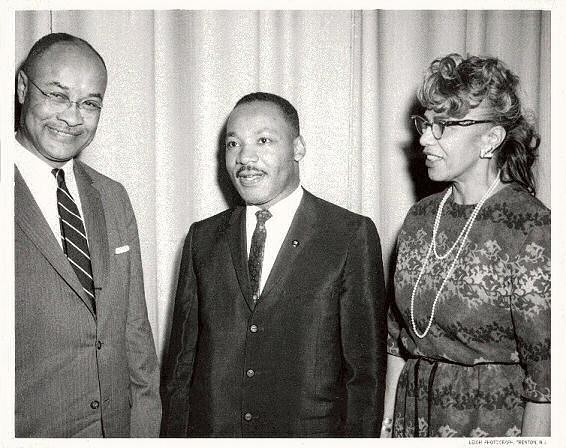
Dr. Martin Luther King Jr. gave his “American Dream” speech to an audience of 5,000 at Drew University. He is with Drew professor Dr. George D. Kelsey and his wife.

A. I would like to use as a subject from which to speak tonight, the American Dream. And I use this subject because America is essentially a dream, a dream yet unfulfilled. The substance of the dream is expressed in some very familiar words found in the Declaration of Independence. “We hold these truths to be self-evident: that all men are created equal; that they are endowed by their Creator with certain inalienable rights; that among these are life, liberty, and the pursuit of happiness.” This is a dream. Now one of the first things we notice about this dream is an amazing universalism. It does not say some men, it says all men. It does not say all white men, but it says all men which includes black men. It doesn’t say all Protestants, but it says all men which includes Catholics. It doesn’t say all Gentiles, it says all men which includes Jews. And that is something else at the center of the American Dream which is one of the distinguishing points, one of the things that distinguishes it from other forms of government, particularly totalitarian systems. It says that each individual has certain basic rights that are neither derived from nor conferred by the state. They are gifts from the hands of the Almighty God. Very seldom if ever in the history of the world has a socio-political document expressed in such profound eloquent and unequivocal language the dignity and the worth of human personality.

B. But ever since the Founding Fathers of our nation dreamed this dream, America has been something of a schizophrenic personality, tragically divided against herself. On the one hand we have proudly professed the great principles of democracy. On the other hand we have sadly practiced the very antithesis of those principles. Indeed, slavery and racial segregation are strange paradoxes in the nation founded on the principle that all men are created equal. But now, more than ever before, our nation is challenged to realize this dream. For the shape of the world today does not afford us the luxury of an anemic democracy, and the price that America must pay for the continued oppression of the Negro and other minority groups is the price of its own destruction. The hour is late and the clock of destiny is ticking out, and we must act now before it is too late.

C. I would like to suggest some of the things that must be done in our nation if this American Dream is to be realized, some of the challenges that we face at this hour; and in facing the challenges we will be able to bring this dream into full realization. I would like to start on the world scale, so to speak, by saying if the American Dream is to be a reality we must develop a world perspective. It goes without saying that the world in which we live is geographically one, and now more than ever before we are challenged to make it one in terms of brotherhood . . . Mrs. King and I had the privilege to journey to that great country known as India. I never will forget the experience of meeting and talking with the great leaders of India, meeting and talking with thousands and thousands of people in the cities and villages all over that vast country. These experiences will remain meaningful and dear to me as long as the chords of memory shall let them. But I must say to you that there were those depressing moments. How can one avoid being depressed when he sees with his own eyes evidences of people by the millions going to bed hungry at night? How can one avoid being depressed when he sees with his own eyes thousands of people sleeping on the sidewalks at night, no houses to go in, no beds to sleep in? How can one avoid being depressed when he discovers that out of India’s population of more than 400 million people, some 375 million make an annual income of less than $80 a year? And most of these people have never seen a doctor or a dentist. As I noticed these conditions, something within me cried out, “Can we in America stand idly by and not be concerned?” And an answer came, “Oh, no, because the destiny of the United States is tied up with the destiny of India and every other nation. And I started thinking about the fact that we spend millions of dollars a day in America to store surplus food. I said to myself, “I know where we can store that food free of charge, in the wrinkled stomachs of the millions of God’s children in Asia and Africa and in South America.

D. I think this is the first challenge and it is necessary to meet it in order to move on toward the realization of the American Dream, the dream of men of all races, creeds, national backgrounds, living together as brothers. If the American Dream is to be a reality, secondly we must get rid of the notion once and for all that there are superior and inferior races. This idea still lingers around in some situations and in some circles . . . There may be superior and inferior individuals academically within all races. But there are no superior and inferior races. But in spite of this, the notion still lingers around . . . We have enough evidence in practical experiences and practical accomplishments of individuals in the Negro community and individuals in other minority groups to demonstrate that there is no truth in the idea of the inferiority of the Negro race, of the superiority of any other race.

Questions

  1. According to Dr. King, what is the American Dream?
  2. In your opinion, are any groups missing from the list described in section A. If so, who is missing?
  3. In section B, why does Dr. King call the United States “schizophrenic”?
  4. In section C, why did Dr. King have an extended discussion of conditions in India?

Dr. King delivered this speech in 1965. In your opinion, are the problems he described still present in American society? Explain.

Apprehensive About Teaching

Apprehensive About Teaching

Adeola Tella-Williams

The attack on Critical Race Theory is creating controversy in education. For the first time in my professional career, I am apprehensive about teaching any subject having to do with race, religion, Blackness, Whiteness and all things cultural. Why? The simple answer lies in the attempted coup of education by some parents over their misunderstanding about Critical Race Theory and conflating it with Culturally Relevant Teaching. IT IS being used as a political ping-pong, mainly by the Republicans to erase parts of American history that mainly deals with the cruelties of slavery and mistreatment of people of color. While apprehensive, I remain true to history and will always teach as I have been doing for the past 20 plus years.

I have been an educator for 21 years. I began my teaching career in East New York, Brooklyn, as a middle school Social Studies teacher at one of the lowest performing schools in New York City. Regardless of the school’s low performance status, my students were some of the smartest and kindest I have ever taught. They were aware of the shortcomings of their reality. They knew the truth and were not afraid to voice their opinions, good, bad or indifferent. It was fun and challenging teaching them, but they took their agency, no one had to give it to them. After a year in Brooklyn, I left in 2000 to teach conversational English in Tokyo, Japan for a half year and returned to East New York for another year. The past two decades, I have been in the Uniondale School District. I took a sabbatical in 2016 to teach in the United Arab Emirates, where I taught Humanities to Arab, continental African, Canadian, South American, and Indian middle school scholars at American International School, Abu Dhabi. This year, I am teaching African and Latinx History to upperclassmen and Global History to 9th graders in Uniondale High School.

In my years as an educator, I have assisted and led many activities and events outside of the classroom; most notably, a student forum on police brutality in the wake of the Michael Brown shooting back in 2014. I also created a girls Rite of Passage program in 2004 at one of the two middle schools in Uniondale. When President Barack Obama was elected in 2008, I assisted the Uniondale High School in planning a “controversial” inauguration assembly in recognition of the first African American elected President of the United States. The program was considered “controversial” because a number of white teachers objected and boycotted the event.

I have also worked with Dr. Alan Singer, professor at Hofstra University, for many years. I asked him to lead a discussion on the complexities surrounding the Iraq war back in 2003 to my middle schoolers and he was the keynote speaker for a forum held between two racially segregated communities, Oceanside and Uniondale. We discussed police brutality and other racially charged issues on Long Island in 2015. The discussion of the U.S. invasion of Iraq and the absence of weapons of mass destructive also produced heated faculty blowback.

I have immersed myself in “controversial,” or as I would prefer to call them, “contemporary issues” my entire career. I am finding that in this day and age, the topics I chose to cover back then would be considered blasphemy today. For example, Bridges was created to foster empathy, and collaboration amongst White, Black and Hispanic students who live in neighboring communities, attend different schools, and have little contact with each other. It is the goal of the program to engage students in the evaluation of contemporary issues related to race, economics, and politics that will lead to well-rounded, active, and engaged citizens. In Bridges, difficult conversations are encouraged and the asking of challenging questions is nurtured. Divergent points of views are not shunned with the understanding that students can agree to disagree with civility. In this program we have discussed the January 6th insurrection, the legacy of segregation on Black and Brown communities, cross-cultural experiences of Black and White students, and other contemporary issues that would make those who dislike Critical Race Theory very uncomfortable.

Back in 2014, when I decided to do the forum about police brutality in the wake of the Michael Brown shooting with my Participation and Government scholars, I did not think of the backlash or its “controversial” nature. I thought about the hopelessness I saw in my students that September. They looked at me as just another teacher. It was as if they gave up on learning and embraced the Read, Answer Questions, Pass a Test and Repeat pedagogical style. But, little did they know, I was not that teacher, I have never been that teacher. Recognizing this hopelessness in the wake of the Michael Brown shooting prompted me to change the way I would teach this course. As it was my first time teaching the course, I wanted to make it real for the students. After all, it’s a “Participation” in Government class. I took that term “participation” literally and decided they would be active, as opposed to passively learning in this course. Therefore, learning through doing became one of the goals. Their hopelessness from my perspective was due to the way the year began, with the shooting coupled with normal senioritis and a genuine boredom for all things related to school. Therefore, empowering their voices became my mission, and so I challenged them to put on a forum on police brutality. After all, our early ancestors, who created great civilizations in Africa, Greece, Rome and the Americas, held forums to gauge the feelings of their subjects on controversial issues. Furthermore, forums give voice to the voiceless and empower citizens to take further action. To me this is how a democratic society prospers; it actively engages young people early on.

Gone are the days of sitting in the class and taking notes on how great democracy is when in reality my students were not having, or seeing, that same example in their day-to-day lives. In their world, fairness was a fairytale. To them education was boring and they were tired and ready to graduate and join the rest of humanity in the rat race called life. However, I refused to let them leave in this manner. I was, and am, still very idealistic and optimistic about education and what it can do for young people charged with taking over, ready or not. Nonetheless, I charged them with putting on a school-wide forum on police brutality. They were very reluctant at first, as they were not used to being placed in leadership positions. But I assured them that the worst that can happen is the principal says no and then they don’t have the forum, but they had to ask first. They asked and to their surprise, not mine, the principal agreed. My principal at the time, was very supportive of student engagement. Having a strong principal makes a world of difference for a teacher like me. She was not afraid to support any program or event that gave students a voice. Again, as their teacher, my concern was not the backlash. My goals were to help them love learning, give them agency and have them practice their voice.

In preparation for the forum, they researched about the Civil Rights Movement and the history of police brutality in America. I felt they needed to see the trend, be informed, and be armed with solid information when they spoke in front of their peers. I wanted them to be confident when they took to the stage. I wanted them to lead. Many scholars are not given the tools to be leaders in real world scenarios. It was important to me to have these non-AP scholars lead an academic forum in front of their peers who only saw them in non-academic settings. These were scholars that always got in trouble; they were not jocks or honor students, just “regular,” sometimes forgotten people. I wanted them to be heard and seen, as they have something to say and lots to give.

All of the above were also my goals in starting the Rite of Passage program. These were also my goals when I decided to be the first advisor of the Bridges High School program. I believe giving scholars the opportunity to lead and participate in real world scenarios makes education palatable – it makes it real. As with science and math, many scholars ask, “When will I need this in real life?” Some teachers are able to show the why and some aren’t. These days however, STEAM and STEM have become the norm. As a history teacher, Historical and Civic Literacy is just as important as STEAM and STEM to me. Making space for these contemporary issues gives students agency and time to hone their Social Studies skills of argumentation, observation, listening, speaking, analyzing, synthesizing and application.

When I started the Rite of Passage program some ten years ago in my district, it was to help girls of color, especially darker hue girls, accept themselves in a world that constantly ignores them. Another goal was to help girls get along better, to learn how to respect each other despite their difference in hair texture, complexion or whatever else distract girls from being their best. While I did not see this program as controversial, today it seems as though it is. With the Crown Act being passed in California and other states, African textured hair seems to be a problem in the workplace and in schools. Girls of color are 5.5 times more likely to be suspended from school, starting in pre-school. Programs like the Rite of Passage aim to reveal the controversial issues that plague Black girls. Many of the girls I had in the program have since graduated college and are well into their careers. I have received Facebook posts and text messages from them referencing our time together and how impactful those times had on them then and now.

Simply put, I am an educator who does not shy away from contemporary topics or historical controversies in and out of the classroom. My goal has always been to make sure scholars love learning and intrinsically love the art of learning about themselves, within the context of mirrors, windows, and glass sliding doors. I also aim to instill the love of learning in order to help them make their communities a place they are proud of and value. My upbringing in a Jamaican-Nigerian household has strongly shaped my approach as an educator. I also received these messages from my upbringing in my African American community after moving to the United States in 1987 from Nigeria.

Curriculum focused on Culturally Relevant Teaching is under attack and it is being interwoven in the debate about Critical Race Theory. While some elements of culture are in Critical Race Theory, the philosophy was not intended for K-12 education. When parents fail to understand the importance of creating safe spaces for scholars to speak about controversial issues or contemporary issues, it marginalizes young people of color. For instance, White teachers make up 79% of the teaching staff across America, and Black and Hispanic teachers make up less than 5% of the teaching staff in predominantly white schools. Where is the diversity of thought when scholars graduate from high school? How are students of color being taught, let alone having their issues addressed in forums or in the classroom? When does a white child meet or interact with a Black or Brown teacher? These are questions that need to be raised in education. But how can we discuss these and other topics when Critical Race Theory is being conflated with Culturally Relevant Teaching and anything having to do with race or culture is seen as divisive rather than an integral part of progress? School is the place to teach and grapple with controversial topics in a responsible way, of course. The attacks on Critical Race Theory and Culturally Relevant Teaching are making it harder to teach controversial topics in history as well as put on programs about contemporary issues as I have done in the past, creating a tense environment to discuss these topics freely and responsibly. I am afraid educators like me will continue to be apprehensive about teaching subjects having to do with race or spear head programs that raise contemporary issues. I am afraid that the attack on CRT will take over education and take us back to a time when teachers wrote notes on the board, students copied, memorized information, did not or could not ask questions, took a test, barely passed and moved on to the next grade anyway. This type of “teaching” has not been productive, especially in Black and Brown school districts. As a result of this style of pedagogy, if you can call it that, our Black and Brown scholars have been mislabeled, wrongly disciplined and have been marginalized from the curriculum. Really, they are just bored and uninterested in an education that fails to recognize them. As educators we have a responsibility to speak up and not allow the attack on Critical Race Theory to lead us back to the 80’s, 90’s, and early 2000’s when schools did not address the academic needs of Black and Brown students, but instead disproportionately placed them in SPED classes and suspended them in droves, creating the school-to-prison pipeline that so many in education reference today. All students really need is a true education.

I am an American: The Wong Kim Ark Story

I am an American: The Wong Kim Ark Story

by Martha Brockenbrough with Grace Lin (Little, Brown, 2021)

Review by Valerie Ooka Pang

This review was originally published in the International Examiner and is
republished with permission.
https://iexaminer.org/honoring-remembering-and-sharing-the-life-of-kim-arkand-his-fight-for-justice/

Has anyone questioned your citizenship? Has anyone ever said to you, “You don’t belong here. Go back to where you came from!”? Meaning you are not an American and should go back to where you came from. This happened to me often in Eastern Washington where I grew up, yet if I was to go back to where I came from, that would have been Seattle, Washington, where I was born. Why didn’t other youngsters think of me as an American? I could also be an immigrant who became an American like Wing Luke, who was the first person of color elected to the Seattle City Council.

Race is a powerful element of American society. People judge others based on their skin color, physical characteristics, stature and cultural practices. I am Japanese American and many of the young people I grew up with did not think of Japanese Americans as Americans. I was seen as a foreigner and so did not belong in the United States, though I lived in the state of Washington all of my
life. I wish there had been a book like I am an American: The Wong Kim Ark Story so their teachers could read it to their students. The book is about how Wong Kim Ark went to court and fought for his right as an American citizen.

In 1873, Wong Kim Ark was born in San Francisco, California to parents from China.
Chinese immigrants suffered much prejudice living in California. His parents left San Francisco in 1890 to go back to China while he stayed with relatives in California. Wong Kim Ark visited his parents in 1894 on a temporary trip. When he returned to San Francisco, he was not allowed to enter the United States because officials said he was not a citizen. He was put in prison because of the 1882 Chinese Exclusion Law that did not allow Chinese workers into the United States. Lawyers sued to get him out of prison in district court.

At that time Wong Kim Ark was about 21 years old. He argued that since he was born in San Francisco, he was a citizen. Members of the Chinese community pooled their finances and hired several lawyers to represent Wong Kim Ark. His case went all the way to the Supreme Court, and the U.S. Supreme Court ruled that due to the Fourteenth Amendment of the U.S. Constitution, since Wong Kim Ark was born in the United States, he was a citizen even though his parents were from China.

The Supreme Court decision of Wong Kim Ark is important because often race is used as an obstacle in establishing citizenship for other Asian Americans and people of color. The Supreme Court ruled that birth in the United States establishes citizenship. The Wong Kim Ark case supports his statement of “I am an American.” Even after the Supreme Court ruled in favor of Kim Ark, he had to carry a certificate of identity “to prove he was an American.” Racism was still strong in the United States.

This is an excellent story to read to children to show that the United States is a diverse country, and its citizens are members of many different ethnic and racial groups. Every student and teacher should know who Wong Kim Ark is and how he
helped to establish citizenship rights for people of color in the United States. Most learners and educators do not know about the contributions that many Asian American and Pacific Islander people have made to our civil rights.

Consider purchasing this book for your children or educators. There should be more AAPI role models presented in school. This book is an exceptional resource. There is additional information about the case at the end of the text. The timeline of historical events is especially informative. It includes dates about Wong Kim Ark’s life and different immigration legislation. As Wong Kim Ark said, “I am an American.”

Teaching Asian American History

Teaching Asian American History

Alan Singer

This article was originally published in History News Network https://historynewsnetwork.org/article/183088

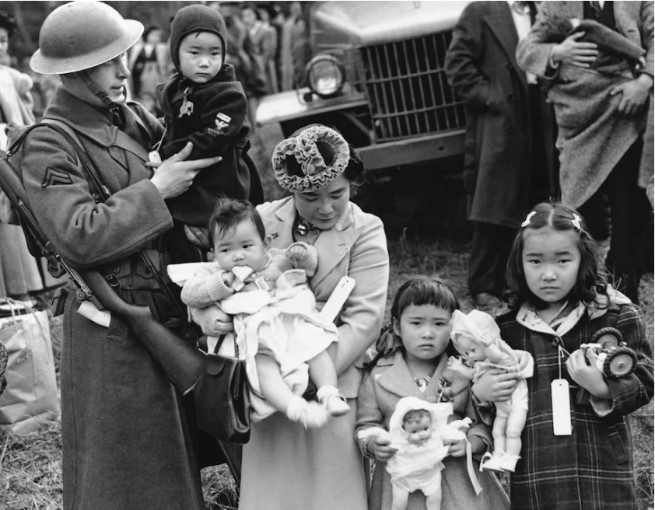
Corporal George Bushy holds the youngest child of Shigeho Kitamoto as she and her children are forced to leave Bainbridge Island, Washington. In 1942, the Kitamoto family was sent to an internment camp. (LOC)

The focus of Critical Race Theory has been on the treatment of people of African ancestry as the United States has been pressed to come to terms with its racist past and lingering racism today. It also should include the long history of anti-Asian violence and discrimination in this country. Asian American and Pacific Islander Heritage Month in May is a time for teachers and students to highlight the contributions and influence of Asian Americans and Pacific Islander Americans on the history, culture, and achievements of the United States.

Ex-President Donald Trump exacerbated anti-Asian hostility in this country with specious statements blaming China for the COVID-19 pandemic and the calling it the  “Chinese virus” and “Kung Flu” for the COVID-19 pandemic. The Republican Party has tried to divide potential Democratic Party voters by arguing that affirmative action programs and school reforms addressing past discrimination against African Americans and Latinos are anti-Asian.

Recent deadly attacks on Asian Americans, in San Francisco, New York City, and one in Atlanta where six women were murdered, have been committed by very disturbed people who were agitated by a climate that allows anti-Asian stereotypes to go largely unchallenged. An article in the journal Education Week calls on schools to play a larger role in combatting the stereotypes and anti-Asian racism by making Asian immigrants and their experience more prominent in the United States history curriculum. This would be an important corrective.

On the 2020 Federal Census, people who identified as Asian or of Asian ancestry made up approximately 6% of the U.S. population or almost 20 million people. The Asian American population grew by 35.5% between 2010 and 2020. Another 4 million Americans identified as mixed ancestry with a partial Asian heritage. The three largest groups were Chinese, about 5.4 million people, South Asians from India, 4.6 million, and Filipinos, 4.2 million. Chinese are the second largest immigrant group in the country. In 2019, California had the largest Asian American population, about of 6.7 million people followed by New York (1.9 million), Texas (1.6 million), and New Jersey (958,000)

The first large influx of people from Asia into territories that would become the United States occurred during the California gold rush starting in 1849. Chinese contract workers were brought to the United States to take low paying, dangerous jobs in mining and railroad construction. Most were male and planned to return home after earning enough money to buy land and start a family. In 1850, the Chinese population of the United States was only 3,227 people. It increased to 35,000 in 1860, a little over 60,000 in 1870, and just over 100,000 in 1880, when anti-Asian laws blocked new Chinese arrivals. In 1857, Harper’s Weekly reported, “The immigration of Chinese into California has attracted the attention of Congress. It appears that the Chinese immigrants, on settling there, persist in maintaining their allegiance to China; and under these circumstances the Senate voted on a resolution, December 19, making inquiry into the propriety of discouraging such emigration.”

From the 1850s through the 1870s, the California state government systematically discriminated against Chinese. Among other actions, it required special licenses for Chinese owned businesses and Chinese were not permitted to testify in court against a white person. In 1875, Congress passed and President Grant signed the Page Act, the first federal immigration law. It prohibited immigrants considered “undesirable” including any individual from Asia who was coming to the United States as a contract laborer, any Asian woman who would engage in prostitution, and all people considered to be convicts in their own country. In 1882, Congress passed the Chinese Exclusion Act suspending the immigration of Chinese laborers for a period of 10 years. It was the first law in American history to place broad restrictions on immigration and the first law to ban a specific ethnic group. The law remained in effect until 1943.

Japanese Americans are a small immigrant group that has had a major role in United States history. In 1870, there were only 55 Japanese in the United States, not counting Hawaii which was not yet an American colony. In 1900, there were still only 24,000 Japanese in the continental United States, but Japanese were the largest ethnic group in Hawaii. By 1960, when Hawaii was admitted as a state, there were 464,000 Japanese in the United States. In 2019, under 1.5 million Americans claimed partial or full Japanese ancestry, less than 1/2 of a percent of the US population. The largest Japanese American communities are in California and Hawaii.

In Hawaii, Japanese immigrants labored on sugar and pineapple plantations where they were subject to harsh rules and exploitation by armed European American overseers. On the plantation, Japanese workers had three to five year binding contracts and were jailed if they tried to leave. Those who eventually migrated to the mainland were subject to discriminatory laws and practices. California passed a law in 1913 banning Japanese from purchasing land.

Under the notorious Gentlemen’s Agreement of 1907 between the United States and Japan, Japanese officials stopped issuing passports for new laborers. Federal legislation in 1924 completely banned any immigration from Japan.

The situation worsened with Japan’s attack on Pearl Harbor in 1941 and U.S. involvement in World War II. Dr. Seuss posted racist caricatures of Japanese and Japanese Americans as part of wartime propaganda and Executive Order 9066 which eliminated all civil rights for Japanese immigrants and their families living on the West Coast. An estimated 120,000 people were branded as risks and forced to abandon homes and businesses and relocate to concentration camps, mostly in inhospitable areas of the Rocky Mountains. This action was taken despite the fact that there was not a single case of espionage ever established against Japanese Americans or Japanese immigrants living in the United States. Over two-thirds of those forced into concentration camps were American born citizens. The fenced in camps were located in harsh terrain and patrolled by armed guards. Ironically, Japanese Americans in Hawaii were not imprisoned because they were needed to rebuild areas destroyed by the attacks. Young Japanese American men were permitted to leave the concentration camps if they enlisted in the U.S. military. Japanese American soldiers served in a segregated unit, the 442nd, stationed in Italy and France. It was the most decorated American combat unit during World War II.

In 1944, in Korematsu vs. United States, the Supreme Court ruled by 6-3 that the detention of Japanese Americans was a “military necessity” and not based on race. In a dissent, Justice Robert Jackson called the exclusion order “the legalization of racism” and a violation of the 14th amendment. Fred Korematsu, who challenged the evacuation order and forced internment, was “convicted of an act not commonly thought a crime. It consists merely of being present in the state whereof he is a citizen, near the place where he was born, and where all his life he has lived.” In 1983, a federal judge overturned Korematsu’s conviction and in 1988, President Reagan signed the Civil Liberties Act compensating more than 100,000 people of Japanese descent who were incarcerated in the World War II concentration camps.

Since 1965, the United States has large immigrant populations from Korea, the Philippines, Southeast Asia, Bangladesh, India, and Pakistan. Each group has its own history in the United States, however all have faced stereotypes and discrimination and been stereotyped. South Asian Americans, often identified as Moslems even when they are not, were targeted after the 9/11/2001 attack on the World Trade Center in New York. A case involving an immigrant from India in the 1920s, United States v. Bhagat Singh Thind, established that people from the Indian sub-continent could not become naturalized citizens of the United States because they were not a “white person” in the sense intended in the Naturalization Act of 1790.

One of the most important constitutional decisions about citizenship was a Supreme Court ruling in the case of the United States vs. Wong Kim Ark was a Chinese American born in San Francisco, California in 1873. His parents were Chinese immigrants who returned to China about 1890. In 1894, Wong Kim Ark traveled to China to visit them and was not allowed to reenter to the United States because officials at the arrival center claimed he was not a citizen. In 1898, the Supreme Court in a 6-2 decision ruled that he was a citizen of the United States because he was born in this country.

Despite decades of prejudice, Asian Americans have made major contributions to life in the United States. They include Vice-President Kamala Harris whose mother was an immigrant from India, Eric S. Yuan, the CEO of Zoom, Steven Chen, co-founder of YouTube, Nobel Prize winning scientists Chen Ning Yang and T. D. Lee, physicistChien-Shiung Wu who worked on the Manhattan Project developing the atomic bomb,U.S. Senators Daniel Inouye (Dem-HI) and Tammy Duckworth (Dem-Ill), film director Ang Lee, astronaut Kalpana Chawla, architect I. M. Pei, authors Maxine Hong Kingston, Jhumpa Lahiri, and Amy Tan, athletes Tiger Woods, Kristi Yamaguchi, and Michelle Kwan, musician Yo-Yo Ma, and actors Sandra Oh, Lucy Liu, Haing Somnang Ngor, George Takei (Mr. Sulu), and Bruce Lee.

New York Local History: Yonkers Sculpture Garden

New York Local History: Yonkers Sculpture Garden

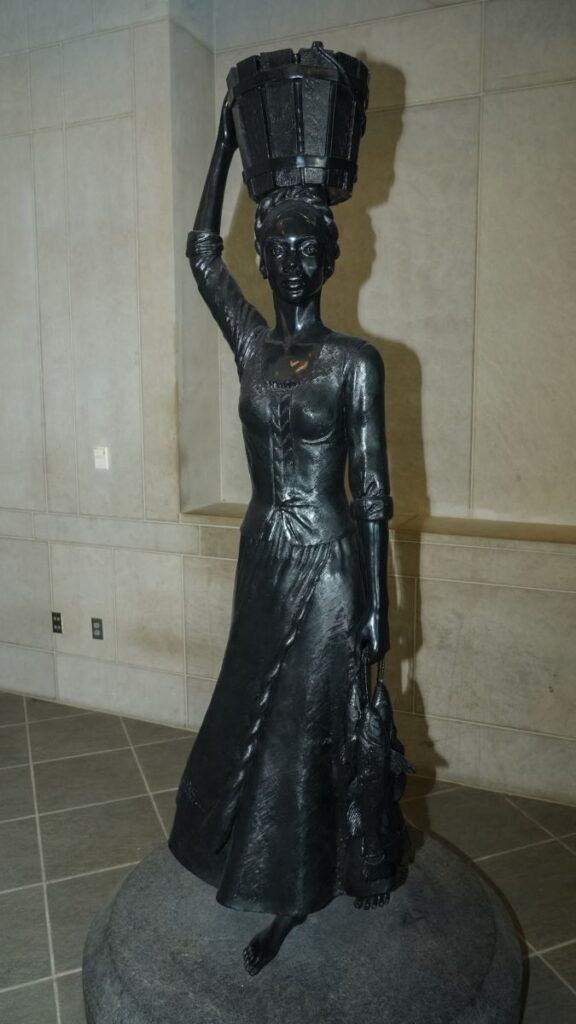
For Juneteenth 2022, the City of Yonkers debuted a permanent art exhibit honoring the legacy of the nation’s first freed slaves. The Enslaved Africans’ Rain Garden includes five life-size bronze sculptures created by artist Vinnie Bagwell depicting formerly enslaved Africans. The sculpture garden is located along the Yonkers Hudson River esplanade. According to Bagwell, “Public art sends a message about the values and priorities of a community. In the spirit of transformative justice for acts against the humanity of black people, I am grateful for those who supported this collective effort. The strongest aspect of the Enslaved Africans’ Rain Garden coming to fruition is that it begins to address the righting of so many wrongs by giving voice to the previously unheard via accessible art in a public place while connecting the goals of artistic and cultural opportunities to improving educational opportunities and economic development.”

In Yonkers, Philipse Manor Hall was the seat of the Philipsburg Manor, a colonial estate that covered more than 52,000 acres of Westchester land. The Philipse family was involved in the trans-Atlantic slave trade and probably as many as two-dozen enslaved African slaves worked and lived at the manor. The enslaved Africans were freed in 1799, one of the first large emancipations in the United States. New York State finally ended slavery in 1827.

My Story: Quamino, New Brunswick, NJ, Somerset County, 1789

My Story: Quamino

Somerset County, NJ 1789

Quamino was born near New Brunswick, New Jersey in 1762. Young Quamino had a complete family unit when he was living in Somerset County. Despite describing Quamino as “compliant,” his contemporary biographer William Allinson described a horrific episode where young Quamino was forced to watch a fellow enslaved person burned at the stake as punishment for alleged crimes. At no point in the memoir or in any other documentation is Quamino described as rebellious or uncooperative. Much of this is attributed to his religious conversion and subsequent piety. Allinson essentially uses Quamino as the model version of a benign, non-threatening Black man as a means of condemning the institution of slavery, consistent with Allinson’s abolitionist views. Allinson’s book is described as a memoir, including numerous quotations directly from Quamino, but neglects to offer a physical description of the man, the names of his siblings, or many of his inner emotions and rationale for his behavior.

At age nine, Quamino was essentially rented out to an enslaver in Poughkeepsie, New York. He was separated from his family and upon the commencement of the Revolutionary War was unable to have any communication with his “master” (and thereby his family). From roughly age 9 to 18, he remained in New York, but in 1780 was unexpectedly returned to his original enslaver and reunited with his family. Allinson wrote, “Overcome with this too sudden announcement, he burst into a violent and uncontrollable fit of crying, and for hours cried aloud as though he had been beaten — unable to answer questions, or to stay his emotions at the kindest efforts to pacify him.”[2]

How do you think each of the following may have contributed to his uncontrollable response to the news?

  1. Shock that his situation would ever improve.
  2. Joy at the prospect of being reunited with his family.
  3. Separation from his family caused emotional deprivation.
  4. The experience of enslavement is a form of mental and physical torture.

Consider the implications of each of the items in a response of two or three sentences.

Back in Somerset County, Quamino had a religious experience, claiming that God had spoken to him, thus beginning his period of devout faith in the Methodist religion. His enslaver looked suspiciously upon enslaved people’s faith, believing it could interfere with maintaining a degree of ignorance and thus make them less “serviceable” as workers. He even suspected Quamino’s position was a pose, designed to gain a level of respect from others in the community. Consequently, he would criticize and may have beaten Quamino for participating in religious services, but Quamino accepted the consequences and maintained his personal beliefs.

As there is only one source for this information, we have no idea of how sincere Quamino’s religious conversion was, but either way, one could argue that maintaining his faith was an exercise of autonomy and personal agency.

Two Options to Consider:

A. Quamino was wholly genuine in his religious conversion, and was willing to deal with any obstacles in his path to exercise his faith.

B. Quamino was less than 100% genuine in his conversion, but believed that some degree of deception would provide him some degree of social standing.

Describe in two to three sentences how each of the options would mean that Quamino was exercising personal agency.

In 1788, he married Sarah, an enslaved woman who lived nearby. She was soon sold and moved five miles away, allowing them to see one another as infrequently as once a week. When Quamino’s enslaver died around 1789, he was passed onto one of the enslaver’s sons. Several years later, he was beaten by his enslaver. Quamino told him he refused to work for him further, a tactic that some other enslaved people had used to demand being sold to a new owner. In some locations, the relationship between enslaver and enslaved was perceived as a sort of social contract with obligations flowing in both directions. “Unjustified” abuse might be grounds for “slave quitting” depending on local customs. Although enslaved people might be aware of instances of slave quitting via word of mouth, nothing was in the law, thus employing this tactic was enormously risky for Quamino.

Consider the possible outcomes of this risky decision.

Three Possible Outcomes to Consider:

A. His enslaver could have rejected the claim and then worsened his treatment of Quamino.

B. His enslaver could agree to sell him to a new enslaver whose treatment of Quamino could be the same (or worse).

C. His enslaver could agree to sell him to a new enslaver whose treatment of Quamino would be an improvement.

Which of the following seems the most likely outcome?

If you think the outcome would have been A or B, would Quamino have regretted his decision of refusing to work?

Why was it difficult for Black Americans to enjoy the ideals of life, liberty, and the pursuit of happiness as stated in the Declaration of Independence?

Quamino was sold to a new enslaver, who did not seem to have used physical violence against those he enslaved. Quamino even arranged for his new enslaver to purchase Sarah, allowing the couple to live together as husband and wife.  In 1806, Quamino was manumitted through an elaborate process that included having to testify before a committee to demonstrate that his freedom would not be a burden upon the state of New Jersey. Sarah died in 1842 and Quamino lived to around 1850 (age 88). They had at least two sons together, although it appears at least one of them was sold as an infant.


[1] Frontispiece of William Allinson, Memoir of Quamino Buccau, A Pious Methodist

[2] Allinson, page 6.

My Story: Samuel Sutphen, Hunterdon County, NJ, 1778, 1832

My Story: Samuel Sutphin

Hunterdon County, NJ 1778,1832

After a month’s service in the militia, Casper Berger had had enough. He was in his 50s and the physical labor and drudgery were beyond him after a career as a stonemason. Given a break from service, he returned to his home in Readington, desperate for a way out of the remaining months of his obligation. He was more than willing to pay his way out of service and return to his current vocation as a tavern operator.

Berger’s neighbor, Guisbert Bogart, enslaved a man in his late 20s named Samuel. Berger knew that it was legal to provide an able-bodied substitute for militia service, so he inquired with Bogart whether he could purchase Samuel. The two arrived at a payment of $92.10, but Berger knew that Samuel would need to be at least somewhat willing to serve as a substitute. An unwilling enslaved person would be rejected, as the militia wouldn’t have time to deal with forcing someone to work. Berger promised Samuel his freedom at the war’s end in exchange for consenting to the deal.

It would be inappropriate and presumptuous for individuals in the 21st century to try to imagine what it was like to be an enslaved person — let alone second guess their decisions — but Samuel’s options were limited:

  1. Consent to the deal based on the promise of freedom when the war eventually ends.
  2. Reject the deal.

Describe the potential ramifications of each in 2 to 3 sentences.

Reflecting on this decision, Samuel said, “I believed the white man’s word, hoping to be free when the fight was over. I took no paper to show the bargain, but trusted to my master.”

Samuel fought in the Battle of Long Island (August 1776), the Battles of Princeton (January 1777), the Battle of Millstone, where he captured a prisoner of war (January 1777), and the Battle of Monmouth (June 1778), among others. On sentry duty at West Point in New York, he was shot twice in his leg, one wound driving a bullet into his leg, thereby ending his active militia service. At the end of the war he asked his enslaver Casper Berger to grant him his freedom as promised. Berger had three choices:

  1. Grant Samuel his freedom as promised.
  2. Renege on the deal and sell Samuel to a new owner.
  3. Renege on the deal and keep a disgruntled enslaved person in his service.

Describe the potential ramifications of each in 2 to 3 sentences.

Despite support from neighbors and fellow veterans, Samuel’s enslavement would continue for another 20 years as Berger opted to sell him to Peter Sutphen. Eventually, Samuel was allowed to purchase his freedom using money he saved up by selling rabbit, raccoon, and muskrat fur.

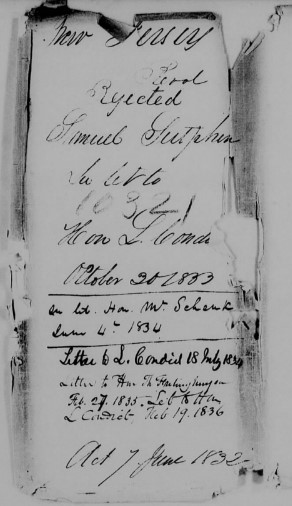
An Act of Congress in 1832 provided a pension to enlisted men who had served for at least two years. Although the federal government wanted to do right by veterans, it also required adequate proof that the claims were valid. According to the pension board, “It must, in every case, be clearly shown under what officers the applicant served: the duration of each term of engagement; the particular place or places where the service was performed; that the applicant served with an embodied corps called into serve by competent authority; that he was either in the field or in garrison; and for the time during which the service was performed, he was not employed in any civil pursuit.”

Samuel first applied for a pension in 1832 at age 85, but a lack of specificity in his testimony, perhaps compounded by a failing memory, led to a series of rejections from the pension board. Samuel’s name did not appear on any official roster, though it is unknown what last name he might have been listed under. In 1775 Samuel also only spoke broken English, using primarily Dutch to communicate up to that point. That he would have difficulty remembering specific names is unsurprising as a result, particularly at his advancing age.

In 1834, former Congressman Lewis Condict offered his support. Condict, who was also a doctor, examined Samuel’s scars and testified that they were wholly consistent with the injuries Samuel had described in his previous testimony. Witnesses even testified seeing him at particular battles and many of his neighbors testified as character witnesses.

DECISION ACTIVITY

Imagine you are a member of the pension board. Select one option and explain your answer in 4 to 6 sentences.

  1. Abide by the guidelines provided by the War Department and reject any claim that does not meet the letter of the law.
  2. Appeal to your superiors to approve the pension based on the particular circumstances and weight of the evidence.
  3. Grant the pension and suffer whatever consequences might arise as a result of your bending of the rules.

Samuel’s fifth petition was ultimately denied, but some important individuals became aware of his plight. Both Dr. Condict and New Jersey Governor Peter Vroom took up his case, and the New Jersey General Assembly passed an act providing Samuel a pension of $50 per year until his death in 1841.

Teaching For Black Lives and Teacher Unions and Social Justice

Teaching For Black Lives and Teacher Unions and Social Justice

Teaching for Black Lives, edited by Dyan Watson, Jesse Hagopian, and Wayne Au, grows directly out of the movement for Black lives. The editors recognize that anti-Black racism constructs Black people, and Blackness generally, as not counting as human life. They provide resources and demonstrate how teachers connect curriculum to young people’s lives and root their concerns and daily experiences in what is taught and how classrooms are set up. They also highlight the hope and beauty of student activism and collective action. Teacher Unions and Social Justice, edited by Michael Charney, Jesse Hagopian, and Bob Peterson, is an anthology of more than 60 articles documenting the history and the how-tos of social justice unionism. Together, they describe the growing movement to forge multiracial alliances with communities to defend and transform public education.

Columbus Day or Indigenous Peoples Day?

Columbus Day or Indigenous Peoples Day?

On October 11, 2021, cities across the United States celebrated Indigenous People’s Day. The idea of a day celebrating the indigenous peoples of the Americas was first introduced at the United Nations in 1977. In 2007, a UN Declaration on the Rights of Indigenous People declared that October 12 would be an International Day of Solidarity with the Indigenous Peoples of the Americas. On October 12, 2021, New York Governor Kathy Hochul signed a proclamation recognizing Indigenous Peoples’ Day. However, Hochul also marched in a Columbus Day parade. President Joe Biden issued a similar proclamation declaring that “On Indigenous Peoples’ Day, our Nation celebrates the invaluable contributions and resilience of Indigenous peoples, recognizes their inherent sovereignty, and commits to honoring the Federal Government’s trust and treaty obligations to Tribal Nations.”

In New Jersey, legislation was introduced in the State Assembly to replace Columbus Day with Indigenous People’s Day as an official state holiday but it did not pass. Newark has recognized Indigenous People’s Day since 2017 and Princeton since 2019. New Jersey has three state-recognized tribes, the Nanticoke Lenni-Lenape Tribal Nation, the Powhatan Renape Nation, and the Ramapough Lunaape Nation. It also has the largest concentration of people of Italian ancestry in the United States. Columbus Day has been celebrated since 1937. Jameson Sweet, a Rutgers University professor, argues that switching from Columbus Day to Indigenous People’s Day is “about acknowledging this difficult past that is usually erased.” Joseph Pennacchio, a Republican state senator from Morris County, responds that Columbus’ voyages “The bottom line is that little flicker of flame started what we now know as America.”

Lisa DuBois, New York–based artist curator and photojournalist, Social Documentary Network: “We are at the start of a new age in American history, one in which the past will be examined more closely. Thirteen states do not observe Columbus Day as a public holiday. Indigenous Peoples’ Day or Native American Day is observed and celebrated in Alaska, Hawaii, Iowa, Louisiana, Maine, Michigan, New Mexico, North Carolina, Oregon, South Dakota, Vermont, Washington, D.C., and Wisconsin and South Dakota instead of Columbus Day. For centuries, we have been misled by skewed interpretations of historical events, and fiction has turned into perceived facts. We as a society recoil when confronted with unpleasant realities, and a minority must bear the responsibility of enlightening others with the truth, due to multigenerational impressions carried along with the fervor of religious and or political convictions on topics such as slavery and Native American genocide. Columbus Day will evolve into an Italian American appreciation day as the focus shifts to the magnificent contributions that Italian Americans have made to the diversity of a new multicultural America, and Columbus will claim his rightful place in history as a ruthless explorer.

Karla Freire, Metropolitan Expeditionary Learning School, Queens, New York: “I firmly believe that Columbus Day should be permanently renamed “Indigenous Peoples Day” in order to commemorate the millions of lives that were lost in the Americas during European conquest in the 15th and 16th centuries. Additionally, it should be a day to openly acknowledge and reflect upon the traumatic effects of colonialism that are still felt by Indigenous peoples and people of indigenous descent, today. The name “Columbus Day” needs to become a remnant of the past. It should be referred to as “Indigenous Peoples Day” on a national level. To continue to honor Columbus, as a country, is deeply harmful and offensive to indigenous peoples of the United States, as well as some within the Latinx community, like Latinx people of indigenous descent. As a Latina of indigenous descent, it pains me to think about anyone honoring Columbus or when people are upset regarding its name change. Many people in “defense” of Columbus Day do not realize or fully process the horrific, dishonorable behavior Columbus and his men carried out in the Americas after 1492. According to historical accounts, written by Columbus himself, the peoples Europeans first encountered were peaceful, gentle, and even generous towards them. Yet, Columbus and his men, fueled by greed and cruelty, tortured and murdered them. They brutally raped women and young girls. Dogs, trained to kill, were brought from Spain to attack and murder any “disobedient” or “rebellious” indigenous peoples. To defend Columbus and regard him as a man that deserves statues and a holiday dedicated to him, demonstrates a fundamental lack of historical knowledge, depth, and empathy.

For those that state it is unfair to Italians, it denies them an opportunity to celebrate their heritage – I ask the following questions: Do you really want to celebrate your heritage using a despicable person, like Columbus, as your cultural representative? There are so many other Italian figures who can be honored and used to represent your culture, who are not problematic–why not pick someone, like Mother Cabrini, to honor instead? Finally, the most important question for Columbus Day defenders is: Why are you still so willing to celebrate your heritage through Columbus, even though he was a man who tried to erase my own heritage and culture?”

Origin and Meaning of Critical Race Theory

Origin and Meaning of Critical Race Theory

Alan Singer

On a November 2021 CNN broadcast, host Chris Cuomo interviewed comedian/commentator Bill Maher about a supposed leftwing peril threatening the United States, feeding him a series of softball questions and responding with “Oh my God” facial expressions. After acknowledging “I’m not in schools” and “I have no interaction with children,” Maher announced that he has heard from people all over the country that “kids are sometimes separated into groups, oppressor and oppressed” and being taught “racism is the essence of America.” He derided this practice as “just silly, it’s just virtue-signaling” and accused people advocating for curriculum revision of being “afraid to acknowledge progress,” a psychological disorder he alternately labeled “wokeness” and “progressophobia.” Maher’s comments on “wokeness” and “progressophobia” reminded me of a 19th century medical condition described by Dr. Samuel Cartwright from Louisiana in DeBow’s Review in 1851 as “Drapetomania, the disease causing Negroes to run away from slavery.”

I kept waiting for Chris Cuomo to ask Maher to provide an example, any example, to support his claims, but Cuomo never did and Maher never felt compelled to offer any evidence. On his television show, Maher promotes a group of contrarians that want to start their own college where they will be free to present offensive ideas and dismiss objections without having to provide supporting evidence or answer to anyone. Cuomo never asked Maher about that either.

In August 2021, the Brookings Institute reported that at least eight states had passed legislation banning the teaching of Critical Race Theory, although only Idaho actually used the phrase. The modern iteration of Critical Race Theory began in the 1980s when legal scholars followed by social scientists and educational researchers employed CRT as a way of understanding the persistence of race and racism in the United States. Kimberlé Crenshaw, who teaches law at UCLA and Columbia University and was an early proponent of critical race theory, described it as “an approach to grappling with a history of white supremacy that rejects the belief that what’s in the past is in the past, and that the laws and systems that grow from that past are detached from it.” Basically, Critical Race Theory disputes the idea of colorblindness or legal neutrality and argues that race and racism have always played a major role in the formulation of American laws and the practices of American institutions. It is a study of laws and institutions that sifts through the surface cover to look for underlying meaning and motivation. In my work as a historian, I traced the current debate over “citizen’s arrest” back to its implementation in the South during the Civil War when it was used to prevent enslaved Africans from fleeing bondage. It essentially empowered any white person to seize and hold any Black person they suspected of a crime, stealing white property by stealing themselves As an academic discipline CRT does not claim that everything about the United States is racist or that all white people are racist. The CRT lens examines laws and institutions, not people, certainly not individual people.

What has come to be known as a CRT approach to understanding United States history and society actually has much deeper roots long before the 1980s. A 19th century French observer of American society, Alexis De Tocqueville, in the book Democracy in America published in 1835, wrote: “I do not believe that the white and black races will ever live in any country upon an equal footing . . . But I believe the difficulty to be still greater in the United States than elsewhere . . . [A]s long as the American democracy remains at the head of affairs . . . [I]t may be foreseen that the freer the white population of the United States becomes, the more isolated will it remain.

In an 1852 Independence Day speech delivered in Rochester, New York, Frederick Douglass rhetorically asked, “What to the Slave is the Fourth of July?” Douglass then answered his own question. “The blessings in which you this day rejoice are not enjoyed in common. The rich inheritance of justice, liberty, prosperity, and independence [given] by your fathers is shared by you, not by me . . . What to the American slave is your Fourth of July? I answer, a day that reveals to him more than all other days of the year, the gross injustice and cruelty to which he is the constant victim. To him your celebration is a sham; your boasted liberty an unholy license; your national greatness, swelling vanity; your sounds of rejoicing are empty and heartless; your denunciation of tyrants, brass-fronted impudence; our shouts of liberty and equality, hollow mockery; your prayers and hymns, your sermons and thanksgivings, with all your religious parade, and solemnity, are, to him, mere bombast, fraud, deception, impiety, and hypocrisy — a thin veil to cover up crimes which would disgrace a nation of savages.”

In the 19th century, a reverse CRT lens was openly used by racists to justify the laws and institutions derided by Alexis De Tocqueville and Frederick Douglass. In the majority opinion of the Supreme Court in its 1857 Dred Scott decision, Chief Justice Roger Taney claimed, and the Court ruled, that “A free negro of the African race, whose ancestors were brought to this country and sold as slaves, is not a ‘citizen’ within the meaning of the Constitution of the United States” because “When the Constitution was adopted, they were not regarded in any of the States as members of the community which constituted the State, and were not numbered among its ‘people or citizens.’ Consequently, the special rights and immunities guaranteed to citizens do not apply to them.”

The deep roots of racism were recognized by the United States Congress when it drafted the 13th, 14th, and 15th amendments after the American Civil War. Abolitionist and civil rights proponent Congressman Thaddeus Stevens issued a warning in December 1865. We have turned, or are about to turn, loose four million slaves without a hut to shelter them or a cent in their pockets. The infernal laws of slavery have prevented them from acquiring an education, understanding the common laws of contract, or of managing the ordinary business of life. This Congress is bound to provide for them until they can take care of themselves. If we do not furnish them with homesteads, and hedge them around with protective laws; if we leave them to the legislation of their late masters, we had better have left them in bondage. If we fail in this great duty now, when we have the power, we shall deserve and receive the execration of history and of all future ages.” Stevens was right. Enforcement legislation was gutted by the Supreme Court making way for Jim Crow segregation, Klan terrorism, and the disenfranchisement of Black voters for the next 100 years. The power of racism was so great that in 1903, W.E.B. DuBois wrote in the forethought to The Souls of Black Folk that “the problem of the Twentieth Century is the problem of the color-line.”

The legal system recognizing the legitimacy of racial distinction was affirmed by the Supreme Court in the 1896 Plessy v. Ferguson decision. Although the Supreme Court reversed itself with the Brown v. Topeka Kansas ruling in 1954, legal action to change American society really started with the Civil Rights Act of 1964 and the Voting Rights Act of 1965, both designed to enforce the 14th Amendment prohibition that states could not make or enforce laws that “abridge the privileges or immunities of citizens of the United States.” Section 2 of the Voting Rights Act, as amended in 1982, outlawed laws and practices that had the result of denying a racial or language minority an equal opportunity to participate in the political process, even if the wording of the law did not expressly mention race. A racist result was racism.

The New York State Court of Appeals also argued that under Title VI of the Civil Rights Act a law could be challenged as discriminatory if the “practice has a sufficiently adverse racial impact–in other words, whether it falls significantly more harshly on a minority racial group than on the majority . . . Proof of discriminatory effect suffices to establish liability under the regulations promulgated pursuant to Title VI.” Governments have the obligation to demonstrate that “less discriminatory alternatives” were not available. This is the modern origin of Critical Race Theory.

According to the Texas Tribune, the “new Texas law designed to limit how race-related subjects are taught in public schools comes with so little guidance, the on-the-ground application is already tying educators up in semantic knots as they try to follow the Legislature’s intent.” In one Texas district, a director of Curriculum and Instruction notified teachers that they had to provide students with “opposing” perspectives on the World War II era European Holocaust, presumably Holocaust-denial voices. It remains unclear if science teachers will now have to legitimize social media claims that the COVID-19 virus arrived on Earth from outer space.

In her blog, Heather Cox Richardson, an American historian and professor of history at Boston College, focused on subjects that were crossed out of the law, which listed topics permissible to teach. The dropped topics included the history of Native Americans, the writings of founding “mothers and other founding persons,” Thomas Jefferson on religious freedom, Frederick Douglass articles in the North Star, William Still’s records for the Underground Railroad, the Fifteenth Amendment to the United States Constitution, documents related to women’s suffrage and equal rights, and documents on the African American Civil Rights movement and the American labor movement, including Martin Luther King Jr.’s “Letter from a Birmingham Jail” and his 1963 “I Have a Dream” speech. The Texas legislature also crossed out from the list of topics that are permissible to teach the “history of white supremacy, including but not limited to the institution of slavery, the eugenics movement, and the Ku Klux Klan, and the ways in which it is morally wrong.”

What caught my attention more though was what the Texas legislators decided to include on the permissible list, documents that they apparently had never read. The “good” topics and documents include the Declaration of Independence, the United States Constitution, the Federalist Papers “including essays 10 and 51,” excerpts from Alexis de Tocqueville’s Democracy in America, and the transcript of the first Lincoln-Douglas debate from 1858 when Abraham Lincoln and Stephen Douglas ran against each other for Senator from Illinois. When you read these documents through a Critical Race Theory lens or any critical lens, they expose the depth of racism in America’s founding institutions.

The Declaration of Independence includes a passage that has stuck with me since I first read it as a high school student in the 1960s. “That whenever any Form of Government becomes destructive of these ends, it is the Right of the People to alter or to abolish it, and to institute new Government, laying its foundation on such principles and organizing its powers in such form, as to them shall seem most likely to effect their Safety and Happiness.” I was always impressed by the vagueness of the passage. Who has the right to abolish a government? Did they mean the majority of the people, some of the people, or did the decision have to approach near unanimity? Did enslaved Africans share this right to rebel? Very unlikely.

The words “slave” and “slavery” do not appear in the United States Constitution until passage of the 13th Amendment in 1865 that banned slavery. However, a number of clauses in the original document were intended to protect the institution. The three-fifths compromise, which refers to “other Persons,” gave extra voting strength to slave states in the House of Representatives and the Electoral College.  Another clause forbade Congress from outlawing the trans-Atlantic slave trade for at least twenty years. A fugitive slave clause required that freedom-seekers who fled slavery to states where it was outlawed had to be returned to slavery if they were apprehended. The Constitution also mandates the federal government to suppress slave insurrections and the Second Amendment protected the right of slaveholders and slave patrols to be armed.

Both Federalists 38 and 54, which were most likely written by future President James Madison, himself a slaveholder, justified slavery. Madison first mentioned slavery in Federalist 38 where he defended the right of the national government to regulate American participation in the trans-Atlantic slave trade. In Federalist 54, Madison explained the legitimacy of the Constitution’s three-fifths clause and of slavery itself. According to Madison, “In being compelled to labor, not for himself, but for a master; in being vendible by one master to another master; and in being subject at all times to be restrained in his liberty and chastised in his body, by the capricious will of another, the slave may appear to be degraded from the human rank, and classed with those irrational animals which fall under the legal denomination of property. In being protected, on the other hand, in his life and in his limbs, against the violence of all others, even the master of his labor and his liberty; and in being punishable himself for all violence committed against others, the slave is no less evidently regarded by the law as a member of the society, not as a part of the irrational creation; as a moral person, not as a mere article of property. The federal Constitution, therefore, decides with great propriety on the case of our slaves, when it views them in the mixed character of persons and of property.”

In the first Lincoln-Douglas debate on August 21, 1858, Stephen Douglas accused Lincoln of trying to “abolitionize” American politics and supporting a “radical” abolitionist platform. Lincoln responded that he was “misrepresented.” While Lincoln claimed to hate slavery, he did not want to “Free them, and make them politically and socially our equals? My own feelings will not admit of this; and if mine would, we well know that those of the great mass of white people will not . . . We cannot, then, make them equals . . . anything that argues me into his idea of perfect social and political equality with the negro, is but a specious and fantastic arrangement of words . . . I have no purpose, directly or indirectly, to interfere with the institution of slavery in the States where it exists.” Lincoln then added in words that show the depth of American racism, “I have no purpose to introduce political and social equality between the white and the black races. There is a physical difference between the two, which, in my judgment, will probably forever forbid their living together upon the footing of perfect equality.”

The real question is why the big outrage about Critical Race Theory today? A group of traditional historians was infuriated by claims in the New York Times 1619 Project that race and racism have played a significant role in throughout American history, including as a motivation for the War for Independence. Whatever you think about that claim in the 1619 Project, I don’t think anyone seriously believes that opposition by a small group of historians is the basis for the assault on CRT. The much-criticized opening essay by Nikole Hannah-Jones does not even mention Critical Race Theory.

I believe the public attacks on Critical Race Theory, including in school board meetings, are a rightwing response to challenges to police actions following the murder of George Floyd and to the Black Lives Matter movement’s demands for racial justice. They have nothing to do with what or how we teach.

CRT became controversial when President Trump denounced it in an effort to rally his supporters during his re-election campaign. Trump declared, without any evidence, that “Critical race theory is being forced into our children’s schools, it’s being imposed into workplace trainings, and it’s being deployed to rip apart friends, neighbors and families.” According to Professor Crenshaw, acknowledging racism was being defined by President Trump and his supporters as racism. Racial equity laws and programs were called “aggression and discrimination against white people.”

We don’t teach CRT in the Pre-K to 12 curriculum because we don’t teach theory. We certainly don’t teach children to hate themselves or this country. What we do teach is critical thinking, and a critical race theory approach is definitely part of critical thinking.

Critical thinking means asking questions about text and events and evaluating evidence. It is at the core of Common Core and social studies education. I like to cite the conservative faction of the Supreme Court that claims to be “textualists,” meaning they carefully examine the text of laws to discover their meaning. Because they will need to become active citizens defending and extending democracy in the United States, we want young people to become “textualists,” to question, to challenge, to weigh different views, to evaluate evidence, as they formulate their own ideas about America’s past, the state of the nation today, and the world they would like to see.

The Texas anti-CRT law also includes more traditional social studies goals, “the ability to: (A) analyze and determine the reliability of information sources; (B) formulate and articulate reasoned positions;  (C) understand the manner in which local, state, and federal government works and operates through the use of simulations and models of governmental and democratic processes; (D) actively listen and engage in civil discourse, including discourse with those with different viewpoints; (E) responsibly participate as a citizen in a constitutional democracy; and (F) effectively engage with governmental institutions at the local, state, and federal levels.” It also includes an appreciation of “(A) the importance and responsibility of participating in civic life; (B) a commitment to the United States and its form of government; and (C) a commitment to free speech and civil discourse.”

Given these very clearly stated civics goals, I recommend that Texas social studies teachers obey the civics legal mandate by organizing with their students a mass campaign to challenge restrictions in the Texas law, including classroom “civil disobedience” by reading the material that was crossed out of the law. Maybe someday Texas students can share Martin Luther King’s “dream.”

AIM: How enlightened was the European Enlightenment? A CRT Lens Lesson

This lesson on the European Enlightenment is for the high school World History curriculum. The European Enlightenment is one of the first topics explored in the New York state 10th grade social studies curriculum. This lesson uses a CRT lens to build on understandings about the Scientific Revolution and the trans-Atlantic slave trade that were studied in the 9th grade. It establishes themes that reemerge in units on European Imperialism in Africa and Asia and lessons on Social Darwinism. Many scholars credit the European Enlightenment with establishing modern ideas like liberty and democracy. But it also defended gender inequality and attempted to establish a scientific basis for racism. Students are asked to take a closer look and decide: “How enlightened was the European Enlightenment?”

Do Now: The European Enlightenment is often known as the Age of Reason because Enlightenment thinkers tried to apply scientific principles to understand human behavior and how societies work. Many of the earliest Enlightenment thinkers were from England, Scotland, and France but the idea of using reason and a scientific approach spread to other European countries and their colonies. In the United States, Thomas Jefferson and Benjamin Franklin are considered Enlightenment thinkers. While there are no firm dates, most historians argue that the European Enlightenment started in the mid-17th century building on the Scientific Revolution, and continued until the mid-19th century. Some historians have pointed out that the Age of Reason in Europe was also the peak years of the trans-Atlantic slave trade when millions of Africans were transported to the Americas as unfree labor on plantations.

One of the first major European Enlightenment thinkers was John Locke of England. Read the excerpt from Locke’s Second Treatise on Civil Government, written in 1690, and answer questions 1-4.

John Locke: “Liberty is to be free from restraint and violence from others . . . Good and evil, reward and punishment, are the only motives to a rational creature: these are the spur and reins whereby all mankind are set on work, and guided . . . Man . . . hath by nature a power . . . to preserve his property – that is, his life, liberty, and estate – against the injuries and attempts of other men . . . The end of law is not to abolish or restrain, but to preserve and enlarge freedom . . . All mankind . . . being all equal and independent, no one ought to harm another in his life, health, liberty or possessions.”

Questions

  1. According to Locke, what is the most important human value?
  2. How does Locke believe this value is preserved?
  3. What document in United States history draws from Locke? Why do you select that document?
  4. In your opinion, why is John Locke considered a European Enlightenment thinker?

Activity: You will work with a team analyzing a quote from one of these European Enlightenment thinkers and answer the following questions. Select a representative to present your views to class. After presentations and discussion, you will complete an exit ticket answering the question, “How enlightened was the European Enlightenment?”

Questions

  1. Where is the author from? What year did they write this piece?
  2. What is the main topic of the excerpt?
  3. What does the author argue about the topic?
  4. Why is this author considered a European Enlightenment thinker?
  5. In your opinion, what do we learn about the European Enlightenment from this except?
 David Hume (Scotland, Dialogues Concerning Natural Religion, 1779): “What truth so obvious, so certain, as the being of a God, which the most ignorant ages have acknowledged, for which the most refined geniuses have ambitiously striven to produce new proofs and arguments? What truth so important as this, which is the ground of all our hopes, the surest foundation of morality, the firmest support of society, and the only principle which ought never to be a moment absent from our thoughts and meditations? . . . Throw several pieces of steel together, without shape or form; they will never arrange themselves so as to compose a watch. Stone, and mortar, and wood, without an architect, never erect a house.”  
Baron de Montesquieu (France, The Spirit of the Laws, 1748): “Political liberty in a citizen is that tranquility of spirit which comes from the opinion each one has of his security, and in order for him to have this liberty the government must be such that one citizen cannot fear another citizen. When the legislative power is united with the executive power in a single person or in a single body of the magistracy, there is no liberty, because one can fear that the same monarch or senate that makes tyrannical laws will execute them tyrannically. Nor is there liberty if the power of judging is not separate from legislative power and from executive power. If it were joined to legislative power, the power over life and liberty of the citizens would be arbitrary, for the judge would be the legislator. If it were joined to executive power, the judge could have the force of an oppressor. All would be lost if the same man or the same body of principal men, either of nobles or of the people exercised these three powers: that of making the laws, that of executing public resolutions, and that of judging the crimes or disputes of individuals.”
Marquis de Lafayette (France, The Declaration of the Rights of Man and of the Citizen, 1789): “Therefore the National Assembly recognizes and proclaims, in the presence and under the auspices of the Supreme Being, the following rights of man and of the citizen: Men are born and remain free and equal in rights. Social distinctions may be founded only upon the general good. The aim of all political association is the preservation of the natural and imprescriptible rights of man. These rights are liberty, property, security, and resistance to oppression. Liberty consists in the freedom to do everything which injures no one else; hence the exercise of the natural rights of each man has no limits except those which assure to the other members of the society the enjoyment of the same rights. These limits can only be determined by law.”
Jean-Jacques Rousseau (France, Emile, or Education, 1762): “Women have ready tongues; they talk earlier, more easily, and more pleasantly than men. They are also said to talk more; this may be true, but I am prepared to reckon it to their credit; eyes and mouth are equally busy and for the same cause. A man says what he knows, a woman says what will please; the one needs knowledge, the other taste; utility should be the man’s object; the woman speaks to give pleasure. There should be nothing in common but truth . . . The earliest education is most important and it undoubtedly is woman’s work. If the author of nature had meant to assign it to men he would have given them milk to feed the child. Address your treatises on education to the women, for not only are they able to watch over it more closely than men, not only is their influence always predominant in education, its success concerns them more nearly, for most widows are at the mercy of their children, who show them very plainly whether their education was good or bad.”
Mary Wollstonecraft (England, A Vindication of the Rights of Woman, 1792): “Till women are more rationally educated, the progress in human virtue and improvement in knowledge must receive continual checks . . . The divine right of husbands, like the divine right of kings, may, it is to be hoped, in this enlightened age, be contested without danger . . . It would be an endless task to trace the variety of meannesses, cares, and sorrows, into which women are plunged by the prevailing opinion that they were created rather to feel than reason, and that all the power they obtain, must be obtained by their charms and weakness . . . It is justice, not charity, that is wanting in the world. . . . How many women thus waste life away the prey of discontent, who might have practiced as physicians, regulated a farm, managed a shop, and stood erect, supported by their own industry, instead of hanging their heads surcharged with the dew of sensibility, that consumes the beauty to which it at first gave lustre.”
Immanuel Kant (Germany, 1761, quoted in Achieving Our Humanity): “All inhabitants of the hottest zones are, without exceptions, idle . . . In the hot countries the human being matures earlier in all ways but does not reach the perfection of the temperate zones. Humanity exists in its greatest perfection in the white race. The yellow Indians have a smaller amount of Talent. The Negroes are lower and the lowest are a part of the American peoples . . . The race of the Negroes, one could say, is completely the opposite of the Americans; they are full of affect and passion, very lively, talkative and vain. They can be educated but only as servants (slaves), that is they allow themselves to be trained. They have many motivating forces, are also sensitive, are afraid of blows and do much out of a sense of honor.”
Thomas Jefferson (British North America, Preamble, Declaration of Independence, 1776): “We hold these truths to be self-evident, that all men are created equal, that they are endowed by their Creator with certain unalienable Rights, that among these are Life, Liberty and the pursuit of Happiness. That to secure these rights, Governments are instituted among Men, deriving their just powers from the consent of the governed, — That whenever any Form of Government becomes destructive of these ends, it is the Right of the People to alter or to abolish it, and to institute new Government, laying its foundation on such principles and organizing its powers in such form, as to them shall seem most likely to effect their Safety and Happiness.”
Thomas Jefferson (Virginia, Notes on the State of Virginia, 1785): “The first difference which strikes us is that of colour. Whether the black of the negro resides in the reticular membrane between the skin and scarf-skin, or in the scarf-skin itself; whether it proceeds from the colour of the blood, the colour of the bile, or from that of some other secretion, the difference is fixed in nature, and is as real as if its seat and cause were better known to us. And is this difference of no importance? Is it not the foundation of a greater or less share of beauty in the two races? Are not the fine mixtures of red and white, the expressions of every passion by greater or less suffusions of colour in the one, preferable to that eternal monotony, which reigns in the countenances, that immovable veil of black which covers all the emotions of the other race? . . . Their griefs are transient. Those numberless afflictions, which render it doubtful whether heaven has given life to us in mercy or in wrath, are less felt, and sooner forgotten with them. In general, their existence appears to participate more of sensation than reflection . . . Comparing them by their faculties of memory, reason, and imagination, it appears to me, that in memory they are equal to the whites; in reason much inferior, as I think one could scarcely be found capable of tracing and comprehending the investigations of Euclid; and that in imagination they are dull, tasteless, and anomalous.”

Exit ticket: “In your opinion, how enlightened was the European Enlightenment?”

What did Thomas Jefferson Buy in October 1803?

The Louisiana Purchase is generally presented to students as a land deal between the United States and France. Napoleon’s hope for a French New World empire collapsed when formerly enslaved Africans on the western third of the Caribbean island of Hispaniola defeated French forces and established an independent republic. The United States was anxious to purchase the French port of New Orleans near the mouth of the Mississippi River to open up the river to U.S. settlers west of the Appalachian Mountains.  Napoleon made a counter-offer and for $15 million the U.S. acquired over 800,000 square miles of land stretching from the Mississippi River to the Rocky Mountains. Or did it?

In middle school, students generally trace the expansion of American territory on maps and may read a biography of explorers Meriwether Lewis and William Clark and their First Nation guide and translator Sacagawea. Sacagawea was a Shoshone woman who had been kidnapped by another tribe. At the time of the expedition, she was married to a French fur-trapper and pregnant. Her baby, a son, was born during the expedition.

In high school students often examine the constitutional debate surrounding the purchase. President Thomas Jefferson was generally a strict constructionist who believed in limited federal authority. Although the Constitution did not expressly authorize the federal government to purchase territory, Jefferson and his special envoy James Monroe argued it was permissible under the government’s power to negotiate treaties with foreign powers. Parts or all of the present day states of Arkansas, Missouri, Iowa, Oklahoma, Kansas, Nebraska, North Dakota, South Dakota, Montana, Wyoming, Colorado, Minnesota, New Mexico, Texas, and Louisiana, were acquired by the United States.

However, despite claims to the territory between the Mississippi River and the Rocky Mountains by both Spain and France, there were very few European settlers in the region outside of the area near New Orleans where the non-native population was about 60,000 people, including 30,000 enslaved Africans. During the expedition west, Lewis, Clark, and Sacagawea encountered members of at least fifty different Native American tribes, some of whom had never met Europeans before, most of whom had never heard of France or Spain, and none of whom recognized Spanish, French, or American sovereignty over their homelands. The Native American population of the region included the Quapaw and Caddo in Louisiana itself, and the Shoshone, Pawnee, Osages, Witchitas, Kiowas, Cheyenne, Crow, Mandan, Minitari, Blackfeet, Chinook, and different branches of the Sioux on the Great Plains.

The reality is that for $15 million the United States purchased French claims to land that belonged to other people and was not France’s to sell and then used military force to drive the First Nations into restricted areas and instituted policies designed to destroy their cultures. Middle school students should consider how they would you feel if someone from someplace else who they had never met knocked on their door and told their family that they all had to leave because a King across the ocean or a President thousands of miles away gave them ownership over their house and the land it stood on? High school students should discuss whether Manifest Destiny, American expansion west to the Pacific, was a form of imperialism, and how it was similar or different from European colonization in the Americas, Africa, and Asia? High school students should also discuss whether United States treatment of the First Nations constitutes genocide and what would be an appropriate recompense for centuries of abuse.

As many areas of the United States shift from celebrating Columbus Day to Indigenous People’s Day, a good question to start with is to ask students exactly what did Thomas Jefferson buy in October 1803?