Using Stories in History and Social Studies Courses

Teachers often find that stories are a good way to engage students in their U.S. history and social studies courses.  Stories illustrate historical themes, bring historical events and characters to life, and leave a lasting impression. People can sometimes remember a particular story from history years later even if they cannot recall all of the context. There are many stories from New York history that may be of interest to teachers in Grades 4 (local and state history), 7-8 (New York and U.S. history). Lots of them are also useful in Grade 11 (U.S. history) because, while the history-makers were New Yorkers, the stories also illustrate national themes and developments as well.

The historical episodes cited below are all good examples of engaging stories. Each one centers around an event or events, illustrates what led up to the event, and also shows the consequences of it. They all fit into and illustrate broader themes in state and local history. Perhaps best of all, they all have exciting people at their core. In several cases, in fact, the story is best told by the people themselves, through first-hand accounts that students can access and use.

The stories included here – and others — are all covered in my three new books, cited at the end of this article. The first privacy law is included in The Crucible of Public Policy, the others in The Spirit of New York and there is also a Glenn Curtiss document in Progressive New York. But the stories are also covered in many other sources. I have tried to cite some of the most helpful for each story.

Two good starting points for any New York history topic are Peter Eisenstadt, ed., The Encyclopedia of New York State (2005) and Kenneth T. Jackson, The Encyclopedia of New York City (2010). Two sites where you can follow developments in New York history and find out about news books are the Office of State History in the State Museum (https://www.nysm.nysed.gov/research-collections/state-history) and New York Almanack (https://www.newyorkalmanack.com). The journal New York History (https://www.cornellpress.cornell.edu/new-york-history) carries articles and book reviews.

New York State’s “Birthday,” April 20, 1777: The upcoming 250th anniversary of the American Revolution is a great time to examine New York’s experiences and its role in the war. At the beginning of 1777, “New York State” did not actually exist yet. A convention elected to draft a constitution worked in Kingston to complete the document on April 20, 1777, in effect New York’s “birthday.” That document laid out state government and powers. The first governor and legislature were elected in the summer and got to work in the fall. Before the end of 1777, New York would survive British onslaughts, including the burning of its temporary capital, Kingston, and invasions from the north, west, and east. 1777 might be called New York’s “miracle year,” an exciting time when the state got started.

William A. Polf’s booklet 1777: The Political Revolution and New York’s First Constitution (1977)is available at https://babel.hathitrust.org/cgi/pt?id=osu.32437123007011&seq=3

A copy of the first state constitution is available on the State Archives website, https://digitalcollections.archives.nysed.gov/index.php/Detail/objects/10485; the text is at https://avalon.law.yale.edu/18th_century/ny01.asp. The Archives Partnership Trust has made available the chapter on the first constitution from my book, The Spirit of New York: https://considerthesource.s3.amazonaws.com/3917/2556/5316/Dearstyne_Constitution_Chapter.pdf

“Anti-Rent Wars,” 1839-ca. 1880: New York tenant farmers in the Hudson valley waged one of the largest tenant rebellions in history in these years. They were fighting for the right to purchase and own the farms; where as tenants they had to pay exorbitant rents. They kicked it off with a declaration against the tyranny of landlords on July 4, 1839. The intrepid farmers’ struggle was waged in the courts, the state legislature, a state constitutional convention, and sometimes through armed resistance to sheriffs who tried to evict them for non-payment of rents. By 1880, most owned their farms, but their struggle had been a heroic and exciting one. Henry Christman, Tin Horns and Calico (1945); Charles McCurdy, The Anti-Rent Era in New York Law and Politics (2001).

Elizabeth Cady Stanton led the campaign for women’s rights. This is really two stories in one – the famous 1848 Seneca Falls women’s rights convention, which demanded the right to vote for women, with Stanton as the chief organizer; and Stanton’s long career as an advocate for woman suffrage and women’s rights generally at the state and federal level (she kept working until the time of her death,1902).

Elisabeth Griffith, In Her Own Right: The Life of Elizabeth Cady Stanton (1984); Lori D. Ginsberg, Elizabeth Cady Stanton: An American Life (2009); Elizabeth Cady Stanton, Eighty Years and More: Reminiscences, 1815-1897 1898; reprint, 1993). Women’s Rights National Historical Park. https://www.nps.gov/wori/index.htm

Syracuse citizens rescued a fugitive slave, 1851. On October 3, 1851, a mob of over 2,000 citizens broke down the doors of a Syracuse police station to liberate William “Jerry” Henry, a fugitive slave, who had been arrested by a Deputy U.S. Marshal under the federal Fugitive Slave Law. That law provided for arrest and return of slaves fleeing the oppression of slavery in the south. New York was an important part of the “underground railroad” which helped escaping slaves find new homes in the North (where slavery was illegal) or Canada (which had also abolished it.). The “Jerry Rescue” was one of the most dramatic events in New York’s growing opposition to slavery. Fergus M. Bordewich, Bound for Canaan: The Epic Story of the Underground Railroad, America’s First Civil Rights Movement (2006); Monique Patenaude Roach, “The Rescue of William ‘Jerry’ Henry: Antislavery and Racism in the Burned-Over District, New York History (2001); Gerald Sorin, The New York Abolitionists: A Case Study of Political Radicalism (1970). “Jerry Rescue” historic marker: https://www.hmdb.org/m.asp?m=138797

New York’s – and the nation’s– first personal privacy law, 1903. In the late 19th and early 20th centuries, advertisers widely used the photos of women in ads for their products, without the women’s consent. There was no law against it. That changed when a seventeen-year old Rochester girl, whose photo was being used in ads for flour, went to court to stop it. The Court of Appeals ruled against her in 1902, but, under pressure from the public, the legislature took up the cause and passed a personal privacy law in 1903, the first in the nation. The main provisions of that law are still on the statute books. New York State Archives Partnership Trust, “Who Owns a Photo of Your Face? The Right of Privacy and the Courts,” (Podcast, October 18, 2022. https://www.nysarchivestrust.org/events/recorded-events); Sarah E. Igo, The Known Citizen: A History of Privacy in Modern America (2018); Jessica Lake, The Face That Launched a Thousand Lawsuits: The American Women Who Forged the Right to Privacy (2016).

Hammondsport aviation pioneer Glenn Curtiss made aviation history. Most students probably have heard of the Wright Brothers and their famous flight at Kitty Hawk, NC in 1903. But the story of their contemporary and rival, Glenn Curtiss, is almost equally important and unknown to post[HB1]  people. Curtiss developed essential airplane designs and controls, including ailerons – adjustable wing flaps on the trailing edges of wings, essential for take offs and landings — still in use today. He made the first pre-announced, publicly witnessed, professionally certified airplane flight (July 4, 1908), and the first flight from Albany to New York City, May 29, 1910). He made the first amphibious flight and convinced the Navy to buy airplanes and train pilots, earning him the title “The Father of Naval Aviation.” This is a story of invention, daring, and doing what has never been done before. Lawrence Goldstone, Birdmen: The Wright Brothers, Glenn Curtiss, and the Battle to Control the Skies (2915); Seth Shulman, Unlocking the Sky: Glenn Hammond Curtiss and the Race to Invent the Airplane (2002); Glenn H. Curtiss Museum, Hammondsport. https://glennhcurtissmuseum.org 

Jackie Robinson broke the color barrier in major league baseball, April 15, 1947. Major league baseball was a whites-only sport until the day in 1947 when Jackie Robinson debuted as the first Black player for a major league team, the Brooklyn Dodgers. Robinson proved to be a stellar player, and his pioneering role paved the way for other Blacks who followed. He also helped undermine racial prejudice and discrimination and was an early example of what would be called the Civil Rights movement. Jackie Robinson and Alfred Duckett, I Never Had it Made: The Autobiography of Jackie Robinson (2003); Carl T. Rowan with Jackie Robinson, Wait Till Next Year: The Life Story of Jackie Robinson (1960); Jules Tygiel, Baseball’s Great Experiment: Jackie Robinson and His Legacy (1983)

Hamilton: An American Musical debuted in New York City. Feb. 17, 2015. The hit musical Hamilton presented the life and achievements of New Yorker Alexander Hamilton, Revolutionary war patriot leader and the first U.S. Secretary of the Treasury, in the form of a lively musical. The play features a multi-ethnic cast, superb acting, smart dialog, humor, and rap and hip-hop musical scores. It recasts Revolutionary era history in the language of today; it is about “America then, as told by America now,” as its writer and lead actor, Lin-Manuel Miranda put it.  This is an exciting way to explore history. Students can study the history behind the musical, watch the musical itself, and compare and contrast the two. Sources: Ron Chernow, Alexander Hamilton (2004); Edward Delman, “How Lin-Manuel Miranda Shapes History,” Atlantic September 29, 2015; Lin-Manuel Miranda and Jeremy McCarter, Hamilton the Revolution. Being the Complete Libretto of the Broadway Musical and a True Account of its Creation (2016)

Governed by Despots: John Swanson Jacobs Chronicles Enslavement and Resistance

(reprinted with permission from New York Almanack (https://www.newyorkalmanack.com/2024/12/john-swanson-jacobs-enslavement/)

The University of Chicago Press recently published a unique account of an escape from enslavement in North Carolina decades before the Civil War. The United States Governed by Six Hundred Thousand Despots (2024) by John Swanson Jacobs tells of his escape from enslavement by North Carolina plantation owner and Congressional Representative Samuel Sawyer in 1838 while he and the slaveholder were in transit through the City of New York. Jacobs eventually made it to Australia where his story was published serially in 1855 by the Sydney Empire. It was later republished in 1861 in London, UK under the title “A True Tale of Slavery” by The Leisure Hour: A Family Journal of Instruction and Recreation. The 1861 version of Jacob’s story is available online at the website Documenting the American South.

John Swanson Jacobs was born in 1815 in Edenton, North Carolina, the younger brother of his better-known sister Harriet Jacobs, author of Incidents in the Life of a Slave Girl (1861). Harriet Jacobs originally published her book under the pseudonym Linda Brent, possibly to protect those who remained enslaved at home. In the book she referred to her brother John as “William” and Samuel Sawyer, the white father of her two children who “owned” both them and John, as “Mr. Sands.” John Swanson Jacobs, safely in Australia, published under his own name.

In 1838, Sawyer traveled north because he and his fiancé planned to be married in Chicago, Illinois where she had family. He was able to bring an enslaved John Swanson Jacobs with him to New York State because although slavery had been abolished there in 1828, state law permitted enslavers visiting or residing in New York part-time to maintain slaves within their households for up to nine months. This statute was not repealed until 1841.

The following is an excerpt from chapter 5 of A TRUE TALE OF SLAVERY that was published in The Leisure Hour: A Family Journal of Instruction and Recreation (No. 478–February 21, 1861). In this excerpt, Jahn Swanson Jacobs describes his escape from slavery while in New York City.

“THE latter end of the third year after I was sold, my master was elected Member of Congress. I was ordered to get ready for Washington . . .  After my master had been there a short time, he went to board with Mrs. P—-, who had two young nieces here, to one of whom he was soon engaged to be married. As good luck would have it, this young lady had a sister living in Chicago, and no place would suit her like that to get married in . . . Everything was ready, and the hoped-for time came. He took his intended, and off we started for the West. When we were taking the boat at Baltimore for Philadelphia, he came up to me and said, “Call me Mr. Sawyer; and if anybody asks you who you are, and where you are going, tell them that you are a free man, and hired by me.”

We stopped two or three days at the Niagara Falls; from thence we went to Buffalo, and took the boat for Chicago; Mr. Sawyer had been here but a few days before he was taken sick. In five weeks from the time of his arrival here, he was married and ready to leave for home. On our return, we went into Canada. Here I wanted to leave him, but there was my sister and a friend of mine at home in slavery . . . I tried to get a seaman’s protection from the English Custom-house, but could not without swearing to a lie, which I did not feel disposed to do.

We left here for New York, where we stopped three or four days. I went to see some of my old friends from home, who I knew were living there. I told them that I wanted their advice. They knew me, they knew my master, and they knew my friends also. “Now tell me my duty,” said I. The answer was a very natural one, “Look out for yourself first.” I weighed the matter in my mind, and found the balance in favour of stopping. If I returned along with my master, I could do my sister no good, and could see no further chance of my own escape. I then set myself to work to get my clothes out of the Astor House Hotel, where we were stopping; I brought them out in small parcels, as if to be washed. This job being done, the next thing was to get my trunk to put them in. I went to Mr. Johnson’s shop, which was in sight of the Astor House Hotel, and told him that I wanted to get my trunk repaired.

The next morning I took my trunk in my hand with me: when I went down, whom should I see at the foot of the steps but Mr. Sawyer? I walked up to him, and showed him a rip in the top of the trunk, opening it at the same time that he might see that I was not running off. He told me that I could change it, or get a new one if I liked. I thanked him, and told him we were very near home now, and with a little repair the old one would do. At this we parted. I got a friend to call and get my trunk, and pack up my things for me, that I might be able to get them at any minute. Mr. Sawyer told me to get everything of his in, and be ready to leave for home the next day. I went to all the places where I had carried anything of his, and where they were not done, I got their cards and left word for them to be ready by the next morning. What I had got were packed in his trunk; what I had not been able to get, there were the cards for them in his room.

They dine at the Astor at three o’clock; they leave the room at four o’clock; at half-past four o’clock I was to be on board the boat for Providence. Being unable to write myself at that time, and unwilling to leave him in suspense, I got a friend to write as follows: — “Sir–I have left you, not to return; when I have got settled, I will give you further satisfaction. No longer yours, JOHN S. JACOB.”

This note was to be put into the post-office in time for him to get it the next morning. I waited on him and his wife at dinner. As the town clock struck four, I left the room. I then went through to New Bedford, where I stopped for a few months . . . The lawyer I have quite a friendly feeling for, and would be pleased to meet him as a countryman and a brother, but not as a master.”

Once free, John Swanson Jacobs moved to New England where he became an active abolitionist. His efforts took him to Rochester, New York and vicinity on a number of occasions and to New York City at least three times, in May 1849, October 1850, and July 1862. On May 11, 1849, the New York Herald printed an account of a speech by Jacobs at an American Anti-Slavery Society meeting where he called on attendees to make it “disreputable” for people who claimed to be Christians to hold other people in bondage. According to North Star on October 24, 1850, Jacobs spoke in New York City calling for active resistance to fugitive slave laws following the seizure of James “Hamlet” Hamilton by slavecatchers and on July 28, 1862, New York Independent reported on an interview with Jacobs where he recounted his experience as a cook on a British ship, with the support of British authorities in the Bahamas, that was attempting to enter the port of Charleston, South Carolina in violation of the federal blockade of Southern ports (252-258). Excerpts from these articles follow.

“A slaveholder named Skinner, who was a skinner in every sense of the word, was in the habit of coming every year, to visit his brother, Re. Dr. Skinner, who . . . lived at 160 Green[e] street; and yet the baby-stealing, women-whipping tyrant never received a rebuke from his reverend brother, at whose table he sat . . . If anyone asked him what must be done to abolish slavery, his answer was, that it must cease to be respectable. They must make it disreputable, and then slaveholders would be ashamed of it . . . If they had less of religion, and more of Christianity, it would be all for the better” (252-254).

“My colored brethren, if you have not sword, I say to you, sell your garments and buy one . . . I would, my friends, advise you to show a front to our tyrants, and arm yourselves; aye, I would advise the women to have their knives too . . . I advise you to trample on this bill, and I further advise you to let us go on immediately, and act like men” (256).

“[A] very intelligent colored man, formerly a slave in North Carolina, but recently for several years a resident of England, called at our office the other day, and related facts showing that British vessels are stilled engaged in running our blockade, and that the British officials in the Bahamas are, if possible, more inimical to our Union than are the same class of people at home . . . He shipped as a cook on board the steamship Lloyds, at London . . . ‘for Havana and any of the West Indies Islands’ . . . the captain (Smith) announced to the crew that he designed to run the blockade before Charleston, and offered three months pay extra to such as would remain with the ship . . . Jacobs refused to go to Charleston at any price whatever, and demanded, what was his undoubted right, that he be sent home to London. After various efforts on the part of Capt. Smith to indure (sic) Jacobs to either go to Charleston or to settle and sign a satisfaction, he attempted coercion. He had Jacobs taken before a police magistrate to answer the charge of having deserted the ship . . . The law was all on the side of Jacobs, but the public sentiment of Nassau was so strongly against him, and in favor of the unlawful and contraband trade with the Rebels” (257-258).

Teaching with Documents: Wallace’s Defense of Segregation

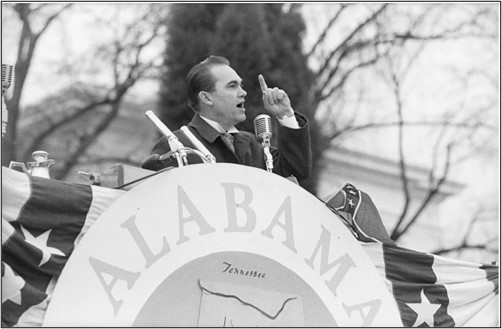
Alabama Governor George Wallace delivers his first inaugural address.

In Freedom’s Dominion: A Saga of White Resistance to Federal Power (Basic Books, 2002), Jefferson Cowie focused on the history Barbour County, Alabama, to document the way a deeply self-serving concept of “freedom” was used by whites to justify racist policies. It was all about their “freedom.” White freedom meant freedom from government restraints; freedom from taxes to support public institutions and services; freedom to own and use guns; and freedom to mistreat African Americans without federal intervention. White freedom, dating to the era of Black enslavement and Jim Crow segregation, equated with racism. Source:https://www.nytimes.com/2022/12/12/books/review/freedoms-dominion-jefferson-cowie.html

Sadly, fear of federal imposition on white freedom remains alive and well today and was part of the justification for the January 6, 2021 insurrection at the United States Capitol building in Washington DC and is the ideological underpinning for the attack on Critical Race Theory by Florida Governor Ron DeSantis and other conservative Republicans. When DeSantis was reelected in November 2022, he declared that his election signified “Freedom is here to stay!” Polls repeatedly show that a large majority of white voters who identify as Republican believe that there is discrimination against white people in the United States and that little or nothing needs to be done to ensure equal rights for African Americans and other minority groups.

Sources: https://www.local10.com/vote-2022/2022/11/08/is-desantis-on-path-to-remain-governor-of-florida/https://thehill.com/hilltv/what-americas-thinking/433270-poll-republicans-and-democrats-differ-strongly-on-whether-white/https://www.pewresearch.org/politics/2021/08/12/deep-divisions-in-americans-views-of-nations-racial-history-and-how-to-address-it/

Barbour County’s best-known native son was George Wallace, Governor of Alabama from 1963 to 1967, 1971 to 1979, and 1983 to 1987. Wallace was also a candidate for President of the United States four times, both in Democratic Party primaries and as an independent candidate. In June 1963, while Governor of Alabama, Wallace staged standing in the entrance to the University of Alabama in Tuscaloosa to block the enrollment of Black students. In defiance of a federal court order, he accused the federal government of usurping state authority in the field of education by calling for desegregation. Wallace finally backed down when the Kennedy Administration federalized Units of the 31st (Dixie) Division of the Alabama National Guard.

Source: https://archive.nytimes.com/www.nytimes.com/library/national/race/061263race-ra.html

For Black History Month, students, Black, white, Asian, and Latinx, should read texts and listen to speeches by inspiring Black authors and orators. But to understand the depth of racism in the past and today, they also need to read and understand racist texts that defended slavery and racial segregation. In his January 1963 inaugural address, George Wallace, as the newly elected governor of Alabama, issued a defiant defense of racial segregation. At the time, only fourteen percent of eligible Black citizens were registered to vote in Alabama although at least 30% of the population was Black. Poll taxes, literacy tests, and hostile registrars effectively ensured white supremacy, white freedom, in the state. Sources: https://rediscovering-black-history.blogs.archives.gov/2016/10/25/voting-rights-in-the-early-1960s-registering-who-they-wanted-to/; http://www.bplonline.org/resources/government/AlabamaPopulation.aspx

“Segregation Now, Segregation Forever” (1963)

By Alabama Governor George Wallace

A. “Before I begin my talk with you, I want to ask you for a few minutes patience while I say something that is on my heart: I want to thank those home folks of my county who first gave an anxious country boy his opportunity to serve in State politics. I shall always owe a lot to those who gave me that first opportunity to serve . . . This is the day of my Inauguration as Governor of the State of Alabama. And on this day I feel a deep obligation to renew my pledges, my covenants with you . . . the people of this great state.”

B. “General Robert E. Lee said that ‘duty’ is the sublimest word on the English language and I have come, increasingly, to realize what he meant. I SHALL do my duty to you, God helping . . . to every man, to every woman . . . yes, to every child in this state . . . I shall fulfill my duty in working hard to bring industry into our state, not only by maintaining an honest, sober and free­ enterprise climate of government in which industry can have confidence . . . but in going out and getting it . . . so that our people can have industrial jobs in Alabama and provide a better life for their children.”

C. “Today I have stood, where once Jefferson Davis stood, and took an oath to my people. It is very appropriate then that from this Cradle of the Confederacy, this very Heart of the Great Anglo­ Saxon Southland, that today we sound the drum for freedom as have our generations of forebears before us done, time and time again through history. Let us rise to the call of freedom­ loving blood that is in us and send our answer to the tyranny that clanks its chains upon the South. In the name of the greatest people that have ever trod this earth, I draw the line in the dust and toss the gauntlet before the feet of tyranny . . . and I say . . . segregation today . . . segregation tomorrow . . . segregation forever.”

  1. Who did Wallace quote on the importance of “duty”? What signal was Wallace sending to his audience by quoting him?
  2. What other references does Wallace make in the speech to ensure his audience understands his political point of view?
  3. How does Wallace propose to battle “tyranny” and defend “freedom”?
  4. Wallace pledged to honor “covenants with you . . . the people of this great state.” In your opinion, to who was Wallace referring? What evidence in the text supports this interpretation?

Reflections on the 1770’s: Diaries of New Jersey Quakers

Reflections on the 1770’s: Diaries of New Jersey Quakers

Robert Ciarletta

It is thrilling to go back in time and encounter writing from a few hundred years ago. I love uncovering the stories, experiences, and feelings embedded there. For those of us who love language, we can also use these texts to observe how the language we use changes just as human life evolves. For my research, I read the diaries of two New Jersey Quakers (the Religious Society of Friends). The writers are John Hunt, a farmer who regularly partook in meetings with other friends in Evesham, now part of Moorestown; the other is Margaret Hill Morris, a nurse practitioner and widow who had four children and lived in Burlington. When reading these diaries, I had to adjust to the different spellings, sounds, diction, and structure, since it is so different from how we write today. To fully appreciate these diaries, you must also recognize that the Quakers wrote in a sort of language of faith. Faith encompassed their lives so much so that it became a central theme in their diaries, arguably just as much as the American Revolution itself. No matter what subject these people wrote about, they constantly alluded to passages from the Bible and looked up to God as a way to make sense of their world.

As you dive in, the language reveals that New Jerseyans used to have a lot of daily items and objects that are so unfamiliar to a reader today. Many of us buy our food pre-packaged at the grocery store, or we order items through online marketplaces like Amazon. Though all of this is convenient, we tend to know little about the processes that go into creating our necessities. On the other hand, early Americans like Hunt must have been quite skilled since they produced numerous things for themselves. For instance, he wrote about tools like a sider press (another way to write cider), a cheespress, silk reel, and others. It is beneficial to expose students to texts like this because it adds a level of dignity to another way of living, and may spark students’ interest in old tools and artifacts.

It is also fun to pick up on the patterns that differentiate someone else’s English from our own. One common quirk is that Hunt used the letter ‘d’ as an inflectional suffix to signal the past tense of verbs, whereas we use ‘e’d. For instance, prayed, composed, and stayed were written as prayd, composd, and stayd in Hunt’s diary. What great, local proof to our students that our language is dynamic! His diary also proves that the names of our places have changed in history; he spelled Moorestown as Mourstown.

These diaries also show that sometimes life can seem ordinary until the moment when it suddenly is not so, anymore. After the French and Indian war, the Friends promoted pacifism with new vigor[1], intending to be a light to the world. But peace did not last, and they felt helpless when the war reached a point of no return. It was impossible to feel safe; their beliefs could only remove them from the war so much. And if you choose to help neither side, does that create zero enemies for you? Or does it possibly create two? There is danger in a decision to declare yourself neutral, and Hunt and Morris had to navigate the war this way.

The Quakers were appalled at the effects of the war on their communities and lives. When John Hunt entered the Evesham meeting house on January 1, 1777, he found soldiers lying in filth, comparing them to animals in a stable. He also writes about the tense situations a year later in 1778, when people around him are dying from a smallpox epidemic, and British soldiers are plundering neighboring homes. It was dismal –the townspeople dying around him, and always on edge anticipating the soldiers coming. He kept these entries brief, not wanting to give the bad all of his focus. The next day he would be back to normal again, and write about farming or attending a meeting.

Hunt’s diary reveals his industry too. A single task occupied him for days on end. For example, he wrote 2-4 mowing to signify that mowing dominated the second through fourth days of the month. And he not only labored physically but also in thought. William Penn said that Quakers should write at least one line in a journal daily[2], and this inspired Hunt. I would get bored writing the same things every day, but Hunt wrote continually to keep track of his days and gain wisdom from a holistic view of his life. He wrote for the sake of writing, and I find that beautiful.

And, you can find duality in Margaret Morris’ diary if you choose to read it. At first, she was overwhelmed by the war, but writing her diary helped her to think clearly and grasp this reality. As you read her diary, you see her use words like ‘terrible and horrid’ to describe the war, and she seems scared. She also writes about seeing soldiers march past her town on their way to meet death, and this suggests an emotional, fearful side of Morris. And then as I read further, she had a similar moment to John Hunt that caught my interest. On January 3, 1777, Morris sneaks into a house next door at night and finds soldiers sprawled on the floor, “like animals”. Yes, one part of her pitied these men. But this was also the moment when I knew Morris was not the kind of woman to just sit home scared during a war, but she also wanted to make sense of things for herself. A light bulb went off in her mind that the soldiers were deserters since she realized that they shouldn’t have been around. Morris does not shy away from what she sees but keeps it to herself in her diary, a form of secret knowledge. 

By the end of the war, Morris gained boldness and found herself. While her neighbors were able to leave for the countryside, she had to stay with her family. She survived cannon fire, evaded a hunt for Tories, and hid one of them in her home. Moreover, she followed her own convictions and gave generously to American troops, despite the mandate in 1776 that Quakers who gave to either side (non-civilians) would be disowned[3]. In chronicling extensive information daily about the war in her diary, she found a sense of confidence and purpose. Later, Morris opened her own medical and apothecary practice in Burlington, in 1779[4]. Morris was well-equipped to provide for her family and protect them. 

So, when people read your diary centuries later, are you still an ordinary person? And what if you provide insight about a time so critical to our nation’s story, like the American Revolution? Hunt and Morris’ slice of the human experience represents something greater, even if the impact of their writing seemed insignificant to themselves at the time. Their diaries tell us about the whole New Jersey revolution experience. And when one’s experiences are immortalized like this, you do in fact become a bit more than ordinary.


[1] Kashatus, William C. “Quakers’ painful choice during the american revolution.” The Philadelphia Inquirer, Jul. 5, 2015.

[2] “John Hunt Papers.” TriCollege Libraries, https://archives.tricolib.brynmawr.edu/resources/5240johu.

[3] Mekeel, Arthur J. “The Relation of the Quakers to the American Revolution.” Quaker History, 65(1), pp. 3-18. Friends Historical Association.

[4] Brandt, Susan. “‘Getting into a Little Business’: Margaret Hill Morris and Women’s Medical Entrepreneurship during the American Revolution.”  Early American Studies, 13(4), pp. 774-807. University of Pennsylvania Press.