The Forgotten Lessons: The Teaching of Northern Slavery

The Forgotten Lessons: The Teaching of Northern Slavery

Andrew Greenstein

In the winter of 2021, a dark discovery took Rider University by storm and sparked a revelation amongst many of the students in attendance. After over a century of being hidden in the darkness, the secret that Rider University was once a slave-owning plantation was revealed to the world. A place of advanced education and diversity was once an institution of oppression. The university has since changed the name of the building from the name of the slave owner, Van Cleve, to the Alumni House. It is important that history not be forgotten, but instead brought to the forefront. The university will not erase the history but rather use it as a way to teach about the complicated history of slavery in the state of New Jersey[1]. To many of the students attending the university, this came as a surprise. The students who were history majors were astonished by the fact that slavery occurred in the state of New Jersey, let alone on Rider University’s property. The reason for this lack of information stems from the collective lack of education on the subject.

With a basic understanding of American history, one would be led to believe that slavery was a southern issue and continues to be a contentious history when taught in those states. The reality was that slavery was a nationwide institution. Though schools in the south are vocal about the unwillingness to teach the subject, schools in the north are silent. There is continuous hypocrisy in deflecting all discussions of the matter to the south while ignoring what happened in their own backyards. Walking through any school teaching U.S. history, one may hear a line like “The north were free states and the south were slave states.” Similarly, worded statements can be found within schools in New Jersey all across the state. It implies that Northern states had no slaves at the time of the civil war and were actively fighting the good fight. When the 14th Amendment comes into discussion, one may have the impression that it directly pertained to the freeing of enslaved people in the south, rather than the north as they were already free. This simplification of the issue is far from the truth. To this day, many students will never learn that slavery took place in the north at all, let alone that New Jersey was the last state to abolish the practice. The nation now celebrates Juneteenth to “commemorate an effective end of slavery in the United States”[2]. The stark reality is that slavery persisted after Juneteenth in the state of New Jersey legally for almost a full year, and illegally for another year. That dark history is often forgotten within classrooms throughout the state of New Jersey and the nation.

The lack of national attention to this critical issue does beg the question of how it happened. Many historians argue that the lack of discussion on the institution of northern slavery was due to the racist beliefs of historians in the 19th and 20th centuries.[3] The voices of those early historians often get blamed for creating the view that slavery was only relevant when discussing the civil war as it was undeniably a major cause[4]. As time progressed, one would assume the material on northern slavery would become more prevalent, however, that is not the case. As the discussion both in the classroom and by historians on the institution of slavery has expanded, northern slavery still remains for the most part absent. The question remains: did this critical part of the establishment of the nation go untaught? The only way to answer that question is by examining the teaching of slavery in New Jersey and the Tri-state area. This will open that gateway to a deeper understanding of how this history could be erased from the collective memory.

Before proceeding, it is imperative to understand what the discussion of the education on northern slavery has been. Though the discussion on northern slavery began in the late 1940s alongside the civil rights movement, the conversation about its absence in the classroom does not begin until 1991 due to a shocking discovery in Manhattan, New York[5]. As the federal government was constructing a 275 million dollar project, they stumbled upon “the largest and oldest collection of colonial-era remains of free and enslaved Africans in the United States, according to the National Park Service”. This discovery of the cemetery caused massive protests to fight the city to halt the construction and the removal of the bodies from the site[6]. Following this event, the New York City public schools began to look for a way to incorporate the material into the class and teach this reality that was just revealed to them[7]. This started a growing push from schools across the nation to try to incorporate this reality.

The conversation on northern slavery would continue over a decade later when Professor Alan Singer of Hofstra University would guest teach in New York City public schools. When teaching less than a mile away from the enslaved African cemetery, most of the students were completely oblivious to the reality that not only were slaves in New York but how the reality of slavery was visible in their own community[8]. Though many decisions on how to tackle such an issue were made to teach this material, over a decade later the students still had no idea about northern slavery. The discussions on the material did not translate into the classroom to a sufficient extent. The debate on how to successfully teach northern slavery in the classroom ensued and ultimately lead to the discussion on how to teach this history appropriately.

The content of northern slavery required a restructuring in order to successfully teach the material. Previously, slavery was only taught at the establishment of European colonies in the New World and before the American Civil War. What this divide does is creates the material into another unit, a separate event rather than a continuous struggle. The 2016 book Understanding and Teaching American Slavery by Bethany Jay and Cynthia Lyerly attempt to illustrate the best organization for discussing the topic and the history of the institution of slavery in classrooms. In their analysis of the history of teaching the institution of slavery, they regard the idea of teaching slavery exclusively at those points during early American Colonization and the Civil War to “severely hinder its importance.”[9] What is the best way to teach the institution of slavery is discussing the enslaved perspective threw out the development of the nation.[10] The benefits of this method allow the longevity of the issue and the hardships faced by those affected to be well articulated amongst the students. This is due to its constant presence and the reminder that liberty and freedom were not for all[11]. This revelation in adding the enslaved perspective to early American history would spark further development in tools and resources to bring northern slavery into the classroom.

An initiative would be enacted to bring northern slavery and the massive scope of the institution of slavery to the forefront. This would come in the form of The New York Times 1619 Project. This resource marks an incredible stride in the conversation on teaching northern slavery. The project’s purpose is “to reframe the country’s history by placing the consequences of slavery and the contributions of black Americans at the very center of our national narrative”[12]. This comes out of a series of historians and teachers discussing how the realities and the true institution of slavery were untaught to them in the classroom. The project’s aim is to bring these lost lessons of slavery such as its true cruelty and its widespread adoption throughout the nation, not just exclusively in the south. It is built off of the ideals proposed in Understanding and Teaching American Slavery and other books with the same idea tofollow this notion that slavery is an integral part of the nation as a whole, rather than at specific points in U.S. history[13]. The combination of all these ideas paints a picture of the flaws of the teaching of slavery threw out the nation. The current discussion’s main focus is looking at what is absent in the current classroom. The smaller conversation that pertains to the material taught in the past primarily revolves around racism and the Klan[14]. The discovery of a 1904 textbook that details the brutality of northern slavery pushes back on this notion[15]. It begs the question of whether the subject was truly untaught or if another force was responsible for its absence. Looking at the material present in the classroom in the past may prove an insight into northern slavery’s appeared absence.

An analysis of the classroom material available to students is key to understanding the absence of northern slavery. To find these answers, understanding what material was being taught in classrooms from the 1860s and beyond. A method to understand the content of the classroom is by looking at textbooks. Many school notes and lesson plans have been lost to time, but what remains are textbooks. The work of Dr. Pearcy shows the indicator tool that can be used to understand their effect on the content being taught in schools. He states clearly in his article, “Textbooks are, ultimately, tools, for student use. Their utility can only be measured by the degree to which they offer teachers the opportunity to build student-centered inquiry”[16]. From this notion, we can conclude that textbooks are just an object and a tool for students to use. Their content is meaningless unless given a purpose by the teacher. Everything learned in the classroom is under the teachers’ control and they possess the option to use or discard the textbook. However, textbooks do tell us something else depending on where they are. His research looks at ten different U.S. history textbooks of different authors that are widely adopted and compares their tellings of the Battle of Fort Sumter[17]. After analyzing each of the tellings, an interesting trend occurs. This trend is in the bias of the author and how they pick and choose what details to keep and leave out of the telling of the event. This bias could affect the leanings of anyone reading and coerce their perspective of the events that unfolded. These different depictions of the conflict in different areas can have effects on the material discussed in class or reflect it. Companies such as Pearson publish multiple textbooks by different authors to capitalize mainly on the market, however, what market are they capitalizing on?

Looking at the rationale behind the variation of textbooks based on location can assist in understanding why certain content is missing. The findings by Goldstein in his article Two States. Eight Textbooks. Two American Stories sheds light on the issue of why these publishing companies hire multiple historians and interpretations of the same material. This article focuses on eight different textbooks found within the states of Texas and California. The issues arise when looking at the same textbook in multiple states. The textbooks are by the exact same author but have different versions for each state. The variations were created by request of school districts or even the book’s own editor. These individuals remove or request additions of material to allow the book to be adopted in a particular area[18]. The best evidence to illustrate this divide between locations is that of the Harlem Renaissance. Examples of this are found in Pearson’s United States History: The Twentieth Century 19th edition. On the subject of the Harlem Renaissance, the Californian edition features a section on the debate within the African American community over its overall impact on them and the nation as a whole. The Texas version only includes the line “some critics ‘dismissed the quality of literature produced’”[19]. What these two distinct changes, along with many more, indicate is the presence of the political atmosphere of the area and the belief of the people the textbook is serving to reinforce. The textbook adopted by a particular state or district reflects the information a school is teaching in the classroom.

With an understanding of the behind-the-scenes crafting of textbooks, there can be the formulation of the content of northern slavery in school. Combining the findings of Dr. Pearcy and Goldstein, textbooks can provide insight into the classroom. The selection of the historian and the version adopted by the school reflect what the administration desired its teachers to instruct in the classroom. Though it may not be a perfect indicator of what was taught in classrooms, as it’s a tool for teachers to use, it gives an idea of what is being taught in the classroom. Examining textbooks from the past used in classrooms within the Tristate area can reveal if northern slavery was taught, and to what extent.

Examining the earliest textbook may yield an understanding of the lack of teaching, not only about northern slavery but slavery as a whole. An example of the content of what was taught in the classroom after the Civil War and in the years following can be found in The New England Primer. This book originated in 1690 and was a fixture in the classroom until the 1930s, a well over 200-year run. The textbook served as the basis of elementary education instruction. By looking at these textbook translations, historians get a sense of what was required of the majority of students at this time, along with what was taught in classrooms. Looking at the 1802 edition, the book opens with an alphabet chart. This gets taught through prayers that become progressively more complex as they go[20]. This information indicates that understanding the alphabet was key. Depending on the quantity available, the school could have focused on reading and potentially writing to utilize this book. Within the context of these prayers, one learns about the calendar and days of the week, counting and basic mathematics, and a small amount of history[21]. This stresses the importance of religion in the classroom at this time. The underlying message throughout the book is that God is more important than any other subject or material in the classroom. The small amount of history included is more biblical in nature but does include the basics of the American government system[22]. The addition of the U.S. system of government is the only change from the 1773 edition, replacing prayers outlining the functions and structure of the parliament system[23]. What this shows is that history was really not a focus in this era of education. Only those who would exceed the basic knowledge of the time would learn about more advanced information. With the perpetuation of this book into the 20th century, this basic education would be what was taught to many poor American individuals and black Americans. More fortunate areas would receive new textbooks and educational material, phasing this material out or relying on it less exclusively. Those less fortunate areas would be using this information exclusively until the 1930s. The New England Primer is referred to as the “Bible of one-room schoolhouse education”[24]. The lack of history not only assists in the loss of the knowledge of northern slavery but of the entire institution of slavery as a whole. These individuals would want the history they learned as children in school. A slow creep of this altered history would make its way to the north.

Movements were made to suppress and remove the teaching of not only northern slavery but all of black history. The most prominent of these would be “The Lost Cause”, the movement to honor the legacy of the confederacy. This movement would begin in the 1870s as reconstruction would begin to fail. The lost cause mentality would paint the black community as unable to attain the same equality as white individuals due to the efforts attempting to create equality failed[25]. This gave rise to the notion that the confederates were noble in their sacrifice to fight for slavery. It rewrites the telling of the history that “there was nothing ‘lost’ about the southern cause”[26]. This was due to the mindset that black Americans were only good at being servants to white men. Monuments and memorials to honor the confederacy would be constructed such as the statues of Stonewall Jackson, Jefferson Davis, and Robert E. Lee. By the 1890s this movement would sink its teeth into the education system of the north. The goal was to rewrite history books to reflect the southern perspective and preserve its honor. This movement is regarded as a reunion of America’s racist mentality as it proposed the Civil War was caused by other factors, not slavery. It also created this idea of the “happy slave”, the idea that there were enslaved individuals that loved slavery and serving the white man[27]. Women’s organizations and the state department of education were the ones in charge of advocating for approving educational material for schools. Many became strong supporters of the lost cause and by the 1920’s it would be integrated into schools across the north and especially in New Jersey[28].

Before the alteration of the history would appear, strides were made to bring the history of northern slavery to the forefront. In the 1870s history books began to include slavery within their content. The oldest examined history textbook to bear mention of slavery is the Condensed History of The United States from 1871. This book was used in a classroom in Norristown, Pennsylvania, as demonstrated by the address of the school on the front cover pages with the initial date of October 31, 1888. On the page adjacent, student names are written, with the last one being 1899, giving the text an eleven-year confirmed usage in the classroom. The cover pages are full of notes made by students long past, however, one stands out amongst the rest. This particular note is a prayer, one found word for word from the 1812 edition of the New England Primer. This detail establishes that in this classroom, the two books were in fact utilized together. This class was learning American history alongside the basics in the New England Primer. The town had the economic resources present to invest in its youth’s education. The students within this town received a higher quality of education than those of poorer communities. However, what did these students learn about not only northern slavery but the institution of slavery as a whole?

 This history tells a very interesting version of America’s past, but what is interesting is what is left out. There is no mention of slavery until what they call the “War of Secession” is discussed[29]. The book starts with the discovery of the new world and the establishment of each American state at the time of its publication, but not one mention of slavery till that point. The book does establish that there was northern slavery by directly stating “At the time of adoption of the Constitution, slavery existed in the Northern as well as the Southern States”[30]. It provides an impressive analysis for its time detailing the various legal cases pertaining to slavery such as Dred Scott v. Sanford. There is a fascinating inaccuracy with the passing of the 13th, 14th, and 15th amendments; as the book details that Johnson was president for their passing. It details that the passing of these amendments was the cause of the issues between the President and the other two branches, rather than Reconstruction. In fact, the only mention of Reconstruction at all is Johnson vetoing the Reconstruction Act of 1865 rather than discussing any of the programs created by it[31]. This alteration to history has two possible reasons for the inaccuracy. The first is more innocent, being in the title of the book “condensed”. Reconstruction not only is a long process and would officially end in 1877. The book was written in 1874 meaning that reconstruction was still ongoing at the time. Writing on its effects could be taken as more speculatory and not factual information as the book attempts to stick exclusively to. The second is the seed of the lost cause making its way into the material. The ideology of the lost cause deemed Reconstruction a failure and did not warrant time discussion. Its omission is telling that this influence was seeping into the education of these students. However, what is most interesting is what it says about how slavery ended in the north. After detailing the increase of southern populations due to the cotton gin, it stated, “In the North, on the other hand, where slave labor was not profitable, slavery soon died out”[32]. It leads to the idea that in the 1850s slavery was extinct in the north, however, the reality was quite different. Slavery was very much alive in the north during the 1850s. 

Looking at the history of just New Jersey alone, there is a far different reality of northern slavery from this telling in the textbook. Starting as far back as the 1790s, New Jersey was split over the issue of slavery. Quakers were strongly against it; they interpreted enslaved people as people due to the wording of the constitution. The three-fifths compromise of 1787 also reinforced their claim that enslaved individuals were people. The opposition viewed freedom as an economic catastrophe. The labor force for the majority of the state’s highest-grossing markets were nearly entirely enslaved or indentured servant individuals. They saw that liberation would make the industries of agriculture, ironworking, and factory manufacturing unprofitable. The debate over a compromise began in 1797 but would reach its conclusion in 1804 with the gradual abolition act, also referred to as the “free womb” act[33]. This legislation gave freedom to all enslaved individuals born after July 4th, 1804 on their 21st birthday[34]. This allowed slave owners to have the labor force they needed to make up for the economic loss of abolition and granted enslaved people their freedom at a set point. The average life expectancy of an enslaved individual in New Jersey at this time was forty-one years. This meant that they would likely have had only half their life to live if they even made it to freedom. The act was filled with loopholes that allowed the continuation of slavery in the state well after the projected period of total abolition. The idea was to have all enslaved individuals freed by the 1830s. The issue was with the clause that allowed children born while in the period of the enslavement term were to be placed in the care of the local principality[35]. Principalities were the townships and counties that reside within the State of New Jersey. Many of the individuals in charge of managing the treatment of these children would give them right back into the hands of their masters, making them slaves till their 21st birthday. This is how the enslaved population grew far larger than it was in 1804 by the 1860s[36].

The inaccuracies of the teaching of northern slavery would have disastrous consequences to its very existence by later generations. The pervasive belief that slavery was all but extinct in the north by the 1860s is evidence of the start of the “the amnesia of slavery”[37]. This is a term coined by historian James Gigantino II in his book The Curious Memory of Slavery in New Jersey, 1865-1941. What he seeks to illustrate is how Northern states such as New Jersey with such a large and prosperous enslaved population forgot that slavery even occurred in their own backyards. The reason for this was that slavery was looked at as an “insignificant sideshow” in the state. Many northern slaveowners owned only one or two slaves, thus making the reminders of an enslaved past virtually nonexistent to those that were not directly affected by it[38]. What the Condensed U.S. History textbook shows us is this amnesia occurring. In a time when enslaved individuals and their children were very much still alive, their suffering is being forgotten. There is no active backlash as those with the ability to change the material have little to no interest. This early removal of teaching about what occurred beneath these students’ feet will send shockwaves to later generations and reach into the modern classroom.

There would be a push to expand the teaching of northern slavery upon the turn of the century before the influence of the Klan would take hold. This is evident in the textbook Stories of New Jersey by Frank R. Stockton. This book was published in 1896 and the copy analyzed was printed in 1904. The inside cover indicates the book originated from a Princeton classroom before finding its way into the Library of Congress. It is worth noting that this book is back in reproduction and the Amazon description of the book reads that it was “so popular over the years in NJ schools that it has in itself become a part of New Jersey’s history”[39]. This book possesses a unique feature that is exclusive to this book and none other, even textbooks today. This feature is an entire chapter dedicated to the history of enslaved individuals in the state from 1626-1867[40]. What this chapter says about slavery in the state is incredibly unique, especially for its time of publication. The section begins with Dutch settlers bringing enslaved individuals over with them in 1626 to develop the inhospitable land and form their colony. Enslaved individuals were expendable and would do the labor that would normally require a far more physical toll on the body. They became the largest group of workers in the booming iron industry, logging, and of course, the plantations popping up across the land. In 1664, the Dutch surrendered their colonies to the English empire. In this exchange, many changes would appear in the lives of those original settlers, but slavery was not changed[41]. Slavery remained in this state for over 200 years after this point. This early slavery history even includes an entire section on how Perth Amboy, New Jersey, was the slave trade capital in the north and distributed enslaved individuals throughout the northern colonies[42]. This was all true. While other texts around this period ignore this history, this book sought to put a spotlight on it. Following details of the atrocious conditions the enslaved people in the state faced and the lack of large plantations like the south, it noted that large numbers of individuals owned one or two enslaved individuals[43]. This kept slavery as a pivotal force in the community and essential to its economy. If this text was utilized in the classroom to the fullest, many students would have learned a genuine and dark history of the establishment of the state’s institutions. However, this very insightful history becomes inaccurate regarding the abolition of slavery.

The first half of the telling of northern slavery from Stories of New Jersey is remarkable with its depiction of northern slavery for its time, but that narrative falls apart when reaching the abolition of slavery in the state. While it does portray an accurate picture, much of it is far from the truth. The first comes in the debates over the gradual abolition act of 1804. The book describes it as Quakers becoming abolitionists; the three-fifths compromise made their view under the law that these were people, not property, and entitled to the same rights. The opposition saw slavery as an economic necessity as the work they were doing was dangerous. These were undesirable jobs no one wanted to do in their society. This debate over the issue does remain close to the reality that transpired. The text makes a crucial error in stating the gradual abolition bill that allowed the abolition of slavery on one’s twenty-first birthday passed in 1820 rather than 1804[44]. This alteration of the date creates a precedent that the abolition of slavery was far faster and more efficient. It creates the idea that New Jersey’s policy was successful and had no issues with its implementation. Further errors found in the section support this idea that the solution the state implemented was successful. When discussing the results of the act it directly states, “in 1840 there were still six-hundred and seventy-four slaves in the state, and by 1860 only eighteen slaves remained, and these must have been very old”[45]. These numbers couldn’t be further from the truth as slavery was still going strong by the 1850s.

 What is missing from the Stories of New Jersey textbook are those who were wrongfully enslaved. The text leaves out the dark reality that a percentage of slavery occurring in the state was children who were supposed to be free. The 1804 Gradual abolition act forced some of the children born to enslaved mothers into a life of enslavement until their twenty-first birthday. The census of children being born from 1804-1835 to exclusively enslaved mothers shows five hundred and forty-one documented children. It is estimated that in the year 1850, while documentation may say two hundred and thirty-six, far more were illegally in service. The text also does not acknowledge the abolition of slavery in its entirety in 1866. The wording makes it appear it ended gradually by 1860 citing the success of the gradual abolition act[46]. This misinformation will impact generations to come as it was the definitive history of the state. It took until 2008 for the New Jersey government to finally formally apologize for its slave-owning past and its failure to step in and end its illegal perpetuation[47]. Though it may not be the most perfect telling of the history, it’s evidence that people were trying to teach the injustice that happened within their state. Slavery was not relegated to a small part of the civil war, rather it merited its own chapter dedicated to the hardships and debate over its abolishment. While this book is making its way into classrooms, so is the Klan. The Klan would attempt to rapidly spread in the education field and in the coming decades as part of its resurgence. This growth would ultimately transform the history of northern slavery.

The Klans’ takeover of northern education and purging of the history of not just northern slavery, but the entire institution is seen within the textbooks of the 1920s. The 1924 textbook An Elementary History of New Jersey by Earle Thomson is dramatically different from the textbook from 1904. What distinguishes this book aside is absolutely no mention of slavery of any kind. This textbook was definitely used within the state, as in the preface the author thanked superintendents and principals who commissioned a book to express their shared view of the truly important history and to add tools that would enhance student understanding[48]. The schools this particular book was used in included Union, Hackensack, Newark, and Westfield[49]. There may have been more schools adopting this book, however, those are unmentioned by the author, and no indication is left on any of the Library of Congress documentation. The book directly states that “children should be taught in some detail the history of their own state and of its part in the development and progress of the country” while omitting a major part of their history[50]. The larger shocking piece is that only the conflict of the Civil War is discussed. There is no lead-up; it just dropped the reader right into the conflict[51]. It appears that only the victory of the war was significant, but not what they were fighting for or even the amendments that followed. This text is pivotal to understanding the shift in the classroom. The lost cause ideology had reached the apex of its hold on the classroom. The removal of all mention of slavery or black Americans was done to illustrate how unimportant the black community was and how futile any action to promote equality was. However, its removal may have been far more purposeful than just a desire to push this lost cause ideology.

The Klan had far larger ambitions than just the omission of slavery from educational material during the 1920s. The book The Second Coming of the KKK: The Ku Klux Klan of the 1920s and the American Political Tradition by Linda Gordon sheds light on this exact time period. The Klan was a notorious hate group created in the aftermath of the Civil War but it saw a resurgence in the 1920s. This revived Klan was stronger in the North than in the southern states of the nation and focused on the education system of the time[52]. Their priority was the recruitment of white American youth to continue their organization into the coming generations. This involved integration of the Klan into the material taught in schools. The Klan and those associated with them edited the material to reflect the beliefs of the organization. This makes recruitment easier as the Klan reflects the morals and values secretly supplanted into the minds of susceptible students[53]. This was most evident in the teaching of history in the classroom. Klansmen in positions of authority in schools such as superintendents used their influence to alter texts found in the classroom. This involved the recreation of textbooks to fit their nefarious agenda[54]. The lack of a mention of slavery or even the leadup or aftermath of the civil war in the 1924 textbook is evidence of known involvement. It’s unclear if any of the principals or superintendents credited in the textbook are Klansmen, but the influence is quite evident. The textbook states, “This book is in no sense a complete history of New Jersey, the author hopes that its study may prove an inspiration to the purple to become an upright citizen of his community or state”[55]. The absence of this major time period in the state’s history is done in a way to not invoke question. Unless there is other supplemental material taught in the classroom, the dark history of the state and the nation are removed from the collective memory. This book directly shows how “the amnesia of slavery”[56] occurred not only in the state of New Jersey but across northern states. With the widespread recruitment push for new Klansmen, anyone learning in schools around this time would have no recollection of northern slavery’s existence. All the work in the decades past to bring this history into the classroom has been completely undone. Any book touching on the subject would have to start from scratch if the goals of those behind the book were successful.

Following the end of the Second World War, the U.S. would revisit the teaching of northern slavery. The post-war U.S. began to enter a period of civil rights and reforms as the Truman administration began to assist in the abolishment of segregation. This gets reflected in the 1947 U.S. history textbook American History by Howard Wilson and Wallice Lamb. This textbook is fascinating due to its creation. The book states that the author’s intentions for writing the textbook were to “include history and perspectives from this great nation that have been forgotten or removed over the years”[57]. This indicates that the creation of the book was to teach a history that includes information removed by the Klan and other parties. The authors attempted to devise a history from the ground up that includes lost information including slavery. It kept its promise by including a simplified version of the slave trade and the quantity of forced labor employed. The text also looked into how the institution of slavery was a fundamental part of colonization in the Americas[58]. It may not be the most perfect of tellings as it leaves the atrocities that faced the enslaved individuals out. This is significant as it leaves out the horrors that faced enslaved individuals. It creates the notion that this was a great injustice on the part of the colonists but was not as horrific as the reality of the situation. It keeps the reader, most likely a white student, separated from the event allowing no remorse for the actions of their forefathers to the black community. This was the last instance of slavery mentioned till the causes of the Civil War. There are two chapters dedicated to the development of agriculture and industry in the northern states and the southern states, but there is no mention of slavery whatsoever[59]. What this does is reinforces the idea that slavery was there, but it wasn’t important in the continued development of the nation. The practice of slavery was only significant in establishing a foothold on the land. It makes the institution and the horrors faced by the enslaved people insignificant to economic development. However, coverage of the Civil War period possessed an interesting take on the content.

The 1947 textbooks’ stance on the Civil War and its aftermath indicate a deviation from the stranglehold of the Klan in education. The period leading up to the war has an interesting take on slavery. The text neither condemns nor supports either side of the debate on slavery. It creates this awkwardly neutral state when describing the situation that caused the suffering of so many[60]. This is important as the goal appears to not anger those with sentiment in support of slavery. The author appears to be holding back their opinion on the matter and not getting into depth on the horrific reality. The text does have an allusion to the idea that the northern states either abandoned or abolished the practice. It describes this trope of the north being “abolitionist”, that there was no one within the state that opposed slavery. Following the end of the war, it does something unique to this text. The textbook described the reconstruction period in a way to appear successful rather than what happened in reality. The book described Reconstruction as establishing property in the south with 40 acres and a mule proposition. It describes how many would remain in the south as they were given property. What is also interesting is that it discusses the surge of newly freed black individuals getting into office as they finally received the right to vote. The book describes the downfall of the reconstruction as due to irresponsible spending of tax dollars and the creation of the Klan forcing black Americans to stay out of government and politics[61]. The text portrays the Klan as the villain in reconstruction. It signifies a shift in public opinion and the elimination of their grasp on the education system. Information that pushes back on the lost cause narrative by showing that Reconstruction was sabotaged is making its way into schools. The neutral dialog however does indicate their presence is still there. The Klans’ limited presence is also indicated by the book leaving out many important details such as lynchings, or even the Great Migration of Black Americans to the north for work. These events had the potential to paint the Klan that existed at this time rather than the early organization during the reconstruction era in a negative light. The Klan may not have been as strong as they were in the previous decades, but was still a prominent organization throughout the nation, especially in the north. The textbooks telling of slavery does reinforce the notion that slavery was exclusively a southern problem, but this is not the first time this will occur.

Northern slavery’s absence in the classroom may not have been excluded due to racist involvement in the material. The relegation to slavery being exclusively southern is an issue that perpetuates to this modern day. This trend is one that Mr.Vikos, a former high school history teacher is very familiar with the pattern of returning to relegating slavery to exclusively the south. Mr. Vikos taught in Brooklyn from the late 1960s to the late 1990s. His insight into the teaching of northern slavery illustrates how racism is not the only factor in the removal of this information. In the late 60s, his school was facing a large influx of black students due to the end of segregation in 1963. The school would become nearly 100% black by 1975 and the teachers wanted to teach material that reflected the classroom’s demographics. This involved teaching northern slavery when the pre-Civil War era would arise in the classroom. “Students did enjoy the content at first, but as the years went on there were an increasing number of issues. The first was general confusion as students would get confused on what side slavery was on during the actual conflict. The second and most important issue was the lack of care. The students had no interest in learning about slavery that occurred here (New York)”[62]. Eventually the teaching of northern slavery would be reduced as issues with the content would arise. “Readings on northern slavery were present in the classroom, but the likelihood anyone of the students remembered them a decade later is highly unlikely”[63]. The teaching of northern slavery was present, but students would be the driving factor in its reduction. Eventually, the material would return to the idea that the north were free states and the south was slave states. There is a cycle of the subject of northern slavery appearing and then disappearing. The topic becomes introduced, it reaches a height where the issue is really focused on, and then an outside force acts, reducing the discussion back to the beginning. This trend can be seen between the textbooks from 1874 to 1924 with the Klan removing the material and again from 1947 to the 1970s when student interest would reduce its discussion. This trend would continue into the modern day. This becomes evident with the current lack of understanding of northern slavery even though the material is now present in almost every classroom in northern schools. The decades from the 1980s to the mid-2010s only serve to continue this trend.

To prove this theory of the teaching of northern slavery being a cycle, the decade of the 1980s serves as a point to see the material reintroduced. The 1980 textbook American History Review Text by Irving Gordon illustrates an interesting trend in the telling of history. This book was used in Port Richmond High School in Staten Island, New York throughout the 1980s and into the early 90s. The textbook immediately began with the colonization of America and the triangle trade after establishing a background on the New World. It also does a fantastic job of illustrating the population differences between the enslaved population and the white Europeans[64]. This detail is that “slavery was found as a common practice throughout all English thirteen colonies”[65].Through discussing early American slavery, the inclusion that it existed within the entirety of the nation does allow the student reading to understand that the institution of slavery was in fact present in the north. Continuing the traditional organization structure, the textbook only mentions slavery only at the colonization of America and prior to the Civil War. This structure continues to assist in undermining the severity and longevity of the institution of slavery. When it begins to discuss the pre-Civil war era, it does call out hypocrisy. Though it may be two paragraphs, it sheds light on the hypocrisy of northern slavery[66]. This hypocrisy was the north participating in slavery while simultaneously vilifying the south for participating in the exact same practice. This is significant as this is the first textbook examined to touch upon this issue. Not only does it bring to light northern slavery, but the textbook condemns the north for criticizing southern slavery before it abolished the practice fully within its states. Upon reaching the point of reconstruction, the textbook’s messages begin to shift.

Though time long since passed the time of Klan involvement, the telling of the history still bears its scars. The language of the text leads to assumptions with the vocabulary used to describe the black community at different points. In the beginning, they were described as “Africans” who then transitioned into being referred to as “enslaved” individuals. In the years during reconstruction, they are referred to as “Black”. However, once reconstruction ends they become “negros”[67]. What this shows is the perpetuation of the lost cause mentality through the vocabulary. The idea of referring to black individuals as “negros” in this text is to establish the notion that the black community during the point of reconstruction and after are two different kinds of people. There also are present many allusions to what is going on in the north but the reality is vastly different. An example of this is the education system constructed in the south during Reconstruction. It stated “Negros, as well as whites, were guaranteed free compulsory public education by the reconstruction constitutions of the southern states. However, after the southern whites regained control, Negros received schooling that was segregated and inferior”[68]. This line does highlight the notion that there was segregation and inferior education in the south but makes it appear that it was not a problem in the north. Segregated schools were prominent in the north as well and in some cases persisted far longer than they were legally able to. What this wording does that becomes commonplace is make the south sound like a racist and discriminatory place and paint the northern states in a light that is far from the reality that existed. The textbook does a decent job of illustrating the regression of the discussion of northern slavery. It may establish the institution existed in the north, but it lacks descriptions of the conditions. The text also regresses to race-charged wording linking its connection to the history of previous Klan-influenced textbooks. This would change as the nation entered the 1990s.

The discussion on northern slavery would continue due to its prioritization. The 90s would be a point where the material on northern slavery would begin to grow once again. Starting in 1996, Mr.Vikos would be responsible for approving textbooks for schools in the central headquarters. When asked about the criteria for what textbooks got approved, he would respond with the topic of slavery. He recalled how “many textbooks would just have a paragraph or two on the subject of slavers as a whole. It is impossible to cover all of the slavery in a single book, how do you do it in one paragraph? A textbook would only get passed if it discussed the social, political, and economic factors of both the north and the south”[69]. He would stress the economic section as this would be the deciding factor of slavery’s perpetuation for both the north and the south. What was illustrated was a reinvigoration of the content. This was an individual who was passionate about bringing this information to the classroom and was in a place to do so. With the discovery of the massive burial of enslaved individuals in Manhattan a few years prior, there was a draw into teaching northern slavery.

As time progresses into the modern day, the pattern of the rise and fall of northern slavery’s discussion in the classroom only becomes more rapid of a cycle. Three different versions of the American Pageant textbook by Thomas Bailey, David Kennedy, and Lizabeth Cohen illustrate the perpetuation of the rise and fall of northern slavery in the classroom. The editions in question are the 2006, 2013, and 2016 versions. What makes these books unique is that they are currently in use in schools in New Jersey. The ones examined were in the possession of students actively using them in the classroom. What makes this even more interesting is the parts that were changed. The beginning chapters detail the triangle trade and the enslavement of the native American populations and the African populations. It even includes how slavery reach the American colonies in 1619 from captured slaves en route to Spanish colonies diverted to Virginia[70]. The wording is almost exactly word for word between editions, so uniform it’s almost conspicuous. The differences become starkly relevant when the discussion of American slavery comes to question.

The three discussed American Pageant textbooks present differences that illustrate the increase and decline of the topic of northern slavery. Each book possessed a section dedicated to slavery between the founding of the nation and the civil war, slavery prior to the civil war, and a chapter on reconstruction. The differences become apparent in the first few paragraphs of the section. The 2006 edition was altered to include a deeper perspective of northern slavery following the revelation that attempts to include the material were unsuccessful. This is evident as the edition remarked that in the north there was freedom being attained, but there was more hatred of black Americans than in the south[71]. This gets reinforced by the story of an individual who was born enslaved in the south, sold in New York City, and was eventually freed after eight years of servitude and the conditions she lived in after gaining freedom. The textbook accurately portrayed the conditions of slavery, and by covering the north before the south in the description of slavery, it gives the impression that slavery was equally horrible in practice throughout the nation[72]. The 2013 edition states that northern slavery was just small farms with no large-scale plantations. It goes into detail about how New York abolished all of its slavery and possessed far better-living conditions than the south[73]. This entirely changes the established narrative that slavery was a horrible practice. The text almost glorifies the practice of slavery in the state of New York. The 2016 edition resolves these issues by taking the best aspects of the two together. It largely emphasizes the story of the enslaved woman by giving it its own dedicated page[74]. It includes an interesting insight into the northern slavery perspective. It does an excellent job of discussing how “few northerners were prepared for the outright abolition of slavery”. It goes in-depth at looking at the economic issues facing the north if it were to abolish slavery and the general view of the population wanting reform rather than abolition[75]. The description of the popular view of the time feeds into a clearer understanding of the northern hypocrisy. This being the desire to abolish slaves in the south rather than within their own borders. The combining of the best of the two prior editions is the greatest strength of the sixteenth edition. Due to its publication date, the revised text containing a large amount of northern slavery material could be due to the political climate in 2016. The contentious political election sought to reinvigorate the discussion of slavery, especially that of northern states. This may be only speculation due to the recentness of this change, but outside forces like that are indicators of material like this being reintroduced based on the previously analyzed patterns in the earlier textbooks discussed. The three different textbooks indicate a falling point in the 2006 edition due to the reinvigoration in the 90s, a low point in 2015 as northern slavery was no longer in style, and then a spike in 2016 due to a shifting political climate.

What the analysis of these texts indicate is a disturbing trend of periodically increasing and decreasing the teaching of northern slavery in the northern states. There are large and periodic appearances of this under-discussed material and it appears to almost be predictable.
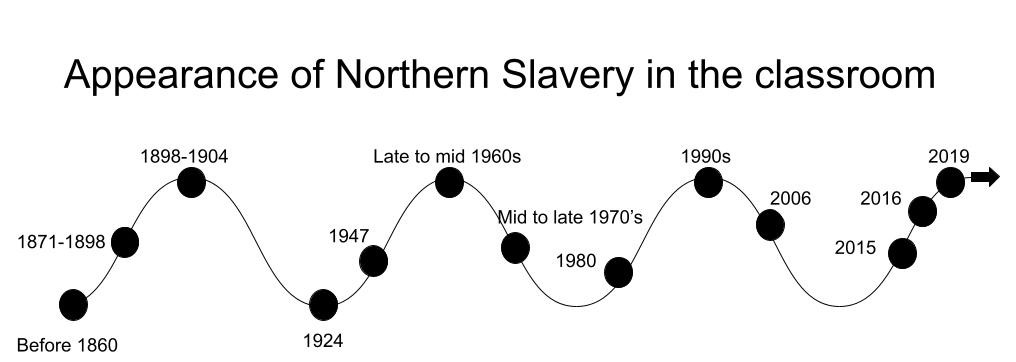
We begin to see it untaught in the classroom in the immediate aftermath of the Civil War[76]. This was due to the material being largely sourced from the New England Primer, a book that focused on basic language, mathematics, and civic education[77]. The exclusivity of this textbook would fuel the “lost cause” ideology. This ideology was the belief that the south was justified in fighting for slavery as reconstruction failed, proving black individuals could never be equal to their white counterparts[78].The discussion of northern slavery begins to increase in the mid-1870s based on the material from Condensed U.S. History from 1874. Though the description of events leads much of the history of northern slavery out, it does make its appearance known[79]. Entering the 20th century we see a boom in the discussion of the material. In the textbook of the history of New Jersey, Stories of New Jersey, there is a detailed history of slavery in the state. It goes as far back as the Dutch and only gets slightly inaccurate in the end with the eventual abolition of the institution[80]. This revolutionary discussion of the material comes crashing down in the 1920s. This is illustrated by the 1924 textbook An Elementary History of New Jersey[81]. Its lack of not only the discussion of slavery in the north, but the absence of the entire practice is the ultimate goal of the “lost cause”. It indicates the idea of the Klan using education as a way to indoctrinate young and new members, and this came at the price of editing textbooks to reflect their views on society[82]. Textbooks and educational material would bear the scars from this alteration for dedicated to come.

The coming age of civil rights reform would attempt to distance itself from the past. The restructuring of this discussion of northern slavery is illustrated in the 1947 textbook American History[83]. Its limited appearance shows that the topic once again rose into the discussion. From the perspective of a history teacher from the late 60s to the mid-1970s, coverage began to increase once again to a clear point in the late 60s as schools finally began to become more diverse due to an end of segregation. Northern slavery’s discussion then began to fall in the 70s as the civil rights movement would lose its ground in the years following Martin Luther King Jr.’s assassination[84]. The discussion on northern slavery would reach a low in the 1980s and gets illustrated by the 1980 history textbook American History Review Text. It may call out the North but it shows clear evidence of promoting the “lost cause” mentality due to its racially charged language[85]. The 90’s would see a rise in the discussion of northern slavery again as the discovery of the largest enslaved cemetery in the nation would be found under Manhattan. The depth of the discussion on northern slavery reached a height in 2006 with the American Pageant 13th edition. It includes a detailed section on slavery in New York and that the horrors of slavery were present in the north. It even details how northerners viewed the practice as unjust but did little to nothing to end it within their states while criticizing the south[86]. From this height there is a dramatic fall in the 2013 edition of the same textbook. It led to the idea that slavery was small in the north and that it was far better in conditions than in the south. It also creates the illusion that it was abolished by the 1860s rather than continuing throughout the civil war[87]. Lastly, we see a jump in the discussion emerging in 2016. The American Pageant textbook’s 16th edition rectifies this issue of a decrease in the discussion. It adds material from the 2006 edition and expands on the practice and conditions of northern slavery[88]. It’s unclear what the cause of this shift could be, but one could only speculate it was done out of a response to the changing climates and the increased national discussion on the longevity of the impacts the institution of slavery had on the nation.

With these trends highlighted, it’s important to note that there has never been a steady teaching of the material. Teachers have struggled with finding ways to get the material across without creating unnecessary confusion. The importance of this subject is unparalleled as its atrocities have never truly been righted[89]. The perpetuation of these trends creates a lost history of the horrifying events that unfolded beneath the feet of students. They can adequately describe the atrocities that happened in distant states but are oblivious to the same atrocities that happened only a few miles away. The lack of a focus or understanding of what happened in the backyards of both teachers and students alike truly creates and perpetuates the “the amnesia of slavery”[90].

There is hope however that this continuous issue does get brought to light in the classroom. The awareness on the part of the students and teachers alike can see an end to its repetition. Teachers bringing this issue to the forefront and explaining to students that slavery happened here, and that it goes undiscussed, may inspire students to speak up when this topic is left out. Activism on this issue is key to maintaining its presence in the classroom and that these forgotten lessons never become forgotten again.

References:

Bailey, Thomas, David Kennedy, and Lizabeth Cohen. The American Pageant. 13th ed. Stamford, CT: Cengage Learning, 2006.

Bailey, Thomas, David Kennedy, and Lizabeth Cohen. The American Pageant. 15th ed. Stamford, CT: Cengage Learning, 2013.

Bailey, Thomas, David Kennedy, and Lizabeth Cohen. The American Pageant. 16th ed. Stamford, CT: Cengage Learning, 2016.

Blight, David W. Race, and Reunion: The Civil War in American Memory. Cambridge, MA: Belknap Press of Harvard University Press, 2001.

Ellis, Nicole. “How the Discovery of an African Burial Ground in New York City Changed the Field of Genetics.” The Washington Post. WP Company, December 20, 2019. https://www.washingtonpost.com/nation/2019/12/20/how-discovery-an-african-burial-ground-new-york-city-changed-field-genetics/.

Gigantino II, James J. “The Curious Memory of Slavery in New Jersey, 1865-1941.” New Jersey Studies: An Interdisciplinary Journal 6 (1): 35–55. 2020, Academic Search Premier doi:10.14713/njs.v6i1.188. Accessed 9/28/22.

Gigantino II, James J. The Ragged Road to Abolition: Slavery and Freedom in New Jersey, 1775-1865. Philadelphia: University of Pennsylvania Press, 2016.

Gigantino II, James J.“‘’The Whole North Is Not Abolitionist’’.” Journal of the Early Republic 34 (3): 411–37. 2014, Academic Search Premier doi:10.1353/jer.2014.0040. Accessed 9/28/22

Goldstein, Dana. “Two States. Eight Textbooks. Two American Stories.” The New York Times. The New York Times, January 12, 2020. https://www.nytimes.com/interactive/2020/01/12/us/texas-vs-california-history-textbooks.html.

Gordon, Irving L. Review Text in American History. New York, NY: AMSCO School Publications, 1980.

Gordon, Linda. The Second Coming of the KKK: The Ku Klux Klan of the 1920s and the American Political Tradition. New York: Liveright Publishing Corporation, a division of W.W. Norton & Company, 2018.

Jay, Bethany, and Cynthia Lynn Lyerly. Understanding and Teaching American Slavery. Madison, WI: The University of Wisconsin Press, 2016.

Lapsansky-Werner, Emma J., Peter B. Levy, Randy Roberts, Alan Taylor, and Kathy Swan. United States History: The Twentieth Century. 19th ed. California. New York, NY: Pearson Education, Inc., 2019.

Lapsansky-Werner, Emma J., Peter B. Levy, Randy Roberts, Alan Taylor, and Kathy Swan. United States History: The Twentieth Century. 19th ed. Texas. New York, NY: Pearson Education, Inc., 2019.

Mydland, Leidulf. “The Leg of One-Room Schoolhouses: A Comparative Study of the AME…” European journal of American studies. European Association for American Studies, February 24, 2011. https://journals.openedition.org/ejas/9205.

New Jersey. Laws, Statutes, Etc. An act for the gradual abolition of slavery … Passed at Trenton . Burlington, S. C. Ustick, printer 1804. Burlington, 1804. Pdf. https://www.loc.gov/item/rbpe.0990100b/.

Nix, Elizabeth, What Is Juneteenth?, History.com, A&E Television Networks, June 19th, 2015, Accessed October 31st, 2022, https://www.history.com/news/what-is-juneteenth

Pearcy, Mark, “We Are Not Enemies”: An Analysis of Textbook Depictions of Fort Sumter at the beginning of the Civil War, The History Teacher, Volume 52 Number 4, Society for History Education, August 2019

Pender, Tori, Slaveowner’s name removed from campus’ alumni house, The Rider News, Rider University, November 17th, 2021, Accessed October 31st, 2022, https://www.theridernews.com/slaveowners-name-removed-from-campus-alumni-house/

Samuel Wood & Sons, Publisher. Beauties of the New-England primer. [New York: Published by Samuel Wood & Sons, 261 Pearl-Street, 1818] Pdf. https://www.loc.gov/item/10011910/.

Stewart, Nikita. “Why Can’t We Teach Slavery Right in American Schools?” The New York Times. The New York Times, August 19, 2019. https://www.nytimes.com/interactive/2019/08/19/magazine/slavery-american-schools.html.

Stockton, Frank R. “Stories of New Jersey.” Amazon. OUTLOOK VERLAG, 2020. https://www.amazon.com/Stories-New-Jersey-Frank-Stockton/dp/0813503698.

Stockton, Frank R. Stories of New Jersey. American book company, 1896. Pdf. https://www.loc.gov/item/01007755/.

Swinton, William. Swinton’s Condensed United States: A Condensed School History of the United States: Constructed for Definite Results in Recitation and Containing a New Method of Topical Reviews. New York, Chicago: Ivinson, Blakeman & Co., 1871.

The Associated Press.“Teachers Shed Light on Slavery in the North.” NBCNews.com. NBCUniversal News Group, March 18, 2006. https://www.nbcnews.com/id/wbna11883116.

The New York Times. “The 1619 Project.” The New York Times. The New York Times, August 14, 2019. https://www.nytimes.com/interactive/2019/08/14/magazine/1619-america-slavery.html.

Thomson, Jay Earle. An elementary history of New Jersey. [New York, Philadelphia, etc. Hinds, Hayden & Eldredge, inc, 1924] Image. https://www.loc.gov/item/24011186/.

Vikos, George and Greenstein, Andrew. Conversation at Marina Cafe, Staten Island NY, November 14th, 2022

Westminster Assembly. The New England primer improved: for the easy attaining the true reading of English, to which is added, the Assembly of Divines, and Mr. Cotton’s catechism. Boston: Printed for and sold by A. Ellison, in Seven-Star Lane, 1773. Pdf. https://www.loc.gov/item/22023945/.

Wilson, Howard E, and Wallice E Lamb. American History. Schoharie, NY: American Book Company, 1947.

Wolinetz, Gary K., When Slavery Wasn’t a Dirty Word in NJ, New Jersey Lawyer, February 15th, 1999


[1] Pender, Tori, Slaveowner’s name removed from campus’ alumni house, The Rider News, Rider University, November 17th, 2021, Accessed October 31st, 2022, https://www.theridernews.com/slaveowners-name-removed-from-campus-alumni-house/

[2] Nix, Elizabeth, What Is Juneteenth?, History.com, A&E Television Networks, June 19th, 2015, Accessed October 31st, 2022, https://www.history.com/news/what-is-juneteenth

[3]Wolinetz, Gary K., When Slavery Wasn’t a Dirty Word in NJ, New Jersey Lawyer, February 15th, 1999

[4] Wolinetz, When Slavery Wasn’t a Dirty Word in NJ

[5]  Wolinetz, When Slavery Wasn’t a Dirty Word in NJ

[6] Ellis, Nicole. “How the Discovery of an African Burial Ground in New York City Changed the Field of Genetics.” The Washington Post. WP Company, December 20, 2019. https://www.washingtonpost.com/nation/2019/12/20/how-discovery-an-african-burial-ground-new-york-city-changed-field-genetics/.

[7]Stewart, Nikita. “Why Can’t We Teach Slavery Right in American Schools?” The New York Times. The New York Times, August 19, 2019. https://www.nytimes.com/interactive/2019/08/19/magazine/slavery-american-schools.html.

[8] The Associated Press.“Teachers Shed Light on Slavery in the North.” NBCNews.com. NBCUniversal News Group, March 18, 2006. https://www.nbcnews.com/id/wbna11883116.

[9] Jay, Bethany, and Cynthia Lynn Lyerly. Understanding and Teaching American Slavery. Madison, WI: The University of Wisconsin Press, 2016. p.32

[10] Jay, Lyerly. Understanding and Teaching American Slavery p.11

[11] Jay, Lyerly. Understanding and Teaching American Slavery p.14-17

[12] The New York Times. “The 1619 Project.” The New York Times. The New York Times, August 14, 2019. https://www.nytimes.com/interactive/2019/08/14/magazine/1619-america-slavery.html. P.1

[13] Jay, Bethany, and Cynthia Lynn Lyerly. Understanding and Teaching American Slavery. Madison, WI: The University of Wisconsin Press, 2016.

[14] Blight, David W. Race and Reunion: The Civil War in American Memory. Cambridge, MA: Belknap Press of Harvard University Press, 2001.

[15] Stockton, Frank R. Stories of New Jersey. American book company, 1896. Pdf. https://www.loc.gov/item/01007755/.

[16]Pearcy, Mark, “We Are Not Enemies”: An Analysis of Textbook Depictions of Fort Sumter at the beginning of the Civil War, The History Teacher, Volume 52 Number 4, Society for History Education, August 2019, p.611

[17] Pearcy, “We Are Not Enemies”: An Analysis of Textbook Depictions of Fort Sumter at the beginning of the Civil War, p.596

[18] Goldstein, Dana. “Two States. Eight Textbooks. Two American Stories.” The New York Times. The New York Times, January 12, 2020. https://www.nytimes.com/interactive/2020/01/12/us/texas-vs-california-history-textbooks.html.

[19]  Goldstein, “Two States. Eight Textbooks. Two American Stories.”

[20]Samuel Wood & Sons, Publisher. Beauties of the New-England primer. [New York: Published by Samuel Wood & Sons, 261 Pearl-Street, 1818] Pdf. https://www.loc.gov/item/10011910/.p.1-32

[21]  Samuel Wood & Sons, Beauties of the New-England primer p.4-21

[22] Samuel Wood & Sons, Beauties of the New-England primer p.22-30

[23]Westminster Assembly. The New-England primer improved: for the more easy attaining the true reading of English, to which is added, the Assembly of Divines, and Mr. Cotton’s catechism. Boston: Printed for and sold by A. Ellison, in Seven-Star Lane, 1773. Pdf. https://www.loc.gov/item/22023945/ ,p.29-31

[24]Mydland, Leidulf. “The Legacy of One-Room Schoolhouses: A Comparative Study of the AME…” European journal of American studies. European Association for American Studies, February 24, 2011. https://journals.openedition.org/ejas/9205.

[25]Blight, David W. Race and Reunion: The Civil War in American Memory. Cambridge, MA: Belknap Press of Harvard University Press, 2001.p.255

[26]Blight, Race and Reunion: The Civil War in American Memory p.257

[27]Blight, Race and Reunion: The Civil War in American Memory p.287

[28] Blight, Race and Reunion: The Civil War in American Memory p.283

[29]Swinton, William. Swinton’s Condensed United States: A Condensed School History of the United States: Constructed for Definite Results in Recitation and Containing a New Method of Topical Reviews. New York, Chicago: Ivinson, Blakeman & Co., 1871, p. 235

[30] Swinton, Swinton’s Condensed United States: A Condensed School History of the United States p. 236

[31] Swinton, Swinton’s Condensed United States: A Condensed School History of the United States p. 288-291

[32] Swinton, Swinton’s Condensed United States: A Condensed School History of the United States p. 237

[33] Wolinetz, When Slavery Wasn’t a Dirty Word in NJ

[34] New Jersey. Laws, Statutes, Etc. An act for the gradual abolition of slavery … Passed at Trenton . Burlington, S. C. Ustick, printer 1804. Burlington, 1804. Pdf. https://www.loc.gov/item/rbpe.0990100b/.

[35] New Jersey, An act for the gradual abolition of slavery.

[36] Gigantino II, James J. “The Curious Memory of Slavery in New Jersey, 1865-1941.” New Jersey Studies: An Interdisciplinary Journal 6 (1): 35–55. 2020, Academic Search Premier doi:10.14713/njs.v6i1.188. Accessed 9/28/22.

[37] Gigantino II, James J. “The Curious Memory of Slavery in New Jersey, 1865-1941.” p.36

[38] Gigantino II, James J. “The Curious Memory of Slavery in New Jersey, 1865-1941.” p.37

[39] Stockton, Frank R. “Stories of New Jersey.” Amazon. OUTLOOK VERLAG, 2020. https://www.amazon.com/Stories-New-Jersey-Frank-Stockton/dp/0813503698.

[40] Stockton, Frank R. Stories of New Jersey. American book company, 1896. Pdf. https://www.loc.gov/item/01007755/.p. 6

[41] Stockton, Stories of New Jersey, p.84-85

[42] Stockton, Frank R. “Stories of New Jersey.” p. 86

[43] Stockton, Frank R. “Stories of New Jersey.” p. 86-89

[44] Stockton, Frank R. “Stories of New Jersey.” p. 92

[45] Stockton, Frank R. “Stories of New Jersey.” p. 92

[46] Stockton, Frank R. “Stories of New Jersey.” p. 92

[47] Gigantino II, James J.“‘’The Whole North Is Not Abolitionist’’.” Journal of the Early Republic 34 (3): 411–37. 2014, Academic Search Premier doi:10.1353/jer.2014.0040. Accessed 9/28/22, P.38

[48]Thomson, Jay Earle. An elementary history of New Jersey. [New York, Philadelphia etc. Hinds, Hayden & Eldredge, inc, 1924] Image. https://www.loc.gov/item/24011186/. P.iv

[49] Thomson, An elementary history of New Jersey P.v

[50] Thomson, An elementary history of New Jersey P.ix

[51] Thomson, An elementary history of New Jersey P.150

[52]Gordon, Linda. The Second Coming of the KKK: The Ku Klux Klan of the 1920s and the American Political Tradition. New York: Liveright Publishing Corporation, a division of W.W. Norton & Company, 2018. p.2

[53] Gordon, Linda. The Second Coming of the KKK: The Ku Klux Klan of the 1920s and the American Political Tradition p.65

[54] Gordon, Linda. The Second Coming of the KKK: The Ku Klux Klan of the 1920s and the American Political Tradition p.67

[55] Thomson, An elementary history of New Jersey P.iv

[56] Gigantino II, James J. “The Curious Memory of Slavery in New Jersey, 1865-1941.” p.36

[57] Wilson, American History p.iv

[58]Wilson, Howard E, and Wallice E Lamb. American History. Schoharie, NY: American Book Company, 1947. p.27-29

[59] Wilson, American History p. 209-236

[60] Wilson, American History p.249-257

[61] Wilson, American History p. 280-286

[62] Vikos, George and Greenstein, Andrew. Conversation at Marina cafe, Staten Island NY, November 14th, 2022

[63] Vikos, Conversation at Marina cafe, Staten Island NY, November 14th, 2022

[64]Gordon, Irving L. Review Text in American History. New York, NY: AMSCO School Publications, 1980 p.21-25

[65] Gordon, Review Text in American History p.22

[66]  Gordon, Review Text in American History p.157

[67] Gordon, Review Text in American History p.184

[68] Gordon, Review Text in American History p.186

[69] Vikos, Conversation at Marina cafe, Staten Island NY, November 14th, 2022

[70] Bailey, Thomas, David Kennedy, and Lizabeth Cohen. The American Pageant. 13th ed., 15th ed, 16th ed, Stamford, CT: Cengage Learning, 2006, 2013, 2016.

[71]Bailey, Thomas, David Kennedy, and Lizabeth Cohen. The American Pageant. 13th ed. Stamford, CT: Cengage Learning, 2006. p.356

[72] Bailey, Thomas, David Kennedy, and Lizabeth Cohen. The American Pageant. 13th ed. p.357-358

[73]Bailey, Thomas, David Kennedy, and Lizabeth Cohen. The American Pageant. 15th ed. Stamford, CT: Cengage Learning, 2013 p.341-344

[74] Bailey, Thomas, David Kennedy, and Lizabeth Cohen. The American Pageant. 16th ed. Stamford, CT: Cengage Learning, 2016. p.352

[75]  Bailey, Thomas, David Kennedy, and Lizabeth Cohen. The American Pageant. 16th ed. p.355-359

[76] Gigantino II,“‘’The Whole North Is Not Abolitionist’’, P.46

[77]  Samuel Wood & Sons, Beauties of the New-England primer

[78]Blight,Race and Reunion: The Civil War in American Memory .P.255

[79] Swinton, Swinton’s Condensed United States: A Condensed School History of the United States p. 236-291

[80] Stockton, Stories of New Jersey, p.84-85

[81] Thomson, An elementary history of New Jersey P.4-157

[82] Gordon, The Second Coming of the KKK: The Ku Klux Klan of the 1920s and the American Political Tradition p.2-47

[83] Wilson, American History p.27-29, 209-257

[84] Vikos, George. Conversation at Marina cafe, Staten Island NY, November 14th, 2022

[85] Gordon, Review Text in American History p.21-25, 157-186

[86] Bailey, Thomas, David Kennedy, and Lizabeth Cohen. The American Pageant. 13th ed. p.356-462

[87] Bailey, Thomas, David Kennedy, and Lizabeth Cohen. The American Pageant. 15th ed. p.341-442

[88] Bailey, Thomas, David Kennedy, and Lizabeth Cohen. The American Pageant. 16th ed. p.343-435

[89] Jay, Lyerly. Understanding and Teaching American Slavery p.9

[90] Gigantino II, James J. “The Curious Memory of Slavery in New Jersey, 1865-1941.” p.36
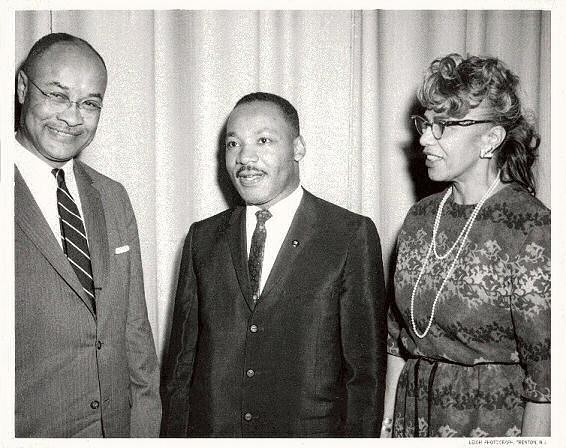
New Jersey History: Dr. Martin Luther King, Jr. Discusses the “American Dream,” Drew University, Madison, New Jersey, February 5, 1965

New Jersey History: Dr. Martin Luther King, Jr. Discusses the “American Dream,” Drew University, Madison, New Jersey, February 5, 1965

Source:https://depts.drew.edu/lib/archives/online_exhibits/king/speech/theamericandream.pdf

An audio of the entire speech is available online at: https://depts.drew.edu/lib/archives/online_exhibits/King/index.html

Dr. Martin Luther King Jr. gave his “American Dream” speech to an audience of 5,000 at Drew University. He is with Drew professor Dr. George D. Kelsey and his wife.

A. I would like to use as a subject from which to speak tonight, the American Dream. And I use this subject because America is essentially a dream, a dream yet unfulfilled. The substance of the dream is expressed in some very familiar words found in the Declaration of Independence. “We hold these truths to be self-evident: that all men are created equal; that they are endowed by their Creator with certain inalienable rights; that among these are life, liberty, and the pursuit of happiness.” This is a dream. Now one of the first things we notice about this dream is an amazing universalism. It does not say some men, it says all men. It does not say all white men, but it says all men which includes black men. It doesn’t say all Protestants, but it says all men which includes Catholics. It doesn’t say all Gentiles, it says all men which includes Jews. And that is something else at the center of the American Dream which is one of the distinguishing points, one of the things that distinguishes it from other forms of government, particularly totalitarian systems. It says that each individual has certain basic rights that are neither derived from nor conferred by the state. They are gifts from the hands of the Almighty God. Very seldom if ever in the history of the world has a socio-political document expressed in such profound eloquent and unequivocal language the dignity and the worth of human personality.

B. But ever since the Founding Fathers of our nation dreamed this dream, America has been something of a schizophrenic personality, tragically divided against herself. On the one hand we have proudly professed the great principles of democracy. On the other hand we have sadly practiced the very antithesis of those principles. Indeed, slavery and racial segregation are strange paradoxes in the nation founded on the principle that all men are created equal. But now, more than ever before, our nation is challenged to realize this dream. For the shape of the world today does not afford us the luxury of an anemic democracy, and the price that America must pay for the continued oppression of the Negro and other minority groups is the price of its own destruction. The hour is late and the clock of destiny is ticking out, and we must act now before it is too late.

C. I would like to suggest some of the things that must be done in our nation if this American Dream is to be realized, some of the challenges that we face at this hour; and in facing the challenges we will be able to bring this dream into full realization. I would like to start on the world scale, so to speak, by saying if the American Dream is to be a reality we must develop a world perspective. It goes without saying that the world in which we live is geographically one, and now more than ever before we are challenged to make it one in terms of brotherhood . . . Mrs. King and I had the privilege to journey to that great country known as India. I never will forget the experience of meeting and talking with the great leaders of India, meeting and talking with thousands and thousands of people in the cities and villages all over that vast country. These experiences will remain meaningful and dear to me as long as the chords of memory shall let them. But I must say to you that there were those depressing moments. How can one avoid being depressed when he sees with his own eyes evidences of people by the millions going to bed hungry at night? How can one avoid being depressed when he sees with his own eyes thousands of people sleeping on the sidewalks at night, no houses to go in, no beds to sleep in? How can one avoid being depressed when he discovers that out of India’s population of more than 400 million people, some 375 million make an annual income of less than $80 a year? And most of these people have never seen a doctor or a dentist. As I noticed these conditions, something within me cried out, “Can we in America stand idly by and not be concerned?” And an answer came, “Oh, no, because the destiny of the United States is tied up with the destiny of India and every other nation. And I started thinking about the fact that we spend millions of dollars a day in America to store surplus food. I said to myself, “I know where we can store that food free of charge, in the wrinkled stomachs of the millions of God’s children in Asia and Africa and in South America.

D. I think this is the first challenge and it is necessary to meet it in order to move on toward the realization of the American Dream, the dream of men of all races, creeds, national backgrounds, living together as brothers. If the American Dream is to be a reality, secondly we must get rid of the notion once and for all that there are superior and inferior races. This idea still lingers around in some situations and in some circles . . . There may be superior and inferior individuals academically within all races. But there are no superior and inferior races. But in spite of this, the notion still lingers around . . . We have enough evidence in practical experiences and practical accomplishments of individuals in the Negro community and individuals in other minority groups to demonstrate that there is no truth in the idea of the inferiority of the Negro race, of the superiority of any other race.

Questions

  1. According to Dr. King, what is the American Dream?
  2. In your opinion, are any groups missing from the list described in section A. If so, who is missing?
  3. In section B, why does Dr. King call the United States “schizophrenic”?
  4. In section C, why did Dr. King have an extended discussion of conditions in India?

Dr. King delivered this speech in 1965. In your opinion, are the problems he described still present in American society? Explain.

My Story: Guillam Demarest, Bergen County, NJ, 1781

My Story: Guillam (Gilliam) Demarest

Bergen County, NJ 1781

August, 1781 (Two months before the Battle of Yorktown)

Father came to visit today. I think this was his fourth visit to the Sugar House Prison in New York City on Crown (now Liberty Street) in four days, but my memory might be failing me — hunger tends to expand time. It feels like decades since my stomach was full. These measly rations (when we get them) would be barely enough to satisfy a small baby, let alone a nineteen-year old man. Of course, my father, David, reminds me that my hunger is my choice. I need but only swear fealty (loyalty) to the Crown, abandon my principles of liberty, and turn against the twenty-three other Patriot members of my family to no longer be hungry.

Father accused me of betraying our country, but how can I betray a country I never felt I belonged to? Our ancestors are French, not British, and we don’t even speak English at home – we speak Jersey Dutch. He is the traitor, not I.  Even my mother, Jane, doesn’t support his decision to join the British.

Father told me to join him and his refugee group. He demanded I join him. But if I join him now, what about Philip and John, my cousins? We were captured together by my father and his men, who were raiding homes in the area for food and supplies, at New Bridge in August but separated upon arrival at the prison (Lurie: Taking Sides, Page 101).

I wonder what will happen to Mother when this is all over. If the British win, will she be persecuted because she and her sons supported the American cause? Will they point to the fact that I willingly enlisted five different times (in 1777, 1778, 1779, 1780, and 1781) for the American militia?  If we win, will she be persecuted because her husband fought on the side of the British? I do not know if I will make it out of this Sugar House prison to see her again. I think I might have a fever. Two men next to me had a fever five days ago. Now, they are dead.

Oh, how I wish I could ask them what they would do….

What should Guillam do in this situation?

  1. Accept his father’s offer to take An Oath of Allegiance to the Crown?
  2. Refuse his father and remain in the Sugar House prison until the Patriots arrange for his release through a prisoner exchange?
  3. Attempt to escape from the Sugar House prison before he dies?
  4. Do something else? Explain.

Guillam ultimately chose to refuse his father’s offer and remained in the Sugar House prison for nine months. Following his release, he rejoined the American militia, where he ended up receiving a serious hand injury. In 1782, Guillam married Bridget Brower with whom he had six children. His father, David, who according to a family acquaintance, “deserted his country’s cause,” moved to Nova Scotia after the war. His mother Jane, ended up having her property confiscated because of her husband’s decision to join the British army. She remained in New Jersey with Guillam.

My Story: George Morgan White Eyes, Princeton, NJ, 1778-1790

My Story: George Morgan White Eyes

Princeton, Mercer County

1778-1790

Koquethagechton, also known as White Eyes, was a Lenape chief living in Ohio Country. He married Rachel Doddridge, a white woman who had been taken captive by the Lenape at age 5 and had become fully assimilated to Lenape life. As an adult, Doddridge chose to remain an adopted Lenape.

When the American Revolution began, Koquethagechton initially tried to remain neutral, but before long it became evident that he would have to take sides. In 1777, Koquethagechton addressed the Continental Congress, and the following year negotiated a peace treaty with American representatives.

Which of the following provisions should Koquethagechton have sought in a peace treaty?

Select one option and explain your answer in 3 to 5 sentences.

  • A new state shall be created for the Lenape, incorporating the nation into the United States with representation in Congress.
  • The United States must build a fort in Lenape territory to help protect the Lenape from attacks by other Native American nations or from the British.
  • The United States shall provide the Lenape with clothing, utensils, and weapons as needed.

Amazingly, the Treaty of Fort Pitt, signed September 17, 1778, included all of these provisions. The promise of a 14th state along with Congressional representation is something that was never promised to any other Native American group, but relied upon the further approval of Congress. Unfortunately, the treaty never received the support of Congress and was ultimately rendered meaningless.

Later that year, while accompanying American soldiers in Ohio Country, Koquethagechton died at the age of 48. Initially the cause of death was reported as smallpox, but eventually it was revealed he had been murdered by the American militia. Nearly ten years later (circa 1788), Rachel Doddridge was murdered in the course of a robbery by white men disguised as Native Americans. Both of their stories are compelling and worthy of more examination, but our focus here turns to their son, George Morgan White Eyes, partly named for Koquethagechton’s American friend, who would become the boy’s guardian.

White Eyes was seven years old when his father died. The Continental Congress assumed financial responsibility for the upbringing of the chief’s son. White Eyes was likely the first recipient of government-based student financial aid from the U.S. government. After completing grammar school, he was enrolled at the College of New Jersey in Princeton in 1785.

In December 1787, he and three other students were summoned before a disciplinary committee for insolence towards a tutor. Apparently, it wasn’t the only time he’d gotten in trouble at school. His guardian decided to remove him from Princeton and sent him to New York City to temporarily be under the care of a merchant tailor while awaiting instructions from Congress on what to do with young White Eyes. His guardian explained in a letter to Congress that White Eyes’ misbehavior may have had to do with his learning the news of his mother’s recent death and the long-concealed truth about his father’s murder. Morgan suggested that instead of sending him back to Princeton – or back to his nation – that White Eyes be sent to a different institution of higher learning, like Yale.

Which of the following choices do you think 18-year-old George Morgan White Eyes would make?

Select one option and explain your answer in 3 to 5 sentences.

  • Go back to Ohio Country to live among his own people.
  • Let his future be decided by George Morgan and the decision of Congress.
  • Strike out on his own in the New York to find a job and be independent.
  • Appeal directly to someone in power, explaining his desire to either be given a job or further education.

On June 2, 1789, George Morgan White Eyes wrote to President George Washington:

“[N]ot the severest Want shall make me return to my native Country—Tis thought from the Behaviour of my Colleagues while at Princeton that I will follow their Example—but never—I shall say but little but I trust my heart is fixed, & the time may come that this now feeble Arm, may be stretched out in the Service of America; & render the United or Individual States essential Service.

My humble request is & has this some Months past, that if the Burthen (sic) is too great on the United States that some kind of Employment may be pointed in order that I thereby may obtain a Living a[long] the Line that Congress probably first intended—That is agreeably to the Education they have been pleased to bestow upon me—I care not what [it] is I am willing to do what I am able, & you should think necessary to my future Welfare—[E]ntreating your Excellency’s kind Patronage on this Occasion I have the Honor to remain With the most perfect Respect, Sir, Your most Obedient & most devoted Servant”

Congress did not act quickly, and as the weeks went by, ‘the severest want” apparently changed White Eyes’ mind. He wrote President Washington again:

“The treatment I met with at Princeton & the Character I bear (which I know I am innocent of) here, are great Grievances to me, especially as I have undergone a great many Difficulties, I shall stear (sic) my Course towards my native [country] let the Consequence be what it will.

For it is better for me to live in Contentment & Quietude, than a life Contempt & Ignominy.1 I have not had any thing this while past & I am almost naked, thro’ some guile or other, for what I know. I believe they are tired of doing any thing for me & I am tired waiting for their duty which is incumbent on them by a resolve of Congress.

I am now to look out for myself since I cannot behave myself, better than I have done; for all that I do is in vain, yet all these things are not discourages of my staying here any longer, but I am [anxious] to return & see my Mother & Friends, as it ought to become every person who has a regard for their Nation. I beg you would assist me in my return as I have no other person to apply to; but if not I must do as well as I can.” Source

In March of 1790, George Morgan White Eyes returned to his nation in Ohio Country.

Sadly, his story has an ignominious ending. Eight years later (1798) in West Point, Ohio, an intoxicated White Eyes ran at 17-year-old William Carpenter Jr. with a tomahawk. Fearing for his life, Carpenter shot White Eyes, killing him instantly. Initially the boy and his father were charged with murder and aiding and abetting, but the case never came to trial.

To GEORGE MORGAN Mount Vernon, August 25, 1788.

Sir: The letter which you did me the favor of writing to me the 31st. of last month, with a Postscript to it on the 5th. of this, came duly to hand; as did a small parcel of wheat, forwarded some time before, by the Post Master General from New York. For your polite attention to me in these instances I pray you to accept my best acknowledgments and Thanks. With much concern I have heard of the ravages of the Hessian fly on the wheaten Crops in the States East of the Delaware and of the progress of this distructive (sic) insect Southerly; but I congratulate with you sincerely on your successful endeavors in the management of your measures &c. to counteract them. If the yellow bearded wheat from a continuation of experiments is found no matter from what cause, to be obnoxious to and able to withstand this all devouring insect [it] must indeed be valuable; but I have paid too little attention to the growth of this particular kind hitherto, to inform you in what degree of cultivation it is in this State, I may venture, at a hazard, however, to add that it is rare: because it is unusual to see fields of bearded wheat of any kind growing with us, particularly in the Western parts of the State, which falls more immediately under my observation. I will distribute the Seed which you have sent me; make enquiry into this matter and communicate the result, begging in the meantime, if any further observations on this insect, and the means of guarding against him should be made by you that you will have the goodness to communicate them to. 67 Source

Finding Our Place in Revolutionary History

Finding Our Place in Revolutionary History
Karen Parker

All human beings want to feel like they belong to something bigger. This is
especially true when students reach adolescence, their whole psyche revolves around being liked, accepted, and belonging to a group. The importance of that “place” that they hold is the driving force held together by peers, social media, cliques, fashion, and home. Relating part of their place to history and pique that sense of belonging to that history, not feeling left out of it as a spectator, not feeling odd or different from the people and feeling like they are connected with the locations, can be the key to the level of engagement. Luckily, in New Jersey, it is not difficult to find Revolutionary era connections in our backyards and neighborhoods.

There is a disconnect with children during their education of history. Students often feel disconnected because of the difficulties in relating to elapsed time, distant places, and unfamiliar habits and customs. As educators, it is our challenge to create as many opportunities for connections as possible, to have the students relate to some “thin and brittle” threads of familiarities, and often we can wrestle grudging interest in the topics presented.

History, unlike active experimentation in science and the excitement of fiction in
language arts, is unsurprisingly often deposited toward the end of the favorite subject list, to muddle around in student’s heads where they view the facts as dull lists of events and dates of forced importance with scattered entertaining facts – more so if they relate to a holiday that includes time off from school.

To connect with people from generations past, it is important to find that common ground with today. Where I grew up in Morris County, I lived a short drive from an active and preserved area of Revolutionary history, spending many hours of my childhood roaming the woods and fields of Revolutionary significance, taking short field trips to Jockey Hollow, Fort Nonsense, and the Ford Mansion. Where I teach in Hunterdon County, the most notable area is Washington’s Crossing State Park, with which many of my students are completely unfamiliar, and the war to them
seems very distant. It is important to find nearby locations and people that are
connected to the Revolution era.

In my research for the New Jersey Council for the Social Studies, I was looking
for information on people from Hunterdon County who were actively involved in the
Revolutionary War. There were many references to soldiers, the Commissary General for Washington’s army and the local militia, but I came across one primary
source that I thought might catch the interest of my students.

Through researching into the life of this average local person, James Parker, reading about his daily missives on the management of the property, connections to the effects that the war had on the common people became evident. Parker’s
connections began as a proprietor whose primary residence was in one of the colonial capitals, Perth Amboy. He was a major landowner in Hunterdon County, owning land in what is now Kingwood, Union, Bethlehem, and Tewksbury Townships and built a large stone house in Union Township called Shipley. It is interesting to note that many people in this local area were not following the political patriots, but many had loyalist leanings or were ambivalent.

Mr. Parker was one of those who did not support the patriotic feelings and was
sentenced and jailed by the New Jersey Council of Safety during the summer of 1777, in Morristown, for refusing to take an oath renouncing loyalty to Britain. He was paroled and exchanged for a Patriot held in New York in 1778. At this time, he spent
more and more of his time in Hunterdon County, overseeing his lands. Some think
that he was avoiding the political climate of the large shore town of Perth Amboy,
though he documents in his farm journal his travels back and forth to his original home for proprietor meetings.

Some other examples of Parker’s political leanings come from an entry in his journal that appeared sympathetic to a local loyalist family, the Voughts who lived in Clinton, known then as Hunt’s Mill, about three miles away from Parker’s home in Pittstown.. On December 18, 1778, Doc Smith took his contribution to a relief fund for women, wives of people gone into the British line and had all of their effects sold. This is the same date that the Voughts had all of their belongings auctioned off. These families were considered traitors by the New Jersey Legislature, which allowed all of their property and possessions to be confiscated. At this time, a large amount of the British army and many of their sympathizers occupied areas of New York and Staten
Island) (Gigantino 2015)

The farm journal expresses many tasks that most would take for granted at the
time, documented in amazing detail, though commonplace and ordinary back then.
These entries in this primary source give glimpses of insight on the challenges of
conducting business during the Revolutionary War. He notes that on July 1, 1778, he was in the meadow with great firing heard at a distance, “Regulars and Continental troops engaged in general or skirmishes since Sunday last.” He notes that it was a “severe engagement” and we can assume that he was hearing the Battle of Monmouth and he must have been at Perth Amboy to be in the proximity to hear the
fighting, even though he does not mention it. There are no references of any major
engagement during this time period anywhere near his lands in Hunterdon County.

Financial struggle, even for wealthy proprietors, was a part of daily life. The
farm journal mentions the use of many different denominations of hard currency:
Continental Dollars, Johannes and Moidore, which were Portuguese gold coins, English Guineas, New York Currency, English Pounds and Spanish dollars. In January of 1779, Parker discusses an issue with the prevalence of counterfeiting, by mentioning that he was buying land from Abraham Bonnell. He could not confirm if the money he was paying with was counterfeit. Bonnell said he didn’t believe any was, due to being very careful to examine the bills and that the mark of a printer was not necessarily a proof of authenticity. At one point he mentions, “Paid for bushel of wheat in hard money.”

This may have been noted because of the general lack of coinage and the use of
continental paper money. He noted on March 5, 1780 that taxes were collected but there was a scarcity of money, and on March 13 taxes were collected on his Bethlehem property, and he complains about having no money until he could collect on his debts. On March 23, taxes were collected on Tewksbury property, and he mentions that he is owed more money than he can pay; he can’t pay the taxes until his debtors pay. For the same year, he was taxed on 200 acres, was able to pay three-quarters of the bill but had no continental money, so he borrowed it.

Everyone knows that Continental and British troops moved all around New Jersey. It is common knowledge that they were located near the famous areas of conflict such as Monmouth, Trenton, Princeton, and Washington’s Crossing at the Delaware River. Troops on both sides of the war marched through Hunterdon County and
stopped to rest their soldiers and horses.

On December 4, 1778, Parker mentions being told by Moore Furman, a local miller and merchant who was well connected as a Deputy Quartermaster General for New Jersey, that Gen. Burgoyne’s army was marching to Virginia and would be quartered in the neighborhood as they marched along. On December 5, troops of the 1st Division came down with three companies of men, eight officers. He notes little business was conducted due to attending the troops. On December 6th, the 1st Division “marcht” off and the 2nd division came in. Charles Stewart (local and
the Commissary General of Washington’s army) spared a gallon of spirits. On
December 7th the 2nd division left, no others came, on December 8th, the 3rd
division troops came with six companies and five officers of the 62nd regiment, on
December 9th, the 3rd division left. Parker noted that the Brunswick troops arrived with three officers and 78 men on the 10th and that little work was accomplished when troops were there. December 11th was active with part of a company of ‘foreign troops” that were there with a major, two horses, a baggage wagon with four more horses; this group left on December 13th.

Imagine the disruption of regular life and business when these troops had been
quartered on the property. May 15, 1779 brought troops from the Continental army through the Pittstown area. James Parker notes that the Regiment of the New Jersey Brigade, commanded by Colonel Ogden, marched to Pittstown on the way to Easton with 300-350 men. The Continental troops pastured horses in local fields. Parker notes that he put into pasture twelve Continental horses, then took on
seven more Continental horses, ending the day with a total of twenty. On August 25th, he received from Nehemiah Dunham, who built the stone mill in nearby Clinton, five barrels of flour for Continental service. On August 25th, he put into pasture 12 Continental horses. On August 26th he took seven more Continental horses, September 4th put up nine more Continental horses and on September 18th, all Continental horses left.

In today’s military, food and supplies are provided by the government, but back in
Revolutionary times, troops were expected to be supplied by local people, sometimes
with promissory notes, sometimes by donation with no recompense. Sometimes a
tax was paid to help sponsor troops. In Parker’s journal he mentions that on July
12,1779, he paid Adam Hope a tax toward raising a state regiment, as assessed by
Colonel Beavers and Charles Coke, of 45 dollars. On August 25th, he received from
Nehemiah Dunham of Clinton five barrels of flour for Continental service. He noted a meeting in Pittstown on January 18, 1780, “Spent day in Pittstown where residents met to deliver cattle and grain collected for the army.”

Students need to imagine for themselves that not all of the population of New Jersey followed the Patriot cause, most sources agree that in the colonies they made up only about thirty to forty percent of the population. They believe that around twenty
percent were acknowledged Loyalists, while the remaining population were neutral.
There were many risks on both ends of the political spectrum, with neighbors who
harassed or reported neighbors, or turned their coats when it was to their benefit.

They need to experience the feelings of taking sides, or remaining neutral in situations. It is important to realize that everyone in New Jersey was involved in the Revolutionary War because it influenced their ordinary lives in ways that did not directly involve battles, shooting, famous officers and other incidents memorialized with statues and National Parks. The areas right around the corner, a barn down the street, an old house, mill or tavern, a name of a road in New Jersey, may have been owned or named after ordinary people whose stories were intimately intertwined with the Revolutionary War.

The decisions of James Parker and others were difficult for them and they have
relevance for us today whenever we receive criticism for our decisions.


References
Gigantino, J.J. (2015). The American
Revolution in New Jersey: Where the
Battlefront Meets the Home Front. Rutgers
University Press.


Stevens, S.B. (2015). All Roads Lead to
Pittstown. Hunterdon County Historical
Commission

Slavery in New Jersey: Teaching Hard History Through Primary Sources

Slavery in New Jersey: Teaching Hard History Through Primary Sources

by Dana Howell

Photo of the Marlpit Hall Family

For nearly a century, the Monmouth County Historical Association (MCHA) has told the story of the Taylor family at Marlpit Hall, the c. 1760 historic house museum in Middletown, NJ. It is a fascinating story indeed, and speaks to the strife between Patriots and Loyalists in Monmouth County, a hotbed of activity during the Revolutionary War. Until recently, however, a chapter of the house’s history had gone untold. In October of 2021, MCHA unveiled the exhibit 

Beneath the Floorboards: Whispers of the Enslaved at Marlpit Hall to include this forgotten chapter. This award-winning exhibit was the culmination of two years of extensive research done by curators Bernadette Rogoff and Joe Zemla to interpret the home to include the long-silenced voices of the enslaved who lived there.

Primary source documentation and discoveries of material culture were the foundations of the research done to uncover the lives of seven of the twelve known enslaved individuals at Marlpit. Birth, death and census records, wills, runaway ads, inventories, bills of sale, and manumissions (or freedom papers) shed light on the experiences of Tom, York, Ephraim, Clarisse, Hannah, Elizabeth, and William. In 2020, Joe Zemla discovered secret caches of artifacts hidden beneath the floorboards of the kitchen loft living quarters that spoke to their religion and protective rituals, while archaeological digs supervised by Dr. Rich Veit of Monmouth University provided further evidence to piece together what life may have looked like for the enslaved. Throughout the house, mannequins dressed in                        

historically accurate reproduction clothing bring each individual to life, supplemented by their carefully researched biographical panels. The artifacts they left behind are now on display; there is no longer a need for them to be hidden from view.

One of the most prevalent comments made by visitors is that they were unaware that slavery existed in New Jersey. For many years, our educational system had been complacent with the general notion that the northern states were free, while the South had enslaved labor. New Jersey has been referred to as the “most southern of the northern states,” second only to New York in the number of enslaved persons and the very last to legally abolish the institution on January 23rd, 1866.

Comparatively, little has been written about slavery in the North. We can read about
the facts of the matter, but the personal stories in the Floorboards exhibit make an impact that no textbook or blog can. The enslaved are presented without any form of politicization, but rather from an evidence-based and humanized lens. Students are able to connect with them, particularly with Elizabeth and William, who were born in the home and are represented as children – another sad fact of slavery that often goes overlooked. It is a unique opportunity to be able to mentally place these individuals in surroundings which are familiar to the student, albeit long ago. The students learn that we can make educated guesses about what life was like during the time in which the enslaved lived and explore the spaces they inhabited, but we can never truly understand their experiences as enslaved human beings. The only thing we can do is try to imagine it, using historical evidence from primary sources as our guide.

There is a sad deficit in age-appropiate classroom resources to teach slavery, and almost none that cover slavery in the North. This deficit creates roadblocks for public school teachers who are mandated to teach these topics as required by the NJ Department of Education’s 2020 Student Learning Standards, incorporating the 2002 Amistad Law.

 monmouthhistory.org/intermediate-btf

While nothing can compare to the experience of actually visiting Marlpit Hall, the opportunity to do so poses challenges for many school districts. In order to make the fascinating information in the exhibit as accessible as possible to students, MCHA has created two NJ standards-based digital education resources adapted for the elementary and middle/high school levels. Created under the advisorship of respected professionals in the fields of education and African American history, both age-appropriate resources provide background on the system of slavery in New Jersey with a focus on the enslaved at Marlpit Hall. In it, they will be introduced to each individual, along with the primary sources that helped to build their stories. Dr. Wendy Morales, Assistant Superintendent of the Monmouth Ocean Educational Services Commission, notes “The questions and activities included in this resource are standards-aligned and cross-curricular. This means students will not only learn historical facts, but will be challenged to think like historians, analyzing primary sources and making connections between historical eras.” Creative writing, art, music, and civics are all explored.

The section on the origins of slavery in New Jersey stress that the enslaved came here not as slaves, but as individuals who were taken from a homeland that had its own culture and civilization. Two videos, courtesy of slavevoyages.org, make a powerful impact. Students will get to view a timelapse of the paths of over 35,000 slave ship voyages, plotted in an animated graph. This visual representation helps students visually process the magnitude of the forced migration of the enslaved, while a 3-D modeling of an actual slave ship offers a uniquely realistic view of these vessels.

 Time lapse of plotted slave ships         Video featuring 3-D model of slave ship

Both grade level resources come with downloadable worksheets that can be customized to accommodate differentiated learning strategies, and submitted through Google Classroom. Teacher answer keys are provided for guidance as well. MCHA is proud to provide these resources free of charge to aid educators in their responsibility to teach slavery. The resources offer a guided approach to help educators navigate this sensitive and often difficult topic in the classroom. The new mandates are an excellent start to correcting the record on New Jersey’s history of enslavement, but it is truly New Jersey’s educators who will place their personal marks on bringing relevance and reverence to the topic in the classroom.

These resources can be found under the education tab at monmouthhistory.org/education-homepage. MCHA welcomes all questions and comments to dhowell@monmouthhistory.org.

New Jersey Local History: Stephen Smith House and Underground Railroad at Cape May

New Jersey Local History: Stephen Smith House and Underground Railroad at Cape May

Stephen Smith was the original owner and builder of a summerhouse in Cape May, New Jersey.

Although born in the late eighteenth century, Smith was a nineteenth century philanthropist. During his lifetime, he was said to be the wealthiest Black American in the nation. He established the first home in the United States for aged and indigent Colored people. This home is still in existence today.

An energetic businessman, Mr. Smith had a coal mine, stone quarry and lumber yards in Philadelphia and Columbia, Pennsylvania. His business activities led to many real estate holdings. He established Smith, Whipple & Co. with his cousin William Whipper. Stephen Smith was a devoted church and family man; married to Harriet Lee, they lived in a stone mansion on Lombard Street in Philadelphia, Pennsylvania. The vacation house was built by him in Cape May, New Jersey using material from his lumber yard. This house is still standing except for the carriage house, kitchen and fireplace room once visible in the rear of the building. Not having children of his own, he welcomed the offspring of his wife’s secretary and friends; namely the Bascoms and Harlans. His secretary Anna Vidal, wife of Ulysses B. Vidal, brought their three children, Etienne, Marie and Anna Clorise to Cape May. Etienne engraved his name in a small glass windowpane with his diamond ring at this house. In later years Marie would point out the pane and recall the prank, for Etienne had long since emigrated to France. Stephen Smith was called “Daddy” Smith by the children and he relished the time consuming carriage ride to Cape May with them. Portraits of Stephen and Harriet were painted by the noted Black artist Edward Stridom and are today the property of the Pennsylvania Historical Society. An avid abolitionist and agent in the Underground Railroad, Mr. Smith was active in politics and church affairs. Records of the AME church attest to his generosity.

Stephen Smith was born October 13, 1795 in Columbia, PA. At the age of nine he was purchased by an officer who was a Revolutionary War general named Thomas Boude. His mother escaped from her owner, found her son, and was taken in by Boudes. Weeks later her mistress (owner) followed and demanded her property. The Boudes’ refused and were supported by the townspeople who believed in aiding a fugitive. Raised by the General Thomas Boude, in time, Stephen purchased his freedom. Before the general died, he set Stephen up in the lumber business. Stephen earned the respect and confidence of the people of Columbia, PA and they supported his endeavors. At age 21, he was inspired by the eminent minister, Richard Allen, founder of the AME church, and at age 31 became licensed to preach. He was a Teller in the election of every Bishop since Richard Allen until his death in 1873. Smith built a public hall in Philadelphia for the use of the “People of Color”; but this was destroyed by fire in the riots of 1842. Stephen Smith was one of the Signers of Frederick Douglas’ Men of Color to Arms appeal during the early part of the Civil War calling on Black Americans to join the Union Army.

An Educator’s Perspective on Teaching the Voices of Enslaved People in NewJersey as Part of Local History

An Educator’s Perspective on Teaching the Voices of Enslaved People in New
Jersey as Part of Local History

by Robert Fenster

Few high school history textbooks have much to say about Black people in the northern colonies and states. While coverage of the evils of slavery has dramatically increased since I was a student in the 1980s, the focus has predominantly been on enslaved people in the south and not enslaved northerners nor free Black people. Slavery is mentioned 14 times in the New Jersey Student Learnings Standards from 2020, but the only connection to slavery in New Jersey is 6.1.8.History CC.4.a: “Explain the growing resistance to slavery and New Jersey’s role in the Underground Railroad.”[1] The standard implies that New Jersey was a hotbed of abolitionism instead of the dark reality: the gradual abolition law in 1804 maintained slavery for life for those born before its passage[2], and the so-called Act to Abolish Slavery in 1846 replaced slavery with apprenticeship for life. The ratification of the 13th Amendment didn’t merely free the slaves in states that were in rebellion, but also 16 people who remained enslaved in New Jersey in December of 1865.[3]

            Is it at all surprising that most students graduate high school in New Jersey unaware of the enduring nature of this institution or the experience of Blacks in the north? Although it might be argued that malignant forces are behind a whitewashing of New Jersey history, it seems more likely that a collective reductionism is at work here. There are only so many days to “cover” the curriculum, so some simplification is necessary. It’s easier for students to understand the binary depiction of the southern enslaver states being evil while the north is celebrated as the home of abolition. That sort of teaching is oversimplified and not only does injustice to actual history, but to the lives of thousands of men and women who were enslaved in New Jersey, as well as the lives of free Black people. This essay shares my ongoing pedagogical journey, and provides some suggestions for my fellow educators who wish to improve student understanding of the history of Black people in New Jersey.

Although modern textbooks include the death of biracial Crispus Attucks at the Boston Massacre, overall Black participation in the actual American Revolution is typically relegated to a sidebar or absent altogether. Graham Russell Hodges describes the American Revolution as a Black revolution, “the largest slave revolt before the Civil War.” Hodges indicates there is documentation for at least 18,000 Black individuals who fought for the British, with the possibility of tens of thousands more having served in an effort to throw off the oppressive shackles of the colonial governments.[4]

            At a week-long National Endowment for the Humanities seminar on Slavery in the Colonial North in 2020 at Philipsburg Manor in Sleepy Hollow, New York run by Leslie Harris and Jacqueline Simmons, I saw the buildings where enslaved people toiled, and heard from expert tour guides who shared how historians pieced together so much of the history of the manor. It inspired me to focus more on slavery in New Jersey. I went to my county clerk’s office and found birth certificates and manumission records of enslaved people from our town and prepared a lesson plan incorporating these primary sources. My students were taken aback especially to see names familiar to them among the enslavers. In addition to discussing how the descendants of the enslaved people might feel about their history, the students also considered what the descendants of enslavers might think about their family’s past. That lesson in and of itself was impactful, but I was acutely aware it didn’t do enough to explore the lives of enslaved men and women.

            Well-intentioned teachers sometimes make cringe-worthy mistakes. There are lessons I did early in my career (and, truth be told, even more recently) that were tone deaf at best. It seems as if every year there’s another incident where a misguided teacher somewhere in the United States steps knee deep into controversy by running a slavery simulation. The vast majority of teachers know such a lesson has no pedagogical value and runs the risk of inducing trauma. A cursory search for lesson plans online still finds dozens of “walk a mile in their shoes” lessons, where educators think they can responsibly and effectively get students to learn by pretending they understand what an enslaved person went through, usually done through some kind of journaling activity. Although I believe it can be useful to consider what enslaved people might have been feeling, it’s ultimately presumptuous and reductive to suggest students would be able to have that level of empathy and understanding. The temptation to work solely in the affective domain when dealing with slavery and other atrocities should be resisted.

            Many enslaved people were actively prevented from learning how to write, creating a dearth of first-person documents in comparison to white contemporaries who kept journals and wrote letters. There are a number of insightful enslaved person narratives, but when trying to keep to New Jersey history it is a bit challenging. There are a handful of narratives written by white contemporaries, like William Allinson’s Memoir of Quamino Buccau, A Pious Methodist. Although Allinson is an abolitionist, he uses his subject as a prop to further his political cause rather than illuminate the individual he is writing about. This focus belies an utter lack of interest in the enslaved person’s internal life and somewhat limits the usefulness of the text.[5] Historians are left to construct meaning out of other resources like fugitive notices, laws, tax registers, censuses, travel logs, registers of free Black people, and manumission records. New Jersey has a fairly robust set of available documents, making the work of historians easier than in several neighboring states.[6]

My evolving goal as a history teacher is three-fold: depict enslaved people as complex individuals who exercised their agency in a variety of ways, examine the ugly reality of slavery in our town, county, and state, and empower students to become historians themselves by examining the wealth of resources available to them on local history.

# # #

The study of agency is absolutely essential to shift student understanding from a one-dimensional conception of hapless victims to recognizing the humanity and complexity of individuals. Enslaved people’s agency was exhibited on a daily basis in a wide variety of ways. When students would ask me “Why didn’t they fight back?” I used to foolishly accept their premise and engage in a conversation about weaponry, psychology, and geography. Although those are all worthy of examination in a larger conversation on the subject, the fact is they fought back in innumerable ways. Agency was exhibited through armed revolt, breaking equipment, arson, working slowly or poorly, poisoning, feigning illness, self-harm, self-liberation, negotiation, and the development of an enslaved culture through language, families, community, religion, and music.

Jigsaw lesson plans are best used when the specific content is less important than the larger concepts. Examining the organized rebellions of enslaved people is an excellent opportunity to use this approach to its maximum efficacy. Students can research the Stono Rebellion, the New York Conspiracy of 1741, Gabriel’s Conspiracy, the German Coast Uprising, and Nat Turner’s Rebellion, for example. I have my students identify key figures, provide a description of the events, and then require them to find a way to frame the event as a successful endeavor. Students, of course, recognize the limits to their success, but by going beyond the reductionism of “Were they emancipated as a result of their rebellion?” it provides a key lesson.

Incidents of self-harm present a challenge to educators. We want students to understand the lengths to which enslaved people would go to assert their agency, but want to be careful about triggering existing trauma on the subject of self-harm. I’m still grappling with how much focus to put on the subject, but have used some narratives of enslaved people and newspaper articles to at least touch on the subject, if not dwell on it. The National Humanities Center has a collection of suicide-related items for teachers to consider using in their curriculum.[7] There are also an array of primary and secondary accounts of self-mutilation, such as the report of the “Desperate Negro Woman” in the Staunton Vindicator who “deliberately cut three of her fingers off, taking two licks at them” with an axe.[8] Needless to say, educators should tread lightly in this area, keeping a keen eye out for the reactions of their students.

Small acts of sabotage are more challenging to document as they likely would be chalked up to accidents or the natural wear and tear on equipment when tools would break. I don’t use any primary sources for this, but there are quite a few descriptions in narratives of enslaved people describing particular incidents that occurred prior to their emancipation. More dramatic forms of resistance like arson tend to capture students’ imagination such as the Albany fires of 1793.[9]

We used to speak of “runaway slaves,” but both terms have undergone a transition for similar reasons. As Katy Waldman pointed out, “To reduce the people involved to a nonhuman noun was to reproduce the violence of slavery on a linguistic level; to dispense with it amounted to a form of emancipation.”[10] Similarly, Daina Ramey Berry writes about the self-liberated: “[T]heir emancipation reflected a level of agency—a public showing of their personhood—and for them, escape was not a crime.”[11] Students can benefit by examining enslavers’ advertisements about the self-liberated which reveal so much about their assumptions and beliefs about their “property,” and often unintentionally expose the skills and accomplishments of the individuals in question.[12]

Giles Wright wrote that the American Revolution was “the cultural metamorphosis of Africans into African Americans.”[13] However, students rarely consider the creation of a common culture to be a form of resistance without being led to that conclusion.  I’m still working on developing plans to help students see enslaved people as something more than one-dimensional figures. I found the Historic Hudson Valley’s People Not Property interactive website particularly useful in helping students make the connection.[14] Modules on the poetry of Phylis Wheatley, the celebration of Pinkster, and the role of extralegal marriages help students better understand how oppressed people can offer resistance through assertions of their own humanity. It helps students understand that these individuals were not passive victims who allowed their oppressors to defeat them at every turn.

# # #

            When I was given the opportunity to participate in the New Jersey Council For Social Studies grant “Telling our Story: Living in New Jersey in the 1770s” focusing on the lives of lesser known individuals during the American Revolution, I knew from the outset I wanted to research Black people from Somerset County, and ideally, from Hillsborough, the town I teach in. I’d read Elaine Buck and Beverly Mills’ powerful book If These Stones Could Talk. The Revolutionary War service of William Stives gets particular attention along with his decision to settle near Hillsborough after the war.[15] The Sourland Mountain ridge runs 17 miles from Lambertville to the western end of Hillsborough, so my students would recognize various geographic locations from his life story. However, since the authors’ work had gained significant attention, I wasn’t sure my focusing on his life would do much to elevate Stives’ story.

            I spent several afternoons at the Somerset County Library in Bridgewater, poring over their local history holdings. Having never done much in the way of local history research, it took awhile to orient myself as to what was available, but before long I encountered a number of promising leads. The most significant came from the Somerset County Historical Quarterly, an outstanding publication compiling historical essays and primary source documents, which ran from 1912 to 1919. It was all I could do not to get lost reading unrelated articles about Hillsborough and nearby towns. However, the article entitled “Revolutionary War Record of a Somerset County Slave” in the 1914 edition utterly captivated me.[16] The story of an enslaved man named Samuel who served as a substitute for his enslaver in exchange for the promise of freedom takes several awful, though not surprising twists. Samuel’s two years of service, including fighting at the battles of Long Island, Princeton, Monmouth — and the very local Millstone — ended in two leg wounds and the broken promise of his enslaver. Decades later, in his mid-80s, Samuel sought a pension for his service, but was repeatedly denied his just due because the pensions board claimed he had not proven his service. Ultimately, the New Jersey legislature passed a law specific to Samuel, providing him $50 a year for the remaining few years of his life.

            Chasing down information on Samuel Sutphen (as he came to be called later in his life) was both challenging and invigorating. It’s been decades since I was a college student doing research in the basement of Alexander Library at Rutgers University. I had hoped to revisit the same location for both nostalgic and practical reasons (the holdings at Rutgers are quite impressive), but Hurricane Ida made that an impossibility. Instead I relied mostly on internet-based research and was able to gain enough materials to prepare a structured academic controversy for my students. The activity incorporated materials on the multiracial Marbleheaders, and Black participants Benjamin Whitecuff, Colonel Tye, and Prime. Frankly it is a work in progress in need of development, but my students saw the breadth of Black participation in the war instead of merely seeing the battles through the eyes of the white officers.

            When I mentioned my desire to learn about enslaved people in Hillsborough, I was pointed towards the biography of Silvia Dubois, a formerly enslaved woman who received her freedom after a physical altercation with her enslaver. Dubois self-liberated after the encounter and negotiated her freedom in exchange for promising never to return.[17] Her story is remarkable, but chronologically was outside the purview of the grant. Nonetheless I read a series of items about her story and took notes for a future lesson plan. In the meantime, I encountered an article about her grandfather Harry Compton written by Kenneth E. Marshall. In turn, this led me to Marshall’s book Manhood Enslaved: Bondmen in Eighteenth- and Early Nineteenth Century New Jersey, in which he focuses on the lives of three enslaved men, including the aforementioned Quamino Buccau. I liked the idea of examining a second Black man from the time period who had not served, but instead experienced changing circumstances during the American Revolution. With many enslavers off serving in the militia or Continental Army, numerous enslaved people used the opportunity to liberate themselves, negotiate better conditions for themselves, or rebel in other ways.

            In examining the experiences of various individuals based on limited and sometimes questionable documentation, it is crucial that students understand that there are limits to what we can definitively know. Many students struggle with history because they struggle with nuance, wanting everything to be crystal clear. For me, the shades of grey are what make history fascinating, and the use of deductive reasoning a great and wonderful challenge. The best conversations in the classroom are the ones where students have honest disagreements about historical interpretations with equally compelling logical arguments to support their positions. What we can do to help them is to identify particular facts and events that serve as anchors. Quamino Buccau, in his teens, was forced to watch executions of enslaved people accused of arson and other crimes.[18] Because Allinson never bothered to ask his subject how he felt about his experiences, we are left to speculate about how such experiences would impact an individual and their subsequent behavior. When he converts to Christianity after hearing what he believed to be the voice of God, a fascinating dichotomy occurs. Some, like Allinson, hold him up to be a model enslaved person, the very proof the abolitionist is seeking to demonstrate the notion that Black people could become responsible citizens imbued by their faith in religion. His subsequent enslaver, however, looked at his religiosity as something inappropriate and suspect. Kenneth Marshall raises fascinating questions about how an enslaved person might show interest in Christianity to curry favor with their enslaver, and how that in and of itself might be an assertion of agency.[19] There’s a lot to unpack here and it may be something that cannot be easily converted into a one- or two-day lesson plan. That being said, a discussion of religion and agency is definitely important in the coverage of slavery.

            Conducting this type of research and lesson planning is simultaneously rewarding and humbling. Even as I create a useful lesson plan that I will share with other educators and likely use for the rest of my career, I reflect on how many years I didn’t adequately address the subject matter in my classes. And I recognize that despite including them in the opening paragraphs of the essay, I have yet to develop resources and lessons on the lives of free Blacks in New Jersey. There is always more work to do, but at least we’re going in the right direction.

# # #

We want our students to be more than passive receptacles of knowledge that we distill. There are myriad critical thinking activities we can provide, but perhaps nothing could surpass doing the actual work of historians. There are thousands of primary and secondary source documents available online, in historical society archives, and in government offices. For example, in West Hartford, Connecticut, students participated in the Witness Stones Project, researching their town’s sordid history in connection to slavery. Beginning with an Advanced Placement US History class and then spreading out to lower grade levels, students dug into historical archives to learn more about the lives of enslaved people, commemorate their lives, and create lasting tributes through the placement of historical markers.[20] Although Covid-19 continues to present obstacles for some research, there’s no reason that our students here in New Jersey can’t start doing similar work to the West Hartford students in an effort to elevate the stories and voices of forgotten people from our local communities.

References


[1]New Jersey Student Learning Standards – Social Studies, accessed January 8, 2022, https://www.state.nj.us/education/cccs/2020/2020%20NJSLS-SS.pdf.

[2]An Act For the Gradual Abolition of Slavery (1804), accessed January 8, 2022, https://www.loc.gov/resource/rbpe.0990100b/?sp=1; Selected New Jersey Laws related to slavery and Free People of Color, accessed January 8, 2022, https://www.montclair.edu/anthropology/wp-content/uploads/sites/36/2021/06/Slavery-in-New-Jersey-Literature-Review-Appendix-B-Slave-Codes_Remediated.pdf

[3] Julia Martin, “Slavery’s legacy is written all over North Jersey, if you know where to look,” NorthJersey.com, accessed January 8, 2022, https://www.northjersey.com/story/news/essex/montclair/2021/02/28/american-dream-paramus-nj-part-north-jersey-slavery-legacy/4212248001. In addition, the work of James J. Gigantino Jr. provides extensive resources on this subject.

[4] Hodges, Graham Russell. Interview with the author. Bob’s Just Asking podcast, January 27, 2022.

[5]Kenneth E. Marshall, Manhood Enslaved: Bondmen in Eighteenth- and Early Nineteenth-Century New Jersey (Rochester: University of Rochester Press, 2011), 18

[6] Hodges Interview.

[7]National Humanities Center, “Suicide among Slaves: A “Very Last Resort,” accessed February 5, 2022, http://nationalhumanitiescenter.org/pds/maai/emancipation/text2/suicide.pdf.

[8]PBS, Slavery and the Making of America, “Responses to Enslavement,” accessed February 5, 2022,  https://www.thirteen.org/wnet/slavery/experience/responses/docs8.html

[9]New York State Education Department, “The Conflagration of 1793,” accessed February 5, 2022, https://exhibitions.nysm.nysed.gov//albany/doc/fire1793.html

[10] Katy Waldman, “Slave or Enslaved Person? It’s not just an academic debate for historians of American slavery,” Slate, May 19, 2015, https://slate.com/human-interest/2015/05/historians-debate-whether-to-use-the-term-slave-or-enslaved-person.html.

[11] Daina Ramey Berry, “The Truth About Black Freedom,” The Atlantic, June 18, 2021, https://www.theatlantic.com/ideas/archive/2021/06/what-freedom-really-meant-juneteenth/619239.

[12]Arlene Balkansaky, “Runaway! Fugitive Slave Ads in Newspapers,” Library of Congress, accessed February 5, 2022,  https://blogs.loc.gov/headlinesandheroes/2019/10/runaway-fugitive-slave-ads-in-newspapers/

[13] Giles Wright, “Moving Toward Breaking the Chains: Black New Jerseyans and the American Revolution,” in New Jersey in the American Revolution, ed. Barbara J. Mitnick (New Brunswick, NJ, Rivergate Books, 2005), 113.

[14]Historic Hudson Valley, “People Not Property: Stories of Slavery int he Colonial North,” accessed February 6, 2022, https://peoplenotproperty.hudsonvalley.org.

[15] Elaine Buck and Beverly Mills, If These Stones Could Talk: African American Presence in the Hopewell VAlley, Sourland Mountain, and Surrounding Regions of New Jersey, (Lambertville, NJ, Wild River Books, 2018).

[16] Abraham Van Doren, “Revolutionary War Record of a Somerset County Slave,” Somerset County Historical Society, Volume III (1914), accessed February 6, 2022, http://hdl.handle.net/10929/46268.

[17] Greg Gillette, “The View From Hillsborough: Silvia Dubois,” My Central Jersey, February 4, 2016, https://www.mycentraljersey.com/story/news/local/view-from-hillsborough/2017/02/07/silvia-dubois/97586960.

[18] William Allinson, Memoir of Quamino Buccau, A Pious Methodist, accessed February 6, 2022, https://docsouth.unc.edu/neh/allinson/allinson.html, 4-5.

[19] Marshall, 100.

[20] Witness Stones Project: Students Find and Share an Untold History of the Enslaved People of West Hartford, accessed February 6, 2022, https://we-ha.com/witness-stones-project-students-find-and-share-an-untold-history-of-the-enslaved-people-of-west-hartford.

My Story: Quamino, New Brunswick, NJ, Somerset County, 1789

My Story: Quamino

Somerset County, NJ 1789

Quamino was born near New Brunswick, New Jersey in 1762. Young Quamino had a complete family unit when he was living in Somerset County. Despite describing Quamino as “compliant,” his contemporary biographer William Allinson described a horrific episode where young Quamino was forced to watch a fellow enslaved person burned at the stake as punishment for alleged crimes. At no point in the memoir or in any other documentation is Quamino described as rebellious or uncooperative. Much of this is attributed to his religious conversion and subsequent piety. Allinson essentially uses Quamino as the model version of a benign, non-threatening Black man as a means of condemning the institution of slavery, consistent with Allinson’s abolitionist views. Allinson’s book is described as a memoir, including numerous quotations directly from Quamino, but neglects to offer a physical description of the man, the names of his siblings, or many of his inner emotions and rationale for his behavior.

At age nine, Quamino was essentially rented out to an enslaver in Poughkeepsie, New York. He was separated from his family and upon the commencement of the Revolutionary War was unable to have any communication with his “master” (and thereby his family). From roughly age 9 to 18, he remained in New York, but in 1780 was unexpectedly returned to his original enslaver and reunited with his family. Allinson wrote, “Overcome with this too sudden announcement, he burst into a violent and uncontrollable fit of crying, and for hours cried aloud as though he had been beaten — unable to answer questions, or to stay his emotions at the kindest efforts to pacify him.”[2]

How do you think each of the following may have contributed to his uncontrollable response to the news?

  1. Shock that his situation would ever improve.
  2. Joy at the prospect of being reunited with his family.
  3. Separation from his family caused emotional deprivation.
  4. The experience of enslavement is a form of mental and physical torture.

Consider the implications of each of the items in a response of two or three sentences.

Back in Somerset County, Quamino had a religious experience, claiming that God had spoken to him, thus beginning his period of devout faith in the Methodist religion. His enslaver looked suspiciously upon enslaved people’s faith, believing it could interfere with maintaining a degree of ignorance and thus make them less “serviceable” as workers. He even suspected Quamino’s position was a pose, designed to gain a level of respect from others in the community. Consequently, he would criticize and may have beaten Quamino for participating in religious services, but Quamino accepted the consequences and maintained his personal beliefs.

As there is only one source for this information, we have no idea of how sincere Quamino’s religious conversion was, but either way, one could argue that maintaining his faith was an exercise of autonomy and personal agency.

Two Options to Consider:

A. Quamino was wholly genuine in his religious conversion, and was willing to deal with any obstacles in his path to exercise his faith.

B. Quamino was less than 100% genuine in his conversion, but believed that some degree of deception would provide him some degree of social standing.

Describe in two to three sentences how each of the options would mean that Quamino was exercising personal agency.

In 1788, he married Sarah, an enslaved woman who lived nearby. She was soon sold and moved five miles away, allowing them to see one another as infrequently as once a week. When Quamino’s enslaver died around 1789, he was passed onto one of the enslaver’s sons. Several years later, he was beaten by his enslaver. Quamino told him he refused to work for him further, a tactic that some other enslaved people had used to demand being sold to a new owner. In some locations, the relationship between enslaver and enslaved was perceived as a sort of social contract with obligations flowing in both directions. “Unjustified” abuse might be grounds for “slave quitting” depending on local customs. Although enslaved people might be aware of instances of slave quitting via word of mouth, nothing was in the law, thus employing this tactic was enormously risky for Quamino.

Consider the possible outcomes of this risky decision.

Three Possible Outcomes to Consider:

A. His enslaver could have rejected the claim and then worsened his treatment of Quamino.

B. His enslaver could agree to sell him to a new enslaver whose treatment of Quamino could be the same (or worse).

C. His enslaver could agree to sell him to a new enslaver whose treatment of Quamino would be an improvement.

Which of the following seems the most likely outcome?

If you think the outcome would have been A or B, would Quamino have regretted his decision of refusing to work?

Why was it difficult for Black Americans to enjoy the ideals of life, liberty, and the pursuit of happiness as stated in the Declaration of Independence?

Quamino was sold to a new enslaver, who did not seem to have used physical violence against those he enslaved. Quamino even arranged for his new enslaver to purchase Sarah, allowing the couple to live together as husband and wife.  In 1806, Quamino was manumitted through an elaborate process that included having to testify before a committee to demonstrate that his freedom would not be a burden upon the state of New Jersey. Sarah died in 1842 and Quamino lived to around 1850 (age 88). They had at least two sons together, although it appears at least one of them was sold as an infant.


[1] Frontispiece of William Allinson, Memoir of Quamino Buccau, A Pious Methodist

[2] Allinson, page 6.

My Story: James Parker – Perth Amboy, NJ Middlesex County, 1777

My Story: James Parker

Perth Amboy, Middlesex County, NJ – 1777

My name is James Parker and the year is 1777. I am sitting in my living room in my large home in Perth Amboy, New Jersey, the state capitol of New Jersey.  I own large areas of land in eastern New Jersey in Middlesex and Hunterdon counties.   My family has served the colony of New Jersey for the British government for many generations, having opportunities and wealth that could not have been obtained in Britain. I have worked directly as a councilor under the Royal Governor of New Jersey, William Franklin, and my brother-in-law, Cortlandt Skinner, served as Royal Attorney General for New Jersey before joining the Loyalist forces in 1776.

The political climate is tense in New Jersey, it is changing with the loud majority supporting the Patriot cause.  I oppose the actions of people using intimidating tactics to coerce people to agree with the more radical Patriot factions.   You may agree that the taxes are burdensome, but as a former merchant, property owner, landlord, lawyer and having also served as the Mayor of Perth Amboy, you have a solid perspective of the complexity of trying to manage multiple ventures and properties with the associated financial responsibilities.  You are trying not to be bold with your political feelings, but are well known in your associations.

The new patriot led state government, having set up a Council of Safety to protect the people who disagreed with the British government, is asking you to swear an Oath of Abjuration, swearing allegiance to the patriotic government. You still feel that all of the benefits you have were due to Britain opening up settlement in the colonies.   Do you take this oath to protect yourself from being fined or even jailed, or do you stand by your principles?

Debate with yourself (or another person) by examining both choices and considering the positive and negative impacts of each.  Write a short paragraph regarding your choice, explaining your rationale as well as the potential consequences. Consider explaining what would happen if you made the opposite choice. Think about the following:

A. How might your family react?

B. How might your neighbors and town of Perth Amboy react?

C. What might be the physical consequences?

d. What might be the moral consequences?

James Parker refused the oath and was sent to jail in Morristown, New Jersey. In 1778, he was paroled in exchange for a patriot held in New York.  Possibly fearing for his family’s safety, he chose to move his family to Union Township in Hunterdon County, where he owned a large amount of property and a home. However, he still needed to conduct his business as a proprietor and maintain his family’s historical residence by traveling frequently to Perth Amboy, one of the two capital cities of New Jersey at the time. 

To financially conduct business during colonial times different denominations of money were used.  There was a definite lack of hard cash.  The saying “cold, hard cash” back then meant coins, because they were metal and the only legal tender.  You may have had to deal with coins as James Parker did. He mentions using Continental dollars, “Johannes”, which were Portuguese gold coins, English pounds, shillings, Guineas, New York currency, New Jersey money. The weights were measured and a considered a reliable method of measuring the purity of a coin.  A moidore, an English version of a Portuguese term for a gold coin, was equivalent to 27 shillings.

One of the problems with using the paper Continental currency was counterfeiting. James Parker notes in his farm journal on January 19, 1779 that he was paying for a piece of property from Abraham Bonnell and felt it important enough to mention that he could not confirm if the bills he used were counterfeited. He also noted that Bonnell said that he did not believe so and said he didn’t believe any of it was counterfeited, as he had been careful to examine, though he had heard that a mark of a printer was not necessarily proof of authenticity.  Parker also notes that he “Paid for a bushel of wheat in hard money”.  Write a short paragraph describing how you would keep track of the different currencies.  

What difficulties would you have as a landowner during this time with handling currency? Consider the following:

A. The different denominations and origins of the currencies at the time

B. Values of Continental money and ease of counterfeiting

It is December of 1778. You will be expected to help quarter General Burgoyne’s troops as they pass through your town on their way to Virginia. It could take a week or more for them to bring all of the divisions of soldiers through. 

How would this affect your business, how you feel and what will you do? Write a few sentences describing how your farm operations would be affected and how you feel about hosting the soldiers on your property and feeding and housing the British officers.

You have heard of a Loyalist family by the last name of Vought, who were suffering due to their allegiance to the crown. The father, John Vought, was particularly well known because of his participation in a violent uprising against the local Patriots in 1776. After being fined heavily, John joined the British army later that year. In the summer of 1778, the Council of Safety confiscated all of their property in Clinton, Hunterdon County and auctioned it off about three miles from your home.

Write a few sentences about how you feel about this woman being left without any belongings while her husband was serving in the British Army?  Would you do anything to help or would you be afraid that your help might bring reprisals from your neighbors?  Would your good standing in the community counter any harmful reactions?

James Parker was asked to contribute to a relief fund by Dr. Isaac Smith, who was collecting various items and livestock for Mrs. Vought.

How difficult and important is it to choose a path of humanitarian support following your religious and moral beliefs, even when they are in conflict with popular sentiment?