Era 12 Postwar United States: Cold War (1945 to early 1970s)

New Jersey Council for the Social Studies

www.njcss.org

The relationship between the individual and the state is present in every country, society, and civilization. Relevant questions about individual liberty, civic engagement, government authority, equality and justice, and protection are important for every demographic group in the population.  In your teaching of World History, consider the examples and questions provided below that should be familiar to students in the history of the United States with application to the experiences of others around the world.

These civic activities are designed to present civics in a global context as civic education happens in every country.  The design is flexible regarding using one of the activities, allowing students to explore multiple activities in groups, and as a lesson for a substitute teacher. The lessons are free, although a donation to the New Jersey Council for the Social Studies is greatly appreciated. www.njcss.org
The middle of the 20th century marks the zenith of American power in the world. Following World War 2, international organizations were established to maintain a stable world order. The United States developed alliances to counter the threat of communism and authoritarian governments.  The cost of the arms race and role as ‘global policeman’ was costly for the government of the United States and as a result its defense of democracy and human rights faced criticisms from its elected representatives and people.

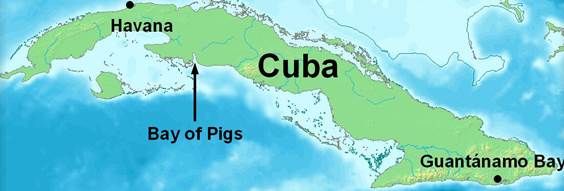
In 1959, Fidel Castro came to power in an armed revolt that overthrew Cuban dictator Fulgencio Batista. The U.S. government distrusted Castro and was wary of his relationship with Nikita Khrushchev, the leader of the Soviet Union. President Eisenhower approved the training of a small army for an assault landing and guerilla warfare. The success of the plan depended on the Cuban population joining the invaders.

On April 17, 1961 the Cuban-exile invasion force landed at beaches along the Bay of Pigs and immediately came under heavy fire.  Within 24 hours, about 1,200 members of the invasion force surrendered, and more than 100 were killed. The Bay of Pigs invasion was a disaster for the United States and President Kennedy.

In 2014, Russia invaded the Crimean Peninsula in Ukraine. Russia annexed Ukraine but the international community did not support or recognize the actions of Russia. Since 2014, Russia has tightened its grip on Crimea. It has transformed the occupied Ukrainian peninsula into a military base, utilizing it for the full-scale invasion of Ukraine in 2022. Crimea currently serves as an important logistical hub for the Russian military, acting as an airbase and naval base while playing a key role in the resupply of the Russian army in Ukraine.

Bay of Pigs Invasion

Russia’s Invasion of Crimea in 2014

  1. Did the United States have a right to overthrow an unelected ruler in Cuba who supported the Soviet Union?
  2. To what extent does geography, national security, or economic stability justify actions of large sovereign states interfering in domestic affairs in smaller states?
  3. Why did the international community fail to challenge Russia’s invasion of Ukraine in 2014?
  4. Why does Russia want territory in Crimea and Ukraine?
  5. How can the international community best address the situation in Ukraine?
  6. If the international community accepts Russia’s illegal annexation of territory in a neighboring state, does this allow or encourage other countries to annex territories. (i.e. China, United States, etc.)

As Americans enjoyed their new prosperity and role as the leader of the free world, there were voices for equality from women, African Americans, and people of color. The US also embraced global responsibilities and the threat posed by the expansion of communism.

Most Americans believe that freedom is a fundamental human right. In the post-World War 2 era, The United States found that the cost of defending democracy and human rights was expensive and difficult. In the first quarter of the 21st century, the United States experienced a state sponsored terririst attack on New York City and Washington D.C., threats of international terrorism, a divided Congress, unprecedented national debt, and conflicts in the Middle East. In 2025, there were 59 violent conflicts in the world. The interests of Russia and China are in conflict with the interests of the United States to defend democratic values and institutions and human rights.

The United States has not ratified the following international agreements on human rights:

  • International Criminal Court
  • Convention on the Elimination of All Forms of Discrimination against Women (CEDAW)
  • Convention on the Rights of the Child (CRC)
  • Convention for the Protection of all Persons from Enforced Disappearance
  • Mine Ban Treaty
  • Convention on Cluster Munitions
  • Convention on the Rights of Persons with Disabilities (CRPD)
  • Optional Protocol to the Convention against Torture
Source

Before 1950, the United States had no stated policy on asylum. However, between 1933-1945, about 200,000 refugees fleeing the violence of war, immigrated to the United States. The American people were opposed to changing the National Origins Quota System enacted in 1924.

The 1952 McCarran-Walter Act was passed over President Truman’s veto. It continues to serve as the basis of our immigration laws and policies.

“The bill would continue, practically without change, the national origins quota system, which was enacted, into law in 1924, and put into effect in 1929. This quota system—always based upon assumptions at variance with our American ideals—is long since out of date and more than ever unrealistic in the face of present world conditions.

This system hinders us in dealing with current immigration problems, and is a constant handicap in the conduct of our foreign relations.” 

In 1965 Immigration and Nationality Act (Hart-Celler Act) eliminated the quota system that was part of the McCarran-Walter Act. The Act opened immigration to people of different racial and ethnic populations, especially Asians and Africans, it continued the quotas for Mexicans and Hispanic populations and favored visas for skilled workers over agricultural or domestic workers.  
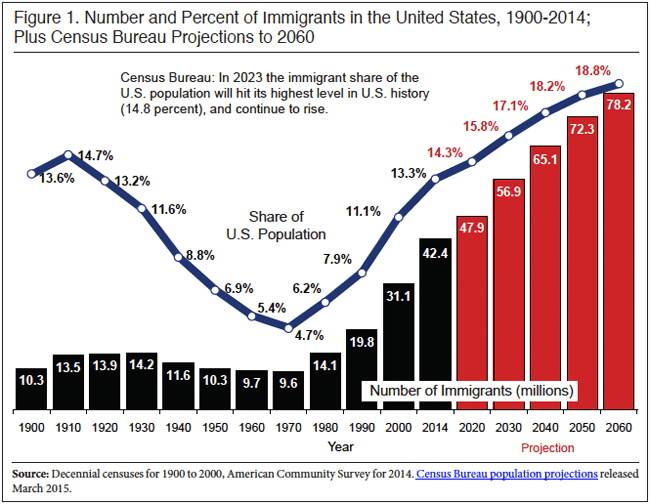
According to the UN refugee agency, a record-breaking 3.6 million new individual asylum applications were registered worldwide in 2023 with most new asylum claims made by nationals of Afghanistan, Colombia, Sudan, Syria, and Venezuela. At the close of 2023, 6.9 million asylum seekers worldwide still had pending asylum claims.

In the United States in 2023, nearly half of all asylum approvals were for people fleeing Afghanistan, China, El Salvador, and Venezuela from violence, poverty, and political upheaval.

  1. Why has the United States refused to support international laws on human rights and crimes against humanity since World War 2?
  2. Is there evidence that the United States violates the human rights of some of its own citizens?
  3. Why have the American people reflected a restrictive immigration policy over time, even for refugees facing death or abuse in their home country?
  4. Who should be granted asylum in the United States?

History of Child Labor in the United States

Truman Library Institute

Brown University’s Slavery and Justice Report

The National Council of La Raza

The War Refugee Board

The Immigration and Nationality Act of 1952(McCarran-Walter Act)

The 1965 Immigration Act: Opening the Nation to Immigrants of Color(Gilder Lehrman Institute of American History)

How Should Americans Remember the 1965 Immigration and Nationality Act?(Organization of American Historians)

How the U.S. Asylum Process Works(Council on Foreign Relations)

In the years after World War 2, especially after Churchill’s Iron Curtain Speech in 1946, the United States feared a global domination of communism. This belief gained popularity after China became communist in 1949. The current administration of President Trump is identifying the Democratic party with Marxist-Leninist ideology or progressive ideas for universal health care, helping students to repay college loans, raising the minimum wage, labor unions, and deporting immigrants with legal visas and some who are not documented.

This has a ‘chilling effect’ on people, especially educators and college professors who teach about communism and Marxist socialism. It is important to understand the historical perspective over time regarding how the government of the United States has responded to situations which have called for a change in our government through elections and the violent overthrow of our Constitution and democratic institutions.

Congress has the power to protect the Government of the United States from armed rebellion. The Insurrection Act of 1807 combined a series of statues to protect the United States from angry citizens following the Embargo Act. The issue for debate is when does the protection of free speech regarding criticism of government policies and organizing plans to change government policies or elected leaders become a matter permitting the government to use military force to protect itself.

The Posse Comitatus Act forbids the U.S. military, including federal armed forces and National Guard from enforcing civil law. The reason for this is to protect the First Amendment rights of citizens to express their beliefs. The Stafford Act (1988) permits the use of the military in times of natural disasters or public health epidemics. 

Section 252 the Insurrection Act allows the president to deploy troops without a request from the state and provides the authority to send in troops against the state’s wishes to enforce the laws of the United States or to suppress rebellion.  President Eisenhower used this power to enforce the decision of the U.S. Supreme Court to desegregate the public schools in Little Rock, AK.  In 1992, the governor of California requested President George H.W. Bush to send troops to control the rioting in Los Angeles following the acquittal of four white police officers on the beating of Rodney King. Section 253 allows the president to suppress domestic violence, a conspiracy to overthrow the government, or an insurrection.  John Brown’s raid in 1859 and the Civil War are examples.

The Smith Act was passed in 1940 making it a crime for any person knowingly or willfully to advocate the overthrow or destruction of the Government of the United States by force or violence. This Act led to the arrest of leaders of the Communist Party who were advocating to overthrow the government of the United States by force.

In 1951, the Court ruled in a 6-2 decision that the conviction of Eugene Dennis of conspiring and organizing for the overthrow and destruction of the United States government by force and violence under provisions of the Smith Act.  In 1967, the decision was overturned by the Brandenburg v. Ohio when the Supreme Court held that “mere advocacy” of violence was protected speech. 

In New York, the Feinberg Law banned from the teaching of the violent overthrow of the government of the United States. Several other states adopted similar measures. When a group of teachers and parents challenged this law, the Supreme Court upheld it in Adler v. Board of Education of the City of New York, (1952) In 1967, another Supreme Court overturned the Adler decision.

  1. If the Declaration of Independence states the right of people to dissent and overthrow an unjust government, should school teachers be allowed to teach this to young students?

“That whenever any Form of Government becomes destructive of these ends, it is the Right of the People to alter or to abolish it, and to institute new Government, laying its foundation on such principles and organizing its powers in such form, as to them shall seem most likely to effect their Safety and Happiness. Prudence, indeed, will dictate that Governments long established should not be changed for light and transient causes; and accordingly all experience hath shewn, that mankind are more disposed to suffer, while evils are sufferable, than to right themselves by abolishing the forms to which they are accustomed. But when a long train of abuses and usurpations, pursuing invariably the same Object evinces a design to reduce them under absolute Despotism, it is their right, it is their duty, to throw off such Government, and to provide new Guards for their future security.”

2. Why do you think the U.S. Supreme Court overturned the Dennis and Adler decisions years later? Do these reversals have a strong foundation in American law?

3. Is it possible to use the Smith Act and the Insurrection Act to bring about a change in government that would embrace a more authoritarian government and a less democratic one?

4. How can the Smith Act and Insurrection Act be abolished?  Should they be abolished?

5. What is the biggest threat facing the United States in the future? (natural disaster, political violence, artificial intelligence, public health emergency, economic crisis, etc.)   Will the best solutions to this threat come from the Executive, Legislative, or Judicial branch of our government?

Thomas Jefferson Signs the Insurrection Act into Law, March 3, 1807

The Insurrection Act Explained  (Brennan Center for Justice)

Dennis v. United States

Supreme Court Rules on Communist Teachers (Adler v. Board of Education of City of New York)

Insubordination And ‘Conduct Unbecoming’: Purging New York’s Communist Teachers at the Start of the Cold War (The Gotham Center for New York City History)

Mass Deportation: Analyzing the Trump’s Adminsitration’s Attacks on Immigrants, Democracy, and America(American Immigration Council)

Japan officially surrendered on September 2, 1945. More than 400,000 Americans, and an estimated 65 million people worldwide, died during the war. After the surrender, the repatriation of the soldiers to their home country began. Refugees also began to return to their homes. The return of the soldiers to Japan, Soviet Union, European countries, and the United States was very different. In this activity, you will compare the return of 7 million soldiers to Japan and the United States. The United States had 16 million soldiers in uniform and 8 million of them were overseas. Operation Magic Carpet was the program to transport Japan’s soldiers to their homeland. There were also millions of Korean and Chinese civilians the Japanese used as slave labor during the war who needed to be repatriated.

Japan’s navy and merchant marine navy had been destroyed during the war. The carriers Hosho and Katsuragi, the destroyer, Yoizuki, and the passenger ship, Hikawa Maru, were able to transport some Japanese soldiers. The United States, Soviet Union, and England used their ships to bring 6.6 million Japanese soldiers back to Japan. The Japanese government designated 18 ports to receive their soldiers. The U.S. role was completed by the end of 1947. The Soviet Union’s role continued through 1957. The port of Maizuru was the largest port.
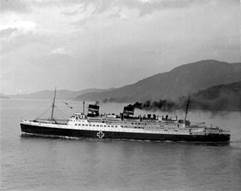
The Japanese soldiers were sprayed with the chemical DDT (dichloro-diphenyl-trichloro-ethane) to kill fleas and lice. At the time, DDT was considered a ‘safe’ chemical but in 1972 it was known to be harmful. Welcome towers were erected where citizens welcomed the retuning soldiers.

The United States also used Nisei interpreters during the years after the surrender of Japan (1945-1952) to prosecute Japan’s military leaders for war crimes, detect subversive activities and help with the drafting of Japan’s new constitution.

Most cities and homes in Japan were destroyed as a result of the war and the destruction of the two atomic bombs. Almost every family experienced the death of a loved one and they did not have a proper burial or the return of their personal belongings (sword, identification, notebooks, clothing, etc.) The new government in Japan changed the family structure which encouraged marriage and children.

The return of veterans to the United States began in 1944, shortly after D-Day. The government instituted a point system based on battles for the return home after the war ended and the GI Bill, which provided for education and vocational training, credit towards loans, one year of unemployment compensation, and counseling. The purpose of the GI Bill was to avoid the high unemployment and inflation that followed World War I.
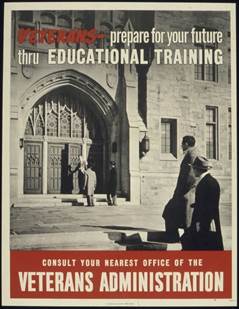
“Veterans Prepare for Your Future thru Educational Training, Consult Your Nearest Office of the Veterans Administration,” n.d. Courtesy of NARA, 44-PA-2262, NAID

The repatriation of American soldiers was very successful and the income taxes from their wages paid back the cost of the GI Bill within the first few years. Veterans also purchased new homes which also increased the GDP.  Similar benefits were provided to American soldiers who served in Korea and Vietnam. New car sales also quadrupled in the first ten years following World War 2 and by 1960 about 75 percent of American households owned a car.

  1. Why did the United States spend millions of dollars to repatriate Japanese soldiers to Japan after the surrender and why did our government pay for the inoculations and transportation of Korean and Chinese from Taiwan?
  2. What would the post-war years in Japan be like without the financial and technical assistance of the United States and the Allied Powers?
  3. As a member of Congress, would you have supported the GI Bill in 1944 knowing that the national debt of the United States was 120% above our GDP?
  • Was it fair to provide ships to transport Japanese soldiers home before all of the American soldiers were repatriated?
  • Should the United States have done more (or less) to repatriate the soldiers from Japan?

Maizuru Repatriation Memorial Museum

Return to Maizuri Port: Documents Related to the Repatriation and Internment Experiences of Japanese (1945-1956)   (UNESCO)

The Afterlife of Families in Japan (Texas A&M University, Corpus Christi)

U.S. Naval Institute

The American Soldier in World War 2

Veterans Return Home From World War 2 (U.S. Army Documentary)

Serviceman’s Readjustment Act, 1944 (National Archives)

Book Review: Stuck by Yoni Applebaum

Stuck

By Yoni Applebaum

Reviewed by Hank Bitten, NJCSS Executive Director

As a social studies teacher I taught the migration of Europeans to the New World, the Atlantic Slave Trade Migration, Oregon Trail, Trail of Tears, construction of canals, steamboats and railroads, land at $1.60 an acre, Underground Railroad, Manifest Destiny, Great Migration after the Civil War, Frederick Jackson Turner’s thesis on the frontier, immigration, analyzed The Warmth of Other Suns, Harlem Renaissance, interstate highway system, Federal Housing Authority, selected excerpts from Crabgrass Frontier, and the migration to the Sun Belt. However, Stuck presented me with a new perspective about the importance of mobility in America and its relationship to the American Dream! This is why I am encouraging every social studies teacher to read Stuck.

Yoni Applebaum clearly presents the economics, sociological, historical perspective to the demographics in the 18th, 19th, and 20th centuries in American history and the opportunities that became available for millions of young Americans. The wealthy Americans remained in Boston, New York, Monticello, Charleston, and Savannah as they had no reason to seek a better life. However, agricultural workers, manufacturing workers, civil servants, and immigrants moved to multiple locations to find better homes, more money, and new social connections. Immigrants moved west and contributed to farming, canals, roads, and railroads. New communities were built on democratic values and traditions and the importance of civics is equally important to the historical, sociological, and economic perspectives. 

“Some Americans have become so accustomed to the places with the greatest opportunities being effectively reserved for the rich that it somehow seems natural that they should be. In fact, it represents a recent and profound inversion. For centuries, Americans at the bottom of the economic ladder moved toward such places, not away from them, searching for a foothold on the first rung of that ladder, looking for a chance to climb. Entrepreneurs raced to erect housing to hold them.” (page 4)

“’When the mobility of population was always so great,” the historian Carl Becker observed, “the strange face, the odd speech, the curious custom of dress, and the unaccustomed religious faith ceased to be a matter of comment or concern.” A mobile population opened the possibilities of pluralism as diverse peoples learned to live alongside each other, The term ‘stranger,’ Becker wrote, in other lands synonymous with ‘enemy,’ instead became ‘a common form of friendly salutation.’  In a nation where people are forever arriving and departing, a newcomer can seem less a threat to the settled order than a welcome addition to a growing community: ‘Howdy, stranger.’ Mobility has long been the shaper of American character and the guarantor of its democracy.’” (page 9)

The industrialization of the United States following the Civil War placed us on a trajectory to become more urban and less rural. Frederick Jackson Turner in 1893 presented a thesis based on the 1890 U.S. Census that claimed the frontier of the United States was closed at the 100th meridian. Although his thesis would eventually be challenged, it revealed divisions of values and new ways of living.

Cities also required investments in public utilities, and in finding solutions to poverty, crime, and places for the homeless. The story of the 20th century is one of urban problems, flight to the suburbs, increasing home values as homes were purchased, destroyed, and rebuilt and sold or rented for higher prices. The story of the 21st century is one where housing has become unaffordable for a majority of Americans, who understand what it means to be ‘stuck’ with limited options or no options for the pursuit of happiness.

Stuck also provides an insightful historical context of the historical experiences of Chinese immigrants living in California and Jewish immigrants in New York City in the late 19th and early 20th century. The two chapters dedicated to the personal experiences of immigrants and immigrant families provided me with new information that directly applies to the teaching of immigration in a U.S. History class. The new information that I learned related to the racist decisions of local governments regarding zoning, housing, and the regulation of family-operated businesses. The exposure about immigration for students is at the national level in the news and most classroom lessons. The chapter on “Dirty Laundry” references Modesto, California in 1885.

“In 1884, more than a hundred men in ‘mostly ghostly attire’ wearing black masks and calling themselves the San Joaquin Valley Regulators, rampaged through Chinatown. They raided opium houses, knocked down one Chinese man who attempted to flee, and even assaulted a white police officer who tried to stop them. In June 1885, a washhouse and a store in Chinatown burned down, in an apparent arson attack. Despite the unrelenting assaults, Modesto’s Chinese residents held fast. And following the familiar pattern, they began to set up their laundries in residential neighborhoods….

Two weeks later, the city council obliged, passing its zoning ordinance.  The Chinese were not mentioned in the legislation.  Instead, it simply designated a district for laundries, one whose boundaries happened to be precisely the same as those of Chinatown.  The ghetto that Modesto had failed to impose with violence, it would now attempt to enforce with land-use law.’ (pp. 90-91)

It is important for students to understand the power of local governments and the importance of understanding local laws they may not hear on social media or local news networks. The story of Hang Kie is told as a story that students will find interesting and compelling for discussion and debate. He was arrested within five days of the implementation of Modesto’s new zoning law. His landlord wanted him to continue operating his business to collect the rent. He was arrested, fined $100 dollars (perhaps three months income) and sentenced to 20 days in jail. His case went to the California Supreme Court on the grounds that the Modesto law was unreasonable because it was not applied equally to all residents, and the right to use your own property providing it did not injure others or negatively harm the general population. The California Supreme Court upheld Hang Kie’s conviction as a reasonable exercise of police powers to safeguard the general population of Modesto from the threat of fire. (pp. 94-95). In the middle of the legal arguments, the men in Modesto could not get their white shirts for Sunday worship cleaned so they adopted colored shirts to hide the dirt.

The use of land-use laws spread to other California towns as the state’s population increased by more than two million between 1900 and 1920. In California, 20% were born in another country and 25% had one immigrant parent. The 1906 San Francisco earthquake displaced thousands of Chinese who relocated in communities across the bay.  A lesson for students is the context of the expansion of the powers of the executive branch of our federal government is the elasticity of police powers.

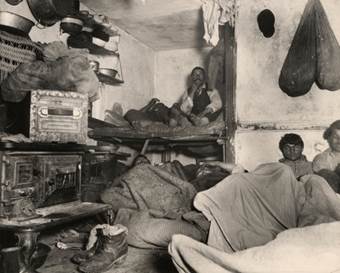
The eastern European Jews who immigrated to the Lower East Side of Manhattan presented situations for local government that had not previously been encountered in the United States. The Jewish population was transitory with perhaps 50% returning to their homeland as they accumulated enough cash to travel back to Europe. They crowded into small apartments and were willing to tolerate unsanitary conditions. They valued education and economic success and were passionate about living in America. (p.116)  The historical record of the experiences of Jewish immigrants is documented with the photographs of Jacob Riis, personal stories in the Library of Congress resource, Chronicling America, and the National Museum of Immigration (Ellis Island) and the Tenement Museum in New York City.

Source: International Center of Photography

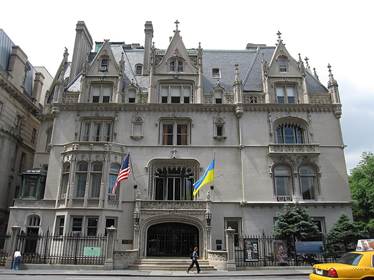
The issues of immigration, affordable housing, and the segregation of the rich from the poor in 1900 offer interesting lessons for the students of this century, 125 years later. New York City faced a surging population that increased from 3.4 million in 1900 to 4.8 million in 1910. An increase of 67%. The density of population in lower Manhattan increased with the construction of six story apartment buildings on every available piece of vacant land. The area north of 42nd street and areas of Brooklyn saw an increase in single family homes and mansions. The top floor of the mansions were designed for offices. The Panic of 1907 left many of these offices vacant and they became occupied with immigrants in need of places to live.

Henry Sinclair House, Fifth Avenue and 79th Street, NYC (Ukraine Consulate)

There were three solutions to New York’s immigrant problem: exclusion of immigrants with literacy tests and quotas, the expansion of immigrant populations to accelerate economic growth through housing construction and employment opportunities, or regulation regarding labor, health, and zoning. (page 124) Congress created the Dillingham Commission in 1911, which offered a detailed report on the enormous contributions of immigrants but concluded that immigration restriction was in the interest of the country. (Page 125)

Report from the Dillingham Commission

An interesting discussion or debate for students studying the living conditions of immigrants is the argument that fire safety justified the police powers of the state to enforce laws regulating businesses, construction, and population density. In Modesto, California, fire regulations were applied to laundries in buildings and in New York City, fire regulations were applied to the height of buildings. While public safety is in the interest of the public it also justified the power of the state to regulate the free enterprise of individuals and influenced the segregation of neighborhoods by income and ethnicity. These arguments were made by the tenement reformers, although the proposed solutions of the reformers favored one economic group over others.

I included Henry George and the single property tax movement in my U.S. History lessons. My students understood this as a socialist reform to redistribute wealth from the millionaire class to the working class. Yoni Applebaum in Stuck offers this perspective:

“The Georgists argued that if the density of people per acre were to rise, it should be seen not as congestion but as efficiency-with tall buildings allowing families to live in desirable neighborhoods while providing them with ample space, and office skyscrapers doing the same for workers. And if people truly objected to this, well, Bassett‘s commission could impose height limits that would spread the most intensive development over a somewhat broader area. The Georgists were confident in the city’s future and in its capacity to provide opportunities to the next generation of residents. The solution to congestion, they argued, was construction.” (page 126)

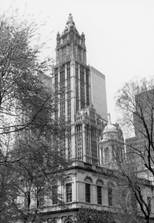
The land tax of Henry George lost to the zoning plan of Edward Murray Bassett. The leaders of New York City would decide what could and could not be built on any piece of property. The solution to the influx of immigrants in New York was to limit affordable housing. In 1913, the Woolworth building was built at 233 Broadway, within walking distance of City Hall. It was 60 stories, included both residential and office spaces, and for 17 years it was the tallest building in the world at a height of 792 feet.

F.W. Woolworth Building in New York City

A unique and important perspective of the author, Yoni Applebaum, is the interdisciplinary connections relating to geography, economics, sociology, and civics. These are transparent in the chapter on “Tenementophobia.”

Regarding geography, students can easily follow the building of houses and neighborhoods along colonial post roads, rivers and canals, railroads, and highways. In the 19th century, houses were built near factories and ports enabling workers to walk to work. The Utopian Socialists built model communities where factories were located. With the arrival of the automobile in the 20th century, people with money moved uptown and later to suburbs to escape the sights of factories, apartments, and the noise of densely populated neighborhoods. Students will see the evolution of apartment houses near the business district, then two-family homes, and then single residence homes, perhaps with winding streets aligned with trees.

The economic perspective is very important and interesting. Many immigrants saved money with the hope of renting a larger space for their families and later a home with a backyard play area. These middle-class homes were available to families with incomes that could sustain the expenses of a downpayment, mortgage, taxes, insurance, and repairs. Many of these homes in cities across the United States were built by independent carpenters or homeowners using models in the Sears Catalog. Students can create a digital museum of these houses with images of wider streets with picturesque views as they follow the construction of homes from the central business district to the outer boundaries of the city. Low incomes kept people ‘stuck’ in their neighborhoods. One of the significant contributions of unions was their ability to get living wages for many workers allowing workers to move from crowded apartments to single or double family homes, Unfortunately, the cost of selling a home made movement to a new neighborhood difficult or impossible.

Sears Catalog, circa, 1910

The sociological perspective on the quality of life should prompt an engaging discussion with students leading to relevant applications today.

“Homeownership promoted personal investment in family, child-rearing, school, church, and community; it safeguarded ‘manhood and womanhood’; it protected the ‘civic and social valiues of the American home….” (pages 152-53).

The single-family home, the belief that a ‘home was a castle’ that living in tenements or public housing was harmful, is a critical issue for students to understand even though it likely is not one of the learning standards in the curriculum. Did the zoning laws that were put in place in the early 20th century support the American Dream or did they segregate our population by income, race, ethnicity, and access to education. Students need to search for answers regarding how poverty should be addressed and eradicated. Is the answer with income and property tax policies, the quality of education, affordable housing, higher incomes, or something else?  In their search for answers, students should investigate the quality of life regarding marriage, cancer, crime, addiction, mental health, infant mortality, attendance in houses of worship, and life expectancy rates. They also need to discuss how their neighborhood or community has changed in the past 25 years (since 2000) and what it might look like in 2050. They also need to consider the economic and sociological impact of vacant stores in strip malls, where affordable homes are being built, and the quality of life in older homes.

The information about how state and the U.S. Supreme Court viewed zoning laws was fascinating to me. The case study in Stuck references Euclid v. Amber Realty Company (1926). The decision supported the constitutionality of zoning laws at a time when state courts were rejecting them. The basis of this case was the claim that zoning parts of the land owned by Ambler depressed property values by as much as two-thirds. (page 149) Euclid is a community east of Cleveland, Ohio and one of its inner suburbs.

The areas marked U2, U3, and U6 were the areas owned by Ambler Realty. Note the areas across Euclid Avenue with the curved streets with single family residences.  If the areas of U2, U3, and U6 were zoned for industry, the view and noise for the residences across the street would see this as undesirable or as a nuisance. What and who determines property use? (1922)

Note the development of the land after the Supreme Court’s decision

Students discussing the implications of police power of the state to determine land use, the public interest regarding health, safety, and welfare.  Should the Court protect the public good by limiting the property rights of an individual or should the Court protect the sanctity of the family against unsightly encroachments of noise, traffic, and smoke? Another consideration is that in 1926, the U.S. Supreme justices lived in communities that were zoned with neighborhoods of single-family homes and perhaps large homes for families with wealth.

The chapter titled “Auto Emancipation” offers new insights into the ‘great migration’ that followed Reconstruction. The railroads and manufacturing of automobiles in Michigan provided opportunities for Black Americans that could not be realized because of segregation, low wages, violence, and unfair mortgages. For me, the perspective was a nice addition to my knowledge from reading The Warmth of Other Suns and Caste by Isabel Wilkerson.

The following two quotes might be used for student inquiry and discussion regarding the experiences of Black Americans and today’s immigrants.

“It was mobility-specifically, the defiant exercise of the freedom of movement-that ultimately brough down the slave system.  Human beings are difficult to hold in bondage, even if half a continent has been turned into a vast, open-air prison.  As long as some place of refuge where people can claim greater freedom and opportunity exists, no system of repression can wholly immobilize a population.” (page 161)

“Black residents earned more than they had in the South, but when housing costs ate up roughly half their gains, they found themselves with few options.  They couldn’t build up, and they couldn’t move out.  The policy choices made by Flint’s elite left them kettled in a handful of districts, paying high rents for aging homes. But as bad as things were, the federal government was about to make things worse.” (i.e. FHA mortgages) (page 177)

Teaching the domestic issues facing the United States is a challenge for most teachers. This unit includes the civil rights movement, women’s rights, education, space exploration, political challenges, inflation, environment, Great Society, U.S. Supreme Court decisions, and the changes with transportation and communication.  The post-World War II economic boom is often lost or marginalized in the teaching of this unit. In my classes, students read excerpts from John Kenneth Galbraith’s The Affluent Society, Michael Harrington’s The Other America, and Kenneth Jackson’s Crabgrass Frontier. The chapter titled “A Plague of Localists” offers the perspective of Frank Duncan, a working Black American living in Flint, Michigan.

I was not aware of the Edwards. v. California (1941) U.S. Supreme Court decision regarding the freedom of an indigent to move to another state. The Dust Bowl provided an incentive for unemployed and financially challenged U.S. citizens to move to other states. In 1936, the city of Los Angeles police turned indigent migrants away. The U.S. Supreme Court affirmed the right of U.S. citizens to choose where they wanted to live but the conflicting arguments date back to 1823.

“In 1940, America was still a nation of renters-some 56 percent of households leased their dwellings…. The government could have met the demand for rentals by investing in public housing projects or providing cheap loans to real estate developers to build multifamily apartment buildings close to centers of employment. Instead, as the war came to an end, it chose to subsidize the purchase of free standing single-family homes.

Millions of Americans used FHA and VA loans to buy houses.  In 1944, America built 114,00 new homes; in 1950 it built 1.7 million.” (page 208)

The economics of housing relating to banks, credit unions, balloon loans, redlining, zero interest loans, mortgage insurance, and itemized tax deductions are essential topics for U.S. History students because they likely are living in communities with public housing, multifamily apartments, gated communities, cape cod houses built after World War 2, and houses in need of repairs.

The study of the housing crisis in America is also one students need to understand because the current scarcity of affordable housing directly affects them. College graduates with a starting salary of $125,000 are not able to save enough money for a downpayment in the community where they are currently living. In fact, they are also unlikely to afford renting at this income level either.

The solutions proposed in the last chapter, “Building a Way Out” include connections to history, civics, economics, and sociology. Some of these solutions include building more housing units to increase supply and reduce the costs of purchase and rent. Another solution is to have consistent rules for housing construction to reduce bureaucracy and encourage affordable housing near employment opportunities. Other solutions include subsidies for housing or increased wages for people below certain income thresholds, tolerance for different kinds of housing, and acceptance of a pluralistic community. The chapter includes case studies of Tokyo and New York City. The bias of the author is that America has a mobility crisis and mobility is what stimulates the American economy.

Book Review: Enrique’s Journey: The True Story of a Boy Determined to Reunite with His Mother

I was very happy to come across this young readers’ version of this book, giving the background of who Enrique is, his family, the mother who works in the United States, and the famous journey to the US to reunite.  This story, which covers about five years of time, is an important one for understanding why people leave children in other countries to come to the US to work, what such distances can provoke in the human spirit, and the complex means of trying to legally reunite family members living on opposite sides of a major border.

This story deals with Enrique’s mother leaving him and three other children in Guatemala to come to the US and work.  This move will allow her to make a great deal more than the money available in her own country.  It is only 12 years later that Maria breaks down and tells the woman she cleans house for about the four children in another land.  A single mother with four kids and a husband who has run off with another woman, she must do whatever she can to support them.  She tells the story as her employer listens. 

Astonished, the employer embraces the story and makes it her mission not just to try to reunite the estranged family but also to get any and all legal charges dropped against the parents.  This book provides some explanations on why immigrants face great danger to come here, take on work, and try to move ahead despite missing family members, their home, and their way of life.  The children and other family members in the other country are going through their own loss, confusion, and grief as they try to choke down the tears, study hard in school, work, and persevere as well as they can. 

The book presents very clearly some of the most common problems felt on both sides of the border.  The grief and the daily burden of being so far away from their kin are two sources of psychological stress that can show up in a myriad of ways—including Post Traumatic Stress Disorder (PTSD).  The separation is dramatic for children, and for their parents. 

I discovered hints of PTSD among the 11 students I myself conducted for my dissertation on Generation 1.5 Mexican American students learning English in two different Illinois community colleges (2010).       

This book by Nazario is full of great social sciences content, cross cultural issues, federal legal procedures, and other information good for use in units and lessons in the regular classroom, social studies classes, and course time in general for students to do the readings and prepare for class projects and discussions.

I recommend the book as a “first source social studies text” for students old enough to appreciate what is here.  Teachers and parents can review the book to look at the usual language issues and other considerations used to evaluate and recommend or not recommend the book for the classroom. 

The book can also be used as good professional development source for conversations among educators because of the content found here. 

Yet another use is personal reading for educators, parents, and stakeholders who can benefit from getting a better handle on the causes and attractions of immigration to this country.  My job is to get people thinking about these kinds of books and the benefits for students.

History of America’s Immigration: The Background to Today’s Border and Asylum Crises

A cartoon of a person pouring liquid into a pot

AI-generated content may be incorrect.A cartoon of a person sitting on a bench

AI-generated content may be incorrect.  
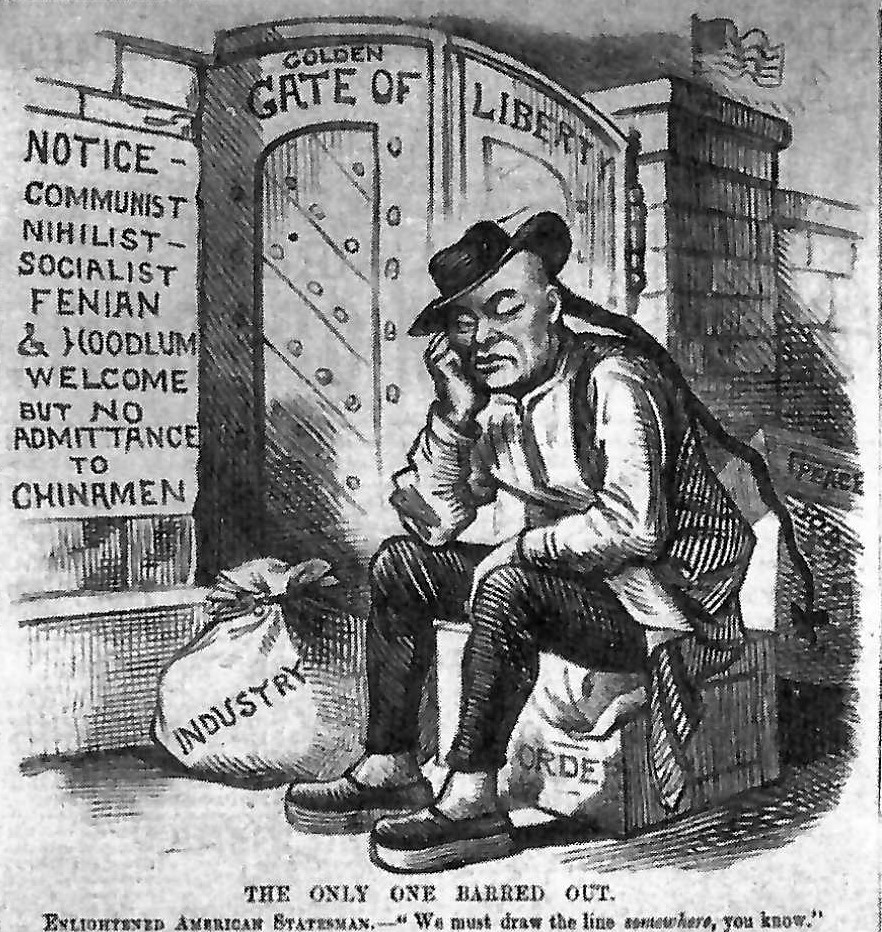
Defining American: The Bureau of Naturalization’s Attempt to Standardize Citizenship Education and Inculcate ‘the Soul of America’ in Immigrants during World War 1  In this wood engraving caricaturing the Chinese Exclusion Act, a well-dress Chinese man embodying “Order” and “Industry” sits outside the Golden Gate of Liberty. The sign to his right declares “Communists, Nihilist, Socialist, Fenian & Hoodlum Welcome but no Admittance to Chinamen.”

The following is a description with vocabulary for each era. Following the four eras is a collection of data that students can use to learn more about each time period. In each era examine who came to the United States, why, and how did government policy favored or discouraged immigration.

Authority was with individual states, not the Federal Government. States used what was then called “state police power” to set and enforce rules. States set rules stopping the admission of convicts, free Blacks, paupers, diseased, sick or disabled persons or passengers on ships who tried to enter without the captain posting a bond on their behalf. No free person whether black, mulatto, or colored from a Caribbean country, especially Haiti, could enter some states. Haitian seamen on a ship entering Charleston, S.C., could not leave the ship. These powers were confirmed by a Supreme Court decision (Miln Decision, 1837) and the Passenger Cases decision (1849) approved state laws on bonding and taxing incoming passengers. The 1830 Indian Removal Act was another example of state police power. The movement of free Blacks within Missouri and Ohio was also regulated.

There were also federal laws in 1793, 1842 (Prigg decision), and 1850 concerning the return of runaway slaves to their owners. Legislation in 1809 prevented the importing of additional slaves from west Africa. In 1817 the Liberia colony was established and federally funded for free Black who wished to return to Africa. 13,000 did.

Federal laws permitting or excluding contract labor from China and Europe were enacted. In 1862 the Coolie importation from China was stopped under the logic that since slavery was illegal in northern states and Coolies were slaves therefore, they could not get into the USA. In 1867 contract labor was permitted from Europe. In conclusion, high, consistent demand for labor led to favorable State and federal immigration policies.

During this era, the power to legislate and enforce laws came totally to the national government. Immigration power resided in the Federal government’s ability to control commerce, Gibbons v. Ogden (1824) and the theory of national sovereignty critical for national security through border control. Between 1871 and 1914, 23.5 million Europeans entered. Eastern and southern Europeans joined those from Ireland, the U.K. and northern Europe. 1.7 million entered in 1907.

The country was industrializing and urbanizing. Labor demand was high. But gradually laws were established excluding some and regulating the entry of others. Many Americans wanted more immigration. Other Americans were critical of who were admitted. By 1924 the doors were almost closed to many Jews, Catholics, Hindus, and Chinese. See the Page Act (1875) and the Chinese Exclusion Act (1882). Research the Foran Act (1885) and the Dillingham Commission (1911).

A 1917 law aimed at South Asians, Indians, who settled in California and Washington and spoke out against British control of their homeland. This was part of a broader American nativist movement merging with white supremacy ideology, anti-communism and earlier opposition to immigrants with physical or mental disabilities. A literacy test was passed. A “barred” zone was created stopping all Asian entry except from the Philippines and Japan, already excluded by an informal 1907 “Gentlemen’s Agreement.” Mexicans were turned into temporary labor migrants. There was also the fear that if the US entered the League of Nations this could endanger national security. In 1920, 16% of the US population was foreign born. Bad foreigners = crime, immorality, and labor conflict.

A 1921 law closed loopholes in the 1917 law and established the first national origin quotas. This law fused beliefs about eugenics, racial bigotry, anti-disabilities prejudice, mixed racial marriages into a category of undesirable immigrant groups. The Johnson-Reed Act (1924) created quotas by ethnic origin. The Border Patrol created an illegal entry called a misdemeanor and felony (1929) if done twice.

The Johnson-Reed Act (1924) confined immigration mainly to northern Europe. National quotas were based on ethnic origins of the 1890 census. Through the Depression of the 1930s and World War II, immigration was severely curtailed. Following World War II, the law remained intact and parallel laws dealing with World War II refugees were created that bypassed but did not displace the 1925 Law.

In 1948, Congress passed the Displaced Persons Act permitting European refugees to enter. In 1948 the law was amended permitting refugees from camps in western Germany who could not return to their former homes in Poland and the USSR to enter the USA. 332,000 arrived including 141,000 Jewish Holocaust survivors between June 1948 and December 1951.

The 1925 law was replaced by the Hart/Cellar Act of 1965. Racial and ethnic quotas were eliminated. Numerical quotas were retained. Entrance was open to people from anywhere. The law favored family unification, preference for specific occupations, and a new side variety of visas. In 1950, the USA was 90% white with a European origin. By 2000, 50% of new immigrants were from Latin America and 27% from Asia. In 2020, the USA population was 69% European white. This law changed the racial composition and, some say, the national identity of the USA. The acrid, hot odor of 1924 bigotry and nativism returned magnified and channeled through social media. By 2020, some Americans were talking of white racial suicide and replacement theory. Politicians pointed to the loss of border control. The 9/11 Attack on America led to Islamophobia and Muslin immigration bans. Many Americans supported legal immigration and the use of work visas for both unskilled and professional work. Most wanted to stop migration but the government system to judge asylum claims became broken. Since May 2022, a 1.85 million undocumented refugees have been permitted to remain in the country following a favorable “credible fear” claim. By September 2022, 86,815 immigrants were deported and 1.7 million were approved to stay. 200,149 immigrants came to New York City.

  • From February 2021 to September 2023, Border Patrol arrested 6 million migrants who crossed the border illegally.
  • 1.7 million immigrants were released to stay in the USA.
  • There were about 1,500 immigration judges and asylum officers available to decide these immigrant cases.
  • People apply for asylum at the border or if they are caught illegally in the country or overstay a visa. They have up to one year to apply. 800,000 applied in 2022.
  • It could cost $2 billion to hire more staff to eliminate the 2 million backlog of cases.
  • In some cities, it will take up to ten years to hear a case.
  • 1.3 million have been told they must leave the USA. They have 90 days to do so.
  • Many do not leave and they disappear. There is no national ID in the United States to identify them.
  • Some marry Americans and become parents of children who are natural born citizens.
  • All of this data is used by politicians running for federal office. Some promise to clear them ‘out.’ How they will do this is not clear.
  • Many local officials run to Washington, D.C., seeking money to care for migrants in their cities. There is a deadlock in Washington, D.C. Many do not want to tax the many to pay for the foreign immigrants. The memory of 1924 is in the air and a chaotic border has become a drug channel.
  • Pyler Supreme Court Case, 1982
  • Temporary Protective Status
  • Humanitarian parole
  • Refugee Act, 1980
  • DACA
  • Visa Lottery System
  • John Tanton
  • Naturalization

Our laws were not designed to deal with BOTH old and new reasons for migrations. The latest reasons are climate change, corruption in many countries, and the development of the smartphone, which immediately connected migrants with friends already in the USA who send money to assist migrants in their journey. Migration used to be single men seeking jobs who would then return home. Now, it is entire families seeking a new life in the USA. Many Americans do not know what to make of it and they will vote their hopes and fears.

Isolationism: FDR’s Immigration Crisis 

Auschwitz, Bergen-Belsen, Belzec, and Ravensbrück. Think of an ice-cold place with no hope of getting out of your worst nightmare. These were some of the most well-known labor camps during World War 2 in Germany and Poland. They were built to target many different groups, like Jehovah’s witnesses, gypsies, and homosexuals. The biggest group targeted was the Jewish population. Hitler’s goal with building these labor camps was to relocate as many Jewish people as possible and make them work to death or just to kill them, these camps were meant for mass murder. There is a lot of hidden history that is not discussed about the Holocaust.

There was a lot of blame going around and new power coming into place that America was not fully aware of because they focused on being stable after the Great Depression. In Europe tensions rose and Germany became very angry about the outcome of World War 1. Germany believed the repercussion from World War I they had gotten was not fair.  Hitler blamed the Jewish population for their loss in World War 1 and thought that they had to pay for their betrayal to the German people. Thus, sparked the idea for Hitler to create labor camps to torture and destroy the Jewish population. While the labor camps were being built there were things going on beforehand that sparked antisemitism in Germany. They had to go around wearing the star of David on all their clothing, they couldn’t go to public schools just Jewish schools, couldn’t go to the movies or to certain restaurants and a lot of Jewish business owners lost their businesses from German soldiers trashing it and shutting them down all because they were Jewish. 

Gas chambers were the kiss of death. Jews and others who made it farther would get tattoos. Jews had no name anymore and just were referred to as a number. All hair would be cut off and then would be told to change into the same striped outfits and sent to their barracks and from there they would be sent to work all day and every day with little to no food. One wrong move and anyone could be killed. Reapings would happen as well. Those who were picked were sent to either different camps or to the gas chambers to be killed. This was kept secret in Europe and only thought to be rumors for many years. Around 6 million lives were lost. 

            FDR was a great leader in so many ways and did want to help the country and the people of the United States out first and foremost. He wanted to get the country out of the Great Depression and make sure that the people were being taken care of. However, there were split sides on what the United States should have been doing during this time. Historians are still debating this topic to this day and disagree with the isolationist mindsets that were put into place and FDR should have gotten involved and helped the Jewish population more. Saying he should have done what he wanted regardless of the backlash he would have gotten from the people. The isolationist mindset and closed-door policies has been seen as something that ruined the United States because in 1941 Japan had conducted a surprise attack on Pearl Harbor. That created other countries to have animosity towards the United States. Pearl Harbor ended up being the turning point for the United States to get involved in the war, leading to all of those closed-door policies to go out of the window. America was finally waking up and realizing what was going on outside of the country. 

The public loved FDR. He had a great relationship with the country because they had felt like they truly knew him. This starts with his fireside chats where the country was able to listen to him and what he wanted to do for the American people. While he was their president there was his hominess about him where he became more than a president to them.  The people saw how FDR had a helping hand in the reason the country got out of the Great Depression because of his New Deal policy. The New Deal was a domestic program between 1933-1939 which aimed to provide relief and reform the people of the country.

So many lives were lost. Lives were lost because of leaders not believing the rumors of the labor camps, but also because of the restraints put on the immigration policies and visas that would have helped the immigrants trying to get into the country.  Policies have to get passed through many different levels of the government because of the checks and balances system so FDR isn’t the main source of the issue, it was the government as a whole. While the borders had been closed and not as open for quite some time, the decision to close the border angered immigrants who greatly needed help.. There was a genocide happening in Europe because of Nazi regime and the antisemitism running through Germany. America had a lot of difficult decisions to make when it came to policies and deciding what they wanted to do with the immigrants, specifically the Jewish population. America wants to be neutral, and the Jewish population was not something the country was prioritizing. From another entry that was written by FDR he states “I have no intention in getting into a war with Germany. American will not enter. (343) There was no way that FDR was going to allow American to assist with anything including with the immigrants.  The US turned an eye and the immigrants had to then go back to their countries they were trying to leave. Many went into hiding and others were captured and sent to different places, whether it be different countries or a labor camp. This did not just affect the Jewish population, it affected so many immigrants from all over and while the Holocaust as a whole killed around 13 million innocent lives, 6 million of which were Jewish men, women and children. 

At this point the country was torn on what to do. There were some groups that wanted to just get involved in the war because they didn’t want anything to happen to us because we were staying out and cutting ties with other countries. Yet there were the other groups that wanted nothing to do with the war because it was on European soil and did not concern the US in any way.  Due to this split there were discussions being had in Congress over what to do with these sets of Neutrality acts that were rolled out and how to rethink the mindsets of the isolationist. 

After the attack on Pearl Harbor it was like the United States woke up. The Japanese had bombed America’s soil and the people were shocked and distraught. This is what isolationist mindsets do, they had created enemies because with these policies the US was cutting ties with allies and countries had been trading with which was going to create conflict. We never truly had any issues with Japan until all of this happened. The immigration policies after the attack got even tighter than they were before. They truly didn’t want anyone, no matter where they were coming from, to come in and that showed because of the way they were treating the Japanese American groups in the country. However, the containment mindset and isolationism changed completely after the attack on Pearl Harbor in 1941. The people were angry; they wanted everyone who was on the axis side to pay for what they had just done to us, so America joined the allied powers and in 1941 America was officially a part of the war. 

The United States was involved in the war and helping out the Allied powers, men and women were being a part of the war being nurses and taking over the jobs that men were doing and in ways being a part of the war was an eye opening for what women’s roles were like showing women can do just as much as men could do. The American citizens started to speak out more about how they were feeling about the policies already in place and in the novel America Between The Wars there is a letter that gets discussed about how the American families are feeling during his time of presidency, this section shows the side of the American families that want nothing to do with the war, it states“ Dear Mr. President, my wife and I have just heard your speech over the radio, I can not refrain from expressing our deepest appreciation for your state will do everything to keep this country neutral.”(214) This was what the American citizens were thinking; however, being isolated was the wrong move for this country even though the leaders and some of the public agreed to just be focused on the country but in the end the country got attacked by enemies. The isolationism did bring harm to the country and didn’t truly help us. It made the country look weak and made the people feel divided because if the country had not been  isolated could Pearl Harbor have been prevented. While that is a question historians will never truly know it shows FDR should have listened to his heart. FDR should have focused on the people like he did but not in a containment isolationist mindset where certain events might have been avoided. 

Overall, FDR did a lot of good for the people of the country. Did he do the same for immigrants that wanted to come into the country or for the immigrants already in the country?  That is questionable. FDR did not treat the Japanese American immigrants in America right after that attack on Pearl Harbor and FDR changing his immigration quotas and rejecting the Jewish population into the country was not seen as a good move. There will always been good and bad things that any president will do but in this case things could have been different and prevented if he did what he wanted to do and stopped listening to mixed opinions of the public and his cabinet members and because of these policies and the split down the middle this caused a lot of antisemitism and hatred in the country to the Japanese Americans and to the Jewish population that were already here and or the ones who were trying to come in. 

Antisemitism is all too well known throughout the world. Antisemitism is something that has been seen for centuries, the meaning of antisemitism is to be hostile or prejudiced against Jewish people, this has dated back to ancient times but became more seen during the time when Hitler was the dictator of Nazi Germany. The Nazi’s were corrupting the youth and they were being taught how to spot a Jew based on their eyes and hair color, their nose side, how their skull lined up etc. The antisemitism that was happening in Germany would later on during the war spread to the United States in a different way.  As mentioned before, it was antisemitism was always around but because of the increase in hate crimes and antisemitism, other countries were seeing what was really going on.

The Jewish population is one of the groups throughout history that have been blamed and have suffered for far too long. Hitlers building of the labor camps was a genocide and a way to try and erase them for good. FDR and the American population had heard word about these labor camps that were built out in Germany and Poland but had just thought they were rumors. Over in the United States, immigrants had always been coming in for quite some time from all over the world for a fresh start for their families and at the time we were a very friendly and welcoming country when it came to these matters. This had stopped for a while and had been tightened during World War I. When the Great Depression began and people were laid off from their jobs and couldn’t afford anything for their families, their outlooks on immigration started to shift. The people of the United States started to think it wasn’t fair that there were all of these immigrants coming into the country and because they had just suffered through a Depression where they could hardly afford anything that the immigrants should either go somewhere else or that America should be going from open door to a closed-door policy with self-containment and isolationism. 

From that moment on when FDR listened to the majority of the public to become self-contained and isolated matters started to get worse from the Jewish population trying to come into the country and the Jewish population that was already here in the states before the policies were put into place. Historian Breitman who has done a lot research specifically when it comes to the Holocaust and the efforts FDR had states “FDR knew that many Americans held prejudicial views of the Jews.”(5) Breitman has done a lot of research through his book to be able to make a statement like this. There were protests before WW2 was happening towards immigrants and the Jewish population because of fear. . There was an argument made my Breitman stating “ Even if FDR has been more willing to override domestic  opposition and twist arms abroad, he could not have stopped the Nazi’s in the mass murder of about six million Jews.”(5) to make this point is saying that nothing was going to change regardless of the United States changing their quotas and foreign policies to now not allowing them in wouldn’t change anything. There was nothing that could have happened from these events and issues from happening. 

Congress at that point was getting very frustrated. They were seeing the reactions from FDR and the people of the US. There was craziness because emotions were all over the place. In Texas the governor had reported “Efforts to expand Jewish immigration, he said had created a terrible anti-semetic sentiment throughout the country which might break into riots if his bills go through.”(150) The people were getting very vocal about their feelings towards immigration. FDR made a case to congress about their concerns and stated “ This would be a divide with the American people and add to widespread perceptions at home and abroad that Jews had manipulated the policies.”(207) Whether Congress believed what FDR had to say is still a mystery however, what FDR had to say about the American people  was something that was already going through the American people’s minds. 

When the rumors were going around about the labor camps in Europe the people wanted nothing to do with. The public didn’t believe that in Europe there could possibly be any chance of a genocide to a specific group of people. FDR had heard wind of these rumors as any leader would have during this time and states in one of his letters to his Secretary of State “ I do not favor American participation over this matter.”(55) The fact he was getting wind of this and still didn’t want to believe it either and was listening to the American people was an outright shock. FDR seemed to be brushing these rumors away and just wanted to continue to only focus on his isolationism and being neutral during this war.

While the Jewish population was living in fear not only in Germany, they had come to fear the United States. The Jewish population had thought the states would be a safe place for them to come to but when they were turned away because FDR and his committee wanted to change his foreign immigration policies that all changed. The Jewish population was happy for what FDR had done for them, they felt like they were finally able to escape the troubles they were having with the Nazi’s slowly growing to have power. However, once World War II had started those policies changed drastically. Some of those policies were not in place anymore or changed significantly. Numbers were cut by over half and so many Jewish families were sent back to Germany at the start of the war and taken to the labor camps or just killed on the spot for trying to escape. In some ways the United States did such a disservice to the Jewish population They lost all of their clothes, jewelry, houses and worst of all their identity, they were not humans anymore according to the Nazi’s.  So many of the Jewish population were killed or died of illness in those labor camps and the antisemitism that was in Germany had spread to the United States. 

The people of the United States were calling the Jewish population spies to the Nazi government thinking they wanted us to get involved in the war. That was not the case. They wanted a safe place to live where they didn’t have to fear for their lives. Some were sent back to Germany. The people did not want to believe that a genocide towards the Jews were actually happening and they wanted to live in their own happy bubble. The government did nothing to stop the hatred that had spread to the United States because it was not their issue. A little later on in the war when the Americans were on Europe soil and came across a strange looking area in the middle of nowhere was when they realized what they had just stumbled upon. The United States had to do something about this, so they sent word back to the United States and FDR declared that all of the labor camps be liberated. The anger and sadness that got back to the American people and their views on the Jewish population changed drastically. 

Breitman, Richard, and Allan J Lichtman. 2014. FDR and the Jews. Cambridge, Massachusetts: Belknap Press Of Harvard University Press.

Wayne, Cole.  1983. Roosevelt & the Isolationists, 1932-45. Lincoln : University of Nebraska Press.

Robert, Divine A. 1969. Roosevelt and World War II. Johns Hopkins University Press.

Bernard, Fay. 1972. Roosevelt and His America.

Rafael,Medoff. 2009. Blowing the Whistle on Genocide : Josiah E. Dubois, Jr. And the Struggle for a U.S. Response to the Holocaust. West Lafayette, Ind: Purdue University Press.

Welky, David, 2012. America between the Wars, 1919-1941: A Documentary Reader. Malden, Mass.: Wiley-Blackwell. Harrap, and Elliot Roosevelt, The Roosevelt Letters Volume 3; 1928-1945.

Book Review – Aporophobia: Why We Reject the Poor Instead of Helping Them

The author is a professor emerita of ethics and political philosophy and paints a broad sweep of a picture here including both the history and politics of what people think of the poor. Cortina speaks to the changes in this country—President Biden welcoming the poor immigrants in—and the ongoing nightmares—such as the Haitians who were chased by guards on horseback.

All is not well in the land of the poor, which Cortina explains, is pretty much every land. The notion that immigrants bring lots of problems but certainly nothing of value to offer is an important theme in the book.

Since the days of the “undeserving poor” and the various battles against poverty (none have really succeeded in conquering it) persons who find themselves trapped in poverty have been in the news. Every day, we hear about what the poor are doing, what the homeless are up to, and what the people
out there without jobs and money are (supposedly) doing to destroy our nation.

Currently, just within Chicago, we have over 60,000 (native) homeless, over 20,000 new migrants who are homeless, and all the numbers are up, up, up. There are over 16,000 homeless students who attend Chicago Public Schools. There are over 50,000 children in Illinois.

These ideas of this big (and growing) part of the world population are strong in the media and the sources and causes of the views and opinions about this burgeoning sector of the US (and world) population. Without giving away all of the book’s content, I must say, I do not like to tell readers all the most important parts and facts and conclusions of a book. Rather, I
leave the discovery and discussion to the reader to find, consider, and ponder.

What this text does is provide an interesting outline of where our fear of the poor comes from… a clear understanding of the Greek root words used to come up with a term for this fear, and an ethical framework for understanding all of this.

Now, it is up to the reader, the educator, the social worker, and the taxpayer to make sense of the outline, the map, provided here, and develop a better understanding of oneself as we venture out
into the street to help the poor.

Era 8 The Twenties (1920–1930)

New Jersey Council for the Social Studies

www.njcss.org

The relationship between the individual and the state is present in every country, society, and civilization. Relevant questions about individual liberty, civic engagement, government authority, equality and justice, and protection are important for every demographic group in the population.  In your teaching of World History, consider the examples and questions provided below that should be familiar to students in the history of the United States with application to the experiences of others around the world.

These civic activities are designed to present civics in a global context as civic education happens in every country.  The design is flexible regarding using one of the activities, allowing students to explore multiple activities in groups, and as a lesson for a substitute teacher. The lessons are free, although a donation to the New Jersey Council for the Social Studies is greatly appreciated. www.njcss.org

The Twenties were the first time that more Americans lived in cities than on farms. It was a decade of social, economic and political change following the devastating effects of World War I, the mass production of the automobile, and the radio brought news, sports, and entertainment into the homes of people. The way people understood information was changing as newspapers and advertisements supported a “consumer culture.”  It was also a time when many people were uncomfortable with the secular lifestyle and attitudes rejected alcohol, even though it was the fifth largest industry in the country and restrictive laws were passed regarding immigration as the country favored isolationist policies.

Education in the United States is under the control of local communities and each of the 50 states. The federal government tries to influence education with financial assistance and has authority to enforce national laws that apply to civil and human rights. In 1923, Tennessee became the first state to ban the teaching of evolution. Tennessee had the legal authority to determine the content of the curriculum in public schools. The legal issues would test the freedom of speech for teachers and the right of the state to respect the views of many citizens and state legislators, regarding their understanding of the Holy Bible.

Fundamentalism represented the literal interpretation of the Holy Bible and had been gaining popularity in American culture for 40 years before the Scopes Trial. The philosophy of communism in the Soviet Union opposed the freedom of religious expression and the unprecedented death in World War I prompted many to question the existence of God. It was also a time of spiritual evangelism when people used the teachings of the Holy Bible to counter the modern ideas of jazz music, sexual promiscuity, and secularism.

The jury found Scopes guilty of violating the law and fined him $100. Bryan and the anti-evolutionists claimed victory, and the Tennessee law would stand for another 42 years.  The ACLU publicized scientific evidence for evolution. The verdict did have a chilling effect on teaching evolution in the classroom, however, and not until the 1960s did it reappear in schoolbooks. It continues as an issue in some states today.

Kenya has an educational system that is considered one of the best in the world. Education is controlled by the government and changes take time to make. Recently, Kenya made significant changes in the curriculum with a vision to make Kenya a leader in Africa by 2063, the next 40 years. “The overall aim of the new curriculum is to equip citizens with skills for the 21st century and hinges on the global shift towards education programs that encourage optimal human capital development. Education should be viewed in a holistic spectrum that includes schooling and the co-curriculum activities that nurture, mentor, and mold the child into productive citizens.”

There are advantages and disadvantages to both a national and federal system of education. Canada, Australia, and Germany have federal systems of education that might be compared to the United States. The majority of countries in the world have a national system similar to the one in Kenya.  U.S. News & World Report published a study of the education in 87 countries. For discussion, consider if the goal of a well-developed educational system is to prepare students for higher education, support employment, educate citizens, teach values, access, efficiency of costs, etc.  Another area for discussion could be if the purpose of education is the focus on the well-being and development of the individual or if the emphasis is on subject matter content.

  1. Who should decide matters of content in the curriculum?
  2. Should parents have the authority to ‘opt out’ of lessons?
  3. Should teachers or assessments determine what is taught?
  4. What is the purpose of education?
  5. Is the primary purpose of education to teach skills, content, or to prepare children to be citizens?
  6. Should the U.S. government limit or empower the U.S. Department of Education in the area of curriculum?

The Scopes Trial (National Constitution Center)

The Scopes Trial (History Channel)

The Scopes Trial (Bill of Rights Institute)

On the evening of the president’s death, Herbert Hoover sent out the official news that the president had died of “a stroke of cerebral apoplexy.” But it was most likely a heart attack, that ended Harding’s life at the age of 58, two years more than the average life span for an American male in 1923 (56.1 years).

President Harding’s Vice President was Calvin Coolidge. He was from Massachusetts and at the time of Harding’s death he was visiting his family at their home in Plymouth, Vermont. He issued the following statement:

“Reports have reached me, which I fear are correct, that President Harding is gone. The world has lost a great and good man. I mourn his loss. He was my chief and my friend.

It will be my purpose to carry out the policies which he has begun for the service of the American people and for meeting their responsibilities wherever they may arise. For this purpose I shall seek the cooperation of all those who have been associated with the President during his term of office. Those who have given their efforts to assist him I wish to remain in office that they may assist me. I have faith that God will direct the destinies of our nation.

It is my intention to remain here until I can secure the correct form for the oath of office, which will be administered to me by my father, who is a notary public, if that will meet the necessary requirement. I expect to leave for Washington during the day.”


CALVIN COOLIDGE

Calvin Coolidge’s father was a notary public and administered the Oath of office at 2:47 a.m. in the middle of the night in his home. President Coolidge addressed Congress for the first time when it returned to Washington D.C. on December 6, 1923, expressing support for many of Harding’s policies and he continued with most of Harding’s advisors. The transfer of political power was orderly.

Vladimir Lenin died at age 58 on January 21, 1924, less than six months after President Harding. He had suffered from three strokes and his death was expected. Lenin did not name a successor and the transition to power was contentious between Joseph Stalin and Leon Trotsky.

Alexsei Rykov and V.M Molotov were technically the leaders of the Soviet Union. Joseph Stalin was the General Secretary of the Central Committee of the Communist Party and Leon Trotsky was the Minister of War. As party secretary Stalin controlled appointees and used the position to install people loyal to him. Trotsky represented the faction that favored the spread of socialism in a world revolution. He believed this was necessary for the Soviet Union to develop a stronger economy. In contrast, Stalin did not see a world revolution as probable and favored the gradual economic development through a series of five-year plans with quotas and state ownership of land. Leon Trotsky was exiled to Mexico in 1928 and Josef Stalin became the de facto leader of the Soviet Union.

  1. Is it likely that the death of an American president in this decade would result in an orderly transfer of power or would it be contentious between leaders within the Democratic and Republican Party?
  2. Should the successor of an American president be expected to continue with the appointed advisors and policies of the Administration, or should the new president be encouraged to develop policies consistent with his or her political views?
  3. Is Russia at risk of a contentious transition to a new government in the event of the unexpected death of Vladimir Putin?
  4. Is a parliamentary system of government more effective and efficient in the transfer of political power than the government of the United States, Russia, or China?

How does a government protect the equality and presumed innocence of individual citizens and also protect the general welfare and safety of the public?  On May 1, 1919 (May Day), postal officials discovered 20 bombs in the mail of prominent capitalists, including John D. Rockefeller and J. P. Morgan, Jr., as well as government officials like Supreme Court Justice Oliver Wendell Holmes. A month later, bombs exploded in eight American cities. In 1919 and 1920, President Wilson’s attorney general, A. Mitchell Palmer, led raids on the Communist Party and the International Workers of the World.

In November 1919, Palmer ordered government raids that resulted in the arrests of 250 suspected radicals in 11 cities. The Palmer Raids reached their height on January 2, 1920, when government agents made raids in 33 cities.  More than 4,000 alleged communists were arrested and jailed and 556 immigrants were deported.

The secret police in the Soviet Union is sometimes called or associated with the Checka, Red Terror, Gulag, KGB, or state police.  The Bolsheviks formed the Cheka when Vladimir Lenin was wounded in an assassination attempt in 1918. After the October Revolution in 1917, Russia was in a civil war. The OGPU was commissioned in November 15, 1923 and conducted mass shootings and hangings without trials. It is estimated that the revolutionary tribunals executed 100,000.  The tribunals sanctioned purges of everyone including Russia’s imperial family, land-owning peasants, journalists, priests, scholars, and the homeless.  

The operations of the OGPU reflected decisions of the Party leadership. It was directed to check on church activities, foreigners, and members of opposition parties. It supervised kept a watchful eye on the morale, loyalty, and efficiency or workers.

  1. Do governments have a responsibility to secretly observe the activities of any of its people?
  2. How can a government responsibly protect its citizens from terrorist or subversive activities?
  3. Is the suspension of habeas corpus and individual liberties justified in times of war or civil unrest?
  4. In the United States does the federal government (President) have the authority to send the National Guard or armed forces into a city or state without the approval of the governor or state government?

Palmer Raids (Chronicling America)

The Red Scare (Digital History)

Bombing on Wall Street (You Tube, American Experience, PBS)

Authority of the President to Use the National Guard and Army to Control the Border (CRS)

Establishment of the OGPU (November 15, 1923)

In 1965, the United States passed the Immigration and Nationality Act ending all quotas based on national origin and replacing them with a system of preferences based on family relations to US residents and labor qualifications. Total immigration was limited to 170,000 annually for the Eastern Hemisphere; and 120,000 for the Americas.  The flow of immigrants to the southern border of the United States has exceeded this number for decades. It is now almost one million a year, with about 40% of this number coming from Central America and Mexico. It is also difficult to hire border patrol officers to process the requests for asylum and legal entry. The population of the United States is declining and immigration is the reason for the small increase.  Immigrants also fill needed jobs. Most of the migrant population is living in six states.

In 2021, political tensions between Lithuania and Belarus flared, precipitating a crisis at the borders during which more than 4 000 migrants largely from the Middle East and South Asia were stranded facing inadequate food, water, clothing, or shelter.  Lithuania is a country of about 4 million people and the government did not welcome the surge of immigrants The Lithuanian Red Cross provided humanitarian assistance in the form of non-food items, medicine, and food, as well as mental health care. Since 2021, Lithuanian border guards have prevented around 20,000 people from crossing the border from Belarus. They check the documents of each individual and have permitted asylum seekers to enter.

“The protection of the right to life and the prohibition of torture or inhuman or degrading treatment or punishment provide the cornerstones of any human rights compliant response to border crossing and must be fully upheld at all times, including in emergency situations. I have received consistent worrying reports of patterns of violence and other human rights violations committed against migrants, including in the context of pushbacks at Lithuania’s border with Belarus. Parliament should contribute to putting a stop to these human rights violations and take the lead in guaranteeing a human rights compliant migration policy.” (European Union Commissioner on Human Rights, 2023)

The Lithuanian parliament adopted a law on Tuesday (25 April, 2023) legalizing the turning away of irregular migrants at the border under a state-level extreme situation regime or a state of emergency.

  1. Do nations have the right to stop people from entering their country or does the need to provide humanitarian care take precedence?
  2. Many countries are facing large numbers of immigrants for economic and political reasons. How can countries manage this population movement?
  3. How would you define a humanitarian immigration policy?
  4.  Which countries have the most humane and effective immigration policies?

https://www.cgdev.org/blog/which-countries-have-best-migration-policies

History of America’s Immigration: The Background to Today’s Border and Asylum Crises

Harry.stein@manhattan.edu

Following is a description with vocabulary for each era.  Following the four eras mis a collection of data that students can use to learn more about each time period.  In each era examine who came to the USA, why, and how did government policy favored or discouraged immigration.

Authority was with individual states, not the Federal Government.  States used what was then called “state police power” to set and enforce rules.  States set rules stopping the admission of convicts, free Blacks, paupers, diseased, sick or disabled persons or passengers on ships who tried to enter without the captain posting a bond on their behalf.  No free person whether black, mulatto, or colored from a Caribbean country, especially Haiti, could enter some states.  Haitian seamen on a ship entering Charleston, S.C., could not leave the ship.  These powers were confirmed by a Supreme Court decision (Miln Decision, 1837) and the Passenger Cases decision (1849) approve state laws on bonding and taxing incoming passengers.  The 1830 Indian Removal Act was another example of state police power.  The movement of free Blacks within Missouri and Ohio was also regulated.

There were also federal laws in 1793, 1842 (Prigg decision), and 1850 concerning the return of runaway slaves to their owners.  Legislation in 1809 prevented the importing of additional slaves from west Africa.  In 1817 the Liberia colony was established and federally funded for free Black who wished to return to Africa. 13,000 did.

Federal laws permitting or excluding contract labor from China and Europe were enacted.  In 1862 the Coolie importation from China was stopped under the logic that since slavery was illegal in northern states and Coolies were slaves therefore, they could not get into the USA.  In 1867 contract labor was permitted from Europe.  In conclusion, high, consistent demand for labor led to favorable State and federal immigration policies.

Critical terms: Era #1

1790 Naturalization Act

Know Nothing Party

Dred Scott Decision

Burlingame Treaty

Northern European Migration from Ireland, UK, Germany, Netherlands

During this era, power to legislate and enforce laws came totally to the national government. Immigration power resided in the Federal government’s ability to control commerce, Gibbons v. Ogden (1824) and the theory of national sovereignty critical for national security through border control.  Between 1871 and 1914, 23.5 million Europeans entered.  Eastern and southern Europeans joined those from Ireland, the U.K. and northern Europe. 1.7 million entered in 1907.

The country was industrializing and urbanizing.  Labor demand was high.  But gradually laws were established excluding some and regulating the entry of others.  Many Americans wanted more immigration.  Other Americans were critical of who were admitted.  By 1924 the doors were almost closed to many Jews, Catholics, Hindus, and Chinese. See the Page Act (1875) and Chinese Exclusion Act (1882). Research the Foran Act (1885) and the Dillingham Commission (1911).

1917 –  Law aimed at South Asians, Indians, who settled in California and Washington and spoke out against British control of their homeland.  This was part of a wider American nativist movement merging with white supremacy ideology, anti-communism and earlier opposition to immigrants with physical or mental disabilities.  A literacy test was passed.  A “barred” zone was created stopping all Asian entry except from the Philippines and Japan, already excluded by an informal 1907 “Gentlemen’s Agreement”, Mexicans were turned into temporary labor migrants.  There was also the fear that if the US entered the League of Nations this could endanger national security.  In 1920, 16% of the US population was foreign born.  Bad foreigners = crime, immorality, and labor conflict.

1921 – First law closing loopholes in the 1917 law and establishing first national origin quotas. This law fused beliefs about eugenics, racial bigotry, anti-disabilities prejudice, mixed racial marriages into a category of undesirable immigrant groups.  The Johnson-Reed Act (1924) created quotas by ethnic origin.  The Border Patrol created an illegal entry called a misdemeanor and felony (1929) if done twice.

Harry Laughlin

Madison Grant

Prescott Hall

Bracero

Thind Supreme Court Case, 1923

Wong Kim Ark Supreme Court Case, 1898

Jones/Shafroth Act, 1917

Ellis Island,

Castle Garden

The Johnson-Reed Act (1924) confined immigration to mainly northern Europe.  National quotas were based on ethnic origins of the 1890 census.  Through the Depression of the 1930s and World War II, immigration was severely curtailed.  Following World War II, the law remained intact and parallel laws dealing with World War II refugees were created that bypassed but did not displace the 1925 Law.

In 1948, Congress passed the Displaced Persons Act permitting European refugees to enter.  In 1948 the law was amended permitting refugees from camps in west Germany who could not return to former homes in Poland and the USSR to enter the USA.  332,000 arrived including 141,000 Jewish Holocaust survivors between June 1948 and December 1951.

Xenophobia

The 1938 Voyage of the St. Louis

Project Paperclip

Chinese Citizen Act of 1943

Mariel Boat Lift, 1960

The 1925 law was replaced by the Hart/Cellar Act of 1965.  Racial and ethnic quotas were eliminated.  Numerical quotas were retained.  Entrance was open to people from anywhere.  The law favored family unification, preference for certain occupations, and a new side variety of visas.  In 1950, the USA was 90% white with a European origin. By 2000, 50% of new immigrants were from Latin America and 27% from Asia.  In 2020, the USA population was 69% European white.

This law changed the racial composition and, some say, the national identity of the USA.  The acrid, hot odor of 1924 bigotry and nativism returned magnified and channeled through social media.  By 2020, some Americans were talking of white racial suicide and replacement theory.  Politicians pointed to the loss of border control.  The 9/11 Attack on America led to Islamophobia and Muslin immigration bans.

Many Americans supported legal immigration and the use of work visas for both unskilled and professional work.  Most wanted to stop migration but the government system to judge asylum claims became broken.  Since May 2022, 1.85 million border crosses have been permitted to remain in the country following a favorable “credible fear” claim.  By September 2022, 86,815 immigrants were deported and 1.7 million were approved to stay.  200,149 immigrants came to New York City.

  1. From February 2021 to September 2023, Border Patrol arrested 6 million migrants who crossed the border illegally.
  2. 1.7 million immigrants were released to stay in the USA.
  3. There were about 1,500 immigration judges and asylum offices available to decide these immigrant cases.
  4. People apply for asylum at the border or if they are caught illegally in the country or overstay a visa.  They have up to one year to apply.  800,000 applied in 2022.
  5. It could cost $2 billion to hire more staff to eliminate the 2 million backlog of cases.
  6. In some cities, it will take up to ten years to hear a case.
  7. 1.3 million have been told they must leave the USA.  They have 90 days to do so.
  8. Many do not leave and they disappear.  There is no national ID in the USA to identify them.
  9. Some marry Americans and become parents of children who are natural born citizens.

All of this data is used by politicians running for federal office. Some promise to clear them ‘out.’  How they will do this is not clear.

Many local officials run to Washington, D.V., seeking money to care for migrants in their cities.  There is a deadlock in Washington, D.C.  Many do not want to tax the many to pay for the foreign immigrants.  The memory of 1924 is in the air and a chaotic border has become a drug channel.

Pyler Supreme Court Case, 1982

Temporary Protective Status

Humanitarian parole

Refugee Act, 1980

DACA

Visa Lottery System

John Tanton

Naturalization

Our laws were not designed to deal with BOTH old and new reasons for migrations.  The new reasons are climate change, corruption in many countries, the I-phone which immediately connected migrants with friends already in the USA who send money to assist migrants in their journey.  Migration used to be single men seeking jobs who would then return home.  Now, it is entire families seeking a new life in the USA.  Many Americans do not know what to make of it and they will vote their hopes and fears.

Behind the Numbers: A Discussion for Social Studies & Sociology Students on the Future of Religion in America

Behind the Numbers: A Traditional Church Faces a New America

A Discussion for Social Studies & Sociology Students on the Future of Religion in America

Hank Bitten, Executive Director, NJ Council for the Social Studies

The free exercise of religious beliefs is written into our constitution and has been part of the framework of our democratic society and American identity since the Pilgrims arrived in 1620. The principle of the separation of church and state prevented America from having a religious institution or denomination supported by the state, it has enabled the proliferation of houses of worship, the establishment of colleges to train clergy, the dissemination of religious beliefs into our culture through art, literature, and music, and prayers in public places. Religious beliefs and the practices of denominational churches are part of the tapestry of America.

“Congress shall make no law respecting an establishment of religion, or prohibiting the free exercise thereof; or abridging the freedom of speech, or of the press; or the right of the people peaceably to assemble, and to petition the Government for a redress of grievances.” (First Amendment)

This is clearly evident in the First and Second Great Awakening, the Sunday School movement, and the missionary zeal in the 19th century to convert people to the Christian faith. The names of Jonathan Edwards, George Whitfield, Charles and John Wesley, Francis Asbury, Billy Sunday, Billy and Franklin Graham, Dwight Moody, Phoebe Smith, Mary Baker Eddy, James Dobson, Tim Keller, Oral Roberts, and Pat Robertson are just a few names that are part of several high school history textbooks.

In the first two chapters of the dissertation, “Behind the Numbers: A Traditional Church Faces a New America”, Rev. Larry Vogel, presents us with a turning point in the first two decades of the 21st century that is an opportunity for discussion, debate, and discernment.  The dissertation provides a sociological, anthropological, and theological perspective that is insightful in how evidence is used to support a claim or thesis.

The data from the U.S. Census Bureau presents a vision of America that is as influential today as Jean de Crèvecoeur’s “Letters from an American Farmer” were in 1782. Crèvecoeur tried to describe the ‘new American’ as industrious and religious. The experiences of living during and after the American Revolution changed the colonists from Europeans to Americans.  The ‘new American’ following the passage of the Immigration and Nationality Act of 1965 is from global origins and the ‘new American’ is Hispanic, African, and Asian.

By analyzing the census data in this dissertation, high school students will be able to make a claim regarding the importance of religion in American by 2050, the impact of immigration on society, the consequences of a society that is changing over time, and make predictions for the future. In a Sociology class, students can also survey their own community and compare the data with the national data in the U.S. Census.

“As for ethnicity, 61.6% of the US population is White alone (204.3 million), a decline from 223.6 million and 72.4% in 2010. Blacks who self-identified without any other racial combination increased slightly in number between 2010 and 2020 (from 38.9 to 41.1 million), but declined very slightly as a percentage of the population (from 12.6% to 12.4%). The Asian alone population of the US increased both numerically and proportionately. In 2010 14.7 M (4.8%) Americans identified as Asian alone. In 2020 that number swelled to 19.9 M (6%).” The Asian population is projected to more than double, from 15.9 million in 2012 to 34.4 million in 2060, with its share of nation’s total population climbing from 5.1 percent to 8.2 percent in the same period. (p. 58)

In the table below, the majority population in the United States declined 11% in ten years from 2010-2020. Will this trend continue to fall another 10% or will it be greater than 10% in this decade?

In high school social studies classes, teachers ask questions about our American identity. Students look at this over time by discussing how each century defined the emerging American identity? The demographics of what is happening to the religious beliefs of the ‘new American’ are important to our culture, economy, education, families, and government. Religion is perhaps the largest service industry in the United States with more than 100 million people attending worship regularly. The number of subscribers to weekly worship experiences is declining but this change is likely disguised as the ‘new American’ still believes in a supreme deity but expresses this belief differently than the way Crèvecoeur’s ‘American’ did. The insights in “Behind the Numbers: A Traditional Church Faces a New America” encourages the debate in the classroom and in the chancel. The analysis of the data provides a perspective of what life will be like in the United States at mid-century. Some will see this as an opportunity and others as a threat.

To begin our inquiry into the data, examine the population profile of the top ten states with the highest immigrant populations. (pp.66) Half of these states are in the Boston-New York-Philadelphia-Baltimore- Washington, D.C. corridor.  A third of these states are in the western region of the United States.

One of the striking observations in the census report is that these changes have occurred after 2000.

“The continued growth of the US population is due to immigration rather than to immigrant birth rates. All-in-all, the foreign-born US population in 2018 was nearly 14% of the total US population and their second-generation children were an additional 12.3% of the total population. This means that fully 25% of the current US population is the result of immigration and that the changing racial-ethnic profile of the US is due almost entirely to immigration in recent decades. As Taylor puts it: “Immigration is driving our national makeover.” (p. 67)

As you review the data in the graph below, consider the implications of this decline in your community and state.

Here are some questions to ask regarding this data?

  1. Will these demographic trends continue on the same trajectory over the next three decades or escalate?
  2. Will external events (i.e., climate, artificial intelligence, economic conditions, etc.) have a direct effect on immigration trends?
  3. Will the immigrant population move to other states as they have in the past?
  4. As the immigrant population of 2020 ages, how will this influence the ‘new American’ identity?
  5. As immigrants assimilate into American culture, will they be influenced by the religious institutions in America?

The Census Bureau predicts that the trend toward racial-ethnic diversity will continue: The non-Hispanic White population is projected to shrink over coming decades, from 199 million in 2020 to 179 million people in 2060—even as the U.S. population continues to grow. Their decline is driven by falling birth rates and a rising number of deaths over time as the non-Hispanic White population ages. In comparison, the White population, regardless of Hispanic origin, is projected to grow from 253 million to 275 million over the same period. (p. 236)

Dr. Vogel’s thesis claims that “the underlying support and stimulus for Global Christianity’s surge is the Bible translated into the vernacular. The Bible in whole or in part is available in over 1500 languages, including more than 650 African tongues. With the Bible in their own tongue, Christians in Africa and throughout the globe “can claim not just the biblical story, but their own culture and lore in addition.” (p. 82) However, his thesis also raises the counterargument that the Millennial generation (birth years 1981-1996) is leading the shift away from organized religion, specifically, Christian denominations. According to the Pew research from 2019, 40% of the Millennials (also Generation Y) identify as unaffiliated with 9% claiming a faith other than Christianity. The trend for Generation Z (birth years 1996-2010) will likely be higher.

The perspective of Dr. Mark Chaves of Duke University (and high school student of the author of this article), is that America will likely continue its religious identity in this century. The diversity of the American population will lead to changes, notably that non-Christian beliefs also lead to eternal life. Church membership and worship practices will likely change.  A new subculture within the religious and worshipping population may emerge in the 21st century.  The ‘new American’ will likely continue helping others in need by donating food, working in a soup kitchen, providing assistance after a disaster, building homes for the homeless, as the volunteer spirit will likely continue throughout this century. But this ‘new American’ may also be influenced by social media and artificial intelligence. Engage your students in exploring answers to these questions and possibilities.

George Hawley of the University of Alabama presents a strong counter argument regarding the demographics of the denominational church in 2022. He cites that 23 percent (almost one-fourth) of the population affiliated with a Christian denominational church are over the age of 65. He also observed that only 13 percent who attend church regularly are under the age of 30. This is not sustainable beyond 2050. Non-Christian religious traditions increased from 5% percent to 7% since 2010. In terms of actual numbers, 13 million Americans identify as atheists and 33 million or 10 percent) have no particular religious affiliation.  To place this in perspective, the populations of 49 states are less than 33 million people. The population of Texas is 31 million.

To add a second layer of analysis to our scaffold is the research of the Barna Group which used three factors in determining affiliation with a Christian Church.

  1. Christian identity with a denominational church
  2. Regular worship attendance
  3. Placing faith as a high priority

The data reports that 25% of the American population of 330 million people are practicing Christians. In 2000, the number was 45%!  (p. 113) Although weekly church attendance continues to decrease in both Protestant and Roman Catholic churches, the diversity of Roman Catholic congregations appears positive, especially if the United States will continue as a Christian country.  “Nearly 40% of Catholic churches are either predominantly or very much non-White. In 2014, The Center for Applied Research in the Apostolate (CARA) study of RCC parishes, 323 out of 846 responding parishes could be identified as multi-cultural parishes.

By using the data below, ask this question: ‘Why is Roman Catholic weekly attendance decreasing in the first quarter of this century and Protestant weekly attendance showing a slight increase?’  (Note: the years on the y axis appear to have 1983-1986 reversed with 1995-1996)

This article reflects the data in Chapters 1 and 2 of the dissertation. Chapters 3, 4, 5 include prescriptive information on a case study of the Lutheran Church and information about other denominations. Chapters 4 and 5 include a theological analysis of church history and the inclusion of all people.

https://scholar.csl.edu/phd/146/

Behind the Numbers: A Traditional Church Faces a New America

Larry VogelConcordia Seminary, St. Louis

Date of Award  5-19-2023

Abstract

The dissertation examines membership data for The Lutheran Church—Missouri Synod (LCMS) from the mid-1970s to the present. It considers the analysis of LCMS decline by two scholars, George Hawley and Ryan MacPherson, who independently proposed that LCMS membership decline was internal in causation due to diminished birthrates and fewer young families. While acknowledging the reality of such internal decline, this dissertation argues that the lack of external growth is a greater cause for LCMS decline. Its lack of external growth is due primarily to the racial and ethnic homogeneity of the LCMS and its failure effectively to evangelize the increasingly diverse American population. This indicates a theological weakness: a failure to teach and emphasize the catholicity of the church adequately in LCMS catechesis and dogmatic theology.

Recommended Citation

Vogel, Larry, “Behind the Numbers: A Traditional Church Faces a New America” (2023). Doctor of Philosophy Dissertation. 146.     https://scholar.csl.edu/phd/146

CHAPTER ONE………………………………………………………………………………………………………. 12

DEMOGRAPHIC CHANGE IN THEORY, REALITY, AND APPLICATION …………………..12

THE DEMOGRAPHIC TRANSITION—A GLOBAL PHENOMENON………………………….. 12

Demographics Defined ……………………………………………………………………………………………….. 12

The First Demographic Transition ………………………………………………………………………………… 13

The Second Demographic Transition……………………………………………………………………………… 17

Cause of the Demographic Transition …………………………………………………………………………… 23

US DEMOGRAPHICS ………………………………………………………………………………………………. 24

EFFECTS OF THE DT ………………………………………………………………………………………………. 27

Primary Effects: Declining Births, Increasing Age………………………………………………………….. 27

Secondary Effects: Changes in Female Life Patterns and Family Formation …………………….. 32

RESPONSES TO DEMOGRAPHIC CHANGE………………………………………………………………40

Responses to the Demographic Transition: A Survey………………………………………………………..41

China’s Response to Demographic Transition………………………………………………………………… 42

Brazil’s Response to Demographic Transition………………………………………………………………… 45

The European Response to Demographic Transition ………………………………………………………. 47

The North American Response to Demographic Transition……………………………………………… 50

THE CHANGING DEMOGRAPHIC PROFILE……………………………………………………………. 57

New America: Older and More Female………………………………………………………………….. … 58

New America: Greater Diversity…………………………………………………………………………… …. 58

CHAPTER TWO …………………………………………………………………………………………………….. 68

THE DEMOGRAPHIC CHALLENGE AND RELIGION……………………………………………….. 68

DEMOGRAPHIC CHANGE AND RELIGIOSITY—A WORLD TOUR …………………………. 68

DT and Religion in Asia ……………………………………………………………………………………………… 68

DT and Religion in Latin America………………………………………………………………………………… 74

DT and Religion in Africa …………………………………………………………………………………………… 78

DT and Religion in Europe …………………………………………………………………………………………. 85

DT and Religion in the United States: Six Trends…………………………………………………………… 92

The Millennial Challenge……………………………………………………………………………………………. 96

The Challenge of Multiethnic America ………………………………………………………………………. 100

The Challenge of Family Decline……………………………………………………………………………….. 102

The Challenge of Income Inequity …………………………………………………………………………….. 104

Conclusion: DT and Religion in America…………………………………………………………………….. 106

DEMOGRAPHIC TRANSITION AND DECLINE IN AMERICAN CHRISTIANITY…….108

Rise of the Religiously Unaffiliated and the DT……………………………………………………………. 109

The Healthiest Churches……………………………………………………………………………………………. 118

THE NEW AMERICA IN THE ROMAN CATHOLIC CHURCH…………………………………. 123

A Church in Crisis: Flight from the Roman Church …………………………………………………….. 125

A Church’s Hidden Strength: The Diversity of American Roman Catholics…………………….. 127

THE NEW AMERICA IN THE PRESBYTERIAN CHURCH IN AMERICA ……………….. 133

A History of Struggle ………………………………………………………………………………………………. 133

Growth in the PCA through Doctrinal Fidelity and Outreach ……………………………………….. 142

Reflection and Redirection ………………………………………………………………………………………. 144

Troublemaker

Troublemaker, by John Cho (Little, Brown, 2022)

Review by Valerie Ooka Pang

This review was originally published in the International Examiner and is republished with permission.

Korean American actor John Cho has written Troublemaker, an excellent novel for middle-school students about racism, a Korean American family, and the bonds of a son with his father. Cho lived in Everett for part of his young adult years and remembers going to the local Fred Meyer supermarket, and while his parents shopped, he would visit the book section and read a chapter in the novel, First Blood. Every week while his parents were purchasing their weekly groceries, John would read another chapter.

Jordan Park, a 12-year-old, is always in trouble unlike Sarah, his perfect sister, a junior in high school. As a Korean American kid, he cannot live up to the expectations of his parents, especially his father. Jordan picks poor friends and gets suspended from school for cheating on tests. He does not want to tell his parents about his suspension. He thinks he can prove to his family that he is not a bad kid.

The Park family lives in Los Angeles, and his father has a store in Koreatown. It is 1992 when race riots rock the city. Rodney King is beaten by four White police officers. Latasha Harlins is shot and killed by a Korean shop owner who says she thought the teen was shoplifting. The police found that Latasha had the money for the juice in her hand and was not stealing. Racial tensions are high.

Jordan and Sarah find themselves in this confusing and dangerous time. Jordan wants to help his father protect their store because the police do not do much for shop owners in Koreatown, but he can’t find a ride to the shop. His friend takes him part of the way, but then he leaves him at a neighborhood hangout. His sister worries and tries to find him.

In the end, Jordan learns a valuable lesson about guns from his father. He grows up a lot during that summer. This is a coming-of-age story of a young Korean American male and a portrait of his Korean American family. The dialogue pushes the story line forward and is a major element in creating an engaging novel.

Troublemaker provides an excellent opportunity for teachers and parents to talk about family relationships and how sometimes communications in the family get misinterpreted. The story emphasizes the dad’s love for his son though the son does not realize how much his father cares for him. Teachers can also have students talk about the racial conflicts between Blacks and Koreans, and police and communities of color. Though the story does not take on racial discord head on, it provides openings for educators to talk about the problems among communities of color. This book is extremely timely especially since there is so much anti-Asian hate in the nation today.