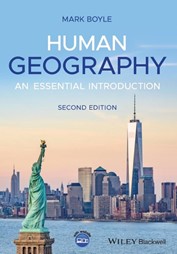
Human Geography: A Concise Introduction, by Mark Boyle. Malden, MA: Wiley-Blackwell. 2015, paper, 318 pages.
By Thomas Hansen, Ph.D.
This is a very interesting book because it is not from mainstream sources and is not a traditional format text.
This is a textbook meant for college and university courses within the United Kingdom, but the book can be used as a textbook anywhere, good background reading, and interesting data for writing social studies units and lessons in K-12 classrooms. Meant for a semester-long course, the book includes major points in history to illustrate what human geography is.
As in most of my reviews, I try not to give away all of the content and key ideas in the review. I talk more in this particular review about the overall approach of the book, some interesting features and themes, my personal reaction, and some possible uses for the book. I begin here by discussing how the book’s author sets up the discussion.
The author uses a historical approach in discussing human geography and this is mirrored in the way the book is organized—from the beginnings of civilization and the notion of what geography is. The vocabulary and basic concepts of the subject are presented in the first chapter.
There are 12 chapters, including a wide range of watershed events, natural disasters, migration, changing economies, and our current understanding of geography. Each chapter begins with a table of contents and a list of learning objectives. Each chapter ends with a conclusion of the most important points made, a bank of three essay questions, and references for further reading of what was found in the chapter. The format of the chapters could be helpful for students seeking lots of clarity in their reading.
One thing that really stands out in the book is the use of the “zoom-in boxes.” These are similar to sidebars, but they take up sometimes a full page or more than one page of text, stories and examples related to whatever the information is they interrupt. The problem is, there are so very many of them that they are aggravating. Right in the middle of a section on a given topic or subtopic, there is some discussion of how something is an example of X. When faced with these,
I did not know if I should stop reading the chapter and read the zoom-in box instead, or read for a while and come back to it.
The zoom-in box phenomenon was a very strange aspect of the book for me. Perhaps this sort of zoom-in box is a tradition in some fields, or in some lands, but it was something I did not ever get used to. I did not know how to incorporate them into the flow of what I was reading. Maybe the use of the zoom-in box is aimed at readers with short attention spans?
Another noticeable aspect of the book for me was the persistent theme of the West having imposed its will so strongly worldwide that this has resulted in a strong and pervasive clash of cultures noticeable around the globe (e.g., p. 99). This sentiment appears throughout the book and is also spelled out at several points. Readers will see it early on, and they will draw their own conclusions from it.
In responding to this text, I must admit I enjoyed very much the topics and discussion of the different themes and components of what makes geography work. Aside from the strange tone of the book, and the zoom-in boxes, I got a great deal out of reviewing this topic—one I have always felt is greatly slighted in schools.
I remember in my own case studying geography in elementary school—we had a book on it one year! In high school, I took a course on physical geography—in addition to taking French, German and Spanish language courses. A survey course on cultural geography was one of the very first electives I took in college. I went on to study several other world languages in college.
Of course, in studying about other languages and cultures, a knowledge of geography is essential. Therefore, I do not need to be convinced it is an important topic for study.
I would recommend the book to give teachers of social studies, world languages, and other subjects a different perspective and a way to connect history and geography. It is always interesting to me to see how books are laid out in other countries and learn from different points of view. This is good material for a teacher’s professional library, and the book can also be used to help inform and design units for the classroom.
Because the book is too long for a short professional development session, it fits more in the category of resource and reference material for teachers of cultural and world-focused subjects.
Human Geography: A Concise Introduction, by Mark Boyle. Malden, MA: Wiley-Blackwell. 2015, paper, 318 pages.
By Thomas Hansen, Ph.D.
This is a very interesting book because it is not from mainstream sources and is not a traditional format text.
This is a textbook meant for college and university courses within the United Kingdom, but the book can be used as a textbook anywhere, good background reading, and interesting data for writing social studies units and lessons in K-12 classrooms. Meant for a semester-long course, the book includes major points in history to illustrate what human geography is.
As in most of my reviews, I try not to give away all of the content and key ideas in the review. I talk more in this particular review about the overall approach of the book, some interesting features and themes, my personal reaction, and some possible uses for the book. I begin here by discussing how the book’s author sets up the discussion.
The author uses a historical approach in discussing human geography and this is mirrored in the way the book is organized—from the beginnings of civilization and the notion of what geography is. The vocabulary and basic concepts of the subject are presented in the first chapter.
There are 12 chapters, including a wide range of watershed events, natural disasters, migration, changing economies, and our current understanding of geography. Each chapter begins with a table of contents and a list of learning objectives. Each chapter ends with a conclusion of the most important points made, a bank of three essay questions, and references for further reading of what was found in the chapter. The format of the chapters could be helpful for students seeking lots of clarity in their reading.
One thing that really stands out in the book is the use of the “zoom-in boxes.” These are similar to sidebars, but they take up sometimes a full page or more than one page of text, stories and examples related to whatever the information is they interrupt. The problem is, there are so very many of them that they are aggravating. Right in the middle of a section on a given topic or subtopic, there is some discussion of how something is an example of X. When faced with these,
I did not know if I should stop reading the chapter and read the zoom-in box instead, or read for a while and come back to it.
The zoom-in box phenomenon was a very strange aspect of the book for me. Perhaps this sort of zoom-in box is a tradition in some fields, or in some lands, but it was something I did not ever get used to. I did not know how to incorporate them into the flow of what I was reading. Maybe the use of the zoom-in box is aimed at readers with short attention spans?
Another noticeable aspect of the book for me was the persistent theme of the West having imposed its will so strongly worldwide that this has resulted in a strong and pervasive clash of cultures noticeable around the globe (e.g., p. 99). This sentiment appears throughout the book and is also spelled out at several points. Readers will see it early on, and they will draw their own conclusions from it.
In responding to this text, I must admit I enjoyed very much the topics and discussion of the different themes and components of what makes geography work. Aside from the strange tone of the book, and the zoom-in boxes, I got a great deal out of reviewing this topic—one I have always felt is greatly slighted in schools.
I remember in my own case studying geography in elementary school—we had a book on it one year! In high school, I took a course on physical geography—in addition to taking French, German and Spanish language courses. A survey course on cultural geography was one of the very first electives I took in college. I went on to study several other world languages in college.
Of course, in studying about other languages and cultures, a knowledge of geography is essential. Therefore, I do not need to be convinced it is an important topic for study.
I would recommend the book to give teachers of social studies, world languages, and other subjects a different perspective and a way to connect history and geography. It is always interesting to me to see how books are laid out in other countries and learn from different points of view. This is good material for a teacher’s professional library, and the book can also be used to help inform and design units for the classroom.
Because the book is too long for a short professional development session, it fits more in the category of resource and reference material for teachers of cultural and world-focused subjects.
Human Geography: A Concise Introduction, by Mark Boyle. Malden, MA: Wiley-Blackwell. 2015, paper, 318 pages.
By Thomas Hansen, Ph.D.
This is a very interesting book because it is not from mainstream sources and is not a traditional format text.
This is a textbook meant for college and university courses within the United Kingdom, but the book can be used as a textbook anywhere, good background reading, and interesting data for writing social studies units and lessons in K-12 classrooms. Meant for a semester-long course, the book includes major points in history to illustrate what human geography is.
As in most of my reviews, I try not to give away all of the content and key ideas in the review. I talk more in this particular review about the overall approach of the book, some interesting features and themes, my personal reaction, and some possible uses for the book. I begin here by discussing how the book’s author sets up the discussion.
The author uses a historical approach in discussing human geography and this is mirrored in the way the book is organized—from the beginnings of civilization and the notion of what geography is. The vocabulary and basic concepts of the subject are presented in the first chapter.
There are 12 chapters, including a wide range of watershed events, natural disasters, migration, changing economies, and our current understanding of geography. Each chapter begins with a table of contents and a list of learning objectives. Each chapter ends with a conclusion of the most important points made, a bank of three essay questions, and references for further reading of what was found in the chapter. The format of the chapters could be helpful for students seeking lots of clarity in their reading.
One thing that really stands out in the book is the use of the “zoom-in boxes.” These are similar to sidebars, but they take up sometimes a full page or more than one page of text, stories and examples related to whatever the information is they interrupt. The problem is, there are so very many of them that they are aggravating. Right in the middle of a section on a given topic or subtopic, there is some discussion of how something is an example of X. When faced with these,
I did not know if I should stop reading the chapter and read the zoom-in box instead, or read for a while and come back to it.
The zoom-in box phenomenon was a very strange aspect of the book for me. Perhaps this sort of zoom-in box is a tradition in some fields, or in some lands, but it was something I did not ever get used to. I did not know how to incorporate them into the flow of what I was reading. Maybe the use of the zoom-in box is aimed at readers with short attention spans?
Another noticeable aspect of the book for me was the persistent theme of the West having imposed its will so strongly worldwide that this has resulted in a strong and pervasive clash of cultures noticeable around the globe (e.g., p. 99). This sentiment appears throughout the book and is also spelled out at several points. Readers will see it early on, and they will draw their own conclusions from it.
In responding to this text, I must admit I enjoyed very much the topics and discussion of the different themes and components of what makes geography work. Aside from the strange tone of the book, and the zoom-in boxes, I got a great deal out of reviewing this topic—one I have always felt is greatly slighted in schools.
I remember in my own case studying geography in elementary school—we had a book on it one year! In high school, I took a course on physical geography—in addition to taking French, German and Spanish language courses. A survey course on cultural geography was one of the very first electives I took in college. I went on to study several other world languages in college.
Of course, in studying about other languages and cultures, a knowledge of geography is essential. Therefore, I do not need to be convinced it is an important topic for study.
I would recommend the book to give teachers of social studies, world languages, and other subjects a different perspective and a way to connect history and geography. It is always interesting to me to see how books are laid out in other countries and learn from different points of view. This is good material for a teacher’s professional library, and the book can also be used to help inform and design units for the classroom.
Because the book is too long for a short professional development session, it fits more in the category of resource and reference material for teachers of cultural and world-focused subjects.
Human Geography: A Concise Introduction, by Mark Boyle. Malden, MA: Wiley-Blackwell. 2015, paper, 318 pages.
By Thomas Hansen, Ph.D.
This is a very interesting book because it is not from mainstream sources and is not a traditional format text.
This is a textbook meant for college and university courses within the United Kingdom, but the book can be used as a textbook anywhere, good background reading, and interesting data for writing social studies units and lessons in K-12 classrooms. Meant for a semester-long course, the book includes major points in history to illustrate what human geography is.
As in most of my reviews, I try not to give away all of the content and key ideas in the review. I talk more in this particular review about the overall approach of the book, some interesting features and themes, my personal reaction, and some possible uses for the book. I begin here by discussing how the book’s author sets up the discussion.
The author uses a historical approach in discussing human geography and this is mirrored in the way the book is organized—from the beginnings of civilization and the notion of what geography is. The vocabulary and basic concepts of the subject are presented in the first chapter.
There are 12 chapters, including a wide range of watershed events, natural disasters, migration, changing economies, and our current understanding of geography. Each chapter begins with a table of contents and a list of learning objectives. Each chapter ends with a conclusion of the most important points made, a bank of three essay questions, and references for further reading of what was found in the chapter. The format of the chapters could be helpful for students seeking lots of clarity in their reading.
One thing that really stands out in the book is the use of the “zoom-in boxes.” These are similar to sidebars, but they take up sometimes a full page or more than one page of text, stories and examples related to whatever the information is they interrupt. The problem is, there are so very many of them that they are aggravating. Right in the middle of a section on a given topic or subtopic, there is some discussion of how something is an example of X. When faced with these,
I did not know if I should stop reading the chapter and read the zoom-in box instead, or read for a while and come back to it.
The zoom-in box phenomenon was a very strange aspect of the book for me. Perhaps this sort of zoom-in box is a tradition in some fields, or in some lands, but it was something I did not ever get used to. I did not know how to incorporate them into the flow of what I was reading. Maybe the use of the zoom-in box is aimed at readers with short attention spans?
Another noticeable aspect of the book for me was the persistent theme of the West having imposed its will so strongly worldwide that this has resulted in a strong and pervasive clash of cultures noticeable around the globe (e.g., p. 99). This sentiment appears throughout the book and is also spelled out at several points. Readers will see it early on, and they will draw their own conclusions from it.
In responding to this text, I must admit I enjoyed very much the topics and discussion of the different themes and components of what makes geography work. Aside from the strange tone of the book, and the zoom-in boxes, I got a great deal out of reviewing this topic—one I have always felt is greatly slighted in schools.
I remember in my own case studying geography in elementary school—we had a book on it one year! In high school, I took a course on physical geography—in addition to taking French, German and Spanish language courses. A survey course on cultural geography was one of the very first electives I took in college. I went on to study several other world languages in college.
Of course, in studying about other languages and cultures, a knowledge of geography is essential. Therefore, I do not need to be convinced it is an important topic for study.
I would recommend the book to give teachers of social studies, world languages, and other subjects a different perspective and a way to connect history and geography. It is always interesting to me to see how books are laid out in other countries and learn from different points of view. This is good material for a teacher’s professional library, and the book can also be used to help inform and design units for the classroom.
Because the book is too long for a short professional development session, it fits more in the category of resource and reference material for teachers of cultural and world-focused subjects.





 njcssjournal