Obsolete but Preferable: The Role of Textbooks in the Modern Social Studies Classroom

Despite everything we’ve been led to believe over the past two decades, books have not completely disappeared from our society, nor our schools. Indeed, the world has rapidly moved in the direction of technological reliance at a seemingly infinitely higher rate since it entered the 2020s. This is especially true in educational settings, as teachers have begun to use a vast array of online tools, and many students across the country are more and more completing digital assignments. Yet, with all of this progression, texts themselves have not been completely phased out. No analyzation of the American education system can be generalized for every single school, let alone every single teacher. However, it is clear that the majority are still based on or at least reference some form of text. Still, this begs a question regarding the nature of the role that physical textbooks still play in the modern classroom, especially social studies ones considering so much of said subject is based on text interpretation. Ultimately, it is clear that textbooks generally are no longer the sole basis for classes’ entire curricula but are still used as valuable reference points. In addition, there has been a major shift away from traditional physical textbooks, and a move towards more differentiated options. 

To begin my research, I first looked into suggestions on how textbooks could continue to be useful tools. As my research isn’t catered towards one specific grade level, the article “A Content Analysis of Vocabulary Instruction in Social Studies Textbooks for Grades 4-8″ by Janis Harmon, Wanda Hedrick, and Elizabeth Fox from The Elementary School Journal proved a useful starting point. These authors posit that the real issue with the current usage of textbooks is not the book itself, but the way it is used. The primary alternative method of using textbooks regards vocabulary terms. Specifically, the authors claim that “effective practices for promoting vocabulary development stress the importance of instruction that affects comprehension, not just word knowledge alone” (Harmon, Hedrick, and Fox, 254). Thus, textbooks can’t be used to create simple repetition practices, they have to challenge the students in innovative ways which force them to exercise critical thinking skills about the matter at hand. Therefore, vocabulary terms are one of the most essential parts of a textbook, but there must be a dramatic shift away from how this device is being used at present, and how it has been used in the past.

The second article, and perhaps the most important I read, comes from the Georgia Educational Researcher and was written by two professors from Spelman College in Atlanta, Georgia, Dr. Amber Reed and Dr. Bailey Brown. Their article “Divergent Representations of Africa: A Qualitative Analysis of Georgia Social Studies Textbooks” explores the complexities of textbook usage in the deep American South, and how inherent biases towards various cultures is manifested in their content. In their research of Georgia’s public schools, they found that these issues are systemic and institutionalized. As such, they claim that “research also finds that educators are often ill-prepared to teach global perspectives in the social studies curriculum and that teachers’ biases and Eurocentric framework for teaching material can reproduce misconceptions about other countries” (Brown and Reed, 26). Thus, the biased nature of textbooks, at least in Georgia, is almost guaranteed for renewal as such misconceptions are carried down from one generation to the next. Therefore, there is likely little malicious intent in textbook bias, but failing to recognize it plays into the Eurocentric attitude that the American education system has long subscribed to. As such, this article doesn’t necessarily argue for doing away with textbooks altogether, but it does explain the need for a serious overhaul of the “traditional” methods they inspire.

The final article I referenced comes from the Journal of Adolescent & Adult Literacy. Written by Professors Sarah Matthew and Craig McGill, “Honestly, I Had a Very Strong Reaction to This Reading” contrasts to the aforementioned pieces by actually arguing in favor of moving away from traditional textbooks. They explore what the term “graphic” means in a literary context and how it can often be misconstrued. On the one hand, it can immediately act as a scare tactic many use to support banning certain titles as it assumes such content is either violent or pornographic. But in reality, “graphic” doesn’t have to imply any extreme at all, and at its most basic level just refers to the use of imagery or illustrations (Matthew and McGill, 433). As such, Matthew and McGill heavily advocate for the increased use of graphic novels as alternatives for traditional textbooks, arguing that they can bring a new perspective and encourage certain critical thinking skills not found otherwise. Not only that, but they also advocate for teaching banned material itself, in order to show students why titles are challenged, and what implications doing so holds. 

After doing my preliminary research into contemporary attitudes towards continuing textbook usage, I developed a two-pronged approach for my own research into this topic. The first prong involved transferring my findings from the articles I found into questions for three teachers I interviewed. While only three teachers’ opinions can be difficult to form conclusions upon, they are from different parts of New Jersey, and all teach at different levels. One teaches ninth and eleventh grade social studies at Ewing High School. Another teaches sixth grade ancient civilizations at Community Middle School in West Windsor. The final teaches sixth grade social studies at West Brook Middle School in Paramus. They were each asked the same five questions, three of which pertain to the above articles, and I have decided to retain their names in order to further encourage honesty in their answers. Moreover, they were not shown the data collected or previous teachers’ answers until after the interview was completed thereby ensuring autonomy in their responses. The five questions I asked these teachers were: overall, what do you believe the role of textbooks should be in the contemporary classroom; what kind of textbooks do you use, if any at all; do you believe textbook vocabulary terms can be beneficial if taught the right way; have you found that textbooks are generally more biased or unbiased; and how do you feel about teaching banned books, is it important that students are exposed to such material?

In contrast, the second prong focused on the student perspective. For this part of my research, I created a survey which I used to sample students in the class of the aforementioned teacher from Community Middle School. I was also able to obtain some responses from outside West Windsor from other students I work with, particularly in Byram and Stanhope in Sussex County. However, about 90% of the responses came from Community. As such, again I approached drawing blanket conclusions from this data with caution, but it still provides valuable insight into the direction at least this type of school is moving in. For the students I also asked five questions, inquiring about what type of texts are most appealing to them, which types they have used before, which types they believe would be most beneficial for them going forward, how positive an impact they believe textbooks have been on their education so far, and how strongly they believe textbooks can still play a positive role going forward.

Surprisingly to me, and with few exceptions, each teacher shared very similar answers to the five questions. The consensus seemed to be that textbooks should only act as complementary material to otherwise well-constructed lessons. Furthermore, you needn’t actively seek out textbooks for the niche purposes of vocabulary terms or just for the sake of teaching banned material. This can be done more organically, which is more beneficial to the fluidity of the unit at large. And textbooks, at least those in use in New Jersey, generally try to present information in unbiased ways, but as with any written material, biases do poke through. Hence why it is again important to not rely upon textbooks, or any one source for that matter, so heavily. Put most straightforwardly, the teachers I interviewed were in general agreement that textbooks can’t be the basis of an entire class but can still serve as one of many important resources for instruction or reference.

Similarly, the data I received from the students was not what I was expecting. In terms of what they found most appealing, graphic novels took about 1/3 of the responses. However, traditional textbooks achieved nearly the same number. Unsurprisingly, traditional textbooks were overwhelmingly the most used type of text, but eBooks fell not far behind, and graphic novels again took about 1/3 of the responses. Most surprising of all, traditional textbooks took the plurality of the responses for what type of text students believed would be most beneficial for them going forward, receiving about 40%. And finally, most of the responses for the final two questions fell somewhere in the middle, with zero responses indicating that they strongly disagreed, and 15% indicating that they strongly agreed. 

            The twenty-first century so far has seen a dramatic increase in reliance on technology and advancements in this field. And yet despite the seemingly resulting trend that physical textbooks have become obsolete, they can still play a role in the modern classroom. In completing my research, I have found that few have argued that such resources should be done away with entirely. In fact, many authors who have written on this subject have simply made suggestions for alternative practices. In addition, the teachers I spoke to were also generally supportive of continuing usage of textbooks so long as they do not dominate an entire class. Even students, who in general as an entire demographic have long been stereotyped as vehemently anti-textbook, seem not only willing, but happy to continue learning from them going forward. Again, it is important to acknowledge the small sample sizes used to conduct this study, and further research would have to be completed in order to make any type of generalization. But the general conclusion I draw from this project is that not only can textbooks still play a role in the modern classroom, but they must continue to be a commonly used resource.

The data I received both from the teacher interviews and the student surveys somewhat contradicted the information I found in the articles. First and foremost, it seems that the educators I talked to have few issues with the systematic bias in textbooks. They don’t negate its existence; rather they just see them as any other type of text which has to be approached with caution. They see the bias actually as useful, because any source is going to include it. Thus, it can be beneficial to have their students look for biases and point them out when they find them. The implication of their lack of hesitation in this regard seems to be that the era of fully textbook-based classes is just about over. A simple reliance on one textbook dooms students to a narrow view of the world, especially in social studies settings. Moreover, running your class as such is a dangerous reversal of the current trend which aims to facilitate critical thinking, rather than simple content knowledge.

Furthermore, continued textbook usage is completely acceptable, but it has to be supplemented with abundant material from other sources. And not only do students see continued textbook usage as necessary, but many even see traditional textbooks as having played a significant and even positive role in their education. Thus, while it is important to supplement traditional textbooks with other material, it seems we cannot be so extreme as to throw them out entirely. They serve as a familiar source of knowledge which many might feel lost without. So, to answer the initial question this research was based off of, textbooks can absolutely play an important and expansive role in the modern classroom. We just have to ensure that they are being used the right way and are not the only type of source students are exposed to. 

Brown, Bailey, and Reed, Amber. 2023. “Divergent Representations of Africa: A Qualitative Analysis of Georgia Social Studies Textbooks.” Georgia Educational Researcher 20 (2): 26–44. doi:10.20429/ger.2023.200202.  

Harmon, Janis M., Wanda B. Hedrick, and Elizabeth A. Fox. “A Content Analysis of Vocabulary Instruction in Social Studies Textbooks for Grades 4-8.” The Elementary School Journal 100, no. 3 (2000): 253–71. http://www.jstor.org/stable/1002154.

Mathews, Sarah A., and Craig M. McGill. 2022. “‘Honestly, I Had a Very Strong Reaction to This Reading’: Social Studies Pre‐Service Teachers’ Application of Literacy Frameworks While Engaging with a Graphic Textbook.” Journal of Adolescent & Adult Literacy 65 (5): 431–39. doi:10.1002/jaal.1224.

Fairness Counts: Integrating Math and Social Studies in the Elementary Classroom

“That’s not fair!” Any teacher who has spent time in elementary school classrooms knows the frequency and passion with which this sentence is declared each day.  As early as 3 years of age, children have a developed sense of fairness that concerns not only allocation of materials, but also the distribution process (Englemann & Tomasello, 2019). This desire to regulate games, play, and sharing of resources in early childhood continues to develop through the elementary years, and it provides a remarkable opportunity for teachers to leverage the integration of mathematics and social studies.

Social studies standards in New York explicitly refer to “gathering, interpreting, and using evidence” and “chronological reasoning and causation” (New York State Education Department [NYSED], 2017a).  The Next Generation Standards for Mathematical Practice include “Construct viable arguments and critique the reasoning of others” and “Look for and make use of structure,” which refers to finding patterns over the course of time (NYSED, 2017b). The overlap between these two subjects, particularly in the early grades, is significant and useful in settling disputes of tangible fairness and in the upper elementary grades, in providing support for students to think about more abstract concepts of fairness and equity.

Math and social studies integration for early childhood (PK-2)

Most early childhood classrooms have objects that are in short supply and coveted by many children at once.  Common ones might include the “good” bean bag chair for reading, the block corner, or the newest art supplies. Some teachers generate and implement systems for managing these situations so that students are treated fairly. Other teachers might feel that students ought to learn that sometimes they can’t get what they want and adopt mantras similar to “you get what you get, and you don’t get upset.”

Both teacher-imposed systems of fairness and teacher-imposed systems of control miss a crucial opportunity to allow students ownership of their class rules and also an opportunity to show how social studies and mathematics are integrated and relevant. Consider the example of the bean bag chair that, for some reason undiscernible to adults, students have decided is the “best” one. In the reading corner, despite the fact that there are four seemingly equivalent places to sit, one chair always causes an argument or a dash across the room to get there first. It is important for teachers to know that even if it seems not to make sense, children assign tremendous value to objects. In fact, studies have shown that even very young children view objects as extensions of self (Diesendruck & Perez, 2015). Leveraging this assigned significance into learning opportunities should be at the forefront of teacher’s agendas.

An interdisciplinary solution to the bean bag chair problem might begin by first naming the issue and helping children articulate their feelings and questions about it. Then, the teacher might set up a democratic process for students to share what they think are good solutions. There are many literary resources that would be good starting points for student participation. Fair Shares by Pippa Goodheart, Share and Take Turns by Cheri J. Meiners, and Friends Ask First by Alexandra Cassel are a few popular choices to anchor a discussion.

Once all students have had an opportunity to ask questions and share their ideas for a fair system, the teacher might consolidate all of the ideas into two or three options. It is important to explicitly model thinking critically about ideas of fairness for students to help them broaden their understanding and expose them to different points of view (Bjervås, 2017).  Ideas elicited from early childhood students would likely come under a few different categories: 1) some kind of system where everyone gets the same amount of time 2) a taking turns system, where if someone else wants a turn, the person in the chair has to give it up 3) a Darwinian system that indicates something to the effect of whoever gets there first gets the chair, and 4) other less fair, or more difficult to articulate systems. Through questioning and debate facilitated by the teacher, students would likely come to the conclusion that the time system is fairest.  In PK-2 classrooms, setting up a ballot measure and having students vote would be a clear way of establishing an example of the democratic process.  Age-appropriate social studies concepts met during this process include gathering, interpreting and using evidence, chronological reasoning and causation, and civic participation (NYSED, 2017a).

After everyone has participated in this form of civic engagement, mathematics plays a larger part.  The very process of counting and representing the results of voting is a mathematical concept.  Using a Unifix cube or a similar concrete manipulative to represent each vote, students can stack them to construct a three-dimensional bar graph showing how many votes were cast for each option. This visual and tactile representation of the votes will make it clear to students the option with which more students agree. This representation itself ticks several boxes for mathematical standards and concepts appropriate for PK-2 classrooms. 

Counting objects, sorting them into categories, arranging them in a line to assign ordinal numbers, comparing the quantity in each group by using words like more than or fewer, and representing data in a display and reading said display are all mathematics concepts that students should learn in early childhood grades (NYSED, 2017b). Research has long since established that students not only retain mathematics content more effectively but are also better able to transfer and apply skills they learned through the context of their own social and cultural values rather than word problems with “real world” situations involving carts full of watermelons from a textbook (Boaler, 1993; Lazic & Maričić, 2021; Taylor, 1989). Establishing classroom rules that are fair for everyone is a high priority for young students, and therefore the mathematics and social studies concepts associated with the construction of such a classroom will likely be learned deeply and effectively.

The idea of “fairness” holds within it the essence of “equality,” which is a mathematics concept that is tremendously important but often misunderstood, particularly in early childhood (Sophian, 2022). Furthermore, concepts of equal parts of a whole, equal groups of objects, and showing equal quantities in different ways are found throughout PK-2 math standards (NYSED, 2017b). To keep with the time in the bean bag chair example, this activity can be further developed by facilitating a discussion among students about how much time in the bean bag chair is fair.  If independent reading time is 20 minutes, and there are 20 students in the class, one option that can be shown using concrete or digital manipulatives is for each student to get 1 minute per day in the chair. Most young children have not yet developed understanding of lengths of time, and understanding the duration of a minute is an important concept taught in the early grades.

Discussion and practical testing of this idea might lead students to the realization that a single minute is not enough time for quality reading and relaxing.  Therefore, through discussion and some experimentation with manipulatives representing minutes, the teacher might suggest that only fewer people per day get to sit in the chair, but for a longer time, and ask students to try to come up with a system for keeping track of students and times. 

Including this amount of thinking and discussion about the bean bag chair will likely result in taking several days to create and revise the plan.  The time invested in having students involved with and responsible for making a fair system is easily justified by the lessons and concepts they will learn about mathematics, social studies, literacy, and collaboration. An additional benefit to facilitating a series of lessons like these is the reduction of students wondering “why do we need to know this?” The meaning behind the instruction is already implicit: students will develop the skills and capacity to eliminate fighting over the bean bag chair.

As students mature throughout elementary school activities and lessons like the one above might become less relevant; students become more capable of regulating fairness in social situations without adult intervention.  Additionally, items like the bean bag chair or favorite toys might become less significant in upper elementary classrooms.  However, there still exist many opportunities for students to integrate mathematics and social studies concepts to gain a better understanding of fairness in the world.

Gathering and examining evidence, constructing arguments, and critiquing the reasoning of others are skills that both mathematics and social studies standards mention explicitly (NYSED, 2107a, b). Common examples of how to integrate mathematics and social studies include examining percentages, reading and interpreting graphs and charts, and analyzing change over time. One facet that may not be traditionally examined thorough the lens of both mathematics and social studies is a calculation of the amount of voting power that citizens have in an indirect democracy. 

While younger students are quick to point out “that’s not fair!” when tangible resources are inequitably distributed, older students should be encouraged to think critically about the fairness and equity in more abstract terms by systems of which they are a part (Lee et al., 2021). Elementary school students begin learning the structure of the United States government and have some understanding of what government representatives do. They are also beginning to develop understanding of fractions, extremely large and small numbers, and operations with these numbers. These sets of concepts can be integrated to give students real world understanding of the amount of power their votes have by exploring representative democracy.

This activity focuses on U.S. Senate representation. If students are unfamiliar with representative democracy, a teacher might want to demonstrate using a concrete example with students in the class:  If students in a class of 20 are seated 5 to a table, for example, an election for table representative can be held. Students should understand that these representatives will, with the direction of the teacher, help make some of the rules for the classroom and advocate on behalf of their constituents (tablemates). Therefore, they have to think carefully about who they want to represent them. In this example, there are 4 student representatives who will be part of the discussion and vote on rules.  Each of these student representatives, therefore, has of the total voting power in any matter on which they vote. 

The next question is, how much voting power does each person at the table have? By facilitating discussion, the teacher should be able to elicit that each student has  of the voting power, since everyone was able to vote for their own representative.  This can be found two ways; the first one indicated below is the most straightforward, while the second might be less obvious. Nevertheless, students might notice and articulate this strategy if they are given the chance to explore it. This is also the skill students will need to find answers to questions later in this activity.

  • Each student is 1 out of the total 20 in the class, therefore each vote is  of the total.
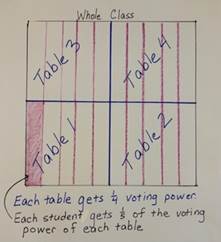
  • Each table gets  of the vote via their representative.  That  of the vote comprises 5 students, so each student gets  of that .  Students can draw a model of fourths, then divide each of those fourths into 5 sections (Figure 1) to show that every smaller section is then .  Some students might realize that  of  also means , which is also the same as .

The reasoning in the second explanation can be further explored by changing some conditions about the representatives. For example, what if there were still 4 tables, each with 1 representative, but one table had 8 people, and the rest had 4? Would everyone still have the same voting power? The table of 8 would have  of the voting power each.  While the tables of 4 would have  of the voting power each. There are several mathematical questions that can be asked at this point to facilitate exploration with fractions:

  • Who has more voting power? How do you know?
  • Is that fair? Which table would you want to sit at?
  • What does the size of the denominator tell us about the size of the fraction?

This activity can be extended over the course of several days to expand students’ understanding of voting power on a larger scale. They can be asked to find reliable sources of information indicating the population of each state in the U.S. and to calculate the voting power of the citizens of each state in the U.S senate if each state is represented by two senators. These calculations would involve operations with very large numbers, and comparing unit fractions that represent extremely small quantities, both of which are included in upper elementary mathematics standards (NYSED, 2017a). Students might be surprised to learn that in terms of senate votes, U.S. citizens have drastically different voting power. Extension questions might include:

  • Citizens of which state have the most voting power in the senate? The least?
  • How many times as powerful are the votes from the state with the most power per citizen compared with the state with the least?
  • Is this the case in all branches of government? Should it be? How does representation in the other branches work?

Both the activity described for PK-2 students and the one described for upper elementary students integrate mathematics and social studies in an age-appropriate, real-world context. Social studies and mathematics are not always considered easy to integrate smoothly, but many concepts and skills are clearly interdisciplinary between these two subjects. While meeting content standards is important to ensure equity of mathematics and social studies knowledge among students, it is even more important to give students the tools to think critically, advocate for themselves, and engage in civil discourse (Lee, et al. 2021). These skills ought to be taught through relevant applications that demonstrate to students why it is important to have them. For this reason, leveraging students’ deeply developed feelings that some things are unfair (Engelmann & Tomasello, 2019) into motivating lessons about how to quantify fairness and equity is a powerful bit of pedagogy.

Boaler, J. (1993). The Role of Contexts in the Mathematics Classroom: Do they Make Mathematics More” Real”? For the learning of mathematics13(2), 12-17. https://www.jstor.org/stable/40248079

Bjervås, L. L. (2017). Teaching about fairness in a preschool context. In Values in Early Childhood Education (pp. 55-69). Routledge.

Diesendruck, G., & Perez, R. (2015). Toys are me: Children’s extension of self to objects. Cognition134, 11-20. https://doi.org/10.1016/j.cognition.2014.09.010

Engelmann, J. M., & Tomasello, M. (2019). Children’s sense of fairness as equal respect. Trends in Cognitive Sciences23(6), 454-463. https://doi.org/10.1016/j.tics.2019.03.001

Lazic, B., Knežević, J., & Maričić, S. (2021). The influence of project-based learning on student achievement in elementary mathematics education. South African Journal of Education41(3). http://dx.doi.org.ezproxy.hofstra.edu/10.15700/saje.v41n3a1909

Lee, C. D., White, G., & Dong, D. (2021). Educating for Civic Reasoning and Discourse. National Academy of Education. https://files.eric.ed.gov/fulltext/ED611951.pdf

New York State Education Department. (2017a). New York State K-8 social studies framework.https://www.nysed.gov/sites/default/files/programs/standards-instruction/ss-framework-k-8a2.pdf

New York State Education Department. (2017b). New York state p-12 learning standards for mathematics. http://www.nysed.gov/new-york-state-revised-mathematics-learning-standards

Sophian, C. (2022). A developmental perspective on children’s counting. The development of mathematical skills (pp. 26-46). Psychology Press.

Taylor, N. (1989). Let them eat cake: desire, cognition and culture in mathematics learning. Mathematics for All, 161-163.

Partial List of Banned Words by the U.S. Federal Government

PARTIAL LIST OF BANNED WORDS

Hank Bitten, NJCSS Executive Director

Abortion; accessible; accessibility; activism; anti-racism; antiracist; at risk; autism; barrier; bias; Black; clean energy; climate crisis; climate science; community; continuum; Covid-19; cultural differences; cultural heritage; DEI; disability; discrimination; disparity; diverse; diversity; equality; equity; elderly; environmental justice; ethnicity; evidence-based; female; feminism; fetus; fluoride; gay; gender; gender based; Gulf of Mexico; ideology; immigrants; implicit bias; inclusion; inequality; injustice; institutional; hate speech; Hispanic; Latinx; LGBT and LGBTQ; marginalized; marijuana; measles; mental health; minority; multicultural; Native American; obesity; opioids; oppression; peanut allergies; polarization; political; pollution; prejudice; privilege; promote; pronoun; pronouns; prostitute; race; racial identity; racism; science-based; segregation; sex; social justice; stereotypes; transgender; trauma; traumatic; unconscious bias; underprivileged; underrepresented; vaccines; victims; woman; women

Source (Pen America) Complete List is on this site

Source (Alan Singer)

Presidents and Labor Strikes

Hank Bitten, NJCSS Executive Director

Most decisions by American presidents and other world leaders do not have an immediate impact on the economy, especially regarding the macroeconomic issues of employment and inflation. For example, President Franklin Roosevelt’s bank holiday, President John Kennedy’s tariff on imported steel, and President Ronald Reagan’s Economic Recovery Tax Act had limited immediate effects on the economy, but their long-term effects were significant. The accomplishments or problems of a previous administration may impact on the administration that follows.

For example, President Biden faced criticism about the economy during his administration. The jobs created with the Bipartisan Infrastructure Law and the interest rate policy of the Federal Reserve Bank to lower inflation did not show results until years later. The drop in Real Disposable Income from the administration of President Trump is another example. Real Disposable Income is a measure of income that is adjusted for inflation. The drop between the administration of President Bident and Trump is the result of extended unemployment benefits, people working from home during the pandemic when businesses were closed, and stimulus checks from the government. The economic transition following the end of the pandemic had a significant impact on the economy.

PresidentGDP GrowthUnemployment  RateInflation RatePoverty RateReal  Disposable  Income
Johnson2.6%3.4%4.4%12.8%$17,181
Nixon2.0%5.5%10.9%12.0%$19,621
Ford2.8%7.5%5.2%11.9%$20,780
Carter4.6%7.4%11.8%13.0%$21,891
Reagan2.1%5.4%4.7%13.1%$27,080
H.W. Bush0.7%7.3%3.3%14.5%$27,990
Clinton0.3%4.2%3.7%11.3%$34,216
G.W. Bush-1.2%7.8%0.0%13.2%$37,814
Obama1.0%4.7%2.5%14.0%$42,914
Trump2.6%6.4%1.4%11.9%$48,286
Biden2.6%3.5%5.0%12.8%$46,682

This series provides a context of important decisions by America’s presidents that are connected to the expected economic decisions under the second administration of President Trump. The background information and questions provide an opportunity for small and large group discussions, structured debate, and additional investigation and research. They may be used for current events, as a substitute lesson activity or integrated into a lesson.

In the case study below, have your students investigate the economic problem, different perspectives on the proposed solution, the short- and long-term impact of the decision, and how the decision affects Americans in the 21st century.

The Economic Problem

One of the first labor strikes in the United States occurred in Paterson, New Jersey on July 3, 1835.  About 2,000 textile workers stopped working in about 20 textile mills demanding better hours. Workers, including women and children worked 13 hours a day six days a week and their wages were reduced as fines for infractions. The strike eventually led to a 12-hour day and a nine-hour day on Saturday.

In 1835 carpenters, masons, and stonecutters in Boston staged a seven-month strike in favor of a ten-hour day. The strikers demanded that employers reduce excessively long hours worked in the summer and spread them throughout the year. In Philadelphia, carpenters, bricklayers, plasterers, masons, leather dressers, and blacksmiths went on strike. In Lowell, MA, women also went on strike. The history of labor complaints and strikes date back to the colony of Jamestown. Although the common law in England provided protection for peaceful demonstrations, the courts in the colonies and states often fined workers because their organization as a group was viewed as a ‘restrain of free trade’ or a violation of the right of property for employers. In 1842, the Commonwealth of Massachusetts v. Hunt was a landmark decision that allowed peaceful demonstrations. “In March 1842, Chief Justice Lemuel Shaw ruled that labor combinations were legal provided that they were organized for a legal purpose and used legal means to achieve their goals.”

The economic problem was long hours, low wages, and oppressive working conditions. The market revolution led to the demand for consumer goods. The new inventions of the cotton gin, steamboats, locomotives, and factories. The nature of work was changing and this led to profound changes in society. Employers and entrepreneurs believed this was the idea behind the pursuit of happiness in the declaration of Independence and how a republic was governed. Laborers used the press to voice their concerns which led to the organization of trade unions in Philadelphia.

President Andrew Jackson’s decision to let the charter of the Second Bank of the United States to expire had an unexpected and profound impact on ordinary people. Working conditions continued to decline and President Jackson’s decision led to an increase in paper money and inflation. Higher prices led to unemployment and longer hours for those who were employed. Illness or injury and debt led to homelessness and poverty. According to a New York City physician, the laboring poor in the 1790s lived in “little decayed wooden huts” inhabited by several families, dismal abodes set on muddy alleys and permeated by the stench from “putrefying excrement.” Source

In 1840 the federal government introduced a ten-hour workday on public works projects. In 1847 New Hampshire became the first state to adopt a ten-hour day law. It was followed by Pennsylvania in 1848. Both states’ laws, however, included a clause that allowed workers to voluntarily agree to work more than a ten-hour day. Despite the limitations of these state laws, agitation for a ten-hour day did result in a reduction in the average number of hours worked, to approximately 11 by 1850.  On May 19, 1869, President Grant issue Proclamation 182 making an 8-hour day for all federal government employees. This expanded the decision of Congress made in 1868.

After the Civil War, manufacturing and economic growth increased dramatically. There were many strikes as farmers and laborers, both skilled and unskilled, formed associations and unions. Below are examples of larger strikes that are likely part of the high school curriculum.

During the first week of May,1886 workers in Chicago staged demonstrations and strikes demanding an eight-hour day. On May 4 a bomb exploded near Haymarket Square in Chicago.  Several police officers and protesters were wounded or killed by the blast, and 8 individuals were arrested and convicted. Source

A day to recognize the rights of workers was first proposed by Matthew Maguire from Paterson, NJ in 1882. The balance between the right to have peaceful demonstrations under the First Amendment was respected but the Haymarket Riot became violent, strikes were costly to the profits of employers, and violence and strikes were a threat to property. President Cleveland was the first president challenged by the threat of anarchy from socialists. After the Haymarket Riot, a few states, including New York and New Jersey, recognized a Labor Day holiday. This was the fourth federal holiday after Independence Day, Christmas Day, and New Year’s Day. Congress considered making Labor Day a federal holiday in May, but President Cleveland feared this would become a recognition of the violence of the Haymarket Riot.  President Cleveland was the first president to involve the federal government in resolving issues between labor and business interests or capital.  Source

Newspaper Accounts of the Haymarket Riot, 1886

  1. Under what conditions would you support workers on strike? (higher wages, better working conditions, unfair practices by an employer, benefits, job security, etc.)
  2. Are labor strikes a violation of the property rights of employers?
  3. Do workers have a right to disrupt the production of goods or services by a slowdown in the workplace, strict adherence to their contract agreement, coordinating a sick out, making public expressions or statements about their situation, etc.
  4. Do workers need to be paid in wages or can employers also pay them in other ways? (time off, goods produced, etc.)
  5. Should workers receive an annual salary increase based on their months or years of service, inflationary costs of living, or only if they produce more than in the past?
  6. How would you determine a fair wage?
  7. Do the students in your class (or a larger group) support the right to strike workers?

Open the three-day lesson on the 1835 strike in Paterson, NJ. (Update the CPI index from 2012 to the present)

In the months before the presidential election of 1892, President Harrison was faced with a violent strike at the Carnegie Steel Company in Homestead, PA near Pittsburg. The Knights of Labor and the Amalgamated Association of Iron Workers went on strike on June 30 when their contract expired. Workers in Carnegie’s companies in the area supported the striking workers.  Henry Clay, the manager of the Homestead plant, hired private Pinkerton guards to protect the plant and keep the striking workers away. President Harrison privately sent Whitelaw Reid to mediate the conflict.

The strikers threw rocks at the guards, the crowd size was estimated to be about 5,000, and gunshots were fired. At one point amid the chaos, shots were fired. The Pinkertons surrendered and the strikers continued with verbal abuse and assaulted them with rocks as they marched them to a local Opera Hall.

On July 12, Pennsylvania Governor Robert Pattison sent 8,500 National Guardsmen to end the strike. In less than 30 minutes the Carnegie mill was under martial law, the strikers were arrested. Sixteen of the strikers were arrested for conspiracy, murder, and inciting riots. The strike ended three months later in November with the workers agreeing to lower wages, the elimination of 500 jobs, and a 12-hour day. The labor unions lost, and their membership declined.

President Cleveland faced a nationwide railroad strike that began on May 11, 1894. The American Railway Union went on strike against the Pullman Company and the major railroads.  It became a turning point in U.S. labor law. The workers at Pullman protested the layoff of 2,000 workers and wage cuts that amounted to 25%-50% of their wages. The Pullman workers lived in a company town and paid rent to the Pullman Company, which was located near Chicago, Il. The rents were not reduced. The Pullman Company also had a surplus of $4 million at the time of the strike and consistently paid dividends to shareholders.

The Panic or recession of 1893 negatively affected many companies as production declined. The railroads depended on shipping farm products, which were reduced as a result of crop failures. This was the most serious economic recession in the world as investors in Europe purchased gold from U.S. banks, Americans took their savings out of banks, and companies that had speculated in the stock, bond, and commodity markets lost money/ The economic recovery after the recession ended would take several years.

On July 3, 1894, President Cleveland ordered 2,000 armed federal troops to Chicago to end the strike. The strike ended within a few weeks, union leaders were arrested and jailed on charges of conspiracy to obstruct interstate commerce. The justification of using federal troops to move the U.S. mail was based on the Sherman Anti-Trust Act of 1890. This was not the first time federal troops were used to end a strike. President Jackson used troops in 1834 to end the strike by workers building the Chesapeake and Ohio Canal and in 1877 President Hayes send troops to end the violence in Baltimore during the Great Railroad strike.

In May 1902 President Teddy Roosevelt was faced with a nationwide strike by coal miners. Many homes were heated by coal and a prolonged strike in the winter could be catastrophic, deadly, and cause riots. On October 3, 1902, with winter weather approaching, President Theodore Roosevelt called a precedent-shattering meeting to negotiate a settlement. The President did not have any legal authority to settle a labor dispute, although Presidents Jackson, Hayes and Cleveland used federal troops to end labor disputes.

President Roosevelt’s administration proposed the Anthracite Coal Commission to complete a fact-finding report and negotiate a settlement.  The strike ended on October 20, 1902, and the Commission recommended in March 1903 increasing miners’ pay by ten percent (one-half of their demand) and reducing the working day from ten to nine hours.

Samuel Gompers wrote: “Several times I have been asked what in my opinion was the most important single incident in the labor movement in the United States and I have invariably replied: the strike of the anthracite miners in Pennsylvania … from then on the miners became not merely human machines to produce coal but men and citizens…. The strike was evidence of the effectiveness of trade unions ….

The victory in the anthracite coalfields breathed new life into the American labor movement.55 It strengthened moderate labor leaders and progressive businessmen who championed negotiations as a way to labor peace. It enhanced the reputation of President Theodore Roosevelt. Sometimes overlooked, however, is the change the conflict made in the role of the Federal Government in important national strikes.” Source

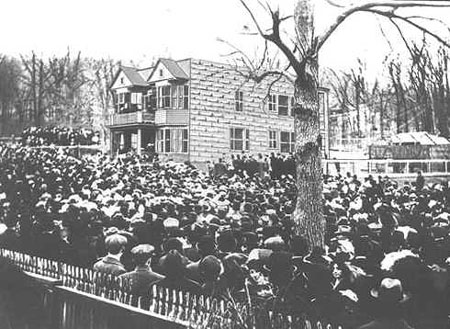
The silk strike began in February 1913 when twenty-five thousand striking silk workers shut down the three hundred silk mills and dye houses in Paterson, New Jersey, for almost five months. There were several textile strikes that preceded the one in Paterson. The Paterson strike was related to an increased workload and the desire for an eight-hour day. The other strikes occurred because of wages. The Industrial Workers of the World (I.W.W.) were active in organizing the strike and produced the “Pageant of the Paterson Strike” in Madison Square Garden on June 7.  Pietro Botton opened his home to the labor leaders from New York City and on May 25, a rally of more than 20,000 people took place outside his home. These rallies continued on Sundays until the strike ended in July.

The strikers returned to work without any concessions, although the employers did not implement the plan to have one worker operating four looms instead of two.

  1. What is a yellow dog contract, scab, collective bargaining, closed shop, and right to work protections
  2. What are the differences between skilled and unskilled laborers?
  3. How is an Association different from a labor or trade union?
  4. Who has the advantage in a strike: labor employees or employers?
  5. How do strikes affect the economy and the lives of people who are not associated with the union?
  6. Why do you think the union and workers failed to achieve their goal in the Paterson Strike of 1913?
  1. Make a list of labor unions and associations in the United States.
  2. Use these sources to categorize the list of strikes by length of time, size of the unions, and frequency? List of Unions (Wikipedia)   200 Years of Labor History (NPS)

The Seattle General Strike of February 1919 was the first 20th-century solidarity strike in the United States to be proclaimed a “general strike.”  Seattle had 101 unions that were part of the American Federation of Labor (AFL). On the morning of February 6, 1919, over 25,000 union workers stopped working to support the 35,000 shipyard workers who were already on strike. Although wartime inflation created a need for higher wages, the goals of the striking workers were not clearly articulated. Mayor Ole threatened to declare martial law and two battalions (about 3,000) U.S. Army troops arrived. The union members had already implemented a plan to provide food deliveries, transport people to hospitals, and patrol the streets to prevent crime. Below is an image of a soup kitchen. Union members distributed 30,000 meals a day during the strike.

The strike lasted six days and was peaceful. There were minimal gains for the workers, but most returned to work. There were several outside agitators who were identified as “Reds” or communists who were arrested. The strike is generally viewed as unsuccessful.

Seattle General Strike Project

History of the General Strike (9-minute Video)

History of the General Strike (4-minute Video)

The Seattle General Strike (Roberta Gold) 

“An Account of What Happened in Seattle and Especially in the Seattle Labor Movement, During the General Strike, February 6 to 11, 1919” 

Slide show 

The Seattle General Strike 

The Boston Police went on strike on September 9, 1919. Police officers worked long hours, received low wages, and had inadequate working conditions. They worked thirteen-hour days and wanted an eight-hour day. They had to purchase their own uniforms which cost $200 (about two months’ salary), were required to sleep overnight in the police station several nights a month, and they had not received a salary increase in over ten years. They were paid about 25 cents an hour and earned about $1,400 a year.

The three cases below were landmark decisions in the labor movement. The Lochner decision ruled that employers could issue contracts without any restrictions such as an 8- or 10-hour day. The Adkins decision supported this and ruled it was illegal to have a minimum wage for workers. The Muller decision ruled that the hours of women could be less than those of men if their health was at risk.

The general right to make a contract in relation to one’s business is part of the liberty protected by the Fourteenth Amendment, and this includes the right to purchase and sell labor, except as controlled by the state in the legitimate exercise of its police power.

The regulation of the working hours of women falls within the police power of the state, and a statute directed exclusively to such regulation does not conflict with the Due Process or Equal Protection Clauses.

Legislation fixing hours or conditions of work may properly take into account the physical differences between men and women, but the doctrine that women of mature age require (or may be subjected to) restrictions on their liberty of contract that could not lawfully be imposed on men in similar circumstances must be rejected.

Frances Perkins was asked to serve as FDR’s Secretary of Labor. As Secretary, she would pursue: a 40-hour work week; a minimum wage; unemployment compensation; worker’s compensation; abolition of child labor; direct federal aid to the states for unemployment relief; Social Security; a revitalized federal employment service; and universal health insurance. She is the longest serving labor secretary and one of only two cabinet secretaries to serve the entire length of the Roosevelt Presidency.

The Wagner Act (1935) created the National Labor Relations Board to enforce employee rights rather than to mediate disputes. It gave employees the right, under Section 7, to form and join unions, and it obligated employers to bargain collectively with unions selected by a majority of the employees in an appropriate bargaining unit. 

The U.S. Supreme Court in NLRB v. Washington Aluminum in 1962 upheld the right of employees to go on strike whether they have a union or not. However, workers and unions still needed to be careful to avoid an unlawful strike.

A strike is likely protected by law if it is in response to “unfair labor practice strikers” or “economic hardship from low wages, excessive hours, or difficult working conditions.” 

A strike may be unlawful when it supports an unfair labor practice such as requiring an employer to stop doing business with another company. Workers cannot legally strike if their contract prohibits strikes, although workers can stop working if they are subject to dangerous or unhealthy conditions.

After World War II, there were several major strikes and unions were unpopular because of the strikes and fear of the expansion of communism after Churchills’ Iron Curtain speech. The Taft Hartley Act amended the Wagner Act (1935). It was proposed by Rep. Fred Hartley from New Jersey and Senator Robert Taft from Ohio.  The Taft-Hartley Act made major changes to the Wagner Act. It was vetoed by President Truman and required a vote by both houses of Congress to override his veto. The Act was amended to protect employees’ rights from unfair practices by unions by making the closed shop and wildcat strikes to be illegal and prohibiting unions from charging excessive fees for membership.

  1. What are the differences between a walkout, lockout, strike, and sit-down strike? Do the definitions or labels matter if work stops?
  2. Should certain employees be prevented from having a union to represent their interests?
  3. Should certain employees who serve the public be prevented by law from being able to strike when the public’s safety or interest is at risk? (teachers, bankers, police, sanitation, transportation workers, nurses, etc.)
  4. What is arbitration, fact-finding, and collective bargaining? What is the purpose of each?
  5. What is back pay?  Should striking workers be compensated for the days or weeks they did not work?
  1. Interview two or three people or groups of people regarding labor conditions they would like to have negotiated in their favor.
  2. Review the contract between teachers and the Board of Education in your district or another district. Discuss the protections in the contract that are not directly related to salary?

In January 1966, there was a 13-day transit strike in New York City. The buses and trains were shut down. In 1968, the teachers and sanitation workers went on strike. Thousands of New York City teachers went on strike in 1968 when the local school board of Ocean Hill – Brownsville, fired nineteen teachers and administrators without notice. The newly created school district, in a heavily black neighborhood, was an experiment in community control over schools—those dismissed were almost all Jewish. The strike began in September and ended on November 17. There are many important issues relevant to this strike – civil rights, integrated schools, poor performing districts, and local control vs. a central Board of Education. The strike raised the issue if public sector employees (police, fire, teachers, and private sector employees should have the right to strike over unfair business practices.

On the morning of August 5, 1981, approximately 13,000 workers of the air traffic control facilities called a strike.  President Reagan spoke from the Rose Garden at the White House telling them to return to work within 48 hours or be fired. About 2,000 returned to work and the rest were fired. The government used people from the military and retired air traffic controllers to monitor the flights and hired new air traffic controllers. This one event had a proof und effect on the labor movement as workers feared losing their jobs if they went on strike.

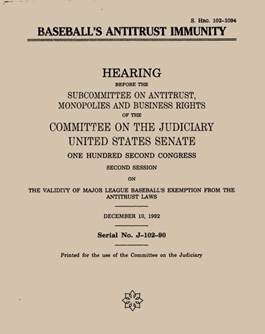
The 232-day baseball strike of 1994-95 was the biggest one in professional sports. Although there have been many work stoppages in professional baseball dating back to 1912, the study of this strike is important because of the challenges it presented to labor negotiators. This problem has historical origins and dates back to the Sherman Antitrust Act of 1890. In 1922, the U.S. Supreme Court ruled that professional baseball was exempt from the anti-trust protection because it was not considered to meet the definition of trade or commerce. Federal Baseball Club of Baltimore, Inc. v. National League of Professional Baseball Clubs et al.  The case was appealed several times but not reversed. The only option for players was to strike. Source

The strike began on August 12, 1994, and the World Series was cancelled on September 14. One of the main issues was the salary cap that owners placed on the players. The cancellation of the World Series prompted some senators to propose legislation to end the anti-trust exemption given to baseball. This divided the Congress because the protection was favored by owners of smaller teams. President Clinton attempted to intervene but was not able to negotiate a settlement. As the 1995 baseball season was about to begin, baseball owners planned to hire non-union replacement players, a tactic used by the National Football League in 1987. On March 31, 1995, U.S. District Judge Sonia Sotomayor issued an injunction, and the baseball players returned to the field.

Chronological History of Labor Strikes in the United States (NPS

Challenges of Teaching African American History in Secondary Schools

Imani Hinson, Romelo Green, Nefe Abamwa, and Adam Stevens presented on a panel at the 2025 conference of the American Historical Association. Hinson is a social studies teacher in the Howard County Maryland School District who formerly taught in Brooklyn and an item writer for the College Board AP African American Studies program. Green and Abamwa teach at Bellport High School in Suffolk County, New York and Stevens teaches at Brooklyn Technical High School. The session was chaired by April Francis-Taylor of Hofstra University and also included papers by Alan Singer of Hofstra University and Justin Williams of Uniondale High School.

By Imani Hinson

Each year I start my students off with a week of lessons to understand why we study history in the first place and to get students specifically to understand why varied viewpoints are so important. This year I had my students reflect on a quote from Maya Angelou and asked them why they thought some political leaders across the United States did not think African American history was important and why they thought this history was considered controversial.

My students responded with the understanding that by learning history we can hope to not repeat it but also that learning this history does not aim to make individuals feel bad for the deeds done but rather understand the historical situations in which our country was founded and the continued history that is shaping the way our country is moving forward today. Despite the pain and suffering lived by many in this country, especially African Americans, it is important to uncover truths about our shared history. The APâ African American Studies curriculum provides students with a chance to do just that; tackle tough questions, tough realities, glean an understanding of the world that they live in today, and it gives them a chance to acknowledge a history that many of them have not learned before.

The APâ curriculum has a fantastic starting place with the African Kingdoms of Mali, Songhai, the Hausa States, and more. Students are able to do a deep dive into the history of Africa that many of them had never been taught about before. A question I get often from my students is “Ms. Hinson why are we not taught this in World History or any other history class?” The truth is that a lot of this history was unknown or kept secret for many years. In my classroom, we delve into the nuances of this history so that students understand how it differs from the traditional documents and writings they usually learn about in Eurocentric history classes. I introduce them to griots and students learn that different cultures pass down history in different ways. Much of the early history we know from African civilizations was passed down orally making it much harder for historians to uncover truths about these societies.  My students learned that Christianity was in Africa before European arrival when they study about places such as Lalibela. They learn about trade starting in the 8th century along the East Coast of Africa that connect places with the Mediterranean region and Central and East Asia. Students uncover truths about the Great Zimbabwe and amazing structures, built not by Greeks or aliens, but by the local Zimbabwean people who garnered their wealth from the Indian Ocean trade routes. Timbuktu is not a fictional place, but a nation where trade, advanced institutions of knowledge, and wealth resided.

Before being exposed to this curriculum, my students were taught that Africa was backward, a continent ripe for exploitation. They saw Africa, not as the birthplace of humanity with rich cultures, but rather a place that Europeans conquered and a continent that continues to have issues to this day.

Challenging misleading notions continues as students learn about the African diaspora. Before being exposed to this curriculum, they believed African Americans had no culture and were only brought to the Americas for harsh work and enslavement because of the color of their skin. I overheard an exchange in my classroom in which one student of color was poking fun at another. A West African student asked another Black student, “Hey, where are you from?” The student responded, “Oh well, I am just Black.” The West African student laughed and said “Oh, I’m so sorry y’all don’t have any culture.” That was an eye-opening exchange. I joined the conversation and asked, “What do you mean by that?” The student explained that they never heard of any African American culture and that Black people did not know where they came from. The conversation continued:

The sad reality is that so many of our students think this way. They believe that Black people are a people without history and this misleading notion really stems from the fact that we have not done a good job as a society to unpack these misconceptions. In some states they still teach that slavery was a benevolent work system where the enslaved learned important skills, sugarcoating the reality of what enslavement was. Why don’t students learn that there was slavery in New York and in other northern localities? Why don’t students learn that Free Blacks and people who escaped from slavery played a crucial role in the abolitionist movement and that African Americans have fought in every war in the United States even before its inception, that 200,000 Black soldiers and sailors fought in the Civil War to end slavery and the right to be full citizens of the nation of their birth?

The hardest part about teaching APâ African American studies course is getting students to relearn the history that was taught to them over and over again since they entered school. Black people were slaves, the Civil War happened, Lincoln signed the Emancipation Proclamation, Reconstruction took place, African Americans got some rights, then skip to the Civil Rights Movement, and that’s Black history. But there is so much more to African American history. Students truly do not understand that African Americans as a people continuously strove to be accepted as valuable contributors to this great nation. Even when they were told to “go back to Africa,” they stayed and fought for equality. It is hard to teach history in a society that try to erase the African American past by making it seem Un-American to shed light on the contributions of Black people to this county.

As a society we have prevented students of color from learning the truth about their heritage and culture and permitted all students to believe in a factionalized past. As a corrective, APâ African American studies is not just a class for students of color. Ideally, African and African American history should be interwoven into World History and United States history classes, not just relegated to an elective.  Black history truly is both World and U.S. history.

It is challenging for many young people to see the correlation between history and the world that we live in today. I started a lesson on sugar being the driver for enslavement in the Americas showing students newspaper headlines discussing chocolate companies using child slave labor and asked students would they still eat chocolate knowing where it came from. Many of the students had to think long and hard about it, but eventually most of them confessed that “yes, they would still eat it.” After a gallery walk showing various documents about the correlation between sugar and enslavement and economics, we came back together to have a discussion. I asked my students how the legacies of sugar plantations and slavery continue to impact economic disparities and race relations today? A student raised her hand and said, “what we see is that enslaved people were working for free and that their enslavers were making loads of money because of their hard work.” I asked, “What does that mean for the Black community today?” Another student responded, “Well this means that many Black communities don’t have the same amount of money as white people because they got rich while we didn’t get anything.”

Another student added, “Well that is the reason why so many Black people have struggled to make generational wealth. It is almost as if we started at a different place” and then another explained “they basically had a 300-year start.” This is the reality that people who criticize the APâ African American studies curriculum are afraid of students uncovering; uncovering how this history continues to play out in America today.

Some people fear the acquisition of knowledge because they know that with knowledge can come change. The APâ African American studies course should not be labeled controversial or Un-American; in fact, it is the exact opposite. African Americans fought to be a part of this country and continue to fight for the country to stand true to its democratic values of all people having the right to life, liberty, and pursuit of happiness. The course does not blame students for the past but rather brings them into the conversation about how we can continue to hold America to its promise by including the history of all of the people who helped to build this great nation. Thank you.

My name is Romelo Green. I am a social studies teacher in the South Country Central School District located on Long Island, Bellport, New York. I teach 11th-grade U.S. History & Government and 12th-grade AP U.S. Government & Politics. In both courses, African American history is a component of the course framework. Being a social studies teacher in the contemporary societal and political landscape presents various challenges. As historians and educators, we are entrusted with the responsibility of addressing topics that can often be sensitive and complex. It is imperative that we present these subjects in a balanced manner, offering to our students various perspectives. Many of these topics are deeply rooted in political discourse, requiring us to navigate these discussions with care.  Moreover, we face the ongoing challenge of countering the misinformation that our students see daily through various social media platforms. We also must remain informed about rapidly evolving current events. We must be equipped to respond to our students’ questions with a neutral stance. Additionally, it is essential for us to remain compliant with state standards, ensuring that we cover all mandated material effectively, and thereby preparing our students for state assessments.

As an African American growing up, I did not hear many lessons pertaining to the deep roots of my own culture. This would include my high school and college experience. Many of the more nuanced topics in (African) American history were only brought to the surface for me once I became a teacher and began to conduct my own research, or through collegiate circles within my own department. This would include the Tulsa Race Massacre, the Haitian Revolution, the true history of policing in America, and the fact that Africans sold other Africans into slavery. I almost never heard of the achievements of African Americans except for the popular few who are always brought to light at certain points in American History (MLK, W.E.B Dubois, Malcolm X, etc…) The drastic omission from our curriculum and our textbooks leaves us with a very limited view of the African American experience.

When we learn about our culture in a public setting, it is usually generalized and only discusses the traumatic experience of African Americans rather than highlighting the achievements of individuals representing our culture. In my school some of the teachers (who are here with us in the audience today) conducted a study using focus groups to try and create a more culturally responsive classroom. Through their research they found that students representing various cultural groups have high interest in learning more about their own culture, however, the students stated that when it is taught in the classroom it is either generalized or just taught wrong. In other words, they know more about their own culture than their teachers.

What I see is that we have two factors at play.

  • Our students hunger for cultural knowledge.
  • Many teachers are unable to conduct such discourse freely and/or accurately.

For example, the legacy of slavery, reconstruction, Jim Crow laws, and the Civil Rights Movement are pivotal components that require a sensitive and comprehensive examination. Inaccurate or incomplete teachings risk perpetuating misunderstandings and stereotypes. What we then need to do is find a balance where teachers are enabled to speak freely in the classroom providing students with facts and hard truths about historical cultural experiences. The students need to be inspired to think critically and be leaders of inquiry-based research. As such, the role of the teacher extends beyond mere instruction to include being a facilitator of dialogue, ensuring a supportive educational environment that encourages critical thinking and open discussion, while carefully steering conversations to be constructive rather than polarizing.

A teacher’s freedom of speech in the classroom is one that is of great complexity, although we all have freedom of speech under the first amendment, our right to freedom of speech in educational settings is not absolute. The question then becomes what must we do as educators? With greater political pressure from the media, parents and the community, how do we still educate and fulfill the students’ drive for knowledge, while maintaining accordance with school or state policy? I think this is where we lean on our students and allow them to be leaders in the classroom. Allow our students to ask the questions and conduct the research, allow them to present information to each other and to hear the perspectives of their peers. As I mentioned our job is now to facilitate and ensure dialogue proceeds in a constructive manner. In order to do this successfully, our students need lessons on misinformation, fact-based research, and evaluating reliable sources. All of which is in alignment with NYS standards. Our teacher preparation programs also need modules on culturally responsive teaching, equipping our prospective teachers with the tools needed to navigate sensitive material respectfully and effectively.

Lastly, professional development for educators is also essential. Teachers need training and resources to confidently navigate the difficult and often sensitive topics inherent in African American history. By investing in their development, schools can create more informed educators who are better equipped to address the diverse needs of their students.

Good morning, my name is Nefe Abamwa. I teach 9th and 10th grade Global History, as well as Pre-AP World at Bellport High School on Long Island. Today’s panel is geared towards the challenges of teaching African American history and how to make the content more relevant. However, I believe it is also a part of a larger conversation on how to make the classroom culturally relevant as well.

As a first-generation Nigerian-American, my culture has greatly shaped me. My parents immigrated from Nigeria to America in the 80’s and early 90’s for better employment opportunities. My father became an accountant for the NYC Comptroller’s Office, while my mother became an RN, ultimately practicing at Pilgrim State Psych Ward. They’ve always emphasized and instilled the value of education in my siblings and I. We were raised to view education as an essential tool for success and advancement. Nigerians often tend to joke that we have three options for careers; to either become a lawyer, doctor, or engineer. In our culture, an advancement in education and an outstanding career is nothing short of an expectation. Growing up in a household and with family where these values were the norm, you could understand the confusion I faced when I began to attend Amityville Public Schools. A district notoriously known for violence, poor academics and administration, and its low-income community.

Throughout my educational career in Amityville, there were many issues I observed that made an impact on me, in regard to the staff and students. I noticed a cultural disconnect between teachers, who were predominantly white, and students, who were predominately black. I noticed that many of my peers did not value school and did not seem to understand, or care, that it could lead to endless opportunity and an escape from their environment. Lastly, the most impactful observation I noticed was that many students and staff were very ignorant and uneducated about African culture. Unfortunately, many of these observations continued to trend throughout my college, postgraduate, professional, and personal life overall. From interactions with colleagues, college professors, church members, peers, and most recently a NYSUT a union member; African culture and history tends to be stigmatized, stereotyped, and homogenized. As I faced these experiences, I would often have conversations with my parents unpacking these interactions and how disappointing it was to have these encounters so often. During these discussions, my parents would share their own experiences in America, where they too have faced racism and ignorance from people of all races, backgrounds, and levels of education.

My cultural values and upbringing, compared to my educational experiences, inspired me at a very young age to go into education. I felt there was a strong need and lack of support for students in low-income communities that may not have proper guidance otherwise; I wanted to show students of color that there are opportunities beyond their environment; and I wanted to make the classroom experience more culturally relevant. I began to instill these changes during my student teaching assignment in a 6th grade classroom at Washington Middle School in Meriden, Connecticut. The demographics there were very similar to Amityville Public Schools, as were the observations I made initially throughout my primary and secondary educational experience. In my class, I began a daily segment at the beginning of the period called “Figure of the Day”. “Figure of the Day” started off as a daily 5-minute black history lesson, during Black History Month, after learning that students knew very little about any historical black figures. These 5-minute sessions would often unintentionally run over time due to the conversations and engagement it brought out of students. Soon enough, students were so intrigued, they would request people they wanted to learn more about. Eventually, that grew into wanting to conduct their own research and present their own projects. And it ended with us expanding “Figure of Day” to cover other races and cultures, well after Black History Month had ended. With each lesson presented, whether it was from me or their peers, I could tell each student found a connection, was inspired, and genuinely excited by what they were being taught because not only was it interesting, but very relatable. Many would go home and discuss what they learned with their parents and share more with their peers the following day.

During my first year at Bellport High School in 2020, I taught my very first Global 10 class. To describe that experience as challenging would be an understatement. 10th graders and 6th graders are quite different, as you can imagine. And this was during covid. Half of my students were in person, half of them online and I’ve never met, and engagement was at an all-time low. That year I decided to conduct a project to reflect on revolutions, a prominent topic in Global 10. Throughout the year, students learn about many revolutions including the French, Haitian, and Latin American revolutions, as well as unifications such as the German and Italian. All of these movements highlight the effects of nationalism, or pride in one’s country or culture. I wanted to show that many of the issues that lead to revolutions still endure today. At the time, the #EndSARS movement was occurring in Nigeria. This was a campaign to stop police brutality led by the Nigerian youth and made international news. I felt learning about this movement was a great way to connect students to issues outside of America as well as bring awareness to some African culture and societies. Students watched a cover of Childish Gambino’s “This is America” called “This is Nigeria”, which highlights political, economic, and social issues Nigerians face. Then, my students produced questions to ask one of my cousins in Nigeria about his experience there. He was able to respond to the questions with a series of videos. Through this and document analysis, students realized many of their own experiences and issues were similar. Many were also surprised to learn that my cousin had an iPhone and could make videos. For these students, this project helped humanize a continent that is often seen as lesser than and irrelevant.

Lastly, during the Imperialism unit, for Global 10, I emphasize the long-lasting effects of White Man’s Burden and eurocentrism, as many students are unaware of how these concepts influence many aspects of our lives. I include how these concepts have impacted the world’s view of anyone that is not a WASP. This is done through document analysis, where students study different events, letters, and political cartoons. I teach them to focus on tone, POV, and how images are portrayed. When conducting these lessons, it’s easier to find the British view of imperialism versus Africans. For African perspectives I use sources such as Jomo Kenyatta’s “Gentleman of the Jungle”, documentaries, primary documents, and my own parents and grandparents’ experiences of living in Nigeria and having government positions while under British occupation. We discussed how Europeans had many negative impacts, disregard and ignorance towards natives because they had different lifestyles and only cared for profit. We also study how ignorance and stereotypes play out in modern society, pop culture, and their own personal lives today. These activities often lead to discussions about common stereotypes and misconceptions about different races, cultures, and religions. When beginning these activities, students are often embarrassed and resistant to participate at first; but it opens up important dialogue about why it is dangerous to think that way. I find that not only are most students genuinely intrigued by history behind many of these misconceptions and stereotypes, but they often notice that these lasting impacts have affected them as well. What is most rewarding is when they are able to identify and call out these issues in their own lives and well after the lesson has been taught.

As a social studies teacher that emphasizes cultural relevancy and providing different cultural perspectives, I fear retaliation, being silenced, or accused of pushing certain agendas. I believe teachers must maintain a certain level of academic freedom and it is an absolute necessity for students to learn how to have hard and constructive conversations without having to agree with one another, especially in today’s climate. Unfortunately, I never experienced a teacher that brought these things to my attention but, I was fortunate enough to have a support system and grow up in an environment where I had exposure, which then fostered my own curiosity. I would like to pay that forward and not only be a support and role model for students, but to help them make the connections and realize the importance of education.

“Is Black resistance the highest form of Black excellence?” During Black history month the past few years this has been the focusing question in the Black history class I teach at Brooklyn Technical High School. By February we have been together since September, and the range of opinion on this question is wide. The room crackles with intellectual energy.  Scholarship and emotion combine to produce forceful arguments. Radical and conservative traditions contend. Outside the classroom we are saturated by a media environment where images of Black wealth are iconic, think Beyonce and Jay-Z. From time to time these Black images compete for our attention with images flowing out of what I’ll call a Black radical or activist tradition – think ‘End Racism’ appearing in NFL end zones or black screens on social media in the wake of the killing of George Floyd.

Inside our K-12 school buildings Black achievement is generally embodied in homage to great Black individuals, our unspoken mission is to lift our students out of the working class into the middle class or to keep them firmly planted in the American middle class. We may even provide a platform for a handful to become truly rich, to achieve ‘generational wealth.’. This unspoken mission is shared by parents, and if we are being honest, we hold it as a mission for our own children as well.

Our schooling involves an implicit renunciation of working-class life; under capitalism, workers are not winners. Yet workers are what most of our students will be. Black history in the United States is, by and large, the history of a working people. I have my students read passages from Barbara Fields’s seminal essay “Race, Slavery and Ideology in the United States.” Fields is careful to remind us that plantations in the American South existed to produce cotton first, not white supremacy. In small groups my students are taken aback by a passage that describes the numerous recollections of planters, overseers and enslaved persons of circumstances where the ‘smooth running’ of the plantation required the planter taking the word of the enslaved over that of the overseer, or of overseers being dismissed because of their management practices.

The power of economic development and class goals continued after the end of slavery. During a century of Jim Crow, a Black middle class and Black elite clawed their way up out of economic precarity, even as state-sponsored and vigilante racist terror haunted them. In the post-Civil Rights Movement era, a Black middle class was consolidated.  In April of 1968 elite institutions threw open their doors to the Black in a cynical but consistent response to the mass uprisings after the shooting of Dr. Martin Luther King, Jr. in April of 1968.

Should curriculum focus on the history of a Black elite? The tenets of ‘social history’ seek to ground historical investigation in the lived reality of the masses of the people, to get us away from understanding history as the work of ‘great men.’ When the masses are white, the rules of American racism have meant that we are studying a group that, over time, has experienced great chances for uplift, for rising in social status. Social history of the white working-class rests on a certain implicit substrate of hope. The problem in Black history is that for the whole era of slavery and much of the period after that ‘hopeful narrative’ is by definition closed.

This continent would not house a world power if it were not for the stolen  labor and amassed capital of the slavery era. Silence on slavery and its afterlife suits a ruling class that would have us forget this one fact. This is why the hysteria over Critical Race Theory. Forget slavery. Forget Jim Crow. Forget George Floyd. The U.S. ruling class knows what they did to get where they are, what they do to stay there, and they don’t want the next generation being reminded of it.

In the face of these stark facts of history and given the political headwinds, teaching of Jim Crow by retreating into the salve of figures of Black Excellence such as Madam CJ Walker feels safer not just in the face of conservative school boards, but as a way to boost the morale of a room where the course material can otherwise feel like a catalogue of Black suffering. Of course, by neglecting struggle, we don’t know what to do with Nat Turner, let alone John Brown, or Paul Robeson, or Claudia Jones, or W.E.B. DuBois.

That’s why historians and teachers matter so much. We need historians and teachers who can foreground the majesty of the Black struggle for liberation, for justice. We need historians and teachers who invite us to have pride in the broad masses of our ancestors, not just the elites. We grasp intuitively, perhaps, that it was the action of these broad masses that formed the motive force behind every great liberation movement of our history.  Black history as hero worship of great leaders disempowers every student who can’t see themselves becoming the next Martin Luther King. This problem is one that King grappled with himself on the day he died, there in Memphis, binding himself more closely to the cause of the sanitation workers of that city. He was building a Poor People’s Movement with a strong anti-imperialist element. The images of those Black workers with signs reading “I Am a Man” are iconic but they are iconic as protesters, not just as workers.

Eugene Genovese (Roll, Jordan Roll, Book Three, Part Two) helps my students understand slavery as a world where far more choice was exercised by the enslaved than we are given to imagine. I teach the returning veterans from World War I and World War II whose refusal to accept the business as usual of Jim Crow. Their energy gave birth to a Harlem Renaissance and a Civil Rights Movement. To see Black workers gathered in their masses, politicized, in motion against racism as the most powerful force in history, to see honor and glory in joining such a movement, this is an alternative view of Black Excellence and approach to curriculum. Teaching the struggles of ordinary Black people for dignity and equality is the curriculum focus we need to empower our students to survive and defeat the growing threats of fascism and war and to avert climate disaster. 


Teaching the APâ African American Studies Course

By Imani Hinson

Each year I start my students off with a week of lessons to understand why we study history in the first place and to get students specifically to understand why varied viewpoints are so important. This year I had my students reflect on a quote from Maya Angelou and asked them why they thought some political leaders across the United States did not think African American history was important and why they thought this history was considered controversial.

My students responded with the understanding that by learning history we can hope to not repeat it but also that learning this history does not aim to make individuals feel bad for the deeds done but rather understand the historical situations in which our country was founded and the continued history that is shaping the way our country is moving forward today. Despite the pain and suffering lived by many in this country, especially African Americans, it is important to uncover truths about our shared history. The APâ African American Studies curriculum provides students with a chance to do just that; tackle tough questions, tough realities, glean an understanding of the world that they live in today, and it gives them a chance to acknowledge a history that many of them have not learned before.

The APâ curriculum has a fantastic starting with the African Kingdoms of Mali, Songhai, the Hausa States, and much more. Students are able to do a deep dive into the history of Africa that many of them had never been taught about before. A question I get often from my students is “Ms. Hinson why are we not taught this in world history or any other history class?” The truth is that a lot of this history was unknown or kept secret for many years. In my classroom, we delve into the nuances of this history so that students understand how it differs from the traditional documents and writings they usually learn about in Eurocentric history classes. I introduce them to griots and students learn that different cultures pass down history in different ways. Much of the early history we know from African civilizations was passed down orally making it much harder for historians to uncover truths about these societies.  My students learned that Christianity was in Africa before European arrival when they study about places such as Lalibela. They learn about trade starting in the 8th century along the East Coast of Africa that connect places with the Mediterranean region and Central and East Asia. Students uncover truths about the Great Zimbabwe and amazing structures, built not by Greeks or aliens, but by the local Zimbabwean people who garnered their wealth from the Indian Ocean trade routes. Timbuktu is not a fictional place, but a nation where trade, advanced institutions of knowledge, and wealth resided.

Before being exposed to this curriculum, my students were taught that Africa was backward, a continent ripe for exploitation. They saw Africa, not as the birthplace of humanity with rich cultures, but rather a place that Europeans conquered and a continent that continues to have issues to this day.

Challenging misleading notions continues as students learn about the African diaspora. Before being exposed to this curriculum, they believed African Americans had no culture and were only brought to the Americas for harsh work and enslavement because of the color of their skin. I overheard an exchange in my classroom in which one student of color was poking fun at another. A West African student asked another Black student, “Hey, where are you from?” The student responded, “Oh well, I am just Black.” The West African student laughed and said “Oh, I’m so sorry y’all don’t have any culture.” That was an eye-opening exchange. I joined the conversation and asked, “What do you mean by that?” The student explained that they never heard of any African American culture and that Black people did not know where they came from. The conversation continued:

“Well why do you think that African Americans don’t know where they come from?”

“Well, I am not sure I guess slavery.”

“Correct, but do you know about all that Black people had to do to overcome of the obstacles of enslavement? Do you know the years of oppression that then followed enslavement that African Americans continued to make strides towards crafting a new identity?”

“The music you listen to is African American culture, some of the pieces of clothing or slang that you use are African American culture. The food that you eat, a lot of is African American culture.”

“Wow I never thought about that.”

“You should take the APâ African American studies course so you can learn more about Black culture!”

The sad reality is that so many of our students think this way. They believe that Black people are a people without history and this misleading notion really stems from the fact that we have not done a good job as a society to unpack these misconceptions. In some states they still teach that slavery was a benevolent work system where the enslaved learned important skills, sugarcoating the reality of what enslavement was. Why don’t students learn that there was slavery in New York and in other northern localities? Why don’t students learn that Free Blacks and people who escaped from slavery played a crucial role in the abolitionist movement and that African Americans have fought in every war in the United States even before its inception, that 200,000 Black soldiers and sailors fought in the Civil War to end slavery and the right to be full citizens of the nation of their birth?

The hardest part about teaching APâ African American studies course is getting students to relearn the history that was taught to them over and over again since they entered school. Black people were slaves, the Civil War happened, Lincoln signed the Emancipation Proclamation, Reconstruction took place, African Americans got some rights, then skip to the Civil Rights Movement, and that’s Black history. But there is so much more to African American history. Students truly do not understand that African Americans as a people continuously strove to be accepted as valuable contributors to this great nation. Even when they were told to “go back to Africa,” they stayed and fought for equality. It is hard to teach history in a society that try to erase the African American past by making it seem Un-American to shed light on the contributions of Black people to this county.

As a society we have prevented students of color from learning the truth about their heritage and culture and permitted all students to believe in a factionalized past. As a corrective, APâ African American studies is not just a class for students of color. Ideally, African and African American history should be interwoven into World history and United States history classes, not just relegated to an elective.  Black history truly is both World and U.S. history.

It is challenging for many young people to see the correlation between history and the world that we live in today. I started a lesson on sugar being the driver for enslavement in the Americas showing students newspaper headlines discussing chocolate companies using child slave labor and asked students would they still eat chocolate knowing where it came from. Many of the students had to think long and hard about it, but eventually most of them confessed that “yes, they would still eat it.” After a gallery walk showing various documents about the correlation between sugar and enslavement and economics, we came back together to have a discussion. I asked my students how the legacies of sugar plantations and slavery continue to impact economic disparities and race relations today? A student raised her hand and said, “what we see is that enslaved people were working for free and that their enslavers were making loads of money because of their hard work.” I asked, “What does that mean for the Black community today?” Another student responded, “Well this means that many Black communities don’t have the same amount of money as white people because they got rich while we didn’t get anything.” Another student added, “Well that is the reason why so many Black people have struggled to make generational wealth. It is almost as if we started at a different place” and then another explained “they basically had a 300-year start.” This is the reality that people who criticize the APâ African American studies curriculum are afraid of students uncovering; uncovering how this history continues to play out in America today.

Some people fear the acquisition of knowledge because they know that with knowledge can come change. The APâ African American studies course should not be labeled controversial or Un-American; in fact, it is the exact opposite. African Americans fought to be a part of this country and continue to fight for the country to stand true to its democratic values of all people having the right to life, liberty, and pursuit of happiness. The course does not blame students for the past, but rather brings them into the conversation about how we can continue to hold America to its promise by including the history of all of the people who helped to build this great nation. Thank you.

Interdisciplinary Teaching and Teacher Education by Dr. Jiwon Kim and Dr. Sandra Zak

Reviewed by Hank Bitten, NJCSS Executive Director and contributing author.

I am writing to you as a contributing author to Interdisciplinary Teaching and Teacher Education rather than as a reviewer. Through this blog post I am hoping to expand your classroom experience, ask you to begin talking about classroom instruction with your colleagues, and challenge you to develop partnerships or connection groups within and outside of your school. I have the perspective of an educator with more than a half-century of experience as a teacher in elementary, middle, high school, and college classrooms and five school districts.

Public education took a step forward in 1852 when Massachusetts became the first state to pass an Act Concerning the Attendance of Children at School. This was a monumental change because every village and city in Massachusetts was required to have a primary school to teach math and grammar. Students were required to be in school for three months with six weeks or more of continued instruction. Parents who did not send their children between age 8 to 14 to school were fined $20, a little more than a week’s wage for a factory worker. Lessons were passive and based on memory and practice.

Fifty years later in the beginning years of the 20th century, John Dewey dramatically shifted the focus to inquiry and problem-solving. Dewey’s instructional philosophy included brainstorming for solutions, testing hypothesis, experiential learning, and models of student government. His model was revolutionary, emphasized an understanding of the big ideas rather than simplistic true and false or multiple choice answers.

William James, a psychologist, understood the influences of the media on children. Children were exposed to advertising and pictures in newspapers and magazines. The media in the beginning of the 20th century was perhaps just as powerful as today’s social media digital platforms as publications overwhelmed the mailbox of the home instead of the inbox on the phone. James understood motivation, the importance of emotional engagement in learning, and the importance of the educational environment on the character and behavior of students.

My college instruction in the 1960s was influenced by Jerome Bruner.  The emphasis was on cognitive growth and a constructivist model of learning. We were taught concepts and how to use relevant experiences to bring meaning to the content in the curriculum. One of the lessons I applied from Jerome Bruner to the teaching of social studies was the influence of culture on how students learn. 

My education as a teacher was influenced by the sociologist James Coleman.  I developed simulations for understanding the big ideas of revolution, social classes, perspectives, and historical changes. I applied my college experiences of debate, Model United Nations, Model Congress, and Mock Trial to simulations of battles, problems in society, and decisions of presidents.  My graduate studies focused on the French Revolution and the insights of The Anatomy of a Revolution by Crane Brinton.

It is in the context of my simulation game, France, 1789, that interdisciplinary instruction became the focus of my teaching of world history, United States History, and African American History. I integrated literature, art, film, and music into my lessons. The engagement of my students was visible and they were applying knowledge and memory to their experiences.

Dr. Jiwon Kim and Dr. Sandra Zak provide a practical guide with explicit examples of how interdisciplinary models in classrooms and school are essential to learning in a Tik Tok culture and why teachers in departments, faculty in smaller schools, and professors of education need to have discussions about the effectiveness of teaching and the extent that students are learning.

The main concern of social studies teachers is that their students cannot write. We observe  children asking Google for answers, completing assignment worksheets in Google Classroom, and engaging with short videos on BrainPOP and YouTube.  My response to teachers who share with me their observations about how their students are learning in middle school and high school is that they need to be taught how to think before they can write. They need to be asked open-ended questions before they can express what they are thinking.  They need to build memory through interdisciplinary learning experiences.

Interdisciplinary education and interdisciplinary instruction are similar and yet very different experiences for students.  In Chapter 3, Christine Grabowski presents graphic models for planning and practical examples of interdisciplinary connections between social studies, math, reading, and art.  Below are examples relating to civic engagement and spatial recognition.

In Chapter 4, I provide explicit examples for teaching climate, U.S. History, Civics, and world history. Intradisciplinary models with integration of geography, economics, and culture provide students with both relevance and engagement. Below is an example of the diverse contributions of people from New Jersey who have impacted the lives of ordinary people.

In Chapter 5, Dr. Mark Pearcy and I present explanations on why interdisciplinary learning is necessary, models for including this in the education of pre-service teachers, and an example of a school district in New Jersey that has multiple opportunities for high school students.  Below is an example of curriculum connections in a World History course.

Perhaps the most important contribution of the collaborative efforts of Jiwon Kim and Sandra Zak are the prompts suggested for discussions between teachers and curriculum directors.  The importance of shared instruction, differentiated learning, and partnerships with local and academic institutions is a good beginning. I hope you enjoy Interdisciplinary Teaching and Teacher Education as much as I enjoyed contributing to it!

Using Rivers as a Contextual Bridge to Connect K-8 Students to Their Communities

Using Rivers as a Contextual Bridge to Connect K-8 Students to Their Communities

November 1, 2024 Heather Fenyk

For K-12 students, there is only one New Jersey Student Learning Standard (NJSLS) on rivers: “Use maps to identify physical features (e.g., continents, oceans, rivers, lakes, mountains).” On Monday October 20, Lower Raritan Watershed Partnership Board Members Missy Holzer and Heather Fenyk joined K-12 educators attending the New Jersey Council for the Social Studies annual conference to lead what we hope was the first of many workshops to support educators and students in using maps and rivers to learn about, and connect to, their communities. We now invite K-12 educators from all disciplines to explore curricular materials we shared at our NJCSS2024 session, titled “Using Rivers as a Contextual Bridge to Connect K-8 Students to Their Communities: A First Nations Perspective.” A curriculum guide and all workshop materials, including the powerpoint, bibliography, and detailed teacher and student case study guides, are available at: https://tinyurl.com/LRWP24NJCSS.

This LRWP workshop for social studies teachers emerged from our own place-based, problem-based teaching orientation, and built specifically on our Spring 2024 volunteer eel monitoring program. We centered the lesson around a special case study: “The Mystery of the Missing American Glass Eels,” and also worked to support educator comfort with using maps, particularly topographic maps, as tools for student understanding of change to their local landscape over time. Our aim, as always, is to help educators use local waterways to connect students to their backyards, while developing our next generation of local stewards.

While it may seem unusual for an environmental non-profit to engage with K-12 social studies educators, the LRWP sees great potential to connect with multiple disciplines, including social studies, science, math and art. From the past to the present, and into the future, New Jersey’s waterways were and are vital to our existence. Besides being a continual source of water, our rivers, streams, and canals have implicitly and explicitly shaped our presence in the state. Drinking water, food, transportation (people and goods), industry, energy, and recreation are a few of the services our waterways have contributed to life in New Jersey.

Viewing our waterways from a watershed perspective that includes all the tributaries, rivers, and wetlands within a drainage area, connects communities to each other as much as they connect the flow of water from the headwaters of a river to the sea. Our Lower Raritan Watershed, its lands, streams, and the Raritan River, offer a host of case-based, problem-based, and place-based approaches to formal and informal investigation of these connections from the past, present, and future. The LRWP invites formal and informal educators to connect with us to discuss opportunities to partner for classroom or field based approaches to learning and inquiry.

History, Now and Then: Teaching Historiography with the American History Textbook Project at Ramapo College

Rationale

One of the foremost challenges in social studies education is overcoming the danger of a single narrative. High school history classes that are structured around a textbook are particularly prone to this inhibition. History is not one set of facts — it is an argument. Relying too much on one secondary text to guide instruction fails to establish this key principle for understanding what history is, how it is done, and how it is significant to the present. The challenge of textbooks is that as tertiary sources, they vary widely in quality, and tend to offer overly simplistic narratives of the past that leave little room for debate or acknowledgement of tension over what really happened and why.

While textbooks are a necessary tool for establishing a basic set of facts for history instruction, as well as providing primary source resources and activities to support effective social studies pedagogy, they greatly undermine students’ understanding of history as a discipline with its own distinct theories and skills. It should be acknowledged that authors and publishers have generally made progress including diverse primary sources in their products, thought it has come to be widely accepted that the editorial choices made by textbook companies are often driven by politics, and
textbooks that are outdated will ultimately fail to expose students to the changing narratives of the past that are continually being written and debated. And, as with any piece of historical writing, textbook narratives are ultimately shaped by the times in which they are written.

These limitations present secondary social studies teachers with an obligation as well as an opportunity to introduce students to the theory behind how historical narratives are crafted and why history is constantly changing. How could history instruction be improved if students were exposed to different interpretations of the past and an evolution of historical narratives over time? In 2020, the authors’ utilized the American History Textbook Project (AHTP) at Ramapo College of NJ to develop and implement a lesson that introduced seventy high school juniors to the basics of historiography. Two years later, a cohort of sixteen students was invited to use the collection at Ramapo College for the purposes of developing historiographical thinking through text analysis.

While many history teachers may take issue with introducing secondary students to historiography, it is hardly a new idea or practice. Both Hoefferle (2007) and Zucker (2016) define the benefits of and
propose strategies for bringing historiography into the social studies classroom. Caroline Hoefferle realized that, while her undergraduate students knew how to analyze primary documents, they “had
never before thought critically about the histories that they read” (pg. 40). One of the chief benefits of bringing historiography into the social studies classroom, therefore, is that it both supports content acquisition as well as the development of critical thinking skills. Hoefferle writes that, upon being
introduced to historiography, many of her students “wished that they had been exposed to the course in high school. . . so that they knew beforehand how to read history and how to make sense of it all” (pg. 40). In this sense, exposing younger students to historiographical thinking compliments and reinforces the work that they regularly do with primary sources. Students are frequently asked to analyze, synthesize, and develop conclusions or arguments. This same thinking should be encouraged with textbook use.

How frequently do social studies teachers present students with the opportunity to understand that history is not just a “set of facts” but an ongoing debate? Professional scholars are continually offering new perspectives and interpretations that are in turn influenced by factors such as contemporary events or personal experiences and philosophies. History classes that are structured around a single textbook minimize the need for students to think critically, and undermine their understanding of why history is always changing. In Hoefferle’s words,

“Historiography not only enlightens students as to the inside story of the historical profession, but it also makes history more alive and interesting to them. It helps them to understand that everything is not already known and agreed upon, that there is a place for them in the profession, that in the future
they can contribute to the ongoing historical debates about the past. This takes them away from being simply passive receivers of the truth, to active pursuers of the truth” (pg. 41).

Similarly, AP US History teacher James Zucker (2016) takes issue with the current approach to teaching students history which relies primarily on primary source analysis. This often assumes that students are at the same level as professional historians and often forces them to analyze sources without proper contact. Rather, Zucker moves his students’ historical thinking beyond “fact gathering” through a multi-tier approach to teaching the American Revolution. First, students read
and analyze academic articles by prominent historians, such as T.H. Breen and Gary Nash. They find thesis statements, assess the supporting evidence, and discuss the validity of the arguments in a Socratic seminar. Only after students have come to the realization that there are multiple narratives of the American Revolution do they engage in primary source-based research for deeper historical context. Finally, the class circles back, assessing the relationship between the primary sources and the scholarly articles they first analyzed. Zucker expects his students to be able to engage with questions such as: “In what ways do these sources support or refute the arguments put forth by the likes of Breen and Nash? How do the interpretations reflect their own historical time period and point of view?” This is historical thinking at its finest.

In the words of Michael J. Swogger, D.Ed, writing for the National Council of the Social Studies blog “Pardon the Interruption!” in 2017: “Where historiography takes the study of history further is by asking the students to examine the evolution of how a particular history has been told over time. . . . . [S]tudying a historical topic through a historiographical lens helps students to better understand the elasticity of history itself” (Swogger, 2017). While it seems reasonable to believe that advanced high school students should be able and expected to do this type of work, there are those who advocate for the fostering of historiographical thinking skills among much younger students. In Teaching What Really Happened, James Loewen argues that social studies teachers can make historiography approachable for children as young as 10 years old, noting that “if they can learn supercalifragilisticexpialidocious, they can handle historiography.” In theory and practice, this may be as simple as having students critically analyze the narrative put forward in their history textbook, with an eye towards the flaws of a text: “Students find it intriguing to think about what topics textbooks handle especially badly” (Loewen, 76). While it may be common knowledge to history educators that the course textbook and supplemental materials often present a singular narrative with the aim of simplicity and consensus building, challenging students to question and challenge what their textbook delivers as the “correct” understanding of the past can be a powerful approach. The realization that not everything they read in a textbook is “agreed upon” may be one of the more empowering lessons that emerges from a social studies education. Together, we may take Loewen,
Hofferle, and Swogger, and Zucker to conclude the following:

These conclusions led us to develop a program, using the American History Textbook Project at Ramapo College of New Jersey, to introduce historiographical thinking to a cohort of high school students. Several characteristics of the American History Textbook Project make it an ideal
vehicle for such an undertaking.

The American History Textbook Project (AHTP) at Ramapo College began as a student-led project, under the supervision of an American Studies professor. Students researched materials to purchase before offering them to the college’s library as a special collection (Connor and Rice, 2012).
The majority of the collection consists of high school-level materials, but there are also some intended for elementary and middle school-age, as well as special editions for religious schools and state editions. Since 2009, the collection has grown to over 300 volumes, spanning almost 200 years (1825 to 2016); the collection continues to grow through grants and donations. In Spring 2020, when the college moved to remote operations due to COVID-19, a digital edition of the collection was created in order to meet the high demand of use while the physical collection was inaccessible
(https://libguides.ramapo.edu/digitalAHTP).

For a special collection, AHTP materials have a high level of use. At Ramapo, historiography is a key learning outcome not only in the History and American Studies programs, but also within the College’s General Education (GE) Program. As a result, undergraduates, often in their first year, who are enrolled in courses associated with this student learning outcome are exposed to historiographical
concepts, even if they are not history majors. This inclusion came as a result of a major recent revision to the GE Program that required professors develop courses that asked students to learn not only historical content (events, processes, trends, people) but also to place that learning in historical
context and to think critically about causation, connections to the present, and cultural bias. Students use the collection not as the books were intended – as tertiary sources – but rather as primary sources or artifacts to a time period. Professors found using the AHTP collection beneficial because students commented that using textbooks to understand complex historiographical concepts was more
manageable because information was presented in a less intimidating structure. In addition, professors appreciated that the textbooks covered so many topics – activism, industrialization, social issues, etc. – that using them allowed for maximum flexibility for courses.

Interest in the collection has grown outside of the College, especially among high school educators. When teachers contact the Library for a tour of collections, AHTP is often a featured discussion for
visiting groups. In the summer of 2023, a senior high school student volunteered to work with the collection and noted that working with the books, especially when seeing doodles and notes written by past students, brought a human element to his work research. Interacting with the AHTP collection allows students, even at the secondary level, to see these materials beyond static, neutral vessels of information, but as time capsules for both those who wrote the materials and those who used them. This adds an important new dimension of engagement with historical concepts.

In October, 2022, sixteen students from Ramsey High School participated in the program. The group of students consisted of five sophomores, nine juniors, and two seniors. All students had volunteered to participate and were not pre selected based upon any academic or personal criteria. Three quarters of the students had been or were currently enrolled in an honors or Advanced Placement history course. In a pre-assessment survey sent to the group, fifty percent of the students claimed that they frequently or regularly used a textbook in their history class, while more than forty percent said sometimes, rarely, or never. This was asked to gauge students’ familiarity with the components
and use of a history textbook. Among those who had utilized a history textbook recently, ten of the students indicated that they had read the book to answer specific questions or to study for a written assessment.


The session


For convenient access to the textbooks, the two-hour session was conducted in the special collections reading room of the George T. Potter Library at Ramapo College. Students were placed into groups of four based upon expressed interest in and general familiarity with one of four topics: the women’s suffrage movement, slavery and the American Civil War, U.S. immigration and immigrant groups, and the history of Native Americans during the Jacksonian Era. Students were seated with their groups at large tables. The session was run by Christina Connor, Ramapo College Assessment and Instruction Librarian and curator of the AHTP collection, and Daniel Willever, social studies teacher at Ramsey High School. To begin the session, brief introductory remarks were delivered by
Stephen Rice, Professor of American Studies at Ramapo College. Professor Rice originated the AHTP collection before it was donated to the library and taken over by Ms. Connor.

The work session was organized into four major activities followed by time for a post-assessment survey. In addition, students were given free time to interact with a small subset of textbooks that Ms. Connor selected for display due to their unique characteristics. As an activating strategy, each student was given one textbook from the collection to freely explore. During this time, many students made note of the cover art, the title, and the year of publication (which ranged as far back as the 1890s, though nearly all books were from the mid twentieth century). A few students turned to
the table of contents to see how the book was structured, and others took note of markings which indicated where the book had been used or by whom. Students were then asked to answer the question: “How does this text begin the story of American history?” The intention behind this question was twofold: first, for students to orient themselves to how the narrative of American
history was going to be told in the book they selected; second, for them to notice significant differences between the four books in their group regarding how the authors chose to begin the story. Answers varied, with some books beginning with the Columbian exchange, some with the
populating of the Americas during the last ice age, and others going back to the foundations of ancient civilizations.

Students then shared out to the whole group their perspective on why the starting point of their book may have been chosen by the authors and what its significance was. They were also free to ask questions or make general observations about the textbook they had selected. Some students use their phones to look up information about the author(s) of the book.

Following this orientation, students were distributed a copy of the session handout, designed to serve as a note catcher. This one page document, an adaptation of the resource used with undergraduate students at the college, was designed with ease-of-use in mind, for students to distillate core
understandings about the text into a simple framework which could be used for later thinking. At the top, students indicated basic identifying characteristics, such as title, author, and publication date of their book.

Below this, a matrix posed four essential questions for students to think about and answer using their book:

In the second activity, students conducted topical research using their textbook. At any time during the session, students were welcome to read together or to exchange books, although they were to
primarily focus their attention on the one book they selected at the start of the activity.

Following this independent reading and writing time — about twenty minutes, in total — students came together for a group collaboration session. This time was reserved for them to converse about their observations and annotations. Within each topic group, students were to begin the process of comparing and contrasting how each textbook approached, organized, conveyed and conveyed the subject matter.

Each group received a large sheet of poster paper and markers to produce a graphic organizer which expressed how the telling of their historical topic had changed over time, as noted through comparison of the four textbooks. The two hour session concluded with the final activity, in which time was allotted for presentations to the whole cohort, with additional general discussion of key takeaways and questions.


Observations and data


During the session, students were observed to be highly engaged and in regular conversation, sharing the information they were finding both for the activity sheets as well as other observations made while analyzing the textbooks. Rarely did the instructors need to intervene without students first asking a question. It was often noticed that if students were using their phones, it was to look something up for the activity, not as a distraction from the session. For two hours students were
actively participating and did not need to be reminded to focus on the lesson and discussion.

The conversation was extraordinarily organic within each group, as students huddled looking from book to book, comparing text, and making notations. Most students provided a great deal of detail in their worksheets, citing a variety of examples for each question. When asked to provide words or phrases used to describe their topics, students took the time to quote excerpts from books, not just produce a simple vocabulary list. When describing how much space is devoted to their subject,
students often provided significant detail, describing both the specific space allocated for topics (e.g., sentences, paragraphs, pages), but also reflecting if the language used was simple as well as if the topic was discussed in passing or within the context of another topic.

Reading through comments on the last two questions (to describe what is emphasized/deemphasized and how the narrative could influence a reader), it was observed that students were making the
connection that how a narrative was framed could impact perspectives on a topic. For example, if a book praised the Jacksonian policy of Native American relocation because it led to expanding U.S. territories, yet minimized or failed to mention the struggles felt by native populations, students noted how a reader could come to believe Native Americans were treated fairly and the U.S. acted justly.

In other cases, students included knowledge from their own classroom lessons to assist in their analysis of materials. For example, a student reviewing women’s suffrage noted passages in her book that downplayed the struggle, and did not discuss how long and hard a process suffrage was for women as well as the violence experienced by many suffragettes. She also noted that her book failed to mention public opposition to women’s suffrage. Since this information was absent from her materials, it was clear she was pulling in outside information in order to discuss what aspects of suffrage were under represented. The amount of detail provided by students in their observations showcased how engaged they were with the materials and that their reflections developed from a
close reading.

In addition to individual worksheets, groups were also asked to create a timeline poster with all the books, which they would use when presenting out at the end of the session. This was an important piece to the discussion because it allowed students to see that while some topics improved in coverage over time, others surprisingly were more biased in later years. It gave the students the opportunity to consider if possible outside societal or political influences may have led to how a topic evolved over time.

One group used their poster session to make interesting observations regarding how the topic of slavery was treated in chapters on the American Civil War. Student K.H., for example, observed that in A History of the United States by William A. Mowry and Arthur May Mowry, published 1896, the issue of slavery was deemphasized as a cause of the war. His peer, student G.P. noted similar language in a 1950s textbook, which did not address the harsh treatment of enslaved people and downplayed slavery as a cause of the war. Another member of this group noted that a 1979 textbook by John Garrity went into greater detail of slavery as an economic and social institution with severely harmful consequences for enslaved people. The last member of the group, in assessing the 2005 textbook The Americans by McDougal Littell, observed that this textbook explicitly described the southern states’ desire to protect slavery as what caused the war. Four students utilized four texts spanning nearly 110 years of history to arrive at the conclusion that the narratives surrounding American slavery evolved significantly over time, were reflective of issues and events contemporary to the authors, and had a significant impact on how Americans viewed the past and present of their country. The group reflected on these observations in their timeline poster and presentation to the rest of the cohort.

The post-survey completed at the end of the session yielded interesting remarks from participants. Thirteen of 14 students who completed the exit survey said that the activity somewhat (8) or significantly (5) changed their understanding of how history is written and understood. In elaborating upon how the experience reformed their understanding of history as a discipline and how narratives of history evolve over time, students often revisited the topic of their textbook exploration. Said one
student: “While I understood that history textbooks change throughout history, I’ve
never looked at examples of this or investigated what this means. I learned about Jackson and Native Americans and the connotations and views of these events in multiple times [sic] periods, but specifically during the 1920s. During this time many people wanted to hide America’s past flaws
and promote nationalism after World War I and in case there was another war in the future.” This student demonstrated the importance of contextualizing a source as a
product of the time period in which it was published.

Another common insight shared by students was the search for objectivity and validity in historical writing. While some students saw the older textbooks as “more biased” or “misleading,” still others
wondered the degree to which they needed to think critically about the narratives in their own history textbooks: The ability for students to make connections between these historical texts and what they are being taught today was a significant development, as is exemplified in one reflection: “It was very interesting to see what was being taught to Americans based on what was going on at the time, and if this information they were getting was accurate. I wonder if the same thing is happening to the textbooks we are learning from today.” Similarly, another student commented that “Getting a
sense of what previous generations were taught was intriguing, especially when placed into historical context. Seeing how the textbooks develop into a more accurate depiction was pretty cool.” A third student sought to juxtapose their critical thinking vis a vis the textbook with the narratives of history delivered by their history teacher in class: “I have always thought that a textbook is more reliable than a teacher because teachers can be opinionated and books can’t.

After today I am left thinking If my previous thought is true. A book can have so many
biases that I have never considered.” The significant impact of the exercise was perhaps best expressed by another student: “. . .for someone who has never thought about how the telling of history has evolved this would be really eye opening.”

Conclusion

This project provided the authors with insight as to how secondary and tertiary sources, such as textbooks, may be used to expose high school students to a basic understanding of historiography.
Furthermore, such a strategy can lead to significant development of students’ historical thinking skills and their understanding of “history” as a discipline, as opposed to just a timeline of people, dates, and events. History professionals understand that history “wars” are nothing new;
conflicts over how the story of the past is told have been ongoing for some time and
will continue, because, as George Orwell rightly noted, “who controls the past controls the future.” However, the consequences of these debates and the motivations behind them are most likely
foreign to high school students. While school-age children may see media coverage over the removal of Confederate monuments or criticism over a “liberal” influence in the classroom, seeing the evolution of curricular materials may help provide insight as to why history debates are often heated.

All-in-all, it was clear that students valued the time spent working with the textbooks and many of them said they would enjoy doing so again in the future with different topics of exploration. It was
rewarding to see students use prior classroom knowledge and make connections to their current or former history courses. Seeing these observations helps underscore the point that high school-level students are capable of engaging with historiographical concepts and their reactions further highlight why it is necessary to do so. The moments of epiphany to which we bore witness during the textbook session were heartening and motivating.

Further exploration of this strategy for teaching historiography may focus on the degree to which students bring their new historiographical thinking skills back to their history classroom for use in an academic setting. Overall, it was encouraging to see that students were thoroughly engaged for
nearly two hours of work time and were observed to be consistently thinking out loud, organically collaborating, analytically reading texts, and utilizing advanced historical thinking skills. If additional endeavors to promote an understanding of historiography among pre-college learners prove to be as fulfilling and successful, the future of history is a promising one.


    Connor C. & Rice S. (2012). The American History Textbook Project: The Making of a Student-Centered Special Collection at a Public Liberal Arts College. In E. Mitchell, P.A. Seiden, & S. Taraba (Eds.), Past or Portal? Enhancing Undergraduate Learning through Special Collections and Archives (pp. 271-278). Association of College and Research Libraries.

    Hoefferle, C. (2007). Teaching Historiography to High School and Undergraduate Students. OAH Magazine of History, 21(2), 40–44. http://www.jstor.org/stable/25162115

    Loewen, J.W. (2009). Teaching What Really Happened: How to Avoid the Tyranny of Textbooks and Get Students Excited About Doing History (Multicultural Education Series edition). Teachers College Press.

    Swogger, M. (2017, March 29). Embracing Historiography in the Classroom. Pardon the Interruption! from the National Council of the Social Studies. http://connected.socialstudies.org/blogs/michael-swogger/2017/03/29/embracinghistoriography-in-the-classroom.

    Zucker J. (2016, January 13). Teaching Historiography to High School Students. Process: a blog for American history. https://www.processhistory.org/jameszucker-teaching-historiography-in-highschool/.