Teaching Controversial Issues: Teachers’ Freedom of Speech in the Classroom

Teaching Controversial Issues: Teachers’ Freedom of Speech in the Classroom

Arlene Gardner

What is the purpose of education? The conventional answer is the acquisition of knowledge. Looking beyond this facile response, most people will agree that the true purpose of education is to produce citizens. One of the primary reasons our nation’s founders envisioned a vast public education system was to prepare youth to be active participants in our system of self-government.  John Dewey makes a strong case for the importance of education not only as a place to gain content knowledge, but also as a place to learn how to live. In his eyes, the purpose of education should not revolve around the acquisition of a predetermined set of skills, but rather the realization of one’s full potential and the ability to use those skills for the greater good.

Democratic self-government requires constant discussions and decisions about controversial issues. There is an intrinsic and crucial connection between the discussion of controversial political issues and the health of democracy. If we want our students to become informed, engaged citizens, we need to teach them how to “do” democracy by practicing the skills of discussing controversial issues in the classroom and learning how to respectfully disagree.

Research has demonstrated that controversy during classroom discussion also promotes cognitive gains in complex reasoning, integrated thinking, and decision-making. Controversy can be a useful, powerful, and memorable tool to promote learning. In addition to its value in promoting skills for democracy, discussing current controversial public issues:

  • Is authentic and relevant
  • Enhances students’ sense of political efficacy
  • Improves critical thinking skills
  • Increases students’ comfort with conflict that exists in the world outside of the classroom
  • Develops political tolerance
  • Motivates students
  • Results in students gaining greater content knowledge.

(Diana Hess, Controversy in the Classroom: The Democratic Power of Discussion (2009); Nel Noddings and Laurie Brooks, Teaching Controversial Issues: The Case for Critical Thinking and Moral Commitment in the Classroom (2017); “Guardian of Democracy: The Civic Mission of Schools” (2011); Center for Research on Learning and Teaching, University of Michigan at https://crlt.umich.edu/tstrategies/tsd).

Yet, teachers may consciously (or unconsciously) avoid controversial issues in the classroom because of the difficulty involved in managing heated discussions and/or for fear that parents will complain or that the school administration will admonish or punish them for “being controversial.” These concerns are certainly not groundless. How well are teachers protected from negative repercussions if they address controversial issues in their classrooms? How extensive are teachers’ First Amendment rights to free speech? How can heated disagreements among students be contained in the classroom?

Two different legal issues exist regarding free speech rights of teachers: The First Amendment directly protects a teacher’s personal right to speak about public issues outside of the classroom and “Academic Freedom” protects a teacher’s right and responsibility to teach controversial issues in the classroom.  However, both have certain limitations.

First Amendment protection of public speech by teachers

Although the First Amendment free speech protection is written in absolute terms (“Congress shall make no law…”), the courts have carved out several exceptions (for national security, libel and slander, pornography, imminent threats, etc.).  The courts have also carved out a limited “government employee” exception based on the rationale that a government employee is paid a salary to work and contribute to an agency’s effective operation and, therefore, the government employer must have the power to prevent or restrain the employee from doing or saying things that detract from the agency’s effective operation.  Thus, the government has been given greater latitude to engage in actions that impose restrictions on a person’s right to speak when the person is a governmental employee, which includes teachers who work in public schools.

Some of the earliest threats to the free speech rights of public school teachers were the loyalty oaths that many states imposed on government employees during the ‘‘red scare’’ and early ‘‘cold war’’ years of American history. In Adler v. Board of Education (1952), the Supreme Court in a 6-3 decision rejected First Amendment claims and upheld a New York statute designed to enforce existing civil service regulations to prevent members of subversive groups, particularly of the Communist Party, from teaching in public schools. The Supreme Court effectively overturned this ruling in the 1960s and declared several loyalty oath schemes to be unconstitutional because they had chilling effects on individuals which violated their First Amendment rights (Baggett v. Bullitt (1964); Cramp v. Board of Public Instruction (1961); and Keyishian v. Board of Education (1967)).

Much of the reasoning regarding the “government employee” exception to the First Amendment outlined in Adler was abandoned altogether in the 1968 U.S. Supreme Court decision in Pickering v. Board of Education. Teacher Marvin Pickering had written a letter complaining about a recently defeated school budget proposal to increase school taxes. The school board felt that the letter was “detrimental to the efficient operation and administration of the schools” and decided to terminate Pickering, who sued claiming his letter was protected speech under the First Amendment. The U.S. Supreme Court held that Pickering’s dismissal violated his First Amendment right to free speech because public employees are entitled to the same measure of constitutional protection as enjoyed by their civilian counterparts when speaking as “citizens” and not as “employees.”

In Mt. Healthy City School District v. Doyle (1977), non-tenured teacher Fred Doyle conveyed the substance of an internal memorandum regarding a proposed staff dress code to a local radio station, which released it. When the board of education refused to rehire him, Doyle claimed that his First and Fourteenth Amendment rights had been violated. The court developed a “balancing test” that required the teacher to demonstrate that the speech act was a ‘‘substantial’’ or ‘‘motivating factor’’ in the administration’s decision and gave the school board the opportunity to demonstrate, based on the preponderance of the evidence, that the teacher’s speech act was not the ‘‘but for’’ cause of the negative consequences imposed on the teacher by the school board. Finally, the court would “balance” the free speech interests of the teacher and the administrative interests of the school district to determine which carried more weight.  Based on this test, the U.S. Supreme Court found that the teacher’s call to the radio station was protected by the First Amendment, that the call played a substantial part in the board’s decision not to rehire Doyle, and that this action was a violation of Doyle’s rights under the First and Fourteenth Amendments.

In a 5/4 decision in Connick v. Meyers (1983), the U.S. Supreme Court held that speech by public employees is generally only protected when they are addressing matters of public concern, not personal issues. Sheila Meyers was an Assistant District Attorney who had been transferred.  She strongly opposed her transfer and prepared a questionnaire asking for her co-workers views on the transfer policy, office morale and confidence in supervisors.  She was terminated for insubordination. Meyers alleged her termination violated her First Amendment right to free speech. The district court agreed and the Fifth Circuit affirmed. However, the U.S. Supreme Court reversed because Meyer’s speech only dealt with personal not public issues.  “When a public employee speaks not as a citizen upon matters of public concern, but instead as an employee upon matters only of personal interest, absent the most unusual circumstances, a federal court is not the appropriate forum in which to review the wisdom of a personnel decision taken by a public agency allegedly in reaction to the employee’s behavior.” Although the case involved an Assistant District Attorney, it is applicable to all public employees: teachers must demonstrate that their speech is of public concern.

This was confirmed in Kirkland v. Northside Independent School District (1989) where the school district did not rehire non-tenured teacher Timothy Kirkland because of poor performance and substandard teaching evaluations. Kirkland filed a lawsuit in federal district court against Northside, claiming that he was not rehired in violation of his First Amendment rights after he gave his students a reading list that was different from Northside’s list. Northside argued that Kirkland had no right to substitute his list without permission or consent and he had failed to obtain either. The district court ruled in favor of Kirkland and Northside appealed. The Fifth Circuit Court of Appeals reversed and dismissed Kirkland’s complaint, holding that Kirkland’s “speech” did not infringe on any matter of public concern and was in fact “private speech.” If the nature of the speech is purely private, such as a dispute over one employee’s job performance, judicial inquiry then comes to an end, and the question of whether the employee’s speech was a substantial or motivating factor in the decision not to rehire him need not even be reached. The U.S. Supreme Court denied cert, leaving this decision in place.

Academic freedom

Although primarily used in the context of university faculty rights, “Academic Freedom” protects a teacher’s ability to determine the content and method of addressing controversial issues in the classroom.  This is more limited at the K-12 level because the courts have long held the view that the administration of K-12 public schools resides with state and local authorities. Primary and secondary education is, for the most part, funded by local sources of revenue, and it has traditionally been a government service that residents of the community have structured to fit their needs. Therefore, a teacher’s “Academic Freedom” is limited to his or her content and method of teaching within the policies and curriculum established by the state and local school board. By finding no First Amendment violation, the court in Kirkland implicitly held that he had no right to substitute his own book list for the one approved by the district without permission or consent, which he failed to obtain. 

In an early case, following the end of World War I, Nebraska had passed a law prohibiting teaching grade school children any language other than English and Robert Meyer was punished for teaching German at a private Lutheran school. The court held that the Nebraska law was an unnecessarily restrictive way to ensure English language learning and was an unconstitutional violation of the 14th Amendment due process clause (the 14th Amendment had not yet applied the First Amendment to the states until Gitlow v.  New York in 1925) that exceeded the power of the state (Meyer v. Nebraska, 262 U.S. 390 (1923).

“The Fourteenth Amendment, as now applied to the States, protects the citizen against the State itself and all of its creatures-Boards of Education not excepted. These have, of course, important, delicate, and highly discretionary functions, but none that they may not perform within the limits of the Bill of Rights. That they are educating the young for citizenship is reason for scrupulous protection of Constitutional freedoms of the individual, if we are not to strangle the free mind at its source and teach youth to discount important principles of our government as mere platitudes.” Justice Jackson in West Virginia Board of Education v. Barnett (1943)(holding unconstitutional a requirement that all children in public schools salute the flag).

The Supreme Court has more than once instructed that “[t]he vigilant protection of constitutional freedoms is nowhere more vital than in the community of American schools” (Shelton v. Tucker (1960)). In Epperson v. Arkansas (1968)(a reprise of the famous 1927 “Scopes Trial”), the Arkansas legislature had passed a law prohibiting teachers in public or state-supported schools from teaching, or using textbooks that teach, human evolution. Sue Epperson, a public school teacher, sued, claiming that the law violated her First Amendment right to free speech as well as the Establishment Clause. A unanimous U.S. Supreme Court declared the state law unconstitutional. The Court found that “the State’s undoubted right to prescribe the curriculum for its public schools does not carry with it the right to prohibit, on pain of criminal penalty, the teaching of a scientific theory or doctrine where that prohibition is based upon reasons that violate the First Amendment.” Seven members of the court based their decision on the Establishment Clause, whereas two concurred in the result based on the Due Process clause of the 14th Amendment (because it was unconstitutionally vague) or the Free Speech clause of the First Amendment.

The Supreme Court, however, has not clearly defined the scope of academic freedom protections under the First Amendment, and commentators disagree about the scope of those protections. (See, e.g., William W. Van Alstyne, “The Specific Theory of Academic Freedom and the General Issue of Civil Liberty,” in The Concept of Academic Freedom 59, 61-63 (Edmund L. Pincoffs ed., 1972); J. Peter Byrne, “Academic Freedom: A ‘Special Concern of the First Amendment’,” 99 Yale L.J. 251 (1989); and Neil Hamilton, Zealotry and Academic Freedom: A Legal and Historical Perspective (New Brunswick, 1998). 

Whatever the legal scope, it is clear that the First Amendment protection of individual academic freedom is not absolute. For example, in Boring v. Buncombe County Board of Education (1998), the Fourth Circuit Court of Appeals held that a teacher could be reprimanded (in this case transferred) because she sponsored the performance of a play that school authorities subsequently deemed inappropriate for her students and inconsistent with the curriculum developed by the local school authorities. This judicial deference toward K through 12 institutions often can be seen in cases involving teachers who assert that their First Amendment rights were violated when school administrators imposed punishments on them for engaging—while they taught their classes—in some form of expressive activity that the administrators disapproved.

The content

While cases about academic freedom, such as Epperson,  involved state laws that limited or prohibited certain content being taught (in this case prohibiting teachers in public or state-supported schools from teaching, or using textbooks that teach, human evolution); New Jersey has taken a very broad approach to classroom content.  Since 1996, New Jersey has established state standards (currently called “Student Learning Standards”) that set a framework for each content area.  Unlike many other states, New Jersey does not establish a state curriculum but rather leaves this to local school boards. Subject to applicable provisions of state law and standards set by the State Department of Education, district school boards have control of public elementary and secondary schools.  How much protection do New Jersey teachers have when they address controversial topics?  Most First Amendment education cases in New Jersey involve students’ rights rather than teachers’ rights (e.g., school dress, vulgar language, threats, religious speech, equal access, See http://www.njpsa.org/documents/pdf/lawprimer_FirstAmendment.pdf). However, several recent cases from the Third Circuit (which includes New Jersey) provide some parameters.

In Edwards v. California University of Pennsylvania (3rd Cir. 1998), a tenured professor in media studies sued the administration for violating his right to free speech by restricting his choice of classroom materials in an educational media course. Instead of using the approval syllabus, Edwards emphasized the issues of “bias, censorship, religion and humanism.” Students complained that he was promoting religious ideas in the class. The U.S. Supreme Court declined to review the Third Circuit’s summary judgement against Edwards, holding that a university professor does not have a First Amendment right to choose classroom materials and subjects in contravention of the University’s dictates.

A very recent decision regarding a New Jersey teacher confirms the fact that the First Amendment does not provide absolute protection for teachers in public schools to decide the content of their lessons if it is not within the curriculum set by the school district.  In Ali v. Woodbridge Twp. School District (3rd Cir. April 22, 2020) a non-tenured public high school teacher at Woodbridge High School was teaching Holocaust denial to his students and was posting links to articles on the school’s website saying things such as, “The Jews are like a cancer” and expressing conspiracy theories accusing the United States of planning a 9/11-style attack. When the Board of Education fired Ali, he sued claiming that his employment was terminated on the basis of his race and religion, and that defendants had violated his rights to free speech and academic freedom, among other claims. The District Court rejected all of Ali’s claims, awarding summary judgment to the school board, and the Third Circuit affirmed.

These are extreme cases where a teacher is addressing issues that are NOT within the curriculum set by the university or within the state social studies standards and the local school district’s curriculum.  When teachers are teaching a controversial topic that is included in the New Jersey Student Learning Standards for Social Studies and their school district’s social studies curriculum, the existing case law seems to support the fact that they would be protected by the Fourteenth Amendment, unless they are violating school policies that require teaching in a neutral, balanced manner that does not seek to indoctrinate students.

For example, what if a teacher wants to assign a research paper about the Stonewall Riots or the Lavender Project?   Since the history of LGBT rights is in the state standards and supposed to be included in local school district social studies curriculum, the Stonewell Riots and Lavender Project would be part of this history. This is not a situation like Ali where the materials were beyond the scope of the local curriculum (as well as being taught in an indoctrinating manner—see below). If the teacher fears that the topics will be controversial with the community, he or she should make the school administration aware of what he or she is planning to do.  Since here, what the teacher plans to teach is within the state standards and the local school district curriculum, the school administration should support the teacher.  If parents object, the real issue is one of policy (Should LGBT history be taught?), which is decided by the state and local boards of education, not the teacher. Therefore, the parents’ argument should be with the state and local boards of education.

What if a teacher wants to show scenes of an R-rated movie in the classroom (i.e. Revolutionary War scenes from The Patriot or D-Day from Saving Private Ryan?) Obviously, the American Revolution and World War II are part of the state standards for U.S. History and in every local school district’s curriculum.  The movie scenes would need to relate to the district curriculum and the teacher should get prior administrative and parental approval if some movie scenes are going to be very graphic.

How should a teacher prepare lessons on Nazi Germany during the 1930s? Nazi Germany is also part of the state history standards and every school district’s curriculum. It should be taught in a way so that students can understand how the Nazis came to power and the prejudices they carried.  Some of the World War II footage and movies may be shocking but our students will not be able to become informed, engaged citizens if we hide the past from them. 

An ounce of prevention beforehand will help.  Before starting, teachers should be clear about the goal of their lesson: The classroom activities should encourage critical thinking. You are not trying to convince students of any particular point of view. Preview any materials, especially visual media which may be very powerful or provocative. Be aware of the biases of the sources of information that will be used by students.

Teaching Tolerance suggests in Civil Discourse in the Classroom that “Teachers can effectively use current and controversial events instruction to address a wide variety of standards and even mandated content. To do so, however, teachers must work carefully and incrementally to integrate this new approach in their classrooms.”  The University of Michigan’s Center for Research on Learning and Teaching offers guidance for how instructors (offered for college instructors but applicable for K-12) can successfully manage discussions on controversial topics. See Center for Research on Learning and Teaching, University of Michigan at https://crlt.umich.edu/tstrategies/tsd). The “Statement on Academic Freedom and Tenure” of the American Association of University Professors, suggests that teachers should be careful to avoid controversial matters that are unrelated to the subject discussed.

Before engaging students in an activity or discussion involving a controversial subject, tell your supervisor and/or principal what you are planning on teaching and, if necessary, reference the district policy on teaching controversial issues, explain the lesson’s connection with the district social studies curriculum and explain the goal and value of what you plan to do.  Then, consider the demographics of your community. If you anticipate that the topic of your lesson will be controversial with the community, send a note and/or talk with your students’ parents and/or the Parent Teacher Organization.

In an informative piece titled “Do You Have the Right to be an Advocate?,” published by EdWeek, Julie Underwood, a professor of law and educational leadership and policy analysis at the School of Education, University of Wisconsin-Madison, explains that the “district or the state can regulate employee speech during school hours or at school-sponsored activities to protect their own interests in instruction and political neutrality.” Despite the ambiguity in the laws protecting a teacher’s freedom of speech, Underwood concludes: “If it relates to the in class instruction and is age appropriate there is a good rationale for having a political discussion”.

Teaching in a Neutral or Balanced Manner

If the teacher has created a supportive, respectful classroom climate and built tolerance for opposing views, it will be easier to consider controversial topics. For example, considering historical controversies might be good background as practice for looking at current controversies. Establish a process and rules of adequate evidence or support so that the discussion is based on facts rather than simply opinions. To help maintain classroom order even when students are having heated disagreements, set clear rules for discussions or use activities that require students to use active listening skills when considering controversial issues, such as:

  • Continuum/Take a Stand
  • Civil Conversations
  • C3 Inquiries
  • Guided discussions
  • Socratic Smackdown
  • Moot courts—structured format for considering constitutional issues
  • Philosophical Chairs discussion
  • Legislative hearings—structured format for considering solutions to problems

Carefully consider how students are grouped if they are to work cooperatively.  Provide closure (which may be acknowledging the difficulty of the issue).

School boards work primarily through policies which set guidelines for principals, teachers, parents and students, as well as the district curriculum. To avoid a problem afterwards, the teacher should make sure that the controversial topic is within the state standards and the curriculum adopted by their local school board. Then the teacher should consult the school district’s policy regarding the teaching of controversial issues. Most school districts have a policy (usually #2240) that supports and encourages the teaching of controversial issues and sets guidelines for teaching controversial issues, including a process for dealing with challenges.  Although the language may differ, policies dealing with controversial issues generally focus on the need for the classroom lesson to be balanced, unprejudiced, fair, objective, and not aimed at indoctrinating students to a particular point of view.

Clearly, the type of indoctrination attempted by the teachers in the Edwards or Ali cases is beyond protected speech.  In addition to avoiding indoctrination, teachers should avoid telling a joke in the classroom that might imply a negative characterization of an ethnic group, religion or gender.  A “joke” that might be a put down of any ethnic group, religion or gender told in the classroom to students is never a good idea. It is not even a good idea for a teacher to post such a “joke” on Facebook because such speech might be considered as not addressing a matter of public concern and would not be protected by the First Amendment. However, using an historical photo, engraving or picture that included a negative image of an ethnic, racial or religious group might be okay in the context of examining what was seen as humor in the past and understanding the prejudice that existed during a particular time period. For example, when teaching about the Holocaust, a teacher might carefully use Nazi cartoons to demonstrate the high level of prejudice at the time. Another example might be using images of blackface or corporate ad campaigns to show racial attitudes when teaching about Jim Crow. The teacher does not need many examples to make the point. Know your audience. Choose carefully and be aware that certain advertising images from the Jim Crow era may offend some students in the class. The purpose of using controversial issues is important. At the core of deciding what a teacher should or should not say or do in the classroom is good judgment.

Should a teacher share his or her viewpoint on a controversial issue with the students?

Whether a teacher should share his or her opinion or viewpoint on a controversial issue will depend on the age of the students, if the opinion was requested by the students, and the comfort-level of the teacher.  A teacher’s opinion may have too much influence on younger students and should probably be avoided. What if a middle or high school student specifically asks for your opinion? Such “natural disclosures” in response to a direct question by a student should be accompanied by a disclaimer, such as “This is my view because…” or “Other people may have different views”.  If you prefer not to disclose your view, explicitly state that and explain why. Remember, the goal is to help students develop their own well-informed positions. Be mindful of your position as the “classroom expert” and the potential impact on the students. If you decide to disclose your own view, do it carefully and only after the students have expressed their views. Unrequested disclosures may be seen as preachy, or may stop the discussion. (See Hess, Controversy in the Classroom)

So, for example, should a teacher take a position on climate change?  In terms of content, climate change is in the state standards and should be in the local school curriculum. If parents disapprove of this topic, this disagreement is really with the curriculum set by the school board, not with the teacher.  However, the teaching strategy is important. Rather than taking a position, which may be seen as indoctrination or may simply stop the classroom inquiry, the better approach might be to have the students examine the issue and let the facts speak for themselves.  Let students use the facts that exist to construct their own arguments about whether or not climate change is the result of mankind’s use of fossil fuels in industry and transportation.  If the topic is presented in a balanced, neutral, non-indoctrinating manner, the teacher should not be subject to discipline. Objections by parents should be referred to the school administration because it is a matter of policy (Should climate change be taught?), which is decided by the state and local boards of education, not the teacher.

How should teachers address questions from students regarding Black Lives Matter and racial inequality? The ACLU in the state of Washington prepared a short online article, “Free Speech Rights of Teachers in Washington State” (NJ’s ACLU only has a publication about students’ rights) with a related hypothetical:  The teacher is instructed not to discuss personal opinions on political matters with students.  In a classroom discussion on racial issues in America, the teacher tells the class that he/she has recently participated in a Black Lives Matter demonstration.  Revealing this is the same as giving an opinion and may not be protected speech. Teachers can be disciplined for departing from the curriculum adopted by the school district and this would be a departure.

Can a teacher state that New Jersey is a segregated state when it comes to communities? Is the teacher stating this as a personal opinion or as a fact related to a topic of learning? There is no reason to simply state that NJ is segregated unless it is in the context of helping students understand and appreciate the history of segregation in NJ consistent with state standards and district curriculum. (For example, see “Land Use in NJ” and “School Desegregation and School Finance in NJ” for history, context and facts at http://civiced.rutgers.edu/njlessons.html).

Is a teacher permitted to take a stand on the issue of removing public monuments? Assuming that this is part of a current events lesson, it would be better if the teacher remained neutral and let the students’ voice differing views. If the students all have one position, perhaps the teacher can take a position as “devil’s advocate,” but it should be made clear that this is what the teacher is doing.

Can a teacher assign blame to protests to specific groups or left or right extremist groups? Assigning blame is the same as a teacher giving his or her personal opinion. The better approach would be to have students look at the actions of specific groups and determine their appropriateness.

Can a teacher assign blame to Associate Justice Amy Coney Barrett regarding a Supreme Court decision that is 5-4 and against the teacher’s preference (i.e. Affordable Care Act, marriage, etc.).  Assuming that this is part of a classroom lesson about the Supreme Court, the teacher should refrain from “assigning blame” because this is expressing his or her opinion, but should instead let the students consider the reasoning and impact of the decisions.

Is a teacher permitted to criticize or defend the government’s policies or actions on immigration? Outside the classroom, a teacher has a first amendment right to express his or her views on public issues. As part of a classroom lesson about immigration, rather than criticizing or defending the government’s policies or actions on immigration, the better approach would be to present or let students research the history of immigration policy and its impact and let the students discuss and draw their own conclusions (For example, see “Immigration Policy and its impact on NJ” at http://civiced.rutgers.edu/njlessons.html).

Can a teacher show a video clip from a specific news station (Fox, CNN) or assign students to watch a specific news program as an assignment?  As long as the purpose is not indoctrination to any particular point of view and the assignments are balanced. If the teacher wants students to see and compare various media views on the same topic, that would be a valuable classroom activity. (For example, see “Educating for Informed, Engaged Citizens” virtual workshop, for background on helping students understand bias in news, at the New Jersey Council for the Social Studies website at http://www.njcss.org/;  also see Choices Program at Brown University: Teaching with the News at https://www.choices.edu/teaching-with-the-news/;   and Constitutional Rights Foundation Fake News at https://www.crf-usa.org/images/pdf/challenge/Understanding-Fake-News1.pdf and https://www.crfusa.org/images/pdf/challenge/Tackling-Fake-News.pdf).

Conclusions

A teacher has a personal right under the First Amendment to share his view on public policy issues in public but NOT in the classroom.  A teacher sharing his opinion or viewpoint in the classroom may be seen as indoctrination. So, for example, teachers should avoid sharing personal views on one’s sexual preference, regarding a particular candidate, President Trump’s taxes, a decision by a Grand Jury, prosecutor, FBI on racial issues, etc. Your school district may even have an explicit policy that teachers should not discuss personal views on political matters in the classroom, in which case, this policy should be followed.  Everything a teacher says or does in the classroom should be considered based on the possible impact on the students.

This does not mean that teachers should avoid having students examine and discuss controversial topics. Encouraging the development of civic skills and attitudes among young people has been an important goal of education since the start of the country.  Schools are communities in which young people learn to interact, argue, and work together with others, an important foundation for future citizenship.  Since the purpose of social education is to prepare students for participation in a pluralist democracy, social studies classes NEED to address controversial issues.  Teachers have the right and the responsibility to help their students understand controversial topics and to develop critical thinking skills.  However, the controversial topics should relate to the broad scope of subjects included in the NJ Student Learning Standards and the local school district curriculum.  And controversial subjects should be addressed in a neutral or balanced manner, without any effort to indoctrinate students, but rather to help them develop the knowledge and skills they will need as workers, parents and citizens in a democratic society.

Background Materials

Meyer v. Nebraska, 262 U.S. 390 (1923)

West Virginia Board of Education v. Barnett, 319 U.S. 624 (1943)

Adler v. Board of Education, 342 U.S. 485 (1952)

Shelton v. Tucker, 364 U.S. 479 (1960)

Cramp v. Board of Public Instruction, 368 U.S. 278 (1961)

Baggett v. Bullitt, 377 U.S. 360(1964)

Keyishian v. Board of Regents, 385 U.S. 589 (1967)

Pickering v. Board of Education, 391 U.S. 563 (1968)

Epperson v. Arkansas, 393 U.S. 97 (1968)

Mt. Healthy City School District Board of Education v. Doyle, 429 U.S. 274 (1977)

Connick v. Meyers, 461 U.S. 138 (1983)

Kirkland v. Northside Independent School District, 890 F.2d 694 (5th Cir. 1989), cert. denied (1990)

Bradley v. Pittsburgh Bd. of Educ., 910 F.2d 1172 (3d Cir.1990)

Boring v. Buncombe County Board of Education, 136 F.3d 364 (4th Cir. 1998)

Edwards v. California University of Pennsylvania, 156 F.3d 488 (3rd Cir. 1998), cert. denied, 525 U.S. 1143 (1999)

Ali v. Woodbridge Twp. School District, 957 F.3d 174 (3rd Cir. April 22, 2020)

Keith Barton and Linda Levstik, Teaching History for the Common Good (Erlbaum, 2004)

Diana E. Hess, Controversy in the Classroom: The Democratic Power of Discussion (New York: Routledge, 2009)

Nel Noddings and Laurie Brooks, Teaching Controversial Issues: The Case for Critical Thinking and Moral Commitment in the Classroom (New York:  Teacher’s College Press, 2017).

William W. Van Alstyne, “Academic Freedom and the First Amendment in the Supreme Court of the United States:

An Unhurried Historical Review,” 53 Law and Contemp. Probs. 79 (1990)

ACLU-Washington at https://www.aclu-wa.org/docs/free-speech-rights-public-school-teachers-washington-state

American Association of University Professors, “Academic Freedom of Professors and Institutions,” (2002) at https://www.aaup.org/issues/academic-freedom/professors-and-institutions

Center for Research on Instruction and Teaching, University of Michigan at https://crlt.umich.edu/tstrategies/tsd

Choices Program at Brown University: Teaching with the News at https://www.choices.edu/teaching-with-thenews/

Constitutional Rights Foundation at https://www.crf-usa.org/

EdSurge at https://www.edsurge.com/news/2018-01-17-why-we-need-controversy-in-our-classrooms

Facing History at https://www.facinghistory.org/educator-resources

Find Law at https://www.findlaw.com/education/teachers-rights/teachers-different-freedoms-and-rightsarticle.html

Forbes at https://www.forbes.com/sites/jessicabohrer/2020/09/14/teaching-children-about-freedom-ofspeech/#25cb6ff07101

John Goodlad, “Fulfilling the Public Purpose of Schooling: Educating the Young in Support of Democracy May Be Leadership’s Highest Calling,” School Administrator, v61 n5 p14 May 2004.

Jonathan Gould, Kathleen Hall Jamieson, Peter Levine, Ted McConnell, and David B. Smith, eds. “Guardian of

Democracy: The Civic Mission of Schools, Philadelphia: Annenberg Public Policy Center, 2011

Amanda Litvinov, “Forgotten Purpose: Civic Education in Public Schools, NEA Today, Mar 16, 2017 at https://www.nea.org/advocating-for-change/new-from-nea/forgotten-purpose-civics-education-publicschools#

New Jersey Center for Civic Education (New Jersey lessons) at http://civiced.rutgers.edu/njlessons.html

New Jersey Law Journal at https://www.law.com/njlawjournal/2020/06/28/as-woodbridge-teachers-case-showsfacts-do-matter/?slreturn=20200929134110

New Jersey Principals and Supervisors Association at http://www.njpsa.org/documents/pdf/lawprimer_FirstAmendment.pdf

Phi Delta Kappa, “Do you have the right to be an Advocate?, at https://kappanonline.org/underwood-schooldistricts-control-teachers-classroom-speech/

Poorvu Center, Yale University at https://poorvucenter.yale.edu/teaching/ideas-teaching/teaching-controversialtopics

Teaching Tolerance at https://www.tolerance.org/magazine/publications/civil-discourse-in-theclassroom/chapter-4-teaching-controversy

Texas Association of School Boards at https://www.tasb.org/services/legal-services/tasb-school-lawesource/personnel/documents/employee_free_speech_rights.aspx

The First Amendment Encyclopedia at https://www.mtsu.edu/first-amendment/article/973/rights-of-teachers U.S. Civil Liberties at https://uscivilliberties.org/themes/4571-teacher-speech-in-public-schools.html
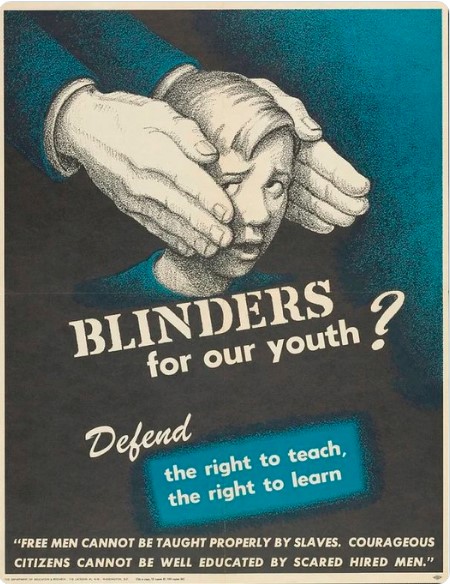
Academic Freedom: Are American Teachers Free? Should They Be?

Academic Freedom: Are American Teachers Free? Should They Be?

James K. Daly

In 1936 Howard Beale asked if American teachers were free. It is a question that still resonates today. The issue is entangled in the complex and ever-changing world of educational policy, political pressures, and cultural tensions. A second question to Beales earlier one could very well ask, should they be? What does it mean for teachers to be free? How do cultural expectations impact on what schools, communities, and larger groups perceive as appropriate for examination in public schools?

Many suggest topics, issues, and claims to truth should not be examined at all. Those who know the truth often feel compelled to teach it. Educational orthodoxy, whether of the political Left or the political Right, can silence opposing views, materials, attention. There is a long history of efforts to suppress perspectives. Legislation in many states has institutionalized restrictions on viewpoints, and textbook publishers have complied. Practitioners supporting the status quo, or the work of activist special interest groups have also contributed to censoring views (Jenkinson, 1979, 1985; O’Neil, 1984; Parker and Weiss 1983; Merry, 2009; Fallace, 2011; Hill, 2020, Nelson, 2021).

The essentiality of critical thinking

Critical thinking is regularly cited as an essential skill for preparing the young to succeed in the 21st century. The NCSS C3 framework identifies critical thinking as a key element in developing engagement and participation among citizens (NCSS 2013). Nelson et al. (2021) cite critical thinking as among the most important issues in schools.

Scholars have long stressed the need for schools to move away from indoctrination, the antithesis of critical thinking. Social studies is where young people must examine conflicts in beliefs and values (Hunt & Metcalf, 1955). Any belief not carefully examined is by definition a prejudice. Oliver and Shaver (1966) assert that the ability to choose on issues of public importance depends on awareness of alternatives. Schools must not just tolerate but encourage the examination of these alternatives. To accomplish this critical thinking is essential.

Critical thinking in schools allows individuals to scrutinize information and claims to truth. Learners explore what can be demonstrated, proved, and accepted using the best available information. Views are challenged, defended, discarded, or temporarily accepted. Learners recognize that acceptance of truth may well be tentative, pending additional knowledge (Pinker 2018).

Critical thinking skills are essential to examining topics on which society is divided (Nelson, 2021a). They protect against propaganda and conspiracy theories. Without these students are simply told what is correct, and which views are to be accepted. Recent years show the danger of this.  In a world of rapid fire media proclaiming new truths throughout the day, with little or poorly supported evidence, students can be ignorant of their own ignorance. This may be welcomed by any number of special interest groups but is anathema to maintaining democracy. 

Critical thinking takes a great deal of time. It requires considerable financial and other resources, from purchasing tools and materials to providing professional development opportunities. The amount of energy needed to do this in a field not easily measured is a challenge (Nelson et al., 2021).

Critical thinking and critical issues

Can critical thinking be promoted when only one or a narrow range of similar views are explored? Can critical thinking be developed for transfer to authentic settings if current critical issues are not examined? Traditionally many ‘givens’ are found both in the formal and the hidden curriculum. They are drawn from the dominant political and cultural perspectives reflecting the larger community. Scholars have consistently asserted that discussing controversy is essential in a diverse democratic society. Critical thinking needs to be about issues that in themselves are critical, with many and competing views. Critical thinking helps students explore different outlooks, and constructively consider consequences of alternative views. Ettinger (2004) refers to this a “constructive harnessing of conflict”. Conflict can be embraced as offering opportunities for exchanging information, evidence, and making tentative conclusions on actions.

Barton and Levstik (2004) state that the aim of history education, and indeed for social studies, is preparing the young to act. Actions and consequences of historic challenges can be scaffolded to frame current day issues. They cite Newman (1975) and his call for intelligent action, the ability to use knowledge and skills to develop a commitment for addressing social problems. The context in which critical thinking skills evolve is pivotal. Barton and Levstik mention Parker and others in advancing the need for the young to understand and experience participatory democracy. Students need to be taught, and practice critical thinking skills on topics where disagreements are analyzed.  They refer to McCully (2002) suggesting that just working on critical thinking skills may not help in examining current divisive topics. Building critical thinking skills without an exploration of authentic current issues may fall far short of what is needed.

Claims to truth need to be analyzed, with critical thinking skills scaffolded, enhanced, and regularly practiced. These skills support conflict resolution strategies, utilizing active listening and clear communication (Katz, 2020). This reinforces what Lortie (1975) referred to as the apprenticeship of observation. Learners routinely experience situations in which these skills are refined and improved. They grapple with different views and competing sources of evidence. The routine and expected school experience would demonstrate a respectful appreciation of diverse views. The hidden curriculum would be supportive of the intellectual work of considering conflicting opinions. The norm would be examining issues in practiced and familiar patterns, respectful of opinions, while accepting disagreement on conclusions. Democratic principles and foundational documents along with Human Rights concepts need to provide the context in which critical thinking evolves. Examining how well these principles, documents and concepts have demonstrated themselves over time provides framing for analyzing current issues.

The need to address critical thinking skills, and the need to do so when addressing current controversial topics puts the teacher at the center of public scrutiny. It is in the larger public arena that controversy is housed, and from which it enters classrooms.

The preponderance of scholarship supports dealing with controversy. Schools must offer individuals opportunity to escape the limitations of the group into which they were born (Dewey, 1916). Schools should create awareness of the larger society. Few other institutions can guide an analysis of past events, an exploration of current considerations, with a focus on the future. 

In a nation as diverse as ours, and in the current political and cultural climate, controversy enters schools and classrooms. The interactions between teachers, administrators, professional organizations, and the public are fraught with complex and often contradictory expectations. Sustaining a democratic republic in this context requires citizens who can examine topics on which there is disagreement (Lynd, 1939; Selakovich, 1967; Newman and Oliver, 1970; Shermis and Barth, 1979; Berlak, 1977; O’Neil, R.M.,1981); Apple, 1982; Besag and Nelson, 1984; Engle and Ochoa, (1986); Daly, et al., 2001; Underwood, 2017; Nelson 2021a).

Are American teachers free?

Teachers appear to be willing to address controversy but often don’t because of concerns about the consequences (Byford, 2009). Nelson (1992) writes that many report they have academic freedom. However, when questioned about teaching specific issues, a typical response was that they were too controversial to teach. Teacher belief in their ability to address controversy does necessarily translate to their doing do (Daly, 1986; Mitchell, Evans, Daly, & Roach, 1997; Misco and Patterson 2007). Patterson (2010) reveals that while 98% of teachers in one study reported they had academic freedom (of varying degrees), over 93% indicated limits to what can be taught. Some of those restrictions might be called self-censorship. Limitations included barriers raised (or anticipated) from community members, administrators, and students. Girard and Harris (2021) describe that teachers in one study found it easy to add topics and issues to provide a more inclusive view. However, they were unwilling to examine contemporary society and power relationships. The local commuity was cited as a significant influence on what teachers address.  In an Education Week article considerable percentages of teachers disclosed they avoided teaching many topics (Pendharkar, 2021). 

Potential Sources supporting teacher freedom

Decisions made by practitioners have consequences for what is taught and how it is taught. State curriculum standards impact those decisions. An analysis of state standards for History indicated clear and opaque support for teacher decision making and selection in many states (Girard and Harris, 2020). The impact on teacher freedom ranged from rigid specificity to almost limitless choice for teachers. Standards may well support considerable freedom in many states; however, more is needed.

Academic Freedom is a philosophical framework buttressing teacher freedom. There are legal decisions that help uphold it. Philosophical views without more compelling legal support cannot be relied upon. They can and should be used to engage educators and communities in discussions on exploring difficult topics. Language supporting academic freedom needs to be in district policy manuals and guides. Hess (2009) reminds us that controversy is a socially constructed phenomenon. She recognizes that the public has a right to have an influence on what is taught in the schools. Engaged and systematic review of the need for, the limits on, and the student benefits of academic freedom need to be promoted. While the specific topics may change, controversy is a given.  Underwood (2017) recognizes that many who would restrict teacher freedom fear indoctrination. They feel left out of curriculum discussions, unaware of pedagogical strategies, and suspicious of views other than their own. Discussions on the nature and purpose of academic freedom may ease that fear.

Academic freedom

The National Council for the Social Studies advocates teacher freedom. The organization issued Position Statements on Academic Freedom in 1969, revised in 2007 (National Council for the Social Studies, 2010).  The most recent maintains that teachers should be free to create settings that foster democratic processes (Social Education, 2016)). Academic Freedom for teachers is necessary to create citizens aware of contentious issues and positions on them. Students need to examine factual claims, discuss competing perspectives, investigate, and analyze topics of concern. This promotes understanding of the relationship between past and present, providing skills and dispositions for grasping local, national, and global views. Truth is difficult to discover and claims to it need to be thoughtfully considered.

Affirming academic freedom is important, as it informs educators and the larger community of its twin features. Academic freedom is not just a concept addressing the teacher, but one focused on the student (Hofstadter and Metzger (1968). Emerging from early German universities, the right of the student to learn was essential. The student was free to explore ideas and not simply compelled to accept all that teachers, text and school presented.

Reassuring the public that academic freedom does not promote indoctrination is critical when many believe schools are overtly trying to impose views antithetical to them. Compelling acceptance of views can create a spiral of silence (Noelle-Neumann, 1977; Journell, 2017). Students presented with one perspective, taught by teachers supporting and promoting that perspective, may feel themselves to be in a minority. That perception can lead to silence. Anecdotal evidence suggests that students, and families, know what teachers expect, what outlooks are correct, and often the moral value attached to various views. With academic freedom the constraints of local perspectives are open to be examined in a wider context, but student acceptance or belief in those viewpoints is not required. Those who embrace Academic Freedom recognize it is not a license for teachers to force views on students or to limit the issues examined. The concept is a defense against the imposition of certainty, which seems to be an objective of many along the political continuum.

The role of school boards

School Boards approve curricula, resources, and materials. Board meetings often have limited time for public discussion of issues, let alone providing for discussions and examination of curricula content. Entering the term Teacher Academic Freedom on the National School Boards website had no hits. Under one heading on that site Boards were urged to say no to any Federal intrusion of local decision making authority (School Boards Association, 2021). That would seem to provide support for considerable community influence on what is taught, and how it is taught. In the Advocacy Agenda for 2019-2020 (the only one on the website as of 2/16/22), there does not appear to be much about how to work with communities beyond the traditional interactions. No role for the larger public is evident.

Recently local Boards have addressed concerns about what may inappropriately be referred to as Critical Race Theory. A quick google or YouTube search provides evidence that the issue is one generating considerable conflict, and political action at the local and state level. The many YouTube videos, and anecdotal evidence suggest that school board meetings are not the best time or place for discussion. The very structure of public input at Board meetings seems to add frustration and anger to already potentially confrontational topics. Limited time, and the lack of a structure to permit significant and sustained conversation suggests other approaches need to be explored.

A memo from the FBI Director provides evidence that the anecdotal and social media reports of Board confrontations are accurate. The memo cites a spike in harassment, intimidation, and threats of violence against school employees and officials. It indicates that the agency will use FBI agents to discourage, identify and prosecute such threats. (Federal Bureau of Investigation, 2021).

What is the role of the larger community? Are they to be relegated to sporadic outbursts on social or traditional media, angry statements at school board meetings? How should public views be identified, shared, and considered. Who decides what is controversial, what gets addressed, and how, or if, opposing views are examined, welcome or tolerated?

Should American teachers be free?

American teachers should be free to foster citizens who can critically examine current controversial topics that divide the society. There is a need to protect the right of the student to learn. Teacher freedom brings responsibilities. There is a responsibility to ensure that practitioners and those preparing to practice are knowledgeable about the need for such freedom. There is a responsibility for practitioners to be open to guidance in planning, teaching, and assessing when focused on controversy. Administrators and Boards need to support teachers engaged in this work. They have a responsibility to create environments in which teachers work with colleagues, administrators, and the larger public to build support for addressing controversy. There are too few fora in which such conversation occurs. Those promoting teacher freedom and the right of students to learn beyond indoctrination need to work with school board members and the school community. Together those in schools must actively seek to find opportunities to have difficult conversations about the need for teacher and student freedom.

Preparing teachers for these challenges

Those planning to teach must understand the nature of academic freedom, recognize the need for dealing with controversial issues, and their relationship to citizenship education. Research on teacher preparation in this effort is mixed. Misco and Patterson (2007) report that teacher education candidates understand the concept of academic freedom but believe that it offers only limited protection. Some revealed they would not exercise those freedoms for several reasons, including fear of reprisals. Uncertainty about how to properly deal with controversy led to a deference to community preferences. The majority were aware of constraints on what and how issues could be addressed.

Even after completing a social studies methods course, participants in a study by Nganga et al. (2020) displayed limited awareness and understanding of teaching controversial issues. Most were unwilling or cautious about addressing issues with which they did not feel comfortable, or about which they had little experience. There was acceptance of the need to conform to the views and values dominant in the community (Engebretson, 2018; Hess 2002).

Teacher education programs themselves may not model ways to deal with alternative perspectives. The spiral of silence found in other settings may also be present within these programs (Journell, 2017). Holding conversations and exploring differing perspectives on foundational ideas may not be a priority. There may be ‘single stories’ (Adichie, 2009) in teacher preparation. Divergent views need to be shared and explored.  Doing so would model how to examine differences in the schools in which students will work.

Education programs may be one of many ‘silo’s’ within the university, with their own “silo’s’. Conversation and collaboration between the programs for administrators and other specialists is essential. Counselors, teachers, administrators in training all benefit from examining the nature of controversy, community engagement, and the benefits to teachers and students of academic freedom. There are overlapping interests, and common audiences. This collaboration would help explore ways to engage with the communities in which they already work and those in which they will work.

What needs to be done?

Little in the larger culture provides examples of how people can discuss deeply held and contrary views. The skills of active listening and clear communication need to be practiced examining issues of current importance, even when presented in an historic setting. Students need experience checking the validity of various claims. They need practice within agreed upon ground rules. Time needs to be provided for researching evidence on topics and discussing views. Students require opportunities to analyze issues using various strategies. Students need structure and practice in hearing contrasting views and doing so in respectful ways.

Teachers need to be free to select books, resources, materials, and strategies. This must support the curriculum and be consistent with state standards. Approaches on how to navigate those requirements is needed. Pre-service training and professional development for practitioners needs to be authentic, providing active participation in using various strategies. Routine focus is needed on the rationale for dealing with controversy. Pre-service training needs consistent and collaborative support from professors, clinical field supervisors, cooperating teachers and their administrators. Practitioners need support from colleagues, administrators, and local community members. These groups, committed to democracy, are essential to promoting conversation instead of confrontation on issues of significant disagreement.

References

Adichie, C. N. (2009, July). The danger of a single story [Video]. TED Conferences. https://www.ted.com/talks/chimamanda_ngozi_adichie_the_danger_of_a_single_story

Apple, M.W. (1982). Education and power. Routledge and Kegan Paul. https://doi.org/10.4324/9780203143124

Barton, K. C. (2005). “Best not to forget them”: Secondary students’ judgments of historical significance in Northern Ireland. Theory and Research in Social Education, 33(1), 9–44. https://doi.org/10.1080/00933104.2005.10473270

Barton, K. C., & Levstik, L. S. (2004). Teaching history for the common good. Routledge. https://doi.org/10.4324/9781410610508

Beale, H. K. (1936). Are American teachers free: An analysis of restraints upon the freedom of teaching in American schools. C. Scribner’s Sons. https://doi.org/10.1086/ahr/43.1.177

Berlak, H. (1977). Human consciousness, social criticism, and civic education. In J. P. Shaver (Eds.), Building rationales for citizenship education. Bulletin 52 (pp. 34-47). National Council for the Social Studies.

Besag, F. P., & Nelson, J. L. (1984). The foundations of education: Stasis and change. Random House.

Byford, J., Lennon, S., & Russell, W. B. (2009). Teaching controversial issues in the social studies: A research study of high school teachers. The Clearing House: A Journal of Educational Strategies, Issues and Ideas, 82(4), 165-170. https://doi.org/10.3200/TCHS.82.4.165-170

Collum, M. (2016). Academic freedom and the social studies educator. Social Education, 80(3), 186. https://www.socialstudies.org/social-education/80/03/academic-freedom-and-social-studies-teacher

Cruz, T., Lee, M., Blackburn, M. (2021, October 8). [Letter to Merrick Garland, Attorney General of the United States]. Senate Judiciary Committee. https://www.blackburn.senate.gov/services/files/1DA3DAA8-2087-4DDD-9BE9-0A4E7E3B9F0B

Daly, J. (1986). Patterns and perceptions of censorship among secondary educators: Censorship in New Jersey Schools [Unpublished doctoral dissertation]. Rutgers University.

Daly, J. K., Schall, P. L., & Skeele, R. W. (2001). Protecting the right to teach and learn: Power, politics, and public schools. Teachers College Press.

Dewey, J. (1916). Democracy and education: An introduction to the philosophy of education. Macmillan.

Engebretson, K. E. (2018). One novice teacher and her decisions to address or avoid controversial issues. The Journal of Social Studies Research, 42(1), 39-47. https://doi.org/10.1016/j.jssr.2017.03.001

Engle, S. H., & Ochoa, A. (1986). A curriculum for democratic citizenship. Social Education, 50(7).

Fallace, T. D. (2011). The effects of life adjustment education on the US history curriculum, 1948-1957. The History Teacher, 44(4), 569-589. http://www.jstor.org/stable/41304011

Girard, B., Harris, L. M., Mayger, L. K., Kessner, T. M., & Reid, S. (2021). “There’s no way we can teach all of this”: Factors that influence secondary history teachers’ content choices. Theory & Research in Social Education, 49(2), 227-261. https://doi.org/10.1080/00933104.2020.1855280

Harris, L. M., & Girard, B. (2020). Evaluating the support of teacher choice in state history standards. The History Teacher, 53(4), 613-633.

Hess, D. E. (2009). Controversy in the classroom: The democratic power of discussion. Routledge. https://doi.org/10.4324/9780203878880

Hill, R. (2020). The problem of self-censorship. In A. M. Dawkins (Eds.), Intellectual freedom issues in school libraries (pp. 88-98). Libraries Unlimited

Ho, L., McAvoy, P., Hess, D., & Gibbs, B. (2017). Teaching and learning about controversial issues and topics in the social studies. The Wiley handbook of social studies research, 319-335. https://www.perlego.com/book/994195/the-wiley-handbook-of-social-studies-research-pdf  (Original work published 2017)

Hunt, M.P., & Metcalf, L.E. (1955). Teaching high school social studies. Problems in reflective thinking and social understanding. Harper and Row.

Jenkinson, E. B. (1979). Censors in the classroom: The mind benders. Southern Illinois University Press.

Journell, W. (2017). Politically conservative preservice teachers and the spiral of silence: Implications for teacher education. Teacher Education Quarterly, 44(2), 105-129. https://www.jstor.org/stable/90010520

Katz, N. H., Lawyer, J. W., Sosa, K. J., Sweedler, M., & Tokar, P. (2020). Communication and conflict resolution skills. Kendall Hunt Publishing. Retrieved from https://nsuworks.nova.edu/shss_facbooks/177

Lortie, D. C. (1975). Schoolteacher: A sociological study. University of Chicago Press.

McCully, A., Nigel Pilgrim, A. S., & McMinn, T. (2002). ‘Don’t worry, Mr. Trimble. We can handle it’ Balancing the rational and the emotional in teaching of contentious topics. Teaching History, 106, 6-12.

Merry, M. S. (2009). Patriotism, history and the legitimate aims of American education. Educational Philosophy and Theory, 41(4), 378-398. https://doi.org/10.1111/j.1469-5812.2007.00363.x

Mitchell, G., Evans, S., Daly, J., & Roach, P. (1997). Academic freedom and the preparation of social studies teachers. Theory & Research in Social Education, 25(1), 54-66. https://doi.org/10.1080/00933104.1997.10505790

National Council for the Social Studies. (2013). The college, career, and civic life (C3) framework for social studies state standards: Guidance for enhancing the rigor of K-12 civics, economics, geography, and history. https://www.socialstudies.org/standards/c3 

National School Boards Association. (2021, December 14). Local school board governance and flexibility. https://www.nsba.org/Advocacy/Federal-Legislative-Priorities/Local-School-Board-Governance-and-Flexibility

Nelson, J. L. (1992a). Social studies and history: A response to Whelan. Theory & Research in Social Education, 20(3), 318-326. https://doi.org/10.1080/00933104.1992.10505672

Nelson, J. L. (2021b). Academic freedom and issues-based social education. In R. W. Evans (Ed.), Handbook on teaching social issues (2nd ed., pp. 37-49). Information Age Publishing.

Nelson, J. L., Palonsky, S. B., & McCarthy, M. R. (2021). Critical issues in education. Dialogues and dialectics (9th ed.). Waveland Press.

Newman, F. (1975). Education for citizen action: Challenge for secondary curriculum. McCutchan Publishing Corporation.

Noelle-Neumann, E. (1977). Turbulences in the climate of opinion: Methodological applications of the spiral of silence theory. Public Opinion Quarterly, 41(2), 143-158. https://doi.org/10.1086/268371

O’Neil, R. M. (1981). Classrooms in the crossfire. The rights and interests of students, parents, teachers, administrators, librarians, and the community. Indiana University Press.

Oliver, D. W., & Shaver, J. P. (1966). Teaching public issues in the high school. Utah State University Press.

Parker, B. & Weiss, S. (1983). Protecting the freedom to learn: A citizen’s guide. People for the American Way.

Parker, W. (Ed.). (1996). Educating the democratic mind. SUNY Press.

Pendharkar, E. (2021, December 10). You’re not going to teach about race. You’re going to go ahead and keep your job. Education Week. https://www.edweek.org/leadership/youre-not-going-to-teach-about-race-youre-going-to-go-ahead-and-keep-your-job/2021/12

Pinker, S. (2018). Enlightenment now: The case for reason, science, humanism, and progress. Penguin UK.

Selakovich, D. (1967). The schools and American society. Blaisdell Publishing Co.

Shermis, S. S., & Barth, J. L. (1979). Defining social problems. Theory & Research in Social Education, 7(1), 1-19. https://doi.org/10.1080/00933104.1979.10506047

Underwood, J. (2017). Under the law: School districts control teachers’ classroom speech. Phi Delta Kappan, 99(4), 76-77. https://doi.org/10.1177/0031721718808270

New York State’s Birthday and First Constitution

New York State’s Birthday and First Constitution

Bruce W. Dearstyne

Social studies and history teachers routinely cover the Declaration of Independence and the U.S. Constitution in their courses. But every state also has a “birthday” (the day it got started as a state) and its own state constitution. The origins of states and their first constitutions can be very useful teaching tools, adding a new dimension to students’ historical insight and understanding.

New York State is an outstanding example. April 20 is New York’s Birthday! That was the date in 1777 when the Convention of Representatives of the State of New York, an ad hoc group elected the previous year to guide New York’s Revolutionary War efforts and develop its first constitution, finished work on that document.

The story of New York’s first state constitution is a dramatic one. New York had moved from steadfast loyalty to Britain to reluctant rebelling colony to a full-scale push for independence through the actions of three Provincial Congresses, the first elected in 1775, to guide New York in the growing alienation from Britain. The “Convention of Representatives” had been elected the year before as New York’s fourth Provincial Congress. Meeting initially in White Plains, they authorized New York’s representatives to the Continental Congress to approve the Declaration of Independence in early July, then, to keep out of reach of British forces, fled north to Fishkill and finally to Kingston where they completed their work. Along the way, they changed their name from Provincial Congress to Convention of Representatives of the State of New York. 

When they began their work it wasn’t entirely clear just what a “state” was. People knew about colonies/provinces (New York had been one), and nations or nation-states as they were sometimes called (such as Britain). There were few precedents of models to draw on. Other colonies-becoming-states were writing their own first constitutions. The Articles of Confederation, which would link the new states together, was not completed until November 1777. The U.S. Constitution was a decade in the future. The creative New York drafters drew on their own experience in colonial government, their knowledge of European writers on the concepts of natural rights and representative government, and  a few American leading-edge advocates such as Massachusetts’ John Adams. But mostly they drew on their own creativity and improvisation.

The delegates worked in haste and approved the final draft of their document, which still had strikeouts and marginal notes when they signed it. There was no time to make a clean copy before sending the document to the printer. They took a day off but the next day, April 22, the convention’s secretary mounted a flour barrel outside the court house where the group had worked and read it aloud to Kingston citizens.

New York State had in effect proclaimed itself into existence.

The document began by quoting the Declaration of Independence. This connected New York with the other colonies asserting their independence. It stated that the convention acting “in the name and by the authority of the good people of this State doth ordain, determine, and declare that no authority shall on any pretense whatever shall be exercised over the people or members of this State, but such as shall be derived from and granted by them.” In 1777, a document purporting to represent the consensus and will of the people, and their right to govern themselves,  was a startling, radical departure from the past.

The original copy of the first constitution is preserved in the State Archives.   The Archives has provided a scanned version at https://digitalcollections.archives.nysed.gov/index.php/Detail/objects/10485.You can read it online in typed form at the Yale Law School Avalon Project. William A. Polf’s 1777:  The Political Revolution and New York’s First Constitution, also available online, provides a good introduction. It is also described in Peter Galie, Ordered Liberty: A Constitutional History of New York and in my book, The Spirit of New York: Defining Events in the Empire State’s History.

The 1777 constitution is just over 5000 words in length, It outlined the structure and purposes of state government but did not provide much detail.

It created a two-house legislature — one house, the Assembly, to be more numerous and more broadly representative of the people, and the other, the Senate, to be smaller and more attuned to the interests and property. That basic structure is still in place today.

It declared that “the supreme executive power and authority of this State shall be vested in a governor” who “shall take care that the laws are faithfully executed.” That wording is similar to what exists in the current State Constitution. But the 1777 writers had had enough experience with the King of England and some colonial governors who had over-asserted their power that they hedged the authority of New York State’s governor. Instead of giving the governor veto power over bills passed by the legislature, they created a “Council of Revision” consisting of the governor, chancellor, and judges of the supreme court with veto power. Rather than giving the governor sole appointment power, they vested that in a “Council of Appointment,” consisting of the governor and four senators chosen annually by the Assembly,  to approve all appointments.

The document made only a brief reference the courts; fleshing that out later would require legislative action. Voting rights were restricted to men who met certain property-holding or other requirements.

The Constitution was not very long but it was a sound beginning. Hastily-organized elections were held in the spring and summer. The first legislature assembled in Kingston in September and got to work. The newly-elected governor, General George Clinton, had to await a lull in the fighting to come to Kingston, take the oath office, make  the first gubernatorial address, and then hurry back to lead troops again.

The fledgling government did not have tranquility for long. It had to flee as British troops arrived and assaulted and burned Kingston on October 16. The legislature soon re-assembled in Poughkeepsie and resumed work. By then, patriot forces had defeated British incursions from the west (at Oriskany, August 6), the east (at Bennington, on August 16) and the north (at Saratoga, October 17, a major victory that became the turning point of the Revolution).

1777 turned out to be something of a “miracle year.” New York State was here to stay. The new constitution endured without major changes until 1821.

There are many ways of approaching the use of the first State Constitution in social studies and history courses. Some possibilities:

*It is an inspiring, against-the-odds story. It is a story of people determined to control their own collective affairs through representative government.  At the beginning of 1777, the odds of New York’s success did not seem great. By the end of the year, New had written a constitution, established a government, held elections, fended off invasions from three directions, and survived invasion and destruction of its capital.

*It represented compromise and consensus. The writers had a number of disagreements and varying viewpoints and perspectives going into the process. But along the way they put aside their differences, compromised, and came together to develop a consensus document. That process is worthy of study now, when too often it seems difficult to reach agreement on divisive political issues.

*It was successful, flexible, and enduring. The first constitution proved to be a viable framework for years when New York grew remarkably fast. Even when the first major revisions came in 1821, the structural changes were relatively modest. The revisions abolished the Council of Revision and the Council of Appointment and replaced them with procedures more similar to what we have today.

*It left important work undone. The convention discussed abolishing the horrible practice of slavery but in the end it did not. That had to await legislation in 1799 and slavery was not formally abolished until 1827. Restrictions on men’s voting rights were gradually abolished in ensuing decades. Women finally got the right to vote in 1917. The constitution had no bill of rights other than protection of freedom of religion. The legislature enacted a bill of rights in 1787 and they were embodied in the 1821 constitutional revision. Since then, the constitution has been revised, updated, changed, and amended many times. That is a reminder that constitutions are subject to update and change over time, with voters’ approval.

*It was influential. The New York constitution includes some of the principles that were embodied in the U.S. Constitution a decade later, 1787. New York led the way in a sense. That is not surprising because New York patriot Gouverneur Morris was one of the principal writers of the New York document and a decade later, then a delegate to the Constitutional Convention from Pennsylvania, he was also one of the writers of the U.S. Constitution.

*It is a source for teaching about self-government, constitutional law, and civic responsibilities. The constitution could be a source for deepening students’ understanding of self-government and their roles and  responsibilities as citizens. Educating for American Democracy , a recent report on civics education, notes that students need more study of “the social, political, and institutional history of the United States in its founding era, as well as the theoretical underpinnings of our constitutional design. The state constitutions and the federal 1787 Constitution, as amended, form diverse peoples and places into an American people: one overarching political community.”

The Rise of Corporate Power and the Disintegration of American Democracy

The Rise of Corporate Power and the Disintegration of American Democracy

by Anthony  Higueruela

“No thoughtful person can question that the American economic system is under broad attack”.[1]  These words open the Powell Memorandum’s “Attack on American free enterprise System”, written by Lewis Powell and sent to the United States Chamber of Commerce in 1971.  Lewis Powell would become one of four justices Richard Nixon appointed to the United States Supreme Court that would gradually dismantle the more liberal leaning Warren court of the 1950s and 1960s.[2]  For Powell the sources of the assault on American business were wide and varied.  “They include, not unexpectedly, the Communists, New Leftists, and other revolutionaries who would destroy the entire system, both political and economic”.[3]  Powell is thorough in his inquiry into the many forces at work throughout the United States hell-bent on upending the capitalist order.  He states that: “Yale, like every other major college, is graduating scores of bright young men who are practitioners of despair.  These young men despise the American political and economic system… their minds seem to be wholly closed.  They live, not by rational discussion but by mindless slogans.  A recent poll of students on 12 representative campuses reported that: almost half of the students favored socialization of basic U.S. industries”.[4]  The Powell Memorandum would prove to be a rallying cry for big business and global corporations to assert their rightful place in the sphere of American economic and political life.  Powell argues in almost Orwellian tones that the battle for corporate dominance must be waged on multiple fronts: that textbooks in universities should be kept under surveillance, television networks closely monitored and scholarly articles propagated on the positive benefits of a capitalistic system.[5]  He urged corporations to take a page out of the playbooks of labor and realize that political power is essential for corporate growth and must be meticulously cultivated.[6]  The Powell Memorandum is essential because it provides a framework for business interests to utilize and manipulate the existing framework of the United States legal system to gain rights that would become akin to corporate personhood.  One can think of Powell’s letter to the Chamber of Commerce as both a rallying cry and a blueprint for corporate America in order to gain greater hegemony in the United States.  The purpose of this paper is to argue that through corporations’ utilization of the legal system to gain personhood and the rights that accompany it, the political and economic welfare of the American citizen has been jeopardized. 

The first battles in the war for corporate supremacy would be waged on the legal front.  Corporations used the court system to gain access to rights historically reserved for United States citizens.  With the continual accruement of First Amendment speech rights, corporate America argued that monetary contributions by business is protected free speech guaranteed by the constitution.  This came to have disastrous consequences for the future of America’s political and democratic systems.  As corporations grew more powerful they were able to use the wealth and resources at their disposal to buy political influence and favorable legislation.

The first defining court case appeared in 1976, a few years after the establishment of the Federal Election Campaign Act (FECA).  FECA’s primary goal was to establish new standards for fundraising and influence in the political spheres, much of which grew out of the reforms post-Watergate scandal.[7]  This act mandated public disclosure of contributions, made campaign contributions over a certain amount of money illegal and set caps on the amounts for campaign spending.[8]  The most ardent opponents of FECA were anxious that the law could be used as a tool by established politicians in order to maintain their own stranglehold on power.[9]  Their main concern lie in the fact that if the government could enact punitive measures on political communication, then entrenched politicians could utilize spending limits on insurgent political operatives in order to hold onto their own power.[10]  This law would eventually be challenged in the United States Supreme Court with the case of Buckley v. Valeo.  On January 2, 1975 a suit was filed in the U.S. District Court for the District of Columbia by New York Senator James L. Buckley and Eugene McCarthy.[11]  The plaintiffs in this case argued that the Federal Election Campaign Act of 1971 and the Presidential Election Campaign Fund Act were unconstitutional.[12]  The Supreme Court upheld the majority of the law, however it struck down the spending limits on grounds of the First Amendment.[13]  The Supreme Court reached the conclusion that legislatively passed limits on spending were unconstitutional due to the fact that they infringed on the First Amendment and were not adequately related to solving the issue of corruption.[14]  Buckley would serve as a starting point for the Supreme Court’s jurisprudence on money and political affairs.[15]  The influence of money and monetary contributions to politicians had far reaching consequences to the U.S. political system.  Robert Kaiser’s So Damn Much Money makes note that “the more important money became to the politicians, the more important the donors become to them”.[16]  This new setup, although beneficial to corporate America, was problematic to the health of American democracy and the right of the average citizen to have fair representation.  With the growth of corporate donors and their extensive resources which allow them to donate large sums of money to political campaigns, one must ask the question—what does this do to the balance of influence between people and corporations?  This answer is simple: it dramatically shifts it in favor of corporations.

The culmination of over three decades worth of litigation would result in Citizens United v. FEC (2010).  This seminal case proved to be the crowning victory for corporate America’s right to donate unfettered amounts of money based on their first amendment rights to freedom of speech.  Just as Bellotti opened up a loophole for corporations to donate money in ballot measures, Citizens United threatened to do the same for corporate money in campaign elections.[17]  The case that would forever alter the landscape of campaign finance law began when a conservative nonprofit corporation sought to air a ninety minute movie about Hillary Clinton on DirecTV.[18]  Citizens United also wished to air thirty second advertisements for their movie regarding Hillary Clinton on cable television.[19]  The Federal Election Committee (FEC) sought to block both the movie and the television ads on the basis that they violated the Bipartisan Campaign Reform Act (2002), which did not allow corporate funded campaign ads within thirty day of a presidential primary contest.[20]  Citizens United challenged the decision handed down by FEC on the basis that it was a documentary and not offered on broadcast television, therefore BCRA was not applicable.[21]  The government, however, argued that it was a ninety minute advertisement designed to damage Clinton in the primaries and its distribution did indeed count as broadcast.[22]  Ted Olsen, one of the leading lawyers for Citizens United argued that the law had no justification since there was no quid pro quo when corporations donate money to campaigns.[23]  His argument rested on the fact that Congress’s power to limit corruption in elections rested on their power to punish and deter clearly explicit bribes, anything else could not truly be counted as corruption.[24]  Olson went so far as to tell the court that the Bipartisan Campaign Reform Act was essentially a ban on the free speech of corporations, and that the government had distinctly prohibited speech.[25] 

Proponents of Citizens United often attempt to downplay the damage it did to democracy.  In the Wall Street Journal, Bradley Smith argues that the ruling allowed corporations to make independent expenditures in campaigns and elections.[26]  He also argues that Citizens United opened the door to new political challengers and is quick to dismiss any critics as simply being put off that their preferred candidates did not win.[27]  What Smith fails to recognize is that the ruling from Citizens United puts corporations and wealthy individuals at a disproportionate advantage when compared to the ordinary citizen.  Citizens United essentially gave big business and special interests a pass to legally bribe politicians for legislation favorable to their interests.  This in turn diminishes the political rights of the American citizenry.  

Citizens United is unique in the sense that corporations are described as associations that have taken on corporate form.[28]  Historian Adam Winkler noted, “if the first amendment has any force, Kennedy read aloud from his opinion, it prohibits Congress from fining or jailing citizens or associations of citizens for simply engaging in political speech” (Winkler 364).  What is significant in this fact is that by defining corporations as associations of citizens, it allows them to subsume the rights of other people, in other words the corporations own members.[29] 

One must then examine the implications of allowing corporations to assume rights of multiple individuals.  If a corporation, as an association of individuals, can assume their collective rights then what recourse is left to individuals within the corporation to seek redress from grievances perpetrated by the corporation?  If all rights belonging to individuals within a corporate framework are taken by the corporate entity then workers and employees are left powerless against corporate abuse and excess.  The adoption of corporate personhood and corporate legal speech rights to utilize money in campaigns robbed the average citizen of their rights to a free and fair democracy.  According to Zephyr Teachout, “while corruption has narrowed to quid pro quo, free speech has expanded to encompass all money spent on communication”.[30]  Large corporations, due to their wealth and resources, are at an unnatural advantage when compared to the average citizen in terms of spending money on campaigns and referendums.  This undermines democracy as it creates rule by a few large corporate entities as opposed to rule by the people.  It also allows corporations to buy greater access to political candidates in order to secure favorable legislation towards their own interests.  Taken a step further, Teachout argues, “because of Citizens United it is not illegal for a corporation to spend millions of dollars to punish a congressperson who voted against their interests”.[31]  This only further increases the power of corporations at the expense of the American citizens due to the fact that corporations are able to use their money and lobbying power to ensure favorable outcomes for themselves in regards to legislation.


[1] Lewis Powell, greenpeace.org, 1.

[2] Adam Winkler, We the Corporations (Liveright Publishing Corporation, 2018)

[3] Lewis Powell, greenpeace.org, 3.

[4] Powell, 3.

[5] Winkler, 286-87

[6] Winkler, 287.

[7]Teachout, 206.

[8] Teachout, 206-07

[9] Teachout, 207

[10] Teachout, 207.

[11] Fec.gov, 1.

[12] Fec.gov, 1.

[13] Teachout, 207.

[14] Teachout, 207.

[15] Teachout, 207.

[16] Teachout, 209.

[17] Winkler,

[18] Teachout, 229-230

[19] Teachout, 230

[20] Teachout, 230

[21] Teachout,  230

[22] Teachout, 230

[23] Teachout, 231

[24] Teachout, 231

[25] Winkler, 361

[26] Bradley Smith, “The Incumbent’s Bane: Citizens United and the 2010 Election”, Wall Street Journal, 2.

[27] Smith, 2.

[28] Winkler, 364

[29] Winkler, 364

[30] Teachout, 241.

[31] Teachout, 112.

Transforming Education for Our Children’s Future

Parts of this essay appear in At the Center of All Possibilities: Transforming Education for our Children’s Future (Peter Lang, 2022). https://www.peterlang.com/document/1166664

Transforming Education for Our Children’s Future

by Doug Selwyn

            A group of approximately 30 teachers, administrators, over the family members, health officials and others in our town of Greenfield, Massachusetts met summer of 2020 attempting to plan for the opening of the 2020-2021 school year. COVID-19 was raging and we had to make choices about whether to have in-person schooling, a hybrid model that had children in schools some of the week and learning remotely the rest of the week, or to conduct school entirely remotely, at least to start.

            Several things became evident as we considered our options. First, there might be no institution as inextricably bound to the community than are schools. Any decision we made would reverberate through the community, with consequences for families, for businesses, for those needing childcare, for virtually every aspect of town life. It also meant that what was happening in the community would have significant consequences for what was happening in the schools. Second, it was clear that what we already knew, that there was (and is) significant inequality across our community, was even more prevalent and more consequential than we had realized. Third, our schools were already severely underfunded and under-resourced before Covid. The arrival of Covid made things even worse, stretching resources beyond the breaking point, which made realistic planning all but impossible because there was no way to really do what needed to be done. Fourth, there would be no time to offer adequate professional development or preparation time for faculty and staff. And fifth, the federal and state governments were prioritizing political and economic interests over educational or health-related concerns.

And what was most clear was that the best-case scenario was to be able to get back to near “normal,” to the education we had before the arrival of the pandemic. We were in crisis mode and getting ready for the school year was all that mattered.

I had written a book two years before focused on the question, what would our schools look like if our primary focus was on the health and wellbeing of our children. What I found was that if that really was our primary concern we would have to address the underlying issues in our society such as the increasing gap between rich and poor, a lack of health care for mothers during pregnancy and for newborns and their families through their first months and years of life, and the various stresses and traumas our children were experiencing from racism, from living in a toxic environment, from a lack of access to health care, and from other social, or economic factors if we wanted our children to both be healthy and able to come to school ready to learn. We could not simply say to schools fix yourselves while doing nothing about the underlying issues in our communities and country.

No one on our committee had time or energy to think about these larger issues as we pondered how to open schools. They simply wanted to get back to as close to “normal” as possible. While I recognized the enormous pressure the committee was under to get schools open one way or another, having as a goal returning to a school system that was failing so many of our children, particularly those who are most vulnerable, was not good enough, so I decided to research the question what do our children need to learn and know and how can we help them to learn it so that they are going to be as prepared as possible to move into their future, which is, by definition, unpredictable. While we recognize that one of the responsibilities of the adults in our society is to educate our young, there is not always agreement about what that education should consist of, who should receive it, who should offer it, who should pay for it, and how it should be assessed. These questions led me to invite the thoughts of educators and activists on what education our children needed and how we might help them to achieve it. I cast as wide a net as I could in gathering points of view, experience, perspectives, and understandings, and we looked at several aspects of the question including understanding the role of schools within the larger society, learning from our experiences with COVID, looking at the content we offer, considering who should be teaching and how they should be educated, how we might assess, and what other models of education might we consider, beyond public schooling. I pulled the essays and interviews together into a book, At the Center of All Possibilities: Transforming Education for Our Children’s Future (2022), and want to briefly share what I learned, starting with a brief look at my own story.

I was mis educated about much of U.S. history by Walt Disney and other programs on television. I “learned” from Disney and other media that U.S. history really began with the “discovery” of America by Christopher Columbus in 1492 and continued as (white) European Americans moved across North America fulfilling their Manifest Destiny to civilize and settle the essentially empty continent. I watched Disney’s take on Davy Crockett to learn about what that meant; fighting hostile, savage Indians who stood in the way of that Manifest Destiny, and later, fighting hostile, evil Mexicans who surrounded and murdered heroic Americans at the Alamo. Disney never mentioned the genocide and forced resettlements that were at the heart of Manifest Destiny, or the land grab that was the so-called Mexican War, or its link to perpetuating and maintaining slavery. It was nationalistic myth making that was echoed by virtually everything else that appeared on television, our prime window on the world outside of our neighborhoods.

Disney and other media also (mis) educated me about race relations, gender roles and values, which seemed to center on strong, silent, gun toting men who traveled alone or sometimes with a clownish sidekick, and pretty, vulnerable and relatively helpless women. And, of course, all the good guys (and women) were white.

Despite the fact that I went through a well-regarded K-12 school system, I did not encounter any real pushback to the Disney version of history until I was in college, and that pushback mostly came from “teachers” and situations outside of the classroom. I spent my summers living across the street from the Six Nations Museum, in Onchiota, NY (population 62), within a small Mohawk community, and got to know Ray Fadden, the man who built and ran the museum., “Uncle” Ray and my other neighbors helped me to learn a much more accurate picture of the genocide and forced removal that were the hallmarks of Manifest Destiny, and I learned more about the complex and layered governing and social systems at the heart of the Iroquois Confederacy that challenged virtually everything I’d been taught at school, or by Disney.

This experience awakened me to the need to question, to challenge, and to not automatically accept what I was being told in school, in my neighborhood (which was an essentially middle class, white, quietly racist community of young families), and from media of all sorts, including the news.

When I finally decided on becoming a teacher, more than a decade after graduating from college I thought back on my relentless mis education and realized I had to formulate my own goals, my own purpose as an educator. I came up with a short list of goals and aspirations for my work as a teacher, which I continued to add to with experience. They included:

The children are more important than any of the subjects.

  • Every child should feel welcomed and valued.
  • All children in class should have the opportunity to explore what is most important to them, at least some of the time.
  • I should avoid using textbooks as much as possible as they are both deadly boring and inaccurate or incomplete.
  • It is crucial to bring in more points of view and voices than what are featured in textbooks or in mandated curriculum.
  • I must be a learner, to model what I hope the students will take from their time with me.
  • I will bring as much joy and excitement to learning as possible.
  • I want to help students to learn to critically question what they are encountering, including me.
  • I must do everything I can to tell them the truth, and to help to learn to find the truth for themselves.

I can’t say that I have always been successful in meeting those goals, but they are always the compass points I try to steer by. My research and conversations while editing At the Center of All Possibilities have moved me to update my list. I would now add:

  • Having an increased awareness of the cultures, histories, and contexts of the students.
  • Learning much more about the impact that inequality, white supremacy, racism, and capitalism play in determining, or strongly influencing the lives we lead
  • Becoming a more active and engaged advocate for social justice outside of the classroom. Helping students understand the crippling impact of slavery and racism on our society, that continues to this day
  • Supporting students learning to listen and communicate clearly with their peers, and to work with them as allies and cooperators rather than as competitors.
  • Developing alternative ways of organizing education that pattern after the freedom school model, with a focus is on a smaller, more personal educational experience focused on the needs and interests of the students.
  • Assessing the quality of our work together, in my classroom and in my school by the quality of our lives inside and outside of school. How are we feeling about ourselves and each other, how are we behaving with each other, how much are we engaging in learning that is of interest, and how are putting what we learn to use in service to what we care about, in school and out. If there is no evidence that school is moving them towards becoming engaged, caring, and joyful humans then we are failing them and need to change what we are doing.

I would also add to my list the importance of reaching out to the community to help me to learn about the students, to learn about content I don’t know, to help me identify resources and to help me think through how best to make the educational experience as effective and meaningful and joyful as possible. Many of us enter classrooms thinking we must do it all ourselves and are reluctant to “blow our cover” by admitting we don’t know how to deal with particular content or a particular student or situation. That is evidence of a flaw in how we are trained rather than educated in our K-12 and university systems. I learned so much by asking them to be a part of this project. I hope that readers will keep this learning in mind as you think about how to transform education in your school or district, that you will be well served by inviting others to think and plan and act with you. We are in this together and are wiser and more powerful when we join together.

I want to close with a few words from Myles Horton, the founder of the Highlander Folk School, in Tennessee. He was in dialog with Brazilian educator Paolo Freire and said this: “If I had to put a finger on what I consider a good education, a good radical education, it wouldn’t be about methods or techniques. It would be loving people first…. and that means people everywhere, not just your family or your own countrymen or your own color. And wanting for them what you want for yourself. And then next is respect for people’s abilities to learn and to act and to shape their own lives. You have to have confidence that people can do that… The third thing grows out of caring for people and having respect for people’s ability to do things, and that is that you value their experiences. You can’t say that you respect people and not respect their experiences.” (Bell, Gaventa, & Peters, 1990, p 177-178)

There is so much that we can do if we trust, respect, and value the people we work with, beginning with our students and their families. When we trust, respect, and value people enough to listen to them when they share who they are, what they care about, and what their goals and dreams are, we have already taken a significant step towards the transformation of their educational experience, and ours.

References

Bell, B, Gaventa, J, & Peters, J. (1990). We make the road by walking: Conversations on education and social change. Philadelphia: Temple University Press.

Selwyn, D. (2022). At the center of all possibilities: Transforming education for our children’s future. Peter Lang.

The Freedom to Teach by the National Council for the Social Studies

This statement is from March 2022 and can be found at https://www.socialstudies.org/current-events-response/freedom-teach

Poster-Congress of Industrial Organizations, 1950s

School districts, the most active battlefield in the American culture wars today, are facing an unprecedented number of calls to remove books from schools and libraries, false claims about “obscenity” invading classrooms, the elimination of teaching about evolution and climate change, challenges to the need for making sense of and critiquing our world in the mathematics classrooms, and legislation redlining teaching about racism in American history. These actions are putting excessive and undue pressure on teachers, who are caught in the crossfire of larger political conflict, motivated by cultural shifts and stoked for political gain.

Teachers are being maligned as “harming” children and are subjected to constant scrutiny (and even direct surveillance) by many parents, school administrators, and activist groups. Some are afraid to offer their students award-winning books that may violate vaguely stated laws about teaching the history of racism or that may be misleadingly labeled as pornographic. As a result, teachers’ very ability to do their job is under threat.

In their zeal, activists of the current culture wars unfortunately treat teachers as if they are enemies. The truth is that teachers are uniquely important leaders who, in educating current and new generations of students, bear responsibility for this country’s future. They are trained professionals with one of the hardest and most demanding jobs, a job that requires deep commitment, but brings little financial reward.  

Teachers need our support; they need our trust; they need to have the freedom to exercise their professional judgment. And that freedom includes the freedom to decide what materials best suit their students in meeting the demands of the curriculum, the freedom to discuss disturbing parts of American history if and when they judge students are ready for it, and the freedom to determine how to help young people navigate the psychological and social challenges of growing up. In short, teachers need the freedom to prepare students to become future members of a democratic society who can engage in making responsible and informed contributions and decisions about our world.

The stakes are too high. We cannot let good teachers leave the field because they no longer have the freedom to do their job. We cannot let the education of our children and young adults become collateral damage in partisan political machination.

National Council for the Social Studies Response to the Acquittal of Kyle Rittenhouse

National Council for the Social Studies Response to the Acquittal of Kyle Rittenhouse

This statement was issued by the National Council for the Social Studies in November during its national convention. The New Jersey and New York social studies councils are part of NCSS.

“This week as the National Council for the Social Studies comes together to proclaim solidarity as social studies professionals, Kyle Rittenhouse, the 18-year-old who in a series of encounters with protesters calling for justice in the police shooting of Jacob Blake, shot and killed Joseph Rosenbaum, Anthony Huber, and injured Gaige Grosskreutz, was acquitted by a jury in Kenosha, Wisconsin. This acquittal is a dangerous harbinger for civic life, giving license to vigilantism.”

“The Pledge of Allegiance concludes with the words “and justice for all.” There are many who believe that justice for all was not done in this case. Others believe that we need to be trusting of the system – even when we are faced with a decision with which we may wholeheartedly disagree. Regardless of what you believe, as social studies professionals, we understand the gravity of this acquittal because we know the wicked history of vigilantism as a tool to maintain white privilege in the United States.”

“Martin Luther King, Jr., said: ‘Injustice anywhere is a threat to justice everywhere. We are caught in an inescapable network of mutuality, tied in a single garment of destiny. Whatever affects one directly, affects all indirectly.’”

“We call for social studies teachers to stand in solidarity with the families of those victimized by Kyle Rittenhouse. We call for social studies teachers to stand in solidarity with the right to proclaim Black Lives Matter without fearing white vigilantism. We call for social studies teachers to stand in solidarity with citizens who continue to stand for justice, even when the systems of justice are found wanting.”

Same Bigotry, Different Name: Race Suicide, the Birth Dearth, and Women’s Rights

Same Bigotry, Different Name: Race Suicide, the Birth Dearth, and Women’s Rights

Megan McGlynn

Despite the fact that roughly half of the world’s population is born female, women’s roles in history are consistently regulated to side characters and often left out of core history classes. In those same classes there is a lack of discussion of the ways that women have been affected by the issues of the time in often dramatically different ways from men, but from each other as well. We have a tendency to treat the experiences of all women as one universal experience in education which could not be far from the truth. Even the optional women’s history courses taught at some high schools have unregulated curriculums created by teachers that want more for their students but may unintentionally let their own ideas of whose story matters steer the course away from the point. Intersectionality is the crux of progress, understanding that no one is ever just one thing. Gender, race, class, sexuality, religion, and a whole host of other aspects of a person are independent of each other and differ widely, allowing for humanity to benefit from the wonder of a complete variety of distinct perspectives and unique people. Limiting women’s history to an optional course with no clear path hurts the learning of all students and sets the standard that women are a separate branch of human history, that their stories and lives have had no bearing on the course of events.

As teachers, it is our responsibility to determine where and how we can incorporate supplemental material into our core curriculum in order to provide additional insight and get to more topics than we might be able to delve fully into. One such topic of importance that gets zero attention in U.S. history is women’s movements. Sure we talk about the 19th amendment; but only long enough to ensure students that it fixed everything overnight, missing the whole sections on the rights of women of color and the other ways women were still restricted. The current struggle federally over the rights women have to their own reproductive choices is an issue I guarantee that your students have questions about. They know little about Roe v. Wade, or the numerous attempts to overthrow it. What they do know is that this coming year may change the landscape of the nation and that is terrifying. One of the most overused cliches in the English language is ‘knowledge is power’, and it could not fit better here. Arming students with an understanding of the origins of these battles gives them context, motivation, and a place to start. And what better way to do so than to connect the present legislative concerns with where U.S. history classes love to focus; U.S. presidents. Shortly, the opinions of two presidents from opposite ends of the 20th century will become clear; Theodore Roosevelt and Richard Nixon. In order to take them in fully however, we first must form a distinct picture of the issues facing the nation today.

In December of 1971 a pregnant woman, named Jane Roe in court documents for privacy, sued her county district attorney Henry Wade alleging that the Texas abortion law violated her constitutional rights. Two years later on January 22, 1973 the Supreme Court ruled in a 7-2 majority in Roe’s favor, declaring safe access to abortion a constitutional right.[1] The ruling ensured legal protection for those seeking the essential medical procedure despite the countless protests and legislative attempts at blocking access throughout the years, and restricting eligibility for the procedure based on the length of pregnancy. Forty-eight years later, the state of Texas has passed the most restrictive abortion legislation to date.[2] The bill, SB 8, bans all abortions except those fitting into slim medical necessity criteria after ultrasound scans first pick up evidence of cardiac activity typically around six weeks’ gestation. The term “heartbeat bill” has caused strife as it inaccurately labels electrical pulses as a heartbeat, attaching emotional images of infancy to a cluster of cells the size of a grain of rice.[3] Not only is the nickname misleading, but six weeks is only two weeks after a missed period and is the earliest possible time a pregnancy test can give a positive result. Therefore an abortion is nearly impossible for any Texas woman to receive by the time they discover they are pregnant.

This is by far not the first time Texas legislation has made national headlines for its restrictive nature or controversial stance, but now there is an insurmountable fear of how influential this bill may be. Texas is not the first state to pass a “heartbeat bill” but all others have been struck down as unconstitutional. This law has skirted the limitations of previous legislation by putting the onus of prosecution on civilians instead of the government. Per Roe v. Wade, government officials cannot prosecute an individual for seeking an abortion but according to the Texas Tribune the new legislation has remedied that stating, “While abortion patients themselves can’t be sued under the new law, anyone who performs or aids with the abortion can be sued”.[4] By creating a civil avenue for abortion persecution Texas lawmakers have stepped into uncharted waters where it is unclear if attempts to throw the bill out will succeed. A successful bill of this kind will produce similar bills across the country until women’s reproductive healthcare is completely unrecognizable in a post Roe v. Wade world.

Unfortunately though perhaps unsurprisingly, attacks such as this on the rights and liberties of women are persistent throughout American history. The above instance is a prime example of these attacks which increase in number and intensity during periods of increased women’s rights activism, but are ultimately always present. The right to vote was the first cause that women congregated in support of solely for themselves in the United States. Women sought the influence of voting privilege and equal treatment under the law; if men and women are all citizens why should they not have the same liberties? For some this made perfect sense and women came together locally and eventually nationally to advocate for women’s suffrage.

In 1890 the two national suffrage organizations, the American Woman Suffrage Association and the National Woman Suffrage Association, separated for twenty years due to conflicting support for the 15th amendment and Black men, finally came together again with the help of suffragist Alice Stone Blackwell.[5] Under the name of the National American Woman Suffrage Association the group led women’s suffrage efforts ultimately culminating in the ratification of the 19th amendment giving White women the right to vote. This success was certainly to the chagrin of the opposition; which was a surprising combination of men and women who felt that White women did not need to vote as they spent most of their time in the home caring for children. Coupled with this group’s perceived lack of political knowledge, they believed that giving White women the ability to vote would only raise taxes and not change much else. Anti-suffragists believed that most White women did not want the vote and made their voices heard through protests, political cartoons, scathing articles, and speeches.[6] But even the formation of the National Association Opposed to Woman Suffrage by Josephine Dodge in 1911 to coordinate and amplify anti-suffrage opinions did tip the scales and the 19th amendment passed.[7] When women activists would once again bring calls for equal treatment to the national stage, similar opposition surfaced.

Though it was first drafted fifty years earlier, in 1972 the Equal Rights Amendment (ERA) was passed by both houses of Congress and ratification of the potential 27th amendment seemed all but certain. The amendment’s sudden and long overdue position as a topic of national conversation was the credit of a new age of women’s activism; women’s liberation. Often shortened to women’s lib in discussion, the movement aimed to free women of the unequal barriers present in professional spaces. These barriers kept them from the opportunities afforded to men in the same spaces, as if these working women were not privy to a secret password. The ERA was the universal translator, a legal declaration that adequate pay, promotions, and authority were not to be hidden above a glass ceiling away from women who were held back from reaching them.

So in 1972, support was high from the women’s liberation movement and a true success for women’s rights felt close enough to taste.[8] Women were tired of the inconsistencies and being told that the vote was enough to fix hundreds of years of inequality. But the deadline for ratification came and went without a ratified ERA, leaving the nation wondering how. In the ten year time limit thirty-five out of the thirty-eight required states ratified the amendment.[9] But this was not enough. As shocking as it may seem, this is attributed to the work of one woman, Phyllis Schlafly. Schlafly was an author, activist, and lawyer who formed the Stop ERA movement on her own. She believed that equality was not truly in the interests of men or women and would ultimately lead to a detrimental moral shirt in American society.[10] Her emphatic public expression of this opinion frightened the public and had the intended effect on politicians. It was this extremist comparative approach that was responsible for the failure of the ERA and is yet another example of the oppositional forces that spark up against fights for women’s rights.

Though separated by decades, these two 20th century movements, suffrage and women’s liberation both tackled the mistreatment of women in the United States, pulling the discrepancies to the forefront of national discussion. What is most shocking is that 50 years separate these two movements but they frankly could have taken place at the same time. Nothing changed from the ERA’s conception while White women were gaining the right to vote in 1920 and its failed ratification in the last decades of the century. This is even more apparent when you consider the inherent issues of race in women’s movements. The suffrage movement was populated by abolitionists who fought for the 13th amendment decades prior securing Black men their constitutional right to vote. Yet the same White women who had shown up in support then refused to acknowledge that suffrage should come for all women at once. They selfishly secured their own rights ahead of all other women and proved that their earlier activism for Black men was only in the interest of paving their own way. This racial divide in women’s movements is demonstrative of the larger social perception of race, the lines of demarcation that defined acceptance and persecution so clearly outlined by skin color.

The intersection between the treatment of women and racially motivated fears in the United States is considerably large. Women are, by virtue of reproductive anatomy, the individuals who give birth to the next generation. Those who wish to control the future makeup of the population therefore have always had a vested interest in the ways women choose to procreate or not, and with whom they do so. Sociologist Edward A. Ross established the term ‘race suicide’ at the beginning of the 20th century to refer to situations ‘when the birth rate within a so-called race dropped below the death rate’ and expected the end result of this to be ‘that the “race” would die out’.[11] This definition with its use of the word suicide heavily implies that the focus of the blame falls within the race in question and is not due to outside forces impacting the race.[12] Later on we will see evidence of President Theodore Roosevelt taking Ross’s idea and running with it, popularizing a national idea that race suicide was killing the United States and that the only remedy was a strictly traditional large family. Prominent political and academic thinkers of the era seeing as women produce children, also blamed them for White race suicide in America as the term gained popularity.

Just as Edward Ross coined the term race suicide in the early 1900s, Benjamin Wattenberg coined the term ‘birth dearth’ in 1987 in his book titled The Birth Dearth: What Happens When People in Free Countries Don’t Have Enough Babies?. Birth dearth is close in meaning to race suicide. Quite simply it refers to a lack of births contributing to a lower population and in the next generation a lack of adults to replenish those retiring out of the labor force or passing away.[13] Again, as with Roosevelt, Wattenberg lists many reasons that caused this horrific decline. Of those causes, most directly implicate women. Of the subheadings in chapter 10 titled Causes, two-thirds (12 of 18) specifically target women. They include education (for women), working women, abortion, contraception, divorce, and decreased fecundity all of which except the last attacked personal decisions women made in their lives. These decisions were perceived by Wattenberg to have caused a majority of the birth dearth decline, leaving the country open to being outmatched in advancement and population by other Eastern countries.[14] Instead of focusing on the family as Roosevelt did, Wattenberg chose to turn his attention to the outside influences of immigration and fears of the advancement of other countries.

            Based on the history and current events described previously, it is clear that women’s personal decisions have been the concern of the public and the government for well over a century, and far beyond the time frame examined. Whether or not the individual choices of a group as large as women should be controlled or inspected so closely is not up for debate, but the reason for that examination certainly is. The picture that Ross and Wattenberg painted of a future United States devoid of children centers women’s contributions in a specifically narrow light. The research conducted in this paper aims to answer the question raised by the opinions of figures like Ross and Wattenberg. That is, what are women’s roles in nationalism as mothers and how are expectations for women shaped by government officials and national culture? With that question at the focus a secondary question forms that will also be answered in the following pages; why and how has progress in women’s rights led to backlash and a privileging of unequal gender and racial hierarchy? Holding tightly to those two questions it is important to examine the body of work conducted in this vein looking at both the suffrage and women’s liberation movements and their backlash.

                        At every turn, women’s rights activists struggled in a greater culture that benefits from the reduction of women’s capabilities and denial of the positive effects that liberation and equality provide. There is a consistent bubbling undercurrent of discontent in American society that continues to exist in the pervasive nature of disease, perpetually infecting the nation with discontent whispers of feminist pursuits as the biggest possible detriment to national prosperity in existence. These whispers push and claim that elimination of and movement beyond feminism into postfeminism is the only cure, women must forget the call for equality because they already can have it all. This is certainly not the case and frankly is a desperate albeit successful attempt to bring women’s issues full circle, to replace the barriers that are already broken one by one.

            The use of the word backlash above is deliberate. Backlash is a term that originated with Susan Faludi who examines the distinct spikes in discontent that push into aggressive, propagandist backlash in her book of the same name, aptly subtitled The Undeclared War Against American Women. She describes the intense media and governmental assault on women’s liberation that occurred in the 80’s, at the height of the movement managing to sow indecisive and malcontented seeds of self-doubt into the minds of women across the nation. This gave the backlash places to hide in the minds of its victims and a convenient space for denial in the spotlight.[15] But the backlash of the 80’s is not the only one we have experienced as a country, far from it in fact.

            But the 80’s were not the first decade to experience backlash, it historically comes as a direct “reaction to women’s ‘progress’” as Faludi dives into further.[16] That being said, Faludi is not the only historian to connect the seemingly cyclical attacks to women’s progress historically. In Building a Better Race : Gender, Sexuality, and Eugenics From the Turn of the Century to the Baby Boom, Wendy Kline contends that the history of eugenics in America has been passive and pretends that eugenic efforts have ceased which she demonstrates is far from the truth.[17] Kline asserts that eugenics is responsible for the notion of race suicide in the beginning of the 19th century and the concept of the birth dearth in the 80’s.[18]

Notably Kline is not the only historian to share this opinion. In her essay “Reproduction: The Politics of Choice” taken from an anthology of her works titled No Turning Back: The History of Feminism and the Future of Women Estelle B. Freedman reiterates the importance of eugenics on reproductive decisions in the United States. According to Freedman, when fears of White Anglo-Saxon Protestant women committing race suicide bubbled to the surface of American life, eugenics was already heavily rooted in the United States as well as other predominantly White European nations across the ocean.[19] It was not long until eugenics ideologies gripped the medical practice of these countries allowing doctors, White men, to decide which women were fit for reproduction. She discusses laws implemented in the United States to institute compulsory sterilization by stating, “The laws applied to men or women of any background, but they disproportionately affected immigrants, African Americans, Native Americans, Puerto Ricans, the poor, and disabled women. Twice as many American women as men underwent compulsory sterilization”.[20] Freedman’s analysis of the perilous situation eugenic efforts placed people of color, women, and those who were disabled in demonstrates how the fear of race suicide was not just a lack of White babies, but an increase in non-White babies.

The way President Roosevelt viewed women and their role in society is discussed in Leroy Dorsey’s article “Managing Women’s Equality: Theodore Roosevelt, the Frontier Myth, and the Modern Woman” where he articulates a nuanced view of the man and his perspective. Dorsey asserts that Roosevelt built his idea of womanhood around the idea of the frontier woman, creating a niche way to build support for women’s equality while still claiming that motherhood was of the utmost importance to the equal frontier woman.[21] He managed to find a balance where he could support a progressive approach to women’s equality while still championing a traditional view of marriage and family aligned with its emphasis on national welfare. This midrange stance did leave Roosevelt in contention with women’s rights activists who felt he could push harder in support of the movement, but Dorsey argues that Roosevelt’s careful balance was wholly intentional and actually was necessary in order to “consider the application of Victorian principles in a modern age”.[22] Though Dorsey does make a solid argument, he neglects a large portion of Roosevelt’s beliefs, mainly regarding racial purity and race suicide. These beliefs are ever present in his presidency and opinions, to leave them out of the analysis creates an inaccurate depiction of Roosevelt and his impact.

            Though her work does not contend with the implications of race suicide or eugenics, Elaine Tyler May does investigate the legislation surrounding women’s bodies and choices. Her book, America and the Pill: A History of Promise, Peril, and Liberation lays bare the history of the contraceptive pill and how inaccurate the assumptions of its grandiose accomplishments for women were. The pill was FDA approved in 1960 and was viewed publicly as an incredible advancement in birth control technology.[23]  Prior to the pill, the Comstock Law made it illegal to send information about contraceptives or any contraceptive devices through the mail.[24] The Comstock Law was in effect from 1873 to 1936. From its introduction to the birth control scene, the pill was represented in mountains of legislation and informal governmental rulings limiting it as well as other forms of contraception. Presidential gag rules were also cyclically introduced would ban U.S. aid for health organizations working in other countries that provided abortion, even if that was a small percentage of the services provided.[25] Though the gag rules were a part of foreign policy, they are incredibly telling in regards to American positions on contraception and abortion, both of which heavily impacted women’s lives.

            While May heavily addresses the legislative efforts to control women’s reproductive rights, the work of Grant and Mislán focuses on the media that influenced the spread of race suicide ideology in the first place. Through close examination of articles published in two newspapers, the Columbia Missourian and the Columbian Tribune, in Columbia, Missouri, Grant and Mislán demonstrate how objectivity as a tenet of journalism ethics contributed to the rise in eugenics scientific legitimacy.[26] The trust that local communities placed in their newspapers to provide ethical, honest, evidence-based claims lent itself to being taken advantage of by journalists with clear biases. Coupled with the lack of other news outlets to compare information with and the insulated nature of small communities, race suicide ideology implanted and festered without much resistance. Through examination of these works, a picture develops of a society where women’s civic impact is emphasized by their willingness and ability to produce children to combat the racial suicide of the American race.

The research conducted in this paper on the recurring antifeminist backlash and emphasis on women as wombs for national protection against a non-White population increase fits in nicely with of Susan Faludi, building upon her research into backlash against women’s liberation. To do so it will highlight a specific focus of the opposition on women’s reproductive capabilities as their primary quality over all others, taking required emphasis away from other qualities and damaging women in the long run. From there the bridge between this discussion of backlash and the eugenics arguments of the 20th century is easy to cross as historiography has evolved to understand how eugenics was responsible for the restrictions placed upon women and continues to be. In this way the intention is to complement and build upon these works to foster a stronger understanding of the reproductive harm caused by fearful efforts to mitigate supposed racial tensions.

Further, it is clear that an examination of presidential opinions and decisions will demonstrate the clear and intentional steps taken to protect a white supremacist nationalist view that has carried on throughout the decades undetected by giving the same rhetoric a facelift and vocabulary change while maintaining the oppressive structure and values. Eras with strong women’s rights movements challenge this placement of women in society and as a result see a huge backlash from those aiming to protect this view in the highest realm of politics. This will be evident in the analysis of the sources from the periods of women’s suffrage and women’s liberation that establish the rhetoric of each. Presidential speeches and opinions illustrate how women’s role in the family was essential to the continuation of American excellence.  Ultimately, this will culminate in an argument that is difficult to dispute, that women’s role in American nationalism as breeders has been planned by men in power for the better part of a century to use them as pawns in a one sided race war.

            Though Edward Ross coined the term race suicide, credit for its proliferation into 1900s American vernacular and everyday life goes to then president, Theodore Roosevelt. He was inaugurated for his second term as President of the United States on March 4, 1905 in Washington, D.C. Nine days later he appeared in front of the National Congress of Mothers to address his concerns over the grave dangers that plagued the nation. Roosevelt was uniquely positioned as the first president to have been reelected following a term ascended to from the vice president position. In this position he felt justified by his victory to press further onwards with his beliefs on maintaining the pride and prowess of the nation via a close adherence to traditionally apt goals of marriage and family. Through an emphasis on the strict traditional representations of men and women’s roles, Roosevelt aimed to mitigate the plight of ‘race suicide’ in the United States; in doing so he alienated and invalidated the women fighting for women’s suffrage by asserting that a woman’s civic duty began and ended with their children.

            Roosevelt brought race suicide to national attention through his public speeches and written work over the course of his presidencies, heightening national fear and promoting the idea of procreation as function of national security.  In this speech he claims, in reference to his own example of what would happen if all American families only had two children, that “a race that practiced race suicide would thereby conclusively show that it was unfit to exist, and that it had better give place to people who had not forgotten the primary laws of their being”.[27] Here he demonstrates the racial imperative he believed Americans held to have a large family, anything less was not enough. Roosevelt doubly emphasized this notion for women in this speech, highlighting the importance of choosing motherhood over personal ambitions. He believed, as many soon would, that the American population was in a serious decline that would diminish America’s prestige around the world and lead to a change in the demographic makeup of the country. This would reduce the White population’s majority in the country as well, as he claimed “But the nation is in a bad way if there is no real home, if the family is not of the right kind.”[28]  In this speech Roosevelt further emphasized the “primary duties” of men and women; for men to tend to the financial needs of their families and for women to tend to the physical, emotional, moral needs of their children.[29] These two roles are treated the same in that they are essential and play the largest part in protecting the white race but are different in that women who choose not to have children are demonized. And, this distinction comes at the same time that American women are struggling for the right to vote.

Despite condemning both men and women who shirked their duty to procreate and raise children with strong American ideals, Roosevelt targets women more vehemently than men.  He asserts that the nation suffers if the home is in bad shape providing several examples, most of which are specifically towards women. Roosevelt calls these examples a woman losing her “sense of duty”, sinking into ‘vapid self-indulgence’, and “let[ting] her nature be twisted so that she prefers a sterile pseudo-intellectuality”.[30] In this way he connected the future population numbers to women’s personal decisions. From there it was not difficult to make the jump to controlling women’s decisions about their bodies in the interest of the nation. In doing this, he places a woman’s civic duty in direct connection to her decision to procreate and removes the ability to be a proud citizen without having done so. His audience, being mothers who took part in the National Congress of Mothers, received this message well, embraced it as they were validated by the prestige his beliefs awarded their position. In proliferating this message to an audience of mothers, Roosevelt played into pre-existing divisions amongst women regarding suffrage efforts and further increased the divide by providing means for a motherly superiority complex in the form of nationalist praise.

This public speech was not Roosevelt’s first time deliberating on the topic of race suicide. It happened to be a subject of correspondence between him and his associates. He also made it clear in his writing that his particular stance was racially motivated. In a personal letter to politician and friend Albion W. Tourgée, sent in November of 1901, this latter racial matter is made clear as Roosevelt begins the letter by saying, “I too have been at my wits’ end in dealing with the black man”, elucidating further in his next paragraph by writing, “I have not been able to think out any solution of the terrible problem offered by the presence of the negro on this continent”.[31] Further in this sentence he explains that he is resigned to the fact that it would be impossible to expel Black men from America either by death or emigration, so “the honorable and Christian thing to do is to treat each black man and each White man strictly on his merits as a man”.[32] From these quoted passages, Roosevelt’s opinion is clear; he does not want Black men in America and they would be banished as soon as possible if only that was feasible. The fact that this letter predates his speech to the National Congress of Mothers by four years emphatically stresses that Roosevelt’s belief in the severity of race suicide was motivated by an increasing non-White population in the United States.

Further delving into the former president’s personal correspondence shows much of his public sentiments as president were very much rooted in personal truths. One year following the letter described above to Albion W. Tourgée, in October of 1902 Roosevelt wrote to Bessie Van Vorst the notable author of the magazine series and book titled The Woman Who Toils: Being the Experiences of Two Gentlewomen as Factory Girls. This book focused on the lives of factory working girls. Roosevelt begins by complementing Vorst’s magazine series before condemning another article by a different author published in the same magazine on the unemployed rich population. In comparing the women at the focus of the two articles Roosevelt finds similarity stating that he sees, “An easy, good-natured kindliness, and a desire to be independent” claiming that these qualities “are no substitute for the fundamental virtues, for the practice of the strong racial qualities without which there can be no strong races”.[33] Here he defines independence as a quality that is incompatible with American womanhood, and a lack of independence as better for the White race.

A final letter written by Roosevelt in April of 1907 demonstrates that his view if race suicide did not waver and ultimately grew stronger following the 1905 speech. This letter was written to the editor, Dr. Albert Shaw, of The American Monthly Review of Reviews regarding issues Roosevelt had with an article published in the journal titled “The Doctor in the Public School” written by Dr. Cronin. In the article Dr. Cronin says with a level of professional certainty that American families do not need to have more children than are depicted by the national birth rate of the time.[34] But Roosevelt contests this calling the idea erroneous and claiming that the doctor is not fit to write definitively on the subject because he is not as well read as the president is on the subject.

Roosevelt calls attention to what he sees as the biggest issue of this misinformation, which he says is a “tendency to the elimination instead of the survival of the fittest; and the moral attitude which helps on this tendency is of course strengthened when it is apologized for and praised in a magazine like yours.”[35] Cronin’s article asserts in a journal read by the well-off of American society an argument that goes directly against Roosevelt’s own and removes the imperative placed on the elite to reproduce profusely. This is a direct threat to White American nationalist efforts like Roosevelt’s to increase White birth rates. Further evidence that Roosevelt is incensed by the article because of this perceived threat is seen when he states, “These teachings give moral justification to every woman who practices abortion; they furnish excuses for every unnatural prevention of child-bearing, for every form of gross and shallow selfishness of the kind that is the deepest reflection on, the deepest discredit to, American social life.”[36] By writing in this passionate way, Roosevelt betrays his true feelings of reproductive control and the women who assert that right. These private, personal decisions of American women are a direct reflection on the entire nation and as such are terrible choices that should be shamed unlike how Dr. Cronin bears their justification. Time and time again through his public speeches and private letters, former President Theodore Roosevelt demonstrates his belief that women who chose not to have children were criminals at the center of a racial betrayal. By his description, women’s continued birthing and raising of new White children was all that protected the country from the loss of a truly American society.

It is important to note that President Roosevelt’s fears of racial imbalance in the United States were not sparked by Black men though they were the target of most of his vitriolic rhetoric. In reality the fear of Jewish and Irish Catholic immigration was the true catalyst for his sentiments, Black men simply garnered the heavy burden of his prejudices because they were the visibly identifiable group amongst the three. In reality, Black men have been present in the country since 1619 when the first African slaves arrived while Jewish and Irish Catholic immigration grew considerably in the early 1900s, making them the “real” outsiders. Though today Jewish, Irish Catholic, and Protestant White people are all considered a part of the same White population in the United States, this was not the case at the beginning of the 20th century. Protestants were the White race and were clearly different from the former groups in society. Though his ideology clearly developed a focus on Black men and their potential corruption of White birth rates, it bloomed from fear of increased immigrations effects of the birth rate because White did not mean what it means today.

Former President Roosevelt was perhaps fortunate that he could be so outspoken about the views he held regarding race suicide and women’s reproductive decisions in both his private communication and public speeches as president, as his views were common amongst those he spoke to. The presidents of the country during the women’s liberation movement did not have that same so-called luxury and had to combat the new fear of being taken out of context in conversation and being recorded. One of the biggest lessons learned by President Nixon was the importance of hiding your personal opinions from the public. This is evidenced by his commissioning of the infamous ‘Nixon tapes’, recordings of his meetings and phone calls in the Oval office and his private study which have been released in recent decades as part of public record. His recorded conversations contrasted with public communication and decisions show his opinion of mothers but also his impact on their lives and how these things were steeped in his own racism.

Richard Nixon’s paranoia about a leak in the White House and his need to always be covered in case of miscommunication not only led to his impeachment but also provided the public with copious records of his personal communication and a glimpse into the man behind the president. One thing that Nixon clearly knew to keep private was his racist ideology, though he had no problem discussing it on his private telephone line. On October 7, 1971 Nixon called sociologist Daniel Moynihan to discuss an article titled “I.Q.” written by psychologist Richard Herrnstein and its impacts on education, welfare, and government intervention. During this conversation they begin discussing Nixon’s Family Assistance Plan. At this point Nixon says, “everybody says, ‘Well, God, you can’t—the work requirement is only for the purpose of making these poor colored women, you know, who can’t work and with little babies coming every month—or it’s every nine months, I believe. Anyway, whatever the case is, you can’t make them work’”, assuming that only women of color need to use welfare programs and that they simply cannot stop having children.[37] Later on in the same conversation he says that it is the responsibility of a nation’s leader to know the hard truths that drive decision making but never say them outloud. Nixon says, “My theory is that the responsibility of a president, in my present position, first, is to know these things. … But also my theory is that I must do everything that I possibly can to deny them.”.[38] The things in question being that Black people and Jewish people would damage the performance of a voting ticket and that women do not belong on the Supreme Court. Here the overlap between his racist views and misogyny is tentatively expressed, but that is developed further in a future tape.

            Roe v. Wade occurred in 1973 while Nixon was still president. He never publicly commented on the ruling however so his opinion was not known until the January and February 1973 tapes from the Oval office were released in 2009. On January 23rd, the day after the decision, Nixon and his special counsel Chuck Colson were discussing the decision and Nixon said, “I know, I know. I admit, I mean there are times when abortions are necessary. I know that. You know [when] you have a black and a white.” And then following a prompt by Colson adding “Or rape.” as an afterthought.[39] This shows with clarity how his racist views overlapped his views on women. It was not acceptable for women to have mixed race children and the thought of allowing women to make that decision after a traumatic event like rape was not nearly as important to him as keeping the races separated.

            Though never explicitly stated publicly, these views were present in his decisions. The most notable one being his veto of the Comprehensive Child Development Act in 1971, a bill that would have extended the programs available from the Office of Economic Opportunity (OEO) establishing national public daycare facilities among other provisions.[40] A main reasoning of Nixon’s veto was keeping focus on the family. His veto reads “good public policy requires that we enhance rather than diminish both parental authority and parental involvement with children.”[41] In speaking to his Secretary of the Treasury John B. Connally on the phone Nixon confirmed that his stance was not only concerned with family stability but also with keeping stay at home mothers in childcare saying, “I mean, I think if you ever start down this—the road of having the state raise the kids and giving mother, whether they work or not, the option of that, it’s bad, you see?”[42] His motives in vetoing the child care bill were to strengthen the American family by continuing to force American women to stay home with their children and reducing the number of Americans on welfare programs. This was in spite of their personal wishes regarding going to work if they were not able to afford private child care. This coupled with the way he spoke about women of color on welfare on the tape with Moynihan in 1971, referenced above, demonstrates that he believed women must earn the right to need government assistance for their families and that supporting families was not as important as protecting his ideal of the American family.[43] The fact that this was the president’s opinion of American family life during the women’s liberation movement’s fight for equality of opportunity is baffling and explains how he managed to produce the exact opposite of his intended result.

            Contrary to Nixon’s intention of building up the American family by vetoing the OEO bill, his action directly contributed to the degradation of the American family and subsequent birth dearth that Ben Wattenberg would write his titular book about. As we have discussed earlier on, Ben Wattenberg was an economist who analyzed decreasing birth rates in the United States, finding that White births suffered a considerably higher decline, and claimed that the nation’s authority as a world power would undeniably suffer as a result.[44] His fears of the United States being overtaken by Eastern socialist countries heavily influenced his results. These findings were published in The Birth Dearth where he contended that this was because of a variety of social and legal successes of women’s movements and contributed his own solutions for a White birth increase. The highlights if these contributing issues included increased higher education and job opportunities for women, accessibility of contraception and abortion, and divorce, while his most notable solution was banning abortion because a majority of abortions were done on wealthy White women, a ban would naturally increase the White population.[45] At the time of the book’s publication, Wattenberg was a notable public figure following his time as an advisor to President Lyndon B. Johnson and condensed versions of the book’s argument were  published in prominent newspapers including the New York Times and Los Angeles Times which also published scathing reviews of the book.[46] That is to say that his view on the topic was projected to the national stage much in the same way as Roosevelt and Nixon’s were by nature of their position.

A scathing indictment of Nixon’s decision to veto was published in the New York Times the day following the decision, quoting Nixon as saying, “our response to this challenge must be a measured, evolutionary, painstakingly considered one, consciously designed to cement the family in its rightful position as the keystone of our civilization.”.[47] Yet, the birth dearth is cited as beginning in 1971, continuing until the present day, so that conscious decision did not play out as planned.[48] Worse, Nixon’s veto is still contributing to the unequal distribution of wealth and participation in the labor force that still plagues women in America despite the efforts of the women’s liberation movement. According to Lisa Rabasca Roepe, author of the Business Insider article “Richard Nixon Sabotaged a Generation of Women, but Now Congress Has Another Chance – If It Can Pass Biden’s $3.5 Trillion Spending Plan”, the birth dearth is evidence “that Nixon’s veto weakened the family structure in exactly the way he was trying to prevent”.[49] By forcing childcare to remain a private industry, many families could not and still cannot justify having both parents in the workforce when the salary of one parent would be used in almost its entirety to pay for childcare that can be done at home instead.

In effect, growing costs of living and a lack of childcare options forced many women to choose between having a family and a career. This sentiment was echoed throughout the ranks of the women’s liberation movement, as women cried out for support that President Nixon refused them. Combined with the widespread use of the birth control pill, Nixon’s veto contributed to the birth dearth by making the choice easy; to have a career women had fewer children. The nation was not prepared to make the necessary efforts to ensure that families were supported in ways that mattered so that was the only way. If only Nixon had taken the time to consider women as individuals separate from their relationship status or obligation as mothers the American family could have prospered the way he intended.

It may not seem so, but the relationship between Roosevelt’s views on race suicide and Nixon’s impact on the birth dearth is quite close. Nixon was born in 1913 while race suicide rhetoric, strengthened and popularized by President Roosevelt’s speeches years prior was still wildly prominent in American culture. He grew up breathing in and internalizing these messages that the White race was dying and that minority groups were overtaking “true Americans”. In truth the birth dearth was inspired by the rhetoric of the early 1900s, a continuation of the same mantra with a fancy new name and subtler approach. This is a fantastic place to build connections as a teacher, to demonstrate the importance of chronology when understanding history. Nixon was a young child at the height of race suicide ideology so it is no wonder that his own beliefs so similarly mirror this notion minus the name. Our societal beliefs form slowly and change even slower, fifty years is not so long in the grand scheme of time.

The 1973 case of Roe v. Wade was the first national government ruling that gave women the right to make decisions about their bodies that they had been making without government approval for centuries, but some in the government finally recognized the need for women to be in charge of those health decisions. The current backlash and attempts to overturn Roe v. Wade are reflective of the attitudes of older decades. Fears of race suicide and separation of the family unit pushed presidents and therefore the public to the extreme of the traditional family unit barring women from gaining strides in reproductive rights in the same way that they did with the vote and workplace equality. The views and actions of Presidents Roosevelt and Nixon were crucial to the pressure on American citizens to participate in the good American family ideal in order to preserve the nation from potential racial disparities and consequently White women had to be controlled. Their bodies housed all potential for another generation of Americans and they had to be made to do what was ‘right’. With all the evidence laid out it can be clearly seen that this was an intentional decision by the men in power to use White women as pawns in this war of perception by making their bodily decisions for them.

Using the primary sources depicted in this article and the historiography provided, the means to develop a short but effective interjection to a U.S. history classroom are clearly available. The situation of Roe v. Wade’s standing as a Supreme Court ruling is the most recent legislative example in a long storied history of the American government and our presidents attempting to assign limitations to women. Our students were not alive for even the most recent prior examples of these attempts but that does not mean they cannot learn. Incorporating new primary source material from notable and already frequently discussed U.S. presidents provides further detail to an undiscussed issue and will also teach your students more about developing full opinions of historical figures as flawed human beings.

References

Primary Sources

Address by President Roosevelt before the National Congress of Mothers. Theodore Roosevelt Collection. MS Am 1541 (315). Harvard College Library.

“Child Development Legislation Dies in House.” In CQ Almanac 1972, 28th ed., 03-914-03-918. Washington, DC: Congressional Quarterly, 1973. http://library.cqpress.com/cqalmanac/cqal72-1249564.

Colson, Chuck and Richard Nixon. “President Nixon and Chuck Colson Discuss the Supreme Court Decision Roe v. Wade.” Edited by Luke A. Nichter. Nixon tapes and transcripts. Accessed October 23, 2021. http://www.nixontapes.org/chron53.html.

Douglas, Erin and Carla Astudillo. “We Annotated Texas’ near-Total Abortion Ban. Here’s What the Law Says about Enforcement.” The Texas Tribune. The Texas Tribune, September 10, 2021. https://www.texastribune.org/2021/09/10/texas-abortion-law-ban-enforcement/.

Irvine, Bethany. “Why ‘Heartbeat Bill’ Is a Misleading Name for Texas’ near-Total Abortion Ban.” The Texas Tribune. The Texas Tribune, September 2, 2021. https://www.texastribune.org/2021/09/02/texas-abortion-heartbeat-bill/.

Jane Roe, et al., Appellants, v. Henry Wade, Cornell Law School Legal Information Institute (United States Supreme Court 1973).

“Richard Nixon and Daniel P. Moynihan on 7 October 1971,” Conversation 010-116, Presidential Recordings Digital Edition [Nixon Telephone Tapes 1971, ed. Ken Hughes] (Charlottesville: University of Virginia Press, 2014–). URL: http://prde.upress.virginia.edu/conversations/4002184

“Richard Nixon and John B. Connally on 8 December 1971,” Conversation 016-044, Presidential Recordings Digital Edition [Nixon Telephone Tapes 1971, ed. Ken Hughes] (Charlottesville: University of Virginia Press, 2014–). URL: http://prde.upress.virginia.edu/conversations/4006696

Roosevelt, Theodore. “The American Birth Rate”, Theodore Roosevelt Letters and Speeches. Edited by Louis Auchincloss. New York, N.Y.: Literary Classics of the United States, 2004, 520.

Roosevelt, Theodore. “The Danger of ‘Race Suicide’”, Theodore Roosevelt Letters and Speeches. Edited by Louis Auchincloss. New York, N.Y.: Literary Classics of the United States, 2004, 259.

Roosevelt, Theodore . “Dealing with the Black Man”, Theodore Roosevelt Letters and Speeches. Edited by Louis Auchincloss. New York, N.Y.: Literary Classics of the United States, 2004, 244.

Rosenthal, Jack. “President Vetoes Child Care Plan as Irresponsible.” The New York Times. The New York Times, December 10, 1971. https://www.nytimes.com/1971/12/10/archives/president-vetoes-child-care-plan-as-irresponsible-he-terms-bill.html.

Wattenberg, Ben J. The Birth Dearth: What Happens When People in Free Countries Don’t Have Enough Babies? New York, NY: Pharos Books, 1987.

Secondary Sources

Dorsey, Leroy G. 2013. “Managing Women’s Equality: Theodore Roosevelt, the Frontier Myth, and the Modern Woman.” Rhetoric & Public Affairs 16 (3): 423–56. doi:10.14321/rhetpublaffa.16.3.0423.

Faludi, Susan. Backlash: The Undeclared War against American Women. New York: Crown, 1991.

Freedman, Estelle B. “Reproduction: The Politics of Choice.” in No Turning Back: The History of Feminism and the Future of Women, 229-252. New York:Ballantine Books, 2002.

Grant, Rachel and Cristina Mislán (2020) “Improving the Race”: The Discourse of Science and Eugenics in Local News Coverage, 1905–1922, American Journalism, 37:4, 476-499, DOI: 10.1080/08821127.2020.1830627

Hochman, A. (2014, April 29). Race suicide. Eugenics Archive Encyclopedia. Retrieved October 5, 2021, from https://eugenicsarchive.ca/discover/connections/535eedb87095aa0000000250

Kennedy, Lesley. “How Phyllis Schlafly Derailed the Equal Rights Amendment.” History.com. A&E Television Networks, March 19, 2020. https://www.history.com/news/equal-rights-amendment-failure-phyllis-schlafly.

Kline, Wendy. 2001. Building a Better Race : Gender, Sexuality, and Eugenics From the Turn of the Century to the Baby Boom. Berkeley: University of California Press. https://search-ebscohost-com.rider.idm.oclc.org/login.aspx?direct=true&db=e000xna&AN=112975&site=eds-live&scope=site.

Lange, Allison. “National American Woman Suffrage Association.” History of U.S. Woman’s Suffrage, Fall 2015. http://www.crusadeforthevote.org/nawsa-united.

Lange, Allison. “National Woman Suffrage Association.” History of U.S. Woman’s Suffrage, Fall 2015. http://www.crusadeforthevote.org/nwsa-organize.

Lange, Allison. “Opposition to Suffrage.” History of U.S. Woman’s Suffrage. National Women’s History Museum, Fall 2015. http://www.crusadeforthevote.org/naows-opposition.

May, Elaine Tyler. America and the Pill: A History of Promise, Peril, and Liberation. New York: Basic Books, 2011.

Roepe, Lisa Rabasca. “Richard Nixon Sabotaged a Generation of Women, but Now Congress Has Another Chance – If It Can Pass Biden’s $3.5 Trillion Spending Plan.” Business Insider. Business Insider, August 15, 2021. https://www.businessinsider.com/care-economy-biden-nixon-veto-50-years-infrastructure-american-families-2021-8.


[1] Jane Roe, et al., Appellants, v. Henry Wade, Cornell Law School Legal Information Institute (United States Supreme Court 1973).

[2] Bethany Irvine, “Why ‘Heartbeat Bill’ Is a Misleading Name for Texas’ near-Total Abortion Ban.” The Texas Tribune. The Texas Tribune, September 2, 2021. https://www.texastribune.org/2021/09/02/texas-abortion-heartbeat-bill/.

[3] Bethany Irvine, Heartbeat Bill. 2021.

[4] Roe, Cornell Law School Legal Information Institute; Erin Douglas and Carla Astudillo, “We Annotated Texas’ near-Total Abortion Ban. Here’s What the Law Says about Enforcement.” The Texas Tribune. The Texas Tribune, September 10, 2021. https://www.texastribune.org/2021/09/10/texas-abortion-law-ban-enforcement/.

[5] Allison Lange, “National Woman Suffrage Association.” History of U.S. Woman’s Suffrage, Fall 2015. http://www.crusadeforthevote.org/nwsa-organize.; Allison Lange, “National American Woman Suffrage Association.” History of U.S. Woman’s Suffrage, Fall 2015. http://www.crusadeforthevote.org/nawsa-united.

[6]  Allison Lange, “Opposition to Suffrage.” History of U.S. Woman’s Suffrage. National Women’s History Museum, Fall 2015. http://www.crusadeforthevote.org/naows-opposition.

[7] Allison Lange, “Opposition to Suffrage.”

[8] Lesley Kennedy, “How Phyllis Schlafly Derailed the Equal Rights Amendment.” History.com. A&E Television Networks, March 19, 2020 https://www.history.com/news/equal-rights-amendment-failure-phyllis-schlafly.

[9] Lesley Kennedy.

[10]  Lesley Kennedy.

[11] Adam Hochman, (2014, April 29). Race suicide. Retrieved October 5, 2021, from https://eugenicsarchive.ca/discover/connections/535eedb87095aa0000000250

[12] Adam Hochman, Race Suicide.

[13] Ben J. Wattenberg, The Birth Dearth: What Happens When People in Free Countries Don’t Have Enough Babies? New York, NY: Pharos Books, 1987.

[14] Ben J. Wattenberg, The Birth Dearth.

[15] Susan Faludi, introduction to Backlash: The Undeclared War against American Women. (New York: Crown, 1991), xxii.

[16] Susan Faludi,  xix.

[17] Wendy Kline, 2001. Building a Better Race : Gender, Sexuality, and Eugenics From the Turn of the Century to the Baby Boom. Berkeley: University of California Press, 6.

[18] Wendy Kline, Building a Better Race, 159, 164.

[19] Estelle B. Freedman, “Reproduction: The Politics of Choice.” in No Turning Back: The History of Feminism and the Future of Women, (New York:Ballantine Books, 2002), 233..

[20] Freedman, 234.

[21] Leroy G. Dorsey. 2013. “Managing Women’s Equality: Theodore Roosevelt, the Frontier Myth, and the Modern Woman.” Rhetoric & Public Affairs 16 (3): 423–56. doi:10.14321/rhetpublaffa.16.3.0423. 446,447.

[22] Lroy G. Dorsey. 2013. “Managing Women’s Equality”, 448.

[23] Elaine Tyler May, America and the Pill: A History of Promise, Peril, and Liberation. New York: Basic Books, 2011, 1.

[24] Elaine Tyler May, America and the Pill, 1.

[25] Elaine Tyler May, America and the Pill, 53-55.

[26] Rachel Grant and Cristina Mislán (2020) “Improving the Race”: The Discourse of Science and Eugenics in Local News Coverage, 1905–1922, American Journalism, 37:4, 476-499, DOI: 10.1080/08821127.2020.1830627, 476.

[27] Address by President Roosevelt before the National Congress of Mothers. Theodore Roosevelt Collection. MS Am 1541 (315). Harvard College Library.

[28] Address by President Roosevelt before the National Congress of Mothers. Theodore Roosevelt Collection. MS Am 1541 (315). Harvard College Library.

[29] Address by President Roosevelt. Theodore Roosevelt Collection.

[30] Address by President Roosevelt before the National Congress of Mothers.

[31] Theodore Roosevelt. “Dealing with the Black Man”, Theodore Roosevelt Letters and Speeches. Edited by Louis Auchincloss. New York, N.Y.: Literary Classics of the United States, 2004, 244.

[32] Theodore Roosevelt. “Dealing with the Black Man”, Theodore Roosevelt Letters and Speeches, 245.

[33] Theodore Roosevelt. “The Danger of ‘Race Suicide’”, Theodore Roosevelt Letters and Speeches. Edited by Louis Auchincloss. New York, N.Y.: Literary Classics of the United States, 2004, 259.

[34] Theodore Roosevelt. “The American Birth Rate”, Theodore Roosevelt Letters and Speeches. Edited by Louis Auchincloss. New York, N.Y.: Literary Classics of the United States, 2004, 520.

[35] Theodore Roosevelt. “The American Birth Rate”, Theodore Roosevelt Letters and Speeches, 521.

[36] Theodore Roosevelt. “The American Birth Rate”, Theodore Roosevelt Letters and Speeches, 522.

[37] “Richard Nixon and Daniel P. Moynihan on 7 October 1971,” Conversation 010-116, Presidential Recordings Digital Edition [Nixon Telephone Tapes 1971, ed. Ken Hughes] (Charlottesville: University of Virginia Press, 2014–). URL: http://prde.upress.virginia.edu/conversations/4002184

[38]  “Richard Nixon and Daniel P. Moynihan on 7 October 1971,” Conversation 010-116.

[39] Chuck Colson and Richard Nixon. “President Nixon and Chuck Colson Discuss the Supreme Court Decision Roe v. Wade.” Edited by Luke A. Nichter. Nixon tapes and transcripts. Accessed October 23, 2021. http://www.nixontapes.org/chron53.html.

[40] “Child Development Legislation Dies in House.” In CQ Almanac 1972, 28th ed., 03-914-03-918. Washington, DC: Congressional Quarterly, 1973. http://library.cqpress.com/cqalmanac/cqal72-1249564.

[41] “Child Development Legislation Dies in House.”, 1973.

[42] “Richard Nixon and John B. Connally on 8 December 1971,” Conversation 016-044, Presidential Recordings Digital Edition [Nixon Telephone Tapes 1971, ed. Ken Hughes] (Charlottesville: University of Virginia Press, 2014–). URL: http://prde.upress.virginia.edu/conversations/4006696

[43] “Richard Nixon and Daniel P. Moynihan on 7 October 1971,” Conversation 010-116.

[44] Ben J. Wattenberg, The Birth Dearth

[45] Ben J. Wattenberg, The Birth Dearth

[46] Morris, Richard. “The Birth Dearth: What Happens When People in Free Countries Don’t Have Enough Babies? by Ben J. Wattenberg (Pharos: $16.95; 182 Pp.).” Los Angeles Times. Los Angeles Times, August 2, 1987.; Shabecoff, Philip. “Warning on Births Provokes Dissent.” The New York Times. The New York Times, August 23, 1987. https://www.nytimes.com/1987/08/23/us/warning-on-births-provokes-dissent.html.

[47] Jack Rosenthal. “President Vetoes Child Care Plan as Irresponsible.” The New York Times. The New York Times, December 10, 1971. https://www.nytimes.com/1971/12/10/archives/president-vetoes-child-care-plan-as-irresponsible-he-terms-bill.html.

[48] Lisa Rabasca Roepe. “Richard Nixon Sabotaged a Generation of Women, but Now Congress Has Another Chance – If It Can Pass Biden’s $3.5 Trillion Spending Plan.” Business Insider. Business Insider, August 15, 2021. https://www.businessinsider.com/care-economy-biden-nixon-veto-50-years-infrastructure-american-families-2021-8.

[49] Lisa Rabasca Roepe. “Richard Nixon Sabotaged a Generation of Women”

Midwifery and Abortion in the Modern Curriculum

Midwifery and Abortion in the Modern Curriculum

Nora Sayed

Teaching sensitive topics in the classroom is difficult no matter the subject material. Especially when incorporating political ideologies and scientific disagreements. The science of childbirth has been a tumultuous one. The impact of women in the field of childbirth, and medicine in general, has often been overlooked due to the mostly male presence in the medical narrative. When doctors began to control the practice of childbirth and hospital births became more common, the history of midwifery took a downward turn. However, midwifery has been the central practice for childbirth for thousands of years. The definition of a midwife is a person (typically) a woman who is trained to assist in childbirth and has been a central figure in history in every culture globally. Midwifery is centrally important because it was the original practice of childbirth and pioneered the obstetric field. Not only did midwifery pioneer the obstetric field, but the ideology of a woman’s right to her own body. Midwives were often seen assisting, in some capacity, with women seeking abortions. When combining secondary education and specifically sensitive topics such as childbirth, and more specifically midwifery, the teacher should present the information, facts, history, and current events to the student and then guide them in making their decision. Due to the recent political activity regarding the Supreme Court case Roe v. Wade, allowing students to understand more about the medical history regarding midwifery as well as abortion could assist in them making a well-informed opinion.

Research regarding early modern midwifery states that despite it being the most common practice with regards to childbirth in human history, it only became a licensed medical profession in the 16th century. Comparatively to today’s standards, midwives played the role of multiple healthcare professionals and even social workers. The role of the midwife was to assist the new mother in any   way possible. Meaning she would visit the mother during pregnancy, assist with the labor and delivery process, and then return post-labor to teach the mother about her newborn and best care practices. Not only did midwives do all of these things, but they would also check on mothers to see if they were fit to care for their newborn child. Samuel Thomas has a Ph.D. in history with a focus on Early Modern England and taught history at the college level for ten years. He currently teaches at a high school in Cleveland Ohio and is an author of a series about Midwives in 17th century London. Thomas wrote an essay about the social importance of midwives in society as well as the lack of historical credit given to them.[1] This historical lack of credit accounts for the later shift in care in the obstetric field during the 17th century when childbirth became hospitalized. Along with this shift towards childbirth and obstetric care in general taking place in a hospital, the entire fundamental practice changed from constant care with the expecting mother to check ups and generalized advice. “Trained midwives delivered superb medical care and gave birthing women personal attention that physicians were too rushed to provide. It is suggested that the elimination of midwifery in the United States slowed the decline in infant and maternal mortality.”[2] Not only did this shift impact childbirth, it also stimulated the drastic change in the perception of abortion.

 In the 17th century abortion was seen as a mother’s choice with drugs being sold in drug stores that would induce miscarriage. After childbirth, and consequently OB/GYN care, was taken over my male practitioners in hospitals this viewpoint drastically changed. Which eventually led us to the modern debate over abortion in the United States. According to historian Leslie Regan, “At conception and the earliest stage of pregnancy, before quickening, no one believed that a human life existed; not even the Catholic Church took this view. Rather, the popular ethic regarding abortion and common law were grounded in the female experience of their own bodies.”[3] Contrary to popular belief, abortion was not banned by the Catholic Church canonically until 1869[4]. Midwives would often help women gain access to an abortion and would allow them the choice to do so. However, at the turn of the Progressive Era this practice became ‘taboo’ and was restricted; “The combined campaign to control abortion and midwifery took the form of a classic Progressive Era reform movement”[5].  This campaign to control abortion continues today with peaks and troughs such as the recent ban on legal abortion in Texas as of 2021.

When considering how these topics should be brought into the classroom it is important to consider the parameters of the subject. For instance during my field experience at Ewing High School in New Jersey this past fall I was able to observe a women’s studies class. This experience was very eye opening as it allowed me to see how different, less common topics, were tackled in the classroom. The teacher had Pro-Choice posters in her class, along with abortion on her curriculum as a discussion topic not be overlooked. Ground rules I have observed both in and out of the classroom when bringing up sensitive topics include: placing parameters and clear goals for the discussion topic; giving the students objective background information to prepare them; going through the topic with respect for opposing viewpoints or possible emotions; as well as allowing them time to summarize, reflect and ask questions. This basic framework works with any sensitive topic or current events issue. According to the National Education Association’s article on teaching sensitive topics in history, “One of the greatest challenges facing teachers right now is teaching our students to engage with hard histories in this specific historical moment,” says Rich, a director of research at the university’s Rowan Center for Holocaust and Genocide Studies. “Currently, everything feels particularly fraught, and we are unsure of where students and families fall across the highly polarized political spectrum.”[6] Despite the complicated political climate and sensitivity of the topics, these histories should not be left out of the classroom. Allowing students to analyze and learn about uncomfortable historical topics allows for more informed decision making in their future.

Although abortion and childbirth are somewhat obscure topics when it comes to the traditional curricula of the public school system there are ways to integrate them into the classroom. For World History classes, when discussing the Medieval Period and the Black Plague it is important to also touch on the overall medical sphere of the time period, and midwives were a huge character of that. Not only did midwives deliver babies and care for mothers, they continued to care for the delivered baby well into childhood acting almost as a family practitioner. The importance of midwifery can continue into US History 1 and 2 by integrating nurse-midwifery that gained its roots in the Civil War with the rising popularity of nursing, and later officially began in 1925.[7] These are some more abstract and creative ideas regarding midwifery in the classroom, whereas the famous 1973 Roe v Wade case can be touched on in both Civics and American History curriculums for its monumental impact on both second wave feminism and medical history.

The importance of history cannot be overlooked when the topic becomes unsavory. Despite abortion and midwifery being more high-level or sensitive issues to be debating in the classroom, there are tools and ways to allow for their discussion with students. Without teaching students about more thought-provoking topics they will never have the opportunity to make informed decisions thus creating uninformed citizens who will continue to misinterpret history. A teacher’s place is not one to force opinions or political standings on their students but to open their minds to new things that they might not have previously understood or heard of. The debate over legal abortion access will continue, and by informing our students of the history regarding it we will be able to have pride in their future decisions.

References:

Devitt N. The statistical case for elimination of the midwife: fact versus prejudice, 1890-1935 (Part I). Women Health. 1979 Spring;4(1):81-96. PMID: 10297450.

Dawley K. Origins of nurse-midwifery in the United States and its expansion in the 1940s. J Midwifery Women’s Health. 2003 Mar-Apr;48(2):86-95. doi: 10.1016/s1526-9523(03)00002-3. PMID: 12686940.

Hovey G. Abortion: a history. Plan Parent Rev. 1985 Summer; 5(2):18-21. PMID: 12340403.

Reagan, Leslie J. When Abortion Was a Crime: Women, Medicine, and Law in the United States, 1867-1973. University of California Press, 1998.

Reagan LJ. Linking midwives and abortion in the Progressive Era. Bull Hist Med. 1995 Winter;69(4):569-98. PMID: 8563453.

Rosales, John. “Teaching the ‘Hard History’ behind Today’s News.” NEA. NEA Today, August 29, 2018. https://www.nea.org/advocating-for-change/new-from-nea/teaching-hard-history-behind-todays-news

Thomas, Samuel S. “EARLY MODERN MIDWIFERY: SPLITTING THE PROFESSION, CONNECTING THE HISTORY.” Journal of Social History 43, no. 1 (2009): 115–38. http://www.jstor.org/stable/20685350.


[1] Thomas, Samuel S. “EARLY MODERN MIDWIFERY: SPLITTING THE PROFESSION, CONNECTING THE HISTORY.” Journal of Social History 43, no. 1 (2009): 115–38. http://www.jstor.org/stable/20685350.

[2] Devitt N. The statistical case for elimination of the midwife: fact versus prejudice, 1890-1935 (Part I). Women Health. 1979 Spring;4(1):81-96. PMID: 10297450.

[3] Reagan, Leslie J. When Abortion Was a Crime: Women, Medicine, and Law in the United States, 1867-1973. University of California Press, 1998.

[4] Hovey G. Abortion: a history. Plan Parent Rev. 1985 Summer;5(2):18-21. PMID: 12340403.

[5] Reagan LJ. Linking midwives and abortion in the Progressive Era. Bull Hist Med. 1995 Winter;69(4):569-98. PMID: 8563453.

[6] Rosales, John. “Teaching the ‘Hard History’ behind Today’s News.” NEA. NEA Today , August 29, 2018. https://www.nea.org/advocating-for-change/new-from-nea/teaching-hard-history-behind-todays-news.

[7] Dawley K. Origins of nurse-midwifery in the United States and its expansion in the 1940s. J Midwifery Womens Health. 2003 Mar-Apr;48(2):86-95. doi: 10.1016/s1526-9523(03)00002-3. PMID: 12686940.

Surviving the Right-Wing Assault on Education

Surviving the Right-Wing Assault on Education

Leah Rosenzweig

A recent article by the editors of Rethinking Schools recalled an 1867 Harper’s Weekly editorial invoked the phrase: “The alphabet is abolitionist.” It meant that with the denial of literacy under the “slavocracy,” merely learning or teaching others to read and write was in itself an abolitionist act.

Educators have always been vulnerable to the threat of white nationalism, with their main duty being the enhancement and diffusion of knowledge, a great, if not the greatest, weapon of all. Just look at how fearful the idea of teaching formerly enslaved people to read made white supremacists during Reconstruction.

Now, 150 years later, white supremacism has evolved, not only as an intrusion to the way teachers relay facts or clarify concepts or ideas, but as a threat to the very stasis of the classroom, as kids are becoming influenced by back-alley online movements that promote nationalism, anti-Semitism, and misogyny. And so, while teachers don’t and shouldn’t create incognito accounts on 4chan, they should try to stay current with right-wing Internet trends, so that they’re able to catch things like hand symbols and disconcerting research paper citations.

One Chicago teacher created a toolkit for confronting white nationalism in the classroom, which offers various entry points for addressing whether or not and how a student may have become radicalized. In general, white nationalism has managed to creep its way back into the classroom in more ways than one can seemingly count. As a National Education Association article from earlier this year recalls, an Illinois high school teacher found himself, for the first time in his 32-year career, standing in front of his social studies class in 2017, reminding students that Nazis are not good people.

While this was a direct response on the part of the teacher to Donald Trump’s comments about the Charlottesville Nazis being “very fine people,” it was also a pretty abrupt shift for the teacher when it came to how he expressed his opinions of politicians’ statements in the classroom. The last six years have completely shattered the delicate walls that separate politics and everything else. For teachers, addressing the current state of politics is not a matter of grandstanding—it’s become a matter of human decency, of living up to their positions as presumptive role models and advocating for their students.

Laws around banning critical race theory — or worse, the bill introduced in Missouri which bans teaching that “identifies people or groups of people, entities, or institutions in the United States as inherently, immutably, or systemically sexist, racist, anti-LGBT, bigoted, biased, privileged, or oppressed” only serve to confuse young people. By banning educators from teaching about these systemic realities, and further, prohibiting them from even acknowledging that many systems are built upon “isms” and “antis,” politicians and their supporters deny young people the right to understand the very world they’ve inherited.

Denying this type of learning, and the civil discussion that accompanies it, is in itself a type of suppression. By prohibiting students the ability to learn the truth of their country’s history, lawmakers and the right-wing nationalists who today have emerged as a truly influential voting contingent in this country are disenfranchising young people. Despite this massive threat, teachers across the country are already fighting back, with many arguing that there is simply no way to stay neutral when not only our democracy but our ability to teach the truth is at risk.

If anything, schools should step up when it comes to bringing politics into the classroom—help teachers develop tactics and show support when necessary. As places that bring so many types of young people with so many different perspectives together, schools have a better opportunity than most institutions to help teachers develop a more human approach to viewing the world. Students, therefore, will be less susceptible to being radicalized by right wing forces online and will maybe even use their newfound knowledge to educate their parents and communities.

As educators, we must remember that staying neutral is perhaps more dangerous than any right-wing threat. Ignoring the recent explosion of right-wing nationalism and Nazi sentiments is not a way of staying out of politics, but a way of proliferating harmful politics. We cannot, in good conscience, become Adolf Eichmanns in the classroom. We must instead fight for what is just and for what betters our students and the world.

The Rethinking Schools article ended with a quote from Angela Davis. “I am no longer accepting the things I cannot change. I am changing the things I cannot accept.”

References

Owen, T. (2019). How teachers are fighting the white nationalists brainwashing their students,” Retrieved from  https://www.vice.com/en/article/j5yg54/how-teachers-are-fighting-the-white-nationalists-brainwashing-their-students

Rethinking Schools. (2021). Right-wing legislators are trying to stop us from teaching for racial justice. We refuse. Retrieved from https://rethinkingschools.org/articles/right-wing-legislators-are-trying-to-stop-us-from-teaching-for-racial-justice-we-refuse/

Saul, S. (2021, November 14). How a school district got caught in Virginia’s political maelstrom,” New York Times. Retrieved from

https://www.nytimes.com/2021/11/14/us/loudoun-county-school-board-va.html Walker, T. (2021). Teaching in an era of polarization. NEA Today. Retrieved from https://www.nea.org/advocating-for-change/new-from-nea/teaching-era-polarization