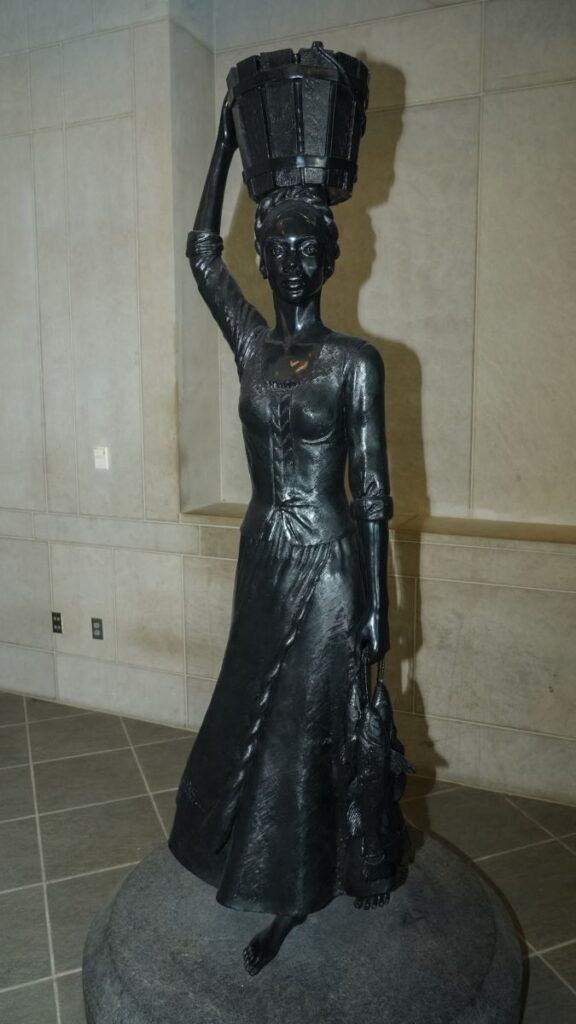
Teaching sensitive topics in the classroom is difficult no matter the subject material. Especially when incorporating political ideologies and scientific disagreements. The science of childbirth has been a tumultuous one. The impact of women in the field of childbirth, and medicine in general, has often been overlooked due to the mostly male presence in the medical narrative. When doctors began to control the practice of childbirth and hospital births became more common, the history of midwifery took a downward turn. However, midwifery has been the central practice for childbirth for thousands of years. The definition of a midwife is a person (typically) a woman who is trained to assist in childbirth and has been a central figure in history in every culture globally. Midwifery is centrally important because it was the original practice of childbirth and pioneered the obstetric field. Not only did midwifery pioneer the obstetric field, but the ideology of a woman’s right to her own body. Midwives were often seen assisting, in some capacity, with women seeking abortions. When combining secondary education and specifically sensitive topics such as childbirth, and more specifically midwifery, the teacher should present the information, facts, history, and current events to the student and then guide them in making their decision. Due to the recent political activity regarding the Supreme Court case Roe v. Wade, allowing students to understand more about the medical history regarding midwifery as well as abortion could assist in them making a well-informed opinion.
Research regarding early modern midwifery states that despite it being the most common practice with regards to childbirth in human history, it only became a licensed medical profession in the 16th century. Comparatively to today’s standards, midwives played the role of multiple healthcare professionals and even social workers. The role of the midwife was to assist the new mother in any way possible. Meaning she would visit the mother during pregnancy, assist with the labor and delivery process, and then return post-labor to teach the mother about her newborn and best care practices. Not only did midwives do all of these things, but they would also check on mothers to see if they were fit to care for their newborn child. Samuel Thomas has a Ph.D. in history with a focus on Early Modern England and taught history at the college level for ten years. He currently teaches at a high school in Cleveland Ohio and is an author of a series about Midwives in 17th century London. Thomas wrote an essay about the social importance of midwives in society as well as the lack of historical credit given to them.[1] This historical lack of credit accounts for the later shift in care in the obstetric field during the 17th century when childbirth became hospitalized. Along with this shift towards childbirth and obstetric care in general taking place in a hospital, the entire fundamental practice changed from constant care with the expecting mother to check ups and generalized advice. “Trained midwives delivered superb medical care and gave birthing women personal attention that physicians were too rushed to provide. It is suggested that the elimination of midwifery in the United States slowed the decline in infant and maternal mortality.”[2] Not only did this shift impact childbirth, it also stimulated the drastic change in the perception of abortion.
In the 17th century abortion was seen as a mother’s choice with drugs being sold in drug stores that would induce miscarriage. After childbirth, and consequently OB/GYN care, was taken over my male practitioners in hospitals this viewpoint drastically changed. Which eventually led us to the modern debate over abortion in the United States. According to historian Leslie Regan, “At conception and the earliest stage of pregnancy, before quickening, no one believed that a human life existed; not even the Catholic Church took this view. Rather, the popular ethic regarding abortion and common law were grounded in the female experience of their own bodies.”[3] Contrary to popular belief, abortion was not banned by the Catholic Church canonically until 1869[4]. Midwives would often help women gain access to an abortion and would allow them the choice to do so. However, at the turn of the Progressive Era this practice became ‘taboo’ and was restricted; “The combined campaign to control abortion and midwifery took the form of a classic Progressive Era reform movement”[5]. This campaign to control abortion continues today with peaks and troughs such as the recent ban on legal abortion in Texas as of 2021.
When considering how these topics should be brought into the classroom it is important to consider the parameters of the subject. For instance during my field experience at Ewing High School in New Jersey this past fall I was able to observe a women’s studies class. This experience was very eye opening as it allowed me to see how different, less common topics, were tackled in the classroom. The teacher had Pro-Choice posters in her class, along with abortion on her curriculum as a discussion topic not be overlooked. Ground rules I have observed both in and out of the classroom when bringing up sensitive topics include: placing parameters and clear goals for the discussion topic; giving the students objective background information to prepare them; going through the topic with respect for opposing viewpoints or possible emotions; as well as allowing them time to summarize, reflect and ask questions. This basic framework works with any sensitive topic or current events issue. According to the National Education Association’s article on teaching sensitive topics in history, “One of the greatest challenges facing teachers right now is teaching our students to engage with hard histories in this specific historical moment,” says Rich, a director of research at the university’s Rowan Center for Holocaust and Genocide Studies. “Currently, everything feels particularly fraught, and we are unsure of where students and families fall across the highly polarized political spectrum.”[6] Despite the complicated political climate and sensitivity of the topics, these histories should not be left out of the classroom. Allowing students to analyze and learn about uncomfortable historical topics allows for more informed decision making in their future.
Although abortion and childbirth are somewhat obscure topics when it comes to the traditional curricula of the public school system there are ways to integrate them into the classroom. For World History classes, when discussing the Medieval Period and the Black Plague it is important to also touch on the overall medical sphere of the time period, and midwives were a huge character of that. Not only did midwives deliver babies and care for mothers, they continued to care for the delivered baby well into childhood acting almost as a family practitioner. The importance of midwifery can continue into US History 1 and 2 by integrating nurse-midwifery that gained its roots in the Civil War with the rising popularity of nursing, and later officially began in 1925.[7] These are some more abstract and creative ideas regarding midwifery in the classroom, whereas the famous 1973 Roe v Wade case can be touched on in both Civics and American History curriculums for its monumental impact on both second wave feminism and medical history.
The importance of history cannot be overlooked when the topic becomes unsavory. Despite abortion and midwifery being more high-level or sensitive issues to be debating in the classroom, there are tools and ways to allow for their discussion with students. Without teaching students about more thought-provoking topics they will never have the opportunity to make informed decisions thus creating uninformed citizens who will continue to misinterpret history. A teacher’s place is not one to force opinions or political standings on their students but to open their minds to new things that they might not have previously understood or heard of. The debate over legal abortion access will continue, and by informing our students of the history regarding it we will be able to have pride in their future decisions.
References:
Devitt N. The statistical case for elimination of the midwife: fact versus prejudice, 1890-1935 (Part I). Women Health. 1979 Spring;4(1):81-96. PMID: 10297450.
Dawley K. Origins of nurse-midwifery in the United States and its expansion in the 1940s. J Midwifery Women’s Health. 2003 Mar-Apr;48(2):86-95. doi: 10.1016/s1526-9523(03)00002-3. PMID: 12686940.
Hovey G. Abortion: a history. Plan Parent Rev. 1985 Summer; 5(2):18-21. PMID: 12340403.
Reagan, Leslie J. When Abortion Was a Crime: Women, Medicine, and Law in the United States, 1867-1973. University of California Press, 1998.
Reagan LJ. Linking midwives and abortion in the Progressive Era. Bull Hist Med. 1995 Winter;69(4):569-98. PMID: 8563453.
Thomas, Samuel S. “EARLY MODERN MIDWIFERY: SPLITTING THE PROFESSION, CONNECTING THE HISTORY.” Journal of Social History 43, no. 1 (2009): 115–38. http://www.jstor.org/stable/20685350.
[1] Thomas, Samuel S. “EARLY MODERN MIDWIFERY: SPLITTING THE PROFESSION, CONNECTING THE HISTORY.” Journal of Social History 43, no. 1 (2009): 115–38. http://www.jstor.org/stable/20685350.
[2] Devitt N. The statistical case for elimination of the midwife: fact versus prejudice, 1890-1935 (Part I). Women Health. 1979 Spring;4(1):81-96. PMID: 10297450.
[3] Reagan, Leslie J. When Abortion Was a Crime: Women, Medicine, and Law in the United States, 1867-1973. University of California Press, 1998.
[4] Hovey G. Abortion: a history. Plan Parent Rev. 1985 Summer;5(2):18-21. PMID: 12340403.
[5] Reagan LJ. Linking midwives and abortion in the Progressive Era. Bull Hist Med. 1995 Winter;69(4):569-98. PMID: 8563453.
[7] Dawley K. Origins of nurse-midwifery in the United States and its expansion in the 1940s. J Midwifery Womens Health. 2003 Mar-Apr;48(2):86-95. doi: 10.1016/s1526-9523(03)00002-3. PMID: 12686940.
A recent article by the editors of Rethinking Schools recalled an 1867 Harper’s Weekly editorial invoked the phrase: “The alphabet is abolitionist.” It meant that with the denial of literacy under the “slavocracy,” merely learning or teaching others to read and write was in itself an abolitionist act.
Educators have always been vulnerable to the threat of white nationalism, with their main duty being the enhancement and diffusion of knowledge, a great, if not the greatest, weapon of all. Just look at how fearful the idea of teaching formerly enslaved people to read made white supremacists during Reconstruction.
Now, 150 years later, white supremacism has evolved, not only as an intrusion to the way teachers relay facts or clarify concepts or ideas, but as a threat to the very stasis of the classroom, as kids are becoming influenced by back-alley online movements that promote nationalism, anti-Semitism, and misogyny. And so, while teachers don’t and shouldn’t create incognito accounts on 4chan, they should try to stay current with right-wing Internet trends, so that they’re able to catch things like hand symbols and disconcerting research paper citations.
One Chicago teacher created a toolkit for confronting white nationalism in the classroom, which offers various entry points for addressing whether or not and how a student may have become radicalized. In general, white nationalism has managed to creep its way back into the classroom in more ways than one can seemingly count. As a National Education Association article from earlier this year recalls, an Illinois high school teacher found himself, for the first time in his 32-year career, standing in front of his social studies class in 2017, reminding students that Nazis are not good people.
While this was a direct response on the part of the teacher to Donald Trump’s comments about the Charlottesville Nazis being “very fine people,” it was also a pretty abrupt shift for the teacher when it came to how he expressed his opinions of politicians’ statements in the classroom. The last six years have completely shattered the delicate walls that separate politics and everything else. For teachers, addressing the current state of politics is not a matter of grandstanding—it’s become a matter of human decency, of living up to their positions as presumptive role models and advocating for their students.
Laws around banning critical race theory — or worse, the bill introduced in Missouri which bans teaching that “identifies people or groups of people, entities, or institutions in the United States as inherently, immutably, or systemically sexist, racist, anti-LGBT, bigoted, biased, privileged, or oppressed” only serve to confuse young people. By banning educators from teaching about these systemic realities, and further, prohibiting them from even acknowledging that many systems are built upon “isms” and “antis,” politicians and their supporters deny young people the right to understand the very world they’ve inherited.
Denying this type of learning, and the civil discussion that accompanies it, is in itself a type of suppression. By prohibiting students the ability to learn the truth of their country’s history, lawmakers and the right-wing nationalists who today have emerged as a truly influential voting contingent in this country are disenfranchising young people. Despite this massive threat, teachers across the country are already fighting back, with many arguing that there is simply no way to stay neutral when not only our democracy but our ability to teach the truth is at risk.
If anything, schools should step up when it comes to bringing politics into the classroom—help teachers develop tactics and show support when necessary. As places that bring so many types of young people with so many different perspectives together, schools have a better opportunity than most institutions to help teachers develop a more human approach to viewing the world. Students, therefore, will be less susceptible to being radicalized by right wing forces online and will maybe even use their newfound knowledge to educate their parents and communities.
As educators, we must remember that staying neutral is perhaps more dangerous than any right-wing threat. Ignoring the recent explosion of right-wing nationalism and Nazi sentiments is not a way of staying out of politics, but a way of proliferating harmful politics. We cannot, in good conscience, become Adolf Eichmanns in the classroom. We must instead fight for what is just and for what betters our students and the world.
The Rethinking Schools article ended with a quote from Angela Davis. “I am no longer accepting the things I cannot change. I am changing the things I cannot accept.”
Students Taking Action Together: Strategies that Blend SEL with Civil Discourse for Democratic Change to Meet the NJSLS Social Studies Practices
Laura Bond and Lauren Fullmer
The racial reckoning of 2020, the COVID-19 pandemic, renewed focus on climate change and the Capitol insurrection have collectively revealed to youth that systematic change is needed to reduce structural inequities (Fullmer & Bond, 2021). With students back to in-person schooling, the eagerness for expression, social connection, and understanding how constructive social change is possible has never been greater than during the 2021-2022 school year.
Social Studies teachers stand in this rich moment in time, to teach civil discourse and citizenship in alignment with the new 2020 NJSLS Social Studies Standards. Students Taking Action Together (STAT), a project from Rutgers University’s Social-Emotional Character Development Lab, has developed five research-based strategies to equip teachers in grades five through twelve with the tools to integrate social-emotional competencies and academic standards with active practices to be explicitly taught and practiced in the classroom to foster citizenship skills. In this article, we illustrate how the five strategies embed SEL competencies required to meet the challenges of civic engagement and democratic change and then examine how each strategy delivers upon the NJSLS Social Studies practices so students are equipped to lead change in their schools and communities.
The Five STAT Strategies
STAT is a set of five SEL research-based strategies – Norms, Yes-No-Maybe, Respectful Debate, Audience Focused Communication (AFC), and PLAN, a social problem-solving framework – that scaffold the integration of active civics-based social studies practices for grades five through twelve using existing curricular content. The strategies explicitly promote social-emotional competencies, academic skills, dispositions, and actions required for an informed and engaged citizenry (Fullmer et al., 2022). In ready-made lesson plans, organized around the themes of race, class, and gender, students explore constructs of power, oppression, human rights, injustice, and inequality. The lessons showcase the use of a STAT strategy related to a historic event and/or relevant civic issues being addressed in national and local debates.
Each strategy builds upon the foundational SEL skills developed by the previous strategy and therefore, the strategies are meant to be taught in the sequence in which they are presented. By doing so, students have ample opportunity to practice explicit SEL competency skills and the academic standards to engage in civic dialogue and debate for democratic action.
Figure 1: The Five STAT Strategies
Norms
Engages students in developing ethical standards that lay the groundwork for a relationship-centered classroom community.
Yes-No-Maybe
Offers students opportunities for peer opinion sharing, in which they reflect on their views on an issue to take a stand and actively listen to the diverse perspectives of their classmates.
Respectful Debate
Encourages students to practice the skill of perspective taking by analyzing all sides of an issue, in order to gain an appreciation for diverse viewpoints and a level of comfort in modifying their original thinking.
Audience-Focused Communication (AFC)
Allows students opportunities to tailor their language and style of presentation to a specific audience with the goal of understanding the perspective and context of their audience and communication, toward optimally conveying their good ideas about changing a policy or practice for the greater good of their classroom, school, and society.
P.L.A.N.
Involves students in collaborative problem solving with action planning to make a change in policies and practices that maintain privilege and power and limit whose voices have input in key decisions.
The Norms Strategy
To engage the civil discourse skills of peer opinion sharing, perspective taking, social problem solving, norms nurture a safe, relationship-centered and open learning environment (Elias & Nayman, 2019). Unlike classroom rules, which are generally teacher constructed to establish an efficient and open environment, norms are co-created by students and the teacher. Through a discussion facilitated by the teacher, students decide upon desirable and undesirable classroom learning commitments and behaviors. Ultimately, students develop a list of affirmatively stated norms and discuss the rationale behind each norm and its impact on their well-being. Students also collectively determine ways to handle “norm-breaking” as a shared commitment to collective responsibility.
Engaging in the Norms strategy allows students to practice the SEL skills of self-awareness, self-management, relationship-building, and social awareness to form a safe and interdependent learning environment. Students practice how to recognize their feelings about working together within the classroom community, how to keep their impulsive behaviors in check, develop knowledge of the sensitivities and needs of their peers, and to communicate in a positive and constructive way with classmates and adults. Acting as a living class constitution, norms allow for students to rehearse the civic skills of respectful listening, peer opinion sharing, empathic debate, information gathering to shape arguments, and collaborative problem-solving required in the next four strategies. In this fashion, students build the competencies, both social-emotional and academic, to take informed action.
The Yes-No-Maybe Strategy
The Yes-No-Maybe strategy facilitates peer opinion sharing, which is the basis for genuine civic dialogue. This simple entry-level strategy allows students to express and share their opinions on historic or current issues, given their initial impressions and then after reading a source on the issue. This strategy supports students’ social-emotional skills of self-management, in which students have to withhold judgment, refrain from reacting, and the social awareness skills through perspective-taking and respectful listening.
Students reflect on several neutral statements related to a historic or current event inspired by a teacher-selected source. They take a stance on each statement by moving to a space in the classroom marked “yes”, “no” or “maybe” that reflects their opinion. They practice respectful listening by discussing their opinions in those small informal gatherings within those spaces, and sharing them out with the full group. Next, students read a background source directly related to the issue to inform their thinking. They are then given a second opportunity to change and/or share their opinions by moving to the appropriate location in the room on the same neutral statements provided the additional information from the source or from listening to their peers. Students reflect on if their opinions changed in the second round and if so, what inspired the shift in their opinion. The instructor facilitates these conversations, but does not seek to arrive at a consensus or other conclusion.
The Respectful Debate Strategy
Engaging in civic debate for understanding, rather than debate to win, is embodied in Respectful Debate (Civility and Society – A SmartBrief, 2019). With the skills of perspective-taking and respectful listening in place, this strategy introduces students to the more complex skill of establishing and defending an informed position on a topic while empathically listening to opposing views. Respectful Debates provide rich opportunities for students to practice their self-awareness and emotional regulation skills (Elias & Schwab, 2006). Students engage their social awareness by realizing the impact of their emotions on themselves and others, build confidence as they recognize their limitations and potential as they speak, and collaborate in teams. They self-regulate their emotions, thoughts, and behaviors as they dialogue with peers in preparation, present their argument and summarize the opposing side’s argument.
Students can be provided with or gather evidence for their assigned position on the debate statement or question. Students are assigned the stance of “pro” or “con” and work in small groups. Unlike traditional classroom debates, students are charged with arguing on both sides of the issue and intentionally reflecting on and accurately understanding the position of their opposition, allowing them to more objectively analyze the issue and broaden their perspectives. This poses a challenge when students strongly disagree with one side of the issue and find themselves dealing with strong emotions that they must regulate. This challenge presents opportunities for teachers to teach emotional regulation techniques, such as deep breathing, positive self-talk, and waiting before speaking.
Audience-Focused Communication (AFC)
Civic discourse is realized with Audience-Focused Communication (AFC), which is a stand-alone strategy to be implemented without the need to be taught in the sequenced order of the previous three strategies. It’s a deliberate and strategic focus on speaking and related skills that can be harnessed to present on academic topics, such as pivotal decisions or historic debates, as well as school-based issues, such as the inclusiveness of student government, bullying, and freedom of expression. With AFC, students are given a rich opportunity to find their stance and voice and to use media effectively in order to impact an audience to mobilize consensus-making or to excite change. AFC can also be used as a natural extension of PLAN (what we refer to as PLAN Integrative), in that it provides students with detailed guidance with regard to how to best present the solutions and action plans that they developed. Fundamental to AFC is asking students to put themselves in the shoes of the listener/receiver, and not assume that they always are speaking to people just like themselves. This is true for sharing work in a class, making an announcement over the loudspeaker, preparing a presentation for an assembly, or developing and delivering a petition to the Student Council.
The essence of AFC is that students exercise their social awareness and relationship skills working collaboratively to identify their audience, determine the format of their presentation, and take into consideration their audience’s background and prior knowledge to effectively craft their message and communicate it to influence the audience. Self-awareness and self-regulation skills are key to this strategy, which demands students self-assess and continually evaluate how to best present the information and craft their argument to have the maximum impact on the audience.
PLAN: A Problem-Solving Framework
The fifth and final strategy, PLAN, builds on the skills students practice in the preceding strategies and shifts the focus to social problem solving and action planning to prepare students to take civic action. PLAN stands for Problem definition, Listing options, Action plan, and Notice success and lessons learned for next time. With PLAN, students work in small groups to collaboratively examine and evaluate a historic or a current problem that has no obvious solution or perhaps revisit a past situation to better understand how different analyses or decisions might have led to different actions and outcomes.
Then, they consider the options to address the problem and weigh the pros and cons of each. Students work together to develop a SMART goal and related action plan to solve the problem. They also engage in perspective-taking to consider the impact of their action plan on the various stakeholders involved and look to implement when feasible (hence, the title, Students Taking Action Together). The process culminates with a reflection, in which students notice successes with their plan and possible revisions to their thinking to be more successful the next time around. In the spirit of John Dewey, as students apply PLAN to classroom and school-related problems, it will accelerate their ability to apply their skills to historic and civic issues.
How the STAT Strategies Align to the NJSLS Practices
The new Social Studies practices engender opportunities for students to practice civic discourse, dialogue, debate and action in the classroom. The STAT strategies guide Social Studies teachers to strike a balance between content acquisition and active practices that maximizes students’ ability to rehearse and transfer the skills they learn (Fullmer et al., 2022). STAT strategies are designed to accompany and supplement lesson content. They provide guidance on how teachers can integrate the active practices for civil discourse and action into existing curricula. In the crosswalk figure below, we’ll show how STAT coaches teachers to achieve this integration in meaningful and effective ways.
Figure 2: A Crosswalk of STAT’s Integration of the NJSLS Social Studies Practices
Y-N-M
RD
AFC
PLAN
Developing Questions & Planning Inquiry
Each lesson features an organizing question to foster thinking & support planning.
Students are given a debate question and assigned an initial side (they will ultimately take both sides) for which they must plan an approach to gather information and present it.
Students formulate inquiries to understand the context within which they will be presenting.
The first step in the PLAN process involved identifying the problem/ questions that will be the focus of inquiry.
Gathering & Evaluating Sources
Students read a central article/source and share their opinions before and after reading the article.
Students must review sources to prepare their positions for the debate.
Students must gather information from relevant and appropriate sources to determine presentation context and constraints.
PLAN works from the existing curriculum or school situations/contexts, so students must gather this information at the outset and value the information in proportion to the reliability of its sources.
Seeking Diverse Perspectives
Students express their opinions. Articles/sources offer multiple views on the issues.
Students must examine both points of view and argue both sides of the debate.
Students are encouraged to consider a range of presentation modalities and to gather perspectives from individuals with experience at presenting to the intended audience(s).
The second part of the PLAN process involves brainstorming a wide range of possible solutions to the problem. Prior to that, the problem is defined from the perspective of each of the groups involved.
Developing Claims and Using Evidence
Students respond to claims before and after reading the article/sources.
To be successful, students must bring forward credible sources of evidence to support their positions.
Students working in groups to finalize their presentation context and message must put forward their approaches using credible evidence.
Students will be expected to justify their claims based on evidence in textual and other sources.
Presenting Arguments and Explanations
Students read & draw on the source’s key arguments, supporting evidence to inform and express their opinions.
Students must refine, present, and defend their arguments within the constraints of the debate.
Students must justify their particular positions regarding how the presentation should be made to be appropriate to the audience and context.
The third step in the PLAN process involves presenting solutions and detailed plans, including anticipation of obstacles.
Engaging in Civil Discourse and Critiquing Conclusions
Students exhibit curious compassion towards those with divergent views and seek to understand them through inquiry, rather than judge them.
Students learn emotional regulation techniques to remain calm when involved in controversial discussions with their peers.
When students work collaboratively to plan a presentation, the process of civil discourse – when deciding upon the content that will be presented and the method of delivery – is more important than the product (i.e. choosing the “right” content or format).
The fourth step of PLAN involves critiquing the conclusions reached by those who dealt with the issue in history and the conclusions the students reached when implementing their action plan.
Taking Informed Action
Students gain the confidence and competence of developing informed opinions and expressing their opinions in social settings required to take.
Students consider the views of all relevant stakeholders by engaging in perspective-taking to ensure that their plan of action is inclusive.
Students will take action based on their plans and will gather feedback/debrief to inform their future action in similar situations.
The final step in PLAN involves reflecting on actions taken and identifying how things would be done differently in future situations; when applied to history, this includes projecting different outcomes if past decisions were different, including implications for the present and future.
Developing Questions & Planning Inquiry
Civic discourse often starts with asking questions of leaders and elected officials. The first Social Studies practice of Developing Questions & Planning Inquiry is explicitly integrated into STAT lessons. Each lesson features a core question to assist the teacher in organizing the lesson content and student thinking. Relevant issues are integrated into the lesson anchor question to promote student engagement. Students then use the question to dig deeper into exploring the issue.
For example, in a Yes-No-Maybe lesson, the statement, “The coronavirus has not fueled anti-Asian racism?” is presented to students to frame the development of neutral statements, shaping students’ thinking and questioning as they engage in dialogue with their peers. At the end of the lesson, students revisit the question and respond to the essential question. In this vein, students learn how the power of relevant questions can drive collective discussion and learning around the issue. The Yes-No-Maybe strategy demonstrates to students that civic discourse starts with asking questions. The table below indicates exactly how students engage the skill of planning for inquiry and developing questions across the STAT strategies, once Norms have been established. The practice necessary to spark civic discourse is scaffolded and spirals up through the strategies to PLAN.
Gathering & Evaluating Sources
The second practice, Gathering & Evaluating Sources, facilitates students’ inquiry by having them gather credible sources, given the framing statement or essential question to enhance their background knowledge and to consider all perspectives on the issue. With the STAT lessons, students are exposed to a wide range of primary and secondary sources, including podcasts, political cartoons, and newspaper articles and are equipped with the critical literacy skills needed for civic life, as well as to promote informed citizenship. Through repeated practice, students learn that words are a form of power and that no source is entirely neutral in nature.
In the Respectful Debate strategy, after the students are presented with a controversial statement that frames the debate, they are tasked with critically evaluating background sources on the topic to identify evidence in support of their position. For example, in a Respectful Debate lesson on racial equality, framed around the statement “In order to achieve racial equality, Blacks should separate from Whites”, students are provided with a blog post from the New York City Urban Debate League and an audio recording of the 1961 debate between Malcolm X and James Baldwin. Through the processes of deliberation, peer discussion, and reflection, students analyze the information from all angles and form new understandings by synthesizing it with their prior knowledge.
Seeking Diverse Perspectives
When building the muscle of evaluating background sources, students develop an understanding of their perspective on an issue, as well as an appreciation for the perspectives of others. Seeking Diverse Perspectives is a practice that allows students to see and connect with the authentic and genuine emotional reactions and thoughts of their peers. This allows them to develop empathy for individuals and groups of people of different backgrounds and experiences. The Yes-No-Maybe strategy teaches students to exercise compassionate curiosity over biased assumptions to better understand the other’s perspectives. Through respectful and empathic listening and peer opinion sharing, students become more open-minded and accepting of the notion that beliefs and opinions can change over time.
During a Yes-No-Maybe lesson on foot binding in China, students are invited to reflect on their views related to the statements: “Women, not men, perpetuate a society’s concept of what is beautiful” and “Expressions of beauty are typically crafted by the elite”. Students then engage in peer opinion sharing and a review of background sources to consider how what people think is beautiful has changed over the years and differs around the world. Through these experiences, students widen their perspectives and reevaluate their views about the meaning of beauty.
Developing Claims and Using Evidence
The fourth practice, Developing Claims and Using Evidence, equips students with the skills to engage in constructive and meaningful dialogue about important issues. Students consider an issue from all perspectives and take account of any biases they may have to formulate their own viewpoint on the issue and develop a logical argument supported with the best possible evidence. While all of the STAT strategies task students with exercising the skill of eliciting evidence from their analysis of background sources and engaging dialogue with peers (Fullmer et al., 2022), Respectful Debate really hones in on this practice. Provided with background sources on a controversial issue, students not only identify the most compelling evidence to support their “pro” or “con” argument, but also, reflect on any gaps in the reasoning and evidence presented by their opponent.
For example, in a Respectful Debate lesson, students must identify evidence and construct arguments to support the “pro” and “con” sides of “Is it possible for sports to be inclusive of the LGBTQIA+ community?”. Provided with a video, timeline, and two articles, students identify the authors’ respective claims and compare it to their own and pull out the best pieces of evidence to not only support their claim, but to challenge that of their opponents. By actively listening to both sides of the argument, students develop a collective understanding, as well as historical empathy for members of the LGBTQIA+ community.
Presenting Arguments and Explanations
While students are frequently asked to Present Arguments and Explanations in front of an audience, whether sharing the results of a science lab, describing why an invented algorithm works in math, or justifying the theme of a novel, they are rarely provided with the skills to do so with competence and confidence. Yet, being able to tailor their presentations to a specific audience and regulate their tone of voice, eye contact, and nonverbal communication accordingly are essential elements of the fifth practice. The Audience-Focused Communication (AFC) strategy equips students with the presentation literacy skills necessary to determine the appropriate format of a presentation (e.g., slideshow, song, video, speech) and the prior knowledge and views of their audience to most effectively present their argument in a way that makes sense and resonates with their audience.
Consider an AFC lesson at the end of a content-based unit, in which students are tasked with presenting on a topic or book that they recently learned about. Students learn how to focus their message, given a specific audience, and consider how it will be received through perspective-taking. Through deliberate planning and practice, students develop a step-by-step run-down of the flow of the presentation and rehearse SEL skills such as positive self-talk and deep breathing to be prepared to regulate their emotions. With AFC, students are furnished with the presentation literacy skills to be active members in a participatory democracy.
Engaging in Civil Discourse and Critiquing Conclusions
Building off the previous two practices, the skill of Engaging in Civil Discourse and Critiquing Conclusions excites opportunities for collective listening and assessing the reasoning which is central to sensemaking. In a Yes-No-Maybe lesson students present their opinions and listen to their peers express their opinion on statements related to a topic, prior to reading a source. After reading the source students move to a location in the room that reflects their opinion, even if it changed and discuss in small groups what argument shaped their opinions. At the end of the lesson the class reflects on whether their thinking changed or not and discusses what reasons may have caused them to change their original opinion on the topic. Thus, students learn the value of listening and reading diverse views on the topic and can refine their original thinking on the topic.
Respectful Debate lessons ask students to summarize the opposing sides argument and question if the summary was accurate. The process of summarizing the presented argument provides students real practice for active listening in debate to expand their thinking on the topic. When students switch sides to argue the opposing argument it exposes them to analyze the reasoning of a point of view they may not agree with. In this process they begin to organically critique the argument(s) by questioning their assumption and preconceptions on the topic. At the end of the lesson students reflect about whether summarizing what the other side said and/or switching sides changed their opinion, and what about the summary was helpful. The reflection is a potent opportunity to learn the value of listening to and standing in to argue for a contrary view can refine their own and the group’s concluding thinking as they strive towards collective understanding.
Taking Informed Action
The previous practices lay the groundwork for the final practice of Taking Informed Action, which is the very essence of democracy. With the PLAN problem-solving framework, students examine a problem of the present or the past and consider the options to solve it by engaging in inquiry and background research. Next, they consider the views and needs of all relevant stakeholders to develop an action plan. In the final step, they engage in a collaborative discussion in which they reflect on the successes of their plan and identify areas for growth moving forward. This encourages students to acknowledge that the problem-solving process is iterative in nature and requires constant revisions to be more inclusive and effective.
A PLAN exemplar lesson on Women’s Rights invites students to analyze how Elizabeth Cady Stanton and the women at the Seneca Falls Convention organized to address the issue of unequal social, civil, and religious rights. Students then engage in perspective-taking to put themselves in the position of disenfranchised women during the mid-19th century to generate alternative solutions and action plans. The hope is that students walk away from this lesson with a greater awareness of the social injustices in their communities and the skills to organize to take collective action.
Conclusion
The New Jersey Social Studies Standards are visionary. They seek to educate students in history and civics and prepare them for active citizenship in a global and interdependent society. Students Taking Action Together is a set of teaching strategies that are ideally matched to the NJSLS and the guiding practices articulated for attaining them. These strategies embolden students with the necessary skills that nurtures a sense of hope and optimism that they can lead the change they wish to see in the world.
References
Civility and Society: How to Boost Civil Discourse in K-12 Classrooms. (2019). Smartbrief.
Elias, M. J., & Nayman, S. (2019, October 28). Students taking action together (STAT). New Jersey Education Association.
Elias, M. J. & Schwab, Y. (2006). From compliance to responsibility: Social and emotional learning and classroom management. In C. M. Evertson & C. S. Weinsten (Eds.), Handbook of classroom management (pp. 94-115). Lawrence Erlbaum Associates.
Fullmer, L. M., Bond, L. F., Molyneaux, C. M., Nayman, S. J., & Elias, M. J. (2022). Students Taking Action Together: 5 teaching techniques to cultivate SEL, civic engagement, and a healthy democracy. ASCD.
This excerpt from a longer article is reposted from History News Network with the author’s permission. The full article was published in the November 23, 2021 issue of The Atlantic Monthly.
Anti-Evolution: The Conservative War on Education that Failed
by Adam Laats
In the recent governor’s race in Virginia, Glenn Youngkin scored a huge upset win days after promising to ban critical race theory from Virginia schools. Youngkin is hardly the only Republican calling for school bans. In Texas, Representative Matt Krause sent a letter to school administrators about books in their district. Did they have Ta-Nehisi Coates on their shelves? Isabel Wilkerson’s Caste? How about LGBT Families, by Leanne K. Currie-McGhee? Or any of about 850 other books that might, in Krause’s words, “make students feel discomfort, guilt, anguish, or any other form of psychological distress because of their race or sex”?
Beyond Texas, beyond Virginia, the prospect of banning books and ideas from public schools has GOP strategists smelling electoral blood. House Minority Leader Kevin McCarthy vowed to turn school bans into a winning issue for Republicans in 2022, sketching a “parental bill of rights” to protect kids from troubling ideas about race and sex.
These efforts have a history. Back in the 1920s, the vague term that galvanized conservative angst was not critical race theory but evolution. Conservative pundits at the time seized on a cartoonish misrepresentation of evolutionary science and warned their fellow Americans that “evolution” was nothing less than a sinister plot to rob white American children of their religion, their morals, and their sense of innate superiority.
But although the school bans might have changed some school curricula in the short term, in the long run, they backfired. Telling parents you don’t want their kids to have the best possible public schools is never good politics. A full century ago, the most effective school-ban campaign in American history set the pattern: noise, fury, rancor, and fear, but not much change in what schools actually teach.
In the 1920s, the idea of evolution wasn’t new. Charles Darwin’s bombshell book about natural selection had been published 60 years earlier. The outlines of Darwin’s theory had become standard fare in school textbooks and curricula, even though the real scientific controversies about the mechanism of natural selection were by no means settled. But the furious campaign to ban evolution had nothing to do with those debates among scientists.
In 1923, T. T. Martin, the “Blue Mountain Evangelist,” preached that “evolution is being drilled into our boys and girls … during the most susceptible, dangerous age of their lives.” Evolution, Martin warned, was not good science but only a plot by “sneering” “high-brows” to inject mandatory atheism into public schools. Martin claimed to have “abundant evidence that the teaching of these text-books is unsettling the faith of thousands of students.”
“WHAT can be done? Where is our hope? The pussyfooting apologies for the Evolutionists will say “Don’t do anything drastic. Educate the people, and the thing will right itself.” Educate the people? How can we, when Evolutionists have us by the throat? When they have, while we were asleep, captured our tax-supported schools from primary to University, and many of our denominational colleges? “The Philistines be upon thee Samson !” But alas! We have been asleep upon the lap of this Delilah and. have been shorn of our strength-they have captured our schools. But “O Lord God, remember me, I pray thee, and strengthen me, I pray thee, strengthen me only this once, O God.” “And Samson took hold of the two middle pillars upon which the house stood, and on which it was borne up.” So could we. “And he bowed himself with all his might.” So can we. And the strength of God who “created man in his own image” will come into us, and we will slay these Philistines, the greatest curse that has come upon man since God created him in His own image. What is a war, what is an epidemic that sweeps people away by the hundred thousand, compared to this scourge that under the guise of “science,” when it is not science, at all, is sweeping our sons and daughters away from God, away from God’s word, taking from them their Redeemer and Saviour, to spend eternity in hell?”
New Jersey’s Climate Change Curriculum: An Important First Step for Social Studies Education
by Evan Saperstein and Daniel Saperstein
In a recent Intergovernmental Panel on Climate Change (IPCC) (2021) report, the United Nations (UN) scientific body confirmed what many leading scientists, activists, and public officials have known and warned for years: human activity is responsible for the climate change crisis. The sobering report (drafted by 234 scientists representing 66 nations) is nothing short of a code red, concluding that greenhouse gas (e.g., carbon dioxide, methane) emissions are causing rising temperatures and more frequent heatwaves, as well as worsening floods, droughts, and hurricanes (Intergovernmental Panel on Climate Change, 2021). To stem the tide requires immediate and sustained action across the globe (e.g., through a net zero emissions coalition) (Intergovernmental Panel on Climate Change, 2021). The UN General Assembly (2015) at large has recognized this dire imperative for years, and other multinational institutions and organizations (e.g., Climate Action Network) have worked tirelessly to bring attention to this heightening threat.
With each passing year, however, the stark consequence of failing to take action has become more painfully evident. Indeed, only three weeks after the release of the IPCC report, Hurricane Ida wreaked havoc in the South and then, to the surprise of forecasters, across much of the Northeast, particularly in New Jersey (Porter & Scolforo, 2021). The torrential downpour and instant flash flooding of streets and homes resulted in swift and seismic destruction (Porter & Scolforo, 2021). In response, New Jersey Governor Phil Murphy issued a state of emergency, and promised grants to help rebuild and guard against future devastation (Arco, 2021; Porter & Scolforo, 2021). And, while touring the aftermath, President Joe Biden (2021) cautioned that: “weather would be more extreme and climate change was here, and we’re living through it now. We don’t have any more time.”
Hurricane Ida is just the latest example of extreme weather events in New Jersey and across the United States (Freedman & Samenow, 2020; Pershing, 2021). Indeed, the United States recently experienced its warmest summer in history (previously set in 1936) (Chow, 2021). In fact, this past decade was the Earth’s warmest to date (and since 2005, there have been the 10 hottest years on record) (Borunda, 2020; Lindsey & Dahlman, 20021; Milman, 2020). In light of these troubling trends, New Jersey has taken steps to address climate change.
For instance, in 2020, Governor Murphy signed the Food Waste Recycling Law to reduce greenhouse gases by requiring large generators of food waste to recycle unused and wasted food (Munoz, 2020). Later that year, the New Jersey Department of Environmental Protection published the Global Warming Response Act Report, detailing the steps needed to reduce climate pollutant emissions (Barr et al., 2020). This past year, the New Jersey Department of Environmental Protection (2021) also developed its first statewide Climate Change Resilience Strategy. The strategy outlines six overarching priorities: “build resilient and healthy communities,” “strengthen the resilience of New Jersey’s ecosystem,” “promote coordinated governance,” “invest in information and increase public understanding,” “promote climate-informed investments and innovative financing,” and a “coastal resilience plan” (New Jersey Department of Environmental Protection, 2021).
Notably, New Jersey’s climate change initiative and action also has extended to education. Recently, New Jersey became the first U.S. state to add climate change across its K-12 curricular standards (Fallon, 2020; Warren, 2020; Williams, 2020); full implementation will take effect by the following academic year due to delays resulting from the pandemic (New Jersey Department of Education, 2021). Various stakeholders, including K-12 educators and administrators, participated in this historic initiative. New Jersey’s first lady Tammy Murphy helped lead the effort (Warren, 2020), with the goal of providing younger generations “an opportunity to study and understand the climate crisis through a comprehensive, interdisciplinary lens” (Cruise, 2020). The first lady cast the initiative as “much more than an added educational requirement; it is a symbol of a partnership between generations” (Cruise, 2020). Governor Murphy himself acknowledged the significance of the curricular standards “to reestablish New Jersey’s role as a leader in the fight against climate change” (Warren, 2020). Former Vice President and environmental activist Al Gore also praised the state for its commitment to prepare future leaders able to confront climate change and prescribe solutions (Warren, 2020).
The incorporation of climate change related content into the state’s K-12 curriculum is far-reaching (Fallon, 2020; Warren, 2020; Williams, 2020). The new curriculum will result in material changes to Social Studies, as well as several other content areas of the 2020 New Jersey Student Learning Standards (NJSLS) ranging from Career Readiness, Life Literacies, and Key Skills to Comprehensive Health and Physical Education; Computer Science and Design Thinking; Science; Visual and Performing Arts; and World Languages.
For Social Studies in particular, climate-related content has been added to U.S. and world history, encompassing economics, geography, civics, government, and human rights (New Jersey Department of Education, 2020e). The social studies standards speak to “leveraging climate change as an area of focus” through “authentic learning experiences” and the “use of disciplinary literacy skills to communicate . . . solutions for change” (New Jersey Department of Education, 2020e, p. 21). This includes “students asking their own questions,” soliciting “diverse points of view,” and “using geospatial technologies to gather data” (New Jersey Department of Education, 2020e, p. 21).
The social studies standards from the New Jersey Department of Education (2020e) set “performance expectations” specific to climate change, including to “evaluate the impact of individual, business, and government decisions and actions on . . . climate change” (p. 66); “assess the efficacy of government policies and agencies in New Jersey and the United States in addressing these decisions” (p. 66); “investigate . . . climate change, its significance, and share information about how it impacts different regions around the world” (p. 86); “develop an action plan . . . related to climate change and share with school and/or community members” (p. 87); and “plan and participate in an advocacy project . . . about the impact of climate change at the local or state level and propose possible solutions” (p. 87). These curricular changes go well beyond Social Studies, as noted above. For Career Readiness, Life Literacies, and Key Skills, climate-related content cuts across topics in creativity and innovation; critical thinking and problem-solving; digital citizenship; global and cultural awareness; and information and media literacy (New Jersey Department of Education, 2020a). Comprehensive Health and Physical Education ties climate-related content with community health services and support (New Jersey Department of Education, 2020b). Computer Science and Design Thinking fuses climate-related content with data and analysis, as well as the effects of technology on the natural world (New Jersey Department of Education, 2020c). For Science, naturally, climate-related content covers earth and human activity, engineering design, and earth’s systems (New Jersey Department of Education, 2020d). For Visual and Performing Arts, climate-related content is part of dance, media arts, theatre, and visual arts (New Jersey Department of Education, 2020f, p. 4). And, for World Languages, climate-related content runs the gamut of interpretive, interpersonal, and presentational modes of communication (New Jersey Department of Education, 2020g).
Educating the next generation about the effects of climate change is fundamental to the future of social studies education and across disciplines. During the September 2019 global climate strikes, students around the globe (led by Greta Thunberg) left class and took to the streets to protest politicians’ inaction on climate change (Huish, 2021; Sengupta, 2019). While the pandemic served to stall momentum (Berwyn & Erdenesanaa, 2021), youth activists are once again holding in-person (albeit much smaller) protests as part of Thunberg’s Friday for Future movement (Adam & Noack, 2021). But youth activists can only achieve so much on their own, and climate change education is a necessary predicate to prepare the next generation to address this challenge.
New Jersey’s climate change curriculum is a critical first step, and it should become a blueprint for other states in this country as well as other countries abroad. Climate change education will provide students with a baseline of knowledge to understand and confront the negative impacts of this threat. As the NJSLS show, these are interdisciplinary issues that cut across social studies, as well as the sciences and the arts, to name a few. It is imperative that students with varying backgrounds, educational levels, and areas of interest become well-versed in these issues, and take the lessons learned through further education, into their professions, and as part of their lives as citizens.
Yet, New Jersey should not stop with climate change education. New Jersey K-12 schools can and should take the lead in teaching about other critical issues—be they about public health, economic inequality, or social justice. The UN has outlined a number of these global challenges that have become better known as the 17 sustainable development goals (SDGs), of which climate action is but one. Others include: no poverty; zero hunger; good health and well-being; quality education; gender equality; clean water and sanitation; affordable and clean energy; decent work and economic growth; industry, innovation and infrastructure; reduced inequalities; sustainable cities and communities; responsible consumption and production; life below water; life on land; peace, justice, and strong institutions; and partnerships (United Nations General Assembly, 2015). To groom well-rounded citizens, New Jersey K-12 schools must once again take the reins and incorporate such issues into various content area standards. Students need to learn about the impact of climate change and other global issues to successfully navigate through the many challenges facing today’s world. Given the scope and scale of the risk, the stakes could not be greater.
Barr, H., Orlando, P., Kettig, R., Barry, R. C., Karmarkar-Deshmukh, R., & Kamel, M. (2020). New Jersey’s Global Warming Response Act 80×50 Report. New Jersey Department of Environmental Protection. Retrieved from https://www.nj.gov/dep/climatechange/docs/nj-gwra-80×50-report-2020.pdf
Berwyn, B., & Erdenesanaa, D. (2021, September 24). A Friday for the future: The global climate strike may help the youth movement rebound from the pandemic.
Huish, R. (2021). Global citizenship amid COVID-19: Why climate change and a pandemic spell the end of international experiential learning. Canadian Journal of Development Studies, 1-18. Intergovernmental Panel on Climate Change (2021). AR 6 climate change 2021: The physical Science basis. Retrieved from https://www.ipcc.ch/report/ar6/wg1/
New Jersey Department of Education. (2020e). 2020 New Jersey Student Learning Standards – Social Studies. New Jersey Department of Education. (2020f). 2020 New Jersey Student Learning Standards – Visual and Performing Arts.Retrieved from https://www.nj.gov/education/cccs/2020/2020%20NJSLS-VPA.pdf
Is it possible to build social solidarity beyond the state? It’s easy to conclude that it’s not. In 1915, as national governments produced the shocking carnage of World War I, Ralph Chaplin, an activist in the Industrial Workers of the World, wrote his stirring song, “Solidarity Forever.” Taken up by unions around the globe, it proclaimed that there was “no power greater anywhere beneath the sun” than international working class solidarity. But, today, despite Chaplin’s dream of bringing to birth “a new world from the ashes of the old,” the world remains sharply divided by national boundaries—boundaries that are usually quite rigid, policed by armed guards, and ultimately enforced through that traditional national standby, war.
Even so, over the course of modern history, social movements have managed, to a remarkable degree, to form global networks of activists who have transcended nationalism in their ideas and actions. Starting in the late nineteenth century, there was a remarkable efflorescence of these movements: the international aid movement; the labor movement; the socialist movement; the peace movement; and the women’s rights movement, among others. In recent decades, other global movements have emerged, preaching and embodying the same kind of human solidarity—from the environmental movement, to the nuclear disarmament movement, to the campaign against corporate globalization, and to the racial justice movement.
Although divided from one another, at times, by their disparate concerns, these transnational humanitarian movements have nevertheless been profoundly subversive of many established ideas and of the established order—an order that has often been devoted to maintenance of special privilege and preservation of the nation state system. Consequently, these movements have usually found a home on the political Left and have usually triggered a furious backlash on the political Right.
The rise of globally based social movements appears to have developed out of the growing interconnection of nations, economies, and peoples, spawned by increasing world economic, scientific, and technological development, trade, travel, and communications. This interconnection has meant that war, economic collapse, climate disasters, diseases, corporate exploitation, and other problems are no longer local, but global. And the solutions, of course, are also global in nature. Meanwhile, the possibilities for alliances of like-minded people across national boundaries have also grown.
The rise of the worldwide campaign for nuclear disarmament exemplifies these trends. Beginning in 1945, in the aftermath of the bombing of Hiroshima, its sense of urgency was driven by breakthroughs in science and technology that revolutionized war and, thereby, threatened the world with unprecedented disaster. Furthermore, the movement had little choice but to develop across the confines of national boundaries. After all, nuclear testing, the nuclear arms race, and the prospect of nuclear annihilation represented global problems that could not be tackled on a national basis. Eventually, a true peoples’ alliance emerged, uniting activists in East and West against the catastrophic nuclear war plans of their governments.
Much the same approach is true of other global social movements. Amnesty International and Human Rights Watch, for example, play no favorites among nations when they report on human rights abuses around the world. Individual nations, of course, selectively pick through the findings of these organizations to label their political adversaries (though not their allies) ruthless human rights abusers. But the underlying reality is that participants in these movements have broken free of allegiances to national governments to uphold a single standard and, thereby, act as genuine world citizens. The same can be said of activists in climate organizations like Greenpeace and 350.org, anticorporate campaigns, the women’s rights movement, and most other transnational social movements.
Institutions of global governance also foster human solidarity across national borders. The very existence of such institutions normalizes the idea that people in diverse countries are all part of the human community and, therefore, have a responsibility to one another. Furthermore, UN Secretaries-General have often served as voices of conscience to the world, deploring warfare, economic inequality, runaway climate disaster, and a host of other global ills. Conversely, the ability of global institutions to focus public attention upon such matters has deeply disturbed the political Right, which acts whenever it can to undermine the United Nations, the International Criminal Court, the World Health Organization, and other global institutions.
Social movements and institutions of global governance often have a symbiotic relationship. The United Nations has provided a very useful locus for discussion and action on issues of concern to organizations dealing with women’s rights, environmental protection, human rights, poverty, and other issues, with frequent conferences devoted to these concerns. Frustrated with the failure of the nuclear powers to divest themselves of nuclear weapons, nuclear disarmament organizations deftly used a series of UN conferences to push through the adoption of the 2017 UN Treaty on the Prohibition of Nuclear Weapons, much to the horror of nuclear-armed states.
Admittedly, the United Nations is a confederation of nations, where the “great powers” often use their disproportionate influence—for example, in the Security Council—to block the adoption of popular global measures that they consider against their “interests.” But it remains possible to change the rules of the world body, diminishing great power influence and creating a more democratic, effective world federation of nations. Not surprisingly, there are social movements, such as the World Federalist Movement/Institute for Global Policy and Citizens for Global Solutions, working for these reforms.
Although there are no guarantees that social movements and enhanced global governance will transform our divided, problem-ridden world, we shouldn’t ignore these movements and institutions, either. Indeed, they should provide us with at least a measure of hope that, someday, human solidarity will prevail, thereby bringing to birth “a new world from the ashes of the old.”
NJCSS Commences Grant on Living in New Jersey Before and During the American Revolution
by David DiCostanzo, Vineland High School (NJ)
Several Social Studies teachers from around the state began a research grant from the New Jersey Historical Commission to examine the histories of ordinary people in New Jersey and how the events leading up to and during the Revolutionary War impacted their lives. The grant, “Telling Our Story: Living in New Jersey Before and During the American Revolution”, is an effort by the NJCSS to prepare educators in New Jersey for the 250th anniversary of the American Revolution during the 2025-26 school year. The 250th anniversary celebrations will continue through 2031 and are part of the overall mission of the NJCSS to provide and make available meaningful lessons and activities to students, teachers, and the public. This is important work because it engages students and residents in various counties throughout New Jersey about the birth of representative government in America.
Research Scholars Working at the MCHA Museum on 11/6/2021
The purpose of this grant is for each research scholar to explore primary sources, such as pamphlets and letters, related to events that affected the lives and livelihoods of people during the American Revolution. The results of this research will be communicated to students in Grades 4-12 (and college) through activity-based lessons requiring role playing, simulation and/or debating decisions relating to the personal experiences of people living in New Jersey in the 1770s. Each research scholar is also responsible for submitting an article on their topic for publication, producing a 3-5-minute documentary, and including an annotated bibliography. The articles will be published on the NJCSS website and the documentaries will be made available via our Vimeo channel. Our team of research scholars include:
Bobby Ciarletta Ramapo College of New Jersey
Kevin Daly Parsippany Troy Hills High School
David DiCostanzo Vineland High School
Bob Fenster Hillsborough High School
Bill Smith Shore Regional High School
Karen Smith Immaculate Conception MS
Susan Soprano Passaic Middle School
The Dey Mansion in Wayne, New Jersey
Recently, these research scholars in coordination with Dr. Lucia McMahon, Professor and Chair of History at William Paterson University, Dr. Mark Percy, Professor of Social Studies Education at Rider University, and Mr. Hank Bitten, Executive Director of the NJCSS visited two historical sites as a way of beginning their research. On Friday, November 5, 2021, the group worked from the Dey Mansion in Wayne, New Jersey. Dey Mansion was the headquarters of General George Washington and the Continental Army during the fall and summer of 1780. The Dey Mansion promotes the examination of life during the colonial era and the events and people of the American Revolution. This historical site also offers a wide range of inquiry based educational programs for students in all grade levels. Under the direction of Dey Mansion Curator and Research Librarian Jessica Bush, the group spent a productive day touring the grounds, learning about the importance or material culture, and conducting independent and group research. Marc Lorenc from the New Jersey Historical Commission welcomed us.
The Monmouth County Historical Association Museum in Freehold, New Jersey
On Saturday November 6, 2021, the grant participants headed south and spent the day at the Monmouth Historical Society Museum in Freehold, New Jersey. Founded in 1898, the Monmouth County Historical Association manages the museum. Their mission of the association is to collect, preserve, and interpret its extensive museum, research library, and archival collections that relate to Monmouth County’s history and culture and makes these resources available to the widest possible audience. Under the direction of Research Librarian and Archivist Dana Howell, the group read through and scanned over 200 primary source documents related to dozens of individuals that lived in Monmouth County during the American Revolution. Several of the educators were extremely impressed with the museum which included a recent exhibition honoring hometown musician Bruce Springsteen. The NJCSS would like to thank Jessica Bush and Dana Howell for a wonderful two days!
Going forward, the research scholars will be meeting at the New Jersey Historical Society in Newark, New Jersey on December 4, 2021. In Newark, they will carry on their research which will continue to be guided by Dr. McMahon, Dr. Pearcy, and Mr. Bitten. The research scholars will have two additional opportunities to meet in January to work on their projects. All of the grant participants will also conduct independent research by visiting 18th century historical sites in their own respective counties and by sharing their findings and presentations with other Social Studies teachers and people in their individual school districts. The finished products are scheduled to be completed in February and March of 2022.
Two scouts from the leading column of the Royal Marines and Tories and two companies of Long Island Tories were attracted to watermelons growing near the southwest corner of Green-Wood Cemetery. Riflemen fired on the would-be melon poachers.
The Old Stone House now at Fifth Avenue and Third Street in Park Slope, which has an interpretive center, was then named the Vechte Farmhouse, located south of Gowanus Creek. The event involving the retreat of the Americans says that Lord Stirling (he was on our side) gathered 2,000 men. These included troops from Delaware and Pennsylvania, along with an elite regiment from the First Maryland Regiment.
The Old Lyon Inn is now an American Legion Post near the IKEA on the point of Red Hook. The chance meeting at the watermelon patch became a major confrontation that stretched for a quarter of a mile and was responsible for convincing the Americans that the major attack would be on the Gowanus Road. With two sides confronting each other in regular battle formation, this was the first time the Americans, as an independent nation, faced the British in an open field. With no fortifications or stones to hide behind, only hedges and trees to face Grant, the commander of the British (not related to our former president General Grant) took on the fight.
The Brits, however, went east and linked up with the Hessians (paid German mercenaries) to seize high ground in what we now know as Battle-Hill in Green-Wood Cemetery.
The main body of the enemy came down through Flatbush to the intersection of Nostrand Avenue and Fulton Street in Bed-Stuy. (5). The British were very sneaky in this maneuver, as they swung around in a loop behind the Americans and attempted to capture them all. Howe, the British general ordered his men to cut off the American retreat to the Brooklyn forts on Brooklyn Heights. Most of the Americans survived, some were captured by the British, and others were bayoneted as they tried to surrender to the Hessians.
There is a monument to those who died in terrible conditions as prisoners of the British on ships in our harbor. An obelisk stands in Fort Greene Park that is a 150-foot tall Prison Ship Martyrs’ Monument and crypt, which honors some 11,500 patriots who died aboard British prison ships during the American Revolution.
Washington’s headquarters, and he had many of them during the war, was at The Four Chimneys in a mansion overlooking the harbor from Brooklyn Heights. A small garden with a flagpole now marks this spot on the Brooklyn Heights Promenade. There is also a small plaque with information about the house embedded into the stand that supports the flag. Washington held his war council there on August 29, 1776. The British, despite their clever advances, made a tactical error. They wasted time digging trenches. This decision took away the Brits’ opportunity to win the war in one stroke.
Lord Stirling managed to disengage from Grant and get around Cornwallis’s forces stationed around the Vechte farmhouse, blocking the Post Road, now First Street in Park Slope. Stirling ordered his troops to plunge into the marsh and go across Gowanus Creek on August 27, 1776.
On what can be seen now as a suicide mission, he staged a preemptive strike against Cornwallis in and around the Vechte farmhouse and its orchard. This sacrificial rearguard gave the bulk of the American wing a chance to escape across the marshes along Gowanus Creek.
A very dense fog drifted in and Washington and his men escaped from the Ferry Landing next to what is now the elegant River Cafe. Washington took the whole regiment by ferry to New York. The last man over received permission to go back for his horse and he and the volunteers were fired upon in what he said was a salute from the enemy with musketry that couldn’t reach them as they returned to safety.
General Howe was in Red Hook and his men were spread all the way to Hells Gate to keep the Americans guessing where he would attack, but he never crossed the East River to pursue them. Howe did succeed to take Brooklyn Heights and Governor’s Island, concealing his invasion flotilla in Newton’s Creek, the border between the Boroughs of Brooklyn and Queens at approximately 32nd Street.
General Howe is said to have dallied too long at the home of Robert Murray on a hot evening of September 15th when Mrs. Murray and her two daughters opened the wine cellar at the mansion and served cakes and Madeira to the British generals and Governor Tyron. Howe’s delay allowed the Americans to slip away again. There is a plaque to mark the mansion on Park Avenue and 37th Street in Manhattan.
School districts across the United States are racing to report that they teach critical thinking, not Critical Race Theory. The Florida State Board of Education banned the teaching of Critical Race Theory because all topics taught in Florida schools must be “factual and objective” and Critical Race Theory argues “racism is embedded in American society and its legal systems in order to uphold the supremacy of white persons.” Florida Governor Ron DeSantis, an early contender for the 2024 Republican Party Presidential nomination denounced CRT for teaching children “the country is rotten and that our institutions are illegitimate.” Teaching CRT is also banned in Tennessee and Idaho.
The controversy erupted in Commack, New York when members of a group called the Loud Majority disrupted two public meetings, interrupting school board members and speakers from the audience, including students who were trying to explain how they felt slighted in a curriculum that ignored who they were. Instead of silencing the disrupters or requiring them to leave, board members and district officials kept trying to explain the curriculum to people who were not interested in listening.
Kimberlé Crenshaw, who teaches law at UCLA and Columbia University and was an early proponent of Critical Race Theory, describes it as “an approach to grappling with a history of White supremacy that rejects the belief that what’s in the past is in the past, and that the laws and systems that grow from that past are detached from it.” It has roots in legal efforts during the 1970s to challenge segregation deeply entrenched in American law. In the 1990s, social scientists and educational researchers began to employ CRT as a lens to understand the persistence of race and racism. It became controversial when former President Trump denounced CRT as part of his response to the New York Times 1619 Project. In an effort to rally his supporters during his campaign for reelection, Trump declared, “Critical race theory is being forced into our children’s schools, it’s being imposed into workplace trainings, and it’s being deployed to rip apart friends, neighbors and families.”
As a teacher educator and former high school social studies teacher, I embrace the National Council for the Social Studies’ promotion of critical thinking based on an evaluation of evidence as a core component of social studies curriculum. I found Critical Race Theory is an important lens for engaging students as critical thinkers and helps teachers involve students in broader discussion.
For example, the European Enlightenment is often known as the Age of Reason because Enlightenment thinkers tried to apply scientific principles to understand human behavior and how societies work. Many of the earliest Enlightenment thinkers were from England, Scotland, and France but the idea of using reason and a scientific approach spread to other European countries and their colonies. In the United States, Thomas Jefferson and Benjamin Franklin are considered Enlightenment thinkers. While there are no firm dates, most historians argue that the European Enlightenment started in the mid-17th century building on the Scientific Revolution and continued until the mid-19th century. However, some historians, including me, point out that the Age of Reason in Europe was also the peak years of the trans-Atlantic slave trade when millions of Africans were transporting to the Americans as unfree labor on plantations. In the British North America colonies that became the United States, leading founders of the new nation that declared the “self-evident truth” and human equality, including George Washington, Thomas Jefferson, and Patrick Henry, were plantation owners and slaveholders.
When teachers introduce the European Enlightenment they have to decide which thinkers and documents to include. John Locke, Baron de Montesquieu and Jean-Jacques Rousseau are pretty standard, but if we want students to understand and critically examine the limitations of Enlightenment thought we also should include Mary Wollstonecraft, who demanded human rights for women, and Immanuel Kant, who promoted a scientific basis for racism. Thomas Jefferson’s Declaration of Independence was part of the European Enlightenment, but so were Jefferson’s racist comments in his Notes on the State of Virginia.
This lesson builds on earlier lessons on the Scientific Revolution and the trans-Atlantic slave trade establishes themes that reemerge in units on European Imperialism in Africa and Asia and lessons on Social Darwinism.
AIM: How enlightened was the European Enlightenment?
John Locke (1632-1704)
Do Now: The European Enlightenment is often known as the Age of Reason because Enlightenment thinkers tried to apply scientific principles to understand human behavior and how societies work. Many of the earliest Enlightenment thinkers were from England, Scotland, and France but the idea of using reason and a scientific approach spread to other European countries and their colonies. In the United States, Thomas Jefferson and Benjamin Franklin are considered Enlightenment thinkers. While there are no firm dates, most historians argue that the European Enlightenment started in the mid-17th century building on the Scientific Revolution and continued until the mid-19th century. Some historians have pointed out that the Age of Reason in Europe was also the peak years of the trans-Atlantic slave trade when millions of Africans were transporting to the Americans as unfree labor on plantations.
One of the first major European Enlightenment thinkers was John Locke of England. Read the excerpt from Locke’s Second Treatise on Civil Government, written in 1690, and answer questions 1-4.
John Locke: “Liberty is to be free from restraint and violence from others . . . Good and evil, reward and punishment, are the only motives to a rational creature: these are the spur and reins whereby all mankind are set on work, and guided . . . Man . . . hath by nature a power . . . to preserve his property – that is, his life, liberty, and estate – against the injuries and attempts of other men . . . The end of law is not to abolish or restrain, but to preserve and enlarge freedom . . . All mankind . . . being all equal and independent, no one ought to harm another in his life, health, liberty or possessions.
Questions
According to Locke, what is the most important human value?
How does Locke believe this value is preserved?
What document in United States history draws from Locke? Why do you select that document?
In your opinion, why is John Locke considered a European Enlightenment thinker?
Activity: You will work with a team analyzing a quote from one of these European Enlightenment thinkers and answer the following questions. Select a representative to present your views to class. After presentations and discussion, you will complete an exit ticket answering the question, “How enlightened was the European Enlightenment?”
Questions
Where is the author from? What year did they write this piece?
What is the main topic of the excerpt?
What does the author argue about the topic?
Why is this author considered a European Enlightenment thinker?
In your opinion, what do we learn about the European Enlightenment from this except?
David Hume (Scotland, Dialogues Concerning Natural Religion, 1779): “What truth so obvious, so certain, as the being of a God, which the most ignorant ages have acknowledged, for which the most refined geniuses have ambitiously striven to produce new proofs and arguments? What truth so important as this, which is the ground of all our hopes, the surest foundation of morality, the firmest support of society, and the only principle which ought never to be a moment absent from our thoughts and meditations? . . . Throw several pieces of steel together, without shape or form; they will never arrange themselves so as to compose a watch. Stone, and mortar, and wood, without an architect, never erect a house.
Baron de Montesquieu (France, TheSpirit of the Laws, 1748): “Political liberty in a citizen is that tranquility of spirit which comes from the opinion each one has of his security, and in order for him to have this liberty the government must be such that one citizen cannot fear another citizen. When the legislative power is united with the executive power in a single person or in a single body of the magistracy, there is no liberty, because one can fear that the same monarch or senate that makes tyrannical laws will execute them tyrannically. Nor is there liberty if the power of judging is not separate from legislative power and from executive power. If it were joined to legislative power, the power over life and liberty of the citizens would be arbitrary, for the judge would be the legislator. If it were joined to executive power, the judge could have the force of an oppressor. All would be lost if the same man or the same body of principal men, either of nobles or of the people exercised these three powers: that of making the laws, that of executing public resolutions, and that of judging the crimes or disputes of individuals.”
Marquis de Lafayette (France, The Declaration of the Rights of Man and of the Citizen, 1789): “Therefore the National Assembly recognizes and proclaims, in the presence and under the auspices of the Supreme Being, the following rights of man and of the citizen:
Men are born and remain free and equal in rights. Social distinctions may be founded only upon the general good.
The aim of all political association is the preservation of the natural and imprescriptible rights of man. These rights are liberty, property, security, and resistance to oppression.
Liberty consists in the freedom to do everything which injures no one else; hence the exercise of the natural rights of each man has no limits except those which assure to the other members of the society the enjoyment of the same rights. These limits can only be determined by law.”
Jean-Jacques Rousseau (France, Emile, or Education, 1762): “Women have ready tongues; they talk earlier, more easily, and more pleasantly than men. They are also said to talk more; this may be true, but I am prepared to reckon it to their credit; eyes and mouth are equally busy and for the same cause. A man says what he knows, a woman says what will please; the one needs knowledge, the other taste; utility should be the man’s object; the woman speaks to give pleasure. There should be nothing in common but truth . . . The earliest education is most important and it undoubtedly is woman’s work. If the author of nature had meant to assign it to men he would have given them milk to feed the child. Address your treatises on education to the women, for not only are they able to watch over it more closely than men, not only is their influence always predominant in education, its success concerns them more nearly, for most widows are at the mercy of their children, who show them very plainly whether their education was good or bad.
Mary Wollstonecraft (England, A Vindication of the Rights of Woman, 1792): “Till women are more rationally educated, the progress in human virtue and improvement in knowledge must receive continual checks . . . The divine right of husbands, like the divine right of kings, may, it is to be hoped, in this enlightened age, be contested without danger . . . It would be an endless task to trace the variety of meannesses, cares, and sorrows, into which women are plunged by the prevailing opinion that they were created rather to feel than reason, and that all the power they obtain, must be obtained by their charms and weakness . . . It is justice, not charity, that is wanting in the world. . . . How many women thus waste life away the prey of discontent, who might have practiced as physicians, regulated a farm, managed a shop, and stood erect, supported by their own industry, instead of hanging their heads surcharged with the dew of sensibility, that consumes the beauty to which it at first gave lustre.
Immanuel Kant (Germany, 1761, quoted in Achieving Our Humanity): “All inhabitants of the hottest zones are, without exceptions, idle . . . In the hot countries the human being matures earlier in all ways but does not reach the perfection of the temperate zones. Humanity exists in its greatest perfection in the white race. The yellow Indians have a smaller amount of Talent. The Negroes are lower and the lowest are a part of the American peoples . . . The race of the Negroes, one could say, is completely the opposite of the Americans; they are full of affect and passion, very lively, talkative and vain. They can be educated but only as servants (slaves), that is they allow themselves to be trained. They have many motivating forces, are also sensitive, are afraid of blows and do much out of a sense of honor.”
Thomas Jefferson (British North America, Preamble,Declaration of Independence, 1776): “We hold these truths to be self-evident, that all men are created equal, that they are endowed by their Creator with certain unalienable Rights, that among these are Life, Liberty and the pursuit of Happiness. That to secure these rights, Governments are instituted among Men, deriving their just powers from the consent of the governed, — That whenever any Form of Government becomes destructive of these ends, it is the Right of the People to alter or to abolish it, and to institute new Government, laying its foundation on such principles and organizing its powers in such form, as to them shall seem most likely to effect their Safety and Happiness.”
Thomas Jefferson (Virginia, Notes on the State of Virginia, 1785): “The first difference which strikes us is that of colour. Whether the black of the negro resides in the reticular membrane between the skin and scarf-skin, or in the scarf-skin itself; whether it proceeds from the colour of the blood, the colour of the bile, or from that of some other secretion, the difference is fixed in nature, and is as real as if its seat and cause were better known to us. And is this difference of no importance? Is it not the foundation of a greater or less share of beauty in the two races? Are not the fine mixtures of red and white, the expressions of every passion by greater or less suffusions of colour in the one, preferable to that eternal monotony, which reigns in the countenances, that immovable veil of black which covers all the emotions of the other race? . . . Their griefs are transient. Those numberless afflictions, which render it doubtful whether heaven has given life to us in mercy or in wrath, are less felt, and sooner forgotten with them. In general, their existence appears to participate more of sensation than reflection . . . Comparing them by their faculties of memory, reason, and imagination, it appears to me, that in memory they are equal to the whites; in reason much inferior, as I think one could scarcely be found capable of tracing and comprehending the investigations of Euclid; and that in imagination they are dull, tasteless, and anomalous.”
Exit ticket: “How enlightened was the European Enlightenment?”
Adopting a Politics of Love and Liberation in Our Schools Can Save Our Democracy
Teresa Ann Willis
On January 6, 2021, mobs of mostly white Trump supporters stormed the United States Capitol building armed with weapons, outrage and what they believed to be the truth about a Donald Trump victory in the November 2020 presidential election. Despite election results that recorded a 306 to 232 electoral college win for Biden, many who backed the president believed, without any evidence to support their beliefs, the election was stolen and President Trump should serve another four-year term. Two weeks later, Trump’s 1776 Commission released its report on the teaching of U.S. history in schools — a report widely criticized for its poor scholarship and blatant lies. Trump ushered the commission into existence the day before the November election, he said, to restore patriotic education and eradicate “decades of left-wing indoctrination.”
In September 2020, then-presidential candidate, Joe Biden, also weighed in on the teaching of history. Speaking at a Kenosha, Wis. town hall held in the wake of the police shooting of Jacob Blake and the civil unrest that followed, Biden asked, “Why aren’t we teaching history in history classes?” then proceeded to extol the accomplishments of African Americans routinely left out of the curriculum.
Both Trump and Biden understand education’s role in shaping our understanding of who we are as Americans, and thus, our democracy. Though Biden revoked Trump’s 1776 Commission during his first week in office, neither approach to teaching history will help us become a healthy democratic nation.
President Biden correctly understands U.S. history hasn’t been taught with the complexity and nuance needed for students to become informed voters and citizens. But if we want to prevent today’s students from becoming tomorrow’s insurrectionists, we can’t just change what is taught, we’ve got to change how we teach, and doing so will require restructuring teacher education programs. Teacher candidates must be trained in teaching historical thinking skills — skills that equip students to critically analyze and evaluate history by reviewing primary sources from multiple perspectives, thereby enabling them to make intelligent, evidence-based arguments.
Trained in historical thinking, students will determine for themselves the validity of claims like, “there was no Holocaust” or “slavery wasn’t really that bad for African Americans” or “the election was stolen.”
Interrogating primary sources will push students to confront what James Baldwin rightly called a history that is “longer, larger, more various, more beautiful, and more terrible than anything anyone has ever said about it.” Liberated from corporate textbook versions of American history, students will be compelled to confront historical narratives with their eyes wide open. Classrooms will come alive with students engaged in robust inquiry and thoughtful meaning-making. Under the guidance of competently trained teachers, they’ll also practice being civil and respectful in the face of sometimes extreme dissonance and discomfort — skills sorely lacking in our body politic.
That our public education system has always been political (even though we pretend otherwise) is an understatement. Before the 1954 Brown v. Board of Education ruling, Americans were educated in segregated schools. It’s true, schools populated by Black children, teachers and staff were grossly underfunded. Often ignored is that some of those schools had an abundance of what is necessary to produce informed, courageous citizens, perfectly positioned to create a healthy representative democracy.
In the best schools, Black children were educated by teachers who loved on them just as hard as their parents loved on them. These teachers affirmed their Black students and as a result the children in these schools knew they mattered. They believed they were worthy human beings despite dominant cultural narratives that screamed otherwise.
They also were held to the highest academic standards. In her book, Their Highest Potential, Vanessa Siddle Walker, professor of African American Educational Studies at Emory University, spotlights one school, the former Caswell County Training School (CCTS) in Yanceyville, North Carolina. CCTS was the only accredited school in that county when court mandated desegregation took root: “Ironically, then, at the end of segregation, black students left their accredited high school to be desegregated into a white school that was not accredited,” Walker wrote. Teachers at CCTS recalled pushing students to their highest potential because they knew “giving other children what you would want for your own was the basis of good teaching and of a good school program.”
In other segregated schools, children were taught how to vote through elaborate election simulations even though their parents and teachers were barred from voting. The teachers and students who populated some of these Jim Crow-era schools became our Civil Rights Movement sheroes and heroes. The staff, teachers, students and parents of these segregated Black schools serve as models for what’s needed today.
It’s true more history teachers are using primary source documents to teach history. It’s also true many lament that because they weren’t adequately taught American history, they feel neither confident nor comfortable teaching it. If we’re going to begin teaching in a way we’ve never before taught, we will have to become comfortable being uncomfortable — until we find our sweet spot.
As a first step, we must acknowledge and understand our own relationship to American history. The question, “In the history of the United States, where were my ancestors and how are my people connected to past events?” may not be the most comfortable place to begin but begin teachers must. That some educators also cling to ignorant notions about our history speaks to the urgency of overhauling teacher education programs. After a classroom discussion in a 2016 professional development institute I attended on slavery and abolitionism, one tenured teacher remarked about enslaved people, “Well they had food and shelter.”
Similarly, the furor over Nikole Hannah-Jones’s 1619 Project speaks to why we’ve got to come to terms with our history and with who we are as a nation. Premiering in the New York Times Magazine in 2019, the series reframes America’s historical narrative by “placing the consequences of slavery and the contributions of African Americans at the very center” of our story. As a nation, we will never be able to love other people’s children like they are our own until we first reconcile who we’ve been to each other, how we’ve treated each other and why.
Walker stated that the teachers who trained Black children for democratic citizenship were engaging in subversive acts. Training all students for democratic citizenship, arming them with critical thinking skills and liberating them from the myths, lies, omissions and erasures of American history may still be considered subversive, but it is no less essential.
It would be naïve to think our education system is the only one requiring systemic change if America is to become her best and highest self. It would be equally naïve to think teachers are singularly responsible for the task at hand. Creating schools that become sites of liberation and love will require a commitment from all stakeholders — politicians, power brokers, education administrators, teachers, parents, everyone. America, will you commit? Will you love our children and make real our democracy?