Human Geography: A Concise Introduction, by Mark Boyle. Reviewed by Thomas Hansen, Ph.D.

This is a very interesting book because it is not from mainstream sources and is not a traditional format text.

This is a textbook meant for college and university courses within the United Kingdom, but the book can be used as a textbook anywhere, good background reading, and interesting data for writing social studies units and lessons in K-12 classrooms.  Meant for a semester-long course, the book includes major points in history to illustrate what human geography is.

As in most of my reviews, I try not to give away all of the content and key ideas in the review.  I talk more in this particular review about the overall approach of the book, some interesting features and themes, my personal reaction, and some possible uses for the book.  I begin here by discussing how the book’s author sets up the discussion.

The author uses a historical approach in discussing human geography and this is mirrored in the way the book is organized—from the beginnings of civilization and the notion of what geography is.  The vocabulary and basic concepts of the subject are presented in the first chapter.  

There are 12 chapters, including a wide range of watershed events, natural disasters, migration, changing economies, and our current understanding of geography.  Each chapter begins with a table of contents and a list of learning objectives.  Each chapter ends with a conclusion of the most important points made, a bank of three essay questions, and references for further reading of what was found in the chapter.  The format of the chapters could be helpful for students seeking lots of clarity in their reading. 

One thing that really stands out in the book is the use of the “zoom-in boxes.”  These are similar to sidebars, but they take up sometimes a full page or more than one page of text, stories and examples related to whatever the information is they interrupt.  The problem is, there are so very many of them that they are aggravating.  Right in the middle of a section on a given topic or subtopic, there is some discussion of how something is an example of X.  When faced with these,

I did not know if I should stop reading the chapter and read the zoom-in box instead, or read for a while and come back to it.

The zoom-in box phenomenon was a very strange aspect of the book for me.  Perhaps this sort of zoom-in box is a tradition in some fields, or in some lands, but it was something I did not ever get used to.  I did not know how to incorporate them into the flow of what I was reading.  Maybe the use of the zoom-in box is aimed at readers with short attention spans?

Another noticeable aspect of the book for me was the persistent theme of the West having imposed its will so strongly worldwide that this has resulted in a strong and pervasive clash of cultures noticeable around the globe (e.g., p. 99).  This sentiment appears throughout the book and is also spelled out at several points.  Readers will see it early on, and they will draw their own conclusions from it.

In responding to this text, I must admit I enjoyed very much the topics and discussion of the different themes and components of what makes geography work.  Aside from the strange tone of the book, and the zoom-in boxes, I got a great deal out of reviewing this topic—one I have always felt is greatly slighted in schools. 

I remember in my own case studying geography in elementary school—we had a book on it one year!  In high school, I took a course on physical geography—in addition to taking French, German and Spanish language courses.  A survey course on cultural geography was one of the very first electives I took in college.  I went on to study several other world languages in college. 

Of course, in studying about other languages and cultures, a knowledge of geography is essential.  Therefore, I do not need to be convinced it is an important topic for study.   

I would recommend the book to give teachers of social studies, world languages, and other subjects a different perspective and a way to connect history and geography.  It is always interesting to me to see how books are laid out in other countries and learn from different points of view.  This is good material for a teacher’s professional library, and the book can also be used to help inform and design units for the classroom. 

Because the book is too long for a short professional development session, it fits more in the category of resource and reference material for teachers of cultural and world-focused subjects. 

The Children of Willesden Lane: Beyond the Kindertransport—A Memoir of Music, Love, and Survival, by Mona Golabek & Lee Cohen

by Mona Golabek and Lee Cohen, 2002.

New York: Grand Central, Paper, 272 pages.

The Children of Willesden Lane is based on the true story of the pianist Lisa Jura, a Jewish girl from Vienna, who was sent by her parents to England where she was supposed to be assisted by a cousin there during the time of the Kindertransport, the program sending children out of Austria and Germany to safety. The book is written by her daughter, Mona, who reports on what was happening in Vienna after the Annexation.

When Lisa arrives in England, the cousin who is supposed to house and feed her reneges on the agreement. This leads her to the hostel on Willesden Lane where she and a score of other Jewish children from various countries in Europe form bonds, become strong, and face with dignity and perseverance a very uncertain future.

Lisa fights hard to get her older sister to England, enlisting the help of the other children in the facility to find a sponsor for her. Lisa herself is protected by the woman running the hostel, and Lisa becomes a leader of the other youngsters. Lisa’s father is a tailor, and he has taught her how to use a sewing machine. Because of this, she is hired right away to work in a factory making trousers. Her income helps support the hostel.

A musician, Lisa is faced with a lifetime of servitude until she has some decent breaks because of the woman in charge of the hostel and others who are pulling for her. She is allowed to audition for a scholarship to study classical music.

Teachers, writers, and musicians will appreciate this book because it tells of worlds that sometimes can only be imagined. I was able to understand most (not all!) of the technical information about music here because of my mother filling our home with melodies—and constant discussion of music theory. I too studied the piano, but alas I was not meant to be a pianist!

Lisa perseveres in the story. She fights hard to practice for the scholarship, at the same time she works making uniforms in the factory.

The human spirit is so strong. I am always amazed by this fact.

Lisa’s story is a beautiful one. It includes such hope and so much good news. The story also includes some bad news, however, because of what is happening in Europe with the war and all of Hitler’s policies uprooting and destroying entire threads of history, family ties, destiny of entire peoples, and freedom.

It is freedom itself that is at the core of the themes in this book. Losing freedom and gaining freedom are two of the biggest events we can experience as thinking persons.

Book Review: The Day the Markets Roared

The lessons of history are very important for students to understand. The laws of economics and the functionality of markets are essential for understanding our current troubled century. Students taking U.S. History in New Jersey are required to learn the following in their study of the post-World War II economy.

The Day the Markets Roared is a concise economic history of the last 45 years. It is a personal account and perspective written by one of America’s top researchers on the economy with an understanding of the role of stocks and bonds in a dynamic global economy. In 1982, the American economy was faced with unprecedented debt, an unemployment rate of 10.8%, a double-digit rate of inflation, a strong dollar, and high-income tax rates.

“The economy entered 1982 in a severe recession and labor market conditions deteriorated throughout the year. The unemployment rate, already high by historical standards at the onset of the recession in mid-1981, reached 10 .8 percent at the end of 1982, higher than at any time in post-World War II history.

The current recession followed on the heels of the brief 1980 recession, from which several key goods industries experienced only limited recovery. Housing, automobiles, and steel, plus many of the industries that supply these basic industries, were in a prolonged downturn spanning 3 years or more and bore the brunt of the 1981-82 job cutbacks.

Unemployment rose throughout 1982 and, by September, the overall rate had reached double digits for the first time since 1941. A total of 12 million persons were jobless by yearend-an increase of 4.2 million persons since the prerecession low of July 1981.’ Unemployment rates for every major worker group reached postwar highs, with men aged 20 and over particularly hard hit.” Bureau of Labor Statistics

The book begins on a cloudy, humid Tuesday morning, August 17, 1982, in Wyckoff, New Jersey. As Henry Kaufman enters the Lincoln Town Car at 6:30 a.m. he is traveling to a meeting of the Salomon Brothers Executive Committee at the Waldorf Astoria Hotel on Park Avenue in Manhattan. In the hour-long ride to the meeting, he is editing a memo to his office secretary, Helen Katcher that will be released to clients and the press shortly after 8:30 a.m. and before the opening of the bond markets at 9:00 a.m. and the stock markets in New York at 9:30 a.m.

The Reagan Recession of 1981-82

The first years of the Reagan presidency faced global insecurity with a Soviet arms buildup in Eastern Europe, Soviet invasion of Afghanistan, conflicts in Lebanon and the Middle East, Falkland Islands, Nicaragua, and Grenada, an unpopular grain embargo from the Carter Administration, and a rising federal deficit and debt due to military spending.  These were difficult challenges requiring the monitoring of the M1 and M2 money supply accounts, bank balance sheets, and revolving credit expenses.

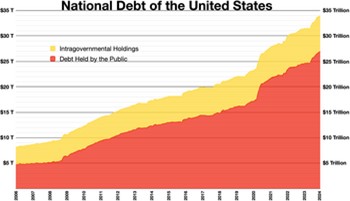
The current challenges for our economy and financial stability are the validity of information, the dependency of the federal government on the Federal Reserve System as either the lender of ‘last resort’ or ‘first resort,’ declining credit ratings of governments and corporations, and the fact that short-term liabilities are rarely paid off.  The federal deficit of the United States government is 33 trillion dollars and increased borrowing for social security, Medicare, infrastructure improvements, and assistance from extreme weather events are hurricane force winds facing our economy.

As of June 2024, the federal debt is $34.55 trillion dollars and between 110% and 117% of our annual GDP with full employment and moderate inflation.

It is critical that social studies teachers integrate economic history into their lessons, encourage problem-solving and decision-based case studies, engage students in discussions with local financial experts in your community, an understanding of where money comes from, and the differences between the tax and money multipliers.

  1. What are the effects of a 10% protective tariff?
  2. How does a 1% change in the rate of inflation affect the federal budget?
  3. How do changes in the federal income tax structure affect the national economy?
  4. What are the implications of a decrease in the credit rating of the United States?  Why does a credit rating change?
  5. Will the increased demands of the federal government to finance its debt through bonds lead to ‘crowding out’ for municipal, state, and private corporations?
  6. Who will be the effective borrowers in the next decade?

Students will also gain valuable lessons through engaging conversations through their analysis of excerpts from the classical economists of Adam Smith, David Riccardo, and Thomas Malthus.  Perspectives of Karl Marx, Joseph Schumpeter, Frederick Hayek, Milton Friedman, Paul Samuelson, and others are important. Consider a dinner conversation, Madame Tussauds Wax Museum Hall of Fame, Press Conference, or digital video production. Here is an example of a reference in the book.

“Adam Smith remains a useful guide to the hallmarks of capitalism.  In The Wealth of Nations (1776), he argued that humans innately strive for material progress, and the best way to get there is through unfettered competition, the division of labor, and free trade.  Smith argued that the state should play a limited role in economic affairs.  Governments should be properly confined to national security, the rule of law-including the protection of private property – and the provision of a few public goods which as education.  He also cautioned against sharp class divisions that might idle rich people and exploit workers.  ‘No society can surely be flourishing and happy, of which the far greater part of the members is poor and miserable.’” (Kaufman, Page 167)’

One final observation about The Day the Markets Roared is the insights into the internal operations of businesses before the age of social media.  The lessons of power, leadership, profit motive, media image, responding to a crisis, understanding how financial markets react to political changes are revealed in Chapters 3-7.

The book is easy to read, includes interesting insights and perspectives, and is one of the few books I am aware of that provide a concise and accurate economic history of the 1970s and 1980s.

Seven Steps to Raising a Bilingual Child

Reviewed by Thomas Hansen, Ph.D.

The author presents here a very clear guide for parents who wish to raise their children to become bilingual speakers.  The author uses a variety of language examples, plus stories of real parents whose children have become proficient in more than one language because of the help and planning of their parents.  There are seven clear steps here, the most important of which is planning to start at a certain point and then maintain one’s interest and devotion to raising the child to be bilingual.

With background in developmental-behavioral pediatrics, this physician is an expert in how children learn languages.  She is raising her own children to be multilingual, and she understands the perspective of the parent.  This is perhaps why she is able to relate to parents and put the technical information into terms parents will appreciate.  

The author presents seven myths of bilingual learning—such as the notion that not all kids can learn another language.  The myths are the typical ones we as language teachers often hear, whether we teach world languages, language arts, English as a second language programs (ESL), or bilingual education.  Little kids are resilient, and their brains are wired for communication.  The author does a good job of reminding parents of these facts.

The author explains to parents the importance of letting students develop all four skills areas, meaning listening, then speaking, then reading, and finally writing.  This is the natural order in which children learn languages—at least predominantly—but some of us in second language teaching are great advocates for teaching the skills in a more integrated fashion, even from the early stages.  However, we still realize first-graders should not be expected to write term papers in the target language!

Steiner provides other notes for the parents to help them tailor the language teaching and language learning experiences at home to their unique children.  Each child is different, and one important point is that some children will learn the second language at slower rates than others.  The author provides ideas on how to deal with these kinds of issues in the quest for language proficiency.

Overall, I will recommend the book, but there are a few comments I will make on it.  One weakness is that the explanation of bilingual education and ESL programs (pp. 155-158) is a bit vague.  The author tries to summarize in just a few short paragraphs rather diverse programs.  As most language teachers can tell you, each district—sometimes each building—has a very different model in use. 

Note that teachers and administrators of many types of programs may take issue with what the author says on various pages about school programs (e.g., pp. 80, 155) because the explanation simply cannot be done in such a short space.  If you recommend this book to parents or to parent groups, please warn them about some of those passages.  

The information about dual language is pretty much accurate, and the point is made that most programs in the nation are for French/English and Spanish/English experiences.  However, the parent will need to seek out the programs in their own or nearby schools and districts. 

Note that it is often very hard to locate dual language programs in the state since there is rarely a statewide directory in place (in Illinois for example) and because of the way the teachers’ workload is reported to the state education agency.  In many cases, a dual language teacher is simply registered by the district as an “elementary grade teacher.”  The same is true of teachers who teach foreign language in the elementary schools (FLES) programs.

The good news, though, is that there are very effective and well-established programs out there that are flourishing.  For example, Chicago Public Schools (District 299) lead the way in innovative language programs and dual language initiatives.  Staff members there can help you with questions and can help direct parents to certain schools with new and interesting language programs in place. 

Illinois also is one of the leaders nationwide in the number of FLES programs available to students in K-8 buildings.  This is not even counting Saturday, after-school, and immersion language programs—all of which exist in Chicago and many of the suburban schools.

One benefit of the book is the way the author relates to parents and knows what challenges they may face.  For example, the author explains how to approach the foreign language teacher if you have a child who has been speaking another language at home and who should be in more advanced levels than the school is planning. 

Readers should remind parents that sometimes they will need to be assertive indeed in getting their kids into the right levels so they are not bored to death in a beginning level too easy for them.  The author mentions also that the kids could start a different language in higher grade levels, but parents should fight against this.  The ACTFL and state standards remind us students need long-term programs–complete with high-quality classroom instruction in all four skills areas.      

Another benefit is that the author reminds parents (pp. 39-40) that foreign language exploratory (FLEX) programs simply do not produce much proficiency and the parents should not expect much from them.  It is important for parents to get this fact! 

As an aside, I will also mention that these programs stand in the way of other language programs becoming planned and put into place because the FLEX programs appear to “offer something” in the realm of language teaching—even though they do not produce much. 

Another issue is that many people will say something like, “Well with the FLEX program at least we have something going on.”  With that, they do not commit funds to start a bona fide educational program with the goal of creating language proficiency.

Because the author has a very different perspective on language learning and parenting, I think she can explain things in ways parents understand.  The book is a good foundation for parents, and it could also work for school boards looking to increase their language program offerings.   

Mexican Women Factories: Free Trade and Exploitation on the Border

Reviewed by Thomas Hansen, Ph.D.

Ella Howard studies Mexican women working along the border in “maquilas” or factories, some of the more oppressive ones being referred to sometimes as “sweat shops.”  She conducts a quantitative component in the form of a survey to be completed by women, followed by a qualitative component in the form of one-on-one interviews following up on what is revealed in the surveys.  I focus here on how the book is organized, the kinds of questions Howard asks the women, and some of the topics for students to study.

Howard organizes the book by discussing the history of the border factories and the city of Nogales—which sits in two different countries.  She includes a history of the maquila industry and seeks to discover whether the industry has brought about liberation or exploitation of the women.  She also includes chapters on how she designed her study, what the study revealed, and ways we can think about what she discovered.  She also uses throughout the book the process of comparison-contrast, namely looking both at what is similar and what is different.

Howard poses questions related to both the working and living conditions of the women who are employed in the factories.  She also asks questions related to quality of life, purpose of the work, feelings women develop as a result of their work, demands, schedules, and earnings.  She includes in-depth discussion of the dwellings in which the women find themselves, the kinds of appliances they may have, the floor coverings, the furniture, and the utilities.  Howard reveals some very interesting details indeed about the “colonias” in which the women live.

There is a great deal revealed in this book about Mexican culture, American corporate greed, border communities, poverty, wealth, fairness, and other topics.  The reader will learn so much from looking at the situation, discovering what *NAFTA was supposed to achieve, and digesting the details of how things are for the people directly impacted by all of the new international factories found along the border.  This book is important reading for people who want to consider themselves informed voters, American citizens, and humane persons.

I recommend the book for many readers, but especially for educators dealing with these kinds of topics in their classes: border communities, American business practices, US bills and laws, international trade and business, Mexican culture, gender roles, cultural differences, wealth and poverty, trade agreements, and the both the history and impact of NAFTA.  The book is important as a history textbook, cultural book, and personal reading for teachers.  As educators, it is crucial we include fairness, advocacy, and empathy in our daily work.  It is also good to look at things from more than one perspective.  It is interesting to look at phenomena in their own context sometimes, and also revealing to look at things in a more universal way. 

Made in New York: 25 Innovators Who Shaped Our World

When singer Frank Sinatra famously crooned about New York, “If I can make it there, I’ll make it anywhere,” he could have been talking about New York’s great inventors whose works have travelled across the globe. New York has been a hotbed of innovation since its founding. Made in New York tells the stories behind the innovators and their inventions. Like many New Yorkers, some came from elsewhere to find success in their new home. Some became famous; others struggled for recognition. All were visionaries and risk-takers who were willing to put their lives on the line if necessary. From the first brassiere to the life-saving pacemaker, and from a solar lantern to the first mass-produced cameras, New York has been the seedbed of life-changing technologies that have altered how we live. Made in New York celebrates these compelling stories.

The Eight: The Lemmon Slave Case and the Fight for Freedom

The Eight tells the story of Lemmon v. New York—or, as it’s more popularly known, the Lemmon Slave Case. All but forgotten today, it was one of the most momentous civil rights cases in American history. There had been cases in which the enslaved had won their freedom after having resided in free states, but the Lemmon case was unique, posing the question of whether an enslaved person can win freedom by merely setting foot on New York soil—when brought there in the keep of an “owner.” The case concerned the fates of eight enslaved people from Virginia, brought through New York in 1852 by their owners, Juliet and Jonathan Lemmon. The Eight were in court seeking, legally, to become people—to change their status under law from objects into human beings. The Eight encountered Louis Napoleon, the son of a slave, an abolitionist activist, and a “conductor” of the Underground Railroad, who took enormous risks to help others. He was part of an anti-slavery movement in which African Americans played an integral role in the fight for freedom. The case was part of the broader judicial landscape at the time: If a law was morally repugnant but enshrined in the Constitution, what was the duty of the judge? Should there be, as some people advocated, a “higher law” that transcends the written law? These questions were at the heart of the Lemmon case. They were difficult and important ones in the 1850s—and, more than a century and a half later, we must still grapple with them today.

Growing Up Roosevelt: A Granddaughter’s Memoir of Eleanor Roosevelt

Local History from SUNY Press

When Nina Roosevelt was just seven years old, her family moved from California to live with her grandmother at the small cottage, Val-Kill, in Hyde Park, New York. It was at Val-Kill Farm that Nina shared her childhood years with her remarkable grandmother, the woman who would change her life. To Nina, she was Grandmère, but, to most everyone else, she was Eleanor Roosevelt. Few people realize how important Val-Kill was for Eleanor Roosevelt. Returning “home again” nourished her, allowed her time for reflection, planning, and rejuvenation so that she could continue pouring her heart and soul into the needs of so many people the world over. Growing Up Roosevelt gives an intimate picture of life at Val-Kill as well as Nina’s wide-ranging experiences traveling as a teenager with her grandmother. When Nina Roosevelt was just seven years old, her family moved from California to live with her grandmother at the small cottage, Val-Kill, in Hyde Park, New York. It was at Val-Kill Farm that Nina shared her childhood years with her remarkable grandmother, the woman who would change her life. To Nina, she was Grandmère, but, to most everyone else, she was Eleanor Roosevelt.

Few people realize how important Val-Kill was for Eleanor Roosevelt. Returning “home again” nourished her, allowed her time for reflection, planning, and rejuvenation so that she could continue pouring her heart and soul into the needs of so many people the world over. Growing Up Roosevelt gives an intimate picture of life at Val-Kill as well as Nina’s wide-ranging experiences traveling as a teenager with her grandmother. Included are portraits of the family, staff, famous friends, people in need, and world leaders as disparate as Nikita Khrushchev, Haile Selassie, and John F. Kennedy. This book will appeal to anyone interested in the life and times of Eleanor Roosevelt, her work as a trailblazing political and feminist leader, and the intimate behind-the-scenes details that only her granddaughter can tell. Biographer Blanche Wiesen Cook writes “the woman Nina Roosevelt Gibson called Grand-Mere was Eleanor Roosevelt, and in Growing Up Roosevelt she vividly captures what it was like to spend a dozen formative years within the orbit of that extraordinary woman. She evokes the sights and sounds and changing seasons at her grandmother’s tranquil haven at Val Kill and also reveals what it was like to tag along on one of her frenetic trips abroad. No one interested in the Roosevelts will want to miss these warm and loving memories.”

Clifford Case and the Challenge of Liberal Republicanism

The first speech Rep. Clifford Case spoke on the floor of the U.S. Capitol on June 11, 1945, should be taught to every student studying World War II and the Civil Rights era. The speech is printed in the opening paragraphs and defines Clifford Case as a public servant and human rights advocate. His statement below was a response to the defense of poll taxes as a voting requirement by Congressman John E. Rankin (D) who advocated for the mass incarceration of Japanese Americans after Pearl Harbor, the mass deportation of Japanese Americans after the war, segregation, attacked Associate Justice Felix Frankfurter, questioned the patriotism of African Americans, and explicitly spoke of racial equality as a slippery slope leading to the end of the white man’s civilization on the planet.

“Mr. Chairman, I am native-born, white, a gentile-a Protestant. That I am these things entitles me to no special status or distinction.  Indeed, I had no choice in any of them, except the last.”

Most students and teachers will have no prior knowledge of Clifford Case. I voted for him in 1972 in my first opportunity to cast a ballot for senator in New Jersey. Who is he and how did his career path lead him to be a public servant for the residents of New Jersey?

 Clifford was a preacher’s kid, born in Franklin Park, a small community of farmers, craftsmen, and a few merchants.  He was baptized in the historic Six Mile Run Reformed Church, where his father was the pastor. This church dates back to 1710.

His father accepted a call to the Second Reformed Church in Poughkeepsie, NY when he was three years old. Clifford attended the schools in Poughkeepsie. His father unexpectedly died of pneumonia in 1920, when Clifford was age 16 and a junior in high school.  His father’s church would merge with the First Reformed Church in Poughkeepsie in 1923, in a newly built church.

Rev. Clifford Case resigned as “Old First” pastor.  At the first meeting of the new consistory on January 7 he was called as the pastor of the united congregations. Thus, the Mill Street or Second Reformed Church became the fifth house of worship of The Reformed Dutch Church of Poughkeepsie.  Rev. Case remained its pastor until his death on March 7, 1920.  His picture hangs at the entrance to the present Reformed Church’s ‘Case Chapel.’ (http://churches.rca.org/poughkeepsierc/Booklet2014A.pdf)

Clifford returned to New Jersey to attend Rutgers University where he enjoyed courses in civics, constitutional history, U.S. history, European history, and literature. He met Ruth Smith, from Linden, NJ, who was a student in the New Jersey College for Women at Rutgers (Douglass), where Barnard College graduate Mabel Smith Douglass was the Dean. They both enjoyed the music and dancing. (After all, this is the ‘Roaring 20’s!)  The humor of Bill Fernekes, author, is captured through his interview with Mary Jane Weaver, Clifford and Ruth’s daughter.

Following Rutgers, Clifford attended Columbia Law School and Ruth taught English at Linden High School. They were married in July 1928 and honeymooned in Europe. Columbia law curriculum was unique with its emphasis on interdisciplinary courses and an understanding of the social problems in society. Following his graduation, he joined the law firm of Thatcher, Simpson and Bartlett in Manhattan and worked with Cyrus Vance. Clifford and Ruth moved to Rahway and he commuted to work.

The biography written by Bill Fernekes provides insights into the power of the local and state political party ‘machine’ and why some politicians, like Clifford Case, take positions that are to the left or right of the center. It is a fascinating perspective on competitive democracy, the influence of the Hague machine in the Democratic Party in New Jersey, and the views of the media and residents regarding segregation, foreign policy, labor, health care, to identify a few of the public issues that Clifford Case held liberal Republican views.

His first election to the Rahway Council in 1937 was decided by 311 votes. (page 20) He advocated for transparency in local government and an end to the private caucuses between small groups of council members. The 1930’s was a difficult decade in the United States but in particular this was a time of prosperity for some in New Jersey and poverty for others who were without employment. Teachers in high school emphasize the Great Depression and the New Deal and this book provides some insight into the importance of local government.  Rahway was a place for large manufacturing companies and a major station on the Pennsylvania RR. Clifford Case also served on the Board of Foreign missions for the Presbyterian Church, which gave him a valued perspective on the abuses faced by others living in a dangerous world.

Cherry Street in Rahway, NJ, circa, 1920

In 1941, Clifford Case campaigned in the primary election for the Republican Party nomination in the NJ Assembly.  The Frank Hague political machine had a powerful influence in New Jersey, making it almost impossible for Republican candidates from northern New Jersey to win.  Hague’s influence secured governors from the Democratic Party and Thomas Brogan as Chief Justice, who would dismiss challenges of election fraud at this time. Hague also influenced the candidates for local and state positions in the Republican Party. Although Case did not secure the Republican Party nomination in 1941, he prevailed in 1942. He understood the importance of campaigning on a personal level in towns in Union County, especially Cranford, Elizabeth, Hillside, New Providence, Roselle, and Westfield. The result was a victory with a margin of more than 16,000 votes.

The context of the information in the chapter, “Development of a Political Servant” is important for students studying political institutions and/or local New Jersey history during World War II because of its relevance to voter fraud issues, campaign strategies and promises, the use of voting machines, and the outcome of elections. The lessons in the past provide insight into how fragile democracy has been over time.  Case’s term in the NJ Assembly resulted in significant legislation for civil service reforms certification for lawyers, and legal status for ride sharing, which became a necessity with fuel rations during World War II.  

The depth of the research and perspective in this book is with the legislative decisions and sponsorships of Congressman and later Senator Clifford Case. The historic context of civil rights, segregation, anti-lynching, and labor bills provide important information for teachers regarding the teaching of these standards-based indicators for high school students. For teachers who are committed to historical inquiry and decision-making lessons, Clifford Case and The Challenge of Liberal Republicanism is a book that must be read!  Let’s examine two case studies:

Segregation:  The incident of Isaac Woodward (Woodard), a black World War II veteran, who was in his uniform, at a bus stop in Batesburg, South Carolina on February 12, 1946, motivated the first significant legislation proposed by Congressman Case in 1947.

Although more than 200 federal anti-lynching bills have been introduced since 1918 none of them became a law. The Justice for Victims of Lynching Act of 2018, co-sponsored by NJ Senator Cory Booker and now V.P. Kamala Harris, finally became law in 2022.  The Case bill introduced in 1948 (HR3488) is important because of the continuing relevance of this issue which has continued without agreement for over 140 years!  Students need to understand the slow process of our Legislative Branch in reaching agreement on controversial issues such as guns, health care, rights of women, and other timely issues. The perspective below leads to historical inquiry in the classroom about continuity and change in history.

Clifford Case’s position as a congressman on the Taft Hartley Act provides an opportunity for students to understand the important labor issues of the 20th century. In our current service-sector economy the issues discussed on the classroom are likely a fair minimum wage, medical benefits, and the wage gap between men and women. In the middle of the 20th century, The Taft Hartley Act of 1947 was unpopular with labor and unions. The sponsors were Senator Robert Taft (R-Ohio) and Congressman Fred Hartley (R-New Jersey).  New Jersey was a manufacturing state and unions were an important part of life for most families. After World War II there were shortages of many goods and prices were inflated. Unions used this time to expand their membership and there were frequent strikes and boycotts demanding higher pay and better benefits. After Churchill’s Iron Curtain Speech on March 5, 1946, Americans feared communism and strikes and unions were associated with socialism and communism.

In this political climate, Clifford Case introduced a bill to restrict the power of organized labor, co-sponsored a bill with Christian Herter that did not become law, and voted for the Taft Hartley Act and after President Truman’s veto of Taft Hartley he voted to override the president’s veto. Although Case was re-elected in 1948, eighty-two congressmen who supported Taft-Hartley were not re-elected. Labor and the Democratic Party were determined to repeal Taft Hartley and Clifford Case was faced with a difficult decision. He voted against the Wood bill which retained most of the provisions in the Taft Hartley Act. The competitive arguments between the Wagner and Taft Hartley Act, the right to work and the right to strike, are critical issues for workers, public safety, and the American economy. Visit the resources in the Truman Library for the reasons why the Taft Hartley Act was harmful and see if your students agree or disagree with President Truman and Congressman Case.

Students in New Jersey, and likely most other states learn about the McCarthy hearings and the threat of communism to the stability of the government of the United States and the spreading of this ideology around the world. Clifford Case became a senator in January 1955 and was faced with the threat of communism in China, Southeast Asia, Africa, and in the United States. Senator McCarthy and Senator Case were members of the Republican Party. The performance expectation for high school students in New Jersey is “Analyze efforts to eliminate communism, such as McCarthyism, and their impact on individual civil liberties.” 

The campaign for Senate in New Jersey is a race that teachers should consider including when teaching about communism and McCarthyism. Case stated that if elected he would remove the powerful Senator Joseph McCarthy as chairman of all committees. Case will win the election against Rep. Charles Howell by 3,369 votes which was challenged by a recount that validated a win for Clifford Case by 3,507 votes. The 84th Congress had the Senate divided with 48 Democrats, 47 Republicans, and 1 Independent. Although McCarthy’s influence was declining by the summer of 1954, the media labeled Clifford Case as being soft on communism and Stalin’s choice for Senator. One question for students to explore is: ‘Why did Case take such a strong position against McCarthy when he could have moderated his criticisms and left McCarthy to self-destruct, following President Eisenhower’s lead?  

Clifford Case was also confronted with the conservatism of Senator Barry Goldwater and his attempts to eliminate communism in the 1960s and as the Republican Party’s candidate for president in 1964. Again, teachers should consider his positions on civil rights, communism, nuclear weapons, and his vision for the future of the GOP. This is an opportunity to teach the influence of local and state government and the influence of state political leaders in both political parties. There was a price to pay for challenging the powerful and conservative Republican leaders in New Jersey and Senator Case was the only elected Republican who would not endorse Barry Goldwater in 1964.

One of the hidden gems in this scholarly book is the ‘big picture of American history from Truman to Carter. This includes the period of 1945-1975, which some historians consider the zenith of American power when the world looked to the United States for moral leadership, economic leadership, and as the protector of freedom and democracy from the threats of communism and terrorism.

The opportunity to view this period of American domestic and foreign policy through the lens of a public servant provides an opportunity for inquiry and study by students. For teachers who provide direct instruction through primary source materials, the quotes in this book by Clifford Case provide unique insights into why a Republican congressional representative and senator challenged members within his political party and found ways to educate every president with his perspective. For teachers who differentiate instruction and enable students to investigate essential questions, the quotes and narrative in this book provide a resource for understanding the big picture of American history.

Here is an example from Senator Case on his opposition to President Nixon’s nomination of Clement Haynsworth as Associate Justice to the U.S. Supreme Court in 1969.

One of my observations after reading this book is that the challenges facing our government today are different but also very similar to the challenges our democracy faced when Clifford Case served in Congress.  The major issues that Senators Clifford Case (R) and Harrison Williams (D) from New Jersey had positions on are the foundation of all curriculum and courses relating to 20th century American history and likely include:

NSC-68                                                   Cuban Missile Crisis                                             Middle East

McCarran Walter Act                          Southeast Asia                                                      Inflation & Recession

Korean Conflict                                     Civil Rights Act                                                      Watergate

McCarthy Hearings                              Voting Rights Act                                                  Energy Independence

School Desegregation                          Immigration and Nationality Act                       War Powers Act

National Highway Act                          Environmental Protection Act                           Human Rights

The three chapters on the Vietnam War (Chapters 14, 15, and 16) provide a comprehensive picture of the conflicts between the legislative and executive branches that has particular utility for teachers of American history and government. Dr. Fernekes provides insights into the debates about funding, responsibilities for declaring and fighting wars, negotiated agreements, the death of civilians, and transparency between the branches. His perspective is scholarly, analytical and clear with carefully numbered observations. Senator Case was an outspoken supporter of American engagement in Vietnam who became an outspoken critic.  His perspective is critical to studying this period of history and although Vietnam is different than the Persian Gulf, Iraq, Afghanistan, Syria, Ukraine, and Israel, the similarities of the debate and division provide teachers with an opportunity to gather evidence for inquiry and building a thesis. Here are two examples in the words of Clifford Case:

The second example provides both the context for the continuing support of the United States for Israel and the complexity of debate among members of Congress and the position of the president in the words of Senator Case in 1978 about an arms package to the Middle East.

Senator Case also served during the time when the Republicans controlled the House, Senate, and Executive Brank from 1953-1955 and when the Democrats controlled the House, Senate, and Executive Branch in the Sixties. Clifford Case was also an important voice in defining the vision of the Republican Party after the 1964 election. The perspective of his local New Jersey voice is necessary to grasp the struggle behind each of the issues above. Students should also use the Library of Congress sources of Thomas to and Chronicling America for information.

The book includes excellent photographs and images of political cartoons from newspapers and the Works Cited sources are also helpful. There is a Digital Exhibit at Rutgers that was created by Dr. William Fernekes, the author.  https://exhibits.libraries.rutgers.edu/clifford-p-case Although the book is expensive at $135.00, it is a book that should be in every high school, college, and public library in New Jersey. Clifford Case and the Challenge of Liberal Republicanism

Book Review: Transformative Assessment, by W. James Popham

Unlike the majority of short paperbacks published by ASCD, this book does not seem to lend itself so well to use in very brief meetings with teachers or teacher candidates.  While many ASCD titles work well on weekend retreats or for “introduction, discussion, and application” in a one-day workshop, this one may need to be used in several meetings. 

Because of the complicated presentation of the four major levels of formative assessment and the steps to using each one, presenters or teacher-educators may wish to assign a chapter and then cover it separately from others.  The problem with adding so much complicated work to a busy teacher’s workday or semester is that a teaching tool meant to improve one’s teaching can have an adverse effect: it can confuse educators to the point that they give up trying to use it.

The author tells us there are four different levels of formative assessment, starting with the teacher’s strategies for checking on students’ ongoing mastery of concepts and ranging all the way to schoolwide implementation of the process.  He tells us of the development of the term and shows the interest in this process, starting with work done by the Council of Chief State School Officers.  Growing out of the work on formative assessment is Popham’s work with “transformative” aspects of assessment, meaning the ways in which a school can be changed at those four levels.     

Popham here presents a helpful but difficult explanation of formative assessment, beginning by explaining that this process is one used by teachers as a way to monitor student learning and by students as a way to assess whether they are digesting the pieces of information being covered by the teacher.  It has a constructivist aspect to it, in that the students are supposed to get better as figuring out what they should know and how they should be able to show it.

Murky begets murky, though, and on top of the four different levels of formative assessment there are different stages that need to be given attention.  This makes the confusion a little more pointed, and it may be that many busy educators simply don’t have the energy to focus on what is being proposed here.  There is, however, a very clear discussion of how standardized testing works, and why 1) it is not a form of formative assessment; 2) it does not necessarily reflect good teaching; and 3) it does not necessarily improve in a building where educators have embraced the strategies and principles of formative assessment.

The above negative points having been made, I would recommend that you regard this text as a good resource and a decent overview of formative assessment and Popham’s version of it.  However, you as teacher educators and classroom experts in your own right will have to decide whether you have a good use for this short book.  I might use it as optional reading in an advanced course for students who would have experience teaching and who could critique it for themselves.