The Eight: The Lemmon Slave Case and the Fight for Freedom
By Albert Rosenblatt
The Eight tells the story of Lemmon v. New York—or, as it’s more popularly known, the Lemmon Slave Case. All but forgotten today, it was one of the most momentous civil rights cases in American history. There had been cases in which the enslaved had won their freedom after having resided in free states, but the Lemmon case was unique, posing the question of whether an enslaved person can win freedom by merely setting foot on New York soil—when brought there in the keep of an “owner.” The case concerned the fates of eight enslaved people from Virginia, brought through New York in 1852 by their owners, Juliet and Jonathan Lemmon. The Eight were in court seeking, legally, to become people—to change their status under law from objects into human beings. The Eight encountered Louis Napoleon, the son of a slave, an abolitionist activist, and a “conductor” of the Underground Railroad, who took enormous risks to help others. He was part of an anti-slavery movement in which African Americans played an integral role in the fight for freedom. The case was part of the broader judicial landscape at the time: If a law was morally repugnant but enshrined in the Constitution, what was the duty of the judge? Should there be, as some people advocated, a “higher law” that transcends the written law? These questions were at the heart of the Lemmon case. They were difficult and important ones in the 1850s—and, more than a century and a half later, we must still grapple with them today.
Growing Up Roosevelt: A Granddaughter’s Memoir of Eleanor Roosevelt
By Nina Roosevelt Gibson
When Nina Roosevelt was just seven years old, her family moved from California to live with her grandmother at the small cottage, Val-Kill, in Hyde Park, New York. It was at Val-Kill Farm that Nina shared her childhood years with her remarkable grandmother, the woman who would change her life. To Nina, she was Grandmère, but, to most everyone else, she was Eleanor Roosevelt. Few people realize how important Val-Kill was for Eleanor Roosevelt. Returning “home again” nourished her, allowed her time for reflection, planning, and rejuvenation so that she could continue pouring her heart and soul into the needs of so many people the world over. Growing Up Roosevelt gives an intimate picture of life at Val-Kill as well as Nina’s wide-ranging experiences traveling as a teenager with her grandmother. When Nina Roosevelt was just seven years old, her family moved from California to live with her grandmother at the small cottage, Val-Kill, in Hyde Park, New York. It was at Val-Kill Farm that Nina shared her childhood years with her remarkable grandmother, the woman who would change her life. To Nina, she was Grandmère, but, to most everyone else, she was Eleanor Roosevelt.
Few people realize how important Val-Kill was for Eleanor Roosevelt. Returning “home again” nourished her, allowed her time for reflection, planning, and rejuvenation so that she could continue pouring her heart and soul into the needs of so many people the world over. Growing Up Roosevelt gives an intimate picture of life at Val-Kill as well as Nina’s wide-ranging experiences traveling as a teenager with her grandmother. Included are portraits of the family, staff, famous friends, people in need, and world leaders as disparate as Nikita Khrushchev, Haile Selassie, and John F. Kennedy. This book will appeal to anyone interested in the life and times of Eleanor Roosevelt, her work as a trailblazing political and feminist leader, and the intimate behind-the-scenes details that only her granddaughter can tell. Biographer Blanche Wiesen Cook writes “the woman Nina Roosevelt Gibson called Grand-Mere was Eleanor Roosevelt, and in Growing Up Roosevelt she vividly captures what it was like to spend a dozen formative years within the orbit of that extraordinary woman. She evokes the sights and sounds and changing seasons at her grandmother’s tranquil haven at Val Kill and also reveals what it was like to tag along on one of her frenetic trips abroad. No one interested in the Roosevelts will want to miss these warm and loving memories.”
Clifford Case and the Challenge of Liberal Republicanism
By William R. Fernekes
Reviewed by Hank Bitten, NJCSS Executive Director
The first speech Rep. Clifford Case spoke on the floor of the U.S. Capitol on June 11, 1945, should be taught to every student studying World War II and the Civil Rights era. The speech is printed in the opening paragraphs and defines Clifford Case as a public servant and human rights advocate. His statement below was a response to the defense of poll taxes as a voting requirement by Congressman John E. Rankin (D) who advocated for the mass incarceration of Japanese Americans after Pearl Harbor, the mass deportation of Japanese Americans after the war, segregation, attacked Associate Justice Felix Frankfurter, questioned the patriotism of African Americans, and explicitly spoke of racial equality as a slippery slope leading to the end of the white man’s civilization on the planet.
“Mr. Chairman, I am native-born, white, a gentile-a Protestant. That I am these things entitles me to no special status or distinction. Indeed, I had no choice in any of them, except the last.”
“Mr. Chairman, no group in this country has a monopoly on patriotism. Men of all races, colors, and creeds, whether native-or foreign born, have equally sacrificed their lives or given the best years of their youth in this war. The casualty lists show that, as do the gold stars in the windows of homes, both high and humble, in every city, town, and hamlet, and on the farms throughout the land. I suppose there are not many Jews in the State of Mississippi, but I am convinced that their casualties are in proportion to their number in the population, as they are all over the country. And if that be not true of the Negroes, it is due, I am sure to no lack of courage or patriotism on their part, but rather to these two reasons: First, that, because of poverty and lack of equal educational and economic opportunity for generations, the percentage of Negro draft rejections on medical and mental grounds is far above the average for other groups. Second, that, to some extent, they may have been given noncombat service of one kind or another more often than most other groups. Obviously, both of these factors have been quite beyond the control of the Negroes themselves. I am sure the records of this war will vindicate fully the heroism of the Negro combat soldier.” (page 6)
Most students and teachers will have no prior knowledge of Clifford Case. I voted for him in 1972 in my first opportunity to cast a ballot for senator in New Jersey. Who is he and how did his career path lead him to be a public servant for the residents of New Jersey?
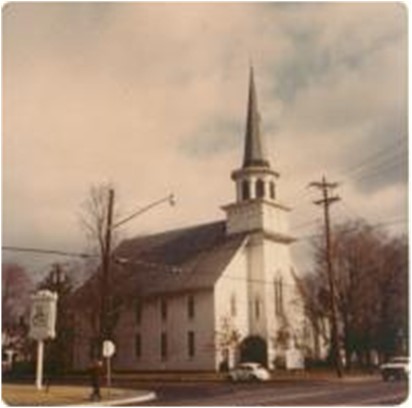
Clifford was a preacher’s kid, born in Franklin Park, a small community of farmers, craftsmen, and a few merchants. He was baptized in the historic Six Mile Run Reformed Church, where his father was the pastor. This church dates back to 1710.
His father accepted a call to the Second Reformed Church in Poughkeepsie, NY when he was three years old. Clifford attended the schools in Poughkeepsie. His father unexpectedly died of pneumonia in 1920, when Clifford was age 16 and a junior in high school. His father’s church would merge with the First Reformed Church in Poughkeepsie in 1923, in a newly built church.
Rev. Clifford Case resigned as “Old First” pastor. At the first meeting of the new consistory on January 7 he was called as the pastor of the united congregations. Thus, the Mill Street or Second Reformed Church became the fifth house of worship of The Reformed Dutch Church of Poughkeepsie. Rev. Case remained its pastor until his death on March 7, 1920. His picture hangs at the entrance to the present Reformed Church’s ‘Case Chapel.’ (http://churches.rca.org/poughkeepsierc/Booklet2014A.pdf)
Clifford returned to New Jersey to attend Rutgers University where he enjoyed courses in civics, constitutional history, U.S. history, European history, and literature. He met Ruth Smith, from Linden, NJ, who was a student in the New Jersey College for Women at Rutgers (Douglass), where Barnard College graduate Mabel Smith Douglass was the Dean. They both enjoyed the music and dancing. (After all, this is the ‘Roaring 20’s!) The humor of Bill Fernekes, author, is captured through his interview with Mary Jane Weaver, Clifford and Ruth’s daughter.
“Arriving late “Buddy” Case was slightly embarrassed because his pants were split and he covered the tear with his music folder, a fact detected by the observant Ruth…. She (Ruth Case) would tell me the story of how she met this handsome, athletic Rutgers student, with a strong tenor singing voice. She would plan her departure from her dorm to coincide with him.” (page 14)
Following Rutgers, Clifford attended Columbia Law School and Ruth taught English at Linden High School. They were married in July 1928 and honeymooned in Europe. Columbia law curriculum was unique with its emphasis on interdisciplinary courses and an understanding of the social problems in society. Following his graduation, he joined the law firm of Thatcher, Simpson and Bartlett in Manhattan and worked with Cyrus Vance. Clifford and Ruth moved to Rahway and he commuted to work.
The biography written by Bill Fernekes provides insights into the power of the local and state political party ‘machine’ and why some politicians, like Clifford Case, take positions that are to the left or right of the center. It is a fascinating perspective on competitive democracy, the influence of the Hague machine in the Democratic Party in New Jersey, and the views of the media and residents regarding segregation, foreign policy, labor, health care, to identify a few of the public issues that Clifford Case held liberal Republican views.
His first election to the Rahway Council in 1937 was decided by 311 votes. (page 20) He advocated for transparency in local government and an end to the private caucuses between small groups of council members. The 1930’s was a difficult decade in the United States but in particular this was a time of prosperity for some in New Jersey and poverty for others who were without employment. Teachers in high school emphasize the Great Depression and the New Deal and this book provides some insight into the importance of local government. Rahway was a place for large manufacturing companies and a major station on the Pennsylvania RR. Clifford Case also served on the Board of Foreign missions for the Presbyterian Church, which gave him a valued perspective on the abuses faced by others living in a dangerous world.
Cherry Street in Rahway, NJ, circa, 1920
“Rahway’s municipal government established a separation between a mayor who oversaw daily city operations, and the Common Council, which set priorities, functioned in an oversight role regarding city operations, and provided resources for funding municipal operations and services. With Clifford P. Case and Sherman Lusk as the only two Republican council members, any influence they desired would require coalition building with Democrats.” (page 21)
In 1941, Clifford Case campaigned in the primary election for the Republican Party nomination in the NJ Assembly. The Frank Hague political machine had a powerful influence in New Jersey, making it almost impossible for Republican candidates from northern New Jersey to win. Hague’s influence secured governors from the Democratic Party and Thomas Brogan as Chief Justice, who would dismiss challenges of election fraud at this time. Hague also influenced the candidates for local and state positions in the Republican Party. Although Case did not secure the Republican Party nomination in 1941, he prevailed in 1942. He understood the importance of campaigning on a personal level in towns in Union County, especially Cranford, Elizabeth, Hillside, New Providence, Roselle, and Westfield. The result was a victory with a margin of more than 16,000 votes.
The context of the information in the chapter, “Development of a Political Servant” is important for students studying political institutions and/or local New Jersey history during World War II because of its relevance to voter fraud issues, campaign strategies and promises, the use of voting machines, and the outcome of elections. The lessons in the past provide insight into how fragile democracy has been over time. Case’s term in the NJ Assembly resulted in significant legislation for civil service reforms certification for lawyers, and legal status for ride sharing, which became a necessity with fuel rations during World War II.
The depth of the research and perspective in this book is with the legislative decisions and sponsorships of Congressman and later Senator Clifford Case. The historic context of civil rights, segregation, anti-lynching, and labor bills provide important information for teachers regarding the teaching of these standards-based indicators for high school students. For teachers who are committed to historical inquiry and decision-making lessons, Clifford Case and The Challenge of Liberal Republicanism is a book that must be read! Let’s examine two case studies:
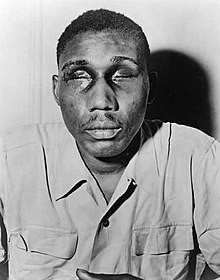
Segregation: The incident of Isaac Woodward (Woodard), a black World War II veteran, who was in his uniform, at a bus stop in Batesburg, South Carolina on February 12, 1946, motivated the first significant legislation proposed by Congressman Case in 1947.
“An especially vicious attack occurred in South Carolina in February 1946, when recently discharged army veteran Isaac Woodward was assaulted by a white sheriff and his deputy after having been pulled off an interstate bus when the driver complained Woodward took too much time during a restroom stop and quarreled with him.,. Woodward was removed from the bus, violently beaten by Sheriff Linwood Shull and his deputy, and permanently blinded when one of his attackers drove a blunt instrument into his eyes. Although tried before a federal court after the NAACP and celebrities such as Orson Welles made a cause celebre about the case, Shull was acquitted.” (page 41)
Although more than 200 federal anti-lynching bills have been introduced since 1918 none of them became a law. The Justice for Victims of Lynching Act of 2018, co-sponsored by NJ Senator Cory Booker and now V.P. Kamala Harris, finally became law in 2022. The Case bill introduced in 1948 (HR3488) is important because of the continuing relevance of this issue which has continued without agreement for over 140 years! Students need to understand the slow process of our Legislative Branch in reaching agreement on controversial issues such as guns, health care, rights of women, and other timely issues. The perspective below leads to historical inquiry in the classroom about continuity and change in history.
“While the legislative efforts of Case and other civil rights supporters generated more frustration than concrete results, their work and Truman’s Committee report were important. Historian Philp Dray stated that while ‘the Dixiecrats torpedoed many of Truman’s good works-the permanent FEPC antilynching legislation, and measures to end the poll tax, the Truman Committee’s report and recommendations, legislative proposals like Case’s bill, and related discussions and debates in the Congress shifted the national conversation about civil rights and racial equality. Dray argues Southern obstructionism to civil rights legislation reinforced the perception by many Americans the South was resistant to change, and lynchings, although less frequent, were now subject to ‘swift national denunciation,’ which ‘helped to convince many Americans that the South was once again carrying the country toward some form of cataclysm.’ Just a few years before the Brown v. Board of Education decision, the seeds of change regarding federal action on civil rights were planted by courageous legislators like Clifford P. Case.” (pp. 44,45) (Philip Dray is an Assistant Professor of History at the Eugene Lang College of Liberal Arts at the New School in New York City)
Clifford Case’s position as a congressman on the Taft Hartley Act provides an opportunity for students to understand the important labor issues of the 20th century. In our current service-sector economy the issues discussed on the classroom are likely a fair minimum wage, medical benefits, and the wage gap between men and women. In the middle of the 20th century, The Taft Hartley Act of 1947 was unpopular with labor and unions. The sponsors were Senator Robert Taft (R-Ohio) and Congressman Fred Hartley (R-New Jersey). New Jersey was a manufacturing state and unions were an important part of life for most families. After World War II there were shortages of many goods and prices were inflated. Unions used this time to expand their membership and there were frequent strikes and boycotts demanding higher pay and better benefits. After Churchill’s Iron Curtain Speech on March 5, 1946, Americans feared communism and strikes and unions were associated with socialism and communism.
In this political climate, Clifford Case introduced a bill to restrict the power of organized labor, co-sponsored a bill with Christian Herter that did not become law, and voted for the Taft Hartley Act and after President Truman’s veto of Taft Hartley he voted to override the president’s veto. Although Case was re-elected in 1948, eighty-two congressmen who supported Taft-Hartley were not re-elected. Labor and the Democratic Party were determined to repeal Taft Hartley and Clifford Case was faced with a difficult decision. He voted against the Wood bill which retained most of the provisions in the Taft Hartley Act. The competitive arguments between the Wagner and Taft Hartley Act, the right to work and the right to strike, are critical issues for workers, public safety, and the American economy. Visit the resources in the Truman Library for the reasons why the Taft Hartley Act was harmful and see if your students agree or disagree with President Truman and Congressman Case.
“When we passed the Taft Hartley Act, we believed it was a good law. But all of us also agreed that if experience should prove it deficient in any respect, such deficiency should be cured by amendment. There is now almost unanimous agreement that a number of the provisions of the Taft Hartley Act are actually or potentially harmful to the legitimate interests of organized labor and hence to the entire economy, and that the Act should be amended to eliminate these defects….
I was convinced that it would be possible to work out and pass a bill which met the legitimate objections to the Taft-Hartley law, which was fair to both management and labor, and a bill which adequately safeguarded the public interest. The Wood bill, despite changes made on the floor in a number of his provisions, including those mentioned, did not satisfy those objectives.” (page 48)
Students in New Jersey, and likely most other states learn about the McCarthy hearings and the threat of communism to the stability of the government of the United States and the spreading of this ideology around the world. Clifford Case became a senator in January 1955 and was faced with the threat of communism in China, Southeast Asia, Africa, and in the United States. Senator McCarthy and Senator Case were members of the Republican Party. The performance expectation for high school students in New Jersey is “Analyze efforts to eliminate communism, such as McCarthyism, and their impact on individual civil liberties.”
The campaign for Senate in New Jersey is a race that teachers should consider including when teaching about communism and McCarthyism. Case stated that if elected he would remove the powerful Senator Joseph McCarthy as chairman of all committees. Case will win the election against Rep. Charles Howell by 3,369 votes which was challenged by a recount that validated a win for Clifford Case by 3,507 votes. The 84th Congress had the Senate divided with 48 Democrats, 47 Republicans, and 1 Independent. Although McCarthy’s influence was declining by the summer of 1954, the media labeled Clifford Case as being soft on communism and Stalin’s choice for Senator. One question for students to explore is: ‘Why did Case take such a strong position against McCarthy when he could have moderated his criticisms and left McCarthy to self-destruct, following President Eisenhower’s lead?
“The evidence suggests Case’s opposition to McCarthy was rooted in deeply held principles of fairness and justice with Case believing his stance would attract support from moderate Republicans, Independents, and possibly even Democrats. Although critical of McCarthy, Howell’s stance was little different from the national Democratic Party’s position on McCarthy. Case’s call to remove McCarthy from any committee chairmanship went much further, highlighting Case’s courage in taking on a well-known and powerful Republican senator.” (page 62) Senator McCarthy was censured after the November 2, 1954 election.
Clifford Case was also confronted with the conservatism of Senator Barry Goldwater and his attempts to eliminate communism in the 1960s and as the Republican Party’s candidate for president in 1964. Again, teachers should consider his positions on civil rights, communism, nuclear weapons, and his vision for the future of the GOP. This is an opportunity to teach the influence of local and state government and the influence of state political leaders in both political parties. There was a price to pay for challenging the powerful and conservative Republican leaders in New Jersey and Senator Case was the only elected Republican who would not endorse Barry Goldwater in 1964.
“My refusal to support Barry Goldwater unless he asserts his leadership, by both word and deed, against attempts to capitalize on the white backlash and against extremist appeals of any sort is based upon a moral principle which I regard as transcendent. No perspective person in attendance, and I should guess no television viewer, could miss the ugly racist undercurrent at the Convention. There is simply no comparison with whatever differences there were between Taft and Dewey or Eisenhower.” (page 150)
One of the hidden gems in this scholarly book is the ‘big picture of American history from Truman to Carter. This includes the period of 1945-1975, which some historians consider the zenith of American power when the world looked to the United States for moral leadership, economic leadership, and as the protector of freedom and democracy from the threats of communism and terrorism.
The opportunity to view this period of American domestic and foreign policy through the lens of a public servant provides an opportunity for inquiry and study by students. For teachers who provide direct instruction through primary source materials, the quotes in this book by Clifford Case provide unique insights into why a Republican congressional representative and senator challenged members within his political party and found ways to educate every president with his perspective. For teachers who differentiate instruction and enable students to investigate essential questions, the quotes and narrative in this book provide a resource for understanding the big picture of American history.
Here is an example from Senator Case on his opposition to President Nixon’s nomination of Clement Haynsworth as Associate Justice to the U.S. Supreme Court in 1969.
“The conclusion is inescapable, I believe, that Judge Haynsworth has shown a persistent reluctance to accept, and considerable legal ingenuity to avoid, the Supreme Court’s unanimous holdings in the Brown case and in subsequent decisions barring discrimination in areas other than the field of education….As late as 1968, Judge Haynsworth was continuing to voice his preference for “freedom of choice” plans in the desegregation of schools even while he reluctantly implemented prior decisions by the Supreme Court. Only last year he was still insisting that the burden of expensive litigation to secure constitutional rights be borne by those seeking relief, even when those people had been upheld in their contentions by his own court.” (page 191)
“I believe there can be no doubt that Judge Haynsworth’s confirmation by the Senate would be taken by great numbers of our people as the elevation of a symbol of resistance to the historic movement toward equal justice for every American citizen. This appointment, at this time, would drive more deeply the wedge between the black community and the other minorities on the one hand, and on the other, the rest of American society. I shall vote against the confirmation.” (page 192)
One of my observations after reading this book is that the challenges facing our government today are different but also very similar to the challenges our democracy faced when Clifford Case served in Congress. The major issues that Senators Clifford Case (R) and Harrison Williams (D) from New Jersey had positions on are the foundation of all curriculum and courses relating to 20th century American history and likely include:
NSC-68 Cuban Missile Crisis Middle East
McCarran Walter Act Southeast Asia Inflation & Recession
Korean Conflict Civil Rights Act Watergate
McCarthy Hearings Voting Rights Act Energy Independence
School Desegregation Immigration and Nationality Act War Powers Act
National Highway Act Environmental Protection Act Human Rights
The three chapters on the Vietnam War (Chapters 14, 15, and 16) provide a comprehensive picture of the conflicts between the legislative and executive branches that has particular utility for teachers of American history and government. Dr. Fernekes provides insights into the debates about funding, responsibilities for declaring and fighting wars, negotiated agreements, the death of civilians, and transparency between the branches. His perspective is scholarly, analytical and clear with carefully numbered observations. Senator Case was an outspoken supporter of American engagement in Vietnam who became an outspoken critic. His perspective is critical to studying this period of history and although Vietnam is different than the Persian Gulf, Iraq, Afghanistan, Syria, Ukraine, and Israel, the similarities of the debate and division provide teachers with an opportunity to gather evidence for inquiry and building a thesis. Here are two examples in the words of Clifford Case:
“The President’s power as commander in chief does not extend to his unilateral decision to protect another government by military action. If it were otherwise, the President would be free to engage our military forces whenever and wherever he pleases. Denying any such unfettered executive authority, our Founding Fathers carefully counterposed against the president’s power as commander in chief of our military forces the Congress’ power to declare war and control the purse strings. We must restore this vital part to our constitutional system of checks and balances.” (page 288)
“I do not accept the suggestion that the only way the peace settlement is going to work is if the North Vietnamese think we are going to intervene, if they violate the agreement. But even if that were so, we have a Constitution; and the question that the Senator from Idaho and I have raised by this bill is not whether we should or should not intervene in particular hypothetical circumstances. The question is: Who should make the decision?….The Founding Fathers not only gave Congress the constitutional authority of parliaments to withhold funds from particular ventures, they gave Congress the power to declare war and to start war, whether the President happened to have money on hand or not.” (page 288)
The second example provides both the context for the continuing support of the United States for Israel and the complexity of debate among members of Congress and the position of the president in the words of Senator Case in 1978 about an arms package to the Middle East.
“Mr. President, I suggest it is time we recognized again and kept bright and shining in our eyes this truth: The existence of Israel, its strength to defend itself, is essential to the preservation of the West, to the preservation of NATO and inevitably, in the end, to the preservation of the United States. More than that, it is essential to the preservation of the moderate Arab regimes.
Can you imagine, if there is no Israel, the kind of fighting that would go on among the various nations and interests and groups within the Middle East? Can you imagine the fertile field for Communist stirring up of strife that would exist if that happened? Can you imagine the possibility-any possibility of moderate leaders such as President Sadat surviving long in such a shambles? I cannot. I think no reasonable people can…. It is time that we restored to our thinking the concept that a strong Israel is not just a beneficiary of the United States. It is essential to the security of the United states and of all the West.“ (page 363, 364).
Senator Case also served during the time when the Republicans controlled the House, Senate, and Executive Brank from 1953-1955 and when the Democrats controlled the House, Senate, and Executive Branch in the Sixties. Clifford Case was also an important voice in defining the vision of the Republican Party after the 1964 election. The perspective of his local New Jersey voice is necessary to grasp the struggle behind each of the issues above. Students should also use the Library of Congress sources of Thomas to and Chronicling America for information.
The book includes excellent photographs and images of political cartoons from newspapers and the Works Cited sources are also helpful. There is a Digital Exhibit at Rutgers that was created by Dr. William Fernekes, the author. https://exhibits.libraries.rutgers.edu/clifford-p-case Although the book is expensive at $135.00, it is a book that should be in every high school, college, and public library in New Jersey. Clifford Case and the Challenge of Liberal Republicanism
Transformative Assessment, by W. James Popham ((Alexandria, VA: Association for Supervision and Curriculum Development, 2008)
Unlike the majority of short paperbacks published by ASCD, this book does not seem to lend itself so well to use in very brief meetings with teachers or teacher candidates. While many ASCD titles work well on weekend retreats or for “introduction, discussion, and application” in a one-day workshop, this one may need to be used in several meetings.
Because of the complicated presentation of the four major levels of formative assessment and the steps to using each one, presenters or teacher-educators may wish to assign a chapter and then cover it separately from others. The problem with adding so much complicated work to a busy teacher’s workday or semester is that a teaching tool meant to improve one’s teaching can have an adverse effect: it can confuse educators to the point that they give up trying to use it.
The author tells us there are four different levels of formative assessment, starting with the teacher’s strategies for checking on students’ ongoing mastery of concepts and ranging all the way to schoolwide implementation of the process. He tells us of the development of the term and shows the interest in this process, starting with work done by the Council of Chief State School Officers. Growing out of the work on formative assessment is Popham’s work with “transformative” aspects of assessment, meaning the ways in which a school can be changed at those four levels.
Popham here presents a helpful but difficult explanation of formative assessment, beginning by explaining that this process is one used by teachers as a way to monitor student learning and by students as a way to assess whether they are digesting the pieces of information being covered by the teacher. It has a constructivist aspect to it, in that the students are supposed to get better as figuring out what they should know and how they should be able to show it.
Murky begets murky, though, and on top of the four different levels of formative assessment there are different stages that need to be given attention. This makes the confusion a little more pointed, and it may be that many busy educators simply don’t have the energy to focus on what is being proposed here. There is, however, a very clear discussion of how standardized testing works, and why 1) it is not a form of formative assessment; 2) it does not necessarily reflect good teaching; and 3) it does not necessarily improve in a building where educators have embraced the strategies and principles of formative assessment.
The above negative points having been made, I would recommend that you regard this text as a good resource and a decent overview of formative assessment and Popham’s version of it. However, you as teacher educators and classroom experts in your own right will have to decide whether you have a good use for this short book. I might use it as optional reading in an advanced course for students who would have experience teaching and who could critique it for themselves.
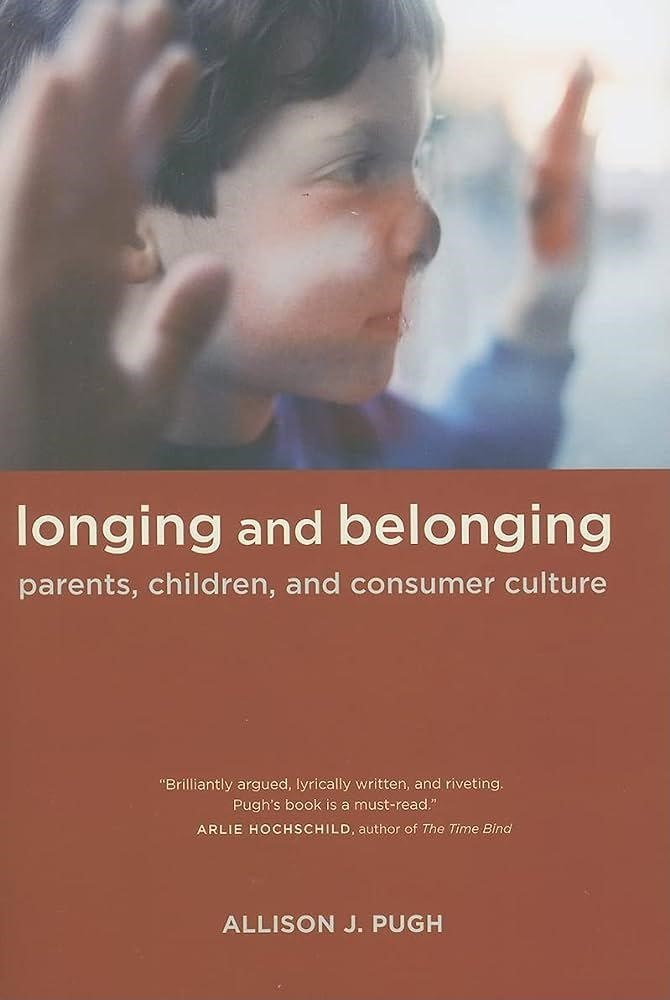
Longing and Belonging: Parents, Children, and Consumer Culture, by Allison J. Pugh (Berkeley, CA: University of California Press, 2009)
This is a very important book for teachers, teacher trainers, and teacher candidates to read because it offers an explanation of the desires of children and the interesting way the desires are met, or not met, by their parents. In this day of increasing demand for newer and better toys and technology, children ask for more and more expensive items.
Allison Pugh uses a qualitative research approach from the side of sociology to look at the phenomenon, namely the decision to reward children with gifts or to withhold them, and why or why not. Pugh looks at the desires and needs of kids from very disparate family backgrounds, socioeconomic class, and racial and cultural experiences in a region of southern California.
The pivotal point is the school, the type of school, including whether it is public or private, and the ways that having technology and other assets are viewed by the students. The author interviews several parents to find out how the decision is made as to whether the kids will receive something they want. In some cases, the parents do buy the items so that the kids will not stand out as being too different from others, so that the kids will be able to participate with others in their school and be able to “save face.”
Not all parents immediately purchase items for their child, however, sometimes waiting to make sure it is a wise choice or until the family can afford it. In other cases, the parents can indeed afford the time but wait before buying it. The author uses the term “symbolic deprivation” to describe parents waiting until the child truly deserves the item or it is somehow time to go ahead and purchase the gift, toy, or technology.
In this ethnographic study, the author discovers some surprising aspects many people do not consider. Parents often want their children to fit in, so buying them fruit snacks or certain kinds of lunch items is very important as they help their kids to be part of the scene. Some parents consider the social life at school to be as important or even more important than what the kids are learning. Sometimes parents do try to get children to adopt better eating habits, but they agree to help them fit in better by purchasing trendy snacks or desserts for the lunchbox.
For a variety of reasons, parents do or do not buy certain items. Parents of all income levels explained it was a struggle to know when to say enough is enough. In many cases, the parents say they try to buy the majority of the things the kids want, and sometimes that means kids do have to wait so the family will not wind up “in trouble” financially. Still, though, kids in this study tended to eventually get the lion’s share of what they had on their conscious wish list.
Important reading for educators, this book shows the social and family side of the desires and needs of children in three very different kinds of schools. Other factors such as class and race place interesting roles in the decision process employed by parents. It is essential to better understand the kinds of pressures on kids and their parents in terms of the technology and toys so much of the kid landscape these days. Understanding what is going on behind the scenes, in the lunchroom, and in the playground can be very helpful in comprehending a little more of the kid’s world and that of the parents raising them.
It will be interesting to study these patterns and decisions after COVID-19 has come to a more secure stop at the end of the road.
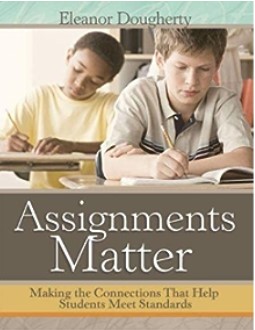
Assignments Matter: Making the Connections that Help Students Meet Standardsby Eleanor Dougherty (Alexandria, VA: Association for Supervision and Curriculum Development. 2012)
Reviewed by Thomas Hansen, Ph.D
This helpful book provides information on all stages of assignments, including basic starting points, reasons for the strategies employed, assessment ideas, and rubrics to help the classroom teacher evaluate what has happened. The author walks us through why we include assignments as part of the educational process for students, how to design them, why they are important in the classroom, and what they mean outside the school also.
The book is divided into three main sections. The first, “Why and What,” explains the basics of assignments and why they matter. The second, “In the Classroom,” talks about crafting assignments and how they reflect and expand the teaching of the related topics. Included is a discussion of how to properly sequence assignments and five design principles—including literacy as common practice (p. 88). The third section deals with assignments serving as anchors to instruction and also being used as data in themselves. These connect assignments to life outside the classroom.
Included in this short book are links to technology that will yield additional resources and ideas for designing and enriching lessons and assignments (inside cover, back cover, and p. 180). An appendix (pp. 171-180) yields even more information, including websites for assignment content and for organizations providing some interesting prompts also.
The book does reference standards and common core issues and statements, so teachers in Illinois and many other states can make use of it. In the prairie state, teachers are making use of a variety of standards, anchors, statements, and other outcomes-related guidance in their teaching and testing. There is nothing in this book that contradicts such an eclectic approach to education.
I would recommend the book as a good basic introduction for teacher education courses. The book would also be beneficial for new teachers, I think. It is clear and thorough, and I really like the examples. I think more experienced teachers who want to make more use of technology when designing units and writing lessons may wish to look into this book also.
As a professional development book, this is suitable as general background reading for teachers in different fields to come up with their own adaptations of the ideas and strategies employed. The book would also perhaps work for people coming to teaching from other fields and who have a great deal of technical knowledge on their subject but who want a thorough treatment of how to get assignments and assessments planned quickly for use in the classroom right away.
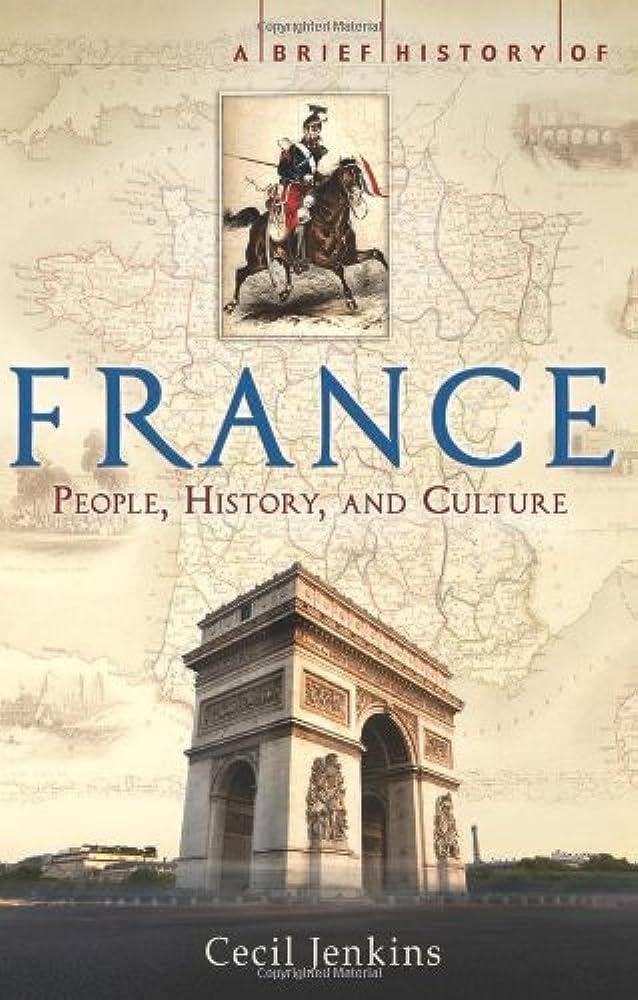
A Brief History of France: People, History, and Culture, by Cecil Jenkins (Philadelphia, PA: Running Press. 2011)
Reviewed by Dr. Thomas Hansen, Ph.D
In 15 information-filled chapters, Jenkins gives us a decent amount of French history in a short book. Chapter One is called “Cro-Magnon Man, Roman Gaul and the Feudal Kingdom,” and the last chapter is called “France in the New Global Order.” By chapter 6 we are already reading about Napoleon, so if that is any indication of the coverage here you know that means most of the book is about the last few hundred years and not about Cro-Magnons or Romans or Celts. If you want more emphasis on those guys, you have to seek a different book.
Jenkins is a great writer, and he not only uses clever turns of phrase. He also uses a great deal of humor and fun in his writing. The book is enjoyable to read. I hold a BA in French Language & Literature, but I found a huge amount of information here I had not expected and had not known about before reading the book.
The book is really quite funny, at points. For example, on page 28, Jenkins explains, “Again, the old practice of dividing estates among the sons, which had created so many problems with the royal succession, caused continual private wars among the minor nobles who had often little else to do but strike knightly attitudes.”
This striking-a-pose reference is typical of the funny ways Jenkins tells us in more modern terms what went on in the French past. See, also, the mention of Philippe IV’s “cold good looks (p. 33) and the “déjà vu all over again” discussion on page 72 and the bitchiness notes on page 75.
Without giving too much of the actual content away, I will say here that the framework of French history gives Jenkins a wonderful playground to exercise in. He enjoys writing about this topic, obviously, and the reader will enjoy finding out about some of the more interesting and sometimes weird passages of time within the French world.’
Teachers of social studies and of history will probably like the book because of its approach and clever language. More advanced students—especially those who know something of French history—may like this also. It is not a very basic review of French history, however. It does demand some overall familiarity with the topic so that the reader can follow what is happening. I have read some other similar books recently on history of countries I knew little about and feel for those who read this one if they are not somewhat versed in French history.
This is a brief history, indeed, and best for those who need a good review and an exciting read about the topic. I recommend the book especially for Francophiles who want another perspective. This point of view is certainly refreshing.
Britain Beginsby Barry Cunliffe (London: Oxford University Press. 2013)
Reviewed by Dr. Thomas Hansen, Ph.D
The author tells the story here of both England and Ireland because they cannot be separated easily. Since the very beginning of humans’ time in that part of the world, both lands and cultures were connected. It is that united history that leads the way in this incredible story of the sometimes icy, sometimes verdant northern reaches of civilization.
The reader will find here exciting and revealing chapters in the history of movements throughout the pre-historic, Celtic, Roman, Anglo-Saxon, Norman, and modern times of the isles. There are clear and helpful illustrations, and there is enough information here to fill any semester-long course on the history of England, or rather Albion, as it was first called by those who were using formal language.
The author paints rich stories onto a canvas of what was once a chilly ice-covered region and which came to be a world power. The author makes use of language, tools, science, history, and other major fields to tell about the different eras of the isles.
The years of the Celts are very intriguing ones, indeed. Cunliffe speaks of the idea that there were two entirely distinct waves of movement among them—including Iberia, Britain, Ireland, Scotland, Brittany, and Wales (pp. 248-249). He also speaks to the idea that the Celts started in the north and later in one era migrated as a large group southward to Brittany (p. 428). He has a number of additional theories related to this and other good examples of “movement.”
Another very interesting idea is that language, culture, and tools were shared up and down the west coast of Europe and up between the isles—a sort of “Atlantic” civilization (p. 344) emerging over time among the Celts. This explains linguistic and other hints pointing to migrations and movements up and down the coast—as opposed to some earlier notions of “Spanish” Celts trudging only northward to the further reaches of what came to be the UK.
Cunliffe talks about the notion of Celts moving southward—starting in Scotland and Ireland and coming down into Europe along the Atlantic. The author uses many different sorts of proof to advance this theory, at the same time he asks additional questions.
Teachers will be able to use this big book in a variety of ways. First and foremost, it is important personal reading for any teacher interested in social studies in general and in the history of English-speaking people specifically. Understanding the history of northwest Europe is helpful in understanding the intricate connections among the Celts and Europeans, the British and the Irish, and the Scandinavian and Germanic stock among the English.
Another important use is for helping students understand the power of “movement” among peoples, the conflicts created and agreements forged, and the resulting cultural and linguistic differences and similarities resulting from peoples coming into contact. The notion of movement relates also to the traveling ideas, tools, traditions, names, weapons, foods, trades, and books, later. Any standards and benchmarks related to movement are connected through teacher use of this book as a reference and resource.
Yet another good use of this volume is a textbook for a college-level course in history, of course. Because it covers so very much information, it could also be used as a summer reading project for advanced rising college freshman students needing timely non-fiction reading.
Those four uses of the book can be joined by another one I propose here: coffee table teaser. It would be interesting to set this in plain view and see who would pick it up and want to start reading it. It has a beautiful green cover. There are in fact many photos, drawings, and illustrations inside. The cover just might draw in some unsuspecting readers.
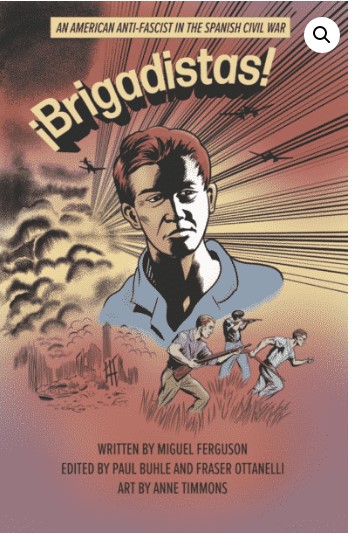
!Brigadistas! An American Anti-Fascist in theSpanish Civil War edited by Miguel Ferguson, Anne Timmons, Paul Buhle, and Fraser Ottanelli (Monthly review Press, 2022).
(Review by Anika Amin, St. Ann’s, Brooklyn)
¡Brigadistas! is a graphic novel about the Spanish Civil War (1936-1939). It tells the story of three friends from Brooklyn, New York who travel to Spain where they join the Abraham Lincoln Brigade. The book was super descriptive and did not include unnecessary details. This made it comprehensive but still clear and intelligible. The moments about the effects of the war and the regular people it affected were extremely powerful. The descriptions of the war’s effects on children and people who were not soldiers made the graphic novel very impactful. There could have even been more of these moments included to reinforce the significance. Overall it was informative, clear, and very powerful. Although it was very clear, it could have made it easier to read if it had chapters or sections. Breaking up the text and providing landmarks throughout the story could have also made it easier to follow. Additionally, depending on the target age group, some of the terms and concepts could have been explained more to keep the writing flowing. Overall it was great to read and it presented important and difficult topics in an understandable way.
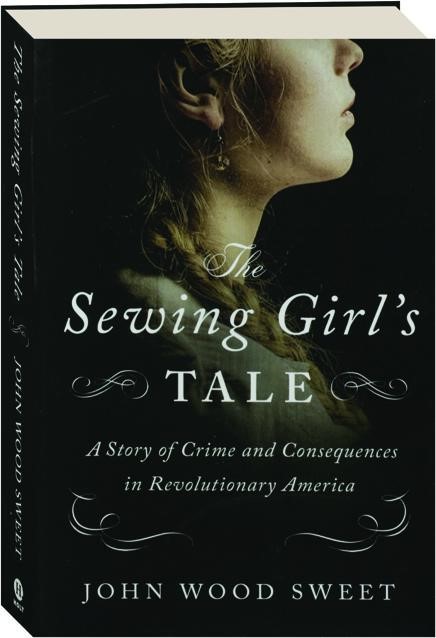
The Sewing Girl’s Tale: A Story of Crime and Consequences in Revolutionary America by John Wood
Sweet (Henry Holt) uses the trial of the accused rapist, Harry Bedlow, of a seventeen-year-old seamstress named Lanah Sawyer in 1793 to analyze New York City’s social hierarchy during the early republic. Alexander Hamilton was part of Bedlow’s legal team. Bedlow’s acquittal[1] after the jury deliberated for only fifteen minutes sparked riots in the streets and ignited a vigorous debate about class privilege and sexual double standards. Sawyer received some justice when her stepfather won a civil suit against Bedlow and the family was awarded a significant sum. The book received a Bancroft Award from the American Historical Association.