Teaching the Unteachable: The Holocaust and Kids These Days

The Holocaust is one of the most daunting subjects for teachers to tackle, and it grows more challenging as its survivors and their direct memories fade away. Educational approaches to this profoundly significant chapter of history are constantly evolving, often revealing critical issues about how the Holocaust is presented, the consequences of universalizing its lessons, and the need to balance meaningful engagement with the risk of trivialization or desensitization. While Holocaust education remains an indispensable part of modern curricula, current instructional methods sometimes risk diluting its impact by reducing it to an oversimplified lesson on intolerance, rather than treating it as a distinct historical catastrophe shaped by complex historical, social, and political dynamics.

This paper argues that effective Holocaust education requires maintaining a delicate balance between universal lessons and historical specificity while addressing ongoing issues in its presentation. It examines how educational approaches sometimes fall short in emphasizing the Holocaust’s unique characteristics, critiques the risks of trivialization, and underscores the importance of thoughtful engagement. It argues for interdisciplinary and experiential methods to ensure students engage deeply and critically with this critical subject, fostering both historical and moral awareness.

Andy Pearce writes in The Shapes of Holocaust Education in the Early Twenty-First Century (2022)[1] that despite the increase in Holocaust education, many adults today still have an incomplete or even incorrect understanding of what happened. This is a major paradox – Holocaust education is more widespread than ever, with school programs, museums, documentaries, and memorials, yet people’s understanding of the event seems to be declining. Pearce argues that this may be because we are putting too much focus on quantity over quality. Simply adding more content about the Holocaust – more books, more films, more commemorations – does not necessarily lead to deeper understanding. Instead, there needs to be a shift toward more thoughtful engagement that encourages students to question, reflect, and truly understand the gravity and complexity of what happened.

One of the biggest issues in Holocaust education today is the tendency to universalize it – to present the Holocaust as a symbol of general human suffering or to draw broad lessons about human rights and tolerance. While it is true that the Holocaust contains important universal lessons about prejudice, hate, and what can happen when these go unchecked, there is a risk in oversimplifying it. Historian Peter Novick, in The Holocaust in American Life[2] (2000), argues that the Holocaust has become a “moral and ideological Rorschach test,” meaning that people tend to see in it whatever they want to see, often using it to support their political or social agendas. This way of looking at the Holocaust can make it lose its specificity – the particular historical, ideological, and cultural circumstances that led to this genocide. When we use the Holocaust as a general metaphor for evil or intolerance, we can easily lose sight of the particular factors that allowed it to happen in the first place: the racial theories, the bureaucracy, the complicity of ordinary people, and the very specific political and social context of post-WWI Europe. Without focusing on these details, students may struggle to understand how an advanced, seemingly “civilized” society could systematically plan and execute the murder of six million Jews and millions of other innocent people.

Arthur Chapman, in Learning Lessons of the Holocaust[3](2020), also critiques this trend of framing the Holocaust mainly in terms of human rights or as an example of intolerance. He argues that while connecting the Holocaust to other events or to broader human rights issues can make it feel more relevant to students, it can also obscure what made the Holocaust unique. The Holocaust was not just another example of prejudice – it was a carefully planned and executed genocide, driven by specific racial ideologies, supported by modern technologies, and enabled by the collaboration or indifference of millions of people across Europe. When educators draw too many parallels between the Holocaust and other historical atrocities or present it as just another case of human cruelty, they risk minimizing the specific dangers posed by antisemitism.

Edward Rothstein[4] makes a similar point in his critique of the Museum of Tolerance, where he argues that mixing the Holocaust with contemporary issues like bullying or discrimination creates an oversimplified narrative. When the Holocaust is used as a kind of shorthand for any and all forms of prejudice, we end up losing the specificity of what actually happened, and why it happened. This is not to say that the Holocaust does not have broader lessons – it absolutely does – but those lessons need to be rooted in a deep understanding of the historical facts and circumstances.

Another major problem in Holocaust education is that students often come away with a focus on the perpetrators – on Hitler, the Nazis, and the details of how the genocide was carried out – while the voices and experiences of the victims are sometimes lost in the process. It is crucial to remember that the six million Jews who were murdered were not just numbers. They were individuals, each with a story, a family, hopes, dreams, and a culture that was nearly erased. Jewish communities in Europe were diverse, vibrant centers of culture, religion, art, and intellectual life. Yiddish literature, theater, music, religious study – these were all thriving before the war. Thousands of towns and cities were emptied either partially or entirely, and an entire way of life that had evolved over centuries was violently destroyed. When we reduce the Holocaust to numbers or see it only in terms of evil perpetrators, we risk losing sight of what was really lost – the human beings, the families, and the incredible cultural richness that was almost entirely wiped out. By focusing on the stories of individuals – children whose lives were cut short, artists whose work was lost, religious leaders whose wisdom was extinguished – we can help students understand the profound human cost of the Holocaust.

Teaching the Holocaust effectively also means addressing what made this genocide possible. How could it happen? How could so many people be complicit, either actively or passively? How did a modern, industrialized country like Germany become a place where millions of innocent people were murdered in cold blood? These questions are not easy to answer, but they are essential if students are to truly understand the Holocaust. One key factor was the long history of antisemitism in Europe, which paved the way for the Nazi ideology to take root. Antisemitism was not new – it had been part of European society for centuries, and the Nazis were able to exploit existing prejudices and fears. They used modern technology – propaganda, the radio, the press – to spread their hateful ideology and to dehumanize Jews in the eyes of the German public. Bureaucracy also played a huge role. The Holocaust was, to a large extent, a “bureaucratic genocide,” carried out not by a handful of madmen but by thousands of ordinary clerks, railway workers, policemen, and soldiers, each of whom played a small role in the killing machine.

Historiographical debates surrounding the Holocaust add another layer of complexity to the topic. Two of the most prominent debates are the functionalist versus intentionalist interpretations and the Historikerstreit (“historians’ dispute”) of the 1980s. Functionalists argue that the Holocaust evolved gradually and was not the result of a single, premeditated plan by Adolf Hitler. They emphasize the chaotic and improvised nature of Nazi governance, suggesting that local initiatives and bureaucratic momentum led to the escalation of genocidal policies. Historians such as Hans Mommsen and Martin Broszat represent this view, arguing that Hitler’s role, while significant, was not one of a micromanager dictating every step of the Final Solution.

Intentionalists, on the other hand, maintain that the Holocaust was a deliberate plan masterminded by Hitler from the beginning. This perspective emphasizes Hitler’s ideological obsession with antisemitism, as seen in Mein Kampf and his public speeches, where he frequently referred to the “annihilation of the Jews.” Intentionalist historians, such as Lucy Dawidowicz and Eberhard Jäckel, argue that the Holocaust was the culmination of a long-standing plan to eliminate Europe’s Jewish population. These contrasting views shape how we understand the Holocaust – whether as the result of a chaotic and disorganized regime or as the fulfillment of a clear and unchanging ideological mission.

The Historikerstreit further complicated Holocaust historiography by raising questions about how the Holocaust should be contextualized within broader histories of violence and genocide. German historian Ernst Nolte argued that the Holocaust was not unique but part of a larger pattern of twentieth-century atrocities, including Soviet gulags. Nolte’s views sparked intense backlash, with critics like Jürgen Habermas accusing him of relativizing Nazi crimes and diminishing the Holocaust’s moral and historical significance. The debate highlighted deep divisions among historians over how to approach the Holocaust – as an event that stands apart or as one atrocity among many in an age of ideological conflict.

Understanding these debates is critical for educators because they influence how the Holocaust is taught in classrooms. Should the Holocaust be presented as the inevitable result of Hitler’s ideological hatred, or as a complex process driven by bureaucratic chaos and opportunism? Should it be contextualized within global histories of genocide, or treated as a unique event? These questions shape the narratives students encounter and affect how they interpret the Holocaust’s causes, consequences, and lessons.

In recent years, there has been a troubling rise in Holocaust denial and distortion. Surveys by the Claims Conference reveal that many young people are unaware of basic facts about the Holocaust, such as what Auschwitz was or even the number of Jews killed. This lack of knowledge makes students more susceptible to denialist arguments and misinformation. To combat this, it is crucial to teach students not just what happened during the Holocaust but also how we know what we know. Holocaust denial is not just about denying facts, it is about undermining the credibility of survivors, historians, and the very idea of historical evidence. Teaching students how historians verify facts, how we know what happened, and why it matters is essential. This means incorporating lessons on media literacy, primary and secondary sources, teaching students how to critically evaluate evidence, and showing them why denialist arguments are false. This is especially important in the age of social media, where misinformation can spread so quickly and where conspiracy theories thrive.

Jeffrey Glanz[5], in Ten Suggestions for Teaching the Holocaust (1999), advocates for “hands-on” and “minds-on” learning, emphasizing that students should actively engage with the material through reflective analysis rather than passive learning. Educators must focus on the specific aspects of the Holocaust – its historical context, the entrenched antisemitism that enabled it, and the societal structures that allowed it to happen. Holocaust education should go beyond simply transmitting historical facts, encouraging students to critically engage with how systemic hatred, conspiracy theories, and scapegoating can lead to mass violence. By framing antisemitism as the “oldest and most dangerous conspiracy theory,” educators can help students understand the deep roots of this prejudice and its persistence throughout history.

James Joyce once said, “In the particular is contained the universal.” We don’t need to tell students that the lesson of the Holocaust is not to be a bully – they will come to that conclusion themselves if they are given a deep understanding of what happened. The power of Holocaust education lies in the details – the particular stories of individuals, the specific historical circumstances, the choices people made. If students understand these details, they will understand the broader lessons.

Another key aspect of effective Holocaust education is the use of interdisciplinary methods. The Holocaust is not just a historical event – it is also a deeply moral, psychological, and cultural one. Literature, like the works of Primo Levi, Viktor Frankl or Elie Wiesel, can help students understand the emotional and personal aspects of the Holocaust in a way that pure history might not be able to. These personal accounts give a face to the victims, allowing students to see them not as numbers but as people. Psychology can help explain how ordinary people became complicit in such an atrocity. Studies on obedience, such as those by Stanley Milgram, show how people can be influenced to do things they would not normally do. Philosophy and ethics also play a crucial role in Holocaust education. Discussions about moral responsibility, the nature of evil, and the role of individual agency allow students to grapple with the ethical questions raised by the Holocaust. Was it possible for perpetrators to refuse to participate? What motivated bystanders to remain silent? These questions encourage students to think deeply about moral choices and about the factors that influence human behavior.

Experiential learning – such as visiting Holocaust museums, listening to survivor testimonies, or using virtual reality to explore historical sites – can also make a big difference. These experiences bring history to life and make it more immediate and real. Survivor testimonies, whether read, watched, or listened to, are incredibly powerful. They humanize the history and help students connect to it on an emotional level. They help students see the Holocaust not as an abstract historical event but as something that happened to real people, people like them.

The challenges of teaching the Holocaust in high school revolve around maintaining historical specificity while making the content accessible and impactful for students. The risks of universalizing the Holocaust, of losing its specificity, or of overwhelming students with its horrors, require a thoughtful approach. By using interdisciplinary methods, encouraging critical thinking, and providing meaningful engagement, educators can ensure that Holocaust education respects the memory of the victims and provides students with the understanding they need to recognize and combat hatred and bigotry today, equipping them with a nuanced understanding of one of history’s darkest chapters. Ultimately, the goal is to empower students not only with historical knowledge but also with the intellectual tools needed to recognize and combat the forms of hatred and bigotry that continue to threaten society today.

The stakes for Holocaust education could not be higher. In an era of rising antisemitism, misinformation, and historical revisionism, ensuring that students have a deep, critical, and empathetic understanding of the Holocaust is crucial. This means moving beyond superficial narratives and creating a learning environment that respects the complexity of history and honors the memory of those who suffered. Through thoughtful, reflective, and innovative approaches, educators can play a key role in ensuring that the lessons of the Holocaust continue to resonate with future generations, fostering a commitment to justice, human dignity, and the prevention of future atrocities.

 Aly, G. (2014). Why the Germans? Why the Jews? Metropolitan Books.

Chapman, A. (2015). Learning lessons of the Holocaust. UCL Press.

Cole, T. (1999). Selling the Holocaust: From Auschwitz to Schindler; how history is bought, packaged, and sold. Routledge.

Dawidowicz, L. S. (1975). The war against the Jews: 1933–1945. Bantam Books.

Feinberg, S., & Totten, S. (Eds.). (2009). Essentials of Holocaust education: Fundamental issues and approaches. Routledge.

Glanz, J. (1995). Ten suggestions for teaching the Holocaust. The Social Studies, 86(3), 111–113.

Habermas, J. (1989). A kind of settlement of damages: The Historikerstreit and the past that will not pass. New German Critique, (44), 25–39. https://doi.org/10.2307/488496

Mommsen, H. (1986). The realization of the unthinkable: The “Final Solution of the Jewish Question” in the Third Reich. Contemporary European History, 1(1), 7–20. https://doi.org/10.1017/S0960777300000045

Novick, P. (1999). The Holocaust in American life. Houghton Mifflin.

Pearce, A. (2018). The shapes of Holocaust education in the early twenty-first century. Holocaust Studies, 24(3), 261–287. https://doi.org/10.1080/17504902.2018.1444113

Rothstein, E. (2002, November 17). Whose history is it? The New York Times. https://www.nytimes.com/2002/11/17/arts/whose-history-is-it.html

Slezkine, Y. (2004). The Jewish century. Princeton University Press.

Stone, D. (2010). Histories of the Holocaust. Oxford University Press.


[1] Pearce, A. (2020). Challenges, issues and controversies: The shapes of ‘Holocaust education’ in the early twenty-first century. In A. Pearce, S. Foster, & A. Pettigrew (Eds.), Holocaust Education: Contemporary challenges and controversies (pp. 1–27). UCL Press. doi.org/10.2307/j.ctv15d7zpf.7

[2] Novick, P. (2000). The Holocaust in American life. Mariner Books.

[3] Chapman, A. (2020). Learning the lessons of the Holocaust: A critical exploration. In S. Foster, A. Pearce, & A. Pettigrew (Eds.), Holocaust Education: Contemporary challenges and controversies (pp. 50–73). UCL Press. doi.org/10.2307/j.ctv15d7zpf.9

[4] Rothstein, E. (2011, April 30). Making the Holocaust the lesson on all evils. The New York Timesnytimes.com/2011/04/30/arts/design/museums-make-the-holocaust-a-homily.html

[5] Glanz, J. (1999). Ten Suggestions for Teaching the Holocaust. The History Teacher, 32(4), 547–565. doi.org/10.2307/494162

Obsolete but Preferable: The Role of Textbooks in the Modern Social Studies Classroom

Despite everything we’ve been led to believe over the past two decades, books have not completely disappeared from our society, nor our schools. Indeed, the world has rapidly moved in the direction of technological reliance at a seemingly infinitely higher rate since it entered the 2020s. This is especially true in educational settings, as teachers have begun to use a vast array of online tools, and many students across the country are more and more completing digital assignments. Yet, with all of this progression, texts themselves have not been completely phased out. No analyzation of the American education system can be generalized for every single school, let alone every single teacher. However, it is clear that the majority are still based on or at least reference some form of text. Still, this begs a question regarding the nature of the role that physical textbooks still play in the modern classroom, especially social studies ones considering so much of said subject is based on text interpretation. Ultimately, it is clear that textbooks generally are no longer the sole basis for classes’ entire curricula but are still used as valuable reference points. In addition, there has been a major shift away from traditional physical textbooks, and a move towards more differentiated options. 

To begin my research, I first looked into suggestions on how textbooks could continue to be useful tools. As my research isn’t catered towards one specific grade level, the article “A Content Analysis of Vocabulary Instruction in Social Studies Textbooks for Grades 4-8″ by Janis Harmon, Wanda Hedrick, and Elizabeth Fox from The Elementary School Journal proved a useful starting point. These authors posit that the real issue with the current usage of textbooks is not the book itself, but the way it is used. The primary alternative method of using textbooks regards vocabulary terms. Specifically, the authors claim that “effective practices for promoting vocabulary development stress the importance of instruction that affects comprehension, not just word knowledge alone” (Harmon, Hedrick, and Fox, 254). Thus, textbooks can’t be used to create simple repetition practices, they have to challenge the students in innovative ways which force them to exercise critical thinking skills about the matter at hand. Therefore, vocabulary terms are one of the most essential parts of a textbook, but there must be a dramatic shift away from how this device is being used at present, and how it has been used in the past.

The second article, and perhaps the most important I read, comes from the Georgia Educational Researcher and was written by two professors from Spelman College in Atlanta, Georgia, Dr. Amber Reed and Dr. Bailey Brown. Their article “Divergent Representations of Africa: A Qualitative Analysis of Georgia Social Studies Textbooks” explores the complexities of textbook usage in the deep American South, and how inherent biases towards various cultures is manifested in their content. In their research of Georgia’s public schools, they found that these issues are systemic and institutionalized. As such, they claim that “research also finds that educators are often ill-prepared to teach global perspectives in the social studies curriculum and that teachers’ biases and Eurocentric framework for teaching material can reproduce misconceptions about other countries” (Brown and Reed, 26). Thus, the biased nature of textbooks, at least in Georgia, is almost guaranteed for renewal as such misconceptions are carried down from one generation to the next. Therefore, there is likely little malicious intent in textbook bias, but failing to recognize it plays into the Eurocentric attitude that the American education system has long subscribed to. As such, this article doesn’t necessarily argue for doing away with textbooks altogether, but it does explain the need for a serious overhaul of the “traditional” methods they inspire.

The final article I referenced comes from the Journal of Adolescent & Adult Literacy. Written by Professors Sarah Matthew and Craig McGill, “Honestly, I Had a Very Strong Reaction to This Reading” contrasts to the aforementioned pieces by actually arguing in favor of moving away from traditional textbooks. They explore what the term “graphic” means in a literary context and how it can often be misconstrued. On the one hand, it can immediately act as a scare tactic many use to support banning certain titles as it assumes such content is either violent or pornographic. But in reality, “graphic” doesn’t have to imply any extreme at all, and at its most basic level just refers to the use of imagery or illustrations (Matthew and McGill, 433). As such, Matthew and McGill heavily advocate for the increased use of graphic novels as alternatives for traditional textbooks, arguing that they can bring a new perspective and encourage certain critical thinking skills not found otherwise. Not only that, but they also advocate for teaching banned material itself, in order to show students why titles are challenged, and what implications doing so holds. 

After doing my preliminary research into contemporary attitudes towards continuing textbook usage, I developed a two-pronged approach for my own research into this topic. The first prong involved transferring my findings from the articles I found into questions for three teachers I interviewed. While only three teachers’ opinions can be difficult to form conclusions upon, they are from different parts of New Jersey, and all teach at different levels. One teaches ninth and eleventh grade social studies at Ewing High School. Another teaches sixth grade ancient civilizations at Community Middle School in West Windsor. The final teaches sixth grade social studies at West Brook Middle School in Paramus. They were each asked the same five questions, three of which pertain to the above articles, and I have decided to retain their names in order to further encourage honesty in their answers. Moreover, they were not shown the data collected or previous teachers’ answers until after the interview was completed thereby ensuring autonomy in their responses. The five questions I asked these teachers were: overall, what do you believe the role of textbooks should be in the contemporary classroom; what kind of textbooks do you use, if any at all; do you believe textbook vocabulary terms can be beneficial if taught the right way; have you found that textbooks are generally more biased or unbiased; and how do you feel about teaching banned books, is it important that students are exposed to such material?

In contrast, the second prong focused on the student perspective. For this part of my research, I created a survey which I used to sample students in the class of the aforementioned teacher from Community Middle School. I was also able to obtain some responses from outside West Windsor from other students I work with, particularly in Byram and Stanhope in Sussex County. However, about 90% of the responses came from Community. As such, again I approached drawing blanket conclusions from this data with caution, but it still provides valuable insight into the direction at least this type of school is moving in. For the students I also asked five questions, inquiring about what type of texts are most appealing to them, which types they have used before, which types they believe would be most beneficial for them going forward, how positive an impact they believe textbooks have been on their education so far, and how strongly they believe textbooks can still play a positive role going forward.

Surprisingly to me, and with few exceptions, each teacher shared very similar answers to the five questions. The consensus seemed to be that textbooks should only act as complementary material to otherwise well-constructed lessons. Furthermore, you needn’t actively seek out textbooks for the niche purposes of vocabulary terms or just for the sake of teaching banned material. This can be done more organically, which is more beneficial to the fluidity of the unit at large. And textbooks, at least those in use in New Jersey, generally try to present information in unbiased ways, but as with any written material, biases do poke through. Hence why it is again important to not rely upon textbooks, or any one source for that matter, so heavily. Put most straightforwardly, the teachers I interviewed were in general agreement that textbooks can’t be the basis of an entire class but can still serve as one of many important resources for instruction or reference.

Similarly, the data I received from the students was not what I was expecting. In terms of what they found most appealing, graphic novels took about 1/3 of the responses. However, traditional textbooks achieved nearly the same number. Unsurprisingly, traditional textbooks were overwhelmingly the most used type of text, but eBooks fell not far behind, and graphic novels again took about 1/3 of the responses. Most surprising of all, traditional textbooks took the plurality of the responses for what type of text students believed would be most beneficial for them going forward, receiving about 40%. And finally, most of the responses for the final two questions fell somewhere in the middle, with zero responses indicating that they strongly disagreed, and 15% indicating that they strongly agreed. 

            The twenty-first century so far has seen a dramatic increase in reliance on technology and advancements in this field. And yet despite the seemingly resulting trend that physical textbooks have become obsolete, they can still play a role in the modern classroom. In completing my research, I have found that few have argued that such resources should be done away with entirely. In fact, many authors who have written on this subject have simply made suggestions for alternative practices. In addition, the teachers I spoke to were also generally supportive of continuing usage of textbooks so long as they do not dominate an entire class. Even students, who in general as an entire demographic have long been stereotyped as vehemently anti-textbook, seem not only willing, but happy to continue learning from them going forward. Again, it is important to acknowledge the small sample sizes used to conduct this study, and further research would have to be completed in order to make any type of generalization. But the general conclusion I draw from this project is that not only can textbooks still play a role in the modern classroom, but they must continue to be a commonly used resource.

The data I received both from the teacher interviews and the student surveys somewhat contradicted the information I found in the articles. First and foremost, it seems that the educators I talked to have few issues with the systematic bias in textbooks. They don’t negate its existence; rather they just see them as any other type of text which has to be approached with caution. They see the bias actually as useful, because any source is going to include it. Thus, it can be beneficial to have their students look for biases and point them out when they find them. The implication of their lack of hesitation in this regard seems to be that the era of fully textbook-based classes is just about over. A simple reliance on one textbook dooms students to a narrow view of the world, especially in social studies settings. Moreover, running your class as such is a dangerous reversal of the current trend which aims to facilitate critical thinking, rather than simple content knowledge.

Furthermore, continued textbook usage is completely acceptable, but it has to be supplemented with abundant material from other sources. And not only do students see continued textbook usage as necessary, but many even see traditional textbooks as having played a significant and even positive role in their education. Thus, while it is important to supplement traditional textbooks with other material, it seems we cannot be so extreme as to throw them out entirely. They serve as a familiar source of knowledge which many might feel lost without. So, to answer the initial question this research was based off of, textbooks can absolutely play an important and expansive role in the modern classroom. We just have to ensure that they are being used the right way and are not the only type of source students are exposed to. 

Brown, Bailey, and Reed, Amber. 2023. “Divergent Representations of Africa: A Qualitative Analysis of Georgia Social Studies Textbooks.” Georgia Educational Researcher 20 (2): 26–44. doi:10.20429/ger.2023.200202.  

Harmon, Janis M., Wanda B. Hedrick, and Elizabeth A. Fox. “A Content Analysis of Vocabulary Instruction in Social Studies Textbooks for Grades 4-8.” The Elementary School Journal 100, no. 3 (2000): 253–71. http://www.jstor.org/stable/1002154.

Mathews, Sarah A., and Craig M. McGill. 2022. “‘Honestly, I Had a Very Strong Reaction to This Reading’: Social Studies Pre‐Service Teachers’ Application of Literacy Frameworks While Engaging with a Graphic Textbook.” Journal of Adolescent & Adult Literacy 65 (5): 431–39. doi:10.1002/jaal.1224.

Fairness Counts: Integrating Math and Social Studies in the Elementary Classroom

“That’s not fair!” Any teacher who has spent time in elementary school classrooms knows the frequency and passion with which this sentence is declared each day.  As early as 3 years of age, children have a developed sense of fairness that concerns not only allocation of materials, but also the distribution process (Englemann & Tomasello, 2019). This desire to regulate games, play, and sharing of resources in early childhood continues to develop through the elementary years, and it provides a remarkable opportunity for teachers to leverage the integration of mathematics and social studies.

Social studies standards in New York explicitly refer to “gathering, interpreting, and using evidence” and “chronological reasoning and causation” (New York State Education Department [NYSED], 2017a).  The Next Generation Standards for Mathematical Practice include “Construct viable arguments and critique the reasoning of others” and “Look for and make use of structure,” which refers to finding patterns over the course of time (NYSED, 2017b). The overlap between these two subjects, particularly in the early grades, is significant and useful in settling disputes of tangible fairness and in the upper elementary grades, in providing support for students to think about more abstract concepts of fairness and equity.

Math and social studies integration for early childhood (PK-2)

Most early childhood classrooms have objects that are in short supply and coveted by many children at once.  Common ones might include the “good” bean bag chair for reading, the block corner, or the newest art supplies. Some teachers generate and implement systems for managing these situations so that students are treated fairly. Other teachers might feel that students ought to learn that sometimes they can’t get what they want and adopt mantras similar to “you get what you get, and you don’t get upset.”

Both teacher-imposed systems of fairness and teacher-imposed systems of control miss a crucial opportunity to allow students ownership of their class rules and also an opportunity to show how social studies and mathematics are integrated and relevant. Consider the example of the bean bag chair that, for some reason undiscernible to adults, students have decided is the “best” one. In the reading corner, despite the fact that there are four seemingly equivalent places to sit, one chair always causes an argument or a dash across the room to get there first. It is important for teachers to know that even if it seems not to make sense, children assign tremendous value to objects. In fact, studies have shown that even very young children view objects as extensions of self (Diesendruck & Perez, 2015). Leveraging this assigned significance into learning opportunities should be at the forefront of teacher’s agendas.

An interdisciplinary solution to the bean bag chair problem might begin by first naming the issue and helping children articulate their feelings and questions about it. Then, the teacher might set up a democratic process for students to share what they think are good solutions. There are many literary resources that would be good starting points for student participation. Fair Shares by Pippa Goodheart, Share and Take Turns by Cheri J. Meiners, and Friends Ask First by Alexandra Cassel are a few popular choices to anchor a discussion.

Once all students have had an opportunity to ask questions and share their ideas for a fair system, the teacher might consolidate all of the ideas into two or three options. It is important to explicitly model thinking critically about ideas of fairness for students to help them broaden their understanding and expose them to different points of view (Bjervås, 2017).  Ideas elicited from early childhood students would likely come under a few different categories: 1) some kind of system where everyone gets the same amount of time 2) a taking turns system, where if someone else wants a turn, the person in the chair has to give it up 3) a Darwinian system that indicates something to the effect of whoever gets there first gets the chair, and 4) other less fair, or more difficult to articulate systems. Through questioning and debate facilitated by the teacher, students would likely come to the conclusion that the time system is fairest.  In PK-2 classrooms, setting up a ballot measure and having students vote would be a clear way of establishing an example of the democratic process.  Age-appropriate social studies concepts met during this process include gathering, interpreting and using evidence, chronological reasoning and causation, and civic participation (NYSED, 2017a).

After everyone has participated in this form of civic engagement, mathematics plays a larger part.  The very process of counting and representing the results of voting is a mathematical concept.  Using a Unifix cube or a similar concrete manipulative to represent each vote, students can stack them to construct a three-dimensional bar graph showing how many votes were cast for each option. This visual and tactile representation of the votes will make it clear to students the option with which more students agree. This representation itself ticks several boxes for mathematical standards and concepts appropriate for PK-2 classrooms. 

Counting objects, sorting them into categories, arranging them in a line to assign ordinal numbers, comparing the quantity in each group by using words like more than or fewer, and representing data in a display and reading said display are all mathematics concepts that students should learn in early childhood grades (NYSED, 2017b). Research has long since established that students not only retain mathematics content more effectively but are also better able to transfer and apply skills they learned through the context of their own social and cultural values rather than word problems with “real world” situations involving carts full of watermelons from a textbook (Boaler, 1993; Lazic & Maričić, 2021; Taylor, 1989). Establishing classroom rules that are fair for everyone is a high priority for young students, and therefore the mathematics and social studies concepts associated with the construction of such a classroom will likely be learned deeply and effectively.

The idea of “fairness” holds within it the essence of “equality,” which is a mathematics concept that is tremendously important but often misunderstood, particularly in early childhood (Sophian, 2022). Furthermore, concepts of equal parts of a whole, equal groups of objects, and showing equal quantities in different ways are found throughout PK-2 math standards (NYSED, 2017b). To keep with the time in the bean bag chair example, this activity can be further developed by facilitating a discussion among students about how much time in the bean bag chair is fair.  If independent reading time is 20 minutes, and there are 20 students in the class, one option that can be shown using concrete or digital manipulatives is for each student to get 1 minute per day in the chair. Most young children have not yet developed understanding of lengths of time, and understanding the duration of a minute is an important concept taught in the early grades.

Discussion and practical testing of this idea might lead students to the realization that a single minute is not enough time for quality reading and relaxing.  Therefore, through discussion and some experimentation with manipulatives representing minutes, the teacher might suggest that only fewer people per day get to sit in the chair, but for a longer time, and ask students to try to come up with a system for keeping track of students and times. 

Including this amount of thinking and discussion about the bean bag chair will likely result in taking several days to create and revise the plan.  The time invested in having students involved with and responsible for making a fair system is easily justified by the lessons and concepts they will learn about mathematics, social studies, literacy, and collaboration. An additional benefit to facilitating a series of lessons like these is the reduction of students wondering “why do we need to know this?” The meaning behind the instruction is already implicit: students will develop the skills and capacity to eliminate fighting over the bean bag chair.

As students mature throughout elementary school activities and lessons like the one above might become less relevant; students become more capable of regulating fairness in social situations without adult intervention.  Additionally, items like the bean bag chair or favorite toys might become less significant in upper elementary classrooms.  However, there still exist many opportunities for students to integrate mathematics and social studies concepts to gain a better understanding of fairness in the world.

Gathering and examining evidence, constructing arguments, and critiquing the reasoning of others are skills that both mathematics and social studies standards mention explicitly (NYSED, 2107a, b). Common examples of how to integrate mathematics and social studies include examining percentages, reading and interpreting graphs and charts, and analyzing change over time. One facet that may not be traditionally examined thorough the lens of both mathematics and social studies is a calculation of the amount of voting power that citizens have in an indirect democracy. 

While younger students are quick to point out “that’s not fair!” when tangible resources are inequitably distributed, older students should be encouraged to think critically about the fairness and equity in more abstract terms by systems of which they are a part (Lee et al., 2021). Elementary school students begin learning the structure of the United States government and have some understanding of what government representatives do. They are also beginning to develop understanding of fractions, extremely large and small numbers, and operations with these numbers. These sets of concepts can be integrated to give students real world understanding of the amount of power their votes have by exploring representative democracy.

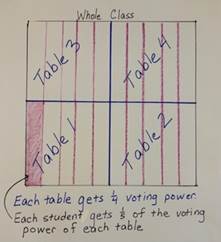
This activity focuses on U.S. Senate representation. If students are unfamiliar with representative democracy, a teacher might want to demonstrate using a concrete example with students in the class:  If students in a class of 20 are seated 5 to a table, for example, an election for table representative can be held. Students should understand that these representatives will, with the direction of the teacher, help make some of the rules for the classroom and advocate on behalf of their constituents (tablemates). Therefore, they have to think carefully about who they want to represent them. In this example, there are 4 student representatives who will be part of the discussion and vote on rules.  Each of these student representatives, therefore, has of the total voting power in any matter on which they vote. 

The next question is, how much voting power does each person at the table have? By facilitating discussion, the teacher should be able to elicit that each student has  of the voting power, since everyone was able to vote for their own representative.  This can be found two ways; the first one indicated below is the most straightforward, while the second might be less obvious. Nevertheless, students might notice and articulate this strategy if they are given the chance to explore it. This is also the skill students will need to find answers to questions later in this activity.

  • Each student is 1 out of the total 20 in the class, therefore each vote is  of the total.
  • Each table gets  of the vote via their representative.  That  of the vote comprises 5 students, so each student gets  of that .  Students can draw a model of fourths, then divide each of those fourths into 5 sections (Figure 1) to show that every smaller section is then .  Some students might realize that  of  also means , which is also the same as .

The reasoning in the second explanation can be further explored by changing some conditions about the representatives. For example, what if there were still 4 tables, each with 1 representative, but one table had 8 people, and the rest had 4? Would everyone still have the same voting power? The table of 8 would have  of the voting power each.  While the tables of 4 would have  of the voting power each. There are several mathematical questions that can be asked at this point to facilitate exploration with fractions:
  • Who has more voting power? How do you know?
  • Is that fair? Which table would you want to sit at?
  • What does the size of the denominator tell us about the size of the fraction?

This activity can be extended over the course of several days to expand students’ understanding of voting power on a larger scale. They can be asked to find reliable sources of information indicating the population of each state in the U.S. and to calculate the voting power of the citizens of each state in the U.S senate if each state is represented by two senators. These calculations would involve operations with very large numbers, and comparing unit fractions that represent extremely small quantities, both of which are included in upper elementary mathematics standards (NYSED, 2017a). Students might be surprised to learn that in terms of senate votes, U.S. citizens have drastically different voting power. Extension questions might include:

  • Citizens of which state have the most voting power in the senate? The least?
  • How many times as powerful are the votes from the state with the most power per citizen compared with the state with the least?
  • Is this the case in all branches of government? Should it be? How does representation in the other branches work?

Both the activity described for PK-2 students and the one described for upper elementary students integrate mathematics and social studies in an age-appropriate, real-world context. Social studies and mathematics are not always considered easy to integrate smoothly, but many concepts and skills are clearly interdisciplinary between these two subjects. While meeting content standards is important to ensure equity of mathematics and social studies knowledge among students, it is even more important to give students the tools to think critically, advocate for themselves, and engage in civil discourse (Lee, et al. 2021). These skills ought to be taught through relevant applications that demonstrate to students why it is important to have them. For this reason, leveraging students’ deeply developed feelings that some things are unfair (Engelmann & Tomasello, 2019) into motivating lessons about how to quantify fairness and equity is a powerful bit of pedagogy.

Boaler, J. (1993). The Role of Contexts in the Mathematics Classroom: Do they Make Mathematics More” Real”? For the learning of mathematics13(2), 12-17. https://www.jstor.org/stable/40248079

Bjervås, L. L. (2017). Teaching about fairness in a preschool context. In Values in Early Childhood Education (pp. 55-69). Routledge.

Diesendruck, G., & Perez, R. (2015). Toys are me: Children’s extension of self to objects. Cognition134, 11-20. https://doi.org/10.1016/j.cognition.2014.09.010

Engelmann, J. M., & Tomasello, M. (2019). Children’s sense of fairness as equal respect. Trends in Cognitive Sciences23(6), 454-463. https://doi.org/10.1016/j.tics.2019.03.001

Lazic, B., Knežević, J., & Maričić, S. (2021). The influence of project-based learning on student achievement in elementary mathematics education. South African Journal of Education41(3). http://dx.doi.org.ezproxy.hofstra.edu/10.15700/saje.v41n3a1909

Lee, C. D., White, G., & Dong, D. (2021). Educating for Civic Reasoning and Discourse. National Academy of Education. https://files.eric.ed.gov/fulltext/ED611951.pdf

New York State Education Department. (2017a). New York State K-8 social studies framework.https://www.nysed.gov/sites/default/files/programs/standards-instruction/ss-framework-k-8a2.pdf

New York State Education Department. (2017b). New York state p-12 learning standards for mathematics. http://www.nysed.gov/new-york-state-revised-mathematics-learning-standards

Sophian, C. (2022). A developmental perspective on children’s counting. The development of mathematical skills (pp. 26-46). Psychology Press.

Taylor, N. (1989). Let them eat cake: desire, cognition and culture in mathematics learning. Mathematics for All, 161-163.

Three Social Studies Lessons Using Baseball as an Introduction to History

How Baseball and Jackie Robinson Shaped New York’s Identity

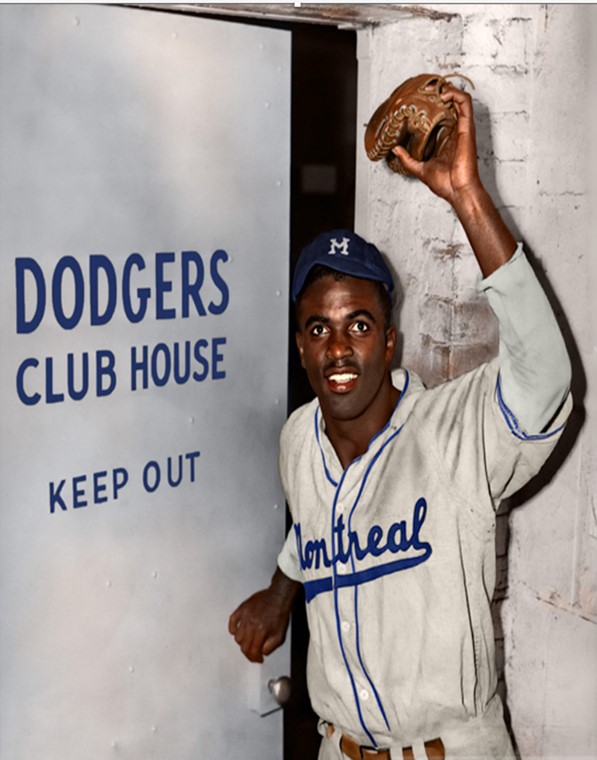
Jackie Robinson played with the Dodgers’ minor league Montreal team.

Introduction: The Brooklyn Dodgers were not just a baseball team; they were a cultural institution that embodied Brooklyn’s identity from 1883 until their departure in 1957. Prior to 1898, Brooklyn was the fourth largest city in America. After incorporation into the greater city of New York, the Dodgers contributed to Brooklynites maintaining their separate sense of identity. In 1947, Jackie Robinson broke baseball’s color barrier when he joined the Brooklyn Dodgers. This historic moment changed not only baseball but also had profound social implications that shaped Brooklyn’s identity. After decades of falling short, particularly against the Yankees, the Dodgers finally won the World Series in 1955. This victory was a defining moment for Brooklyn’s collective identity. In 1957, Dodgers owner Walter O’Malley moved the team to Los Angeles after failing to secure a deal to build a new stadium in Brooklyn. This departure left a profound impact on Brooklyn’s identity and development. The departure of the Dodgers coincided with other significant changes in Brooklyn and New York City. The borough’s identity had to evolve in the absence of its beloved team.

  1. In your opinion, what does the phrase “Wait ’til next year” reveal about Brooklyn’s character and the relationship between the team and its fans?
  2. Why was defeating the Yankees particularly significant for Brooklynites’ sense of identity?
  3. How did Brooklyn residents react to the Dodgers leaving Brooklyn?
  4. Do professional sports teams have any obligations to their loyal fanbase?
  5. The proposed site for a new Dodgers stadium at Atlantic and Flatbush Avenues eventually became the Barclays Center in 2012. What does the building of this arena reveal about Brooklyn’s evolution in your lifetime?
  • 1865-1877: Reconstruction era provides brief period of expanded rights for Black Americans.  Republican support among Black voters, however, declines when President Hayes withdrew federal troops from the South
  • 1876: National League founded (all-white)
  • 1884: Moses Fleetwood Walker becomes last Black player in major leagues prior to International League institutes unwritten “gentlemen’s agreement” (1887) barring Black players
  • 1920s: Negro National League established as segregated professional baseball thrives
  • 1939: Jackie Robinson enrolls at UCLA, becomes first athlete to letter in four sports
  • 1944: Robinson court-martialed for refusing to move to back of segregated bus while in Army
  • 1945: Branch Rickey signs Robinson to Montreal Royals (Dodgers’ farm team). Robinson agrees to avoid responding to provocations from racist white fans and players
  • 1946: Robinson leads International League with .349 average and 40 stolen bases
  • April 15, 1947: Robinson debuts with Brooklyn Dodgers
  • 1948: President Truman issues Executive Order 9981 desegregating armed forces
  • 1949: Robinson wins NL MVP, batting .342 with 37 stolen bases
  • 1954: Brown v. Board of Education Supreme Court decision outlawed school segregation
  • 1955: Rosa Parks, MLK and the Montgomery Bus Boycott
  • 1955: Robinson helps Dodgers win World Series
  • 1956: Robinson retires from baseball rather than accept trade to Giants
  • 1957: Robinson is hired as VP at Chock Full O’Nuts
  • 1957: Robinson heads NAACP Fund Drive
  • 1957: Little Rock Nine integrate Central High School in Arkansas
  • 1959: Robinson begins writing syndicated newspaper columns
  • 1960: Robinson campaigns for Richard Nixon in presidential election
  • 1963: Robinson participates in March on Washington with MLK
  • 1964: Robinson co-founds Freedom National Bank in Harlem
  • 1964: Civil Rights Act passed
  • 1965: Voting Rights Act passed
  • 1968: Robinson supports Hubert Humphrey after disillusionment with Republican Party
  • 1970: Robinson creates Jackie Robinson Construction Corporation
  • October 15, 1972: Final appearance at World Series, calls for Black MLB managers
  • October 24, 1972: Robinson dies at age 53 from heart attack and diabetes complications
  • 1973: Rachel Robinson establishes Jackie Robinson Foundation
  • 1997: MLB universally retires Robinson’s number 42
  • 2004: MLB establishes Jackie Robinson Day (April 15)
  1. What economic, cultural, or social factors might have made baseball more willing to accept racial integration before other American Institutions?
  2. Why did MLB’s integration have such a profound impact on American society?

On April 15, 1947, Jackie Robinson played first base for the Brooklyn Dodgers at Ebbets Field, becoming the first Black player in Major League Baseball since 1884. The Dodgers defeated the Boston Braves 5-3. This historic moment ended the “gentlemen’s agreement” among team owners that had kept baseball segregated. Robinson’s journey began when Branch Rickey, the Dodgers’ general manager, signed him to the Montreal Royals (the Dodgers’ minor league affiliate) in 1945. Rickey specifically chose Robinson not only for his athletic ability and competitive fire but for his character and temperament, asking him to “turn the other cheek” in the face of racial hostility. After excelling in Montreal during the 1946 season, Robinson joined the Dodgers for the 1947 season. Robinson’s debut received dramatically different coverage in white and Black newspapers. Most mainstream white papers barely mentioned the historic significance, focusing instead on other aspects of the game. In contrast, Black newspapers across the country made Robinson’s debut front-page news, with extensive coverage and photography.

Throughout his first season, Robinson endured racist taunts, pitches thrown at his head, and opponents attempting to spike him on the basepaths. Despite this, he batted .297, led the league in stolen bases, and won the first Rookie of the Year award. His decade-long career included six National League pennants, a World Series championship in 1955, and the National League MVP award in 1949. He was inducted into the Baseball Hall of Fame in 1962.

Robinson was politically engaged throughout his post-baseball life. He served as chairman of the NAACP Freedom Fund Drive, traveling the country to recruit members and raise funds. From 1959, he wrote syndicated newspaper columns addressing race relations, politics, and other social issues for the New York Post and later the New York Amsterdam News. Robinson developed close relationships with civil rights leaders, including Martin Luther King Jr., whom he accompanied on numerous speaking tours. Robinson supported King’s work and helped raise funds for the Civil Rights Movement. Specifically, he and his wife Rachel hosted jazz concerts at their Connecticut home to raise bail money for protesters arrested during civil rights Robinson’s impact on civil rights was summarized by Martin Luther King Jr., who told Dodgers pitcher Don Newcombe: “You will never know how easy it was for me because of Jackie Robinson.” Robinson’s approach to civil rights combined direct advocacy with practical action. Robinson believed that speaking out against injustice was a responsibility that came with his privileged celebrity position, frequently stating he would not remain silent when witnessing wrongdoing. He challenged professional sports leagues, politicians, and fellow athletes to do better on racial issues throughout his life.

After retiring from baseball in 1956, Robinson became vice president of personnel at Chock Full O’Nuts, becoming the first African American to hold such a position at a major American corporation. He used this platform to advocate for civil rights, writing letters to politicians on company letterhead and challenging discriminatory practices. Robinson believed strongly in economic independence for Black Americans. He co-founded the Freedom National Bank in Harlem in 1964 to provide financial services to the Black community, and in 1970 he created the Jackie Robinson Construction Corporation to build affordable housing. He consistently advocated for Black capitalism and criticized businesses that failed to employ African Americans.

In presidential politics, Robinson initially supported Hubert Humphrey in the 1960 Democratic primaries before backing Republican Richard Nixon in the general election, believing Nixon had a stronger civil rights record than John Kennedy. Later, he campaigned for progressive Republican candidate Nelson Rockefeller and opposed Barry Goldwater’s 1964 Republican nomination, which he felt represented a rightward shift that would attract more white voters by alienating Black voters. By 1968, disillusioned with Nixon, he supported Humphrey again.

At his final public appearance at the 1972 World Series, just nine days before his death, Robinson used the opportunity to call for more Black managers and coaches in baseball. After his death from a heart attack on October 24, 1972, civil rights activist Jesse Jackson delivered his eulogy, calling him “the Black Knight in a chess game… checking the King’s bigotry and the Queen’s indifference.” In 1973, Rachel Robinson established the Jackie Robinson Foundation, which provides scholarships and support services to minority students. By 2021, the foundation had graduated over 1,500 students, maintained a nearly 100% graduation rate, and provided more than $70 million in assistance. The Jackie Robinson Museum in New York City was created to further preserve his legacy. Robinson’s own quote, engraved on his tombstone, captures his philosophy: “A life is not important except in the impact it has on other lives.” Through both his baseball career and his activism, Jackie Robinson’s life embodied this principle, changing American sports and society forever.

As “the Party of Lincoln,” Republicans had delivered emancipation, the Reconstruction Amendments (13th, 14th, and 15th), and various civil rights acts from 1866 to 1875. However, this alignment between Republicans & Black Americans began to fracture after Republican President Rutherford B. Hayes ended Reconstruction by withdrawing federal troops from the South in 1877. In 1932, Franklin Roosevelt’s New Deal attracted Black voters to the Democratic Party.

In 1960, Robinson supported Richard Nixon over John Kennedy. This choice reflected Robinson’s approval of the Eisenhower administration’s deployment of federal troops to protect Black students in Little Rock and passage of the 1957 Civil Rights Act. At that time, Nixon’s civil rights record appeared stronger than Kennedy’s or Johnson’s.

As an executive at Chock Full O’Nuts, Robinson championed Black economic self-sufficiency, believing that Black-owned businesses and financial institutions were crucial for community advancement. This economic philosophy aligned with traditional Republican values. Robinson’s party loyalty evolved as the political landscape shifted. He supported Democrat Lyndon Johnson over Republican Barry Goldwater in 1964 after Goldwater opposed that year’s Civil Rights Act. By 1968, Robinson had broken with Nixon and voted for Democrat Hubert Humphrey. By 1972, the year of Robinson’s death, Democrat George McGovern won 87% of the Black vote —a percentage that has remained consistent in subsequent elections, demonstrating the complete reversal of Black voters’ historical party alignment.

In his approach Robinson built on several core beliefs and principles established 60 years earlier by Black economic equality activists such as Booker T. Washington. Both men emphasized the importance of Black economic independence and viewed entrepreneurship as essential for advancement. Both created or supported Black-owned institutions that could serve community needs without relying on white approval or support. Both valued practical education that could translate directly into economic opportunities. Both saw Black-owned businesses as vehicles for community development and racial advancement. Both believed that demonstrating Black capability and success would help undermine racist stereotypes and arguments.

Despite these similarities, there were crucial differences in their approaches. Robinson saw economic initiatives as complementary to—not a replacement for—the fight for immediate civil and political rights. Robinson actively challenged segregation and participated in direct civil rights activism alongside his economic initiatives. Robinson directly challenged racial inequities, even when it alienated white supporters. As Robinson stated, he was “very much concerned over the lack of understanding in White America of the desires and ambitions of most Black Americans.” Robinson pursued integration across both social and economic spheres. As Robinson experienced the limitations of Black political advancement, he intensified his focus on economic institutions. Robinson’s economic vision expanded from individual advancement to community-wide initiatives that could create systemic change.

Robinson’s approach to Black capitalism influenced later civil rights leaders who recognized the importance of economic power alongside political rights. His founding of Freedom National Bank was a pioneering step in the community development banking movement. The bank served as the financial backbone of Harlem into the 1990s. In many of his actions and words, Robinson further developed the idea that economic empowerment without political rights is insufficient, but that political rights without economic power remains incomplete.

  1. How was Major League Baseball’s “Gentlemen’s Agreement” supported by social, legal and economic factors?
  2. Explain how Robinson’s post-baseball activities reflected his commitment to economic justice for Black Americans.
  3. Robinson said, “A life is not important except in the impact it has on other lives.” Identify three specific ways Robinson impacted American society beyond sports.
  4. Compare and contrast Jackie Robinson’s approach, tactics, philosophies, to other prominent civil rights figures (Paul Robeson, Martin Luther King Jr., Malcolm X, etc.).
  5. What do Robinson’s shifting endorsements of Republican and Democratic candidates reveal about the politics of civil rights?
  6. How have recent events in sports and society continued Robinson’s legacy of athlete activism?
  7. Examine how Robinson’s story has been memorialized, commemorated, and sometimes sanitized with the removal of controversy in American public memory.

As students of history, examining primary sources allows us to understand historical figures in their own context rather than solely through the lens of later interpretations. Robinson’s words reveal the complex interplay between his baseball career, civil rights activism, and political engagement.

Robinson’s Letter to President Eisenhower (May 13, 1958): Robinson wrote this letter on Chock Full O’Nuts letterhead to express his disappointment with President Eisenhower’s advice that Black Americans should be patient in their quest for civil rights. By this time, Robinson had been retired from baseball for two years and was using his position as a corporate executive to advocate for civil rights.

“I was sitting in the audience at the Summit Meeting of Negro Leaders yesterday when you said we must have patience… On behalf of myself, and I know thousands and thousands of my fellow Americans, I respectfully remind you sir that we have been the most patient of all people.”

  1. How does Robinson’s tone and words differ from his public persona during his playing days?
  2. What does Robinson’s use of corporate letterhead suggest about his business position and his activism?
  3. How might Robinson’s letter have influenced Dr. King’s 1963 “Letter from Birmingham Jail.” What risks did Robinson and King face in writing their letters?

“I Never Had It Made” Autobiography (1972): Published in the year of his death, Robinson’s autobiography presented a more critical and candid perspective on American racism than he had publicly expressed during much of his baseball career. This statement reflects his evolving views on patriotism and racial progress.

“I cannot stand and sing the anthem. I cannot salute the flag; I know that I am a Black man in a white world. In 1972, in 1947, at my birth in 1919, I know that I never had it made.”

  1. How does this statement challenge simplified narratives about Robinson as a symbol of American progress? Why might Robinson have felt more comfortable expressing these views in 1972 than earlier in his baseball career?
  2. Compare Robinson’s perspective with athlete activism today. What parallels and differences can you make?

Robinson on Economic Justice (New York Amsterdam News, 1962): Robinson wrote regular columns for the New York Amsterdam News, a prominent Black newspaper. In these columns, he advocated for economic opportunities for Black Americans and challenged discriminatory practices in business and sports.

“It is the duty and responsibility of each and every one of us to refuse to accept the faintest sign or token of prejudice. It does not matter whether it is directed against us or against others. Racial prejudice is not only a vicious disease, it is contagious.”

  1. How did Robinson’s economic perspectives and activities promote civil rights?
  2. How did Robinson’s status as a former athlete and business executive shape his particular form of civil rights activism?

Robinson’s Final Public Statement (October 15, 1972): This statement came nine days before Robinson’s death during a ceremony honoring the 25th anniversary of his breaking baseball’s color barrier. Despite the celebratory occasion, Robinson used the platform to highlight ongoing inequalities in Major League Baseball.

“I’d like to see a Black manager. I’d like to see the day when there’s a Black man coaching at third base.”

  1. What does this statement reveal about Robinson’s assessment of baseball’s progress on racial equality since 1947? Why would Robinson choose this particular moment to highlight the status of Black Athletes? How does it add to the statements historical significance?
  2. How long did it take for Robinson’s wish to be fulfilled? What does this reveal about institutional resistance to social change? What does this reveal about Robinson’s impact on Baseball and American society?
  1. How did the Brooklyn Dodgers both reflect and shape Brooklyn’s identity and how did their departure impact the region? Use specific examples for both.
  2. What lessons can be learned from the Dodgers story about the relationship between sports teams or cultural institutions and a community’s identity? Provide one modern example.
  • The Jackie Robinson Foundation Archives
  • Papers of the NAACP (Library of Congress)
  • Robinson, Jackie. I Never Had It Made (autobiography)*
  • Robinson, Rachel. Jackie Robinson: An Intimate Portrait*
  • Tygiel, Jules. Baseball’s Great Experiment
  • Long, Michael G. First Class Citizenship: The Civil Rights Letters of Jackie Robinson
  • Rampersad, Arnold. Jackie Robinson: A Biography
  • Long, Michael. 42 Today: Jackie Robinson and His Legacy
  • Long, Michael G. First Class Citizenship: The Civil Rights Letters of Jackie Robinson
  • Burns, Ken. Jackie Robinson (documentary)

This worksheet is based on an article originally published by PBS American Experience, written by Eduardo Obregón Pagán.

In the shadows of Los Angeles’ urban development lies the story of Chavez Ravine, a once-thriving Mexican-American community sacrificed for the creation of Dodger’s Stadium. This rural enclave near downtown Los Angeles maintained a tight-knit, self-sufficient character despite lacking basic city services. Residents grew their own food, raised livestock, and fostered strong community bonds through local institutions like their Catholic church, elementary school, and neighborhood businesses.

The community’s fate changed dramatically in the post-World War II era. Initially, Chavez Ravine was designated for a federally-funded public housing development. Residents were forced to sell their homes at below-market prices with promises they would receive priority housing in the new development. Many families complied, believing the government’s promises.

However, the story took a decisive turn when Brooklyn Dodgers owner Walter O’Malley sought a new location for his team. Los Angeles investors, eager to attract a major sports franchise, offered Chavez Ravine as the perfect stadium site. In the politically charged McCarthy era, city leadership abandoned the housing project, labeling it as too “communist,” and voters approved the stadium plan in a referendum.

Community resistance formed as remaining residents organized, created petitions, and testified at city meetings about their rights to their homes and land. Their efforts ultimately failed when, on May 9, 1959 – known as “Black Friday” – sheriff’s deputies forcibly removed the last families from their homes. Bulldozers quickly moved in, destroying all traces of the once-vibrant neighborhoods. The promised replacement housing never materialized for those who had initially complied with orders to sell their properties.

Dodger Stadium rose from these ruins, becoming a celebrated landmark for baseball fans while simultaneously standing as what many consider “a monument to the power of wealth over the impoverished.” The stadium represents the racialized nature of urban renewal policies and the unjust displacement of marginalized communities in favor of commercial interests.

This history demonstrates several significant patterns that continue to resonate in American urban development: racial and economic injustice in planning decisions, broken promises to vulnerable communities, tensions between public housing needs and commercial development, and the erasure of marginalized histories from popular narratives. From a legal perspective, O’Malley & The Dodgers operated within existing law – the land acquisition occurred through government processes, was approved by voters, and evictions were executed by law enforcement. However, ethical questions linger about a process that exploited residents with limited political power and the acceptance of land obtained through broken promises. The story of Chavez Ravine remains relevant today as cities continue to wrestle with questions of development, displacement, gentrification, and whose interests take priority in urban planning decisions.

The story of Chavez Ravine’s transformation from a Mexican-American community to the site of Dodger Stadium represents one of baseball’s most complex historical chapters, yet it remains unfamiliar to many fans and virtually erased from the popular baseball narrative. Baseball’s dominant stories traditionally focus on on-field achievements.. The mythology of Dodger Stadium emphasizes its picturesque setting, perfect sightlines, and the excitement of the Dodgers’ arrival in Los Angeles rather than examining the displacement that preceded it. When the Dodgers moved to Los Angeles in 1958, the media celebrated the economic benefits and civic pride the team would bring rather than investigating the local community costs.

Additionally, baseball’s gatekeepers (team and league officials, journalists, TV & marketing execs, and fans) have traditionally reflected baseball’s power structures. The voices and perspectives of displaced Mexican-American residents had little representation in the game’s official story.

More recently, as sports history has become more inclusive and critical, the Chavez Ravine story has gained increased attention through academic studies, documentaries, and community remembrance projects. However, these efforts remain peripheral to mainstream baseball coverage, which continues to celebrate ballparks without fully acknowledging any complicated origins.

For baseball to fully reckon with this history would require confronting uncomfortable questions about who benefits from and who pays the price for the growth of the sports industry across the world – a conversation that challenges the game’s preferred self-image as an innocent pastime above politics and social conflict.

  1. How has baseball’s storytelling traditions (which emphasizes baseball’s positive impact on communities) contributed to the erasure of the Chavez Ravine displacement story?
  2. How might the Chavez Ravine controversy further complicate Walter O’Malley’s legacy in New York’s baseball history?
  3. What does the Dodgers departure from Brooklyn and their relocation to LA teach us about community dynamics and professional sports teams business decisions?

Book Review – Erasing History: How Fascists Rewrite the Past to Control the Future by Jason Stanley

Although it was published prior to the 2024 Presidential election, Erasing History serves well as Jason Stanley’s response to the patriotic history being promoted by the Trump 2.0 administration. Stanley was a Professor of Philosophy at Yale University, but he recently announced that he accepted an appointment to the University of Toronto in Canada because of the deteriorating political situation in the United States. His previous books include How Propaganda Works (2015) and How Fascism Works (2018).

In the Preface to the book, Stanley argues “One lesson the past century has taught us that authoritarian regimes often find history profoundly threatening. At every opportunity, these regimes find ways of erasing or concealing history in order to consolidate their power.” Democracy, on the other hand, “requires recognition of a shared reality that consists of multiple perspective” so that “citizens learn to regard one another as equal contributors to a national narrative . . . Erasing history helps authoritarians because doing so allows them to misrepresent it as a single story,” their preferred story.

Social studies teachers are crucial players in the battle to protect democracy because we insist that students examine multiple perspectives and reach conclusions based on evidence and discussion (xi-x). Russia Premier Vladimir Putin recognizes the danger teachers pose to authoritarian regimes and has declared “Wars are won by teachers.” Under Putin, and now under Trump, history classes are supposed to stress patriotism and textbooks are rewritten to whitewash the past (Illyushina, 2024).

Stanley acknowledges that every educational system must decide what is important to know and be able to explain why because a school curriculum cannot include all knowledge. What authoritarian regimes do is erase from the curriculum evidence that people can struggle for change and social justice so that people are willing to accept an unsatisfactory status quo as the only possible circumstance. That is why China’s government outlawed teaching about the 1989 pro-democracy Tiananmen Square protests and Florida wants to block discussion of reasons for the Black Lives Matter movement in the United States. “By removing the history of uprisings against the current status quo from the curriculum (or never allowing that history to be taught in the first place) authoritarians leave students with the impression that the status quo has never been and cannot be challenged (xx-xxi).”

Chapters include “How to Create an Autocracy”; “Colonizing the Mind”;” “The Nationalist Project”; “From Supremacism to Fascism”; “Anti-education”; and “Reclaiming History.” Throughout the book, Stanley draws comparisons between past nativist and racist movements in the United States, the Nazi ascendency in Germany, and MAGA authoritarianism in the United States today.

Attacks on universities are a key component of the fascist agenda to erase history and undermine democracy. In contemporary Russia, India, Hungary, and Turkey rightwing politicians and autocratic leaders have sought to destroy academic independence by branding faculty as enemies of the state and trying to mandate a preferred curriculum. A Fox New host quota by Stanley bemoaned that “Our universities have become lunatic incubators, which the federal government funds” (21). Stanley argues that there are similar trends in government attacks in these countries on K-12 education. He quotes W.E.B. DuBois that “Education for colonial people must inevitably mean unrest and revolt; education therefore had to be limited and used to inculcate obedience and servility” (25).

Stanly explains how curriculum and textbooks are used in “colonizing the mind.” As a high school teacher in the 1980s I taught an advanced United States history class using Bailey and Kennedy’s The American Pageant: A History of the Republic, 7th edition (Lexington, MA: D.C. Heath, 1983). Stanley includes a quote from the introduction legitimizing colonialism and genocide that I must have completely overlook and did not challenge. It is a statement that well summarizes major components of Trump’s “patriotic history.”

“The American Republic, which is still relatively young when compared with the Old World, was from the outset richly favored. It started from scratch on a vast and virgin continent, which was so sparsely populated by Indians that they could be eliminated or shouldered aside. Such a magnificent opportunity for great democratic experiment may never come again” (2).

However, it did not start from “scratch,” its early institutions and its white people were Europeans, and it definitely was not a “virgin” continent as the sentence acknowledges. What a “magnificent opportunity” to conduct a “great democratic experiment” by exterminating the indigenous population and importing a workforce of enslaved Africans. Hopefully it “may never come again.”

Stanley argues that a movement in the United States to stem the trend towards authoritarianism must reclaim history. That is why social studies teachers, whatever their political views, but because of their commitments to dialogue, evidence, critical thinking, and developing active citizens for a democratic society, are in the crucible of the battle for the hearts and minds of America’s future leaders and defining the kind of country this will become. We are the threat to authoritarianism.

For the book jacket, Congressman Jamie Raskin (D-Md) wrote Stanley that “shows how everything from the antisemitic Great Replacement Theory to the vilification of gay people and feminists to the promotion of myths of national purity and historical innocence all work to demolish democratic agency and freedom.” Stanley “leaves us with the sense that those who fight for the past can save the future.”

This is both a readable and invaluable book for teachers who are concerned about the impact of the Trump administration of the future of education in this country and the survival of democracy in America.

Personal Stories about the Impact of Climate Change

Changes in the global climate exacerbate climate hazards and amplify the risk of extreme weather disasters. Increases of air and water temperatures lead to rising sea levels, supercharged storms and higher wind speeds, more intense and prolonged droughts and wildfire seasons, heavier precipitation and flooding. The number of climate-related disasters has tripled in the last 30 years. The United Nations Environment Programme estimates that adapting to climate change and coping with damages will cost developing countries $140-300 billion per year by 2030.

Source: https://www.oxfam.org/en/5-natural-disasters-beg-climate-action#

An annual average of 21.5 million people were forcibly displaced each year by weather-related events – such as floods, storms, wildfires and droughts – between 2008 and 2016, according to the International Displacement Monitoring Centre. This figure reached a record 32.6 million in 2022. The International Environmental Partnership, an international thinktank, expects this number to surge. It predicts that 1.2 billion people could be displaced globally by 2050 due to climate change and natural disasters. Source: https://www.zurich.com/media/magazine/2022/there-could-be-1-2-billion-climate-refugees-by-2050-here-s-what-you-need-to-know

Source: Rethinking Schools

 “These are hard times for people like me who work on coffee farms. I’ve worked here in Sonsonate since I was a kid. I have done pretty much every job there is to do on this farm. There are a lot of problems now — pests, low prices for coffee beans — but the big one is climate change. It used to be that the rainy season would start in May. But with climate change, who knows? The rains sometime come early, and the coffee plants flower, but then the rain will stop and so things dry up. Sometimes the rains come late or don’t come at all. That leads to a terrible harvest. Forty years ago, this farm produced 4,000 tons of coffee. This year? It will produce about 300 tons. In the last 10 years in El Salvador, 80,000 people lost their jobs in the coffee industry. I guess I’m one of the lucky ones, because I still have a job, although it pays only about $30 a week. My daughter couldn’t find any work at all, other than trying to sell food on street corners. So in order to survive, she and her family joined one of the migrant caravans traveling to the United States. What else was she supposed to do? I’m old now, so cannot make the journey north, but if I was younger, I probably would. My friend, Reyna de Jesús López, who works on the coffee farm with me, paid to send her 12-year-old son to the United States. She says that sometimes he calls her to say that he wants to come home, but she tells him, “What are you going to do here? There are no opportunities for young people.” Things here have never been easy, but climate change made them worse. The government in the United States tells Salvadoran migrants to go home. But one of the main reasons migrants can’t go home is because of climate change — caused mostly by the rich countries, like the United States, with all their greenhouse gases.”

Source: Project Drawdown

I’m taking action on climate change solutions because I was made homeless three times by climate change, hurricanes hitting my island. So I feel it very personally. I am working on a project to restore the mangroves to a community called Water Key, which was a bone fishing destination. So we’re engaging with the community there, all of whom were also displaced by climate change. Hurricane Dorian in 2019. It is now 2024 and no one has been able to move back yet. They’re living on the main island of Grand Bahama. They go on the weekends to try to rebuild their homes. But we’re hoping now that when we plant thousands, hundreds of thousands of mangroves in and around that area that they will still be able to be a bone fishing destination and that those mangroves will grow. At the same time, the community will be able to move back to the island.

Source: Project Drawdown

“When I was growing up, we didn’t talk about climate change. We talked about global warming, the ice caps and polar bears. Everything changed for me when I moved to New Orleans, just a couple of days before hurricane Katrina hit. Hurricane Katrina was one of the deadliest hurricanes that made landfall in American history, killing over 1800 people. And it was also one of the most expensive disaster recovery efforts that we’ve had to undertake since then, things have only gotten worse. Our climate continues to get warmer and more unpredictable. We have stronger hurricanes, more wildfires, increased droughts and floods. The time to take action was really decades ago. The next best time to take action is now.”

Source: The Harvard Gazette

I’m a member of the Hoopa Valley Tribe in Northern California, and I live on the reservation, which is about an hour away from an actual Target or Costco, over two mountains. What’s special about the Hoopa tribe is that we’ve never stopped practicing our traditional ceremonies. I grew up in a culturally rich, matriarchal society. We have a woman’s coming-of-age ceremony to celebrate a woman’s coming into a leadership role in the community. We had a lot of women serving on the tribal council; my mom herself also served on the council. Our population is small: 2,000 people. And when I was younger, my family and other families used to rely a lot on natural resources. A lot of our food would come from the environment around us. But that slowly started to dwindle away as I got older because of climate change and the use of our waterways by big agricultural farms. Our water resources also decreased due to fires, and since our culture is so intertwined with our land and natural resources, it has become a lot harder to keep our culture. It is hard to make baskets or jewelry because natural resources are becoming scarce. For the younger generations, it has been hard to grow up without having access to those resources that can allow them to express themselves through culture and art. We see that playing out in a mental health crisis among students because of threats to their culture, which is being taken away.

Source: The Harvard Gazette

“I live on the north shore of Oahu, Hawaii, in a very small town called Kahuku. Our population is 2,000. We have one stoplight. We used to have a gas station; now it’s in the town over. Our sense of community identity is strong. As far as the impact of climate change in my community, I’ve seen the way beaches and landscapes have changed tremendously from when I was little to now. Native Hawaiians, and Indigenous folk everywhere, have a deep connection with the land and the water, and this is hard for other people to understand. For us, the land and water are living beings, sort of relatives that hold lots of stories that are so connected to our culture and identities. Hawaiian lives are deeply impacted by climate change and over-tourism, which is not sustainable and is also harmful to the environment. Indigenous people are forced to face the worst and most harmful impacts of climate change when we contribute the least to it.”

Source: The Harvard Gazette

“I grew up in Puerto Rico. In the past five years, we faced hurricanes, earthquakes, and COVID. There is no question that the worsening climate on our planet is making it more likely for natural disasters to occur, and I want to make clear the stark difference between the impact of climate change in the Global North and the Global South. What we underestimate, in the U.S. and the Global North, is how climate change worsens natural disasters. To us in the Global North, it means a couple more hurricanes, but for the Global South, where most developing countries are located, natural disasters are not ephemeral. They become significant; their gravity multiplies exponentially. Climate change is worse for the Global South because they are less able to recover from the increased volume and gravity of the impact of natural disasters. Puerto Rico was badly hit by Hurricane Maria five years ago, and people are still suffering to this day because of it. It is because of the catastrophic system failure that took place in the wake of Maria: All systems failed and became too weak to recover, and economically, it made it hard for the island to rebuild. Once the infrastructure is weakened, as well as its ability to recover, the island becomes more vulnerable to the next natural disaster. We just had Hurricane Fiona, which was a Category 1 hurricane, and we felt the damage as if it were Maria, which was Category 5.

Source: New York Times

“When the rain began to pour over Green Mountain, N.C., in late September, Alison Wisely kept a close eye on the puddles growing slowly outside her window. Hurricane Helene was churning across the American South, and Ms. Wisely, 42, and her fiancé, Knox Petrucci, 41, were hunkering at home with her two young sons. The house was hundreds of miles from any coastline. On the morning of Sept. 27, a nearby river overflowed, and catastrophe came quickly. Floodwaters rushed toward the couple and the children — Felix, 9, and Lucas, 7. In a frantic effort to escape, all four lost their lives. Their deaths represent only a small fraction of Helene’s terrible toll. The storm has killed more than 200 people, making it the deadliest tropical cyclone to strike the mainland United States since 2005.”

Source: Australian Climate Case

“My name is Emma. I’m sixteen years old and I live on the south coast of New South Wales. I’ve always been into nature and the environment. Growing up I used to get really upset when I saw a tree being cut down. Then we learned about climate change in year 7. I remember it being really scary – I thought the world was perfect but really it isn’t. I just thought the way we were living was fine but that was a real eye opener. Climate change is becoming part of our lives now and affecting us directly. I was here when the bushfires happened – it was New Year’s Eve and the smoke was coming from the south and the north. The smoke got thicker and thicker as the day went on. I remember looking at Gulaga and it was just glowing. Everyone was banding together in town and just waiting. Eventually we went home but we couldn’t do anything because the power was out. The next day when we woke up the sky was a dark red and the trees were black. It was surreal – I couldn’t tell what time it was. The wind kept changing direction – the Cobargo fires were coming towards us but we got lucky and the wind changed. Several times we evacuated to the golf course with all of our stuff until the threat had passed.”

Source: Australian Climate Case

“My clan is the crocodile clan – Saibai Koedal – on my father’s side and on my mother’s side I’m Fijian. My grandfather and his family left Saibai just after the war. He wouldn’t have called it climate migration, but a key reason for them leaving was that people’s gardens were starting to get inundated with salt water, making it harder to grow crops. He had the foresight to realize that if it got worse then Saibai wouldn’t be able to support us. People say ‘oh it was the 1940s’ but the Industrial Revolution was well underway and the climate was already changing. My family has been away from Saibai for more than 70 years. It’s definitely had an impact on how we use our language and practice our culture. The young boys in Seisia often say ‘one day I’ll get to go to the homeland’ even though we’re only a few islands away. We’re witnessing climate change happening here in Seisia now. We’re seeing more extreme weather and more intense storm surges. Elders say that it’s very different now to the old days. You can see the effects on the shape of the shoreline – the beach used to have a shallow gradient but storm surges and king tides have carved the sand into a steep slope.”

Source: Global Citizen

Lato K.Kenya: “As pastoralists in Kenya, we are experiencing long periods of drought and short but dangerous rain periods, which bring flooding. The drought causes starvation of our cattle and the rain drowns them.”

The Wildness Society has video interviews with five Americans whose lives were impacted by climate change. Source: https://www.wilderness.org/articles/blog/5-stories-people-impacted-climate-change-and-inspired-take-action

WaterAid has a feature on people impacted by climate change around Lake Chilwa in Malawi.      https://www.wateraid.org/uk/stories/climate-stories

Underground Railroad Sites in New York’s Southern Tier

Source[1] 

The Underground Railroad was a network of churches, safe houses and community centers that led thousands of people escaping slavery to freedom. Northern states like Pennsylvania played a major role in the progression of freedom, and the trail made several stops in New York, including the Southern Tier counties along the Pennsylvania border. Here are some of the local landmarks near Binghamton that played a role in the success of the Underground Railroad, including private homes and churches across the region.

This Whitney Point home was owned by George Seymore in the late 1850s and was a spot along the Underground Railroad network. During that time most people who lived in the area knew the Seymore home was being used to hide and assist escaped enslaved people. According to former Broome County historian Gerald Smith, the home was later converted into an antique shop called the Underground Antiques and eventually turned into a private residence. 

The Cyrus Gates Farmstead was once used as a sanctuary along the Underground Railroad. On 30 acres in Maine, Cyrus Gates’ home — referred to as “Gates’ white elephant” — was built in the 1850s by a New York City architect. It was added to the National Register of Historic Places in 1999. Gates was a cartographer and surveyor, as well as a vocal abolitionist. Up in the attic, the Gates home had an emergency hiding place. Tucked behind a hidden panel in the back of a cupboard, escaped slaves could crawl into a 10-by-20 foot secret room in the house’s south wing attic, crouching so as not to hit the four-foot-tall ceiling, when they needed to hide.

Members of Park Church, originally named the First Independent Congregational Church of Elmira, were active participants in the Underground Railroad. They included John W. Jones, an escaped slave who helped over 800 travel to freedom through Elmira and Jervis Langdon, a local financier who helped Frederick Douglass escape from slavery. The church offered shelter, provided food and finances, and took legal action against slavery. They also prepared a petition to officially record their stance as an anti-slavery church and in 1871, it became Park Church. In 2006, the church was added to the National Park Service’s Network to Freedom program. 

During the mid-19th century, the home of Dr. Stephen D. Hand stood at the site of the current Binghamton City Hall. After moving to Binghamton and starting a successful medical practice, he took an active role in the Underground Railroad. Hand opened his doors to those seeking freedom. His home was near two existing African American churches — the Bethel Church and the First Colored Methodist Episcopal Church — which created a trio of spots in close proximity offering help. The home was demolished in the 1960s and Binghamton City Hall took its place. The building has a plaque to recognize the significant role the Hand home placed in the Underground Railroad. 

The church, founded in 1838, is a stop on the Downtown Binghamton Freedom Trail, recognized for its role in the Underground Railroad. The historic marker at the site shares its history as originally the AME Zion Church, a site that was a place of worship and safe spot to rest and receive help while traveling. Rev. Jermain Loguen, director of the Underground Railroad in Syracuse, was also pastor at the church in the 1860s.


Tulsa Massacre was Erased from History

My partner Felicia Hirata, friends Judy and Ruben Stern, and I were discussing the movie Killers of the Flower Moon and conversation shifted to the 1921 Tulsa Massacre. Felicia, Ruben, and I are all retired New York City high school social studies teachers and we realized we had never taught about the massacre in class, and we were unsure of whether we even knew about it when we were teachers. It had effectively been erased from history.

As a high school teacher, I did introduce my students, almost all African American and Latinx, to post-World War 1 racist attacks on African Americans with the poem “If We Must Die” by Claude McKay that was first published in the July 1919 of The Liberator coupled with photographs and newspaper headlines of the 1919 Chicago race riot showing white mobs and police attacking Blacks in the street. The McKay poem is especially powerful and resonated with students because it is a call for resistance.

https://alansingerphd.medium.com/the-100th-anniversary-of-the-tulsa-race-massacre-5cee3a689f6f[1]

I now teach social studies methods at Hofstra University in suburban Long Island, New York. After our discussion of Killers of the Flower Moon and the Tulsa Massacre, I decided to review how the post-World War 1 race riots and the Tulsa massacre were covered in the textbooks I used as a high school teacher and in more recent editions used by teachers today, books my students will likely use when they become teachers, books that continue to minimize the role that race and racism played in American history.

Ruben and I both taught United States history at Franklin K. Lane High School in the 1980s using Lewis Todd and Merle Curti’s Triumph of the American Nation as our primary textbook. Chapter 27 “New Directions in American Life Changing Ways (1900-1920)” ignores race, in fact the book’s index does not include race or racism as a category (Harcourt Brace Jovanovich, 1986). After discussing World War 1, the authors skipped directly to the “Golden Twenties” where the post-war race riots were ignored. In a later chapter, “Decades in Contrast Changing ways (1920-1939),” “Black migration to the North,” “Disappointed hopes,” and “The riots of 1919” are briefly mentioned, but not what happened in Tulsa. Students learned from the book that “Frightened whites, convinced that black Americans were trying to threaten them and gain control, responded with more violence. Police forces, ill-equipped to deal with riots, usually sided with whites” (751). Perhaps even more disturbing than the omissions, is this justification offered for the white rioters.

I also used Thomas Bailey and David Kennedy, The American Pageant, 7th Edition (1983, D.C. Heath) with a college-level dual enrollment class. A section in Chapter 39, “The Politics of Boom and Bust, 1920-1932” titled “The Aftermath of War” includes a paragraph explaining that “Vicious race riots also rocked the Republic in years following the Great War . . . [I]n the immediate post-war period, blacks were brutally taught that the North was not a Promised land. A racial reign of terror descended on Chicago in the summer of 1919, leaving twenty-three blacks and fifteen whites dead. Clashes also inflamed Knoxville, Omaha, Washington, and other cities.” There was also no mention of 1921 and Tulsa massacre in this textbook. Unlike Todd and Curti, Bailey and Kennedy didn’t justify the behavior of the white rioters but by suggesting that these were somehow clashes between Blacks and whites, it takes the onus off white mobs killing African Americans and driving them out of housing and jobs.

Even Howard Zinn’s widely used A People’s History of the United States, first published in 1980 by Harper Collins and reissued most recently in 2015 by Harper Perennial, the most progressive history of the United States that I used as a reference, falls short. Zinn included the post-war strike wave but not the race riots in 1919 or the destruction of the Black community of Tulsa in 1921.

I read From Slavery to Freedom, A History of Negro Americans, 3rd edition by John Hope Franklin and Alfred A. Moss, Jr. (1969, Vintage) as an undergraduate at CCNY in a class on American Nego History during the 1968-1969 school year. Unfortunately, it did not have much influence on the American history curriculum.

In the 7th edition (published in 1994 by Knopf), Franklin and Moss have a chapter “Democracy Escapes” about conditions faced by African Americans in the United States in the post-World War 1 era after approximately 380,000 African Americans served in the army and about 200,000 were stationed in the European theater (346-360; Goldenberg, 2022). Despite welcoming parades in major American cities, The Crisis reported “This country of ours, despite all its better souls have done and dreamed, is yet a shameful land. It lynches . . . It disenfranchises its own citizens . . . It encourages ignorance . . .It steals from us . . . It insults us . . . We return. We return from fighting. We return fighting. Make way for Democracy! We saved it in France, and by the Great Jehovah, we will save it in the U.S.A., or know the reason why” (347).

Between June and December 1919, Red Summer, Franklin and Moss estimate there were twenty-five anti-Black race riots in American cities (349). The most serious riot was in Chicago where there were thirty-eight fatalities, over 500 reported injuries, and 1,000 families left homeless (350-351).  The book also briefly describes a “race war” in Tulsa, Oklahoma in June 1921 where nine whites and 21 blacks were killed.

On Long Island, New York, the most widely used United States history textbook is Holt McDougal’s The Americans by Gerald Danzer, Jorge Kor de Alva, Larry Krieger, Louis Wilson, and Nancy Woloch. The 2012 edition has two references to the post-World War I racial climate. A “Historical Spotlight” box in a chapter on “The First World War” explains that “Racial prejudice against African Americans in the North sometimes took violent forms. However, the 1917 East St. Louis riot seems to be excused because “White workers were furious over the hiring of African Americans as strikebreakers at a munitions plant.” The 1919 Chicago riot is also blamed on African Americans who “retaliated” when a Black teenager was stoned to death by “white bathers” after he swam into “water off a ‘white beach’” (600). A later chapter on the Harlem Renaissance mentions that “Northern cities in general had not welcomed the massive influx of African Americans. Tensions had escalated in the years prior to 1920, culminating in the summer of 1919, in approximately 25 urban race riots” (659). This section does not explain who was rioting and who was being attacked.

The 12th edition of The American Pageant (2002), widely used in Advanced Placement classes, added Lisabeth Cohen as a co-author. A section on “Workers in Wartime” included the “sudden appearance” of African Americans in “previously all-white areas sometimes sparked interracial violence,” equally blamed on Blacks and whites (711). A photograph of a victim of the 1919 Chicago race riot lying on the ground face down includes the caption “The policeman arrived too late to spare this victim from being pelted by stones from an angry mob” (711). From the picture, it is difficult to tell that the victim was African American and he is not identified as such in the caption, although the police standing above him are clearly white. Members of the mob and its victims are not identified, and the caption inaccurately suggests that white police were trying to protect the Black community. The 16th edition, published in 2015, notes in Chapter 32 “American Life in the Roaring Twenties, 1919-1929” that a “ new racial pride also blossomed in the northern black communities that burgeoned during and after the war,” but contained no mention of the race riots in 1919 or 1921 (749) and the chapter on “The Politics of Boom and Bust, 1920-1932” dropped the reference to “vicious race riots” in the 1983 edition.

The fourth edition of Making America (Houghton Mifflin, 2006) by Carol Berkin, Christopher Miller, Robert Cherny, and James Gormly references the East St. Louis and Tulsa riots in the index and race riots are paired with lynchings as examples of the conditions faced by returning Black veteran after World War 1. Unlike other texts, this book clearly identifies that “white mobs” were attacking African Americans in East St. Louis, Washington DC, Chicago, Omaha, Tulsa, and Detroit (694, 706, 732). It is also one of the few textbooks to list racism in the index.

America’s History 9th edition for the AP Course by James Henretta, Rebecca Edward, Eric Hunderaker and Robert Self, published by Bedford, Freeman & Worth in 2018, includes Chapter 21, “Unsettled Prosperity: From War to Depression, 1919-1932.” This chapter has a section titled “Racial Backlash.” White attacks on Black workers and communities are presented as a response to the Great Migration during World War I and competition for jobs and housing. The section references 1917 riots in East St. Louis, Illinois where white mobs “burned more than 300 black homes and murdered between 50 and 150 black men, women and children”; the Chicago race riot of 1919; the Rosewood, Florida Massacre; and the “horrific incident” in Tulsa. The Tulsa “incident” did receive significant coverage, about half of a paragraph. “Sensational, false reports of an alleged rape helped incite white mobs who resented growing black prosperity. Anger focused on the 8,000 residents of Tulsa’s prosperous Greenwood district, locally known as ‘the black Wall Street.’ The mobs – helped by National Guardsmen, who arrested African Americans who resisted – burned thirty-five blocks of Greenwood and killed several dozen people. The city’s leading paper acknowledged that ‘semi-organized bands of white men systematically applied the torch, while others shot on site men of color.’ It took a decade for black residents to rebuild Greenwood” (653-654).

The best coverage of the 1917-1921 anti-Black race riots is probably Eric Foner’s AP text Give Me Liberty (6th edition, Norton). Chapter 19 “Safe for Democracy: The United States and World War I,” has a section on “Racial Violence, North and South.” It reports on the East St. Louis and Chicago attacks by white mobs on Black workers and communities, lynchings in the South targeting returning Black war veterans, a bloody attack on striking Black sharecroppers in Arkansas, and Tulsa. Foner describes Tulsa as “The worst race riot in American history . . . when more than 300 blacks were killed and over 10,000 left homeless after a white mob, including police and National Guardsmen, burned an all-black section of the city to the ground. The Tulsa riot erupted after s group of black veterans tried to prevent the lynching of a youth who had accidently tripped and fallen on a white female elevator operator, causing rumors of rape to sweep the city” (766).

Over one hundred years after the Tulsa Massacre, the United States needs to stop pretending that racism ended with the American Civil War and take steps to address the lingering impact of slavery and systemic racism on American society. An important step would be to ensure that high school students learn about events from the past that continue to shape the present.


Tragedy on the Erie Canal: The Harrowing Saga of William and Catherine Harris

https[1] ://www.syracuse.com/living/2025/02/tragedy-on-the-erie-canal-the-harrowing-saga-of-william-and-catherine-harris-and-their-journey-to-freedom.html

Despite widespread and prolonged opposition in many northern cities, President Millard Fillmore affixed his signature to the new Fugitive Slave Act on September 18, 1850. It unleashed a torrent of fear amongst the ever-growing populations of free Blacks and freedom seekers that at any minute slave catchers, who now possessed the ability to forcibly enlist civilians to aid in the recapture of those purported to be enslaved.

In Syracuse, already a hotbed of agitation against the odious legislation for several months, local leaders called for a mass meeting at City Hall on October 4 to further demonstrate their collective resistance. Word of the upcoming gathering reached Rev. Jermain Loguen, who was in Troy on missionary work for the African Methodist Episcopal Church. He decided he must return to the city he called home since 1841 to lend his righteous voice to the proceedings.

Following the speech of his friend, Samuel Ringgold Ward, the Black publisher of The Impartial Citizen, Loguen addressed the massive crowd that spilled out of the hall out onto Montgomery and Market streets with the courage and eloquence that characterized his tireless fight against the inhumane institution he’d escaped almost 15 years prior. He declared that he would not be taken into slavery. “What is my life if I am to be a slave in Tennessee . . . I will not live a slave, and if force is employed to re-enslave me, I shall make preparations to meet the crisis as becomes a man.”

For Loguen, those preparations did not include uprooting his wife Caroline and their children and fleeing to Canada, despite the numerous admonitions of friends to do so. Protected as he was in some regard by geography and a strong network of allies, Loguen could make this bold stand. For many other freedom seekers elsewhere in the Union, particularly those in border states like Pennsylvania, the Fugitive Slave Act left them no choice but to continue running further north.

Less than three weeks after Loguen’s stirring call to action, the city of Syracuse found itself at the center of a human tragedy that illustrated perfectly the fear, anxiety, and cruelty engendered by the new legislation. On October 24, 1850, under the headline “Attempted Suicide of a Fugitive,” the readers of the Syracuse Standard, a paper friendly to the cause of abolition, first learned of the tragic ordeal of the Harris family. In response to the passage of the Fugitive Slave Act, William and Catherine Harris and their 3-year-old daughter had fled Philadelphia days earlier in the hopes of gaining safe transport to Canada via Rochester.

Initial reports stated that Harris escaped his own enslavement in South Carolina years earlier, eventually settling in Philadelphia. According to the testimony that Catherine later gave to Syracuse Police Justice Sylvester House, the two were married in 1843 and lived a quiet and peaceful life, and a few years later the couple welcomed the birth of their daughter. Terrified that he might be captured under the auspices of the new law, William made the fateful decision to uproot his family, and they made their way to New York City. There, they procured tickets to Rochester via the Erie Canal.

The real trouble began once they reached Albany on Thursday, October 17. As Mrs. Harris relayed in her testimony, having purchased their tickets for passage to Rochester they boarded their boat. The problems started almost immediately. Captain Hartwell C. Webster refused to return the Harris’s tickets. They were stuck in the cargo hold with large quantities of clams and oysters, delicacies that had become wildly popular all along the canal route in the 25 years since its completion.

The clams and oysters belonged to a merchant named Silas Cowell, who along with one of the boat hand’s, Jeremiah Cluney, began harassing the Harris family that evening. Somehow, they became aware of William’s status as a fugitive. Compounding their predicament was the fact that Mrs. Harris was of markedly lighter skin tone, being described in the New York Tribune [2] as a “mulatto woman, of interesting appearance.”

 According to Harris’ testimony, Cluney and Cowell continued threatening to handing them over to slave catchers saying, “no n—– could pass this canal without being taken.” Preying on their fear, these men tormented William and Catherine and their three year-old-daughter for the next two days. They even attempted to extort money from William for passage, aware that the Captain had taken their tickets to Rochester. Mrs. Harris stated that Cluney and Cowell made reference to Syracuse as “the place where they said we would be taken.” After days of ceaseless torment, Catherine Harris could not take it anymore. As she stated in her testimony, she “wants to die rather than be taken by the kidnappers.”

Convinced that the slave catchers were waiting on them in Syracuse, she jumped through the moving boat’s window and into the canal with her daughter in her arms somewhere between Frankfort and Utica. Somehow, she was fished out of the nearly eight feet of water. In the commotion, her daughter slipped out of her grasp. The captain refused to stop the boat to look for her body. William went on deck to beg the captain to stop the boat, but to no avail. Cluney threatened to cut his throat if he did not go back below decks. Their daughter was assumed drowned.

Sometime around 10 p.m., on Monday, Catherine and William retreated to the cargo hold, the depths of their misery unimaginable “awaiting their doom.” In her testimony, Mrs. Harris said Cowell confronted them again saying that the crew was going to “take his head off.” William responded that he would rather do it himself. He took his shaving razor and sliced his own throat. For the next five hours, William lay bleeding next to his wife. All the while, Cluney and Cowell sat there playing cards, yelling racist epithets at him and threatening to “knock his brains out” if he so much as moved.

As the morning sun appeared in the skies outside Canastota on Tuesday, October 22, William was able to jump off the boat and began walking on the towpath towards Syracuse. Catherine recounted being able to see him alongside the boat, while Cluney, acting on the orders of the captain, threatened William with violence if he attempted to rejoin his aggrieved wife. As such, he walked wounded and bleeding alongside the boat for over 20 miles until he collapsed by the Lodi locks, near Beech Street. Catherine reported losing sight of him around this time as the boat continued on into Clinton Square. She remained on the boat as it continued west towards Rochester. There were no slave catchers waiting there. It had all been a grotesque and murderous charade.

According to the reports in the Syracuse Journal, William Harris regained consciousness and threw himself into the canal in front of a moving boat just west of the Lodi locks. The boat’s Captain, V.R. Ogden managed to rescue Harris and bring him into Clinton Square, where he was taken and treated by Dr. Hiram Hoyt, a Syracuse physician with abolitionist sympathies. Though Harris was unable to talk due to the wound on his neck, somehow, he communicated his ordeal to Hoyt, who in turn got word to Rev. John Lisle, a Black preacher in the AME Zion Church and pastor of the Second Congregational Church on Fayette and Almond streets. Rev. Lisle offered to head west towards Rochester to find Catherine, which he did at Montezuma. According to Lisle’s testimony, he encountered no resistance from Captain Webster nor the boat’s crew, a far cry from the harrowing experience of the Harrises.

Upon their return to Syracuse, Catherine provided the testimony upon which this essay is based. As a result of her damning testimony, Justice House issued arrest warrants for Webster, Cluney, and Cowell. The three men were detained in Rochester and brought to Syracuse on charges of assault and harassment. Unconvinced by their testimony, which painted William Harris as a disorderly drunk, they were found guilty, fined and jailed.

According to historian Angela Murphy, the Harrises continued their journey to freedom in Canada, though as a family of two instead of three. Their unimaginable suffering found its way into newspapers all over the union from Wisconsin to Maine, Massachusetts and Pennsylvania, Virginia, and even Georgia. It helped galvanize the opposition to the Fugitive Slave Law in a way that rhetoric could not.

Here in Syracuse, the memory of the Harrises persisted, actuating more strident resistance. This resistance would come to a head less than a year later in one of the most profound acts of civil disobedience of the period, when a righteous mob freed Jerry from his jail cell just a few steps from the Clinton Street bridge where Dr. Hoyt found William Harris bleeding from a self-inflicted wound.

“On Tuesday afternoon a colored man named Wm Harris, attempted to commit suicide by cutting his throat with a razor, on the towing path, about two miles east of this city. Harris is from South Carolina, and has been residing in Philadelphia for several years past, but on the passage of the Fugitive Slave Law became alarmed for his safety, and started for Canada, accompanied by his wife and child. In New York he procured a passage ticket for Rochester, but at Albany his ticket was taken from him and destroyed by some persons who threatened to deliver him up unless he paid for his passage again. He succeeded in getting as far as Utica, when his fears were again excited by threats of being taken back to Slavery, and says he was informed by persons belonging to the boat that he would certainly be arrested at Syracuse. He became so much alarmed by these repeated threats, (Whether made in jest or earnest it is now impossible to say) that he determined to commit suicide, and advised his wife to drown herself and their child. Taking his razor he jumped on the towing path and made an attempt to destroy himself by cutting his throat, inflicting a terrible wound, and fainted from loss of blood. His wife, with the child in her arms jumped into the canal about the same time, but was taken out by the hands-on-board the boat. The child was not recovered. The wife was carried west through this city, on the boat, [3] leaving the husband upon the tow path.” Source: Syracuse Standard, October 24, 1850. 

“I was a slave; I knew the dangers I was exposed to. I had made up my mind as to the course I was to take. On that score I needed no counsel, nor did the colored citizens generally. They had taken their stand-they would not be taken back to slavery. If to shoot down their assailants should forfeit their lives, such result was the least of the evil. They will have their liberties or die in their defence. What is life to me if I am to be a slave in Tennessee? My neighbors! I have lived with you many years, and you know me. My home is here, and my children were born here. I am bound to Syracuse by pecuniary interests, and social and family bonds. And do you think I can be taken away from you and from my wife and children, and be a slave in Tennessee? Has the President and his Secretary sent this enactment up here, to you,

Some kind and good friends advise me to quit my country, and stay in Canada, until this tempest is passed. I doubt not the sincerity of such counsellors. But my conviction is strong, that their advice comes from lack of knowledge of themselves and the case in hand. I believe that our own bosoms are charged to the brim with qualities that will smite to the earth the villains who may interfere to enslave any man in Syracuse.

I don’t respect this law- I don’t fear it- I won’t obey it! It outlaws me, and I outlaw it, and the men who attempt to enforce it on me. I place the governmental officials on the ground that they place me. I will not live a slave, and if force is employed to re-enslave me, I shall make preparations to meet the crisis as becomes a man.” Source: The Rev. J.W. Loguen, As A Slave and As a freeman. A Narrative of Real Life (Syracuse, 1859), pp. 391-93; Aptheker 306-308