Reflections on the 1770’s: Diaries of New Jersey Quakers
Robert Ciarletta
It is thrilling to go back in time and encounter writing from a few hundred years ago. I love uncovering the stories, experiences, and feelings embedded there. For those of us who love language, we can also use these texts to observe how the language we use changes just as human life evolves. For my research, I read the diaries of two New Jersey Quakers (the Religious Society of Friends). The writers are John Hunt, a farmer who regularly partook in meetings with other friends in Evesham, now part of Moorestown; the other is Margaret Hill Morris, a nurse practitioner and widow who had four children and lived in Burlington. When reading these diaries, I had to adjust to the different spellings, sounds, diction, and structure, since it is so different from how we write today. To fully appreciate these diaries, you must also recognize that the Quakers wrote in a sort of language of faith. Faith encompassed their lives so much so that it became a central theme in their diaries, arguably just as much as the American Revolution itself. No matter what subject these people wrote about, they constantly alluded to passages from the Bible and looked up to God as a way to make sense of their world.
As you dive in, the language reveals that New Jerseyans used to have a lot of daily items and objects that are so unfamiliar to a reader today. Many of us buy our food pre-packaged at the grocery store, or we order items through online marketplaces like Amazon. Though all of this is convenient, we tend to know little about the processes that go into creating our necessities. On the other hand, early Americans like Hunt must have been quite skilled since they produced numerous things for themselves. For instance, he wrote about tools like a sider press (another way to write cider), a cheespress, silk reel, and others. It is beneficial to expose students to texts like this because it adds a level of dignity to another way of living, and may spark students’ interest in old tools and artifacts.
It is also fun to pick up on the patterns that differentiate someone else’s English from our own. One common quirk is that Hunt used the letter ‘d’ as an inflectional suffix to signal the past tense of verbs, whereas we use ‘e’d. For instance, prayed, composed, and stayed were written as prayd, composd, and stayd in Hunt’s diary. What great, local proof to our students that our language is dynamic! His diary also proves that the names of our places have changed in history; he spelled Moorestown as Mourstown.
These diaries also show that sometimes life can seem ordinary until the moment when it suddenly is not so, anymore. After the French and Indian war, the Friends promoted pacifism with new vigor[1], intending to be a light to the world. But peace did not last, and they felt helpless when the war reached a point of no return. It was impossible to feel safe; their beliefs could only remove them from the war so much. And if you choose to help neither side, does that create zero enemies for you? Or does it possibly create two? There is danger in a decision to declare yourself neutral, and Hunt and Morris had to navigate the war this way.
The Quakers were appalled at the effects of the war on their communities and lives. When John Hunt entered the Evesham meeting house on January 1, 1777, he found soldiers lying in filth, comparing them to animals in a stable. He also writes about the tense situations a year later in 1778, when people around him are dying from a smallpox epidemic, and British soldiers are plundering neighboring homes. It was dismal –the townspeople dying around him, and always on edge anticipating the soldiers coming. He kept these entries brief, not wanting to give the bad all of his focus. The next day he would be back to normal again, and write about farming or attending a meeting.
Hunt’s diary reveals his industry too. A single task occupied him for days on end. For example, he wrote 2-4 mowing to signify that mowing dominated the second through fourth days of the month. And he not only labored physically but also in thought. William Penn said that Quakers should write at least one line in a journal daily[2], and this inspired Hunt. I would get bored writing the same things every day, but Hunt wrote continually to keep track of his days and gain wisdom from a holistic view of his life. He wrote for the sake of writing, and I find that beautiful.
And, you can find duality in Margaret Morris’ diary if you choose to read it. At first, she was overwhelmed by the war, but writing her diary helped her to think clearly and grasp this reality. As you read her diary, you see her use words like ‘terrible and horrid’ to describe the war, and she seems scared. She also writes about seeing soldiers march past her town on their way to meet death, and this suggests an emotional, fearful side of Morris. And then as I read further, she had a similar moment to John Hunt that caught my interest. On January 3, 1777, Morris sneaks into a house next door at night and finds soldiers sprawled on the floor, “like animals”. Yes, one part of her pitied these men. But this was also the moment when I knew Morris was not the kind of woman to just sit home scared during a war, but she also wanted to make sense of things for herself. A light bulb went off in her mind that the soldiers were deserters since she realized that they shouldn’t have been around. Morris does not shy away from what she sees but keeps it to herself in her diary, a form of secret knowledge.
By the end of the war, Morris gained boldness and found herself. While her neighbors were able to leave for the countryside, she had to stay with her family. She survived cannon fire, evaded a hunt for Tories, and hid one of them in her home. Moreover, she followed her own convictions and gave generously to American troops, despite the mandate in 1776 that Quakers who gave to either side (non-civilians) would be disowned[3]. In chronicling extensive information daily about the war in her diary, she found a sense of confidence and purpose. Later, Morris opened her own medical and apothecary practice in Burlington, in 1779[4]. Morris was well-equipped to provide for her family and protect them.
So, when people read your diary centuries later, are you still an ordinary person? And what if you provide insight about a time so critical to our nation’s story, like the American Revolution? Hunt and Morris’ slice of the human experience represents something greater, even if the impact of their writing seemed insignificant to themselves at the time. Their diaries tell us about the whole New Jersey revolution experience. And when one’s experiences are immortalized like this, you do in fact become a bit more than ordinary.
[1] Kashatus, William C. “Quakers’ painful choice during the american revolution.” The Philadelphia Inquirer, Jul. 5, 2015.
[3] Mekeel, Arthur J. “The Relation of the Quakers to the American Revolution.” Quaker History, 65(1), pp. 3-18. Friends Historical Association.
[4] Brandt, Susan. “‘Getting into a Little Business’: Margaret Hill Morris and Women’s Medical Entrepreneurship during the American Revolution.” Early American Studies, 13(4), pp. 774-807. University of Pennsylvania Press.
Greenwood Cemetery in the Sunset Park section of Brooklyn overlooking New York Harbor was founded in 1838 and was one of the first rural cemeteries in the United States. By the 1860s, Greenwood had earned a reputation for its beauty and was a sought after place to be buried. The cemetery is a Revolutionary War historic site, part of the Battle of Long Island was fought here in August 1776, and a designated site on the Civil War Discovery Trail. In 2006, Greenwood was designated a National Historic Landmark by the United States Department of the Interior. Greenwood attracts 500,000 visitors a year, second to Niagara Falls as the nation’s greatest tourist attraction. Greenwood is still an active cemetery, serving as the resting place for over 570,000 “permanent residents.” In addition to being a cemetery, Greenwood also serves as a cultural institution that tells the history and culture of the borough and city.
Entrance to Greenwood Cemetery
In 1862, Green-Wood Cemetery established a Soldier’s Lot for the free burial of veterans who died during the Civil War. By 1865, more than 200 soldiers and sailors were buried here. African Americans were originally buried, many in unmarked graves, along the southwestern edge of the vast burial grounds in unmarked graves in what was known as “Colored Lots.” The section is now known as the “Freedom Lots.” Margaret Pine, who died in 1857, may have been the “last slave in the State of New York.” Prior to the end of slavery in New York State in 1827, she was enslaved by the family of Wynant van Zandt. Pine is buried in the main section of the cemetery.
Soldier’s Monument
Civil War Monument
Famous and infamous statues and monuments in Greenwood Cemetery include the Soldier’s Monument, Minerva, and Civic Virtue. The Soldier’s Monument was dedicated on Battle Hill by the City of New York to honor the 150,000 local men who served in the Union Army during the Civil War. The statue of Minerva, the Roman goddess of Arts and War, is also on Battle Hill. Minerva, stands on a platform labeled “Alter of Liberty” and faces the Statue of Liberty in New York harbor. The statues appear to be waving to each other. The statue Civic Virtue was originally in City Hall Park and in the 1940s it was moved to the Queens Borough Hall. It was placed in Greenwood because of a public uproar that it portrayed women as treacherous creatures trying to seduce the virtuous figure that resembles Hercules. Greenwood may soon be the final resting place for a statue of James Marion Sims that was removed from New York City’s Central Park because Sims had conducted gynecological experiments on enslaved African women.
Statue of Minerva
Thematic Tours of Greenwood Cemetery
Activists
John Cook (1829-1859): John E. Cook was a law clerk and ally of militant abolitionist John Brown. Cook studied law in Connecticut, fought border ruffians in Kansas, served as an abolitionist mole in Virginia, took white hostages during the Harper’s Ferry raid, and almost escaped to freedom. After the raid, he was the most hunted man in America. When Cook was captured and brought to trial, he betrayed John Brown and named fellow abolitionists in a full confession. Source: https://www.amazon.com/John-Browns-Spy-Adventurous-Confession/dp/0300180497
Henry Ward Beecher (1813-1887): Beecher was born in Litchfield Connecticut and attended Amherst College where he had his first taste of public speaking and joined the ministry. From 1839-1847, Beecher was a minister to a small Presbyterian congregation in Indiana. In 1847, he was appointed minister at Brooklyn’s Plymouth Congregational Church. Beecher was a staunch abolitionist. When the federal Fugitive Slave Law was passed, Beecher declared “it was a Christian’s duty to feed and shelter escaped slaves.” In 1856, Beecher sent rifles, known as “Beecher’s Bibles” to help abolitionists fighting to block slavery in the Kansas Territory. Plymouth Congregational Church, under his tutelage, purchased freedom for a number of enslaved young women. During the Civil War, President Abraham Lincoln sent Beecher to Europe to help gain support for the Union. Beecher was also an advocate for temperance and the women’s suffrage movement. After the Civil War he was embroiled in a scandal when he was accused of an affair with the wife of a church deacon. Source: https://en.wikipedia.org/wiki/Henry_Ward_Beecher
Henry Ward Beecher with his sister, Harriet Beecher Stowe
Samuel Cornish (1795-1858): Samuel Cornish was born in Delaware and with John B. Russworm, he edited Freedom’s Journal, the first black-owned and operated newspaper in the United States. Cornish became the senior editor and later took on a position as an agent for the New York Free African schools. He was involved with a number of abolitionist organizations including the American Anti-Slavery Society, the New York City Vigilance Committee, and the American and Foreign Anti-Slavery Society. Source: https://www.blackpast.org/african-american-history/cornish-samuel-eli-1795-1858/
Elizabeth Cushier (1837–1931): Elizabeth Cushier, born in Jamaica, New York, was a professor of medicine and one of New York’s most prominent obstetricians and surgeons. In 1868, Cushier read a medical article that sparked her interest in the field and she enrolled in the homeopathic New York Medical College for Women. A year later, Cushier transferred to Elizabeth & Emily Blackwell’s Woman’s Medical College of the New York Infirmary. Following her graduation, Cushier furthered her studies at the University of Zurich, researching pathological and normal histology, a field of research not yet open to women in the United States. Upon her return, she was employed at the New York Infirmary as a resident physician as well as at the Woman’s Medical College as an obstetrics professor and administrator. Cushier also opened a private practice in New York City that offered gynecological surgery. She published articles and case studies for medical journals, becoming known as an expert in her field of obstetrics and gynecology. During World War I, Cushier volunteered for the Red Cross to perform relief work for French and Belgium women, children, and servicemen. Source:
Louisine Havemeyer (1855-1929): Havemeyer was a women’s rights advocate, suffragette, and pioneering art collector. With her husband, Harry Havemeyer, they created a massive art collection which included all kinds of world class artwork, particularly notable for its representation of modern French artists. Many pieces of her collection were given to the Metropolitan Museum of Art. Source:
Susan McKinney Steward (1847-1918): McKinney Steward was born in Crown Heights in Brooklyn and was the third African-American woman to earn a medical degree in the United States. Steward may have decided to become a physician after the death of two of her brothers during the Civil War. Additionally, in 1866, she witnessed a cholera epidemic in Brooklyn, in which over 1,200 people died. She attended the New York Medical College for Women and graduated from medical school as valedictorian. Her medical career focused on prenatal and pediatric care and childhood disease. She established a medical practice in Brooklyn and opened a second office in Manhattan where she worked with patients of all races. She was a founder of the Brooklyn Women’s Homeopathic Hospital and Dispensary which served the African American community. Dr. Steward was an accomplished public speaker and in 1911 she addressed the first Universal Race of Congress in London, speaking about “Colored Women in America.” Source: https://www.nymc.edu/school-of-medicine-som/som-alumni-profiles/alumni-in-memorium/new-york-medical-college-for-women/susan-smith-mckinney-steward/
Actors/Movie Industry
Lola Montez (1821–1861): Montez, born Eliza Gilbert in Ireland, became famous as a Spanish dancer, prostitute, and mistress to King Ludwig of Bavaria. She debuted in London in 1843 as “Lola Montez, Spanish dancer.” In 1846, Lola arrived in Munich and she was discovered by King Ludwig and became his mistress. Ludwig made Lola the Countess of Landsfeld, granting her citizenship and a castle in 1847. Lola wielded great political power, which she used to favor liberalism and anti-Catholicism. In 1851, Lola came to the eastern United States for a fresh start and performed as a dancer and actress. In 1856, after a failed tour in Australia, Lola settled in New York City and gathered a following as a lecturer on fashion, beautiful women and courage. Source: https://www.findagrave.com/memorial/726/lola-montez
Frank Morgan (1890-1949): Francis Wuppermann was born in New York City. Taking the stage name “Morgan” he followed his older brother Ralph into show business, first on Broadway and then in movies. His first film was the silent movie “The Suspect.” His career at Metro-Goldwyn-Mayer took off when “talkies” began and his most stereotypical role was a confused but good-hearted middle aged man. Morgan is best remembered for his performance in the 1939 classic “The Wizard of Oz” in which he played five roles: the Wizard, Professor Marvel, the Emerald City doorman, the Emerald City hack driver and the Wizard’s guard. In over 100 film appearances, Morgan was nominated for two Academy Awards: for Best Actor in 1934s “The Affairs of Cellini” and for Best Supporting Actor in 1942s “Tortilla Flat.”
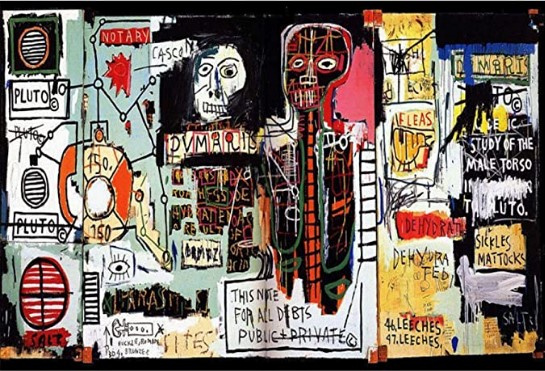
Jean-Michel Basquiat (1960–1988): Basquiat was born in Brooklyn, New York and attended Edward R. Murrow High School and City-As-School. While at this school, Basquiat became friends with Al Diaz and the two of them began spray painting graffiti using the pseudonym SAMO (acronym for “Same Old S—t”). One of their most famous graffiti pieces is the three-pointed crown. At age 17, Basquiat dropped out of school, his father kicked him out of the house. Basquiat slept at friends’ apartments or on park benches. In order to support himself, he panhandled, dealt drugs, and peddled hand-painted postcards and T-shirts. He often went to downtown clubs where he met well-known artists and musicians. Through these connections, Basquiat made appearances on television shows and showcased his artwork in galleries. Basquiat struggled with drug abuse and died from a heroin overdose. Source:
Leonard Bernstein (1918–1990): Bernstein was born in Lawrence, Massachusetts and was an American composer, conductor, pianist, and music educator. He is considered to be one of the most significant American personalities in orchestral conducting of the 20th century. In 1940, he studied at the Boston Symphony Orchestra’s summer institute called the Tanglewood Music Center. For nearly every summer for the rest of his life, Bernstein returned to Tanglewood to teach and conduct young music students. Bernstein wrote several books and helped to found two major international music festivals, the Pacific Music Festival and the Schleswig Holstein Music Festival, influencing and educating generations of young musicians. In 1958, he was the first conductor to share music on TV through his televised concert and lecture series, Young People’s Concerts with the New York Philharmonic. He became the Music Director of the New York Philharmonic and was given the lifetime title of Laureate Conductor. His best known work on Broadway is the musical West Side Story which was made into an Academy Award-winning film. He has been the recipient of many honors, including 11 Emmy Awards, one Tony Award, 17 Grammy awards, including the Lifetime Achievement Award, and the Kennedy Center Honor. Bernstein was also a lifelong humanitarian, supporting civil rights and issues that ranged from HIV/AIDS awareness, advocating for nuclear disarmament, protesting the Vietnam War, and engaging in international initiatives for world peace. Source: https://www.leonardbernstein.com/about
George Catlin (1796–1872): Catlin was born in Wilkes- Barre, Pennsylvania and as a young boy, he was interested in Native American life. In 1828, after encountering a delegation of Plains Indians in Philadelphia on their way to Washington D.C., he became determined to study Native American heritage before it was destroyed. Based on what he observed from his travels, he made more than 500 paintings and sketches. He eventually exhibited his pieces in the United States and Europe and referred to them as the “Indian Gallery.” The Smithsonian Institution acquired the bulk of Catlin’s Collection for ethnographic and historical interest. Source: https://www.britannica.com/biography/George-Catlin
Nathaniel Currier (1813–1888): Currier was born in Roxbury, Massachusetts and was an American lithographer who headed the company Currier & Ives with James Ives. Currier attended public school until 15, when he was apprenticed to the Boston printing firm of William and John Pendleton, the first successful lithographers in the United States. In 1835, Currier started his own lithographic business in which he produced standard lithographic products such as printing music sheets, letterheads, handbills, etc. In 1835, he issued a print illustrating a recent fire in New York, calling it the “Ruins of the Merchant’s Exchange N.Y. after the Destructive Conflagration of Decbr 16 & 17, 1835.” His print was published in the New York Sun, and was an early example of illustrated news. Currier & Ives are best known for their creation of popular art prints that portrayed Christmas scenes and landscapes but also produced political cartoons, historical scenes, and current events. Source: https://en.wikipedia.org/wiki/Nathaniel_Currier
James Merritt Ives (1824–1895): Ives was born in New York City and was a self-made artist. Ives’ talent as an artist as well as his business skills gave him valuable insight into what the public wanted, helping to grow the company. Source: https://en.wikipedia.org/wiki/James_Merritt_Ives
A winter scene in Central Park by Currier and Ives
Bashar Barakah Jackson (Pop Smoke) (1999-2020): Jackson, was born in Canarsie, Brooklyn, and was an American rapper and songwriter. He recorded his first track, “Mpr (Panic Part 3),” in 2018. His rap name is a combination of Poppa, a name given to him by his grandmother, and Smocco Guwop, a nickname from childhood friends. In 2019, he released his breakout single, “Welcome to the Party” and his debut mixtape “Meet the Woo.” In February 2020, Pop Smoke was shot during a home invasion in Los Angeles. Four men broke in around 4:30 A.M. and shot him twice in the chest and he was pronounced dead at Cedars-Sinai Medical Center. Originally, the LAPD thought Pop Smoke’s death was gang-related as he had ties to the Crips, but further evidence showed that his death was a consequence of a home robbery gone wrong. Source: https://en.wikipedia.org/wiki/Pop_Smoke
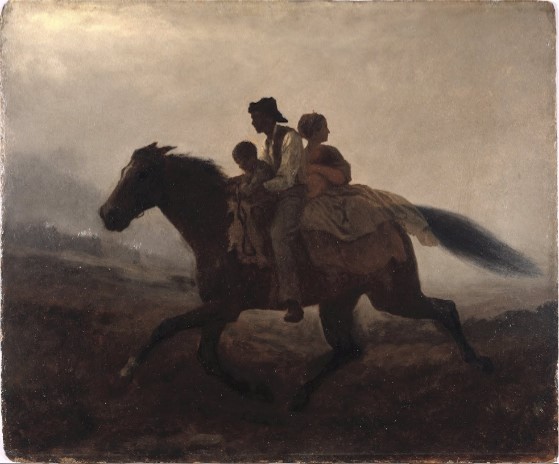
Eastman Johnson (1824-1906): Johnson was born in Lovell, Maine and was an American painter and co-founder of the Metropolitan Museum of Art in New York City. He was best known for his paintings of scenes from everyday life, called genre painting, and was considered the American Rembrandt of his time. His attention to detail made his work incredibly realistic. He established a studio in New York City with his ‘Negro Life in the South’, popularly called ‘Old Kentucky Home,’ an exhibit at the National Academy of Design. The painting alludes to plantation life and shows a range of domestic activities that took place in the slave quarters of a plantation. Another significant painting is ‘A Ride for Liberty – The Fugitive Slaves’, painted in 1862, based on his observations during the Civil War Battle of Manassas. It depicts a slave family riding to freedom and by placing the former slaves squarely in the center of the work, Johnson alludes to the idea that the people are acting as agents of their own destiny. Source:
Eastman Johnson, A Ride for Liberty — The Fugitive Slaves, c. 1862
Authors/Writers.
James Weldon Johnson (1871–1938): Johnson was born in Jacksonville, Florida and received a bachelor’s degree from the college at Atlanta University. After graduating, he became the principal of Stanton School and began studying law. He was admitted to the Florida Bar thereafter. In 1901, Johnson decided he also wanted to pursue a career in writing and moved to New York City with his brother where they wrote songs for musicals on Broadway. Johnson became involved in politics and eventually accepted the position of field secretary for the National Association for the Advancement of Colored People (NAACP). As executive secretary, he brought attention to racism, lynching, and segregation. Johnson’s best known work is the lyric to “Lift Every Voice and Sing,” which is considered the unofficial Black national anthem.Source: https://www.naacp.org/naacp-history-james-weldon-johnson/
Business Leaders/ Newspaper Publishers.
James Gordon Bennett, Sr. (1795-1872): Bennett was born in Scotland, immigrated to Canada, and then moved to the United States. Starting in 1823, Bennett worked as a freelance writer and assistant editor of the New York Courier and Enquier. Bennett created the New York Herald and shocked readers with the front-page coverage of sensational crimes. Bennett pioneered a cash-in-advance policy for advertisers, using the latest technology, and using woodcuts to illustrate articles. During the Civil War, Bennett and the Herald used racist language in articles opposing the war and attacked President Abraham Lincoln for trying to keep the Union together. Source: https://www.britannica.com/biography/James-Gordon-Bennett-American-editor-1795-1872
Charles Feltman (1841-1910): Feltman was a German-American restaurateur who is credited with being the inventor of the hot dog. In 1867, Feltman began to sell food to beachgoers at Coney Island in Brooklyn and came up with the idea of putting a sausage on a roll so he could avoid having to provide silverware and plates to his customers. They were Coney Island Red Hots. In 1916, a Feltman employee named Nathan Handwerker left to start his own business a few blocks away from Feltman’s on Surf Avenue. Nathan’s Famous soon became a larger attraction than his former employer’s restaurant and became a Coney Island icon. Source: https://www.coneyislandhistory.org/hall-of-fame/charles-feltman
William Delbert Gann (1878–1955): William Delbert Gann was born in Lufkin, Texas where he dropped out of school to work on his family’s cotton farm. Gann used the Bible to learn to read, and in so doing, learned about commodities trading in cotton warehouses. Gann eventually moved to New York City where he worked on Wall Street and opened his own brokerage firm, known as W.D. Gann & Company, becoming one of the most successful stock and commodity traders in the world. Source: https://www.investopedia.com/articles/investing/091615/mysterious-life-trading-legend-wd-gann.asp
Horace Greeley (1811-1872): Greeley was born in Amherst, New Hampshire where he became a printer’s apprentice before moving to New York City. In 1834, Greeley founded his first newspaper, The New-Yorker, which was aligned with the Whig Party (he would print ads and help influence people to vote for candidates of this party). Greeley was an active Whig, working with New York Governor William H. Seward and President William Henry Harrison on their campaigns. He started The New-York Tribune in 1841, where he championed rights for workers and women and the abolition of slavery. Greeley criticized President Abraham Lincoln during the Civil War for not actively opposing slavery. Greeley ran unsuccessfully for President in 1872 as a Liberal Republican. Interestingly, Greeley’s wife died in October 1872, a few weeks before the election and Greeley died a few weeks later on November 29. If he had won the election, this would be the first time a president-elect died before being elected by the Electoral College. Source: https://www.green-wood.com/horace-greeley/
Morris Ketchum Jesup (1830-1908): Jesup a banker and philanthropist. He moved to New York City in 1842 where he established MK Jesup & Company and eventually was President of the New York Chamber of Commerce and of the Museum of Natural History. He worked to improve social conditions in New York for poor immigrants from Europe and Russia as a founder of the Five Points House of Industry, a settlement house that taught immigrants skills needed to live in the United States. In 1905, Jesup was knighted by Tsar Nicholas II of Russia for his philanthropic work aiding immigrants from Russia. Source: https://www.lindahall.org/morris-ketchum-jesup/
Pierre Lorillard IV (1833-1901): Lorillard’s great-grandfather founded P. Lorillard and Company which processed tobacco, cigars, and snuff. Lorillard established Tuxedo Park, New York as an elite hunting and fishing destination, which attracted the world’s rich and famous. He helped pioneer the formal dresswear for men, the tuxedo. Source: https://www.alsformalwear.com/history-of-the-tuxedo/
Henry Jarvis Raymond (1820-1869): Raymond worked for numerous newspapers including the New York Tribune and Courier and Enquirer as a journalist and associate editor and then started The New York Times, in 1851. Raymond was a member of the New York Assembly as a member of the Whig Party (and was elected lieutenant governor (1855-1856). He was a strong supporter of President Lincoln and served one term in the House of Representatives from 1865 to 1867. After Raymond retired from Congress, he attacked the corrupt “Tweed Ring” and advocated for tariff reductions and civil service reform. Source:
Sahadi Family: The Sahadi family imigrated from Lebanon to “Little Syria” in Manhattan where they launched Sahadi Importing to introduce Middle Eastern goods in the United States. On Ellis Island, an exhibition features a photograph of Abrahim Sahadi with A. Sahadi & Co. tins and an ordering book from the 1920s. In the 1940s the Sahadi’s store relocated to Brooklyn’s Atlantic Avenue where it remains.
Frederick August Otto Schwarz (1836–1911): Schwarz was born in Westphalia, Germany where he served an apprenticeship for one of the city’s leading merchants. At the age of twenty, he immigrated to the United States and initially settled in Baltimore. , receiving business training that benefited him when he moved to the United States at 20 years old. In New York City he opened the Schwarz toy bazaar. The F.A.O. Schwarz catalog was published in 1876 and it became the store’s staple for merchandising. Schwarz was the first merchant to utilize a live dressed-up Santa Claus to promote seasonal sales. In the movie, Big, there is an iconic moment where two characters play “Chopsticks” with the floor keyboard in the flagship F.A.O. Schwarz toy store in Manhattan. Source: https://www.encyclopedia.com/education/economics-magazines/schwarz-frederick-august-otto
Henry Steinway (1797–1871): Henry Steinway (Heinrich Steinweg) was born on February 15, 1871 in Braunschweig, Germany. In the first 30 years of his life, Steinweg spent them in Germany making pianos in his own home. In June of 1849, his son, Carl, became the first family member to emigrate to America. A few months later, Heinrich prepared him and his family to follow suit. The Steinweg family eventually settled into a home in New York City, luckily, in an area where there were many piano manufacturers. In 1856, the Steinway & Sons partnership agreement was signed and the name Steinway was used instead of Steinweg for business purposes. At the American Institute Fair in 1855, a Steinway piano was honored the best in the show and was awarded the first place gold medal. This accolade confirmed the quality of the instruments produced by their family. They used the name “Gold Medal Pianos” to advertise their work. The business story of the Steinway piano business is exceptional. Henry never learned how to speak English and did not become an American citizen until 1863. Source:
Louis Comfort Tiffany (1848–1933): Louis Comfort Tiffany is known as one of America’s acclaimed artists. He was a painter, craftsman, philanthropist, decorator, and designer. He was internationally recognized as one the greatest forces of the Art Nouveau style, which made significant contributions to the art of glassmaking. Starting his career as a painter, he worked under the influence of artists such as George Inness and Samuel Colman. In the late 1870’s, Tiffany began to acquire an interest for decorative arts and interiors as well. Later on, both Tiffany and Colman worked together to design furnishings and interiors for the New York mansion, which was completed in 1892. Under various clients, Tiffany designed both private interiors and public spaces. In the 1890’s, Tiffany built a glasshouse in Corona, Queens, New York. His work with leaded-glass brought him great recognition. Aside from his various artistic nature, Tiffany was knowledgeable about jewelry trends through art periodicals, international expositions, and his father’s firm, Tiffany & Co. Upon his father’s death in 1902, he was appointed art director. His earliest jewelry designs were exhibited at the 1904 Louisiana Purchase Exposition in St. Louis. Enamels, Favrile glass vessels, and pottery gained attention and favorable press by various art critics during this time period. Between 1902 and 1905, Tiffany built his Long Island country home in Cold Spring Harbor in Oyster Bay, New York. Evidently, his work continues to influence Tiffany & Co. designs. Source: https://www.metmuseum.org/toah/hd/tiff/hd_tiff.htm
Tiffany Lamps at the New York Historical Society
Inventors/Scientists
Barry Commoner (1917–2012): Barry Commoner, born on May 28, 1917 in Brooklyn, NY, was an American cellular biologist, activist. and environmentalist. He received his bachelor’s degree in zoology from Columbia University in 1937 and his master’s and doctoral degrees in cellular biology from Harvard University in 1938 and 1941. In 1947, he moved to St. Louis, Missouri, and joined the faculty of Washington University in St Louis where he worked as a professor of plant physiology for 34 years. In the 1950s, Commoner warned of the environmental threats posed by modern technology (i.e.: nuclear weapons, use of pesticides, and ineffective waste management). Commoner was known for his opposition to nuclear weapons testing and joined a team which conducted the Baby Tooth Survey, which found Strontium 90 in children’s teeth as a direct result of nuclear fallout. This study directly contributed to the adoption of the Nuclear Test Ban Treaty of 1963. Commoner’s publications were influential in the Nixon administration’s decision to create the Environmental Protection Agency (EPA) and the Clean Air Act. In February 1970, TIME magazine named Commoner the “Paul Revere of ecology.” Source: https://www.nytimes.com/2012/10/02/us/barry-commoner-dies-at-95.html
Peter Cooper (1791-1883): Peter Cooper was born on February 12, 1791 in New York City. Cooper was an American inventor, manufacturer, and philanthropist. He built the “Tom Thumb” locomotive, a new system for towing canal boats, and founded The Cooper Union for the Advancement of Science and Art.
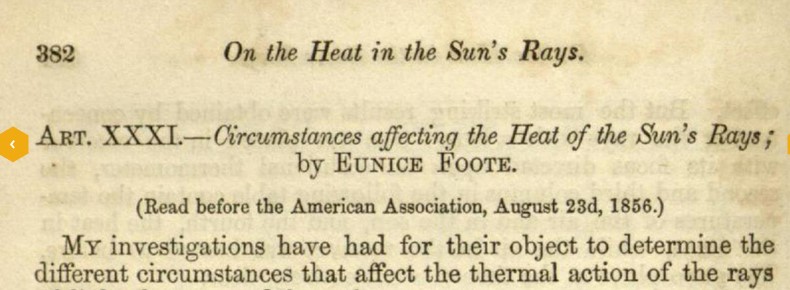
Eunice Newton Foote (1819-1888): Foote was an American scientist and women’s rights activist. She pioneered climate science and in 1856, theorized that changes in carbon dioxide in the atmosphere could affect the Earth’s temperature. Her groundbreaking discovery was overlooked and eventually forgotten by the scientific community. Foote made the discovery by conducting a series of experiments that demonstrated the interactions of the sun’s rays on different gases. She concluded that carbon dioxide trapped the most heat of all the gases she tested and connected the dots between carbon dioxide and global warming. Her paper was later published in the American Journal of Science and Arts. Foote was a prominent feminist and a signer of the Declaration of Sentiments at the 1848 Seneca Falls Convention. She was a neighbor and friend of suffragist Elizabeth Cady Stanton and was one of the five women who prepared the proceedings of the convention for publication. old. Source: https://www.nytimes.com/2020/04/21/obituaries/eunice-foote-overlooked.html
Elias Howe (1819-1867): Elias Howe was born on July 9, 1819 in Spencer Massachusetts. He worked in a textile factory in Lowell until it closed in 1837 and then for a master mechanic where he had the idea for the sewing machine. In September 1846, he was awarded a United States patent for his invention. In 1851, Howe received a patent for an “Automatic, Continuous Clothing Closure,” now known as the zipper. Source: https://en.wikipedia.org/wiki/Elias_Howe
Mary Jacobi (1842-1906): Mary Jacobi was born in 1843 in London, England to American parents. Jacobi studied at the New York College of Pharmacy and later received her M.D. from the Female Medical College of Pennsylvania. In 1866, Jacobi moved to Paris and supported co-education for men and women. She argued that women’s medical schools could not provide the same training and clinical practice as established universities that were affiliated with large hospitals. Jacobi published over 120 scientific articles and nine books. Source: https://cfmedicine.nlm.nih.gov/physicians/biography_163.html
Samuel Morse (1791- 1872): Morse was born in Charlestown, Massachusetts and attended Yale College where he received instruction in religious philosophy, mathematics, the science of horses, and electricity. After graduating, he traveled to England to study art and gained a reputation as a portrait painter. When he returned to the United States, he helped found the National Academy of Design in New York City. While traveling by ship from Europe to the United States, Morse conceived the idea for an electric telegraph. Morse was an active opponent of immigration to the United States and a leading defender of slavery. Source: https://en.wikipedia.org/wiki/Samuel_Morse
Political Figures
DeWitt Clinton (1769–1828): DeWitt Clinton was born on March 2, 1769 in Little Britain, New York. Clinton was the nephew of Governor George Clinton. He served as a United State Senator (1798-1802), Mayor of New York City (1803-15), Lieutenant Governor (1811-13), and Governor (1817-1823 and 1825-1828). In 1812, he ran for president against James Madison and lost. As mayor, Clinton advocated for free and widespread education. In 1811, Clinton proposed a canal to link the Hudson River with Lake Erie. In April 1816, the legislature agreed to finance the canal, which was completed in 1825. Source: https://www.britannica.com/biography/DeWitt-Clinton-American-politician
William Livingston (1723-1790): William Livingston was born in Albany, New York, and studied law at Yale College before moving to New York City. He represented New Jersey in the First and Second Continental Congress, was a delegate to the Constitutional Convention in 1787, and was the first man elected Governor of New Jersey. Livingston, New Jersey, is named in his honor—he was reelected 14 times and was responsible for the gradual emancipation laws of New Jersey. Source: https://www.britannica.com/biography/William-Livingston
Alice Roosevelt (1861-1884): Alice (Lee) Roosevelt was an American socialite and the first wife of President Theodore Roosevelt. In 1883, Alice became pregnant and gave birth to the couple’s daughter. Less than two days later, she died from kidney failure caused by Bright’s disease. Source:
Henry Rutgers (1745-1830): Henry Rutgers was born in New York City. After graduating from King’s College (now Columbia University), he became a supporter of independence. During the Battle of White Plains, Rutgers served as captain of the American forces and then later on as a colonel for the New York militia. Rutgers committed his fortune to philanthropy, donating land for the use of schools, churches, and charities. He donated to Queen’s College in New Brunswick, New Jersey which was renamed Rutgers College. Source: https://en.wikipedia.org/wiki/Henry_Rutgers
Henry Chadwick (1824-1908): English-born Chadwick was a sportswriter, baseball statistician and historian. He edited the first baseball guide and is sometimes called the “Father of Baseball.” In 1859, while working with the Brooklyn Excelsior club, Chadwick created the first modern box score. He included runs, hits, put outs, assists and errors the letter ‘K’ for strikeouts. He is a member of the baseball Hall of Fame. Source: https://baseballhall.org/hall-of-famers/chadwick-henry
Charles Ebbets (1859–1925): Ebbets was born and raised in New York City. He sold team tickets, score cards, and peanuts at the Brooklyn Baseball Association stadium in Washington Park on 5th Avenue and 3rd Street. Ebbets bought lots in the Flatbush area and opened Ebbets Field at the intersection of Empire Boulevard and Bedford Avenue. Ebbets received credit for many baseball innovations including the rain check, uniform numbers, and the way that teams should draft in inverse order based on their final standings. Source: https://sabr.org/bioproj/person/charlie-ebbets/
Scoundrels
Albert Anastasia (1903-1957): Anastasia arrived in New York City from Italy in 1919. In the 1920s, Anastasia was an executioner for Giuseppe Masseria’s Brooklyn gang. Anastasia was charged with a series of murders, but in each case witnesses either disappeared or refused to testify. In the late 1930s, he became the leader of Murder Inc., earning Anastasia the nicknames “Mad Hatter” and the “Lord High Executioner.” In 1942, Anastasia joined the U.S. Army and was granted United States citizenship. In the late 1940s, he became boss of the Gambino Family (one of the Five Families of organized crime in New York City). Anastasia was murdered in 1957 in a New York City barber shop by rival mobsters. Source: https://www.britannica.com/biography/Albert-Anastasia
Jane Augusta Funk Blankman (1823–1860): Better known as Fanny White, she was one of the most successful prostitutes and wealthiest women in pre-Civil War New York City. She managed a brothel where her clientele included some of the richest men in New York City. In 1859, she married Edmon Blankman, a well-known criminal attorney. An initial autopsy revealed that Jane died as a result of a stroke that caused bleeding on her brain, however, rumors circulated that her husband poisoned her to inherit her wealth. Source: https://civilwartalk.com/threads/did-anyone-cry—when-jane-blankman-died.156198/
Joey “Crazy Joe” Gallo (1929–1972): Gallo was born in Red Hook, Brooklyn. His father Umberto was a bootlegger during Prohibition Gallo became an enforcer and a hit-man for the Profaci family and in 1957, Gallo and his crew murdered Albert Anastasia (boss of the Gambino family). After a prison term Gallo set up his own gang. In a gangland war, he was murdered by a gunman murdered for the Profaci-Colombo family. Source: https://mafia.wikia.org/wiki/Joey_Gallo
Carmine Persico (1933–2019): Persico was born in Brooklyn, New York, where he was a leader of the Garfield Boys gangs. In the 1950s, Persico was recruited by the Profaci family and he participated in the murder of Albert Anastasia and was a rival of Joey Gallo. Gallo twice tried to murder Persico by bombing his car and shooting him, however Persico survived both attempts. In 1968, Persico was convicted on federal hijacking charges and was sent to prison for eight years. He was later sentenced to 139 years in prison. Source: https://en.wikipedia.org/wiki/Carmine_Persico
William “Bill the Butcher” Poole (1821-1855): Poole was born in New Jersey, but his family moved to New York City in 1832 where his father opened a butcher shop. Poole was a member of volunteer Fire Engine Company #34, where he started the Washington Street Gang, later known as the Bowery Boys. The Bowery Boys were nativists and their main rivals were the Dead Rabbits, an Irish gang. Poole was also active in the anti-immigrant Know Nothings political movement. He was immortalized in the movie Gangs of New York. Source: https://www.historicmysteries.com/bill-the-butcher/
James Marion Sims (1813-1883): Sims was born in South Carolina and started his medical career in Montgomery, Alabama before moving to New York City. He was known as the father of modern gynecology. His reputation has changed because he developed pioneering tools and surgical techniques by experimenting without antiseptics or anesthesia on enslaved black women. Because of this, a statue of Sims was removed from New York’s Central Park in 2018 and it is now in storage at Greenwood cemetery. Source: https://www.history.com/news/the-father-of-modern-gynecology-performed-shocking-experiments-on-slaves
Lynne Stewart (1939–2017): Stewart was was a defense attorney known for representing economically disadvantaged clients and controversial defendants. Her most famous client was Sheikh Omar Abdel Rahman who was found guilty of leading the 1993 plot to blow up New York City landmarks including the World Trade Center. Rahman was sentenced to a life term in solitary confinement and Stewart, as his lawyer, was one of the few people authorized to visit him. In 2005, Stewart was convicted of smuggling messages between Rahman and his followers. She was disbarred and sent to prison. Source: https://www.nytimes.com/2017/03/07/nyregion/lynne-stewart-dead-radical-leftist-lawyer.html
William Maegar “Boss” Tweed (1823-1878): Tweed was born in New York City. In 1851, on his second try, he won the race for city alderman and then served in the House of Representatives from 1853 to 1855. He was elected to New York City’s Board of Supervisors in 1858. Tweed used this position to build the “Tweed Ring,” a political network of corruption. In 1863, Tweed was chosen to be the head of Tammany Hall’s general committee and began placing friends into influential positions. One of the grandest schemes that the Tweed Ring was involved in was the construction and furnishing of New York City’s courthouse. At a time where the land for Central Park cost New York City $5 million and St. Patrick’s Cathedral cost $2 million to build, the Courthouse ended up costing taxpayers $12 million because of inflated bills that provided kickbacks to members of the Tweed Ring. As the result of an anti-corruption campaign by the New York Times and cartoonist Thomas Nast of Harper’s Weekly, Tweed was arrested in 1871 and the Tweed Ring was dismantled. Tweed was convicted on 204 counts but escaped from custody and fled to Spain where he was captured by Spanish officials that recognized him from Nast cartoons. Source: https://www.green-wood.com/william-magear-boss-tweed/
The Cypress Hills Cemetery on Jamaica Avenue in Brooklyn near the Queens border was founded in November 1848. It is known as the “first cemetery in Greater New York to be organized under a law that is internationally recognized as ‘America’s contribution to the civilized burial of the dead.’” During the 1800s, many cemeteries were located in churchyards. The founders of Cypress Hills strayed from the common cemetery landscape to “look up unto the hills,” instead of using lowlands. Due to the size and geographic makeup of Cypress Hills Cemetery, it took almost three years of work to cut, clean, and properly landscape the land. As the work was being done, cannonballs and other Revolutionary war artifacts from the August 1776 Battle of Brooklyn were discovered on the grounds. Currently, the cemetery extends over 225 acres. A detailed map of notables is available online at this link.
Elizabeth Jennings Graham (1830-1901): Graham was born to free African-American parents and became a church organist and a teacher at the African Free School in New York City. In 1854, Jennings boarded a streetcar reserved for whites only at the corner of Pearl Street and Chatham Street. The conductor ordered to get off, she refused, and was forcibly removed by the conductor and police officer. Following the incident, Jennings wrote a letter, which was published in the New York Tribune, describing the events. Her letter received national attention and motivated the African-American community to start a movement to end racial discrimination on streetcars in New York City. On her behalf, Jennings’ father filed a lawsuit against the conductor. They were represented by future U.S. President Chester A. Arthur. The court ruled in their favor, awarding damages of $225. Source:
Charlotte E. Ray (1850-1911): Ray was born on January 13, 1850, in New York, New York. As a student at the Institution for the Education of Colored Youth in Washington, D.C., she received a law degree in 1872. She was the first woman admitted to practice law in the District of Columbia and the first Black woman to become a certified lawyer in the United States. Ray attempted to open a law office in Washington D.C., however, racial prejudices proved too strong and she couldn’t obtain enough legal business to maintain a steady, active practice. She returned to New York City where she taught in public schools. Source: https://www.britannica.com/biography/Charlotte-E-Ray
Arturo Schomburg (1874-1938): Schomburg was born in San Juan, Puerto Rico and at a very young age, he experienced racism when his grade school teacher told him that black culture lacked any prominent individuals or noteworthy history. This comment disturbed Schomburg and ultimately sparked his lifelong dedication to debunking this claim. At the age of 17, he migrated to New York where he was active in movements for Cuban and Puerto Rican independence and co-founded a political club known as Las Dos Antillas. For the rest of his life, he collected historical documents such as books, prints, pamphlets, and articles produced by Africans in the Americas and Europe. He was a founder of the Negro Society for Historical Research and served as the leader of the American Negro Academy. He also wrote articles on the history of black culture for “The Crisis,” “Opportunity,” “Negro World” and others. In 1926, Schomburg sold his collection to the New York Public Library. Source:
James McCune Smith (1813-1865): Smith was born into slavery on April 18, 1813 in New York City and set free on July 4, 1827 by the Emancipation Act of New York. He was the first African American to hold a medical degree, graduating at the top in his class from the University of Glasgow, Scotland. He applied to Columbia University and Geneva Medical College but was denied due to racial discrimination. When Smith returned to New York in 1837, he opened a practice in Manhattan in general surgery, treating both Black and white patients and operated the first Black-owned pharmacy in the U.S. He was also the first Black to publish in American medical journals. Smith was a prominent abolitionist and wrote essays and gave lectures refuting racist misconceptions about race and intelligence. After the New York Draft Riots in 1863, in which white rioters attacked Blacks throughout the city, Smith moved to Williamsburg, Brooklyn. Source: https://www.nyhistory.org/web/africanfreeschool/bios/james-mccune-smith.html
Actors/Artists/Musicians
James “Eubie” Blake (1883-1983): Blake, an American pianist, lyricist, and composer of jazz music, was born on February 7, 1887 in Baltimore, MD. He was one of the most important figures in early-20th century African American music, particularly ragtime and early jazz music and culture. Blake began playing piano professionally when he was 16 years old and wrote his first composition, the Charleston Rag, around the same time. His career took off in 1915 when he met his long-time collaborator Noble Sissle and together they wrote Shuffle Along, one of the first Broadway musicals to be written and directed by African Americans. The show was a hit, running for 504 performances with 3 years of national tours. By 1975, Blake had received honorary doctorates from Rutgers, the University of Maryland, the New England Conservatory, Morgan State University, Pratt Institute, Brooklyn College and Dartmouth and in 1981, he received the Presidential Medal of Freedom from President Ronald Reagan. Sources: https://en.wikipedia.org/wiki/Eubie_Blake; https://www.loc.gov/item/ihas.200038834/
Junius B. Stearns (1810-1885): Stearns is most well-known for his five-part painting series of George Washington. Washington as a Statesman depicts Washington addressing the Constitutional Convention and was used on a U.S. Postage Stamp in 1937. Source: https://eazel.net/artists/68
Mary Jane “Mae” West (1893-1980): Her mother was an immigrant from Germany and her father was the Brooklyn prizefighter “Battlin’ Jack” West. At the age of five, Mae made her first stage appearance at a church gathering. Not long after, Mae was performing at amateur night at local burlesque theaters as “Baby May.” At the age of 14, West began performing professionally in vaudeville, impersonating adult vaudeville and burlesque performers. In 1926, West wrote, produced, directed, and starred the Broadway play “Sex,” which both got her arrested and made her known around the world. Ten years later, Hollywood noticed West’s talent she stared in many films. Source: https://www.biography.com/actor/mae-west
Sports Figures.
James “Gentleman Jim” Corbett (1866-1933): Corbett was an American professional boxer and a World Heavyweight Champion. He is the only person who ever defeated John Sullivan in the World HeavyWeight Championship in 1892. “Gentleman Jim” is considered the “Father of Modern Boxing.” Source: https://www.thefightcity.com/fight-city-legends-gentleman-jim-boxing/
Jackie Robinson (1919-1972): Robinson was born in Georgia and attended college in California where he played basketball, football, baseball, and ran track. During World War II, Robinson left college to enlist in the U.S. Army, where he moved up to second lieutenant in two years, but then was court-martialed when he challenged incidents of racial discrimination. Starting in 1945, Robinson played professional baseball in the Negro League. Robinson later signed with the Brooklyn Dodgers and broke the color barrier in Major League Baseball. As a rookie, Robinson led the National League in stolen bases and was chosen Rookie of the Year. In 1949, he won the National League batting championship with a .342 average and was voted Most Valuable Player. His career batting average was .311 and he was the first African-American elected to the National Baseball Hall of Fame. In 1997, Major League Baseball retired his number 42. Source: https://www.jackierobinson.com/
Scoundrels
Margaretta and Catherine Fox (1833–1893; 1837–1892): The Fox sisters were American spiritualists and performers who would pass messages to each other by cracking their toes during a seance and claimed they could talk to the dead. The Fox sisters were eventually exposed as fakes and were forced to admit their act was all fraud. Source: https://www.theparisreview.org/blog/2016/11/04/in-the-joints-of-their-toes/
National Council for the Social Studies Response to the Acquittal of Kyle Rittenhouse
This statement was issued by the National Council for the Social Studies in November during its national convention. The New Jersey and New York social studies councils are part of NCSS.
“This week as the National Council for the Social Studies comes together to proclaim solidarity as social studies professionals, Kyle Rittenhouse, the 18-year-old who in a series of encounters with protesters calling for justice in the police shooting of Jacob Blake, shot and killed Joseph Rosenbaum, Anthony Huber, and injured Gaige Grosskreutz, was acquitted by a jury in Kenosha, Wisconsin. This acquittal is a dangerous harbinger for civic life, giving license to vigilantism.”
“The Pledge of Allegiance concludes with the words “and justice for all.” There are many who believe that justice for all was not done in this case. Others believe that we need to be trusting of the system – even when we are faced with a decision with which we may wholeheartedly disagree. Regardless of what you believe, as social studies professionals, we understand the gravity of this acquittal because we know the wicked history of vigilantism as a tool to maintain white privilege in the United States.”
“Martin Luther King, Jr., said: ‘Injustice anywhere is a threat to justice everywhere. We are caught in an inescapable network of mutuality, tied in a single garment of destiny. Whatever affects one directly, affects all indirectly.’”
“We call for social studies teachers to stand in solidarity with the families of those victimized by Kyle Rittenhouse. We call for social studies teachers to stand in solidarity with the right to proclaim Black Lives Matter without fearing white vigilantism. We call for social studies teachers to stand in solidarity with citizens who continue to stand for justice, even when the systems of justice are found wanting.”
Conflicted Vision: Thomas Jefferson and the University of Virginia
by Alan Taylor
Review by James J. Carpenter
In any discussion of early America and public education, Thomas Jefferson inevitably plays a central role. For many, he “remains one of democratic education’s founding fathers” (Neem, 2013, p. 3). Jefferson’s Bill for the General Diffusion of Knowledge called for a three-tiered system of public schooling that would, according to Wagoner (2004), “elevate the mass of people to the moral status necessary to insure good government and public safety and happiness” (p. 34). Jefferson’s vision for Virginia schools would fall victim to the political realities of that state, save for the eventual establishment of the University of Virginia in 1819. Indeed, the university is one of three accomplishments Jefferson had engraved on his tomb, along with being the author of the Declaration of Independence and of the Virginia Statute for Religious Freedom.
Like most of Jefferson’s life, there is a considerable volume of literature on his educational views and his plans for improving education in his beloved Virginia (e.g. Addis, 2003; Conant, 1962; Gilreath, 1999; Heslep, 1969; and Wills, 2002). I was curious, therefore, to read Alan Taylor’s latest work entitled Thomas Jefferson’s Education. Was this a description of Jefferson’s personal educational odyssey or was this another discourse on his educational philosophy and plans for public schooling in Virginia? I was pleasantly surprised to find it was both and more. Taylor successfully weaves Jefferson’s fight to advance public education in Virginia with stories of a wide variety of individuals who supported or resisted his goals. Furthermore, he situates these often bitter political struggles in the context of a stratified Virginia society built on a foundation of enslaved labor.
Indeed, Taylor’s description of a complicated social milieu often seems to be the real subject of his book. At first, as a reader, I was distracted by the many anecdotes and stories Taylor offers as illustrations for the contesting forces that impacted Jefferson’s goal of free public education for white males. It is only when the reader sits back and focuses on the entire mosaic rather than on the individual tesserae that Taylor’s story becomes clear. He rather quickly addresses the failure of Virginia’s legislature to approve Jefferson’s plans for publicly funded elementary and secondary schools and focuses on Jefferson’s goal for a public university that would rival Harvard and Yale.
Taylor places this struggle to create the University of Virginia in the context of powerful cultural forces within the state – and by extension throughout the South – and thereby creates a fascinating subtext for his book. The primary forces at work were the increasingly rigid attitudes regarding slavery and the strict adherence to the gentry’s belief in their privileged status including their preference for drinking, gambling, and dueling in defense of their honor. Taylor masterfully posits these societal flaws against Jefferson’s wishes to create a university which would train leaders who would reform Virginia. Jefferson envisioned this next generation of leaders would further republicanism by adopting “a more democratic state constitution for white men,” by embracing his goals for public education for all white children, and by emancipating but deporting slaves (p. 307). Jefferson’s hopes for the future evolved during a period where regional bitterness was hardening at an alarming rate, an extreme bitterness Joanne Freeman (2018) has described as a violent “cultural federalism” (p. 50). Southern politicians increasingly saw the Union as endangered by northern political and economic interests which would put the South at a distinct disadvantage. Southern fathers did not want their sons attending northern institutions of higher learning for fear they would be corrupted by antislavery ideas and dangerous democratic ideas of equality. Instead, southern “gentlemen attended college to hone social skills and cultivate social networks” (p. 82). Additionally, “fathers wanted sons to develop a robust sense of honor,” including choosing dueling over accepting insults (p. 83). And, as Taylor describes, their sons whole-heartedly bought into their privileged status; to the extent that they believed themselves exempt from obeying rules and policies implemented by those they believed to be of inferior status including their professors. Indeed, according to Taylor, this strategy at times worked all too well. Most of Virginia’s young gentlemen “became petty tyrants” to the state’s enslaved population (p. 83).
It was in this social and cultural milieu that Jefferson and others in Virginia’s founding generation tried to re-establish that state’s prestige. As other states, especially in the North, gained in population and in political influence, these aging leaders identified education as the means to restore Virginia to what they believed to be her rightful status. The College of William and Mary was in decline since the state capitol had moved from Williamsburg to Richmond and Jefferson saw this as an opportunity to build a new university, one that would embody his philosophical beliefs and be free from any religious connections. Taylor describes Jefferson’s reliance on his chief lieutenant in the state legislature, Joseph C. Cabell, and his efforts to thwart other attempts to construct a university in locations other than Charlottesville. Many personalities are presented in this account; some famous like James Madison, Patrick Henry, and James Monroe and others less so, such as the Scottish teacher James Ogilvie, the mercurial John Randolph, and Jefferson’s rival for controlling the fledgling university, John Hartwell Cocke.
In detailing how he secured his beloved university, Taylor sheds light on Jefferson’s complex personality. For example, in constructing the university Jefferson dismissed the idea of sharing state education allocations with two other campuses he ridiculed as “’local interests’” while remaining oblivious to the parochial nature of his own plans (p. 198). Believing “that only architectural grandeur could attract many students” (p. 211), Jefferson’s construction costs exceeded both the state appropriations and private monies raised through subscriptions leaving the university with no money for scholarships for deserving students. As a result, only sons of the wealthiest Virginia families could afford to attend causing the university to “suffer from their homogeneity and sense of entitlement” (p. 214).
Known for his pleasing manners and hospitable nature, Jefferson could also be sharp and intransient on issues he deemed important. His insistence that the university be free from religious influence and that there be no professor of divinity alienated many Virginia Christians, especially Evangelical Episcopalians and Presbyterians, leading to contentious struggles with the university’s Board of Visitors and state political leaders. Though he expressed a faith in the free expression of ideas, Taylor describes how Jefferson “assumed that the free pursuit of truth always led to his conclusions.” His university would be a bastion of republican orthodoxy free from “Federalist “’heresies.’” For example, Jefferson selected political readings that “favored states’ rights over national consolidation” as texts for the professor of law to use (p. 238, emphasis added to first quote). Republicanism was the litmus test in hiring for Jefferson. Therefore “no Federalist need apply to become professor of law at the University of Virginia,” regardless of his qualifications (p. 239). Far from promoting a democratic education, Jefferson often endorsed a more authoritarian approach in managing the day to day issues at his university.
Today the University of Virginia is one of the most respected public universities in the United States. It is fondly referred to as Mr. Jefferson’s university. The picture Taylor paints of the early days of the university is at odds with what it has become. Plagued by low enrollments and financial problems, it initially housed a student population more dedicated to drinking, gambling, and carousing than to studying. Students accustomed to privilege and power frequently fought, rioted, mistreated slaves, and disrespected faculty, with one student actually fatally shooting a professor. Following Jefferson’s death in 1826, things began to change, albeit slowly. By the mid-1840s, the university could afford to grant scholarships to deserving but less affluent students. Increasing enrollments led to greater numbers of Christian students who would have been unacceptable to Jefferson. Faculty hires became less political and rule changes on campus led to less violent and more sober student behavior. By the eve of the Civil War, the University of Virginia was becoming a major academic institution though not as envisioned by its famous founder.
The evolution Taylor describes contains many ironies. For example, while largely ignoring the need to educate women beyond what was required to be a good wife (though he did promote learning for his own daughters and granddaughters), it was Jefferson’s daughters and granddaughters who became “teachers of a new generation of women” and who managed to save their family financially after the Civil War (p. 315). And Taylor masterfully describes the problematic relationship between Jefferson’s primary objectives for students who attended the University of Virginia. One goal was to produce republican leaders who would protect the rights of states against what he perceived as an increasingly threatening union controlled by northern politicians. His second objective was that these more enlightened leaders would reform Virginia, especially by first ending slavery and then deporting the formerly enslaved out of the United States, thereby ridding the country of its original sin. Jefferson failed to see these two goals as being contradictory. As Taylor demonstrates, the next generation did defend states’ rights in ways Jefferson could not have imagined. And rather than seeing slavery as a sin to be abolished, Virginia leaders promoted slavery as a positive institution which protected an inferior race. Ultimately, the university students did not “uproot slavery as Jefferson had hoped,” but instead “defended it and served the Confederacy in the Civil War” (p. 307). In delineating this progression to the potential dissolution of the union Jefferson had helped create, Taylor not only has made a valuable contribution to the literature on Thomas Jefferson’s impact on education but also to that of the history of education in the United States and to that of sectional development in ante-bellum America.
References
Addis, C. (2003). Jefferson’s Vision for Education, 1760-1845. New York, NY: Peter Lang.
Conant, J. B. (1962), Thomas Jefferson and the Development of American Public Education. Berkeley, CA: University of California Press.
Freeman, J. B. (2018). The field of blood: Violence in Congress and the road to civil war. New York NY: Farrar, Straus and Giroux.
Gilreath, J. (Ed.). (1999). Thomas Jefferson and the Education of a Citizen. Washington, D. C.: The Library of Congress.
Heslep, R. D. (1969). Thomas Jefferson & Education. New York, NY: Random House.
Neem, J. (2013). Is Jefferson a founding father of democratic education? A response to “Jefferson and the ideology of democratic schooling.” Democracy and Education, 21 (2), Article 8. Available at https://www.democracyandeducationjournal.org/home/vol21/iss2/8.
Wagoner, J. L., Jr. (2004). Jefferson and education. (Monticello monograph series). Chapel Hill, NC: University of North Carolina Press.
Wills, G. (2002). Mr. Jefferson’s University. Washington, D.C.: National Geographic Society.
Teaching Critical Thinking in the Context of Political Rhetoric: A Guide for Classroom Practice
by Joseph Sanacore
During the past several decades, there has been a blitz of information, sometimes referred to as the knowledge explosion, and students have struggled in their attempts to distinguish true, fake, and terribly biased information, especially regarding political issues. This book highlights the value of critical thinking as a way to navigate this difficult and frustrating terrain, so that students grow and develop as knowledgeable, independent thinkers. To promote this growth, the book offers thoughtful, evidence-based advice for teachers to support students’ deep thinking as it relates to real-world contexts. Strategies presented include student reflection based on experience, moving from narrow to broader perspectives, and using graphic organizers to build and activate knowledge before, during, and after instructional activities. With the instructional guidance and activities presented in this short, easy-to-apply volume, teachers can give students the tools they need to negotiate the often-murky waters of political. Chapters include: The Need to Teach Critical Thinking; Promoting Critical Thinking; Application and Transfer of Learning; Other Strategies and Activities That Support Transfer of Learning; The Value of Hard Work; and Reflections on Critical Thinking.
In a review, Alina Reznitskaya, Professor, Department of Educational Foundations, Montclair State University, New Jersey, writes “Written at a time when news can be fake and facts can have alternatives, this book provides teachers with innovative research-based instructional strategies that help students learn how to think through complex questions in a deliberate and informed way. It is a timely and valuable resource for practitioners who are looking for effective ways to address a pressing educational priority: teaching students how to critically evaluate various types of information and reach a sound conclusion. Importantly, the book treats teachers as co-inquirers, who reflect on their own thinking and continue to learn with their students.”
Joseph Sanacore is a journalist, researcher, and professor in the Department of Teaching and Learning at the Post Campus of Long Island University, Brookville, NY. He has authored more than 100 articles, essays, and book chapters. He also was an elementary, middle, and high school teacher and a K-12 Director of Language Arts and Literacy.
Sense of Origins: A Study of New York’s Young Italian Americans
by Rosemary Serra, translated by Scott R. Kapuscinski
In Sense of Origins, Rosemary Serra explores the lives of a significant group of self-identified young Italian Americans residing in New York City and its surrounding areas. The book presents and examines the results of a survey she conducted of their values, family relationships, prejudices and stereotypes, affiliations, attitudes and behaviors, and future perspectives of Italian American culture. The core of the study focuses on self-identification with Italian cultural heritage and analyzes it according to five aspects—physical, personality, cultural, psychological, and emotional/affective. The data provides insights into today’s young Italian Americans and the ways their perception of reality in everyday interactions is affected by their heritage, while shedding light on the value and symbolic references that come with an Italian heritage. Through her rendering of relevant facets that emerge from the study, Serra constructs interpretative models useful for outlining the physiognomy and characterization of second, third, fourth, and fifth generations of Italian Americans. In the current climate, questions of ethnicity and migrant identity around the world make Sense of Origins useful not only to the Italian American community but also to the descendants of the innumerable present-day migrants who find themselves living in countries different from those of their ancestors. The book will resonate in future explorations of ethnic identity in the United States. Rosemary Serra is Associate Professor of Sociology at the University of Trieste, Italy. Scott R. Kapuscinski teaches English at Queens College, City University of New York.
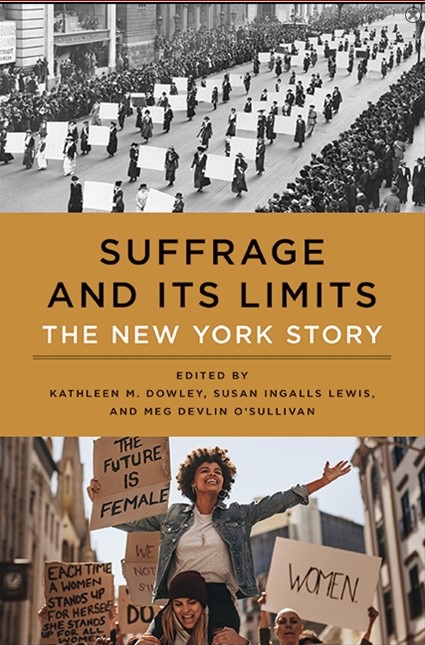
Edited by Kathleen M. Dowley, Susan Ingalls Lewis, and Meg Devlin O’Sullivan
Suffrage and Its Limits offers a unique interdisciplinary overview of the legacy and limits of suffrage for the women of New York State. It commemorates the state suffrage centennial of 2017, yet arrives in time to contribute to celebrations around the national centennial of 2020. Bringing together scholars with a wide variety of research specialties, it initiates a timely dialogue that links an appreciation of accomplishments to a clearer understanding of present problems and an agenda for future progress. The first three chapters explore the state suffrage movement, the 1917 victory, and what New York women did with the vote. The next three chapters focus on the status of women and politics in New York today. The final three chapters take a prospective look at the limits of liberal feminism and its unfinished agenda for women’s equality in New York. A preface by Lieutenant Governor Katherine Hochul and a final chapter by activist Barbara Smith bookend the discussion. Combining diverse approaches and analyses, this collection enables readers to make connections between history, political science, public policy, sociology, philosophy, and activism. This study moves beyond merely celebrating the centennial to tackle women’s issues of today and tomorrow.
Kathleen M. Dowley is Associate Professor and Chair of Political Science and International Relations, Susan Ingalls Lewis is Professor Emerita of History, and Meg Devlin O’Sullivan is Associate Professor of History and Women’s, Gender, and Sexuality Studies, at SUNY New Paltz.
Teaching For Black Lives and Teacher Unions and Social Justice
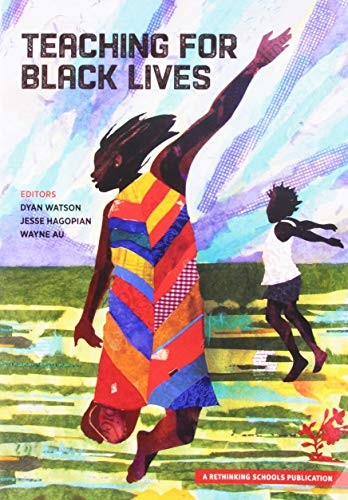
Teaching for Black Lives, edited by Dyan Watson, Jesse Hagopian, and Wayne Au, grows directly out of the movement for Black lives. The editors recognize that anti-Black racism constructs Black people, and Blackness generally, as not counting as human life. They provide resources and demonstrate how teachers connect curriculum to young people’s lives and root their concerns and daily experiences in what is taught and how classrooms are set up. They also highlight the hope and beauty of student activism and collective action. Teacher Unions and Social Justice, edited by Michael Charney, Jesse Hagopian, and Bob Peterson, is an anthology of more than 60 articles documenting the history and the how-tos of social justice unionism. Together, they describe the growing movement to forge multiracial alliances with communities to defend and transform public education.
Social Studies for a Better World: An Anti-Oppressive Approach for Elementary Educators
by Noreen Naseem Rodriguez and Kathy Swalwell
“In the wake of 2020, we need today’s young learners to be prepared to develop solutions to a host of entrenched and complex issues, including systemic racism, massive environmental problems, deep political divisions, and future pandemics that will severely test the effectiveness and equity of our health policies. What better place to start that preparation than with a social studies curriculum that enables elementary students to envision and build a better world? In this engaging guide two experienced social studies educators unpack the oppressions that so often characterize the elementary curriculum—normalization, idealization, heroification, and dramatization—and show how common pitfalls can be replaced with creative solutions. Whether you’re a classroom teacher, methods student, or curriculum coordinator, this is a book that can transform your understanding of the social studies disciplines and their power to disrupt the narratives that maintain current inequities.” Noreen Naseem Rodríguezis an Assistant Professor of Teacher Learning, Research, and Practice at the University of Colorado, Boulder. Katy Swalwellis Lead Equity Specialist for the Equity Literacy Institute and founder of Past Present Future Media & Consulting.
Welcome to the Anthropocene. Since the start of the Industrial Revolution, human-caused climate change has impacted the globe with the burning of fossil fuels. The debate in classrooms and the political realm should not be whether climate change is happening or how much it places human civilization at risk but over how societies and individuals should respond. This interdisciplinary book offers an in-depth examination of the history of the Earth’s climate and how historians and citizens can influence contemporary climate debate and activism. The author explains climate history and climate science and makes this important subject matter accessible to a general audience. Chapter topics include examining the Earth’s geological past, the impact of climate on human evolution, the impact of climate on earlier civilizations, climate activism, and the need for international cooperation. Presenting climate history, human history, and climate science in a readable format and featuring resources for students, this book is meant for use by teachers in high school elective or an introductory college course setting.
Chapters include “Our House is on Fire”; Tipping Points; Great Climate Migration; Earth’s Past Climates; Climate Change and Human Evolution; Extreme Heat; Four Billion Years of Climate History; Mass Extinctions; “Clocking” Climate Change; Diseases Carried by Mosquitoes or Hidden in the Ice; Climate Change Deniers and Minimizers; A Short Cold Snap of about 500 Years; Power of Ice; Climate Repercussions; Water Scarcity, Water’s Vengeance; Technology Debate; Saving the Amazon Rainforest; Capitalism vs. the Climate; and Climate Activism. There is an annotated bibliography and a list of resources for teaching about climate change.








 njcssjournal