My Story: Elizabeth Covenhoven, Monmouth County, 1778

Elizabeth Covenhoven

My Story: Monmouth County, 1778

“What’s a Woman To Do … In Times Like These?”

“These are the times that try men’s souls.”  Those infamous words were echoed throughout the colonies since the publication of Thomas Paine’s American Crisis in December of 1776. But what then, can be said, of us ladies? Women: married, single, daughters, mothers, sisters, and grandmothers. A war where loyalties were drawn, neighbor against neighbor, friend against newly formed foe. And here, especially in New Jersey, the war was always in our backyard. With the colonial victories at Trenton and Princeton in the winter of 1776-1777 it would seem as though Washington’s troops were making some progress toward their campaign for victory. But the British were a tough enemy. They were unrelenting and refused to let a rag-tag group of Patriots win. That’s why it was no surprise to me when I heard the rustlings around town that the British were moving throughout the area on their way to New York, perhaps even stopping in the area of the Monmouth Courthouse, my hometown! (Freehold, New Jersey) This was a scary thought, especially to me, since I had heard rumors of British troops burning down homes, taking animals from the barns, and stealing good supplies, foodstuffs, and other valuables from the colonists!

Those of us ladies that remained were often left on our homesteads, alone, to fend for ourselves in the midst of war. I myself have reared 10 children in a one-room home that has stood on this property at 150 West Main Street for the past 25 years. After our children were grown and gone, my husband William and I built a substantial home with the wealth that our families left us, making it one of the most impressive in Monmouth County. We were also able to purchase some very nice furniture, and of course, a beautiful set of china plates, for entertainment purposes of course. I have worked too hard to lose any of these things!

            I guess by now you’re wondering, who am I? Well, my name is Elizabeth Covenhoven.   My husband William is a 5th generation Dutch-American who roots in Monmouth County date back to 1709.  At the time that the war came through my backyard in 1778, I was 74 years old, left alone to fend for myself alongside my four enslaved persons that lived with me on my property. My husband, unfortunately, was not here at the time that General Clinton passed through, and therefore, I alone had to make tough choices in order to survive. My home and its belongings are all I have. 

What should Elizabeth Covenhoven do in order to survive the British occupation of her hometown? Be sure to provide reasoning for your response. 

  1. RUN. This might be a bit challenging due to her age, but certainly, she can hopefully make it to one of her children’s homes and see if they can offer her protection from the British. That is, if they themselves aren’t already in trouble …
  1. OUTWIT. She realizes the limitations of her age. However, with the help of her enslaved persons, she can most certainly hide what possessions she has in the nearby woods and under the earth. The British certainly can’t be that intuitive to know what she has done …
  1. NEGOTIATE. Certainly, the British can’t be *as bad* as how they are perceived? And besides, she is a wealthy Monmouth County socialite, that could be helpful to tired and hungry soldiers and their officers.
  1. FIGHT. She can attempt to defend her land claims and property with the support of her four enslaved persons. Certainly, she can’t take on the British Army by herself, but she could attempt to not let them into her house to seize her property and possessions or set fire to her home.

After discussing and deciding on your decision, select one of the following activities. Be sure to use support from your knowledge of the time period in order to justify your response:

  1. Write a letter to your husband, William, justifying the choice that you made for survival. Remember that you will need to outline what happened to your possessions, as well as the home.
  1. Write a letter to General Clinton. Make sure that you state your case as to why your home should be spared from invasion/destruction of the British.
  1. Write a letter to General Washington. Explain your case to the General of the Continental Army and ask for any type of retribution that has to deal with what has happened to your homestead.

Resources:

https://www.monmouthhistory.org/covenhoven-house

From Scratch: Adventures in Harvesting, Hunting, Fishing, and Foraging on a Fragile Planet

From Scratch: Adventures in Harvesting, Hunting, Fishing, and Foraging on a Fragile Planet, by David and Jon Moscow (New York: Permuted Press, 2022)

Review by Alan Singer

Jon Moscow is the co-executive director of the Ethics in Education Network located in New York City and a podcaster. David Moscow is an actor and producer. Jon and David are father and son. In the preface to From Scratch they wrote “There are also many meals in here. Some are unique. Some are gut-turning. Most are great.” They are clearly more adventurous than me. I recommend staying with the less gut-turning suggestions.

The first gastronomical adventure is in New York City and it is about harvesting and eating oysters from Long Island Sound. David claims he dreamed about oysters since his boyhood in the Bronx with trips to Orchard Beach. I also grew up in the Bronx, back in the 1950s, frequented Orchard Beach, and I warn readers, nothing good comes out of those waters that I would eat, then and now. Today the water is considered clean, but when I was a boy we frequently saw raw sewage and condoms on the waves.

The best part of this chapter, and every chapter, are the gastronomical history lessons. The original inhabitants of the New York metropolitan region were the Lenni-Lanape who harvested oysters before the water was polluted and cooked them by wrapping them in seaweed and tossing them into a fire. We also learn that Pearl Street in Manhattan was “paved” by burning oyster shells to create lime that was mixed with broken oyster shells, sand, ash, and water. New York continued to be the oyster capital of the world until the early 20th century when New York City oyster beds were closed because of toxicity. David does admit that New York City oysters are still considered unfit to eat so that he and friends actually harvested oysters further east on Long Island.

Other adventures in harvesting and eating include trips to South Africa for avocados and “dune spinach,” to Mediterranean Malta and Sardinia for octopus and snails, Peru with its thousands of potato varieties, Kenya for barley and honey, and back to New York after a stop on the Amalfi Coast and Naples to savor pizza. David discusses some of his favorite New York pizza parlors including his childhood haunt, Three Brothers, on Kingsbridge Road. Brother’s Pizza is still located at 27 E. Kingsbridge Rd. Another noteworthy Bronx pizza destination is Catania’s Pizzeria & Café at 2307 Arthur Avenue. However my favorite is Pizza Plus on 359 7th Avenue in Brooklyn because their pizza has the best red sauce. The best part of this chapter is the authors’ discussion of the history of the tomato, which traveled from the Americas to Europe as part of the Columbian Exchange. Who knew there were over 15,000 varieties of tomatoes?

Fred Ende, Director of Curriculum and Instructional Services at Putnam/Northern Westchester BOCES, who also reviewed the book, points out that in the first and second chapters the authors show that the history of both Long Island and South Africa was influenced, in some cases deeply, by food, and that food was influenced by history. Ende appreciated the interdisciplinary nature of the story the Moscows are telling because too often secondary schools disciplines are taught in isolation. Elde likes that the book melds science, art, culture and history pretty seamlessly.

The book ends with recipes including a Philippine dish, Kilawin made with mackerel, tuna and coconut, a Native American trout and potato dish from Utah, and D Michele’s famous pizza dough. I make my own pizza from scratch and I do all my foraging at a local supermarket.

Alan’s Homemade Pizza

Ingredients for the dough

  • 2 cups flour, plus more for rolling
  • 1/2 tsp. sugar
  • 1 tbs. dry yeast
  • 1 tsp. salt
  • 3/4 cups warm water (body temperature)
  • 2 tbs. olive oil to mix into the dough and 2 tsp. to oil the bowl

Instructions

1. Combine and stir the dry ingredients and then add the water and oil. Stir and knead the dough until it is smooth with a slight gleam. If the dough is too sticky add a little more flour. If it is too dry, add a very small amount of water. I rub a little flour on my hands as I knead the dough. After about ten minutes I roll the dough into a ball and place it in a covered oiled bowl for about an hour and keep the bowl in a warm place; sometimes in the oven with the temperature set at the lowest level.

2. While the dough rises I prepare my toppings. I use sliced olives, mushrooms, and green peppers After an hour, preheat the oven to 475°F. I usually use a commercial sauce; my preferred one is Barilla. I roll out the dough as flat as I can with a rolling pin (without tossing it up and down) and put it on a large oiled baking sheet. I brush a light oil coat on the dough, cover the pie with sauce leaving a thin 1/2 crust on the edges, sprinkle with lots of thinly sliced mozzarella, feta bits, oregano, and parmesan, and add the toppings.

3. Now its time to bake the pizza in the 475°F oven for about 15 minutes until the crust is brown and the cheese is melted. Magnifico!

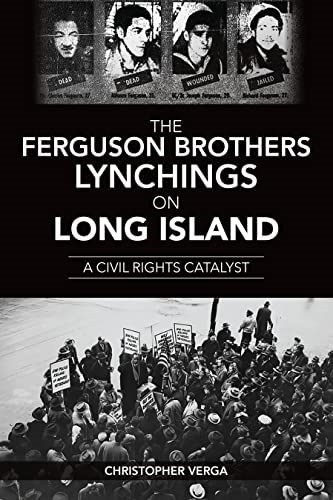
The Ferguson Brothers Lynchings on Long Island: A Civil Rights Catalyst

The Ferguson Brothers Lynchings on Long Island: A Civil Rights Catalyst (The History Press, 2022) by Christopher Verga

Review by Alan Singer

(Reprinted with permission from New York Almanack)

In a book dedicated to Wilfred Ferguson, the son of Charles Ferguson, teacher and historian Christopher Verga resurrects the story of two Roosevelt, New York brothers killed by a Freeport police officer in 1946. Verga opens The Ferguson Brothers Lynchings on Long Island: A Civil Rights Catalyst with an account of the long history of racism on Long Island and in the Freeport area including Ku Klux Klan activity. The background to the 1946 killings takes up the first third of the book. The book is well researched and referenced with extended quotes from official court documents and newspaper accounts. It is available from Amazon in Kindle and paperback formats.

On February 5, 1946, two African American men, brothers, were shot and killed by a white probationary police officer in Freeport, New York. The officer claimed that the men were part of a group of four, all brothers, who were using “abusive and threatening language” and that one of the men he shot had stated that he had a .45 and was going to use. The officer’s first shot struck 27-year old Charles Ferguson, a World War II veteran, in the heart and killed him instantly. The second shot wounded Joseph Ferguson, aged 20, and then struck Alphonso Ferguson, aged 25, in the head. Charles and Joseph Ferguson were both wearing military uniforms when they were shot. Alphonso Ferguson was taken to Meadowbrook Hospital in East Hempstead where he died. The fourth brother, Richard Ferguson, also a veteran, was arrested and charged with disorderly conduct. He was tried, convicted, and sentenced to 100 days in jail, but his conviction was overturned on appeal. Military tribunals later cleared the brothers of any blame in the incident. Charles Ferguson was buried at the Long Island National Cemetery with full military honors.

At the time of the shootings, Freeport was a segregated town. There were no Black police officers there or teachers in the Freeport school system and Black children were all zoned to attend one elementary school regardless of where they lived.

After Nassau County District Attorney ruled that the shootings were justified, the New York Committee for Justice in Freeport, the American Jewish Congress, and Congressional Representative Vito Marcantonio of Manhattan demanded that Governor Thomas E. Dewey authorize a new investigation. In July, Dewey appointed Lawrence S. Greenbaum, as a special investigator to hold hearings and examine witnesses. Greenbaum, a lawyer, was a member of the NAACP. A petition to Governor Dewey condemned the Nassau County District Attorney for “not properly and without prejudice carry out his duties in the presentation to the February grand jury” and the Freeport Village Board for prejudicing the proceedings by exonerating the white officer before the grand jury had heard the case. The petition also asserted that the brothers were not drunk as the police claimed, and that the incident had been precipitated when the operator of a lunch counter had refused to serve the men because they were Black. Legendary folk singer and activist Woodie Guthrie wrote a song, “The Ferguson Brothers Shooting,” to support the campaign for justice for the Ferguson family.

The cop said that we had insulted the joint man.

He made us line up with our faces to the wall;

We laughed to ourselves as we stood there and listened

To the man of law and order putting in his riot call.

The cop turned around and walked back to young Charlie

Kicked him in the groin and then shot him to the ground;

This same bullet went through the brain of Alonzo

And the next bullet laid my brother Joseph down . . .

The town that we ride through is not Rankin, Mississippi,

Nor Bilbo’s Jim Crow town of Washington, D.C.

But it’s greater New York, our most fair-minded city

In all this big land here and streets of the brave.

At the hearing, held in Manhattan, the two surviving brothers testified that the police officer first kicked Charles and Joseph Ferguson and then drew his pistol and lined the four brothers against a wall. The police produced witnesses to support the accused officer, including an African American by-passer, and no cross-examination of witnesses was permitted. The officer repeated his accusation that Charles Ferguson claimed to have a weapon, and that he shot Alfonso Ferguson when Ferguson was charging at him. The officer and the other police witnesses admitted that they never saw a gun and no gun was found at the scene. A spokesperson for the New York Committee for Justice on Freeport charged that the investigation was a “white-wash” and an “unvarnished fraud’ because witnesses were not cross-examined. At the final inquiry session on July 23, most of the audience walked out in protest.

After the special investigator’s report was released on August 2 and exonerated the police officer and the Nassau County District Attorney’s office, Governor Dewey closed the inquiry. The report claimed that the police officer acted because he believed his life was in danger and there was reason to believe he would have acted differently if “the four men before him had been white and not colored.”

The killing of the African American men in Freeport became an issue in the November 1946 gubernatorial election as Dewey, a Republican, campaigned for reelection. Democratic party candidate James M. Mead charged that the shooting was a lynching and accused Dewey of endorsing Southern-style racism. However, once Dewey was reelected, the Freeport case dropped out of the news.

A side story in the book is the role of the American left including the Communist Party in the push for the special investigation into the killings and for justice for the Ferguson family. While the NAACP also called for the inquiry, it avoided being too closely associated with the left groups, and being branded as communist or communist directed. State and federal law officials investigated communist influence in the campaign, perhaps more carefully than they investigated the actual incident. In Nassau County and in Freeport supporters of the police officer used left involvement in the campaign as a way to discredit the specific charges and deny underlying racism in the area.

Verga concludes the book by examining a similar story about an African American veteran attacked and gravely injured by police in South Carolina and other incidents of racism in the United States and on Long Island after World War II including the notorious racial covenant banning African Americans from purchasing or renting Levittown homes. Verga note that at least demographically, Freeport and Long Island have changed since the deaths of Charles and Alponso Ferguson at the hands of a police officer in 1946.

Nineteen Reservoirs: On Their Creation and the Promise of Water for New York City

Nineteen Reservoirs: On Their Creation and the Promise of Water for New York City (The Experiment, 2022) by Lucy Sante with photographs by Tim Davis

From 1907 to 1967, a network of reservoirs and aqueducts was built across more than one million acres in upstate New York, including Greene, Delaware, Sullivan, and Ulster Counties. This feat of engineering served to meet New York City’s ever-increasing need for water, sustaining its inhabitants and cementing it as a center of industry. West of the Hudson, it meant that twenty-six villages, with their farms, forest lands, orchards, and quarries, were bought for a fraction of their value, demolished, and submerged, profoundly altering ecosystems in ways we will never fully appreciate. This paradox of victory and loss is at the heart of Nineteen Reservoirs, Lucy Sante’s meticulous account of how New York City secured its seemingly limitless fresh water supply, and why it cannot be taken for granted. In inimitable form, Sante plumbs the historical record to surface forgotten archives and images, bringing lost places back to life on the page. Her immaculately calibrated sensitivity honors both perspectives on New York City’s reservoir system and helps us understand the full import of its creation.

Coming Out of the Streets: LGBTQ Youth Experiencing Homelessness

Coming Out to the Streets: LGBTQ Youth Experiencing Homelessness, by Brandon Andrew Robinson (Oakland: University of California Press)

Review by Thomas Hansen

This is the story of a qualitative research study in which the professor was an observer who was able to get a great deal of trust and information from the subjects interviewed.  Volunteering at the shelter where the subjects were housed temporarily, the professor conducted this ethnographic study by using in-depth interviews to look at the lives and goals of young homeless persons.   

I disagree with the author making the clear point throughout the book that the family does not shoulder much of the blame for the young people becoming disenfranchised or bullied or shunned by society.  The author hopes people will move beyond simply blaming the family for all the difficulties youth must conquer in order to survive the young-adult years.  The author insists it is “the system” that needs to be fixed—not the youth and not the family.  There would be many people who disagree with this author on this point, including many people who have battled through those difficult years and somehow made it to the other side.

While I leaf back through the book and thought again about what I had recently read, two young gay men at the next table are telling of the terrible experiences they had growing up, coming out, and finally escaping a damning and hateful family—in both of their cases.  I keep moving away from them, but I can still hear every word they are saying and do not want to listen.  However, they get louder and louder as they share their experiences and hopes out loud. 

I am embarrassed I can hear all this—at the same time I am thankful I am hearing such a timely discussion when I am trying to write some notes that will lead to a review of this book. 

They share a common story about the oppressive life they have lead “at their family’s house.”  I know very little–if anything—about these two young men.  I do not know their names or where they are from or what their parents are like.  I do not know if anything they are sharing very loudly is true or not.  But most everything they are saying is similar to a story I have heard from many young people for years.   

It is true that different people, in different situations and cities, will have disparate realities as they “come out” into whatever sexuality or personality they take on as adults.  I would argue with this author that it is the great majority of young LGBTQ persons who have had the most difficulties at home—the very people who should be loving, supporting, and protecting the youths are instead perhaps the biggest challenge facing them. 

Children’s families often abandon them and turn them off.  Without the support of the very people who should be helping, these youth often have to make sure very hard decisions and face some terrible dangers to survive.  In the meantime, the family continues to withhold their assistance.         

The professor who conducted this study insists it is society—not the family—that is the culprit in the destruction of young people who are meant to come out and live the responsible gay lives they should be allowed to live.  The professor attempts to show how blame for the young people’s stress can be levied against several different pieces of the system.  Teachers, school administrators, the courts, the police, and mainstream society in general are all to blame for presenting the young persons with great challenges and judgment.  The author makes the point that the family is not the main problem and she does this strongly in the book.

Maybe in this particular shelter where the author interviewed young people, and throughout this study, and elsewhere in this book, the family is not to blame.  However, I maintain the family is one of the most guilty parties in the oppression, judgment, and ostracizing of the young people who wind up out on the streets and facing terrible choices.

I know it is the average families, including the parents without much cultural and educational understanding, who have no idea how much they are contributing to creating a whole population of young adults in stress.  These are young persons who are struggling to gain their independence and who have to make difficult decisions to do so.  Young LGBTQ persons become involved in prostitution, selling drugs, using drugs, shoplifting and other sorts of crimes. 

The book does a good and typical glimpse of the young people who have been damaged by their families (and church and school and neighbors and etc.).  There is so much wasted time.  Instead of transitioning easily from being children to being adults, these young people have to use a huge amount of energy to survive, learn, begin to work, and then establish new goals later in life, and become adults “later” than they wanted to in some ways, and “way too early” in other ways.

Much as these young persons are still children, they are thrust into the rougher realities of an adult world not very interested in protecting them.  While I agree society can be one of the culprits, I maintain it is principally the family who bears the responsibility for making life difficult for the young people. 

There is plenty of evidence in the literature of the family’s negative role in the lives of such young adults.   

Engaging Students with Poverty in Mind: Practical Strategies for Raising Achievement

Engaging Students with Poverty in Mind: Practical Strategies for Raising Achievement, by Eric Jensen (Alexandria, VA: Association for Supervision and Curriculum Development)

Review by Thomas Hansen

Eric Jensen provides good hints and strategies for dealing with the special and difficult problems our poorer students bring to the classroom.  The number of students living in poverty has grown exponentially, yet many educators are not aware of the realities.  Jensen shows a good understanding of some of the difficulties and challenges students face, and he uses a research basis in this text.

Published in 2013, this book paints a bleak picture of a bleak nation.  I am sure Jensen had NO idea there would be worse days, COVID-19, and a burgeoning homeless population in this country.  Fresh after the New Great Depression, this book was timeless then—and is timeless now.

This text appeared years ago but is still relevant because the number of persons on the streets has risen, a huge number of families rely on food stamps and free lunches, and the homes of many families have been boarded up for a number of years, with most people not able to afford a house and the original occupants of those dwellings now living with relatives, in shelters, or in their cars. 

A huge challenge today is how to afford a place to live.  Struggling families can tell you this.  Housing is expensive.  In many cities, very few people have any interest at all in providing affordable homes or apartments for poorer people to live in.  You can count on one hand the cities that have actually addressed the problem of “where to put the poor people.

The question remains:  “How do we begin to help students who face the stressors of hunger, despair, and stigma each day?”  It is important to serve and protect the students now, while they are poor, and deal with housing and other services later.  But how do we teach them?  Feed them?  Encourage them?

Jensen includes the data from research on these students, starting with health and nutrition issues and ranging to the stress levels and daily hassles students face.  These and five other areas constitute the seven types of challenges facing students living in poverty, though I would suggest many of our students, in addition to teachers and teacher candidates, face many of these same difficulties.   Jensen calls these “the seven engagement factors,” and the other ones are: vocabulary; effort and energy; mind-set; cognitive capacity; and relationships.

Jensen bases his approach here more on the stressors facing poor students and less on technical information about the poverty numbers and facts out there.  For that technical data, we would have to go to other sources. 

Jensen proposes “five rules for engagement” for teachers to employ in the classroom as a means of getting poorer students involved: upgrade your attitude; build relationships & respect; get buy-in; embrace clarity; and show your passion.  Though I think these are good to use with any student, they seem to make sense in dealing with students who face the hassles and challenges of living with poverty on a daily basis, a seemingly unrelenting set of difficulties.  Clarity is important, for example, because students living in poverty are often hungry and tired, and they need straightforward definitions and examples, in addition to encouragement and a positive learning environment.

Jensen acknowledges hunger and stress and the power they hold over students.  He reminds us that students should be treated with dignity, and that they are the reason we have a job.  The students are the future of our country, Jensen reminds us, not prison inmates. 

Students living in poverty, especially, come to school wondering if someone there cares about them, wondering if they are important.  They may have difficulty concentrating, and difficulty feeling that the school day may offer something interesting and relevant in a world that may have forgotten them, they may feel.  Younger people, especially, have trouble making sense of a world in which there is so much hunger.                

I can think of some other texts from years ago that are still relevant.  If Jensen’s older book is to be used in a topics class on dealing with poverty issues or other such use, including professional development meetings or retreats, I would definitely recommend one or more additional texts—both of them older/older editions fine—with more specific information on poverty be included.  One good additional text would be: Poverty in America: A Handbook, Third Edition, 2013, by John Iceland.  

Another good text would be: Someplace Like America: Tales from the New Great Depression, Updated Edition, 2013, by Dale Maharidge, Photographs by Michael S. Williamson.  These could both provide more of the technical information not included in the Jensen text.

To summarize, I recommend this text because of the good teaching strategies and scenarios included.  I think most of what Jensen includes is good information for working with any student, and certainly any student facing stressful situations. 

Health Care Off the Books: Poverty, Illness, and Strategies for Survival in Urban America

Health Care Off the Books:  Poverty, Illness, and Strategies for Survival in Urban America, by Danielle T. Raudenbush, (Oakland: University of California Press).

Review by Thomas Hansen

Teachers of social studies—and all teachers interested in social justice—can make good use of this text as either a good reference for their personal library or a good research source for students in secondary school courses to read and consult.  There is a great deal of good information here about healthcare and healthcare policies in the US.  The book is written in accessible language and does not appear to have any offensive passages.

Danielle T. Raudenbush explains the ways in which poor urban dwellers in a project navigate the challenging world of health care, some with insurance, some without.  Raudenbush shows us there are three different levels of approaches to getting the needed pills, bandages, and even medical equipment whether patients follow the formal approach to getting their healthcare—or not.

The author makes it clear there is a consistent and reliable informal network of helpers for poor persons to get pretty much whatever they need on the streets.  Raudenbush acknowledges this particular qualitative study, done over time, focuses very much on healthcare issues and does not address food, money, rides, or other items very much. 

The author shows us there are those three different approaches, first formal: going to doctor appointments, buying medication and/or using insurance to do so, and then taking all of the medication/following all the doctor’s orders, and convalescing as directed.  There is also informal—and this is the one that seems to be of most interest to the author.

A second approach is “informal” and it involves using local resources and persons in the process of purchasing or trading for the pills, bartering for the pills, lending other needed medical supplies and goods, or purchasing these items from a helper in the project.  It is very interesting how the author is able to get so much information, and she has established very good rapport, it seems, with the residents of the project.  Like her subjects in the study, the author is African-American, and this connection helps her to get the trust of the people she interviews.  She also conducts focus groups with the residents.

A third approach—she calls it the “hybrid” one, shows local and formal together.  The author reveals how much the residents of the project bend rules, make important connections, share resources, and make use of the people who serve as “helpers” in that community.  Doctors and other medical personnel are also involved in the hybrid approach in various ways—and in the informal approach too.

Helpers provide the backbone for the poor to get access to so many services, and to food, and to medication, and even to walkers and wheelchairs.  Often heard among the homeless, also, are these kinds of questions:

  • Who is giving away winter coats?
  • Who has free dinner tonight?
  • Is there any place with decent sack lunches by my spot where I stay now?
  • Where can I get some gloves and underwear on a Sunday?
  • How do I find that lady who has the phone chargers for sale?

In addition to these questions, helpers often have to deal with others—such as ones dealing with social security application rules, where to get free aspirin, how to get disability checks, how to find a good dentist who takes XY or Z insurance, and other needed information.  As in this book, one will find out the streets have helpers who are constantly assisting those in need—and who are well-known among the street networks. 

Informal networks and devoted helpers are an integral part for many residents of that project.  The author does a great job of show how complex the relationships can be.

Troublemaker

Troublemaker, by John Cho (Little, Brown, 2022)

Review by Valerie Ooka Pang

This review was originally published in the International Examiner and is republished with permission.

Korean American actor John Cho has written Troublemaker, an excellent novel for middle-school students about racism, a Korean American family, and the bonds of a son with his father. Cho lived in Everett for part of his young adult years and remembers going to the local Fred Meyer supermarket, and while his parents shopped, he would visit the book section and read a chapter in the novel, First Blood. Every week while his parents were purchasing their weekly groceries, John would read another chapter.

Jordan Park, a 12-year-old, is always in trouble unlike Sarah, his perfect sister, a junior in high school. As a Korean American kid, he cannot live up to the expectations of his parents, especially his father. Jordan picks poor friends and gets suspended from school for cheating on tests. He does not want to tell his parents about his suspension. He thinks he can prove to his family that he is not a bad kid.

The Park family lives in Los Angeles, and his father has a store in Koreatown. It is 1992 when race riots rock the city. Rodney King is beaten by four White police officers. Latasha Harlins is shot and killed by a Korean shop owner who says she thought the teen was shoplifting. The police found that Latasha had the money for the juice in her hand and was not stealing. Racial tensions are high.

Jordan and Sarah find themselves in this confusing and dangerous time. Jordan wants to help his father protect their store because the police do not do much for shop owners in Koreatown, but he can’t find a ride to the shop. His friend takes him part of the way, but then he leaves him at a neighborhood hangout. His sister worries and tries to find him.

In the end, Jordan learns a valuable lesson about guns from his father. He grows up a lot during that summer. This is a coming-of-age story of a young Korean American male and a portrait of his Korean American family. The dialogue pushes the story line forward and is a major element in creating an engaging novel.

Troublemaker provides an excellent opportunity for teachers and parents to talk about family relationships and how sometimes communications in the family get misinterpreted. The story emphasizes the dad’s love for his son though the son does not realize how much his father cares for him. Teachers can also have students talk about the racial conflicts between Blacks and Koreans, and police and communities of color. Though the story does not take on racial discord head on, it provides openings for educators to talk about the problems among communities of color. This book is extremely timely especially since there is so much anti-Asian hate in the nation today.

New York History: “A White Man Imprisoned 17 Years for Helping Enslaved People Escape to Freedom”

New York History: “A White Man Imprisoned 17 Years for Helping Enslaved People Escape to Freedom”

Reprinted with permission by the editorial staff of the New York Almanack.

Rev. Calvin Cornelius Fairbank was born November 3, 1816 in Pike, Wyoming County, NY. He began his academic studies at a seminary in Lima, Livingston County, NY, and became a licensed preacher in 1840. In 1842 he was ordained an elder in the Methodist Episcopal Church, and he graduated Oberlin College in Ohio two years later. At Oberlin he met John Mifflin Brown (1817-1893), a bishop in the African Methodist Episcopal (AME) Church and an Underground Railroad activist.

Fairbank was a radical abolitionist who not only spoke out against slavery, but actively worked to free as many enslaved people as he could. “Forty-seven slaves I guided toward the North Star, in violation of the state codes of Kentucky and Virginia,” he wrote. “I piloted them through the forests, mostly by night, – girls fair and white, dressed as ladies; men and boys, as gentlemen or servants – men in women’s clothes, and women in men’s clothes; on horseback, in buggies, in carriages, common wagons, in and under loads of hay, straw, old furniture, boxes and bags; crossed the Jordan of the slave, swimming, or wading chin deep, or in boats, or skiffs, on rafts, and often on a pine log. And I never allowed one to be recaptured. For aiding these slaves to escape from their bondage, I was twice imprisoned, – in all seventeen years and four months; and received… thirty-five thousand, one hundred and five stripes from a leather strap…”

Fairbank helped free an enslaved person for the first time in 1837. While piloting a lumber raft down the Ohio River he ferried a slave across the river into free territory. He often guided escaped slaves to Levi Coffin who helped arrange further transportation north for thousands of people.

Fairbank was arrested for helping to transport Lewis Hayden, his wife Harriet and Harriet’s son Joseph by carriage to freedom in Ohio. He was tried in 1845 and sentenced to 15 years, five years for each of the slaves he helped free. Serving his sentence in the Kentucky State Penitentiary in Frankfort, he was pardoned in 1849 using money raised by Hayden from his new neighbors in Boston. Two years later he was arrested again for helping an enslaved man named Tamar escape Kentucky to Indiana. In November 1851, marshals from Kentucky, with the help of the sheriff of Clark County, Indiana and Indiana Governor Joseph A. Wright, abducted Fairbank and took him back to Kentucky. In 1852, he was again sentenced to 15 years. While imprisoned in the Frankfort Penitentiary he was the victim of harsh treatment, including being frequently whipped (he believed he had received some 35,000 lashes while imprisoned). From 1844 to 1870, Kentucky imprisoned at least 44 people for helping to free enslaved people. The last man was released in 1870, five years after the end of the Civil War. Eight of those imprisoned died prisoners. 

Late in the Civil War, in 1864, Fairbank was pardoned by Acting Kentucky Governor Richard T. Jacob. He later wrote a memoir, published in 1890, Rev. Calvin Fairbank During Slavery Times: How He “Fought the Good Fight” to Prepare “the Way.” He died in near-poverty in Angelica, Allegany County, NY. Rev. Calvin Cornelius Fairbank was inducted to the National Abolition Hall of Fame and Museum in Peterboro, New York in October 2022.

Rev. Calvin Fairbank During Slavery Times (1890) (Excerpts)

  1. “I took license to preach in 1840, and in 1842 was ordained an elder in the Methodist Episcopal Church, and closed my course of study, graduating in 1844. One incident, more than anything else outside of my organization, controlled and intensified my sentiments on the slavery question. It was this: I went with my father and mother to Rushford to quarterly meeting when a boy, and we were assigned to the good, clean home of a pair of escaped slaves. One night after service I sat on the hearthstone before the fire, and listened to the woman’s story of sorrow. It covered the history of thirty years. She had been sold from home, separated from her husband and family, and all ties of affection broken. My heart wept, my anger was kindled, and antagonism to slavery was fixed upon me. “Father,” I said, on going to our room, “when I get bigger they shall not do that;” and the resolve waxed stronger with my growth.”
  2. I grew to manhood with a positive, innate sense of impartial liberty and equality, of inalienable right, without regard to race, color, descent, sex or position. I never trained with the strong party simply because it was strong. From the time I heard that woman’s story I felt the most intense hatred and contempt for slavery, as the vilest evil that ever existed; and yet I supposed the institution provided for and protected by the United States Constitution, and legally established by every slave state; and when, previous to investigation, I repeatedly aided the slaves to escape in violation of law, I did it earnestly, honestly, in all good conscience toward God and man.
  3. Coming within the influence of active anti-slavery men at Oberlin, Ohio, I was led to examine the subject in the light of law and justice, and soon found the United States Constitution anti-slavery, and the institution existing in violation of law. My conclusion in regard to the anti-slavery character of the Constitution of the United States was based on common law, on its interpretation by the whole civilized world, and the recognition of self-evident truth as the basis of that interpretation, viz.: “Where rights are infringed, where fundamental principles are overthrown, where the general system of the law is departed from, the legislative intention must be expressed with irresistible clearness, in order to induce a court of justice to suppose a design to effect such object.”
  4. This conclusion enabled me to act without misgiving, as to my obligation to the General Government. I was no longer under obligation to respect the evil institution as protected by the Government, but was free to condemn slavery and the slave code, — free to follow the promptings of duty.
  5. Finding, then, the diabolical institution unprovided for — finding it positively prohibited—finding it to be a conceded fact by our best statesmen, North and South, that not a state in the Union had slavery established by law, I concluded, upon the highest authority in the universe, that slavery was chronic rebellion, and that I was not only justified, but bound by the “higher law,” to oppose it in defense of an oppressed people. From that time I never allowed an opportunity to aid the fugitives to pass unimproved; but when men and women came to me, pleading the “Fatherhood of God,” and the brotherhood of man, I did all in my power to set them free, subjecting myself to imprisonment and the deepest suffering.
  6. Forty-seven slaves I guided toward the North Star, in violation of the state codes of Virginia and Kentucky. I piloted them through the forests, mostly by night, — girls, fair and white, dressed as ladies; men and boys, as gentlemen, or servants, — men in women’s clothes, and women in men’s clothes; boys dressed as girls, and girls as boys; on foot or on horseback, in buggies, carriages, common wagons, in and under loads of hay, straw, old furniture, boxes, and bags; crossed the Jordan of the slave, swimming, or wading chin deep, or in boats, or skiffs, on rafts, and often on a pine log. And I never suffered one to be recaptured. None of them, so far as I have learned, have ever come to poverty, or to disgrace. I have visited a score of those families, finding them all industrious, frugal, prosperous, respectable citizens.
  7. For aiding those slaves to escape from their bondage, I was twice imprisoned — in all seventeen years and four months; and received, during the eight years from March first, 1854, to March first, 1862, thirty-five thousand, one hundred and five stripes from a leather strap fifteen to eighteen inches long, one and a half inches wide, and from one-quarter to three-eighths of an inch thick. It was of half-tanned leather, and frequently well soaked, so that it might burn the flesh more intensely. These floggings were not with a rawhide or cowhide, but with a strap of leather attached to a handle of convenient size and length to inflict as much pain as possible, with as little real damage as possible to the working capacity.

Questions

  1. In what decade did Calvin Fairbank become a member of the clergy?
  2. What “incident’ convinced Rev. Fairbank to organize his life to oppose slavery?
  3. Rev. Fairbank believed in a “positive, innate sense of impartial liberty and equality, of inalienable right, without regard to race, color, descent, sex or position.” In which foundational American document(s) do those ideas appear?
  4. What was his initial view of the United States Constitution?
  5. How did his view of the Constitution and the government change?
  6. How many freedom seekers did Fairbank assist on the Underground Railroad?
  7. What happened to Fairbank as a result of his activity on the Underground Railroad?
  8. Rev. Calvin Fairbank was recently inducted into the National Abolition Hall of Fame and Museum in Peterboro, New York. In your opinion, did he merit this honor? Explain.

Vietnam Protests at New Jersey Universities

Vietnam Protests at New Jersey Universities

Dan Hamlin

For many, Princeton is a place of prestige and cultural and educational exceptionalism that only the best of the Ivy League can offer. A university such as this is on the cutting edge of tomorrow, where great minds assemble to become future presidents and Nobel laureates. Such has been Princeton’s tradition since colonial times. From founders being founding fathers to multiple presidents, Nobel laureates, and world-renowned physicists, one would be remiss to say that Princeton is not one of the most important and influential schools in the United States, let alone the world. One also cannot overstate the importance of tradition at Princeton University. At a university showcasing James Madison as a notable alumnus on its website,[1]It is clear that Princeton is a place of prestige.

The 1960s and 70s are a particular time in American history where education and student activism became particularly important to the American public. Students were the loudest advocates for change during this time and serve as an excellent example of the value of students taking advocacy in their educational careers. Students in this time would protest in many different ways and about many different things. Issues that concerned students in the 1960s and 70s included civil rights campus issues and the war in Vietnam; these protests would look different at each university depending on the culture and the history of it. So, one would likely expect Princeton: a place of deep and rich American tradition, to be where liberal protest dies, especially in the late 1960s and early 1970s when such protests were well beyond the norm. However, this is not the case. During the Anti-Vietnam War movement, Princeton University experienced an explosion of support from students and faculty sympathetic to the movement. It even boasted its Students for a Democratic Society chapter, which garnered massive student support. However, as the movement got bigger and bigger, tradition started to derail the movement at Princeton University in favor of more modest ways to protest the War in Vietnam. Princeton University is one of New Jersey’s most influential colleges and will provide enormously valuable insight into the Student protest movement in New Jersey, as it is representative of how long-established universities in New Jersey were impacted by the student protest movement. Whereas Rider University provided insight into how smaller less established universities in New Jersey were impacted by the movements, Princeton will illustrate “Established Universities” coped with the movement, illustrating how colleges impacted the broader movement.

Princeton University, where future leaders begin their journeys, was one of the earliest universities in New Jersey to speak outright against the war in Vietnam. Although the war in Vietnam began much earlier, in 1955, opposition to the war was minimal at best, and no sources spoke critically of the war. It was in 1962 that the evidence of discontent began to show. It was in April of 1962 that the School newspaper, The Daily Princetonian published an opinion piece about the war after the release of images of the conflict in Vietnam that Princeton began to show some opposition to the war. The article argues that “unless we base our policy on a response to the fundamental problems of the country and thus end the discontent on which the Communists thrive, we will see many more pictures of bodies in fields, ending only in an ignominious withdrawal from a country in which we will have forfeited the popular support without which victory is impossible. The article questions the need for American involvement at home; Americans face many more present dangers.”[2]Here, one can see the Princeton students first asking questions about the war and the merit upon which America is involved as time goes on.

However, these questions become action. In the ensuing years, discontent at Princeton will begin to fester, on par with that of other Universities from across the nation.[3]However, on October 8th of 1965, Students for a Democratic society officially arrive at the Princeton campus, signaling a massive upgrade in student support for the Anti-war movement.[4]Despite the step forward, not all campus is united in this mission. Very early on, there were instances of resistance to SDS and increased support against the war in Vietnam. In December of 1965, an SDS banner saying “Even Princeton” was stolen, and at an SDS demonstration, “some came to heckle, some came to argue, some came to support,” said the SDS chairman Johnathan M. Wiener. Wiener also later says how “unprecedented” the support has been, especially considering the “traditional Princeton apathy.”[5]Later in early 1966, a conservative teach-in about American military strategy occurred, led by the Conservative club and directed by conservative faculty on campus.[6]These instances are undoubtedly reactionary to the more significant campus-wide attitudes but merit inclusion as they are evidence of Princeton’s traditional values combatting this liberal movement on campus.

In 1966 the movement began hitting its stride as the protest became a standard fixture on campus. As the movement grew, students’ voices grew. In a march 1966 article polling students about the issues they are most concerned about, the Anti-war protest polled near the top however was outshined by campus-related issues, such as food and living conditions.[7] While this says little about the student protest of the war in Vietnam, it reveals two critical things about Princeton at the time. Firstly, Princeton students were incredibly active on campus at this time, inspired by the enthusiasm caused by the Anti-war protest. Secondly, this shows that the most significant external issue to Princeton students was the war in Vietnam, suggesting growth in support for anti-war protests.

As protests grow and time progresses, and anti-movements grow, so too does student involvement in SDS. By May of 1968, SDS had grown to massive heights,  leading The Daily Princetonian to raise the question, “SDS or UGA?” The UGA is the student government association elected by students and meant to represent the students. As the article reads, “There is no other strong political interest group on campus, and the UGA has proven itself to be an impotent governing body capable only of reacting to events and unable to cause creative change where change is needed. The SDS has easily and naturally taken over the vacuum in student leadership. There is now a genuine danger that relevant student issues and the entire student power concept will be identified with the SDS banner and that as these issues come of age, the SDS will increasingly be taken as the voice of the Princeton student body.” This speaks to the incredible power that SDS had by 1968. This article suggests that SDS was the governing body of Princeton University at the time. As the article states there are “nearly 150 members and well over 200 sympathizers.”8 making it the largest student organization on campus. This article illustrates the effect of the anti-war movement on Princeton university, as the SDS, an organization founded to oppose the war in Vietnam, has committed a quasi-coup of the student government, crippling their effectiveness. Princeton is fully invested, and SDS is at the peak of its power on campus. Nevertheless, this success is short-lived.

As students returned in the fall of ‘68, SDS had a significant setback. At a meeting about protesting the new student government in UGA, SDS had an ideological setback, causing a split into two camps. The “revolutionary” who intended on a walk-out at the UGA meetings, vs. the “Liberal politics” camp who decided for a more moderate course of action. The division “threaten[ed] to cripple the effectiveness of that organization and to interrupt the workings of the student-faculty Committee on the Structure of the University”[8]This ideological the split was the beginning of a slow and unceremonious decline in SDS’s popularity on campus. This ideological split was one typical among SDS chapters as the organization progressed into more radical and less palatable avenues.[9]nevertheless, students at Princeton were still appalled by the War in Vietnam and continued protesting the war. However, with the ideological split, this came in different forms.

By April 1969, the radicals are performing more radical actions, fiercely attacking conservative opponents and blocking marine recruiters. These actions cause SDS to be seen as “not working against “the authorities” alone but against other students. This position cuts much of their sympathetic support.”[10]SDS is losing traction at Princeton University, and campus life is becoming more volatile. What that does not mean, however, is that students’ opinions on the war are changing. It is just saying that they disagree with the extreme methods of one organization. In fact, by this point, Princeton and its faculty are united in a front against the anti-war movement as evidenced by the history department’s united efforts to publish an anti-war resolve and include it into their curriculum.[11][12]The splintered movement is a confusing time for Princeton university, as radical acts persist on campus, yet the anti-war movement continues to grow.

Just as Rider had severe reactions to the Kent State killings, Princeton, too, reeled from the national outcry. Over 900 students marched around campus in protest, eventually ending up at the Institute for Defense Analysis. A peaceful protest broke out, protesting the military presence on campus. At the same time, Faculty endorsed a strike of Princeton’s involvement with the Department of Defense after the “senseless killing of four students at Kent State.” Princeton deciding to cut ties with the military is a significant step for the University, as the government undoubtedly relied on Princeton’s prestige to foster new and innovative military thinkers and ideas; an example of Princeton’s prestige and culture influencing their protests, as very few other colleges can take this kind of meaningful action against the government, nor can students from many other universities find a place on campus to focus their anger.

Over the next few years and despite SDS’s ideological split, the movement does not simmer. As more and more opposition against the Nixon administration occurred, the student body became more and more independent against the war in Vietnam, culminating in massive campus-wide strikes and walkouts in 1972. At this time, the Nixon administration was in the exaggeratedly long process of withdrawing troops, and at Princeton, the anger boiled into legitimate action. The April 20th, 1972 edition of The Daily Princetonian almost entirely talks about the organization of strikes and walkouts due to current events. Peace pamphlets are hung around campus, and important board members resign due to mounting pressure. A “Frivolous spring parade around campus turned into an anti-war protest” that raised around “300 students” marching around campus and breaking into smaller protests late at night. The campus was very active at this time. There are also mentions of a picketing schedule for the upcoming week.[13]after these sporadic instances of protest occurred for the remainder of the war until 1975; This is perhaps because the movement as a whole got bigger and became a national issue, one that was now in the halls of congress.[14]

Princeton is a trailblazing school, one where the undergrads move on to do monumental things post-graduation. This was no different in the late 60s and early 70s; however, the student body had more of a fire lit under them to get motivated—the student body at Princeton University was incredibly active during the Anti-war/social movements around the time of the Vietnam war. However, Princeton, having the tradition and strong minds, never reached the full extent of the protest and demonstrations as a more prominent school. So, as a result, Princeton was greatly affected by these movements, but never to the entirely extreme end that a school like Rutgers experienced.


[1] Princeton University Alumni, ed. “Notable Alumni.” Princeton University.

https://princetoniana.princeton.edu/people/alumni/government-and-public-affairs.

[2] Slocombe, W. B. “The Political Side.” The Daily Princetonian (Princeton, NJ),  April 27, 1962. https://papersofprinceton.princeton.edu/princetonperiodicals/cgibin/imageserver.pl?oid=Princetonian19 620427-01&getpdf=true.

[3] Kennedy, Patrick D. “Reactions against the Vietnam War and Military-Related Targets on Campus: The University of Illinois as a Case Study, 1965-1972.” Illinois Historical Journal 84, no. 2 (1991): 101–18. http://www.jstor.org/stable/40192359.

[4] The Daily Princetonian (Princeton, NJ). “Liberal Activist Group to Open Local Chapter.” October 4, 1965. https://papersofprinceton.princeton.edu/princetonperiodicals/cgibin/imageserver.pl?oid=Princetonian19 651004-01&getpdf=true.

[5] The Daily Princetonian (Princeton, NJ). “SDS Banner Tempts Thief, Draws Crowd.” December 3, 1965. https://papersofprinceton.princeton.edu/princetonperiodicals/cgi-bin/imageserver.pl?oid=Princetonian19 651203-01&getpdf=true.

[6] Durkee, Robert. “Conservatives Stress Military Victory: Teach-ins Urges Vietnam Action.” The Daily Princetonian (Princeton, NJ), January 7, 1966. https://papersofprinceton.princeton.edu/princetonperiodicals/cgi-bin/imageserver.pl?oid=Princetonian19 660107-01&getpdf=true.

[7] Miller, Damon. “Student Protests: What Are the Issues?” The Daily Princetonian (Princeton, NJ), March 11, 1966.

[8] Balfor, Richard. “SDS Walk-out Threatens Structure Committee.” The Daily Princetonian (Princeton, NJ), October 2, 1968. https://papersofprinceton.princeton.edu/princetonperiodicals/cgi-binimageserver.pl?oid=Princetonian196 81002-01&getpdf=true.

[9] Isserman, Maurice, and Michael Kazin. America Divided: The Civil War of the 1960s. New York, NY: Oxford University Press, 2000.

[10] Buckner, Bruce. “Campus Braces for Upcoming Radical Action.” The Daily Princetonian (Princeton, NJ), April 23, 1969. https://papersofprinceton.princeton.edu/princetonperiodicals/cgi-bin/imageserver.pl?oid=Princetonian19 690423-01&getpdf=true.

[11] Berkowitz, Ed. “Historians Circulate Anti-War Resolve.” The Daily Princetonian (Princeton, NJ), October 2, 1969.

[13] The Daily Princetonian (Princeton, NJ), April 20, 1972. https://papersofprinceton.princeton.edu/princetonperiodicals/cgi-bin/imageserver.pl?oid=Princetonian19 720420-01&getpdf=true.

[14] Isserman, Maurice, and Michael Kazin. America Divided: The Civil War of the 1960s. New York, NY: Oxford University Press, 2000.