Civics – Era 11 The Great Depression and World War II (1929-1945)

www.njcss.org

The relationship between the individual and the state is present in every country, society, and civilization. Relevant questions about individual liberty, civic engagement, government authority, equality and justice, and protection are important for every demographic group in the population.  In your teaching of World History, consider the examples and questions provided below that should be familiar to students in the history of the United States with application to the experiences of others around the world.

These civic activities are designed to present civics in a global context as civic education happens in every country.  The design is flexible regarding using one of the activities, allowing students to explore multiple activities in groups, and as a lesson for a substitute teacher. The lessons are free, although a donation to the New Jersey Council for the Social Studies is greatly appreciated. www.njcss.org

Era 11 The Great Depression and World War II (1929–1945)

*  
*  

The beginning of the 20th century marks the foundation of the transformation of the United States into a world power by the middle of the century. In this era industrialization, urbanization, and rapid immigration changed America from an agrarian to an urban society as people lived and worked in cities. The development of the new technologies of electricity, transportation, and communication challenged our long-held traditional policies of limited government, neutrality, and laissez-faire capitalism. The lesson of the Great Depression was that capitalism and free markets did not enable everyone to attain the American Dream. As a result, Americans looked to their government for help with the problems of unemployment, poverty, old age. Housing, and the supply of food.

During the Great Depression, the unemployment rate was 24.9% in the United States (about 13 million people). Without income, there was very limited private consumption. President Roosevelt identified the South as the number one “problem region” of the U.S. for poverty and economic distress. In 1933, President Roosevelt signed the Tennessee Valley Authority Act, a federally funded program to protect  the environment from floods, encourage economic development, and produce electric power.

In 1934, Shareholders of the Alabama Power Company sued to prevent the TVA from acquiring over half of the company’s property and equipment. The sale would allow the government agency to allocate electric power to consumers. The shareholders argued that Congress exceeded its authority.

The U.S. Supreme Court in Ashwander v. Tennessee Valley Authority, held that Congress did not abuse its power. Justice Hughes argued that the Wilson Dam, the location where the TVA was in the business of generating electricity, had been built originally in the interest of national defense because it produced materials involved in the production of munitions. The government could sell excess electricity to consumers without violating the Constitution. The majority concluded that Congress had the authority to construct the Wilson Dam. The majority also found that the disposal of the electric energy generated was lawful. 

This Supreme Court decision is also known for the reasoning of Justice Louis Brandeis regarding conflicts when one branch exceeds its power and infringes on another branch. Justice Brandeis adopted the criteria which has become known as the ‘avoidance doctrine.“One branch of the government cannot encroach upon the domain of another, without danger. The safety of our institutions depends in no small degree on a strict observance of this salutary rule.”

The legacy of the Tennessee Valley Authority brought electricity to the southeastern United States increasing the productivity of farming and transforming this region from poverty to sustainable economic development. Before the Tennessee Valley Authority, electric power was generated by private companies. (e.g. Westinghouse, Edison Electric Illuminating Company, Public Service Corporation, etc.) Private companies are concerned with making a profit instead of investing in public areas such as street lights or rural areas. The first buildings to have electricity around 1880 were often hotels and commercial buildings. Wabash, IN, Appleton, WI, Cleveland, OH, and lower Manhattan were some of the first towns and cities to have electric power. Some members in Congress, namely Senator George Norris, favored public utility companies as the most efficient way to bring this new invention to everyone in the United States.

Since the Russian Revolution of 1917, Lenin prioritized the electrification of the Soviet Union as essential for economic and industrial development.  Each of the 12 Five Year Plans included the expansion of power through the construction of dams, fossil fuels, natural gas, and since 1975, nuclear energy. The Soviet state planning committee, Gosplan, developed these plans with clearly stated production goals.

One of the problems with the energy plan of the Soviet Union is the transmission of electricity from the generating plant to other regions of the country. Russia depends on a unified power system and the complexity of its geography and use of different energy sources (fossil fuels, hydropower, natural gas, and nuclear) makes it difficult to transfer power from one source to another efficiently.  The heaviest demand for electricity is in the western or European side of the country.  However, as electricity became accessible to rural areas, agricultural production became dependent on electricity. The largest nuclear power plant in Europe is on the Dnieper River in Ukraine. It was constructed in 1985.

The Soviet Union could benefit from the computer software used in the United States, but the Five-Year Plan model is dependent on Soviet Union computers and boilers. Some of the Five-Year Plans were completed ahead of schedule, some did not meet their goals, and they also included social changes such as closing houses of worship, providing child care, and using large collective farms. The goals of most of the plans were to transform the Soviet Union into a major industrial and economic power.

The Debate Between Private and Public Electric Companies

Russia’s 12 5 year plans

The Soviet Electric Power Industry

Questions:

  1. How is a market economy different from a command economy? What are the advantages and disadvantages of both models?
  2. Why did the United States and Soviet Union experience challenges or problems with electrifying their countries?
  3. Is a monopoly or market competition the most efficient economic model for providing utilities to the people in a country? (water, electric, phone, education, etc.)
  4. Is a market or command economy the most efficient model to address the expected problems from climate change in the next 25 years?
  5. Which economic model (market, command, or mixed) is the most efficient one to increase worker productivity?

On January 6, 1940, about three months after Hitler’s attack on Poland, President Franklin Roosevelt gave his Four Freedoms speech as part of his State of the Union address. This was during a time when many people in America wanted to remain neutral and isolated from the European conflict which expanded in September 1939 with Germany’s blitzkrieg attack and occupation of independent Poland.

1940 was also a presidential election year. In the mid-term election of 1938, the Republican Party became the majority in the House and Senate.  The Republican Party had several contenders for the nomination, notably Governor Thomas Dewey (NY) Senator Robert Taft (OH), and Wendell Wilkie, a businessman from Kansas. When the Republican Party convention was held in June in Philadelphia, Wendell Wilkie’s popularity had increased significantly, while the popularity of Thomas Dewey and Robert Taft was declining. 

“In the future days, which we seek to make secure, we look forward to a world founded upon four essential human freedoms.

The first is freedom of speech and expression–everywhere in the world.

The second is freedom of every person to worship God in his own way–everywhere in the world.

The third is freedom from want–which, translated into world terms, means economic understandings which will secure to every nation a healthy peacetime life for its inhabitants-everywhere in the world.

The fourth is freedom from fear–which, translated into world terms, means a world-wide reduction of armaments to such a point and in such a thorough fashion that no nation will be in a position to commit an act of physical aggression against any neighbor–anywhere in the world.

That is no vision of a distant millennium. It is a definite basis for a kind of world attainable in our own time and generation. That kind of world is the very antithesis of the so-called new order of tyranny which the dictators seek to create with the crash of a bomb.

To that new order we oppose the greater conception–the moral order. A good society is able to face schemes of world domination and foreign revolutions alike without fear.

Since the beginning of our American history, we have been engaged in change — in a perpetual peaceful revolution — a revolution which goes on steadily, quietly adjusting itself to changing conditions–without the concentration camp or the quick-lime in the ditch. The world order which we seek is the cooperation of free countries, working together in a friendly, civilized society.

This nation has placed its destiny in the hands and heads and hearts of its millions of free men and women; and its faith in freedom under the guidance of God. Freedom means the supremacy of human rights everywhere. Our support goes to those who struggle to gain those rights or keep them. Our strength is our unity of purpose. To that high concept there can be no end save victory.”

Historical perspectives were important in 1941, and they are important today. The United States, including President Roosevelt, presented a perspective of Japanese superiority and a destiny to rule the world. He also called America’s citizens to accept the importance of a new moral order that included the religious concept of faith in freedom under the guidance of God. This perspective of American superiority is built on a commitment to an idea and an ideal.

A Life Magazine article about Emperor Hirohito in 1937 stated “To Japanese he is, in all seriousness, a divine descendent of the Sun goddess, the incarnate head of the Japanese divinity idea that makes the conquest of Asia a holy destiny for the Japanese race.” For ordinary Americans, the concept of kami in Japanese culture was not comprehendible. Instead of understanding a perspective of divinity as present everywhere, they accepted Hirohito as a son of a god or goddess or someone connected with divinity.

After the bombing at Pearl Harbor tensions between the United States and Japan escalated. Through the lens of war, the Japanese emperor’s god-like status became a more serious issue because they perceived Japan’s war objectives connected with their religious beliefs.  A 1945 United States News story explains, “Shintoism has no religious content and has ethical content to the extent that it is designed to support the idea of the divine origin of the Emperor.”  A 1945 article in Life Magazine stated, “The Emperor of Japan is neither a man nor a ruler. Nor is he simply a god living in Tokyo. He is a spiritual institution in which center the energy, the loyalty and even the morality of the Japanese.” He is supreme in all temporal matters of state as well as in all spiritual matters, and he is the foundation of Japanese social and civil morality.

American and Japanese civilians had very opposite reactions following the events of December 7, 1941. For Americans, Pearl Harbor represented “A Day Which Will Live in Infamy.” For citizens of Japan, Pearl Harbor represented the success of a justified military retaliation. The American and Japanese governments both utilized nationalism to their advantage, and implemented various forms of propaganda as tools for shaping their civilians’ perspectives.  

     “What an uproar! Japan’s Imperial Forces got things off to a quick start with one splendid strike then another in historic surprise attacks on Pearl Harbor, where the bravado of the US Asia fleet met with sudden defeat, and off the Malaya Coast, where the main forces of the British Asia fleet were utterly annihilated. Word has it that Roosevelt and Churchill were shaken up and went pale upon hearing of the defeats. In a third strike, Hong Kong Island, England’s strategic base for its 100-year exploitation of East Asia, fell into ruin in only a matter of ten days. During this time, Churchill was sent reeling, cutting off contact with others and showing up in Washington.

     What these two headstrong countries are striving for will only lead them on a downhill path to military defeat. Our barbaric enemies are already cowering in fear in the Pacific, and the fall of Manila shall mark the day of the Philippines’ subjugation and reversion back to Greater East Asia. The enemy power of Singapore, which was—alas—boasting of its impenetrable stronghold before the Imperial Forces penetrated the jungle area of the Malay Peninsula and advanced southward like a raging tide, shall also vanish into nothingness in the midst of this glorious chapter in history.

     The military gains of the glorious Imperial Forces are truly great, and the army, navy, and air force should be given our heartfelt gratitude. We should also honor our courageous men who are ready to lay down their lives when charging enemy lines, as well as those who went out to conquer but never returned.”

On January 1, 1946, four months after the surrender on September 2, 1945, Emperor Hirohito made the following statement in Japan’s newspapers.

“I stand by my people. I am ever ready to share in their joys and sorrows. The ties between me and my people have always been formed by mutual trust and affection. They do not depend upon mere legends or myths. Nor are they predicated on the false conception that the Emperor is divine, and that the Japanese are superior to other races and destined to rule the world.

FDR Four Freedoms Speech

FDR Annual Message to Congress, January 6, 1940

Japanese vs. American Perspectives on Pearl Harbor

Japan’s Announcement Following Pearl Harbor, December 8, 1941

President Roosevelt’s Speech Following Pearl Harbor (video:4:48)

Eleanor Roosevelt’s Radio Address on the Evening of Pearl Harbor (transcript)

Eleanor Roosevelt’s Radio Address on the Evening of Pearl Harbor (audio, 2:57)

Questions:

  1. How was the rise of dictators after World War 1 an existential threat? How did ordinary American citizens understand the conflict in Europe and Asia before and after the attack on Poland and the attack on Pearl Harbor?
  2. If you were the President of the United States in 1940, would you deliver the Four Freedoms speech or one that is similar in content and context?
  3. Do you accept President Roosevelt’s statement following Pearl Harbor that before the attack the United States was at peace with Japan? (see video clip above)
  4. Are elected leaders elevated by people and the press or are they criticized to the extent that their decisions and motives are questioned?
  5. Which government delivered the best message to its citizens based on factual evidence and an understanding of the importance of the attack on Pearl Harbor?

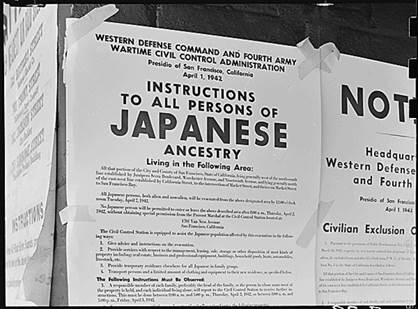
Two months after the attack on Pearl Harbor, February 19, 1942, President Franklin Roosevelt signed Executive Order 9066 to relocate approximately 117,000 Japanese Americans living on the west coast.  At first, the order was voluntary and Japanese Americans had time to sell their property and comply in an orderly manner.
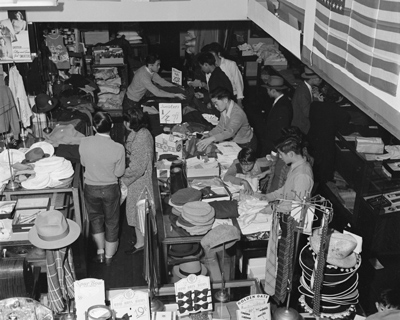
Unfortunately, many did not comply voluntarily, and the relocation became mandatory. Thousands of people lost their homes and businesses due to “failure to pay taxes.” The relocation of Japanese Americans in the United States for safety and security reasons was controversial during World War II and for the decades that followed.  The internment camps provided educational and recreational activities, adequate heat, and a process to hear complaints and address concerns.
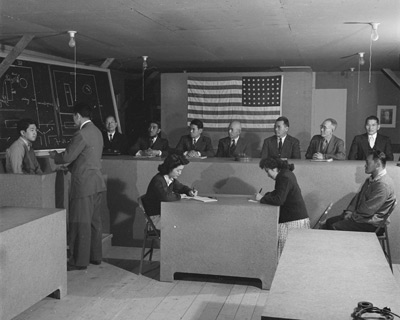
There were 12 camps located all over the United States, with the Seabrook Farms camp in New Jersey.

President Truman rescinded the Executive Order on June 25, 1946 allowing the Japanese Americans to return to their homes. They were in relocation camps for more than four years. When they returned home, most found their belongings stolen and their homes and property sold. They also faced prejudice and discrimination for years, even though Japanese Americans were combat soldiers during the war. 

In 1988, President Ronald Reagan signed the Civil Liberties Act. The remaining survivors of the relocation camps were sent formal letters of apology and were awarded $20,000 in restitutions from the United States government.

On February 23, 1944, the Chechens were exiled from their ancestral lands and deported to Siberia and the northern regions of Kazakhstan. The entirety of the Chechen nation was accused of collaborating with the Fascists, even though there is no evidence to support this. The German advance into the Soviet Union never came close to Chechnya. The Chechen deportation of almost 400,000 men, women, and children is the largest Soviet deportation and occurred in a matter of days. Many Chechens had in fact fought on the front lines of the Soviet war against the German aggressor.

On September 1, 1941 the mass evacuation was announced for the approximately 440,000 Volga Germans. Ten days later they began their forced deportation to Kazakhstan and Siberia. Many were forced to work in ‘labor camps’  such as Kolyma. The Volga Germans were then stripped of their citizenship and did not regain their civil rights until after Stalin’s death. Most estimates indicate that close to 40 percent of the affected population perished.

In 1944, Joseph Stalin ordered the deportation of the entire Crimean Tatar community (roughly 200,000), falsely accusing them of collaborating with the Nazis. Reports suggest that nearly half of the deported died during the ordeal. Ukraine, Latvia, Lithuania, and Canada have all formally recognized Stalin’s brutal deportation as a crime of genocide. During this same period, the Soviet Union adopted a policy of “Russification” for the peninsula. Crimea was “Russified” and any study of the Tatar’s native language was banned, ancient Tatar names were erased, Tatar books were burned, and their mosques were destroyed. Nikita Khrushchev transferred Crimea from Soviet Russia to Soviet Ukraine.

Behind Barbed Wire: Japanese American Camps

Japanese American Internment Camps

Soviet Union Deportation of Volga Germans

Soviet Union Deportation of Chechnyas

Soviet Union Deportation of Crimean Tatars

Questions:

  1. Is it possible for a government to correct something it did that was morally or legally wrong?
  2. Do governments need to justify the actions they take during a time of war or a national crisis?
  3. Are there significant differences in the actions of the United States and the Soviet Union in the relocation or deportation of innocent people, many who were citizens?
  4. Do ordinary people have any rights during a war or crisis (i.e. Ukraine, Gaza, Sudan, Congo, Rwanda, etc.)?
  5. How and who determines if and when a government exceeds its authority?

In World War II, the Japanese were fighting for the Emperor who convinced them that it was better to die than surrender. Women and children had been taught how to kill with basic weapons. kamikaze pilots crashed their planes into American ships. A land invasion would be costly with estimates of more than one million American lives lost.

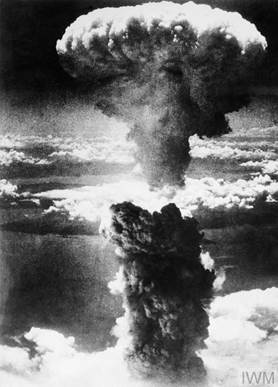
After a successful test of a nuclear bomb at Los Alamos, New Mexico on July 16, 1945, the United States, China, and the United Kingdom issued the Potsdam Declaration on July 26 demanding the unconditional surrender of the Japanese government, warning of “prompt and utter destruction.” On the morning of August 6, 1945, the first atomic bomb was dropped on Hiroshima. The result was approximately 80,000 deaths in just the first few minutes. Thousands died later from radiation sickness. On August 9, 1945, a second atomic bomb was dropped on Nagasaki. The result was 39,000 men, women and children were killed and 25,000 more were injured. Both cities were leveled and Japan surrendered to the United States.

After the news of the atomic bombs that were dropped on Hiroshima on August 6, 1945 and on Nagasaki on August 9, 1945, Lieutenant General Leslie R Groves, director of the `Manhattan Project’ that had developed the atomic bomb, commented:

“The atomic bombings of Hiroshima and Nagasaki ended World War II. There can be no doubt of that. While they brought death and destruction on a horrifying scale, they averted even greater losses – American, English, and Japanese”.

This justification that the use of the bomb saved lives, even though it killed innocent civilians, has haunted the world into our present time.  It was a view that generated controversy then and after as to the justification or otherwise of the use of such weapons on largely defenseless civilian targets, at such Mutual Assured Destruction (MAD) that has haunted the world into our present times.

Following World War 2, there was an arms race between the Soviet Union and the United States. Although there were threats of war and conflicts in Korea, Southeast Asia, the Congo and other places, this period was called the Cold War. Other countries also developed nuclear weapons leading to concerns of a global conflict.
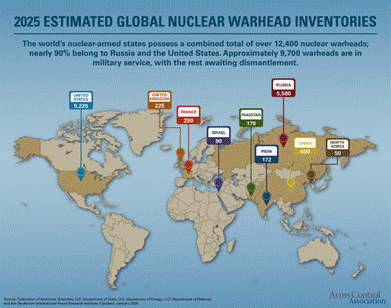
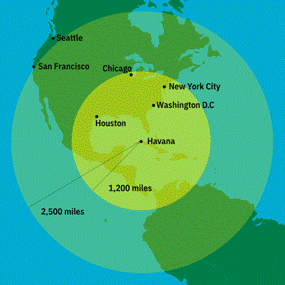
The world came close to a nuclear attack during the Cuban Missile Crisis. In 1962, nuclear weapons could be delivered by airplanes, missiles, and submarines. The Soviet Union placed nuclear warheads in Cuba and the United States had some in Turkey. These missiles could attack cities in both countries within a range of 1,200 miles. Fortunately, the Soviet Union began to withdraw its ships and missiles from Cuba and an agreement was made.
In the 1960s, the military strategy of Mutual Assured Destruction (MAD) was debated, In this strategy, two opposing forces, the Soviet Union and the United States, had enough nuclear weapons to completely destroy each other. This deterrence theory assumed that neither side would initiate a nuclear attack because the resulting retaliation would lead to their own destruction.  The concept, first discussed in the 1960s during the Cold War, is based on the idea that the devastating consequences of nuclear war would outweigh any potential gains for either side. 

As a result, the United Nations initiated the process to limit the production of nuclear testing and weapons.  Since the first test ban treaty, several agreements have been ratified to control the proliferation of nuclear and chemical weapons. The threat from atomic, hydrogen, neutron, and cobalt nuclear weapons is a concern to every person and every country because of the fallout from dangerous levels of radiation. There are still detectable effects of radiation in our atmosphere today from the 1945 explosion. The effects of radiation from a thermonuclear weapon (Hydrogen bomb) will likely last for hundreds of years and affect every living organism and human.

Following the Attack on the World Trade Center on September 11, 2001, the world became concerned about a terrorist group having access to a smaller nuclear weapon, a dirty bomb, that might be detonated in an urban area. The effects of a dirty bomb would likely be limited to the immediate area of the explosion but the damage to property and the cleanup of radioactive elements would be significant and costly.

Nuclear Arms Race and Treaties: 1949-2021 (Council on Foreign Relations)

Timeline of the Nuclear Non-Proliferation Treaty (Arms Control Association)

Devastating Effects of Nuclear Weapons

Questions:

  1. Why did an arms race between the USA and the USSR begin after 1945?
  2. How sane was the policy of MAD?
  3. What factors sustained the arms race for so long?
  4. Is a limited nuclear war a plausible scenario or would it quickly lead to an all-out war?
  5. What would life on Earth be like after a nuclear war? What geographic regions might have a chance of survival?
  6. Should the civil defense from a nuclear war or dirty bomb explosion be best coordinated by local, state, or the federal government in the United States?
  7. How would the governments of Europe or the Middle East, where there are many countries within a small geographic area respond to a nuclear war or explosion from a bomb or nuclear power plant?
  8. What is the most likely scenario for a nuclear explosion in the 21st century?
The First World War and New York City

On April 6, 1917, President Woodrow Wilson declared America’s entrance into the First World War and initiated a nation wide drive to strengthen the armed forces. It was decided that the commemorations of Patriots’ Day on April 19 should coincide with a “Wake up America Day” of
recruitment. Every city hosted its own parties and spectacles.

In New York City, festivities were organized with decorated floats, patriotic banners and a grand vaudeville at Carnegie Hall starring Will Rogers, Ethel Barrymore, and others. James Montgomery Flagg designed the posters announcing the event. Fifth Avenue hosted a parade, whilst Army and Navy planes dropped pamphlets encouraging the crowd to summon the “Spirit of 1776.”

The manifestation started with a parade that re-enacted Paul Revere’s legendary “Midnight Ride” in April 1775 to warn the colonial militia of approaching British forces. At midnight the bells at
Trinity Church rang whilst, dressed as a Continental soldier, a young feminist named Jean Earle Moehle rode on horseback through Manhattan beckoning both men and women to “wake up” to the fight.

Despite America’s initial neutrality, the conflict was a headache for New York’s authorities. After recent mass arrivals, the city was largely populated by first- or second-generation European immigrants.

With their former homelands at war, residents responded by either declaring allegiance to the “motherland” or by identifying with their adopted nation and engaging in debates regarding the morality of global war.

The arguments were taken outdoors. The fighting front may have been far away, but the battle raged on the streets of the city. The war sharpened the focus on issues of American and civic identity.

A City of foreign villages? New York had grown rapidly with different immigrant nationalities living in a network of small communities. By 1900, the metropolis consisted of multiple foreign “villages” with a population that included 300,000 Germans; 275,000 Irish; 155,000 Russians; 145,000 Italians; 117,000 Austro Hungarians; 90,000 British; 30,000 Polish people and many other smaller groupings.

One of the most extensive communities was Little Germany (Klein Deutschland) in the Lower East Side where German banks, businesses, breweries and newspapers flourished. Little Italy (Piccola Italia) on Mulberry Street was likened to an insular Neapolitan village with its own language, customs, and institutions.

By 1900 there were many other ethnic enclaves dotted around the city. Little Syria was centered on Washington and Rector streets. Its name derived from some 95,000 Arabs who had arrived from Ottoman controlled Greater Syria (covering what is now Syria, Lebanon, Palestine and Jordan) in the Great Migration between 1880 and the early 1920s. In 1892, the first American-Arabic language newspaper Kawkab America (Planet of America) was printed there.

Throughout the nineteenth century New York served as a financial hub for industrial growth and became the nation’s de facto cultural capital. It created a divided city. While Fifth Avenue and the Central Park district were monopolized by the elite, part of Manhattan’s Lower East Side was stricken by poverty. New York’s political landscape became shaped by migration issues in which the Democratic Party and Tammany Hall dominated municipal government.

The loyalty of immigrants to the Democratic Party was born out of the perception that the city’s wealth was not shared, causing stark levels of inequality. The rule of oligarchs also caused the emergence of anarchist groups. It was against this background of social unrest and militancy that New York City was drawn into the war in Europe.

The United States initially decided on neutrality for a number of reasons. It was generally expected that the “distant” war would not last long. Politicians agreed that the fragile status quo between communities with ancestral ties to either the Allied or the Central Powers should not be endangered as the war was bringing conflicting ties and allegiances to the fore.

The German-language New Yorker Staats-Zeitung extolled the virtues of the German Kaiser; the Yiddish socialist Forverts(Forward) explained the murder of Austria’s Archduke Franz Ferdinand in Sarajevo as a consequence of social repression; and the Gaelic American complained that Britain’s colonial rule forced Ireland into entering the war. Large crowds with divided loyalties gathered
around newspaper offices in Times Square and Herald Square to learn the latest news from the battlefields.

Consulates encouraged patriotic support. Schemes were set up to raise money for war widows and orphans. German-American residents paraded down Fifth Avenue and queued to sign up. City authorities became increasingly concerned that New York’s diverse population could prove to be a tinderbox of a conflict that was ripping Europe apart. Demonstrations of sympathy towards any of the combatants were soon forbidden.

In spite of internal tensions, Woodrow Wilson’s decision not to get involved was shared by many. That consensus changed when both Germany and Britain started targeting enemy supply lines on the high seas. The British North Sea blockade annoyed politicians, but the German move towards “total” submarine warfare became intolerable once American ships were attacked and lives lost at sea. Outrage was expressed after a German U Boat torpedoed the British liner Lusitania off the coast of Ireland on May 7, 1915, killing 1,198 civilians, 128 Americans among them.

Parades for and against military participation were held around the nation. Woodrow Wilson remained determined not to take sides. Why would a President who was of Ulster-Scottish descent and the son of a Presbyterian minister commit himself to a morally abhorrent conflict that might spill over into the streets of American cities? Why imperil an emerging economy that was heavily dependent on trade with the United Kingdom in particular, closely followed by Germany?

Former President Theodore Roosevelt by contrast advocated expanding the military in anticipation of a widening of hostilities, especially since Wilson’s appeals for peace talks and offers of mediation were ignored.

One effect of growing public anger was unease about New York City’s “American” identity. Addressing an audience at Carnegie Hall in October 1915, Roosevelt stated that “hyphenated
Americanism” was no longer tolerable. His words instigated a period of chauvinistic jingoism, accompanied by a campaign of orchestrated propaganda that permeated the city.

With the formation of the Preparedness Movement in August 1915 and the concurrent rise of the National Security League (NSL: a quasi-paramilitary organization which campaigned for the assertion of “American” values), New York’s streets were closely observed by municipal and national authorities. The call for Americanization had a belligerent undertone intended to ensure law and order amongst a split population.

Americans started to doubt Wilson’s policy of “armed neutrality” and were getting ready for intervention. On May 13, 1916, a Preparedness Parade along Fifth Avenue was attended by an estimated 130,000 marchers who joined ranks behind a banner that proclaimed, “Absolute and
Unqualified Loyalty to our Country.” The manifestation inspired Childe Hassam’s painting “Flags, Fifth Avenue.” An anti-German Francophile, the artist passionately backed the Allied cause.

Isolated incidents intensified the city’s febrile atmosphere. The Black Tom Island Explosion in New York Harbor on July 30, 1916, which destroyed a large ammunition depot, damaging the Statue of Liberty and buildings in downtown Manhattan, heightened the suspicion that German saboteurs were active in the city (although arrests were made, the culprits were never identified).

Responding to recent news of the February Revolution in Russia, New York’s 95th Mayor John Purroy Mitchel stated in an address of March 1917 to a gathering of Russian-Americans that the
city’s citizens should be divided in two classes: “Americans and traitors.”

In April 1917, Wilson went before Congress to ask for a declaration of war. He cited Germany’s resumption of submarine warfare, its sabotage, and the revelation of the “Zimmermann Telegram” (an attempt by the German Foreign Office to recruit Mexico to attack the United States) as evidence of the nation’s hostile intent. It was a pivotal moment. For the first time in the nation’s history, America joined a coalition to fight a war not on its own soil or of its own making. The decision transformed life in New York City. All foreign-language publications were monitored; socialist and anarchist newspapers were censored or restricted.

Vigilantes attacked people identified as “pro-German”; schools sacked German teachers; butchers no longer sold Frankfurters; orchestras stopped playing German masterpieces; the German American Bank was re-introduced as the Continental Bank of New York; and countless German-Americans changed their names to demonstrate their loyalty.

Six weeks after formally entering the war, Congress passed the Selective Service Act which authorized the government to impose conscription. Men between the ages of twenty-one and forty
five were required to register for military service. The move was widely resisted. As the spectre of the 1863 Draft Riots haunted politicians, the process in New York (and elsewhere) was enforced by a heavy police presence, backed up by NSL volunteers. Patriotism was tightly policed.

Speaking out against the war meant risking prosecution, while posters whipped up emotions and encouraged subjects to enlist, conserve food, buy liberty bonds and keep on the lookout for foreign spies. The (intimidating) calls for loyalty raised the issue of citizenship, especially amongst African-Americans.

By supporting the government’s call many black leaders hoped to gain full citizenship, but others suspected that the war would lead to more injustice. In response to racist perpetrating the East St
Louis Massacre, the National Association for the Advancement of Colored People (NAACP) and African-American Churches in Harlem conducted a Silent Parade on July 28, 1917, in which about 10,000 participants marched along Fifth Avenue.

Protesters carried banners and placards that alluded to a draft that demanded African-Americans to fight for freedom and democracy in Europe, whilst they themselves were not only deprived of representation and equal rights, but in danger of being assaulted or lynched.


Through conscription, the army grew in a relatively brief period from a constabulary force of some 300,000 troops to an American Expeditionary Force (AEF) of more than four million soldiers. These
forces reflected the population’s ethnic and racial diversity.

The slogan “Americans All!” promoted wartime service as a unifying experience that rendered differences in language, culture and religion irrelevant – but race still mattered. The army-at-war
remained rigidly segregated.

When American forces arrived in Europe, they quickly turned the tide in favor of Britain and France, leading to an Allied victory in November 1918. They had been engaged in six months of fighting at
the cost of 53,000 lives. In addition, nearly 63,000 men died of disease, primarily from influenza (misnamed “the Spanish flu”), and 200,000 veterans returned home wounded.

The number of casualties weighed on Wilson’s conscience. It motivated him to support the creation of an international body based on collective security. Even though joining the League of Nations would require the United States to sacrifice a measure of sovereignty, the President was prepared to pay the price for the sake of peace.

His opponents declared it foolish to relinquish America’s newfound stature as a military superpower. The toxic discussion on what later became known as “America First” has divided opinion ever since.

The marking of the Armistice in November 1918 was a moment that New Yorkers came together to celebrate their collective identity. Whereas in 1914, German-Americans had paraded down Fifth Avenue proclaiming their attachment both to the Fatherland and to the United States, now mobs of cheering citizens kicked effigies of the Kaiser through the city. The war had turned New Yorkers into “real” Americans.

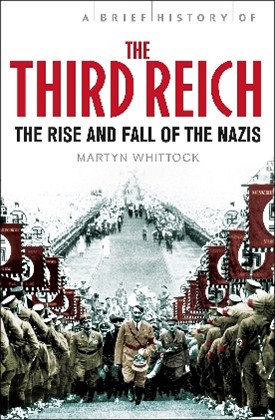
Book Review: A Brief History of the Third Reich: The Rise and Fall of the Nazis, by Martyn Whittock

Martyn Whittock assembles here the accounts of what is what like to be a German and go through all the things that happened before, during, and after World War II. He includes stories from people coming from all walks of life, and he adds his own theories and ideas.

In 22 chapters, Whittock describes the economic, political, and spiritual life in Germany leading to the Nazis seizing power and discusses both German complacency and involvement in contributing to the party’s rise to leading the nation. Whittock talks a great deal about Hitler’s reasons and motivations leading to some of the worst decisions possible.

Hitler had a tendency to make very dramatic and quick decisions without listening to the advice of those who would try to help him, or help Germany, in times of crisis. Hitler tended to stretch resources too thin and to make decisions which caused other greater problems unforeseen.

Without giving away too much content, I will say that this book does include the strength of using so many different persons’ stories to give the reader different perspectives on how the Nazis were actually able to get as far as they did. It is important to continue to read such accounts to try to sort out what makes sense and what does not.

Whittock gives the reader a great deal of information on the concentration camps and on how they were run. He does give us a glimpse into the desperate lives of the Germans who assisted in the murders, as he does regarding all of the persons who helped Hitler come to power.

There was something in it for everyone, it appears, and Whittock attempts to explain how and why the Germans allowed the Nazis to take so much power. He also provides the death tolls and discusses the methods used for murdering the inmates. Whittock provides a full description of the murders and numbers. However, he also uses more contemporary examples of bloodshed such as the Rwanda murders.

Maybe this is done to show that murder on a huge scale is to be expected in the world? Nothing could compare to the Nazis’ slaughter of entire peoples and communities, so that idea is lost on this reader—and on most all readers, I would assume.

The reader can profit from trying to understand what happened in Germany during those say 50 years of time. Teachers can perhaps get a little better understanding of how to begin to explain what was going on in the minds of Germans who watched all of it.

This is important reading because of the different perspectives revealed here.

IBM and Auschwitz: New Evidence

Edwin Black

Reprinted with permission from https://historynewsnetwork.org/article/1035

Edwin Black is author of IBM and the Holocaust, The Strategic Alliance between Nazi Germany and America’s Most Powerful Corporation (Crown Publishers 2001 and Three Rivers Press 2002). This article is drawn from Mr. Black’s just released and updated German paperback edition. The new edition includes the discovery of hard evidence linking IBM to Auschwitz. The evidence, detailed here, will be appended to his English language editions at the next reprinting in the new future.

The infamous Auschwitz tattoo began as an IBM number. In August 1943, a timber merchant from Bendzin, Poland, arrived at Auschwitz. He was among a group of 400 inmates, mostly Jews. First, a doctor examined him briefly to determine his fitness for work. His physical information was noted on a medical record. Second, his full prisoner registration was completed with all personal details. Third, his name was checked against the indices of the Political Section to see if he would be subjected to special punishment. Finally, he was registered in the Labor Assignment Office and assigned a characteristic five-digit IBM Hollerith number, 44673.

The five-digit Hollerith number was part of a custom punch card system devised by IBM to track prisoners in Nazi concentration camps, including the slave labor at Auschwitz.

The Polish timber merchant’s punch card number would follow him from labor assignment to labor assignment as Hollerith systems tracked him and his availability for work, and reported the data to the central inmate file eventually kept at Department DII. Department DII of the SS Economics Administration in Oranienburg oversaw all camp slave labor assignments, utilizing elaborate IBM systems.

Later in the summer of 1943, the Polish timber merchant’s same five-digit Hollerith number, 44673, was tattooed on his forearm. Eventually, during the summer of 1943, all non-Germans at Auschwitz were similarly tattooed. Tattoos, however, quickly evolved at Auschwitz. Soon, they bore no further relation to Hollerith compatibility for one reason: the Hollerith number was designed to track a working inmate—not a dead one. Once the daily death rate at Auschwitz climbed, Hollerith-based numbering simply became outmoded. Soon, ad hoc numbering systems were inaugurated at Auschwitz. Various number ranges, often with letters attached, were assigned to prisoners in ascending sequence. Dr. Josef Mengele, who performed cruel experiments, tattooed his own distinct number series on “patients.” Tattoo numbering schemes ultimately took on a chaotic incongruity all its own as an internal Auschwitz-specific identification system.

However, Hollerith numbers remained the chief method Berlin employed to centrally identify and track prisoners at Auschwitz. For example, in late 1943, some 6,500 healthy, working Jews were ordered to the gas chamber by the SS. But their murder was delayed for two days as the Political Section meticulously checked each of their numbers against the Section’s own card index. The Section was under orders to temporarily reprieve any Jews with traces of Aryan parentage.

Sigismund Gajda was another Auschwitz inmate processed by the Hollerith system. Born in Kielce, Poland, Gajda was about 40 years of age when on May 18, 1943, he arrived at Auschwitz. A plain paper form, labeled “Personal Inmate Card,” listed all of Gajda’s personal information. He professed Roman Catholicism, had two children, and his work skill was marked”mechanic.” The reverse side of his Personal Inmate Card listed nine previous work assignments. Once Gajda’s card was processed by IBM equipment, a large indicia in typical Nazi Gothic script was rubber-stamped at the bottom: “Hollerith erfasst,” or “Hollerith registered.” Indeed, that designation was stamped in large letters on hundreds of thousands of processed Personal Inmate Cards at camps all across Europe. The Extermination by Labor campaign itself depended upon specially designed IBM systems that matched worker skills and locations with labor needs across Nazi-dominated Europe. Once the prisoner was too exhausted to work, he was murdered by gas or bullet. Exterminated prisoners were coded “six” in the IBM system.

The Polish timber merchant’s Hollerith tattoo, Sigismund Gajda’s inmate form, and the victimization of millions more at Auschwitz live on as dark icons of IBM’s conscious 12-year business alliance with Nazi Germany. IBM’s custom-designed prisoner-tracking Hollerith punch card equipment allowed the Nazis to efficiently manage the hundreds of concentration camps and sub-camps throughout Europe, as well as the millions who passed through them. Auschwitz’ camp code in the IBM tabulation system was 001.8

Nearly every Nazi concentration camp operated a Hollerith Department known as the Hollerith Abteilung. The three-part Hollerith system of paper forms, punch cards and processing machines varied from camp to camp and from year to year, depending upon conditions. In some camps, such as Dachau and Storkow, as many as two dozen IBM sorters, tabulators, and printers were installed. Other facilities operated punchers only and submitted their cards to central locations such as Mauthausen or Berlin. In some camps, such as Stuthoff, the plain paper forms were coded and processed elsewhere. Hollerith activity, whether paper, punching or processing, was frequently—but not always–located within the camp itself, consigned to a special bureau called the Labor Assignment Office, known in German as the Arbeitseinatz. The Arbeitseinsatz issued the all-important life-sustaining daily work assignments, and processed all inmate cards and labor transfer rosters.

IBM did not sell any of its punch card machines to Nazi Germany. The equipment was leased by the month. Each month, often more frequently, authorized repairmen, working directly for or trained by IBM, serviced the machines on-site–whether in the middle of Berlin or at a concentration camp. In addition, all spare parts were supplied by IBM factories located throughout Europe. Of course, the billions of punch cards continually devoured by the machines, available exclusively from IBM, were extra.

IBM’s extensive technological support for Hitler’s conquest of Europe and genocide against the Jews was extensively documented in my book, IBM and the Holocaust, published in February 2001 and updated in a paperback edition. In March of this year, The Village Voice broke exclusive new details of a special IBM wartime subsidiary set up in Poland by IBM’s New York headquarters shortly after Hitler’s 1939 invasion. In 1939, America had not entered the war, and it was still legal to trade with Nazi Germany. IBM’s new Polish subsidiary, Watson Business Machines, helped Germany automate the rape of Poland. The subsidiary was named for its president Thomas J. Watson.

Central to the Nazi effort was a massive 500-man Hollerith Gruppe, installed in a looming brown building at 24 Murnerstrasse in Krakow. The Hollerith Gruppe of the Nazi Statistical Office crunched all the numbers of plunder and genocide that allowed the Nazis to systematically starve the Jews, meter them out of the ghettos and then transport them to either work camps or death camps. The trains running to Auschwitz were tracked by a special guarded IBM customer site facility at 22 Pawia in Krakow. The millions of punch cards the Nazis in Poland required were obtained exclusively from IBM, including one company print shop at 6 Rymarska Street across the street from the Warsaw Ghetto. The entire Polish subsidiary was overseen by an IBM administrative facility at 24 Kreuz in Warsaw.

The exact address and equipment arrays of the key IBM offices and customer sites in Nazi-occupied Poland have been discovered. But no one has ever been able to locate an IBM facility at, or even near, Auschwitz. Until now. Auschwitz chief archivist Piotr Setkiewicz finally pinpointed the first such IBM customer site. The newly unearthed IBM customer site was a huge Hollerith Büro. It was situated in the I.G. Farben factory complex, housed in Barracks 18, next to German Civil Worker Camp 7, about two kilometers from Auschwitz III, also known as Monowitz Concentration Camp. Auschwitz’ Setkiewicz explains, “The Hollerith office at IG Farben in Monowitz used the IBM machines as a system of computerization of civil and slave labor resources. This gave Farben the opportunity to identify people with certain skills, primarily skills needed for the construction of certain buildings in Monowitz.”

By way of background, what most people call “Auschwitz” was actually a sprawling hell comprised of three concentration camps, surrounded by some 40 subcamps, numerous factories and a collection of farms in a surrounding captive commercial zone. The original Auschwitz became known simply as Auschwitz I, and functioned as a diversified camp for transit, labor and detention. Auschwitz II, also called Birkenau, became the infamous extermination center, operating gas chambers and ovens. Nearby Auschwitz III, known as Monowitz, existed primarily as a slave labor camp. Monowitz is where IBM’s bustling customer site functioned.

Many of the long-known paper prisoner forms stamped Hollerith Erfasst, or” registered by Hollerith,” indicated the prisoners were from Auschwitz III, that is, Monowitz. Now Auschwitz archivist Setkiewicz has also discovered about 100 Hollerith machine summary printouts of Monowitz prisoner assignments and details generated by the I.G. Farben customer site. For example, Alexander Kuciel, born August 12, 1889, was in 1944 deployed as a slave carpenter, skill coded 0149, and his Hollerith printout is marked “Sch/P,” the Reich abbreviation for Schutzhäftling/Pole. Schutzhäftling/Pole means “Polish political prisoner.” The giant Farben facilities, also known as “I.G. Werk Auschwitz,” maintained two Hollerith Büro staff contacts, Herr Hirsch and Herr Husch. One key man running the card index systems was Eduard Müller. Müller was a fat, aging, ill-kempt man, with brown hair and brown eyes. Some said, “He stank like a polecat.” A rabid Nazi, Müller took special delight in harming inmates from his all-important position in camp administration.

Comparison of the new printouts to other typical camp cards shows the Monowitz systems were customized for the specific coding Farben needed to process the thousands of slave workers who labored and died there. The machines were probably also used to manage and develop manufacturing processes and ordinary business applications. The machines almost certainly did not maintain extermination totals, which were calculated as “evacuations” by the Hollerith Gruppe in Krakow. At press time, the diverse Farben codes and range of machine uses are still being studied. It is not known how many additional IBM customer sites researchers will discover in the cold ashes of the expansive commercial Auschwitz zone.

A Hollerith Büro, such as the one at Auschwitz III, was larger than a typical mechanized concentration camp Hollerith Department. A Büro was generally comprised of more than a dozen punching machines, a sorter and one tabulator. Leon Krzemieniecki was a compulsory worker who operated a tabulator at the IBM customer site at the Polish railways office in Krakow that kept track of trains going to and from Auschwitz. He recalls, “I know that trains were constantly going from Krakow to Auschwitz–not only passenger trains, but cargo trains as well.” Krzemieniecki, who worked for two years with IBM punchers, card sorters and tabulators, estimates that a punch card operation for so large a manufacturing complex as Farben “would probably require at least two high-speed tabulators, four sorters, and perhaps 20 punchers.” He added, “The whole thing would probably require 30-40 persons, plus their German supervisors.”

The new revelation of IBM technology in the Auschwitz area constitutes the final link in the chain of documentation surrounding Big Blue’s vast enterprise in Nazi-occupied Poland, supervised at first directly from its New York headquarters, and later through its Geneva office. Jewish leaders and human rights activists were again outraged. “This latest disclosure removes any pretext of deniability and completes the puzzle that has been IBM and Auschwitz: New Evidence.

“When put together about IBM in Poland,” declared Malcolm Hoenlein, vice president of the New York-based Conference of Presidents of Major Jewish Organizations. “The picture that emerges is most disturbing,” added Hoenlein.” IBM must confront this matter honestly if there is to be any closure.”

Marek Orski, state historian of the museum at Poland’s Stuthoff Concentration Camp, has distinguished himself as that country’s leading expert on the use of IBM technology at Polish concentration camps. “This latest information,” asserts Orski,”proves once more that IBM’s Hollerith machines in occupied Poland were functioning in the area of yet another concentration camp, in this case Auschwitz-Monowitz–something completely unknown until now. It is yet another significant revelation in what has become the undoubted fact of IBM’s involvement in Poland. Now we need to compile more documents identifying the exact activity of this Hollerith Büro in Auschwitz Monowitz.”

Krzemieniecki is convinced obtaining such documents would be difficult. “It would be great to have access to those documents,” he said, “but where are they?” He added, “Please remember, I witnessed in 1944, when the war front came closer to Poland, that all the IBM machines in Krakow were removed. I’m sure the Farben machines were being moved at the same time. Plus, the Germans were busy destroying all the records. Even still,” he continues, “what has been revealed thus far is a great achievement.”

Auschwitz historians were originally convinced that there were no machines at Auschwitz, that all the prisoner documents were processed at a remote location, primarily because they could find no trace of the equipment in the area. They even speculated that the stamped forms from Auschwitz III were actually punched at the massive Hollerith service at Mauthausen concentration camp. Indeed, even the Farben Hollerith documents had been identified some time ago at Auschwitz, but were not understood as IBM printouts. That is, not until the Hollerith Büro itself was discovered. Archivists only found the Büro because it was listed in the I.G. Werk Auschwitz phone book on page 50. The phone extension was 4496.”I was looking for something else,” recalls Auschwitz’ Setkiewicz,”and there it was.” Once the printouts were reexamined in the light of IBM punch card revelations, the connection became clear.

Setkiewicz says, “We still need to find more similar identification cards and printouts, and try to find just how extensive was the usage in the whole I.G. Farben administration and employment of workers. But no one among historians has had success in finding these documents.”

In the current climate of intense public scrutiny of corporate subsidiaries, IBM’s evasive response has aroused a renewed demand for accountability. “In the day of Enron and Tyco,” says Robert Urekew, a University of Louisville professor of business ethics, “we now know these are not impersonal entities. They are directed by people with names and faces.” Prof. Urekew, who has studied IBM’s Hitler-era activities, continued, “The news that IBM machines were at Auschwitz is just the latest smoking gun. For IBM to continue to stonewall and hinder access to its New York archives flies in the face of the focus on accountability in business ethics today. Since the United States was not technically at war with Nazi Germany in 1939, it may have been legal for IBM to do business with the Third Reich and its camps in Poland. But was it moral?”

Even some IBM employees are frustrated by IBM’s silence. Michael Zamczyk, for example, is a long-time IBM employee in San Jose, California, working on business controls. A loyal IBMer, Zamczyk has worked for the company for some 28 years. He is also probably the only IBM employee who survived the Krakow ghetto in 1941 and 1942. Since revelations about IBM’s ties to Hitler exploded into public view in February 2001, Zamczyk has been demanding answers—and an apology–from IBM senior management.

“Originally,” says Zamczyk,”I was just trying to determine if it was IBM equipment that helped select my father to be shipped to Auschwitz, and if the machines were used to schedule the trains to Auschwitz.

Zamczyk started writing letters and emails, but to no avail. He could not get any concrete response about IBM’s activities during the Hitler era.”I contacted senior management, all the way up to the president, trying to get an answer,”states Zamczyk. “Since then, I have read the facts about IBM in Poland, about the railroad department at 22 Pawia Street in Krakow, and I read about the eyewitnesses. Now I feel that IBM owes me, as an IBM employee, an apology. And that is all I am looking for.”

Zamczyk was met by stony silence from IBM executives.” The only response I got,” he relates, “was basically telling me there would be no public or private apology. But I am still waiting for that apology and debating what to do next.”

Repeated attempts to obtain IBM reaction to the newest disclosure were rebuffed by IBM spokesman Carol Makovich. I phoned her more than a dozen times, but she did not respond, or grant me permission to examine Polish, Brazilian and French subsidiary documents at the company’s Somers, New York archives. Nor has the company been forthcoming to numerous Jewish leaders, consumers and members of the media who have demanded answers.

At one point, Makovich quipped to a Reuters correspondent, “We are a technology company, we are not historians.”


Twentieth Century Women Across Cultures

                        War is dispassionate in choosing its victims. It causes all participants, voluntary or involuntary, to suffer. And yet, throughout history, women have been defined by many social studies curricula as noncombatants, unable to wield a weapon against their enemy despite remaining on the receiving end of the opposition’s weapon. Women in twentieth century warfare instead contribute to the war effort from the homefront, taking the positions typically held by men who had left for the warfront. However, war is by nature chaotic and often has little respect for the socially manufactured lines of home and war fronts, potentially blurring the physical gap between the two. This is certainly the case on the eastern front of World War II for the Soviet Union. As Germany advanced far into Soviet territory in 1941, the warfront was pushed ever closer to the heart of Soviet noncombatants’ homes. These civilians, both men and women, became motivated to fight to reclaim their homes, supported by the national ideal that all Soviet citizens must be willing to fight and die for their motherland. One woman in particular, Lyudmila Pavlichenko, became the embodiment of this ideal, and her career “exemplified the activism fostered in young women” of the time.[1] Through her memoir Lady Death, Pavlichenko details the proximity the war had with the typical Soviet citizen as hometowns were transformed into battlefields. This blend of home and war fronts is a foreign concept for the United States however, emphasized throughout Lyudmila’s reflection on her time spent in the western nation in 1942 as she drew comparisons between Soviet and American women. Therefore, Lyudmila Pavlichenko’s story may be used in history classrooms as a case study to allow students to explore the roles of women in World War II as well as note the differences between Soviet and American cultures in an era directly preceding the Cold War.

            Female soldiers were not unheard of in the Soviet Union by 1941. In Soviet mythology and history, women were often portrayed as “being physically strong and capable of fighting.”[2] Prior to the Russian Revolution of 1917, approximately 6,000 women were enlisted as soldiers in the Russian military. During the civil war following the Revolution, somewhere between, “73,000 and 80,000 women served on the Bolshevik side.”[3] After the Russian Civil War’s conclusion, the Constitution of 1918 established voluntary military service for women. Soviet women were given equal rights to men in Article 122 of the 1936 Constitution. Of particular note is Article 133 of the same constitution, in which it is stated that, “The defense of the fatherland is the sacred duty of every citizen of the USSR.”[4] These two Articles, when considered together, created a sense of military duty for every Soviet citizen, regardless of gender. This is evident in the feelings of many Soviet women as they remembered their enlistment, such as Svetlana Katykhina who recalls that, “My father was the first to leave for the front. Mama wanted to go with my father, she was a nurse, but he was sent in one direction, she in another. I kept going to the recruitment office, and after a year they took me.”[5] Each member of Svetlana’s family enlisted in the Soviet military, including both Svetlana’s mother and Svetlana herself. Pavlichenko herself echoes this call to arms, stating that, “everyone who was confident in military knowledge and skills, regardless of his or her sex or national affiliation, had to join the ranks and make whatever contribution they were capable of to wipe out the German Fascist invaders.”[6] Soviet citizens were united against Germany through their national sense of duty to military participation in conjunction with their united hatred for the aggressors invading their home.

            Alongside legal support offered to Soviet women prior to the war, it was not abnormal for Soviet women to learn to work with firearms as citizens. In 1918, the Vsevobuch was created, requiring all male citizens between the ages of 18 to 40 to complete eight weeks of military training. This training was also offered to women, although participation was voluntary.[7] Lyudmila’s first experience with shooting occurred far prior to the war through a shooting club offered to workers at Lyudmila’s factory, where her “enthusiasm for rifle-shooting began, [alongside her] apprenticeship as a sharpshooter.”[8] Lyudmila then pursued her hobby in the form of a two-year-long curriculum at Osoaviakhim sniper school from 1937 to 1939. Lyudmila did this not explicitly out of her own interest in sniping, however, but because the activity of Germany in Europe in the late 30s that led Lyudmila to believe her sniper skills, “might come in handy.”[9] Lyudmila was a rare case in the sense that her intention of fighting in the Red Army as a sniper existed prior to the war encroaching upon the Soviet Union’s territory.

            Upon Germany’s invasion of the Soviet Union on June 22, 1941, only about 1,000 women were active in the Soviet military.[10] The battlefield quickly reached Soviet citizens’ doorstep, forcing families that were able to evacuate east. Olga Vasilyevna, an eventual Soviet soldier, recalled that her “war began with evacuation… I left my home, my youth. On the way, our train was strafed, bombed.”[11] It was at this point that the lines between war and homefront began to blur for Soviet citizens, causing both men and women alike to enlist in the Red Army. In the first few weeks, tens of thousands of Soviet women volunteered. Most were rejected.[12] Lyudmila Pavlichenko, despite graduating with top marks from the Osoaviakhim sniper school, was initially rejected, recalling that the military registrar, “looked at me with a harassed expression and said: ‘Medical staff will be enlisted from tomorrow.’”[13] It is this initial rejection of female soldier applicants in the Soviet Union that displays that women’s enlistment in the Red Army did not stem solely from Soviet social leniency towards women on the frontlines, as Soviet culture–like most nations in the mid-twentieth century–viewed women as a means of support during wartime. As the war progressed, however, “female volunteers were increasingly accepted.”[14] On the second day of war, a request was made for 40,000 women to be called up for medical duties. By August of 1941, another 14,000 women were recruited as drivers. This trend continued until 1943, wherein,

Soviet women had been integrated into all services and all military roles, ranging from traditional support roles like medical service, to primarily defensive work in antiaircraft defense, to offensive combat roles in the infantry, to artillery, and armor, as well as the partisan movement.[15]

While Soviet women had to begin their fight in the war prior to reaching the battlefield by gaining a foothold into the army, they quickly emerged victorious as the Red Army sought out additional manpower.

            Lyudmila Pavlichenko and other Soviet women snipers were able to prove themselves effective on the battlefield. Women began to gain more respect in the eyes of Soviet military commanders. Pavlichenko’s sniping instructor, Alexander Vladimirovich Potapov, told Lyudmila that, “he was sure that women – not all, of course – were better suited to sniper operations… [women] had a considered and careful approach to the process of firing.”[16] Soviet Major General Morozov stated that superior female marksmanship was due to their enhanced sense of touch allowing for the smooth pulling of a trigger, insinuating that, “innate feminine characteristics… predisposed women to surgical killing.”[17] The Soviet government, recognizing women’s aptitude for the sniper role in combat, began training female snipers on the front lines.[18] Early Soviet media reports on female soldiers often masculinized names to hide female involvement.[19] However, this shifted as the war went on, as in March 1942 the Russian tabloid Komsomolskaya Pravda published the sentiment, “If a young Soviet woman patriot is burning to master the machine gun, we should give her the opportunity to realize her dream.”[20] Lyudmila’s experience echoed these social changes. After struggling to gain even a rifle with which to prove herself,[21] Lyudmila was able to quickly rise up in rank after proving her abilities. She was promoted from private to corporal after recovering from shrapnel wounds[22] and was later given her own sniper platoon to select and instruct in late 1941.[23] While she continuously faced many fellow Soviets who doubted her abilities as a soldier due to her gender, she encountered just as many who recognized her talents. Pavlichenko returned from the frontlines in 1942 after having killed over 309 enemy soldiers.[24]

            Lyudmila, after being injured for her fourth time in 1942, was taken away from the frontlines and sent to the USSR’s western allies to pressure political leaders into opening up a second front against Germany. Lyudmila begins her journey in the United States, where she is subject to the drastic cultural shift between Soviet and American values during a time of war. Lyudmila is interviewed repeatedly, and she finds herself growing increasingly aggravated at the sense of calm and the focus on pointless subjects rampant within the U.S. In one press conference, Lyudmila is asked if women were, “able to use lipstick when at war,” to which Lyudmila replied, “Yes, but they don’t always have time. You need to be able to reach for a machine gun, or a rifle, or a pistol, or a grenade.”[25] In the United States, says Lyudmila,

I feel like the butt of jokes, the object of idle curiosity, something like a circus act. Like a bearded woman. But I’m an officer of the Red Army. I have fought and will go on fighting for the freedom and independence of my country.[26]

For a society so distanced from the forefront of war, the United States’ culture viewed Lyudmila as an individual from another world, an object needing pity due to the “need” of Soviet Russia to employ their women–who, from the American perspective, should be distanced from conflict–as frontline soldiers.

During her trip to America, Lyudmila came into contact with feminist world leader Eleanor Roosevelt. When meeting with Lyudmila over breakfast, Eleanor noted that, “If you had a good view of the faces of your enemies through telescope sights, but still fired to kill, it would be hard for American women to understand you, dear Lyudmila.”[27] Lyudmila responded that the difference between American and Soviet women stems not from their ability and willingness to kill, but from the difference between American and Soviet circumstances in the war. Lyudmila,

explained to those living in a state far from the struggle against Fascism that we had come from a place where bombs were destroying towns and villages, blood was being spilt, where innocent people were being killed, and my native land was undergoing a severe ordeal. An accurate bullet was no more than a response to a vicious enemy.[28]

Soldiers fought in World War II from both the U.S. and the USSR. However, while Soviet women were given rifles and machine guns to defend their homes from the frontline, “uniformed women from the United States did not participate in organized combat.”[29] So what was the difference between Soviet and American women in the mid-twentieth century? How were Soviet women capable of pulling the trigger of a rifle pointed at their enemy, while American women–or rather their media representation–remained preoccupied with the attractiveness of their uniform? The gap between American and Soviet female participation in the military did not stem from cultural nor biological differences, but from the circumstances of the war itself. While the United States remained free of foreign invaders or bombings, the Soviet Union was subject to constant pressures, bombing runs, and gunfire. In the United States, women who desired to participate on the frontline of World War II had to travel thousands of miles to the medical tents.[30] For women in the Soviet Union, the frontline came to them.

These conclusions can be applied in a (likely high school-level) history classroom to lead students to think more about the cultural gap between Soviets and Americans prior to the decades-long Cold War. Rarely are personal interactions between the two superpowers brought into the classroom, and equally rare is a case study portraying women as strong and deadly representatives of their nation on the frontline in times of war. Lyudmila Pavlichenko’s story brings both of these seldom-discussed aspects of history together, creating a perfect case study to use as a medium to bring historical context and personal perspectives from the mid twentieth century into the modern classroom. Students may be encouraged to use Lyudmila’s story as a source for a research paper or the excerpts about Lyudmila’s visit to the US as a basis for a student-led project. With the American curriculum often restricted to a western-based perspective on World War II and the Cold War, Lyudmila Pavlichenko’s memoir allows for a drastic change in perspective and representation of the “enemy’s” culture in contrast to our own.

Aleksievich, Svetlana. The Unwomanly Face of War: An Oral History of Women in World War II. New York, NY: Random House, 2018.

Judy, Barrett Litoff and David C. Smith. “American Women in a World at War.” Magazine of History 16, no. 3 (Spring, 2002): 7-7,9. Retrieved from https://ezproxy.tcnj.edu/login?url=https://www.proquest.com/scholarly-journals/american-women-world-at-war/docview/213740770/se-2.

Markwick, Roger D., and Euridice Charon Cardona. Soviet Women on the Frontline in the Second World War (Palgrave Macmillan, 2012).

Muller, Richard. R, and Amy Goodpaster Strebe. 2009. “Flying for Her Country: The American and Soviet Women Pilots of World War II.” Journal of American Studies 43 (1). https://doi.org/10.1017/S0021875809006422.  

Pavlychenko, Li︠u︡dmyla Mykhaĭlivna. Lady Death: The Memoirs of Stalin’s Sniper. Strawberry Hills, NSW: Read How You Want, 2021. 

Pennington, Reina. “Offensive Women: Women in Combat in the Red Army in the Second World War” Journal of Military History (2010) 74#3 pp 775–820.


[1] Roger D. Markwick and Euridice Charon Cardona, Soviet Women on the Frontline in the Second World War, (Palgrave Macmillan, 2012), 204.

[2] Reina Pennington, “Offensive Women: Women in Combat in the Red Army in the Second World War,” in Journal of Military History (2010), 778.

[3] Ibid., 779.

[4] Ibid., 779.

[5] Svetlana Aleksievich. The Unwomanly Face of War: An Oral History of Women in World War II, (New York, NY: Random House, 2001), 58.

[6] Li︠u︡dmyla Mykhaĭlivna Pavlychenko. Lady Death: The Memoirs of Stalin’s Sniper, (Strawberry Hills, NSW: Read How You Want, 2021), 133.

[7] Pennington, Offensive Women, 779.

[8] Pavlychenko, Lady Death, 32.

[9] Ibid., 38.

[10] Pennington, Offensive Women, 780.

[11] Aleksievich, The Unwomanly Face of War, 92.

[12] Pennington, Offensive Women, 780.

[13]  Pavlychenko, Lady Death, 54.

[14] Pennington, Offensive Women, 780.

[15] Ibid., 782.

[16]   Pavlychenko, Lady Death, 42.

[17] Markwick and Cardona, Soviet Women on the Frontline, 211.

[18] Ibid., 209.

[19] Richard R. Muller and Amy Goodpaster Strebe, “Flying for Her Country: The American and Soviet Women Pilots of World War II,” in Journal of American Studies 43, (2009).

[20] Markwick and Cardona, Soviet Women on the Frontline, 211.

[21] Pavlychenko, Lady Death, 58.

[22] Ibid., 78.

[23]  Ibid., 107.

[24]  Markwick and Cardona, Soviet Women on the Frontline, 203.

[25] Pavlychenko, Lady Death, 305.

[26] Ibid., 340.

[27]  Ibid., 302.

[28]   Ibid., 302.

[29] Barret Litoff Judy and David C. Smith, “American Women in a World at War,” in Magazine of History 16, no. 3 (2002).

[30] Ibid.