Origin and Meaning of Critical Race Theory

Origin and Meaning of Critical Race Theory

Alan Singer

On a November 2021 CNN broadcast, host Chris Cuomo interviewed comedian/commentator Bill Maher about a supposed leftwing peril threatening the United States, feeding him a series of softball questions and responding with “Oh my God” facial expressions. After acknowledging “I’m not in schools” and “I have no interaction with children,” Maher announced that he has heard from people all over the country that “kids are sometimes separated into groups, oppressor and oppressed” and being taught “racism is the essence of America.” He derided this practice as “just silly, it’s just virtue-signaling” and accused people advocating for curriculum revision of being “afraid to acknowledge progress,” a psychological disorder he alternately labeled “wokeness” and “progressophobia.” Maher’s comments on “wokeness” and “progressophobia” reminded me of a 19th century medical condition described by Dr. Samuel Cartwright from Louisiana in DeBow’s Review in 1851 as “Drapetomania, the disease causing Negroes to run away from slavery.”

I kept waiting for Chris Cuomo to ask Maher to provide an example, any example, to support his claims, but Cuomo never did and Maher never felt compelled to offer any evidence. On his television show, Maher promotes a group of contrarians that want to start their own college where they will be free to present offensive ideas and dismiss objections without having to provide supporting evidence or answer to anyone. Cuomo never asked Maher about that either.

In August 2021, the Brookings Institute reported that at least eight states had passed legislation banning the teaching of Critical Race Theory, although only Idaho actually used the phrase. The modern iteration of Critical Race Theory began in the 1980s when legal scholars followed by social scientists and educational researchers employed CRT as a way of understanding the persistence of race and racism in the United States. Kimberlé Crenshaw, who teaches law at UCLA and Columbia University and was an early proponent of critical race theory, described it as “an approach to grappling with a history of white supremacy that rejects the belief that what’s in the past is in the past, and that the laws and systems that grow from that past are detached from it.” Basically, Critical Race Theory disputes the idea of colorblindness or legal neutrality and argues that race and racism have always played a major role in the formulation of American laws and the practices of American institutions. It is a study of laws and institutions that sifts through the surface cover to look for underlying meaning and motivation. In my work as a historian, I traced the current debate over “citizen’s arrest” back to its implementation in the South during the Civil War when it was used to prevent enslaved Africans from fleeing bondage. It essentially empowered any white person to seize and hold any Black person they suspected of a crime, stealing white property by stealing themselves As an academic discipline CRT does not claim that everything about the United States is racist or that all white people are racist. The CRT lens examines laws and institutions, not people, certainly not individual people.

What has come to be known as a CRT approach to understanding United States history and society actually has much deeper roots long before the 1980s. A 19th century French observer of American society, Alexis De Tocqueville, in the book Democracy in America published in 1835, wrote: “I do not believe that the white and black races will ever live in any country upon an equal footing . . . But I believe the difficulty to be still greater in the United States than elsewhere . . . [A]s long as the American democracy remains at the head of affairs . . . [I]t may be foreseen that the freer the white population of the United States becomes, the more isolated will it remain.

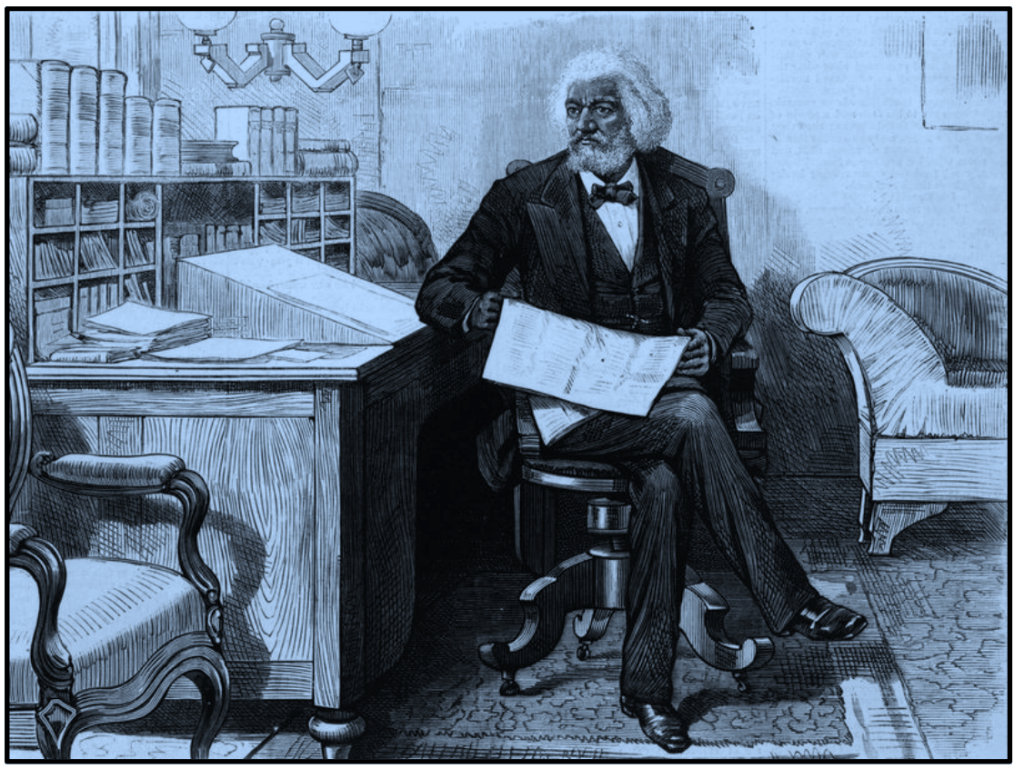
In an 1852 Independence Day speech delivered in Rochester, New York, Frederick Douglass rhetorically asked, “What to the Slave is the Fourth of July?” Douglass then answered his own question. “The blessings in which you this day rejoice are not enjoyed in common. The rich inheritance of justice, liberty, prosperity, and independence [given] by your fathers is shared by you, not by me . . . What to the American slave is your Fourth of July? I answer, a day that reveals to him more than all other days of the year, the gross injustice and cruelty to which he is the constant victim. To him your celebration is a sham; your boasted liberty an unholy license; your national greatness, swelling vanity; your sounds of rejoicing are empty and heartless; your denunciation of tyrants, brass-fronted impudence; our shouts of liberty and equality, hollow mockery; your prayers and hymns, your sermons and thanksgivings, with all your religious parade, and solemnity, are, to him, mere bombast, fraud, deception, impiety, and hypocrisy — a thin veil to cover up crimes which would disgrace a nation of savages.”

In the 19th century, a reverse CRT lens was openly used by racists to justify the laws and institutions derided by Alexis De Tocqueville and Frederick Douglass. In the majority opinion of the Supreme Court in its 1857 Dred Scott decision, Chief Justice Roger Taney claimed, and the Court ruled, that “A free negro of the African race, whose ancestors were brought to this country and sold as slaves, is not a ‘citizen’ within the meaning of the Constitution of the United States” because “When the Constitution was adopted, they were not regarded in any of the States as members of the community which constituted the State, and were not numbered among its ‘people or citizens.’ Consequently, the special rights and immunities guaranteed to citizens do not apply to them.”

The deep roots of racism were recognized by the United States Congress when it drafted the 13th, 14th, and 15th amendments after the American Civil War. Abolitionist and civil rights proponent Congressman Thaddeus Stevens issued a warning in December 1865. We have turned, or are about to turn, loose four million slaves without a hut to shelter them or a cent in their pockets. The infernal laws of slavery have prevented them from acquiring an education, understanding the common laws of contract, or of managing the ordinary business of life. This Congress is bound to provide for them until they can take care of themselves. If we do not furnish them with homesteads, and hedge them around with protective laws; if we leave them to the legislation of their late masters, we had better have left them in bondage. If we fail in this great duty now, when we have the power, we shall deserve and receive the execration of history and of all future ages.” Stevens was right. Enforcement legislation was gutted by the Supreme Court making way for Jim Crow segregation, Klan terrorism, and the disenfranchisement of Black voters for the next 100 years. The power of racism was so great that in 1903, W.E.B. DuBois wrote in the forethought to The Souls of Black Folk that “the problem of the Twentieth Century is the problem of the color-line.”

The legal system recognizing the legitimacy of racial distinction was affirmed by the Supreme Court in the 1896 Plessy v. Ferguson decision. Although the Supreme Court reversed itself with the Brown v. Topeka Kansas ruling in 1954, legal action to change American society really started with the Civil Rights Act of 1964 and the Voting Rights Act of 1965, both designed to enforce the 14th Amendment prohibition that states could not make or enforce laws that “abridge the privileges or immunities of citizens of the United States.” Section 2 of the Voting Rights Act, as amended in 1982, outlawed laws and practices that had the result of denying a racial or language minority an equal opportunity to participate in the political process, even if the wording of the law did not expressly mention race. A racist result was racism.

The New York State Court of Appeals also argued that under Title VI of the Civil Rights Act a law could be challenged as discriminatory if the “practice has a sufficiently adverse racial impact–in other words, whether it falls significantly more harshly on a minority racial group than on the majority . . . Proof of discriminatory effect suffices to establish liability under the regulations promulgated pursuant to Title VI.” Governments have the obligation to demonstrate that “less discriminatory alternatives” were not available. This is the modern origin of Critical Race Theory.

According to the Texas Tribune, the “new Texas law designed to limit how race-related subjects are taught in public schools comes with so little guidance, the on-the-ground application is already tying educators up in semantic knots as they try to follow the Legislature’s intent.” In one Texas district, a director of Curriculum and Instruction notified teachers that they had to provide students with “opposing” perspectives on the World War II era European Holocaust, presumably Holocaust-denial voices. It remains unclear if science teachers will now have to legitimize social media claims that the COVID-19 virus arrived on Earth from outer space.

In her blog, Heather Cox Richardson, an American historian and professor of history at Boston College, focused on subjects that were crossed out of the law, which listed topics permissible to teach. The dropped topics included the history of Native Americans, the writings of founding “mothers and other founding persons,” Thomas Jefferson on religious freedom, Frederick Douglass articles in the North Star, William Still’s records for the Underground Railroad, the Fifteenth Amendment to the United States Constitution, documents related to women’s suffrage and equal rights, and documents on the African American Civil Rights movement and the American labor movement, including Martin Luther King Jr.’s “Letter from a Birmingham Jail” and his 1963 “I Have a Dream” speech. The Texas legislature also crossed out from the list of topics that are permissible to teach the “history of white supremacy, including but not limited to the institution of slavery, the eugenics movement, and the Ku Klux Klan, and the ways in which it is morally wrong.”

What caught my attention more though was what the Texas legislators decided to include on the permissible list, documents that they apparently had never read. The “good” topics and documents include the Declaration of Independence, the United States Constitution, the Federalist Papers “including essays 10 and 51,” excerpts from Alexis de Tocqueville’s Democracy in America, and the transcript of the first Lincoln-Douglas debate from 1858 when Abraham Lincoln and Stephen Douglas ran against each other for Senator from Illinois. When you read these documents through a Critical Race Theory lens or any critical lens, they expose the depth of racism in America’s founding institutions.

The Declaration of Independence includes a passage that has stuck with me since I first read it as a high school student in the 1960s. “That whenever any Form of Government becomes destructive of these ends, it is the Right of the People to alter or to abolish it, and to institute new Government, laying its foundation on such principles and organizing its powers in such form, as to them shall seem most likely to effect their Safety and Happiness.” I was always impressed by the vagueness of the passage. Who has the right to abolish a government? Did they mean the majority of the people, some of the people, or did the decision have to approach near unanimity? Did enslaved Africans share this right to rebel? Very unlikely.

The words “slave” and “slavery” do not appear in the United States Constitution until passage of the 13th Amendment in 1865 that banned slavery. However, a number of clauses in the original document were intended to protect the institution. The three-fifths compromise, which refers to “other Persons,” gave extra voting strength to slave states in the House of Representatives and the Electoral College.  Another clause forbade Congress from outlawing the trans-Atlantic slave trade for at least twenty years. A fugitive slave clause required that freedom-seekers who fled slavery to states where it was outlawed had to be returned to slavery if they were apprehended. The Constitution also mandates the federal government to suppress slave insurrections and the Second Amendment protected the right of slaveholders and slave patrols to be armed.

Both Federalists 38 and 54, which were most likely written by future President James Madison, himself a slaveholder, justified slavery. Madison first mentioned slavery in Federalist 38 where he defended the right of the national government to regulate American participation in the trans-Atlantic slave trade. In Federalist 54, Madison explained the legitimacy of the Constitution’s three-fifths clause and of slavery itself. According to Madison, “In being compelled to labor, not for himself, but for a master; in being vendible by one master to another master; and in being subject at all times to be restrained in his liberty and chastised in his body, by the capricious will of another, the slave may appear to be degraded from the human rank, and classed with those irrational animals which fall under the legal denomination of property. In being protected, on the other hand, in his life and in his limbs, against the violence of all others, even the master of his labor and his liberty; and in being punishable himself for all violence committed against others, the slave is no less evidently regarded by the law as a member of the society, not as a part of the irrational creation; as a moral person, not as a mere article of property. The federal Constitution, therefore, decides with great propriety on the case of our slaves, when it views them in the mixed character of persons and of property.”

In the first Lincoln-Douglas debate on August 21, 1858, Stephen Douglas accused Lincoln of trying to “abolitionize” American politics and supporting a “radical” abolitionist platform. Lincoln responded that he was “misrepresented.” While Lincoln claimed to hate slavery, he did not want to “Free them, and make them politically and socially our equals? My own feelings will not admit of this; and if mine would, we well know that those of the great mass of white people will not . . . We cannot, then, make them equals . . . anything that argues me into his idea of perfect social and political equality with the negro, is but a specious and fantastic arrangement of words . . . I have no purpose, directly or indirectly, to interfere with the institution of slavery in the States where it exists.” Lincoln then added in words that show the depth of American racism, “I have no purpose to introduce political and social equality between the white and the black races. There is a physical difference between the two, which, in my judgment, will probably forever forbid their living together upon the footing of perfect equality.”

The real question is why the big outrage about Critical Race Theory today? A group of traditional historians was infuriated by claims in the New York Times 1619 Project that race and racism have played a significant role in throughout American history, including as a motivation for the War for Independence. Whatever you think about that claim in the 1619 Project, I don’t think anyone seriously believes that opposition by a small group of historians is the basis for the assault on CRT. The much-criticized opening essay by Nikole Hannah-Jones does not even mention Critical Race Theory.

I believe the public attacks on Critical Race Theory, including in school board meetings, are a rightwing response to challenges to police actions following the murder of George Floyd and to the Black Lives Matter movement’s demands for racial justice. They have nothing to do with what or how we teach.

CRT became controversial when President Trump denounced it in an effort to rally his supporters during his re-election campaign. Trump declared, without any evidence, that “Critical race theory is being forced into our children’s schools, it’s being imposed into workplace trainings, and it’s being deployed to rip apart friends, neighbors and families.” According to Professor Crenshaw, acknowledging racism was being defined by President Trump and his supporters as racism. Racial equity laws and programs were called “aggression and discrimination against white people.”

We don’t teach CRT in the Pre-K to 12 curriculum because we don’t teach theory. We certainly don’t teach children to hate themselves or this country. What we do teach is critical thinking, and a critical race theory approach is definitely part of critical thinking.

Critical thinking means asking questions about text and events and evaluating evidence. It is at the core of Common Core and social studies education. I like to cite the conservative faction of the Supreme Court that claims to be “textualists,” meaning they carefully examine the text of laws to discover their meaning. Because they will need to become active citizens defending and extending democracy in the United States, we want young people to become “textualists,” to question, to challenge, to weigh different views, to evaluate evidence, as they formulate their own ideas about America’s past, the state of the nation today, and the world they would like to see.

The Texas anti-CRT law also includes more traditional social studies goals, “the ability to: (A) analyze and determine the reliability of information sources; (B) formulate and articulate reasoned positions;  (C) understand the manner in which local, state, and federal government works and operates through the use of simulations and models of governmental and democratic processes; (D) actively listen and engage in civil discourse, including discourse with those with different viewpoints; (E) responsibly participate as a citizen in a constitutional democracy; and (F) effectively engage with governmental institutions at the local, state, and federal levels.” It also includes an appreciation of “(A) the importance and responsibility of participating in civic life; (B) a commitment to the United States and its form of government; and (C) a commitment to free speech and civil discourse.”

Given these very clearly stated civics goals, I recommend that Texas social studies teachers obey the civics legal mandate by organizing with their students a mass campaign to challenge restrictions in the Texas law, including classroom “civil disobedience” by reading the material that was crossed out of the law. Maybe someday Texas students can share Martin Luther King’s “dream.”

AIM: How enlightened was the European Enlightenment? A CRT Lens Lesson

This lesson on the European Enlightenment is for the high school World History curriculum. The European Enlightenment is one of the first topics explored in the New York state 10th grade social studies curriculum. This lesson uses a CRT lens to build on understandings about the Scientific Revolution and the trans-Atlantic slave trade that were studied in the 9th grade. It establishes themes that reemerge in units on European Imperialism in Africa and Asia and lessons on Social Darwinism. Many scholars credit the European Enlightenment with establishing modern ideas like liberty and democracy. But it also defended gender inequality and attempted to establish a scientific basis for racism. Students are asked to take a closer look and decide: “How enlightened was the European Enlightenment?”

Do Now: The European Enlightenment is often known as the Age of Reason because Enlightenment thinkers tried to apply scientific principles to understand human behavior and how societies work. Many of the earliest Enlightenment thinkers were from England, Scotland, and France but the idea of using reason and a scientific approach spread to other European countries and their colonies. In the United States, Thomas Jefferson and Benjamin Franklin are considered Enlightenment thinkers. While there are no firm dates, most historians argue that the European Enlightenment started in the mid-17th century building on the Scientific Revolution, and continued until the mid-19th century. Some historians have pointed out that the Age of Reason in Europe was also the peak years of the trans-Atlantic slave trade when millions of Africans were transported to the Americas as unfree labor on plantations.

One of the first major European Enlightenment thinkers was John Locke of England. Read the excerpt from Locke’s Second Treatise on Civil Government, written in 1690, and answer questions 1-4.

John Locke: “Liberty is to be free from restraint and violence from others . . . Good and evil, reward and punishment, are the only motives to a rational creature: these are the spur and reins whereby all mankind are set on work, and guided . . . Man . . . hath by nature a power . . . to preserve his property – that is, his life, liberty, and estate – against the injuries and attempts of other men . . . The end of law is not to abolish or restrain, but to preserve and enlarge freedom . . . All mankind . . . being all equal and independent, no one ought to harm another in his life, health, liberty or possessions.”

Questions

  1. According to Locke, what is the most important human value?
  2. How does Locke believe this value is preserved?
  3. What document in United States history draws from Locke? Why do you select that document?
  4. In your opinion, why is John Locke considered a European Enlightenment thinker?

Activity: You will work with a team analyzing a quote from one of these European Enlightenment thinkers and answer the following questions. Select a representative to present your views to class. After presentations and discussion, you will complete an exit ticket answering the question, “How enlightened was the European Enlightenment?”

Questions

  1. Where is the author from? What year did they write this piece?
  2. What is the main topic of the excerpt?
  3. What does the author argue about the topic?
  4. Why is this author considered a European Enlightenment thinker?
  5. In your opinion, what do we learn about the European Enlightenment from this except?
 David Hume (Scotland, Dialogues Concerning Natural Religion, 1779): “What truth so obvious, so certain, as the being of a God, which the most ignorant ages have acknowledged, for which the most refined geniuses have ambitiously striven to produce new proofs and arguments? What truth so important as this, which is the ground of all our hopes, the surest foundation of morality, the firmest support of society, and the only principle which ought never to be a moment absent from our thoughts and meditations? . . . Throw several pieces of steel together, without shape or form; they will never arrange themselves so as to compose a watch. Stone, and mortar, and wood, without an architect, never erect a house.”  
Baron de Montesquieu (France, The Spirit of the Laws, 1748): “Political liberty in a citizen is that tranquility of spirit which comes from the opinion each one has of his security, and in order for him to have this liberty the government must be such that one citizen cannot fear another citizen. When the legislative power is united with the executive power in a single person or in a single body of the magistracy, there is no liberty, because one can fear that the same monarch or senate that makes tyrannical laws will execute them tyrannically. Nor is there liberty if the power of judging is not separate from legislative power and from executive power. If it were joined to legislative power, the power over life and liberty of the citizens would be arbitrary, for the judge would be the legislator. If it were joined to executive power, the judge could have the force of an oppressor. All would be lost if the same man or the same body of principal men, either of nobles or of the people exercised these three powers: that of making the laws, that of executing public resolutions, and that of judging the crimes or disputes of individuals.”
Marquis de Lafayette (France, The Declaration of the Rights of Man and of the Citizen, 1789): “Therefore the National Assembly recognizes and proclaims, in the presence and under the auspices of the Supreme Being, the following rights of man and of the citizen: Men are born and remain free and equal in rights. Social distinctions may be founded only upon the general good. The aim of all political association is the preservation of the natural and imprescriptible rights of man. These rights are liberty, property, security, and resistance to oppression. Liberty consists in the freedom to do everything which injures no one else; hence the exercise of the natural rights of each man has no limits except those which assure to the other members of the society the enjoyment of the same rights. These limits can only be determined by law.”
Jean-Jacques Rousseau (France, Emile, or Education, 1762): “Women have ready tongues; they talk earlier, more easily, and more pleasantly than men. They are also said to talk more; this may be true, but I am prepared to reckon it to their credit; eyes and mouth are equally busy and for the same cause. A man says what he knows, a woman says what will please; the one needs knowledge, the other taste; utility should be the man’s object; the woman speaks to give pleasure. There should be nothing in common but truth . . . The earliest education is most important and it undoubtedly is woman’s work. If the author of nature had meant to assign it to men he would have given them milk to feed the child. Address your treatises on education to the women, for not only are they able to watch over it more closely than men, not only is their influence always predominant in education, its success concerns them more nearly, for most widows are at the mercy of their children, who show them very plainly whether their education was good or bad.”
Mary Wollstonecraft (England, A Vindication of the Rights of Woman, 1792): “Till women are more rationally educated, the progress in human virtue and improvement in knowledge must receive continual checks . . . The divine right of husbands, like the divine right of kings, may, it is to be hoped, in this enlightened age, be contested without danger . . . It would be an endless task to trace the variety of meannesses, cares, and sorrows, into which women are plunged by the prevailing opinion that they were created rather to feel than reason, and that all the power they obtain, must be obtained by their charms and weakness . . . It is justice, not charity, that is wanting in the world. . . . How many women thus waste life away the prey of discontent, who might have practiced as physicians, regulated a farm, managed a shop, and stood erect, supported by their own industry, instead of hanging their heads surcharged with the dew of sensibility, that consumes the beauty to which it at first gave lustre.”
Immanuel Kant (Germany, 1761, quoted in Achieving Our Humanity): “All inhabitants of the hottest zones are, without exceptions, idle . . . In the hot countries the human being matures earlier in all ways but does not reach the perfection of the temperate zones. Humanity exists in its greatest perfection in the white race. The yellow Indians have a smaller amount of Talent. The Negroes are lower and the lowest are a part of the American peoples . . . The race of the Negroes, one could say, is completely the opposite of the Americans; they are full of affect and passion, very lively, talkative and vain. They can be educated but only as servants (slaves), that is they allow themselves to be trained. They have many motivating forces, are also sensitive, are afraid of blows and do much out of a sense of honor.”
Thomas Jefferson (British North America, Preamble, Declaration of Independence, 1776): “We hold these truths to be self-evident, that all men are created equal, that they are endowed by their Creator with certain unalienable Rights, that among these are Life, Liberty and the pursuit of Happiness. That to secure these rights, Governments are instituted among Men, deriving their just powers from the consent of the governed, — That whenever any Form of Government becomes destructive of these ends, it is the Right of the People to alter or to abolish it, and to institute new Government, laying its foundation on such principles and organizing its powers in such form, as to them shall seem most likely to effect their Safety and Happiness.”
Thomas Jefferson (Virginia, Notes on the State of Virginia, 1785): “The first difference which strikes us is that of colour. Whether the black of the negro resides in the reticular membrane between the skin and scarf-skin, or in the scarf-skin itself; whether it proceeds from the colour of the blood, the colour of the bile, or from that of some other secretion, the difference is fixed in nature, and is as real as if its seat and cause were better known to us. And is this difference of no importance? Is it not the foundation of a greater or less share of beauty in the two races? Are not the fine mixtures of red and white, the expressions of every passion by greater or less suffusions of colour in the one, preferable to that eternal monotony, which reigns in the countenances, that immovable veil of black which covers all the emotions of the other race? . . . Their griefs are transient. Those numberless afflictions, which render it doubtful whether heaven has given life to us in mercy or in wrath, are less felt, and sooner forgotten with them. In general, their existence appears to participate more of sensation than reflection . . . Comparing them by their faculties of memory, reason, and imagination, it appears to me, that in memory they are equal to the whites; in reason much inferior, as I think one could scarcely be found capable of tracing and comprehending the investigations of Euclid; and that in imagination they are dull, tasteless, and anomalous.”

Exit ticket: “In your opinion, how enlightened was the European Enlightenment?”

What did Thomas Jefferson Buy in October 1803?

The Louisiana Purchase is generally presented to students as a land deal between the United States and France. Napoleon’s hope for a French New World empire collapsed when formerly enslaved Africans on the western third of the Caribbean island of Hispaniola defeated French forces and established an independent republic. The United States was anxious to purchase the French port of New Orleans near the mouth of the Mississippi River to open up the river to U.S. settlers west of the Appalachian Mountains.  Napoleon made a counter-offer and for $15 million the U.S. acquired over 800,000 square miles of land stretching from the Mississippi River to the Rocky Mountains. Or did it?

In middle school, students generally trace the expansion of American territory on maps and may read a biography of explorers Meriwether Lewis and William Clark and their First Nation guide and translator Sacagawea. Sacagawea was a Shoshone woman who had been kidnapped by another tribe. At the time of the expedition, she was married to a French fur-trapper and pregnant. Her baby, a son, was born during the expedition.

In high school students often examine the constitutional debate surrounding the purchase. President Thomas Jefferson was generally a strict constructionist who believed in limited federal authority. Although the Constitution did not expressly authorize the federal government to purchase territory, Jefferson and his special envoy James Monroe argued it was permissible under the government’s power to negotiate treaties with foreign powers. Parts or all of the present day states of Arkansas, Missouri, Iowa, Oklahoma, Kansas, Nebraska, North Dakota, South Dakota, Montana, Wyoming, Colorado, Minnesota, New Mexico, Texas, and Louisiana, were acquired by the United States.

However, despite claims to the territory between the Mississippi River and the Rocky Mountains by both Spain and France, there were very few European settlers in the region outside of the area near New Orleans where the non-native population was about 60,000 people, including 30,000 enslaved Africans. During the expedition west, Lewis, Clark, and Sacagawea encountered members of at least fifty different Native American tribes, some of whom had never met Europeans before, most of whom had never heard of France or Spain, and none of whom recognized Spanish, French, or American sovereignty over their homelands. The Native American population of the region included the Quapaw and Caddo in Louisiana itself, and the Shoshone, Pawnee, Osages, Witchitas, Kiowas, Cheyenne, Crow, Mandan, Minitari, Blackfeet, Chinook, and different branches of the Sioux on the Great Plains.

The reality is that for $15 million the United States purchased French claims to land that belonged to other people and was not France’s to sell and then used military force to drive the First Nations into restricted areas and instituted policies designed to destroy their cultures. Middle school students should consider how they would you feel if someone from someplace else who they had never met knocked on their door and told their family that they all had to leave because a King across the ocean or a President thousands of miles away gave them ownership over their house and the land it stood on? High school students should discuss whether Manifest Destiny, American expansion west to the Pacific, was a form of imperialism, and how it was similar or different from European colonization in the Americas, Africa, and Asia? High school students should also discuss whether United States treatment of the First Nations constitutes genocide and what would be an appropriate recompense for centuries of abuse.

As many areas of the United States shift from celebrating Columbus Day to Indigenous People’s Day, a good question to start with is to ask students exactly what did Thomas Jefferson buy in October 1803?

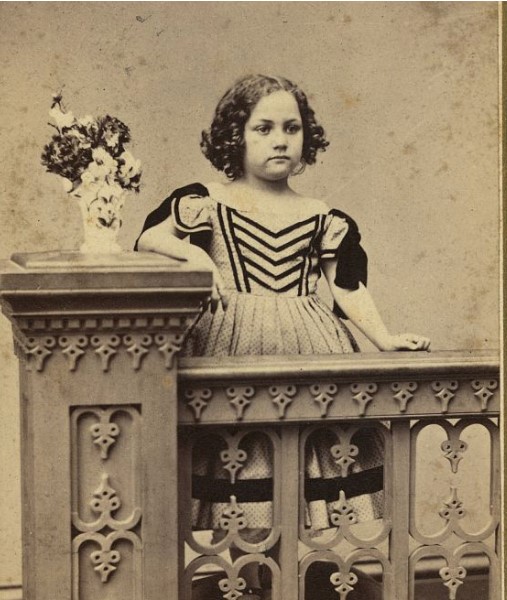
A Graveyard’s Link to the “Most Photographed Slave Child in History”

A Graveyard’s Link to the “Most Photographed Slave Child in History”

Chris Connell

Piedmont Journalism Foundation

Reprinted with permission from https://www.fauquier.com/lifestyles/a-rectortown-graveyard-s-link-to-the-most-photographed-slave-child-in-history/article_2deb32d8-9716-11eb-a138-c310ca021a59.html

A fallen tombstone in an old cemetery on a farm outside Rectortown, Virginia marks the grave of a man who killed a neighbor in 1859 and set in motion events that made a little blue-eyed, flaxen-haired enslaved girl a poster child for abolition during the Civil War. In 1863, when Fannie Lawrence was 5, a famed abolitionist preacher in New York had her pose Shirley Temple-like in fancy dresses, then the photos were sold to raise money from sympathizers of the movement. The Library of Congress has an online exhibit on Fannie Lawrence. And her tale is detailed in a 2015 account, “A Sad Story of Redemption,” written by Page Johnson, editor of a newsletter for Historic Fairfax City, a group dedicated to preserving local heritage.

Johnson drew largely on the 1893 autobiography of Catherine S. Lawrence, an ardent anti-slavery and temperance crusader from upstate New York who had come to Virginia to nurse Union soldiers at a tent hospital on the grounds of the Episcopal Seminary in Alexandria. Fannie and two older sisters, Viana and Sally, were among several children of three enslaved women who had been impregnated by their owner, Charles Rufus Ayres. He was a wealthy young Virginian, who studied at Yale and the University of Virginia to practice law, but instead owned a mill and farmed 500 acres outside Rectortown with at least 12 enslaved workers. Despite his dependency on slavery, he was “a Union man,” Johnson wrote, and in his will, the 32-year-old Ayres promised the three women their freedom and money for them to move north and to pay for their children’s education when he died.

The 1857 will came into force sooner than Ayres could have imagined. A bitter quarrel with a neighbor, William Wesley Phillips, over a gate ended in an exchange of gun fire on Nov. 11, 1859. Ayres – whose shot missed – was mortally wounded by Phillips and his 18-year-old son, Samuel. Father and son were convicted of manslaughter and sentenced to three years in the state penitentiary in Richmond, which was soon to be the capital of the Confederacy.

Ayres’ testamentary wishes did not go to plan. The women – including Fannie’s mother, Mary Fletcher, who had still-enslaved children in the area – at first forsook freedom and elected to remain in Virginia, living with Ayres’ kindly mother. When she died, Fannie, Viana, Sallie and many others escaped Rectortown, eluded Confederate patrols and wild hogs for more than 40 miles, and made it safely behind Union lines to Fort Williams in Alexandria near the seminary.

According to Lawrence’s autobiography, Viana, at 10 or 12 the eldest sister, pleaded for her to adopt 4-year-old Fannie. The nurse agreed to temporarily take the “beautiful child and I soon became very much attached to her.”

Lawrence wound up keeping her and taking her to New York, where she had Fannie christened at Plymouth Church in Brooklyn by the Rev. Henry Ward Beecher, brother of Harriet Beecher Stowe, author of “Uncle Tom’s Cabin.” Beecher paraded the “redeemed slave child,” as he called her, before his congregation, baptized her as Fannie Virginia Casseopia Lawrence and took up a collection reportedly of $1,200, although Lawrence said she never received any of the money. He warned that her light skin put her in danger of being abused by slave-masters or sold into prostitution.  “Look upon this child,” the preacher urged. “Tell me, have you ever seen a fairer, sweeter face? This is a sample of the slavery which absorbs into itself everything fair and attractive. The loveliness of this child would only make her so much more valuable as a chattel.”

Fannie Virginia Casseopia Lawrence

He sent Fannie to the studio of a Brooklyn photographer to pose in formal dresses, sometimes with her adoptive mother. The daguerreotypes, photographs developed on special silvered plates, were mounted on “cartes de visite,” calling cards that were popular in that era, and sold to abolitionist sympathizers. Fannie posed at least 17 times in Brooklyn and elsewhere. The cards “were wildly popular in the North, making Fanny the most photographed slave child in history,” Johnson wrote in “A Sad Story of Redemption.” Lawrence took Fannie on tours to sing at churches and may have profited herself from sales of the cards.

The story has no happy ending for Fannie or her sisters. Lawrence went back to Virginia to retrieve Viana and Sallie with the idea of placing them in “good Christian families” in New York who promised to educate them.

Instead, they used them as servants. Sallie died of consumption in 1867. Viana lived just four years more. Fannie reached adulthood, but against her adoptive mother’s wishes “married one whom I opposed, knowing his reckless life rendered him wholly unfit for her,” Lawrence said. The husband abandoned Fannie with an infant daughter, leaving them to destitution. When Fannie died, her “double orphan” child was left “unprotected and unprovided for, only as far as the small savings of her mother’s hard labor will go.” “My three Southern children are all laid away, for which I thank my heavenly Father,” Lawrence wrote in the autobiography, titled “Sketch of the Life and Labors of Miss Catherine S. Lawrence, Who in Early Life Distinguished Herself as a Bitter Opponent of Slavery and Intemperance.” The Civil War nurse died at 84 in 1904. It is not known how or when Fannie died or where she is buried.

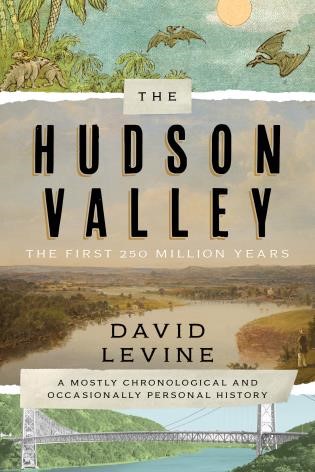
African American History: A Past Rooted in the Hudson Valley

African American History: A Past Rooted in the Hudson Valley

David Levine

Reprinted with permission from https://hvmag.com/life-style/history/african-american-past-hudsonvalley/  

The origin story of what was to become the United States of America typically features two main characters: the native peoples who had lived on these lands for centuries, and the Europeans who took those lands from them. But there was a third cast member in this drama, one whose role is at best downplayed and at worst ignored: Africans and their descendants. In 1613, just four years after Henry Hudson’s crew sailed up the river that would bear his name, and seven years before the Pilgrims arrived in Plymouth, a mixed-race man named Juan Rodrigues (or some spelling variant near that) left Hispaniola for the New World, set up shop in and around Manhattan Island, traded with the natives for a time, squabbled with the Dutch—who called him a “black rascal”—and then disappeared from the public record as the first African to set foot in the Hudson Valley.

In 1626, just 10 years after the establishment of New Amsterdam, the Dutch West India Company shipped 11 African male slaves—whom they labeled “proud and treacherous”—into the colony, with women brought in two years later. Some slaves were moved to Fort Orange, the outpost that became Albany. As land patents divvied up the Valley, every patent holder whose name still graces the region stocked his farm with slaves. In 1664, when the Dutch handed the keys to the new kingdom to the British, about 800 Africans and their children inhabited the Valley, only about 75 of them considered free.

The British increased slave importation, and by the early 1700s New York State had more slaves than anywhere else in the colonies, more than the deep South, more than Boston, more than the Virginia plantations. “The two biggest slave markets in the country before the American Revolution were in New York City and Albany,” Dr. A.J. Williams-Myers, a retired professor of Black Studies at SUNY New Paltz, says. By 1790, the first federal census counted more than 19,000 enslaved New Yorkers; Georgia had 12,000. “New York was not a society with slaves, it was a slave society, dependent on enslaved Africans,” he says.

As New Yorkers, we like to think of ourselves as different from the south in regards to slavery. We were different only in that, numerically speaking at least, we were worse. Any history of African descendants in the Hudson Valley must first come to grips with this fact. From the earliest moments of European contact, African Americans have been part of the Valley’s dramatis personae. “Africans have been portrayed as in the shadow of history, when actually they were center stage,” Williams-Meyers says. “Where European people went, Africans went with them, shoulder to shoulder with their enslavers.” 

The oppressed as oppressors

As the Hudson Valley economy transitioned during the 17th century from the fur trade to farming, Africans helped make the region the most prosperous in the New World. Hudson Valley farms helped feed Great Britain, its newest colonies and its holdings in the Caribbean, and Africans did much of the work. A 1733 century painting called the “Van Bergen Overmantel,” by artist John Heaten, depicts the Marten Van Bergen farm near the Greene County town of Leeds. Historic Hudson Valley writes that “no other single artifact offers more information about life in colonial New York. Here African, Native American, and European people populate the landscape.” Dr. Myra Young Armstead, Lyford Paterson Edwards and Helen Gray Edwards Professor of Historical Studies at Bard College, calls this painting, “a good picture of what was going on and why the Hudson Valley was a big area of slavery.”

Even those who came here because of oppression became oppressors. The French Huguenot founders of New Paltz purchased their first of many slaves in Kingston in 1674, a hypocrisy not lost on a Huguenot descendant. “My ancestors fled France for religious and political freedom. Before leaving France they saw their own families tortured, enslaved, and killed. Yet these emigrants came to the New World and, for their own personal gain, forced other human beings to labor against their will,” Mary Etta Schneider, board chair of Historic Huguenot Street, said this summer. “For this I am ashamed.” 

Schneider was speaking in advance of a September 2016 event, in which HHS welcomed Joseph McGill, founder of the Slave Dwelling Project. McGill travels the country spending the night in historic slave dwellings to bring awareness to their existence, history, and need for preservation. More of these are in the north than most people know. “The history I learned in school was junk,” McGill says. “Slave dwellings are part of the history of this nation. They are hidden in plain sight.” Huguenot slaves were likely locked in at night so they couldn’t escape, Schneider said, and those who slept there along with McGill got “a sense of what it must have felt like to just reinforce that ownership, that lack of ability to have any control over your life.” Addressing another myth, that northern slave owners were “better” than southern ones, McGill says bluntly, “There were no great slave owners. When you assign a degree of severity, you start with bad.”

Long before Nat Turner, slaves in New York were rebelling against their owners. In 1712, 23 slaves killed nine whites in New York City, and rumors both real and unproved of slaves plotting revolts from the City to Albany kept tensions high throughout the 18th century. In 1794, three slaves—including two girls of 12 and 14—were hanged for setting a fire that burned much of downtown Albany; two were hanged from “the Hanging Elm Tree,” at the northwest corner of State and Pearl Streets (planted in front of the house of young Philip Livingston), the third on Pinkster Hill, site of the current Capitol. “Slaves and owners were on constant war footing,” William-Myers says. “The Hanging Tree in Albany shows you the use of fear to keep Africans in their place.”

Revolutionaries and warriors

And yet, slaves helped their masters win independence. “You cannot discount Africans’ input in the Revolutionary War,” Williams-Myers says. Though they often were sent to replace their owners in battle, under the assumption that whey would be freed after the war, they fought bravely and well. “They are never pictured as part of that, but they were there on the battlefield,” he says. Slaves held positions along the Hudson River as General Clinton made his way up from New York City, and fought at the battles of Saratoga, along the Mohawk River and throughout the region. “African warriors were one of the colonies’ secret weapons,” he says. “They were significant in winning the war.”

After the war, slaves weren’t freed right away, but Federalists like John Jay and Alexander Hamilton founded the New York Manumission Society in 1785 to promote abolition. It happened in fits and starts, and full emancipation was realized when the last New York slaves were freed by July 4, 1827. It was the largest emancipation in North America before the Civil War.

The Hudson Valley to a large extent welcomed freed African Americans. During this gradual emancipation, Quaker groups offered land—usually rocky, undesirable land, to be clear—to help freed slaves, and self-sustaining black communities sprung up in Rockland (Skunk Hollow, near the New Jersey border), Westchester (The Hills in Harrison and another community near Bedford), Dutchess (near Hyde Park, Beekman and Millbrook), Ulster (Eagles Nest, west of Hurley), and all the other river counties. Though legally emancipated, blacks weren’t entirely free yet, and the Valley, like the rest of the state, was in no way free from racism. Laws limited blacks’ rights to vote, to travel with whites on public transportation, to attend school and more. “You could argue that the earliest ‘Jim Crow’ laws actually appeared in the north, not the south,” says Dr. Oscar Williams, Chair of the Department of Africana Studies at the State University of New York at Albany.

The opening of the Erie Canal, in 1815, precipitated the slow and steady migration from upstate farms to river cities for employment. “Cities like Newburgh and Poughkeepsie offered jobs to blacks, while there was bigger movement to New York City or Albany, the nodes of the Valley,” Armstead says. Black institutional and social life took hold in these cities. Rhinebeck, for example, had a vibrant neighborhood of black artisans on Oak Street. African American Revolutionary War veteran Andrew Frazier and his family, who are buried in the “Potter’s Field” section of Rhinebeck Cemetery, owned land in the Town of Milan. In Kingston, the A.M.E. Zion Church on Franklin Street, the oldest African American church in Ulster County, owns the Mt. Zion African American Burial Ground on South Wall Street. The cemetery holds the remains of members of the U.S. Colored Infantry’s 20th Regiment, which fought in the Civil War. An extension of the Mt. Zion cemetery on South Pine Street is “one of the earliest, and potentially largest slave cemeteries known in the northeast,” according to an anthropologist who conducted an archeological survey for the city of Kingston in 1993. The Rye African American Cemetery, inside the Greenwood Union Cemetery, was established in 1860 as a burial place for blacks. It is on the National Register of Historic Places and is the final resting spot for African American Civil War veterans and the descendants of many slaves from Rye.

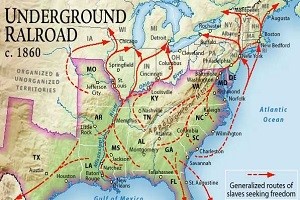
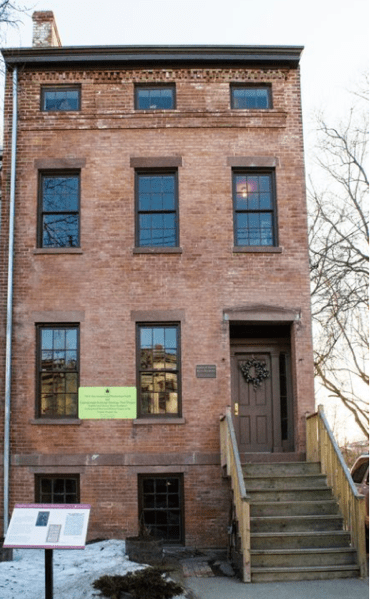
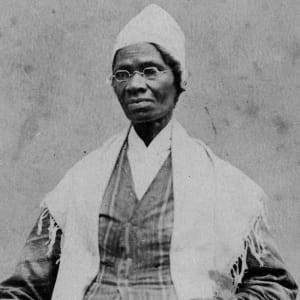
As the Civil War approached, the Hudson Valley was a hotbed of abolition. So-called Colored Conventions, movements held by free slaves to oppose slavery and push for rights for free blacks, were held all over country, including in Poughkeepsie, Armstead says. The Underground Railroad had important station stops along the river, such as the Beecher House in Peekskill and the Stephen and Harriet Myers House in Albany. Sojourner Truth started on her march to freedom as Isabella Baumfree, a slave born on an estate near what is now Ripton, sold to a family in New Paltz. In Troy, an African American named Henry Highland Garnett was Malcolm X before Malcolm X. Garnett led a radical movement from his position as the first pastor of the Liberty Street Negro Presbyterian Church. First working with abolition leaders like William Lloyd Garrison and Frederick Douglass, he gave a famous speech in 1843 at the National Negro Convention, a “Call to Rebellion” encouraging slaves to rise up in open revolt. His position was opposed.

Past, prologue

After the Civil War, blacks continued to move from local farms to industrial centers, and in their “Great Migration” from the South. New York City was a major destination, and in time blacks also moved into the suburbs, exurbs and growing river cities of the Valley. Freedom did not mean integration, however. As just one example, in the 1920s, land in the Nepperhan neighborhood of Yonkers, now known as Runyon Heights, was sold to blacks because whites didn’t want it and it was naturally separated from white communities.

Work, as always, continued to be the magnet drawing African Americans north, and the Valley had one of the world’s most powerful magnets: IBM. After World War II, “IBM was really important, ahead of its time, a global force that recruited from black colleges and universities,” Armstead says. By the late 1950s and 1960s, black professionals populated the area. “That generation is dying or dead now, but they became the first black heads of organizations, the first black teachers,” she says.

The history of African Americans over the last half century is a story of progress and regression, of course, both nationally and here in the Valley. The current political climate is restive. The struggle has been ongoing for 403 years now, ever since Juan Rodriguez stepped ashore and began battling the Dutch. The story has evolved, but it hasn’t ended. As William Faulkner wrote, the past is never dead. It’s not even past.

“The Captain’s Story” by Harriet Beecher Stowe

“The Captain’s Story” by Harriet Beecher Stowe

Ellen Gruber Garvey

This article is reprinted with permission of the author. It was originally published in the Washington Post under the headline “A forgotten 19th-century story can help us navigate today’s political fractures.”  https://www.washingtonpost.com/outlook/2021/03/23/forgotten-19th-century-story-can-help-us-navigate-todays-political-fractures/   

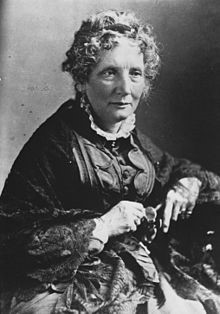
Harriet Beecher Stowe

Can Democrats truly reconcile with those Republicans who called President Biden’s election fraudulent and encouraged violent attack of the U.S. Capitol? Earlier moments in U.S. history should caution us about the lure and danger of reconciliation when one side refuses to acknowledge wrongdoing. After the Civil War, former Union partisans sought to get along with the Southerners who fought to keep Black people enslaved even after the war. But later, they doubted the wisdom of having done so.

One of those people was Harriet Beecher Stowe, the author of “Uncle Tom’s Cabin” (1852), the most influential novel in the United States during the 19th century. Her famous book kindled readers’ sense that they could and must end slavery, even if that meant disrupting alliances, friendships and family ties with enslavers and their supporters. Thirty years later, Stowe wrote a story little known even it its own time, in which she considered what happened when these same White Northerners who fought against slavery reconciled too easily with former enslavers.

Can Democrats truly reconcile with those Republicans who called President Biden’s election fraudulent and encouraged violent attack of the U.S. Capitol? Earlier moments in U.S. history should caution us about the lure and danger of reconciliation when one side refuses to acknowledge wrongdoing. After the Civil War, former Union partisans sought to get along with the Southerners who fought to keep Black people enslaved even after the war. But later, they doubted the wisdom of having done so.

One of those people was Harriet Beecher Stowe, the author of “Uncle Tom’s Cabin” (1852), the most influential novel in the United States during the 19th century. Her famous book kindled readers’ sense that they could and must end slavery, even if that meant disrupting alliances, friendships and family ties with enslavers and their supporters. Thirty years later, Stowe wrote a story little known even it its own time, in which she considered what happened when these same White Northerners who fought against slavery reconciled too easily with former enslavers.

Written in 1882, but set in 1866, “The Captain’s Story” tells of two former Union army captains who visit Florida, where they once fought on the battlefield. They hope to relax and recuperate from the toll the war had taken on their health. The two listen to their white Floridian guide’s ghost story, which includes his casual mention of having murdered enslaved African captives. The ghost of one captive continues to haunt a nearby plantation, he says. Despite moral qualms, the two captains decide to continue their trip with their murderous guide who can show them all the best fishing grounds. They will get along, and leave his punishment to God.

Stowe began spending winters in Florida just after the Civil War, about the time the story is set, initially hoping to help her son recover from his own Civil War trauma. She wrote popular travel articles in the 1870s touting the state’s pleasures for Protestant Northern Whites, hoping to attract them to politically overwhelm the Southern planters. Full of chummy advice on how to travel south and where to buy land, the accounts spurred the state’s first tourist boom while also raising money for a Black school. In “The Captain’s Story,” she swerves to remind her readers of the brutalities of her Florida neighbors who once enslaved people.

Although Stowe was a founder of the Atlantic Monthly, “The Captain’s Story” was not published there, perhaps because few 1880s editors wished to take the horrors of slavery seriously. Albion Tourgée, the editor of the short-lived but high-paying weekly Our Continent, did, however. He was a Union veteran who worked for Reconstruction then wrote about his experiences in two best-selling novels focusing on the difficulties and assaults the freed people faced. He went on to fight Jim Crow, as the lawyer representing a Black plaintiff attacking segregation in public facilities in Plessy v. Ferguson.

Although Our Continent was not a crusading publication and sought to attract White Southern readers, too, Tourgée published other works that acknowledged that the Civil War was fought over slavery. Yet Our Continent was obscure enough that “The Captain’s Story” received no notice in the press at the time. It was not anthologized or reprinted.

The story’s questioning of White complicity in postwar racism is subtle and conflicted. But it does stand in stark contrast to other popular magazine stories of the time. Northern magazines shoveled out stories romanticizing Southern plantations as places where sweet, quasi-familial ties between enslavers and enslaved people infused life with graciousness. Plantation fiction frequently featured a tired Northern businessman who, like the two captains, goes South to rest and comes to appreciate relaxed Southern hospitality.

Marriage to a Southern woman in these stories offered an allegory of reconciliation between Northern and Southern Whites. As the White abolitionist and orator Anna E. Dickinson noted, “The fashion of the day has been, and is, to talk of the love feast that is spread between old foes, till at last we of the North and of the South are doing what our forefathers did 30 years ago — grasping hands across the prostrate body of the negro.”

Of course, former Confederates did not seek reconciliation. Instead, they created the cult of the Lost Cause, celebrating the nobility and heroism of the Confederacy, leading to the erection of statues honoring Confederate leaders and school textbooks that continued to inculcate this version of history for over a century.

That is why Stowe’s story is significant. It called out the murderous past, presented plantation owners and their friends as lawless, brutal, disloyal, casual killers, scornful of the family ties of enslaved people.But the story disappeared, and that illuminated the shifting reality of race relations in 1882. Reconstruction had ended, a reign of racial terror lynchings had commenced, and states passed Black Codes that allowed Southern Whites to continue to coerce the labor of African Americans.White supremacy had regrouped with new legal structures and Northern collusion, and former Confederates were back in power in the South. Ex-Confederates suppressed the Black vote and reinstated slavery under different names.

The myth of benevolent plantation life took hold through sheer repetition in fictional work, most familiar now through “Gone With the Wind,” imagery and plantation tours. Burying Stowe’s story while celebrating that myth matters. It is another small part of concealing slavery’s past and obscuring the power of white supremacy, which still haunt the United States.

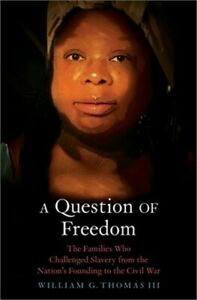
A Question of Freedom by William G. Thomas III, Reviewed by Hank Bitten

A Question of Freedom:

The Families Who Challenged Slavery from the Nation’s Founding to the Civil War

by William G. Thomas III

Reviewed by Hank Bitten, Executive Director NJ Council for the Social Studies

Having taught the colonial unit for decades as part of the U.S. History 1 course, I always dedicated time to Lord Calvert, the persecution of Roman Catholics in Maryland, the Toleration Act of 1649, and life of Charles Carroll of Carrollton. Although I would document his wealth and plantation, I never made the connection to his slaves or the role of the Roman Catholic Church in operating a tobacco plantation with slaves in Prince George’s County.

The history of slaves in Maryland and the role of the Society of Jesuits in conducting the business of a tobacco corporation in complicated.  As a result of reading A Question of Freedom, I have a new perspective and credible documentation of how slavery became rooted in the laws of our colonies, states, and national government.

The opening chapter is a compelling account of the life of Edward Queen who sued for freedom in 1791 because he was the son of a freewoman, his grandmother. (p. 3) The struggle for freedom by Edward Queen continued for 22 years until the decision in Queen v. Hepburn by the U.S. Supreme Court in 1813. His attorney was Francis Scott Key.

Teachers who are looking for the right questions to engage students in historical inquiry and investigative research will find the questions presented by Professor Thomas (University of Nebraska, Lincoln) a valuable resource. This book is filled with inquiry based questions that encourage exploration and debate. Here are some examples:

  1. Why did the Jesuits and other slaveholders fight so ferociously in court to hold on to the people they enslaved?
  2. What did people like Edward Queen hope to achieve, and what did they think was within their reach?
  3. Why did lawyers, like Francis Scott Key take these cases and how did judges, even those with moderate antislavery convictions, end up advancing legal principles in the trials that would ultimately uphold slavery?
  4. How did Duvall, Key, and Queen families know one another long before the case was argued in the Supreme Court in February 1813?
  5. Did the Queen case leave any lasting impression on the thinking of Francis Scott Key when he wrote the poem that would become “The Star Spangled Banner?’ (p. 5)

Professor Thomas discovered the name of Allen Bowie Duckett, Associate Justice to the Circuit Court of the District of Columbia in his research.  Justice Duckett’s father presided over a case for freedom by the Edward Queen family and ruled in their favor. In fact, this decision resulted in the freedom of twenty members of the Queen family. What Professor Thomas discovered through his research was that his grandmother’s family owned plantations adjacent to the area known as White Marsh on the Chesapeake Bay peninsula. He discovered that Elizabeth M. Duckett claimed slaves at the end of the Civil War. The document reported Henny Queen, age 35, and her five children ages six months to eight years old.

Teachers interested in teaching about Continuity and Change will see insights in Chapter 2 about how the aftermath of the Seven Years War and the American Revolution gave rise to the election of liberal and conservative members in the British House of Commons. In America, laws about slavery were limited to each colony before 1789 but in the case of England, its protection, importation, manumission, and abolition applied to a global colonial empire.

Did British Common Law Apply to its Colonies?

Even though the importation of slaves was legal in the United States until 1808, slaves who were brought to England were not compelled to leave according to a common law decision by Chief Justice Lord Mansfield in the decision of James Somersett.  James Somersett, a slave, was taken to England by his master, Charles Stewart, a customs officer in Boston. He ran away and was eventually tracked down and placed in prison. A writ of habeas corpus was issued for his release by the abolitionist Granville Sharp in connection with a pending case by merchants from the West Indies who wanted assurance by common law that slaves were a safe investment. The case of Somersett v. Stewart, 1772 became a landmark case that inspired hope for slaves held in bondage throughout the British empire.

The language of the Somersett decision indicates the complexities of the status of slaves as persons under natural and moral law or as property protected by laws. England will not abolish slavery for 60 years (1833) but without a specific law in England to sanction slavery, a person with the legal status of a slave in a colony could not be forced to leave England and return to slavery. James Somersett continued with his status as a slave but could not be forced to return to chattel slavery. The language is confusing in stating that slavery was odious but a temporary presence in England did not guarantee manumission, and questions would continue regarding if the common law ruling applied only to the definition of being in England or if being on a ship or at a port in the Tames River applied.

“Mansfield’s decision moved slavery entirely out of the reach of the common law and its moral protection.  Whatever slavery was, it was not sanctioned by English common law. As a result, Somersett v. Stewart wiped out the line of seventeenth century precedents that had once propped up slavery as a lawful form of property.” (p. 34)

Professor Thomas researched the case of Mahoney v. Ashton in Maryland. “In its length and complexity, Mahoney v. Ashton was like almost no other petition for freedom in American history.” (p. 88) Charles Mahoney and 40 of his relatives were owned by Charles Carrollton, Maryland’s leading politician and a signer of the Declaration of Independence.

The basis of the trial dated back to Ann Joice, grandmother of Charles Mahoney.  Ann Joice was a black indentured servant from Barbados who spent time in England before coming to Maryland to work for Lord Baltimore.  As an indentured servant, she should be entitled to her freedom, as should her 1,500 descendants who were slaves in Maryland. People of color born from a free woman were not slaves!  Unfortunately, it was difficult to provide evidence that she was in England. The research provided in this case, with its twists and turns, is worth your reading.  In the trial, the jurors heard testimony from hearsay of Mary Queen, a free black woman who came to Virginia from New Spain instead of the Popo region of West Africa as claimed by Benjamin Duvall, representing the slaveholders.

“The all-white slaveholding jury gave greater weight to the testimony of the Queen witnesses, followed the ruling of the general court in Edward’s case, and rendered a verdict in favor of freedom for Phillis Queen. The decision made sense.  A higher court determined Edward Queen was free, so surely his mother, Phillis should be also.  Since Edward’s grandmother, Mary Queen was “not a slave,” surely her daughter could not be a slave either.” (p. 76) “On May 12, 1799, the jury returned an unambiguous verdict: ‘Charles Mahoney is a free man.’” (p. 99)

As a result of this decision, twenty related lawsuits freed over fifty children and grandchildren. “The trials cost John Ashton and the Jesuits 6,795 pounds of tobacco in damages, court costs, and fees.” (p. 78) The year is 1796 and the cost was even greater since tobacco prices were depressed in the mid-1790s. In this same year, the Maryland legislature allowed manumission by last will and testament for individuals in good health, under the age of forty-five, who could support themselves. Unfortunately, legal precedents can change and Charles Mahoney’s family experienced their loss of freedom.

“On June 25, 1802, the High Court of Appeals reversed the May 1799 judgment freeing Charles Mahoney. The defeat was total.”  Setting a foot in England was no longer a basis for the right to life, liberty, and the pursuit of happiness for Charles, Patrick, and Daniel Mahoney or others. (p. 112)

What a teachable moment!

  1. Is this decision evidence that in the United States, slaves were defined as property because of the color of their skin?
  2. Is this decision a reaction against the popularity of the Jeffersonian Republicans after the Election of 1800?
  3. Did the ill-fated rebellion near Richmond, Virginia by Gabriel Prosser in 1800 and the French and Haitian Revolutions increase fears of mob rule and the loss of property?
  4. Is the decision valid based on the arguments of Robert Goodloe Harper that Somersett v. Stewart only suspended a slaveholder’s right to property?
  5. Is the position of the Democratic Republicans contradictory in its support for slavery on the basis of race while advocating for the freedom of specific individuals, like the Mahoney family?

These questions should motivate deeper questions by your students leading to evidence that legal precedents are being established in states that will support the basis of Roger Taney’s obiter dictum in Dred Scott v. Sandford in 1857. The Question of Freedom provides insights into why laws for voting based on the ownership of property were changed to qualifications based on race and skin color. (p. 115) States began to introduce legislation outlawing manumission and requiring free blacks to carry a certificate of freedom signed by the county court. Judges provided instructions to jurors that the burden of proof fell on the enslaved person to prove their freedom and that the color of their mulatto skin was white. “Judges and juries would observe their color, hair, and physical features.  Testimony about the racial features of their ancestors would give greater weight than what contemporaries said about their status as free persons.” (p. 132)

The Impact of the Domestic Slave Trade

The freedom case of Priscilla and Mina Queen (Queen v. Hepburn) offers unique insights into the slave trade, black market trade of enslaved persons, impact of bankruptcy on slaveowners and enslaved persons, and changing financial markets.  The case began in 1809 and a successful outcome depended on Priscilla and Mina Queen proving their grandmother was Nanny Cooper, the daughter of Mary Queen who was in England, and establishing that she came to Maryland as a free woman before 1715 (100 years ago).

John Hepburn, inherited over one thousand acres in 1775 and over the years overspent his fortune in a lucrative life style. As a result of filing for bankruptcy, his creditors could acquire slaves, sell them, and separate them from their children. Blacks, both free and slave, were in high demand to meet the labor needs for the construction of buildings and roads in the new capital city of Washington D.C. and to pick cotton to meet the international demand for cotton textiles.

The U.S. prohibited the international slave trade of slaves in 1808 but the domestic slave trade became a daily event at auctions.  “Former New York congressman John P. Van Ness advertised in the newspaper a year later that he had ‘A Negro Boy for Sale.’” (p. 166) When Catholic women joined the convent, their parents gave the Roman Catholic Church their dowries, which often included slaves. As a result of the increasing population of people of color in the new capital, strict black codes designed to limit freedom in the evening were enacted. (p. 162)

Chapter 5 presents the facts in a concise manner that offers teachers an opportunity to create a mock trial simulation of Queen v. Hepburn and Queen v. Neale. These cases have twists and turns regarding hearsay evidence, transcription errors in documents, and connections to shipping records and wills. Furthermore, the Queen’s lawyer is Francis Scott Key and one of the associate judges on the U.S. Supreme Court, Gabriel Duvall, had previous ruled in favor of Charles Mahoney.  There is also a map of Washington D.C. (1815) identifying the homes and offices of the major individuals in this story.  The research is splendid and the controversial issues for students to debate provide a powerful understanding of both systemic racism in the United States and the depth of individual freedom.  The arguments for the protection of property are real and the right to individual freedom is powerful. (pp. 169 -179

  1. William Cranch, Federalist and nephew of Abigail Adams is the chief judge of the circuit court in D.C. Although a Federalist, expert in property contracts, his decisions generally benefited slaves in their freedom suits.
  2. Francs Scott Key presented all the depositions from the 21 freedom suits of the Queen family that Gabriel Duvall had taken years before. The evidence that Mary Queen was an indentured servant was carefully explained.
  3. Fredus Ryland was a star witness and had previously given a deposition in 1796 stating that he met Mary Queen and heard her story first hand. His deposition clearly stated that she was ‘born free’ came from Guayaquil (Ecuador or New Spain) and was transported around the world and to England by Captain Woodes Rogers and lived in London for three years!
  4. Everyone who was literate in the United States was familiar with Daniel Defoe’s popular book, Robinson Crusoe, which is based on the account of Captain Rogers and includes a reference to a passenger Maria. Could this be Mary Queen?
  5. Francis Scott Key introduced the will of James Carroll bequeathing a woman named Mary to Anthony Carroll, John Carroll’s seven-year old nephew.
  6. The attorneys for Rev. Francis Neale, objected to the deposition of Fredus Ryland claiming it was based on hearsay.

Read the digital files of the freedom suits at The Georgetown Slavery Archive and University of Nebraska-Lincoln O Say Can You See Project

Students should ask questions about the rules of evidence in trials, especially in the case of slaves who lacked birth records and travel documents. In the 21st century lawyers and judges argue over what evidence is credible and what needs to be excluded.  Many judges were open to hearsay evidence in freedom trials, especially when it was supported by multiple individuals. With the rejection of hearsay evidence, Priscilla Queen and Nina Queen both lost their suit for freedom.  However, Nina Queen appealed her decision to the U.S. Supreme Court in February 1813.

In the context of the Fugitive Slave Law of 1850, I taught my students about the slave trade in Washington, D.C. and the market value of the price of slaves.  After reading Question of freedom, I realized this needs to be taught much earlier. Professor Thomas provides detailed research of the slave trade and prisons in our nation’s capital dating back to 1800 and the demand for laborers in building the U.S. Capitol, ships for our navy, and house servants for elected members of our government. It is a valuable resource for teachers, as is Solomon Northrup, Twelve Years a Slave, who want to teach about continuity and change and how the questions relating to slavery, property, and individual freedom changed in the first six decades of the 19th century.

“The men, women, and children were ‘bound together in pairs, some with ropes, and some with iron chains.” (Report from Dr. Jesse Torrey, circa 1815, p. 196)

Slave Trades in Washington D.C.

The locations of hidden slave pen on the upper floor of George Miller’s Tavern on F Street (between 13th and 14th), Williams Yellow House, and Robey’s Tavern on Independence Ave. between 7th and 8th Streets.

The story of Ann Williams captures the fear that every black person faced daily as the demand for labor intensified with the construction of roads and buildings and the cotton economy in the South.  Ann Williams and her two young daughters were taken from their home in Bladensburg, Maryland and marched in chains for seven miles to Washington D.C. She pried open a window and jumped three floors breaking her spine. George Miller, the tavern owner, kept her on a wooden pallet providing her with food and water. 

Engage your students in reflective thinking to determine if his motives were for humanitarian reasons or for profit from the children she would likely give birth to after she was healed. This is a powerful story that your students will never forget. Furthermore, the Circuit Court in D.C. issued a writ of habeas corpus to investigate the incident at the Miller Tavern only to have it rescinded on the grounds that Ann Williams was property and therefore a writ of habeas corpus could not apply because it is only for persons detained. Her story is even more important because on July 2, 1832, she received her freedom through a verdict from a jury in the District of Columbia Court – 17 years after she jumped from the top floor of Miller’s Tavern.

The questions presented by Professor Williams are at times clearly stated and they are also hidden in the perspectives. For example, the argument by George Miller that slaves were property and could be denied a writ of habeas corpus are of national importance.  This incident influenced the Missouri Compromise, Tallmadge Amendment, and the African Colonization Society. With every economic crisis in 1817, 1837, with the changing markets for labor, with burgeoning individual debts and personal bankruptcy, enslaved persons were vulnerable.

Henry Clay

Teachers must ask their students how did economics influence the principles of slaveholders such as Francis Scott Key, John Marshall, Roger B. Taney, Henry Clay and other prominent Americans who are also understood as reformers? The evidence illustrates the inequality of the United States of America in a way that the debate over a $15 minimum wage has arguments for maintaining wages below the poverty level and increasing profits for businesses above the expected rate of inflation. History is complicated!

However, the freedom suit filed by Charlotte Dupee in 1829 for her freedom from Henry Clay, Secretary of State, displays these conflicts.  Henry Clay is a founding member of the American Colonization Society (the chairperson), an aspiring candidate for president, former Speaker of the House of Representatives, and a senator from Kentucky.  Henry Clay stated, “free black confronted unconquerable prejudices resulting from their color and they never could amalgamate with the free whites of this country.” (pp. 200-201)

Henry Clay purchased Charlotte for $450 (a high price) in 1815. She married Henry Clay’s personal assistant and driver, Aaron Dupee. Charlotte and Aaron married and had two children, Charles and Mary Ann.  They lived with Henry Clay in his home (Decatur House) on Lafayette Square. Charlotte’s parents lived in Maryland as a free family and her family visited with them regularly. Charlotte and Aaron were well known and respected among the Washington political elites and likely very aware of legislation and debates relating to slavery.

Charlotte’s law suit was based on the fact that when she was born her parents were free and not slaves. However, she was born in 1787 and her father received his freedom in 1790 and her mother in 1792. She claimed her sale to Henry Clay was illegal.  After the Electoral College declared Andrew Jackson as president, Henry Clay would return to Kentucky with Charlotte and Aaron and their two children. They could be separated and sold at any time.

The case embarrassed Henry Clay and called into question his political reputation. In another interesting twist of research, Professor Williams observes that Charlotte remained in Washington D.C. because of her pending lawsuit and found new employment with Martin Van Buren, the new vice-president and political enemy of Henry Clay.  The Court decided in May 1830 in favor of Henry Clay with the statement “Charlotte Dupee was born a slave for life.” (p.227). Henry Clay instructed his attorney to inform Charlotte to return to his home in Kentucky at her expense.  Students will find Henry Clay’s letter to his attorney of interest:

“I approve entirely of your order to the Marshall to imprison Lotty (Charlotte).Her husband and children are here. Her refusal therefore to return home, when requested by me to do so through you, was unnatural towards them as it was disobedient to me.  She has been her own mistress, upwards of 18 months, since I left her in Washington, in consequence of the groundless writ which she was prompted to bring against me for her freedom; and as that writ has been decided against her, and as her conduct has created insubordination among her relatives here, I think it is high time to put a stop to it.” (p. 227)

Charlotte Dupee was taken to the D.C. City Jail and sent to Henry Clay’s daughter in New Orleans. Charlotte’s freedom suit was never reported in the newspapers. In 1840, Henry Clay emancipated Charlotte and her daughter Mary Anne. She was 53 years old. However, Henry Clay did not free Mary Anne’s children. Have your students examine slavery in America with snapshots taken in 1790 (ratification of the U.S. Constitution), 1800 (rise of Jeffersonian Republicans), 1810 (end to the importation of slaves), 1820 (Missouri Compromise), 1830 (Charlotte Dupee’s freedom suit), 1831 (Nat Turner’s Rebellion), and now in 1840 (Whig Party).

Fears Every Black American Experienced

There were more urban riots in the summer of 1835 than in any other year. The 1835 riots in Washington D.C. exploded in the Washington Navy Yard following the decision to bring thirteen slaves and three free black men to complete the work on the USS Columbia.   The fear of industrial slave labor might replace skilled white workers. After someone reported the theft of compression pins from the blacksmith shop, the white workers went on strike.

The diary (1813-1865) kept by Michael Shiner, one of the enslaved workers who was a literate carpenter reveals the fears of the black community and a unique perspective of the events in Washington D.C.  Michael Shiner was one year away from his freedom when the riots of 1835 happened.  Another event that shook America was the death of John Marshall on July 6, which was followed by the nomination of Roger B. Taney. The diary of Michael Shiner also recorded the arrest of a young African American, Arthur Bowen for the attempted murder of a notable white woman, which involved the U.S. marines to keep order and prevent the lynching of Arthur Bowen.  The U.S. district attorney was Francis Scott Key, a tough prosecutor and brother-in-law to Chief Justice Taney, who arrested Professor Reuben Crandall, a botany professor at Yale.  There are many factors related to these events in the summer of 1835 for students to analyze and each of them reveals engaging questions about abolition, the influence of the Ebenezer African Methodist Church on Fourth and G Streets, the inequality experienced by residents in the area around the Navy Yard (Northeast), the citywide Memorial Petition calling for the abolition of slavery in the District of Columbia, the slave trading corporation of Isaac Franklin and John Armfield with scheduled transports of slaves to New Orleans, Natchez, and other ports in the South. Some of the questions that intrigued me are:

  1. Is holding abolitionist literature and distributing a pamphlet to another person the same as publishing abolitionist literature?
  2. Francis Scott Key represented slaves in their request for freedom, is a founding member of the American Colonization Society, defended slave holders, owned seven slaves, freed four of his slaves, and facilitated the sale of 272 black men, women, and children for $115,000 to balance the accounts of Georgetown College. How should I teach my students about the life of Francis Scott Key?
  3. Did the rhetoric of the abolitionists, intended to end slavery, encourage slaves to become violent and become counter-productive to the cause of freedom?
  4. Was the decision to expand the U.S. Supreme Court in 1837 from seven to nine justices, motivated to protect the property of slaveholders or by the westward expansion of the United States? (President Jackson appointed seven of the nine justices)

System Racism

The evidence in Chapter 8 regarding the financial implications of how slaves were “assembled, sold, and transported,” the exponential impact of how the sale of a few enslaved persons affected the lives of hundreds, the importance of understanding how the panics or economic recessions of 1837 and 1857 contributed to the sale of enslaved persons and the breaking up of families, and the legal theories that were advanced by slaveholders and abolitionists is powerful and clearly articulated. The claims and arguments in this chapter regarding systemic racism in the United States are convincing.

  1. Enslaved persons were treated in every contract and sale as part of a “lot.” Individuals were clearly property and packaged in a way that mortgages are sold as bonds in today’s market. Individual slaves were sold as priced commodities based on their skin colors, genders, skills, histories, and ages. They were sold to different buyers in a similar way that odd lot purchases of stocks are bought and sold on today’s stock exchanges.  Slaves were chattel and appraised for their value. For example, Ann Bell lived independently in Washington D.C. from approximately 1825 to 1836. Unknown to her, she was privately bequeathed as estate property by Gerald T. Greenfield of Tennessee.

“Thirteen-year old Andrew was valued at $375. Caroline, now nine years old, was priced at $250.  Eleven-year old Mary Ellen and seven-year old George were valued at $200 each.  Five-year old Daniel and his three-year old sister Harriett were priced at $100 each.”  (p. 303)

2. After the expiration of the Charter of the Bank of the United States in 1836, state banks developed “property banking” to provide capital for land speculation in land and slaves. For example, the Union Bank of Louisiana arranged for slaveholders to leverage their land and slaves as collateral for expanding their cotton plantations. This was called “hypothecation.” (p. 281). Unfortunately, when supply was greater than demand, creditors demanded payments on loans in gold or specie, or the price of cotton, sugar, or tobacco declined, slaves were traded and sold. It was heartbreaking for families who were broken up.

3. Slavery was legally defined at the state level. For example, in Louisiana ALL Negroes of black color were “presumed to be slaves.”  Slaves could not be freed through a will because they were required to leave the state.  In Maryland, the General Assembly ratified a constitutional amendment in 1837 stating that “the relation of master and slave, in this State, shall not be abolished unless by unanimous vote of the General Assembly and with full compensation to slaveholders.” (p. 263) The reason for this new law was that fugitives were not being returned to Maryland from free states as required by the 1793 Fugitive Slave Act without a legal definition that slaves were property.

5. During the decade of 1831-1840, more than 285,000 slaves from Maryland and Virginia were sold through interstate trade – about 30,000 a year or about 80 a day. (p. 271)

6. The free black population in Maryland doubled between 1790-1800 from 10,000 to 20,000. Forty years later, the number of free blacks had more than tripled to 62,000, and four in every ten African Americans were free. (p. 316)

Slaves purchased on the market walked (perhaps 400-500 miles) to their new destinations in the Carolinas and Georgia or transported on vessels owned by Isaac Franklin and John Armfield, to New Orleans and Natchez.

“Their vessels, built in Connecticut, had been designed specifically for the slave trade, and their holds were similar to those in the ships that plied the transatlantic slave trade. Each captive had only about 36 cubic feet of space, (6x3x2) sometimes less, when more than 180 people were jammed into the tightly packed holds below decks.  Built for Franklin and Armfield’s in 1833, the Uncas carried thousands to New Orleans in the booming interstate slave trade. Franklin and Armfield typically separated the men and boys from the woman and girls on the voyage and heavily fortified the section of the ship holding the men.  Nothing prevented the captain or the officers from entering the women’s hold and seizing any of them for sex. The Uncas carried approximately 50 people.” (p. 290)

In 1850, the slave trade in the District of Columbia ended with the Compromise of 1850. The Fugitive Slave Act followed the neutral language in the Constitution of “persons held to service or labor” instead of slaves. Although these words could provide evidence that slaves were persons with basic constitutional rights of due process under the Fifth Amendment, they were seized without a warrant. Even Frederick Douglass, a runaway, was at risk of being returned to slavery!

Professor Thomas raises excellent questions for students to answer:

  1. Did enslaved persons have any rights under the Constitution?
  2. Was slavery a local condition without fundamental legitimacy in the law and therefore restricted to certain, specific restraints?
  3. Did enslaved persons lack any rights at all, and was slavery national in scope and legal authority under the Constitution?

The answers to these questions are difficult as reflected in the response of the abolitionist William Lloyd Garrison.  The Compromise of 1850 made Garrison choose between the U.S. Constitution and the moral evil of slavery.

“Their idealism was such that they would not participate in purchasing the freedom of a single enslaved person who fled bondage.” (p. 318)

One of the Performance Expectations for students in New Jersey public schools is to learn about free black communities:

6.1.12.HistoryUP.2.b: Analyze the impact and contributions of African American leaders and institutions in the development and activities of black communities in the North and South before and after the Civil War

Although Maryland had the third highest population of slaves in the United States with more than a hundred thousand people in bondage, (p.6), it was also the home to more than 8,000 free blacks living in communities, such as Annapolis and Baltimore and organizing institutions. (p. 42).  Forty years later, the number of free blacks was 62,000, and four in every ten African Americans were free. (p. 316) Students need to know this!

Another insight I learned from reading Question of Freedom was the diversity of Maryland regarding plantation slavery in the Chesapeake Bay area and the absence of slavery in Frederick County in northwestern Maryland. (p.91)

The evidence in A Question of Freedom, regarding the presence of systemic racism in the United States is convincing and it is presented over 240 years beginning with Mary Queen

For further inquiry and exploration, research the digital resources on the freedom suits of enslaved persons from Maryland.

The Georgetown Slavery Archive

University of Nebraska-Lincoln O Say Can You See Project

Educated for Freedom: The Incredible Story of Two Fugitive Schoolboys Who Grew Up to Change a Nation, by Anna Mae Duane

Educated for Freedom: The Incredible Story of Two Fugitive Schoolboys Who Grew Up to Change a Nation, by Anna Mae Duane

Anna Mae Duane, the author of Educated for Freedom, is Associate Professor of English and director of the American Studies Program at the University of Connecticut. According to the book blurb, “In the 1820s, few Americans could imagine a viable future for black children. Even abolitionists saw just two options for African American youth: permanent subjection or exile. Educated for Freedom tells the story of James McCune Smith and Henry Highland Garnet, two black children who came of age and into freedom as their country struggled to grow from a slave nation into a free country. Smith and Garnet met as schoolboys at the Mulberry Street New York African Free School, an educational experiment created by founding fathers who believed in freedom’s power to transform the country. Smith and Garnet’s achievements were near-miraculous in a nation that refused to acknowledge black talent or potential. The sons of enslaved mothers, these schoolboy friends would go on to travel the world, meet Revolutionary War heroes, publish in medical journals, address Congress, and speak before cheering crowds of thousands. The lessons they took from their days at the New York African Free School #2 shed light on how antebellum Americans viewed black children as symbols of America’s possible future. The story of their lives, their work, and their friendship testifies to the imagination and activism of the free black community that shaped the national journey toward freedom.”

Duane argues, “The questions that plagued Smith and Garnet remain relevant today. The notion that somehow Black bodies are doomed – stuck on a historical wheel that keeps returning them to the same place – has powerful resonance in the twenty-first century, as the country continues to reenact bitter divisions over the role of race in remembering our history and imagining our future” (10).

According to Karen Ordahl Kupperman, Professor Emerita, New York University, “Duane unravels the story of two boys enrolled in New York’s African Free School” who “as accomplished adults . . . confronted the reality that America offered African Americans.” Derrick Spires believes the book “will become indispensible for those invested in deep and complex understandings of black life and letter in the long nineteenth century.” James Brewer Stewart, founder of Historians Against Slavery, calls the book a “methodological tour de force.”

The Kidnapping Club: Wall Street, Slavery, and Resistance on the Eve of the Civil War by Jonathan Daniel Wells

The Kidnapping Club: Wall Street, Slavery, and Resistance on the Eve of the Civil War by Jonathan Daniel Wells

In The Kidnapping Club, Jonathan Daniel Wells, a social, cultural, and intellectual historian and a Professor of History in the Departments of Afroamerican and African Studies at the University of Michigan, tells the story of the powerful network of judges, lawyers, and police officers who circumvented anti-slavery laws by sanctioning the kidnapping of free and fugitive African Americans. Nicknamed “The New York Kidnapping Club,” the group had the tacit support of institutions from Wall Street to Tammany Hall whose wealth depended on the Southern slave and cotton trade. But a small cohort of abolitionists, including Black journalist David Ruggles, organized tirelessly for the rights of Black New Yorkers, often risking their lives in the process. Taking readers into the bustling streets and ports of America’s great Northern metropolis, The Kidnapping Club is a dramatic account of the ties between slavery and capitalism, the deeply corrupt roots of policing, and the strength of Black activism.

“With New York City as its backdrop, The Kidnapping Club offers an important and compelling narrative that explores the long struggle for Black freedom and equality. Jonathan Daniel Wells offers a rich and timely account that uncovers a history of racial violence and terror in nineteenth-century Gotham. To no surprise, law enforcement, politicians, and bankers thwarted Black freedom time and time again. But the power and fortitude of Black New Yorkers pressed white citizens to remember and uphold the ideals of a new nation. The Kidnapping Club is a must read for those who want to understand current debates about the intersection of Black lives and structural oppression.”― Erica Armstrong Dunbar, author of Never Caught: The Washingtons’ Relentless Pursuit of Their Runaway Slave, Ona Judge

“Jonathan Daniel Wells’ The Kidnapping Club is a necessary story of black agency and resistance. Bringing to life the competing strains of humanism and oppression that echo our present-day struggles, Wells paints a portrait of New York that reveals the best of American principles in the bodies of black resistors while showing us the economic complexity and complicity of America’s greatest city. It is a brilliant history perfectly suited for our times.”― Michael Eric Dyson, author of Tears We Cannot Stop and What Truth Sounds Like

The Kidnapping Club maps and specifies both the top-side financial connections between the capitalists of the North and the slavers of the South and the underbelly of police corruption, violence, and kidnapping that knit together. And it manages to combine acute historical analysis with literary drama and a persistent, gentle humanity. You should read it.”― Walter Johnson, author of The Broken Heart of America: St. Louis and the Violent History of the United States

“Nineteenth-century New York City was a battleground for African Americans, who most whites assumed to be undeserving of freedom. Jonathan Wells’ The Kidnapping Club brings to life the struggles in the courts and on the streets between those who sought to send blacks to slavery in the south; those who benefited from southern slavery; and the small group of interracial activists who fought against slavery and would eventually prevail in claiming freedom for all regardless of race. From politicians and jurists to newspaper owners, and from bankers to ministers to common laborers, everyone had a stake in the central question of the moment: the legality and morality of slavery and the status of people of African descent in the nation. Wells’ gripping narrative brings to life the real-life impact of these questions on every New Yorker, and how the struggle over racial equality affected every sector of life in antebellum New York City.” ― Leslie M. Harris, author of In the Shadow of Slavery: African Americans in New York City, 1626-1863.

Historic New York: Underground Railroad Stations

Historic New York: Underground Railroad Stations

Sheryl Nance-Nash

Reprinted by permission from the Amsterdam News, October 8, 2020, http://amsterdamnews.com/news/2020/oct/08/underground-railroad-sites-new-york/;

https://www.hudsonrivervalley.com/sites/Stephen-and-Harriet-Myers-Residence1/details

Stephen and Harriet Myers Residence, Albany: This is an award-winning Greek Revival building built in 1847. Underground Railroad site. It celebrates the anti-slavery activism of Stephen and Harriet Myers and their colleagues, the meetings of the Vigilance Committee, and the Freedom Seekers who stopped here to request assistance. The Residence has seven rooms on three stories with a full basement that housed the kitchen and dining area. It was the home of Stephen and Harriet Myers and their four children in the mid-1850s, when it was also the office and meeting place of the local Vigilance Committee. Over 50 Freedom Seekers were directed there for assistance. Stephen Myers was born enslaved in New York State. He and Harriet were the central figures in Northeastern New York’s Underground Railroad movement (https://undergroundrailroadhistory.org/residence/)

North Star Underground Railroad Museum, Ausable Chasm: The museum shares stories of the Champlain line of the Underground Railroad, which includes the Upper Hudson River, Champlain Canal and Lake Champlain in the Northern section of the Adirondacks. Freedom seekers traveling north navigated these waterways into Canada, making Lake Champlain a gateway to freedom. Exhibits include stories of enslaved individuals and families who traveled through the Champlain Valley to Canada or settled in the area, local safe houses, as well as accounts of the debates over slavery and the divisions it caused. https://northcountryundergroundrailroad.com/museum.php

Harriet Tubman National Historical Site, Auburn: This 26-acre estate in upstate New York includes the former home of Harriet Tubman, a two-story brick home provided by William Seward, the U.S. senator from New York, a welcome center and the Harriet Tubman Home for the Aged. She helped hundreds of enslaved people and families to freedom on her Underground Railroad over a period of 12 years. In 1857 she moved to Auburn and continued her work as the conductor of the Underground Railroad. https://www.nps.gov/hart/index.htm

Plymouth Church, Brooklyn: Under the cover of night freedom-seekers would come and others would leave the Plymouth Church in Brooklyn. The basement of the church was a hiding place. The church started in 1847 and was led by anti-slavery advocate and senior minister Henry Ward Beecher. From its beginnings, the church served as a vital philosophical and geographical link in the Underground Railroad. Famous visitors include President Abraham Lincoln and Rev. Dr. Martin Luther King Jr. The National Register of Historic Places designated the church a National Historic Landmark in 1961. https://www.nps.gov/nr/travel/underground/ny6.htm

Gerrit Smith Estate National Park, Petersboro: Gerrit Smith was one of the most powerful abolitionists in the United States, using his wealth to assist formerly enslaved people reach freedom, arranging safe passage to Canada, helping families establish their lives locally, gifting land and providing educational opportunities. Among the properties’ treasure are the five original horse stalls that were used in the Underground Railroad. “The Gerrit Smith Estate is a National Historic Landmark. https://www.gerritsmith.org/

Niagara Falls Underground Railroad Heritage Center, Niagara Falls: Showcases the stories of Underground Railroad freedom seekers and abolitionists in Niagara Falls. Located inside the former 1863 U.S. Custom House attached to the Niagara Falls Amtrak Station, the One More River to Cross permanent exhibition spotlights the crucial role Niagara Falls played by its location and geography, and the actions of its residents and particularly its African American residents. https://www.niagarafallsundergroundrailroad.org/

4th Grade NYS and Slavery Inquiry: How did New Yorkers challenge slavery?

April Francis

Editor’s Note: This is the third day of a multi-day lesson in a three-lesson sequence designed for fourth grade on slavery and New York developed by April Francis for the Putnam | Northern Westchester BOCES Integrated Social Studies/ELA
Curriculum.

Aim: How did New Yorkers challenge slavery? NYS Social Studies Framework: 4.5a: There were slaves in New York State. People worked to fight against slavery and for change; Students will investigate people who took action to abolish slavery, including Samuel Cornish, Frederick Douglass, William Lloyd Garrison, and Harriet Tubman.

Social Studies Practices: Gathering, Interpreting, and Using Evidence; Comparison and Contextualization; Geographic Reasoning; Economics and Economic Systems; Civic Participation

Next Gen. ELA Standards:
o 4R6: In informational texts, compare and contrast a primary and secondary source on the same event or topic. (RI);
o 4R8: Explain how claims in a text are supported by relevant reasons and evidence.
(RI&RL)
o 4W5: Draw evidence from literary or informational texts to respond and support
analysis, reflection, and research by applying grade 4 reading standards.
o 4SL4: Report on a topic or text, tell a story, or recount an experience with appropriate facts and relevant, descriptive details, speaking clearly at an understandable pace and volume appropriate for audience.

Learning Objectives: Identify Harriet Tubman, William Lloyd Garrison, Frederick Douglass, The Jerry Rescue, African Free School, and the AntiSlavery Society. Define resist and resistance.

Analyze the Underground Railroad system.
Decipher and understand various primary and secondary sources. Develop individual and group presentation skills. Evaluate which form of resistance was most successful in ending slavery in NYS.

Materials:
Video: Harriet Tubman (4:48 minutes) https://www.youtube.com/watchv=Dv7YhVKFqbQ&feature=youtu.be
o Source 1. Harriet Tubman biography
o Source 2. NYS Map of the Underground Railroad
o Source 3a & 3b. African Free School
o Source 4. Frederick Douglass & The North Star
o Source 5. Anti-Slavery Society
o Source 6. The “Jerry Rescue” Syracuse, NY

Additional Activities:
http://www.nygeo.org/ugrrlessons.html (NYS Underground RR Regional Geography Lesson)
Video: https://www.youtube.com/watch?v=YWVr57o_ElU
(animated video about Harriet Tubman’s life, 25 minutes)

Formative Task: Students will serve experts on one form of resistance used against slavery and present it as a group to the whole class.

Lesson Narrative & Procedure: In this lesson, students will be introduced to the term “resistance” and analyze various methods New Yorkers used to fight against the system of slavery. Students will be introduced to famous abolitionists such as Harriet
Tubman, Frederick Douglass, and William Lloyd Garrison. Through video analysis, students will understand how the secret Underground Railroad system was used to help enslaved people escape to freedom. To synthesize their learning, students will
be asked to summarize the methods some New Yorkers used to resist the slave system.

Preparation for Day 1: Make copies of “Source 1: Harriet Tubman biography” and the “Circle Map” worksheet. Queue video: Harriet Tubman (4:48 minutes)

Day 1 Engage (10 minutes): The teacher should introduce the supporting question “How did some New Yorkers resist the slavery system?” by having a student read it aloud to the class. The teacher should ask students if they know what the term “resist” means. After students respond, the teacher should give an example of “resisting” and then share a definition of the term. Once students have a
foundation of the term “resist” the teacher should ask students, “Based on what we have learned, why do you think some New Yorkers would want to resist the slave system?” Students should respond with examples from the previous lessons.

Explore (20 minutes): The teacher should distribute Source 1: Harriet Tubman Biography.
Ask students what they know about Harriet Tubman. Students will share various answers. After students respond, the teacher can share they will participate in the read aloud. During the read aloud, students can annotate the reading. Additionally, the teacher can choose to play the animated video Harriet Tubman as a support to the reading (https://www.youtube.com/watch?v=YWVr57o_ElU ).

Once students have finished the reading (and/or video), students share main ideas on their circle map, that answer the questions:
a. How did Harriet Tubman resist the slave system?
b. How did she help others?

Ask, “What can this biography inform us about Harriet Tubman’s character? Do you know of anyone today that would be similar to Harriet Tubman in character?

Explain (10 minutes): After discussing Harriet Tubman, the teacher can ask students, “Based on your own knowledge and our reading today, what do you know about the Underground Railroad?”
Students can share various answers. The teacher can then state, “New York State played a vital role in the Underground Railroad. Let’s investigate how the Underground Railroad worked in helping people resist the slave system.”


Elaborate (15 minutes): The teacher will have students work in pairs on the “Underground Railroad” packet. The student worksheet is located on the last page of the packet.
Once students have completed the packet, the teacher can participate in a whole class review. The teacher should ensure to ask follow-up or clarifying questions when needed based on student responses.

Evaluate (10 minutes)

  1. After review, the teacher should distribute the Exit Ticket- Day 1 to each student, asking them to respond to the question prompt: Do you think you would have been able to escape using the Underground Railroad? Explain.
    a. An alternative activity to the “exit ticket” is
    creating a Padlet board online for student responses.

    Day 2 Preparation: Print Sources 2-6 and create “Stations” for student groups. Make copies of the “Resisting Slavery” Graphic Organizer Chart.

Engage (15 minutes): The teacher should reintroduce the supporting question “How did some New Yorkers resist the slavery system?” and have students complete a brainstorm of their understanding of yesterday’s lesson using the “3-2-1” method:
a) 3 things they learned from yesterday’s lesson.
b) 2 things they found interesting.
c) 1 question they still have?

After reviewing using the 3-2-1 method, the teacher can have students analyze Sources 2-6, in a group format.

The teacher can state:
a. “Today we are going to analyze other ways people in New York resisted the slave system in the 1800s. We will be working in cooperative teams, using your “Resistance of Slavery in New York” chart to record your findings. Each team will be assigned one document to analyze, and then they will report on this document to the class.

i. Station 1. Source 2. NYS Map of UGRR (printed in color or viewed on a smartboard)

ii. Station 2. Source 3a & 3b. African Free School

iii. Station 3. Source 4. Frederick Douglass & The North Star

iv. Station 4. Source 5a & 5b. Anti-Slavery Society

v. Station 5. Source 6. The “Jerry Rescue” Syracuse, NY

Note: Teachers should use their knowledge of their students and assign the documents based on student levels. Documents can also be modified to meet
specific needs of individual classrooms.

Explore & Explain (15 minutes). Students should analyze the document they were assigned for their group. As a group, they should fill out their portion of the Graphic Organizer – Resisting Slavery and then decide how they will present this information
to the rest of the class.

Elaborate (15 minutes). After student analysis, each team should share their “expert” knowledge of the source they were assigned in a presentation format. Students can use the Source Analysis Guide-Historical Thinking Chart adapted from the Stanford Historical Education Group (SHEG) to help develop their presentation. For each group presentation, the teacher should project the source onto the Smartboard so it is visible for all students. While one group is sharing, all members should be recording key points onto their individual “Resisting Slavery” graphic organizers.

Evaluate (10 minutes). After group presentations, the teacher can distribute the Exit Ticket- Day 2 and state, “Slavery was finally banned in New York State in 1827, ‘Which method of resistance do you think was most successful in ending slavery in New York State? Why?’”

Source 1. Harriet Tubman (1820-1913) [http://www.harriet-tubman.org/house/]

Harriet Tubman’s home in Auburn, NY
Portrait of Harriet Tubman

Background:
(A) Harriet Tubman was born a slave. Her parents named her Araminta “Minty” Ross. She changed her name in 1849 when she escaped. She adopted the name Harriet after her mother and the last name Tubman after her husband. Tubman
suffered a head injury as a teenager which gave her…sleeping spells. She was deeply religious and according to her it was her religious beliefs that gave her courage rescue friends and family over and over again. She remained illiterate [unable to read or write] for her entire life.

(B) Harriet Tubman was the most famous conductor of the Underground Railroad. In a decade she guided over 300 slaves to freedom; abolitionist William Lloyd Garrison thought she deserved the nickname “Moses”. She worked hard to save money to return and save more slaves. In time she built a reputation and many Underground Railroad supporters provided her with funds and shelter to support her trips.

(C) During the Civil War, Tubman served as a nurse, cook, laundress, spy and scout. After the Emancipation Proclamation she returned to Auburn where she lived the rest of her life. She opened her doors to those in need. With donations and the money from her vegetable garden she was able to support herself and those she helped. She raised money to open schools for African Americans and gave speeches on Women’s rights. Her dream was to build a home for the elderly and in 1908 the Harriet Tubman Home for the Elderly was created.

Source 2. Underground Railroad Routes in New York State
The Underground Railroad was a connection of people helping enslaved people escape from slavery in the early and mid19th century. It included free blacks, whites, church people, and abolitionists. Enslaved Africans traveled to freedom by any means available, using homes as stops, songs, and secret codes. This map shows escape routes used by runaways when traveling through New York State.

Map Key: Blue Line- Hudson/Mohawk Route
Green Line- Susquehanna/ Finger Lakes Route
Red Line- Lake Erie/Niagara Route
Purple Line- Hudson/ Champlain Route
Source: Timothy McDonnell www.nygeo.org

Source 3a. New York African Free School
Right after the American Revolution, the New York Manumission Society was created. It worked to end the slave trade around the world and to achieve the abolition of slavery in the new county. It established the African Free School in
New York City, the first education organization for Black Americans in North America. It served both free blacks and the children of enslaved
people.


Source 3b. African Free School Student Award for Edward T. Haines
Source: https://www.nyhistory.org/web/africanfreeschool
Edward T. Haines proudly displays his handwriting skill and his title as assistant
monitor general, a position that carried significant responsibilities. The 1820 U.S.
census lists an African American ‘Hains’ family with a boy Edward’s age living in
New York City’s Fifth Ward, a west-side neighborhood south of Canal Street that was
the home of many free people of color in New York City.

Edward Haines Handwriting Skill

Source 4. Frederick Douglass & The North Star Publication
Source: https://www.smithsonianmag.com/history/frederick-douglass

Frederick Douglass (1818-1895) was an American orator, editor, author, abolitionist and escaped slave.
The most famous black abolitionist was Frederick Douglass, an escaped slave. He used his skills to speak in the northern
states against slavery. He also helped slaves escape to the North while working with the Underground Railroad. He established the abolitionist paper The North Star on December 3, 1847, in Rochester, NY.

Source 5a – Anti-Slavery Society
William Lloyd Garrison was born December 10, 1805 in Newburyport, Massachusetts. In 1830 he started an abolitionist paper, The Liberator. In 1832 he helped form the New England Anti-Slavery Society When the Civil War broke out, he continued to speak against the Constitution as a pro-slavery document. When the
civil war ended, he at last saw the abolition of slavery. He died May 24, 1879 in New York City. Source: www.biography.com

Source 5b – Anti-Slavery Society
Gerrit Smith founded the New York State Anti-slavery Society in Peterboro, New York in 1835.

Source 6. “The Jerry Rescue” Central New York 1851
Source: https://freethought-trail.org/trail-map/location:jerry- rescue-monument/

This monument, added to Clinton Square, Syracuse, NY in 2001, celebrates the October 1, 1851, rescue of William “Jerry” Henry, an escaped slave from Missouri. Henry had been arrested in Syracuse and since he was an escaped slave; law officers were eager to follow the Fugitive Slave Act and wanted to return him to Missouri. The Fugitive Slave Act was a United States law that said runaways, even in free states, had to be returned to their masters. Henry was arrested the same day an abolitionist meeting was taking place in the city. A large group of fifty-two men stormed a police station, pounded on down its doors, and rescued “Jerry” Henry. Within a few days, “Jerry” escaped to freedom in Kingston, Ontario. The “Jerry Rescue” itself was organized by area abolitionist leaders.

How did some New Yorkers resist the slave system?
Directions: Use this chart to organize your information for each document.

The Underground Railroad was a network of secret routes and safe houses established in the United States during the early to mid-19th century and used by African American enslaved people to escape into free states, Canada and
Nova Scotia with the aid of abolitionists and allies who were sympathetic to their cause. It is believed that around 100,000 runaways between 1810 and 1860 escaped using the network. The majority of the runaways came from the upper south states that bordered free states such as Kentucky, Virginia, and Maryland.

The Underground Railroad was not located underground, and it was not a railroad. It was symbolically underground as the network’s activities were secret and illegal, so they had to remain “underground” to help fugitive slaves stay out of sight.
The term “railroad” was used because the railroad was a system of transportation and its supporters used railroad code to communicate in secret language. Runaways used songs called spirituals to communicate with each other. Homes where fugitives (runaways) would stay and eat were called “stations” or “depots” the owner of the house was the “station master” and the “conductor” was the person responsible to move slaves from station to station. Those financing the Underground Railroad by donating money, food, and clothing were called “stockholders”.

Stephen and Harriet Myers House, Albany, NY
Elias Hicks, UGRR Station Master in Jericho

Codes and Songs of the Underground Railroad
Supporters of the Underground Railroad used words railroad conductors employed every day to create their own code as secret language in order to help slaves escape. Below are a sample of some of the words used:

Songs were used in everyday life by enslaved African Americans. Singing was a tradition brought from Africa by the first enslaved people; sometimes their songs are called spirituals. Singing served many purposes such as providing a rhythm for manual work, inspiration and motivation. Singing was also used to express their values and solidarity with each other and during celebrations. Songs were used as tools to remember and communicate since the majority of enslaved African Americans could not read.
Harriet Tubman and others used songs as a strategy to communicate their struggle for freedom. Coded songs contained words giving directions on how to escape also known as signal songs or where to meet known as map songs.

Source: http://www.harriet-tubman.org/songs-of-the-underground-railroad/
“Follow the Drinking Gourd” Source: https://www.nps.gov/articles/drinkinggourd.htm
Listen here: http://pathways.thinkport.org/secrets/gourd2.cfm

When the Sun comes back And the first quail calls Follow the Drinking Gourd.
For the old man is a-waiting for to carry you to freedom if you follow the Drinking Gourd.
The riverbank makes a very good road. The dead trees will show you the way.
Left foot, peg foot, traveling on, Follow the Drinking Gourd.
The river ends between two hills Follow the Drinking Gourd.
For the old man is a-waiting for to carry you to freedom if you follow the Drinking Gourd.

This song suggests escaping in the spring as the days get longer. The drinking gourd is a water dipper which is a code name for the constellation Big Dipper which points to the Pole Star towards the north. Moss grows on the north side of dead trees, so if the Big Dipper is not visible, dead trees will guide them north.

Questions

  1. Why do you think it was known as the Underground Railroad??
  2. Why do you think runaways were called fugitives?
  3. What role did songs play in the Underground Railroad?
  4. What are some of the symbols in the song and what do they refer to?

New York’s African Americans Demand Freedom

Imani Hinson and Alan Singer

This dramatization designed for classrooms explores the lives and words of freedom-seekers from New York and the South and Black abolitionist who fought to end slavery in the United States. Each speaker is a real historic figure and
addresses the audience in his or her own words.


Background: The Dutch West India Company (WIC) founded New Amsterdam on the southern tip of Manhattan Island in 1624. The name was changed to New York in honor of the Duke of York after Great Britain took control over the small settlement in 1664. The Duke of York was the younger brother of the King of England and a future king himself. He was also the head of the Royal African Company, which was engaged in the transAtlantic slave trade. Many enslaved Africans were branded with the letters RAC, the company’s initials, or DY, which stood for Duke of York.

The first eleven enslaved Africans were brought to New Amsterdam in 1626 to work for the WIC. The first slave auction in what would become New York City was probably held in 1655. The city Common Council established the Wall Street slave
market in 1711. The last enslaved Africans in New York were freed on July 4, 1827, which meant slavery existed in New Amsterdam/New York for over 200 years, which is longer than there has been freedom in the city.

This play introduces African Americans, some born enslaved and some born free, who helped transform New York City and state into a center of resistance to slavery. It also tells about the ugly truth of slavery in New Amsterdam and New York. Each of the speakers in this play is a real historical figure and the words that they utter are
from their speeches and writing or from contemporary newspaper accounts.

The play opens with a petition from Emanuel and Reytory Pieterson. They were free
Blacks in colonial New Amsterdam. In 1661, they petitioned the Dutch government to recognize that their adopted son, eighteen-year old Anthony van Angola, was a free man because his parents were free when he was born and he was raised by free
people.

Venture Smith was born in Africa, kidnapped, sold into slavery, and transported, first
to Barbados, and then Fisher’s Island off the east coast of Long Island. In a memoir, published in 1796, Smith described brutal treatment while enslaved. Jupiter Hammon was the first Black poet published in the United States. Austin Steward was
brought as a slave from Virginia to upstate New York where he secured his freedom and established himself as a merchant. Peter Williams, Jr. was an Episcopal priest who organized the St. Philip’s African Church in New York City. Thomas James
was born a slave in Canajoharie, New York and later became an important figure in the AME church. John B. Russwurm published the first African American newspaper in the United States. William Hamilton was co-founder of the New York African Society for Mutual Relief. James McCune Smith was the first African American to obtain a medical degree. David Ruggles was a founder and secretary of the New York Committee of Vigilance.

Samuel Ringgold Ward’s family escaped enslavement in Maryland when he was a child. He became an abolitionist, newspaper editor, and Congregationalist minister. Henry Highland Garnet also escaped to the freedom with his family when he was a child and he became one of the most radical Black abolitionists. Solomon Northup was a free Black man in upstate New York who was kidnapped and sold into slavery in Louisiana. After twelve years of enslavement he was able to contact his family and secured his freedom. After escaping from slavery in Maryland, Frederick Douglass
became a leading abolitionist orator and newspaper editor. Jermain Loguen was an abolitionist, teacher, minister and Underground Railroad “station master” in Syracuse.

After gaining her freedom when New York State abolished slavery, Isabella Bomfree became Sojourner Truth, an itinerant minister and abolitionist and feminist speaker. Harriet Jacobs wrote about her life enslaved in North Carolina and the discrimination suffered by free Blacks in the North. James Pennington opposed segregation in New York and championed education for African American children. Elizabeth Jennings was a free woman of color who challenged segregation on New York City street cars. William Wells Brown, a former freedom-seeker, worked as a steamboatman on Lake Erie helping other freedom-seekers escape
to Canada. Harriet Tubman was the most famous conductor on the Underground Railroad. Frances Ellen Watkins Harper was a writer and an activist for African Americans and woman.

New York’s African Americans Demand Freedom

1. Reytory Pieterson: Reytory and Emanuel Pieterson were free Blacks in colonial New Amsterdam. In 1661 they petitioned the Dutch government to recognize that eighteen-year old Anthony van Angola, who they raised after the death of his parents, was born free and should legally be recognized as a free man.


Reytory, in the year 1643, on the third of August, stood as godparent or witness at the Christian baptism of a little son of one Anthony van Angola, begotten with his own wife named Louise, the which aforementioned Anthony and Louise were both free Negroes; and about four weeks thereafter the aforementioned Louise came to depart this world, leaving behind the aforementioned little son named Anthony, the which child your petitioner out of Christian affection took to herself, and with the fruits of her hands’ bitter toil she reared him as her own child, and up to the present supported him,
taking all motherly solicitude and care for him . . .Your petitioners….very respectfully address themselves to you, noble and right honorable lords, humbly begging that your noble honors consent to grant a stamp in this margin of this document . . . declaring] that he himself, being of free parents, reared and brought up without burden or expense of the West Indian Company . . . may be declared by your noble honors to be a free person.

2. Venture Smith: Venture Smith was born in Africa, kidnapped, sold into slavery, and transported, first to Barbados and then Fisher’s Island off the east coast of Long Island. When he was twenty-two years old, Smith married and attempted to escape from bondage. He eventually surrendered to his master, but was permitted to earn money to purchase his freedom and the freedom of his family. He published his memoirs in 1796.

My master having set me off my business to perform that day and then left me to perform it, his son came up to me in the course of the day, big with authority, and commanded me very arrogantly to quit my present business and go directly about what he should order me. I replied to him that my master had given me so much to perform that day, and that I must faithfully complete it in that time. He then broke out into a great rage, snatched a pitchfork and went to lay me over the head therewith, but I as soon got another and defended myself with it, or otherwise he might have murdered me in his outrage. He immediately called some people who
were within hearing at work for him, and ordered them to take his hair rope and come and bind me with it. They all tried to bind me, but in vain, though there were three assistants in number. I recovered my temper, voluntarily caused myself to be bound by the same men who tried in vain before, and carried before my young master, that he might do what he pleased with me. He took me to a gallows made for the purpose of hanging cattle on, and suspended me on it. I was released and went to
work after hanging on the gallows about an hour.

3. Jupiter Hammon: Jupiter Hammon, who was enslaved on Long Island, was the first Black poet published in the United States. He addressed this statement to the African population of New York in 1786, soon after national independence.

Liberty is a great thing, and worth seeking for, if we can get it honestly, and by our good conduct, prevail on our masters to set us free. That liberty is a great thing we may know from our own feelings, and we may likewise judge so from the conduct of the white people, in the late war. How much money has been spent, and how many lives have been lost, to defend their liberty. I must say that I have hoped that God would open their eyes, when they were so much engaged for liberty, to think of the state of the poor blacks, and to pity us.

4. Austin Steward: Austin Steward was born in 1793 in Prince William County, Virginia. As a youth, he was brought to upstate New York where he eventually secured his freedom and established himself as a merchant in Rochester.


We traveled northward, through Maryland, Pennsylvania, and a portion of New York, to Sodus Bay, where we halted for some time. We made about twenty miles per day, camping out every night, and reached that place after a march of twenty days. Every morning the overseer called the roll, when every slave must answer to his or her name, felling to the ground with his cowhide, any delinquent who failed to speak out in quick time.

After the roll had been called, and our scanty breakfast eaten, we marched on again, our company presenting the appearance of some numerous caravan crossing the desert of Sahara. When we pitched our tents for the night, the slaves must immediately set about cooking not their supper only, but their breakfast, so as to be ready to start early the next morning, when the tents were struck; and we proceeded on our journey in this way to the end . . . My master . . . hired me out to a man by the name of Joseph Robinson . . . He was . . .tyrannical and cruel to those in his employ; and having hired me as a “slave boy,” he appeared to feel at full liberty to wreak his brutal passion on me at any time, whether I deserved rebuke or not; . . . he would frequently draw from the cart-tongue a heavy iron pin, and beat me over the head with it, so unmercifully that he frequently sent the blood flowing over my scanty apparel, and from that to the ground, before he could feel satisfied.

5. Peter Williams, Jr.: Reverend Peter Williams, Jr. was an Episcopal priest who organized the St. Philip’s African Church in New York City. In 1808, Williams delivered this prayer commemorating the outlawing of the trans-Atlantic slave trade by the United States.


Oh, God! we thank thee, that thou didst condescend to listen to the cries of Africa’s
wretched sons; and that thou didst interfere in their behalf. At thy call humanity sprang forth, and espoused the cause of the oppressed; one hand she employed in drawing from their vitals the deadly arrows of injustice; and the other in holding a
shield, to defend them from fresh assaults; and at that illustrious moment, when the sons of 76 pronounced these United States free and independent; when the spirit of patriotism, erected a temple sacred to liberty; when the inspired voice of Americans first uttered those noble sentiments, “we hold these truths to be self-evident, that all men are created equal; that they are endowed by their Creator with certain unalienable rights; among which are life, liberty, and the pursuit of happiness”; and when the bleeding African, lifting his fetters, exclaimed, “am I not a man and a brother”; then with redoubled efforts, the angel of humanity strove to restore to the African race, the inherent rights of man. . . . May the time speedily commence, when Ethiopia shall stretch forth her hands; when the sun of liberty shall beam resplendent on the whole African race; and its genial influences, promote the luxuriant growth of knowledge and virtue.

6. Thomas James: Reverend Thomas James was born enslaved in Canajoharie, New York. When he was eight years-old, James was separated from his mother, brother and sister when they were sold away to another owner. He escaped from slavery when he was seventeen. He later became an important figure in the African Methodist Episcopal Church.


While I was still in the seventeenth year of my age, Master Kimball was killed in a runaway accident; and at the administrator’s sale I was sold with the rest of the property . . .My new master had owned me but a few months when he sold me, or
rather traded me, . . . in exchange for a yoke of steers, a colt and some additional property. I remained with Master Hess from March until June of the same year, when I ran away. My master had worked me hard, and at last undertook to whip me.
This led me to seek escape from slavery. I arose in the night, and taking the newly staked line of the Erie canal for my route, traveled along it westward until, about a week later, I reached the village of Lockport. No one had stopped me in my flight. Men were at work digging the new canal at many points, but they never troubled themselves even to question me. I slept in barns at night and begged food at farmers’ houses along my route. At Lockport a colored man showed me the way to the Canadian border. I crossed the Niagara at Youngstown on the ferry-boat, and was free!

7. John B. Russwurm: Freedom’s Journal was the first African American newspaper published in the United States. It was founded and edited by Samuel Cornish and John B. Russwurm in New York City in 1827. Its editorials stressed the fight against slavery and racial discrimination.


We wish to plead our own cause. Too long have others spoken for us. Too long has the public been deceived by misrepresentations, in things which concern us dearly, though in the estimation of some mere trifles; for though there are many in society who exercise towards us benevolent feelings; still (with sorrow we confess it) there are others who make it their business to enlarge upon the least trifle, which tends to the discredit of any person of color; and pronounce anathemas and denounce our whole body for the misconduct of this guilty one . . . Education being an object of the highest importance to the welfare of society, we shall endeavor to present just and adequate views of it, and to urge upon our brethren the necessity and expediency of training their children, while young, to habits of industry, and thus forming them for becoming useful members of society . . . The civil rights of a people being of the greatest value, it shall ever be our duty to vindicate our brethren, when oppressed; and to lay the case before the public. We shall also urge upon our brethren, (who are qualified by the laws of the different states) the expediency of using their elective franchise.

8. William Hamilton: William Hamilton was a carpenter and co-founder of the New York African Society for Mutual Relief. On July 4, 1827 he delivered an Emancipation Day Address celebrating the end of slavery in New York State.


“LIBERTY! kind goddess! brightest of the heavenly deities that guide the affairs or men. Oh Liberty! where thou art resisted and irritated, thou art terrible as the raging sea and dreadful as a tornado. But where thou art listened to and obeyed, thou art gentle as the purling stream that meanders through the mead; as soft and as cheerful as the zephyrs that dance upon the summers breeze, and as bounteous as autumn’s harvest. To thee, the sons of Africa, in this once dark, gloomy, hopeless, but now fairest, brightest, and most cheerful of thy domain, do owe a double obligation of gratitude.
Thou hast entwined and bound fast the cruel hands of oppression – thou hast by the powerful charm of reason deprived the monster of his strength – he dies, he sinks to rise no more. Thou hast loosened the hard bound fetters by which we were held. And
by a voice sweet as the music of heaven, yet strong and powerful, reaching to the extreme boundaries of the state of New-York, hath declared that we the people of color, the sons of Africa, are free.”

9. James McCune Smith: Dr. James McCune Smith was an African American physician who studied medicine in Glasgow, Scotland. Here he describes a manumission day parade in New York that he attended as a youth.

A splendid looking black man, mounted on a milk-white steed, then his aids on horseback, dashing up and down the line; then the orator of the day, also mounted, with a handsome scroll, appearing like a baton in his right hand, then in due order, splendidly dressed in scarfs of silk with gold-edgings, and with colored bands of music and their banners appropriately lettered and painted, followed, the New York African Society for Mutual Relief, the Wilberforce Benevolent Society, and the Clarkson Benevolent Society; then the people five or six abreast from grown men to small boys. The sidewalks were crowded with wives, daughters, sisters, and mothers of the celebrants, representing every state in the Union, and not a few with gay bandanna handkerchiefs, betraying their West Indian birth. Nor was Africa underrepresented. Hundreds who survived the middle passage and a youth in slavery joined in the joyful procession.

10. David Ruggles: David Ruggles was born free in Norwich, Connecticut in 1810. He moved to New York City in 1827 where he was a founder and secretary of the New York Committee of Vigilance which aided hundreds of fugitive slaves. He also founded the city’s first Black bookstore, was a noted abolitionist lecturer, published a newspaper, and ran a boarding house that was a stop on the Underground Railroad. In 1838, he provided safe-haven in his home for a freedom-seeker named Frederick Bailey who later changed his name to Frederick Douglass.


The whites have robbed us for centuries – they made Africa bleed rivers of blood! – they have torn husbands from their wives – wives from their husbands – parents from their children – children from their parents – brothers from their sisters – sisters from their brothers, and bound them in chains – forced them into holds of vessels – subjected them to the most unmerciful tortures: starved and murdered, and doomed them to endure the horrors of slavery. . . . But why is it that it seems to you so “repugnant” to marry your sons and daughters to colored persons? Simply because public opinion is against it. Nature teaches no such “repugnance,” but experience has taught me that education only does. Do children feel and exercise that prejudice towards colored persons? Do not colored and white children play together promiscuously until the white is taught to despise the colored?

11. Samuel Ringgold Ward: Samuel Ringgold
Ward’s family escaped enslavement in Maryland when he was a child. He became an abolitionist, newspaper editor, and Congregationalist minister. He was forced to flee the United States in 1851 because of his involvement in anti-slavery activity in Syracuse.


I was born on the 17th October, 1817, in that part of the State of Maryland, commonly called the Eastern Shore. My parents were slaves. I was born a slave. They escaped, and took their then only child with them . . . I grew up, in the State of New Jersey, where my parents lived till I was nine years old, and in the State of New York, where we lived for many years. My parents were always in danger of being arrested and re-enslaved. To avoid this, among their measures of caution, was the keeping of their children quite ignorant of their birthplace, and of their condition, whether free or slave, when born.

12. Solomon Northup: Solomon Northup was a free Black man in upstate New York who was kidnapped and sold into slavery in Louisiana. After twelve years of enslavement he was able to contact his family and secured his freedom. His memoir
remains a powerful indictment of the slave system.


My ancestors on the paternal side were slaves in Rhode Island. They belonged to a family by the name of Northup, one of whom, removing to the State of New York, settled at Hoosic, in Rensselaer county. He brought with him Mintus Northup, my father. On the death of this gentleman, which must have occurred some fifty years ago, my father became free, having been emancipated by a direction in his will.. . . Though born a slave, and laboring under the disadvantages to which my unfortunate race is subjected, my father was a man respected for his industry and integrity, as many now living, who well remember him, are ready to testify. His whole life was passed in the peaceful pursuits of agriculture, never seeking employment in those more menial positions, which seem to be especially allotted to the children of Africa. Besides giving us an education surpassing that ordinarily bestowed upon children in our condition, he acquired, by his diligence and economy, a sufficient
property qualification to entitle him to the right of suffrage . . . Up to this period I had been principally engaged with my father in the labors of the farm. The leisure hours allowed me were generally either employed over my books, or playing on the violin –
an amusement which was the ruling passion of my youth.

13. Henry Highland Garnet: Henry Highland Garnet escaped to freedom with his family when he was a child and became a Presbyterian minister in Troy and New York City. At the 1843 National Negro Convention in Buffalo, New York, Garnet
called on enslaved Africans to revolt against their masters.


Let your motto be resistance! It is in your power so to torment the God-cursed slave-holders, that they will be glad to let you go free. If the scale was turned, and black men were the masters and white men the slaves, every destructive agent and element would be employed to lay the oppressor low. Danger and death would hang over their heads day and night. Yes, the tyrants would meet with plagues more terrible than those of Pharaoh. But you are a patient people. You act as though you were made for the special use of these devils. You act as though your daughters were born to pamper the lusts of your masters and overseers. And worse than all, you tamely submit while your lords tear your wives from your embraces and defile them before your eyes. In the name of God, we ask, are you men? Where is the blood of your fathers? Has it all run out of your veins? Awake, awake; millions of voices are calling you! Your dead fathers speak to you from their graves. Heaven, as with a voice of thunder, calls on you to arise from the dust. Let your motto be resistance! resistance! resistance! No oppressed people have ever secured their liberty without resistance. Trust in the living God. Labor for the peace of the human race, and remember that you are four millions.

14. Frederick Douglass: Frederick Washington Bailey was born in Maryland in 1817. He was the son of a White man and an enslaved African woman so he was legally a slave. As a boy he was taught to read in violation of state law. In 1838, he escaped to New York City where he married and changed his name to Frederick Douglass. In 1847, Frederick Douglass started an anti-slavery newspaper in Rochester, New York.


“We solemnly dedicate the ‘North Star’ to the cause of our long oppressed and plundered fellow countrymen. May God bless the undertaking to your good. It shall fearlessly assert your rights, faithfully proclaim your wrongs, and earnestly demand for you instant and even-handed justice. Giving no quarter to slavery at the South, it will hold no truce with oppressors at the North. While it shall boldly advocate emancipation for our enslaved brethren, it will omit no opportunity to gain for the nominally free complete enfranchisement. Every effort to injure or degrade you or your cause . . . shall find in it a constant, unswerving and inflexible foe . . .”

15. Frederick Douglass: In 1852 Frederick Douglass delivered a Fourth of July speech in Rochester where he demanded to know, “What to the Slave is the Fourth of July?”


“What have I or those I represent to do with your national independence? Are the great principles of political freedom and of natural justice, embodied in that Declaration of Independence, extended to us? . . . Your high independence only reveals the immeasurable distance between us. The blessings in which you this day rejoice are not enjoyed in common. The rich inheritance of justice, liberty, prosperity, and independence given by your fathers is shared by you, not by me. The sunlight that brought life and healing to you has brought stripes and death to me.
This Fourth of July is yours, not mine. You may rejoice, I must mourn . . . What to the American slave is your Fourth of July? I answer, a day that reveals to him more than all other days of the year, the gross injustice and cruelty to which he is the constant victim. To him your celebration is a sham; your boasted liberty an unholy license; your national greatness, swelling vanity; your sounds of rejoicing are empty and heartless; your denunciation of tyrants, brass-fronted impudence; your shouts of
liberty and equality . . . There is not a nation of the earth guilty of practices more shocking and bloody than are the people of these United States at this very hour.”

16. Frederick Douglass: In a January 1864 speech at Cooper Union in New York City, Frederick Douglass laid out his vision for the future of the country.


What we now want is a country—a free country—a country not saddened by the footprints of a single slave—and nowhere cursed by the presence of a slaveholder. We want a country which shall not brand the Declaration of Independence as a lie. We want a country whose fundamental institutions we can proudly defend before the highest intelligence and civilization of the age . . . We now want a country in which the obligations of patriotism shall not conflict with fidelity to justice and liberty . . . WE want a country . . . where no man may be imprisoned or flogged or sold for learning to read, or teaching a fellow mortal how to read . . . Liberty for all, chains for none; the black man a soldier in war, a laborer in peace; a voter at the South as well as at the North; America his permanent home, and all Americans his fellow countrymen. Such, fellow citizens, is my idea of the mission of the war. If accomplished, our glory as a nation will be complete, our peace will flow like a river, and our foundation will be the everlasting rocks.

17. Jermain Loguen: Jermain Loguen escaped from slavery in Tennessee when he was 21. Once free, Loguen became an abolitionist, teacher and minister. In 1841, he moved to Syracuse, where as the “station master” of the local underground railroad “depot,” he helped over one thousand “fugitives” escape to Canada. In 1850, Reverend Loguen denounced the Fugitive Slave Law.


I was a slave; I knew the dangers I was exposed to. I had made up my mind as to the course I was to take. On that score I needed no counsel, nor did the colored citizens generally. They had taken their stand-they would not be taken back to slavery. If to shoot down their assailants should forfeit their lives, such result was the least of the evil. They will have their liberties or die in their defense. I don’t respect this law – I don’t fear it – I won’t obey it! It outlaws me, and I outlaw it, and the men who attempt to enforce it on me. I place the governmental officials on the ground that they place me. I will not live a slave, and if force is employed to re-enslave me, I shall make preparations to meet the crisis as becomes a man. If you will stand by me and I believe you will do it, for your freedom and honor are involved as well as mine, . . . you will be the saviors of your country. Your decision tonight in favor of resistance will give vent to the spirit of liberty, and will break the bands of party, and shout for joy all over the North. Your example only is needed to be the type of public action in Auburn, and Rochester, and Utica, and Buffalo, and all the West, and eventually in the Atlantic cities. Heaven knows that this act of noble daring will break out somewhere – and may God grant that Syracuse be the honored spot, whence it shall send an earthquake voice through the land!

18. Sojourner Truth: Sojourner Truth, whose original name was Isabella Bomfree, was born and enslaved near Kingston, New York. After gaining her freedom she became an itinerant preacher who campaigned for abolition and woman’s rights.
During the Civil War, Truth urged young men to enlist and organized supplies for black troops. After the war, she worked with the Freedmen’s Bureau, helping people find jobs and build new lives. Her most famous speech was delivered in 1851 at a
women’s rights convention in Ohio.


Well, children, where there is so much racket there must be something out of kilter. I think that ‘twixt the negroes of the South and the women at the North, all talking about rights, the white men will be in a fix pretty soon. But what’s all this here talking about? That man over there says that women need to be helped into carriages, and lifted over ditches, and to have the best place everywhere. Nobody ever helps me into carriages, or over mud-puddles, or gives me any best place! And ain’t I a woman? Look at me! Look at my arm! I have ploughed and planted, and gathered into barns, and no man could head me!
And ain’t I a woman? I could work as much and eat as much as a man – when I could get it – and bear the lash as well! And ain’t I a woman? I have borne thirteen children, and seen most all sold off to slavery, and when I cried out with my mother’s grief, none but Jesus heard me! And ain’t I a woman? . . . That little man in black there, he says women can’t have as much rights as men, ’cause Christ wasn’t a woman! Where did your Christ come from? Where did your Christ come from?
From God and a woman! Man had nothing to do with Him. If the first woman God ever made was strong enough to turn the world upside down all alone, these women together ought to be able to turn it back, and get it right side up again! And now
they is asking to do it, the men better let them.

19. Harriet Jacobs: Harriet Jacobs was born
enslaved in North Carolina in 1813. After hiding in
an attic for seven years, she escaped to the north in

She published her memoir in 1861 using the pseudonym Linda Brent. In 1853, Jacobs wrote a Letter from a Fugitive Slave that was published in the New York Daily Tribune.


I was born a slave, reared in the Southern hot-bed until I was the mother of two children, sold at the early age of two and four years old. I have been hunted through all of the Northern States . . . My mother was dragged to jail, there remained twenty-five days, with Negro traders to come in as they liked to examine her, as she was offered for sale. My sister was told that she must yield, or never expect to see her mother again . . . That child gave herself up to her master’s bidding, to save one that was dearer to her than life itself . . . At fifteen, my sister held to her bosom an innocent offspring of her guilt and misery. In this way she dragged a miserable existence of two years, between the fires of her mistress’s jealousy and her master’s brutal passion. At seventeen, she gave birth to another helpless infant, heir to all the evils of slavery. Thus life and its sufferings was meted out to her until her twenty-first year. Sorrow and suffering has made its ravages upon her – she was less the object to be desired by the fiend who had crushed her to the earth; and as her children grew, they bore too strong a resemblance to him who desired to give them no other inheritance save Chains and Handcuffs . . . those two helpless children were the sons of one of your sainted Members in Congress; that agonized mother, his victim and slave.

20. James Pennington: James Pennington was born into slavery on the coast of Maryland and escaped in 1828. He challenged segregation and championed education for African Americans. He authored the first account of African Americans
used in schools, A Text Book of the Origin and History of Colored People.


There is one sin that slavery committed against me, which I never can forgive. It robbed me of my education; the injury is irreparable; I feel the embarrassment more seriously now than I ever did before. It cost me two years’ hard labour, after I
fled, to unshackle my mind; it was three years before I had purged my language of slavery’s idioms; it was four years before I had thrown off the crouching aspect of slavery; and now the evil that besets me is a great lack of that general information, the foundation of which is most effectually laid in that part of life which I served as
a slave. When I consider how much now, more than ever, depends upon sound and thorough education among coloured men, I am grievously overwhelmed with a sense of my deficiency, and more especially as I can never hope now to make it up.

21. Elizabeth Jennings: In 1854, Elizabeth Jennings, a free woman of color, was thrown off a street car in New York City. The New York Tribune printed “Outrage Upon Colored Persons” where she told her story.


I held up my hand to the driver and he stopped the cars. We got on the platform, when the conductor told us to wait for the next car. I told him I could not wait, as I was in a hurry to go to church. He then told me that the other car had my people in it, that it was appropriated for that purpose . . . He insisted upon my getting off the car, but I did not get off . . . I told him not to lay his hands on me. I took hold of the window sash and held on. He pulled me until he broke my grasp and I took hold of his coat and held onto that. He ordered the driver to fasten his horses, which he did, and come and help him put me out of the car. They then both seized hold of me by the arms and pulled and dragged me flat down on the bottom of the platform, so that my feet hung one way and my head the other, nearly on the ground. I screamed murder with all my voice, and my companion screamed out “you’ll kill her. Don’t kill her.” . . . They got an officer on the corner of Walker and Bowery, whom the conductor told that his orders from the agent were to admit colored persons if the passengers did not object, but if they did, not to let them ride . . . Then the officer, without listening to anything I had to say, thrust me out, and then pushed me, and tauntingly told me to get redress [damages] if I could.

22. William Wells Brown: William Wells Brown was born on a plantation near Lexington, Kentucky in 1814 and escaped to Ohio in 1834. He moved to
New York State in the 1840, and he began lecturing for the Western New York Anti-Slavery Society and worked as a steam boatman, which enabled him to assist freedom-seekers on the Underground Railroad. During the Civil War he demanded that Blacks be allowed to serve in the Union Army.


Mr. President, I think that the present contest has shown clearly that the fidelity of the black people of this country to the cause of freedom is enough to put to shame every white man in the land who would think of driving us out of the country, provided freedom shall be proclaimed. I remember well, when Mr. Lincoln’s proclamation went forth, calling for the first 75,000 men, that among the first to respond to that call were the colored men . . . Although the colored men in many of the free States were disfranchised, abused, taxed without representation, their children turned out of the schools, nevertheless, they, went on, determined to try to discharge their duty to the country, and to save it from the tyrannical power of the slaveholders of the South . . . The black man welcomes your armies and your fleets, takes care of your sick, is ready to do anything, from cooking up to shouldering a musket; and yet these would-be patriots and professed lovers of the land talk about driving the Negro out!

23. Harriet Tubman: Harriet Tubman, who escaped from slavery in Maryland as a young woman, was the most famous conductor on the Underground Railroad. She served in the Civil War as a scout, nurse, and guerilla fighter. On October 22, 1865, Harriet Tubman spoke before a massive audience at the Bridge Street AME Church in
Brooklyn.


Last evening an immense congregation, fully half consisting of whites, was presented at the African M.E. Church in Bridge street, to listen to the story of the experiences of Mrs. Harriet Tubman, known as the South Carolina Scout and nurse, as related by herself . . . Mrs. Tubman is a colored lady, of 35 or 40 years of age; she appeared before those present with a wounded hand in a bandage, which would she stated was caused by maltreatment received at the hands of a conductor on the Camden and Amboy railroad, on her trip from Philadelphia to New York, a few days since. Her words were in the peculiar plantation dialect and at times were not intelligible to the white portion of her audience . . . She was born, she said, in the eastern portion of the State of Maryland, and wanted it to be distinctly understood that she was not educated, nor did she receive any “broughten up”. . . She knew that God had directed her to perform other works in this world, and so she escaped from bondage. This was nearly 14 years ago, since then she has assisted hundreds to do the same.

24. Frances Ellen Watkins Harper: In May 1866, Frances Ellen Watkins Harper, a leading African American poet, lecturer and civil right activist, addressed the Eleventh National Women’s Rights Convention in New York.

Born of a race whose inheritance has been outrage and wrong, most of my life had been spent in battling against those wrongs . . . We are all bound up together in one great bundle of humanity, and society cannot trample on the weakest and feeblest of its members without receiving the curse in its own soul. You tried that in the case of the Negro. You pressed him down for two centuries; and in so doing you crippled the moral strength and paralyzed the spiritual energies of the white men of the country. When the hands of the black were fettered, white men were deprived of the liberty of speech and the freedom of the press. Society cannot afford to neglect the enlightenment of any class of its members . . . This grand and glorious revolution which has commenced, will fail to reach its climax of success, until throughout the length and breadth of the American Republic, the nation shall be so color-blind, as to know no man by the color of his skin or the curl of his hair. It will then have no privileged class, trampling upon outraging the unprivileged classes, but will be then one great privileged nation, whose privilege will be to produce the loftiest manhood and womanhood that humanity can attain.