Governed by Despots: John Swanson Jacobs Chronicles Enslavement and Resistance

(reprinted with permission from New York Almanack (https://www.newyorkalmanack.com/2024/12/john-swanson-jacobs-enslavement/)

The University of Chicago Press recently published a unique account of an escape from enslavement in North Carolina decades before the Civil War. The United States Governed by Six Hundred Thousand Despots (2024) by John Swanson Jacobs tells of his escape from enslavement by North Carolina plantation owner and Congressional Representative Samuel Sawyer in 1838 while he and the slaveholder were in transit through the City of New York. Jacobs eventually made it to Australia where his story was published serially in 1855 by the Sydney Empire. It was later republished in 1861 in London, UK under the title “A True Tale of Slavery” by The Leisure Hour: A Family Journal of Instruction and Recreation. The 1861 version of Jacob’s story is available online at the website Documenting the American South.

John Swanson Jacobs was born in 1815 in Edenton, North Carolina, the younger brother of his better-known sister Harriet Jacobs, author of Incidents in the Life of a Slave Girl (1861). Harriet Jacobs originally published her book under the pseudonym Linda Brent, possibly to protect those who remained enslaved at home. In the book she referred to her brother John as “William” and Samuel Sawyer, the white father of her two children who “owned” both them and John, as “Mr. Sands.” John Swanson Jacobs, safely in Australia, published under his own name.

In 1838, Sawyer traveled north because he and his fiancé planned to be married in Chicago, Illinois where she had family. He was able to bring an enslaved John Swanson Jacobs with him to New York State because although slavery had been abolished there in 1828, state law permitted enslavers visiting or residing in New York part-time to maintain slaves within their households for up to nine months. This statute was not repealed until 1841.

The following is an excerpt from chapter 5 of A TRUE TALE OF SLAVERY that was published in The Leisure Hour: A Family Journal of Instruction and Recreation (No. 478–February 21, 1861). In this excerpt, Jahn Swanson Jacobs describes his escape from slavery while in New York City.

“THE latter end of the third year after I was sold, my master was elected Member of Congress. I was ordered to get ready for Washington . . .  After my master had been there a short time, he went to board with Mrs. P—-, who had two young nieces here, to one of whom he was soon engaged to be married. As good luck would have it, this young lady had a sister living in Chicago, and no place would suit her like that to get married in . . . Everything was ready, and the hoped-for time came. He took his intended, and off we started for the West. When we were taking the boat at Baltimore for Philadelphia, he came up to me and said, “Call me Mr. Sawyer; and if anybody asks you who you are, and where you are going, tell them that you are a free man, and hired by me.”

We stopped two or three days at the Niagara Falls; from thence we went to Buffalo, and took the boat for Chicago; Mr. Sawyer had been here but a few days before he was taken sick. In five weeks from the time of his arrival here, he was married and ready to leave for home. On our return, we went into Canada. Here I wanted to leave him, but there was my sister and a friend of mine at home in slavery . . . I tried to get a seaman’s protection from the English Custom-house, but could not without swearing to a lie, which I did not feel disposed to do.

We left here for New York, where we stopped three or four days. I went to see some of my old friends from home, who I knew were living there. I told them that I wanted their advice. They knew me, they knew my master, and they knew my friends also. “Now tell me my duty,” said I. The answer was a very natural one, “Look out for yourself first.” I weighed the matter in my mind, and found the balance in favour of stopping. If I returned along with my master, I could do my sister no good, and could see no further chance of my own escape. I then set myself to work to get my clothes out of the Astor House Hotel, where we were stopping; I brought them out in small parcels, as if to be washed. This job being done, the next thing was to get my trunk to put them in. I went to Mr. Johnson’s shop, which was in sight of the Astor House Hotel, and told him that I wanted to get my trunk repaired.

The next morning I took my trunk in my hand with me: when I went down, whom should I see at the foot of the steps but Mr. Sawyer? I walked up to him, and showed him a rip in the top of the trunk, opening it at the same time that he might see that I was not running off. He told me that I could change it, or get a new one if I liked. I thanked him, and told him we were very near home now, and with a little repair the old one would do. At this we parted. I got a friend to call and get my trunk, and pack up my things for me, that I might be able to get them at any minute. Mr. Sawyer told me to get everything of his in, and be ready to leave for home the next day. I went to all the places where I had carried anything of his, and where they were not done, I got their cards and left word for them to be ready by the next morning. What I had got were packed in his trunk; what I had not been able to get, there were the cards for them in his room.

They dine at the Astor at three o’clock; they leave the room at four o’clock; at half-past four o’clock I was to be on board the boat for Providence. Being unable to write myself at that time, and unwilling to leave him in suspense, I got a friend to write as follows: — “Sir–I have left you, not to return; when I have got settled, I will give you further satisfaction. No longer yours, JOHN S. JACOB.”

This note was to be put into the post-office in time for him to get it the next morning. I waited on him and his wife at dinner. As the town clock struck four, I left the room. I then went through to New Bedford, where I stopped for a few months . . . The lawyer I have quite a friendly feeling for, and would be pleased to meet him as a countryman and a brother, but not as a master.”

Once free, John Swanson Jacobs moved to New England where he became an active abolitionist. His efforts took him to Rochester, New York and vicinity on a number of occasions and to New York City at least three times, in May 1849, October 1850, and July 1862. On May 11, 1849, the New York Herald printed an account of a speech by Jacobs at an American Anti-Slavery Society meeting where he called on attendees to make it “disreputable” for people who claimed to be Christians to hold other people in bondage. According to North Star on October 24, 1850, Jacobs spoke in New York City calling for active resistance to fugitive slave laws following the seizure of James “Hamlet” Hamilton by slavecatchers and on July 28, 1862, New York Independent reported on an interview with Jacobs where he recounted his experience as a cook on a British ship, with the support of British authorities in the Bahamas, that was attempting to enter the port of Charleston, South Carolina in violation of the federal blockade of Southern ports (252-258). Excerpts from these articles follow.

“A slaveholder named Skinner, who was a skinner in every sense of the word, was in the habit of coming every year, to visit his brother, Re. Dr. Skinner, who . . . lived at 160 Green[e] street; and yet the baby-stealing, women-whipping tyrant never received a rebuke from his reverend brother, at whose table he sat . . . If anyone asked him what must be done to abolish slavery, his answer was, that it must cease to be respectable. They must make it disreputable, and then slaveholders would be ashamed of it . . . If they had less of religion, and more of Christianity, it would be all for the better” (252-254).

“My colored brethren, if you have not sword, I say to you, sell your garments and buy one . . . I would, my friends, advise you to show a front to our tyrants, and arm yourselves; aye, I would advise the women to have their knives too . . . I advise you to trample on this bill, and I further advise you to let us go on immediately, and act like men” (256).

“[A] very intelligent colored man, formerly a slave in North Carolina, but recently for several years a resident of England, called at our office the other day, and related facts showing that British vessels are stilled engaged in running our blockade, and that the British officials in the Bahamas are, if possible, more inimical to our Union than are the same class of people at home . . . He shipped as a cook on board the steamship Lloyds, at London . . . ‘for Havana and any of the West Indies Islands’ . . . the captain (Smith) announced to the crew that he designed to run the blockade before Charleston, and offered three months pay extra to such as would remain with the ship . . . Jacobs refused to go to Charleston at any price whatever, and demanded, what was his undoubted right, that he be sent home to London. After various efforts on the part of Capt. Smith to indure (sic) Jacobs to either go to Charleston or to settle and sign a satisfaction, he attempted coercion. He had Jacobs taken before a police magistrate to answer the charge of having deserted the ship . . . The law was all on the side of Jacobs, but the public sentiment of Nassau was so strongly against him, and in favor of the unlawful and contraband trade with the Rebels” (257-258).

The John W. Jones Story

Reprinted with permission from https://www.johnwjonesmuseum.org/the-john-w-jones-story

John W. Jones became an active agent in the Underground Railroad in 1851. In 1854, the Northern Central railroad tracks from Williamsport, Pennsylvania to Elmira, New York were completed. Jones made an arrangement with Northern Central employees and hid the fugitives in the 4 o’clock “Freedom Baggage Car,” directly to Niagara Falls via Watkins Glen and Canandaigua. Most of Jones’s “baggage” eventually landed in St. Catharines, Ontario.

By 1860, Jones aided in the escape of 800 runaway slaves. He usually received the fugitives in parties of six to ten, but there were times he found shelter for up to 30 men, women, and children a night. It is believed Jones sheltered many in his own home behind First Baptist Church. Of those 800, none were captured or returned to the South.

Jones became the sexton for Woodlawn Cemetery in 1859. One of his primary roles was to bury each deceased Confederate soldier from the Elmira Prison Camp. Of the 2,973 prisoners who Jones buried, only seven are listed as unknown. Jones kept such precise records that on December 7, 1877, the federal government declared the burial site a national cemetery.

Historically, the house was the private residence of John W. Jones and his family, changed ownership several times, and was last used as rental property that fell into disrepair. Condemned by the City of Elmira in 1997, Lucy Brown brought it to the public’s attention and with a group of concerned citizens, saved it from demolition. The building currently stands on Jones’ original farm property and the site will continue to be visually interpreted as a farm.

The museum highlights the history of African Americans who settled in New York and the activity of local abolitionists, emphasizing Elmira’s role as the only regular agency and published station on the Underground Railroad between Philadelphia and St. Catharine’s, Canada, and explore Mr. Jones’ community involvement and his relationship with his contemporaries.

John W. Jones was born a slave June 21, 1817, on a plantation south of Leesburg, Virginia. He was owned by the Ellzey family, an influential family who treated their slaves with perhaps more kindness than some plantation owners did. Miss Sarah (Sally) Ellzey was fond of John and was a good friend to him. But she was getting on in years and John was concerned about what would happen to him once she passed away.

On June 3, 1844, at the age of 27, John fled north to the place his mother had told him about “where there is no slavery.” It took one month for John, his two half-brothers, George and Charles, and Jefferson Brown and John Smith from an adjoining estate to walk from Virginia to Elmira, New York, a distance of about 300 miles. The route they followed was part of the Underground Railroad coming up through Pennsylvania and into New York by way of Williamsport, Canton, Alba and South Creek. In South Creek they reached the farm of Dr. Nathaniel Smith, where they crawled into the hay mow of his immense barn and went to sleep, more dead than alive. They remained there over night. Mrs. Smith discovered them and cooked food and took it to them. This is the Mrs. Smith whose grave in Woodlawn Cemetery, just beyond the Langdon plot, always had fresh flowers on it and no one knew where they came from. After John Jones died, there were no more mysterious fresh flowers.

John Jones was an ambitious man and never idle. The first thing he did when he arrived in Elmira was to offer to cut wood in exchange for 50¢ for Mrs. John Culp, Colonel John Hendy’s daughter. Another early job he took was in a tallow and candle store working for Seth Kelly. John wanted to get an education, but was refused at first because he was black. Judge Arial Standish Thurston befriended him, realized his potential and made it possible for him to receive an education – in fact, at the same school where before he had been turned down. As a result, John went to school in the winter and worked as janitor for Miss Clara Thurston’s school for young ladies on Main Street. In October, 1847, he was appointed sexton or caretaker of the first church building of the First Baptist Church that had been constituted in 1829 under the name of the Baptist Church of Southport and Elmira. The first members gathered in homes, but as the membership grew they met in a schoolhouse in Southport. By 1832, the membership had grown to the point where they decided to build their own church building. They were sold the piece of land where the Baptist Church still is today for $1.50 by Jeffrey and Elizabeth Wisner who were in-laws of the first pastor, Rev. Philander Gillett. The first building was a barn-like structure constructed at a cost of $954.

By 1848, 16 years later, the Baptists had outgrown that building and decided to build something larger. The 1863 City Directory says this building was constructed of wood, stucco and cost $8000. Mr. Jones was sexton of this second church building for the 42 years that it was in existence.

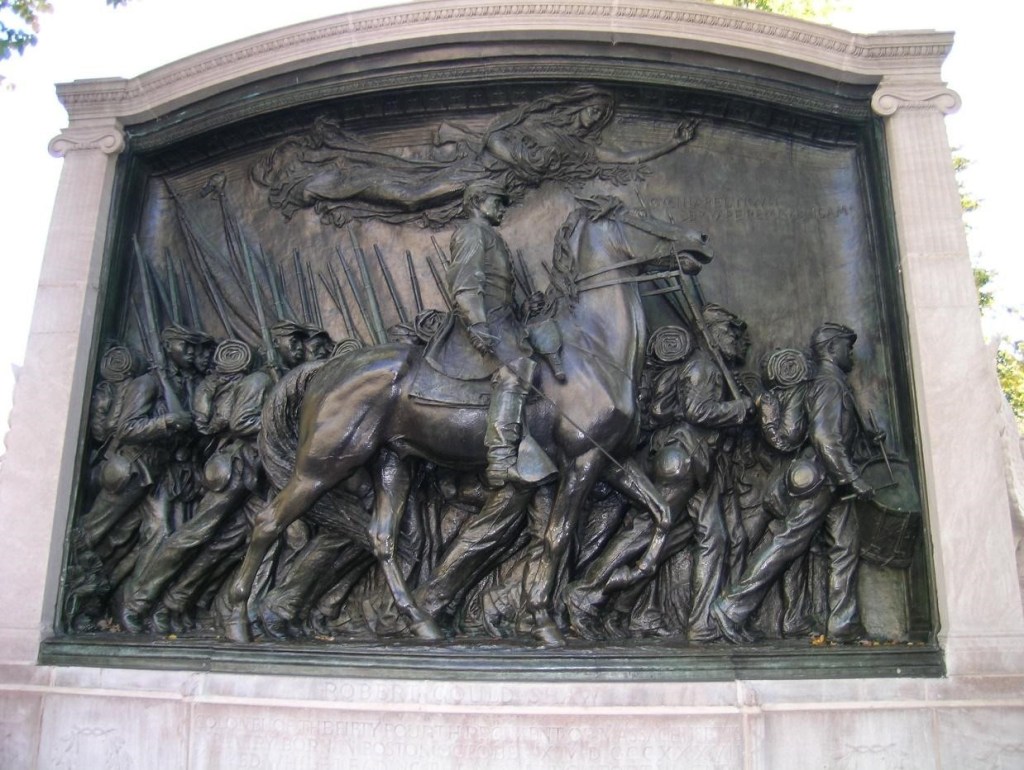
In 1854 he bought the “yellow house next to the church” from an Ezra Canfield for $500. Two years later, John Jones married Rachel Swails. Rachel’s brother was Stephen Swails, a Lieutenant in the 54th Massachusetts Regiment. If you have ever seen the movie Glory, you know the story of this famous regiment.

By 1859, Jones was already very active in Underground Railroad work. An article in The Liberator (Boston) signed J.W. Jones, Sec. said: “Resolved, That we, the colored citizens of Elmira, do hereby form ourselves into a society for the purpose of protecting ourselves against those persons, [slave-catchers] prowling through different parts of this and other States since the passing of the diabolical act of Sept. 18th, 1850, which consigns freemen of other States to that awful state of brutality which the fiendish slaveholders of the Southern States think desirable for their colored brethren, but are not willing to try it themselves.”

Arch Merrill said in his book on the UGRR, “Jones quietly took command of the Underground in Elmira, a gateway between the South and the North. It became the principal station on the ‘railroad’ between Philadelphia and the Canadian border. Jones worked closely with William Still, the chief Underground agent in Philadelphia, who forwarded parties of from six to 10 fugitives at a time to Elmira.

“Jones had many allies in Elmira. Mrs. John Culp hid runaways in her home. Other Underground leaders were Jervis Langdon; Simeon Benjamin, the founder of Elmira College; Thomas Stanley Day; S. G. Andrus; John Selover; Riggs Watrous and others. The station master concealed as many as 30 slaves at one time in his home—exactly where, he never told. He carried on his operations so secretly that only the inner circle of abolitionists knew that in a decade he dispatched nearly 800 slaves to Canada. “John Jones demonstrated his winning ways in encouraging the railroad baggage men to stow away the hundreds of men, women, and children who were spirited away to freedom.

“In 1854 the railroad from Williamsport to Elmira was completed and Jones received many more fugitives by train, to ship away in the 4 a.m. ‘Freedom Baggage Car,’ directly to Niagara Falls via Watkins Glen and Canandaigua, where the car was shifted to the New York Central. Most of Jones’s ‘baggage’ eventually landed in St. Catharine’s.”

His house right next to the church was the UGRR station of which Mr. Jones was station master. I often wonder about his wife, Rachel, who never knew how many were coming for dinner. I have also wondered if on those nights when he had 30 or more people to hide, if the church building, which he had access to, gave them shelter. There is no record that tells us this, but still, I wonder.

If you stand at the corner of West Church Street and Railroad Avenue and look north toward the Erie depot, you can envision the journey of the fugitives in the middle of the night as they go from Mr. Jones’s home, where the parking lot of First Baptist is now, up Railroad Avenue to the depot.


Wm. Still’s book about the UGRR is full of stories by the actual people involved in the work. In October, 1855, a lady wrote to Still asking, “Please give me again the direction of Hiram Wilson and the friend in Elmira, Mr. Jones, I think.” [Still, page 40]

Here is a letter written by John W. Jones to William Still:
Elmira, June 6, 1860.
Friend Wm Still:


Challenges of Teaching African American History in Secondary Schools

Imani Hinson, Romelo Green, Nefe Abamwa, and Adam Stevens presented on a panel at the 2025 conference of the American Historical Association. Hinson is a social studies teacher in the Howard County Maryland School District who formerly taught in Brooklyn and an item writer for the College Board AP African American Studies program. Green and Abamwa teach at Bellport High School in Suffolk County, New York and Stevens teaches at Brooklyn Technical High School. The session was chaired by April Francis-Taylor of Hofstra University and also included papers by Alan Singer of Hofstra University and Justin Williams of Uniondale High School.

By Imani Hinson

Each year I start my students off with a week of lessons to understand why we study history in the first place and to get students specifically to understand why varied viewpoints are so important. This year I had my students reflect on a quote from Maya Angelou and asked them why they thought some political leaders across the United States did not think African American history was important and why they thought this history was considered controversial.

My students responded with the understanding that by learning history we can hope to not repeat it but also that learning this history does not aim to make individuals feel bad for the deeds done but rather understand the historical situations in which our country was founded and the continued history that is shaping the way our country is moving forward today. Despite the pain and suffering lived by many in this country, especially African Americans, it is important to uncover truths about our shared history. The APâ African American Studies curriculum provides students with a chance to do just that; tackle tough questions, tough realities, glean an understanding of the world that they live in today, and it gives them a chance to acknowledge a history that many of them have not learned before.

The APâ curriculum has a fantastic starting place with the African Kingdoms of Mali, Songhai, the Hausa States, and more. Students are able to do a deep dive into the history of Africa that many of them had never been taught about before. A question I get often from my students is “Ms. Hinson why are we not taught this in World History or any other history class?” The truth is that a lot of this history was unknown or kept secret for many years. In my classroom, we delve into the nuances of this history so that students understand how it differs from the traditional documents and writings they usually learn about in Eurocentric history classes. I introduce them to griots and students learn that different cultures pass down history in different ways. Much of the early history we know from African civilizations was passed down orally making it much harder for historians to uncover truths about these societies.  My students learned that Christianity was in Africa before European arrival when they study about places such as Lalibela. They learn about trade starting in the 8th century along the East Coast of Africa that connect places with the Mediterranean region and Central and East Asia. Students uncover truths about the Great Zimbabwe and amazing structures, built not by Greeks or aliens, but by the local Zimbabwean people who garnered their wealth from the Indian Ocean trade routes. Timbuktu is not a fictional place, but a nation where trade, advanced institutions of knowledge, and wealth resided.

Before being exposed to this curriculum, my students were taught that Africa was backward, a continent ripe for exploitation. They saw Africa, not as the birthplace of humanity with rich cultures, but rather a place that Europeans conquered and a continent that continues to have issues to this day.

Challenging misleading notions continues as students learn about the African diaspora. Before being exposed to this curriculum, they believed African Americans had no culture and were only brought to the Americas for harsh work and enslavement because of the color of their skin. I overheard an exchange in my classroom in which one student of color was poking fun at another. A West African student asked another Black student, “Hey, where are you from?” The student responded, “Oh well, I am just Black.” The West African student laughed and said “Oh, I’m so sorry y’all don’t have any culture.” That was an eye-opening exchange. I joined the conversation and asked, “What do you mean by that?” The student explained that they never heard of any African American culture and that Black people did not know where they came from. The conversation continued:

The sad reality is that so many of our students think this way. They believe that Black people are a people without history and this misleading notion really stems from the fact that we have not done a good job as a society to unpack these misconceptions. In some states they still teach that slavery was a benevolent work system where the enslaved learned important skills, sugarcoating the reality of what enslavement was. Why don’t students learn that there was slavery in New York and in other northern localities? Why don’t students learn that Free Blacks and people who escaped from slavery played a crucial role in the abolitionist movement and that African Americans have fought in every war in the United States even before its inception, that 200,000 Black soldiers and sailors fought in the Civil War to end slavery and the right to be full citizens of the nation of their birth?

The hardest part about teaching APâ African American studies course is getting students to relearn the history that was taught to them over and over again since they entered school. Black people were slaves, the Civil War happened, Lincoln signed the Emancipation Proclamation, Reconstruction took place, African Americans got some rights, then skip to the Civil Rights Movement, and that’s Black history. But there is so much more to African American history. Students truly do not understand that African Americans as a people continuously strove to be accepted as valuable contributors to this great nation. Even when they were told to “go back to Africa,” they stayed and fought for equality. It is hard to teach history in a society that try to erase the African American past by making it seem Un-American to shed light on the contributions of Black people to this county.

As a society we have prevented students of color from learning the truth about their heritage and culture and permitted all students to believe in a factionalized past. As a corrective, APâ African American studies is not just a class for students of color. Ideally, African and African American history should be interwoven into World History and United States history classes, not just relegated to an elective.  Black history truly is both World and U.S. history.

It is challenging for many young people to see the correlation between history and the world that we live in today. I started a lesson on sugar being the driver for enslavement in the Americas showing students newspaper headlines discussing chocolate companies using child slave labor and asked students would they still eat chocolate knowing where it came from. Many of the students had to think long and hard about it, but eventually most of them confessed that “yes, they would still eat it.” After a gallery walk showing various documents about the correlation between sugar and enslavement and economics, we came back together to have a discussion. I asked my students how the legacies of sugar plantations and slavery continue to impact economic disparities and race relations today? A student raised her hand and said, “what we see is that enslaved people were working for free and that their enslavers were making loads of money because of their hard work.” I asked, “What does that mean for the Black community today?” Another student responded, “Well this means that many Black communities don’t have the same amount of money as white people because they got rich while we didn’t get anything.”

Another student added, “Well that is the reason why so many Black people have struggled to make generational wealth. It is almost as if we started at a different place” and then another explained “they basically had a 300-year start.” This is the reality that people who criticize the APâ African American studies curriculum are afraid of students uncovering; uncovering how this history continues to play out in America today.

Some people fear the acquisition of knowledge because they know that with knowledge can come change. The APâ African American studies course should not be labeled controversial or Un-American; in fact, it is the exact opposite. African Americans fought to be a part of this country and continue to fight for the country to stand true to its democratic values of all people having the right to life, liberty, and pursuit of happiness. The course does not blame students for the past but rather brings them into the conversation about how we can continue to hold America to its promise by including the history of all of the people who helped to build this great nation. Thank you.

My name is Romelo Green. I am a social studies teacher in the South Country Central School District located on Long Island, Bellport, New York. I teach 11th-grade U.S. History & Government and 12th-grade AP U.S. Government & Politics. In both courses, African American history is a component of the course framework. Being a social studies teacher in the contemporary societal and political landscape presents various challenges. As historians and educators, we are entrusted with the responsibility of addressing topics that can often be sensitive and complex. It is imperative that we present these subjects in a balanced manner, offering to our students various perspectives. Many of these topics are deeply rooted in political discourse, requiring us to navigate these discussions with care.  Moreover, we face the ongoing challenge of countering the misinformation that our students see daily through various social media platforms. We also must remain informed about rapidly evolving current events. We must be equipped to respond to our students’ questions with a neutral stance. Additionally, it is essential for us to remain compliant with state standards, ensuring that we cover all mandated material effectively, and thereby preparing our students for state assessments.

As an African American growing up, I did not hear many lessons pertaining to the deep roots of my own culture. This would include my high school and college experience. Many of the more nuanced topics in (African) American history were only brought to the surface for me once I became a teacher and began to conduct my own research, or through collegiate circles within my own department. This would include the Tulsa Race Massacre, the Haitian Revolution, the true history of policing in America, and the fact that Africans sold other Africans into slavery. I almost never heard of the achievements of African Americans except for the popular few who are always brought to light at certain points in American History (MLK, W.E.B Dubois, Malcolm X, etc…) The drastic omission from our curriculum and our textbooks leaves us with a very limited view of the African American experience.

When we learn about our culture in a public setting, it is usually generalized and only discusses the traumatic experience of African Americans rather than highlighting the achievements of individuals representing our culture. In my school some of the teachers (who are here with us in the audience today) conducted a study using focus groups to try and create a more culturally responsive classroom. Through their research they found that students representing various cultural groups have high interest in learning more about their own culture, however, the students stated that when it is taught in the classroom it is either generalized or just taught wrong. In other words, they know more about their own culture than their teachers.

What I see is that we have two factors at play.

  • Our students hunger for cultural knowledge.
  • Many teachers are unable to conduct such discourse freely and/or accurately.

For example, the legacy of slavery, reconstruction, Jim Crow laws, and the Civil Rights Movement are pivotal components that require a sensitive and comprehensive examination. Inaccurate or incomplete teachings risk perpetuating misunderstandings and stereotypes. What we then need to do is find a balance where teachers are enabled to speak freely in the classroom providing students with facts and hard truths about historical cultural experiences. The students need to be inspired to think critically and be leaders of inquiry-based research. As such, the role of the teacher extends beyond mere instruction to include being a facilitator of dialogue, ensuring a supportive educational environment that encourages critical thinking and open discussion, while carefully steering conversations to be constructive rather than polarizing.

A teacher’s freedom of speech in the classroom is one that is of great complexity, although we all have freedom of speech under the first amendment, our right to freedom of speech in educational settings is not absolute. The question then becomes what must we do as educators? With greater political pressure from the media, parents and the community, how do we still educate and fulfill the students’ drive for knowledge, while maintaining accordance with school or state policy? I think this is where we lean on our students and allow them to be leaders in the classroom. Allow our students to ask the questions and conduct the research, allow them to present information to each other and to hear the perspectives of their peers. As I mentioned our job is now to facilitate and ensure dialogue proceeds in a constructive manner. In order to do this successfully, our students need lessons on misinformation, fact-based research, and evaluating reliable sources. All of which is in alignment with NYS standards. Our teacher preparation programs also need modules on culturally responsive teaching, equipping our prospective teachers with the tools needed to navigate sensitive material respectfully and effectively.

Lastly, professional development for educators is also essential. Teachers need training and resources to confidently navigate the difficult and often sensitive topics inherent in African American history. By investing in their development, schools can create more informed educators who are better equipped to address the diverse needs of their students.

Good morning, my name is Nefe Abamwa. I teach 9th and 10th grade Global History, as well as Pre-AP World at Bellport High School on Long Island. Today’s panel is geared towards the challenges of teaching African American history and how to make the content more relevant. However, I believe it is also a part of a larger conversation on how to make the classroom culturally relevant as well.

As a first-generation Nigerian-American, my culture has greatly shaped me. My parents immigrated from Nigeria to America in the 80’s and early 90’s for better employment opportunities. My father became an accountant for the NYC Comptroller’s Office, while my mother became an RN, ultimately practicing at Pilgrim State Psych Ward. They’ve always emphasized and instilled the value of education in my siblings and I. We were raised to view education as an essential tool for success and advancement. Nigerians often tend to joke that we have three options for careers; to either become a lawyer, doctor, or engineer. In our culture, an advancement in education and an outstanding career is nothing short of an expectation. Growing up in a household and with family where these values were the norm, you could understand the confusion I faced when I began to attend Amityville Public Schools. A district notoriously known for violence, poor academics and administration, and its low-income community.

Throughout my educational career in Amityville, there were many issues I observed that made an impact on me, in regard to the staff and students. I noticed a cultural disconnect between teachers, who were predominantly white, and students, who were predominately black. I noticed that many of my peers did not value school and did not seem to understand, or care, that it could lead to endless opportunity and an escape from their environment. Lastly, the most impactful observation I noticed was that many students and staff were very ignorant and uneducated about African culture. Unfortunately, many of these observations continued to trend throughout my college, postgraduate, professional, and personal life overall. From interactions with colleagues, college professors, church members, peers, and most recently a NYSUT a union member; African culture and history tends to be stigmatized, stereotyped, and homogenized. As I faced these experiences, I would often have conversations with my parents unpacking these interactions and how disappointing it was to have these encounters so often. During these discussions, my parents would share their own experiences in America, where they too have faced racism and ignorance from people of all races, backgrounds, and levels of education.

My cultural values and upbringing, compared to my educational experiences, inspired me at a very young age to go into education. I felt there was a strong need and lack of support for students in low-income communities that may not have proper guidance otherwise; I wanted to show students of color that there are opportunities beyond their environment; and I wanted to make the classroom experience more culturally relevant. I began to instill these changes during my student teaching assignment in a 6th grade classroom at Washington Middle School in Meriden, Connecticut. The demographics there were very similar to Amityville Public Schools, as were the observations I made initially throughout my primary and secondary educational experience. In my class, I began a daily segment at the beginning of the period called “Figure of the Day”. “Figure of the Day” started off as a daily 5-minute black history lesson, during Black History Month, after learning that students knew very little about any historical black figures. These 5-minute sessions would often unintentionally run over time due to the conversations and engagement it brought out of students. Soon enough, students were so intrigued, they would request people they wanted to learn more about. Eventually, that grew into wanting to conduct their own research and present their own projects. And it ended with us expanding “Figure of Day” to cover other races and cultures, well after Black History Month had ended. With each lesson presented, whether it was from me or their peers, I could tell each student found a connection, was inspired, and genuinely excited by what they were being taught because not only was it interesting, but very relatable. Many would go home and discuss what they learned with their parents and share more with their peers the following day.

During my first year at Bellport High School in 2020, I taught my very first Global 10 class. To describe that experience as challenging would be an understatement. 10th graders and 6th graders are quite different, as you can imagine. And this was during covid. Half of my students were in person, half of them online and I’ve never met, and engagement was at an all-time low. That year I decided to conduct a project to reflect on revolutions, a prominent topic in Global 10. Throughout the year, students learn about many revolutions including the French, Haitian, and Latin American revolutions, as well as unifications such as the German and Italian. All of these movements highlight the effects of nationalism, or pride in one’s country or culture. I wanted to show that many of the issues that lead to revolutions still endure today. At the time, the #EndSARS movement was occurring in Nigeria. This was a campaign to stop police brutality led by the Nigerian youth and made international news. I felt learning about this movement was a great way to connect students to issues outside of America as well as bring awareness to some African culture and societies. Students watched a cover of Childish Gambino’s “This is America” called “This is Nigeria”, which highlights political, economic, and social issues Nigerians face. Then, my students produced questions to ask one of my cousins in Nigeria about his experience there. He was able to respond to the questions with a series of videos. Through this and document analysis, students realized many of their own experiences and issues were similar. Many were also surprised to learn that my cousin had an iPhone and could make videos. For these students, this project helped humanize a continent that is often seen as lesser than and irrelevant.

Lastly, during the Imperialism unit, for Global 10, I emphasize the long-lasting effects of White Man’s Burden and eurocentrism, as many students are unaware of how these concepts influence many aspects of our lives. I include how these concepts have impacted the world’s view of anyone that is not a WASP. This is done through document analysis, where students study different events, letters, and political cartoons. I teach them to focus on tone, POV, and how images are portrayed. When conducting these lessons, it’s easier to find the British view of imperialism versus Africans. For African perspectives I use sources such as Jomo Kenyatta’s “Gentleman of the Jungle”, documentaries, primary documents, and my own parents and grandparents’ experiences of living in Nigeria and having government positions while under British occupation. We discussed how Europeans had many negative impacts, disregard and ignorance towards natives because they had different lifestyles and only cared for profit. We also study how ignorance and stereotypes play out in modern society, pop culture, and their own personal lives today. These activities often lead to discussions about common stereotypes and misconceptions about different races, cultures, and religions. When beginning these activities, students are often embarrassed and resistant to participate at first; but it opens up important dialogue about why it is dangerous to think that way. I find that not only are most students genuinely intrigued by history behind many of these misconceptions and stereotypes, but they often notice that these lasting impacts have affected them as well. What is most rewarding is when they are able to identify and call out these issues in their own lives and well after the lesson has been taught.

As a social studies teacher that emphasizes cultural relevancy and providing different cultural perspectives, I fear retaliation, being silenced, or accused of pushing certain agendas. I believe teachers must maintain a certain level of academic freedom and it is an absolute necessity for students to learn how to have hard and constructive conversations without having to agree with one another, especially in today’s climate. Unfortunately, I never experienced a teacher that brought these things to my attention but, I was fortunate enough to have a support system and grow up in an environment where I had exposure, which then fostered my own curiosity. I would like to pay that forward and not only be a support and role model for students, but to help them make the connections and realize the importance of education.

“Is Black resistance the highest form of Black excellence?” During Black history month the past few years this has been the focusing question in the Black history class I teach at Brooklyn Technical High School. By February we have been together since September, and the range of opinion on this question is wide. The room crackles with intellectual energy.  Scholarship and emotion combine to produce forceful arguments. Radical and conservative traditions contend. Outside the classroom we are saturated by a media environment where images of Black wealth are iconic, think Beyonce and Jay-Z. From time to time these Black images compete for our attention with images flowing out of what I’ll call a Black radical or activist tradition – think ‘End Racism’ appearing in NFL end zones or black screens on social media in the wake of the killing of George Floyd.

Inside our K-12 school buildings Black achievement is generally embodied in homage to great Black individuals, our unspoken mission is to lift our students out of the working class into the middle class or to keep them firmly planted in the American middle class. We may even provide a platform for a handful to become truly rich, to achieve ‘generational wealth.’. This unspoken mission is shared by parents, and if we are being honest, we hold it as a mission for our own children as well.

Our schooling involves an implicit renunciation of working-class life; under capitalism, workers are not winners. Yet workers are what most of our students will be. Black history in the United States is, by and large, the history of a working people. I have my students read passages from Barbara Fields’s seminal essay “Race, Slavery and Ideology in the United States.” Fields is careful to remind us that plantations in the American South existed to produce cotton first, not white supremacy. In small groups my students are taken aback by a passage that describes the numerous recollections of planters, overseers and enslaved persons of circumstances where the ‘smooth running’ of the plantation required the planter taking the word of the enslaved over that of the overseer, or of overseers being dismissed because of their management practices.

The power of economic development and class goals continued after the end of slavery. During a century of Jim Crow, a Black middle class and Black elite clawed their way up out of economic precarity, even as state-sponsored and vigilante racist terror haunted them. In the post-Civil Rights Movement era, a Black middle class was consolidated.  In April of 1968 elite institutions threw open their doors to the Black in a cynical but consistent response to the mass uprisings after the shooting of Dr. Martin Luther King, Jr. in April of 1968.

Should curriculum focus on the history of a Black elite? The tenets of ‘social history’ seek to ground historical investigation in the lived reality of the masses of the people, to get us away from understanding history as the work of ‘great men.’ When the masses are white, the rules of American racism have meant that we are studying a group that, over time, has experienced great chances for uplift, for rising in social status. Social history of the white working-class rests on a certain implicit substrate of hope. The problem in Black history is that for the whole era of slavery and much of the period after that ‘hopeful narrative’ is by definition closed.

This continent would not house a world power if it were not for the stolen  labor and amassed capital of the slavery era. Silence on slavery and its afterlife suits a ruling class that would have us forget this one fact. This is why the hysteria over Critical Race Theory. Forget slavery. Forget Jim Crow. Forget George Floyd. The U.S. ruling class knows what they did to get where they are, what they do to stay there, and they don’t want the next generation being reminded of it.

In the face of these stark facts of history and given the political headwinds, teaching of Jim Crow by retreating into the salve of figures of Black Excellence such as Madam CJ Walker feels safer not just in the face of conservative school boards, but as a way to boost the morale of a room where the course material can otherwise feel like a catalogue of Black suffering. Of course, by neglecting struggle, we don’t know what to do with Nat Turner, let alone John Brown, or Paul Robeson, or Claudia Jones, or W.E.B. DuBois.

That’s why historians and teachers matter so much. We need historians and teachers who can foreground the majesty of the Black struggle for liberation, for justice. We need historians and teachers who invite us to have pride in the broad masses of our ancestors, not just the elites. We grasp intuitively, perhaps, that it was the action of these broad masses that formed the motive force behind every great liberation movement of our history.  Black history as hero worship of great leaders disempowers every student who can’t see themselves becoming the next Martin Luther King. This problem is one that King grappled with himself on the day he died, there in Memphis, binding himself more closely to the cause of the sanitation workers of that city. He was building a Poor People’s Movement with a strong anti-imperialist element. The images of those Black workers with signs reading “I Am a Man” are iconic but they are iconic as protesters, not just as workers.

Eugene Genovese (Roll, Jordan Roll, Book Three, Part Two) helps my students understand slavery as a world where far more choice was exercised by the enslaved than we are given to imagine. I teach the returning veterans from World War I and World War II whose refusal to accept the business as usual of Jim Crow. Their energy gave birth to a Harlem Renaissance and a Civil Rights Movement. To see Black workers gathered in their masses, politicized, in motion against racism as the most powerful force in history, to see honor and glory in joining such a movement, this is an alternative view of Black Excellence and approach to curriculum. Teaching the struggles of ordinary Black people for dignity and equality is the curriculum focus we need to empower our students to survive and defeat the growing threats of fascism and war and to avert climate disaster. 


The Exploitation of Enslaved Women During The 18th Century Colonial America

Logan Stovall

Logan Stovall is an eighth grade student at Montclair Kimberley Academy in Montclair, NJ

The 18th century represents a dark period in American history when the institution of slavery thrived, and the exploitation of enslaved Black women flourished. The cruel realities endured by Black women during this time were not only a consequence of their enslavement but were magnified by both their race and gender, perpetuating a cycle of inequality and suffering. Beyond the physical captivity, these women endured a complex oppression that not only involved grueling labor but also made them victims of sexual violence. The harsh reality of this oppression becomes evident when one reflects on how the clothing worn by enslaved Black women served as a physical manifestation of their fragile existence. The clothes they wore were not just rags or pieces of fabric used to cover their bodies; they represented a system that dehumanized and abused them.  During the 18th century, an enslaved Black woman’s gender and race primarily affected the way she lived and thrived in an illiberal society. Understanding the exploitation of enslaved Black women during the American colonial era requires a closer look into the sweat of their daily labor, the sexual abuse they endured, and the clothing they wore that bound them to such a harsh life.

However, before any analysis regarding the exploitation of enslaved Black women is made, one must first consider that the racial stereotypes and discriminatory practices against enslaved Black women during the colonial era were the underlying causes of their mistreatment. The widely accepted racist ideas of Antebellum white slaveholders led them to think of their enslaved people as both biologically and culturally inferior. Due to their understanding of the social hierarchy at this time, slaveholders often whipped and physically mistreated enslaved women under their supervision.[i] In addition to the racist beliefs they held, slaveholders also created various stereotypes about enslaved Black women. One such popular stereotype was the “Mammy” caricature. The “mammy caricature” depicted enslaved Black women as enjoying their servitude, being physically unattractive, and only fit to be domestic workers.[ii]

In contrast to the “mammy caricature”, slave owners also created a more promiscuous stereotype of enslaved Black women: the “Jezebel” figure. The Jezebel caricature was used during slavery to justify a slaveholder’s objectification and sexual exploitation of enslaved Black women.[iii] The Mammy and Jezebel caricatures, along with various other derogatory stereotypes that plagued enslaved Black women, heavily influenced how the rest of the White population during the Antebellum period perceived and treated Black women. Sadly, these caricatures endured for decades even after colonial times.

With racial stereotyping forming the underlying cause of discrimination against Black women, a significant amount of White slave masters often subjected Black women to harsh labor conditions. Enslaved women were often forced to work in the fields from sunrise to sunset where they endured physical and emotional abuse. On larger farms and plantations, for example, women were forced to perform tasks like hoeing and ditching entire fields. These were the most exhausting and uninteresting forms of fieldwork.[iv] Slaveholders also held enslaved women accountable for cleaning and tidying communal areas like stables and expected them to spread manure as a fertilizer.[v] Moreover, slave owners frequently questioned how much time off enslaved women needed to adequately take care of their families and children. When not offered any downtime by their slaveholders, enslaved women had to bring their children with them to the fields and strap them to their backs as they worked tirelessly. [vi]

Black women’s exploitation extended beyond the fields. In many instances, the labor performed by enslaved women was prolonged and complicated. For example, many enslaved women began to work for slaveholders at a very young age. There was little free time for enslaved women to rest, given that most women worked for their master five to six days a week. This included keeping the owner’s homes clean, cooking food, and washing their clothes.[vii] In short, enslaved women were expected to work tirelessly, both in the fields and in the house. The slave masters did not care about  the well-being of their enslaved women and exploited them for their free labor.  For Black women, slavery in the southern colonies meant long days performing menial, exhausting tasks, sometimes in the hot, baking sun.  After working prolonged, hard days for the slaveholders, these women had to care for their own families, which was often a physical and mental challenge due to the absence of time to rest. When enslaved women did not meet the expectations for their work by their enslaver, they would oftentimes be taken advantage of sexually or physically assaulted as a form of punishment. Unfortunately, this possibility became a reality for many enslaved Black women.

Indeed, as the slave population in America grew larger through the importation of slaves, enslaved Black women primarily as reproducers of a valuable labor force rather than merely a part of the labor force.  The sexual exploitation of Black women extended from sexual gratification of their White slaveholders to include reproducing offspring that would expand their workforce. Though slave owners valued enslaved women as laborers, they were also well aware that female slaves could be used to successfully reproduce new labor (more children who would grow up to be slaves) by continuing their role as full-time mothers.[viii] This presented slaveholders with a dilemma because West African women usually had some prior agricultural experience (like growing tobacco and rice) which could be used to the slaveholders’ benefit.[ix]

In 1756, Reverend Peter Fontaine of Charles City County, Virginia, stated that Black females were “far more prolific than…white women.” This form of racial stereotyping made enslaved women extremely vulnerable to physical assault.[x] Many white enslavers raped Black women for sexual pleasure, as well as for their ability to produce children who would become slaves and ultimately increase their wealth. Instead of perpetuating the stereotype that all enslaved Black women were unattractive and were only fit to be domestic workers, they now were feeding into the stereotype that Black women were promiscuous and desired for the reproduction of enslaved children who could be used or sold. This form of physical exploitation was pervasive throughout the Antebellum South.

In addition to labor and sexual exploitation, clothing was another form of exploitation that enslaved Black women were forced to endure. While these women often knitted or otherwise made beautiful garments for White women and their children, the fabrics that enslaved Black women wore themselves offered minimal protection from the weather and had to be inexpensive and easy to make.[xi] Their clothing was so cheap in quality that it often disassembled or tore within weeks. As a result, enslaved women often borrowed clothing from one another or even stole clothing from the slave master’s house. They did this to give themselves or their families warm, sustainable garments, and sometimes, to blend into the free population. Oppressors often made enslaved women wear poor, rugged clothing to symbolize a Black woman’s low status and to cultivate racial stereotypes depicting Black women as inferior. Indeed, one reason why enslaved women wanted to steal White people’s clothes was because they wanted to appear as free Black people with increased status.[xii]

Despite being subjected to clothing exploitation, many enslaved women nevertheless tried to continue to be connected to their former culture by wearing West African garments. Enslaved women working in slaveholders’ homes were expected to cover their heads with lightweight white caps, which other members of the household also wore. However, to continue the West African tradition, many enslaved women also chose to wear brightly colored head wraps that surrounded their heads and were secured with knots and tucking’s.[xiii] They also sometimes wore cowrie shells in their hair; which were very expensive and far more valuable than money. These cowrie shells also appeared in spirit bundles as parts of clothing and jewelry, implying their use as amulets.

Black women not only wore these West African garments to remain connected with their former cultures, but they also wore the garments as a form of resistance against enslavement.[xiv] Enslaved Black women despised their status as slaves but were able to feel proud about and connect to their former West African heritage when they wore their cultural headdresses. The significance of these garments likely gave Black women a feeling of strength and empowerment as they were emotionally frightened by the abuse they faced from their enslavers.

During the 18th century, the exploitation of enslaved Black women through their gender and race greatly influenced the way they survived and flourished in a prejudicial society. Enslaved women were exploited in numerous ways and were expected to address the needs of others to the detriment of caring for themselves and their families. They worked extremely hard, both in the house and in the field, and did whatever they were commanded to do withstanding both physical and emotional abuse. They were often raped through their shabby clothing and physically assaulted by their master’s for punishment, as a means to increase their profit in human labor. But still, an enslaved Black woman was able to overcome these acts of exploitation non-violently and create her own peace by wearing and displaying garments that were distinct to her West African culture. Given all that these enslaved women endured, we should respect and admire their ability to overcome such incredible hardships.

Smithsonian, and National Museum of African American History and Culture. “Cowrie Shells and Trade Power.” National Museum of African American History and Culture. Accessed November 15, 2023. https://nmaahc.si.edu/cowrie-shells-and-trade-power#:~:text=Europeans%20in%20the%2016th%20century,at%20their%20use%20as%20amulets .


[i] LDHI, “Hidden Voices: Enslaved Women in the Lowcountry and U.S. South,” LDHI, accessed November 27, 2023, https://ldhi.library.cofc.edu/exhibits/show/hidden-voices/enslaved-womens-work.

[ii] LDHI, “Hidden Voices,” LDHI.

[iii] LDHI, “Hidden Voices,” LDHI.

[iv] Jennifer Hallam, “The Slave Experience: Men, Women & Gender,” Slavery and the Making of America, accessed November 27, 2023, https://www.thirteen.org/wnet/slavery/experience/gender/history.html.

[v] Emily West, Enslaved Women in America: From Colonial Times to Emancipation (Lanham: Rowman & Littlefield Publishers, 2017), 29

[vi] West, Enslaved Women, 28.

[vii] LDHI, “Hidden Voices,” LDHI.

[viii] West, Enslaved Women, 28.

[ix] West, Enslaved Women, 29

[x] West, Enslaved Women, 31.

[xi] Daina Ramey Berry and Deleso A. Alford, eds., Enslaved Women in America: An Encyclopedia enhanced credo edition ed. (Santa Barbara, CA: Greenwood, 2012), 34 and 35.

[xii] Katherine Gruber, ed., “Clothing and Adornment of Enslaved People in Virginia,” Encyclopedia Virginia, last modified December 7, 2020, accessed November 5, 2023, https://encyclopediavirginia.org/entries/slave-clothing-and-adornment-in-virginia/.

[xiii] Gruber, “Clothing and Adornment,” Encyclopedia Virginia.

[xiv] Smithsonian and National Museum of African American History and Culture, “Cowrie Shells and Trade Power,” National Museum of African American History and Culture, accessed November 15, 2023, https://nmaahc.si.edu/cowrie-shells-and-trade-power#:~:text=Europeans%20in%20the%2016th%20century,at%20their%20use%20as%20amulets.


Berry, Daina Ramey, and Deleso A. Alford, eds. Enslaved Women in America: An Encyclopedia. Enhanced Credo edition ed. Santa Barbara, CA: Greenwood, 2012.

Gruber , Katherine, ed. “Clothing and Adornment of Enslaved People in Virginia.” Encyclopedia Virginia. Last modified December 7, 2020. Accessed November 5, 2023. https://encyclopediavirginia.org/entries/slave-clothing-and-adornment-in-virginia/.

Hallam, Jennifer. “The Slave Experience: Men, Women & Gender.” Slavery and the Making of America. Accessed November 27, 2023. https://www.thirteen.org/wnet/slavery/experience/gender/history.html.

LDHI. “Hidden Voices: Enslaved Women in the Lowcountry and U.S. South.” LDHI. Accessed November 27, 2023. https://ldhi.library.cofc.edu/exhibits/show/hidden-voices/enslaved-womens-work.

West, Emily. Enslaved Women in America: From Colonial Times to Emancipation. Lanham: Rowman & Littlefield Publishers, 2017.

Sally Hemings’ Legacy of Freedom and Motherhood

Ms. Aquino is an eighth grade student at Montclair Kimberley Academy in Montclair, NJ

Sally Hemings led an extraordinarily complex life, yet her story inspires thousands of women, myself included. Despite the intricacies, she fought against the notion of becoming just another enslaved individual in her family’s generational cycle. Sally sought to change the trajectory of her children’s lives, offering them opportunities beyond enslavement. Instead of securing her own freedom, she made a selfless choice to promise freedom to her future children—a decision that stands out as a remarkable act of heroism. Sally Hemings’s life, sacrifices, and ability to persuade Thomas Jefferson into making her a  promise was an act of heroism towards her children. Her story is a testament to the profound strength of a mother’s love and the power of quiet rebellion against an oppressive system.

Born into slavery, Sally began her journey as one of Polly’s , Thomas Jefferson’s daughter, maid, and caretaker. Over time, she developed a close relationship with Polly, potentially even her aunt as well.[1] During their time in Paris, where Sally accompanied Polly in her studies, Thomas Jefferson expressed reservations about Sally’s  ability to care for his daughter because she was so young, fourteen at the time. However, although she was well-trained in caring for people, Thomas Jefferson expressed that she was “wholly incapable of looking after” his daughter and could not do it “without some superior to direct her.”[2]  Despite Jefferson’s doubts about her abilities, Sally gracefully navigated the unfamiliar Parisian landscape and spent twenty-six months in Paris, also reuniting with her brother James. She contracted smallpox but received proper care and was compensated for her work. Sally also learned French during her stay, though her literacy in both languages remains uncertain.[3]

In Paris, at the age of fourteen, Sally’s  involvement in a sexual relationship with Thomas Jefferson, whose wife died in 1782, resulted in her pregnancy, which shifted her trajectory dramatically. While accompanying Thomas Jefferson’s daughter, Polly, to Paris, Hemings was caught in a complex web of power dynamics and his unspoken desires. Yet, a fateful encounter with Jefferson forever altered her life. Madison Hemings, Sally Hemings’s son, stated that his mother became Mr. Jefferson’s concubine in France. Though in France, slavery was not legal, so Sally was considered a free person. Torn between the possibility of freedom in Paris and the promise of a better future for her children, Sally made a heart-wrenching choice. She negotiated an extraordinary deal: freedom for her future children at 21, sacrificing her own chance at escape. In the face of unimaginable hardship, this selflessness began her quiet rebellion. She did not try to negotiate for freedom for herself.[4] Additionally, Thomas Jefferson wrote about Sally as they continued their “relationship” after returning to Monticello. He wrote, “It is well known that the man whom it delighted the people to honor, keeps, and for many years past has kept, as his concubine, her name is Sally.”[5] Jefferson clearly stated that Sally was his concubine, his mistress. In his eyes, Sally was just another woman.

After returning to Monticello with Jefferson and his daughters in 1789, she became a household servant and lady’s maid.[6] In addition, Madison Hemings stated, “It was her duty, all her life which I can remember, up to the time of father’s death, to take care of his chamber and wardrobe, look after us children and do such light work as sewing.” As well as being a maid, Sally’s job was cleaning Jefferson’s closet and sewing. Also, upon returning to Monticello, Sally’s relationship with Jefferson, though shrouded in secrecy, was an undeniable reality. Sally Hemings’s relationship with Thomas Jefferson was well-known throughout Monticello. Some of Jefferson’s friends and even political colleagues knew about them. However, this new sexual relationship did not come as a surprise to people. It was, unfortunately, widespread for white men to have sexual activity with enslaved women, let alone enslavers with enslaved women. However, society could ignore Thomas Jefferson and Sally Hemings if he kept them discreet, so he never acknowledged the rumors, and they continued their “relationship.”[7] Their relationship lasted until Jefferson died on July 4, 1826.

She  bore him six children, each carrying the weight of their father’s legacy and the burden of slavery. Although, only four survived to adulthood, Harried, Beverly, Madison and Eston. Despite her duties as a servant and Jefferson’s “concubine,” Sally nurtured her children with unwavering love and a fierce determination to see them free. Madison Hemings said, “She gave birth to four others, and Jefferson was the father of all. They were Beverly, Harriet, Madison (myself), and Eston – three sons and one daughter.”[8] The oldest, Beverly Hemings, worked as a carpenter for the duration of his enslaving. He was also into music, more specifically, the violin.[9] Harriet Hemings was born a few years after Beverly in 1801. She grew up enslaved, spinning wood. After Harriet, Madison is the child that had the most to say about his mother’s life and what he thinks about their relationship. Lastly, there is Eston Hemings, the youngest son out of them all. He obtained knowledge in woodworking and was granted freedom in 1829. After Jefferson’s death, Martha, his daughter, allowed Sally to leave the plantation to live with her younger sons, Madison and Eston, in Charlottesville, Virginia. Madison and Eston gladly took their mother in with open arms and loving hearts. They initially passed as white for the U.S. Census, but later Sally identified as “free mulatto.” Sally lived freely with her sons until she died in 1835.[10] 

             Throughout her life, Sally Hemings made decisions that transformed her children’s lives and impacted women at large. Her selfless act in Paris, negotiating freedom for her unborn children, inspires women and their own children. In the course of her life, just like many other enslaved women, Sally Hemings’s children were fathered by her owner. In  the context of the era where enslaved women lacked legal rights,[11] Sally’s story reflects the harsh reality of exploitation. The dynamic between her and Jefferson can vary, though, taking into consideration age and consent. Sally was fourteen, and  Jefferson was about forty years old.[12] Additionally, enslaved women often were raped and sexually harassed without being able to speak up or say no. Despite  these challenges, she rose above and stands as a stark motivation for women across the globe.  

            Sally Hemings’s story is a personal triumph and a beacon of hope for all who fight against injustice. Pulitzer Prize-winning historian Annette Gordon-Reed also said, “Though enslaved, Sally Hemings helped shape her life and the lives of her children, who got an almost 50-year head start on emancipation, escaping the system that had engulfed their ancestors and millions of others. Whatever we may feel about it today, this was important to her.” The measures Sally took to ensure emancipation for her children were significant and display the unconditional love she had for them. For a mother to surrender her own freedom, her only chance to escape, for her children was selfless. Her quiet defiance, her unwavering love for her children, and her ability to negotiate freedom within the confines of slavery inspire generations of women and mothers. Her life, sacrifices, and ability to persuade Thomas Jefferson into making her a promise was an act of heroism towards her kids. While inspiring many women worldwide, the most significant impact was on her children. Ones who exclaimed the great things she did for them. On the other hand, her children were not the only ones who spoke highly of her.  Her story carries a historical significance and profound lessons about the human spirit’s capacity for resilience and love. A woman who defied the odds and shaped the destiny of her children, leaving behind a legacy that continues to resonate  with many women and children today.

Hemings, Madison. “Sally Hemings” [Sally Hemings]. https://monticello.org. Accessed November 9, 2023. https://www.monticello.org/sallyhemings/.

“The Memoirs of Madison Hemings” [The Memoirs of Madison Hemings]. https://www.pbs.org. Accessed December 17, 2023. https://www.pbs.org/wgbh/pages/frontline/shows/jefferson/cron/1873march.html.

Adams, William Howard. The Paris Years of Thomas Jefferson.

Gordon-Reed, Annette. The Hemingses of Monticello.

“Life Story: Sally Hemings” [Life Story: Sally Hemings]. https://nyhistory.org. Accessed December 14, 2023. https://wams.nyhistory.org/building-a-new-nation/american-woman/sally-hemings/#:~:text=Sally%20lived%20in%20Paris%20long,together%20when%20they%20reached%20adulthood .

Thorson, David. “Beverly Hemings” [Beverly Hemings]. https://www.monticello.org/. Accessed December 17, 2023. https://www.monticello.org/research-education/thomas-jefferson-encyclopedia/beverly-hemings-2/.

The University of Virginia. “The Hemings Family” [The Hemings Family]. https://monticello.org. Accessed November 6, 2023. https://www.monticello.org/slavery/paradox-of-liberty/enslaved-families-of-monticello/the-hemings-family/ .


[1] William Howard Adams, The Paris Years of Thomas Jefferson, Page 220

[2] William Howard Adams, The Paris Years of Thomas Jefferson, Page 220

[3] Madison Hemings, “Sally Hemings” [Sally Hemings], Monticello.org, accessed November 9, 2023, https://www.monticello.org/sallyhemings/.

[4] Hemings, “Sally Hemings,” Monticello.org.

[5] Hemings, “Sally Hemings,” Monticello.org.

[6] Hemings, “Sally Hemings,” Monticello.org.

[7] “Life Story: Sally Hemings” [Life Story: Sally Hemings], nyhistory.org, accessed December 14, 2023, https://wams.nyhistory.org/building-a-new-nation/american-woman/sally-hemings/#:~:text=Sally%20lived%20in%20Paris%20long,together%20when%20they%20reached%20adulthood.

[8] Hemings, “Sally Hemings,” https://monticello.org.

[9] David Thorson, “Beverly Hemings” [Beverly Hemings], https://www.monticello.org/, accessed December 17, 2023, https://www.monticello.org/research-education/thomas-jefferson-encyclopedia/beverly-hemings-2/.

[10] Life Story,” https://nyhistory.org

[11] Hemings, “Sally Hemings,” https://monticello.org.

[12] Hemings, “Sally Hemings,” https://monticello.org.


The Eight: The Lemmon Slave Case and the Fight for Freedom

The Eight tells the story of Lemmon v. New York—or, as it’s more popularly known, the Lemmon Slave Case. All but forgotten today, it was one of the most momentous civil rights cases in American history. There had been cases in which the enslaved had won their freedom after having resided in free states, but the Lemmon case was unique, posing the question of whether an enslaved person can win freedom by merely setting foot on New York soil—when brought there in the keep of an “owner.” The case concerned the fates of eight enslaved people from Virginia, brought through New York in 1852 by their owners, Juliet and Jonathan Lemmon. The Eight were in court seeking, legally, to become people—to change their status under law from objects into human beings. The Eight encountered Louis Napoleon, the son of a slave, an abolitionist activist, and a “conductor” of the Underground Railroad, who took enormous risks to help others. He was part of an anti-slavery movement in which African Americans played an integral role in the fight for freedom. The case was part of the broader judicial landscape at the time: If a law was morally repugnant but enshrined in the Constitution, what was the duty of the judge? Should there be, as some people advocated, a “higher law” that transcends the written law? These questions were at the heart of the Lemmon case. They were difficult and important ones in the 1850s—and, more than a century and a half later, we must still grapple with them today.

The Social Cost of Deindustrialization: Postwar Trenton, New Jersey

Patrick Luckie

Studying local history is something that is often overlooked and underestimated in social studies classrooms around the country. Think about it—do you have any memory of learning about your own local community in a coordinated school or social studies effort? Big ideas like imperialism, global culture, and other themes of the past and present usually take precedence over learning about one’s own local history in the high school. As part of my undergraduate senior research project at Rider University, I grappled with this fact and produced a short study of my own local history which I used to inform my instruction in the classroom. This article will present the research I have done and will end with a short analysis of how my research project on local history has affected my instruction in Ewing High School and how it can change the way we think about teaching local history in all American high school social studies classrooms.

These powerful words were written by Dr. Jack Washington, a teacher of Social Studies in Trenton public schools for over 40 years and author of, The Quest for Equality: Trenton’s Black Community 1890-1965 which traces racial struggle and movements for equality over the city’s history. Trenton’s uniqueness as Washington describes, is a product of its deep history, rooted in the American Revolution, World War II, and the Civil Rights Movement of the 1960s. Trenton was once a manufacturing powerhouse, home to multiple industries which forged the urban landscape of the state’s capital and produced thousands of union jobs for its inhabitants. These included the mighty John A. Roebling’s Sons Company, which aided in the creation of the Brooklyn Bridge and whose factory in West Chambersburg served as a symbol of innovation and opportunity for decades. Trenton’s pottery industry was also one of the largest and most successful in the whole nation alongside its iron, steel, rubber, and textile companies. Together, these industries provided enough stable employment and pay to support a rapidly growing population of mostly first and second generation European immigrants from Italy, Ireland, Germany, Poland, and Hungary, to name a few. Trenton’s manufacturing prowess was best showcased in 1917 with the first lighting of the famous “Trenton Makes, The World Takes” sign on the Lower Trenton Bridge, a symbol which still stands today in 2023.

 The “golden age” of the city, as historian John T. Cumbler describes it, lasted from around 1850 to 1920 when Trenton established itself as one of the manufacturing capitals of the nation.[2] Almost perfectly situated between two of America’s largest cities in New York and Philadelphia, Trenton industrialists used its strategic geographic location along the Delaware River to tap into large markets and supply the massive manufacturing needs of the east coast. Trenton at this time was truly a symbol of the American dream, and people flocked to the city in search of opportunities. By 1920, the population of the city surpassed 119,000 people and it was amongst the most densely populated places in the state of New Jersey.[3]

The first signs of the city’s decline came with the weakening of its labor movement. By the 1920s, the age of mechanization had begun and the economic shift from factory work to mechanized manufacturing began weakening labor unions overtime. Worker’s unions and cooperation between owners and workers alike had been central to the functioning of the local economy and the glue by which the city binded itself together. Overtime, businesses could no longer maintain the standards of work they had previously upheld and conditions within the city started to slowly deteriorate. From 1910-1920 Trenton underwent its largest leap in population within a decade and shortly thereafter it began experiencing some of its greatest economic struggles. Plants began relocating outside of the city and unionized jobs were becoming more and more difficult to attain. Economic historians have grappled with this shift in the post-war era, claiming “US corporations aggressively sought to break free of expensive union contracts and to seek out ways to pay lower wages and allied social costs in order to increase profits.”[4] This is a persistent trend in this study. With great increases in population and the changing state of the local and national economy, Trenton suffered meaningful losses in employment and manufacturing output.

With the Great Depression beginning in 1929 and the waging of the Second World War in 1939, Trenton retreated back to manufacturing and away from addressing the issues surrounding labor which had marked its initial decline. The waging of the war meant a massive nation-wide mobilization of industry towards fueling the war effort. The war-time economy of Trenton temporarily revitalized the city. Roebling’s Sons employed droves of new workers, opportunities for overtime became more available, unions strengthened, worker’s pay went up, and the largest wave of black migrants in the city’s history began making their way to Trenton beginning in the 1940s.[5] These migrants came to Trenton and other cities in what is known as The Great Migration. That is the movement of millions of African Americans predominantly from the rural southern states to the urban north and midwest between 1910-1970.

This temporary boom did not yield long-term progress for Trenton in the post-war period. During the 1950s, many of the city’s largest industries began relocating outside the city limits and the economy did not adequately support its largest ever population of over 129,000 people.[6] In 1952, Trenton’s most popular employer Roebling’s Sons was sold to Colorado Fuel and Iron Company which over the next decade cut its employment numbers in Trenton and relocated its major manufacturing and business centers outside the city limits. This was the fate for many of the most popular industries within the city which sold their shares to larger corporations after WWII, leaving the fate of the city’s economy in the hands of interests which had little to no connection to it. The rubber, steel, iron, and pottery industries which had defined the city of Trenton and produced its “golden age” became shadows of their former selves and the physical conditions of the city reflected this change. Overtime, thousands of industrial jobs were lost and the population of Trenton dropped 13,382 people from 1950 to 1960 and an additional 9,381 people the following decade.[7] Population decline continued to the year 2000 and stabilized between 80,000 to 90,000 in the 21st century. 

This study seeks to answer two fundamental questions: 1) What were the major effects of deindustrialization on Trenton, NJ in the decades immediately following WWIII? 2) How were these effects felt by the people living within the city at this time? In answering these questions, this study will provide a lens through which race and class come to the forefront of the discussion. Trenton’s decline overlaps with the migration of thousands of African Americans to the city in search of economic opportunities. This demographic shift was the largest in the city’s history and was not met with opportunity but rather inequality and increased racial tension. The major effects of deindustrialization on Trenton, NJ in the post-war period were economic destabilization, movement to the suburbs, and increased racial tensions between white and black Trentonians. Each subsection of this work will dive into these effects individually as well as their overall impact on life in Trenton. It is important to recognize that this movement away from manufacturing and its effects were not phenomena restricted to certain areas or regions. Rather it was a national trend which all rust belt cities like Trenton grappled with in the 21st century. In addition to deindustrialization broadly,  the age of mechanized labor, the shifting of the U.S. economy towards greater support for large corporations, and the social movements of the 1960s all played extremely important roles in shaping American cities in the post-war era.

Secondary source literature on the decline of U.S. cities in the post-WWII period falls into the fields of American urban, economic, and social history. One of the most popular works on these subjects is historian Thomas J. Sugrue’s The Origins of the Urban Crisis: Race and Inequality in Postwar Detroit, which examines the many ways in which American cities began to decline following WWII with specific focus on racial inequality and division. In his work, Sugrue states that Trenton, like Detroit and other rust belt cities of the time, experienced hundreds of thousands of layoffs in manufacturing jobs nationwide due to the changing state of the U.S. economy and the lack of government spending allocated towards Northern cities.[8] These conditions radically transformed urban environments into almost unrecognizable versions of their industrial heights. Sugrue explores the connections between suburbanization, demographic change, and the racial attitudes of northern whites to produce an all-encompassing case study of the decline of Detroit. At the heart of his argument is that racial segregation and inadequate political responses to signs of crisis determined the fate of the city. The importance of this historical research cannot be overstated. Before this book was originally published in 1996, the stories of Detroit and other American cities who suffered from the consequences of deindustrialization and racial division in the post-war period were largely untold. The Origins of Urban Crisis continues to be one of the most influential modern studies of American urban history and is without doubt one of the most cited pieces of literature in the field.

Jefferson Cowie and Joseph Heathcott, who together produced Beyond the Ruins: The Meanings of Deindustrialization,built on the historical research of Sugrue by studying the impact of post-war deindustrialization across the nation. This book seeks to progress the conversation of historic decline to modern solutions for urban decay and economic instability. In doing so, it compiles a collection of essays from historians and other professionals to further explore deindustrialization and its impact on American cities.[9] From this perspective, the authors identify a complexity of causes and effects of urban decline which vary from city to city but share many similarities nationally. The value of this work is in its wide-scope. By compiling essays from multiple professionals in a variety of related disciplines, the image of declining cities in the U.S. following WWII becomes more clear than ever.

The most recognized work on post-war deindustrialization in specifically Trenton, New Jersey lies within historian John T. Cumbler’s A Social History of Economic Decline: Business, Politics, and Work in Trenton. This book outlines a long trajectory of economic conditions in Trenton beginning in the 1920s with focus on the Great Depression and researches the changing nature of the city up until the book’s publishing in 1989. One of Cumbler’s main arguments includes the notion that America experienced a gradual economic shift from civic to national capitalism following the Great Depression which empowered large corporations while simultaneously destroying the small businesses which held many industrial cities together.[10] He also explores the rich history of the city’s most impactful industries, politicians, union leaders, and manufacturing workers to provide a comprehensive view of Trenton’s economic and social decline. This work provides the foundation of historical knowledge on Trenton required to produce further research on this topic. However, Cumbler’s history of Trenton does not extend as far into the social consequences and effects of deindustrialization as one might expect. Nevertheless, virtually any modern historical literature on the city of Trenton cites this work. This points to the undying credibility of Cumbler as a historian and shows the importance and relevance of his arguments to the continued study of the city’s history.

More recent historical literature on related topics has largely focused on national trends of suburbanization and racial conflict. One such journal article titled “The Rural Past-in-Present and Postwar Suburban Progress” by University of Waterloo professor Stacy Denton studies the shift towards suburbanization following WWII. The author highlights the transformation of previously rural spaces to suburban landscapes and the implications of such transformations on national attitudes and beliefs towards race, culture, and class.[11] In a similar light, economic historian Leah Platt Bouston’s 2007 work “Black Migration, White Flight: The Effect of Black Migration on Northern Cities and Labor Markets” studies the effects of The Great Migration on northern cities and their economies. She also dives into the racist attitudes of northern whites which manifested themselves in movements out of increasingly diversifying cities and into the surrounding suburbs as part of a process termed “white flight.”[12] Both these works of history are incredibly valuable to this study of post-war Trenton for the topics and findings of their research are amongst the greatest effects of deindustrialization on the city.

The research done in this paper will synthesize the secondary source material on the decline of U.S. cities and apply their findings to a specific case study of Trenton, New Jersey. In doing so, it will paint a clearer picture of the more immediate social and economic effects of deindustrialization on the city in the decades following WWII. This will add to the historiography of urban history and Trenton historical study by compiling primary and secondary source documents to more deeply understand the major effects of deindustrialization and economic transformation on the city.  These major effects include economic destabilization, massive suburbanization, and increased racial tension. These symptoms of deindustrialization were felt most harshly by the city’s poor ethnic-white and growing black population. More specifically, economic decline in Trenton coincided with the arrival of black migrants which compounded racist attitudes and practices within the city. This is most clear in workplace and housing segregation which new migrants had to face upon their arrival.

Industry leaving Trenton following WWII radically changed the city’s local economy. Unionized factory jobs became harder to attain, poor residents were left with fewer options, and Trenton’s growing black community was segregated in their employment. Long-time union workers like those who worked in the pottery and steel plants found themselves in an unfamiliar situation. As Cumbler explained, “Those workers thrown out of work by plant closings had the hardest time finding work and represented the largest number of Trenton’s unemployed.”[13]

The selling of corporations like Roebling’s Sons produced a much weaker focus on the city’s manufacturing growth and output and instead, large corporations sought for the relocation of facilities and workers to outside the city. This left the existing workforce in the city out to dry and decreased options for employment, especially among the lower-income white and minority black populations.

 One action taken by the state and local government to fill this gap created by fleeing industry was growth in the employment of state workers and other public jobs. New Jersey state workers were in the 1950s and 60s, as they still are in the present day, centralized in the capital city of Trenton. Cumbler described this shift from manufacturing to public work as, “Blue Collar to White Collar and White Smock.”[14] This provided some relief to the city’s unemployment problem which exceeded the national average through the 1950s and 60s but it did not come close to meeting the pay and benefit standards that manufacturing jobs had produced just a decade prior. Additionally, the large majority of state workers employed at this time were disproportionately white men. Despite these changes, public and state employment was not enough to lift the city out of its economic slump nor its inherent issues with workplace discrimination.

A large part of the story of economic destabilization in Trenton as a product of deindustrialization was the negative consequences on its black community. Former Trentonian and author Helen Lee Jackson published her autobiography in 1978 charting her experience with racial discrimination as a black woman seeking meaningful employment in the city. Her description of Trenton reads as follows:

In 1940, Trenton was an industrial city with many potteries. Steel mills, factories, and a large auto plant, but the production lines were almost solidly white. Black men swept the floors, moved heavy equipment and shipping crates, and performed other burdensome tasks. In the business sections, they were almost invisible except as window cleaners, janitors, or elevator operators. There were no black salespeople in the stores, banks, or business offices. They were hired as maids, package wrappers, or seamstress. Even the five-and-ten-cent stores refused to hire blacks, except to sweep, dust, or move stock.[15]

Jackson’s firsthand experience with racial segregation and inequality in the city in the 1940s is a reflection of the racial attitudes and prejudices in Trenton and other northern cities earlier in the 20th century. Racist attitudes towards black migrants who largely came from the south was a characteristic of many industrial cities in the U.S. at this time as is highlighted in Sugrue’s work on Detroit and other rust belt cities. With greater numbers of black migrants entering northern cities, the problem of racial discrimination and inequality intensified and the competition for jobs in short supply fuel racist attitudes. According to Sugrue, a combination of factors including employer bias, the structure of the industrial work place, and the overarching ideologies and beliefs of racism and black inferiority contributed to this workplace segregation.[16] For Trenton, these differences in employment were visible to the observer and significantly impacted the lives of those seeking stable income. With the collapse of industry happening simultaneously with a dramatic increase in the city’s black population, this problem compounded. Black residents were not only excluded from whatever factory jobs were left on the basis of their race but they were also labeled as the source of the city’s problems altogether.

In a 1953 study of community services in Trenton, researchers found that the average black resident experienced twice as much unemployment and earned on average 30% less total income than the average white person at this time despite only a one year difference in their average acquired education.[17] These statistics are proof of income inequality and workplace discrimination and provide insight into the lived experiences of black people in Trenton at this time. Furthermore, research from The Journal of Economic History, suggests “black workers were channeled into negro jobs and faced limited opportunities for promotion.”[18] Access to financial resources and meaningful employment were among the largest reasons for black migration to Trenton and other northern cities. Upon their arrival however, they were met with egregious workplace discrimination and were given very little opportunities to climb the economic ladder. Black women specifically made up, “The least utilized pool of potential industrial labor power having much less than proportionate representation with her white counterpart” according to a 1950s study titled, The Negro in the Trenton Labor Market.[19] Many black women, including Helen Lee Jackson, struggled even more so than black men to find employment within the city. These conditions forced economically disadvantaged men and women alike to scramble for jobs and income in order to support themselves and their families.

Changes to the manufacturing economy and workplace discrimination created great instability in Trenton during the 1950s and 60s. Old union workers were suddenly left jobless and the fruits of their loyal labor to the city’s largest industries were now gone. Attempts to revitalize the economy largely failed and economic decline impacted the poor and minority black population of the city more harshly than anyone else in the form of unequal pay and limited job opportunities. With this knowledge, it becomes clear that deindustrialization and the exodus of industry destroyed the economy of Trenton that was historically forged by large-scale manufacturing and robust labor unions and disproportionately affected the new and growing black community.

Another major consequence of postwar deindustrialization on America’s rustbelt cities was the creation of and migration to the suburbs. Suburbs are the areas where urban centers like Trenton, NJ extend into previously rural environments where new housing developments, industries, and townships began to populate with greater and greater numbers of prior city-dwelling individuals. Historian Kenneth T. Jackson’s work on suburbanization titled,

Crabgrass Frontier: The Suburbanization of the United States,  provides the best historical analysis of this phenomenon which swept the nation in the 20th century. Among many important factors, he claims that the roots of suburbanization can be traced to the boom of the automobile industry in the 1920s which enabled those who could afford it to move further and further away from the cities in which they worked. Jackson states, “Indeed the automobile had a greater spatial and social impact on cities than any technological innovation since the development of the wheel” He goes further to explain, “After 1920 suburbanization began to acquire a new character as residential developments multiplied, as cities expanded far beyond their old boundaries, and as the old distinctions between city and country began to erode.”[20]

For Trenton NJ, this shift towards the suburbs was gradual beginning in the 1920s and peaking during the 1950s. It is important to note that suburbanization in Trenton and in cities across the nation happened gradually into the late 20th century. This coincided with a decline in major industries and jobs. Historical research on suburbanization has also revealed that many of these white suburbanites moved to the suburbs to create a physical barrier between them and their racial counterparts.[21] As a result of these factors, thousands of residents with the financial freedom to do so began expanding into the towns on the periphery like Hamilton, Ewing, and Lawrence. Many of whom continued to work as state workers or in other capacities inside Trenton while living outside the city. These towns saw unprecedented growth in the post-WWII years in housing developments thanks to VA and FHA loans which were granted to veterans of the war as part of president Franklin Delano Roosevelt’s New Deal Reforms.[22] It is important to note that these New Deal programs were especially beneficial to white service members and much historical literature has been written about the exclusionary practices associated with housing loans in relation to African Americans. This is relevant because during and shortly after WWII, the largest wave of black migrants traveled from predominantly southern states to Trenton and other northern cities in search of employment opportunities associated with the mobilization of industry towards the war effort. This search for opportunity overlapped with the decay of Trenton’s largest industries, leaving many black migrants below the poverty line, working menial jobs as opposed to fruitful unionized jobs, and in some cases, out of work completely. Compounding these issues was the inaccessibility of reasonable home loans for members of the black community.

The effects of suburbanization on the local economy of Trenton and its inhabitants can be seen through analysis of the popular media. Pride Magazine was a Trenton-based publication which centered its content around black businesses and black business owners. This specific magazine concerned itself with the failure of local politicians to enact positive change in the form of urban renewal plans which were targeted at improving the infrastructure, housing, and employment opportunities within the city. In March of 1972, Pride Magazine issued a publication titled, “Black Businesses Need Your Help!” which featured a section written by the magazine’s publisher Vance Phillips, who received his college education in Trenton. He wrote, “What are we doing to fill the vacuum of the cities which was created by relocation of the established business” He then goes on to say, “After spending 5 years of planning and developing new programs for structural and economic changes, Trenton Model Cities program has failed to meet the potential growth of new and old businesses in our community.”[23] Phillips like many black Americans living in Trenton during the 1970s saw visible signs of the city’s decline through the failure of local businesses. He believed what was needed to fix this problem was a stronger government response along with increased civic action from specifically the black community.[24]

 In this same publication, Phillips expressed his belief that, “a person who lives within the city should have preference over persons living outside of the cities in terms of employment.”[25] Here the author is addressing those who live in the surrounding suburbs but continue to fill job positions within the city limits. This would have been a popular message to Trenton’s black business owning population due to the negative effects that rapid suburbanization had on small businesses within the city.  In this magazine article, Phillips touches on an number of topics which are extremely relevant to this study. For one, the instability of small businesses in the wake of mass-suburbanization which he observed was largely due to the relocation of both industry and people to outside the city. Mostly ethnically-white Trentonians were leaving the city for the suburbs and taking with them their spending power. With population decline being spearheaded by movements to the suburbs, there simply was not enough money being circulated throughout the city to adequately support the small businesses which propped up its local economy.

Another popular message within this passage highlights that with most of Trenton’s workforce shifting into the surrounding suburbs, so too did its voting power.[26] This left black communities who resided within the urban centers even more powerless as a minority to change their own political environment. Suburbanization brought with it a massive decrease to the city’s population and tax-base. The previously 100,000+ populated city now had just around 80,000 inhabitants by 1970.[27] This rapid population decrease meant that the tax revenue generated was not enough to effectively grapple with the issues facing the economy and the evolving workforce.

Furthermore, local culture within the city which had been forged by America’s largest waves of European immigration in the 19th and early 20th century suffered as a result of deindustrialization and suburbanization. Many of the small businesses and social institutions which had historically characterized the city of Trenton were established by first and second generation Italian, Irish, Polish, and Hungarian immigrants. Many of whom traveled from the larger cities of New York and Philadelphia to find industrial jobs in Trenton. Dennis J. Starr’s book, The Italians of New Jersey, outlines the effects of suburbanization on the “old immigrants” of New Jersey, stating:

The movement to the suburbs and smaller urban places paralleled a major transformation of the state’s urban political economy. Following the war, the state’s largest cities did not participate in the postwar prosperity and economic development. Instead, their industrial bases eroded, their mercantile bases moved to suburban shopping malls and their overall, especially affluent white, populations shrank.[28]

The effect of suburbanization on the local culture of Trenton’s longest serving residents is a source of some historical debate. Cumbler notes that, “Despite suburbanization of the more successful Italians and Slavs, many of Trenton’s ethnic neighborhoods seemed as entrenched as ever in the 1950s.”[29] However, the following decades of the 1950s would see even more of Trenton’s staple “old immigrant” communities relocating to the suburbs and with them their cultural values and traditions. That being said, the cultural diversity of Trenton, New Jersey created by its ethnic melting pot of a history can still be felt today in 2023. Walking the streets of some of its most popular neighborhoods like Chambersburg, one can still see and feel the Italian influence of churches, social clubs, and bar-restaurants in the area. The main point here is that culture did suffer as a result of suburbanization and population decline, but it did not die, it rather faded into a less obvious and less present version of its former self.

            Looking at suburbanization as a major effect of postwar de-industrialization on the city of Trenton provides valuable insight into the cities rise and decline as a manufacturing powerhouse. Like many other rust belt cities of this time period, the trend of suburbanization caused unprecedented changes to the city’s local economy and demographics. The loss of unionized industry jobs encouraged many Trentonians to relocate to the surrounding towns which had recently seen great increases in housing development. In the process, those who left the city unintendedly left Trenton out to dry. Money from the pockets of those who moved to the suburbs was desperately needed to support small businesses in the city and their tax dollars could have been used to make meaningful change to the city’s failing infrastructure. As previously discussed, the local culture of the city also suffered as a result of these consequences which only compounded with each decade of further suburbanization and relocation away from the city. With a decreasing population, aging workforce, and a new wave of migrants without sufficient employment opportunities, the city began to decline into an unrecognizable version of its “Golden Age” of the 1920s.

Trenton’s deindustrialization and its history of racism and inequality are inextricably linked. In 1986, Historian Dennis J. Starr published, History of Ethnic and Racial Groups in Trenton, New Jersey: 1900 – 1960, which acts as one of the foremost important pieces of historical literature on Trenton race-relations. This research clearly establishes a link between deindustrialization and increased racial tensions by claiming:

As industries closed down or reduced their work force it became harder for Afro-American migrants to get a toe hold on the traditional ladder of social mobility–a factory job. Meanwhile the city’s sizable Italian, Polish and Hungarian communities became fearful lest their jobs be eliminated, their neighborhoods integrated. A siege mentality developed in light of the population shifts and exodus of industries, commercial businesses, colleges and government offices.[30]

This “siege mentality” was amplified overtime with the overcrowding of black communities in Trenton and the extension of black-owned or rented residences into shrinking ethnically white neighborhoods.

Between 1950 and 1960, Trenton’s black population rose to 22.8 percent of the total population. As discussed earlier, Trenton was a historically segregated city but in the 1950s and 60s this racial division took on a whole new light given the increases in population and decreases in economic opportunities and industry.[31] Trenton historian Jack Washington described Trenton following WWII stating, “That the 1950s was a period of benign neglect for the Black community is an understatement, for Black people were forgotten while their economic and political troubles continued to mount.”[32] These economic troubles can be seen most clearly through examination of housing segregation in the city and its continued influence on the lives of Trentonians. Along with housing and workplace discrimination, ethnically white residents used black migrants as scapegoats for their city’s economic misfortunes and decline.

            Housing in Trenton, NJ after the postwar years can be characterized as both segregated and worse for wear. Following the largest influx of black immigrants to the city in the late 1940s and early 50s, this new population was largely forced to live in the Coalport and Five Points areas of the city on its interior.[33] Housing opportunities for black residents were few and far between and were in most cases aged and deteriorated. Starr shed light on this inequality revealing, “By 1957 over 80 per cent of the city’s housing was over 50 years old and 20 percent of all housing units were dilapidated or had deficient plumbing.”[34] This was a problem for all city-dwellers and stood as a marker of the city’s decline following deindustrialization. For the black community, this problem was especially real given that the neighborhoods with the worst physical damage and infrastructure were those areas in which they settled. A 1950s survey of the city titled, Negro Housing in Trenton found, “the percentage of substandard housing among the Negro population is four times higher than that for the general population.”[35] Not only were black Trentonians limited in their occupation but also in the location and quality of their housing. This same study of housing in Trenton concluded that 1,200 new residential spaces would have to be erected in order to meet the needs and standards of the city. These spaces were not created and public housing efforts did not meet the requirements of the new growing population.[36]

With little options for housing, a lack of policy action to create new housing, and increases to the population, black migrants had no choice but to expand into Trenton’s old ethnically-white neighborhoods. In the eyes of many in the white majority, black migrants were the corrupting force which acted to take down their beloved city. Declining social and economic conditions in the city paired with old racist tendencies to produce conflict between ethnic groups. Cumbler eloquently explains this clash stating:

The decline of their industrial base narrowed the boundaries of choice for both white and black Trentonians, and in doing so it intensified conflict between them. Increasingly, Trenton’s problems became defined by the city’s white residents in terms of growth of its black population. Actually, its problems had other sources: the loss of its tax base with the closing down of factories, dilapidation of the existing housing stock, and the declining income of its citizens of whatever color.[37]

This excerpt captures the situation in Trenton during the 1950s and 60s in terms of race relations and the overall decline of the city. Racist attitudes were not a new trend in Trenton but were compounded with the arrival of large populations of black migrants. From the white perspective, black migrants were aiding in the destruction of the city. From the black perspective, Trenton did not provide the necessary resources for which they traveled north in search of in the first place.

The 1960s and the Civil Rights era was the historical boiling point for racial tensions and division in Trenton. The influence of the NAACP and other organizations for the advancement of racial equality along with intense riots brought race and class to the forefront of Trenton’s post-industrial issues. Most impactful, Trenton race riots following the assassination of Dr. Martin Luther King Jr. exploded in early April of 1968. These riots lasted for multiple days and resulted in fires erupting around the city as well as over 7 million dollars in damage to over 200 different businesses in Trenton at the time. During the chaos, around 300 mostly young black men were arrested by Trenton Police. The devastating damage to the downtown section of the city caused many to flee and abandon it altogether in the years that followed.[38] It would be unfair to say that these riots were a direct result of deindustrialization in postwar Trenton. However, the city’s history of racial inequality and the compounding forces of racial tension as a result of deindustrialization point to the creation of fertile ground for public outrage. Of course, the assassination of Dr. Martin Luther King Jr. served as the catalyst for race riots in the city but the broader history of discrimination and inequality in Trenton suggests an intense decades-long build up to the events that unfolded in April of 1968.

Trenton’s rise and fall as an American industrial city is truly a fascinating case study of the post-war era in U.S. history. What was once a manufacturing powerhouse along the Delaware River strategically placed between the two large cities of New York and Philadelphia was reduced to a shadow of its former glory by the 1950s and 60s. The causes of this decline can be found in the removal of industry away from the city following the war effort and signs of economic decline can be traced as far back as the 1920s. The effects of this shift however, remain the most significant in the broader history of the city. Rapid deindustrialization meant that wages and opportunities were significantly limited for all Trentonians but especially for its segregated black community. Many of those who could afford it elected to move to the surrounding suburbs, bringing with them their tax dollars, their votes, and their culture. Lastly, deindustrialization and the consequences of a radically transformed Trenton increased racial tensions in the form of housing and workplace discrimination.

These effects offer new insights into the Trenton of today. Trenton now has a black majority and interestingly, those same areas which housed black migrants in the 1950s on the city’s interior are still today in 2023 the site of high unemployment and low opportunities. Walking the streets of Trenton, one is quickly reminded of its rich history with many of its houses and abandoned factories still standing today as a reminder of the city’s complicated history. A hopeful message could be that a greater understanding of Trenton’s post-war history could provide the necessary insight to create better living conditions and opportunities for all its residents. However, today Trenton remains a city in an intense state of recovery from its industrial past. Historical research has been done to show that urban renewal plans have largely failed to revitalize the city’s economy in the 20th and 21st centuries and issues such as crime, poverty, drug abuse, poor infrastructure, among others continue to loom over the once prosperous city.

            Today, the “Trenton Makes, The World Takes” sign on the Lower Trenton Bridge still stands bright but its meaning has drastically changed since the last century. What was once a beacon of promise and stability is now a constant reminder of how far the city has fallen from its industrial and manufacturing heights.

Upon completing this research paper on Trenton, I gave a lesson to high school world history students at Ewing High school as part of my undergraduate co-teaching field work. Ewing is one of the border towns to the city of Trenton and was one of the most popular destinations for suburbanites who left the city in the 20th century at least in part because of deindustrialization and the city’s overall decline. The proximity of the topic and the familiarity students  had with popular street names, businesses, and buildings in the city created a feeling of relevance that sparked engagement. Students were surprised to be learning about a topic so close to home and they responded with passionate discussion and the creation of meaningful connections which were sparked through a mix of group and whole class discussions.

For social studies teachers, this successful shift from world history topics to a more grass roots approach to teaching local history can be used as a template for future lessons. Topics frequently come up during different units throughout the school year which deeply relate to the local history of wherever kids go to school. For Ewing students, Trenton’s decline as an industrial city directly related to their lived experiences. Many of my students had lived in or around Trenton for most of their lives. This practice of teaching local history to students is not overwhelming nor is it undoable. The same amount of effort it takes to create a lesson in a world history or AP class can be channeled into research dealing with one’s own local environment and history.

This template for teaching local history can be used to generate engagement in the classroom which is unique to any other topic. Once students are given the opportunity to learn and ask questions about their own town, city, home, etc. they begin to view the world through a more historical lens which is the goal of many if not all high school social studies teachers. Overall, my experience with this approach was overwhelmingly positive and I encourage any and all educators to shift their focus for at least one day of the year towards exploring their own local history and connecting it to larger themes within our discipline.

Black Businesses Need Your Help!. Pride Magazine. Trenton Public Library. March 1972. https://www.trentonlib.org/trentoniana/microfilm-newspapers/

Dwyer, William. This Is The Task. Findings of the Trenton, New Jersey Human Relations Self-Survey (Nashville: Fisk University, 1955).

Lee, Helen J. Nigger in the Window. Library of Congress, Internet Archive 1978.

Negro Housing in Trenton: The Housing Committee of the Self Survey. Trenton Public Library. Trentoniana Collection. Ca 1950.

“Negro in the Trenton Labor Market,” Folder: Community Services in Trenton, Box: Trenton Council on Human Relations, Trentoniana Collection, Trenton Public Library.

“Study of Community Services in Trenton,” Folder: Community Services in Trenton, Box: Trenton Council on Human Relations, Trentoniana Collection, Trenton Public Library.

Trenton Council of Social Agencies, Study of Northeast Trenton: Population, Housing, Economic, Social and Physical Aspects of the Area. Folder: Study of Northeast Trenton. Box 1: African American Experience. Trentoniana Collection. Trenton Public Library. 1958.

Boustan, Leah Platt. “Black Migration, White Flight: The Effect of Black Migration on Northern Cities and Labor Markets.” The Journal of Economic History 67, no. 2 (2007): 484–88. http://www.jstor.org/stable/4501161.

Cowie, J. & Heathcott, J. Beyond the Ruins: The Meaning of Deindustrialization. Cornell University Press, 2003.

Cumbler, John T. A Social History of Economic Decline: Business, Politics, and Work in Trenton (New Brunswick: Rutgers University Press, 1989).

Denton, Stacy. “The Rural Past-in-Present and Postwar Sub/Urban Progress.” American Studies 53, no. 2 (2014): 119–40. http://www.jstor.org/stable/24589591.

Division of Labor Market and Demographic Research. New Jersey Population Trends 1790 to 2000 (Trenton, NJ: New Jersey State Data Center, August 2001).

Gibson, Campbell. U.S. Bureau of the Census: Population of the 100 Largest Cities and Other Urban Places in the United States: 1790 – 1990, (Washington D.C.: U.S. Bureau of the Census, 1998).

Jackson, Kenneth T. Crabgrass Frontier: The Suburbanization of the United States. Oxford University Press, 1985.

Leynes, Jennifer B. “Three Centuries of African-American History in Trenton.” Trentoniana Collection. Trenton Historical Society. 2011.

Starr, Dennis J. “History of Ethnic and Racial Groups in Trenton, New Jersey, 1900-1960,” Trentoniana Collection. 1986.

Starr, Dennis J. The Italians of New Jersey: A Historical Introduction and Bibliography. New Jersey Historical Society. Newark, NJ. 1985.

Strangleman, Tim, James Rhodes, and Sherry Linkon. “Introduction to Crumbling Cultures: Deindustrialization, Class, and Memory.” International Labor and Working-Class History, no. 84 (2013): 7–22. http://www.jstor.org/stable/43302724.

Sugrue, Thomas J. The Origins of the Urban Crisis: Race and Inequality in Postwar Detroit. (Revised Ed.). Princeton University Press, 2005. Originally published 1996.

Washington, Jack. The Quest for Equality: Trenton’s Black Community 1890-1965. Africa World Press. 1993.


[1] Jack Washington, The Quest for Equality: Trenton’s Black Community 1890-1965, Africa World Press, 1993, 56.

[2] John T. Cumbler, A Social History of Economic Decline: Business, Politics, and Work in Trenton, (New Brunswick: Rutgers University Press, 1989), 9.

[3] Division of Labor Market and Demographic Research, New Jersey Population Trends 1790 to 2000 (Trenton, NJ: New Jersey State Data Center, August 2001), 23.

[4] Tim Strangleman, James Rhodes, and Sherry Linkon, “Introduction to Crumbling Cultures: Deindustrialization, Class, and Memory.” International Labor and Working-Class History, no. 84 (2013), 19.

[5] Cumbler, A Social History, 132-133.

[6] Campbell Gibson, U.S. Bureau of the Census: Population of the 100 Largest Cities and Other Urban Places in the United States: 1790 – 1990, (Washington D.C.: U.S. Bureau of the Census, 1998)

[7] Division of Labor, New Jersey Population Trends, 26.

[8] Thomas J. Sugrue, The Origins of the Urban Crisis: Race and Inequality in Postwar Detroit, (Revised Ed.), Princeton University Press, 2005, Originally published 1996, 128.

[9] Jefferson, Cowie & Joseph Heathcott, Beyond the Ruins: The Meaning of Deindustrialization, Cornell University Press, 2003. 1-3.

[10] Cumbler, A Social History, 93-95.

[11]Stacy Denton, “The Rural Past-in-Present and Postwar Sub/Urban Progress,” American Studies 53, no. 2 (2014): 119.

[12]Leah P. Boustan, “Black Migration, White Flight: The Effect of Black Migration on Northern Cities and Labor Markets.” The Journal of Economic History 67, no. 2 (2007): 484-485.

[13] Cumbler, A Social History, 147-148.

[14] Cumbler, A Social History, 145.

[15] Helen J. Lee, N—-r in the Window, Library of Congress, Internet Archive 1978, 131.

[16] Sugrue, Urban Crisis, 93-94.

[17] “Study of Community Services in Trenton,” Folder: Community Services in Trenton, Box: Trenton Council on Human Relations, Trentoniana Collection, Trenton Public Library, 8.

[18] Leah P. Boustan, “Black Migration, White Flight” 485-486.

[19] “Negro in the Trenton Labor Market,” Folder: Community Services in Trenton, Box: Trenton Council on Human Relations, Trentoniana Collection, Trenton Public Library, 33-34.

[20] Kenneth T. Jackson. Crabgrass Frontier: The Suburbanization of the United States, Oxford University Press, 1985, 188.

[21] Stacy Denton, “The Rural Past-in-Present,” 119.

[22] Cumbler, A Social History, 139.

[23] Black Businesses Need Your Help!. Pride Magazine. Trenton Public Library. March 1972, 5

[24] Black Businesses, Pride Magazine, 6

[25] Black Businesses, Pride Magazine, 6-7

[26] Black Businesses, Pride Magazine, 6-7.

[27] Gibson, U.S. Bureau of the Census, 43.

[28] Dennis J. Starr, The Italians of New Jersey: A Historical Introduction and Bibliography, New Jersey Historical Society, Newark, NJ 1985, 54.

[29] Cumbler, A Social History, 148-150.

[30] Dennis J. Starr, “History of Ethnic and Racial Groups in Trenton, New Jersey, 1900-1960,” Trentoniana Collection, 1986, 16-17.

[31] Cumbler, A Social History, 153.

[32] Washington, The Quest for Equality, 136.

[33] Trenton Council of Social Agencies, Study of Northeast Trenton: Population, Housing, Economic, Social and Physical Aspects of the Area, Folder: Study of Northeast Trenton, Box 1: African American Experience, Trentoniana Collection, Trenton Public Library, 1958, 53-54.

[34] Starr, Ethnic and Racial Groups in Trenton, 15.

[35] Negro Housing in Trenton: The Housing Committee of the Self Survey, Trenton Public Library, Trentoniana Collection, ca 1950s , 63.

[36] Negro Housing, Housing Committee, 67.

[37] Cumbler, A Social History, 156.

[38] Jennifer B. Leynes, “Three Centuries of African-American History in Trenton,” Trentoniana Collection, Trenton Historical Society. 2011, 3-4.


The Usage of Film in Teaching History through the Lens of the Civil Rights Movement

Film, in the wake of the 21st Century, has become a highly popular type of media to portray historical events. Society has evolved to a point in which it is a visual culture. No longer are we represented by oral and written means; visual communication is much more popular. Traditional school experiences juxtapose this idea. Students are still bound by books and written texts in order to receive information. Educators need to be willing to continue to learn how to introduce new modes of expression in their classroom.

Topics like the Civil Rights Movement are often whitewashed in educational texts. Because most films are produced outside of K-12 schooling environments, producers are able to recreate controversial situations, relationships, and people. This paper will provide summaries and analyses of three modern films depicting different aspects of the American Civil Rights movement. It will then discuss why showing these films in classrooms are worthwhile.

Historical film projects have created controversial figures and taken controversial figures and turned them into likable characters. The Civil Rights movement has been portrayed in film time and time again, each with a slightly different take. The Help tells the story of a White woman in Jackson recording the stories of Black maids, and ultimately publishes them. This film creates white saviors, a specific character type in media, often seen in pieces that discuss issues pertaining to people of color. One Night in Miami focuses on four prominent Black men in the 1960s; Malcolm X takes the main stage. The film wrestles with Malcolm’s stiff exterior and anxious personal life. Selma tells the story of the Selma Marches in 1964. The film highlights Martin Luther King’s actions and how they led to the passing of the Voting Rights Act of 1965. Each protagonist in these three films is understood by audiences differently. How a Civil Rights activist is appreciated in film greatly depends on the general public’s pre-existing opinion of the character. Regardless of a production team’s goals, an activist’s infamy or other characteristics influence the audience.

The Help was directed by Taylor Tate and released in 2011, grossing $216 million worldwide and receiving positive reviews from critics.[1] The movie takes place in Jackson, Mississippi during the 1960s.[2] Eugenia “Skeeter” Phelan, a new college graduate, wants to become a writer. She is given the chance to have a book published, but the story hinges on Black maids being willing to speak to her about their experiences working for White families. The issue lies in finding Black help that was willing to risk their livelihoods for Skeeter’s writing.[3] Minny Jackson begins to work for Celia Foote after being fired by a different White woman.[4] After gathering enough stories, Skeeter publishes her book, which is a massive hit. Skeeter chooses to stay in Jackson instead of moving to New York City with the promise of a job in a publishing agency.[5]

Hollywood has a tendency to find a newsworthy topic and exploit it; despite the Civil Rights Movement being a “hot” topic in America for decades, it was mostly left out of the film industry.[6] However, in recent years, stories about the era of civil rights have graced screens. The development of white savior stories has become prevalent in American films. These stories amplify (or overamplify) a white character’s influence regarding issues faced by people of color.[7] The white character rescues non-white characters, often learning more about the problem than they originally knew and evaluating how they contributed to the problem. It makes the white character appear as the hero of the story, despite the size of their role, or the danger the characters of color face fighting issues.

The Help created two white savior characters: Skeeter and Celia. The women become white saviors through different experiences. Skeeter is meant to be portrayed as a young woman who does a great service by exposing the nature of treatment White employers subjected their Black help to. She does this without realizing the importance of what she is doing. The film also emphasizes how she will be viewed in the White community, breezing past the reality Black women will face if the location of the book is revealed. Skeeter’s risks are overplayed (especially because she is promised a job if the book sells well) while the maid’s risks are underplayed, painting Skeeter ultimately as the hero of the film. This imagery is only furthered as Skeeter chooses not to accept her dream job working in a New York publishing firm to stay in Jackson and help the women who gave her stories for her book.

Celia is slightly different. She hires Minny after being unable to find help for her house. She wants to impress her husband and the women of Jackson. She treats Minny with kindness and does not seem to grasp certain societal expectations, like the help and employers eating at different tables and the help and employers not being “friends.” During one specific scene, Celia takes Minny by the arm, walks her into the house, and offers her a coke.[8] In another scene, Celia and her husband offer Minny a meal (prepared by Celia) at their dining room table.[9] The film alludes to the idea that because of Celia’s kindness, Minny’s problems are lessened or completely gone. This then creates the idea that a white woman’s kindness solves issues that are systemic racial issues, when in reality, Minny and the rest of the Black community face issues that could only be corrected through legislative changes.

However, different from most narratives, both of these characters are women. By regendering the white savior, two things occur. The first is the idea that they may not be able to be saviors because they also come from oppressed communities. Because they are not men, it is assumed they do not have the power to overcome societal beliefs regarding their own womanhood, let alone fight against anti-Blackness. The second is that they become harder to identify because of tropes surrounding what a woman is supposed to be and how she is supposed to act.[10] Both of these women hold stereotypical traits, such as kindness and empathy. Celia also yearns to be a mother, another trait that has been associated with femininity. Because they have “female” characteristics, audiences need to decipher what aspects are stereotypes and which are aspects of the white savior trope.

Despite having stereotypical personality traits, the women defy traditional womanhood in different ways, making it easy to see how they fill their white-savior roles. Skeeter is considered a tom-boy; she is a college graduate who does not plan to marry until she has established her career. She grew up in Jackson and, after graduating from college, returned, continuing to be well-liked until she gave a voice to Black maids.[11] Celia moved to Jackson and married her husband because of an unplanned pregnancy. She is also one of the loudest women in the movie, trying to push herself into Jackson’s social circle. Until hiring Minny, she did not have help in her house. Because of this, she is regarded as an outsider by most White women but yearns to be accepted.[12]

Ultimately, the regendering of the white savior in The Help created a character that was not as easily identified as in other films, such as Green Book and Hidden Figures. The two women appear as outcasts who do not fully understand societal roles, instead of two women extending a hand to the Black community in Jackson. The audience feels its heartstrings being tugged at as Celia is outcasted by other women in Jackson, both because of her own identity and because she hired Minny.[13] Skeeter is threatened by another White woman after realizing that the book featured her home.[14] If Skeeter and Celia had been written as male characters, it is much more likely that this character trope would be more apparent. As a result, Skeeter and Celia become characters that are endearing to the audience; the two women are effective in their roles of “hero.”

One Night in Miami

Starkly different from the two White women of The Help are the four men of Regina King’s One Night in Miami. More specifically, the four Black men in the film. Malcolm X, Sam Cooke, Jim Brown, and Cassius Clay (more famously known as Muhammad Ali) are the focus of this 2020 film. It was released directly to Amazon Prime Video streaming, receiving glowing reviews from critics and the general audience.[15]

The four men unite in Miami, Florida in 1964 to watch Cassius Clay box in the championship round.[16] After Clay wins, the men return to X’s motel room to celebrate. Instead of celebrating, the men have a serious night. Coming from different backgrounds (one activist, one football player, one singer, and one boxer) the men have curt conversations about the Civil Rights Movement and Black support of the movement. Paranoia, racism, and Islamophobia are all commented on in the film, as Malcolm criticizes his friends but also speaks to them about his decision to leave the Nation of Islam.[17]

Going into production, director Regina King had a unique problem. How does one create a positive protagonist out of a man disliked or misunderstood by many Americans? Malcolm X’s legacy is often misinterpreted or never properly learned. Media pushes X’s original ideas, many of which the Nation of Islam was responsible for propagating. The figure seen in much of American media is a representation of Malcolm X prior to his revelation about black and white segregation, “white devils,” and many of his polarizing ideas.[18] King directed a film that humanized X, showing anxiety, paranoia, and friendship as a way to create a likable (or at least neutral) film character.

Casual Islamophobia arises throughout the film as X’s friends Cooke and Brown try to discourage Clay from converting to Islam; Muslims do not drink, smoke, or “have fun.”[19] If a friend does not accept you for something as personal as religion, it makes an onlooker feel sorry. This usage of stereotyping lends itself to the audience feeling empathetic toward Malcolm X.

One Night in Miami was a refreshing media perspective of Malcolm X. The film shows how Malcolm was a polarizing figure but did not villainize him, which is an overarching theme across Hollywood film. The activist has been painted as one who advocated for violence, black-and-white separation, and the Nation of Islam. Time and time again, the media forgets that X gave up those ideas after his journey to Mecca to complete Hajj, an important Muslim pilgrimage. He gave a voice to “the subterranean fury, [gave] it a voice, not a gun… and [staved] off the rising violence with which he and every human being must struggle when men are brutalized by men.”[20] However, it is important to keep in mind that many audience members may not have this complex understanding of X and how his ideas evolved before his assassination. The movie ultimately portrays this; Malcolm Xnever advocates for the men to pick up arms and storm cities, he implores his friends to use their fame and resources as a voice for the voiceless.[21]

One Night in Miami also does an excellent job of portraying Malcolm X as the man most people know. Known for being strong-headed throughout his life, Malcolm X is presented as a man firm in his stances and was not afraid to tell someone if they did not align with what he thought was right. Because of this, he was often seen as judgmental towards his friends and American society.[22] He and Sam Cooke butt heads several times as Malcolm chastises him for not doing enough for the Black community and Civil Rights Movement. “…He longed for peace and believed it could only come when men were honest with each other.”[23]

This chastisement could turn audiences against Malcolm X, or there could be a moment of realization that he was not the man that the media at the time painted him as. Shortly after his assassination, James Loomis wrote to the editor of the New York Times explaining that Malcolm X was not the violent figure that White media made him out to be during his life. Loomis did admit that the activist was set in his ways; he set the way for future Civil Rights activists “much as the Old Testament laid the foundation for the New Testament.”[24] If a film viewer was somewhat familiar with X after his Hajj, they would understand, much as Loomis did, that X’s original separatist ideas were not the ideas that he died with. One Night in Miami portrays Malcolm X in a light that allows the audience to better understand his purpose, looking past the “harsh” exterior of his words.

Selma was directed by Ava DuVernay and released in 2014. It was popular with critics and well-liked by general audiences, grossing more than $66 million worldwide.[25] The film opens in 1963 with four girls running down a stairway. A bomb is set off, killing all four girls; the 16th Street Baptist Church Bombing sets the emotional tone for the remaining film.[26] It then moves to 1965 in Selma, Alabama, where Black Americans are being turned away from voting. Martin Luther King Jr. was called down to help advocate for voting rights legislation that would protect Black Americans from poll taxes and tests.[27] After arriving in Selma, he quickly butts heads with local activist groups. There are several scenes in which King meets with President Lyndon B. Johnson to pressure him to pass voting rights legislation.[28] Eventually, King and other activists plan to walk from Selma to the state capitol, Montgomery. During the first attempt, protestors are brutally beaten by police officers and rush back to Selma to escape said violence.[29] During the second march, King decides to turn the group around to avoid traps set by police or White aggressors along the way.[30] Finally, backed by the state, King and thousands of protestors completed the 50-mile march from Selma to Montgomery, Alabama.[31] The movie closes with the signing of the Voting Rights Act of 1965 and King’s speech in Montgomery.[32]

King had relationships with powerful White individuals, such as President Johnson. Often, an activist who has this kind of support will be much more successful in their cause because it seems reasonable. Selma highlighted these relations, showing the president and his advisors in several scenes.[33] This association implies backing from the federal government. It creates a positive air around King, something that the audience can recognize and absorb.

Martin Luther King gathered more support than other activists during the Civil Rights Movement. As seen in Selma, King directs a group and few and far in between are the decisions made by the other members. Even fewer are activists not in King’s posse. Malcolm X, for example, was mentioned but never seen. [34] President Johnson makes a negative comment about X, saying King is better suited for the American people because he is not as radical.[35] The audience can speculate who Johnson means when he says “American people,” but if the president sees King as a more palatable Black activist, it can be assumed that America is synonymous with White and not all Americans. Little else is said about X; his ideas, policies, speeches, and actions are not mentioned. If an audience member has little knowledge about the other activist, it is likely that they would have a much more positive thought process about King and his actions from there on.

Selma, much like the other two films, casts its main protagonist in a neutral, if not positive light. However, part of this positive atmosphere around King may have been from the lack of other important stars in the Selma March. The film never refers to the other celebrities that came down to Alabama, many of whom were actors. The decision to not feature more of Hollywood in Selma enlarges the light shown on King.[36] This issue continues throughout the film; DuVernay wanted to create a “‘demonstration of our moral certainty’ – sacred art,” so, while she wanted to produce a history piece, she had other motives.[37]

By creating a piece about King and the people of Selma, the director chose to eliminate other aspects of the historical narrative.[38]  DuVernay does not change King’s actions, making him a historically accurate figure in the film, but she does omit aspects of events that bolster King’s role, which ultimately pushes him to the front of the film and enlarges his moral character.[39] Historians took issue with this because it “egregiously distorts a significant element of that history,” changing the emphasis each individual carried within the Civil Rights Movement.[40]

The film industry, after long avoiding The Civil Rights movement, has begun to produce film after film about it. The Help focuses on Skeeter, with Black maids as supporting characters despite their stories being the reason for her success. This paints Skeeter as the hero of the movie, emphasizing her role as a White savior. Minny is influenced by a second White savior, Celia, as the woman’s kindness seems to alleviate Minny of all problems. The two White women sneak under the radar as saviors because their gender makes their powerlessness evident. One Night in Miami attempts to show Malcolm X in a more humane light, in an attempt to make audiences more willing to understand him and his goals as an activist. The United States has a perverse idea of X; Regina King’s film attempts to display how X’s frustration and curt way of speaking was only because of his passion and desire to find equality and Black rights in America. Selma creates a reverent picture of Martin Luther King by maximizing his role in the Selma Marches in 1964. Differently from X, King already has a respected and positive legacy, making the production much more palatable to many more people. The four protagonists in these three films produce different reactions from an audience. The way a Civil Rights activist is able to be understood and appreciated in film greatly depends on the general public’s pre-existing opinion of the character of character-type.

            Film differs from written sources because it has the ability to bring people, places, and events to life. Too often educators rely on students being able to read well to understand the deeper nuances and feeling of the writer or the details being described. Choosing to present information through visual sources evens the playing field for many students because they do not need to rely on their reading skills. Using film provides a new way to learn; it provides auditory and visual learners a positive experience. Captions can provide students who are hard of hearing or in need of written reinforcement to read what is being said. Film has the ability to serve as a platform that benefits many types of learning.

            As mentioned in the previous section, the film industry has recently started to embrace the production of film that focuses on the United States Civil Rights movement and the treatment of People of Color in American history. Due to this, there has been an uptick in historically accurate films that celebrate influential members of the Black American community. Often, film directors have much more freedom than textbook creators do. Films are able to incorporate aspects of history that have been whitewashed or completely removed from educational sources. The United States has a heavy history of whitewashing curriculum related to the Civil Rights Movement. The three films described in the first section are films that I have deemed as accessible and useful to teaching. Each film provides viewers with a different understanding and line of inquiry regarding civil rights and the role in which people played in the movement.

             The Help conveys an important message about the white savior complex. Despite financially providing for the Black women who shared their stories with her, Skeeter would never have suffered the same backlash and potential violence that these women would have if it became apparent that these stories were from Jackson. Skeeter’s race keeps her away from loss of employment, finances, and the potential for violent retaliation. Class lectures or discussions about how history has shown that identities dramatically shape a person’s quality of life can be related to the way Black women were forced to work in harsh conditions and Skeeter was able to write about these experiences and create a best-seller. In addition to this, class discourse after viewing could include a conversation about the introduction of White characters in Black stories and the space they then take away from Black individuals. The Help serves as an introduction to race and the way it shapes experiences.

            One Night in Miami retells the story of Malcolm X, Jim Brown, Sam Cooke, and Muhammad Ali reuniting in Miami for the boxing match. However, the film does something that most media does not. Malcolm X has been villainized throughout American media. This film allows Malcolm to be seen as a person with emotions, fears, and friendships. This humanizing aspect disrupts the narrative that most textbooks create. Very rarely does media, especially literature, acknowledge Malcolm’s humanity. They paint him as a hard radical. This film could also be used as a segue into Malcolm X’s life and ideas after his hajj, a Muslim pilgrimage to Mecca.

            Selma takes place in Alabama before the Voting Rights Act of 1965 was passed. It focuses on Martin Luther King Jr., but also incorporates activists that are taught about less often such as John Lewis. Showing this film allows students to understand that MLK did not act alone and was often called to areas to act as the face of a movement. The film also illustrates the violence against Black Americans and Americans that supported integration and equal rights. It does so in a matter that makes viewers understand the severity, but it does so with becoming too explicit. For instance, the film opens with the 16th Street Baptist Church Bombing. It shows the four young girls that would be killed but the bombing does not show the individuals.

            As discussed, the usage of film can be an effective use of media in the classroom. It is used far too often; written sources are no longer reflective of today’s society. With the recent boom of media representing the Civil Rights Movement or racial inequality, it seems clear that film needs to be present in classrooms while teaching these events and concepts.

DuVernay, Ava, director. Selma. Pathé, Plan B Entertainment, Harpo Productions, Ingenious Media, Celador, Cloud Eight Films, 2014. 2 hr., 33 min. https://www.showtime.com/movie/3505943

“The Help.” IMDb. IMDb.com, August 10, 2011. https://www.imdb.com/title/tt1454029/?ref_=nv_sr_srsg_0

Horne, Gerald. “‘Myth’ and the Making of ‘Malcolm X.” The American Historical Review 98, no. 2 (April 1993): 440–50. https://doi.org/10.1086/ahr/98.2.440

Housley, Jason. “Hollywood and The Civil Rights Movement.” Black Camera 19, no. 1 (2004): 7–8. http://www.jstor.org/stable/27761632.

King, Regina, director. One Night in Miami. Amazon Studios, 2020. 1 hr., 55 min. https://www.amazon.com/gp/video/detail/amzn1.dv.gti.e8badd0e-9d87-114a-934b-54a31210c34f?autoplay=0&ref_=atv_cf_strg_wb

Knapp, Jeffrey. “Selma and the Place of Fiction in Historical Films.” Representations 142, no. 1 (2018): 91–123. https://doi.org/10.1525/rep.2018.142.1.91

Loomis, James. “New York Times,” February 27, 1965.

“One Night in Miami…” IMDb. IMDb.com, January 8, 2021. https://www.imdb.com/title/tt10612922/

Reed, Adolph. “The Strange Career of the Voting Rights Act.” New Labor Forum 24, no. 2 (2015): 32–41. https://doi.org/10.1177/1095796015579201

Seekford, Brett. “To Kill a Mockingbird, The Help, and the Regendering of the White Savior.” James Madison Undergraduate Research Journal 4, no. 1 (2016): 6–12. https://doi.org/https://commons.lib.jmu.edu/jmurj/vol4/iss1/1/

“Selma.” IMDb. IMDb.com, January 9, 2015. https://www.imdb.com/title/tt1020072/

Taylor, Tate, director. The Help. DreamWork Pictures, Touchstone Pictures, Walt Disney Studios Motion Pictures, Paramount Vintage, StudioCanal UK, 2011. 1 hr., 35 min. https://play.hbomax.com/page/urn:hbo:page:GYe7uAgqQlZyQwgEAAAAf:type:feature?source=googleHBOMAX&action=play


[1] “The Help,” IMDb (IMDb.com, August 10, 2011), https://www.imdb.com/title/tt1454029/?ref_=nv_sr_srsg_0

[2] Taylor, Tate, director. The Help. DreamWork Pictures, Touchstone Pictures, Walt Disney Studios Motion Pictures, Paramount Vintage, StudioCanal UK, 2011. 1 hr., 35 min. https://play.hbomax.com/page/urn:hbo:page:GYe7uAgqQlZyQwgEAAAAf:type:feature?source=googleHBOMAX&action=play

[3] Taylor, Tate, director. The Help.

[4] Taylor, Tate, director. The Help.

[5] Taylor, Tate, director. The Help.

[6] Housley, Jason. “Hollywood and The Civil Rights Movement.” Black Camera 19, no. 1 (2004): 7.

[7] Taylor, Tate, director. The Help.

[8] Taylor, Tate, director. The Help.

[9] Taylor, Tate, director. The Help.

[10] Brett Seekford, “To Kill a Mockingbird, The Help, and the Regendering of the White Savior,” James Madison Undergraduate Research Journal 4, no. 1 (2016): pp. 6-12, https://doi.org/https://commons.lib.jmu.edu/jmurj/vol4/iss1/1/

[11] Taylor, Tate, director. The Help.

[12] Taylor, Tate, director. The Help.

[13] Taylor, Tate, director. The Help.

[14] Taylor, Tate, director. The Help.

[15] “One Night in Miami…,” IMDb (IMDb.com, January 8, 2021), https://www.imdb.com/title/tt10612922/.

[16] King, Regina, director. One Night in Miami. Amazon Studios, 2020. 1 hr., 55 min. https://www.amazon.com/gp/video/detail/amzn1.dv.gti.e8badd0e-9d87-114a-934b-54a31210c34f?autoplay=0&ref_=atv_cf_strg_wb 

[17] King, Regina, director. One Night in Miami.

[18]  Gerald Horne, “‘Myth’ and the Making of ‘Malcolm X,” The American Historical Review 98, no. 2 (April 1993): pp. 442-444.

[19] King, Regina, director. One Night in Miami.

[20] James Loomis, “Letter to the Editor – Death of Malcolm X,” n.d.

[21] King, Regina, director. One Night in Miami.

[22] King, Regina, director. One Night in Miami.

[23] James Loomis, “Letter to the Editor – Death of Malcolm X,” n.d.

[24] James Loomis, “Letter to the Editor – Death of Malcolm X,” n.d.

[25] “Selma,” IMDb (IMDb.com, January 9, 2015), https://www.imdb.com/title/tt1020072/.

[26] DuVernay, Ava, director. Selma. Pathé, Plan B Entertainment, Harpo Productions, Ingenious Media, Celador, Cloud Eight Films, 2014. 2 hr., 33 min. https://www.showtime.com/movie/3505943

[27] DuVernay, Ava, director. Selma.

[28] DuVernay, Ava, director. Selma.

[29] DuVernay, Ava, director. Selma.

[30] DuVernay, Ava, director. Selma.

[31] DuVernay, Ava, director. Selma.

[32] DuVernay, Ava, director. Selma.

[33] DuVernay, Ava, director. Selma.

[34] DuVernay, Ava, director. Selma.

[35] DuVernay, Ava, director. Selma.

[36] Jeffrey Knapp, “Selma and the Place of Fiction in Historical Films,” Representations 142, no. 1 (2018): pp. 113.

[37] Jeffrey Knapp, “Selma and the Place of Fiction in Historical Films,”114.

[38] Adolph Reed, “The Strange Career of the Voting Rights Act,” New Labor Forum 24, no. 2 (August 2015): pp. 33.

[39] Jeffrey Knapp, “Selma and the Place of Fiction in Historical Films,” 92-94.

[40] Adolph Reed, “The Strange Career of the Voting Rights Act,” 34.

Lesson Based on the Movie Glory

“Let the black man get upon his person the brass letter, U.S., let him get an eagle on his button, and a musket on his shoulder and bullets in his pocket, there is no power on earth that can deny that he has earned the right to citizenship.” – Frederick Douglass

  • Read the packet prior to our class viewing of the Edward Zwick’s film Glory (1989)
  • Highlight/underline and annotate the most important points; be sure you review the questions before we view the film.
  • Pay attention and answer the questions in the time allotted following the end of the film.

Background: The issues of emancipation and military service were intertwined from the onset of the Civil War. News from Fort Sumter set off a rush by free Black men to enlist in U.S. military units. They were turned away, however, because a federal law barred Negroes from bearing arms for the U.S. Army. The Lincoln administration was concerned that the recruitment of Black troops would prompt the Border States (Delaware, Maryland, Kentucky, and Missouri) to secede. By mid-1862, however, the escalating number of former slaves (contrabands), the declining number of white volunteers, and the needs of the Union Army pushed the Government into reconsidering the ban. As a result, on July 17, 1862, Congress passed the Second Confiscation and Militia Act, freeing slaves who had masters in the Confederate Army. Two days later, slavery was abolished in all the territories of the United States. In the Emancipation Proclamation, issued on January 1, 1863, President Lincoln announced that Black men would be recruited into the U.S. Army and Navy. Abolitionist leaders such as Frederick Douglass encouraged Black men to become soldiers to ensure eventual full citizenship (two of Douglass’s own sons enlisted). By the end of the Civil War, roughly 188,000 Black men (10% of the Union Army) served as soldiers and another 19,000 served in the Navy. 40,000 Black soldiers died over the course of the war. There were 80 Black commissioned officers; 21 Black soldiers and sailors won the Medal of Honor by the time it ended. Black women could not formally join the Army but served as nurses, spies, and scouts, the most famous scout being Harriet Tubman. In addition to the perils of war faced by all Civil War soldiers, Black soldiers faced additional problems stemming from racial prejudice. Segregated units were formed with Black enlisted men commanded by white officers. Black soldiers were initially paid $10 per month from which $3 was automatically deducted for clothing, resulting in a net pay of $7. In contrast, white soldiers received $13 per month from which no clothing allowance was drawn. In June 1864, Congress granted equal pay to the U.S. Colored Troops.

The film: Glory tells the story of the 54th Colored Massachusetts Infantry Regiment, one of the most celebrated regiments of Black soldiers that fought in the Civil War. Known simply as “the 54th,” this regiment became famous after the heroic, but ill-fated, assault on Fort Wagner, South Carolina. Leading the direct assault under heavy fire, the 54th suffered enormous casualties before being forced to withdraw. The courage and sacrifice of the 54th helped to dispel doubt within the Union about the fighting ability of Black soldiers and earned this regiment undying battlefield glory. Of the 5,000 Federals who took part, 1,527 were casualties: 246 killed, 890 wounded and 391 captured. The 54th lost a stunning 42 percent of its men: 34 killed, 146 wounded and 92 missing and presumed captured. By comparison, the Confederates suffered a loss of just 222 men. Despite the 54th’s terrible casualties, the battle of Fort Wagner was a watershed for the regiment. Civil War scholar James McPherson states, that the “significance of the 54th’s attack on For Wagner was enormous. Its sacrifice became the war’s dominant positive symbol of Black courage. Their sacrifice sparked a huge recruitment drive of Black Americans. It also allowed Lincoln to make the case to whites that the North was in the war to help bring a “new birth of freedom” to all Americans.

  1. List 2 reasons why men joined the 54th?
  2. Why do you think the white officers volunteered to lead them?
  3. Why do you think Colonel Shaw wants his regiment to lead the deadly assault on Fort Wagner?
  4. In the scene just before the final attack, Shaw approaches a reporter and says, “Remember what you see here.” Write a brief newspaper entry including a headline, dateline, photo (or drawing, engraving, map, etc.) and caption, and a brief (3-4 sentences) description stating what the reporter saw at the Battle of Fort Wagner.

In-class group activity: We will divide randomly into 4 groups. Each group will be assigned one of the images below. Your group will determine how the image represents the significance of the 54th’s achievements and legacy. Each group will then report back to the rest of the class.

Russell Duncan. Blue-Eyed Child of Fortune: The Civil War Letters of Robert Gould Shaw. This book contains a 67-page biography of Shaw as well as 300 additional pages featuring the various letters Shaw wrote to family members, some of which are read in the movie.

Joseph T. Glatthaar. Forged in Battle: The Civil War Alliance of Black Soldiers and White Officers. Paperback. Louisiana State University Press (April 2000).

David Blight’s article, “Race and Reunion: Soldiers and the Problem of the Civil War in American Memory” (6, no. 3 [2003]: 26-38).

A: Storming Fort Wagner. Lithograph by Kurz & Allison, 1890

Image B: Civil War photograph of Sergeant-Major Lewis H. Douglas, one of the first troops of the 54th to climb over the walls of Fort Wagner during the attack.

Image C: Augustus Saint-Gaudens (one of the premier artists of his day) took nearly fourteen years to complete this high-relief bronze monument, which celebrates the valor and sacrifices of the Massachusetts 54th. Colonel Shaw is shown on horseback and three rows of infantrymen march behind. This scene depicts the 54th Regiment marching down Beacon Street on May 28, 1863 as they left Boston to head south. The monument was unveiled in a ceremony on May 31, 1897.

Image D: One of the 54ths casualty lists with the names of 116 enlisted men who died at the battle for Fort Wagner. National Archives, Records of the Adjutant General’s Office, 1780’s-1917

Teaching with Documents: The 1892 Lynching of an African American Man in New York State

The National Memorial for Peace and Justice in Montgomery, Alabama memorializes the over 4,000 African Americans murdered by vigilante terrorism in the American South between the end of Reconstruction in the United States in 1877 and 1950 and the more than 300 victims of racial terrorism in other states. Alabama, Arkansas, Florida, Georgia, Kentucky, Louisiana, Mississippi, North Carolina, South Carolina, Tennessee, Texas, and Virginia were the worst offenders, but there were also significant numbers of vigilante murders of African Americans in Illinois, Indiana, Kansas, Maryland, Missouri, Ohio, Oklahoma, and West Virginia. Eight hundred steel columns hang from the ceiling at the Memorial, each with the name of a county where a lynching occurred with the names of victims engraved on it. The only lynching in New York State during this period occurred in the town of Port Jervis, Orange County in 1892. Port Jervis is located on the Delaware River at the border of New York, Pennsylvania, and New Jersey. At the end of the 19th century, it was an important stop on the Delaware and Hudson Canal for barges transporting anthracite coal to Philadelphia and New York City from Scranton area coal mines and on the New York, Lake Erie and Western Railroad.

In his new book, A Lynching at Port Jervis: Race and Reckoning in the Gilded (New York: Farrar, Straus and Giroux, 2022), Philip Dray documents racial violence in Port Jervis about sixty-five miles northwest of New York City. The story of what happened to Robert Lewis, a 28-year-old African American teamster and coach driver on Thursday June 2, 1892 was largely told through the eyes of white residents and white-owned newspapers. Unfortunately, there are no sources that address the Black perspective on the lynching of Lewis by a white mob. A coroner’s inquest was held with witness testimony, but there is no surviving transcript. At least one witness, Officer Simon Yaple, is known to have named some of the members of the murderous mob, but none were ever tried or convicted of crimes.

Robert Lewis, described in the press as a powerful man of about five feet seven and 170 pounds, was accused of assaulting and sexually abusing a 22-year-old white woman named Lena McMahon on a riverbank where the Cuddeback Brook meets the Neversink River before it flows into the Delaware River just south of Port Jervis. Participants in the mob attack on Lewis claimed that before he was murdered, Lewis confessed to the assault and implicated McMahon’s white boyfriend, Philip Foley as an accomplice. Lewis was then lynched on East Main Street, now U.S. Route 6.

Lena McMahon reported to authorities that she was approached by a heavy-set Black man with a light complexion who she did not know, although he appeared to know her. In her testimony about the assault, McMahon claimed that she was “terribly frightened” because her assailant had an “evil look in his eyes” and that after she rebuffed him he grabbed her shoulder and covered her mouth in an attempt to keep her from screaming. Local boys interrupted the attack on McMahon and her attacker, presumably Lewis, picked up fishing gear and left the scene. While McMahon initially reported that the man who attacked her was a “tramp,” one of the boys later identified Lewis as the assailant.

Robert Lewis was seized by a posse on the towpath of the D & H Canal while riding on a slow moving coal barge, not a very likely escape plan and Lewis made no effort to avoid capture. He had fishing gear with him and said he was planning to spend the night fishing. Sol Carley, part of the posse that captured Lewis, claimed that he questioned Lewis while they were bringing him back to Port Jervis. According to Carley, Lewis confessed to what had taken place, but claimed that Foley, who he knew from the hotel where he previously worked, told him McMahon would be receptive to a sexual encounter and if he wanted a “piece to go down and get it.” Lewis seemed to think that the entire situation could be resolved if they questioned Foley and Lewis had a chance to speak to McMahon’s father.

The initial police plan was to bring Lewis to the McMahon home to see if she could identify him, although Lena McMahon continued to maintain her attacker was a stranger, probably a tramp, who was camping in the woods. This plan was interrupted when a rumor spread that Lena McMahon had died from her wounds, dooming Robert Lewis. A crowd of over 300 white men was gathered in downtown Port Jervis. Upon hearing the rumor, it was transformed into an uncontrollable mob and murdered Lewis. Port Jervis’ small African American community, in defiance of white authority, insisted on a proper funeral for Lewis and contributed funds for burial at Laurel Grove cemetery, while at least some whites tried to steal souvenir relics from his body.

Students can read, compare, and discuss newspaper coverage of the events in Port Jervis. In the age of #MeToo and Black Lives Matter, it is difficult to dissect aspects of events that took place over a hundred years ago, especially where the surviving documentation is sporadic and clearly biased. How much of Lena McMahon’s story should be believed? Does questioning her account reflect what we now recognize as gender bias? On the other hand, how much of her story was colored by racism? We know from similar accusations made by white women against Black men that led to the arrest and imprisonment of the Scottsboro Boys and the murder of Emmett Till, that in a climate of intense racism, white women protected their reputations by fabricating stories of disrespect or assault. It is hard to believe that Robert Lewis did not know that a “confession” meant a death sentence. A compelling question for students to consider is: What do the events in Port Jervis and the newspaper coverage tell us about race and racism in New York State during this period? Teachers should alert students that there are overtly racist comments in the newspaper articles, but that “negro” was in common usage at the time to describe the group of people we now call African American and was not a racist term.

Documenting the Lynching of Robert Lewis at Port Jervis, New York

Robert Jackson, a young colored man, was lynched in this village to-night, receiving swift retribution for an assault committed this morning on Miss Lena McMahon, daughter of John McMahon of this place. The crime occurred on the outskirts of the village, near the banks of the Neversink River. Two young negroes and a crowd of children were near by, but when the former tried to interfere Jackson kept them at bay with a revolver. He made his escape without trouble. Miss McMahon was left in an insensible condition. Her injuries may prove fatal. A posse started in pursuit of Jackson as soon as news of the assault spread . . . The capture of the fugitive was finally made at Cuddebackville, a small village on the Delaware and Hudson Canal about nine miles from Port Jervis, by Sol Carley, Duke Horton, and a man named Coleman. Jackson had borrowed a canal boat at Huguenot, and had reached Cuddebackville, when he was overtaken by the three men. On the way back to this village he confessed the crime, and implicated William Foley, a white man, who, he said, was in the conspiracy against Miss McMahon. Foley has been paying attention to the girl contrary to the wishes of her parents, and the feeling against him in this community is such that, should he be taken, a fate similar to that which has overtaken Jackson would probably be meted out to him. The news of the capture of Jackson soon spread through the town, and a large crowd of men collected about the village lock-up, awaiting the arrival of the prisoner. The word was whispered through the crowd “Lynch him, lynch him!” The suggestion spread like wildfire, and it was evident that the fate of the prisoner was sealed. On his arrival at the lock-up Jackson was taken in hand by the mob. The village police endeavored to protect him, but their efforts were unavailing. It was at first proposed to have Jackson identified by his victim before hanging him, in order to make sure of his guilt. With this object in view the mob tied a rope around his body and dragged him up Hammond and down Main Streets as far as the residence of E. G. Fowler, Esq. By this time the mob had reached a state of uncontrollable excitement, and it was decided to dispatch him without further ceremony. A noose was adjusted about his neck and he was strung up to a neighboring tree in the presence of over 1,000 people. For an hour the body hung from the tree, where it was viewed by crowds . . . Public sentiment on the subject of the lynching is divided, although a majority approve and openly applaud the work of the lynchers, declaring that a terrible warning was necessary to prevent future repetitions of the same offense.

  1. Where and when did these events take place?
  2. Who was Robert Jackson?
  3. What was Robert Jackson accused of?
  4. What happened to Robert Jackson?
  • What is the attitude of the New York Times toward these events? What evidence from the text supports your conclusion?

A negro was hanged by a mob in Port Jervis on Thursday night. He was charged with the crime of violence on a white girl, who is now said to be lingering between life and death. The crime was committed. The victim of it and two other witnesses charged the commission of it on a negro called by the name of the one who was lynched. The accused criminal was caught a long distance from the spot, while trying to run away. He was not, however, taken for identification before any of the persons who had accused him. A rumor prevails around Port Jervis that, after all, the wrong negro was captured and killed. Negroes are not easily distinguished from one another, unless by marks of identification carefully registered on scientific examination and then carefully compared when any man to whom they presumably refer is apprehended. There is very little doubt that the negro who was killed was the man who committed the crime, but there is some doubt that he was. That doubt, however slight, should harrow the memories and consciences of the men who lawlessly destroyed him. Aside from this fact, the offense of which the negro was accused but not convicted does not carry the punishment of death in this state by law. http://www.bethlehemchurch.com/admin/Law has found that capital punishment in cases of violence against women has been inflicted on innocent persons. The accusation is easily made. It is hard to disprove. A predisposition to believe it exists when it is brought against the lowly and the humble, the obscure or the repulsive. The pardoning power is not seldom required to rectify the errors of courts and juries in cases of violence to women. On these accounts the punishment has been reduced below the death penalty, to give time and government a chance to correct the wrongs of law. The event at Port Jervis, Thursday night, was a disgrace to the State of New York. The heinousness of the offense may explain but does not excuse the popular violence. This is supposed to be a government of law. Citizens are supposed to be law abiding. Moral culture and obedience to law are supposed to be an insurance that communities will not take the law in their own hands in any cases, and especially in cases which excite and inflame them. It may be roughly said, so far as lynch law is concerned in New York State, that the greater the provocation the less the excuse. The crime of which this negro was guilty cannot be overcharacterized, but there are worse crimes than it, by the definition of the law of the State of New York. A worse crime is murder. Murder is the destruction of a human being without warrant of law, with malice and premeditation, and not in self defense. The hanging of the negro in Port Jervis on Thursday night mates with that definition of the crime of murder. It was murder.

  1. Are there features in the Brooklyn Eagle article you would identify as racist? Explain.
  2. Compare coverage of the events in Port Jervis as reported in the Brooklyn Eagle the New York Times. How is it similar or different?
  • In your opinion, are there errors of fact in the Brooklyn Eagle account? Explain.

Port Jervis has not added to her good name by the brutal murder of a negro, who was, no doubt, no less brutal than the white men who took the law into their own hands and inflicted the death penalty without sentence. Has the Empire State fallen so low that criminals cannot be punished by due process of law? . . . There is no reason why a Northern State inhabited by justice-loving people, should be Southernized by a few misguided men in a country town. A heinous crime was charged against the negro, but there was no sworn evidence that he was the guilty person. Sympathy was strong for the young woman who, it is said, suffered from the negro’s violence, and this sympathy was proper and creditable; but it does not justify killing by mass meeting. It is to be hoped that every one of the men who actually took part on compassing the negro’s death will be apprehended and made to feel the hand of the law he has outraged.”

  1. How is coverage of the events in Port Jervis in this article from the Daily Standard Union, a Brooklyn, New York newspaper, similar to and different from coverage in the New York Times and the Brooklyn Eagle?
  • What is conspicuously missing from this excerpt from the article? In your opinion, what does that suggest about the viewpoint of the Daily Standard Union about the events?

Port Jervis Union: The Excitement in this village over the lynching of the negro, Robert Lewis has abated somewhat but further developments are awaited with the most intense interest. Attention is now centered upon the work of the coroner’s jury which was empanelled yesterday and whose duty it is not merely to investigate the manner of Lewis’ death but if possible to trace out the leaders and instigators of mob violence and to fix upon them the responsibility which belongs to them. Public sentiment and the honor and fair fame of the village demand that an earnest effort be made to do this. Now that the excitement attendant upon the awful events of Thursday has partially subsided a decided reaction has taken place in public sentiment and there are few who do not deplore and condemn the work of the mob. It is now generally admitted that the ends of justice would have been fully satisfied by leaving Lewis to be dealt with according to the regular forms of law, while our village would have escaped the world-wide notoriety which now attaches to it as the scene of one of the worst manifestations of mob-violence which has occurred in recent years. To be known as a community controlled and dominated by lawless elements is a penalty which we must now pay.

Middletown Daily Press: What a hard question to decide: the right or the wrong of Thursday night’s outrage in Port Jervis. One man, a father, and a county official, said: “It’s all right for some of us to moralize. But put yourself in that father’s place.” Another man, also a father: “Those men are worse than the negro. No matter how heinous the crime, can any human being think of a life being tugged along through public streets by a howling, half mad crowd which handled the rope, without saying ‘They’re brutes, and God does not sanction their work.’”

Middletown Argus: That the punishment so summarily meted out to the black ruffian who made Lena McMahon victim of his lust was more than merited, there is no division of sentiment . . . Lewis might better have been left to be dealt with by court and jury, inadequate though his punishment, if convicted, would be, but informal as was his exit from it, no one will say nay to it that the world is well rid of him.

Newburgh Daily Journal: The outbreak in Port Jervis is wholly without justification . . . The mob’s crime was an attack upon the cause of law and order. It remains with the criminal authorities to deal with the perpetrators of this crime as the law provides.

  1. The Port Jervis Union is a weekly newspaper. This issue was published two days after the events and coverage is on page 3. What is the primary focus of the article? What does this suggest about local attitudes toward the event?
  • What are the attitudes toward the events in Port Jervis expressed in newspaper coverage from neighboring towns?

A considerable number of persons, some of them possibly very worth citizens in a general way and others pretty certainly nothing of the kind, united on Thursday in Port Jervis to hang a negro who had committed a criminal assault upon a white girl. The feeling that actuated the mob was doubtless the same that is cited as defense for like lynching in the Southern States. It is that the penalty prescribed by law is not sufficient for the offense which is punished by lynching. It is not to be denied that negroes are much more prone to this crime than whites, and the crime itself becomes more revolting and infuriating to white men, North as well as South, when a negro is the perpetrator and a white woman the victim . . . It is unlikely that such a change in the law would diminish the number of lynchings. These are commonly committed by crowds which are animated by so furious an indignation that they would not wait for the law to take its course, even though the punishment were capital and certain, but would insist upon themselves doing their prisoner to death rather than to wait for months, or even weeks, to have him done to death by the law. This lawless temper is not commendable, and it ought to be discouraged by the law. Although it is probable that the good citizens of Port Jervis sympathized with the mob when they first learned of its murderous work, it is also probable that they are by this time ashamed of it and of their sympathy with it, and regard the lynching as more of a disgrace to the town than the crime it avenged, for which only a single brute was responsible . . . [I]t is admitted that the mob, misled by one of the rumors that spread in times of excitement, came very near hanging the wrong man, and this is a danger that always attends the unlawful execution of justice . . . [T]he lynchers by their precipitation seem to have operated a defeat of justice almost as great as if they had hanged the wrong man. The negro not only confessed his crime, but declared that he had been instigated to commit it by a white man whom he named. . . . The greater criminal, if he be a criminal at all, is likely to go scot free because the people of Port Jervis have hastily and carelessly hanged a man who, if he had been spared, might have proved a valuable witness. This is a danger of lynching that the lynchers have incurred which they themselves must confess to be a serious drawback to the success of their method of doing justice.

  1. How does the New York Times describe the people who participated in the lynching of Robert Lewis?
  2. In the opinion of the New York Times, why is the incident regrettable?
  • What evidence, if any, does the excerpt from the editorial suggest about the biases of the Times?

The coroner’s inquest over the lynching of Bob Lewis, the negro, terminated at 4:30 o’clock yesterday afternoon. The jury, after being out one hour, rendered the following verdict: “We find that Robert Lewis came to his death in the village of Port Jervis on June 2, 1892, by being hanged by some persons or person unknown to this jury . . . The thinking public doubts Miss McMahon’s story, as it also does Foleys . The circumstances are to conflicting. If the young woman had practically no knowledge of her surroundings from Wednesday to Thursday morning, then she must have been crazy. Not a living female would or could be hired to stay over night in Laurel Grove cemetery, as she stated she did. The stormy weather and the delicate physique of the girl would knock that story in the head. It is a fact that when Foley was arrested on the morning succeeding the assault of Miss McMahon, he trembled like a leaf and had to be supported. There is something back of the whole affair and those facts are held by Squire Mulley justice of the peace, who refuses to allow the contents of Foleys blackmailing letters addressed to Miss McMahon, to appear in print. Mr. Mulley says that the investigation of Miss McMahon and Foley will be strictly private.

  1. What was the verdict of the coroner’s inquest?
  2. What is the attitude of this newspaper to stories of the incident?
  • This article appeared in a Colorado newspaper. What does that suggest about reaction to the lynching?

To the Editor of the Daily Union:

Sir: As my name has been so freely circulated throughout the press of the country during he past few weeks in connection with the infamous scoundrel, Foley, who has been airing his ignorance and viciousness in frequent letters from the county jail, that I wish, once for all, in justice to myself, to refute and brand as malicious falsehoods the statements this person has seen fit to utter. I first became acquainted with Foley when he assumed to be a gentleman, through the introduction of a mutual friend. He paid me attention, and I was foolish, as other young girls have been, to believe in his professions of friendship, and when I, in the indiscretion of youth, had some trifling difficulty with fond and loving parents who endeavored to give me wise counsel and advice, resolved to leave home, this inhuman monster egged me on and endeavored to carry into execution his nefarious scheme to ruin and blacken my character forever. When I discovered “the wolf in sheep’s clothing,” the true character of the parody of manhood, I at all risks and perils resolved to prosecute him as he so richly deserves. That resolution I still maintain, and I wish to assure the public that the maudlin, sentimental outpourings from this person, who, relying upon the fact that I was once his friend, has seen fit to make me the victim of extortion and blackmail, have no effect whatever on me, and it will not be my fault if he does not receive the punishment he so richly deserves. There is nothing to prevent this man writing letters, and I do not consider it either wise or discreet to pay any attention to them. I simply desire to say that his insinuations and allegations are falsehoods; that my relations with him have been those only of a friend. God only knows how much I regret that. I cannot have my reputation as an honest, chaste, and virtuous girl assailed by this villain without a protest, and I ask all right-thinking people who possess these qualities to place themselves in my position and then ask if they would act differently than I have done. The evil fortune that has overtaken me has been no fault of my own, and I trust that the light of truth will reveal this man as he truly is, the author of all my misfortune. I do not intend to express myself again to the public concerning this matter, nor pay any attention to what this man may say or do. All I desire is peace, and the consideration and fair treatment that should be extended to one who has suffered untold misery, and whose whole life has been blighted by one whose heartlessness and cruelty is only equaled by his low cunning and cowardice. LENA M’MAHON.

  1. Who is Lena McMahon?
  2. What prompted her to write this letter?
  3. What is missing from the letter?
  • What does the missing part tell us about events in Port Jervis?

H. Port Jervis Lynching Indictments. New York Times, June 30, 1892
The Grand Jury of Orange County to-day indicted nine persons in the Port Jervis lynching case. Two of these were officers of the village . . . Five of the indictments are for assault and the rest for riot.

Arrested for the Port Jervis Lynching. New York Times, July 1, 1892
Bench warrants for the arrest of five men indicted by the Grand Jury, and alleged to have been in the party who lynched the negro in this place, were issued to-day . . . The indictment is regarded as the weakest that could have been made.

Port Jervis Lynchers Not Indicted. New York Times, September 30, 1892
The Orange County Grand Jury reported to-day to Judge John J. Beattie. They said they had not indicted the Port Jervis lynchers of the colored man Robert Lewis. The reason was that the Port Jervis people had failed to give the evidence necessary to indict.

  1. What was the final resolution of the Port Jervis lynching?
  • In your opinion, what does this tell us about race and justice in New York in this period?

References      

Dray, Philip. 2022. A Lynching at Port Jervis: Race and Reckoning in the Gilded (New York: Farrar, Straus and Giroux, 2022).