Franklin Delano Roosevelt: The OG Influencer— No Twitter Just Fireside Chats

A nation on the brink of despair. One man’s voice crackled through the radio. 54 million listeners. Two-thirds of America.[1] Franklin Delano Roosevelt’s fireside chats did not just deliver news, but also wove a thread of hope and unity that transformed the very fabric of political communication. In an age dominated by tweets and soundbites, Roosevelt’s intimate conversations set a powerful precedent for how presidents connected with their citizens. His informal and conversational style turned these broadcasts into what would be famously known as his “fireside chats.” Through his fireside chats Roosevelt was able to connect with people right in their homes, creating a personal feeling. This unprecedented use of technology changed the way Americans looked at the presidency. This revolution in communication highlighted several key themes: the technologically advanced nature of radio, the personal connection and accessibility it afforded, the emergence of celebrity culture, and the lasting lessons it offers for future leaders. Together, these elements illustrated how Roosevelt’s fireside chats informed as well as inspired a nation in need. An examination of Roosevelt’s innovative use of radio reveals a profound and lasting impact on presidential communication, setting a precedent that future leaders, such as John F. Kennedy and Donald Trump, would follow. This analysis highlights a clear pattern of technological advancements in communication strategies, illustrating how each president adapted to evolving media landscapes to engage effectively with the American public.

President Roosevelt was first inaugurated on March 3rd, 1933. During this time, the nation grappled with the Great Depression’s harsh realities. Just eight days after his inauguration, Roosevelt delivered his first national radio address, which became a groundbreaking moment in American history. Around this point the radio emerged. In the 1920s everyone wanted a radio in their home; it was the new thing. By the 1930s, it was in every other home. The 1930 census “showed that 40.3% of all families owned a radio set.” This percentage was even higher “in urban areas, with ownership at 50.0%.” Although radio ownership became increasingly common across much of the United States, it remained less widespread in the South, where economic and geographic factors slowed its growth compared to other regions.[2] A lot can change over the course of a decade. Not long later in the 1940s— “despite the economic crisis— [the] radio became commonplace: 86 percent of homes had sets.”[3] Even though the radio’s popularity coincided with a time of great social and economic upheaval, families still gathered around it. During Roosevelt’s presidency, the radio transformed from a luxury item into a normal part of daily life, deeply embedded in American households and communities. The radio served as a primary means of communication, entertainment, and connection to the world beyond their community. For Roosevelt, this technological shift provided an unprecedented opportunity to speak directly to the American people. According to communication expert Christopher Sterling, Hooper Radio reported “nearly 54 million people (of roughly 82 million adult Americans) tuned in to the broadcast.”[4] Although only half the population owned a radio set, two-thirds were listening in at times. This may seem puzzling at first— today this can be seen by everyone watching a YouTube video but only some actually hit subscribe. For the radio, this was possible because it went beyond just a household item. The radio was a shared, communal resource, something previous technologies lacked. Those without a radio in their homes could easily tune in at a friend’s house, a diner, or even in a car. This made radio listening a shared experience that transcended the boundaries of individual ownership, and in many ways, it brought communities closer together. Roosevelt recognized the power of this medium and began using it to connect directly with the American people during their darkest hours.

Amid the chaos of the Great Depression, the fireside chats were not just a communication tool, but a lifeline for people facing mass unemployment, bank failures, and dramatic deflation. Ranging from 1929 to 1939, the Great Depression marked one of the most severe economic downturns in American history. Nearly a quarter of the workforce was unemployed, families struggled to survive as their savings vanished and businesses collapsed. The stock market crash of 1929 had triggered a financial panic, soon after the banking crisis only worsened that disaster. By the time Roosevelt took office in 1933, more than nine thousand banks had failed, wiping out the savings of millions of Americans.[5] Due to this, public trust in the government and the financial system was at an all-time low, and many Americans were desperate for reassurance and a sense of direction. This put a lot of pressure on Roosevelt, but still he confidently promised to tackle the nation’s economic challenges. Historian Geoffrey Storm notes that “the letters he received from New Yorkers illuminate Depression-era conditions and indicate an early instance of the intimate bond established between Roosevelt and his listeners.”[6] This bond, cultivated through the fireside chats, allowed Roosevelt to directly engage with the anxieties of the American public, offering both guidance and comfort during the nation’s time of uncertainty.

Most historians agree that Roosevelt’s fireside chats significantly impacted political communication. It is how historians approach it where these things differ. The main two approaches reflect the influence from a media history or political history angle. On one hand, historians like Bruce Lenthal, Harold Holzer, and Geoffrey Storm highlight how Roosevelt’s fireside chats influenced media approaches, resulting in more direct and accessible communication with the American people.[7] Lenthal’s work specifically does a deep dive into the radio, analyzing the technological and cultural impact of it. Lenthal argues that the radio is to credit for the rise of modern mass culture. He and Storm examine the technological innovations in relation to the cultural impact of the fireside chats. The two of them are quite interested in the history of the radio, making their contributions slightly narrow. Storm adds substantial information on what the technology of the fireside chats meant for society, such as how it helped reach a wider audience across different regions. Holzer has less of a focus on the radio and more of a focus on the technology relevant at certain times. This is because he looks at the history of media throughout the presidencies, not just at Roosevelt’s radio. Like the other approaches, Holzer looks at technologies’ impact on modern media strategies and its role in engaging the public, though for multiple different presidents. Together these historians draw attention to Roosevelt’s media strategy as they find the fireside chats impact relates to its technologically advanced nature.

On the other hand, there is the political history focus. Political historians look at the impact of Roosevelt’s use of radio on his administration, particularly how it shaped public opinion and solidified his leadership during the crisis. They focus on the fireside chats in terms of fostering national unity and engagement. William Edward Leuchtenburg, Richard W. Steele, and Tom Lewis primarily focus on the public sentiment, rather than the technology.[8] Leuchtenburg emphasizes how Roosevelt’s New Deal policies reshaped American society, with mention of people’s reaction to his fireside chats. Looking at social and political history, Leuchtenburg makes captivating insights on how Roosevelt’s use of radio transformed presidential communication, allowing him to connect directly with Americans in their homes, build trust, and shape public opinion during the Great Depression. Steele’s article “The Pulse of the People: Franklin D. Roosevelt and the Gauging of American Public Opinion,” emphasizes Roosevelt’s strategic methods for gauging public sentiment, highlighting how the president used informal feedback and media interactions to respond to American concerns. By examining Roosevelt’s strategy, Steele is firmly rooted in political history. He continues this focus in his article “The Great Debate: Roosevelt, the Media, and the Coming of the War, 1940–1941.” In this, Steele argues that Roosevelt strategically used the media to gain support for his plans of intervention. Lewis takes these two ideas, from Leuchtenburg and Steele, and combines them when he explores the direct impact of the fireside chats on building a personal connection. Lewis argues the emergence of celebrity culture within the context of radio highlights how Roosevelt utilized the medium to cultivate a public persona. Lewis incorporates a considerable amount of cultural history by looking at the cultural impact of Roosevelt’s political identity. Still, the core focus is on how these efforts were used for political gain, making it political history. These historians generally analyze the broader dynamics of Roosevelt’s fireside chats to public opinion, to do this they take a more legacy related approach to understanding Roosevelt’s impact.

Building on these insights, this analysis will explore how Roosevelt’s fireside chats were successful for both technological and political history reasons. The current historical discussion is limited in its view of the fireside chats. Roosevelt’s use of the radio transformed presidential communication for both technological reasons and the personal connections the fireside chats formed. However, while historians focus on these aspects in isolation, few have fully explored how Roosevelt’s fireside chats laid the groundwork for future presidents. Today, the echoes of Roosevelt’s fireside chats can still be heard in the way presidents communicate with the American people. The groundbreaking fireside chats strengthened Roosevelt’s relationships, created his public persona, and made future presidents embrace the precedent. Roosevelts’ influence cannot be attributed to just one historical category. The combined reasons make a tangible strategy that continued after Roosevelt. The fireside chats represented a game changing development in political communication, due to their technological innovation making them direct and personal. One did not need to be a politician to understand the policies being discussed. At the same time, Roosevelt’s use of radio contributed to the rise of celebrity culture, positioning him as a prominent public figure whose personality resonated with Americans and made him a recognizable and influential leader. Comparisons with future presidents, including but not limited to, John F. Kennedy, who emulated Roosevelt’s personal connection through strong stage presence, and Donald Trump, who harnessed the elements with social media, illustrate how advancements in technology have continually influenced presidential communication strategies. Roosevelt was not setting out to make this precedent, but in trying to help his country recover, he revolutionized the presidency. This raises an important question; how did Roosevelt use the radio to revolutionize the way future presidents communicate with the American people? This analysis will argue that the legacy of the fireside chats is still present today. Where much of the current discussion stops is at Roosevelt’s direct impact, and this fails to address the next question; what have later presidents done to follow in Roosevelt’s footsteps? Ultimately, this analysis aims to contribute to current historiography by highlighting how Roosevelt’s fireside chats not only reshaped the nature of political communication but also established a framework for future leaders to connect with the public in increasingly personal and engaging ways, reflecting the evolving relationship between technology and political communication.

The once revolutionary technology, the radio, transformed how Americans experienced both political news and general culture. The most transformative aspect of the radio was the direct communication it provided. Lenthal, author of Radio’s America, notes the radio as cutting edge technology in the 1930s. For the first time, Americans were able to listen to live broadcasts, giving them unmediated access to national events and shaping their understanding of politics and culture. Lenthal further explains that for people listening “the government that had seemed so far away […], suddenly felt meaningful in his own house.”[9] This is to say previous interactions with the presidency were physically distant and felt that way too. Leuchtenburg said in his book, The FDR Years: On Roosevelt and His Legacy, “most Americans in the previous 160 years had never even seen a President” the news was their only choice.[10] A newspaper represents someone else’s account of events. It is written after the fact, whether that be hours or days later. And then it is read even further from the original date, when a person finally sees it and has time for it. The more and more this goes on, the news begins to feel like a game of Telephone— what once was, now becomes a distant version of the original.[11] None of that could be said for Roosevelt’s fireside chats. He spoke directly to the American people, explaining why his ideas, such as the New Deal, were going to help them. They heard the president speak. From his mouth to their ears, with the exact words he said it to them specifically. To experience the president speaking directly to you, with no delay and no middle man, marked a profound shift in how Americans engaged with their leader. This forever altered the way future presidents would communicate with the American people.

Not only did the radio allow direct unmediated communication with the president, but it also extended the accessibility of information across the nation. By eliminating the barriers of traditional news outlets, the radio made it possible to reach millions of citizens. Previous barriers holding back news accessibility were typically monetary. In the early 1900s, most people got their news through newspapers or newsreels.[12] This means people had to buy each issue or a movie ticket to stay informed. The radio brought political messages into people’s homes, workplaces, and public spaces. This unprecedented ability to broadcast news to such a wide audience at once, fundamentally altered the dynamics of political communication, which enabled Roosevelt to connect with the American public in ways never before imagined. Doing so reshaped the relationship between the government and the citizens. As Steele notes in “The Great Debate: Roosevelt, the Media, and the Coming of the War,” “Roosevelt’s presidential addresses, particularly his fireside chats, were as popular among newsreel viewers as they were among the nation’s radio audiences.”[13] Since radio dominated mass communication during Roosevelt’s presidency, he used it to address millions of Americans, extending his reach greatly. However, it is important to highlight the significance of newsreels, they were brief films screened in movie theaters that showcased significant events. Most would assume that newsreels would be more popular as it was on a screen, something still present today. But while newsreels were widely popular, radio offered an additional layer of accessibility, allowing Americans to tune in directly from their homes without the need for a movie ticket.

While the radio expanded accessibility, it also fostered a collective experience, as millions of Americans listened together in real-time, creating a shared moment of national engagement. Unlike any other medium before it, the radio allowed millions of people to engage with the same event or broadcast simultaneously, creating a sense of collective participation. Not owning a radio did not equal not listening to one.[14] Roosevelt capitalized on this unique characteristic, using his fireside chats not just as a platform for delivering his policies, but as an opportunity to connect the American people. Across the country, people from different families and different towns would come together and have listening parties for Roosevelt’s broadcasts. According to Lenthal, “simply listening to the radio was often a shared experience: Americans in the 1930s typically listened with groups of family or friends.”[15] Figure 1, a 1938 photo, showed how Roosevelt’s real-time address to the nation created an immediate connection with listeners. Even if they were listening cramped up in a small room with nowhere to sit, people would still come together to listen to the radio.[16] The American people were brought together by the shared cultural experience of hearing their president speak directly to them. This type of collective experience was unprecedented at the time— today, we might experience similar collective moments through viral memes with millions of views, but in Roosevelt’s era, the radio was the groundbreaking technology that made such a connection possible.

With a discussion of the technological innovation behind the fireside chats, a key point often missing is the simple aspect that this communication came directly from the President of the United States of America. This was not a slick big business’s PR stunt, nor a cheerful ad for a local store. This was the President, the country’s leader, using this advanced technology to directly engage with the American people. Leutchenbrug confirms that Roosevelt was “the first chief executive to take full advantage of the capacity of radio to project a president’s idea.”[17] What set Roosevelt apart from other figures using the radio stemmed from his unique ability to turn the technological medium into a means of political leadership. Roosevelt used the radio not only to inform but to cultivate a relationship with the people, making them feel personally connected to their government. His broadcasts were more than just announcements. The fireside chats served as a way to project leadership, confidence, and authority during one of the country’s most difficult periods. Roosevelt understood the power of this new communication tool to foster trust, shape public perception, and solidify his influence as the nation’s leader. The impact of his fireside chats reached far beyond the immediate information he conveyed— it transformed the way Americans viewed their president, setting a new standard for political communication that future presidents would adopt and adapt.

            Roosevelt broke down the boundaries between the president and the people by forcing himself into American living rooms, giving millions of Americans the sensation that they were having a conversation with the president. Americans tuned in to listen to the president in the comfort of their own homes, creating the sensation that Roosevelt himself stood in the room with them, speaking to each individual as if he was any other friend in their own home. This powerful illustration is captured in Figure 2, a 1940 photograph, “The Fireside Chats: Roosevelt’s Radio Talks.” The photo has a father and daughter intently tuning in to one of these broadcasts, symbolizing the intimate, family-centered atmosphere Roosevelt cultivated through his radio addresses.[18]
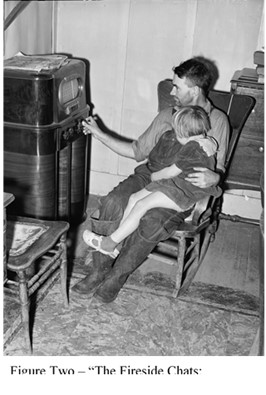
The photograph conveys more than words ever could, as listening to Roosevelt speak in one’s own home highlights the personal connection it made the American people feel. Historian Geoffrey Storm put it perfectly when he says that listening to the fireside chats was “a highly personal, immediate experience that reduced the limitations of geographical separation to forge new, wider notions of community.”[19] Roosevelt intended for his fireside chats to sound personal, as though he were addressing each listener individually, rather than delivering a formal, distant speech. At the time, the radio served as a revolutionary technology capable of bringing the president’s voice as though he were right there in the room with them. Prior to radio, people in different sections of the country frequently did not hear directly from the president because of geographic distance.[20] It was so personalized that Lewis notes that “some people placed Roosevelt’s picture beside their radios, so they might see him as he spoke.”[21] This highlights the intimate relationship listeners developed with Roosevelt, viewing him as a personal figure rather than just a distant politician. To have a picture of the president in one’s home means it was a source of comfort, familiarity, and reassurance. Bridging the physical gap between himself and the American people, Roosevelt’s fireside chats helped to strengthen the relationship and make him feel less like an inaccessible politician and more like a trusted presence in every home.

            In addition to creating a personal connection, Roosevelt’s fireside chats were characterized by his use of simple, clear language that spoke directly to the concerns and experiences of ordinary Americans. Roosevelt made that motivation clear too. During his very first fireside chat, on March 12 1933, titled “Fireside Chat on the Banking Crisis,” he emphasized that his actions were “for the benefit of the average citizen.”[22] Instead of using complex political or economic terminology, Roosevelt broke down the issues at hand into terms that anyone could understand, regardless of their background or education. He carefully explained the banking crisis and the steps the government was taking to address it in straightforward language, ensuring that people felt informed and reassured— given the circumstances, that reassurance was certainly needed. He referenced this again seven years later in another fireside chat, having said “I tried to convey to the great mass of American people what the banking crisis meant to them in their daily lives.”[23] Furthermore, not only did Roosevelt talk without political jargon, like a real person, but he as well had an “informal delivery” that contributed to accessibility.[24] Roosevelt’s approachable tone made listeners feel comfortable sending letters to him in response to his fireside chats. For example, F.B. Graham, a woman who wrote to Roosevelt after listening to one of his fireside chats, described them as “neighborly” and noted that “in simple words [he] explained the great things he had done, so that all us unfamiliar” would understand.[25] This letter, written by a listener who was not a political expert but a regular American citizen, demonstrates the easy comprehension of the fireside chats. Roosevelt’s use of simple language, paired with his informal yet authoritative delivery, allowed him to communicate effectively with people across the nation. From this understanding, Roosevelt built a unique relationship with the American people, increasing his popularity. By addressing ordinary citizens in a language they could easily understand, he made complex policy discussions feel personal and approachable, rather than distant and formal.

By speaking in simple, relatable terms, Roosevelt made political issues more understandable, which opened up the political process, encouraging greater public participation and involvement in government decisions. Roosevelt’s decision to speak informally went beyond just making his message clearer to the public. The fireside chats were a deliberate effort to make politics more approachable and relatable for ordinary Americans. The fireside chats were void of political lingo that those “unfamiliar with the technicalities” would be confused by.[26] At the time, political discourse remained largely secluded to the educated elite or political insiders. Roosevelt’s straightforward language invited a wider range of citizens— regardless of their social or educational background— into the conversation. Something essential during this time was that the banking crisis ruined thousands of normal American lives. By opting for simplicity he made it possible for the people being affected to understand the issues at hand. This gave them a sense of participation in the national dialogue and empowered them to engage more deeply with the decisions that shaped their desperate circumstances. By ensuring that Americans from various parts of society understood the topics being discussed, his fireside chats helped close the divide between the public and the government. As historian Leuchtenburg notes, Roosevelt “greatly broadened the political agenda and encouraged outsiders to enter the civic arena” not only through his fireside chats but also by his openness to new ideas and people previously excluded from Washington.[27] By making politics less intimidating, Roosevelt encouraged people to believe that they could engage with and even influence government decisions. Roosevelt himself said this too in his first fireside chat, he made his audience known when he said he was having this broadcast for “the comparatively few who understand the mechanics of banking but more particularly with the overwhelming majority who use banks for the making of deposits in the drawing of checks.”[28] Roosevelt wanted all American listeners to know they were meant to hear this. The fireside chats were not for the banking specialist or politicians, it was to talk to real people with real concerns, who might not fully understand the technicalities of the circumstances. Roosevelt’s fireside chats ultimately contributed to a more informed and involved population by changing their relationship between the people and the government.

The fireside celebrity

            When the radio emerged as a powerful medium, it influenced not only how the American people got their news, but it also marked the birth of a political celebrity. Roosevelt was the first person to mix politics into the entertainment industry, elevating him to household-name status alongside the iconic movie stars of the 1920s and famous athletes. The radio played a crucial role in the development of celebrity culture. Before the rise of the radio, Americans were mostly confined to local communities, with limited access to people or happenings outside of their immediate surroundings.[29] While the film industry had already begun to expand cultural boundaries, the radio offered a different kind of connection. The radio brought national conversations directly into American homes, it was centered on live, real-world content. As for magazine culture, it was alive, but it did not reach people like the radio did.[30] The development of the radio created an expansion of the “bounds of geography.”[31] For example, people in the Midwest could suddenly walk into their living room and hear about the lives of people in the cities. Given that America is not a walkable country, this is essential towards celebrity culture. There cannot be a celebrity culture when regional divides are limiting access. With the radio, every American can listen to events happening nowhere near them, whether it be New York, Hollywood, or overseas. The cities were no longer the sole holders of information—suddenly, anyone anywhere could be an informed citizen. This new level of awareness not only transformed how Americans consumed news but additionally allowed public figures to reach national audiences in ways previously unimaginable. Where once individuals were confined to local newspapers, magazines, or word-of-mouth to hear about the lives of famous people, the radio created an instantaneous, nationwide conversation. It allowed personalities to transcend their regional bases, gaining widespread recognition across the country. This made it possible for figures such as movie stars, musicians, and politicians to become national household names, a phenomenon that would eventually blossom into what is known today as celebrity culture.

            Roosevelt’s widespread media presence cemented his celebrity status, as reflected by the flood of letters he received from ordinary Americans, eager to communicate with their president. The feelings invoked by Roosevelt’s fireside chats made people wish they could talk to him. If the president is already sitting in one’s living room, it only makes sense to continue the conversation by writing to him. Similar to celebrities today, Roosevelt received a lot of fan mail. Roosevelt’s carefully managed persona was embraced by the American people, causing a constant “flow of letters to the White House.”[32] Whether it be a simple hello, a political inquiry, or a message of congratulations— Roosevelt received it all. His desk, often piled high with letters from ordinary citizens, served as a constant reminder of the public persona he fostered with millions of Americans. Each letter was a reflection of their hopes, struggles, and trust in his leadership. According to investigative reporter Stephen Smith, Herbert Hoover, Roosevelt’s predecessor, could not relate. Whereas Hoover received around eight hundred letters a day. Roosevelt received eight thousand.[33] Roosevelt’s ability to connect with the public was not only a product of his own charisma, but also of his family legacy. Harold Holzer, author of President v.s. the Press says that Roosevelt’s cousin, Theodore Roosevelt, had set the foundation for the Roosevelt family’s public image, teaching Roosevelt the power of leveraging personal charm and a strong public presence.[34] The power of this can be seen in Figure 3, a photograph that depicts Roosevelt with a mountain of letters on his desk. This parallels modern YouTubers’ unboxing fan mail videos.[35] Like YouTubers today, sitting in front of a camera surrounded by fan mail, more than they could ever realistically read, Roosevelt was in the same situation a little less than a hundred years ago. Roosevelt’s overwhelming fan mail was a clear sign that his connection with the public went far beyond politics, creating a new type of political figure whose reach and influence rivaled that of modern-day celebrities.
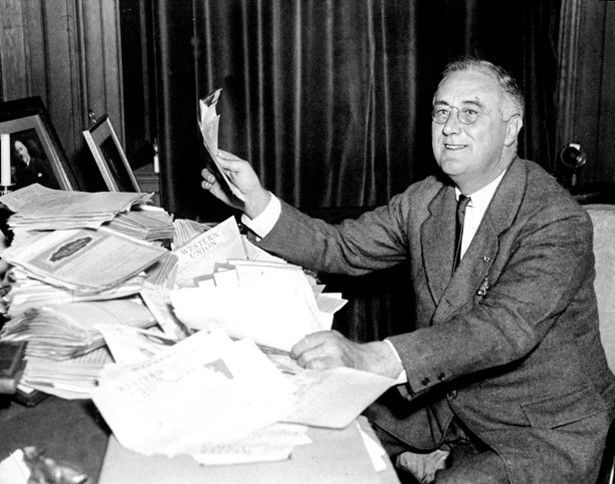
Roosevelt’s influence knew no borders. His communication had a far reaching impact, with listeners all over the globe tuned in. One notable example is a fourteen year old kid from Cuba, named Fidel Castro, who wrote to Roosevelt addressing him as “my good friend Roosevelt.”[36] This personal address demonstrated how Roosevelt’s use of the radio not only connected him with Americans, but also extended his reach to international audiences. His unique ability to make Americans and foreign citizens alike feel personally connected to him made him a “celebrity” in the modern sense of the word. This shift from national leader to global icon marked a new era in political communication, blurring the line between celebrity and politician. The timing was crucial given the context of the Great Depression. During a global crisis, Roosevelt was able to extend his influence and status further than the national borders, establishing him as not merely the leader of the United States of America, but as a figure of widespread fame.

Beyond the spotlight, Roosevelt’s charismatic personality was a calculated approach to public opinion that transformed him into more than just a political leader. Roosevelt became a symbol of trust and stability. The fireside chats provided Roosevelt a unique opportunity to be a politician with a celebrity like relationship. Taking full advantage of the opportunity, Roosevelt carefully scripted his public persona. Steele says in his article “The Pulse of the People,” that this is because Roosevelt “never thought that good government spoke for itself” and actively sought to shape public sentiment, recognizing that public attitudes could significantly impact his administration’s success.[37] Lewis points to how Roosevelt harnessed radio to build his image in a time of crisis, arguing that “Roosevelt used radio to unite a fearful nation and to expand his popular appeal.”[38] Many assume Roosevelt’s high popularity came from “the product of some special intuitive sense,” but Steele argues it was in fact “deliberately constructed and carefully maintained.”[39] By closely monitoring the press and engaging with citizens’ concerns, Roosevelt not only showcased his confidence and responsiveness but also fostered a sense of connection and trust among the public. This proactive engagement helped cultivate a loyal following and reinforced the idea that effective leadership involves understanding and addressing the needs of the American people.[40] Roosevelt’s careful management of public sentiment was not only about maintaining trust— it had also been about restoring and building confidence, particularly during times of uncertainty. During Roosevelt’s second fireside chat, he said it himself: “I made clear to the country various facts that might otherwise have been misunderstood and in general provided a means of understanding which did much to restore confidence.”[41] Therefore, Roosevelt’s celebrity-like status played a crucial role in shaping the nation’s perception of him as a trustworthy and dependable leader during times of crisis.

Long before social media, Roosevelt started the idea of a political celebrity through the power of the radio, using his voice to shape not just public opinion but an entirely new kind of public figure. Roosevelt’s public persona extended far beyond his position in office, with his influence shaping not only political landscapes but also the cultural and social fabric of the nation. This status stemmed from his remarkable ability to connect with the public in a way that felt deeply personal. Roosevelt’s strategic fireside chats fostered a sense of leadership that elevated him to a person of unprecedented recognition and influence. The 1920s movie stars were recognizable and of course everyone knew who Babe Ruth was, but none of them had influence over the country like President Roosevelt did.

            Roosevelt’s fireside chats had a lasting impact that extended far beyond his presidency. The fireside chats influenced future presidents to follow in Roosevelt’s footsteps, by embracing the technology of the time. After Roosevelt died in office on April 12th 1945, his vice president Harry Truman, succeeded him. He continued Roosevelt’s use of the radio, even announcing Japan’s surrender in WWII over the radio.[42] By continuing Roosevelt’s use of the radio, Truman ensured that the nation remained connected during a time of great change and uncertainty, honoring Roosevelt’s legacy and demonstrating the lasting influence of the fireside chats. Over time the development of technology’s effect on the presidency has only deepened. As technology continues to evolve, its influence on presidential communication only grows, shaping how future leaders will connect with the public and furthering Roosevelt’s impact.

            Technological advancements are like fads, they leave just as fast as they enter. Only seven years later and the radio was old news. The television, growing in popularity, quickly became the new staple in every home. In 1952, the Eisenhower campaign became the first to have televised ads. This happened through his series “Eisenhower Answers America,” where just like Roosevelt, Eisenhower directly addressed America. The timing of this was essential given that Lewis says “by 1953, when there were more than 17 million television sets in the United States.”[43] The television proved to be especially useful for addressing controversy, as it allowed candidates to directly engage with the public in a personal and immediate way. A notable example of this is when Eisenhower’s VP, Richard Nixon gave a televised speech famously titled, “Checkers.” Political historian, John Malsberger, notes this speech as having “produced an outpouring of popular support for Nixon and erased doubts about his candidacy.”[44] The televised speech was able to humanize the nominees and clear the air regarding financial concerns the nation had. Roosevelt did the same regularly, in one particular fireside chat, Roosevelt had to clear the air about his Recovery Program. During this broadcast he explained his actions and gave “a word of encouragement,” to help address some of the issues people were having.[45] Roosevelt and Eisenhower understood the power of direct communication through emerging technologies, using radio and television to not only address controversy but also build trust and connect with the American people during times of uncertainty.

            John F. Kennedy took advantage of the television like never seen before. Kennedy’s remarkable charisma and public appeal was a defining feature of his presidency, making it possible for him to connect with Americans in a way that few other leaders had before. Kennedy, like Roosevelt, understood the ability of technological advancements to create a personal connection with the public. Whereas Roosevelt established the use of radio to reach the masses, Kennedy capitalized on the growing influence of television to do the same, using it not just to inform, but to inspire. Kennedy’s personal narrative— his youthful energy, his family legacy, and his polished public persona— played a key role in this media strategy. Holzer notes that Kennedy “brought not only movie star looks to the political table but also a substantial if slightly padded résumé. Like TR [Theodore Roosevelt] a genuine war hero and published writer, he was also, like FDR, the scion of multigenerational political royalty and, like both Roosevelts, a graduate of prestigious Harvard.”[46] This carefully crafted image of Kennedy as both a man of action and intellect helped reinforce the connection he fostered through the media. This point about Kennedy can be directly related to Roosevelt’s aim with his fireside chats. As previously stated, Roosevelt “never thought that good government spoke for itself” and actively sought to shape public sentiment.[47] Beyond his televised speeches, Kennedy’s ability to engage directly with the media was evident from his first day in office. During his inaugural press conference, the young president responded to thirty-seven separate press questions, surpassing Roosevelt’s record and demonstrating his command over complex issues. As Holzer further observes, this moment “placed his grasp of complex matters on full display.”[48] By utilizing television and press interactions in such a direct and accessible way, Kennedy continued the legacy set by Roosevelt, demonstrating how future presidents would adapt to changing media landscapes to connect with the American people.

Both Roosevelt and Kennedy effectively bypassed traditional print media to connect directly with the American public— Roosevelt through radio broadcasts and Kennedy through the television. As Holzer notes, “if FDR possessed the perfect voice for radio, JFK boasted the perfect appearance for TV.” Roosevelt’s strong oratory skills and commanding voice made his radio broadcasts particularly effective. On the other hand, Kennedy’s “irresistible” appearance and charismatic stage presence made him a natural fit for the visual medium of television, where his image played a crucial role in engaging viewers.[49] While Roosevelt’s radio broadcasts relied on the power of voice and verbal persuasion, Kennedy’s television appearances capitalized on the visual appeal and personal connection that the medium offered. Following Roosevelt’s example, Kennedy recognized the power of using a new medium to engage with the American people and continue the tradition of presidents speaking directly to their citizens. Kennedy did this by playing on his natural charisma and good looks.

            The significance of  Kennedy cannot be understood without discussing the first ever televised debate. During this 1960 debate, Democratic nominee Senator Kennedy wiped Republican nominee Vice President Nixon out of the park. This is not something historians or the everyday American would disagree with. Anyone can watch the recording to see Kennedy’s strong stage presence and ability to answer the questions at hand. Nixon on the other hand appeared weak with a very evident cold. His suit was too big, he had sweat dripping down his face, and he looked like death. Many attribute Nixon’s failed televised debate to his loss to Kennedy. Historian Mark White says it is important to note that “Americans who watched it on television thought Kennedy had triumphed,” but those who only listened in on the radio saw the debate as “evenly matched.”[50] People who were able to physically see Kennedy’s golden tan and charisma, were confident in his win. While those who only heard the debate saw the two as equal because there was no visual support giving Kennedy a leg up. The visual impact of the television gave Kennedy an edge. The debates themselves were a series of discussions that stretched over several weeks, each providing both candidates with the chance to present their views. Going into the election, Nixon had significant advantages. As Vice President, he brought extensive experience in foreign affairs and was older than Kennedy, which contributed to his greater experience in office. However, despite these strengths, the youngest person ever to run for president and the first Catholic to do so, Kennedy, ultimately won. Just as Roosevelt’s fireside chats helped solidify his image as a strong leader, Kennedy’s confident appearance during the debate contributed to his image as the more capable candidate. Nixon, despite his experience, struggled with the medium. In both cases, the media became a pivotal force in influencing public opinion and helped determine the outcome of the election.

            Failing to use technology as efficiently as Roosevelt is part of the double edged sword. Nixon won supporters back during his “Checkers” speech, but he was not able to do that following the Watergate scandal. The media’s constant coverage of this stain on Nixon’s record kept the scandal in the public eye and only amplified public skepticism. This made it nearly impossible for Nixon to regain America’s confidence. Unlike his earlier political battles, Nixon could not craft a favorable narrative or regain control of the message. Nixon’s struggles to harness the power of emerging media differed from Roosevelt’s skillful use of radio which helped maintain his public image. Ultimately, Roosevelt’s strategy set a precedent that Nixon was unable to follow.

            Around twenty years later, Ronald Reagan, also known as “The Great Communicator,” won the presidency. Holzer says Reagan “found himself in precisely the right place at exactly the right time to ride the crest of a media revolution,” much like Roosevelt had done during his time in office.[51] Comparably to Roosevelt, Reagan regularly addressed the American people. He did this through “broadcasting weekly Saturday-morning addresses,” to the nation.[52] Reagan’s weekly talks quickly became a fixture in the lives of many Americans, much like Roosevelt’s fireside chats had. Just as families once gathered around the radio to listen to Roosevelt, Americans tuned in to hear Reagan speak in a direct, relatable way. Reagan’s ability to connect with the public caused him to be given the nickname, “The Great Communicator.” This came from his ability to speak casually, friendly, and clearly to the country. Similar to Roosevelt’s fireside chats which resonated with Americans for the same reason. Additionally, Reagan’s Hollywood acting background allowed him to utilize the media in a way not previously done. Reagan was able to swoop in from Jimmy Carter’s negative media portrayal and win the 1980 election. Carter was a Washington outsider— a peanut farmer from Georgia— up against a man who had experience in front of cameras. Reagan’s effective use of media and his ability to connect with the public reflected the lasting influence of Roosevelt’s legacy.

            Even though the internet was emerging during George H.W. Bush’s time in office, with the birth of the World Wide Web and the introduction of email to the White House, he did not fully embrace the potential of the internet. Bush had a bad relationship with the media in multiple forms, including both the internet and the traditional press. Holzer believes that the press was always looking to “embarrass” Bush. This contrasts sharply with Roosevelt, whose effective use of new technology fostered a direct and positive connection with the American people. This left Bush’s suppressor, Bill Clinton, with the opportunity to sweep in “as an appealing Southern Governor,” with an actually good relationship with the media.[53] It was under the Clinton administration that the White House got its own official website, even though it could have been made much earlier during the Bush administration. Having a website meant that news was more accessible due to its far reach, much like Roosevelt’s fireside chats, which connected with a broad audience. When looking at Figure 4, a screenshot from the original White House website, it is clear that the layout was simple and easy to navigate.[54] This allowed the everyday American to see what was going on in the nation, just as Roosevelt’s broadcasts provided clear, direct information to the public. Clinton’s embrace of the internet and his strong rapport with the media allowed him to successfully engage the American public in ways Bush could not, solidifying his place as his successor. Clinton was able to do this because he, much like Roosevelt, recognized the power of the media.

            The power of television is undeniable, just look at the fact that the American people saw George W. Bush’s initial reaction to 9/11 because a camera happened to be on him when he was informed. The footage was released after the fact, but it still goes to show the power of technology. In the last two decades a new technology has taken over the presidency: social media, the current trend in a long line to come. Social media has redefined the way politicians interact with the public, shifting away from the one-way communication style of television and radio. Instead of simply broadcasting messages, social media allows for two-way conversations between politicians and voters. This shift has made politicians more accessible and relatable, as they can now directly respond to questions, share personal moments, and engage in real-time discussions with the public. Modern presidential campaigns depend on it. Holzer credits President Obama’s team as the first in history to use Facebook, Twitter, and YouTube to teach his policies. By using social media, Obama “expanded and personalized his messaging by using the most modern available technologies to reach the widest possible audiences.”[55] This mirrors Roosevelt’s fireside chats which expanded and personalized information access. While Roosevelt’s chats were one-way communications, Obama’s use of social media allowed for two-way conversations, making his messaging even more personalized and interactive. The reach Obama’s Twitter had was unmatched, Holzer says that by the end of Obama’s presidency he “attracted more than 104 million followers— more than anyone in the country at the time, even runner-up singing sensation Katy Perry.”[56] Roosevelt’s fireside chats laid the groundwork for future presidents to connect more directly with the public, and Obama’s use of social media built upon that legacy, and took it one step further by transforming presidential communication into a more interactive and personalized experience.

Similarly, there is another president who took advantage of the changing media landscape and used social media to connect with the American people. That president would be Donald Trump. Trump made communicating with the American people even more direct and even more personal by using his Twitter account as his own personal diary instead of a professional platform. This completely bypasses traditional media narratives. It is important to note that this was the case even prior to his presidency. Before Holzer evaluates Trump’s use of technology, he draws attention to the fact that “Donald Trump commenced deploying Twitter to promote his television series, flaunt his hotels and residential properties, and, most of all, tout himself. It was the perfect merger of technology and personality, medium and messenger.”[57] The Twitter addiction did not falter after Trump’s inauguration. Throughout his campaign, presidency, and impeachment, Trump never stopped tweeting. In a May 2020 The Collegian opinion piece, it was noted that although “Twitter is his preferred form of communication with the country,” Trump frequently claims social media is censoring conservatives.[58] This newspaper reinforces the idea that the American people saw how Trump preferred social media over traditional news outlets. Much like Roosevelt’s use of the radio evading traditional media, Trump did the same, with the added complexity of personal narrative and controversy, reflecting how technology has continued to shape presidential communication.

In today’s media landscape, the power of direct communication has reached such a point that public figures like Trump can choose to bypass traditional media events altogether, such as refusing to attend the White House Correspondents’ Association gala or even a presidential debate. After one bad roast, Trump decided “he would never attend a White House Correspondents’ Association gala again.” He had the power and confidence to refuse an important public relations event because he could speak to the American people whenever he wanted through Twitter. Holzer says Trump had this ability because “by then, his Twitter feed was attracting far more viewers than the correspondents’ affair anyway.”[59] Trump did not need to do any press that gave him even the slightest bit of trouble, he has direct communication at any time he pleases. This shift in power dynamics is evident not only in his refusal to attend traditional events but also in his ability to opt out of presidential debates. Presidential debates were traditionally viewed as essential for candidates to directly engage with the public, it was the candidates time to tell the American people why their policies would help them. Roosevelt did this through his fireside chats, just as Trump did this through his Twitter. Now this country is at a point where candidates have the confidence to rely on their own platform. Trump’s ability to threaten or refuse participation marks a dramatic shift in how political communication is approached. Trump had a platform that allowed him to control the narrative without ever needing to face traditional media or public scrutiny, making debates and other traditional PR events seem optional, rather than necessary. Roosevelt’s legacy was built upon and furthered by Trump’s use of Twitter, transforming presidential communication in ways Roosevelt never could have imagined.

The fireside chats were more than a communication tool. They were a guidebook for future presidents on how to use emerging technology to relate, inform, and inspire the American people. Roosevelt made politics feel intimate, as both a friend and a celebrity figure. Roosevelt’s fireside chats set a precedent for future presidents to engage with citizens on a personal level, bypassing traditional media filters. Since then, presidents have adopted this communication style, which combines current technology, attachment, and accessibility. Each generation of leaders have had to repeat Roosevelt’s history of adapting to the constantly evolving media landscapes to effectively engage with the American people. New technologies will continue to alter the ways presidents communicate, but one thing will remain constant: the need to embrace effective and current communication. Future presidents must draw lessons from the past as technology develops further, striking a balance between the influence of new media and respectable leadership. In an era when political figures communicate through tweets, Roosevelt’s intimate fireside chats remind us of the profound power of personal connection in politics. Roosevelt transformed a nation through the simple act of speaking directly to his people.

Barnes, Jack. “Social Media Companies Ban ‘Dangerous’ Accounts Ahead of 2020 Election After Criticism.” The Collegian Vol. 116, No. 19 (May 2020): 2.       

Castro, Fidel. “Letter to Roosevelt.” Cuba, November 1940.

 “Family Listening to Radio.” National Archives. 1938.

Graham, F. B. “Letter to Roosevelt.” Iowa, n.d.

 “President Franklin D. Roosevelt reads congratulatory telegrams on Nov. 4, 1936, after re-election victory over Alfred Landon.” New York Daily News Archive. November, 1936.

Roosevelt, Franklin Delano. “Fireside Chat on the Banking Crisis.” Radio Broadcast. March, 1933.

Roosevelt, Franklin Delano. “Fireside Chat (Recovery Program).” Radio Broadcast. July, 1933.

Roosevelt, Franklin Delano. “Fireside Chat.” Radio Broadcast. December, 1940.

Roosevelt, Franklin Delano. “Second Fireside Chat.” Radio Broadcast. May 1933.

“The Fireside Chats: Roosevelt’s Radio Talks – Photo 3.” Library of Congress. 1940.

 “The first White House website homepage.” National Archives and Records Administration. 1994.

Holzer, Harold. President v.s. the Press. New York: Dutton, 2020.

Kluskens, Claire. ““Census Fun Fact #3 – Do You Own a Radio Set?” History Hub (October 2020).

Lenthal, Bruce. Radio’s America: The Great Depression and the Rise of Modern Mass Culture. Illinois: University of Chicago Press, 2007.

Leuchtenburg, William Edward. The FDR Years: On Roosevelt and His Legacy. New York: Columbia University Press, 1997.

Lewis, Tom. “‘A Godlike Presence’: The Impact of Radio on the 1920s and 1930s.” OAH Magazine of History Vol 6, No. 4 (1992): 26–33.

Malsberger, John W. “Dwight Eisenhower, Richard Nixon, and the Fund Crisis of 1952.” The Historian Vol 23, No. 3 (2011): 526-547.

Smith, Sam. “Letters to Franklin Delano Roosevelt” APM Reports (November 2014).

Steele, Richard W. “The Great Debate: Roosevelt, the Media, and the Coming of the War, 1940–1941” Journal of American History Vol 71, No. 1 (June 1984): 69–92.

Steele, Richard W. “The Pulse of the People. Franklin D. Roosevelt and the Gauging of American Public Opinion” Journal of Contemporary History Vol. 9, No. 4 (October 1974) 195-216.

Sterling, Christopher H. ““The Fireside Chats”—President Franklin D. Roosevelt (1933-1944)” National Registry (2002).

Storm, Geoffrey. “FDR and WGY: The Origins of the Fireside Chats.” New York History Vol 88, No 2 (2007): 176–97.         

White, Mark. “Apparent Perfection: The Image of John F. Kennedy” History Vol 98, No. 2 (April 2013): 226-246.


[1] Christopher H. Sterling, ““The Fireside Chats”—President Franklin D.  Roosevelt (1933-1944)” National Registry (2002): 2.

[2] Claire Kluskens, “Census Fun Fact #3 – Do You Own a Radio Set?” History Hub (October 2020).

[3] Bruce Lenthall, Radio’s America: The Great Depression and the Rise of Modern Mass Culture (Chicago: University of Chicago Press, 2007), 56.

[4] Sterling, 2.

[5]  Geoffrey Storm, “FDR and WGY: The Origins of the Fireside Chats.” New York History, Vol 88 Number 2 (2007): 176–97.

[6] Storm, 178.

[7] Lenthal; Harold Holzer, President v.s. the Press (New York: Dutton, 2020).; Storm.

[8] William Edward Leuchtenburg, The FDR Years: On Roosevelt and His Legacy (New York: Columbia University Press, 1997).; Richard W. Steele, “The Great Debate: Roosevelt, the Media, and the Coming of the War, 1940–1941” Journal of American History, Vol 71 Issue 1, (June 1984) 69–92.; Richard W. Steele, “The Pulse of the People. Franklin D. Roosevelt and the Gauging of American Public Opinion” Journal of Contemporary History, Vol. 9 Number 4 (October 1974) 195-216.; Tom Lewis, “‘A Godlike Presence’: The Impact of Radio on the 1920s and 1930s.” OAH Magazine of History, Vol 6 Number 4 (1992): 26–33.

[9] Lenthal, 83.

[10] Leuchtenburg, 14.

[11] Telephone: a children’s game where players form a circle, and the first person whispers a message to the next. Each person passes on what they heard, but by the time the message reaches the last person, it’s often distorted.

[12] Lenthal, 7.

[13] Steele, “The Great Debate,” 72.

[14] Lenthal, 58-59.

[15] Lenthal, 77.

[16] See Figure 1.

[17] Leuchtenburg, 14.

[18] See Figure 2.

[19] Storm, 179.

[20] Leuchtenburg, 14.

[21] Lewis, 31.

[22] Franklin Delano Roosevelt, “Fireside Chat on the Banking Crisis.” Radio Broadcast (March 1933).

[23]  Franklin Delano Roosevelt, “Fireside Chat.” Radio Broadcast (December 1940).

[24] Leuchtenburg, 14.

[25] F. B. Graham, “Letter to Roosevelt.” (Iowa, n.d.). “— so that all of us unfamiliar with the technicalities might understand.”

[26] Graham.

[27] Leuchtenburg, 15.

[28] Roosevelt, “Fireside Chat on the Banking Crisis.”

[29] Lewis, 29.

[30] Steele, “The Pulse of the People,” 198.

[31] Lenthal, 56.

[32] Storm, 31.

[33]  Stephen Smith, “Letters to Franklin Delano Roosevelt,” APM Reports (November 2014).

[34] Holzer, 93-94.

[35] See Figure 3.

[36] Fidel Castro, “Letter to Roosevelt.” (Cuba, November 1940).

[37]  Steele, “The Pulse of the People,” 195.

[38] Lewis, 30.

[39] Steele, “The Pulse of the People,” 195.

[40] Lewis, 31.

[41]Franklin Delano Roosevelt, “Second Fireside Chat.” Radio Broadcast (May 1993).

[42]  Steele, “The Great Debate,” 70.

[43] Lewis, 32.

[44] John W. Malsbergerm, “Dwight Eisenhower, Richard Nixon, and the Fund Crisis of 1952.” The Historian, Vol 23 No. 3 (2011): 526-547.

[45] Franklin Delano Roosevelt, “Fireside Chat (Recovery Program).” Radio Broadcast (July 1993).

[46] Holzer, 195.

[47] Steele, “The Pulse of the People.” 195. Quote previously referenced in the prior section.

[48] Holzer, 202.

[49] Holzer, 198.

[50] Mark White, “Apparent Perfection: The Image of John F. Kennedy” History, Vol 98 No. 2 (April 2013): 226-246.

[51] Holzer, 306.

[52] Holzer, 310.

[53] Holzer, 327-328.

[54] See Figure 4.

[55] Holzer, 377.

[56] Holzer, 379.

[57] Holzer, 409. Flog: promote or talk about something repetitively or at excessive length.

[58] Jack Barnes, “Social Media Companies Ban ‘Dangerous’ Accounts Ahead of 2020 Election After Criticism,” The Collegian, Vol 116 No. 19 (May 2020): 2.

[59] Holzer, 409.


Interdisciplinary Teaching and Teacher Education by Dr. Jiwon Kim and Dr. Sandra Zak

Reviewed by Hank Bitten, NJCSS Executive Director and contributing author.

I am writing to you as a contributing author to Interdisciplinary Teaching and Teacher Education rather than as a reviewer. Through this blog post I am hoping to expand your classroom experience, ask you to begin talking about classroom instruction with your colleagues, and challenge you to develop partnerships or connection groups within and outside of your school. I have the perspective of an educator with more than a half-century of experience as a teacher in elementary, middle, high school, and college classrooms and five school districts.

Public education took a step forward in 1852 when Massachusetts became the first state to pass an Act Concerning the Attendance of Children at School. This was a monumental change because every village and city in Massachusetts was required to have a primary school to teach math and grammar. Students were required to be in school for three months with six weeks or more of continued instruction. Parents who did not send their children between age 8 to 14 to school were fined $20, a little more than a week’s wage for a factory worker. Lessons were passive and based on memory and practice.

Fifty years later in the beginning years of the 20th century, John Dewey dramatically shifted the focus to inquiry and problem-solving. Dewey’s instructional philosophy included brainstorming for solutions, testing hypothesis, experiential learning, and models of student government. His model was revolutionary, emphasized an understanding of the big ideas rather than simplistic true and false or multiple choice answers.

William James, a psychologist, understood the influences of the media on children. Children were exposed to advertising and pictures in newspapers and magazines. The media in the beginning of the 20th century was perhaps just as powerful as today’s social media digital platforms as publications overwhelmed the mailbox of the home instead of the inbox on the phone. James understood motivation, the importance of emotional engagement in learning, and the importance of the educational environment on the character and behavior of students.

My college instruction in the 1960s was influenced by Jerome Bruner.  The emphasis was on cognitive growth and a constructivist model of learning. We were taught concepts and how to use relevant experiences to bring meaning to the content in the curriculum. One of the lessons I applied from Jerome Bruner to the teaching of social studies was the influence of culture on how students learn. 

My education as a teacher was influenced by the sociologist James Coleman.  I developed simulations for understanding the big ideas of revolution, social classes, perspectives, and historical changes. I applied my college experiences of debate, Model United Nations, Model Congress, and Mock Trial to simulations of battles, problems in society, and decisions of presidents.  My graduate studies focused on the French Revolution and the insights of The Anatomy of a Revolution by Crane Brinton.

It is in the context of my simulation game, France, 1789, that interdisciplinary instruction became the focus of my teaching of world history, United States History, and African American History. I integrated literature, art, film, and music into my lessons. The engagement of my students was visible and they were applying knowledge and memory to their experiences.

Dr. Jiwon Kim and Dr. Sandra Zak provide a practical guide with explicit examples of how interdisciplinary models in classrooms and school are essential to learning in a Tik Tok culture and why teachers in departments, faculty in smaller schools, and professors of education need to have discussions about the effectiveness of teaching and the extent that students are learning.

The main concern of social studies teachers is that their students cannot write. We observe  children asking Google for answers, completing assignment worksheets in Google Classroom, and engaging with short videos on BrainPOP and YouTube.  My response to teachers who share with me their observations about how their students are learning in middle school and high school is that they need to be taught how to think before they can write. They need to be asked open-ended questions before they can express what they are thinking.  They need to build memory through interdisciplinary learning experiences.

Interdisciplinary education and interdisciplinary instruction are similar and yet very different experiences for students.  In Chapter 3, Christine Grabowski presents graphic models for planning and practical examples of interdisciplinary connections between social studies, math, reading, and art.  Below are examples relating to civic engagement and spatial recognition.

In Chapter 4, I provide explicit examples for teaching climate, U.S. History, Civics, and world history. Intradisciplinary models with integration of geography, economics, and culture provide students with both relevance and engagement. Below is an example of the diverse contributions of people from New Jersey who have impacted the lives of ordinary people.

In Chapter 5, Dr. Mark Pearcy and I present explanations on why interdisciplinary learning is necessary, models for including this in the education of pre-service teachers, and an example of a school district in New Jersey that has multiple opportunities for high school students.  Below is an example of curriculum connections in a World History course.

Perhaps the most important contribution of the collaborative efforts of Jiwon Kim and Sandra Zak are the prompts suggested for discussions between teachers and curriculum directors.  The importance of shared instruction, differentiated learning, and partnerships with local and academic institutions is a good beginning. I hope you enjoy Interdisciplinary Teaching and Teacher Education as much as I enjoyed contributing to it!

Einstein’s Postwar Campaign to Save the World from Nuclear Destruction

Lawrence S. Wittner

This article appeared originally in Foreign Policy in Focus. It is reprinted with permission.

Although the popular new Netflix film, Einstein and the Bomb, purports to tell the story of the great physicist’s relationship to nuclear weapons, it ignores his vital role in rallying the world against nuclear catastrophe. Aghast at the use of nuclear weapons in August 1945 to obliterate the
cities of Hiroshima and Nagasaki, Einstein threw himself into efforts to prevent worldwide nuclear annihilation. In September, responding to a letter from Robert Hutchins, Chancellor of the University of Chicago, about nuclear weapons, Einstein contended that, “as long as nations demand unrestricted sovereignty, we shall undoubtedly be faced with still bigger wars, fought with bigger and technologically more advanced weapons.”

Thus, “the most important task of intellectuals is to make this clear to the general public and to emphasize over and over again the need to establish a well organized world government.” Four days
later, he made the same point to an interviewer, insisting that “the only salvation for civilization and the human race lies in the creation of a world government, with security of nations founded upon law.”

Determined to prevent nuclear war, Einstein repeatedly hammered away at the need to replace international anarchy with a federation of nations operating under international law. In October 1945, together with other prominent Americans (among them Senator J. William Fulbright, Supreme
Court Justice Owen Roberts, and novelist Thomas Mann), Einstein called for a “Federal Constitution of the World.” That November, he returned to this theme in an interview published in the Atlantic
Monthly. “The release of atomic energy has not created a new problem,” he said. “It has merely made more urgent the necessity of solving an existing one…As long as there are sovereign nations possessing great power, war is inevitable.” And war, sooner or later, would become nuclear war.

Einstein promoted these ideas through a burgeoning atomic scientists’ movement in which he played a central role. To bring the full significance of the atomic bomb to the public, the newly-formed Federation of American Scientists put together an inexpensive paperback, One World or None, with individual essays by prominent Americans. In his contribution to the book, Einstein wrote that he was “convinced there is only one way out” and this necessitated creating “a supranational organization” to “make it impossible for any country to wage war.” This hard-hitting book, which first appeared in early 1946, sold more than 100,000 copies.

Given Einstein’s fame and his well publicized efforts to avert a nuclear holocaust, in May 1946 he became chair of the newly-formed Emergency Committee of Atomic Scientists, a fundraising and
policymaking arm for the atomic scientists’ movement. In the Committee’s first fund appeal, Einstein warned that “the unleashed power of the atom has changed everything save our modes of thinking, and thus we drift toward unparalleled catastrophe.” Even so, despite the fact that Einstein, like most members of the early atomic scientists’ movement, saw world government as the best recipe for survival in the nuclear age, there seemed good reason to consider shorter-range objectives. After all,
the Cold War was emerging and nations were beginning to formulate nuclear policies. An early Atomic Scientists of Chicago statement, prepared by Eugene Rabinowitch, editor of the Bulletin of the Atomic Scientists, underscored practical considerations. “Since world government is unlikely to be achieved within the short time available before the atomic armaments race will lead to an acute danger of armed conflict,” it noted, “the establishment of international controls must be considered as a problem of immediate urgency.” Consequently, the movement increasingly worked in support of specific nuclear arms control and disarmament measures.

In the context of the heightening Cold War, however, taking even limited steps forward proved impossible. The Russian government sharply rejected the Baruch Plan for international control of
atomic energy and, instead, developed its own atomic arsenal. In turn, U.S. President Harry Truman, in February 1950, announced his decision to develop a hydrogen bomb―a weapon a thousand times as powerful as its predecessor. Naturally, the atomic scientists were deeply disturbed by this lurch toward disaster. Appearing on television, Einstein called once more for the creation of a “supra national” government as the only “way out of the impasse.” Until then, he declared, “annihilation beckons.”


Despite the dashing of his hopes for postwar action to end the nuclear menace, Einstein lent his support over the following years to peace, nuclear disarmament, and world government projects. The most important of these ventures occurred in 1955, when Bertrand Russell, like Einstein, a proponent of world federation, conceived the idea of issuing a public statement by a small group of the world’s most eminent scientists about the existential peril nuclear weapons brought to modern war. Asked by Russell for his support, Einstein was delighted to sign the statement and did so in one of his last actions before his death that April. In July, Russell presented the statement to a large meeting in London, packed with representatives of the mass communications media. In the shadow of the Bomb, it read, “we have to learn to think in a new way…Shall we…choose death because we cannot forget our quarrels? We appeal as human beings to human beings: Remember your humanity, and forget the rest.”

This Russell-Einstein Manifesto, as it became known, helped trigger a remarkable worldwide uprising against nuclear weapons in the late 1950s and early 1960s, culminating in the world’s first
significant nuclear arms control measures. Furthermore, in later years, it inspired legions of activists and world leaders. Among them was the Soviet Union’s Mikhail Gorbachev, whose “new thinking,” modeled on the Manifesto, brought a dramatic end to the Cold War and fostered substantial nuclear disarmament. The Manifesto thus provided an appropriate conclusion to Einstein’s unremitting campaign to save the world from nuclear destruction.

The Atomic Bomb: Albert Einstein’s Letter to President Franklin D. Roosevelt
Digital History ID 1184
Author: Albert Einstein
Date:1939
https://www.digitalhistory.uh.edu/disp_textb
ook.cfm?smtID=3&psid=1184

Annotation: In August 1939, six months after physicists Otto Hahn and Fritz Strassman had demonstrated the process of nuclear fission, Albert Einstein, at the urging of physicist Leo Szilard, wrote to President Franklin D. Roosevelt about the danger of Nazi Germany creating an atomic bomb.


Document: Sir:
Some recent work by E. Fermi and L. Szilard, which has been communicated to me in manuscript, leads me to expect that the element uranium may be turned into a new and important source of energy in the immediate future. Certain aspects of the situation which has arisen seem to call for
watchfulness and, if necessary, quick action on the part of the Administration. I believe therefore that it is my duty to bring to your attention the following facts and recommendations:


In the course of the last four months it has been made probable-through the work of Joliot in France as well as Fermi and Szilard in America-that it may become possible to set up a nuclear chain reaction in a large mass of uranium, by which vast amount of power and large quantities of new radium like elements would be generated. Now it appears almost certain that this could be
achieved in the immediate future.

This new phenomenon would also lead to the construction of bombs, and it is conceivable-though much less certain-that extremely powerful bombs of a new type may thus be constructed. A single bomb of this type, carried by boat and exploded in a port, might very well destroy the whole port
together with some of the surrounding territory. However, such bombs might very well prove to be too heavy for transportation by air.


The United States has only very poor ores of uranium in moderate quantities. There is some good ore in Canada and the former Czechoslovakia, while the most important source of uranium is the Belgian Congo.


Yours very truly,

In view of this situation you may think it desirable to have some permanent contact maintained between the Administration and the group of physicists working on chain reactions in America. One possible way of achieving this might be for you to entrust with this task a person who has your confidence and who could perhaps serve in an inofficial capacity. His task might comprise the following:


a) to approach Government Departments, keep them informed of the further development, and put forward recommendations for Government action, giving particular attention to the problem of securing a supply of uranium ore for the United States:


b) to speed up the experimental work, which is at present being carried on within the limits of the budgets of University laboratories, by providing funds, if such funds be required, through his contacts with private persons who are willing to make contributions for this cause, and perhaps also by obtaining the co-operation of industrial laboratories which have the necessary equipment.


I understand that Germany has actually stopped the sale of uranium from the Czechoslovakian mines which she has taken over. That she should have taken such early action might perhaps be understood on the ground that the son of the German Under-Secretary of State, von Weizsacker, is attached to the Kaiser-Wilhelm-Institute in Berlin where some of the American work on uranium is now being repeated.
[signed] Albert Einstein


The secret of the bomb should be committed to a World Government, and the United States should immediately announce its readiness to give it to a World Government. This government should be
founded by the United States, the Soviet Union, and Great Britain —the only three powers with great military strength. All three of them should commit to this World Government all of their military strength.


The fact that there are only three nations with great military power should make it easier rather than harder to establish such a government . . . Since I do not foresee that atomic energy is to be a great boon for a long time, I have to say that for the present it is a menace. Perhaps it is well that it should
be. It may intimidate the human race into bringing order into its international affairs, which, without the pressure of fear, it would not do.
https://www.theatlantic.com/magazine/archive/1945/11/einstein-on-the-atomicbomb/656626/

Russell-Einstein Manifesto (London, July 9, 1955)
https://ahf.nuclearmuseum.org/ahf/keydocuments/russell-einstein-manifesto/

In the tragic situation which confronts humanity, we feel that scientists should assemble in conference to appraise the perils that have arisen as a result of the development of weapons of mass destruction, and to discuss a resolution in the spirit of the appended draft. We are speaking on this occasion, not as members of this or that nation, continent, or creed, but as human beings, members of the species Man, whose continued existence is in doubt. The world is full of conflicts; and overshadowing all minor conflicts, the titanic struggle between Communism and anti-Communism.

Almost everybody who is politically conscious has strong feelings about one or more of these issues; but we want you, if you can, to set aside such feelings and consider yourselves only as members of a
biological species which has had a remarkable history, and whose disappearance none of us can desire.

We shall try to say no single word which should appeal to one group rather than to another. All, equally, are in peril, and, if the peril is understood, there is hope that they may collectively avert it.
We have to learn to think in a new way. We have to learn to ask ourselves, not what steps can be taken to give military victory to whatever group we prefer, for there no longer are such steps; the question we have to ask ourselves is: what steps can be taken to prevent a military contest of which the issue must be disastrous to all parties?


The general public, and even many men in positions of authority, have not realized what would be involved in a war with nuclear bombs. The general public still thinks in terms of the obliteration of cities. It is understood that the new bombs are more powerful than the old, and that, while one A
bomb could obliterate Hiroshima, one H bomb could obliterate the largest cities, such as London, New York, and Moscow. No doubt, in an H-bomb war, great cities would be obliterated. But this is one of the minor disasters that would have to be faced. If everybody in London, New York, and Moscow were exterminated, the world might, in the course of a few centuries, recover from the blow. But we now know, especially since the Bikini test, that nuclear bombs can gradually spread destruction over a very much wider area than had been supposed.


It is stated on very good authority that a bomb can now be manufactured which will be 2,500 times as powerful as that which destroyed Hiroshima. Such a bomb, if exploded near the ground or under water, sends radio-active particles into the upper air. They sink gradually and reach the surface of the earth in the form of a deadly dust or rain. It was this dust which infected the Japanese fishermen and their catch of fish. No one knows how widely such lethal radio-active particles might be diffused, but
the best authorities are unanimous in saying that a war with H-bombs might possibly put an end tothe human race. It is feared that if many H-bombs are used there will be universal death, sudden only for a minority, but for the majority a slow torture of disease and disintegration.


Many warnings have been uttered by eminent men of science and by authorities in and both sides would set to work to military strategy. None of them will say that the worst results are certain. What they do say is that these results are possible, and no one can be sure that they will not be realized. We have not yet found that the views of experts on this question depend in any degree upon their politics or prejudices. They depend only, so far as our researches have revealed, upon the extent of the
particular expert’s knowledge. We have found that the men who know most are the most gloomy.

Here, then, is the problem which we present to you, stark and dreadful and inescapable: Shall we put an end to the human race; or shall mankind renounce war? People will not face this alternative because it is so difficult to abolish war. The abolition of war will demand is tasteful limitations of national sovereignty. But what perhaps impedes understanding of the situation more than anything else is that the term “mankind” feels vague and abstract. People scarcely realize in imagination that the danger is to themselves and their children and their grandchildren, and not only to a dimly apprehended humanity. They can scarcely bring themselves to grasp that they, individually, and those whom they love are in imminent danger of perishing agonizingly. And so they hope that perhaps
war may be allowed to continue provided modern weapons are prohibited. This hope is illusory. Whatever agreements not to use H-bombs had been reached in time of peace, they would no
longer be considered binding in time of war, manufacture H-bombs as soon as war broke out, for, if one side manufactured the bombs and the other did not, the side that manufactured them would inevitably be victorious.

Although an agreement to renounce nuclear weapons as part of a general reduction of armaments would not afford an ultimate solution, it would serve certain important purposes. First, any agreement between East and West is to the good in so far as it tends to diminish tension. Second, the abolition of thermo-nuclear weapons, if each side believed that the other had carried it out sincerely, would lessen the fear of a sudden attack in the style of Pearl Harbor, which at present keeps both sides in a state of nervous apprehension. We should, therefore, welcome such an agreement though only as a first step.

Most of us are not neutral in feeling, but, as human beings, we have to remember that, if the issues between East and West are to be decided in any manner that can give any possible satisfaction to anybody, whether Communist or anti-Communist, whether Asian or European or American, whether White or Black, then these issues must not be decided by war. We should wish this to be understood, both in the East and in the West.

There lies before us, if we choose, continual progress in happiness, knowledge, and wisdom. Shall we, instead, choose death, because we cannot forget our quarrels? We appeal as human beings to human beings: Remember your humanity, and forget the rest. If you can do so, the way lies open to a new Paradise; if you cannot, there lies before you the risk of universal death.

Resolution:
We invite this Congress, and through it the scientists of the world and the general public, to subscribe to the following resolution: “In view of the fact that in any future world war nuclear weapons will
certainly be employed, and that such weapons threaten the continued existence of mankind, we urge the governments of the world to realize, and to acknowledge publicly, that their purpose cannot be furthered by a world war, and we urge them, consequently, to find peaceful means for the settlement of all matters of dispute between them.”

The Social Cost of Deindustrialization: Postwar Trenton, New Jersey

Patrick Luckie

Studying local history is something that is often overlooked and underestimated in social studies classrooms around the country. Think about it—do you have any memory of learning about your own local community in a coordinated school or social studies effort? Big ideas like imperialism, global culture, and other themes of the past and present usually take precedence over learning about one’s own local history in the high school. As part of my undergraduate senior research project at Rider University, I grappled with this fact and produced a short study of my own local history which I used to inform my instruction in the classroom. This article will present the research I have done and will end with a short analysis of how my research project on local history has affected my instruction in Ewing High School and how it can change the way we think about teaching local history in all American high school social studies classrooms.

These powerful words were written by Dr. Jack Washington, a teacher of Social Studies in Trenton public schools for over 40 years and author of, The Quest for Equality: Trenton’s Black Community 1890-1965 which traces racial struggle and movements for equality over the city’s history. Trenton’s uniqueness as Washington describes, is a product of its deep history, rooted in the American Revolution, World War II, and the Civil Rights Movement of the 1960s. Trenton was once a manufacturing powerhouse, home to multiple industries which forged the urban landscape of the state’s capital and produced thousands of union jobs for its inhabitants. These included the mighty John A. Roebling’s Sons Company, which aided in the creation of the Brooklyn Bridge and whose factory in West Chambersburg served as a symbol of innovation and opportunity for decades. Trenton’s pottery industry was also one of the largest and most successful in the whole nation alongside its iron, steel, rubber, and textile companies. Together, these industries provided enough stable employment and pay to support a rapidly growing population of mostly first and second generation European immigrants from Italy, Ireland, Germany, Poland, and Hungary, to name a few. Trenton’s manufacturing prowess was best showcased in 1917 with the first lighting of the famous “Trenton Makes, The World Takes” sign on the Lower Trenton Bridge, a symbol which still stands today in 2023.

 The “golden age” of the city, as historian John T. Cumbler describes it, lasted from around 1850 to 1920 when Trenton established itself as one of the manufacturing capitals of the nation.[2] Almost perfectly situated between two of America’s largest cities in New York and Philadelphia, Trenton industrialists used its strategic geographic location along the Delaware River to tap into large markets and supply the massive manufacturing needs of the east coast. Trenton at this time was truly a symbol of the American dream, and people flocked to the city in search of opportunities. By 1920, the population of the city surpassed 119,000 people and it was amongst the most densely populated places in the state of New Jersey.[3]

The first signs of the city’s decline came with the weakening of its labor movement. By the 1920s, the age of mechanization had begun and the economic shift from factory work to mechanized manufacturing began weakening labor unions overtime. Worker’s unions and cooperation between owners and workers alike had been central to the functioning of the local economy and the glue by which the city binded itself together. Overtime, businesses could no longer maintain the standards of work they had previously upheld and conditions within the city started to slowly deteriorate. From 1910-1920 Trenton underwent its largest leap in population within a decade and shortly thereafter it began experiencing some of its greatest economic struggles. Plants began relocating outside of the city and unionized jobs were becoming more and more difficult to attain. Economic historians have grappled with this shift in the post-war era, claiming “US corporations aggressively sought to break free of expensive union contracts and to seek out ways to pay lower wages and allied social costs in order to increase profits.”[4] This is a persistent trend in this study. With great increases in population and the changing state of the local and national economy, Trenton suffered meaningful losses in employment and manufacturing output.

With the Great Depression beginning in 1929 and the waging of the Second World War in 1939, Trenton retreated back to manufacturing and away from addressing the issues surrounding labor which had marked its initial decline. The waging of the war meant a massive nation-wide mobilization of industry towards fueling the war effort. The war-time economy of Trenton temporarily revitalized the city. Roebling’s Sons employed droves of new workers, opportunities for overtime became more available, unions strengthened, worker’s pay went up, and the largest wave of black migrants in the city’s history began making their way to Trenton beginning in the 1940s.[5] These migrants came to Trenton and other cities in what is known as The Great Migration. That is the movement of millions of African Americans predominantly from the rural southern states to the urban north and midwest between 1910-1970.

This temporary boom did not yield long-term progress for Trenton in the post-war period. During the 1950s, many of the city’s largest industries began relocating outside the city limits and the economy did not adequately support its largest ever population of over 129,000 people.[6] In 1952, Trenton’s most popular employer Roebling’s Sons was sold to Colorado Fuel and Iron Company which over the next decade cut its employment numbers in Trenton and relocated its major manufacturing and business centers outside the city limits. This was the fate for many of the most popular industries within the city which sold their shares to larger corporations after WWII, leaving the fate of the city’s economy in the hands of interests which had little to no connection to it. The rubber, steel, iron, and pottery industries which had defined the city of Trenton and produced its “golden age” became shadows of their former selves and the physical conditions of the city reflected this change. Overtime, thousands of industrial jobs were lost and the population of Trenton dropped 13,382 people from 1950 to 1960 and an additional 9,381 people the following decade.[7] Population decline continued to the year 2000 and stabilized between 80,000 to 90,000 in the 21st century. 

This study seeks to answer two fundamental questions: 1) What were the major effects of deindustrialization on Trenton, NJ in the decades immediately following WWIII? 2) How were these effects felt by the people living within the city at this time? In answering these questions, this study will provide a lens through which race and class come to the forefront of the discussion. Trenton’s decline overlaps with the migration of thousands of African Americans to the city in search of economic opportunities. This demographic shift was the largest in the city’s history and was not met with opportunity but rather inequality and increased racial tension. The major effects of deindustrialization on Trenton, NJ in the post-war period were economic destabilization, movement to the suburbs, and increased racial tensions between white and black Trentonians. Each subsection of this work will dive into these effects individually as well as their overall impact on life in Trenton. It is important to recognize that this movement away from manufacturing and its effects were not phenomena restricted to certain areas or regions. Rather it was a national trend which all rust belt cities like Trenton grappled with in the 21st century. In addition to deindustrialization broadly,  the age of mechanized labor, the shifting of the U.S. economy towards greater support for large corporations, and the social movements of the 1960s all played extremely important roles in shaping American cities in the post-war era.

Secondary source literature on the decline of U.S. cities in the post-WWII period falls into the fields of American urban, economic, and social history. One of the most popular works on these subjects is historian Thomas J. Sugrue’s The Origins of the Urban Crisis: Race and Inequality in Postwar Detroit, which examines the many ways in which American cities began to decline following WWII with specific focus on racial inequality and division. In his work, Sugrue states that Trenton, like Detroit and other rust belt cities of the time, experienced hundreds of thousands of layoffs in manufacturing jobs nationwide due to the changing state of the U.S. economy and the lack of government spending allocated towards Northern cities.[8] These conditions radically transformed urban environments into almost unrecognizable versions of their industrial heights. Sugrue explores the connections between suburbanization, demographic change, and the racial attitudes of northern whites to produce an all-encompassing case study of the decline of Detroit. At the heart of his argument is that racial segregation and inadequate political responses to signs of crisis determined the fate of the city. The importance of this historical research cannot be overstated. Before this book was originally published in 1996, the stories of Detroit and other American cities who suffered from the consequences of deindustrialization and racial division in the post-war period were largely untold. The Origins of Urban Crisis continues to be one of the most influential modern studies of American urban history and is without doubt one of the most cited pieces of literature in the field.

Jefferson Cowie and Joseph Heathcott, who together produced Beyond the Ruins: The Meanings of Deindustrialization,built on the historical research of Sugrue by studying the impact of post-war deindustrialization across the nation. This book seeks to progress the conversation of historic decline to modern solutions for urban decay and economic instability. In doing so, it compiles a collection of essays from historians and other professionals to further explore deindustrialization and its impact on American cities.[9] From this perspective, the authors identify a complexity of causes and effects of urban decline which vary from city to city but share many similarities nationally. The value of this work is in its wide-scope. By compiling essays from multiple professionals in a variety of related disciplines, the image of declining cities in the U.S. following WWII becomes more clear than ever.

The most recognized work on post-war deindustrialization in specifically Trenton, New Jersey lies within historian John T. Cumbler’s A Social History of Economic Decline: Business, Politics, and Work in Trenton. This book outlines a long trajectory of economic conditions in Trenton beginning in the 1920s with focus on the Great Depression and researches the changing nature of the city up until the book’s publishing in 1989. One of Cumbler’s main arguments includes the notion that America experienced a gradual economic shift from civic to national capitalism following the Great Depression which empowered large corporations while simultaneously destroying the small businesses which held many industrial cities together.[10] He also explores the rich history of the city’s most impactful industries, politicians, union leaders, and manufacturing workers to provide a comprehensive view of Trenton’s economic and social decline. This work provides the foundation of historical knowledge on Trenton required to produce further research on this topic. However, Cumbler’s history of Trenton does not extend as far into the social consequences and effects of deindustrialization as one might expect. Nevertheless, virtually any modern historical literature on the city of Trenton cites this work. This points to the undying credibility of Cumbler as a historian and shows the importance and relevance of his arguments to the continued study of the city’s history.

More recent historical literature on related topics has largely focused on national trends of suburbanization and racial conflict. One such journal article titled “The Rural Past-in-Present and Postwar Suburban Progress” by University of Waterloo professor Stacy Denton studies the shift towards suburbanization following WWII. The author highlights the transformation of previously rural spaces to suburban landscapes and the implications of such transformations on national attitudes and beliefs towards race, culture, and class.[11] In a similar light, economic historian Leah Platt Bouston’s 2007 work “Black Migration, White Flight: The Effect of Black Migration on Northern Cities and Labor Markets” studies the effects of The Great Migration on northern cities and their economies. She also dives into the racist attitudes of northern whites which manifested themselves in movements out of increasingly diversifying cities and into the surrounding suburbs as part of a process termed “white flight.”[12] Both these works of history are incredibly valuable to this study of post-war Trenton for the topics and findings of their research are amongst the greatest effects of deindustrialization on the city.

The research done in this paper will synthesize the secondary source material on the decline of U.S. cities and apply their findings to a specific case study of Trenton, New Jersey. In doing so, it will paint a clearer picture of the more immediate social and economic effects of deindustrialization on the city in the decades following WWII. This will add to the historiography of urban history and Trenton historical study by compiling primary and secondary source documents to more deeply understand the major effects of deindustrialization and economic transformation on the city.  These major effects include economic destabilization, massive suburbanization, and increased racial tension. These symptoms of deindustrialization were felt most harshly by the city’s poor ethnic-white and growing black population. More specifically, economic decline in Trenton coincided with the arrival of black migrants which compounded racist attitudes and practices within the city. This is most clear in workplace and housing segregation which new migrants had to face upon their arrival.

Industry leaving Trenton following WWII radically changed the city’s local economy. Unionized factory jobs became harder to attain, poor residents were left with fewer options, and Trenton’s growing black community was segregated in their employment. Long-time union workers like those who worked in the pottery and steel plants found themselves in an unfamiliar situation. As Cumbler explained, “Those workers thrown out of work by plant closings had the hardest time finding work and represented the largest number of Trenton’s unemployed.”[13]

The selling of corporations like Roebling’s Sons produced a much weaker focus on the city’s manufacturing growth and output and instead, large corporations sought for the relocation of facilities and workers to outside the city. This left the existing workforce in the city out to dry and decreased options for employment, especially among the lower-income white and minority black populations.

 One action taken by the state and local government to fill this gap created by fleeing industry was growth in the employment of state workers and other public jobs. New Jersey state workers were in the 1950s and 60s, as they still are in the present day, centralized in the capital city of Trenton. Cumbler described this shift from manufacturing to public work as, “Blue Collar to White Collar and White Smock.”[14] This provided some relief to the city’s unemployment problem which exceeded the national average through the 1950s and 60s but it did not come close to meeting the pay and benefit standards that manufacturing jobs had produced just a decade prior. Additionally, the large majority of state workers employed at this time were disproportionately white men. Despite these changes, public and state employment was not enough to lift the city out of its economic slump nor its inherent issues with workplace discrimination.

A large part of the story of economic destabilization in Trenton as a product of deindustrialization was the negative consequences on its black community. Former Trentonian and author Helen Lee Jackson published her autobiography in 1978 charting her experience with racial discrimination as a black woman seeking meaningful employment in the city. Her description of Trenton reads as follows:

In 1940, Trenton was an industrial city with many potteries. Steel mills, factories, and a large auto plant, but the production lines were almost solidly white. Black men swept the floors, moved heavy equipment and shipping crates, and performed other burdensome tasks. In the business sections, they were almost invisible except as window cleaners, janitors, or elevator operators. There were no black salespeople in the stores, banks, or business offices. They were hired as maids, package wrappers, or seamstress. Even the five-and-ten-cent stores refused to hire blacks, except to sweep, dust, or move stock.[15]

Jackson’s firsthand experience with racial segregation and inequality in the city in the 1940s is a reflection of the racial attitudes and prejudices in Trenton and other northern cities earlier in the 20th century. Racist attitudes towards black migrants who largely came from the south was a characteristic of many industrial cities in the U.S. at this time as is highlighted in Sugrue’s work on Detroit and other rust belt cities. With greater numbers of black migrants entering northern cities, the problem of racial discrimination and inequality intensified and the competition for jobs in short supply fuel racist attitudes. According to Sugrue, a combination of factors including employer bias, the structure of the industrial work place, and the overarching ideologies and beliefs of racism and black inferiority contributed to this workplace segregation.[16] For Trenton, these differences in employment were visible to the observer and significantly impacted the lives of those seeking stable income. With the collapse of industry happening simultaneously with a dramatic increase in the city’s black population, this problem compounded. Black residents were not only excluded from whatever factory jobs were left on the basis of their race but they were also labeled as the source of the city’s problems altogether.

In a 1953 study of community services in Trenton, researchers found that the average black resident experienced twice as much unemployment and earned on average 30% less total income than the average white person at this time despite only a one year difference in their average acquired education.[17] These statistics are proof of income inequality and workplace discrimination and provide insight into the lived experiences of black people in Trenton at this time. Furthermore, research from The Journal of Economic History, suggests “black workers were channeled into negro jobs and faced limited opportunities for promotion.”[18] Access to financial resources and meaningful employment were among the largest reasons for black migration to Trenton and other northern cities. Upon their arrival however, they were met with egregious workplace discrimination and were given very little opportunities to climb the economic ladder. Black women specifically made up, “The least utilized pool of potential industrial labor power having much less than proportionate representation with her white counterpart” according to a 1950s study titled, The Negro in the Trenton Labor Market.[19] Many black women, including Helen Lee Jackson, struggled even more so than black men to find employment within the city. These conditions forced economically disadvantaged men and women alike to scramble for jobs and income in order to support themselves and their families.

Changes to the manufacturing economy and workplace discrimination created great instability in Trenton during the 1950s and 60s. Old union workers were suddenly left jobless and the fruits of their loyal labor to the city’s largest industries were now gone. Attempts to revitalize the economy largely failed and economic decline impacted the poor and minority black population of the city more harshly than anyone else in the form of unequal pay and limited job opportunities. With this knowledge, it becomes clear that deindustrialization and the exodus of industry destroyed the economy of Trenton that was historically forged by large-scale manufacturing and robust labor unions and disproportionately affected the new and growing black community.

Another major consequence of postwar deindustrialization on America’s rustbelt cities was the creation of and migration to the suburbs. Suburbs are the areas where urban centers like Trenton, NJ extend into previously rural environments where new housing developments, industries, and townships began to populate with greater and greater numbers of prior city-dwelling individuals. Historian Kenneth T. Jackson’s work on suburbanization titled,

Crabgrass Frontier: The Suburbanization of the United States,  provides the best historical analysis of this phenomenon which swept the nation in the 20th century. Among many important factors, he claims that the roots of suburbanization can be traced to the boom of the automobile industry in the 1920s which enabled those who could afford it to move further and further away from the cities in which they worked. Jackson states, “Indeed the automobile had a greater spatial and social impact on cities than any technological innovation since the development of the wheel” He goes further to explain, “After 1920 suburbanization began to acquire a new character as residential developments multiplied, as cities expanded far beyond their old boundaries, and as the old distinctions between city and country began to erode.”[20]

For Trenton NJ, this shift towards the suburbs was gradual beginning in the 1920s and peaking during the 1950s. It is important to note that suburbanization in Trenton and in cities across the nation happened gradually into the late 20th century. This coincided with a decline in major industries and jobs. Historical research on suburbanization has also revealed that many of these white suburbanites moved to the suburbs to create a physical barrier between them and their racial counterparts.[21] As a result of these factors, thousands of residents with the financial freedom to do so began expanding into the towns on the periphery like Hamilton, Ewing, and Lawrence. Many of whom continued to work as state workers or in other capacities inside Trenton while living outside the city. These towns saw unprecedented growth in the post-WWII years in housing developments thanks to VA and FHA loans which were granted to veterans of the war as part of president Franklin Delano Roosevelt’s New Deal Reforms.[22] It is important to note that these New Deal programs were especially beneficial to white service members and much historical literature has been written about the exclusionary practices associated with housing loans in relation to African Americans. This is relevant because during and shortly after WWII, the largest wave of black migrants traveled from predominantly southern states to Trenton and other northern cities in search of employment opportunities associated with the mobilization of industry towards the war effort. This search for opportunity overlapped with the decay of Trenton’s largest industries, leaving many black migrants below the poverty line, working menial jobs as opposed to fruitful unionized jobs, and in some cases, out of work completely. Compounding these issues was the inaccessibility of reasonable home loans for members of the black community.

The effects of suburbanization on the local economy of Trenton and its inhabitants can be seen through analysis of the popular media. Pride Magazine was a Trenton-based publication which centered its content around black businesses and black business owners. This specific magazine concerned itself with the failure of local politicians to enact positive change in the form of urban renewal plans which were targeted at improving the infrastructure, housing, and employment opportunities within the city. In March of 1972, Pride Magazine issued a publication titled, “Black Businesses Need Your Help!” which featured a section written by the magazine’s publisher Vance Phillips, who received his college education in Trenton. He wrote, “What are we doing to fill the vacuum of the cities which was created by relocation of the established business” He then goes on to say, “After spending 5 years of planning and developing new programs for structural and economic changes, Trenton Model Cities program has failed to meet the potential growth of new and old businesses in our community.”[23] Phillips like many black Americans living in Trenton during the 1970s saw visible signs of the city’s decline through the failure of local businesses. He believed what was needed to fix this problem was a stronger government response along with increased civic action from specifically the black community.[24]

 In this same publication, Phillips expressed his belief that, “a person who lives within the city should have preference over persons living outside of the cities in terms of employment.”[25] Here the author is addressing those who live in the surrounding suburbs but continue to fill job positions within the city limits. This would have been a popular message to Trenton’s black business owning population due to the negative effects that rapid suburbanization had on small businesses within the city.  In this magazine article, Phillips touches on an number of topics which are extremely relevant to this study. For one, the instability of small businesses in the wake of mass-suburbanization which he observed was largely due to the relocation of both industry and people to outside the city. Mostly ethnically-white Trentonians were leaving the city for the suburbs and taking with them their spending power. With population decline being spearheaded by movements to the suburbs, there simply was not enough money being circulated throughout the city to adequately support the small businesses which propped up its local economy.

Another popular message within this passage highlights that with most of Trenton’s workforce shifting into the surrounding suburbs, so too did its voting power.[26] This left black communities who resided within the urban centers even more powerless as a minority to change their own political environment. Suburbanization brought with it a massive decrease to the city’s population and tax-base. The previously 100,000+ populated city now had just around 80,000 inhabitants by 1970.[27] This rapid population decrease meant that the tax revenue generated was not enough to effectively grapple with the issues facing the economy and the evolving workforce.

Furthermore, local culture within the city which had been forged by America’s largest waves of European immigration in the 19th and early 20th century suffered as a result of deindustrialization and suburbanization. Many of the small businesses and social institutions which had historically characterized the city of Trenton were established by first and second generation Italian, Irish, Polish, and Hungarian immigrants. Many of whom traveled from the larger cities of New York and Philadelphia to find industrial jobs in Trenton. Dennis J. Starr’s book, The Italians of New Jersey, outlines the effects of suburbanization on the “old immigrants” of New Jersey, stating:

The movement to the suburbs and smaller urban places paralleled a major transformation of the state’s urban political economy. Following the war, the state’s largest cities did not participate in the postwar prosperity and economic development. Instead, their industrial bases eroded, their mercantile bases moved to suburban shopping malls and their overall, especially affluent white, populations shrank.[28]

The effect of suburbanization on the local culture of Trenton’s longest serving residents is a source of some historical debate. Cumbler notes that, “Despite suburbanization of the more successful Italians and Slavs, many of Trenton’s ethnic neighborhoods seemed as entrenched as ever in the 1950s.”[29] However, the following decades of the 1950s would see even more of Trenton’s staple “old immigrant” communities relocating to the suburbs and with them their cultural values and traditions. That being said, the cultural diversity of Trenton, New Jersey created by its ethnic melting pot of a history can still be felt today in 2023. Walking the streets of some of its most popular neighborhoods like Chambersburg, one can still see and feel the Italian influence of churches, social clubs, and bar-restaurants in the area. The main point here is that culture did suffer as a result of suburbanization and population decline, but it did not die, it rather faded into a less obvious and less present version of its former self.

            Looking at suburbanization as a major effect of postwar de-industrialization on the city of Trenton provides valuable insight into the cities rise and decline as a manufacturing powerhouse. Like many other rust belt cities of this time period, the trend of suburbanization caused unprecedented changes to the city’s local economy and demographics. The loss of unionized industry jobs encouraged many Trentonians to relocate to the surrounding towns which had recently seen great increases in housing development. In the process, those who left the city unintendedly left Trenton out to dry. Money from the pockets of those who moved to the suburbs was desperately needed to support small businesses in the city and their tax dollars could have been used to make meaningful change to the city’s failing infrastructure. As previously discussed, the local culture of the city also suffered as a result of these consequences which only compounded with each decade of further suburbanization and relocation away from the city. With a decreasing population, aging workforce, and a new wave of migrants without sufficient employment opportunities, the city began to decline into an unrecognizable version of its “Golden Age” of the 1920s.

Trenton’s deindustrialization and its history of racism and inequality are inextricably linked. In 1986, Historian Dennis J. Starr published, History of Ethnic and Racial Groups in Trenton, New Jersey: 1900 – 1960, which acts as one of the foremost important pieces of historical literature on Trenton race-relations. This research clearly establishes a link between deindustrialization and increased racial tensions by claiming:

As industries closed down or reduced their work force it became harder for Afro-American migrants to get a toe hold on the traditional ladder of social mobility–a factory job. Meanwhile the city’s sizable Italian, Polish and Hungarian communities became fearful lest their jobs be eliminated, their neighborhoods integrated. A siege mentality developed in light of the population shifts and exodus of industries, commercial businesses, colleges and government offices.[30]

This “siege mentality” was amplified overtime with the overcrowding of black communities in Trenton and the extension of black-owned or rented residences into shrinking ethnically white neighborhoods.

Between 1950 and 1960, Trenton’s black population rose to 22.8 percent of the total population. As discussed earlier, Trenton was a historically segregated city but in the 1950s and 60s this racial division took on a whole new light given the increases in population and decreases in economic opportunities and industry.[31] Trenton historian Jack Washington described Trenton following WWII stating, “That the 1950s was a period of benign neglect for the Black community is an understatement, for Black people were forgotten while their economic and political troubles continued to mount.”[32] These economic troubles can be seen most clearly through examination of housing segregation in the city and its continued influence on the lives of Trentonians. Along with housing and workplace discrimination, ethnically white residents used black migrants as scapegoats for their city’s economic misfortunes and decline.

            Housing in Trenton, NJ after the postwar years can be characterized as both segregated and worse for wear. Following the largest influx of black immigrants to the city in the late 1940s and early 50s, this new population was largely forced to live in the Coalport and Five Points areas of the city on its interior.[33] Housing opportunities for black residents were few and far between and were in most cases aged and deteriorated. Starr shed light on this inequality revealing, “By 1957 over 80 per cent of the city’s housing was over 50 years old and 20 percent of all housing units were dilapidated or had deficient plumbing.”[34] This was a problem for all city-dwellers and stood as a marker of the city’s decline following deindustrialization. For the black community, this problem was especially real given that the neighborhoods with the worst physical damage and infrastructure were those areas in which they settled. A 1950s survey of the city titled, Negro Housing in Trenton found, “the percentage of substandard housing among the Negro population is four times higher than that for the general population.”[35] Not only were black Trentonians limited in their occupation but also in the location and quality of their housing. This same study of housing in Trenton concluded that 1,200 new residential spaces would have to be erected in order to meet the needs and standards of the city. These spaces were not created and public housing efforts did not meet the requirements of the new growing population.[36]

With little options for housing, a lack of policy action to create new housing, and increases to the population, black migrants had no choice but to expand into Trenton’s old ethnically-white neighborhoods. In the eyes of many in the white majority, black migrants were the corrupting force which acted to take down their beloved city. Declining social and economic conditions in the city paired with old racist tendencies to produce conflict between ethnic groups. Cumbler eloquently explains this clash stating:

The decline of their industrial base narrowed the boundaries of choice for both white and black Trentonians, and in doing so it intensified conflict between them. Increasingly, Trenton’s problems became defined by the city’s white residents in terms of growth of its black population. Actually, its problems had other sources: the loss of its tax base with the closing down of factories, dilapidation of the existing housing stock, and the declining income of its citizens of whatever color.[37]

This excerpt captures the situation in Trenton during the 1950s and 60s in terms of race relations and the overall decline of the city. Racist attitudes were not a new trend in Trenton but were compounded with the arrival of large populations of black migrants. From the white perspective, black migrants were aiding in the destruction of the city. From the black perspective, Trenton did not provide the necessary resources for which they traveled north in search of in the first place.

The 1960s and the Civil Rights era was the historical boiling point for racial tensions and division in Trenton. The influence of the NAACP and other organizations for the advancement of racial equality along with intense riots brought race and class to the forefront of Trenton’s post-industrial issues. Most impactful, Trenton race riots following the assassination of Dr. Martin Luther King Jr. exploded in early April of 1968. These riots lasted for multiple days and resulted in fires erupting around the city as well as over 7 million dollars in damage to over 200 different businesses in Trenton at the time. During the chaos, around 300 mostly young black men were arrested by Trenton Police. The devastating damage to the downtown section of the city caused many to flee and abandon it altogether in the years that followed.[38] It would be unfair to say that these riots were a direct result of deindustrialization in postwar Trenton. However, the city’s history of racial inequality and the compounding forces of racial tension as a result of deindustrialization point to the creation of fertile ground for public outrage. Of course, the assassination of Dr. Martin Luther King Jr. served as the catalyst for race riots in the city but the broader history of discrimination and inequality in Trenton suggests an intense decades-long build up to the events that unfolded in April of 1968.

Trenton’s rise and fall as an American industrial city is truly a fascinating case study of the post-war era in U.S. history. What was once a manufacturing powerhouse along the Delaware River strategically placed between the two large cities of New York and Philadelphia was reduced to a shadow of its former glory by the 1950s and 60s. The causes of this decline can be found in the removal of industry away from the city following the war effort and signs of economic decline can be traced as far back as the 1920s. The effects of this shift however, remain the most significant in the broader history of the city. Rapid deindustrialization meant that wages and opportunities were significantly limited for all Trentonians but especially for its segregated black community. Many of those who could afford it elected to move to the surrounding suburbs, bringing with them their tax dollars, their votes, and their culture. Lastly, deindustrialization and the consequences of a radically transformed Trenton increased racial tensions in the form of housing and workplace discrimination.

These effects offer new insights into the Trenton of today. Trenton now has a black majority and interestingly, those same areas which housed black migrants in the 1950s on the city’s interior are still today in 2023 the site of high unemployment and low opportunities. Walking the streets of Trenton, one is quickly reminded of its rich history with many of its houses and abandoned factories still standing today as a reminder of the city’s complicated history. A hopeful message could be that a greater understanding of Trenton’s post-war history could provide the necessary insight to create better living conditions and opportunities for all its residents. However, today Trenton remains a city in an intense state of recovery from its industrial past. Historical research has been done to show that urban renewal plans have largely failed to revitalize the city’s economy in the 20th and 21st centuries and issues such as crime, poverty, drug abuse, poor infrastructure, among others continue to loom over the once prosperous city.

            Today, the “Trenton Makes, The World Takes” sign on the Lower Trenton Bridge still stands bright but its meaning has drastically changed since the last century. What was once a beacon of promise and stability is now a constant reminder of how far the city has fallen from its industrial and manufacturing heights.

Upon completing this research paper on Trenton, I gave a lesson to high school world history students at Ewing High school as part of my undergraduate co-teaching field work. Ewing is one of the border towns to the city of Trenton and was one of the most popular destinations for suburbanites who left the city in the 20th century at least in part because of deindustrialization and the city’s overall decline. The proximity of the topic and the familiarity students  had with popular street names, businesses, and buildings in the city created a feeling of relevance that sparked engagement. Students were surprised to be learning about a topic so close to home and they responded with passionate discussion and the creation of meaningful connections which were sparked through a mix of group and whole class discussions.

For social studies teachers, this successful shift from world history topics to a more grass roots approach to teaching local history can be used as a template for future lessons. Topics frequently come up during different units throughout the school year which deeply relate to the local history of wherever kids go to school. For Ewing students, Trenton’s decline as an industrial city directly related to their lived experiences. Many of my students had lived in or around Trenton for most of their lives. This practice of teaching local history to students is not overwhelming nor is it undoable. The same amount of effort it takes to create a lesson in a world history or AP class can be channeled into research dealing with one’s own local environment and history.

This template for teaching local history can be used to generate engagement in the classroom which is unique to any other topic. Once students are given the opportunity to learn and ask questions about their own town, city, home, etc. they begin to view the world through a more historical lens which is the goal of many if not all high school social studies teachers. Overall, my experience with this approach was overwhelmingly positive and I encourage any and all educators to shift their focus for at least one day of the year towards exploring their own local history and connecting it to larger themes within our discipline.

Black Businesses Need Your Help!. Pride Magazine. Trenton Public Library. March 1972. https://www.trentonlib.org/trentoniana/microfilm-newspapers/

Dwyer, William. This Is The Task. Findings of the Trenton, New Jersey Human Relations Self-Survey (Nashville: Fisk University, 1955).

Lee, Helen J. Nigger in the Window. Library of Congress, Internet Archive 1978.

Negro Housing in Trenton: The Housing Committee of the Self Survey. Trenton Public Library. Trentoniana Collection. Ca 1950.

“Negro in the Trenton Labor Market,” Folder: Community Services in Trenton, Box: Trenton Council on Human Relations, Trentoniana Collection, Trenton Public Library.

“Study of Community Services in Trenton,” Folder: Community Services in Trenton, Box: Trenton Council on Human Relations, Trentoniana Collection, Trenton Public Library.

Trenton Council of Social Agencies, Study of Northeast Trenton: Population, Housing, Economic, Social and Physical Aspects of the Area. Folder: Study of Northeast Trenton. Box 1: African American Experience. Trentoniana Collection. Trenton Public Library. 1958.

Boustan, Leah Platt. “Black Migration, White Flight: The Effect of Black Migration on Northern Cities and Labor Markets.” The Journal of Economic History 67, no. 2 (2007): 484–88. http://www.jstor.org/stable/4501161.

Cowie, J. & Heathcott, J. Beyond the Ruins: The Meaning of Deindustrialization. Cornell University Press, 2003.

Cumbler, John T. A Social History of Economic Decline: Business, Politics, and Work in Trenton (New Brunswick: Rutgers University Press, 1989).

Denton, Stacy. “The Rural Past-in-Present and Postwar Sub/Urban Progress.” American Studies 53, no. 2 (2014): 119–40. http://www.jstor.org/stable/24589591.

Division of Labor Market and Demographic Research. New Jersey Population Trends 1790 to 2000 (Trenton, NJ: New Jersey State Data Center, August 2001).

Gibson, Campbell. U.S. Bureau of the Census: Population of the 100 Largest Cities and Other Urban Places in the United States: 1790 – 1990, (Washington D.C.: U.S. Bureau of the Census, 1998).

Jackson, Kenneth T. Crabgrass Frontier: The Suburbanization of the United States. Oxford University Press, 1985.

Leynes, Jennifer B. “Three Centuries of African-American History in Trenton.” Trentoniana Collection. Trenton Historical Society. 2011.

Starr, Dennis J. “History of Ethnic and Racial Groups in Trenton, New Jersey, 1900-1960,” Trentoniana Collection. 1986.

Starr, Dennis J. The Italians of New Jersey: A Historical Introduction and Bibliography. New Jersey Historical Society. Newark, NJ. 1985.

Strangleman, Tim, James Rhodes, and Sherry Linkon. “Introduction to Crumbling Cultures: Deindustrialization, Class, and Memory.” International Labor and Working-Class History, no. 84 (2013): 7–22. http://www.jstor.org/stable/43302724.

Sugrue, Thomas J. The Origins of the Urban Crisis: Race and Inequality in Postwar Detroit. (Revised Ed.). Princeton University Press, 2005. Originally published 1996.

Washington, Jack. The Quest for Equality: Trenton’s Black Community 1890-1965. Africa World Press. 1993.


[1] Jack Washington, The Quest for Equality: Trenton’s Black Community 1890-1965, Africa World Press, 1993, 56.

[2] John T. Cumbler, A Social History of Economic Decline: Business, Politics, and Work in Trenton, (New Brunswick: Rutgers University Press, 1989), 9.

[3] Division of Labor Market and Demographic Research, New Jersey Population Trends 1790 to 2000 (Trenton, NJ: New Jersey State Data Center, August 2001), 23.

[4] Tim Strangleman, James Rhodes, and Sherry Linkon, “Introduction to Crumbling Cultures: Deindustrialization, Class, and Memory.” International Labor and Working-Class History, no. 84 (2013), 19.

[5] Cumbler, A Social History, 132-133.

[6] Campbell Gibson, U.S. Bureau of the Census: Population of the 100 Largest Cities and Other Urban Places in the United States: 1790 – 1990, (Washington D.C.: U.S. Bureau of the Census, 1998)

[7] Division of Labor, New Jersey Population Trends, 26.

[8] Thomas J. Sugrue, The Origins of the Urban Crisis: Race and Inequality in Postwar Detroit, (Revised Ed.), Princeton University Press, 2005, Originally published 1996, 128.

[9] Jefferson, Cowie & Joseph Heathcott, Beyond the Ruins: The Meaning of Deindustrialization, Cornell University Press, 2003. 1-3.

[10] Cumbler, A Social History, 93-95.

[11]Stacy Denton, “The Rural Past-in-Present and Postwar Sub/Urban Progress,” American Studies 53, no. 2 (2014): 119.

[12]Leah P. Boustan, “Black Migration, White Flight: The Effect of Black Migration on Northern Cities and Labor Markets.” The Journal of Economic History 67, no. 2 (2007): 484-485.

[13] Cumbler, A Social History, 147-148.

[14] Cumbler, A Social History, 145.

[15] Helen J. Lee, N—-r in the Window, Library of Congress, Internet Archive 1978, 131.

[16] Sugrue, Urban Crisis, 93-94.

[17] “Study of Community Services in Trenton,” Folder: Community Services in Trenton, Box: Trenton Council on Human Relations, Trentoniana Collection, Trenton Public Library, 8.

[18] Leah P. Boustan, “Black Migration, White Flight” 485-486.

[19] “Negro in the Trenton Labor Market,” Folder: Community Services in Trenton, Box: Trenton Council on Human Relations, Trentoniana Collection, Trenton Public Library, 33-34.

[20] Kenneth T. Jackson. Crabgrass Frontier: The Suburbanization of the United States, Oxford University Press, 1985, 188.

[21] Stacy Denton, “The Rural Past-in-Present,” 119.

[22] Cumbler, A Social History, 139.

[23] Black Businesses Need Your Help!. Pride Magazine. Trenton Public Library. March 1972, 5

[24] Black Businesses, Pride Magazine, 6

[25] Black Businesses, Pride Magazine, 6-7

[26] Black Businesses, Pride Magazine, 6-7.

[27] Gibson, U.S. Bureau of the Census, 43.

[28] Dennis J. Starr, The Italians of New Jersey: A Historical Introduction and Bibliography, New Jersey Historical Society, Newark, NJ 1985, 54.

[29] Cumbler, A Social History, 148-150.

[30] Dennis J. Starr, “History of Ethnic and Racial Groups in Trenton, New Jersey, 1900-1960,” Trentoniana Collection, 1986, 16-17.

[31] Cumbler, A Social History, 153.

[32] Washington, The Quest for Equality, 136.

[33] Trenton Council of Social Agencies, Study of Northeast Trenton: Population, Housing, Economic, Social and Physical Aspects of the Area, Folder: Study of Northeast Trenton, Box 1: African American Experience, Trentoniana Collection, Trenton Public Library, 1958, 53-54.

[34] Starr, Ethnic and Racial Groups in Trenton, 15.

[35] Negro Housing in Trenton: The Housing Committee of the Self Survey, Trenton Public Library, Trentoniana Collection, ca 1950s , 63.

[36] Negro Housing, Housing Committee, 67.

[37] Cumbler, A Social History, 156.

[38] Jennifer B. Leynes, “Three Centuries of African-American History in Trenton,” Trentoniana Collection, Trenton Historical Society. 2011, 3-4.