Telling School Tales: Rural School History Research

In 1998, my first teaching position in Little Valley Central School District in Cattaraugus County New York, as a social studies instructor led to a career exploring the nooks and hollows of educational history across the Empire State (Jakubowski, 2020; 2023). The former school district is part of the Appalachian region of New York State, which includes 14 counties from Lake Erie to the Catskills. This district was undertaking an annexation study, or school district reorganization attempt in my first year. I knew nothing of these events, and was unaware that there was a nearly 100 year history of rural school reform focusing on creating more urban-like schools in rural areas (Jakubowski, 2020).  The first major community activity surrounding a reorganization, or merger is the Boards of Education voting to undergo a study. After the districts are presented with the study, the Board then votes to accept the study. If this passes both boards, it is sent to the community in a non binding, or advisory vote (straw). When the straw vote passed in both Cattaraugus and Little Valley, people began to protest outside the school every morning and evening, to “save the panthers” or to “save the heart of LV” as I remember the sign read. My students were pulled from extracurriculars by their parents in order to protest the potential merging of the two districts, Cattaraugus to the north, and Little Valley, a one building K-12 district with just under 300 students. When the “binding vote” happened that year, and the Cattaraugus community defeated the proposed measure, we wondered, “What next?”

I left the district that fall, to move to central New York, and once again, a school centralization impacted my life. A family member’s teaching position was abolished, because the five year moratorium had expired. After a few resignations and retirements, the family member was once again employed. This is an all too unfortunate reality across Appalachia’s schools, as decreasing population, and wealth decline usually results in less money for school budgets, and personnel.  I was once again wondering “What next?” This time, I used a Masters level research paper (unpublished, 2004)[1] to begin to pursue what has been a twenty-year scholarly chase through the rural, upstate, and state education department policy of recommending schools which are, according to the 1947 and 1958 Master Plan for School District Reorganization, too small to produce efficient, or effective programming for their children[2]). I also learned that New York State’s policy towards rural districts is as Fulkerson & Thomas (2019) describe it “urban normative” or the urban areas are the norm, and should be promoted as an ideal form of local government.[3] So I dug deep, and researched cases of successfully undertaken and defeated centralizations, or consolidations, or mergers, or reorganizations.[4] The history of why so many reorganizations failed post 1960 became an obsession. I learned from my pursuit of the 20th and 21st century of educational history of New York two major tracks: most educational historians write on the early period (founding of New York as a colony to just after World War I) and second, the state’s citizens have experienced some major fights with the state bureaucratic system in Albany over really basic issues of democracy, local control, and what citizenship means.

Telling tales out of school, as the title implies is often thought of as a negative, and uncivilized approach, yet I view these two tales, about Kiantone and Morganville, as critical, and very necessary to explain some of the basic urban rural divide of New York State, and further the rural anger deployed at government, which observers believe is current, but is actually rooted in Post World War II actions by the the State Education Department.[5]

The State of New York has, as Tracy Steffes writes in her seminal work, been interested since the late 1800s in “reforming” rural schools through strategic aid packages to develop longer terms and more “professional” schools in rural areas.[6] Thomas Mauhs-Pugh described how the local school governing boards were once held as exemplars, because they created “12,000 little republics” that taught governing principles at the local level.[7] Benjamin Justice combed the archive to discover how religious governing practices amongst local Board of Education members often resulted in appeals to the State Education Department.[8] Heffernan’s article on the conflict between State Education Department expectations for school facilities and local board’s realities describe how dissonance started in the early 20th century between the professionals and the public.[9]  Chiles’ work on Progressive era school reform describes how Gov. Smith undertook school reform in rural areas as a signature effort among his governorship, and later presidential aspirations.[10] Loveland’s dissertation on the transition between the State Superintendent for Education to the University of the State of New York’s Commissioner of Education and President is a landmark in describing how the first three leaders at the newly created State Education Department had created a policy of rural school reform[11]. As Parkerson & Parkerson wrote in the crucial book on rurals school reform, the “ABCs” or Assessment, bureaucracy and consolidation, have haunted, especially in New York, rural schools who try to survive in the midst of population decline, decreasing wealth, and state policy which relies on a long standing deficit narrative, which Biddle & Azano expose as more than 100 years old.[12]

Having learned about the New York Master Plan for School District Reorganization (which is still in effect in 2023) I began to explore areas close to where I was living at the time, namely Genesee County, and discovered a huge gap in my understanding of the creation of the present day accepted “Central School Districts.” Many New Yorkers take for granted these post-Depression era created districts, many of which did not assume final form until the midst of the Cold War. These often hyphenated schools recall a vague history, or “mystic chords of memory” as Kammen would call it,[13] of the past, prior to the baby boomers (post World War II) entering school and gaining an affiliation as members of those relatively newly created schools. As Osterude describes in a profound work on the Broome County area, identity, and affinity moved from community to the newly created school districts, often built outside of town, and the social hub of the area.[14]  Yet I know from my own experience (auto ethnographic history?)[15] the process must not have been smooth, or why would perfectly rational people hold so closely to an identity or mascot, as much of the national research claimed was the reason centralizations/ consolidations/ mergers are defeated?

Seeking to understand school history, as Carol Kammen, or David Kyvig[16] calls “nearby history” led me to the Genesee County Archives, where I discovered the Morganville Question. At the bottom of the Byron Bergen Central School District 1958 Master Plan entry was a footnote, which caught my attention:

By alteration of boundary, effective Sept. 17, 1951, all of the property in the Town of Stafford, formerly C2 Stafford, was transferred from CS 1 Byron to CS 1 Le Roy. (p. 301).[17]

After meeting with the Genesee County historian, and reading the records from the New York State Archive on the town of Stafford, I went to the town historian, and museum and learned a bit about this “school tale.”[18]

            Stafford 2, Morganville, was one of the wealthier common schools in the area. A community with a pottery manufacturing center, and a two room schoolhouse, the community provided a grade 1-6 education to their children. In a tuition agreement very common until the creation of centralized school districts, and the birth of a semi modern high school in each C.S.D, Morganville partnered with South Byron by sending their secondary students for instruction. When the Centralization petition was launched, the Stafford 2 district residents overwhelmingly voted no, and wanted to maintain their two room schoolhouse, and independence. In records, memos, telegrams, and newspaper reports of the time period, the fight between Morganville (Stafford 2) and SED heated up, and became a back and forth with the end result of the community locking the South Byron Board of Education employee teacher out of the building. The parents refused to send their children.[19] The local school district superintendent, who is a field based representative of the commissioner of education, was on the side of the Stafford 2 (Morganville) representatives.

            The archival records in Genesee county, and the State Archives in Albany record the back and forth memos and telegrams of the bureaucracy and the local residents trying to enter into a positive, less public solution. What became the clue to a second quest was a note on one of the memos from senior SED officials to the bureau and the local superintendent: “We do not need another Kiantone.”[20] More on Kiantone below.

            What finally concluded the “Morganville question” was a bit of bureaucracy, and the intervention of a neighboring district. LeRoy, a larger village in Genesee County, had a well developed secondary school, as befitting an Erie Canal town home to the creators of Jell-o. The leaders of LeRoy offered free transportation and free tuition for schooling to any family in Stafford 2 who could transport their children to the boundary line. Using this subtle recruiting technique, the narrative from Morganville changed from “independent” to “LeRoy” as their demands for a school centralization destination. In one of the communications between the Morganville leaders and SED, the justification given for the break in the previous relationship with South Byron was the expectation of a better quality of secondary education for children at the LeRoy schools. South Byron was, in the opinion of the Morganville leaders, too small and not robust enough.[21]

            The bureaucratic support arrived in the form of the New York State Thruway Authority, and its construction of the mainline branch from Buffalo to Rochester. The layout of the Eisenhower Interstate system, a divided, limited access highway modeled on the autobahn, was a technology and transportation revolution in the United States post World War II. As the Morganville community and the State were seeking a solution to the “question” of where would the children attend school, the Thruway authority indicated that the disruption caused by construction of the thruway and the needed overpass bridges for state and local routes would be a long term logistical problem for Morganville Children to attend South Byron. The authority provided the State Education Department face saving “cover” to move Morganville (Stafford 2) student population to LeRoy. The Morganville residents celebrated a win, and the State Education Department reaffirmed that the Master Plan was a voluntary policy, and the districts presented in the plan were recommended[22].

            This situation was very different than just five years prior, where the Kiantone community south of Jamestown, in the Northern Appalachian region,  experienced the wrath of State Education Department, while participating in a “farmers rebellion” that brought to the fore questions of democracy, local self determination and the international questions of communism, and totalitarianism post World War II.

            Just south of Jamestown, of the “outlying” urban areas of New York State in the mid 1800s, Kiantone was a farming community along the Kiantone creek, with early settlers engaging in what Fox calls resource clearance in the areas of lumbering and then farming. The Kiantone residents erected seven Common Schools as part of the State enabling legislation. As Jamestown to the north, the residents began a long term tuitioning partnership with the secondary academy in Jamestown. Through World War I, and then World War II, the region provided significant material and manpower, and as a local furniture manufacturing hub in Buffalo, became a large urban center devoted to consumer products, and then the war efforts.  At the Fenton- Chautauqua County historical society, the story of Kiantone is well known, and is a special area to the research people, because it represents the hypocrisy of national policy and local actions.[23]

            During World War II, the Rapp-Coudert commission was charged by the New York state Legislature with rooting out communists among college professors in New York City. It also became the leading committee examining how to create a more efficient and effective public school system, with a focus on rural districts. After the New York State Board of Regents inquiry into the condition of public schools in the 1930s, at the height of the Great Depression, the report concluded that rural schools were extremely inefficient, and ineffective. Prior to the centralization movements of the 1930s-1970s, New York was home to a large number of smaller common schools, offering grades 1-6, and or tuitioning children out to neighboring districts. The Master Plan for School District Reorganization reported that in 1930, there were over 10,000 districts in New York State. By 1945, there were just over 5,000 (today, there are just under 700). At the secondary or 7-12 levels, parents would send children to villages based or academies for a secondary education focused on the Board of Regents curriculum and end of course exams introduced just after the Civil War, as Beadie describes. The Rapp Coudert commission established minimums to ensure efficient and effective spending on public education in the state. The commission, under the guise of a voluntary or recommended reorganization plan of 1947 (p. 18) created an organized plan to ensure that proposed districts would meet minimums in grades 1-6 and 7-12.  Those minimums include 1500 dollars for elementary programming and 1800 for secondary expenditures. The minimums for pupil enrollment recommended at least 1000 students in a district.[24] As these recommendations emerged during the World War II era (1941-1945) the final report and “Master Plan” was released in 1947.[25] As the Master Plan was established, residents in each proposed district could submit to the local District superintendent of schools a request to begin the centralization process. Kiantone, with its long standing relationship to Jamestown, had been included in the Frewsburg Central School District proposed area. After some initial negotiations, one of the Kiantone schools was moved to Jamestown,[26] but the rest were included with Frewsburg. 

 Trustees of the Common Schools, and residents,  vigorously opposed this arrangement, and felt, at the minimum, two major negatives precluded their inclusion with Frewsburg. First, the long relationship with Jamestown was primary. Second, the program in Jamestown was far superior to Frewsburg offerings. The Common School trustees in Kiantone refused to turn the key to the school over, and in August of 1948, the attorney for the Frewsburg Central School, accompanied by a “Phalanx” of New York State Troopers “crashed into a human barricade “ (Jamestown Post Journal, August 24, 1948).[27]  A scuffle resulted, with a World War I veteran, who was waving an American Flag, pushed to the ground.  In the ensuing media coverage, comparisons with John Paul Jones, a demand for the House Un American Activities Committee to investigate, and a comparison to the totalitarianism of the USSR and Germany were published. Investigations were launched by the American Legion and the New York State Grange into the incident, and then the State Education Department’s response. Deputy Commissioner Jeru, interviewed by the Post Journal, was rather harsh, and described the residents of Kiantone as self-serving, and neglectful of their children’s future.[28] Commissioner of Education Franscis Trow Spaulding, in speeches, referenced troublemakers in rural areas, who did not see the bigger picture of centralization and the need to create more and better training opportunities[29]. Mrs. Potter, of the area, an Albany Normal School trained librarian, became the spokesperson for the community, and led statewide hearings, rallies, and pressures which resulted in some seismic shifts to state law and policy. First, the Kiantone residents created a private school, and the State Appeals court in Buffalo ruled that private, non organization sponsored schools were legal. This legalized schools unaffiliated with formal organizations, such as religious groups to operate. Second the process was altered (after Morganville) so that a majority of voters in the individual, in existence schools were needed to authorize the centralization or consolidation. This home rule precedent was crucial in the slowing down of enabling consolidations.[30]

The story does not end here, as many districts in the Northern Appalachian Region area of New York have experienced this pressure to reorganize, centralize, or consolidate. In every county, districts have faced pressure to examine consolidation. The ongoing drumbeat of efficiency, and effectiveness from the State policy and political leadership is often matched by local and regional media opinions that “bigger is better.” Yet in large urban districts, “smaller is successful” has been supported by politicians, philanthropists, and others. Why this dissonance? As Fulkerson & Thomas have pointed out, the schema of many policy makers supposes that urban is normal, cities are the way, and rural isn’t worth support or investment.

            These two examples of school district reorganization, whose stories exist in local archives, which to this point, have not been extensively researched, help fill a research gap into the rural rage and distrust of state officials. The two examples provide a demonstrable dissonance between the words, deeds, and actions of the United States government towards democracy overseas, and the internal state government downplaying local communities concerns that their rights were violated and should be subjected to state level bureaucratic planning. No wonder rural residents in New York view state government promises as fleeting and empty.[31]

            I would, in this short essay, recommend that scholars, students, and the curious examine these smaller, more local archives as sources of interesting, compelling, and frankly subaltern histories that do not mirror the narrative which explains the creation of our now taken for granted local governing structures.

Fenton Historical Society of Chautauqua County. Kiantone history files. Jamestown, NY

Genesee County historical society. Local history files. Batavia, NY.

New York State Archives.  Education Department Bureau of School District Organization. File B0477. Albany, NY.

Biddle, Catharine, and Amy Price Azano. “Constructing and reconstructing the “rural school problem” a century of rural education research.” Review of Research in Education 40, no. 1 (2016): 298-325.

Chiles, Robert. “SCHOOL REFORM AS PROGRESSIVE STATECRAFT: EDUCATION POLICY IN NEW YORK UNDER GOVERNOR ALFRED E. SMITH, 1919–1928.” The Journal of the Gilded Age and Progressive Era 15, no. 4 (2016): 379-398.

Fulkerson, G. & A. Thomas. Urban normativity. Lexington, 2019.

Heffernan, Karen M. ““Much more chewing”: a case study of resistance to school reform in rural New York during the early twentieth century.” Paedagogica Historica (2021): 1-19.

Jakubowski, C. Rural school consolidation: A case study. Unpublished seminar paper, SUNY Binghamton, 2004.

Jakubowski, C. Hidden Resistance. Unpublished PhD Dissertation, SUNY Albany, 2019.

Jakubowski, C. School Consolidation. New York State Archives Magazine 20.1, 2020.

Jakubowski, C. A Cog in the Machine.  Alexandra, VA: Edumatch, 2021.

Jakubowski, C. Rural Education History: State Policy Meets Local Implementation.Lexington, 2023.

Jakubowski, C. Schooling for a Fight. Lexington Press (expected publication 2025).

Justice, Benjamin. The war that wasn’t: Religious conflict and compromise in the common schools of New York state, 1865-1900. SUNY Press, 2009.

Kammen, Carol. On doing local history. Rowman & Littlefield, 2014.

Kammen, Michael. Mystic chords of memory: The transformation of tradition in American culture. Vintage, 2011.

Kyvig, D. et al.  Nearby History: Exploring the Past Around You, 4th ed. Lanham, MD: Rowman & Littlefield, 2019.

Loveland, Fred Gerald. Victor M. Rice and Andrew S. Draper: the origins of educational centralization in rural New York State. State University of New York at Buffalo, 1993.

Mauhs-Pugh, Thomas J. “12,000 Little Republics: Civic Apprenticeship and the Cult of Efficiency.” New York History 86, no. 3 (2005): 251-287.

New York State. Master Plan for School District Reorganization. Albany, 1947

New York State. Master Plan for School Districts Reorganization. Second Ed. Albany, 1958.

Osterud, Nancy Grey. Putting the Barn Before the House. Cornell University Press, 2012.

Parkerson, Donald, and Jo Ann Parkerson. Assessment, bureaucracy, and consolidation: The issues facing schools today. Rowman & Littlefield, 2015.

Spaulding, Francis Trow. Addresses and Papers of Francis Trow Spaulding ,President of the University of the State of New York and Commissioner of Education from July 1, 1946-March 25, 1950. University of the State of New York, State Education Department, 1967.

Steffes, Tracy L. “Solving the “rural school problem”: New state aid, standards, and supervision of local schools, 1900–1933.” History of Education Quarterly 48, no. 2 (2008): 181-220.


[1] Jakubowski, 2004 (SUNY Binghamton, History Department Masters presentations).

[2] NYSED, 1958

[3] Fulkerson & Thomas, 2019

[4] Jakubowski, 2019

[5] Initial findings  presented at multiple Researching New York Conference and Jakubowski (2025)

[6] Steffes, 2008

[7] Mauhs-Pugh, 2005

[8] Justice, 2009

[9] Heffernan, 2021

[10] Chiles, 2016

[11] Loveland, 1993

[12] Parkerson & Parkerson, 2015, Azano & Biddle, 2016.

[13] Kammen, 2011

[14] Osterude, 2011

[15] Jakubowski, 2021

[16] Kammen, 2014; Kyvig, et al, 2021.

[17] NYSED, 1958

[18] Genesee County historical society, Batavia, NY. Local history files. NYS Archives, Bureau of District Reorganization files.

[19] See footnote 18

[20] See note 18

[21] See note 18

[22] See note 18

[23] Fenton Historical Society, Kiantone School Consolidation files, Jamestown, NY.

[24] Reports of the New York State Legislative Commission (Rapp-Coldert Commission, 1941-1945)

[25] New York State Master Plan for School District Reorganization, 1947.

[26] Master Plan, 1947 p. 107 & 122.

[27] Fenton Historical Society, Kiantone File, Newspaper clippings.

[28] See note 27

[29] Spaulding, 1967

[30] See note 27

[31] Jakubowski, 2019
Underground Railroad Sites in New York’s Southern Tier

Source[1] 

The Underground Railroad was a network of churches, safe houses and community centers that led thousands of people escaping slavery to freedom. Northern states like Pennsylvania played a major role in the progression of freedom, and the trail made several stops in New York, including the Southern Tier counties along the Pennsylvania border. Here are some of the local landmarks near Binghamton that played a role in the success of the Underground Railroad, including private homes and churches across the region.

This Whitney Point home was owned by George Seymore in the late 1850s and was a spot along the Underground Railroad network. During that time most people who lived in the area knew the Seymore home was being used to hide and assist escaped enslaved people. According to former Broome County historian Gerald Smith, the home was later converted into an antique shop called the Underground Antiques and eventually turned into a private residence. 

The Cyrus Gates Farmstead was once used as a sanctuary along the Underground Railroad. On 30 acres in Maine, Cyrus Gates’ home — referred to as “Gates’ white elephant” — was built in the 1850s by a New York City architect. It was added to the National Register of Historic Places in 1999. Gates was a cartographer and surveyor, as well as a vocal abolitionist. Up in the attic, the Gates home had an emergency hiding place. Tucked behind a hidden panel in the back of a cupboard, escaped slaves could crawl into a 10-by-20 foot secret room in the house’s south wing attic, crouching so as not to hit the four-foot-tall ceiling, when they needed to hide.

Members of Park Church, originally named the First Independent Congregational Church of Elmira, were active participants in the Underground Railroad. They included John W. Jones, an escaped slave who helped over 800 travel to freedom through Elmira and Jervis Langdon, a local financier who helped Frederick Douglass escape from slavery. The church offered shelter, provided food and finances, and took legal action against slavery. They also prepared a petition to officially record their stance as an anti-slavery church and in 1871, it became Park Church. In 2006, the church was added to the National Park Service’s Network to Freedom program. 

During the mid-19th century, the home of Dr. Stephen D. Hand stood at the site of the current Binghamton City Hall. After moving to Binghamton and starting a successful medical practice, he took an active role in the Underground Railroad. Hand opened his doors to those seeking freedom. His home was near two existing African American churches — the Bethel Church and the First Colored Methodist Episcopal Church — which created a trio of spots in close proximity offering help. The home was demolished in the 1960s and Binghamton City Hall took its place. The building has a plaque to recognize the significant role the Hand home placed in the Underground Railroad. 

The church, founded in 1838, is a stop on the Downtown Binghamton Freedom Trail, recognized for its role in the Underground Railroad. The historic marker at the site shares its history as originally the AME Zion Church, a site that was a place of worship and safe spot to rest and receive help while traveling. Rev. Jermain Loguen, director of the Underground Railroad in Syracuse, was also pastor at the church in the 1860s.


Tragedy on the Erie Canal: The Harrowing Saga of William and Catherine Harris

https[1] ://www.syracuse.com/living/2025/02/tragedy-on-the-erie-canal-the-harrowing-saga-of-william-and-catherine-harris-and-their-journey-to-freedom.html

Despite widespread and prolonged opposition in many northern cities, President Millard Fillmore affixed his signature to the new Fugitive Slave Act on September 18, 1850. It unleashed a torrent of fear amongst the ever-growing populations of free Blacks and freedom seekers that at any minute slave catchers, who now possessed the ability to forcibly enlist civilians to aid in the recapture of those purported to be enslaved.

In Syracuse, already a hotbed of agitation against the odious legislation for several months, local leaders called for a mass meeting at City Hall on October 4 to further demonstrate their collective resistance. Word of the upcoming gathering reached Rev. Jermain Loguen, who was in Troy on missionary work for the African Methodist Episcopal Church. He decided he must return to the city he called home since 1841 to lend his righteous voice to the proceedings.

Following the speech of his friend, Samuel Ringgold Ward, the Black publisher of The Impartial Citizen, Loguen addressed the massive crowd that spilled out of the hall out onto Montgomery and Market streets with the courage and eloquence that characterized his tireless fight against the inhumane institution he’d escaped almost 15 years prior. He declared that he would not be taken into slavery. “What is my life if I am to be a slave in Tennessee . . . I will not live a slave, and if force is employed to re-enslave me, I shall make preparations to meet the crisis as becomes a man.”

For Loguen, those preparations did not include uprooting his wife Caroline and their children and fleeing to Canada, despite the numerous admonitions of friends to do so. Protected as he was in some regard by geography and a strong network of allies, Loguen could make this bold stand. For many other freedom seekers elsewhere in the Union, particularly those in border states like Pennsylvania, the Fugitive Slave Act left them no choice but to continue running further north.

Less than three weeks after Loguen’s stirring call to action, the city of Syracuse found itself at the center of a human tragedy that illustrated perfectly the fear, anxiety, and cruelty engendered by the new legislation. On October 24, 1850, under the headline “Attempted Suicide of a Fugitive,” the readers of the Syracuse Standard, a paper friendly to the cause of abolition, first learned of the tragic ordeal of the Harris family. In response to the passage of the Fugitive Slave Act, William and Catherine Harris and their 3-year-old daughter had fled Philadelphia days earlier in the hopes of gaining safe transport to Canada via Rochester.

Initial reports stated that Harris escaped his own enslavement in South Carolina years earlier, eventually settling in Philadelphia. According to the testimony that Catherine later gave to Syracuse Police Justice Sylvester House, the two were married in 1843 and lived a quiet and peaceful life, and a few years later the couple welcomed the birth of their daughter. Terrified that he might be captured under the auspices of the new law, William made the fateful decision to uproot his family, and they made their way to New York City. There, they procured tickets to Rochester via the Erie Canal.

The real trouble began once they reached Albany on Thursday, October 17. As Mrs. Harris relayed in her testimony, having purchased their tickets for passage to Rochester they boarded their boat. The problems started almost immediately. Captain Hartwell C. Webster refused to return the Harris’s tickets. They were stuck in the cargo hold with large quantities of clams and oysters, delicacies that had become wildly popular all along the canal route in the 25 years since its completion.

The clams and oysters belonged to a merchant named Silas Cowell, who along with one of the boat hand’s, Jeremiah Cluney, began harassing the Harris family that evening. Somehow, they became aware of William’s status as a fugitive. Compounding their predicament was the fact that Mrs. Harris was of markedly lighter skin tone, being described in the New York Tribune [2] as a “mulatto woman, of interesting appearance.”

 According to Harris’ testimony, Cluney and Cowell continued threatening to handing them over to slave catchers saying, “no n—– could pass this canal without being taken.” Preying on their fear, these men tormented William and Catherine and their three year-old-daughter for the next two days. They even attempted to extort money from William for passage, aware that the Captain had taken their tickets to Rochester. Mrs. Harris stated that Cluney and Cowell made reference to Syracuse as “the place where they said we would be taken.” After days of ceaseless torment, Catherine Harris could not take it anymore. As she stated in her testimony, she “wants to die rather than be taken by the kidnappers.”

Convinced that the slave catchers were waiting on them in Syracuse, she jumped through the moving boat’s window and into the canal with her daughter in her arms somewhere between Frankfort and Utica. Somehow, she was fished out of the nearly eight feet of water. In the commotion, her daughter slipped out of her grasp. The captain refused to stop the boat to look for her body. William went on deck to beg the captain to stop the boat, but to no avail. Cluney threatened to cut his throat if he did not go back below decks. Their daughter was assumed drowned.

Sometime around 10 p.m., on Monday, Catherine and William retreated to the cargo hold, the depths of their misery unimaginable “awaiting their doom.” In her testimony, Mrs. Harris said Cowell confronted them again saying that the crew was going to “take his head off.” William responded that he would rather do it himself. He took his shaving razor and sliced his own throat. For the next five hours, William lay bleeding next to his wife. All the while, Cluney and Cowell sat there playing cards, yelling racist epithets at him and threatening to “knock his brains out” if he so much as moved.

As the morning sun appeared in the skies outside Canastota on Tuesday, October 22, William was able to jump off the boat and began walking on the towpath towards Syracuse. Catherine recounted being able to see him alongside the boat, while Cluney, acting on the orders of the captain, threatened William with violence if he attempted to rejoin his aggrieved wife. As such, he walked wounded and bleeding alongside the boat for over 20 miles until he collapsed by the Lodi locks, near Beech Street. Catherine reported losing sight of him around this time as the boat continued on into Clinton Square. She remained on the boat as it continued west towards Rochester. There were no slave catchers waiting there. It had all been a grotesque and murderous charade.

According to the reports in the Syracuse Journal, William Harris regained consciousness and threw himself into the canal in front of a moving boat just west of the Lodi locks. The boat’s Captain, V.R. Ogden managed to rescue Harris and bring him into Clinton Square, where he was taken and treated by Dr. Hiram Hoyt, a Syracuse physician with abolitionist sympathies. Though Harris was unable to talk due to the wound on his neck, somehow, he communicated his ordeal to Hoyt, who in turn got word to Rev. John Lisle, a Black preacher in the AME Zion Church and pastor of the Second Congregational Church on Fayette and Almond streets. Rev. Lisle offered to head west towards Rochester to find Catherine, which he did at Montezuma. According to Lisle’s testimony, he encountered no resistance from Captain Webster nor the boat’s crew, a far cry from the harrowing experience of the Harrises.

Upon their return to Syracuse, Catherine provided the testimony upon which this essay is based. As a result of her damning testimony, Justice House issued arrest warrants for Webster, Cluney, and Cowell. The three men were detained in Rochester and brought to Syracuse on charges of assault and harassment. Unconvinced by their testimony, which painted William Harris as a disorderly drunk, they were found guilty, fined and jailed.

According to historian Angela Murphy, the Harrises continued their journey to freedom in Canada, though as a family of two instead of three. Their unimaginable suffering found its way into newspapers all over the union from Wisconsin to Maine, Massachusetts and Pennsylvania, Virginia, and even Georgia. It helped galvanize the opposition to the Fugitive Slave Law in a way that rhetoric could not.

Here in Syracuse, the memory of the Harrises persisted, actuating more strident resistance. This resistance would come to a head less than a year later in one of the most profound acts of civil disobedience of the period, when a righteous mob freed Jerry from his jail cell just a few steps from the Clinton Street bridge where Dr. Hoyt found William Harris bleeding from a self-inflicted wound.

“On Tuesday afternoon a colored man named Wm Harris, attempted to commit suicide by cutting his throat with a razor, on the towing path, about two miles east of this city. Harris is from South Carolina, and has been residing in Philadelphia for several years past, but on the passage of the Fugitive Slave Law became alarmed for his safety, and started for Canada, accompanied by his wife and child. In New York he procured a passage ticket for Rochester, but at Albany his ticket was taken from him and destroyed by some persons who threatened to deliver him up unless he paid for his passage again. He succeeded in getting as far as Utica, when his fears were again excited by threats of being taken back to Slavery, and says he was informed by persons belonging to the boat that he would certainly be arrested at Syracuse. He became so much alarmed by these repeated threats, (Whether made in jest or earnest it is now impossible to say) that he determined to commit suicide, and advised his wife to drown herself and their child. Taking his razor he jumped on the towing path and made an attempt to destroy himself by cutting his throat, inflicting a terrible wound, and fainted from loss of blood. His wife, with the child in her arms jumped into the canal about the same time, but was taken out by the hands-on-board the boat. The child was not recovered. The wife was carried west through this city, on the boat, [3] leaving the husband upon the tow path.” Source: Syracuse Standard, October 24, 1850. 

“I was a slave; I knew the dangers I was exposed to. I had made up my mind as to the course I was to take. On that score I needed no counsel, nor did the colored citizens generally. They had taken their stand-they would not be taken back to slavery. If to shoot down their assailants should forfeit their lives, such result was the least of the evil. They will have their liberties or die in their defence. What is life to me if I am to be a slave in Tennessee? My neighbors! I have lived with you many years, and you know me. My home is here, and my children were born here. I am bound to Syracuse by pecuniary interests, and social and family bonds. And do you think I can be taken away from you and from my wife and children, and be a slave in Tennessee? Has the President and his Secretary sent this enactment up here, to you,

Some kind and good friends advise me to quit my country, and stay in Canada, until this tempest is passed. I doubt not the sincerity of such counsellors. But my conviction is strong, that their advice comes from lack of knowledge of themselves and the case in hand. I believe that our own bosoms are charged to the brim with qualities that will smite to the earth the villains who may interfere to enslave any man in Syracuse.

I don’t respect this law- I don’t fear it- I won’t obey it! It outlaws me, and I outlaw it, and the men who attempt to enforce it on me. I place the governmental officials on the ground that they place me. I will not live a slave, and if force is employed to re-enslave me, I shall make preparations to meet the crisis as becomes a man.” Source: The Rev. J.W. Loguen, As A Slave and As a freeman. A Narrative of Real Life (Syracuse, 1859), pp. 391-93; Aptheker 306-308


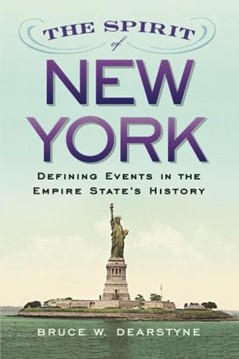
Book Review: The Spirit of New York: Defining Events in the Empire State’s History

This book presents an overview of New York history in the form of 20 exciting, engaging stories. These include, for instance, the beginning of New York State with the completion of the first state constitution in 1777; the “Anti-Rent Wars” in the mid-Hudson region in the 19th century when tenant farmers fought for the right to buy and own their own land; the Seneca Falls’ women’s right convention in 1848, which launched the demand for women’s right to vote and legal equality; and Syracuse citizens’ rescue of a fugitive slave from a marshal who sought to return him to slavery in 1851.

The book describes the campaign against child labor in 1903; the work of pioneering New York aviator Glenn Curtiss, the inventor of several modern airplane flight controls and the first to fly down the Hudson River in 1910; Jackie Robinson’s debut as the first Black major league baseball player in 1947; the construction and opening of the State Thruway in 1954; and the debut of the hit musical, Hamilton, in 2015, and the history behind the events it presents. The narrative for each chapter is woven around what led up to a key event, what happened, and what the results were. The book’s stories feature first-hand, eyewitness accounts by history-makers, participants and observers at the time. The author calls this “a scholarly book for a popular audience.” Because of New York’s historical importance, many of the stories have relevance to American as well as New York history. Social studies and history teachers can use the stories in the book as the basis for their classroom presentations and for study, essays, and discussion by students.

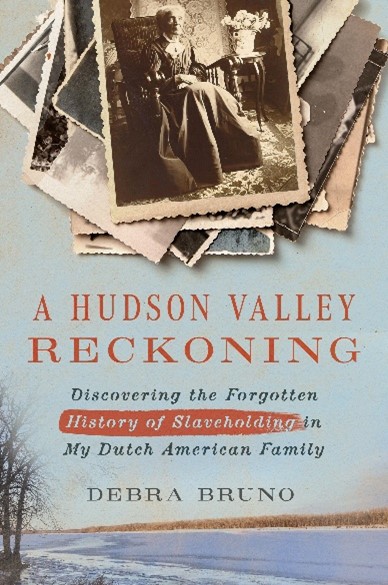
Book Review: A Hudson Valley Reckoning: Discovering the Forgotten History of Slaveholding in My Dutch American Family

For many, slavery in the North is nothing but a long-ago memory, a story that is often untold due to the cruelties of enslavement in the South and the long-lasting impact of enslavement in the Southern part of the United States. The general public is not always aware of the enslavement of African people in the North with only recent discoveries being brought to light. A Hudson Valley Reckoning: Discovering the Forgotten History of Slaveholding in My Dutch American Family showcases the stories of enslaved people who lived in Greene County, New York. The author, Debra Bruno, offers a new perspective on the enslaved in New York by exploring her own lineage and that of a distant cousin named Eleanor.

In this thirteen-chapter narrative, Bruno tells the story of her slave-holding Dutch family and the connection between her relatives and those who they might have enslaved. Eleanor is a descendant of the individuals whom Bruno’s family enslaved. Bruno discusses how historians, politicians, journalists, and every day people have erased significant features of enslavement in the North and painted a quaint picture of enslaved people helping the Dutch with their farms, houses, and livestock. Bruno, however, provides a much clearer picture of the reality of slavery in Dutch New York. She visited Macon, Georgia, and Curacao as she dug deeper into her family’s history.

In the introduction, Bruno describes her upbringing and the proud nature of her family’s Dutch heritage. She draws the reader in by describing her hometown of Athens and Coxsackie, places located along the Hudson River. Her American family began with Lambert Van Valkenburg, who settled in New Amsterdam in the early 1600s and later sold this land relocated on the North River, now the Hudson River. Her ancestor originally owned land in New Amsterdam where the where Empire State Building is located.

While digging into the history of her family, Bruno decided to explore whether they were enslavers. Bruno used Ancestry.com where she found various records including newspaper clippings, census data, photographs, and wills. Valkenburg did not provide significant results, so she searched under Collier, her grandmother’s family name. Bruno found a will from what would be her Great Grandfather five times back. He had many children and grandchildren around the Coxsackie area and left a will bequeathing much of his property to them. As Bruno combed through the pages of the will she saw it, “detailed like inventory along with his property and cows were slaves” (6).

Chapter four illustrates enslavement in the North with an analysis of a painting. “Van Bergen Overmantel” was commissioned by the Van Bergen family in the early 1700s to hang in the family home. It depicted what life was like in 18th century Hudson Valley and “is the first visual evidence of slavery on a New York farm” (56). According to Bruno, in 1714 Coxsackie’s population was 21% enslaved people. and by the 1790s in places such as Brooklyn, New York that number went up to 30%. In the late 18th century New York had an enslaved population of 319,000 enslaved people.

In the following chapters Bruno describes the challenges she faced in finding sources from the enslaved that could detail what their life was like on these farms. She notes that they were threatened with being sold down South or the Caribbean, some ran away killing their masters in the escape, and these details just go to show that enslaved life in the North was not a cakewalk as some may think. Even after being emancipated, African Americans still struggled in New York as they fought their right to be citizens and gain full citizenship rights as discussed in chapter nine.

In a discussion of why this history was so important to recover, Bruno emphasized that the Declaration of Independence and the Constitution, the nation’s founding documents, not grant the same freedoms to all people living on this land, and that individuals must “accept that only some people have benefited from their promises. To deny that and to distance ourselves from that truth is to misunderstand how our county grew, prospered, and exists today” (233.

Using Stories in History and Social Studies Courses

Teachers often find that stories are a good way to engage students in their U.S. history and social studies courses.  Stories illustrate historical themes, bring historical events and characters to life, and leave a lasting impression. People can sometimes remember a particular story from history years later even if they cannot recall all of the context. There are many stories from New York history that may be of interest to teachers in Grades 4 (local and state history), 7-8 (New York and U.S. history). Lots of them are also useful in Grade 11 (U.S. history) because, while the history-makers were New Yorkers, the stories also illustrate national themes and developments as well.

The historical episodes cited below are all good examples of engaging stories. Each one centers around an event or events, illustrates what led up to the event, and also shows the consequences of it. They all fit into and illustrate broader themes in state and local history. Perhaps best of all, they all have exciting people at their core. In several cases, in fact, the story is best told by the people themselves, through first-hand accounts that students can access and use.

The stories included here – and others — are all covered in my three new books, cited at the end of this article. The first privacy law is included in The Crucible of Public Policy, the others in The Spirit of New York and there is also a Glenn Curtiss document in Progressive New York. But the stories are also covered in many other sources. I have tried to cite some of the most helpful for each story.

Two good starting points for any New York history topic are Peter Eisenstadt, ed., The Encyclopedia of New York State (2005) and Kenneth T. Jackson, The Encyclopedia of New York City (2010). Two sites where you can follow developments in New York history and find out about news books are the Office of State History in the State Museum (https://www.nysm.nysed.gov/research-collections/state-history) and New York Almanack (https://www.newyorkalmanack.com). The journal New York History (https://www.cornellpress.cornell.edu/new-york-history) carries articles and book reviews.

New York State’s “Birthday,” April 20, 1777: The upcoming 250th anniversary of the American Revolution is a great time to examine New York’s experiences and its role in the war. At the beginning of 1777, “New York State” did not actually exist yet. A convention elected to draft a constitution worked in Kingston to complete the document on April 20, 1777, in effect New York’s “birthday.” That document laid out state government and powers. The first governor and legislature were elected in the summer and got to work in the fall. Before the end of 1777, New York would survive British onslaughts, including the burning of its temporary capital, Kingston, and invasions from the north, west, and east. 1777 might be called New York’s “miracle year,” an exciting time when the state got started.

William A. Polf’s booklet 1777: The Political Revolution and New York’s First Constitution (1977)is available at https://babel.hathitrust.org/cgi/pt?id=osu.32437123007011&seq=3

A copy of the first state constitution is available on the State Archives website, https://digitalcollections.archives.nysed.gov/index.php/Detail/objects/10485; the text is at https://avalon.law.yale.edu/18th_century/ny01.asp. The Archives Partnership Trust has made available the chapter on the first constitution from my book, The Spirit of New York: https://considerthesource.s3.amazonaws.com/3917/2556/5316/Dearstyne_Constitution_Chapter.pdf

“Anti-Rent Wars,” 1839-ca. 1880: New York tenant farmers in the Hudson valley waged one of the largest tenant rebellions in history in these years. They were fighting for the right to purchase and own the farms; where as tenants they had to pay exorbitant rents. They kicked it off with a declaration against the tyranny of landlords on July 4, 1839. The intrepid farmers’ struggle was waged in the courts, the state legislature, a state constitutional convention, and sometimes through armed resistance to sheriffs who tried to evict them for non-payment of rents. By 1880, most owned their farms, but their struggle had been a heroic and exciting one. Henry Christman, Tin Horns and Calico (1945); Charles McCurdy, The Anti-Rent Era in New York Law and Politics (2001).

Elizabeth Cady Stanton led the campaign for women’s rights. This is really two stories in one – the famous 1848 Seneca Falls women’s rights convention, which demanded the right to vote for women, with Stanton as the chief organizer; and Stanton’s long career as an advocate for woman suffrage and women’s rights generally at the state and federal level (she kept working until the time of her death,1902).

Elisabeth Griffith, In Her Own Right: The Life of Elizabeth Cady Stanton (1984); Lori D. Ginsberg, Elizabeth Cady Stanton: An American Life (2009); Elizabeth Cady Stanton, Eighty Years and More: Reminiscences, 1815-1897 1898; reprint, 1993). Women’s Rights National Historical Park. https://www.nps.gov/wori/index.htm

Syracuse citizens rescued a fugitive slave, 1851. On October 3, 1851, a mob of over 2,000 citizens broke down the doors of a Syracuse police station to liberate William “Jerry” Henry, a fugitive slave, who had been arrested by a Deputy U.S. Marshal under the federal Fugitive Slave Law. That law provided for arrest and return of slaves fleeing the oppression of slavery in the south. New York was an important part of the “underground railroad” which helped escaping slaves find new homes in the North (where slavery was illegal) or Canada (which had also abolished it.). The “Jerry Rescue” was one of the most dramatic events in New York’s growing opposition to slavery. Fergus M. Bordewich, Bound for Canaan: The Epic Story of the Underground Railroad, America’s First Civil Rights Movement (2006); Monique Patenaude Roach, “The Rescue of William ‘Jerry’ Henry: Antislavery and Racism in the Burned-Over District, New York History (2001); Gerald Sorin, The New York Abolitionists: A Case Study of Political Radicalism (1970). “Jerry Rescue” historic marker: https://www.hmdb.org/m.asp?m=138797

New York’s – and the nation’s– first personal privacy law, 1903. In the late 19th and early 20th centuries, advertisers widely used the photos of women in ads for their products, without the women’s consent. There was no law against it. That changed when a seventeen-year old Rochester girl, whose photo was being used in ads for flour, went to court to stop it. The Court of Appeals ruled against her in 1902, but, under pressure from the public, the legislature took up the cause and passed a personal privacy law in 1903, the first in the nation. The main provisions of that law are still on the statute books. New York State Archives Partnership Trust, “Who Owns a Photo of Your Face? The Right of Privacy and the Courts,” (Podcast, October 18, 2022. https://www.nysarchivestrust.org/events/recorded-events); Sarah E. Igo, The Known Citizen: A History of Privacy in Modern America (2018); Jessica Lake, The Face That Launched a Thousand Lawsuits: The American Women Who Forged the Right to Privacy (2016).

Hammondsport aviation pioneer Glenn Curtiss made aviation history. Most students probably have heard of the Wright Brothers and their famous flight at Kitty Hawk, NC in 1903. But the story of their contemporary and rival, Glenn Curtiss, is almost equally important and unknown to post[HB1]  people. Curtiss developed essential airplane designs and controls, including ailerons – adjustable wing flaps on the trailing edges of wings, essential for take offs and landings — still in use today. He made the first pre-announced, publicly witnessed, professionally certified airplane flight (July 4, 1908), and the first flight from Albany to New York City, May 29, 1910). He made the first amphibious flight and convinced the Navy to buy airplanes and train pilots, earning him the title “The Father of Naval Aviation.” This is a story of invention, daring, and doing what has never been done before. Lawrence Goldstone, Birdmen: The Wright Brothers, Glenn Curtiss, and the Battle to Control the Skies (2915); Seth Shulman, Unlocking the Sky: Glenn Hammond Curtiss and the Race to Invent the Airplane (2002); Glenn H. Curtiss Museum, Hammondsport. https://glennhcurtissmuseum.org 

Jackie Robinson broke the color barrier in major league baseball, April 15, 1947. Major league baseball was a whites-only sport until the day in 1947 when Jackie Robinson debuted as the first Black player for a major league team, the Brooklyn Dodgers. Robinson proved to be a stellar player, and his pioneering role paved the way for other Blacks who followed. He also helped undermine racial prejudice and discrimination and was an early example of what would be called the Civil Rights movement. Jackie Robinson and Alfred Duckett, I Never Had it Made: The Autobiography of Jackie Robinson (2003); Carl T. Rowan with Jackie Robinson, Wait Till Next Year: The Life Story of Jackie Robinson (1960); Jules Tygiel, Baseball’s Great Experiment: Jackie Robinson and His Legacy (1983)

Hamilton: An American Musical debuted in New York City. Feb. 17, 2015. The hit musical Hamilton presented the life and achievements of New Yorker Alexander Hamilton, Revolutionary war patriot leader and the first U.S. Secretary of the Treasury, in the form of a lively musical. The play features a multi-ethnic cast, superb acting, smart dialog, humor, and rap and hip-hop musical scores. It recasts Revolutionary era history in the language of today; it is about “America then, as told by America now,” as its writer and lead actor, Lin-Manuel Miranda put it.  This is an exciting way to explore history. Students can study the history behind the musical, watch the musical itself, and compare and contrast the two. Sources: Ron Chernow, Alexander Hamilton (2004); Edward Delman, “How Lin-Manuel Miranda Shapes History,” Atlantic September 29, 2015; Lin-Manuel Miranda and Jeremy McCarter, Hamilton the Revolution. Being the Complete Libretto of the Broadway Musical and a True Account of its Creation (2016)


The John W. Jones Story

Reprinted with permission from https://www.johnwjonesmuseum.org/the-john-w-jones-story

John W. Jones became an active agent in the Underground Railroad in 1851. In 1854, the Northern Central railroad tracks from Williamsport, Pennsylvania to Elmira, New York were completed. Jones made an arrangement with Northern Central employees and hid the fugitives in the 4 o’clock “Freedom Baggage Car,” directly to Niagara Falls via Watkins Glen and Canandaigua. Most of Jones’s “baggage” eventually landed in St. Catharines, Ontario.

By 1860, Jones aided in the escape of 800 runaway slaves. He usually received the fugitives in parties of six to ten, but there were times he found shelter for up to 30 men, women, and children a night. It is believed Jones sheltered many in his own home behind First Baptist Church. Of those 800, none were captured or returned to the South.

Jones became the sexton for Woodlawn Cemetery in 1859. One of his primary roles was to bury each deceased Confederate soldier from the Elmira Prison Camp. Of the 2,973 prisoners who Jones buried, only seven are listed as unknown. Jones kept such precise records that on December 7, 1877, the federal government declared the burial site a national cemetery.

Historically, the house was the private residence of John W. Jones and his family, changed ownership several times, and was last used as rental property that fell into disrepair. Condemned by the City of Elmira in 1997, Lucy Brown brought it to the public’s attention and with a group of concerned citizens, saved it from demolition. The building currently stands on Jones’ original farm property and the site will continue to be visually interpreted as a farm.

The museum highlights the history of African Americans who settled in New York and the activity of local abolitionists, emphasizing Elmira’s role as the only regular agency and published station on the Underground Railroad between Philadelphia and St. Catharine’s, Canada, and explore Mr. Jones’ community involvement and his relationship with his contemporaries.

John W. Jones was born a slave June 21, 1817, on a plantation south of Leesburg, Virginia. He was owned by the Ellzey family, an influential family who treated their slaves with perhaps more kindness than some plantation owners did. Miss Sarah (Sally) Ellzey was fond of John and was a good friend to him. But she was getting on in years and John was concerned about what would happen to him once she passed away.

On June 3, 1844, at the age of 27, John fled north to the place his mother had told him about “where there is no slavery.” It took one month for John, his two half-brothers, George and Charles, and Jefferson Brown and John Smith from an adjoining estate to walk from Virginia to Elmira, New York, a distance of about 300 miles. The route they followed was part of the Underground Railroad coming up through Pennsylvania and into New York by way of Williamsport, Canton, Alba and South Creek. In South Creek they reached the farm of Dr. Nathaniel Smith, where they crawled into the hay mow of his immense barn and went to sleep, more dead than alive. They remained there over night. Mrs. Smith discovered them and cooked food and took it to them. This is the Mrs. Smith whose grave in Woodlawn Cemetery, just beyond the Langdon plot, always had fresh flowers on it and no one knew where they came from. After John Jones died, there were no more mysterious fresh flowers.

John Jones was an ambitious man and never idle. The first thing he did when he arrived in Elmira was to offer to cut wood in exchange for 50¢ for Mrs. John Culp, Colonel John Hendy’s daughter. Another early job he took was in a tallow and candle store working for Seth Kelly. John wanted to get an education, but was refused at first because he was black. Judge Arial Standish Thurston befriended him, realized his potential and made it possible for him to receive an education – in fact, at the same school where before he had been turned down. As a result, John went to school in the winter and worked as janitor for Miss Clara Thurston’s school for young ladies on Main Street. In October, 1847, he was appointed sexton or caretaker of the first church building of the First Baptist Church that had been constituted in 1829 under the name of the Baptist Church of Southport and Elmira. The first members gathered in homes, but as the membership grew they met in a schoolhouse in Southport. By 1832, the membership had grown to the point where they decided to build their own church building. They were sold the piece of land where the Baptist Church still is today for $1.50 by Jeffrey and Elizabeth Wisner who were in-laws of the first pastor, Rev. Philander Gillett. The first building was a barn-like structure constructed at a cost of $954.

By 1848, 16 years later, the Baptists had outgrown that building and decided to build something larger. The 1863 City Directory says this building was constructed of wood, stucco and cost $8000. Mr. Jones was sexton of this second church building for the 42 years that it was in existence.

In 1854 he bought the “yellow house next to the church” from an Ezra Canfield for $500. Two years later, John Jones married Rachel Swails. Rachel’s brother was Stephen Swails, a Lieutenant in the 54th Massachusetts Regiment. If you have ever seen the movie Glory, you know the story of this famous regiment.

By 1859, Jones was already very active in Underground Railroad work. An article in The Liberator (Boston) signed J.W. Jones, Sec. said: “Resolved, That we, the colored citizens of Elmira, do hereby form ourselves into a society for the purpose of protecting ourselves against those persons, [slave-catchers] prowling through different parts of this and other States since the passing of the diabolical act of Sept. 18th, 1850, which consigns freemen of other States to that awful state of brutality which the fiendish slaveholders of the Southern States think desirable for their colored brethren, but are not willing to try it themselves.”

Arch Merrill said in his book on the UGRR, “Jones quietly took command of the Underground in Elmira, a gateway between the South and the North. It became the principal station on the ‘railroad’ between Philadelphia and the Canadian border. Jones worked closely with William Still, the chief Underground agent in Philadelphia, who forwarded parties of from six to 10 fugitives at a time to Elmira.

“Jones had many allies in Elmira. Mrs. John Culp hid runaways in her home. Other Underground leaders were Jervis Langdon; Simeon Benjamin, the founder of Elmira College; Thomas Stanley Day; S. G. Andrus; John Selover; Riggs Watrous and others. The station master concealed as many as 30 slaves at one time in his home—exactly where, he never told. He carried on his operations so secretly that only the inner circle of abolitionists knew that in a decade he dispatched nearly 800 slaves to Canada. “John Jones demonstrated his winning ways in encouraging the railroad baggage men to stow away the hundreds of men, women, and children who were spirited away to freedom.

“In 1854 the railroad from Williamsport to Elmira was completed and Jones received many more fugitives by train, to ship away in the 4 a.m. ‘Freedom Baggage Car,’ directly to Niagara Falls via Watkins Glen and Canandaigua, where the car was shifted to the New York Central. Most of Jones’s ‘baggage’ eventually landed in St. Catharine’s.”

His house right next to the church was the UGRR station of which Mr. Jones was station master. I often wonder about his wife, Rachel, who never knew how many were coming for dinner. I have also wondered if on those nights when he had 30 or more people to hide, if the church building, which he had access to, gave them shelter. There is no record that tells us this, but still, I wonder.

If you stand at the corner of West Church Street and Railroad Avenue and look north toward the Erie depot, you can envision the journey of the fugitives in the middle of the night as they go from Mr. Jones’s home, where the parking lot of First Baptist is now, up Railroad Avenue to the depot.


Wm. Still’s book about the UGRR is full of stories by the actual people involved in the work. In October, 1855, a lady wrote to Still asking, “Please give me again the direction of Hiram Wilson and the friend in Elmira, Mr. Jones, I think.” [Still, page 40]

Here is a letter written by John W. Jones to William Still:
Elmira, June 6, 1860.
Friend Wm Still:


Made in New York: 25 Innovators Who Shaped Our World

When singer Frank Sinatra famously crooned about New York, “If I can make it there, I’ll make it anywhere,” he could have been talking about New York’s great inventors whose works have travelled across the globe. New York has been a hotbed of innovation since its founding. Made in New York tells the stories behind the innovators and their inventions. Like many New Yorkers, some came from elsewhere to find success in their new home. Some became famous; others struggled for recognition. All were visionaries and risk-takers who were willing to put their lives on the line if necessary. From the first brassiere to the life-saving pacemaker, and from a solar lantern to the first mass-produced cameras, New York has been the seedbed of life-changing technologies that have altered how we live. Made in New York celebrates these compelling stories.

Land of the Oneidas

The central part of New York State, the homeland of the Oneida Haudenosaunee people, helped shape American history. This book tells the story of the land and the people who made their homes there from its earliest habitation to the present day. It examines this region’s impact on the making of America, from its strategic importance in the Revolution and Early Republic to its symbolic significance now to a nation grappling with challenges rooted deep in its history. The book shows that in central New York—perhaps more than in any other region in the United States—the past has never remained neatly in the past. Land of the Oneidas is the first book in eighty years that tells the history of this region as it changed from century to century and into our own time.

Erie Canal Learning Hub

The Erie Canal Learning Hub (https://eriecanalway.org/learn/teachers/resources) is a joint initiative of the Erie Canalway National Heritage Corridor and the New York State Canal Corporation, with additional support from the National Park Foundation and the National Park Service. This page contains DBQs, lesson plans, and links to other useful resources and primary source materials. You’ll find useful content for students throughout the LEARN section, including Fast Facts3D Tours of Canal StructuresSocial Reform & Innovation, and Native Americans.

Document Based Questions: Use these worksheets to help students read and interpret images and documents to learn about the Erie Canal.

Seneca Lake Survey (Grades 6-8)

Canal shipwrecks discovered in the deep waters of Seneca Lake provide a fascinating window into history, underwater archeology, bathymetry, invasive species, and water quality. Choose from a set of four lesson plans that combine teacher instructions, original source documents and images, and student worksheets.

Opening the Gates to Change: The Erie Canal and Woman’s Suffrage (Grades 6-12)

This 9-minute video and corresponding lesson plan explore the impacts of the Erie Canal on development of 19th century social reform movements, particularly women’s rights. While it examines the history of the struggle for equality, it also compares past movements to contemporary issues and shows ways that young people are finding their voices in today’s struggle for social justice.

The Erie Canal Adventure: Unlocking the Waterway Wonders (Grades 4-6)

This 40-minute film explores the Erie Canal’s impact on the development of New York and the significance of waterways in connecting communities across the state. Companion lesson plans give students the opportunity to learn about the types of fish that live in Western New York waters and test their design skills by building their own canal boat.

Building the Erie Canal (Grades 4-8)

Lesson plan with pre- and post-visit activities for classes visiting the Albany Institute of History & Art as part of Ticket to Ride. Students will examine the work that went into building the Erie Canal and consider the political and physical barriers that were overcome to accomplish its construction.

Historical Photographs and Documents

Two Hundred Years on the Erie Canal

This online exhibition illustrates the incredible story of the Erie Canal with historical images and primary-source documents. From early concepts and plans to canal construction to its impact and lasting legacy, the exhibition provides a comprehensive visual resource of information for teachers and students.

Consider the Source: New York

Free online community that connects educators across New York State to the valuable primary sources materials found in the churches, museums, historical organizations, libraries, and state and local governments with a series of highly-engaging learning activities designed to guide and encourage students at all grade levels to make discoveries using critical thinking skills. Includes Erie Canal source materials and lessons.

Erie Canal Way Itineraries 

Erie Canalway itineraries make it easy for students and their families to visit the Erie Canal today and learn about its impacts on New York and the Nation. Download and share copies of our itineraries with students or share the link to our itinerary’s web page with students and their families.

The Erie Canal
Devoted to the history of the Erie Canal through images, prints, and traces of past canal structures.

The Erie Canal Museum
Located in downtown Syracuse, NY, the museum engages the public in the story of the canal’s transformative impacts.

The Erie Canal Song
History, lyrics, audio, and notes for guitar and piano of Low Bridge, Everybody Down written by Thomas Allen in 1905.