Book Review – Mankind: The Story of All of Us

Teachers are going to really enjoy this approach to story-telling that focuses more on themes than on the old fashioned linear method of discussing history. Themes and topics such as the use of tools,
differences in diet, domestication of certain animals and what that has meant for mankind, and the use of weapons, jewelry, boats, and architecture through history will astound and captivate the more technically oriented readers looking into this glossy, beautiful book.

More general readers, perhaps fans of the story of Homo sapiens up to current times will also love this book and will wonder what is next in mankind’s journey. This book tells us of great adventures in the past and gives us hints of what is in store, given our talents, strengths, and weaknesses. Pamela Toler has assembled here some incredibly cool ways to talk about the history of mankind and does something very new and unique: using modern drawings and actors to portray the stages of mankind over time. This makes for very interesting and lively illustrations.

Toler also uses a great deal of scenarios—created to advance theories of how wheat was first sown, how people reacted to the “Sea People” invading around the Mediterranean and bringing their women and children with them, and ways people thought and acted. The rationale for different actions over time are interesting to consider, and she uses them throughout the book to make the major and minor events alike more understandable.

As long as readers understand that is her method, they will be alright as they watch mankind progress through the themes, wars, discoveries, changes in regime, and differences in lifestyles over time. The use of the themes and topics, again, is very interesting. Chapter Five, for example, is
called “Plagues.” The book tells us where the words “algebra” and “algorithm” come from also, in addition to many other facts important to showing the contributions of many cultures to world knowledge

A third thing Toler does is uses clever phrases and humor in the book. This will make the book even more entertaining for those readers who want a little more “fun” in their dealing with the story of us.

For example, when discussing the supposed complete disappearance of Neanderthals from the earth, she reminds us that recent research has shown that the Neanderthal genome makes up between 1 and 4 percent of the DNA of humans who are not from Australia or sub-Saharan Africa. She states comically, “Evidently the rumors of Neanderthal man’s extinction are exaggerated. He lives on in us” (p. 16).

Without giving too much content away, I will say this book is a “must-read” for educators and all other readers who need a new and refreshing way to look at the history of us. It is a shiny, interesting, innovative, and thrilling book indeed. I am so lucky I was able to receive a copy to review!

The book could also be a clever tool to get some students interested in the story of us and to watch as they consider the photos, drawings, and scenarios presented in this lively and colorful presentation of
history. Many short sidebars and other bits of information fill the book, much as in many current high school books and undergraduate textbooks. I would champion the use of this book to see if teachers can “hook” some students into the realms of history, science, and discovery.

The design of the book is shared by the History Channel. It is also available via download to own, in Blu-Ray, DVD, eBook, and graphic novels. These other formats may be just what the teacher ordered for some students to be able to handle—and to reach them using technology they prefer.

As an educator, I can see many great uses for this book. It could also stimulate some wonderful discussions among teachers of science, technology, history, social studies, culture, mathematics, art, design, religion, and language.

As with many such books, interdisciplinary units can be crafted rather easily by creative teachers who will see many possible connections. Helping students become constructivists themselves and see connections is yet another possible use for the book as both a reference source and reading for getting good in-depth conversations going among secondary school students.

As with each and every book teachers use with students in K-12 settings, a thorough reading is important before students are encouraged to read the book. Some adult topics arise in the book and
should be considered, of course.

Book Review – Lies My Teacher Told Me: Everything Your American History Textbook Got Wrong

Reviewed by Thomas Hansen, Ph.D


James Loewen does a great job here of presenting some very interesting and different perspectives on some of the most important events, persons, wars, and traditions in American history. In fact, what he provides here is a lot of information that is the exact opposite of what is reported in the great majority of the high school history books. In some cases, the truth is not presented at all in those textbooks.

Writing this book did cause some large waves at the time, as I remember. I had heard about the book but never read it. I came across a copy the other day and had to see what was so shocking and revealing and other-worldly about Loewen’s revelations about US history.

Experiencing it now, I can see why it was so iconoclastic back when it appeared. The book dispels a huge number of myths and explains how high school US history books are meant to paint a White,
ethnocentric, idyllic, patriotic, and just plain false account of so many things in our past. The way the history books have discussed Native Americans, Blacks, racism, wars, and so many covered up facts and realities is incredible.

I would recommend the book to all those readers who wish to be better informed about the truth about our history and who wish to get the basic information they need to be able to do their own research on the people and places whose pictures have been painted very differently from what one will expect once you get the real explanations of what went on in the past.

Woodrow Wilson, Helen Keller, and others are not presented the same way here as they are in typical high school history books. I urge you to read this book and embark on some interesting research
journeys to get a different version of history. It is an enjoyable and unsettling book, at the same time.

Certainly all teachers should read this book, and obviously teachers of American history need to have this one on their shelf if they are going to engage in discussions with other professionals who want to know the truth. Why textbooks are so general and vague is a theme addressed throughout this revealing book. How we as educators can figure out a way to teach students about the truth of so many magical and mythical stories is a challenge. There has been so much written in the attempt to use a glorifying approach to American history.

Loewen is a good writer and presents his information here completely and through the use of references. Note that he has a long bibliography and is funny and sarcastic throughout the book (e.g., pp. 14, 15, 16). He is not afraid to write down some very controversial and clear information in this book. For example, he includes five key images of the Vietnam War with their explanations (p. 242). Loewen also spells out the most important question regarding why we fought the Vietnam War (p. 248).

Loewen sure did stir things up. I recommend you read this book… see if you agree or disagree… certainly interesting to considering some challenging and different perspectives on some of the most important events, persons, wars, and traditions in American history. Yet another good book to make us think!

Book Review: Legacies of the War on Poverty

Bailey and Danziger assemble here ten papers on the history of the war on poverty, covering its beginnings with JFK to the current great recession creating and disabling the poor in our country. They write the first chapter, explaining how Lyndon B. Johnson took up the torch and planned to eradicate poverty in the USA. They show the origin of many charitable programs, from food stamps to unemployment benefits, and they make it clear the numbers of poor persons in this land have not been small.

The book has more than one use, as it provides in-depth explanations of the origin of programs and the political connections related to funding, legislation, and public perspectives on spending. From
the point of view of historical developments, public policy, and political processes, the book could be not only good background reading for teachers but also very helpful for developing or enriching social science units in the classroom.

What led up to and exploded in 2008 and 2009 is profiled clearly here… great background reading for educators, to say the least.

The readings in the rest of the edition are also helpful, though some include rather technical terminology and concepts from fields such as economics. The text would lend itself well to use in graduate courses or longer summer classes on developing either teacher understanding of the current
recession or on creating more informative units on social science topics in the classroom.

The second part of the book includes four readings on increasing human capital, employment, and earnings. Here, four topics in education are discussed: the origins and impacts of Head Start; K-12 education battles; access to higher education; and workforce development. The third part of the book includes: the safety net for families with children; the safety net for the elderly; and the origins and impact of housing programs for families. The last section covers improvements in access to medical care and health.

These last two chapters on medical care and health are very important as a connection to on Obamacare (and its history), current events, and political processes. Like the other chapters in the
book, these two can provide teachers with one solid reference when designing materials and questions for students to ponder. Much of the data here can be used not only for teachers to come to a better understanding of what has been done to help disadvantaged persons in this nation but also for teachers to design and enrich units related to all of the Social Science Goals within the Illinois Learning Standards.

I would suggest that the themes and data in the book relate to specific strands within the Social Science Goals. Based on the information in this book, I would propose the book includes insights and data helpful specifically related to units addressing these strands in the Illinois Social Science Goals: 14.A, 14.B, 14.C; 14.D; 14.F; 15.A.c; 15.A.d.; 15.E; 16.C.b (US); 16.E.b; 17.C.a; 18.A; 18.B; and 18.C.

These two specific benchmarks could be impacted also, given the global interdependence of economies: 16.C.5b (W) and 16.C.5c (W). We could also impact benchmarks related to the environment, how it contributes to the current poverty in our nation, and ways to remedy the problems: 17.C.5b and 17.D.5. In addition, it would be interesting to look at how the book could be
used as a basis to locate other materials for designing units related to communicating about poverty, politics, social policy, hunger, unemployment, social change, and poverty.

There are cultural and other connections to be made from the materials in this book. To do so, we could impact possibly these specific benchmarks within the Illinois Fine Arts Goals: 26.A.5; 27.A.4b; 27.B.4b; and 27.B.5.

These are only a few suggestions; I would suggest there are more connections, including across subjects. As examples, links could be shown between the above information, plus the various strands and benchmarks suggested, to help impact other learning areas. For districts interested in knowing, they would be possibly impacting these particular Illinois Foreign Language benchmarks: 29.D.5; 29.E.5; 30.A.5a; and 30.A.5c.

To summarize, I would recommend the book for use in various graduate courses and professional development sessions of some length for teachers. I suggest the book is helpful for both developing teacher understanding of the current recession and on creating more informed units on social
science topics in the classroom. Teachers will clearly make their own connections to different strands, benchmarks and subject. The above is simply an attempt on my part to call attention to some possible interesting uses for this detailed text.

Although the text has some dense passages with technical terms and ideas, it is enlightening to read such great detail about poverty and ways it has been addressed in the USA in the last several decades.

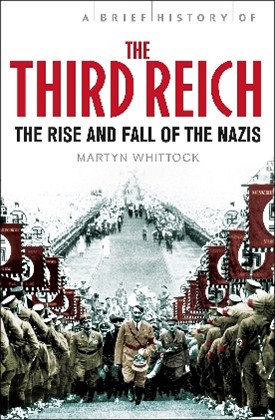
Book Review: A Brief History of the Third Reich: The Rise and Fall of the Nazis, by Martyn Whittock

Martyn Whittock assembles here the accounts of what is what like to be a German and go through all the things that happened before, during, and after World War II. He includes stories from people coming from all walks of life, and he adds his own theories and ideas.

In 22 chapters, Whittock describes the economic, political, and spiritual life in Germany leading to the Nazis seizing power and discusses both German complacency and involvement in contributing to the party’s rise to leading the nation. Whittock talks a great deal about Hitler’s reasons and motivations leading to some of the worst decisions possible.

Hitler had a tendency to make very dramatic and quick decisions without listening to the advice of those who would try to help him, or help Germany, in times of crisis. Hitler tended to stretch resources too thin and to make decisions which caused other greater problems unforeseen.

Without giving away too much content, I will say that this book does include the strength of using so many different persons’ stories to give the reader different perspectives on how the Nazis were actually able to get as far as they did. It is important to continue to read such accounts to try to sort out what makes sense and what does not.

Whittock gives the reader a great deal of information on the concentration camps and on how they were run. He does give us a glimpse into the desperate lives of the Germans who assisted in the murders, as he does regarding all of the persons who helped Hitler come to power.

There was something in it for everyone, it appears, and Whittock attempts to explain how and why the Germans allowed the Nazis to take so much power. He also provides the death tolls and discusses the methods used for murdering the inmates. Whittock provides a full description of the murders and numbers. However, he also uses more contemporary examples of bloodshed such as the Rwanda murders.

Maybe this is done to show that murder on a huge scale is to be expected in the world? Nothing could compare to the Nazis’ slaughter of entire peoples and communities, so that idea is lost on this reader—and on most all readers, I would assume.

The reader can profit from trying to understand what happened in Germany during those say 50 years of time. Teachers can perhaps get a little better understanding of how to begin to explain what was going on in the minds of Germans who watched all of it.

This is important reading because of the different perspectives revealed here.

Book Review: Breaking the Chains: African American Slave Resistance

(reprint of the 1990 edition with a new introduction by Robin D.G. Kelley)

When various localities are seeking to return to rhetoric of enslavement being beneficial or benevolent, Breaking the Chains: African American Slave Resistance is a book that is timely and beneficial for both teachers and students to understand the story of African Americans in their time of bondage. William Loren Katz did an amazing job of telling the story of African American enslavement through the eyes of the enslaved. Katz does this by describing a life in which enslaved people were not complacent but rather fought for every freedom awarded to them by their enslavers.

Katz explains, through this history, that African Americans were not only dealt physical blows but also had to fight against the master’s version of history after enslavement ended.

For much of American history enslaved people were described as complacent, willing to work, not upset about their condition or, as historians Allan Nevins and Henry Steele wrote, enslaved people
“were cared for and apparently happy” (9).

In other historical texts historians such as W.E. Woodward falsely stated that African Americans “were the only people in the history of the world who became free without any effort of their own” (234).

Although this had been a standard narrative for many years, Katz pushed back on this idea saying that historians had not done enough to find the stories of the enslaved in order to tell the true story of their resistance and their disdain for enslavement. He even goes as far as to say that “most scholars
have ignored this mountain of evidence” (13). But Katz refused to be another historian who gets history wrong and he wrote this book to detail the lives of the enslaved through the beginnings of the slave trade in Africa up to the passing of the Emancipation Proclamation.

Shown through many different angles and time periods, Katz described a people who resisted enslavement in every way. The book is broken up into four parts with a varying number of chapters in each part. The book begins with two introductory chapters, one written in 2023 in which Robin G. Kelley does the introduction and the other in which the author opens up the book setting the stage for the first chapter.

With the use of large print and historical images this book could easily be used to teach secondary students in grades 7-12 or could be used in an undergraduate college course. The writing is impeccably understandable and uses various sorts of sources including narratives of the enslaved,
accounts from white enslavers, foreign visitors to the United States, reports from the military and government, newspapers, and legal documents. In a society where it feels taboo to talk about the enslavement of African Americans, Katz’s thorough research is paramount to telling the story of
African Americans and their refusal to accept bondage.

Chapter two sets up the rest of the book by detailing why African Americans felt they needed to resist. In this chapter, Katz details the re-enslavement of African Americans on a daily basis and the horrors of what enslavement meant to them. He begins the chapter by stating “The reason for enslaved people’s resistance was slavery” (35). Enslavers understood that in order for them to achieve their goal of assimilating formerly free people into bondage, they would need to assert a form of dominance that denied African Americans the right to be human. Enslaved people were viewed as animals, chattel, property, and were purposefully kept from any knowledge beyond the plantations they toiled in. Chapter 2 details the fact that African Americans were not allowed to mourn, to be educated, to have their own thoughts, and were met with violence when they sought to
show any form of disobedience to Whiteness. In two narratives shared in this
chapter, one Louisiana woman was whipped for saying “‘My mother sent me’” (40) because calling her mother “mother” was akin to claiming the status of Whiteness.

In another story, Roberta Manson expressed that “They said we had no souls, that we were like animals’” and this was shown when her father was whipped for shedding tears after looking at an enslaved person who had been killed (40). Settlers thrived off of this system as they reaped the benefits of this free labor. As Katz explains that the South’s economy depended on the labor of
enslaved people and would not have thrived without them. White settlers were not willing to lose their power or control because they understood how vital enslaved people were to their economic prosperity.

While enslavers were concerned about enforcing and safeguarding their dominance, African Americans sought to play on this thought of enslaved people as inferior, dumb, and senile. Enslaved people deceived their masters into thinking they were joyfully working companions who looked forward to plantation labor. As Katz says “Black people pretended to be meek, happy, and dumb. They learned to answer an enslaver’s questions with the words they wanted to hear” (47). While enslavers were working to suppress the knowledge of the world around them, enslaved people worked to combat this through deception. Enslaved people would “forget” about tasks they were
told to perform or play dumb stating that they didn’t understand the job they were coerced to do. Enslaved people became the best actors claiming to be ill, not able to work due to a physical body strain, or in some cases even pretending to be pregnant. Enslaved people would smile and laugh with their enslavers before possibly running away that exact night. Although African Americans may have seemed dumb and senile, in reality this was a part of them reclaiming their agency to combat the
institution of enslavement.

In the wake of rhetoric that denies African Americans worked tirelessly to undermine the institution of slavery, this book does a great job of bringing to light the various ways in which African Americans resisted. Through the words of the enslaved themselves, as well as other primary source
documents, this book does the work of a historian, by uncovering the truth about African American resistance and their role in obtaining their own freedom.

Book Review: In Levittown’s Shadow: Poverty in America’s Wealthiest Postwar Suburb

There is a familiar narrative about American suburbs: after 1945, white residents left cities for leafy, affluent subdivisions and the better life they seemed to embody. In Levittown’s Shadow tells us
there is more to this story, offering an eye opening account of diverse, poor residents living and working in those same neighborhoods. Tim Keogh shows how public policies produced both suburban plenty and deprivation—and why ignoring suburban poverty doomed efforts to reduce inequality. Keogh focuses on the suburbs of Long Island, home to Levittown, often considered the archetypal suburb. Here military contracts subsidized well-paid employment like welding airplanes or filing paperwork, while weak labor laws impoverished suburbanites who mowed lawns, built houses, scrubbed kitchen floors, and stocked supermarket shelves. Federal mortgage programs helped some families buy orderly single-family homes and enter the middle class but also underwrote landlord efforts to cram poor families into suburban attics, basements, and sheds.

Keogh explores how policymakers ignored suburban inequality, addressing housing segregation between cities and suburbs rather than suburbanites’ demands for decent jobs, housing, and schools. By turning our attention to the suburban poor, Keogh reveals poverty wasn’t just an urban problem but a suburban one, too. In Levittown’s Shadow deepens our understanding of suburbia’s history—and points us toward more effective ways to combat poverty today.

Herman P. Levine: A Brooklyn School Teacher in the Mexican Revolution

Apparently, a prison term was not enough punishment, for Levine was also fired from his job. The state commissioner of education deprived Levine of his license to teach, and the school board at a meeting on 11 July 1917 dismissed him from his teaching position at Public School 160.6 The state and the school board made it impossible for Levine to practice his profession in his native state, and no doubt this became another factor in driving him into exile.7

While in jail, Levine was duly notified that he would still have to appear for his mandatory physical examination. Standing on his principles, he wrote from jail to The Call, rather sententiously, “I shall…not raise any technicality, but offer myself as a sacrifice, if need be, to the greedy, exploiting and devastating system of capitalism.”8 As Levine’s statement makes clear, he was a conscientious objector to the war because he was a socialist opposed to capitalist wars.

In Minneapolis, Minnesota on 21 September 1919 the board of education dismissed D.J. Amoss from his teaching job at Central high school because of his alleged membership in the Industrial Workers of the World.

7 “Minneapolis Teacher,” The Call, 22 September 1917, p. 9.
8 “Levine Refuses Physical Test,”, The Call, 9 August 1917.

He asserted, “My life will affirm what my mind and heart dictate. I have refused to do their bidding by refusing. Such actions were not uncommon at the time.to register. I will refuse to do their bidding in the future.”9 Levine’s statements published in The Call, thus also served, as he surely realized, as anti-draft and anti-war propaganda. His own intransigence might serve an inspiration to other young men to resist.

Levine also wrote a letter from jail to a friend who then passed it on to be published in The Call:

Having been registered against his will in prison, when Levine finished his prison sentence, he was still subject to the draft, and, if he refused, to imprisonment. Evidently preferring his freedom, he must have left for Mexico immediately upon release in June 1918. Levine reached
Mexico City shortly thereafter, and adopted two aliases and identities: Mischa Poltiolevsky, claiming to be a Russian immigrant, and Martin Paley, an American schoolteacher. Levine’s experience in jail and prison must have hardened his radical convictions, for when he left and fled to
Mexico, he continued his political activity, though now as a leftist labour organiser rather than as an anti-war activist.

Levine’s decision to go to Mexico was not unique. Americans didn’t go to Canada because it was part of the British Empire which was already at war. Mexico credate no barriers to American war resisters who wanted to enter the country, and what began as a trickle became a steady stream, and
soon, some would claim, a flood. The New York Times reported in June of 1920—a year and a half after the end of the war—that an estimated 10,000 draft evaders still remained in Mexico.11 Senator Albert Bacon Fall told the Associated Press that an estimated thirty thousand Americans had crossed into Mexico to evade the draft law.12 American politicians and the press called them “slackers,” a derogatory term that the war resisters adopted as a badge of honor.

Many American war resisters went to Mexico City, but Levine went to Tampico in the state of Tamaulipas, a city that was then a center of the relatively new oil industry dominated by British and American companies. He eventually found work as a clerk there set about re-organizing the local
chapter of the Industrial Workers of the World, also known as the Wobblies.

Tampico, the principal port for the Mexican oil industry, had developed rapidly beginning with the outbreak of the war in Europe in 1914. With the expansion of industry there was also a rapid growth in the number of oil workers, stevedores and seamen. These workers, often led by Spanish anarchists or sometimes American Wobblies, formed unions which grew rapidly in size, strength, and militancy.

11 ‘Ask Mexico to Send Draft Dodgers Back,” The New York Times, 7 June 1920, p. 9.
12 Linn A.E. Gale, “They Were Willing,” Gale’s Magazine, March 1920, p. 1. 3

Labor unionism in Tampico had begun during the first years of the twentieth century when workers had established a variety of unions, such as the Moralizing Union of Carpenters (Unión Moralizadora
de Carpinteros). By 1915, the major anarcho-syndicalist labor federation, the House of the World Worker, had reached Tampico, and began organizing both trades and industrial workers. The practice of striking to improve wages and working conditions became widespread and frequent among workers in Tampico.13

The Industrial Workers of the World already had a foothold in Tampico before Levine arrived. While it remains unclear if the IWW had any specific strategic plan for Tampico, in general the IWW organized unions of workers in a particular industry with the goal of affiliating them eventually into a national and then a worldwide industrial union, the One Big Union, as they sometimes called it.14

13 Gruber, Adelson, Steven Lief 1982, “Historia Social de Ios Obreros Industriales de Tampico, 1906 1919,” (Doctoral dissertation, 1982, Colegio de México), pp. 424–70.
14 Cole, Peter, David Stuthers, and Kenyon Zimmer 2017, Wobblies of the World: A Global History of the IWW.

In the United States, the IWWs strategy led it to organize oil workers, copper miners, lumberjacks in the spruce forests, and agricultural workers in the wheat fields: all strategic wartime industries (spruce wood was used to build airplanes). Following capital and heavy industry over the border to the south, Wobblies found themselves working in Mexican mines and oil fields, as well as on
Mexican docks and on ships of various nations. There they would employ the same strategy of industrial unionism and direct action.

One group of the Industrial Workers of the World arrived in Tampico in force in 1916 when the C.A. Canfield arrived in port. The crew of the Canfield belonged to the IWWs Marine Transport Workers (IWW MTW), and many were Spanish speaking. They recruited Mexican seamen to their union, which probably also gained a foothold among the stevedores. Pedro Coria, a Mexican IWW organizer from Arizona arrived in Tampico in January 1917 and organized Local #100 of IWW-MTW.15 Workers in Tampico had many grievances, (London: Pluto Press, 2017), pp. 124 but one of their major complaints was that they were paid in varying worthless currencies, so they demanded pay in gold or silver. In 1917 there was a series of strikes that began over this issue, culminating in a
great general strike in the Tampico area involving petroleum workers and stevedores from both the House of the World Worker and the IWW.16 The US Embassy sent a note to the Mexican Secretary of Foreign Affairs in October of 1917 on ‘The Tampico Situation’, which gives an impression of the
US government’s concerns. The note reads:

On 8 January 1919, Excelsior, a Mexico City newspaper, repeated a story that had apparently originated in New York that there were “secret soviets” in Tampico, organized by the IWW.18

15 Norman Caulfield, “Wobblies and Mexican Workers in Mining and Petroleum, 1905-1924,”
International Review of Social History, April 1995, Vol. 40, No. pp. 51-751995), p. 57.
15 Cole et all, Wobblies, pp. 124–39. 16 Cole et all, Wobblies, pp. 124–39.
17 US Embassy to Mexican Secretary of Foreign Relations, unsigned, ‘Memorandum: The
Tampico Situation’, 13 October 1917, Expediente 18-1-146, SRE.
18 Paco Ignacio Taibo II, Los Bolshevikis: Historia narrativa de los orígenes del communism en Mexico: 1919

By the time Levine arrived in Tampico in 1919 or 1920, the IWW was an established organization among industrial workers with a legendary militancy. Levine joined in the work of the IWW as editor of the group’s newspaper. In 1920, US intelligence agents reported that Mischa Poltiolevsky—they apparently believed this was Levine’s real name—”is working in Tampico under the name of M. Paley. He is a very active agent/”19 They were correct.

Levine had become one of the most dynamic leaders of the Tampico IWW organizing among stevedores and oil industry workers. The former socialist Levine had undergone a conversion experience: he had given up his membership in the Socialist Party and had joined the IWW. During the period between 1917 and 1919, he rethought his political ideals, rejecting his belief in socialism and espousing instead revolutionary syndicalism. In a letter to the Industrial Workers of the World headquarters in Chicago, he explained his personal situation and his political views:
I have never learned a trade, nor am I a manual worker, and this I regret, for I recognize that the workers on the job must prepare themselves to run industry, and the workers on the job must determine radical tactics during the struggle to attain their aim, because they alone are surrounded by that environment from which real radical measures surge. I am opposed to political action. An
industrial administration must be prepared for industrially. Political action wastes energy that could be used in the class struggle—on the job. I intend to learn a trade as soon as possible, so that my views may arise in the proper environment. Until then, I shall suggest nothing— but shall affirm that radicals on the job, in the factory, on the farm, in the mine—theirs is the final voice.

1925 (Mexico: Joaquin Mortiz, 1986), p. 32.
19 Memo of 26 May 1920 from the military attaché of the American Embassy to the Director
of Military Intelligence, G.S., Washington, D.C. on the subject of Bolshivist [sic] propaganda,
Record Group 165, Box 2290, USMID, USNA.

Levine concluded his letter, “I was a member of the Socialist party, Local Kings [County], N.Y., but sent in my resignation last May [1919].” In a hand-written postscript he added, “As soon as I become a worker on the job, I intend to join the IWW. But for the present as an office worker, I cannot do so.”20

Why did Levine leave the Socialist Party? Perhaps because so many prominent figures in the party had supported the war and even gone to work for the Wilson administration. Or maybe Levine had fallen under the influence of American or Mexican Wobblies who had convinced him of their
revolutionary syndicalist principles and strategy. Or perhaps his own experience as a slacker had simply driven him to the left, and, at the time, the far left was the IWW.

20 Letter (unsigned) by Levine to Whitehead, November (date scratched out), 1919, Record Group 165, Box 2290, USMID, USNA. 21 A number of copies of El Obrero Industrial can be found in Record Group 165, USMID, US

In any case, though he did not have an industrial job—or perhaps precisely because he did not have such a job—Levine, using the name M. Paley, became the editor of the Tampico IWW newspaper, El Obrero Industrial (The Industrial Worker). The newspaper was just one or two tabloid size sheets of paper folded into four or at most eight pages, written in Spanish it was aimed at the Tampico oil workers and stevedores. Its articles advocated direct action and industrial unionism and called for the use of the general strike to create a workers’ government.21 Levine’s newspaper and his
organizing activities became a serious concern to the US Military Intelligence Division (USMID). The USMID officer in Laredo, Texas wrote to his superiors in July 1920:


The [US] Government is receiving copies of “The Industrial Worker” [El Obrero Industrial] paper being printed in Tampico, which in its editorials is spreading the doctrine of Lenine and Trotzky. The paper says the strikers will not cease until they have accomplished their purpose. Reports also state that at their meetings the strikers have red flags and that the cry ‘Vive la Russia’ [sic] can be heard. The oil companies told the laborers that the pay will not be increased one cent, as they claim
they are paying the best salary in the country.22

National Archives. The newspaper reported on local activities in Tampico, but its main political ideas were identical to those of the IWW of the United States: direct action, industrial unionism the general strike.


At the time many IWWs were supporters of the Russian Revolution and the Soviet government, and some were attracted to the Bolsheviks, who were in the process of organizing the Communist International. As editor of El Obrero Industrial Levine, like other Wobblies, followed the Russian
Revolution with sympathy and offered it his support from afar. Later he would join in the foundation of the Mexican Communist Party (PCM).

The writer B. Traven, whose real name was Ret Marut and who was a German revolutionary refugee of the post-war conflicts in that country, lived in Tampico in the early 1920s. Traven spent some time
with members of the Industrial Workers of the World and left a picture of the American radicals in his novels Die Baumwollpflucker (The Cottonpicker) and Der Wobbly (The Wobbly). In his fictional account of a strike Traven gives us some idea of Levine’s Tampico:

in this country [they] do not suffer from a clumsy, bureaucratic apparatus. The union secretaries do not regard themselves as civil servants. They are all young and roaring revolutionaries. The trade unions here have only been founded during the last ten years, and they have started in the most modern direction. They absorbed the experience of the Russian Revolution, and they embody the
explosive power of a young radical force and the elasticity of an organization which is still searching
for its form and changes it tactics daily.
23

22 Report from Intelligence Officer, Laredo, Texas, to department Intelligence Officer, Fort
Sam Houston, Texas, 23 July 1920, Record Groups 165, in Box 2291, USMID, USNA.
23 Heidi Zogbaum, B. Traven: A Vision of Mexico (Wilmington, DE: SR Books,

Traven’s stories and novels caught the spirit of Tampico’s Wobblies and other radical unionists.
The employers took the matter of what they saw as the foreign-inspired labor unions in Tampico quite seriously.

R.D. Hutchinson, of the British ‘El Águila’ Oil Company told the Bulletin of the National
Chambers of Industry that the Tampico general strike of 1920 represented a “giant step toward the dictatorship of the proletariat,”

He went on: Mexican workers have unionized with the goal of imposing themselves on capital in Tampico and they have done it at the insistence of two different kinds of agitators: some foreigners, who, preaching Bolshevik ideas, have done a profound job, a deep job among the proletarians of the oil zones; and the others, Mexican politicians, who pursuing, if not identical goals, disrupt the peace by attacking the established interests at this crucial moment.24

As both Traven’s novel and this company manager’s remarks suggest, Levine, Coria and other slackers together with the Mexican workers had constructed a powerful, radical industrial union movement in Tampico that threatened the existing order.

Scholarly Resources Inc., 1992), p. 14, citing B. Traven, , Die Baumwollpflucker. (Hamburg. 1962),
p. 72. Wobbly movement.

The British government was also alarmed at the growth of the IWW in Tampico and other cities. The British Ambassador, H.A.C. Cummins reported to Lord Curzon at the Foreign Office in London in April of 1921, “The I.W.W. organization obtained some influence here during the war, an influence which has not lessened, and it is known that the confederated labor unions [CROM] are being directed by these dangerous extremists, and that they are laying plans with a view to establishing a Soviet administration in Mexico.”25 As Cummins’s communication indicates, in Tampico both
the IWW and the more moderate state sponsored CROM unions carried out militant campaigns against the employers.

While both foreign employers and foreign consuls sometimes exaggerated the threat from the IWW, their exaggerations were based on the very real, and quite formidable Wobbly Movement.
24 “Las Últimas Huelgas Según Seis Industriales Prominentes,” Boletín de la Confederación de Cámaras

There are always fights between people in business and politics and the 1910s and 20s were a period of particularly ferocious struggles everywhere. U.S. President Woodrow Wilson fought the Socialist Party and the IWW, severely weakening the former and virtually destroying the latter. The Republicans fought the Democrats and defeated them leading to the reactionary and corrupt President Warren G. Harding. In Russia, Joseph Stalin fought and defeated Leon Trotsky. In America Socialists fought Communists and the AFL fought the IWW. So it is not surprising that here was also a fight in the Mexican IWW.

In Mexico, it became a personal fight between slackers Herman Levine and Linn A.E. Gale over the question of who represented the real IWW in Mexico. Gale was a small-town journalist, a former low level, local politician from New York, facing criminal prosecution for his debts and also fearing he might be drafted fled to Mexico with his wife Magdalena, a secretary who worked to support him. He published Gale’s Magazine which combined socialism and spiritual and promoted himself as the leading American leftwing intellectual and activist in Mexico, mailing his magazine to influential American radicals.

Industriales, (August 1920) , pp. 10 25 Bourne n.d., p. 307.


While Levine worked in Tampico organizing petroleum workers into the IWW, Gale, with the political backing of Mexican President Venustiano Carranza’s Minister of the Interior, Manuel Aguirre Berlanga published article s supporting Carranza’s notoriously corrupt and avaricious government, claiming it was progressive or even potentially socialism. At the same time, Gale claimed to be the leader of the Mexican IWW, and though he didn’t do much organizing, he gave out
IWW membership cards and photographs of the American Socialist Party leader Eugene V. Debs.

The situation was complicated by the fact that Gale also claimed to be the head of the Communist Party of Mexico (PCdeM), made up of the same clique that formed his IWW, while Levine sympathized with the rival Mexican Communist Party (PCM) that had been established by American slacker Charles Francis Phillips, Indian Manabendra Nath Roy, and Russian Bolshevik (Communist) Mikhail Borodin. All of this was taking place at a brief moment when revolutionary syndicalists around the world were briefly attracted to the Communist movement, just as they were in Mexico.
We know Levine’s opinion of Gale and his IWW group from a long letter (eight single-spaced pages) in which Levine wrote to “Fellow Worker Whitehead,” that is, Thomas Whitehead, the secretary-treasurer of the IWW in the United States. Whether or not a copy ever reached Whitehead is unclear, because the letter was intercepted by USMID. Levine portrayed Gale as the
antithesis of a genuine labor organizer. The letter gives us a great deal of insight into
Levine’s political principles and his notion of the proper role as an American revolutionary and labor organizer in Mexico and it is worth reviewing in some detail.26

26 The following several citations come from this letter. Letter (unsigned) to Whitehead from Levine, date November (date scratched out) 1919. Box 2290, Record Group 165, US National Archives.

Levine wrote, ‘He [Gale] is a businessman seeking political preferment and social position’, while Gale’s Magazine is ‘not a radical nor socialist organ’. He went on:

27 Letter (unsigned) to Whitehead from Levine, date November (scratched out) 1919. Box 2290,
Record Group 165, US National Archives. The following several citations come from this letter.

Levine pointed out to Whitehead that it was Berlanga who had quashed the teachers’ strike of 1919.


In general, Levine was critical of Gale’s notion that the Mexican government was a radical government moving toward socialism. What had the peasants and workers gained? asked Levine. “The worker’s reward? The right to have the military forces used against him when he goes on strike, printing presses seized, union halls closed.” Levine gave the examples of the suppression of the Mexico City teachers strike in May and of the Tampico oil workers strike in November of 1919.
“What is the essence of the Mexican Government?” asked Levine rhetorically. “It is an incipient capitalist state.” Carranza, Levine argued, had ‘tried to establish industry on a firm capitalist basis’, inviting the Chambers of Commerce of Dallas, Chicago and other US cities to come to Mexico to help:

Carranza invited them to invest capital in Mexico, but denied them any special privilege. He wants
Mexico to develop on a capitalist basis, without intervention of foreign capitalist governments. “Mexico for the Mexican Capitalists, for the Mexican Government” is his slogan.

Most modern historians would agree with Levine’s assessment of the Carranza regime. Levine argued that Gale’s call for support of Mexico against foreign intervention missed the point that the Mexican government actually supported foreign economic investment and protected foreign investors.

Tampico oil is in the hands of foreign exploiters. But when workers go on strike, the union halls are
closed down, printing presses seized despite specific constitutional provisions to the contrary, right of assembly denied—by whom? Not by foreigners, but by the military officials of that very government which we are asked to defend. Levine lumped Gale together with
Gompers as foreigners meddling in Mexican workers’ affairs:

Mexican radical policy will be determined by Mexicans. The Mexican working class is fighting its
fight where it ought to be fought—on the job. It [the Mexican working class] is not revolutionary—but it becomes aroused over the right to organize—as is proved by the Orizaba [textile] strike now before the public eye. Mexican Labor is too conservative, its leaders and organizations being bound up with the American Federation of Labor. But there are radical elements, and it is to them that we must look for action.

Interestingly, while he and other American slackers participated in the Mexican labor movement, Levine clearly believed that Mexican workers should ultimately determine its policies. Levine concluded his critique by arguing that:

American radicals should fight against American Capitalism; Mexican Comrades should fight their
own exploiters. The class struggle— cannot—will not— be sidetracked.


The letter ended: “cooperation with [Gale] by the IWW is dangerous to the Wobbly movement.” Levine clearly believed that genuine labor organizers would work not with Mexico’s capitalist government, but with the “radical elements” among the industrial workers in the organization of the class struggle. Levine, as this letter makes clear, held Gale in utter contempt.28

28 Letter (unsigned) to Whitehead from Levine, date November (date scratched out) 1919. Box
2290, Record Group 165, US National Archives.

The battle between the American slackers for control of the Mexican Industrial Workers of the World was fought both in Mexico and in the pages of the IWW magazine and newspapers in the United
States. Both slacker groups in Mexico wanted the endorsement of the Chicago headquarters of the IWW, and each wrote long articles arguing its point of view and attacking the opposition. The imprimatur of the Chicago office of the IWW was just as important for the slacker unionists as the
endorsement of the Moscow headquarters of the Communist International was for the slacker Communists.

As usual, Linn Gale struck the first blow with an article titled ‘The War Against Gompersism in Mexico’ published in November 1919 in The One Big Union Monthly, the magazine of the IWW
executive committee in the United States. He recounted the first national congress of the Mexican Socialist Party and attacked M.N. Roy for voting to admit Gompers. He also attempted to discredit.

The Indian revolutionary M.N. Roy. Gale wrote that the ‘Hindu’ (M.N. Roy) is “said by some to be a
spy for the American government. As to the truth of this I do not know.” He claimed that during the congress Roy had been “working hand-in-hand with [Luis N.] Morones,” the corrupt leader of the CROM. Gale explained that “Roy voted in favor of seating Morones, casting the deciding vote!!!” Consequently, Gale explained, he and others had withdrawn from the Socialist Party and formed Communist Party of Mexico, a tiny group headed by Gale, which was “in favor of Industrial Unionism.”

The following several citations come from this letter.

The editor of The One Big Union Monthly observed that,

“Not knowing the condition in Mexico, we publish the above with some mental reservation, insofar as we believe that the I.W.W. men of Mexico may take a different view of cooperation with the new Communist party.”29 In the same issue there appeared an excerpt from Gale’s Communist Party of Mexico manifesto, obviously sent to the paper by Gale, endorsing the IWW, denouncing the AFL,
calling for the use of strikes, boycotts and sabotage, and looking forward to the eventual establishment of the “Dictatorship of the Proletariat.” The manifesto also called for a “Constant and intelligent co-operation between the Communist Party and the industrial unions of Mexico and the Communist Parties and industrial unions of other countries.”.30

29 Linn A.E. Gale, “The War Against Gompersism in Mexico’, The One
Big Union Monthly, November 1919, pp. 23–5.
30 “I.W.W. in Mexico,” The One Big Union Monthly, November 1919, p. 50.

The other slacker faction was not long in responding in the American Wobbly press. Irwin Granich [Mike Gold] wrote a long article, “Sowing Seeds of One Big Union in Mexico,” in which he described political, economic, and social conditions, and rebutted Gale’s attack. Granich gave his
own report on the first national congress of the Mexican Socialist Party, and his own interpretation of events. First, he argued that the Socialist Party congress really functioned as a kind of IWW convention. As he put it:

The Socialist party, dominated by I.W.W. elements, had called the congress because there was no union able to call it. It was called for the purpose of bringing to the workers the message of One Big Union and to help them create a national body based on industrial lines.

The Mexican Socialist Party congress, said Granich, succeeded in doing so despite the sabotage of Luis Morones and Linn Gale. He described Gale as “an American adventurer and labor provocateur
who has a shady past and has just organized a so-called Communist party of six or seven members for some sinister ends.” Gale “is really a nonentity, dangerous only because he is trying to bleed the movement for money, and because he is of the type that will ultimately sell out and turn spy—if he
has not already achieved this profitable end, as the Soviet Bureau in New York believes.
” Granich asserted that despite Morones and Gale, the congress had been a success and the delegates had launched two new magazines, El Soviet in Mexico City and El Obrero Industrial in Veracruz.31

31 Irwin Granich, Irwin [pseud. of Michael Gold], “Sowing the Seeds of One Big Union in Mexico,” The One Big Union Monthly January 1920 , pp. 36–7.

In the March 1920 issue of The One Big Union Monthly, the editor felt obliged to explain why he was continuing to print letters from the rival slacker factions in Mexico, and his explanation bears citation because it shows the American IWW’s interest in establishing continental industrial
unionism. “First,” wrote the editor,” it is just as important for us to be familiar with conditions down in Mexico as it is for us to know conditions in Canada. The question of direct cooperation between the One Big Union of Canada, of United States and of Mexico is bound to come up in the near
future, and for that reason it is necessary that we should be somewhat conversant with men and condition[s] in Mexico as well as in Canada.”


“Second,” wrote the OBU editor, “we want our members to know the state of affairs down in Mexico City when they get down there, so they do not act blindly.” Finally, said the editor, the IWW rejected
political parties, whether Socialist or Communist. “We enjoy to see the politicians destroy one another before an audience of wage workers,” because “it fills the workers with disgust for the political game and makes them turn to industrial organization.” So he let the debate in the pages of his magazine continue.32 The editor asked that future articles respond to a number of specific questions, namely a history and survey of the Mexican labor movement, a discussion of the experiments in the Yucatan, a discussion of the roles of Emiliano Zapata and Pancho Villa, and a
survey of Mexican industry with statistics.

32 John A. Jutt, “The Mexican Administration of the I.W.W,”

José Refugio Rodríguez, Secretary of Gale’s IWW organization, took up the offer and wrote an article on “The Working Class Movement in Mexico” which avoided the recriminations of the earlier articles and described general conditions of Mexican labor. Rodriguez’s article characterized the
various leaders and tendencies in the Mexican Revolution. He rejected support for Álvaro Obregón, who was “seeking the support of the American and Mexican financial interests,” and also repudiated
Carranza who was “at best only a Liberal.” Rodríguez also characterized Villa and Zapata. He wrote (wrongly and falsely) that the former “is no more and no less than a despicable murderer who once served in the American Army and there learned completely the science of killing his fellow human beings.” He expressed admiration for Zapata as an “honest man,” but noted that “the tales published in foreign periodicals about the wonders of ‘Zapataland’ make us laugh and also make us shed bitter tears”:

His “Zapataland” only existed over a few hectares of land in the days of its greatest success. It was very crude, undeveloped, unorganized, and could not therefore, last long. In the great land over which Lenin is the guiding figure and where Industrial democracy has come to remain forever, there is much of science, order, skill, wisdom and shrewdness, to match that of the capitalist empires without. But there was none of this in “Zapataland”—only honest intentions, high ideals, bad
organizations, big blunders and inevitable failure.33

Gale’s Magazine, February 1920, p. 44.

What is striking in Rodríguez’s essay is the nearly complete rejection of all of the Mexican revolutionary factions, including the plebeian movements of Zapata and Villa, and his absolute confidence in Lenin and the Russian model. Gale and his comrades, it seemed, having rejected the Mexican revolution entirely, intended to implant the models of the Chicago-based IWW and the
Moscow-centered Communist International.

Whatever appeared in the papers in Chicago, the fight to control the Mexican IWW would be settled in Mexico and Mexican workers would play a central role. Levine had found two allies in his struggle against Gale. Both Charles King and Pedro Coria had been active; in the Industrial Workers of the World in the United States, as well as in Mexico. A USMID report, probably written by José Allen, who was simultaneously head of the Mexican Communist Party and a US spy, described
Levine’s new supporters. The description of King was brief:

King claims to be an American Communist. He has been in Mexico approximately eighteen months. He is five feet eight inches tall; weight about one hundred and sixty pounds; dark hair; dark eyes; swarthy complexion. He is very sarcastic and cynical. He appears to be very well educated; he speaks Spanish and English equally well. Trade unknown.

33 José Refugio Rodríguez, “The Working Class Movement in Mexico,” The One Big Union Monthly, 1920 II, no. 6, 26-27.

The spy’s account of Coria went into more detail, painting a picture of a sophisticated political activist. “Corea [sic] is a Mexican of the railroad man type; age about forty; about five feet eight inches tall; weight about one hundred and eighty pounds; thick, black hair; black eyes; slightly florid complexion,”, wrote Allen.

34 ‘Who’s Who Material – Mexican Radical Elements’, 15 October 1920. RG 165, Box 2290.

Coria told his own story in an autobiography written in the 1960s. Raised in a military orphanage, Coria eventually became a foundry worker and after working in several Mexican cities travelled to the United States. While living in Chicago, Coria learned to speak English fluently and also became acquainted with the American labor movement. He apparently attended an early convention of the Industrial Workers of the World and became a Wobbly. As a Wobbly organizer in various parts of the
West, Coria had participated in numerous organizing campaigns, strikes, and protest demonstrations.

At various times he was beaten, jailed, and had his life was threatened. As a working-class pacifist in the United States, he opposed both the violence of the revolution in Mexico and United States involvement in World War I. When the Wilson administration suppressed the IWW, Coria fled to Tampico, no doubt because he knew there was an active IWW group there.35

35 Coria, Pedro, “Adventures of an Indian Mestizo,” Industrial Worker (Chicago), January, February,
March, April, and May, 1971. Thanks to Robert J. Halstead for calling this series to my attention and providing a photocopy.

As soon as he arrived in Tampico, Coria made contact with the IWW and joined other Wobblies in organizing Petroleum Workers Industrial Union 230 and Marine Transport Workers union 510. He quickly became one of the most prominent IWW leaders in Tampico and was sent by the local IWW as delegate to the important labor convention in Saltillo, Coahuila held on 1 May 1918, the meeting that produced the Regional Confederation of Mexican Workers (CROM). It must have
been not long after returning from Saltillo that Coria met Herman P. Levine.

Coria’s experience made him a highly valuable IWW organizer. His knowledge of English and Spanish, his familiarity with the labor union and political movements in both countries, and his
courage and dedication made him particularly useful in the attempt to organize the IWW in Mexico. So, it was natural that in Tampico, Coria became one of the closest allies of Levine.

Levine—now backed up by Coria and King—proposed at the 17 October 1920 IWW meetings in Mexico City, which involved both factions, that the IWW’s US rule excluding non-wage-workers be
enforced. The observation of that rule would have meant the expulsion from membership in the Mexican IWW of Gale, the newspaper publisher and his followers: Cervantes López, the printer; Hipólito Flores, the policeman, and other non-worker members of Gale’s committee. Gale responded
evasively that the IWW had to organize soldiers and sailors, and should not, for example, exclude a woman fired from her factory who became a fruit vendor.36

36 Gale 1920, p. 6; ‘Memorandum to the A.C. of S. for Military Intelligence’, 15 October 1920, in
Box 2290, Record Group 165, USMID, USNA, an account of these differences within the IWW, probably written by José Allen, says that Pedro Coria was disputing the leadership of the union with Gale and Charles King. This is probably the same struggle. See also Taibo II 1986, p. 101.

There was another important element in this debate, in addition to the question of a member’s social class. Levine and Coria also proposed to take the Mexican IWW into an alliance with the anarchists, anarcho syndicalists, and the other Mexican Communist Party (not the one run by Gale) in order to form a united front among all the labor radicals in Mexico. It was this issue that accounted for the presence at the Mexico City meeting of Jacinto Huitrón, a leader of the anarcho-syndicalist labor
movement, and Manuel D. Ramírez, a labor activist and the future head of the Mexican Communist Party. It was this group which would later establish the important though short-lived labor organization the Communist Federation of the Mexican Proletariat.37

37 ‘Memorandum to the A.C. of S. for Military Intelligence: Notes on Radical Activities’, 15
October 1920, USMID, Record Group 165, Box 2290, USMID, USNA.

The debate over the rules was postponed, but Gale refused to call another meeting, so the other faction, Levine, Coria and King, now joined by Gale’s former allies Rodríguez, Pacheco and Ortega, called their own meeting of the executive board, revised the rules to exclude non-workers, and elected their own executive committee. Gale was out. Levine had won.

The Gale-Levine faction fight ended in the pages of the IWWs magazine in the United States at the end of 1920. In December, an article apparently written by Herman Levine, announced the victory of
the “wage workers” over the “petit bourgeois” faction led by Linn Gale. “The wage workers faction, the most numerous and the strongest, with the general secretary treasurer and the majority of the G.E.B. [General Executive Board] with them, are continuing in charge of the organization, and hope for better progress now that they have rid themselves of the political and petit bourgeois element,”, stated the author. The IWW, now firmly in proletarian hands, the author reported, was organizing oil workers in Tampico, metal mine workers in Guanajuato, and industrial workers in Mexico City.38

38 Herman Levine, Herman ‘The Mexican I.W.W.’, The One Big Union Monthly, December 1920, p. 57.

After Levine, Coria, and King took charge of the IWW, it immediately entered into a united front with the other factions of the revolutionary labor movement. The anarcho-syndicalists, the IWW, the Mexican Communist Party, and some independent unions formed first the “Revolutionary Bloc,” in August 1920, which subsequently became the Communist Federation of the Mexican Proletariat (FCPM). The FCPM was meant to be an alternative to the CROM. It stood for revolutionary labor
unionism, the fight for workers’ control, the overthrow of capitalism, and, passing through a brief dictatorship of the proletariat, for Social Revolution. While most of its members were anarchists or anarcho-syndicalists, the FCPM sympathized with the Soviet Union. Later the FCPM would become the anarchist General Confederation of Workers or CGT.

In addition to Levine’s wing of the IWW, the Mexican Communist Party (PCM) (that is the party founded by Roy and Phillips) also joined the new federation. Within a few months the PCM Communists were involved in the leadership of a genuine working-class upheaval in Mexico City,
Veracruz, Orizaba and Tampico. Two of the PCM’s new young leaders, Manuel Díaz Ramírez and José C. Valadés were elected secretaries of the executive board of the FCPM.39 The Communist Federation and its activists such as Levine, Valadés and Díaz Ramírez were far more serious about
organizing than Gale had been. For example,

39 Taibo II 1986, Los Bolshevikis, p. 103.

Díaz Ramírez, who was himself from Veracruz, contacted Aurelio Medrano and other leaders of the Orizaba textile workers’ anarcho-communist group, the group with which Gale had been corresponding. Díaz not only wrote them and sent the Communist magazine Vida Nueva and the
Boletín Comunista, but he also went to Orizaba gave a public lecture on “Unionism and Communism.” He met privately with local activists and attempted to win the group over to the Communist Federation of the Mexican Proletariat, and to the Mexican Communist Party.40 Díaz urged the local anarcho-communists and CROM activists to join the Communist Federation and later its successor the General Confederation of Workers (CGT). The Orizaba group decided to stay in the CROM, though they remained in its left wing.41 Nevertheless, Díaz and the Communists demonstrated a new commitment to building the IWW and the Communist Party among workers.

40 García Díaz, Bernardo 1990, Textiles del Valle de Orizaba (1880–1925). (Xalapa, Veracruz: Universidad Veracruzana, Centro de Investigaciones Historicas, 199), pp. 240–1.
41 Ibid., pp. 270–1.

Levine’s organizing in Tampico and his fight with Gale had strengthened the IWW in Mexico. He also helped to build the young and fragile Mexican Communist Party. The political winds, however, had shifted. While President Venustiano Carranza had welcomed the American slackers, the new president, Álvaro Obregon, wanted to be rid of them, ordering their arrest and expulsion.

Levine was captured and deported on 25 May 1921.42 He either revealed his citizenship or it was discovered, for the Washington Post carried the news of Levine’s detention to the public in a story
date-lined Laredo, Texas, 27 May 1921: Herman M. [sic] Levine, of New York City, who fled to Mexico in 1918 and is alleged to have engaged in radical activities there, was deported Wednesday from Monterrey, where he was arrested last week. He was immediately taken in charge by military authorities here and is being held at Fort McIntosh.43

42 Letter from Matthew C. Smith, Col., General Staff, Chief, Negative Branch to W.L. Hurley, Office of the Under-Secretary, Department of State, 28 May 1921; Memorandum for file dated 27 May 1921 regarding phone call from Mr. Hoover to USMID. Both in Box 2292, Record
Group 165, USMED, USNA.
43 “Mexico Deports Radicals; Herman M. Levine, of New York Returned to the United States,” Washington Post, 27 May 1921. Clipping in Box 2291, Record Group 165, USMID, USNA

.
44 Memorandum for file, undated by citing General Intelligence Bulletin No. 53 for 4 June
1921, Box 2292, Record Group 165, USMID,USNA.

The US government’s General Intelligence Bulletin No. 53 for 5 June 1921 reported that Levine’s “case will be presented to the Grand Jury for indictment as a slacker.”44

After this point, Levine disappears from the records, but what an experience Levine had had since the day four years before when he decided to resist the draft. The war and the draft forced him to give up his profession, and his country and led him to become a political exile in Mexico. While
Levine remained a radical, the war also caused him to abandon his political party, the Socialists, and led him to adopt the revolutionary syndicalist ideology of the Industrial Workers of the World.

As a Wobbly in Mexico, Levine edited the union’s newspaper in Tampico where he also became one of the union’s leading spirits. Of all the American slackers, Levine was perhaps the only one who really threw himself shoulder-to-shoulder into the organization of ordinary Mexican workers in an attempt to bring about a new industrial and economic order. For a brief period, Levine and his IWW ‘fellow workers’ had led thousands of Tampico’s oil port workers in a mass movement involving strikes that paralyzed shipping, challenged the employers, and troubled two states. Levine had cooperated with the founders of the Mexican Communist Party and Levine himself appears to have become a member. Like other radicals in Mexico at the time, Levine signed his letters “Salud y Revolución Social,” that is, “Health and Social Revolution,” and he added in English with that characteristic Wobbly American accent, “May it come damn quick.” Unfortunately for Levine, it did not come.

Whatever happened to Levine? We do not know, but a cross-reference in the card index of the US Military Intelligence Division files mentions a Herman Levine who was active in June 1932 in the
executive councils of various veterans’ organizations and was a bonus marcher, one of the largest American working-class protests of the era. Could that have been the Brooklyn school teacher Levine who led oil workers in Tampico during the years of the World War and the Mexican Revolution?
We cannot be sure that this is the same man, but it might well have been.

History, Now and Then: Teaching Historiography with the American History Textbook Project at Ramapo College

Rationale

One of the foremost challenges in social studies education is overcoming the danger of a single narrative. High school history classes that are structured around a textbook are particularly prone to this inhibition. History is not one set of facts — it is an argument. Relying too much on one secondary text to guide instruction fails to establish this key principle for understanding what history is, how it is done, and how it is significant to the present. The challenge of textbooks is that as tertiary sources, they vary widely in quality, and tend to offer overly simplistic narratives of the past that leave little room for debate or acknowledgement of tension over what really happened and why.

While textbooks are a necessary tool for establishing a basic set of facts for history instruction, as well as providing primary source resources and activities to support effective social studies pedagogy, they greatly undermine students’ understanding of history as a discipline with its own distinct theories and skills. It should be acknowledged that authors and publishers have generally made progress including diverse primary sources in their products, thought it has come to be widely accepted that the editorial choices made by textbook companies are often driven by politics, and
textbooks that are outdated will ultimately fail to expose students to the changing narratives of the past that are continually being written and debated. And, as with any piece of historical writing, textbook narratives are ultimately shaped by the times in which they are written.

These limitations present secondary social studies teachers with an obligation as well as an opportunity to introduce students to the theory behind how historical narratives are crafted and why history is constantly changing. How could history instruction be improved if students were exposed to different interpretations of the past and an evolution of historical narratives over time? In 2020, the authors’ utilized the American History Textbook Project (AHTP) at Ramapo College of NJ to develop and implement a lesson that introduced seventy high school juniors to the basics of historiography. Two years later, a cohort of sixteen students was invited to use the collection at Ramapo College for the purposes of developing historiographical thinking through text analysis.

While many history teachers may take issue with introducing secondary students to historiography, it is hardly a new idea or practice. Both Hoefferle (2007) and Zucker (2016) define the benefits of and
propose strategies for bringing historiography into the social studies classroom. Caroline Hoefferle realized that, while her undergraduate students knew how to analyze primary documents, they “had
never before thought critically about the histories that they read” (pg. 40). One of the chief benefits of bringing historiography into the social studies classroom, therefore, is that it both supports content acquisition as well as the development of critical thinking skills. Hoefferle writes that, upon being
introduced to historiography, many of her students “wished that they had been exposed to the course in high school. . . so that they knew beforehand how to read history and how to make sense of it all” (pg. 40). In this sense, exposing younger students to historiographical thinking compliments and reinforces the work that they regularly do with primary sources. Students are frequently asked to analyze, synthesize, and develop conclusions or arguments. This same thinking should be encouraged with textbook use.

How frequently do social studies teachers present students with the opportunity to understand that history is not just a “set of facts” but an ongoing debate? Professional scholars are continually offering new perspectives and interpretations that are in turn influenced by factors such as contemporary events or personal experiences and philosophies. History classes that are structured around a single textbook minimize the need for students to think critically, and undermine their understanding of why history is always changing. In Hoefferle’s words,

“Historiography not only enlightens students as to the inside story of the historical profession, but it also makes history more alive and interesting to them. It helps them to understand that everything is not already known and agreed upon, that there is a place for them in the profession, that in the future
they can contribute to the ongoing historical debates about the past. This takes them away from being simply passive receivers of the truth, to active pursuers of the truth” (pg. 41).

Similarly, AP US History teacher James Zucker (2016) takes issue with the current approach to teaching students history which relies primarily on primary source analysis. This often assumes that students are at the same level as professional historians and often forces them to analyze sources without proper contact. Rather, Zucker moves his students’ historical thinking beyond “fact gathering” through a multi-tier approach to teaching the American Revolution. First, students read
and analyze academic articles by prominent historians, such as T.H. Breen and Gary Nash. They find thesis statements, assess the supporting evidence, and discuss the validity of the arguments in a Socratic seminar. Only after students have come to the realization that there are multiple narratives of the American Revolution do they engage in primary source-based research for deeper historical context. Finally, the class circles back, assessing the relationship between the primary sources and the scholarly articles they first analyzed. Zucker expects his students to be able to engage with questions such as: “In what ways do these sources support or refute the arguments put forth by the likes of Breen and Nash? How do the interpretations reflect their own historical time period and point of view?” This is historical thinking at its finest.

In the words of Michael J. Swogger, D.Ed, writing for the National Council of the Social Studies blog “Pardon the Interruption!” in 2017: “Where historiography takes the study of history further is by asking the students to examine the evolution of how a particular history has been told over time. . . . . [S]tudying a historical topic through a historiographical lens helps students to better understand the elasticity of history itself” (Swogger, 2017). While it seems reasonable to believe that advanced high school students should be able and expected to do this type of work, there are those who advocate for the fostering of historiographical thinking skills among much younger students. In Teaching What Really Happened, James Loewen argues that social studies teachers can make historiography approachable for children as young as 10 years old, noting that “if they can learn supercalifragilisticexpialidocious, they can handle historiography.” In theory and practice, this may be as simple as having students critically analyze the narrative put forward in their history textbook, with an eye towards the flaws of a text: “Students find it intriguing to think about what topics textbooks handle especially badly” (Loewen, 76). While it may be common knowledge to history educators that the course textbook and supplemental materials often present a singular narrative with the aim of simplicity and consensus building, challenging students to question and challenge what their textbook delivers as the “correct” understanding of the past can be a powerful approach. The realization that not everything they read in a textbook is “agreed upon” may be one of the more empowering lessons that emerges from a social studies education. Together, we may take Loewen,
Hofferle, and Swogger, and Zucker to conclude the following:

These conclusions led us to develop a program, using the American History Textbook Project at Ramapo College of New Jersey, to introduce historiographical thinking to a cohort of high school students. Several characteristics of the American History Textbook Project make it an ideal
vehicle for such an undertaking.

The American History Textbook Project (AHTP) at Ramapo College began as a student-led project, under the supervision of an American Studies professor. Students researched materials to purchase before offering them to the college’s library as a special collection (Connor and Rice, 2012).
The majority of the collection consists of high school-level materials, but there are also some intended for elementary and middle school-age, as well as special editions for religious schools and state editions. Since 2009, the collection has grown to over 300 volumes, spanning almost 200 years (1825 to 2016); the collection continues to grow through grants and donations. In Spring 2020, when the college moved to remote operations due to COVID-19, a digital edition of the collection was created in order to meet the high demand of use while the physical collection was inaccessible
(https://libguides.ramapo.edu/digitalAHTP).

For a special collection, AHTP materials have a high level of use. At Ramapo, historiography is a key learning outcome not only in the History and American Studies programs, but also within the College’s General Education (GE) Program. As a result, undergraduates, often in their first year, who are enrolled in courses associated with this student learning outcome are exposed to historiographical
concepts, even if they are not history majors. This inclusion came as a result of a major recent revision to the GE Program that required professors develop courses that asked students to learn not only historical content (events, processes, trends, people) but also to place that learning in historical
context and to think critically about causation, connections to the present, and cultural bias. Students use the collection not as the books were intended – as tertiary sources – but rather as primary sources or artifacts to a time period. Professors found using the AHTP collection beneficial because students commented that using textbooks to understand complex historiographical concepts was more
manageable because information was presented in a less intimidating structure. In addition, professors appreciated that the textbooks covered so many topics – activism, industrialization, social issues, etc. – that using them allowed for maximum flexibility for courses.

Interest in the collection has grown outside of the College, especially among high school educators. When teachers contact the Library for a tour of collections, AHTP is often a featured discussion for
visiting groups. In the summer of 2023, a senior high school student volunteered to work with the collection and noted that working with the books, especially when seeing doodles and notes written by past students, brought a human element to his work research. Interacting with the AHTP collection allows students, even at the secondary level, to see these materials beyond static, neutral vessels of information, but as time capsules for both those who wrote the materials and those who used them. This adds an important new dimension of engagement with historical concepts.

In October, 2022, sixteen students from Ramsey High School participated in the program. The group of students consisted of five sophomores, nine juniors, and two seniors. All students had volunteered to participate and were not pre selected based upon any academic or personal criteria. Three quarters of the students had been or were currently enrolled in an honors or Advanced Placement history course. In a pre-assessment survey sent to the group, fifty percent of the students claimed that they frequently or regularly used a textbook in their history class, while more than forty percent said sometimes, rarely, or never. This was asked to gauge students’ familiarity with the components
and use of a history textbook. Among those who had utilized a history textbook recently, ten of the students indicated that they had read the book to answer specific questions or to study for a written assessment.


The session


For convenient access to the textbooks, the two-hour session was conducted in the special collections reading room of the George T. Potter Library at Ramapo College. Students were placed into groups of four based upon expressed interest in and general familiarity with one of four topics: the women’s suffrage movement, slavery and the American Civil War, U.S. immigration and immigrant groups, and the history of Native Americans during the Jacksonian Era. Students were seated with their groups at large tables. The session was run by Christina Connor, Ramapo College Assessment and Instruction Librarian and curator of the AHTP collection, and Daniel Willever, social studies teacher at Ramsey High School. To begin the session, brief introductory remarks were delivered by
Stephen Rice, Professor of American Studies at Ramapo College. Professor Rice originated the AHTP collection before it was donated to the library and taken over by Ms. Connor.

The work session was organized into four major activities followed by time for a post-assessment survey. In addition, students were given free time to interact with a small subset of textbooks that Ms. Connor selected for display due to their unique characteristics. As an activating strategy, each student was given one textbook from the collection to freely explore. During this time, many students made note of the cover art, the title, and the year of publication (which ranged as far back as the 1890s, though nearly all books were from the mid twentieth century). A few students turned to
the table of contents to see how the book was structured, and others took note of markings which indicated where the book had been used or by whom. Students were then asked to answer the question: “How does this text begin the story of American history?” The intention behind this question was twofold: first, for students to orient themselves to how the narrative of American
history was going to be told in the book they selected; second, for them to notice significant differences between the four books in their group regarding how the authors chose to begin the story. Answers varied, with some books beginning with the Columbian exchange, some with the
populating of the Americas during the last ice age, and others going back to the foundations of ancient civilizations.

Students then shared out to the whole group their perspective on why the starting point of their book may have been chosen by the authors and what its significance was. They were also free to ask questions or make general observations about the textbook they had selected. Some students use their phones to look up information about the author(s) of the book.

Following this orientation, students were distributed a copy of the session handout, designed to serve as a note catcher. This one page document, an adaptation of the resource used with undergraduate students at the college, was designed with ease-of-use in mind, for students to distillate core
understandings about the text into a simple framework which could be used for later thinking. At the top, students indicated basic identifying characteristics, such as title, author, and publication date of their book.

Below this, a matrix posed four essential questions for students to think about and answer using their book:

In the second activity, students conducted topical research using their textbook. At any time during the session, students were welcome to read together or to exchange books, although they were to
primarily focus their attention on the one book they selected at the start of the activity.

Following this independent reading and writing time — about twenty minutes, in total — students came together for a group collaboration session. This time was reserved for them to converse about their observations and annotations. Within each topic group, students were to begin the process of comparing and contrasting how each textbook approached, organized, conveyed and conveyed the subject matter.

Each group received a large sheet of poster paper and markers to produce a graphic organizer which expressed how the telling of their historical topic had changed over time, as noted through comparison of the four textbooks. The two hour session concluded with the final activity, in which time was allotted for presentations to the whole cohort, with additional general discussion of key takeaways and questions.


Observations and data


During the session, students were observed to be highly engaged and in regular conversation, sharing the information they were finding both for the activity sheets as well as other observations made while analyzing the textbooks. Rarely did the instructors need to intervene without students first asking a question. It was often noticed that if students were using their phones, it was to look something up for the activity, not as a distraction from the session. For two hours students were
actively participating and did not need to be reminded to focus on the lesson and discussion.

The conversation was extraordinarily organic within each group, as students huddled looking from book to book, comparing text, and making notations. Most students provided a great deal of detail in their worksheets, citing a variety of examples for each question. When asked to provide words or phrases used to describe their topics, students took the time to quote excerpts from books, not just produce a simple vocabulary list. When describing how much space is devoted to their subject,
students often provided significant detail, describing both the specific space allocated for topics (e.g., sentences, paragraphs, pages), but also reflecting if the language used was simple as well as if the topic was discussed in passing or within the context of another topic.

Reading through comments on the last two questions (to describe what is emphasized/deemphasized and how the narrative could influence a reader), it was observed that students were making the
connection that how a narrative was framed could impact perspectives on a topic. For example, if a book praised the Jacksonian policy of Native American relocation because it led to expanding U.S. territories, yet minimized or failed to mention the struggles felt by native populations, students noted how a reader could come to believe Native Americans were treated fairly and the U.S. acted justly.

In other cases, students included knowledge from their own classroom lessons to assist in their analysis of materials. For example, a student reviewing women’s suffrage noted passages in her book that downplayed the struggle, and did not discuss how long and hard a process suffrage was for women as well as the violence experienced by many suffragettes. She also noted that her book failed to mention public opposition to women’s suffrage. Since this information was absent from her materials, it was clear she was pulling in outside information in order to discuss what aspects of suffrage were under represented. The amount of detail provided by students in their observations showcased how engaged they were with the materials and that their reflections developed from a
close reading.

In addition to individual worksheets, groups were also asked to create a timeline poster with all the books, which they would use when presenting out at the end of the session. This was an important piece to the discussion because it allowed students to see that while some topics improved in coverage over time, others surprisingly were more biased in later years. It gave the students the opportunity to consider if possible outside societal or political influences may have led to how a topic evolved over time.

One group used their poster session to make interesting observations regarding how the topic of slavery was treated in chapters on the American Civil War. Student K.H., for example, observed that in A History of the United States by William A. Mowry and Arthur May Mowry, published 1896, the issue of slavery was deemphasized as a cause of the war. His peer, student G.P. noted similar language in a 1950s textbook, which did not address the harsh treatment of enslaved people and downplayed slavery as a cause of the war. Another member of this group noted that a 1979 textbook by John Garrity went into greater detail of slavery as an economic and social institution with severely harmful consequences for enslaved people. The last member of the group, in assessing the 2005 textbook The Americans by McDougal Littell, observed that this textbook explicitly described the southern states’ desire to protect slavery as what caused the war. Four students utilized four texts spanning nearly 110 years of history to arrive at the conclusion that the narratives surrounding American slavery evolved significantly over time, were reflective of issues and events contemporary to the authors, and had a significant impact on how Americans viewed the past and present of their country. The group reflected on these observations in their timeline poster and presentation to the rest of the cohort.

The post-survey completed at the end of the session yielded interesting remarks from participants. Thirteen of 14 students who completed the exit survey said that the activity somewhat (8) or significantly (5) changed their understanding of how history is written and understood. In elaborating upon how the experience reformed their understanding of history as a discipline and how narratives of history evolve over time, students often revisited the topic of their textbook exploration. Said one
student: “While I understood that history textbooks change throughout history, I’ve
never looked at examples of this or investigated what this means. I learned about Jackson and Native Americans and the connotations and views of these events in multiple times [sic] periods, but specifically during the 1920s. During this time many people wanted to hide America’s past flaws
and promote nationalism after World War I and in case there was another war in the future.” This student demonstrated the importance of contextualizing a source as a
product of the time period in which it was published.

Another common insight shared by students was the search for objectivity and validity in historical writing. While some students saw the older textbooks as “more biased” or “misleading,” still others
wondered the degree to which they needed to think critically about the narratives in their own history textbooks: The ability for students to make connections between these historical texts and what they are being taught today was a significant development, as is exemplified in one reflection: “It was very interesting to see what was being taught to Americans based on what was going on at the time, and if this information they were getting was accurate. I wonder if the same thing is happening to the textbooks we are learning from today.” Similarly, another student commented that “Getting a
sense of what previous generations were taught was intriguing, especially when placed into historical context. Seeing how the textbooks develop into a more accurate depiction was pretty cool.” A third student sought to juxtapose their critical thinking vis a vis the textbook with the narratives of history delivered by their history teacher in class: “I have always thought that a textbook is more reliable than a teacher because teachers can be opinionated and books can’t.

After today I am left thinking If my previous thought is true. A book can have so many
biases that I have never considered.” The significant impact of the exercise was perhaps best expressed by another student: “. . .for someone who has never thought about how the telling of history has evolved this would be really eye opening.”

Conclusion

This project provided the authors with insight as to how secondary and tertiary sources, such as textbooks, may be used to expose high school students to a basic understanding of historiography.
Furthermore, such a strategy can lead to significant development of students’ historical thinking skills and their understanding of “history” as a discipline, as opposed to just a timeline of people, dates, and events. History professionals understand that history “wars” are nothing new;
conflicts over how the story of the past is told have been ongoing for some time and
will continue, because, as George Orwell rightly noted, “who controls the past controls the future.” However, the consequences of these debates and the motivations behind them are most likely
foreign to high school students. While school-age children may see media coverage over the removal of Confederate monuments or criticism over a “liberal” influence in the classroom, seeing the evolution of curricular materials may help provide insight as to why history debates are often heated.

All-in-all, it was clear that students valued the time spent working with the textbooks and many of them said they would enjoy doing so again in the future with different topics of exploration. It was
rewarding to see students use prior classroom knowledge and make connections to their current or former history courses. Seeing these observations helps underscore the point that high school-level students are capable of engaging with historiographical concepts and their reactions further highlight why it is necessary to do so. The moments of epiphany to which we bore witness during the textbook session were heartening and motivating.

Further exploration of this strategy for teaching historiography may focus on the degree to which students bring their new historiographical thinking skills back to their history classroom for use in an academic setting. Overall, it was encouraging to see that students were thoroughly engaged for
nearly two hours of work time and were observed to be consistently thinking out loud, organically collaborating, analytically reading texts, and utilizing advanced historical thinking skills. If additional endeavors to promote an understanding of historiography among pre-college learners prove to be as fulfilling and successful, the future of history is a promising one.


    Connor C. & Rice S. (2012). The American History Textbook Project: The Making of a Student-Centered Special Collection at a Public Liberal Arts College. In E. Mitchell, P.A. Seiden, & S. Taraba (Eds.), Past or Portal? Enhancing Undergraduate Learning through Special Collections and Archives (pp. 271-278). Association of College and Research Libraries.

    Hoefferle, C. (2007). Teaching Historiography to High School and Undergraduate Students. OAH Magazine of History, 21(2), 40–44. http://www.jstor.org/stable/25162115

    Loewen, J.W. (2009). Teaching What Really Happened: How to Avoid the Tyranny of Textbooks and Get Students Excited About Doing History (Multicultural Education Series edition). Teachers College Press.

    Swogger, M. (2017, March 29). Embracing Historiography in the Classroom. Pardon the Interruption! from the National Council of the Social Studies. http://connected.socialstudies.org/blogs/michael-swogger/2017/03/29/embracinghistoriography-in-the-classroom.

    Zucker J. (2016, January 13). Teaching Historiography to High School Students. Process: a blog for American history. https://www.processhistory.org/jameszucker-teaching-historiography-in-highschool/.

    Addressing Israel, Palestine, Gaza, Hamas, Islamophobia, and Antisemitism in the High School Curriculum

    In response to teacher and student questions, teachers and administrators at Franklin Delano Roosevelt High School in Brooklyn partnered with Bridging Cultures Group to develop material for
    integrating lessons on Israel, Gaza, Hamas, Islam, and antisemitism into the curriculum. Study of conflicts in the Middle East are part of the 8th, 10th, and 11th grade social studies curriculum. According to the Social Studies Framework, in 8th grade United States history students should learn that “The period after World War II has been characterized by an ideological and political struggle, first between the United States and communism during the Cold War, then between the United States and forces of instability in the Middle East. Increased economic interdependence and competition, as well as environmental concerns, are challenges faced by the United States.”

    In New York, in 10th grade students learn how “Nationalism in the Middle East was often influenced by factors such as religious beliefs and secularism.” Students are expected to “investigate Zionism, the mandates created at the end of World War I, and Arab nationalism” and “the creation of the
    State of Israel and the Arab-Israeli conflict.”

    In 11th grade they examine how “American strategic interests in the Middle East grew with the Cold War, the creation of the State of Israel, and the increased United States dependence on Middle Eastern oil. The continuing nature of the Arab-Israeli dispute has helped to define the contours of American policy in the Middle East.” As part of this unit, “Students will examine United States foreign policy toward the Middle East, including the recognition of and support for the State of Israel, the Camp David Accords, and the interaction with radical groups in the region.”

    In 12th grade, New York State students study the organization and role of the United States government. There are no content specifications, and the course is expected to “adapt to present local, national, and global circumstances, allowing teachers to select flexibly from current events to illuminate key ideas and conceptual understandings.”

    A teacher’s responsibility is to find or put together documents from different perspectives that students can evaluate together, to ask probing questions and develop an informed opinion on topics
    in a safe classroom environment.

    These are compelling questions that can be addressed in high school Global history classrooms.

    • What was the origin of Zionism?
    • How did World War I impact Palestine?
    • How did the Holocaust and World War II shape the future of Israel and Palestine?
    • What was the outcome of the 1948 Arab-Israeli War?
    • What was the origin of the PLO?
    • What were the results of the Six-Day and Yom Kippur wars?
    • Why did Palestinians launch an Intifada?
    • What is the origin of Hamas?
    • Why is it difficult to resolve conflicts between Israel and Palestine?
    • Why has the war in Gaza drawn international attention
    • These are compelling questions that can be addressed in high school United States history
      classrooms.
    • How did Middle east conflicts impact on the domestic front?
    • How did U.S. support for Israel lead to an oil embargo?
    • What was the impact of the oil embargo on the American people?
    • How has the United States tried to resolve Middle East conflicts?
    • The material included in this package are only suggestions. Teachers should adapt lesson ideas and
      documents to make them appropriate for their students. Some of the material presented in this package is prepared using different formats.
    • Aim: Why is there a conflict between the Israelis and Palestinians?
      Do Now: Cartoon analysis.
    1. See: What do you see happening in the cartoon?
    2. Think: Based on your observations, what can you infer about the conflict between Palestine and Israel?
    3. Wonder: Write down questions you have about the conflict between Israel and Palestine.
    4. Historical thinking skills practice: Using the google slides and the video
      (https://www.youtube.com/watch?v=Bno1m1zhIWs), to explain the historical context of the Israeli –
      Palestinian conflict. Use the three images below and answer the questions following “Review of Key Ideas.”

    Review of key ideas
    I: The Arab/Palestinian -Israeli Conflict: 1948- present day Key vocabulary: Zionism – the belief that Jews should have their own homeland; Zionism strengthens after the Holocaust.
    II: Balfour Declaration: The British set up Palestine as the Jewish homeland.
    III: Mandate Border 1920: Set up by the British; 90% of Palestine inhabited by Arabs.
    IV: UN Resolution 1947: UN votes to divide Palestine into two countries. Jews agree to plan, Arabs do not. May 14, 1948, the state of Israel was born.
    V. Since the establishment of Israel, there has been conflict between Israelis and the Palestinians as well as neighboring Arab countries.

    1. How did this conflict start?
    2. Where is the conflict happening?
    3. Who is fighting?

    Historical thinking skills practice: Identify viewpoints and explain how they are similar and different.

    Exit Ticket: In your opinion, will the conflict between the Israelis and Palestinians ever end? Is peace possible? Why or why not?

    AIM: What were the historical circumstances that led to conflicts between Jews and Palestinians?
    Lesson Objective: Contextualize the origins of the Israel and Palestinian series of conflicts.

    ACTIVITY 1: DO NOW – STUDENT CHOICE
    Directions: Choose an option below. You don’t have to do both.

    The McMahon–Hussein Correspondence is a series of letters that were exchanged during World War I in which the Government of the United Kingdom agreed to recognize Arab independence in a large region after the war in exchange for the Sharif of Mecca launching the Arab Revolt against the Ottoman Empire. The correspondence had a significant influence on Middle Eastern history during and after the war; a dispute over Palestine continued thereafter.


    DOCUMENT 1: Zionism
    Zionism is a Jewish nationalist movement that has had as its goal the creation and support of a Jewish national state in Palestine, the ancient homeland of the Jews. Below are quotes from Zionist Theodor Herzl.

    “Oppression and persecution cannot exterminate us. No nation on earth has endured such struggles and sufferings as we have . . . Palestine is our unforgettable historic homeland. . . Let me repeat
    once more my opening words: The Jews who will it shall achieve their State. We shall live at last as free men on our own soil, and in our own homes peacefully die. The world will be liberated by our
    freedom, enriched by our wealth, magnified by our greatness. And whatever we attempt there for our
    own benefit will redound mightily and beneficially to the good of all mankind.” – Theodore Herzl,
    February 1896

    DOCUMENT 2: Balfour Declaration

    Balfour Declaration, (November 2, 1917), statement of British support for “the establishment in Palestine of a national home for the Jewish people.” It was made in a letter from Arthur James Balfour, the British foreign secretary, to Lionel Walter Rothschild, 2nd.

    Baron Rothschild, a leader of the Anglo-Jewish community.


    “His Majesty’s Government view with favour the establishment in Palestine of a national home for the Jewish people, and will use their best endeavours to facilitate the achievement of this object, it being clearly understood that nothing shall be done which may prejudice the civil and religious rights of existing non-Jewish communities in Palestine, or the rights and political status enjoyed by Jews in any other country.” – Arthur James Balfour, British Foreign Secretary

    1. What is the primary purpose of the Balfour Declaration?
    2. Identify a cause-and-effect relationship between the events shown in Documents 1 and 2.
    1. What is the historical context/circumstances to the events shown in Option A?

    OPTION B

    Source: A Survey of Palestine: Prepared in December 1945 and January 1946 for the
    Information of the Anglo-American Committee of Inquiry. Vol. 1. Palestine

    1. What trends do you notice according to the chart about Jewish immigration to Palestine in the mid 1930s?

    Beginning in 1929, Arabs and Jews openly fought in Palestine, and Britain attempted to limit Jewish
    immigration as a means of appeasing the Arabs. As a result of the Holocaust in Europe, many Jews
    illegally entered Palestine during World War II. Jewish groups employed terrorism against British
    forces in Palestine, which they thought had betrayed the Zionist cause. At the end of World War II, in
    1945, the United States took up the Zionist cause. Britain, unable to find a practical solution, referred
    the problem to the United Nations, which in November 1947 voted to partition Palestine. The Jews
    were to possess more than half of Palestine, although they made up less than half of Palestine’s
    population. The Palestinian Arabs, aided by volunteers from other countries, fought the Zionist forces, but by May 14, 1948, the Jews had secured full control of their U.N.-allocated share of Palestine and also some Arab territory. On May 14, Britain withdrew with the expiration of its mandate, and the State of Israel was proclaimed.

    Key Word: Key Sentence: Main Idea:

    ACTIVITY 3: VIDEO ANALYSIS
    Directions: Watch the video (https://www.youtube.com/watch?v=iRYZjOuUnlU) and summarize the
    events of the Israel/Palestine conflict.

    ACTIVITY 4: HISTORICAL THINKING SKILLS PRACTICE
    Directions: Look at the map below and answer the historical thinking questions. Examine the questions from the 2023 Global History Regents and see why the New York Post reported some Jewish leaders (https://nypost.com/2023/01/31/new-york-regents-exam-blasted-for-loaded-questions-about-israel/) saw this as a biased source.

    2023 Global History Regents Questions

    1.Which historical event most directly influenced the development of the 1947 plan shown on Map A?
    (1) Russian pogroms
    (2) the fall of the Austro-Hungarian Empire
    (3) Paris Peace Conference
    (4) the Holocaust

    2.Which group benefited the most from the changes shown on these maps?
    (1) Zionists and Jewish immigrants
    (2) the government of Jordan
    (3) Palestinian nationalists
    (4) the citizens of Lebanon
    Historical Thinking Questions

    1. What is the historical context/circumstances that led to the maps shown?
    2. What is the primary purpose of maps A, B, and C?
    3. Is there a potential bias in the maps? yes/no explain why.

    Biased? In your opinion, are these questions biased? Explain.

    AIM: Can a two-state solution work between Israel and Palestine?
    Lesson Objective: Contextualize the current situation between Israel and Palestine.

    ACTIVITY 3: VIDEO ANALYSIS
    Directions: Watch the video (https://www.youtube.com/watch?v=d2PguJV7l24&t=110s).

    1. What claims are presented in the video?
    2. What evidence is presented to support the claims?
    3. Do you agree with the claims made in the video? Explain.
    1. New York State Social Studies Standards:
      Overall: Common Core Learning Standards:
      Reading:
      Cite specific text evidence from the text
      Provide an accurate summary of how key events or ideas develop over the course of the text
      Determine whether earlier events caused later ones or simply preceded them
      Determine the meaning of words as they are used in a text
      Writing:
      Write explanatory text with relevant and sufficient facts, concrete details, and appropriate examples
      Use precise language and domain specific vocabulary
      Produce clear and coherent writing in which the development, organization, and style are appropriate to task, purpose, and audience
      Procedure:
    2. Do Now: Students will be provided with a choice of either using the photographs or the political cartoons to answer the questions.

    1.How were Americans impacted by oil?

    2. Even though these cartoons and photographs are from the 1970’s are there any connections that you can make to current day in the United States?

    1. What claims are made by Senator Schumer?
    2. What evidence does he present to support the claims?
    3. Do you agree with the claims made by Senator Schumer? Explain.
    1. What claims are made by Israeli Prime Minister Netanyahu?
    2. What evidence does he present to support the claims?
    3. Do you agree with the claims made by Israeli Prime Minister Netanyahu? Explain.
      Exit Ticket: In your opinion, is a two-state solution for Israel and Palestine possible or likely at this time? Explain.
      Lesson: 1970s Presidents/policies / U.S. History 11th Grade
      Aim: How did various foreign policy decisions impact the United States during the 1970’s?
      Objective: Students will learn about the OPEC oil embargo and the Camp David Accords during the
      various presidencies of the 1970’s by completing an SEQ 1 task.
    4. Mini-Lesson
      a. Essential vocabulary
      b. Background information. Students will engage in a turn and talk with one another to note the
      relations between the US and the Middle East during this time.

    Activity #2: Students will complete an SEQ 1 task
    Task: Read and analyze the following documents, applying your social studies knowledge
    and skills to write a short essay of two paragraphs in which you:

    • Describe the historical context surrounding these documents
    • Identify and explain the relationship between the events and/or ideas found in these documents
      (Cause and Effect, or Similarity/Difference, or Turning Point)
    • In developing your short essay answer of two or three paragraphs, be sure to keep these explanations in mind:
      o Describe means “to illustrate something in words or tell about it”
      o Historical Context refers to “the relevant historical circumstances surrounding or connecting the events, ideas, or developments in these documents”
      o Identify means “to put a name to or to name”
      o Explain means “to make plain or understandable; to give reasons for or causes of; to show the logical development or relationship of”
      o Types of Relationships:
      o Cause refers to “something that contributes to the occurrence of an event, the rise of an idea, or the bringing about of a development”
      o Effect refers to “what happens as a consequence (result, impact, outcome) of an event, an idea, or a development”
      o Similarity tells how “something is alike or the same as something else”
      o Difference tells how “something is not alike or not the same as something else”
      o Turning Point is “a major event, idea, or historical development that brings about significant change. It can be local, regional, national, or global.
    • Document 1: “Policies to Deal with the Energy Shortages”, Richard Nixon, Address to the Nation about policies to deal with energy shortages. November 7th, 1973
      “As America has grown and prospered in recent years, our energy demands have begun to exceed
      available supplies. In recent months, we have taken many actions to increase supplies and to reduce
      consumption. But even with our best efforts, we knew that a period of temporary shortages was
      inevitable. Unfortunately, our expectations for this winter have now been sharply altered by the recent conflict in the Middle East. Because of that war, most of the Middle Eastern oil producers have reduced overall production and cut off their shipments of oil to the United States. By the end of this month, more than 2 million barrels a day of oil we expected to import into the United States will no longer be available. We must, therefore, face up to a very stark fact: We are heading toward the most acute shortages of energy since World War II. Our supply of petroleum this winter will be at least 10 percent short of our anticipated demands, and it could fall short by as much as 17 percent . . . To be sure that there is enough oil to go around for the entire winter, all over the country, it will be essential for all of us to live and work in lower temperatures. We must ask everyone to lower the thermostat in your home by at least 6 degrees so that we can achieve a national daytime average of 68 degrees . . . I am also asking Governors to take steps to reduce highway speed limits to 50 miles per hour. . . . Proposed legislation would enable the executive branch to meet the energy emergency in several important ways: First, it would authorize an immediate return to daylight saving time on a year round basis. Second, it would provide the necessary authority to relax environmental regulations on a temporary, case-by-case basis . . . Third, it would grant authority to impose special energy conservation measures, such as restrictions on the working hours for shopping centers and other commercial establishments.”
    • Document 2: “Moral Equivalent to War” President Jimmy Carter, Address to the Nation. April 18, 1977
      “I want to have an unpleasant talk with you about a problem that is unprecedented in our history. With the exception of preventing war, this is the greatest challenge that our country will face during our lifetime. The energy crisis has not yet overwhelmed us, but it will if we do not act quickly. It’s a problem that we will not be able to solve in the next few years, and it’s likely to get progressively worse through the rest of this century . . . . By acting now we can control our future instead of letting the future control us. Two days from now, I will present to the Congress my energy proposals . . . Many of these proposals will be unpopular. Some will cause you to put up with inconveniences and to make sacrifices. The most important thing about these proposals is that the alternative may be a national catastrophe. Further delay can affect our strength and our power as a nation. Our decision about energy will test the character of the American people and the ability of the President and the Congress to govern this Nation. This difficult effort will be the “moral equivalent of war,” except that we will be uniting our efforts to build and not to destroy . . . The 1973 gas lines are gone, and with this springtime weather, our homes are warm again. But our energy problem is worse tonight than it was in 1973 or a few weeks ago in the dead of winter. It’s worse because more waste has occurred and more time has passed by without our planning for the future.
      And it will get worse every day until we act . . . [W]e must reduce our vulnerability to potentially
      devastating embargoes. We can protect ourselves from uncertain supplies by reducing our demand for oil, by making the most of our abundant resources such as coal, and by developing a strategic petroleum reserve.”
      Closure: Read the letter to President Carter and answer the multiple-choice questions.
    • Aim: What role did the United States play in the Middle East in the post-World War II era?
      Objective: U.S. History 11th Grade. SWL about the relations between the U.S. and Middle East
      following World War II by completing an SEQ 2 task.
      New York State Social Studies Standards: 11.9 c: American strategic interests in the Middle East grew with the Cold War, the creation of the State of Israel, and the increased United States dependence on Middle Eastern oil. The continuing nature of the Arab-Israeli dispute has helped to define the contours of American policy in the Middle East.
      Next Generation Learning Standards for Reading and Writing:
    • Cite specific text evidence
    • Provide an accurate summary of how key events or ideas develop over the course of the text
    • Determine whether earlier events caused later ones or simply preceded them
    • Determine the meaning of words as they are used in a text
    • Write explanatory text with relevant and sufficient facts, concrete details, and appropriate examples
    • Use precise language and domain specific vocabulary
    • Produce clear and coherent writing in which the development, organization, and style are appropriate
      to task, purpose, and audience
      Procedure:
    1. Do Now: Students will read the except and note the main ideas found.
    2. Mini-Lesson: Masterful read of the information. While reading, students will annotate and note the
      possible causes for conflict in the Middle East
    3. Learning Activities
    • Turn and Talk: What would you say was the main cause for the United States involvement in the
      Middle East following WWII?
    • Students will read the document and will complete the SEQ 2 task for either purpose or POV.
      Do Now: Based on the following excerpt note the main ideas found in the text.
      Questions:

    1.What do you think the purpose was in creating this text?

    2.From what point of view do you believe this was written? Why?

    Purpose: The reason an author wrote something. Examples are to inform, entertain, persuade, describe.
    Point of View: side from which the creator of a source describes a historical event.

    American strategy became consumed with thwarting Russian power and the concomitant (related)
    global spread of communism. Foreign policy officials increasingly opposed all insurgencies or
    independence movements that could in any way be linked to international communism. The Soviet
    Union, too, was attempting to sway the world. Stalin and his successors pushed an agenda that included not only the creation of Soviet client states in Eastern and Central Europe, but also a tendency to support leftwing liberation movements everywhere, particularly when they espoused anti-American sentiment. As a result, the United States and the Union of Soviet Socialist Republics (USSR) engaged in numerous proxy wars in the Third World. American planners felt that successful decolonization could demonstrate the superiority of democracy and capitalism against competing Soviet models. Their goal was in essence to develop an informal system of world power based as much as possible on consent (hegemony) rather than coercion (empire). But European powers still defended colonization and American officials feared that anticolonial resistance would breed revolution and push nationalists into the Soviet sphere. And when faced with such movements, American policy dictated alliances with colonial regimes, alienating nationalist leaders in Asia and Africa. Source: Michael Brenes et al., “The Cold War,” in Ari Cushner, ed., The American Yawp, eds. Joseph Locke and Ben Wright (Stanford: Stanford University Press, 2018).

    1. Directions: Do a close read of the following text passage and annotate

    The Region’s Strategic Importance

    After World War II, the United States began taking a more active and
    interventionist role in political and military conflicts across the globe. This
    was a marked break from the country’s mainly isolationist approach to world
    affairs in its first 150 years. The Middle East has been the most consistent
    region for U.S. intervention over the past 70 years, especially after War II
    ended beginning with the creation of the State of Israel. In 1947, the United
    Nations voted to divide British-controlled Palestine into two states-one Arab
    and one Jewish. The U.N. action resulted in violence between Jews and
    Arabs. In May 1948, Israel declared itself an independent state. Both the
    United States and the Soviet Union supported this development. Most Arab
    nations objected to U.S. support of Israel even though they too received U.S.
    economic aid. Arab resentment against both Israel and the United States grew
    in the postwar years. This allowed the Soviet Union to gain influence in the
    Middle East, especially in Syria. In 1957, President Eisenhower moved to
    address this spreading Soviet influence. He established the U.S. policy of
    sending troops to any Middle Eastern nation that requested help against
    communism. The Eisenhower Doctrine was first tested in Lebanon in 1958.
    The presence of U.S. troops in Lebanon helped that country’s government
    deal successfully with a Communist challenge.

    The history of the Middle East in modern times has been marked by civil
    wars, revolutions, assassinations, invasions, and border wars. In dealing with
    each conflict, U.S. policymakers tried to balance three main interests:

    1. Support to the democratic State of Israel
    2. Support for Arab states to ensure a steady flow of Middle Eastern oil to the
      United States and its allies
    3. Prevention of increased Soviet Union influence in the region

    Turn and Talk/ Check for Understanding: What would you say was the main cause for the United
    States involvement in the Middle East following World War II?

    Task: Read and analyze the documents. Applying your social studies knowledge and skills to write a
    short essay of two or three paragraphs in which you: Describe the historical context surrounding the
    Special Message to Congress by President Eisenhower and explain how audience, or purpose, or bias, or point of view affects this document’s use as a reliable source of evidence.

    Document: President Dwight D. Eisenhower, Special Message to Congress, January 5, 1957

    “The reason for Russia’s interest in the Middle East is solely that of power politics. Considering her
    announced purpose of Communizing the world, it is easy to understand her hope of dominating the
    Middle East. This region has always been the crossroads of the continents of the Eastern Hemisphere. The Suez Canal enables the nations of Asia and Europe to carry on the commerce that is essential if these countries are to maintain well-rounded and prosperous economies. The Middle East provides a gateway between Eurasia and Africa. Then there are other factors which transcend the material. The Middle East is the birthplace of three great religions-Moslem, Christian and Hebrew. Mecca and Jerusalem are more than places on the map. They symbolize religions which teach that the spirit has supremacy over matter and that the individual has a dignity and rights of which no despotic government can rightfully deprive him. It would be intolerable if the holy places of the Middle East should be subjected to a rule that glorifies atheistic materialism. International Communism, of course, seeks to mask its purposes of domination by expressions of good will and by superficially attractive offers of political, economic and military aid. Under all the circumstances I have laid before you, a greater responsibility now devolves upon the United States … The action which I propose would … authorize the United States to cooperate with and assist any nation or group of nations in the general area of the Middle East in the development of economic strength dedicated to the maintenance of national independence. It would [also] authorize such assistance and cooperation to include the employment of the armed forces of the United States to secure and protect the territorial integrity and political independence of such nations. This program will not solve all the problems of the Middle East. The United Nations is actively concerning itself with all these matters, and . . . we are willing to do much to assist the United Nations in solving the basic problems of Palestine. Source: President Dwight D. Eisenhower, Special Message to Congress, January 5, 1957

    Short Essay Question Paragraph Outline: In developing your short essay answer of two or three
    paragraphs, be sure to keep these explanations in mind –
    Describe means “to illustrate something in words or tell about it.” Historical Context refers to
    “the relevant historical circumstances surrounding or connecting the events, ideas, or
    developments in these documents.” Analyze means “to examine a document and determine its
    elements and its relationships.” Explain means “to make plain or understandable; to give reasons
    for or causes of; to show the logical development or relationship of.” Reliability is determined by
    how accurate and useful the information found in a source is for a specific purpose.

    Paragraph 2: Reliability
    Topic Sentence:
    The document is (possible responses: not, somewhat, very) reliable.
    Based on the (purpose OR point of view (Choose 1) ______________

    Document evidence ________________________________________

    Paragraph 3: Significance of the document evidence
    Closing Sentence:

    Aim: Why did the Crusades occur?
    Do Now: Read the poem and look and the image below. Pick a sentence that stands out to you. What do you think this sentence says about how the author feels about the land ?

    To our land,
    And it one near the word of god,
    To our land,
    And it is the one tiny as a sesame seed
    To our land , and it is the prize of war
    The freedom to die from longing and burning and our
    land, in its bloodiest night, is a jewel that glimmers for
    the far upon the far.

    Historical Context : The Crusades were a series of wars (1050-1300 CE) during the Middle Ages where the Christians of Europe tried to retake control of Jerusalem and the Holy Land from the Muslims. Jerusalem was important to a number of religions during the Middle Ages.
    ● It was important to Jewish people as it was the site of the original temple to God built by King
    Solomon.
    ● It was important to the Muslims because it was where they believe the Prophet Muhammad ascended to heaven.
    ● It was important to Christians as it is where Christianity began. They considered it the Holy Land.
    Check for understanding:
    A major goal of the Christian Church during the Crusades (1096–1291) was to
    1) establish Christianity in western Europe
    2) capture the Holy Land from Islamic rulers
    3) unite warring Arab peoples
    4) strengthen English dominance in the Arab world

    • Which point of view was this written from? Crusader (Christian), Muslim
    • Identify at least two words, sentences, or phrases in this source that illustrate its point of view.
    • How do they feel about the crusades?

    Document A: Kingdom of Heaven – Clash of Cavalry
    Directions: Read the documents below and use textual evidence to figure out the point of view
    “Finally, our men took possession of the walls and towers, and wonderful sights were to be seen. Some of our men cut off the heads of their enemies; others shot them with arrows, so that they fell from the towers. It was necessary to pick one’s way over the bodies of men and horses. In the Temple of Solomon, men rode in blood up to their knees and bridle reins. Indeed, it was a just and splendid (excellent) judgment of God that this place should be filled with the blood of the unbelievers.”
    Questions

    Document B
    “Refugees reached Baghdad and told the Caliph’s ministers a story that wrung their hearts and brought tears to their eyes. They begged for help, weeping so that their hearers wept with them as they described the sufferings of the Muslims in that Holy City: the men killed, the women and children taken prisoner, the homes pillaged.”
    Questions

    1. Which point of view was this written from? Crusader (Christian), Muslim
    2. Identify at least two words, sentences, or phrases in this source that illustrate its point of view.
    3. How do they feel about the crusades?

    Einstein’s Postwar Campaign to Save the World from Nuclear Destruction

    Lawrence S. Wittner

    This article appeared originally in Foreign Policy in Focus. It is reprinted with permission.

    Although the popular new Netflix film, Einstein and the Bomb, purports to tell the story of the great physicist’s relationship to nuclear weapons, it ignores his vital role in rallying the world against nuclear catastrophe. Aghast at the use of nuclear weapons in August 1945 to obliterate the
    cities of Hiroshima and Nagasaki, Einstein threw himself into efforts to prevent worldwide nuclear annihilation. In September, responding to a letter from Robert Hutchins, Chancellor of the University of Chicago, about nuclear weapons, Einstein contended that, “as long as nations demand unrestricted sovereignty, we shall undoubtedly be faced with still bigger wars, fought with bigger and technologically more advanced weapons.”

    Thus, “the most important task of intellectuals is to make this clear to the general public and to emphasize over and over again the need to establish a well organized world government.” Four days
    later, he made the same point to an interviewer, insisting that “the only salvation for civilization and the human race lies in the creation of a world government, with security of nations founded upon law.”

    Determined to prevent nuclear war, Einstein repeatedly hammered away at the need to replace international anarchy with a federation of nations operating under international law. In October 1945, together with other prominent Americans (among them Senator J. William Fulbright, Supreme
    Court Justice Owen Roberts, and novelist Thomas Mann), Einstein called for a “Federal Constitution of the World.” That November, he returned to this theme in an interview published in the Atlantic
    Monthly. “The release of atomic energy has not created a new problem,” he said. “It has merely made more urgent the necessity of solving an existing one…As long as there are sovereign nations possessing great power, war is inevitable.” And war, sooner or later, would become nuclear war.

    Einstein promoted these ideas through a burgeoning atomic scientists’ movement in which he played a central role. To bring the full significance of the atomic bomb to the public, the newly-formed Federation of American Scientists put together an inexpensive paperback, One World or None, with individual essays by prominent Americans. In his contribution to the book, Einstein wrote that he was “convinced there is only one way out” and this necessitated creating “a supranational organization” to “make it impossible for any country to wage war.” This hard-hitting book, which first appeared in early 1946, sold more than 100,000 copies.

    Given Einstein’s fame and his well publicized efforts to avert a nuclear holocaust, in May 1946 he became chair of the newly-formed Emergency Committee of Atomic Scientists, a fundraising and
    policymaking arm for the atomic scientists’ movement. In the Committee’s first fund appeal, Einstein warned that “the unleashed power of the atom has changed everything save our modes of thinking, and thus we drift toward unparalleled catastrophe.” Even so, despite the fact that Einstein, like most members of the early atomic scientists’ movement, saw world government as the best recipe for survival in the nuclear age, there seemed good reason to consider shorter-range objectives. After all,
    the Cold War was emerging and nations were beginning to formulate nuclear policies. An early Atomic Scientists of Chicago statement, prepared by Eugene Rabinowitch, editor of the Bulletin of the Atomic Scientists, underscored practical considerations. “Since world government is unlikely to be achieved within the short time available before the atomic armaments race will lead to an acute danger of armed conflict,” it noted, “the establishment of international controls must be considered as a problem of immediate urgency.” Consequently, the movement increasingly worked in support of specific nuclear arms control and disarmament measures.

    In the context of the heightening Cold War, however, taking even limited steps forward proved impossible. The Russian government sharply rejected the Baruch Plan for international control of
    atomic energy and, instead, developed its own atomic arsenal. In turn, U.S. President Harry Truman, in February 1950, announced his decision to develop a hydrogen bomb―a weapon a thousand times as powerful as its predecessor. Naturally, the atomic scientists were deeply disturbed by this lurch toward disaster. Appearing on television, Einstein called once more for the creation of a “supra national” government as the only “way out of the impasse.” Until then, he declared, “annihilation beckons.”


    Despite the dashing of his hopes for postwar action to end the nuclear menace, Einstein lent his support over the following years to peace, nuclear disarmament, and world government projects. The most important of these ventures occurred in 1955, when Bertrand Russell, like Einstein, a proponent of world federation, conceived the idea of issuing a public statement by a small group of the world’s most eminent scientists about the existential peril nuclear weapons brought to modern war. Asked by Russell for his support, Einstein was delighted to sign the statement and did so in one of his last actions before his death that April. In July, Russell presented the statement to a large meeting in London, packed with representatives of the mass communications media. In the shadow of the Bomb, it read, “we have to learn to think in a new way…Shall we…choose death because we cannot forget our quarrels? We appeal as human beings to human beings: Remember your humanity, and forget the rest.”

    This Russell-Einstein Manifesto, as it became known, helped trigger a remarkable worldwide uprising against nuclear weapons in the late 1950s and early 1960s, culminating in the world’s first
    significant nuclear arms control measures. Furthermore, in later years, it inspired legions of activists and world leaders. Among them was the Soviet Union’s Mikhail Gorbachev, whose “new thinking,” modeled on the Manifesto, brought a dramatic end to the Cold War and fostered substantial nuclear disarmament. The Manifesto thus provided an appropriate conclusion to Einstein’s unremitting campaign to save the world from nuclear destruction.

    The Atomic Bomb: Albert Einstein’s Letter to President Franklin D. Roosevelt
    Digital History ID 1184
    Author: Albert Einstein
    Date:1939
    https://www.digitalhistory.uh.edu/disp_textb
    ook.cfm?smtID=3&psid=1184

    Annotation: In August 1939, six months after physicists Otto Hahn and Fritz Strassman had demonstrated the process of nuclear fission, Albert Einstein, at the urging of physicist Leo Szilard, wrote to President Franklin D. Roosevelt about the danger of Nazi Germany creating an atomic bomb.


    Document: Sir:
    Some recent work by E. Fermi and L. Szilard, which has been communicated to me in manuscript, leads me to expect that the element uranium may be turned into a new and important source of energy in the immediate future. Certain aspects of the situation which has arisen seem to call for
    watchfulness and, if necessary, quick action on the part of the Administration. I believe therefore that it is my duty to bring to your attention the following facts and recommendations:


    In the course of the last four months it has been made probable-through the work of Joliot in France as well as Fermi and Szilard in America-that it may become possible to set up a nuclear chain reaction in a large mass of uranium, by which vast amount of power and large quantities of new radium like elements would be generated. Now it appears almost certain that this could be
    achieved in the immediate future.

    This new phenomenon would also lead to the construction of bombs, and it is conceivable-though much less certain-that extremely powerful bombs of a new type may thus be constructed. A single bomb of this type, carried by boat and exploded in a port, might very well destroy the whole port
    together with some of the surrounding territory. However, such bombs might very well prove to be too heavy for transportation by air.


    The United States has only very poor ores of uranium in moderate quantities. There is some good ore in Canada and the former Czechoslovakia, while the most important source of uranium is the Belgian Congo.


    Yours very truly,

    In view of this situation you may think it desirable to have some permanent contact maintained between the Administration and the group of physicists working on chain reactions in America. One possible way of achieving this might be for you to entrust with this task a person who has your confidence and who could perhaps serve in an inofficial capacity. His task might comprise the following:


    a) to approach Government Departments, keep them informed of the further development, and put forward recommendations for Government action, giving particular attention to the problem of securing a supply of uranium ore for the United States:


    b) to speed up the experimental work, which is at present being carried on within the limits of the budgets of University laboratories, by providing funds, if such funds be required, through his contacts with private persons who are willing to make contributions for this cause, and perhaps also by obtaining the co-operation of industrial laboratories which have the necessary equipment.


    I understand that Germany has actually stopped the sale of uranium from the Czechoslovakian mines which she has taken over. That she should have taken such early action might perhaps be understood on the ground that the son of the German Under-Secretary of State, von Weizsacker, is attached to the Kaiser-Wilhelm-Institute in Berlin where some of the American work on uranium is now being repeated.
    [signed] Albert Einstein


    The secret of the bomb should be committed to a World Government, and the United States should immediately announce its readiness to give it to a World Government. This government should be
    founded by the United States, the Soviet Union, and Great Britain —the only three powers with great military strength. All three of them should commit to this World Government all of their military strength.


    The fact that there are only three nations with great military power should make it easier rather than harder to establish such a government . . . Since I do not foresee that atomic energy is to be a great boon for a long time, I have to say that for the present it is a menace. Perhaps it is well that it should
    be. It may intimidate the human race into bringing order into its international affairs, which, without the pressure of fear, it would not do.
    https://www.theatlantic.com/magazine/archive/1945/11/einstein-on-the-atomicbomb/656626/

    Russell-Einstein Manifesto (London, July 9, 1955)
    https://ahf.nuclearmuseum.org/ahf/keydocuments/russell-einstein-manifesto/

    In the tragic situation which confronts humanity, we feel that scientists should assemble in conference to appraise the perils that have arisen as a result of the development of weapons of mass destruction, and to discuss a resolution in the spirit of the appended draft. We are speaking on this occasion, not as members of this or that nation, continent, or creed, but as human beings, members of the species Man, whose continued existence is in doubt. The world is full of conflicts; and overshadowing all minor conflicts, the titanic struggle between Communism and anti-Communism.

    Almost everybody who is politically conscious has strong feelings about one or more of these issues; but we want you, if you can, to set aside such feelings and consider yourselves only as members of a
    biological species which has had a remarkable history, and whose disappearance none of us can desire.

    We shall try to say no single word which should appeal to one group rather than to another. All, equally, are in peril, and, if the peril is understood, there is hope that they may collectively avert it.
    We have to learn to think in a new way. We have to learn to ask ourselves, not what steps can be taken to give military victory to whatever group we prefer, for there no longer are such steps; the question we have to ask ourselves is: what steps can be taken to prevent a military contest of which the issue must be disastrous to all parties?


    The general public, and even many men in positions of authority, have not realized what would be involved in a war with nuclear bombs. The general public still thinks in terms of the obliteration of cities. It is understood that the new bombs are more powerful than the old, and that, while one A
    bomb could obliterate Hiroshima, one H bomb could obliterate the largest cities, such as London, New York, and Moscow. No doubt, in an H-bomb war, great cities would be obliterated. But this is one of the minor disasters that would have to be faced. If everybody in London, New York, and Moscow were exterminated, the world might, in the course of a few centuries, recover from the blow. But we now know, especially since the Bikini test, that nuclear bombs can gradually spread destruction over a very much wider area than had been supposed.


    It is stated on very good authority that a bomb can now be manufactured which will be 2,500 times as powerful as that which destroyed Hiroshima. Such a bomb, if exploded near the ground or under water, sends radio-active particles into the upper air. They sink gradually and reach the surface of the earth in the form of a deadly dust or rain. It was this dust which infected the Japanese fishermen and their catch of fish. No one knows how widely such lethal radio-active particles might be diffused, but
    the best authorities are unanimous in saying that a war with H-bombs might possibly put an end tothe human race. It is feared that if many H-bombs are used there will be universal death, sudden only for a minority, but for the majority a slow torture of disease and disintegration.


    Many warnings have been uttered by eminent men of science and by authorities in and both sides would set to work to military strategy. None of them will say that the worst results are certain. What they do say is that these results are possible, and no one can be sure that they will not be realized. We have not yet found that the views of experts on this question depend in any degree upon their politics or prejudices. They depend only, so far as our researches have revealed, upon the extent of the
    particular expert’s knowledge. We have found that the men who know most are the most gloomy.

    Here, then, is the problem which we present to you, stark and dreadful and inescapable: Shall we put an end to the human race; or shall mankind renounce war? People will not face this alternative because it is so difficult to abolish war. The abolition of war will demand is tasteful limitations of national sovereignty. But what perhaps impedes understanding of the situation more than anything else is that the term “mankind” feels vague and abstract. People scarcely realize in imagination that the danger is to themselves and their children and their grandchildren, and not only to a dimly apprehended humanity. They can scarcely bring themselves to grasp that they, individually, and those whom they love are in imminent danger of perishing agonizingly. And so they hope that perhaps
    war may be allowed to continue provided modern weapons are prohibited. This hope is illusory. Whatever agreements not to use H-bombs had been reached in time of peace, they would no
    longer be considered binding in time of war, manufacture H-bombs as soon as war broke out, for, if one side manufactured the bombs and the other did not, the side that manufactured them would inevitably be victorious.

    Although an agreement to renounce nuclear weapons as part of a general reduction of armaments would not afford an ultimate solution, it would serve certain important purposes. First, any agreement between East and West is to the good in so far as it tends to diminish tension. Second, the abolition of thermo-nuclear weapons, if each side believed that the other had carried it out sincerely, would lessen the fear of a sudden attack in the style of Pearl Harbor, which at present keeps both sides in a state of nervous apprehension. We should, therefore, welcome such an agreement though only as a first step.

    Most of us are not neutral in feeling, but, as human beings, we have to remember that, if the issues between East and West are to be decided in any manner that can give any possible satisfaction to anybody, whether Communist or anti-Communist, whether Asian or European or American, whether White or Black, then these issues must not be decided by war. We should wish this to be understood, both in the East and in the West.

    There lies before us, if we choose, continual progress in happiness, knowledge, and wisdom. Shall we, instead, choose death, because we cannot forget our quarrels? We appeal as human beings to human beings: Remember your humanity, and forget the rest. If you can do so, the way lies open to a new Paradise; if you cannot, there lies before you the risk of universal death.

    Resolution:
    We invite this Congress, and through it the scientists of the world and the general public, to subscribe to the following resolution: “In view of the fact that in any future world war nuclear weapons will
    certainly be employed, and that such weapons threaten the continued existence of mankind, we urge the governments of the world to realize, and to acknowledge publicly, that their purpose cannot be furthered by a world war, and we urge them, consequently, to find peaceful means for the settlement of all matters of dispute between them.”