Interdisciplinary Teaching and Teacher Education by Dr. Jiwon Kim and Dr. Sandra Zak

Reviewed by Hank Bitten, NJCSS Executive Director and contributing author.

I am writing to you as a contributing author to Interdisciplinary Teaching and Teacher Education rather than as a reviewer. Through this blog post I am hoping to expand your classroom experience, ask you to begin talking about classroom instruction with your colleagues, and challenge you to develop partnerships or connection groups within and outside of your school. I have the perspective of an educator with more than a half-century of experience as a teacher in elementary, middle, high school, and college classrooms and five school districts.

Public education took a step forward in 1852 when Massachusetts became the first state to pass an Act Concerning the Attendance of Children at School. This was a monumental change because every village and city in Massachusetts was required to have a primary school to teach math and grammar. Students were required to be in school for three months with six weeks or more of continued instruction. Parents who did not send their children between age 8 to 14 to school were fined $20, a little more than a week’s wage for a factory worker. Lessons were passive and based on memory and practice.

Fifty years later in the beginning years of the 20th century, John Dewey dramatically shifted the focus to inquiry and problem-solving. Dewey’s instructional philosophy included brainstorming for solutions, testing hypothesis, experiential learning, and models of student government. His model was revolutionary, emphasized an understanding of the big ideas rather than simplistic true and false or multiple choice answers.

William James, a psychologist, understood the influences of the media on children. Children were exposed to advertising and pictures in newspapers and magazines. The media in the beginning of the 20th century was perhaps just as powerful as today’s social media digital platforms as publications overwhelmed the mailbox of the home instead of the inbox on the phone. James understood motivation, the importance of emotional engagement in learning, and the importance of the educational environment on the character and behavior of students.

My college instruction in the 1960s was influenced by Jerome Bruner.  The emphasis was on cognitive growth and a constructivist model of learning. We were taught concepts and how to use relevant experiences to bring meaning to the content in the curriculum. One of the lessons I applied from Jerome Bruner to the teaching of social studies was the influence of culture on how students learn. 

My education as a teacher was influenced by the sociologist James Coleman.  I developed simulations for understanding the big ideas of revolution, social classes, perspectives, and historical changes. I applied my college experiences of debate, Model United Nations, Model Congress, and Mock Trial to simulations of battles, problems in society, and decisions of presidents.  My graduate studies focused on the French Revolution and the insights of The Anatomy of a Revolution by Crane Brinton.

It is in the context of my simulation game, France, 1789, that interdisciplinary instruction became the focus of my teaching of world history, United States History, and African American History. I integrated literature, art, film, and music into my lessons. The engagement of my students was visible and they were applying knowledge and memory to their experiences.

Dr. Jiwon Kim and Dr. Sandra Zak provide a practical guide with explicit examples of how interdisciplinary models in classrooms and school are essential to learning in a Tik Tok culture and why teachers in departments, faculty in smaller schools, and professors of education need to have discussions about the effectiveness of teaching and the extent that students are learning.

The main concern of social studies teachers is that their students cannot write. We observe  children asking Google for answers, completing assignment worksheets in Google Classroom, and engaging with short videos on BrainPOP and YouTube.  My response to teachers who share with me their observations about how their students are learning in middle school and high school is that they need to be taught how to think before they can write. They need to be asked open-ended questions before they can express what they are thinking.  They need to build memory through interdisciplinary learning experiences.

Interdisciplinary education and interdisciplinary instruction are similar and yet very different experiences for students.  In Chapter 3, Christine Grabowski presents graphic models for planning and practical examples of interdisciplinary connections between social studies, math, reading, and art.  Below are examples relating to civic engagement and spatial recognition.

In Chapter 4, I provide explicit examples for teaching climate, U.S. History, Civics, and world history. Intradisciplinary models with integration of geography, economics, and culture provide students with both relevance and engagement. Below is an example of the diverse contributions of people from New Jersey who have impacted the lives of ordinary people.

In Chapter 5, Dr. Mark Pearcy and I present explanations on why interdisciplinary learning is necessary, models for including this in the education of pre-service teachers, and an example of a school district in New Jersey that has multiple opportunities for high school students.  Below is an example of curriculum connections in a World History course.

Perhaps the most important contribution of the collaborative efforts of Jiwon Kim and Sandra Zak are the prompts suggested for discussions between teachers and curriculum directors.  The importance of shared instruction, differentiated learning, and partnerships with local and academic institutions is a good beginning. I hope you enjoy Interdisciplinary Teaching and Teacher Education as much as I enjoyed contributing to it!

Using Rivers as a Contextual Bridge to Connect K-8 Students to Their Communities

Using Rivers as a Contextual Bridge to Connect K-8 Students to Their Communities

November 1, 2024 Heather Fenyk

For K-12 students, there is only one New Jersey Student Learning Standard (NJSLS) on rivers: “Use maps to identify physical features (e.g., continents, oceans, rivers, lakes, mountains).” On Monday October 20, Lower Raritan Watershed Partnership Board Members Missy Holzer and Heather Fenyk joined K-12 educators attending the New Jersey Council for the Social Studies annual conference to lead what we hope was the first of many workshops to support educators and students in using maps and rivers to learn about, and connect to, their communities. We now invite K-12 educators from all disciplines to explore curricular materials we shared at our NJCSS2024 session, titled “Using Rivers as a Contextual Bridge to Connect K-8 Students to Their Communities: A First Nations Perspective.” A curriculum guide and all workshop materials, including the powerpoint, bibliography, and detailed teacher and student case study guides, are available at: https://tinyurl.com/LRWP24NJCSS.

This LRWP workshop for social studies teachers emerged from our own place-based, problem-based teaching orientation, and built specifically on our Spring 2024 volunteer eel monitoring program. We centered the lesson around a special case study: “The Mystery of the Missing American Glass Eels,” and also worked to support educator comfort with using maps, particularly topographic maps, as tools for student understanding of change to their local landscape over time. Our aim, as always, is to help educators use local waterways to connect students to their backyards, while developing our next generation of local stewards.

While it may seem unusual for an environmental non-profit to engage with K-12 social studies educators, the LRWP sees great potential to connect with multiple disciplines, including social studies, science, math and art. From the past to the present, and into the future, New Jersey’s waterways were and are vital to our existence. Besides being a continual source of water, our rivers, streams, and canals have implicitly and explicitly shaped our presence in the state. Drinking water, food, transportation (people and goods), industry, energy, and recreation are a few of the services our waterways have contributed to life in New Jersey.

Viewing our waterways from a watershed perspective that includes all the tributaries, rivers, and wetlands within a drainage area, connects communities to each other as much as they connect the flow of water from the headwaters of a river to the sea. Our Lower Raritan Watershed, its lands, streams, and the Raritan River, offer a host of case-based, problem-based, and place-based approaches to formal and informal investigation of these connections from the past, present, and future. The LRWP invites formal and informal educators to connect with us to discuss opportunities to partner for classroom or field based approaches to learning and inquiry.

Book Review – School Climate Change: How Do I Build a Positive Environment for Learning?

DeWitt and Slade give us in this brief ARIAS series book a variety of ways in which schools can be positive environments for learning. They remind us the National School Climate Council recommends the climate include components such as these (p. 2):

  • Norms, values and expectations that support people feeling socially, emotionally, and physically safe.
  • People are engaged and respected.
  • Educators model and nurture attitudes that emphasize the benefits and satisfaction gained from learning.

This very helpful but brief book drives home the point that violence, bullying, harassment, and intimidation have no place in a positive learning environment. Students of all cultures and backgrounds must be made welcome.

Administrators must work hard to make sure all marginalized groups of students are made to feel safe and feel valued in our schools. This attention to the student takes time, and it can be difficult to find that time in this day and age of obsession with test scores and with improvement in the quality
of the instruction.


However, improvement in test scores means little without the safety and comfort of all students, teachers, staff members, parents, visitors, and administrators. Improvement in teaching and learning are indeed important. The authors include three key questions for students and their teachers:
Where am I going? How am I going? …and Where am I going next? (p. 17)

Administrators are the leaders that can help the school climate become more positive. The authors remind us that there are four essential components of a beneficial school climate (p. 14):

  1. Engagement
  2. Empowerment and Autonomy
  3. Inclusivity and Equity
  4. Environment

They also provide some very good ideas on how to make it clear we are striving for a positive school climate. Some examples are: having a student ambassador; using safe space stickers for students of the LGBT community; and embracing a diverse curriculum.

Many states have adopted various outcomes, standards, and guidelines for how K-12 teachers should act and communicate in the classroom. Illinois (because of 2003 legislation) and other states have adopted social and emotional standards for students also.


The Illinois State Board of Education has proposed 10 Standards for Social and Emotional Learning (Social and Emotional Learning (isbe.net)). At the core of these, students and their teachers acquire the knowledge, attitudes, and skills they need to:

  • recognize and manage their emotions;
  • demonstrate caring and concern for others;
  • establish positive relationships;
  • make responsible decisions; and
  • handle challenging situations constructively.

I recommend this book for new administrators and for professional development sessions attended by many types of stakeholders. Including parents, students, and community members in the process of creating a more positive learning environment is important also.

Book Review – Mankind: The Story of All of Us

Teachers are going to really enjoy this approach to story-telling that focuses more on themes than on the old fashioned linear method of discussing history. Themes and topics such as the use of tools,
differences in diet, domestication of certain animals and what that has meant for mankind, and the use of weapons, jewelry, boats, and architecture through history will astound and captivate the more technically oriented readers looking into this glossy, beautiful book.

More general readers, perhaps fans of the story of Homo sapiens up to current times will also love this book and will wonder what is next in mankind’s journey. This book tells us of great adventures in the past and gives us hints of what is in store, given our talents, strengths, and weaknesses. Pamela Toler has assembled here some incredibly cool ways to talk about the history of mankind and does something very new and unique: using modern drawings and actors to portray the stages of mankind over time. This makes for very interesting and lively illustrations.

Toler also uses a great deal of scenarios—created to advance theories of how wheat was first sown, how people reacted to the “Sea People” invading around the Mediterranean and bringing their women and children with them, and ways people thought and acted. The rationale for different actions over time are interesting to consider, and she uses them throughout the book to make the major and minor events alike more understandable.

As long as readers understand that is her method, they will be alright as they watch mankind progress through the themes, wars, discoveries, changes in regime, and differences in lifestyles over time. The use of the themes and topics, again, is very interesting. Chapter Five, for example, is
called “Plagues.” The book tells us where the words “algebra” and “algorithm” come from also, in addition to many other facts important to showing the contributions of many cultures to world knowledge

A third thing Toler does is uses clever phrases and humor in the book. This will make the book even more entertaining for those readers who want a little more “fun” in their dealing with the story of us.

For example, when discussing the supposed complete disappearance of Neanderthals from the earth, she reminds us that recent research has shown that the Neanderthal genome makes up between 1 and 4 percent of the DNA of humans who are not from Australia or sub-Saharan Africa. She states comically, “Evidently the rumors of Neanderthal man’s extinction are exaggerated. He lives on in us” (p. 16).

Without giving too much content away, I will say this book is a “must-read” for educators and all other readers who need a new and refreshing way to look at the history of us. It is a shiny, interesting, innovative, and thrilling book indeed. I am so lucky I was able to receive a copy to review!

The book could also be a clever tool to get some students interested in the story of us and to watch as they consider the photos, drawings, and scenarios presented in this lively and colorful presentation of
history. Many short sidebars and other bits of information fill the book, much as in many current high school books and undergraduate textbooks. I would champion the use of this book to see if teachers can “hook” some students into the realms of history, science, and discovery.

The design of the book is shared by the History Channel. It is also available via download to own, in Blu-Ray, DVD, eBook, and graphic novels. These other formats may be just what the teacher ordered for some students to be able to handle—and to reach them using technology they prefer.

As an educator, I can see many great uses for this book. It could also stimulate some wonderful discussions among teachers of science, technology, history, social studies, culture, mathematics, art, design, religion, and language.

As with many such books, interdisciplinary units can be crafted rather easily by creative teachers who will see many possible connections. Helping students become constructivists themselves and see connections is yet another possible use for the book as both a reference source and reading for getting good in-depth conversations going among secondary school students.

As with each and every book teachers use with students in K-12 settings, a thorough reading is important before students are encouraged to read the book. Some adult topics arise in the book and
should be considered, of course.

Book Review – Lies My Teacher Told Me: Everything Your American History Textbook Got Wrong

Reviewed by Thomas Hansen, Ph.D


James Loewen does a great job here of presenting some very interesting and different perspectives on some of the most important events, persons, wars, and traditions in American history. In fact, what he provides here is a lot of information that is the exact opposite of what is reported in the great majority of the high school history books. In some cases, the truth is not presented at all in those textbooks.

Writing this book did cause some large waves at the time, as I remember. I had heard about the book but never read it. I came across a copy the other day and had to see what was so shocking and revealing and other-worldly about Loewen’s revelations about US history.

Experiencing it now, I can see why it was so iconoclastic back when it appeared. The book dispels a huge number of myths and explains how high school US history books are meant to paint a White,
ethnocentric, idyllic, patriotic, and just plain false account of so many things in our past. The way the history books have discussed Native Americans, Blacks, racism, wars, and so many covered up facts and realities is incredible.

I would recommend the book to all those readers who wish to be better informed about the truth about our history and who wish to get the basic information they need to be able to do their own research on the people and places whose pictures have been painted very differently from what one will expect once you get the real explanations of what went on in the past.

Woodrow Wilson, Helen Keller, and others are not presented the same way here as they are in typical high school history books. I urge you to read this book and embark on some interesting research
journeys to get a different version of history. It is an enjoyable and unsettling book, at the same time.

Certainly all teachers should read this book, and obviously teachers of American history need to have this one on their shelf if they are going to engage in discussions with other professionals who want to know the truth. Why textbooks are so general and vague is a theme addressed throughout this revealing book. How we as educators can figure out a way to teach students about the truth of so many magical and mythical stories is a challenge. There has been so much written in the attempt to use a glorifying approach to American history.

Loewen is a good writer and presents his information here completely and through the use of references. Note that he has a long bibliography and is funny and sarcastic throughout the book (e.g., pp. 14, 15, 16). He is not afraid to write down some very controversial and clear information in this book. For example, he includes five key images of the Vietnam War with their explanations (p. 242). Loewen also spells out the most important question regarding why we fought the Vietnam War (p. 248).

Loewen sure did stir things up. I recommend you read this book… see if you agree or disagree… certainly interesting to considering some challenging and different perspectives on some of the most important events, persons, wars, and traditions in American history. Yet another good book to make us think!

Book Review: Legacies of the War on Poverty

Bailey and Danziger assemble here ten papers on the history of the war on poverty, covering its beginnings with JFK to the current great recession creating and disabling the poor in our country. They write the first chapter, explaining how Lyndon B. Johnson took up the torch and planned to eradicate poverty in the USA. They show the origin of many charitable programs, from food stamps to unemployment benefits, and they make it clear the numbers of poor persons in this land have not been small.

The book has more than one use, as it provides in-depth explanations of the origin of programs and the political connections related to funding, legislation, and public perspectives on spending. From
the point of view of historical developments, public policy, and political processes, the book could be not only good background reading for teachers but also very helpful for developing or enriching social science units in the classroom.

What led up to and exploded in 2008 and 2009 is profiled clearly here… great background reading for educators, to say the least.

The readings in the rest of the edition are also helpful, though some include rather technical terminology and concepts from fields such as economics. The text would lend itself well to use in graduate courses or longer summer classes on developing either teacher understanding of the current
recession or on creating more informative units on social science topics in the classroom.

The second part of the book includes four readings on increasing human capital, employment, and earnings. Here, four topics in education are discussed: the origins and impacts of Head Start; K-12 education battles; access to higher education; and workforce development. The third part of the book includes: the safety net for families with children; the safety net for the elderly; and the origins and impact of housing programs for families. The last section covers improvements in access to medical care and health.

These last two chapters on medical care and health are very important as a connection to on Obamacare (and its history), current events, and political processes. Like the other chapters in the
book, these two can provide teachers with one solid reference when designing materials and questions for students to ponder. Much of the data here can be used not only for teachers to come to a better understanding of what has been done to help disadvantaged persons in this nation but also for teachers to design and enrich units related to all of the Social Science Goals within the Illinois Learning Standards.

I would suggest that the themes and data in the book relate to specific strands within the Social Science Goals. Based on the information in this book, I would propose the book includes insights and data helpful specifically related to units addressing these strands in the Illinois Social Science Goals: 14.A, 14.B, 14.C; 14.D; 14.F; 15.A.c; 15.A.d.; 15.E; 16.C.b (US); 16.E.b; 17.C.a; 18.A; 18.B; and 18.C.

These two specific benchmarks could be impacted also, given the global interdependence of economies: 16.C.5b (W) and 16.C.5c (W). We could also impact benchmarks related to the environment, how it contributes to the current poverty in our nation, and ways to remedy the problems: 17.C.5b and 17.D.5. In addition, it would be interesting to look at how the book could be
used as a basis to locate other materials for designing units related to communicating about poverty, politics, social policy, hunger, unemployment, social change, and poverty.

There are cultural and other connections to be made from the materials in this book. To do so, we could impact possibly these specific benchmarks within the Illinois Fine Arts Goals: 26.A.5; 27.A.4b; 27.B.4b; and 27.B.5.

These are only a few suggestions; I would suggest there are more connections, including across subjects. As examples, links could be shown between the above information, plus the various strands and benchmarks suggested, to help impact other learning areas. For districts interested in knowing, they would be possibly impacting these particular Illinois Foreign Language benchmarks: 29.D.5; 29.E.5; 30.A.5a; and 30.A.5c.

To summarize, I would recommend the book for use in various graduate courses and professional development sessions of some length for teachers. I suggest the book is helpful for both developing teacher understanding of the current recession and on creating more informed units on social
science topics in the classroom. Teachers will clearly make their own connections to different strands, benchmarks and subject. The above is simply an attempt on my part to call attention to some possible interesting uses for this detailed text.

Although the text has some dense passages with technical terms and ideas, it is enlightening to read such great detail about poverty and ways it has been addressed in the USA in the last several decades.

Intentional Use of AI in the Social Studies Classroom for Multilingual Learners


Andy Szeto


The introduction of ChatGPT in 2022 has opened up numerous exciting possibilities for teachers, making AI increasingly relevant in the classroom. For social studies teachers working with multilingual learners, AI offers valuable tools to enhance content comprehension and engagement. The intersection of social studies language demands and AI’s powerful capabilities represents a perfect synergy. The recent proliferation of AI-powered tools has significantly improved educators’ ability to bring social studies content to life and address the diverse needs of multilingual students. This article explores how AI can support these social studies teachers by providing tailored resources and facilitating effective teaching strategies.

In modern social studies education, we must move beyond rote memorization of facts, events, and dates to create more engaging and meaningful experiences for students. The integration of AI presents a significant opportunity to enhance SWIRL—speaking, writing, interacting,
reading, and listening—within lessons.1

1 Andrea Honigsfeld and Maria G. Dove, Collaborating for English Learners: A Foundational Guide to Integrated Practices, 2nd ed. (Thousand Oaks, CA: Corwin, 2020).

For instance, when exploring the decision of the United States to join the League of Nations after World War I, teachers can utilize historical chatbots to offer students diverse perspectives on the issue, fostering interactive learning. An activity could involve students preparing and participating
in a debate, supported by real-time audio translation and captioning to ensure inclusivity. AI can transcribe and translate these debates into multiple languages, allowing all students to engage fully.

Additionally, students can write about the topic in their native language, with AI translating their work for peer review and feedback. Through such applications, AI not only facilitates active participation in all aspects of SWIRL but also enriches the learning experience by bridging language
barriers and promoting deeper engagement with historical content. 2
2Tan Huynh, “3 Strategies to Support English Language Learners in Social Studies,” Edutopia,
January 24, 2022, https://www.edutopia.org/article/3strategies-support-english-language-learners-socialstudies/ .

Teaching academic vocabulary in social studies instruction is crucial as it empowers students to comprehend complex concepts, engage in higher-order thinking, and effectively communicate their
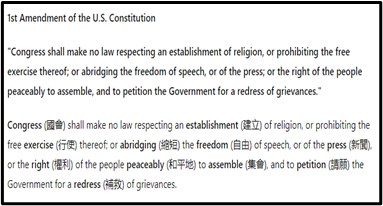
understanding of historical and contemporary issues.3 AI-powered tools can support multilingual learners by offering customized language resources tailored to individual student language needs. These tools can assist social studies teachers by identifying key vocabulary and facilitating the translation or integration of terms in various languages. For example, a government teacher working with primarily Chinese-speaking students, who is covering the First Amendment and individual rights, might use AI to create a presentation slide with key terms highlighted in a complex text. AI can identify these terms in English, translate them into Chinese, and either embed the translations within the text or provide them as a separate reference.

This screenshot displays an output from ChatGPT used to create a handout featuring key vocabulary
words. These words have been identified and translated into Traditional Chinese to assist in understanding and learning.

AI integration in the classroom allows students to use language more expressively and intentionally. It enables teachers to seamlessly plan for the use of academic language while leveraging all of the students’ language resources. In the same example, the teacher can ask students to choose which of the freedoms from the First Amendment they view as most important and discuss their choices with partners in either language, with the aid of AI-powered tools. 3 This approach not only helps students understand critical concepts but also improves their comprehension by offering translations in their native languages, making the content more accessible and inclusive.4

3 Bárbara C. Cruz and Stephen J. Thornton, “Social Studies for English Language Learners: Teaching Social Studies that Matters,” Social Education 73, no.6 (2009): 271–74.
4 WIDA. Focus Bulletin: Translanguaging. Accessed July 20, 2024.

This screenshot displays an output from ChatGPT used to create a handout featuring key vocabulary
words. These words have been identified and translated into Traditional Chinese to assist in understanding and learning.

Additionally, research has shown that cognates can significantly aid language acquisition for multilingual students.5 Social studies teachers can use this concept into their pedagogical strategies to enhance student comprehension. AI-powered tools are particularly useful in this context. For
instance, an American History teacher, serving students who speak French, English, and Spanish might use such tools to generate a slide illustrating all possible cognates in the Gettysburg Address. This visual aid can facilitate students’ understanding of the document. To be inclusive of all students’
languages, the teacher should ensure that the slide includes cognates relevant to each language spoken in the classroom. The table of cognates, produced automatically and efficiently by AI, serves as a valuable resource for these students.

https://wida.wisc.edu/sites/default/files/resource/Focus-Bulletin-Translanguaging.pdf.
5 “Using Cognates to Develop Comprehension inEnglish,” Colorín Colorado, accessed July 19, 2024,
https://www.colorincolorado.org/ellstrategies/cognates.

Screenshot of the output table from the prompt: “Identify any cognates in French and Spanish in the Gettysburg Address.”

AI-powered tools have greatly improved the accessibility of media content, particularly benefiting language acquisition for multilingual students. These tools can produce transcripts and captions for videos found on online platforms such as YouTube and Vimeo, making it easier for educators to
share content in various languages. They can also efficiently create transcripts and captions for student or teacher-created content, presenting material in multiple languages. For instance, a social studies teacher might ask students to share their immigrant arrival stories, which can then be recorded, transcribed, or captioned in multiple languages. This approach honors students’ cultures, facilitates collaboration, and maximizes translanguaging as a pedagogy, helping students understand
themselves and others better. Students can also practice public speaking by presenting their stories to the class and receiving constructive feedback from their peers. With AI tools, feedback can be offered in any language, further supporting diverse language needs and enhancing the learning experience.

Social studies teachers can foster an environment that supports multilingual learners by being flexible with their planning. This involves allowing students to navigate and utilize different language practices as they learn. For instance, in a World History class studying the social aspects during the Industrial Revolution in England, students who speak various native languages might read primary sources translated, in parts or in whole, in their own language, engage in group debates in
English, and annotate texts in any language they choose. Flexibility is crucial here; the goal is to help students process and make sense of what they have learned with direct translation only as needed. AI-powered tools can greatly facilitate this process.

These tools can assist teachers in creating discussion prompts in multiple languages, generating translated texts or primary sources, or even developing multilingual word walls. Such capabilities make it easier to integrate diverse language practices in the classroom and support students’
understanding across different languages.

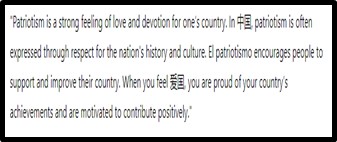
Teachers can design learning objectives that foster bilingualism and multilingualism by emphasizing skills that transcend specific languages. For example, objectives could include: “Students will be able to analyze the concepts of nationalism and patriotism through collaborative research and discussion,” enabling them to engage with diverse perspectives. By utilizing tools like Google Docs or virtual whiteboards, students can collaborate in real-time, contributing in different languages and using AI to translate their contributions effortlessly. AI allows students to navigate and integrate multiple languages in their work, thus enhancing their language acquisition and comprehension. This
approach encourages inclusive participation and deepens understanding of social studies concepts across linguistic boundaries.

Sample Output from ChatGPT: Exploring the question ‘What does patriotism mean to you?’—a
snapshot of sample student reflection on the essence of national pride and identity. 6 (Katie Novak, “Why UDL Matters for English Language Learners,” Language Magazine, March 9, 2018,
https://www.languagemagazine.com/2018/03/09/why-udl-matters-for-english-language-learners/.
7 Anya S. Evmenova, Jered Borup, and Joan Kang Shin, “Harnessing the Power of Generative AI to
AI and Universal Design for Learning (UDL)

AI intersects with Universal Design for Learning (UDL) by promoting flexible language use to support diverse learners, aligning with UDL’s principles of Multiple Means of Representation and Engagement.6

AI can enhance this intersection by using students’ languages as a starting point for brainstorming ideas, creating real-life scenarios that honor their cultures, reducing writer’s block, and producing materials with varying demands and levels.7 Additionally, AI can provide personalized feedback in
multiple languages, facilitate comparisons between student-generated and AI-generated content for reflective learning, and incorporate speech recognition software to support diverse communication needs. For example, a teacher preparing students for a group debate on whether to join the Patriots’ cause or remain loyal to the British at the onset of the Revolutionary War can encourage engagement by allowing students to research in any language and prepare their talking points in both English and their native languages. The debates can then be conducted in the languages of the students’ choosing, with real-time translation and speech recognition software available to support their participation, making the activity inclusive and accessible for all learners. 8
(Support ALL Learners,” Journal of Educational Technology, 2024, https://doi.org/10.1007/s11528
024-00966-x.
(Published May 14, 2024).
8 Cioè-Peña, M. (2022). TrUDL, a path to full inclusion: The intersectional possibilities of translanguaging and Universal Design for Learning.)

The use of AI in education empowers social studies teachers to effectively support multilingual students in academic writing. AI-powered resources, such as Ethiqly and Khanmigo’s Writing Coach, can assist with the writing process by providing sentence starters, suggesting outlines, and brainstorming ideas for multilingual learners.9 In multilingual classrooms where teachers may not be fluent in all languages spoken by their students, this is especially helpful.

AI can also translate and interpret various languages simultaneously, enabling teachers to enhance students’ understanding and expression in their native tongues. For example, a government teacher can use AI to create sentence starters or templates when asking students to write an argumentative
essay on voting rights. These supports can be provided in their native language, in English, or both, as AI offers the flexibility and simplicity needed to accommodate diverse linguistic needs.

The integration of AI in social studies classrooms has emerged as a transformative tool for supporting multilingual learners, offering unprecedented opportunities to enhance engagement, comprehension, and participation. By leveraging AI’s capabilities, educators can create dynamic
and inclusive learning environments that address the diverse linguistic needs of their students. Whether through enhanced media accessibility, flexible lesson planning, or personalized academic support, AI tools enable teachers to break down language barriers and foster a deeper connection to
historical content.
8 TESOL Quarterly, 56(2), 799–812. https://doi.org/10.1002/tesq.3074
9 “AI and Education: Will Chatbots Soon Tutor Your Children?” The New York Times, January 11, 2024,

As we continue to explore the potential of AI in education, it is essential to prioritize intentional and thoughtful integration, ensuring that these tools complement and enhance traditional teaching methods. By embracing AI’s potential, educators can empower multilingual learners, enrich their
educational experiences, and contribute to a more inclusive and equitable learning environment. Through ongoing innovation and adaptation, AI can play a pivotal role in advancing social studies education and supporting the diverse needs of multilingual learners.
https://www.nytimes.com/2024/01/11/technology/ai
chatbots-khan-education-tutoring.html
.

Seven Steps to Raising a Bilingual Child

Reviewed by Thomas Hansen, Ph.D.

The author presents here a very clear guide for parents who wish to raise their children to become bilingual speakers.  The author uses a variety of language examples, plus stories of real parents whose children have become proficient in more than one language because of the help and planning of their parents.  There are seven clear steps here, the most important of which is planning to start at a certain point and then maintain one’s interest and devotion to raising the child to be bilingual.

With background in developmental-behavioral pediatrics, this physician is an expert in how children learn languages.  She is raising her own children to be multilingual, and she understands the perspective of the parent.  This is perhaps why she is able to relate to parents and put the technical information into terms parents will appreciate.  

The author presents seven myths of bilingual learning—such as the notion that not all kids can learn another language.  The myths are the typical ones we as language teachers often hear, whether we teach world languages, language arts, English as a second language programs (ESL), or bilingual education.  Little kids are resilient, and their brains are wired for communication.  The author does a good job of reminding parents of these facts.

The author explains to parents the importance of letting students develop all four skills areas, meaning listening, then speaking, then reading, and finally writing.  This is the natural order in which children learn languages—at least predominantly—but some of us in second language teaching are great advocates for teaching the skills in a more integrated fashion, even from the early stages.  However, we still realize first-graders should not be expected to write term papers in the target language!

Steiner provides other notes for the parents to help them tailor the language teaching and language learning experiences at home to their unique children.  Each child is different, and one important point is that some children will learn the second language at slower rates than others.  The author provides ideas on how to deal with these kinds of issues in the quest for language proficiency.

Overall, I will recommend the book, but there are a few comments I will make on it.  One weakness is that the explanation of bilingual education and ESL programs (pp. 155-158) is a bit vague.  The author tries to summarize in just a few short paragraphs rather diverse programs.  As most language teachers can tell you, each district—sometimes each building—has a very different model in use. 

Note that teachers and administrators of many types of programs may take issue with what the author says on various pages about school programs (e.g., pp. 80, 155) because the explanation simply cannot be done in such a short space.  If you recommend this book to parents or to parent groups, please warn them about some of those passages.  

The information about dual language is pretty much accurate, and the point is made that most programs in the nation are for French/English and Spanish/English experiences.  However, the parent will need to seek out the programs in their own or nearby schools and districts. 

Note that it is often very hard to locate dual language programs in the state since there is rarely a statewide directory in place (in Illinois for example) and because of the way the teachers’ workload is reported to the state education agency.  In many cases, a dual language teacher is simply registered by the district as an “elementary grade teacher.”  The same is true of teachers who teach foreign language in the elementary schools (FLES) programs.

The good news, though, is that there are very effective and well-established programs out there that are flourishing.  For example, Chicago Public Schools (District 299) lead the way in innovative language programs and dual language initiatives.  Staff members there can help you with questions and can help direct parents to certain schools with new and interesting language programs in place. 

Illinois also is one of the leaders nationwide in the number of FLES programs available to students in K-8 buildings.  This is not even counting Saturday, after-school, and immersion language programs—all of which exist in Chicago and many of the suburban schools.

One benefit of the book is the way the author relates to parents and knows what challenges they may face.  For example, the author explains how to approach the foreign language teacher if you have a child who has been speaking another language at home and who should be in more advanced levels than the school is planning. 

Readers should remind parents that sometimes they will need to be assertive indeed in getting their kids into the right levels so they are not bored to death in a beginning level too easy for them.  The author mentions also that the kids could start a different language in higher grade levels, but parents should fight against this.  The ACTFL and state standards remind us students need long-term programs–complete with high-quality classroom instruction in all four skills areas.      

Another benefit is that the author reminds parents (pp. 39-40) that foreign language exploratory (FLEX) programs simply do not produce much proficiency and the parents should not expect much from them.  It is important for parents to get this fact! 

As an aside, I will also mention that these programs stand in the way of other language programs becoming planned and put into place because the FLEX programs appear to “offer something” in the realm of language teaching—even though they do not produce much. 

Another issue is that many people will say something like, “Well with the FLEX program at least we have something going on.”  With that, they do not commit funds to start a bona fide educational program with the goal of creating language proficiency.

Because the author has a very different perspective on language learning and parenting, I think she can explain things in ways parents understand.  The book is a good foundation for parents, and it could also work for school boards looking to increase their language program offerings.   

Engaging Students with Poverty in Mind: Practical Strategies for Raising Achievement

Engaging Students with Poverty in Mind: Practical Strategies for Raising Achievement, by Eric Jensen (Alexandria, VA: Association for Supervision and Curriculum Development)

Review by Thomas Hansen

Eric Jensen provides good hints and strategies for dealing with the special and difficult problems our poorer students bring to the classroom.  The number of students living in poverty has grown exponentially, yet many educators are not aware of the realities.  Jensen shows a good understanding of some of the difficulties and challenges students face, and he uses a research basis in this text.

Published in 2013, this book paints a bleak picture of a bleak nation.  I am sure Jensen had NO idea there would be worse days, COVID-19, and a burgeoning homeless population in this country.  Fresh after the New Great Depression, this book was timeless then—and is timeless now.

This text appeared years ago but is still relevant because the number of persons on the streets has risen, a huge number of families rely on food stamps and free lunches, and the homes of many families have been boarded up for a number of years, with most people not able to afford a house and the original occupants of those dwellings now living with relatives, in shelters, or in their cars. 

A huge challenge today is how to afford a place to live.  Struggling families can tell you this.  Housing is expensive.  In many cities, very few people have any interest at all in providing affordable homes or apartments for poorer people to live in.  You can count on one hand the cities that have actually addressed the problem of “where to put the poor people.

The question remains:  “How do we begin to help students who face the stressors of hunger, despair, and stigma each day?”  It is important to serve and protect the students now, while they are poor, and deal with housing and other services later.  But how do we teach them?  Feed them?  Encourage them?

Jensen includes the data from research on these students, starting with health and nutrition issues and ranging to the stress levels and daily hassles students face.  These and five other areas constitute the seven types of challenges facing students living in poverty, though I would suggest many of our students, in addition to teachers and teacher candidates, face many of these same difficulties.   Jensen calls these “the seven engagement factors,” and the other ones are: vocabulary; effort and energy; mind-set; cognitive capacity; and relationships.

Jensen bases his approach here more on the stressors facing poor students and less on technical information about the poverty numbers and facts out there.  For that technical data, we would have to go to other sources. 

Jensen proposes “five rules for engagement” for teachers to employ in the classroom as a means of getting poorer students involved: upgrade your attitude; build relationships & respect; get buy-in; embrace clarity; and show your passion.  Though I think these are good to use with any student, they seem to make sense in dealing with students who face the hassles and challenges of living with poverty on a daily basis, a seemingly unrelenting set of difficulties.  Clarity is important, for example, because students living in poverty are often hungry and tired, and they need straightforward definitions and examples, in addition to encouragement and a positive learning environment.

Jensen acknowledges hunger and stress and the power they hold over students.  He reminds us that students should be treated with dignity, and that they are the reason we have a job.  The students are the future of our country, Jensen reminds us, not prison inmates. 

Students living in poverty, especially, come to school wondering if someone there cares about them, wondering if they are important.  They may have difficulty concentrating, and difficulty feeling that the school day may offer something interesting and relevant in a world that may have forgotten them, they may feel.  Younger people, especially, have trouble making sense of a world in which there is so much hunger.                

I can think of some other texts from years ago that are still relevant.  If Jensen’s older book is to be used in a topics class on dealing with poverty issues or other such use, including professional development meetings or retreats, I would definitely recommend one or more additional texts—both of them older/older editions fine—with more specific information on poverty be included.  One good additional text would be: Poverty in America: A Handbook, Third Edition, 2013, by John Iceland.  

Another good text would be: Someplace Like America: Tales from the New Great Depression, Updated Edition, 2013, by Dale Maharidge, Photographs by Michael S. Williamson.  These could both provide more of the technical information not included in the Jensen text.

To summarize, I recommend this text because of the good teaching strategies and scenarios included.  I think most of what Jensen includes is good information for working with any student, and certainly any student facing stressful situations. 

Teaching Controversial Issues: Teachers’ Freedom of Speech in the Classroom

Teaching Controversial Issues: Teachers’ Freedom of Speech in the Classroom

Arlene Gardner

What is the purpose of education? The conventional answer is the acquisition of knowledge. Looking beyond this facile response, most people will agree that the true purpose of education is to produce citizens. One of the primary reasons our nation’s founders envisioned a vast public education system was to prepare youth to be active participants in our system of self-government.  John Dewey makes a strong case for the importance of education not only as a place to gain content knowledge, but also as a place to learn how to live. In his eyes, the purpose of education should not revolve around the acquisition of a predetermined set of skills, but rather the realization of one’s full potential and the ability to use those skills for the greater good.

Democratic self-government requires constant discussions and decisions about controversial issues. There is an intrinsic and crucial connection between the discussion of controversial political issues and the health of democracy. If we want our students to become informed, engaged citizens, we need to teach them how to “do” democracy by practicing the skills of discussing controversial issues in the classroom and learning how to respectfully disagree.

Research has demonstrated that controversy during classroom discussion also promotes cognitive gains in complex reasoning, integrated thinking, and decision-making. Controversy can be a useful, powerful, and memorable tool to promote learning. In addition to its value in promoting skills for democracy, discussing current controversial public issues:

  • Is authentic and relevant
  • Enhances students’ sense of political efficacy
  • Improves critical thinking skills
  • Increases students’ comfort with conflict that exists in the world outside of the classroom
  • Develops political tolerance
  • Motivates students
  • Results in students gaining greater content knowledge.

(Diana Hess, Controversy in the Classroom: The Democratic Power of Discussion (2009); Nel Noddings and Laurie Brooks, Teaching Controversial Issues: The Case for Critical Thinking and Moral Commitment in the Classroom (2017); “Guardian of Democracy: The Civic Mission of Schools” (2011); Center for Research on Learning and Teaching, University of Michigan at https://crlt.umich.edu/tstrategies/tsd).

Yet, teachers may consciously (or unconsciously) avoid controversial issues in the classroom because of the difficulty involved in managing heated discussions and/or for fear that parents will complain or that the school administration will admonish or punish them for “being controversial.” These concerns are certainly not groundless. How well are teachers protected from negative repercussions if they address controversial issues in their classrooms? How extensive are teachers’ First Amendment rights to free speech? How can heated disagreements among students be contained in the classroom?

Two different legal issues exist regarding free speech rights of teachers: The First Amendment directly protects a teacher’s personal right to speak about public issues outside of the classroom and “Academic Freedom” protects a teacher’s right and responsibility to teach controversial issues in the classroom.  However, both have certain limitations.

First Amendment protection of public speech by teachers

Although the First Amendment free speech protection is written in absolute terms (“Congress shall make no law…”), the courts have carved out several exceptions (for national security, libel and slander, pornography, imminent threats, etc.).  The courts have also carved out a limited “government employee” exception based on the rationale that a government employee is paid a salary to work and contribute to an agency’s effective operation and, therefore, the government employer must have the power to prevent or restrain the employee from doing or saying things that detract from the agency’s effective operation.  Thus, the government has been given greater latitude to engage in actions that impose restrictions on a person’s right to speak when the person is a governmental employee, which includes teachers who work in public schools.

Some of the earliest threats to the free speech rights of public school teachers were the loyalty oaths that many states imposed on government employees during the ‘‘red scare’’ and early ‘‘cold war’’ years of American history. In Adler v. Board of Education (1952), the Supreme Court in a 6-3 decision rejected First Amendment claims and upheld a New York statute designed to enforce existing civil service regulations to prevent members of subversive groups, particularly of the Communist Party, from teaching in public schools. The Supreme Court effectively overturned this ruling in the 1960s and declared several loyalty oath schemes to be unconstitutional because they had chilling effects on individuals which violated their First Amendment rights (Baggett v. Bullitt (1964); Cramp v. Board of Public Instruction (1961); and Keyishian v. Board of Education (1967)).

Much of the reasoning regarding the “government employee” exception to the First Amendment outlined in Adler was abandoned altogether in the 1968 U.S. Supreme Court decision in Pickering v. Board of Education. Teacher Marvin Pickering had written a letter complaining about a recently defeated school budget proposal to increase school taxes. The school board felt that the letter was “detrimental to the efficient operation and administration of the schools” and decided to terminate Pickering, who sued claiming his letter was protected speech under the First Amendment. The U.S. Supreme Court held that Pickering’s dismissal violated his First Amendment right to free speech because public employees are entitled to the same measure of constitutional protection as enjoyed by their civilian counterparts when speaking as “citizens” and not as “employees.”

In Mt. Healthy City School District v. Doyle (1977), non-tenured teacher Fred Doyle conveyed the substance of an internal memorandum regarding a proposed staff dress code to a local radio station, which released it. When the board of education refused to rehire him, Doyle claimed that his First and Fourteenth Amendment rights had been violated. The court developed a “balancing test” that required the teacher to demonstrate that the speech act was a ‘‘substantial’’ or ‘‘motivating factor’’ in the administration’s decision and gave the school board the opportunity to demonstrate, based on the preponderance of the evidence, that the teacher’s speech act was not the ‘‘but for’’ cause of the negative consequences imposed on the teacher by the school board. Finally, the court would “balance” the free speech interests of the teacher and the administrative interests of the school district to determine which carried more weight.  Based on this test, the U.S. Supreme Court found that the teacher’s call to the radio station was protected by the First Amendment, that the call played a substantial part in the board’s decision not to rehire Doyle, and that this action was a violation of Doyle’s rights under the First and Fourteenth Amendments.

In a 5/4 decision in Connick v. Meyers (1983), the U.S. Supreme Court held that speech by public employees is generally only protected when they are addressing matters of public concern, not personal issues. Sheila Meyers was an Assistant District Attorney who had been transferred.  She strongly opposed her transfer and prepared a questionnaire asking for her co-workers views on the transfer policy, office morale and confidence in supervisors.  She was terminated for insubordination. Meyers alleged her termination violated her First Amendment right to free speech. The district court agreed and the Fifth Circuit affirmed. However, the U.S. Supreme Court reversed because Meyer’s speech only dealt with personal not public issues.  “When a public employee speaks not as a citizen upon matters of public concern, but instead as an employee upon matters only of personal interest, absent the most unusual circumstances, a federal court is not the appropriate forum in which to review the wisdom of a personnel decision taken by a public agency allegedly in reaction to the employee’s behavior.” Although the case involved an Assistant District Attorney, it is applicable to all public employees: teachers must demonstrate that their speech is of public concern.

This was confirmed in Kirkland v. Northside Independent School District (1989) where the school district did not rehire non-tenured teacher Timothy Kirkland because of poor performance and substandard teaching evaluations. Kirkland filed a lawsuit in federal district court against Northside, claiming that he was not rehired in violation of his First Amendment rights after he gave his students a reading list that was different from Northside’s list. Northside argued that Kirkland had no right to substitute his list without permission or consent and he had failed to obtain either. The district court ruled in favor of Kirkland and Northside appealed. The Fifth Circuit Court of Appeals reversed and dismissed Kirkland’s complaint, holding that Kirkland’s “speech” did not infringe on any matter of public concern and was in fact “private speech.” If the nature of the speech is purely private, such as a dispute over one employee’s job performance, judicial inquiry then comes to an end, and the question of whether the employee’s speech was a substantial or motivating factor in the decision not to rehire him need not even be reached. The U.S. Supreme Court denied cert, leaving this decision in place.

Academic freedom

Although primarily used in the context of university faculty rights, “Academic Freedom” protects a teacher’s ability to determine the content and method of addressing controversial issues in the classroom.  This is more limited at the K-12 level because the courts have long held the view that the administration of K-12 public schools resides with state and local authorities. Primary and secondary education is, for the most part, funded by local sources of revenue, and it has traditionally been a government service that residents of the community have structured to fit their needs. Therefore, a teacher’s “Academic Freedom” is limited to his or her content and method of teaching within the policies and curriculum established by the state and local school board. By finding no First Amendment violation, the court in Kirkland implicitly held that he had no right to substitute his own book list for the one approved by the district without permission or consent, which he failed to obtain. 

In an early case, following the end of World War I, Nebraska had passed a law prohibiting teaching grade school children any language other than English and Robert Meyer was punished for teaching German at a private Lutheran school. The court held that the Nebraska law was an unnecessarily restrictive way to ensure English language learning and was an unconstitutional violation of the 14th Amendment due process clause (the 14th Amendment had not yet applied the First Amendment to the states until Gitlow v.  New York in 1925) that exceeded the power of the state (Meyer v. Nebraska, 262 U.S. 390 (1923).

“The Fourteenth Amendment, as now applied to the States, protects the citizen against the State itself and all of its creatures-Boards of Education not excepted. These have, of course, important, delicate, and highly discretionary functions, but none that they may not perform within the limits of the Bill of Rights. That they are educating the young for citizenship is reason for scrupulous protection of Constitutional freedoms of the individual, if we are not to strangle the free mind at its source and teach youth to discount important principles of our government as mere platitudes.” Justice Jackson in West Virginia Board of Education v. Barnett (1943)(holding unconstitutional a requirement that all children in public schools salute the flag).

The Supreme Court has more than once instructed that “[t]he vigilant protection of constitutional freedoms is nowhere more vital than in the community of American schools” (Shelton v. Tucker (1960)). In Epperson v. Arkansas (1968)(a reprise of the famous 1927 “Scopes Trial”), the Arkansas legislature had passed a law prohibiting teachers in public or state-supported schools from teaching, or using textbooks that teach, human evolution. Sue Epperson, a public school teacher, sued, claiming that the law violated her First Amendment right to free speech as well as the Establishment Clause. A unanimous U.S. Supreme Court declared the state law unconstitutional. The Court found that “the State’s undoubted right to prescribe the curriculum for its public schools does not carry with it the right to prohibit, on pain of criminal penalty, the teaching of a scientific theory or doctrine where that prohibition is based upon reasons that violate the First Amendment.” Seven members of the court based their decision on the Establishment Clause, whereas two concurred in the result based on the Due Process clause of the 14th Amendment (because it was unconstitutionally vague) or the Free Speech clause of the First Amendment.

The Supreme Court, however, has not clearly defined the scope of academic freedom protections under the First Amendment, and commentators disagree about the scope of those protections. (See, e.g., William W. Van Alstyne, “The Specific Theory of Academic Freedom and the General Issue of Civil Liberty,” in The Concept of Academic Freedom 59, 61-63 (Edmund L. Pincoffs ed., 1972); J. Peter Byrne, “Academic Freedom: A ‘Special Concern of the First Amendment’,” 99 Yale L.J. 251 (1989); and Neil Hamilton, Zealotry and Academic Freedom: A Legal and Historical Perspective (New Brunswick, 1998). 

Whatever the legal scope, it is clear that the First Amendment protection of individual academic freedom is not absolute. For example, in Boring v. Buncombe County Board of Education (1998), the Fourth Circuit Court of Appeals held that a teacher could be reprimanded (in this case transferred) because she sponsored the performance of a play that school authorities subsequently deemed inappropriate for her students and inconsistent with the curriculum developed by the local school authorities. This judicial deference toward K through 12 institutions often can be seen in cases involving teachers who assert that their First Amendment rights were violated when school administrators imposed punishments on them for engaging—while they taught their classes—in some form of expressive activity that the administrators disapproved.

The content

While cases about academic freedom, such as Epperson,  involved state laws that limited or prohibited certain content being taught (in this case prohibiting teachers in public or state-supported schools from teaching, or using textbooks that teach, human evolution); New Jersey has taken a very broad approach to classroom content.  Since 1996, New Jersey has established state standards (currently called “Student Learning Standards”) that set a framework for each content area.  Unlike many other states, New Jersey does not establish a state curriculum but rather leaves this to local school boards. Subject to applicable provisions of state law and standards set by the State Department of Education, district school boards have control of public elementary and secondary schools.  How much protection do New Jersey teachers have when they address controversial topics?  Most First Amendment education cases in New Jersey involve students’ rights rather than teachers’ rights (e.g., school dress, vulgar language, threats, religious speech, equal access, See http://www.njpsa.org/documents/pdf/lawprimer_FirstAmendment.pdf). However, several recent cases from the Third Circuit (which includes New Jersey) provide some parameters.

In Edwards v. California University of Pennsylvania (3rd Cir. 1998), a tenured professor in media studies sued the administration for violating his right to free speech by restricting his choice of classroom materials in an educational media course. Instead of using the approval syllabus, Edwards emphasized the issues of “bias, censorship, religion and humanism.” Students complained that he was promoting religious ideas in the class. The U.S. Supreme Court declined to review the Third Circuit’s summary judgement against Edwards, holding that a university professor does not have a First Amendment right to choose classroom materials and subjects in contravention of the University’s dictates.

A very recent decision regarding a New Jersey teacher confirms the fact that the First Amendment does not provide absolute protection for teachers in public schools to decide the content of their lessons if it is not within the curriculum set by the school district.  In Ali v. Woodbridge Twp. School District (3rd Cir. April 22, 2020) a non-tenured public high school teacher at Woodbridge High School was teaching Holocaust denial to his students and was posting links to articles on the school’s website saying things such as, “The Jews are like a cancer” and expressing conspiracy theories accusing the United States of planning a 9/11-style attack. When the Board of Education fired Ali, he sued claiming that his employment was terminated on the basis of his race and religion, and that defendants had violated his rights to free speech and academic freedom, among other claims. The District Court rejected all of Ali’s claims, awarding summary judgment to the school board, and the Third Circuit affirmed.

These are extreme cases where a teacher is addressing issues that are NOT within the curriculum set by the university or within the state social studies standards and the local school district’s curriculum.  When teachers are teaching a controversial topic that is included in the New Jersey Student Learning Standards for Social Studies and their school district’s social studies curriculum, the existing case law seems to support the fact that they would be protected by the Fourteenth Amendment, unless they are violating school policies that require teaching in a neutral, balanced manner that does not seek to indoctrinate students.

For example, what if a teacher wants to assign a research paper about the Stonewall Riots or the Lavender Project?   Since the history of LGBT rights is in the state standards and supposed to be included in local school district social studies curriculum, the Stonewell Riots and Lavender Project would be part of this history. This is not a situation like Ali where the materials were beyond the scope of the local curriculum (as well as being taught in an indoctrinating manner—see below). If the teacher fears that the topics will be controversial with the community, he or she should make the school administration aware of what he or she is planning to do.  Since here, what the teacher plans to teach is within the state standards and the local school district curriculum, the school administration should support the teacher.  If parents object, the real issue is one of policy (Should LGBT history be taught?), which is decided by the state and local boards of education, not the teacher. Therefore, the parents’ argument should be with the state and local boards of education.

What if a teacher wants to show scenes of an R-rated movie in the classroom (i.e. Revolutionary War scenes from The Patriot or D-Day from Saving Private Ryan?) Obviously, the American Revolution and World War II are part of the state standards for U.S. History and in every local school district’s curriculum.  The movie scenes would need to relate to the district curriculum and the teacher should get prior administrative and parental approval if some movie scenes are going to be very graphic.

How should a teacher prepare lessons on Nazi Germany during the 1930s? Nazi Germany is also part of the state history standards and every school district’s curriculum. It should be taught in a way so that students can understand how the Nazis came to power and the prejudices they carried.  Some of the World War II footage and movies may be shocking but our students will not be able to become informed, engaged citizens if we hide the past from them. 

An ounce of prevention beforehand will help.  Before starting, teachers should be clear about the goal of their lesson: The classroom activities should encourage critical thinking. You are not trying to convince students of any particular point of view. Preview any materials, especially visual media which may be very powerful or provocative. Be aware of the biases of the sources of information that will be used by students.

Teaching Tolerance suggests in Civil Discourse in the Classroom that “Teachers can effectively use current and controversial events instruction to address a wide variety of standards and even mandated content. To do so, however, teachers must work carefully and incrementally to integrate this new approach in their classrooms.”  The University of Michigan’s Center for Research on Learning and Teaching offers guidance for how instructors (offered for college instructors but applicable for K-12) can successfully manage discussions on controversial topics. See Center for Research on Learning and Teaching, University of Michigan at https://crlt.umich.edu/tstrategies/tsd). The “Statement on Academic Freedom and Tenure” of the American Association of University Professors, suggests that teachers should be careful to avoid controversial matters that are unrelated to the subject discussed.

Before engaging students in an activity or discussion involving a controversial subject, tell your supervisor and/or principal what you are planning on teaching and, if necessary, reference the district policy on teaching controversial issues, explain the lesson’s connection with the district social studies curriculum and explain the goal and value of what you plan to do.  Then, consider the demographics of your community. If you anticipate that the topic of your lesson will be controversial with the community, send a note and/or talk with your students’ parents and/or the Parent Teacher Organization.

In an informative piece titled “Do You Have the Right to be an Advocate?,” published by EdWeek, Julie Underwood, a professor of law and educational leadership and policy analysis at the School of Education, University of Wisconsin-Madison, explains that the “district or the state can regulate employee speech during school hours or at school-sponsored activities to protect their own interests in instruction and political neutrality.” Despite the ambiguity in the laws protecting a teacher’s freedom of speech, Underwood concludes: “If it relates to the in class instruction and is age appropriate there is a good rationale for having a political discussion”.

Teaching in a Neutral or Balanced Manner

If the teacher has created a supportive, respectful classroom climate and built tolerance for opposing views, it will be easier to consider controversial topics. For example, considering historical controversies might be good background as practice for looking at current controversies. Establish a process and rules of adequate evidence or support so that the discussion is based on facts rather than simply opinions. To help maintain classroom order even when students are having heated disagreements, set clear rules for discussions or use activities that require students to use active listening skills when considering controversial issues, such as:

  • Continuum/Take a Stand
  • Civil Conversations
  • C3 Inquiries
  • Guided discussions
  • Socratic Smackdown
  • Moot courts—structured format for considering constitutional issues
  • Philosophical Chairs discussion
  • Legislative hearings—structured format for considering solutions to problems

Carefully consider how students are grouped if they are to work cooperatively.  Provide closure (which may be acknowledging the difficulty of the issue).

School boards work primarily through policies which set guidelines for principals, teachers, parents and students, as well as the district curriculum. To avoid a problem afterwards, the teacher should make sure that the controversial topic is within the state standards and the curriculum adopted by their local school board. Then the teacher should consult the school district’s policy regarding the teaching of controversial issues. Most school districts have a policy (usually #2240) that supports and encourages the teaching of controversial issues and sets guidelines for teaching controversial issues, including a process for dealing with challenges.  Although the language may differ, policies dealing with controversial issues generally focus on the need for the classroom lesson to be balanced, unprejudiced, fair, objective, and not aimed at indoctrinating students to a particular point of view.

Clearly, the type of indoctrination attempted by the teachers in the Edwards or Ali cases is beyond protected speech.  In addition to avoiding indoctrination, teachers should avoid telling a joke in the classroom that might imply a negative characterization of an ethnic group, religion or gender.  A “joke” that might be a put down of any ethnic group, religion or gender told in the classroom to students is never a good idea. It is not even a good idea for a teacher to post such a “joke” on Facebook because such speech might be considered as not addressing a matter of public concern and would not be protected by the First Amendment. However, using an historical photo, engraving or picture that included a negative image of an ethnic, racial or religious group might be okay in the context of examining what was seen as humor in the past and understanding the prejudice that existed during a particular time period. For example, when teaching about the Holocaust, a teacher might carefully use Nazi cartoons to demonstrate the high level of prejudice at the time. Another example might be using images of blackface or corporate ad campaigns to show racial attitudes when teaching about Jim Crow. The teacher does not need many examples to make the point. Know your audience. Choose carefully and be aware that certain advertising images from the Jim Crow era may offend some students in the class. The purpose of using controversial issues is important. At the core of deciding what a teacher should or should not say or do in the classroom is good judgment.

Should a teacher share his or her viewpoint on a controversial issue with the students?

Whether a teacher should share his or her opinion or viewpoint on a controversial issue will depend on the age of the students, if the opinion was requested by the students, and the comfort-level of the teacher.  A teacher’s opinion may have too much influence on younger students and should probably be avoided. What if a middle or high school student specifically asks for your opinion? Such “natural disclosures” in response to a direct question by a student should be accompanied by a disclaimer, such as “This is my view because…” or “Other people may have different views”.  If you prefer not to disclose your view, explicitly state that and explain why. Remember, the goal is to help students develop their own well-informed positions. Be mindful of your position as the “classroom expert” and the potential impact on the students. If you decide to disclose your own view, do it carefully and only after the students have expressed their views. Unrequested disclosures may be seen as preachy, or may stop the discussion. (See Hess, Controversy in the Classroom)

So, for example, should a teacher take a position on climate change?  In terms of content, climate change is in the state standards and should be in the local school curriculum. If parents disapprove of this topic, this disagreement is really with the curriculum set by the school board, not with the teacher.  However, the teaching strategy is important. Rather than taking a position, which may be seen as indoctrination or may simply stop the classroom inquiry, the better approach might be to have the students examine the issue and let the facts speak for themselves.  Let students use the facts that exist to construct their own arguments about whether or not climate change is the result of mankind’s use of fossil fuels in industry and transportation.  If the topic is presented in a balanced, neutral, non-indoctrinating manner, the teacher should not be subject to discipline. Objections by parents should be referred to the school administration because it is a matter of policy (Should climate change be taught?), which is decided by the state and local boards of education, not the teacher.

How should teachers address questions from students regarding Black Lives Matter and racial inequality? The ACLU in the state of Washington prepared a short online article, “Free Speech Rights of Teachers in Washington State” (NJ’s ACLU only has a publication about students’ rights) with a related hypothetical:  The teacher is instructed not to discuss personal opinions on political matters with students.  In a classroom discussion on racial issues in America, the teacher tells the class that he/she has recently participated in a Black Lives Matter demonstration.  Revealing this is the same as giving an opinion and may not be protected speech. Teachers can be disciplined for departing from the curriculum adopted by the school district and this would be a departure.

Can a teacher state that New Jersey is a segregated state when it comes to communities? Is the teacher stating this as a personal opinion or as a fact related to a topic of learning? There is no reason to simply state that NJ is segregated unless it is in the context of helping students understand and appreciate the history of segregation in NJ consistent with state standards and district curriculum. (For example, see “Land Use in NJ” and “School Desegregation and School Finance in NJ” for history, context and facts at http://civiced.rutgers.edu/njlessons.html).

Is a teacher permitted to take a stand on the issue of removing public monuments? Assuming that this is part of a current events lesson, it would be better if the teacher remained neutral and let the students’ voice differing views. If the students all have one position, perhaps the teacher can take a position as “devil’s advocate,” but it should be made clear that this is what the teacher is doing.

Can a teacher assign blame to protests to specific groups or left or right extremist groups? Assigning blame is the same as a teacher giving his or her personal opinion. The better approach would be to have students look at the actions of specific groups and determine their appropriateness.

Can a teacher assign blame to Associate Justice Amy Coney Barrett regarding a Supreme Court decision that is 5-4 and against the teacher’s preference (i.e. Affordable Care Act, marriage, etc.).  Assuming that this is part of a classroom lesson about the Supreme Court, the teacher should refrain from “assigning blame” because this is expressing his or her opinion, but should instead let the students consider the reasoning and impact of the decisions.

Is a teacher permitted to criticize or defend the government’s policies or actions on immigration? Outside the classroom, a teacher has a first amendment right to express his or her views on public issues. As part of a classroom lesson about immigration, rather than criticizing or defending the government’s policies or actions on immigration, the better approach would be to present or let students research the history of immigration policy and its impact and let the students discuss and draw their own conclusions (For example, see “Immigration Policy and its impact on NJ” at http://civiced.rutgers.edu/njlessons.html).

Can a teacher show a video clip from a specific news station (Fox, CNN) or assign students to watch a specific news program as an assignment?  As long as the purpose is not indoctrination to any particular point of view and the assignments are balanced. If the teacher wants students to see and compare various media views on the same topic, that would be a valuable classroom activity. (For example, see “Educating for Informed, Engaged Citizens” virtual workshop, for background on helping students understand bias in news, at the New Jersey Council for the Social Studies website at http://www.njcss.org/;  also see Choices Program at Brown University: Teaching with the News at https://www.choices.edu/teaching-with-the-news/;   and Constitutional Rights Foundation Fake News at https://www.crf-usa.org/images/pdf/challenge/Understanding-Fake-News1.pdf and https://www.crfusa.org/images/pdf/challenge/Tackling-Fake-News.pdf).

Conclusions

A teacher has a personal right under the First Amendment to share his view on public policy issues in public but NOT in the classroom.  A teacher sharing his opinion or viewpoint in the classroom may be seen as indoctrination. So, for example, teachers should avoid sharing personal views on one’s sexual preference, regarding a particular candidate, President Trump’s taxes, a decision by a Grand Jury, prosecutor, FBI on racial issues, etc. Your school district may even have an explicit policy that teachers should not discuss personal views on political matters in the classroom, in which case, this policy should be followed.  Everything a teacher says or does in the classroom should be considered based on the possible impact on the students.

This does not mean that teachers should avoid having students examine and discuss controversial topics. Encouraging the development of civic skills and attitudes among young people has been an important goal of education since the start of the country.  Schools are communities in which young people learn to interact, argue, and work together with others, an important foundation for future citizenship.  Since the purpose of social education is to prepare students for participation in a pluralist democracy, social studies classes NEED to address controversial issues.  Teachers have the right and the responsibility to help their students understand controversial topics and to develop critical thinking skills.  However, the controversial topics should relate to the broad scope of subjects included in the NJ Student Learning Standards and the local school district curriculum.  And controversial subjects should be addressed in a neutral or balanced manner, without any effort to indoctrinate students, but rather to help them develop the knowledge and skills they will need as workers, parents and citizens in a democratic society.

Background Materials

Meyer v. Nebraska, 262 U.S. 390 (1923)

West Virginia Board of Education v. Barnett, 319 U.S. 624 (1943)

Adler v. Board of Education, 342 U.S. 485 (1952)

Shelton v. Tucker, 364 U.S. 479 (1960)

Cramp v. Board of Public Instruction, 368 U.S. 278 (1961)

Baggett v. Bullitt, 377 U.S. 360(1964)

Keyishian v. Board of Regents, 385 U.S. 589 (1967)

Pickering v. Board of Education, 391 U.S. 563 (1968)

Epperson v. Arkansas, 393 U.S. 97 (1968)

Mt. Healthy City School District Board of Education v. Doyle, 429 U.S. 274 (1977)

Connick v. Meyers, 461 U.S. 138 (1983)

Kirkland v. Northside Independent School District, 890 F.2d 694 (5th Cir. 1989), cert. denied (1990)

Bradley v. Pittsburgh Bd. of Educ., 910 F.2d 1172 (3d Cir.1990)

Boring v. Buncombe County Board of Education, 136 F.3d 364 (4th Cir. 1998)

Edwards v. California University of Pennsylvania, 156 F.3d 488 (3rd Cir. 1998), cert. denied, 525 U.S. 1143 (1999)

Ali v. Woodbridge Twp. School District, 957 F.3d 174 (3rd Cir. April 22, 2020)

Keith Barton and Linda Levstik, Teaching History for the Common Good (Erlbaum, 2004)

Diana E. Hess, Controversy in the Classroom: The Democratic Power of Discussion (New York: Routledge, 2009)

Nel Noddings and Laurie Brooks, Teaching Controversial Issues: The Case for Critical Thinking and Moral Commitment in the Classroom (New York:  Teacher’s College Press, 2017).

William W. Van Alstyne, “Academic Freedom and the First Amendment in the Supreme Court of the United States:

An Unhurried Historical Review,” 53 Law and Contemp. Probs. 79 (1990)

ACLU-Washington at https://www.aclu-wa.org/docs/free-speech-rights-public-school-teachers-washington-state

American Association of University Professors, “Academic Freedom of Professors and Institutions,” (2002) at https://www.aaup.org/issues/academic-freedom/professors-and-institutions

Center for Research on Instruction and Teaching, University of Michigan at https://crlt.umich.edu/tstrategies/tsd

Choices Program at Brown University: Teaching with the News at https://www.choices.edu/teaching-with-thenews/

Constitutional Rights Foundation at https://www.crf-usa.org/

EdSurge at https://www.edsurge.com/news/2018-01-17-why-we-need-controversy-in-our-classrooms

Facing History at https://www.facinghistory.org/educator-resources

Find Law at https://www.findlaw.com/education/teachers-rights/teachers-different-freedoms-and-rightsarticle.html

Forbes at https://www.forbes.com/sites/jessicabohrer/2020/09/14/teaching-children-about-freedom-ofspeech/#25cb6ff07101

John Goodlad, “Fulfilling the Public Purpose of Schooling: Educating the Young in Support of Democracy May Be Leadership’s Highest Calling,” School Administrator, v61 n5 p14 May 2004.

Jonathan Gould, Kathleen Hall Jamieson, Peter Levine, Ted McConnell, and David B. Smith, eds. “Guardian of

Democracy: The Civic Mission of Schools, Philadelphia: Annenberg Public Policy Center, 2011

Amanda Litvinov, “Forgotten Purpose: Civic Education in Public Schools, NEA Today, Mar 16, 2017 at https://www.nea.org/advocating-for-change/new-from-nea/forgotten-purpose-civics-education-publicschools#

New Jersey Center for Civic Education (New Jersey lessons) at http://civiced.rutgers.edu/njlessons.html

New Jersey Law Journal at https://www.law.com/njlawjournal/2020/06/28/as-woodbridge-teachers-case-showsfacts-do-matter/?slreturn=20200929134110

New Jersey Principals and Supervisors Association at http://www.njpsa.org/documents/pdf/lawprimer_FirstAmendment.pdf

Phi Delta Kappa, “Do you have the right to be an Advocate?, at https://kappanonline.org/underwood-schooldistricts-control-teachers-classroom-speech/

Poorvu Center, Yale University at https://poorvucenter.yale.edu/teaching/ideas-teaching/teaching-controversialtopics

Teaching Tolerance at https://www.tolerance.org/magazine/publications/civil-discourse-in-theclassroom/chapter-4-teaching-controversy

Texas Association of School Boards at https://www.tasb.org/services/legal-services/tasb-school-lawesource/personnel/documents/employee_free_speech_rights.aspx

The First Amendment Encyclopedia at https://www.mtsu.edu/first-amendment/article/973/rights-of-teachers U.S. Civil Liberties at https://uscivilliberties.org/themes/4571-teacher-speech-in-public-schools.html