Era 13 Postwar United States: Civil Unrest and Social Change

www.njcss.org

The relationship between the individual and the state is present in every country, society, and civilization. Relevant questions about individual liberty, civic engagement, government authority, equality and justice, and protection are important for every demographic group in the population.  In your teaching of World History, consider the examples and questions provided below that should be familiar to students in the history of the United States with application to the experiences of others around the world.

These civic activities are designed to present civics in a global context as civic education happens in every country.  The design is flexible regarding using one of the activities, allowing students to explore multiple activities in groups, and as a lesson for a substitute teacher. The lessons are free, although a donation to the New Jersey Council for the Social Studies is greatly appreciated. www.njcss.org
Era 13 Postwar United States: Civil Rights and Social Change (1945 to early 1970s)

The postwar era marked the rise of America as a world power. The new world order established alliance and economic agreements that have led to unprecedented economic growth. However, this period also marks divisions between countries with democratic institutions, authoritarian governments following the ideology of Marxist communism, and developing countries with issues of poverty, disease, debt, and human rights abuses. The United States faced issues or racial segregation, a shrinking middle class, and the expansion of costly federal government programs and a large defense budget causing its national debt to increase. Technology and the media influenced social changes.

Dixiecrats and the Authority of State Government in the United States

The principle of federalism is valued in the way the people of the United States govern themselves. There is a fine line between the division of powers between the states and the national government. The Tenth Amendment specifically protects the powers of the 50 states, and the Ninth Amendment protects the powers of individual citizens.  The powers of the national government are carefully defined and limited.

“The enumeration in the Constitution, of certain rights, shall not be construed to deny or disparage others retained by the people.” (Ninth Amendment)

“The powers not delegated to the United States by the Constitution, nor prohibited by it to the States, are reserved to the States respectively, or to the people.” (Tenth Amendment)

“The President shall be Commander in Chief of the Army and Navy of the United States, and of the Militia of the several States, when called into the actual Service of the United States; he may require the Opinion, in writing, of the principal Officer in each of the executive Departments, upon any Subject relating to the Duties of their respective Offices, and he shall have Power to grant Reprieves and Pardons for Offences against the United States, except in Cases of Impeachment.” (Article 2, Section 2)

“He shall from time to time give to the Congress Information of the State of the Union, and recommend to their Consideration such Measures as he shall judge necessary and expedient; he may, on extraordinary Occasions, convene both Houses, or either of them, and in Case of Disagreement between them, with Respect to the Time of Adjournment, he may adjourn them to such Time as he shall think proper; he shall receive Ambassadors and other public Ministers; he shall take Care that the Laws be faithfully executed, and shall Commission all the Officers of the United States.” (Article 2, Section 3)

The Dixiecrats perceived the legislation passed by the national government (Congress and President Truman) to integrate American society as a threat to their liberty and authority as independent states. In the 1948 presidential election, Southern Democrats walked out of the Democratic National Convention because they disagreed with its civil rights platform. They formed a new political party with South Carolina’s Governor Strom Thurmond as their party’s presidential nominee. Their objective was to deny or ‘nullify’ laws passed by the national government to integrate schools and modes of transportation. Individual states wanted to continue with the 1896 “separate but equal” decision from the U.S. Supreme Court decision in Plessy v. Ferguson

In 1798, Congress passed, and President John Adams signed into law, the Alien and Sedition Acts. The acts outraged Thomas Jefferson and Kentucky declared the Alien and Sedition Acts unconstitutional and “altogether void and of no force” in the state of Kentucky.

Kentucky held that our Constitution was a “compact” among the states that delegated a set of limited powers to the federal government. This meant that “every state” had the power to “nullify of their own authority” any violation of the Constitution. In 1832, South Carolina declared the Tariff of 1832 was unconstitutional, “null, void, and no law” because they disproportionately burdened southern states.

“This Constitution, and the Laws of the United States which shall be made in Pursuance thereof; and all Treaties made, or which shall be made, under the Authority of the United States, shall be the supreme Law of the Land; and the Judges in every State shall be bound thereby, any Thing in the Constitution or Laws of any State to the Contrary notwithstanding.” (Article 6)

Switzerland’s Government

Switzerland is governed under a federal system at three levels: the Confederation, the 26 cantons and the 2,131 communes. The Swiss Confederation of States and its current boundaries were agreed to in 1815 and its current constitution was adopted in 1848. Switzerland has a direct democracy with citizens voting on decisions at all political levels. Switzerland is governed by the Federal Council of seven members representing the different political parties and are elected by the two-house assembly or parliament. whose decisions are made by consensus. Switzerland has a two-house assembly, the National Council is the lower house and represents the people. The upper house is the Council of States and represents the individual cantons. Switzerland also has ten political parties. The powers of cantons include education, culture, healthcare, welfare, law enforcement, taxation, and voting. Cantons have their own constitutions, parliaments, and courts, which are aligned with the federal constitution. 

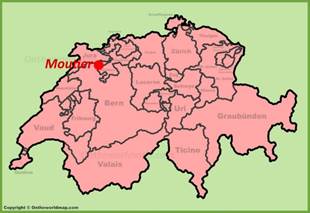
An example of a conflict in Switzerland that challenged the authority of the individual cantons is the city of Moutier with a population of 7,500 in the canton of Bern. Since 1957, the Moutier committee wanted to secede from the canton of Bern and join the canton of Jura. The majority of people in Bern have voted to keep Moutier within its jurisdiction.  Four out of the seven Jura districts narrowly rejected forming a new district. The three northern, majority Roman Catholic, districts voted in favor of a new district.

Since 2013, there have been peaceful protests and at times vandalism. The people of Moutier voted to join the Jura canton making it the second largest town in the canton of Jura. Although a majority, 51%, of the people voted to join, the government and people of Bern declared their vote to be invalid because some people voted whose residency could not be confirmed. There have been nine referendums in the past 70 years with the population voting to secede and join the Canton of Jura in 2021.  The change to the canton of Jura took effect on January 1, 2026, granting Moutier the right to secede from one canton and join another.
Questions:

  1. Should the national government of the United States be able to enforce common laws for holidays, the economy, schools, transportation, public health, and the environment in all 50 states and territories?
  • What are the advantages and disadvantages of the federal system of power between the individual states and the national government in the United States?
  • Does the Swiss government model have any advantages or disadvantages over the structure of government in the United States?
  • What would be the best way to resolve the conflict with the population of Moutier?
  • Will the decision allowing Moutier to secede establish a precedent for future towns or cities to secede in Switzerland?  

Platform of the States Rights Democratic Party, August 14, 1948

Article 1, Section 8: Federalism and the Overall Scope of Federal Power

Keeping the Balance: What a President Can and Cannot Do (Truman Library)

Looking Back: Nullification in American History (National Constitution Center)

Political System of Switzerland

Federalism in Switzerland

Education is primarily a state and local responsibility in the United States. About 92% of the money for elementary and secondary education comes from local taxes and money from the individual states. The role of the federal government in education dates back to 1867 when Congress wanted information on teachers and how students learn. Over time this led to land-grant colleges and vocational schools After World War 2, the federal government enacted the “GI Bill” to provide college and vocational education to returning veterans.

In response to the Soviet launch of a satellite, Sputnik, into space in 1957, Congress passed the National Defense Education Act to provide funds for teachers in the areas of mathematics, science, world languages, and area studies to enable us to compete with the Soviet Union. Perhaps the most significant legislation to increase federal funds for schools came in response to the passage of civil rights laws in the 1960s and 1970s and the Great Society programs to reduce poverty. In 1980, Congress established the Department of Education as a position in the president’s Cabinet. In 2025, the Department of Education’s staff and budget was significantly reduced. The Department of Education before 2025 supported 50 million students in 98,000 public schools and 32,000 private schools. They also provided grants, loans, and work-study programs to 12 million students in colleges and vocational training programs. In addition, they administered $150 billion in loans.

The purpose of federal funds in the United States is to provide equality for disadvantaged students and to improve academic achievement. This is monitored through state assessments based on learning standards. Unfortunately, some states lowered their expectations for student achievement to qualify for the federal funds and the federal government is currently investigating fraud in how federal dollars are being spent.

In the United States, federal funds are designated for after school instruction, English language acquisition, preschools, nutrition, literacy, teaching American history and civics, charter, and  magnet schools.

School Financing in Canada

School funding in Canada is primarily a responsibility of provincial and territorial governments. The federal government contributes money to ensure an equal education for its significant indigenous population. Most funding is from Canada’s 10 provinces. Some provinces provide public funding to private, charter, and religious schools.

The government of Canada views education as a public good from which everyone in society benefits. Education prepares students for jobs, higher education, lowers crime, and reduces poverty. Employers also benefit as educated workers are more productive leading to higher profits for businesses. The only province to fully embrace school choice is Alberta. Canadians fear that school choice may lead wealthier Canadians to benefit from independent, parochial, charter, or magnet schools and this would leave marginalized populations at a disadvantage. Equality and equity are two principles that Canadians value.

According to U.S. News & World Report, the United States is ranked #1 and Canada is ranked #4 in the world in education.

Questions:

  1. Should local communities, states or provinces, or the national government decide the curriculum and funding for public schools?
  2. To what extent should public tax dollars be used to support private or religious schools?
  3. What is the best way to ensure an equal and equitable education for all students?
  4. Should public tax dollars be used for extracurricular activities and sports in schools?
  5. Do you consider education to be a public good that benefits all of society or is it a private good that benefits individual students?
  6. To what extent should public tax dollars be used to support college and vocational education after completing elementary and secondary education?

Elementary and Secondary Education Act

Canada’s Approach to School Funding

Council of Ministers of Education, Canada

De facto Racial Residential Segregation in the United States

The United States ended racial segregation with the Brown v. Board of Education v. Topeka, Kansas decision by the U.S. Supreme Court in 1954, the Civil Rights Act of 1964, and the Voting Rights Act of 1965. However, the United States continues to be a place of segregation, not integration. Residential segregation exists through our zip codes and neighborhoods. Although our laws prohibit discrimination, differences in land use policies, wealth and income, contribute to what is called de facto racial residential segregation. Neighborhoods determine the quality of schools, public safety, quality of drinking water, opportunities for employment, strategies of law enforcement, rates of incarceration, and life expectancy.

A study by the University of California (Source) found that more than 80 percent of metropolitan areas were more segregated in 2019 than in 1990. In 2025, the United States government effectively ended support for DEI (Diversity, Equity, and Inclusion) programs. Racial residential segregation is difficult to    address when resources are not equally available to all communities. The Kerner Commission wrote in its 1968 report that integration is “the only course which explicitly seeks to achieve a single nation” rather than a dual or permanently divided society.

Table 3: Top 10 Most Segregated Metropolitan Statistical Areas (2019, Minimum 200,000 people)

Segregation  RankMetro
1New York-Northern New Jersey-Long Island, NY-NJ-PA
2Chicago-Joliet-Naperville, IL-IN-WI
3Milwaukee-Waukesha-West Allis, WI
4Detroit-Warren-Livonia, MI
5Miami-Fort Lauderdale-Pompano Beach, FL
6Los Angeles-Long Beach-Santa Ana, CA
7Trenton-Ewing, NJ
8Cleveland-Elyria-Mentor, OH
9Philadelphia-Camden-Wilmington, PA-NJ-DE-MD
10 (tied)Beaumont-Port Arthur, TX
10 (tied)New Orleans-Metairie-Kenner, LA

Religious Segregation in India

India ended the caste system in 1947 and yet many Indians live in religiously segregated areas. One of the reasons for this segregation is that friendship circles are often part of the religious community and marriages are within the same faith community. People in southern India are most likely to live in integrated neighborhoods. Indians with a college degree are more accepting of people from other faiths living in their neighborhoods than those with less education.

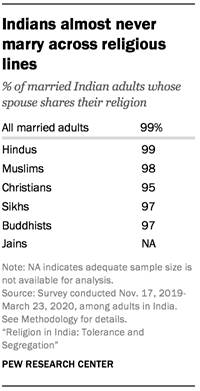
Very few Indians say they are married to someone with a different religion. Almost all married people (99%) reported that their spouse shared their religion. This applies to Hindus, Muslims, Christians, Sikhs and Buddhists.

Indians generally marry within same religion
Religion, especially members of the Hindu faith, is closely connected with views on politics and national identity. Hindus make up 80% of India’s population. A Pew Research study found that 36% of Hindus would not be willing to live near a Muslim, and 31% say they would not want a Christian living in their neighborhood. Jains are even more likely to express such views:. 54% of people who identify with the Jainist faith would not accept a Muslim as a neighbor, and 47% say the same about Christians. People who identify as Buddhist tend to be the most accepting of people from other faith traditions. Eight-in-ten Buddhists in India say they would accept a Muslim, Hindu, Christian, Sikh or Jain as a neighbor.

Members of both large and small religious groups mostly keep friendships within religious lines
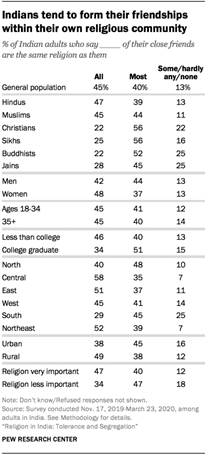
And Indians who live in the Central region of the country are more inclined than people in other regions to say it is very important to stop people from marrying outside of their religion. Among Hindus in the Central region, for instance, 82% say stopping the interreligious marriage of Hindu women is very important, compared with 67% of Hindus nationally. Among Muslims in the region, nearly all (96%) see it as crucial to stop Muslim women from marrying outside the faith, versus 80% of Muslims nationally.

The religious segregation also impacts the quality of education and employment. Muslim student enrollment is dropping. Some states in India are banning religious instruction even though it is protected by the national constitution.

Questions:

  1. Are there common factors (geographic, social, economic, racial, educational, religious, etc.) causing different kinds of segregation in Indian and the United States?
  2. How can countries best establish a social system of equality and integration?
  3. Is segregation present in your school or community?
  4. How do countries/societies unite or define their identity?
  5. Is the problem of segregation about the same, more severe, less severe in India or the United States?

Examples of Government Regulation of Business in the United States

Religious Segregation in India (Pew Research Center)

The Great Society Program in the United States

In 1965, according to the U.S. Census, the poverty rate in the United States was 13.3%. In 2024, it was 10.6%. However, poverty rates often provide mixed data because of inflation, income levels, race, and age. For examples in 1965 45% of the population in South Carolina was below the poverty line and in 2024 the poverty rate for Hispanic (15%), Black Americans (18.4%), and Native Americans (19.3%) is significantly higher than 10.6%. The definition is further complicated by the difference between absolute poverty (below an income of $31,200 for a four-person household) and relative poverty (the quality of life for people in a neighborhood or community).

Social Security and Medicare are for senior citizens who are eligible at age 65 for Medicare and age 67 for Social Security. There are 83 million people, including children, receiving Medicaid, about 25% of the population. The program is offered by the states and the services provided depend on the state. An average estimate for eligibility is an income that is about 140 percent above the federal poverty level ($30,000 for a family of two in New Jersey, as of 2026). In New Jersey, Medicaid costs about 23% of the state’s budget. Approximately 25% of the residents in New Jesey receive Medicaid at an average cost of $2,600 per enrollee. Amounts vary and are higher for families with children and pregnant women.

According to the Congressional Research Services, mandatory spending was only 30% of the federal budget. Today, it is 60%. Medicare and Medicaid together cost nearly $1 trillion annually. Medicare, Medicaid, and Social Security, are the main contributors to our national debt, which is now over $40 trillion (or roughly $59,000 per citizen). According to the Kaiser Family Foundation, Medicare provides health insurance coverage to 68 million Americans. Funding for Medicare is from government contributions, payroll tax revenues, and premiums paid by beneficiaries. Medicare spending is currently about 13.5% of the federal budget or roughly $1.1 trillion. The average cost is $17,000 per enrollee with a $12 billion shortfall in 2023, about $1,300 per enrollee.  The administration of President Trump cut some of the Medicaid programs in 2025 and is negotiating lower prescription drug costs to reduce this shortfall. An aging population and higher health care costs are factors that are expected to continue. Even with these Great Society programs, poverty among the elderly is significantly high. According to USA Today,

“Based on the official measure, which is a simple calculation based on pretax cash income compared with a national threshold, the percentage of seniors in poverty rose to 9.9% last year from 9.7% in 2023, data showed. Using the more comprehensive supplemental measure, which includes noncash government benefits, accounts for taxes and essential expenses like medical care and work-related costs, and adjusts thresholds for regional differences in housing costs, senior poverty rose to 15% from 14.2% − and marked the highest poverty level among all age groups.”

Although these programs are not cost effective and are withdrawing funds from the Trust Fund, they are considered transfer payments because the money is spent at the local and state level which generates income and GDP growth in the economy. They are often referred to as entitlement programs because they were passed by Congress and have been in effect for 90 years (Social Security) and 60 years (Medicaid and Medicare) and revised and expanded over time.

Marshall Plan

In June 1947, Secretary of State George Marshall, announced the U.S. plan to give economic aid to Europe. The offer was made to all of Europe, including the U.S. wartime enemies and the communist countries of Eastern Europe. Sixteen European countries responded by cooperating on a plan that was accepted by the United States. The United States appropriated $13.6 billion (equivalent to $190 billion in 2026 money) was provided. By 1950, the economies of the participating countries returned to their prewar levels.
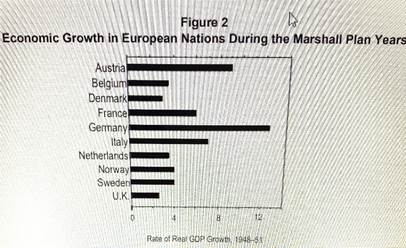
The Marshall Plan required the countries to stabilize their currency, reduce public spending, import goods from the United States and increase their exports to the United States. There were clear expectations that benefited the economy of the United States. The Marshall Plan established the U.S. as a dominant economic power, promoted open trade and prevented the return of economic depression. It was critical in forming NATO and a closer relationship between the United States and Europe.

Questions:

  1. Given the fact that the Great Society programs of Medicaid and Medicare are not cost effective and that the poverty rate for people over the age of 65 has increased, should the United States continue with these programs?
  2. What should the United States or the individual states do to lower the poverty rate among people over the age of 65?
  3. Does the United States have a legal (constitutional) or moral responsibility to provide supplemental or full health care for its citizens, legal residents, and/or undocumented immigrants?
  4. Was the Marshall Plan worth the investment by the United States?
  5. What factors contributed to the success of the Marshall Plan?
  6. Would a ‘Marshall Plan” to support the rebuilding of a sustainable infrastructure based on renewable energy be effective and accomplish similar outcomes within three to five years?

Tallying the Costs and Benefits of LBJ’s Great Society Programs (American Enterprise Institute)

Estimates of the Costs of Federal Credit Programs (Congressional Budget Office)

Kaiser Family Foundation Reports on Medicare-Medicaid Enrollment and Spending

Marshall Plan (1948) (National Archives)

Marshall Plan and U.S. Economic Dominance (EBSCO)

The Marshall Plan: Design, Accomplishments, and Significance (Congressional Research Service)

Can you Pass the Oklahoma Anti-Woke Test?

https://www.dailykos.com/stories/2025/12/31/2360791/-CAN-YOU-PASS-THE-OKLAHOMA-ANTI-WOKE-TEACHER-S-TEST

In August 2025, worried that WOKE educators from higher paying unionized states might move to Oklahoma to take jobs as teachers, Oklahoma implemented an “America-First Assessment” for new teachers. The assessment, created by the PragerU, a conservative group that is definitely not a university, was dropped three months later by a new state education superintendent.

As a WOKE teacher educator from a WOKE state with almost fifty years of teaching experience and indoctrination, I was interested to see if I could pass the “America-First Assessment” and qualify to teach in Oklahoma. But not to worry, it is much easier than the test immigrants take to become United States citizens, the New York State Teacher Certification Exam, and the United States History Regents Exam for 11th grade students in New York State.

A reporter for the Oklahoma Voice took the online test and intentionally picked the most ridiculous choices. It turns out that when you got a wrong answer, the test allowed you to try again and again until you picked the choice they wanted so it was impossible to fail. It makes you wonder about the poor quality of teaching and learning in the Sooner State.

The test has a number of questions about defining sex but no questions about Oklahoma history. Teachers don’t have to know about the Trail of Tears forcing East Coast Native American tribes onto Oklahoma Territory reservations or race riots that destroyed the Tulsa African American community.

Don’t be nervous. I highlighted the answers Oklahoma wants you to pick to prove you aren’t WOKE.

1. According to the Supreme Court cases Meyer v. Nebraska (1923) and Pierce v. Society of Sisters (1925), who has the ultimate right to direct a child’s education?
a. The Superintendent of Schools
b. The parents
c. The Board of Education
d. The federal Department of Education

2. What is the fundamental biological distinction between males and females?
a. Height and weight
b. Blood type
c. Personal preference
d. Chromosomes and reproductive anatomy

3. How is a child’s biological sex typically identified?
a. Parental affirmation of child’s preference
b. Personal feelings
c. Visual anatomical observation and chromosomes
d. Online registration

4. Which chromosome pair determines biological sex in humans?
a. AA/BB
b. XX/XY
c. RH/AB
d. XE/XQ

5. Why is the distinction between male and female considered important in areas like sports and privacy?
a. For equity in minority communities
b. To preserve fairness, safety and integrity for both sexes
c. To increase participation in sports
d. To enhance the self-esteem of transgender children

6. Should teachers be allowed to express their own political viewpoints in the classroom In order to persuade the students to adopt their point of view?
a. Yes, teachers have freedom of speech, too, which does not stop at the classroom door
b. No, once you become a teacher, your freedom of speech in and out of the classroom is restricted
c. Yes, sometimes – when the issue includes civil rights or social justice
d. No, the classroom is not an appropriate venue for political activism

7. What did the Supreme Court rule in the 2025 case of Mahmoud v. Taylor?
a. Gender-affirming medical procedures are allowed in America
b. Students must recite the Pledge of Allegiance in schools
c. Religious schools must hire non-religious staff
d. Public schools cannot require participation in LGBTQ-themed instruction without a parental opt-out

8. What are the first three words of the U.S. Constitution?
a. In God We Trust
b. We the People
c. Life, Liberty, Happiness
d. The United States

9. Why is freedom of religion important to America’s identity?
a. It protects religious choice from government control
b. It makes Christianity the national religion
c. It bans all forms of public worship
d. It limits religious teaching in the public square

10. What are the two parts of the U.S. Congress?
a. The House of Lords and The House of Commons
b. The judiciary and the Senate
c. The Executive and the Legislative
d. The Senate and the House of Representatives

11. How many total U.S. senators are there?
a. 435
b. 535
c. 100
d. 50

12. Why do some states have more representatives than others?
a. Representation is allocated by population
b. They cover a larger geographic area
c. They have held statehood for a longer period
d. The number is determined by Congress

13. What is the primary responsibility of the president’s Cabinet?
a. Approve Supreme Court justices
b. Pass legislation
c. Sign executive orders
d. Advise the president

14. Who signs bills into law?
a. The vice president
b. The chief justice
c. The president
d. The speaker of the house

15. What is the highest court in the United States?
a. The Federal Court
b. The Court of Appeals
c. The District Court
d. The Supreme Court

16. In the United States, which of the following is a responsibility reserved only for citizens?
a. Serve on a jury
b. Own a home
c. Pay taxes
d. Possess a driver’s license

17. Which of the following are explicitly listed in the Bill of Rights?
a. Freedom of speech and religion
b. Voting and public education
c. Reproductive rights and healthcare
d. Freedom from data collection and surveillance

18. Which right does the Second Amendment protect?
a. The right to hunt and fish
b. The right to arm the military
c. The right to restrict certain kinds of speech
d. The right to keep and bear arms

19. What is the supreme law of the United States?
a. Presidential Executive Orders
b. Laws passed by Congress and signed by the president
c. Laws passed by state legislatures and signed by state governors
d. The Constitution

20. Who wrote the first draft of the Declaration of Independence?
a. John Adams
b. Thomas Jefferson
c. John Hancock
d. Thomas Paine

21. When was the Declaration of Independence adopted?
a. July 4, 1778
b. July 4, 1787
c. July 4, 1776
d. July 4, 1619

22. What was the primary reason the colonists fought the British?
a. To resist expansion of the British Empire
b. To maintain slavery
c. To resist taxation without representation
d. To resist forced military service

23. Who were the first three U.S. presidents?
a. George Washington, Benjamin Franklin, Alexander Hamilton
b. George Washington, John Adams, Thomas Jefferson
c. George Washington, Thomas Jefferson, James Madison
d. George Washington, John Adams, Abraham Lincoln

24. Who is called the “Father of Our Country”?
a. Benjamin Franklin
b. Abraham Lincoln
c. Martin Luther King Jr.
d. George Washington

25. What did the Emancipation Proclamation do?
a. Ended Prohibition
b. Freed Confederate generals
c. Freed the slaves in the North
d. Ended slavery in the rebelling Confederate states

26. What was Abraham Lincoln’s primary reason for waging the Civil War?
a. To preserve states’ rights
b. To abolish slavery
c. To preserve the Union
d. To end the Union

27. What cause is Martin Luther King Jr. best known for?
a. Advocating for segregation
b. Advocating for the abolition of slavery
c. Advocating for diversity, equity and inclusion
d. Advocating for racial equality under the law

28. How did the Cold War end?
a. The U.S. prevailed in the Cuban Missile Crisis
b. Russia invaded and occupied Ukraine
c. The Soviet Union Collapsed
d. The U.S., the European Union, and the Soviet Union signed a peace treaty

29. Who was president during the Great Depression and WWII?
a. Woodrow Wilson
b. Harry S. Truman
c. Franklin D. Roosevelt
d. Theodore Roosevelt

30. What is the name of the national anthem?
a. “The Star-Spangled Banner”
b. “America the Beautiful”
c. “This Land is Your Land”
d. “God Bless America”

31. Why are there thirteen stripes on the American flag?
a. One for each signer of the Declaration of Independence
b. To honor the Thirteenth Amendment
c. To commemorate America’s fallen soldiers
d. To symbolize the original colonies

32. Which national holiday honors those who died while serving in the U.S. military?
a. Armistice Day
b. Memorial Day
c. Veterans Day
d. Flag Day

33. Which of the following is a phrase from the Pledge of Allegiance?
a. Life, liberty and the pursuit of happiness
b. Of, by and for the people
c. One nation, indivisible, with liberty and justice for all
d. One nation, under God, indivisible with liberty and justice for all

34. From what does the United States government derive its power?
a. The Supreme Court
b. The people
c. The president

An Education: How I Changed My Mind About Schools and Almost Everything Else

According to Randi Weingarten, president of the American Federation of Teachers, “Diane Ravitch’s telling of her remarkable journey — from a child of working-class immigrants to one of the most vital national education treasures and leaders — tells us so much about her unwavering support for public education and its role in our society. That would be beautiful enough, but the second thrill is how she brings her curiosity — an essential trait we nurture in students — to question her own views and change her mind. The result is this clarion call to protect and strengthen public schooling in America as the foundation of our young people — and our democracy. If you care about the future, read this book.”

Diane Ravitch has spent five decades analyzing and advocating for national and state education policies designed to reform and reshape public schools. Her work supporting school choice made her the intellectual darling of the right. But when she renounced school choice as a failure, she was abandoned by many old friends and colleagues. Today she is a champion for public schools, a foe of standardized testing, and proclaims herself to be “woke.” Her latest book, An Education: How I Changed My Mind About Schools and Almost Everything Else is published by Columbia University Press

Ravitch was one of eight children from a Jewish family in Houston, Texas, where she grew up with no television, no air conditioning, and, often, no shoes. In college she met and married a man from a wealthy and connected New York City family, where they lived and raised a family. She began working for a socialist magazine, which led to writing about education and, eventually, a PhD in education history.

Ravitch’s writings favored strengthening and expanding school choice and rigorous testing, ideas that aligned well with conservative donors and think tanks who supported her work and led to positions in the George H.W. Bush and Clinton administrations. Meanwhile, a chance encounter at an education conference with a New York City high school social studies teacher, Mary Butz, led to a clandestine romance. Ravitch’s new relationship upended her previous “life of comfort and plenty” and led to her marriage to Mary.

New York Mayor Michael Bloomberg sought Ravitch’s support and counsel for the changes he and school commissioner Joel Klein instituted during his administration, but it was at this time that Ravitch began to question the results of standardized testing and school choice programs like charter schools. Improved test scores at lauded schools proved illusory and charter schools only seemed to thrive because they were able to weed out the most challenged pupils. Gradually, Ravitch abandoned her long-held views on the power of testing or the promise of choice. She began to write and speak out in favor of saving America’s besieged public schools.

Ravitch’s involvement in education idea and policy have earned her a reputation as education’s best-known living historian and its most controversial figure.  An Education is the story of the making, unmaking, and remaking of a public intellectual and a remarkable testament to the importance of a mind open to truth and possibility in a world, she writes, “of masks and artifice”.

An Interview on Teaching about Controversial Subjects in Today’s Political Climate

What this means in the social studies classroom is that we don’t want students to just accept what the textbook or curriculum says, but we want them to raise their own questions with the material they are being presented with. We also want to provide them with material from different perspectives so that they learn to weigh the validity of different explanations. Our goal is for them to think like historians to prepare them to be active citizens in a democratic society. At the end of the Constitutional Convention, Benjamin Franklin was asked what type of government the delegates had created. Franklin’s reply reverberates today. Franklin said, “A republic, if you can keep it.” We need to equip students so the United States will remain a democracy, if they can keep it.

There are no national social studies standards in the United States so each state Department of Education develops their own. I am most familiar with New York State and New Jersey social studies standards which both strongly support document-based instruction, promoting critical thinking, and preparing students for full participation as citizens. National organizations like the National Council for the Social Studies, the American Historical Association, and the Organization of American Historians also promote these goals. Unfortunately, even though they are in the standards does not mean that we see them in practice in classrooms. Too much of teaching centers on preparing students for state and national reading skill exams that are used to evaluate school districts, schools, and teachers.

Again, the practices you want to see in classrooms will only happen when there is respectful dialogue. Our goal is to learn together, to share ideas, not to win or to silence others. That type of community can take a while to build, but it is essential if students are to become critical historians and responsible citizens in a democratic society. I never lecture. When I talk to much it means I failed to design an effective lesson plan. My role in the classroom is to introduce material and question students as they evaluate primary and secondary source material. What does the text say? What does the text mean? What are your views of the text? What is the evidence presented to support the author’s view? What is the evidence to support your views?

This was my journey, but in answer to your question, it is not forcefully incorporated into state and national curricula and it is not the experience and understanding that many other teachers bring to the classroom. One group that promotes this approach to teaching is Rethinking Schools which also sponsors the Zinn Education Project.

Book Review: On This Ground: Hardship and Hope at the Toughest Prep School in America, by Anthony DePalma

Published by Harper Collins, 2026. 249 pages

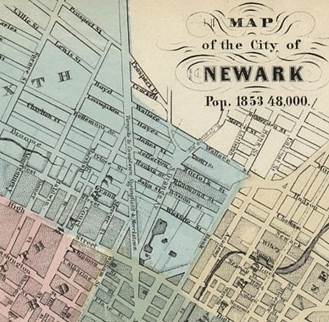
The first pages of On This Ground engage the reader in the spiritual identity of children seeking an understanding about life in the world into which they were born. It is also an eyewitness account about how Newark became ‘the worst city in America’ in the 1960s.  The first pages of this book provide an historical understanding of Newark but also of cities throughout New Jersey and the United States.

The reflections on education at St. Benedict Prep have value regarding an understanding of the core values, purpose, mission, and vision of all schools. Every teacher will find lessons in the passion and dedication of the faculty who are committed to caring, serving, and teaching. By Page 21, I was reliving the movie of “Sister Act” regarding the passion of nuns serving the people of Los Angeles. Also, my memories of “Welcome Back Kotter”, “Abbot Elementary”, “School of Rock”, “Mr. Holland’s Opus”, “Stand and Deliver”, “Dead Poet’s Society”, and “Up the Down Staircase” each flashed across my mind as I began reading On This Ground! It was an amazing flashback to my own experiences as a teacher.

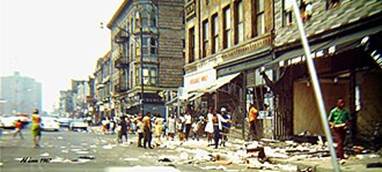
Chapter 2 is the historical account of the 1967 Newark riots.  In this chapter we learn of the German immigrant population that came to Newark in the 19th century, the dominance of the beer industry, the migration in the 1920’s to Newark from the South, and the flight to the suburbs that came with interstate highways and airports. It is one of the best descriptive accounts of continuity and change over time of an American city because of its conciseness and accuracy.

The account of the riots is important for the story of St. Benedict’s Prep School but also for every resident in New Jersey to understand and synthesize. The riots left 26 people dead and 700 injured. Entire blocks were destroyed with property damage totaling $10 million or about $100 million in today’s money.  Over 1,400 residents were arrested. Teenage unemployment was about 50%. The white landlords and store owners moved out of Newark to the suburbs and local taxes to fund the essential services and public schools disappeared. The pain of the “Long hot summer of 1967” continued for years. The local government had limited authority and resources, the state government formed the Lilley Commission which identified social, political, and economic issues to be the underlying causes for the riots, and the Kerner Commission led to a national conversation about race and poverty, concluding that in the United States we had two separate and unequal societies.

We walk through the halls of St. Benedict’s Prep with Anthony DePalma to the Shanley Gym where the voices of students from the past and present are heard. Everyone who reads On This Ground will discover the power of love in the culture of this school, the importance of empowering students to make decisions, and how a cohesive community unites and energizes young scholars and athletes. When teachers care and listen to their students, everyone works toward the same goal. Through situations involving cheating, vaping, and texting inappropriate messages, Anthony DePalma guides us through the steps that make a difference in the lives of students; even those who are resistant.

The stories of the hardships of students, disciplinary decisions, the integration of girls from a small Roman Catholic school in neighboring Elizabeth, helping families with limited financial resources, and prayers for healing are not unique to St. Benedict’s. The strategies of how the faculty and headmaster handled these situations is unique. St. Benedict’s connects students and teachers as a community of learners. Anthony DePalma explicitly illustrates the dedication of the educators at St. Benedict’s in an environment where teachers are ‘called’ to serve, even though their college education may not include preparation for urban schools. Other schools will find value in learning how the daily morning faculty meeting discusses the needs of students, the importance of the ‘convocation’ that gathers students together with opportunities for leadership, the overnight experience in the mountains that brings the students together, and how problem-solving includes conversations between students, parents, and administrators.

Beyond the journey through the halls and classrooms are the insights into the lives of young children facing the addictive behaviors of parents, injuries from gun wounds, foster care homes, temporary living conditions, food insecurity, and unemployment. The crisis in our schools and cities is not part of the evening news or the discussions around the dinner table, office, or places of worship. Illiteracy is a crisis in America and perhaps this book will awaken interest.

In New Jersey, 3% of high school students drop out of school by their sophomore year in high school. Source

In New Jersey, 437,000 students (26%) are receiving supplemental food daily. Source

Approximately 1/3 of students in New Jersey are living with single parents or their parents are in prison, rehabilitation, or are unemployed. Source

In New York City, 45% of the students are ‘chronically absent.’  Source

17% of third through eighth graders in the United States are chronically absent because of mental health issues. Many are from suburban homes and excellent school districts. Source

Examine the data (2023) from the Federal Reserve Bank of St. Louis below: Source

Atlantic County, NJ36%Middlesex County, NJ24%
Bergen County, NJ21%Monmouth County, NJ20%
Burlington County, NJ27%Morris County, NJ15%
Camden County, NJ37%Ocean County, NJ20%
Cape May County, NJ30%Passaic County, NJ38%
Cumberland County, NJ46%Salem County, NJ41%
Essex County, NJ40%Somerset County, NJ18%
Gloucester County, NJ29%Sussex County, NJ21%
Hudson County, NJ33%Union County, NJ32%
Hunterdon County, NJ17%Warren County, NJ27%
Mercer County, NJ29%

On This Ground engages readers to think about the moral and spiritual poverty that is in our country. Towards the end of the book there is an account of a freshman girl who loved to dance but had been disadvantaged in many ways. She overcame several obstacles in her persistence to establish the first cheerleading team at St. Benedict’s. It is a story of moral and spiritual strength and the power of perseverance and determination. The stories of alumni, Anthony Badger, Bob Brennan, and Leon McBurrows remind us that life is challenging because we are human and our humanity is complex.

As I am reading the words of Anthony DePalma, I am thinking of the children who are disconnected from reality. I am also thinking of the 14-year-old freshman entering high school in September 2026 who will only be age 28 in the year 2040. The message for me in On This Ground is the importance of teaching about character, kindness, self-esteem, decision-making, and personal identity. The  institutions for helping children and their families with these lessons are our local schools and places of worship. The importance of teachers, clergy, custodians, crossing guards, cafeteria workers, bus drivers, coaches, are essential to connecting young people to a productive life.

America is faced with a crisis of illiteracy and the adage that schools teach reading, writing, and arithmetic is for a different time in our history. The challenges of artificial intelligence, substances, obesity, food insecurity, a warmer climate, and what we spend our money on, are overwhelming! 

The story of St. Benedict’s Preparatory School provides optimism and hope. The links below are videos about the story in On This Ground.

Guided by The Rule (Seton Hall)

Newark High School is Unlike Any Other (CBS 60 Minutes)

Saint Benedict’s Preparatory School (Documentary: Religion & Ethics NewsWeekly)

Book Review: Review of Student Research for Community Change: Tools to Develop Ethical Thinking and Analytic Problem Solving

This new text provides an explanation of a program – and a plan – for getting high school students involved in important hands-on research right in their communities.  The two authors have become experts in encouraging young people to start on research early – not waiting for college.  Despite more traditional approaches of letting students wait to become upperclassmen in college, the authors learned to forge ahead and assume students could do this work.

William Tobin is a research fellow with the Kenan Institute for Ethics at Duke University.  The program explained in this book is an example of the community work Tobin and his students have been doing to help their neighbors.  Valerie Feit is co-director of school counseling for Rye Neck, New York schools.  This program has been used successfully in three different applications at Duke.

The authors talk in terms of “tools” for coming up with research problems and questions, plans for finding out information, and guidance in making recommendations to solve the problems (pp. 23-24).  I think of this book’s content in terms of methods for approaching the work.  This looks like a method, with many parts, with rules, with suggestions, and with potential.

The authors provide tools for this “method” of teaching and learning they hope will be applicable in other settings.  They have already had students complete research projects using this method.  They use a qualitative approach, overall, in their research.  However, they do not stress this fact in the book.  Interviews and protocols to conduct them ground us in qualitative approaches to getting information from people to help students – and the community ultimately — solve problems. 

The method connects clearly (in terms of policy and application) to national standards in the different learning areas, plus Common Core college-ready and work-ready emphases.  The method looks forward to more advanced levels of inquiry than the more traditional benchmarked studies of the past.  It does this by assuming students can do more advanced and challenging work if they can see the purpose for it, the rewards for it, and the connections of it to real-life goals. 

While I will not give away the content and all the goods here, I will say that this appears to be a good “method” for getting students working on purposeful projects earlier than traditionally done.  Aspiring to more is always good, especially if there is a research basis telling us the method can work. 

As an educator (and community member, advocate, and other roles) I have always been interested in the “why” of doing things in education.  Do we respect different learning styles?  Where did we as teachers “learn” to do xyz in classes?  Is  there a good research basis for using certain materials?  Has anyone ever proven it makes sense to do abc this way?  All of these kinds of questions enter my mind when I look at a new approach.  I wonder if this book could work in my neighborhood.  With students who need resources like a place to live?  In a community not very interested in helping others in need?  

The authors emphasize how they have already served communities and how they need partners and cooperation.  They remind us that institutions of higher education are supposed to be helping with such endeavors (p. 111).  Reminding the readers that IHEs have non-profit status because they are supposed to be assisting in important research projects in the community, the authors urge readers to seek faculty who will sign on and become excited to participate.

I would recommend this book for a couple different uses.  First, I would encourage K-12 and college educators read it to see what is possible if we assume students can do more and can meet challenges.  The book is important in that way.  Second, I would encourage educators to attempt to use some of the tools in a mini-project to ascertain the value of the method.  Then, if teachers and college researchers or others can come together to formulate a bigger project, more in-depth labor can be done.  Students do the work and need guidance and advice.  They need to learn about ethics and the role it plays in inquiry (pp. 12-13). 

This method, overall, is another good example of the more mature and advanced kinds of ways of thinking about education for secondary students and underclassmen.  As I said above, there is a clear connection to getting students ready for what comes at more advanced levels.

How to use the book in times of distance-learning?  How would students find neighbors interested in participating?  How would they work with other students to come up with questions?  What about brainstorming?  Planning?

This might be a method that calls for a hybrid approach.  The majority of the discussions could occur online (p. xvii) because of the power of the Internet.  This could be done especially during shared times – online meetings.  Different teams of students and teachers could work on different steps or themes of the research project.  However, it might be necessary to be out in the community to approach potential members and to set up some of the meetings (pp. 112-113) and the interviews.  The teams could conduct the remaining work online, such as the interviews, the discussion of them and other input, the drawing of conclusions from the various input sources, the writing of recommendations for intervention (or similar activities), and the follow-up and assessment stages for the entire project.   

Book Review: Teach, Reflect, Learn: Building Your Capacity for Success in the Classroom

Hall and Simeral have set forth here three major stages to helping teachers reflect on what they are doing in an effort to improve the instruction in the classroom.  The authors hope to help teachers learn how to reflect on a regular basis as part of the self-assessment process in which teachers should engage.  Included are lots of scenarios of teachers and their comments about why things are working—or not—in their classrooms.

As in most of my reviews, I try to not give away all the content.  Here, I will list the names of the nine main chapters of the book: If You Can Read This, Thank a Teacher; Reflections on Self-Reflection; Reflective Self-Assessment Tool; The Continuum of Self-Reflection; The Unaware Stage: What Does Unaware Mean, Anyway?; The Conscious Stage: Is the Knowing-Doing Gap Real?; The Action Stage: What Happens When Art and Science Collide?; and The Refinement Stage: Smoothing Out the Rough Edges.

Having attended a Jesuit institution for my Ph.D. in Education, I will have to admit I am fully aware of reflection as a major component of the teaching-improvement process.  In most all of my courses, I had to reflect on what I had said, or written, or taught, or done.  It was a very interesting reminder of the reflection process many successful and hard-working good educators already use in one form or another.

Most good teachers will admit they are always trying to improve their skills, whether it is coming up with better ways to explain a phenomenon or inventing better ways to let students come to their understanding of how a process works.  Good teachers probably apply it to their writing and their research and their service, also.  At least that is what the literature says.

Becoming more efficient is important, and this book does have some interesting hints about looking at learning situations with different lenses.  I recommend the book as a sort of self-study book, especially for teachers who want to consider some alternatives to learning about new methods or new materials.  Sometimes it has to do more with looking directly at how we as individuals do our work.  Once we have considered that, we can look outward.

I would recommend this text also in group settings where there are several different short paperbacks and small groups get to choose a book to discuss.  The readings in this and similar shorter texts can be a good starting point for considering what it is we are doing in the classroom.  Enjoyable and fruitful also are the stories of what other teachers use for methods and materials.

In a recent professional development session I worked on, several of the teachers said, “We never have enough time to talk to each other, simply about what we are doing in our classrooms.”  I think this is a good message for principals and others charged with PD and other sessions for teachers.  Helping them to reflect can be facilitated by books like this one by Hall and Simeral. 

Book Review – Erasing History: How Fascist Rewrite the Past to Control the Future by Jason Stanley

This quote published in the Washington Post on May 7, 2024 is the opening statement in Chapter 1 of Erasing History. It is a powerful statement and thesis for this book and a compelling reason for teachers to read the arguments presented by Jason Stanley, Yale University Professor of Philosophy. There are numerous examples in this book explaining the biased perspective of American history regarding Black Americans, Latinx, Native Americans, women, children, etc. and there are examples of how history has been erased in Kenya, Palestine, India, China, and Ukraine.

Every teacher of U.S. history teaches the different views of Booker T. Washington and W.E.B. Dubois to assimilate into American society at the turn of the 20th century. However, the perspective presented by Jason Stanley offers students in our classes the opportunity for a critical debate regarding two different paths towards assimilation.

Some societies and governments favor a part of their population as the dominant or protected class and discount or “erase” the contributions of other people in their state. The technological advances of artificial intelligence present new challenges for teachers as history can easily be revised from quoting textbooks, historical papers, and extremist views from the past and make them appear as valid scholarship.  The increasing popularity of PraegerU is an example of how school districts, Departments of Education, and individual teachers are accepting the information and lessons provided by non-academic institutions. Teachers have a unique responsibility and position because they are trusted by students and what they say is transformed from sight and sound to memory.

Teachers will find the historiography and analysis of the concepts of nationalism, American exceptionalism, and colonialism to be helpful for the development of lesson plans in both U.S. history and world history. It is less about ‘erasing’ history than changing history or emphasizing certain historical themes while ignoring others. Curriculum designers and teachers have both power and responsibility in how lessons are structured, implemented, and assessed. One example from the book is including the “I Have a Dream” speech by Dr. Martin Luther King, Jr. and ignoring his many contributions in the civil rights movement.

This is an important debate regarding assimilation in a society with a dominant class. A current example is the debate of how the working class earning an hourly wage without benefits can assimilate into the middle class. Is the best way to address this through subsidized education, new tax policies, or paying a living wage?

Teachers must have a strong content background in the westward movement, labor, Reconstruction, civil rights, Ukraine, Palestine, etc. to be aware of what is missing in the sources and resources they are using with students. The example below provides different points of view on the 1932-33 engineered famine that killed millions of people in Ukraine.

Fascism is not taught is most high schools and college courses may not have provided this instruction for teachers. Fascism, socialism, Marxism, communism, and Naziism are critical movements in world history and they are complicated to teach because the are not monolithic. Professor Stanley provides five major themes that are part of a fascist education: (page 78)

The strategy that wins the support of people is often fear and patriotism.  In the United States, the theme of national greatness is most visible with “Make America Great Again” and defining the United States as the greatest nation or what is defined as American exceptionalism.  However, associating crime, poverty, homelessness, unemployment, etc. with a specific demographic group is part of the fascist goal of national purity. In Germany, it was the Aryan population.  In the United States it is critical race theory, structural racism, and making white Americans feel guilty. We see the theme of strict gender roles in the directives to teach traditional roles of women and banning references to the contributions of the LGBTQ persons. The placing of blame for everything on a past president or a specific political party is another effective strategy. Teachers should be aware of these five signs and why populations embrace it.

President Trump delivered a speech in September 2020 when he introduced the White House Conference on American History. Particularly, in the 250th anniversary year of the signing of the declaration of Independence, teachers need to be aware of how President Trump understands the teaching of patriotic history.

Erasing History dedicates three chapters to the importance of education in both preventing and promoting authoritarian rulers or advocating against democracy and for authoritarianism. Teachers of social studies, history, and literature have a responsibility to recognize bias and ignorance and to select the sources and perspectives that lead to an understanding of the American values of equality, liberty, and the rule of law.

The movement for school vouchers, criticisms of curriculum, the attack on the 1619 Project, and the emphasis on America’s greatness contribute to distrust about public schools and confuses parents.

I found Professor Stanley’s analysis of classical education to be exceptional. The extreme right and the extreme left (and those in between) support the teaching of Greek and Roman civilizations. What I found interesting is how each side selects the leaders and documents that support their perspective of government. For example, Pericles Funeral Oration describes Athenian democracy:

While the above speech favors democracy, others look to Plato as evidence of a strong ruler with a clear authoritarian philosophy.  The Greeks and Romans supported gender and racial superiority, owned slaves, favored landowners and intellectuals, and had colonies. These examples support a fascist ideology. Teachers have the responsibility to teach historical context, provide the reasons for social changes, help students to analyze how freedom is related to continuity and change over time, and an understanding of equality, reason, liberty, and power. Concepts we thought had clear definitions have become complicated.

There are more compelling insights in this book than I can comment on in a book review. Teachers of all subjects should read this book, but in particular history, social studies, and teachers of literature. Pre-service teachers also need to read and discuss this book.  Let me conclude with these observations:

As a teacher of history and/or social studies, you are on the front line and can expect to be criticized! Our responsibility as teachers is to include the experiences and contributions of all people – especially women, children, immigrants, people of different faiths, Black and Native Americans, laborers, individuals with disabilities, individuals who are LGBTQ, etc. Teaching history includes compassion, empathy, struggles, contributions, and the untold stories that you will discover. Erasing History is about forgotten and neglected history.

Telling School Tales: Rural School History Research

In 1998, my first teaching position in Little Valley Central School District in Cattaraugus County New York, as a social studies instructor led to a career exploring the nooks and hollows of educational history across the Empire State (Jakubowski, 2020; 2023). The former school district is part of the Appalachian region of New York State, which includes 14 counties from Lake Erie to the Catskills. This district was undertaking an annexation study, or school district reorganization attempt in my first year. I knew nothing of these events, and was unaware that there was a nearly 100 year history of rural school reform focusing on creating more urban-like schools in rural areas (Jakubowski, 2020).  The first major community activity surrounding a reorganization, or merger is the Boards of Education voting to undergo a study. After the districts are presented with the study, the Board then votes to accept the study. If this passes both boards, it is sent to the community in a non binding, or advisory vote (straw). When the straw vote passed in both Cattaraugus and Little Valley, people began to protest outside the school every morning and evening, to “save the panthers” or to “save the heart of LV” as I remember the sign read. My students were pulled from extracurriculars by their parents in order to protest the potential merging of the two districts, Cattaraugus to the north, and Little Valley, a one building K-12 district with just under 300 students. When the “binding vote” happened that year, and the Cattaraugus community defeated the proposed measure, we wondered, “What next?”

I left the district that fall, to move to central New York, and once again, a school centralization impacted my life. A family member’s teaching position was abolished, because the five year moratorium had expired. After a few resignations and retirements, the family member was once again employed. This is an all too unfortunate reality across Appalachia’s schools, as decreasing population, and wealth decline usually results in less money for school budgets, and personnel.  I was once again wondering “What next?” This time, I used a Masters level research paper (unpublished, 2004)[1] to begin to pursue what has been a twenty-year scholarly chase through the rural, upstate, and state education department policy of recommending schools which are, according to the 1947 and 1958 Master Plan for School District Reorganization, too small to produce efficient, or effective programming for their children[2]). I also learned that New York State’s policy towards rural districts is as Fulkerson & Thomas (2019) describe it “urban normative” or the urban areas are the norm, and should be promoted as an ideal form of local government.[3] So I dug deep, and researched cases of successfully undertaken and defeated centralizations, or consolidations, or mergers, or reorganizations.[4] The history of why so many reorganizations failed post 1960 became an obsession. I learned from my pursuit of the 20th and 21st century of educational history of New York two major tracks: most educational historians write on the early period (founding of New York as a colony to just after World War I) and second, the state’s citizens have experienced some major fights with the state bureaucratic system in Albany over really basic issues of democracy, local control, and what citizenship means.

Telling tales out of school, as the title implies is often thought of as a negative, and uncivilized approach, yet I view these two tales, about Kiantone and Morganville, as critical, and very necessary to explain some of the basic urban rural divide of New York State, and further the rural anger deployed at government, which observers believe is current, but is actually rooted in Post World War II actions by the the State Education Department.[5]

The State of New York has, as Tracy Steffes writes in her seminal work, been interested since the late 1800s in “reforming” rural schools through strategic aid packages to develop longer terms and more “professional” schools in rural areas.[6] Thomas Mauhs-Pugh described how the local school governing boards were once held as exemplars, because they created “12,000 little republics” that taught governing principles at the local level.[7] Benjamin Justice combed the archive to discover how religious governing practices amongst local Board of Education members often resulted in appeals to the State Education Department.[8] Heffernan’s article on the conflict between State Education Department expectations for school facilities and local board’s realities describe how dissonance started in the early 20th century between the professionals and the public.[9]  Chiles’ work on Progressive era school reform describes how Gov. Smith undertook school reform in rural areas as a signature effort among his governorship, and later presidential aspirations.[10] Loveland’s dissertation on the transition between the State Superintendent for Education to the University of the State of New York’s Commissioner of Education and President is a landmark in describing how the first three leaders at the newly created State Education Department had created a policy of rural school reform[11]. As Parkerson & Parkerson wrote in the crucial book on rurals school reform, the “ABCs” or Assessment, bureaucracy and consolidation, have haunted, especially in New York, rural schools who try to survive in the midst of population decline, decreasing wealth, and state policy which relies on a long standing deficit narrative, which Biddle & Azano expose as more than 100 years old.[12]

Having learned about the New York Master Plan for School District Reorganization (which is still in effect in 2023) I began to explore areas close to where I was living at the time, namely Genesee County, and discovered a huge gap in my understanding of the creation of the present day accepted “Central School Districts.” Many New Yorkers take for granted these post-Depression era created districts, many of which did not assume final form until the midst of the Cold War. These often hyphenated schools recall a vague history, or “mystic chords of memory” as Kammen would call it,[13] of the past, prior to the baby boomers (post World War II) entering school and gaining an affiliation as members of those relatively newly created schools. As Osterude describes in a profound work on the Broome County area, identity, and affinity moved from community to the newly created school districts, often built outside of town, and the social hub of the area.[14]  Yet I know from my own experience (auto ethnographic history?)[15] the process must not have been smooth, or why would perfectly rational people hold so closely to an identity or mascot, as much of the national research claimed was the reason centralizations/ consolidations/ mergers are defeated?

Seeking to understand school history, as Carol Kammen, or David Kyvig[16] calls “nearby history” led me to the Genesee County Archives, where I discovered the Morganville Question. At the bottom of the Byron Bergen Central School District 1958 Master Plan entry was a footnote, which caught my attention:

By alteration of boundary, effective Sept. 17, 1951, all of the property in the Town of Stafford, formerly C2 Stafford, was transferred from CS 1 Byron to CS 1 Le Roy. (p. 301).[17]

After meeting with the Genesee County historian, and reading the records from the New York State Archive on the town of Stafford, I went to the town historian, and museum and learned a bit about this “school tale.”[18]

            Stafford 2, Morganville, was one of the wealthier common schools in the area. A community with a pottery manufacturing center, and a two room schoolhouse, the community provided a grade 1-6 education to their children. In a tuition agreement very common until the creation of centralized school districts, and the birth of a semi modern high school in each C.S.D, Morganville partnered with South Byron by sending their secondary students for instruction. When the Centralization petition was launched, the Stafford 2 district residents overwhelmingly voted no, and wanted to maintain their two room schoolhouse, and independence. In records, memos, telegrams, and newspaper reports of the time period, the fight between Morganville (Stafford 2) and SED heated up, and became a back and forth with the end result of the community locking the South Byron Board of Education employee teacher out of the building. The parents refused to send their children.[19] The local school district superintendent, who is a field based representative of the commissioner of education, was on the side of the Stafford 2 (Morganville) representatives.

            The archival records in Genesee county, and the State Archives in Albany record the back and forth memos and telegrams of the bureaucracy and the local residents trying to enter into a positive, less public solution. What became the clue to a second quest was a note on one of the memos from senior SED officials to the bureau and the local superintendent: “We do not need another Kiantone.”[20] More on Kiantone below.

            What finally concluded the “Morganville question” was a bit of bureaucracy, and the intervention of a neighboring district. LeRoy, a larger village in Genesee County, had a well developed secondary school, as befitting an Erie Canal town home to the creators of Jell-o. The leaders of LeRoy offered free transportation and free tuition for schooling to any family in Stafford 2 who could transport their children to the boundary line. Using this subtle recruiting technique, the narrative from Morganville changed from “independent” to “LeRoy” as their demands for a school centralization destination. In one of the communications between the Morganville leaders and SED, the justification given for the break in the previous relationship with South Byron was the expectation of a better quality of secondary education for children at the LeRoy schools. South Byron was, in the opinion of the Morganville leaders, too small and not robust enough.[21]

            The bureaucratic support arrived in the form of the New York State Thruway Authority, and its construction of the mainline branch from Buffalo to Rochester. The layout of the Eisenhower Interstate system, a divided, limited access highway modeled on the autobahn, was a technology and transportation revolution in the United States post World War II. As the Morganville community and the State were seeking a solution to the “question” of where would the children attend school, the Thruway authority indicated that the disruption caused by construction of the thruway and the needed overpass bridges for state and local routes would be a long term logistical problem for Morganville Children to attend South Byron. The authority provided the State Education Department face saving “cover” to move Morganville (Stafford 2) student population to LeRoy. The Morganville residents celebrated a win, and the State Education Department reaffirmed that the Master Plan was a voluntary policy, and the districts presented in the plan were recommended[22].

            This situation was very different than just five years prior, where the Kiantone community south of Jamestown, in the Northern Appalachian region,  experienced the wrath of State Education Department, while participating in a “farmers rebellion” that brought to the fore questions of democracy, local self determination and the international questions of communism, and totalitarianism post World War II.

            Just south of Jamestown, of the “outlying” urban areas of New York State in the mid 1800s, Kiantone was a farming community along the Kiantone creek, with early settlers engaging in what Fox calls resource clearance in the areas of lumbering and then farming. The Kiantone residents erected seven Common Schools as part of the State enabling legislation. As Jamestown to the north, the residents began a long term tuitioning partnership with the secondary academy in Jamestown. Through World War I, and then World War II, the region provided significant material and manpower, and as a local furniture manufacturing hub in Buffalo, became a large urban center devoted to consumer products, and then the war efforts.  At the Fenton- Chautauqua County historical society, the story of Kiantone is well known, and is a special area to the research people, because it represents the hypocrisy of national policy and local actions.[23]

            During World War II, the Rapp-Coudert commission was charged by the New York state Legislature with rooting out communists among college professors in New York City. It also became the leading committee examining how to create a more efficient and effective public school system, with a focus on rural districts. After the New York State Board of Regents inquiry into the condition of public schools in the 1930s, at the height of the Great Depression, the report concluded that rural schools were extremely inefficient, and ineffective. Prior to the centralization movements of the 1930s-1970s, New York was home to a large number of smaller common schools, offering grades 1-6, and or tuitioning children out to neighboring districts. The Master Plan for School District Reorganization reported that in 1930, there were over 10,000 districts in New York State. By 1945, there were just over 5,000 (today, there are just under 700). At the secondary or 7-12 levels, parents would send children to villages based or academies for a secondary education focused on the Board of Regents curriculum and end of course exams introduced just after the Civil War, as Beadie describes. The Rapp Coudert commission established minimums to ensure efficient and effective spending on public education in the state. The commission, under the guise of a voluntary or recommended reorganization plan of 1947 (p. 18) created an organized plan to ensure that proposed districts would meet minimums in grades 1-6 and 7-12.  Those minimums include 1500 dollars for elementary programming and 1800 for secondary expenditures. The minimums for pupil enrollment recommended at least 1000 students in a district.[24] As these recommendations emerged during the World War II era (1941-1945) the final report and “Master Plan” was released in 1947.[25] As the Master Plan was established, residents in each proposed district could submit to the local District superintendent of schools a request to begin the centralization process. Kiantone, with its long standing relationship to Jamestown, had been included in the Frewsburg Central School District proposed area. After some initial negotiations, one of the Kiantone schools was moved to Jamestown,[26] but the rest were included with Frewsburg. 

 Trustees of the Common Schools, and residents,  vigorously opposed this arrangement, and felt, at the minimum, two major negatives precluded their inclusion with Frewsburg. First, the long relationship with Jamestown was primary. Second, the program in Jamestown was far superior to Frewsburg offerings. The Common School trustees in Kiantone refused to turn the key to the school over, and in August of 1948, the attorney for the Frewsburg Central School, accompanied by a “Phalanx” of New York State Troopers “crashed into a human barricade “ (Jamestown Post Journal, August 24, 1948).[27]  A scuffle resulted, with a World War I veteran, who was waving an American Flag, pushed to the ground.  In the ensuing media coverage, comparisons with John Paul Jones, a demand for the House Un American Activities Committee to investigate, and a comparison to the totalitarianism of the USSR and Germany were published. Investigations were launched by the American Legion and the New York State Grange into the incident, and then the State Education Department’s response. Deputy Commissioner Jeru, interviewed by the Post Journal, was rather harsh, and described the residents of Kiantone as self-serving, and neglectful of their children’s future.[28] Commissioner of Education Franscis Trow Spaulding, in speeches, referenced troublemakers in rural areas, who did not see the bigger picture of centralization and the need to create more and better training opportunities[29]. Mrs. Potter, of the area, an Albany Normal School trained librarian, became the spokesperson for the community, and led statewide hearings, rallies, and pressures which resulted in some seismic shifts to state law and policy. First, the Kiantone residents created a private school, and the State Appeals court in Buffalo ruled that private, non organization sponsored schools were legal. This legalized schools unaffiliated with formal organizations, such as religious groups to operate. Second the process was altered (after Morganville) so that a majority of voters in the individual, in existence schools were needed to authorize the centralization or consolidation. This home rule precedent was crucial in the slowing down of enabling consolidations.[30]

The story does not end here, as many districts in the Northern Appalachian Region area of New York have experienced this pressure to reorganize, centralize, or consolidate. In every county, districts have faced pressure to examine consolidation. The ongoing drumbeat of efficiency, and effectiveness from the State policy and political leadership is often matched by local and regional media opinions that “bigger is better.” Yet in large urban districts, “smaller is successful” has been supported by politicians, philanthropists, and others. Why this dissonance? As Fulkerson & Thomas have pointed out, the schema of many policy makers supposes that urban is normal, cities are the way, and rural isn’t worth support or investment.

            These two examples of school district reorganization, whose stories exist in local archives, which to this point, have not been extensively researched, help fill a research gap into the rural rage and distrust of state officials. The two examples provide a demonstrable dissonance between the words, deeds, and actions of the United States government towards democracy overseas, and the internal state government downplaying local communities concerns that their rights were violated and should be subjected to state level bureaucratic planning. No wonder rural residents in New York view state government promises as fleeting and empty.[31]

            I would, in this short essay, recommend that scholars, students, and the curious examine these smaller, more local archives as sources of interesting, compelling, and frankly subaltern histories that do not mirror the narrative which explains the creation of our now taken for granted local governing structures.

Fenton Historical Society of Chautauqua County. Kiantone history files. Jamestown, NY

Genesee County historical society. Local history files. Batavia, NY.

New York State Archives.  Education Department Bureau of School District Organization. File B0477. Albany, NY.

Biddle, Catharine, and Amy Price Azano. “Constructing and reconstructing the “rural school problem” a century of rural education research.” Review of Research in Education 40, no. 1 (2016): 298-325.

Chiles, Robert. “SCHOOL REFORM AS PROGRESSIVE STATECRAFT: EDUCATION POLICY IN NEW YORK UNDER GOVERNOR ALFRED E. SMITH, 1919–1928.” The Journal of the Gilded Age and Progressive Era 15, no. 4 (2016): 379-398.

Fulkerson, G. & A. Thomas. Urban normativity. Lexington, 2019.

Heffernan, Karen M. ““Much more chewing”: a case study of resistance to school reform in rural New York during the early twentieth century.” Paedagogica Historica (2021): 1-19.

Jakubowski, C. Rural school consolidation: A case study. Unpublished seminar paper, SUNY Binghamton, 2004.

Jakubowski, C. Hidden Resistance. Unpublished PhD Dissertation, SUNY Albany, 2019.

Jakubowski, C. School Consolidation. New York State Archives Magazine 20.1, 2020.

Jakubowski, C. A Cog in the Machine.  Alexandra, VA: Edumatch, 2021.

Jakubowski, C. Rural Education History: State Policy Meets Local Implementation.Lexington, 2023.

Jakubowski, C. Schooling for a Fight. Lexington Press (expected publication 2025).

Justice, Benjamin. The war that wasn’t: Religious conflict and compromise in the common schools of New York state, 1865-1900. SUNY Press, 2009.

Kammen, Carol. On doing local history. Rowman & Littlefield, 2014.

Kammen, Michael. Mystic chords of memory: The transformation of tradition in American culture. Vintage, 2011.

Kyvig, D. et al.  Nearby History: Exploring the Past Around You, 4th ed. Lanham, MD: Rowman & Littlefield, 2019.

Loveland, Fred Gerald. Victor M. Rice and Andrew S. Draper: the origins of educational centralization in rural New York State. State University of New York at Buffalo, 1993.

Mauhs-Pugh, Thomas J. “12,000 Little Republics: Civic Apprenticeship and the Cult of Efficiency.” New York History 86, no. 3 (2005): 251-287.

New York State. Master Plan for School District Reorganization. Albany, 1947

New York State. Master Plan for School Districts Reorganization. Second Ed. Albany, 1958.

Osterud, Nancy Grey. Putting the Barn Before the House. Cornell University Press, 2012.

Parkerson, Donald, and Jo Ann Parkerson. Assessment, bureaucracy, and consolidation: The issues facing schools today. Rowman & Littlefield, 2015.

Spaulding, Francis Trow. Addresses and Papers of Francis Trow Spaulding ,President of the University of the State of New York and Commissioner of Education from July 1, 1946-March 25, 1950. University of the State of New York, State Education Department, 1967.

Steffes, Tracy L. “Solving the “rural school problem”: New state aid, standards, and supervision of local schools, 1900–1933.” History of Education Quarterly 48, no. 2 (2008): 181-220.


[1] Jakubowski, 2004 (SUNY Binghamton, History Department Masters presentations).

[2] NYSED, 1958

[3] Fulkerson & Thomas, 2019

[4] Jakubowski, 2019

[5] Initial findings  presented at multiple Researching New York Conference and Jakubowski (2025)

[6] Steffes, 2008

[7] Mauhs-Pugh, 2005

[8] Justice, 2009

[9] Heffernan, 2021

[10] Chiles, 2016

[11] Loveland, 1993

[12] Parkerson & Parkerson, 2015, Azano & Biddle, 2016.

[13] Kammen, 2011

[14] Osterude, 2011

[15] Jakubowski, 2021

[16] Kammen, 2014; Kyvig, et al, 2021.

[17] NYSED, 1958

[18] Genesee County historical society, Batavia, NY. Local history files. NYS Archives, Bureau of District Reorganization files.

[19] See footnote 18

[20] See note 18

[21] See note 18

[22] See note 18

[23] Fenton Historical Society, Kiantone School Consolidation files, Jamestown, NY.

[24] Reports of the New York State Legislative Commission (Rapp-Coldert Commission, 1941-1945)

[25] New York State Master Plan for School District Reorganization, 1947.

[26] Master Plan, 1947 p. 107 & 122.

[27] Fenton Historical Society, Kiantone File, Newspaper clippings.

[28] See note 27

[29] Spaulding, 1967

[30] See note 27

[31] Jakubowski, 2019

Obsolete but Preferable: The Role of Textbooks in the Modern Social Studies Classroom

Despite everything we’ve been led to believe over the past two decades, books have not completely disappeared from our society, nor our schools. Indeed, the world has rapidly moved in the direction of technological reliance at a seemingly infinitely higher rate since it entered the 2020s. This is especially true in educational settings, as teachers have begun to use a vast array of online tools, and many students across the country are more and more completing digital assignments. Yet, with all of this progression, texts themselves have not been completely phased out. No analyzation of the American education system can be generalized for every single school, let alone every single teacher. However, it is clear that the majority are still based on or at least reference some form of text. Still, this begs a question regarding the nature of the role that physical textbooks still play in the modern classroom, especially social studies ones considering so much of said subject is based on text interpretation. Ultimately, it is clear that textbooks generally are no longer the sole basis for classes’ entire curricula but are still used as valuable reference points. In addition, there has been a major shift away from traditional physical textbooks, and a move towards more differentiated options. 

To begin my research, I first looked into suggestions on how textbooks could continue to be useful tools. As my research isn’t catered towards one specific grade level, the article “A Content Analysis of Vocabulary Instruction in Social Studies Textbooks for Grades 4-8″ by Janis Harmon, Wanda Hedrick, and Elizabeth Fox from The Elementary School Journal proved a useful starting point. These authors posit that the real issue with the current usage of textbooks is not the book itself, but the way it is used. The primary alternative method of using textbooks regards vocabulary terms. Specifically, the authors claim that “effective practices for promoting vocabulary development stress the importance of instruction that affects comprehension, not just word knowledge alone” (Harmon, Hedrick, and Fox, 254). Thus, textbooks can’t be used to create simple repetition practices, they have to challenge the students in innovative ways which force them to exercise critical thinking skills about the matter at hand. Therefore, vocabulary terms are one of the most essential parts of a textbook, but there must be a dramatic shift away from how this device is being used at present, and how it has been used in the past.

The second article, and perhaps the most important I read, comes from the Georgia Educational Researcher and was written by two professors from Spelman College in Atlanta, Georgia, Dr. Amber Reed and Dr. Bailey Brown. Their article “Divergent Representations of Africa: A Qualitative Analysis of Georgia Social Studies Textbooks” explores the complexities of textbook usage in the deep American South, and how inherent biases towards various cultures is manifested in their content. In their research of Georgia’s public schools, they found that these issues are systemic and institutionalized. As such, they claim that “research also finds that educators are often ill-prepared to teach global perspectives in the social studies curriculum and that teachers’ biases and Eurocentric framework for teaching material can reproduce misconceptions about other countries” (Brown and Reed, 26). Thus, the biased nature of textbooks, at least in Georgia, is almost guaranteed for renewal as such misconceptions are carried down from one generation to the next. Therefore, there is likely little malicious intent in textbook bias, but failing to recognize it plays into the Eurocentric attitude that the American education system has long subscribed to. As such, this article doesn’t necessarily argue for doing away with textbooks altogether, but it does explain the need for a serious overhaul of the “traditional” methods they inspire.

The final article I referenced comes from the Journal of Adolescent & Adult Literacy. Written by Professors Sarah Matthew and Craig McGill, “Honestly, I Had a Very Strong Reaction to This Reading” contrasts to the aforementioned pieces by actually arguing in favor of moving away from traditional textbooks. They explore what the term “graphic” means in a literary context and how it can often be misconstrued. On the one hand, it can immediately act as a scare tactic many use to support banning certain titles as it assumes such content is either violent or pornographic. But in reality, “graphic” doesn’t have to imply any extreme at all, and at its most basic level just refers to the use of imagery or illustrations (Matthew and McGill, 433). As such, Matthew and McGill heavily advocate for the increased use of graphic novels as alternatives for traditional textbooks, arguing that they can bring a new perspective and encourage certain critical thinking skills not found otherwise. Not only that, but they also advocate for teaching banned material itself, in order to show students why titles are challenged, and what implications doing so holds. 

After doing my preliminary research into contemporary attitudes towards continuing textbook usage, I developed a two-pronged approach for my own research into this topic. The first prong involved transferring my findings from the articles I found into questions for three teachers I interviewed. While only three teachers’ opinions can be difficult to form conclusions upon, they are from different parts of New Jersey, and all teach at different levels. One teaches ninth and eleventh grade social studies at Ewing High School. Another teaches sixth grade ancient civilizations at Community Middle School in West Windsor. The final teaches sixth grade social studies at West Brook Middle School in Paramus. They were each asked the same five questions, three of which pertain to the above articles, and I have decided to retain their names in order to further encourage honesty in their answers. Moreover, they were not shown the data collected or previous teachers’ answers until after the interview was completed thereby ensuring autonomy in their responses. The five questions I asked these teachers were: overall, what do you believe the role of textbooks should be in the contemporary classroom; what kind of textbooks do you use, if any at all; do you believe textbook vocabulary terms can be beneficial if taught the right way; have you found that textbooks are generally more biased or unbiased; and how do you feel about teaching banned books, is it important that students are exposed to such material?

In contrast, the second prong focused on the student perspective. For this part of my research, I created a survey which I used to sample students in the class of the aforementioned teacher from Community Middle School. I was also able to obtain some responses from outside West Windsor from other students I work with, particularly in Byram and Stanhope in Sussex County. However, about 90% of the responses came from Community. As such, again I approached drawing blanket conclusions from this data with caution, but it still provides valuable insight into the direction at least this type of school is moving in. For the students I also asked five questions, inquiring about what type of texts are most appealing to them, which types they have used before, which types they believe would be most beneficial for them going forward, how positive an impact they believe textbooks have been on their education so far, and how strongly they believe textbooks can still play a positive role going forward.

Surprisingly to me, and with few exceptions, each teacher shared very similar answers to the five questions. The consensus seemed to be that textbooks should only act as complementary material to otherwise well-constructed lessons. Furthermore, you needn’t actively seek out textbooks for the niche purposes of vocabulary terms or just for the sake of teaching banned material. This can be done more organically, which is more beneficial to the fluidity of the unit at large. And textbooks, at least those in use in New Jersey, generally try to present information in unbiased ways, but as with any written material, biases do poke through. Hence why it is again important to not rely upon textbooks, or any one source for that matter, so heavily. Put most straightforwardly, the teachers I interviewed were in general agreement that textbooks can’t be the basis of an entire class but can still serve as one of many important resources for instruction or reference.

Similarly, the data I received from the students was not what I was expecting. In terms of what they found most appealing, graphic novels took about 1/3 of the responses. However, traditional textbooks achieved nearly the same number. Unsurprisingly, traditional textbooks were overwhelmingly the most used type of text, but eBooks fell not far behind, and graphic novels again took about 1/3 of the responses. Most surprising of all, traditional textbooks took the plurality of the responses for what type of text students believed would be most beneficial for them going forward, receiving about 40%. And finally, most of the responses for the final two questions fell somewhere in the middle, with zero responses indicating that they strongly disagreed, and 15% indicating that they strongly agreed. 

            The twenty-first century so far has seen a dramatic increase in reliance on technology and advancements in this field. And yet despite the seemingly resulting trend that physical textbooks have become obsolete, they can still play a role in the modern classroom. In completing my research, I have found that few have argued that such resources should be done away with entirely. In fact, many authors who have written on this subject have simply made suggestions for alternative practices. In addition, the teachers I spoke to were also generally supportive of continuing usage of textbooks so long as they do not dominate an entire class. Even students, who in general as an entire demographic have long been stereotyped as vehemently anti-textbook, seem not only willing, but happy to continue learning from them going forward. Again, it is important to acknowledge the small sample sizes used to conduct this study, and further research would have to be completed in order to make any type of generalization. But the general conclusion I draw from this project is that not only can textbooks still play a role in the modern classroom, but they must continue to be a commonly used resource.

The data I received both from the teacher interviews and the student surveys somewhat contradicted the information I found in the articles. First and foremost, it seems that the educators I talked to have few issues with the systematic bias in textbooks. They don’t negate its existence; rather they just see them as any other type of text which has to be approached with caution. They see the bias actually as useful, because any source is going to include it. Thus, it can be beneficial to have their students look for biases and point them out when they find them. The implication of their lack of hesitation in this regard seems to be that the era of fully textbook-based classes is just about over. A simple reliance on one textbook dooms students to a narrow view of the world, especially in social studies settings. Moreover, running your class as such is a dangerous reversal of the current trend which aims to facilitate critical thinking, rather than simple content knowledge.

Furthermore, continued textbook usage is completely acceptable, but it has to be supplemented with abundant material from other sources. And not only do students see continued textbook usage as necessary, but many even see traditional textbooks as having played a significant and even positive role in their education. Thus, while it is important to supplement traditional textbooks with other material, it seems we cannot be so extreme as to throw them out entirely. They serve as a familiar source of knowledge which many might feel lost without. So, to answer the initial question this research was based off of, textbooks can absolutely play an important and expansive role in the modern classroom. We just have to ensure that they are being used the right way and are not the only type of source students are exposed to. 

Brown, Bailey, and Reed, Amber. 2023. “Divergent Representations of Africa: A Qualitative Analysis of Georgia Social Studies Textbooks.” Georgia Educational Researcher 20 (2): 26–44. doi:10.20429/ger.2023.200202.  

Harmon, Janis M., Wanda B. Hedrick, and Elizabeth A. Fox. “A Content Analysis of Vocabulary Instruction in Social Studies Textbooks for Grades 4-8.” The Elementary School Journal 100, no. 3 (2000): 253–71. http://www.jstor.org/stable/1002154.

Mathews, Sarah A., and Craig M. McGill. 2022. “‘Honestly, I Had a Very Strong Reaction to This Reading’: Social Studies Pre‐Service Teachers’ Application of Literacy Frameworks While Engaging with a Graphic Textbook.” Journal of Adolescent & Adult Literacy 65 (5): 431–39. doi:10.1002/jaal.1224.