New York’s Education Wars a Century Ago Show How Content Restrictions Can Backfire

Bill Greer

 Reprinted with permission from https://historynewsnetwork.org/article/185878

Matthew Hawn, a high school teacher for sixteen years in conservative Sullivan County, Tennessee, opened the 2020-21 year in his Contemporary Issues class with a discussion of police shootings.  White privilege is a fact, he told the students.  He had a history of challenging his classes, which led to lively discussions among those who agreed and disagreed with his views.  But this day’s discussion got back to a parent who objected.  Hawn apologized – but didn’t relent.  Months later, with more parents complaining, school officials reprimanded him for assigning “The First White President,” an essay by Ta-Nehisi Coates, which argues that white supremacy was the basis for Donald Trump’s presidency.  After another incident in April, school officials fired him for insubordination and unprofessional behavior.

Days later, Tennessee outlawed his teaching statewide, placing restrictions on what could be taught about race and sex.  Students should learn “the exceptionalism of our nation,” not “things that inherently divide or pit either Americans against Americans or people groups against people groups,” Governor Bill Lee announced.  The new laws also required advance notice to parents of instruction on sexual orientation, gender identity, and contraception, with an option to withdraw their children.

Over the past three years, at least 18 states have enacted laws governing what is and is not taught in schools. Restricted topics mirror Tennessee’s, focusing on race, gender identity, and sexual orientation.  In some cases, legislation bans the more general category of “divisive concepts,” a term coined in a 2020 executive order issued by the Trump administration and now promoted by conservative advocates.  In recent months, Florida has been at the forefront of extending such laws to cover political ideology, mandating lessons that communism could lead to the overthrow of the US government.  Even the teaching of mathematics has not escaped Florida politics, with 44 books banned for infractions like using race-based examples in word problems.

In a sense the country is stepping back a century to when a similar hysteria invaded New York’s schools during the “Red Scare” at the end of World War I, when fear of socialism and Bolshevism spread throughout the US.  New York City launched its reaction in 1918 when Mayor John Francis Hylan banned public display of the red flag.  He considered the Socialist Party’s banner “an insignia for law hating and anarchy . . .  repulsive to ideals of civilization and the principles upon which our Government is founded.”

In the schools, Benjamin Glassberg, a teacher at Commercial High School in Brooklyn, was cast in Matthew Hawn’s role.  On January 14, 1919, his history class discussed Bolshevism.  The next day, twelve students, about one-third, signed a statement that their teacher had portrayed Bolshevism as a form of political expression not nearly so black as people painted it.  The students cited specifics Glassberg gave them – that the State Department forbade publishing the truth about Bolshevism; that Red Cross staff with first-hand knowledge were prevented from talking about conditions in Russia; that Lenin and Trotsky had undermined rather than supported Germany and helped end the war.  The school’s principal forwarded the statement to Dr. John L. Tildsley, Associate Superintendent of Schools, who suspended Glassberg, pending a trial by the Board of Education.

Glassberg’s trial played out through May.  Several students repeated the charges in their statement, while others testified their teacher had said nothing disrespectful to the US government.  Over that period, the sentiments of school officials became clear.  Dr. Tildsley proclaimed that no person adhering to the Marxian program should become a teacher in the public schools, and if discovered should be forced to resign.  He would be sending to everyone in the school system a circular making clear that “Americanism is to be put above everything else in classroom study.”  He directed teachers to correct students’ opinions contrary to fundamental American ideas. The Board of Education empowered City Superintendent William Ettinger to undertake an “exhaustive examination into the life, affiliations, opinions, and loyalty of every member” of the teachers union.  Organizations like the National Security League and the American Defense Society pushed the fight against Bolshevism across the country.

After the Board declared Glassberg guilty, the pace picked up.  In June, the city’s high school students took a test entitled  Examination For High Schools on the Great War.  The title was misleading.  The first question was designed to assess students’ knowledge of and attitude toward Bolshevism.  The instructions to principals said this question was of greatest interest and teachers should highlight any students who displayed an especially intimate knowledge of that subject.  The results pleased school officials when only 1 in 300 students showed any significant knowledge of or leaning toward Bolshevism.  The “self-confessed radicals” would be given a six-month course on the “economic and social system recognized in America.”  Only if they failed that course would their diplomas be denied.

In September, the state got involved.  New York Attorney General Charles D. Newton called for “Americanization,” describing it as “intensive instruction in our schools in the ideals and traditions of America.”  Also serving as counsel to the New York State Legislative Committee to Investigate Bolshevism, commonly known as the Lusk Committee after its chairman, Newton was in a position to make it happen.  In January 1920, Lusk began hearings on education.  Tildsly, Ettinger, and Board of Education President Anning S. Prawl all testified in favor of an Americanization plan.

In April, the New York Senate and Assembly passed three anti-Socialist “Lusk bills.”  The “Teachers’ Loyalty” bill required public school teachers to obtain from the Board of Regents a Certificate of Loyalty to the State and Federal Constitutions and the country’s laws and institutions.  “Sorely needed,” praised the New York Times, a long-time advocate for Americanization in the schools.  But any celebration was premature.  Governor Alfred E. Smith had his objections.  Stating that the Teacher Loyalty Bill “permits one man to place upon any teacher the stigma of disloyalty, and this even without hearing or trial,” he vetoed it along with the others.  Lusk and his backers would have to wait until the governor’s election in November when Nathan L. Miller beat Smith in a squeaker.  After Miller’s inauguration, the Legislature passed the bills again.  Miller signed them in May despite substantial opposition from prominent New Yorkers.

Over the next two years, the opposition grew.  Even the New York Times backed off its unrelenting anti-Socialist stance.  With the governor’s term lasting only two years, opponents got another chance in November, 1922, in a Smith-Miller rematch.  Making the Lusk laws a major issue, Smith won in a landslide.  He announced his intention to repeal the laws days after his inauguration.  Lusk and his backers fought viciously but the Legislature finally passed repeal in April.  Calling the teacher loyalty law (and a second Lusk law on private school licensing) “repugnant to the fundamentals of American democracy,” Smith signed their repeal.

More than any other factor, the experience of the teachers fueled the growing opposition to the Teachers’ Loyalty bill.  After its enactment, state authorities administered two oaths to teachers statewide.  That effort didn’t satisfy Dr. Frank P. Graves, State Commissioner of Education.  In April 1922, he established the Advisory Council on Qualifications of Teachers of the State of New York to hear cases of teachers charged with disloyalty.  He appointed Archibald Stevenson, counsel to the Lusk committee and arch-proponent of rooting out disloyalty in the schools, as one member.  By summer the Council had earned a reputation as a witch hunt.  Its activities drew headlines such as Teachers Secretly Quizzed on Loyalty and Teachers Defy Loyalty Court.  Teachers and principals called before it refused to attend.  Its reputation grew so bad that New York’s Board of Education asked for its abolishment and the President of the Board told teachers that they need not appear if summoned.

A lesson perhaps lies in that experience for proponents of restrictions on what can be taught today.  Already teachers, principals, and superintendents risk fines and termination from violating laws ambiguous on what is and is not allowed.  The result has been a chilling environment where educators simply avoid controversial issues altogether.  Punishing long-time and respected teachers – like Matthew Hawn, whom dozens of his former students defend – will put faces on the fallout from the laws being passed.  How long before a backlash rears up, as it did in New York over Teachers’ Loyalty?


“Just a Few Thousand” – the Moral Questions Facing New Teachers

Mark Pearcy

I taught for nineteen years in public schools before joining higher education, and I can honestly say that I was never more shocked than I was in my second year, during a class in U.S. history. That year, I had a student named Chris. Likable, athletic (a pitcher on the baseball team), Chris wasn’t particularly gifted or hardworking, content with regular C’s and the occasional B. He didn’t talk much in class, except to girls; rarely participating in class discussions. This changed when we started our unit on the Holocaust.

            All the students knew the basic history of the topic, some more informed than others—but all students were thoroughly engaged when we talked about the death camps, the experiments, and the usual round of questions: “Why didn’t more fight back?” “Did they ever catch the ones who did it?” “How many died?”

            It was the last question that brought Chris into the discussion. A student had called out the question, and another had spontaneously answered: “Millions.” Chris raised his hand; surprised, I called on him.

            “Actually, I heard it was different than that,” he said.

            “Well, that’s true,” I responded. Privately, I was delighted he was taking part—while the Holocaust is a grim subject, it usually serves the pedagogical purpose of getting quiet students off the sideline and into the argument. “The total number killed in the Holocaust was around eleven million. Jewish victims made up six million of those.”

“No, actually I heard it was less.”

            “Really?”

            “Yeah, I heard it was just a few thousand.” He nodded in response to my surprised look. “I heard they got the number ‘six million’ by adding up all the generations of kids that would have been born to the actual victims.”

I was stunned. This was not only patently, demonstrably absurd—it was also directly from the rhetoric of neo-Nazis and Holocaust deniers. Trying hard to maintain composure, I asked him: “Where did you hear that?”

            He shrugged again.  “My father.”

The question facing a new teacher like me was difficult—should I have corrected Chris? Should I have told him his father was flatly wrong? Or worse, should I have told him that his father was repeating nauseating rhetoric that had been zoned off for the worst, vilest purveyors of bigotry? Incidentally, to make matters more complicated, I knew Chris’ father—like his son, an amiable, likeable man, who certainly didn’t seem to me the type of person who would repeat wildly inaccurate beliefs about the Holocaust. But what should be done?

I corrected Chris. Quickly, and bluntly, in front of the class. “That’s wrong,” I told him, and proceeded to drill him with the facts and evidence in my corner. I’m certain there are many teachers that would dispute my decision, and say that dealing with Chris’ error in that manner was too direct; or, even more likely, that dealing with it at all, especially in the second year of my career, was skirting the possibility of professional suicide, especially today, when the pressure and scrutiny aimed at teachers is worse than ever before.

All this would be reasonable criticism. Certainly, I make no grand claims to courage, seeing as I how I was teaching in an era of educator independence which, nowadays, we can seemingly only remember through the misty lens of nostalgia. My reaction was instantaneous precisely because I didn’t think about professional consequences. In fact, I had only one thought about Chris at the moment—“I can’t let him go on believing that.”

The lesson of Chris, and “just a few thousand,” is one of which new teachers are aware. There is a moral component to what we do in the classroom, one that applies to all subject areas. When we teach, we not only want to foster academic skills and achievement, we want to help children develop into good people. This is a concept of which many teachers are leery, and it’s hard to blame them—since for many, both in the classroom and out, it can sound quite a lot like indoctrination. But when we, through our schools, produce adults who are incapable of critically analyzing the issues of the world and their own lives—that would be the product of indoctrination. Instead, our goal, as Nel Noddings puts it, is invested in “a commitment to building a world in which it is both possible and desirable for children to be good—a world in which children are happy” (Noddings, 2003, p. 2).

Certainly, helping students find a worthwhile and lucrative career is important, as is helping them to acquire the habits of mind that accompany any field of study. But all teachers, in all disciplines, will sooner or later face situations where students believe an idea, or adopt a behavior, which endangers the successful achievement of the goal we seek, a world in which children can be “good.”

But how do we know what that means, to be “good?” Isn’t this is a matter of debate, and isn’t it dangerous for teachers to put themselves in the midst of such debate?

Of course. But that’s part of the job, as much as helping students learn to multiply and divide, or write clear sentences, or construct a logical argument. As teachers, we are representatives of a broader culture, one committed to a series of values that, as a community, we’ve deemed worth promoting and defending. Yes, there are gray areas, but far more often, the answers we have are clearer than we might want to accept.

Supreme Court Justice Potter Stewart, in the 1964 case Jacobellis v. Ohio, offered a succinct definition of obscenity—“I know it when I see it.” When confronting with morally impermissible views, teachers are a bulwark of civilization and morality—and though very often there may be debate about whether or not we should intervene, often (perhaps too often) there is no debate at all. We know it when we see it, and we should have the courage of our own convictions, and faith in the goals of our profession, to act.

References

Noddings, N. (2003). Happiness and education. Cambridge, UK: Cambridge University Press. United States Supreme Court. (1964). Jacobellis v. Ohio. Retrieved from http://www.law.cornell.edu/supct/html/historics/USSC_CR_0378_0184_ZC1.html

New Jersey’s Slavery Past

Deborah P. Carter

The Howe House on Claremont Avenue in Montclair

Reprinted with permission from New Jersey Monthly, “Montclair’s Howe House a Testament to NJ’s Uncomfortable and Dark Past,” https://njmonthly.com/articles/towns-schools/history/montclair-howe-house/

In 1831, James Howe was deeded 6 acres and a small house on Claremont Avenue in Montclair. That house still stands. For many years, the worn clapboard house was known locally as the slave house. James Howe was owned by Nathaniel Crane. A member of one of the town’s founding families, Crane left the property to Howe (rumored to be his son) upon his death.

American slavery began in 1619 and eventually spread to all 13 colonies. By the late 1700s, Garden State neighbors like Pennsylvania, New Hampshire, and Massachusetts, followed 20 years later by New York, began adopting policies to abolish legal human bondage. New Jersey, however, was slow to outlaw the practice and adopted brutal laws restricting rights, including reading, writing, and ownership of firearms and property, for the nearly 12,000 enslaved Africans who lived here at the turn of the 19th century. After 185 years of slavery in New Jersey, in 1804 the state passed the Act for the Gradual Abolition of Slavery. The mandate required enslaved men born after July 4, 1804, to serve 25 years, and enslaved women, 20 years before manumission. By the start of the Civil War in 1861, records indicate slavery in New Jersey had dwindled, but remained legal. In 1866, the state ratified the Thirteenth Amendment to the Constitution, making it the last Northern state to end slavery.

Today, historically significant properties like the Howe House bear witness to New Jersey’s past. The nonprofit Friends of Howe House (FHH) are seeking historic landmark status and recently rallied support to purchase the building. “We are forming a steering committee and seeking community input to determine the next steps for Howe House,” says committee member Kimberly Latortue, adding turning it into a house museum is an option. The town “prides itself on being the epitome of diversity,” says Aminah Toler, a Montclair native and founding member of FHH. “We want to ensure that the Howe House remains to tell the story of the African American history that shaped this town and this country.”

Era 5 – Engaging High School Students in Global Civic Education Lessons in U.S. History

New Jersey Council for the Social Studies

www.njcss.org

The relationship between the individual and the state is present in every country, society, and civilization. Relevant questions about individual liberty, civic engagement, government authority, equality and justice, and protection are important for every demographic group in the population.  In your teaching of World History, consider the examples and questions provided below that should be familiar to students in the history of the United States with application to the experiences of others around the world.

These civic activities are designed to present civics in a global context as civic education happens in every country.  The design is flexible regarding using one of the activities, allowing students to explore multiple activities in groups, and as a lesson for a substitute teacher. The lessons are free, although a donation to the New Jersey Council for the Social Studies is greatly appreciated. www.njcss.org

The development of the industrial United States is a transformational period in our history. The United States became more industrial, urban, and diverse during the last quarter of the 19th century. The use of fossil fuels for energy led to mechanized farming, railroads changed the way people traveled and transported raw materials and goods, the demand for labor saw one of the largest migrations in world history to America, and laissez-faire economics provided opportunities for wealth while increasing the divide between the poor and rich. During this period local governments were challenged to meet the needs of large populations in urban areas regarding their health, safety, and education.  

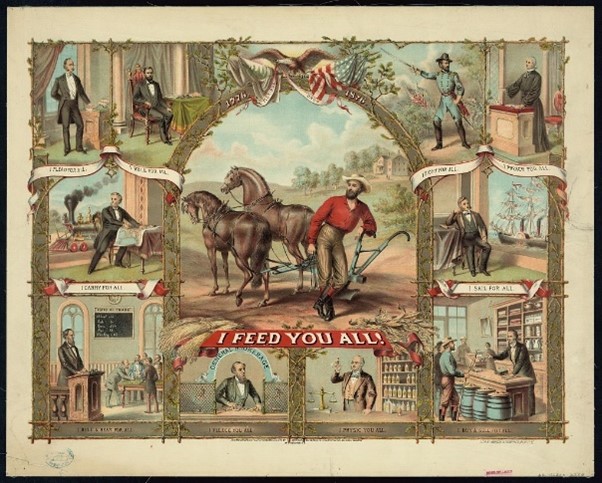
The Patrons of Husbandry, or the Grange, was founded in 1867 to advance methods of agriculture, as well as to promote the social and economic needs of farmers in the United States. The financial crisis of 1873, along with falling crop prices, increases in railroad fees to ship crops, and Congress’s reduction of paper money in favor of gold and silver devastated farmers’ livelihoods and caused a surge in Grange membership in the mid-1870s. Both at the state and national level, Grangers gave their support to reform-minded groups such as the Greenback Party, the Populist Party, and, eventually, the Progressives.

The social turmoil that the Western farmers were in was mainly a result of the complete dependence on outside markets for the selling of their produce. This meant that they had to rely on corporately owned railroads and grain elevators for the transport of their crops. To make matters worse, “elevators, often themselves owned by railroads, charged high prices for their services, weighed and graded grain without supervision, and used their influence with the railroads to ensure that cars were not available to farmers who sought to evade elevator service.” In 1871, Illinois created a new constitution allowing the state to set maximum freight rates but the railroads simply refused to follow the mandates of the state government.

The Grangers became political by encouraging friends to elect only those officials with the same views. Furthermore, while Republicans and Democrats had already been bought out by corporations looking to curry favor in the government, Grangers vowed to create their own independent party devoted to upholding the rights of the general populace.

On Independence Day, 1873 (known as the Farmer’s Fourth of July), the Grangers read their Farmer’s Declaration of Independence, which cited all of their grievances and in which they vowed to free themselves from the tyranny of monopoly.  The Supreme Court decision in Munn v. Illinois stated that businesses of a public nature could, in accordance with the federal constitution, be subject to state regulation. Following this ruling, several pieces of legislation, collectively known as the Granger Laws, were passed. Unfortunately, many of these laws were repealed.

Though the organization did not last, it demonstrated the effects that monopolies have on society. It subjugated these individuals to its whims, and then forced them to take action against it. 

The Yellow Vests Protest in France

Donning the now-famous fluorescent waistcoats that are mandatory in French cars, the  Yellow Vests staged 52 consecutive weeks of protests against economic hardship, mounting inequality and a discredited political establishment. They manned roundabouts across the country night and day, took to the streets on every Saturday since November 17, and at their peak in December even stormed the Arc de Triomphe in central Paris, amid scenes of chaos not witnessed since May ’68. The movement had an indelible mark on France, forcing the government into billions of euros of tax breaks.

“The picture that emerged was that of a movement made up largely of workers and former workers in a situation of financial insecurity, with relatively few unemployed,” said Gonthier. Yellow Vests were present across France, but strongest in small towns and rural areas. They came from all walks of life, but liberal professions were underrepresented, while small business owners and employees, craftspeople and care workers formed the bulk of the movement. About two thirds of respondents earned less than the average wage, and a slightly higher percentage registered as having a “deficit of cultural resources and social links”. This in turn “conditioned the way they defined themselves, and helped distance them from traditional social movements”, Gonthier added.

Another defining feature was the high proportion of women, who made up roughly half the Yellow Vests, whereas social movements traditionally tend to be male-dominated. Gonthier said this reflected the significant mobilization of women in care work, “most notably hospital workers from a public health sector that is plunging deeper into crisis”. They included a high number of single mothers who couldn’t go out and protest, or were scared away by the police’s heavy-handed response, but who supported the movement online.

  1. Are monopolies harmful to a growing economy or are they a necessary ‘evil’?
  2. Is it inevitable that an oppressed people will revolt and attempt to destroy that which has kept them down?
  3. How can governments best address poverty and inequality?
  4. If a significant minority feels oppressed, do they have a right to overthrow their government by protest or violence if they cannot get satisfaction through the process of elections?
  5. Do you support the Grangers, Yellow Vests, both or neither?

The Granger Revolution

The Grange Movement

A Brief Essay on the Grange Movement

Who are France’s Yellow Vest Protestors and What do they Want?

The Yellow Vest Movement Explained

Activity #2: Munn-Wabash Railroad in Illinois and the Trans-Siberian Railroad in Russia

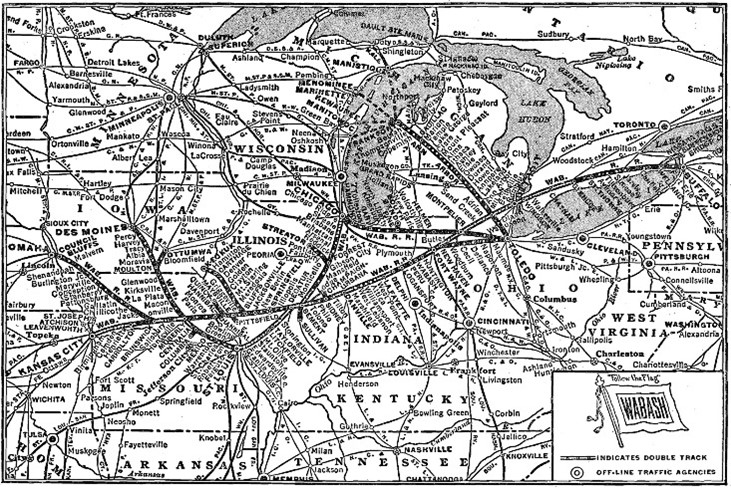
Route of the Wabash Railroad in the Midwest

The Wabash Railroad Company went bankrupt and was sold. The new Toledo and Wabash Railroad Company was chartered October 7, 1858. The Wabash and Western Railroad was chartered on September 27 and acquired the Indiana portion on October 5. On December 15, the two companies merged as the Toledo and Wabash Railway, which merged with the Great Western Railway of Illinois. The right of continuous transportation from one end of the country to the other is essential in modern times to that freedom of commerce. The Commerce Clause in the U.S. Constitution gives Congress the power to regulate commerce among the States and with foreign nations. If Illinois or any other state within whose were permitted to impose regulations concerning the price, compensation, or taxation, or any other restrictive regulation it would be harmful to commerce between states.

The Trans-Siberian Road in Russia

Trans-Siberian Railroad Crossing a large river in Siberia

The construction of the longest railway in the world  was launched in April 1891 and was completed in 1894. Three years later the section between Vladivostok to Khabarovsk with a length of 772km was opened in November 1897. The Central Siberian Railway from the River Ob to Irkutsk with a length of 1839km was built in 1899. The construction involved more than 100,000 workers, including prisoners, and the work was carried out by hand using shovels, axes, crowbars, saws. Despite the many challenges of the taiga, mountains, wide rivers, deep lakes, and floods, the tracks were built with amazing speed – around 740km per year.

  1. Does the protection of technology for the efficiency of commerce justify federal regulations over state regulations?
  2. If a corporation is losing money, do they have a right or obligation to raise rates to become profitable?
  3. Do authoritarian governments have an advantage or disadvantage in the construction of large infrastructure projects?

Consolidation of Railroads in Four States

The Supreme Court Strikes Down Railroad Regulation

Interstate Commerce Act (1887)

Construction of the Trans-Siberian Railroad

History of the Trans-Siberian Road

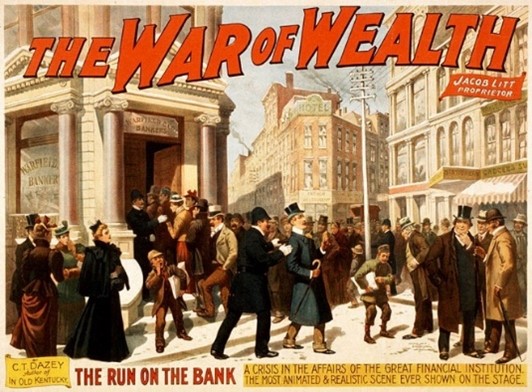
No crisis of the Cleveland presidencies exceeded the magnitude of the financial panic that gripped the nation at the start of his second term in 1893, and which presaged a depression that still lingered when he left office in March 1897.

The Constitution granted Congress the power “to coin money, regulate the value thereof, and of foreign coin, and fix the standard of weights and measures.” (Article 1, Section 8) Article I, Section 8, and Clause 2 The Congress shall have power to borrow money on the credit of the United States. In the 14th Amendment, Section 4, it states that “the validity of the public debt of the United States, authorized by law … shall not be questioned.”

In the century preceding 1893, Congress experimented with two central banks, a national banking system, laws regulating so-called “wildcat banks,” paper money issues, legalized suspension of specie payments, and fixed ratios of gold and silver. Gold and silver rose to prominence as the predominant monies of the civilized world because of their scarcity and value. Under the direction of Alexander Hamilton, the federal government adopted an official policy of bimetallism and a fixed ratio of 15 to 1 in 1792.

In 1875, the newly-formed National Greenback Party called for currency inflation through the issuance of paper money tied, at best, only minimally to the stock of specie. The proposal attracted widespread support in the West and South where many farmers and debtors joined associations to lobby for inflation, knowing that a reduction in the value of the currency unit would alleviate the burden of their debts.

When President Cleveland assumed office on March 4, 1893, the Treasury’s gold reserve stood at the historic low of $100,982,410 — slightly above the $100 million minimum required for protecting the supply of greenbacks. The Panic of 1893 began when the gold reserves fell below $100,000,000. Stocks fell and factories closed with many going bankrupt. Unemployment rose to 9.6%, nearly three times the rate for 1892. By 1894, the unemployment rate was almost 17%. The Sherman Silver Purchase Act was repealed in support of gold as a stable currency.

Cleveland’s position on sound money was not supported by his Democratic Party. The Gold Standard Act of 1900 resulted in a stable gold standard and economic growth. Cleveland’s position on sound money worked.

Hyperinflation in Germany

Under the Treaty of Versailles Germany was forced to make a reparations payment in gold-backed Marks. On June 24, 1922, Walter Rathenau, the foreign minister was assassinated. The French sent their army into the Ruhr to enforce their demands for reparations and the Germans were powerless to resist. More than inflation, the Germans feared unemployment. A cheaper Mark, they reasoned, would make German goods cheap and easy to export, and they needed the export earnings to buy raw materials abroad. Inflation kept everyone working.

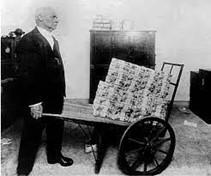
The price increases began to be dizzying. Menus in cafes could not be revised quickly enough. For example, a student at Freiburg University ordered a cup of coffee at a café for 5,000 Marks. He had two cups but when the bill came, it was for 14,000 Marks. When the 1,000-billion Mark note came out, few bothered to collect the change when they spent it. By November 1923, with one dollar equal to one trillion Marks, the breakdown was complete. The currency had lost meaning and value.

Although the currency was worthless, Germany was still a rich country — with mines, farms, factories, forests. The backing for the new Rentenmark was the value of the land for mortgages and bonds for the factories. Since the factories and land couldn’t be turned into cash or used abroad the value of one Rentenmark was equal to one billion of the former Marks. People lost their savings and homes.

Questions:

  1. Is a sound currency policy, where the dollar is backed by gold or some other form of credit, always the best policy for governments to follow?

    2. Does the financial debt of a country matter if its economy is growing?  Does it matter in times of war or the recovery from a natural disaster?

    3. In a financial crisis, a depression, does everyone suffer equally or are some more affected than others?

    4. Which problem should the government address first? High Unemployment of 8% or rising inflation of 5%? Why?

    5. Is foreign investment in a country’s economy necessary to maintain a balance of payments?

    6. Based on the U.S. Constitution, is the debt of our government limited or unlimited?

    The Panic of 1893 and the Election of 1896

    Price Stability and the Fed

    The Weimar Republic

    The German Hyperinflation, 1923

    Hyperinflation in Germany

    Historians often call the period between 1870 and the early 1900s the Gilded Age. This was an era of rapid industrialization, laissez-faire capitalism, and no income tax. Captains of industry like John D. Rockefeller and Andrew Carnegie made fortunes. They also preached “survival of the fittest” in business.

    By the late 1800s, however, monopolies, not competing companies, increasingly controlled the production and prices of goods in many American industries.

    Workers’ wages and working conditions were unregulated. Millions of men, women, and children worked long hours for low pay in dangerous factories and mines. There were few work-safety regulations, no worker compensation laws, no company pensions, and no government social security.

    Starting in the 1880s, worker strikes and protests increased and became more violent. Social reformers demanded a tax on large incomes and the breakup of monopolies. They looked to state and federal governments to regulate capitalism. They sought legislation on working conditions, wages, and child labor.

    Railroad builders accepted grants of land and public subsidies in the 19th century. Industries facing strong competition from abroad have appealed for higher tariffs. American agriculture benefited with land grants and government support. State governments helped finance canals, railroads, and roads.

    It is difficult to separate government intervention, regulation, and laissez-faire in American history. It is likely even more difficult to find the proper balance between government and free enterprise. Perhaps the most serious violations occurred during this era in America’s history with land grants to railroads, regulating the rates railroads could charge, mandating time zones, and allowing paper currency.

    1. Why is limited government and laissez-faire economics popular in the United States over time and today?
    2. Should the federal government regulate education and schools or should this be left to the local and state governments?
    3. Does laissez-faire economics bridge or widen the income gap between the social classes?
    4. Who benefits the most from increasing government regulation?

    Laissez-faire Economics in Practice

    Social Darwinism and Laissez-faire Capitalism in America

    Defending the Free Market from Laissez-faire?

    Era 4 – Engaging High School Students in Global Civic Education Lessons of in U.S. History

    www.njcss.org

    The relationship between the individual and the state is present in every country, society, and civilization.  Relevant questions about individual liberty, civic engagement, government authority, equality and justice, and protection are important for every demographic group in the population.  In your teaching of World History, consider the examples and questions provided below that should be familiar to students in the history of the United States with application to the experiences of others around the world.

    These civic activities are designed to present civics in a global context as civic education happens in every country.  The design is flexible regarding using one of the activities, allowing students to explore multiple activities in groups, and as a lesson for a substitute teacher. The lessons are free, although a donation to the New Jersey Council for the Social Studies is greatly appreciated.

    The Civil War put the constitutional government of the United States to its severest test. It challenged the Legislative, Executive, and Judicial branches of government as well as the federal system of power with state and local government. The activities below provide an opportunity to learn about the breakdown of a democratic political system, the conflict between geographic regions and different subcultural, and the competitive ideas for reconstruction. Students will learn about the hope regarding equality for black Americans through the 13th, 14th, and 15th Amendments and the resistance leading to disenfranchisement, segregation, and debt peonage.

    Did the Supreme Court have jurisdiction to hear the case? The law suit was properly in federal court only if a “citizen” of one State was suing a “citizen” of another State. Sanford was a citizen of New York. Even if we assume, with Scott, that the law made him a free man, was he then a “citizen” of Missouri?  If Scott was a “citizen” and jurisdiction was proper, then what about the basic issue on the merits? Did the law make Scott a free man?

    Was the Dred Scott Decision a failure of the Judicial system in the United States because it violated the fundamental principle in the Magna Carta regarding the rule of law and the individual rights and liberties of all people, regardless of their estate or condition.  Article 39 of the Magna Carta, secured a promise from the monarchy that “no free man shall be arrested or imprisoned, or disseized or outlawed or exiled or in any way victimized, neither will we attack him or send anyone to attack him, except by the lawful judgment of his peers or by the law of the land.” In the fourteenth century, Article 39 was redrafted by Parliament to apply not only to free men but also to any man “of whatever estate or condition he may be.”

    The Supreme Court’s conclusion: It “is the opinion of the Court that the act of Congress, which prohibited a citizen from holding and owning property of this kind . . . is not warranted by the Constitution and is therefore void; and that neither Dred Scott himself, nor any of his family, were made free by being carried into this territory, even if they had been carried there by the owner with the intention of becoming a permanent resident.”

    How do the principles of the Magna Carta and the precedent of the Dred Scott decision apply to the restrictive immigration decisions legislated by Congress in the Emergency Quota Act of 1921 and the Johnson-Reed Immigration Act of 1924? Does the United States, or any country, have the authority to restrict immigration based on race, ethnicity, or geographic location?  Aliens in the United States do not have a right to a court-appointed attorney, Miranda rights, the right to a jury trial, or the right to see all the evidence against them. However, they have the protection of the Due Process of Law clause.

    But one constitutional right that applies to aliens in removal proceedings is Due Process. According to the Supreme Court: “The Due Process Clause applies to all “persons” within the United States, including aliens, whether their presence here is lawful, unlawful, temporary, or permanent. Santa Clara County v. Southern Pacific Railroad Company, (1886)

    Questions:

    1. Did the U.S. Supreme Court have the authority to issue an obiter dictum regarding Mr. Dred Scott?
    2. Did enslaved persons who received freedom also become citizens of the state where they lived? Would their status as citizens change because of their race or ethnicity if they moved to another state?
    3. Does Article 39 of the Magna Carta apply to free blacks who were arrested as fugitives?
    4. Do people living in America, who are not citizens, entitled to rights in addition to the due process of law and should they also receive the equal protection of the laws of the United States?
    5. What about people living in America who entered illegal or have expired documents?
    6. Should birthright citizenship, everyone born in the United States or one of its territories, be considered a full citizen regardless of the status of their immigrant parent(s)?

    Associate Justice Stephen Breyer’s Address to the Supreme Court Historical Society on June 1, 2009

    Slavery and the Magna Carta in the development of Anglo American Constitutionalism

    The Immigration Act of 1924 (Johnson-Reed Act)

    The 1924 Act that Slammed the Door on Immigrants and the Politicians who Pushed it Back Open

    The question is whether the Southern states possessed the legal right to secede. Jefferson Davis, president of the new Confederate States of America, argued that the Tenth Amendment was the legal basis for secession. The U.S. Constitution is silent on the question of secession. Therefore, secession is a right reserved to the states and is supported by the ‘compact theory’ regarding the right to nullify a federal law.

    Another argument in support of the right of secession involves the states of Virginia, New York, and Rhode Island because these states included a clause in their constitutions that permitted them to withdraw from the Union if the government should become oppressive. Virginia cited this provision when it seceded in 1861. The Constitution is also based on the principle that all the states are equal and no state can have more rights than another. The right of secession cited by these three states must extend equally to all the states.  This is an interesting question for debate and discussion.

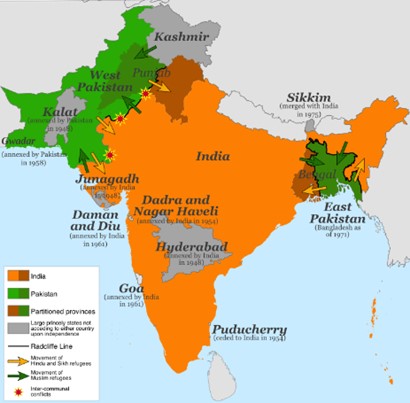
    In 1971, the Pakistan army launched a brutal campaign to suppress its breakaway eastern province.  A large number of people lost their lives, an estimated 300,000 to 500,000 died. The Bangladesh government puts the figure at three million. Bangladesh seceded because of the oppressive genocide against their population. It is now more than 40 years since they became an independent country.

    1. Do the “opt out’ clauses by Virginia, New York, and Rhode Island support secession at a later date from an early agreement to join into the common government or the Union?
    2. If a government violates the natural rights of life, liberty, property, or the pursuit of happiness against a specific group of people or a state, do they have the right to secede?
    3. Would you support the secession of Bangladesh if less than 1,000 people were killed?

    The Secession of East Pakistan in 1971 and the Question of Genocide

    The Secession of Bangladesh in International Law: Setting New Standards?

    Activity #3: Emancipation Act of 1863, 13th Amendment, Civil Rights Act of 1866

    Historians and constitutional scholars question if the Emancipation Proclamation was constitutional. This is a different question than asking if the Proclamation was justified. The debate over constitutionality is based on the question if it was lawful to own another human being if you lived in a state that was loyal to the Union. The Supreme Court in Prigg v. Pennsylvania (1842) upheld the Fugitive Slave Law of 1793  stating that Pennsylvania could not prevent the return of a fugitive slave to its owner. Consequently, The Thirteenth Amendment was necessary to make the Emancipation Proclamation constitutional.

    On January 5, 1866, a few weeks after the ratification of the Thirteenth Amendment, Senator Lyman Trumbull, from Illinois, introduced the first federal civil rights bill in our history. President Andrew Johnson vetoed the bill, opposing laws for the equality of African Americans as compared to the natural progression for this to happen over time. The veto message incensed Congress, who had evidence of widespread mistreatment of African Americans throughout the South by both private and public parties.  Congress overrode Johnson’s veto on April 9, 1866, and elements of the Civil Rights Act of 1866 eventually became the framework for the Fourteenth Amendment.  The constitutional question relates to the argument if the Act applies only to states that discriminate or if it applies to both state governments and private citizens.

    1. Does the U.S. Constitution need to explicitly state that all human beings are guaranteed life, liberty, and the pursuit of happiness?
    2. Did the Civil Rights Act of 1866 go too far or was it too limited in prohibiting discrimination?
    3. Should the Thirteenth Amendment have included a provision for reparations for enslaved persons and a provision for compensating slave owners for their losses?

    Emancipation Proclamation (National Archives)

    Was the Emancipation Proclamation Constitutional? (Illinois Law Review)

    Origin and Purpose of the Thirteenth Amendment (Cornell Law School)

    The Civil Rights Act of 1866

    Racial Discrimination and the Civil Rights Act of 1866

    The 14th amendment explicitly contains an equal protection clause. Miranda warnings and other amendments were not only created to protect certain individuals but all individuals.  Equal protection is a foundational principle in our society. No one should have their rights unjustly taken away from them; and no one should be allowed to get away with crimes because of their ethnicity, gender, socioeconomic status, etc. Everyone is under the rule of law.

    An uneducated or uninformed individual may be pressured by authorities in an interrogation and confess to a crime they did not commit in order to stop the questioning. The right to remain silent and the right to an attorney ensures that all individuals get equal protection regarding of their situation or circumstance.

    1. Does Miranda provide adequate protections for accused persons?
    2. Does the right to remain silent benefit an innocent person who is detained or accused?
    3. Should a detained or accused person have to specifically state and document their request to remain silent?
    4. Do the police have to stop questioning after a person states their intention to remain silent?
    5. If the police need information two or three weeks after the initial detainment, do they need to repeat the Miranda warning a second time?
    6. Should Miranda warnings apply to juveniles in school or only in matters involving questions by the police?

    Miranda v. Arizona, 1966

    Fourteenth Amendment(Cornell Law)

    Journal of Criminal Law and Criminology(Northwestern University School of Law, 1996)

    Era 3 – Engaging High School Students in Global Civic Education Lessons in U.S. History

    New Jersey Council for the Social Studies

    www.njcss.org

    The relationship between the individual and the state is present in every country, society, and civilization.  Relevant questions about individual liberty, civic engagement, government authority, equality and justice, and protection are important for every demographic group in the population.  In your teaching of World History, consider the examples and questions provided below that should be familiar to students in the history of the United States with application to the experiences of others around the world.

    These civic activities are designed to present civics in a global context as civic education happens in every country.  The design is flexible regarding using one of the activities, allowing students to explore multiple activities in groups, and as a lesson for a substitute teacher. The lessons are free, although a donation to the New Jersey Council for the Social Studies is greatly appreciated. www.njcss.org

    Concept of Self-Government

    In the late 17thcentury the colony of New Jersey was divided between East Jersey with a capital city in Perth Amboy and West Jersey with a capital city in Burlington. The situation was chaotic with arguments over property investments and the selection of governors. In 1702, a decision was made for New Jersey to become a royal colony with the appointment of Edward Hyde, Lord Cornbury.

    In the first 50 years of the 19th century the United States expanded its territory from the Atlantic to the Pacific Ocean and from Canada to the Rio Grande River. The expansion of territory also challenged the fundamental principles of democracy in the United States with the debt of purchasing land, wars with other countries, determining the meaning of equality, the migration of populations, and conflicts between the branches of government. In this era, teachers and students will discover that these conflicts in our government are not unique.

    Activity #1: Orders of Nullification and Conflicts over Laws – United States (1832) and Catalonia(2017)

    One of the challenges facing sovereign states is when the right of self-determination conflicts with the rule of law, especially constitutional law. The people of South Carolina opposed the Tariff of 1828, the law of the land, because of the economic harm to their citizens. On November 24, 1832, the state legislature adopted the Orders of Nullification which included the following statement, …”and that the people of this State will henceforth hold themselves absolved from all further obligation to maintain or preserve their political connection with the people of the other States; and will forthwith proceed to organize a separate government, and do all other acts and things which sovereign and independent States may of right do.”

    In 2017, the state of Catalonia, one of Spain’s wealthiest states, filed a petition for independence following the sentencing of nine of their citizens to jail for protests against the government and charges that the government does not tax the people of Catalonia equally with other citizens in Spain.

    1. Do the people of a territory have the legal right to withdraw from a compact or union?
    2. If a federal government violates the rights of the people it promises to protect, does this justify a right to withdraw from the compact or union?
    3. What states or territories have attempted to separate from a federal union? (Quebec,

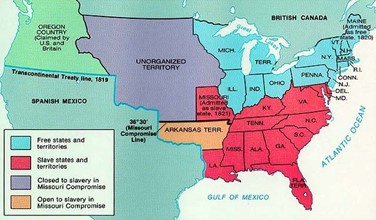
    Missouri applied for statehood in 1819 allowing for slavery.  Congress was already divided and there was a competitive debate over human rights and how Missouri’s application would tip the balance of an equally divided legislature of 11 free states and 11 slave states. The last state admitted was Louisiana in 1812.  Illinois was admitted on December 3, 1818 and Alabama on December 14, 1819.  The compromise was that Maine (part of Massachusetts) would be admitted as a free state and Missouri as a slave state, providing that slavery would be banned north of the latitude line 36o 30’.

    The European Union was created in 1993 with the signing of the Maastricht Treaty. Today it has 27 states. In 2009 the Lisbon treaty amended the constitution and adopted the Charter of Fundamental Rights of the European Union and the acceptance of this charter and human rights is a requirement for membership. However, Hungary and Poland do not embrace the Charter of Fundamental Rights in the same manner as the other member states.

    The newly elected leaders in Poland and Hungary have taken strong positions against abortion and the equality of individuals identifying as LGBTQ. The constitutional question before the Court of Justice is similar to the Dred Scott v. Sanford case of 1857 which challenged the legal authority of the Missouri Compromise and prohibiting slave property in states.

    1. Why was the United Kingdom allowed to leave the European Union?
    • Should states without an ‘opt out’ clause be allowed to leave the European Union? What conditions should be considered?
    • How does the secession of one state impact its own people and the other states in Europe?
    • Under Article 7 of the Treaty of the European Union, can a state leave if it is suspended?
    • Is it possible for member states to end diplomatic relations with another member state?

    After eight years of government by the Democratic-Republican Party, in 1824, the Democratic-Republican Party splintered as four separate candidates sought the presidency. The election tested the Twelfth Amendment. Since no candidate received a majority of the electoral vote, it was decided by the House of Representatives.  Although Andrew Jackson received the most popular votes and the most electoral votes, he did not become president.  At this time, several states did not have a popular vote for president and electors in some states were chosen by state legislators.

    In 2018, the Green Party in Germany became the second strongest political party. After years of government by the Social Democratic Party and the Christian Democratic Party, the Green Party has rallied the citizens of Germany around environmental issues, specifically climate change. They also have positions against racism and support immigration.  The parliamentary system of government selects the chancellor or leader of Germany through alliances of the political parties elected.

    1. How would you describe a competitive democracy?
    • Are political parties supporting a single issue with limited experience in diplomacy or political administration qualified to govern in countries defined as the G20?
    • Why do populist movements emerge? Is there strength based on the issues or the charisma of an individual?
    • How do new voices and political leaders gain support withing their countries?
    • Does the Electoral College in the United States provide protection against third parties?  Is this appropriate for a 21st century democracy?
    • Do you think the Democratic and Republican parties will be the leaders of the two-party system of government in the United states at mid-century, the election of 2048 or 2052?

    Presidential Election of 1824: A Resource Guide (Virtual Programs & Services, Library of Congress) (loc.gov)

    The ‘gag rule’ was a legislative tactic employed by southern members of Congress beginning in the 1830s to prevent any discussion of enslavement in the House of Representatives. The silencing of enslavement opponents was accomplished by a resolution first passed in 1836 and renewed repeatedly for eight years.

    The suppression of free speech in the House was naturally deemed offensive to northern members of Congress and their constituents. What came to be widely known as the gag rule faced opposition for years, most notably from former president John Quincy Adams. The gag rule was finally rescinded in December 1844.

    Democratic Centralism is essential to the internal political debates withing the Communist Party of the Soviet Union. To what extent is debate permitted withing the Soviet Congress influencing policy and implementing changes?  In the 1920’s there was dissent within the Communist Party regarding the proletariat and farmers. In December 1927, the opposition voices led by Leon Trotsky were expelled from the Congress, a ‘gag rule’ as debate was ended. In the 1980s, some voices within the Communist Party called for reforms and supported market forces in the economy and more democracy. The principle of democratic centralism challenged the authority of Gorbachev in a failed attempt to overthrow his authority. Eventually, democratic centralism changed the government as the former Soviet Union collapsed.

    1. Is a single party system, two-party-system, or a multi-party system the most practical way to govern in the 21st century?
    • In a democracy, should the majority have the right to limit or suppress debate on controversial issues?
    • What is the most effective way for people to change their government: public protests or elections?
    • How effective is a strong leader with charisma in today’s government?
    • To what extent is the news media (including social media) a political influence or force in the United States?
    • What type of government does Russia have today and what type of government does the United States have today?
    • Is a parliamentary system of government more effective than the two-party system of representative government that the United States has?

    Era 2 – Engaging High School Students in Global Civic Education Lessons in U.S. History

    New Jersey Council for the Social Studies

    www.njcss.org

    The relationship between the individual and the state is present in every country, society, and civilization.  Relevant questions about individual liberty, civic engagement, government authority, equality and justice, and protection are important for every demographic group in the population.  In your teaching of World History, consider the examples and questions provided below that should be familiar to students in the history of the United States with application to the experiences of others around the world.

    These civic activities are designed to present civics in a global context as civic education happens in every country.  The design is flexible regarding using one of the activities, allowing students to explore multiple activities in groups, and as a lesson for a substitute teacher. The lessons are free, although a donation to the New Jersey Council for the Social Studies is greatly appreciated. www.njcss.org

    Concept of Self-Government

    In the late 17thcentury the colony of New Jersey was divided between East Jersey with a capital city in Perth Amboy and West Jersey with a capital city in Burlington. The situation was chaotic with arguments over property investments and the selection of governors. In 1702, a decision was made for New Jersey to become a royal colony with the appointment of Edward Hyde, Lord Cornbury.

    The 18th century was a unique time in world history as this was a time when the concept of government changed in Europe from the authority of the divine right of kings to the authority of the social contract and sovereignty of the people.  This period is unique in western civilizations because of its focus on natural rights, limited government, and enlightened ideas.

    The Ujamaa concept was the centerpiece in Tanzania’s Declaration of Independence (1967) and the concept of natural or inalienable rights is the centerpiece of America’s Declaration of Independence (1776). This is an opportunity to analyze how the pursuit of happiness was defined in the 18th century and in the 20th century. To what extent has time and history changed our understanding of equal opportunity, empowerment, property, and the means to establish social justice and independence?

    1. Compare how America and Tanzania defined equality, property, and opportunity for their people in different centuries.
    2. Are there unique advantages or disadvantages in each document?

    The Land Ordinance of 1785 is considered a hallmark for considering future states as equals to the original 13 states which declared independence from Great Britain. Equality is a fundamental principle in democracy. Under the Land Ordinances of 1784, 1785, and 1787, slavery was abolished, religious and civil liberties, and an education about democratic values provided opportunities for all citizens.

    Although Canada was settled around the same time as the thirteen American colonies, the colonies in Canada were divided culturally and politically.  Lower Canada was settled by France and the majority of the people professed the Roman Catholic religion and Upper Canada was influenced by England and the Protestant religion. In the Unification of Upper and Lower Canada in 1867, there was a debate about future territories and democracy.

    1. Compare and contrast the fundamental ideals of democratic government in the United States and Canada regarding the structure of government, role of education, concept of equality and opportunities for all citizens, end the separation of powers in both governments. 
    • Does one country emphasize direct democracy over indirect democracy or do both countries have similar governments?

    Land Ordinance of 1785 – Ohio History Central

    The History of Upper and Lower  Canada

    An Act of Union (1867)

    The Road to Democracy in Canada

    What was the force behind the emancipation of enslaved persons in the 19th century?  Was the movement to end slavery motivated by the abolitionist movement, economics, legislation, resistance, or something else? Liberty is considered a natural or inalienable right and for millions in North America, this basic right was denied.  The Atlantic slave trade ended in 1807 but slavery continued and the population of enslaved persons continued.

    1. What is the role of civic responsibility and empowerment in the movement to abolish slavery in the British colonies in the Caribbean and in the United States of America?  
    2. One defense of slavery in opposition to those who would abolish it was the claim that slaves were private property essential to a slaveowner’s way of life and livelihood. Therefore, to abolish the institution of slavery was to force an owner of slaves into a life of having to work for wages or hire people and pay them wages. Thus, the slaveowner would be enslaved by a law abolishing slavery. Does this claim of individual freedom through the ownership of property have any constitutional support?

    Use the links below for evidence to support your thesis or claim.

    Jamaica                                                                  The Act for the Gradual Abolition of Slavery in NJ (Feb. 15, 1804)

    Jamaica and the Atlantic World                        Legislating Slavery in New Jersey

    Emancipation in Jamaica                                    Resources for the Abolition of Slavery in New Jersey

    The Emancipation Act of 1833

    The history of the United States was determined by compromises regarding the legislature, property, and the importation of slaves.  A controversial compromise was over the counting of enslaved persons in the 13 independent states for purposes of representation and taxation. An agreement was reached to count enslaved persons for the purpose of taxation and representation as only three-fifths of the population. This method of determining representation in the House of Representatives continued until the Thirteenth Amendment abolished slavery.

    Article I, Section 2 of the U.S. Constitution states: “Representatives and direct Taxes shall be apportioned among the several States which may be included within this Union, according to their respective Numbers, which shall be determined by adding to the whole Number of free Persons, including those bound to Service for a Term of Years, and excluding Indians not taxed, three fifths of all other Persons.” The “other Persons” were slaves.  The Southern states wanted to count the entire slave population, which would increase their number of members of Congress. The Northern delegates and others opposed to slavery wanted to count only free persons, including free blacks in the North and South.

    The Continental Congress debated the ratio of slaves to free persons at great length. Northerners favored a 4-to-3 ratio, while southerners favored a 2-to-1 or 4-to-1 ratio. Finally, James Madison suggested a compromise: a 5-to-3 ratio.

    Slavery was essential to the Brazilian economy. 40 percent of the 10 million enslaved African brought to the New World ended up in Brazil. The institution of slavery in Brazil was supported by a majority of white citizens and the Roman Catholic Church. Gradual abolition began in 1871 for children born to enslaved women. Unfortunately, with no plan for assimilation into Brazilian slavery continued into the 20th century with informal agreements for food and housing.

    1. Should the decisions about equality and freedom be determined by governments or by the vote of the citizens?
    2. How should decisions be made about the protection of property when property conflicts with human life and personal liberty?
    3. If automobiles are harmful to the environment should government have the authority to ban them without compensation?

    Thirteenth Amendment to the Constitution of the United States, 1865

    Golden Law of 1883 in Brazil

    History of America’s Immigration: The Background to Today’s Border and Asylum Crises

    Harry.stein@manhattan.edu

    Following is a description with vocabulary for each era.  Following the four eras mis a collection of data that students can use to learn more about each time period.  In each era examine who came to the USA, why, and how did government policy favored or discouraged immigration.

    Authority was with individual states, not the Federal Government.  States used what was then called “state police power” to set and enforce rules.  States set rules stopping the admission of convicts, free Blacks, paupers, diseased, sick or disabled persons or passengers on ships who tried to enter without the captain posting a bond on their behalf.  No free person whether black, mulatto, or colored from a Caribbean country, especially Haiti, could enter some states.  Haitian seamen on a ship entering Charleston, S.C., could not leave the ship.  These powers were confirmed by a Supreme Court decision (Miln Decision, 1837) and the Passenger Cases decision (1849) approve state laws on bonding and taxing incoming passengers.  The 1830 Indian Removal Act was another example of state police power.  The movement of free Blacks within Missouri and Ohio was also regulated.

    There were also federal laws in 1793, 1842 (Prigg decision), and 1850 concerning the return of runaway slaves to their owners.  Legislation in 1809 prevented the importing of additional slaves from west Africa.  In 1817 the Liberia colony was established and federally funded for free Black who wished to return to Africa. 13,000 did.

    Federal laws permitting or excluding contract labor from China and Europe were enacted.  In 1862 the Coolie importation from China was stopped under the logic that since slavery was illegal in northern states and Coolies were slaves therefore, they could not get into the USA.  In 1867 contract labor was permitted from Europe.  In conclusion, high, consistent demand for labor led to favorable State and federal immigration policies.

    Critical terms: Era #1

    1790 Naturalization Act

    Know Nothing Party

    Dred Scott Decision

    Burlingame Treaty

    Northern European Migration from Ireland, UK, Germany, Netherlands

    During this era, power to legislate and enforce laws came totally to the national government. Immigration power resided in the Federal government’s ability to control commerce, Gibbons v. Ogden (1824) and the theory of national sovereignty critical for national security through border control.  Between 1871 and 1914, 23.5 million Europeans entered.  Eastern and southern Europeans joined those from Ireland, the U.K. and northern Europe. 1.7 million entered in 1907.

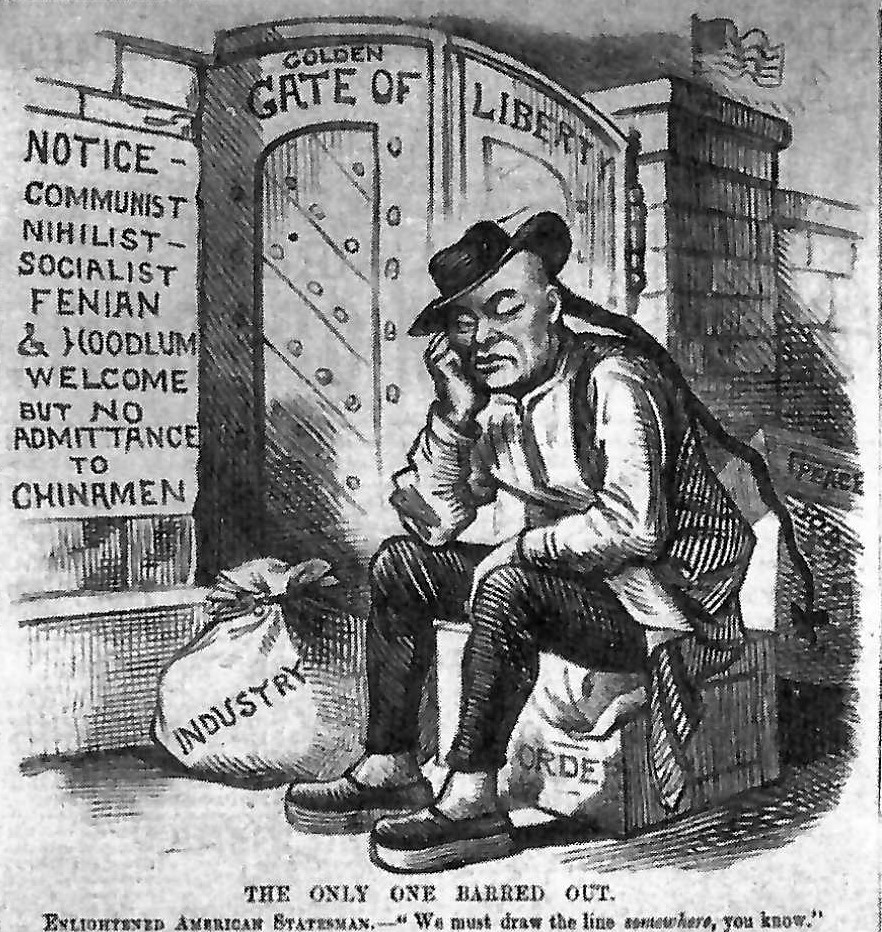
    The country was industrializing and urbanizing.  Labor demand was high.  But gradually laws were established excluding some and regulating the entry of others.  Many Americans wanted more immigration.  Other Americans were critical of who were admitted.  By 1924 the doors were almost closed to many Jews, Catholics, Hindus, and Chinese. See the Page Act (1875) and Chinese Exclusion Act (1882). Research the Foran Act (1885) and the Dillingham Commission (1911).

    1917 –  Law aimed at South Asians, Indians, who settled in California and Washington and spoke out against British control of their homeland.  This was part of a wider American nativist movement merging with white supremacy ideology, anti-communism and earlier opposition to immigrants with physical or mental disabilities.  A literacy test was passed.  A “barred” zone was created stopping all Asian entry except from the Philippines and Japan, already excluded by an informal 1907 “Gentlemen’s Agreement”, Mexicans were turned into temporary labor migrants.  There was also the fear that if the US entered the League of Nations this could endanger national security.  In 1920, 16% of the US population was foreign born.  Bad foreigners = crime, immorality, and labor conflict.

    1921 – First law closing loopholes in the 1917 law and establishing first national origin quotas. This law fused beliefs about eugenics, racial bigotry, anti-disabilities prejudice, mixed racial marriages into a category of undesirable immigrant groups.  The Johnson-Reed Act (1924) created quotas by ethnic origin.  The Border Patrol created an illegal entry called a misdemeanor and felony (1929) if done twice.

    Harry Laughlin

    Madison Grant

    Prescott Hall

    Bracero

    Thind Supreme Court Case, 1923

    Wong Kim Ark Supreme Court Case, 1898

    Jones/Shafroth Act, 1917

    Ellis Island,

    Castle Garden

    The Johnson-Reed Act (1924) confined immigration to mainly northern Europe.  National quotas were based on ethnic origins of the 1890 census.  Through the Depression of the 1930s and World War II, immigration was severely curtailed.  Following World War II, the law remained intact and parallel laws dealing with World War II refugees were created that bypassed but did not displace the 1925 Law.

    In 1948, Congress passed the Displaced Persons Act permitting European refugees to enter.  In 1948 the law was amended permitting refugees from camps in west Germany who could not return to former homes in Poland and the USSR to enter the USA.  332,000 arrived including 141,000 Jewish Holocaust survivors between June 1948 and December 1951.

    Xenophobia

    The 1938 Voyage of the St. Louis

    Project Paperclip

    Chinese Citizen Act of 1943

    Mariel Boat Lift, 1960

    The 1925 law was replaced by the Hart/Cellar Act of 1965.  Racial and ethnic quotas were eliminated.  Numerical quotas were retained.  Entrance was open to people from anywhere.  The law favored family unification, preference for certain occupations, and a new side variety of visas.  In 1950, the USA was 90% white with a European origin. By 2000, 50% of new immigrants were from Latin America and 27% from Asia.  In 2020, the USA population was 69% European white.

    This law changed the racial composition and, some say, the national identity of the USA.  The acrid, hot odor of 1924 bigotry and nativism returned magnified and channeled through social media.  By 2020, some Americans were talking of white racial suicide and replacement theory.  Politicians pointed to the loss of border control.  The 9/11 Attack on America led to Islamophobia and Muslin immigration bans.

    Many Americans supported legal immigration and the use of work visas for both unskilled and professional work.  Most wanted to stop migration but the government system to judge asylum claims became broken.  Since May 2022, 1.85 million border crosses have been permitted to remain in the country following a favorable “credible fear” claim.  By September 2022, 86,815 immigrants were deported and 1.7 million were approved to stay.  200,149 immigrants came to New York City.

    1. From February 2021 to September 2023, Border Patrol arrested 6 million migrants who crossed the border illegally.
    2. 1.7 million immigrants were released to stay in the USA.
    3. There were about 1,500 immigration judges and asylum offices available to decide these immigrant cases.
    4. People apply for asylum at the border or if they are caught illegally in the country or overstay a visa.  They have up to one year to apply.  800,000 applied in 2022.
    5. It could cost $2 billion to hire more staff to eliminate the 2 million backlog of cases.
    6. In some cities, it will take up to ten years to hear a case.
    7. 1.3 million have been told they must leave the USA.  They have 90 days to do so.
    8. Many do not leave and they disappear.  There is no national ID in the USA to identify them.
    9. Some marry Americans and become parents of children who are natural born citizens.

    All of this data is used by politicians running for federal office. Some promise to clear them ‘out.’  How they will do this is not clear.

    Many local officials run to Washington, D.V., seeking money to care for migrants in their cities.  There is a deadlock in Washington, D.C.  Many do not want to tax the many to pay for the foreign immigrants.  The memory of 1924 is in the air and a chaotic border has become a drug channel.

    Pyler Supreme Court Case, 1982

    Temporary Protective Status

    Humanitarian parole

    Refugee Act, 1980

    DACA

    Visa Lottery System

    John Tanton

    Naturalization

    Our laws were not designed to deal with BOTH old and new reasons for migrations.  The new reasons are climate change, corruption in many countries, the I-phone which immediately connected migrants with friends already in the USA who send money to assist migrants in their journey.  Migration used to be single men seeking jobs who would then return home.  Now, it is entire families seeking a new life in the USA.  Many Americans do not know what to make of it and they will vote their hopes and fears.

    Book Review: Transformative Assessment, by W. James Popham

    Unlike the majority of short paperbacks published by ASCD, this book does not seem to lend itself so well to use in very brief meetings with teachers or teacher candidates.  While many ASCD titles work well on weekend retreats or for “introduction, discussion, and application” in a one-day workshop, this one may need to be used in several meetings. 

    Because of the complicated presentation of the four major levels of formative assessment and the steps to using each one, presenters or teacher-educators may wish to assign a chapter and then cover it separately from others.  The problem with adding so much complicated work to a busy teacher’s workday or semester is that a teaching tool meant to improve one’s teaching can have an adverse effect: it can confuse educators to the point that they give up trying to use it.

    The author tells us there are four different levels of formative assessment, starting with the teacher’s strategies for checking on students’ ongoing mastery of concepts and ranging all the way to schoolwide implementation of the process.  He tells us of the development of the term and shows the interest in this process, starting with work done by the Council of Chief State School Officers.  Growing out of the work on formative assessment is Popham’s work with “transformative” aspects of assessment, meaning the ways in which a school can be changed at those four levels.     

    Popham here presents a helpful but difficult explanation of formative assessment, beginning by explaining that this process is one used by teachers as a way to monitor student learning and by students as a way to assess whether they are digesting the pieces of information being covered by the teacher.  It has a constructivist aspect to it, in that the students are supposed to get better as figuring out what they should know and how they should be able to show it.

    Murky begets murky, though, and on top of the four different levels of formative assessment there are different stages that need to be given attention.  This makes the confusion a little more pointed, and it may be that many busy educators simply don’t have the energy to focus on what is being proposed here.  There is, however, a very clear discussion of how standardized testing works, and why 1) it is not a form of formative assessment; 2) it does not necessarily reflect good teaching; and 3) it does not necessarily improve in a building where educators have embraced the strategies and principles of formative assessment.

    The above negative points having been made, I would recommend that you regard this text as a good resource and a decent overview of formative assessment and Popham’s version of it.  However, you as teacher educators and classroom experts in your own right will have to decide whether you have a good use for this short book.  I might use it as optional reading in an advanced course for students who would have experience teaching and who could critique it for themselves.    

    Book Review: Assignments Matter: Making the Connections that Help Students Meet Standards

    This helpful book provides information on all stages of assignments, including basic starting points, reasons for the strategies employed, assessment ideas, and rubrics to help the classroom teacher evaluate what has happened.  The author walks us through why we include assignments as part of the educational process for students, how to design them, why they are important in the classroom, and what they mean outside the school also. 

    The book is divided into three main sections. The first, “Why and What,” explains the basics of assignments and why they matter.  The second, “In the Classroom,” talks about crafting assignments and how they reflect and expand the teaching of the related topics.  Included is a discussion of how to properly sequence assignments and five design principles—including literacy as common practice (p. 88).  The third section deals with assignments serving as anchors to instruction and also being used as data in themselves.  These connect assignments to life outside the classroom.   

    Included in this short book are links to technology that will yield additional resources and ideas for designing and enriching lessons and assignments (inside cover, back cover, and p. 180).  An appendix (pp. 171-180) yields even more information, including websites for assignment content and for organizations providing some interesting prompts also.  

    The book does reference standards and common core issues and statements, so teachers in Illinois and many other states can make use of it.  In the prairie state, teachers are making use of a variety of standards, anchors, statements, and other outcomes-related guidance in their teaching and testing.  There is nothing in this book that contradicts such an eclectic approach to education.  

    I would recommend the book as a good basic introduction for teacher education courses.  The book would also be beneficial for new teachers, I think.  It is clear and thorough, and I really like the examples.  I think more experienced teachers who want to make more use of technology when designing units and writing lessons may wish to look into this book also. 

    As a professional development book, this is suitable as general background reading for teachers in different fields to come up with their own adaptations of the ideas and strategies employed.  The book would also perhaps work for people coming to teaching from other fields and who have a great deal of technical knowledge on their subject but who want a thorough treatment of how to get assignments and assessments planned quickly for use in the classroom right away.