Review of Student Research for Community Change: Tools to Develop Ethical Thinking and Analytic Problem Solving
by William Tobin and Valerie Feit, 2020. Teachers College Press, 127 pages.
Review by: Thomas Hansen, Ph.D.
This new text provides an explanation of a program – and a plan – for getting high school students involved in important hands-on research right in their communities. The two authors have become experts in encouraging young people to start on research early – not waiting for college. Despite more traditional approaches of letting students wait to become upperclassmen in college, the authors learned to forge ahead and assume students could do this work.
William Tobin is a research fellow with the Kenan Institute for Ethics at Duke University. The program explained in this book is an example of the community work Tobin and his students have been doing to help their neighbors. Valerie Feit is co-director of school counseling for Rye Neck, New York schools. This program has been used successfully in three different applications at Duke.
The authors talk in terms of “tools” for coming up with research problems and questions, plans for finding out information, and guidance in making recommendations to solve the problems (pp. 23-24). I think of this book’s content in terms of methods for approaching the work. This looks like a method, with many parts, with rules, with suggestions, and with potential.
The authors provide tools for this “method” of teaching and learning they hope will be applicable in other settings. They have already had students complete research projects using this method. They use a qualitative approach, overall, in their research. However, they do not stress this fact in the book. Interviews and protocols to conduct them ground us in qualitative approaches to getting information from people to help students – and the community ultimately — solve problems.
The method connects clearly (in terms of policy and application) to national standards in the different learning areas, plus Common Core college-ready and work-ready emphases. The method looks forward to more advanced levels of inquiry than the more traditional benchmarked studies of the past. It does this by assuming students can do more advanced and challenging work if they can see the purpose for it, the rewards for it, and the connections of it to real-life goals.
While I will not give away the content and all the goods here, I will say that this appears to be a good “method” for getting students working on purposeful projects earlier than traditionally done. Aspiring to more is always good, especially if there is a research basis telling us the method can work.
As an educator (and community member, advocate, and other roles) I have always been interested in the “why” of doing things in education. Do we respect different learning styles? Where did we as teachers “learn” to do xyz in classes? Is there a good research basis for using certain materials? Has anyone ever proven it makes sense to do abc this way? All of these kinds of questions enter my mind when I look at a new approach. I wonder if this book could work in my neighborhood. With students who need resources like a place to live? In a community not very interested in helping others in need?
The authors emphasize how they have already served communities and how they need partners and cooperation. They remind us that institutions of higher education are supposed to be helping with such endeavors (p. 111). Reminding the readers that IHEs have non-profit status because they are supposed to be assisting in important research projects in the community, the authors urge readers to seek faculty who will sign on and become excited to participate.
I would recommend this book for a couple different uses. First, I would encourage K-12 and college educators read it to see what is possible if we assume students can do more and can meet challenges. The book is important in that way. Second, I would encourage educators to attempt to use some of the tools in a mini-project to ascertain the value of the method. Then, if teachers and college researchers or others can come together to formulate a bigger project, more in-depth labor can be done. Students do the work and need guidance and advice. They need to learn about ethics and the role it plays in inquiry (pp. 12-13).
This method, overall, is another good example of the more mature and advanced kinds of ways of thinking about education for secondary students and underclassmen. As I said above, there is a clear connection to getting students ready for what comes at more advanced levels.
How to use the book in times of distance-learning? How would students find neighbors interested in participating? How would they work with other students to come up with questions? What about brainstorming? Planning?
This might be a method that calls for a hybrid approach. The majority of the discussions could occur online (p. xvii) because of the power of the Internet. This could be done especially during shared times – online meetings. Different teams of students and teachers could work on different steps or themes of the research project. However, it might be necessary to be out in the community to approach potential members and to set up some of the meetings (pp. 112-113) and the interviews. The teams could conduct the remaining work online, such as the interviews, the discussion of them and other input, the drawing of conclusions from the various input sources, the writing of recommendations for intervention (or similar activities), and the follow-up and assessment stages for the entire project.
Review of Teach, Reflect, Learn: Building Your Capacity for Success in the Classroom
by Pete Hall & Alisa Simeral. Alexandria, VA: ASCD. 2015, paper, 178 pages.
Reviewed by Thomas Hansen, Ph.D.
Hall and Simeral have set forth here three major stages to helping teachers reflect on what they are doing in an effort to improve the instruction in the classroom. The authors hope to help teachers learn how to reflect on a regular basis as part of the self-assessment process in which teachers should engage. Included are lots of scenarios of teachers and their comments about why things are working—or not—in their classrooms.
As in most of my reviews, I try to not give away all the content. Here, I will list the names of the nine main chapters of the book: If You Can Read This, Thank a Teacher; Reflections on Self-Reflection; Reflective Self-Assessment Tool; The Continuum of Self-Reflection; The Unaware Stage: What Does Unaware Mean, Anyway?; The Conscious Stage: Is the Knowing-Doing Gap Real?; The Action Stage: What Happens When Art and Science Collide?; and The Refinement Stage: Smoothing Out the Rough Edges.
Having attended a Jesuit institution for my Ph.D. in Education, I will have to admit I am fully aware of reflection as a major component of the teaching-improvement process. In most all of my courses, I had to reflect on what I had said, or written, or taught, or done. It was a very interesting reminder of the reflection process many successful and hard-working good educators already use in one form or another.
Most good teachers will admit they are always trying to improve their skills, whether it is coming up with better ways to explain a phenomenon or inventing better ways to let students come to their understanding of how a process works. Good teachers probably apply it to their writing and their research and their service, also. At least that is what the literature says.
Becoming more efficient is important, and this book does have some interesting hints about looking at learning situations with different lenses. I recommend the book as a sort of self-study book, especially for teachers who want to consider some alternatives to learning about new methods or new materials. Sometimes it has to do more with looking directly at how we as individuals do our work. Once we have considered that, we can look outward.
I would recommend this text also in group settings where there are several different short paperbacks and small groups get to choose a book to discuss. The readings in this and similar shorter texts can be a good starting point for considering what it is we are doing in the classroom. Enjoyable and fruitful also are the stories of what other teachers use for methods and materials.
In a recent professional development session I worked on, several of the teachers said, “We never have enough time to talk to each other, simply about what we are doing in our classrooms.” I think this is a good message for principals and others charged with PD and other sessions for teachers. Helping them to reflect can be facilitated by books like this one by Hall and Simeral.
In this lesson, students learn about the bonds that unite Jewish Americans as an ethnic group, and the rich diversity that exists within the community. In addition, students will deepen their understanding of the multifaceted nature of identity across groups.
Essential Questions
● How are Jewish Americans an ethnic group?
● What visible and invisible components make up each person’s unique identity?
● How do the multiple components that make up identity help us understand the diversity of Jewish Americans?
● What are key positive and negative experiences of Jewish Americans both historically and today?
Learning Outcomes Students will be able to:
● Explain how Jewish Americans are an ethnic group that is connected through a shared history, ancestry, culture, religion, sacred texts, and more.
● Understand that Jewish Americans are remarkably diverse in appearance, skin color, ethnic subgroup, and religious practice.
● Analyze the visible and invisible components of individual and group identities and make connections to their personal identities.
● Develop a better understanding of other people, cultures, and ethnic groups, how all groups have commonalities and differences within them, and the parallels that exist between Jewish Americans and other groups.
● Determine central ideas or information from primary and secondary sources.
● IAmJewish:PersonalReflectionsInspiredbytheLastWordsofDanielPearl, Ruth Pearl and Judea Pearl eds., Woodstock, VT: Jewish Lights Publishing, 2004. (9 excerpts)
HANDOUTS
Identity Iceberg document, availableonline
Jewish American Diversity Fact Sheet, availableonline
Jewish Americans: Identity, History, and Experience Fact Sheet, availableonline
Lesson Plan
1. INTRODUCTION
Introduce the topic and emphasize that this lesson examines what unites the Jewish American community, as well as its diversity. While individual identity is personal, Jewish American group identity is based on ties of history, culture, ancestry, religion, language, celebrations, communal and familial traditions, common values, and a sense of a common ethnic peoplehood.
Further explain that this lesson explains some of the challenges Jewish Americans faced historically and continue to face today, including prejudice, discrimination, and antisemitism. It also explains experiences of acculturation and assimilation, and associated benefits and losses. Ultimately, students will be introduced to Jewish American history to deepen understanding of Jewish American experiences over time and Jewish American contributions to American society.
2. IDENTITY ICEBERG ACTIVITY
Provide students with the identity iceberg worksheet and explain that only a small part of an iceberg is visible above the waterline, while most of the iceberg’s mass lies below the waterline and is invisible. Tell students, that like an iceberg, some parts of identity are visible to others, while other parts are invisible.
Watch the video: “Diverse Jewish Stories: Jonah” (3:08 minutes) and ask students what they can determine about Jonah’s identity from what they viewed.
Explain that they are going to investigate various components of an individual’s identity. For this activity, students may choose to focus on their own identity, an imaginary student identity, or a celebrity’s identity. Emphasize that it is optional to use themselves as the subject in this activity, and that no one should disclose private information unless they would like to do so.
Either in small groups or as a whole group, students can brainstorm categories that will be used on the identity iceberg worksheet, or you can share suggested categories below, that include visible, sometimes visible, and invisible aspects of identity.
Suggestedcategories:
● Gender
● Race
● Ethnic appearance
● Visible religious signs: religious head coverings (kippah, yarmulke, hijab, turban); tzitzit (Jewish ritual fringes); cross, Star of David necklace, kirpan (Sikh religious knife), other)
● Age (child, middle schooler, teen, young adult, middle age, elderly, etc.)
● Language(s) (accent, second language, regional dialect, formality of speech)
● Religion/level of religious practice/spirituality/philosophy
● Family’s national origin/immigrant/refugee/forced migration
● Nationality/citizenship
● Violence, trauma, or intergenerational trauma
● Activity, passion, or a job that is an important part of identity
● Other cultural or group or family aspect of identity
With the list of identities categories handy, ask students to write in categories of identity on a blank identity iceberg worksheet that are:
● usually visible to others above the water line, in the top third
● sometimes visible, and sometimes invisible, close to the waterline
● usually invisible to others, in the bottom third of the iceberg
Ask for student volunteers to share their identity icebergs with the class. Identify commonalities and differences across the student examples.
MakingConnections
Think about groups whose identities are sometimes visible and sometimes invisible. What happens when members of these groups publicly express their identities?
The following are two options for an activity centered on learning about Jewish American diversity.
Option A: Arrange students into small groups. Provide each group with the Jewish American Diversity Fact Sheet (2 pages) and review the contents together. Instruct the groups to cut the document so that each fact is its own strip of paper. Next, have the students put the facts into groupings that they think go together, encouraging them to have no more than six groups. Once the facts have been grouped, have the students provide a title for each of the groupings. They then should review each grouping and revise until they are satisfied with their sorting. Finally, have each group share the titles they came up with, the facts they included with that title, and explanation as to how they arrived at the title and the facts that they have associated with it.
Option B: Have students read the Jewish American Diversity Fact Sheet (2 pages).
In small groups or as a class, have students discuss and respond to the following questions:
● In what ways are Jewish Americans a diverse ethnic group?
o Suggestedresponses: racial and physical appearance, ethnic subgroup, language, food and cultural traditions, religious observance, origins, etc.
● What bonds Jewish Americans across diversity?
JEWISHAMERICANS:IDENTITY,HISTORY,ANDEXPERIENC
o Suggestedresponses: shared Jewish history, ancestry, values, sacred texts, religious rituals, traditions, celebrations, culture, and a sense of common peoplehood.
● What is meant by the term “Jewish peoplehood”?
o Suggestedresponses: Jewish peoplehood refers to the idea that all Jews are connected to one another across time and geography and share a common destiny. Other identity categories fail to capture the complexity of Jewish group identity.
● What did you learn that surprised you?
o Suggestedresponses:Jews are incredibly diverse and are multiracial. There is not one way of being Jewish, but many, and there is no single physical appearance that characterizes what Jews look like. At the same time, Jews feel a strong sense of common peoplehood.
● Where have Jewish Americans come from?
o Suggestedresponses: Jewish Americans have ancestry from many different countries, and some Jewish Americans have lived in the U.S. for centuries. Many Jewish Americans are of Eastern and Central European Jewish descent. There is a significant Middle Eastern Jewish population in many parts of the U.S. (from Iran, Iraq, Israel, Lebanon, Syria, Turkey, and Yemen). Jewish Americans also have roots in North Africa (Egypt, Libya, Tunisia, Algeria, Morocco), East Africa (Ethiopia), Central Asia (Bukharan Jews from Uzbekistan and Tajikistan), Central and South America, and beyond. Regardless of recent origins, Jewish Americans, like Jews everywhere, are connected to each other and to their ancestral homeland of Israel; Judaism highlights this connection in daily prayers and Jewish holidays.
MakingConnections
In what ways are other American ethnic groups diverse? Consider the diversity among other American ethnic groups and pan-ethnic groups (groups with origins in a large diverse region). Consider diversity among African Americans, Asian Americans, Latino/a Americans, and Native Americans.
o Suggestedresponses: racial and physical appearance, language, food and cultural traditions, religious observance, origins, ethnic subgroups, etc.
The following additional videos and texts can be viewed by students to provide examples of Jewish American racial, ethnic, and religious diversity, and may help to answer the previous questions on Jewish American diversity.
● Video Series on Jewish Americans: Faces of American Jewry, is a 2021 series of 2-3 minute long videos on Jewish Americans produced by the American Jewish Committee.
● Reading: “Being Jewish in the United States,” (2 pages), Facing History and Ourselves. Judaism’s religious diversity in three short readings by three teens on their relationship to Judaism with discussion questions.
4. I AM JEWISH: PERSONAL REFLECTIONS INSPIRED BY THE LAST WORDS OF DANIEL PEARL ACTIVITY
This activity is based on excerpts from the book, IAmJewish:PersonalReflectionsInspiredbytheLastWordsofDanielPearl.
Tell students that Daniel Pearl was a Jewish American journalist, raised in California. Pearl was working as the South Asia Bureau Chief of TheWallStreetJournal, based in Mumbai, India. In early 2002, soon after 9/11, he was kidnapped and later beheaded by terrorists in Pakistan for being Jewish. After losing their son, Daniel Pearl’s parents asked a diverse group of Jews to reflect on what being Jewish means to them in memory of Pearl, reflecting on Pearl’s last words which were: “My father is Jewish, my mother is Jewish, I am Jewish.”
Divide students into small groups and assign each group to read two or three brief excerpts from IAmJewish:PersonalReflectionsInspiredbytheLastWordsofDanielPearl. Provide them with the PDFs or digital versions so that they can respond to the following prompts on the excerpts regarding individual and group identity:
1. What elements of identity does the author stress? (culture, family, ancestry, history, religion, social justice, community, etc.)
2. Highlight or underline one key sentence or phrase from each excerpt to share with the class. 3. Why do Jews not fit neatly into racial and religious categories?
Ask students to share one word that jumps out on what being Jewish means to the writers and compile them in a shared visual medium for the class.
AdditionalResourceforIAmJewishActivity
The following additional video can also be viewed by students and used to answer the activity questions.
Video: “I Love Being Jewish,” (7:24 minutes) Jane Parven, high school student Jane Parven discusses her Jewish American identity, antisemitism, and goal of eliminating all forms of hate. 3/14/2018, Massachusetts
5. JEWISH AMERICANS: IDENTITY, HISTORY, AND EXPERIENCE ACTIVITY
Have students read the Jewish Americans: Identity, History, and Experience Fact Sheet (4 pages).
You may first want to explain and define the key terms from the Fact Sheet before students read it, or you may check comprehension of the following key terms during the discussion: acculturation,assimilation,racialization,WhiteSupremacy,andantisemitism.
Next, in small groups or as a class, ask students to discuss and respond to the following questions:
● What does acculturation and assimilation mean? Why do people acculturate or assimilate?
oSuggestedresponsestosecondquestion: To fit in, make friends, succeed in school, get a job, not feel different, or because after living and going to school in the new culture and language, they feel part of the dominant culture.
● What does a member of an ethnic group gain from assimilation? What does a member of an ethnic group lose from assimilation?
o Suggestedresponses: Gains: a sense of belonging, success in school and jobs, a new positive hyphenated culture and identity. Losses: lack of connection to their parents’ culture, gap between generations, loss of language, traditions, and religious practices.
● What are some of the ways Jews have been racially categorized? What does racialization mean? o Suggestedresponses: While Jews are not a racial group, they have been categorized as non-white, as the “Hebrew race,” seen by Nazis as an inferior race, seen by White Supremacists as non-white, as threatening to replace white people, and as a threat to racial purity. Racialization is when a dominant group decides another group is a separate lower race.
● What were some of the push factors for Jewish immigration in the 19th and 20th centuries? Why were Jewish refugees from Nazi Germany refused entry to the U.S.? How has immigration shaped the Jewish American experience?
o Suggestedresponses: Jews came to the U.S. as immigrants and refugees fleeing persecution, pogroms, poverty, war, and revolution in the 19th and 20th centuries. Anti-Jewish prejudice in the U.S. in the 1930s and U.S. immigration law prevented most Jewish refugees from being admitted during the Holocaust, dooming Jews to their deaths in Nazi-occupied Europe. Jewish immigration experiences and family histories of escaping persecution have made many Jewish Americans empathetic to the plight of other immigrant and refugee groups in the U.S. today.
● In what way(s) do you think the Holocaust shifted perceptions of Jews in American society?
o Suggestedresponses: Before the Holocaust, Jews experienced a lot of open discrimination. After learning how prejudice led to the genocide of the Holocaust, more overt forms of anti-Jewish discrimination decreased but hatred of Jews did not go away.
● Based on what we have learned about changes in how Jews have been racially categorized, what conclusions can we draw about race as a social construct?
o Suggestedresponses: If light-skinned Jews can be categorized as non-white or white, then racial categories and boundaries are socially constructed and can and do change.
● What are some of the noteworthy contributions Jewish Americans have made to American society?
o Suggestedresponses: Jews have been leaders in the labor, civil rights, feminist, and other rights movements; contributors and founders in the film industry, in American music, literature, and comedy, and in science, and medicine.
● What is antisemitism? How does anti-Jewish hate show up in different ways?
JEWISHAMERICANS:IDENTITY,HISTORY,ANDEXPERIENC
o Suggestedresponses: Antisemitism is anti-Jewish prejudice or hate. It often shows up through Holocaust or Nazi imagery that is used to intimidate or threaten Jewish students. It shows up with Jewish students being excluded from diversity discussions or allyship, or in being excluded for not disassociating themselves from Israel. It also shows up in accusations that the Jewish “race” threatens white purity. Historically, Jews faced discrimination in jobs, education, housing, and social acceptance.
MakingConnections
What parallels are there between Jewish Americans and other American ethnic groups?
o Suggested responses: Experiences of immigration and being refugees, prejudice and discrimination, assimilation and acculturation, connection to origins and traditions, contributions, and communal pride.
How have other groups responded to prejudice and discrimination?
o Suggested responses: Activism, legislation, education, ethnic pride, celebratory events, seeking representation, standing up for others experiencing discrimination.
6. CONCLUSION
In an Exit Slip, or as a group discussion, have students reflect on what they have learned in this lesson. The following questions can help guide the discussion:
1. Name some ways Jewish Americans are connected as an ethnic group, how are they internally diverse, and what you have learned about Jewish American history and experiences?
2. When you think about your individual and group identities, what are some things that connect the group, and some ways your identity reflects diversity within that group?
3. How are the experiences of Jewish Americans distinct from other groups’ experiences?
7. EXTENSION ACTIVITIES
1. Through the resources from this lesson and external research, students have been provided with detailed information on the positive impact Jewish Americans have made on society. To spotlight these contributions, have students create social media style posts that highlight three reasons Jewish Americans should be recognized and celebrated alongside other American ethnic groups, for example with Jewish American Heritage Month, celebrated in May (no actual social media accounts are needed, as this can be done using templates here , or use your own).
2. Have students conduct research about Jewish American contributions to American society and evaluate how these contributions have impacted their lives or the lives of others. Students could focus on contributions in particular fields, such as science, medicine, literature, art, music, politics, law, business, sports, entertainment, etc. Students can use people from the Jewish Americans: Identity, History, and Experience Fact Sheet or follow their own interests. Their research and discoveries can be presented in a variety of ways, such as a multimedia presentation, a digital or traditional poster, a speech, a written biography, etc. Students can use people from the Jewish Americans: Identity, History, and Experience Face Sheet, the Weitzman National Museum ofAmerican Jewish History Hall of Fame virtual exhibit, or follow their own interests.
3. Ask students to choose one aspect of their own identity and write a one-paragraph reflection on why that aspect of their identity is important to them. Please complete: “I am (chooseanaspectofidentity) because …, and it is important to me because ….”
Jewish Americans: Identity, History, and Experience Fact Sheet
Jewish American Diversity Fact Sheet
Jewish Americans have come to the United States from all over the world and have brought a rich variety of different Jewish cultural traditions with them.
The Jewish people originated about 3,000 years ago in Southwest Asia, in the land of Israel.
Jewish Americans, like Jews everywhere, feel a strong connection to each other and to the ancestral homeland of Israel. Jewish tradition and rituals reinforce these connections in many ways, from the content and direction of daily prayers to Jewish holidays. For example, Jews around the world conclude the Passover Seder with “Next year in Jerusalem.”
Jews are a distinct ethnic group connected by rich traditions, thousands of years of history, ancestry, language, and religion. Jewish American ethnic identity may be expressed through food, language, holidays, celebrations, a feeling of connectedness to other Jews (Jewish peoplehood), remembrances of historical and ancestral experiences, connections to Israel, a commitment to social justice, and cultural elements such as music, literature, art, and philosophy that are also part of Jewish life.
Jews do not fit exclusively into predefined categories, and frequently self-identify as both an ethnic group and a people.
o Jewish Americans are an ethnic group among diverse American ethnic groups.
o The concept of Jewish peoplehood means that Jews around the world are connected to each other across time and geography and share a common destiny.
There are several major Jewish ethnic subgroups:
o Mizrahi Jews are racially diverse Arabic- and Farsi-speaking Jews indigenous to the Middle East and North Africa for over 2,500 years.
o Sephardic Jews are originally Judeo-Spanish or Ladino-speaking Jews expelled from Spain and Portugal to North Africa, the Ottoman Empire, and Central and South America, beginning with Spain’s expulsion in 1492.
o Ethiopian Jews are Amharic-speaking Jews originally from Ethiopia.
o Ashkenazi Jews are or were Yiddish-speaking Eastern and Central European Jews.
Major languages and literature of Jewish expression include English, Hebrew, Arabic, Yiddish, Ladino, and Farsi. Hebrew, the language of Jewish scripture, is often a lingua franca that has united different Jewish ethnic subgroups.
The physical appearance of Jewish Americans is very diverse, and skin color can range from light skinned to dark skinned, and includes Middle Eastern Jews, African American Jews, Asian American Jews, Latino/a/x Jews, and Native American Jews. Jewish families include multiracial households and there are diverse appearances both within families and within communities.
The majority of Jewish Americans emigrated from Eastern Europe, and while their racial appearance often reflects this, there is a range of physical appearances, reflecting the movement of Jews over time and place.
For many Jews, Jewish identity is primary, but they may be classified by others based on their skin color. Therefore, Jews often experience a divergence between internal identity and external classification.
Other Jewish Americans or their families emigrated from the Middle East (Iran, Iraq, Israel, Lebanon, Syria, Turkey, Yemen), North Africa (Egypt, Libya, Tunisia, Algeria, Morocco), East Africa (Ethiopia), Central Asia (Bukharan Jews from Uzbekistan and Tajikistan), Central and South America, and beyond, and are of Mizrachi and Sephardic heritage.
American Judaism has a range of religious denominations, including Reform, Reconstructionist, Conservative, and Orthodox, with a range of observances and practices. At the same time, Jews
are united by shared sacred texts, like the Torah, by celebrations, traditions, and a feeling of connection to other Jews around the world.
Jewish Americans have a wide range of opinions and beliefs about what it means to be Jewish, how Jewish identity is defined, and the extent to which they identify with the religion of Judaism.
Across Jewish denominations, ancestry marks a person as Jewish regardless of the individual’s personal level of religious observance. Traditionally, a person is considered Jewish if born to a Jewish mother. Reform Jews among others consider a person with a Jewish father to also be Jewish.
Jews consider a person who converts to Judaism, without Jewish ancestry, to be as Jewish as any other Jew.
Jews are part of the Jewish American community by birth, adoption, marriage, and by throwing their lot in with the Jewish people through conversion or being part of a Jewish family
Douglas Rushkoff is a writer, journalist, and professor of media studies. “Jews are not a tribe but an amalgamation of tribes around a single premise that human beings have a role. Judaism dared to make human beings responsible for this realm. Instead of depending on the gods for food and protection, we decided to enact God, ourselves, and to depend on one another. So out of the death cults of Mitzrayim [Egypt] came a repudiation of idolatry and a way of living that celebrated life itself. To say “l’chaim [to life]” was new, revolutionary, even naughty. It overturned sacred truths in favor of sacred living.… It’s important to me that those, who throughout our history, have attacked the Jews on the basis of blood not be allowed to redefine our indescribable process or our internally evolving civilization. We are attacked for our refusal to accept the boundaries, yet sometimes we incorporate these very attacks into our thinking and beliefs. It was Pharaoh who first used the term Am Yisrael [People of Israel] in Torah, fearing a people who might replicate like bugs and not support him in a war. It was the Spanish of the Inquisition who invented the notion of Jewish blood, looking for a new reason to murder those who had converted to Catholicism. It was Hitler, via Jung, who spread the idea of a Jewish “genetic memory” capable of instilling an uncooperative nature in even those with partial Jewish ancestry. And it was Danny Pearl’s killers who defined his Judaism as a sin of birth. I refuse these definitions. Yes, our parents pass our Judaism on to us, but not through their race, blood, or genes — it is through their teaching, their love, and their spirit. Judaism is not bestowed; it is enacted. Judaism is not a boundary; it is the force that breaks down boundaries. And Judaism is the refusal to let anyone tell us otherwise.” (pages 90–91)
1. Highlight or bold/underline a sentence or phrase from the excerpt that leaves a lasting impression on you. Explain your selection.
2. What elements of their identity does the author stress (culture, family, ancestry, history, religion, social justice, community, etc.)?
3. What do you think being Jewish means to the person in the excerpt?
4. Why do Jewish Americans not fit neatly into racial and religious categories?
Justice Ruth Bader Ginsburg was a Justice of the U. S. Supreme Court from 1993 to 2020 and advocate for women’s rights. “I say who I am in certain visible signs. The command from Deuteronomy appears in artworks, in Hebrew letters, on three walls and a table in my chambers. “Zedek, zedek, tirdof,” Justice, Justice shalt thou pursue,” these artworks proclaim; they are ever-present reminders to me what judges must do “that they may thrive.” There is also a large silver mezuzah [Torah verses in a small case] on my door post… I am a judge, born, raised, and proud of being a Jew. The demand for justice runs through the entirety of Jewish history and Jewish tradition. I hope, in all the years I have the good fortune to serve on the bench of the Supreme Court of the United States, I will have the strength and courage to remain steadfast in the service of that demand.” (pages 201–202)
1. Highlight or bold/underline a sentence or phrase from the excerpt that leaves a lasting impression on you. Explain your selection.
2. What elements of their identity does the author stress (culture, family, ancestry, history, religion, social justice, community, etc.)?
3. What do you think being Jewish means to the person in the excerpt?
4. Why do Jewish Americans not fit neatly into racial and religious categories?
Naim Dangoor was a leader of Iraqi Jewry outside Iraq. The location of Babylonia is primarily modern-day Iraq. “When I was a young boy a teacher at school asked me, “Why are you a Jew?” I, with all the practicality of youth, replied, because I was born one!” There is, however, something in this sentiment that rings truer than one might think Judaism is a birthright, a glorious gift from one’s forefathers of faith, culture, and heritage. For me, it is this: my strong Babylonian heritage, the heritage that Daniel Pearl also shared, his mother having been born in Baghdad, that makes me so proud to be a Jew. Babylonia was one of the main birthplaces of the Jewish people, from where Abraham emerged as a founder, and later from where the Babylonian Talmud, forming the framework for Rabbinic Judaism, was created. Its glorious Jewish intellectual eminence fanned out across the known world for more than a thousand years. Currently the descendants of this tradition are spread throughout the globe.” (pages 97–98)
1. Highlight or bold/underline a sentence or phrase from the excerpt that leaves a lasting impression on you. Explain your selection.
2. What elements of their identity does the author stress (culture, family, ancestry, history, religion, social justice, community, etc.)?
3. What do you think being Jewish means to the person in the excerpt?
4. Why do Jewish Americans not fit neatly into racial and religious categories?
Norman Lear is a writer, producer, and social activist. “I identify with everything in life as a Jew. The Jewish contribution over the centuries to literature, art, science, theater, music, philosophy, the humanities, public policy, and the field of philanthropy awes me and fills me with pride and inspiration. As to Judaism, the religion: I love the congregation and find myself less interested in the ritual. If that describes me to others as a “cultural Jew,” I have failed. My description, as I feel it, would be: total Jew.” (page 34)
1. Highlight or bold/underline a sentence or phrase from the excerpt that leaves a lasting impression on you. Explain your selection.
2. What elements of their identity does the author stress (culture, family, ancestry, history, religion, social justice, community, etc.)?
3. What do you think being Jewish means to the person in the excerpt?
4. Why do Jewish Americans not fit neatly into racial and religious categories?
Rabbi Angela Warnick Buchdahl is an Asian American Rabbi ordained by Hebrew Union College. She spent her college summers working as head song leader at Camp Swig, a Reform Jewish camp in Saratoga, California. “My father is a Jew and my mother is a Korean Buddhist. As the child of a mother who carried her own distinct ethnic and cultural traditions — and wore them on her face — I internalized the belief that I can never be “fully Jewish” because I could never be “purely” Jewish. My daily reminders included strangers’ comments “Funny you don’t look Jewish”), other Jews’ challenges to my halakhic [Jewish law] status, and every look in the mirror. Jewish identity is not solely a religious identification, but also a cultural and ethnic marker. While we have been a “mixed multitude” since Biblical times, over the centuries the idea of a Jewish race became popularized. After all, Jews have their own language, foods, even genetic diseases. But what does the Jewish “race” mean to you if you are Black and Jewish? Or Arab and Jewish? Or even German and Jewish, for that matter? How should Jewish identity be understood, given that Am Yisrael [people of Israel] reflects the faces of so many nations? Years ago… I called my mother to declare that I no longer wanted to be Jewish. I did not look Jewish. I did not carry a Jewish name, and I no longer wanted the heavy burden of having to explain and prove myself every time I entered a new Jewish community. My Buddhist mother’s response was profoundly simple: “Is that possible?” At that moment I realized I could no sooner stop being a Jew than I can stop being Korean, or female, or me. Judaism might not be my “race” but it is an internal identification as indestructible as my DNA. Jewish identity remains a complicated and controversial issue in the Jewish community. Ultimately, Judaism cannot be about race, but must be a way of walking in this world that transcends racial lines. Only then will the “mixed multitude” truly be Am Yisrael.” (pages 19-20)
1. Highlight or bold/underline a sentence or phrase from the excerpt that leaves a lasting impression on you. Explain your selection.
2. What elements of their identity does the author stress (culture, family, ancestry, history, religion, social justice, community, etc.)?
3. What do you think being Jewish means to the person in the excerpt?
4. Why do Jewish Americans not fit neatly into racial and religious categories?
Rabbi Eric H. Yoffie is President Emeritus of the Union for Reform Judaism who focuses on interfaith relations and social justice. “I am Jewish. This means, above all else, that I was present at Sinai and that when the Torah was given on that mountain, my DNA was to be found in the crowd… A people is usually defined by race, origin, language, territory or statehood, and none of these categories is an obvious common denominator for the worldwide Jewish people. Peoplehood is a puzzling concept for modern Jews, particularly the younger ones, who often cannot understand what connects them to other Jews in Moscow, Buenos Aires, and Tel Aviv. But I am convinced, to the depth of my being, that Jewish destiny is a collective destiny… It is the covenant at Sinai that links all Jews, including non-observant ones, in a bond of shared responsibility. And if we hope to strengthen the unity and interdependence of the Jewish people, we will have to revive the religious ideas on which these notions are based.” (pages 114–115)
1. Highlight or bold/underline a sentence or phrase from the excerpt that leaves a lasting impression on you. Explain your selection.
2. What elements of their identity does the author stress (culture, family, ancestry, history, religion, social justice, community, etc.)?
3. What do you think being Jewish means to the person in the excerpt?
4. Why do Jewish Americans not fit neatly into racial and religious categories?
Sarah Rosenbuam is a 15 years old from Southern California. “When I say that I am Jewish, I am identifying myself as part of a tradition, connected to our foremothers and fathers, and carrying on to the future a culture, a religion, a way of life. I feel pride and am overwhelmed with joy when I declare that I am part of this incredible people, our people Israel.” (page 54)
1. Highlight or bold/underline a sentence or phrase from the excerpt that leaves a lasting impression on you. Explain your selection.
2. What elements of their identity does the author stress (culture, family, ancestry, history, religion, social justice, community, etc.)?
3. What do you think being Jewish means to the person in the excerpt?
4. Why do Jewish Americans not fit neatly into racial and religious categories?
Senator Dianne Feinstein is the senior US Senator from California since 1992. “I was born during the Holocaust. If I had lived in Russia or Poland — the birthplaces of my grandparents — I probably would not be alive today, and I certainly wouldn’t have had the opportunities afforded to me here. When I think of the six million people who were murdered, and the horrors that can take hold of a society, it reinforces my commitment to social justice and progress, principles that have always been central to Jewish history and tradition. For those of us who hold elected office, governing in this complex country can often be difficult. My experience is that bigotry and prejudice in diverse societies ultimately leads to some form of violence, and we must be constantly vigilant against this. Our Jewish culture is one that values tolerance with an enduring spirit of democracy. If I’ve learned anything from the past and from my heritage, it’s that it takes all of us who cherish beauty and humankind to be mindful and respectful of one another. Every day we’re called upon to put aside our animosities, to search together for common ground, and to settle differences before they fester and become problems. Despite terrible events, so deeply etched in their souls, Jews continue to be taught to do their part in repairing the world. That is why I’ve dedicated my life to the pursuit of justice; sought equality for the underdog; and fought for the rights of every person regardless of their race, creed, color, sex, or sexual orientation, to live a safe, good life. For me that’s what it means to be a Jew, and every day I rededicate myself to that ideal.” (pages 228–229)
1. Highlight or bold/underline a sentence or phrase from the excerpt that leaves a lasting impression on you. Explain your selection.
2. What elements of their identity does the author stress (culture, family, ancestry, history, religion, social justice, community, etc.)?
3. What do you think being Jewish means to the person in the excerpt?
4. Why do Jewish Americans not fit neatly into racial and religious categories?
Senator Joe Lieberman is a former U.S. Senator from Connecticut from 1989 to 2013, and a Vice-Presidential candidate in 2000. “What does being Jewish mean to me? To me, being Jewish means having help in answering life’s most fundamental questions. How did I come to this place? And, now that I am here, how should I live? My faith, which has anchored my life, begins with a joyful gratitude that there is a God who created the universe and then, because He continued to care for what He created, gave us laws and values to order and improve our lives. God also gave us a purpose and a destiny —to do justice and to protect, indeed to perfect, the human community and natural environment. Being Jewish in America also means feeling a special love for this country, which has provided such unprecedented freedom and opportunity to the millions who have come and lived here. My parents raised me to believe that I did not have to mute my religious faith or ethnic identity to be a good American, that, on the contrary, America invites all its people to be what they are and believe what they wish…. Jews around the world and all who love freedom— the freedom to think, to speak, to write, to question, to pray—will hold Daniel [Pearl] near to our hearts, and from his courage we will draw internal light and strength.” (pages 107-108)
1. Highlight or bold/underline a sentence or phrase from the excerpt that leaves a lasting impression on you. Explain your selection. 2. What elements of their identity does the author stress (culture, family, ancestry, history, religion, social justice, community, etc.)? 3. What do you think being Jewish means to the person in the excerpt? 4. Why do Jewish Americans not fit neatly into racial and religious categories?
Jewish Americans: Identity, History, and Experience Fact Sheet
● The first Jews to arrive in 1654 to what became the United States were Sephardic Portuguese Jews from Brazil, who fled the Portuguese expulsion and Inquisition. The American Jewish community was predominantly Sephardic through the first decades of the U.S.
● From 1840 to 1880, Jewish immigrants were primarily from Central Europe and Germany, fleeing poverty, persecution, anti-Jewish violence, and revolution. During this time, the Reform Movement transformed Jewish practice in America, created the first prayer book for Americans, and established a rabbinical school. By 1880, the majority of U.S. synagogues were Reform congregations.
● Between 1880 and 1924, 2 million Jewish immigrants came to the U.S. from Eastern Europe, pushed by persecution, pogroms, war, and poverty. White supremacist prejudice against Jews and Catholics from Eastern and Southern Europe motivated the passing of the Johnson-Reed Immigration Act of 1924, greatly restricting Jewish immigration through 1965.
● In official U.S. immigration and naturalization law from 1898 to 1941, Jews were categorized as part of the “Hebrew race.” This racialization deemed Jews non-white.
○ Racialization is when a group becomes categorized as a stigmatized group, and that group is seen as a separate lower race by another dominant group.
● Yiddish became a major language of Jewish newspapers, theatre, and culture, while at the same time public schools became the vehicle for acculturation, Americanization, and learning English, with many Jews entering teaching.
● American Judaism was changed by the large wave of Ashkenazi immigrants 1880-1924 from Eastern Europe, and in the next three decades, by the growth of the Orthodox (1920s-50s) and Conservative (1950s) movements. These movements established synagogues, rabbinical schools, seminaries, and universities. For many decades, American Judaism was defined by the Reform, Conservative, and Orthodox denominations.
● In addition to targeting African Americans, the white supremacist racism of the Ku Klux Klan (KKK) deemed Jews as non-white, a separate and lesser race that was a threat to American “racial purity,” and targeted Jews with exclusionary immigration legislation and intimidation in large marches on Washington, D.C.
○ White supremacy is the belief that white people are a superior race and should dominate society. White supremacists target other racial and ethnic groups, such as African Americans and Jews, who they view as inferior.
● In the first half of the 20th century, Jews were usually not considered white in American society and, as a result, experienced discrimination in employment, housing, education, and social acceptance.
● From the 1880s through the 1960s, antisemitic employment discrimination with overt and covert “no Jews allowed” notices often led Jews to enter new industries with less discrimination. Housing covenants prohibited Jews or “Hebrews” from purchasing houses in many areas. Elite universities also had quotas, limiting the number of Jews who could attend them until the early 1960s.
● Jewish American allies to the African American community played a significant role in the founding and funding of the NAACP, Rosenwald Schools, and the Southern Poverty Law Center. Julius Rosenwald partnered with Booker T. Washington to build over 5,000 schools for African American students between 1917 and 1932, and by 1928, one-third of the South’s rural Black school children and teachers were served by Rosenwald Schools. In 1931, lawyer Samuel Leibowitz defended the Scottsboro boys.
● Motivated by Jewish tradition’s concern for the worker, and oppressive working conditions for Jewish immigrants, the U.S. labor movement included many Jewish labor organizers, such as Samuel Gompers (founder of American Federation of Labor (AFL) and president 1886-1924); Rose Schneiderman (active 1904-1940s in the Women’s Trade Union League); and Pauline M. Newman (active 1907-1983), Clara Lemlich (active 1909-1951), and David Dubinsky (active 1932-1966 as president) in the International Ladies Garment Worker Union (ILGWU).
● Jews were pioneers in the new film industry in California in the early decades of the 20th century. This included studio heads Harry Cohn (Columbia Pictures 1919-1958), Samuel Goldwyn (active 1913-1959), Louis B. Mayer (active MGM 1915-1951), Carl Laemmle (Universal Pictures active 1909-1939), the Warner Brothers (active 1918-1973), and Adolph Zukor (Paramount Pictures active 1903-1959). Though there was less overt discrimination in California, anti-Jewish prejudice in the U.S. led many studio heads and producers to shy away from Jewish themes in movies for many decades.
● Jewish songwriters enthusiastically embraced American music and contributed to the Great American songbook (1911-1960), Tin Pan Alley (1885-1940), Broadway musicals (1949-2018), and folk and protest music (1930s-1970s). Among these were: George and Ira Gershwin, Irving Berlin, Rodgers and Hammerstein, Aaron Copland, Stephen Sondheim, Leonard Bernstein, Bob Dylan, Arlo Guthrie, Phil Ochs, Art Garfunkel, Paul Simon, Peter Yarrow, Carole King, Country Joe McDonald, and Ramblin’ Jack Elliott.
● In the 1920s and 1930s, anti-Jewish conspiracy theories (later used in Nazi propaganda) were openly distributed in the U.S., for example by Henry Ford’s newspaper (TheDearbornIndependent) and Father Edward Coughlin’s radio show.
● Drawing upon white supremacist ideas about Jews and pseudoscientific eugenics “theories,” Nazi racial theories deemed Jews a separate non-white race (racialization), and the lowest race in their racial hierarchy, leading to the genocide of the Holocaust.
● In the 1930s, growing anti-Jewish prejudice in the U.S. led to the U.S. government’s refusal of entry to Jewish refugees from Nazi Germany until 1944, after millions of Jews were already murdered.
○ Refugees are people with a history of persecution or a well-founded fear of future persecution on account of their race, religion, nationality, membership in a particular social group, or political opinion.
○ Immigrants are people who have left their country of origin and arrived in another country.
● Some Jews changed their Jewish sounding names to avoid discrimination, be more accepted by American society, not feel different or other, or because they had internalized other people’s negative attitudes about Jews. Starting with immigrants, and common with actors, this practice of name-changing continues to the present day. At the same time, today, many Jewish Americans proudly select Jewish ethnic names, as an expression of pride in their heritage.
● In the decades after the Holocaust, American attitudes toward Jews gradually changed, and overt anti-Jewish discrimination decreased. Descendants of light-skinned Jewish immigrants were able to acculturate or assimilate which brought gains and losses.
○ Acculturation refers to the adoption of many of the practices and values of the majority or dominant culture while still retaining a connection to one’s culture of origin, or a balance between cultures.
○ Assimilation is a process by which a minority group or culture comes to resemble that of the majority culture.
● Assimilation allowed the children of light-skinned Jewish immigrants to change their position on the racial hierarchy from their immigrant parents, though they remained vulnerable to antisemitism. Assimilation also brought loss of community, identity, cultural traditions, and practic
● During the civil rights movement, a large percentage of allies were Jewish activists, disproportionate to their small percentage in the U.S. population. Nearly half the country’s civil rights lawyers were Jewish, and more than half of the non-African American civil rights workers were Jewish, including two of the three men murdered during the 1964 Freedom Summer.
● Jewish women played critical roles in the second wave feminist movement in the 1960s and 1970s: Betty Friedan, Bella Abzug, Gloria Steinem, Letty Cottin Pogrebin, and Supreme Court Justice Ruth Bader Ginsberg when she worked for the ACLU.
● Jews have also been at the forefront of the LGBTQ rights movement, contributing to major milestones such as the advancement of marriage equality and the fight for HIV/AIDS recognition: Evan Wolfson, Edie Windsor, Roberta Kaplan, and Larry Kramer. Pioneering LGBTQ Jewish elected officials include Harvey Milk in California, and Barney Frank from Massachusetts.
● While anti-Jewish prejudice became less socially accepted over time, antisemitism persisted and persists in various forms today.
○ Antisemitism is hatred, discrimination, fear, and prejudice against Jews based on stereotypes and myths that target their ethnicity, culture, religion, traditions, right to self-determination, or connection to the State of Israel.
● Antisemitism is found across the political spectrum, and manifests differently. In schools, it often shows up through Holocaust or Nazi imagery that is used to intimidate or threaten Jewish students. It also shows up with Jewish students being excluded from diversity discussions or allyship, or for not disassociating themselves from Israel.
● Jews and Jewish institutions continue to be targets of anti-Jewish hate, which can include vandalism, bomb threats, harassment and bullying, physical assaults and violent attacks such as bombings and shootings. For example, in Pittsburgh, PA in 2018, and in Poway, CA in 2019, there were two synagogue shootings with a total of 12 fatalities.
● In different contexts, Jewish Americans may have very different experiences.
○ Light-skinned Jews may experience the benefits of conditional whiteness on the basis of their appearance, for example, in safer encounters with law enforcement. At the same time, they may experience antisemitic prejudice and discrimination on the basis of their Jewishness from people on both extremes of the political spectrum.
○ Jews of color, like all communities of color, face systemic racism, and also face antisemitic prejudice and discrimination on the basis of their Jewishness.
● Jews of all skin colors who are visibly Jewish, from their appearance, name, self-identification, or religious clothing or symbols, e.g., a Star of David necklace or kippah, experience more overt antisemitism.
● Reflecting Jewish tradition’s fondness for the written word, Jewish Americans have contributed extensively to American literature. Among these literary figures are:
○ poets Emma Lazarus, Allen Ginsberg, Adrienne Rich, and Louise Glück.
○ playwrights Ben Hecht, Lillian Hellman, Clifford Odets, Arthur Miller, Neil Simon, David Mamet, and Tony Kushner.
○ writers Mary Antin, Anzia Yezierska, Isaac Bashevis Singer, Isaac Asimov, Saul Bellow, Herman Wouk, Norman Mailer, Bernard Malamud, Elie Wiesel, Philip Roth, Cynthia Ozick, Judy Blume, Art Spiegelman, Anita Diamant, Faye Kellerman, Nathan Englander, Jonathan Safran Foer, and Dara Hor
● Jewish comedians have also played an important role in shaping American popular culture, drawing on their experiences as outsiders looking in on American society. Examples include: Groucho Marx and the Marx brothers, Three Stooges, Jack Benny, Sid Cesar, Mel Brooks, Joan Rivers, Jerry Seinfeld, Sarah Silverman, and Jon Stewart.
● Jewish Americans have made significant contributions to life saving medical advances that have saved millions of American lives including: chlorination of drinking water (Abel Wolman in 1918); polio vaccine (Jonas Salk in 1955, and Albert Sabin in 1961-64); measles vaccine (Samuel Katz in 1958); heart pacemaker and defibrillator (Paul Zoll 1956 and 1960); the mammogram (Jacob Gershon-Cohen in 1964); the Heimlich maneuver (Henry Heimlich in 1974); and identifying that virus genes can cause cancer (Harold Varmus in the 1970s).
This lesson plan on the History of European Antisemitism is a critical tool for social studies teachers, empowering students with the context and critical skills to analyze the evolution of deep-seated hatred. The lesson is indispensable for World History by demonstrating how the Holocaust was the result of centuries of cumulative antisemitism. Furthermore, it strengthens U.S. History curricula by providing the historical framework needed to study WWII and genocide.
Essential Questions
What is antisemitism?
What are four historical forms of antisemitism?
How have these four forms of antisemitism been expressed throughout history?
How can these four forms of antisemitism be expressed in modern times?
What does modern antisemitism, or anti-Jew hate look like?
Learning Objectives
Students will be able to:
Define antisemitism.
Identify four forms of antisemitism (religious, economic, political, and racial) which are interconnected and have manifested in various ways over time.
Trace the evolution of antisemitism from pre-Christian to modern times.
Understand that anti-Jew hate evolves and manifests in ways that don’t fit into the historical forms.
Materials Needed
PRIMARY SOURCES
This slide deck contains the nine primary source examples below. The speaker notes on each slide explain the type of historical form of antisemitism the source represents, as well as offer guides for analysis of each source. Additional context and suggested use for them can be found in the lesson plan, beginning at Section 4.
SOURCE 1: Ecclesia And Synagoga, 1300 CE
SOURCE 2: (optional) Excerpt from Law of Theodosius II, 438 CE
SOURCE 3: German depiction of Blood Libel and Judensau, 15th century
SOURCE 4: (optional) Excerpt from Solomon bar Simson Chronicle, 1140
SOURCE 5 Excerpt from Henry Ford’s The International Jew, 1920
SOURCE 6: Political cartoon “Metamorphosis” from Simplicissmus, 1903
SOURCE 7: Excerpt from a letter written by Hitler to Adolf Geimlich, 1919
SOURCE 8: Magazine cover of the French publication “La Libre Parole,” 1893
SOURCE 9: Excerpt from speech by Senator Ellison DuRant Smith of South Carolina in support of the 1924 Federal Immigration Act
This lesson contains information, images, and text that reveal the extensive discrimination that Jews have faced historically and continue to face in the modern world.
This information can be difficult; allow time to reflect and process.
The term “anti-Jew hate” is a synonym for antisemitism, and both terms are used throughout the lesson. Simply put, antisemitism is anti-Jew hate.
Education about history is key to learning from society’s past injustices and creating a more equitable society. By educating students about anti-Jew hate, we can help them understand the harmful effects of prejudice and encourage them to work towards creating a more tolerant and inclusive society. Here are some specific reasons why we should teach students about antisemitism:
To raise awareness: Many students may not know what antisemitism is or how it manifests in our society. By teaching them about anti-Jew hate, teachers can help raise awareness and encourage students to recognize and challenge instances of antisemitism when they encounter them.To encourage critical thinking: Learning about antisemitism can help students develop critical thinking skills. They can analyze the historical and cultural contexts that have contributed to anti-Jew hate and evaluate the different and evolving ways that it manifests in our society.To promote empathy: Learning about anti-Jew hate can help students develop empathy for those who have experienced discrimination and prejudice. This can help students better understand the experiences of others and become more compassionate and tolerant individuals.
To prevent hate crimes: Antisemitism is a form of hate that can lead to violence and discrimination. By teaching students about it, teachers and students can help prevent hate crimes and create a safer and more inclusive community.
Lesson Plan
1. INTRODUCTION
It’s important to learn about the wider context – the various historical events – which have influenced the evolution of antisemitism.
The following points may be helpful as you introduce the topic:
Today, we will be learning about the history of European antisemitism, including its origins in the ancient Mediterranean world, its evolution through European history, and its manifestations in modern culture. Many people think that antisemitism started with Hitler and the Nazis. However, antisemitism goes back to ancient times.
Unfortunately, antisemitism continues today – both abroad and in the United States. In fact, there are sometimes incidents of antisemitism in countries with very few or no Jews.
Antisemitism is complex and has a number of forms. Antisemitism cannot be properly understood without understanding its religious roots, which is where this lesson begins.
Understanding lesson structure: The following content of the lesson plan is directly mirrored in the presentation deck, which is available on the website. As you are reviewing this lesson plan, please make sure you are referring to the Google Slides Deck for Classroom Presentation to familiarize yourself with the full content and its presentation.
2. DEFINING THE TERM “ANTISEMITISM”
Before diving into the history of antisemitism, it’s important to first define the term and ensure that everyone has a clear understanding of what it means. You can begin by asking your students how they would define antisemitism. Then, ask them to consider their answers in light of the definition of antisemitism outlined below. You will find a slide with the definition in the Google Slides Deck for Classroom Presentationas well as the Antisemitism Glossary of Terms (PDF).
Definitions for antisemitism vary, but ultimately, they all come down to the same thing: Antisemitism is hatred, discrimination, fear, and prejudice against Jews based on stereotypes and myths that target their ethnicity, culture, religion, traditions, right to self-determination, or connection to the State of Israel.
The term Jew-hate can be used interchangeably with the word antisemitism, as they both mean the same thing.
To best communicate that antisemitism is a word for anti-Jew hate, ICS, along with the US Holocaust Memorial Museum, the Associated Press, and the New York Times all use the single-word spelling.
3. ASSESS PRIOR KNOWLEDGE
Before jumping into the history of antisemitism, begin with what students may already know about this particular type of hatred. Choose one of the following activities to introduce the topic:
Option 1: Using the Prior Knowledge Handout, assess prior knowledge and particular areas of interest among students.
Option 2: More informally, have a brief class discussion around the topic. Some possible questions for starting the conversation can include the following questions. You may want to consider allowing your students time to process these questions in writing first, so that they feel more prepared to share their thoughts.
How long do you think anti-Jew hate has been around?
Where have you learned about antisemitism or past antisemitic events?
Why do you think it is important to learn about antisemitism?
What does it mean for a group of people to feel “othered”?
What do you know about how anti-Jew hate looks today?
Next, explain to your students that you’ll be exploring the history of this hatred. As you go through the presentation, students will see how and why the various stereotypes and myths developed. Understanding this history will also help students to identify antisemitism in their own world, especially as they see the modern examples in the closing activity.
Note:As you go through the Google Slides Deck for Classroom Presentation, you can have your students take notes using the graphic organizers. There are two versions of the organizer – one that has specific prompts to help students look out for key information, and the other is open-ended and allows students to jot down whatever notes they feel are most important.
Judaism originated in the Land of Israel around the 12th century BCE.
Judaism’s notion of monotheism was seen as a radical departure from the polytheistic beliefs that were prevalent in ancient times. This difference in belief, as well as distinct religious practices, often set Jews apart, leading them to be viewed as “other” in the societies in which they lived.
The destruction of the Second Jewish Temple and the creation of the JewishDiaspora in 70 CE furthered the“othering” of Jews. Jews became viewed as outsiders, with their safety and well-being dependent on the tolerance of others.
Meanwhile, upon the Roman crucifixion of Jesus in 30 CE, Christianity began to spread. One of the ways that Christianity distinguished itself from Judaism was through the concept of replacement theology.
In 380 CE, Christianity became the official religion of Rome. In 438 CE, the Roman Empire codified anti-Jewish laws through the Theodosian Code, which established Christianity’s legal dominance over Judaism.
Even after the Roman empire dissolved in the 5th century, succeeding kingdoms and monarchs continued to use the anti-Jewish legal codes of the Roman Empire.
Tell students that this pair of figures personifies the Christian Church (Ecclesia) and Judaism (Synagoga). In the medieval period, they often appeared sculpted as large figures on either side of a church or cathedral entry, and still exist at some places like Notre Dame Cathedral in Paris. Use the “see-think-wonder” structure to have students analyze what these sculptures are communicating. Facilitation instructions for this primary source analysis discussion are included in the Google Slides Deck for Classroom Presentation.
Primary Source:
Step 1: SEE – What do you notice about the figures? Possible responses:
Ecclesia
Young, attractive, adorned with a crown
Holding a chalice and cross-topped staff
Looking confidently forward
Synagoga
Blindfolded and drooping/hunched over a bit
Carrying a broken lance (possibly an allusion to the Holy Lance that stabbed Jesus) and the tablets of Jewish Law that may be slipping from her hand
Step 2: THINK – What do these details suggest? What message do you think these details communicate?
Elicit student ideas and guide students in their thinking to understand that this is a visual representation of replacement theology. Judaism is being portrayed as an obsolete or flawed religion that is “blind” to the “true” revelation of Christianity.
Step 3: WONDER – What questions do you have?
Students may wonder about the objects in their hands, or they may wonder about the difference in dress. These are great opportunities for further student inquiry.
Optional: Share SOURCE 2: Excerpt from Law of Theodosius II
Context:
The Theodosian Code, which codified anti-Jewish laws, was adopted in 438 CE, roughly 60 years after Christianity became the official religion of the Roman Empire. The following excerpt reveals some of its concrete prohibitions against Jews, as well as some of the attitudes that formed their basis.
Primary Source:
“Wherefore, although according to an old saying ‘no cure is to be applied in desperate sicknesses,’ nevertheless, in order that these dangerous sects which are unmindful of our times may not spread into life the more freely, in indiscriminate disorder as it were, we ordain by this law to be valid for all time: No Jew – or no Samaritan who subscribes to neither religion – shall obtain offices and dignities… Indeed, we believe it sinful that the enemies of the heavenly majesty and of the Roman laws should become the executors of our laws – the administration of which they have slyly obtained… should have the power to judge or decide as they wish against Christians…, and thus, as it were, insult our faith.” [2]
First, consider guiding a discussion allowing students to again share what they see – what stands out to them from this quote. Then, ask students to more specifically identify:
How are Jews being described/perceived by Roman law?
sly/untrustworthy
dangerous
Where do you see elements of a Christian theological view?
Jews being described as “enemies of the heavenly majesty,” and “insult to our faith”
What are Jews prohibited from doing?
serving in public office, presiding in courts → in other words, having any kind of authority over Christians
Explain to students that the ancient origins of antisemitism laid the groundwork for the emergence and persistence of various forms of antisemitism throughout history. In the remainder of this lesson, we will explore four forms of antisemitism – religious, economic, political, and racial – and how they were expressed in the past. It’s important to note that, even though some forms developed earlier than others, there is often overlap or a combination of multiple forms.
5. HISTORICAL FORM OF ANTISEMITISM: RELIGIOUS
Guiding Questions: How did Christianity depict Jews as a threat? What are some historical examples of religious antisemitism?
The notes below, as well as additional content, are presented through correlating slides in the Google Slides Deck for Classroom Presentation. Please refer to the Antisemitism Glossary of Terms for additional definitions of the bolded words below.
● By the early medieval period, Christianity had emerged as the dominant force in both daily and political European life. This power structure reinforced the belief that Christians were superior to Jews. Depicting Jews as a threat to the social order became central to European culture, as the following examples illustrate:
Jews were accused of deicide
The deicide charge was used to justify the murder and forced conversion of Jews during the Crusades (1096-1272)
Jews were seen as a threat to Christian purity
Jews were forced to wear identifying markers (such as yellow badges or special hats) to ensure that a Christian would not accidentally marry a Jew (1215)
Jews were forced to live in segregated areas known as ghettos and were excluded from all activities in mainstream society (13th century)
Jews were associated with the devil and evil
Jews were commonly depicted as having devilish features (e.g., horns, forked tail); Judensau (pronounced you-den-saw) became a category of art portraying Jews engaging in derogatory interactions with pigs
Jewish customs were seen as nefarious, for example, Christians claimed Jews used the blood of Christian children in baking matzah for Passover
The blood libel accusation resulted in the blame and killing of Jews when a Christian child would go missing
Share SOURCE 3: German depiction of Blood Libel and Judensau.
Context:
The artwork below from Medieval Germany displays several of the elements of religious antisemitism described above, including blood libel, Judensau, associations with the devil and evil, and Jews being forced to mark their identity through their clothing. Ask students to carefully examine the visual and describe the connections they make to religious antisemitism.
*Important Teacher Note – Content Warning: Please note that the visual content in this source contains more mature elements. Please consider if this is appropriate for the age group and setting in which you teach. Consider using the alternate image provided below.
Questions for students: How are Jews being depicted in the image? What harmful myth about Jews is represented? How does an image like this reinforce religious antisemitic views?
Possible Responses:
On top is an image of Simon of Trent, reinforcing the blood libel myth
Below, Jews are depicted as being engaged in disgusting and lewd actions with a pig (considered an unclean animal in Jewish tradition) – this represents the idea of Judensau:
A Jewish man is placing his mouth on a pig’s anus
A Jewish child is suckling from the pig
A Jewish man is riding backwards on the pig, alluding to his “backwards” nature in his rejection of Christianity
Both the Jews and the devil are wearing circular badges (one of the identifying markers that Jews were forced to wear in parts of Europe)
Optional: Share SOURCE 4: Excerpt from Solomon bar Simson Chronicle[5].
Context:
By the 11th century, as a result of becoming a diaspora, Jews had settled across many regions of Europe and the Middle East. In 1096, Pope Urban II launched the First Crusade to regain the Holy Land from Muslim rule. Unfortunately, a number of Jewish communities lay en route to the Eastern Mediterranean and were attacked by the Crusaders. Many Christians viewed Jews negatively because they did not embrace Jesus. So, although the Crusaders set off to fight “enemy Muslims,” they quickly incorporated attacking “enemy Jews” as part of their mission. As the Crusaders made their way through France and Germany, they burned synagogues, forced conversions, brutally massacred Jews, and incited anti-Jewish riots.
The following excerpt is from a source known as the “Solomon bar Simson Chronicle.” The chronicle is a Jewish account of the First Crusade.
Primary Source:
“Now it came to pass that as they [the Crusaders] passed through the towns where Jews dwelled, they said to one another: “Look now, we are going a long way to seek out the profane shrine [Jerusalem] and to avenge ourselves on the Ishmaelites [Muslims], when here, in our very midst, are the Jews—they whose forefathers murdered and crucified him [Jesus] for no reason.” Let us first avenge ourselves on them and exterminate them from among the nations so that the name of Israel will no longer be remembered, or let them adopt our faith and acknowledge the offspring of promiscuity.”
First, consider guiding a discussion, allowing students to again share what they see – what stands out to them from this quote? Then, ask students to specifically discuss:
According to this quote, what did the Crusaders want to do to the Jews?
Kill them all (“exterminate them from among the nations”)
What religious antisemitic notions did the Crusaders use to justify their actions?
Deicide charge (“those whose forefathers murdered and crucified him for no reason”)
Jews being evil (“offspring of promiscuity”)
Optional: The graphic organizer gives students space to reflect after learning about each historical form of antisemitism. If time permits, give students a few moments to reflect, either through writing or discussion, about what they have learned in this part of the lesson.
Transition: Explain that the second form of antisemitism we will be discussing is economic antisemitism. The image of the “greedy Jew” may be the most enduring antisemitic stereotype of all. It is during the medieval period that economic antisemitism began to take on forms that are familiar to us today.
6. HISTORICAL FORM OF ANTISEMITISM: ECONOMIC
Guiding Questions: How did Jews first become associated with money/money lending? What are some historical examples of religious antisemitism?
● Starting in the 11th century, many medieval European legal systems prohibited Jews from owning land, farming, or joining craft guilds. These legal systems were based on the types of legal codes from the Roman period, like the Theodosian Code, which were designed to limit Jews religiously and economically.
● With few economic opportunities available, many Jews turned to marginalized occupations, such as tax/rent collecting and money lending on behalf of wealthier Christians. Many Christian lords would use Jews as middlemen to bypass the Christian religious prohibition on usury.
● As a result, the Christian populace depended on Jewish moneylenders, which resulted in resentment and hostility towards Jewish debt collectors (rather than the rulers who were enacting the taxes or charging high interest in the first place).
● Christian leadership exacerbated these tensions by positioning Jews as a scapegoat for the common person’s financial troubles. Though Jews were not the only ones involved in lending money at interest during the Middle Ages, eventually usury – and finance more generally – became identified as a “Jewish practice.”
● This association between Jews and money became deeply entrenched in Western society to the point where it is now a Jewish stereotype.
o Shylock – perhaps the most notorious Jewish moneylender – is a fictional character created by William Shakespeare. It’s important to note that Shakespeare debuted this play at a time when nearly no Jews were living in England – they had all been expelled 300 years earlier. However, the stereotype of the Jewish moneylender was so entrenched by this point that audiences didn’t need to have Jews around for the caricature to resonate.
o Hundreds of years later, Henry Ford, founder of the Ford Motor Company, propagated virulently antisemitic notions about Jews in his newspaper The Dearborn Independent, in the 1920s, drawing on medieval tropes that described Jews as ruthless, money-hungry, and in control of the world’s finances. The antisemitic content that was published in Ford’s newspaper had a significant impact because of its vast readership, with articles being picked up by other news outlets across America. Consequently, Ford’s published works played a role in the rise of antisemitism in the United States.
Share SOURCE 5: Excerpt from The International Jew.
Context:
The following excerpt is an illustration of the ideas propagated by Henry Ford in his newspaper, The Dearborn Independent. He collected and published his articles in a book entitled The International Jew: The World’s Foremost Problem. The book became widely read, was translated into several languages, and served as a point of inspiration for later Nazi leadership.
Primary Source:
“Business is to [a Jew] a matter of goods and money, not of people. If you are in distress and suffering, the Jewish heart would have sympathy for you; but if your house were involved in the matter, you and your house would be two separate entities…the Jew would naturally find it difficult, in his theory of business, to humanize the house…he would say that it was only “business.” (June 5, 1920)[6]
Ask students:
● How are Jews being portrayed in this quote?
o Cruel, heartless, entirely driven by greed
o Incapable of displaying “sympathy” or “humanizing” situations if money is involved
Optional: The graphic organizer gives students space to reflect after learning about each historical form of antisemitism. If time permits, give students a few moments to reflect, either through writing or discussion, about what they have learned in this part of the lesson.
Transition: Explain that the third form of antisemitism we will be unpacking is political antisemitism. To understand the roots of this kind of anti-Jewish thought, we need to go back to the French Revolution and the rise of the modern nation-state.
7. HISTORICAL FORM OF ANTISEMITISM: POLITICAL
Guiding Questions: What is the “Jewish Question”? How did the political situation differ for the Jews of Western and Central Europe compared to the situation of those in Eastern Europe? How did the backlash to Jewish emancipation in Europe contribute to political antisemitism? What are some historical examples of political antisemitism?
In the late 1700s and 1800s, the cultural and political status of Jews in Western and Central Europe would begin to change.
The French Revolution created a new category of “citizen” that granted equal rights to everyone (at least in theory). However, some French people wondered whether Jews were capable of really being “French enough” to be entitled to political rights like other citizens of France. This became known as the “Jewish Question.”
In the end, France decided to emancipate its Jewish population in 1791. However, in return, Jews were expected to make changes to various aspects of their cultural and communal life (e.g., stop using traditional Jewish names, refrain from using Hebrew/Yiddish in business transactions, keep their Jewishness private and out of the public sphere).
However, in Eastern Europe (where the majority of European Jews lived) the political situation was very different. Jews in Eastern Europe were not emancipated until 126 years later in 1917.
In Imperial Russia in the 19th and early 20th centuries:
Jews were only allowed to live in the so-called “Pale of Settlement.”
Russian authorities encouraged antisemitic violence and riots known as pogroms.
By the mid-19th century in Western and Central Europe, objections to emancipation began to grow. Resentment and fear helped fuel the prejudices that would manifest into political antisemitism.
Resentment of perceived economic success among Jews fueled false notions that Jews were stealing jobs from Christians and were over-represented in important fields.
As Jews became politically active, they were viewed as proponents of radical/dangerous political views – those held by whatever the powers that be feared.
For example, because figures like Karl Marx and Leon Trotsky were of Jewish descent, this led people to closely associate Jews with communism (even though most Jews were not communists).
More broadly, however, there were widespread conspiracy theories throughout Europe about Jewish governmental and economic control, which hinged on small numbers of Jews in positions of power.
The Protocols of the Elders of Zion, published in Russia in 1905, is one of the most widely cited pieces of political antisemitism to this day.
Despite efforts to assimilate and become part of their host societies, Jews continued to stay connected to their own communities and retain aspects of their cultural identities. This led critics to believe that Jews were benefiting from emancipation while remaining a separate group – a group whose loyalty would always be questioned. Jews, therefore, continued to be perceived as “other” and as a threat to European society.
Share SOURCE 6: Political Cartoon – “Metamorphosis”
Context:
The following political cartoon, printed in 1903, comes from a German weekly satirical magazine called Simplicissimus.[7] Explain that metamorphosis means a thing/person changing from one thing to something completely different (such as a caterpillar becoming a butterfly). Then have students take a look at the image below.
Primary Source:
First, consider guiding a discussion allowing students to share what they see – what do they notice when first examining this cartoon? Then ask students more specifically:
What is going on in this cartoon?
A Jewish immigrant is transforming himself from a pauper into a well-respected and affluent member of society
What about the way the Jewish man is portrayed stays the same throughout the three pictures? What changes?
The exaggerated and distorted features remain (hooked nose)
The clothes are more expensive and modern
The items he holds become more valuable and modern
What is this cartoon implying about Jewish emancipation?
That a Jew will always be a Jew – an “other” – no matter how much he changes externally and tries to assimilate
Reinforce the point that many in European society opposed emancipation because their prejudice against Jews led them to interpret Jewish efforts to join society as being motivated by ill intent. Additionally, the reference to the Jewish nose is based on pseudo-scientific notions of Jews being an inferior race, which will be addressed in the final form of antisemitism outlined in this lesson plan.
Optional: The graphic organizer gives students space to reflect after learning about each historical form of antisemitism. If time permits, give students a few moments to reflect, either through writing or discussion, about what they have learned in this part of the lesson.
Transition: Explain to students that the last form of antisemitism you’re going to examine is called racialized antisemitism. While political antisemites fear a “Jewish” political agenda for “world domination”, racial antisemites claim that there is a Jewish agenda for “racial domination.”
8. HISTORICAL FORM OF ANTISEMITISM: RACIAL
Guiding Questions: What term did Wilhelm Marr coin, and what did the term describe? How were the scientific concepts of natural selection and biological inheritance misappropriated by antisemites? What are some historical examples of racial antisemitism?
● In 1859, Charles Darwin debuted his theory of evolution and natural selection. In 1865, Gregor Mendel introduced the concept of biological inheritance – the basis for what we now call genetics.
● Racists and antisemites misappropriated these notions to support their beliefs in white superiority.
● In 1879, German journalist Wilhelm Marr introduced the term “antisemitism” to describe his opposition to Jews as a supposed inferior “race” (please reference the Appendix for more information). Soon, Marr’s new term was being used throughout Europe.
● Marr’s notion of Jews being an inferior race marked a dangerous turn. According to Marr, Jews were a problem because of innate and unchangeable biological differences.
● Racial antisemitism was the primary manifestation of antisemitism in Nazi Germany.
● According to Nazi racial theory, Jews constituted a biologically inferior race which was thought to corrupt the pure German-Aryan stock through “race-mixing” and intermarriage. It became extremely important to the Third Reich to distinguish between those with Jewish and “Aryan” ancestry.
● In 1935, the Nazi government passed the Nuremberg Laws, which legally made Jewish Germans different from non-Jewish Germans. They restricted marriages and sexual relations between those deemed racially German and those with Jewish backgrounds. Under the Nuremberg Laws, only “Aryans” were allowed citizenship. Jews were stripped of citizenship and denied their political rights, and their passports invalidated.
● Eventually, the Nazis passed more discriminatory laws that forced Jews out of many professions, severely limited their movements, and required them to self-identify in public with the infamous yellow stars.
● The Nazis made a great effort to define who was and was not racially acceptable. Their racialized understanding applied to: religious Jews, non-religious Jews, converts from Judaism to other religions, those who were not considered Jewish according to Jewish law but had some amount of Jewish ancestry.
Share SOURCE 7: Excerpt from a letter written by Adolf Hitler to Adolf Geimlich.[8]
Context:
In the politically unsettled period after World War I, the Bavarian state government in Germany established a group on May 11, 1919, to keep an eye on political groups and to carry out “educational work” in order to combat revolutionary activities among disgruntled army veterans. Adolf Hitler joined the “Information Department” as a propaganda writer and informant and participated in education courses organized by the department. Because of his noted rhetorical gifts, Hitler was appointed as a lecturer. He was asked to respond to Adolf Gemlich, a course participant, on September 16, 1919, on the government’s position on the so-called “Jewish Question.”
The letter is an early example of Hitler’s views on Jews before he became the leader of the National Socialist Democratic Party, also known as the Nazi Party, in 1921. The full letter builds on all of the types of antisemitism explored in this lesson. To analyze racial antisemitism, please examine the following excerpt with students:
Primary Source:
“Through a thousand years of inbreeding, often practiced within a very narrow circle, the Jew has in general preserved his race and character much more rigorously than many of the peoples among whom he lives. And as a result, there is living amongst us a non-German, foreign race, unwilling and unable to sacrifice its racial characteristics, to deny its own feeling, thinking and striving, and which nonetheless possesses all the political rights that we ourselves have. The feelings of the Jew are concerned with purely material things; his thoughts and desires even more so…His activities produce a racial tuberculosis among nations…”
Then, discuss the following questions with students:
Where do you see racialized antisemitism expressed?
“thousand years of inbreeding”, “the Jew has preserved his race and character”, “non-German, foreign race, unwilling and unable to sacrifice its racial characteristics”
reveals the thought that Jews are a ‘foreign race’ with undesirable traits, and that they cannot be changed
“the feelings of the Jew are concerned with purely material things”
claims that the so-called greediness of Jews is in fact an inalterable racial characteristic
“his activities produce a racial tuberculosis”
Jews are described as causing disease in society – something malignant and insidious
What other types of antisemitism does Hitler express in this passage?
“possesses all the political rights that we ourselves have”
Disturbed that Jews have equal political rights – echoes the idea that Jews use political rights for nefarious gain
“the feelings of the Jew are concerned with purely material things”
ties in racialized perception of Jews with economic antisemitism
Share SOURCE 8: Speech by Ellison DuRant Smith”[9]
Context:
The Jewish immigrant population in the U.S. significantly grew between 1880-1924. Fears that immigrants posed a threat to the racial and cultural makeup of the U.S. led to efforts to keep Jews out. As a result, America created a new federal law that primarily aimed to exclude Eastern European Jews and Southern Italian Catholics from immigrating to the country: the 1924 Immigration Act. Many of the arguments put forward in support of the law, like this one, were explicitly racist. While the text does not name Jews specifically (aside from Son of a German Immigrant), it’s important to note that this is the kind of thinking that went along with racialized antisemitism – a belief in white superiority above ALL other “races”.
Primary Source:
“Who is an American? … If you were to go abroad and someone were to meet you and say, ‘I met a typical American,’ what would flash into your mind as a typical American, the typical representative of that new Nation? Would it be the son of an Italian immigrant, the son of a German immigrant, the son of any of the breeds from the Orient, the son of the denizens of Africa? …Thank God we have in America perhaps the largest percentage of any country in the world of the pure, unadulterated Anglo-Saxon stock…It is for the preservation of that splendid stock that has characterized us that I would make this not an asylum for the oppressed of all countries, but a country to assimilate and perfect that splendid type of manhood that has made America the foremost Nation in her progress and in her power… [L]et us shut the door and assimilate what we have, and let us breed pure American citizens and develop our own American resources.”
Then, discuss the following questions with students:
How does DuRant Smith express racialized antisemitism?
That only true Americans should only come from “pure” Anglo-Saxon (meaning mostly English) families. They even want to “breed” more of these “pure” Americans.
This idea is part of a bigger way of thinking where people are judged and ranked based on their race. By saying what they think is the “right” race for America, they are automatically saying that other races are “wrong” or “less than.”
How do these ideas suggest a specific, and potentially harmful, vision for who should be considered truly “American” and how immigrants should be treated?
These ideas are harmful because they basically say that only people who are from a specific background (Anglo-Saxon) are truly American and valuable. Everyone else, especially immigrants, is seen as “less than” or a “problem” that needs to be changed.
Share SOURCE 9: Magazine cover of “La Libre Parole”[10]
As a final primary source analysis activity, ask students to look for the four forms of antisemitism they have learned about in a single source, which demonstrates the idea that these types of antisemitism are often interconnected and influence each other. Use the Library of Congress analysis method, “Observe, Reflect, Question,” to analyze the following magazine cover, which reflects many of the concepts from this lesson and can help students visually synthesize those ideas.
Context:
This magazine cover is from a French publication called La Libre Parole. It was printed on October 28, 1893 (just over 100 years after the emancipation of Jews in France).The editor and founder of this magazine was Edouard Drumont, who founded the Antisemitic League of France in 1889. Consider how this cover reflects antisemitic ideas held by parts of French society at the time.
Primary Source:
Step 1 – OBSERVE: Start by having students make observations, focusing on concrete details that they notice.
Observations may include: Tattered clothes, enlarged nose, animalistic/dehumanized features like claws, the money stuffed in his pockets and coming out of the world, he seems to be doing harm to the planet. He’s also in the dark – the sun is on the other side.
Step 2 – REFLECT: Next, ask students to reflect and use the prompt questions to help guide their thinking. What do the details suggest? What stereotypes are represented? In what ways are the four forms of antisemitism discussed in this lesson represented in this one image?
Reflections might include: If you recognize the stereotyped features, then we know this is a dehumanizing depiction of a Jew. Clearly, the illustrator believed that this man is harming the world in multiple ways. That he’s in the dark, along with the claw-like hands, suggests evil activity.
As for how the four types of antisemitism manifest in this image, here are some possible insights:
Political antisemitism. The figure appears to be maliciously grabbing onto the globe, eagerly climbing his way as far as he can go. This reflects a perceived threat of Jewish world domination.
Racialized stereotypes – the enlarged nose, the pointy beard, the beastly features – all exaggerated, and are reminiscent of the idea that Jews are less human and an inferior race trying to soil the purity of white Europeans.
Economic stereotype of the greedy Jew with money stuffed in his pockets echoes the idea that Jews perform harmful economic activities.
While not as overtly featured as the other forms of antisemitism, we can still see representations of religious antisemitism. First, there is the association between Jews and darkness, and therefore evil – a common trope in religious antisemitism. The man also covers his head, something that marks him as a religious Jew.
Step 3 – QUESTION: Finally, encourage students to ask additional questions to help further their learning. Possible questions might include: Why does the figure have exaggerated features? Why does he have on ragged clothes, while shown with an excessive amount of money in his pockets? Why is he illustrated as doing some sort of harm to the world?
Transition to Gallery Walk Activity: Explain to students that, like in the La Libre Parole image, the four forms of antisemitism continue to manifest in society, which will be demonstrated in the following activity. However, as important as it is to be able to recognize these influences, sometimes the way antisemitism is expressed in the current context does not fit neatly into the four historical forms. Today, we are seeing unprecedented levels of anti-Jew hate showing up in schools, sports, social media, and more, with the intent to hurt, intimidate, and marginalize Jews. In the following activity, we will refer to some examples as Evolving Anti-Jew Hate when they do not distinctly fit into the four categories we have learned about.
9. GALLERY WALK ACTIVITY
This activity may be used as a final assignment or as a lesson wrap-up. Students will apply what they have learned through direct instruction in the lesson to modern examples of antisemitism, or anti-Jew hate, that they will analyze independently.
Objective
Through close examination of primary source documents and collaborative group work, this activity will enrich student understanding of how the four forms of antisemitism have manifested in the past as well as the present.
Display the primary sources around the classroom. These primary sources should be displayed “gallery style,” at different stations in a way that allows students to disperse themselves around the room. The primary sources can be arranged in any order. They can be hung on walls or placed on tables. The most important factor is that the stations are spread far enough apart to reduce significant crowding.
There are 14 stations for this activity, so you may want to divide the class into groups and assign each group two or three stations, depending on the number of students in the class. Of course, you may decide to use fewer primary sources, depending upon the amount of time you have to spend on this lesson or what content you want to emphasize.
Instructions
Explain to the students that they will participate in a “gallery walk activity.” Students will move around from station to station, like in a museum or art gallery. They will review the source at each station and answer a few questions per station. Students should write their responses in the space provided on the Gallery Walk Note-Catcher (included in the PDF).
Alternative Gallery Walk Experience: Interactive Digital Gallery
Then, instruct students to click on each image to interact with it by reading an example, answering a self-assessment question about the form of historical antisemitism shown, and considering discussion questions. Teachers can further assess understanding through class discussions or by collecting individual responses to provided prompts. Note that student responses entered on the slide identifying the historical form of antisemitism will not be available to the teacher.
10. CONCLUSION
Have students fill out the exit slip (PDF | Google Doc) or use the questions to hold a class discussion.
Appendix: Race vs. Ethnicity
The term ‘ethnicity’ falls short when describing Jewish identity. The more fitting, ancient term is Am (people). This category predates and differs from later social constructs like race, religion, and ethnicity, explaining why Jewish people don’t fit neatly into any of them.
However, to help students better understand how to define Jews as a group of people, it can be helpful to understand the difference between race and ethnicity, since Jews are often classified as an ethnic and/or a religious group, but NOT a race.
Ethnicity refers to a people’s shared cultural identity, often based on factors such as ancestry, language, religion, customs, and a sense of common history or heritage. It distinguishes one group of people from another based on these cultural characteristics.
The term race is often used to categorize and differentiate people based on physical traits such as skin color, facial features, and hair texture. However, it’s important to note that the concept of race is a social construct and not a scientifically valid biological category. All people are part of the human race.
It’s inaccurate to call Jews a race because they come from a wide variety of backgrounds and exhibit significant physical and visible diversity. This is why ethnicity is the preferred term to describe the Jewish people.
[1] Statues of Ecclesia and Synogoga in Freiburg Germany Cathedral Entrance, c. 1300
[5] Source: Shlomo Eidelberg, The Jews and the Crusaders: The Hebrew Chronicles of the First and Second Crusades (Madison, WI: The University of Wisconsin Press, 1977), pg. 22.
[7] Harris, Constance. The Way Jews Lived: Five Hundred Years of Printed Words and Images. McFarland, 2008. p. 335.
[8] Source of English translation: Jeremy Noakes and Geoffrey Pridham, eds., Nazism 1919-1945, Vol. 1, The Rise to Power 1919-1934. Exeter: University of Exeter Press, 1998, pp. 12-14.
[9] Speech by Ellison DuRant Smith, April 9, 1924, Congressional Record, 68th Congress, 1st Session (Washington DC: Government Printing Office, 1924), vol. 65, 5961–5962. https://shec.ashp.cuny.edu/items/show/1249
History of America’s Immigration: The Background to Today’s Border and Asylum Crises
Dr. Harry Stein
Defining American: The Bureau of Naturalization’s Attempt to Standardize Citizenship Education and Inculcate ‘the Soul of America’ in Immigrants during World War 1
In this wood engraving caricaturing the Chinese Exclusion Act, a well-dress Chinese man embodying “Order” and “Industry” sits outside the Golden Gate of Liberty. The sign to his right declares “Communists, Nihilist, Socialist, Fenian & Hoodlum Welcome but no Admittance to Chinamen.”
Four Eras of U.S. Immigration History
The following is a description with vocabulary for each era. Following the four eras is a collection of data that students can use to learn more about each time period. In each era examine who came to the United States, why, and how did government policy favored or discouraged immigration.
Era #1: Populating the Continent-Colonial to 1875
Authority was with individual states, not the Federal Government. States used what was then called “state police power” to set and enforce rules. States set rules stopping the admission of convicts, free Blacks, paupers, diseased, sick or disabled persons or passengers on ships who tried to enter without the captain posting a bond on their behalf. No free person whether black, mulatto, or colored from a Caribbean country, especially Haiti, could enter some states. Haitian seamen on a ship entering Charleston, S.C., could not leave the ship. These powers were confirmed by a Supreme Court decision (Miln Decision, 1837) and the Passenger Cases decision (1849) approved state laws on bonding and taxing incoming passengers. The 1830 Indian Removal Act was another example of state police power. The movement of free Blacks within Missouri and Ohio was also regulated.
There were also federal laws in 1793, 1842 (Prigg decision), and 1850 concerning the return of runaway slaves to their owners. Legislation in 1809 prevented the importing of additional slaves from west Africa. In 1817 the Liberia colony was established and federally funded for free Black who wished to return to Africa. 13,000 did.
Federal laws permitting or excluding contract labor from China and Europe were enacted. In 1862 the Coolie importation from China was stopped under the logic that since slavery was illegal in northern states and Coolies were slaves therefore, they could not get into the USA. In 1867 contract labor was permitted from Europe. In conclusion, high, consistent demand for labor led to favorable State and federal immigration policies.
Northern European Migration from Ireland, UK, Germany, Netherlands
Era #2: Opening and Closing the Immigration Doors, 1875 – 1924
During this era, the power to legislate and enforce laws came totally to the national government. Immigration power resided in the Federal government’s ability to control commerce, Gibbons v. Ogden (1824) and the theory of national sovereignty critical for national security through border control. Between 1871 and 1914, 23.5 million Europeans entered. Eastern and southern Europeans joined those from Ireland, the U.K. and northern Europe. 1.7 million entered in 1907.
The country was industrializing and urbanizing. Labor demand was high. But gradually laws were established excluding some and regulating the entry of others. Many Americans wanted more immigration. Other Americans were critical of who were admitted. By 1924 the doors were almost closed to many Jews, Catholics, Hindus, and Chinese. See the Page Act (1875) and the Chinese Exclusion Act (1882). Research the Foran Act (1885) and the Dillingham Commission (1911).
A 1917 law aimed at South Asians, Indians, who settled in California and Washington and spoke out against British control of their homeland. This was part of a broader American nativist movement merging with white supremacy ideology, anti-communism and earlier opposition to immigrants with physical or mental disabilities. A literacy test was passed. A “barred” zone was created stopping all Asian entry except from the Philippines and Japan, already excluded by an informal 1907 “Gentlemen’s Agreement.” Mexicans were turned into temporary labor migrants. There was also the fear that if the US entered the League of Nations this could endanger national security. In 1920, 16% of the US population was foreign born. Bad foreigners = crime, immorality, and labor conflict.
A 1921 law closed loopholes in the 1917 law and established the first national origin quotas. This law fused beliefs about eugenics, racial bigotry, anti-disabilities prejudice, mixed racial marriages into a category of undesirable immigrant groups. The Johnson-Reed Act (1924) created quotas by ethnic origin. The Border Patrol created an illegal entry called a misdemeanor and felony (1929) if done twice.
The Johnson-Reed Act (1924) confined immigration mainly to northern Europe. National quotas were based on ethnic origins of the 1890 census. Through the Depression of the 1930s and World War II, immigration was severely curtailed. Following World War II, the law remained intact and parallel laws dealing with World War II refugees were created that bypassed but did not displace the 1925 Law.
In 1948, Congress passed the Displaced Persons Act permitting European refugees to enter. In 1948 the law was amended permitting refugees from camps in western Germany who could not return to their former homes in Poland and the USSR to enter the USA. 332,000 arrived including 141,000 Jewish Holocaust survivors between June 1948 and December 1951.
Era #4: Broader Opening of the Doors, 1965 – Present
The 1925 law was replaced by the Hart/Cellar Act of 1965. Racial and ethnic quotas were eliminated. Numerical quotas were retained. Entrance was open to people from anywhere. The law favored family unification, preference for specific occupations, and a new side variety of visas. In 1950, the USA was 90% white with a European origin. By 2000, 50% of new immigrants were from Latin America and 27% from Asia. In 2020, the USA population was 69% European white. This law changed the racial composition and, some say, the national identity of the USA. The acrid, hot odor of 1924 bigotry and nativism returned magnified and channeled through social media. By 2020, some Americans were talking of white racial suicide and replacement theory. Politicians pointed to the loss of border control. The 9/11 Attack on America led to Islamophobia and Muslin immigration bans. Many Americans supported legal immigration and the use of work visas for both unskilled and professional work. Most wanted to stop migration but the government system to judge asylum claims became broken. Since May 2022, a 1.85 million undocumented refugees have been permitted to remain in the country following a favorable “credible fear” claim. By September 2022, 86,815 immigrants were deported and 1.7 million were approved to stay. 200,149 immigrants came to New York City.
More Data:
From February 2021 to September 2023, Border Patrol arrested 6 million migrants who crossed the border illegally.
1.7 million immigrants were released to stay in the USA.
There were about 1,500 immigration judges and asylum officers available to decide these immigrant cases.
People apply for asylum at the border or if they are caught illegally in the country or overstay a visa. They have up to one year to apply. 800,000 applied in 2022.
It could cost $2 billion to hire more staff to eliminate the 2 million backlog of cases.
In some cities, it will take up to ten years to hear a case.
1.3 million have been told they must leave the USA. They have 90 days to do so.
Many do not leave and they disappear. There is no national ID in the United States to identify them.
Some marry Americans and become parents of children who are natural born citizens.
All of this data is used by politicians running for federal office. Some promise to clear them ‘out.’ How they will do this is not clear.
Many local officials run to Washington, D.C., seeking money to care for migrants in their cities. There is a deadlock in Washington, D.C. Many do not want to tax the many to pay for the foreign immigrants. The memory of 1924 is in the air and a chaotic border has become a drug channel.
Our laws were not designed to deal with BOTH old and new reasons for migrations. The latest reasons are climate change, corruption in many countries, and the development of the smartphone, which immediately connected migrants with friends already in the USA who send money to assist migrants in their journey. Migration used to be single men seeking jobs who would then return home. Now, it is entire families seeking a new life in the USA. Many Americans do not know what to make of it and they will vote their hopes and fears.
Cori Sternstein, Dominick Pursino and April Francis-Taylor
Problem: The NYS Social Studies Standards have failed to recognize the issue of genocide, despite it being a large part of our global community today, and much of the 20th century. Teachers are also often very limited in how much they are able to address such a topic due to its severity.
Purpose: The purpose of this unit is to allow students the opportunity to learn about the history of genocide around the world during the 20th century and prepare them to become agents of change.
Unit Compelling Question
How could our understanding of human rights violations in the 20th century help us to understand the word “genocide” as well as attempts by resisters to stop it?
Unit Supporting Questions
1. How did the word “genocide” change how the world responds to mass violence?
2. How did the Cambodian Genocide fit the UN definition of genocide?
3. How did the Rwandan Genocide change the international community’s approach to addressing genocide?
4. How did attempts for resistance against the perpetrators of genocide instill the need for legislative change?
New York State Social Studies Framework
10.5e Human atrocities and mass murders occurred in this time period. Students will examine the atrocities against the Armenians; examine the Ukrainian Holodomor and examine the Holocaust.
10.10c HUMAN RIGHTS VIOLATIONS: Since the Holocaust, human rights violations have generated worldwide attention and concern. The United Nations Universal Declaration of Human Rights has provided a set of principles to guide efforts to protect threatened and has served as a lens through which historical occurrences of oppression can be evaluated.
Social Emotional Learning Competencies (SEL)
Social Awareness: “The abilities to understand the perspectives of and empathize with others, including those from diverse backgrounds, cultures, and contexts. This includes taking others’ perspectives, recognizing strengths in others, demonstrating empathy and compassion, showing concern for the feelings of others, identifying diverse social norms, including unjust ones, recognizing situational demands and opportunities, and understanding the influences of organizations and systems on behavior. (Principle 2)
NYS CR-S Framework Strategies
High Expectations and Rigorous Instruction (CR-S Education Framework 27)
Critical Examination of Power Structures (Supporting Questions 2 and 3)
Ongoing Professional Learning and Support (CR-S Education Framework 28)
Curriculum and instruction is aligned with the histories, languages, and experiences of traditionally marginalized voices.
Provide opportunities for students to critically examine topics of power and privilege. These can be planned project-based learning initiatives (Fostering High Expectations and Rigorous Instruction)
Summative Task
Students will be paired up and will create a PowerPoint presentation about one of the genocides that we did not discuss in class. They will incorporate what they have learned about the definitions of genocides, the attempts and interventions to stop these genocides, along with pictures.
Taking Informed Action
How do these genocides still impact various people around the world today?
There are still various human rights violations occurring in the world today, such as the Uighurs in China and Rohingya in Myanmar. Students visit the United States Holocaust Memorial Museum online (https://www.ushmm.org/ ) or a local exhibit such as the Holocaust Memorial & Tolerance Center in Glen Cove, New York or the South Jersey Esther Raab Holocaust Museum and Goodwin Education Center to explore the recent instances of genocide in our world today as inspiration for their PowerPoints.
Discussion
Prior to the creation of the word genocide, different groups around the world were targeted, usually on the basis of their ethnicity, religion, or race. The creation of the word gave the international community a platform to act, allowing for those guilty of committing genocide to be punished. Despite the creation of means for the prevention of genocide, these events still continued to occur all over the world during the 20th century, and even into the 21st century. Genocide and related acts are often left out of news reports or are often breezed over in an effort to shield the world from the severity.
Who is Raphael Lemkin?
Directions: Read the passage below and answer the questions.
Raphael Lemkin, a Polish-Jewish lawyer, coined the term “genocide” in his 1944 book Axis Rule in Occupied Europe as a response to the atrocities of the Armenian Genocide and the Holocaust. He believed the international community needed a specific term and legal framework to address the targeted destruction of groups. Before World War II, the word “genocide” didn’t exist, leaving atrocities like those in Armenia and the Soviet Union without clear legal consequences. During World War I, the Allied Powers referred to the Ottoman Empire’s actions against Armenians as “crimes against humanity,” but terms like “massacre” and “extermination” lacked the moral weight of “genocide.” Later, similar acts were often called “ethnic cleansing,” though not legally defined.
After the Holocaust, the Nuremberg Trials in 1945 used the term genocide, but it wasn’t yet legally recognized. In 1948, thanks to Lemkin’s efforts, the UN adopted the Convention on the Prevention and Punishment of the Crime of Genocide, officially making genocide an international crime. Lemkin became known as the “Father of the Genocide Convention.” That same year, the UN also adopted the Universal Declaration of Human Rights, affirming the dignity and equal rights of all people, and laying the foundation for legal frameworks to prevent genocide and other mass atrocities.
Questions:
Who was Raphael Lemkin?
Why did Armenia and the Soviet Union go partly unnoticed?
How does defining atrocities as “massacres” or “exterminations” negatively impact the victims of these acts?
What were the impacts of Lemkin’s efforts?
How do you think Lemkin’s efforts may have impacted genocides in the future?
Prepared by the Queens, New York Public Library and the University of Minnesota, Carlson School of Management
Every facet of the United States has been affected by the labor and inventions of African Americans. Discover some of the men and women who created the inventions that improved daily life, fought for fair wages, safety, equal rights, and justice for Black workers. These are just some of the important milestones in the history of Black Labor in America. To learn more, visit your local library during Black History Month—and beyond!
1500s-1865: Transatlantic Slave Trade through the American Civil War
1500s: Transatlantic Slave Trade
The largest oceanic forced migration in history, the Transatlantic Slave Trade began in the late 1500s when over 12.5 million African men, women and children were removed from the continent and transported to the Americas, Brazil and the Caribbean to work on plantations and live their lives in servitude. As a result, many slave rebellions erupted throughout the 17th, 18th and 19th centuries, constituting some of the first organizing and labor-related actions in the Americas.
1739: Traditional African drumming is banned
Enslaved Africans were prohibited from playing traditional drums, as European enslavers feared that drumming could facilitate communication across fields, uplift weary spirits, comment on oppressive masters, and incite rebellions. In response, Black people developed alternative forms of musical expression, such as hand clapping and percussive stomping, which became the foundation of work songs and spirituals. These musical forms later evolved into genres like the blues and jazz and are integral to today’s African American music.
c.1763-c.1826: Artist Joshua Johnson
Recognized as one of the earliest professional African American artists, Johnson was born into slavery near Baltimore around 1763 and gained his freedom in 1782. He described himself as a “self-taught genius” and painted portraits of families, children, and prominent residents of Maryland.
1786: The Tignon Law
This Louisiana law was enacted to regulate the appearance of free women of color to “establish public order and proper standards of morality,” and subjection to undesirability. Women were prohibited from going outdoors without wrapping their natural hair with a Tignon cloth. As a symbol of rebellion, Black women reappropriated Tignon production into a major fashion statement, form of self-expression and business by embellishing the headscarves with decorative fabrics, feathers and jewels.
1859: Author Harriet E. Wilson
Our Nig; or Sketches from the Life of a Free Black is considered the first novel by an African American woman. It gave insight into the supposed “Free North,” challenging the idea that the North was a safe have providing peace and equality for African Americans
1865: 13th Amendment Outlaws Slavery
The official end to slavery was perhaps the greatest labor victory in U.S. history. Yet the struggle for equal rights and fair wages was far from over; the same year that Congress adopted the 13th Amendment, the white supremacist terrorist organization and hate group, the Ku Klux Klan, was formed.
1865-1900: Reconstruction and the Gilded Age
1865-1877: Reconstruction
In the decade following the Civil War, Congress established the Freedmen’s Bureau to help African Americans with food, housing, education, political rights and negotiating labor agreements. This period is thought to be one of expanding freedom for the formerly enslaved but in the South they were subjected to violence and new forms of mistreatment.
1872: Frederick Douglass
Douglass was elected president of the “Colored” National Labor Union, and his The New National Era became the union’s official newspaper. Douglass was one of America’s most important champions of equality and the right to organize a union.
1880s: Knights of Labor
The St. Paul Minnesota Trades & Labor Assembly was founded with the assistance of the Knights of Labor Assembly in1883. The Knights of Labor were known for their inclusiveness for accepting women and African American members, however they also supported the Chinese Exclusion Act.
1883: Lucy Parsons (c. 1851 – 1942)
Lucy Parsons and her husband, Albert Parsons, a former Confederate soldier turned anarchist, founded the International Working People’s Association. In 1886, they led the city’s first May Day parade, which called for an eight-hour workday.
1900s-1950s
1901: Up from Slavery
Booker T. Washington, a major voice for economic self-reliance and racial uplift, publishes his autobiography discussing his life and thoughts on race relations.
1905-1960: The Great Migration
In the first half of the 20th century, a mass migration of more than six million Black people took place from the South to the North. Many left to escape overt Southern racism, only to encounter racial tensions in the North as whites viewed them as a threat to their jobs. The Migration Series is a group of paintings by African American painter Jacob Lawrence (1917-2000) which depicts the migration of African Americans to the Northern U.S. from the South. It was completed in 1941 and was conceived as a single work rather than individual paintings. Lawrence wrote captions for each of the sixty paintings. Viewed in its entirety, the series creates a narrative in images and words that tells the story of the Great Migration.
1909: National Training School for Women and Girls
Nannie Helen Burroughs (1879-1961) was a suffragist, educator and organizer, as well as a mentor to the Rev. Martin Luther King, Jr., who worked to integrate labor reform into the movement for voting rights. Burroughs established the National Training School for Women and Girls in 1909 to combat labor exploitation through education, helping to improve working conditions and expand career pathways for Black women. She also launched the National Association of Wage Earners in 1921, a labor union for Black domestic workers.
1910s-1930s: The Harlem Renaissance
A period of flourishing of African American art, literature, and performance art saw the rise of iconic figures like author Langston Hughes, trumpeter Louis Armstrong, pianist Duke Ellington, and vocalists Ella Fitzgerald and Billie Holiday. Langston Hughes was a central figure in the Harlem Renaissance. A major poet, Hughes also wrote novels, short stories, essays, and plays.
1910: The Foster Photoplay Company
William D. Foster founds the first film production company established by an African American. It features all African American casts. The Railroad Porter (circa 1913) was the first film produced and directed by an African American.
1917: East St. Louis Race Riot
During World War I, thousands of Blacks moved to the St. Louis area to work in factories fueling the war effort. When the largely white workforce at the Aluminum Ore Company went on strike, hundreds of Blacks were hired as strikebreakers. Tensions erupted, and thousands of whites, many of them union members, attacked African Americans and set fire to their homes. Between 100 and 200 Blacks are estimated to have been killed and were 6,000 left homeless.
1919: Red Summer
Racial tensions were inflamed during the September 1919 Steel Strike, when workers shut down half of the nation’s steel production in an effort to form a union. Bosses replaced them with some 40,000 African American and Mexican American strikebreakers, an action made possible by AFL unions that excluded people of color from union jobs and membership.
1921: Tulsa Race Massacre (May 31-June 1, 1921)
The Tulsa Race Massacre was a 1921 attack on Tulsa’s Greenwood District, an affluent African American community whose thriving business and residential areas were known as “Black Wall Street.” In response to a May 31 newspaper report of alleged black-on-white crime, white rioters looted and burned Greenwood in the early hours of June 1. The governor of Oklahoma declared martial law, and National Guard troops arrived and detained all Black Tulsans not already interned. About 6,000 Black people were imprisoned, some for as long as eight days. In the end, 35 city blocks lay in ruins, more than 800 people were injured, and as many as 300 people may have died. The Massacre was largely omitted from local, state, and national histories until the Tulsa Race Massacre Commission convened in 1997 to investigate the event. Today, memorials, historical exhibits, and documentaries are some of the ways that the Massacre has been acknowledged and the history of “Black Wall Street” kept alive.
1925: Brotherhood of Sleeping Car Porters
The first labor organization led by African Americans to receive a charter from the American Federation of Labor. African American porters performed essential passenger services on the railroads’ Pullman sleeper cars and the union played a key role in promoting their rights. In the summer of 1925, A. Philip Randolph (1889-1979) met with porters from the Chicago-based Pullman Palace Car Company. The mostly Black Pullman workforce were paid lower wages than white railway workers and faced harsh conditions and long working hours. Randolph worked with these workers to form and organize the Brotherhood of Sleeping Car Porters. When the union was finally recognized in 1935, it became the first predominantly Black labor union in the nation. As the union’s founder and first president, A. Philip Randolph became a leader in the Civil Rights Movement.
1930s: The Great Depression
African Americans primarily worked as sharecroppers on white-owned land, and tenant farmers in the south. They continued migrating to the north in search of better opportunities, but due to racism, they often found work as domestics, in factories, and as seasonal traveling migrant farmers. New Deal programs provided some relief, but they still faced unequal access to programs like the Works Progress Administration due to racial segregation and violence.
1934: Dora Lee Jones (1890-1972)
Jones helped found the Domestic Workers Union (DWU) in Harlem in 1934 in defiance of New York City’s “slave markets,” as they were known. With few options during the Depression, Black women would gather daily in the morning at certain locations and wait for white middle-class women to hire them, typically for low wages. The DWU eventually affiliated with the predecessor to today’s Service Employees International Union.
1940s: Women Fill Wartime jobs
During World War II, African American women contributed significantly to the war effort by taking on industrial factory jobs and working in shipyards and other war production facilities. Referred to as “Black Rosie’s.” They worked as welders, machinists, assemblers and more. They also served in the military as nurses, in the Women’s Army Corps, and in the all-Black 6888th Central Postal Directory Battalion, responsible for clearing the backlog of overseas mail.
1941: Fair Employment Practices Committee
Under pressure from labor leader A. Philip Randolph, who planned a march of 250,000 Black workers in Washington, D.C., to demand jobs, President Franklin Roosevelt signed Executive Order 8802, creating the Fair Employment Practices Committee. The order banned racial discrimination in any defense industry receiving federal contracts and led to more employment opportunities for African Americans.
1944: Admission to the Brotherhood of Locomotive Firemen and Enginemen Union. African Americans who maintained railroad locomotive engines had to sue the Brotherhood of Locomotive Firemen and Enginemen all the way to the Supreme Court to gain admission to the union in 1944.
1945: Maida Springer Kemp (1910-2005)
Kemp worked as a labor organizer in the garment industry and became the first Black woman to represent the U.S. labor movement overseas when she visited post-war Britain on a 1945 labor exchange trip. She went on to spend many years liaising between American and African labor leaders as a member of the AFL-CIO and became affectionately known as “Mama Maida” for her work. Throughout her life, she advocated for civil rights and women’s rights in America and internationally.
1946: Operation Dixie
Encouraged by massive growth in union membership (including African Americans) during the 1930s and 1940s, the Operation Dixie campaign launched an effort to organize the largely non-union Southern region’s textile industry and strengthen the power of unions across the United States. Spearheaded by the Congress of Industrial Organizations, in concert with civil rights organizations, the campaign covered 12 states. Operation Dixie failed because of racial barriers, employer opposition and anti-Communist sentiment that labeled anyone who spoke out as an agitator. In 1947, the Taft-Hartley Act was enacted, allowing states to adopt so-called “Right to Work” laws that limited union power.
1948: Zelda Wynn Valdes (1905-2001)
Fashion and costume designer Zelda Wynn Valdes was the first Black designer to open her own shop and business on Broadway in New York City. Her designs were worn by entertainers including Dorothy Dandridge, Josephine Baker, Marian Anderson, Ella Fitzgerald, Mae West, Ruby Dee, Eartha Kitt, and Sarah Vaughan.
1950s-2000s
1950s: Post-War Era
Despite some gains during World War II, African Americans still experienced high unemployment rates compared to white workers and faced significant barriers to upward mobility in the workforce. Labor was largely confined to low-wage, segregated jobs, primarily in service industries like domestic work, with limited access to skilled trades and significant discrimination within unions. These struggles fueled the developing Civil Rights movement and pushed for greater labor equality.
1953: Clara Day (c.1923-2015)
As a clerk at Montgomery Ward, she resented the segregation of white and Black employees, which led her to push for change. Clara Day first began organizing co-workers at Montgomery Ward in 1953 and went on to hold several roles in the Teamsters Local 743. She also helped found the Coalition of Labor Union Women and the Teamsters National Black Caucus. A passionate advocate for labor, civil rights and women’s rights, she helped bring attention to issues like pay equity and sexual harassment.
1954: Norma Merrick Sklarek (1926-2012)
In 1954, Norma Merrick Sklarek became the first Black woman to become a licensed architect in New York. Her projects included the United States Embassy in Tokyo, Japan in 1976 and the Terminal One station at the Los Angeles International Airport in 1984.
1950s-1970s: The Era of Social Movements. The three decades after World War Il saw the emergence of many movements in American society for equal rights, most notably the Civil Rights Movement. One milestone for this movement was passage of the 1964 Civil Rights Act, a landmark civil rights and labor law in the U.S., outlawing discrimination based on race, color, religion, sex and national origin.
1950s-1970s: Social Movements
During the Civil Rights Movement, African American artists like Nina Simone, and Harry Belafonte used their music and performances to advocate for social change. One significant event happened when Eartha Kitt was invited to Lady Bird Johnson’s “Women Doers Luncheon” in 1968. During the event, Kitt publicly spoke out against the Vietnam War and criticized several of President Johnson’s policies, consequentially derailing her U.S. career for more than a decade.
1963: Bayard Rustin (1912-1987) and Anna Arnold Hedgeman (1899-1990) Plan the March on Washington
While the Rev. Dr. Martin Luther King, Jr. made headlines with his “I Have a Dream” speech, it was Rustin who worked closely with the labor movement behind the scenes, planning and organizing the massive March on Washington for Jobs and Freedom, one of the largest nonviolent protests ever held in the United States. As an openly gay man, Rustin’s crucial role in the March on Washington was often diminished and forgotten. As a member of the executive council of the AFL-CIO and a founder of the AFL-CIO’s A. Philip Randolph Institute, Rustin fought against racism and discrimination in the labor movement. Hedgeman was a civil rights activist, educator and writer who helped organize the March on Washington for Jobs and Freedom. She was a lifelong advocate for equal opportunity and employment.
1968: Poor People’s Campaign
This multiracial campaign, launched by the Southern Christian Leadership Conference under the Rev. Dr. Martin Luther King, Jr., and the Rev. Dr. Ralph Abernathy, recognized that civil rights alone did not lift up African Americans. The campaign called for guaranteed, universal basic income, full employment and affordable housing. Dr. King said, “But if a man doesn’t have a job or an income, he has neither life nor liberty, nor the possibility for the pursuit of happiness. He merely exists.”
1968: Memphis Sanitation Strike
African American sanitation workers in Memphis, Tennessee, represented by the American Federation of State, County and Municipal Employees (AFSCME), went on strike to obtain better wages and safety on the job, winning major contract gains. The Rev. Dr. Martin Luther King, Jr., the strike’s most influential supporter, was assassinated on April 4 as he was leaving his hotel room to address striking workers. Today, AFSCME produces the I AM STORY podcast, which follows the history of the 1968 Memphis Sanitation Strike as told by those who experienced it firsthand.
1969: League of Revolutionary Black Workers (LRBW)
Established in Detroit, Michigan, the LRBW united several revolutionary union movements across the auto industry and other sectors. A significant influential Black Power group, the LRBW had a tremendous influence on the left wing of the labor movement. Their activism played a pivotal role at the intersection of race and class in the ‘post-civil rights’ era.
1970: Melnea Cass (1896-1978)
Known as the ‘First Lady of Roxbury,’ community organizer and activist Melnea Cass helped provide social services, professional training and labor rights education that empowered Boston’s most vulnerable workers. One of many examples is a program she co-created that provided childcare for working mothers. Her advocacy helped achieve a major legislative victory in 1970 when Massachusetts passed the nation’s first state-level minimum wage protections for domestic workers since the Great Depression.
1970s: Workforce and Unemployment
By 1970, about nine million African American men and women were part of the workforce in the United States. This workforce included the steel, metal fabricating, meatpacking, retail, railroading, medical services and communications industries, numbering one third to one half of basic blue-collar workers. Yet, at that time, the African American unemployment rate was still two to three times more than that of whites.
1970: Dorothy Bolden (1923-2005)
Future president Jimmy Carter presents a Maids Day Proclamation to Dorothy Bolden. Dorothy Bolden began helping her mother with domestic work at age 9. She was proud of her work, but also knew how hard it could be and wanted domestic workers to be respected as part of the labor force. Dr. Martin Luther King, Jr., her next-door neighbor, encouraged her to take action. In 1968, she founded the National Domestic Workers Union, helping organize workers on a scale never seen before in the United States. The union taught workers how to bargain for higher wages, vacation time and more. She also required that all members register to vote, helping to give workers a stronger voice both on the job and in Georgia policy.
1979: Wage Decline Begins
Hourly wages for many American workers stagnated or dropped beginning in 1979, except for a period of strong across-the-board wage growth in the late 1990s. Researchers have found a correlation between the decline of unions and lower wages, and between lower wages and a growth in economic and social inequality, resulting in African Americans and Latino workers facing greater wage stagnation than white workers.
1980s: Declines and Milestones
During the 1980s, African American labor continued to face significant challenges including high unemployment rates, disproportionate job displacement due to industrial decline, and the widening wage gap compared to white workers. Particularly impacted were African American women, and blue-collar African American workers who relied heavily on shrinking union jobs during this period. Despite this, some progress was made with an increased Black union membership among men, affecting barriers to full equality in the workforce due to earlier civil rights movements.
1990: Hattie Canty (1933-2012)
Hattie Canty lived in Nevada and worked several jobs as a maid, a school janitor, and eventually a room attendant on the Las Vegas Strip. She became active in her union, was elected to the executive board of the Culinary Workers Union (CWU) in 1984 and became union president in 1990. She was the first Black woman and the first room attendant elected to this position in CWU. During her tenure, she brought together workers from several nations, helped push forward racial justice within the industry and her union, and founded the Culinary Training Academy, which helps people of color obtain better jobs in the hospitality industry.
1990: Americans with Disabilities Act
Inspired by the Civil Rights Act, and signed into law by President George H.W. Bush, Congress passed the Americans with Disabilities Act, prohibiting discrimination against all people living with developmental and physical disabilities in the workplace, transportation, public accommodations, state and local government services and telecommunications.
Recent History
2008: Smithfield Packing Plant Workers
Smithfield workers join the United Food and Commercial Workers (UFCW). After 16 years of organizing by African American, Latino, and Native American workers, the Smithfield Packing Plant in Tar Heel, North Carolina finally succeeded in joining the United Food and Commercial Workers (UFCW) union. Despite years of intimidation, violence, and illegal firings by the company’s management, the new local union was chartered as UFCW Local 1208. Today, there is a mural of civil rights leaders on the wall of the union hall.
2008: Barack Obama (1961- )
Barack Obama was elected to the first of his two terms as the 44th President of the United States becoming the first African American president in U.S. history. During his first two years in office, he signed many landmark bills into law, including his very first piece of legislation, the Lilly Ledbetter Fair Pay Act, which impacted the labor movement. Obama also reduced the unemployment rate to the lowest it had been in more than eleven years.
2012: #BlackLivesMatter
Formed after the 2012 murder of a young African American man in Florida, Trayvon Martin, the Black Lives Matter movement grew as protests mounted against other killings, including the 2020 slaying of George Floyd in Minneapolis. In several communities, labor unions have built ties with #BLM chapters to address chronic issues of dehumanization, inequality, and exploitation.
Since Hamas’s attack on October 7, 2023, there has been an increased interest in helping K-12 students understand the historical background and context of the current violence in Israel/Palestine that has now escalated to a war in Lebanon and the possibility of a regional war involving Syria, Yemen, and Iran. On October 20, 2023, The Office of the Texas Governor encouraged schools to use a list of resources shared by the Texas Education Agency “to increase awareness and understanding of the Israel-Hamas war and root causes of conflict in the region” (Office of the Texas Governor, Greg Abbott, 2023). First in a list of four resources hyperlinked to the press release is a document from the Institute of Curriculum Studies (ICS) titled “Support for Classroom Discussion on the Hamas-Israel War,” which in turn includes a link to ICS’s curriculum, “Teaching the History of the Arab-Israeli Conflict Using Primary Sources.”
The Institute for Curriculum Services (ICS) is not new to teacher training. Founded in 2005, their website states that 18,000 teachers have engaged in their workshops, and that all 50 states and D.C. are represented within ICS’s pool of participants. The reach of ICS’s influence in secondary school instruction is further facilitated through cooperation with the National Council of Social Studies and many of their state affiliates and local districts, including New York Department of Education; North Carolina Department of Public Instruction; Iowa Department of Education, among many others (ICS, 2024). ICS published its “Teaching the History of the Arab Israeli Conflict Using Primary Sources” in 2022 and has promoted the curriculum as an effective tool for teachers to help students understand the history of the conflict. In addition to the curriculum, which is accessible for free online and includes worksheets and graphic organizers for students (2022a), ICS offers workshops, both online and in-person in collaboration with public school districts across the country (2024). However, key aspects of ICS’s curriculum are misaligned with standards for the study of history and geography and are not conducive to helping students understand the root causes of Hamas’s attack on October 7, 2023, nor Israel’s widely condemned response. This curriculum, by providing students with insufficient context and inaccurate information, primes students to uncritically condone and support Israel’s ongoing settler colonial violence and dispossession, and contributes to the dissemination of racist, Islamophobic tropes.
Misalignment with C3 Framework for Social Studies State Standards
By using standard curriculum formatting and creating materials and activities that can be easily implemented for class instruction, ICS’s curriculum looks like a credible curriculum, and thus may seem like a legitimate tool for teaching about Israel/Palestine. ICS claims that their curriculum is “guided by, and…in alignment with, state and national standards” (ICS, 2018b). The organization points to the Frameworks in the C3 Framework for Social Studies as supposed guiding principles for the creation of their curricular resources, “with a particular focus on Dimension 2: History and “Dimension 3: Evaluating Sources and Using Evidence” (ICS, 2018b).The National Council for the Social Studies states that the C3 Framework was developed “for states to upgrade their state social studies standards” and “for practitioners…to strengthen their social studies programs” (2013). ICS claims to specifically and particularly align with two Dimensions within the framework: “History” and “Evaluating Sources and Using Evidence” (ICS 2018b). While ICS does not claim to address “Geography,” its substantial use of (political) maps requires attention to the desired learning outcomes of that Dimension as well. An analysis of the ICS curriculum compared to the learning outcomes outlined in the C3 Framework demonstrates the curriculum’s failure to meet standards for social studies education. This article will highlight specific ways in which the ICS curriculum is misaligned with the C3 Framework’s learning outcomes, and will include resources that, had they been included in the curriculum, would meet the expressed skills standards and learning outcomes. The C3 Framework includes learning outcomes which are used as a basis of the critique of ICS’s curriculum.
C3 Framework Learning Outcomes (achieved by end of Grade 12) (National Council for Social Studies, 2013, pp. 42-49) Dimension 1: History Change, Continuity, and Context “Use questions generated about individuals and groups to assess how the significance of their actions changes over time and is shaped by the historical context.” Perspectives “Analyze complex and interacting factors that influenced the perspectives of people during historical eras.” “Analyze how historical contexts shaped and continue to shape people’s perspectives.” Historical Sources and Evidence “Analyze the relationship between historical sources and the secondary interpretations made from them.” “Critique the usefulness of historical sources for a specific historical inquiry based on their maker, date, place or origin, intended audience, and purpose” “Use questions generated about multiple historical sources to pursue further inquiry and investigate additional sources.” “Critique the appropriateness of the historical sources used in a secondary interpretation.” Causation and Argumentation “Analyze multiple and complex causes and effects of events in the past.” “Distinguish between long-term causes and triggering events in developing a historical argument.” “Integrate evidence from multiple relevant historical sources and interpretations into a reasoned argument about the past” “Critique the central argument in secondary works of history on related topics in multiple media in terms of their historical accuracy.” Dimension 2: Geography Human-Environment Interaction “Evaluate how political and economic decisions through time have influenced cultural and environmental characteristics of various places and regions.” Evaluate the impact of human settlement activities on the environmental and cultural characteristics of specific places and regions.” Human Population “Evaluate the impact of economic activities and political decisions on spatial patterns within and among urban, suburban, and rural regions.” Dimension 3: Evaluating Sources & Using Evidence Gathering and Evaluating Sources “Gather relevant information from multiple sources representing a wide range of views while using the origin, authority, structure, context, and corroborative value of the source to guide the selection.”
ICS’s selection and framing of primary source material is misaligned with several learning outcomes outlined within the C3 Framework’s Dimension 2: History. ICS limits the sources provided to official governmental and intragovernmental documents and fails to provide citations for the background information that frames each of the sources and provides the overarching narrative of the curriculum. In this way, ICS fails to provide students with the opportunity to adequately strengthen skills pertaining to the study of history. Furthermore, through their narrow selection of sources, ICS fails to model the effective evaluation of sources and use of evidence for students, as outlined in Dimension 3 of the C3 Framework.
Through its failure to adequately address skills mandates as outlined in the C3 Framework, ICS dangerously misrepresents the historical context and multiple perspectives that are necessary for helping students understand the context of Hamas’s October 7 attack. In order for ICS to meet those standards, it would need to include significantly more primary sources and provide more accurate context. The ICS curriculum implies that Zionist settlers accepted Palestinians as deserving of national sovereignty in their own right and that it was solely Palestinians who rejected Jewish neighbors, beginning with the UN Partition Plan of 1947 (ICS, 2018a). The curriculum emphasizes this implication by providing inaccurate and incomplete information, insufficient, misleading and oversimplified context, and a single perspective of events. Furthermore, it is not grounded in the skills or learning outcomes outlined within the C3 framework, to which ICS claims to adhere.
Inaccurate & Incomplete Information
ICS provides inaccurate and incomplete information within the curriculum, particularly when it comes to the perspectives and experiences of Palestinians. Two serious issues that contribute to this lack of accurate and complete information are the lack of Palestinian-authored sources. Only one source written by a Palestinian is included in the entire curriculum–the Declaration of the State of Palestine (1988), in the final lesson (2022f). The Palestinians are only represented in the curriculum long after decades of representing themselves under the British Mandate. In this way, the designers of the ICS curriculum de-historicize and choose to frame Palestinian “nationalist aspirations” in a document that is comparable to the Israeli Declaration of Independence included in Lesson 4 (2022e). This factually inaccurate portrayal of the inception of the First Intifada misrepresents the most important aspects of the Intifada; namely, that it was a largely nonviolent series of protests and economic boycotts of Israel that were predominantly organized by women, eventually involved the support of Israeli peace organizations and was as much of a surprise to the PLO as it was to the Israeli occupation (Bacha, 2017).
To address the lack of Palestinian perspectives within the curriculum, primary sources that deal with the Palestinian experience of the Nakba should be included to provide an insight into the Palestinian perspective of the 1948 war, particularly given that the Nakba is widely viewed as ongoing to the present day in the context of continued settlement expansion. The Nakba Archive (2002) is a collection of oral history testimony from Palestinian refugees living in Lebanon and provides valuable context for both the Declaration of the Establishment of Israel document and the Arab League Declaration on the Invasion of Palestine, which is the second primary source included in ICS’s Lesson 4 (2022e). Additional incorporation of photographs or videos from the UNRWA Film & Photo Archive, which provides audio and visual documentation of Palestinian refugees since 1948 would provide additional insight into the lived experience of Palestinians during the Nakba and counter the lack of visual representation of Palestinians within the curriculum (UNRWA, 2016).
The inclusion of a wider variety of primary sources such as film, photographs, and posters would provide students with a more accurate representation of the First Intifada and would align with the C3 Framework’s stated learning outcomes. It would also provide insight into the rise of more violent tactics employed by Palestinians since the Second Intifada that would better contextualize the Hamas attack on October 7. ICS states, in framing the First Intifada at the beginning of Lesson 5, that “Palestinians attacked Israelis with improvised weapons and firearms supplied by the Palestinian Liberation Organization (PLO), which organized much of the uprising” (2022f). This factually inaccurate portrayal of the inception of the First Intifada misrepresents the most important aspects of the Intifada. By inaccurately portraying the First Intifada, ICS legitimizes Israel’s violent response to the uprising and lacks context that would help students understand the cause-and-effect relationship between Israeli military and settler violence and the use of violent tactics by some members and groups of the Palestinian resistance.
Lack of Context
Building on the issues that stem from the lack of accurate and complete information, the lack of sufficient context further strengthens ICS’s implication that Palestinians have only been antagonistic aggressors to Israel and their Jewish neighbors. In Lesson 1 of the curriculum (2022b), the excerpt from Theodor Herzl’s “The Jewish State” (1896) lacks contextualization regarding the existing Palestinian population and their historical ties to the land ignoring the settler colonial nature of Zionism and its impact on the indigenous population of Palestine (ICS, 2022b). In Lesson 3, there is a major gap in source material from May 1948 to June 1967 (ICS, 2022d). This gap leads to a total lack of context for the inception of the 1967 war, as well as the experience of Palestinians in the years between 1948 and 1967. This lack of context makes it impossible for students to investigate Palestinian perspectives and understand cause-and-effect relationships between historical events.
The excerpt from “The Jewish State” highlights Herzl’s concerns about antisemitism across Europe, proposing the establishment of a Jewish state as a solution. The document reflects the persecution faced by Jews in Europe and their quest for a sovereign homeland. However, the document lacks contextualization regarding the existing Palestinian population and their historical ties to the land ignoring the settler colonial nature of Zionism and its impact on the indigenous population of Palestine (see Table 1 2a & 6a). It also omits Herzl’s recognition of the need for support from the Great Powers for the successful establishment of a Jewish state.
The gap in source material and information on events that occurred between May 14/15, 1948 and the June 1967 war conveys an inaccurate and incomplete depiction of the experience of Palestinians in the months and years after the creation of the state of Israel. This erasure functions in service of the curriculum’s portrayal of Palestinians as exclusively antagonistic and unwilling participants in peacebuilding. Of course, the entirety of “The Jewish State” (Herzl, 1896) is too long of a document to present to 6th-12th grade students, the target audience of ICS’s curriculum; however, the excerpt excludes text that highlights important context for the document (see Table 1 2b & 3d). An aspect of early Zionism that is also apparent in Herzl’s text but excluded from ICS’s excerpt is that multiple locations were considered for the Jewish state. Herzl highlights Palestine and Argentina (Argentine in the text). The selection of Palestine or Argentina for the Jewish state would be left to the Powers and Jewish consensus, “we shall take what is given us, and what is selected by Jewish public opinion” (American Zionist Emergency Council, 1946). Herzl mentions “the present possessors of the land” in reference to either or both Palestinians and Argentinians already living in areas proposed for the Jewish state, demonstrating his awareness that there were people living in both areas prior to Zionist colonization. By adding a few sentences to the excerpt, ICS could better contextualize the document regarding the existing Palestinian population, the settler colonial nature of Zionism, and the role of European imperialism’s support for the foundation of the Jewish state. Palestinian nationalism shifted away from “Arab/Ottoman” to “Palestinian/Arab” in the context of “watershed events” that included the British control of Palestine and the Balfour Declaration (Khalidi, 1997/2010). The ICS curriculum frames nationalism as only legitimately developing pre-World War I, which severely misrepresents the historical contexts in which Palestinian nationalism developed (see 1a, 4a & 4b). Herzl expresses the need for Great Power intervention for the Zionist project to be reified: “Should the Powers declare themselves willing to admit our sovereignty over a neutral piece of land, then the [Jewish] Society will enter into negotiations for the possession of this land” (American Zionist Emergency Council, 1946). Herzl further elaborates on the necessity of Great Power subscription to the Zionist project, “The Society of Jews… [will put] itself under the protectorate of the European Powers.” Herzl’s document demonstrates an amenability to the colonial mandate system that eventually came into effect after the ratification of the Covenant of the League of Nations in 1922.
Another useful addition to the collection of primary sources that would provide much-needed context for the time during May 1948 and June 1967 are the UN General Assembly Resolution 194 (1948) and UN Security Council Resolution 242 (1967). UN General Assembly Resolution 194 Article III (1948) codifies the right of return for Palestinian refugees who wish “to return to their homes and live at peace with their neighbors” and “that compensation should be paid for the property of those choosing not to return and for loss of or damage to property.” UN Resolution Security Council 242 (1967) of the “withdrawal of Israel armed forces from territories occupied in the recent conflict,” i.e. the 1967 war. and reaffirms the importance of “a just settlement of the refugee problem.” The Israeli unwillingness to honor this right of return coupled with the continuous expansion of settlements since 1967 and continued occupation of the West Bank (and Golan Heights) are major obstacles to peace that are completely ignored by the ICS curriculum.
Single Perspective
The ICS curriculum privileges Great Power perspectives, from which Zionism as a political project was birthed, without providing sufficient information on their imperial context. This serves to legitimize the Great Power intervention in the region beginning after World War I, and the expansion of Israeli settlements since 1967, without providing sufficient information to nuance or question this perspective.
By relying heavily on primary source documents that advance only the Great Power colonial perspective such as the Balfour Declaration, Sykes-Picot Agreement, and Article 22 of the Covenant of the League of Nations, ICS’s curriculum presents the colonial project and interventions advanced by the authors of these documents as legitimate, without giving students the resources or information to question the right or authority of the Great Powers to undermine the sovereignty of people living within the region following the end of World War I. This legitimization of the Great Power’s imperial project in the region after World War I contributes to the portrayal of Palestinians as antagonistic and unwilling to work towards a peaceful resolution to the conflict.
Additionally, the curriculum developers’ decision to use only political maps (themselves crafted by ICS) that do not align with internationally recognized borders and disputed territories, rather than demographic and land use maps, fail to provide information that is essential to understanding Palestinians’ perspectives. ICS’s curriculum completely ignores the expansion of settlements in the West Bank, confiscation of land, demolition of homes, and displacement of civilians, avoiding any discussion of numerous UN resolutions and United States foreign policy over time. By depicting political boundaries that have resulted from military occupation as if they were incontrovertible facts, the maps erase the issue of territorial annexations that have not been recognized under international law. The illegal settlements in the West Bank are legitimized in the video at the beginning of Lesson 4 (ICS, 2019). They are described as “in locations chosen for their strategic security value,” though there is no explanation of what that “value” might be. The video further states that “the number of settlements remained sparse until the late 1970s. They would become a major issue in later negotiations between Israel and the Palestinians.” The illegal settlements and settlement expansion are not mentioned again in the curriculum, despite the fact that settlement expansion and settler violence, along with the right of return for Palestinian refugees, are two of the primary concerns in negotiations with Israelis. Furthermore, settlements have been deemed illegal in successive judgements in institutions of international law, human rights and justice (Amnesty International, 2019).
A primary source that would provide useful insight into the perspectives of people living within Palestine contemporaneous with the other sources included by ICS is the Resolution of the General Syrian Congress at Damascus, which was ratified on July 2, 1919. The congress was composed of members from all regions of Ottoman Greater Syria who described themselves as “provided with credentials and authorizations by the inhabitants of our various districts, Moslems, Christians, and Jews” (1919). The resolution provides important insight into how Arab nationalism was shifting as a result of the dissolution of the Ottoman Empire. Of the ten points included in the resolution, five include important context for several of the primary sources included in ICS’s curriculum, namely the Sykes-Picot Agreement, the Covenant of the League of Nations, the British Mandate for Palestine, the Balfour Declaration, and the Faisal-Weizmann Agreement. Point three is a protest against Article 22 of the Covenant of the League of Nations; the Congress unanimously rejected the institution of a mandate. Point six addresses the issue of Zionism. It states, “We oppose the pretensions of the Zionists to create a Jewish commonwealth in the southern part of Syria, known as Palestine” and that “our Jewish compatriots shall enjoy our common rights and assume the common responsibilities.” The Congress was not opposed to the millennia-long presence of Jewish people in the land of Greater Syria, but soundly opposed to the Zionist settler colonial project, an important distinction left out of the ICS curriculum. Point eight of the resolution rejects the separation of Greater Syria into Lebanon, Syria, and Palestine, as was outlined in the Sykes-Picot agreement. Finally, point ten calls for the annulment of “these conventions and agreements” whose aim is establishment of a Zionist state in Palestine in light of “President Wilson’s condemnation of secret treaties,” seemingly a direct response to both the Sykes-Picot Agreement and the Balfour Declaration.
The inclusion of demographic and land-use maps would provide needed information to contextualize Palestinian resistance, particularly to settlement expansion since 1967. Alex McDonald of the Texas Coalition for Human Rights, in a video lesson titled “Letting Maps Tell the Story” (2020), is a valuable resource for educators seeking to help students employ geographic studies skills to examine the geopolitical context of the conflict. Additionally, the inclusion of UN Resolution 2334 (2016) would provide useful information on the ways in which Israel’s settlement expansion continues to make a two-state solution unviable. This would provide students valuable information on the Palestinian perspectives of Israel’s policy of expansion, and additional context for discussing causes and effects. The ICS curriculum developers chose to use only politically contested maps, rather than the very demographic and land use maps that would illuminate the situation under the Mandate before 1948, and which indeed formed the basis for the UN Partition Plan. For the period after 1948, land use, demographic information, and water resource maps would better align with the C3 Framework and provide context for discussing causes and effects.
Conclusion
Not only is the curriculum misaligned with standards for skill development in history and social studies, but it also fails in its expressed objectives. The stated goal of ICS’s curriculum, entitled “Teaching the Arab-Israeli Conflict” is that “students will become more knowledgeable global citizens and gain confidence in following current world issues” (2022a). Under the FAQ section of the ICS website, under the drop-down menu titled “What is ICS’s commitment to accuracy and balance?” the organization states that “accuracy is a value in itself. At a time when public discourse in America is becoming less committed to accuracy and facts, we think it is all the more important that we study historical documents and ground our understanding of history in them” (2018b). ICS’s curriculum, by providing students with insufficient context and inaccurate information across all five lessons, primes students to uncritically condone and support Israel’s ongoing settler colonial violence and dispossession rather than helping them become “more informed global citizens” (2022a). It fails to meet both its own professed goals and standards for social studies education and skills acquisition. This curriculum prevents students from engaging with the full historical context of the current situation and implicitly claims that the exclusion and erasure of Palestinian voices is an acceptable form of “accuracy.”
References
American Zionist Emergency Council. (1946). Texts Concerning Zionism: “The Jewish
General Syrian Congress (1919 July 2). The resolution of the General Syrian Congress at Damascus proclaims Arab sovereignty over greater Syria (July 2, 1919). In A.F. Khater (Ed.), Sources in the History of the Modern Middle East, 2nd edition (2011) (pp. 158-160). Wadsworth Cengage Learning.
Institute for Curriculum Services. (2018a, June 4). ICS Episode 3: A place to belong. Vimeo. Retrieved November 14, 2024, from https://vimeo.com/273382658.
Institute for Curriculum Services. (2019, September 9). ICS Episode 4: War and Peace. Vimeo. Retrieved November 14, 2024, from https://vimeo.com/358927133.
Given the often-contentious nature of the subject discussed in the article above, editors for Teaching Social Studies solicited comments from teachers and preservice educators. Those responses are below.
Alysse Ginsburg, Uniondale (NY) High School: I am a 12th grade history teacher with 25 years of classroom teaching experience. The editors asked me to respond to this essay in 250-500 words. Of course, I can’t possibly respond thoughtfully or comprehensively to a 5,000 word essay in the allotted space, but I do have a few thoughts to share. Prior to reading the essay, I had not used ICS materials in my classroom. A colleague with experience using them had good things to say, so I investigated further. As a history teacher, I believe it is important to carefully examine the sources of content I might bring into my classroom to be sure they are accurate and align with standards and best practices. Here are a few things I concluded about ICS’s lessons:
The lessons on the Arab-Israeli conflict align well with both the New York Social Studies Framework and New Jersey’s Learning Standards for Social Studies (which are similar to the C3 Framework).
ICS’s lessons rely on primary sources representing different parties. For example, in the lesson on Jewish and Arab nationalism, I noticed the inclusion of primary sources from a mainstream Zionist thinker and a mainstream Arab nationalist thinker and documents from both the first Zionist Congress and the first Arab Congress. The number of sources provided seemed balanced and appropriate for the available time a teacher would have to teach the lesson.
ICS has been around for almost 20 years and has professional development partners in many state and local education agencies; 21,000 teachers have elected to participate in ICS programs; and ICS is a Library of Congress Teaching with Primary Sources Consortium Member.
I was honestly reluctant to submit this response without knowing even more, so I had a call with ICS and asked them to address some of the author’s comments directly. In addition to patiently answering my questions, they said they looked forward to seeing the essay (and even speaking to the writer) so they could understand her concerns and consider improvements, as they often do with teacher input. For example, they told me that they recently updated one of their PD sessions to further clarify the specific reasons why Palestinians and Arabs were opposed to the United Nations Partition plan. I’m an educator who believes in a growth mindset, so this pleased me. Though I had very limited space and time to respond to the essay, I was impressed by what I saw and heard from ICS, and I encourage you to look at their lessons and materials and judge for yourself. My main critique, which I told them, was that they should modify their materials for students at different reading levels. They said they were working on it.
Dianne Pari, former social studies chair, Floral Park (NY) High School: As an educator with experience as a social studies teacher, department chairperson, and currently a supervisor of student teachers, I have observed a growing hesitation among today’s teachers to address the Arab-Israeli conflict in the classroom. Many shy away from student questions about the current situation. Why? There are many complex reasons, but it cannot be overlooked that in today’s politically charged climate, even the most neutral or fact-based responses can be misconstrued, criticized, or politicized. There have been cases where educators have faced backlash from parents and school administrations simply for presenting information that challenges students’ or families’ existing beliefs or biases.
This makes it imperative that curriculum materials on this topic are balanced, historically accurate, and free of bias. I support Chloe Daikh’s assertion that the ICS curriculum on “The Arab-Israeli Conflict” lacks this balance, particularly in its limited inclusion of Palestinian voices and perspectives. Such omissions can unintentionally perpetuate a one-sided narrative, portraying Palestinians predominantly as aggressors and Israelis solely as defenders for example. The Daikh article provides a detailed evaluation of the ICS curriculum, and I agree with her conclusions. Unfortunately, she, nor the ISC, touch upon the issue I raised earlier, that teaching the Arab-Israeli Conflict is so polarizing today, that it is often being avoided altogether.
If I were teaching this topic today, I would begin with two foundational lessons to establish historical context, especially of previous conflicts, and then transition to an analysis of the ongoing Israel-Hamas war. To ensure a broad and balanced understanding, I would incorporate a range of news sources, including major American outlets and international media such as Al Jazeera that offer valuable resources for classroom discussion. Online, Al Jazeera provides “Israel-Gaza War in Maps and Charts: Live Tracker” (https://www.aljazeera.com/news/longform/2023/10/9/israel-hamas-war-in-maps-and-charts-live-tracker).
Students must be provided with balanced, credible, and comprehensive resources that foster critical thinking and informed discussion—especially when addressing complex and emotionally charged global issues such as this one and more importantly, teachers must be supported by school administrators when their lessons are challenged.
John Staudt, The Wheatly School, East Williston, NY: As a teacher and a historian, I largely agree with Chole Daihk’s analysis of the Institute for Curriculum Services (ICS) curriculum on “The Arab-Israeli Conflict.” There are several significant methodological and historiographical shortcomings, including biases that teachers should explore with students when teaching controversial topics.
The ICS prioritizes using state-centric sources while overlooking everyday experiences of the people most impacted by the actions of state characters. It leaves out numerous critical primary sources – most egregiously – from Palestinian voices and perspectives. The exclusive inclusion of mostly official documents is a prime example of what the scholar Edward Said called “textual imperialism.” Textual imperialism is a form of revisionist history written from the perspectives of the victors, while overshadowing the personal experiences of those who lost and suffered the most. (Said, 1993) By excluding Palestinian literature before the 1988 Declaration, the ICS distorts the history of Palestinian nationalism and erases decades of Arab political activism.
The exclusion of nineteen-years of actions, words and events between 1948 to 1967, reveals a broad gap in the literature and obscures crucial historical information including, among other things, evolution of early resistance movements, the formation of Palestinian political consciousness and the fate of Palestinian refugees. These omissions inevitably distort historically crucial links and obscures important continuities underlying present-day controversies and conflicts. These significant oversights also distort the First Intifada as PLO-initiated violence which minimizes its original non-violent, civic nature.
The geographic mapping options Daikh makes note of demonstrate significant bias. By incorporating political maps that legitimize military occupation, the curriculum normalizes settlements that are recognized as illegal under international law. When coupled with the absence of sources featuring Palestinian perspectives this further exacerbates the historical revisionism in the curriculum. By excluding alternative demographic and land-use maps, students do not grasp the circumstances — displacement, resource distribution, fragmentation — underlying Palestinian perspectives and reasons for resistance.
The ICC’s narrative makes Palestinian activism appear violently aggressive, while misinterpreting Israeli policy as almost entirely defensive. A good example of the problem is the exclusion of Israeli historian Ilan Pappé’s “1948 paradigm.” Pappe challenges the mainstream Israeli narrative of the 1948 war as a struggle for independence, instead arguing it was a deliberate campaign of ethnic cleansing to expel and displace Palestinians — a perspective he claims has been suppressed in historical discourse. The ICC approach further obscures the structural, settler-colonialism of the Israeli-Arab conflict (Pappé, 2006). I think it is significant to mention that Pappé was born in Israel after the 1948 war and is a Jew whose parents fled Nazi Germany in the 1930s. Pappé teaches in Great Britain after he was pressured to resign his position at the University of Haifa because of his confrontational views of official Israeli government policies.
As teachers, our goal is to provide students with a range of materials to analyze so they can reach conclusions based on evidence and share with colleagues in respectful conversations. By utilizing selected sources focusing on mostly one perspective of this deeply complicated issue, the ICC’s approach reenforces historical and geographical biases and does a disservice to students and the general public who are interested in learning more about this and other controversial topics. To counter these tendencies, historians and social studies teachers must employ meticulous attention to detail and incorporate perspectives that challenge an educator’s own arguments instead of following preordained interpretive templates.
Erin Smyth, Social Studies Education Student, Hofstra University: As a graduate student pursuing a degree in secondary social studies education, I was asked to review the Institute for Curriculum Services (ICS) curriculum on the Arab-Israeli conflict alongside Chloe Daikh’s critique of it. On the whole, I agree with Daikh’s analysis. The ICS curriculum fails to provide a complete historical account of the conflict. It leaves out essential historical events and excludes sources from individuals, particularly Palestinians, directly affected by the conflict. This omission hinders students from developing a nuanced understanding of a complex historical issue.
My biggest issue with the ICS curriculum is the absence of Palestinian-authored sources. Aside from the one late inclusion in the curriculum which Daikh notes, the 1988 Palestinian Declaration of Independence, there are no primary sources that focus on Palestinian perspectives, even though the curriculum repeatedly includes Zionist and Israeli sources. This imbalance results in a distorted narrative which is evident in the way the Nakba is covered. The curriculum gives little attention to the mass displacement of Palestinians in 1948 and omits oral histories, failing to convey how the Nakba is experienced by generations of Palestinians. As a result, students are denied the opportunity to understand one of the long-lasting impacts of the conflict on Palestinians.
These omissions not only negatively impact students’ ability to understand the Arab-Israeli conflict, but shape how they understand power, legitimacy, and justice in history. The inclusion of oral histories and more balanced source material is crucial. Without doing so, students cannot fully understand the causes and consequences of the conflict, nor can they evaluate historical claims with the critical thinking skills the C3 Framework demands.
As a future educator, I believe I have a responsibility to teach with integrity and eliminate bias in order to give my students the most complete understanding of history I can. That means resisting overly sanitized or one-sided curricula and ensuring my classroom is a space where multiple narratives are included and analyzed. The ICS curriculum, in its current form, does not meet that standard.
Obsolete but Preferable: The Role of Textbooks in the Modern Social Studies Classroom
Mitchell Meyer
Introduction
Despite everything we’ve been led to believe over the past two decades, books have not completely disappeared from our society, nor our schools. Indeed, the world has rapidly moved in the direction of technological reliance at a seemingly infinitely higher rate since it entered the 2020s. This is especially true in educational settings, as teachers have begun to use a vast array of online tools, and many students across the country are more and more completing digital assignments. Yet, with all of this progression, texts themselves have not been completely phased out. No analyzation of the American education system can be generalized for every single school, let alone every single teacher. However, it is clear that the majority are still based on or at least reference some form of text. Still, this begs a question regarding the nature of the role that physical textbooks still play in the modern classroom, especially social studies ones considering so much of said subject is based on text interpretation. Ultimately, it is clear that textbooks generally are no longer the sole basis for classes’ entire curricula but are still used as valuable reference points. In addition, there has been a major shift away from traditional physical textbooks, and a move towards more differentiated options.
Literature Review
To begin my research, I first looked into suggestions on how textbooks could continue to be useful tools. As my research isn’t catered towards one specific grade level, the article “A Content Analysis of Vocabulary Instruction in Social Studies Textbooks for Grades 4-8″ by Janis Harmon, Wanda Hedrick, and Elizabeth Fox from The Elementary School Journal proved a useful starting point. These authors posit that the real issue with the current usage of textbooks is not the book itself, but the way it is used. The primary alternative method of using textbooks regards vocabulary terms. Specifically, the authors claim that “effective practices for promoting vocabulary development stress the importance of instruction that affects comprehension, not just word knowledge alone” (Harmon, Hedrick, and Fox, 254). Thus, textbooks can’t be used to create simple repetition practices, they have to challenge the students in innovative ways which force them to exercise critical thinking skills about the matter at hand. Therefore, vocabulary terms are one of the most essential parts of a textbook, but there must be a dramatic shift away from how this device is being used at present, and how it has been used in the past.
The second article, and perhaps the most important I read, comes from the Georgia Educational Researcher and was written by two professors from Spelman College in Atlanta, Georgia, Dr. Amber Reed and Dr. Bailey Brown. Their article “Divergent Representations of Africa: A Qualitative Analysis of Georgia Social Studies Textbooks” explores the complexities of textbook usage in the deep American South, and how inherent biases towards various cultures is manifested in their content. In their research of Georgia’s public schools, they found that these issues are systemic and institutionalized. As such, they claim that “research also finds that educators are often ill-prepared to teach global perspectives in the social studies curriculum and that teachers’ biases and Eurocentric framework for teaching material can reproduce misconceptions about other countries” (Brown and Reed, 26). Thus, the biased nature of textbooks, at least in Georgia, is almost guaranteed for renewal as such misconceptions are carried down from one generation to the next. Therefore, there is likely little malicious intent in textbook bias, but failing to recognize it plays into the Eurocentric attitude that the American education system has long subscribed to. As such, this article doesn’t necessarily argue for doing away with textbooks altogether, but it does explain the need for a serious overhaul of the “traditional” methods they inspire.
The final article I referenced comes from the Journal of Adolescent & Adult Literacy. Written by Professors Sarah Matthew and Craig McGill, “Honestly, I Had a Very Strong Reaction to This Reading” contrasts to the aforementioned pieces by actually arguing in favor of moving away from traditional textbooks. They explore what the term “graphic” means in a literary context and how it can often be misconstrued. On the one hand, it can immediately act as a scare tactic many use to support banning certain titles as it assumes such content is either violent or pornographic. But in reality, “graphic” doesn’t have to imply any extreme at all, and at its most basic level just refers to the use of imagery or illustrations (Matthew and McGill, 433). As such, Matthew and McGill heavily advocate for the increased use of graphic novels as alternatives for traditional textbooks, arguing that they can bring a new perspective and encourage certain critical thinking skills not found otherwise. Not only that, but they also advocate for teaching banned material itself, in order to show students why titles are challenged, and what implications doing so holds.
Methodology
After doing my preliminary research into contemporary attitudes towards continuing textbook usage, I developed a two-pronged approach for my own research into this topic. The first prong involved transferring my findings from the articles I found into questions for three teachers I interviewed. While only three teachers’ opinions can be difficult to form conclusions upon, they are from different parts of New Jersey, and all teach at different levels. One teaches ninth and eleventh grade social studies at Ewing High School. Another teaches sixth grade ancient civilizations at Community Middle School in West Windsor. The final teaches sixth grade social studies at West Brook Middle School in Paramus. They were each asked the same five questions, three of which pertain to the above articles, and I have decided to retain their names in order to further encourage honesty in their answers. Moreover, they were not shown the data collected or previous teachers’ answers until after the interview was completed thereby ensuring autonomy in their responses. The five questions I asked these teachers were: overall, what do you believe the role of textbooks should be in the contemporary classroom; what kind of textbooks do you use, if any at all; do you believe textbook vocabulary terms can be beneficial if taught the right way; have you found that textbooks are generally more biased or unbiased; and how do you feel about teaching banned books, is it important that students are exposed to such material?
In contrast, the second prong focused on the student perspective. For this part of my research, I created a survey which I used to sample students in the class of the aforementioned teacher from Community Middle School. I was also able to obtain some responses from outside West Windsor from other students I work with, particularly in Byram and Stanhope in Sussex County. However, about 90% of the responses came from Community. As such, again I approached drawing blanket conclusions from this data with caution, but it still provides valuable insight into the direction at least this type of school is moving in. For the students I also asked five questions, inquiring about what type of texts are most appealing to them, which types they have used before, which types they believe would be most beneficial for them going forward, how positive an impact they believe textbooks have been on their education so far, and how strongly they believe textbooks can still play a positive role going forward.
The Results
Surprisingly to me, and with few exceptions, each teacher shared very similar answers to the five questions. The consensus seemed to be that textbooks should only act as complementary material to otherwise well-constructed lessons. Furthermore, you needn’t actively seek out textbooks for the niche purposes of vocabulary terms or just for the sake of teaching banned material. This can be done more organically, which is more beneficial to the fluidity of the unit at large. And textbooks, at least those in use in New Jersey, generally try to present information in unbiased ways, but as with any written material, biases do poke through. Hence why it is again important to not rely upon textbooks, or any one source for that matter, so heavily. Put most straightforwardly, the teachers I interviewed were in general agreement that textbooks can’t be the basis of an entire class but can still serve as one of many important resources for instruction or reference.
Similarly, the data I received from the students was not what I was expecting. In terms of what they found most appealing, graphic novels took about 1/3 of the responses. However, traditional textbooks achieved nearly the same number. Unsurprisingly, traditional textbooks were overwhelmingly the most used type of text, but eBooks fell not far behind, and graphic novels again took about 1/3 of the responses. Most surprising of all, traditional textbooks took the plurality of the responses for what type of text students believed would be most beneficial for them going forward, receiving about 40%. And finally, most of the responses for the final two questions fell somewhere in the middle, with zero responses indicating that they strongly disagreed, and 15% indicating that they strongly agreed.
Conclusion
The twenty-first century so far has seen a dramatic increase in reliance on technology and advancements in this field. And yet despite the seemingly resulting trend that physical textbooks have become obsolete, they can still play a role in the modern classroom. In completing my research, I have found that few have argued that such resources should be done away with entirely. In fact, many authors who have written on this subject have simply made suggestions for alternative practices. In addition, the teachers I spoke to were also generally supportive of continuing usage of textbooks so long as they do not dominate an entire class. Even students, who in general as an entire demographic have long been stereotyped as vehemently anti-textbook, seem not only willing, but happy to continue learning from them going forward. Again, it is important to acknowledge the small sample sizes used to conduct this study, and further research would have to be completed in order to make any type of generalization. But the general conclusion I draw from this project is that not only can textbooks still play a role in the modern classroom, but they must continue to be a commonly used resource.
Implications
The data I received both from the teacher interviews and the student surveys somewhat contradicted the information I found in the articles. First and foremost, it seems that the educators I talked to have few issues with the systematic bias in textbooks. They don’t negate its existence; rather they just see them as any other type of text which has to be approached with caution. They see the bias actually as useful, because any source is going to include it. Thus, it can be beneficial to have their students look for biases and point them out when they find them. The implication of their lack of hesitation in this regard seems to be that the era of fully textbook-based classes is just about over. A simple reliance on one textbook dooms students to a narrow view of the world, especially in social studies settings. Moreover, running your class as such is a dangerous reversal of the current trend which aims to facilitate critical thinking, rather than simple content knowledge.
Furthermore, continued textbook usage is completely acceptable, but it has to be supplemented with abundant material from other sources. And not only do students see continued textbook usage as necessary, but many even see traditional textbooks as having played a significant and even positive role in their education. Thus, while it is important to supplement traditional textbooks with other material, it seems we cannot be so extreme as to throw them out entirely. They serve as a familiar source of knowledge which many might feel lost without. So, to answer the initial question this research was based off of, textbooks can absolutely play an important and expansive role in the modern classroom. We just have to ensure that they are being used the right way and are not the only type of source students are exposed to.
References
Brown, Bailey, and Reed, Amber. 2023. “Divergent Representations of Africa: A Qualitative Analysis of Georgia Social Studies Textbooks.” Georgia Educational Researcher 20 (2): 26–44. doi:10.20429/ger.2023.200202.
Harmon, Janis M., Wanda B. Hedrick, and Elizabeth A. Fox. “A Content Analysis of Vocabulary Instruction in Social Studies Textbooks for Grades 4-8.” The Elementary School Journal 100, no. 3 (2000): 253–71. http://www.jstor.org/stable/1002154.
Mathews, Sarah A., and Craig M. McGill. 2022. “‘Honestly, I Had a Very Strong Reaction to This Reading’: Social Studies Pre‐Service Teachers’ Application of Literacy Frameworks While Engaging with a Graphic Textbook.” Journal of Adolescent & Adult Literacy 65 (5): 431–39. doi:10.1002/jaal.1224.
Fairness Counts: Integrating Math and Social Studies in the Elementary Classroom
Marilyn M. DePietto
“That’s not fair!” Any teacher who has spent time in elementary school classrooms knows the frequency and passion with which this sentence is declared each day. As early as 3 years of age, children have a developed sense of fairness that concerns not only allocation of materials, but also the distribution process (Englemann & Tomasello, 2019). This desire to regulate games, play, and sharing of resources in early childhood continues to develop through the elementary years, and it provides a remarkable opportunity for teachers to leverage the integration of mathematics and social studies.
Social studies standards in New York explicitly refer to “gathering, interpreting, and using evidence” and “chronological reasoning and causation” (New York State Education Department [NYSED], 2017a). The Next Generation Standards for Mathematical Practice include “Construct viable arguments and critique the reasoning of others” and “Look for and make use of structure,” which refers to finding patterns over the course of time (NYSED, 2017b). The overlap between these two subjects, particularly in the early grades, is significant and useful in settling disputes of tangible fairness and in the upper elementary grades, in providing support for students to think about more abstract concepts of fairness and equity.
Math and social studies integration for early childhood (PK-2)
Most early childhood classrooms have objects that are in short supply and coveted by many children at once. Common ones might include the “good” bean bag chair for reading, the block corner, or the newest art supplies. Some teachers generate and implement systems for managing these situations so that students are treated fairly. Other teachers might feel that students ought to learn that sometimes they can’t get what they want and adopt mantras similar to “you get what you get, and you don’t get upset.”
Both teacher-imposed systems of fairness and teacher-imposed systems of control miss a crucial opportunity to allow students ownership of their class rules and also an opportunity to show how social studies and mathematics are integrated and relevant. Consider the example of the bean bag chair that, for some reason undiscernible to adults, students have decided is the “best” one. In the reading corner, despite the fact that there are four seemingly equivalent places to sit, one chair always causes an argument or a dash across the room to get there first. It is important for teachers to know that even if it seems not to make sense, children assign tremendous value to objects. In fact, studies have shown that even very young children view objects as extensions of self (Diesendruck & Perez, 2015). Leveraging this assigned significance into learning opportunities should be at the forefront of teacher’s agendas.
An interdisciplinary solution to the bean bag chair problem might begin by first naming the issue and helping children articulate their feelings and questions about it. Then, the teacher might set up a democratic process for students to share what they think are good solutions. There are many literary resources that would be good starting points for student participation. Fair Shares by Pippa Goodheart, Share and Take Turns by Cheri J. Meiners, and Friends Ask First by Alexandra Cassel are a few popular choices to anchor a discussion.
Once all students have had an opportunity to ask questions and share their ideas for a fair system, the teacher might consolidate all of the ideas into two or three options. It is important to explicitly model thinking critically about ideas of fairness for students to help them broaden their understanding and expose them to different points of view (Bjervås, 2017). Ideas elicited from early childhood students would likely come under a few different categories: 1) some kind of system where everyone gets the same amount of time 2) a taking turns system, where if someone else wants a turn, the person in the chair has to give it up 3) a Darwinian system that indicates something to the effect of whoever gets there first gets the chair, and 4) other less fair, or more difficult to articulate systems. Through questioning and debate facilitated by the teacher, students would likely come to the conclusion that the time system is fairest. In PK-2 classrooms, setting up a ballot measure and having students vote would be a clear way of establishing an example of the democratic process. Age-appropriate social studies concepts met during this process include gathering, interpreting and using evidence, chronological reasoning and causation, and civic participation (NYSED, 2017a).
After everyone has participated in this form of civic engagement, mathematics plays a larger part. The very process of counting and representing the results of voting is a mathematical concept. Using a Unifix cube or a similar concrete manipulative to represent each vote, students can stack them to construct a three-dimensional bar graph showing how many votes were cast for each option. This visual and tactile representation of the votes will make it clear to students the option with which more students agree. This representation itself ticks several boxes for mathematical standards and concepts appropriate for PK-2 classrooms.
Counting objects, sorting them into categories, arranging them in a line to assign ordinal numbers, comparing the quantity in each group by using words like more than or fewer, and representing data in a display and reading said display are all mathematics concepts that students should learn in early childhood grades (NYSED, 2017b). Research has long since established that students not only retain mathematics content more effectively but are also better able to transfer and apply skills they learned through the context of their own social and cultural values rather than word problems with “real world” situations involving carts full of watermelons from a textbook (Boaler, 1993; Lazic & Maričić, 2021; Taylor, 1989). Establishing classroom rules that are fair for everyone is a high priority for young students, and therefore the mathematics and social studies concepts associated with the construction of such a classroom will likely be learned deeply and effectively.
The idea of “fairness” holds within it the essence of “equality,” which is a mathematics concept that is tremendously important but often misunderstood, particularly in early childhood (Sophian, 2022). Furthermore, concepts of equal parts of a whole, equal groups of objects, and showing equal quantities in different ways are found throughout PK-2 math standards (NYSED, 2017b). To keep with the time in the bean bag chair example, this activity can be further developed by facilitating a discussion among students about how much time in the bean bag chair is fair. If independent reading time is 20 minutes, and there are 20 students in the class, one option that can be shown using concrete or digital manipulatives is for each student to get 1 minute per day in the chair. Most young children have not yet developed understanding of lengths of time, and understanding the duration of a minute is an important concept taught in the early grades.
Discussion and practical testing of this idea might lead students to the realization that a single minute is not enough time for quality reading and relaxing. Therefore, through discussion and some experimentation with manipulatives representing minutes, the teacher might suggest that only fewer people per day get to sit in the chair, but for a longer time, and ask students to try to come up with a system for keeping track of students and times.
Including this amount of thinking and discussion about the bean bag chair will likely result in taking several days to create and revise the plan. The time invested in having students involved with and responsible for making a fair system is easily justified by the lessons and concepts they will learn about mathematics, social studies, literacy, and collaboration. An additional benefit to facilitating a series of lessons like these is the reduction of students wondering “why do we need to know this?” The meaning behind the instruction is already implicit: students will develop the skills and capacity to eliminate fighting over the bean bag chair.
Math and social studies integration for upper elementary (3-6)
As students mature throughout elementary school activities and lessons like the one above might become less relevant; students become more capable of regulating fairness in social situations without adult intervention. Additionally, items like the bean bag chair or favorite toys might become less significant in upper elementary classrooms. However, there still exist many opportunities for students to integrate mathematics and social studies concepts to gain a better understanding of fairness in the world.
Gathering and examining evidence, constructing arguments, and critiquing the reasoning of others are skills that both mathematics and social studies standards mention explicitly (NYSED, 2107a, b). Common examples of how to integrate mathematics and social studies include examining percentages, reading and interpreting graphs and charts, and analyzing change over time. One facet that may not be traditionally examined thorough the lens of both mathematics and social studies is a calculation of the amount of voting power that citizens have in an indirect democracy.
While younger students are quick to point out “that’s not fair!” when tangible resources are inequitably distributed, older students should be encouraged to think critically about the fairness and equity in more abstract terms by systems of which they are a part (Lee et al., 2021). Elementary school students begin learning the structure of the United States government and have some understanding of what government representatives do. They are also beginning to develop understanding of fractions, extremely large and small numbers, and operations with these numbers. These sets of concepts can be integrated to give students real world understanding of the amount of power their votes have by exploring representative democracy.
This activity focuses on U.S. Senate representation. If students are unfamiliar with representative democracy, a teacher might want to demonstrate using a concrete example with students in the class: If students in a class of 20 are seated 5 to a table, for example, an election for table representative can be held. Students should understand that these representatives will, with the direction of the teacher, help make some of the rules for the classroom and advocate on behalf of their constituents (tablemates). Therefore, they have to think carefully about who they want to represent them. In this example, there are 4 student representatives who will be part of the discussion and vote on rules. Each of these student representatives, therefore, has of the total voting power in any matter on which they vote.
The next question is, how much voting power does each person at the table have? By facilitating discussion, the teacher should be able to elicit that each student has of the voting power, since everyone was able to vote for their own representative. This can be found two ways; the first one indicated below is the most straightforward, while the second might be less obvious. Nevertheless, students might notice and articulate this strategy if they are given the chance to explore it. This is also the skill students will need to find answers to questions later in this activity.
Each student is 1 out of the total 20 in the class, therefore each vote is of the total.
Each table gets of the vote via their representative. That of the vote comprises 5 students, so each student gets of that . Students can draw a model of fourths, then divide each of those fourths into 5 sections (Figure 1) to show that every smaller section is then . Some students might realize that of also means , which is also the same as .
Figure 1
The reasoning in the second explanation can be further explored by changing some conditions about the representatives. For example, what if there were still 4 tables, each with 1 representative, but one table had 8 people, and the rest had 4? Would everyone still have the same voting power? The table of 8 would have of the voting power each. While the tables of 4 would have of the voting power each. There are several mathematical questions that can be asked at this point to facilitate exploration with fractions:
Who has more voting power? How do you know?
Is that fair? Which table would you want to sit at?
What does the size of the denominator tell us about the size of the fraction?
This activity can be extended over the course of several days to expand students’ understanding of voting power on a larger scale. They can be asked to find reliable sources of information indicating the population of each state in the U.S. and to calculate the voting power of the citizens of each state in the U.S senate if each state is represented by two senators. These calculations would involve operations with very large numbers, and comparing unit fractions that represent extremely small quantities, both of which are included in upper elementary mathematics standards (NYSED, 2017a). Students might be surprised to learn that in terms of senate votes, U.S. citizens have drastically different voting power. Extension questions might include:
Citizens of which state have the most voting power in the senate? The least?
How many times as powerful are the votes from the state with the most power per citizen compared with the state with the least?
Is this the case in all branches of government? Should it be? How does representation in the other branches work?
Conclusion
Both the activity described for PK-2 students and the one described for upper elementary students integrate mathematics and social studies in an age-appropriate, real-world context. Social studies and mathematics are not always considered easy to integrate smoothly, but many concepts and skills are clearly interdisciplinary between these two subjects. While meeting content standards is important to ensure equity of mathematics and social studies knowledge among students, it is even more important to give students the tools to think critically, advocate for themselves, and engage in civil discourse (Lee, et al. 2021). These skills ought to be taught through relevant applications that demonstrate to students why it is important to have them. For this reason, leveraging students’ deeply developed feelings that some things are unfair (Engelmann & Tomasello, 2019) into motivating lessons about how to quantify fairness and equity is a powerful bit of pedagogy.
References
Boaler, J. (1993). The Role of Contexts in the Mathematics Classroom: Do they Make Mathematics More” Real”? For the learning of mathematics, 13(2), 12-17. https://www.jstor.org/stable/40248079
Bjervås, L. L. (2017). Teaching about fairness in a preschool context. In Values in Early Childhood Education (pp. 55-69). Routledge.
Engelmann, J. M., & Tomasello, M. (2019). Children’s sense of fairness as equal respect. Trends in Cognitive Sciences, 23(6), 454-463. https://doi.org/10.1016/j.tics.2019.03.001
Lazic, B., Knežević, J., & Maričić, S. (2021). The influence of project-based learning on student achievement in elementary mathematics education. South African Journal of Education, 41(3). http://dx.doi.org.ezproxy.hofstra.edu/10.15700/saje.v41n3a1909



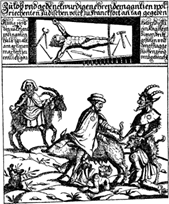


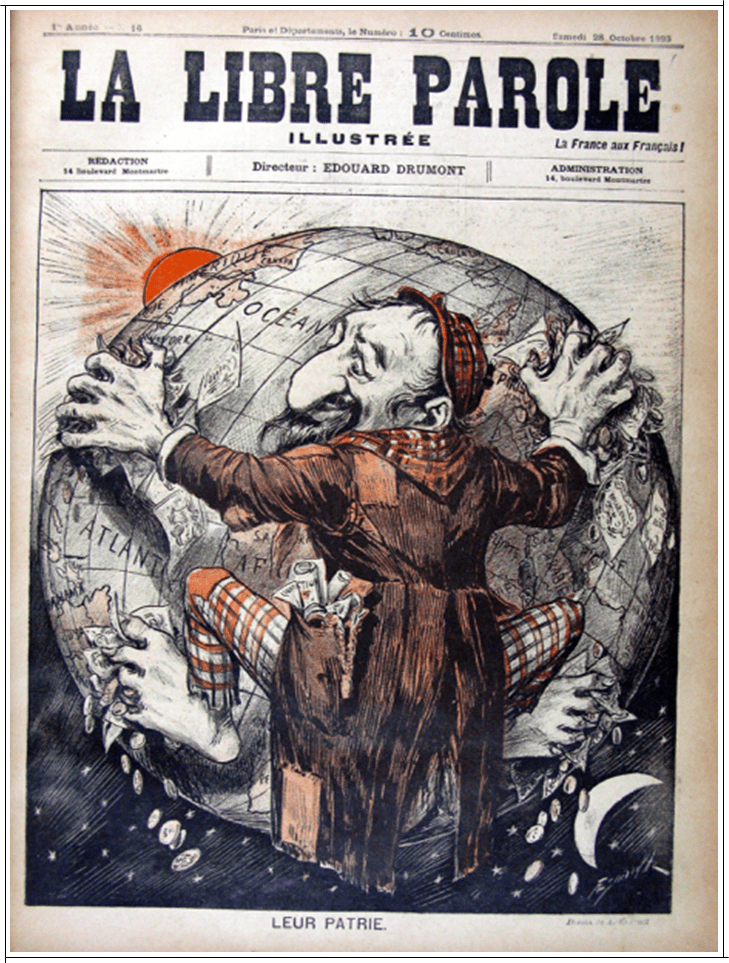


 of the total voting power in any matter on which they vote.
  of the voting power, since everyone was able to vote for their own representative. This can be found two ways; the first one indicated below is the most straightforward, while the second might be less obvious. Nevertheless, students might notice and articulate this strategy if they are given the chance to explore it. This is also the skill students will need to find answers to questions later in this activity.
 of the total.
 of the vote via their representative. That
  of the vote comprises 5 students, so each student gets
  of that
  . Students can draw a model of fourths, then divide each of those fourths into 5 sections (Figure 1) to show that every smaller section is then
  . Some students might realize that
  of
of  also means
  , which is also the same as
  .
.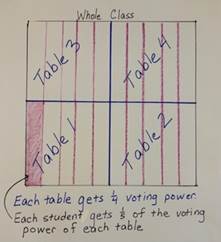
 of the voting power each. While the tables of 4 would have
  of the voting power each. There are several mathematical questions that can be asked at this point to facilitate exploration with fractions:

