Book Review – Our Fragile Freedoms

Four books that have influenced my teaching of U.S. history are: the volumes in the Jefferson Papers Project, The Life of Henry Adams, The Life of Arthur Schlesinger, and Our Fragile Freedoms. These books have left a profound influence on me because each of them included a perspective of 50 years or more.

Eric Foner’s Our Fragile Freedoms is a series of selected documents and book reviews that he has authored over 250 years of our history.  It is a collection of human stories in addition to documents, perspectives, historiography, and scholarly insights. In my reading I discovered new information and perspectives about enslaved persons, laborers, immigrants, and women.  I have also met Eric Foner, our lives share a similar chronology of the second half of the 20th century and the first 25 years of the 21st century.  Just when I thought I had mastered everything that needs to be taught in high schools, colleges, and in public discussions, I discovered somethings that are new and important in his book.

Our Fragile Freedoms gathers together nearly sixty book reviews and opinion pieces I have written over the past quarter century,  Originally published in venues such as the New York Review of Books, London Review of Books, The Nation, and The New York Times, they reflect a period of remarkable creativity among  American historians but also intense controversy over the teaching, writing and public presentation of history.  The book examines history as refracted through the prism of some of the most influential recent works of scholarship, while at the same time shedding light on my own evolution as an historian.” (Introduction, page xv)

The insights into the U.S. history curriculum are helpful to teachers who want to engage their students in investigating history and discussing the concept of freedom.  Here are some examples:

1.Colonial America: “In South Carolina and Georgia, however, the disruption of the War for independence produced not a weakening of commitment to slavery, but the demand that the Atlantic slave trade be reopened.  At the insistence of these states, the Constitutional Convention of 1787 forbade Congress from abolishing the importation of slaves until 1808. Given this window of opportunity, South Carolina brought in tens of thousands of new slaves, further reinforcing the African presence in the low country Black society.” (page 22)

    2. President Washington: “Thompson (Mary Thompson, author of “The Only Unavoidable Subject of Regret: George Washington, Slavery, and the Enslaved Community at Mount Vernon”, 2019) offers various explanations for Washington’s refusal to speak or act publicly against slavery.  She points out that freeing his slaves would have meant financial disaster for his family.  Like other Virginia planters, Washington was chronically in debt, largely because of his taste for luxury goods imported from Britain. Indeed, in 1789 he had to borrow money to pay for his journey to New York where his inauguration as the first president was to take place.” (page 35)

    3. Fugitive Slave Law: “The first arrest under the Fugitive Slave Act of 1850 took place in New York-a city whose economic fortunes were closely tied to the cotton trade, and whose political establishment was decidedly pro-southern. On September 16, 1850, eight days after President Millard Fillmore signed the measure, two deputy U.S. marshals arrested James Hamlet at his job as a porter in a local store. Hamlet had escaped from Baltimore two years earlier and settled in Williamsburg, a Brooklyn village with a small Black population, along with his wife and three children, all born in Maryland.” (page 53)

    4. Emancipation Proclamation: “’I cannot make it better known than it already is, that I strongly favor colonization,” Lincoln said in a message to Congress less than a month before he issued the Emancipation Proclamation.  Oakes (Professor James Oakes, CUNY) calls Lincoln’s August 1862 meeting with Black leaders (not including Douglass), where he urged them to support colonization, “bizarre,” and explains it as an effort to “make emancipation more palatable to white racists.” And he notes, Douglass reacted with one of his most bitter criticisms of the president, “Mr. Lincoln,” he wrote, “assumes the language and arguments of an itinerant colonization lecturer shows all his inconsistencies, his pride of race and blood, his contempt for Negroes and his canting hypocrisy.  (page 72)

    5. Reconstruction: “Grant’s contemporaries recognized the Civil War as an event of international significance.  One hundred and fifty years after the conflict began, the meanings they ascribed to it offer a useful way if outlining why it was so pivotal in our own history.  The Civil War changed the nature of warfare, gave rise to an empowered nation-state, vindicated the idea of free labor, and destroyed the modern world’s greatest slave society. Each of these outcomes laid the foundation for the country we live in today. But as with all historical events, each outcome carried with it ambiguous, even contradictory, consequences.” (page 85)

    As teachers, we need to understand the big picture of historical decisions and events over time.  This is why it is important for students to learn about continuity and change as one of the core skills of our discipline. Our Fragile Freedoms helped me to grasp the complexity of the concepts of freedom and equality that social studies teachers introduce in kindergarten.

    An important article and commentary in the book is “Everyday Violence in the Jim Crow South.” (pp. 201-210) This review of By Hands Now Known: Jim Crow’s Legal Executioners, by Margaret A. Burnham, New York Review of Books, April 6, 2023, provides specific examples of the abuse of power by people in local and state government against innocent citizens.

    “In Westfield, a town near Birmingham, a female white clerk at a local store, claiming that a Black customer, William Daniel, had insulted her, called the police.  When an officer arrived, he almost immediately shot and killed the alleged offender, even though, as Burnham laconically remarks, Daniel had committed no crime: ‘even in Alabama, there was no law against, ‘insulting a white woman.’” (p. 203)

    Another commentary that engaged my interest as a high school teacher was “Tulsa: Forgetting and Remembering.” (pp. 211-220) The information in the Review of The Ground Breaking: An American City and Its Search for Justice by Scott Ellsworth in the London Review of Books, September 9, 2011, provides new insights and perspectives to this horrific tragedy that began with a minor encounter between two teenagers. Scott Ellswoth is from Tulsa and became interested in this race riot in his research for a high school history paper.  He pursued his passion of this massacre as a college student at Reed College, and throughout his adult life. The discussion about the importance of local research has relevance to the teaching of history and its relevance to project-based learning.

    The review of Half American: The Epic Story of African Americans Fighting World War II at Home and Abroad by Matthew F. Delmont and An Army Afire: How the U.S. Army Confronted Its Racial Crisis in the Vietnam Era by Beth Bailey 2023) left me feeling uncomfortable. I think many teachers emphasize the role of the Tuskegee Airmen in teaching World War II and follow it up with a five-minute talk on President Truman’s Executive Order to embrace “equality of treatment and opportunity” in the military regardless of race, religion, and national origin. Because of my ignorance in this area, I never included examples of Jim Crow discrimination and the race problem in our armed forces. Our Fragile Freedoms provides graphic examples. (pp. 232-243)

    In the middle of the book there are some of the most important insights and perspectives for teachers of 20th century United States History. They have a direct relationship to what students are thinking about today as they listen to or witness events that are challenging the values of liberty, equality and social justice.  They offer teachers critical questions of inquiry regarding the continuity and change of America’s core values from the Declaration of Independence, Reconstruction Era, and Civil Rights movement. Allow me to summarize from examples on the New Deal and Civil Rights era from pages 243-267.

    “We will never know precisely why Parks refused to leave her seat when ordered to do so, her decision was not premeditated but neither was it completely spontaneous.  Perhaps it was because an all-white jury in Mississippi had just acquitted the murderers of Emmett Till, a Black teenager who had allegedly whistled at a white woman.  Perhaps the reason was that she had inadvertently boarded a bus driven by the same driver who had evicted her twelve years earlier.  Parks knew that talk of a boycott was in the air.  In any event, in the wake of her arrest the boycott began.” (p. 248)

    In the review of Riding for Freedom, teachers might ask if the foreign policy of the Kennedy Administration on the Cold War was mutually exclusive from the domestic policy of integration and racial justice. Many American presidents have faced challenging decisions regarding their promise for domestic reforms and unexpected international conflicts. Kennedy experienced this in his first year as president.

    “Certainly, the photographs that flashed across the world embarrassed the White House.  But the conflict with the Soviets also inspired deep distrust of any movement that included critics of American foreign policy.  After a telephone conversation in which he urged Martin Luther King Jr. to restrain the riders, Robert Kennedy remarked to an aide, ‘I wonder whether they have the best interest of their country at heart.’” (pp. 253-254).

    “The continuing distortion of the period (Reconstruction) by historians raised a troubling question, King had long identified the movement with core American values inherited from the nation’s founding. But what, in fact, were the nation’s deepest values? All men are created equal? Or something more sinister, exemplified by Reconstruction’s violent overthrow? King had originally believed, he told the journalist David Halberstam, that American society could be reformed through many small changes. Now, he said, he felt ‘quite differently,’ ‘I think you’ve got to have a reconstruction of the entire society, a revolution of values.’ Was the movement the fulfilment of American values or their repudiation?” (pp. 263-264)

    These excerpts are only appetizers for the full meal that is within each review and the entire book. As students think about and debate the civil rights era, they gain an understanding of the civil rights movement, its brutality, its injustice, its inequality, and its struggle. Unfortunately, too many students only know one sentence from Martin Luther King’s speech, “I have a dream….” Teachers should have students read or watch the entire speech.

    “We must forever conduct our struggle on the high plane of dignity and discipline. We must not allow our creative protests to degenerate into physical violence. . . . The marvelous new militancy which has engulfed the Negro community must not lead us to distrust all white people, for many of our white brothers, as evidenced by their presence here today, have come to realize that their destiny is tied up with our destiny. . . .

    We cannot walk alone. And as we walk we must make the pledge that we shall always march ahead. We cannot turn back. There are those who are asking the devotees of civil rights, “When will you be satisfied?” We can never be satisfied as long as the Negro is the victim of the unspeakable horrors of police brutality.

    (https://www.gilderlehrman.org/sites/default/files/inline-pdfs/king.dreamspeech.excerpts.pdf)

    The genius of this book is that each chapter offers a new insight, a scholarly perspective, and a valuable lesson. I learned something new about integration, voting, the censorship of speech, the Chicago riots in 1968, and progressivism. The section on History, Memory, Historians is a must read for every pre-service teacher and every social studies teacher. The lessons here about historical omissions, social and intellectual history, and the lessons of history. Our Fragile Freedoms should shape the generation of social studies/history teachers who will be teaching students in the second quarter of the 21st century!

    African American & Labor History Timeline

    Every facet of the United States has been affected by the labor and inventions of African Americans. Discover some of the men and women who created the inventions that improved daily life, fought for fair wages, safety, equal rights, and justice for Black workers. These are just some of the important milestones in the history of Black Labor in America. To learn more, visit your local library during Black History Month—and beyond!

    1500s-1865: Transatlantic Slave Trade through the American Civil War

    1500s: Transatlantic Slave Trade

    The largest oceanic forced migration in history, the Transatlantic Slave Trade began in the late 1500s when over 12.5 million African men, women and children were removed from the continent and transported to the Americas, Brazil and the Caribbean to work on plantations and live their lives in servitude. As a result, many slave rebellions erupted throughout the 17th, 18th and 19th centuries, constituting some of the first organizing and labor-related actions in the Americas.

    1739: Traditional African drumming is banned

    Enslaved Africans were prohibited from playing traditional drums, as European enslavers feared that drumming could facilitate communication across fields, uplift weary spirits, comment on oppressive masters, and incite rebellions. In response, Black people developed alternative forms of musical expression, such as hand clapping and percussive stomping, which became the foundation of work songs and spirituals. These musical forms later evolved into genres like the blues and jazz and are integral to today’s African American music.

    c.1763-c.1826: Artist Joshua Johnson

    Recognized as one of the earliest professional African American artists, Johnson was born into slavery near Baltimore around 1763 and gained his freedom in 1782. He described himself as a “self-taught genius” and painted portraits of families, children, and prominent residents of Maryland.

    1786: The Tignon Law

    This Louisiana law was enacted to regulate the appearance of free women of color to “establish public order and proper standards of morality,” and subjection to undesirability. Women were prohibited from going outdoors without wrapping their natural hair with a Tignon cloth. As a symbol of rebellion, Black women reappropriated Tignon production into a major fashion statement, form of self-expression and business by embellishing the headscarves with decorative fabrics, feathers and jewels.

    1859: Author Harriet E. Wilson

    Our Nig; or Sketches from the Life of a Free Black is considered the first novel by an African American woman. It gave insight into the supposed “Free North,” challenging the idea that the North was a safe have providing peace and equality for African Americans

    1865: 13th Amendment Outlaws Slavery

    The official end to slavery was perhaps the greatest labor victory in U.S. history. Yet the struggle for equal rights and fair wages was far from over; the same year that Congress adopted the 13th Amendment, the white supremacist terrorist organization and hate group, the Ku Klux Klan, was formed.

    1865-1877: Reconstruction

    In the decade following the Civil War, Congress established the Freedmen’s Bureau to help African Americans with food, housing, education, political rights and negotiating labor agreements. This period is thought to be one of expanding freedom for the formerly enslaved but in the South they were subjected to violence and new forms of mistreatment.

    1872: Frederick Douglass

    Douglass was elected president of the “Colored” National Labor Union, and his The New National Era became the union’s official newspaper. Douglass was one of America’s most important champions of equality and the right to organize a union.

    1880s: Knights of Labor

    The St. Paul Minnesota Trades & Labor Assembly was founded with the assistance of the Knights of Labor Assembly in1883. The Knights of Labor were known for their inclusiveness for accepting women and African American members, however they also supported the Chinese Exclusion Act.

    1883: Lucy Parsons (c. 1851 – 1942)

    Lucy Parsons and her husband, Albert Parsons, a former Confederate soldier turned anarchist, founded the International Working People’s Association. In 1886, they led the city’s first May Day parade, which called for an eight-hour workday.

    1901: Up from Slavery

    Booker T. Washington, a major voice for economic self-reliance and racial uplift, publishes his autobiography discussing his life and thoughts on race relations.

    1905-1960: The Great Migration

    In the first half of the 20th century, a mass migration of more than six million Black people took place from the South to the North. Many left to escape overt Southern racism, only to encounter racial tensions in the North as whites viewed them as a threat to their jobs. The Migration Series is a group of paintings by African American painter Jacob Lawrence (1917-2000) which depicts the migration of African Americans to the Northern U.S. from the South. It was completed in 1941 and was conceived as a single work rather than individual paintings. Lawrence wrote captions for each of the sixty paintings. Viewed in its entirety, the series creates a narrative in images and words that tells the story of the Great Migration.

    1909: National Training School for Women and Girls

    Nannie Helen Burroughs (1879-1961) was a suffragist, educator and organizer, as well as a mentor to the Rev. Martin Luther King, Jr., who worked to integrate labor reform into the movement for voting rights. Burroughs established the National Training School for Women and Girls in 1909 to combat labor exploitation through education, helping to improve working conditions and expand career pathways for Black women. She also launched the National Association of Wage Earners in 1921, a labor union for Black domestic workers.

    1910s-1930s: The Harlem Renaissance

    A period of flourishing of African American art, literature, and performance art saw the rise of iconic figures like author Langston Hughes, trumpeter Louis Armstrong, pianist Duke Ellington, and vocalists Ella Fitzgerald and Billie Holiday. Langston Hughes was a central figure in the Harlem Renaissance. A major poet, Hughes also wrote novels, short stories, essays, and plays.

    1910: The Foster Photoplay Company

    William D. Foster founds the first film production company established by an African American. It features all African American casts. The Railroad Porter (circa 1913) was the first film produced and directed by an African American.

    1917: East St. Louis Race Riot

    During World War I, thousands of Blacks moved to the St. Louis area to work in factories fueling the war effort. When the largely white workforce at the Aluminum Ore Company went on strike, hundreds of Blacks were hired as strikebreakers. Tensions erupted, and thousands of whites, many of them union members, attacked African Americans and set fire to their homes. Between 100 and 200 Blacks are estimated to have been killed and were 6,000 left homeless.

    1919: Red Summer

    Racial tensions were inflamed during the September 1919 Steel Strike, when workers shut down half of the nation’s steel production in an effort to form a union. Bosses replaced them with some 40,000 African American and Mexican American strikebreakers, an action made possible by AFL unions that excluded people of color from union jobs and membership.

    1921: Tulsa Race Massacre (May 31-June 1, 1921)

    The Tulsa Race Massacre was a 1921 attack on Tulsa’s Greenwood District, an affluent African American community whose thriving business and residential areas were known as “Black Wall Street.” In response to a May 31 newspaper report of alleged black-on-white crime, white rioters looted and burned Greenwood in the early hours of June 1. The governor of Oklahoma declared martial law, and National Guard troops arrived and detained all Black Tulsans not already interned. About 6,000 Black people were imprisoned, some for as long as eight days. In the end, 35 city blocks lay in ruins, more than 800 people were injured, and as many as 300 people may have died. The Massacre was largely omitted from local, state, and national histories until the Tulsa Race Massacre Commission convened in 1997 to investigate the event. Today, memorials, historical exhibits, and documentaries are some of the ways that the Massacre has been acknowledged and the history of “Black Wall Street” kept alive.

    1925: Brotherhood of Sleeping Car Porters

     The first labor organization led by African Americans to receive a charter from the American Federation of Labor. African American porters performed essential passenger services on the railroads’ Pullman sleeper cars and the union played a key role in promoting their rights. In the summer of 1925, A. Philip Randolph (1889-1979) met with porters from the Chicago-based Pullman Palace Car Company. The mostly Black Pullman workforce were paid lower wages than white railway workers and faced harsh conditions and long working hours. Randolph worked with these workers to form and organize the Brotherhood of Sleeping Car Porters. When the union was finally recognized in 1935, it became the first predominantly Black labor union in the nation. As the union’s founder and first president, A. Philip Randolph became a leader in the Civil Rights Movement.

    1930s: The Great Depression

    African Americans primarily worked as sharecroppers on white-owned land, and tenant farmers in the south. They continued migrating to the north in search of better opportunities, but due to racism, they often found work as domestics, in factories, and as seasonal traveling migrant farmers. New Deal programs provided some relief, but they still faced unequal access to programs like the Works Progress Administration due to racial segregation and violence.

    1934: Dora Lee Jones (1890-1972)

    Jones helped found the Domestic Workers Union (DWU) in Harlem in 1934 in defiance of New York City’s “slave markets,” as they were known. With few options during the Depression, Black women would gather daily in the morning at certain locations and wait for white middle-class women to hire them, typically for low wages. The DWU eventually affiliated with the predecessor to today’s Service Employees International Union.

    1940s: Women Fill Wartime jobs

    During World War II, African American women contributed significantly to the war effort by taking on industrial factory jobs and working in shipyards and other war production facilities. Referred to as “Black Rosie’s.” They worked as welders, machinists, assemblers and more. They also served in the military as nurses, in the Women’s Army Corps, and in the all-Black 6888th Central Postal Directory Battalion, responsible for clearing the backlog of overseas mail.

    1941: Fair Employment Practices Committee

    Under pressure from labor leader A. Philip Randolph, who planned a march of 250,000 Black workers in Washington, D.C., to demand jobs, President Franklin Roosevelt signed Executive Order 8802, creating the Fair Employment Practices Committee. The order banned racial discrimination in any defense industry receiving federal contracts and led to more employment opportunities for African Americans.

    1944: Admission to the Brotherhood of Locomotive Firemen and Enginemen Union. African Americans who maintained railroad locomotive engines had to sue the Brotherhood of Locomotive Firemen and Enginemen all the way to the Supreme Court to gain admission to the union in 1944.

    1945: Maida Springer Kemp (1910-2005)

    Kemp worked as a labor organizer in the garment industry and became the first Black woman to represent the U.S. labor movement overseas when she visited post-war Britain on a 1945 labor exchange trip. She went on to spend many years liaising between American and African labor leaders as a member of the AFL-CIO and became affectionately known as “Mama Maida” for her work. Throughout her life, she advocated for civil rights and women’s rights in America and internationally.

    1946: Operation Dixie

    Encouraged by massive growth in union membership (including African Americans) during the 1930s and 1940s, the Operation Dixie campaign launched an effort to organize the largely non-union Southern region’s textile industry and strengthen the power of unions across the United States. Spearheaded by the Congress of Industrial Organizations, in concert with civil rights organizations, the campaign covered 12 states. Operation Dixie failed because of racial barriers, employer opposition and anti-Communist sentiment that labeled anyone who spoke out as an agitator. In 1947, the Taft-Hartley Act was enacted, allowing states to adopt so-called “Right to Work” laws that limited union power.

    1948: Zelda Wynn Valdes (1905-2001)

    Fashion and costume designer Zelda Wynn Valdes was the first Black designer to open her own shop and business on Broadway in New York City. Her designs were worn by entertainers including Dorothy Dandridge, Josephine Baker, Marian Anderson, Ella Fitzgerald, Mae West, Ruby Dee, Eartha Kitt, and Sarah Vaughan.

    1950s: Post-War Era

    Despite some gains during World War II, African Americans still experienced high unemployment rates compared to white workers and faced significant barriers to upward mobility in the workforce. Labor was largely confined to low-wage, segregated jobs, primarily in service industries like domestic work, with limited access to skilled trades and significant discrimination within unions. These struggles fueled the developing Civil Rights movement and pushed for greater labor equality.

    1953: Clara Day (c.1923-2015)

    As a clerk at Montgomery Ward, she resented the segregation of white and Black employees, which led her to push for change. Clara Day first began organizing co-workers at Montgomery Ward in 1953 and went on to hold several roles in the Teamsters Local 743. She also helped found the Coalition of Labor Union Women and the Teamsters National Black Caucus. A passionate advocate for labor, civil rights and women’s rights, she helped bring attention to issues like pay equity and sexual harassment.

    1954: Norma Merrick Sklarek (1926-2012)

    In 1954, Norma Merrick Sklarek became the first Black woman to become a licensed architect in New York. Her projects included the United States Embassy in Tokyo, Japan in 1976 and the Terminal One station at the Los Angeles International Airport in 1984.

    1950s-1970s: The Era of Social Movements. The three decades after World War Il saw the emergence of many movements in American society for equal rights, most notably the Civil Rights Movement. One milestone for this movement was passage of the 1964 Civil Rights Act, a landmark civil rights and labor law in the U.S., outlawing discrimination based on race, color, religion, sex and national origin.

    1950s-1970s: Social Movements

    During the Civil Rights Movement, African American artists like Nina Simone, and Harry Belafonte used their music and performances to advocate for social change. One significant event happened when Eartha Kitt was invited to Lady Bird Johnson’s “Women Doers Luncheon” in 1968. During the event, Kitt publicly spoke out against the Vietnam War and criticized several of President Johnson’s policies, consequentially derailing her U.S. career for more than a decade.

    1963: Bayard Rustin (1912-1987) and Anna Arnold Hedgeman (1899-1990) Plan the March on Washington

    While the Rev. Dr. Martin Luther King, Jr. made headlines with his “I Have a Dream” speech, it was Rustin who worked closely with the labor movement behind the scenes, planning and organizing the massive March on Washington for Jobs and Freedom, one of the largest nonviolent protests ever held in the United States. As an openly gay man, Rustin’s crucial role in the March on Washington was often diminished and forgotten. As a member of the executive council of the AFL-CIO and a founder of the AFL-CIO’s A. Philip Randolph Institute, Rustin fought against racism and discrimination in the labor movement. Hedgeman was a civil rights activist, educator and writer who helped organize the March on Washington for Jobs and Freedom. She was a lifelong advocate for equal opportunity and employment.

    1968: Poor People’s Campaign

    This multiracial campaign, launched by the Southern Christian Leadership Conference under the Rev. Dr. Martin Luther King, Jr., and the Rev. Dr. Ralph Abernathy, recognized that civil rights alone did not lift up African Americans. The campaign called for guaranteed, universal basic income, full employment and affordable housing. Dr. King said, “But if a man doesn’t have a job or an income, he has neither life nor liberty, nor the possibility for the pursuit of happiness. He merely exists.”

    1968: Memphis Sanitation Strike

    African American sanitation workers in Memphis, Tennessee, represented by the American Federation of State, County and Municipal Employees (AFSCME), went on strike to obtain better wages and safety on the job, winning major contract gains. The Rev. Dr. Martin Luther King, Jr., the strike’s most influential supporter, was assassinated on April 4 as he was leaving his hotel room to address striking workers. Today, AFSCME produces the I AM STORY podcast, which follows the history of the 1968 Memphis Sanitation Strike as told by those who experienced it firsthand.

    1969: League of Revolutionary Black Workers (LRBW)

    Established in Detroit, Michigan, the LRBW united several revolutionary union movements across the auto industry and other sectors. A significant influential Black Power group, the LRBW had a tremendous influence on the left wing of the labor movement. Their activism played a pivotal role at the intersection of race and class in the ‘post-civil rights’ era.

    1970: Melnea Cass (1896-1978)

    Known as the ‘First Lady of Roxbury,’ community organizer and activist Melnea Cass helped provide social services, professional training and labor rights education that empowered Boston’s most vulnerable workers. One of many examples is a program she co-created that provided childcare for working mothers. Her advocacy helped achieve a major legislative victory in 1970 when Massachusetts passed the nation’s first state-level minimum wage protections for domestic workers since the Great Depression.

    1970s: Workforce and Unemployment

    By 1970, about nine million African American men and women were part of the workforce in the United States. This workforce included the steel, metal fabricating, meatpacking, retail, railroading, medical services and communications industries, numbering one third to one half of basic blue-collar workers. Yet, at that time, the African American unemployment rate was still two to three times more than that of whites.

    1970: Dorothy Bolden (1923-2005)

    Future president Jimmy Carter presents a Maids Day Proclamation to Dorothy Bolden. Dorothy Bolden began helping her mother with domestic work at age 9. She was proud of her work, but also knew how hard it could be and wanted domestic workers to be respected as part of the labor force. Dr. Martin Luther King, Jr., her next-door neighbor, encouraged her to take action. In 1968, she founded the National Domestic Workers Union, helping organize workers on a scale never seen before in the United States. The union taught workers how to bargain for higher wages, vacation time and more. She also required that all members register to vote, helping to give workers a stronger voice both on the job and in Georgia policy.

    1979: Wage Decline Begins

    Hourly wages for many American workers stagnated or dropped beginning in 1979, except for a period of strong across-the-board wage growth in the late 1990s. Researchers have found a correlation between the decline of unions and lower wages, and between lower wages and a growth in economic and social inequality, resulting in African Americans and Latino workers facing greater wage stagnation than white workers.

    1980s: Declines and Milestones

    During the 1980s, African American labor continued to face significant challenges including high unemployment rates, disproportionate job displacement due to industrial decline, and the widening wage gap compared to white workers. Particularly impacted were African American women, and blue-collar African American workers who relied heavily on shrinking union jobs during this period. Despite this, some progress was made with an increased Black union membership among men, affecting barriers to full equality in the workforce due to earlier civil rights movements.

    1990: Hattie Canty (1933-2012)

    Hattie Canty lived in Nevada and worked several jobs as a maid, a school janitor, and eventually a room attendant on the Las Vegas Strip. She became active in her union, was elected to the executive board of the Culinary Workers Union (CWU) in 1984 and became union president in 1990. She was the first Black woman and the first room attendant elected to this position in CWU. During her tenure, she brought together workers from several nations, helped push forward racial justice within the industry and her union, and founded the Culinary Training Academy, which helps people of color obtain better jobs in the hospitality industry.

    1990: Americans with Disabilities Act

    Inspired by the Civil Rights Act, and signed into law by President George H.W. Bush, Congress passed the Americans with Disabilities Act, prohibiting discrimination against all people living with developmental and physical disabilities in the workplace, transportation, public accommodations, state and local government services and telecommunications.

    2008: Smithfield Packing Plant Workers

    Smithfield workers join the United Food and Commercial Workers (UFCW). After 16 years of organizing by African American, Latino, and Native American workers, the Smithfield Packing Plant in Tar Heel, North Carolina finally succeeded in joining the United Food and Commercial Workers (UFCW) union. Despite years of intimidation, violence, and illegal firings by the company’s management, the new local union was chartered as UFCW Local 1208. Today, there is a mural of civil rights leaders on the wall of the union hall.

    2008: Barack Obama (1961- )

    Barack Obama was elected to the first of his two terms as the 44th President of the United States becoming the first African American president in U.S. history. During his first two years in office, he signed many landmark bills into law, including his very first piece of legislation, the Lilly Ledbetter Fair Pay Act, which impacted the labor movement. Obama also reduced the unemployment rate to the lowest it had been in more than eleven years.

    2012: #BlackLivesMatter

    Formed after the 2012 murder of a young African American man in Florida, Trayvon Martin, the Black Lives Matter movement grew as protests mounted against other killings, including the 2020 slaying of George Floyd in Minneapolis. In several communities, labor unions have built ties with #BLM chapters to address chronic issues of dehumanization, inequality, and exploitation.

    The Usage of Film in Teaching History through the Lens of the Civil Rights Movement

    Film, in the wake of the 21st Century, has become a highly popular type of media to portray historical events. Society has evolved to a point in which it is a visual culture. No longer are we represented by oral and written means; visual communication is much more popular. Traditional school experiences juxtapose this idea. Students are still bound by books and written texts in order to receive information. Educators need to be willing to continue to learn how to introduce new modes of expression in their classroom.

    Topics like the Civil Rights Movement are often whitewashed in educational texts. Because most films are produced outside of K-12 schooling environments, producers are able to recreate controversial situations, relationships, and people. This paper will provide summaries and analyses of three modern films depicting different aspects of the American Civil Rights movement. It will then discuss why showing these films in classrooms are worthwhile.

    Historical film projects have created controversial figures and taken controversial figures and turned them into likable characters. The Civil Rights movement has been portrayed in film time and time again, each with a slightly different take. The Help tells the story of a White woman in Jackson recording the stories of Black maids, and ultimately publishes them. This film creates white saviors, a specific character type in media, often seen in pieces that discuss issues pertaining to people of color. One Night in Miami focuses on four prominent Black men in the 1960s; Malcolm X takes the main stage. The film wrestles with Malcolm’s stiff exterior and anxious personal life. Selma tells the story of the Selma Marches in 1964. The film highlights Martin Luther King’s actions and how they led to the passing of the Voting Rights Act of 1965. Each protagonist in these three films is understood by audiences differently. How a Civil Rights activist is appreciated in film greatly depends on the general public’s pre-existing opinion of the character. Regardless of a production team’s goals, an activist’s infamy or other characteristics influence the audience.

    The Help was directed by Taylor Tate and released in 2011, grossing $216 million worldwide and receiving positive reviews from critics.[1] The movie takes place in Jackson, Mississippi during the 1960s.[2] Eugenia “Skeeter” Phelan, a new college graduate, wants to become a writer. She is given the chance to have a book published, but the story hinges on Black maids being willing to speak to her about their experiences working for White families. The issue lies in finding Black help that was willing to risk their livelihoods for Skeeter’s writing.[3] Minny Jackson begins to work for Celia Foote after being fired by a different White woman.[4] After gathering enough stories, Skeeter publishes her book, which is a massive hit. Skeeter chooses to stay in Jackson instead of moving to New York City with the promise of a job in a publishing agency.[5]

    Hollywood has a tendency to find a newsworthy topic and exploit it; despite the Civil Rights Movement being a “hot” topic in America for decades, it was mostly left out of the film industry.[6] However, in recent years, stories about the era of civil rights have graced screens. The development of white savior stories has become prevalent in American films. These stories amplify (or overamplify) a white character’s influence regarding issues faced by people of color.[7] The white character rescues non-white characters, often learning more about the problem than they originally knew and evaluating how they contributed to the problem. It makes the white character appear as the hero of the story, despite the size of their role, or the danger the characters of color face fighting issues.

    The Help created two white savior characters: Skeeter and Celia. The women become white saviors through different experiences. Skeeter is meant to be portrayed as a young woman who does a great service by exposing the nature of treatment White employers subjected their Black help to. She does this without realizing the importance of what she is doing. The film also emphasizes how she will be viewed in the White community, breezing past the reality Black women will face if the location of the book is revealed. Skeeter’s risks are overplayed (especially because she is promised a job if the book sells well) while the maid’s risks are underplayed, painting Skeeter ultimately as the hero of the film. This imagery is only furthered as Skeeter chooses not to accept her dream job working in a New York publishing firm to stay in Jackson and help the women who gave her stories for her book.

    Celia is slightly different. She hires Minny after being unable to find help for her house. She wants to impress her husband and the women of Jackson. She treats Minny with kindness and does not seem to grasp certain societal expectations, like the help and employers eating at different tables and the help and employers not being “friends.” During one specific scene, Celia takes Minny by the arm, walks her into the house, and offers her a coke.[8] In another scene, Celia and her husband offer Minny a meal (prepared by Celia) at their dining room table.[9] The film alludes to the idea that because of Celia’s kindness, Minny’s problems are lessened or completely gone. This then creates the idea that a white woman’s kindness solves issues that are systemic racial issues, when in reality, Minny and the rest of the Black community face issues that could only be corrected through legislative changes.

    However, different from most narratives, both of these characters are women. By regendering the white savior, two things occur. The first is the idea that they may not be able to be saviors because they also come from oppressed communities. Because they are not men, it is assumed they do not have the power to overcome societal beliefs regarding their own womanhood, let alone fight against anti-Blackness. The second is that they become harder to identify because of tropes surrounding what a woman is supposed to be and how she is supposed to act.[10] Both of these women hold stereotypical traits, such as kindness and empathy. Celia also yearns to be a mother, another trait that has been associated with femininity. Because they have “female” characteristics, audiences need to decipher what aspects are stereotypes and which are aspects of the white savior trope.

    Despite having stereotypical personality traits, the women defy traditional womanhood in different ways, making it easy to see how they fill their white-savior roles. Skeeter is considered a tom-boy; she is a college graduate who does not plan to marry until she has established her career. She grew up in Jackson and, after graduating from college, returned, continuing to be well-liked until she gave a voice to Black maids.[11] Celia moved to Jackson and married her husband because of an unplanned pregnancy. She is also one of the loudest women in the movie, trying to push herself into Jackson’s social circle. Until hiring Minny, she did not have help in her house. Because of this, she is regarded as an outsider by most White women but yearns to be accepted.[12]

    Ultimately, the regendering of the white savior in The Help created a character that was not as easily identified as in other films, such as Green Book and Hidden Figures. The two women appear as outcasts who do not fully understand societal roles, instead of two women extending a hand to the Black community in Jackson. The audience feels its heartstrings being tugged at as Celia is outcasted by other women in Jackson, both because of her own identity and because she hired Minny.[13] Skeeter is threatened by another White woman after realizing that the book featured her home.[14] If Skeeter and Celia had been written as male characters, it is much more likely that this character trope would be more apparent. As a result, Skeeter and Celia become characters that are endearing to the audience; the two women are effective in their roles of “hero.”

    One Night in Miami

    Starkly different from the two White women of The Help are the four men of Regina King’s One Night in Miami. More specifically, the four Black men in the film. Malcolm X, Sam Cooke, Jim Brown, and Cassius Clay (more famously known as Muhammad Ali) are the focus of this 2020 film. It was released directly to Amazon Prime Video streaming, receiving glowing reviews from critics and the general audience.[15]

    The four men unite in Miami, Florida in 1964 to watch Cassius Clay box in the championship round.[16] After Clay wins, the men return to X’s motel room to celebrate. Instead of celebrating, the men have a serious night. Coming from different backgrounds (one activist, one football player, one singer, and one boxer) the men have curt conversations about the Civil Rights Movement and Black support of the movement. Paranoia, racism, and Islamophobia are all commented on in the film, as Malcolm criticizes his friends but also speaks to them about his decision to leave the Nation of Islam.[17]

    Going into production, director Regina King had a unique problem. How does one create a positive protagonist out of a man disliked or misunderstood by many Americans? Malcolm X’s legacy is often misinterpreted or never properly learned. Media pushes X’s original ideas, many of which the Nation of Islam was responsible for propagating. The figure seen in much of American media is a representation of Malcolm X prior to his revelation about black and white segregation, “white devils,” and many of his polarizing ideas.[18] King directed a film that humanized X, showing anxiety, paranoia, and friendship as a way to create a likable (or at least neutral) film character.

    Casual Islamophobia arises throughout the film as X’s friends Cooke and Brown try to discourage Clay from converting to Islam; Muslims do not drink, smoke, or “have fun.”[19] If a friend does not accept you for something as personal as religion, it makes an onlooker feel sorry. This usage of stereotyping lends itself to the audience feeling empathetic toward Malcolm X.

    One Night in Miami was a refreshing media perspective of Malcolm X. The film shows how Malcolm was a polarizing figure but did not villainize him, which is an overarching theme across Hollywood film. The activist has been painted as one who advocated for violence, black-and-white separation, and the Nation of Islam. Time and time again, the media forgets that X gave up those ideas after his journey to Mecca to complete Hajj, an important Muslim pilgrimage. He gave a voice to “the subterranean fury, [gave] it a voice, not a gun… and [staved] off the rising violence with which he and every human being must struggle when men are brutalized by men.”[20] However, it is important to keep in mind that many audience members may not have this complex understanding of X and how his ideas evolved before his assassination. The movie ultimately portrays this; Malcolm Xnever advocates for the men to pick up arms and storm cities, he implores his friends to use their fame and resources as a voice for the voiceless.[21]

    One Night in Miami also does an excellent job of portraying Malcolm X as the man most people know. Known for being strong-headed throughout his life, Malcolm X is presented as a man firm in his stances and was not afraid to tell someone if they did not align with what he thought was right. Because of this, he was often seen as judgmental towards his friends and American society.[22] He and Sam Cooke butt heads several times as Malcolm chastises him for not doing enough for the Black community and Civil Rights Movement. “…He longed for peace and believed it could only come when men were honest with each other.”[23]

    This chastisement could turn audiences against Malcolm X, or there could be a moment of realization that he was not the man that the media at the time painted him as. Shortly after his assassination, James Loomis wrote to the editor of the New York Times explaining that Malcolm X was not the violent figure that White media made him out to be during his life. Loomis did admit that the activist was set in his ways; he set the way for future Civil Rights activists “much as the Old Testament laid the foundation for the New Testament.”[24] If a film viewer was somewhat familiar with X after his Hajj, they would understand, much as Loomis did, that X’s original separatist ideas were not the ideas that he died with. One Night in Miami portrays Malcolm X in a light that allows the audience to better understand his purpose, looking past the “harsh” exterior of his words.

    Selma was directed by Ava DuVernay and released in 2014. It was popular with critics and well-liked by general audiences, grossing more than $66 million worldwide.[25] The film opens in 1963 with four girls running down a stairway. A bomb is set off, killing all four girls; the 16th Street Baptist Church Bombing sets the emotional tone for the remaining film.[26] It then moves to 1965 in Selma, Alabama, where Black Americans are being turned away from voting. Martin Luther King Jr. was called down to help advocate for voting rights legislation that would protect Black Americans from poll taxes and tests.[27] After arriving in Selma, he quickly butts heads with local activist groups. There are several scenes in which King meets with President Lyndon B. Johnson to pressure him to pass voting rights legislation.[28] Eventually, King and other activists plan to walk from Selma to the state capitol, Montgomery. During the first attempt, protestors are brutally beaten by police officers and rush back to Selma to escape said violence.[29] During the second march, King decides to turn the group around to avoid traps set by police or White aggressors along the way.[30] Finally, backed by the state, King and thousands of protestors completed the 50-mile march from Selma to Montgomery, Alabama.[31] The movie closes with the signing of the Voting Rights Act of 1965 and King’s speech in Montgomery.[32]

    King had relationships with powerful White individuals, such as President Johnson. Often, an activist who has this kind of support will be much more successful in their cause because it seems reasonable. Selma highlighted these relations, showing the president and his advisors in several scenes.[33] This association implies backing from the federal government. It creates a positive air around King, something that the audience can recognize and absorb.

    Martin Luther King gathered more support than other activists during the Civil Rights Movement. As seen in Selma, King directs a group and few and far in between are the decisions made by the other members. Even fewer are activists not in King’s posse. Malcolm X, for example, was mentioned but never seen. [34] President Johnson makes a negative comment about X, saying King is better suited for the American people because he is not as radical.[35] The audience can speculate who Johnson means when he says “American people,” but if the president sees King as a more palatable Black activist, it can be assumed that America is synonymous with White and not all Americans. Little else is said about X; his ideas, policies, speeches, and actions are not mentioned. If an audience member has little knowledge about the other activist, it is likely that they would have a much more positive thought process about King and his actions from there on.

    Selma, much like the other two films, casts its main protagonist in a neutral, if not positive light. However, part of this positive atmosphere around King may have been from the lack of other important stars in the Selma March. The film never refers to the other celebrities that came down to Alabama, many of whom were actors. The decision to not feature more of Hollywood in Selma enlarges the light shown on King.[36] This issue continues throughout the film; DuVernay wanted to create a “‘demonstration of our moral certainty’ – sacred art,” so, while she wanted to produce a history piece, she had other motives.[37]

    By creating a piece about King and the people of Selma, the director chose to eliminate other aspects of the historical narrative.[38]  DuVernay does not change King’s actions, making him a historically accurate figure in the film, but she does omit aspects of events that bolster King’s role, which ultimately pushes him to the front of the film and enlarges his moral character.[39] Historians took issue with this because it “egregiously distorts a significant element of that history,” changing the emphasis each individual carried within the Civil Rights Movement.[40]

    The film industry, after long avoiding The Civil Rights movement, has begun to produce film after film about it. The Help focuses on Skeeter, with Black maids as supporting characters despite their stories being the reason for her success. This paints Skeeter as the hero of the movie, emphasizing her role as a White savior. Minny is influenced by a second White savior, Celia, as the woman’s kindness seems to alleviate Minny of all problems. The two White women sneak under the radar as saviors because their gender makes their powerlessness evident. One Night in Miami attempts to show Malcolm X in a more humane light, in an attempt to make audiences more willing to understand him and his goals as an activist. The United States has a perverse idea of X; Regina King’s film attempts to display how X’s frustration and curt way of speaking was only because of his passion and desire to find equality and Black rights in America. Selma creates a reverent picture of Martin Luther King by maximizing his role in the Selma Marches in 1964. Differently from X, King already has a respected and positive legacy, making the production much more palatable to many more people. The four protagonists in these three films produce different reactions from an audience. The way a Civil Rights activist is able to be understood and appreciated in film greatly depends on the general public’s pre-existing opinion of the character of character-type.

                Film differs from written sources because it has the ability to bring people, places, and events to life. Too often educators rely on students being able to read well to understand the deeper nuances and feeling of the writer or the details being described. Choosing to present information through visual sources evens the playing field for many students because they do not need to rely on their reading skills. Using film provides a new way to learn; it provides auditory and visual learners a positive experience. Captions can provide students who are hard of hearing or in need of written reinforcement to read what is being said. Film has the ability to serve as a platform that benefits many types of learning.

                As mentioned in the previous section, the film industry has recently started to embrace the production of film that focuses on the United States Civil Rights movement and the treatment of People of Color in American history. Due to this, there has been an uptick in historically accurate films that celebrate influential members of the Black American community. Often, film directors have much more freedom than textbook creators do. Films are able to incorporate aspects of history that have been whitewashed or completely removed from educational sources. The United States has a heavy history of whitewashing curriculum related to the Civil Rights Movement. The three films described in the first section are films that I have deemed as accessible and useful to teaching. Each film provides viewers with a different understanding and line of inquiry regarding civil rights and the role in which people played in the movement.

                 The Help conveys an important message about the white savior complex. Despite financially providing for the Black women who shared their stories with her, Skeeter would never have suffered the same backlash and potential violence that these women would have if it became apparent that these stories were from Jackson. Skeeter’s race keeps her away from loss of employment, finances, and the potential for violent retaliation. Class lectures or discussions about how history has shown that identities dramatically shape a person’s quality of life can be related to the way Black women were forced to work in harsh conditions and Skeeter was able to write about these experiences and create a best-seller. In addition to this, class discourse after viewing could include a conversation about the introduction of White characters in Black stories and the space they then take away from Black individuals. The Help serves as an introduction to race and the way it shapes experiences.

                One Night in Miami retells the story of Malcolm X, Jim Brown, Sam Cooke, and Muhammad Ali reuniting in Miami for the boxing match. However, the film does something that most media does not. Malcolm X has been villainized throughout American media. This film allows Malcolm to be seen as a person with emotions, fears, and friendships. This humanizing aspect disrupts the narrative that most textbooks create. Very rarely does media, especially literature, acknowledge Malcolm’s humanity. They paint him as a hard radical. This film could also be used as a segue into Malcolm X’s life and ideas after his hajj, a Muslim pilgrimage to Mecca.

                Selma takes place in Alabama before the Voting Rights Act of 1965 was passed. It focuses on Martin Luther King Jr., but also incorporates activists that are taught about less often such as John Lewis. Showing this film allows students to understand that MLK did not act alone and was often called to areas to act as the face of a movement. The film also illustrates the violence against Black Americans and Americans that supported integration and equal rights. It does so in a matter that makes viewers understand the severity, but it does so with becoming too explicit. For instance, the film opens with the 16th Street Baptist Church Bombing. It shows the four young girls that would be killed but the bombing does not show the individuals.

                As discussed, the usage of film can be an effective use of media in the classroom. It is used far too often; written sources are no longer reflective of today’s society. With the recent boom of media representing the Civil Rights Movement or racial inequality, it seems clear that film needs to be present in classrooms while teaching these events and concepts.

    DuVernay, Ava, director. Selma. Pathé, Plan B Entertainment, Harpo Productions, Ingenious Media, Celador, Cloud Eight Films, 2014. 2 hr., 33 min. https://www.showtime.com/movie/3505943

    “The Help.” IMDb. IMDb.com, August 10, 2011. https://www.imdb.com/title/tt1454029/?ref_=nv_sr_srsg_0

    Horne, Gerald. “‘Myth’ and the Making of ‘Malcolm X.” The American Historical Review 98, no. 2 (April 1993): 440–50. https://doi.org/10.1086/ahr/98.2.440

    Housley, Jason. “Hollywood and The Civil Rights Movement.” Black Camera 19, no. 1 (2004): 7–8. http://www.jstor.org/stable/27761632.

    King, Regina, director. One Night in Miami. Amazon Studios, 2020. 1 hr., 55 min. https://www.amazon.com/gp/video/detail/amzn1.dv.gti.e8badd0e-9d87-114a-934b-54a31210c34f?autoplay=0&ref_=atv_cf_strg_wb

    Knapp, Jeffrey. “Selma and the Place of Fiction in Historical Films.” Representations 142, no. 1 (2018): 91–123. https://doi.org/10.1525/rep.2018.142.1.91

    Loomis, James. “New York Times,” February 27, 1965.

    “One Night in Miami…” IMDb. IMDb.com, January 8, 2021. https://www.imdb.com/title/tt10612922/

    Reed, Adolph. “The Strange Career of the Voting Rights Act.” New Labor Forum 24, no. 2 (2015): 32–41. https://doi.org/10.1177/1095796015579201

    Seekford, Brett. “To Kill a Mockingbird, The Help, and the Regendering of the White Savior.” James Madison Undergraduate Research Journal 4, no. 1 (2016): 6–12. https://doi.org/https://commons.lib.jmu.edu/jmurj/vol4/iss1/1/

    “Selma.” IMDb. IMDb.com, January 9, 2015. https://www.imdb.com/title/tt1020072/

    Taylor, Tate, director. The Help. DreamWork Pictures, Touchstone Pictures, Walt Disney Studios Motion Pictures, Paramount Vintage, StudioCanal UK, 2011. 1 hr., 35 min. https://play.hbomax.com/page/urn:hbo:page:GYe7uAgqQlZyQwgEAAAAf:type:feature?source=googleHBOMAX&action=play


    [1] “The Help,” IMDb (IMDb.com, August 10, 2011), https://www.imdb.com/title/tt1454029/?ref_=nv_sr_srsg_0

    [2] Taylor, Tate, director. The Help. DreamWork Pictures, Touchstone Pictures, Walt Disney Studios Motion Pictures, Paramount Vintage, StudioCanal UK, 2011. 1 hr., 35 min. https://play.hbomax.com/page/urn:hbo:page:GYe7uAgqQlZyQwgEAAAAf:type:feature?source=googleHBOMAX&action=play

    [3] Taylor, Tate, director. The Help.

    [4] Taylor, Tate, director. The Help.

    [5] Taylor, Tate, director. The Help.

    [6] Housley, Jason. “Hollywood and The Civil Rights Movement.” Black Camera 19, no. 1 (2004): 7.

    [7] Taylor, Tate, director. The Help.

    [8] Taylor, Tate, director. The Help.

    [9] Taylor, Tate, director. The Help.

    [10] Brett Seekford, “To Kill a Mockingbird, The Help, and the Regendering of the White Savior,” James Madison Undergraduate Research Journal 4, no. 1 (2016): pp. 6-12, https://doi.org/https://commons.lib.jmu.edu/jmurj/vol4/iss1/1/

    [11] Taylor, Tate, director. The Help.

    [12] Taylor, Tate, director. The Help.

    [13] Taylor, Tate, director. The Help.

    [14] Taylor, Tate, director. The Help.

    [15] “One Night in Miami…,” IMDb (IMDb.com, January 8, 2021), https://www.imdb.com/title/tt10612922/.

    [16] King, Regina, director. One Night in Miami. Amazon Studios, 2020. 1 hr., 55 min. https://www.amazon.com/gp/video/detail/amzn1.dv.gti.e8badd0e-9d87-114a-934b-54a31210c34f?autoplay=0&ref_=atv_cf_strg_wb 

    [17] King, Regina, director. One Night in Miami.

    [18]  Gerald Horne, “‘Myth’ and the Making of ‘Malcolm X,” The American Historical Review 98, no. 2 (April 1993): pp. 442-444.

    [19] King, Regina, director. One Night in Miami.

    [20] James Loomis, “Letter to the Editor – Death of Malcolm X,” n.d.

    [21] King, Regina, director. One Night in Miami.

    [22] King, Regina, director. One Night in Miami.

    [23] James Loomis, “Letter to the Editor – Death of Malcolm X,” n.d.

    [24] James Loomis, “Letter to the Editor – Death of Malcolm X,” n.d.

    [25] “Selma,” IMDb (IMDb.com, January 9, 2015), https://www.imdb.com/title/tt1020072/.

    [26] DuVernay, Ava, director. Selma. Pathé, Plan B Entertainment, Harpo Productions, Ingenious Media, Celador, Cloud Eight Films, 2014. 2 hr., 33 min. https://www.showtime.com/movie/3505943

    [27] DuVernay, Ava, director. Selma.

    [28] DuVernay, Ava, director. Selma.

    [29] DuVernay, Ava, director. Selma.

    [30] DuVernay, Ava, director. Selma.

    [31] DuVernay, Ava, director. Selma.

    [32] DuVernay, Ava, director. Selma.

    [33] DuVernay, Ava, director. Selma.

    [34] DuVernay, Ava, director. Selma.

    [35] DuVernay, Ava, director. Selma.

    [36] Jeffrey Knapp, “Selma and the Place of Fiction in Historical Films,” Representations 142, no. 1 (2018): pp. 113.

    [37] Jeffrey Knapp, “Selma and the Place of Fiction in Historical Films,”114.

    [38] Adolph Reed, “The Strange Career of the Voting Rights Act,” New Labor Forum 24, no. 2 (August 2015): pp. 33.

    [39] Jeffrey Knapp, “Selma and the Place of Fiction in Historical Films,” 92-94.

    [40] Adolph Reed, “The Strange Career of the Voting Rights Act,” 34.

    The Ferguson Brothers Lynchings on Long Island: A Civil Rights Catalyst

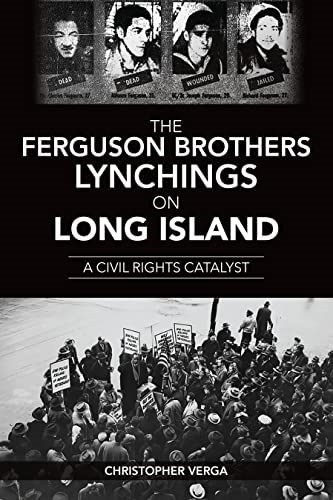
    The Ferguson Brothers Lynchings on Long Island: A Civil Rights Catalyst (The History Press, 2022) by Christopher Verga

    Review by Alan Singer

    (Reprinted with permission from New York Almanack)

    In a book dedicated to Wilfred Ferguson, the son of Charles Ferguson, teacher and historian Christopher Verga resurrects the story of two Roosevelt, New York brothers killed by a Freeport police officer in 1946. Verga opens The Ferguson Brothers Lynchings on Long Island: A Civil Rights Catalyst with an account of the long history of racism on Long Island and in the Freeport area including Ku Klux Klan activity. The background to the 1946 killings takes up the first third of the book. The book is well researched and referenced with extended quotes from official court documents and newspaper accounts. It is available from Amazon in Kindle and paperback formats.

    On February 5, 1946, two African American men, brothers, were shot and killed by a white probationary police officer in Freeport, New York. The officer claimed that the men were part of a group of four, all brothers, who were using “abusive and threatening language” and that one of the men he shot had stated that he had a .45 and was going to use. The officer’s first shot struck 27-year old Charles Ferguson, a World War II veteran, in the heart and killed him instantly. The second shot wounded Joseph Ferguson, aged 20, and then struck Alphonso Ferguson, aged 25, in the head. Charles and Joseph Ferguson were both wearing military uniforms when they were shot. Alphonso Ferguson was taken to Meadowbrook Hospital in East Hempstead where he died. The fourth brother, Richard Ferguson, also a veteran, was arrested and charged with disorderly conduct. He was tried, convicted, and sentenced to 100 days in jail, but his conviction was overturned on appeal. Military tribunals later cleared the brothers of any blame in the incident. Charles Ferguson was buried at the Long Island National Cemetery with full military honors.

    At the time of the shootings, Freeport was a segregated town. There were no Black police officers there or teachers in the Freeport school system and Black children were all zoned to attend one elementary school regardless of where they lived.

    After Nassau County District Attorney ruled that the shootings were justified, the New York Committee for Justice in Freeport, the American Jewish Congress, and Congressional Representative Vito Marcantonio of Manhattan demanded that Governor Thomas E. Dewey authorize a new investigation. In July, Dewey appointed Lawrence S. Greenbaum, as a special investigator to hold hearings and examine witnesses. Greenbaum, a lawyer, was a member of the NAACP. A petition to Governor Dewey condemned the Nassau County District Attorney for “not properly and without prejudice carry out his duties in the presentation to the February grand jury” and the Freeport Village Board for prejudicing the proceedings by exonerating the white officer before the grand jury had heard the case. The petition also asserted that the brothers were not drunk as the police claimed, and that the incident had been precipitated when the operator of a lunch counter had refused to serve the men because they were Black. Legendary folk singer and activist Woodie Guthrie wrote a song, “The Ferguson Brothers Shooting,” to support the campaign for justice for the Ferguson family.

    The cop said that we had insulted the joint man.

    He made us line up with our faces to the wall;

    We laughed to ourselves as we stood there and listened

    To the man of law and order putting in his riot call.

    The cop turned around and walked back to young Charlie

    Kicked him in the groin and then shot him to the ground;

    This same bullet went through the brain of Alonzo

    And the next bullet laid my brother Joseph down . . .

    The town that we ride through is not Rankin, Mississippi,

    Nor Bilbo’s Jim Crow town of Washington, D.C.

    But it’s greater New York, our most fair-minded city

    In all this big land here and streets of the brave.

    At the hearing, held in Manhattan, the two surviving brothers testified that the police officer first kicked Charles and Joseph Ferguson and then drew his pistol and lined the four brothers against a wall. The police produced witnesses to support the accused officer, including an African American by-passer, and no cross-examination of witnesses was permitted. The officer repeated his accusation that Charles Ferguson claimed to have a weapon, and that he shot Alfonso Ferguson when Ferguson was charging at him. The officer and the other police witnesses admitted that they never saw a gun and no gun was found at the scene. A spokesperson for the New York Committee for Justice on Freeport charged that the investigation was a “white-wash” and an “unvarnished fraud’ because witnesses were not cross-examined. At the final inquiry session on July 23, most of the audience walked out in protest.

    After the special investigator’s report was released on August 2 and exonerated the police officer and the Nassau County District Attorney’s office, Governor Dewey closed the inquiry. The report claimed that the police officer acted because he believed his life was in danger and there was reason to believe he would have acted differently if “the four men before him had been white and not colored.”

    The killing of the African American men in Freeport became an issue in the November 1946 gubernatorial election as Dewey, a Republican, campaigned for reelection. Democratic party candidate James M. Mead charged that the shooting was a lynching and accused Dewey of endorsing Southern-style racism. However, once Dewey was reelected, the Freeport case dropped out of the news.

    A side story in the book is the role of the American left including the Communist Party in the push for the special investigation into the killings and for justice for the Ferguson family. While the NAACP also called for the inquiry, it avoided being too closely associated with the left groups, and being branded as communist or communist directed. State and federal law officials investigated communist influence in the campaign, perhaps more carefully than they investigated the actual incident. In Nassau County and in Freeport supporters of the police officer used left involvement in the campaign as a way to discredit the specific charges and deny underlying racism in the area.

    Verga concludes the book by examining a similar story about an African American veteran attacked and gravely injured by police in South Carolina and other incidents of racism in the United States and on Long Island after World War II including the notorious racial covenant banning African Americans from purchasing or renting Levittown homes. Verga note that at least demographically, Freeport and Long Island have changed since the deaths of Charles and Alponso Ferguson at the hands of a police officer in 1946.

    How the First African American Doctor Fought for Women’s Rights in Glasgow

    How the First African American Doctor Fought for Women’s Rights in Glasgow

    Mathew D. Eddy

    (This essay was originally published in The Conversation)

    James McCune Smith was the first African American to receive a medical doctorate from a university. Born in 1813 to a poor South Carolina runaway slave who had escaped to New York City, he went on to attend Glasgow University during the 1830s. When he returned to America, he became a leading black physician, a tireless abolitionist, activist and journalist. McCune Smith led an amazing life. He exposed false medical data in the 1840 American census. He supported women’s suffrage alongside the noted feminist Susan B. Anthony. And he wrote the introduction to Frederick Douglass’s sensational 1855 autobiographical slave narrative, My Bondage and My Freedom. Now, for the first time, my research has revealed that McCune Smith was also the first African American known to be published in a British medical journal – and that he used this platform to reveal a cover-up by an ambitious medical professor who was experimenting on vulnerable women in Glasgow in the 1830s.

    I am a historian of science and medicine. I study how people learned scientific skills and I am especially intrigued by the history of how scientists and physicians made discoveries and how that knowledge then circulated between the academy and the public. One way to track this process is to compare what students learned in educational settings to how they used their scientific training to solve problems and make decisions later in life. My forthcoming book, Media and the Mind (2020, Chicago University Press), for example, uses school and university notebooks to reconstruct how students historically learned to create, analyze and visualize scientific data in ways that helped them understand the human body and the natural world when they finished their education.

    Several years ago, I decided to investigate the history of how the testimony of hospital patients was transformed into scientific data by physicians. I eventually stumbled across the 1837 case of a young Glasgow doctor who sought to expose painful experimental drug trials that had been conducted on the impoverished women of a local hospital. That doctor was James McCune Smith. He had written articles detailing how the women of a local charity hospital were being subjected to a painful experimental drug. It was a career changing moment for me because I had not encountered this kind of activism in my previous research on medical education.

    Who was this doctor? What led him to speak out? Where did he learn to place his knowledge of science and medicine in the service of equality and justice? Upon closer examination, despite his many accomplishments, virtually nothing had been written about McCune Smith’s time in Glasgow or about his work as a practicing physician in New York. Like the children of many runaway slaves in New York, McCune Smith grew up in Five Points, Lower Manhattan, one of the poorest and most densely populated urban areas of America at that time. Though the state fully emancipated all former slaves in 1827,  when McCune Smith was a teenager, discriminatory educational policies, unsanitary living conditions, chronic illness and infectious diseases ensured that the prospects for a free African American teenager in the early part of the 19th century were limited. Indeed, in an article entitled “Freedom and Slavery for African-Americans,” published in the New York Tribune in 1844, McCune Smith observed that only six of the 100 boys who attended school with him from 1826 to 1827 were “still now living”. He noted further that they were “all white.”

    Though technically “free,” the lives of African Americans in New York during the 1820s and 1830s were marred by the legacy of slavery and discrimination. Runaway slaves were openly hunted in the city’s alleys, streets and wharves. McCune Smith reflected on these events in an essay that he wrote about the life of his school classmate, Henry Highland Garnet. An abolitionist and Presbyterian minister, Garnet was the first African American to speak before Congress. McCune Smith recalled the trauma experienced by Garnet’s family in 1829 when they were tracked by slave-hunters. They barely escaped by jumping out of a two-story building and hiding in the house of a local grocer. When they returned to their home they found, in the words of McCune Smith: “The entire household furniture of the family was destroyed or stolen; and they were obliged to start anew in life empty-handed.”

    Despite many challenges, New York’s African Americans founded their own businesses, churches, political associations, printing presses and more. In addition to receiving support and encouragement from a community of relatives and friends, McCune Smith’s path to becoming a doctor was significantly aided by his education at the African Free School. Older students were taught penmanship, drawing, grammar, geography, astronomy, natural philosophy and navigation. When American universities denied his medical school applications, the free school community played a role in raising funds for him to attend Glasgow University.

    After sailing from New York to Liverpool, McCune Smith arrived in Glasgow in 1832. Thanks to maritime trade, it was one of the largest cities in the country and the university’s medical school was one of the best in Europe. Britain had prohibited the slave trade in 1807 and it fully abolished slavery the year after his arrival in 1833. Though there were not many African Americans in Glasgow, black writers, had been operating in Britain since the 1770s. Then, in 1809 Edinburgh University admitted William Fergusson who was from Jamaica and was the university’s first student of African descent. Though he took medical courses at the university, Fergusson did not stay to complete a medical doctorate. Instead, he received a license from the Royal College of Surgeons in Edinburgh in 1813. He then practiced as a surgeon in the British military and eventually became governor of the then-British colony of Sierra Leone. McCune Smith joined the ranks of these torchbearers and became the first African American known to graduate with a BA, MA, and medical doctorate from Glasgow University. By the time McCune Smith began his studies in Glasgow, opposition to slavery had moved beyond the walls of the university. There was an active abolitionist community and it founded the Glasgow Emancipation Society in 1833. McCune Smith, still only an undergraduate, was one of the founding members. After he graduated, a number of black students attended the university over the course of the century.

    Despite living in a foreign country, McCune Smith excelled at his studies and received several academic awards. The Glasgow medical faculty placed equal emphasis on scientific rigor and hands-on clinical experience. In addition to learning chemistry, anatomy and physiology from some of Britain’s leading doctors, he witnessed cutting-edge experiments and new medical technologies being demonstrated in his lectures. He graduated with honors in 1837 and was immediately given a prestigious clinical residency in Glasgow’s Lock Hospital. He worked there alongside the eminent Scottish obstetrician and gynecologist, William Cumin, treating women who had contracted venereal diseases.

    The difficulty in pursuing a project of this nature is that many of the scientific papers and publications of black physicians have been lost to the sands of time. Unlike the many collections that university libraries have dedicated to preserving the legacy of white doctors who were alumni or donors, there is no “James McCune Smith Medical Collection” where scholars can go to study his medical career and scientific ideas. No one has yet told the full story of how African Americans like McCune Smith became doctors or how they used their knowledge of medical science to fight injustice and prejudice. The hidden histories of these black physicians based in countries spread around the Atlantic Ocean led me to start my current research project on how they used their scientific training to counter the rise of racist medical theories -theories which erroneously suggested that black bodies were physically different from other bodies and could more easily withstand the stress, pain and labour of enslavement.

    Though a number of McCune Smith’s articles were republished several years ago, the whereabouts of his personal medical library, clinical notebooks, patient records, office ledgers and article drafts are unknown. Likewise, his manuscript Glasgow diary and letters have been lost. Though aspects of his career have received attention from historians in recent years, a biography of his extraordinary life has not been written.

    This was the situation when I discovered his efforts to expose the harmful drug trials that were being conducted on the women of the Glasgow Lock Hospital. The evidence consisted of two articles that he had published during the spring and summer of 1837 in the London Medical Gazette, a weekly journal with articles about medicine and science.

    I originally came upon these articles by reading page after page of medical journals housed in the National Library of Scotland in Edinburgh. When I found them, they immediately stood out because they took the testimony of poor female patients seriously. When I realized that McCune Smith was the first African American to graduate from a Scottish university, I could not believe what I had discovered.

    New discoveries

    Discovering McCune Smith’s articles was momentous because they are the first currently known to have been published by an African American medical doctor in any scientific journal. Scientists in the 19th century published articles for many reasons. Some wanted to popularize their research in a way that advanced their careers. Others hoped their research would benefit the general public.

    The fascinating aspect about McCune Smith’s articles in relation to the historical emergence of the scientific journal is that they were published to expose the unethical misapplication of scientific experiments. This means that they offer new insight into how he learned to combine the power of the press with his medical training to fight inequality and injustice in Britain prior to returning to New York.

    The story they tell is extraordinary. The events occurred in the spring and summer of 1837 while McCune Smith was serving in the Glasgow Lock Hospital as a resident physician in gynecology. The hospital was a charity institution set up by the city for impoverished women suffering from acute venereal diseases such as gonorrhea and syphilis.

    After consulting the ward’s records and speaking with the patients, McCune Smith discovered that Alexander Hannay, a senior doctor in the hospital, was treating women suffering from gonorrhea with an experimental drug called silver nitrate, a compound that a handful of doctors used as a topical treatment for infected skin tissue or to stop bleeding. But it was normally used in low concentrations mixed into a solution, with doctors emphasizing that it should be applied with caution and as a last resort.

    But Hannay was administering the drug in a solid form, which meant that it was highly concentrated and caused a terrible burning sensation. He fancied this usage to be innovative and was relatively unfazed when his patients repeatedly asked for less painful forms of treatment. After speaking with the women and further consulting the hospital’s records, McCune Smith realized that Hannay was effectively treating the women as guinea pigs – as non-consenting participants – in an experimental trial that involved a very painful drug.

    At that time, silver nitrate was a newly available substance and its long-term effects were relatively unknown. There were a handful of military doctors who used it experimentally to cauterize skin ulcers or wounds of soldiers that would not stop bleeding. But some medical books classified it as a poison. Glasgow’s medical students, particularly those who studied with Prof William Cumin, avoided using it on internal organs due to its unknown effects. Instead, when it came to gynecological cases involving ulcers or infections, students learned to use an alum solution because its effects were generally considered to be effective and less painful.

    Hannay went beyond using the silver nitrate on the skin. He applied it to the internal reproductive organs of women, at least one of whom was pregnant. McCune Smith’s article pointed out that the baby subsequently died through complications surrounding a miscarriage. It also intimates that a few women died after the application of silver nitrate. Since the drug’s effect on internal organs was unknown, he believed that that the deaths could not be treated as a separate occurrence.

    In addition to being McCune Smith’s superior, Hannay was a medical professor at Glasgow’s newly established Anderson University. The easiest thing for McCune Smith to do was to say nothing. The plight of the Lock Hospital patients would not have been a major concern for many medical men at the time. The patients were impoverished women and most doctors assumed they were former prostitutes.

    But McCune Smith’s perspective was different. Unlike his peers, he had spent his early years in New York City witnessing the pain and suffering caused by poverty, inequality and exploitation. So he decided to place his knowledge of medical science in the service of these women.

    McCune Smith knew that there were other effective treatments for gonorrhea. This allowed him to see that Hannay was more interested in bolstering his reputation with a pharmaceutical discovery than helping his patients. But his studies had given him another equally powerful tool – data analysis. His ability to use this tool can be seen in his London Medical Gazette articles. The gazette was a journal of some repute, serving the British medical community as well as physicians based in Europe and America. In his article, he wrote: “The materials of my paper on the subject of gonorrhea of women were collected whilst I held the office of clerk to the Glasgow Lock Hospital.”

    He made his case against the experiments by extracting figures from handwritten registers that recorded the condition of patients being treated in the hospital over an entire year. He had learned to collect, categorize, and analyze data in the clinical lectures that were required for graduation. This method was part of the new science of “vital statistics” that used medical data to predict or prevent disease in people, cities and even countries. Known as “medical statistics” today, it was becoming more commonly used in journals that published articles on medical science.

    McCune Smith’s articles showed that the drug trials were ineffective and presented an unwarranted risk. They also revealed that Hannay and his team of assistants had attempted to cover up data in the hospital records that damaged their claims about the drug’s efficacy and their position that its side effects were minimal. McCune Smith did not mince his words. He wrote: “By this novel and ingenious mode of recording the Hospital transactions for 1836, [Prof Hannay’s team] keeps out of view the evidence of the severity of the treatment, and the amount of mortality, while, at the same time, the residence of the patients in the house seems shorted, the cost of each diminished, and the treatment made to appear more than usually successful.”

    Accordingly, he called for the trials to stop immediately. But McCune Smith was not happy to simply cite statistics. He wanted to give these women a voice too. To achieve this, he emphasized the extreme pain that they were experiencing. Their suffering had been played down by those conducting the experimental trials. Hannay even suggested that the women were dishonest and unreliable witnesses. To counter this suggestion, McCune Smith quoted the women themselves, some of whom said that the drug felt like it was “burning their inside with caustic”. This was strong language. They were effectively saying that the drug felt like a flame being applied to their bodies.

    McCune Smith’s decision to use this kind of visceral language on behalf of impoverished women in a scientific article was rare at the time. Nor was it common in the lengthy, fact-laden lectures given at Glasgow’s medical school. So where did McCune Smith learn to write like this? Finding an answer to this question has been difficult because hardly any of McCune Smith’s manuscripts from his Glasgow years are known to have survived. But thanks to a recent discovery that I made with the rare books librarian Robert MacLean in the Archives and Special Collections of Glasgow University, a better picture is starting to emerge.

    Based on my previous research on Scottish student notekeeping, I knew that Glasgow University kept handwritten registers of books borrowed by students from its libraries during the 19th century. Luckily, it turned out that McCune Smith’s manuscript library borrowing record did, in fact, still exist. It was a gem that had remained hidden for the past two centuries in the dusty pages of Glasgow’s library registers.

    The discovery was historic because it revealed that he definitely took the university’s moral philosophy class. The course was taught by James Mylne and it encouraged students to judge the accuracy of statistical data when making moral decisions. The registers also showed that McCune Smith consulted the Lancet, the leading medical journal of research and reform that promoted the same kind of public health activism evinced in his 1837 Gazette articles.

    Finding the student reading record for any historical figure is like striking gold. In McCune Smith’s case it was doubly exciting because so little is known about his intellectual development. In addition to literature relevant to his studies, he checked out several 1835 issues of the Lancet which regularly identified links between pain and maltreatment.

    It is likely these accounts inspired him to use a similar approach in his gazette articles. But even the Lancet’s references to pain and cruelty barely addressed the plights of impoverished women, let alone those who had been regularly subjected to experimental drugs. In this respect McCune Smith’s concern for the Lock Hospital patients surpassed the reform agenda promoted by Britain’s most progressive medical journal.

    Further investigations have revealed that there were many other black physicians who lived in America in the decades after McCune Smith became a doctor. As revealed in research by the Massachusetts Historical Society, there was, for example, John van Surly DeGrasse. He studied at Bowdoin College in Maine, received a medical doctorate in the 1840s, set up a practice in Boston and became the first African American member of the Massachusetts Medical Association.

    There was also Alexander Thomas Augusta, who, despite Virginia laws that banned free blacks from learning to read, was educated by a minister, moved to Toronto and graduated from Trinity College’s medical school in 1856. Notably, both Augusta and DeGrasse served in the union army as physicians with the rank of major during the American Civil War.

    After McCune Smith returned to America in the autumn of 1837, he served as a professional role model for African Americans who studied medicine from the 1840s onward. By the time younger black physicians such as DeGrasse and Augusta began their studies, McCune Smith had already opened a practice that served patients from both sides of the color line and had published several scientific articles. For the rest of his career his name was a frequent byline in articles about health and society published by the African American press, as well as larger newspapers with mixed readership, like the New York Tribune.

    An excellent example of McCune Smith’s later medical activism is the collection of articles that he published during the 1840s about the national census. The main issue was that slavery advocates had noticed that the mortality rates of African Americans in northern asylums were higher than those of black people in the southern states. This led them to conclude, erroneously, that freedom somehow damaged their mental and physical health.

    Rather than engage with their desire to co-opt convenient data, McCune Smith used his knowledge of medical statistics to skillfully undermine their attempts to find scientific data that fit their discriminatory world view. He conducted his own investigation and proved that the original collection of the figures on site in the northern asylums had been flawed and that, as a result, the data was incorrect and could not be used to accurately determine the health of black asylum patients.

    McCune Smith did not stop there. He turned the tables on slavery advocates by transforming the new accurate mortality statistics into a tool that could be used to fight inequality. His 1844 New York Tribune article about the census concluded: “These facts prove that within 15 years after it became a Free State, a portion of the Free Black Population of New York have improved the ratio of their mortality 13.28% – a fact without parallel in the history of any People.”

    Put simply, the correct data revealed that the health of African Americans unburdened by the deprivation and forced labour of slavery thrived once they left the south and lived lives as free citizens in the north.

    McCune Smith’s publications are a significant early chapter in the history of how black activists have worked tirelessly over the past two centuries to disentangle erroneous interpretations of scientific data from discriminatory claims about poverty, gender and race. They provide crucial historical insight into the relationships between race, science and technology that exist today.

    In many respects McCune Smith’s desire to locate and publicize correct data about asylum patients built on the approach that he had developed in his articles about the mistreatment of women in Glasgow’s Lock Hospital. He continued to publish articles throughout his career that challenged those who sought to use science to justify discrimination and inequality. In 1859 he even went so far as to challenge former President Thomas Jefferson’s discriminatory racial assumptions when he wrote: “His arrangement of these views is so mixed and confused, that we must depart from it.”

    McCune Smith’s activism showed aspiring African Americans that becoming a professional black physician could be more than simply treating patients. For him, being an expert in medical science also included using his training to fight injustice and inequality.

    His publications are an indispensable chapter in the American history of science and medicine. But they are an important part of British history too. Because it was in Britain where he first published articles that placed his knowledge of medicine in the service of equality and justice. It was the libraries of Glasgow University – which now has a building named in his honor – and the wards of the Lock Hospital, which fed his towering intellect and fired his passion for medical knowledge, as well as the pursuit of justice for the powerless and oppressed.

    “Rights, Redistribution, and Recognition”:Newark and its Place in the Civil Rights Movement

    “Rights, Redistribution, and Recognition”:Newark and its Place in the Civil Rights Movement

    Victoria Burd

    New Jersey, a northeastern state situated directly under New York and steeped in American history, is often seen as a liberal beacon for the 20th and 21st centuries. The state has consistently voted Democrat in every presidential election for over twenty years, holds a higher minimum wage than many other states, and has decriminalized marijuana in recent years. Despite these “progressive” stances, New Jersey, like the rest of the United States, is mired by a history of racial injustice and discriminatory violence, often perpetrated by the hands of the state itself. New Jersey’s key cities such as Newark, Trenton, and Camden served as battlegrounds in a fierce fight for equality and justice, yet these cities remain an often forgotten fragment of the Civil Rights movement of the mid-20th century due to their location in the North.

    Defining the Civil Rights movement is a difficult task, as Black Americans have been fighting against racism and discrimination in America for centuries before the term “Civil Rights movement” was even coined. For the purposes of this paper, the focus will be on the post-World War II Civil Rights movement, from the 1950s-1970s, where many famed protests and riots took place across the Northern and Southern United States. Large cities such as Newark, Trenton, Camden, and various others in New Jersey performed critical roles in the Northern Civil Rights movement, with Newark being one of the most publicized of its time. Acting as a catalyst to other race riots in cities such as Trenton and Plainfield, as well as being more thoroughly documented, the 1967 Newark riots serve as a case study by which to compare other cities in New Jersey, the events of the Civil Rights movement in Newark to other events in the North as a whole, and where Newark compares and contrasts with the Southern Civil Rights movement. This paper will explain the preceding events, context, and lasting effects of the 1967 Newark riots and the historiography existing around the Northern Civil Rights movement, before comparing and contrasting Newark and the Northern Civil Rights movement to that of the South and analyzing how the Civil Rights movement in Newark differed from other movements in the North.

    According to the Report of The National Advisory Commission on Civil Disorders, known better as the Kerner Commission or Kerner Report, the Civil Rights movement can be separated into major stages: the Colonial Period, Civil War and “Emancipation”, Reconstruction, the Early 20th Century, World War I, the Great Depression and New Deal, World War II, and the focus of this paper, the postwar period (Report of the National Advisory Commission on Civil Disorders, 1968, p. 95-106). During the war, Black Americans waged what was known as the “Double-V Campaign”: victory against foreign enemies and fascism abroad, and victory against racial discrimination at home (Mumford, 2007, p. 32). After having experienced racially integrated life and interracial relationships while being deployed in Europe, specifically England and Germany, during the Second World War, Black veterans came home with a renewed vision for racial equality in the United States. Kevin Mumford, author of Newark: A History of Race, Rights, and Riots in America, describes this sentiment among Black Americans well, explaining that,“‘…before [Black American Soldiers] go out on foreign fields to fight the Hitlers of our day, [they] must get rid of all Hitlers around us,’’ (Mumford, 2007, p. 36). This renewed sense of conviction for equal rights combined with a World War II emphasis on liberty and personal freedoms (although not intended for Black Americans), antithetical to fascist governments of Nazi Germany and Mussolini’s Italy, formed the ideological groundwork for a culture of Black Americans ready to relentlessly pursue equal and just treatment during the postwar period.

    The postwar period began with grassroots movements in the South, most prominently the Alabama bus boycotts which led to the meteoric rise of Civil Rights leader Martin Luther King Jr., who for many White Americans (on opposite sides of the spectrum of racial tolerance), served as the unofficial spokesman of the Civil Rights movement (Report of the National Advisory Commission on Civil Disorders, 1968, p. 106). While other Civil Rights leaders such as Malcolm X were prevalent within the movement, Martin Luther King Jr.’s message of nonviolent resistance meant less disruption in the lives of White Americans, and thus garnered more support from that group. As the Civil Rights movement gained traction, not just in the south but across the entire United States, elected officials were pressured to create legislation that would address the core agenda of the Civil Rights movement. One key example is the Civil Rights Act of 1964, which outlawed employment discrimination against “race, color, religion, sex, or national origin,” under Title VII (Sugrue, 2008, p. 360-1). The Civil Rights Act of 1964 was a landmark victory for Civil Rights groups in both the North and South, as it not only ended certain measures of discrimination, but provided the first steps towards “equality” of Black Americans.

    This legal measure acted as the first step away from legal discrimination for Black Americans, but as legal barriers began to lift, social and corporate barriers quickly took their place. The definition of racism changed drastically during this period. According to Carol Anderson, author of White Rage: The Unspoken Truth of our Racial Divide, “…[when] Confronted with civil rights headlines, depicting unflattering portrayals of KKK rallies and jackbooted sheriffs, white authority transformed those damning images of white supremacy into the sole definition of racism,” which in turn, caused more hostility between White and Black Americans, as Black Americans continued to fight for societal equality and justice (Anderson, 2017, p. 100). As racism became harder to prove on a legal basis, methods of resisting racism became more extreme. The transition from legal to societal discrimination marked a shift in the Civil Rights movement, with the justification of violence rising amongst many different Civil Rights groups and characterizing Northern protests from Southern.

    Newark

    Newark is a port city in New Jersey founded in 1666, by the Puritan colonists who claimed the land after removing the Hackensack Native American tribe against their will. Like the Black Americans who would come to occupy the city, the Hackensack natives would be largely removed from the narrative surrounding Newark’s development (Mumford, 2007, p. 13). Newark possessed a strong Black community for much of its history, yet this community existed outside of the White public sphere. This Black community published their own newspapers, participated in their own ceremonies, and formed their own societies, creating a distinct circle separate from the White population (Mumford, 2007, p. 17). Throughout many periods of the long Civil Rights movement, White citizens of Newark vigorously resisted Black American integration in their city, maintaining societal segregation (Mumford, 2007, p. 18).  In 1883, the City of Newark passed legislation prohibiting segregation in hotels, restaurants, and transportation, yet what could have been sweeping and unprecedented reform of 19th century civil rights policy was ultimately undermined when consecutive policies for equal protection and education were blatantly disregarded by White Newarkers (Mumford, 2007, p. 19). The culture of Jim Crow was alive and well in a city that saw neighborhoods of many different demographics tightly compacted next to each other (Mumford, 2007, p. 22).

    The Great Migration period also affected Newark’s Black public sphere, with Black Southerners migrating to northern cities in hopes for a better life (Mumford, 2007, p. 20). At the same time, Newark experienced an influx of European immigrants from countries such as Italy and Poland. The relationship between Italian Americans and the Black community worsened during the Great Depression, as both groups were affected by diminishing opportunities in manufacturing jobs, a relationship that would only continue to curdle into the 1950s and 1960s (Mumford, 2007, p. 27). This relationship was only further exacerbated by Italians taking up positions of authority in public housing projects that housed mostly black tenants and families (Mumford, 2007, p. 58). The Great Migration, which resulted in 1.2 million Southerners heading North due to World War I labor shortages, was emphasized by ambitious recruitment and enthusiasm for a new place (Mumford, 2007, p. 20). According to demographer Lieberson and Wilkinson, the migrating Black Southerners did find some success in the economic opportunities of the North, with an inconsequential difference between the incomes of Black native Northerners and themselves (Lieberson & Wilkinson, 1976, p. 209). Overall, northern cities offered blacks economic opportunities unavailable in much of the South—indeed many migrated to northern cities during and after World War I and World War II when employers faced a shortage of workers. Overall, however, blacks were confined to what one observer called “the meanest and dirtiest jobs,” (Sugrue, 2008, p. 12).

    Integration continued to spread throughout the Central Ward of Newark (otherwise known as the heart of the city, and predominantly black), and into the South, West, and North Wards, with the North Wards containing a large Italian migrant population (Mumford, 2007, p.

    62). By 1961, the Civil Rights movement officially entered Newark, with the Freedom Riders, Civil Rights activists from the South, congregating in Newark’s Military Park before continuing their journey to other Southern states (Mumford, 2007, p. 78). Tensions between Italians and Black Americans came to a head in 1967, when an unqualified Italian “crony”, rather than an already appointed capable Black candidate, was appointed by the mayor for a public school board position at a school in which half the students were black. The conflict arising from this situation would eventually become one of the reasons for the 1967 Newark riots (Mumford, 2007, p. 104).

    Newark Riots of 1967

    The inciting incident of the Newark riots was the arrest and subsequent beating of cab driver John William Smith at the hands of White police officers (Mumford, 2007, p. 98). According to those living in apartments that face the Fourth Precinct Station House, they were able to see Smith being dragged in through the precinct doors. As recounted in the Kerner Commission, “Within a few minutes, at least two civil rights leaders received calls from a hysterical woman declaring a cab driver was being beaten by the police. When one of the persons at the station notified the cab company of Smith’s arrest, cab drivers all over the city began learning of it over their cab radios,” (Report of the National Advisory Commission on Civil Disorders, 1968, p. 33). After the police refused to negotiate with civil rights leaders representing a mob that formed outside, the crowd was dispersed by force, and reports of looting came in not long after. The Newark riots had begun, and they would end up being the most destructive race riot among the forty riots that occurred since Watts two years earlier (Reeves, 1967). The violence, looting, and firebombing became so severe that units of both State Police and National Guardsmen were sent into the Central Ward to lay siege to the city (Bergesen, 1982, p. 265). According to newspaper articles written about the riots, “Scores of Negroes were taken into custody, although the police said that 75 had been arrested…the injured in the hundreds…more than 100 persons had been treated [in hospital] alone,” (Carroll, 1967). Additionally, “A physician at Newark City Hospital said four persons had been admitted there with gunshot wounds…stabbed or struck by rocks, bottles, and bricks,” (Carroll, 1967).  Four people were shot by Police for looting and six Black Newarkers died as a result of police officers and National Guardsmen firing into crowds, showcasing that police violence during the Newark riots was indiscriminate, racially charged, and often fatal (Bergeson, 1982, p. 265). The initiating events in Newark would spread to other major urban centers in New Jersey in the week following the riots, with varying degrees of severity.

    Understanding the history of Newark, the inciting events of these riots, and the progress of these riots is key to uncovering Newark’s and, in a broader sense, New Jersey’s role in the Civil Rights movement. This paper analyzes how violence is used as a distinction between riots in the North and South. It also investigates the main causes of the Civil Rights movement and subsequent rioting in Newark, including the phenomenon of  “White flight,” redlining and the housing crisis, and poverty caused by rapid urbanization. Lastly, the paper considers the impact of the lack of public welfare programs, intercommunity-autonomy and governmental transparency as tools for curbing civil unrest amongst majority black communities.

    Lasting Effects on the City of Newark

    Twenty-six people died during the Newark riots, most of whom were Black residents of the city, and over 700 people were injured or hospitalized during the riots. The property damage resulting from the looting and fires valued at over ten million dollars, and spaces still exist where buildings once stood (Rojas & Atkinson, 2017). The long-term physical and psychological effects of the riots on the people of Newark and on the reputation of the city itself cannot be understated (Rojas & Atkinson, 2017). Beyond the pain and grief caused by the loss of life and property, the riots represented a paradigm shift for Newark as a city. The eruptive violence in the city streets was perhaps the final nail in the coffin arranged by systemic racism, as Newark’s reputation as a dangerous city plagued by violence and corruption solidified in the minds of its former White residents and White generations long after (Rojas & Atkinson, 2017). As a result, the entrenched Black communities of Newark found themselves losing tax revenue and job opportunities quickly. The disadvantages that came from the riots and their causes only further incentivized White families to keep their tax dollars and children as far away from Newark as possible; this also occurred during a time in which taxes for police, fire, and medical services were being increased to compensate emergency departments for their involvement in the riots (Treadwell, 1992). Areas such as Springfield Avenue, once a highly commercialized street, were turned into abandoned, boarded up-buildings, further contributing to Newark’s negative reputation (Treadwell, 1992). What once were public housing projects, well lived-in homes, and family businesses remain vacant and crumbling, if not already demolished from the looting and fires fifty years ago which much of Newark did not rebuild (Treadwell, 1992). Even church buildings which once conveyed a sense of openness to all of the public are lined with fences and barbed-wire to prevent looting and vandalism (Treadwell, 1992). While the riots did lead to Black and Latino Americans vying for political positions that previously belonged to the White population, ushering in the election of the first Black mayor and first Black city council members in Newark in 1970 (Treadwell, 1992). Despite Black Americans gaining some control politically, the Central Ward still lacked economic and social renewal, with any efforts towards regenerating Newark failing to undo the larger effects of the riots of 1967 (Treadwell, 1992). Any of the limited economic development that did occur was largely restricted to “White areas”, such as downtown Newark, as opposed to the Black communities (“50 Years Later,” 2017). Larry Hamm, appointed to the Board of Education at 17 years old by Newark’s first Black mayor, expounds on the economic disparity between Black and White Newarkers, with “dynamism [prevalent] downtown, and poverty in the neighborhoods,” (Hampson, 2017). Fifty years after the riots, police brutality remains a constant for Black Newarkers, with a 2016 investigation into the Newark police department finding that officers were still making illegal and illegitimate arrests, often using excessive force and retaliatory actions against the Black population (“50 Years Later,” 2017). A city with a large Black population, one third of Newark residents remain below the poverty line, with Newark residents only representing one fifth of the city’s jobs (Hampson, 2017). Despite the foothold that Black Americans have gained in Newark’s politics, the economic power largely remains in the hands of White corporations and organizations (Hampson, 2017). Other economic factors, such as increases in the cost of insurance due to increased property risk, tax increases for increased police and fire protection, and businesses and job opportunities either closing or moving to different (Whiter) neighborhoods following White flight also have a significant lasting economic impact on the city (“How the 1960s’ Riots Hurt African-Americans,” 2004). The people of Newark were also affected psychologically and emotionally. On one hand, many Black Americans felt empowered – their community had risen against injustice and was largely successful in catching the nation’s attention despite the lack of real organization, challenging the system that desperately tried to keep them isolated and creating a movement that emphasized their power (“Outcomes and Impacts – the North,” 2021). Yet, just as many Black Americans became hopeless, seeing a country and its law enforcement continue to disregard their lives and stability, treating them as secondary citizens despite the many legal changes made under the guise of creating equality (CBS New York, 2020).

    The riots of 1967 destroyed Newark’s reputation and economic stability, steeping the population in poverty. While the Black Community used this opportunity to gain political power in the city and to jumpstart the Black Power movement in New Jersey, many Black Newarkers remain in despair, seeing their community members injured and killed with no change to the systemic cycle of racism that perpetuates the city.

    The National Advisory Commission on Civil Disorders Report (Kerner Commission Report)

    The 1968 National Advisory Commission on Civil Disorders Report is one of the most referenced resources in this paper, due to the unique document’s origins, in which sitting President Lyndon B. Johnson in 1967 tasked a commission specifically with determining the causes of the rising number of U.S. race riots that had occured that summer, with the riots in Detroit and Newark acting as catalysts for the founding of the commission. While Johnson essentially anticipated a report that would serve to legitimize his Great Society policies, the Kerner Report would come to be one of the most candid and progressive examinations of how public policy affected Black Americans’ lives (Wills, 2020). The Commission was led by Illinois Governor Otto Kerner, and consisted of ten other men, most of whom were White. The only non-white members of the Commission were Roy Wilkins, an NAACP head, and Sen. Edward Brooke, a Republican from Massachusetts (Bates, 2018). Despite the lack of racial representation on the commission, the members placed themselves in the segregated and redlined Black communities they were writing about, interviewing ordinary Black Americans and relaying their struggles with a humanistic clarity that was largely uncharacteristic of federal politics in the 1960s. This report identified rampant and blatant racism as the cause of the race riots of 1967, starkly departing from Lyndon B. Johnson’s views on race relations and in the process establishing historical legitimacy as a well-supported and largely objective source (Haberman, 2020). The Kerner Commission clearly outlines how segregation, White Flight and police brutality contributed the most to worsening race relations and rising tensions between Black communities and the White municipal governments who mandated said communities (Report of the National Advisory Commission on Civil Disorders, 1968, p. 119, 120, 160). Despite the Kerner Commission clearly outlining the causes and effects of the racial climate of the 1960s, the commission makes no effort to justify the riots themselves, or even validate the emotions and frustrations resulting from the oppression that the Commission identifies. For everything that the commission does state, it leaves just as much unstated. As the Commission explains, America in the 1960s was in the process of dividing into two separate, unequal, and increasingly racially ubiquitous societies, and the Commission itself validates this theory by displaying a clear identification of what the Black experience looks like while having next to no willingness to justify or defend the riots themselves (Report of the National Advisory Commission on Civil Disorders, 1968, p. 225). The Kerner Commission is a factually accurate but contextually apathetic document which, for its purpose in this paper, serves as one of the key documents due to its accuracy; yet it is important to acknowledge its shortcomings in the larger context of the Civil Rights Movement. Despite clearly identifying both the causes of the 1967 race riots and racial tensions in America, the Kerner Commission has gone largely ignored, as many of the issues identified by the commission remain present in Black communities, and in some instances, have worsened significantly, such as the issues of income inequality and rising incarceration rates (Wilson, 2018).

    Section 1: How Newark and the Northern Civil Rights Movement was Alike and Consistent with Civil Rights Movements in the South

    Newark’s riots and Civil Rights movement reflected many of the same characteristics seen in Civil Right movements across the country, both in the North and South. Key similarities between Newark and the rest of the Civil Rights movements in the United States, as well as decisive factors that sparked the rioting in Newark, include the phenomenon of “White Flight”, effects from police brutality and over-policing as a result of White Flight, and the quickly deteriorating relationship between black communities and law enforcement with the introduction of the National Guard into areas of conflict, combined with the familiar effects of redlining that are still visible across the United States today.

    White Flight

    One of the main causes of the Newark riots was the phenomenon known as “White flight”, and the effects caused by extreme racial isolation. To truly understand the impacts of “White Flight”, one must first define the concept. “White Flight” is the unique phenomenon of middle class White Americans leaving cities that were becoming more diversely integrated with Black Americans who were migrating from rural areas to these cities. In the 1950s, 45.5 million White Americans lived in areas considered to be “cities”, yet research by Thomas Sugrue in his work Sweet Land of Liberty explains how although the White population in cities did increase in the next decade, it was not of the same rate as previous years or in line with the Nation’s whole white population, with theoretically 4.9 million White Americans leaving cities between 1960 and 1965 (Sugrue, 2008, ch. 7, Report of the National Advisory Commission on Civil Disorders, 1968, p. 119). American cities were becoming less white, caused by Black American populations in cities increasing, and resulting in an even greater Black population in urban centers (Sugrue, 2008, p. 259). This population movement was not only seen in the South or key cities in the North such as Detroit and Chicago (though present there as well). Kevin Mumford explains Newark’s experience with this phenomenon, citing how the Central Ward of Newark (i.e., the “heart” of the city) included 90 percent of the black population of Newark, a drastic difference from the initial years of the Great Migration which saw only 30 percent of Newark’s black population settling in the Central Ward (Mumford, 2007, p. 23). White flight changed the landscape of New Jersey, with densely populated cities such as Newark, Trenton, and Camden becoming more clearly divided from new suburban residential areas, and the development of these new suburban areas leading thousands to flee the inner cities (Mumford, 2007, p. 50).

    White flight impacted more than just the distinct and divided racial makeup of cities and suburbs; impacts were also seen in other areas of life. The “persistant racial segregation” in post-war America often decided what kind of education an individual received, what jobs were accessible, and even the quality of an individual’s life (Sugrue, 2008, p. 201). Urban (i.e., majority Black) residents were further hurt from this White flight, as suburban areas located close to urban centers drained urban areas of their taxes, decreased their population, and left fewer jobs available to urban communities (Sugrue, 2008, p. 206). The lack of urban taxes funding urban public schools resulted in unequal educational opportunities, further validating the White argument that having Black Americans in cities “ …signified disorder and failure” (Mumford, 2007, p. 5).

    What ultimately made White Flight possible and cyclically reinforced White privilege was agency. White Americans possessed the agency to choose home ownership, involved and “cookie-cutter” communities, and access to adequate education. They had stronger and better-funded education systems, public services, and largely avoided many of the social problems that plagued black communities, including economic instability, lack of reliable housing, and health issues further exacerbated by overcrowded living conditions. Furthermore, White Americans did not fear the police, as this form of law enforcement showed an extensive history of protecting and benefitting White communities. As explained by Sugrue,”Ultimately, the problem of housing segregation was one of political and economic power, of coercion, not choice, personal attitudes, or personal morality,” (Sugrue, 2008, p. 249). The existence of a black middle class and integrated suburbs represented a deterioration of this agency, and was therefore not permitted by the larger White population. The considerable and ever growing gap of wealth, stature, and control between White and Black Americans was not lost on the Black urban population. After being revitalized by the hope that the World War II emphasis on freedom and liberty gave Black Americans, the disappointment and bitterness that stemmed from the lack of social change morphed public opinion in Black communities from that of optimism to resentment (Sugrue, 2008, p. 257). This resentment, exacerbated by continuous outside stressors, would eventually bubble over into violent demonstrations. The hundreds of racial revolts of the 1960s [The Newark riots among them] marked a major turning point in the black revolution, highlighting the demand for African American self-determination (Woodard, 2003, p. 289).

    White Flight was a fundamental motivator in the Newark riots, yet was experienced by urban centers across the North, South, Midwest, and West Coast. The stark contrast between Black and White Americans in regards to agency over housing, public programs, education and law enforcement, stemming from the upending of White Americans’ tax dollars from urban centers grew dramatically and inversely during the 1950s and 1960s, setting the stage for a period of unprecedented violence and racial unrest in America’s cities. Post-war optimism among Black Americans was severely dashed by the lack of extension of freedom and liberty at home, and the financial and social atrophy that followed would inform fierce resentment among Black Americans, ushering in a newer, more embittered chapter of the Civil Rights movement.

    Police Brutality, “Snipers”, and the National Guard

    As American cities became increasingly Black due to the phenomenon of White flight, already strained relationships between Black Americans and law enforcement worsened. Newark saw a palpable shift in intercommunity relations with the police. Over-policing and police brutality in Black neighborhoods acted as a product of a lack of racial representation in the ranks of American police forces (Bigart, 1968). To further emphasize this divide between the police and minority groups, the use of brute force was prevalent on the Black population, especially during the riots of the late 1960s. Police brutality against John William Smith acted as an inciting event to the Newark riots, but brazen, and often fatal violence at the hands of Newark’s police forces fanned the flames of violent unrest.

    Even before the Newark riots, the police were infiltrating and undermining Civil Rights groups in America’s cities. One such case that preceded the riots occurred in the suburb of East Orange, New Jersey, in which multiple Black Muslims were arrested, resulting in the arrestees being released from jail having sustained a fragmented skull, lacerations, and genital trauma at the hands of the police (Mumford, 2007, p. 110). This incident occurred only a week before the Newark riots, and is, in hindsight, indicative of the Newark Police Department’s willingness to enact acts of brutal violence in the name of “keeping the peace” and disrupting leftist organizations (Mumford, 2007, p. 110). As chronicled by Sugrue, the Black population of America,”…doesn’t see anything but the dogs and hoses. It’s all the white cop,” (Sugrue, 2008, p. 329).

    The Newark riots began, fittingly, at a police station. After John William Smith was allegedly beaten by two white officers and brutalized in holding, a mob formed in front of the Fourth Precinct demanding to see the taxi driver and his condition. Any hopes of the crowd being dispersed peacefully and a riot being avoided were dashed when a Molotov cocktail struck the police station (Report of the National Advisory Commission on Civil Disorders, 1968, p. 33). The ensuing riot control would prove more destructive and archaic than the looting and arson being committed at the hands of rioters. Riot police, armed with automatic rifles and carbines, fired indiscriminately into the air, at cars, at residential buildings, and into empty storefronts of pro-black businesses (Report of the National Advisory Commission on Civil Disorders, 1968, p. 38). At least four looters were shot and at least six civilians were killed as a result of firing into crowds (Bergesen, 1982, p. 264-5). Beyond gun violence, a specific instance in which a black off-duty police officer attempting to enter his precinct during the riots was beaten and brutalized by his white coworkers who did not recognize him offers an indication of how unprompted much of the violence against the Black population of Newark was (Carroll, 1967). In the end, 26 people died, and over 69 were injured (Carroll, 1967).

    As extreme as the violence against demonstrators was during the Newark riots, it was far from unique. Similarly tactless and lethal methods of crowd control had been deployed during race riots in Watts and Detroit (Report of the National Advisory Commission on Civil Disorders, 1968, p. 20, 54). Another similarity between these three race riots, as well as other race riots in the South, were the supposedly looming presence of urban snipers (Report of the National Advisory Commission on Civil Disorders, 1968, p. 180). While it remains unseen if Black nationalists armed with sniper rifles were truly as ubiquitous as the media would have then made it seem, what is verifiable is the fact that Riot Police used urban snipers as justification to scale up militarization efforts and enter and proliferate Black communities (Report of the National Advisory Commission on Civil Disorders, 1968, p. 40, Mumford, 2007, p. 142). Despite being difficult to verify, the threat of snipers waiting patiently to pick off police officers in dense urban areas was a deeply vivid and real threat to police and National Guardsmen sent into Newark and other cities. In Newark, there are multiple accounts of police firing indiscriminately into apartment windows out of fear for snipers. It is assumed, however, that most reports of sniper fire during race riots across cities in the United States were misidentified shots sourced from police or National Guardsmen (Report of the National Advisory Commission on Civil Disorders, 1968, p. 180).

    The presence of the National Guard as peacekeepers during the Newark riots is another factor that is both consistent with other race riots and contributed heavily to high death tolls among said race riots. Of the roughly 17,000 enlisted New Jersey National Guardsmen that responded to the riots in 1967, only 303 of them were Black (Report of the National Advisory Commission on Civil Disorders, 1968, p. 37). The largely white Guardsmen who were tasked with keeping the peace in cities in the full swing of anarchy had for the most part only had limited experience with black people, let alone crowd control operations. The majority of the reporting Guardsmen at Newark were young, not adequately psychologically or tactically prepared, and “trigger happy” (Bigart, 1968). The naivety of these Guardsmen, the presence of military-grade equipment such as machine guns and armored vehicles, and the looming threat of snipers created a situation in which it is possible that black demonstrators were seen as an enemy force to be subdued or neutralized, rather than American citizens engaging in protest. By any measure, however, the temperament of the National Guard displayed a clear and fervent prejudice against African Americans, and Guardsmen were reported to have taken part in the destruction of Black lives and property alongside Newark Police and New Jersey State Police (Bigart, 1968). Reinforcing a clear bias against Black Americans, Black enlistment in the National Guard declined deeply following integration within the Guard. There is no way of knowing for sure if a higher number of enlisted black Guardsmen would have led to a deeper understanding of Black communities, and in turn a less destructive response to the race riots of the 1960s; yet the police brutality that faced John William Smith, and the subsequent brutality that faced Newark rioters further exacerbated the riots themselves, with police using the word “sniper” as an excuse to wreak havoc on the Black masses.

    Redlining and the Turn from Legal to Public Discrimination

    Redlining is a discriminatory practice in which Black citizens were segregated into specific neighborhoods under the guise of lacking financial assistance through loans and government programs, rather than Jim Crow Laws. Large areas of residential housing occupied disproportionately by Black homeowners were designated to be high-risk by banking organizations, and would thus be denied housing loans to move out of their neighborhood. The results of this practice were strictly segregated neighborhoods that existed far beyond the Civil Rights Act of 1964, and ostensibly dashed any possibility for Black Americans to build generational wealth. Redlining is a key example of how many discrimination practices, in both the North and South, changed from being legally enforced to publicly and socially enforced. Redlining and public discrimination practices affected Black communities in both the Northern and Southern United States, and contributed directly to the Newark riots by preventing Black Americans from accruing generational wealth, pushing out “ghetto” communities through urban renewal, and forcing Black Americans to remain in impoverished communities through publicly enforced racial lines.

    Redlining was conceptualized and implemented during the Second World War, when William Levitt revolutionized residential communities with easily built and affordable housing in the form of Levittown, America’s first true suburb. Initially, Levitt, a staunch segregationist, outright banned Black Americans from living in his communities on the basis of race. As a result, Black Americans paid more on average for housing than White Americans did, while being excluded from access to new and contemporary housing (Sugrue, 2008, p. 200). As advancements in legal protections for Black Americans were made during the 1950’s, realtors, leasing managers and landlords shifted their efforts towards a more privatized form of discrimination, emphasizing the individual rights of businesses to decide who to do business with (Sugrue, 2008, p. 202). White Americans in the North during this time had developed a curious sense of superiority over the discriminatory culture and customs of the South, despite engaging in the same discriminatory practices under the guise of “Freedom of Association,” (Sugrue, 2008, p. 202). White Americans in the north drew their own lines, publicly enforcing White-only neighborhoods and refusing Black consumers access to their housing market, similar to the Jim Crow laws in the South. At the same time that White liberals were expressing admiration for Dr. Martin Luther King, they were drawing invisible borders through their communities, ready and willing to relegate Black Americans to ghettos if it meant their property value remained high (Mumford, 2007, p. 65). Black Americans not only faced discriminatory lending practices, as a single black family had the potential to shutter a community of well-to-do-whites, but in addition the Federal Housing Administration was in open support of restrictive covenants (Sugrue, 2008, p. 204).

    For Black Americans, it was not only enough to prove that they could exist in white neighborhoods without presenting a risk to White financial assets and housing, it was their responsibility to justify their existence in White suburbs against the risk of financial loss. As Sugrue explains, “It was one thing to challenge the status quo; it was another to create viable alternatives,” and black communities were not able to create these alternatives while still effectively being segregated (Sugrue, 2008, p. 220). As a result of these discriminatory practices, Black Americans’ experiences with White Americans was primarily relegated to that of interactions with the police. Redlining only served to further solidify many Black communities as “ghettos”, as many areas that became heavily redlined were already suffering from unemployment and disinvestment. Furthermore, redlined communities were subject to urban renewal efforts, where black communities were essentially uprooted to make room for expanding public projects that were intended to displace the ghetto population (Theoharis & Woodard, 2003, p. 291). A specific example of this phenomenon would be the “Medical School Crisis”, a major catalyst for the Newark riots in which a school campus was proposed that would displace Black citizens in Newark’s Central Ward (Theoharis & Woodard, 2003, p. 291).

    The effects of redlining in Black neighborhoods was severe. The extent of the widening wealth gap was not lost on Black Americans, who truly began to feel the effects of a lack of self-governance and generational wealth, both of which could not exist inside redlined communities. Black Americans became further aware not only of the wealth gap, but in the differences in status and power that existed between Black and White Americans (Sugrue, 2008, p. 257). Economic inequality became synonymous with racial inequality, and Black Americans began actively protesting both as a result of redlining (Sugrue, 2012, p. 10). As previously mentioned, urban development was a rising trend amongst metropolitan areas, and the superhighways needed to make the newly paved American Highway system work often involved building massive ramps and tracts of highway over residential housing that could not be sold (Sugrue, 2008, p. 259). Public school systems were affected as well. As previously recounted in the effects of White flight, taxes were being drained from urban centers to fund schools bordering between central cities and White suburbs, yet Black Americans did not benefit from these schools, remaining segregated and without necessary resources to make their education truly “equal” (Sugrue, 2008, p. 206). Gerrymandering further ensured these separate school districts, drawing more invisible lines that dictated which schools children living in certain areas would attend (Sugrue, 2012, p. 13). Many White community members argued that these schools were not separated intentionally, but that it was “… the natural consequence of individual choices about where to live and where to send children to school,” completely disregarding that the segregated districts are a byproduct of White-imposed redlining (Sugrue, 2012, p. 14). The effects of this practice were so dire that Newark’s mayor called for the state control of public schools (Bigart, 1968). In the end, the image many White Americans held of Black neighborhoods became a self-fulfilling prophecy; that redlined areas were occupied by gangsters, bootleggers, and other criminals. In reality, the economic hardships imposed by stringent redlining created the circumstances under which crime was inevitable (Sugrue, 2008, p. 203).

    Beyond a network of financial discrimination, the White general public also maintained the lines surrounding redlined communities through publicly and socially enforced separation. Rare cases of Black families attempting to move into segregated majority White neighborhoods such as Levittown were almost always met with at best, verbal, and at worst, physical abuse (Report of the National Advisory Commission on Civil Disorders, 1968, p. 119). To Whites, the impoverished neighborhoods of Newark were no better than “…a vast crawl of negro slums and poverty, a festering center of diseases, vice injustice, and crime,” (Mumford, 2007, p. 52) and the acceptance of Black families into White neighborhoods represented a direct threat that their communities would be labeled the same way.

    Redlining and the practice of socially and publicly enforcing discrimination measures affected Black communities across America, and contributed directly to the riots by preventing Black Americans from leaving the poverty-stricken neighborhoods known as “ghettos”, forcing urban renewal on the already limited spaces Black Americans could live, and furthering the wealth gap between Black and White Americans. Redlining proved to be a long-lasting roadblock in the slow march towards the advancement of America’s Black Population. Its inception and widespread use was indicative of a still-segregationist White America who was willing to explore alternative avenues in the name of maintaining the racial purity of their neighborhoods. Redlining essentially served as the next interpretation of Jim Crow laws – severe stratification of Black economies, reinforced by a White majority committed to keeping said system in place (Mumford, 2007, p. 22). In response to these measures, Black groups that were not against using violence to enact results began to popularize, leading to an expansion of the Black public sphere, the establishment of the Black Power movements, and the rise in riots across the country.

    Section 2: How Newark and the Northern Civil Rights Movement Differed from the

    Civil Rights Movement of the South

    Despite their significant similarities, the Northern and Southern Civil Rights movement differ in various ways that allow for specific characteristics of each movement. The greatest difference between the two regional movements was the ideas and theories surrounding the use of, and different applications of, violence as a means for social change. As the South turned towards nonviolent measures of civil protest, the North did the opposite, at times using the South as an example of how nonviolent protests were not successful (Sugrue, 2008, p. 291). After experiencing the nonviolent tactics of the South and observing the little change it brought to the North, people in Newark and other cities in the North began to use more aggressive tactics, such as firebombs, molotovs, and violent protests, both as aggressors and defenders.

    The South and Nonviolence

    In the years leading up to the Newark riots, attention was once again on the South as nonviolent ideology continued to spread and characterize the Southern Civil Rights movement.

    Nonviolent protests stemmed out of Selma, Alabama, when Civil Rights workers staged a protest in 1965, law enforcement interrupted the protest, and weeks later two White supporters of the Civil Rights movement were killed by racists due to their participation (Report of the National Advisory Commission on Civil Disorders, 1968, p. 20). Other indicators of the Southern ideology of the Civil Rights movement are further exemplified by the Student Nonviolent Coordinating Committee (SNCC), a Civil Rights organization which used protest measures such as sit-ins, boycotts, and the Freedom Rides, and whose headquarters was located in Atlanta (Report of the National Advisory Commission on Civil Disorders, 1968, p. 29). When the Freedom Riders arrived in Newark in 1961 on their way to Tennessee, the Black community of Newark saw firsthand how nonviolent protesting in the South functioned (Mumford, 2007, p. 78). Newark would experience many other nonviolent Civil Rights events before the riots of 1967, including the events of Freedom Summer 1964, which acted as a campaign to recruit Black voters, and the actions of the Congress of Racial Equality (at this point a civil disobedience organization that would later join the Black Power movement) who organized sit-ins at White Castle diners across New Jersey for better treatment of Black consumers and just hiring protocols for aspiring Black employees (Mumford, 2007, p. 80). Violence against Black Americans continued despite these protests, including the death of Lester Long Jr. and Walter Mathis, which further reminded the

    Black community of one of the most notorious lynchings, Emmett Till (Mumford, 2007, p. 117).

    It was clear to many Black Northerners that racism, discrimination, and brutality against Black Americans would not bend to nonviolent will, therefore causing the Northern Civil Rights movement, and, by extension, the Newark rioters, to use more aggressive tactics in order to stimulate change.

    Violence and Resistance in Newark and the North

    Black Americans in Newark and across the North bore witness to the nonviolent protests in areas such as Birmingham and Selma, and, instead of imitating their methods, used these events as justification for turning to more violent tactics (Sugrue, 2008, p. 291). Nonviolent protesting measures were criticized by many, including key individuals such as Nathan Wright, an author prevalent in the Black Power movement, who claimed that it lowered “black self-esteem” and led to the ideology that Black community members themselves were not worth defending (Mumford, 2007, p. 111). To many Black Americans, violence was a justifiable means, aligning with the psychoanalytic theory of Frantz Fanon, who claimed that “…the development of violence among the colonized people will be proportionate to the violence exercised by the threatened colonial regime,” (Mumford, 2007, p. 109). Up to this stage in the Civil Rights movement, and for decades after, the effect of White colonialism, segregation, brutality, redlining, and other discriminatory measures more than sufficed as violence exercised against the Black American people, and therefore provided the North and the rioters of Newark with a justifiable means to turn towards violence.

    The Northern Civil Rights riots themselves were steeped in aggressive tactics, though it is uncertain in many circumstances whether the rioters were the true initiators of such events. Molotovs and firebombs became key components of the movement, mostly the threat rather than the use themselves. Police confiscated six bottles with the makings of Molotov cocktails after raiding the homes of various Black Americans who were classified as “militant”, and Black activists anonymously dispersed guides on how to assemble these incendiary weapons (Mumford, 2007, p. 115, Report of the National Advisory Commission on Civil Disorders, 1968, p. 22). During the Newark riots, fires spread through downtown Newark, yet officials from the Fire Department adamantly claimed that the rioters were not the ones who set the fire (Carroll, 1967). There were also reports of gunfire between law enforcement and Black rioters, with the gunfire being “aimed” at police reportedly originating from the tops of buildings and the interiors of cars, further exacerbating the rumors of “snipers” attacking the police and National Guard (Carroll, 1967).

    Other riots in the North experienced severe aggression as well, though with substantial evidence that some rioters were instigators in the events. In the Plainfield riots, a series of New Jersey riots that mirrored those of Newark, black youths were reported physically assaulting and murdering a police officer, Gleason, to which the police department then claimed that “…under the circumstances and in the atmosphere that prevailed at that moment, any police officer, black or white, would have been killed…” in the hostile situation (Report of the National Advisory Commission on Civil Disorders, 1968, p. 44). This, black rioters recognized, would be used as a justification for retaliation against all Black rioters. Rioters (the majority young) then began arming themselves with carbines from a local arms manufacturing company, and firing without clear targets (Report of the National Advisory Commission on Civil Disorders, 1968, p. 45). This is a drastic change from the nonviolent protests that characterized the South, and furthered the distinction between the Northern Civil Rights and Southern Civil Rights movements. Though the changes between the protesting tactics of the North and South remain markedly different, there remain many differences between Northern protests as well, including the roles that welfare and public programs, intercommunity agency, and governmental transparency play in maintaining peace.

    Section 3: How Various Civil Rights Movements in the North Differed from Newark and Each Other

    Anti-Poverty and Welfare Programs

    Anti-Poverty and welfare programs proved to be invaluable tools for New Jersey’s cities in diffusing racial violence before it escalated to the level of the Newark riots. In New Brunswick, following the events in Newark, a growingly despondent group of Black youths began committing what the Kerner Commission refers to as “random vandalism” and “mischief” (Report of the National Advisory Commission on Civil Disorders, 1968, p. 46). Despite being relatively harmless, concerns still loomed that an eruption of violence comparable with Newark remained a possibility in New Brunswick. As a result, the city government funded a summer program for the city’s anti-poverty agency (Report of the National Advisory Commission on Civil Disorders, 1968, p. 46). Enough young people signed up for leadership positions in the summer program that the city cut their stipends in half and hired twice as many young people (Report of the National Advisory Commission on Civil Disorders, 1968, p. 46). This summer program did not single-handedly deescalate racial tensions between Black youth and White city government, but it did establish a rapport that was utilized to come to a sort of common ground (Report of the National Advisory Commission on Civil Disorders, 1968, p. 46). The same cannot be said about the events that transpired in Plainfield, around the same time. Like New Brunswick, Plainfield was on the brink of extreme racial violence, and in similar fashion, young people and teenagers were demanding community recreation activities be expanded. The city government, however, refused, and Plainfield went on to sustain violence and destruction at the hands of rioters, second only to the Newark riots (Mumford, 2007, p. 107).

    Perhaps it seems overly simplistic to suggest the difference between neighborhood kids and radicalized arsonists is simply having something to do; but what is repeatedly noted by the Kerner Commission in their profile of an average Newark rioter is a lack of preoccupation. They describe the typical rioter as young, male, unmarried, uneducated and often unemployed (Report of the National Advisory Commission on Civil Disorders, 1968, p. 73). These men often did not attend high school or university, and went into and out of periods of joblessness. What is noteworthy is that the attitude of these men towards education and employment is that of frustration, rather than apathy (Report of the National Advisory Commission on Civil Disorders, 1968, p. 78). According to the Commission Report, rioters typically desired more consistent and gainful employment or the opportunity to pursue a higher education, but were stymied by race or class barriers (Report of the National Advisory Commission on Civil Disorders, 1968, p. 78). The Kerner Report established a pattern of explaining systemic barriers to positive social, health, economic, and education outcomes, quickly followed by assertions of black pathology. The report does not conclude that it is absolutely logical to find oppression intolerable and that some type of action should be expected, or an apathy toward political and educational systems would be a rational response to these barriers (Bentley-Edwards et. al., 2018). Regardless, there appears to be a direct correlation between giving urban youths leadership positions within their communities, and a desire to preserve and protect that community. Perhaps if this tactic was employed by the city of Newark, there would have been less desire to loot and proliferate, and more importantly, the possibility that this tactic could be used in contemporary urban centers.

    Communal Autonomy and Self-Governance

    As mentioned earlier in this paper, a sense of communal agency was paramount in upholding White privilege, and was a consistently desired standard in New Jersey’s cities during the 1960s. In Elizabeth, an impending race riot was preemptively undone by utilizing intercommunity autonomy and self-governance (Report of the National Advisory Commission on Civil Disorders, 1968, p. 40). Among a hundred volunteer peacekeepers in Elizabeth was Hesham Jaaber, an orthodox Muslim leader who led two dozen of his followers into the streets, armed with a bullhorn to urge peace and order (Report of the National Advisory Commission on Civil Disorders, 1968, p. 40). Both demonstrators and police dissipated and a full riot failed to materialize in Elizabeth (Report of the National Advisory Commission on Civil Disorders, 1968, p. 40). This approach can be compared with the Newark riots, in which peace was supposed to be achieved at the hands of nearly 8,000 heavily armed, excessively violent White National Guardsmen who knew nothing about the people they were supposedly deployed to serve. Per the example in New Brunswick, a correlation between the effectiveness of de-escalation measures from law enforcement who live in that community and the ineffectiveness of de-escalation in cities when law enforcement do not reside in that community becomes apparent.

    Government Transparency and Community-Government Partnerships

    An excellent example of how government transparency can positively affect race relations is the previous example of New Brunswick. Despite the success of the anti-poverty summer program, there still remained a radical sect of incensed young people in the city. When this group of 35 teenagers expressed an interest in speaking directly to the newly instated Mayor Sheehan, the Mayor obliged their request and agreed to meet with them (Report of the National Advisory Commission on Civil Disorders, 1968, p. 46). After a long discussion in which the teenagers “poured their hearts out,” Sheehan agreed to draw up plans to address the social ills that these young Black Americans were facing. In return, the 35 young people began sending radio broadcasts to other young people, insisting that they “cool it,” and emphasized the Mayor’s willingness to tackle Black issues (Report of the National Advisory Commission on Civil Disorders, 1968, p. 46). Sheehan also demonstrated her willingness for peaceful negotiation with her constituents when in the days after the Newark riots, a mob materialized on the steps of city hall, demanding that all those jailed during demonstrations in New Brunswick that day be released from holding. Rather than using the police to disperse the group by force, Sheehan met the mob face to face with a bullhorn and informed them that all held arrestees had already been released. Upon hearing this, the mob willingly dispersed and returned home (Report of the National Advisory Commission on Civil Disorders, 1968, p. 47).

    It is perhaps unsurprising that the Newark police did not utilize these tactics, though they had ample opportunities to do so. In the moments directly before the riot, in front of the Fourth Precinct Station House, Mayor Addonizio and Police Director Spina repeatedly ignored attempts by Civil Rights leader Robert Curvin to appease the crowd by performing a visual inspection of John William Smith for injuries (Report of the National Advisory Commission on Civil Disorders, 1968, p. 117). It was not until nearly a full day of rioting had occurred before Mayor Addonizio even considered a political solution to the rioters demands, and by that point it was too late to reach an arrangement (Mumford, 2007, p. 129).

    The consistent factor among instances of avoided and deescalated violence is a level of mutual respect between city government officials and Black communities. Repeatedly, arson, looting, and destruction of property occurred in areas where rioters felt that their surroundings, their infrastructure, and community did not belong to them. Based on evidence mentioned in this section, it is clear that the more a community is involved in administering the area that they live in, the more they feel inclined to defend and preserve their neighborhood.

    Conclusions and Why Teaching This History is Necessary

    This paper analyzed key distinctions between inciting events of the Civil Rights movement riots in the North and South, including the differing ideologies on nonviolent verses violent protesting, the phenomenon of “White flight” and subsequent redlining, the housing crisis and poverty caused by rapid urbanization and lack of public welfare programs. This paper explains how intercommunity autonomy and government transparency, along with anti-poverty measures were underutilized tools in curbing civil unrest amongst Black communities, leading to increased tensions, anger, and distrust between Black Americans and White communities and government. It also compares the violence prevalent in Northern Civil Rights movement protests, stemming from disregard and denial of the blatant systemic racism rampant in the states, to the nonviolent protesting measures characteristic of the South and the Civil Rights movement as a whole. Throughout the recapitulation of the Civil Rights movement, specifically that in New Jersey using the Newark Riots of 1967, a side of state history that is often overlooked becomes clearer. Through this clarification, one can see the effects this history still has on New Jersey, and, in a larger sense, the United States today. As students continue to see protests regarding the injustice, inequality, and brutality facing Black communities in New Jersey and across the country, the importance of understanding the decisions throughout history that sparked these events becomes all the more important. Without understanding “White flight”, students cannot fully understand why center cities have a vast majority Black population, while suburbs remain significantly White. Without understanding redlining in key cities such as Newark, students cannot understand why New Jersey schools severely lack diversity, still remaining severely separated, or why tax money from central cities are being redirected to schools bordering suburbs.

    Without understanding the deep history of police brutality toward Black Americans, students cannot fully understand or analyze the tragedies of today, such as the death of George Floyd, Breonna Taylor, Elijah Jovan McClain, and countless others. Racism and discrimination is deeply rooted not only in the South, not only in the North, but in New Jersey and the entirety of America, and the effects of such racism and discrimination are still seen daily. It is impossible to separate the history of New Jersey from its racist roots, making understanding these roots integral to understanding New Jersey. Now more than ever, teachers are forced to critically think about what role the history of racism in America has in their classroom – yet the conversation must exist with students for as long as the effects of this racist past are still seen in classrooms across the United States, including their home state. By centering the education of racism on New Jersey, students make a deeper connection to the history, and recognize that racism and segregation, as often taught in history classes, did not solely exist in the South, but down the street from them, in their capital, and across the “civilized” North. Teachers can use Newark as a way to initiate the conversation of racism in New Jersey, educating students on how racist institutions and injustices evolved into rioting, how the cycle is still seen today, and how many of the reasons people in 1967 rioted are still reasons that they saw people riot in 2020. When teaching about the Civil Rights movement, teachers can include the North in their instruction, emphasizing how racism looked different in the North compared to the South, yet still perpetuated inequality. It is not a happy history, nor one that citizens should be proud of- and it is far from being rectified. Yet, it is the duty of citizens and students of New Jersey to research these topics that are often overlooked and hidden, to analyze how racism and discrimination still impacts Black New Jersians, before analyzing the post-war Civil Rights movement and the activism and movements such as Black Lives Matter in New Jersey today. By failing to educate students on the effects of racism in the North, students are left uneducated on how to identify legal and institutionalized racism, and vulnerable to misinformation. Until the measures of deeply ingrained racism and discrimination are fully dissolved and racial injustice is consistently upended, beginning with proper education, protesting and civil unrest will remain a constant in the American experience, as will the consistent need to educate students on these injustices.

    References

    Primary Sources:

    “50 Years Later, Newark Riots Recall an Era Echoed by Black Lives Matter.” (2017). NBCNews.com. NBCUniversal News Group. Retrieved from https://www.nbcnews.com/news/nbcblk/50-years-later-newark-riots-recall-era-echoed-black-lives-n780856.

    Bates, K. G. (2018). “Report Updates Landmark 1968 Racism Study, Finds More Poverty and Segregation.” NPR. Retrieved from https://www.npr.org/2018/02/27/589351779/report-updates-landmark-1968-racism-studyfinds-more-poverty-more-segregation.

    Bigart, H. (1968) “Newark Riot Panel Calls Police Action ‘Excessive’; Newark Riot Panel Charges Police Action against Negroes Was ‘Excessive’.” The New York Times. Retrieved from https://timesmachine.nytimes.com/timesmachine/1968/02/11/91220255.html?page Number=1.

    Carroll, M. (1967). “Newark’s Mayor Calls in Guard as Riots Spread.” New York Times. The New York Times. Retrieved from https://timesmachine.nytimes.com/timesmachine/1967/07/14/83616047.html?page Number=1.

    CBS New York. (2020). “Newark Public Officials Reflect on 1967 Riots amidst New Protests: ‘The City Has Now Begun to Rise from the Ashes’.” CBS New York. CBS New York. Retrieved from https://newyork.cbslocal.com/2020/06/01/newark-riots-1967-protests/.

    Haberman, C. (2020). “The 1968 Kerner Commission Report Still Echoes Across America.” The New York Times. Retrieved from https://www.nytimes.com/2020/06/23/us/kerner-commission-report.html.

    Hampson, R. (2017). “Newark Riots, 50 Years Later.” USA Today. Gannett Satellite Information Network. Retrieved from https://www.usatoday.com/story/news/politics/2017/07/12/50-years-after-newark-trump-urban-america-inner-city-detroit/103525154/.

    Handler, M. S. (1967). (“Newark Rioting Assailed by Meeting of N.A.A.C.P.; N.A.A.C.P. Hits Newark Riots.” The New York Times. Retrieved from https://timesmachine.nytimes.com/timesmachine/1967/07/16/83617963.html?page Number=1.

    “How the 1960s’ Riots Hurt African-Americans.” (2004). National Bureau of Economic Research. Retrieved from https://www.nber.org/digest/sep04/how-1960s-riots-hurt-african-americans.

    “Outcomes and Impacts – the North.” (2021). RiseUp North Newark. Retrieved from https://riseupnewark.com/chapters/chapter-3/part-2/outcomes-and-impacts/.

    Reeves, R. (1967). “Riots in Newark Are the Worst in Nation since 34 Died in Watts.” The New York Times. Retrieved from https://timesmachine.nytimes.com/timesmachine/1967/07/15/83617474.html?page Number=11.

    Report of the National Advisory Commission on Civil Disorders. (1968). Bantam Books. Retrieved from https://search.ebscohost.com/login.aspx?direct=true&db=cat03997a&AN=RUL.b115507 2&site=eds-live&scope=site.

    Robinson, D. (1967) “Jersey Will Seek U.S. Funds to Rebuild Newark; Riot Victims Would Get Food, Medicine, Business Loans and Money for Rent.” The New York Times. Retrieved from  https://timesmachine.nytimes.com/timesmachine/1967/07/18/90375693.html?page Number=22.

    Rojas, R., & Atkinson, K. (2017). “Five Days of Unrest That Shaped, and Haunted, Newark.” The New York Times. Retrieved from https://www.nytimes.com/2017/07/11/nyregion/newark-riots-50-years.html.

    Special, H. B. (1967). “Newark Riot Deaths at 21 as Negro Sniping Widens.” The New York Times. Retrieved from https://www.nytimes.com/1967/07/16/archives/newark-riot-deaths-at-21-as-negro-s niping-widens-hughes-may-seek-us.html?searchResultPosition=26.

    Sullivan, R. (1968). “Negro Is Killed in Trenton.” New York Times. Retrieved from https://timesmachine.nytimes.com/timesmachine/1968/04/10/89130687.pdf?pdf_redirect =true&ip=0.

    Treadwell, D. (1992). “After the Riots: The Search for Answers : For Blighted Newark, Effects of Rioting in 1967 Still Remain : Redevelopment: The Once-Bustling Commercial Thoroughfare at the Center of That City’s Unrest Is Still an Urban Wasteland 25 Years Later.” Los Angeles Times. Retrieved from  https://www.latimes.com/archives/la-xpm-1992-05-07-mn-2525-story.html.

    Waggoner, W. H. (1967). “Courtrooms Calm as Trials Start for 27 Indicted in Newark Riots.” The New York Times. Retrieved from https://timesmachine.nytimes.com/timesmachine/1967/09/26/83634623.html?page Number=41.

    Wills, M. (2020). “The Kerner Commission Report on White Racism, 50 Years on …” JSTOR Daily. Retrieved from https://daily-jstor-org.ezproxy.usach.cl/the-kerner-commission-report-on-white-racism-50 -years-on/.

    Wilson, B. L. (2018). “The Kerner Commission Report 50 Years Later.” GW Today. Retrieved from https://gwtoday.gwu.edu/kerner-commission-report-50-years-later.

    Secondary Sources:

    Anderson, C. (2017). White Rage: The Unspoken Truth of Our Racial Divide (1st ed.). Bloomsbury, an imprint of Bloomsbury Publishing Plc.

    Bentley-Edwards, K. L., Edwards, M. C., Spence, C.N., Darity Jr., W. A., Hamilton, D., & Perez, D. (2018). “How Does It Feel to Be a Problem? The Missing Kerner Commission Report.” RSF: The Russell Sage Foundation Journal of the SocialSciences 4, no. 6: 20–40. https://doi.org/10.7758/rsf.2018.4.6.02.

    Bergesen, A. (1982). “Race Riots of 1967: An Analysis of Police Violence in Detroit and Newark.” Journal of Black Studies 12, no. 3 (March 1, 1982): 261–74. Retrieved from https://search-ebscohost-com.rider.idm.oclc.org/login.aspx?direct=true&db=edsjsr&AN= edsjsr.2784247&site=eds-live&scope=site.

    Lieberson, S., and Wilkinson, C. A. (1976). “A Comparison between Northern and Southern Blacks Residing in the North.” Demography 13, no. 2: 199–224. https://doi.org/10.2307/2060801.

    Mumford, K. J. (2007). Newark : A History of Race, Rights, and Riots in America. American History and Culture. New York University Press. Retrieved from https://search.ebscohost.com/login.aspx?direct=true&db=cat03997a&AN=RUL.b140884 3&site=eds-live&scope=site.

    Sugrue, T. J. (2012). “Northern Lights: The Black Freedom Struggle Outside the South.” OAH Magazine of History 26, no. 1: 9–15. doi:10.1093/oahmag/oar052

    Sugrue, T. J. (2008). Sweet Land of Liberty : The Forgotten Struggle for Civil Rights in the North. 1st ed. Random House. Retrieved from https://search.ebscohost.com/login.aspx?direct=true&db=cat03997a&AN=RUL.b140557

    6&site=eds-live&scope=site.

    Theoharis, J., & Woodard, K. (2003). Freedom North: Black Freedom Struggles Outside the South, 1940-1980. 1st ed. Palgrave Macmillan. Retrieved from https://search.ebscohost.com/login.aspx?direct=true&db=cat03997a&AN=RUL.b1327086&site=eds-live&scope=site.

    Learning and Teaching about Service Learning: A Model Project about Freedom Seekers

    Learning and Teaching about Service Learning: A Model Project about Freedom Seekers

    Dana Faye Serure and Michael Broccolo

    The College, Career, and Civic Life (C3) Framework for Social Studies State Standards advocate civic engagement in which students take informed action as “both a means of learning and applying social studies knowledge” in order to prepare for civic life living in a democracy (National Council for the Social Studies, 2013, p. 59). Civic engagement is also an aspirational learning goal of the New York State K-12 Social Studies Framework (2015). That said, preparing pre-service social studies teachers who are equipped with teaching civic engagement can be challenging especially in our current times with increased political polarization (Hess & McAvoy, 2014), fakenews vs. fact-checkers (Breakstone, McGrew, Smith, Ortega, & Wineburg, 2018; Journell, 2021; McGrew, 2020), and the continued social studies wars – recently evident by President Trump’s “1776 Commission” and The New York Times “1619 Project” debate (Davis, 2020; Evans, 2004; Evans & Passe, 2007; Kendi, 2016).

    This manuscript details the process of pre-service secondary social studies education candidates learning “how to teach” as well as learning “how to teach service learning” during a required course project. In addition, pre-service teachers examined social justice from the perspective of Learning for Justice (formerly Teaching Tolerance). The authors are the course instructor and the educational specialist with the Niagara Falls Underground Railroad Heritage Center (hereafter referenced as UGRR or Heritage Center) who offer insight on this topic. The course instructor is a newer assistant professor in the field of teacher education, and previously served as a social studies instructional specialist and classroom teacher. The educational specialist is a social studies education graduate from Institution_insert. He/she began working at UGRR in 2018 as a Visitor Experience Guide, and recently promoted to develop UGRR educational resources.

    Being mindful that teaching “how to teach” and learning and teaching “how to teach service learning” with social justice in mind can be a daunting task for any educator. A meta-ethnography of social studies education research pinpoints an un-even score card of pre-service social studies teachers’ capability to internalize democratic education  concepts, such as civic action, equality and equity, and social justice (Tannebaum, 2015). While many social studies teacher educators address these topics and issues, Tannebaum (2015) indicates that pre-service teachers demonstrate a developing competency to apply theory into instructional practice. As expressed by Bickmore (2008) teaching social studies methods compares to making “soup” and all of its “ingredients” with a sprinkle of hope that pre-service teachers will learn to be/become civic-minded, social justice teachers.

    Hence, the course instructor believes that the initial methods and materials course prepares pre-service teachers for “doing social studies,” in other words, to develop their social studies purpose similar to a teacher’s creed (Author, YYYY; LaMorte, 2017; Ross, 2015). “Doing social studies”extends beyond content, skills, and literacy; it leads with civics which “enables students not only to study how others participate, but also to practice participating and taking informed action themselves” (National Council for the Social Studies, 2000, p. 31) as critical for pre-service teachers to learn during their preparation programming.

    What is service learning with social justice in mind?

    According to the National Council for the Social Studies (NCSS), service learning connects meaningful service in the school or community with academic learning and civic responsibility (NCSS, 2000). Service learning is distinguished from community service or volunteerism in two ways: 1) the service activity is integrated with academic skills and content; and 2) students engage in structured reflection activities about their service experiences. Service learning seeks “to equally benefit the provider and the receipt of the service,” distinguished from traditional service learning as charity work (Furco, 1996, p. 12). One’s service intention should avoid the deficit perspective which dis-empowers the community partner, and instead advocate an asset perspective which aligns with “social justice” or “justice orientated” civic engagement principles(Bringle & Hatcher, 1996; Ho & Barton, 2020; Tinkler, Hannah, Tinkler, & Miller, 2014; Wade, 2000). This approach, social justice service-learning, is encouraged by NAME_INSTITUTION for service learning, credit-bearing courses, which is the future goal for this teacher educator to become a service learning instructor.

    Social Justice. For teacher educators implementing the National Standards for the Preparation of Social Studies Teachers (NCSS, 2017) social justice is defined as “(1) a goal for improving access to equity for all individuals in a society who face any type of marginalization; and (2) the process by which individuals work toward realizing this goal” (Adams, Bell, & Griffin, 2007 as cited in Cuenca, 2017, p. 373). With civic responsibility at the core of service learning, and taking informed action to demonstrate civic engagement, pre-service teachers also need to self-reflect on their social justice knowledge. It begins with self-awareness of one’s own intersectionality, such as gender, race, ethnicity, social-economic status, and etc.

    In developing the ability to teach and learn about social justice, the instructor and students examined the “Social Justice Standards: The Teaching Tolerance Anti-bias Framework” (Learning for Justice, 2018). The social justice standards include: identity, diversity, justice, and action; and were explored by four online learning modules that the course instructor adapted from the professional development resources by Learning for Justice. Additional class lessons supported student’s online learning experiences by viewing model lesson plans and participating in class discussions.

    Overview: High School Methods Course and Service Learning Project. The high school methods and materials course introduces pre-service social studies teachers to social justice and service learning concepts in the first of two required methods and materials courses. At the course onset, explicit instruction centered on the NYS Social Studies Framework (NYSED, 2015), and an array of social studies teaching methods, such as historical thinking, social justice standards (identity, diversity, justice, and action by Learning for Justice), cultural-relevant sustaining pedagogy, taking informed action as advocated by the C3 Framework, as well as pedagogical skills (i.e., lesson plans, assessments, etc.).

    In brief, the service learning project assessed a multi-step culminated learning process in which pre-service teachers either developedan action plan to coordinate a service learning experience with a future community partner or created a unit of study (sequenced lesson plans) to support the education platform of a community partner. Figure 1 outlines the development of the service learning course project over the last two years.

    Figure 1: Service Learning Course Project

    Due to various circumstances each semester (a total of four semesters over two years), the course project took on slightly different versions. Year One was split between a pre-coronavirus semester and a semester that included an extended spring break plus full remote instruction. During the second year only one semester of pre-service teachers completed the project who participated in a model service learning experience with the Heritage Center. This unique opportunity offered students a social justice lens to develop lesson plans that met UGRR’s value of freedom seekers. In seeking a reciprocal action students’ lesson plans were reviewed by the course instructor, UGRR’s education specialist, and collaborated upon to create a single inquiry which applied the Inquiry Design Method (Swan, Lee, & Grant, 2018), and formatted like the NYS Toolkit Project (for examples visit EngageNY – NYS K-12 Social Studies Resource Toolkit, 2015).

    Niagara Falls Underground Railroad Heritage Center

    Niagara Falls, New York served as an impactful geographic place in the story of freedom seekers. The transportation routes afforded by the Niagara Falls region aided abolitionists, free African Americans, and enslaved people who crossed the International Suspension Bridge (located in the former village of Suspension Bridge) and/or the Niagara River into Canada (Wellman, 2012).

    The public opening of the Heritage Center took place in May of 2018 after of decade of planning by the Niagara Falls Underground Railroad Heritage Commission. The museum is attached to the Niagara Falls Amtrak Station and housed in the former 1863 U.S. Custom House. The mission includes a desire “to inspire visitors to recognize modern injustices that stem from slavery and take action toward an equitable society” (UGRR, Mission, n.d.). As adopted by the board of directors, UGRR vision is:  

    To be at the forefront of Underground Railroad interpretation by encouraging visitors to take action for civil and human rights and creating global change that begins in the Niagara Falls community (Bacon, 2018).

    The Heritage Center’s perspective advocates for social justice, such as “identity” and “action” by the language usage and teaching local history. The rethinking of language by the Heritage Center allows us to consider how words and images make us think and feel as demonstrated by exhibits of “freedom seekers” and “enslaved people” who achieved self-emancipation; some aided by others while many sought freedom unaided (National Parks Service, What is the Underground Railroad, 2020;Wellman, 2012).

    Niagara Falls was not the only Underground Railroad passageway yet served as a predominant crossing point known as “one more river to cross” and a permanent exhibit at the Heritage Center (UGRR, One More River to Cross, 2020; Wellman, 2012). The grassy space of the museum and remnants of the Suspension bridge is called the Harriet Tubman Plaza, a sacred place where freedom seekers crossed into Canada for their freedom (UGRR, On Site – Niagara Falls Suspension Bridge, 2021). Equally important, the Heritage Center is dedicated to the heroic efforts of many unknown everyday heroes who accomplished extraordinary things. UGRR prides itself in telling freedom seekers stories, for example John Morrison, Nancy Berry, Cecilia Reynolds, and Patrick Sneed (UGRR, n.d.; Wellman, 2012).

    Service Learning: Course Project for a High School Methods and Materials Course

    As pre-service social studies teachers learn “how to teach,” the aim of this teacher educator is to develop their ability to be “democratic social justice” leaders (Bickmore, 2008). As previously noted this endeavor can be a challenging task as pre-service teachers may be novices to civic engagement and civic responsibility themselves (Ho & Barton, 2020; Tannebaum, 2015; Wade, 2000, 1995).

    Project Description and Process

    Pre-service social studies teachers enrolled at INSTITUTION_NAME, an urban-engaged campus, prioritizes social justice and service learning at the collegiate level. The college’s Social Studies Education Department is also refining its program to enhance alignment with the National Standards for the Preparation of Social Studies Teachers (NCSS, 2017), specifically social justice and service learning experiences. That said, the instructor addressed these learning intentions by exploring the Learning for Justicesocial justice standards and collaborating with the campus organization, CCE (as previously outlined in Figure 1).

    The service learning project was inspired by a fifth grade classroom project called Civic Zines (Kawai & Cody, 2015) and Project Citizen protocols (Center for Civic Education, 1996).

    Learning civic action for elementary students took the form of creating an individual current events magazine based on a topic or issue that was civically important to them (Kawai & Cody, 2015). For pre-service teachers, they followed a similar structure to inquire about social justice issues in the community and to connect with a community partner in order to develop a service learning experience. During this segment of learning, course readings included articles about the Inquiry Design Model (IDM) by Kathy Swan, John Lee, and S.G. Grant (2018) and viewing videos on the c3teachers.org website. Each of these resources connected with explicit instruction in the classroom which established the foundational “ingredients” to prepare students for the culminating project.

    The initial step to implement the course project was the “What is service learning?” presentation facilitated by CCE specialists and included a class discussion about social justice issues important to students. The process continued with the following tasks: students conducted their own research seeking out an issue important to them, researched potential community partners to collaborate with, and reviewed NYS Social Studies Framework (NYSED, 2015) for instructional alignment with a grades 9-12 social studies course. The instructor reviewed students’ drafts and provided feedback as students focused on writing either a structured action plan detailing the logistics of a service learning experience for their future students or creating an unit design with a sequence of lesson plans for a potential service learning project relevant to high school social studies students. One criteria of the assignment that demonstrated exemplary performance compared with developing performance was planning for social justice beyond the act of charity, or volunteerism (Furco, 1996; NCSS, 2000). Last, pre-service teachers reflected upon service learning as a pedagogical approach in fulfilling their social studies purpose.

    Even though the instructor intended to implement a class service learning experiential model as he/she transitioned from year one to year two, some limitations were encountered including the coronavirus pandemic. Collaborating with the CCE specialist, INSERT_NAME, and a former student, INSERT_NAME who serves as the educational specialist with the Heritage Center, a virtual partner was coordinated. The course project took on new meaning as the class experienced service learning through the eyes of a “student” and a “teacher.” The updated service learning project entailed a virtual tour of the heritage site, detailed learning about how language matters with an emphasis on Freedom Seekers, a walking and driving tour of local historical sites, and the option for additional research to develop lesson plans for UGRR. Three out of twelve students created lesson plans which are currently being vetted with the intent to be published on the Heritage Center’s website.

    Assessment and Students’ Self-reflection. Pre-service teachers were assessed by four dimensions: 1) Research, 2) Learning Experience, 3) Reflection, and 4) Elements of Writing, see Figure 2 below.

    Figure 2: Rubric Dimensions

    Student reflections provide insight for the teacher educator and potential next steps in re-designing the course’s learning objectives. In year one, two students (whose names have been changed to protect their identity) expressed the following:

    • Firstly, I like the fact that service learning allows for learning outside of the classroom. I also like the fact that this type of learning shows empathy toward one’s community (Ed).
    • I learned about what goes into planning and organizing a service-learning project…like research to find a reputable place that fits your classroom with relevant issues. Then, how will this learning experience impact the students. I would like to assume that if students understand the problems existing in their backyard…that they would be willing to make a difference and take-action (Rachel).

    Both students reflect on the importance of community awareness and empathy as a civic action Second, these pre-service social studies education candidates recognize the potential impact on student learning that service learning can have on their own future students. In year two, this cohort participated in the virtual service learning experience with UGRR, and one student who developed lesson plans reflected on his learning experience as

    This semester we had a chance to interact with the Niagara Falls Underground Railroad Museum; I found it an enriching and meaningful experience. For my final project, I created lesson plans to focus on using language and imagery, and how they affect how we think, view, and feel about a historical topic, specifically the Underground Railroad. The museum encourages visitors to rethink how we use language and imagery. Some of the lesson plan resources that I used included documents and videos from the Niagara Falls Underground Railroad Museum (Don).

    The reciprocal deed is reflected upon in this student’s statement as he expressed his own learning from UGRR resources and desired to create lesson plans which aligned with the Heritage Center’s belief system of freedom seekers.

    According to the educational specialist, connecting history to the present is a paramount goal of the Heritage Center. He/she explained the impact of conversations between UGRR specialists and visitors, like students, can have when “learners make their own connections with history while UGRR staff help to deepen their understanding and probe more challenging questions” during a Heritage Center experience. Similarly, UGRR specialists, like teachers, aim to engage participants in discourse in order to enhance their learning experience, especially when seeking to take action about social justice.

    Next Steps and Conclusion

                To meet and exceed the new NCSS teaching standards (2017), social studies education programs must provide purposeful learning experiences about social justice and service learning in order to develop civically, and social justice mindful educators. In attaining this goal, one potential next step is re-designing the methods course and formalizing it as a service learning course, which would entail:

    a credit-bearing educational experience in which students participate in an organized service activity that meets identified community needs and reflect on the service activity in such a way as to gain further understanding of the course content, a broader appreciation of the discipline, and an enhanced sense of civic responsibility (Bringle & Hatcher, 1996, p. 222).

    Even though not yet an official service learning course, another student’s reflection statement demonstrates that some of these attributes are already in place with the course project. She stated:

    During the research stage I learned that there are many organizations trying to help those in need, and a service-learning project would impact high school students in a positive way. I never had the chance to do a project like this and I wish I did (Yvonne).

    Yvonne recognizes the impact service learning can have on her future students; thus, indicating the course project’s learning intention were met.

    Another next step is a continued community partnership with UGRR. As expressed by Michael Broccolo, “the museum is always looking to make connections with schools and educational institutions; collaborating with service learners offers UGRR an exciting role in sharing its mission and continued advocacy for modern day freedom seekers.” Ultimately, the participants, including the pre-service teachers, instructor, and community partner, found the social justice, service learning project worthwhile.

    In conclusion, the notion of doing social studies begins with better equipping future social studies teachers with service learning experiences, including social justice mindfulness. It is imperative that teacher educators continue to focus on developing future teachers as “democratic social justice” leaders(Bickmore, 2008, p. 155; Tannebaum, 2015) in order to achieve the endeavor of fostering adolescents’ civic mindfulness for democratic social justice.

    References

    Adams, M. E., Bell, L. A. E., & Griffin, P. E. (2007). Teaching for diversity and social justice. Routledge/Taylor & Francis Group.

    Bacon, C. (2018). Interpretive Plan. Niagara Falls Underground Railroad Heritage Center.

    Breakstone, J., McGrew, S., Smith, M., Ortega, T., & Wineburg, S. (2018). Teaching students to

    navigate the online landscape. Social Education82(4), 219-221.

    Bickmore, K. (2008). Social justice and the social studies. In L.S. Levstik, & C.A. Tyson (Eds.), Handbook of research in social studies education. (pp. 155-171). Routledge.

    Bringle, R. G., & Hatcher, J. A. (1996). Implementing service learning in higher education. The Journal of Higher Education67(2), 221-239.

    Center for Civic Education. (1996). In Project Citizen. Retrieved from www.new.civiced.org/programs/project-citizen

    Cuenca, A. (2017). Preparing Teachers for a New Generation of Social Studies Learners: Introducing the National Standards for the Preparation of Social Studies Teachers. Social Education81(6), 370-375.

    Davis, K. C. (2020). The American contradiction: Conceived in liberty, born in

    shackles. Social Education84(2), 76-82.

    Evans, R. W. (2004). The social studies wars: What should we teach the children?. New York: Teachers College Press.

    Evans, R., & Passe, J. (2007). Dare We Make Peace: A Dialogue on the Social Studies Wars. The Social Studies98(6), 251–256. https://doi.org/10.3200/TSSS.98.6.251-256

    Furco, A. (1996). Service-learning: A balanced approach to experiential education. In B. Taylor (Ed.), Expanding boundaries: Serving and learning (pp. 2–6). Washington,

    DC: Corporation for National Service.

    Hess, D. E., & McAvoy, P. (2014). The political classroom: Evidence and ethics in democratic education. New York: Routledge.

    Ho, L. C., & Barton, K. C. (2020). Preparation for civil society: A necessary element of curriculum for social justice. Theory & Research in Social Education48(4), 471-491.

    Journell, W. (2021). Taking a reasoned stance against misinformation. Phi Delta Kappan102(5), 12–17.  https://doi.org/10.1177/0031721721992559

    Kawai, R., & Cody, J. (2015). Civic zines: Writing, discussing, and doing citizenship. Social Studies and the Young Learner28(2), 22-25.

    Kendi, I. X. (2016). Stamped from the beginning: The definitive history of racist ideas in America. New York: Nation Books.

    LaMorte, S. (2017). A context for teaching and learning social studies. NYSED Social Studies Statewide PD. Albany, NY: Rochester City Schools.

    McGrew, S. (2020). Learning to evaluate: An intervention in civic online reasoning. Computers & Education145, 1-13.https://doi.org/10.1016/j.compedu.2019.103711

    National Council for the Social Studies. (2017). National standards for the preparation of social studies teachers.Washington, DC: National Council for Social Studies.

    National Council for the Social Studies. (2013). The college, career, and civic life (C3) framework for social studies state standards: Guiding for enhancing the rigor of K-12 civics, economics, geography, and history. Washington, DC: National Council for Social Studies.

    National Council for the Social Studies. (2000). Service-learning: An essential component of citizenship education. Washington, DC: National Council for Social Studies.

    National Park Service. (2020, October 15). What is the Underground Railroad?. In Underground Railroad. Retrieved from https://www.nps.gov/subjects/undergroundrailroad/what-is-the-underground-railroad.htm

    New York State K-12 Social Studies Resource Toolkit. (2015, May 25). In EngageNY. Retrieved from https://www.engageny.org/resource/new-york-state-k-12-social-studies-resource-toolkit

    New York State Education Department. (2015). New York State K-12 social studies framework. Retrieved from http://www.nysed.gov/curriculum-instruction/k-12-social-studies-framework

    Niagara Falls Underground Railroad Heritage Center. (n.d.). Our Mission and Vision. In About: Niagara Falls Underground Railroad Heritage Center. Retrieved from https://www.niagarafallsundergroundrailroad.org/about/

    Niagara Falls Underground Railroad Heritage Center. (2021, February 15). On Site – Niagara Falls Suspension Bridge. In YouTube. Retrieved from https://youtu.be/v–49r6kpaE

    Niagara Falls Underground Railroad Heritage Center. (2020, March 25). One More River to Cross. In Facebook. Retrieved from https://www.facebook.com/NiagaraFallsUGRR/videos/one-more-river-to-cross/203025981129517/

    Ross, W. (2015). Teaching for change: Social education and critical knowledge of everyday life. The importance of teaching social issues; Our pedagogical creeds, 141-147.

    Tannebaum, R. (2015). Preservice social studies teachers’ perspectives and understandings of teaching in the twenty-first century classroom: A meta-ethnography. Journal of Social Studies Education Research6 (2), 154-176.

    Tinkler, B., Hannah, C. L., Tinkler, A., & Miller, E. (2014). Analyzing a service-learning experience using a social justice lens. Teaching Education25(1), 82-98.

    Social Justice Standards: The Teaching Tolerance Anti-bias Framework. (2018). In Learning For Justice. Retrieved from https://www.learningforjustice.org/sites/default/files/2020-09/TT-Social-Justice-Standards-Anti-bias-framework-2020.pdf

    Swan, K., Lee, J. K., & Grant, S. G. (2018). Inquiry design model: Building inquiries in social studies. Washington, DC: National Council for the Social Studies and C3 Teachers.

    Wade, R. C. (2000). Service‐learning for multicultural teaching competency: Insights from the literature for teacher educators. Equity & Excellence in Education33(3), 21-29.

    Wade, R. C. (1995). Developing active citizens: Community service learning in social studies teacher education. The Social Studies86(3), 122-128.

    Wellman, J. (2012, April). Survey of Sites Relating to the Underground Railroad, Abolitionism, and African American Life in Niagara Falls and Surrounding Area, 1820-1880 HISTORIC RESOURCES SURVEY REPORT. In Niagara Falls Underground Railroad Heritage Center. Retrieved from https://www.niagarafallsundergroundrailroad.org/wp-content/uploads/2019/06/NF-HAMP-Report-Appendix-C-1.pdf

    African American Cemeteries on Long Island

    African American Cemeteries on Long Island

    Debra Willett

    Although there are references to free blacks on Long Island as early as 1657 most of the African Americans on Long Island were enslaved until after the Revolution. However, slavery on Long Island was both less widespread and shorter-lived than that of the South. Day workers, journeymen, or family help were more typical. New York State had enacted legislation to abolish slavery in 1799. The new constitution of the State of New York was enacted in 1821. Under its terms, black males who owned $250 in taxable property were eligible to vote. However, emancipation was neither immediate nor universal. Instead, the terms of the statute called for male slaves to be freed when they attained the age of 28; females, when they reached 25. This resulted in a gradual emancipation that was not complete until 1827, when the last child born into slavery had reached the age of freedom.

    After the emancipation, many of the newly freed Blacks established communities of their own around the Island. Some of the early free black communities included the communities of Success and Spinney Hill in the Lake Success/Manhasset area. Freemen also settled in Sag Harbor, New Cassel, Roslyn Heights, Amityville, Glen Cove, Setauket, and Bridgehampton. In the twentieth century, black suburbs were established from east to west along the Island. Many of these, like Gordon Heights and North Amityville, were built especially for a black population. Others evolved into predominantly black communities after World War II, when working-class whites abandoned older areas and settled in the newly constructed, but racially restricted GI Bill communities. At the same time the older communities they were vacating experienced an influx of the emerging African-American homeowner class. By the 1960s, communities such as Hempstead, Freeport, Roosevelt, and Wyandanch had become home to a growing black middle class.

    Centuries of spiritual tradition, dating back to their time in Africa, had supported the black community in slavery and in freedom. After the African Methodist Episcopal Church was founded in Philadelphia at the beginning of the nineteenth century, the AME church became a strong center for the freemen of Long Island. By the time of the Civil War there were over thirty African-American churches on Long Island, of which twenty-seven were of the AME denomination. In addition, there are several black churches within the Baptist, Presbyterian, and Congregational denominations. Many of these early churches remain strong centers of social and religious life in the African-American communities of Long Island.

    Until the 1950s, about 90 percent of all public cemeteries in the U.S. employed a variety of racial restrictions. Until recently, to enter a cemetery was to experience, as a University of Pennsylvania geography professor put it, the “spatial segregation of the American dead.” Even when a religious cemetery was not entirely race restricted, different races were buried in separate parts of the cemetery, with whites usually getting the more attractive plots.

    In most cases Long Island followed the de facto cemetery racial segregation that most of America followed until the 1900s. Most African American cemeteries were adjacent to a church that owned and maintained them. Unfortunately, when the communities disappeared so did the cemeteries. The thriving community of Freetown in East Hampton that had its foundation in 1800’s made up of free African Americans and former slaves encompassed a cemetery. This cemetery appears in a 1916 Suffolk County atlas, but by 1930the community and its cemetery had disappeared due to a form of “suburban renewal”. In the few instances of a racially mixed cemetery the African Americans were buried in their own section without markings or a marker that denotes their importance to a specific family. In the McCoun Cemetery on Sandy Hill Rd and Agnes St, Oyster Bay there is a marker that states “Sophia Moore born a Slave.” Most African Americans historically were buried with a marker or a very simple one unless they were part of the military.

    Prominent African Americans Buried in Long Island Cemeteries

    Flushing Cemetery, Queens County, New York: This cemetery opened in 1853. At the time Queens was mainly rural with a population of less than 20,000 people. The original site was 20 acres, and in 1875 an additional 50 acres was added from an adjacent farm. Flushing Cemetery added a Quaker section in 1860 and was always one of the few non-segregated cemeteries. Several prominent African Americans are buried there. They include musicians Louis Armstrong, Dizzy Gillespie, Johnny Hodges and Hazel Scott. World War I pioneer aviator Eugene Bullard and the Reverend Adam Clayton Powell Sr. are also interred there.

    Louis “Satchmo” Armstrong (1901-1971):

    Louis Armstrong

    Armstrong, a trumpeter and singer, was one of the most popular and influential musicians in America in the 20th century.

    He was born in New Orleans and had only a 5th grade education. While working for a local family, Armstrong purchased his first cornet. After an arrest, he was placed in a home for boys where he learned how to play and eventually became the leader of the Waif’s Home Brass Band. Armstrong was released in 1914 and found work as an entertainer on Mississippi riverboats with Joseph “King” Oliver.

    After World War I, Armstrong migrated to Chicago with Oliver’s band where he eventually formed his own band, Louis Armstrong and His Hot Seven. In the 1950s and 1960s, Armstrong was an active supporter of the Civil Rights movement. He was an early “cross-over” star appearing on live television. Louis Armstrong’s house in Corona, Queens is now a public museum and Queens College houses a research collection bearing his name.

    Johnny Hodges (1906-1970): Cornelius “Johnny” Hodges was a jazz alto sax player and a soloist in the Duke Ellington Orchestra. Hodges was considered to be second only to the legendary Charlie Parker as a jazz great.

    Rev. Adam Clayton Powell, Sr. (1865-1953): Powell was an American minister and father to the late Congressman Adam Clayton Powell, Jr. He was born in Virginia to formerly enslaved parents. He entered the ministry in 1892 and in 1908 became pastor of the Abyssinian Baptist Church in New York. He often preached against discrimination and was a member of the NAACP and National Urban League.

    John “Dizzy” Gillespie (1917-1993): Gillespie was American trumpet player, bandleader, and singer. He helped make the “bebop” genre of jazz popular. Gillespie influenced many other musicians including Miles Davis and Chuck Mangione. His grave is unmarked.

    Eugene Bullard (1894-1961): 

    Eugene Bullard

    Bullard was an American who flew for French forces as a member of the Lafayette Flying Corps during World War I. He was wounded 3 times and earned a Croix de Guerre. Bullard was known for flying with a pet rhesus monkey named Jimmy. After the war, Bullard remained in Europe and fought during World War II in the French Army. Bullard escaped from occupied France and returned to the U.S. where he settled in Harlem and worked briefly as an interpreter for Louis Armstrong. In 1954 President Charles de Gaulle invited him to Paris to re-light the flame of the Unknown Soldier under the Arc de Triomphe. The French government honored Bullard again 1959 by making him a Chevalier de la Legion d’Honneur. When he died Bullard was buried in the uniform of a French Foreign Legionnaire. President Bill Clinton posthumously promoted Bullard to U.S.A.F. 2nd lieutenant.

    Hazel Scott: (1920-1989): 

    Hazel Scott

    Scott was a world-renown pianist and singer known as the “Darling of Café Society” for her interpretations of classical masterpieces. She was born in Trinidad and raised in Harlem where she met jazz greats Fats Waller and Lester Young. While still in high school she hosted her own radio show, broke sales records with her recordings, and soloed at Carnegie Hall. Scott was very vocal about racial discrimination. She refused to play for segregated audiences, would not act in any movie that depicted her in a role she considered demeaning, and demanded the same pay as white actresses. Scott was the first African American performer to have her own national television show, but was blacklisted after she was named as a Communist sympathizer by the House Un-American Activities Committee. She left the U.S. for Europe and did not return and resume her career here until 1967.

    Long Island National Cemetery: This cemetery is located in Farmingdale, N.Y. It was established in 1936 because the Cypress Hills National Cemetery in Brooklyn was almost filled to capacity.

     Sgt. Leander Willett (1895-1956): Willet was born in Oyster Bay, NY and was a member of the World War 1 all-African American 369th Infantry unit known as the “Harlem Hellfighters.” The unit spent 191 days on the front lines in France, more than any other regiment. 169 men won individual war crosses and two soldiers were the first Americans to received the French Croix de Guerre. Sgt. Willett was wounded in the Argonne Forest offensive when he was bayoneted and gassed.

    William Thompson (1927-1950): Thompson served in the Korean Conflict and was awarded the Congressional Medal of Honor. On August 6, 1950, Thompson’s unit was hit with a surprise attack at night. He set-up his machine gun in the path of the enemy combatants and pinned them down to allow his platoon to withdraw and re-group in a more favorable position. Although hit with grenade and bullet fragments, Thompson remained at his post until he was killed by a grenade.

    John Coltrane (1926-1967):  Coltrane was born in North Carolina and served in the U.S. Navy where he was stationed in the Manana Barracks in Pearl Harbor where he unofficially played with Navy band. Because the band was all-white Coltrane could not be listed as a member and was referred to as a guest performer. During his career, Coltrane played with Miles Davis, Thelonious Monk, Ben Webster, Coleman Hawkins, Dizzy Gillespie, Johnny Hodges, McCoy Tyner, and Charlie Parker. His former home in Philadelphia was designated a National Historic Landmark and his last home in Dix Hills N.Y. is on the National Register of Historic Places. Posthumously Coltrane was awarded a lifetime Grammy Achievement Award, and the U.S. Post office issued a commemorative stamp. His wife, Alice Coltrane (1937-2007), also was a musician and composer.

    Henry Dumas (1934-1968): Dumas was a writer and poet. Her was born in Arkansas but grew up in Harlem and attended both C.U.N.Y and Rutgers University. After serving in the Air Force, he took a position at Southern Illinois University. Dumas was shoot and killed by a New York City Transit Policeman in the 125th St. and Lenox Ave. subway station. His death was ruled a case of mistaken identity. 

    Capt. Lewis Cunningham Broadus (1877-1961): Broadus started his military life as a Buffalo Soldier at Fort Custer, Montana. With the outbreak of the Spanish-American War, Capt. Broadus saw action in Cuba at the Battle of El Caney. Broadus requested a promotion based in his service, but was denied because African-Americans were not permitted to be commissioned officers. Broadus saw action in the Philippines and was awarded a Certificate of Merit by President Theodore Roosevelt for bravery. During WWI, Broadus was stationed in Hawaii along with several thousand African-American recruits, and his request for promotion was honored. He completed officer’s training at the Reserves Office Training Camp at Fort Des Moines Iowa.

    Holy Rood Cemetery Holy Rood Cemetery: This cemetery is located in Westbury, New York and is part of the Rockville Centre Diocese. People buried at Holy Rood include Commissioner William J Willett (1931-2003) of Glen Cove N.Y. native. Willett served in the U.S. Navy during the Korean Conflict. After the war, Willett joined the Nassau County police force and was one of the first African-American “beat” cops in Nassau County. In 2000 Willett was named Police Commissioner of Nassau County, one of the largest police departments in the United States.

    Calverton National Cemetery: Calverton is located in eastern Long Island between the towns of Manorville and Riverhead in Suffolk County. Calverton National Cemetery features a memorial pathway lined with a variety of memorials that honor America’s veterans. As of 2009, there are 23 memorials here, most commemorating soldiers of 20th century wars. African American service men buried at Calverton include Isaac Woodard (1919-1992). Sergeant Woodard served in the Pacific Theater of World War II and was honorably discharged in 1946. In uniform, he boarded a bus for home and, enroute, was brutally attacked and blinded. Woodard was one of many black servicemen who experienced discrimination and violence, but his case sparked a national outcry. The NAACP sought justice, musicians immortalized the travesty, and Orson Welles unmasked Woodard’s attacker – police chief Lynwood Shull – on his radio show. No charges were filed until President Harry Truman ordered an investigation, but an all-white jury acquitted Shull in less than a half hour. In response, Truman established a Civil Rights Commission and desegregated the military.

    Enemies in Their Own Homes

    Enemies in Their Own Homes

    Austin Parrish

    “I am the grandson of immigrants from Japan who went to America. Boldly going to a strange new world, seeking new opportunities.”  George Takei, a famous Japanese American actor who is proud of his heritage is also proud to be an American citizen.  Just as his grandparents came to the United States, so did many other Japanese people.  They came to seek opportunities and create a new life for themselves. They wanted to live the American dream, and all was well until the day that will live in infamy, flipped the lives of the Japanese Americans.  After the attack on Pearl Harbor the United States felt that the only things that they could do to prevent further attacks on the United States was to round up the Japanese Americans and put them into internment camps all over the country.  This was heavily backed up by powerful figures in government such as the President and the Secretary of War.  There were those who opposed the idea but the overwhelming push for the Japanese Americans to be put into the internment camps drowned out the opposition.  Japanese Americans became an important part of the economy in a few different states and by removing them all so rapidly it would be extremely detrimental to American’s society.  This paper will argue that it did more harm to the United States socially and economically to put the Japanese Americans into the internment camps.  It cost the United States a lot of money to set up the camps, round up all the Japanese Americans and keep them there for a couple of years.  Socially it was detrimental to the Japanese Americans after they returned home from the Internment camps as they lost everything upon returning home.  The United States felt that they were making the right decision and wanted to make the public feel safe.   To keep the citizens at peace of mind they made the decision to put them in the camps even though it would cost the United States.  Even though the Japanese attacked the United States directly it did not mean that all the Japanese people living in the United States were spies for Japan or had mal intent.

    Japanese immigration to the United States started around the 1900s and when they first arrived in the United States their economic status was on par with that of African Americans.  There were many restrictions set on Japanese immigrants, making it difficult for them to be economically successful.  They were not allowed to own any farm land or even lease it in a few different states.  However, according to historian Masao Suzuki, due to their culture and solidarity they were able to be more successful and some considered them an “ideal minority”. In the eyes of the American people the ideal minority was what they were looking for in the immigrants that were coming into the United States.   The idea of “ideal minority” meant that they were helpful to society in that they were able to keep jobs and work hard as well.  The Jewish people were also considered ideal minorities because they shared a similar work ethic because of their culture and the society that they lived in.  However, the neighbors to the Japanese, the Chinese were very hard workers but due to their lifestyle in China most of them were looked down upon and would not fit into American culture as easily as the Japanese did.

    Immigrants coming into the United States were usually coming for one reason to work.  In the short time between 1900 and 1940 about 90% of the Japanese population that had come to the United States were working in jobs.  Many of those jobs were unskilled, which included things such as farming, railroad work, mining, and domestic servants.  There was also a small 2% of Japanese Americans that were professionals or proprietors and that only continued to increase and eventually by the 1940s it went up to 18%, the highest of all minorities.  The Japanese were a crucial part of the economy in some states.  Even though they were very productive and contributed to society they were still looked down upon in the eyes of white Americans and were still not seen as equals to the other white minorities.  However, on the day that will live in infamy, December 7th 1941, when Japan attacked Pearl Harbor everything changed for the Japanese Americans and their lives were turned upside down.  The view of the Japanese people drastically shifted and led the United States to take immediate action.  Franklin D. Roosevelt the 32nd President of the United States created the Executive Order 9006 which resulted in the internment of the Japanese Americans.  This further alienated the Japanese Americans in the eyes of the American people.  Which had a very negative social impact on the Japanese Americans as well as problems for civil rights in the United States.

    The attack on Pearl Harbor stunned Americans and President Franklin D. Roosevelt made a speech December 7th 1941 in response to the attack on Hawaii.  Roosevelt stated “YESTERDAY, December 7th, 1941 a date which will live in infamy the United States of America was suddenly and deliberately attacked by naval and air forces of the Empire of Japan.” There was civil unrest among the people of the United States as they were scared of the uncertainty that lay ahead of them.  The main reason behind the President creating the Executive Order 9066 was to protect from any form of espionage, to do this he gave power to the Secretary of War.   He was given the power to evacuate the Japanese Americans from their homes and bring them into military controlled camps.  The Japanese Americans were uprooted from their homes and were only allowed to bring with them what they could carry.  Even though there was much support from influential members of the government for the internment camps there were those such as Governor of Colorado, Ralph L. Carr, who were very much against the idea.  An American General by the name of DeWitt states that “a Japs a Jap… Whether the Jap is a citizen or not”.  This sentiment was the widely accepted view for the American people at that time because of the immediate impact Pearl Harbor had on the population.  This order outraged Carr, who believed that all American citizens, regardless of race or ethnicity, should be guaranteed their constitutional rights.  Even though there was support against the internment of Japanese Americans there was not enough to free them from the camps.

    This paper will be delving into the social and economic effects of putting the Japanese Americans into the internment camps.  The United States had done more harm to itself socially and economically by putting the Japanese Americans in the camps.  It will discuss the social changes that occurred when the Japanese citizens were vacated from their homes.  The paper will also take into consideration the economic effects of removing the Japanese Americans from their homes and into the camps.  From the jobs that the Japanese Americans were doing, to feeding them in the camps, setting up the camps, and giving retribution for what they had lost as well.  The paper will also take into consideration the reasoning for the Japanese being put into the internment camps and the possible positive outcomes.

    In the years leading up to the United States entering World War II because of the attack on Pearl Harbor, the Japanese American population started to assimilate into American society.  Japanese American families made the United States into their home just as George Takei’s mother and father did.  Prior to the attack on Pearl Harbor Takei’s family had been living comfortably in Los Angeles and were even celebrating the American holiday of Christmas because they felt as though they were truly American citizens.  After the attack on Pearl Harbor the morning after, the Takei family’s car was smashed and painted on saying “Get out Japs”This act of vandalism shows how the call for internment caused problems socially on a whole other level because the act of hatred made it seem as though all Americans were against the Japanese.  Which was a very backwards way to try and rally the people because it made the Japanese Americans feel as though they cannot be trusted even though in some cases families had been living in the United States for multiple generations. This incident was incited by the speech that President Franklin D. Roosevelt gave after it was reported that the Japanese were the ones behind the attack.  His speech and call for congress to go to action further alienated the Japanese Americans in the eyes of the American people.  Socially for the Japanese Americans they now felt as if they were enemies in their own home, that even though they were tax paying Americans they were considered the enemy.  The claim was that they wanted to avoid something of the magnitude of Pearl Harbor to happen again and they felt that it was the best thing to do to make the American people feel most safe.

    The internment of the Japanese Americans was truly unjustified as it was discovered that there was no real threat of Japanese Americans attacking the country.  Under the order of the President there was a man by the name of Curtis B. Munson and he was tasked with gathering intelligence on the loyalty of the Japanese Americans.  His research concluded that the Japanese Americans were loyal and would pose little threat to the United States.  He said that “There is no Japanese `problem’ on the Coast … There is far more danger from Communists and people of the Bridges type on the Coast than there is from Japanese.” The report goes into the different generations and how each of them are loyal to the United States, the first generation of Japanese Americans who are around 55-65 may romantically be connected to Japan but he goes on to say how their loyalty to Japan has been severely weakened because they have chosen to leave Japan.  Munson had written in his report that “they have chosen to make this their home and have brought up their children here. They expect to die here. They are quite fearful of being put in a concentration camp. Many would take out American citizenship if allowed to do so.” This is where socially for the United States wanting to intern their own citizens continues to cause problems for them.  What the United States described as “model minorities” are being attacked and the minorities are in fear of their own government which was reason enough to want to leave.  Even though what the government planned to do was a large civil rights issue, they felt as though they were doing the right thing as there is always a need to defend one’s country.   From the report there was a generation of Japanese Americans that the government did feel they needed to watch.  The younger generation that had been taught their early years in Japan and then had come to the United States however, even they were considered to be no real threat.  This showed that the main reason for the United States to call for the internment of Japanese Americans, was really not backed by much evidence besides that they were being over cautious.  Which leads to the idea that there was a deeper cause for the internment of the Japanese Americans rooted in a racial bias.  If the United States government had truly taken account of the report they could have avoided the social repercussions for what they had done prior to the Japanese Americans being released.  The United States government waited seventy-four days after the attack on Pearl Harbor to take action against the Japanese Americans calling for Executive order 9066 in which the government gave the call to intern the Japanese Americans in camps across the country.

    Executive Order 9066 was detrimental to American society because it took away American citizens’ civil liberties. The order was a big step backwards in the case of civil rights which only led to further problems in the future socially for the United States.  The order gave permission to “the Secretary of War and the said Military Commanders to take such other steps as he or the appropriate Military Commander may deem advisable to enforce compliance with the restrictions applicable to each Military area hereinabove authorized to be designated, including the use of federal troops and other federal agencies, with authority to accept assistance of state and local agencies.”.  The President gave the military power to handle the situation and for them to take the lead in putting the Japanese into the internment camps.  Japanese Americans had no intention of revolting but were still going to be put into the camps and the Americans were now faced with interning over 100,000 Japanese Americans and keeping them in a camp for over two years.  This order proves to show that there would be social repercussions for going about this in the wrong way.  By giving the military the job of interning the Japanese Americans it made them feel far more alienated.  As they would really no longer be true American citizens as all their civil liberties are being stripped away. 

    The issue for the United States would be that they have to pay the workers for filling in for the Japanese workers but the problem was that the employers now have to pay the workers more money.  This was not beneficial to the businesses and or the economy of the United States as now the businesses could not make as much money.  This shows another way that the United States caused harm to itself for interning the Japanese Americans.  There was more of a negative impact economically for the white Americans that owned the farm and business but also for those people who were buying from them as well.  Since they had to pay the workers more, that means that had to increase the price for the food or labor that was being supplied.  California was highly populated by the Japanese so they were most heavily affected by the sudden disappearance of the Japanese workers on their farms.  

    The Japanese Americans at that time were responsible for the production of almost 40% of the agricultural growth in California.  California was hit hard when a sudden disappearance of workers stunted the amount of agriculture that California was producing.  An interview done with a man who had been in the internment camps states that “At 98, Riichi Fuwa doesn’t remember his Social Security number, but he remembers this: “19949. That was my number the government gave me,” he said. “19949. You were more number than name.”.  The assigning of the numbers to the people rather than using their own names was another thing that caused problems for the Japanese socially.  As this was a practice used to dehumanize people and was used even by the Nazi’s in their internment camps.  However, there is no comparison to what went on in Germany and there is no intent to really compare them in any way.  Fuwa was assigned that number when he arrived at the camp when he was 24 years old and when he arrived he saw “Rows and rows and rows of these buildings, We were inside the barbed-wire fence, the armed guard towers. We couldn’t walk out of the enclosure. I might get shot.” He remembered thinking, “Hey, I’m an American citizen! Now I’m the one being hunted.”.  It was noted that they paid the Japanese Americans and that depended on each of the camps but in the one Fuwa was working they paid them twelve dollars a month which was barely anything compared to what they were paid outside of the camps.   This was a struggle both economically and socially for the Japanese Americans as they were losing money while being in the camps for so long, and also being dehumanized in these camps.  They were treated almost as live stock and they had most if not all of their civil rights taken away.  This maltreatment of the Japanese Americans left a lasting impact on these citizens and would not soon forget.

    When the Japanese Americans were brought to the camps they were forced to leave everything behind including their homes and business.  They were given time to gather what they could carry and told that they would be taken to the camps to live until they would be released.  The United States decided that they would buy the Japanese Americans homes and businesses from them, however they were paying almost nothing and they had no choice but to accept it.  The United States was able to take advantage of the Japanese Americans once again they were able to buy land and homes from that at extremely low prices.  This caused problems for the Japanese Americans after they had left the internment camps.  They did not know what their future would be like after they had left the internment camps because they no longer had a home, their business, or their job.  This would lead to more social problems for the United States as it was unfair the way they were treated which would lead to reparations causing issues for the United States economically.

    This court case is evidence to support the United States facing social repercussions and many more issues.  The first court case was between Kiyoshi Hirabayashi v. United States, which started May 10th 1943 and finished June 21st 1943.  Kiyoshi was convicted of violating a curfew and relocation order.  This happened during the time the Japanese Americans were being put into the internment camps and laws were being enforced against them.  They were not given the option to leave their home and many Japanese Americans did not feel they should have to leave and that is what ultimately caused this court case to begin.  The reason this court case was so important was because they were looking at whether or not the President’s executive order and the power delegated to the military authorities discriminate against Americans and resident aliens of Japanese descent.  These actions that had taken place were violating their Fifth Amendment rights.  This court case goes to argue that the United States was taking advantage of their power and caused problems with its own citizens by taking away many of the Japanese American’s rights.  By having put them in the internment camps and even charging the Japanese for breaking their new laws showed just how poorly this was handled and the error that they made in making the internment camps in the first place. However, the United States government found the President’s actions to be constitutional, claiming that the relocation and curfew laws put in were okay.  The reasoning behind the court decision had to do with the fact that much of the military supplies were being built on the west coast and it would be in the best interest for the United States to make sure the Japanese Americans could not go near them.  During the case they ducked the idea of relocation as they really had no answer for that and really only focused on the curfew aspect.  This shows how the internment continued to cause issues socially for the Japanese Americans and that their problems with the internment were getting pushed aside rather than listened which would lead to another court case that happened a year after.  This court case ended quite quickly as the United States government knew what they were doing was wrong and truly unjustified as seen by the Munson Report.  This issue of relocation would turn into something much more, as civil rights issues were starting to sprout up at this time.  Due to the war however much of this was swept under the carpet only to reappear after the war’s end.  

    This case like the prior one discusses the social issues that were caused by the internment of the Japanese Americans.  It was about a Japanese-American man living in San Leandro, Fred Korematsu, chose to stay at his residence rather than obey the order to relocate.  Korematsu was arrested and convicted of violating the order.  He responded by arguing that Executive Order 9066 violated the Fifth Amendment.  The court case was important because of the fact that this was similar to the prior court case in that it was affecting the Japanese Americans in a negative aspect once again.  It showed that more Japanese Americans believed that they were citizens just like everyone else and that they had certain rights that should not have been taken away from them.  This affected the United States in the social end because this angered many Japanese Americans who were very much in support of America to feel alienated and eventually move into support for the civil rights push after they were released from the internment camps.  In an opinion written by Justice Black, the Court ruled that the evacuation order violated by Korematsu was valid. The majority found that the Executive Order did not show racial prejudice but rather responded to the strategic imperative of keeping the U.S. and particularly the West Coast, which is the closest region to Japan, secure from invasion. The Court relied heavily on a 1943 decision, Hirabayashi v. U.S., which addressed similar issues. Black argued that the validation of the military’s decision by Congress merited even more deference.  Justice Frankfurter concurred, writing that the “martial necessity arising from the danger of espionage and sabotage” warranted the military’s evacuation order.  Justice Jackson who disagreed, argued that the exclusion order legitimized racism that violated the Equal Protection Clause of the Fourteenth Amendment. There were swaying opinions on the case but ultimately met the same fate as the last one so not much was accomplished for the Japanese Americans but this only seemed to cause more problems for the United States.  

    These two court cases truly are some of the stronger documents as they give extremely valid arguments against the relocation and internment of the Japanese Americans.  It is clear to the common people that their civil liberties are being violated and the executive order and curfew are in direct violation of the Fifth Amendment, as the Japanese Americans were not given fair trial before really in a sense being sentenced to jail.  There was no evidence given to be able to do such a massive thing, such as relocation of an entire ethnic group.  They had done research “The Munson Report” that the Japanese Americans in fact were not a threat to the United States in any way.  They had no need to fear the Japanese Americans would do any harm to the United States and even though California had the largest population of Japanese Americans the report showed that even they really had nothing to fear.  They made the claim that they were protecting the production aspect of California and that it is in fact the closest to Japan; this was still not a good enough reason for them to have to relocate.  Even by putting them in internment camps that did not affect the fact that they could still be attacked by the Japanese directly.  It is not as if the Japanese did not know where California is.

    Even with those trying to fight for the Japanese Americans no real change was seen until much later on after the war finished with Proclamation 4417.   President Gerald R. Ford’s Proclamation 4417 confirmed the termination of the Executive order that authorized the Japanese American’s internment during World War II.  This took place February 19th, 1976.  This was the first step taken by the United States to begin to attempt to make up for what they did to the Japanese American population.  The President said “that we have learned from the tragedy of that long-ago experience forever to treasure liberty and justice for each individual American, and resolve that this kind of action shall never again be repeated.”.  The government now acknowledges what they had done goes against the ideals of a democracy.  This Proclamation goes into prove the argument that the United States by putting the Japanese Americans in internment camps only caused the society more harm and hurt the belief that many Japanese Americans had about the United States.  Not much longer after that, there were a string of new bills that go onto try and pay back the Japanese Americans for what they went through including the Civil Liberties Act of 1987 and the amendments made to it not much long after.  There was also the Japanese claims act which had to do with both the economic effects as well as the social, as the Japanese Americans had lost everything upon returning to their homes after they had been released by the American government.  

    The Japanese claim act was a very important act that was created in order to give compensation to the Japanese Americans after they had left the internment camps.  The Japanese Americans had everything they had taken from them and when they got out they pretty much had no money, a place to live, or a job.  This act was extremely detrimental to the United States government as they had to give up a lot of money to pay back what they had taken from them.  However, not every Japanese American filed for the compensation.  There were 26,550 claims made and each claim was supposed to be given about $20,000.   Which ended up being around 36 million in reparations paid which in today’s money is a little over 4 billion dollars.  While this was not a huge sum of money, it was still a lump sum that could have been used in other ways besides having to pay reparations.  These payments not only affected them economically but impacted them socially as well.  This was really not enough money to give back to the Japanese Americans as they had lost everything and $20,000 would not buy back their homes, business and cars.

    The Civil Liberties Act of 1987 was introduced January 1st, 1987 and was done by the House and the Judiciary branches of the government.  These two were the committee responsible for the law.  The Act declares a few different things including that  a grave injustice was done to citizens and permanent resident aliens of Japanese ancestry by the evacuation, relocation, and internment of civilians during World War II; (2) these actions were without security reasons and without any acts of espionage or sabotage documented by the Commission on Wartime Relocation and Internment of Civilians, and were motivated by racial prejudice, wartime hysteria, and a failure of political leadership; (3) the excluded individuals suffered enormous damages for which appropriate compensation has not been made; and (4) the Congress apologizes on behalf of the Nation.

    The United States was faced with a difficult decision after the infamous day of the attack on Pearl Harbor.  However, the choice they made to intern the Japanese Americans had far more negative effects than they originally thought.  It affected the United States both socially and economically, while it did not affect it as economically as originally believed it still had a negative impact on the United States.   The United States was able to take advantage of the field work that the Japanese Americans were doing by selling excess crops and food to the free market while this did help the government.  It really only harmed the common American farmer who had lost workers to go work on other farms.  They also took advantage of the fact, that after they would be released, they now knew of more government owned farm land that they could use or sell. The real effect was felt socially by the Japanese Americans until reparations and acts had been put into place to make up for what had been done.  The United States government going on to openly say what they had done back then was wrong and to try and amend for what they had done strengthens the argument that they had done more harm both economically and socially to the United States.

    References:

    Daniels, R. (2004). Prisoners without trial: Japanese Americans in World War II. Hill and Wang.

    Legal Information Institute. (n.d.). Toyosaburo Korematsu v. United States vol. 22, 11 Oct. 1944. Retrieved from www.law.cornell.edu/supremecourt/text/323/214.

    Morehouse, L., and Fuwa, R. (2017). Farming behind barbed wire: Japanese-Americans remember WWII incarceration. NPR. Retrieved from https://www.npr.org/sections/thesalt/2017/02/19/515822019/farming-behind-barbed-wire-japanese-americans-remember-wwii-incarceration

    Munson, C.B. (1941). Munson Report. Retrieved from https://www.digitalhistory.uh.edu/active_learning/explorations/japanese_internment/munson_report.cfm

    Nagata, D. (2015). Processing cultural trauma: Intergenerational effects of the Japanese American incarceration. Journal of Social Issues, 71 (2), 356-370.

    Parrish, A.E., and Cole, H.L. (1999). The Great Depression in the United States from a neoclassical perspective. Quarterly Review, 23 (1).

    Ray, M. (2018). Executive Order 9066. Britannica.  Retrieved from www.britannica.com/topic/Executive-Order-9066.

    Robinson, G. (2003). By order of the president: FDR and the internment of Japanese Americans. Harvard University Press.

    Robinson, G. (2011). A tragedy of democracy: Japanese confinement in North America. Columbia University Press.

    Suzuki, M. (2002). Selective immigration and ethnic economic achievement: Japanese Americans before World War II. Explorations in Economic History, 39 (3), 254–277.

    Takei, G. (2020). They called us enemy. Top Shelf Productions.

    Taylor, S.C. (2013). Japanese Americans, From Relocation to Redress. University of Washington Press: Seattle, WA.

    U.S. Bureau of the Census. (1904), Occupations at the twelfth census. Washington, DC: Government Printing Office.

    The Teachable Idols of the ’60s: Their March Toward Civil Equality

    The Teachable Idols of the ‘60’s: Their March towards Civil Equality

    Thomas Colantino

    2020 will be stamped in history books worldwide. You always wonder when analyzing history what it was like to live in some of the most chaotic time periods. I guess you never realize what it’s like living through history when it is happening around you every day. Teaching history relies on this idea of perspective. Students must be able to not only comprehend the content, but also be able to focus through another lens, which is the ability to put themselves in the situation that is being taught. I feel as though the best way to achieve this is through student engagement. The most important question in education is how to get students to be engaged with the material and to learn the lessons accordingly? For myself, the philosophy is you have to find ways to relate or spark the interests of the student. Schooling, in a repetitive manner can become exceedingly dull and classes can become white noise to students, ESPECIALLY, in the world we live in today. With virtual learning students are partaking in classes sometimes still in bed. There is a plethora of distractions when working from home, so as the educator, the objective is to make the class not only packed with content, but also have the ability to intrigue the students.

                For myself, the best way to pique the interest of students would be to somehow combine a mutual interest and find it in history, or how at least it could correlate. I feel as though my capstone is this happy medium. The entertainment business, of any kind reaches a wide variety of people. Whether it be through film, art, music, or athletics, one of the many outlets connects with someone. So, why wouldn’t you try and incorporate the entertainment business into a lesson. If you could show history through entertainment, potentially students would be more interested to learn that lesson. My capstone centers around the Civil Rights Movement of the 1960’s, one of the most crucial topics of not only modern America, but American history in general. Yet, with a little twist, I focus on the celebrities of the time period, and how they were able to utilize their platforms to promote change. Not only just working for activists, but also alongside them. With many of the unfortunate events that had transpired over the course of the year in relation to social issues, it was interesting to see which individuals were on the forefront fighting the battle and protesting in the street. In several different cities around the country, several different actors, athletes, etc., flooded the streets with the general civilian voicing their wants and desires. For students, seeing their favorite athlete or musician voicing their opinion for change, could change the student’s perspective and raises interests. As a result, this idea can be depicted also for the Civil Rights Movement. By finding celebrities that chose to fight for the Civil Rights Movement, it creates another avenue for students to stay engaged with the material.

                So how would one go about collaborating the important material in regards of the history aspect of the Civil Rights Movement, and also sparking the interest of students through the entertainment of the era. For myself, I start with the true trailblazers, the ones that’s actions outside of their own profession spoke louder than those within their respected fields. One of the obvious names to start with in this case is Jackie Robinson. Now, Robinson broke the color barrier in 1947, well before the 1960s and its decade of civil rights activism, but every lesson has a background section, no? To Segway to a historical standpoint, around this same era, dealing with the same kind of circumstance, Executive Order 9981 (1948), the desegregation of the military declared by President Harry Truman. See, there are connections that can be made. In terms of the Civil Rights Movement of the 1960’s itself, the individuals to stick with are those who worked closely with the activists of the era. Someone like Harry Belafonte, singer by day, activist by night, had a loft in New York City where activists would meet to create rally plans and protests to promote change. Even the idea of the stories that could be shared of activists and celebrities would be intriguing enough for students to work with the material. The overall argument here is that there is knowledge that can be learned from these celebrities and their work towards promoting civil equality.

                To conclude, there were similar arguments I attempted to prove that could be utilized within the classroom. I tried analyzing media sources such as newspapers to see the perception of historical events. The objective here was to see how the events were written and perceived by the general public. This idea derives from how medias portrayal of an event can alter an individual’s viewpoint of that situation.  The influence of the public can be changed through how the media covers the situation. This idea of an influence can also be seen in comparison to those of celebrities and their aurora. Celebrity platforms reach a wide variety of individuals. The way they speak and carry themselves can and does influence their fans. The idea here that I try to create with the Civil Rights Movement is that if the celebrities preach change, then their fans will want change. In closing, the main argument of this work is how important student engagement is. Yes, we bounce around the ideas that are focused within my capstone, but the reason for its importance is how it can provoke interest in students. Every child is entertained by a commodity of life. Why not, as teachers, add the entertainment factor to the classroom and connect it with your lessons? Throughout history there are other aspects that connect history to everyday life. As an example, when teaching the Renaissance, generally professors and educators utilize the art aspect of the movement to pique the interest of their students. The colors, pictures, paintings, etc. help the class visualize the era. How about when teaching the Civil Rights Movement, add the sounds of Bob Dylan and Harry Belafonte, with the words of Martin Luther King Jr. and Malcolm X to see the similarities—or just as importantly the differences? Or add the movement of one Muhammad Ali in and outside the ring with the movement of protest marches for civil justice and voting rights in the South during the early stages of Civil Rights Movement. There are many ways to connect, it just takes thinking outside the box to not only teach, but to entertain.