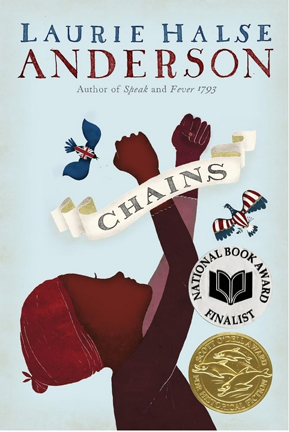
Book Review – Chains

Set in New York at the time of the American Revolution, Chains spans May 27, 1776 to January 19, 1777. As the novel opens, the young teenage protagonist, Isabel, is optimistic about her future as her owner, Miss Mary Finch, has died and had let Isabel know beforehand that she and her five-year old sister Ruth would be free upon her passing. Unfortunately, no lawyer is present to produce the will that shows Miss Finch’s wishes. Mr. Robert Finch, Mary’s nephew and only surviving relative, has come to claim Isabel and Ruth and accuses Isabel of lying about the will. He proceeds to sell Isabel and her sister to Elihu and Anne Lockton from New York. The couple are Loyalists, and while Mrs. Lockton treats Ruth as a kind of pet that she shows off to friends she entertains, she treats Isabel, whom she refers to as “Sal,” in a harsh and degrading fashion, always showing her disfavor.

Isabel has two aims: to protect her sister and to gain freedom. She lives in fear that the Locktons will sell Ruth and thus separate them. At one point Mrs. Lockton provides sweets to them, something that was unusual. But she had laced them with something to make Isabel fall into a deep sleep. When Isabel awakens she learns that Mrs. Lockton has sold Ruth into slavery in the West Indies. This crushes Isabel, who is unable to escape due to constant monitoring by the Locktons.

While doing errands in town for Mrs. Lockton, Isabel meets Curzon, a teenage slave of Mr. Bellingham, a Patriot. Curzon asks Isabel if she would be willing to spy on the Locktons to get information to the Patriots. Initially Isabel refuses but then begins doing so. Mrs. Lockton finds out and punishes her by branding her cheek with an “I” for “insolence.” It takes Isabela six days to regain consciousness after the branding.

Mrs. Lockton makes Isabel care for Lady Seymour, Elihu’s aunt, who lives in town. As Isabel goes to town she is able to deliver messages about Loyalist activities to the Patriot soldiers. Lady Seymour has compassion for Isabel, treating her with kindness and feeding her well. Her house burned in the great fire of New York (September 21, 1776), and Isabel saves her as well as a portrait of her husband and some letters that were dear to her. This becomes important late in the book as Lady Seymour, then an invalid and unable to speak, gestures to Isabel that she approves of her taking coins that she had saved.

The Locktons don’t recognize Isabel as intelligent, which works to her advantage when she is in the room delivering food or waiting for orders when Mr. Lockton is talking with other Loyalists. Isabel learns of the plot to kill Gen. George Washington and shares this with Patriots who come and arrest Mr. Lockton. However, he is soon released and later escapes by hiding in a barrel of cheese. Readers learn that Ruth has not been sold to the West Indies but rather sent to Charleston, South Carolina. Isabel plots her escape for the night that people are distracted by a celebration of Queen Charlotte of Great Britain’s birthday. Though Mrs. Lockton had Isabel locked in a potato bin during the ceremonies, she manages to dig her way out, find a pass and forge papers showing she is free.

Curzon, who had fought in battle for the Patriots, was shot in the leg and held at Bridewell as a prisoner of war. Isabel is able to see him by bribing the guards with food. On the night of her escape, she goes to Bridewell and says she was sent to clean the cells where “prisoners been dropping dead like flies. Fever.” “Curzon lay insensible, his skin burning with fever, his eyes rolled up into his head. I called his name and pinched him, but he did not look my way nor speak a word.” Isabel claims Curzon is dead, loads him in a wheelbarrow and covers him with a filthy blanket. The two manage to make it to the wharf and to a boat. “I rowed that river like it was a horse delivering me from the Devil. My hands blistered, the blisters popped, they re-formed and popped again. I rowed with my hands slick with blood … The sun rose beyond the water, at the other side of the river. I was on the west bank. I was in Jersey. I had set myself free.” At this point Curzon awakes asking where they are, and Isabel replies “I think we just crossed the river Jordan.” The book ends with Isabel asking Curzon if he can walk and with an advertisement for the sequel Forge that gives the account of Isabel Gardner (formerly Sal Lockton) and companion Curzon Bellingham. 

The first teaching strategy for Chains is a set of ten questions designed to guide students in a close reading and deeper study of the novel. These questions may be used as the basis of class discussions, exams or essays.

Questions for Study and Discussion for Chains
1. How do Isabel’s and Curzon’s views of freedom differ in chapter 6? Also consider whether this changes as the novel progresses.
2. What evidence exists that Mr. Lockton is conspiring against the Patriots? Trace his journey from the point that he is arrested to the last mention of him.
3. In chapter 29 Isabel speaks of being “chained between two nations.” What does this mean?
4. Isabel’s grandfather speaks to her about the river Jordan in chapter 26, and in the last paragraph of the book, Isabel states “I think we just crossed the river Jordan.” What is the significance of the river Jordan?

5. Discuss the circumstances by which Isabel secures a copy of Thomas Paine’s Common Sense in chapter 39How does the pamphlet influence her in later chapters?
6. How does the author contrast Lady Seymour and Mrs. Lockton in chapter 41?
7. In what ways was the relationship between Isabel and Lady Seymour a reciprocal one where each benefited? Consider especially the events of chapters 31 and 44.
8. It may be said that at the time of Chains, both Isabel and America are rebellious, young, and conflicted. Explain.
9. Identify three scenes that you believe are the most important in Chains and explain why each is key to the novel.
10. The trilogy of which Chains is book one is called Seeds of America. What role do seeds play in the novel?

While these questions help to ensure close reading and provide opportunities to check for student understanding in a traditional way, the next activity engages students in a more creative, nontraditional manner as they use symbolic thinking and hands-on creativity.

A coat of arms is a visual design in the form of a shield, that goes back to Medieval days when families and communities used them to show their identity. The coat of arms includes a motto or slogan that captures the important essence of the family, nation, school, or in our case, Chains. A coat of arms can be elaborate, including features such as “supporters” (visuals on each side of the shield) and “toppers” (one or more visuals at the top such as a crest, torse, helmet, or crown).

This assignment consists of three parts: 1) Pre-writing via the writing frames for the coat of arms; 2) The visual coat of arms; 3) A paper that explains the symbols chosen in connection with the character the student chose from Chains.

A drawing of a coat of arms

AI-generated content may be incorrect.

The slogan “Per Aspera ad Astra” is Latin for “Through hardships to the stars” which is why the top of the crest features stars. There are three stars, each with an initial, representing Isabel in the middle and Curzon and Ruth on each side. The pre-writing in Table 1 provides additional insights about the symbols and colors used in Isabel’s shield.

Like it or Not, History Isn’t Rosy

The White House has issued complaints about the history on display in our national museums, complaining that it is too negative, that it portrays the past as a place of hurt. Yet, I would argue that historians, those in the academic world, museum directors, and local historians have been doing their job — and doing it well.

I am a local historian in Ithaca, New York, writing mostly about the place where I live and the region that surrounds it. By listening and observing the work of others, I have learned about Rosie, a young immigrant woman who led a strike in 1913 in Auburn, New York. I have come to see H. H. Coleman as an inadvertent historian whose columns in the Colored American in the 1880s, described the social life of Black people in my town. I have learned about Juanita Breckenridge Bates who led the fight for suffrage in my town and the curious fact, that her husband, in 1917, forgot to turn over his ballot to affirm the fact that women should have the vote. I have learned about Lizzy the enslaved woman who was suddenly “disappeared” from her home in Caroline and sold in the south just as New York was passing a law in 1827 to abolish slavery in the state. I have come to know about Rev. Henry Johnson who brought the AME Zion church in Ithaca into being, but while lecturing around the state was beaten 17 times. I know that the first Jewish rabbi in Ithaca arrived in 1915 where he and his wife had a child; then moving on to Alabama his family was listed as having a child born in Ithaca — with Greece written in pencil above young David’s name, no one in Alabama knowing about Ithaca, New York.

Small things. But they tell a greater picture. That life in the past was not always a rosy place, that laborers had to strike for better working conditions, that Black people fled here and then away again because this was not far enough away from the federal marshals unleashed by the Fugitive Slave Act of 1850. I learned that local women worked hard to achieve equality in the law by sending a petition to Albany in 1878 asking that the word male be removed from the state constitution, and that petition, while registered, was then deposited in the trash and never heard of again. So, the women had to go to work again to gain equal rights.

Opening up the faults of the past does not tear down our country but rather it aids us in rising above it. It allows us to see that we can change for the better, recognize our faults, and strive to bring about a pluribus unum. The truth of the past allows us to see that problems and faults can be overcome, that there are moral truths worth fighting for, that individuals matter. It is this diversity that has been uncovered over the past 50 years that has broadened our view of the past and is displayed in museums across the land.

This country was not a place of peace and harmony but a place where individuals had to step out of line to make “good trouble” to bring about necessary change. That story needs to be told ‘lest we believe that the past was unlike the present where there are tensions and contests and inequities that need to be resolved for this be a true democracy.

Historians are doing their job. It is now up to those in power and voters to see that where there is inequity we work for fairness, where there is harm, we bring balm, where there is strife we talk to each other to make the country and the world better places.

African American & Labor History Timeline

Every facet of the United States has been affected by the labor and inventions of African Americans. Discover some of the men and women who created the inventions that improved daily life, fought for fair wages, safety, equal rights, and justice for Black workers. These are just some of the important milestones in the history of Black Labor in America. To learn more, visit your local library during Black History Month—and beyond!

1500s-1865: Transatlantic Slave Trade through the American Civil War

1500s: Transatlantic Slave Trade

The largest oceanic forced migration in history, the Transatlantic Slave Trade began in the late 1500s when over 12.5 million African men, women and children were removed from the continent and transported to the Americas, Brazil and the Caribbean to work on plantations and live their lives in servitude. As a result, many slave rebellions erupted throughout the 17th, 18th and 19th centuries, constituting some of the first organizing and labor-related actions in the Americas.

1739: Traditional African drumming is banned

Enslaved Africans were prohibited from playing traditional drums, as European enslavers feared that drumming could facilitate communication across fields, uplift weary spirits, comment on oppressive masters, and incite rebellions. In response, Black people developed alternative forms of musical expression, such as hand clapping and percussive stomping, which became the foundation of work songs and spirituals. These musical forms later evolved into genres like the blues and jazz and are integral to today’s African American music.

c.1763-c.1826: Artist Joshua Johnson

Recognized as one of the earliest professional African American artists, Johnson was born into slavery near Baltimore around 1763 and gained his freedom in 1782. He described himself as a “self-taught genius” and painted portraits of families, children, and prominent residents of Maryland.

1786: The Tignon Law

This Louisiana law was enacted to regulate the appearance of free women of color to “establish public order and proper standards of morality,” and subjection to undesirability. Women were prohibited from going outdoors without wrapping their natural hair with a Tignon cloth. As a symbol of rebellion, Black women reappropriated Tignon production into a major fashion statement, form of self-expression and business by embellishing the headscarves with decorative fabrics, feathers and jewels.

1859: Author Harriet E. Wilson

Our Nig; or Sketches from the Life of a Free Black is considered the first novel by an African American woman. It gave insight into the supposed “Free North,” challenging the idea that the North was a safe have providing peace and equality for African Americans

1865: 13th Amendment Outlaws Slavery

The official end to slavery was perhaps the greatest labor victory in U.S. history. Yet the struggle for equal rights and fair wages was far from over; the same year that Congress adopted the 13th Amendment, the white supremacist terrorist organization and hate group, the Ku Klux Klan, was formed.

1865-1877: Reconstruction

In the decade following the Civil War, Congress established the Freedmen’s Bureau to help African Americans with food, housing, education, political rights and negotiating labor agreements. This period is thought to be one of expanding freedom for the formerly enslaved but in the South they were subjected to violence and new forms of mistreatment.

1872: Frederick Douglass

Douglass was elected president of the “Colored” National Labor Union, and his The New National Era became the union’s official newspaper. Douglass was one of America’s most important champions of equality and the right to organize a union.

1880s: Knights of Labor

The St. Paul Minnesota Trades & Labor Assembly was founded with the assistance of the Knights of Labor Assembly in1883. The Knights of Labor were known for their inclusiveness for accepting women and African American members, however they also supported the Chinese Exclusion Act.

1883: Lucy Parsons (c. 1851 – 1942)

Lucy Parsons and her husband, Albert Parsons, a former Confederate soldier turned anarchist, founded the International Working People’s Association. In 1886, they led the city’s first May Day parade, which called for an eight-hour workday.

1901: Up from Slavery

Booker T. Washington, a major voice for economic self-reliance and racial uplift, publishes his autobiography discussing his life and thoughts on race relations.

1905-1960: The Great Migration

In the first half of the 20th century, a mass migration of more than six million Black people took place from the South to the North. Many left to escape overt Southern racism, only to encounter racial tensions in the North as whites viewed them as a threat to their jobs. The Migration Series is a group of paintings by African American painter Jacob Lawrence (1917-2000) which depicts the migration of African Americans to the Northern U.S. from the South. It was completed in 1941 and was conceived as a single work rather than individual paintings. Lawrence wrote captions for each of the sixty paintings. Viewed in its entirety, the series creates a narrative in images and words that tells the story of the Great Migration.

1909: National Training School for Women and Girls

Nannie Helen Burroughs (1879-1961) was a suffragist, educator and organizer, as well as a mentor to the Rev. Martin Luther King, Jr., who worked to integrate labor reform into the movement for voting rights. Burroughs established the National Training School for Women and Girls in 1909 to combat labor exploitation through education, helping to improve working conditions and expand career pathways for Black women. She also launched the National Association of Wage Earners in 1921, a labor union for Black domestic workers.

1910s-1930s: The Harlem Renaissance

A period of flourishing of African American art, literature, and performance art saw the rise of iconic figures like author Langston Hughes, trumpeter Louis Armstrong, pianist Duke Ellington, and vocalists Ella Fitzgerald and Billie Holiday. Langston Hughes was a central figure in the Harlem Renaissance. A major poet, Hughes also wrote novels, short stories, essays, and plays.

1910: The Foster Photoplay Company

William D. Foster founds the first film production company established by an African American. It features all African American casts. The Railroad Porter (circa 1913) was the first film produced and directed by an African American.

1917: East St. Louis Race Riot

During World War I, thousands of Blacks moved to the St. Louis area to work in factories fueling the war effort. When the largely white workforce at the Aluminum Ore Company went on strike, hundreds of Blacks were hired as strikebreakers. Tensions erupted, and thousands of whites, many of them union members, attacked African Americans and set fire to their homes. Between 100 and 200 Blacks are estimated to have been killed and were 6,000 left homeless.

1919: Red Summer

Racial tensions were inflamed during the September 1919 Steel Strike, when workers shut down half of the nation’s steel production in an effort to form a union. Bosses replaced them with some 40,000 African American and Mexican American strikebreakers, an action made possible by AFL unions that excluded people of color from union jobs and membership.

1921: Tulsa Race Massacre (May 31-June 1, 1921)

The Tulsa Race Massacre was a 1921 attack on Tulsa’s Greenwood District, an affluent African American community whose thriving business and residential areas were known as “Black Wall Street.” In response to a May 31 newspaper report of alleged black-on-white crime, white rioters looted and burned Greenwood in the early hours of June 1. The governor of Oklahoma declared martial law, and National Guard troops arrived and detained all Black Tulsans not already interned. About 6,000 Black people were imprisoned, some for as long as eight days. In the end, 35 city blocks lay in ruins, more than 800 people were injured, and as many as 300 people may have died. The Massacre was largely omitted from local, state, and national histories until the Tulsa Race Massacre Commission convened in 1997 to investigate the event. Today, memorials, historical exhibits, and documentaries are some of the ways that the Massacre has been acknowledged and the history of “Black Wall Street” kept alive.

1925: Brotherhood of Sleeping Car Porters

 The first labor organization led by African Americans to receive a charter from the American Federation of Labor. African American porters performed essential passenger services on the railroads’ Pullman sleeper cars and the union played a key role in promoting their rights. In the summer of 1925, A. Philip Randolph (1889-1979) met with porters from the Chicago-based Pullman Palace Car Company. The mostly Black Pullman workforce were paid lower wages than white railway workers and faced harsh conditions and long working hours. Randolph worked with these workers to form and organize the Brotherhood of Sleeping Car Porters. When the union was finally recognized in 1935, it became the first predominantly Black labor union in the nation. As the union’s founder and first president, A. Philip Randolph became a leader in the Civil Rights Movement.

1930s: The Great Depression

African Americans primarily worked as sharecroppers on white-owned land, and tenant farmers in the south. They continued migrating to the north in search of better opportunities, but due to racism, they often found work as domestics, in factories, and as seasonal traveling migrant farmers. New Deal programs provided some relief, but they still faced unequal access to programs like the Works Progress Administration due to racial segregation and violence.

1934: Dora Lee Jones (1890-1972)

Jones helped found the Domestic Workers Union (DWU) in Harlem in 1934 in defiance of New York City’s “slave markets,” as they were known. With few options during the Depression, Black women would gather daily in the morning at certain locations and wait for white middle-class women to hire them, typically for low wages. The DWU eventually affiliated with the predecessor to today’s Service Employees International Union.

1940s: Women Fill Wartime jobs

During World War II, African American women contributed significantly to the war effort by taking on industrial factory jobs and working in shipyards and other war production facilities. Referred to as “Black Rosie’s.” They worked as welders, machinists, assemblers and more. They also served in the military as nurses, in the Women’s Army Corps, and in the all-Black 6888th Central Postal Directory Battalion, responsible for clearing the backlog of overseas mail.

1941: Fair Employment Practices Committee

Under pressure from labor leader A. Philip Randolph, who planned a march of 250,000 Black workers in Washington, D.C., to demand jobs, President Franklin Roosevelt signed Executive Order 8802, creating the Fair Employment Practices Committee. The order banned racial discrimination in any defense industry receiving federal contracts and led to more employment opportunities for African Americans.

1944: Admission to the Brotherhood of Locomotive Firemen and Enginemen Union. African Americans who maintained railroad locomotive engines had to sue the Brotherhood of Locomotive Firemen and Enginemen all the way to the Supreme Court to gain admission to the union in 1944.

1945: Maida Springer Kemp (1910-2005)

Kemp worked as a labor organizer in the garment industry and became the first Black woman to represent the U.S. labor movement overseas when she visited post-war Britain on a 1945 labor exchange trip. She went on to spend many years liaising between American and African labor leaders as a member of the AFL-CIO and became affectionately known as “Mama Maida” for her work. Throughout her life, she advocated for civil rights and women’s rights in America and internationally.

1946: Operation Dixie

Encouraged by massive growth in union membership (including African Americans) during the 1930s and 1940s, the Operation Dixie campaign launched an effort to organize the largely non-union Southern region’s textile industry and strengthen the power of unions across the United States. Spearheaded by the Congress of Industrial Organizations, in concert with civil rights organizations, the campaign covered 12 states. Operation Dixie failed because of racial barriers, employer opposition and anti-Communist sentiment that labeled anyone who spoke out as an agitator. In 1947, the Taft-Hartley Act was enacted, allowing states to adopt so-called “Right to Work” laws that limited union power.

1948: Zelda Wynn Valdes (1905-2001)

Fashion and costume designer Zelda Wynn Valdes was the first Black designer to open her own shop and business on Broadway in New York City. Her designs were worn by entertainers including Dorothy Dandridge, Josephine Baker, Marian Anderson, Ella Fitzgerald, Mae West, Ruby Dee, Eartha Kitt, and Sarah Vaughan.

1950s: Post-War Era

Despite some gains during World War II, African Americans still experienced high unemployment rates compared to white workers and faced significant barriers to upward mobility in the workforce. Labor was largely confined to low-wage, segregated jobs, primarily in service industries like domestic work, with limited access to skilled trades and significant discrimination within unions. These struggles fueled the developing Civil Rights movement and pushed for greater labor equality.

1953: Clara Day (c.1923-2015)

As a clerk at Montgomery Ward, she resented the segregation of white and Black employees, which led her to push for change. Clara Day first began organizing co-workers at Montgomery Ward in 1953 and went on to hold several roles in the Teamsters Local 743. She also helped found the Coalition of Labor Union Women and the Teamsters National Black Caucus. A passionate advocate for labor, civil rights and women’s rights, she helped bring attention to issues like pay equity and sexual harassment.

1954: Norma Merrick Sklarek (1926-2012)

In 1954, Norma Merrick Sklarek became the first Black woman to become a licensed architect in New York. Her projects included the United States Embassy in Tokyo, Japan in 1976 and the Terminal One station at the Los Angeles International Airport in 1984.

1950s-1970s: The Era of Social Movements. The three decades after World War Il saw the emergence of many movements in American society for equal rights, most notably the Civil Rights Movement. One milestone for this movement was passage of the 1964 Civil Rights Act, a landmark civil rights and labor law in the U.S., outlawing discrimination based on race, color, religion, sex and national origin.

1950s-1970s: Social Movements

During the Civil Rights Movement, African American artists like Nina Simone, and Harry Belafonte used their music and performances to advocate for social change. One significant event happened when Eartha Kitt was invited to Lady Bird Johnson’s “Women Doers Luncheon” in 1968. During the event, Kitt publicly spoke out against the Vietnam War and criticized several of President Johnson’s policies, consequentially derailing her U.S. career for more than a decade.

1963: Bayard Rustin (1912-1987) and Anna Arnold Hedgeman (1899-1990) Plan the March on Washington

While the Rev. Dr. Martin Luther King, Jr. made headlines with his “I Have a Dream” speech, it was Rustin who worked closely with the labor movement behind the scenes, planning and organizing the massive March on Washington for Jobs and Freedom, one of the largest nonviolent protests ever held in the United States. As an openly gay man, Rustin’s crucial role in the March on Washington was often diminished and forgotten. As a member of the executive council of the AFL-CIO and a founder of the AFL-CIO’s A. Philip Randolph Institute, Rustin fought against racism and discrimination in the labor movement. Hedgeman was a civil rights activist, educator and writer who helped organize the March on Washington for Jobs and Freedom. She was a lifelong advocate for equal opportunity and employment.

1968: Poor People’s Campaign

This multiracial campaign, launched by the Southern Christian Leadership Conference under the Rev. Dr. Martin Luther King, Jr., and the Rev. Dr. Ralph Abernathy, recognized that civil rights alone did not lift up African Americans. The campaign called for guaranteed, universal basic income, full employment and affordable housing. Dr. King said, “But if a man doesn’t have a job or an income, he has neither life nor liberty, nor the possibility for the pursuit of happiness. He merely exists.”

1968: Memphis Sanitation Strike

African American sanitation workers in Memphis, Tennessee, represented by the American Federation of State, County and Municipal Employees (AFSCME), went on strike to obtain better wages and safety on the job, winning major contract gains. The Rev. Dr. Martin Luther King, Jr., the strike’s most influential supporter, was assassinated on April 4 as he was leaving his hotel room to address striking workers. Today, AFSCME produces the I AM STORY podcast, which follows the history of the 1968 Memphis Sanitation Strike as told by those who experienced it firsthand.

1969: League of Revolutionary Black Workers (LRBW)

Established in Detroit, Michigan, the LRBW united several revolutionary union movements across the auto industry and other sectors. A significant influential Black Power group, the LRBW had a tremendous influence on the left wing of the labor movement. Their activism played a pivotal role at the intersection of race and class in the ‘post-civil rights’ era.

1970: Melnea Cass (1896-1978)

Known as the ‘First Lady of Roxbury,’ community organizer and activist Melnea Cass helped provide social services, professional training and labor rights education that empowered Boston’s most vulnerable workers. One of many examples is a program she co-created that provided childcare for working mothers. Her advocacy helped achieve a major legislative victory in 1970 when Massachusetts passed the nation’s first state-level minimum wage protections for domestic workers since the Great Depression.

1970s: Workforce and Unemployment

By 1970, about nine million African American men and women were part of the workforce in the United States. This workforce included the steel, metal fabricating, meatpacking, retail, railroading, medical services and communications industries, numbering one third to one half of basic blue-collar workers. Yet, at that time, the African American unemployment rate was still two to three times more than that of whites.

1970: Dorothy Bolden (1923-2005)

Future president Jimmy Carter presents a Maids Day Proclamation to Dorothy Bolden. Dorothy Bolden began helping her mother with domestic work at age 9. She was proud of her work, but also knew how hard it could be and wanted domestic workers to be respected as part of the labor force. Dr. Martin Luther King, Jr., her next-door neighbor, encouraged her to take action. In 1968, she founded the National Domestic Workers Union, helping organize workers on a scale never seen before in the United States. The union taught workers how to bargain for higher wages, vacation time and more. She also required that all members register to vote, helping to give workers a stronger voice both on the job and in Georgia policy.

1979: Wage Decline Begins

Hourly wages for many American workers stagnated or dropped beginning in 1979, except for a period of strong across-the-board wage growth in the late 1990s. Researchers have found a correlation between the decline of unions and lower wages, and between lower wages and a growth in economic and social inequality, resulting in African Americans and Latino workers facing greater wage stagnation than white workers.

1980s: Declines and Milestones

During the 1980s, African American labor continued to face significant challenges including high unemployment rates, disproportionate job displacement due to industrial decline, and the widening wage gap compared to white workers. Particularly impacted were African American women, and blue-collar African American workers who relied heavily on shrinking union jobs during this period. Despite this, some progress was made with an increased Black union membership among men, affecting barriers to full equality in the workforce due to earlier civil rights movements.

1990: Hattie Canty (1933-2012)

Hattie Canty lived in Nevada and worked several jobs as a maid, a school janitor, and eventually a room attendant on the Las Vegas Strip. She became active in her union, was elected to the executive board of the Culinary Workers Union (CWU) in 1984 and became union president in 1990. She was the first Black woman and the first room attendant elected to this position in CWU. During her tenure, she brought together workers from several nations, helped push forward racial justice within the industry and her union, and founded the Culinary Training Academy, which helps people of color obtain better jobs in the hospitality industry.

1990: Americans with Disabilities Act

Inspired by the Civil Rights Act, and signed into law by President George H.W. Bush, Congress passed the Americans with Disabilities Act, prohibiting discrimination against all people living with developmental and physical disabilities in the workplace, transportation, public accommodations, state and local government services and telecommunications.

2008: Smithfield Packing Plant Workers

Smithfield workers join the United Food and Commercial Workers (UFCW). After 16 years of organizing by African American, Latino, and Native American workers, the Smithfield Packing Plant in Tar Heel, North Carolina finally succeeded in joining the United Food and Commercial Workers (UFCW) union. Despite years of intimidation, violence, and illegal firings by the company’s management, the new local union was chartered as UFCW Local 1208. Today, there is a mural of civil rights leaders on the wall of the union hall.

2008: Barack Obama (1961- )

Barack Obama was elected to the first of his two terms as the 44th President of the United States becoming the first African American president in U.S. history. During his first two years in office, he signed many landmark bills into law, including his very first piece of legislation, the Lilly Ledbetter Fair Pay Act, which impacted the labor movement. Obama also reduced the unemployment rate to the lowest it had been in more than eleven years.

2012: #BlackLivesMatter

Formed after the 2012 murder of a young African American man in Florida, Trayvon Martin, the Black Lives Matter movement grew as protests mounted against other killings, including the 2020 slaying of George Floyd in Minneapolis. In several communities, labor unions have built ties with #BLM chapters to address chronic issues of dehumanization, inequality, and exploitation.

The John W. Jones Story

Reprinted with permission from https://www.johnwjonesmuseum.org/the-john-w-jones-story

John W. Jones became an active agent in the Underground Railroad in 1851. In 1854, the Northern Central railroad tracks from Williamsport, Pennsylvania to Elmira, New York were completed. Jones made an arrangement with Northern Central employees and hid the fugitives in the 4 o’clock “Freedom Baggage Car,” directly to Niagara Falls via Watkins Glen and Canandaigua. Most of Jones’s “baggage” eventually landed in St. Catharines, Ontario.

By 1860, Jones aided in the escape of 800 runaway slaves. He usually received the fugitives in parties of six to ten, but there were times he found shelter for up to 30 men, women, and children a night. It is believed Jones sheltered many in his own home behind First Baptist Church. Of those 800, none were captured or returned to the South.

Jones became the sexton for Woodlawn Cemetery in 1859. One of his primary roles was to bury each deceased Confederate soldier from the Elmira Prison Camp. Of the 2,973 prisoners who Jones buried, only seven are listed as unknown. Jones kept such precise records that on December 7, 1877, the federal government declared the burial site a national cemetery.

Historically, the house was the private residence of John W. Jones and his family, changed ownership several times, and was last used as rental property that fell into disrepair. Condemned by the City of Elmira in 1997, Lucy Brown brought it to the public’s attention and with a group of concerned citizens, saved it from demolition. The building currently stands on Jones’ original farm property and the site will continue to be visually interpreted as a farm.

The museum highlights the history of African Americans who settled in New York and the activity of local abolitionists, emphasizing Elmira’s role as the only regular agency and published station on the Underground Railroad between Philadelphia and St. Catharine’s, Canada, and explore Mr. Jones’ community involvement and his relationship with his contemporaries.

John W. Jones was born a slave June 21, 1817, on a plantation south of Leesburg, Virginia. He was owned by the Ellzey family, an influential family who treated their slaves with perhaps more kindness than some plantation owners did. Miss Sarah (Sally) Ellzey was fond of John and was a good friend to him. But she was getting on in years and John was concerned about what would happen to him once she passed away.

On June 3, 1844, at the age of 27, John fled north to the place his mother had told him about “where there is no slavery.” It took one month for John, his two half-brothers, George and Charles, and Jefferson Brown and John Smith from an adjoining estate to walk from Virginia to Elmira, New York, a distance of about 300 miles. The route they followed was part of the Underground Railroad coming up through Pennsylvania and into New York by way of Williamsport, Canton, Alba and South Creek. In South Creek they reached the farm of Dr. Nathaniel Smith, where they crawled into the hay mow of his immense barn and went to sleep, more dead than alive. They remained there over night. Mrs. Smith discovered them and cooked food and took it to them. This is the Mrs. Smith whose grave in Woodlawn Cemetery, just beyond the Langdon plot, always had fresh flowers on it and no one knew where they came from. After John Jones died, there were no more mysterious fresh flowers.

John Jones was an ambitious man and never idle. The first thing he did when he arrived in Elmira was to offer to cut wood in exchange for 50¢ for Mrs. John Culp, Colonel John Hendy’s daughter. Another early job he took was in a tallow and candle store working for Seth Kelly. John wanted to get an education, but was refused at first because he was black. Judge Arial Standish Thurston befriended him, realized his potential and made it possible for him to receive an education – in fact, at the same school where before he had been turned down. As a result, John went to school in the winter and worked as janitor for Miss Clara Thurston’s school for young ladies on Main Street. In October, 1847, he was appointed sexton or caretaker of the first church building of the First Baptist Church that had been constituted in 1829 under the name of the Baptist Church of Southport and Elmira. The first members gathered in homes, but as the membership grew they met in a schoolhouse in Southport. By 1832, the membership had grown to the point where they decided to build their own church building. They were sold the piece of land where the Baptist Church still is today for $1.50 by Jeffrey and Elizabeth Wisner who were in-laws of the first pastor, Rev. Philander Gillett. The first building was a barn-like structure constructed at a cost of $954.

By 1848, 16 years later, the Baptists had outgrown that building and decided to build something larger. The 1863 City Directory says this building was constructed of wood, stucco and cost $8000. Mr. Jones was sexton of this second church building for the 42 years that it was in existence.

In 1854 he bought the “yellow house next to the church” from an Ezra Canfield for $500. Two years later, John Jones married Rachel Swails. Rachel’s brother was Stephen Swails, a Lieutenant in the 54th Massachusetts Regiment. If you have ever seen the movie Glory, you know the story of this famous regiment.

By 1859, Jones was already very active in Underground Railroad work. An article in The Liberator (Boston) signed J.W. Jones, Sec. said: “Resolved, That we, the colored citizens of Elmira, do hereby form ourselves into a society for the purpose of protecting ourselves against those persons, [slave-catchers] prowling through different parts of this and other States since the passing of the diabolical act of Sept. 18th, 1850, which consigns freemen of other States to that awful state of brutality which the fiendish slaveholders of the Southern States think desirable for their colored brethren, but are not willing to try it themselves.”

Arch Merrill said in his book on the UGRR, “Jones quietly took command of the Underground in Elmira, a gateway between the South and the North. It became the principal station on the ‘railroad’ between Philadelphia and the Canadian border. Jones worked closely with William Still, the chief Underground agent in Philadelphia, who forwarded parties of from six to 10 fugitives at a time to Elmira.

“Jones had many allies in Elmira. Mrs. John Culp hid runaways in her home. Other Underground leaders were Jervis Langdon; Simeon Benjamin, the founder of Elmira College; Thomas Stanley Day; S. G. Andrus; John Selover; Riggs Watrous and others. The station master concealed as many as 30 slaves at one time in his home—exactly where, he never told. He carried on his operations so secretly that only the inner circle of abolitionists knew that in a decade he dispatched nearly 800 slaves to Canada. “John Jones demonstrated his winning ways in encouraging the railroad baggage men to stow away the hundreds of men, women, and children who were spirited away to freedom.

“In 1854 the railroad from Williamsport to Elmira was completed and Jones received many more fugitives by train, to ship away in the 4 a.m. ‘Freedom Baggage Car,’ directly to Niagara Falls via Watkins Glen and Canandaigua, where the car was shifted to the New York Central. Most of Jones’s ‘baggage’ eventually landed in St. Catharine’s.”

His house right next to the church was the UGRR station of which Mr. Jones was station master. I often wonder about his wife, Rachel, who never knew how many were coming for dinner. I have also wondered if on those nights when he had 30 or more people to hide, if the church building, which he had access to, gave them shelter. There is no record that tells us this, but still, I wonder.

If you stand at the corner of West Church Street and Railroad Avenue and look north toward the Erie depot, you can envision the journey of the fugitives in the middle of the night as they go from Mr. Jones’s home, where the parking lot of First Baptist is now, up Railroad Avenue to the depot.


Wm. Still’s book about the UGRR is full of stories by the actual people involved in the work. In October, 1855, a lady wrote to Still asking, “Please give me again the direction of Hiram Wilson and the friend in Elmira, Mr. Jones, I think.” [Still, page 40]

Here is a letter written by John W. Jones to William Still:
Elmira, June 6, 1860.
Friend Wm Still:


Challenges of Teaching African American History in Secondary Schools

Imani Hinson, Romelo Green, Nefe Abamwa, and Adam Stevens presented on a panel at the 2025 conference of the American Historical Association. Hinson is a social studies teacher in the Howard County Maryland School District who formerly taught in Brooklyn and an item writer for the College Board AP African American Studies program. Green and Abamwa teach at Bellport High School in Suffolk County, New York and Stevens teaches at Brooklyn Technical High School. The session was chaired by April Francis-Taylor of Hofstra University and also included papers by Alan Singer of Hofstra University and Justin Williams of Uniondale High School.

By Imani Hinson

Each year I start my students off with a week of lessons to understand why we study history in the first place and to get students specifically to understand why varied viewpoints are so important. This year I had my students reflect on a quote from Maya Angelou and asked them why they thought some political leaders across the United States did not think African American history was important and why they thought this history was considered controversial.

My students responded with the understanding that by learning history we can hope to not repeat it but also that learning this history does not aim to make individuals feel bad for the deeds done but rather understand the historical situations in which our country was founded and the continued history that is shaping the way our country is moving forward today. Despite the pain and suffering lived by many in this country, especially African Americans, it is important to uncover truths about our shared history. The APâ African American Studies curriculum provides students with a chance to do just that; tackle tough questions, tough realities, glean an understanding of the world that they live in today, and it gives them a chance to acknowledge a history that many of them have not learned before.

The APâ curriculum has a fantastic starting place with the African Kingdoms of Mali, Songhai, the Hausa States, and more. Students are able to do a deep dive into the history of Africa that many of them had never been taught about before. A question I get often from my students is “Ms. Hinson why are we not taught this in World History or any other history class?” The truth is that a lot of this history was unknown or kept secret for many years. In my classroom, we delve into the nuances of this history so that students understand how it differs from the traditional documents and writings they usually learn about in Eurocentric history classes. I introduce them to griots and students learn that different cultures pass down history in different ways. Much of the early history we know from African civilizations was passed down orally making it much harder for historians to uncover truths about these societies.  My students learned that Christianity was in Africa before European arrival when they study about places such as Lalibela. They learn about trade starting in the 8th century along the East Coast of Africa that connect places with the Mediterranean region and Central and East Asia. Students uncover truths about the Great Zimbabwe and amazing structures, built not by Greeks or aliens, but by the local Zimbabwean people who garnered their wealth from the Indian Ocean trade routes. Timbuktu is not a fictional place, but a nation where trade, advanced institutions of knowledge, and wealth resided.

Before being exposed to this curriculum, my students were taught that Africa was backward, a continent ripe for exploitation. They saw Africa, not as the birthplace of humanity with rich cultures, but rather a place that Europeans conquered and a continent that continues to have issues to this day.

Challenging misleading notions continues as students learn about the African diaspora. Before being exposed to this curriculum, they believed African Americans had no culture and were only brought to the Americas for harsh work and enslavement because of the color of their skin. I overheard an exchange in my classroom in which one student of color was poking fun at another. A West African student asked another Black student, “Hey, where are you from?” The student responded, “Oh well, I am just Black.” The West African student laughed and said “Oh, I’m so sorry y’all don’t have any culture.” That was an eye-opening exchange. I joined the conversation and asked, “What do you mean by that?” The student explained that they never heard of any African American culture and that Black people did not know where they came from. The conversation continued:

The sad reality is that so many of our students think this way. They believe that Black people are a people without history and this misleading notion really stems from the fact that we have not done a good job as a society to unpack these misconceptions. In some states they still teach that slavery was a benevolent work system where the enslaved learned important skills, sugarcoating the reality of what enslavement was. Why don’t students learn that there was slavery in New York and in other northern localities? Why don’t students learn that Free Blacks and people who escaped from slavery played a crucial role in the abolitionist movement and that African Americans have fought in every war in the United States even before its inception, that 200,000 Black soldiers and sailors fought in the Civil War to end slavery and the right to be full citizens of the nation of their birth?

The hardest part about teaching APâ African American studies course is getting students to relearn the history that was taught to them over and over again since they entered school. Black people were slaves, the Civil War happened, Lincoln signed the Emancipation Proclamation, Reconstruction took place, African Americans got some rights, then skip to the Civil Rights Movement, and that’s Black history. But there is so much more to African American history. Students truly do not understand that African Americans as a people continuously strove to be accepted as valuable contributors to this great nation. Even when they were told to “go back to Africa,” they stayed and fought for equality. It is hard to teach history in a society that try to erase the African American past by making it seem Un-American to shed light on the contributions of Black people to this county.

As a society we have prevented students of color from learning the truth about their heritage and culture and permitted all students to believe in a factionalized past. As a corrective, APâ African American studies is not just a class for students of color. Ideally, African and African American history should be interwoven into World History and United States history classes, not just relegated to an elective.  Black history truly is both World and U.S. history.

It is challenging for many young people to see the correlation between history and the world that we live in today. I started a lesson on sugar being the driver for enslavement in the Americas showing students newspaper headlines discussing chocolate companies using child slave labor and asked students would they still eat chocolate knowing where it came from. Many of the students had to think long and hard about it, but eventually most of them confessed that “yes, they would still eat it.” After a gallery walk showing various documents about the correlation between sugar and enslavement and economics, we came back together to have a discussion. I asked my students how the legacies of sugar plantations and slavery continue to impact economic disparities and race relations today? A student raised her hand and said, “what we see is that enslaved people were working for free and that their enslavers were making loads of money because of their hard work.” I asked, “What does that mean for the Black community today?” Another student responded, “Well this means that many Black communities don’t have the same amount of money as white people because they got rich while we didn’t get anything.”

Another student added, “Well that is the reason why so many Black people have struggled to make generational wealth. It is almost as if we started at a different place” and then another explained “they basically had a 300-year start.” This is the reality that people who criticize the APâ African American studies curriculum are afraid of students uncovering; uncovering how this history continues to play out in America today.

Some people fear the acquisition of knowledge because they know that with knowledge can come change. The APâ African American studies course should not be labeled controversial or Un-American; in fact, it is the exact opposite. African Americans fought to be a part of this country and continue to fight for the country to stand true to its democratic values of all people having the right to life, liberty, and pursuit of happiness. The course does not blame students for the past but rather brings them into the conversation about how we can continue to hold America to its promise by including the history of all of the people who helped to build this great nation. Thank you.

My name is Romelo Green. I am a social studies teacher in the South Country Central School District located on Long Island, Bellport, New York. I teach 11th-grade U.S. History & Government and 12th-grade AP U.S. Government & Politics. In both courses, African American history is a component of the course framework. Being a social studies teacher in the contemporary societal and political landscape presents various challenges. As historians and educators, we are entrusted with the responsibility of addressing topics that can often be sensitive and complex. It is imperative that we present these subjects in a balanced manner, offering to our students various perspectives. Many of these topics are deeply rooted in political discourse, requiring us to navigate these discussions with care.  Moreover, we face the ongoing challenge of countering the misinformation that our students see daily through various social media platforms. We also must remain informed about rapidly evolving current events. We must be equipped to respond to our students’ questions with a neutral stance. Additionally, it is essential for us to remain compliant with state standards, ensuring that we cover all mandated material effectively, and thereby preparing our students for state assessments.

As an African American growing up, I did not hear many lessons pertaining to the deep roots of my own culture. This would include my high school and college experience. Many of the more nuanced topics in (African) American history were only brought to the surface for me once I became a teacher and began to conduct my own research, or through collegiate circles within my own department. This would include the Tulsa Race Massacre, the Haitian Revolution, the true history of policing in America, and the fact that Africans sold other Africans into slavery. I almost never heard of the achievements of African Americans except for the popular few who are always brought to light at certain points in American History (MLK, W.E.B Dubois, Malcolm X, etc…) The drastic omission from our curriculum and our textbooks leaves us with a very limited view of the African American experience.

When we learn about our culture in a public setting, it is usually generalized and only discusses the traumatic experience of African Americans rather than highlighting the achievements of individuals representing our culture. In my school some of the teachers (who are here with us in the audience today) conducted a study using focus groups to try and create a more culturally responsive classroom. Through their research they found that students representing various cultural groups have high interest in learning more about their own culture, however, the students stated that when it is taught in the classroom it is either generalized or just taught wrong. In other words, they know more about their own culture than their teachers.

What I see is that we have two factors at play.

  • Our students hunger for cultural knowledge.
  • Many teachers are unable to conduct such discourse freely and/or accurately.

For example, the legacy of slavery, reconstruction, Jim Crow laws, and the Civil Rights Movement are pivotal components that require a sensitive and comprehensive examination. Inaccurate or incomplete teachings risk perpetuating misunderstandings and stereotypes. What we then need to do is find a balance where teachers are enabled to speak freely in the classroom providing students with facts and hard truths about historical cultural experiences. The students need to be inspired to think critically and be leaders of inquiry-based research. As such, the role of the teacher extends beyond mere instruction to include being a facilitator of dialogue, ensuring a supportive educational environment that encourages critical thinking and open discussion, while carefully steering conversations to be constructive rather than polarizing.

A teacher’s freedom of speech in the classroom is one that is of great complexity, although we all have freedom of speech under the first amendment, our right to freedom of speech in educational settings is not absolute. The question then becomes what must we do as educators? With greater political pressure from the media, parents and the community, how do we still educate and fulfill the students’ drive for knowledge, while maintaining accordance with school or state policy? I think this is where we lean on our students and allow them to be leaders in the classroom. Allow our students to ask the questions and conduct the research, allow them to present information to each other and to hear the perspectives of their peers. As I mentioned our job is now to facilitate and ensure dialogue proceeds in a constructive manner. In order to do this successfully, our students need lessons on misinformation, fact-based research, and evaluating reliable sources. All of which is in alignment with NYS standards. Our teacher preparation programs also need modules on culturally responsive teaching, equipping our prospective teachers with the tools needed to navigate sensitive material respectfully and effectively.

Lastly, professional development for educators is also essential. Teachers need training and resources to confidently navigate the difficult and often sensitive topics inherent in African American history. By investing in their development, schools can create more informed educators who are better equipped to address the diverse needs of their students.

Good morning, my name is Nefe Abamwa. I teach 9th and 10th grade Global History, as well as Pre-AP World at Bellport High School on Long Island. Today’s panel is geared towards the challenges of teaching African American history and how to make the content more relevant. However, I believe it is also a part of a larger conversation on how to make the classroom culturally relevant as well.

As a first-generation Nigerian-American, my culture has greatly shaped me. My parents immigrated from Nigeria to America in the 80’s and early 90’s for better employment opportunities. My father became an accountant for the NYC Comptroller’s Office, while my mother became an RN, ultimately practicing at Pilgrim State Psych Ward. They’ve always emphasized and instilled the value of education in my siblings and I. We were raised to view education as an essential tool for success and advancement. Nigerians often tend to joke that we have three options for careers; to either become a lawyer, doctor, or engineer. In our culture, an advancement in education and an outstanding career is nothing short of an expectation. Growing up in a household and with family where these values were the norm, you could understand the confusion I faced when I began to attend Amityville Public Schools. A district notoriously known for violence, poor academics and administration, and its low-income community.

Throughout my educational career in Amityville, there were many issues I observed that made an impact on me, in regard to the staff and students. I noticed a cultural disconnect between teachers, who were predominantly white, and students, who were predominately black. I noticed that many of my peers did not value school and did not seem to understand, or care, that it could lead to endless opportunity and an escape from their environment. Lastly, the most impactful observation I noticed was that many students and staff were very ignorant and uneducated about African culture. Unfortunately, many of these observations continued to trend throughout my college, postgraduate, professional, and personal life overall. From interactions with colleagues, college professors, church members, peers, and most recently a NYSUT a union member; African culture and history tends to be stigmatized, stereotyped, and homogenized. As I faced these experiences, I would often have conversations with my parents unpacking these interactions and how disappointing it was to have these encounters so often. During these discussions, my parents would share their own experiences in America, where they too have faced racism and ignorance from people of all races, backgrounds, and levels of education.

My cultural values and upbringing, compared to my educational experiences, inspired me at a very young age to go into education. I felt there was a strong need and lack of support for students in low-income communities that may not have proper guidance otherwise; I wanted to show students of color that there are opportunities beyond their environment; and I wanted to make the classroom experience more culturally relevant. I began to instill these changes during my student teaching assignment in a 6th grade classroom at Washington Middle School in Meriden, Connecticut. The demographics there were very similar to Amityville Public Schools, as were the observations I made initially throughout my primary and secondary educational experience. In my class, I began a daily segment at the beginning of the period called “Figure of the Day”. “Figure of the Day” started off as a daily 5-minute black history lesson, during Black History Month, after learning that students knew very little about any historical black figures. These 5-minute sessions would often unintentionally run over time due to the conversations and engagement it brought out of students. Soon enough, students were so intrigued, they would request people they wanted to learn more about. Eventually, that grew into wanting to conduct their own research and present their own projects. And it ended with us expanding “Figure of Day” to cover other races and cultures, well after Black History Month had ended. With each lesson presented, whether it was from me or their peers, I could tell each student found a connection, was inspired, and genuinely excited by what they were being taught because not only was it interesting, but very relatable. Many would go home and discuss what they learned with their parents and share more with their peers the following day.

During my first year at Bellport High School in 2020, I taught my very first Global 10 class. To describe that experience as challenging would be an understatement. 10th graders and 6th graders are quite different, as you can imagine. And this was during covid. Half of my students were in person, half of them online and I’ve never met, and engagement was at an all-time low. That year I decided to conduct a project to reflect on revolutions, a prominent topic in Global 10. Throughout the year, students learn about many revolutions including the French, Haitian, and Latin American revolutions, as well as unifications such as the German and Italian. All of these movements highlight the effects of nationalism, or pride in one’s country or culture. I wanted to show that many of the issues that lead to revolutions still endure today. At the time, the #EndSARS movement was occurring in Nigeria. This was a campaign to stop police brutality led by the Nigerian youth and made international news. I felt learning about this movement was a great way to connect students to issues outside of America as well as bring awareness to some African culture and societies. Students watched a cover of Childish Gambino’s “This is America” called “This is Nigeria”, which highlights political, economic, and social issues Nigerians face. Then, my students produced questions to ask one of my cousins in Nigeria about his experience there. He was able to respond to the questions with a series of videos. Through this and document analysis, students realized many of their own experiences and issues were similar. Many were also surprised to learn that my cousin had an iPhone and could make videos. For these students, this project helped humanize a continent that is often seen as lesser than and irrelevant.

Lastly, during the Imperialism unit, for Global 10, I emphasize the long-lasting effects of White Man’s Burden and eurocentrism, as many students are unaware of how these concepts influence many aspects of our lives. I include how these concepts have impacted the world’s view of anyone that is not a WASP. This is done through document analysis, where students study different events, letters, and political cartoons. I teach them to focus on tone, POV, and how images are portrayed. When conducting these lessons, it’s easier to find the British view of imperialism versus Africans. For African perspectives I use sources such as Jomo Kenyatta’s “Gentleman of the Jungle”, documentaries, primary documents, and my own parents and grandparents’ experiences of living in Nigeria and having government positions while under British occupation. We discussed how Europeans had many negative impacts, disregard and ignorance towards natives because they had different lifestyles and only cared for profit. We also study how ignorance and stereotypes play out in modern society, pop culture, and their own personal lives today. These activities often lead to discussions about common stereotypes and misconceptions about different races, cultures, and religions. When beginning these activities, students are often embarrassed and resistant to participate at first; but it opens up important dialogue about why it is dangerous to think that way. I find that not only are most students genuinely intrigued by history behind many of these misconceptions and stereotypes, but they often notice that these lasting impacts have affected them as well. What is most rewarding is when they are able to identify and call out these issues in their own lives and well after the lesson has been taught.

As a social studies teacher that emphasizes cultural relevancy and providing different cultural perspectives, I fear retaliation, being silenced, or accused of pushing certain agendas. I believe teachers must maintain a certain level of academic freedom and it is an absolute necessity for students to learn how to have hard and constructive conversations without having to agree with one another, especially in today’s climate. Unfortunately, I never experienced a teacher that brought these things to my attention but, I was fortunate enough to have a support system and grow up in an environment where I had exposure, which then fostered my own curiosity. I would like to pay that forward and not only be a support and role model for students, but to help them make the connections and realize the importance of education.

“Is Black resistance the highest form of Black excellence?” During Black history month the past few years this has been the focusing question in the Black history class I teach at Brooklyn Technical High School. By February we have been together since September, and the range of opinion on this question is wide. The room crackles with intellectual energy.  Scholarship and emotion combine to produce forceful arguments. Radical and conservative traditions contend. Outside the classroom we are saturated by a media environment where images of Black wealth are iconic, think Beyonce and Jay-Z. From time to time these Black images compete for our attention with images flowing out of what I’ll call a Black radical or activist tradition – think ‘End Racism’ appearing in NFL end zones or black screens on social media in the wake of the killing of George Floyd.

Inside our K-12 school buildings Black achievement is generally embodied in homage to great Black individuals, our unspoken mission is to lift our students out of the working class into the middle class or to keep them firmly planted in the American middle class. We may even provide a platform for a handful to become truly rich, to achieve ‘generational wealth.’. This unspoken mission is shared by parents, and if we are being honest, we hold it as a mission for our own children as well.

Our schooling involves an implicit renunciation of working-class life; under capitalism, workers are not winners. Yet workers are what most of our students will be. Black history in the United States is, by and large, the history of a working people. I have my students read passages from Barbara Fields’s seminal essay “Race, Slavery and Ideology in the United States.” Fields is careful to remind us that plantations in the American South existed to produce cotton first, not white supremacy. In small groups my students are taken aback by a passage that describes the numerous recollections of planters, overseers and enslaved persons of circumstances where the ‘smooth running’ of the plantation required the planter taking the word of the enslaved over that of the overseer, or of overseers being dismissed because of their management practices.

The power of economic development and class goals continued after the end of slavery. During a century of Jim Crow, a Black middle class and Black elite clawed their way up out of economic precarity, even as state-sponsored and vigilante racist terror haunted them. In the post-Civil Rights Movement era, a Black middle class was consolidated.  In April of 1968 elite institutions threw open their doors to the Black in a cynical but consistent response to the mass uprisings after the shooting of Dr. Martin Luther King, Jr. in April of 1968.

Should curriculum focus on the history of a Black elite? The tenets of ‘social history’ seek to ground historical investigation in the lived reality of the masses of the people, to get us away from understanding history as the work of ‘great men.’ When the masses are white, the rules of American racism have meant that we are studying a group that, over time, has experienced great chances for uplift, for rising in social status. Social history of the white working-class rests on a certain implicit substrate of hope. The problem in Black history is that for the whole era of slavery and much of the period after that ‘hopeful narrative’ is by definition closed.

This continent would not house a world power if it were not for the stolen  labor and amassed capital of the slavery era. Silence on slavery and its afterlife suits a ruling class that would have us forget this one fact. This is why the hysteria over Critical Race Theory. Forget slavery. Forget Jim Crow. Forget George Floyd. The U.S. ruling class knows what they did to get where they are, what they do to stay there, and they don’t want the next generation being reminded of it.

In the face of these stark facts of history and given the political headwinds, teaching of Jim Crow by retreating into the salve of figures of Black Excellence such as Madam CJ Walker feels safer not just in the face of conservative school boards, but as a way to boost the morale of a room where the course material can otherwise feel like a catalogue of Black suffering. Of course, by neglecting struggle, we don’t know what to do with Nat Turner, let alone John Brown, or Paul Robeson, or Claudia Jones, or W.E.B. DuBois.

That’s why historians and teachers matter so much. We need historians and teachers who can foreground the majesty of the Black struggle for liberation, for justice. We need historians and teachers who invite us to have pride in the broad masses of our ancestors, not just the elites. We grasp intuitively, perhaps, that it was the action of these broad masses that formed the motive force behind every great liberation movement of our history.  Black history as hero worship of great leaders disempowers every student who can’t see themselves becoming the next Martin Luther King. This problem is one that King grappled with himself on the day he died, there in Memphis, binding himself more closely to the cause of the sanitation workers of that city. He was building a Poor People’s Movement with a strong anti-imperialist element. The images of those Black workers with signs reading “I Am a Man” are iconic but they are iconic as protesters, not just as workers.

Eugene Genovese (Roll, Jordan Roll, Book Three, Part Two) helps my students understand slavery as a world where far more choice was exercised by the enslaved than we are given to imagine. I teach the returning veterans from World War I and World War II whose refusal to accept the business as usual of Jim Crow. Their energy gave birth to a Harlem Renaissance and a Civil Rights Movement. To see Black workers gathered in their masses, politicized, in motion against racism as the most powerful force in history, to see honor and glory in joining such a movement, this is an alternative view of Black Excellence and approach to curriculum. Teaching the struggles of ordinary Black people for dignity and equality is the curriculum focus we need to empower our students to survive and defeat the growing threats of fascism and war and to avert climate disaster. 


Teaching the APâ African American Studies Course

By Imani Hinson

Each year I start my students off with a week of lessons to understand why we study history in the first place and to get students specifically to understand why varied viewpoints are so important. This year I had my students reflect on a quote from Maya Angelou and asked them why they thought some political leaders across the United States did not think African American history was important and why they thought this history was considered controversial.

My students responded with the understanding that by learning history we can hope to not repeat it but also that learning this history does not aim to make individuals feel bad for the deeds done but rather understand the historical situations in which our country was founded and the continued history that is shaping the way our country is moving forward today. Despite the pain and suffering lived by many in this country, especially African Americans, it is important to uncover truths about our shared history. The APâ African American Studies curriculum provides students with a chance to do just that; tackle tough questions, tough realities, glean an understanding of the world that they live in today, and it gives them a chance to acknowledge a history that many of them have not learned before.

The APâ curriculum has a fantastic starting with the African Kingdoms of Mali, Songhai, the Hausa States, and much more. Students are able to do a deep dive into the history of Africa that many of them had never been taught about before. A question I get often from my students is “Ms. Hinson why are we not taught this in world history or any other history class?” The truth is that a lot of this history was unknown or kept secret for many years. In my classroom, we delve into the nuances of this history so that students understand how it differs from the traditional documents and writings they usually learn about in Eurocentric history classes. I introduce them to griots and students learn that different cultures pass down history in different ways. Much of the early history we know from African civilizations was passed down orally making it much harder for historians to uncover truths about these societies.  My students learned that Christianity was in Africa before European arrival when they study about places such as Lalibela. They learn about trade starting in the 8th century along the East Coast of Africa that connect places with the Mediterranean region and Central and East Asia. Students uncover truths about the Great Zimbabwe and amazing structures, built not by Greeks or aliens, but by the local Zimbabwean people who garnered their wealth from the Indian Ocean trade routes. Timbuktu is not a fictional place, but a nation where trade, advanced institutions of knowledge, and wealth resided.

Before being exposed to this curriculum, my students were taught that Africa was backward, a continent ripe for exploitation. They saw Africa, not as the birthplace of humanity with rich cultures, but rather a place that Europeans conquered and a continent that continues to have issues to this day.

Challenging misleading notions continues as students learn about the African diaspora. Before being exposed to this curriculum, they believed African Americans had no culture and were only brought to the Americas for harsh work and enslavement because of the color of their skin. I overheard an exchange in my classroom in which one student of color was poking fun at another. A West African student asked another Black student, “Hey, where are you from?” The student responded, “Oh well, I am just Black.” The West African student laughed and said “Oh, I’m so sorry y’all don’t have any culture.” That was an eye-opening exchange. I joined the conversation and asked, “What do you mean by that?” The student explained that they never heard of any African American culture and that Black people did not know where they came from. The conversation continued:

“Well why do you think that African Americans don’t know where they come from?”

“Well, I am not sure I guess slavery.”

“Correct, but do you know about all that Black people had to do to overcome of the obstacles of enslavement? Do you know the years of oppression that then followed enslavement that African Americans continued to make strides towards crafting a new identity?”

“The music you listen to is African American culture, some of the pieces of clothing or slang that you use are African American culture. The food that you eat, a lot of is African American culture.”

“Wow I never thought about that.”

“You should take the APâ African American studies course so you can learn more about Black culture!”

The sad reality is that so many of our students think this way. They believe that Black people are a people without history and this misleading notion really stems from the fact that we have not done a good job as a society to unpack these misconceptions. In some states they still teach that slavery was a benevolent work system where the enslaved learned important skills, sugarcoating the reality of what enslavement was. Why don’t students learn that there was slavery in New York and in other northern localities? Why don’t students learn that Free Blacks and people who escaped from slavery played a crucial role in the abolitionist movement and that African Americans have fought in every war in the United States even before its inception, that 200,000 Black soldiers and sailors fought in the Civil War to end slavery and the right to be full citizens of the nation of their birth?

The hardest part about teaching APâ African American studies course is getting students to relearn the history that was taught to them over and over again since they entered school. Black people were slaves, the Civil War happened, Lincoln signed the Emancipation Proclamation, Reconstruction took place, African Americans got some rights, then skip to the Civil Rights Movement, and that’s Black history. But there is so much more to African American history. Students truly do not understand that African Americans as a people continuously strove to be accepted as valuable contributors to this great nation. Even when they were told to “go back to Africa,” they stayed and fought for equality. It is hard to teach history in a society that try to erase the African American past by making it seem Un-American to shed light on the contributions of Black people to this county.

As a society we have prevented students of color from learning the truth about their heritage and culture and permitted all students to believe in a factionalized past. As a corrective, APâ African American studies is not just a class for students of color. Ideally, African and African American history should be interwoven into World history and United States history classes, not just relegated to an elective.  Black history truly is both World and U.S. history.

It is challenging for many young people to see the correlation between history and the world that we live in today. I started a lesson on sugar being the driver for enslavement in the Americas showing students newspaper headlines discussing chocolate companies using child slave labor and asked students would they still eat chocolate knowing where it came from. Many of the students had to think long and hard about it, but eventually most of them confessed that “yes, they would still eat it.” After a gallery walk showing various documents about the correlation between sugar and enslavement and economics, we came back together to have a discussion. I asked my students how the legacies of sugar plantations and slavery continue to impact economic disparities and race relations today? A student raised her hand and said, “what we see is that enslaved people were working for free and that their enslavers were making loads of money because of their hard work.” I asked, “What does that mean for the Black community today?” Another student responded, “Well this means that many Black communities don’t have the same amount of money as white people because they got rich while we didn’t get anything.” Another student added, “Well that is the reason why so many Black people have struggled to make generational wealth. It is almost as if we started at a different place” and then another explained “they basically had a 300-year start.” This is the reality that people who criticize the APâ African American studies curriculum are afraid of students uncovering; uncovering how this history continues to play out in America today.

Some people fear the acquisition of knowledge because they know that with knowledge can come change. The APâ African American studies course should not be labeled controversial or Un-American; in fact, it is the exact opposite. African Americans fought to be a part of this country and continue to fight for the country to stand true to its democratic values of all people having the right to life, liberty, and pursuit of happiness. The course does not blame students for the past, but rather brings them into the conversation about how we can continue to hold America to its promise by including the history of all of the people who helped to build this great nation. Thank you.

Why We Must Teach African American History

Recent years have seen efforts to include African American history as part of the American cultural heritage in school curriculums nationwide. A few examples include an elective 2020 African American studies course in Texas for the 10th-12th grade, in 2018 the adoption of a curriculum entitled Developing Black Historical Consciousness in Kentucky’s Jefferson County Public Schools, and in 2005, an African American history course as a high school graduation requirement in the Philadelphia school district (Pew Trust, 2020). These efforts suggest that progress has been made in the century-long struggles of African American communities to include African American history in the mainstream narrative of American history. In this light, the controversy surrounding Florida Governor Ron DeSantis’s administration’s decision to publicly censor parts of the College Board’s Advanced Placement (AP) African American Studies Curriculum and the College Board’s seemingly capitulation is puzzling. Including an AP African American studies curriculum in the College Board’s offering legitimizes the experiences and histories of African American communities. According to the College Board site, the curriculum has been in the making for over a decade. Respected scholars such as Henry Louis Gates and Evelyn Brooks Higginbotham have been part of the effort. However, the DeSantis administration’s attempt to censor aspects of the curriculum where they cite violates the provision of “principles of freedom” in newly passed laws (State Board of Education rule 6A-1.094124, and Florida laws including 1003.42, F.S., and House Bill 7.), and has little “educational value” demonstrates the cost of legitimation is an erasure of ideas and events that compete with the mainstream historical consciousness of American exceptionalism and harmony.

It is critical to recognize the importance of legitimizing African American studies as part of the American mainstream historical consciousness. E pluribus unum, out of many one, is a critical conceptual frame in American democracy rooted in two foundational ideas. (1) Citizenship and fundamental citizenship rights  are available to all regardless of race, ethnicity, religion, and gender. (2) Diverse groups can coexist as long as we respect the rights of one another.

Enacting a culturally pluralistic society requires constant negotiation on the following two questions. (1) What are our ideas about America? and (2) What does it mean to be an American. Dill and Hunter (2010) describe e pluribus unum as “the central and enduring conundrum of American democracy. How much plurality? What kind of unity? On whose terms?”

To answer the above two questions, we turn to our historical consciousness to make sense of our past and to inform our future. Our individual experiences and our interpretations of those experiences constitute our historical consciousness. The DeSantis administration’s new laws require a singular historical consciousness that does not allow for dialogue on these questions or the introduction of a Black historical consciousness about the past and present. The Florida Department of Education (FLDOE) Commissioner of Education, in a tweet, provided a one-page handout with a table listing six problematic areas that the state wanted expunged (out of 19 identified in their correspondence with the College Board over the 2022 calendar year) (Diaz, 2023). These areas explored the roots of institutional racism, contemporary African American resistance movements, and the involvement of marginalized communities. According to a FLDOE memo, these topics specifically violated Florida law because of “Instruction rule, 6A-1.094124, which requires that “instruction on required topics must be factual and objective and may not suppress or distort significant historical events” and in the same memo, FLDOE cited the material as conflicting with Florida law because it contained “discriminatory and historically fictional topics” (Meckler, 2023).

Labeling the topics of institutional racism and contemporary African American resistance movements as fictional does not allow Americans to have an informed conversation on what it means to be an American or the nature of American society past and present. The DeSantis administration is unwilling to have students engage in the historical process, engaging in intellectual debates to explore contentious interpretations of histories. They are using state power to discredit the work of credible scholars, deny the complexity of the lived experiences of African Americans in the United States, and they are trying to present a singular and inaccurate historical consciousness. The message it sends to all Americans is that the banned topics are not plausible and promote an uncritical examination of history and the DeSantis administration’s censorship undermines the ability of the youth of Florida to analyze, integrate, and form their own the historical consciousness.

Censoring these topics dismisses the necessity of Black historical consciousness. LaGarrett King (2017) argues that Black historical consciousness is essential because African American history includes critical events in its communities. For example, significant to African American history are traditions of Black liberation such as Juneteenth (among a few holidays celebrated as Emancipation holidays) and the loss of African American educators due to the Brown vs. Board of Education decision which led to the push for integrated schools by discriminatory school boards. Blatantly ignoring the histories of African American communities is intolerance.

The DeSantis administration is using the law to impose a false consensus on what they see as the “true” narrative of American history. The FLDOE’s correspondence with the College Board suggests that the AP African American studies curriculum pushed the boundaries of legitimation to far. The initial version of the African American studies pilot challenged the DeSantis administration and their supporters’ understanding of America’s historical consciousness by questioning the American collective identity and civic culture. The challenge to e pluribus unum continues. 

Diaz Jr. Manny [@SenMannyDiazJr](2023,Jan 20) Concerns found within College Board’s submitted AP African American Studies Course. [Image Attached] [Tweet] Twitter. twitter.com/SenMannyDiazJr/status/161656504876738560  

Dill, J.S., Hunter, J.D. (2010). Education and the Culture Wars. In: Hitlin, S., Vaisey, S. (eds) Handbook of the Sociology of Morality. Handbooks of Sociology and Social Research. Springer, New York, NY. https://doi.org/10.1007/978-1-4419-6896-8_15

King, LaGarrett. (2017). Black History is Not American History: Toward a Framework of Black Historical Consciousness. Social Education 84(6) , pp. 335–341

Meckler, Laura A. (2023, February 9). Florida details months of complaints about the AP African American studies course. Washington Post. Retrieved from https://www.washingtonpost.com/education/2023/02/09/florida-ap-african-american-studies-complaints-college-board/

Mercer, Marsha (2020, August) “Black History Instruction Gets New Emphasis in Many States” Pew Trusts. Retrieved from https://www.pewtrusts.org/en/research-and-analysis/blogs/stateline/2020/08/20/black-history-instruction-gets-new-emphasis-in-many-states