Alyssa Knipfing Oceanwide High School, Oceanside, New York
Aim: Why did people immigrate to the United States? Why New York City?
Do Now: Read both passages, A & B, and answer the guiding
questions to the right.
(A) Internal Immigrants: Quotas on foreign immigration unleashed a wave of internal migration between 1920 and 1965. The largest groups to move were from the U.S. south. Rural Southern blacks and whites migrated to northern and western cities seeking work in expanding factories. Many African Americans hoped to find increased freedom away from the racially segregated south. This migration created new African American communities in New York City in Harlem and Bedford Stuyvesant. Spanish-speaking Puerto Ricans came to the mainland seeking work in record numbers during these years. Because Puerto Rico was a U.S. colony, Puerto Ricans were not restricted by immigration quotas.
(B) Newest Immigrants: In 1965, the United States revised its immigration laws, making it possible for millions of new immigrants to enter the country. The newest immigrants to the United States, Brooklyn, and East New York, include tens of thousands of people from the Caribbean, South and Central America, West Africa, Eastern Europe, and Asia. These people seek work and economic, political, and religious freedom. Despite hostility that has often greeted them, many have decided to put down roots and become United States citizens.
Questions: According to Passage A, What caused the creation of new African American communities in New York City?According to Passage B, What regions did immigrants come from in the 1960s?In your opinion, do you think the benefits of living in American society outweighed the harsh realities of daily discrimination?
Directions: Read the following passages about the historical background of immigration with your groups. Answer the guiding questions in your social studies notebooks.
(C) New Arrivals: From 1840 until 1880, new European groups migrated to the United States. The Irish fled starvation and persecution by the British. In the United States they became factory workers and helped build the canals, railroads, and the labor movement. Scandinavians were farming people who largely settled in the midwest. The Germans migrated in large numbers because of war and failed revolutions. Many Germans were skilled workers and they settled in new cities. During this period there were so many German immigrants that Chicago schools taught students in German. People of German decent remain the largest ethnic group in the United States today. During this period large numbers of Chinese also migrated to the United States. They settled on the west coast where they helped to build the railroads. When the economy was strong, these new people were generally accepted. However, economic hard times brought strong anti-immigrant feelings including the spread of racist ideas. Immigrant workers were attacked, their unions were broken, and laws were passed to keep out new immigrants. In 1882 the first exclusion laws banned immigrants from China and other “undesirables.” In 1908, the United States also blocked immigration from Japan.
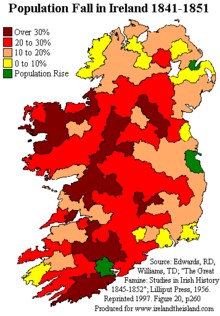
The map above shows the immense decrease in population in Ireland during the Irish potato famine that caused mass starvation
Questions for Passage C: Why did the Irish flee their homeland? What kind of work did the immigrants do in U.S.? Why did the Germans flee their homeland? How were the Irish and German immigrants treated?In your opinion, why do you think American citizens treated the immigrants so harshly? Explain.
(D) Ellis Island: Between 1880 and 1921 millions of new immigrants poured into the United States from Eastern and Southern Europe and from Mexico. They included Slavic people like Russians, Poles, and Ukrainians, Mediterranean groups like Italians, Sicilians, Greeks, Turks and Armenians, and religious groups like the Eastern European Jews. Most of these new immigrants arrived by boat in New York City through Ellis Island. They were poor people who traveled in “steerage,” along with their luggage in the hold of large steamships. Most of the new arrivals from Europe settled in Eastern coast and midwestern cities where they lived in overcrowded slums and unhealthy and unsafe tenement housing. Many did dangerous work in mines, mills, and factories. In New York City, immigrants dug the subway tunnels and water aqueducts, built the skyscrapers and bridges, and developed the garment industry. Conditions were so difficult that almost 50% of the Italians and Sicilians and over 30% of the Slavs who came to the United States eventually returned home. Many immigrants were union leaders and political activists who tried to improve conditions for poor people and workers. Mother Jones and Elizabeth Gurley Flynn were Irish. Joe Hill was Swedish. Sacco and Vanzetti were Italian. Sam Gompers, Sidney Hillman, and David Dubinsky were Jews. By 1919, anti-immigrant sentiment was growing in the United States again. Southern and Eastern European immigrants were branded as radicals and undesirables who could never become truly American. In 1921 and 1924 quota laws were passed to effectively stop immigration from these areas. Source:https://people.hofstra.edu/alan_j_singer/294%20Course%20Pack/6.%20Immigration/115.pdf
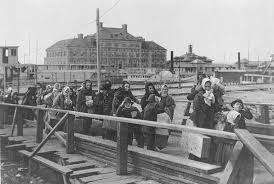
The picture above is showing immigrants arriving to Ellis Island
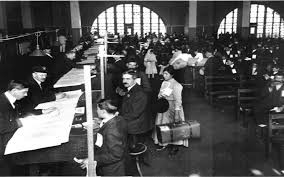
The picture above is showing immigrants being processed.
Questions for Passage D:
Where did the millions of new immigrants come from? How and where did they arrive to the United States? What kind of jobs did the immigrants have in New York City? In your opinion, why do you think those jobs were given to the immigrants?In your opinion, why do you think anti-immigrant sentiment was growing in the United States?
(E) Directions: Examine the
map below and answer the “Geography Skillbuilder – Interpreting Maps” questions
in your SS notebooks.
Aim:
How did the Immigration Act of 1924 (Johnson-Reed Act) affect immigration into the United States? How did it affect immigration into New York
state?
Do
Now: Read the historical background and answer the guiding
questions in your notebooks.
Historical
Background: “The Immigration Act of 1924 made
the principle of national origin quotas the permanent basis for U.S.
immigration policy. The Immigration Act of 1924, also known as the Johnson-Reed
Act, restricted the number of immigrants from a given country to 2% of the number
of residents from that same country living in the United States. The percentage
quotas were strongly biased towards to the “Old Immigrants” from
North-Western Europe as opposed to the “New Immigrants” from
South-Eastern Europe. The Immigration Act of 1924 shut the ‘Golden Door’ to
America and 87% of immigration permits (visas) went to immigrants from Britain,
Ireland, Germany, and Scandinavia. The law completely excluded immigrants from
Asia. Calvin Coolidge was the 30th American President who served in office from
August 2, 1923 to March 4, 1929. One of the important events during his
presidency was the Immigration Act of 1924.”
Directions:
With your shoulder partners, read and examine the following boxes about the
legislation’s causes and effects. Discuss the importance of the act and how it
impacted immigration from foreign lands into the United States. Then, write a
brief paragraph about the concept of justice in regards to both of the parties
involved: Was the act fair to American citizens? Was the act fair to
immigrants? Was the United States justified in their decision to pass this act
limiting and restricting immigration from certain lands? Explain your thoughts
to the aforementioned questions by using supporting evidence from the
surrounding boxes.
Questions:
What was the Immigration Act of
1924?
Why was the Immigration Act of 1924
passed?
What was an important effect of the
legislation?
In your opinion, do you think
President Calvin Coolidge’s support for this legislation helped or hurt the United
States? Explain your opinion with evidence from the passage.
Reasons
Why the Immigration Act of 1924 Was Passed:
Immigration levels between 1900-1920
had soared, reaching over 14 million new immigrants into America
The Eugenics
Movement, the pseudo-science supported
by highly prominent and influential people, fueled anti-immigrant and
racist beliefs in America
The 1919 recession and high
unemployment had led to strikes, violence and riots that prompted the Red Scare in
America
Nativism and xenophobia
in America led to a wave of anti-immigration hysteria that swept the country –
the government became under enormous pressure to restrict immigration
Why
was the Immigration Act of 1924 important?
→ Consolidates US
laws Restricting Immigration
The Immigration Act of
1924 consolidated the principles of the following acts and made them permanent
features of US law to restrict Immigration:
Assignment:
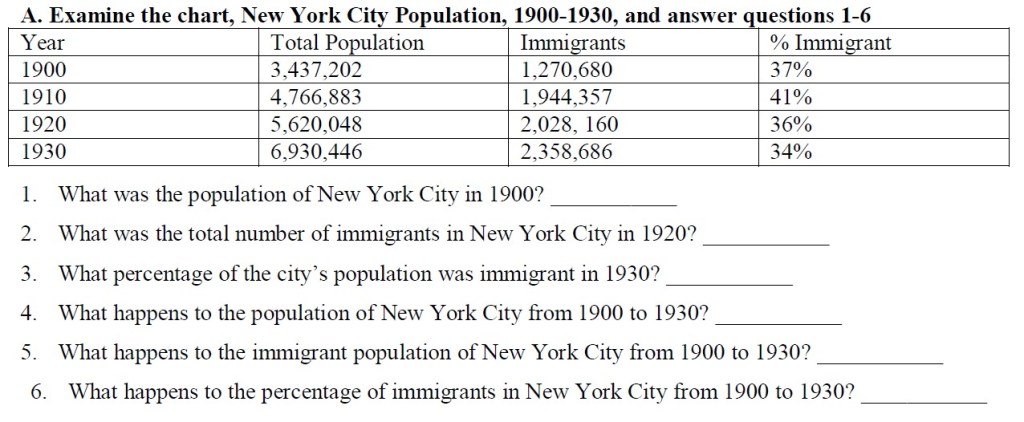
Based upon the data shown in the table above, describe what happened to the New
York City population from 1900 to 1930. Make sure to describe the trends before
the Immigration Act of 1924 was passed and what happened to the demographics in
New York after it passed. Explain in about 150 words what was happening using
data to support your claims. Record your response in your social studies
notebook.
Directions:
Read the passage below and examine the data table to the right with your
partners. Then, answer the guiding questions in your social studies notebooks.
Who
Was Shut Out? Immigration Quotas, 1925-1927
In response to growing public opinion against the flow of
immigrants from Southern and Eastern Europe in the years following World War I,
Congress passed first the Quota Act of 1921 then the even more restrictive
Immigration Act of 1924 (the Johnson-Reed Act). Initially, the 1924 law imposed
a total quota on immigration of 165,000—less than 20 percent of the pre-World
War I average. It based ceilings on the number of immigrants from any
particular nation on the percentage of each nationality recorded in the 1890
census—a blatant effort to limit immigration from Southern and Eastern Europe,
which mostly occurred after that date. In the first decade of the 20th century,
an average of 200,000 Italians had entered the United States each year. With the
1924 Act, the annual quota for Italians was set at less than 4,000. This table
shows the annual immigration quotas under the 1924 Immigration Act. Source: http://historymatters.gmu.edu/d/5078
Aim:
How did the Immigration and Nationality Act of 1965 (Hart-Celler Act) affect immigration into
the United States?
Do
Now: Read the following passages and answer the guiding
questions in your social studies notebook.
Passage A: The 1965 Immigration and Nationality
Act, for the first time in American history, accepted immigrants of all
nationalities on a roughly equal basis. The law eliminated the use of
national-origin quotas, under which the overwhelming majority of immigrant
visas were set aside for people coming from northern and western Europe.
Passage B: The pattern of U.S. immigration changed
dramatically. The share of the U.S. population born outside the country tripled
and became far more diverse. Seven out of every eight immigrants in 1960 were
from Europe; by 2010, nine out of ten were coming from other parts of the
world. The 1965 Immigration Act was largely responsible for that shift. No law
passed in the 20th century altered the country’s demographic character quite so
thoroughly.
Questions:
According to Passage A, What was the main
goal of the new legislation in 1965?
According to Passage B, What was the ratio
of immigrants from Europe in the 1960s?
In
your opinion, what are the major differences between the Immigration Act of
1924 we studied earlier and this piece of immigration legislation?
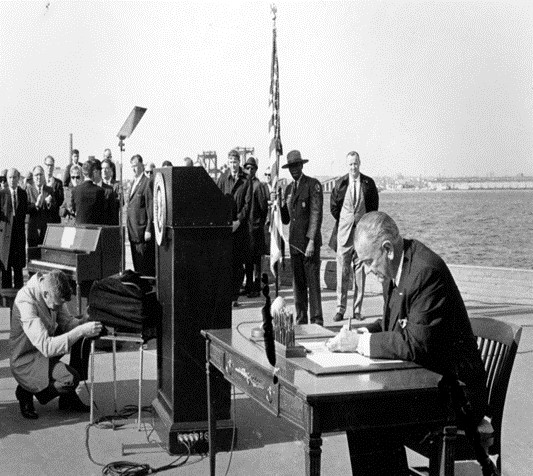
President Lyndon B. Johnson sits at his desk on Liberty
Island in New York Harbor as he signs a new immigration bill, October 1965.
Directions:
Examine the following sources with your groups and answer the guiding questions
in your social studies notebooks.
Questions: How many immigrants (in millions) consisted of the U.S. population in 1960?Why did immigration into the U.S. increase from 1970 to 1990?In your opinion, why do you think the Census Bureau projects a steady increase of immigrants until the year 2060?
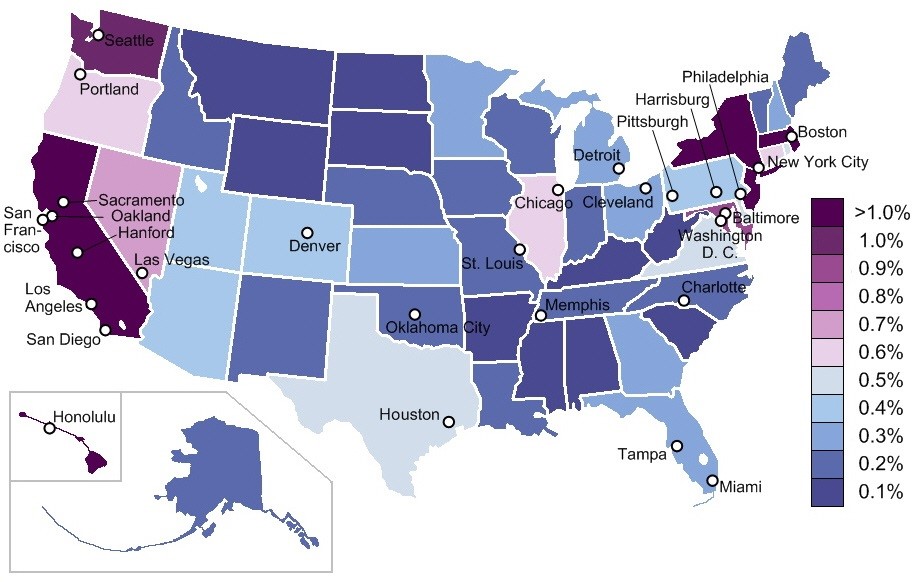
Percentage of Chinese
population in the United States, 2000:
Questions: According to the map, Which American states have the greatest Chinese populations? Which have the smallest Chinese populations?Which major American cities are well-renowned for their Chinese populations? How do you know? [Hint: think of America’s many “Chinatowns”]. In your opinion, What do you think this map will look like in the next fifty years? Explain your thoughts.
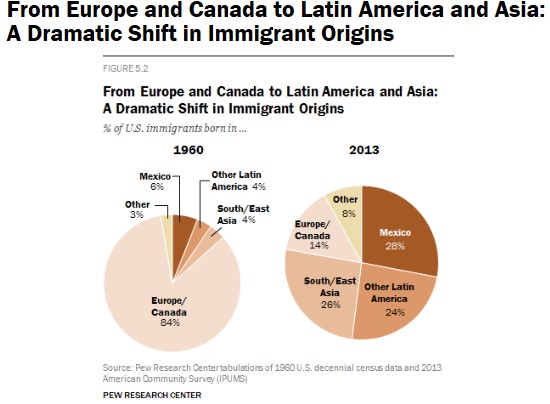
U.S. Foreign-Born Population Trends: Modern
Immigration Wave Brings 59 Million to U.S., Driving Population Growth and
Change Through 2065 – SHIFT IN ORIGINS
In 1960, 8.2 million immigrants from Europe
and Canada were living in the U.S. By 2013, that number had fallen to 5.9
million. Over the same period, the number of immigrants who were born in South
or East Asia increased almost thirtyfold, from about 400,000 in 1960 to 10.7
million in 2013. Immigrants from Mexico are not far behind, with about 20 times
as many Mexican immigrants in 2013 (11.6 million) as there were in 1960
(600,000).
Questions: According to the pie-graph, Where in the world were immigrants predominantly coming from in 1960? Percentage? What are the four major regions where immigrants came from in the year 2013? Percentages? In your opinion, what do you think this pie-graph will look like in the next fifty years? Explain your thoughts
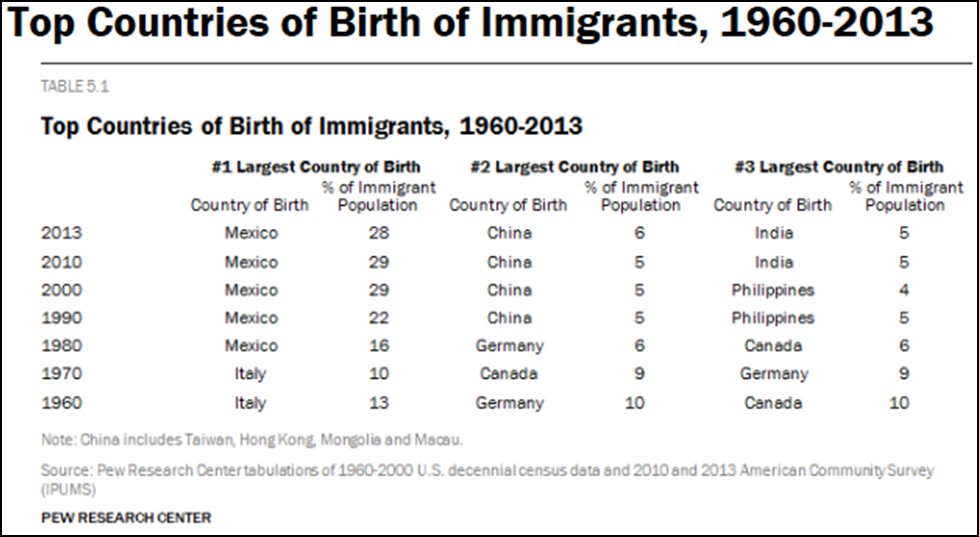
U.S. Foreign-Born Population Trends: Modern
Immigration Wave Brings 59 Million to U.S., Driving Population Growth and
Change Through 2065 – TOP COUNTRIES OF BIRTH
Looking at the top countries of origin among
immigrants in the U.S. by state, there is a shift from 1960 to 2013. In 1960,
while Mexico was the biggest country of origin in the border states
(California, Arizona, New Mexico and Texas), Canada and European countries such
as Italy, Germany and the United Kingdom dominated the rest of the country. In
2013, Mexico was the top country of origin in 33 states, encompassing most of
the West, South and Midwest. Immigrants in the remaining states have diverse
origins, including the Caribbean, Central America, Canada, South and East Asia
and Africa.
Questions:
According to the data table above, from rank #1 to rank #3, Which countries were the top birthplaces of immigrants in:
1960?
1990?
2013?
What type of United States legislation do you think was responsible for the change in birthplace origins of immigrants into the United States? Explain why.
In your opinion, Which country/countries do you think will be the most popular place immigrants will come from in 2050? Explain your thoughts.
United States history is usually taught in fifth grade. One of the more difficult topics to teach with sensitivity and critically is about the enslavement of African Americans in British North America and the United States. Elementary school teachers that I work with often have only a superficial knowledge of history at best, particularly topics like slavery, which means that if they decide to teach about it they are drawn to packaged lessons. Many are afraid to even touch the topic because of news stories about teachers challenged by parents and administrators, and even removed, because of inappropriate lessons.
In response, I developed a series of full class and group
based lessons. While I think it is important to help students understand the
horror and injustice of enslavement, they also need to learn how people, both
Black and white, risked their lives in the struggle to end it. A focus on
abolitionists also addresses other key social studies goals including
understanding what it means to be an active citizen in a democratic society and
writing more women into the history curriculum.
I use a close reading and textual analysis of three songs
from slavery days, “All the Pretty Little Horses,” “Go Down Moses,” and “Follow
the Drinking Gourd”, to introduce three major themes. “All the Pretty Little
Horses”is the story of a mother
separated from her child and is about the sorry and injustice of being
enslaved. “Go Down Moses” is a religious allegory, nominally about the
enslavement of Israelites in Egypt, but really about the desire of enslaved
Africans for freedom. “Follow the Drinking Gourd” tells the story of the
Underground Railroad as a pathway to freedom. Versions of the songs are
available on Youtube. I recommend Odetta singing “All the Pretty Little Horses,”
Paul Robeson singing “Go Down Moses,” and Richie Havens’ version of “Follow the
Drinking Gourd.”
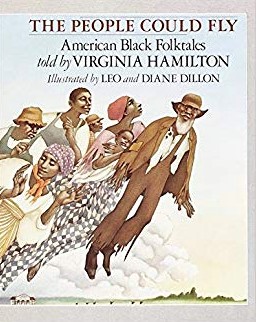
Virginia Hamilton’s story “The People Could Fly” lends itself
to reenactment as a play. It introduces slavery as an oppressive work system,
explores the horrors of enslavement, and shows the resistance to bondage. Based
on a traditional folktale, it ends with enslaved Africans on a cotton
plantation in the South rediscovering the magic of flight to escape enslavement
and return to Africa. I have performed this play successfully with students in
grades 5 to 8. Some classes have opened and closed with performances of African
dance.
The package “Abolitionists who
fought to end slavery” opens with a full class lesson on abolitionists. It
includes an early photograph that records
an anti-slavery meeting in August 1850 in Cazenovia, New York. The meeting was
called to protest against a proposed new federal Fugitive Slave law.
Participants in the meeting included Frederick Douglass.The lesson
includes a map of Underground Railroad routes through the New Jersey and New
York. It concludes with instructions for the “Abolitionist
Project.” Each team studies about one of ten leading abolitionists who fought
against slavery. They produce a PowerPoint with between five and ten slides
about their abolitionist’s life and achievements; create a tee-shirt, poster,
or three-dimensional display featuring the life of their abolitionist; and
write a poem, letter, skit, rap, or song about their abolitionist. The team’s
PowerPoint and creative activities are presented to the class.
Traditional African American Songs
from the Era of Slavery
A) All the Pretty Little Horses – The key to understanding this lullaby
is that there are two babies.
Hush-a-bye, don’t you cry, go to
sleep my little baby,
When you wake, you shall have, all
the pretty little horses,
Blacks and bays, dapples and grays,
all the pretty little horses.
Way down yonder, in the meadow, lies
my poor little lambie,
With bees and butterflies peckin’ out
its eyes,
The poor little things crying Mammy.
Questions
Who
are the two babies in this lullaby? Which baby is the woman singing to?
Why
do you think the woman was assigned to care for this baby?
What
does this song tell us about the experience of enslaved Africans?
B) Go Down, Moses – This song is an African American
version of Exodus from the Old Testament.
When Israel was in Egypt land, Let my
people go.
Oppressed so hard they could not
stand, Let my people go.
Chorus- Go down, Moses, Way down in
Egypt land. Tell old Pharaoh to let my people go.
“Thus spoke the Lord,” bold Moses
said, Let my people go.
“If not, I’ll smite your first-born
dead.” Let my people go.
Chorus- Go down, Moses, Way down in
Egypt land. Tell old Pharaoh to let my people go.
Old Pharaoh said he’d go across, Let
my people go.
But Pharaoh and his host were lost,
Let my people go.
Chorus- Go down, Moses, Way down in
Egypt land. Tell old Pharaoh to let my people go.
No more shall they in bondage toil,
Let my people go.
They shall go forth with Egypt’s
spoil, Let my people go.
Chorus- Go down, Moses, Way down in
Egypt land. Tell old Pharaoh to let my people go.
Questions
What
does Moses say to Pharaoh?
Why
do you think enslaved African Americans sang a song about ancient Israelites?
What
does this song tell us about the experience of enslaved Africans?
C) Follow the Drinking Gourd– This song is supposed to contain an
oral map of the Underground Railroad. The “drinking gourd” is the star
constellation known as the Big Dipper.
When the sun comes up and the first
quail calls, follow the drinking gourd,
For the old man is awaiting for to
carry you to freedom, if you follow the drinking gourd.
Chorus- Follow the drinking gourd,
follow the drinking gourd,
For the old man is
awaiting for to carry you to freedom, if you follow the drinking gourd.
The river bank will make a mighty
good road, the dead trees will show you the way,
Left foot, peg foot, travelin’ on,
follow the drinking gourd.
Chorus- Follow the drinking gourd,
follow the drinking gourd,
For the old man is
awaiting for to carry you to freedom, if you follow the drinking gourd.
The river ends between two hills,
follow the drinking gourd,
There’s another river on the other
side, follow the drinking gourd.
Chorus- Follow the drinking gourd,
follow the drinking gourd,
For the old man is
awaiting for to carry you to freedom, if you follow the drinking gourd.
Questions
Why
does the song tell passengers on the Underground Railroad to follow the
“drinking gourd”?
Why
would runaway slaves prefer an oral map to a written map?
What
does this song tell us about the experience of enslaved Africans?
__________________________________________
The People Could Fly
– A Play
Based
on a story from the book, The People
Could Fly, American Black Folktales byVirginia Hamilton (New York: Random House, 1993)
Background: Toby and Sarah stand in the middle
bending over to pick cotton. The overseer and master loom in the background,
either as giant puppets or as large images on a screen (scanned from the book).
A leather belt imitates the sound of a whip. The play illustrates the
oppression of slavery and the desire of enslaved Africans for freedom. The play
follows the original story very closely.
Cast: 12 Narrators, Sarah, Toby,
Overseer, Master
Materials: Belt for cracking like a whip, baby
doll for Sarah, two giant puppets (water jugs attached to a broom stick, tape
on a wire hanger and provide a long sleeve shirt)
Narrator 1: They say the people could fly. Say
that along ago in Africa, some of the people knew magic. And they would walk up
on the air like climbing up on a gate. And they flew like blackbirds over the
fields. Black, shiny wings flapping against the blue up there. Then, many of
the people were captured for Slavery. The ones that could fly shed their wings.
They couldn’t take their wings across the water on the slave ships. Too
crowded, don’t you know. The folks were full of misery, then. Got sick with the
up and down of the sea. So they forgot about flying when they could no longer
breathe the sweet scent of Africa.
Narrator 2: Say the people who could fly kept
their power, although they shed their wings. They kept their secret magic in
the land of slavery. They looked the same as the other people from Africa who
had been coming over, who had dark skin. Say you couldn’t tell anymore one who
could fly from one who couldn’t. One such who could was an old man, call him
Toby. And standing tall, yet afraid, was a young woman who once had wings. Call
her Sarah. Now Sarah carried a babe tied to her back. She trembled to be so
hard worked and scorned. The slaves labored in the fields from sunup to
sundown. The owner of the slaves calling himself their Master. Say he was a
hard lump of clay. A hard, glinty coal. A hard rock pile, wouldn’t be moved.
Narrator 3: His Overseer on horseback pointed
out the slaves who were slowing down. So the one called Driver cracked his whip
over the slow ones to make them move faster. That whip was a slice-open cut of
pain. So they did move faster. Had to. Sarah hoed and chopped the row as the
babe on her back slept. Say the child grew hungry. That babe started up bawling
too loud. Sarah couldn’t stop to feed it. Couldn’t stop to soothe and quiet it
down. She let it cry. She didn’t want to. She had no heart to croon to it.
Overseer:
“Keep that thing quiet.”
Narrator 4: The Overseer, he pointed his
finger at the babe. The woman scrunched low. The Driver cracked his whip across
the babe anyhow. The babe hollered like any hurt child, and the woman feel to
the earth. The old man that was there, Toby, came and helped her to her feet.
Sarah: “I must go soon.”
Toby:
“Soon.”
Narrator 5:
Sarah couldn’t stand up straight any longer. She was too weak. The sun
burned her face. The babe cried and cried.
Sarah: “Pity me, oh, pity me.” say it
sounded like. Sarah was so sad and starving, she sat down in the row.
Overseer: “Get up, you black cow.” ”
Narrator 5: The Overseer pointed his hand, and
the Driver’s whip snarled around Sarah’s legs. Her sack dress tore into rags.
Her legs bled onto the earth. She couldn’t get up. Toby was there where there
was no one to help her and the babe.
Sarah:
“Now, before it’s too late. Now, Father!”
Toby: “Yes, Daughter, the time is come.
Go, as you know how to go!” (He raised his arms, holding them out to her. ) “Kum … yali, kum buba tambe. Kum
… yali, kum buba tambe.”
Narrator 6: The young woman lifted one foot on
the air. Then the other. She flew clumsily at first, with the child now held
tightly in her arms. Then she felt the magic, the African mystery. Say she rose
just as free as a bird. As light as a feather. The Overseer rode after her,
hollering. Sarah flew over the fences. She flew over the woods. Tall trees
could not snag her. Nor could the Overseer. She flew like an eagle now, until
she was gone from sight. No one dared speak about it. Couldn’t believe it. But
it was, because they that was there saw that it was.
Narrator 7: Say the next day was dead hot in
the fields. A young man slave fell from the heat. The Driver come and whipped
him. Toby come over and spoke words to the fallen one. The words of ancient
Africa once heard are never remembered completely. The young man forgot them as
soon as he heard them. They went way inside him. He got up and rolled over on
the air. He rode it awhile. And he flew away. Another and another fell from the
heat. Toby was there. He cried out to the fallen and reached his arms out to
them.
Toby: “Kum kunka yali, kum … tambe!”
Narrator 8: And they too rose on the air. They
rode the hot breezes. The ones flying were black and shining sticks, wheeling
above the head of the Overseer. They crossed the rows, the fields, the fences,
the streams, and were away.
Overseer: “Seize the old man! I heard him
say the magic words. Seize him!”
Narrator 9: The one calling himself Master
come running. The Driver got his whip ready to curl around old Toby and tie him
up. The slaveowner took his hip gun from its place. He meant to kill old, black
Toby. But Toby just laughed. Say he threw back his head.
Toby: “Hee, hee! Don’t you know who I
am? Don’t you know some of us in this field? We are ones who fly!”
Narrator 10: And he sighed the ancient words
that were a dark promise. He said them all around to the others in the field
under the whip, “… buba yali … buba
tambe …” There was a great outcrying. The bent backs straightened up. Old
and young who were called slaves and could fly joined hands. Say like they
would ring-sing. But they didn’t shuffle in a circle. They didn’t sing. They
rose on the air. They flew in a flock that was black against the heavenly blue.
Black crows or black shadows. It didn’t matter, they went so high. Way above
the plantation, way over the slavery land. Say they flew away to Free-dom.
Narrator 11:And the old man,
old Toby, flew behind them, taking care of them. He wasn’t crying. He wasn’t
laughing. He was the seer. His gaze fell on the plantation where the slaves who
could not fly waited.
Class:
“Take us with you! Take us with you!”
Narrator 11:Their looks spoke
it but they were afraid to shout it. Toby couldn’t take them with him. Hadn’t
the time to teach them to fly. They must wait for a chance to run.
Toby: “Goodie-bye!”
Narrator 12:The old man called
Toby spoke to them, poor souls! And he was flying gone. So they say. The
Overseer told it. The one called Master said it was a lie, a trick of the
light. The Driver kept his mouth shut. The enslaved Africans who could not fly
told about the people who could fly to their children. When they were free.
When they sat close before the fire in the free land, they told it. They did so
love firelight and Free-dom, and
telling. They say that the children of the ones who could not fly told their
children. And now, me, I have told it to you.
Abolitionists
fought to end slavery in the United States. Some were Black and some were
white. Many were religious. Some were former slaves who had escaped from
bondage. Some believed the country could change peaceably. Some believed it
would not change without bloodshed. Some believed abolitionists should obey the
law. Some believed abolitionists should break the law. Some wanted slavery to
end at once. Some thought it could end over time. They all believed slavery in
the United States was wrong and must end.
A)
This early photograph records an anti-slavery meeting in August 1850 in
Cazenovia, New York. Abolitionists gathered to protest against a proposed new
federal Fugitive Slave Act. The act would
permit federal marshals to arrest and return to slavery freedom seekers who had
escaped to the North. It would also punish anyone accused to helping a fugitive
by providing them with food, a place to stay, or a job.
B)
Cazenovia was a small town in upstate New York near Auburn, Syracuse, and Utica
and just south of the Erie Canal. Participants in the convention included
Frederick Douglass, Gerrit Smith, about 50 fugitive slaves, and more than 2,000
other people.
C)
In the photograph, Frederick Douglass is the African American man seated by the
table. Behind him with his arm raised is Gerrit
Smith, a leading white abolitionist. On either side of Smith are Mary and Emily
Edmonson. They escaped from slavery in 1848 but were recaptured and sent to New
Orleans to be sold. The girls’ free-born father raised money to buy their
freedom. The Edmonson’s attended college in the North and became active
abolitionists.
D) Frederick
Douglass, who was a former fugitive slave, presided over the convention. The
convention closed with a “Letter
to the American Slaves” that offered advice and help to slaves planning to
rebel in the South and freedom-seekers who escaped to the North. In the letter
they wrote:
1.
“While such would dissuade [convince] you from all violence toward the
slaveholder, let it not be supposed that they regard it as guiltier than those
strifes [fights] which even good men are wont to justify. If the American
revolutionists had excuse for shedding but one drop of blood, then have the
American slaves excuse for making blood to flow.”
2.
“The Liberty Party, the Vigilance Committee of New York, individuals, and
companies [groups] of individuals in various parts of the country, are doing
all they can, and it is much, to afford you a safe and a cheap passage from
slavery to liberty.
3.
Brethren [brothers], our last word to you is to bid you be of good cheer and
not to despair of your deliverance. Do not abandon yourselves, as have many
thousands of American slaves, to the crime of suicide. Live! Live to escape
from slavery! Live to serve God! Live till He shall Himself call you into
eternity! Be prayerful — be brave — be hopeful. “Lift up your heads, for your
redemption draweth nigh.” [will be soon]
The Abolitionist Project
Instructions: Each team will study
one of the leading abolitionists who fought against slavery. Start with the
biography sheet for your abolitionist and conduct additional research online.
For your final project each team
will create:
PowerPoint with between five and ten
slides about your abolitionist’s life and achievements. Your team will present
this in class.
A tee-shirt, poster, or
three-dimensional display featuring the life of your abolitionist.
A poem, letter, skit, rap, or song
about your abolitionist.
Frederick Douglass: An Abolitionist
Who Helped End Slavery in the United States
Social Reformer, Abolitionist, Orator, Writer
1818 – Born enslaved in
Maryland
1838 – Escaped from
slavery
1841 – Met William
Lloyd Garrison and became an active abolitionist
1845 – Published first
edition of biography 1845 – Traveled to Europe to avoid re-enslavement
1847 – Returned to the
United States and began publication of the abolitionist North Star in
Rochester, NY
1848 – Attended the
Women’s Rights Convention in Seneca Falls, NY
1859 – Met with John
Brown to plan slave rebellion. Fled to Europe to escape prosecution after
Harpers Ferry.
1863 – Convinced
Lincoln to enlist Black troops in the Union Army
1872 – First African American nominated for
Vice President of the United States
1889 – Appointed U.S. representative
to Haiti
1895 – Died in Washington DC
Famous Speech: “What to the Slave is the
Fourth of July?”
Frederick
Douglass was asked to address the citizens of Rochester at their Fourth of July
celebration in 1852. This excerpt from his speech shows his great power as an
orator and the strength of his opposition to slavery.
What to the American slave is your Fourth of July? I answer,
a day that reveals to him more than all other days of the year, the gross
injustice and cruelty to which he is the constant victim. To him your
celebration is a sham; your boasted liberty an unholy license; your national
greatness, swelling vanity; your sounds of rejoicing are empty and heartless;
your denunciation of tyrants, brass-fronted impudence; your shouts of liberty
and equality, hollow mockery; your prayers and hymns, your sermons and
thanksgivings, with all your religious parade and solemnity, are to him mere
bombast, fraud, deception, impiety, and hypocrisy-a thin veil to cover up
crimes which would disgrace a nation of savages. There is not a nation of the
earth guilty of practices more shocking and bloody than are the people of these
United States at this very hour. Go where you may, search where you will, roam
through all the monarchies and despotisms of the Old World, travel through
South America, search out every abuse and when you have found the last, lay
your facts by the side of the every-day practices of this nation, and you will
say with me that, for revolting barbarity and shameless hypocrisy, America
reigns without a rival.
Henry Highland Garnet: An
Abolitionist Who Helped End Slavery in the United States
Abolitionist, Minister, Educator and Orator
1815 – Born enslaved in
Maryland
1824 – Escaped with his
family to New Jersey
1825 – Family settled
in New York where he attended the African Free School
1828 (?) –
Slavecatchers force his family to flee Brooklyn. Garnet harbored in Smithtown,
NY.
1830 – Suffered serious
leg injury (later amputated)
1834 – Helped found an
abolitionist society
1835 – Attended
interracial Noyes Academy in Connecticut that was burned down by rioters
1839 – Graduated from
Oneida Theological Institute and became a Presbyterian minister in Troy, NY
1843 – Called for slave
rebellion in speech at the National Negro Convention
1849 – Called free
Blacks to emigrate out of the U.S.
1852 – Moved to Jamaica
as a Christian Missionary
1863 – Enlisted Blacks
in the Union Army. Escaped from Draft Riots.
1865 – 1st African
American to preach in Capital building
1882 – Died Monrovia, Liberia
Famous Speech: “An Address to the Slaves of the
United States”
From
August 21-24, 1843, a National Negro Convention was held in Buffalo, New York.
Delegates included Frederick Douglass. Henry Highland Garnet delivered a very
militant speech calling on enslaved Africans to revolt.
It is in your power so to torment the God-cursed
slaveholders that they will be glad to let you go free. If the scale was
turned, and black men were the masters and white men the slaves, every
destructive agent and element would be employed to lay the oppressor low.
Danger and death would hang over their heads day and night. Yes, the tyrants
would meet with plagues more terrible than those of Pharaoh. But you are a
patient people. You act as though, you were made for the special use of these
devils. You act as though your daughters were born to pamper the lusts of your
masters and overseers.
Let your motto be resistance! Resistance! RESISTANCE! No
oppressed people have ever secured their liberty without resistance. What kind
of resistance you had better make, you must decide by the circumstances that
surround you, and according to the suggestion of expediency. Brethren, adieu!
Trust in the living God. Labor for the peace of the human race, and remember
that you are FOUR MILLIONS.
Gerrit Smith: An Abolitionist Who
Helped End Slavery in the United States
1846 – Gave land in the
Adirondacks to free Blacks as homesteads
1848- His home became
UGRR station
1848 – Liberty Party
Candidate for President
1850s – Financially
supported Frederick Douglass’ newspapers
1852 – Elected to
Congress
1859 – Funded John
Brown raid on Harpers Ferry
1865 – Advocated for mild
treatment of the South after the Civil War
1874 – Died in New York City
Famous Speech: Statement on Slavery
in Congress, April 6, 1854
Slavery is
the baldest and biggest lie on earth. In reducing man to chattel, it denies,
that God is God – for, in His image, made He man – the black man and the red
man, as well as the white man. Distorted as our minds by prejudice, and
shrivelled as are our souls by the spirit of caste, this essential equality of
the varieties of the human family may not be apparent to us all.
The
Constitution, the only law of the territories, is not in favor of slavery, and
that slavery cannot be set up under it . . . I deny that there can be
Constitutional slavery in any of the States of the American Union – future
States, or present States – new or old. I hold, that the Constitution, not only
authorizes no slavery, but permits no slavery; not only creates no slavery in
any part of the land, but abolishes slavery in every part o the land. In other
words, I hold, that there is no law for American slavery.
John Brown: An
Abolitionist Who Helped End Slavery in the United States
John Brown
1800 – Born in
Torrington, Connecticut
1837 – Brown commits
his life to fighting to end slavery.
1849 – John Brown and
his family moved to the Black community of North Elba in the Adirondack region
of New York.
1855 – Brown and five
of his sons organize a band of anti-slavery guerilla fighters in the Kansas
territory.
1859 – John Brown and
21 other men attacked the federal arsenal at Harpers Ferry. Brown was wounded,
captured and convicted of treason. He was hanged on December 2, 1859.
John
Brown is one of the most controversial [debated] figures in United States
history. He was a conductor on the Underground Railroad and an anti-slavery
guerilla fighter in Kansas. In 1859, Brown led an armed attack on a federal
armory at Harpers Ferry, Virginia. His goal was to start a slave rebellion in
the United States. Brown and his followers were defeated, tried and executed.
While the rebellion failed, it led to the Civil War and the end of slavery in
the United States.
Famous Speech: John Brown to the Virginia Court on November
2, 1859
In
the first place, I deny everything but what I have all along admitted, — the
design on my part to free slaves . . . Had I so interfered in behalf of the
rich, the powerful, the intelligent, the so-called great, or in behalf of any
of their friends — either father, mother, sister, wife, or children, or any of
that class — and suffered and sacrificed what I have in this interference, it
would have been all right; and every man in this court would have deemed it an
act worthy of reward rather than punishment.
The
court acknowledges, as I suppose, the validity of the law of God . . . I believe
that to have interfered as I have done — as I have always freely admitted I
have done — in behalf of His despised poor, was not wrong, but right. Now if
it is deemed necessary that I should forfeit my life for the furtherance
of the ends of justice, and mingle [mix] my blood further with the blood of my children and with the blood of millions in this slave country whose rights are disregarded by wicked, cruel, and unjust enactments. — I submit; so let it be done!
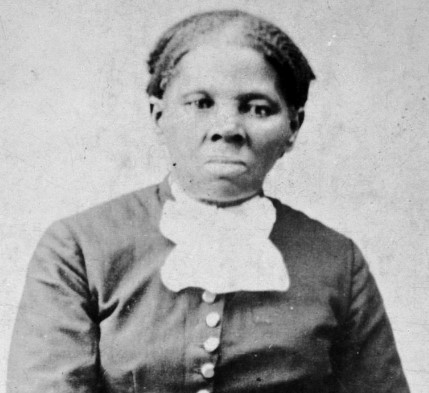
Harriet Tubman: An
Abolitionist Who Helped End Slavery in the United States
Abolitionist, Political Activist, Nurse, Spy
1822 – Born enslaved in
Maryland. Birth name Araminta “Minty” Ross
1834 (?) – Suffered
severe head injury when she helped another slave who was being beaten
1849 – Escaped
enslavement
1850s – Conductor on
the UGRR
1858 – Helped John
Brown plot Harpers Ferry
1859 – Establishes farm
Auburn, NY
1861 – Served as a cook
and nurse for Union Army
1863 – Became spy for
the Union Army
1868 – Secured Civil
War pension
1896 – Established an
old age home
1913 – Died in Auburn, NY
Excerpt from her
Biography by Sarah Bradford
Master
Lincoln, he’s a great man, and I am a poor negro [African American]; but the
negro can tell master Lincoln how to save the money and the young men. He can
do it by setting the negro free. Suppose that was an awful big snake down
there, on the floor. He bite you. Folks all scared, because you die. You send
for a doctor to cut the bite; but the snake, he rolled up there, and while the
doctor doing it, he bite you again. The doctor dug out that bite; but while the
doctor doing it, the snake, he spring up and bite you again; so he keep doing
it, till you kill him. That’s what master Lincoln ought to know.
Frederick Douglass
Praises Harriet Tubman
The
difference between us is very marked. Most that I have done and suffered in the
service of our cause has been in public, and I have received much encouragement
at every step of the way. You, on the other hand, have labored in a private
way. I have wrought in the day—you in the night. … The midnight sky and the
silent stars have been the witnesses of your devotion to freedom and of your
heroism. Excepting John Brown—of sacred memory—I know of no one who has
willingly encountered more perils and hardships to serve our enslaved people
than you have.
Sojourner Truth: An
Abolitionist Who Helped End Slavery in the United States
Abolitionist and Women’s Rights Activist
1797 – Born enslaved in
Ulster County, NY. Her birth name was Isabella (Belle) Baumfree. She spoke Dutch before she spoke English.
1806
– Isabella was sold for the first time at age 9.
1826
– She escaped from slavery with her infant daughter.
1827
– Legally freed by New York Emancipation Act.
1828
– Sued in court to free her son who had be sold illegally to an owner in
Alabama.
1843
– Isabella converted to Methodism, changed her name to Sojourner Truth, and
became a travelling preacher and abolitionist.
1850
– William Lloyd Garrison published her memoir.
1851
– Sojourner Truth delivered her “Ain’t I a Woman” speech at an Ohio Women’s
Rights Convention.
1850s
– Spoke at many anti-slavery and women’s rights meetings
1860s – Recruited Black
soldiers for the Union Army.
1870s – Campaigned for
equal rights for former slaves.
1883 – Died in Battle Creek,
Michigan
Famous Speech: “Ain’t
I a Woman” (edited)
In May 1851, Sojourner Truth
attended the Ohio Women’s Rights Convention in Akron, Ohio. She delivered a
speech where she demanded full and equal human rights for women and enslaved
Africans. The text of the speech was written down and later published by
Frances Gage, who organized the convention. In the published version of the
speech Sojourner Truth referred to herself using a word that is not acceptable
to use. This is an edited version of the speech.
Well,
children, where there is so much racket there must be something out of
kilter. I think that between the Negroes
[Blacks] of the South and the women at the North, all talking about rights, the
white men will be in a fix pretty soon.
But what’s all this here talking about?
Then
they talk about this thing in the head; what do they call it? [Intellect,
someone whispers.] That’s it, honey.
What’s that got to do with women’s rights or Negro’s rights? If my cup won’t
hold but a pint and yours holds a quart, wouldn’t you be mean not to let me
have my little half-measure full?
Then
that little man in black there, he says women can’t have as much rights as men,
because Christ wasn’t a woman! Where did
your Christ come from? From God and a woman! Man had nothing to do with Him.
If
the first woman God ever made was strong enough to turn the world upside down
all alone, these women together . . . ought to be able to turn it back, and get
it right side up again! And now they is
asking to do it, the men better let them.
David Ruggles: An Abolitionist Who
Helped End Slavery in the United States
David Ruggles
1810
– Born in Lyme, Connecticut to free black parents
1815
– Attended Sabbath School for poor children in Norwich, Connecticut.
1826
– Moved to New York City and operated a grocery store.
1830 – Opened the first African-American bookstore.
1835
– Organized the New York Vigilance
Committee.
1835
– A white anti-abolitionist mob assaulted Ruggles and burned his bookstore.
1838- Helped
Frederick Douglass during his escape from slavery.
1842
– Became very ill and almost completely blind
1849
– Died in Northampton, Massachusetts
A Letter from David
Ruggles
David Ruggles wrote this
letter to the editor of a New York newspaper, Zion’s Watchman, It was reprinted
in The Liberator by William Lloyd Garrison in October 1837. The New York Vigilance Committee helped enslaved Africans to escape and free
Blacks arrested and accused of being runaway slaves.
I
suppose, not one in a thousand of your readers can be aware of the extent to
which slavery prevails even in the so-called free state of New York. Within the
last four weeks, I have seen not less than eleven different persons who have
recently been brought from the south, and who are now held as slaves by their
masters in this state; as you know the laws of this state allow any slaveholder
to do this, nine months at a time; so that when the slave has been here nine
months, the master has only to take him out of the state, and then return with
him immediately, and have him registered again, and so he may hold on to the
slave as long as he lives. Some of the slaves whom I have recently seen are
employed by their masters, some are loaned, and others hired out; and each of
the holders of these slaves whom I have seen are professors of religion!!
Jermain Loguen: An
Abolitionist Who Helped End Slavery in the United States
Abolitionist, UGRR Station Master, Bishop
1814 – Born enslaved in
Tennessee. His biological father owned Jermain and his mother.
1834 – Escaped to
Canada on the UGRR
1837 – Studied at the
Oneida Institute
1840s – An AME Zion
minister, he established schools for Black children in Syracuse and Utica. His
home in Syracuse was UGRR station.
1850 – Speech denounced
Fugitive Slave Law
1851 – Breaks the
Fugitive Slave Law helping a freedom seeker escape from prison to Canada
1859 – Published his
autobiography
1868 – Appointed Bishop
in the AME Zion Church
1872 – Died in Syracuse, NY
Famous Speech: Reverend
Jermain Loguen Denounces the Fugitive Slave Law (1850)
I
was a slave; I knew the dangers I was exposed to. I had made up my mind as to
the course I was to take. On that score I needed no counsel, nor did the
colored citizens generally. They had taken their stand – they would not be
taken back to slavery. If to shoot down their assailants should forfeit their
lives, such result was the least of the evil. They will have their liberties or
die in their defense.
I
don’t respect this law – I don’t fear it – I won’t obey it! It outlaws me, and
I outlaw it, and the men who attempt to enforce it on me. I place the
governmental officials on the ground that they place me. I will not live a
slave, and if force is employed to re-enslave me, I shall make preparations to
meet the crisis as becomes a man. If you will stand by me- and believe you will
do it, for your freedom and honor are involved as well as mine- it requires no
microscope to see that- I say if you will stand with us in resistance to this
measure, you will be the saviours (sic)
of your country. Your decision tonight in favor of resistance will give vent to
the spirit of liberty, and will break the bands of party, and shout for joy all
over the North. Your example only is needed to be the type of public action in
Auburn, and Rochester, and Utica, and Buffalo, and all the West, and eventually
in the Atlantic cities. Heaven knows that this act of noble daring will break
out somewhere- and may God grant that Syracuse be the honored spot, whence it
shall send an earthquake voice through the land!
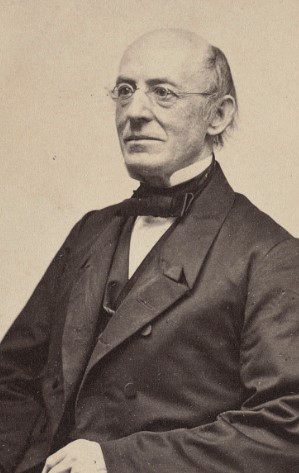
William Lloyd
Garrison: An Abolitionist Who Helped End Slavery in the United States
Abolitionist, Journalist, Women’s Rights
1805 – Born in
Massachusetts
1828 – Active in
Temperance campaigns
1831 – Started
publication of the anti-slavery newspaper The
Liberator
1832- Organized the New
England Anti-Slavery Society
1835 – Nearly lynched
after speaking at an anti-slavery rally in Boston.
1840 – Demanded that
women be allowed to participate in all abolitionist activities.
1841 – Starts working
with Frederick Douglass after meeting at an anti-slavery rally.
1850 – Garrison and
Douglass disagree whether slavery could be defeated through electoral means.
1854 – Garrison burned
a copy of the Constitution calling it a pro-slavery document.
1870s – Garrison
campaigns for full and equal rights for Blacks and women.
1879 – Died in New York City
Famous Essay: 1st Editorial
in The Liberator
William Lloyd
Garrison was a radical abolitionist who demanded an immediate end to slavery.
This excerpt is from the initial editorial in The Liberator. It was published
January 1, 1831.
I
determined, at every hazard, to lift up the standard of emancipation in the
eyes of the nation . . . That standard is now unfurled; and long may it float .
. . till every chain be broken, and every bondman set free! Let southern
oppressors tremble . . . let all the enemies of the persecuted blacks
tremble.
Assenting to the “self-evident truth” maintained in the American Declaration of Independence, “that all men are created equal, and endowed by their Creator with certain inalienable rights — among which are life, liberty and the pursuit of happiness,” I shall strenuously contend for the immediate enfranchisement of our slave population.
I am
aware that many object to the severity of my language; but is there not cause
for severity? I will be as harsh as truth, and as uncompromising as justice. On
this subject, I do not wish to think, or speak, or write, with moderation. No!
No! Tell a man whose house is on fire to give a moderate alarm; tell him to
moderately rescue his wife from the hands of the ravisher; tell the mother to
gradually extricate her babe from the fire into which it has fallen; — but urge
me not to use moderation in a cause like the present. I am in earnest — I will
not equivocate — I will not excuse — I will not retreat a single inch — and
I will be heard.
Angelina
Grimké Weld: An Abolitionist Who Helped End
Slavery in the United States
Abolitionist, Feminist, Educator
1805 – Born in
Charleston, South Carolina. Her parents were major slaveholders.
1826 – Became a Sunday
school teacher in the Presbyterian church..
1829 – Spoke against
slavery at a church service and she was expelled from membership..
1835 – Joined the
Philadelphia Female Anti-Slavery Society.
1836 – A letter
published in The Liberator made her a
well-known abolitionist.
1837 – Helped organize
the Anti-Slavery Convention of American Women.
1838 – In Boston, she
became the 1st woman in the United States to speak before a state legislature.
Threatened by a mob when she spoke at a Philadelphia anti-slavery rally.
1838 – Married
abolitionist Theodore Weld and together they operated schools in New Jersey
1879 – Died at Hyde Park, Massachusetts
“Appeal to the Christian Women of the South”
Angelina
Grimké was a religious
Christian. Her religious beliefs convinced her to become an abolitionist. In
her 1836 letter published in The Liberator, she wrote that abolition was a
“cause worth dying for.” In her writing and speeches she appealed to other
Christians to join the anti-slavery campaign. In 1837, she published a pamphlet
that urged Southern white women, in the name of their Christian beliefs, to
help end slavery.
I
appeal to you, my friends, as mothers; Are you willing to enslave your children?
You start back with horror and indignation at such a question. But why, if
slavery is no wrong to those upon whom it is imposed? Why, if as has often been
said, slaves are happier than their masters, free from the cares and
perplexities of providing for themselves and their families? Why not place your
children in the way of being supported without your having the trouble to
provide for them, or they for themselves? Do you not perceive that as soon as
this golden rule of action is applied to yourselves that you involuntarily
shrink from the test; as soon as your actions are weighed in this balance of
the sanctuary that you are found wanting? Try yourselves by another of the
Divine precepts, “Thou shalt love thy neighbor as thyself.” Can we
love a man as we love ourselves if we do, and continue to do unto him, what we
would not wish any one to do to us?
A. Life was different at Columbia University in 1968. There was a war and a draft. There were ROTC drills on South Field, military and CIA recruiters on campus. The Civil Rights movement, led by the Black Panthers, captured students’ imaginations. Dr. King had just been killed and the cities were in flames. You couldn’t ignore all this.
B. On April 23, several hundred students gathered at the sundial on the Columbia campus to protest the Vietnam War because the university had a relationship with the Institute for Defense Analyses and supported other war related activities, such as ROTC drills on campus. The students were also outraged by the lack of sensitivities of black New Yorkers, as the University attempted to construct a gym that usurp a portion of Morningside Park and be accessible to neighboring Harlem residents mainly through an ignominious (embarrassing) back door.
C. By morning, African American students continued to occupy Hamilton, while other Columbia and Barnard students, mostly white, took over President Grayson Kirk’s office in Low Library. Soon student protesters took over three other buildings—Fayerweather, Mathematics, and Avery. The protesters were demonized as ill-tempered and self-righteous radicals who resorted to militant disruption when other means of protest were still available. On April 30th, the New York City police arrested more than 700 protesters.
Questions:
In Paragraph A, what couldn’t be ignored at Columbia University?
According to Paragraph B, what groups led the protest on April 23?
What happened to the students in Paragraph C?
How were the students described in Paragraph C?
In your opinion, Is this an accurate description of the events? Why?
In your opinion, did the students act appropriately? If not, what could they have done differently?
NY Times: 300 protesting Columbia Students Barricade Office of College Dean (April 24, 1968)
A. Three-hundred chanting students barricaded the Dean of Columbia College in his office yesterday to protest the construction of a gymnasium in Morningside Park and a defense oriented program participated in by Columbia University.
B. The students say that construction of the gymnasium would be “racist” because it would deprive Negroes in the area of recreational facilities. The charge against the defense program, the Institute for Defense Analysis, was that it supported the war effort in Vietnam.
C. The protest, organized by the leftist Students for a Democratic Society, had the support of other Columbia campus groups. Representatives of several Negro organizations unrelated to Columbia joined the protest.
D. The protesters marched throughout the campus, where Mr. Mark Rudd addressed the group at the sundial. “We’re going to have to take a hostage to make them let go of I.D.A and let go of the gym” he shouted.
Questions:
What was occurring in Paragraph A?
According to Paragraph B, why were the students protesting?
What does Mark Rudd suggest in Paragraph D?
In your opinion, how would Civil Rights organizations impact the protest?
NY Times Editorial: Hoodlumism at Columbia (April 25, 1968)
The destructive minority of students at Columbia University, along with their not so friendly allies among community militants, have offered a degrading spectacle of hoodlum tactics-the exaltation of irresponsibility over reason. Whatever causes these students to claim to be supporting have been defiled by their vandalism.
The student action, organized by the extremist forces of the Students for a Democratic Society, sabotages that search for a constructive course. By turning down the administration’s invitation to discuss their grievances and demands, the self-styled student leaders have shown their true purpose of disruption.
Massive student participation in the Presidential campaign has given a persuasive demonstration that young people can apply their political power in meaningful ways through legitimate and legal forms of expression. The students at Columbia and elsewhere, undermine academic freedom and the free society itself by resorting to such junta methods as wrecking the university President’s office and holding administrators and trustees as hostages.
Questions:
According to the editorial, what has vandalism done to the protest?
In Paragraph B, how does the editorial describe the Students for a Democratic Society?
In Paragraph C, how does the author characterize the student participation in the presidential campaign?
Do you agree or disagree with the editorial depiction of the student strike? Explain.
NY Times: Columbia Halting Work on its Gym (April 26, 1968)
Columbia University announced early this morning that it’s halting work on the gymnasium that had set off a student protest. It also said it was closing the university until Monday, and was postponing and police action on campus. Despite the announcement students remained in the buildings they had occupied.
Yesterday afternoon, Dr. Grayson Kirk, the university president, refused to grant demonstrating students their key demand- an amnesty covering all participants in the protest, which is primarily directed against the construction of a new gymnasium in Morningside Park.
Complicating efforts to end the campus dispute was a split between Negro students holding Hamilton Hall and white students led by the Students for a Democratic Society holding the other three buildings and conducting picketing.
Student leaders and university sources said that although the objectives of the two groups were largely similar, they had broken over tactics, with the Negroes advocating more militancy than the whites were prepared to accept.
Questions:
According to Paragraph B, what did Dr. Kirk refuse to grant?
What is complicating efforts to end the dispute based off the information in paragraph C?
In your opinion, why did Dr. Kirk not want to grant amnesty to the protesters?
How do you think the student groups were able to continue the protest for several days despite having different tactics?
Times Editorial: Citadel of Reason (April 29, 1968)
A. It was apparent from the start that the youthful junta which has substituted dictatorship by temper tantrum for undergraduate democracy neither cared about nor has received support from the majority of students. That isolated it from even the shadow of moral right to demand amnesty for its irresponsibility.
B. But Columbia’s slowness to do what it is now doing should not permit the rebels slogans to obscure the facts underlying the present test. The university administration offered to discuss all grievances with the dissidents before they staged their coup.
Questions:
What is the definition of “junta” in paragraph A?
What is the opinion of the author in paragraph A?
According to paragraph B, How did the university attempt to address the protesters?
In your opinion, is this excerpt biased? Provide evidence supporting your opinion.
NY Times: 1,000 Police Move onto Columbia Campus to Oust Students (April 30, 1968)
As the hour for the police assault approached, tension mounted sharply on the campus as groups of students held informal meetings. At 1:45am, when word reached Mathematics building that “a bust” or police raid, was imminent, student demonstrators began strengthening their barricades and girding themselves for the assault. The police commanders were said to be carrying written instructions from Police commissioner Howard R. Leary to use necessary force but to show restraint in their handling of the students. The police acted in response to a request from the administration of the university it was understood. Under normal procedure, the police would take no action on the campus, which is private property, unless formally authorized to do so by university officials.
Question: In your opinion, should police have been called to oust the student demonstrators? Explain.
Questions:
What is happening in the photo?
Based on the description above and the photo, would you have participated in the take-over if you were a student at Columbia?
How long did the protest last?
What is the definition of “amnesty” on April 27?
In your opinion, did school administrators and the the police act appropriately on April 30th? Why or why not?
Timeline of Events
Tuesday April 23
Noon: SDS sundial rally2:00 pm: Sit-in begins in Hamilton Hall, Dean Henry Coleman restrained by students2:50 pm: 6 Demands formulated, students refuse to leave until demands are met
Wednesday April 24
6:15 am: Students break into Low Library3:30 pm: Dean Coleman released8:00 pm: Administration makes unsuccessful compromise offer
Thursday April 25
2:00 am: Fayweather Hall occupied by Students4:00 pm: Ad Hoc Faculty Group, first proposals to end demonstrations8:00 pm: Strikers reject Ad Hoc Faculty proposals
Friday April 26
1:05 am: Mathematics Hall occupied by Students3:20 am: Gym construction suspended, police action cancelled1:10 pm: H. Rap Brown and Stokley Carmichael enter campus
Saturday April 27
1:00 am: Mark Rudd rejects mediation that does not include amnesty for striking students11:30 am: Faculty cordon around Low Library established to prevent access to demonstrators
Sunday April 28
8:00 am: Ad Hoc Faculty group announces final resolution6:00 pm: Demonstrators attempt to pass food through counter-demonstrators cordon into Low Library
Monday April 29
6:30 pm: Strikers reject final resolution
Tuesday April 30
5:30 am: NYCPD remove students from occupied buildings and clear campus, 712 arrested, 148 injured8:00 pm: Students hold strike meeting in Wollman Auditorium
OBJECTIVES: Students will judge if All Quiet on the Western Front
accurately portrays the ways young men were influenced to join armies in World
War I. They will view a section of the film, All Quiet on the Western Front,
and judge whether it accurately portrays the costs of war and the attitude
towards war. Students will be able to judge the physical and psychological
pressures placed on the soldiers in the trenches. Through a gallery walk, they
will be able to determine the effects of World War I and evaluate whether the
war was worth the costs.
LESSON 1 AIM: How were young men influenced to
join the war effort?
Activity 2: Segment from All Quiet on the Western Front. Answer the following questions as you view the video. (Beginning of him to shot of empty classroom – eight minutes – 0:00 – 9:45)
1. What are some of the phrases that the professor uses to urge to boys to enlist?
2. What are some of the images that the boys have of soldiers?
3. What are the boy’s feelings as they throw their books around and march out of the room?
4. What does the empty classroom symbolize?
5. How does the speech by the Professor reflect German nationalism?
6. The Professor said, “I believe it will be a quick war, with few losses.” How does this opinion reflect the views of most Europeans about World War I?
Professor Kantorek’s speech: “Now, my beloved class, this is what we must do. Strike with all our power. Give every ounce of strength to win victory before the end of the year. It is with reluctance that I bring this subject up again. You are the life of the fatherland, you boys. You are the iron men of Germany. You are the gay heroes who will repulse the enemy when you are called upon to do so. It is not for me to suggest that any of you should stand up and offer to defend his country. But I wonder if such a thing is going through your heads. I know that in one of the schools the boys have risen up in the classroom and enlisted in a mass. But, of course, if such a thing should happen here you would not blame me for a feeling of pride. Perhaps some will say that you should not be allowed to go yet that you are too young, – that you have homes, mothers, fathers – that you should not be torn away. Are your fathers so forgetful of their fatherland that they would let it perish? Are your mothers so weak that they cannot send a son to defend the land which gave them birth? And after all, is a little experience such a bad thing for a boy?
Is the honor of wearing a uniform something from which we should run? And if our young ladies glory in those who wear it is that anything to be ashamed of? I know you have never desired the adulation of heroes. That has not been part of my teaching. We have sought to make ourselves worthy and let a claim come when it would. But to be foremost in battle is a virtue not to be despised. I believe it will be a quick war that there will be few losses. But if losses there must be then let us remember the Latin phrase which must have come to the lips of many a Roman when he stood embattled in a foreign land: ‘Dulce et decorum est pro patria mori.’ ‘Sweet and fitting it is to die for the fatherland.’ Some of you may have ambitions. I know of one young man who has great promise as a writer and he has written the first act of a tragedy which would be a credit to one of the masters. And he is dreaming, I suppose of following in the footsteps of Goethe and Schiller, and I hope he will. But now our country calls. The fatherland needs leaders. Personal ambition must be thrown aside in the one great sacrifice for our country. Here is a glorious beginning to your lives. The field of honor calls you. Why are we here? You, Kropp, what has kept you back? You, Mueller, you know how much you are needed? Ah, I see you look at your leader. And I, too, look to you, Paul Baumer and I wonder what you are going to do.”
Activity 3: Joining the Army – Even before the United States entered World War I, many young people were eager to become part of the action. One was Alphonzo Bulz, a teenager in Western Texas who later served in Europe with the 36th (Texas) National Guard Division. Here he tells about how he learned about the war and decided to join the army.
Questions: 1. Why did Alphonzo Bulz want to join the war?
2. In what ways did wartime propaganda influence Bulz’s decision to join the army?
3. How is this propaganda similar to the arguments used by the Professor in the film, and in “A Call for Arms”?
“We didn’t have the radio and TV the way we do today. Why, we got our information from what we used to call the ‘drummers.’ These were the [salesmen] who’d go through all the towns in places like West Texas selling all the merchants their merchandise. They would paint such a dark picture [of] what was going on there that we all felt the Kaiser was going to invade America. And all those awful things the Germans were doing to the Belgians. . . Then we’d hear how they were riling up the Mexicans so that they’d want to fight us. I was only seventeen then, but I thought I better go over there and fight so that I wouldn’t be no slave to any foreign country. Of c ourse, my family wasn’t about to let me go, so one day I stopped off at the baker’s shop on my way to high school. He was a good buddy of mine, so I left my books at his shop and told him to hold them for me because I was going to be gone a couple of days. A couple of days – that was a funny one. I was gone about two years. Now, I didn’t have any money, so I went down to the railroad yard and hopped a freight train to Waco, then grabbed another to [Fort] Worth. I told the recruiting sergeant there that I was twenty-one. I lied you see; I had to get in. I told him I wanted to join the infantry so I could fight those Germans, and they said fine. Well, when my daddy found out where I was, he came down to get me to come back home. ‘Al,’ he pleaded, ‘We need you at home. What do you want to go over there to France for, get all shot full of holes? We love you at home, boy.’ ‘No, Dad,’ I answered, ‘I don’t want to go back home. I want to go to war, show the Kaiser that he can’t fool around with Americans.’ Poor Dad, he tried so hard for about an hour to get me to go home. But finally he gave up. ‘Well, son, if that’s the way you feel,” he said, “remember one thing: if you love God and your country, and you do your duty, you’ll come back safe.’ And he was right.” Source: Berry, H. (ed.) Make the Kaiser Dance: Living Memories of a Forgotten War: The American Experience in World War I, pp. 291-295
LESSON 2 AIM: How did the attitude of soldiers
change after being in battle?
Activity 1: Students read the poem “The Soldier” silently followed by the class reading the poem aloud.
If I should die, think only this of me: That there’s some corner of a foreign field That is ever England. There shall be In that rich earth a richer dust concealed; A dust whom England bore, shaped, made aware, Gave, once her flowers to love, her ways to roam, A body of England’s, breathing English air,
Washed by the rivers, blest by the suns of home. And think, this heart, all evil shed away, A pulse in the eternal mind, no less Gives somewhere back the thoughts by England given; Her sights and sounds; dreams happy as her day; And laughter, learnt of friends; and gentleness In hearts at peace, under an English heaven.
Source: Brooke, Rupert The Complete Poems of Rupert Brooke (1933)
Activity 2: Segment from All Quiet on the Western Front.
Soldier: (shocked) Dead. He’s dead.
Katczinsky: Why did you risk your life bringing him in?
Soldier: But it’s Behm, my friend.
Katczinsky: (admonishing) It’s a corpse, no matter whose it is.
Questions 1. What are the soldiers doing? 2. Why were the boys surprised at their friend’s death? 3. What does Katczinsky mean? 4. Who is right in the dialogue when the boys bring back Behm’s body?
Activity 3: “Dulce Et Decorum Est.”
Questions A. Distribute the poem and have students read it alone. Answer any questions about the vocabulary. When the students are ready, read the poem aloud as a class.
B. Read the questions first so that it is clear what they are to look for.
C. Put students into pairs. Have each group answer one of the following questions, quoting the lines that support their answers.
Questions 1. Where is the poet going? Where has he come from? (To their “distant rest.” They have travelled from the front line: “Till the haunting flares we turned our backs.”)
2. How did he and the other soldiers feel? (Very tired – “Drunk with fatigue”)
3. How do the soldiers look? (Like old beggars; weak and malnourished; knock-kneed, covered in blood: “Blood-shod”, in bare feet and barely able to walk “Many had lost their boots/ but limped on. . . all lame”)
4. What do the soldiers try to do to protect themselves? (put on their gas masks: “An ecstasy of fumbling / Fitting the clumsy helmets just in time”)
5. Does every man mange to fit his helmet in time? (No: “But someone still was yelling out and stumbling”)
6 What happens to the man? (He dies in agony: “flound’ring like a man in fire or lime”)
7 What lasting effect does this incident have on Owen? (He still sees the man in his dreams: In all my dreams, before my helpless sight, / He plunges at me”)
8 What is Owen’s final message? (If you saw such a thing you would never repeat the slogan, Dulce at Delcorum Est – there is no glory in war)
“Dulce Et Decorum Est” Source: C. Day Lewis, ed., The Collected Poems of Wilfred Owen (1963) Bent double, like old beggars under sacks, Knock-kneed, coughing like hags, we cursed through sludge, Till on the haunting flares we turned our backs And towards our distant rest began to trudge. Men marched asleep.
Many had lost their boots But limped on, blood-shod. All went lame; all blind; Drunk with fatigue; deaf even to the hoots Of tired, out stripped Five-Nines that dropped behind. Gas! Gas! Quick boys! –An ecstasy of fumbling, Fitting the clumsy helmets just in time; But someone still was yelling out and stumbling And flound’ring like a man in fire or lime. . . Dim, through the misty panes and thick green light, As under a green sea, I saw him drowning. In all my dreams, before my helpless sight, He plunges at me, guttering, choking, drowning. If in some smothering dreams you too could pace Behind the wagon that we flung him in, And watch the white eyes writhing in his face, His hanging face, like a devil’s sick of sin; If you could hear, at every jolt, the blood Come gargling from the froth-corrupted lungs, Obscene as cancer, bitter as the cud Of vile, incurable sores on innocent tongues, — My friend, you would not tell with such high zest To children ardent for some desperate glory, The Old Lie: Dulce et Decorum est Pro patria mori.* * (“It is fitting and proper to die for one’s country.”
Culminating Activity: Using their notes, the students will
write several paragraphs explaining who they think was right.
LESSON 3 AIM: What were some of the emotional
costs of the war?
Activity 1: Discuss the psychological pressures that can lead to insanity
1. Distribute the handout, “Psychiatrists Case Study”
2. As students watch the film, they are to fill out the case study. They are psychiatrists and are to write a clinical description of the conditions the soldiers are exposed to.
3. Show the film from the death of their friend to the point where the soldiers are about to attack. (Chapter Seven – 10 minutes – 26:35 – 36:35)
4. Have the students describe the conditions in the trenches.
5. Start the film again, run it until the fade out. (Chapter Seven – seven minutes – 36:35 – 43:35) What were the soldiers exposed to? How could this exposure lead to “shell shock?” Discussion.
“A Psychiatrist’s Case Study” There has been an outbreak of “shell-shock” in the German army. This is a situation where soldiers go insane. You have been called in to complete a study of the conditions that the soldiers face in the trenches. Describe what you see the soldiers exhibiting as you watch the film clip. Physical Conditions: Chance of injury: Food: Weather – it’s effect on the soldiers: Sleeping conditions and the effect of these: Privacy (or lack of) and its effect: Deaths and their effect:
Summary: Each student will pretend that they are a soldier in World War I fighting in the trenches, and are trying to describe this warfare to a loved one at home. They may use any media they want, e.g. letter, poetry, song, artwork.
LESSON 4 AIM: Was the war worth the costs?
Activity 1: Gallery Walk
1. Organize documents around the classroom: Texts should be displayed “gallery-style” – in a way that allows students to disperse themselves around the room, with several students clustering around a particular text. Texts can be hung on walls or placed on tables. The most important factor is that the texts are spread far enough apart to reduce significant crowding. Students should be given a definite time to be spent on each prompt, e.g. two minutes. A timer can be used.
2. Instruct students on how to walk through the gallery: Students will take the gallery walk on their own. They should fill out the question sheet as they rotate around the room. One direction that should be emphasized is that students are supposed to disperse themselves around the room. Be ready to break up clumps of students.
3. Assess: As the teacher, it is important to make sure that the students understand each prompt, thus, it is important that you monitor the stations while the students participate. Ask some students to explain what they see. You may need to clarify or provide a hint if students don’t understand or misinterpret what is posted at their station. Read the students’ writing (Specific problems may be that, in “Parade to War, Allegory” the soldiers faces resemble skulls or in John Singer Sargent’s painting some of the soldiers have their hands on other’s shoulders – this is because they have been blinded. They should also be aware of the figures in the foreground and background of Sargent’s painting).
4. Reflect: Have students break into small groups to discuss what they have seen. They should discuss how each document reflects an aspect of the costs of World War I. As a group they should decide which document is the most important, explaining why.
5. Class Reflection: A representative from each group will explain to the class which document their group decided was the most important. They will give reasons to defend their choice.
Station 1: How was Ypres affected by the war?
Station 2: How were participating countries affected by World War I?
Station 3: What was the result of “A Call for Arms”?
Station 3: What was the result of “A Call for Arms”? “Untrained though they were (the conscription laws exempted them from service until their studies were complete), they volunteered almost to a complete body to form the new XXII and XXIII corps, which in October 1914, after two months of drill, were thrown into action against the regulars of the British army near Ypres in Belgium. The result was a massacre of the innocents (known in Germany as the kindermord bei Ypern), of which a ghastly memorial can be seen to his day. In the Langemarck cemetery, overlooked by a shrine decorated by the insignia of Germany’s universities, lie the bodies of 36,000 young men interred in a common grave, all killed in three weeks of fighting; the number almost equals hat of the UnitedStates’ battle casualties in seven years of war in Vietnam. Source: Keegan, J. A History of Warfare, pp. 358-359
Station 4: What was the affect of poison gas?
Station 4: What was the affect of poison gas? The aftermath of a mustard gas attack in August 1918 witnessed by the artist John Singer Sargent. Poison gas was probably the most feared of all weapons in World War One. Poison gas was indiscriminate and could be used on the trenches even when no attack was going on. “What we saw was total death,” wrote a young German soldier named Willi Siebert in a letter to his son. “Nothing was alive. All of the animals had come out of their holes to die. … You could see where men had clawed at their faces, and throats, trying to get breath. Some had shot themselves.” Source: Everts, Sara “When Chemicals Became Weapons of War.”
Refugees from Belgium flood into Holland.
Station 5: How did the war affect civilians? The magnitude of the wartime refugee crisis is difficult to establish with precision. It was characterized by multiple flows of human beings, and therefore an imaginary census at a given point in time would underestimate the real total of those who were displaced. Nevertheless, data from different countries suggest that at least 10 million people were displaced either internally or as a result of fleeing across an international frontier. Source: Gatrell, Peter Refugees | International Encyclopedia of the First World War (WW1)
Shell Shock
Station 6: How did the losses of World War I affect the soldiers? By 1917 the French army had lost nearly 1,000,000 dead, and after another disastrous offensive in Champagne in April, one half of its fighting divisions refused to obey further orders to attack. The episode, loosely described as mutiny, is better represented as a large-scale military strike against the operation of an unbearable probability; four out of nine Frenchmen enlisted in the fighting-units suffered wounds or death by the war’s close. At the end of that year, the Italian army, which its government had committed to war against Austria in May 1915, went the same way; it collapsed in the face of an Austro-German counteroffensive and was effectively immobilized until the armistice. The Russian army, its casualties, uncounted, had by then begun to ‘vote for peace with its feet,’ in Lenin’s phrase. Lenin’s political victory in the Petrograd Revolution of October 1917 could not have occurred but for the military catastrophes the army had undergone in East Prussia, Poland, and the Ukraine, which dissolved the units on which the constitutional government counted for support. Source: Keegan, J. A History of Warfare, pp. 359-362
References:
All Quiet on the Western Front. Directed by Lewis Milestone. Universal Studios, 1930.
Berry, H.
(1978, ed.). Make the Kaiser dance: Living memories of a forgotten war—The American
experience in World War I.
Doubleday: New York.
Brooke,
R (1933). The complete poems of Rupert
Brooke. London: Sidwich & Jackson.
Eksteins,
M. (1989). Rites of spring: The great war and the birth
of the modern age. New York. A Peter Davison Book/Houghton Mifflin Company.
Sheena Jacobs Coordinator for Social Studies, Glen Cove School District
“I, too, sing America. I am the darker brother. They send me to eat in the kitchen when company comes, but I laugh, and eat well, and grow strong. Tomorrow, I’ll be at the table when company comes. Nobody will dare say to me, “Eat in the kitchen,” then. Besides, they’ll see how beautiful I am and be ashamed—I, too, am America” (Hughes, 2012).
James Mercer Langston Hughes was a
famous American writer who was known best for being a leader of the Harlem
Renaissance in New York City. Through his writings, he spoke about the
inequalities that Blacks faced in our nation. He wrote and talked about the
trials and tribulations that society has put on Blacks, and he questioned all
aspects that are a nation is derived from, which are political, social, and
economic. Reflecting on Langston Hughes poem, “I, Too,” and in the current
political and social climate that we are living in, we are reminded that now more
than ever, schools must embrace diversity and become culturally responsive. We
are currently living in a society where the haves are at an advantage point,
and the have-nots are at a disadvantage. For social mobility, we must provide
equal and quality education for all children.
Unfortunately in the 21st century,
we still face segregation and inequalities within schools from various regions,
such as rural, urban and suburban areas. According to Leonard Valverde article
titled, “Equal Educational Opportunity Since Brown: four major development”
(2004) research has indicated the following implications are all steps to
assist the segregation, promotion of equality and quality of education for all
children.
Implication #1: Compensatory Education for Equal Treatment Programs stimulated and encouraged by federal funding
Implication #2: School Financing: Equity and Adequacy—Includes facilities, equipment, and personnel; inclusion and access using affirmative action
Implication #3: Multicultural Curriculum: An Accurate Account—A balance and true representation of contributions made by populations in America’s development
These strategies are targeted to
address four basic concepts necessary to eliminate school segregation: promote
equality in treatment, equity in resources, equal opportunity, and cultural
democracy (Valverde, 2004). When researching responses to diversify and provide
equal and quality education, author Ezella McPherson states the following
points in “Moving from Separate, to Equal, to Equitable Schooling: Revisiting
School Desegregation Policies,” (2011)
“…to diversify schools, housing
policies need to be implemented to end racial discriminatory housing practices
while integrating neighborhoods so that children and parents can interact with
people from different racial backgrounds. By doing so, parents may be able to
build racial tolerance and acceptance of their neighbors, which will place them
in a better position to feel more comfortable to send their children to
racially integrated schools. Besides neighborhoods, schools may need to be
reformed to provide equitable learning environments for students regardless of
their racial and/or socioeconomic class background. By equitable learning
environment, I am suggesting that schools provide students with the opportunity
to learn through providing an equitable education to students through quality
teaching, school resources (e.g., books, materials), in-school tutoring for
students with special needs or who have challenges in a particular subject.
More importantly, in building racial tolerance and acceptance for people from different
racial backgrounds, community members (e.g., school teachers, parents, local
community members) should consider working together to provide a quality
education for students” (2011, p.479).
Reflecting on my personal story, my
parents migrated to the United States of America in the 1970s, looking for a
better opportunity in three aspects of life, political, social and economic.
They left their family and possessions behind and started in this country with
a clear motivation, “to provide a better opportunity and lifestyle for their
children and extended family.” I grew up in a household with strong cultural
ties to the Indian culture and the Christian faith. My siblings and I were
consistently reminded of the struggles that my parents and their ancestors
endured and faced as they lived in India. They told us their hardships if it
dealt with socioeconomic status, race, equality, or gender relationship, that
they dealt with as they started and continued to live in America. The challenge
of living in a traditional household that focuses on culture and religion is
when you are living in a different culture besides the one that you are growing
up in. Living in a household and trying to find an even balance between the
American culture and Indian culture was challenging because there were ideology
differences in culture, achievement, motivation, and gender. As I entered the
elementary school, I thought that all children are equal and viewed the same;
however, I soon came to realize how different I was even though I was born in
the United States of America. I saw that I was not a part of the same culture,
in fact, I was a minority looking into a culture that I had no idea about.
At an early age, I found myself
making decisions and understanding perspectives that differed from mine; I look
at the content in multiple ways because I was exposed to understanding how the
world can be complicated, unjust, and unfair. My parents instilled in us that
one should not allow being conquered by the injustices or unfairness that we
might receive, one should look at these trials and tribulations and overcome
them by continuing to follow their aspirations, advancing to become educated
and eventually empowering oneself and making the change he or she wishes to
see.
Looking at my parents starting
point as they entered this country in the 1970s and comparing to where we are
as a family now is remarkable, considering the strides that they made with the
limited resources and support at their disposal. My parents eventually moved
out to the suburbs on Long Island. They were adamant about providing us a
quality education, and as a result, they uprooted their family to a new
location where they were the only minority family. I can remember racial
tension stories, an unfair treatment that my parents endured as they lived in the
United States. I remember entering school and seeing racial injustices amongst
my siblings and I. However, the one thing I remembered is that my parents
consistently demonstrated that the culture that they have raised us was a
culture that entailed language, knowledge, history, morals, and values that we
should be proud of. We were taught not to back down and continue to strive. My
parents equipped us with ideas that when we face injustices, we must be
prepared with words, education, knowledge, and understanding and only then can
we achieve equality.
In a traditional Indian household
males and females are distinctly different. Being the youngest and a female, my
gender defined my family responsibilities, social behavior, and thought
process. For instance, I was expected to learn how to cook and clean, prepare
meals and serve, be submissive and inferior to the males. However, living in a
western culture and growing up in a traditional Indian household, my
environment did not allow me to accept and practice any of these expectations.
In fact, with the combination of the American and Indian culture intertwined,
the two cultures combined empowered me to become a stronger individual that was
aspiring to be a change agent for future minority youths, adults and especially
minority females.
As an educator, administrator, and
a doctoral student, I can emphatically say and agree with Ezella McPherson; it
is time for schools to support children that come from diverse background, it
is imperative that we as leaders provide professional development to our
teachers who are in the frontline to help children who may differ from the
majority, it is time for local and state officials to make culturally
responsiveness a priority and not a checklist of things to get done within the
educational system. The racial segregation and intolerance I felt in my life
was strikingly turning points in my life, however the people that I came
across, my family who was my foundation, and my loved ones who continue to
support me were all factors why I keep staying on a path where I can be a
change agent for schools to become culturally responsive.
References:
Hughes, L., Collier, B., Linn, L., & Simon and Schuster
Books for Young Readers (Firm),. (2012). I,
Too. New York: Simon & Schuster Books for Young Readers.
Kozol, Jonathan (1991). Savage Inequalities: children in America’s schools. New York:
Broadway Paperbacks.
McPherson, Ezella (2011). Moving from Separate, to Equal, to
Equitable Schooling: Revisiting School Desegregation Policies. Education and Urban Society, 46(3),
465-483.
Valverde, Leonard (2004). Equal Educational Opportunity Since Brown: four major developments. Education and Urban Society, 36(3), 368-378.
A southern city has now become
synonymous with the ongoing scourge of racism in the United States. A year
ago, white supremacists rallied to “Unite the Right” in
Charlottesville, protesting the removal of a Confederate statute. In the days
that followed, two of them, Christopher C. Cantwell and James A. Fields Jr.,
became quite prominent. The HBO show “Vice News Tonight” profiled Cantwell
in an episode and showed him spouting racist and anti-Semitic slurs and
violent fantasies. Fields gained notoriety after he plowed a car into a
group of unarmed counterprotesters, killing 32-year-old Heather Heyer.
Today this tragedy defines the
nature of modern racism primarily as Southern, embodied in tiki torches,
Confederate flags and violent outbursts. As historians of race
in America, we believe that such a one-sided view misses how entrenched,
widespread and multi-various racism is and has been across the country.
Jim Crow
born in the North
Racism has deep historic roots in
the North, making the chaos and violence of Charlottesville part of a national
historic phenomenon. Cantwell was born and raised in Stony Brook, Long
Island, and was living in New Hampshire at the time of the march. Fields was
born in Boone County, Kentucky, a stone’s throw from Cincinnati, Ohio,
and was living in Ohio when he plowed through a crowd.
Jim Crow, the system of laws that
advanced segregation and black disenfranchisement, began in the North, not the
South, as most Americans believe. Long before the Civil War, northern states
like New York, Massachusetts, Ohio, New Jersey and Pennsylvania had legal
codes that promoted black people’s racial segregation and political
disenfranchisement.
If racism is only pictured
in spitting and screaming, in torches and vigilante justice and an
allegiance to the Confederacy, many Americans can rest easy, believing they
share little responsibility in its perpetuation. But the truth is,
Americans all over the country do bear responsibility for racial segregation
and inequality. Studying the long history of the Jim Crow North makes
clear to us that there was nothing regional about white supremacy and its
upholders. There is a larger landscape of segregation and struggle in the
“liberal” North that brings into sharp relief the national character of
American apartheid.
Northern
racism shaped region
Throughout the 19th century, black
and white abolitionists and free black activists challenged the North’s
Jim Crow practices and waged war against slavery in the South and the
North. At the same time, Northerners wove Jim Crow racism into the fabric of
their social, political and economic lives in ways that shaped the history
of the region and the entire nation.
There was broad-based support,
North and South, for white supremacy. Abraham Lincoln, who campaigned to stop
slavery from spreading outside of the South, barely carried New York State in
the elections of 1860 and 1864, for example, but he lost both by a landslide in
New York City. Lincoln’s victory in 1864 came with only 50.5 percent of
the state’s popular vote. What’s more, in 1860, New York State voters
overwhelmingly supported – 63.6 percent – a referendum to keep universal
suffrage rights only for white men.
New York banks loaned Southerners
tens of millions of dollars, and New York shipowners provided southern cotton
producers with the means to get their products to market. In other
words, New York City was sustained by a slave economy. And working-class
New Yorkers believed that the abolition of slavery would flood the city
with cheap black labor, putting newly arrived immigrants out of work.
‘Promised
land that wasn’t’
Malignant racism appeared
throughout Northern political, economic, and social life during the 18th and
19th centuries. But the cancerous history of the Jim Crow North
metastasized during the mid-20th century. Six million black people moved
north and west between 1910 and 1970, seeking jobs, desiring education for
their children and fleeing racial terrorism.
The rejuvenation of the Ku Klux
Klan in the early 20th century, promoting pseudo-scientific racism known
as “eugenics,” immigration restriction and racial segregation, found supple
support in pockets of the North,
from California to Michigan to Queens, New York –
not only in the states of the old Confederacy.
The KKK was a visible and overt
example of widespread Northern racism that remained covert and insidious. Over
the course of the 20th century, Northern laws, policies and policing
strategies cemented Jim Crow. In Northern housing, the New Deal-era government
Home Owners Loan Corporation maintained and created racially
segregated neighborhoods. The research of scholars Robert K. Nelson,
LaDale Winling, Richard Marciano and Nathan Connolly, through their valuable
website, Mapping Inequality (http://dsl.richmond.edu/mappinginequality.html),
makes this history visible and undeniable. Zoning policies in the
North preserved racial segregation in schools. Discrimination in jobs
contributed to economic underdevelopment of businesses and
neighborhoods, as well as destabilization of families. Crime statistics
became a modern weapon for justifying the criminalization of Northern
urban black populations and aggressive forms of policing.
A close examination of the history
of the Jim Crow North – what Rosa Parks referred to as the “Northern
promised land that wasn’t”—demonstrates how racial discrimination and
segregation operated as a system. Judges, police officers, school board
officials and many others created and maintained the scaffolding for a
Northern Jim Crow system that hid in plain sight.
New Deal policies, combined with
white Americans’ growing apprehension toward the migrants moving from the South
to the North, created a systematized raw deal for the country’s black people.
Segregation worsened after the New Deal of the 1930s in multiple ways. For
example, Federal Housing Administration policies rated neighborhoods
for residential and school racial homogeneity. Aid to Dependent Children carved
a requirement for “suitable homes” in discriminatory ways. Policymakers and
intellectuals blamed black “cultural pathology” for social disparities.
Fighting
back
Faced with these new realities,
black people relentlessly and repeatedly challenged Northern racism, building
movements from Boston to Milwaukee to Los Angeles. They were often met with the
argument that this wasn’t the South. They found it difficult to focus
national attention on northern injustice. As Martin Luther King Jr. pointedly
observed in 1965, “As the nation, negro and white, trembled with outrage at
police brutality in the South, police misconduct in the North was rationalized,
tolerated and usually denied.”
Many Northerners, even ones who
pushed for change in the South, were silent and often resistant to change at
home. One of the grandest achievements of the modern civil rights movement –
the 1964 Civil Rights Act – contained a key loophole to prevent school
desegregation from coming to northern communities. In a New York Times poll in 1964, a majority
of New Yorkers thought the civil rights movement had gone too far.
Jim Crow practices unfolded
despite supposed “colorblindness” among those who considered themselves
liberal. And it evolved not just through Southern conservatism but New Deal and
Great Society liberalism as well. Understanding racism in America in 2018 means
not only examining the long history of racist practices and ideologies in the
South but also the long history of racism in the Jim Crow North.
e 6 Col
A problem framing the economics curriculum is disagreement about what should be included and even when there is a consensus on topics and themes, how they should be presented. The Business Dictionary, the NCSS C3 Framework, New York Times columnist Paul Krugman, and the New York State 12th Grade Social Studies Framework even offer very different conceptions of what economics is. In Social Studies for Secondary Schools (Routledge, 2014) I provide teachers with a very simple definition. “Economics examines how societies produce and distribute the goods and services that people, communities, and nations need to survive.” But of course, it is really complex, because how societies “produce and distribute the goods and services” involves individual, business, social, and political decisions, and competition between different interests, as does defining what “people, communities, and nations need to survive.” A good example is the debate over the regulation of industry to protect the environment and human civilization from the negative effects of climate change.
Business Dictionary: “The theories, principles, and models that deal with how the market process works. It attempts to explain how wealth is created and distributed in communities, how people allocate resources that are scarce and have many alternative uses, and other such matters that arise in dealing with human wants and their satisfaction.” Their focus is on the market process and does not include the role of labor in production or government regulation.
NCSS C3 Framework: “Effective economic decision making requires that students have a keen understanding of the ways in which individuals, businesses, governments, and societies make decisions to allocate human capital, physical capital, and natural resources among alternative uses. This economic reasoning process involves the consideration of costs and benefits with the ultimate goal of making decisions that will enable individuals and societies to be as well off as possible. The study of economics provides students with the concepts and tools necessary for an economic way of thinking and helps students understand the interaction of buyers and sellers in markets, workings of the national economy, and interactions within the global marketplace.” Their focus is on economic decision-making and cost benefits. They recognize the role of multiple forces in the process, but don’t specifically cite workers or unions, or discuss how programs that benefit one group can be catastrophic for another.
Nobel Prize winning economist and New York Times columnist Paul Krugman: “The economy is everything that involves making or using goods and services . . .Self-interest is still the best motivator we know – or more accurately, the only consistent motivator. So I’m for market economies. But I’m for market economies with strong safety nets, with adult supervision in capital markets, with public provision of goods the private sector does badly. An idealized New Deal is about as far as I go.” Krugman is a left-Keysnian who supports an active role for the government in regulating markets and meeting human needs, but he still relies on market solutions.
NYS 12th Grade Framework: “Economics, the Enterprise System, and Finance” examines the principles of the United States free market economy in a global context. Students will examine their individual responsibility for managing their personal finances. Students will analyze the role of supply and demand in determining the prices individuals and businesses face in the product and factor markets, and the global nature of these markets. Students will study changes to the workforce in the United States, and the role of entrepreneurs in our economy, as well as the effects of globalization. Students will explore the challenges facing the United States free market economy in a global environment and various policy-making opportunities available to government to address these challenges.”
This is the worst of the definitions. First, the United States does not have a free-market economy and never has. Second, the stress on individual responsibility ignores the broader forces shaping our lives. Individuals, especially children, do not choose to be poor, unemployed, or homeless. Third, nothing is mentioned about competing interests or economic inequality. Good points are recognition of global forces and a role for government, but these are secondary in the,curriculum.
The
idea of free markets is generally associated with 18th century Scottish
Enlightenment thinker Adam Smith and his notion of an “invisible hand”
self-regulating markets. Smith actually only mentioned the “invisible hand”
once in “The Wealth of Nations,” his signature work. The idea was actually
promoted by 20th century economists, including F.A. Hayek who described it as
“spontaneous order” and Joseph Schumpeter who called it “creative destruction.”
As a result of Smith, Hayek, and Schumpeter, free-market economists often
describe the “invisible hand” and the supply/demand curve as “economic law.” According to Smith: “Every individual necessarily labors to render
the annual revenue of the society as great as he can … He intends only his
own gain, and he is in this, as in many other cases, led by an invisible hand
to promote an end which was no part of his intention … By pursuing his own
interests, he frequently promotes that of the society more effectually than
when he really intends to promote it. I have never known much good done by
those who affected to trade for the public good” (https://www.investopedia.com/terms/i/invisiblehand.asp).
Economists
from Karl Marx through John Maynard Keynes and contemporary Nobel Prize winners
Joseph Stiglitz and Paul Krugman argue that political policies and government
decisions actually play a much more important role in shaping modern economies
than hypothesized economic laws. Most political economists argue that
government intervention in modern economies is a positive benefit to society
although they disagree on how active the government’s role should be.
This series of activities are
designed to involve economics students in discussion of whether “economic law”
or political policy should govern modern economies. The articles are edited
down to less than 500 words to meet the standard for fair-use replications.
They were also selected as challenging, but within the literacy expectations of
students who are ready to do college-level work.
Aim: Does economic law or political
policy govern modern economies?
Do Now: Read the definition of the “Invisible Hand,” examine the
cartoons, and answer questions 1-4.
Invisible Hand: The term “invisible hand” was introduced by
Adam Smith in his book An Inquiry into the Nature and Causes of the
Wealth of Nations
(1776).
It describes unobservable, or
invisible, market forces that help the demand and supply of goods in a free
market capitalist economy to automatically reach equilibrium (balance) at the
most productive or beneficial level. – https://economictimes.indiatimes.com/definition/invisible-hand.
Questions
What
is the origin of the term, the “invisible hand”?How
is it supposed to operate?How
are the depictions of the “invisible hand” in the cartoons similar and
different?In
your opinion, which cartoonist has a more accurate view of how the “invisible
hand” of free market capitalism actually works? Explain.
Introduction (Modeling — Reading
with video): Tax
policies are definitely government decisions and affect people and industries
differently. Donald Trump argues that cutting taxes on the wealthy and on
corporations will unleash productivity and create new jobs. He is generally
supported by free-market advocates, primarily members of the Republican Party.
This chart is drawn from an article from Time
magazine (http://time.com/5030731/the-republican-tax-bills-winners-and-losers/).
The page also includes a video presenting multiple views on tax cuts.
The
Republican Tax Bill’s Winners and Losers
The
ultra-wealthy, especially those with dynastic businesses — like President
Donald Trump and his family — do very well under a major Republican tax bill
moving in the Senate, as they do under legislation passed this week by the
House . . . On the other hand, people living in high-tax states, who deduct
their local property, income and sales taxes from what they owe Uncle Sam, could
lose out from the complete or partial repeal of the deductions. And an
estimated 13 million Americans could lose health insurance coverage over 10
years under the Senate bill.
Winners
Losers
* Wealthy individuals and their heirs win big. The hottest class-warfare debate around the tax overhaul legislation involves the inheritance tax on multimillion-dollar estates. The House bill initially doubles the limits — to $11 million for individuals and $22 million for couples — on how much money in the estate can be exempted from the inheritance tax, then repeals it entirely after 2023. The Senate version also doubles the limits but doesn’t repeal the tax. Then there’s the alternative minimum tax, a levy aimed at ensuring that higher-earning people pay at least some tax. It disappears in both bills. The House measure cuts tax rates for many of the millions of “pass-through” businesses big and small — including partnerships and specially organized corporations — whose profits are taxed at the owners’ personal income rate. The Senate bill lets pass-through owners deduct some of the earnings and then pay at their personal income rate on the remainder.
* Corporations win all around, with a tax rate slashed from 35 percent to 20 percent in both bills — though they’d have to wait a year for it under the Senate measure.
* U.S. oil companies with foreign operations would pay reduced taxes under the Senate bill on their income from sales of oil and natural gas abroad. Beer, wine and liquor producers would reap tax reductions under the Senate measure. Companies that provide management services like maintenance for aircraft get an updated win. The Senate bill clarifies that under current law, the management companies would be exempt from paying taxes on payments they receive from owners of private jets as well as from commercial airlines.
* An estimated 13 million Americans could lose health insurance coverage under the Senate bill, which would repeal the “Obamacare” requirement that everyone in the U.S. have health insurance. The projection comes from the nonpartisan Congressional Budget Office. Eliminating the fines is expected to mean fewer people would obtain federally subsidized health policies. * People living in high-tax states would be hit by repeal of federal deductions for state and local taxes under the Senate bill, and partial repeal under the House measure. That result of a compromise allows the deduction for up to $10,000 in property taxes.
* Many families making less than $30,000 a year would face tax increases starting in 2021 under the Senate bill, according to Congress’ nonpartisan Joint Committee on Taxation.
* By 2027, families earning less than $75,000 would see their tax bills rise while those making more would enjoy reductions, the analysts find. The individual income-tax reductions in the Senate bill would end in 2026.
Questions 1. Based on this report, who benefits the most from tax reform proposals?
2. Based on this report, who loses the most from tax reform proposals?
3. In your opinion, are these proposals fair? Explain.
4. Does government tax policy support the idea that the “invisible hand” is operating or that economies are driven by political decisions? Explain.
Questions 1. Based on this report, who benefits the most from current economic policies?
2. Based on this report, who loses the most from current economic policies?
3. In your opinion, are these policies fair? Explain.
4. Does government policy support the idea that the “invisible hand” is operating or that economies are driven by political decisions? Explain.
The Republican tax bills moving through
Congress could significantly hobble the United States’ renewable energy
industry because of a series of provisions that scale back incentives for wind
and solar power while bolstering older energy sources like oil and gas
production.
The possibility highlights the degree to
which the nation’s recent surge in renewable electricity
generation is still sustained by favorable tax
treatment, which has lowered the cost of solar and wind production while provoking
the ire of fossil-fuel competitors seeking to weaken those tax preferences.
Whether lawmakers choose to protect or
jettison various renewable tax breaks in the final bill being negotiated on Capitol Hill could
have major ramifications for the United States energy landscape, including the
prices consumers pay for electricity.
Wind and solar are two of the fastest-growing
sources of power in the country, providing 7 percent of electricity last year.
Sharp declines in the cost of wind turbines and photovoltaic panels, coupled
with generous tax credits that can offset at least 30 percent of project costs,
have made new wind and solar even cheaper than running existing fossil-fuel plants in
parts of the country.
In different ways,
direct and indirect, the House and Senate bills each imperil elements of that
ascension. A Senate bill provision intended to stop multinational companies
from shifting profits overseas could unexpectedly cripple a
key financing tool used by the renewable energy industry, particularly solar,
by eroding the value of tax credits that banks and other financial institutions
buy from energy companies.
The House bill’s effects
would be more direct, rolling back tax credits for wind farms and electric
vehicles, while increasing federal support for two nuclear reactors under construction in Georgia. Fossil
fuel producers are under little pressure in either bill and some would stand to
benefit: The Senate legislation would open the Arctic National Wildlife Refuge in Alaska to oil drilling,
while a last-minute amendment added by Senator John Cornyn, Republican of Texas,
would allow oil and gas companies to receive lower tax rates on their profits.
The tension between new and old energy was on
display this week at a White House event to promote the Republican tax
legislation, where a coal plant employee from North
Dakota thanked President Trump for a provision in the House bill that would
drastically reduce the value of the production tax credit for wind.
“The production tax credit has destroyed the
energy market, especially in the Midwest,” the employee, Jessica Unruh, who is
also a state representative, told the president. “Wind production has really
eroded our state tax base and replaced coal production when it comes to
electricity production.”
The wind industry has warned that
the House language, which would reduce the wind tax credit to 1.5 cents per
kilowatt-hour, from 2.4 cents, and change eligibility rules, could eliminate
over half of the new wind farms planned in the United States.
Questions 1. Based on this report, who benefits the most from current economic policies? 2. Based on this report, who loses the most from current economic policies? 3. In your opinion, are these policies fair? Explain. 4. Does government policy support the idea that the “invisible hand” is operating or that economies are driven by political decisions? Explain.
An
insidious trend has developed over this past third of a century. A country that
experienced shared growth after World War II began to tear apart, so much so
that when the Great Recession hit in late 2007, one could no longer ignore the
fissures that had come to define the American economic landscape. How did this
“shining city on a hill” become the advanced country with the greatest level of
inequality?
Our
current brand of capitalism is an ersatz capitalism. For proof of this go back
to our response to the Great Recession, where we socialized losses, even as we
privatized gains. Perfect competition should drive profits to zero, at least
theoretically, but we have monopolies and oligopolies making persistently high
profits. C.E.O.s enjoy incomes that are on average
295 times that of the typical worker, a much higher ratio than in the past,
without any evidence of a proportionate increase in productivity.
If
it is not the inexorable laws of economics that have led to America’s great
divide, what is it? Part of the answer is that as World War II faded into
memory, so too did the solidarity it had engendered. As America triumphed in
the Cold War, there didn’t seem to be a viable competitor to our economic model
. . . Ideology and interests combined nefariously. Some drew the wrong lesson
from the collapse of the Soviet system. The pendulum swung from much too much
government there to much too little here. Corporate interests argued for
getting rid of regulations, even when those regulations had done so much to
protect and improve our environment, our safety, our health and the economy
itself. But this ideology was hypocritical. The bankers, among the strongest
advocates of laissez-faire economics, were only too willing to accept hundreds
of billions of dollars from the government in the bailouts that have been a
recurring feature of the global economy since the beginning of the
Thatcher-Reagan era of “free” markets and deregulation.
The
American political system is overrun by money. Economic inequality translates
into political inequality, and political inequality yields increasing economic
inequality . . . So corporate welfare increases as we curtail welfare for the
poor. Congress maintains subsidies for rich farmers as we cut back on
nutritional support for the needy. Drug companies have been given hundreds of
billions of dollars as we limit Medicaid benefits. The banks that brought on
the global financial crisis got billions while a pittance went to the
homeowners and victims of the same banks’ predatory lending practices.
The
problem of inequality is not so much a matter of technical economics. It’s
really a problem of practical politics. Ensuring that those at the top pay
their fair share of taxes — ending the special privileges of speculators,
corporations and the rich — is both pragmatic and fair . . . Widening and
deepening inequality is not driven by immutable economic laws, but by laws we
have written ourselves.
Questions 1. Based on this report, who benefits the most from current economic policies? 2. Based on this report, who loses the most from current economic policies? 3. In your opinion, are these policies fair? Explain. 4. Does government policy support the idea that the “invisible hand” is operating or that economies are driven by political decisions? Explain.
Some
15 years ago, searching for a consistent way to compare wages of equivalent
workers across the world, Orley Ashenfelter, an economics professor at
Princeton University, came upon McDonald’s. The uniform, highly scripted
production methods used throughout the McDonald’s fast-food empire allowed
Professor Ashenfelter to compare workers in far-flung countries doing virtually
the same thing. The company also offered a natural index to measure the
purchasing power of its wages around the world: the price of a Big Mac. Some of
his findings are depressing. Real wages — measured in terms of the number
of Big Macs they might buy, declined over the first decade of the millennium
widely across the industrialized world.
Even
before the financial crisis struck, the wages of McDonald’s workers in the
United States, many Western European countries, Japan and Canada went nowhere
between 2000 and 2007, a period of steady, though unspectacular, economic
growth in most of the developed world. In the United States, real wages
actually declined . . . Faced with a tightening labor market and besieged by a
vocal, combative movement demanding higher wages for America’s worst-paid
employees, McDonald’s, Walmart and other large employers of cheap labor have
offered modest raises to millions of workers scraping the bottom of the job
market.
The
battle for public opinion is fought mostly on ethical grounds — pitting the
healthy profits of American corporations and the colossal pay of their
executives against bottom-end wages that force millions of workers to rely
on public assistance to survive. But what is often overlooked in the
hypercharged debate about corporate morality is how a similar dynamic is taking
hold around the industrialized world.
Lane
Kenworthy, a professor of sociology at the University of California, San Diego,
has disentangled the evolution of household incomes over the last three or four
decades. The wages from work, he found, are playing a diminishing role for a
growing swath of the labor force . . . A combination of sluggish employment and
stagnant wages has forced more families to rely on the public purse in many
developed nations.
In
Canada, for example, labor market earnings for the bottom fourth of the income
ladder grew by roughly $25 a year between 1979 and 2007. Government transfers
increased by $78. For Canadian households one rung higher — between the 25th
and the 50th percent of the earnings distribution — there were no increases in
labor market compensation. All gains came from the government. In Germany —
often portrayed as the gold standard of the postindustrial labor market — the
entire bottom half of households experienced shrinking earnings from work. They
only got ahead because of rising government benefits.
Perhaps
it is simply that the demand for skill in the modern job market has grown
faster than its supply. The United States, notably, hasn’t increased
educational attainment at the rate the labor market requires. And the economy
simply doesn’t need as many less-educated workers as it once did.
Team D: Top 10% Took Home Half Of U.S. Income in 2012 by Annie Lowrey, NYT, September 11, 2013, B4
Questions 1. Based on this report, who benefits the most from current economic policies? 2. Based on this report, who loses the most from current economic policies? 3. In your opinion, are these policies fair? Explain. 4. Does government policy support the idea that the “invisible hand” is operating or that economies are driven by political decisions? Explain.
The
top 10 percent of earners took more than half of the country’s total income in
2012, the highest level recorded since the government began collecting the
relevant data a century ago, according to an
updated study by the prominent
economists Emmanuel Saez and Thomas Piketty. The top 1 percent took
more than one-fifth of the income earned by Americans, one of the highest
levels on record since 1913, when the government instituted an income tax. The
figures underscore that even after the recession the country remains in a new
Gilded Age, with income as concentrated as it was in the years that preceded
the Depression of the 1930s, if not more so.
High
stock prices, rising home values and surging corporate profits have buoyed the
recovery-era incomes of the most affluent Americans, with the incomes of the
rest still weighed down by high unemployment and stagnant wages for many blue-
and white-collar workers.
The
income share of the top 1 percent of earners in 2012 returned to the same level
as before both the Great Recession and the Great Depression: just above 20
percent, jumping to about 22.5 percent in 2012 from 19.7 percent in 2011 . . .
[R]icher households have disproportionately benefited from the boom in the
stock market during the recovery, with the Dow Jones Industrial Average more
than doubling in value since it bottomed out early in 2009. About half of
households hold stock, directly or through vehicles like pension accounts. But
the richest 10 percent of households own about 90 percent of the stock,
expanding both their net worth and their incomes when they cash out or receive
dividends.
The
economy remains depressed for most wage-earning families. With sustained,
relatively high rates of unemployment, businesses are under no pressure to
raise their employees’ incomes because both workers and employers know that
many people without jobs would be willing to work for less. The share of
Americans working or looking for work is at
its lowest in 35 years. There is a glimmer of good news for the 99
percent in the report, though. Mr. Piketty and Mr. Saez show that the incomes
of that group stagnated between 2009 and 2011. In 2012, they started growing
again — if only by about 1 percent. But the total income of the top 1 percent
surged nearly 20 percent that year. The incomes of the very richest, the 0.01
percent, shot up more than 32 percent.
Questions 1. Based on this report, who benefits the most from current economic policies? 2. Based on this report, who loses the most from current economic policies? 3. In your opinion, are these policies fair? Explain. 4. Does government policy support the idea that the “invisible hand” is operating or that economies are driven by political decisions? Explain.
Thirty years ago, Bonnie Svarstad and Chester
Bond of the School of Pharmacy at the University of Wisconsin-Madison
discovered an interesting pattern in the use of sedatives at nursing homes
in the south of the state. Patients entering church-affiliated nonprofit homes
were prescribed drugs roughly as often as those entering profit-making
“proprietary” institutions. But patients in proprietary homes received, on
average, more than four times the dose of patients at nonprofits. Writing about
his colleagues’ research, . . .the economist Burton Weisbrod provided a
straightforward explanation: “differences in the pursuit of profit.” Sedatives
are cheap, Mr. Weisbrod noted. “Less expensive than, say, giving special
attention to more active patients who need to be kept busy.”
This behavior was hardly surprising.
Hospitals run for profit are also less likely than nonprofit and
government-run institutions to offer services like
home health care and psychiatric emergency care, which are not as profitable as
open-heart surgery. A shareholder might even applaud the creativity with which
profit-seeking institutions go about seeking profit. But the consequences of
this pursuit might not be so great for other stakeholders in the system —
patients, for instance. One study found that patients’ mortality rates spiked
when nonprofit hospitals switched to become profit-making, and their staff
levels declined.
These profit-maximizing tactics point to a
troubling conflict of interest that goes beyond the private delivery of health
care. They raise a broader, more important question: How much should we rely on
the private sector to satisfy broad social needs? From health to pensions to
education, the United States relies on private enterprise more than pretty much
every other advanced, industrial nation to provide essential social services.
The government pays Medicare
Advantage plans to deliver health care to aging Americans. It provides a tax
break to encourage employers to cover workers under 65. Businesses devote
almost 6 percent of the nation’s economic output to pay for health insurance
for their employees. This amounts to nine times similar private spending on
health benefits across the Organization for Economic Cooperation and
Development, on average. Private plans cover more than a third of pension
benefits. The average for 30 countries in the O.E.C.D. is just over one-fifth.
Our reliance on private enterprise to provide
the most essential services stems, in part, from a more narrow understanding of
our collective responsibility to provide social goods. Private American health
care has stood out for decades among industrial nations, where public universal
coverage has long been considered a right of citizenship. But our faith in
private solutions also draws on an ingrained belief that big government serves
too many disparate objectives and must cater to too many conflicting interests
to deliver services fairly and effectively.
Our trust appears undeserved, however. Our
track record suggests that handing over responsibility for social goals to
private enterprise is providing us with social goods of lower quality,
distributed more inequitably and at a higher cost than if government delivered
or paid for them directly.
Questions 1. Based on this report, who benefits the most from current economic policies? 2. Based on this report, who loses the most from current economic policies? 3. In your opinion, are these policies fair? Explain. 4. Does government policy support the idea that the “invisible hand” is operating or that economies are driven by political decisions? Explain.
At the Philips Electronics factory on the
coast of China, hundreds of workers use their hands and specialized tools to
assemble electric shavers. That is the old way. At a sister factory here in the
Dutch countryside, 128 robot arms do the same work with yoga-like flexibility.
Video cameras guide them through feats well beyond the capability of the most
dexterous human. One robot arm endlessly forms three perfect bends in two
connector wires and slips them into holes almost too small for the eye to see.
The arms work so fast that they must be enclosed in glass cages to prevent the
people supervising them from being injured. And they do it all without a coffee
break — three shifts a day, 365 days a year. All told, the factory here has
several dozen workers per shift, about a tenth as many as the plant in the
Chinese city of Zhuhai.
This is the future. A new wave of robots, far
more adept than those now commonly used by automakers and other heavy
manufacturers, are replacing workers around the world in both manufacturing and
distribution. Factories like the one here in the Netherlands are a striking
counterpoint to those used by Apple and
other consumer electronics giants, which employ hundreds of thousands of
low-skilled workers.
Many industry executives and technology
experts say Philips’s approach is gaining ground on Apple’s. Even as Foxconn,
Apple’s iPhone
manufacturer, continues to build new plants and hire thousands of additional
workers to make smartphones, it plans to install more than a million robots
within a few years to supplement its work force in China. Foxconn has not
disclosed how many workers will be displaced or when. But its chairman, Terry
Gou, has publicly endorsed a growing use of robots. Speaking of his more than
one million employees worldwide: “As human beings are also animals, to manage
one million animals gives me a headache.”
Take the cavernous solar-panel factory run by
Flextronics in Milpitas, south of San Francisco. A large banner proudly
proclaims “Bringing Jobs & Manufacturing Back to California!” Yet in the
state-of-the-art plant, where the assembly line runs 24 hours a day, seven days
a week, there are robots everywhere and few human workers. All of the heavy
lifting and almost all of the precise work is done by robots that string
together solar cells and seal them under glass. The human workers do things
like trimming excess material, threading wires and screwing a handful of
fasteners into a simple frame for each panel.
Such advances in manufacturing are also
beginning to transform other sectors that employ millions of workers around the
world. One is distribution, where robots that zoom at the speed of the world’s
fastest sprinters can store, retrieve and pack goods for shipment far more
efficiently than people. Robots could soon replace workers at companies like C
& S Wholesale Grocers, the nation’s largest grocery distributor, which has
already deployed robot technology.
Questions 1. Based on this report, who benefits the most from current economic policies? 2. Based on this report, who loses the most from current economic policies? 3. In your opinion, are these policies fair? Explain. 4. Does government policy support the idea that the “invisible hand” is operating or that economies are driven by political decisions? Explain.
The
metro areas that offered the highest pay in 2000 have grown by some of the
slowest rates since then, while people have flocked to lower-wage metros like
Las Vegas, Phoenix and Charlotte, N.C. Similarly, the metros with the highest
G.D.P. per capita are barely adding workers relative to much less productive
areas. Some people aren’t moving into wealthy regions because they’re stuck in
struggling ones. They have houses they can’t sell or government benefits they
don’t want to lose. But the larger problem is that they’re blocked from moving
to prosperous places by the shortage and cost of housing there. And that’s
a deliberate decision these wealthy
regions have made in opposing more housing construction, a prerequisite to make
room for more people.
Compare
that with most of American history. The country’s economic growth has long
“gone hand in hand with enormous reallocation of population,” write the
economists Kyle Herkenhoff, Lee Ohanian and Edward Prescott in a recent studyof what’s hobbling similar
population flows now. Workers moved north during the Great Migration and west
out of the Dust Bowl. The lure of the Gold Rush made San Francisco a boomtown
after the 1850s. The rise of the auto industry helped triple the size of Detroit
between 1910 and 1930. Other northern cities like Cleveland similarly swelled
as they became manufacturing hubs. Los Angeles grew to a city of more than a
million in the 1920s as film sets, oil wells and aircraft manufacturing
promised opportunity. Seattle boomed after World War II, as Boeing did. Houston’s
population took off as it became the center of the country’s energy economy.
Michael Pezone is a retired social studies teacher who taught at the High
School for Law Enforcement and Public Safety in Jamaica, Queens. He organized
his classes around research and writing projects for teams and individuals,
oral presentations, class discussion, and civic action. This project was
developed for Participation in Government classes. Many of his students had
difficulty presenting their ideas in writing and supporting them with evidence.
This project was designed to support students who will be taking the New York
State English/Language Arts Regents Exam. Many of the students in his classes
took the exam more than once so they can earn a diploma.
Introduction:
While changes in the larger society are needed to address
problems like poverty and homelessness, there are things schools can do to help
students affected by these issues. Your group is tasked to write a practical
and reasonable proposal to the principal to suggest a school wide homework
policy that might better serve all students, including our most needy students.
(“No more homework, ever!” is NOT a practical proposal). Use information from
the documents below as well as outside information to complete the project.
Requirements
A. A written
recommendation addressed to the principal (see suggested outline below). Your
group’s proposal must:
Be
150 words that are extremely well written. Your proposal must be typed in
friendly letter format (the format will be projected on the smart board during
class).
Explain
how poverty and homelessness in NYC affect the ability of many children to do
homework. Use statistics and other evidence to support your explanation. Use
information from the documents and from your own research. Cite your source(s).
(See how to cite the documents below)
Propose
a practical and reasonable school wide homework policy to address these issues
B. A poster
that will be presented in class along with the proposal and may be selected to
present to the principal. The poster should contain: A title and student names
on the front of the poster; Chart(s), graph(s), and photo(s) that support your
proposal, along with captions that explain what each chart, graph, photo shows.
The poster should be EXTREMELY attractive with accurate information.
C. Presentations.
Each group will present their proposals and posters to the class. All proposals
will then be combined into one final proposal. Students will choose a team (two
or three students from each class) to present the proposal to the principal. One
poster will be chosen for use in the presentation to the principal.
How to Cite the Documents
(Singer,
“Children Need Homes, Not Charter Schools Or Standardized Tests, And Definitely
Not Tax Cuts For The Wealthy,” Huffington post, 12/14/2017)
(“Homelessness
in New York State,” NYSTeachs, nysteachs.org/info-topic/statistics, 2017)
(“Figure 1:
Time high school students spend on homework by race and parent’s income,”
Brookings Institute, brookings.edu, 2017)
Suggested Paper Outline
I. First
paragraph: Explain the problem of poverty and homelessness and how it affects
NYC students, using statistics and evidence to support your explanation
II. Second
paragraph: Present your proposal for a school wide homework policy
III. Brief
concluding paragraph: Thank her for her consideration of the issue and ask her
to meet with a team of students to discuss your proposal
Directions:
Read the key term and documents and then complete the group assignment below.
Key Term: “Gentrification” – process of
renovation of deteriorated urban neighborhoods by means of the eviction of poor
residents to make way for an influx of more affluent residents.
Document 1 – Article: “Children Need Homes, Not Charter Schools or Standardized Tests, and Definitely Not Tax Cuts for the Wealthy,” by Alan Singer, Huffington Post, 12/14/2017
(1) Over 1.1 million children and teens attend more than 1,800 New York City public schools. About one-third of these children live in poverty. In addition, 111,562 students were homeless at some point during the 2016-2017 school year. They are assigned homework, but they have no homes. It is as if these children are trapped in a 19th-century Charles Dickens novel about London’s poor.
(2) New York City is not a Third World country, but 10 percent of its registered students live on the street, in cars, in shelters, in abandoned buildings, in public housing double-ups, and in over-crowded deteriorating tenements with people they do not know. They often don’t have basic food, clothing, and health care, or heat in the freezing winter and air-conditioning in the sweltering summer. They don’t do homework and they don’t do well on standardized tests. Over 60 percent are chronically absent from school.
(3) Homeless children are the collateral damage of gentrification in New York City. Between 2000 and 2015 the Hispanic population of Washington Heights in Manhattan declined by over 10,000 people. There were double-digit percentage declines in Hispanic population in the gentrifying Brooklyn neighborhoods of Greenpoint, Williamsburg and Bushwick. The African American population sharply declined in Harlem and the Brooklyn neighborhoods of Crown Heights and Bedford-Stuyvesant. No one is asking what happened to the children who used to live in these communities.
(4) During his reelection campaign, Mayor Bill de Blasio claimed great advances in addressing homelessness and school performance. These children don’t see it. The governor and his appointees on New York State school accrediting agencies push for more charter schools and lowering teacher qualifications. It is not clear how this will make a difference in the lives of these children. The City Council is discussing a bill that will ensure families applying for places in homeless shelters receive school information. They must be kidding, but the kids don’t get the joke.
(5) Mayor De Blasio, Governor Cuomo and President Trump need to know this: Schools and teachers can do just so much to help homeless children. Children need homes. Their parents need jobs. Authorizing additional charter schools and standardized testing and AP classes are pretend solutions to very real and pressing social problems.
(6) Expect the situation to grow worse. The Trump tax scam will force cuts in a range of federal programs including medical care. Such cuts in social services will be done so that tax breaks for the rich will not increase the national debt too much. Under Trump’s plan, loss of tax breaks for state and local governments will squeeze middle-class taxpayers and force state and local governments to lower taxes and cut spending on vital social services. Already two New Jersey towns have rejected school spending increases that were expected to pass. Children from the poorest families will be amongst the hardest hit.
Document
2: Data on Homelessness in New York State
(NYSTeaches – Chart shows growing homelessness from the 2009-2010 school year to the 2016-2017 school year)
Document
3: “Time high school students spend on homework by race and parent’s income.”
Content of Proposal (0-3) Is your explanation of the problem of poverty and homelessness and their effects on homework completion well organized and logical? Is your explanation supported by statistics and other evidence? Is your proposal for a school wide homework policy reasonable and practical?
Quality of Writing (0-4) Is your writing of high quality, typed, with no errors? Do you follow a simple paragraph format? Do you properly cite your sources?
Quality of Poster (0-4) Is the information presented accurate? Is the poster extremely attractive? Does the poster present graph(s), chart(s), and photo(s) with titles and captions for each that explain what they are showing? Does the poster contain a title and student names on front?
Presentation and Teamwork (0-4) Do all group members contribute to the proposal and poster? Do all group members come on time and follow school rules? Do all group members behave in a mature manner? Do all group members take turns presenting their proposal and poster to the class?
As United States citizens we are given the right to vote. This opportunity allows our country to be a democracy and gives people a voice in the government. As a young adult, one would think that our generation would choose to voice their opinions for the future, since it will affect our lives immensely. Unfortunately, many individuals among my generation do not see this as a priority. Young adults, from the ages eighteen to twenty-four have the lowest voting participation rates out of everyone who is eligible to vote. This is due to the Presidential Election in 2016 between Donald J. Trump and Hillary Rodham Clinton. Young adults share their voice and opinions on politics, but when it comes to the polls, they do not vote. Many young adults also believe that they do not have to go and vote because they believe that their voices will not be heard. In this article, I discuss the reasons behind this lack of commitment to the polls. What is the reason that young adults right out of high school do not vote? Is it the lack of teaching politics in social studies classrooms? Or, is the focus of social studies classrooms too dedicated to teaching the same past events? Furthermore, could this turn out be evidence that social studies needs to be renovated? Maybe there needs to be a class that is dedicated to current events and individual responsibility as a citizen that all students must take. I can recall when I was a student in high school, my teachers never fully expressed the importance of voting because we were not old enough to vote at that point in our lives. The presidential election of 2016 should be a warning for adolescents and young adults that our votes, in fact, do matter. All votes matter, but when it comes to the future of the United States, the younger Americans need to vote so our concerns can be handled properly.
I remember, too, when I was in high
school four years ago and all my social studies teachers never emphasized the
importance of voting. Teachers always briefly stated the importance of the
rights that we have, one being the right to vote. Before the 2016 election,
there was not a recent election where the younger generation believed that they
had to vote. Since the outcome of the election, this was a wakeup call to many
people. Many people just believed that the person that they wanted to win,
would. When the outcome was the presidential candidate that they did not want,
they were the first people to complain all over social media. How can someone
complain if they did not actively practice their right to vote? From my past
experiences in the field at Ewing High School, my cooperating teacher expressed
to the students how important it is to vote. We collaborated on a lesson about
Andrew Jackson and tracing his presidency from his actions as a common man to
his actions as having “king-like qualities”. Our students were curious on our
views on the past election and what we believed. Together, we were honest with
them. We expressed how significant it is to do your research, hear everyone’s
side, and develop your own beliefs. We discussed the voter turnout and why
their vote will matter someday. It is important for students to be taught that
when they are of age to go out and make their voices heard.
After researching why, it is that
the younger generation does not vote, I found out that the average age that
voted in the 2016 election was fifty-seven (Strauss, 2018). These means that
all the reforms and laws that the younger generation wants to be passed, will
not. All new laws, reforms, acts, will be towards what the older generation
needs. Carolyn DeWitt and Maureen Costello state
that, “If there is one thing we believe in America, we believe in government of
the people, by the people, for the people.” and later explain that American
citizens, “…haven’t learned how to register to vote. They haven’t learned the
best way to influence their elected representatives. They haven’t learned that
they have power.” (Strauss, 2018). How can we be a democracy that
countries want to mimic if we cannot get our own to get up and vote? Have
Americans stopped caring or are we too lazy to vote? Joel Stein explains the millennial turnout
and states that he, “calls millennials the “narcissistic generation,” and Jean Twenge says they are
the “me generation,” stuck to their phones and uninterested in politics.”
(Dalton, 2016). I do believe that millennials and people who are younger are
addicted to their phones. Social media overtakes people’s lives, day to day.
Instead of going out to make sure their vote counts, they will voice their
opinions on Twitter or Facebook hoping that by posting their opinion it will
help the vote. I agree, it is essential to voice your opinions, but if you are
not going to act, then why are you choosing to not vote?
I always ask my peers why they do
not bother to go vote because I understood the importance of this aspect my
whole life. The answer I frequently receive is, “Because my vote won’t make a
difference”. This answer, I personally feel is a selfish statement. Every vote
matters no matter who you are or what you believe. If everyone who did not
believe in their vote, voted, then the voter turnout would be completely
different. Health care is so prominent because it is what most older people
want for themselves. If the younger generation would go out and vote we could help
our education systems and our futures. Caroline Beaton expresses that, “In 2016, we view engaging in politics
as a personal choice, not a civic obligation.” (Beaton, 2016). This is accurate
because many younger people see voting as an option and not an obligation. They
believe it is not their civic duty to express what they want. If people were
educated more on voting and constantly informed on the importance of it, I
believe that they would go out and exercise
their right to vote.
I have hope for my generation in the
2020 election. The past election was, without a doubt, a wakeup call. This
article is not intended to bash the younger generation, however, to express my
aspiration for them to be more active participants in the future of our
country. We are the future and I believe that we will come together as one
fighting for what we believe.
On the night of October 4, 1957, Americans could tune in on their radios to hear a small sphere floating in orbit sounding off beeps as it goes along. Sputnik was the first human-made object to go into an orbit around Earth, and thus start something called the Space Race. For such a breakthrough technological achievement, however, it was somewhat limited in its own performance. It could orbit and transmit radio signals back to earth, but beyond that, Sputnik was practically useless except for its role in Cold War Symbolism. It is this symbolism that is thought more often than not, then the education reform that comes after it. The launch of Sputnik is much more than the start of the Space Race; it was a catalyst for education reform and by my calculations, it will take another Sputnik to launch another wave of widely accepted reforms instead of the patchwork introduction of fixes like SGOs, Common Core, and PARCC.
“It is essential to examine the America school system before the launch of Sputnik in 1957. Before 1947 and stemming out of World War Two American schools were still primarily influenced by Progressivist school of ideas and practices from John Dewey. Progressivism emphasized the concept that students could only learn when they had “internalized what they had gained through experience and practiced in their own lives.” (Olson, 2000) In the mid-1940s, a new group called the ‘Life-Adjusters’ began to challenge the progressivist idea and thus began to change them. The main reason being that progressive education failed the majority. This so-called failure along with these new ideas for education and its purpose were based in the 1918 study titled Cardinal Principles of Secondary Education. The goal of this new educational philosophy entitled ‘Life-Adjustment’ was to change the fundamental practices of the school. What fundamental practices did this study mean, it was no other than the core academic classes. By disregarding traditional academics, this meant that history, languages, science, and mathematics were less valued to instead focus on the concept of ‘fundamental processes.’ The fundamental process was the curricula and activities for the general student and would thus be the considerations for vocational education, use of leisure time, and other wholesome topics that would improve the capability of a student to live a good and productive life. What supported this study was a national education conference in 1945. From its findings, the committee has found that no more than 20% of students could be reasonably expected to ever attend college, with another 20% destined for a vocational program. This means that only 40 percent of students can further their education and contribute to society; the other problem becomes the other 60%. The obvious recommendation was the adoption of the previously mentioned Life Adjustment education model. It, however, was not going to be all in favor of the Life Adjusters, as these beliefs were incorporated with some progressive concepts. The most important being the concept of tracking students by ability level on every topic. This meant that higher achieving college-and vocational school-bound kids could still get the same education while the other students can get a more general track in which they can succeed. In 1951 the Life Adjustment approach was formalized in the Educational Policy Commission’s report, Education for All American Children. (Bybee, 1997) Life-adjustment education was more utilitarian when compared to the previous progressive practices of earlier education models. The reason for this utilitarian nature is that schools were failing in preparing a majority of its student population for its future so this model instead focused on the needs of the general student. Its proposed curriculum was on functional experiences in areas such as arts, family living, and civic participation. This kind of curriculum was more about preparing an active citizen instead of an educated academic.
Now, when you examine these tracks based on the ability for the student you can draw a comparison to the modern day with Special Education with the process of inclusion and mainstreaming. The method of mainstreaming and inclusion is the result of placing students in the Least Restrictive Environment as a part of the requirements of the IDEA act. (Morin) Mainstreaming is the process of taking your kids with disabilities and putting them in a general classroom, hence the mainstream. This typically comes with some form of help for the student or that the student spends time in special education or resource classes. Without the IDEA act, special education would not have advanced as quickly as it did which thus leads us to why Sputnik was so important.
The National Defense Education Act was spurred into creation off the impact of the Sputnik launch. The overall goal of this specific legislation was to change the country’s educational system to meet the standards of the national government concerning the nation’s defense. Regarding the national defense that meant the subject thought and focused on would have a direct benefit to those job fields. Thus, by increasing the standards of education, the United States hoped the changes would help them either compete or pass the Soviet Union. The importance of the NDEA, much like IDEA, is in the acceleration for reform it caused. The overall effects of NDEA are grants and federal aid for higher education and also a restructuring of school curriculum around that funding. Because of the scientific nature and international significance of Sputnik, the course requirements for students became aligned toward national security and jobs of that nature. Thus, the standard course load stiffened away from Life-Adjustment and added more Math and Science classes. If The Association of American Universities described the NDEA as “inspiring generations of U.S. students to pursue study in fields vital to national security and aide.” (American Association of Universities, 2006) Then it was effective in changing education as they knew it. And when you examine education curricula today, you see that the impact clear as day as almost every high school student for graduation shall have four years of math and 2-3 years of science by the time they do so.
The apparent result of Sputnik is not just in the historical context of historians of Devine and Dickson who propose a situation of American paranoia in retrospect to their calm leader, but rather the impact on education reform that we can see in the foundation of today’s schools. (Divine, 1993; Dickson, 2001) In an interesting article by a psychologist, he recognizes that there is a problem with modern educational reform. At the national level, the federal government spending on education has skyrocketed, with no comparable improvement in educational outcomes in such programs like Head Start, New Math, Nation at Risk, Goals 2000, Race to the Top, No Child Left Behind, charter schools, Next Generation Science Standards, and Common Core? (Klemm). We have had little to show in terms of the results of these programs as we keep trying to create better-standardized tests and are even thinking of replacing the common core in many states even though it only came out in 2009. The problem with modern education reform may not be with the program, but with the implementation. If states are allowed to pick and choose on adopting or adapting these reforms based on the fear of losing government spending, then the speed and acceptance rate would be relatively minor and too late before it impacted most of the nation. Klemm later states in the previous article “I think the real problem is that students generally lack learning competencies. Amazingly, schools tell students more about what to learn than how to learn” (Klemm, 2014). This is something that can have a much more lasting impact because it is on the level of teacher adaptation. If we are teaching these competencies instead of solely content, we can make sure that students can turn into these lifelong learners. It is effortless for a teacher to teach Organization, Understanding, Synthesis, Memory, Application, Creativity because it involves no money, but instead an adaptation of a lesson plan. Organization can be as simple as upgrading our technology to a cohesive system like Google Classroom where students can access all work and assignments and the same can be said for teachers. Creativity can be new ways to teach a lesson or new activities.
It’s important to touch on memory, which is commonly related to tests. Instead of teaching kids to take these tests, let’s make them create better mental connections for better learning. If students can connect historical themes to present day events than they can more easily recall this knowledge for other subjects. The problem with social studies is the idea that we teach to one test, and then the student can forget that knowledge. If we work on creating these connections, they can easily recall this knowledge in other classes or everyday life. Instead of a focus on a national reform movement that is bogged down by politics, let’s do something that only teachers have control over, which is how we teach students.
If we want to change education before national reform is ever sufficient, we as teachers must be proactive and as Social Studies teacher that may be the essential part of our jobs. If we can get tour students to transfer the Think like a Historian skill to other subjects, we can change their mind on the value of history. So until we have another Sputnik, we are stuck in the process of revolution. (Kuhn 1962) We had Sputnik in 1957, We had The Nation at Risk in 1983, what is the next event to revolutionize education? The next logical step is the quick improvement in technology, which may drastically change how and where we teach. Whatever the next Sputnik is, to make sure it is a more effective reform like NDEA it takes us as Teachers to be open-minded and accepting to the changes. Because, whatever reform or new ideas are thrown our way, we still need to be ready to change for the sake of our students.
References:
American
Association of Universities. (2006). A National Defense Education Act for the
21st century: Renewing our commitment to U.S. students, science,
scholarship, and security.
Bybee, R. (1997). The Sputnik era: Why is this educational
reform different from all the others? Center
for Science, Mathematics, and Engineering Education Symposium “Reflecting on Sputnik: Linking the Past,
Present, and Future of Educational Reform.” Washington, DC.
Dickson,
P. (2001). Sputnik: Shock of the Century.
New York, NY: Walker Publishers.
Divine, R.A.
(1993). The Sputnik Challenge. New
York: Oxford University Press.
Olson, L. (2000). Tugging at tradition. In V. Edwards (Ed.), Lessons of a Century: A Nation’s Schools Come of Age (94-118). Bethesda, MD: Editorial Projects in Education.