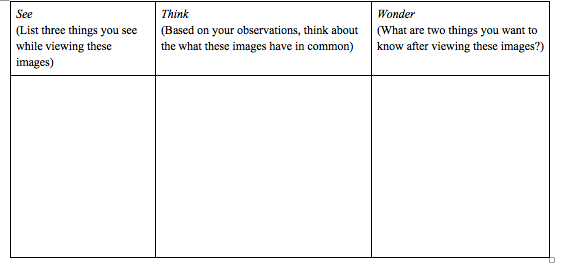
Note-making is active writing. Students are given formats or frames which organize thinking and hence notemaking.
Learning More Quickly and Forgetting More Slowly
Regardless of what social studies course we teach, World History, World Cultures, US History, Geography, or any of the social sciences;
Regardless of what academic level we teach, AP, honors, college prep, basic, special education or bilingual/esl:
Regardless of whether we teach live on line or in-person;
Regardless of how we teach, direct instruction “listen to me and do as I say”, cooperative inquiry groups of independent digital assignments;
All teachers need and want their students to achieve more and forget less. The key to this process is using four academic literacy skills.
A. Gather and organize information from print, visual, and data sources
B. Process this information through thinking and reasoning
C. Store, retain, and rehearse the information through memory
D. Produce thought in writing, speech or through the creative actions of drama, art, music, and movement.
Following are three ideas that will assist students in Memory skills. But before we begin examining these activities let’s consider 3 Nos. There will be NO “taking” notes. We will “make” thoughts or notes. Use NO notebooks. We will give students or show them how to make special notemaking paper. Finally, save money. Buy NO notebooks!
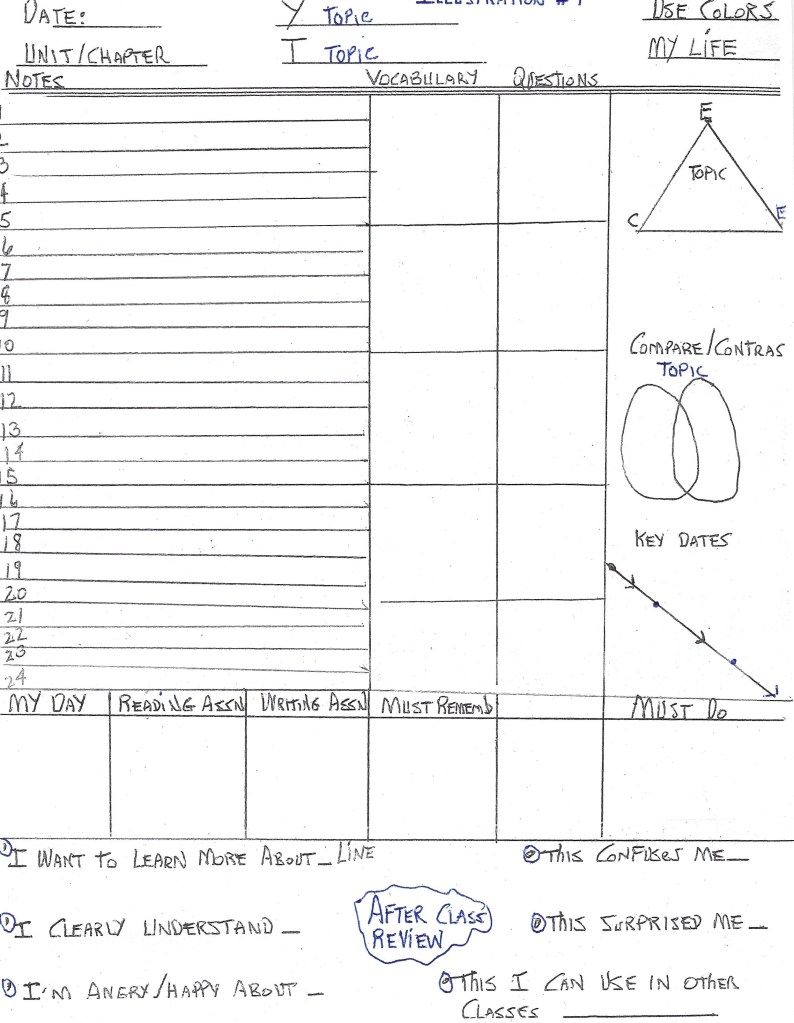
Illustration #1 is used for reading assignments. Create and distribute this illustration to students using standard size paper. If available use different colors for different marking periods. Colors enhance memory. Let’s examine #1. Top Center the Y=yesterday, what did we study yesterday? Note it. The T is for Today. Note today’s topic. Notes are made on the numbered lines. Key vocabulary, people, events, dates, ideas etc. are noted. Critical questions are copied or created.
On the right side are 3-line graphs: the topic, event, cause, effect triangle, the Venn Diagram for comparison/contrast within a given topic and a single chronology date line to capture key dates.
Illustration #1
On the bottom of the notemaking paper is a review section. Note the KEY on the lower left side. What is the key or unlocking ideas of the reading/research assignment? Note them below the KEY. What does the student NEED to know and DO? Write it down! What am I curious about? What is the next assignment?
Towards the bottom of the page are review end of class note boxes. The most important is the MY DAY. In this box note the weather, clothing worn, food eaten, or anything special in the student’s life that day. Personal memory must be linked tri academic study. The other boxes are self-evident. What is my next reading/writing assignment? What must I remember from this class and what Must I do for the class? The open space if for ideas from the teacher or student.
The notemaking page ends with a review section completed at home and turned in to the teacher. These reactions give feedback information to the teacher and can guide future classes.
Finally, look at the upper right of the illustration and find the words Use Colors. Ask students at the start of the year to buy a 4-color pen. Use it in class or for review. Here’s how it works.
Original notes are done in black. Green is used in review. Green=growth. Red is used to locate confusion. Red=danger. Blue is for clarity or I understand. Blue-clear in my mind as in a blue sky. Colors focus study and enhance memory. Use them.
This technique uses eight one-half by fourteen size paper. But it can be done on standard paper. It is used for assigned readings or research. Illustration #1 is used in an active class learning situation. The notemaking paper has a Text Reading Chart with vocabulary extensions to the left. The text reading chart has an area to note page locations. The illustration uses a visual flow chart to organize information and question “stems” to note questions and answers found in the reading.
Illustration #2
On the bottom of the notemaking paper is a review section. Note the KEY on the lower left side. What is the key or unlocking ideas of the reading/research assignment? Note them below the KEY. What does the student NEED to know and DO? Write it down! What am I curious about? What is the next assignment?
As you examine these 2 illustrations ask ourselves these questions. What do our student notebooks now look like? What is their current value? Can we try one of these illustrations in one of our classes and see how they work toward achieving our goal: learning more quickly and forgetting more slowly.
Now, lets’ go to another activity used in reading articles. Not all reading is text or document reading. Reading occurs in different formats. Oh, yes! Those of us who use digital texts and not books are still using texts. The word “text” is from Latin meaning “threads”. When we use digital devices, they are still using text which live as pixels behind the screen.
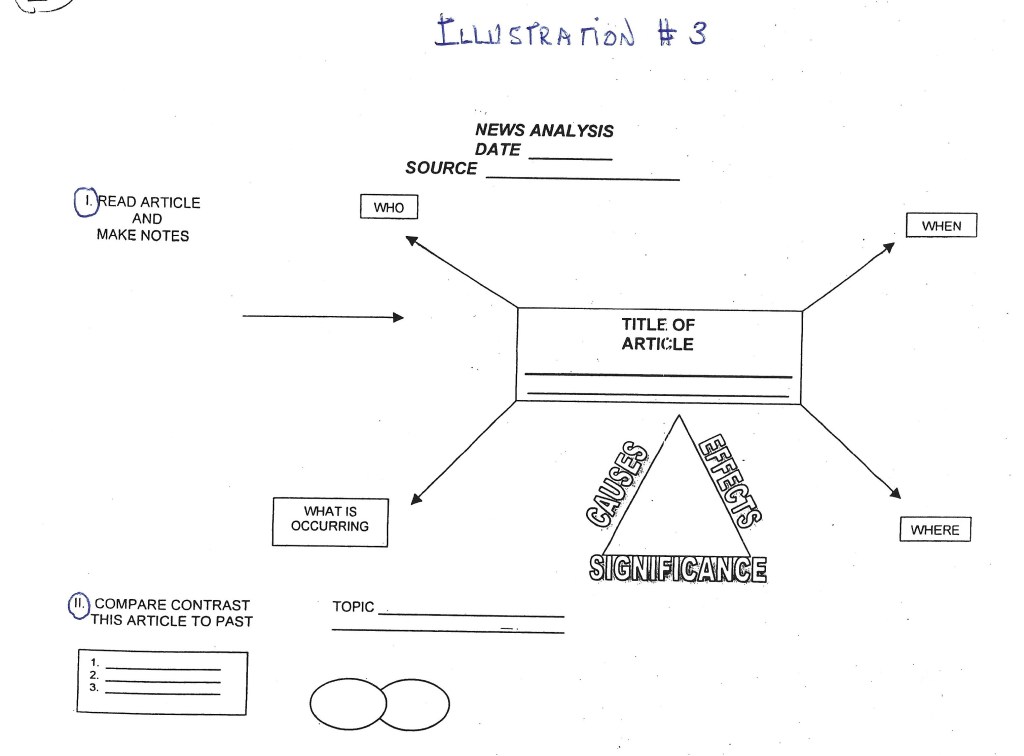
Illustration #3 is used by students when reading a NEWS ARTICLE or an essay from a periodical. The notemaking elements are self-evident. Remember ask students to use the 4 colors and somewhere on the paper note something about an event in their life, the food they just ate, the clothing they are wearing, or even how they feel. Private memory and academic memory link and help the academic emerge when students take exams, write, or speak.
Illustration #3
Finally, use the notemaking paper in phased practice reviews after classes and require that they turn in samples of their notemaking paper with exams. Give the finished notes credit. You can even ask them to create their own exams or add to yours using their notes. Reward successful practice as well as content mastery.
Creating Memory Using Visual Palates
Academic Literacy has 4 elements: gathering and organizing information, thinking/reasoning, building useable memory, and producing thought. Visual palates help build visual memory. They create a video tape or CD of a particular content topic.
Illustration #1 – Range of Visual Palates
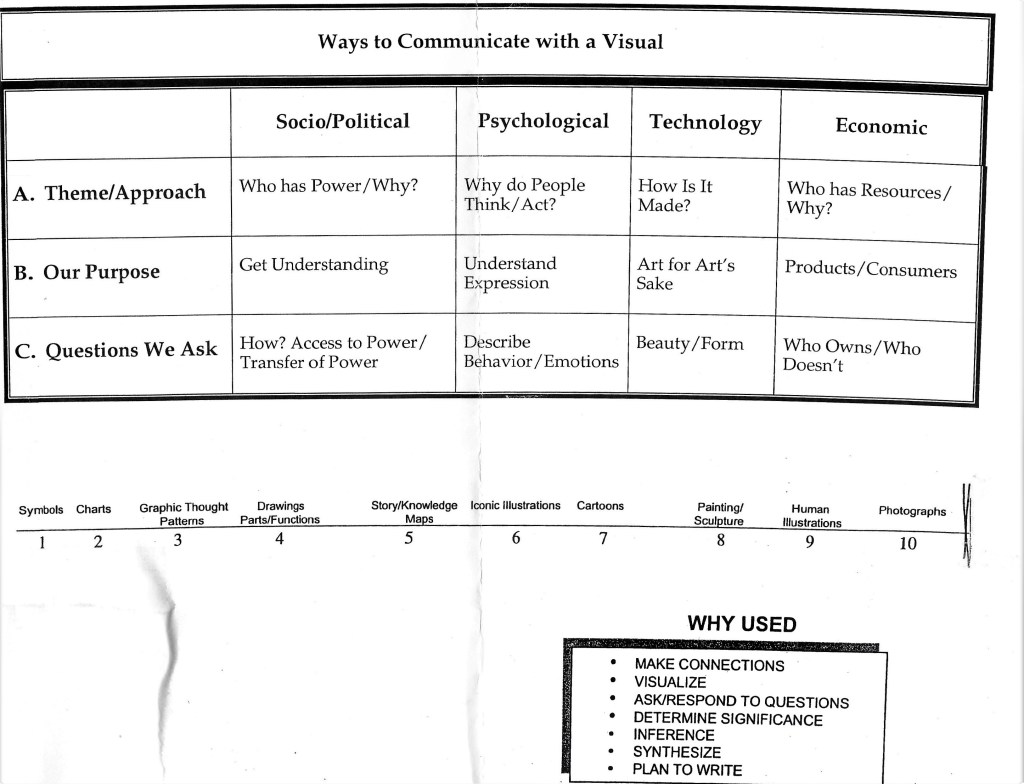
Illustration #1 describes the range of visual palates and their functions. At the bottom of the page there are 10 types on a spectrum from abstract symbols such as an arrow to realistic photographs. Visuals act a metaphor for both content information and a particular dominant thinking skill used when students encounter the content. Teachers locate and reproduce the visual palate on standard size 8 ½ x 11 paper although they can also be used on larger paper. Each student is given a visual palate. They are used in class, for assignments, or as test items.
American History Thinking Skills – Notemaking and Visuals: Tools for Improved Achievement
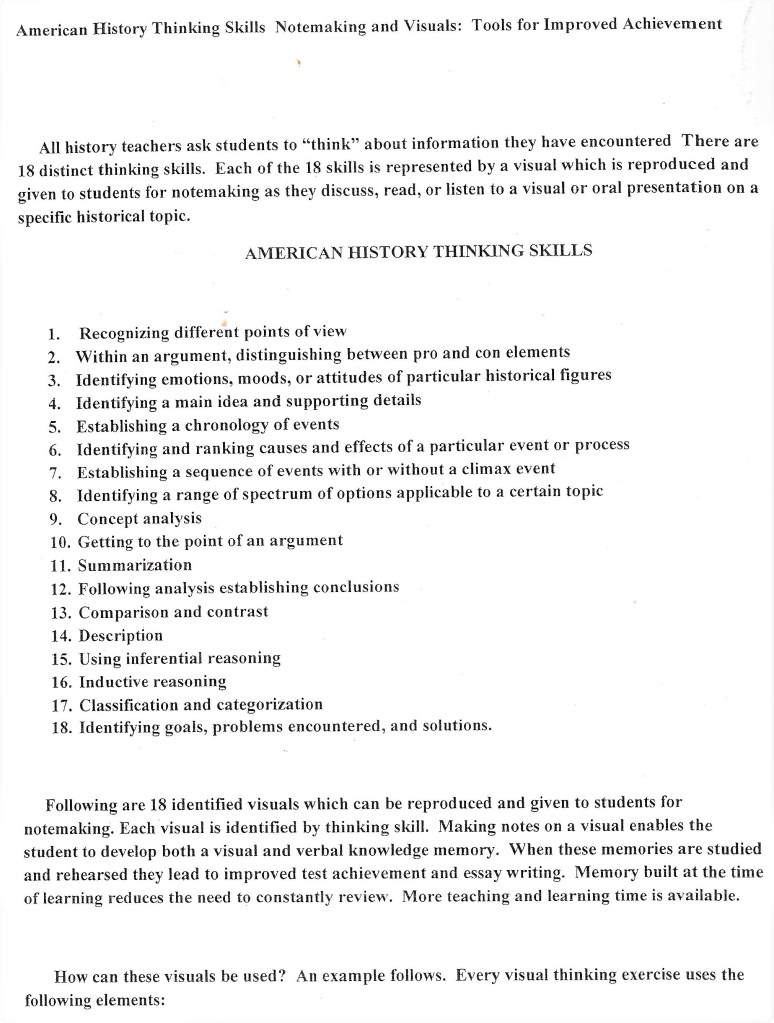
Illustration #2 lists the types of thinking skills used in our courses. Several may occur in a single class or assignment but normally one or two will dominate learning.
Illustration #2 – Thinking Skills
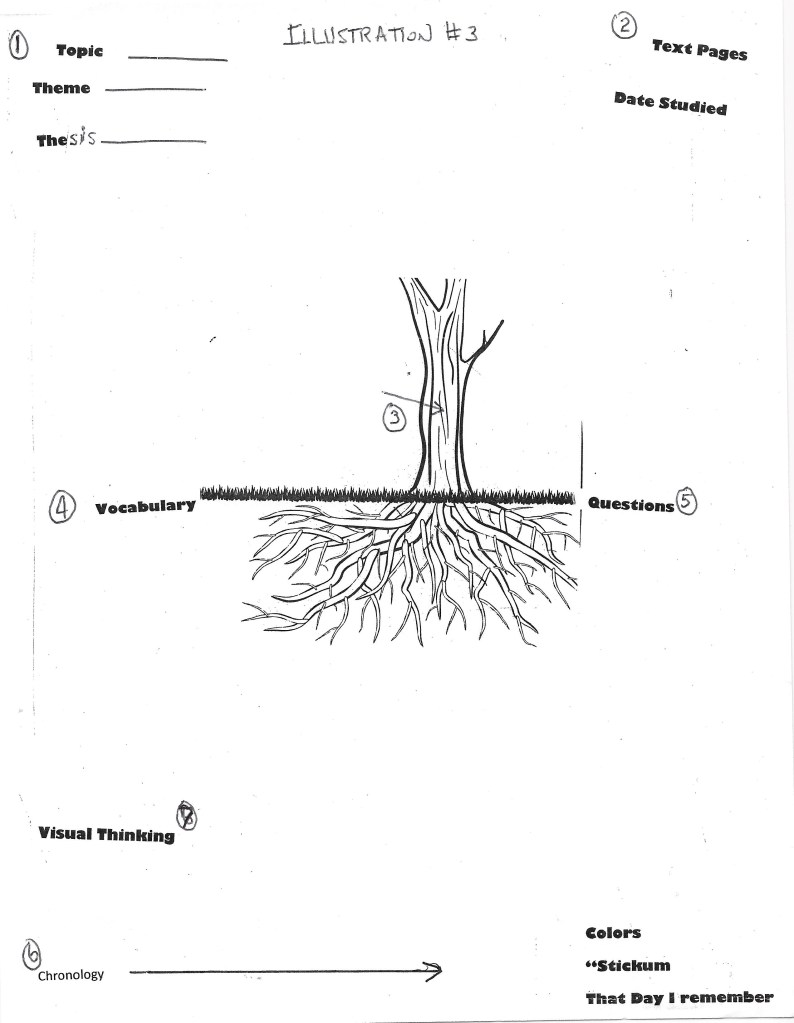
Illustration #3 is our first visual palate. It is line drawing of a tree embedded in soil. The major content focus is preprinted on the trunk of the tree. As students listen, read, watch videos they will make notes or begin to PAINT the visual palate. Let’s examine the 7 sections in the visual.
Illustration #3 – Example of a Visual Palate
Upper left corner there are 3 Ts. Students make notes on each. The first is the TOPIC, the facts of who/where/when/what the second is the THEME or thread that runs through the entire learning topic. The third is the THESIS or argument that drives our inquiry. This is the triple T
2. In the upper right are sections that link the visual to text pages and the date when learning first occurred.
3. The trunk depicts the content topic. Below the trunk are the roots or CAUSES of the topic. Extending out from the trunk are branches which become the EFFECTS of the topical events. Students make their notes on the many roots and branches. Some roots and branches are primary and some are secondary or minor.
4. Key vocabulary is isolated to the left of the roots and key questions are noted at (5) to the right of the roots.
5. At the very bottom of the palate is a time or chronology line. Students note critical dates.
6. This visual thinking area might have a Venn Diagram for compare and contrast or a star for an important person.
In the extreme right corner are 3 memory builders. Colors, use a 4-color pen on a palate. Black is for critical notes, red is for confusing ideas and hence dangerous, green is for notes we make when studying and represents growth, and blue is for ideas we clearly see like a sky blue. We can also attach postal notes or stickums to the paper. They focus the eyes. Finally, we must note something that personally occurred to us on that day. It might be the weather, the food we ate, the clothing we have, the shoes we wear, or how we feel. Connect the personal to the academic learning. The personal will rehearse or ignite the academic when we study or when we want to write or speak.
All visual palates have the same elements. Illustration #4 shows a clock with attached sticks of dynamite. This visual is used for revolution, American, French, Civil War, Nazi Germany, USSR 1917, Mao’s China, Castro in Cuba etc. As students learn they paint the palate with their 4-color pen. The dynamite=causes. The clock hours=events.
So, what to do? If we like the visual palate idea try it with only one class. When? try the last class of the day. Do something different. If it works the day ends well. If it does not get out of school, turn on the radio, and go home. If we use new ideas early in a day and they do not work they often leave an aftertaste in the mind and air since students will tell one another that the teacher is doing something weird today.
Limit creativity to the margins of our daily school life. We are already doing a good job. We are not working from a deficit. Visual palates can be used in any course, with any student type, and within any instructional/learning study. They can be used in class, for assignments, or on tests. We need to show them how to use them, permit them to use them in small groups, and then ask students to practice independently. They have one goal increase faster learning and slow the relentless decay of memory.
When we announce an exam and want students to study their notes what do these notes now look like? If they have created visual palates, they use them. They are videos and aural recordings of their learning.
The Knowledge Map. (KM)
The KM is a specially designed 8 ½ X 14 paper used when a class has a long unit or chapter that might go for 10 or even 15 classes. The content might be a long chronology or complex series of events. KMs may be used in any subject and are especially useful learning and memory tools in AP classes which are both fast-paced and intensive.
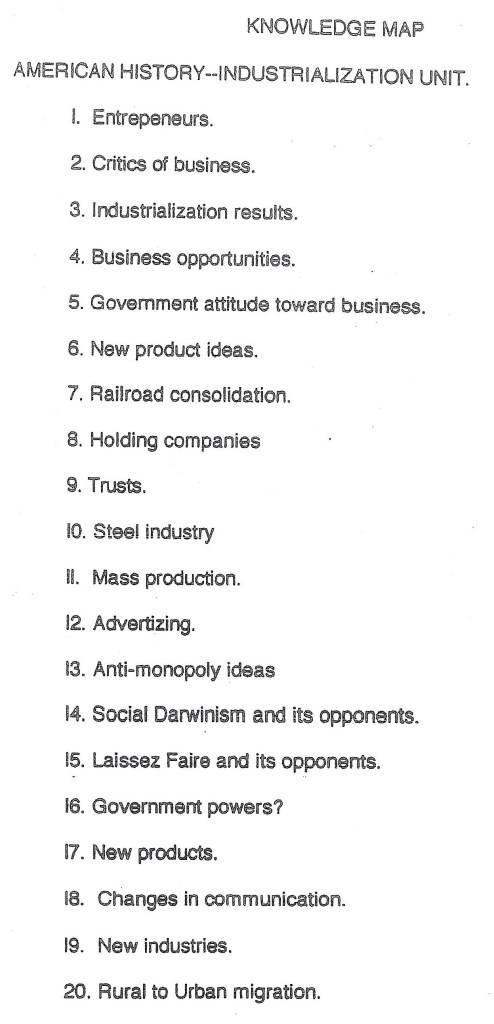
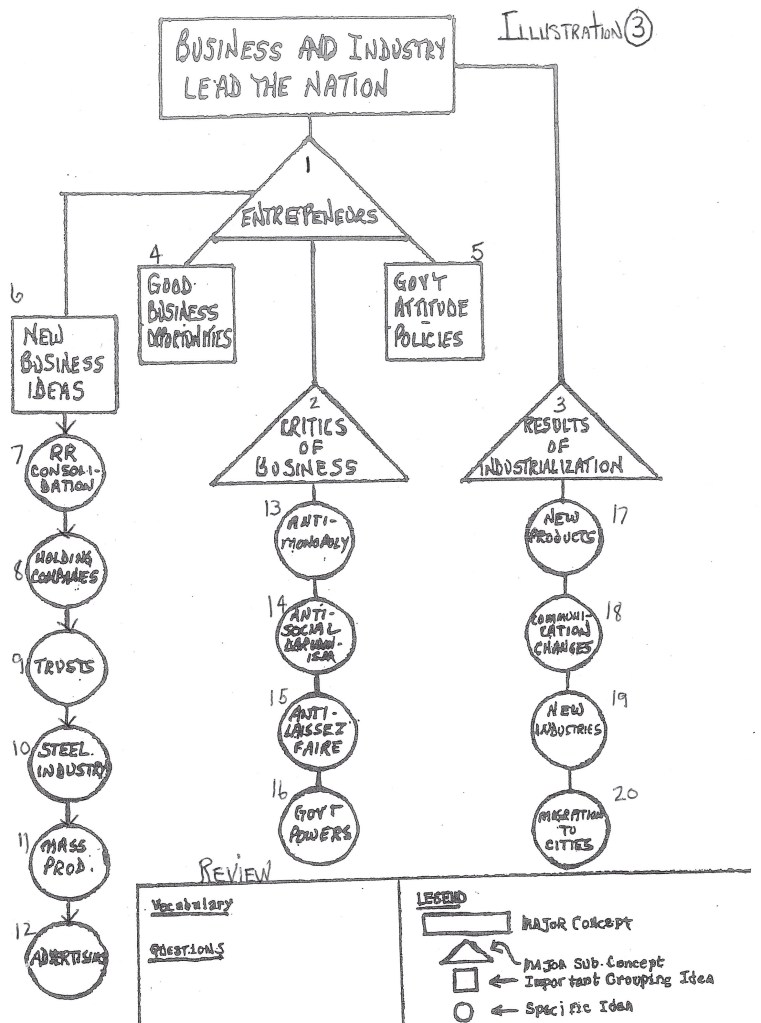
This is how a KM is created. Get legal-size paper. Step I-Identify the content topics you want students to investigate. The topics might be people, events, or ideas. Our example shows a teacher KM with 20 topics. Step 2-arrange the topics in a flow chart and number each one. Step 3-decide a flow chart type. There are 3.
A, The “completed” or fully clothed chart showing names of all topics.
B. The “naked” or incomplete flow chart showing empty chart spaces that students will fill in during the unit.
C. The “checker board” chart in which random spaces are filled in by the teacher and others are left empty for later student work.
Give the one you choose to students at the start of the unit or chapter. Tell them they will be used throughout the unit and turned in with all quizzes or exams. They are given credit for completed KMs.
Illustrations 1-2-3 show the topic list, a naked KM, and a completed KM.
Illustration #1 – Knowledge Map
Illustration #2 – A ‘Naked” Knowledge Map
Illustration #2 – A ‘Naked” Knowledge Map
Illustration #3 – A Completed Knowledge Map
KMs are used in 3 class learning times, these are at the start of a class to review and preview, during a class as a “time out” or integration moment, or at the end of a class as a “wrap it up” final one or two minutes. They can also be used for assignment notemaking or test preparation. They replace notes in a notebook. They integrate many learning days and different forms of learning.
Following are 13 tips for using KMs. Pick a few and try them.
If you can, create the KM on colored paper. It is harder to lose. Make friends with art teachers. They may have a ream.
Organize the class into teams of 3 or 4. If a student is absent, they can share work on their phones or in class.
On each chart area note the date the topic was first studied.
On each chart box note the page number in the text where this information is located.
To the left of each box note a question (Q) about the topic. The ? may come from the teacher or is student created. Interact with the topic!
To the right of the topic note an associated vocabulary word or date (V) Again, interact and extend learning.
Use a 4-colored pen. Black for original notes. Green for review or growth notes. Red for confusion and danger. Blue for “I understand this.” Study the red and green.
Create a chronology or time line at the bottom of the KM.
Notes which topics are homework or project assignments and their due dates,
Get some post-it “stickums” of different colors and attach them to different chart topics you want to emphasize.
Sketch visual graphics on the chart such as a STAR for an important person or a VENN diagram for compare/contrast thinking.
Occasionally make notes about your personal life on the chart: the weather, food you ate, clothing you wear, videos you saw etc. Merge the personal with the academic.
Anywhere on the chart write old exam questions on the chart.
There are five learning principles embedded in KMs
Spaced time-interval review.
Self-inquiry
Short quizzes or tests review and response
Using colors
Merging personal memory with academic memory
Try a KM in one course in one class. Determine if that class has a greater grasp of complex content when compared to another class. Consider using the KM the last of the day. Often student athletes or club members may be absent for special events. Their team members can keep them up to date until they return to class.
One teacher uses the KM on a test review day. The teacher creates a completed KM and then cuts it into many pieces and puts them into an envelope which is given to a team. The team opens the envelop and has to reconstruct the KM and justify their thinking.
Learning more quickly and forgetting more slowly is our goal. The KM is one tool we can use. A middle school might use a smaller KM with 10 topics. A high school class might have 20. A complex AP unit might have 30. KMs are used in any teaching or learning style, in a room with desks or tables or lined with individual computers. The KM integrates content, time, and a variety of teaching materials into a single memory device.
They are RW recognizing writing, copying, note-making, RD or redesigned writing, composition, media writing, and website design.
Illustration #2
Element #5 composition is divided into styles and scales. Styles refers to narrative, descriptive, expository, and point of view writing. Scale refers to sentences, paragraphs, MP or multiple paragraphs, E or essays, and RP research papers. During the course of an academic year students should practice all styles and scales.
The 7 AW writing elements are practiced in three settings: the classroom, assignments, and on tests.
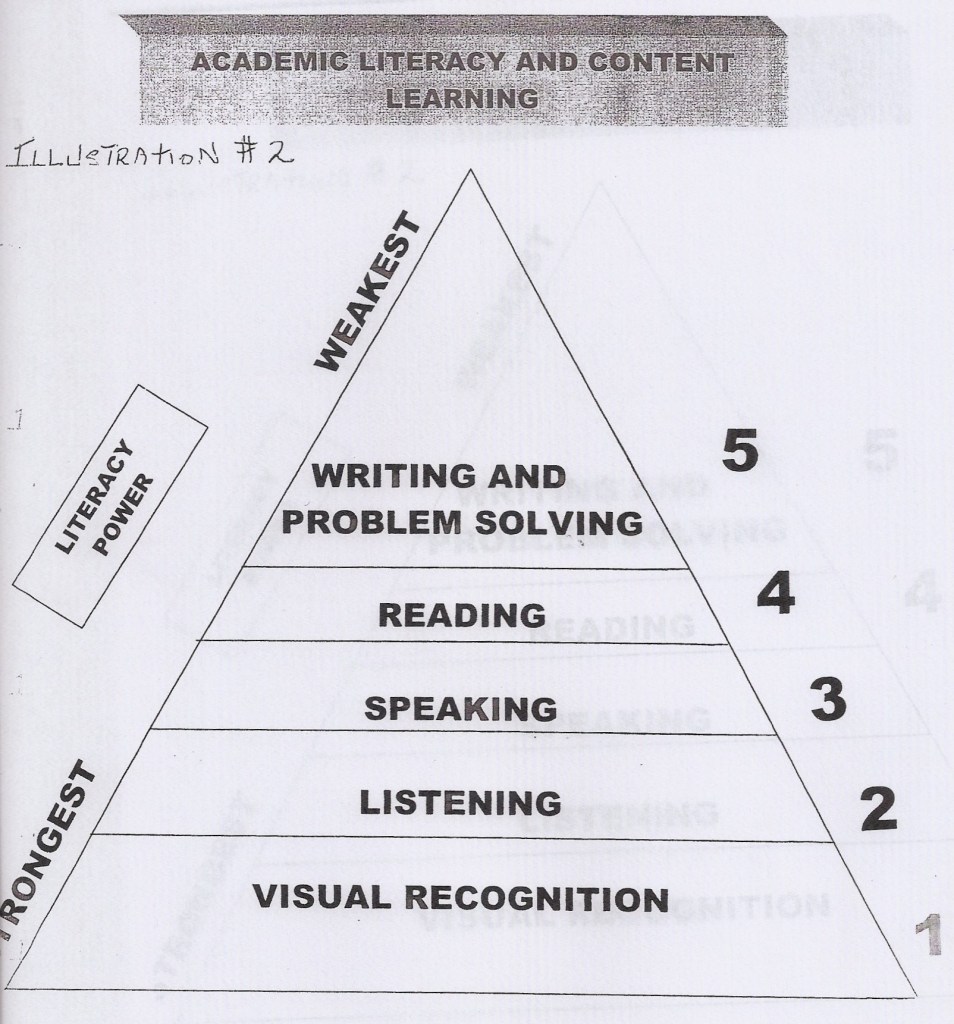
Illustration #2 shows the relationship between five literacy skills.
Writing is the most difficult because it cannot occur without gathering and organizing information, critical thinking, and memory. Writing is both a product and a process of learning. It is slowly and consistently developed over an entire year.
Academic Writing Skill #1 Recognizing Writing
Illustration #3AIllustration 3B
Illustrations #3 ABC shows three examples of this skill. They are teacher developed and used in CAT, the classroom, assignments, or on tests.
Stop! Wait! A teacher will ask how and when do I have the time to create these activities for my classes. I am busy with 5 sections and 100-125 students. My commercial supplemental materials do not have these examples. A problem! Yes, but solvable.
Consider the following tactics. 1.Before February ask your supervisor to budget a summer staff development time for you to to create these lessons. 2. If you are told there is no money ask the supervisor to eliminate your school duty period in the next year and let you use the period to develop the activities which you will offer to other faculty. This effort becomes your duty. Do this before a master schedule is created with supervisory assignments. 3. If you cannot get a duty release ask the supervisor to approach a parent group for an initiative grant for a summer effort. 4. Most districts require that faculty create an improvement plan for the following year. Let AW activity development become your plan and during the coming school year occasionally ask your supervisor for released time during a school day to create the activities. Schools have money for daily subs and period coverage.
Academic Writing Skill #2: Copying
Copying is notetaking. Think of copying as Xerox reproduction. This is a critical skill. It is unrecognized. Copying occurs in two ways: we listen and reproduce or we read and reproduce. At the end of a period take three or four minutes for a copying activity. Find a critical sentence or two in a reading. Ask students to get paper/pen ready.
Read aloud. Stop! Give them a paper copy of what you said or refer them to a text page. Did they get it right? You may have an old overhead projector and could show them the passage they just heard. Discuss the sentence.
Some teachers ask students to read a short passage and copy it. Sometimes, even though the passage is in front of their eyes they fail to replicate it because copying requires careful attention and precise effort.
Note-making is active writing. Students are given formats or frames which organize thinking and hence notemaking.
Illustration #6
Illustration #6 is a standard chart used in an International Baccalaureate Theory of Knowledge course. As students read or learn in class they fill in the chart.
Another chart form is called a triple screen. Students are given an 8 1/2 X 11 paper and told to fold it vertically into 3 columns. The left column is labeled reading notes, the middle column is called class discussion, and the right-side column is called review notes. A four-color pen is used. Reading notes are in black. Class discussion notes are in blue for clear understanding and red for confusing ideas. Green is used for the final column. Green shows growth or change incurred during the review.
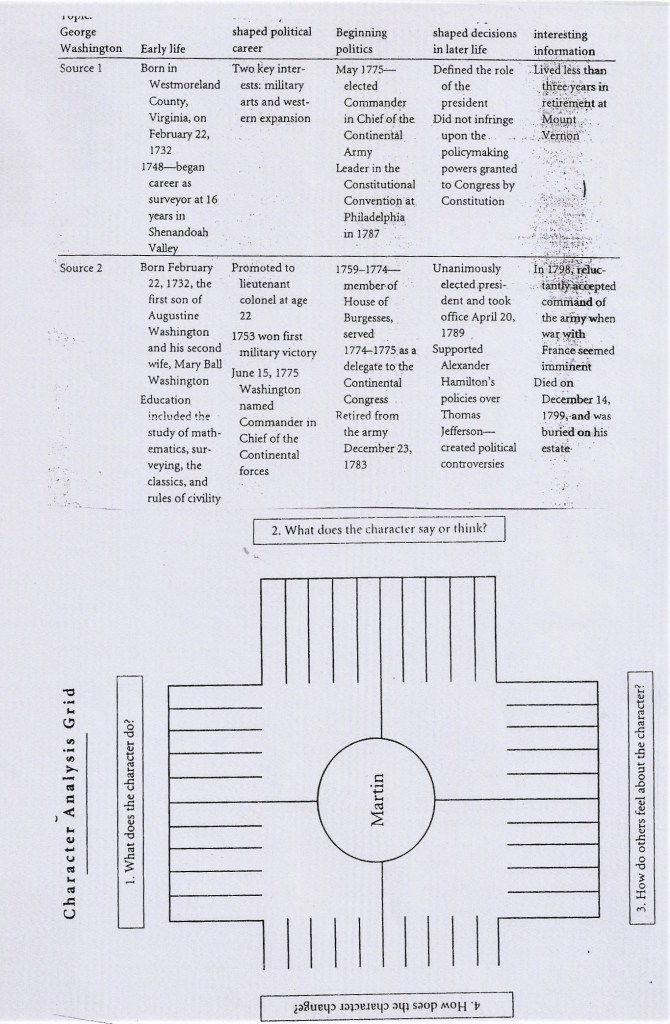
Illustration #7
Illustration #7 depicts two techniques used when studying an important person or group. In this example we used George Washington. The Inquiry Chart is self-explanatory. The character analysis chart was originally used in a literature class. Eliminate the word MARTIN and substitute GEORGE WASHINGTON and we have a Character Analysis Chart. Both tactics, CAT, are used in the classroom, for assignments, or as a testing challenge.
Illustration #8
Illustration #8 is called a “story chain.” This example is from a literature class. History teachers would create their own story chain word series. Using the chain students in class or on a reading assignment expand or extend the words in the story chain into a larger narrative or series of events. See the example of French and Indian War.
As we examine these note-making frames or palates they have one trait. We do not ask or tell students to “take notes.” We provide them with an organizing frame. They use it as a painting palate brushing in their thoughts.
Illustration #9
Illustration #9 is a visual icon frame. There are 11 content thought patterns. Examine #7 Main Idea/Detail. Students are given a four circle visual. The central and smallest circle is main idea. Students make an arrow into the small circle and print the main idea on arrow. The other circles are details or outer ideas. #11 is a football field. At each end are goal lines. The names of one or another group are printed on the lines and an arrow is extended from the group toward and across their goal line. When a student studies the goals of the North or South in the Civil War, they study a football field with notes. #1 is called a Reverse 7. On the top at left 7 we see the word Federalist and at the top of the inverted 7 we see the word Antifederalist. They are facing off looking at one another. Notes are made below each figure. The gap between them is a note room for their differences. Visual icons are powerful ways to organize thinking and their results.
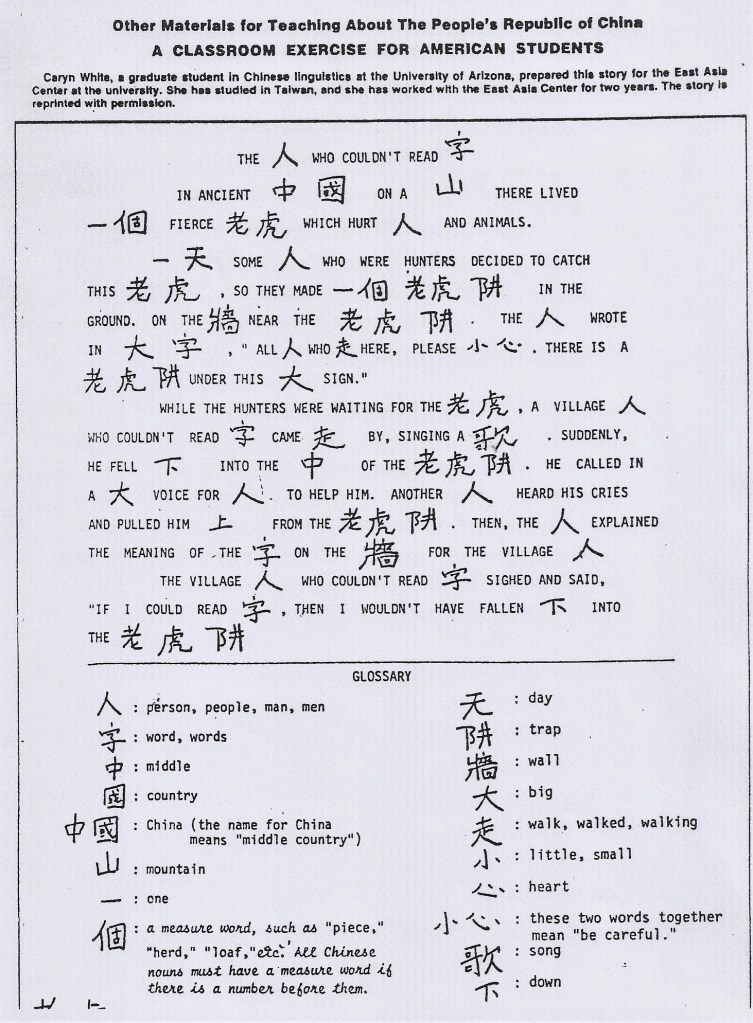
Illustration #10
Illustration #10 is a “time out” device one teacher developed to develop see/search/think/note skills. Try it even though it may not fit your exact lesson content. Students may learn a little Chinese!
Academic Writing #5 – Composing
The next type of academic writing is composing. Composing has two features, styles and scale or quantity of words. In general, the first composing efforts should be short and simple sentences and paragraphs. Don’t assign complex essays or research papers early in a term. English teachers may tell us that students know how to write. This is not the issue. They do not have content mastery in our subject. They may not understand the natural logic or continuity of academic learning. So, start short and simple gradually moving toward extended multiple paragraph and essay writing in the second or even third marking periods.
Qualify the above statement. With high achieving AP or IB classes move more quickly. They need rapid and continual work in short answer essays, open-ended longer essays, the DBQ form essay. Their examination is in mid-May. Time is short. Demands are long.
Adopt a composing plan for each 9 week marking period.
Follow it ending with research papers. Research is a year long achievement but gradually escalate the size from a simple paragraph to more extensive works.
Illustration #15
Illustration #15 shows an example of sentence writing and an outline of different paragraph types. The sentence example is called “Right-write” to the point. Have students place their pen on a paper and draw an outline of its shape. Go to the back of the pen and begin to write a sentence about an assigned topic ending at the point of the pen. The visual forces students to very carefully limit their thinking to a few precise words in their response. The sentence can be narrative, descriptive, expository, or point of view. Just write to the point. Brevity is beauty.
On the left side of the illustration are six organizational patterns. At the bottom is a writing space. One metaphor used in many schools is the “hamburger” approach. The top of the bun is the topic sentence or claim. In the middle is the evidence with salt, pepper, mustard, or ketchup as details. The bottom of the bun is the ending. Hamburger writing can be used in the classroom for assignments, or on tests.
Illustration #16
Illustration #16 is a multiple paragraph assignment. AP exams in world, European, and American history require SAQs or short answer questions. Within the SAQ format they use an ACE technique. A=a direct answer to the prompt. C=how the writer defines and describes their claim in the answer. E=explain your choice of the claim and logically connect your claim to relevant historical developments. In short, bring more information to the SAQ. The multiple paragraph challenge makes a claim, provides evidence, and ends with commentary. 3 examples of SAQs follow. They were presented at an AP professional development program in Tampa, Florida.
Before examining them take a look at the essay questions you have assigned. Now, examine A B C D.
Illustration #17 has 4 essay examples: A B C D
Illustration #17A
Illustration #17B
Illustration #17C
Illustration #17D
How do they compare or contrast with our work? Look for clear, precise, linear directions. What does the end product look like? What is the font size in the directions.
Are due or progress dates clear? What are expectations for A quality work? Have you posted examples of A quality work from previous years? What is the essay worth in computing semester grades? When is the teacher available for individual help? Set the context. Ask students to locate the dictionary definition of the French word “essay.”
The final type of essay is the DBQ or document-based questions. See illustration #18. This DBQ has 5 documents. Creating DBQs is extremely hard and time-consuming. Teachers get them from AP, IB, State agencies, or commercial sources. Except for AP courses, they should be assigned well into a course. Responding to a DBQ requires both integrated knowledge from the course and the documents and powerful synthesis writing skills. An inclass DBQ can be assigned to a cooperating group or an individual.
Illustration #18
What does a good DBQ response read like. Illustration #19 is a reading sheet given to teachers who read AP DBQs. The notes were made by the author. This DBQ has 10 documents. Current DBQs are 6 or 7.
Illustration #19
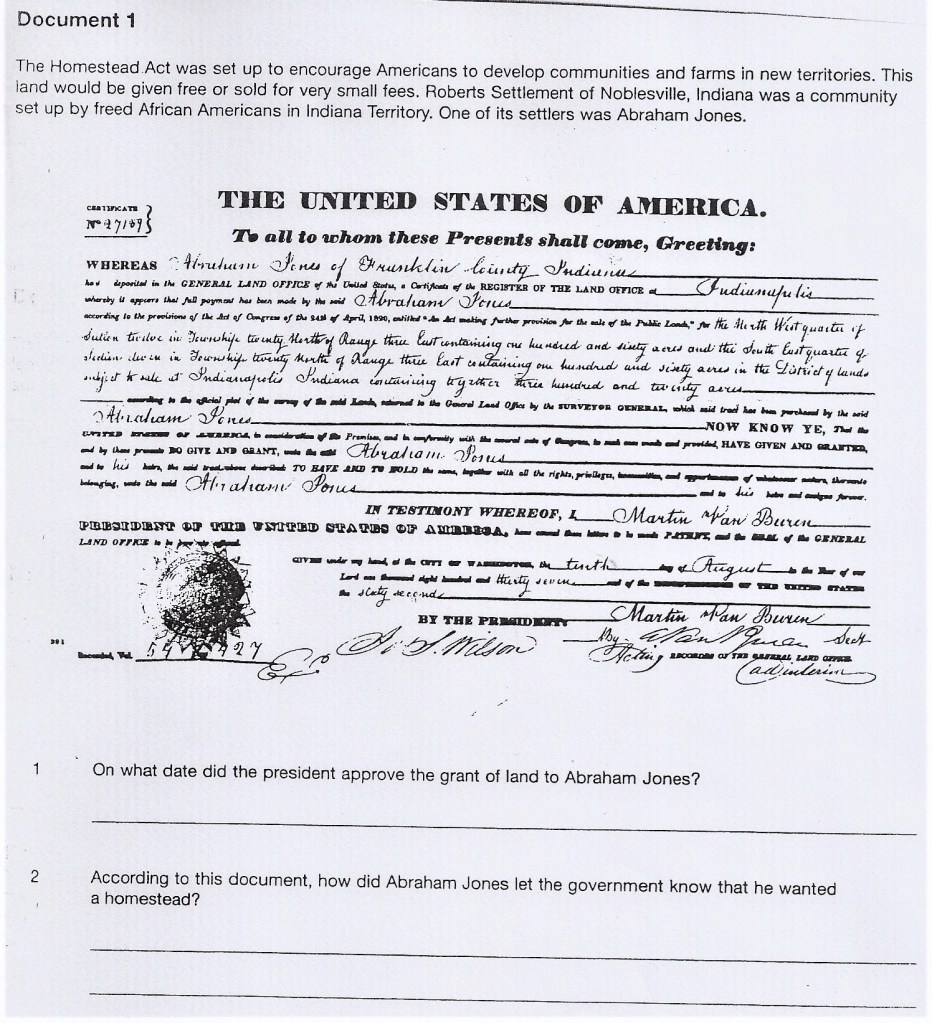
Document #1 – Homestead Act
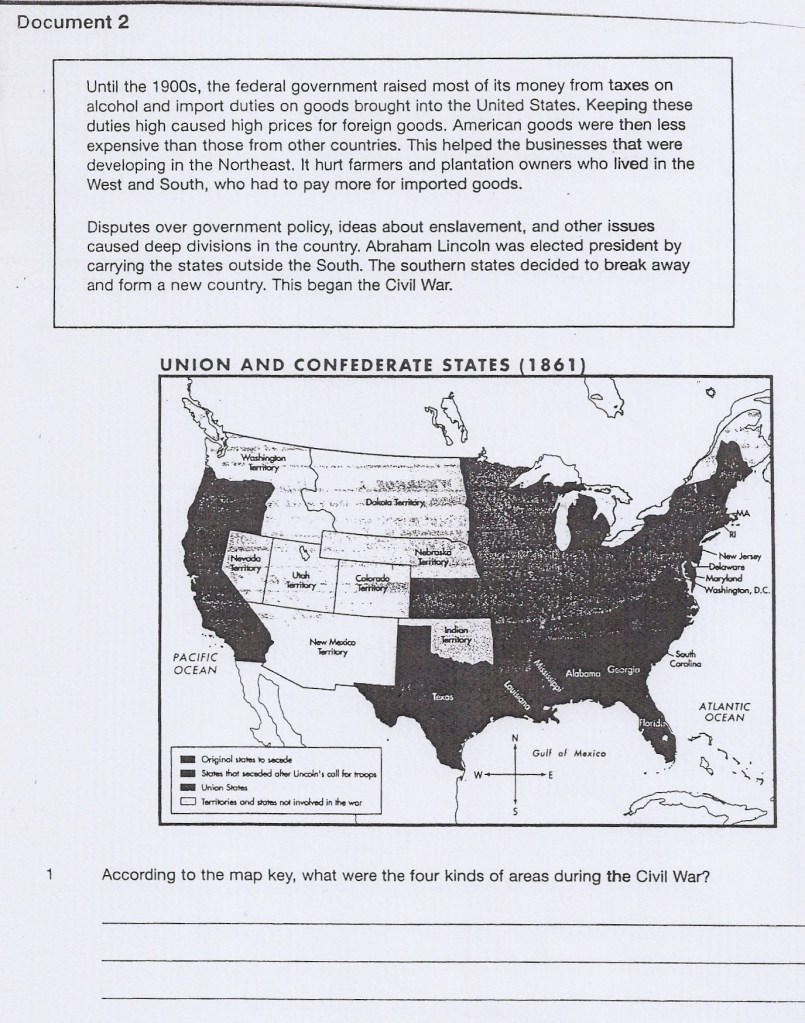
Document 2 – Reactions to the Morrill Tariff
Document #3 – Benjamin Singleton and Exodus to Kansas
Document #4 – Migration to Kansas
Document #5 – Exodus to Kansas
This DBQ was graded on a scale of 0-1 to 8-9. The average DBQ score in this reading from 2007 was slightly over a 3. An 8-9 score occurred in less than 5% of the papers. Illustration #20 shows a English language State testing rubric. It is not designed for DBQs but may be useful in grading the DBQ.
2007 DBQ in United States History
2007 DBQ United States History
2007 DBQ United States History
2007 DBQ United States History
2. determine the audience or target for the message,
Illustration #20
The research paper is the final type of composing.
In a middle or high school the format for these papers normally comes from the English Department. In a few schools the format may be cooperative merging social studies and even science teachers in a joint effort.
The research paper involves style conventions such as bibliographies and footnoting. These are always taught by English faculty. We need to carefully consult with our colleagues. We can not assign research papers and assume students know how to follow style conventions. We have to coordinate the timing of our research papers with their instruction and practice. This is complicated and one reason why research papers almost always occur toward the end of a course.
Academic Writing #4 – Media Writing and Website Design
Media writing is the very opposite of linear, left to right composition. Media writing has 3 planning elements:
1. pick a medium or carrier of a message,
3. decide on the quantity of information in the message.
Two quick examples: what word messages about the causes of the American Revolution might be printed on a T shirt or a cup or an advertising billboard. A tee shirt can not carry an essay. The message has to be short and direct.
Illustration #21A
Illustration #21B
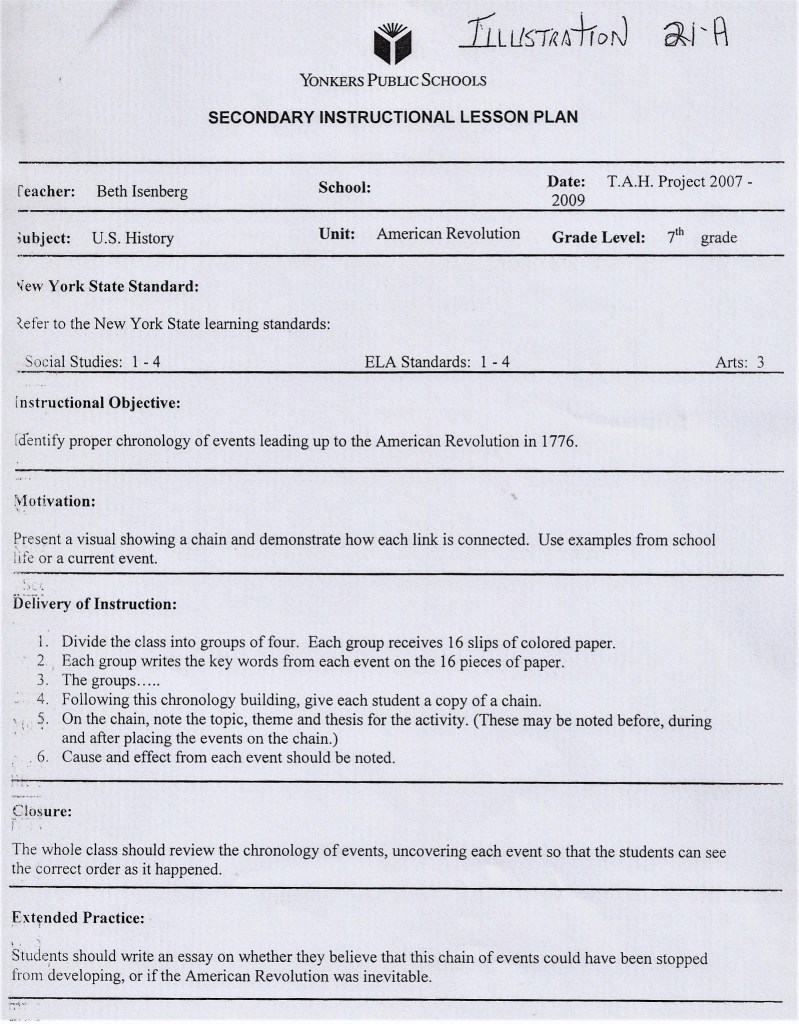
Illustration #21 shows a chain. The chain is a set of interlocking parts and is especially suited to showing events, their causes, and effects. The chain is the medium and notes are appended to each side of the chain. This example uses a “triple T” organizer in the upper left where the student notes their topic, theme, and thesis claim.
Beth Isenberg was a 7th grade teacher in the Yonkers Public School system. She chose the medium of a cup to show FDR’s plan to remake American society during the Depression. Illustration #22 shows a draft of her media writing. Note the “triple T” in the upper right and a time line at the bottom of the page.
Illustration #22
Ms. Isenberg used this cup media writing in 3 dimensions, the classroom, the assignment or on a test. She gave students the cup and they had to put the pieces together.
Ms. Isenberg’s class also used the chain medium.
The final type of writing is website design. Instead of asking students to compose an essay or research paper on a given topic ask them to create a website. How?, they will ask. Go to your IT person in the building or district and discuss your project with her/him. Invite them into the class after you have had students go to one of their favorite sites and analyse the type of information at the site. Did the site contain words, how many? Did the site have data, pictures, or icons. Did the site carry sound? What colors or shapes were used? Were vocabulary featured? All web sites have design features and before we make one using history content students have to see their design features.
With the help of an IT person and planning the web site assignment over a long period of time we can begin to introduce new writing forms to our students. All writing is symbol making. When we underline or circle we are are writing. When we star a word we are writing. Writing is more than composing. Writing occurs when we take our private thoughts and make them public. Reading is symbol absorption. Writing is symbol production. Reading is silent and private. Writing takes our private thoughts and proclaims them to an audience. Writing is a risk-taking venture. We expose ourselves to the critical eye or “I” of another person. When we ask students to write they need the confidence of their own thoughts.
Finally, Illustration #23 shows a planning chart for academic writing. It is broken into MP or marking periods, an MY exam (mid-year exam) and a final exam. The chart enables the teacher to plan and record the types of writing activities for the entire year. A similar chart can easily be constructed for a 9 week marking period. The CATs strategy is noted enabling the teacher to place the activity in the C= classroom A=assignment or T=the test.
Illustration #23
A set of academic writing beliefs concludes the chart.
Conclusion
Academic Literacy is not only an idea it is a series of social studies teaching and learning activities for our classrooms, assignments, and evaluations. We need to link these activities to four other mandated ideas that affect teachers and students. These are school district mandated planning procedures, the mandated observation and evaluation of teachers, required teacher professional development, and the general philosophies that guide education in the fifty states and 12,000 public school districts.
Illustration #1 – Weekly Academic Literacy Chart
Illustration #1 is a weekly Academic Literacy Planning chart. It is a supplement to normal district plans that call for the identification of State standards, content teaching/learning objectives, selection of materials, and assessment.
This planning chart identifies the four major elements in Academic Literacy, gathering and organizing information (I and II) critical thinking (III and IV) memory (V) and Writing (VI). Using the Activities Handbook teachers can identify which activities they might use as students interact with content materials.
At the bottom of the chart is a section showing how social studies teachers might coordinate with other faculty members. Some students also go the remedial reading and writing teachers. NCLB, NO Child Left Behind or Title I) staff. Some go to ELL staff, English language literacy. If they know what content is being taught in a social studies class they can find similar content and use it for their skill objectives. The inclass support teacher is assigned to be with special education students mainstreamed in a social studies class.
Illustration #2 – Charlotte Danielson Framework for Teaching Theory
Illustration #2 shows the commonly used Danielson theory for teacher observation and evaluation. Academic Literacy activities are part of Domain 3 Instruction.
Illustration #3 is a framework for creating a permanent professional learning community in a school or district.
Illustration #3 – Professional learning Communities in Schools
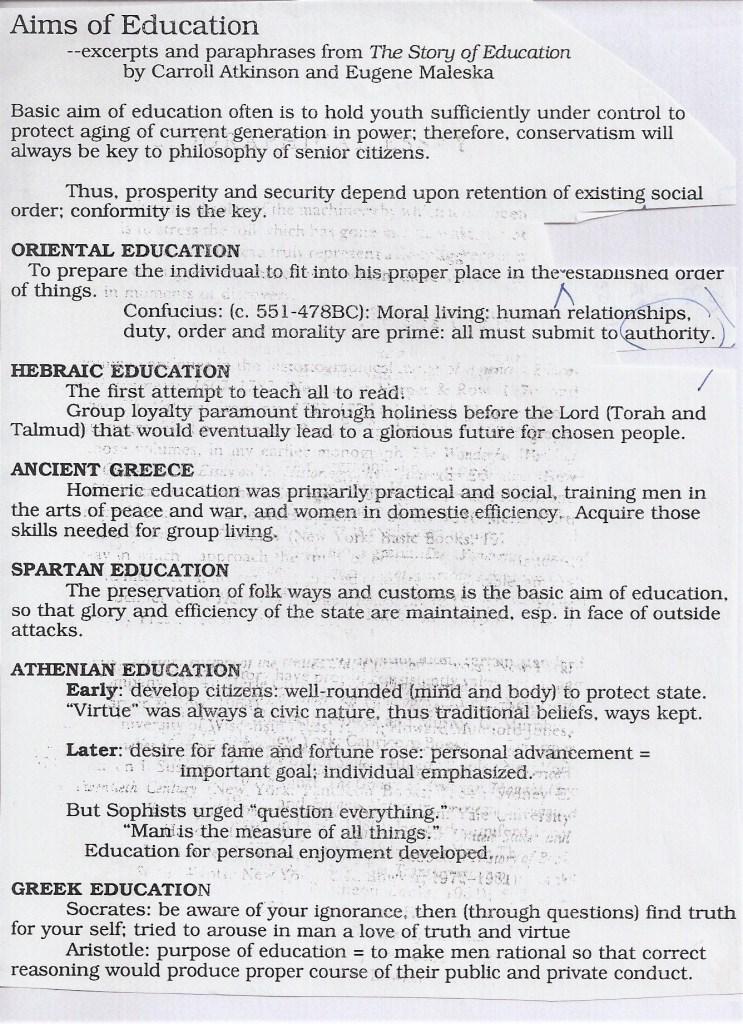
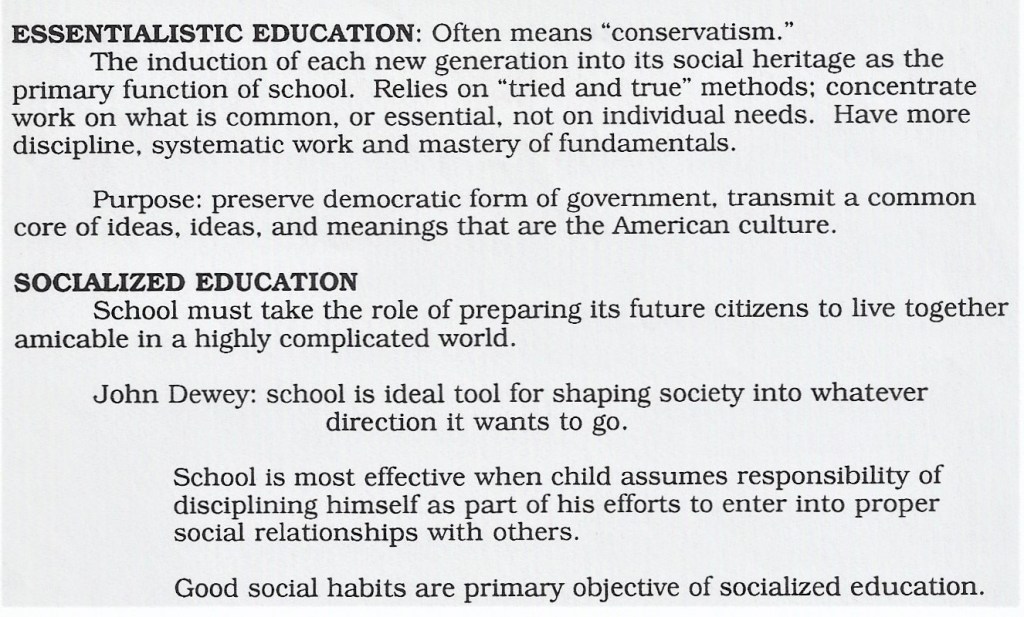
Finally, Academic Literacy is always a tool in carrying out an educational belief. The Aims of Education thinking of Eugene Maleska offers a wide variety of choices.
Illustration #3 – Framework for Professional Learning Communities in Schools
Media writing is the very opposite of linear, left to right composition. Media writing has 3 planning elements:
1. pick a medium or carrier of a message,
3. decide on the quantity of information in the message.
Two quick examples: what word messages about the causes of the American Revolution might be printed on a T shirt or a cup or an advertising billboard. A tee shirt can not carry an essay. The message has to be short and direct.
Illustration #21AIllustration #21B
Illustration #21 shows a chain. The chain is a set of interlocking parts and is especially suited to showing events, their causes, and effects. The chain is the medium and notes are appended to each side of the chain. This example uses a “triple T” organizer in the upper left where the student notes their topic, theme, and thesis claim.
Beth Isenberg was a 7th grade teacher in the Yonkers Public School system. She chose the medium of a cup to show FDR’s plan to remake American society during the Depression. Illustration #22 shows a draft of her media writing. Note the “triple T” in the upper right and a time line at the bottom of the page.
Illustration #22
Ms. Isenberg used this cup media writing in 3 dimensions, the classroom, the assignment or on a test. She gave students the cup and they had to put the pieces together.
Ms. Isenberg’s class also used the chain medium.
Academic Writing – Website Design
The final type of writing is website design. Instead of asking students to compose an essay or research paper on a given topic ask them to create a website. How?, they will ask. Go to your IT person in the building or district and discuss your project with her/him. Invite them into the class after you have had students go to one of their favorite sites and analyse the type of information at the site. Did the site contain words, how many? Did the site have data, pictures, or icons. Did the site carry sound? What colors or shapes were used? Were vocabulary featured? All web sites have design features and before we make one using history content students have to see their design features.
With the help of an IT person and planning the web site assignment over a long period of time we can begin to introduce new writing forms to our students. All writing is symbol making. When we underline or circle we are are writing. When we star a word we are writing. Writing is more than composing. Writing occurs when we take our private thoughts and make them public. Reading is symbol absorption. Writing is symbol production. Reading is silent and private. Writing takes our private thoughts and proclaims them to an audience. Writing is a risk-taking venture. We expose ourselves to the critical eye or “I” of another person. When we ask students to write they need the confidence of their own thoughts.
Finally, Illustration #23 shows a planning chart for academic writing. It is broken into MP or marking periods, an MY exam (mid-year exam) and a final exam. The chart enables the teacher to plan and record the types of writing activities for the entire year. A similar chart can easily be constructed for a 9 week marking period. The CATs strategy is noted enabling the teacher to place the activity in the C= classroom A=assignment or T=the test.
Illustration #23
A set of academic writing beliefs concludes the chart.
Academic Literacy: Critical Thinking and Reasoning
Dr. Harry Stein, Manhattan College
Academic Literacy has one goal: learn more quickly and forget more slowly. Learning has four elements: gathering and organizing information, critical thinking (CT) and reasoning, memory/retention, and creating thought through writing, speaking, and creative acts in art, music, dance, and drama.
How can we describe and define critical thinking? There is no single, agreed upon definition. Critical thinking has different components including recognizing information and assumptions, accurate evaluation of ideas and comprehending how conclusions are reached. Critical thinking should consistently be practiced in school and used in everyday life.
Reasoning is more defined. If thinking is a mind’s highway then reasoning is the curves. ups and downs, and directions the highway takes. There are five kinds of reasoning: inductive, deductive, metaphorical, analogistic, and syllogistic. The first two are most practiced in academic settings. For example, if we ask students to discuss the affirmed generalization “Lincoln saved the Union” and then ask students for evidence we are practicing deductive reasoning. We have a true statement and are now providing the facts and ideas as the foundation for the statement. In inductive reasoning we would ask students to assemble random facts and ideas and then ask what generalization do they prove.
In 2007 the National Institute for Literacy published the guidebook “What Content Area Teachers Should Know About Adolescent Literacy.” An introduction stated that “adolescents entering the adult world in the 21st. Century will read and write more than at any time in human history. They will need advanced levels of literacy to perform their jobs, run their households, act as citizens, and conduct their personal lives.” Academic literacy extends this focus of literacy beyond print to many forms of visual and quantitative learning. The flood of modern information is not restricted to print. Images and data are critical. Writing is critical but for others producing thought in art, music, dance, and dramatic forms is their way of responding to information.
If we can agree that critical thinking is an important learning achievement mental processing act once we have gathered and organized information. How do teachers and different students start this critical thinking process? The critical thinking will be later stored and produced as our writing, speaking, or creative response to information.
Illustration #1
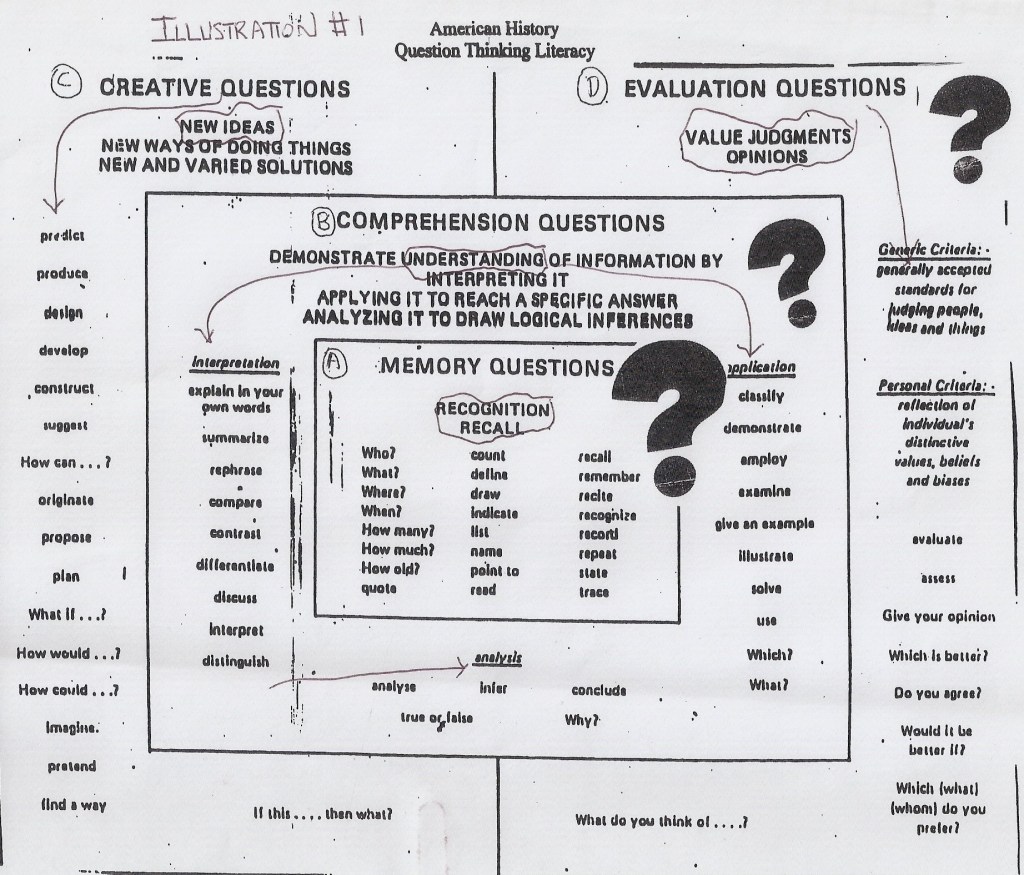
Illustration #1 is a visualized chart showing the critical thinking process. Every student is given a copy. Large copies are mounted on the classroom walls. Part of our dilemma in thinking is that it is a silent and hidden process. If we are asked to read or see we use our eyes. When we are asked to think we do not have self-directed tools. How do I think? The chart makes the idea tangible to the eye. The letters A B C D show the four types of thinking skills. The skills are circled. Questions are the matches that ignite or fire-up the thinking skill target.
There are four thinking targets:
recognition and recall of explicit information,
understanding,
creating new ideas
arriving at judgments and opinions.
There are three types of understanding skills:
interpretation,
application, and
analysis.
Illustration #1 can be used by a teacher in planning content knowledge objectives. It can be used in classroom or assignment questions. If students take State tests, IB exams or AP exams the visual can be used to analyze the types and frequency of questions on these external examinations. Finally, it can be used when designing a school quiz or test.
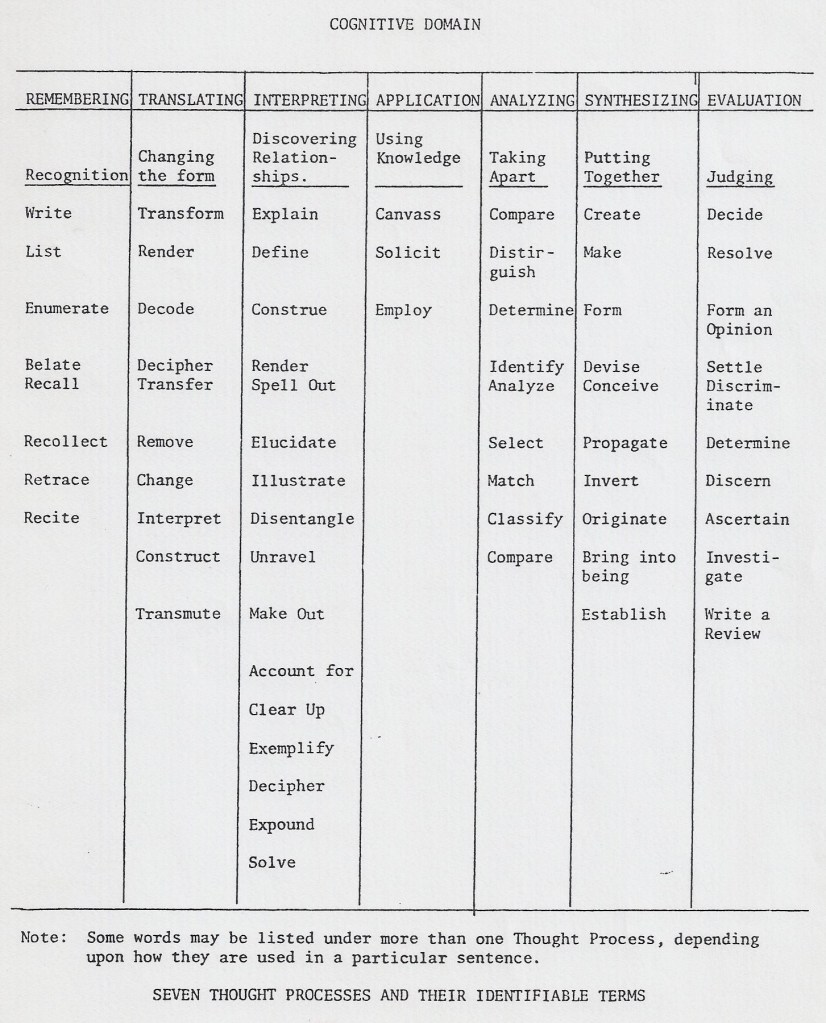
Often, parents want to discuss a student’s achievement. If assignments and tests follow the A B C D elements in the visual, student results can be quickly identified by thinking skill. High achievement students consistently think at the C D level after they have mastered A B levels. Some students never elevate their thinking beyond factual recognition and recall. Their test results and assignments do not rise to the B C D level. These levels become achievement goals. When students can “see” their thinking results and goals, they can consciously reflect on what a Cor an A student means, Illustration #2 is a chart that identifies thinking skills and the questions we use to ignite the skill.
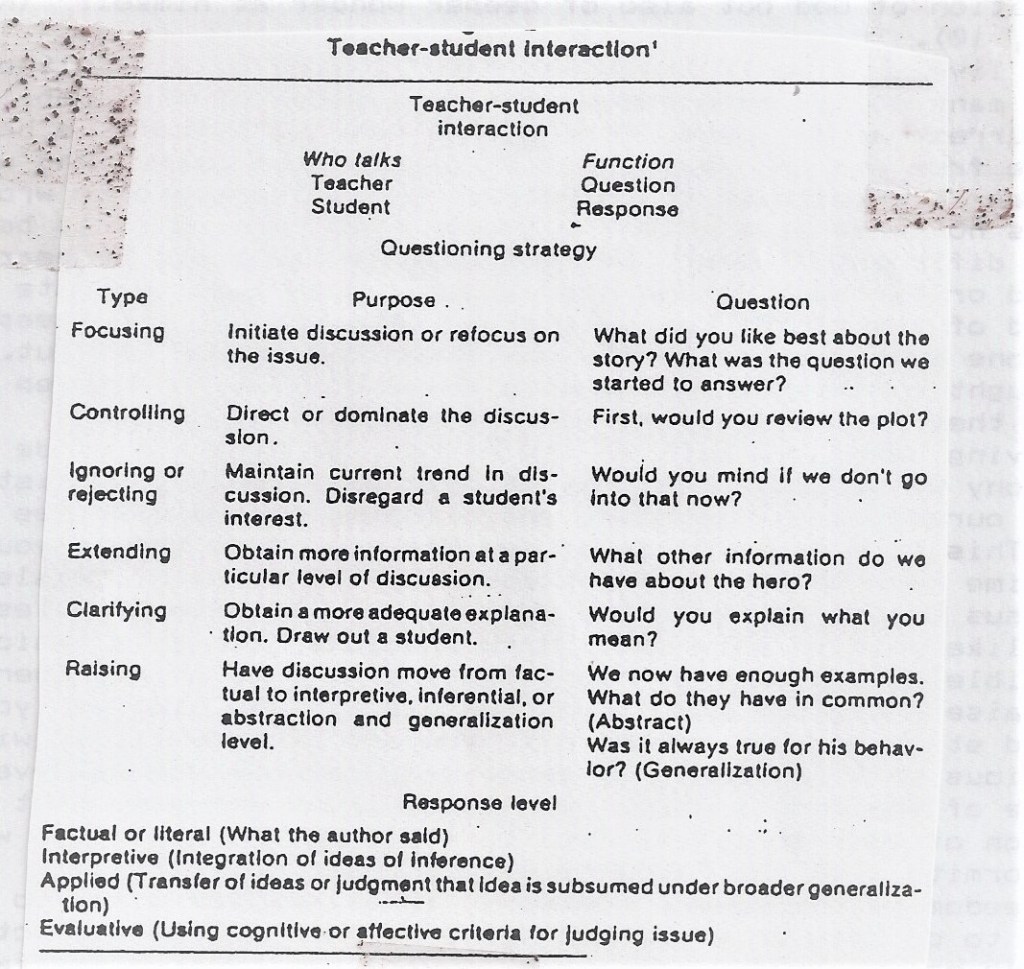
Illustration #2
When students can “see” their thinking results and goals, they can consciously reflect on what being a C or an A student means. Illustration #2 is a chart that identifies thinking skills and the questions we use to ignite the skill.
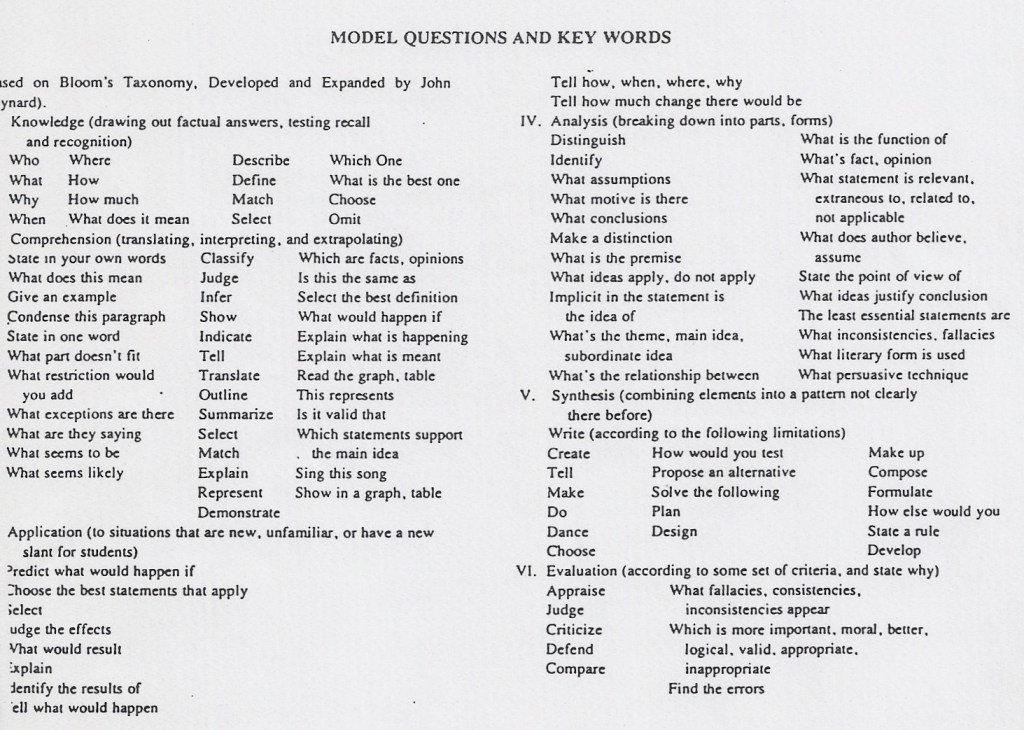
Illustration #3
Illustration #3 is another question taxonomy. Stress with students the difference between the thinking skill target and the question arrow. Once they practice with our question they can create their own questions or even an examination using the menu of illustrations 2 and 3. Students learn to think about thinking.
We have now defined critical thinking and examined visual examples showing the relationships between Critical thinking and questions. Critical thinking occurs within a class setting.
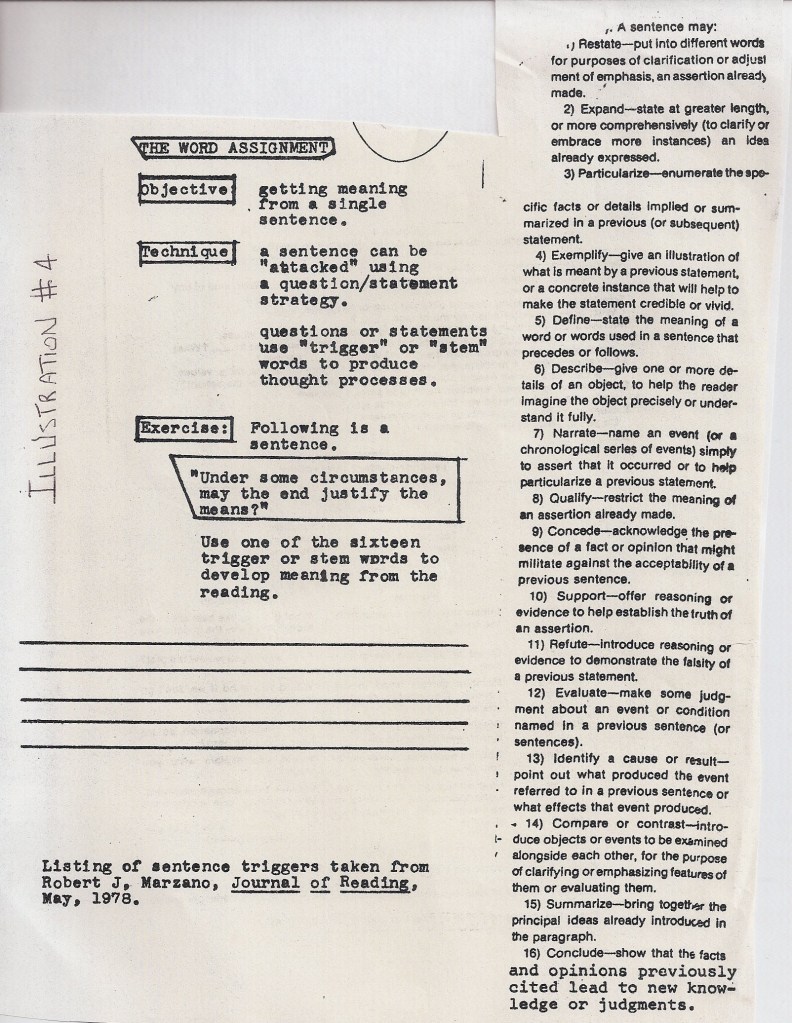
Illustration #4
What are the teaching tactics which will help us reach our Critical thinking strategical goal? One strategy from Robert Marzano is applied to a single sentence classroom reading. See Illustration #4.
Marzano asks the class to respond to the question “Under some circumstances may the end justify the means?” Students may read or listen to the question. He then lists 16 possible ways the teacher can activate student thinking by direct questions or asking students to create their own question responses to the statement.
Illustration #5 (Q/R) Question and Response
In Illustration #5, Robert Stahl of Arizona State University developed a multistep question approach to questions centering on values and moral education. When encountering information, print, visual, or quantitative, Stahl took students through four critical thinking actions:
Knowing,
Thinking,
Valuing,
Feeling.
For each stage he used certain specific questions. To know requires explicit evidence yielding precise facts. He used “I see it there” focus questions. Then he asked students researching for implicit evidence.
Stahl used two question tactics. “Define” and “restate in your own words.” To focus on values relating to critical thinking, he asked students to compare and contrast and finally he used questions summarizing, concluding, or clarifying that helped students make judgments.
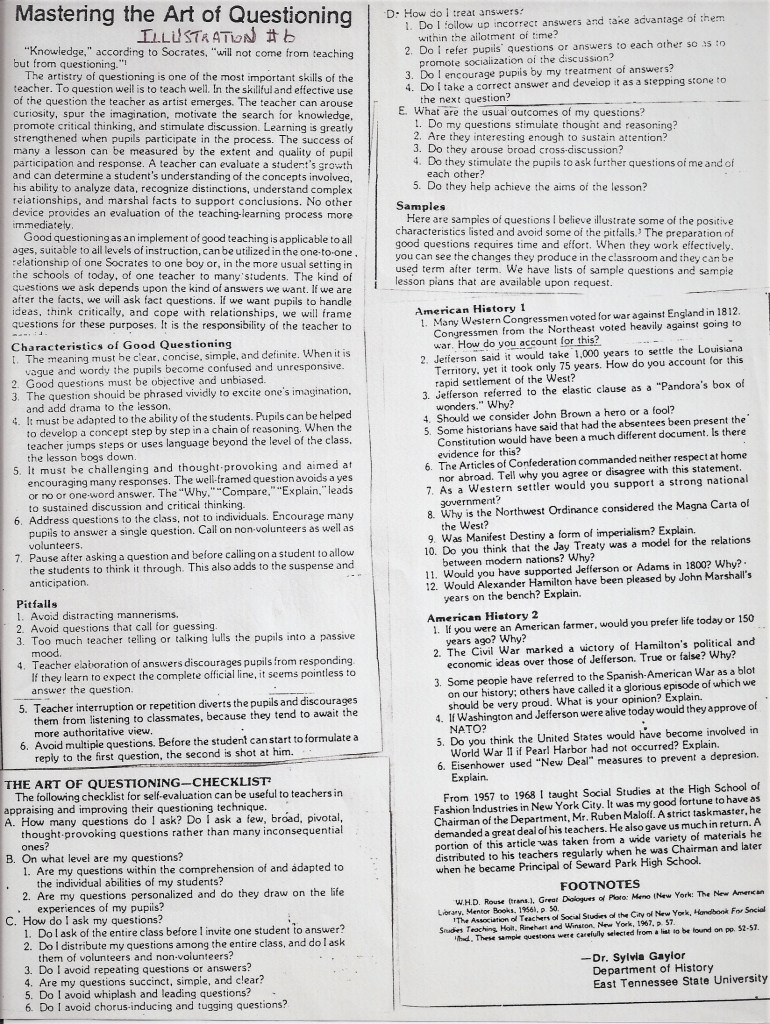
Illustration #6 (Dr. Sylvia Gaylor)
Dr. Sylvia Gaylor gives us some concluding advice in her article MASTERING THE ART OF QUESTIONING, Illustration #6
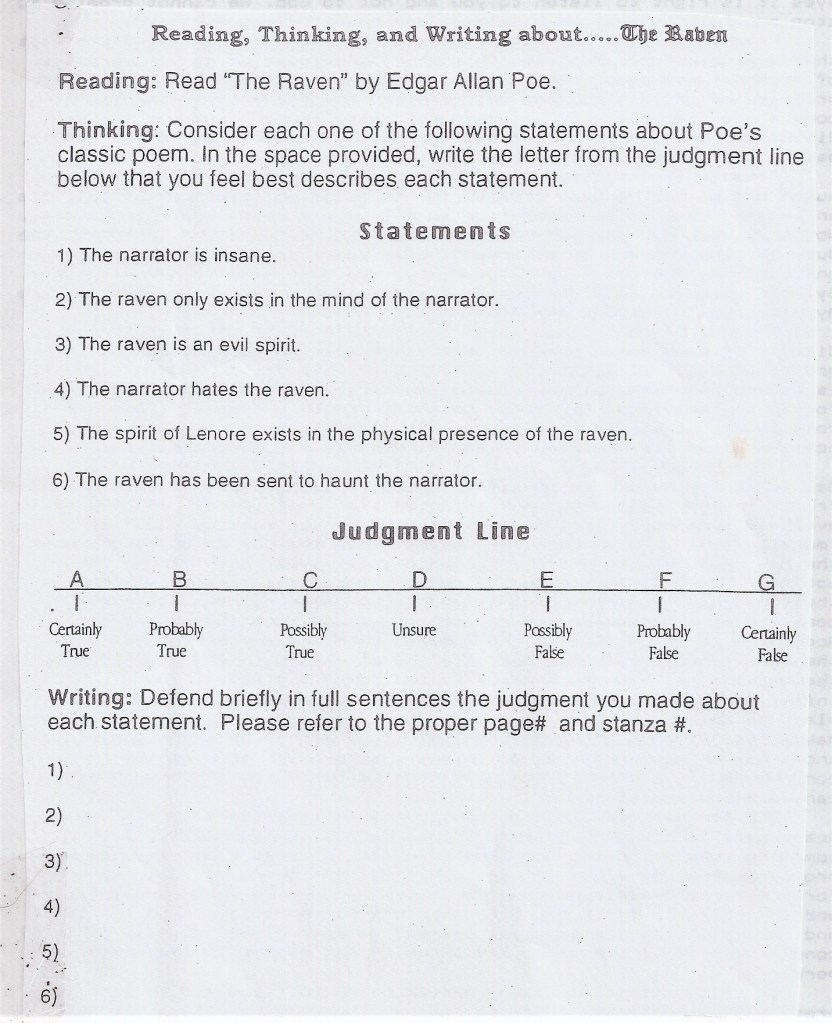
Illustration #7
Two examples of deductive reasoning follow. The first called J line orJudgment Thinkingis by an American Studies middle school teacher Jay Wordsman (Valley Middle School, Oakland NJ). The activity in Illustration #7 has 4 elements:
A. Assign a reading-The Raven by Edgar Allan Poe.
B. Following the reading students are given a response form called J Line containing six statements.
C. Students are asked to read the statement and consider its validity remembering evidence about each statement. Using the Judgment Line they circle one of the responses A B C D E F G writing a few words above the letter noting their evidence.
D. Finally, the defend each of their six choices in a sentence.
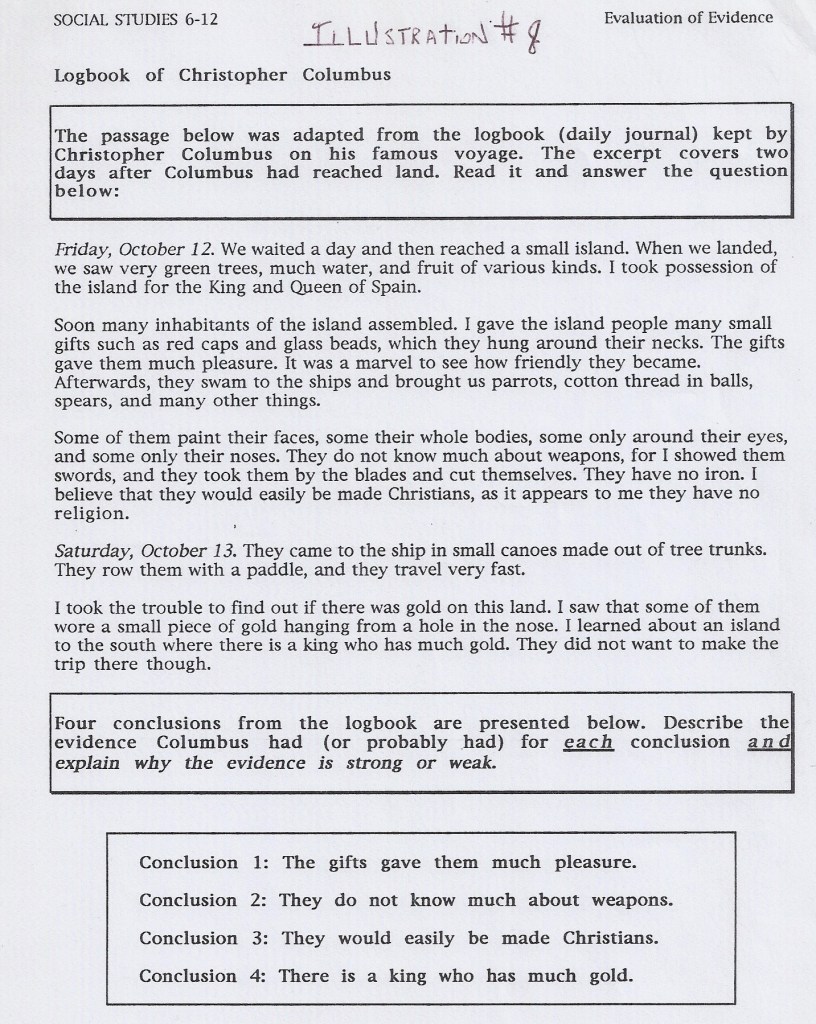
The final example of deductive reasoning is from the Massachusetts Department of Education, Illustration #8.
Illustration #8
It lists four conclusions from a Columbus reading and asks students to evaluate the strength or weakness in the conclusion.
Critical thinking and reasoning are the second element in Academic Literacy. These skills are used in the classroom, for assignments and in evaluation. By its very nature thinking is hidden and silent. We need to visualize it and engage students using the visuals so that private thinking becomes public discussion.
American students are in school for thirteen disconnected years. In grades K-5 students learn in a reading/language arts/mathematics skill-based school. Most students have one classroom teacher. Literacy means reading and language arts, a term that combines writing, speaking, and listening. Testing assesses reading, language arts skills, and occasionally writing short compositions.
Then a change occurs in grade 6. Students go to a ‘second” school. This is a middle or junior high school with departments. Teacher certifications and expectations change. Every day students will now see six or seven teachers. Except for the language arts teacher these teachers do not teach literacy. They use it as one tool to achieve their academic goals. These schools, grades 6-12, have redefined literacy.
“Second” schools use four literacy elements:
Information Sources – reading, visual cognition, quantitative analysis and kinesthetic learning skills.
Information Processing – Thinking operations and reasoning odes
Retention – The most critical literacy skill in grades 6-12.
Producing Thought – Responding to objective test items. Writing in 7 forms, speaking, and creating performances in music, theatre, art, and dance.
Knowledge retention is a new and now most critical skill. Without memory students can’t achieve or produce original thought. These 4 elements are known as Academic and Career Literacy (ACL). Attachments A and B illustrate in mathematics and other departments.
Elementary or skilled-based schools focus on reading and writing composition. These experiences are important but inadequate for success in knowledge-based “second” schools. Whether instruction is authoritarian lecture, inquiry project guided, cooperative groups, or individual instruction via technology, these teachers in “second: schools have no exclusive loyalty to academic learning through reading. They are eclectic in choosing learning materials and teaching tactics. Their loyalty is to their students and academic subject matter. This is their identity and mission. Walk down the hall in a K-5 school and ask a teacher who he or she is. Their response will be, “I teach 3rd grade.” They identify by child cohort. Walk down the hall of a “second” school, middle, junior, or senior high school and ask the same question. “Who are you and what do you do?” The response will be different. The Literacy Big Short emerges from this disconnection between elementary schools and “second” school function and literacy use. The disconnection is deep, harms students, and is not easily corrected through teacher education reform or new State certification requirements.
ORIGINS OF THE BIG LITERACY SHORT
Educators have been aware of the literacy disconnection and have made efforts to define and connect literacy between elementary and adolescent “second” schools. A 2006 project funded by the Carnegie Corporationin association with the International Reading Association and the Alliance for Excellent Education. Fifteen key elements were identified within a reading and writing literacy concept. They are abridged and paraphrased below:
Direct comprehension instruction.
Effective instructional principles embedded within comprehension activities.
Motivation and self-directed learning.
Text-based collaboration.
Strategic tutoring.
Use diverse texts.
Intensive writing.
Use technology.
Ongoing formative assessment.
Extended time for literacy.
Professional Development.
Ongoing summative assessment.
Teacher teams or cross-departmental reading.
Administrative leadership.
Cross grade and departmental coordination.
The elements do not reflect the actual nature of literacy in “second’ schools They were and remain a response to standardized reading and language arts testing mandates found in district tests, state examinations, PSAT, SAT-1 and the ACT. These mandates are critical and permanent. Except for the New York State Regents content graduation examinations, high stakes testing in American “second” schools, middle and high schools, assesses reading and mathematics. But, “second” school students learn and graduate by earning credits in departments that use academic and career literacy, not only the reading component.
What is missing? The following ACL skills are used across all grades and departments in “second” schools and directly linked to college entrance examinations and achievement.
Visual Cognition: Print and Electronic
Thinking and Reasoning: Applied to all information sources
Cognitive Science: Focus on attention, toleration for frustration, impulsive control, goal setting, task completion, and self-generating questions.
Retention: Both short and long-term academic memory
Applied Quantitative Analysis: Statistics and Data interpretation
Writing in 7 forms: recognizing writing, copying, note-making, redesigned writing, composition, media writing, and web site design
The greatest deficiency in a reading centered literacy is the near total absence of instructional emphasis on retention and memory. Reading contests determining who has read the most books in a year are very important. They nurture motivation and develop skills. But does any student who has read 112 books remember what they read in book #56? There is no need to remember until they enter “second” schools where reading is transformed into literature study. Remembering Act 2 Scene 4 in Hamlet is critical to understanding Act 3 Scene 1. The challenge becomes not what we read but how quickly we can learn and how much more slowly can we forget. Without useable memory, every Monday is Friday and teachers can’t go forward. Review is necessary. Memory is constructed at the time of instruction and not only through study which only rehearses embedded memory.
This literacy disconnection will continue. University reading preparation programs train reading experts. State certification requirements reflect these goals. Some students in “second” schools must have intensive reading remediation. Many more new English-language learners are also entering these schools. Special education enrollment is rising. There is a growing need for expert reading diagnostic-based instruction. Yet when these students enter content classrooms their teachers are not loyal to reading as the primary information instructional system. Success in isolated clinical settings or small group instruction do achieve reading gains. Schools and districts are judged by these test results. But, credit-driven content learning requires skills other than reading skills. Students do not graduate high school because they can read. They graduate when they meet credit requirements. Some drop out.
CLOSING THE BIG LITERACY SHORT GAP
First, can we accept the reality that literacy in the “second” school is not the literacy in the elementary, skill-based school? Can we accept the reality that university-based degree literacy programs will not easily change since they must produce reading experts and the reformed programs would have to include members from other university departments such as psychology, communications, English, and perhaps, philosophy? Changing state certification requirements is very difficult, time-consuming, and may require administrative code or statutory change.
Any effort to improve achievement in “second” schools must begin in the district. The first step is an administrative commitment to a new concept of literacy instructional leadership. Then, in every “second” school can we identify an educator who will embrace and use the ACL concept and gradually begin serving other faculty? This person could be a reading specialist or a science teacher. As this teacher assumed a professional development role, they must retain a full teaching schedule. Any reduction in teaching periods will increase costs, and possibly divide faculty harming the outreach effort. Administrators should eliminate all school duties for this person. Their duty will be to practice literacy in their classroom and communicate to other teachers either in their departments or to all teachers during their duty period. A stipend, summer work, professional travel and other incentives can be offered.
This academic and career literacy leader and administrators can then form a professional learning community (PLC) within the school. The PLC would include a mathematics, English, science, history, special education, and English-language learner teachers. The PLC would learn about and use ACL and then turnkey their classroom practices within their own departments. Schools would have a permanent cadre of ACL teachers and eliminate outside consultants.
The ACL/PLC project would then assist faculty in meeting school and district goals. Services could be offered or mandated to new teachers, untenured teachers, teachers at different grade levels, teachers in different departments, and teachers whose observation/evaluation and personal needs include some form of ACL.
THE BIG LITERACY SHORT: A CODA
All “second” schools are fragmented and consist of teaching tribes with different certifications and indeed even locations within the school. These schools are centrifugal and fracture a student’s experience in a 6-8 period day. They lack common academic purpose because every subject has its own claim to virtue. Academic and career literacy can be binding glue in this planned decentered adolescent education ecology. ACL also gives a common definition to Common Core in “second” schools. A shared center is created where none existed.
Schools grappling with changing demographic, economic, and social circumstances realize that their future is already rapidly receding behind them. They are in catchup reaction mode. Part of the dilemma lies in the recognition that the student achievement goal is restrained by an older concept of literacy which is them again disconnected by the current information communications technology that affects all teaching and learning across the different tribal cells in our “second” schools.
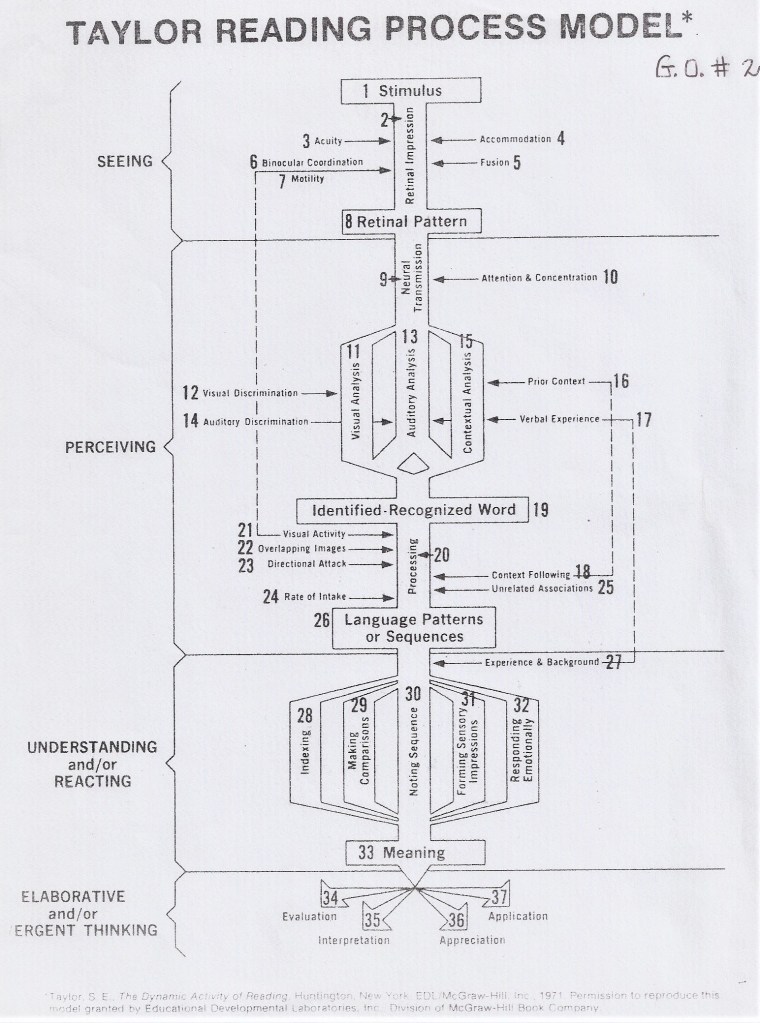
Inputs are depicted in the upper left. Reading is one means whereby students practice Gathering and Organizing. It is the first input which leads to processing, storage, and then producing thought.
First, we must describe and define the term “reading.”
Illustration #2 – Taylor Reading Process Model
Academic Literacy is used in knowledge-based classes with content teachers. They are never reading teachers and do not teach reading. They use reading for academic content goals. Academic literacy begins at #27 on the Taylor model. If students can not progress through points #1-26 they must receive direct reading instruction from reading teachers. Their comprehension level must be 4th grade or higher. Academic literacy gives content teachers the tools to create content learning after students can decode words and minimally comprehend. Academic literacy is a teaching/learning concept in departmentalized middle and high schools. It assumes minimal reading skills, #1-26 and proceeds from #27 to #37 on the Taylor model.
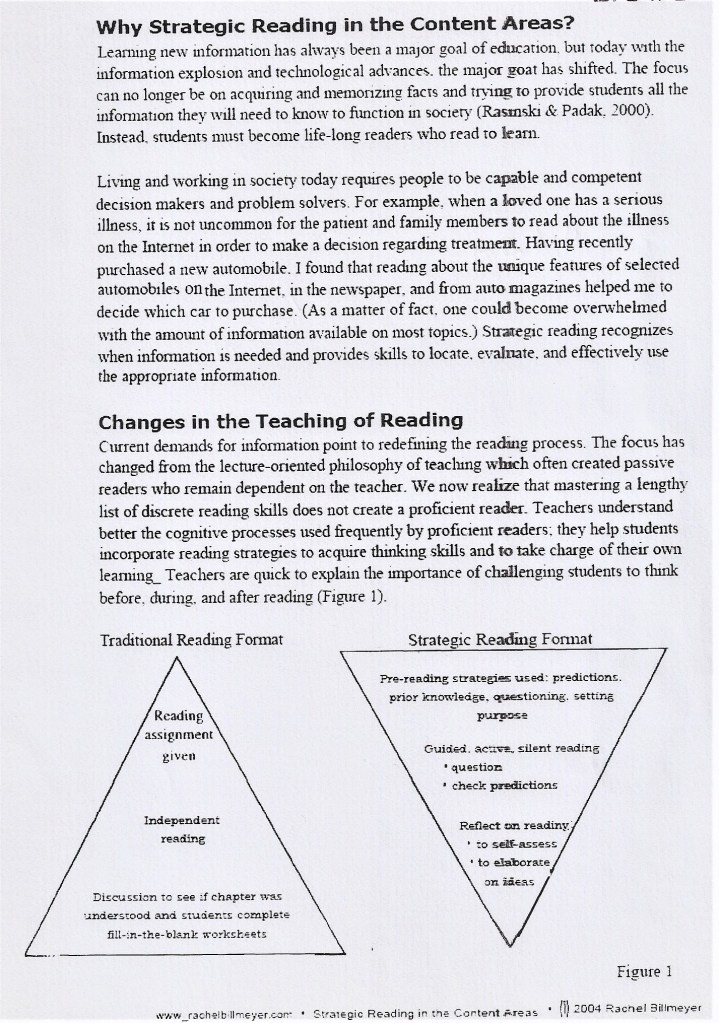
Academic Literacy reading is strategic reading. Reading is a tool for achieving content learning. Illustration #3 describes strategic reading in the content areas. It differentiates between traditional reading activities and strategic reading. The former assumes students can read, retain, and discuss after an assignment. The latter is planned and directive.
Illustration #3 – Strategic Reading in the Content Areas
In Social Studies reading occurs in three settings: the classroom, the independent assignment, and within tests.
The acronym CAT defines these settings: class, assignment, and test.
Classroom Reading—The short passage
Find a critical, short reading passage. Refer students to their text or handout. “Short” means no more than three or four reading minutes. Attention research indicates that the student focus span rarely exceeds four minutes. The content must be absolutely critical for meeting our goals.
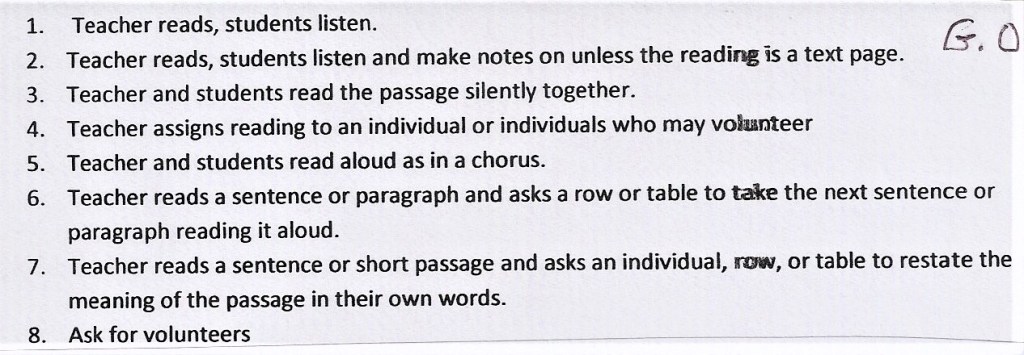
Illustration #4 – Eight Steps for Close Reading
So, how can we start the reading? Illustration #4 gives us eight ways. Set a purpose for the reading. Tell students what they will do after the reading. Then, begin the short “tight” reading.
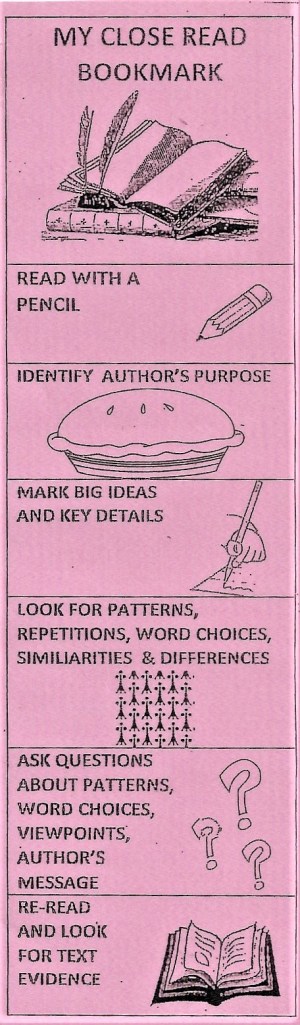
Mary Byatt and Laura DiPetro of Washington Township in New Jersey created a tool they call My Close Read Bookmark. Give one to each student, Illustration #5.
Illustration #5 – Close Read Bookmark
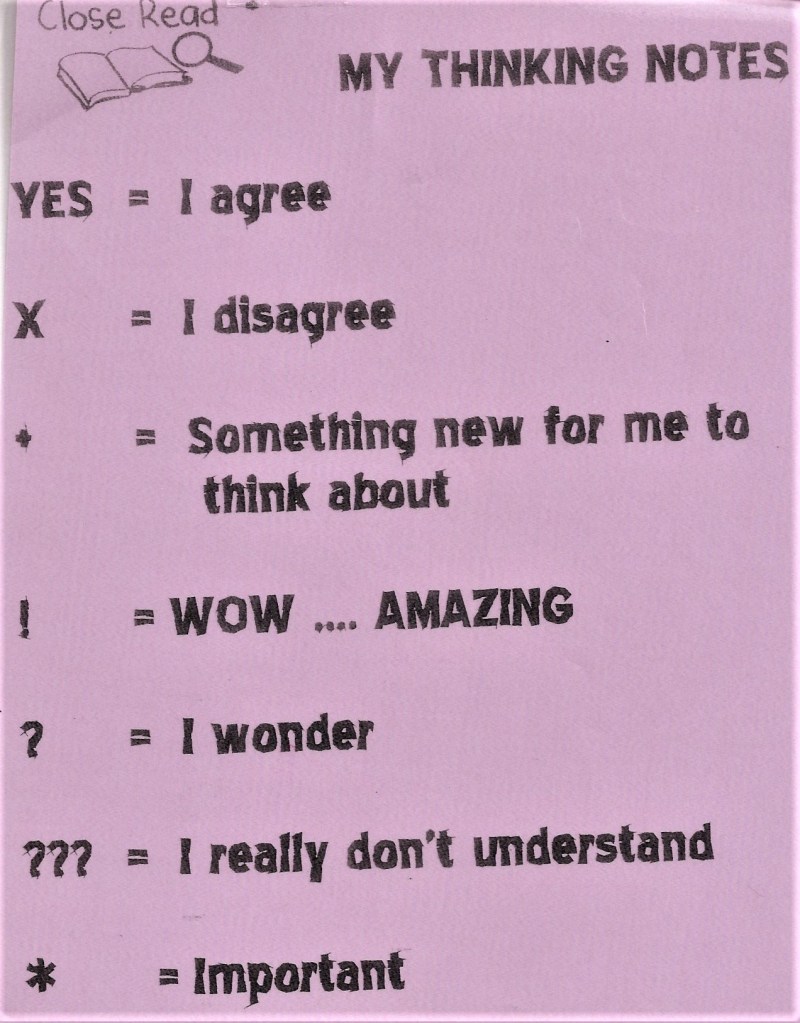
Using this tool they make “thinking notes.” Illustration #6
Illustration #6 – Thinking Notes
Before class ask students to bring in a 4 color pen. Use black for important notes, red for confusing ideas, blue for clear ideas, and green for post-reading review notes. Green for growth or change.
For memory ask students to note the weather that day, the type of clothing they wore, what they ate for breakfast or lunch or any other personal marker of their lives that day. Personal memory and academic reading memory unite.
Classroom Reading—The primary source document.
Faculty at Knox College in Iowa use Illustration #7 when examining documents. Students make notes on the handout.
At a 2015 U.S. History AP Reading Conference, Christopher Lewis and Jennifer Yoo Brannon, both AP teachers, presented another tool they called the HAPPY Analysis Chart. Illustration #8. When reading/discussing the document the chart is a note-making tool. H-A-P–P sections are indicated. The Y is for “why” is the document significant.
Illustration #8 – H-A-P-P-Y Analysis Chart
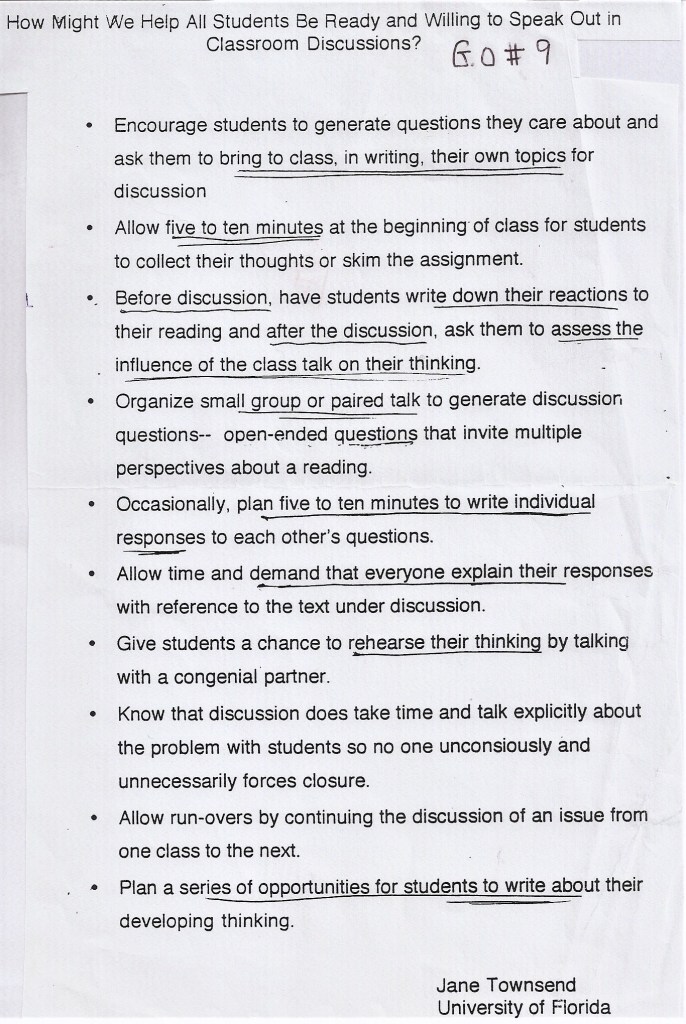
Classroom Reading QUESTION/DISCUSSION STRATEGY. Jane Townsend, University of Florida Illustration #9 gives us general guidelines for in-class readings.
Illustration #9 – A Strategy for Questions & Discussion
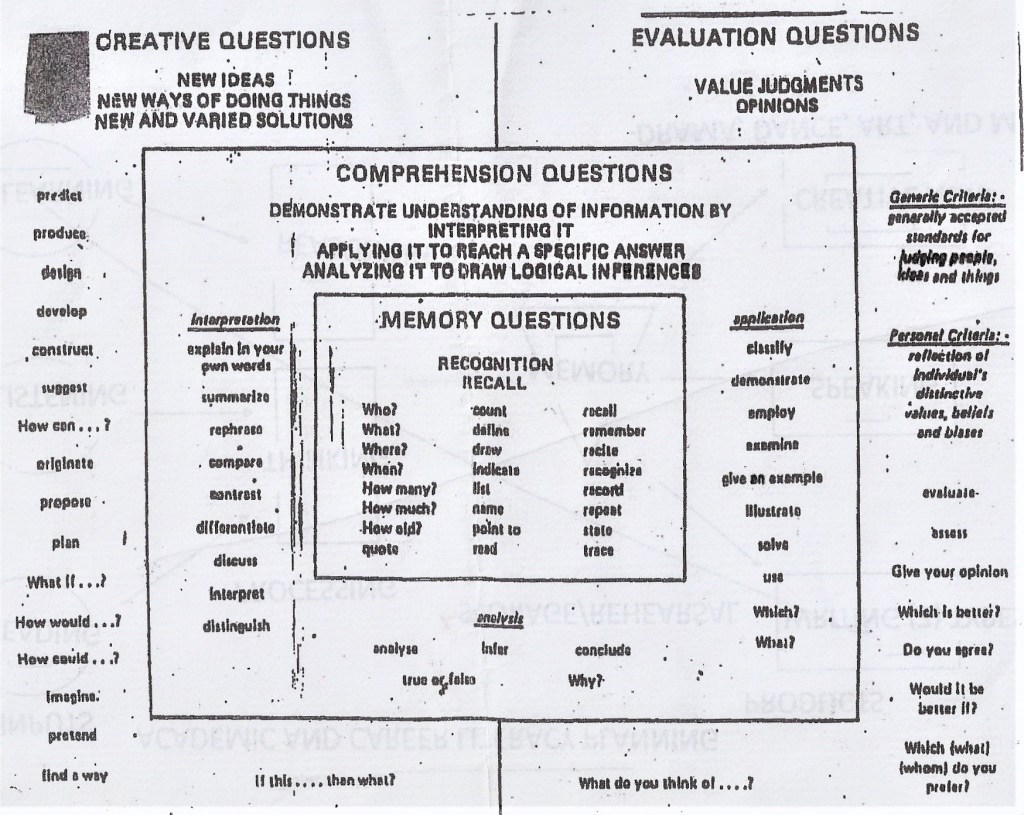
Every classroom reading needs a question strategy the teacher shares with the readers. Illustration #10 visualizes 4 types of thinking skills and the question triggers for each.
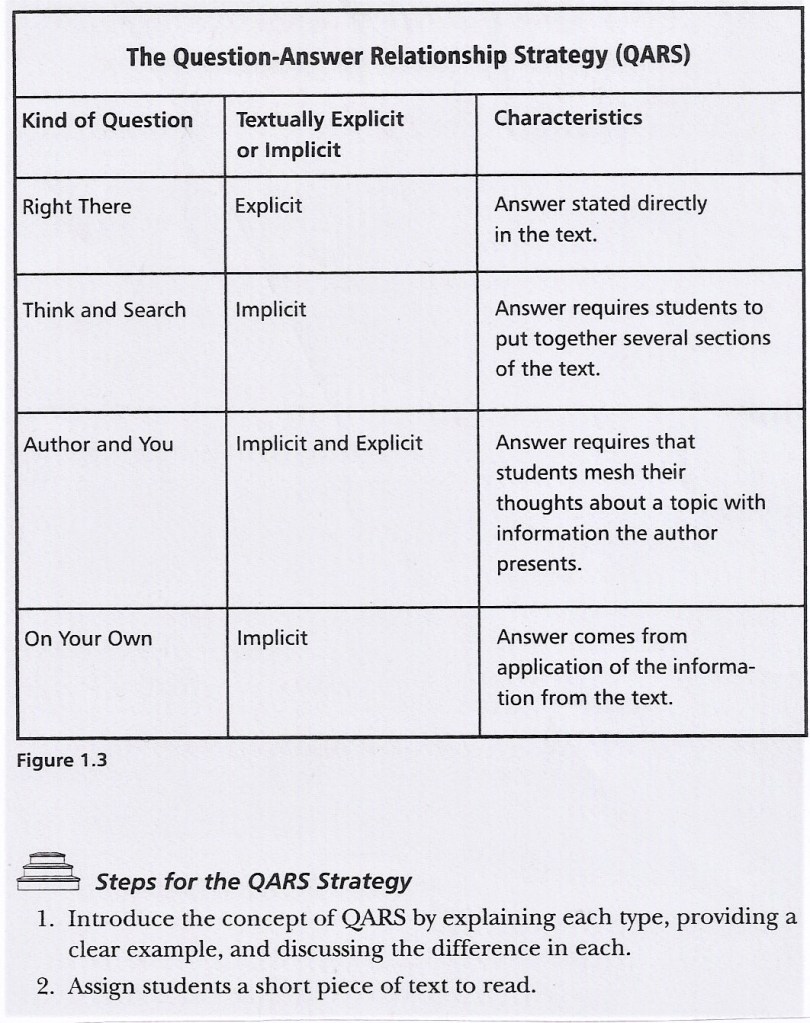
Illustration #10 – Thinking Skills
Illustration#11 shows the QARS strategy.
Illustration #11 – Q-A-R-S Strategy
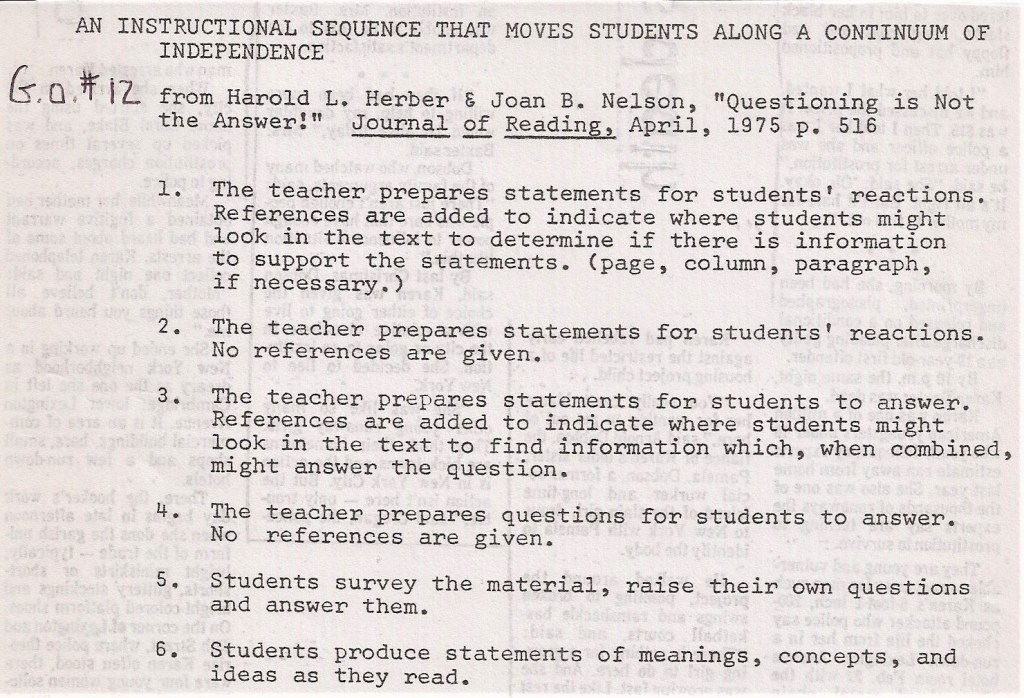
Illustration #12 must be carefully read because it gives teachers a question road map whereby students move from depending on the teacher for questions to their being able to create their own questions or statements.
Illustration #12 – Road Map for Asking Questions
=========================================
Reading Assignments—Guidelines.
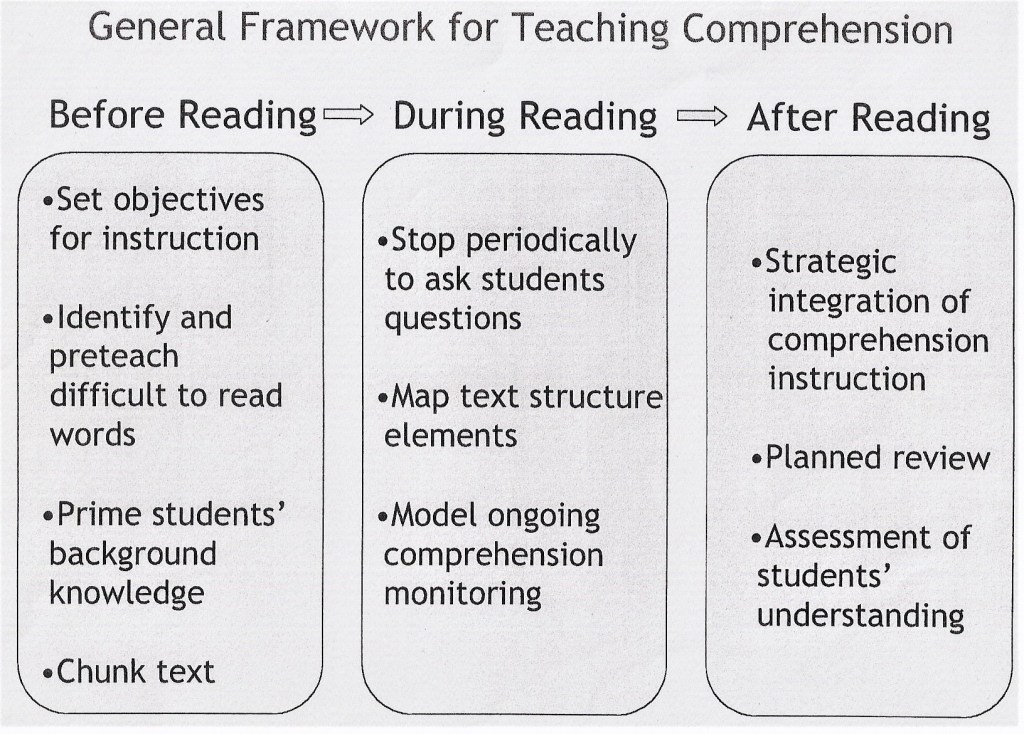
Often, we ask students to independently read before the next class. Then, we expect them to effectively discuss what they have read in class or use the reading to work cooperatively with new materials. Usually, they have not done the reading or if they have they have not retained any meaning. Illustration #13 gives teachers a strategy. Before the assigned reading we must prep students. As they independently read they need note-making tools to direct their reading and capture their reactions. Then, when they arrive in class the next day we can proceed. This is called a BDA strategy. B=Before, D=During, and A=After the reading.
Illustration #13 – B-D-A Strategy
Post Assignment Learning Strategies—Guides.
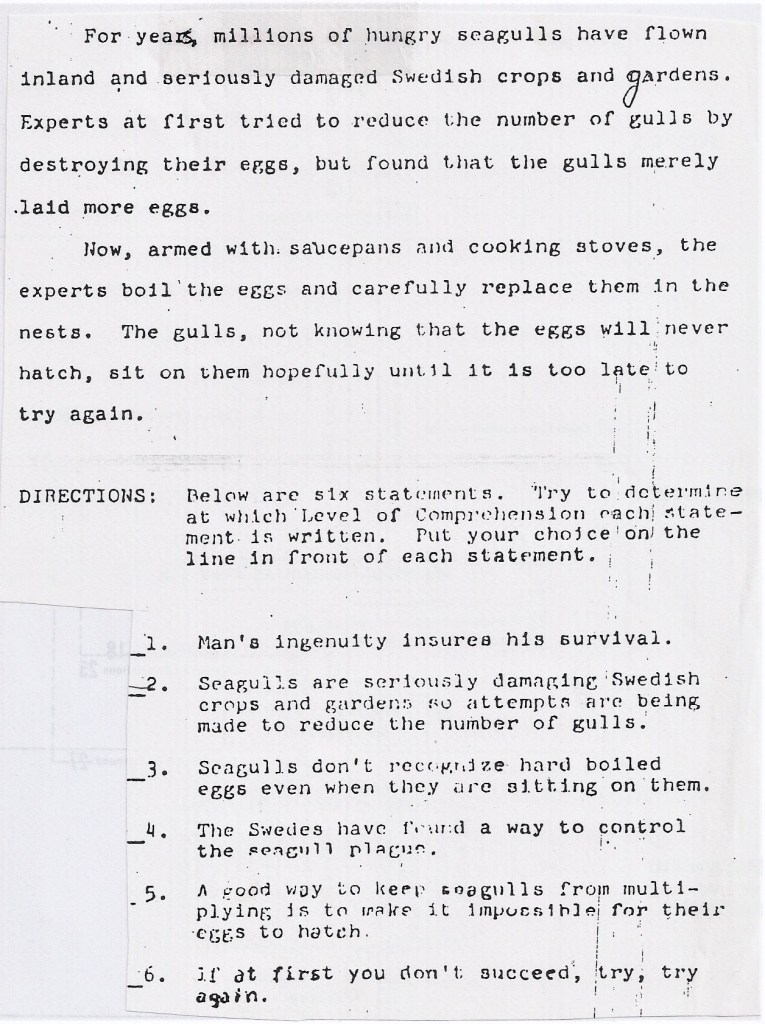
On the previous day we assigned a reading. Now, in the next class we want to build learning based on their reading. Guides are a tool. There are different types. GO#14 illustrates a comprehension levels guide.
Illustration #14 – Guide for Reading Comprehension
GO#14 illustrates a comprehension levels guide. There are 3 levels: factual, interpretation, and judgement.
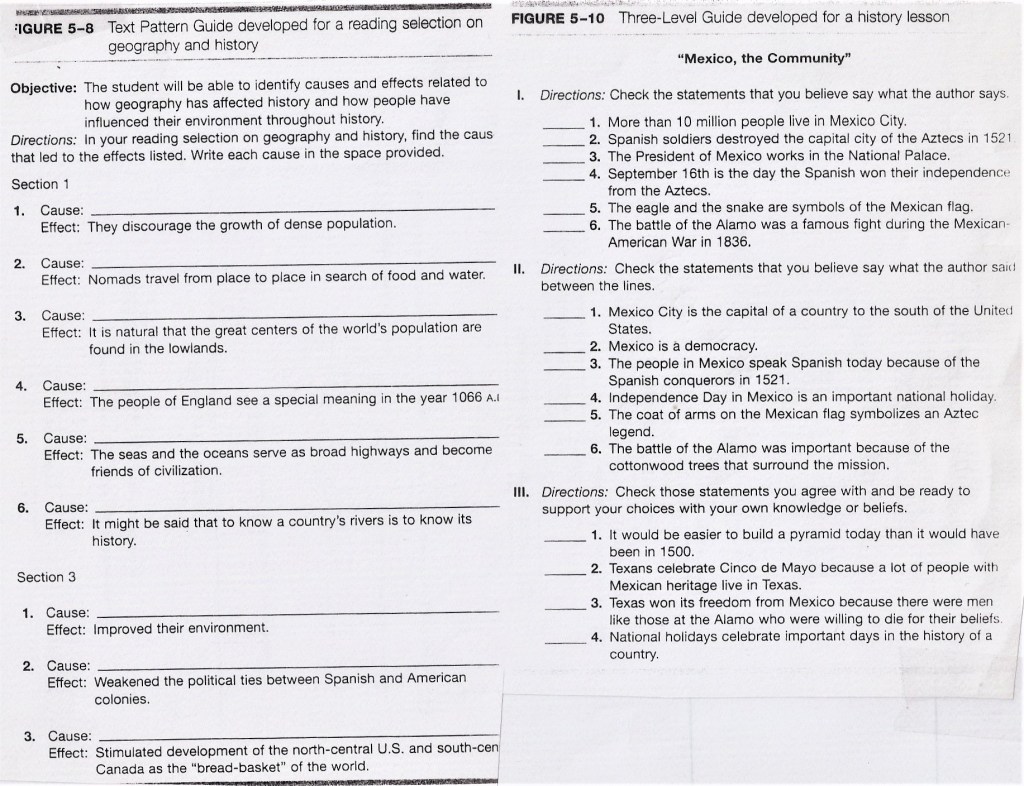
Illustration # 15 – Cause & Effect Patterns
This is a statement not a question guide. Use statements to trigger thinking. Statements open the mind. Questions corner the mind in one direction. Illustration #15 shows a cause/effect pattern guide and an author’s intention guide.
Illustration #16 uses lyrics from a ballad At Seventeen and develops a concept guide.
Illustration #16 – Seventeen
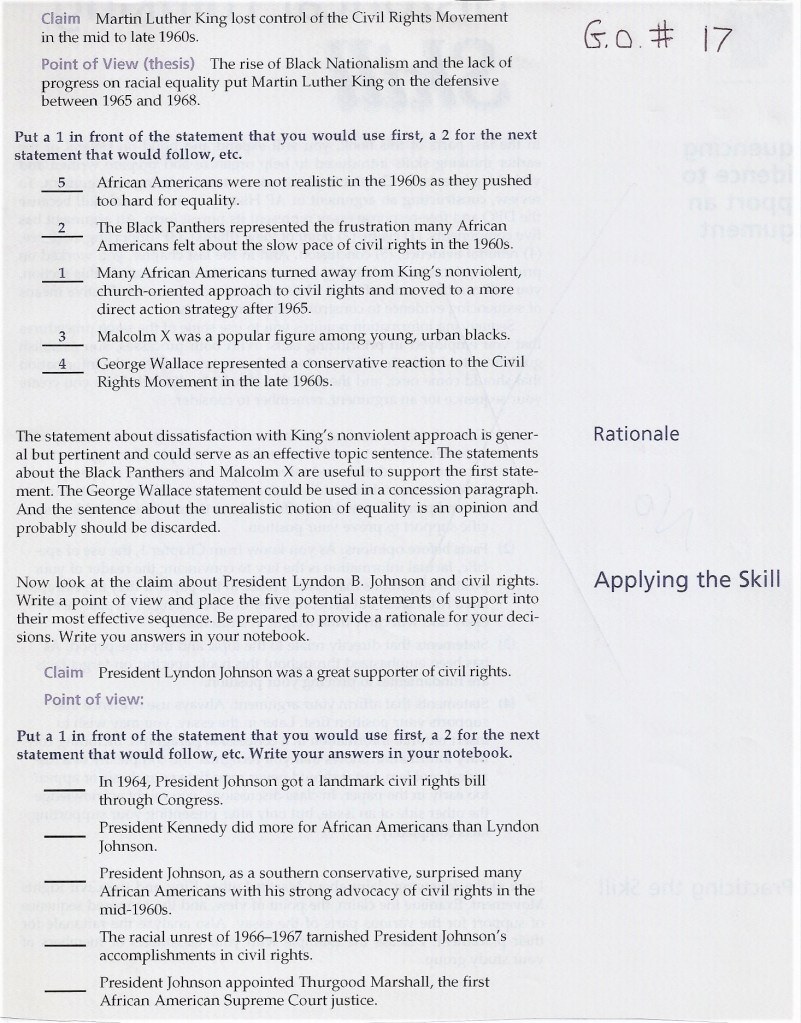
Illustration #17 uses a Claim/Point of View Statement Guide
Illustration #17 – Stating Claim
Illustration #18 concludes our guide samples by showing how our colleagues in science use guides. This two part guide was developed by Dr. Judith Thelen from Frostburg State, Maryland.
Illustration #18 – Example from Science
=====================================
Reading is one tool we use for learning. We don’t teach it. We use it for our academic goals. But, in using it we must not assume students automatically will read and bring critical skills to our classroom. We have to use our tools in the teaching learning process.
Part 1 – Academic Literacy – Learning with Visuals
“In elementary school all students are taught to read. Who teaches them to see. They may be mentally blind.”
Task #1 is defining the term “visual.” See illustration Gathering and Organizing #19. At the bottom is a line graph. Numbers 1-10 are flat, frozen visuals. The numbers proceed from #1 abstract symbols such as a plus or minus sign to #10 realistic photographs. Numbers #11 to #13 are electronic moving visuals. Our focus is on flat frozen visuals.
Illustration #20 is a visual interpretation chart. The chart argues that all visuals have a producer with intent and aim. The visual can vary. Finally, there is a receiver or audience which has a memory and reason for seeing the visual. We can always use this generic chart in our classes.
Illustration #21 – Visual Interpretation Chart
The most commonly used visual is the photograph. Read illustration #21 for an orientation to photographs. Pick one of the Thoughts at the bottom and discuss its meaning with students.
“Looking is easy. Seeing is an achievement”
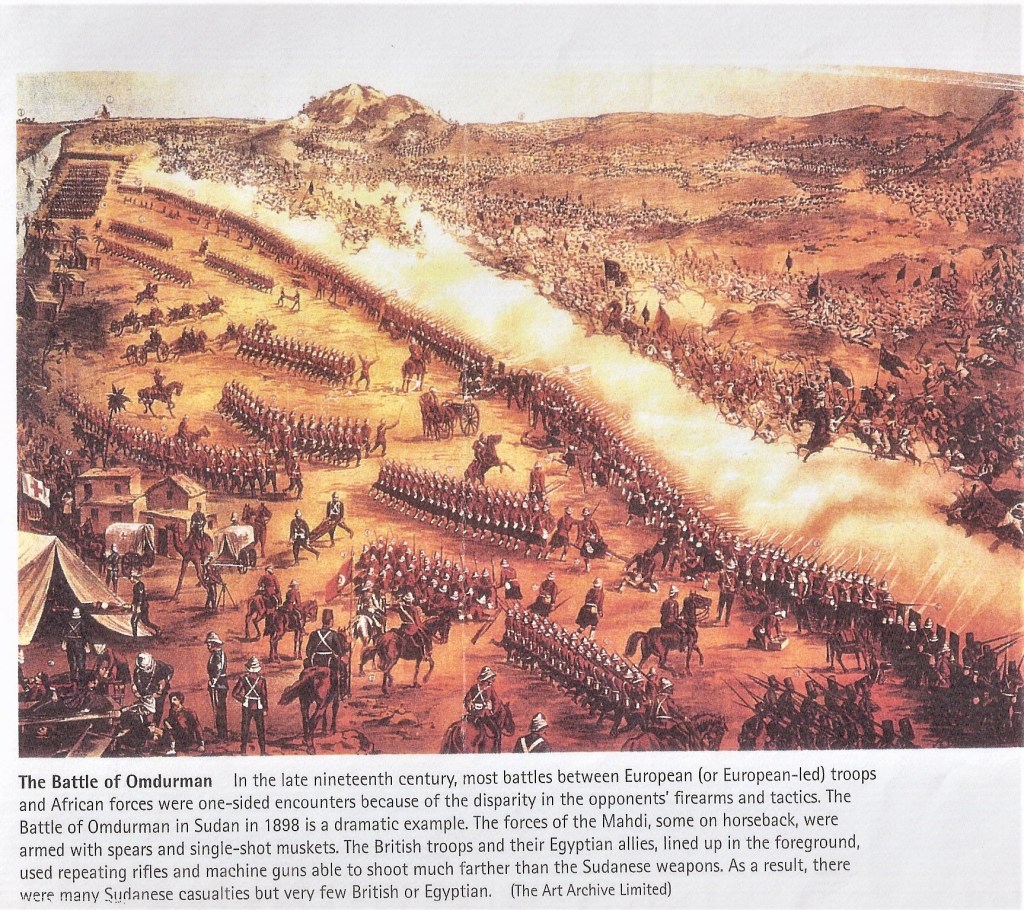
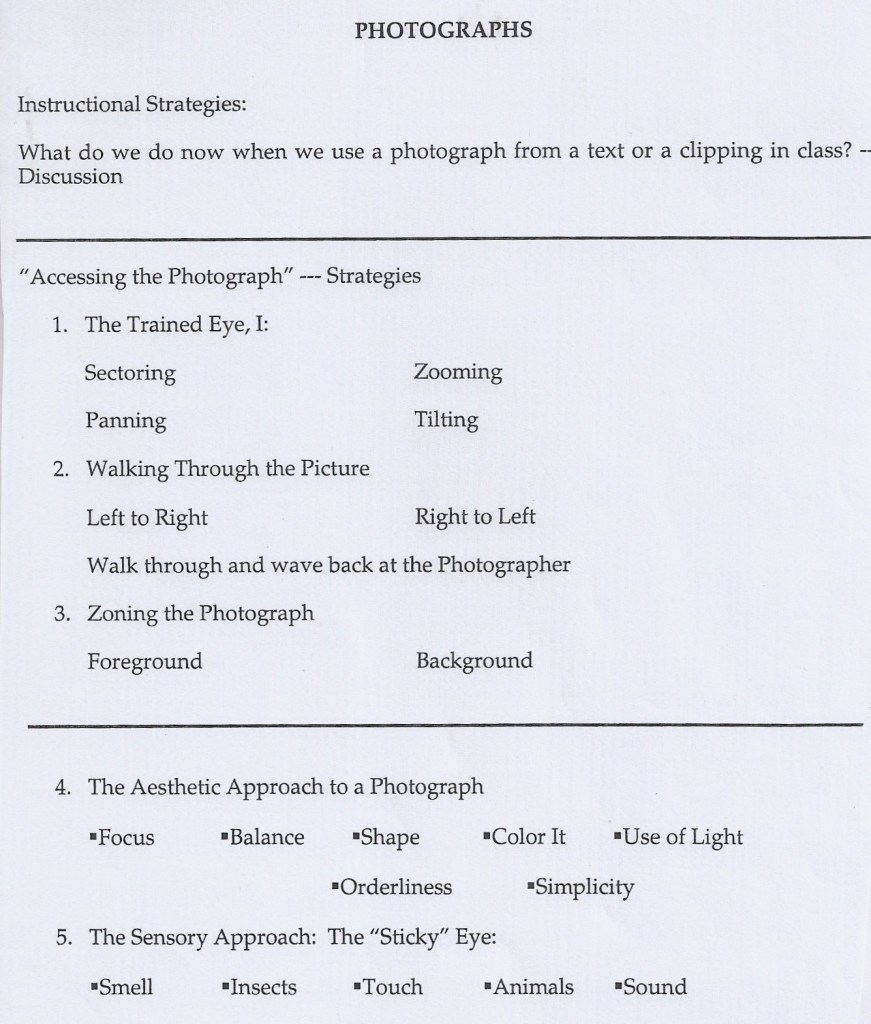
Following are instructional activities we can use when a photograph or pictorial illustration serves our teaching objectives. Illustration #21 is called Invading the Picture. Let’s use it with an illustration of the Battle of Omdurman in the Sudan in 1898. The illustration is extremely dense with information. We can ask students to tell use what they see or we can deliberately guide them in an inductive teaching manner. Accessing the illustration has three approaches. First is the trained eye. We can sector or divide the scene into observable parts. The white area seems to divide the two forces. We can pan the scene from left to right or top to bottom gathering information. We can zoom shot on one tiny feature and expand the meaning. For example, using a clock technique go to 11 o’clock in the extreme upper left. There is a river. In the river are boats. Next to the river are masses of assembled troops.
Illustration #21 – Battle of Omdurmam in the Sudan (1898)
What does this zoom or punctum (point) shot tell us? Rather than walk across a desert to the battle the British brought their rested troops aboard ships before disembarking them. They were well fed and had plenty of water so when put into the battle they were fresh. A final technique is called the “tilt” eye shot in which the viewer is looking down on the scene as if in a drone. We do not simply look. We have a guided eye.
A second approach is called walking through a picture. A third is called zoning the illustration
“A photograph or illustration is time’s witness stopping it forever.”
The 4th and 5th approach to invading a photograph or illustration are the aesthetic and sensory approach.
Illustration #22 – Analyzing Photographs
“Does a photograph have meaning or is the meaning brought to the photograph?’
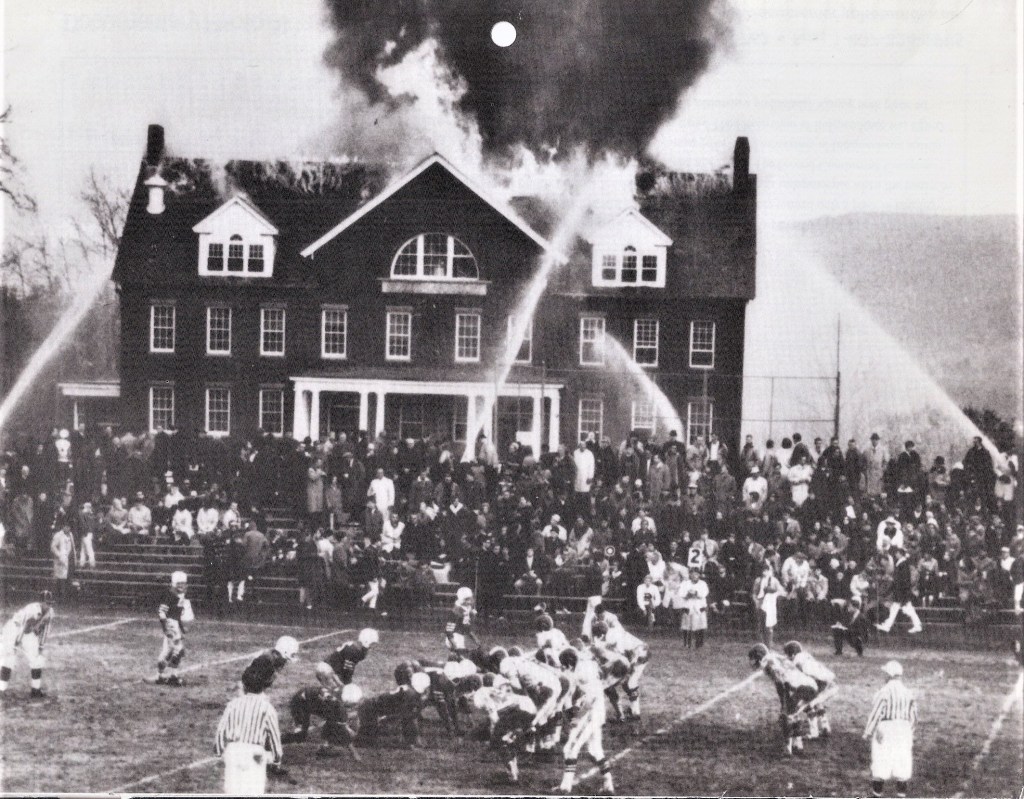
Illustration #23 is an action photographs that accompanied an article about a football game being played while a school was burning down.
Illustration #23 – School on Fire
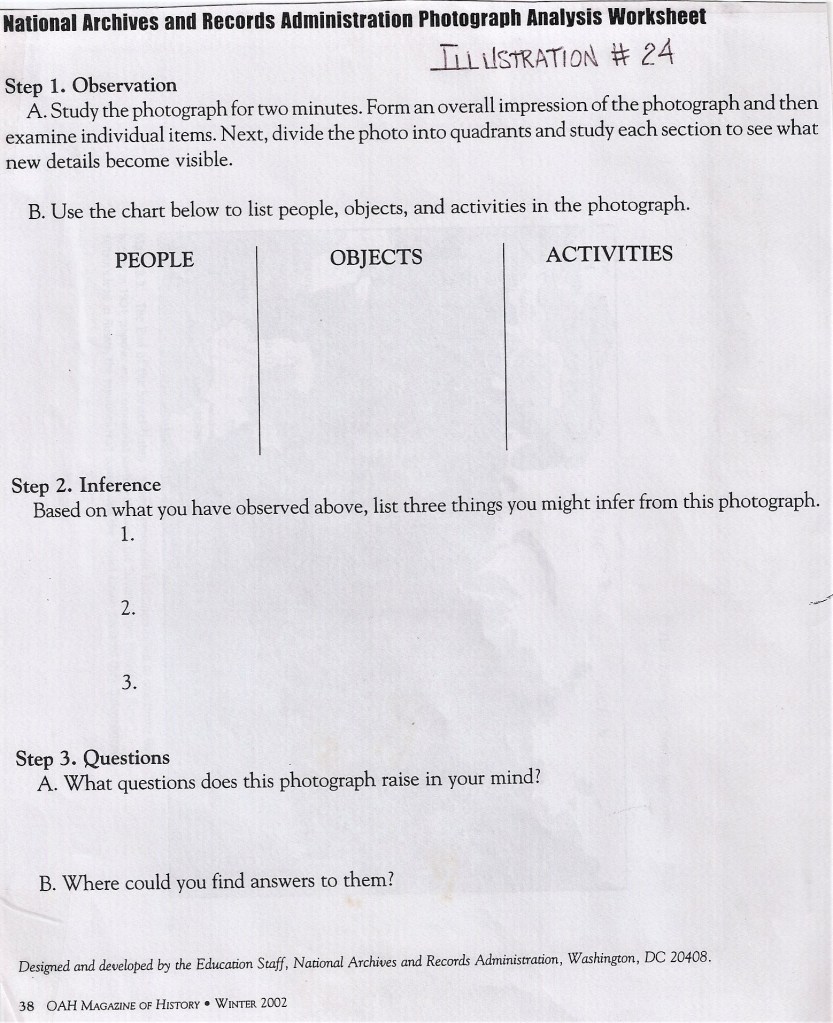
Illustration #24 can be used with the same photograph. A four column analysis is used. People-who are the people we see? Objects-what things do we see? Connect them to the people, Activities-what actions do we see? Now, add a 4th column IDEAS what ideas or idea does the photograph convey? This is a POAI-Chart.
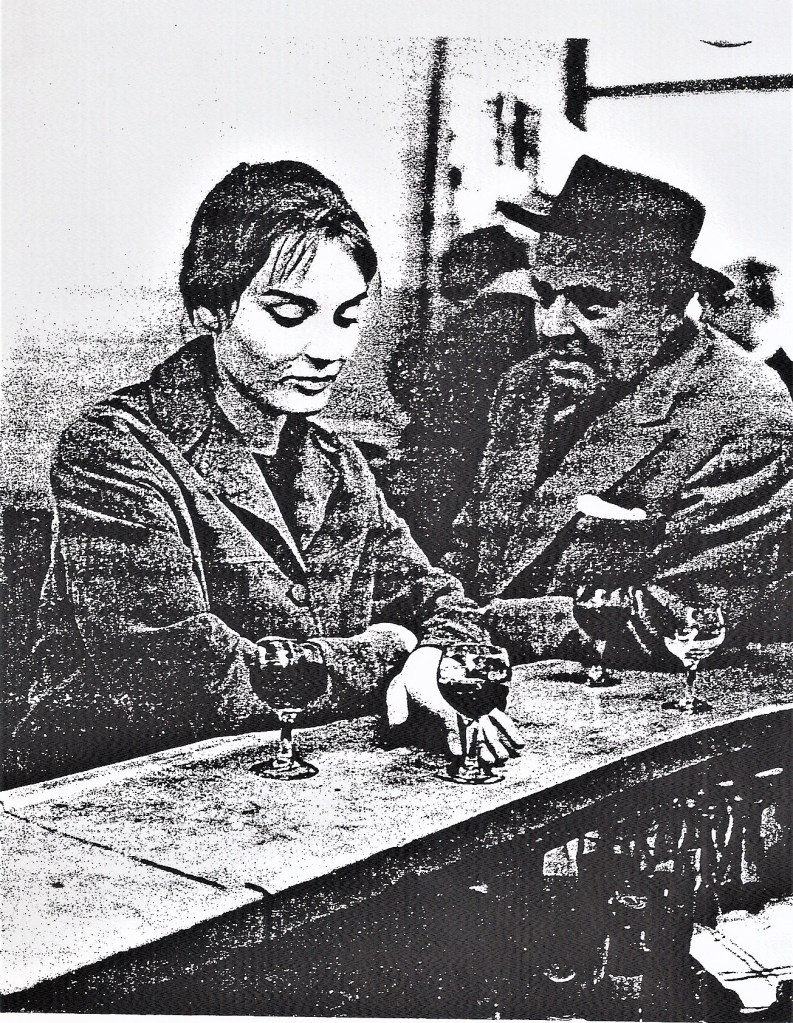
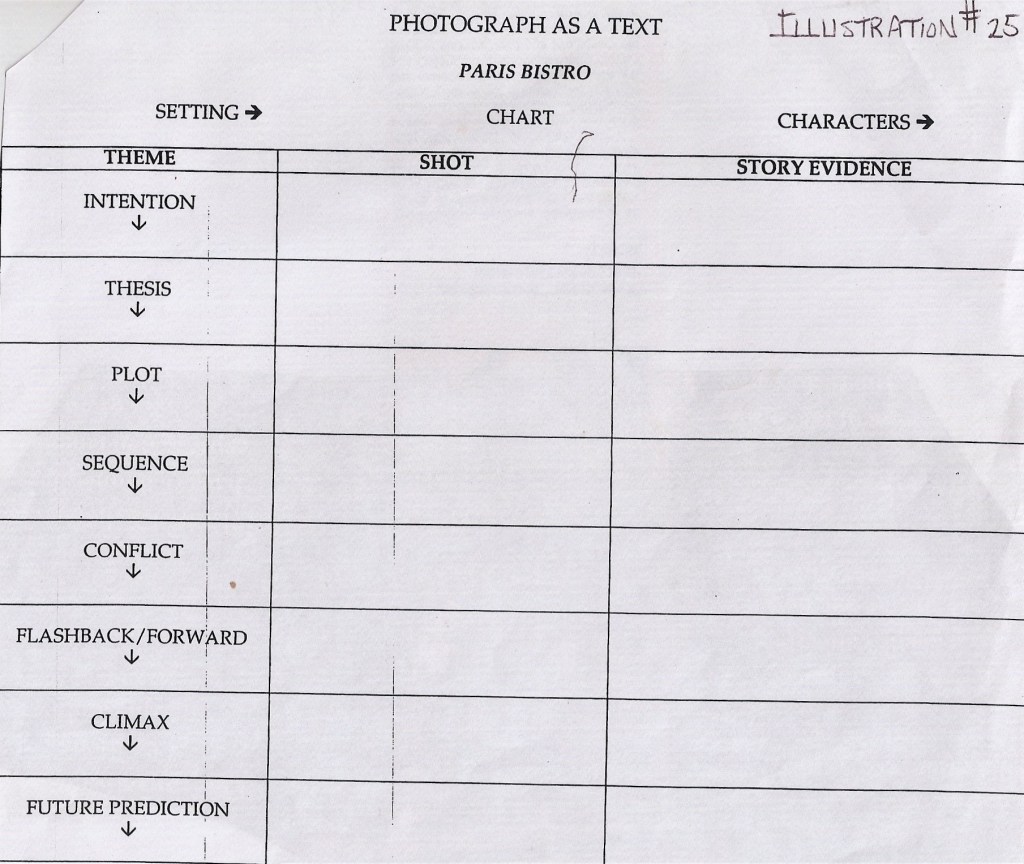
Illustration #25 Photograph as a Text shows us how we can tell a Story from a photograph. Students are given the story chart in the illustration. A photograph called Paris Bistro is our scene.
Paris Bistro
The left side of the chart sets our theme. What are the intentions of the two people in the picture. Where in the SHOT is there evidence of the intentions, the argument or thesis claim of the photographer. What might the plot be? What is the sequence of events. What were these two people doing an hour before they met and an hour after. Do we see any conflicts?
Illustration #25 -Paris Bistro Analysis Chart
What happened before? Later? How might this end. Is this a father speaking to a daughter? Is this a husband talking to a wife? What does the future hold? This story telling technique could have also been applied to the Omdurman illustration.
“A photograph is insight, not sight.”
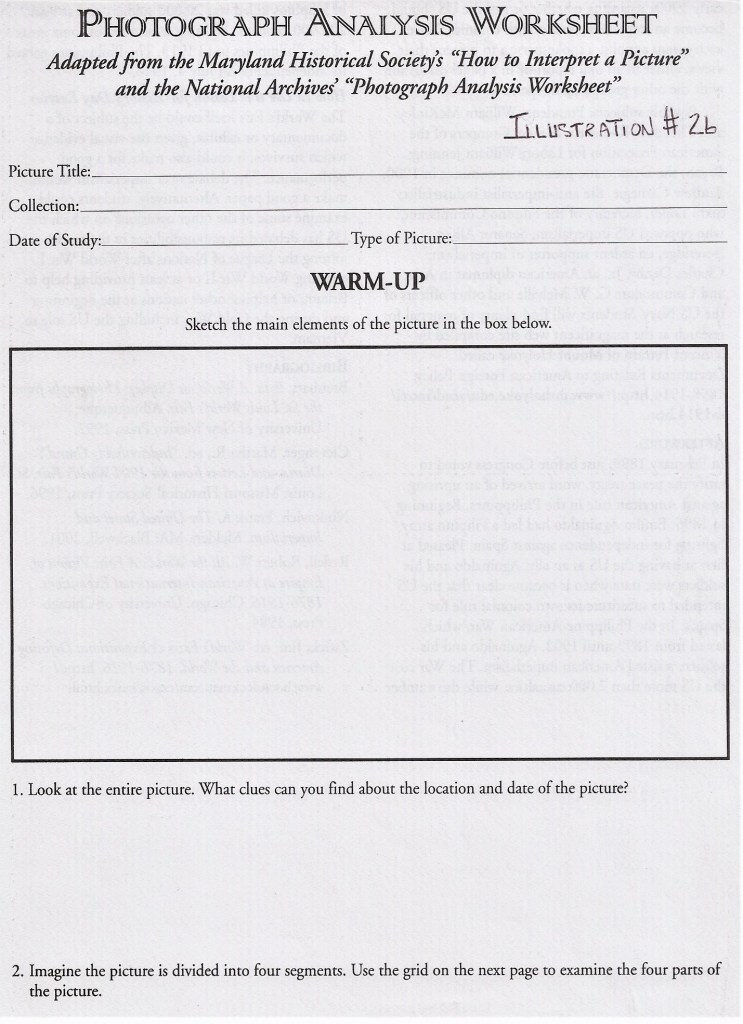
Illustration #26 shows another learning strategy.
Illustration #26 – Photograph Analysis Worksheet
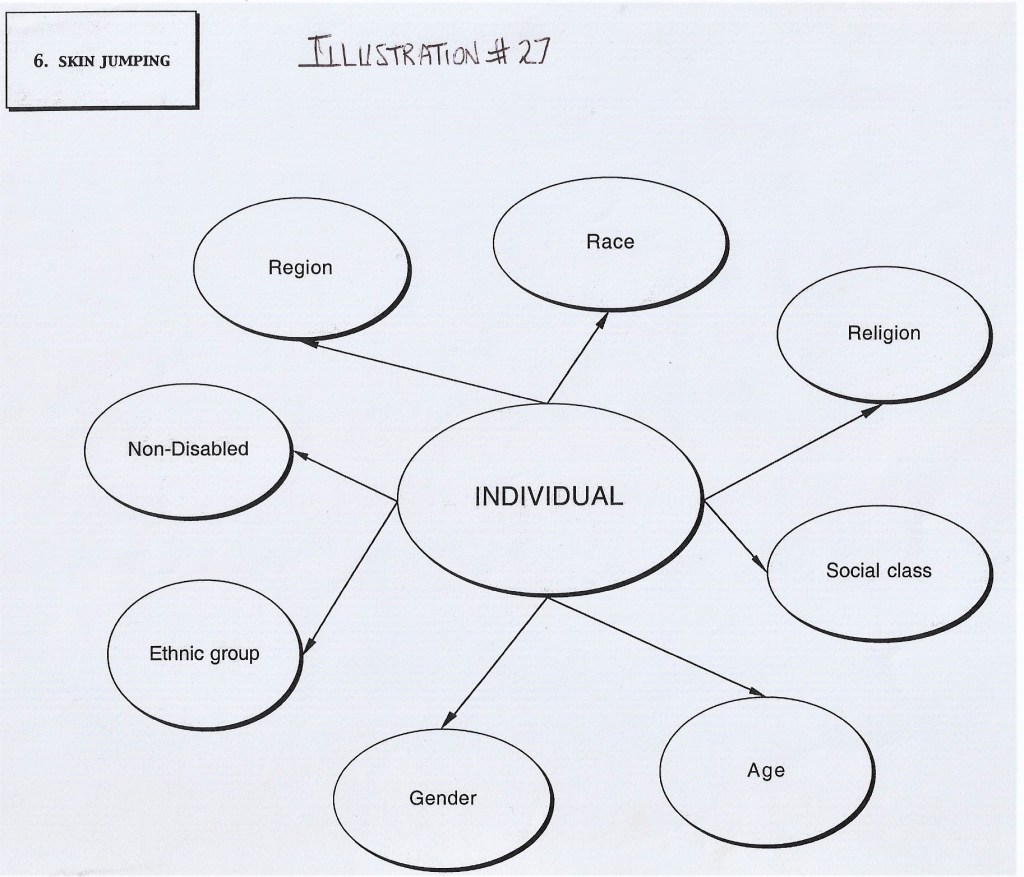
Illustration #27 is a very different learning idea. It is called skin jumping. Different people bring a different “eye” or “I” to a picture. Using the Paris Bistro picture how could or would a viewer of a certain race, religion, social class, age, gender, ethnic group, non-disabled, disabled, or from a certain region of a country view the picture.
Illustration #27 -Skin Jumping
“The mind is the real instrument of sight and observation.”
Photographs and illustrations are two visual types. Paintings and portraits can also be used in our classes. Illustration #28 gives us some general ideas about comparing and contrasting these visual forms.
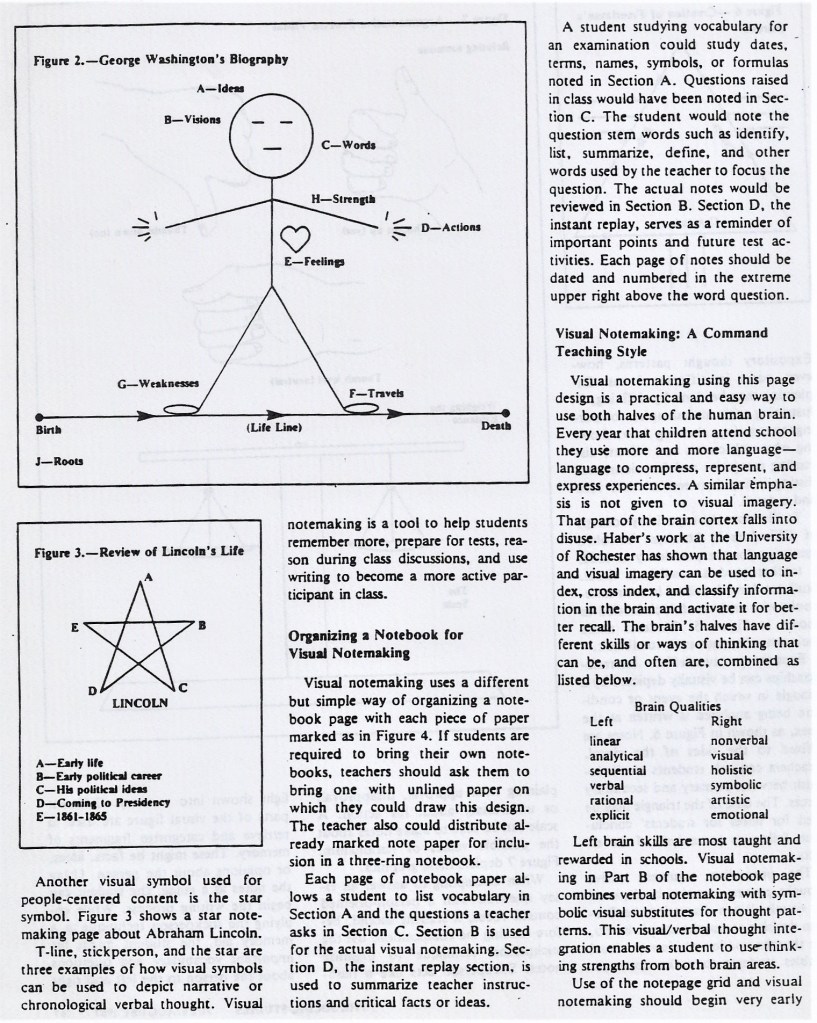
Illustration #29 depicts a young Frederick Douglass. What do we “see” or “feel” in him? As you learn about Douglass, using his portrait draw a line from his head outward. On the line print the major ideas he is thinking. Next, draw a line outward from his eyes. On the line print what you think his hopes are. Then draw a line from his mouth outward. On the line print what you think he might have said. Next draw a line from his ears outward. On this line write what you think he might have heard. Look at his hands. Draw a line indicating what actions he took. Draw a line from his upper arm. This is his muscle. Write his strengths on this line. Finally, locate his heart and draw a line outward from his heart. On this line write what you think his feelings were. Therefore, when you teach Frederick Douglass, use a visual with your students to help them in organizing their thoughts.
Illustration #29 – Young Frederick Douglass
“The painted portrait, a sign of wealth. The photograph a sign of democracy.”
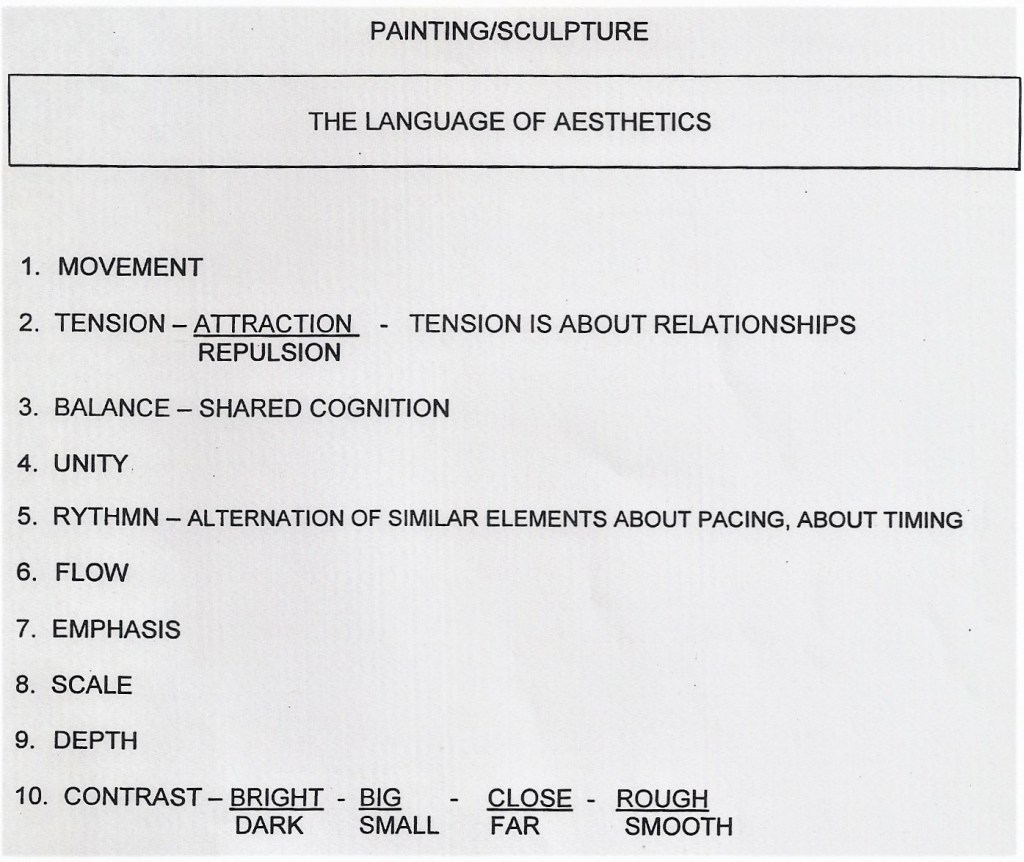
Illustration #30 is used with artistic images.
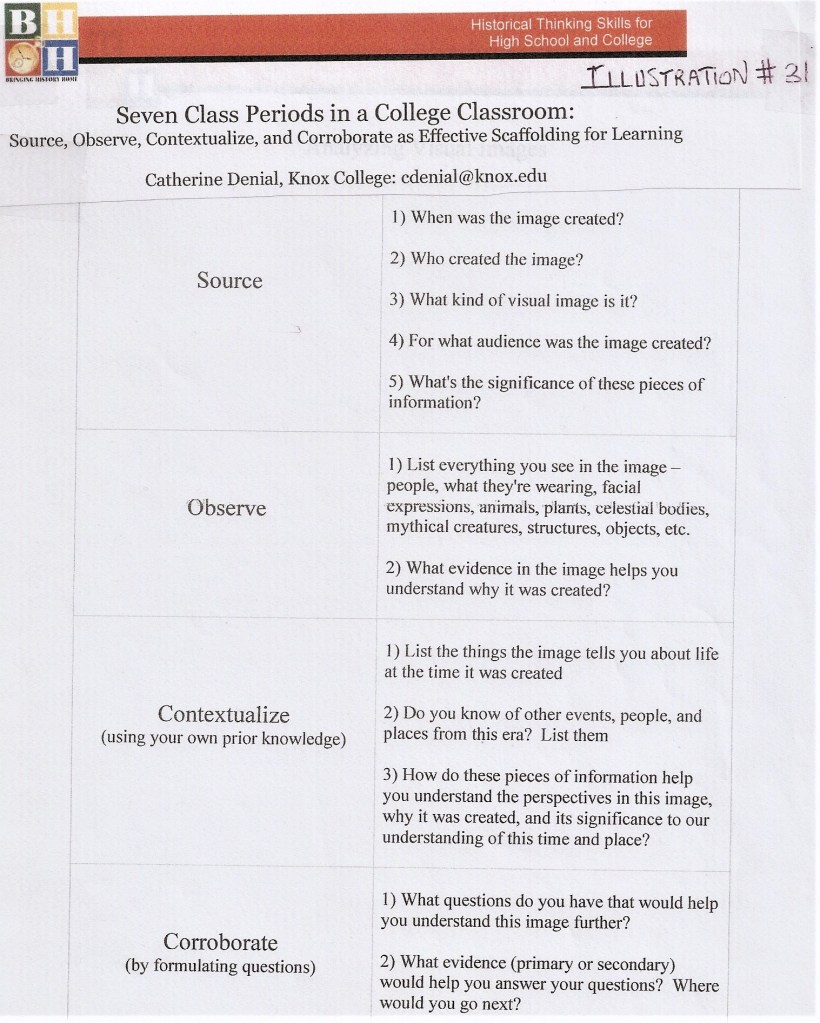
Illustration #31 – S-O-C-C Approach
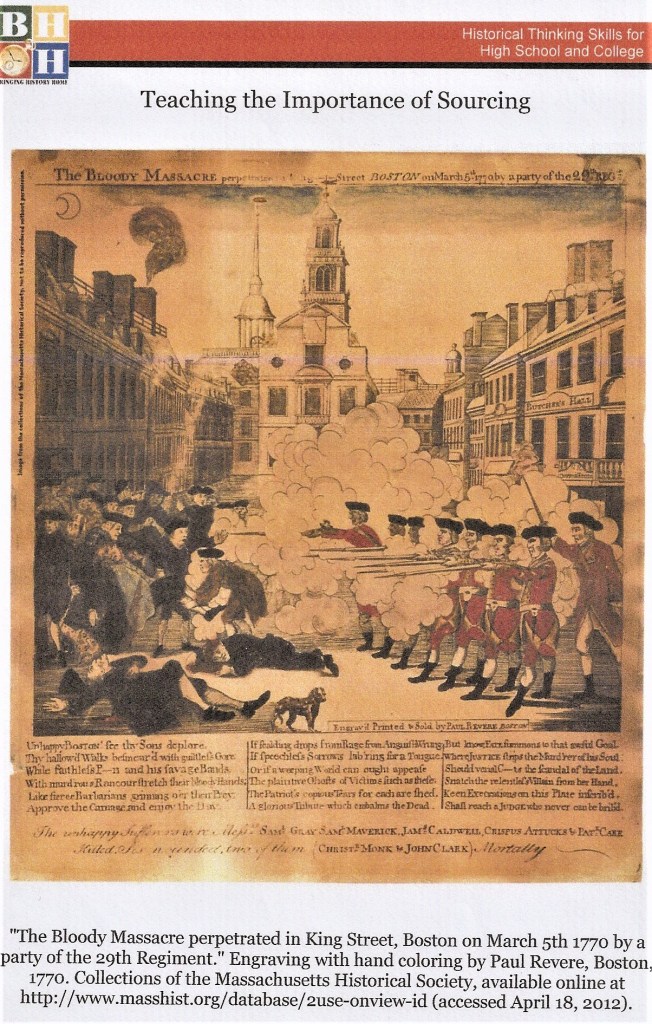
Illustration #31 from Catherine Denial of Knox College gives us an SOCC approach: source, observe, contextualize, and corroborate. This approach could be used with either Omdurman or the football fire scene. She uses it with the famous Boston Bloody Massacre scene of 1770.
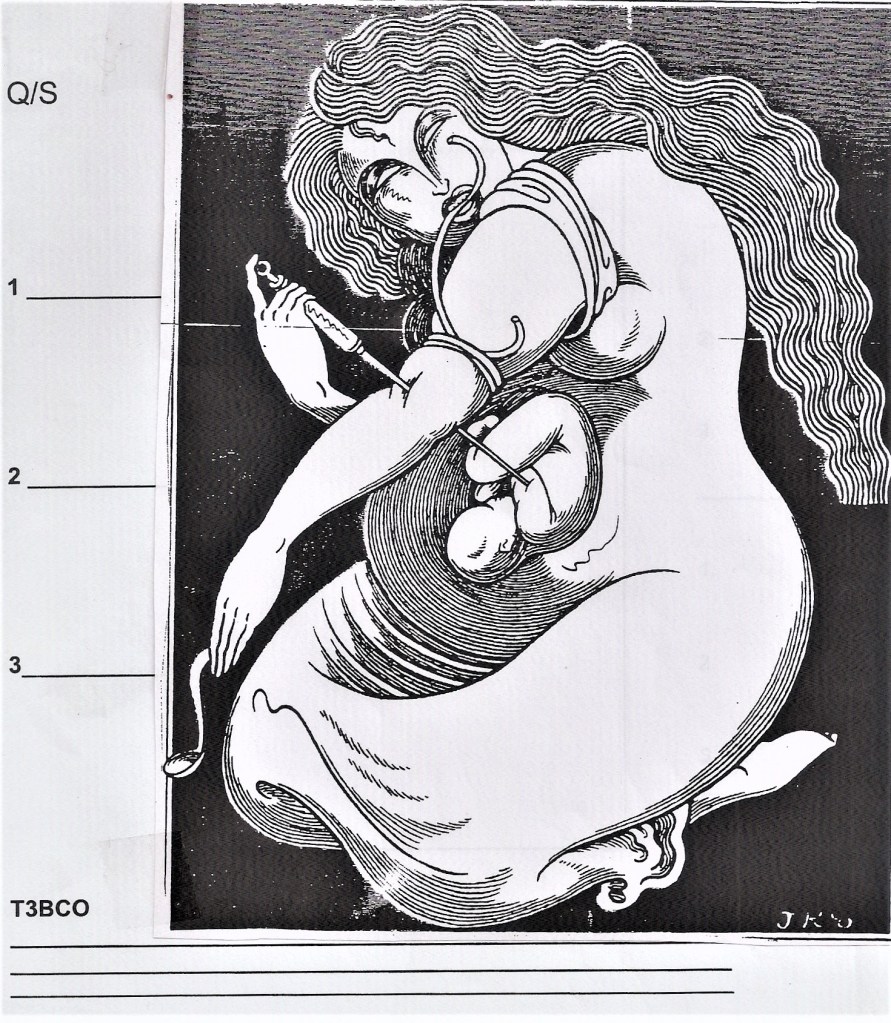
Our final visual is a graphic illustration #32 used in a history of American addictions. A POAI approach from Illustration #24 could first be used. Make notes on the handout illustration. On the left side is a Q/S column. Students are asked to write and answer 3 questions or statements they have about the illustration. At the bottom of the illustration is a paragraph writing technique called T3BCO. In a paragraph state the T or topic. Then list the three ‘becauses’ or evidence to support the topic. C=the conclusion.
Illustration #32 – History of American Addictions
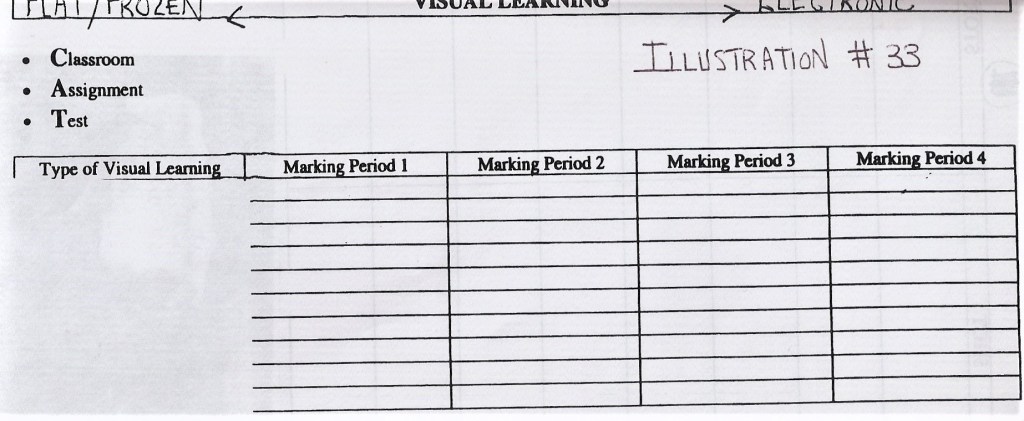
Illustration #33 is a visual teaching planning chart. Using illustration #19 plan how you can teach with visuals in a 9 week marking period.
Illustration #33 – Visual Learning Planning Chart
Illustration #34 conveys three ideas about visual learning.
Illustration #34 – Visual Learning
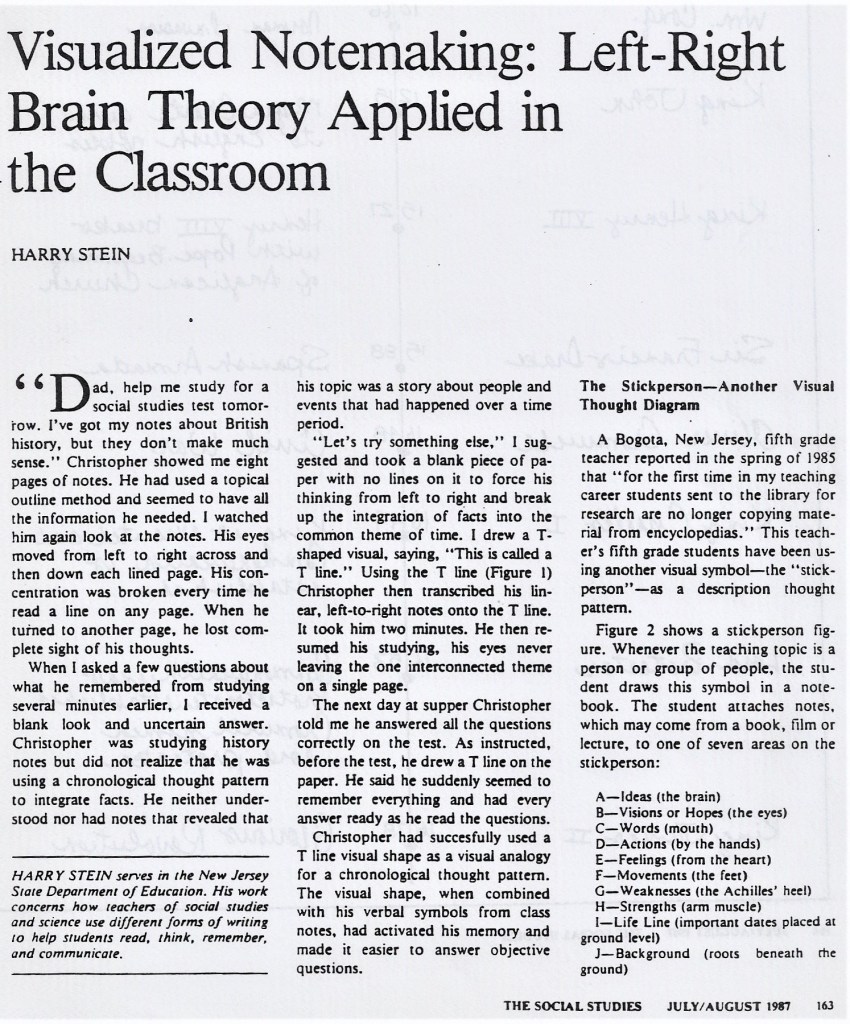
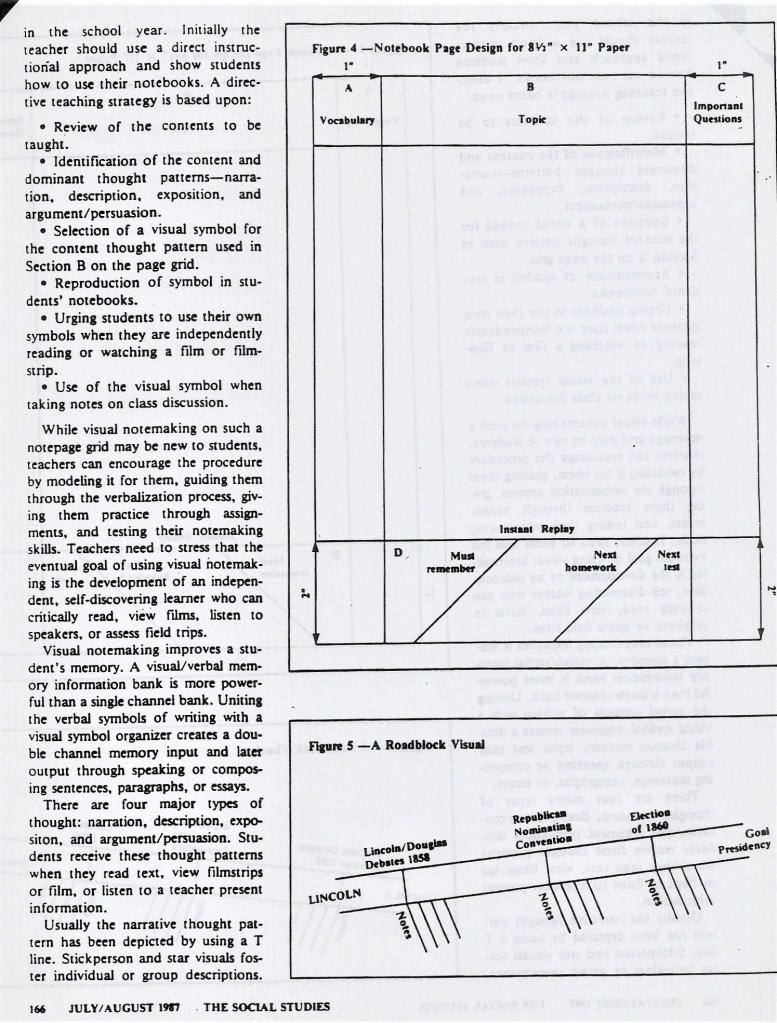
An article on Visualized Notemaking concludes the gathering and organizing activities and gives students a transition from observing to notemaking, the precondition for building memory leading to writing and speaking.
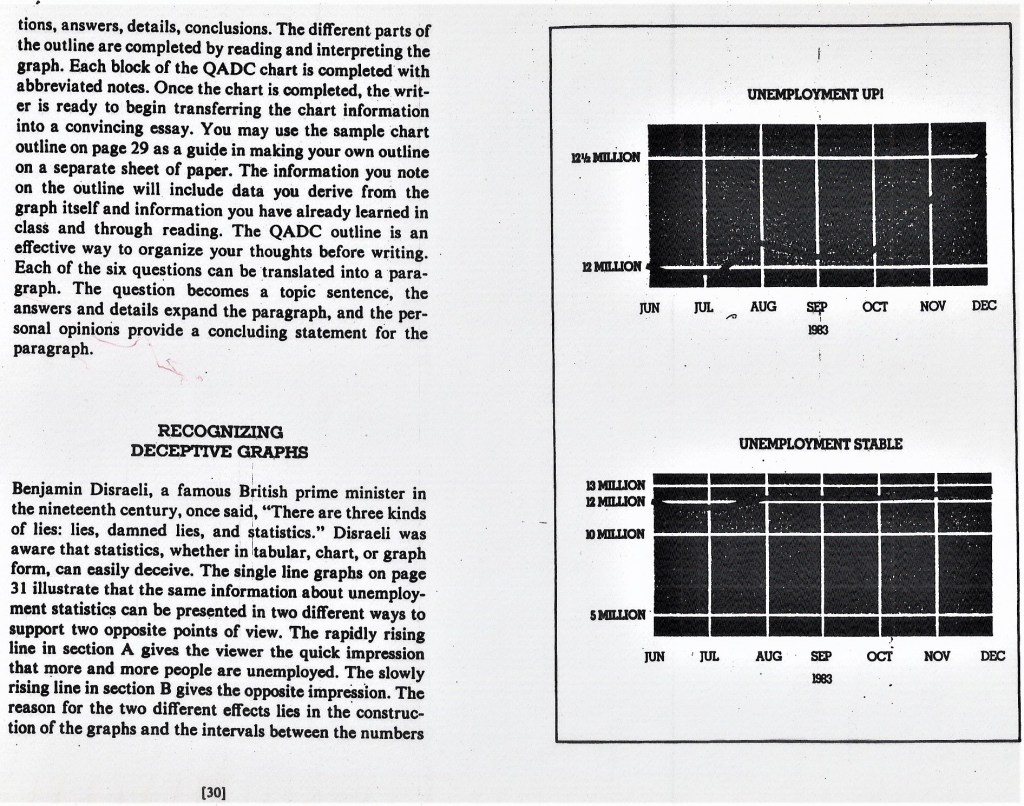
One type of graphical aid is the familiar chart form. Illustration #35 informs us about sexually transmitted infections. Use 3 steps to analyze any chart. Turn the heading into a question, “what are the”. Identify the vertical content, the diseases, and finally identify the horizontal content, the variables of cause, transmission etc. Then complete the chart.
Illustration #35 – Sexually Transmitted Diseases
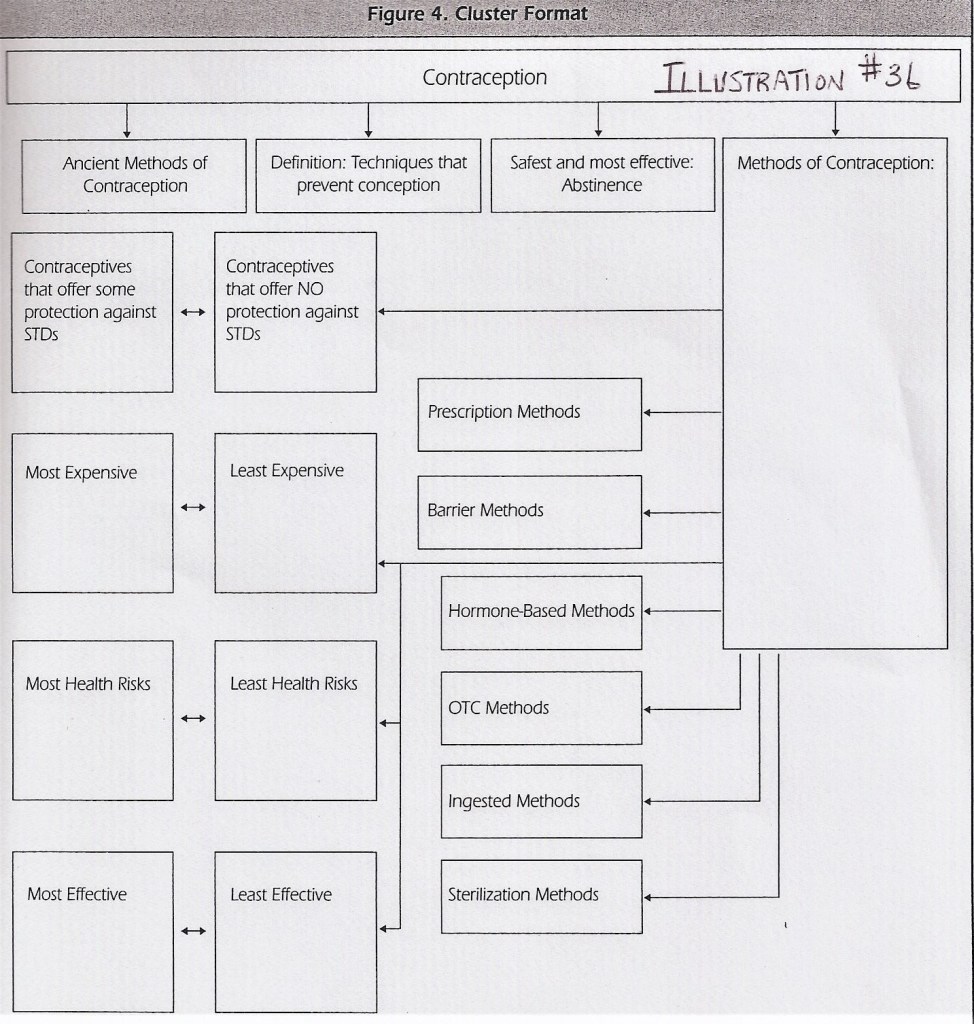
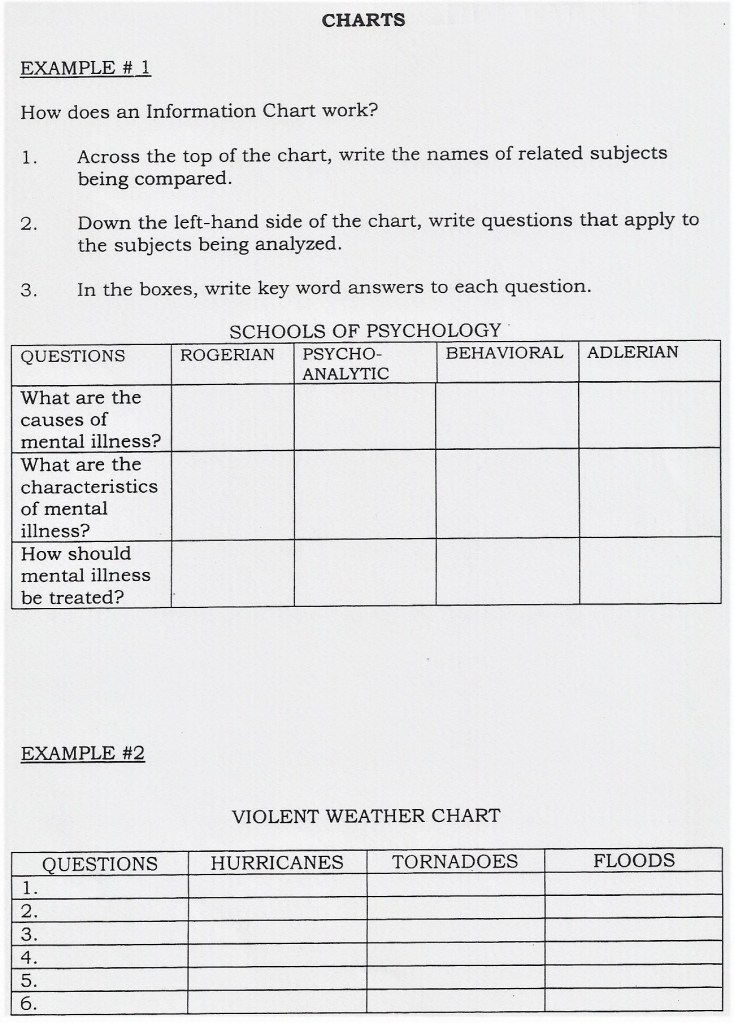
Illustrations #36 and #37 show 2 different chart forms, the CLUSTER and the WEB. Students are directed to the central theme and its offshoots. When viewing these charts use a pen to circle the main theme and draw connecting lines with arrows to the parts. Drawing focuses the eye and mind.
Illustration #36 – Cluster FormatIllustration #37 – Web Format
Additional types of charts are depicted in Illustration #38 ABC.
Illustration #38 A – Types of ChartsIllustration #38B – Research or Information ChartsIllustration #38C – Research & InformationIllustration #38D – Comparison Chart
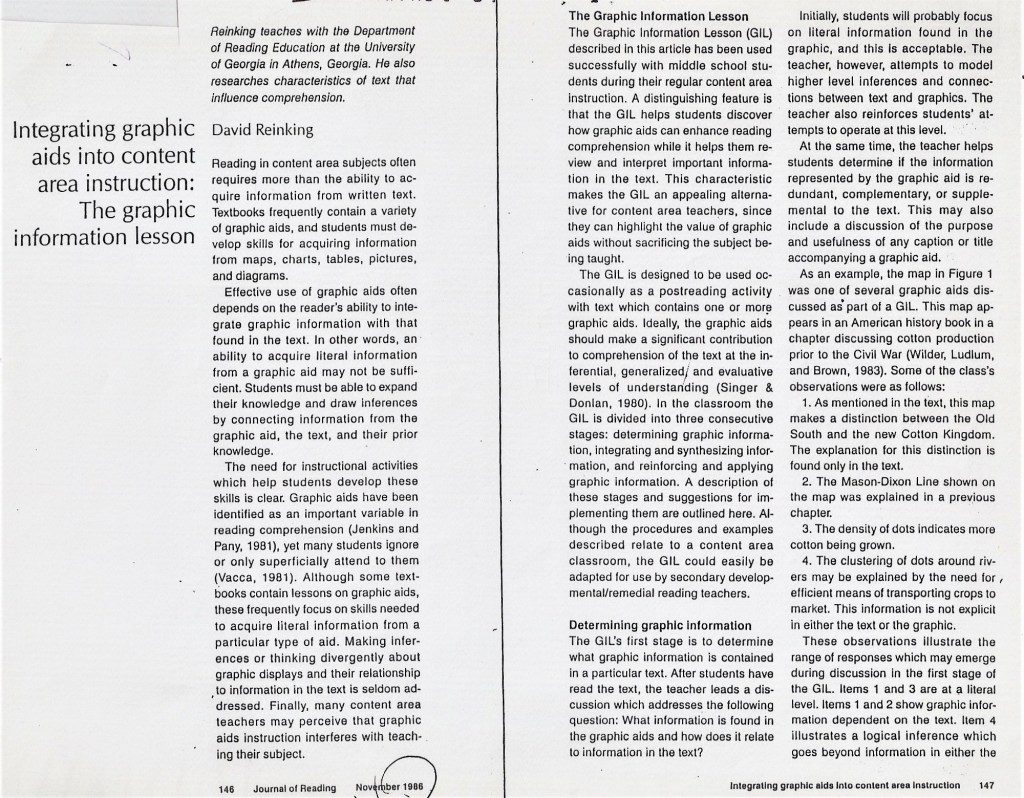
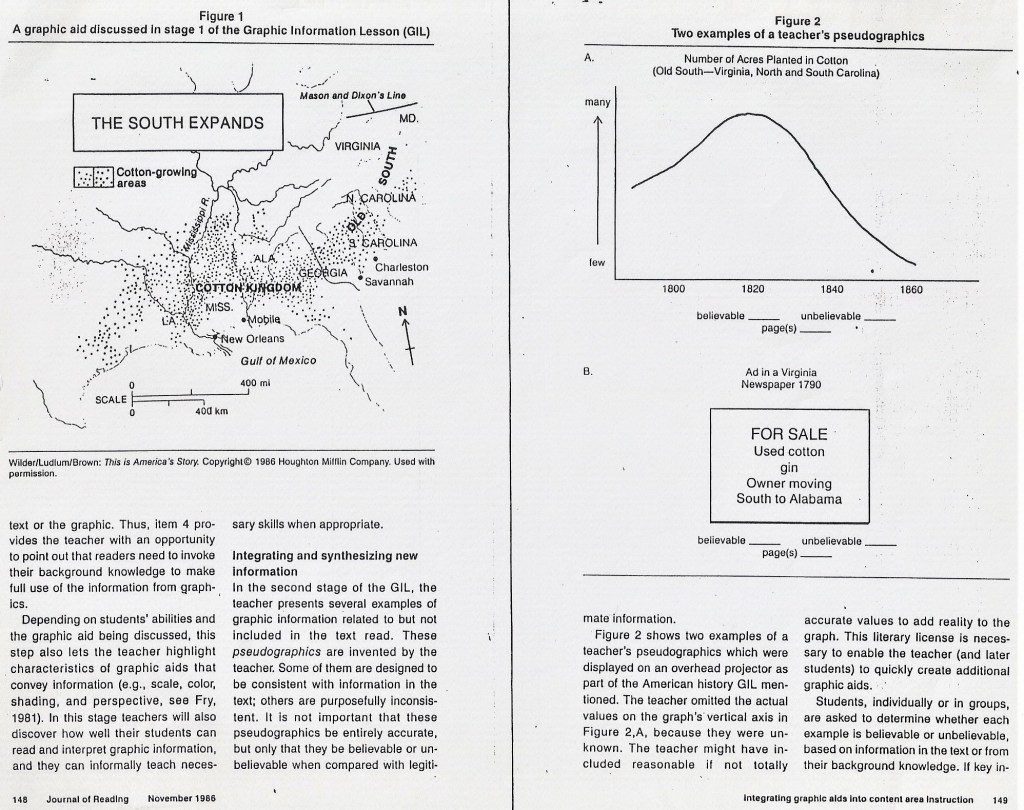
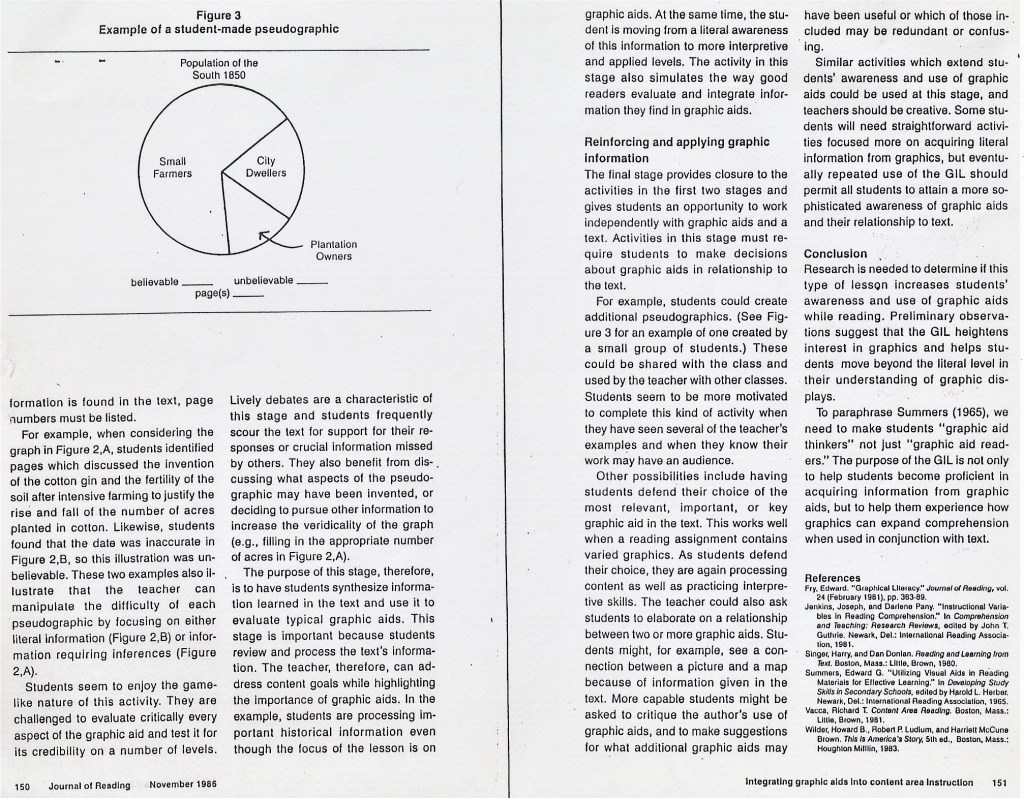
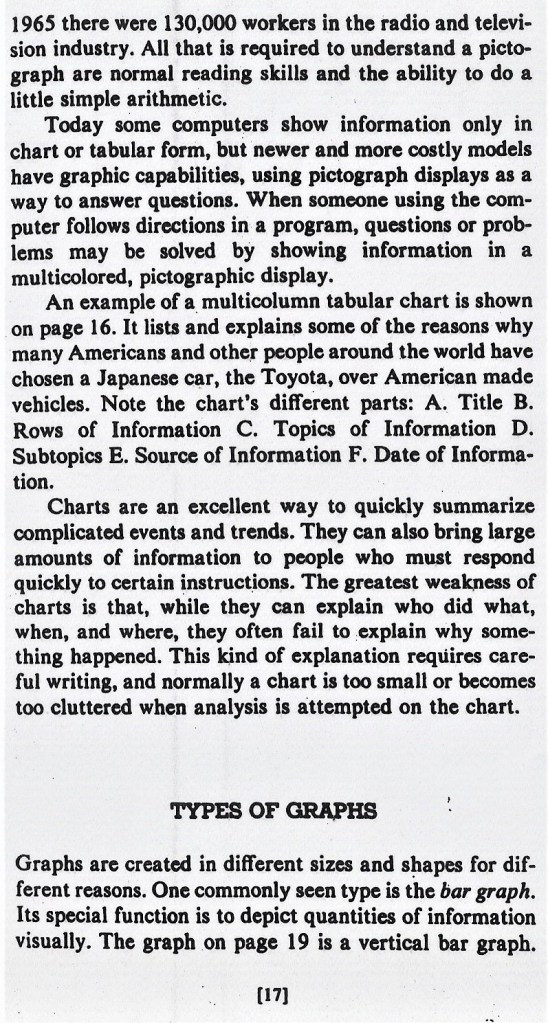
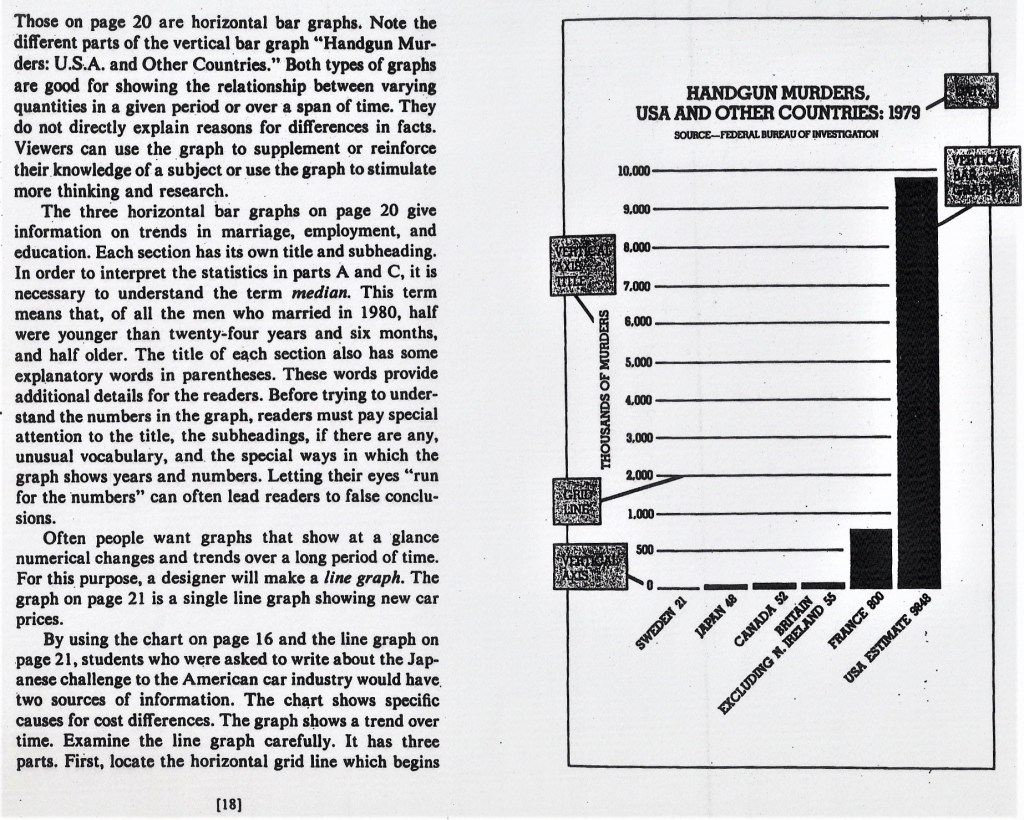
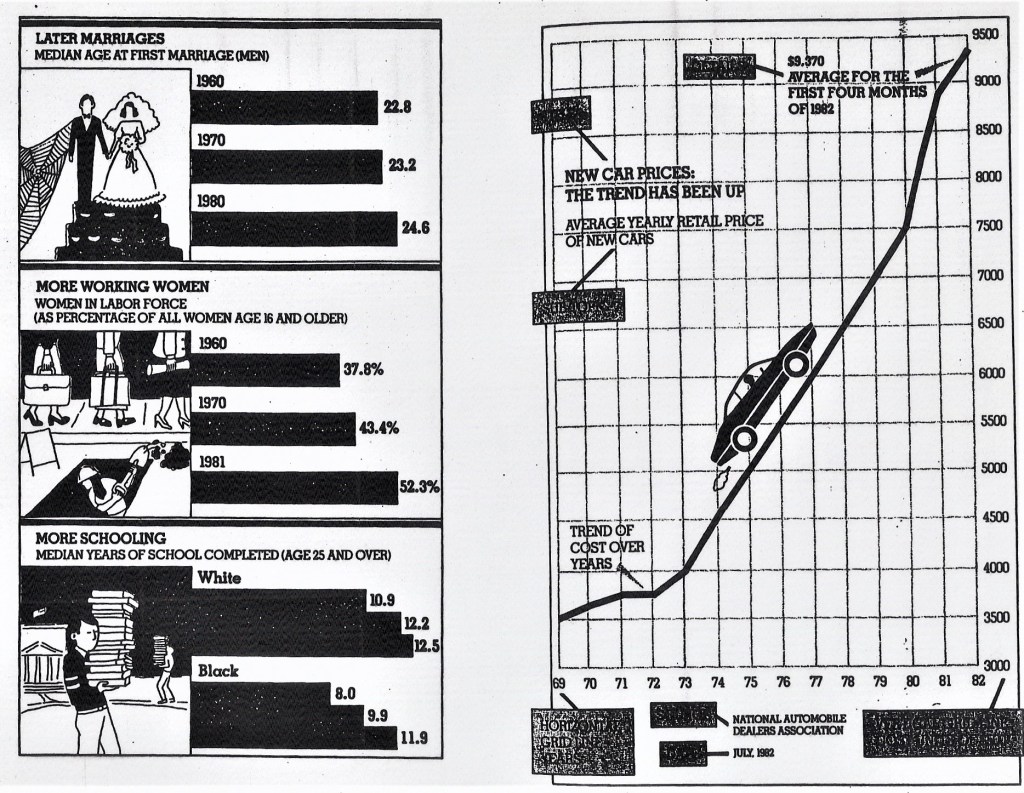
Illustration #39 is an article called the Graphic Information Lesson. It combines maps, graphs, and charts. The author skillfully integrates visual types and thinking skills.
Illustration #39 – Graphic Information Lesson – Page 1Illustration #39 – Graphic Information Lesson – Page 2Illustration #39 – Graphic Information lesson – Page 3
Illustration #40 is an information map that examines the relationships between economic production, the role of government, geography, demography, beliefs, behavior, and economic principles. The concept of public investment infrastructure is shown with an arrow linking government investment to 7 forms of infrastructure: T=transportation, E=energy, C=communication, H=health, I=information/education, PH=public health, ands S=security, police, fire, courts, weather prediction, military, and currency management. Students use the chart for note-making. Apply this to any country or historical era.
Illustration #40 – Information Map
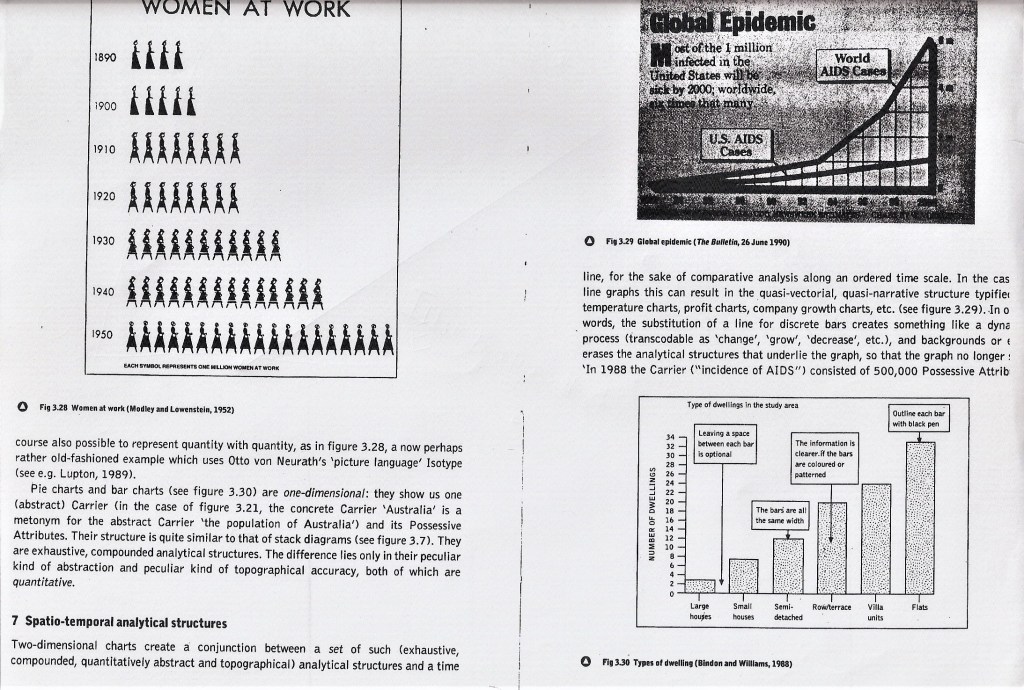
Illustration #41 is the author’s chapter on graphs, supplemented by two additional examples.
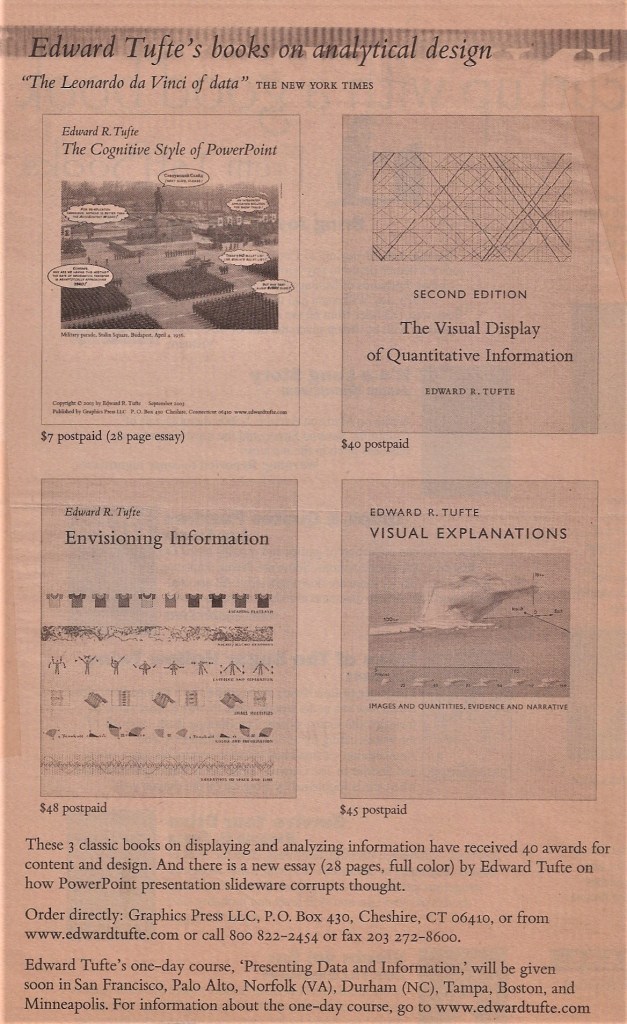
Illustration #42 is a valuable resource by Edward Tufte, the 20th century’s foremost thinker in information design. Gathering and Organizing Information has three components: reading, representational visuals, and graphical aids. These forms occur in all of our texts and materials. Learning to use them is critical and produces life-long learning skills transferable to all careers and daily life. When students can gather and organize information they create a highway for practicing thinking and reasoning. When thinking and reasoning are organized into retrievable memory they are the building blocks for writing, speaking, and other creative acts.
Illustration #42 – Edward Tufte’s Books on Analytical Design
In the 1950s and 1960s the revolutionary communist-led government of China enlisted elementary school-age students to educate adults about the need for public health measures. The Chinese campaign against spitting in public was actually not new or communist inspired. In the late 19th century, as immigrants poured into overcrowded urban areas, tuberculosis bacterium (TB) was responsible for a pandemic that caused the death of one in seven people in the United States and Europe. It New York City, spitting on a public conveyance was made illegal in 1896 and spitters were subject to arrest and a fine of up to fifty dollars. Signs were placed in street cars and on the subway system warning that spitting spread TB. When the signs proved to be an inadequate deterrence, health officers, known as the Sanitary Squad, conducted random raids at subway stations arresting hundreds of scofflaws. The city also launched public health campaigns distributing flyers and schools were enlisted to educate children about the spread of the disease.
This play was performed on street corners in Hangzhou and Shanghai by Young Pioneers, children between the ages of nine and thirteen. In the 1950s and again during the Corona virus pandemic today, China uses poster art to teach public health lessons. Classes can act out and discuss “Do Not Spit at Random” on Zoom. This version of the play is from a New York City multicultural curriculum package (1967).
Questions for discussion include:
Who are the Young Pioneers?
In your opinion, why are they involved in the public health campaign?
What are some of the arguments and social pressures used to make the Passer-By clean up the spit?
If you lived in China at that time, would you have joined the Young Pioneers? Explain.
Do you think student plays like this one would help in the current Corona virus pandemic? Explain. As a follow-up, students can write their own plays teaching people how to be safe during the Corona virus pandemic and create public health posters. Do Not Spit at Random (188u-yao sui-ti t’u t’an) by Fang Tzu Setting: Street corner of Hangzhou, China, the early 1960s. A young girl Pioneer with a megaphone comes out from a crowd in the street or from among the audience in a theater.
Characters: Young Pioneer (Hsiao-Ying) Passer-By (Ch’em Jung-fa) One of the Crowd Crowd People’s Police Mother
YOUNG PIONEER. Dear uncles and aunts, please do not spit at random. Spitting at random on the ground is a most deplorable habit. It helps to spread germs and disease, and so may affect our health harmfully. Dear uncles and aunts, if you want to spit, please do so into a cuspidor. If there is no cuspidor at hand, then spit into a handkerchief.
PASSER-BY (walks across a stage with a briefcase, makes noise as if going to spit). Hmm …hawk…choo! (Spits phlegm on the ground.)
YOUNG PIONEER (seeing the passer-by spit, hurries away from the crow to overtake the man, or leaps onto stage from below). Uncle, uncle, don’t spit on the ground. Please rub it away with a piece of paper.
PASSER-BY. My young friend with the cuspidor so far away, where do you think I should spit.
YOUNG PIONEER. You can go up to the cuspidor. It’s only a few steps away.
PASSER-BY. I’d have to go there and come back again. How do you think I am going to catch my bus?
YOUNG PIONEER. Uncle, don’t you know there are many germs in spittle? When it dries the germs will be scattered everywhere, and, by breathing the air, people may be infected with such diseases as typhoid, diphtheria, tuberculosis –
PASSER-BY. I am not a tubercular. So there cannot be any germs in the phlegm I coughed out.
YOUNG PIONEER. It is a social obligation to refrain from spitting at one random. If everyone spits and insist that there can be no germs in what he has spat, how can we be patriotic and keep ourselves in good health?
ONE OF THE CROWD (speaks from the crowd or from the audience, in a theater). Rub the spittle away quick! (A large crowd gathers around the passer-by)
PASSER-BY (irritated). Hmm. You want me to squat there and rub away the spittle? But I have no time for that. Besides, I’m not used to doing that sort of thing. (Prepared to go.)
YOUNG PIONEER. Uncle, uncle, don’t go. I haven’t finished with you yet.
PASSER-BY. I have to go home now to my dinner and have no time to carry on a conversation.
ONE OF THE CROWD. Hey, you come back here! There can’t be a more unreasonable man than you.
PASSER-BY. How so?
YOUNG PIONEER (offering a piece of paper). Uncle, please rub it away with this piece of paper.
PASSER-BY. I won’t do it!
YOUNG PIONEER. How can you refuse to carry out a social obligation?
PASSER-BY. Are you lecturing me? (Here a number of actors come out of the crowd to speak, or speak from among the audience, or some may go up on the stage.)
CROWD. What? You are trying to assume airs? Don’t argue with him. Call the police. Police! Comrade police!
PASSER-BY. I won’t rub it. I promise not to spit again.
CROWD. Comrade, what is your unit?
PASSER-BY. That’s none of your business
CROWD. Why isn’t it my business? When you refuse to carry out a public obligation, everyone is entitled to criticize you.
PEOPLE’S POLICE (enters). What’s happened here? (At this moment the crowd becomes larger.)
CROWD. He spat at random and refuses to accept criticism. He would not listen to the advice of a child. And he’s such a big man. He is no better than this child. And he is a Party member too! Probably a backward one.
PEOPLE’S POLICE. All right, it’s clear to me now. (Addressing the crowd.) Comrades! What do you think we should do with such a man?
CROWD. He should be criticized and fined. He should be made the subject of a wall newspaper. A cartoon should be drawn of him for all to see. He should be taken to the police station.
PEOPLE’S POLICE. Oh, well, if you will not rub it away, I’ll do it for you. But, first of all, may I know what unit you belong to?
PASSER-BY. As for that – (The voice of a middle-aged woman is heard offstage calling someone.)
MOTHER. Hsiao-ying, Hsiao-ying!
YOUNG PIONEER. Oh, Mama!
MOTHER. There you are. We’ve been waiting for you a long time. The meal is cold. Won’t you hurry home to your meal?
YOUNG PIONEER. I haven’t finished my work yet.
MOTHER. Work? What sort of work?
YOUNG PIONEER. Someone has spat on the ground and refuses to accept criticism. Unless he cleans it off, I am not going to let him go.
MOTHER (recognizes the passer-by). Oh, is that you, Comrade Ch’en?
PASSER-BY. Er – es, it’s me, Teacher Wang.
MOTHER. Hsiao-ying, who is it that refuses to accept criticism?
YOUNG PIONEER. Mama, there he is.
PEOPLE’S POLICE (addressing mother). Comrade, do you know which unit this comrade belongs to?
MOTHER. He is the accountant of the cotton mill. He is Comrade Ch’en Jung-fa.
PEOPLE’S POLICE. Good, thank you. (Addressing the passer-by.) I think there’s only one way now. (Draws a circle round the spittle on the ground with a piece of chalk and is about to write down the name of the passer-by and the unit to which he belongs.)
PASSER-BY (frightened). Comrade, don’t! Don’t write down the name of my unit! (Addressing the crowd.) Comrades and my young friend, please pardon me this once. You may write my name there, but please do not write the name of our mill too. Our mill has already signed a patriotic health pact.
PEOPLE’S POLICE. Yet you break the pact?
PASSER-BY. All right, I’ll clean it, I’ll clean it. I promise not to do the same thing again.
PEOPLE’S POLICE (to mother). Comrade, your child is really a good Young Pioneer, a young heroine for the elimination of the seven pests (mosquitoes, flies, rats, sparrows, and so forth) and for public health. If everyone eliminates the seven pests in earnest and maintains public hygiene as she does, our cities and the countryside will be rid of the seven pests sooner, disease will largely be wiped out, people will be healthier than ever, and the nation will be more prosperous and stronger.
MOTHER. Hsiao-ying, hurry home to your meal. It’s already cold.
YOUNG PIONEER. Mama, my group leader isn’t here yet. I’ll go home when he come to relieve me.
MOTHER. Oh, well, I’ll have to warm the meal again anyway.
YOUNG PIONEER (speaking through megaphone and coming toward crowd in the street or toward audience in theater). Dear uncles and aunts, please do not spit at random. Sitting at random is a most deplorable habit.
Kristen Bradle, Jessica Hermann and Dean Bacigalupo
Rationale: This package was created as a resource to assist educators who are teaching the 9th grade New Jersey World History or 9th and 10th grade New York State Global History and Geography curriculum. The resources and guiding questions are aligned with the New Jersey and New York Learning Standards and the academic skills required on the New York State Global History and Geography Regents examination. The resources highlight the impact of climate change on human societies as an enduring issue that reemerged at different points in history. These resources contain strong transdisciplinary connections between Social Studies, Science, and STEM/STEAM.
The impact of climate change on human societies is one of the most pressing topics affecting the world today. Teenage climate activist Greta Thunberg is demanding government and corporate action to prevent a climate catastrophe. Goals in designing these materials were to interest students in the past and to engage them as active citizens in the present empowered with historical knowledge.
The question of how to respond to climate change has been contentious as some political leaders in the United States and other countries have challenged the science that explains the threat of climate change to human civilization. Some have dismissed proposals to restrict the emission of greenhouse gases claiming it would injure economies and because “We can’t have the cure be worse than the problem.” In reference to the Corona virus, Donald Trump tweeted in all caps, “WE CANNOT LET THE CURE BE WORSE THAN THE PROBLEM ITSELF.” Students will have to respond to this assertion as educated citizens, future parents, and community leaders. https://www.realclearpolitics.com/articles/2020/03/24/trump_we_cant_have_the_cure_be_worse_than_the_problem_142750.html https://twitter.com/realDonaldTrump/status/1241935285916782593
Human Impact on the Environment: Includes environmental degradation, deforestation, desertification, global warming, destruction of ozone layer, pollution, extinction of species/loss of species, loss of biodiversity, diversion of rivers/water sources, use of alternative energy sources, impact of policies on sustainability, and spread of disease.
Impact of Environment on Humans: Includes impact of climate, impact of natural disasters, and impact of policies designed to deal with natural disasters.
Impact of Technology: Includes consequences of technology use for people and consequences of technology use for the environment. Impact of Industrialization: Includes consequences of industrialization.
Impact of Globalization: Includes consequences of interdependence.
Social Studies Frameworks: The following New York State Frameworks are addressed in this series of climate activity sheets:
CLASSICAL CIVILIZATIONS: EXPANSION, ACHIEVEMENT, DECLINE: Classical civilizations in Eurasia and Mesoamerica employed a variety of methods to expand and maintain control over vast territories. They developed lasting cultural achievements. Both internal and external forces led to the eventual decline of these empires. Geographic factors encouraged and hindered a state’s/empire’s expansion and interactions. Students will investigate how geographic factors encouraged or hindered expansion and interactions within the Greek, Roman, and Mayan civilizations.
SOCIAL AND CULTURAL GROWTH AND CONFLICT: During the postclassical era, the growth of transregional empires and the use of trade networks influenced religions and spread disease. These cross-cultural interactions also led to conflict and affected demographic development. Networks of exchange facilitated the spread of disease, which affected social, cultural, economic, and demographic development. Students will map the spread of the Black Death (Bubonic Plague) as it was carried westward from Asia to Africa and Europe. Students will evaluate the effects of the Black Death on these regions
CAUSES AND EFFECTS OF THE INDUSTRIAL REVOLUTION: Innovations in agriculture, production, and transportation led to the Industrial Revolution, which originated in Western Europe and spread over time to Japan and other regions. This led to major population shifts and transformed economic and social systems.
GLOBALIZATION AND A CHANGING GLOBAL ENVIRONMENT (1990–PRESENT): Technological changes have resulted in a more interconnected world, affecting economic and political relations and in some cases leading to conflict and in others to efforts to cooperate. Globalization and population pressures have led to strains on the environment. Technological changes in communication and transportation systems allow for instantaneous interconnections and new networks of exchange between people and places that have lessened the effects of time and distance. Students will investigate the causes and effects of, and responses to, one infectious disease (e.g., malaria, HIV/AIDS). Population pressures, industrialization, and urbanization have increased demands for limited natural resources and food resources, often straining the environment. Students will examine strains on the environment, such as threats to wildlife and degradation of the physical environment (i.e., desertification, deforestation and pollution) due to population growth, industrialization, and urbanization.
Science and STEM/STEAM Transdisciplinary Connections: The NYS P-12 Science Learning Standards with STEM/STEAM practices and crosscutting concepts guidance document that was referenced to inform connections with middle and high social studies can be found at: http://www.nysed.gov/common/nysed/files/program s/curriculum-instruction/p-12-science-learningstandards.pdf Transdisciplinary connections for middle school include 3 inquiries: Earth’s Systems, Weather and Climate, and Human Impacts can be found on pages 48-50. Transdisciplinary connections for high school include the inquiry focused on Interdependent Relationships in Ecosystems and can be found on pages 67-68.
Sample Lesson Introduction Below is a visual Do Now activity that displays the impact and affect climate change has had on the world. This provides students with the evidence and visual understanding that the climate change has resulted drastic changes to our ecosystems. The website below, created by NASA, displays a series of before and after pictures of different climate change “hot spots” around the world. Within these pictures, visible changes, such as rising levels of water can be seen. https://climate.nasa.gov/images-of-change?id=709#709-christmas-tree-harvest-inashe-county-north-carolina
DO NOW: You will examine a series of images on the board, while viewing these images fill out the chart below.
Topic: Old Kingdom Egypt AIM: What environmental change caused the downfall of Old Kingdom Egypt? These documents explore the effect of desertification in the past.
Map of Old Kingdom, Egypt
Statue of Pharaoh Menkaure (center)
Pyramid of Djoser
Temple of Djoser
Document 1: Desertification of Egypt “Tomb paintings and inscriptions hint that the environment became more arid toward the end of the Old Kingdom, as some plants disappeared and sand dunes crept close to river settlements. Data drawn from cores in the Nile basin confirm that the climate began to dry around 2200 B.C.” Source: Did Egypt’s Old Kingdom Die—or Simply Fade Away?
Document 3:Desertification of the Sahara “7,300 to 5,500 years ago: Retreating monsoonal rains initiated desiccation in the Egyptian Sahara, prompting humans to move to remaining habitable niches in Sudanese Sahara. The end of the rains and return of desert conditions throughout the Sahara after 5,500 coincides with population return to the Nile Valley and the beginning of pharaonic society . . . The climate change at [10,500 years ago] which turned most of the [3.8 million square mile] large Sahara into a savannah-type environment happened within a few hundred years only, certainly within less than 500 years,” said study team member Stefan Kroepelin of the University of Cologne in Germany.” Source: https://www.livescience.com/4180-saharadesert-lush-populated.html
Document 4:Effects of Drought and Desertification on the Egyptian Empire “When a drought brought famine to the land, there was no longer any meaningful central government to respond to it. The Old Kingdom ended with the 6th Dynasty as no strong ruler came to the throne to lead the people. Local officials took care of their own communities and had no resources, nor felt the responsibility, to help the rest of the country. As the 6th Dynasty passed away, Egypt slowly tumbled into the era now classified by scholars as the First Intermediate Period . . . At the end of the 6th Dynasty, there was no longer a central government of note and Egypt entered a period of social unrest and reformation known as The Frist Intermediate Period (2181-2040 BCE) during which Egypt was ruled regionally by local magistrates who made and enforced their own laws. The rise of these local officials and the power of the priesthood were not the only causes of the collapse of the Old Kingdom, however, in that a severe drought toward the end of the 6th Dynasty brought famine which the government could do nothing to alleviate. Scholars have also pointed to the exceptionally long reign of Pepi II of the 6th Dynasty as a contributing factor because he outlived his successors and left no heir to the throne.” Source: https://www.ancient.eu/Old_Kingdom_of_Egypt/
Questions: The civilizations you examined today made advances in their societies.
How have environmental factors impacted the societies you examined today?
How did the advances civilizations made contribute to environmental consequences?
How have these advances caused a long-lasting impact that is negatively affecting societies today?
Identify a similarity or a difference between the events, ideas, or historical developments presented in documents 1 and 2.
Explain a similarity or a difference in the events, ideas, or historical developments presented in these documents. Be sure to use evidence from both documents 1 and 2 in your response.
Topic: Collapse of Akkadian Empire Aim: What did the Curse of Akkad teach us about the impact of climate on society? These documents examine the effect of drought caused by a changing local environment.
“For some time, researchers attributed the collapse to political disintegration and invasion by hostile groups. Some paleoclimate records indicate that a catastrophic drought also occurred around this time and suggest that climate factors beyond the control of the empire played a role in its demise.” Source: Drought and the Akkadian Empire
“Instead of rain, the Akkadians and their subjects were baked by dry, hot winds from the north. Precipitation fell by 30 percent, and crops withered in the field; the raw wind picked up the topsoil and blew it south. With their surplus dwindling, the fields barren, and laborers consuming what was left, at some point the Akkadians decided the game was up. Many of the Akkadians moved south, likely as word filtered back that the Euphrates, though diminished, continued to flow, supplying irrigation water to the fields there. Some refugees became pastoral nomads, moving with their herds in search of fodder.
Those who remained at Tell Leilan left no trace. As the decades went by, sand and dust gradually entombed the acropolis. When the winds and drought finally abated, some three hundred years later, new settlers moved in.” -Eugene Linden, The Winds of Change
Questions:
What was “The Curse of Akkad”?
Use specific quotes from the text to explain what happened as a result of the climate change the Akkadian Empire experienced.
How did Akkadians adapt/respond to the changing climate?
Topic: Mayan Civilization Aim: Did consequences of climate change play a significant role in the downfall of the Mayan Civilization? Climate change played a critical role on the collapse of the Mayan Civilization.
Document #1: Chart of Evaporation: Scientists have reconstructed climate at the time of the Mayan civilization by studying lake sediment cores from the Yucatan Peninsula (Hodell et al. 1995; Curtis et al. 1996; Hodell et al. 2005). It is possible to reconstruct changes in the balance between precipitation and evaporation (P−E), a common indicator of drought, by measuring oxygen isotope data from the shells of gastropods and ostracods. Lake H2O molecules containing the isotope 18O evaporate less easily than H2O molecules with 16O. Thus, during periods of strong evaporation, the lake water becomes enriched in 18O (values of δ18O are high). These isotopic values are incorporated into the growing shells of gastropods and ostracods that live in the lake.
Another proxy for P−E is the percent of sulfur in the lake sediments. Evaporation concentrates sulfur in the lake water. If the sulfur concentration becomes high enough, salts such as gypsum (CaSO4) will start to precipitate from the lake water and add sulfur to the lake sediments. The variations of sulfur percentage match the variations in oxygen isotopes closely. Corroborating one paleoclimate proxy with another is an important check on proxy records and gives us more confidence in them.
Scientists reconstructed changes in the balance between precipitation and evaporation using the percent of sulfur in sediments and the oxygen isotopes of shells of gastropods and ostracods from Lake Chichancanab on the Yucatan Peninsula (Hodell et al. 1995)
Document 2: Effects of Deforestation on Mayan Civilization: “Results from simulations with a regional climate model demonstrate that deforestation by the Maya also likely induced warmer, drier, drought‐like conditions. It is therefore hypothesized that the drought conditions devastating the Maya resulted from a combination of natural variability and human activities. Neither the natural drought or the human‐induced effects alone were sufficient to cause the collapse, but the combination created a situation the Maya could not recover from. These results may have sobering implications for the present and future state of climate and water resources in Mesoamerica as ongoing massive deforestation is again occurring.” Source: Oglesby, R. J., T. L. Sever, W. Saturno, D. J. Erickson III, and J. Srikishen (2010). “Collapse of the Maya: Could deforestation have contributed?” J. Geophys. Res., 115, D12106, doi:10.1029/2009JD011942.
“Deforestation led to lower rainfall and higher temperatures; both factors would have been detrimental to Mayan life. The reduction in rainfall means it would have been more difficult for the Maya to store enough water to survive the dry season, while the warmer conditions put more stress on evaporation, vegetation, livestock, and people. These effects occurred during both the wet and dry seasons but were much larger during the wet season, when they were also arguably more important. This is because the Maya societal structure depended on storage of water during the wet season, which in turn provided for them during the dry season.” Source: AGU Journal
Document 3: Effects of Drought on Mayan Civilization: “Recent data indicate that a major drought at this time may have been a key factor in the collapse. Research along the Holmul River, which runs through several bajos and connects 10 major Maya cities, indicates that between A.D. 750 and 850 the river either dried up or became swampy, perhaps as a result of a long period of drought” [Sever and Irwin, 2003; T. P. Culbert, personal communication, 2002].
Document 4: Reduction of Rainfall and Wetland Formation: Researchers from Arizona State University analyzed archaeological data from across the Yucatan to reach a better understanding of the environmental conditions when the area was abandoned. Around this time, they found, severe reductions in rainfall were coupled with a rapid rate of deforestation, as the Mayans burned and chopped down more and more forest to clear land for agriculture. Interestingly, they also required massive amounts of wood to fuel the fires that cooked the lime plaster for their elaborate constructions—experts estimate it would have taken 20 trees to produce a single square meter of cityscape. Smithsonian magazine Accelerator mass spectrometry dates chart and conceptual model of wetland formation. (Credit: T. Beach et al., University of Texas at Austin)
Document 5: Lake Bottom Sediment Core from Yucatan Peninsula: Bands located on sediment core help indicate periods of drought and periods of rainfall based on the coloring of the bands. Below, is a piece of lake bottom sediment core from the Yucatan Peninsula, displaying periods of drought during the time of the Mayan collapse.
Picture source: The Winds of Change: Climate, Weather, and the Destruction of Civilizations by Eugene Linden.
Questions for Mayan Document Series:
How did deforestation and drought play a critical role in the decline and eventual collapse of the Mayan Civilization?
How does science aid historians in understanding important changes in climate that have affected civilizations?
Based on the research presented in this document series, did consequences of climate change play a significant role in the downfall of the Mayan Civilization?
Topic: Roman Empire (27 BC-476 AD) Aim: How did shifts in climate lead to the decline of the Roman Empire? During the establishment and peak of the Roman empire Europe was enduring a period of climate stability. When Rome began experiencing colder, unstable weather, deadly epidemics led to a decline in civilization.
Document 1: Climate Change Background “Climate change did not begin with the exhaust fumes of industrialization, but has been a permanent feature of human existence. Orbital mechanics (small variations in the tilt, spin and eccentricity of the Earth’s orbit) and solar cycles alter the amount and distribution of energy received from the Sun. And volcanic eruptions spew reflective sulphates into the atmosphere, sometimes with long-reaching effects. Modern, anthropogenic climate change is so perilous because it is happening quickly and in conjunction with so many other irreversible changes in the Earth’s biosphere. But climate change per seis nothing new.” Source: Smithsonian
Document 2: How Favorable Climate Led To The Rise of the Roman Empire “It turns out that climate had a major role in the rise and fall of Roman civilization. The empire-builders benefitted from impeccable timing: the characteristic warm, wet and stable weather was conducive to economic productivity in an agrarian society. The benefits of economic growth supported the political and social bargains by which the Roman empire controlled its vast territory. The favorable climate, in ways subtle and profound, was baked into the empire’s innermost structure.” Source: Smithsonian
Document 3: Climate and The Fall of The Roman Empire “The end of this lucky climate regime did not immediately, or in any simple deterministic sense, spell the doom of Rome. Rather, a less favorable climate undermined its power just when the empire was imperiled by more dangerous enemies— Germans, Persians—from without. Climate instability peaked in the sixth century, during the reign of Justinian. Work by dendro-chronologists and ice-core experts points to an enormous spasm of volcanic activity in the 530s and 540s CE, unlike anything else in the past few thousand years. This violent sequence of eruptions triggered what is now called the ‘Late Antique Little Ice Age,’ when much colder temperatures endured for at least 150 years. This phase of climate deterioration had decisive effects in Rome’s unravelling. It was also intimately linked to a catastrophe of even greater moment: the outbreak of the first pandemic of bubonic plague.” Source: Smithsonian
Document 4: Levels of Precipitation in the Roman Empire The Fall of the Roman Empire was affected by a period of cooling, known as the Little Ice Age. This period of cooling greatly affected the way people lived. Source: US National Library of Medicine National Institutes of Health.
Source: US National Library of Medicine National Institutes of Health (https://www.nlm.nih.gov/)
Document 5 and 6: Favorable Flooding of the Nile Creating Stable Conditions Source: The Journal of Interdisciplinary History “Finally, unnoticed until not, Egypt, the Roman Empire’s breadbasket, spears to have enjoyed exceptionally favorable conditions for cereal production during this period . Nile river levels reflect precipitation over Ethiopia and East and Central Africa. Precious study has clarified the history of Nile floods down to 299 A.D., but that abundant evidence has never been exploited for climate history or economic performance. Before Rome annexed Egypt, all seven of nine securely recorded Nile floods in the earlier years of the first century B.C. were below average. For the next 329 years, from the annexation in 30 B.C. to 299 S.D., reliable documents allow an estimate of the annual flood in 199 different years, after which the available data become more scarce until 642 A.D. They show a subtle but significant pattern: The most favorable floods occurred when contrasted with those of the following period.”
Note:Dead Sea: Fluctuating sea levels reflect overall precipitation in the Levant. Although the chronology is fluid, recent work clearly confirms earlier findings of an early and late period of humid conditions, separated and followed by dry conditions Note:Lake Van: Oxygen isotopes within our period indicate most humid conditions c. the first centuries B.C. and A.D. and c. the fifth and sixth centuries A.D., and dry conditions c. the third and seventh centuries.
Document 7: Favorable Conditions During the Roman Empire Source: The Journal of Interdisciplinary History, The Roman Optimum: Stability from C. 100 B.C. to 200 A.D. Exceptional climate stability characterizes the centuries of the Roman Empire’s rise; certain regions enjoyed unusually favorable conditions. In the western Roman Empire, the first century B.C. through the first and possibly second century A.D. were warmer than later centuries. Archaeological evidence from Britain, ice-core date from Greenland, and dendrodata about summer temperature.
Document 8: The Fall of the Roman Empire Source: The Journal of Interdisciplinary History We synthesize the results for the entire sweep of Roman imperial history in four multi-century phases, distinguishing between the western (approximately -9.34 to 22 degrees) and the eastern (22 degrees to 38.96 degrees) regions of the Empire. The written, archeological, and natural-scientific proxy evidence independently but consistently indicates that climate conditions changed during the period of the Roman Empire’s maximum expansion and final crisis. Rates of change shifted dramatically over time, from apparent near stasis under the early Empire to rapid fluctuations later in the Empire’s history. Changes affected different parts of the Empire in different ways and at different times. Even though the different data sets are not in perfect agreement about absolute dating, they impressively converge about the sequence of events. In each case, the discussion moves from west to east.
Questions
Why might an unprecedented period of chilling have major consequences on the Roman Empire?
Why is it important river levels and flooding remain on a set schedule and stay predictable? If they do not, what effects might it have on society?
Was the Roman Empire able to adapt to climate change?
Topic: Collapse of the Norse North Atlantic Network Aim: How did climate change cause the Inuit civilization to prosper and the downfall of the Norse? Climate change can cause one civilization to flourish while it causes another to collapse. Civilizations that are able adapt to climate change may prevail.
Medieval Warming Period 900-1250 A.D. created wealth and prosperity in Europe. During this time the peak expansion of Viking Influence occurred. This warming period caused the growing season to lengthen as population and trade expanded throughout Europe. The Norse first ventured to Iceland starting in 874 when trees were plentiful. From Iceland they traveled to Greenland which had “better land for growing barley than Iceland, as well as birch and willow trees, and meadows to support livestock.” In an attempt to expand their influence some “Norse traders ventured to North America during the 350-year span of the Western Settlement in Greenland” but “Norse ventures in the New World petered out” and the Norse were forced to return to Greenland and Iceland. The weather turning colder due to the Little Ice Age “eliminated the possibility that the Norse would colonize North America.”
“Climate changes, and when it does, it favors some and penalizes others. This is what happened during the Viking Age. Starting between 1343 and 1345, Greenland suffered through ten cold years, culminating in the worst winter in five hundred years in 1355. This led to the collapse of the western colony.” The Norse civilization slowly collapsed and starved as “short cold summers gave the Norse no opportunity to rebuild their flocks and grain supplies. For food, they relied on hunting and gathering as well as farming…and relied on meat and milk to get them through the winter.”
“The Inuit flourished during this same period. The Norse could have survived the bad weather too if they had learned from the Inuit, who love it when the weather turns frigid because it gives them an ice platform from which to hunt ringed seals with harpoons when the mammals surface at breathing holes in the sea ice. Christian Norse likely regarded the shamanistic Inuit as unenlightened and beneath them. The Norse could have adapted Inuit hunting methods and survived the Little Ice Age. Greenland colonies prospered during the warm years and became uninhabitable by agrarian people during the cold years. The Little Ice Age proved absolutely fatal to the Greenland colonies.” – Linden, The Winds of Change
Questions
Would the world be different today if the Medieval Warm Period had continued and Greenland settlers had endured? Explain your answer.
Why did the Inuit civilization survive the Little Ice Age while it caused the collapse of the Norse civilization?
Topic: The Fall of the Ancient Khmer Empire 802 CE-1431CE Aim: What does Ancient Khmer infrastructure reveal about their collapse? Through innovation the Khmer Empire tried to decrease the effects of climate instability but ultimately climate change prevailed and led to the fall of the Empire.
“The cause of the Angkor empire’s demise in the early 15th century long remained a mystery. But researchers have now shown that intense monsoon rains that followed a prolonged drought in the region caused widespread damage to the city’s infrastructure, leading to its collapse. From the beginning, water was central to the development of Angkor, which is often described as a “hydraulic city.” Channels and reservoirs were constructed to collect and store water coming from the hills, both for flood control and for distribution for agriculture. A system of overflows and bypasses carried surplus water to the Tonle Sap Lake to the south of the city.
In the mid to late 1300s, Angkor began suffering from a persistent drought. This was followed by several years of unusually strong monsoon rains, producing extensive flooding with which the city’s infrastructure seemed to have been unable to cope. The flooding caused serious erosion in the system, with links in it being systematically severed. To the south of the city, canals were choked with material eroded from the center of Angkor.
The bridge at Angkor Thom was built from reused stone blocks from temples, with many of them carved in intricate ways. That they would take apart a temple and use it for something as mundane as a bridge suggests there is something seriously going wrong. It has long been thought that the damage to the water management system put an end to a long period of decline at Angkor. As the flooding destroyed the infrastructure, the city of Angkor collapsed. In 1431, it was taken by the Siamese army.
How did infrastructure innovations created by the Angkor civilization help their civilization flourish and then aid in the collapse?
What advantages do societies have today for surviving climate change that the Ancient Khmer Empire did not?
Document 1: The Rise of Genghis Khan and The Mongols. “On a research trip to Mongolia in 2010, Pederson, Hessl and their colleagues discovered a stand of stunted Siberian pine trees in the Khangai Mountains. The trees—some of which were still alive—were ancient, some more than 1,100 years old. Old trees provide a living history book of the climate. During warm, wet years, the trees grow more, and the rings inside the trunk that mark those years are wider. The opposite happens during dry years, when the rings would be narrow. Counting back to the late 1100s, just before the rise of Genghis Khan, the tree-ring data indicated that the Mongol steppes had been in the grip of an intense drought, one that could have helped drive the years of division among the Mongol tribes as they competed for scarce resources. But the tree-rings showed that the years between 1211 and 1225—a period of time that coincided with the meteoric rise of Genghis Khan, who died in 1227—were marked by unusually heavy rainfall and mild temperatures.” Source: Time Magazine
Document 2: “The transition from extreme drought to extreme moisture right then strongly suggests that climate played a role in human events. It wasn’t the only thing, but it must have created the ideal conditions for a charismatic leader to emerge out of the chaos, develop an army and concentrate power. Where it’s arid, unusual moisture creates unusual plant productivity, and that translates into horsepower. Genghis was literally able to ride that wave.” Source: PNAS Study, Amy Hessl
Document 3: Tree Ring Moisture: Tree ring moisture indicated the Mongols suffered severe drought and began dealing with a period of moisture when Genghis Khan was able to rise to power. Tree-ring drought reconstruction site (green cross) and inferred temperature site (white cross) are 50 km apart. Map of the Mongol Empire near its zenith (aqua) in 1260 CE. The ancient capital city of Karakorum (black triangle) and current capital of Mongolia, Ulaanbaatar (black star). Source: PNAS
Questions
How could change in climate lead to the emergence of a new leader?
Why would climate altering from dry to damp help foster conditions where a civilization is able to thrive?
Do we see a similar trend of unfavorable climate conditions, followed by favorable climate conditions leading to the emergence of powerful leaders elsewhere in history?
Topic: Bubonic Plague Aim: Was the Bubonic Plague pandemic driven by climate change? The Bubonic Plague (1346-1353) was a result of weather effects due to climate change during the Little Ice Age (1303-1860)
Document 1: The Spread of the Black Plague “From 1347 to 1353, a second plague pandemic called the Black Death swept across Europe, killing some 25 million people there and another 25 million in Asia and Africa. But plague is not naturally found in Europe. The disease is endemic to Asia, where the bacterium is found among small animals (rodents) and their fleas. It’s possible the disease was reintroduced to Europe multiple times following Asian climate events. The world was suffering through a second plague pandemic as effects of quick succession of floods and droughts. The rodents likely played a role in moving the disease between harbors. Instances of quarantining ships—a practice developed in the late 14th century in response to the Black Death—could have saved at least a few port towns during the centuries of the second pandemic.” Source: Plague Pandemic May Have Been Driven by Climate, Not Rats
Document 2: The climate causes of the Black Plague “Rapid shifts between warm and cool throw ecosystems out of balance, unleashing pests and microbes, and ruining crops. During the Little Ice Age global temperatures dropped between 0.5 and 1 degree centigrade. Flooding in China’s river valleys “one of the greatest weather-related disasters ever known,” since the floods led to the deaths of roughly 7 million people…made Asia a petri dish for the next iteration of the plague in 1332. The years following saw severe drought, setting up the climate seesaw that would cause the rapid increase and collapse of various rodent populations, both of which could have brought the plague into contact with humans. Weather played a role in releasing the Black Death from China and Mongolia, where it had been bottled up in rodent populations. Before it made its way down the Silk Road to Crimea, the plague killed an estimated 35 million people in China. Then, in about 1346, it began to move west. The plague and other epidemics made several return visits over the next few centuries. All these traumas were direct and indirect effects of the Little Ice Age.” Source: Linden, The Winds of Change
Questions
Would the world be different today if the Medieval Warm Period had continued and Greenland settlers had endured? Explain your answer.
Why did the Inuit civilization survive the Little Ice Age while it caused the collapse of the Norse civilization?
Topic: Medieval Europe AIM: How did building Cathedrals during the Middle Ages impact the environment? Deforestation places strains on the environment with major consequences.
Document 1: The Notre Dame Cathedral: The Notre Dame Cathedral was built in Paris, France in 1163. On April 15, 2019 a structure fire broke out under the roof in the Notre Dame Cathedral.
Document 2: “The trees that made up the roof’s wooden structure were cut down around 1160, and some sources estimate that the beams accounted for 13,000 trees, or about 21 hectares of medieval forest, many of which had been growing since the 800s or 900s. “You have a stage in France where deforestation was a problem; these buildings consumed huge amounts of wood.” That’s according to Columbia University art historian Stephen Murray, who spoke with Ars Technica. All that wood, he said, supported an outer roof of lead— until the wood burned and the roof collapsed.” Source: Notre Dame Cathedral will never be the same, but it can be rebuilt
Document 3: “The wooden roof, which burned in the fire, was built with beams over 850 years old, comes from secular forests. Most of the large 12thcentury trees were cut for construction, making them a deciding factor in the current state of the trees on French territory. Another major problem is the large-scale deforestation that was taking place at that time. Many trees have grown since the 7th century, which means that much of the wood destroyed in Dombrand was destroyed 1,300 years ago. For the construction of churches castles and ships needed large quantities of wood, leaving a large part of the wood in French forests as felled.”Source: SUMBER projections for the reconstruction of Notre Dame Cathedral. What the architects say about the lack of a crucial element
Questions
Is it possible to rebuild the Notre Dame Cathedral roof today replicating its original structure using the same original materials? Explain your answer.
What environmental impact did the construction of the Notre Dame Cathedral have on the environment at the time of its original construction? How did it impact the environment?
Topic: Industrial Revolution AIM: How did the advancements made during the Industrial Revolution impact the environment? The Industrial Revolution started mid-18th century in England. and has had a lasting impact on climate. These documents focus on how new industries produced new problems with pollution, problems that continue today.
Document 1:
Document 2: Political Cartoons
Document 3: “Fog everywhere. Fog up the river… fog down the river, where it rolls defiled among the tiers of shipping and the waterside pollution of a great (and dirty) city.” – Charles Dickens, BLEAK HOUSE. The towns surrounding Manchester . . . re badly and irregularly built with foul courts, lanes, and back alleys, reeking of coal smoke, and especially dingy from the originally bright red brick, turned black with time. These east and north-east sides of Manchester are the only ones on which the bourgeoisie has not built, because ten or eleven months of the year the west and south-west wind drives the smoke of all the factories hither, and that the working-people alone may breathe . . . Along both sides of the stream, which is coal-black, stagnant and foul, stretches a broad belt of factories and working-men’s dwellings . . . The cottages are old, dirty, and of the smallest sort, the streets uneven, fallen into ruts and in part without drains or pavement; masses of refuse, offal and sickening filth lie among standing pools in all directions; the atmosphere is poisoned by the effluvia from these, and laden and darkened by the smoke of a dozen tall factory chimneys. – Condition of the Working Class in England, by Engels, 1845.
Document 4: “And what cities! … smoke hung over them and filth impregnated them, the elementary public services – water supply, sanitation, street-cleaning, open spaces, and so on – could not keep pace with the mass migration of men into the cities, thus producing, especially after 1830, epidemics of cholera, typhoid and an appalling constant toll of the two great groups of nineteenth century urban killers – air pollution and water pollution or respiratory and intestinal disease.” – Hobsbawm, 1969, p. 86.
What environmental effect did the Industrial Revolution have on England’s environment? Note one environmental effect from political cartoons and one from the excerpts.
What aspect of the Industrial Revolution caused these environmental effects? Explain your answer.
Explain the historical circumstances that caused the environmental effects?
Identify and explain a cause and effect relationship associated with the ideas or events in documents 1 and 2. Be sure to use evidence from both documents 1 and 2 in your response.
Topic: Climate Change and Disease Aim: How did the eruption of Mt. Tambora in Indonesia lead to a global pandemic? Natural catastrophic events like a volcanic eruption can had long term widespread consequences.
Tambora is located in Indonesia. It erupted on April 9, 1815 causing lasting global effects; including a year without a summer in 1816.
Environmental Effects “A powerful volcanic eruption in 1815 set off a chain of events, from extreme weather and crop failures to a global cholera pandemic. Mount Tambora erupted on the Indonesian island of Sumbawa. It belched millions of tonnes of rock, ash and gas in April 1815, set off a tsunami, and killed about 100,000 people in the immediate aftermath. Then, as sulphur dioxide rose with the ash into the stratosphere and circled the globe, the world was plunged into a volcanic winter that lasted three years. Crops failed in China, Europe and, eventually, America. In New York, it snowed in June. In the Alps, glaciers fingered out at unprecedented speed. Weird as it may seem, the Tambora explosion, unnoticed outside Java, not only unleashed devastating weather, destroying crops and communities around the globe. It also transformed cholera from a local nuisance in Bengal into one of the world’s most virulent and feared diseases.” Source: Relevant lessons from climate change and a global pandemic in the 19th century
“The onset of volcanic winters jeopardized global food security and had climate effects that lasted years. It created a global pandemic that lasted years and hurt the global economy.”
Rise of a New Disease “In 1817, a global cholera pandemic suddenly erupted, a “phantom agent of death that was brutal, unknowable, and potentially limitless in its reach.” From India, a newly virulent strain of cholera spread to Myanmar and Thailand in 1819 and 1820 and Iran in 1822 before reaching France in 1830 and eventually the United States in 1832.” Source: Relevant lessons from climate change and a global pandemic in the 19th century
“Drought brought on by the eruption devastated crop yields across the Indian subcontinent, but more disastrously gave rise to a new and deadly strain of cholera. Cholera had always been endemic to Bengal, but the bizarre weather of 1816–17 triggered by Tambora’s eruption—first drought, then late, unseasonal flooding—altered the microbial ecology of the Bay of Bengal. The cholera bacterium, which has an unusually adaptive genetic structure highly sensitive to changes in its aquatic environment, mutated into a new strain. This was met with no resistance among the local population, and it spread across Asia and eventually the globe. By the century’s end, the death toll from Bengal cholera stood in the tens of millions.” Source: Tambora eruption caused the year without a summer: Cholera, opium, famine, and Arctic exploration.
Questions
What climate reactions occurred as a result of the eruption of Mount Tambora?
How did the eruption of Mount Tambora cause the cholera pandemic?
How did the eruption of Mount Tambora affect the world economy
Topic: Water Resources Aim: What will the United States do when the water in the Great Plains is gone? Changing climate is affecting a vast area of the United States. The droughts and shorter growing season taking place in the Great Plains will have dire effects on the population. The main source of water in this area, the Ogallala Aquifer, is being drained and dried. The unstable climate will affect water resources and agriculture in the United States.
“The Plains are made up of a broad range of ecosystems, including forests, rangelands, marshes, and desert. Climate change related impacts, including heat waves and extreme weather events, have disproportionate effects on vulnerable groups, including young, elderly, ill, and low income populations. In the Great Plains, remotely located populations, face greater challenges in responding to climate change because of a lack of development, public health resources, and access to other public services and communication systems. Language barriers for indigenous groups can also impact the ability to respond to climate extremes.” Source: Climate Impacts in the Great Plains | US
“This is the breadbasket of America—the region that supplies at least one fifth of the total annual U.S. agricultural harvest. If the aquifer goes dry, more than $20 billion worth of food and fiber will vanish from the world’s markets. And scientists say it will take natural processes 6,000 years to refill the reservoir.” Source: The Ogallala Aquifer: Saving a Vital U.S. Water Source
Impacts on Water Resources “As patterns of temperature and precipitation change, the Great Plains region is expected to face increased competition for water supplies for use by homes, business, agriculture, and energy production. Water in this region comes largely from the High Plains Aquifer system, made up largely of the Ogallala aquifer. The High Plains Aquifer system is one of the largest freshwater aquifers in the world and underlies approximately 111 million acres in parts of Colorado, Kansas, Nebraska, New Mexico, Oklahoma, South Dakota, Texas, and Wyoming. Nearly 30% of all irrigated lands in the United States reside above this aquifer, making it one of the primary agricultural regions in the nation. The High Plains Aquifer also provides drinking water for more than 80% of the residents living over the aquifer and is key to the region’s energy production. Long-term declines in the water level within the High Plains Aquifer have resulted from greater water discharge than recharge. Discharge (or withdrawal) occurs largely by irrigation, which has resulted in an average water level decline of 14.2 feet since irrigation began around 1950. This translates to an 80 trillion gallon reduction in water storage within the aquifer. Recharge (or replenishing) comes primarily from precipitation. In the northern portion of the Great Plains, rain can recharge the aquifer quickly. However, with climate change, precipitation in the winter and spring is projected to increasingly fall in the form of very heavy precipitation events, which can increase flooding and runoff that reduce water quality and cause soil erosion. In the southern portion of the region, little recharge occurs, so declines in the aquifer’s water level are much greater (see figure of High Plains Aquifer). Climate change will worsen this situation by causing drier conditions and increasing the need for irrigation.”
Topic: Natural Disasters Aim: Can climate change trigger volcanic eruptions? Researchers believe record rainfall attributed to climate change triggered the 2018 Kīlauea volcano eruptions in Hawaii.
Do Now: Read about the relationship between climate change and rainfall and answer question: How does “human-caused climate change” lead to more intense rainfall? “Human-caused climate change intensifies the heaviest downpours. More than 70% of the planet’s surface is water, and as the world warms, more water evaporates from oceans, lakes, and soils. Every 1°F rise also allows the atmosphere to hold 4% more water vapor. So when weather patterns lead to heavy rain, there is even more moisture available for stronger downpours, increasing the risk and severity of flooding.“– Climate Central, https://www.climatecentral.org/news/report-pouring-it-on-climate-change-intensifies-heavy-rain-events
Map of Hawaiian Islands
Location of Kīlauea volcano
Instructions: Examine Document A, the abstract from a scientific report in the journal Nature, and Document B, an excerpt from a report on the study published in the British newspaper The Guardian. An important role of the press is to translate technical language into conventional speech. After reading the two documents answer the guiding questions and discuss with our team whether The Guardian report adequately explained the scientific study.
Questions
Where is the Kīlauea volcano and when did it erupt?
According to the scientific report, what triggered the eruption?
The scientific report cites “anthropogenic climate change” as a cause of the eruption. Based on context clues, what is “anthropogenic climate change”?
What other evidence is there of volcanic eruptions triggered by intense rainfall?
The headline in The Guardian article is “Record rain triggered 2018 Kīlauea volcano eruptions, says study.” In your opinion, are the headline and article an accurate summary of the scientific report?
Document A: Extreme rainfall triggered the 2018 rift eruption at Kīlauea Volcano Source: https://www.nature.com/articles/s41586- 020-2172-5 The May 2018 rift intrusion and eruption of Kīlauea Volcano, Hawai‘i, represented one of its most extraordinary eruptive sequences in at least 200 years, yet the trigger mechanism remains elusive. The event was preceded by several months of anomalously high precipitation. It has been proposed that rainfall can modulate shallow volcanic activity, but it remains unknown whether it can have impacts at the greater depths associated with magma transport. Here we show that immediately before and during the eruption, infiltration of rainfall into Kīlauea Volcano’s subsurface increased pore pressure at depths of 1 to 3 kilometres by 0.1 to 1 kilopascals, to its highest pressure in almost 50 years. We propose that weakening and mechanical failure of the edifice was driven by changes in pore pressure within the rift zone, prompting opportunistic dyke intrusion and ultimately facilitating the eruption. A precipitation-induced eruption trigger is consistent with the lack of precursory summit inflation, showing that this intrusion—unlike others—was not caused by the forceful intrusion of new magma into the rift zone. Moreover, statistical analysis of historic eruption occurrence suggests that rainfall patterns contribute substantially to the timing and frequency of Kīlauea’s eruptions and intrusions. Thus, volcanic activity can be modulated by extreme rainfall triggering edifice rock failure — a factor that should be considered when assessing volcanic hazards. Notably, the increasingly extreme weather patterns associated with ongoing anthropogenic climate change could increase the potential for rainfall-triggered volcanic phenomena worldwide.
Document B: Record rain triggered 2018 Kīlauea volcano eruptions, says study https://www.theguardian.com/world/2020/apr/22/record-rain-triggered-2018-kilauea-volcanoeruptions-hawaii-study The spectacular eruptions of the Kīlauea volcano in Hawaii in 2018 were triggered by extreme rainfall in the preceding months, research suggests. Scientists say the finding raises the possibility that climate breakdown, which is causing more extreme weather, could lead to an increase in eruptions around the world. The 2018 Kīlauea eruptions were one of the most extraordinary sequences in at least 200 years, according to the scientists, with rifts opening, summit explosions and collapses, and a magnitude 6.9 earthquake. But the trigger was not known. However, several months of unusually high rainfall preceded the eruption, with one 24-hour period setting a record for the entire US. This flood of water would have percolated down into fissures and pores in the rocks of the volcano, as far as 1.8 miles (2.9km) below the surface. The scientists calculated this pushed up the pore pressure inside the rocks to the highest level in almost 50 years, weakening them and allowing magma to push up from below. The scientists also looked at eruptions of Kīlauea since 1790 and found that these historical events were twice as likely to happen in the rainy season. Such a link has long been thought possible – JD Dana, one of the first geologists to visit Hawaii in the late 1800s, suggested the idea. They also ruled out magma pressure from below triggering the eruption, because the surface had barely deformed, and the gravitational pull of the sun and moon, which can trigger eruptions. “All the circumstantial evidence points in the same direction,” said Jamie Farquharson, at the University of Miami, whose research is published in the journal Nature. Rain has been linked to shallow eruptions in the past, such as at Mount St Helens in 1980, but this is the first time an impact at depth has been found.
Topic: Impact of Current Climate Change Aim: How does climate change threaten the future of Kenya? Climate change severely impacts Kenya. Kenya is dealing with erratic rainfall, extreme drought, and an increase in temperatures. Kenya is in extreme need of global action to help combat the challenges climate change brings to their everyday life.
Document 1: Projections of Kenya’s Future Source: United States Agency of International Development
Document 3: Historic Climate vs. Future Climate Projections (U.S. Agency of International Development)
Document 4: Effect of all Aspects of Life (U.S. Agency of International Development
Document 5: Primary Source Information: The Children of Kenya (Source: UNICEF) “Our home was destroyed by the floods and we have nothing left. My parents cannot even afford to pay my older siblings’ school fees since we have no cows left to sell.”-Nixon Bwire, age 13, Tana River.
“Climate change is affecting us and, in the future if we are not involved, we will live in a desert. The rivers have dried up and sand mining has increased, this has caused many children to drop out of school to work loading vehicles for mines”-Samuel, age 14, Machakos
Idhila Mohammed carries her child on her back as she searches for food and water for her surviving cattle. “We had 180 cattle last year, but since the drought only 40 are left,” she said. “In the few years that I’ve been here, the climate has really changed. Temperatures have gone up. The rainfall has dropped. As time goes by, things are getting worse and worse … It rains once in three months, that’s not normal. This has led to shortage of food and water, which has led to the death of animals. People lose their livestock and other people die due to starvation and hunger.” Lourine Oyodah, age 15, Lodwar
Document 7: Documented Changes from 1967- 2012 (Source: Human Rights Watch) Between 1967 and 2012, maximum and minimum average temperatures in Turkana County, in Kenya’s northwest corner near the border with Ethiopia, rose between 2 and 3°C (3.6 to 5.4°F), according to data from the meteorological station in Turkana’s capital. Rainfall patterns seem to have changed, with the long rainy season becoming shorter and drier and the short rainy season becoming longer and wetter. Insecurity and conflict in the region are expected to get worse as grazing lands decrease.
At the same time, hydroelectric projects and irrigated sugar plantations in Ethiopia’s lower Omo River Valley threaten to vastly reduce the water levels in Lake Turkana, the world largest desert lake, and the source of livelihood for 300,000 Turkana residents. Some experts forecast that the lake may recede into two small pools, devastating fish stocks.
Document 8: Conditions in Kenya (Source: Kenya Climate Innovation) For instance, the flooding in Naivasha, Kenya after the Karati River burst its banks caused 172 fatalities, displaced 283,290 people and left 84 people with severe injuries. Government data also shows that in the Tana River alone, 150,000 people have been displaced and 16 killed due to flooding. Furthermore, flooding is related to food scarcity fueled by decreased yields. The drought has also lead to decreased power and water supply to cities in Kenya, including Nairobi. One of the areas that has negatively been impacted by climate change is agriculture, which supports 75% of Kenya’s population and contributes to 21% of the country’s GDP. Given its high reliance on rainfall, it is adversely impacted by drought. For instance, prolonged drought in 2016/2017 yielded low agricultural productivity that resulted in food prices increasing by a third.
Questions
What major changes in climate has Kenya had to deal with?
How has climate change affected Kenya?
Have climate conditions improved and are conditions projected to improve? What do the climate projections suggest?
Do the United States and other economically advanced nations have a responsibility to provide aid to Kenya? Explain.
Topic: Climate Change Impact on Sub-Sahara Desert Aim: How is climate change affecting regions bordering the Sahara Desert? Climate change in sub-Sahara arid regions has led to an increase in temperature, changes in rainfall levels, an increase in sea level, desertification, deforestation and the emergence of new diseases that will seriously impact human life, both in the area and globally.
Document 1: Climate Changes and Impacts Source: Climate change impacts in Sub-Saharan Africa: from physical changes to their social repercussions.
Document 2: Rising Sea Levels Source: Climate change impacts in Sub-Saharan Africa: from physical changes to their social repercussions
Document 3: Is Africa sleepwalking into a potential catastrophe? Source: BBC. The African continent will be hardest hit by climate change. There are four key reasons for this: First, African society is very closely coupled with the climate system; hundreds of millions of people depend on rainfall to grow their food Second, the African climate system is controlled by an extremely complex mix of large-scale weather systems, many from distant parts of the planet and, in comparison with almost all other inhabited regions, is vastly understudied. It is therefore capable of all sorts of surprises Third, the degree of expected climate change is large. The two most extensive land-based end of-century projected decreases in rainfall anywhere on the planet occur over Africa; one over North Africa and the other over southern Africa Finally, the capacity for adaptation to climate change is low; poverty equates to reduced choice at the individual level while governance generally fails to prioritize and act on climate change
Document 4: Deforestation in Sub-Saharan Africa: At the end of 1990, Africa had an estimated 528 million hectares, or 30 percent of the world’s tropical forests. In several Sub-Saharan African countries, the rate of deforestation exceeded the global annual average of 0.8 percent. While deforestation in other parts of the world is mainly caused by commercial logging or cattle ranching the leading causes in Africa are associated with human activity. Developing countries rely heavily on wood fuel, the major energy source for cooking and heating. In Africa, the statistics are striking: an estimated 90 percent of the entire continent’s population uses fuelwood for cooking, and in SubSaharan Africa, firewood and brush supply approximately 52 percent of all energy sources. Source: African Technology Forum
Document 5: Deforestation: It is difficult to imagine that such vast ancient woodlands are at risk of extinction. But they are disappearing at an alarming rate. According to the UN Food and Agriculture Organization (FAO), indigenous (also known as “old-growth”) forests in Africa are being cut down at a rate of more than 4 mn hectares per year — twice the world’s deforestation average. According to the FAO, losses totalled more than 10 percent of the continent’s total forest cover between 1980 and 1995 alone. Source: “Saving Africa’s Forests, ‘The Lungs of The World’ by Michael Fleshman.
Document 6: Desertification: Desertification is defined as the persistent degradation of dryland ecosystems by climatic variations and human activities. Simply put, desertification is the process by which fertile lands become deserts, typically because of drought, deforestation or inappropriate agriculture. Desertification affects up to 30 percent of land worldwide, and 1.5 billion people around the world depend on land at risk from desertification for their main source of food or income. Seventy-four percent of these people already live in poverty.
In sub-Saharan Africa, desertification may force up to 50 million people to flee their homes by 2020. Since 1923, the Sahara Desert has expanded by 10 percent, especially affecting people living in the Sahel region. Dryland covers 65 percent of the African continent, and 70 to 80 percent of people in Ethiopia and Kenya are threatened by desertification. Source: The Borgen Project
Document 7: Desertification:Desertification is most severe in Africa. Arid lands account for two-thirds of the African continent, and three-quarters of the continent’s drylands that are used for agriculture have already begun to lose productivity. A total of 45 percent of Africa’s population lives in drylands that are susceptible to desertification, according to the United Nations Development Program’s Drylands Population Assessment II. In Kenya, a three-year drought has withered crops and killed livestock, leaving thousands of people without adequate food supplies. Two-thirds of the country’s land has been severely affected by the drought, and over 40 percent of Kenya’s cattle and up to 20 percent of its sheep and goats have perished, according to the Arid Lands Resource Management Project, a government initiative. In neighboring Tanzania, widespread tree felling threatens to transform much of the country’s forest into desert. In early January, Vice President Omar Ali Juma called attention to the worsening problem, noting that the country is losing between 320,000 and 1.2 million acres of forest land each year to the expansion of agricultural lands and to increased demand for fuelwood. Livestock herders also contribute to the deterioration of Tanzania’s forests by moving their herds from arid areas in the north to the vegetation- and water-rich forests of the south.
Questions
What climate problems are affecting Africa?
Why are deforestation and desertification threatening the survival of sub-Saharan Africa?
How can deforestation and desertification in Africa be prevented
Topic: Pandemics Aim: How does the world’s response to the Coronavirus pandemic illustrate about the possibilities for responding to climate change? The response to the Corona Virus pandemic led to an unintended decrease in human causes of climate change.
“Levels of air pollutants and warming gases over some cities and regions are showing significant drops as coronavirus impacts work and travel.
With global economic activity ramping down as a result of the coronavirus pandemic, it is hardly surprising that emissions of a variety of gases related to energy and transport would be reduced.” Source: Coronavirus: Air pollution and CO2 fall rapidly as virus spreads
“Traffic levels in the [New York] city were estimated to be down 35% compared with a year ago. Emissions of carbon monoxide, mainly due to cars and trucks, have fallen by around 50% for a couple of days this week according to researchers at Columbia University. They have also found that there was a 5-10% drop in CO2 over New York and a solid drop in methane as well.”
In Los Angeles, New York, Manila and Milan, the skies clear as air pollution drops. In Venice, the canal water is clear enough to see fish, and dolphins are returning. What would the world be like if we decided to pursue this trend?
What response to climate change did the coronavirus cause globally?
How did this pandemic lessen the effects of climate change?
As countries plan to restart their economies, what are some changes they should consider in light of unintended consequences of quarantine?
East Africa Confronts New Climate Change Plague Aim: How has climate change caused the worst Desert Locust in over seventy years in the Horn of Africa? Rising numbers of Desert Locusts in East Africa are a threat to food security and livelihood. Kenya is experiencing the worst Desert Locust infestation in over seventy years.
Document 1: Desert Locusts. “The eighth plague that the Judaic God launched against the Egyptian Pharaoh Tutankhamun in the Old Testament story of Exodus was swarms of locust. The locust covered the sun and devoured everything green in the fields. This immense locust swarm is a direct result of global warming and climate change. Warming of the Indian Ocean produced record heavy rainfall in the region from October through December, accelerating the breeding and growth of the desert locust. Source: https://www.dailykos.com/stories/2020/3/5/1924511/-World-Confronts-New-Climate-Change-Plagues
Document 2: Effects of Desert Locusts. “Kenya is battling its worst desert locust outbreak in 70 years, and the infestation has spread through much of the eastern part of the continent and the Horn of Africa, razing pasture and croplands in Somalia and Ethiopia and sweeping into South Sudan, Djibouti, Uganda and Tanzania. The highly mobile creatures can travel over 80 miles a day. Their swarms, which can contain as many as 80 million locust adults in each square kilometer, eat the same amount of food daily as about 35,000 people.” Source: https://www.nytimes.com/2020/02/21/world/africa/locusts-kenya-eastafrica.html?searchResultPosition=1
Document 3: “Rising numbers of Desert Locusts present an extremely alarming and unprecedented threat to food security and livelihoods in the Horn of Africa. It is the worst outbreak of Desert Locusts seen in the region for decades. Tens of thousands of hectares of croplands and pasture have been damaged in Ethiopia, Kenya and Somalia with potentially severe consequences in a region where 11.9 million people are already food insecure. The potential for destruction is enormous.” Rising temperatures also mean locusts can mature more quickly and spread to higher elevation environments. Given that many locusts are adapted to arid regions, if climate change expands the geographic extent of these lands, locusts could expand their range as well. “Therefore, in general, locust outbreaks are expected to become more frequent and severe under climate change,” said Arianne Cease, director of the Global Locust Initiative at Arizona State University. Source: http://www.fao.org/news/story/en/item/1258877/icode/
Questions:
How has climate changed caused faster breeding and growth of Desert Locust?
How have increased swarms of Desert Locust devastated life in Kenya?
Topic: Climate Change Aim: Can the world reverse global warming? “Socratic Seminar CRQ “Task: Have students seating arranged to participate in a Socratic Seminar Using specific details from each document, students should discuss:
What is the goal of each author?
How do youth become important in affecting change?
If you had Theodore Roosevelt, Martin Luther King Jr., and Greta Thunberg over for a dinner party- what would they say to each other? What would they say to you? (Think about each person’s goals, methods, areas of agreement, areas of disagreement, etc.)
Informed Action/Extension activities: Donald Trump (Republican) and Joseph Biden (Democrat) will need to present a plan to address climate change as they try to appeal to American voters. Research each candidate’s policy proposals/actions on climate change and prepare a graphic organizer to illustrate these with you class. What policy proposals and decisions do you agree with? Disagree with?
“My message is that we’ll be watching you.” “This is all wrong. I shouldn’t be up here. I should be back in school on the other side of the ocean. Yet you all come to us young people for hope. How dare you! “You have stolen my dreams and my childhood with your empty words. And yet I’m one of the lucky ones. People are suffering. People are dying. Entire ecosystems are collapsing. We are in the beginning of a mass extinction, and all you can talk about is money and fairy tales of eternal economic growth. How dare you! “For more than 30 years, the science has been crystal clear. How dare you continue to look away and come here saying that you’re doing enough, when the politics and solutions needed are still nowhere in sight.
Who is Greta addressing in this speech? Who are “us” that Greta is referring to?
You say you hear us and that you understand the urgency. But no matter how sad and angry I am, I do not want to believe that. Because if you really understood the situation and still kept on failing to act, then you would be evil. And that I refuse to believe. “The popular idea of cutting our emissions in half in 10 years only gives us a 50% chance of staying below 1.5 degrees [Celsius], and the risk of setting off irreversible chain reactions beyond human control. “Fifty percent may be acceptable to you. But those numbers do not include tipping points, most feedback loops, additional warming hidden by toxic air pollution or the aspects of equity and climate justice. They also rely on my generation sucking hundreds of billions of tons of your CO2 out of the air with technologies that barely exist. “So a 50% risk is simply not acceptable to us — we who have to live with the consequences. “To have a 67% chance of staying below a 1.5 degrees global temperature rise – the best odds given by the [Intergovernmental Panel on Climate Change] – the world had 420 gigatons of CO2 left to emit back on Jan. 1st, 2018. Today that figure is already down to less than 350 gigatons. “How dare you pretend that this can be solved with just ‘business as usual’ and some technical solutions? With today’s emissions levels, that remaining CO2 budget will be entirely gone within less than 8 1/2 years. “There will not be any solutions or plans presented in line with these figures here today, because these numbers are too uncomfortable. And you are still not mature enough to tell it like it is. “You are failing us. But the young people are starting to understand your betrayal. The eyes of all future generations are upon you. And if you choose to fail us, I say: We will never forgive you. “We will not let you get away with this. Right here, right now is where we draw the line. The world is waking up. And change is coming, whether you like it or not.
Why does Greta think current climate change initiatives will fail? “And you are still not mature enough to tell it like it is” What is ironic about this statement? What “change” is Greta alluding to?
Document I: Climate activist Greta Thunberg, 16, addressed the U.N.’s Climate Action Summit in New York City on September 23, 2019. Here’s the full transcript of Thunberg’s speech, beginning with her response to a question about the message she has for world leaders.
Questions 1) In your opinion, was Greta Thunberg’s speech effective in moving young people to take action against climate change? 2) What part(s) of Greta’s speech had the strongest impact? Why? 3) Greta Thunberg was 16 years old when she delivered this speech to the United Nations. Does this fact make her speech more or less powerful? Explain.
Document 2: Statement by Martin Luther King Jr. at the Youth Leadership Conference, April 15, 1960 Background: Over two hundred student and adult activists gathered at Shaw University for an Easter weekend youth conference to discuss the growing sit-in movement. King issued this statement at a press conference on the opening day of the meeting. The following day, King addressed a mass meeting at the Raleigh Memorial Auditorium. During the three-day conference, youth leaders voted to create the Temporary Student Nonviolent Coordinating Committee (SNCC)
This is an era of offensive on the part of oppressed people. All peoples deprived of dignity and freedom are on the march on every continent throughout the world. The student sit-in movement represents just such an offensive in the history of the Negro peoples’ struggle for freedom. The students have taken the struggle for justice into their own strong hands. In less than two months more Negro freedom fighters have revealed to the nation and the world their determination and courage than has occurred in many years. They have embraced a philosophy of mass direct nonviolent action. They are moving away from tactics which are suitable merely for gradual and long-term change.
Today the leaders of the sit-in movement are assembled here from ten states and some forty communities to evaluate these recent sit-ins and to chart future goals. They realize that they must now evolve a strategy for victory. Some elements which suggest themselves for discussion are:
1) The need for some type of continuing organization. Those who oppose justice are well organized. To win out the student movement must be organized. 2) The students must consider calling for a nation-wide campaign of “selective buying.” Such a program is a moral act. It is a moral necessity to select, to buy from these agencies, these stores, and businesses where one can buy with dignity and self-respect. It is immoral to spend one’s money where one cannot be treated with respect. 3) The students must seriously consider training a group of volunteers who will willingly go to jail rather than pay bail or fines. This courageous willingness to go to jail may well be the thing to awaken the dozing conscience of many of our white brothers. We are in an era in which a prison term for a freedom struggle is a badge of honor. 4) The youth must take the freedom struggle into every community in the South without exception. The struggle must be spread into every nook and cranny. Inevitably this broadening of the struggle and the determination which it represents will arouse vocal and vigorous support and place pressures on the federal government that will compel its intervention. 5) The students will certainly want to delve deeper into the philosophy of nonviolence. It must be made palpably clear that resistance and nonviolence are not in themselves good. There is another element that must be present in our struggle that then makes our resistance and nonviolence truly meaningful. That element is reconciliation. Our ultimate end must be the creation of the beloved community. The tactics of nonviolence without the spirit of nonviolence may indeed become a new kind of violence.
Questions
What was the purpose of “sit-ins” of the 1960s during the Civil Rights Movement? Why was it important for students to become involved?
What is a climate strike?
What are similarities and differences between the climate strikes of today and the sit-ins of the 1960’s?
Document 3: American Antiquities Act of 1906, 16 USC 431-433 Sec. 1. Be it enacted by the Senate and House of Representatives of the United States of America in Congress assembled, That any person who shall appropriate, excavate, injure, or destroy any historic or prehistoric ruin or monument, or any object of antiquity, situated on lands owned or controlled by the Government of the United States, without the permission of the Secretary of the Department of the Government having jurisdiction over the lands on which said antiquities are situated, shall, upon conviction, be fined in a sum of not more than five hundred dollars or be imprisoned for a period of not more than ninety days, or shall suffer both fine and imprisonment, in the discretion of the court. Sec. 2. That the President of the United States is hereby authorized, in his discretion, to declare by public proclamation historic landmarks, historic and prehistoric structures, and other objects of historic or scientific interest that are situated upon the lands owned or controlled by the Government of the United States to be national monuments, and may reserve as a part thereof parcels of land, the limits of which in all cases shall be confined to the smallest area compatible with proper care and management of the objects to be protected. Sec. 3. That permits for the examination of ruins, the excavation of archaeological sites, and the gathering of objects of antiquity upon the lands under their respective jurisdictions may be granted by the Secretaries of the Interior, Agriculture, and War to institutions which the may deem properly qualified to conduct such examination, excavation, or gathering, subject to such rules and regulation as they may prescribe. Sec. 4. That the Secretaries of the Departments aforesaid shall make and publish from time to time uniform rules and regulations for the purpose of carrying out the provisions of this Act. Approved, June 8, 1906. President Theodore Roosevelt signed the Antiquities Act into law on June 8, 1906.
Read the following quotes from President Theodore Roosevelt. Choose one of these quotes. For this quote:
Define the historical context behind President Roosevelt’s words.
Explain and give examples of how the Antiquities Act (1906) could be used to improve the situation(s) Roosevelt brings attention to.
Quote #1: “We have become great because of the lavish use of our resources. But the time has come to inquire seriously what will happen when our forests are gone, when the coal, the iron, the oil, and the gas are exhausted, when the soils have still further impoverished and washed into the streams, polluting the rivers, denuding the fields and obstructing navigation.”
Quote #2:“But we are, as a whole, still in that low state of civilization where we do not understand that it is also vandalism wantonly to destroy or to permit the destruction of what is beautiful in nature, whether it be a cliff, a forest, or a species of mammal or bird. Here in the United States we turn our rivers and streams into sewers and dumping-grounds, we pollute the air, we destroy forests, and exterminate fishes, birds and mammals— not to speak of vulgarizing charming landscapes with hideous advertisements. But at last it looks as if our people were awakening.”
Socratic Seminar CRQ “Task: Have students seating arranged to participate in a Socratic Seminar. Using specific details from each document, students should discuss: 1) What is the goal of each author? 2) How do youth become important in affecting change? If you had Theodore Roosevelt, Martin Luther King Jr., and Greta Thunberg over for a dinner party what would they say to each other? What would they say to you? (Think about each person’s goals, methods, areas of agreement, areas of disagreement, etc.)
Informed Action/Extension activities: 1) Donald Trump (Republican) and Joseph Biden (Democrat) will need to present a plan to address climate change as they try to appeal to American voters. Research each candidate’s policy proposals/actions on climate change and prepare a graphic organizer to illustrate these with your class. What policy proposals and decisions do you agree with? Disagree with?
2) A great project is launching a Climate Emergency Campaign in your community. The Climate Emergency Campaign asks local governments to declare a climate emergency. Students can lobby school boards to mandate teaching how climate change threatens local communities and human civilization. In 2017, Hoboken, New Jersey was the first city in the United States and the third city in the world to declare a Climate Emergency. Hoboken is located on the Hudson River flood plain and suffered serious damage during Superstorm Sandy in 2012. The Climate Mobilization website has a sample Climate Emergency resolution.
This dramatization designed for classrooms explores the lives and words of freedom-seekers from New York and the South and Black abolitionist who fought to end slavery in the United States. Each speaker is a real historic figure and addresses the audience in his or her own words.
Background: The Dutch West India Company (WIC) founded New Amsterdam on the southern tip of Manhattan Island in 1624. The name was changed to New York in honor of the Duke of York after Great Britain took control over the small settlement in 1664. The Duke of York was the younger brother of the King of England and a future king himself. He was also the head of the Royal African Company, which was engaged in the transAtlantic slave trade. Many enslaved Africans were branded with the letters RAC, the company’s initials, or DY, which stood for Duke of York.
The first eleven enslaved Africans were brought to New Amsterdam in 1626 to work for the WIC. The first slave auction in what would become New York City was probably held in 1655. The city Common Council established the Wall Street slave market in 1711. The last enslaved Africans in New York were freed on July 4, 1827, which meant slavery existed in New Amsterdam/New York for over 200 years, which is longer than there has been freedom in the city.
This play introduces African Americans, some born enslaved and some born free, who helped transform New York City and state into a center of resistance to slavery. It also tells about the ugly truth of slavery in New Amsterdam and New York. Each of the speakers in this play is a real historical figure and the words that they utter are from their speeches and writing or from contemporary newspaper accounts.
The play opens with a petition from Emanuel and Reytory Pieterson. They were free Blacks in colonial New Amsterdam. In 1661, they petitioned the Dutch government to recognize that their adopted son, eighteen-year old Anthony van Angola, was a free man because his parents were free when he was born and he was raised by free people.
Venture Smith was born in Africa, kidnapped, sold into slavery, and transported, first to Barbados, and then Fisher’s Island off the east coast of Long Island. In a memoir, published in 1796, Smith described brutal treatment while enslaved. Jupiter Hammon was the first Black poet published in the United States. Austin Steward was brought as a slave from Virginia to upstate New York where he secured his freedom and established himself as a merchant. Peter Williams, Jr. was an Episcopal priest who organized the St. Philip’s African Church in New York City. Thomas James was born a slave in Canajoharie, New York and later became an important figure in the AME church. John B. Russwurm published the first African American newspaper in the United States. William Hamilton was co-founder of the New York African Society for Mutual Relief. James McCune Smith was the first African American to obtain a medical degree. David Ruggles was a founder and secretary of the New York Committee of Vigilance.
Samuel Ringgold Ward’s family escaped enslavement in Maryland when he was a child. He became an abolitionist, newspaper editor, and Congregationalist minister. Henry Highland Garnet also escaped to the freedom with his family when he was a child and he became one of the most radical Black abolitionists. Solomon Northup was a free Black man in upstate New York who was kidnapped and sold into slavery in Louisiana. After twelve years of enslavement he was able to contact his family and secured his freedom. After escaping from slavery in Maryland, Frederick Douglass became a leading abolitionist orator and newspaper editor. Jermain Loguen was an abolitionist, teacher, minister and Underground Railroad “station master” in Syracuse.
After gaining her freedom when New York State abolished slavery, Isabella Bomfree became Sojourner Truth, an itinerant minister and abolitionist and feminist speaker. Harriet Jacobs wrote about her life enslaved in North Carolina and the discrimination suffered by free Blacks in the North. James Pennington opposed segregation in New York and championed education for African American children. Elizabeth Jennings was a free woman of color who challenged segregation on New York City street cars. William Wells Brown, a former freedom-seeker, worked as a steamboatman on Lake Erie helping other freedom-seekers escape to Canada. Harriet Tubman was the most famous conductor on the Underground Railroad. Frances Ellen Watkins Harper was a writer and an activist for African Americans and woman.
New York’s African Americans Demand Freedom
1. Reytory Pieterson: Reytory and Emanuel Pieterson were free Blacks in colonial New Amsterdam. In 1661 they petitioned the Dutch government to recognize that eighteen-year old Anthony van Angola, who they raised after the death of his parents, was born free and should legally be recognized as a free man.
Reytory, in the year 1643, on the third of August, stood as godparent or witness at the Christian baptism of a little son of one Anthony van Angola, begotten with his own wife named Louise, the which aforementioned Anthony and Louise were both free Negroes; and about four weeks thereafter the aforementioned Louise came to depart this world, leaving behind the aforementioned little son named Anthony, the which child your petitioner out of Christian affection took to herself, and with the fruits of her hands’ bitter toil she reared him as her own child, and up to the present supported him, taking all motherly solicitude and care for him . . .Your petitioners….very respectfully address themselves to you, noble and right honorable lords, humbly begging that your noble honors consent to grant a stamp in this margin of this document . . . declaring] that he himself, being of free parents, reared and brought up without burden or expense of the West Indian Company . . . may be declared by your noble honors to be a free person.
2. Venture Smith: Venture Smith was born in Africa, kidnapped, sold into slavery, and transported, first to Barbados and then Fisher’s Island off the east coast of Long Island. When he was twenty-two years old, Smith married and attempted to escape from bondage. He eventually surrendered to his master, but was permitted to earn money to purchase his freedom and the freedom of his family. He published his memoirs in 1796.
My master having set me off my business to perform that day and then left me to perform it, his son came up to me in the course of the day, big with authority, and commanded me very arrogantly to quit my present business and go directly about what he should order me. I replied to him that my master had given me so much to perform that day, and that I must faithfully complete it in that time. He then broke out into a great rage, snatched a pitchfork and went to lay me over the head therewith, but I as soon got another and defended myself with it, or otherwise he might have murdered me in his outrage. He immediately called some people who were within hearing at work for him, and ordered them to take his hair rope and come and bind me with it. They all tried to bind me, but in vain, though there were three assistants in number. I recovered my temper, voluntarily caused myself to be bound by the same men who tried in vain before, and carried before my young master, that he might do what he pleased with me. He took me to a gallows made for the purpose of hanging cattle on, and suspended me on it. I was released and went to work after hanging on the gallows about an hour.
3. Jupiter Hammon:Jupiter Hammon, who was enslaved on Long Island, was the first Black poet published in the United States. He addressed this statement to the African population of New York in 1786, soon after national independence.
Liberty is a great thing, and worth seeking for, if we can get it honestly, and by our good conduct, prevail on our masters to set us free. That liberty is a great thing we may know from our own feelings, and we may likewise judge so from the conduct of the white people, in the late war. How much money has been spent, and how many lives have been lost, to defend their liberty. I must say that I have hoped that God would open their eyes, when they were so much engaged for liberty, to think of the state of the poor blacks, and to pity us.
4. Austin Steward: Austin Steward was born in 1793 in Prince William County, Virginia. As a youth, he was brought to upstate New York where he eventually secured his freedom and established himself as a merchant in Rochester.
We traveled northward, through Maryland, Pennsylvania, and a portion of New York, to Sodus Bay, where we halted for some time. We made about twenty miles per day, camping out every night, and reached that place after a march of twenty days. Every morning the overseer called the roll, when every slave must answer to his or her name, felling to the ground with his cowhide, any delinquent who failed to speak out in quick time.
After the roll had been called, and our scanty breakfast eaten, we marched on again, our company presenting the appearance of some numerous caravan crossing the desert of Sahara. When we pitched our tents for the night, the slaves must immediately set about cooking not their supper only, but their breakfast, so as to be ready to start early the next morning, when the tents were struck; and we proceeded on our journey in this way to the end . . . My master . . . hired me out to a man by the name of Joseph Robinson . . . He was . . .tyrannical and cruel to those in his employ; and having hired me as a “slave boy,” he appeared to feel at full liberty to wreak his brutal passion on me at any time, whether I deserved rebuke or not; . . . he would frequently draw from the cart-tongue a heavy iron pin, and beat me over the head with it, so unmercifully that he frequently sent the blood flowing over my scanty apparel, and from that to the ground, before he could feel satisfied.
5. Peter Williams, Jr.: Reverend Peter Williams, Jr. was an Episcopal priest who organized the St. Philip’s African Church in New York City. In 1808, Williams delivered this prayer commemorating the outlawing of the trans-Atlantic slave trade by the United States.
Oh, God! we thank thee, that thou didst condescend to listen to the cries of Africa’s wretched sons; and that thou didst interfere in their behalf. At thy call humanity sprang forth, and espoused the cause of the oppressed; one hand she employed in drawing from their vitals the deadly arrows of injustice; and the other in holding a shield, to defend them from fresh assaults; and at that illustrious moment, when the sons of 76 pronounced these United States free and independent; when the spirit of patriotism, erected a temple sacred to liberty; when the inspired voice of Americans first uttered those noble sentiments, “we hold these truths to be self-evident, that all men are created equal; that they are endowed by their Creator with certain unalienable rights; among which are life, liberty, and the pursuit of happiness”; and when the bleeding African, lifting his fetters, exclaimed, “am I not a man and a brother”; then with redoubled efforts, the angel of humanity strove to restore to the African race, the inherent rights of man. . . . May the time speedily commence, when Ethiopia shall stretch forth her hands; when the sun of liberty shall beam resplendent on the whole African race; and its genial influences, promote the luxuriant growth of knowledge and virtue.
6. Thomas James: Reverend Thomas James was born enslaved in Canajoharie, New York. When he was eight years-old, James was separated from his mother, brother and sister when they were sold away to another owner. He escaped from slavery when he was seventeen. He later became an important figure in the African Methodist Episcopal Church.
While I was still in the seventeenth year of my age, Master Kimball was killed in a runaway accident; and at the administrator’s sale I was sold with the rest of the property . . .My new master had owned me but a few months when he sold me, or rather traded me, . . . in exchange for a yoke of steers, a colt and some additional property. I remained with Master Hess from March until June of the same year, when I ran away. My master had worked me hard, and at last undertook to whip me. This led me to seek escape from slavery. I arose in the night, and taking the newly staked line of the Erie canal for my route, traveled along it westward until, about a week later, I reached the village of Lockport. No one had stopped me in my flight. Men were at work digging the new canal at many points, but they never troubled themselves even to question me. I slept in barns at night and begged food at farmers’ houses along my route. At Lockport a colored man showed me the way to the Canadian border. I crossed the Niagara at Youngstown on the ferry-boat, and was free!
7. John B. Russwurm: Freedom’s Journal was the first African American newspaper published in the United States. It was founded and edited by Samuel Cornish and John B. Russwurm in New York City in 1827. Its editorials stressed the fight against slavery and racial discrimination.
We wish to plead our own cause. Too long have others spoken for us. Too long has the public been deceived by misrepresentations, in things which concern us dearly, though in the estimation of some mere trifles; for though there are many in society who exercise towards us benevolent feelings; still (with sorrow we confess it) there are others who make it their business to enlarge upon the least trifle, which tends to the discredit of any person of color; and pronounce anathemas and denounce our whole body for the misconduct of this guilty one . . . Education being an object of the highest importance to the welfare of society, we shall endeavor to present just and adequate views of it, and to urge upon our brethren the necessity and expediency of training their children, while young, to habits of industry, and thus forming them for becoming useful members of society . . . The civil rights of a people being of the greatest value, it shall ever be our duty to vindicate our brethren, when oppressed; and to lay the case before the public. We shall also urge upon our brethren, (who are qualified by the laws of the different states) the expediency of using their elective franchise.
8. William Hamilton: William Hamilton was a carpenter and co-founder of the New York African Society for Mutual Relief. On July 4, 1827 he delivered an Emancipation Day Address celebrating the end of slavery in New York State.
“LIBERTY! kind goddess! brightest of the heavenly deities that guide the affairs or men. Oh Liberty! where thou art resisted and irritated, thou art terrible as the raging sea and dreadful as a tornado. But where thou art listened to and obeyed, thou art gentle as the purling stream that meanders through the mead; as soft and as cheerful as the zephyrs that dance upon the summers breeze, and as bounteous as autumn’s harvest. To thee, the sons of Africa, in this once dark, gloomy, hopeless, but now fairest, brightest, and most cheerful of thy domain, do owe a double obligation of gratitude. Thou hast entwined and bound fast the cruel hands of oppression – thou hast by the powerful charm of reason deprived the monster of his strength – he dies, he sinks to rise no more. Thou hast loosened the hard bound fetters by which we were held. And by a voice sweet as the music of heaven, yet strong and powerful, reaching to the extreme boundaries of the state of New-York, hath declared that we the people of color, the sons of Africa, are free.”
9. James McCune Smith: Dr. James McCune Smith was an African American physician who studied medicine in Glasgow, Scotland. Here he describes a manumission day parade in New York that he attended as a youth.
A splendid looking black man, mounted on a milk-white steed, then his aids on horseback, dashing up and down the line; then the orator of the day, also mounted, with a handsome scroll, appearing like a baton in his right hand, then in due order, splendidly dressed in scarfs of silk with gold-edgings, and with colored bands of music and their banners appropriately lettered and painted, followed, the New York African Society for Mutual Relief, the Wilberforce Benevolent Society, and the Clarkson Benevolent Society; then the people five or six abreast from grown men to small boys. The sidewalks were crowded with wives, daughters, sisters, and mothers of the celebrants, representing every state in the Union, and not a few with gay bandanna handkerchiefs, betraying their West Indian birth. Nor was Africa underrepresented. Hundreds who survived the middle passage and a youth in slavery joined in the joyful procession.
10. David Ruggles: David Ruggles was born free in Norwich, Connecticut in 1810. He moved to New York City in 1827 where he was a founder and secretary of the New York Committee of Vigilance which aided hundreds of fugitive slaves. He also founded the city’s first Black bookstore, was a noted abolitionist lecturer, published a newspaper, and ran a boarding house that was a stop on the Underground Railroad. In 1838, he provided safe-haven in his home for a freedom-seeker named Frederick Bailey who later changed his name to Frederick Douglass.
The whites have robbed us for centuries – they made Africa bleed rivers of blood! – they have torn husbands from their wives – wives from their husbands – parents from their children – children from their parents – brothers from their sisters – sisters from their brothers, and bound them in chains – forced them into holds of vessels – subjected them to the most unmerciful tortures: starved and murdered, and doomed them to endure the horrors of slavery. . . . But why is it that it seems to you so “repugnant” to marry your sons and daughters to colored persons? Simply because public opinion is against it. Nature teaches no such “repugnance,” but experience has taught me that education only does. Do children feel and exercise that prejudice towards colored persons? Do not colored and white children play together promiscuously until the white is taught to despise the colored?
11. Samuel Ringgold Ward: Samuel Ringgold Ward’s family escaped enslavement in Maryland when he was a child. He became an abolitionist, newspaper editor, and Congregationalist minister. He was forced to flee the United States in 1851 because of his involvement in anti-slavery activity in Syracuse.
I was born on the 17th October, 1817, in that part of the State of Maryland, commonly called the Eastern Shore. My parents were slaves. I was born a slave. They escaped, and took their then only child with them . . . I grew up, in the State of New Jersey, where my parents lived till I was nine years old, and in the State of New York, where we lived for many years. My parents were always in danger of being arrested and re-enslaved. To avoid this, among their measures of caution, was the keeping of their children quite ignorant of their birthplace, and of their condition, whether free or slave, when born.
12. Solomon Northup: Solomon Northup was a free Black man in upstate New York who was kidnapped and sold into slavery in Louisiana. After twelve years of enslavement he was able to contact his family and secured his freedom. His memoir remains a powerful indictment of the slave system.
My ancestors on the paternal side were slaves in Rhode Island. They belonged to a family by the name of Northup, one of whom, removing to the State of New York, settled at Hoosic, in Rensselaer county. He brought with him Mintus Northup, my father. On the death of this gentleman, which must have occurred some fifty years ago, my father became free, having been emancipated by a direction in his will.. . . Though born a slave, and laboring under the disadvantages to which my unfortunate race is subjected, my father was a man respected for his industry and integrity, as many now living, who well remember him, are ready to testify. His whole life was passed in the peaceful pursuits of agriculture, never seeking employment in those more menial positions, which seem to be especially allotted to the children of Africa. Besides giving us an education surpassing that ordinarily bestowed upon children in our condition, he acquired, by his diligence and economy, a sufficient property qualification to entitle him to the right of suffrage . . . Up to this period I had been principally engaged with my father in the labors of the farm. The leisure hours allowed me were generally either employed over my books, or playing on the violin – an amusement which was the ruling passion of my youth.
13. Henry Highland Garnet: Henry Highland Garnet escaped to freedom with his family when he was a child and became a Presbyterian minister in Troy and New York City. At the 1843 National Negro Convention in Buffalo, New York, Garnet called on enslaved Africans to revolt against their masters.
Let your motto be resistance! It is in your power so to torment the God-cursed slave-holders, that they will be glad to let you go free. If the scale was turned, and black men were the masters and white men the slaves, every destructive agent and element would be employed to lay the oppressor low. Danger and death would hang over their heads day and night. Yes, the tyrants would meet with plagues more terrible than those of Pharaoh. But you are a patient people. You act as though you were made for the special use of these devils. You act as though your daughters were born to pamper the lusts of your masters and overseers. And worse than all, you tamely submit while your lords tear your wives from your embraces and defile them before your eyes. In the name of God, we ask, are you men? Where is the blood of your fathers? Has it all run out of your veins? Awake, awake; millions of voices are calling you! Your dead fathers speak to you from their graves. Heaven, as with a voice of thunder, calls on you to arise from the dust. Let your motto be resistance! resistance! resistance! No oppressed people have ever secured their liberty without resistance. Trust in the living God. Labor for the peace of the human race, and remember that you are four millions.
14. Frederick Douglass: Frederick Washington Bailey was born in Maryland in 1817. He was the son of a White man and an enslaved African woman so he was legally a slave. As a boy he was taught to read in violation of state law. In 1838, he escaped to New York City where he married and changed his name to Frederick Douglass. In 1847, Frederick Douglass started an anti-slavery newspaper in Rochester, New York.
“We solemnly dedicate the ‘North Star’ to the cause of our long oppressed and plundered fellow countrymen. May God bless the undertaking to your good. It shall fearlessly assert your rights, faithfully proclaim your wrongs, and earnestly demand for you instant and even-handed justice. Giving no quarter to slavery at the South, it will hold no truce with oppressors at the North. While it shall boldly advocate emancipation for our enslaved brethren, it will omit no opportunity to gain for the nominally free complete enfranchisement. Every effort to injure or degrade you or your cause . . . shall find in it a constant, unswerving and inflexible foe . . .”
15. Frederick Douglass: In 1852 Frederick Douglass delivered a Fourth of July speech in Rochester where he demanded to know, “What to the Slave is the Fourth of July?”
“What have I or those I represent to do with your national independence? Are the great principles of political freedom and of natural justice, embodied in that Declaration of Independence, extended to us? . . . Your high independence only reveals the immeasurable distance between us. The blessings in which you this day rejoice are not enjoyed in common. The rich inheritance of justice, liberty, prosperity, and independence given by your fathers is shared by you, not by me. The sunlight that brought life and healing to you has brought stripes and death to me. This Fourth of July is yours, not mine. You may rejoice, I must mourn . . . What to the American slave is your Fourth of July? I answer, a day that reveals to him more than all other days of the year, the gross injustice and cruelty to which he is the constant victim. To him your celebration is a sham; your boasted liberty an unholy license; your national greatness, swelling vanity; your sounds of rejoicing are empty and heartless; your denunciation of tyrants, brass-fronted impudence; your shouts of liberty and equality . . . There is not a nation of the earth guilty of practices more shocking and bloody than are the people of these United States at this very hour.”
16. Frederick Douglass: In a January 1864 speech at Cooper Union in New York City, Frederick Douglass laid out his vision for the future of the country.
What we now want is a country—a free country—a country not saddened by the footprints of a single slave—and nowhere cursed by the presence of a slaveholder. We want a country which shall not brand the Declaration of Independence as a lie. We want a country whose fundamental institutions we can proudly defend before the highest intelligence and civilization of the age . . . We now want a country in which the obligations of patriotism shall not conflict with fidelity to justice and liberty . . . WE want a country . . . where no man may be imprisoned or flogged or sold for learning to read, or teaching a fellow mortal how to read . . . Liberty for all, chains for none; the black man a soldier in war, a laborer in peace; a voter at the South as well as at the North; America his permanent home, and all Americans his fellow countrymen. Such, fellow citizens, is my idea of the mission of the war. If accomplished, our glory as a nation will be complete, our peace will flow like a river, and our foundation will be the everlasting rocks.
17. Jermain Loguen: Jermain Loguen escaped from slavery in Tennessee when he was 21. Once free, Loguen became an abolitionist, teacher and minister. In 1841, he moved to Syracuse, where as the “station master” of the local underground railroad “depot,” he helped over one thousand “fugitives” escape to Canada. In 1850, Reverend Loguen denounced the Fugitive Slave Law.
I was a slave; I knew the dangers I was exposed to. I had made up my mind as to the course I was to take. On that score I needed no counsel, nor did the colored citizens generally. They had taken their stand-they would not be taken back to slavery. If to shoot down their assailants should forfeit their lives, such result was the least of the evil. They will have their liberties or die in their defense. I don’t respect this law – I don’t fear it – I won’t obey it! It outlaws me, and I outlaw it, and the men who attempt to enforce it on me. I place the governmental officials on the ground that they place me. I will not live a slave, and if force is employed to re-enslave me, I shall make preparations to meet the crisis as becomes a man. If you will stand by me and I believe you will do it, for your freedom and honor are involved as well as mine, . . . you will be the saviors of your country. Your decision tonight in favor of resistance will give vent to the spirit of liberty, and will break the bands of party, and shout for joy all over the North. Your example only is needed to be the type of public action in Auburn, and Rochester, and Utica, and Buffalo, and all the West, and eventually in the Atlantic cities. Heaven knows that this act of noble daring will break out somewhere – and may God grant that Syracuse be the honored spot, whence it shall send an earthquake voice through the land!
18. Sojourner Truth: Sojourner Truth, whose original name was Isabella Bomfree, was born and enslaved near Kingston, New York. After gaining her freedom she became an itinerant preacher who campaigned for abolition and woman’s rights. During the Civil War, Truth urged young men to enlist and organized supplies for black troops. After the war, she worked with the Freedmen’s Bureau, helping people find jobs and build new lives. Her most famous speech was delivered in 1851 at a women’s rights convention in Ohio.
Well, children, where there is so much racket there must be something out of kilter. I think that ‘twixt the negroes of the South and the women at the North, all talking about rights, the white men will be in a fix pretty soon. But what’s all this here talking about? That man over there says that women need to be helped into carriages, and lifted over ditches, and to have the best place everywhere. Nobody ever helps me into carriages, or over mud-puddles, or gives me any best place! And ain’t I a woman? Look at me! Look at my arm! I have ploughed and planted, and gathered into barns, and no man could head me! And ain’t I a woman? I could work as much and eat as much as a man – when I could get it – and bear the lash as well! And ain’t I a woman? I have borne thirteen children, and seen most all sold off to slavery, and when I cried out with my mother’s grief, none but Jesus heard me! And ain’t I a woman? . . . That little man in black there, he says women can’t have as much rights as men, ’cause Christ wasn’t a woman! Where did your Christ come from? Where did your Christ come from? From God and a woman! Man had nothing to do with Him. If the first woman God ever made was strong enough to turn the world upside down all alone, these women together ought to be able to turn it back, and get it right side up again! And now they is asking to do it, the men better let them.
19. Harriet Jacobs: Harriet Jacobs was born enslaved in North Carolina in 1813. After hiding in an attic for seven years, she escaped to the north in
She published her memoir in 1861 using the pseudonym Linda Brent. In 1853, Jacobs wrote a Letter from a Fugitive Slave that was published in the New York Daily Tribune.
I was born a slave, reared in the Southern hot-bed until I was the mother of two children, sold at the early age of two and four years old. I have been hunted through all of the Northern States . . . My mother was dragged to jail, there remained twenty-five days, with Negro traders to come in as they liked to examine her, as she was offered for sale. My sister was told that she must yield, or never expect to see her mother again . . . That child gave herself up to her master’s bidding, to save one that was dearer to her than life itself . . . At fifteen, my sister held to her bosom an innocent offspring of her guilt and misery. In this way she dragged a miserable existence of two years, between the fires of her mistress’s jealousy and her master’s brutal passion. At seventeen, she gave birth to another helpless infant, heir to all the evils of slavery. Thus life and its sufferings was meted out to her until her twenty-first year. Sorrow and suffering has made its ravages upon her – she was less the object to be desired by the fiend who had crushed her to the earth; and as her children grew, they bore too strong a resemblance to him who desired to give them no other inheritance save Chains and Handcuffs . . . those two helpless children were the sons of one of your sainted Members in Congress; that agonized mother, his victim and slave.
20. James Pennington: James Pennington was born into slavery on the coast of Maryland and escaped in 1828. He challenged segregation and championed education for African Americans. He authored the first account of African Americans used in schools, A Text Book of the Origin and History of Colored People.
There is one sin that slavery committed against me, which I never can forgive. It robbed me of my education; the injury is irreparable; I feel the embarrassment more seriously now than I ever did before. It cost me two years’ hard labour, after I fled, to unshackle my mind; it was three years before I had purged my language of slavery’s idioms; it was four years before I had thrown off the crouching aspect of slavery; and now the evil that besets me is a great lack of that general information, the foundation of which is most effectually laid in that part of life which I served as a slave. When I consider how much now, more than ever, depends upon sound and thorough education among coloured men, I am grievously overwhelmed with a sense of my deficiency, and more especially as I can never hope now to make it up.
21. Elizabeth Jennings: In 1854, Elizabeth Jennings, a free woman of color, was thrown off a street car in New York City. The New York Tribune printed “Outrage Upon Colored Persons” where she told her story.
I held up my hand to the driver and he stopped the cars. We got on the platform, when the conductor told us to wait for the next car. I told him I could not wait, as I was in a hurry to go to church. He then told me that the other car had my people in it, that it was appropriated for that purpose . . . He insisted upon my getting off the car, but I did not get off . . . I told him not to lay his hands on me. I took hold of the window sash and held on. He pulled me until he broke my grasp and I took hold of his coat and held onto that. He ordered the driver to fasten his horses, which he did, and come and help him put me out of the car. They then both seized hold of me by the arms and pulled and dragged me flat down on the bottom of the platform, so that my feet hung one way and my head the other, nearly on the ground. I screamed murder with all my voice, and my companion screamed out “you’ll kill her. Don’t kill her.” . . . They got an officer on the corner of Walker and Bowery, whom the conductor told that his orders from the agent were to admit colored persons if the passengers did not object, but if they did, not to let them ride . . . Then the officer, without listening to anything I had to say, thrust me out, and then pushed me, and tauntingly told me to get redress [damages] if I could.
22. William Wells Brown: William Wells Brown was born on a plantation near Lexington, Kentucky in 1814 and escaped to Ohio in 1834. He moved to New York State in the 1840, and he began lecturing for the Western New York Anti-Slavery Society and worked as a steam boatman, which enabled him to assist freedom-seekers on the Underground Railroad. During the Civil War he demanded that Blacks be allowed to serve in the Union Army.
Mr. President, I think that the present contest has shown clearly that the fidelity of the black people of this country to the cause of freedom is enough to put to shame every white man in the land who would think of driving us out of the country, provided freedom shall be proclaimed. I remember well, when Mr. Lincoln’s proclamation went forth, calling for the first 75,000 men, that among the first to respond to that call were the colored men . . . Although the colored men in many of the free States were disfranchised, abused, taxed without representation, their children turned out of the schools, nevertheless, they, went on, determined to try to discharge their duty to the country, and to save it from the tyrannical power of the slaveholders of the South . . . The black man welcomes your armies and your fleets, takes care of your sick, is ready to do anything, from cooking up to shouldering a musket; and yet these would-be patriots and professed lovers of the land talk about driving the Negro out!
23. Harriet Tubman: Harriet Tubman, who escaped from slavery in Maryland as a young woman, was the most famous conductor on the Underground Railroad. She served in the Civil War as a scout, nurse, and guerilla fighter. On October 22, 1865, Harriet Tubman spoke before a massive audience at the Bridge Street AME Church in Brooklyn.
Last evening an immense congregation, fully half consisting of whites, was presented at the African M.E. Church in Bridge street, to listen to the story of the experiences of Mrs. Harriet Tubman, known as the South Carolina Scout and nurse, as related by herself . . . Mrs. Tubman is a colored lady, of 35 or 40 years of age; she appeared before those present with a wounded hand in a bandage, which would she stated was caused by maltreatment received at the hands of a conductor on the Camden and Amboy railroad, on her trip from Philadelphia to New York, a few days since. Her words were in the peculiar plantation dialect and at times were not intelligible to the white portion of her audience . . . She was born, she said, in the eastern portion of the State of Maryland, and wanted it to be distinctly understood that she was not educated, nor did she receive any “broughten up”. . . She knew that God had directed her to perform other works in this world, and so she escaped from bondage. This was nearly 14 years ago, since then she has assisted hundreds to do the same.
24. Frances Ellen Watkins Harper: In May 1866, Frances Ellen Watkins Harper, a leading African American poet, lecturer and civil right activist, addressed the Eleventh National Women’s Rights Convention in New York.
Born of a race whose inheritance has been outrage and wrong, most of my life had been spent in battling against those wrongs . . . We are all bound up together in one great bundle of humanity, and society cannot trample on the weakest and feeblest of its members without receiving the curse in its own soul. You tried that in the case of the Negro. You pressed him down for two centuries; and in so doing you crippled the moral strength and paralyzed the spiritual energies of the white men of the country. When the hands of the black were fettered, white men were deprived of the liberty of speech and the freedom of the press. Society cannot afford to neglect the enlightenment of any class of its members . . . This grand and glorious revolution which has commenced, will fail to reach its climax of success, until throughout the length and breadth of the American Republic, the nation shall be so color-blind, as to know no man by the color of his skin or the curl of his hair. It will then have no privileged class, trampling upon outraging the unprivileged classes, but will be then one great privileged nation, whose privilege will be to produce the loftiest manhood and womanhood that humanity can attain.
This article is based on interviews with Marisa Mathias, teachers, and students of the Pascack Hills/Valley Regional District. Hank Bitten is the Executive Director of the New Jersey Council for the Social Studies.
The intent of this course was to introduce students to the more pluralistic world that they are likely to encounter. For much of human history most people lived in a world where they were likely to come across people much as themselves: that is all of their contacts would be with people of a similar ethnic, racial, social and religious background. As the world has become more interconnected students are likely to have to deal with people who have differing world views and the intention of this course was to use the study of religion as a vehicle for students to explore the diversity of religious belief and to see how religion can be a unique and distinct explanation of the human experience.
The goal of the course was to show how religion supports our understanding of how the world operates. Just as the physical and social sciences add to our understanding of how we experience life, so does religion but it does it in a way that that is unique to the core ideas of this discipline. This course was designed to explore the terms and language of religion so that it speaks to the listener on the termsthat most suits its distinctive message.
One of the guiding posits of this course is best summed up by the words of Ludwig Wittgenstein, 20th century Austrian philosopher:
“It is a grave mistake to make religious belief a matter of evidence in the way that science is a matter of evidence because theological language works on an entirely different plane. If religious language is interpreted symbolically it has the power to manifest a transcendent reality in the same way as the short stories of Tolstoy. They reveal a reality too wonderful for words.”
This course permits students to examine religion through the prism of myth and symbol, distinct from an emphasis on creed and ritual, for as Francesco Petrarch said in his 14th century treatise, On Religious Life:
“Theology is actually poetry, poetry concerning God, effective not because it ‘proved’ anything, but because it reached the heart.”
Religion is not supposed to provide answers to questions that lay with the reach of human reason. There are other disciplines that are designed for that.
Religion’s task, closely allied with that of art, it helps us live creatively, peacefully, and even joyously with realities for which there are no rational explanations and for problems for which there are no easy explanations: mortality, pain, grief, despair and outrage at the injustice and cruelty of life. Actually, the study of religion motivates inquiry, discovery, and exploration. When reason is pushed to its limits, we can arrive at a transcendence that may permit us to affirm our suffering with serenity and courage.
Interpreting religion through the use of myth and symbol opens up a new avenue of understanding religious stories that is not reliant on the historical validity of those stories. Those stories have something timeless to tell us about the human experience that transcend our ability to validate them as historical fact.
While there may be some who may doubt that which is neither apparent of the senses nor obvious to our intelligence, I would direct you to the words of Albert Einstein who said in Living Philosophies in 1931:
“The most beautiful emotion that we can experience is the mystical. It is the sower of all true art and science. He to whom this emotion is a stranger is all but dead. To know that what is impenetrable to us really exists, manifesting itself to us as thehighest wisdom and most radiant beauty, which our dull faculties can comprehend only in their most primitive forms – this knowledge, this feeling is at the center of all true religiousness.”
This is what we hope to convey to our students. That through a study of religion with the aid of an understanding of the myth and symbol we too may receive a glimpse of the divine nature of our world. Finally, Carl Jung concluded that
“Science … is part and parcel of our knowledge and obscures our insight only when it holds that the understanding given by it is the only kind there is.”
From a Teacher of the Religion in America Class:
When Dom started this elective course over 30 years ago, both his insight and perspective were brilliant. He held two master’s degrees, one in American History and one in Myth and Religion. Challenging students to examine religion through the prism of myth and symbol offered the opportunity to see beyond creed and ritual. This focus allowed for a second, most important objective to be met for students – to help them understand individually why they believe what they believe. From my experience, this is what students appreciated most from the class. Dom and I have always believed in the art of discussion and have both witnessed throughout our careers that students became empowered when we created a comfortable atmosphere for them to listen, think, question, discuss and grow. This has been and continues to be the beauty and strength of the course.
In 2007, when I began teaching the class, I looked to Stephen Prothero, Religious Scholar and Professor at Boston University. In his book, Religious Literacy, he revealed that most of his students had no understanding of religious concepts. His belief was and continues to be that his students as well American citizens in general need to be religiously literate. Religious literacy, according to Prothero is, “a skill to engage in public conversations about religion” and requires “knowledge of world religions, empathetic understanding, critical engagement, and comparative perspective”.
Our course at Pascack Valley is entitled Religion in America where we offer students a comparative study of World Religions as well as the opportunity to understand why they believe what they believe. And all of it is done through the fostering of lessons in empathy and critical engagement. Inviting guest speakers in to our class from various religions was yet another brilliant idea of Dominic when he began the course and it continues to be the highlight for students. We study religion through the understanding of myth and symbol and learn about multi-religious beliefs from those who practice.
Dominic, myself and now Marisa believe that religion matters and that students cannot make sense of global or American history or America or the world today without it. At a time when ‘information civility’ is waning and in dire need of resurrection, this course espouses it. And the great benefit for students is that they ultimately gain a better understanding of why they believe what they believe.
Comments from final reflection papers by students:
Before taking Religion in America, I held the belief that religion is a form of guidance which allows its followers to feel a sense of purpose in life. This course has reinforced my understanding of religion but I realized there is a lot more to explore and dissect when it comes to religion. The comparative nature of this class has allowed me to find commonalities and debunk preconceived notions about certain religions, which has fostered a stronger sense of open-mindedness within myself. Now I see the concept of religion as having different layers or components: spiritual, structural, and psychological. Moreover, this course has allowed me to analyze my own personal connections to religion and how they have altered my thought processes and behaviors. Despite the fact that I do not presently identify with any religion, this class has had a positive impact by allowing me to apply certain practices and tenets of other religions to my own life.
“As each speaker came in and I listened to them speak so passionately about their religion and my eyes were really opened. Everyone was so humble and surprisingly open to other religions. All the stereotypes I once believed were immediately thrown out the window. I no longer believed that religion is merely for the purpose of worship and control of the masses. It’s about love, community, and giving up yourself for a higher power and cause. Whether it is through community service or the small everyday good deeds you can do.”
“Now at the end of this course, if you ask me whether I believe in God or not, I will still say no, but I will tell you all about how there is something out there for everyone. There is some way to make life worth living, the experience may not be able to take all the bad out of the world, but it will be able to balance it out with the good. It took me a long time to understand why the dark in this world is so necessary, and with the help of this class I finally understand it is completely necessary so that each and every one of us can experience the good in extremes. I now understand that all we can do to live a healthy and happy life is to exist in the present at all times, forgive and forget, and make mistakes. Everybody may not be able to agree with me, but that is okay because religion is not just one thing, it can be anything you believe it to be.
My time spent learning about religions in this class was not time wasted. I feel that I really did learn a lot about the beliefs of the world, the people who believe in them, and the cultures surrounding them all. I value the time I spent learning about all of this, and I feel it was something good for me to have experienced. I’m happy that I have, and I will take the information I’ve gathered this semester with me through the rest of my life. I hope to use it to become a better person, someone who’s more equipped to be more accepting of people no matter what they believe, even if I don’t think it is something I personally could ever subscribe to.”
“After every single speaker that came in, I went home and couldn’t wait to tell my mom, dad, and sister about what I learned.”
“I’m excited to come to class every day. This class genuinely made me a happier and more accepting person.”
“This class is great because you not only learn about the different religions, and different parts of the world, but also about different cultures and the diversity within them.”
I teach sixth grade social studies in an independent Episcopal school. The course explores a narrative history of the Atlantic world beginning with the European Age of Exploration, particularly examining the theme of colonialism as it unfolds in Latin America/the Caribbean and Africa. The content of the course moves between the historical narrative and current global issues that, in some way, tie into that narrative. A major goal of the course is building global citizenship and empathy among the students. The course includes a standalone unit on world religions with the goal of attaining a basic degree of religious literacy and understanding the religious components of the historical narrative and current issues we discuss. Another main objective is helping students develop a respectful understanding of and empathy toward diverse religious traditions. This project articulates the beginning point of the unit on world religions by starting with the concept of lived religion. Because sixth graders need to develop the basic content knowledge of major religious traditions as a starting point, it is important to precede any discussion of the “basic facts” of any religion with the explanation that each tradition is characterized by astounding internal diversity. Using this preliminary discussion as a starting point, students can then move into the discussion of each faith tradition understanding the nuances that there is no such thing as a “pure” example of any tradition.
How can we move beyond a monolithic treatment of religious traditions when introducing religious studies to middle school students? This is the main question behind this project. The NEH Summer Institute, “Religious Worlds of New York,” has emphasized the concept of “lived religion” as an alternative approach to the more traditional model of focusing primarily on basic beliefs and practices as a way to learn about religious traditions. Rather than treating these traditions as monolithic or unchanging, the lived religion or cultural studies approach sees religion as a dynamic, constructed reality in the lives of practitioners that is situated in a particular historical context and, therefore, infinitely diverse in its expression.
The challenge I attempt to undertake with this project is how to communicate essential information about the world’s most influential faith traditions to middle school students in a way that acknowledges the staggering internal diversity of human experiences of these traditions.
I have been persuaded by many of the readings and speakers in this institute of the value and need for the lived religion approach. In particular, Dr. Ali Asani, one of the foremost scholars of Islam in the United States, argued that treating religions monolithically is a cause of ignorance and dehumanization, which of course lies behind many of the religious conflicts we are experiencing in today’s world. Clearly, there is an imperative to teach from a lived religion or cultural studies approach given my overall course goals of global citizenship, empathy and respect. However, in my context teaching sixth grade in a relatively religiously homogeneous community, I am starting from “square one” in terms of introducing these faith traditions for the first time. There is a clear tension between the task of learning the “basic facts” about each tradition and understanding religious life in context of the lived religion approach.
In thinking through how to alleviate this tension, I propose a new way of framing how I introduce the study of world religions for my sixth graders. Instead of launching into learning about history, beliefs, practices, geography, etc. for each religion, I will begin by introducing the concept of lived religion as a way of demonstrating the internal diversity of each faith tradition and the enormous complexity of factors affecting its expression in the “real world” where we live. In short, I want my students to approach the study of each tradition with the caveat that there is no such thing as the “pure” expression of that tradition.
What I propose in this project is a visual model or template for thinking about lived religion. I will use the graphic resource I have created here to explain the concept of lived religion and to caution against projecting the basic facts of any tradition onto any individual practitioner, faith community, denomination, or entire religion. I will use this concept as a way of setting the tone for our study of religion as one of what Robert Orsi calls “radical empiricism” – that my students can approach the study of each tradition as a detached observer rather than a devotee, expert, or theological critic. This will allow us to explore the basic facts of each tradition in the context that these facts have no “pure” expression in the real world. Then, as we examine real examples of lived religion in our community through field trips and ethnographic research, students can explore questions surrounding the extent to which the examples they have encountered reflect the basic traditions we have discussed.
In addition to my emphasis on lived religion as an alternative approach to understanding religious studies, I will include some discussion of how the study of religion ties into the broader theme of colonialism, a major theme of our sixth-grade course. The very idea of “religion” is itself a cultural construct of westerners imposed on nonwestern contexts (Asani, Orsi, Paden, Diner, Hawley, and others we have read or heard from as guest speakers in this institute have emphasized this point). This graphic will help me return the discussion to the theme of colonizer and colonized as we study religions by looking at colonialism as one component of the historical context through which we must filter our study of religion as a lived phenomenon.
I hope that through this careful framing of our discussion of the idea of lived religion, my students will understand that the basic facts of the traditions are an important starting point for understanding religions in the world today, but never are they representative of the religious reality of lived experience.
1. Develop interest and support from teachers in your department or school and supervisor.
2. Develop an objective, mission statement, and curriculum outline for a semester course.
3. Identify resources and speakers in your community. (museums, colleges, places of worship, demographic profile from the U.S. Census.) (www.census.gov )
4. Identify online resources or cost of books and resources.
5. Present plan to your principal.
6. Present plan to your Director of Curriculum.
7. Engage interested students who might sign up for this elective course in one and or two years. (Focus on freshman and sophomore students or middle school students.)
Benefits and Advantages for Students: ○ Colleges value the course for its emphasis on research, understanding of the cultural experiences of students from diverse populations, and the inherent qualities for inquiry and critical thinking
○ Social Emotional Learning connections support sensitivity to the experiences and beliefs of other students, emphasize ethical and moral discussions, and listening to a variety of perspectives.
○ Relevance to the content in the subjects of U.S. History, World History, English Literature
Steps to Support your Course Proposal:
Organize public discussion groups o Present an outline of an elective course on world religions to students and document their questions and statements about offering a course. What do they want to know, why do they want to know about religious teachings, do they have any experiences with the subject of different religious beliefs, etc.
o Arrange for a discussion with teachers in your department and school about an outline for an elective course. Is this something that should be taught by one department, involve an interdisciplinary course offering (literature, science, art, music, etc., be structured around team teaching, etc. o Provide an opportunity for the public (parents and community leaders) to comment on the proposal.
Discuss the proposal with your school or district’s Curriculum Team o First, arrange for an informal discussion with your supervisor and building principal about the need, support, scheduling, and budget. o For example, is this a course that would be taught for a semester or a full year? Should this course be taught during the school day or offered online, after school, on Saturdays, etc.
o Is the primary focus of this course content, enrichment, or exploratory?
o Are there any concerns within the school or community?
o Second, arrange for an informal or formal presentation with your supervisor and principal to your Director of Curriculum and Superintendent.
o At this time, present the course outline, C3 Framework Religious Studies Companion document, examples from other schools, list of possible speakers, textbooks or online resources, the goals and objectives for this course, where it is most likely to fit in the schedule, a summary of your research, professional development and training for teachers, the course description for the Program of Studies, and a timeline for implementation.
Steps to Support your Course Proposal:
Appendix A:
Scholarly Research on Teaching Religion from the National Endowment for the Humanities Summer Institute (2019) Goldschmidt, Henry. (2013). From world religions to lived religion. In V.F. Biondo & A. Fiala (Eds.), Civility, Religious Pluralism, and Education: Routledge.
● Warren Nord – “[Even] if students acquire a basic religious literacy as a result of their courses in history and literature, they are unlikely to develop any significant religious understanding … This kind of inside understanding requires that religion be studied in some depth, using primary sources that enable students to get inside the hearts and minds of people within a religious tradition” (p. 178)
● Goldschmidt – “This sort of empathic understanding is an essential prerequisite to civic engagement, and civil dialogue, among Americans of diverse religious and secular backgrounds” (p. 178)
● “What they need, I think, is an introduction to what scholars in the humanities and social sciences have taken to calling “lived religion.” They need to study popular beliefs and practices, in addition to canonical doctrines and rituals. They need to explore the process of interpretation – tracing how sacred texts may shape, and be shaped by, the practical concerns of contemporary communities. They need to question the boundaries of established religions, and the definition of “religion” as such. And they need to pay very close attention to the diversity within religious traditions and communities, by tracking the doctrinal debates that divide every community, as well as the relationships between religion and other forms of identity, such as race, ethnicity, gender, and sexuality … They need to know how their experiences of American society may be radically different – and not so different at all – from the experiences of their peers living in different religious worlds” (p. 183)
● “I’m afraid world religions curricula may reinforce the divides among religious communities themselves, by painting an oversimplified portrait of these communities as internally homogenous and clearly bounded – wholly unified by their doctrinal commitments and hermetically sealed by their doctrinal differences” (p. 182)
● Orsi, R. (1997). Everyday miracles. In D.D. Hall (Ed.), Lived Religion in America – Toward a History of Practice: Princeton University Press:
“The focus on lived religion … points us to religion as it is shaped and experienced in the interplay among venues of everyday experience …, in the necessary and mutually transforming exchanges between religious authorities and the broader communities of practitioners, by real men and women in situations and relationships they have made and that have made them” (p. 9).
● Orsi, R. (2003) Is the Study of Lived Religion Irrelevant to the World We Live In? Special Presidential Plenary Address, Society for the Scientific Study of Religion, Salt Lake City, November 2, 2002. Journal for the Scientific Study of Religion 42 (2), 169-174:
“The study of lived religion situates all religious creativity within culture and approaches all religion as lived experience, theology no less than lighting a candle for a troubled loved one, spirituality as well as other, less culturally sanctioned forms of religious expression. Rethinking religion as a form of cultural work, the study of lived religion directs attention to institutions and persons, texts and rituals, practice and theology, things and ideas – all as media of making and unmaking worlds. They key questions concern what people do with religious idioms, how they use them, what they make of themselves and their worlds with them, and how, in turn, men and women, and children are fundamentally shaped by the worlds they are making as they make these worlds. There is no religion apart from this, no religion that people have no taken up in their hands” (p. 172)
Paden, W.E. (1994). Religious worlds: The comparative study of religion. Beacon Press. ● “Like the study of music, which is not limited to examining a sequence of composers but also considers the special world of musical categories such as rhythm and harmony, so the study of religion is not limited to analyzing historical traditions such as Buddhism, Judaism, and Christianity but also investigates the religious “language” common to all traditions, the language of myth, gods, ritual, and sacrifice – in short, the language of “the sacred” (p. 1) ● “Many Westerners have found a “perennial philosophy” – as in the title of Alous Huxley’s book on the subject – embodied in mystical experience and writings around the globe. Huxley stressed that the mystics of all religions express a common unity of vision because they have all alike experienced the one reality “beyond name and form.” Innumerable religious sects have maintained versions of the idea of a traditional wisdom that underlies all historical religions and have emphasized the great difference between parochial, literal interpretations of religion, on the one hand, and mystical or symbolic representations on the other. ● In the 20th century, Carl Justav Jung (1875-1961) developed a psychological approach to religion and mythology that stressed the role of universal, collective archetypes embodied in every psyche. The myths and gods here represent typical functions of the unconscious that get reenacted over and over again in similar ways in individual lives. Everywhere we find versions of the great mother, the hero, the tyrant father – all representing structures of the relationship of the go and the unconscious. The archetypal self that is in all of us is “The Hero with a Thousand Faces,” as Joseph Campbell puts it in the title of his widely read book. The stages of the journey of the human spirit follow the same patterns, with but local variations, everywhere” (p. 32)