Has anyone questioned your citizenship? Has anyone ever said to you, “You don’t belong here. Go back to where you came from!”? Meaning you are not an American and should go back to where you came from. This happened to me often in Eastern Washington where I grew up, yet if I was to go back to where I came from, that would have been Seattle, Washington, where I was born. Why didn’t other youngsters think of me as an American? I could also be an immigrant who became an American like Wing Luke, who was the first person of color elected to the Seattle City Council.
Race is a powerful element of American society. People judge others based on their skin color, physical characteristics, stature and cultural practices. I am Japanese American and many of the young people I grew up with did not think of Japanese Americans as Americans. I was seen as a foreigner and so did not belong in the United States, though I lived in the state of Washington all of my life. I wish there had been a book like I am an American: The Wong Kim Ark Story so their teachers could read it to their students. The book is about how Wong Kim Ark went to court and fought for his right as an American citizen.
In 1873, Wong Kim Ark was born in San Francisco, California to parents from China. Chinese immigrants suffered much prejudice living in California. His parents left San Francisco in 1890 to go back to China while he stayed with relatives in California. Wong Kim Ark visited his parents in 1894 on a temporary trip. When he returned to San Francisco, he was not allowed to enter the United States because officials said he was not a citizen. He was put in prison because of the 1882 Chinese Exclusion Law that did not allow Chinese workers into the United States. Lawyers sued to get him out of prison in district court.
At that time Wong Kim Ark was about 21 years old. He argued that since he was born in San Francisco, he was a citizen. Members of the Chinese community pooled their finances and hired several lawyers to represent Wong Kim Ark. His case went all the way to the Supreme Court, and the U.S. Supreme Court ruled that due to the Fourteenth Amendment of the U.S. Constitution, since Wong Kim Ark was born in the United States, he was a citizen even though his parents were from China.
The Supreme Court decision of Wong Kim Ark is important because often race is used as an obstacle in establishing citizenship for other Asian Americans and people of color. The Supreme Court ruled that birth in the United States establishes citizenship. The Wong Kim Ark case supports his statement of “I am an American.” Even after the Supreme Court ruled in favor of Kim Ark, he had to carry a certificate of identity “to prove he was an American.” Racism was still strong in the United States.
This is an excellent story to read to children to show that the United States is a diverse country, and its citizens are members of many different ethnic and racial groups. Every student and teacher should know who Wong Kim Ark is and how he helped to establish citizenship rights for people of color in the United States. Most learners and educators do not know about the contributions that many Asian American and Pacific Islander people have made to our civil rights.
Consider purchasing this book for your children or educators. There should be more AAPI role models presented in school. This book is an exceptional resource. There is additional information about the case at the end of the text. The timeline of historical events is especially informative. It includes dates about Wong Kim Ark’s life and different immigration legislation. As Wong Kim Ark said, “I am an American.”
The Diary of Asser Levy: First Jewish Citizen of New York
By Daniela Weil
Reviewed by Hank Bitten, Executive Director NJ Council for the Social Studies
In the teaching of world history or global studies, the concept of continuity and change over time is important for students in understanding the big picture of history. In learning about the American colonies, the migration of populations and the perspectives of ordinary people are important in understanding the diversity of the people living in the New World.
Teachers are able to understand the big picture of the 20th century and the rise of the United Kingdom, Germany, Japan, Soviet Union, India, China, Israel, and the United States. Some teachers may also understand how the fall of Austria Hungary, Tsarist Russia, Ottoman Empire, Japan, and Germany changed the world. We teach about the permanent members of the UN Security Council but also recognize the power and influence of the media, investment firms, energy cartels, and technology firms. History is complicated.
The Diary of Asser Levy provides an opportunity to understand the big picture of European history in the context of Brazil, the western Caribbean, the Dutch colonies in America, and the Roman Catholic Church. The book is less than 100 pages and packed with a chronological memory over a period of twelve years. Students can easily read the accounts of a day in the life of Asser Levy, or a week or a month in a matter of a few minutes. The photographs and images are designed to connect students with the historical content and promote inquiry, literacy, and memory.
The book is written from the perspective of a teenager or young adult about age 16-18. He lived in Recife, Brazil in a prosperous Jewish community. In the 17th century, the Dutch were a powerful empire and one in competition with Portugal, Britain and the Holy Roman Empire. The entries of the diary take place only six years after the signing of the Treaty of Westphalia ending the Thirty Years War in Europe and marking the “Golden Age” of the Netherlands and the Dutch empire in Europe, East Asia, Africa, and the Americas. The Spanish Century of the 16th century was characterized by “God, gold, and glory” was now declining in influence as new states were rising.
The conflict between the Dutch and Portugal is an extension of the Thirty Years War in Europe and a victory for the Protestant beliefs a century after the Protestant Reformation. The ‘new economy” in Europe was based on their global markets. For Portugal and Netherlands, it was the spice trade in East Asia and sugar and sweets in the New World. Most teachers do not even mention the trade wars of the 17th century and the Diary of Asser Levy provides a point of inquiry for students to ask, “why do the Dutch want Salvador or Recife in Brazil?”
The military operations by the Dutch in Brazil took less than two weeks and 10,000 soldiers. Although the control of Salvador and Recife would be difficult to maintain over time, it changed the way of life for ordinary people who were citizens of the Dutch empire! Conflict is always unsettling because it separates families, postpones dreams, and presents challenges to the spiritual beliefs ordinary people value. This is the point of entry of Daniel Weil into your classroom and her influence on what your students will be thinking.
The Evacuation
“The Dutch have waged war against the crown of Portugal,” Barreto proclaimed, “yet we shall not retaliate. I will give all foreigners a period of three months to leave Brazil. You may take back any possessions you can carry. We shall provide additional ships needed to return you to your homeland.” (January 26, 1654, Page 16)
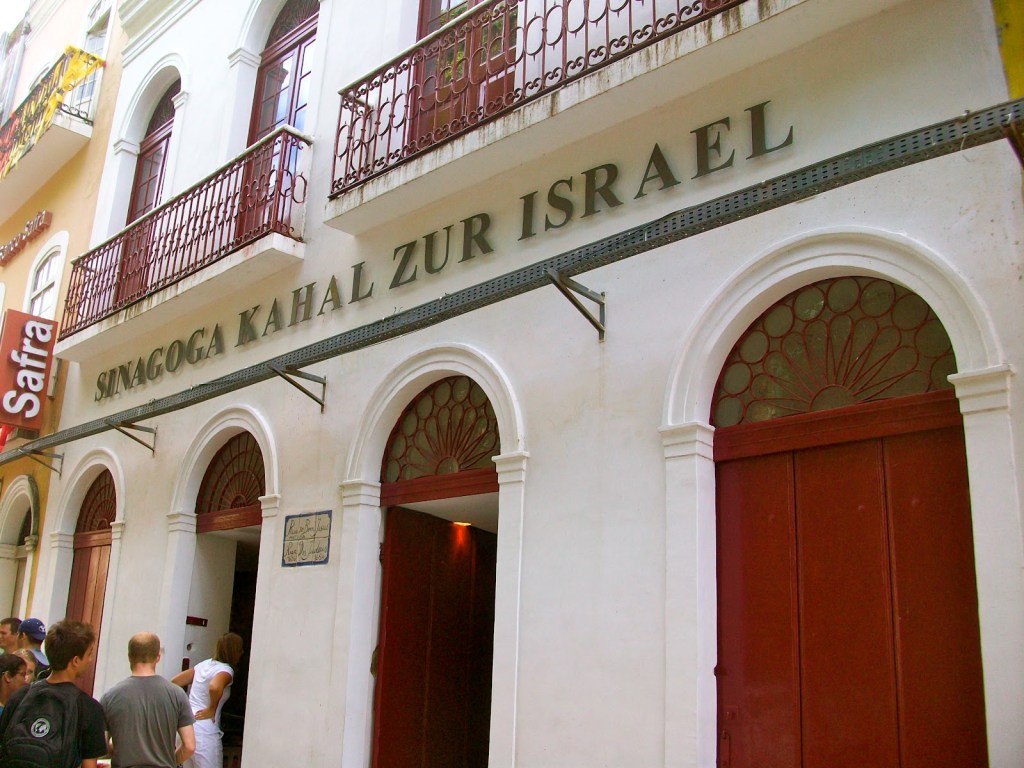
Although this appears a welcome gesture and is better than imprisonment or death, it uprooted the lives of more than 1,600 Jews living a prosperous life after a century of persecution in Europe under the Inquisition. Many Jews were forced to be baptized in Spain and Portugal and as a result many fled to Amsterdam. Under the protection of Dutch laws, the Jews in Recife were allowed to openly practice their religious beliefs and established, Kahal Zur Yisrael, the first synagogue in the New World. Isaac Aboab da Fancseca was the first rabbi in the New World. The Kahal Zur Israel congregation had an elementary and secondary school and supported charities in Recife. Many textbooks call attention to the Touro Synagogue in Newport, Rhode Island, which was built more than one hundred years later in 1763.
The Jewish population of Recife had to sell possessions, close their businesses, end the education of their children, and return to Amsterdam, a place they left more than twenty years ago. Middle school students familiar with the voyage of Columbus, Virginia Company, Pilgrims, and the Massachusetts Bay Company might speculate what the voyage back to Amsterdam in February, 1654. Use this situation to simulate the family discussions in the homes of Recife.
What were the sleeping accommodations like?
Was there adequate food on the ship?
Were the ships seaworthy in storms?
Did people experience sickness?
Was there danger from enemies or pirates?
Were families together or separated?
What dangers did young men and women experience?
Stranded in the Caribbean
Asser Levy wrote in his diary on March 20, 1654, “This morning, the Falcon rocked harder than usual. I fumbled my way up to the deck to see what was going on. An ominous grey sky had replaced the blue, and strong winds howled. Ripples turned into waves, and waves into giant swells. The captain ordered all passengers to take cover below. Lightning exploded over the ship. The Falcon was being tossed around like a toy boat.” (Page 27)
What choices did passengers who are also refugees have at sea? Did they have any rights as Dutch citizens? Would their religious beliefs sentence them to prison, would able workers be kidnapped, could they be killed? Would they feel safe in a Spanish or Portuguese port in the Caribbean?
Five days later on March 25th, Asser Levy wrote with an exclamation, “Red flag!” Pirates! The most likely encounter middle and high school students have with pirates, is the Disney experience of ‘Pirates of the Caribbean.’ For Asser Levy and the other refugees fleeing Brazil, this was a death sentence, perhaps their greatest fear. They would lose their possessions, men might be kidnapped, women raped, and death or injury to anyone who dared challenge the pirates.
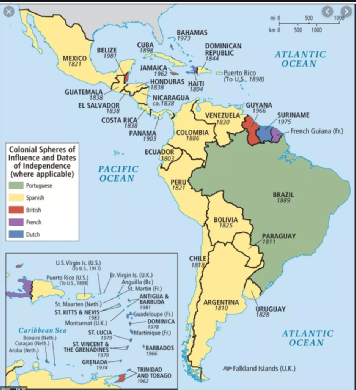
Use the two maps below for students to make a claim about the voyage from Recife, to the place of the storm, the boarding of the ship by pirates, and arriving in Jamaica. [On the first map, Jamaica is just south of the eastern end of Cuba and Recife is not visible. In the second map, Recife is on the most extreme end of the eastern coast of Brazil and Jamaica is south of Cuba.]
On April 1, about one week later, the Falcon, in need of repairs, drifted close to Jamaica. Understanding the geography of the Caribbean, especially the journey of approximately 40 days at sea from Recife to Jamaica should result in many questions and arguments that need evidence. Try to follow the diary and map the intended route of the Falcon with the actual route taking them to Jamaica.
Students studying colonial America are generally familiar with the religious exodus of people with Protestant faiths coming to Virginia, Massachusetts, New Sweden, and Connecticut. They likely understand the settlement of Maryland and the passing of the Toleration Act, 1648. Ask your students if people kept or lost their rights when their ship docked in a Spanish port. How did the Inquisition play out in real time when their ‘passports’ were checked? Asser Levy and the Jewish passengers on the Falcon were now under interrogation and the penalty of imprisonment or death for heresy.
Frustrated in New Amsterdam
This morning, September 5, 1654, “the St. Catherine turned and entered a large bay. The ship slipped through a narrow passage between two forested hills. We drifted into calm, sheltered waters, leaving the agitated open ocean behind, In the distance, the top of an island covered in mist slowly became visible. All the passengers came up on deck to witness the sight.” (Page 41)
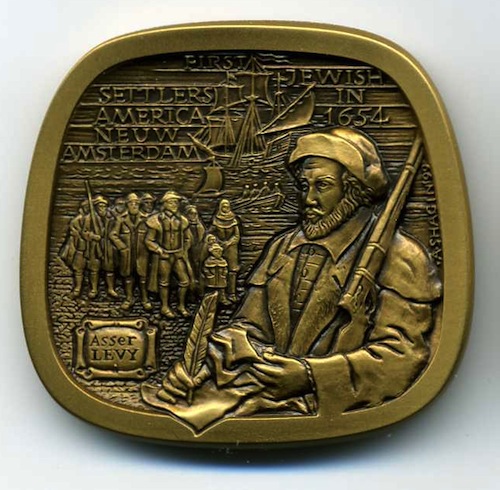
When studying the past, we do not have all the answers. In fact, asking the right questions is necessary to the historical context when documents and artifacts are not available or never existed. Ask your students to draw a picture of Asser Levy who departed Cuba on August 15 and now, 21 days later, has arrived in New Amsterdam.
Draw a line from the place in the image of Asser Levy to answer the following questions:
What does he see with his eyes?
What is he thinking in his head?
What sounds does he hear with his ears?
What sentences will he write with his hand and pen?
What does he smell with his nose?
What does he feel in his heart?
When he arrives on shore, where will his feet take him?
What are his fears?
Why is he holding a weapon?
What are his hopes?
The traditional opportunities to learn about diversity in the American colonies focus on Roman Catholics in Maryland and the banishment of Anne Hutchinson and Roger Williams from Massachusetts Bay, it is 1654, so the Charter of Liberties has not been adopted in Philadelphia, and a safe haven for debtors in Georgia is still 80 years in the future. The evidence in Asser Levy’s diary provides inquiry into the lives of Jews who were Dutch citizens.
There are also clues in this book about self-government in the colonies. Most students learn about the representative government in Virginia’s House of Burgesses, the Mayflower Compact, the town meetings in New England, the power of the purse in determining local taxes, and the Fundamental Orders of Connecticut. The Diary of Asser Levy provides a unique look into the authority of judges and the colonial court system. It also provides a prompt for discussions about civic engagement to correct what Asser Levy believes to be arbitrary or unfair decisions.
September 9, 1654: “Two days have passed since our trial. Today, we had to return to court with Mr. Petersen and face La Motthe again.
The captain made his case. He had not been paid the remaining guilders. Mr. Pietersen begged for a little more time.
“’The Jews have not paid their legal debt to Captain La Motthe,” Stuyvesant declared. “However, they have sufficient property on the St. Catherine. I will allow the captain to sell all of the Jews’ belongings at public auction within four days.’” (Page 51)
For high school students, consider comparing the court system in New Amsterdam with the experiences of four enslaved persons in the courts of Virginia around 1650. (Source). The arrival of the 23 Jewish refugees from Brazil corresponds directly with the arrival of 300 enslaved individuals from Brazil in New Amsterdam. The double arrival presented problems for this colony of 1,000 residents regarding diversity, language barriers, housing, and work. By 1660, New Amsterdam was considered the most significant slave port in North America. (Source) These ‘threads,’ or themes, that are part of the historical tapestry of the colonial experience are available to your students through supplementary texts, The Diary of Asser Levy, and digital resources.
The information in The Diary of Asser Levy is a rich resource for student inquiry, especially for teachers who want to involve their students with guided research, interdisciplinary connections, understanding the diversity of the American experience, and evaluating decisions. The illustrations in the book from colonial New York, with specific street addresses, also provides information for teaching how communities have changed over time. For example, the history behind Pearl Street, Mill Lane, Maiden Lane, William Street, Water Street, and Wall Street are part of the local historical narrative.
Resilience and Restoration
The subtitle of The Diary of Asser Levy is, “First Jewish Citizen of New York.” Brainstorm with your students if it should be changed to, “First Jewish Dutch citizen of New York,” “First Citizen Advocate,” “First Jewish Homeowner in America,” “First Refugee in New York,” “First Jewish Banker,” etc. According to the author, Daniela Weil, Asser Levy was the 38th wealthiest person in America. History comes to life for our students when they make connections with the relevance of today. The websites in the Works Cited section provide digital resources for further exploration and investigation. Of particular note are www.newmasterdamhistorycenter.org, www.unsung.nyc/#home, and www.archives.nyc/newamsterdam.
It is the resilience and civic engagement of Asser Levy as a young man under age 20 who spoke for justice, pursued equality, advocated for the right to employment, homeownership, freedom of religious expression, and made the colony of New Amsterdam, and after 1664 the colony of New York, a safer and better place. This is not a book or lesson about any one person or group of people. Instead, it is a starting point for a deeper discussion about the ordinary people who are the ‘soul’ of America more than a century before the Declaration of independence and the birth of a United States of America.
In this context, students might reflect on the legacy of Asser Levy and how history and New York remember him, when his memory was first discovered, if communities outside of New York have places named in his honor, and how he will most likely be remembered in the future of this century and specifically on August 22, 2054, the 400th anniversary of his arrival in New Amsterdam!
Asser Levy Park, Brooklyn, NY (near Coney Island)
Weil, Daniela, The Diary of Asser Levy, Pelican Publishing, New Orleans, 2020.
Social Studies for a Better World: An Anti-Oppressive Approach for Elementary Education
by Rodriguez Naseem, Noreen, and Katy Swalwell. (2021)
Reviewed by Natalie House
In “Social Studies for a Better World: An Anti-Oppressive Approach for Elementary Education,” the authors are taking on the task of how to teach anti-oppressive history and how to implement those teachings in an elementary classroom. This book aims to “…offer advice for addressing two major fears that the preservice teachers we work with often express: teaching controversial issues and being accused of indoctrination.” Noreen Naseem Rodriguez and Katy Swalwell (2021).” This book showcases the negative realities that the current social studies curriculum offers to all students in America, and takes the audience on a necessary journey that will help educators offer better learning experiences for students moving forward. The authors have created a work that is easily accessible for teachers at any level. Furthermore, the resources and research contained in this book will allow teachers to apply the authors’ ideas in their own classroom.
The authors of the book have taken the time to research different ways in which social studies can be taught. They are able to show multiple examples of effective social studies instruction by describing real lessons that teachers are currently using to help students have meaningful interactions with the curriculum. The authors help guide teachers by discussing the common pitfalls they might encounter while also giving the educators tips and tricks on how to find a solution. All of the examples in this text come with supplemental resources to help the reader implement the lessons or strategies with students easily. Teachers should also feel comfortable utilizing this information because it is all grounded in scholarly research. As a first-year teacher myself, this book was encouraging and helped to validate my emotions as it pertains to teaching hard histories. It lays out the lessons in ways that are fair to our students, while also celebrating the diversity of all people. This is critical because many students feel ignored, or left out, of the current social studies curriculum.
This book is written in a way that supports teachers, but could also be beneficial to pre-service teachers. By discussing the most controversial issues to teach, it also gives the educator time to reflect by posing thoughtful questions. These questions are meant to guide the educator through a lesson, however they also give the educator something to think about as well.
For instance, how they have been unknowingly teaching specific histories incorrectly. It offers a refreshing way for students and teachers to consider what information is being taught, as well as the ways that teachers and students are engaging with the content. The use of real-life examples helps connect the reader with the content that is being shared. Additionally, offering practical advice on how to handle the backlash that might come from teaching controversial issues is something that new teachers will find incredibly helpful.
“In addition to everything laid out in this book about curriculum and instruction, we must understand the bureaucracy and hierarchy of our states and districts so we can know where best to direct our change-making energies, buffer our credibility with ongoing meaningful professional development, and assess our own safety (mental, emotional, physical, financial) so we know exactly how far we are willing to go,” Naseem Rodriguez and Swalwell (2021).
The authors do not sugar-coat anything and they let the reader know that teaching histories in this way is not an easy task. However, it is not a task that has ever been easy in the first place.
“Anti-oppressive elementary social studies may not be easy, but it is absolutely worth it (Naseem Rodriguez and Swalwell (2021).” The opportunity for growth through dialogue with students and colleagues is endless with this book. It opens so many doors for educators to walk through and have thoughtful conversations that will benefit our students.
This book by Noreen Naseem Rodriguez and Katy Swalwell is one that I will be encouraging all of my fellow social studies teachers to read. It was refreshing to read something that was made with so much passion. By using accessible language that all teachers can understand, it made it seem as though teaching these histories today is not as daunting as it might seem. It just takes time to understand and make connections with all of humanity. I feel as though this book did a wonderful job of reaching its target audience. It is well written and has found its place in social studies literature. The reflections and informative way of thinking in this book are exactly what education needs today, and this is a book that social studies educators desperately need.
My name is Natalie House, and I am a current social studies teacher in Oklahoma. I am currently enrolled at The University of Oklahoma as a Master’s student in Instructional Leadership and Academic Curriculum with a focus on Social Studies.
Conflicted Vision: Thomas Jefferson and the University of Virginia
by Alan Taylor
Review by James J. Carpenter
In any discussion of early America and public education, Thomas Jefferson inevitably plays a central role. For many, he “remains one of democratic education’s founding fathers” (Neem, 2013, p. 3). Jefferson’s Bill for the General Diffusion of Knowledge called for a three-tiered system of public schooling that would, according to Wagoner (2004), “elevate the mass of people to the moral status necessary to insure good government and public safety and happiness” (p. 34). Jefferson’s vision for Virginia schools would fall victim to the political realities of that state, save for the eventual establishment of the University of Virginia in 1819. Indeed, the university is one of three accomplishments Jefferson had engraved on his tomb, along with being the author of the Declaration of Independence and of the Virginia Statute for Religious Freedom.
Like most of Jefferson’s life, there is a considerable volume of literature on his educational views and his plans for improving education in his beloved Virginia (e.g. Addis, 2003; Conant, 1962; Gilreath, 1999; Heslep, 1969; and Wills, 2002). I was curious, therefore, to read Alan Taylor’s latest work entitled Thomas Jefferson’s Education. Was this a description of Jefferson’s personal educational odyssey or was this another discourse on his educational philosophy and plans for public schooling in Virginia? I was pleasantly surprised to find it was both and more. Taylor successfully weaves Jefferson’s fight to advance public education in Virginia with stories of a wide variety of individuals who supported or resisted his goals. Furthermore, he situates these often bitter political struggles in the context of a stratified Virginia society built on a foundation of enslaved labor.
Indeed, Taylor’s description of a complicated social milieu often seems to be the real subject of his book. At first, as a reader, I was distracted by the many anecdotes and stories Taylor offers as illustrations for the contesting forces that impacted Jefferson’s goal of free public education for white males. It is only when the reader sits back and focuses on the entire mosaic rather than on the individual tesserae that Taylor’s story becomes clear. He rather quickly addresses the failure of Virginia’s legislature to approve Jefferson’s plans for publicly funded elementary and secondary schools and focuses on Jefferson’s goal for a public university that would rival Harvard and Yale.
Taylor places this struggle to create the University of Virginia in the context of powerful cultural forces within the state – and by extension throughout the South – and thereby creates a fascinating subtext for his book. The primary forces at work were the increasingly rigid attitudes regarding slavery and the strict adherence to the gentry’s belief in their privileged status including their preference for drinking, gambling, and dueling in defense of their honor. Taylor masterfully posits these societal flaws against Jefferson’s wishes to create a university which would train leaders who would reform Virginia. Jefferson envisioned this next generation of leaders would further republicanism by adopting “a more democratic state constitution for white men,” by embracing his goals for public education for all white children, and by emancipating but deporting slaves (p. 307). Jefferson’s hopes for the future evolved during a period where regional bitterness was hardening at an alarming rate, an extreme bitterness Joanne Freeman (2018) has described as a violent “cultural federalism” (p. 50). Southern politicians increasingly saw the Union as endangered by northern political and economic interests which would put the South at a distinct disadvantage. Southern fathers did not want their sons attending northern institutions of higher learning for fear they would be corrupted by antislavery ideas and dangerous democratic ideas of equality. Instead, southern “gentlemen attended college to hone social skills and cultivate social networks” (p. 82). Additionally, “fathers wanted sons to develop a robust sense of honor,” including choosing dueling over accepting insults (p. 83). And, as Taylor describes, their sons whole-heartedly bought into their privileged status; to the extent that they believed themselves exempt from obeying rules and policies implemented by those they believed to be of inferior status including their professors. Indeed, according to Taylor, this strategy at times worked all too well. Most of Virginia’s young gentlemen “became petty tyrants” to the state’s enslaved population (p. 83).
It was in this social and cultural milieu that Jefferson and others in Virginia’s founding generation tried to re-establish that state’s prestige. As other states, especially in the North, gained in population and in political influence, these aging leaders identified education as the means to restore Virginia to what they believed to be her rightful status. The College of William and Mary was in decline since the state capitol had moved from Williamsburg to Richmond and Jefferson saw this as an opportunity to build a new university, one that would embody his philosophical beliefs and be free from any religious connections. Taylor describes Jefferson’s reliance on his chief lieutenant in the state legislature, Joseph C. Cabell, and his efforts to thwart other attempts to construct a university in locations other than Charlottesville. Many personalities are presented in this account; some famous like James Madison, Patrick Henry, and James Monroe and others less so, such as the Scottish teacher James Ogilvie, the mercurial John Randolph, and Jefferson’s rival for controlling the fledgling university, John Hartwell Cocke.
In detailing how he secured his beloved university, Taylor sheds light on Jefferson’s complex personality. For example, in constructing the university Jefferson dismissed the idea of sharing state education allocations with two other campuses he ridiculed as “’local interests’” while remaining oblivious to the parochial nature of his own plans (p. 198). Believing “that only architectural grandeur could attract many students” (p. 211), Jefferson’s construction costs exceeded both the state appropriations and private monies raised through subscriptions leaving the university with no money for scholarships for deserving students. As a result, only sons of the wealthiest Virginia families could afford to attend causing the university to “suffer from their homogeneity and sense of entitlement” (p. 214).
Known for his pleasing manners and hospitable nature, Jefferson could also be sharp and intransient on issues he deemed important. His insistence that the university be free from religious influence and that there be no professor of divinity alienated many Virginia Christians, especially Evangelical Episcopalians and Presbyterians, leading to contentious struggles with the university’s Board of Visitors and state political leaders. Though he expressed a faith in the free expression of ideas, Taylor describes how Jefferson “assumed that the free pursuit of truth always led to his conclusions.” His university would be a bastion of republican orthodoxy free from “Federalist “’heresies.’” For example, Jefferson selected political readings that “favored states’ rights over national consolidation” as texts for the professor of law to use (p. 238, emphasis added to first quote). Republicanism was the litmus test in hiring for Jefferson. Therefore “no Federalist need apply to become professor of law at the University of Virginia,” regardless of his qualifications (p. 239). Far from promoting a democratic education, Jefferson often endorsed a more authoritarian approach in managing the day to day issues at his university.
Today the University of Virginia is one of the most respected public universities in the United States. It is fondly referred to as Mr. Jefferson’s university. The picture Taylor paints of the early days of the university is at odds with what it has become. Plagued by low enrollments and financial problems, it initially housed a student population more dedicated to drinking, gambling, and carousing than to studying. Students accustomed to privilege and power frequently fought, rioted, mistreated slaves, and disrespected faculty, with one student actually fatally shooting a professor. Following Jefferson’s death in 1826, things began to change, albeit slowly. By the mid-1840s, the university could afford to grant scholarships to deserving but less affluent students. Increasing enrollments led to greater numbers of Christian students who would have been unacceptable to Jefferson. Faculty hires became less political and rule changes on campus led to less violent and more sober student behavior. By the eve of the Civil War, the University of Virginia was becoming a major academic institution though not as envisioned by its famous founder.
The evolution Taylor describes contains many ironies. For example, while largely ignoring the need to educate women beyond what was required to be a good wife (though he did promote learning for his own daughters and granddaughters), it was Jefferson’s daughters and granddaughters who became “teachers of a new generation of women” and who managed to save their family financially after the Civil War (p. 315). And Taylor masterfully describes the problematic relationship between Jefferson’s primary objectives for students who attended the University of Virginia. One goal was to produce republican leaders who would protect the rights of states against what he perceived as an increasingly threatening union controlled by northern politicians. His second objective was that these more enlightened leaders would reform Virginia, especially by first ending slavery and then deporting the formerly enslaved out of the United States, thereby ridding the country of its original sin. Jefferson failed to see these two goals as being contradictory. As Taylor demonstrates, the next generation did defend states’ rights in ways Jefferson could not have imagined. And rather than seeing slavery as a sin to be abolished, Virginia leaders promoted slavery as a positive institution which protected an inferior race. Ultimately, the university students did not “uproot slavery as Jefferson had hoped,” but instead “defended it and served the Confederacy in the Civil War” (p. 307). In delineating this progression to the potential dissolution of the union Jefferson had helped create, Taylor not only has made a valuable contribution to the literature on Thomas Jefferson’s impact on education but also to that of the history of education in the United States and to that of sectional development in ante-bellum America.
References
Addis, C. (2003). Jefferson’s Vision for Education, 1760-1845. New York, NY: Peter Lang.
Conant, J. B. (1962), Thomas Jefferson and the Development of American Public Education. Berkeley, CA: University of California Press.
Freeman, J. B. (2018). The field of blood: Violence in Congress and the road to civil war. New York NY: Farrar, Straus and Giroux.
Gilreath, J. (Ed.). (1999). Thomas Jefferson and the Education of a Citizen. Washington, D. C.: The Library of Congress.
Heslep, R. D. (1969). Thomas Jefferson & Education. New York, NY: Random House.
Neem, J. (2013). Is Jefferson a founding father of democratic education? A response to “Jefferson and the ideology of democratic schooling.” Democracy and Education, 21 (2), Article 8. Available at https://www.democracyandeducationjournal.org/home/vol21/iss2/8.
Wagoner, J. L., Jr. (2004). Jefferson and education. (Monticello monograph series). Chapel Hill, NC: University of North Carolina Press.
Wills, G. (2002). Mr. Jefferson’s University. Washington, D.C.: National Geographic Society.
Teaching Critical Thinking in the Context of Political Rhetoric: A Guide for Classroom Practice
by Joseph Sanacore
During the past several decades, there has been a blitz of information, sometimes referred to as the knowledge explosion, and students have struggled in their attempts to distinguish true, fake, and terribly biased information, especially regarding political issues. This book highlights the value of critical thinking as a way to navigate this difficult and frustrating terrain, so that students grow and develop as knowledgeable, independent thinkers. To promote this growth, the book offers thoughtful, evidence-based advice for teachers to support students’ deep thinking as it relates to real-world contexts. Strategies presented include student reflection based on experience, moving from narrow to broader perspectives, and using graphic organizers to build and activate knowledge before, during, and after instructional activities. With the instructional guidance and activities presented in this short, easy-to-apply volume, teachers can give students the tools they need to negotiate the often-murky waters of political. Chapters include: The Need to Teach Critical Thinking; Promoting Critical Thinking; Application and Transfer of Learning; Other Strategies and Activities That Support Transfer of Learning; The Value of Hard Work; and Reflections on Critical Thinking.
In a review, Alina Reznitskaya, Professor, Department of Educational Foundations, Montclair State University, New Jersey, writes “Written at a time when news can be fake and facts can have alternatives, this book provides teachers with innovative research-based instructional strategies that help students learn how to think through complex questions in a deliberate and informed way. It is a timely and valuable resource for practitioners who are looking for effective ways to address a pressing educational priority: teaching students how to critically evaluate various types of information and reach a sound conclusion. Importantly, the book treats teachers as co-inquirers, who reflect on their own thinking and continue to learn with their students.”
Joseph Sanacore is a journalist, researcher, and professor in the Department of Teaching and Learning at the Post Campus of Long Island University, Brookville, NY. He has authored more than 100 articles, essays, and book chapters. He also was an elementary, middle, and high school teacher and a K-12 Director of Language Arts and Literacy.
Sense of Origins: A Study of New York’s Young Italian Americans
by Rosemary Serra, translated by Scott R. Kapuscinski
In Sense of Origins, Rosemary Serra explores the lives of a significant group of self-identified young Italian Americans residing in New York City and its surrounding areas. The book presents and examines the results of a survey she conducted of their values, family relationships, prejudices and stereotypes, affiliations, attitudes and behaviors, and future perspectives of Italian American culture. The core of the study focuses on self-identification with Italian cultural heritage and analyzes it according to five aspects—physical, personality, cultural, psychological, and emotional/affective. The data provides insights into today’s young Italian Americans and the ways their perception of reality in everyday interactions is affected by their heritage, while shedding light on the value and symbolic references that come with an Italian heritage. Through her rendering of relevant facets that emerge from the study, Serra constructs interpretative models useful for outlining the physiognomy and characterization of second, third, fourth, and fifth generations of Italian Americans. In the current climate, questions of ethnicity and migrant identity around the world make Sense of Origins useful not only to the Italian American community but also to the descendants of the innumerable present-day migrants who find themselves living in countries different from those of their ancestors. The book will resonate in future explorations of ethnic identity in the United States. Rosemary Serra is Associate Professor of Sociology at the University of Trieste, Italy. Scott R. Kapuscinski teaches English at Queens College, City University of New York.
Edited by Kathleen M. Dowley, Susan Ingalls Lewis, and Meg Devlin O’Sullivan
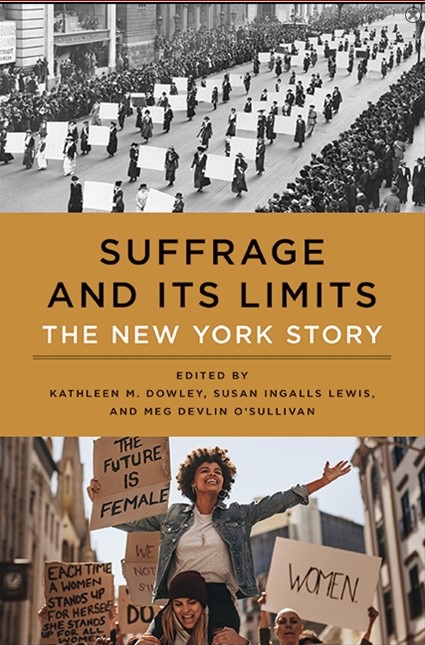
Suffrage and Its Limits offers a unique interdisciplinary overview of the legacy and limits of suffrage for the women of New York State. It commemorates the state suffrage centennial of 2017, yet arrives in time to contribute to celebrations around the national centennial of 2020. Bringing together scholars with a wide variety of research specialties, it initiates a timely dialogue that links an appreciation of accomplishments to a clearer understanding of present problems and an agenda for future progress. The first three chapters explore the state suffrage movement, the 1917 victory, and what New York women did with the vote. The next three chapters focus on the status of women and politics in New York today. The final three chapters take a prospective look at the limits of liberal feminism and its unfinished agenda for women’s equality in New York. A preface by Lieutenant Governor Katherine Hochul and a final chapter by activist Barbara Smith bookend the discussion. Combining diverse approaches and analyses, this collection enables readers to make connections between history, political science, public policy, sociology, philosophy, and activism. This study moves beyond merely celebrating the centennial to tackle women’s issues of today and tomorrow.
Kathleen M. Dowley is Associate Professor and Chair of Political Science and International Relations, Susan Ingalls Lewis is Professor Emerita of History, and Meg Devlin O’Sullivan is Associate Professor of History and Women’s, Gender, and Sexuality Studies, at SUNY New Paltz.
Teaching For Black Lives and Teacher Unions and Social Justice
Teaching for Black Lives, edited by Dyan Watson, Jesse Hagopian, and Wayne Au, grows directly out of the movement for Black lives. The editors recognize that anti-Black racism constructs Black people, and Blackness generally, as not counting as human life. They provide resources and demonstrate how teachers connect curriculum to young people’s lives and root their concerns and daily experiences in what is taught and how classrooms are set up. They also highlight the hope and beauty of student activism and collective action. Teacher Unions and Social Justice, edited by Michael Charney, Jesse Hagopian, and Bob Peterson, is an anthology of more than 60 articles documenting the history and the how-tos of social justice unionism. Together, they describe the growing movement to forge multiracial alliances with communities to defend and transform public education.
Welcome to the Anthropocene. Since the start of the Industrial Revolution, human-caused climate change has impacted the globe with the burning of fossil fuels. The debate in classrooms and the political realm should not be whether climate change is happening or how much it places human civilization at risk but over how societies and individuals should respond. This interdisciplinary book offers an in-depth examination of the history of the Earth’s climate and how historians and citizens can influence contemporary climate debate and activism. The author explains climate history and climate science and makes this important subject matter accessible to a general audience. Chapter topics include examining the Earth’s geological past, the impact of climate on human evolution, the impact of climate on earlier civilizations, climate activism, and the need for international cooperation. Presenting climate history, human history, and climate science in a readable format and featuring resources for students, this book is meant for use by teachers in high school elective or an introductory college course setting.
Chapters include “Our House is on Fire”; Tipping Points; Great Climate Migration; Earth’s Past Climates; Climate Change and Human Evolution; Extreme Heat; Four Billion Years of Climate History; Mass Extinctions; “Clocking” Climate Change; Diseases Carried by Mosquitoes or Hidden in the Ice; Climate Change Deniers and Minimizers; A Short Cold Snap of about 500 Years; Power of Ice; Climate Repercussions; Water Scarcity, Water’s Vengeance; Technology Debate; Saving the Amazon Rainforest; Capitalism vs. the Climate; and Climate Activism. There is an annotated bibliography and a list of resources for teaching about climate change.
Christine Kinealy, professor of history and the founding director of Ireland’s Great Hunger Institute at Quinnipiac University in Connecticut, has created an impressive academic juggernaut for the study of the mid-19th century Great Irish Famine and for bringing the famine to the attention of a broader public. Her more recent published work includes The Bad Times. An Drochshaol (2015), a graphic novel for young people, developed with John Walsh, Private Charity to Ireland during the Great Hunger: The Kindness of Strangers (2013), Daniel O’Connell and Anti-Slavery: The Saddest People the Sun Sees (2011), and War and Peace: Ireland Since the 1960s (2010). She recently released a collection of essays, prepared with Jason King and Gerard Moran, Heroes of Ireland’s Great Hunger (2021, co-published by Quinnipiac University Press and Cork University Press). In Ireland, it is available through Cork University Press. In the United States, it is available in paperback on Amazon. Co-editor Jason King is the academic coordinator for the Irish Heritage Trust and the National Famine Museum in Strokestown, County Roscommon, Ireland. Co-editor Gerard Moran is a historian and senior researcher based at the National University of Ireland – Galway.
Sections in Heroes of Ireland’s Great Hunger include “The Kindness of Strangers,” with chapters on Quaker philanthropy, an exiled Polish Count who distributed emergency famine relief, and an American sea captain who arranged food shipments to Ireland; “Women’s Agency,” with three chapters on women who “rolled up her linen sleeves” to aid the poor; “Medical Heroes,” with five doctors who risked their own lives to aid the Irish; and sections on the role of religious orders in providing relief and Irish leadership. Final reflections include a chapter on “The Choctaw Gift.” The Choctaw were an impoverished Native American tribe who suffered through the Trail of Tears displacement to the Oklahoma Territory. They donated more than they could afford to Irish Famine Relief because they understood the hardship of oppression and going without. Kinealy, King, and Moran managed to enlist some of the top scholars in the field of Irish Studies from both sides of the Atlantic to document how individuals and groups made famine relief a priority, despite official government reticence and refusal in Great Britain and the United States. In her work, Kinealy continually draws connections between the Great Irish Famine and current issues, using the famine as a starting point for addressing problems in the world today. The introduction to the book opens with a discussion of the global response to the COVID-19 pandemic.
Readers meet powerful individuals who deserve a special place in the history books. James Hack Tuke, a Quaker, not only provided and distributed relief, but he attempted to address the underlying issues that left Ireland, a British colony, impoverished. His reports from famine inflicted areas highlighted pre-existing social conditions caused by poverty, not just famine related hunger. His reports challenged the stereotype popularized in the British press that the Irish were lazy and stressed the compassion the Irish showed for their neighbors. While working with famine refugees in his British hometown of York, Tuke became ill with typhus, also known as “Famine Fever,” a disease that caused him to suffer from debilitating after-effects for the rest of his life. After the famine subsided in the 1850s, Tuck continued his campaign for Irish independence from the British yoke.
Count Pawl de Strzelecki of Poland was an adopted British citizen who documented the impact of the Great Irish Famine so that British authorities could not ignore what was taking place and who spoke out against the inadequacy of British relief efforts. Strzelecki was a geographer, geologist, mineralogist, and explorer. As an agent for the British Association for the Relief of Distress in Ireland and the Highlands of Scotland, he submitted reports on conditions in County Donegal, Mayo and Sligo. The reports challenge the British government’s effort to minimize the impact of the famine on the Irish people. On a personal level, Strzelecki provided direct aid to impoverished Irish children and lobbied before Parliamentary committees for increased governmental and institutional attention to their plight. He later worked to provide assistance to women who were emigrating to Australia.
The chapter on Asenath Nicholson was written by my colleague at Hofstra University, Maureen Murphy, Director of the New York State Great Irish Famine Curriculum and author of Compassionate Stranger: Asenath Nicholson and the Great Irish Famine. Nicholson was an American Protestant evangelical who traveled the Irish countryside delivering relief packets and sending reports home to the United States in an effort to raise more money. While she distributed Bibles, she did not make participation in Protestant services a condition of aid, unlike a number of British aid workers. Murphy describes Nicholson as a “woman who was ahead of her time – a vegetarian, a teetotaler, a pacifists, and an outdoor exercise enthusiast” (96). Nicholson’s achievements were largely ignored by a male-dominated world until brought to public attention by Murphy’s work.
Daniel Donovan was a workhouse medical doctor in Skibbereen, perhaps the hardest hit town in County Cork and in all of Ireland. I consider him one of the most significant heroes included in the book. As epidemic diseases devoured the countryside, Dr. Dan, as he was known locally, treated the poor and documented conditions for the outside world. Donovan’s diary reported on the impact of the famine in Skibbereen was published in 1846 as Distress in West Carberry – Diary of a Dispensary Doctor and sections were reprinted in a number of newspapers in Ireland and England, including The Illustrated London News. Dr. Dan, who became a major international medical commentator on famine, fever, and cholera, continued to serve the people of Skibbereen until his death in 1877.
I do have one area of disagreement with the editors. I would have included a section on the leaders of Young Ireland and the 1848 rebellion against British rule, including William Smith O’Brien, John Blake Dillon, John Mitchel, and Thomas Meagher. Rebellion, as well as relief, was an important and heroic response to the Great Irish Famine.