My Story: Cristofel and John Vought, Hunterdon County, NJ 1776

My Story: Christofel and John Vought

Hunterdon County, 1776

Everyone living in New Jersey in 1776 was faced with the difficult decision of remaining quiet, supporting the movement toward independence being debated in the Continental Congress, or remaining loyal to the King of England and Britain. Families, communities, and the population in New Jersey was divided. People were divided because of their location with many Loyalists living near the Hudson River and New York City where the British assembled a large military and naval force and Patriots living near the Delaware River and Philadelphia where the Continental Congress was meeting.

The battle for independence was also a civil war. Revolutionaries made life exceedingly hard for many with sympathies for the British cause, seizing their property, accusing neighbors of sedition and having them arrested and placed in local jails, boycotting their businesses, and tarring and feathering them. If you were the victim of any of these abuses, you had to consider moving to British-held New York, to the Canadian provinces or to England.

In Hunterdon County, near the village of Clinton and Lebanon, the family of John Vought sided with the British. They were Loyalists living among neighbors who supported the Patriot or the American cause for independence. As a result, they faced difficult decisions.

The Voughts came to America in 1710 from the Palatinate area of the Holy Roman Empire (Germany). This productive agricultural and mining region was frequently invaded and people of the Protestant faith migrated to America in the 18th century. Many moved to New Jersey and Pennsylvania. They likely traveled on the Rhine River to Amsterdam and then on a clipper ship to New York or Philadelphia.

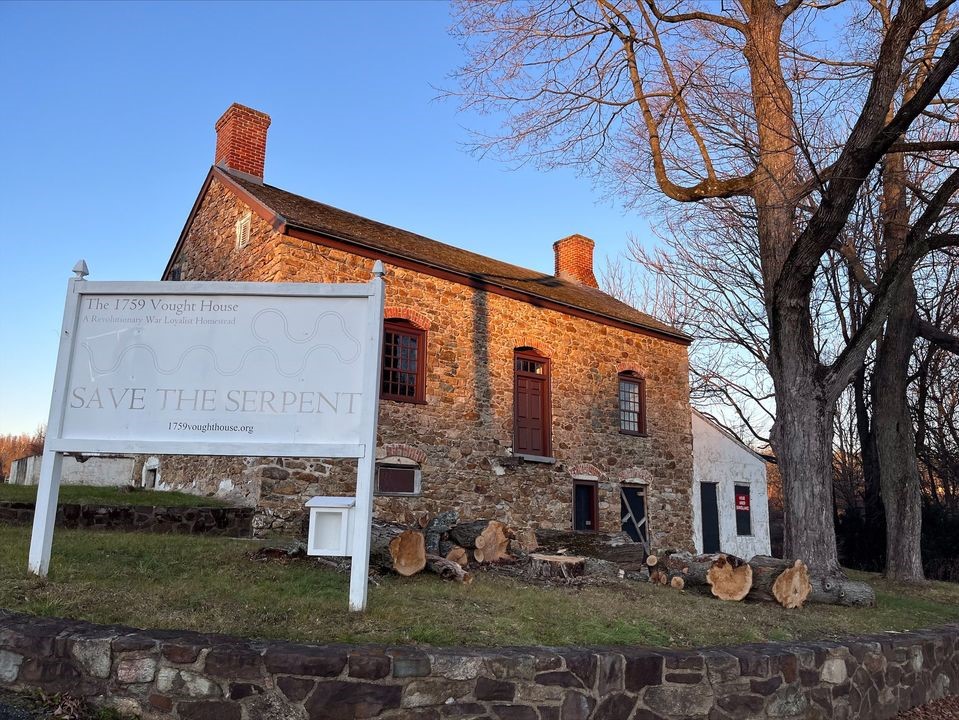
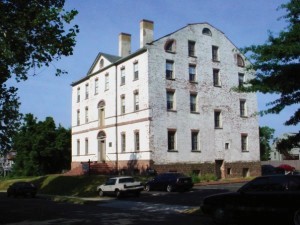
Christofel Vought built a home in 1759, during the French and Indian War on a 258-acre farm. He built a reputation in his community as a market for food supplies. Sometime in the 1770s he transferred ownership of the home to his son, John. On June 24, 1776, John Vought was part of a group of approximately twenty-five loyalists who attacked the home and tavern of Captain Thomas Jones. The tavern was also a recruiting station for the Hunterdon County Militia.  John Vought and the other Loyalists beat Jones and “plundered and robbed the house.”

The raid on the Jones property drew a swift reaction from the Provincial Congress of New Jersey and the adopted the following resolution two days later.  The minutes of their June 26, 1776 session state:

“Whereas it appears, from authentick [sic] information, that certain disaffected persons, in the County of Hunterdon, have confederated for the purpose of opposing the measures of the Continental and Provincial Congresses, and have even proceeded to acts of open and daring violence; have plundered and robbed the house of Captain Jones; have beaten, wounded, and otherwis [sic] abused the friends of freedom in said County, and now publickly [sic] declare, that they will take up arms and engage in behalf of the King of Great Britain, the avowed and implacable enemy of the United Colonies. In order to put an effectual stop to a combination so hostile and dangerous,

“It is resolved unanimously, That Lieutenant-Colonel Ten Eick, and Major Berry, take to their aid such a number of the militia, properly officered and armed, of the Counties of Hunterdon and Somerset, as they may think necessary, and proceed, without delay, to the said County of Hunterdon, in order to apprehend such insurgents and disaffected persons as this Congress shall direct.”

John Vought and his father, Christofel, spent five days in prison at the Hunterdon County Courthouse in Trenton.

During the winter of 1776-77 when the British occupied New York City and Philadelphia, John and Christopher Vought had to decide what they would do:

Should they go to New Brunswick, about 25 miles away, to enlist in the Loyalist troops known as the New Jersey Volunteers?

  1. Should they remain in their home and wait for the British to control New Jersey and Pennsylvania?
  2. Should they leave their home and start a new life in New York City, where they should be protected?
  3. Should they move to Canada and begin a new life?
  4. What would likely be the consequences of each decision for them and their family?

My Story: Rev. John Brainerd, Cumberland County 1751-1781

My Story: Rev. John Brainerd

Exploring Native American Sources Over a 30 Year Period

John Brainerd was born on February 28, 1720 in Haddam, CT. He had a vision to educate Native Americans in the colonies of New England and the Mid-Atlantic, including New Jersey. He graduated from Yale College in 1746 and received a Masters Degree from The College of New Jersey (Princeton) in 1749. He was a Presbyterian minister in Newark and New York before the French and Indian War. Her served as a chaplain in the Colonial Army during the French and Indian War, possibly between 1756 and 1759. He ministered to Christian Indian villages in Cranbury, Bridgetown, Mount Holly, Newark, and Deerfield in New Jersey. He also ministered to Native American communities in Pennsylvania and Connecticut. His brother David also ministered to Native Americans but died before John graduated from Yale.  John Brainerd was married twice. His first wife, Experience Lyon died in 1757, while John Brainerd was with the Colonial Army. The two children she gave birth to, died in their first year. He remarried Hannah Spencer from Lynn, MA (also Haddam, MA) in 1664.

These were the years of the Great Awakening and prominent clergy such as John and Charles Wesley, George Whitefield and Jonathan Edwards preached the Bible, wrote songs, started schools, and ministered to colonial populations.

The French and Indian War, tough economic times after the French and Indian War, and the separation from England following the Declaration of Independence had a significant impact on the clergy who were supported by the Anglican Church of England, the Presbyterian Church of Scotland, and the Reformed Church in the Netherlands. Most clergy returned to England after the Declaration of Independence. John Brainerd, Samson Occum, and Francis Asbury are prominent clergy who ministered to people in New Jersey.

“IN the year1777, at fifty-seven years of age, Mr.-Brainerd removed from Brotherton to Deerfield, in Cumberland County, N.J., and took charge of the church there. He still seems to have retained some oversight of the mission. In 1778, 1779, and1780, up to the year of his death, the Synod of New York and Philadelphia voted that ”the interest on the Indian fund be paid to Mr. Brainerd for his services among the Indians. “To the last of life he seems to have clung to his little flock, his first love, and his brethren did their best in a time of war to sustain him. Brotherton, the Indian settlement which he had aided to build up, and where for fifteen years he had resided, was situated in what is now a prosperous and pleasant rural neighborhood, near the present Shamong station, on the Raritan and Delaware Bay Railroad, about forty miles from Philadelphia. The “Historical Collections of New Jersey “give the following description:

“Edgepelick (or Indian Mills) is the name of a locality about three miles north of Atsion, where was the last Indian settlement in the State. The remnant of the tribe, consisting of about one hundred souls, emigrated to the West nearly half a century since. There is, however, a single family, but of mixed breed, residing in the vicinity ,in a log hut. Brainerd, the missionary, for a time resided among the Indians at this place. His dwelling-house stood about eight rods south of the saw-mill of Godfrey Hancock, on rising ground,  the site of which is still marked by depression, showing the precise spot where the cellar was. Within a few rods is the spring from which the family obtained water. The natives had a saw-mill on the site of Nicholas. Thompson’s mill, a quarter of a mile northeast of Brainerd’s house. Their burying-ground was on the edge of the pond about forty rods northwest of the same dwelling. In the vicinity stood their church, built of logs, and destroyed about thirty-five years since. After the Indians left, it was used by the whites for public worship.” (pp. 413, 14)

Use the sources below to discuss the following and debate the advantages and disadvantages of the proposed decision.

  1. What motivated young men from notable families to serve rural and Native American populations?  Was this the result of their college education, financial incentives, or personal motivation?
  2. How did conflict and war present barriers to the clergy who wanted to minister to people in a congregation or community?
  3. Was their motivation to preach the Word of God, educate Native American populations, or develop a larger church organization similar to what was established in Europe?
  4. Discuss the barriers John Brainerd faced in his travels, family life, with decisions of colonial governments, livelihood, and in ministering to people in need.

Decision: If you were John Brainerd, would you continue your ministry to Native Americans in New Jersey, or accept a position at an established congregation in a populated New Jersey community? (i.e. Newark, Princeton, Perth Amboy, New Brunswick, etc.)

Journal of John Brainerd (January 1761 – October 1762)

The Life of John Brainerd (1720-1781)  (Read pp. 409-420)

All related documents

Eleazar Wheelock, letter, to Mr. Whitefield, 1759 November 3

Manuscript Number 759603

Date 3 November 1759

Abstract: Eleazar Wheelock writes of the progress at his school, and of the conditions under which he looks for more Indian pupils as well as public charity. He also mentions the ordination of Occom.

Eleazar Wheelock, letter, to George Whitefield, 1761 July 4

Manuscript Number 761404

Date 4 July 1761

Abstract: Eleazar Wheelock writes to George Whitefield about first Occom’s mission to the Oneidas, and about the difficulties of teaching Indian students. He mentions the idea of appealing to the Earl of Dartmouth for charity.

Eleazar Wheelock, letter, to John Brainerd, 1765 January 14

Manuscript Number 765114.3

Date 14 January 1765

Abstract: Wheelock writes to Brainerd about setting up a meeting with the Connecticut Board of Commissioners, and the proposed fundraising trip to England, which is complicated by a renewal of the Mason Land Case.

John Brainerd, letter, to Eleazar Wheelock, 1766 September 16

Manuscript Number 766516.1

Date 16 September 1766

Abstract: Brainerd writes about the apprehension of the murderers of two Indian women, includes letters from Francis Alison and John Ewing recommending John G. Kals as a teacher and missionary, and gives his own recommendation of Kals, with reservations.

Eleazar Wheelock, letter, to Samson Occom, 1772 May 26

Manuscript Number 772326.2

Date 26 May 1772

Abstract: Wheelock asks Occom to join the mission of McClure and Frisbie to Muskingum.

Our Story: Should the Lenni Lenape Support the British, Patriots, or Remain Neutral?

Our Story: Should the Lenni Lenape Support the British, Patriots, or Remain Neutral?

Delaware River Valley, Warren County, 1778

The Lenni-Lenape from New Jersey had already begun to leave by the start of the American Revolution. The Lenape were a divided people with only a small number remaining in the Garden State, while most moved north or west.   The Lenni-Lenape that remained in New Jersey during the American Revolution played a significant role.

During the American Revolution, many Lenni-Lenape attempted to stay neutral at the beginning of the war.  However, they were soon divided as some joined with the British, while others sided with the Patriots. In 1778, the United States signed the Treaty of Fort Pitt with the Lenape who sided with the Patriots. Unfortunately, promised supplies were not delivered, and villages of friendly natives were attacked.  In the end, the results were disastrous for the many Lenni-Lenape no matter what side they took.

The outbreak of the American Revolution had great consequences for the Lenni-Lenape. Answer each question below.  Your response should be at least ONE full paragraph.

  • Why did many Lenni-Lenape leave New Jersey at the beginning of the American Revolution. 
  • From the perspective of the Lenni-Lenape, do you think this was the best decision or how long should they have waited before making a decision to leave?
  • Was it possible for the Lenni-Lenape to remain neutral? Explain the advantages and disadvantages of neutrality, declaring allegiance to the British, and supporting the Patriots at the start of the American Revolution?

Many historians have concluded that the Native Americans played a shadowy but important role during the American Revolution. Answer each question below. 

  • To what extent was the role of the Native Americans important to either side during the American Revolution?
  • Identify ONE critical factor that may have been used in the decision-making process of the Lenape to sign the Treaty of Fort Pitt.

Read the excerpt from Article II of the Treaty of Fort Pitt (1778).  Read and analyze the excerpt and answer the following guided questions:

1. Write one sentence summarizing Article II.

2. Is the text of Article II consistent with the text of the Declaration of Independence? What was happening at the time in history this excerpt was written?

“He has excited domestic insurrections amongst us, and has endeavored to bring on the inhabitants of our frontiers, the merciless Indian Savages, whose known rule of warfare, is an undistinguished destruction of all ages, sexes and conditions.

In every stage of these Oppressions We have Petitioned for Redress in the most humble terms: Our repeated Petitions have been answered only by repeated injury. A Prince whose character is thus marked by every act which may define a Tyrant, is unfit to be the ruler of a free people.” (Excerpt from the Declaration of Independence)

3. Identify a Claim and Argument regarding the decision of the Lenape to sign to Treaty of Fort Pitt?

Article II from the Treaty of Fort Pitt, 1778

“That a perpetual peace and friendship shall from henceforth take place, and subsist between the contracting: parties aforesaid, through all succeeding generations: and if either of the parties are engaged in a just and necessary war with any other nation or nations, that then each shall assist the other in due proportion to their abilities, till their enemies are brought to reasonable terms of accommodation: and that if either of them shall discover any hostile designs forming against the other, they shall give the earliest notice thereof that timeous measures may be taken to prevent their ill effect.”  Treaty of Fort Pitt

Our Story: Loyalists in New Jersey

Our Story: Loyalists in New Jersey

Middlesex County, 1776

In June of 1776, tensions between loyalists to the Crown and American patriots were reaching a fever pitch. It is time to choose sides.

You are a patriot living in Perth Amboy, New Jersey. You and your family make a living by selling the manufactured goods that come off the ships at port. Your son is in the Continental Army. You have learned that your next door neighbor is a loyalist sympathizer!

Sergeants Newton and Jasper of Marion’s Brigade, Rescuing American prisoners from a British guard

Do you…
Write to your son and inform him of the potential danger in your midst?Allow your neighbor to continue to live in town, even if it poses a potential risk to the patriot cause?

Loyalists in a patriot-controlled town such as Perth Amboy can be dangerous as they can report on the Continental Army’s movements to the enemy or sabotage the town from within, sometimes even by disrupting the economy with counterfeit bills.

Captured loyalists or suspected loyalists were subjected to imprisonment and confiscation of their lands and belongings.

If you choose to report your neighbor, he is arrested within the week and sent to a prison to await trial. You have heard rumors of the conditions within different prisons and prison ships, and they are all unhygienic, inhospitable, and crowded as Congress has not deemed emptying them a high priority.If you chose not to report your neighbor, your town and the army that your son fights for are at risk of top-secret information reaching the British. Additionally, since you did not report a loyalist, if your neighbor is ever found out, your own loyalty might also be called into question.
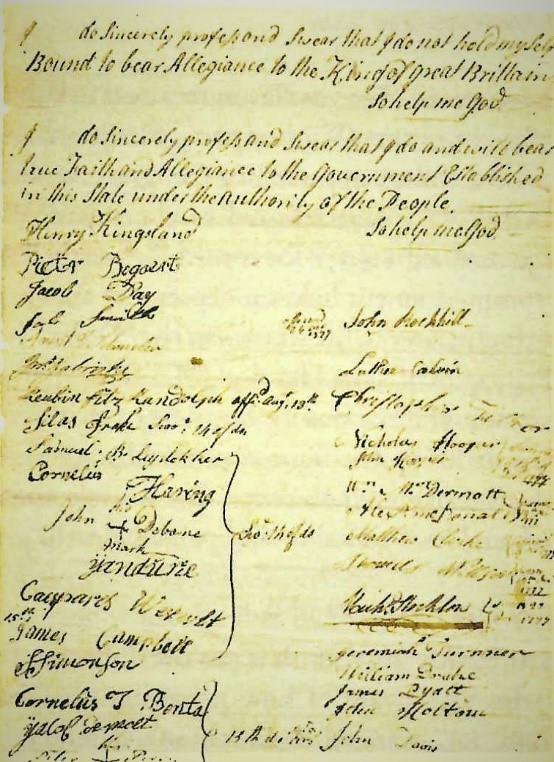
Quote to consider:   Some high-profile prisoners were offered the opportunity to sign an Oath of Allegiance and effectively switch sides in the war. It is important to remember, though, that a prisoner may have been risking not only their own safety but also the safety of their loved ones by refusing to sign oaths of allegiance to their captors. One prisoner, Rawlins Lowndes, former governor of South Carolina, states that soldiers, “harassed his wife, seized his slaves, horses, and poultry,” and felt he “had little choice but to submit.” (Lurie, 69)Quote to consider:   Even neutrality was suspicious. Due to their religious beliefs, Quakers were barred from “swearing loyalty, offering aid, using its money, [or] printing its newspapers or documents” to assist either side of a war. (Lurie, 110) As a result, their non-Quaker neighbors were often suspicious that Quakers were secretly loyalists and therefore, guilty of treachery. Simply stated, “Neutrality helped the enemy. When Quakers were suspected of loyalism their property could be seized, they could be fined, imprisoned, exiled, and in a few rare cases executed.” (Lurie, 111)
Your Choices:Your Choices:
Loyalists’ properties and possessions were typically confiscated and sold to benefit the patriot cause. How could this have motivated you to turn your neighbor in?   How will you attempt to do right by your neighbor and ensure that they are treated well by the Continental Army?   Towns were sometimes raided and townspeople kidnapped to be used in prisoner exchanges. How can you ensure that someone will not try to kidnap a patriot from your town to use as a trade for your loyalist neighbor?   What would you do if your neighbor had proof that they were a patriot just like you?   Do you think the Army is likely to arrest someone without evidence? Why or why not?What could you do to prove your loyalty to the Revolutionary cause and avoid being arrested yourself if it is revealed that you knew that your neighbor was a loyalist and you did not turn them over?   How have the reports of conditions within prisons during the Revolutionary War swayed your choice?   What can you do to ensure that Perth Amboy is still safe, even with a loyalist sympathizer in town?   What would you do if your son comes home for a visit and asks about the family next door?   You learn that ahead of major attacks on British-held Long Island later this summer, General George Washington will be coming to town. Does this change your decision?  

Additional sources to consider:

Oath of Allegiance (Lurie, p.81)

Interior of Jersey (Darley and Bookhaut)

Sources linked or cited in activity above

Taking Sides in Revolutionary New Jersey: Caught in the Crossfire, by Maxine N. Lurie, 2022.

My Story: David Sproat: Keeping ‘hell’ Afloat

David Sproat: Keeping ‘Hell’ Afloat

My Story: Hudson River and the New Jersey coast, 1779

I’m remembered in history as one of the men responsible for keeping “hell afloat” during the American Revolution. Even though historians may have pieced some memoir and diary entries of others together to determine this as my legacy, little is known about me.

So how’d a European guy like me end up fighting for the British cause? Are you surprised I wasn’t one of the rebels, supporting a flimsy attempt at self-government and using unconventional warfare strategies? Well, I set my sights on America in 1760. I’m a Scottish man, and I made decent money for myself as a merchant and land speculator. I settled in Philadelphia, where the hubbub about independence was pronounced. I had joined the Patriot cause in 1776, but feared imprisonment so I joined the British cause under General Howe after the Battle of Brandywine.

From here, I made a name for myself in the Loyalist community and started to get the attention of well-known leaders like William Franklin. Franklin was the last royal governor of New Jersey, and when he saw this colony taking a leap toward freedom, he started the “Refugee Club” for fellow Loyalists. I was able to join this club after I moved to New York City in 1779. In this same year, I was named the Commissary of Prisoners and was stationed in NY Harbor.  In this role, it was my responsibility to provide food, clothing, and shelter to those on board British prison ships.  The notable ship I served on was the HMS Jersey, a Royal Navy ship that first launched in 1736, and was then converted to a hospital ship before becoming reserved for prisoners of war during the Revolution.

‘HELL’, in other words.

This so-called “hell” was in squalor. Thomas Dring described me as a man who “gloated” over the death of prisoners. His memoir, Recollections of Life on the Prison Ship Jersey details the horrors aboard: rotten food, rat infestation, dead bodies, and more. Dring talks about how the Continental Congress abandoned the American prisoners on board, having no urgency to exchange them for British soldiers, or mandate their removal from the horrors. These words would become gospel for historians wishing to know more about these facets of life during the Revolution. But was it the whole story?

In 1909, a publication titled David Sproat and Naval Prisoners in the War of the Revolution, James Lenox Banks showcased a collection of letters that prove my empathy for the prisoners on board. I requested funds from the Continental Congress to secure new bed linens and clothing-I even fronted this cost with my own money. At one point, I had asked Lord Rodney, British naval commander, if I could resign from my position. He informed me that no one was worth enough to take my place. Oh, lucky me.

My legacy is tainted, and I won’t again get the chance to speak for myself. So which version of me do you believe? What causes historical truths to become abandoned?

Supporting Questions

Think about the line from the song “History Has Its Eyes on You” from the musical, Hamilton: “You have no control. Who lives. Who dies. Who tells your story?” How does this line reflect the actions and remembrance of David Sproat?


Based on your comments above, what decisions did David Sproat have to make as prisoner Commissary? Who do you think was influential in helping him make these decisions or do you think he made them alone? How important were his decisions?


What are some examples or situations of decisions that were wrong, immoral or unethical? How do you think war influences the decisions people make?


David Sproat lived in America for almost 20 years before deciding to support the Loyalists and become a member of the Refugee Club.  Do you think he regretted his decision after the war ended? Why or why not?  What additional information do you need to know to answer this question?


The Toil of Staying Loyal: Windows and Mirrors into the “dark side” of the American Revolution

The Toil of Staying Loyal: Windows and Mirrors into the “dark side” of the American Revolution

By Susan Soprano

When thinking about the battles of the American Revolution, many students may envision foot soldiers, old-fashioned pistols, and cannons. Few may visualize the naval fleet, and those who were stationed at sea. Few may consider the Loyalist perspective, those who wished to remain true to the monarchy, as they considered a stab at self-government too risky. Do you think students consider how the Revolution ripped families apart? How about the horrendous conditions aboard prison ships, reserved for those who got caught supporting liberty?

As educators, we want our students to have a complete and comprehensive knowledge of history. For far too long, stories have been hidden or skipped over to give a general overview of major topics in our country’s founding. Our history should provide “windows” and “mirrors” for our students: opportunities for them to see another’s perspective (windows), and opportunities for them to see themselves and their own experiences through others (mirrors).

This past winter, I had an opportunity to research two Loyalists as part of a grant project for the New Jersey Council for Social Studies: William Franklin and David Sproat. I knew very little about both men, but that’s one of the exciting things about taking on a task like this. My research for this project consisted of online articles and journals, and a really interesting read titled, The Ghost Ship of Brooklyn by Robert P. Watson. Prior to this learning journey, the following image really sums up by visualization of Loyalists during the Revolution:

“The Bostonian’s Paying the Excise-man, or Tarring & Feathering,” Philip Dawe, London, October 31, 1774. (Gilder Lehrman Collection, GLC04961.01)

Needless to say, there’s a lot more to envision than this, and your mind doesn’t even have to wander all the way to Boston.

William Franklin was the son of Benjamin Franklin, well known statesman and Patriot. William as a young man followed in his father’s footsteps and then supported the Loyalist cause after the French and Indian War. At that time, William was named royal governor of New Jersey by King George III, and later took up residence at the Proprietary House in Perth Amboy, NJ. In this very home, Ben Franklin visited and pleaded with his son to join the Patriot cause. He refused, and this ended their relationship. As the colonies inched closer and closer to independence, New Jersey shifted to support this cause. New Jersey would become the last colony to support liberty. In spite of this, William Franklin remained true to the crown. As a result, he was placed on house arrest by the New Jersey Assembly and was later arrested for treason. The Proprietary House remains a tourist spot today, hosting afternoon teas, colonial reenactments, and Sunday tours. I visited the house this past April, and enjoyed seeing my research come to life.

Proprietary House, Perth Amboy, NJ (image: https://revolutionarynj.org/places/proprietary-house/)

          David Sproat was a Scottish immigrant who became a Loyalist during the British occupation of Philadelphia in 1777. From here, he made his way to New York City, got the attention of William Franklin, and was ultimately named the commissary of prisoners on the HMS Jersey prison ship. Conflicting accounts show Sproat as both a man of empathy and a monster. His own correspondence with the Continental Congress was published in 1909 by James Lenox Banks, showing his willingness to give the prisoners bed linens and clothes. Sproat paid for these items upfront with his own funds. This challenges the claims from surviving prisoners that Sproat was ruthless and had made it his mission to torture American rebels.

These conflicting sources make one wonder about how history gets remembered. What makes one person’s story more valid than another? Who decides which story gets told? There are many discussions that could be had in your classroom based on these questions. Whichever side you and your students ultimately take, there is a monument dedicated to the fallen prisoners in Brooklyn, NY (pictured below). This statue was dedicated under President Taft in 1908, and was completely restored in 2008. I hope to see this in person one day soon.

Side note: Could there be a connection between the dedication of this statue and the publication of the Sproat correspondence? Did Banks publish these documents to spite the government? I have to dig deeper into this. Gotta love this stuff!

Prison Ship Martyrs Monument, Fort Greene Park, Brooklyn, NY (image: https://www.nycgovparks.org/parks/fort-greene-park/monuments/1222)

Students and teachers alike may be wondering, “Why study this?” Teachers, may be thinking, “How can I use history to help students learn through windows and mirrors?” If we expect our students to connect with history, then they have to learn from perspectives on those who lived it. Building blocks of good instruction like note taking, discussion, and projects are bound to be successful when students are given time to explore the human side of history and learn about individuals who lived in places familiar to them. Many resources from Facing History will challenge students to engage in historical content with empathy and action. I highly recommend their content and strategy libraries for helping your students connect to history in this way.

Social studies teachers have an obligation to prepare students for engaging in an ever changing democratic society. Giving them the tools to analyze history in a way that encourages making connections, understanding others experiences, and challenging inequities will make for responsible adults. It is my hope that social studies students get to enjoy a robust history class experience, for all of their learning years. The American Revolution is a starting place!

Searching for Native Americans Living in New Jersey During the American Revolution

Searching for Native Americans Living in New Jersey During the American Revolution

By Robert Fenster

In a typical high school U.S. History course, the study of Native Americans is relegated to the initial encounters with a couple of interruptions to the timeline to focus on atrocities like the Trail of Tears and Wounded Knee. In the Advanced Placement curriculum, the chronology starts in 1491, with a single thematic focus titled “Native American Societies Before European Contact.” The remaining handful of references to Native Americans are all in relation to their interactions with Europeans, often focusing on their victimization.[1]

Cognizant of my own complicity in this historical injustice, I seized the opportunity to take part in Telling Our Story: Living in New Jersey Before and During the American Revolution. My initial goal was to learn more about the Lenape in New Jersey around the time of the American Revolution. Unfortunately, I learned that the vast majority of the Lenape had left the state by the 1770s. Finding Native Americans in New Jersey who served in the war was going to prove difficult. Although I might have had more success finding Native Americans who fought in a New Jersey battle — on either side — my preference was to learn about those who lived here at the time, whether they served or not.

My initial search turned up three soldiers from New Jersey listed as Native Americans in government documents — William Cuffey, William Holmes, and Oliver Cromwell.[2] All three were most likely Black men who might have had some Native ancestry, but the documentation is sketchy at best. I didn’t feel comfortable with the evidence I had to conclusively state any were of Native American descent, so I turned my focus elsewhere.

As part of the participation in the grant, the goal was to find two distinct individuals to focus on. It would turn out that although the men who I profiled led very different lives, they had a considerable amount in common, including spending time at The College of New Jersey (now Princeton) and suffering unfortunate treatment from those of European descent, one worse than the other. Despite the negative outcomes for each, I was able to focus on their exercise of agency to provide a greater perspective on their life experiences.

The first individual I researched was George Morgan White Eyes, whose larger story required an examination of the life of his father Koquethagechton (aka White Eyes). As spokesman for his people, Koquethagechton addressed the Continental Congress in 1776 and ultimately negotiated a unique treaty at Fort Pitt in 1778, promising the creation of a Lenape state in Ohio Country and representation in Congress in exchange for hosting and guiding U.S. troops battling the British and Native American enemies in the war. Ultimately the land was granted, but not the other provisions. The premature death of White Eyes at the age of 48 was initially falsified as being the result of smallpox, but the truth ultimately came out that he had been assassinated by a member of the American militia in Michigan.

Young White Eyes’ mother, Rachel Doddridge, had her own compelling story. A British-born white woman who was kidnapped and raised by the Lenape, was given multiple chances to leave and live among Americans or British people once more, but opted to stay living among the Lenape. She too would be murdered by white men, a decade after her husband’s demise.

Care of their young son went to George Morgan, a U.S. Indian agent and a close friend. Young George Morgan White Eyes had, of course, been named after Morgan. After showing tremendous academic skill, Young White Eyes would be sent to study in New Jersey, with his expenses being paid by the Continental Congress after George Morgan exhorted the Congress for “a continuance of the patronage of Congress to this worthy orphan whose father was treacherously put to death at the moment of his greatest exertions to serve the United States.”[3]

Young White Eyes would receive assistance for a number of years, but ran into trouble at Princeton more than once, and evidently became somewhat disillusioned after learning the truth about his parents’ deaths. In a remarkable series of letters, he wrote directly to President George Washington about his needs and wishes for his future which ranged from wanting to finish his education elsewhere to getting a job to finally returning to his people.[4] Although it took some time, Washington did intercede on his behalf and helped fulfill that final wish. Unfortunately, the life of George Morgan White Eyes ended in tragedy as he drunkenly picked a fight with a young white man who, in self defense, killed his attacker.

The violent deaths of all three of the members of the White Eyes family is a triple tragedy, but not without moments of achievement and agency — Koquethagechton’s advocacy for his people, Rachel Doddridge’s decision to remain living as a Native American, and George Morgan White Eyes’ participation in the direction of his life make them more than mere victims.

Although the family’s story was absolutely worth telling, I was hoping to find someone who lived in New Jersey for a longer period of time. In my research I found a number of interesting events that happened up to and during the Seven Years’ War, including diplomatic conferences held in Crosswicks, New Jersey and Easton, Pennsylvania in the mid 1750s, leading to the significant reduction of Native lands. When I learned that Brotherton, the first Native American reservation in the colonies, was created in South Jersey in 1759, I was hopeful I could find a person who lived there between its creation and dissolution in 1802.

The person who I focused on was Shawuskukhkung or Bartholomew Scott Calvin. Once again the story needs to start at least a generation earlier (and in his case could go back several generations and be historically powerful). His father Stephen Calvin chose his name as a tribute to his conversion to Presbyterian theology. Stephen was integral in the aforementioned negotiations that led to the creation of Brotherton. Bartholomew was only three years old, but among the 200 Native Americans who settled there. Like George Morgan White Eyes, he attended Princeton for a time, but with his bills being paid by the Society in Scotland for Propagating Christian Knowledge. The outbreak of the American Revolution terminated his studies, and at some point he enlisted in the military, serving in the Pennsylvania Line. I was only able to determine that he saw active duty in 1780, but further records or writings were elusive.

            After the war, Bartholomew would become a teacher, educating not only children from the reservation, but white children from the surrounding towns. Unfortunately, Brotherton’s life was short-lived due to a combination of bad luck, bad environment, and bad neighbors. By 1801, only 63 adult residents were left in Brotherton. Bartholomew and other leaders on the reservation made the difficult decision to accept an invitation to merge with the Stockridge Indians near Oneida Lake in New York. Two decades later the merged groups of Native Americans would move to Michigan finding life on the east coast no longer desirable.

Bartholomew would eventually return to New Jersey at age 76 to address thestate legislature asking to sell their retained rights of hunting and fishing on their lands to the State of New Jersey. He said the following:

“My brethren, I am old, and weak and poor, and therefore a fit representative of my people. You are young and strong, and rich, and therefore fit representatives of your people, but let me beg you for a moment to lay aside the recollections of your strength and our weakness that your minds may be prepared to examine with candor the subject of our claims… We consider the State Legislature the proper purchaser, and throw ourselves upon its benevolence and magnanimity, trusting that feelings of justice and liberality will induce you to give us what you deem a compensation.”[5]

In the end the State of New Jersey paid $2,000 (rough equivalent of $70,000 in modern currency) to officially end any Native American claims in New Jersey. I found the speech fascinating. Did Bartholomew Calvin genuinely believe what he was saying about the fair and equitable treatment by the state of New Jersey or did he choose a strategy he thought most likely to result in a positive outcome? Either way, he advocated for his people and was able to bring them something in the waning days of his life.

There are undoubtedly many more stories of New Jersey Native Americans from this time period that can be told, whether they are among those living in Brotherton, those who assimilated into New Jersey life, or those who served on either side of the American Revolution. There is ample work to be done by historians here.


[1] https://apcentral.collegeboard.org/media/pdf/ap-us-history-course-and-exam-description.pdf

[2] https://www.dar.org/library/forgotten-patriots/forgotten-patriots-book

[3] http://ppolinks.com/bartlesvillehistory/1960725601.pdf

[4] https://founders.archives.gov/documents/Washington/05-02-02-0318

[5] Barber, J. W., Howe, H. (1868). Historical Collections of New Jersey: Past and Present, Containing a General Collection of the Most Interesting Facts, Traditions, Biographical Sketches, Anecdotes, Etc., Relating to the History and Antiquities…. United States: J.W. Barber.

How to use the 250th Anniversary of the American Revolution in New Jersey Resources in a High School Social Studies Classroom

How to Use the 250th Anniversary of the American Revolution in New Jersey Resources in a High School Social Studies Classroom

By: Lucille Finnegan

Abstract: This article seeks to provide other high school educators with some concrete methods for implementing the NJCSS’ resources on ordinary individuals from the American Revolution into their classroom. This article offers educators multiple ways to integrate the decision activities and the associated resources into a unit on the American Revolution.


For the past two years, educators have conducted meaningful research on the lives of ordinary individuals in New Jersey, who were present during the American Revolution. They have uncovered stories of individuals torn between the loyalties of their family members, Native Americans dealing with the aftermath of fraudulent land deals, and women trying to survive in the midst of war. These stories are engaging and illuminating, but not well known. Thus, below, I recommend different student-centered ways to implement these stories into your classroom.

Using the Decision Activities

The decision activities could be used extensively in a Revolutionary America unit centered around a question such as: “How were the lives of women, African-Americans, and Native Americans impacted by the Revolution?”  As an introduction to this unit, students could engage in inquiry based learning by investigating the decision activities of a certain group or individual. For example, one group could study women and could explore the lives of Margaret Hill Morris and Annis Boudinot Stockton. To guide students through the decision activities, students could fill out a graphic organizer similar to the one featured in Exhibit 1 (see below). After each group had read through the decision activities and completed their respective graphic organizers, students could jigsaw with the different groups to learn what other groups had discovered before culminating in a full class discussion. Stating a claim and supporting it with evidence is an important disciplinary skill in social studies.

If a teacher did not want to center their American Revolution unit solely on the question mentioned above, these activities could be very easily integrated into a unit as extension activities. For example, if students were considering how African-Americans were involved in the Revolution, they could consider the story of Samuel Sutphen, an enslaved African-American from Hunterdon County who served as a replacement soldier for his enslaver. For classrooms looking at how the American Revolution was in many ways a civil war, the Guillam Demarest decision activity would be useful. For others looking at Native Americans, I suggest using the Chief Tishcohan decision activity.

Using the Decision Activities in Conjunction with the Hamilton Education Program

Additionally, these decision activities could be used as a starting point for students participating in the Hamilton Education Program, a program run by the Gilder Lehrman Institute. The Hamilton Education Program challenges students to make a performance piece (a song, skit, poem etc.) based on a key event or individual’s life from the founding period of the United States. Since these decision activities highlight the fascinating stories of individuals from the Revolutionary War period, they would serve as excellent base material for any performance piece. Additionally, the primary sources associated with these decision activities would also enable students to conduct the necessary research the program requires (see the Annotated Directory of Resources). For more information on the Hamilton Education program, please visit this page.

Using the Annotated Directory of Resources on the American Revolution

Alternatively, teachers could integrate the primary sources gathered by this project into their classroom by having students explore the Annotated Directory posted on the website. This type of lesson could be done at the beginning of the school year, when students are first learning how to analyze primary sources. After learning how to identify the author, the author’s purpose, the intended audience, and the point of view of a primary source, students could then apply their analysis techniques to one (or more!) of the primary sources located in the Annotated Directory of Resources. Students could use a graphic organizer similar to Exhibit 2 (see below) to assist them in their research and improving their required proficiencies relating to Sources and Evidence.


Exhibit 1: Sample Graphic Organizer

EQ: How were the lives of women, African-Americans, and Native Americans impacted by the Revolution?
 What did you learn about this individual’s life?What decision did you make? Why did you make that decision?How does this decision activity help you answer the essential question?
 Margaret Hill Morris                 
Annis Boudinot Stockton               

Exhibit 2: Sample Primary Source Analysis Research Organizer

 Name of Document: ________________________________
  Who is the author? When was it written? What do you know is happening around the time it was written? 
Who is the author’s intended audience? How do you think this affects what/how they are writing? 
What is the author’s purpose? How do you think this affects what/how they are writing? 
From what perspective is this author writing from? How do you think this affects what/how they are writing? 
Summarize the main ideas of the document.           

My Story: Stephen Blucke, Monmouth County, March 1782

My Story: Stephen Blucke
Toms River, New Jersey, March, 1782

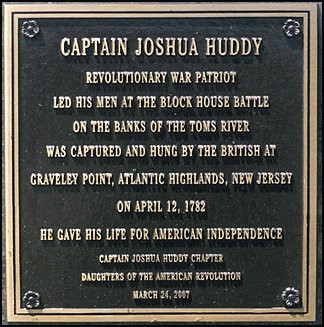
My name is Stephen Blucke. I am a leader of the “Black Pioneers” and the Captain of an elite group of guerrilla fighters known as the “Black Brigade.” The “Black Brigade” consists of black loyalists who have operated independently and alongside the Queen’s Rangers in Monmouth County, New Jersey for the past seven years. Respected and feared for our effective raids and kidnappings of Patriot leaders, our reputation precedes us throughout New Jersey. Our combat unit gained notoriety under the command of Colonel Tye, whose valor and courage on the battlefield made us one of the most feared fighting forces in New Jersey. Colonel Tye was killed in action during a military operation to seize Colonial leader Joshua Huddy. While the “Black Brigade” took down Huddy after a long standoff, New Jersey Militia attacked our men, freeing Huddy, and in the process, mortally wounding Colonel Tye. When he died, I was asked to take his place, commanding the “Black Brigade.” This great honor bestowed upon me is a reflection of my dedicated service to the Crown and the “Black Pioneers.” I joined the “Black Pioneers” early in the American Revolution. While I am from Barbados and was never enslaved, I was inspired by Dunmore’s Proclamation and the Crown’s promise to free all enslaved persons who fought against the Colonists. Colonel Tye died two years ago, having failed his final mission. But his memory continues to inspire his men. We are also inspired by the thought that his killer, Joshua Huddy, remains at large. We have received intelligence that Joshua Huddy is commanding a small contingent of New Jersey militiamen in Toms River, guarding a salt factory. The “Black Brigade” has the opportunity to take control of the salt factory and also take down Joshua Huddy. We have over one hundred men and Huddy has twenty-five. While we outnumber him four to one, Huddy has escaped similarly challenging situations. Where Colonel Tye failed, I must succeed.

As he prepares his troops, what should Stephen Blucke do?

Be sure to provide reasoning for your response.

  1. Use numerical superiority to overwhelm Huddy and his men and quickly take control of the salt factory, even if that means Huddy may be killed in the fighting.
  1. Surround the salt factory to preclude the possibility of Huddy escaping, and send elite soldiers to apprehend Huddy alive. Taking Huddy as a prisoner is more important than capturing the salt factory.

After making your decision complete the following extension activity:

Write a letter from Stephen Blucke, explaining which option you chose and what occurred after your military action in Toms River.

Below is a map of New Jersey around the time of Blucke’s attack on Toms River.

Use this map to answer the following:

1. Locate Toms River on the map using prior knowledge or maps online.

2. Stephen Blucke and the “Black Brigade” were stationed in “Refugeetown” in Sandy Hook over the course of the American Revolution. Locate Sandy Hook on the map.

My Story: Shawuskuuhkung – Bartholomew Scott Calvin, Burlington County, 1756 to 1840

My Story: Shawuskukhkung / Bartholomew Scott Calvin

Burlington County, NJ, 1756 to 1840

Shawuskukhkung or Bartholomew Scott Calvin was born around 1756 in Crosswicks, New Jersey. His father Stephen Calvin, was the first generation of his family to adopt a Western name, most likely for the convenience of white people he interacted with, choosing a surname befitting the family’s recent conversion to Presbyterianism. Many of their fellow Lenape (or Delaware) kin had left New Jersey years prior, resettling in Ohio, but a number of families opted to stay and attempt to live among the European settlers.

In 1758, Stephen Calvin was involved in the negotiations in Crosswicks that resulted in Native Americans giving up all land claims south of the Raritan River. At the same time, the remaining Delaware were given 3,284 acres of land in modern day Shamong, New Jersey. Brotherton, as it was called, would be the first Indian Reservation. Whites were prohibited from settling, hunting, or fishing in their territory. The colony and later state of New Jersey would help with enforcement and in fact, would subsidize the community economically for many years.

The Brotherton Reservation was settled in 1759 by 200 Indians. Children were frequently sent to schools for the training of missionaries, which often included forced assimilation into the white culture. The Society in Scotland for Propagating Christian Knowledge took an interest in Bartholomew Calvin and began paying his way to the College of New Jersey (later Princeton). However, by 1775 with increasing hostilities arising between the colonies and the government of Great Britain, their funds were needed elsewhere and the young student was left with a difficult decision.

Decision Activity #1

Consider Bartholomew Calvin’s situation. What are the pros and cons of each of the following possible choices?

  • Look for another source of funding for completing his education.
  • Return to his home in Brotherton and figure out what to do with the rest of his life without his degree.
  • Join the military to resist the British government in the hopes that the new country will offer gratitude to the Native Americans who supported the cause (or because he genuinely believed in their fight).
  • Join the military to fight for the British government in the hopes that they win and offer some kind of benefit to his people in exchange for military service.

Little is known about Calvin’s military service. While it is possible that he enlisted as early as 1775, the only fixed date we know is that he was in service for the Pennsylvania Line in September of 1780 and saw active duty.

Meanwhile, conditions were deteriorating in Brotherton. Most of the inhabitants were living in abject poverty while harassment from white locals increased over time. In 1767 and again in 1771, members of the Ohio Delaware tribe, their kinsmen, invited the Brotherton Indians to join them. Apparently, this offer was not to their liking as they instead sought permission from the government of New Jersey to lease some of their land to whites. Despite the rejection of this economic lifeline, the Brotherton Indians opted to stay.

After Bartholomew Calvin’s service in the Revolution concluded, he returned to Brotherton where he became schoolmaster, following in his father’s footsteps. Apparently, many of his students were white locals who he welcomed into his rolls.

But by 1801, only 63 adult residents (down from the original 200) were left in Brotherton. At this time, a group of Mohican Indians living in New Stockbridge near Oneida Lake in the state of New York offered them an unusual invitation: “Kinsmen! Our necks are stretched as long as cranes looking toward your firesides! Pack up your mat and come eat out of our dish!”

Decision Activity #2

Anyone who has moved understands how disruptive and difficult the experience can be financially and emotionally. To move an entire community with the additional uncertainty of joining another group must have been a daunting consideration. That being said, things were looking very bleak for the remaining Delaware in New Jersey. Weigh the consequences of the following choices faced by Bartholomew Calvin and the other people at Brotherton:

  • Stay put. After all, this is the land your father negotiated for. Times may be tough, but who knows what would await us in New York?
  • Take the Stockbridge Indians up on their offer. Although they are not direct relatives, you have enough in common with them that you can make it work.
  • Reconsider the offer from Ohio. Life in the state of New York is not likely to be much better than life in New Jersey.

Calvin and other leaders of the community petitioned the State of New Jersey to allow them to sell their lands to finance the journey. The legislature would allow it, provided that three quarters of the adults in the community consented. It appears that they fell short of the required supermajority, but the sale proceeded in 1802 regardless. A few of the inhabitants of Brotherton chose not to make the journey to New York and became integrated into white communities in New Jersey and Pennsylvania. Calvin continued as schoolmaster in Stockbridge.

In 1824 most of the community of Stockbridge Indians, which now included at least four different Native groups, moved to a tract of land near Green Bay in what was then considered Michigan Territory. A small number of people who had moved from Brotherton to New York opted to return to New Jersey. Calvin, however, made the trek to the new homeland, but he wasn’t quite done with New Jersey.

In 1832, at the age of 76, he returned to New Jersey as the delegate of the “original people” and addressed the state legislature. Although they had sold the reservation land back in 1802, the right to hunt and fish on that land was still theirs. Perhaps the State of New Jersey would consider buying those rights, and thereby help the remaining Delaware who had gone through so much.

What is the likelihood of success for each of the following strategies:

  • Based on the principles in the Declaration of Independence, demand just compensation for the rights to hunt and fish as well as money for the trouble the Delaware people experienced.
  • Make a speech that is highly complementary of the New Jersey government in the hopes that they’ll be more willing to give the Delaware something for their troubles.
  • Don’t bother. The idea of the government doing anything for the Delaware at this point in time is very unlikely.

In his address to the Legislature, Calvin said the following:

“My brethren, I am old, and weak and poor, and therefore a fit representative of my people. You are young and strong, and rich, and therefore fit representatives of your people, but let me beg you for a moment to lay aside the recollections of your strength and our weakness that your minds may be prepared to examine with candor the subject of our claims… We consider the State Legislature the proper purchaser, and throw ourselves upon its benevolence and magnanimity, trusting that feelings of justice and liberality will induce you to give us what you deem a compensation.”

Perhaps understanding that his bargaining power was rather limited, Calvin left the determination of an amount up to the Legislature, which in turn provided a modest $2,000 purchasing price, the rough equivalent of $70,000 in present day currency.