Documenting the 250th Anniversary of the Declaration of Independence

  1. Common Sense by Thomas Paine (1776)
  2. Remember the Ladies by Abigail Adams (1776)
  3. Declaration of Independence, July 4, 1776
  4. Preamble to the United States Constitution (1787)
  5. Declaration of the Rights of Man, August 26, (1789)
  6. Celebrating the Declaration of Independence by John Q. Adams (1821)
  7. Speech on the Oregon Bill by John C. Calhoun (1848)
  8. Declaration of Sentiments (1848)
  9. What to the Slave is the Fourth of July by Frederick Douglass (1852)
  10. Gettysburg Address by Abraham Lincoln (1863)
  11. Thirteenth Amendment (1865)
  12. The New Colossus by Emma Lazarus (1883)
  13. Release from Woodstock Jail by Eugene V. Debs (1895)
  14. Nineteenth Amendment (1920)
  15. Four Freedoms Speech by Franklin Roosevelt (1941)
  16. The Struggle for Human Rights by Eleanor Roosevelt (1948)
  17. Universal Declaration of Human Rights (1948)
  18. Declaration of Conscience by Senator Margaret Chase Smith (1950)
  19. Farewell Address by Dwight D. Eisenhower (1961)
  20. Nation’s Space Effort by John F. Kennedy (1962)
  21. I Have a dream by Dr. Martin Luther King, Jr. (1963)
  22. Civil Rights Act (1964)
  23. Bicentennial Ceremony by Gerald R. Ford (1976)
  24. The Hill We Climb by Amanda Gorman (2021)

Thomas Paine published Common Sense anonymously in a pamphlet in 1776. In it, he called for independence from Great Britain, which was a foreign idea at the time. He argued that his claims were common sense and that breaking away from the rule of Great Britain was a necessity for the good of the colonists.
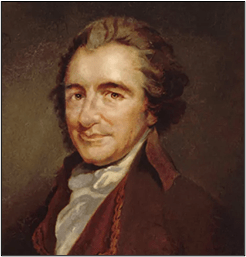
Portrait of Thomas Paine, a key figure in American history known for his influential writings advocating for independence and civil rights.

In the following pages I offer nothing more than simple facts, plain arguments, and common sense…

I have heard it asserted by some, that as America has flourished under her former connection with Great-Britain, the same connection is necessary towards her future happiness, and will always have the same effect. Nothing can be more fallacious than this kind of argument. We may as well assert that because a child has thrived upon milk, that is never to have meat, or that the first twenty years of our lives is to become a precedent for the next twenty. But even this is admitting more than is true; for I answer… that America would have flourished as much, and probably much more, had no European power taken any notice of her. The commerce by which she hath enriched herself are the necessaries of life, and will always have a market while eating is the custom of Europe.

But she has protected us, say some… We have boasted the protection of Great Britain, without considering, that her motive was interest not attachment… This new World hath been the asylum for the persecuted lovers of civil and religious liberty from every part of Europe… As Europe is our market for trade, we ought to form no partial connection with any part of it…

Europe is too thickly planted with Kingdoms to be long at peace, and whenever a war breaks out between England and any foreign power, the trade of America goes to ruin, because of her connection with Britain… There is something absurd, in supposing a Continent to be perpetually governed by an island…

Where, say some, is the king of America? I’ll tell you, Friend, he reigns above, and doth not make havoc of mankind like the royal brute of Great Britain… So far as we approve of monarchy… in America the law is king…

A government of our own is our natural right… Ye that oppose independence now, ye know not what ye do: ye are opening the door to eternal tyranny. . .

  1. How does Paine compare America to a child? How does this compare to the situation of America wanting independence?
  2. Why is Great Britain protecting America, according to Paine?
  3. What happens to America whenever Great Britain is at war? Why?
  4. According to Paine, who is the king of America?
  5. What does Paine say of people who are opposing independence?

Abigail Adams was the wife of revolutionary and second president John Adams. She herself fought for the rights of colonists and advocated for equal rights for women in a time where this was uncommon. In one of her frequent letters to John Adams, she urged him to “remember the ladies” as he was working on the initial draft to the Declaration of Independence. Ultimately, the wording of the Declaration of Independence was exclusionary and women did not receive equal rights until the twentieth century.
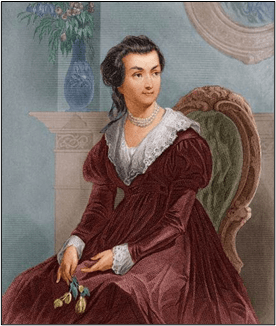
A portrait of a woman seated in an ornate chair, wearing a burgundy dress with a white lace collar, holding a bouquet of flowers, against a backdrop with decorative elements.

Tho we felicitate ourselves, we sympathize with those who are trembling least the Lot of Boston should be theirs. But they cannot be in similar circumstances unless pusillanimity and cowardise should take possession of them. They have time and warning given them to see the Evil and shun it. — I long to hear that you have declared an independancy — and by the way in the new Code of Laws which I suppose it will be necessary for you to make I desire you would Remember the Ladies, and be more generous and favourable to them than your ancestors. Do not put such unlimited power into the hands of the Husbands. Remember all Men would be tyrants if they could. If particular care and attention is not paid to the Ladies, we are determined to foment a Rebellion, and will not hold ourselves bound by any Laws in which we have no voice, or Representation.

That your Sex are Naturally Tyrannical is a Truth so thoroughly established as to admit of no dispute, but such of you as wish to be happy willingly give up the harsh title of Master for the more tender and endearing one of Friend. Why then, not put it out of the power of the vicious and the Lawless to use us with cruelty and indignity with impunity. Men of Sense in all Ages abhor those customs which treat us only as the vassals of your Sex. Regard us then as Beings placed by providence under your protection and in imitation of the Supreme Being make use of that power only for our happiness.

  1. What is Abigail Adams asking of John Adams?
  2. What does Abigail Adams believe of all men?
  3. Why must men pay attention to the ladies, according to Adams?

On July 4, 1776, the most important foundational document in the history of the United States was approved by the Second Continental Congress. The Declaration of Independence, penned by Thomas Jefferson, outlined a formal “declaration” of the 13 colonies as an independent, sovereign state that had broken away from the British Crown and listed various grievances that the new country had against the King. Jefferson scattered the document with political and social ideological thought that would become ingrained principles of American government and society.

A historical painting depicting the signing of the Declaration of Independence, featuring prominent figures in a grand room adorned with an American flag.

“When in the Course of human events, it becomes necessary for one people to dissolve the political bands which have connected them with another, and to assume among the powers of the earth, the separate and equal station to which the Laws of Nature and of Nature’s God entitle them, a decent respect to the opinions of mankind requires that they should declare the causes which impel them to the separation.

We hold these truths to be self-evident, that all men are created equal, that they are endowed by their Creator with certain unalienable Rights, that among these are Life, Liberty and the pursuit of Happiness.–That to secure these rights, Governments are instituted among Men, deriving their just powers from the consent of the governed, –That whenever any Form of Government becomes destructive of these ends, it is the Right of the People to alter or to abolish it, and to institute new Government, laying its foundation on such principles and organizing its powers in such form, as to them shall seem most likely to effect their Safety and Happiness. Prudence, indeed, will dictate that Governments long established should not be changed for light and transient causes; and accordingly all experience hath shewn, that mankind are more disposed to suffer, while evils are sufferable, than to right themselves by abolishing the forms to which they are accustomed. But when a long train of abuses and usurpations, pursuing invariably the same Object evinces a design to reduce them under absolute Despotism, it is their right, it is their duty, to throw off such Government, and to provide new Guards for their future security.–Such has been the patient sufferance of these Colonies; and such is now the necessity which constrains them to alter their former Systems of Government…”

  1. What are the three “unalienable Rights” Thomas Jefferson identifies?
  2. According to Jefferson, what must the people do if a government fails to safeguard these unalienable Rights?
  3. In your opinion, has the U.S. government upheld the message and liberties outlined in the Declaration of Independence. Explain.

Once the United States declared its independence from Great Britain, the nation’s founders needed a stronger, more structured set of laws for government. The initial Articles of Confederation were weak and did structure the government in a way that would be sustainable. Thus, the Constitution was formed after deliberation at the Constitutional Convention. The Preamble serves as the introduction to the Constitution as a whole and establishes the tone and goals for this new budding nation.

A historical painting depicting the signing of the United States Constitution, featuring delegates in formal attire gathered in a large room with decorative details, including a chandelier and an American flag.

“We the People of the United States, in Order to form a more perfect Union, establish Justice, insure domestic Tranquility, provide for the common defense, promote the general Welfare, and secure the Blessings of Liberty to ourselves and our Posterity, do ordain and establish this Constitution for the United States of America.”

  1. What is the importance of the first three words of the Constitution?
  2. List the six goals outlined in the Constitution.
  3. Why was it important for the United States to write the Constitution after the Articles of Confederation?
  4. Select one of the goals of the Constitution. Why do you think the authors believed it was important to include the goal that you chose?

Just a few years after the end of the American Revolution, France was experiencing a revolution of their own. The Third Estate had become overwhelmingly frustrated by the poverty, stagnant economic growth, inept leadership, and poor quality of life they faced while the First and Second Estates lived in luxury and prosperity. The newly formed National Assembly released the Declaration of the Rights of Man in the midst of this violent revolution.
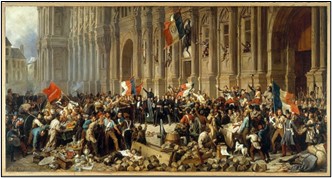
A large crowd gathered in front of a historical building, waving flags and holding banners, as they engage in a passionate display of political support or protest.

“The representatives of the French people, organized as a National Assembly, believing that the ignorance, neglect, or contempt of the rights of man are the sole cause of public calamities and of the corruption of governments, have determined to set forth in a solemn declaration the natural, unalienable, and sacred rights of man, in order that this declaration, being constantly before all the members of the Social body, shall remind them continually of their rights and duties…Therefore the National Assembly recognizes and proclaims, in the presence and under the auspices of the Supreme Being, the following rights of man and of the citizen:

1. Men are born and remain free and equal in rights. Social distinctions may be founded only upon the general good.

2. The aim of all political association is the preservation of the natural and imprescriptible rights of man. These rights are liberty, property, and security, and resistance to oppression.

3. The principle of all sovereignty resides essentially in the nation. No body nor individual may exercise any authority which does not proceed directly from the nation.

…7. No personal shall be accused, arrested, or imprisoned except in the cases and according to the forms prescribed by law. Any one soliciting, transmitting, executing, or causing to be executed, any arbitrary order, shall be punished.

…9. As all persons are held innocent until they have been declared guilty…

10. No one shall be disquieted on account of his opinions, including his religious views, provided their manifestation does not disturb the public order established by law.

11. The free communication of ideas and opinions is one of the most precious of the rights…

  1. According to the preamble, what is the purpose of this declaration?
  2. In the context of the French Revolution, why is the wording of “equal in rights” significant?
  3. Discuss the extent in which this declaration compares to the Declaration of Independence?
  4. How do the two declarations define the rights guaranteed to all men?

While serving as Secretary of State under President James Monroe, John Quincy Adams was invited to Congress to give a speech to commemorate the 45th anniversary of the Declaration of Independence. Adams spends much of this speech praising the Declaration and commending the Founding Fathers’ bravery and triumph over the British Crown in establishing the new nation. This speech has become synonymous with the idea of “American exceptionalism.”
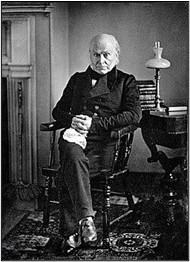
Portrait of a seated elderly man with gray hair, dressed in formal attire, sitting in a wooden chair with hands clasped, set in a domestic interior with a lamp and a patterned rug.

“…In the long conflict of twelve years which had preceded and led to the Declaration of Independence, our fathers had been not less faithful to their duties, than tenacious of their rights. Their resistance had not been rebellion. It was not a restive and ungovernable spirit of ambition, bursting from the bonds of colonial subjection; it was the deep and wounded sense of successive wrongs, upon which complaint had been only answered by aggravation, and petition repelled with contumely, which had driven them to their last stand upon the adamantine rock of human rights.

            …It was the first solemn declaration by a nation of the only legitimate foundation of civil government. It was the cornerstone of a new fabric, destined to cover the surface of the globe. It demolished at a stroke the lawfulness of all governments founded upon conquest. It swept away all the rubbish of accumulated centuries of servitude.

            …It will be acted o’er [over], fellow-citizens, but it can never be repeated. It stands, and must forever stand alone, a beacon on the summit of the mountain, to which all the inhabitants of the earth may turn their eyes for a genial and saving light, till time shall be lost in eternity, and this globe itself dissolve, nor leave a wreck behind. It stands forever, a light of admonition to the rulers of men; a light of salvation and redemption to the oppressed…so long shall this declaration hold out to the sovereign and to the subject the extent and the boundaries of their respective rights and duties; founded in the laws of nature and of nature’s God. Five and forty years have passed away since this Declaration was issued by our fathers; and here are we, fellow-citizens, assembled in the full enjoyment of its fruits.”

  1. What does John Quincy Adams say the Declaration of Independence was the “first” declaration to do?
  2. Why does Adams call the American Revolution a “resistance,” not a “rebellion?”
  3. Why does Adams call the Declaration a “beacon on the summit of the mountain?”
  4. Do you agree with Adams’ perspective of the revolution and the Declaration? Explain.

As the nation crept closer to an impending Civil War, American politics became engulfed over the issue of slavery. One of the leading voices of the pro-slavery movement was South Carolina Democrat senator John C. Calhoun. After serving as Andrew Jackson’s vice president, he ended his career in the Senate. There, he was one of the Democratic Party’s most outspoken supporters for “states’ rights” to defend and uphold slavery within its borders. This speech was in response to the Oregon Bill, which was set to outlaw slavery practices in the new Oregon territory.

A historical black and white portrait of a man with long hair, dressed in a dark suit and vest, seated with hands clasped together.

“The proposition to which I allude, has become an axiom in the minds of a vast majority on both sides of the Atlantic, and is repeated daily from tongue to tongue, as an established and incontrovertible truth; it is, that “all men are born free and equal.” I am not afraid to attack error, however deeply it may be entrenched, or however widely extended, whenever it becomes my duty to do so, as I believe it to be on this subject and occasion.

            Taking the proposition literally (it is in that sense it is understood), there is not a word of truth in it. It begins with “all men are born,” which is utterly untrue. Men are not born. Infants are born. They grow to be men. And concludes with asserting that they are born “free and equal,” which is not less false. They are not born free. While infants they are incapable of freedom, being destitute alike of the capacity of thinking and acting, without which there can be no freedom. Besides, they are necessarily born subject to their parents, and remain so among all people, savage and civilized, until the development of their intellect and physical capacity enables them to take care of themselves…

If we trace it back, we shall find the proposition differently expressed in the Declaration of Independence. That asserts that “all men are created equal.” The form of expression, though less dangerous, is not less erroneous…

… [G]overnment has no right to control individual liberty beyond what is necessary to the safety and well-being of society. Such is the boundary which separates the power of government and the liberty of the citizen or subject in the political state, which, as I have shown, is the natural state of man—the only one in which his race can exist, and the one in which he is born, lives, and dies.”

  1. What does Senator Calhoun say about the phrase “all men are created equal?”
  2. According to Calhoun, how should the government’s role be limited?
  3. What is the connection that Senator Calhoun makes between liberty and race? What does this mean about his message in this speech?

At the Women’s Rights Convention in 1848, 68 women and 32 men signed the “Declaration of Sentiments”, which was essentially a Bill of Rights for women. The document called for equal social, civil, and political liberties for women, which included the right to vote, equal education opportunities, and more legal protections. Elizabeth Cady Stanton served as the primary author as well as Lucretia Mott and Martha Coffin Wright. The Declaration of Sentiments was modeled after the Declaration of Independence, which was written just 72 years prior.
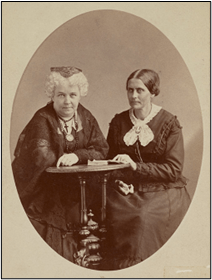
Two women in 19th century attire seated together at a table, with a decorative backdrop.

“We hold these truths to be self-evident; that all men and women are created equal; that they are endowed by their Creator with certain inalienable rights; that among these are life, liberty, and the pursuit of happiness; that to secure these rights governments are instituted, deriving their just powers from the consent of the governed. […]

“The history of mankind is a history of repeated injuries and usurpations on the part of man toward woman, having in direct object the establishment of an absolute tyranny over her. To prove this, let facts be submitted to a candid world. He has never permitted her to exercise her inalienable right to the elective franchise. He has compelled her to submit to laws, in the formation of which she had no voice. He has withheld from her rights which are given to the most ignorant and degraded men – both natives and foreigners. Having deprived her of this first right as a citizen, the elective franchise, thereby leaving her without representation in the halls of legislation, he has oppressed her on all sides. He has made her, if married, in the eye of the law, civilly dead. He has taken from her all right in property, even to the wages she earns. […]

“Now, in view of this entire disfranchisement of one-half the people of this country, their social and religious degradation, – in view of the unjust laws above mentioned, and because women do feel themselves aggrieved, oppressed, and fraudulently deprived of their most sacred rights, we insist that they have immediate admission to all the rights and privileges which belong to them as citizens of these United States.”

  1. What other document is the introduction to the Declaration of Sentiments modeled after?
  2. What is the purpose of this excerpt of the Declaration of Sentiments?
  3. List two of the grievances that the authors included.
  4. Do you believe that this declaration is convincing enough to help women gain equal rights? What would you change if anything?

Frederick Douglass was born into slavery in Maryland in 1818. He escaped slavery in 1838 and used his tutoring of the English language to become a renowned orator and writer. He used the strength of his words to call for the abolition of slavery and worked to ensure freedom for all enslaved people. This speech was written to encourage people to think about what the Fourth of July means for those in America who are not free and who do not experience the same rights and opportunities as their White counterparts.

A historical portrait of Frederick Douglass, a prominent abolitionist and social reformer, seated with an earnest expression, showcasing his distinctive hairstyle and 19th-century attire.

“This, for the purpose of this celebration, is the 4th of July. It is the birthday of your National Independence, and of your political freedom . . . There is consolation in the thought that America is young […] The simple story of it is, that, 76 years ago, the people of this country were British subjects . . . You were under the British Crown . . . But, your fathers . . . They went so far in their excitement as to pronounce the measures of government unjust, unreasonable, and oppressive, and altogether such as ought not to be quietly submitted to […] Citizens, your fathers made good that resolution. They succeeded; and to-­‐day you reap the fruits of their success. The freedom gained is yours; and you, therefore, may properly celebrate this anniversary. The 4th of July is the first great fact in your nation’s history—the very ring-­‐bolt in the chain of your yet undeveloped destiny.

“What, to the American slave, is your 4th of July? I answer: a day that reveals to him, more than all other days in the year, the gross injustice and cruelty to which he is the constant victim. To him, your celebration is a sham; your boasted liberty, an unholy license; your national greatness, swelling vanity; your sounds of rejoicing are empty and heartless; your denunciations of tyrants, brass fronted impudence; your shouts of liberty and equality, hollow mockery; your prayers and hymns, your sermons and thanksgivings, with all your religious parade, and solemnity, are, to him, mere bombast, fraud, deception, impiety, and hypocrisy—a thin veil to cover up crimes which would disgrace a nation of savages. There is not a nation on the earth guilty of practices, more shocking and bloody, than are the people of these United States, at this very hour. Go where you may, search where you will, roam through all the monarchies and despotisms of the old world, travel through South America, search out every abuse, and when you have found the last, lay your facts by the side of the every day practices of this nation, and you will say with me, that, for revolting barbarity and shameless hypocrisy, America reigns without a rival […]

“Allow me to say, in conclusion . . . I do not despair of this country. There are forces in operation, which must inevitably, work the downfall of slavery. “The arm of the Lord is not shortened,” and the doom of slavery is certain. I, therefore, leave off where I began, with hope.”

  1. What words does Douglass use that show he does not align with free Americans?
  2. How is the fourth of July different for enslaved people and free people? Use one example from the text.
  3. How does Douglass conclude his speech? Why do you think he feels this way?

Between July 1 and 3, 1863, the bloodiest battle of the Civil War took place in Gettysburg, Pennsylvania. Both the Union and Confederacy faced catastrophic losses, with casualties totaling over 50,000 men. The Battle of Gettysburg remains the deadliest battle of American history. Four months later, President Abraham Lincoln arrived at Gettysburg to declare the battlefield as a national cemetery. Many in the crowd were anticipating a long speech from President Lincoln, however this famous address only lasted about 3 minutes. Nevertheless, the Gettysburg Address would become enshrined as one of Lincoln’s, and U.S. history’s, most powerful speeches.

Black and white portrait of a man with a beard and a bow tie, looking directly at the camera.

“Four score and seven years ago our fathers brought forth on this continent, a new nation, conceived in Liberty, and dedicated to the proposition that all men are created equal.

Now we are engaged in a great civil war, testing whether that nation, or any nation so conceived and so dedicated, can long endure. We are met on a great battle-field of that war. We have come to dedicate a portion of that field, as a final resting place for those who here gave their lives that that nation might live. It is altogether fitting and proper that we should do this.

…But, in a larger sense, we can not dedicate–we can not consecrate–we can not hallow–this ground. The brave men, living and dead, who struggled here, have consecrated it, far above our poor power to add or detract. The world will little note, nor long remember what we say here, but it can never forget what they did here. It is for us the living, rather, to be dedicated here to the unfinished work which they who fought here have thus far so nobly advanced. It is rather for us to be here dedicated to the great task remaining before us–that from these honored dead we take increased devotion to that cause for which they gave the last full measure of devotion–that we here highly resolve that these dead shall not have died in vain–that this nation, under God, shall have a new birth of freedom–and that government of the people, by the people, for the people, shall not perish from the earth.”

  1. According to Lincoln, what is the “proposition” that the nation was founded on?
  2. What is this civil war “testing?”
  3. What is Lincoln’s tone throughout the speech? Use at least two pieces of textual evidence to support your response.
  4. How does President Lincoln use ideas from the Declaration of Independence in this speech? To what extent is it effective? Use at least two pieces of textual evidence to support your response.

The Thirteenth Amendment to the Constitution abolished slavery and involuntary servitude in the United States. Slavery had been an institution in the United States since the first ship holding enslaved people arrived from the shores of Africa in 1619. Prior to the entire United States abolishing slavery, some states had already dismantled the system of slavery. Many became champions for the abolition of slavery and helped enslaved people escape to freedom. The amendment was ratified in December 1865 after being passed by Congress in January 1865. The Thirteenth Amendment serves as the first of the three Reconstruction Amendments. While it ended legal slavery, Southern states later used the “punishment for crime” clause to create “Black Codes”, which prevented Black people from voting and limited their rights.
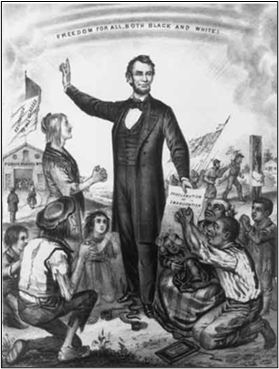
An 1860s political cartoon depicting Abraham Lincoln addressing a group of people, including both Black and white individuals, with a banner stating 'Freedom for all, both Black and White.'

“Section 1

Neither slavery nor involuntary servitude, except as a punishment for crime whereof the party shall have been duly convicted, shall exist within the United States, or any place subject to their jurisdiction.

“Section 2

Congress shall have power to enforce this article by appropriate legislation.”

1. What did the thirteenth amendment accomplish?

2. Where is involuntary servitude still legal?

3. Who has the power to enforce the thirteenth amendment?

4. Do you believe that it is justified for involuntary servitude to be used for criminal offenders? Why or why not?

The New Colossus – Emma Lazarus, 1883

Emma Lazarus was an American poet who wrote the poem “The New Colossus” in 1883. When writing this sonnet, she was inspired by the Statue of Liberty and what the statue represents. In 1903, this poem was engraved onto a bronze plaque and is now on the base of the Statue of Liberty in New York.

Image of the Statue of Liberty against a backdrop of the New York City skyline.

Not like the brazen giant of Greek fame,

With conquering limbs astride from land to land;

Here at our sea-washed, sunset gates shall stand

A mighty woman with a torch, whose flame

Is the imprisoned lightning, and her name

Mother of Exiles. From her beacon-hand

Glows world-wide welcome; her mild eyes command

The air-bridged harbor that twin cities frame.

“Keep, ancient lands, your storied pomp!” cries she

With silent lips. “Give me your tired, your poor,

Your huddled masses yearning to breathe free,

The wretched refuse of your teeming shore.

Send these, the homeless, tempest-tost to me,

I lift my lamp beside the golden door!”

  1. How does Emma Lazarus describe the Statue of Liberty in the poem? Use one line from the text that supports your answer.
  2. What group of people might lines 10-14 be referring to? How do you know?
  3. Why is it appropriate that Emma Lazarus’s poem “The New Colossus” appears on the base of the Statue of Liberty?

Eugene V. Debs was one of the nation’s leading critics of big business and corporations. He was an adamant socialist and sought to educate workers to unionize to combat malicious business practices by their employers. In 1893, there was a massive strike organized against the Pullman Sleeping Car Company. Debs helped organize a boycott with the American Railway Union. President Grover Cleveland had sent the U.S. military to handle the strike, and Debs was later arrested for federal contempt and conspiracy charges.
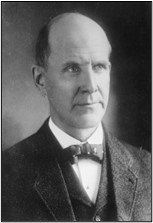
A black and white portrait of a man wearing a suit and bowtie, looking directly at the camera.

            “Manifestly the spirit of ‘76 still survives. The fires of liberty and noble aspirations are not yet extinguished. I greet you tonight as lovers of liberty and as despisers of despotism. I comprehend the significance of this demonstration and appreciate the honor that makes it possible for me to be your guest on such an occasion. The vindication and glorification of American principles of government, as proclaimed to the world in the Declaration of Independence, is the high purpose of this convocation.

            Speaking for myself personally I am not certain whether this is an occasion for rejoicing or lamentation. I confess to a serious doubt as to whether this day marks my deliverance from bondage to freedom or my doom from freedom to bondage…It is not law nor the administration of law of which I complain. It is the flagrant violation of the Constitution, the total abrogation of law and the usurpation of judicial and despotic power, by virtue of which my colleagues and myself were committed to jail, against which I enter my solemn protest; and any honest analysis of the proceedings must sustain the haggard truth of the indictment.

            In a letter recently written by the venerable Judge Trumbull that eminent jurist says: “The doctrine announced by the Supreme Court in the Debs case, carried to its logical conclusion, places every citizen at the mercy of any prejudiced or malicious federal judge who may think proper to imprison him.”. .

            The theme tonight is personal liberty; or giving it its full height, depth, and breadth, American liberty, something that Americans have been accustomed to eulogize since the foundation of the Republic, and multiplied thousands of them continue in the habit to this day because they do not recognize the truth that in the imprisonment of one man in defiance of all constitutional guarantees, the liberties of all are invaded and placed in peril.

  1. What ideas is Debs referencing when he says “the spirit of ‘76 still survives?”
  2. What rights does Debs claim the government has taken away from him and/or denied?
  3. Do you agree with Debs’ analysis of the situation he faced during the Pullman Strike? Explain your answer using evidence from the speech.

From the founding of the United States, women have been championing for equal rights and the ability to vote. From Abigail Adams calling for John Adams to “remember the ladies” to the suffragettes of the nineteenth and twentieth centuries, women and their allies had been calling for equal opportunities since America’s inception. In 1920, the nineteenth amendment was ratified and women were guaranteed the right to vote.

Historical photograph of a women's suffrage march, featuring women holding signs that advocate for the right to vote.

“The right of citizens of the United States to vote shall not be denied or abridged by the United States or by any State on account of sex.

“Congress shall have power to enforce this article by appropriate legislation.”

Questions:

  1. What did the nineteenth amendment accomplish?
  2. Who holds the power to enforce this amendment?

Do you think that any women were prevented from voting following the 19th amendment? Who? Why?

As World War II engulfed Europe, President Roosevelt and the U.S. government navigated the tightrope of effective foreign policy. The United States had long held a strong position of isolationism, and many Americans were firmly opposed to any involvement in Europe’s second world war. However, the U.S. government had shifted away from its isolationism by the end of the 1930s. FDR’s State of the Union address in 1941 echoed a new dawn of American interventionism, as he outlined the four freedoms everybody in the world was entitled to.

A formal portrait of Franklin D. Roosevelt, the 32nd President of the United States, smiling and dressed in a suit with a tie, set against a plain background.

“Since the permanent formation of our Government under the Constitution, in 1789, most of the periods of crisis in our history have related to our domestic affairs. Fortunately, only one of these–the four year War Between the States–ever threatened our national unity. Today, thank God, one hundred and thirty million Americans, in forty-eight States, have forgotten points of compass in our national unity.

            …In like fashion from 1815 to 1914–ninety-nine years–no single war in Europe or in Asia constituted a real threat against our future or against the future of any other American nationf…In the future days, which we seek to make secure, we look forward to a world founded upon four essential human freedoms.

            The first is freedom of speech and expression–everywhere in the world.

            The second is freedom of every person to worship God in his own way–everywhere in the world.

            The third is freedom from want–which, translated into world terms, means economic understandings which will secure to every nation a healthy peacetime life for its inhabitants–everywhere in the world.

            The fourth is freedom from fear–which, translated into world terms, means a world-wide reduction of armaments to such a point in such a thorough fashion that no nation will be in a position to commit an act of physical aggression against any neighbor–anywhere in the world.

            That is no vision of a distant millennium. It is a definite basis for a kind of world attainable in our own time and generation. That kind of world is the very anthesis of the so-called new order of tyranny which the dictators seek to create with the crash of a bomb.”

  1. What does FDR say has been the reason for (most) periods of crisis in U.S. history? Why is the current situation in Europe (World War II) different?
  2. What are the four freedoms FDR lists in this speech?
  3. In your opinion, do people “everywhere in the world” experience the four freedoms today? Explain your answer.

Eleanor Roosevelt was the first lady of the United States from 1933-1945 while her husband, Franklin D. Roosevelt, was president. She redefined the role by speaking out often and calling attention to important social issues. Her speech “The Struggle for Human Rights” was given at the United Nations, to which she served as a delegate to its General Assembly, where she served as chair of the commission that drafted the Universal Declaration of Human Rights.

Eleanor Roosevelt holding the Universal Declaration of Human Rights document during a presentation.

We must not be confused about what freedom is. Basic human rights are simple and easily understood: freedom of speech and a free press; freedom of religion and worship; freedom of assembly and the right of petition; the right of men to be secure in their homes and free from unreasonable search and seizure and from arbitrary arrest and punishment. We must not be deluded by the efforts of the forces of reaction to prostitute the great words of our free tradition and thereby to confuse the struggle. Democracy, freedom, human rights have come to have a definite meaning to the people of the world which we must not allow any nation to so change that they are made synonymous with suppression and dictatorship…

The basic problem confronting the world today, as I said in the beginning, is the preservation of human freedom for the individual and consequently for the society of which he is a part. We are fighting this battle again today as it was fought at the time of the French Revolution and at the time of the American Revolution. The issue of human liberty is as decisive now as it was then. I want to give you my conception of what is meant in my country by freedom of the individual…

            Indeed, in our democracies we make our freedoms secure because each of us is expected to respect the rights of others and we are free to make our own laws…

​             Basic decisions of our society are made through the expressed will of the people. That is why when we see these liberties threatened, instead of falling apart, our nation becomes unified and our democracies come together as a unified group in spite of our varied backgrounds and many racial strains…

            It is my belief, and I am sure it is also yours, that the struggle for democracy and freedom is a critical struggle, for their preservation is essential to the great objective of the United Nations to maintain international peace and security…

            The future must see the broadening of human rights throughout the world. People who have glimpsed freedom will never be content until they have secured it for themselves. In a true sense, human rights are a fundamental object of law and government in a just society. Human rights exist to the degree that they are respected by people in relations with each other and by governments in relations with their citizens.

  1. What are the basic human rights that Eleanor Roosevelt claims are “simple and easily understood”?
  2. What does Roosevelt say makes freedom secure?
  3. In your opinion, why are freedom and democracy essential for all people?

Following the end of World War II, the victorious European powers and the United States created a new global organization to govern international affairs. The United Nations was created to replace the failed League of Nations, and serve as the leading world institution to maintain peace, protect human rights, and prevent future wars and conflict. One of the first declarations of the United Nations was the Universal Declaration of Human Rights (UDHR). Below are Articles 1 through 7 of the UDHR.

United Nations emblem featuring a world map encircled by olive branches on a blue background.

Article 1

All human beings are born free and equal in dignity and rights. They are endowed with reason and conscience and should act towards one another in a spirit of brotherhood.

Article 2

Everyone is entitled to all the rights and freedoms set forth in this Declaration, without distinction of any kind, such as race, colour, sex, language, religion, political or other opinion, national or social origin, property, birth or other status. Furthermore, no distinction shall be made on the basis of the political, jurisdictional or international status of the country or territory to which a person belongs, whether it be independent, trust, non-self-governing or under any other limitation of sovereignty.

Article 3

Everyone has the right to life, liberty and the security of person.

Article 4

No one shall be held in slavery or servitude; slavery and the slave trade shall be prohibited in all their forms.

Article 5

No one shall be subjected to torture or to cruel, inhuman or degrading treatment or punishment.

Article 6

Everyone has the right to recognition everywhere as a person before the law.

Article 7

All are equal before the law and are entitled without any discrimination to equal protection of the law. All are entitled to equal protection against any discrimination in violation of this Declaration and against any incitement to such discrimination.

Questions:

  1. Identify three (3) rights that are guaranteed by the UDHR.
  2. According to Article 2, what kinds of “distinctions” are prohibited from deny people their rights?
  3. Which phrases of ideas in the UDHR connect to the Declaration of Independence?
  4. How does the UDHR expand on the phrase “all men are created equal?”
  5. In your opinion, does the world today uphold these human rights? Explain.

In June 1950, in the midst of an anti-communist campaign identified with Senator Joseph McCarthy (R-Wisconsin), Senator Margaret Chase Smith (R-Maine) spoke out against “selfish political exploitation” targeting innocent people and threatening basic American rights.

Political cartoon depicting Senator Margaret Chase Smith confronting smear tactics used during the anti-communist campaign.

“I would like to speak briefly and simply about a serious national condition. It is a national feeling of fear and frustration that could result in national suicide and the end of everything that we Americans hold dear. It is a condition that comes from the lack of effective leadership either in the legislative branch or the executive branch of our government. … I speak as a Republican. I speak as a woman. I speak as a United States senator. I speak as an American. …  I think that it is high time for the United States Senate and its members to do some real soul searching and to weigh our consciences as to the manner in which we are performing our duty to the people of America and the manner in which we are using or abusing our individual powers and privileges.   I think that it is high time that we remembered that we have sworn to uphold and defend the Constitution. I think that it is high time that we remembered that the Constitution, as amended, speaks not only of the freedom of speech, but also of trial by jury instead of trial by accusation.”

Whether it be a criminal prosecution in court or a character prosecution in the Senate, there is little practical distinction when the life of a person has been ruined.

Those of us who shout the loudest about Americanism in making character assassinations are all too frequently those who, by our own words and acts, ignore some of the basic principles of Americanism –

The right to criticize.

The right to hold unpopular beliefs.

The right to protest.

The right of independent thought.

The exercise of these rights should not cost one single American citizen his reputation or his right to a livelihood nor should he be in danger of losing his reputation or livelihood merely because he happens to know someone who holds unpopular beliefs. Who of us does not? Otherwise none of us could call our souls our own. Otherwise thought control would have set in.

The American people are sick and tired of being afraid to speak their minds lest they be politically smeared as “Communists” or “Fascists” by their opponents. Freedom of speech is not what it used to be in America. It has been so abused by some that it is not exercised by others. The American people are sick and tired of seeing innocent people smeared and guilty people whitewashed.”

1. What is the national feeling identified by Senator Smith?

2. What does she want American leaders to do?

3. What basic rights does Senator Smith believe are threatened?

4. In your opinion, why did Senator Smith focus on “The Basic Principles of Americanism”?

On January 17, 1961, President Eisenhower delivered a ten-minute farewell to the American people on national television from the Oval Office of the White House. In the speech, Eisenhower warned that a large, permanent “military-industrial complex,” an alliance between the military and defense contractors, posed a threat to American democracy. 
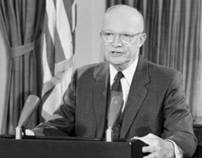
Black and white photograph of President Dwight D. Eisenhower delivering a speech from the Oval Office, with microphones in front and the U.S. flag in the background.

“We now stand ten years past the midpoint of a century that has witnessed four major wars among great nations. Three of these involved our own country. Despite these holocausts America is today the strongest, the most influential and most productive nation in the world. Understandably proud of this pre-eminence, we yet realize that America’s leadership and prestige depend, not merely upon our unmatched material progress, riches and military strength, but on how we use our power in the interests of world peace and human betterment.”

Throughout America’s adventure in free government, our basic purposes have been to keep the peace; to foster progress in human achievement, and to enhance liberty, dignity and integrity among people and among nations. To strive for less would be unworthy of a free and religious people. Any failure traceable to arrogance, or our lack of comprehension or readiness to sacrifice would inflict upon us grievous hurt both at home and abroad.

A vital element in keeping the peace is our military establishment. Our arms must be mighty, ready for instant action, so that no potential aggressor may be tempted to risk his own destruction. … Until the latest of our world conflicts, the United States had no armaments industry. American makers of plowshares could, with time and as required, make swords as well. But now we can no longer risk emergency improvisation of national defense; we have been compelled to create a permanent armaments industry of vast proportions. Added to this, three and a half million men and women are directly engaged in the defense establishment. We annually spend on military security more than the net income of all United State corporations. … This conjunction of an immense military establishment and a large arms industry is new in the American experience. The total influence – economic, political, even spiritual – is felt in every city, every state house, every office of the Federal government. We recognize the imperative need for this development. Yet we must not fail to comprehend its grave implications. Our toil, resources and livelihood are all involved; so is the very structure of our society.

In the councils of government, we must guard against the acquisition of unwarranted influence, whether sought or unsought, by the military-industrial complex. The potential for the disastrous rise of misplaced power exists and will persist. We must never let the weight of this combination endanger our liberties or democratic processes. We should take nothing for granted.”

1. According to President Eisenhower, why does the United States need to maintain a strong military?

2. Why is President Eisenhower concerned about a “military-industrial complex”?

3. What does President Eisenhower alert the American people to do?

Five years prior, the Soviet Union had successfully launched Sputnik 1 into orbit, sparking the beginning of the Space Race between the U.S. and U.S.S.R. The United States quickly sought to catch up to the Soviet Union’s many “firsts” in the Space Race (first satellite, first man in space, first man to orbit the Earth, etc.). Then, in September 1962, President Kennedy gave a speech at Rice University discussing the new goal for America’s space program: put a man on the Moon before the end of the decade.

President John F. Kennedy delivering a speech at Rice University, discussing the United States' commitment to space exploration.

“…We set sail on this new sea because there is new knowledge to be gained, and new rights to be won, and they must be won and used for the progress of all people. For space science, like nuclear science and all technology, has no conscience of its own. Whether it will become a force for good or ill depends on man, and only if the United States occupies a position of pre-eminence can we help decide whether this new ocean will be a sea of peace or a new terrifying theater of war. I do not say the we should or will go unprotected against the hostile misuse of space any more than we go unprotected against the hostile use of land or sea, but I do say that space can be explored and mastered without feeding the fires of war, without repeating the mistakes that man has made in extending his writ around this globe of ours.

NASA Apollo program logo featuring the letter A with a depiction of Earth and the Moon.

There is no strife, no prejudice, no national conflict in outer space as yet. Its hazards are hostile to us all. Its conquest deserves the best of all mankind, and its opportunity for peaceful cooperation may never come again. But why, some say, the moon? Why choose this as our goal? And they may well ask why climb the highest mountain? Why, 35 years ago, fly the Atlantic? Why does Rice play Texas?

We choose to go to the moon. We choose to go to the moon in this decade and do the other things, not because they are easy, but because they are hard, because that goal will serve to organize and measure the best of our energies and and skills, because that challenge is one that we are willing to accept, one we are unwilling to postpone, and one which we intend to win, and the others, too.”

  1. Why does President Kennedy say it is important to “set sail on this new sea?”
  2. What justification does President Kennedy give that the United States should be the first nation to conquer space?
  3. How does Kennedy’s vision for space reflect the ideals in the founding documents?

On August 28, 1963, in the midst of the Civil Rights Movement, civil rights leaders and organizations planned a momentous rally in Washington, D. C. Officially known as the March on Washington for Jobs and Freedom, over 200,000 people gathered to protest and advocate for the end of segregation and guarantee of civil rights for African Americans. At the end of the march, at the Lincoln Memorial, Dr. Martin Luther King, Jr., one of the Civil Rights Movement’s most influential leaders, delivered his most famous speech.

Dr. Martin Luther King Jr. delivering his 'I Have a Dream' speech at the March on Washington, with a large crowd in attendance.

“…It would be fatal for the nation to overlook the urgency of the moment. This sweltering summer of the Negro’s legitimate discontent will not pass until there is an invigorating autumn of freedom and equality. 1963 is not an end, but a beginning. Those who hope that the Negro needed to blow off steam and will now be content will have a rude awakening if the nation returns to business as usual…

            …We cannot be satisfied as long as the Negro’s basic mobility is from a smaller ghetto to a larger one. We can never be satisfied as long as our children are stripped of their selfhood and robbed of their dignity by signs stating: for whites only…

            …So even though we face the difficulties of today and tomorrow, I still have a dream. It is a dream deeply rooted in the American dream. I have a dream that one day this nation will rise up and live out the true meaning of its creed: We hold these truths to be self-evident, that all men are created equal.

            I have a dream that one day on the red hills of Georgia, the sons of former slaves and the sons of former slave owners will be able to sit down together at the table of brotherhood.

I have a dream that one day even the state of Mississippi, a state sweltering with the heat of injustice, sweltering with the heat of oppression will be transformed into an oasis of freedom and justice. I have a dream that my four little children will one day live in a nation where they will not be judged by the color of their skin but by the content of their character. I have a dream today.”

  1. How does Dr. King describe the current situation of African Americans in 1963?
  2. Why does Dr. King call 1963 “not an end, but a beginning?”
  3. What founding document does Dr. King reference in this speech? Why does he reference this document?
  4. In your opinion, has the “dream” described in this speech been achieved? Explain.

On July 2, 1964, President Lyndon B. Johnson signed the Civil Rights Act of 1964 into law. This act called for desegregation of public spaces, schools, and made voting free and fair for all. This was the most sweeping civil rights legislation since Reconstruction. The act made segregation illegal but it also created the Equal Employment Opportunity Commission (EEOC) to enforce laws that prohibit discrimination based on race, color, religion, sex, national origin, disability, or age in hiring, promoting, firing, setting wages, testing, training, apprenticeship, and all other terms and conditions of employment.

A historic moment capturing President Lyndon B. Johnson and Dr. Martin Luther King Jr. engaged in a conversation, with other attendees in the background, symbolizing the partnership in the Civil Rights Movement.

To enforce the constitutional right to vote, to confer jurisdiction upon the district courts of the United States to provide injunctive relief against discrimination in public accommodations, to authorize the Attorney General to institute suits to protect constitutional rights in public facilities and public education, to extend the Commission on Civil Rights, to prevent discrimination in federally assisted programs, to establish a Commission on Equal Employment Opportunity, and for other purposes. Be it enacted by the Senate and House of Representatives of the United States of America in Congress assembled, That this Act may be cited as the “Civil Rights Act of 1964”.

TITLE I: No person acting under color of law shall … apply any standard, practice, or procedure different from the standards, practices, or procedures applied under such law or laws to other individuals within the same county, parish, or similar political subdivision who have been found by State officials to be qualified to vote; deny the right of any individual to vote in any Federal election because of an error or omission on any record or paper relating to any application, registration, or other act requisite to voting … employ any literacy test as a qualification for voting in any Federal election unless (i) such test is administered to each individual and is conducted wholly in writing…

TITLE II: All persons shall be entitled to the full and equal enjoyment of the goods, services, facilities, and privileges, advantages, and accommodations of any place of public accommodation, as defined in this section, without discrimination or segregation on the ground of race, color, religion, or national origin.

            All persons shall be entitled to be free, at any establishment or place, from discrimination or segregation of any kind on the ground of race, color, religion, or national origin, if such discrimination or segregation is or purports to be required by any law, statute, ordinance, regulation, rule, or order of a State or any agency or political subdivision thereof…

  1. What era of history led to the Civil Rights Act of 1964?
  2. What does Title I of the Civil Rights Act pertain to?
  3. What caused Title I to be necessary?
  4. What is the goal of Title II?
  5. Why do you believe that the Civil Rights Act was essential?

On August 9, 1974, President Richard Nixon had resigned from the presidency following the disastrous Watergate scandal. Gerald Ford, Nixon’s vice president, assumed the office immediately and pardoned Nixon one month later. The entire Watergate scandal and Nixon’s resignation created great disdain against the U.S. government. Many Americans became extremely untrustworthy of elected officials and had little faith in the government. Becoming President during the bicentennial of the U.S., Ford dealt with difficult challenges both domestically and abroad.
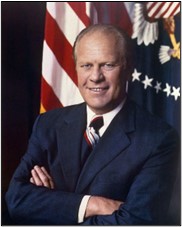
Portrait of Gerald Ford, the 38th President of the United States.

“The Declaration is the Polaris of our political order–the fixed star of freedom. It is impervious to change because it states moral truths that are eternal.

The Constitution provides for its own changes having equal force with the original articles. It began to change soon after it was ratified, when the Bill of Rights was added. We have since amended it 16 times more, and before we celebrate our 300th birthday, there will be more changes…

Jefferson’s principles are very much present. The Constitution, when it is done, will translate the great ideals of the Declaration into a legal mechanism for effective government where the unalienable rights of individual Americans are secure. In grade school we were taught to memorize the first and last parts of the Declaration. Nowadays, even many scholars skip over the long recitation of alleged abuses by King George III and his misguided ministers. But occasionally we ought to read them, because the injuries and invasions of individual rights listed there are the very excesses of government power which the Constitution, the Bill of Rights, and subsequent amendments were designed to prevent…

But the source of all unalienable rights, the proper purposes for which governments are instituted among men, and the reasons why free people should consent to an equitable ordering of their God-given freedom have never been better stated than by Jefferson in our Declaration of Independence. Life, liberty, and the pursuit of happiness are cited as being among the most precious endowments of the Creator–but not the only ones.”

  1. What role does President Ford say the Constitution has in relation to the Declaration?
  2. Why does President Ford say it is important to read the grievances listed against King George III in the Declaration?
  3. Do you agree with President Ford that the Declaration is unchanging while the Constitution changes over time? Explain your answer.

This poem was read at the inauguration of President Joseph Biden in 2021 by its author, Amanda Gorman. She is a poet, activist, and author who wrote this poem for the inauguration under the theme of “America United”.

Amanda Gorman delivers a poem during the inauguration of President Joe Biden, wearing a yellow coat and red headband, with an audience in the background.

…We, the successors of a country and a time where a skinny black girl descended from slaves and raised by a single mother can dream of becoming president only to find herself reciting for one. And, yes, we are far from polished, far from pristine, but that doesn’t mean we are striving to form a union that is perfect, we are striving to forge a union with purpose, to compose a country committed to all cultures, colors, characters and conditions of man.

So we lift our gazes not to what stands between us, but what stands before us. We close the divide because we know to put our future first, we must first put our differences aside. We lay down our arms so we can reach out our arms to one another, we seek harm to none and harmony for all…

That is the promise to glade, the hill we climb if only we dare it because being American is more than a pride we inherit, it’s the past we step into and how we repair it. We’ve seen a force that would shatter our nation rather than share it. That would destroy our country if it meant delaying democracy, and this effort very nearly succeeded. But while democracy can periodically be delayed, but it can never be permanently defeated.

In this truth, in this faith, we trust, for while we have our eyes on the future, history has its eyes on us, this is the era of just redemption we feared in its inception we did not feel prepared to be the heirs of such a terrifying hour but within it we found the power to author a new chapter, to offer hope and laughter to ourselves, so while once we asked how can we possibly prevail over catastrophe, now we assert how could catastrophe possibly prevail over us. We will not march back to what was but move to what shall be, a country that is bruised but whole, benevolent but bold, fierce and free, we will not be turned around or interrupted by intimidation because we know our inaction and inertia will be the inheritance of the next generation, our blunders become their burden. But one thing is certain: if we merge mercy with might and might with right, then love becomes our legacy and change our children’s birthright.

So let us leave behind a country better than the one we were left, with every breath from my bronze, pounded chest, we will raise this wounded world into a wondrous one, we will rise from the golden hills of the West, we will rise from the windswept Northeast where our forefathers first realized revolution, we will rise from the lake-rimmed cities of the Midwestern states, we will rise from the sunbaked South, we will rebuild, reconcile, and recover in every known nook of our nation in every corner called our country our people diverse and beautiful will emerge battered and beautiful, when the day comes we step out of the shade aflame and unafraid, the new dawn blooms as we free it, for there is always light if only we’re brave enough to see it, if only we’re brave enough to be it.

  1. Why does Amanda Gorman urge readers to look towards the future?
  2. What does Gorman believe that being an American includes?
  3. What is the overall tone of the poem? Cite two quotes that support your answer.
New York State Resource Guide for the 250th Anniversary of the American Revolution

Created for teachers of the 4th and 7th grades, this educational guide provides five lessons that introduce students to Fort Orange and the world of New Netherland.

The birthplace of the modern gay rights movement took place on Christopher Street in Greenwich Village in June 1969 at the Stonewall Inn. 

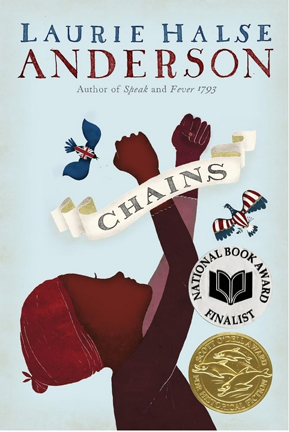
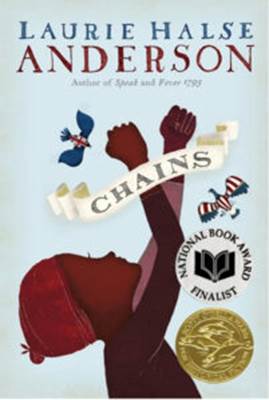
Book Review – Chains

Set in New York at the time of the American Revolution, Chains spans May 27, 1776 to January 19, 1777. As the novel opens, the young teenage protagonist, Isabel, is optimistic about her future as her owner, Miss Mary Finch, has died and had let Isabel know beforehand that she and her five-year old sister Ruth would be free upon her passing. Unfortunately, no lawyer is present to produce the will that shows Miss Finch’s wishes. Mr. Robert Finch, Mary’s nephew and only surviving relative, has come to claim Isabel and Ruth and accuses Isabel of lying about the will. He proceeds to sell Isabel and her sister to Elihu and Anne Lockton from New York. The couple are Loyalists, and while Mrs. Lockton treats Ruth as a kind of pet that she shows off to friends she entertains, she treats Isabel, whom she refers to as “Sal,” in a harsh and degrading fashion, always showing her disfavor.

Isabel has two aims: to protect her sister and to gain freedom. She lives in fear that the Locktons will sell Ruth and thus separate them. At one point Mrs. Lockton provides sweets to them, something that was unusual. But she had laced them with something to make Isabel fall into a deep sleep. When Isabel awakens she learns that Mrs. Lockton has sold Ruth into slavery in the West Indies. This crushes Isabel, who is unable to escape due to constant monitoring by the Locktons.

While doing errands in town for Mrs. Lockton, Isabel meets Curzon, a teenage slave of Mr. Bellingham, a Patriot. Curzon asks Isabel if she would be willing to spy on the Locktons to get information to the Patriots. Initially Isabel refuses but then begins doing so. Mrs. Lockton finds out and punishes her by branding her cheek with an “I” for “insolence.” It takes Isabela six days to regain consciousness after the branding.

Mrs. Lockton makes Isabel care for Lady Seymour, Elihu’s aunt, who lives in town. As Isabel goes to town she is able to deliver messages about Loyalist activities to the Patriot soldiers. Lady Seymour has compassion for Isabel, treating her with kindness and feeding her well. Her house burned in the great fire of New York (September 21, 1776), and Isabel saves her as well as a portrait of her husband and some letters that were dear to her. This becomes important late in the book as Lady Seymour, then an invalid and unable to speak, gestures to Isabel that she approves of her taking coins that she had saved.

The Locktons don’t recognize Isabel as intelligent, which works to her advantage when she is in the room delivering food or waiting for orders when Mr. Lockton is talking with other Loyalists. Isabel learns of the plot to kill Gen. George Washington and shares this with Patriots who come and arrest Mr. Lockton. However, he is soon released and later escapes by hiding in a barrel of cheese. Readers learn that Ruth has not been sold to the West Indies but rather sent to Charleston, South Carolina. Isabel plots her escape for the night that people are distracted by a celebration of Queen Charlotte of Great Britain’s birthday. Though Mrs. Lockton had Isabel locked in a potato bin during the ceremonies, she manages to dig her way out, find a pass and forge papers showing she is free.

Curzon, who had fought in battle for the Patriots, was shot in the leg and held at Bridewell as a prisoner of war. Isabel is able to see him by bribing the guards with food. On the night of her escape, she goes to Bridewell and says she was sent to clean the cells where “prisoners been dropping dead like flies. Fever.” “Curzon lay insensible, his skin burning with fever, his eyes rolled up into his head. I called his name and pinched him, but he did not look my way nor speak a word.” Isabel claims Curzon is dead, loads him in a wheelbarrow and covers him with a filthy blanket. The two manage to make it to the wharf and to a boat. “I rowed that river like it was a horse delivering me from the Devil. My hands blistered, the blisters popped, they re-formed and popped again. I rowed with my hands slick with blood … The sun rose beyond the water, at the other side of the river. I was on the west bank. I was in Jersey. I had set myself free.” At this point Curzon awakes asking where they are, and Isabel replies “I think we just crossed the river Jordan.” The book ends with Isabel asking Curzon if he can walk and with an advertisement for the sequel Forge that gives the account of Isabel Gardner (formerly Sal Lockton) and companion Curzon Bellingham. 

The first teaching strategy for Chains is a set of ten questions designed to guide students in a close reading and deeper study of the novel. These questions may be used as the basis of class discussions, exams or essays.

Questions for Study and Discussion for Chains
1. How do Isabel’s and Curzon’s views of freedom differ in chapter 6? Also consider whether this changes as the novel progresses.
2. What evidence exists that Mr. Lockton is conspiring against the Patriots? Trace his journey from the point that he is arrested to the last mention of him.
3. In chapter 29 Isabel speaks of being “chained between two nations.” What does this mean?
4. Isabel’s grandfather speaks to her about the river Jordan in chapter 26, and in the last paragraph of the book, Isabel states “I think we just crossed the river Jordan.” What is the significance of the river Jordan?

5. Discuss the circumstances by which Isabel secures a copy of Thomas Paine’s Common Sense in chapter 39How does the pamphlet influence her in later chapters?
6. How does the author contrast Lady Seymour and Mrs. Lockton in chapter 41?
7. In what ways was the relationship between Isabel and Lady Seymour a reciprocal one where each benefited? Consider especially the events of chapters 31 and 44.
8. It may be said that at the time of Chains, both Isabel and America are rebellious, young, and conflicted. Explain.
9. Identify three scenes that you believe are the most important in Chains and explain why each is key to the novel.
10. The trilogy of which Chains is book one is called Seeds of America. What role do seeds play in the novel?

While these questions help to ensure close reading and provide opportunities to check for student understanding in a traditional way, the next activity engages students in a more creative, nontraditional manner as they use symbolic thinking and hands-on creativity.

A coat of arms is a visual design in the form of a shield, that goes back to Medieval days when families and communities used them to show their identity. The coat of arms includes a motto or slogan that captures the important essence of the family, nation, school, or in our case, Chains. A coat of arms can be elaborate, including features such as “supporters” (visuals on each side of the shield) and “toppers” (one or more visuals at the top such as a crest, torse, helmet, or crown).

This assignment consists of three parts: 1) Pre-writing via the writing frames for the coat of arms; 2) The visual coat of arms; 3) A paper that explains the symbols chosen in connection with the character the student chose from Chains.

A drawing of a coat of arms

AI-generated content may be incorrect.

The slogan “Per Aspera ad Astra” is Latin for “Through hardships to the stars” which is why the top of the crest features stars. There are three stars, each with an initial, representing Isabel in the middle and Curzon and Ruth on each side. The pre-writing in Table 1 provides additional insights about the symbols and colors used in Isabel’s shield.

How Rightwing Money Tries to Shape the Teaching of American History

The Bill of Rights Institute sponsors events and provides scholarships for the annual conference of the National Council for the Social Studies. On the face of it, it seems innocuous, until you dig a little deeper. The NCSS sells sponsorships, display booths, and sessions that combined can cost a publisher or an organization almost $15,000 which it uses to cover the cost of the convention. At the 2024 NCSS National Conference in Boston, Bill of Rights Institute representatives conducted ten sessions. I have no idea what the Bill of Rights Institute actually pays, but I do know the money and their curriculum initiatives come from the rightwing Koch Foundation and its network of aligned organizations including Americans for Prosperity and the Stand Together Trust. In a 2017 interview with the conservative research group Accuracy in Academia, the President of the Bill of Rights Institute claimed it was working with “approximately one-quarter of the nation’s secondary school teachers in American history, civics, and social studies.”

Koch Industries, the second largest privately held company in the United States, is a $115 billion conglomerate that owns oil refineries and pipelines, markets oil, coal, and chemicals, wood pulp and paper. It uses the Koch Foundation and network to fund conservative causes including challenges to climate science, support for corporate tax cuts, and eliminating federal regulations and environmental controls. The Koch network channeled over $9 million to Project 2025 advisory groups. Other major financial backers of the Bill of Rights Institute include the Adolph Coors Foundation, the Lynde and Harry Bradley Foundation and the Bradley Impact Fund, and the Sarah Scaife Foundation, all donors to the Heritage Foundation for creation of Project 2025. Much of that money was channeled through and the Donors Capital Fund.

In 2014, Bill Bigelow, writing for the Zinn Education Project, accused the Koch Brothers of trying to shape social studies curriculum through their Arlington, Virginia-based Bill of Rights Institute, founded in 1999. According to Bigelow, the Bill of Rights Institute’s tactics to infiltrate social studies include presentations at conferences, essay contests for students, and free seminars for teachers on topics like “Being an American,” “Preserving the Bill of Rights,” and “Heroes and Villains: The Quest for Civic Virtue.” Bigelow argued that their curriculum material “cherry-picks the Constitution, history, and current events to hammer home its libertarian message that the owners of private property should be free to manage their wealth as they see fit.” In one lesson students learn, “The Founders considered industry and property rights critical to the happiness of society.” Of course in many cases their belief in individual property rights included the right to enslave Africans and confiscate land from North America’s indigenous population. In his review of Bill of Rights Institute curriculum and background material, Bigelow found “nothing that could help teachers show students how race and social class shaped the U.S. Constitution” and “nothing that invites students to think about the Constitution from the point of view of anyone other than the elites who drafted it,” including the new nation’s enslaved population.

I attended a regional social studies council conference where a representative from the Bill of Rights Institute made multiple presentations including one on African American participation in the American War for Independence. The lesson plan and supplementary material is available of the Bill of Rights Institute’s website (https://billofrightsinstitute.org/lessons/paths-to-freedom-african-americans-and-the-revolutionary-war). With the Trump administration’s war on museum displays and social studies curriculum that portray negative aspects of U.S. history like the brutality of chattel slavery, I think it is a good example of how the Bill of Rights Institute skews the teaching of American history in line with patriotic history as championed by Project 2025 and the Trump administration’s The 1776 Report. This lesson acknowledges slavery but emphasizes, I believe incorrectly, how the American Revolution was a significant step towards emancipation using isolated examples to support its contentions. The reality is that with the development of the cotton gin in the 1790s and the expansion of cotton production and textile manufacturing at the start of the 19th century slavery in the United States expanded exponentially.

Excerpts from a statement by the Bill of Rights Institute followed by my comments in italics.

  1. The resistance against Great Britain and the Revolutionary War inspired American colonists to think about their natural and constitutional rights. The language and principles of liberty, equality, and self-governance led White and Black Americans to question the institution of slavery and to challenge it more directly. Their diverse efforts led to the largest emancipation in world history at that time and freed an estimated 100,000 enslaved people.
  • Some colonists acknowledged the moral wrong of slavery while protesting British violations of their rights in the 1760s and 1770s. Pamphleteer James Otis wrote that, “The Colonists are by the law of nature free born, as indeed all men are, white or black.” Pennsylvanian Benjamin Rush wrote, “It would be useless for us to denounce the servitude to which the Parliament of Great Britain wishes to reduce us, while we continue to keep our fellow creatures in slavery just because their color is different from ours.” While some colonists addressed the contradiction of slavery and freedom, Black Americans challenged the institution.
  • Enslaved persons appealed to revolutionary ideals to argue for their natural rights. In 1773, four enslaved persons in Massachusetts petitioned the legislature for their freedom “which, as men, we have a natural right to.” The following year, a group of enslaved men presented a freedom petition claiming their natural rights and right to consent. “We have in common with all other men a natural right to our freedom without being deprived of them by our fellow men.” The legislature did not yet act upon the petitions, but Black Americans continued to petition for their freedom during the war as did Nero Brewster and 19 other enslaved individuals in New Hampshire in 1779.
  • Once the Revolutionary War began in 1775 at Lexington and Concord, free and enslaved Blacks joined both the patriot and British sides. Several Black patriots fought bravely at the Battle of Bunker Hill alongside White soldiers, but General George Washington forbade their service in the Continental Army that fall. However, dire manpower needs caused Washington and Congress soon to reverse that policy. The differing states had varied recruiting policies during the war: only South Carolina and Georgia prevented all Blacks from serving. A total of 5,000 free and enslaved Blacks fought for the patriot side throughout the war.

After Lord Dunmore offered freedom to any enslaved Africans who escaped to the British lines, an estimated 20,000 former slaves fought for their freedom by joining the British. The most famous of these was Titus Cornelius, Colonel Tye, who initially fought with Virginia’s Ethiopian Regiment and later led the New Jersey region’s Black Brigade.

Three Pounds Reward – Run away from the subscriber, living in Shrewsbury, in the county of Monmouth, New Jersey, a Negroe man, named Titus, but may probably change his name; he is about 21 years of age, not very black, near 6 feet high; had on a grey homespun coat, brown breeches, blue and white stockings, and took with him a wallet, drawn up at one end with a string, in which was a quantity of clothes. Whoever takes said Negroe, and secures him in any gaol, or brings him to me, shall be entitled to the above reward of Three Pounds, proc. And all reasonable charges paid by John Corlis. Nov. 8, 1775.
  • The British consistently encouraged enslaved persons to escape to support the British war effort and disrupt the American cause rather than out of a sincere desire for Black freedom.
  • During the war, General Washington’s aides, John Laurens and his friend Alexander Hamilton, developed an emancipation plan. In 1779, Congress endorsed their plan to raise a contingent of 3,000 enslaved men in South Carolina and Georgia who would be granted their freedom in exchange for military service. The legislatures of those two southern states rejected the scheme because of their opposition to emancipation and to arming enslaved persons.

Students will be able to connect actions taken by African Americans during the Revolutionary War to an understanding of natural rights of equality and justice.

Students will summarize the main ideas of historic texts.

Students will create an argument supported by evidence from primary sources. How did African Americans participate in the Revolutionary War? How did their actions reflect a desire to enjoy their natural rights?

Student Resources:

Suggested required documents:

The Boston Massacre engraving by Paul Revere, 1770

The Phillipsburg Proclamation, 1779

“Soldiers at the siege of Yorktown,” by Jean-Baptiste-Antoine DeVerger, 1781

James Armistead’s Petition to the Virginia General Assembly, November 30, 1786

Suggested additional documents:

Lord Dunmore’s Proclamation, 1775

“An act directing the emancipation of certain slaves who have served as soldiers in this state, and for the emancipation of the slave Aberdeen,” Virginia General Assembly, October 20, 1783

George Washington’s Last Will and Testament, July 9, 1799

These materials are missing from the Bill of Rights Institute’s suggested documents.

A. This charge against the King of England was removed from the original draft of the Declaration of Independence before it was signed on July 4, 1776: “He has waged cruel war against human nature itself, violating its most sacred rights of life and liberty in the persons of a distant people who never offended him, captivating and carrying them into slavery in another hemisphere, or to incur miserable death in their transportation thither  . . . Determined to keep open a market where men should be bought and sold, he has suppressed every legislative attempt to prohibit or to restrain this execrable commerce.”

B. Boston King’s Escape to the British Lines (1779): “As I was at prayer one evening, I thought the Lord Heard Me, and would mercifully deliver me. [P]utting my confidence in him, about one o’clock in the morning, I went down to the river side and found the guards were either asleep or in the tavern. I instantly entered the water, but when I was a little distance from the opposite shore, I heard the sentinels disputing among themselves. One said, I am sure I saw a man cross the river. Another replied, there is no such thing. When I got a little distance from the shore I got down on my knees and thanked God for this deliver-ance. I traveled until five o’clock in the morning and then concealed myself until seven o’clock at night, when I proceeded forward thro’ brushes and marshes for fear of being discovered. When I came to the river, opposite Staten Island, I found a boat and altho it was near a whale-boat, I ventured into it and cutting the rope, I got safe over. The commanding officer, when informed of my case, gave me a passport and I proceeded to New York.”

C. Pennsylvania Gazette on April 12, 1780 reported on a Monmouth County raid led by Colonel Tye: On the 30th ult. a party of Negroes and Refugees, from the Hook, landed at Shrewsbury in order to plunder. During their excursion, a Mr. Russel, who attempted to make some resistance to their depredations, was killed, and his grandchild had five balls shot through him, but is yet living.” On September 9, 1780, Philadelphia Gazette reported: “One of these attempts (and one which very nearly proved successful) was made about the 1st of September, 1780, by a body of Refugees black and white, including among the former the mulatto leader known as “Colonel Tye.” The party made an unexpected attack on Huddy’s house, which was bravely defended by himself and a girl of about twenty years of age, named Lucretia Emmons. The house had been a station for a detachment of the militia, and fortunately the guard had left there several muskets, which the girl now loaded as rapidly as possible and handed to Huddy, who fired them successively from different windows, wounding several of the assailants and causing them to greatly overestimate the number of defenders. This caused them to shrink from further direct attack, and they then set fire to the house, which, of course, ended all hope of successful resistance on Huddy’s part, and seeing the flames beginning to spread, he, to save his house, agreed to surrender on condition that they would extinguish the fire, which terms they accepted.”

D. George Washington, while headquartered at Newburgh, New York, objected to British plans to evacuate formerly enslaved Africans as a violation of the provisional peace agreement and he sought to find and reacquire people he claimed as his own property. In an April 1783 letter to Benjamin Harrison, the Governor of Virginia, Washington wrote: “I transmitted the list of your Slaves to a Gentleman; a worthy active Man, of my acquaintance in New York and requested him to use his endeavors to obtain and forward them to you. All that can be done, I am sure he will do, but I have but little expectation that many will be recovered; several of my own are with the Enemy but I scarce ever bestowed a thought on them; they have so many doors through which they can escape from New York, that scarce any thing but an inclination to return, or voluntarily surrender of themselves will restore many to their former Masters, even supposing every disposition on the part of the Enemy to deliver them.”

E. Virginians Petition to Protect Slavery (1784): “Some men of considerable weight to wrestle from us, by an Act of the legislature, the most valuable and indispensable Article of our Property, our SLAVES by general emancipation of them. … such a scheme indeed consists very well with the principles and designs of the North, whose Finger is sufficiently visible in it. … No language can express our indignation, Contempt and Detestation of the apostate wretches. … It therefore cannot be admitted that any man had a right … to divest us of our known rights to property which are so clearly defined.”

F. Article in the New-York Packet, April 4, 1785: “It would be greatly injurous to this state if all the Negroes should be allowed the privileges of white men, unless there could be derived some possible means consistent with liberty, to separate them from white people, and prevent them from having any connection or intercourse with them . … [I]f they are emancipated on any other terms, it must be evident to the most common understanding, what will be the consequence in a short time; besides the shame we should most inevitably incur from a mixture of complexions, and their participating in government, … still greater consequence is to be dreaded, which is a total subversion of our liberties.”

G. Jupiter Hammon, poet and minister, was enslaved on Long Island. In 1786, he addressed this statement on slavery to the African population of New York State: “Now I acknowledge that liberty is a great thing, and worth seeking for, if we can get it honestly, and by our good conduct, prevail on our masters to set us free. That liberty is a great thing we may know from our own feelings, and we may likewise judge so from the conduct of the white people, in the late war. How much money has been spent, and how many lives have been lost, to defend their liberty. I must say that I have hoped that God would open their eyes, when they were so much engaged for liberty, to think of the state of the poor blacks, and to pity us. He has done it in some measure, and has raised us up many friends, for which we have reason to be thankful, and to hope in his mercy.”

H. According to the Mount Vernon library, seventeen members of the Mount Vernon enslaved population, fourteen men and three women escaped, many to a British warship anchored in the Potomac River. Hercules Posey, George Washington’s cook, and Ona Judge, Martha Washington’s personal servant successfully escaped bondage during Washington’s Presidency while the family was in Philadelphia. They fled to freedom when Washington tried to rotate them back to Virginia to avoid Pennsylvania’s emancipation laws. Posey was later sighted in New York City. Frederick Kitt, who oversaw the executive residence in Philadelphia, placed an advertisement in the Philadelphia Gazette and Daily Advertiser offering a $10 reward for Judge’s capture. In 1847, The Liberator published a letter from Reverend Benjamin Chase describing a visit with Ona Judge Staines who was now elderly where she recounted her escape. From Philadelphia Judge secured passage on a ship bound for Portsmouth, New Hampshire. A few months after arriving in Portsmouth, Judge was recognized by a friend of Martha Washington’s granddaughter and George Washington enlisted the customs collector there, a federal employee, in an unsuccessful effort to capture Judge. The runaway slave ad and The Liberator article are included on the Bill of Rights Institute web page as “Further Reading,” but not the letter from Washington to the Portsmouth Customs Collector.

I. Letter from President George Washington to Joseph Whipple, Customs Collector, Portsmouth, New Hampshire, November 28, 1796:  I regret that the attempt you made to restore the girl (Oney Judge as she called herself while with us, and who, without the least provocation absconded from her Mistress) should have been attended with so little success. To enter into such a compromise, as she has suggested to you, is totally inadmissible, for reasons that must strike at first view: for however well disposed I might be to a gradual abolition, or even to an entire emancipation of that description of People (if the latter was in itself practicable at this Moment) it would neither be politic or just, to reward unfaithfulness with a premature preference; and thereby discontent, beforehand, the minds of all her fellow Servants; who by their steady adherence, are far more deserving than herself, of favor. … If she will return to her former Service, without obliging me to resort to compulsory means to effect it, her late conduct will be forgiven by her Mistress; and she will meet with the same treatment from me, that all the rest of her family (which is a very numerous one) shall receive. If she will not, you would oblige me, by pursuing such measures as are proper, to put her on board a Vessel bound either to Alexandria or the Federal City.”

Sources:

https://www.socialstudies.org/conference/conference-sponsors

https://accountable.us/leo-koch-networks-funnel-55m-into-project-2025-groups/

https://www.desmog.com/2024/08/14/project-2025-billionaire-donor-heritage-foundation-donald-trump-jd-vance-charles-koch-peter-coors/

https://www.desmog.com/2024/08/14/project-2025-billionaire-donor-heritage-foundation-donald-trump-jd-vance-charles-koch-peter-coors/

Virtual Reality as part of Inquiry into the Boston Massacre

One of the major catalysts that began the American Revolution was the Boston Massacre. This event enraged the local colonial citizens after the increase in taxation and occupation of Boston by the British military. In March 1770, local citizens began to protest against the British by throwing snowballs and rocks on King Street (Reid, 1974). During this event, several British soldiers led by Captain Thomas Preston were detached to quell the conflict (Kellogg, 1918). However, the arrival of the British soldiers only further angered the colonials on King Street. Whether ordered, or unintentionally discharged, the British soldiers fired on the crowd. “On this, the Captain commanded them to fire; and more snowballs coming, he again said, damn you, fire, be the consequence of what it will (The Boston Gazette,1770, p.1). This resulted in the deaths of five colonists, including Crispus Attucks, and the wounding of six others (The Boston Gazette,1770). This article aims to provide social studies teachers the resources using virtual reality experiences as part of an investigative lens to teach the Boston Massacre while integrating the C3 framework of inquiry-based instruction.

Background

In 1767, the British government passed the Townshend Acts, which placed an additional tax on imported goods to the American colonies (Hinderaker, 2017). Although the British crown considered the tax a success, protests and boycotts began throughout the colonies, specifically in Boston. To end the colonial protests, the British government responded in 1769 by sending nearly 2,000 British soldiers to occupy Boston and enforce the tax mandate (Hinderaker, 2017).  “Reports of fighting between soldiers and civilians had been a staple of the Patriot press during the period, but, for the most part, local publications portrayed civilians as the victims of military aggression and praised the town and its leaders for restraining their anger at the abuse” (Messer, 2017, p. 509). By 1770, resentment for the British occupation exploded, resulting in the Boston Massacre. “By this fatal manoeuvre three men were laid dead on the spot and two more struggling for life; but what showed a degree of cruelty unknown to British troops, at least since the house of Hanover has directed their operation, was an attempt to fire upon or push with their bayonets the persons who undertook to remove the slain and wounded” (The Boston Gazette,1770, p.1).

Inquiry-based learning

Inquiry-based learning involves student-led investigations with proposed questions, collecting and analyzing data, and forming evidence-based arguments while the teacher is facilitating the inquiry process (Hmelo-Silver, Duncan, & Chinn, 2007). Inquiry allows learners to examine authentic problems and enhance their understanding (Wirkala & Kuhn, 2011). Levy, Thomas, Drago, and Rex (2013), affirm that inquiry promotes academic investigation and the creation of evidence-based argumentation. Inquiry-based instruction builds upon disciplinary questioning, investigative evaluation, and reflection to develop and defend ideas and concepts (NCSS, 2013). Inquiry-based instruction centers on analyzing information, using evidence to develop arguments and support conclusions (Monte-Sano, 2010). Despite the framework, having students ask meaningful questions and draw conclusions from various sources leads to increased social studies content knowledge (Grant & Gradwell, 2010). However, inquiry-design should incorporate content-related questions, summative tasks in which arguments are developed, sources to support arguments that are constructed, and taking informed action where students take action on a contemporary issue (Grant, Swann, & Lee, 2017).

The birth of VR and AR, as cited within most research, began in the 1960s with the work of graphics pioneer Ivan Sutherland (Bolter, Engberg, & MacIntyre, 2021). With the technological advances that have happened since that time, many state what Sutherland created was more aligned to AR than VR, but it paved the way for VR. AR and VR were “twins when birthed as they began as variations of the same technological idea” (Bolter, Engber, & MacIntyre, 2021, p 22).

So, what exactly is AR and VR?

  • Virtual Reality (VR): “an artificial environment which is experienced through sensory stimuli (such as sights and sounds) provided by a computer and in which one’s actions partially determine what happens in the environment” (Jerald, 2015).
  • Augmented Reality (AR): “AR allows the user to see the real world, with virtual objects superimposed upon or composited with the real world. Therefore, AR supplements reality, rather than completely replacing it” (Azuma, 1997)

            Improvements in computing power, software capabilities, and display technologies allowed VR and AR to become mediums with great promise. Afterall, we have seen what Hollywood has been able to do with this technology. Simply watch a George Lucas or Pixar movie. These possibilities have found their way into the world of education, such as the Boston Massacre which we highlight in this article.

One aspect of using virtual reality is creating a classroom environment where learners can feel more present in a virtual simulation than in other types of traditional learning (Kafai, 2006). Virtual agents allow a personalized learning experience tailored to individuals that might otherwise be expensive or unreachable (Baylor & Kim, 2005). These three-dimension virtual experiences provide sensory information for a more realistic and engaging immersion experience (Pstoka, 1996; Walshe & Driver, 2019). Thus, the user can be part of the virtual environment by performing actions (Bardi, 2019). This type of environment promotes learning about the past through the delivery of digital media and incorporating specific exhibits and artifacts from different historical sites (Harley, Poitras, Jarrell, Duffy, & Lajoie, 2016).  “By using realistic virtual depictions of dangerous crises, learners can experience the chaos and affective stressors that are typically accompanied with actual crises” (Bailenson, Yee, Blascovich, Beall, Lundblad, & Jin, 2008, p. 110). This type of augmented reality experience can immerse learners into the past with reeling life settings for engagement (Bronack, 2011). These virtual experiences offer opportunities for student investigations and real-life encounters not experienced in a traditional classroom (Christensen, Horn, & Johnson, 2008). Additionally, 3-D virtual environments can bridge the gap between experiential learning and representation in learning (Jonassen, Peck, & Wilson, 1998). 

VR devices

A trip into any store that offers for purchase a VR device will prove that there are a plethora of devices from which to select. The selection choice will depend on the type of experience you wish to have through the use of the device. After researching several articles, reviews, and personal trials, we offer three options below – a high, medium, low, if you will. However, we realize that most educators have very little funding and will look for the cheaper options. The experiences offered by the cheaper options, while not the same as the most expensive, are experiences that can still be valuable to students.

LowGoogle Cardboard (https://arvr.google.com/cardboard/) The Google Cardboard is one of the most affordable options at around $10.00. The headset is really a holder for the smartphone, which is where all the content plays. The content available for this headset is mostly free and more readily available than others. 
MediumVR Headset for iPhone & Android + Android Remote 1.0 – for Kids (https://www.amazon.com) This mid-range VR option is $59.99. This headset is a smartphone VR system that supports both apple and android products. The content and applications are also mostly free and more readily available.  
HighOculus Meta Quest 2 – (Meta.com) The Oculus Meta 2, at $399, offers a more robust VR experience in that audio is inside the headset and hand tracking with the controllers. Another option from this device is that you can connect to a PC via a cable to access more experiences from the library of apps and games.  

Before purchasing a device, you should review each device and make your selection based on what you wish for your students to gain from the experience.

To critically evaluate the Boston Massacre, we propose using a model of inquiry; the Inquiry Design Model (C3 Teachers, 2016). Within this model of inquiry, we plan to implement the richness of a virtual reality experience. “The IDM approach, like the C3 Framework, respected the integrity of the core social studies disciplines but also recognized that authentic learning in social studies classrooms necessitated the interdisciplinary pursuit of a compelling question” (Cuenca, 2021, p.301). For teachers using the IDM, three major components must be considered: developing compelling and supporting questions, exposing students to resources, and developing tasks and informed activation activities (Crowley and King, 2018). “Beginning with a compelling question and standards alignment, the model suggests a series of supporting questions, related formative performance tasks, and sources for completing these tasks” (Molebash, Lee, & Heinecke, p.23, 2019). Cuenca (2021) stated:

Based on the nature of the compelling question, the tasks had different purposes, such as developing research, writing, and/or deliberative skills. Regardless of the purpose of the tasks, the inquiry narratives consistently featured teachers scaffolding tasks to ensure that students were able to address the compelling question they were pursuing. In short, teachers were often asked to facilitate how students organized inquiries to help them progressively become more skilled and independent enquirers (p. 306).

“The assumption is that teachers can take a blueprint and make it their own because they know their students’ strengths, they have their preferred style of teaching, and they understand their teaching context better than a curriculum writer” (Swann, Danner, Hawkins, Grant, & Lee, p.233, 2020). Swann, Lee, and Grant (2018) contend that:

            For this specific inquiry-based learning segment, we have decided to use the richness of primary resources infused along with the experiential learning of virtual reality. At the start of the inquiry, teachers can select a topic from their state standards. For this inquiry, we have chosen the Boston Massacre. After selecting a standard and topic, the classroom teacher can begin to develop a compelling question. Our compelling question is: how did the Boston Massacre become one of the sparks that started the American Revolution? The compelling question is an overarching question that will take several days of instruction as part of a learning segment to answer fully. To begin the inquiry with students, there is an introductory activity called staging the question. We decided to have students watch a short video clip and then answer the following question: Who was responsible for the massacre and bloodshed on King Street in Boston?

For each day of instruction, the inquiry is divided into supporting or daily questions. Formative tasks to help answer the supporting questions along with featured resources, such as primary documents and virtual reality resources are used for each supporting question. For the first day, our supporting question is: what events led to the Boston Massacre? Students are asked to construct a timeline leading up to the Boston Massacre, thus, providing information on events and actions before the Boston Massacre. Students are provided with a list of primary resources and applications for developing the timeline. For the second day of the inquiry, students will answer: what were the colonists’ perceptions of the Boston Massacre? Students will be placed into groups, Colonists and British soldiers, and conduct a primary document analysis and watch a VR video on the Boston Massacre using VR headsets. After watching the VR experience on the Boston Massacre, students will be asked to construct a reflective journal on what happened on King Street. This will give students a unique perspective of each group, leading to historical empathy. For the third day of the inquiry, students will be asked: what happened to the British soldiers that killed the colonists on King Street?  After examining the featured primary resources, students will be asked to develop a judicial debriefing summarizing the Boston Massacre trial.

To assess students, the IDM offers the opportunity to participate in performance-based assessments geared toward answering the compelling question. Our performance assessment will divide students into three groups: Tensions rising (emphasizing events before the Boston Massacre), the Boston Massacre, and the Boston Massacre Trial. Each group will be assigned the task of conducting a live simulation/reenactment of their event in class. The reenactment should be no longer than 3-5 minutes. In an optional performance-based assessment, as part of the IDM, students will create and design their video of the Boston Massacre using a variety of AR and video resources. For social studies teachers, both assessments could be used as a student option or as a classroom extension.

At the end of the inquiry is the portion that provides tremendous relevancy to the curriculum, the informed action. For this part of the inquiry, we asked students to use their personal experiences with virtual reality and augmented reality and choose a local or community issue of concern. Students will design an augmented reality presentation or show, using Google Street View, displaying the issue in a community forum or school blog. Students might invite parents, teachers, and community leaders to discuss the issue and offer potential solutions.

 Inquiry Design Model (IDM) Blueprint™
Compelling QuestionHow did the Boston Massacre become one of the sparks that started the American Revolution?
Standards and PracticesSocial Studies Course of Study- State Standards Grade 5 Standard 7 Determine causes and events leading to the American Revolution, including the French and Indian War, the Stamp Act, the Intolerable Acts, the Boston Massacre, and the Boston Tea Party. Grade 10 Standard 3 Trace the chronology of events leading to the American Revolution, including the French and Indian War, passage of the Stamp Act, the Boston Tea Party, the Boston Massacre, passage of the Intolerable Acts, the Battles of Lexington and Concord, the publication of Common Sense, and the signing of the Declaration of Independence.
Staging the QuestionUsing a video clip on the Boston Massacre, pose the question to the students, Who was responsible for the massacre and bloodshed on King Street in Boston? https://www.youtube.com/watch?v=m2QNZf_8V_w  
Supporting Question 1 Supporting Question 2 Supporting Question 3
What events led to the Boston Massacre?  What were the colonists’ perceptions of the Boston Massacre?What happened to the British soldiers that killed the colonists on King Street?
Formative Performance TaskFormative Performance TaskFormative Performance Task
Students will construct a timeline leading up to the Boston Massacre; thus, providing information on events and actions prior to the Boston Massacre.    After watching the VR experience on the Boston Massacre, the class will be divided into two groups; Colonists and British soldiers. Based on the students’ perspective of the primary sources provided, including the VR video, students will be asked to construct a reflective journal on what happened on King Street.      After examining the featured sources, students will be asked to develop a judicial debriefing summarizing the Boston Massacre trial.
Featured SourcesFeatured SourcesFeatured Sources
British occupation of Boston
https://www.historycentral.com/Revolt/british.html
Stamp Act
https://www.gilderlehrman.org/history-resources/spotlight-primary-source/stamp-act-1765
Quartering Act
https://www.battlefields.org/learn/primary-sources/quartering-act-1765
Declaratory Act
https://www.battlefields.org/learn/primary-sources/declaratory-act Timeline using Sutori, TimeGraphics, and Lucidchart
Boston Massacre VR Video
https://www.youtube.com/watch?v=O05rNWygHF4
Paul Revere’s Engraving
https://ap.gilderlehrman.org/resource/paul-revere%27s-engraving-boston-massacre-1770
John Adams Diary Entry https://www.famous-trials.com/massacre/199-diaryentry Boston Massacre Trial Evidence
https://www.famous-trials.com/massacre/210-evidence    
Summative Performance TaskArgumentThe teacher will divide students into three specific groups: Tensions rising (emphasizing events before the Boston Massacre), the Boston Massacre, and the Boston Massacre Trial. Each group will be assigned the task of conducting a live simulation/reenactment of their event in class. The reenactment should be no longer than 3-5 minutes.
ExtensionStudents will create and design their own video of the Boston Massacre using a variety of AR and video resources. Google Streetview
https://www.google.com/streetview/ Canva
https://www.canva.com
Taking Informed ActionFrom using their personal experiences with virtual reality and augmented reality, students will choose a local or community issue of concern. Students will design an augmented reality presentation or show, using Google Street View, displaying the issue in a community forum or school blog. Students might invite parents, teachers, and community leaders to discuss the issue and offer potential solutions. Google Streetview
https://www.google.com/streetview/

The purpose of this article is to provide a framework of inquiry, while using virtual reality to investigate the Boston Massacre. By advancing through the inquiry, students can develop a constructivist approach to their own historical knowledge and their personal experiences through the historical immersion of virtual reality (Wadsworth, 2004). In addition, students can further their technology-based skills by developing their own augmented reality video. The informed action portion of the IDM model gives civic meaning by addressing the community issues and problems, thus, promoting active citizenship. By transforming social studies classrooms into places where students can express these civic principles, democratic citizenship begins (Dewey, 1918). Our aspiration is to give social studies teachers the needed instructional resources, especially virtual reality, to be part of the overall historical learning experience for students. By using VR, students can further investigate and build their own historical knowledge.

(1770). The Boston Gazette, pp. 1–1.

Amazon. (2024). Amazon.com: VR headset. VR Headset for iPhone & Android.

Bailenson, J. N., Yee, N., Blascovich, J., Beall, A. C., Lundblad, N., & Jin, M. (2008). The Use of Immersive Virtual Reality in the Learning Sciences: Digital Transformations of Teachers, Students, and Social Context. The Journal of the Learning Sciences, 17(1), 102–141.

Baylor, A. L., & Kim, Y. (2005). Simulating instructional roles through pedagogical agents. International Journal of Artificial Intelligence in Education, 15(1), 95-115.

Bardi, J. (2019).  What is virtual reality? [Definition and examples].  Retrieved from  https://www.marxentlabs.com/what-is-virtual-reality

Bronack, S. C. (2011). The role of Immersive Media in online education. The Journal of Continuing Higher Education, 59(2), 113–117. https://doi.org/10.1080/07377363.2011.583186  

C3 Teachers. (2016). Retrieved February 18, 2019, from http://www.c3teachers.org/

Crowley, R., & King, K. (2018). Making Inquiry Critical: Examining Power and Inequity in the Classroom. Social Education, 82(1), 14–17.

Cuenca, A. (2021). Proposing Core Practices for Social Studies teacher education: A qualitative content analysis of inquiry-based lessons. Journal of Teacher Education, 72(3), 298–313. https://doi.org/10.1177/0022487120948046  

Christensen, C. M., Horn, M. B., & Johnson, C. W. (2008). Disrupting Class: How disruptive innovation will change the way the world learns. McGraw-Hill.

Dewey, J. (1916). Democracy and Education. New York: Macmillan.

Grant, S. G., & Gradwell, J. M. (Eds.) (2010). Teaching history with big ideas: Cases of ambitious teachers. Rowman & Littlefield.

Grant, S. G., Swann, K., & Lee, J. (2017). Inquiry-based practice in Social Studies Education: Understanding the inquiry design model. Routledge.

Harley, J. M., Poitras, E. G., Jarrell, A., Duffy, M. C., & Lajoie, S. P. (2016). Comparing virtual and location-based augmented reality mobile learning: emotions and learning outcomes. Educational Technology Research and Development, 64(3), 359–388.

Hinderaker, E. (2017). Boston’s Massacre. Cambridge, MA: The Belknap Press.

Hmelo-Silver, C. E., Duncan, R. G., & Chinn, C. A. (2007). Scaffolding and achievement in problem-based and inquiry learning: A Response to Kirschner, Sweller, and Clark (2006). Educational Psychologist, 42(2), 99-107.

Jonassen, D. H., Peck, K. L., & Wilson, B. G. (1998). Learning with Technology: A Constructivist Perspective. Merrill.

Kafai, Y. B. (2006). Playing and making games for learning: Instructionist and Constructionist perspectives for game studies. Games and Culture, 1(1), 36–40. https://doi.org/10.1177/1555412005281767 

Kellogg, L. P. (1918). The Paul Revere Print of the Boston Massacre. The Wisconsin Magazine of History1(4), 377–387.

Levy, B. L., Thomas, E. E., Drago, K., & Rex, L. A. (2013). Examining Studies of Inquiry-Based Learning in Three Fields of Education. Journal of Teacher Education, 64(5), 387-408. https://doi.org/10.1177/002248711349643

Messer, P. (2017). “A scene of Villainy acted by a dirty Banditti, as must astonish the Public”: The Creation of the Boston Massacre. The New England Quarterly90(4), 502–539.

Molebash, P., Lee, J., & Heinecke, W. (2019). Teaching and Learning Inquiry Framework. Journal of Curriculum and Teaching, 8(1), 20–31. https://doi.org/10.5430/jct.v8n1p20

Monte-Sano, C. (2010). Disciplinary literacy in history: An exploration of the historical nature of adolescents’ writing. Journal of the Learning Sciences, 19(4), 539-568.

National Council for the Social Studies. (2013). College, career, and civic life (C3) framework for state social studies standards. Washington, DC: NCSS. 

Psotka, J. (1996). Immersive training systems: Virtual reality and education and training. Instructional Science, 23, 405-423. 

Reid, J. P. (1974). A Lawyer Acquitted: John Adams and the Boston Massacre Trials. The American Journal of Legal History18(3), 189–207.

Swann, K., Danner, A., Hawkins, M., Grant, S. G., & Lee, J. (2020). Zooming Inquiry: Online Teaching with the Pomodoro Technique. Social Education, 84(4), 229–235.

Swann, K., Lee, J., & Grant, S. G. (2018). Questions, Tasks, Sources: Focusing on the Essence of Inquiry. Social Education, 82(3), 133–137.

Walshe, N., & Driver, P. (2019). Developing reflective trainee teacher practice with 360-degree video. Teaching and Teacher Education, 78, 97–105.

Wadsworth, B. J. (2004). Piaget’s theory of cognitive and affective development: Foundations of Constructivism. Longman. Wirkala, C., & Kuhn, D. (2011). Problem-based learning in K-12 education: Is it effective and how does it achieve its effects? American Educational Research Journal, 48(5), 1157-1186

Local History: The American Revolution in the Finger Lakes

Reprinted from New York Almanack based on an essay from the National Park Service’s Finger Lakes National Heritage Area Feasibility Study. https://www.newyorkalmanack.com/2023/09/american-revolution-finger-lakes/#more-98398

Initially, the Haudenosaunee Confederacy (Iroquois) claimed neutrality during the conflict between Britain and the colonists, seeing the disagreement as a civil war and valuing loyalty to their families and to their lands above all else. When the political discontent erupted into the American Revolutionary War, the member nations of the Haudenosaunee Confederacy split their support between the British and newly formed American forces. The majority of nations and individual members supported the British under the belief that those nations would be more likely to keep their relative independence and land under continued British rule, while the Oneida and Tuscarora backed the American Colonists.

As with many American families, alliance was not clear-cut, and in some cases, allegiance was split on a person-by-person basis, which destabilized the clan-based society. What had started as a European civil war on North American soil soon turned the Confederacy against itself, undermining the social unity and political stability that the Six Nations had enjoyed for centuries. In 1778, Loyalists and members of the British-backed nations participated in destructive raids that crippled Continental forces and destroyed frontier settlements in New York and Pennsylvania. Fearing that the New York frontier would be pushed east to the Hudson River if divisive action was not taken, General George Washington ordered General John Sullivan to lead four brigades of men — a sizable portion of the Continental Army — on a scorched-earth campaign that would limit the Haudenosaunee’s ability to attack in the future.

Washington tasked Sullivan with launching a terror campaign to destroy the food supply of the Cayuga and Seneca Nations in the heart of the Finger Lakes and to reduce the Cayuga and Seneca’s forces. Smaller expeditions were tasked with destroying Seneca settlements in western Pennsylvania and Onondaga settlements in Central New York. General Sullivan and his second-in-command, General James Clinton met in Tioga near the Pennsylvania-New York border and began their campaign by destroying the Munsee Delaware settlement of Chemung in present-day Chemung County. Instead of deploying the guerrilla tactics that long served Haudenosaunee well, Confederacy war chiefs and the meager British forces available to counterattack decided to retaliate with a standing battle.

The Battle of Newtown on August 29, 1779, ended in a British and Indian retreat and destroyed morale for the British-backing Confederacy Nations, who now chose to proactively flee to other nearby settlements. For the next two weeks, Sullivan’s forces moved from Seneca Lake to Canandaigua Lake to Chenussio — a Seneca stronghold near present-day Leicester in Livingston County that included 128 multi-family longhouses. By the end of the campaign, Sullivan’s men destroyed more than 40 Haudenosaunee villages, at least 160,000 bushels of corn, countless pounds of stored vegetables and fruit, and only suffered 40 casualties.

While the American forces did not take Haudenosaunee prisoners, the Sullivan Campaign destroyed the nations’ capacity to wage war. By the end of September 1779, more than 5,000 nation members had arrived at the British Fort Niagara expecting food, clothing, and shelter in the face of their catastrophic losses at the hands of the Americans. Instead of lessening the threat to frontier settlements, the Sullivan Campaign increased the animosity of Natives and British alike, laying the ground for fierce fighting within the New York frontier of British-backed Indian raids during the 1780s.

Book Review: The Sewing Girl’s Tale: A Story of Crime and Consequences in Revolutionary America by John Wood

Sweet (Henry Holt) uses the trial of the accused rapist, Harry Bedlow, of a seventeen-year-old seamstress named Lanah Sawyer in 1793 to analyze New York City’s social hierarchy during the early republic. Alexander Hamilton was part of Bedlow’s legal team. Bedlow’s      acquittal[1]  after the jury deliberated for only fifteen minutes sparked riots in the streets and ignited a vigorous debate about class privilege and sexual double standards. Sawyer received some justice when her stepfather won a civil suit against Bedlow and the family was awarded a significant sum. The book received a Bancroft Award from the American Historical Association.


Book Review: The Great New York Fire of 1776: A Lost Story of the American Revolution by Benjamin Carp

In many ways, New York City was the strategic center of the Revolutionary War. During the summer of 1776, George Washington threatened to burn the city rather than let the British take it and shortly after the Crown’s forces took New York City, more than one-fifth of the city mysteriously burned to the ground. This book examines the Great Fire of 1776 and why its origins remained a mystery even after the British investigated it in 1776 and 1783. Benjamin Carp paints a vivid picture of the chaos, passions, and unresolved tragedies that define a historical moment we usually associate with “life, liberty, and the pursuit of happiness.” Carp is a professor of history at Brooklyn College and the CUNY Graduate Center. He is the author of Defiance of the Patriots: The Boston Tea Party and the Making of America and Rebels Rising: Cities and the American Revolution.

My Story: Rev. Samson Occum, 1787, Mercer County

My Story: Rev. Samson Occum, 1787 Mercer County

Visit of Rev. Samson Occum to the Lenape at New Stockbridge

Samson Occum, leader of the New England Brothertown religious movement (not to be confused with the NJ Brotherton community), had a long association with the Delaware Indians.  After his time as Eleazar Wheelock’s first Indian pupil, Occum became a minister.  Based upon his success in religious education, Wheelock began his Indian School in Connecticut, where his first two pupils were Delaware Indian boys from John Brainerd’s Bethel Mission settlement in present-day Monroe Township, New Jersey. The Delaware (Lenape) supported the French in the French and Indian War and by 1777, many had left New Jersey for areas of New York and western Connecticut. By 1802, the assimilation with the Allegheny and Oneida was complete.  (See The Brotherton Indians of New Jersey, 1780)

Use the documents below to discuss and investigate the following questions:

  1. What motivated Samson Occum to become involved with Native Americans?
  2. How did decisions affect the livelihood of the Lenape and Delaware Valley Indians?
  3. Was New Stockbridge a suitable place for the migration of the Lenape and other native Americans?
  4. Do you think the travels of Rev. Samson Occum were planned in advance or were they a response to the letter from the Native Americans at New Stockbridge dated Nov. 28, 1787.
  5. What was traveling in New Jersey like for Rev. Occum (or anyone)?
  6. Comment on five days in Rev. Occum’s journal.

The following information details Occum’s visit to Brotherton and Weekping (Coaxen):

From Love’s Life of Occom (p. 276):

Fundraising mission of Samson Occom and others to New York, New Jersey & Pennsylvania:

November 28, 1787 (underlining is for emphasis)

To all Benevolent Gentlemen, to Whom these following lines may make their appearance.

We who lately mov’d from Several Tribes of Indians in New England, and Setled (sic) here in Oneida Country. And we also Muhheeconnuck Tribe, who lately came from Housotonuk alias Stockbridge, and have settled in Oneida, And finding it our indispensible (sic) Duty to maintain the Christian Religion amongst ourselves in our Towns, And from this Consideration, Some of us desired our Dear Brother, the Rev d Samson Occom, to give us a visit, and accordingly, he came up two years ago this Fall, and he was here a few Days; and his preaching came with great weight upon our Minds. And he has been here two Summers and Falls since. And we must confess to the Glory of God, that God has made him an Eminant (sic) Instrument amongst us, of a Great and Remarkable Reformation. And have now given him a Call to Settle amongst us, and be our Minister that we may enjoy the glorious Doctrines and ordinances of the New Testament.

And he has accepted our Call. But we for ourselves very weak, we c’d do but very little for him. And we want to have him live comfortable.

The late unhappy wars have Stript (sic) us almost Naked of everything, our Temporal enjoyments are greatly lesstened (sic), our Numbers vastly diminished, by being warmly engaged in favour of the United States. Tho’ we had no immediate Business with it, and our Spiritual enjoyments and Priviledges (sic) are all gone. The Fountains abroad, that use to water and refresh our Wilderness are all Dryed up, and the Springs that use to rise near are ceased. And we are truly like the man that fell among Thieves, that was Stript (sic), wounded and left half dead in the high way. And our Wheat was blasted and our Corn and Beans were Frost bitten and kill’d this year. And our moving up here was expensive and these have brought us to great Necessity And these things have brought us to a resolution to try to get a little help from the People of God, for the present; for we have determined to be independent as fast as we can, that we may be no longer troublesome to our good Friends, And therefore our most humble Request and Petition is, to the Friends of the Kingdom of Jesus Christ, [that they] would take notice of us, and help us in encourageing (sic) our Dear Minister, in Communicating Such Things that may Support him and his Family. This is the most humble request and Petition of the Publicks (sic) true Friend & Brothers

ELIJAH WIMPEY

DAVID FOWLER

JOSEPH SHAUQUETHGENT

HENDRECH AUPAUMUT

JOSEPH QUAUNCKHAM

PETER POHQUENUMPEC

New-Stockbridge (NY)

Novr 28: 1787

Native Americans from Stockbridge, MA moved to this location during the American Revolution. The Stockbridge, refuges of tribes mainly of adjoining New York that had settled in the “prayer town” of Stockbridge, Massachusetts, accepted an invitation of the Oneidas to live and share on their reservation in New York. Stockbridge, NY was incorporated in 1791.

Brotherton, Novr 29: 1787.

Conn. Hist. Soc., Indian Papers

A journal of the daily travel of the Rev. Samson Occom in New Jersey

From Occom’s Journal – portions of above-referenced trip [edited by RW for clarity].

December 28, 1787: New Windsor, New York

December 29, 1787: Mr. Brewsters at Blooming Grove; Robinsons Tavern; Florida (NY)

December 30, 1787: Warwick (NY)

December 31, 1787: Mr. Smith’s Public House

January 1, 1788: To Rev. Baldwin’s house and lodged.

January 2, 1788: Went to Parsippany to Mr. Grovers and then back towards Rev. Baldwin.

January 3, 1788: In same area.

January 4, 1788: Called at Rev. Green’s and then went to Mr. Chapmans at Newark mountains [Jebediah Chapman was the master of the Orange Dale Academy. In 1790, Occom sent New Stockbridge resident John Quinney to the Academy.] Went to Crain’s Town and lodged with at Mr. Crain’s.

January 5, 1788: Set off for Horse Neck and put up at Esq. Crain’s. (Horse Neck Tract is present day Caldwell, Fairfield, Verona, Cedar Grove, and Essex Fells.)

January 6, 1788: After meeting, went on about three or four miles and lodged there.

January 7, 1788: Towards Morristown, stopped at Mr. Grover’s and later lodged at Morristown.

January 8, 1788: Went to Basking Ridge and attended the funeral of Rev. Canada’s daughter.

January 9, 1788: Got to Mill Stone and put up at a tavern.

January 10, 1788: At noon, arrived at Dr. Witherspoon’s house at Prince Town. Left and traveled to Black Horse Tavern (Columbus, Burlington County, New Jersey).

January 11, 1788: After eating, went on again. Got to Quakson towards night where there were three or four families of Indians, we called in at one, and they appeared extremely poor, so we went on and put up at a tavern [Red Lion?]. It was cold and we set up long and I was ill with a cold and cough.

January 12, 1788: After breakfast, set off again and got to Agepelack [Edgepillock] some time before night. Stopped and stayed at Friend Mytop’s house. I was very poor with my cold and coughed much.

Sabbath, January 13, 1788: Felt a little better and about 11 went to meeting, and there was not many people they had but little notice. I spoke from the Words, that which is wanting &c and the people attended well. After the service I went home with Daniel Simon to his mother-in-laws house [Widow Calvin] and stayed there all the week. Daniel Simon lost an only child this week and I preached a funeral discourse from the Words Set thy House &c and we had singing meetings every night, and prayed with them and gave them a word of exhortation.

Sabbath, January 20, 1788: Preached here again and it was very bad traveling, and there was a considerable number of people collected, and I spoke from [ ] and the people attended well, and after the meeting went back to Widow Calvin’s [widow of Stephen Calvin, son-in-law of Weequehela] and in the evening people came together and we had an exercise with Christian cards and we sang and prayed and it was a solemn time. Many were affected, and the people were very loath to leave the place & they stayed late.

January 21, 1788: We were up early and got ready as soon as we could. We took leave of the family and others came to take leave of us, and so we directed our course to Philadelphia and in the evening we got to the river against the City and we put up in a tavern one Friend Cooper.

February 22, 1788: About 10 we left Philadelphia and it was bad crossing the river. We went on ice most of the way over, and it was a cold day, and in the evening we got to Moorestown and Brother David [David Fowler] was sick, & Peter [Pauquunnuppeet] went [to] Agepelack, and dined and lodged in a tavern.

February 23, 1788: I went to Quakson [Coaxen] and left David very sick [at Moorestown] and got there before noon, and put up at a public house. In the afternoon, went to an Indian house, and towards night went to a public house.

February 24, 1788: About 11 went to meeting to a meeting house which Mr. John Brainerd used to preach to a number of Indians and there was considerable [number] of people and I spoke from Acts XI.26 and some time towards night, we went to Mount Holly, got there near sun set and we put up at Dr. Ross and David was very sick, and here we stayed some days, and I preached four times in this place.  (Acts 11:26“Then Barnabas went to Tarsus to look for Saul, and when he found him, he brought him to Antioch. So for a whole year Barnabas and Saul met with the church and taught great numbers of people. The disciples were call Christians first at Antioch.”)

February 29, 1788: I left Mount Holly and left David there as he was not well enough to set out. I got to Trenton in the evening. Called on Rev. Armstrong, but he was not home, so I went to a public house.

March 1, 1788: Went back to Bordentown.

March 2, 1788: Preached at Bordentown, went back to Trenton.

March 3, 1788: Went to the meeting house at Trenton and there were considerable people. In the afternoon, I went back to the Draw Bridge (at Bordentown) and had an evening meeting with a vast number of people.

March 4, 1788: David and I set off pretty early and we got to [      ] and lodged at Dutch Tavern.

March 5, 1788: Went to New Brunswick. David left a bundle and had to go back. At New Brunswick, went to see Rev. Munteeth, and then to Dr. Scott. At Dr. Scott’s, Peter was found; he had been straggling about a fortnight. In the evening there was a society and I spoke a few words by way of exhortation. Afterwards, we returned to Dr. Scott’s, where we lodged.

March 6, 1788: Visited several houses, and preached at the Presbyterian church. There was a large number of people. I lodged at Dr. Scott’s and David and Peter lodged in another house.

My Story: Rev. John Brainard & the Delaware Indians, 1759-1789

My Story: Rev. John Brainerd

Exploring Native American Sources Over a 30 Year Period

John Brainerd was born on February 28, 1720 in Haddam, CT. He had a vision to educate Native Americans in the colonies of New England and the Mid-Atlantic, including New Jersey. He graduated from Yale College in 1746 and received a Masters Degree from The College of New Jersey (Princeton) in 1749. He was a Presbyterian minister in Newark and New York before the French and Indian War. Her served as a chaplain in the Colonial Army during the French and Indian War, possibly between 1756 and 1759. He ministered to Christian Indian villages in Cranbury, Bridgetown, Mount Holly, Newark, and Deerfield in New Jersey. He also ministered to Native American communities in Pennsylvania and Connecticut. His brother David also ministered to Native Americans but died before John graduated from Yale.  John Brainerd was married twice. His first wife, Experience Lyon died in 1757, while John Brainerd was with the Colonial Army. The two children she gave birth to, died in their first year. He remarried Hannah Spencer from Lynn, MA (also Haddam, MA) in 1664.

These were the years of the Great Awakening and prominent clergy such as John and Charles Wesley, George Whitefield and Jonathan Edwards preached the Bible, wrote songs, started schools, and ministered to colonial populations.

The French and Indian War, tough economic times after the French and Indian War, and the separation from England following the Declaration of Independence had a significant impact on the clergy who were supported by the Anglican Church of England, the Presbyterian Church of Scotland, and the Reformed Church in the Netherlands. Most clergy returned to England after the Declaration of Independence. John Brainerd, Samson Occum, and Francis Asbury are prominent clergy who ministered to people in New Jersey.

“IN the year 1777, at fifty-seven years of age, Mr.-Brainerd removed from Brotherton to Deerfield, in Cumberland County, N.J., and took charge of the church there. He still seems to have retained some oversight of the mission. In 1778, 1779, and1780, up to the year of his death, the Synod of New York and Philadelphia voted that ”the interest on the Indian fund be paid to Mr. Brainerd for his services among the Indians. “To the last of life he seems to have clung to his little flock, his first love, and his brethren did their best in a time of war to sustain him. Brotherton, the Indian settlement which he had aided to build up, and where for fifteen years he had resided, was situated in what is now a prosperous and pleasant rural neighborhood, near the present Shamong station, on the Raritan and Delaware Bay Railroad, about forty miles from Philadelphia. The “Historical Collections of New Jersey “give the following description:

“Edgepelick (or Indian Mills) is the name of a locality about three miles north of Atsion, where was the last Indian settlement in the State. The remnant of the tribe, consisting of about one hundred souls, emigrated to the West nearly half a century since. There is, however, a single family, but of mixed breed, residing in the vicinity ,in a log hut. Brainerd, the missionary, for a time resided among the Indians at this place. His dwelling-house stood about eight rods south of the saw-mill of Godfrey Hancock, on rising ground,  the site of which is still marked by depression, showing the precise spot where the cellar was. Within a few rods is the spring from which the family obtained water. The natives had a saw-mill on the site of Nicholas. Thompson’s mill, a quarter of a mile northeast of Brainerd’s house. Their burying-ground was on the edge of the pond about forty rods northwest of the same dwelling. In the vicinity stood their church, built of logs, and destroyed about thirty-five years since. After the Indians left, it was used by the whites for public worship.” (pp. 413, 14)

Use the sources below to discuss the following and debate the advantages and disadvantages of the proposed decision.

  1. What motivated young men from notable families to serve rural and Native American populations?  Was this the result of their college education, financial incentives, or personal motivation?
  2. How did conflict and war present barriers to the clergy who wanted to minister to people in a congregation or community?
  3. Was their motivation to preach the Word of God, educate Native American populations, or develop a larger church organization similar to what was established in Europe?
  4. Discuss the barriers John Brainerd faced in his travels, family life, with decisions of colonial governments, livelihood, and in ministering to people in need.

Decision: If you were John Brainerd, would you continue your ministry to Native Americans in New Jersey, or accept a position at an established congregation in a populated New Jersey community? (i.e. Newark, Princeton, Perth Amboy, New Brunswick, etc.)

Journal of John Brainerd (January 1761 – October 1762)

The Life of John Brainerd (1720-1781)  (Read pp. 409-420)

All related documents

Eleazar Wheelock, letter, to Mr. Whitefield, 1759 November 3

Manuscript Number 759603

Date 3 November 1759

Abstract: Eleazar Wheelock writes of the progress at his school, and of the conditions under which he looks for more Indian pupils as well as public charity. He also mentions the ordination of Occom.

Eleazar Wheelock, letter, to George Whitefield, 1761 July 4

Manuscript Number 761404

Date 4 July 1761

Abstract: Eleazar Wheelock writes to George Whitefield about first Occom’s mission to the Oneidas, and about the difficulties of teaching Indian students. He mentions the idea of appealing to the Earl of Dartmouth for charity.

Eleazar Wheelock, letter, to John Brainerd, 1765 January 14

Manuscript Number 765114.3

Date 14 January 1765

Abstract: Wheelock writes to Brainerd about setting up a meeting with the Connecticut Board of Commissioners, and the proposed fundraising trip to England, which is complicated by a renewal of the Mason Land Case.

John Brainerd, letter, to Eleazar Wheelock, 1766 September 16

Manuscript Number 766516.1

Date 16 September 1766

Abstract: Brainerd writes about the apprehension of the murderers of two Indian women, includes letters from Francis Alison and John Ewing recommending John G. Kals as a teacher and missionary, and gives his own recommendation of Kals, with reservations.

Eleazar Wheelock, letter, to Samson Occom, 1772 May 26

Manuscript Number 772326.2

Date 26 May 1772

Abstract: Wheelock asks Occom to join the mission of McClure and Frisbie to Muskingum.