New York Archives Junior (https://considerthesourceny.org/new-york-archives-jr/fall-2023): Designed for grades 4-8, NY Archives JR! The Fall 2023 theme issue is on the Haudenosaunee (Iroquois) people. Some Haudenosaunee people sided with the British. In 1777, colonists attacked Haudenosaunee homes.
Treason of the Blackest Dye (https://www.youtube.com/watch?v=b4SGafhwyfo) This video was created as a companion to the Fall 2024 NY Archives JR! and tells the story of the capture of John Andre and the area known as the Neutral Zone during the Revolution.
Created for teachers of the 4th and 7th grades, this educational guide provides five lessons that introduce students to Fort Orange and the world of New Netherland.
Washington’s Headquarters State Historic Site (https://parks.ny.gov/historic-sites/17/details.aspx): In the critical months that General George Washington spent at Newburgh, he made some of his most important contributions to shaping the American republic. It was here that Washington rejected the idea of an American monarchy.
Theme 4: We the People
Federal Hall (https://parks.ny.gov/historic-sites/17/details.aspx): On Wall Street in Lower Manhattan, George Washington took the oath of office as our first President. The building serves as a museum and memorial to our first President and the beginnings of the United States of America.
First Steps to Freedom (https://nysm.nysed.gov/sites/default/files/ep_teachers-guide_final_links_a_1.pdf): The educational materials in this guide were developed around President Abraham Lincoln’s Preliminary Emancipation Proclamation of 1862, a draft of which is in the collections of the New York State Library in Albany, New York.
The Fifteenth Amendment Educator Guide (https://nysm.nysed.gov/fifteenth-amendment): On February 3, 1870, the United States ratified the 15th Amendment, which allowed all African American men the right to vote. The educational materials in these activities were developed to explore the ratification of the 15th Amendment.
Fraunces Tavern Museum (https://www.frauncestavernmuseum.org/history): Built by the De Lancey family in 1719, 54 Pearl Street has been a private residence, hotel, and one of the most important taverns of the Revolutionary War. The Fraunces Tavern Museum website featuring educational resources focused on the taverns impact during the American Revolution and its’ evolving legacy today.
Review by Linda Rice (reposted from the Journal of the American Revolution)
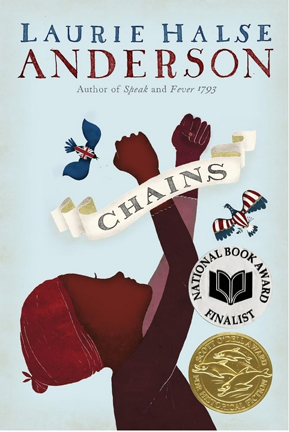
Set in New York at the time of the American Revolution, Chains spans May 27, 1776 to January 19, 1777. As the novel opens, the young teenage protagonist, Isabel, is optimistic about her future as her owner, Miss Mary Finch, has died and had let Isabel know beforehand that she and her five-year old sister Ruth would be free upon her passing. Unfortunately, no lawyer is present to produce the will that shows Miss Finch’s wishes. Mr. Robert Finch, Mary’s nephew and only surviving relative, has come to claim Isabel and Ruth and accuses Isabel of lying about the will. He proceeds to sell Isabel and her sister to Elihu and Anne Lockton from New York. The couple are Loyalists, and while Mrs. Lockton treats Ruth as a kind of pet that she shows off to friends she entertains, she treats Isabel, whom she refers to as “Sal,” in a harsh and degrading fashion, always showing her disfavor.
Isabel has two aims: to protect her sister and to gain freedom. She lives in fear that the Locktons will sell Ruth and thus separate them. At one point Mrs. Lockton provides sweets to them, something that was unusual. But she had laced them with something to make Isabel fall into a deep sleep. When Isabel awakens she learns that Mrs. Lockton has sold Ruth into slavery in the West Indies. This crushes Isabel, who is unable to escape due to constant monitoring by the Locktons.
While doing errands in town for Mrs. Lockton, Isabel meets Curzon, a teenage slave of Mr. Bellingham, a Patriot. Curzon asks Isabel if she would be willing to spy on the Locktons to get information to the Patriots. Initially Isabel refuses but then begins doing so. Mrs. Lockton finds out and punishes her by branding her cheek with an “I” for “insolence.” It takes Isabela six days to regain consciousness after the branding.
Mrs. Lockton makes Isabel care for Lady Seymour, Elihu’s aunt, who lives in town. As Isabel goes to town she is able to deliver messages about Loyalist activities to the Patriot soldiers. Lady Seymour has compassion for Isabel, treating her with kindness and feeding her well. Her house burned in the great fire of New York (September 21, 1776), and Isabel saves her as well as a portrait of her husband and some letters that were dear to her. This becomes important late in the book as Lady Seymour, then an invalid and unable to speak, gestures to Isabel that she approves of her taking coins that she had saved.
The Locktons don’t recognize Isabel as intelligent, which works to her advantage when she is in the room delivering food or waiting for orders when Mr. Lockton is talking with other Loyalists. Isabel learns of the plot to kill Gen. George Washington and shares this with Patriots who come and arrest Mr. Lockton. However, he is soon released and later escapes by hiding in a barrel of cheese. Readers learn that Ruth has not been sold to the West Indies but rather sent to Charleston, South Carolina. Isabel plots her escape for the night that people are distracted by a celebration of Queen Charlotte of Great Britain’s birthday. Though Mrs. Lockton had Isabel locked in a potato bin during the ceremonies, she manages to dig her way out, find a pass and forge papers showing she is free.
Curzon, who had fought in battle for the Patriots, was shot in the leg and held at Bridewell as a prisoner of war. Isabel is able to see him by bribing the guards with food. On the night of her escape, she goes to Bridewell and says she was sent to clean the cells where “prisoners been dropping dead like flies. Fever.” “Curzon lay insensible, his skin burning with fever, his eyes rolled up into his head. I called his name and pinched him, but he did not look my way nor speak a word.” Isabel claims Curzon is dead, loads him in a wheelbarrow and covers him with a filthy blanket. The two manage to make it to the wharf and to a boat. “I rowed that river like it was a horse delivering me from the Devil. My hands blistered, the blisters popped, they re-formed and popped again. I rowed with my hands slick with blood … The sun rose beyond the water, at the other side of the river. I was on the west bank. I was in Jersey. I had set myself free.” At this point Curzon awakes asking where they are, and Isabel replies “I think we just crossed the river Jordan.” The book ends with Isabel asking Curzon if he can walk and with an advertisement for the sequel Forge that gives the account of Isabel Gardner (formerly Sal Lockton) and companion Curzon Bellingham.
The first teaching strategy for Chains is a set of ten questions designed to guide students in a close reading and deeper study of the novel. These questions may be used as the basis of class discussions, exams or essays.
Questions for Study and Discussion for Chains 1. How do Isabel’s and Curzon’s views of freedom differ in chapter 6? Also consider whether this changes as the novel progresses. 2. What evidence exists that Mr. Lockton is conspiring against the Patriots? Trace his journey from the point that he is arrested to the last mention of him. 3. In chapter 29 Isabel speaks of being “chained between two nations.” What does this mean? 4. Isabel’s grandfather speaks to her about the river Jordan in chapter 26, and in the last paragraph of the book, Isabel states “I think we just crossed the river Jordan.” What is the significance of the river Jordan?
5. Discuss the circumstances by which Isabel secures a copy of Thomas Paine’s Common Sense in chapter 39. How does the pamphlet influence her in later chapters? 6. How does the author contrast Lady Seymour and Mrs. Lockton in chapter 41? 7. In what ways was the relationship between Isabel and Lady Seymour a reciprocal one where each benefited? Consider especially the events of chapters 31 and 44. 8. It may be said that at the time of Chains, both Isabel and America are rebellious, young, and conflicted. Explain. 9. Identify three scenes that you believe are the most important in Chains and explain why each is key to the novel. 10. The trilogy of which Chains is book one is called Seeds of America. What role do seeds play in the novel?
While these questions help to ensure close reading and provide opportunities to check for student understanding in a traditional way, the next activity engages students in a more creative, nontraditional manner as they use symbolic thinking and hands-on creativity.
Coat of Arms Overview and Instructions
A coat of arms is a visual design in the form of a shield, that goes back to Medieval days when families and communities used them to show their identity. The coat of arms includes a motto or slogan that captures the important essence of the family, nation, school, or in our case, Chains. A coat of arms can be elaborate, including features such as “supporters” (visuals on each side of the shield) and “toppers” (one or more visuals at the top such as a crest, torse, helmet, or crown).
This assignment consists of three parts: 1) Pre-writing via the writing frames for the coat of arms; 2) The visual coat of arms; 3) A paper that explains the symbols chosen in connection with the character the student chose from Chains.
Visual Coat of Arms
The slogan “Per Aspera ad Astra” is Latin for “Through hardships to the stars” which is why the top of the crest features stars. There are three stars, each with an initial, representing Isabel in the middle and Curzon and Ruth on each side. The pre-writing in Table 1 provides additional insights about the symbols and colors used in Isabel’s shield.
The White House has issued complaints about the history on display in our national museums, complaining that it is too negative, that it portrays the past as a place of hurt. Yet, I would argue that historians, those in the academic world, museum directors, and local historians have been doing their job — and doing it well.
I am a local historian in Ithaca, New York, writing mostly about the place where I live and the region that surrounds it. By listening and observing the work of others, I have learned about Rosie, a young immigrant woman who led a strike in 1913 in Auburn, New York. I have come to see H. H. Coleman as an inadvertent historian whose columns in the Colored American in the 1880s, described the social life of Black people in my town. I have learned about Juanita Breckenridge Bates who led the fight for suffrage in my town and the curious fact, that her husband, in 1917, forgot to turn over his ballot to affirm the fact that women should have the vote. I have learned about Lizzy the enslaved woman who was suddenly “disappeared” from her home in Caroline and sold in the south just as New York was passing a law in 1827 to abolish slavery in the state. I have come to know about Rev. Henry Johnson who brought the AME Zion church in Ithaca into being, but while lecturing around the state was beaten 17 times. I know that the first Jewish rabbi in Ithaca arrived in 1915 where he and his wife had a child; then moving on to Alabama his family was listed as having a child born in Ithaca — with Greece written in pencil above young David’s name, no one in Alabama knowing about Ithaca, New York.
Small things. But they tell a greater picture. That life in the past was not always a rosy place, that laborers had to strike for better working conditions, that Black people fled here and then away again because this was not far enough away from the federal marshals unleashed by the Fugitive Slave Act of 1850. I learned that local women worked hard to achieve equality in the law by sending a petition to Albany in 1878 asking that the word male be removed from the state constitution, and that petition, while registered, was then deposited in the trash and never heard of again. So, the women had to go to work again to gain equal rights.
Opening up the faults of the past does not tear down our country but rather it aids us in rising above it. It allows us to see that we can change for the better, recognize our faults, and strive to bring about a pluribus unum. The truth of the past allows us to see that problems and faults can be overcome, that there are moral truths worth fighting for, that individuals matter. It is this diversity that has been uncovered over the past 50 years that has broadened our view of the past and is displayed in museums across the land.
This country was not a place of peace and harmony but a place where individuals had to step out of line to make “good trouble” to bring about necessary change. That story needs to be told ‘lest we believe that the past was unlike the present where there are tensions and contests and inequities that need to be resolved for this be a true democracy.
Historians are doing their job. It is now up to those in power and voters to see that where there is inequity we work for fairness, where there is harm, we bring balm, where there is strife we talk to each other to make the country and the world better places.
Ever since the atomic bombings of Japanese cities in August 1945, the world has been living on borrowed time. The indications, then and since, that the development of nuclear weapons did not bode well for human survival, were clear enough. The two small atomic bombs dropped on the cities of Hiroshima and Nagasaki killed between 110,000 and 210,000 people and wounded many others, almost all of them civilians. In subsequent years, hundreds of thousands more people around the world lost their lives thanks to the radioactive fallout from nuclear weapons testing, while substantial numbers also died from the mining of uranium for the building of nuclear weapons. Most startlingly, the construction of nuclear weapons armadas against the backdrop of thousands of years of international conflict portended human extinction. Amid the escalating nuclear terror, Einstein declared: “General annihilation beckons.”
Despite the enormity of the nuclear danger, major governments, in the decades after 1945, were too committed to traditional thinking about international relations to resist the temptation to build nuclear weapons to safeguard what they considered their national security. Whatever the dangers, they concluded, military power still counted in an anarchic world. Consequently, they plunged into a nuclear arms race and, on occasion, threatened one another with nuclear war. At times, they came perilously close to it―not only during the 1962Cuban missile crisis, but during the October 1973 Arab-Israeli war and on numerous other occasions.
By contrast, much of the public found nuclear weapons and the prospect of nuclear war very unappealing. Appalled by the nuclear menace, they rallied behind organizations like the National Committee for a Sane Nuclear Policy in the United States, the Campaign for Nuclear Disarmament in Britain, and comparable groups elsewhere that pressed for nuclear arms control and disarmament measures. This popular uprising secured its first clear triumph when, in the fall of 1958, the governments of the United States, the Soviet Union, and Britain agreed to halt nuclear weapons testing as they negotiated a test ban treaty. As the movement crested, it played an important role in securing the Partial Test Ban Treaty of 1963 and a cascade of nuclear arms control measures that followed.
Even when U.S. and Soviet officials revived the nuclear arms race in the late 1970s and early 1980s, a massive public uprising halted and reversed the situation, leading to the advent of major nuclear disarmament measures. As a result, the number of nuclear weapons in the world’s arsenals plummeted from about 70,000 to about 12,240 between 1986 and 2025. At a special meeting of the UN Security Council in 2009, the leaders of the major nuclear powers called for the building of a nuclear weapons-free world.
In recent decades, however, the dwindling of the popular movement and the heightening of international conflict have led to a revival of the nuclear arms race. As three nuclear experts from the Federation of American Scientists reported last June: “Every nuclear country is improving its weapons systems, while some are growing their arsenals. Others are doing both.” The new nuclear weaponry currently being tested includes “cruise missiles that can fly for days before hitting their targets; underwater unmanned nuclear torpedoes; fast-flying maneuverable glide vehicles that can evade defenses; and nuclear weapons in space that can attack satellites or targets on Earth without warning.” The financial costs of the nuclear buildup by the nine nuclear powers (the United States, Russia, China, Britain, France, Israel, India, Pakistan, and North Korea) will be immense. The U.S. government will reportedly spend over $1.7 trillion on its nuclear “modernization.”
Furthermore, over the past decade, the governments of North Korea, the United States, and Russia have issued public threats of nuclear war. In line with its threats, the Russian government announced in late 2024 that it had lowered its threshold for using nuclear weapons. In response to these developments, the Doomsday Clock of the Bulletin of the Atomic Scientists has been set at 89 seconds to midnight, the most dangerous level in its 79-year history.
As the record of the years since 1945 indicates, the catastrophe of nuclear war can be averted. To accomplish this, however, a revival of public pressure for nuclear disarmament is essential, for otherwise governments easily slip into the traditional trap of enhancing military “strength” to cope with a conflict-ridden world―a practice that, in the nuclear age, is a recipe for disaster.
This public pressure could begin, as the Nuclear Freeze movement of the 1980s did, with a call to halt the nuclear arms race, and could continue with the demand for specific nuclear arms control and disarmament measures. But, simultaneously, the movement needs to champion the strengthening of global institutions―institutions that can provide greater international security than presently exists. The existence of these strengthened institutions―for example, a stronger United Nations―would help resolve the violent conflicts among nations that spawn arms races and would undermine lingering public and official beliefs that nuclear weapons are essential to safeguard national security.
Once the world is back on track toward nuclear disarmament, the movement could focus on its campaign for the signing and ratification of the Treaty on the Prohibition of Nuclear Weapons. This treaty, providing the framework for a nuclear weapons-free world, was adopted in 2017 by most of the world’s nations and went into force in 2021. Thus far, it has been signed by 94 nations and ratified by 73 of them.
Given recent international circumstances, none of the nuclear powers has signed it. But with widespread popular pressure and enhanced international security, they could ultimately be brought on board.
They certainly should be, for human survival depends upon ending the nuclear terror.
How Rightwing Money Tries to Shape the Teaching of American History
By Alan Singer
The Bill of Rights Institute sponsors events and provides scholarships for the annual conference of the National Council for the Social Studies. On the face of it, it seems innocuous, until you dig a little deeper. The NCSS sells sponsorships, display booths, and sessions that combined can cost a publisher or an organization almost $15,000 which it uses to cover the cost of the convention. At the 2024 NCSS National Conference in Boston, Bill of Rights Institute representatives conducted ten sessions. I have no idea what the Bill of Rights Institute actually pays, but I do know the money and their curriculum initiatives come from the rightwing Koch Foundation and its network of aligned organizations including Americans for Prosperity and the Stand Together Trust. In a 2017 interview with the conservative research group Accuracy in Academia, the President of the Bill of Rights Institute claimed it was working with “approximately one-quarter of the nation’s secondary school teachers in American history, civics, and social studies.”
Koch Industries, the second largest privately held company in the United States, is a $115 billion conglomerate that owns oil refineries and pipelines, markets oil, coal, and chemicals, wood pulp and paper. It uses the Koch Foundation and network to fund conservative causes including challenges to climate science, support for corporate tax cuts, and eliminating federal regulations and environmental controls. The Koch network channeled over $9 million to Project 2025 advisory groups. Other major financial backers of the Bill of Rights Institute include the Adolph Coors Foundation, the Lynde and Harry Bradley Foundation and the Bradley Impact Fund, and the Sarah Scaife Foundation, all donors to the Heritage Foundation for creation of Project 2025. Much of that money was channeled through and the Donors Capital Fund.
In 2014, Bill Bigelow, writing for the Zinn Education Project, accused the Koch Brothers of trying to shape social studies curriculum through their Arlington, Virginia-based Bill of Rights Institute, founded in 1999. According to Bigelow, the Bill of Rights Institute’s tactics to infiltrate social studies include presentations at conferences, essay contests for students, and free seminars for teachers on topics like “Being an American,” “Preserving the Bill of Rights,” and “Heroes and Villains: The Quest for Civic Virtue.” Bigelow argued that their curriculum material “cherry-picks the Constitution, history, and current events to hammer home its libertarian message that the owners of private property should be free to manage their wealth as they see fit.” In one lesson students learn, “The Founders considered industry and property rights critical to the happiness of society.” Of course in many cases their belief in individual property rights included the right to enslave Africans and confiscate land from North America’s indigenous population. In his review of Bill of Rights Institute curriculum and background material, Bigelow found “nothing that could help teachers show students how race and social class shaped the U.S. Constitution” and “nothing that invites students to think about the Constitution from the point of view of anyone other than the elites who drafted it,” including the new nation’s enslaved population.
I attended a regional social studies council conference where a representative from the Bill of Rights Institute made multiple presentations including one on African American participation in the American War for Independence. The lesson plan and supplementary material is available of the Bill of Rights Institute’s website (https://billofrightsinstitute.org/lessons/paths-to-freedom-african-americans-and-the-revolutionary-war). With the Trump administration’s war on museum displays and social studies curriculum that portray negative aspects of U.S. history like the brutality of chattel slavery, I think it is a good example of how the Bill of Rights Institute skews the teaching of American history in line with patriotic history as championed by Project 2025 and the Trump administration’s The 1776 Report. This lesson acknowledges slavery but emphasizes, I believe incorrectly, how the American Revolution was a significant step towards emancipation using isolated examples to support its contentions. The reality is that with the development of the cotton gin in the 1790s and the expansion of cotton production and textile manufacturing at the start of the 19th century slavery in the United States expanded exponentially.
Excerpts from a statement by the Bill of Rights Institute followed by my comments in italics.
The resistance against Great Britain and the Revolutionary War inspired American colonists to think about their natural and constitutional rights. The language and principles of liberty, equality, and self-governance led White and Black Americans to question the institution of slavery and to challenge it more directly. Their diverse efforts led to the largest emancipation in world history at that time and freed an estimated 100,000 enslaved people.
This is misleading. Neither the Declaration of Independence nor the Constitution challenged the existence of slavery in what would become the United States. A majority of the men who wrote both documents were slaveholders. A statement blaming the King of England for imposing the slave trade on British colonies was removed from the Declaration of Independence. The Constitution indirectly acknowledged the legitimacy of slavery with the three-fifth compromise and provisions for the capture and return of freedom-seekers.
Some colonists acknowledged the moral wrong of slavery while protesting British violations of their rights in the 1760s and 1770s. Pamphleteer James Otis wrote that, “The Colonists are by the law of nature free born, as indeed all men are, white or black.” Pennsylvanian Benjamin Rush wrote, “It would be useless for us to denounce the servitude to which the Parliament of Great Britain wishes to reduce us, while we continue to keep our fellow creatures in slavery just because their color is different from ours.” While some colonists addressed the contradiction of slavery and freedom, Black Americans challenged the institution.
Neither George Washington nor Thomas Jefferson freed enslaved Africans that they owned during their lifetimes. A 1773 letter written by Patrick Henry, who is remembered for declaring “Give Me Liberty Or Give Me Death,” is telling about the attitudes of white colonialists about the institution of slavery. In the letter, Henry wrote “Would any one believe that I am Master of Slaves of my own purchase! I am drawn along by ye. general inconvenience of living without them.”
Enslaved persons appealed to revolutionary ideals to argue for their natural rights. In 1773, four enslaved persons in Massachusetts petitioned the legislature for their freedom “which, as men, we have a natural right to.” The following year, a group of enslaved men presented a freedom petition claiming their natural rights and right to consent. “We have in common with all other men a natural right to our freedom without being deprived of them by our fellow men.” The legislature did not yet act upon the petitions, but Black Americans continued to petition for their freedom during the war as did Nero Brewster and 19 other enslaved individuals in New Hampshire in 1779.
The petitions were almost always unsuccessful.Only one of the original thirteen colonies, Massachusetts, outlawed slavery. Most of the enslaved Africans emancipated during the war were emancipated by the British.
Once the Revolutionary War began in 1775 at Lexington and Concord, free and enslaved Blacks joined both the patriot and British sides. Several Black patriots fought bravely at the Battle of Bunker Hill alongside White soldiers, but General George Washington forbade their service in the Continental Army that fall. However, dire manpower needs caused Washington and Congress soon to reverse that policy. The differing states had varied recruiting policies during the war: only South Carolina and Georgia prevented all Blacks from serving. A total of 5,000 free and enslaved Blacks fought for the patriot side throughout the war.
After Lord Dunmore offered freedom to any enslaved Africans who escaped to the British lines, an estimated 20,000 former slaves fought for their freedom by joining the British. The most famous of these was Titus Cornelius, Colonel Tye, who initially fought with Virginia’s Ethiopian Regiment and later led the New Jersey region’s Black Brigade.
Three Pounds Reward – Run away from the subscriber, living in Shrewsbury, in the county of Monmouth, New Jersey, a Negroe man, named Titus, but may probably change his name; he is about 21 years of age, not very black, near 6 feet high; had on a grey homespun coat, brown breeches, blue and white stockings, and took with him a wallet, drawn up at one end with a string, in which was a quantity of clothes. Whoever takes said Negroe, and secures him in any gaol, or brings him to me, shall be entitled to the above reward of Three Pounds, proc. And all reasonable charges paid by John Corlis. Nov. 8, 1775.
The British consistently encouraged enslaved persons to escape to support the British war effort and disrupt the American cause rather than out of a sincere desire for Black freedom.
During peace negotiations George Washington demanded that the British return formerly enslaved Africans including people he claimed to own as contraband. The British refused and evacuated as many as 20,000 Black Loyalists to Nova Scotia and other parts of the British empire.
During the war, General Washington’s aides, John Laurens and his friend Alexander Hamilton, developed an emancipation plan. In 1779, Congress endorsed their plan to raise a contingent of 3,000 enslaved men in South Carolina and Georgia who would be granted their freedom in exchange for military service. The legislatures of those two southern states rejected the scheme because of their opposition to emancipation and to arming enslaved persons.
In November 1775, George Washington issued an order barring both free and enslaved Black men from serving in the colonial army. In January 1776, Washington permitted the enlistment of free Black men who already were serving in the army and in 1777, all free Black men were permitted to join. Only Rhode Island offered freedom to enslaved men who joined the army. In a letter to Laurens’ father, Washington explained his fear that if the colonists did not arm enslaved Africans and offer them freedom, the British would and the war could be lost. Despite Washington’s pragmatic change of position, the plan was never implemented.
Bill of Rights Institute Guiding Questions:
How did African Americans participate in the Revolutionary War?
How did their actions reflect a desire to enjoy their natural rights?
Objectives:
Students will be able to connect actions taken by African Americans during the Revolutionary War to an understanding of natural rights of equality and justice.
Students will summarize the main ideas of historic texts.
Students will create an argument supported by evidence from primary sources. How did African Americans participate in the Revolutionary War? How did their actions reflect a desire to enjoy their natural rights?
These materials are missing from the Bill of Rights Institute’s suggested documents.
A. This charge against the King of England was removed from the original draft of the Declaration of Independence before it was signed on July 4, 1776:“He has waged cruel war against human nature itself, violating its most sacred rights of life and liberty in the persons of a distant people who never offended him, captivating and carrying them into slavery in another hemisphere, or to incur miserable death in their transportation thither . . . Determined to keep open a market where men should be bought and sold, he has suppressed every legislative attempt to prohibit or to restrain this execrable commerce.”
B. Boston King’s Escape to the British Lines (1779): “As I was at prayer one evening, I thought the Lord Heard Me, and would mercifully deliver me. [P]utting my confidence in him, about one o’clock in the morning, I went down to the river side and found the guards were either asleep or in the tavern. I instantly entered the water, but when I was a little distance from the opposite shore, I heard the sentinels disputing among themselves. One said, I am sure I saw a man cross the river. Another replied, there is no such thing. When I got a little distance from the shore I got down on my knees and thanked God for this deliver-ance. I traveled until five o’clock in the morning and then concealed myself until seven o’clock at night, when I proceeded forward thro’ brushes and marshes for fear of being discovered. When I came to the river, opposite Staten Island, I found a boat and altho it was near a whale-boat, I ventured into it and cutting the rope, I got safe over. The commanding officer, when informed of my case, gave me a passport and I proceeded to New York.”
C. Pennsylvania Gazette on April 12, 1780 reported on a Monmouth County raid led by Colonel Tye:On the 30th ult. a party of Negroes and Refugees, from the Hook, landed at Shrewsbury in order to plunder. During their excursion, a Mr. Russel, who attempted to make some resistance to their depredations, was killed, and his grandchild had five balls shot through him, but is yet living.” On September 9, 1780, Philadelphia Gazette reported: “One of these attempts (and one which very nearly proved successful) was made about the 1st of September, 1780, by a body of Refugees black and white, including among the former the mulatto leader known as “Colonel Tye.” The party made an unexpected attack on Huddy’s house, which was bravely defended by himself and a girl of about twenty years of age, named Lucretia Emmons. The house had been a station for a detachment of the militia, and fortunately the guard had left there several muskets, which the girl now loaded as rapidly as possible and handed to Huddy, who fired them successively from different windows, wounding several of the assailants and causing them to greatly overestimate the number of defenders. This caused them to shrink from further direct attack, and they then set fire to the house, which, of course, ended all hope of successful resistance on Huddy’s part, and seeing the flames beginning to spread, he, to save his house, agreed to surrender on condition that they would extinguish the fire, which terms they accepted.”
D. George Washington, while headquartered at Newburgh, New York, objected to British plans to evacuate formerly enslaved Africans as a violation of the provisional peace agreement and he sought to find and reacquire people he claimed as his own property. In an April 1783 letter to Benjamin Harrison, the Governor of Virginia, Washington wrote: “I transmitted the list of your Slaves to a Gentleman; a worthy active Man, of my acquaintance in New York and requested him to use his endeavors to obtain and forward them to you. All that can be done, I am sure he will do, but I have but little expectation that many will be recovered; several of my own are with the Enemy but I scarce ever bestowed a thought on them; they have so many doors through which they can escape from New York, that scarce any thing but an inclination to return, or voluntarily surrender of themselves will restore many to their former Masters, even supposing every disposition on the part of the Enemy to deliver them.”
E. Virginians Petition to Protect Slavery (1784):“Some men of considerable weight to wrestle from us, by an Act of the legislature, the most valuable and indispensable Article of our Property, our SLAVES by general emancipation of them. … such a scheme indeed consists very well with the principles and designs of the North, whose Finger is sufficiently visible in it. … No language can express our indignation, Contempt and Detestation of the apostate wretches. … It therefore cannot be admitted that any man had a right … to divest us of our known rights to property which are so clearly defined.”
F. Article in the New-York Packet, April 4, 1785:“It would be greatly injurous to this state if all the Negroes should be allowed the privileges of white men, unless there could be derived some possible means consistent with liberty, to separate them from white people, and prevent them from having any connection or intercourse with them . … [I]f they are emancipated on any other terms, it must be evident to the most common understanding, what will be the consequence in a short time; besides the shame we should most inevitably incur from a mixture of complexions, and their participating in government, … still greater consequence is to be dreaded, which is a total subversion of our liberties.”
G. Jupiter Hammon, poet and minister, was enslaved on Long Island. In 1786, he addressed this statement on slavery to the African population of New York State:“Now I acknowledge that liberty is a great thing, and worth seeking for, if we can get it honestly, and by our good conduct, prevail on our masters to set us free. That liberty is a great thing we may know from our own feelings, and we may likewise judge so from the conduct of the white people, in the late war. How much money has been spent, and how many lives have been lost, to defend their liberty. I must say that I have hoped that God would open their eyes, when they were so much engaged for liberty, to think of the state of the poor blacks, and to pity us. He has done it in some measure, and has raised us up many friends, for which we have reason to be thankful, and to hope in his mercy.”
H. According to the Mount Vernon library, seventeen members of the Mount Vernon enslaved population, fourteen men and three women escaped, many to a British warship anchored in the Potomac River. Hercules Posey, George Washington’s cook, and Ona Judge, Martha Washington’s personal servant successfully escaped bondage during Washington’s Presidency while the family was in Philadelphia. They fled to freedom when Washington tried to rotate them back to Virginia to avoid Pennsylvania’s emancipation laws. Posey was later sighted in New York City. Frederick Kitt, who oversaw the executive residence in Philadelphia, placed an advertisement in the Philadelphia Gazette and Daily Advertiser offering a $10 reward for Judge’s capture. In 1847, The Liberator published a letter from Reverend Benjamin Chase describing a visit with Ona Judge Staines who was now elderly where she recounted her escape. From Philadelphia Judge secured passage on a ship bound for Portsmouth, New Hampshire. A few months after arriving in Portsmouth, Judge was recognized by a friend of Martha Washington’s granddaughter and George Washington enlisted the customs collector there, a federal employee, in an unsuccessful effort to capture Judge. The runaway slave ad and The Liberator article are included on the Bill of Rights Institute web page as “Further Reading,” but not the letter from Washington to the Portsmouth Customs Collector.
I. Letter from President George Washington to Joseph Whipple, Customs Collector, Portsmouth, New Hampshire, November 28, 1796:I regret that the attempt you made to restore the girl (Oney Judge as she called herself while with us, and who, without the least provocation absconded from her Mistress) should have been attended with so little success. To enter into such a compromise, as she has suggested to you, is totally inadmissible, for reasons that must strike at first view: for however well disposed I might be to a gradual abolition, or even to an entire emancipation of that description of People (if the latter was in itself practicable at this Moment) it would neither be politic or just, to reward unfaithfulness with a premature preference; and thereby discontent, beforehand, the minds of all her fellow Servants; who by their steady adherence, are far more deserving than herself, of favor. … If she will return to her former Service, without obliging me to resort to compulsory means to effect it, her late conduct will be forgiven by her Mistress; and she will meet with the same treatment from me, that all the rest of her family (which is a very numerous one) shall receive. If she will not, you would oblige me, by pursuing such measures as are proper, to put her on board a Vessel bound either to Alexandria or the Federal City.”
James Arnett Friesen Press 384 pages, hardcover, softcover, and ebook
Reviewed by Emily Mernin
It may be hard for modern readers to imagine Manhattan as a rural island or New York City, now home to over eight million, as “a mere smudge along the shore far across the bay.” It might be difficult, too, for anyone who has travelled through New Jersey — the most tightly packed state, according to the U.S. Census Bureau — to picture it as it once was: a sparsely populated British colony of rolling hills, farmland, and small villages.
This year marks the semiquincentennial of the start of the American Revolution, the brutal eight-year war that resulted in independence from Great Britain. Much of the conflict unfolded in Philadelphia and in what are now the five boroughs of New York, plus the verdant land between the two cities: the Garden State. In his second novel, The Monmouth Manifesto, James Arnett immerses readers in this landscape as he follows two yeoman farmers who enlist to fight as Loyalists.
Arnett’s plot and characters are drawn entirely from historical accounts, all of which are refer enced in his epilogue, afterword, and appendix; he changes few names and dates. The narrative begins with Richard Lippincott in early July 1776 at a Quaker meeting house in Shrewsbury, on the “northeastern coastal plain.” Described as “even- featured, lean, and about five-foot-nine,” the thirty- one-year-old listens intently to a discussion of “the current chaotic conditions of the Province of New Jersey”— specifically the spreading power of George Washington’s Continental Army. One of the meeting’s elders rattles off James and Richard fight side by side in the Battle of Staten Island in August 1777 and become unexpectedly close, even if James is “one of those polished arrogant Anglicans” and Richard is “one of those prickly sanctimonious Dissenters.” As the years pass — and their home lives feel increasingly distant — they influence each other greatly. Despite a series of rebel advances and London’s declining interest in its restless colonies, they help each other stay loyal to the cause. In 1781, after he learns of Maggie’s death, Richard rents a room for himself and Esther in Manhattan, where most of the Loyalists in the region have taken refuge. Although charting the moral evolution of multiple characters, Arnett zeroes in especially on Richard’s slow acceptance of bloodshed, military life, and revenge.
In 1782, Richard’s eventual comfort with violence culminates in his desire to person ally execute the rebel captain Joshua “Jack” Huddy. Richard organizes the prisoner of war’s hanging without the proper orders — a dangerous decision that surprises himself, Esther, and even James (who later resettles in Nova Scotia). The unwarranted murder of Huddy enrages the Patriots. They write the Monmouth Manifesto, a document “demanding that Washington retaliate” by executing someone on the British side. The future president selects a young officer, Charles Asgill, who (as in reality) ultimately sails back to London after six months of imprisonment.
Arnett’s rendering of this dramatic event, which came to be remembered as the Asgill Affair, is suggestive of the futile desperation of the British and Loyalist forces toward the end of the war, along with the self- abandonment required to commit senseless violence. I grew up in A hillside town in Essex county, recent advancements of the rebel cause, including an attempt to establish a “so-called State” and a “Declaration of Independence from Great Britain.” He then asks a question that rings throughout the novel: “How do we pacifists withstand the demands of a violent society?”
For Arnett, the short answer seems to be that they can’t. Within weeks of this gathering, Richard abandons his 100-acre farm “with its many saltwater marshes and estuaries,” his wife, Esther, and their daughter, Maggie, to join the Skinners, a volunteer regiment forming on Staten Island. Arnett writes long, reflective passages on Richard’s internal struggle to reconcile his peace- loving religious views with his new-found commitment to serve the Crown. After a failed attempt to challenge his slave-owning bunkmate, James Moody, Richard thinks, “Maybe I’m just not cut out to be a Friend. Not everyone is ”just a few kilometres west of Newark, facing the ever- changing Manhattan skyline. When I go back to visit, I inevitably drive past the many strip malls of Galloping Hill Road (down which the British retreated during the Battle of Springfield in 1780), catch the eastbound commuter train in Morristown (where Washington’s army headquarters were located), and run along the Palisades — a thirty- two- kilometre stretch of steep cliffs — near Fort Lee (where Thomas Paine composed much of The American Crisis).
Over the last 250 years, these places, like the notion of patriotism, have changed profoundly. It is compelling to find them reimagined here, as part of a richly drawn backdrop for a book about those on “the wrong side of history” (as the cover copy reads). In revisiting this chapter of civil strife, Arnett reminds his readers how careful we must be with what enthralls, ensnares, and enrages us.
The first pages of On This Ground engage the reader in the spiritual identity of children seeking an understanding about life in the world into which they were born. It is also an eyewitness account about how Newark became ‘the worst city in America’ in the 1960s. The first pages of this book provide an historical understanding of Newark but also of cities throughout New Jersey and the United States.
The reflections on education at St. Benedict Prep have value regarding an understanding of the core values, purpose, mission, and vision of all schools. Every teacher will find lessons in the passion and dedication of the faculty who are committed to caring, serving, and teaching. By Page 21, I was reliving the movie of “Sister Act” regarding the passion of nuns serving the people of Los Angeles. Also, my memories of “Welcome Back Kotter”, “Abbot Elementary”, “School of Rock”, “Mr. Holland’s Opus”, “Stand and Deliver”, “Dead Poet’s Society”, and “Up the Down Staircase” each flashed across my mind as I began reading On This Ground! It was an amazing flashback to my own experiences as a teacher.
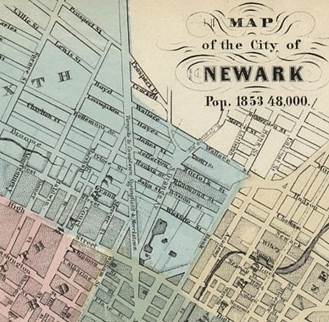
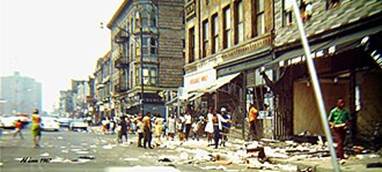
Chapter 2 is the historical account of the 1967 Newark riots. In this chapter we learn of the German immigrant population that came to Newark in the 19th century, the dominance of the beer industry, the migration in the 1920’s to Newark from the South, and the flight to the suburbs that came with interstate highways and airports. It is one of the best descriptive accounts of continuity and change over time of an American city because of its conciseness and accuracy.
The account of the riots is important for the story of St. Benedict’s Prep School but also for every resident in New Jersey to understand and synthesize. The riots left 26 people dead and 700 injured. Entire blocks were destroyed with property damage totaling $10 million or about $100 million in today’s money. Over 1,400 residents were arrested. Teenage unemployment was about 50%. The white landlords and store owners moved out of Newark to the suburbs and local taxes to fund the essential services and public schools disappeared. The pain of the “Long hot summer of 1967” continued for years. The local government had limited authority and resources, the state government formed the Lilley Commission which identified social, political, and economic issues to be the underlying causes for the riots, and the Kerner Commission led to a national conversation about race and poverty, concluding that in the United States we had two separate and unequal societies.
We walk through the halls of St. Benedict’s Prep with Anthony DePalma to the Shanley Gym where the voices of students from the past and present are heard. Everyone who reads On This Ground will discover the power of love in the culture of this school, the importance of empowering students to make decisions, and how a cohesive community unites and energizes young scholars and athletes. When teachers care and listen to their students, everyone works toward the same goal. Through situations involving cheating, vaping, and texting inappropriate messages, Anthony DePalma guides us through the steps that make a difference in the lives of students; even those who are resistant.
The stories of the hardships of students, disciplinary decisions, the integration of girls from a small Roman Catholic school in neighboring Elizabeth, helping families with limited financial resources, and prayers for healing are not unique to St. Benedict’s. The strategies of how the faculty and headmaster handled these situations is unique. St. Benedict’s connects students and teachers as a community of learners. Anthony DePalma explicitly illustrates the dedication of the educators at St. Benedict’s in an environment where teachers are ‘called’ to serve, even though their college education may not include preparation for urban schools. Other schools will find value in learning how the daily morning faculty meeting discusses the needs of students, the importance of the ‘convocation’ that gathers students together with opportunities for leadership, the overnight experience in the mountains that brings the students together, and how problem-solving includes conversations between students, parents, and administrators.
Beyond the journey through the halls and classrooms are the insights into the lives of young children facing the addictive behaviors of parents, injuries from gun wounds, foster care homes, temporary living conditions, food insecurity, and unemployment. The crisis in our schools and cities is not part of the evening news or the discussions around the dinner table, office, or places of worship. Illiteracy is a crisis in America and perhaps this book will awaken interest.
In New Jersey, 3% of high school students drop out of school by their sophomore year in high school. Source
In New Jersey, 437,000 students (26%) are receiving supplemental food daily. Source
Approximately 1/3 of students in New Jersey are living with single parents or their parents are in prison, rehabilitation, or are unemployed. Source
In New York City, 45% of the students are ‘chronically absent.’ Source
17% of third through eighth graders in the United States are chronically absent because of mental health issues. Many are from suburban homes and excellent school districts. Source
Examine the data (2023) from the Federal Reserve Bank of St. Louis below: Source
On This Ground engages readers to think about the moral and spiritual poverty that is in our country. Towards the end of the book there is an account of a freshman girl who loved to dance but had been disadvantaged in many ways. She overcame several obstacles in her persistence to establish the first cheerleading team at St. Benedict’s. It is a story of moral and spiritual strength and the power of perseverance and determination. The stories of alumni, Anthony Badger, Bob Brennan, and Leon McBurrows remind us that life is challenging because we are human and our humanity is complex.
As I am reading the words of Anthony DePalma, I am thinking of the children who are disconnected from reality. I am also thinking of the 14-year-old freshman entering high school in September 2026 who will only be age 28 in the year 2040. The message for me in On This Ground is the importance of teaching about character, kindness, self-esteem, decision-making, and personal identity. The institutions for helping children and their families with these lessons are our local schools and places of worship. The importance of teachers, clergy, custodians, crossing guards, cafeteria workers, bus drivers, coaches, are essential to connecting young people to a productive life.
America is faced with a crisis of illiteracy and the adage that schools teach reading, writing, and arithmetic is for a different time in our history. The challenges of artificial intelligence, substances, obesity, food insecurity, a warmer climate, and what we spend our money on, are overwhelming!
The story of St. Benedict’s Preparatory School provides optimism and hope. The links below are videos about the story in On This Ground.
Lesson Activity by Hank Bitten, NJCSS Executive Director
It is important for students to understand the constitutional procedures for the transfer of power in the event of the death or physical or mental incapacity of the president. The 25th amendment has been invoked three times since its ratification in 1967. Section 2 was invoked twice, and Section 3 was invoked once in 1981.
1973 Resignation of V.P. Spiro Agnew (R) when both houses approved Gerald Ford (R) as Vice-President
1974 Resignation of President Richard Nixon when V.P. Gerald Ford (R) became President and both houses approved Nelson Rockefeller (R) as Vice-President.
1981 Surgery for President Ronald Reagan following a gunshot wound.
Essential Question: Does the 25th Amendment provide a transition of presidential power from one person to another without being challenged?
Read Section 2 of the 25th Amendment and discuss the following scenarios:
Section 2
“Whenever there is a vacancy in the office of the Vice President, the President shall nominate a Vice President who shall take office upon confirmation by a majority vote of both Houses of Congress.”
Scenario A:President Trump passes unexpectedly, and Vice-President J.D. Vance becomes President under Section 1 of the 25th Amendment.
Who should President Vance nominate as the new Vice-President? (Member of Congress, Governor, Cabinet Secretary, someone from the media, business executive, etc.)
Speaker of the House Mike Johnson (Since Rep. Johnson is not able to vote for himself, the Republican majority is 219 with 218 votes required for a majority).
If Rep. Mike is not elected by the House, would the election of someone from the Democratic Party be accepted?
119th Congress, Senate (2025–2027) 51 votes needed for a majority.
119th Congress, House (2025–2027) 218 votes needed for a majority.
Majority Party: Republicans (220 seats)
Minority Party: Democrats (215 seats)
Other Parties: 2 Independents (Caucus with Democrats)
Total Seats: 435
Scenario B:President Trump passes unexpectedly between the 2026 Midterm Elections and the meeting of the new Congress on January 3, 2027.and Vice-President J.D. Vance becomes President under Section 1 of the 25th Amendment.
Who should President Vance nominate as the new Vice-President if the Democratic Party controls either the House or the Senate?
Should the current Congress (House and Senate) that was meeting at the time the Vice-President became President continue until a Vice-President was selected or should the newly elected Congress vote on the candidate?
Scenario C: Who should President Vance nominate as the new Vice-President if the Democratic Party controls both the House and the Senate?
Is there a Republican who would be acceptable to a majority of Democratic representatives in both houses?
What would happen if President Vance refused to nominate a Vice-President?
If we do not have a Vice-President and if the Speaker of the House is a Democrat but the Senate Majority Leader a Republican, should the person next in line to succession as president be the Speaker of the House as current law states or should the presidency go to the Majority Leader in the Senate who is from the same political party as the President?
Scenario D: If there is no Vice-President, would it be possible under Section 4 to declare that President Vance was unable to discharge the powers and duties of his office? (in the event of a physical, emotional, or mental incapacity.)
Section 4:
Whenever the Vice President and a majority of either the principal officers of the executive departments or of such other body as Congress may by law provide, transmit to the President pro tempore of the Senate and the Speaker of the House of Representatives their written declaration that the President is unable to discharge the powers and duties of his office, the Vice President shall immediately assume the powers and duties of the office as Acting President.
What ‘other body’ should Congress select?
If the Speaker of the House is a Democrat and the person next in line to become Acting President, could this be challenged if the Majority Leader in the Senate was a Republican (same party as President Vance)?
If a Democrat becomes Acting President, could this person fire all members of the Vance Cabinet and replace them with new officers consistent with his/her political party? (Democrat) Would this be challenged?
“In a purely legal sense, as Acting President, the Vice President can employ all the powers and tools of the office of the president. Historians have characterized the Acting President as playing “a critical role as decisionmaker,” and “tak[ing] care of the day-to-day business” of the White House. The Acting President has the constitutional authority to “move the troops, report on the State of the Union, propose a new budget, send judicial nominees to the Senate for confirmation, remove the secretary of the treasury, do virtually all the things that presidents do. He might even prepare to control his national party apparatus and to secure its presidential nomination.” (Page 44)
“Senator Bayh responded by noting that the Vice President does “not have the office of President but that of Acting President. He does not get the full powers and duties of the office of President unabated. He is Acting President.”
Setting this symbolic distinction aside, the Acting President would be constitutionally empowered to conduct the same acts as the President. In the floor debate in the Senate, for instance, Senator Bayh expressed his belief that the Vice President acting as President would be able to fire and appoint cabinet officials. When Senator Hart expressed concern that a Vice President acting as President would remove cabinet members to “consolidate[] his position” as Acting President, Senator Bayh admitted that this concern was legitimate, but declared, “we do not want a Vice President who is acting in good cause, say, for example, in a 3-year term of office, being unable to reappoint Cabinet members who may have died or resigned.” (Page 71)
Scenario 5: President Vance continually frustrates both Houses of Congress with a nomination for Vice-President.
According to the following statement from the Yale Law Reader’s Guide, could President Vance be impeached? From Yale University
“Depending on the circumstances, actions taken by the President or other officials to frustrate the Twenty-Fifth Amendment process may constitute an impeachable offense.” (page 8)
The 25th Amendment
Section 1
In case of the removal of the President from office or of his death or resignation, the Vice President shall become President.
Section 2
Whenever there is a vacancy in the office of the Vice President, the President shall nominate a Vice President who shall take office upon confirmation by a majority vote of both Houses of Congress.
Section 3
Whenever the President transmits to the President pro tempore of the Senate and the Speaker of the House of Representatives his written declaration that he is unable to discharge the powers and duties of his office, and until he transmits to them a written declaration to the contrary, such powers and duties shall be discharged by the Vice President as Acting President.
Section 4
Whenever the Vice President and a majority of either the principal officers of the executive departments or of such other body as Congress may by law provide, transmit to the President pro tempore of the Senate and the Speaker of the House of Representatives their written declaration that the President is unable to discharge the powers and duties of his office, the Vice President shall immediately assume the powers and duties of the office as Acting President.
Thereafter, when the President transmits to the President pro tempore of the Senate and the Speaker of the House of Representatives his written declaration that no inability exists, he shall resume the powers and duties of his office unless the Vice President and a majority of either the principal officers of the executive department or of such other body as Congress may by law provide, transmit within four days to the President pro tempore of the Senate and the Speaker of the House of Representatives their written declaration that the President is unable to discharge the powers and duties of his office. Thereupon Congress shall decide the issue, assembling within forty-eight hours for that purpose if not in session. If the Congress, within twenty-one days after receipt of the latter written declaration, or, if Congress is not in session, within twenty-one days after Congress is required to assemble, determines by two-thirds vote of both Houses that the President is unable to discharge the powers and duties of his office, the Vice President shall continue to discharge the same as Acting President; otherwise, the President shall resume the powers and duties of his office.
Review of Student Research for Community Change: Tools to Develop Ethical Thinking and Analytic Problem Solving
by William Tobin and Valerie Feit, 2020. Teachers College Press, 127 pages.
Review by: Thomas Hansen, Ph.D.
This new text provides an explanation of a program – and a plan – for getting high school students involved in important hands-on research right in their communities. The two authors have become experts in encouraging young people to start on research early – not waiting for college. Despite more traditional approaches of letting students wait to become upperclassmen in college, the authors learned to forge ahead and assume students could do this work.
William Tobin is a research fellow with the Kenan Institute for Ethics at Duke University. The program explained in this book is an example of the community work Tobin and his students have been doing to help their neighbors. Valerie Feit is co-director of school counseling for Rye Neck, New York schools. This program has been used successfully in three different applications at Duke.
The authors talk in terms of “tools” for coming up with research problems and questions, plans for finding out information, and guidance in making recommendations to solve the problems (pp. 23-24). I think of this book’s content in terms of methods for approaching the work. This looks like a method, with many parts, with rules, with suggestions, and with potential.
The authors provide tools for this “method” of teaching and learning they hope will be applicable in other settings. They have already had students complete research projects using this method. They use a qualitative approach, overall, in their research. However, they do not stress this fact in the book. Interviews and protocols to conduct them ground us in qualitative approaches to getting information from people to help students – and the community ultimately — solve problems.
The method connects clearly (in terms of policy and application) to national standards in the different learning areas, plus Common Core college-ready and work-ready emphases. The method looks forward to more advanced levels of inquiry than the more traditional benchmarked studies of the past. It does this by assuming students can do more advanced and challenging work if they can see the purpose for it, the rewards for it, and the connections of it to real-life goals.
While I will not give away the content and all the goods here, I will say that this appears to be a good “method” for getting students working on purposeful projects earlier than traditionally done. Aspiring to more is always good, especially if there is a research basis telling us the method can work.
As an educator (and community member, advocate, and other roles) I have always been interested in the “why” of doing things in education. Do we respect different learning styles? Where did we as teachers “learn” to do xyz in classes? Is there a good research basis for using certain materials? Has anyone ever proven it makes sense to do abc this way? All of these kinds of questions enter my mind when I look at a new approach. I wonder if this book could work in my neighborhood. With students who need resources like a place to live? In a community not very interested in helping others in need?
The authors emphasize how they have already served communities and how they need partners and cooperation. They remind us that institutions of higher education are supposed to be helping with such endeavors (p. 111). Reminding the readers that IHEs have non-profit status because they are supposed to be assisting in important research projects in the community, the authors urge readers to seek faculty who will sign on and become excited to participate.
I would recommend this book for a couple different uses. First, I would encourage K-12 and college educators read it to see what is possible if we assume students can do more and can meet challenges. The book is important in that way. Second, I would encourage educators to attempt to use some of the tools in a mini-project to ascertain the value of the method. Then, if teachers and college researchers or others can come together to formulate a bigger project, more in-depth labor can be done. Students do the work and need guidance and advice. They need to learn about ethics and the role it plays in inquiry (pp. 12-13).
This method, overall, is another good example of the more mature and advanced kinds of ways of thinking about education for secondary students and underclassmen. As I said above, there is a clear connection to getting students ready for what comes at more advanced levels.
How to use the book in times of distance-learning? How would students find neighbors interested in participating? How would they work with other students to come up with questions? What about brainstorming? Planning?
This might be a method that calls for a hybrid approach. The majority of the discussions could occur online (p. xvii) because of the power of the Internet. This could be done especially during shared times – online meetings. Different teams of students and teachers could work on different steps or themes of the research project. However, it might be necessary to be out in the community to approach potential members and to set up some of the meetings (pp. 112-113) and the interviews. The teams could conduct the remaining work online, such as the interviews, the discussion of them and other input, the drawing of conclusions from the various input sources, the writing of recommendations for intervention (or similar activities), and the follow-up and assessment stages for the entire project.
Review of Teach, Reflect, Learn: Building Your Capacity for Success in the Classroom
by Pete Hall & Alisa Simeral. Alexandria, VA: ASCD. 2015, paper, 178 pages.
Reviewed by Thomas Hansen, Ph.D.
Hall and Simeral have set forth here three major stages to helping teachers reflect on what they are doing in an effort to improve the instruction in the classroom. The authors hope to help teachers learn how to reflect on a regular basis as part of the self-assessment process in which teachers should engage. Included are lots of scenarios of teachers and their comments about why things are working—or not—in their classrooms.
As in most of my reviews, I try to not give away all the content. Here, I will list the names of the nine main chapters of the book: If You Can Read This, Thank a Teacher; Reflections on Self-Reflection; Reflective Self-Assessment Tool; The Continuum of Self-Reflection; The Unaware Stage: What Does Unaware Mean, Anyway?; The Conscious Stage: Is the Knowing-Doing Gap Real?; The Action Stage: What Happens When Art and Science Collide?; and The Refinement Stage: Smoothing Out the Rough Edges.
Having attended a Jesuit institution for my Ph.D. in Education, I will have to admit I am fully aware of reflection as a major component of the teaching-improvement process. In most all of my courses, I had to reflect on what I had said, or written, or taught, or done. It was a very interesting reminder of the reflection process many successful and hard-working good educators already use in one form or another.
Most good teachers will admit they are always trying to improve their skills, whether it is coming up with better ways to explain a phenomenon or inventing better ways to let students come to their understanding of how a process works. Good teachers probably apply it to their writing and their research and their service, also. At least that is what the literature says.
Becoming more efficient is important, and this book does have some interesting hints about looking at learning situations with different lenses. I recommend the book as a sort of self-study book, especially for teachers who want to consider some alternatives to learning about new methods or new materials. Sometimes it has to do more with looking directly at how we as individuals do our work. Once we have considered that, we can look outward.
I would recommend this text also in group settings where there are several different short paperbacks and small groups get to choose a book to discuss. The readings in this and similar shorter texts can be a good starting point for considering what it is we are doing in the classroom. Enjoyable and fruitful also are the stories of what other teachers use for methods and materials.
In a recent professional development session I worked on, several of the teachers said, “We never have enough time to talk to each other, simply about what we are doing in our classrooms.” I think this is a good message for principals and others charged with PD and other sessions for teachers. Helping them to reflect can be facilitated by books like this one by Hall and Simeral.




 njcssjournal