Lyddie the Mill Girl – An Interdisciplinary 7th Grade Unit

Lyddie the Mill Girl – An Interdisciplinary 7th Grade Unit

Natalie Casale, Dena Giacobbe, Amanda Nardo, and Jamie Thomas

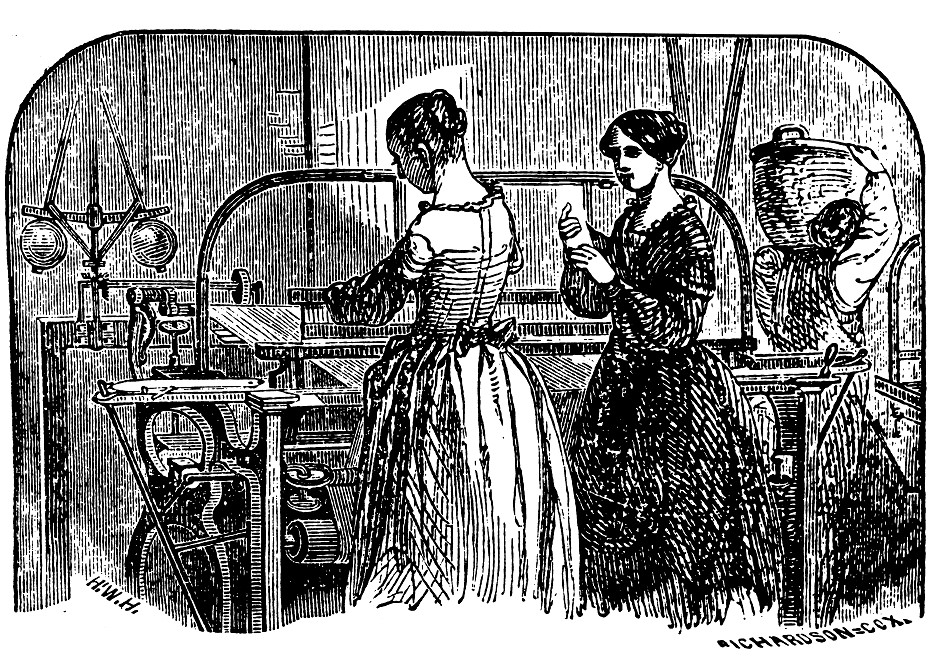
In these lessons, we will look back to the 19th century where workers were not protected and oftentimes had to work in awful conditions, like the young women who worked in the mills in Lowell, Massachusetts. These young women, known as mill girls, worked long hours and were often hurt by the machinery. If they were lucky enough to escape getting hurt by the machines, after working in the mills for a couple of years, the girls started to have respiratory health problems. The novel Lyddie is about a young girl who worked in the Lowell mills. By reading the book, the students have learned about what a typical day is like working at the mills and have read about Lyddie and her friends enduring horrible working conditions and getting hurt as a result. This lesson will explore what the conditions were like working in the mills in the 19th century. Students will examine a picture of a mill girl working the machinery and recall the effects the mills had on Lyddie and her friends. The students will then read about the Lowell mills and about one mill girl’s life, Sarah Bagley. Students will compare and contrast Lyddie and Bagley’s experiences in the mills. By the end of the lesson, the students will be able to describe what it is like to work in the mills and recommend what future mill girls should keep in mind when working in the mills. The students will be grouped homogeneously, working with partners throughout the lesson.

 (A) Sarah George Bagley

Source: https://www.nps.gov/lowe/learn/historyculture/sarah-bagley.htm
The Mill Girls of Lowell
https://www.nps.gov/lowe/learn/historyculture/the-mill-girls-of-lowell.htm

(A) Sarah George Bagley
Source: https://www.nps.gov/lowe/learn/historyculture/sarah-bagley.htm

Sarah George Bagley was born April 19, 1806 to Nathan and Rhoda Witham Bagley. Raised in rural Candia, New Hampshire, she came to the booming industrial city of Lowell in 1837 at the age of 31, where she began work as a weaver at the Hamilton Manufacturing Company. Though older than many of the Yankee women who flocked to Lowell’s mills, Bagley shared with them the shift from rural family life to the urban industrial sphere. While working in the Lowell mills, Sarah Bagley’s view of the world around her changed radically. While much of her life remains surrounded by questions, the record of Bagley’s experiences as a worker and activist in Lowell, Massachusetts, reveals a remarkable spirit. Condemned by some as a rabble rouser and enemy of social order, many have celebrated her as a woman who fought against the confines of patriarchal industrial society on behalf of all her sisters in work and struggle.

“Let no one suppose the ‘factory girls’ are without guardian. We are placed in the care of overseers who feel under moral obligation to look after our interests.” – Sarah Bagley, 1840

 “I am sick at heart when I look into the social world and see woman so willingly made a dupe to the beastly selfishness of man.” – Sarah Bagley, 1847

While many found a sense of independence in coming to the city and earning a wage for the first time, the presence of paternalistic capitalism ensured that working women would never be “without guardian;” or as Bagley would later assert, that factory women would never experience true freedom. Bagley was initially inclined to accept the prescribed order in the Spindle City—she became an excellent weaver and began to write for the Lowell Offering, a literary magazine written by mill workers but overseen and partly funded by the mill corporations. Bagley’s 1840 essay entitled “The Pleasures of Factory Work,” which argued that cotton mill labor was congenial to “pleasurable contemplation” and other noble pursuits, was representative of the positive, proper image of the mills presented in the pages of the Offering.

An 1850 illustration of the Middlesex Manufacturing Company in Lowell Stirrings of Conflict

Was it deteriorating conditions in the cotton factories or some internal shift in Sarah Bagley’s worldview that precipitated her transformation from “mill girl” to ground-breaking labor activist in the span of only a few short years? By 1840 the exploitation of Lowell mill workers was becoming increasingly apparent: the frequent speedups and constant pressure to produce more cloth drove Bagley from the weave room into the cleaner, more relenting dressing room. Here she oversaw the starching (or “dressing”) of the warp threads that constitute the framework for woven cloth.

By 1842 the pressures that Bagley had experienced as a weaver began to erupt in the form of labor conflict. In that year the Middlesex Manufacturing Company, one of Lowell’s textile giants, announced a speedup and subsequent 20% pay cut. In protest, seventy female workers walked out. All were fired and blacklisted. Lowell’s industrial capitalists made it very clear that they would not tolerate challenges to their authority, especially not by young female workers.

The walkout of 1842 did not instantly convert Sarah Bagley into a labor activist; several months after the unsuccessful strike by the Middlesex weavers, Bagley returned to weaving, this time as an employee of the Middlesex mills.

A radical change in Sarah’s own views of the world around her, however, was not far off. How exactly she became involved with the labor movement is uncertain. In 1844, the Lowell Female Labor Reform Association (LFLRA) was founded, becoming one of the earliest successful organizations of working women in the United States, with Sarah Bagley as its president. Working in cooperation with the New England Workingmen’s Association (NEWA) and spurred by a recent extension of work hours, the organizations submitted petitions totaling 2,139 names to the Massachusetts state legislature in 1845. These petitions demanded the reduction of the workday to ten hours on behalf workers’ health as well as their “intellectual, moral and religious habits.” In response, the legislature called a hearing and asked Bagley, among eight others, to testify. Despite the efforts of Bagley and her colleagues, the legislators ultimately refused to act against the powerful mills.

While advocating for the ten-hour workday and against corporate abuses remained the cornerstones of the LFLRA’s activism under Bagley’s presidency, women’s rights issues quickly assumed a prominent role as well. Speaking at the first New England Workingmen’s Association convention at a time when public speaking represented a radical departure from acceptable feminine behavior, Bagley called on male workers to exercise their right to vote on behalf of female workers who lacked political representation.

The year 1845 also saw Sarah taking on new responsibilities as a writer and editor for the Voice of Industry, founded in 1844 by the New England Workingmen’s Association. In a July Fourth speech, Bagley—just named one of the NEWA’s five new vice presidents—condemned the Lowell Offering and its editor Harriet Farley as “a mouthpiece of the corporations,” voicing a deep transformation of her own views. The ensuing public feud belied Bagley’s own praise of the mill companies published in the Offering only five years prior.

1846 was a busy year for Bagley and the Female Labor Reform Association, as she and several associates traveled throughout New England recruiting workers and organizing chapters of the FLRA and the NEWA. She also served as a delegate to numerous labor conventions and associated with a wide variety of progressives beyond the immediate labor movement, from abolitionists to prison reformers. Having left mill work in early 1846, Bagley now considered labor reform her primary calling. 1846 also saw an increase in the Lowell Female Labor Reform Association’s activities, mounting a campaign against yet another speedup and piece rate reduction, establishing a lecture series for workers, and penning pamphlets exposing the contradictions of mill owner paternalism and decrying the “ignorance, misery, and premature decay of both body and intellect” caused by mill work.

These achievements, however, were tempered by continued frustration on the ten-hour front. A second petition, this time numbering 4,500 signatures, was submitted to the legislature and rejected. Perhaps in part owing to the lack of success in attaining this goal, the Lowell Female Labor Reform Association began to shift its focus away from the militant labor activism espoused by Sarah Bagley. Around this time Bagley also came into conflict with the Voice of Industry’s new editor, John Allen, over the role of women in the newspaper’s production. In October of 1846 Bagley published her last piece in the Voice of Industry; in early 1847 she left the Female Labor Reform and Mutual Aid Society (formerly LFLRA) after three brief but influential years of radical activism.

Sarah Bagley once again defied expectations and gendered boundaries in the latter half of 1846 when she took a job as the nation’s first female telegraph operator, first in Lowell and then in Springfield, Massachusetts. Local newspapers were skeptical of both this new technology and of the ability of a woman to fill the position of telegraph depot superintendent—one paper mused, “Can a woman keep a secret?” However, Bagley proved well-suited to this work and through her example opened the new occupational field of telegraphy to women around the country.

Bagley remained employed at the telegraph depot until 1848, when Hamilton mill records show her mysteriously returning to work in the weave room for five months. Bagley had been out of the mills for two years; it must have been a melancholy return for the woman who had risen to fame as an activist against the corporations that she now for whatever reason had to rely upon once again. In September of 1848 she left Lowell to care for her sick father and never returned. At this point Bagley’s life lapses again into partial obscurity—some report that she moved to Philadelphia and worked as a social reformer before marrying and moving to upstate New York to practice homeopathic medicine. While there is some evidence to support this story, others have asserted that she in fact dropped completely from the historical record after 1848. Her date of death is unknown.

(B) The Lowell Mill Girls Go on Strike (1836)

by Harriet Hanson Robinson

Source: Harriet Hanson Robinson, Loom and Spindle or Life Among the Early Mill Girls (New York, T. Y. Crowell, 1898), 83–86. http://hti.osu.edu/sites/hti.osu.edu/files/Harriet-Robinson-account.pdf

A group of Boston capitalists built a major textile manufacturing center in Lowell, Massachusetts, in the second quarter of the 19th century. The first factories recruited women from rural New England as their labor force. These young women, far from home, lived in rows of boardinghouses adjacent to the growing number of mills. The industrial production of textiles was highly profitable, and the number of factories in Lowell and other mill towns increased. More mills led to overproduction, which led to a drop in prices and profits. Mill owners reduced wages and speeded up the pace of work. The young female operatives organized to protest these wage cuts in 1834 and 1836. Harriet Hanson Robinson was one of those factory operatives; she began work in Lowell at the age of ten, later becoming an author and advocate of women’s suffrage. In 1898 she published Loom and Spindle, a memoir of her Lowell experiences, where she recounted the strike of 1836.

One of the first strikes of cotton-factory operatives that ever took place in this country was that in Lowell, in October, 1836. When it was announced that the wages were to be cut down, great indignation was felt, and it was decided to strike, en masse. This was done. The mills were shut down, and the girls went in procession from their several corporations to the “grove” on Chapel Hill, and listened to “incendiary” speeches from early labor reformers.

One of the girls stood on a pump, and gave vent to the feelings of her companions in a neat speech, declaring that it was their duty to resist all attempts at cutting down the wages. This was the first time a woman had spoken in public in Lowell, and the event caused surprise and consternation among her audience.

Cutting down the wages was not their only grievance, nor the only cause of this strike. Hitherto the corporations had paid twenty—five cents a week towards the board of each operative, and now it was their purpose to have the girls pay the sum; and this, in addition to the cut in the wages, would make a difference of at least one dollar a week. It was estimated that as many as twelve or fifteen hundred girls turned out, and walked in procession through the streets. They had neither flags nor music, but sang songs, a favorite (but rather inappropriate) one being a parody on “I won’t be a nun.”

“Oh! isn’t it a pity, such a pretty girl as I-

Should be sent to the factory to pine away and die?

Oh ! I cannot be a slave,

I will not be a slave,

For I’m so fond of liberty

That I cannot be a slave.”

My own recollection of this first strike (or “turn out” as it was called) is very vivid. I worked in a lower room, where I had heard the proposed strike fully, if not vehemently, discussed; I had been an ardent listener to what was said against this attempt at “oppression” on the part of the corporation, and naturally I took sides with the strikers. When the day came on which the girls were to turn out, those in the upper rooms started first, and so many of them left that our mill was at once shut down. Then, when the girls in my room stood irresolute, uncertain what to do, asking each other, “Would you?” or “Shall we turn out?” and not one of them 1laving the courage to lead off, I, who began to think they would not go out, after all their talk, became impatient, and started on ahead, saying, with childish bravado, “I don’t care what you do, I am going to turn out, whether any one else does or not;‘’ and I marched out, and was followed by the others.

As I looked back at the long line that followed me, I was more proud than I have ever been since at any success I may have achieved, and more proud than I shall ever be again until my own beloved State gives to its women citizens the right of suffrage.

The agent of the corporation where I then worked took some small revenges on the supposed ringleaders; on the principle of sending the weaker to the wall, my mother was turned away from her boarding-house, that functionary saying,” Mrs. Hanson, you could not prevent the older girls from turning out, but your daughter is a child, and her you could control.”

It is hardly necessary to say that so far as results were concerned this strike did no good. The dissatisfaction of the operatives subsided, or burned itself out, and though the authorities did not accede to their demands, the majority returned to their work, and the corporation went on cutting down the wages.

And after a time, as the wages became more and more reduced, the best portion of the girls left and went to their homes, or to the other employments that were fast opening to women, until there were very few of the old guard left; and thus the status of the factory population of New England gradually became what we know it to be to-day.

Note: Harriet Robinson worked in the Lowell Mills intermittently from 1835 to 1848. She was 10 when she started at the mills and 23 when she left them to marry. Presumably, she wrote this account in the 1890s, for it was published in her Loom and Spindle; or, Life among the Early Mill Girls in 1898.

 (C) Factory Girls Described by Harriet Hanson Robinson

Source: https://www.historyisaweapon.com/defcon1/robinsonfactgirls.html

“When I look back into the factory life of fifty or sixty years ago, I do not see what is called “a class” of young men and women going to and from their daily work, like so many ants that cannot be distinguished one from another; I see them as individuals, with personalities of their own. This one has about her the atmosphere of her early home. That one is impelled by a strong and noble purpose. The other,—what she is, has been an influence for good to me and to all womankind. 

Yet they were a class of factory operatives, and were spoken of (as the same class is spoken of now) as a set of persons who earned their daily bread, whose condition was fixed, and who must continue to spin and to weave to the end of their natural existence. Nothing but this was expected of them, and they were not supposed to be capable of social or mental improvement. That they could be educated and developed into something more than work-people, was an idea that had not yet entered the public mind. So little does one class of persons really know about the thoughts and aspirations of another! It was the good fortune of these early mill-girls to teach the people of that time that this sort of labor is not degrading; that the operative is not only “capable of virtue,” but also capable of self-cultivation. 

At the time the Lowell cotton-mills were started, the factory girl was the lowest among women. In England, and in France particularly, great injustice had been done to her real character; she was represented as subjected to influences that could not fail to destroy her purity and self-respect. In the eyes of her overseer she was but a brute, slave, to be beaten, pinched, and pushed about. 

It was to overcome this prejudice that such high wages had been offered to women that they might be induced to become mill-girls, in spice of the opprobrium that still clung to this “degrading occupation.” At first only a few came; for, though tempted by the high wages to be regularly paid in “cash,” there were many who still preferred to go on working at some more genteel employment at seventy-five cents a week and their board. 

But in a short time the prejudice against the factory labor wore away, and the Lowell mills became filled with blooming and energetic New England women. They were naturally intelligent, had mother-wit, and fell easily into the ways of their new life. They soon began to associate with those who formed the community in which they had come to live, and were invited to their houses. They went to the same church, and sometimes married into some of the best families. Or if they returned to their secluded homes again, instead of being looked down upon as “factory girls” by the squire’s or lawyer’s family, they were more often welcomed as coming from the metropolis, bringing new fashions, new books, and new ideas with them. 

In 1831 Lowell was little more than a factory village. Several corporations were started, and the cotton-mills belonging to them were building. Help was in great demand; and the stories were told all over the country of the new factory town, and the high wages that were offered to all classes of work-people,—stories that reached the ears of mechanics’ and farmers’ sons, and gave new life to lonely and dependent women in distant towns and farmhouses. Into this Yankee El Dorado, these needy people began to pour by the various modes of travel known to those slow old days. The stage-coach and the canal-boat came every day, always filled with the new recruits for this army of useful people. The mechanic and machinist came, each with his home-made chest of tools, and oftentimes his wife and little ones. The widow came with her little flock of scanty housekeeping goods to open a boarding-house or variety store, and so provided a home for her fatherless children. Many farmers’ daughters came to earn money to complete their wedding outfit, or buy the bride’s share of housekeeping articles. 

Women with past histories came, to hide their griefs and their identity, and to earn an honest living in the “sweat of their brow.” Single young men came, full of hope and life, to get money for an education, or to lift the mortgage from the home-farm. Troops of young girls came by stages and baggage-wagons, men often being employed to go to other States and to Canada, to collect them at so much a head, and deliver them to the factories…. 

These country girls had queer names, which added to the singularity of their appearance. Samantha, Triphena, Plumy, Kezia, Aseneth, Elgardy, Leafy, Ruhamah, Lovey, Almaretta, Sarepta, and Flotilla were among them. 

Their dialect was also very peculiar. On the broken English and Scotch of their ancestors was ingrafted the nasal Yankee twang; so that many of them, when they had just come down, spoke a language almost unintelligible. But the severe discipline and ridicule which met them was as good as a school education, and they were soon taught the “city way of speaking”…

(D) Letter from Mary Paul to her Family (1845)

https://www.albany.edu/history/history316/MaryPaulLetters.html

“I received your letter on Thursday the 14th with much pleasure. I am well which is one comfort. My life and health are spared while others are cut off. Last Thursday one girl fell down and broke her neck which caused instant death. She was going in or coming out of the mill and slipped down it being very icy. The same day a man was killed by the [railroad] cars. Another had nearly all of his ribs broken. Another was nearly killed by falling down and having a bale of cotton fall on him. Last Tuesday we were paid. In all I had six dollars and sixty cents paid $4.68 for board. With the rest I got me a pair of rubbers and a pair of 50.cts shoes. Next payment I am to have a dollar a week beside my board. We have not had much snow the deepest being not more than 4 inches. It has been very warm for winter. Perhaps you would like something about our regulations about going in and coming out of the mill. At 5 o’clock in the morning the bell rings for the folks to get up and get breakfast. At half past six it rings for the girls to get up and at seven they are called into the mill. At half past 12 we have dinner are called back again at one and stay till half past seven. I get along very well with my work. I can doff as fast as any girl in our room. I think I shall have frames before long. The usual time allowed for learning is six months but I think I shall have frames before I have been in three as I get along so fast. I think that the factory is the best place for me and if any girl wants employment I advise them to come to Lowell. Tell Harriet that though she does not hear from me she is not forgotten. I have little time to devote to writing that I cannot write all I want to. There are half a dozen letters which I ought to write to day but I have not time. Tell Harriet I send my love to her and all of the girls. Give my love to Mrs. Clement. Tell Henry this will answer for him and you too for this time.”
Historic New York: Hudson Valley History Lessons

Historic New York: Hudson Valley History Lessons

Debra Bruno

Edited and reprinted with permission from the Washington Post magazine, July 22, 2020.

https://www.washingtonpost.com/magazine/2020/07/22/after-i-discovered-that-my-ancestors-had-enslaved-people-i-connected-with-descendant-those-who-were-enslaved/?arc404=true

I didn’t know much about my Dutch ancestry when I was growing up in New York’s Hudson Valley in the 1960s and ’70s. I thought of myself as Italian. My father was the second son of an immigrant named Pasquale Bruno, who had made his way to New York as a teenager from southern Italy’s impoverished Calabria region. Our holidays were feasts of pasta, meatballs and eggplant Parmesan. The smell of tomato sauce simmering on a Sunday is all I need to feel at home.

But of course, there is also my mother’s side. Her maiden name is Van Valkenburg. All I really knew about her ancestors was that they had helped settle New Netherland, as New York State and the surrounding territory was called in the 1600s. “Think Rip Van Winkle,” I would tell people about that part of my heritage. The Dutch side, I thought, was more white-bread plain. Yet I did wonder about those Dutch, and when the boom in companies like Ancestry turned millions of Americans into amateur genealogists, I joined the trend and started researching. I imagined I’d find a string of farmers and housewives and shopkeepers and laborers, living modest, quiet lives.

Then one day, scrolling through the Ancestry website, I came upon the 1796 last will and testament of one Isaac Collier, born in 1725 in a place called Loonenburg, which is today named Athens. That’s my hometown. And Collier is my grandmother’s maiden name. Isaac was my five-times-great-grandfather.

Isaac was thinking about his legacy. In his will, the 70-year-old carefully divided his land, working out in precise detail where his property lines extended and to which of his five surviving sons each parcel went. Then he got to other items: to his son Joel, “one other Feather Bed, one Negro Boy named Will and my sorrel mare and sorrel stallion, one wagon and harrow.” To his granddaughter Christina Spoor went a “negro wench named Marie.”

“The remains of my negro slaves male and female,” I read, were to be “equally divided” among his remaining sons and one grandson, “share and share alike.”

I sat very still. This will, written in a beautiful, sweeping script, with elegant phrases like “whenever it shall please the Almighty to take me to himself,” hit me with a gut punch. Here was a man blithely imagining his reception into heaven while painstakingly leaving this permanent record of sin.

Here, in the branches of my family tree, was incontrovertible evidence that my Dutch ancestors weren’t just innocent farmers. That I was the descendant of people who enslaved others. How could this be? Growing up in the North, I’d rarely thought about slavery, and the civil rights struggles of the 1960s seemed as distant as the moon landing. But suddenly, slavery was as real as the rolling hills beside the Hudson River that flowed past my parents’ home. Suddenly, my sense of Northern disengagement from our country’s original sin was snapped away.

As a child, I’d learned nothing about New York state’s history of slavery. I didn’t even know that there had been enslaved people in the North. We weren’t like those racist Southerners, or so we thought.

In elementary school, we took the requisite trips to places like the Bronck House in Coxsackie, built in 1663 for one of the region’s first families, from whom the Bronx gets its name. Low beams, enormous fireplaces, historians wearing colonial dress. No one mentioned slavery other than in relation to the Civil War, a war that happened elsewhere and much later in history. Northern slavery wasn’t part of our school lessons. Only since about 2016 has New York state slavery been listed as a small part of the seventh-grade social studies curriculum.

Some scholars believe that Northern slavery was deliberately whitewashed from the history books. Leslie M. Harris, a professor of history at Northwestern University and author of “In the Shadow of Slavery: African Americans in New York City, 1626-1863,” says that the idea of a free North that helped end slavery is “one of the most powerful elements of our culture.” Adding in Northern slavery “complicates what is otherwise a simple, heroic story.”

But slavery was not only a powerful institution in New York; it lasted for nearly 200 years there. Not long after colonizing New Netherland in the 1600s, Dutch settlers, needing to fill a labor shortage, began buying enslaved people from traders with the Dutch West India Company. (The Dutch also tried to enslave the Native Americans who lived nearby, but many of them escaped. They also tried using indentured servants imported from Europe, but those people also tended to die very young or run off, according to Historic Hudson Valley, an organization with a website dedicated in part to teaching about slavery in New York. Of course, it was impossible for Africans to blend in and escape in the same way.)

New York was one of the last Northern states to outlaw slavery. But instead of a sudden explosion of freedom, the state passed the Gradual Emancipation Act of 1799, which slow-rolled freedom over nearly 30 years. It was a compromise measure designed to placate the Dutch farmers reluctant to give up their property.

My roots in the mid-Hudson Valley run deep, and now I suspected that if one family in my tree enslaved people, there had to be others. So I dove in. The more I dug, the more enslavers I found in wills and census records: Hallenbeck, Vosburgh, Van Petten, Van Vechten, Conine, Brandow, Houghtaling and, yes, Bronck.

I also realized that I was not alone. Jonathan Palmer, archivist at the Vedder Research Library in Coxsackie, says that anyone with deep-enough Dutch roots in the region will eventually find enslavers. “For them to have that moment when they confront that is special for me as an archivist,” he says, “for them to stare at a mirror and realize this was the side they were on.”

Castle Garden: An Early Gateway to the United States

Castle Garden: An Early Gateway to the United States

Jenny Ashcraft

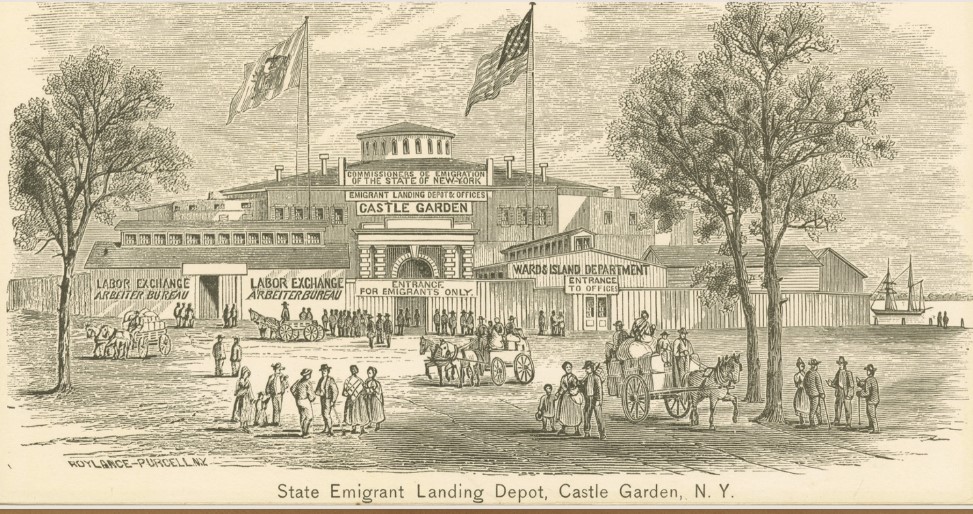
Since the founding of the United States, millions of people hoping for a brighter future left their home countries and immigrated to the United States. The number of immigrants increased dramatically after the Civil War with nearly 12 million arriving between 1870-1900. More than 70% of all immigrants entered through New York City. Castle Garden opened in 1855 as the primary immigration processing center and operated as such until Ellis Island’s opening in 1892 (though from 1890-1892, the center was moved to the U.S. Barge Office). These are some of the stories behind some of those immigrants’ arrivals.

Excerpted and adapted from an article “Before Ellis Island: Entering America Through Castle Garden, 1855-1890” by Jenny Ashcraft, https://blog.newspapers.com/before-ellis-island-entering-america-through-castle-garden-1855-1892/

Source: New York Public Library: Drawing c. 1861
1870 Currier and Ives map of Lower Manhattan. Castle Garden is the circular building on the southwest side of the island.
This brief notice, published in 1855 described the arrival experience for immigrants. They registered their names, the amount of money they carried was recorded, and were taken to a bathhouse where up to twenty-four people bathed at the same time, men and women in separate compartments.
An 1884 article in the New York World told the story of Maggie and Mary Slinsby who arrived at Castle Garden from County Tipperary in Ireland. The sisters, aged 9 and 10, traveled alone and were on their way to meet their parents in Urbana, Ohio. The children were wearing cardboard breastplates with their identification.
Prospective immigrants to the United States had to be careful about swindlers who preyed on immigrants unfamiliar with English. This 1884 clipping from the New York Tribune warns of a swindler selling fraudulent railroad tickets.

Documents A-H

A. Sisters Arrive at Castle Garden with Names Painted on Boards Attached Like Breastplates, Boston Globe, September 6, 1884: 4 (reprinted from the New York World)

“Maggie and Mary Slinsby, 9 and 10 years old, from Tipperary, Ireland. arrived at Castle Garden yesterday on the steamer Republic. They are going to their parents in Urbana, O. The most noticeable feature about them was an elaborate, heavy cardboard breast-plate on which the name of each child was neatly printed, evidently by a professional painter. The cards were attached to the body by a profusion of green ribbons. Clerk Kilroy. who took charge of the children, declared the cardboard breast-plates to be “the high – tonedest [sic] affairs he had ever seen at the Garden.”

B. Unaccompanied small children arrive at Castle Garden, The Inter Ocean, Chicago, Illinois, April 17, 1887: 6
“Among the passenger of the steamship Britannic, which arrived at Castle Garden to-day, were two children. James and Annie Morris, 9 and 11 year old. Eight years ago their parent left Ireland to seek fortune in his country. They left their children with a grandmother and recently sent for them. There was no one at the Garden to welcome too children after their long and stormy voyage. Their parents live in Cleveland, Ohio. They were at once notified by telegraph. The children will be cared for at Castle garden until their parents send money for their fare to Cleveland.

C. Three children tagged and shipped to Chicago to meet their father after arriving at Castle Garden, New York Times, August 9, 1887: 3.

“Otto Heinzman, Superintendent of the Castle Garden Landing Bureau, placed tags yesterday on Louisa Schmidt, aged 8, and her brothers, who are twins, several years younger than herself, and shipped them to their father, who resides in Chicago. They arrived at Castle Garden Saturday.”

D. A 10-year-old girl arrives at Castle Garden to reunite with her mother, Boston Globe, September 14, 1887: 4

Among the crowd of immigrants who arrived at Castle Garden today were two more remarkable than the rest. One was a woman over 80 years of age; the other a child of 10. The old woman was going to Elmira to die with her only daughter and two sons. The little girl was on her way to her mother. who is living in Webster, Mass. The two are from the same barony in county Clare, Ireland, but are wholly unknown to each other. The old woman. whose name is Margaret Collins, cannot speak a word of English; but the little girl speaks it with a fluency and vivaciousness that interested everybody in the garden. Her name is Mary Whalen. Twenty-three years ago, Mrs. Collins said, her three children, Patrick. John and Jane, left her and their father to try their fortune in America, and settled in Elmira. Herself and the old man, Pat, remained on the old sod, cultivating the little farm they had held ever since they were married, and on which their children had been born. She received a letter, she said, every Michaelmas. Christmas and Lady day from her children, bringing her money to make herself and the old man comfortable, and to pay the landlord the rent of the little patch of land. But on Lady day last year the old man died, and then she had no one in the old land on whom she could rely. Her children learned of their father’s death and insisted on her coming to this country. One of them, Mrs. Jane Costello, wife of Martin Costello, South Main street, Elmira. is herself a grandmother. As soon as the old lady arrived at Castle Garden word was sent to her children at Elmira, and a grave-looking old gentleman presented himself, stating that he wanted his mother. She was given to him, and be took her away to die amid her children, grandchildren and great grandchildren. The other immigrant was born after her father’s death, and, after being nursed for a little over four years by her mother, was left in the care of the nuns at Kilrush. in the County Clare, in which the child was born. Her mother. with her two eider children, boys, at that time immigrated hither and settled in Webster, Mass. Mrs. Whalen worked as a dressmaker and nut her two boys to the tailoring business, and will now be happy in the possession of her little daughter.”

E. “To Meet Her Lover,” The Oakes Times, Oakes, North Dakota, December 12, 1890: 5.

At 5:30 in the morning a well-dressed young woman arrived in Utica from Castle Garden. He had come all this way from a place in western Russia, and was on her way to meet her lover in Duluth, Minn., who had left her two years before to find a home for both of them in the New World. He went to Duluth and became fairly prosperous. As soon as he was able he wrote to his sweetheart and urged her to come to him, but the age and sickness of her parents kept her in Russia until this year. Both her parents having died, the young man sent her tickets to bring her to America, with what was supposed to be sufficient money for the journey. The young woman began her journey more than a month ago, and when she arrived at Castle Garden thought she must be within a few hours’ journey of her friend. She came on to Utica, as stated, and was taken to the Central depot, whence she was to proceed on her journey by another train. She waited about the depot all day, and at night in broken German told Leonard Pruey, the baggage master, that she had not had anything to eat all day, and had only twenty cents in her purse. When she had recited the whole story, and Mr. Pruey told her that instead of a few hours she would yet have several days of travel, her distress was pitiful. The kind hearted baggageman promised to do all he could for her, and began his ministrations by giving her a square meal. He then interested himself in bettering her financial condition, and told Conductor John Unser, of Rome, Watertown and Ogdensburg, about it. Mr. Unser was bound north with his train and made no promises, but early the next morning when he came to Utica again, he gave Mr. Pruey a purse of money which he had collected on his train to help the girl on her way. She finally left Utica, after a delay of about twenty-four hours, with a big bag of provisions and many good wishes.”

F. New immigrants visit bathhouse at Castle Garden, New York Times, August 4, 1855: 1.

“Next, the emigrant is shown to the baths. We join the crowd of males that flock in to the right. Here we find a large room, in the centre of which hang several coarse roller towels, and along the side is a deep trough of running Croton. This is the wash-room. Soap abounds- we hope no motives of niggardly economy will ever make it less plenty. Behind a screen that reaches across the room is the basin for bathing. A dozen or two can be accommodated in it at the same time. Indeed, every facility is granted the new corner, whatever may be his condition on entering it, to leave Castle Garden personally clean. The female bath and wash-room were the counterpart of the male, but as it was in use at the time, we consented to take the statement of our conductor and forego a personal investigation.”

G. “A Pitiful Story, If True,” Oakland Tribune, Oakland, California, January 14, 1879: 3

“An old man yesterday morning appealed to Superintendent Jackson of Castle Garden, for assistance to reach, his home in Hungary. His name is Paul Ostrich, 66 years old. He arrived at Castle Garden, he says, on the steamship Pennsylvania last March, with $500 in money, having been told by immigrant agents in Hungary that he would soon become a wealthy man in America. He was a farmer, and finally hired a few acres of ground in Washington Territory, but on account of lack of rain his crops failed, and he lost everything. He then wandered to San Francisco, and, applying to a German society, was furnished with a ticket to Omaha and $3 in money. Letters were given him by railroad agents in San Francisco to those in Omaha, asking them to help him on, but at Omaha all assistance was refused him. Ostrich then started on foot September 17th for New York, inquiring his way as he went along. With the exception of two nights, when he was entertained by German families, he slept either in the fields or barns. He walked the entire distance to New York barefooted and scantily clothed, his food consisting of bread and pork, which he was able to buy with his small pittance, and which lasted him until a few days ago. Sometimes he picked up a few apples. He could not describe the route by which he came, but remembers passing through Chicago. Upon his arrival here, his limbs were swollen and his feet blistered and sore. Dr. Villaniyi gave him food, doctored his wounds and gave him two dollars. The doctor also took him to a clergyman, who gave him a pair of shoes and a supply of clothing, and then directed him to Castle Garden.

H. A Castle Garden Romance, New York Times, October 1, 1878: 8

“A little over five years ago Michael O’Brien left his wife and four children in Tipperary and came to this country to seek his fortune. For a while he corresponded with and sent money to his family. Suddenly both letters and remittances ceased, and they heard nothing more from him until recently, when his wife received information that he had married again. She immediately resolved to seek him out, and on Wednesday last she and the children landed at Castle Garden from the Bothnia. She knew that he had worked at one time in a dyeing factory at Glenwood, NJ, near Fort Lee; so on Friday she took the boat to the latter place in the hope of tracing him. On the boat she met some persons who knew him, and when they heard her story they directed her to the factory where he was still employed. She walked up to where he was working in ignorance which must have been blissful, and quietly tapped him on the back. She says he confessed his fault with many tears and promised reformation, but she is reticent as to whether any arrangement looking towards a happy reunion was arrived at. The Castle-Garden officials are of the opinion that this is so, and that she is trying to shield him from the consequences of his bigamy and the wrath of her rival.”

Learning Through the Presidency of John F. Kennedy: How We Can Teach the Power of Television and Media

Learning Through the Presidency of John F. Kennedy: How We Can Teach the Power of Television and Media

Jon Iorio

We are living through times as Americans where television and media prove to be dominant in our everyday lives. Even more so, the media, using exposure from the television, have shown they have immeasurable power when it comes to shaping the beliefs and ideals of Americans from all corners of the country. It should be up to us as teachers to begin to include the power of media and television and content because it is hard to ignore the impact both have had on our political landscape as a country. On top of this, presidents have shown that they are more than willing to use television and media to their advantage, especially when it comes to pleasing their base. This happens in the forms of rallies, commercials, press conferences, briefings, and interviews on new channels like Fox News and CNN. I believe that, in order to teach our students about the powers of both entities, we must go back to the president who made them a part of main stream American culture. This requires us to go back and analyze the presidency of none other than John F. Kennedy.

Content in many history classes shine light on many presidents like Abraham Lincoln, the heroics of George Washington, the groundbreaking policies of the New Deal era from Franklin Delano Roosevelt, but John F. Kennedy is held to a different standard. JFK was a president the country lost too soon, that cannot be argued differently. However, he is also a president who has become a sort of mythological creature for many younger-generation Americans, deservedly so. As a man who is often remembered for that dreadful day in Dallas, Texas, I believe it is up to us as teachers to start to move towards a different narrative for Kennedy. Although it is challenging to analyze the presidency of JFK from a policy standpoint, since he just simply did not spend an ample amount of time in the White House, he should be remembered and taught in more ways that just his assassination. John F. Kennedy, through television and media, transformed the job of the presidency. He changed what it meant to be presidential because there had never been a president who had been displayed so much to the American public as Kennedy. Mary Ann Watson, a historian from the University of Michigan in her piece, “A Tour of the White House with Mrs. John F Kennedy”, echoes this sentiment, saying, “the symbiotic bond between television and the occupant of the White House was forever sealed during the Kennedy years” (Watson, 1986). We as teachers have been missing out on a key moment in American history when it comes to the analysis of John F. Kennedy’s presidency. The bond Kennedy created between himself and Americans using television explains the development we have seen play out between presidents and presidential candidates in history. It is time for students to learn about the impact he made.

            If you asked a class full of your students when the last time they saw President Trump or President-Elect Biden on their televisions at home with their families, it could be assumed that many would raise their hands. This is an important development of the presidency that has not always been a part of the job title. While it would be ignorant to say that this would not have happened if not for Kennedy and his presidency, the way he connected to Americans so effectively through the exposure from television and the media created a blue print for every presidential hopeful after him to follow. Take it from Kennedy himself, who said in an address as a senator about the impacts of television on politics, “but for better or worse-and I side with those who feel its net effect can be definitely be for the better, the impact of TV on politics is tremendous” (Kennedy, 1959). Kennedy and the television boom the country experienced throughout the 1960’s created a perfect storm. It effectively begun the relationship we are all so familiar with having with our president or presidential nominee every four years.

            The media in 2020 has seemingly unlimited access to presidents and nominees in the climate we find ourselves in. While this has created a transparency between presidents and citizens, it has also allowed for a dangerous dynamic to be created. Something that is often forgot about Kennedy and his relationship with the media is hypnosis he put many of them under during his time in office. Alice George, author of Awaiting Armageddon, said that, “Kennedy was too responsive to journalist’s opinions, and because he made journalists feel important, they became too susceptible to his charms” (George, 2003, p. 88). It could be said the relationship Kennedy and the press had together became toxic for the well-being of America. Kennedy greatly impacted what they told the American people, which created a lack of transparency for the administration. We have seen this playout with many presidents who succeeded Kennedy.

The current political climate when it comes to media coverage is dangerously partisan, and it seems to be getting worse, not better. Kennedy was insecure at times when it came to what the media was saying about him because he knew his image he had with many Americans was something he could not lose hold of. In Joseph P. Berry Jr.’s book, John F. Kennedy and the Media, he wrote, “despite Kennedy’s cooperation with the media, they sometimes wrote or aired reports with which he disagreed; he would then contact the source to let them know of his displeasure and to seek corrections.” And conversely, “whenever Kennedy read a favorable article about himself, he would not only tell the writer, but would then from memory quote direct phases” (Berry, 2002, p. 59). This type of relationship Kennedy had with the media has become more apparent for presidents in office today. Just in this administration alone, we have seen President Trump call every article or claim from the media he does not like “fake news”, while he will praise a Fox News piece that sheds any type of positive light on himself. This has created a dynamic around the office of the presidency where we cannot take everything we hear from the person in office as fact. This is a dangerous precedent, and one America must get off the path of. Our students must know that this has become a part of the presidency when it comes to trusting what they hear from the media. If they don’t, the political climate will become even more partisan because the younger generation will continuously support the channels and news outlets who are either trying to please or undermine the man in office.

Kennedy and the way he transformed the presidency by use of television and media fundamentally changed what it meant to be President of the United States. Every president after Kennedy has had to juggle both the exposure from television as well as intense scrutiny and judgment from the media. Presidents have dealt with it differently, we have seen some fail like Nixon, and some prosper like Reagan. Students must know about the way Kennedy impacted the presidency by shifting the presidency to a man Americans rarely saw to a man who was a part of their lives. Presidents today have a place in millions of homes across America through television and media exposure, it is time students realize the impact President John F. Kennedy had on this monumental change.

References

Berry, J.P. (2002).  John F. Kennedy and the media: The first television president. Auburn, NY: Legend Books.

George, A.L. (2003). Awaiting Armageddon: How Americans faced the Cuban Missile Crisis. Chapel Hill: University of North Carolina Press.

Kennedy, J.F. (1959). “A Force That Has Changed the Political Scene.” Retrieved from https://www.museum.tv/debateweb/html/equalizer/print/tvguide_jfkforce.htm?

Watson, M.A. (1986). A tour of the White House with Mrs. John F. Kennedy: An international special event. Retrieved from https://archive.org/stream/ERIC_ED295564/ERIC_ED295564_djvu.txt

Neither Here Nor There, So Where Shall I Go?

Neither Here Nor There, So Where Shall I Go?

Michael Gil

The individual care of a group or communities is often the best way to assimilate different demographics within home, school, or other places of safety and inclusion. One day Alicia Hsu, a teacher, was talking to her class about the circumstances of Rosa Parks’ epic stand against discrimination and asked if they were in her situation, what they would do? The children responded in their native dialect and answered, “I would move” (Hsu, 1995, p. 240). To which Mrs. Hsu asks gasping, “You would?  But why?”… “Because,” Tang mumbled, “we do not belong. It is their home. It is their train” (Hsu, 1995, p. 240.  To that effect Hsu wanted to know what went wrong and how she failed to inspire in them the belief that they have a place in a nation of immigrants, a nation to which they belonged for it was their home as well. During the 1800s to 1900s, Chinese immigrants were all but assimilated and cared for equally by their fellow man. As the racial tensions began to stir, many American legislators and policy makers view that the Chinese national character was inferior to that of the white men. This began to affect the children of Chinese immigrants in their ability to assimilate into American society. The primary factors that led to long lasting and profound discrimination against Chinese and Chinese Americans were violence, racial legislation, belief in a superior race, and economic instability. To which the children of Chinese immigrants never saw themselves as Americans as they were constantly reminded of the white man’s world and they are not white men but children from an “alien” race.

Within the field of social studies it is important to understand subjects of sensitivity, particular in areas examining discrimination. Students want and desire to be educated based on the historical content and context of particular stories within American history that concern their own demographic in order to understand their own history and identify with it. Teachers in association are to deliver that content and express the ideas of the time and explain the significance of that very event. For it is within those very explanations and examples given by the instructor that a student readily intakes the subject matter and applies it to social gathers to see if that very old version of history within the U.S still holds true. If not then they are ready to identify signs of unequal treatment as they were informed based on how previously America held very different ideas on how immigrants should be treated. Within this very article seeks to demonstrate and inform instructors on the topic of Anti-Chinese sentiments that led to events such as the Chinese Exclusion Law, violence against Chinese Americans, and developing stereotypes that may continue today within modern American communities (Chung, 2018). The Chinese Exclusion law was used to deny entry to certain status types of Chinese immigrants but soon began to prevent all Chinese immigrants from coming into the United States either as skilled or unskilled laborers (Chinese Exclusion Act, 2009). Americans thought that Chinese immigrants would degrade morale in American communities with opium and gambling while stealing American jobs. The significance of the Chinese Exclusion law was that it allowed anti-Chinese Americans to brand Chinese immigrant families as deviants and pests in the American quality of life. Which prompted many Americans to confront the threat of the so-called new Chinese menace, by any means, to what was seen as an endangerment of their own communities. In relation one of the primary means to discriminate against Chinese immigrants that American citizens used was violence and political interference. These Americans were dubbed Anti-Chinese and used violence and other means to enforce fear in Chinese communities. Americans felt that Chinese immigrants were unsuited for American citizenship to participate in the American way of life. They saw Chinese Americana’s unworthy or unable to positively contribute to American communities and are only capable of stealing from it. The effects of how the treatment of Chinese Americans and the future generations onward demonstrate a change in attitudes in anti-Chinese immigration, thus prompting an essential question. What were the primary factors that led to having a profound impact of discriminatory practices against Chinese Americans and what did the children of those immigrants see themselves as within American culture?

The study of Chinese exclusion from American communities ranges from violence, discrimination, stereotyping, and lack of assimilation for the children of those very immigrants. In the work of Sue Fawn Chung, Chinese Exclusion, the First Bureau of Immigration, and the 1905 Special Chinese Census: Registered, Counted, Arrested, Deported–1892-1906,  she depicts and analyzes the history of the Chinese Exclusion law with the inclusion of the Bureau of Immigration. The Bureau of Immigration primary focus was to find Chinese immigrants with improper documentation and detain them. Chung approaches the topic of Chinese exclusion by gathering evidence in accordance with the United States program created in the 1895 called BI which their primary purpose was to control immigrants, especially Chinese (Chung, 2018). Chung details that due to the BI’s realm of control at the time and enforcement powers involved regulations involved in completely sanctioned naked body search of Chinese immigrants despite knowing that in Chinese culture it was extremely offensive. Chung later argues that the new Chinese Census was an important part of the efforts for the BI to regulate further Chinese immigrants for political and economic reasons (Chung, 2018). That later created an atmosphere of fear as many Chinese immigrants view those very procedures made by the BI and Chinese Census were racially motivated. Finally, the main argument of Sun Fawn Chung was that Chinese immigrants were experiencing massive political struggle as anti-Chinese movements sought to protect American democracy in a nation full of immigrants from the seen Chinese menace.

The place of labor and economic fortune within America is seen by many as a market built and used by the American people. However, in Eddie L. Wong’s, Racial Reconstruction : Black Inclusion, Chinese Exclusion, and the Fictions of Citizenship, he details how planters looked to China as a source for workers and importing them to the United states became known as “coolieism”, they were paid at a lower wage rate then white workers. Wong approaches his historical analysis by using source material from “Senate floor debates to Supreme Court test cases brought by Chinese activists, public anxieties over major shifts in the U.S. industrial landscape and class relations became displaced onto the figure of the Chinese labor immigrant who struggled for inclusion at a time when black freedmen were fighting to redefine citizenship” (Wong, 2015). That very source material helps Wong demonstrate a correlation towards immigration and citizenship troubles in the shadow of Reconstruction. For in the wake of racial exclusion, Wong states “post-emancipation deemed Native and Chinese Americans as unredeemable heathens and morally unfit to participate in America’s manifest Destiny” (Wong, 2015). This philosophy or declaration, directly decides that Chinese Americans are not only a hazard to American communities but unfit to partake in the greater picture in how America will spread itself across the continent. Meaning at the time, minority groups such as Chinese Americans have no desirable historical contribution worthy of note within the grand scheme of how the country will continue to grow and succeed. Thus, removing later generations of Chinese Americans to have any sort of assimilation to look to in order to see themselves as an American, as their culture was denied any sort of worthy contribution to the American way of life. 

The treatment and racial discrimination of Chinese Americans are apparent within American society during the 1800s to 1900s. For during the so called invasion of the coolies was also when the very same Chinese Americans were experiencing discrimination from the American people and legislation out of stereotypical fears and potential lose in American jobs. As the racial tensions began to stir, many American legislators and policy makers viewed that the Chinese national character was inferior to the white man. This began soon to affect the children of Chinese immigrants in their ability to assimilate into American society. The primary factors that led to long lasting and profound effects in discriminatory factors for Chinese Americans were violence, racial legislation, belief in a superior race, and economic instability. To which the children of Chinese immigrants never saw themselves as Americans as they were constantly reminded of the white man’s world and they are not white men but children from an “alien” race.

Nothing further increases the reality of political belief than the law itself to institute and enforce legislation. In the year of 1882 Congress passed a series of laws to exclude Chinese laborers from entering the United States (Meade, 2017, p. 293). Those very series of laws prompted the famous law that barred a single demographic for a century within the United States. The case itself is known as Chae Chan Ping vs. The United States, given the title “Chinese Exclusion” by Justice Stephen Field. The court’s power to regulate immigration to the U.S provided the parameters over a controversial legal debate. During this time in the early 1880s many Americans were clamoring for a sort of theoretical Chinese wall where there would be more guards stationed across major immigration ports and create a new administration to enforce this theoretical Chinese wall in light of the Chinese exclusion law. In relation to this, much of the controversy again stemmed from the association of the loss of jobs within American due to Chinese immigrants taking those very jobs. In terms of how the white laborer can combat this was seen as impossible, “if he would attempt competition with the coolie, and will always be driven from his presence, as cheap currency displaces the better for while it is true that wages are relatively highest on the Pacific Coast, the coolie reduces wages and competes everywhere.” and “White labor will not submit to the degradation of a rivalry with such a competitor, but will either assert its power through the government or be driven from the presence of the coolie altogether” (Meade, 2017). The competition between the two groups was seen as an impossible competition as some employers believed in natural rights to which the employer can choose whomever to engage while hiring including immigrants. Which further increases the case’s importance in and causes discrimination and witch hunting among American citizens to Chinese immigrants.

The identity of a foreign entity brings with them a blank slate of which its only purpose is to be filled with some sort of applicable standard over what they are. In the case of the Chinese immigrants, they were given racial inequality and were branded as pests within their new found American communities. What prompted the legal racial inequality was the Chinese Exclusion Act of 1882, as those of Asian descent were the first to be barred from entering the United States and prevented them from gaining citizenship. The regulations towards the arrival of Chinese immigrants were those seeking skilled or unskilled labor under the fear of Chinese immigrants infecting the good order of certain localities within the United States. Within the original piece of legal material of the Chinese Exclusion Law states “Be it enacted by the Senate and House of Representatives of the United States of America in Congress assembled, …… coming of Chinese laborers to the United States be, and the same is hereby, suspended; and during such suspension it shall not be lawful for any Chinese laborer to come, or, having so come after the expiration of said ninety days, to remain within the United States” (Chinese Exclusion Act, 2009). With the outlook of Chinese laborers as poor contributors to American communities and immigrants “stealing” the jobs of deserving Americans, many politicians rode the wave of Chinese exclusion by using 15 sections of Anti-Chinese legislation. By banning the Chinese laborers during the crisis of economic instability, being able to obtain a job lead to one of the primary factors in discriminatory ideas against Chinese Americans.

However, despite supposedly higher job opportunities many Chinese workers and Chinese Americans felt out of place and felt that they were not getting the opportunities they deserve just because they are Chinese. The story of Lawrence Klindt Kentwell, follows a Eurasian of English and Chinese descent who spent his formative years in Hawaii studying to be a lawyer. However due to his Chinese blood, he was excluded from local politics in Hawaii and thus did not have a single chance at entering the legal profession in the United States. The racism he experienced when trying to obtain his natural rights in the United States only made him strongly identify with his Chinese roots, leading him to leave his adopted home in America for good and go to China (Chen, 2019). Due to lack of equal treatment Kentwell felt that it was best to travel back where his roots came from in order to escape unequal treatment and seek better opportunity.  Many Americans saw Chinese people as an inferior group was due to three main reasons such degradation of social standards, habits of filth, and the wage rate. Those very two factors affect social dynamics in American communities as the spreading stereotypes of Chinese immigrants began to warrant them unwanted discrimination and violence. Americans fought back against what they saw as the rise of Chinese immigration to be an invading army that was stealing the resources that they deserve as Americans. In relation to the idea of social standards the overall quality of American living within condensed neighborhoods were given the idea that the Chinese demoralize social instincts and customs. In short, Chinese immigrants would be “inveterate gamblers, opium smokers, bring no families with them, and have reduced prostitution to a system. ……. the Chinese immigrant gambles & deadens his sensibilities by smoking his opium.” (Atchinson, 1894, p. 141).  Those very ideas of foreign born being attributed to America are seen as Anglo-Saxon traditions and continue to still affect it when dealing with attitudes towards immigration from the 1800s and 1900s. For within the Anglo-Saxon tradition sees itself as manifest child of destiny which has been encouraged thought American politics as they accept original various immigrants into their nation Also, shows a key correlation in Chinese American’s, in the face of racial discrimination and legislation, do not feel as if they are American as violence and discriminatory comments are against them. As the legislation and social attitudes change show from the 1800s to 1900s so does how Chinese Americans continue to see themselves.

Chinese Americans had lacked opportunities that were essential to their American way of living. The ability to assimilate into American culture was never properly given to them from the late 1800s to 1900s as many Chinese descendants felt they were alienated within the very nation they were born in. The history of violence, economic instability, discrimination, and alienation drove Chinese American descent and Chinese immigrants to experience hardships that they would not experience otherwise. For the usage of the Chinese Exclusion Act, the denial of civil rights, racism, and stereotyping prompted many Americans to see Chinese immigrants as a pest. Thus undeserving of the American privileges which prompted a few Chinese Americans to shut themselves out of the American way of life as only “true Americans” can experience America or life in the United States altogether. For during the so called invasion of the “coolies” was also when the very same Chinese Americans were experiencing discrimination from the American people and legislation out of stereotypical fears and potential lose in American jobs. Jobs were being rapidly taken by Chinese workers for less pay, thus prompting Americans to view that the Chinese were stealing their jobs. The primary factors that led to long lasting and profound effects in discriminatory factors  for  Chinese  Americans  were  violence,  racial  legislation,  belief  in  a  superior  race, and economic instability. To which the children of Chinese immigrants  never  saw  themselves  as  Americans  as  they  were constantly reminded of the white man’s world and they are not white men but children from an “alien” race. These feelings of lesser worth with the context of historically demographic treatment can leave an impact on a child who is discovering that his or her idea of the world is not all inspiring. Instead, they may see it as a battle for potentially, that someday, discrimination will perhaps resurface if the rights conditions are met. For the instructor’s role within teaching the subject, they must inform students how in certain parts of history there are terrible things that yet to be fully extinguished in our modern society. As such elements of discrimination has yet to leave world and instructors must inform students on that history in order to prevent and bring awareness to discrimination within and outside the classroom.

References 

Atchinson, R.M. (1894). Perils of unrestricted immigration. Retrieved from https://athena.rider.edu:2065/ehost/detail/detail?vid=0&sid=8e8de26b-f1ed-4f46-99e8-cf078e746178%40sdc-v-sessmgr01&bdata=JnNpdGU9ZWhvc3QtbGl2ZSZzY29wZT1zaXRl#AN=21213317&db=fth Chen, L. (2019). A mixed-race child’s fate under the Chinese Exclusion Act: Lawrence Kentwell’s fight for inclusion in local politics and legal profession. Asian Pacific American Law Journal, 23(1), 1–17.

Chinese Exclusion Act. (2009). Chinese exclusion act of 1882. Retrieved from https://athena.rider.edu:2063/login.aspx?direct=true&db=mth&AN=21212613&site=ehost-live&scope=site.

Chung, S. F. (2018). Chinese exclusion, the first bureau of immigration, and the 1905 special Chinese census: Registered, counted, arrested, deported, 1892-1906. Chinese America: History and Perspectives. Retrieved from https://go.gale.com/ps/anonymous?id=GALE%7CA581024572&sid=googleScholar&v=2.1&it=r&linkaccess=abs&issn=10517642&p=AONE&sw=w

Hsu, A. (1995). It’s our train. Horn Book Magazine, 71(2), 240–246.

Meade, E. (2017). Chinese immigration to the United States, 293. Retrieved from https://athena.rider.edu:2063/login.aspx?direct=true&db=prh&AN=21213081&site=ehost-live&scope=site.

Wong, E.L. (2015). Racial Reconstruction : Black inclusion, Chinese exclusion, and the fictions of citizenship. NYU Press.

World War II’s Technological Advancements in Aerial Warfare

World War II’s Technological Advancements in Aerial Warfare

Brianna Hatzold

A significant battle that played an enormous role in World War II that incorporated air crafts was the Allied invasion of mainland Europe at Normandy Beach in France, Operation Overload. This epic invasion was a very crucial climatic battle of World War II. The invasion of Normandy which is commonly referred to as D-Day consisted of a series of complex operations that dealt over several of days. This operation’s goal was to defend the beaches of Normandy heavily and to establish a foothold on the European continent. The first step of the operation was the landing which would prove a grueling march to the city of Berlin to attack the Nazi regime. It is an understating to even try and describe the gigantic role the Allied air forces played in the invasion. Without the assistance provided from the Allied air force the operation could not have happened. The Allied air force, with the contribution of Allied fighter planes, transports, bombers, reconnaissance planes and troop carriers made the events on D-Day possible. In the D-Day operation approximately 13,000 Allied aircrafts participated. D-Day marks one of the largest aerial operations in history. This precedent action was a learning experience that further developed the understanding of how aircrafts can operate as well as how they would interact. Operation D-Day was a very critical and complex mission that commanders understood and accepted the fact that there will be great losses in order to have a control over a beachhead. During this there was a low pressure weather system in England and the coast of France. With the low weather in these areas it then resulted in much confusion when airplanes departed from their bases in England. On top of that, the ceilings forced drop planes to fly at much lower altitudes then what was planned. Then there was also a troubling overcast layer that made it difficult for bombers to targets. Some airplanes even crashed into one another or went missing. 

June 6, 1944 the operation commenced in the dark early-morning. This complex mission was a surprise to Germany. German commanders believed that the weather was poor conditions for the Allied powers to initiate an attack. The aerial operation had several phases in which immensely contributed to the success of the invasion. The first phase consisted of an aerial bombardment on the German emplacements, artillery and supply lines, that were on the beach of Normandy. In this first phase, it used heavy bombers and attack planes. Aircrafts such as the British Lancaster, American B-17 Flying Fortress and the Hawker Typhoons were in action to breakdown the enemy’s defenses. Allied commanders were hopeful that the bombings would neutralize the enemy’s defenses. However, it did not. German forces seemed to be still intact and feared of.

Hundreds of American C-47s were also at this scene. Acting as a supply plane the C-47 was capable to hold up to 6,000 pounds of cargo on their journey bearing a fully assembled vehicle or even a 37-mm cannon. When acting as a troop transporter it can hold 28 soldiers that are fully geared. If it was acting as a medical airlift it had the capacity to hold up to 14 stretcher patients as well as three nurses. According to Allied Supreme Commander Dwight D. Eisenhower, the C-47 was the most important piece of equipment. These aircrafts took off from a base that was located in central England which was approximately two hours flying time away from Normandy. Joe Crouch and his pathfinders were the first Americans to reach the outskirts of France in the early hours on the day of June 6, 1944. Him and his men took off it the darkness around 9:50 p.m. on June 5th. Joe Crouch’s small fleet of armless C-47s began to depart, leaving England in five-minute intervals. His fleets C-47s carried up to 200 paratroopers from the 101st Airborne, the first pathfinders that played a role in the invasion. The pathfinders’ duties were to mark drop zones behind the beaches of Normandy by placing lights and radar beacons.

 Once in the air, the American C-47s then congregated into several V-formations. Each plane held more than a dozen paratroopers. In the morning of D-Day there were hundreds of planes that transported more than 13,000 paratroopers beyond the beach, encroaching on occupied France. The paratroopers were airborne fighters that would leap from these aircrafts into occupied France to cut off the Germans from behind. With the low weather in England and in France in the early morning, it made the airborne operation impossible to run swiftly like planned. About two-thirds of the courageous paratroopers landed way off of the ideal jump zone destinations. With the paratroopers being displaced all over France in incorrect areas it led to great chaos. As Allied soldiers desperately tried to regroup their troops, they encountered the Germans then resulting in a series of guerilla skirmishes.

During the invasion of Normandy, the Waco-CG Hadrian played an enormous role in the war effort. This aircraft did a fantastic job moving in troops and supplies onto the beaches. the Waco-CG Hadrian landed thousands of allied soldiers behind enemy lines with guns and equipment. It even was capable of carrying a Jeep or Howitzer into the war scene. This aircraft was easy to make and not costly to construct. Another wave of support came to troops hours later in gliders. The gliders arrived pre-dawn hours due to when the airborne troops. They went during that time because the airborne men could not wait incredibly long to resupply its troops with equipment as well as fighting off the Germans. This brought a mass amount of difficulty though due to landing at night. There were numerous variables that fliers could have faced. For instance: landing in an occupied territory, landing into fields that held defensive features, other problematic geography landscapes, anti-glider poles, ditches, and so on. Pilots reported that it was extremely difficult to see and that often times they were not able to see until their craft had touched ground. Many of the gliders crashed with fatalities. Despite the problematic situations these soldiers faced, the glider invasion was highly successful. The gliders were able to hold around 15 troops or to transport heavy equipment. Horsa gliders were larger than the Waco Gliders and could carry up to 30 troops.

The great contribution from C-47s as well as the Waco-CG Hadrian allowed the Allied forces to come out on top and to have a gateway into the European theater. D-Day is one of the most famous and the most significant battles that occurred in World War II. Without the reinforcement from aircrafts by supplying soldiers and equipment, then D-Day would not have been possible. Air crafts did far more for the war effort than one may think. Through air crafts, especially in this battle, they totally transformed the war and open the door to “how” to incorporate air crafts.

How Do We Teach Politics in a Society Where Political Affiliations Have Become Toxic?

How Do We Teach Politics in a Society Where Political Affiliations Have Become Toxic?

Nick Zolkiwsky

Throughout my time as a student from kindergarten up until the eighth grade, politics and government were never taught in my classes. To which I was not at all surprised, after all how do you teach a second grader the difference between a conservative and a liberal when they should be learning how to construct paragraphs and learn how to use a keyboard? Let alone how do you get them interested in such a topic? Even more importantly, how do we get them interested in the topic and teach them to respect others who may hold different political views?

The first time I can vividly recall politics being taught in my class was when I was in fourth grade and we were fastly approaching the 2008 Presidential election. During those short and brief lessons, my teachers did not tell us where Senators McCain or Obama sided on certain issues or even a basic background of the parties they were affiliated with. Instead, we were all taught to like Obama because he was younger and was the more “favorable” candidate among teachers at my elementary school. The same situation occurred four years later when I was in eighth grade and the 2012 election was approaching. To which I was genuinely surprised because at this point we were all teenagers and had a better understanding of how the world works compared to when we were still in grade school, at least I thought I did. However, it wasn’t until the 2016 election that my teachers actually began talking about the issues that Americans would be voting for and where Donald Trump and former Secretary of State Hillary Clinton stood. While for the first time we were having open discussions about beliefs and the two major parties it was undoubtedly one of the most toxic environments one could have ever imagined. Instead of listening to each other oftentimes I would find classmates getting into heated arguments, which were then followed by one person attacking the personal character of the other. Even as a 17 year old I knew this was no way to hold political discussions. Where was the respect? Where were the listening skills? And most importantly, where was the maturity? The answer, nowhere to be found. So the question is, how do we, as teachers, teach and create a healthy environment where students can learn and discuss politics when we live in a society that becomes toxic when these discussions arise?

To say 2020 has been one of the most unpredictable years in recent memory would be an understatement. It’s been a 12 month period where every 30 days or so we are met with another apocalyptic type event: first it was wildfires, then a pandemic, then heightened racial issues, and to make it all the more fun we threw in a Presidential election into the mix. According to an article from “weareteachers.com” there are easy steps to teaching politics within the classroom in the current climate that we live in. The first step that the article suggests is to discuss biases and “fake news” within the American mainstream media. This is a perfect starting point as understanding biases will better help all students fully understand the concepts of politics and how different media outlets portray a candidate/policy than a rivaling network. This also opens up the door to teach students the importance of fact-checking and doing their own research, which in the past few years has become so much more important than ever. Unfortunately, due to the easy access to media and the increasing influence of social media, individuals will typically see a picture or a meme on Twitter or Instagram and assume it to be true. Not only will they outright believe it but they won’t even go through the effort of reading up on the issue or using that additional information to form their own opinion.

The next three steps that the article discusses are more so related to notifying parents that you are about to discuss politics within the class. As many social studies teachers know, politics is a very touchy subject to teach about, and as many teachers in general know, parents sometimes are not afraid to tell you how they really feel about you teaching a particular subject. What this step aims to do is to notify the parents before the lesson is taught and lay out for them how the subject will be delivered to the students. By doing so, not only will the parents be as caught up as their students are but, it better prepares them to answer those difficult questions that their children may ask at the dinner table or in some cases, provide clarification and context to when a student tells their parents what they did in school that day. In addition to notifying parents about the upcoming lessons on politics and how you intend on delivering the information, it is a good idea to also encourage parents to talk about politics with their students at home. This is done so not only will the students have a better understanding of what they are getting into and about to learn, but it will also help them start to relate to certain focal points and issues that personally matter to them and their family.

Lastly, once the day has arrived to start teaching about politics in your classroom there are a few ground rules that you should establish right off the bat. The first rule, and quite possibly the most important rule, is to ensure that your students will show respect and remain respectful during the lesson. The way I like to think of it is, respectful ears are ears that are open to hearing the voices of others without judgment. The next rule is more geared towards you as the teacher and that is to remain neutral on the subject matter. While it is oftentimes difficult to remain neutral on certain topics, you have to understand that some of your students might have little to no understanding of the issues that you are about to discuss. Rather than giving them a biased opinion, which they have learned about at this point, you are giving them a non-partisan view and allowing them to make their own opinions on the topic. The third and final rule is to make sure that the students know that their opinions are their own opinions and they have the right to have them. This can be very empowering for students, especially those in High School who now find themselves in the “young adult” category. By having their own free-formed opinions this helps them establish a sense of identity as to who they are and where their morals lie and if you think about it you’re killing two birds with one stone.

How you want to present the information is totally up to you, just as long as you feel that you can provide the necessary information and that the information provided will be retained by the students in the classroom. Some suggest that PowerPoints and lectures may be the best option because this allows students to ask questions throughout the lesson and does provide room for a short class discussion. The more you allow students to voice their opinions and ask questions shows that they are engaging in the topic and that they are getting curious about why things are the way that they are. Other ways could include holding a mini-election within your own classroom, however, this activity may take a few class periods to run its full course, but on the flip side is it keeps them engaged longer and it allows them to go home after class and do their own research to further their own side of the topic. The last way you could do it is a much more laissez-faire approach and that is an open class discussion where you go around and have students speak up on what they know about politics. In doing so, the students are teaching one another and it gives you the teacher the opportunity to expand on talking points, correct any misconceptions brought up and even guide them to areas of further discussion. However, the one drawback that this approach comes with is that you will have biased opinions from students, so be sure to neutralize any bias that could be presented and most importantly, if a student holds similar views as you do, do not promote those as the “correct” way of thinking. 

In conclusion, it is safe to say that we live in a time like no other. Our political climate in our nation today has never been as divisive as it has been over the past few years. But we as educators and even future parents must realize that if we want to change the toxic climate that is our political spheres, then we must lead the charge. Show our students it’s okay to disagree with others and that you can still be friends just because one person voted for one candidate and the other voted for the opposite candidate. The sooner we implement respect in our classrooms and when discussing politics with younger generations the more likely they will pass those traits down to their children.

Enemies in Their Own Homes

Enemies in Their Own Homes

Austin Parrish

“I am the grandson of immigrants from Japan who went to America. Boldly going to a strange new world, seeking new opportunities.”  George Takei, a famous Japanese American actor who is proud of his heritage is also proud to be an American citizen.  Just as his grandparents came to the United States, so did many other Japanese people.  They came to seek opportunities and create a new life for themselves. They wanted to live the American dream, and all was well until the day that will live in infamy, flipped the lives of the Japanese Americans.  After the attack on Pearl Harbor the United States felt that the only things that they could do to prevent further attacks on the United States was to round up the Japanese Americans and put them into internment camps all over the country.  This was heavily backed up by powerful figures in government such as the President and the Secretary of War.  There were those who opposed the idea but the overwhelming push for the Japanese Americans to be put into the internment camps drowned out the opposition.  Japanese Americans became an important part of the economy in a few different states and by removing them all so rapidly it would be extremely detrimental to American’s society.  This paper will argue that it did more harm to the United States socially and economically to put the Japanese Americans into the internment camps.  It cost the United States a lot of money to set up the camps, round up all the Japanese Americans and keep them there for a couple of years.  Socially it was detrimental to the Japanese Americans after they returned home from the Internment camps as they lost everything upon returning home.  The United States felt that they were making the right decision and wanted to make the public feel safe.   To keep the citizens at peace of mind they made the decision to put them in the camps even though it would cost the United States.  Even though the Japanese attacked the United States directly it did not mean that all the Japanese people living in the United States were spies for Japan or had mal intent.

Japanese immigration to the United States started around the 1900s and when they first arrived in the United States their economic status was on par with that of African Americans.  There were many restrictions set on Japanese immigrants, making it difficult for them to be economically successful.  They were not allowed to own any farm land or even lease it in a few different states.  However, according to historian Masao Suzuki, due to their culture and solidarity they were able to be more successful and some considered them an “ideal minority”. In the eyes of the American people the ideal minority was what they were looking for in the immigrants that were coming into the United States.   The idea of “ideal minority” meant that they were helpful to society in that they were able to keep jobs and work hard as well.  The Jewish people were also considered ideal minorities because they shared a similar work ethic because of their culture and the society that they lived in.  However, the neighbors to the Japanese, the Chinese were very hard workers but due to their lifestyle in China most of them were looked down upon and would not fit into American culture as easily as the Japanese did.

Immigrants coming into the United States were usually coming for one reason to work.  In the short time between 1900 and 1940 about 90% of the Japanese population that had come to the United States were working in jobs.  Many of those jobs were unskilled, which included things such as farming, railroad work, mining, and domestic servants.  There was also a small 2% of Japanese Americans that were professionals or proprietors and that only continued to increase and eventually by the 1940s it went up to 18%, the highest of all minorities.  The Japanese were a crucial part of the economy in some states.  Even though they were very productive and contributed to society they were still looked down upon in the eyes of white Americans and were still not seen as equals to the other white minorities.  However, on the day that will live in infamy, December 7th 1941, when Japan attacked Pearl Harbor everything changed for the Japanese Americans and their lives were turned upside down.  The view of the Japanese people drastically shifted and led the United States to take immediate action.  Franklin D. Roosevelt the 32nd President of the United States created the Executive Order 9006 which resulted in the internment of the Japanese Americans.  This further alienated the Japanese Americans in the eyes of the American people.  Which had a very negative social impact on the Japanese Americans as well as problems for civil rights in the United States.

The attack on Pearl Harbor stunned Americans and President Franklin D. Roosevelt made a speech December 7th 1941 in response to the attack on Hawaii.  Roosevelt stated “YESTERDAY, December 7th, 1941 a date which will live in infamy the United States of America was suddenly and deliberately attacked by naval and air forces of the Empire of Japan.” There was civil unrest among the people of the United States as they were scared of the uncertainty that lay ahead of them.  The main reason behind the President creating the Executive Order 9066 was to protect from any form of espionage, to do this he gave power to the Secretary of War.   He was given the power to evacuate the Japanese Americans from their homes and bring them into military controlled camps.  The Japanese Americans were uprooted from their homes and were only allowed to bring with them what they could carry.  Even though there was much support from influential members of the government for the internment camps there were those such as Governor of Colorado, Ralph L. Carr, who were very much against the idea.  An American General by the name of DeWitt states that “a Japs a Jap… Whether the Jap is a citizen or not”.  This sentiment was the widely accepted view for the American people at that time because of the immediate impact Pearl Harbor had on the population.  This order outraged Carr, who believed that all American citizens, regardless of race or ethnicity, should be guaranteed their constitutional rights.  Even though there was support against the internment of Japanese Americans there was not enough to free them from the camps.

This paper will be delving into the social and economic effects of putting the Japanese Americans into the internment camps.  The United States had done more harm to itself socially and economically by putting the Japanese Americans in the camps.  It will discuss the social changes that occurred when the Japanese citizens were vacated from their homes.  The paper will also take into consideration the economic effects of removing the Japanese Americans from their homes and into the camps.  From the jobs that the Japanese Americans were doing, to feeding them in the camps, setting up the camps, and giving retribution for what they had lost as well.  The paper will also take into consideration the reasoning for the Japanese being put into the internment camps and the possible positive outcomes.

In the years leading up to the United States entering World War II because of the attack on Pearl Harbor, the Japanese American population started to assimilate into American society.  Japanese American families made the United States into their home just as George Takei’s mother and father did.  Prior to the attack on Pearl Harbor Takei’s family had been living comfortably in Los Angeles and were even celebrating the American holiday of Christmas because they felt as though they were truly American citizens.  After the attack on Pearl Harbor the morning after, the Takei family’s car was smashed and painted on saying “Get out Japs”This act of vandalism shows how the call for internment caused problems socially on a whole other level because the act of hatred made it seem as though all Americans were against the Japanese.  Which was a very backwards way to try and rally the people because it made the Japanese Americans feel as though they cannot be trusted even though in some cases families had been living in the United States for multiple generations. This incident was incited by the speech that President Franklin D. Roosevelt gave after it was reported that the Japanese were the ones behind the attack.  His speech and call for congress to go to action further alienated the Japanese Americans in the eyes of the American people.  Socially for the Japanese Americans they now felt as if they were enemies in their own home, that even though they were tax paying Americans they were considered the enemy.  The claim was that they wanted to avoid something of the magnitude of Pearl Harbor to happen again and they felt that it was the best thing to do to make the American people feel most safe.

The internment of the Japanese Americans was truly unjustified as it was discovered that there was no real threat of Japanese Americans attacking the country.  Under the order of the President there was a man by the name of Curtis B. Munson and he was tasked with gathering intelligence on the loyalty of the Japanese Americans.  His research concluded that the Japanese Americans were loyal and would pose little threat to the United States.  He said that “There is no Japanese `problem’ on the Coast … There is far more danger from Communists and people of the Bridges type on the Coast than there is from Japanese.” The report goes into the different generations and how each of them are loyal to the United States, the first generation of Japanese Americans who are around 55-65 may romantically be connected to Japan but he goes on to say how their loyalty to Japan has been severely weakened because they have chosen to leave Japan.  Munson had written in his report that “they have chosen to make this their home and have brought up their children here. They expect to die here. They are quite fearful of being put in a concentration camp. Many would take out American citizenship if allowed to do so.” This is where socially for the United States wanting to intern their own citizens continues to cause problems for them.  What the United States described as “model minorities” are being attacked and the minorities are in fear of their own government which was reason enough to want to leave.  Even though what the government planned to do was a large civil rights issue, they felt as though they were doing the right thing as there is always a need to defend one’s country.   From the report there was a generation of Japanese Americans that the government did feel they needed to watch.  The younger generation that had been taught their early years in Japan and then had come to the United States however, even they were considered to be no real threat.  This showed that the main reason for the United States to call for the internment of Japanese Americans, was really not backed by much evidence besides that they were being over cautious.  Which leads to the idea that there was a deeper cause for the internment of the Japanese Americans rooted in a racial bias.  If the United States government had truly taken account of the report they could have avoided the social repercussions for what they had done prior to the Japanese Americans being released.  The United States government waited seventy-four days after the attack on Pearl Harbor to take action against the Japanese Americans calling for Executive order 9066 in which the government gave the call to intern the Japanese Americans in camps across the country.

Executive Order 9066 was detrimental to American society because it took away American citizens’ civil liberties. The order was a big step backwards in the case of civil rights which only led to further problems in the future socially for the United States.  The order gave permission to “the Secretary of War and the said Military Commanders to take such other steps as he or the appropriate Military Commander may deem advisable to enforce compliance with the restrictions applicable to each Military area hereinabove authorized to be designated, including the use of federal troops and other federal agencies, with authority to accept assistance of state and local agencies.”.  The President gave the military power to handle the situation and for them to take the lead in putting the Japanese into the internment camps.  Japanese Americans had no intention of revolting but were still going to be put into the camps and the Americans were now faced with interning over 100,000 Japanese Americans and keeping them in a camp for over two years.  This order proves to show that there would be social repercussions for going about this in the wrong way.  By giving the military the job of interning the Japanese Americans it made them feel far more alienated.  As they would really no longer be true American citizens as all their civil liberties are being stripped away. 

The issue for the United States would be that they have to pay the workers for filling in for the Japanese workers but the problem was that the employers now have to pay the workers more money.  This was not beneficial to the businesses and or the economy of the United States as now the businesses could not make as much money.  This shows another way that the United States caused harm to itself for interning the Japanese Americans.  There was more of a negative impact economically for the white Americans that owned the farm and business but also for those people who were buying from them as well.  Since they had to pay the workers more, that means that had to increase the price for the food or labor that was being supplied.  California was highly populated by the Japanese so they were most heavily affected by the sudden disappearance of the Japanese workers on their farms.  

The Japanese Americans at that time were responsible for the production of almost 40% of the agricultural growth in California.  California was hit hard when a sudden disappearance of workers stunted the amount of agriculture that California was producing.  An interview done with a man who had been in the internment camps states that “At 98, Riichi Fuwa doesn’t remember his Social Security number, but he remembers this: “19949. That was my number the government gave me,” he said. “19949. You were more number than name.”.  The assigning of the numbers to the people rather than using their own names was another thing that caused problems for the Japanese socially.  As this was a practice used to dehumanize people and was used even by the Nazi’s in their internment camps.  However, there is no comparison to what went on in Germany and there is no intent to really compare them in any way.  Fuwa was assigned that number when he arrived at the camp when he was 24 years old and when he arrived he saw “Rows and rows and rows of these buildings, We were inside the barbed-wire fence, the armed guard towers. We couldn’t walk out of the enclosure. I might get shot.” He remembered thinking, “Hey, I’m an American citizen! Now I’m the one being hunted.”.  It was noted that they paid the Japanese Americans and that depended on each of the camps but in the one Fuwa was working they paid them twelve dollars a month which was barely anything compared to what they were paid outside of the camps.   This was a struggle both economically and socially for the Japanese Americans as they were losing money while being in the camps for so long, and also being dehumanized in these camps.  They were treated almost as live stock and they had most if not all of their civil rights taken away.  This maltreatment of the Japanese Americans left a lasting impact on these citizens and would not soon forget.

When the Japanese Americans were brought to the camps they were forced to leave everything behind including their homes and business.  They were given time to gather what they could carry and told that they would be taken to the camps to live until they would be released.  The United States decided that they would buy the Japanese Americans homes and businesses from them, however they were paying almost nothing and they had no choice but to accept it.  The United States was able to take advantage of the Japanese Americans once again they were able to buy land and homes from that at extremely low prices.  This caused problems for the Japanese Americans after they had left the internment camps.  They did not know what their future would be like after they had left the internment camps because they no longer had a home, their business, or their job.  This would lead to more social problems for the United States as it was unfair the way they were treated which would lead to reparations causing issues for the United States economically.

This court case is evidence to support the United States facing social repercussions and many more issues.  The first court case was between Kiyoshi Hirabayashi v. United States, which started May 10th 1943 and finished June 21st 1943.  Kiyoshi was convicted of violating a curfew and relocation order.  This happened during the time the Japanese Americans were being put into the internment camps and laws were being enforced against them.  They were not given the option to leave their home and many Japanese Americans did not feel they should have to leave and that is what ultimately caused this court case to begin.  The reason this court case was so important was because they were looking at whether or not the President’s executive order and the power delegated to the military authorities discriminate against Americans and resident aliens of Japanese descent.  These actions that had taken place were violating their Fifth Amendment rights.  This court case goes to argue that the United States was taking advantage of their power and caused problems with its own citizens by taking away many of the Japanese American’s rights.  By having put them in the internment camps and even charging the Japanese for breaking their new laws showed just how poorly this was handled and the error that they made in making the internment camps in the first place. However, the United States government found the President’s actions to be constitutional, claiming that the relocation and curfew laws put in were okay.  The reasoning behind the court decision had to do with the fact that much of the military supplies were being built on the west coast and it would be in the best interest for the United States to make sure the Japanese Americans could not go near them.  During the case they ducked the idea of relocation as they really had no answer for that and really only focused on the curfew aspect.  This shows how the internment continued to cause issues socially for the Japanese Americans and that their problems with the internment were getting pushed aside rather than listened which would lead to another court case that happened a year after.  This court case ended quite quickly as the United States government knew what they were doing was wrong and truly unjustified as seen by the Munson Report.  This issue of relocation would turn into something much more, as civil rights issues were starting to sprout up at this time.  Due to the war however much of this was swept under the carpet only to reappear after the war’s end.  

This case like the prior one discusses the social issues that were caused by the internment of the Japanese Americans.  It was about a Japanese-American man living in San Leandro, Fred Korematsu, chose to stay at his residence rather than obey the order to relocate.  Korematsu was arrested and convicted of violating the order.  He responded by arguing that Executive Order 9066 violated the Fifth Amendment.  The court case was important because of the fact that this was similar to the prior court case in that it was affecting the Japanese Americans in a negative aspect once again.  It showed that more Japanese Americans believed that they were citizens just like everyone else and that they had certain rights that should not have been taken away from them.  This affected the United States in the social end because this angered many Japanese Americans who were very much in support of America to feel alienated and eventually move into support for the civil rights push after they were released from the internment camps.  In an opinion written by Justice Black, the Court ruled that the evacuation order violated by Korematsu was valid. The majority found that the Executive Order did not show racial prejudice but rather responded to the strategic imperative of keeping the U.S. and particularly the West Coast, which is the closest region to Japan, secure from invasion. The Court relied heavily on a 1943 decision, Hirabayashi v. U.S., which addressed similar issues. Black argued that the validation of the military’s decision by Congress merited even more deference.  Justice Frankfurter concurred, writing that the “martial necessity arising from the danger of espionage and sabotage” warranted the military’s evacuation order.  Justice Jackson who disagreed, argued that the exclusion order legitimized racism that violated the Equal Protection Clause of the Fourteenth Amendment. There were swaying opinions on the case but ultimately met the same fate as the last one so not much was accomplished for the Japanese Americans but this only seemed to cause more problems for the United States.  

These two court cases truly are some of the stronger documents as they give extremely valid arguments against the relocation and internment of the Japanese Americans.  It is clear to the common people that their civil liberties are being violated and the executive order and curfew are in direct violation of the Fifth Amendment, as the Japanese Americans were not given fair trial before really in a sense being sentenced to jail.  There was no evidence given to be able to do such a massive thing, such as relocation of an entire ethnic group.  They had done research “The Munson Report” that the Japanese Americans in fact were not a threat to the United States in any way.  They had no need to fear the Japanese Americans would do any harm to the United States and even though California had the largest population of Japanese Americans the report showed that even they really had nothing to fear.  They made the claim that they were protecting the production aspect of California and that it is in fact the closest to Japan; this was still not a good enough reason for them to have to relocate.  Even by putting them in internment camps that did not affect the fact that they could still be attacked by the Japanese directly.  It is not as if the Japanese did not know where California is.

Even with those trying to fight for the Japanese Americans no real change was seen until much later on after the war finished with Proclamation 4417.   President Gerald R. Ford’s Proclamation 4417 confirmed the termination of the Executive order that authorized the Japanese American’s internment during World War II.  This took place February 19th, 1976.  This was the first step taken by the United States to begin to attempt to make up for what they did to the Japanese American population.  The President said “that we have learned from the tragedy of that long-ago experience forever to treasure liberty and justice for each individual American, and resolve that this kind of action shall never again be repeated.”.  The government now acknowledges what they had done goes against the ideals of a democracy.  This Proclamation goes into prove the argument that the United States by putting the Japanese Americans in internment camps only caused the society more harm and hurt the belief that many Japanese Americans had about the United States.  Not much longer after that, there were a string of new bills that go onto try and pay back the Japanese Americans for what they went through including the Civil Liberties Act of 1987 and the amendments made to it not much long after.  There was also the Japanese claims act which had to do with both the economic effects as well as the social, as the Japanese Americans had lost everything upon returning to their homes after they had been released by the American government.  

The Japanese claim act was a very important act that was created in order to give compensation to the Japanese Americans after they had left the internment camps.  The Japanese Americans had everything they had taken from them and when they got out they pretty much had no money, a place to live, or a job.  This act was extremely detrimental to the United States government as they had to give up a lot of money to pay back what they had taken from them.  However, not every Japanese American filed for the compensation.  There were 26,550 claims made and each claim was supposed to be given about $20,000.   Which ended up being around 36 million in reparations paid which in today’s money is a little over 4 billion dollars.  While this was not a huge sum of money, it was still a lump sum that could have been used in other ways besides having to pay reparations.  These payments not only affected them economically but impacted them socially as well.  This was really not enough money to give back to the Japanese Americans as they had lost everything and $20,000 would not buy back their homes, business and cars.

The Civil Liberties Act of 1987 was introduced January 1st, 1987 and was done by the House and the Judiciary branches of the government.  These two were the committee responsible for the law.  The Act declares a few different things including that  a grave injustice was done to citizens and permanent resident aliens of Japanese ancestry by the evacuation, relocation, and internment of civilians during World War II; (2) these actions were without security reasons and without any acts of espionage or sabotage documented by the Commission on Wartime Relocation and Internment of Civilians, and were motivated by racial prejudice, wartime hysteria, and a failure of political leadership; (3) the excluded individuals suffered enormous damages for which appropriate compensation has not been made; and (4) the Congress apologizes on behalf of the Nation.

The United States was faced with a difficult decision after the infamous day of the attack on Pearl Harbor.  However, the choice they made to intern the Japanese Americans had far more negative effects than they originally thought.  It affected the United States both socially and economically, while it did not affect it as economically as originally believed it still had a negative impact on the United States.   The United States was able to take advantage of the field work that the Japanese Americans were doing by selling excess crops and food to the free market while this did help the government.  It really only harmed the common American farmer who had lost workers to go work on other farms.  They also took advantage of the fact, that after they would be released, they now knew of more government owned farm land that they could use or sell. The real effect was felt socially by the Japanese Americans until reparations and acts had been put into place to make up for what had been done.  The United States government going on to openly say what they had done back then was wrong and to try and amend for what they had done strengthens the argument that they had done more harm both economically and socially to the United States.

References:

Daniels, R. (2004). Prisoners without trial: Japanese Americans in World War II. Hill and Wang.

Legal Information Institute. (n.d.). Toyosaburo Korematsu v. United States vol. 22, 11 Oct. 1944. Retrieved from www.law.cornell.edu/supremecourt/text/323/214.

Morehouse, L., and Fuwa, R. (2017). Farming behind barbed wire: Japanese-Americans remember WWII incarceration. NPR. Retrieved from https://www.npr.org/sections/thesalt/2017/02/19/515822019/farming-behind-barbed-wire-japanese-americans-remember-wwii-incarceration

Munson, C.B. (1941). Munson Report. Retrieved from https://www.digitalhistory.uh.edu/active_learning/explorations/japanese_internment/munson_report.cfm

Nagata, D. (2015). Processing cultural trauma: Intergenerational effects of the Japanese American incarceration. Journal of Social Issues, 71 (2), 356-370.

Parrish, A.E., and Cole, H.L. (1999). The Great Depression in the United States from a neoclassical perspective. Quarterly Review, 23 (1).

Ray, M. (2018). Executive Order 9066. Britannica.  Retrieved from www.britannica.com/topic/Executive-Order-9066.

Robinson, G. (2003). By order of the president: FDR and the internment of Japanese Americans. Harvard University Press.

Robinson, G. (2011). A tragedy of democracy: Japanese confinement in North America. Columbia University Press.

Suzuki, M. (2002). Selective immigration and ethnic economic achievement: Japanese Americans before World War II. Explorations in Economic History, 39 (3), 254–277.

Takei, G. (2020). They called us enemy. Top Shelf Productions.

Taylor, S.C. (2013). Japanese Americans, From Relocation to Redress. University of Washington Press: Seattle, WA.

U.S. Bureau of the Census. (1904), Occupations at the twelfth census. Washington, DC: Government Printing Office.

The American Flapper Through Media

The American Flapper through Media

Kaitlyn Ford

The American flapper, a “new woman”, a change in society, oftentimes overlooked inside history. The flapper did not provide any legal change for women, did not gain them more political rights in her time. She did something else entirely. The American flapper held change in the role of women, the appearance of women, and the way women were looked at inside society. Their power was in their style, their actions, and the culture time period they lived in. When it comes to teaching the flapper, she many times will be brushed over and not paid enough attention. Inside this paper, I will explain a way to place the flapper inside the social studies classroom that will be engaging for the students.

            The flapper emerged during a time in American history where much of society and culture was undergoing change. Historians Kathleen Drowne and Patrick Huber wrote “According to many historians, the Jazz Age marked the birth of Modern America” (Drowne & Huber, 2004). Meaning that during this time considered “the Jazz Age” is what truly began what many consider to be modern American, many of our modern themes came about and can be traced to begin with this time period in America. This time period in American history was one of change, prosperity, and modernization. Many people look here and can see the beginning of the modern times Americans would soon enjoy. So, what exactly happened in this time? A positive aspect of the 20s was the consumer culture. In 1922 the economy had a reboot due to consumer goods being manufactured in industries (Drowne & Huber, 2004). This made products faster, easier, and cheaper. More people would be able to afford a top since it was mass produced by machines. One major reason for consumer goods spreading quickly inside America was through the new media. “Consumer goods revolution fueled the nation’s flourishing economy and increasing reliance on new technologies and mass media transformed the daily lives of ordinary Americans” (Drowne & Huber, 2004). The media was able to influence the lives of Americans across states, classes, and genders aiding in influencing this new consumer culture. People began to use the media and technology to grasp what consumer goods they should purchase during this time period. All of this would be useful information to provide for students to prepare them for the flapper and why the media plays a role in her fame. If the students come into the lesson I explain later one, with a background of the consumer culture and the new media outlets for Americans, it can make learning about the flapper better.

            Who was the American flapper? Historian Joshua Zeitz provided a description of the flapper in Flapper. He states “… the notorious character type who bobbed her hair, smoked cigarettes, drank gin, sported short skirts, and passed her evenings in the steamy jazz clubs, where she danced in a shockingly immodest fashion” (Zeitz, 2006). Inside this activity, I am not trying to convince them of who the flapper is or what she is trying to gain, but more so how she became a household name inside America during the 1920s. After taking the time to explain the 1920s, it is time to begin the flapper movement.

            As a way to engage the students and allow them to move about the classroom, you can create a station activity. This would be a group activity but their review will be independent to see each student’s understanding of the material. Throughout the research done around the American flapper, I have been able to find numerous sources from the time period that can help express the flapper. The goal of this activity is to allow the students to engage with the primary sources and develop their own interpretations. Another goal would be for the students to see how the media during this time could change an opinion of a subject, for them to see bias using the flapper as an example. At the end of the lesson, the students should be able to explain the various types of media sources during the 1920s allowed ideas, opinions, and themes to spread throughout America.

            You can add more sources if you deem necessary but for my lesson I have two newspaper sources and three magazine covers from LIFE. Day One will be the introduction to the 1920s and the mass media (as discussed above). For the review and to check for understanding, they will have a brief response to compare the primary sources they interacted with and explain how those sources depicted the flapper and what influence these would have on the American people then. If it is an honors class, it would be useful to also add for them to describe how these sources affect Americans today in comparison to the 1920s.

            The first newspaper was from the Library of Congress. It was a fashion page that describes the latest trends in dressing, shoes, and hats. A famous actress Clara Bow who portrays a flapper in the film “IT” in 1927 is shown modeling her own hat. It was labeled “the latest for girls” (Evening Star, 1927).  The second newspaper was NYS Historic Newspaper. This paper as well was centered on Clara Bow but instead of her fashion, it was her movie “IT” (The Massena Observer, 1927), showing the times the movie was playing at and the theater it was located in. It allowed Americans to find the film easier by simply reading the paper. As well, this paper promotes the film to the people and could influence a person to attend the theater that day. With these two newspapers, it allows the students to interact with the primary source material on their own and come to understand the type of sources written about the flapper during this time.

The three magazine covers by John Held can be found in numerous books such as Carolyn Kitch’s The Girl on the Magazine Cover; The origins of visual stereotypes in American Mass Media. However, these images can also be discovered on the web. The first one “The Sweet Girl Graduate” depicts the flapper with a cap on her head and diploma in her hand. This expresses the view that the American flapper was educated to some degree. It allows the students a different perspective on the flapper from simply the fashion and actress inside the newspaper.

The next magazine cover was labeled “Sitting Pretty”. This picture shows a flapper and dog both sitting. It expressed the dress, appearance and appeal of the flapper to the students. The newspaper did not do a great job at seeing the flapper since it was more grain like, whereas this cartoon makes it more clear. It helps to show just another aspect of the flapper that would be displayed to the American public.

The final magazine to look into was titled “Teaching Old Dogs New Tricks”. This image shows a young flapper dancing with an older man. They both appear to be enjoying their time and having fun. During this Jazz Age, there was music and dancing, this image helped bring that to life. Part of the flapper was going out and having a good time, so to fully understand this flapper, they would need this side as well.

“The Sweet Girl Graduate”
“Sitting Pretty”
“Teaching Old Dogs New Tricks”

For the setup of the lesson. I would create the five stations. Have the desk preorganized with the primary source already at the table, however it would be hidden inside a folder and they would be told not to touch it yet to keep them from being distracted. Then I would start with a Do Now. Personally, I would begin with asking the students what is a flapper. It would be interesting to see what they do and do not know about this term. Then, pass out the paper they will be using for the activity. The first section on their paper will be filled with questions from the 1920s review. I would have, define the consumer culture, what mass media is, and why this period is considered “Modern America”. This way, as they continue through the stations they can reference if needed and can use this after watching the film. Then, after the review, they can begin their stations. They would be given questions to answer at each station. What type of source are you looking at? When was the source created? What is the source attempting to convey or show the reader? How do you think this influenced a person’s view on the flapper? Depending how long the block is would determine how much time they are given at each station. Allow roughly 10 minutes to briefly go over what they learned and their opinions on the primary sources. I would bring up bias at this point in the lesson.

            Overall, the students should be able to use the primary sources and develop their own understanding of how media affected Americans during this time. The students would use the flapper to better understand the media and the power it could have over this time period. As stated before, the flapper is commonly overlooked. However, she can be used to not only show the changing of women inside society and creating a modern woman, but the flapper can also show them how the media played a role inside the lives of Americans.

References

Drowne, K., and Huber, P. (2004), The 1920s: American Pop Culture Through History 3-28.

Evening Star. [volume], (Washington D.C.) September 23, 1927, page 22, Image 22. https://chroniclingamerica.loc.gov/lccn/sn83045462/1927-09-23/ed-1/seq-22/

Kitch, C. (2001), The Girl on the Magazine Cover; The origins of visual stereotypes in American Mass Media, 121-135.

The Massena observer. (Massena, St. Lawrence County, N.Y.) June 2, 1927. Page 12, Image 12. http://nyhistoricnewspapers.org/lccn/sn84031311/1927-06-02/ed-1/seq-12/

The Teachable Idols of the ’60s: Their March Toward Civil Equality

The Teachable Idols of the ‘60’s: Their March towards Civil Equality

Thomas Colantino

2020 will be stamped in history books worldwide. You always wonder when analyzing history what it was like to live in some of the most chaotic time periods. I guess you never realize what it’s like living through history when it is happening around you every day. Teaching history relies on this idea of perspective. Students must be able to not only comprehend the content, but also be able to focus through another lens, which is the ability to put themselves in the situation that is being taught. I feel as though the best way to achieve this is through student engagement. The most important question in education is how to get students to be engaged with the material and to learn the lessons accordingly? For myself, the philosophy is you have to find ways to relate or spark the interests of the student. Schooling, in a repetitive manner can become exceedingly dull and classes can become white noise to students, ESPECIALLY, in the world we live in today. With virtual learning students are partaking in classes sometimes still in bed. There is a plethora of distractions when working from home, so as the educator, the objective is to make the class not only packed with content, but also have the ability to intrigue the students.

            For myself, the best way to pique the interest of students would be to somehow combine a mutual interest and find it in history, or how at least it could correlate. I feel as though my capstone is this happy medium. The entertainment business, of any kind reaches a wide variety of people. Whether it be through film, art, music, or athletics, one of the many outlets connects with someone. So, why wouldn’t you try and incorporate the entertainment business into a lesson. If you could show history through entertainment, potentially students would be more interested to learn that lesson. My capstone centers around the Civil Rights Movement of the 1960’s, one of the most crucial topics of not only modern America, but American history in general. Yet, with a little twist, I focus on the celebrities of the time period, and how they were able to utilize their platforms to promote change. Not only just working for activists, but also alongside them. With many of the unfortunate events that had transpired over the course of the year in relation to social issues, it was interesting to see which individuals were on the forefront fighting the battle and protesting in the street. In several different cities around the country, several different actors, athletes, etc., flooded the streets with the general civilian voicing their wants and desires. For students, seeing their favorite athlete or musician voicing their opinion for change, could change the student’s perspective and raises interests. As a result, this idea can be depicted also for the Civil Rights Movement. By finding celebrities that chose to fight for the Civil Rights Movement, it creates another avenue for students to stay engaged with the material.

            So how would one go about collaborating the important material in regards of the history aspect of the Civil Rights Movement, and also sparking the interest of students through the entertainment of the era. For myself, I start with the true trailblazers, the ones that’s actions outside of their own profession spoke louder than those within their respected fields. One of the obvious names to start with in this case is Jackie Robinson. Now, Robinson broke the color barrier in 1947, well before the 1960s and its decade of civil rights activism, but every lesson has a background section, no? To Segway to a historical standpoint, around this same era, dealing with the same kind of circumstance, Executive Order 9981 (1948), the desegregation of the military declared by President Harry Truman. See, there are connections that can be made. In terms of the Civil Rights Movement of the 1960’s itself, the individuals to stick with are those who worked closely with the activists of the era. Someone like Harry Belafonte, singer by day, activist by night, had a loft in New York City where activists would meet to create rally plans and protests to promote change. Even the idea of the stories that could be shared of activists and celebrities would be intriguing enough for students to work with the material. The overall argument here is that there is knowledge that can be learned from these celebrities and their work towards promoting civil equality.

            To conclude, there were similar arguments I attempted to prove that could be utilized within the classroom. I tried analyzing media sources such as newspapers to see the perception of historical events. The objective here was to see how the events were written and perceived by the general public. This idea derives from how medias portrayal of an event can alter an individual’s viewpoint of that situation.  The influence of the public can be changed through how the media covers the situation. This idea of an influence can also be seen in comparison to those of celebrities and their aurora. Celebrity platforms reach a wide variety of individuals. The way they speak and carry themselves can and does influence their fans. The idea here that I try to create with the Civil Rights Movement is that if the celebrities preach change, then their fans will want change. In closing, the main argument of this work is how important student engagement is. Yes, we bounce around the ideas that are focused within my capstone, but the reason for its importance is how it can provoke interest in students. Every child is entertained by a commodity of life. Why not, as teachers, add the entertainment factor to the classroom and connect it with your lessons? Throughout history there are other aspects that connect history to everyday life. As an example, when teaching the Renaissance, generally professors and educators utilize the art aspect of the movement to pique the interest of their students. The colors, pictures, paintings, etc. help the class visualize the era. How about when teaching the Civil Rights Movement, add the sounds of Bob Dylan and Harry Belafonte, with the words of Martin Luther King Jr. and Malcolm X to see the similarities—or just as importantly the differences? Or add the movement of one Muhammad Ali in and outside the ring with the movement of protest marches for civil justice and voting rights in the South during the early stages of Civil Rights Movement. There are many ways to connect, it just takes thinking outside the box to not only teach, but to entertain.