Modern Monetary Theory for Social Studies Educators: A New Perspective on an Old System

Modern Monetary Theory for Social Studies Educators: A New Perspective on an Old System

Erin C. Adams
 

Economics is a discourse built on figurative language, metaphors and folksy sayings (McCloskey, 1983). Former U.S. Representative Jack Kingston (Republican, GA) repeated one of the field’s best known sayings when he suggested that K-12 students should “pay a dime, pay a nickel” or better yet “sweep the floor of the cafeteria” in order to learn “there is in fact no such thing as a free lunch” (Kim, 2013). Although many economists, economics teachers and politicians are apt to repeat this popular metaphor, Modern Monetary Theorists would claim that such a sentiment is simply untrue. According to them, current federal programs like the National School Lunch Program, Social Security, Medicare, and the Postal Service can actually be fully funded in ways that have little to nothing to do with tax revenues. Economist Stephanie Kelton (2020) argues that these funding issues are more political than they are financial or economic and derive from a mixture of ignorance about how money actually works and voter pressure.  

Modern Monetary Theory (MMT) “has achieved something quite rare for heterodox economics: it was in the headlines all over the world and in quick succession first denounced by all respectable policymakers, politicians and economists and then suddenly embraced as the necessary response to a global pandemic” (Wray, 2020, p. 3).  The Covid-19 pandemic has prompted discussions about issues that concern MMT; deficit spending, job guarantees, the availability of currency and the government’s role in aiding the public. These ideas “may be the economy’s only hope to get through the pandemic… a final test of MMT will come when the current pandemic ends, and the U.S. economy begins returning to normal” (Pressman, 2020, n.p.). Thus, it may be too late for the federal government to pursue any other course of action other than the deficit spending and other policies that MMT economists promote.

It has been said of Modern Monetary Theory that “once you get it you never see things quite the same way again (Kelton, 2020, p. 31). This is because MMT upends everything we think we know about how the economy works. In this article, I consider the contributions Modern Monetary Theory (MMT) can make to the fostering of the informed citizenry promoted by social studies education. MMT offers a new lens through which social studies educators and their students can view economics, politics and current events (Author, 2020). The goal of this article is not to convert or proselytize or to create MMT acolytes MMT, but to consider how MMT can prompt new and different ways to think about the economy. I highlight the way MMT can illuminate a current issue, the payroll tax deferral and the future of social security and other federally funded institutions.

Modern Monetary Theory: A Short Introduction

Modern Monetary Theory, a “once fringe idea” has suddenly “vaulted into the national conversation” (Bryan, 2019, n.p.). Although developed in the mid-1990s, Modern Monetary Theory, or MMT, gained a following when U.S. Representative Alexandria Ocasio-Cortez proposed it as a financial solution for the Green New Deal (Horsley, 2019 see also Seitz and Krutka, 2020).  In fact, although it is called a “theory” MMT “isn’t ‘theory’ at all” but “an accurate description of the monetary system that has already been operating in the United States and other sovereign nations with sovereign fiat currencies for decades” (Svetlik, 2019).In other words, MMT describes the system already in place and seeks to debunk myths about how money actually works. Thus, economists who promote MMT say that it is not an effort to change the financial system but to provide the public a more accurate picture of how it works.

Modern Monetary Theory was developed by University of Missouri-Kansas City economist Warren Mosler in the 1970s with the publication of the essay “Soft Currency Economics.” Bill Mitchell, who runs the Center of Full Employment and Equity at the University of Newcastle in New South Wales, Australia is credited with the term “Modern Monetary Theory.” Mosler and Mitchell’s ideas are drawn from the chartalism movement which originated in Germany in 1905. Chartalism means “ticket or token” “items that may be accepted as payment, but which do not have intrinsic value” (Hayes, 2021). This is an accurate description for modern United States currency. Since the United States went off of the gold standard in 1971, money is not backed by anything tangible and only functions because it is an agreed-upon currency backed by the sovereignty of the state.

Think like a currency issuer

You and I are currency-users. For that reason, we think like currency users. We have to access the national currency because we cannot print our own money. Unlike currency-issuers, we have to find ways to obtain the currency we need to buy the things we need and want and, most importantly, to pay taxes. Usually, this means we work to obtain the currency we need to participate in the economy. We also have to balance our budgets. This also means when we do not have enough money to pay for something we need or want, we must take out a loan and we must save money for things we want and need in the future. Budgeting, saving, borrowing and working in order to spend are very familiar concepts in K-12 economics education and comprise the crux of financial literacy. From a very early age, children are taught to make personal budgets, to make choices because they cannot have everything they want and to spend and save. The following quiz tests readers’ knowledge of everyday monetary “truths.”

Table 1. Monetary Policy Quiz

BeforeQuestion After
T/FThe purpose of taxes is to pay for government expendituresT/F
T/FSocial security, the United States Postal System and other federal programs can run out of moneyT/F
T/FGovernments introduce(d) currency as a way to make trade easier [than barter]T/F
T/FHouseholds, states and the Federal government must maintain    balanced budgets T/F
T/FTaxes must precede government spending (i.e. governments must collect money before they can spend it). T/F
T/FThat dollar in your pocket is yours T/F
T/FThe Federal government should reduce spending during recessionsT/F

Most people would answer true for most, if not all, of the questions. MMT, however, offers a different point of view, that of the currency-issuer.  Thinking like a currency-issuer means flipping everything we think we know about how the monetary system works, making all of the quiz answers false.

The issues with this curriculum have been noted (e.g. Sonu & Marri, 2018). However, some knowledge of how a person or household can manage their money may service currency-users fairly well, but it does little to help students develop into informed citizens who understand how their government makes decisions.  Kelton (2020) argues that this singular currency-user perspective is the key to Americans’ misinformation and to a continued state of needless austerity. One of these pervasive misunderstandings, and a “fundamental rule” taught to children, is that “money doesn’t grow on trees.” Thinking as a currency issuer is key to understanding both Modern Monetary Theory and U.S. monetary policy. This is because currency-issuers, play by entirely different rules than the currency-user rules taught in financial education. For example, using a currency-issuer’s point of view, MMT argues that the federal government can never actually run out of money despite “going broke” narratives thrown around by politicians. It cannot go bankrupt because “that would mean it ran out of dollars to pay creditors; but it can’t run out of dollars, because it is the only agency allowed to create dollars. It would be like a bowling alley running out of points to give players” (Matthews, 2019). This is a fact corroborated by Alan Greenspan in 2005 testimony before Congress regarding social security “there’s nothing to prevent the federal government from creating as much money as it wants and paying it to somebody” (Kelton, 2020, p. 256).

Taxes

In the United States, any talk of taxes is going to spark heated debate and strong feelings. Tax policies are at the center of any politician’s platform and the “taxpayer…is at the center of the monetary universe because of the belief that the government has no money of its own” and therefore needs ours (Kelton, 2020, p. 2). Taxes and taxpayers are indeed at the center of the monetary universe, but not for the reasons we may think.

The federal government doesn’t actually need to take our money from us, physically. Warren Mosler (2010) put it this way:

What happens if you were to go to your local IRS office to pay your taxes with actual cash? First, you would hand over your pile of currency to the person on duty as payment. Next, he’d count it, give you a receipt and, hopefully, a thank you for helping to pay for social security, interest on the national debt, and the Iraq war. Then, after you, the tax payer, left the room, he’d take that hard-earned cash you just forked over and throw it in a shredder. Yes, it gets thrown it away. Destroyed! Why? There’s no further use for it. Just like a ticket to the Super Bowl. After you enter the stadium and hand the attendant a ticket that was worth maybe $1000, he tears it up and discards it.

The story above demonstrates how the federal government doesn’t actually take in “our” tax money because we pay our taxes in the dollars that it prints. It is simply a matter of pluses and minuses on a spreadsheet. MMT stresses that the government doesn’t need our money, we need its money. 

However, this does not mean that taxes do not matter. In MMT, taxes play more of a social, rather than revenue-raising role. Ideally, taxation should serve not necessarily as a redistribution of wealth but as a tempering mechanism that curbs outsized wealth accumulation. Thought about this way, tax paying is more of a civic duty for the health of the economy rather than as something to avoid or that is “taken.” Taxes, then, are part of a socio-economic contract that has to do with, among other things, creating feelings of entitlement-creating a demand for government and gov’t spending as well as tending to the health of the economy by curbing inflation and, ideally, rebalancing distribution of wealth and income (Kelton, 2020, p. 71).

The main thing, though, is that taxes create a demand for currency.  This notion is based on money usage in ancient Egypt and Greece. These origins are evidence that taxation and social relations, not a replacement for barter, was the real origin of money. In Egypt, the deben (value of goods and labor services) was paid as a tax to fund the public and public works. Bookkeeping was developed as a way to keep track of these debts and obligations (Semenova & Wray, 2015). Basically, the theory is that people must find a way to earn currency in order to pay their taxes. The government, in turn, gets a population that is employed and engaged in public works but that is also reliant upon the government for currency. This is just like a token economy in classrooms. A teacher introduces a currency, offers tangibles to create demand and outlines a way to obtain it. The teacher does this not because she needs pieces of paper to return to her (they are worthless) but because she needs their compliance and their work.

Creating a supply and demand for currency is a classic colonizing tactic; “currency-issuing colonial governments did not need tax payments for revenue but imposed them to force Natives into the wage relation; tax-driven money was a colonial governance mechanism that enabled the mobilization [of currency]” (Feinig, 2020, p. 2).  Although the Tea and Stamp Acts are well-known in American history, the Currency Act of 1764 is not. The Currency Act is essential to understanding the more famous tax acts. A colonizing strategy is for the colonizing nation to impose taxes for the same reason all governments impose taxes-to create a demand for currency. The Currency Act banned the colonies’ practice of printing their own paper money. The tax not only helped Britain locate offenders, but forced Americans to pay their debts to British merchants and to the Crown in pound sterling (see Murphy, 2017 and Office of the Historian, n.d.). Thus, the issue was perhaps not so much the taxes as the currency with which those taxes were to be paid.

 Teachers can lead students in a reconsideration of the role of currency in the colonies and investigate current-day iterations. For example, students can investigate the current anti-CFA movement (see Konkobo, 2017). The CFA Franc, established by France for its colonies and now tied to the Euro, is used by fourteen African nations. Proponents say it stabilizes the nations’ currencies. Opponents say it robs these nations of say over monetary decisions and funnels more money to Europe than received in aid.

Payroll Taxes and Social Security

On August 8, President Trump signed an Executive Order, Deferring Payroll Tax Obligations in Light of the Ongoing COVID-19 Disaster, which deferred the employee portion of Social Security payroll taxes for certain individual. To many Americans, this measure seemed strange and unnecessary. For one, it only deferred, not forgave, payroll taxes. Second, it only “helped” those who pay payroll taxes. Third, the amount of money seemed insignificant, especially when Americans were expecting relief checks, not tax breaks.

With this measure, though, President Trump introduced a tactic to defund social security. However, without knowing the history of social security, this agenda would not be obvious. No President, especially one up for re-election and courting the elderly vote, would threaten social security outright. After all, the program was designed to be defund-proof, as Franklin Roosevelt famously stated, “no damn politician can ever scrap my social security program.” This is because FDR designed a funding scheme built upon a little psychological trick that played on the public’s currency-issuer mindset.

Seeing is believing [that you earned it]

In response to the payroll tax deferral, House Ways and Means Social Security Subcommittee Chairman John B. Larson acknowledged this defunding scheme in his “Save our Social Security Now” hearing on September 24, 2020, stating “and so, when some on the other side of the aisle talk about ‘terminating’ Social Security’s payroll contributions, they are threatening the very existence of this bedrock program.” What does a payroll tax deferral have to do with dismantling social security? The answer has to do with the power of perception.

            Today, 59 million Americans receive retirement, disability and/or survivors’ benefits. Social Security was signed into being by Franklin Roosevelt in 1935 as a measure to alleviate poverty. The history of social security and the debates surrounding it are demonstrated in this EconEdLink lesson, which can be a useful supplement to this inquiry.

FDR knew that the federal government could fund social security. This has since been corroborated by Alan Greenspan (see Norman, 2016).  Instead, he needed to ensure the public demanded this funding (supply and demand). FDR knew the power of perception. Even though the federal government could fund social security without personal contributions, a payroll tax ensures workers see their contributions to social security leave their checks each pay period; “We put those payroll contributions there so as to give the contributors a legal, moral, and political right to collect their pensions and their unemployment benefits. With those taxes in there, no damn politician can ever scrap my social security program.” Basically, FDR wanted to foster a sense of entitlement among workers who paid into the system in order to destroy what he saw as a “relief attitude” or the working person’s resistance to accepting charity. Those who felt they earned their social security payments would not only demand those payments but would hold politicians to ensuring their continuation.

Politics all the way through

“Entitlement” has undergone a transformation in connotation since the Reagan administration. In FDR’s time, the term was “earned entitlement.” “Earned” was then dropped, and, with it, the reminder that social security is something owed to people because they meet the qualifications for receiving it, to be able to live a dignified life in old age and because it is owed to them for not only what they paid in but also for working.

FDR’s “trick” is expressed in a 1941 memorandum from Luther Gulick. In the memo, Gulick proposes the institution of a sales tax as opposed to the payroll tax. In the memo’s last paragraph, Gulick stated “I raised the question of the ultimate abandonment [of] the pay roll taxes in connections with old age security and unemployment relief in the event of another period of depression.” This is a notable parallel to the economic situation in 2020. To this proposal, FDR is reported to have responded that the economics “are politics all the way through.”

To begin the lesson, teachers can have students examine a paycheck stub, asking them to notice the various taxes paid by the worker. Today, with the popularity of direct deposit options, workers may pay less attention to these numbers than in the past. Teachers and students should discuss the psychological effect of these taxes. Likely strong feelings will be elicited. Teachers can use this emotion as an example of “earned entitlement.” Although “entitlement” is often used pejoratively today, it was originally meant to signify someone’s right to collect on what has been promised, or owed, to them. Then, teachers can introduce Social Security, guiding students through the final paragraph of the Gulick letter. Students can consider whether or not FDR’s decision to “fund” social security through payroll tax made the program successful. Finally, discuss the September 2020 CARES Act, specifically the intricacies of the payroll tax deferral. Students can compare the stated aims of this measure, which in reality would make little substantial difference to the average worker to its longer-term effects. Students can analyze H.R. 8171, the “Save our Social Security Now” Act. The document outlines 17 “findings” related to the efficacy and purpose of social security. The final three, numbers 15-17, specifically cite the deferment of payroll taxes as “the first step in his announced plan to entirely defund Social Security by eliminating payroll contributions altogether beginning in 2021.” Primary sources related to Social Security can be found at http://www.sa.gov/history. Students can conclude the lesson by considering whether or not FDR’s “funding” scheme was a mistake, in that “entitlements have fared especially badly…partly because of early decisions that were intended to protect them” (Kelton, 2002, p. 158).

Conclusion: What to do in times of economic downturn?

Once we realize that the federal government’s role is to provide currency not-collect to it, our whole perspective changes. For example, it reminds us that federal institutions like the U.S. Postal Service and Social Security aren’t intended to be profit-generating, but to serve the public. MMT, and the currency-issuer’s perspective help us consider the Federal government’s responsibility to its people, especially in times of economic downturn. Proponents of MMT suggest that “since the government imposes the tax that causes people to look for wages to earn currency, the government should make sure there is always a way to earn currency” (Kelton, p. 65). Currency comes from the Federal government, therefore it is the Federal government’s job to ensure people have a way to obtain it. As Kelton further argues, without a jobs guarantee, minimum wage is not actually $7.25/hour but $0.

The ability to see through these initiatives and to critically read economic policy is a crucial component of economic literacy (Author, 2021). MMT, and the perspectives it fosters, help develop citizens’ ability to understand the political agendas being enacted through economic and monetary policies by taking a currency-issuer’s perspective. The United States doesn’t need our money, we need its. We, in turn, provision the government through circulating currency and engaging in public works. MMT reminds us that we are entitled, and that entitled is not a bad word.

References

Bryan, B. (13, March 2019). A new survey shows that zero top U.S. economists agreed with the basic principles of an economic theory supported by Alexandria Ocasio Cortez. Business Insider. Retrieved from https://www.businessinsider.com/economist-survey-alexandria-ocasio-cortez-modern-monetary-theory-2019-3

Feinig, J. (2020). Toward a moral economy of money? Money as a creature of democracy. Journal of Cultural Economy. Retrieved from https://doi.org/10.1080/17530350.2020.1729223

Greenspan, A. (2005). Testimony: Future of the Social Security program and economics of retirement. Retrieved from https://www.federalreserve.gov/boarddocs/testimony/2005/20050315/default.htm

Hayes, A. Chartalism. Investopedia. Retrieved from https://www.investopedia.com/terms/c/chartalism.asp

Horsley, S. (2019). This economic theory could be used to pay for the Green New Deal.” NPR Morning Edition. Retrieved from https://www.npr.org/2019/07/17/742255158/this-economic-theory-could-be-used-to-pay-for-the-green-new-deal.

Kelton, S. (2020). The deficit myth: Modern Monetary Theory and the birth of the people’s economy. PublicAffairs

Kim, C. (19, December 2013). Poor kids should sweep the floors for school lunches, says GOP Rep. MSNBC. Retrieved from https://www.msnbc.com/the-last-word/gop-rep-poor-kids-should-sweep-school-floors-msna234371

Konkobo, L. (2017). African protests over the CFA ‘colonial currency’. BBC. Retrieved from https://www.bbc.com/news/world-africa-41094094

Larson, J.B. (2020). HR 8171. Retrieved from https://www.congress.gov/bill/116th-congress/house-bill/8171/text

Matthews, D. (16, April 2019). Modern Monetary Theory, explained. Vox. Retrieved from https://www.vox.com/future-perfect/2019/4/16/18251646/modern-monetary-theory-new-moment-explained

McCloskey, D. N. (1983). The rhetoric of economics. Journal of Economic Literature, 21(2), 481-517.

Mosler, W. (2010). Seven deadly innocent frauds of economic policy. Valance Co., Inc. Retrieved from http://moslereconomics.com/wp-content/powerpoints/7DIF.pdf

Mosler, W. (2018). Soft currency economics. Retrieved from http://moslereconomics.com/wp-content/uploads/2018/04/Soft-Curency-Economics-paper.pdf

Murphy, S.A. (2017). Early American colonists had a cash problem. Here’s how they solved it. Time. Retrieved from https://time.com/4675303/money-colonial-america-currency-history/

Norman, M. (20, July 2016). Social Security: If it ain’t broke…and it ain’t, and it never will be. Real Money. Retrieved from https://realmoney.thestreet.com/articles/07/20/2016/social-security-if-it-aint-broke-…-and-it-aint-and-it-never-will-be

Office of the Historian. Parliamentary taxation of colonies, international trade, and the American Revolution 1763-1775. Retrieved from https://history.state.gov/milestones/1750-1775/parliamentary-taxation

Pressman, S. (11, August 2020). Trillions in Coronavirus spending is putting AOC’s favorite economic theory to the test. The Conversation. Retrieved from https://theconversation.com/trillions-in-coronavirus-spending-is-putting-aocs-favorite-economic-theory-to-the-test-143378

Seitz, Z & Krutka, D.G. (2020). Can the Green New Deal save us? An interdisciplinary inquiry. The Social Studies, 111(2), 74-85.

Semenova, A. & Wray, L.R. (2015). The rise of money and class society: The contributions of John F. Henry. Working Paper No. 832. Levy Economics Institute. Retrieved from http://www.levyinstitute.org/pubs/wp_832.pdf

Sonu, D. & Marri, A. (2018). The hidden curriculum in financial literacy: Economics, standards and the teaching of young children. In T.A. Lucey and K.S. Cooter (Eds.) Financial literacy for children and youth. Peter Lang. 2nd ed.

Svetlik, D. (31, March 2019). Modern Monetary Theory Unit 1: Money and physical resources. MiddleWisconsin.org. Retrieved from http://www.middlewisconsin.org/modern-monetary-theory-unit-i-money-and-physical-resources/

Wray, L.R. (2020). The ‘Kansas City’ approach to Modern Monetary Theory. Working Paper No. 961. Levy Economics Institute. Retrieved from http://www.levyinstitute.org/pubs/wp_961.pdf

Local History: Jacob Wynkoop and Black New Paltz

Local History: Jacob Wynkoop and Black New Paltz

Reprinted with permission from https://www.huguenotstreet.org/exhibits

Jacob Wynkoop (1829-1912) was born in New Paltz two years after slavery was legally abolished in New York State. Jacob had an exceptional and varied life for any man of his time, black or white. Among the first African Americans to buy land in the community, he also served in the Union Army during the Civil War, organized politically on behalf of black citizens in town, and built a series of homes that today still define a neighborhood in the village of New Paltz. Unlike countless other Africans and African Americans from the dawn of European colonization through the 19th century and beyond, Jacob’s story is fairly well documented in the historical record. This exhibit, curated by Josephine Bloodgood, Director of Curatorial and Preservation Affairs, was originally installed in the DuBois Fort Visitor Center in 2019, but has been expanded online.

Huguenot Street is proud to offer a new walking tour app titled “Jacob Wynkoop: Building a Free Black Neighborhood,” narrated by Chaundre Hall-Broomfield, a Newburgh native and performer known for his dual roles as Hercules Mulligan and James Madison in the national tour of “Hamilton” with the Angelica company. This new addition to the app (available now at the App Store and Google Play) takes visitors on a guided tour of the Broadhead-Church-Mulberry neighborhood of New Paltz, highlighting the houses built by 19th-century Black carpenter and Civil War veteran Jacob Wynkoop (https://www.huguenotstreet.org/app).

The Historic Huguenot Street Walking Tour app provides succinct narratives for each of the historic buildings on the street with information about the architecture, past residents, and multicultural history of New Paltz. While using the app, you can view archival photos, images of the buildings’ interiors, and the collections pieces within. The tour features the Crispell Memorial French Church, the replica Esopus Munsee wigwam, and all seven historic house museums. Development of the app was made possible in part through support from the County of Ulster’s Ulster County Cultural Services & Promotion Fund administrated by Arts Mid-Hudson. Narration by Grace Angela Henry.

Local History – Hinchliffe Stadium in Paterson

Source: http://friendsofhinchliffestadium.net/FriendsII/HInchliffe_Overview.html

Hinchcliffe Stadium – Paterson, NJ

Hinchliffe Stadium near the Great Falls in Paterson, New Jersey, was placed on the State and National Registers of Historic Places in 2004. It has a permanent niche in the nation’s sports and social history as one of a handful of surviving stadiums that were home to professional black sports during the “Jim Crow” era. At a time when baseball was an indisputable game of greats, Hinchliffe featured some of the greatest ballplayers in America, players who ironically had no access to the major leagues

Hinchliffe was built by public funds at the start of the Great Depression. It was meant as a sports haven for a generation of working-class kids struggling through hard times in a city dependent on industry. But financial reality demanded it also be a “paying investment,” and the City made it one. Its 10,000-seat capacity (more with temporary bleacher seating) proved an instant draw not just for baseball but for a wide range of sports: football, boxing, auto-racing, and major track and field meets, plus star-studded musical and entertainment events. The stadium’s heyday lasted well into the 1950s.

Local History – Underground Railroad in New York

Source: https://parks.ny.gov/historic-preservation/heritage-trails/underground-railroad/default.aspx

Journey to the North Exhibit

The Journey to the North is a six-panel traveling exhibit about the Underground Railroad. The exhibit uses the story of one fictitious character to convey real events experienced by freedom seekers during their journey to freedom. Much of the narrative is told from the point of view of Sarah, a fifteen-year-old fictional escaped slave. As students read the text they are encouraged to imagine themselves in her situation and faced with her decisions. Each of the 6 panels are 84”h x 40”w. with an approximate overall Footprint of 18’ in length.

The exhibition was developed for the New York State Historical Association by the Cooperstown Graduate Program in History Museum Studies.  Generous support for the exhibition came from the NY Council for the Humanities and Heritage New York. 

New York State was at the forefront of the Underground Railroad movement. It was a major destination for freedom-seekers for four main reasons:

  • Destination & Gateway: New York was a gateway to liberation for freedom-seekers (often referred to as escaped slaves). Its prime location, with access to Canada and major water routes, made it the destination of choice for many Africans fleeing slavery along the eastern seaboard.
  • Safe Haven: Freedom-seekers knew they would be protected in New York’s many black communities as well as Quaker and other progressive white and mixed race communities. A large and vocal free black population was present after the manumission (freeing) of slaves in New York State in 1827.
  • Powerful Anti-Slavery Movement: Anti-slavery organizations were abundant in New York State – more than any other state. The reform politics and the progressive nature of the state gave rise to many active anti-slavery organizations.
  • Strong Underground Railroad Leaders: Many nationally-known and locally influential black and white abolitionists chose to make their homes in New York. Among them were: Harriet Tubman, Frederick Douglass, Gerrit Smith, Henry Ward Beecher, Sojourner Truth and John Brown.

The “Journey to the North: New York’s Freedom Trail” exhibit is available for loan to not-for-profit educational institutions. Those interested must meet the loan requirements. For exhibit details and a loan application please contact Cordell Reaves at Cordell.Reaves@oprhp.state.ny.us.

Documenting New Jersey’s Overlooked Black History

Documenting New Jersey’s Overlooked Black History

Jennifer Schuessler

Reprinted with permission from The New York Times, December 23, 2020 (https://www.nytimes.com/2020/12/22/arts/black-cemetery-new-jersey-history.html)

Photograph from the Stoutsburg Sourland African American Museum

History can seem thick on the ground in Hopewell, a quaint, prosperous town of 2,000 in semirural central New Jersey, not far from where Washington crossed the Delaware. A cemetery on the main street holds a grand obelisk honoring John Hart, a signer of the Declaration of Independence. Next to it stands a monument topped by a stone on which another patriot stood to give a fiery speech supporting the cause of liberty. But one afternoon in late summer, a group from the Museum of the American Revolution in Philadelphia drove right past those landmarks, and followed a winding road up to a burial ground with a different story to tell.

Stoutsburg Cemetery, tucked in a clearing about halfway up Sourland Mountain, is one of the state’s oldest African-American burial grounds. It may also be one of its best chronicled, thanks to Elaine Buck and Beverly Mills, two self-described ordinary small-town, middle-aged women turned “history detectives” who have spent more than a dozen years combing through wills, property deeds, tax records and other documents to recover the area’s overlooked Black history. Plenty of people research their genealogy, or undertake local history projects. But few create their own museum, as Ms. Buck and Ms. Mills did when they founded the Stoutsburg Sourland African American Museum, which opened in 2018 in a one-room 19th-century African Methodist church not far from the cemetery. The museum may seem to tell just one hyperlocal story, but it’s part of a broader effort to paint a fuller, more accurate picture of early America. And notably, at Sourland, the story is being told by descendants themselves.

In the 19th century, Sourland Mountain — named, some say, for the poor quality of its soil — had a reputation as a remote, hardscrabble, even dangerous place. And its Black settlements did not go unnoted by white chroniclers, who sometimes peddled exaggerated stories. In 1883, a white doctor and local historian published an oral biography of Sylvia Dubois, a formerly enslaved woman who ran a rough-and-tumble tavern on the mountain (and who was said to have lived to the age of 115). A few years earlier, in 1880, a correspondent from The New York Times had come through. He was there to cover a sensational murder trial, but ended up filing a long dispatch under the blaring headline “A REMARKABLE COLONY OF BARBARIANS IN THE MIDST OF CIVILIZATION.” The article traced the settlement’s origins to William Stives, a “mulatto” Revolutionary War veteran who had married a Native American woman and built a cabin in the “bleak and uninhabited” hills. But it mostly expressed horror at the inhabitants’ “lawless character” and their reputation for rampant “miscegenation,” as evidenced by the appearance of many couples he saw. “That one really got to me,” Ms. Buck, whose husband’s aunt is a descendant of Stives, said of the article. “They’re calling my in-laws barbarians?”

Ms. Buck and Ms. Mills never located Stives’s grave, as they had hoped. But they did find records of his military pension application and his discharge papers — signed, they were stunned to see, by George Washington. They also uncovered the story of another pioneer, Friday Truehart, Mills’s fourth-great-grandfather, who arrived from Charleston, S.C., in 1780 at age 13 with his enslaver, a minister named Oliver Hart. A 19th-century newspaper article said Truehart had been born in Africa, and named for Friday in “Robinson Crusoe” by a ship’s captain. But then Ms. Mills found Hart’s transcribed diary, which included an entry noting the purchase of 4-year-old Friday and his mother, Dinah, along with the child’s precise birth date — Friday, May 29, 1767. Ms. Mills calls learning how Truehart (who was freed in 1802) arrived in Hopewell “one of the most exciting discoveries of my life.”

Through their research, the two women have connected with white people whose history is intertwined with the cemetery. Among them is Ted Blew, the fifth-great-grandson of the man who enslaved Tom Blew, whose son Moses is buried at Stoutsburg. Mr. Blew met Ms. Buck and Ms. Mills in 2018, when they spoke at a Blew family reunion. He had known from wills that his ancestors owned slaves. But until he visited Stoutsburg, he said, that fact was just “words on a page.” “The cemetery has really opened our eyes to this part of our family history,” he said.

When the Museum of the American Revolution sent Ms. Buck and Ms. Mills the 1801 poll list with Hagerman’s name, the two women immediately spotted Tom Blew’s name, along with that of another Black man from the community. And the researchers are still puzzling over how to read a third name. Is it “Isaac Blew”? Or “Jude Blew” — as Tom’s wife, Judith, who is also buried at Stoutsburg, was referred to in other documents? If so, it would be an anomaly. Under the law at the time, only widows and unmarried women could vote. And in 1801 Tom Blew was still alive.

John Dewey’s Century-Old Thoughts on Anti-Asian Bigotry

John Dewey’s Century-Old Thoughts on Anti-Asian Bigotry

Charles F. Howlett

(Reprinted with permission from the History News Network, https://historynewsnetwork.org/article/179923)

Whether or not one agrees with Pulitzer-prize winning historian Richard Hofstadter’s observation that the famous philosopher John Dewey’s “style is suggestive of the cannonading of distant armies: one concludes that something portentous is going on at a remote and inaccessible distance, but one cannot determine just what it is” or the noted Harvard pragmatist, William James, who opined that his writings are “damnable; you might even say God-damnable,” it remains hard to ignore Dewey’s social and political views regarding American attitudes toward Asian Americans. After all, Dewey was more commentator than philosopher in many respects.  The organization Stop AAPI Hate identifies 3,800 reported events of anti-Asian hate incidents in the US over the past 12 months (a total that represents a fraction of all such events).

A century ago, John Dewey commented on the issue of race prejudice in the wake of another global crisis — the aftereffects of World War I. Today, we are experiencing another world crisis, COVID-19, and there are similar parallels when it comes to how we are treating our Asian American citizens.  The global pandemic that has consumed and overtaken our lives has led to a fresh wave of hatred against those of Asian descent but particularly Chinese Americans. The recent attacks at massage parlors in Atlanta and random assaults on the streets of New York and other cities are stark reminders of what can happen when people feel confined, angry, and compelled to blame someone else for their own current predicament. Scholars at Cal State San Bernardino estimate that in 2020, attacks against Asian Americans increased by one hundred and fifty percent from the previous year, a trend which seems to be intensifying in 2021.

The current spate of hate crimes and prejudice against those of Asian descent is particularly worrisome but should not come as a complete surprise. We have a long history of nativist resentment towards those who do not look Western European. The Chinese Exclusion Act of 1882, the 1885 killing of twenty-eight Chinese coal miners by a white mob in Rock Springs, Wyoming, The Gentlemen’s Agreement of 1907, and most famously, the establishment of Internment Camps during World War II, which witnessed Japanese American citizens being torn from their homes and jobs on the West Coast under the pretext of national security (measures not imposed on Germans or Italians in other parts of the country), are just some examples of how Asian ethnic groups have become targets at moments of national tension.

As he was America’s most noted philosopher of the day, Dewey’s post-World War I trip to Asia remains instructive.  Fresh from a two-year sabbatical to the Far East from 1919 to1921, Dewey returned to resume his duties at Columbia prior to his retirement in 1930. He had been battered and intellectually bruised by his former student, Randolph Bourne, who soundly criticized him for supporting America’s entry into the war without carefully thinking about its associated consequences. Indeed, the resulting petty bickering at the Treaty of Versailles and failures to implement all of Wilson’s Fourteen Points resulted in Dewey issuing his own public apologia, “The Discrediting of Idealism.” He heartily welcomed this needed hiatus when invited to the Far East by a number of his former Chinese students at Teachers College—he was encouraged, especially by Hu Shih, to present his ideas on progressive education to coincide with the wave of nationalism and modernization as China emerged from its feudalistic past.  

The two years he spent, first lecturing in Japan for six weeks and then teaching and lecturing at the University of Nanking and other colleges in China while traveling about the countryside during the remainder of his sabbatical, gave Dewey a newfound appreciation for the Chinese and their culture. While he found Chinese thinking difficult to penetrate he was uplifted by their willingness to entertain certain aspects of Western democracy and industrialization.  

But what he did not count upon when he arrived back in his own homeland was the virulent xenophobic nationalism that had surged in his absence. Symptoms included the Red Scare of 1919, the rebirth of the Ku Klux Klan, rural suspicions of expanding urban centers, and growing calls for a stricter immigration bill. The pinnacle of white Anglo-Saxon nativism was the 1924 National Origins Act, which imposed strict quotas to restrict immigration by those not from Northern Europe. The historian John Higham neatly captures the reasons for this nativist hostility in his excellent work, Strangers in the Land: Patterns of American Nativism.

Naturally, Dewey had hoped that upon his return to the United States attitudes would be different. Unfortunately, it was not to be the case. Perhaps he should have seen this coming as a result of the war hysteria and anti-German feelings exhibited between 1914-1918. Although the war had discredited his own idealism, he still found it very difficult to understand why his own nation not only refused to abandon its wartime intolerance but focused it on new enemies; he viewed with dismay and disappointment the nativist mind-set sweeping across the American landscape in the new decade.

Determined to speak out and challenge Americans to try and understand their reasons for treating Asian Americans the way that they did, as well as satisfy Chinese doubts about the sincerity of Western intentions, he presented a powerful and moving speech in 1921. He then fine-tuned it with force and conviction for his American readership. It appeared in a 1922 issue of the Chinese Social and Political Science Review appropriatelytitled, “Race Prejudice and Friction.”

What is most interesting about this speech and why it needs retelling today is how Dewey defined race and prejudice. In this article he insisted that racial prejudice is a social disease, one that comes before judgment; it cuts short our thinking, relies simply on desire or emotion thereby forcing people to see things only in one light and slanting one’s beliefs. What is shocking to our customary habits, Dewey observed, is the manufactured creation of a mentality that nurtures intolerance and hatred.

The anti-foreign sentiment Dewey experienced upon his return led to his further exploration of the nature of the causes for such attitudes. In re-reading this essay I decided to dig deeper into the philosopher’s thinking only to find out to my surprise that he hit upon the obvious: what leads to such reaction is a current crisis. In our case, today, it is the pandemic; what exacerbates the attitudes we are witnessing currently against Asian Americans have been fanned by those who chose political expediency and blame rather than accepting responsibility for their own inactions from the very beginning of this crisis here in the United States.

Perhaps a good way to frame Dewey’s line of thinking and applying it to our present situation is based upon the principle of post hoc, ergo propter hoc, a fallacious determination that, in Dewey’s own words, “since one thing happens after another it happens because of it.” Since things did not go well once the pandemic hit, Asian Americans have now become objects of blame, contempt, and anger. The same analogy can be applied to Muslim-Americans in the wake of 9/11. Indeed, the anti-foreign animus, which Dewey experienced after World War I, continues to resonate within a certain element of Americans who see only Darth Vader among those U.S. citizens of a different color skin, religion, and physical appearance. We can even make the same argument when it comes to immigration from south of our border. We doubt, however, that there would be the same reaction if a bunch of French-speaking Canadians crossed the St. Lawrence River, and invaded Maine; they might even encounter a friendly moose or two as they set up camp.

For Dewey race is an abstract idea and in terms of science is primarily a “mythical idea.” What we, as Americans, must learn from Dewey’s own words is that race “in its popular usage is merely a name given to a large number of phenomena which strike attention because they are different.” We must consider those factors complicating the relationships in our “melting pot” while paying close attention to those cultural aspects found in our “salad bowl.” When and if understanding of the mythical nature of race becomes common, it may counteract the tendency to regard ethnic Americans as strange, unwelcome, or threatening. More importantly, it may allow the embrace of Asian Americans as equal participants in Dewey’s ideal of democracy as a way of life, rather than a mere political construct.

And speaking of political realities, perhaps the most important lesson Dewey gave us in this speech and later published is that race, unfortunately, has been tied too closely to the notion of nationalism, which in turn has “become almost exclusively political fact.” Let Dewey’s words speak for themselves. “The political factor,” he wrote, “works in two ways. In the first place, the fact of political domination creates the belief in superiority on one side and inferiority on the other. It changes race prejudice into racial discrimination.” The second aspect, he argued, is one that engenders a “psychological effect of rule upon the dominant political group”—one that inevitably fosters arrogance and contempt. Seeking cover for its own missteps, certain public officials made all those of Asian nationality responsible for America’s misfortune—it was a calculated-driven attempt based on a tone of self-righteous superiority and indignation.

In reading Dewey’s words we can only wonder if anything has really changed about the true nature of American nativism: “The same man who is sure of the inherent superiority of the white race will for example hold forth on the Yellow Peril in a style which would make one believe that he believed in the inherent inferiority of the white race, though he usually tries to save himself by attributing fear to superiority in numbers.” Race prejudice, Dewey maintained throughout his life, is nothing more than an instinctive dislike and dread of what is different. It is a prejudice “converted into discrimination and friction by accidental physical features, and by cultural differences of language, religion, and, especially at the present time, by an intermixture of political and economic forces [just think today of the political and economic consequences of our current pandemic].” Need Dewey to have said more?

Yet Dewey’s philosophy was not so much about ideas in and of themselves but how they could work out our common social problems. Civic or public involvement captures his philosophical view of democracy in action. A democracy is only as good as the people who make it, apart from the political structure in place, he once proclaimed in The Public and Its Problems. What he sought to do in his writings and speeches was offer a method of inquiry for revising those ideas preventing people from understanding exactly which social and political problems required thought and action, which were necessary for remediation and correction. He was truly a public philosopher whose works were aimed for audiences outside of the academy—an important virtue that has rapidly declined over the years.

By applying his own method of inquiry upon his return to America, he recognized the critical importance of getting at the root of racial prejudice and, in his case, how we treat Asian Americans. What needed correction, then and now, is how those “who have claimed racial superiority and who instigated and used race prejudice to maintain their state of superiority” were allowed to get away with it and why education in schools lost sight of its democratic/civic purpose. How is it possible, Dewey asked, to separate the governing constructs of democracy from the social and cultural patterns of the way we live?

So, what did Dewey suggest? Dewey argued that the nation needed to do a better job to promote a clear understanding of foreign cultures. Despite global communication networks available to encourage understanding, we still remain ill-informed and even less willing to work on this proposition individually. Many of us receive information passively with the goal of being given certainty of knowledge and guidance on how to act on it, or selectively with the goal of confirming pre-existing prejudice (problems Dewey certainly recognized). What still persists is an ongoing reluctance to examine critically and question vigorously what needs to be understood for overcoming long-held misconceptions and built-in biases regarding cultural differences.

But perhaps more importantly, Dewey did provide a vital clue in his own time that continues to resonate and make sense. What society has never fully come to grips with is dealing with the problem of what he called, “acute nationalism.” To solve animosity toward those of non-Western European heritage, we need in Dewey’s words a “degree of political internationalism.” In other words, what he argued a century ago was that the biggest obstacle to cultural assimilation is actually not one of race but a reluctance to adjust to different types of culture. This can only occur when a new state of mind is created that is favorably inclined to encourage fundamental changes in political and economic relationships—one which breaks down those cultural barriers currently steering many white or native-born Americans to blame and anger over a supposed “Chinese virus” instead of the embrace of shared humanity in fighting the global pandemic. An appreciation and willingness, Dewey insisted, which would forego nationalistic predilections by entrenched political systems existing solely for the preservation of the status quo. Indeed, in his concluding words, he warned his readers that “the problem of the mutual adjustment to one another of distinct cultures each having its roots deep in the past is not an easy one at the best. It is not a task to be approached in either an off-hand or a querulous mood. At the present moment the situation is not at its best; we may hope in fact that it is at its worst.” Unfortunately, despite what he observed and what he encouraged a century ago, the way we are treating our Asian American citizens today would not make Dewey very happy. His message still remains unheeded.    

A Graveyard’s Link to the “Most Photographed Slave Child in History”

A Graveyard’s Link to the “Most Photographed Slave Child in History”

Chris Connell

Piedmont Journalism Foundation

Reprinted with permission from https://www.fauquier.com/lifestyles/a-rectortown-graveyard-s-link-to-the-most-photographed-slave-child-in-history/article_2deb32d8-9716-11eb-a138-c310ca021a59.html

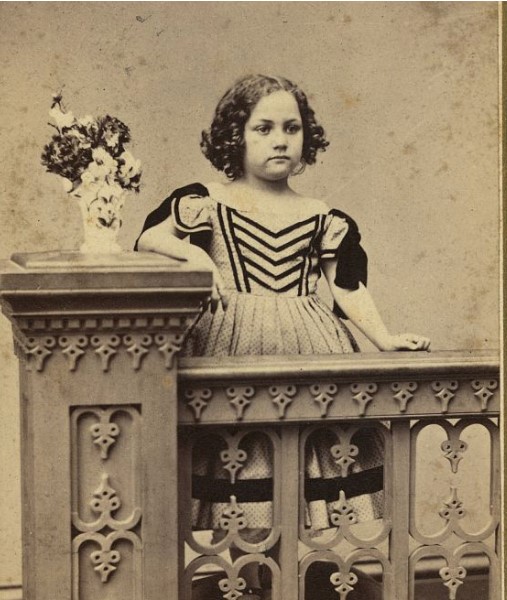
A fallen tombstone in an old cemetery on a farm outside Rectortown, Virginia marks the grave of a man who killed a neighbor in 1859 and set in motion events that made a little blue-eyed, flaxen-haired enslaved girl a poster child for abolition during the Civil War. In 1863, when Fannie Lawrence was 5, a famed abolitionist preacher in New York had her pose Shirley Temple-like in fancy dresses, then the photos were sold to raise money from sympathizers of the movement. The Library of Congress has an online exhibit on Fannie Lawrence. And her tale is detailed in a 2015 account, “A Sad Story of Redemption,” written by Page Johnson, editor of a newsletter for Historic Fairfax City, a group dedicated to preserving local heritage.

Johnson drew largely on the 1893 autobiography of Catherine S. Lawrence, an ardent anti-slavery and temperance crusader from upstate New York who had come to Virginia to nurse Union soldiers at a tent hospital on the grounds of the Episcopal Seminary in Alexandria. Fannie and two older sisters, Viana and Sally, were among several children of three enslaved women who had been impregnated by their owner, Charles Rufus Ayres. He was a wealthy young Virginian, who studied at Yale and the University of Virginia to practice law, but instead owned a mill and farmed 500 acres outside Rectortown with at least 12 enslaved workers. Despite his dependency on slavery, he was “a Union man,” Johnson wrote, and in his will, the 32-year-old Ayres promised the three women their freedom and money for them to move north and to pay for their children’s education when he died.

The 1857 will came into force sooner than Ayres could have imagined. A bitter quarrel with a neighbor, William Wesley Phillips, over a gate ended in an exchange of gun fire on Nov. 11, 1859. Ayres – whose shot missed – was mortally wounded by Phillips and his 18-year-old son, Samuel. Father and son were convicted of manslaughter and sentenced to three years in the state penitentiary in Richmond, which was soon to be the capital of the Confederacy.

Ayres’ testamentary wishes did not go to plan. The women – including Fannie’s mother, Mary Fletcher, who had still-enslaved children in the area – at first forsook freedom and elected to remain in Virginia, living with Ayres’ kindly mother. When she died, Fannie, Viana, Sallie and many others escaped Rectortown, eluded Confederate patrols and wild hogs for more than 40 miles, and made it safely behind Union lines to Fort Williams in Alexandria near the seminary.

According to Lawrence’s autobiography, Viana, at 10 or 12 the eldest sister, pleaded for her to adopt 4-year-old Fannie. The nurse agreed to temporarily take the “beautiful child and I soon became very much attached to her.”

Lawrence wound up keeping her and taking her to New York, where she had Fannie christened at Plymouth Church in Brooklyn by the Rev. Henry Ward Beecher, brother of Harriet Beecher Stowe, author of “Uncle Tom’s Cabin.” Beecher paraded the “redeemed slave child,” as he called her, before his congregation, baptized her as Fannie Virginia Casseopia Lawrence and took up a collection reportedly of $1,200, although Lawrence said she never received any of the money. He warned that her light skin put her in danger of being abused by slave-masters or sold into prostitution.  “Look upon this child,” the preacher urged. “Tell me, have you ever seen a fairer, sweeter face? This is a sample of the slavery which absorbs into itself everything fair and attractive. The loveliness of this child would only make her so much more valuable as a chattel.”

Fannie Virginia Casseopia Lawrence

He sent Fannie to the studio of a Brooklyn photographer to pose in formal dresses, sometimes with her adoptive mother. The daguerreotypes, photographs developed on special silvered plates, were mounted on “cartes de visite,” calling cards that were popular in that era, and sold to abolitionist sympathizers. Fannie posed at least 17 times in Brooklyn and elsewhere. The cards “were wildly popular in the North, making Fanny the most photographed slave child in history,” Johnson wrote in “A Sad Story of Redemption.” Lawrence took Fannie on tours to sing at churches and may have profited herself from sales of the cards.

The story has no happy ending for Fannie or her sisters. Lawrence went back to Virginia to retrieve Viana and Sallie with the idea of placing them in “good Christian families” in New York who promised to educate them.

Instead, they used them as servants. Sallie died of consumption in 1867. Viana lived just four years more. Fannie reached adulthood, but against her adoptive mother’s wishes “married one whom I opposed, knowing his reckless life rendered him wholly unfit for her,” Lawrence said. The husband abandoned Fannie with an infant daughter, leaving them to destitution. When Fannie died, her “double orphan” child was left “unprotected and unprovided for, only as far as the small savings of her mother’s hard labor will go.” “My three Southern children are all laid away, for which I thank my heavenly Father,” Lawrence wrote in the autobiography, titled “Sketch of the Life and Labors of Miss Catherine S. Lawrence, Who in Early Life Distinguished Herself as a Bitter Opponent of Slavery and Intemperance.” The Civil War nurse died at 84 in 1904. It is not known how or when Fannie died or where she is buried.

African American Cemeteries on Long Island

African American Cemeteries on Long Island

Debra Willett

Although there are references to free blacks on Long Island as early as 1657 most of the African Americans on Long Island were enslaved until after the Revolution. However, slavery on Long Island was both less widespread and shorter-lived than that of the South. Day workers, journeymen, or family help were more typical. New York State had enacted legislation to abolish slavery in 1799. The new constitution of the State of New York was enacted in 1821. Under its terms, black males who owned $250 in taxable property were eligible to vote. However, emancipation was neither immediate nor universal. Instead, the terms of the statute called for male slaves to be freed when they attained the age of 28; females, when they reached 25. This resulted in a gradual emancipation that was not complete until 1827, when the last child born into slavery had reached the age of freedom.

After the emancipation, many of the newly freed Blacks established communities of their own around the Island. Some of the early free black communities included the communities of Success and Spinney Hill in the Lake Success/Manhasset area. Freemen also settled in Sag Harbor, New Cassel, Roslyn Heights, Amityville, Glen Cove, Setauket, and Bridgehampton. In the twentieth century, black suburbs were established from east to west along the Island. Many of these, like Gordon Heights and North Amityville, were built especially for a black population. Others evolved into predominantly black communities after World War II, when working-class whites abandoned older areas and settled in the newly constructed, but racially restricted GI Bill communities. At the same time the older communities they were vacating experienced an influx of the emerging African-American homeowner class. By the 1960s, communities such as Hempstead, Freeport, Roosevelt, and Wyandanch had become home to a growing black middle class.

Centuries of spiritual tradition, dating back to their time in Africa, had supported the black community in slavery and in freedom. After the African Methodist Episcopal Church was founded in Philadelphia at the beginning of the nineteenth century, the AME church became a strong center for the freemen of Long Island. By the time of the Civil War there were over thirty African-American churches on Long Island, of which twenty-seven were of the AME denomination. In addition, there are several black churches within the Baptist, Presbyterian, and Congregational denominations. Many of these early churches remain strong centers of social and religious life in the African-American communities of Long Island.

Until the 1950s, about 90 percent of all public cemeteries in the U.S. employed a variety of racial restrictions. Until recently, to enter a cemetery was to experience, as a University of Pennsylvania geography professor put it, the “spatial segregation of the American dead.” Even when a religious cemetery was not entirely race restricted, different races were buried in separate parts of the cemetery, with whites usually getting the more attractive plots.

In most cases Long Island followed the de facto cemetery racial segregation that most of America followed until the 1900s. Most African American cemeteries were adjacent to a church that owned and maintained them. Unfortunately, when the communities disappeared so did the cemeteries. The thriving community of Freetown in East Hampton that had its foundation in 1800’s made up of free African Americans and former slaves encompassed a cemetery. This cemetery appears in a 1916 Suffolk County atlas, but by 1930the community and its cemetery had disappeared due to a form of “suburban renewal”. In the few instances of a racially mixed cemetery the African Americans were buried in their own section without markings or a marker that denotes their importance to a specific family. In the McCoun Cemetery on Sandy Hill Rd and Agnes St, Oyster Bay there is a marker that states “Sophia Moore born a Slave.” Most African Americans historically were buried with a marker or a very simple one unless they were part of the military.

Prominent African Americans Buried in Long Island Cemeteries

Flushing Cemetery, Queens County, New York: This cemetery opened in 1853. At the time Queens was mainly rural with a population of less than 20,000 people. The original site was 20 acres, and in 1875 an additional 50 acres was added from an adjacent farm. Flushing Cemetery added a Quaker section in 1860 and was always one of the few non-segregated cemeteries. Several prominent African Americans are buried there. They include musicians Louis Armstrong, Dizzy Gillespie, Johnny Hodges and Hazel Scott. World War I pioneer aviator Eugene Bullard and the Reverend Adam Clayton Powell Sr. are also interred there.

Louis “Satchmo” Armstrong (1901-1971):

Louis Armstrong

Armstrong, a trumpeter and singer, was one of the most popular and influential musicians in America in the 20th century.

He was born in New Orleans and had only a 5th grade education. While working for a local family, Armstrong purchased his first cornet. After an arrest, he was placed in a home for boys where he learned how to play and eventually became the leader of the Waif’s Home Brass Band. Armstrong was released in 1914 and found work as an entertainer on Mississippi riverboats with Joseph “King” Oliver.

After World War I, Armstrong migrated to Chicago with Oliver’s band where he eventually formed his own band, Louis Armstrong and His Hot Seven. In the 1950s and 1960s, Armstrong was an active supporter of the Civil Rights movement. He was an early “cross-over” star appearing on live television. Louis Armstrong’s house in Corona, Queens is now a public museum and Queens College houses a research collection bearing his name.

Johnny Hodges (1906-1970): Cornelius “Johnny” Hodges was a jazz alto sax player and a soloist in the Duke Ellington Orchestra. Hodges was considered to be second only to the legendary Charlie Parker as a jazz great.

Rev. Adam Clayton Powell, Sr. (1865-1953): Powell was an American minister and father to the late Congressman Adam Clayton Powell, Jr. He was born in Virginia to formerly enslaved parents. He entered the ministry in 1892 and in 1908 became pastor of the Abyssinian Baptist Church in New York. He often preached against discrimination and was a member of the NAACP and National Urban League.

John “Dizzy” Gillespie (1917-1993): Gillespie was American trumpet player, bandleader, and singer. He helped make the “bebop” genre of jazz popular. Gillespie influenced many other musicians including Miles Davis and Chuck Mangione. His grave is unmarked.

Eugene Bullard (1894-1961): 

Eugene Bullard

Bullard was an American who flew for French forces as a member of the Lafayette Flying Corps during World War I. He was wounded 3 times and earned a Croix de Guerre. Bullard was known for flying with a pet rhesus monkey named Jimmy. After the war, Bullard remained in Europe and fought during World War II in the French Army. Bullard escaped from occupied France and returned to the U.S. where he settled in Harlem and worked briefly as an interpreter for Louis Armstrong. In 1954 President Charles de Gaulle invited him to Paris to re-light the flame of the Unknown Soldier under the Arc de Triomphe. The French government honored Bullard again 1959 by making him a Chevalier de la Legion d’Honneur. When he died Bullard was buried in the uniform of a French Foreign Legionnaire. President Bill Clinton posthumously promoted Bullard to U.S.A.F. 2nd lieutenant.

Hazel Scott: (1920-1989): 

Hazel Scott

Scott was a world-renown pianist and singer known as the “Darling of Café Society” for her interpretations of classical masterpieces. She was born in Trinidad and raised in Harlem where she met jazz greats Fats Waller and Lester Young. While still in high school she hosted her own radio show, broke sales records with her recordings, and soloed at Carnegie Hall. Scott was very vocal about racial discrimination. She refused to play for segregated audiences, would not act in any movie that depicted her in a role she considered demeaning, and demanded the same pay as white actresses. Scott was the first African American performer to have her own national television show, but was blacklisted after she was named as a Communist sympathizer by the House Un-American Activities Committee. She left the U.S. for Europe and did not return and resume her career here until 1967.

Long Island National Cemetery: This cemetery is located in Farmingdale, N.Y. It was established in 1936 because the Cypress Hills National Cemetery in Brooklyn was almost filled to capacity.

 Sgt. Leander Willett (1895-1956): Willet was born in Oyster Bay, NY and was a member of the World War 1 all-African American 369th Infantry unit known as the “Harlem Hellfighters.” The unit spent 191 days on the front lines in France, more than any other regiment. 169 men won individual war crosses and two soldiers were the first Americans to received the French Croix de Guerre. Sgt. Willett was wounded in the Argonne Forest offensive when he was bayoneted and gassed.

William Thompson (1927-1950): Thompson served in the Korean Conflict and was awarded the Congressional Medal of Honor. On August 6, 1950, Thompson’s unit was hit with a surprise attack at night. He set-up his machine gun in the path of the enemy combatants and pinned them down to allow his platoon to withdraw and re-group in a more favorable position. Although hit with grenade and bullet fragments, Thompson remained at his post until he was killed by a grenade.

John Coltrane (1926-1967):  Coltrane was born in North Carolina and served in the U.S. Navy where he was stationed in the Manana Barracks in Pearl Harbor where he unofficially played with Navy band. Because the band was all-white Coltrane could not be listed as a member and was referred to as a guest performer. During his career, Coltrane played with Miles Davis, Thelonious Monk, Ben Webster, Coleman Hawkins, Dizzy Gillespie, Johnny Hodges, McCoy Tyner, and Charlie Parker. His former home in Philadelphia was designated a National Historic Landmark and his last home in Dix Hills N.Y. is on the National Register of Historic Places. Posthumously Coltrane was awarded a lifetime Grammy Achievement Award, and the U.S. Post office issued a commemorative stamp. His wife, Alice Coltrane (1937-2007), also was a musician and composer.

Henry Dumas (1934-1968): Dumas was a writer and poet. Her was born in Arkansas but grew up in Harlem and attended both C.U.N.Y and Rutgers University. After serving in the Air Force, he took a position at Southern Illinois University. Dumas was shoot and killed by a New York City Transit Policeman in the 125th St. and Lenox Ave. subway station. His death was ruled a case of mistaken identity. 

Capt. Lewis Cunningham Broadus (1877-1961): Broadus started his military life as a Buffalo Soldier at Fort Custer, Montana. With the outbreak of the Spanish-American War, Capt. Broadus saw action in Cuba at the Battle of El Caney. Broadus requested a promotion based in his service, but was denied because African-Americans were not permitted to be commissioned officers. Broadus saw action in the Philippines and was awarded a Certificate of Merit by President Theodore Roosevelt for bravery. During WWI, Broadus was stationed in Hawaii along with several thousand African-American recruits, and his request for promotion was honored. He completed officer’s training at the Reserves Office Training Camp at Fort Des Moines Iowa.

Holy Rood Cemetery Holy Rood Cemetery: This cemetery is located in Westbury, New York and is part of the Rockville Centre Diocese. People buried at Holy Rood include Commissioner William J Willett (1931-2003) of Glen Cove N.Y. native. Willett served in the U.S. Navy during the Korean Conflict. After the war, Willett joined the Nassau County police force and was one of the first African-American “beat” cops in Nassau County. In 2000 Willett was named Police Commissioner of Nassau County, one of the largest police departments in the United States.

Calverton National Cemetery: Calverton is located in eastern Long Island between the towns of Manorville and Riverhead in Suffolk County. Calverton National Cemetery features a memorial pathway lined with a variety of memorials that honor America’s veterans. As of 2009, there are 23 memorials here, most commemorating soldiers of 20th century wars. African American service men buried at Calverton include Isaac Woodard (1919-1992). Sergeant Woodard served in the Pacific Theater of World War II and was honorably discharged in 1946. In uniform, he boarded a bus for home and, enroute, was brutally attacked and blinded. Woodard was one of many black servicemen who experienced discrimination and violence, but his case sparked a national outcry. The NAACP sought justice, musicians immortalized the travesty, and Orson Welles unmasked Woodard’s attacker – police chief Lynwood Shull – on his radio show. No charges were filed until President Harry Truman ordered an investigation, but an all-white jury acquitted Shull in less than a half hour. In response, Truman established a Civil Rights Commission and desegregated the military.

African American History: A Past Rooted in the Hudson Valley

African American History: A Past Rooted in the Hudson Valley

David Levine

Reprinted with permission from https://hvmag.com/life-style/history/african-american-past-hudsonvalley/  

The origin story of what was to become the United States of America typically features two main characters: the native peoples who had lived on these lands for centuries, and the Europeans who took those lands from them. But there was a third cast member in this drama, one whose role is at best downplayed and at worst ignored: Africans and their descendants. In 1613, just four years after Henry Hudson’s crew sailed up the river that would bear his name, and seven years before the Pilgrims arrived in Plymouth, a mixed-race man named Juan Rodrigues (or some spelling variant near that) left Hispaniola for the New World, set up shop in and around Manhattan Island, traded with the natives for a time, squabbled with the Dutch—who called him a “black rascal”—and then disappeared from the public record as the first African to set foot in the Hudson Valley.

In 1626, just 10 years after the establishment of New Amsterdam, the Dutch West India Company shipped 11 African male slaves—whom they labeled “proud and treacherous”—into the colony, with women brought in two years later. Some slaves were moved to Fort Orange, the outpost that became Albany. As land patents divvied up the Valley, every patent holder whose name still graces the region stocked his farm with slaves. In 1664, when the Dutch handed the keys to the new kingdom to the British, about 800 Africans and their children inhabited the Valley, only about 75 of them considered free.

The British increased slave importation, and by the early 1700s New York State had more slaves than anywhere else in the colonies, more than the deep South, more than Boston, more than the Virginia plantations. “The two biggest slave markets in the country before the American Revolution were in New York City and Albany,” Dr. A.J. Williams-Myers, a retired professor of Black Studies at SUNY New Paltz, says. By 1790, the first federal census counted more than 19,000 enslaved New Yorkers; Georgia had 12,000. “New York was not a society with slaves, it was a slave society, dependent on enslaved Africans,” he says.

As New Yorkers, we like to think of ourselves as different from the south in regards to slavery. We were different only in that, numerically speaking at least, we were worse. Any history of African descendants in the Hudson Valley must first come to grips with this fact. From the earliest moments of European contact, African Americans have been part of the Valley’s dramatis personae. “Africans have been portrayed as in the shadow of history, when actually they were center stage,” Williams-Meyers says. “Where European people went, Africans went with them, shoulder to shoulder with their enslavers.” 

The oppressed as oppressors

As the Hudson Valley economy transitioned during the 17th century from the fur trade to farming, Africans helped make the region the most prosperous in the New World. Hudson Valley farms helped feed Great Britain, its newest colonies and its holdings in the Caribbean, and Africans did much of the work. A 1733 century painting called the “Van Bergen Overmantel,” by artist John Heaten, depicts the Marten Van Bergen farm near the Greene County town of Leeds. Historic Hudson Valley writes that “no other single artifact offers more information about life in colonial New York. Here African, Native American, and European people populate the landscape.” Dr. Myra Young Armstead, Lyford Paterson Edwards and Helen Gray Edwards Professor of Historical Studies at Bard College, calls this painting, “a good picture of what was going on and why the Hudson Valley was a big area of slavery.”

Even those who came here because of oppression became oppressors. The French Huguenot founders of New Paltz purchased their first of many slaves in Kingston in 1674, a hypocrisy not lost on a Huguenot descendant. “My ancestors fled France for religious and political freedom. Before leaving France they saw their own families tortured, enslaved, and killed. Yet these emigrants came to the New World and, for their own personal gain, forced other human beings to labor against their will,” Mary Etta Schneider, board chair of Historic Huguenot Street, said this summer. “For this I am ashamed.” 

Schneider was speaking in advance of a September 2016 event, in which HHS welcomed Joseph McGill, founder of the Slave Dwelling Project. McGill travels the country spending the night in historic slave dwellings to bring awareness to their existence, history, and need for preservation. More of these are in the north than most people know. “The history I learned in school was junk,” McGill says. “Slave dwellings are part of the history of this nation. They are hidden in plain sight.” Huguenot slaves were likely locked in at night so they couldn’t escape, Schneider said, and those who slept there along with McGill got “a sense of what it must have felt like to just reinforce that ownership, that lack of ability to have any control over your life.” Addressing another myth, that northern slave owners were “better” than southern ones, McGill says bluntly, “There were no great slave owners. When you assign a degree of severity, you start with bad.”

Long before Nat Turner, slaves in New York were rebelling against their owners. In 1712, 23 slaves killed nine whites in New York City, and rumors both real and unproved of slaves plotting revolts from the City to Albany kept tensions high throughout the 18th century. In 1794, three slaves—including two girls of 12 and 14—were hanged for setting a fire that burned much of downtown Albany; two were hanged from “the Hanging Elm Tree,” at the northwest corner of State and Pearl Streets (planted in front of the house of young Philip Livingston), the third on Pinkster Hill, site of the current Capitol. “Slaves and owners were on constant war footing,” William-Myers says. “The Hanging Tree in Albany shows you the use of fear to keep Africans in their place.”

Revolutionaries and warriors

And yet, slaves helped their masters win independence. “You cannot discount Africans’ input in the Revolutionary War,” Williams-Myers says. Though they often were sent to replace their owners in battle, under the assumption that whey would be freed after the war, they fought bravely and well. “They are never pictured as part of that, but they were there on the battlefield,” he says. Slaves held positions along the Hudson River as General Clinton made his way up from New York City, and fought at the battles of Saratoga, along the Mohawk River and throughout the region. “African warriors were one of the colonies’ secret weapons,” he says. “They were significant in winning the war.”

After the war, slaves weren’t freed right away, but Federalists like John Jay and Alexander Hamilton founded the New York Manumission Society in 1785 to promote abolition. It happened in fits and starts, and full emancipation was realized when the last New York slaves were freed by July 4, 1827. It was the largest emancipation in North America before the Civil War.

The Hudson Valley to a large extent welcomed freed African Americans. During this gradual emancipation, Quaker groups offered land—usually rocky, undesirable land, to be clear—to help freed slaves, and self-sustaining black communities sprung up in Rockland (Skunk Hollow, near the New Jersey border), Westchester (The Hills in Harrison and another community near Bedford), Dutchess (near Hyde Park, Beekman and Millbrook), Ulster (Eagles Nest, west of Hurley), and all the other river counties. Though legally emancipated, blacks weren’t entirely free yet, and the Valley, like the rest of the state, was in no way free from racism. Laws limited blacks’ rights to vote, to travel with whites on public transportation, to attend school and more. “You could argue that the earliest ‘Jim Crow’ laws actually appeared in the north, not the south,” says Dr. Oscar Williams, Chair of the Department of Africana Studies at the State University of New York at Albany.

The opening of the Erie Canal, in 1815, precipitated the slow and steady migration from upstate farms to river cities for employment. “Cities like Newburgh and Poughkeepsie offered jobs to blacks, while there was bigger movement to New York City or Albany, the nodes of the Valley,” Armstead says. Black institutional and social life took hold in these cities. Rhinebeck, for example, had a vibrant neighborhood of black artisans on Oak Street. African American Revolutionary War veteran Andrew Frazier and his family, who are buried in the “Potter’s Field” section of Rhinebeck Cemetery, owned land in the Town of Milan. In Kingston, the A.M.E. Zion Church on Franklin Street, the oldest African American church in Ulster County, owns the Mt. Zion African American Burial Ground on South Wall Street. The cemetery holds the remains of members of the U.S. Colored Infantry’s 20th Regiment, which fought in the Civil War. An extension of the Mt. Zion cemetery on South Pine Street is “one of the earliest, and potentially largest slave cemeteries known in the northeast,” according to an anthropologist who conducted an archeological survey for the city of Kingston in 1993. The Rye African American Cemetery, inside the Greenwood Union Cemetery, was established in 1860 as a burial place for blacks. It is on the National Register of Historic Places and is the final resting spot for African American Civil War veterans and the descendants of many slaves from Rye.

As the Civil War approached, the Hudson Valley was a hotbed of abolition. So-called Colored Conventions, movements held by free slaves to oppose slavery and push for rights for free blacks, were held all over country, including in Poughkeepsie, Armstead says. The Underground Railroad had important station stops along the river, such as the Beecher House in Peekskill and the Stephen and Harriet Myers House in Albany. Sojourner Truth started on her march to freedom as Isabella Baumfree, a slave born on an estate near what is now Ripton, sold to a family in New Paltz. In Troy, an African American named Henry Highland Garnett was Malcolm X before Malcolm X. Garnett led a radical movement from his position as the first pastor of the Liberty Street Negro Presbyterian Church. First working with abolition leaders like William Lloyd Garrison and Frederick Douglass, he gave a famous speech in 1843 at the National Negro Convention, a “Call to Rebellion” encouraging slaves to rise up in open revolt. His position was opposed.

Past, prologue

After the Civil War, blacks continued to move from local farms to industrial centers, and in their “Great Migration” from the South. New York City was a major destination, and in time blacks also moved into the suburbs, exurbs and growing river cities of the Valley. Freedom did not mean integration, however. As just one example, in the 1920s, land in the Nepperhan neighborhood of Yonkers, now known as Runyon Heights, was sold to blacks because whites didn’t want it and it was naturally separated from white communities.

Work, as always, continued to be the magnet drawing African Americans north, and the Valley had one of the world’s most powerful magnets: IBM. After World War II, “IBM was really important, ahead of its time, a global force that recruited from black colleges and universities,” Armstead says. By the late 1950s and 1960s, black professionals populated the area. “That generation is dying or dead now, but they became the first black heads of organizations, the first black teachers,” she says.

The history of African Americans over the last half century is a story of progress and regression, of course, both nationally and here in the Valley. The current political climate is restive. The struggle has been ongoing for 403 years now, ever since Juan Rodriguez stepped ashore and began battling the Dutch. The story has evolved, but it hasn’t ended. As William Faulkner wrote, the past is never dead. It’s not even past.

“The Captain’s Story” by Harriet Beecher Stowe

“The Captain’s Story” by Harriet Beecher Stowe

Ellen Gruber Garvey

This article is reprinted with permission of the author. It was originally published in the Washington Post under the headline “A forgotten 19th-century story can help us navigate today’s political fractures.”  https://www.washingtonpost.com/outlook/2021/03/23/forgotten-19th-century-story-can-help-us-navigate-todays-political-fractures/   

Harriet Beecher Stowe

Can Democrats truly reconcile with those Republicans who called President Biden’s election fraudulent and encouraged violent attack of the U.S. Capitol? Earlier moments in U.S. history should caution us about the lure and danger of reconciliation when one side refuses to acknowledge wrongdoing. After the Civil War, former Union partisans sought to get along with the Southerners who fought to keep Black people enslaved even after the war. But later, they doubted the wisdom of having done so.

One of those people was Harriet Beecher Stowe, the author of “Uncle Tom’s Cabin” (1852), the most influential novel in the United States during the 19th century. Her famous book kindled readers’ sense that they could and must end slavery, even if that meant disrupting alliances, friendships and family ties with enslavers and their supporters. Thirty years later, Stowe wrote a story little known even it its own time, in which she considered what happened when these same White Northerners who fought against slavery reconciled too easily with former enslavers.

Can Democrats truly reconcile with those Republicans who called President Biden’s election fraudulent and encouraged violent attack of the U.S. Capitol? Earlier moments in U.S. history should caution us about the lure and danger of reconciliation when one side refuses to acknowledge wrongdoing. After the Civil War, former Union partisans sought to get along with the Southerners who fought to keep Black people enslaved even after the war. But later, they doubted the wisdom of having done so.

One of those people was Harriet Beecher Stowe, the author of “Uncle Tom’s Cabin” (1852), the most influential novel in the United States during the 19th century. Her famous book kindled readers’ sense that they could and must end slavery, even if that meant disrupting alliances, friendships and family ties with enslavers and their supporters. Thirty years later, Stowe wrote a story little known even it its own time, in which she considered what happened when these same White Northerners who fought against slavery reconciled too easily with former enslavers.

Written in 1882, but set in 1866, “The Captain’s Story” tells of two former Union army captains who visit Florida, where they once fought on the battlefield. They hope to relax and recuperate from the toll the war had taken on their health. The two listen to their white Floridian guide’s ghost story, which includes his casual mention of having murdered enslaved African captives. The ghost of one captive continues to haunt a nearby plantation, he says. Despite moral qualms, the two captains decide to continue their trip with their murderous guide who can show them all the best fishing grounds. They will get along, and leave his punishment to God.

Stowe began spending winters in Florida just after the Civil War, about the time the story is set, initially hoping to help her son recover from his own Civil War trauma. She wrote popular travel articles in the 1870s touting the state’s pleasures for Protestant Northern Whites, hoping to attract them to politically overwhelm the Southern planters. Full of chummy advice on how to travel south and where to buy land, the accounts spurred the state’s first tourist boom while also raising money for a Black school. In “The Captain’s Story,” she swerves to remind her readers of the brutalities of her Florida neighbors who once enslaved people.

Although Stowe was a founder of the Atlantic Monthly, “The Captain’s Story” was not published there, perhaps because few 1880s editors wished to take the horrors of slavery seriously. Albion Tourgée, the editor of the short-lived but high-paying weekly Our Continent, did, however. He was a Union veteran who worked for Reconstruction then wrote about his experiences in two best-selling novels focusing on the difficulties and assaults the freed people faced. He went on to fight Jim Crow, as the lawyer representing a Black plaintiff attacking segregation in public facilities in Plessy v. Ferguson.

Although Our Continent was not a crusading publication and sought to attract White Southern readers, too, Tourgée published other works that acknowledged that the Civil War was fought over slavery. Yet Our Continent was obscure enough that “The Captain’s Story” received no notice in the press at the time. It was not anthologized or reprinted.

The story’s questioning of White complicity in postwar racism is subtle and conflicted. But it does stand in stark contrast to other popular magazine stories of the time. Northern magazines shoveled out stories romanticizing Southern plantations as places where sweet, quasi-familial ties between enslavers and enslaved people infused life with graciousness. Plantation fiction frequently featured a tired Northern businessman who, like the two captains, goes South to rest and comes to appreciate relaxed Southern hospitality.

Marriage to a Southern woman in these stories offered an allegory of reconciliation between Northern and Southern Whites. As the White abolitionist and orator Anna E. Dickinson noted, “The fashion of the day has been, and is, to talk of the love feast that is spread between old foes, till at last we of the North and of the South are doing what our forefathers did 30 years ago — grasping hands across the prostrate body of the negro.”

Of course, former Confederates did not seek reconciliation. Instead, they created the cult of the Lost Cause, celebrating the nobility and heroism of the Confederacy, leading to the erection of statues honoring Confederate leaders and school textbooks that continued to inculcate this version of history for over a century.

That is why Stowe’s story is significant. It called out the murderous past, presented plantation owners and their friends as lawless, brutal, disloyal, casual killers, scornful of the family ties of enslaved people.But the story disappeared, and that illuminated the shifting reality of race relations in 1882. Reconstruction had ended, a reign of racial terror lynchings had commenced, and states passed Black Codes that allowed Southern Whites to continue to coerce the labor of African Americans.White supremacy had regrouped with new legal structures and Northern collusion, and former Confederates were back in power in the South. Ex-Confederates suppressed the Black vote and reinstated slavery under different names.

The myth of benevolent plantation life took hold through sheer repetition in fictional work, most familiar now through “Gone With the Wind,” imagery and plantation tours. Burying Stowe’s story while celebrating that myth matters. It is another small part of concealing slavery’s past and obscuring the power of white supremacy, which still haunt the United States.

Teaching the 1898 Wilmington Race Massacre using the History Lab Model

Teaching the 1898 Wilmington Race Massacre using the History Lab Model

Cara Ward and Lisa Brown Buchanan

Instances of racial violence towards Black Americans have a longstanding history in the United States. Though a few events and names are recalled most often in textbooks (e.g., Freedom Rides, Nat Turner) their retellings are generally presented from a White viewpoint; in fact, some events have been completely omitted from formal curriculum. This article discusses the teaching of racial violence in the United States, explores how Black historical principles of power and oppression can frame the study of events of racial violence, and outlines a concrete history lab designed to study the 1898 Wilmington Race Massacre (also commonly called the Wilmington Coup or Wilmington Insurrection).

An Overview of the Teaching of Racial Violence

Scholars of teaching Black history have documented the teaching and omission of racial violence towards Black and African Americans for decades (see, for example, Brown, Brown, & Ward, 2017; Busey & Walker 2017; Love, 2019; Vasquez Heilig, Brown, & Brown, 2012). Most research on teaching Black history has focused on PK-12 teaching and knowledge (Woodson, 2017), with some analysis of preservice teachers’ knowledge of Black history (King, 2019). More recently, resources for classroom teachers have become available that are focused on centering the Black experience and perspectives, particularly in experiences of racial violence (see, for example, Learning for Justice’s Teaching Hard History podcast series, New York Times’ 1619 Project, Facing History and Ourselves’ Race in US History collection) and some scholars have described pedagogical approaches to teaching Black history with accuracy and intention in K-12 (Simmons, 2016; Vickery, & Rodríguez, 2021; Vickery & Salinas, 2019).

Some have argued Black history is American history, suggesting a shared legacy between Black and White Americans (King, 2021) which is generally untrue. Others have taken this sentiment to task, pointing out that while the teaching of Black history altogether has been sidelined or disregarded, at best, the teaching of racial violence has been overwhelmingly avoided or if taught at all, with tremendous gaps and inaccuracies (Brown & Brown, 2010a, 2010b, 2011; Woodson, 2017).

In order to improve Black history education historical and contemporary racial violence must be taught as part of American history and Black history (King, 2021). As Brown, Brown, and Ward (2017) explain, classroom investigations of racial violence taught within the context of students’ lives presents a curriculum that “acknowledges race and racism in their present lives.” Using a framework of Black historical consciousness is one way to study racial violence within the context of Black history.

Teaching the Wilmington Race Massacre through Principles of Black Historical Consciousness

Scholars have described the need for teaching a more complete story of Black history (e.g., King, 2021; Muhammad, 2020; Rodríguez & Vickery, 2020) and using a Black historical consciousness framework centers the Black experience and perspective, both largely missing from traditional retellings of Black history. King describes six principles of Black historical consciousness (see King, 2021). While all are in some way directly related to racial violence, in this article, we focus on the principle of power and oppression (King, 2021). King (2021) suggests racial violence as a potential topic for the principle of power and oppression, and similar to our use of the history lab below to examine racial violence, suggests the use of compelling questions that align with interrogating systemic racism. Recognizing that “it is important to understand that Black people have been victims or victimized by oppressive structures, but have never been solely victims (King, 2021, p. 338)” teaching the Wilmington, NC Race Massacre of 1898 through the lens of power and oppression provides a historical context and conscious that is missing in traditional teaching of Black history and illustrates how power and oppression are created and sustained through society (King, 2021, p. 338). Complex ideas like power and oppression are often difficult knowledge for learners, and in concrete examples like the Wilmington Race Massacre, content may be taboo, rendering it obsolete in curricula and standards. Often coined as “hard history”, such content can be taught in powerful and productive ways. We posit that the history lab model, focused on evidence-based answers, offers the structure to unpack complex ideas of power and oppression while identifying the lasting impact of racial violence through the use of historical sources.

History Labs as an Instructional Strategy for Teaching Difficult Knowledge

Teachers are often wary of including instances of “hard history” as these events can be unsettling and spark tense discussions, especially in the current era of political polarization (McAvoy, 2016). In addition to building a cooperative and supportive classroom community before covering such events, there are instructional methods that can lead to productive classroom discussions and a deeper understanding of complex history. One such method is a history lab; first described by Bruce Lesh (2011), this form of instruction includes three main components:  a compelling question, sources to examine, and an evidence-based answer. This teaching method is inquiry-based and includes components of Swan, Lee, and Grant’s (2015) Inquiry Design Model which is now widely used in the field of social studies.

To create a history lab, teachers develop an overarching, open-ended question called a compelling question for students to consider. Swan, Lee, and Grant (2018, 2019) have devoted a chapter in each of their books on the Inquiry Design Model to the topic of compelling questions and how to develop them. After question development, teachers select related sources for students to examine, often a mix of primary sources for details and secondary sources for background information and clarification. After presenting the question and sources to students, teachers facilitate the examination of the documents, reminding students to cite evidence from the documents while formulating their answer to the compelling question (Lesh, 2011).

Careful facilitation of discussion is the key to the effectiveness of this teaching method since it is critical for students to cite evidence in their answers. The most effective history labs are structured in ways that allow student interaction and opportunities to share thoughts throughout instead of just working through a “packet” and writing an individual response. An important first step is determining how to have students examine the primary and secondary sources that are presented. This can be done via gallery walks, jigsaw grouping, small group analysis, and whole group seminar style examination (Author, 2017; Author, 2018; Authors, 2020). Creating guiding questions, prompts, or a graphic organizer to help guide students through a lab can also be beneficial.

Another important consideration in the pandemic-induced era of increased online learning is whether a lab will take place synchronously or asynchronously. While the traditional face-to-face classroom setting is ideal, labs can also work well in either the fully virtual or hybrid classroom. Online synchronous methods such as breakout rooms can be used as a method for having small groups examine sources together. Another effective synchronous method is a whole class seminar-style discussion where students can speak one at a time or even use the chat to respond. For asynchronous course delivery, teachers can put the question and sources in a Google Doc or Jamboard and ask students to share thoughts by adding comments. Another option is to use the discussion board feature in a learning management system such as Google Classroom or Canvas for students to respond to individual sources. Teachers can also use video response and sharing tools such as Flipgrid for students to record their evidence-based answer to a compelling question. For hybrid models, teachers can ask students to examine sources ahead of time, using some of the online tools mentioned above, and then use face-to-face time in class for a whole group discussion.

The 1898 Wilmington Massacre

One example of hard history that can be effectively examined through the use of a history lab is the 1898 Wilmington Massacre. November 10, 1898 was a day of horrific racial violence inflicted upon the thriving, successful Black community in the coastal town of Wilmington, North Carolina. An election year, 1898 had been filled with White supremacist propaganda in local and state newspapers which ultimately led to intimidation of Black voters and a rigged election in Wilmington on November 8th. Two days later, a White mob armed themselves, burned the office of the local Black newspaper The Daily Record to the ground, and took over the city’s biracial government by violent force. During the chaos, the mob killed approximately 60 Black citizens (likely more as an official death toll was impossible to determine) and forced untold numbers out of town. The mayor and members of the board of aldermen were replaced by White supremacists. The event holds great historic significance not only on a local and state level, but also on a national scale. It is the only successful coup d’état in the history of the United States (McCluskey, 2018; Everett, 2015; Tyson, 2006; Umfleet, 2009) and is an example of the extreme violence and resulting large-scale loss of life that could occur as a result of the rise of angry White supremacists in the Jim Crow era. The 1898 Massacre has been compared to what happened in Tulsa in 1921 (Everett, 2015; Umfleet, 2015) and has been referenced multiple times in coverage of the January 6, 2021 attack on the US Capitol (Butler-Arnold, 2021; Cornish, 2021; Hayes, 2021; Ingram, 2021; Meyers, 2021).

The significance of this event is ever-increasing and the economic, social, and political impact is still apparent in Wilmington, NC today. As with other events of racial violence, this event has been largely overlooked and rarely taught, even in North Carolina, due to a lack of information about the event (Everett, 2015). Even the terminology used to describe the event is still evolving – originally called a race riot, in recent years, it has been referred to as an insurrection, massacre, and coup d’état (Fonvielle, 2018; Tyson, 2006; Zucchino, 2020). For all of these reasons, the Wilmington Race Massacre should be taught with middle and secondary students and we believe a history lab is the most appropriate method for studying the event.

A History Lab about the 1898 Wilmington Massacre

We offer the following example of a history lab about 1898 that we developed for students to demonstrate how the work described above can be done. The lab described below can be found at https://tinyurl.com/1898historylab  and is formatted as a view-only Google Slides presentation. This format allows teachers who would like to use the lab either a ready-made version that can be used right away or the flexibility to make a copy of the document to edit for their specific instructional needs. The original sources are linked in the speaker notes area for each slide.

While there are many questions that could be asked about this event, we feel that asking students to examine the long-term impact of the 1898 is most critical to their comprehension of the scale and significance of this event. Therefore, our compelling question is “What is the lasting impact of the 1898 Wilmington Massacre?”

In order to introduce the lab, we have included two sources, one primary and one secondary to give students some background information before they begin analyzing sources. The first source (slide 2) is a photograph of the mob in front of the burnt remains of The Daily Record newspaper office. The next source (slide 3) is a 12-minute video published by Vox which gives a brief, but informative summary of the event. These two sources give students some sense of what happened so that they have some frame of reference for the additional sources.

We selected three guiding questions to help direct student thinking and analysis throughout the lab. For each of these questions, we selected three sources for students to examine. In terms of format for this lab, we recommend dividing the class into three groups (1, 2, 3) and having each group thoroughly examine one of the questions and the accompanying sources, thus allowing a group of students to become “experts” on their assigned question. After this analysis, the class should “jigsaw” into three new groups (A, B, C) which each include members from groups 1, 2, and 3. In groups A, B, and C, the representatives for each question should take turns sharing their analysis of their assigned question with the group so all can gain a sense of what happened and begin to consider what the lasting impact is.

What were the events that led to the 1898 Wilmington Massacre?

For this question, we selected a photograph of the waterfront in downtown Wilmington in the late 1800s which shows the prominent display of White supremacy banners (slide 7). We also selected an excerpt from a speech by Rebecca Lattimore Felton during which she endorsed lynching as a punishment for Black men who had relationships with White women (slide 8). The third source we selected for this question was an editorial written by Alexander Manly in response to Felton’s speech where he points out the unjust and hypocritical nature of her stance (slide 9). These sources should give students a glimpse of the extent to which White supremacy impacted daily life and conversations. While all of the sources in the lab are about a violent event, it should also be noted that Felton’s full speech and Manly’s full editorial which are linked include references to rape. We recommend that teachers thoroughly examine all the sources themselves before presenting them to students.

What happened during the event?

The first source for this question is a telegram sent to then President of the United States, William McKinley warning him of the volatile situation in Wilmington (slide 11). The next source is a map marking the location of those wounded and killed during the event (slide 12). The final source for this question is an interactive timeline and map which gives a comprehensive overview of the events (slide 13). These sources outline the seriousness of the situation and how violent it became.

What was the economic and social impact of the 1898 Wilmington Massacre?

We selected three charts from Umfleet’s (2009) book A Day of Blood for students to examine. The first chart compares the 1897 and 1900 occupations by race for Wilmington citizens (slide 15). The second chart shows the census population by race from 1860 to 1910 for Wilmington (slide 16) and the third chart shows the same data for North Carolina (slide 17). These charts show the loss of economic opportunities for Black Wilmingtonians as well as the decline in the city’s Black population.

We recommend concluding this lab with a whole class discussion focusing back on the compelling question: “What is the lasting impact of the 1898 Wilmington Massacre?” and the evidence that students examined in their groups. Students will likely reference the rise of White supremacy, the loss of human life and the impact on population, economic repercussions such as decreased employment for Black citizens, voter intimidation, and lack of Black political leaders in Wilmington in years that followed the event. Since this is an open-ended question, other responses may be offered as well, but students should back up their ideas with evidence from the sources.

Additional Teacher Resources

We understand that most teachers are unfamiliar with the 1898 Wilmington massacre and may need additional resources to improve their content knowledge of this series of events. We suggest the resources in Table 1 for a more in-depth history of the Wilmington Race Massacre. Teachers may find these sources useful as they study 1898 alongside their students.

  Table 1: Additional Teacher Resources for 1898 Wilmington Race Massacre
Umfleet, L.S. (2009). A day of blood. Raleigh: North Carolina Office of Archives and History.
Zucchino, D. (2020). Wilmington’s lie. New York: Atlantic Monthly Press.
Everett, C. (2015). Wilmington on fire [Documentary film]. United States: Speller Street Films.
Oliver, N. (2016). The red cape [Motion picture]. United States.
Footnote: this lab is available for viewing at https://tinyurl.com/1898historylab (tiny URL view only Google Slides)

Conclusion

While this lab focuses on the Wilmington Race Massacre, we would be remiss to not recognize the abhorrent number of massacre events in United States history to date similar to 1898. If we are committed to teaching the story of Black America (King, 2021), we must be willing to navigate a more complete story of race and racism in the United States, which we believe includes studying “hard history”. Bringing together a Black historical consciousness framework and history lab structure is one powerful and productive approach to a more complete story of Black history.

References

Brown, A.L., Brown, K.D, & Ward, A. (2017). Critical race theory meets culturally relevant pedagogy: Advancing a critical sociohistorical consciousness for teaching and  curriculum. Social Education, 81(1), 23-27.

Brown, K.D. & Brown, A.L. (2011). Teaching K-8 students about race: African Americans, racism, & the struggle for social justice in the U.S. Multicultural Education, 19(1), 9-13.

Brown, A. L., & Brown, K. D. (2010a). Strange fruit indeed: Interrogating contemporary textbook representations of racial violence toward African Americans. Teachers College Record, 112(1), 31-67.

Brown, K. D., & Brown, A. L. (2010b). Silenced memories: An examination of the sociocultural knowledge on race and racial violence in official school curriculum. Equity & Excellence in Education, 43(2), 139-154.

Busey, C. L., & Walker, I. (2017). A dream and a bus: Black critical patriotism in elementary social studies standards. Theory & Research in Social Education, 45(4), 456-488.

Butler-Arnold, A. (2021). Why my students weren’t surprised on January 6th. Social Education, 85(1), 8-10.

Cornish, A. (2021, January 8). Race and the Capitol riot: An American story we’ve heard before [Radio Broadcast]. NPR. Retrieved from https://www.npr.org/transcripts/953286955   

Everett, C. (2015). Wilmington on fire [Documentary film]. United States: Speller Street Films.

Fonvielle, C. (2018, January 24). Email correspondence.

Hayes, C. (2021, January 6). Trump must be lawfully removed from office as fast as possible. MSNBC. Retrieved from https://www.msnbc.com/msnbc/watch/chris-hayes-trump-must-be-lawfully-removed-from-office-as-fast-as-possible-99014213834

Ingram, H. (2021, January 7). 1898 Wilmington massacre and Capitol Hill: Historical parallels at nation’s capital. Star-News. Retrieved from  https://www.starnewsonline.com/story/news/local/2021/01/07/history-shows-parallels-between-1898-wilmington-coup-and-capitol-hill-riot/6579616002/

King, L. (2019). Interpreting Black History: Toward a Black History Framework for Teacher Education. Urban Education, 54(3), 368-396.

King, L. (2021). Black history is not American history: Toward a framework of Black historical consciousness. Social Education, 84(6), 335-341.

Lesh, B. A. (2011). “Why won’t you just tell us the answer?”: Teaching historical thinking in grades 7-12. Portland, ME: Stenhouse.

Love, B. (2019). We want to do more than survive: Abolitionist teaching and the pursuit of educational freedom. Beacon Press.

McAvoy, P. (2016). Preparing young adults for polarized America. In Journell, W. (Ed.)

Teaching social studies in an era of divisiveness: The challenges of discussing social issues in a non-partisan way. Lanham, MD: Rowman & Littlefield Press, 31-46.

McCluskey, M. (2018, August 5). America’s only coup d’état. Retrieved from https://www.splcenter.org/fighting-hate/intelligence-report/2018/americas-only-coup-detat  

Meyers, S.. (2021, January 7). Seth Meyers calls for Trump’s removal after violent insurrection at Capitol. [Video]. Youtube. Retrieved from https://www.youtube.com/watch?v=UOIFBKB4mIE

Muhammad, G. (2020). Cultivating genius: An equity framework for culturally and historically responsive literacy. Scholastic.

Rodríguez, N.N. and Vickery, A.E. (2020). More than a hamburger: Disrupting problematic picturebook depictions of the Civil Rights Movement. International Journal of Multicultural Education, 21(2), 109-128.

Simmons, D. (2016, February 29). Black history month is over. Now what? Learning for Justice. Retrieved from https://www.learningforjustice.org/magazine/black-history-month-is-over-now-what

Swan, K., Grant, S. G., & Lee, J. (2019). Blueprinting: An inquiry-based curriculum. National Council for the Social Studies and C3 Teachers.

Swan, K., Lee, J., & Grant, S. G. (2015). The New York state toolkit and the inquiry design model:  Anatomy of an inquiry. Social Education, 79(5), 316-322.

Swan, K., Lee, J., & Grant, S. G. (2018). Inquiry design model: Building inquiries in social studies. National Council for the Social Studies and C3 Teachers.

Tyson, T. B. (2006, November 17). The ghosts of 1898: Wilmington’s race riot and the rise of White supremacy. Retrieved from http://media2.newsobserver.com/content/media/2010/5/3/ghostsof1898.pdf  

Umfleet, L.S. (2009). A day of blood. Raleigh: North Carolina Office of Archives and History.

Vasquez Heilig, J., Brown, K.D., & Brown, A.L. (2012). The illusion of inclusion: A Critical Race Theory textual analysis of race and standards. Harvard Educational Review, 82(3), 403-424.

Vickery, A.E. & Rodríguez, N. N. (2021). “A woman question and a race problem”: Attending to intersectionality in children’s literature. The Social Studies, 112(2), 57-62.

Vickery, A.E. and Salinas, C. (2019). “I Question America…. Is this America”: Centering the narratives of Black women in the Civil Rights Movement. Curriculum Inquiry, 49(3), 260-283.

Woodson, A. N. (2017). There ain’t no White people here”: Master narratives of the Civil Rights Movement in the stories of urban youth. Urban Education, 52(3), 316-342.

Zucchino, D. (2020). Wilmington’s lie. Atlantic Monthly Press.