Teaching the 1898 Wilmington Race Massacre using the History Lab Model

Teaching the 1898 Wilmington Race Massacre using the History Lab Model

Cara Ward and Lisa Brown Buchanan

Instances of racial violence towards Black Americans have a longstanding history in the United States. Though a few events and names are recalled most often in textbooks (e.g., Freedom Rides, Nat Turner) their retellings are generally presented from a White viewpoint; in fact, some events have been completely omitted from formal curriculum. This article discusses the teaching of racial violence in the United States, explores how Black historical principles of power and oppression can frame the study of events of racial violence, and outlines a concrete history lab designed to study the 1898 Wilmington Race Massacre (also commonly called the Wilmington Coup or Wilmington Insurrection).

An Overview of the Teaching of Racial Violence

Scholars of teaching Black history have documented the teaching and omission of racial violence towards Black and African Americans for decades (see, for example, Brown, Brown, & Ward, 2017; Busey & Walker 2017; Love, 2019; Vasquez Heilig, Brown, & Brown, 2012). Most research on teaching Black history has focused on PK-12 teaching and knowledge (Woodson, 2017), with some analysis of preservice teachers’ knowledge of Black history (King, 2019). More recently, resources for classroom teachers have become available that are focused on centering the Black experience and perspectives, particularly in experiences of racial violence (see, for example, Learning for Justice’s Teaching Hard History podcast series, New York Times’ 1619 Project, Facing History and Ourselves’ Race in US History collection) and some scholars have described pedagogical approaches to teaching Black history with accuracy and intention in K-12 (Simmons, 2016; Vickery, & Rodríguez, 2021; Vickery & Salinas, 2019).

Some have argued Black history is American history, suggesting a shared legacy between Black and White Americans (King, 2021) which is generally untrue. Others have taken this sentiment to task, pointing out that while the teaching of Black history altogether has been sidelined or disregarded, at best, the teaching of racial violence has been overwhelmingly avoided or if taught at all, with tremendous gaps and inaccuracies (Brown & Brown, 2010a, 2010b, 2011; Woodson, 2017).

In order to improve Black history education historical and contemporary racial violence must be taught as part of American history and Black history (King, 2021). As Brown, Brown, and Ward (2017) explain, classroom investigations of racial violence taught within the context of students’ lives presents a curriculum that “acknowledges race and racism in their present lives.” Using a framework of Black historical consciousness is one way to study racial violence within the context of Black history.

Teaching the Wilmington Race Massacre through Principles of Black Historical Consciousness

Scholars have described the need for teaching a more complete story of Black history (e.g., King, 2021; Muhammad, 2020; Rodríguez & Vickery, 2020) and using a Black historical consciousness framework centers the Black experience and perspective, both largely missing from traditional retellings of Black history. King describes six principles of Black historical consciousness (see King, 2021). While all are in some way directly related to racial violence, in this article, we focus on the principle of power and oppression (King, 2021). King (2021) suggests racial violence as a potential topic for the principle of power and oppression, and similar to our use of the history lab below to examine racial violence, suggests the use of compelling questions that align with interrogating systemic racism. Recognizing that “it is important to understand that Black people have been victims or victimized by oppressive structures, but have never been solely victims (King, 2021, p. 338)” teaching the Wilmington, NC Race Massacre of 1898 through the lens of power and oppression provides a historical context and conscious that is missing in traditional teaching of Black history and illustrates how power and oppression are created and sustained through society (King, 2021, p. 338). Complex ideas like power and oppression are often difficult knowledge for learners, and in concrete examples like the Wilmington Race Massacre, content may be taboo, rendering it obsolete in curricula and standards. Often coined as “hard history”, such content can be taught in powerful and productive ways. We posit that the history lab model, focused on evidence-based answers, offers the structure to unpack complex ideas of power and oppression while identifying the lasting impact of racial violence through the use of historical sources.

History Labs as an Instructional Strategy for Teaching Difficult Knowledge

Teachers are often wary of including instances of “hard history” as these events can be unsettling and spark tense discussions, especially in the current era of political polarization (McAvoy, 2016). In addition to building a cooperative and supportive classroom community before covering such events, there are instructional methods that can lead to productive classroom discussions and a deeper understanding of complex history. One such method is a history lab; first described by Bruce Lesh (2011), this form of instruction includes three main components:  a compelling question, sources to examine, and an evidence-based answer. This teaching method is inquiry-based and includes components of Swan, Lee, and Grant’s (2015) Inquiry Design Model which is now widely used in the field of social studies.

To create a history lab, teachers develop an overarching, open-ended question called a compelling question for students to consider. Swan, Lee, and Grant (2018, 2019) have devoted a chapter in each of their books on the Inquiry Design Model to the topic of compelling questions and how to develop them. After question development, teachers select related sources for students to examine, often a mix of primary sources for details and secondary sources for background information and clarification. After presenting the question and sources to students, teachers facilitate the examination of the documents, reminding students to cite evidence from the documents while formulating their answer to the compelling question (Lesh, 2011).

Careful facilitation of discussion is the key to the effectiveness of this teaching method since it is critical for students to cite evidence in their answers. The most effective history labs are structured in ways that allow student interaction and opportunities to share thoughts throughout instead of just working through a “packet” and writing an individual response. An important first step is determining how to have students examine the primary and secondary sources that are presented. This can be done via gallery walks, jigsaw grouping, small group analysis, and whole group seminar style examination (Author, 2017; Author, 2018; Authors, 2020). Creating guiding questions, prompts, or a graphic organizer to help guide students through a lab can also be beneficial.

Another important consideration in the pandemic-induced era of increased online learning is whether a lab will take place synchronously or asynchronously. While the traditional face-to-face classroom setting is ideal, labs can also work well in either the fully virtual or hybrid classroom. Online synchronous methods such as breakout rooms can be used as a method for having small groups examine sources together. Another effective synchronous method is a whole class seminar-style discussion where students can speak one at a time or even use the chat to respond. For asynchronous course delivery, teachers can put the question and sources in a Google Doc or Jamboard and ask students to share thoughts by adding comments. Another option is to use the discussion board feature in a learning management system such as Google Classroom or Canvas for students to respond to individual sources. Teachers can also use video response and sharing tools such as Flipgrid for students to record their evidence-based answer to a compelling question. For hybrid models, teachers can ask students to examine sources ahead of time, using some of the online tools mentioned above, and then use face-to-face time in class for a whole group discussion.

The 1898 Wilmington Massacre

One example of hard history that can be effectively examined through the use of a history lab is the 1898 Wilmington Massacre. November 10, 1898 was a day of horrific racial violence inflicted upon the thriving, successful Black community in the coastal town of Wilmington, North Carolina. An election year, 1898 had been filled with White supremacist propaganda in local and state newspapers which ultimately led to intimidation of Black voters and a rigged election in Wilmington on November 8th. Two days later, a White mob armed themselves, burned the office of the local Black newspaper The Daily Record to the ground, and took over the city’s biracial government by violent force. During the chaos, the mob killed approximately 60 Black citizens (likely more as an official death toll was impossible to determine) and forced untold numbers out of town. The mayor and members of the board of aldermen were replaced by White supremacists. The event holds great historic significance not only on a local and state level, but also on a national scale. It is the only successful coup d’état in the history of the United States (McCluskey, 2018; Everett, 2015; Tyson, 2006; Umfleet, 2009) and is an example of the extreme violence and resulting large-scale loss of life that could occur as a result of the rise of angry White supremacists in the Jim Crow era. The 1898 Massacre has been compared to what happened in Tulsa in 1921 (Everett, 2015; Umfleet, 2015) and has been referenced multiple times in coverage of the January 6, 2021 attack on the US Capitol (Butler-Arnold, 2021; Cornish, 2021; Hayes, 2021; Ingram, 2021; Meyers, 2021).

The significance of this event is ever-increasing and the economic, social, and political impact is still apparent in Wilmington, NC today. As with other events of racial violence, this event has been largely overlooked and rarely taught, even in North Carolina, due to a lack of information about the event (Everett, 2015). Even the terminology used to describe the event is still evolving – originally called a race riot, in recent years, it has been referred to as an insurrection, massacre, and coup d’état (Fonvielle, 2018; Tyson, 2006; Zucchino, 2020). For all of these reasons, the Wilmington Race Massacre should be taught with middle and secondary students and we believe a history lab is the most appropriate method for studying the event.

A History Lab about the 1898 Wilmington Massacre

We offer the following example of a history lab about 1898 that we developed for students to demonstrate how the work described above can be done. The lab described below can be found at https://tinyurl.com/1898historylab  and is formatted as a view-only Google Slides presentation. This format allows teachers who would like to use the lab either a ready-made version that can be used right away or the flexibility to make a copy of the document to edit for their specific instructional needs. The original sources are linked in the speaker notes area for each slide.

While there are many questions that could be asked about this event, we feel that asking students to examine the long-term impact of the 1898 is most critical to their comprehension of the scale and significance of this event. Therefore, our compelling question is “What is the lasting impact of the 1898 Wilmington Massacre?”

In order to introduce the lab, we have included two sources, one primary and one secondary to give students some background information before they begin analyzing sources. The first source (slide 2) is a photograph of the mob in front of the burnt remains of The Daily Record newspaper office. The next source (slide 3) is a 12-minute video published by Vox which gives a brief, but informative summary of the event. These two sources give students some sense of what happened so that they have some frame of reference for the additional sources.

We selected three guiding questions to help direct student thinking and analysis throughout the lab. For each of these questions, we selected three sources for students to examine. In terms of format for this lab, we recommend dividing the class into three groups (1, 2, 3) and having each group thoroughly examine one of the questions and the accompanying sources, thus allowing a group of students to become “experts” on their assigned question. After this analysis, the class should “jigsaw” into three new groups (A, B, C) which each include members from groups 1, 2, and 3. In groups A, B, and C, the representatives for each question should take turns sharing their analysis of their assigned question with the group so all can gain a sense of what happened and begin to consider what the lasting impact is.

What were the events that led to the 1898 Wilmington Massacre?

For this question, we selected a photograph of the waterfront in downtown Wilmington in the late 1800s which shows the prominent display of White supremacy banners (slide 7). We also selected an excerpt from a speech by Rebecca Lattimore Felton during which she endorsed lynching as a punishment for Black men who had relationships with White women (slide 8). The third source we selected for this question was an editorial written by Alexander Manly in response to Felton’s speech where he points out the unjust and hypocritical nature of her stance (slide 9). These sources should give students a glimpse of the extent to which White supremacy impacted daily life and conversations. While all of the sources in the lab are about a violent event, it should also be noted that Felton’s full speech and Manly’s full editorial which are linked include references to rape. We recommend that teachers thoroughly examine all the sources themselves before presenting them to students.

What happened during the event?

The first source for this question is a telegram sent to then President of the United States, William McKinley warning him of the volatile situation in Wilmington (slide 11). The next source is a map marking the location of those wounded and killed during the event (slide 12). The final source for this question is an interactive timeline and map which gives a comprehensive overview of the events (slide 13). These sources outline the seriousness of the situation and how violent it became.

What was the economic and social impact of the 1898 Wilmington Massacre?

We selected three charts from Umfleet’s (2009) book A Day of Blood for students to examine. The first chart compares the 1897 and 1900 occupations by race for Wilmington citizens (slide 15). The second chart shows the census population by race from 1860 to 1910 for Wilmington (slide 16) and the third chart shows the same data for North Carolina (slide 17). These charts show the loss of economic opportunities for Black Wilmingtonians as well as the decline in the city’s Black population.

We recommend concluding this lab with a whole class discussion focusing back on the compelling question: “What is the lasting impact of the 1898 Wilmington Massacre?” and the evidence that students examined in their groups. Students will likely reference the rise of White supremacy, the loss of human life and the impact on population, economic repercussions such as decreased employment for Black citizens, voter intimidation, and lack of Black political leaders in Wilmington in years that followed the event. Since this is an open-ended question, other responses may be offered as well, but students should back up their ideas with evidence from the sources.

Additional Teacher Resources

We understand that most teachers are unfamiliar with the 1898 Wilmington massacre and may need additional resources to improve their content knowledge of this series of events. We suggest the resources in Table 1 for a more in-depth history of the Wilmington Race Massacre. Teachers may find these sources useful as they study 1898 alongside their students.

  Table 1: Additional Teacher Resources for 1898 Wilmington Race Massacre
Umfleet, L.S. (2009). A day of blood. Raleigh: North Carolina Office of Archives and History.
Zucchino, D. (2020). Wilmington’s lie. New York: Atlantic Monthly Press.
Everett, C. (2015). Wilmington on fire [Documentary film]. United States: Speller Street Films.
Oliver, N. (2016). The red cape [Motion picture]. United States.
Footnote: this lab is available for viewing at https://tinyurl.com/1898historylab (tiny URL view only Google Slides)

Conclusion

While this lab focuses on the Wilmington Race Massacre, we would be remiss to not recognize the abhorrent number of massacre events in United States history to date similar to 1898. If we are committed to teaching the story of Black America (King, 2021), we must be willing to navigate a more complete story of race and racism in the United States, which we believe includes studying “hard history”. Bringing together a Black historical consciousness framework and history lab structure is one powerful and productive approach to a more complete story of Black history.

References

Brown, A.L., Brown, K.D, & Ward, A. (2017). Critical race theory meets culturally relevant pedagogy: Advancing a critical sociohistorical consciousness for teaching and  curriculum. Social Education, 81(1), 23-27.

Brown, K.D. & Brown, A.L. (2011). Teaching K-8 students about race: African Americans, racism, & the struggle for social justice in the U.S. Multicultural Education, 19(1), 9-13.

Brown, A. L., & Brown, K. D. (2010a). Strange fruit indeed: Interrogating contemporary textbook representations of racial violence toward African Americans. Teachers College Record, 112(1), 31-67.

Brown, K. D., & Brown, A. L. (2010b). Silenced memories: An examination of the sociocultural knowledge on race and racial violence in official school curriculum. Equity & Excellence in Education, 43(2), 139-154.

Busey, C. L., & Walker, I. (2017). A dream and a bus: Black critical patriotism in elementary social studies standards. Theory & Research in Social Education, 45(4), 456-488.

Butler-Arnold, A. (2021). Why my students weren’t surprised on January 6th. Social Education, 85(1), 8-10.

Cornish, A. (2021, January 8). Race and the Capitol riot: An American story we’ve heard before [Radio Broadcast]. NPR. Retrieved from https://www.npr.org/transcripts/953286955   

Everett, C. (2015). Wilmington on fire [Documentary film]. United States: Speller Street Films.

Fonvielle, C. (2018, January 24). Email correspondence.

Hayes, C. (2021, January 6). Trump must be lawfully removed from office as fast as possible. MSNBC. Retrieved from https://www.msnbc.com/msnbc/watch/chris-hayes-trump-must-be-lawfully-removed-from-office-as-fast-as-possible-99014213834

Ingram, H. (2021, January 7). 1898 Wilmington massacre and Capitol Hill: Historical parallels at nation’s capital. Star-News. Retrieved from  https://www.starnewsonline.com/story/news/local/2021/01/07/history-shows-parallels-between-1898-wilmington-coup-and-capitol-hill-riot/6579616002/

King, L. (2019). Interpreting Black History: Toward a Black History Framework for Teacher Education. Urban Education, 54(3), 368-396.

King, L. (2021). Black history is not American history: Toward a framework of Black historical consciousness. Social Education, 84(6), 335-341.

Lesh, B. A. (2011). “Why won’t you just tell us the answer?”: Teaching historical thinking in grades 7-12. Portland, ME: Stenhouse.

Love, B. (2019). We want to do more than survive: Abolitionist teaching and the pursuit of educational freedom. Beacon Press.

McAvoy, P. (2016). Preparing young adults for polarized America. In Journell, W. (Ed.)

Teaching social studies in an era of divisiveness: The challenges of discussing social issues in a non-partisan way. Lanham, MD: Rowman & Littlefield Press, 31-46.

McCluskey, M. (2018, August 5). America’s only coup d’état. Retrieved from https://www.splcenter.org/fighting-hate/intelligence-report/2018/americas-only-coup-detat  

Meyers, S.. (2021, January 7). Seth Meyers calls for Trump’s removal after violent insurrection at Capitol. [Video]. Youtube. Retrieved from https://www.youtube.com/watch?v=UOIFBKB4mIE

Muhammad, G. (2020). Cultivating genius: An equity framework for culturally and historically responsive literacy. Scholastic.

Rodríguez, N.N. and Vickery, A.E. (2020). More than a hamburger: Disrupting problematic picturebook depictions of the Civil Rights Movement. International Journal of Multicultural Education, 21(2), 109-128.

Simmons, D. (2016, February 29). Black history month is over. Now what? Learning for Justice. Retrieved from https://www.learningforjustice.org/magazine/black-history-month-is-over-now-what

Swan, K., Grant, S. G., & Lee, J. (2019). Blueprinting: An inquiry-based curriculum. National Council for the Social Studies and C3 Teachers.

Swan, K., Lee, J., & Grant, S. G. (2015). The New York state toolkit and the inquiry design model:  Anatomy of an inquiry. Social Education, 79(5), 316-322.

Swan, K., Lee, J., & Grant, S. G. (2018). Inquiry design model: Building inquiries in social studies. National Council for the Social Studies and C3 Teachers.

Tyson, T. B. (2006, November 17). The ghosts of 1898: Wilmington’s race riot and the rise of White supremacy. Retrieved from http://media2.newsobserver.com/content/media/2010/5/3/ghostsof1898.pdf  

Umfleet, L.S. (2009). A day of blood. Raleigh: North Carolina Office of Archives and History.

Vasquez Heilig, J., Brown, K.D., & Brown, A.L. (2012). The illusion of inclusion: A Critical Race Theory textual analysis of race and standards. Harvard Educational Review, 82(3), 403-424.

Vickery, A.E. & Rodríguez, N. N. (2021). “A woman question and a race problem”: Attending to intersectionality in children’s literature. The Social Studies, 112(2), 57-62.

Vickery, A.E. and Salinas, C. (2019). “I Question America…. Is this America”: Centering the narratives of Black women in the Civil Rights Movement. Curriculum Inquiry, 49(3), 260-283.

Woodson, A. N. (2017). There ain’t no White people here”: Master narratives of the Civil Rights Movement in the stories of urban youth. Urban Education, 52(3), 316-342.

Zucchino, D. (2020). Wilmington’s lie. Atlantic Monthly Press.
Climate Change is Like Flicking a Switch

Climate Change is Like Flicking a Switch

Sarah Johnson

In The Winds of Change (2007), Eugene Linden suggests that before catastrophic climate changes, the climate in areas experience not prolonged climate change that gradually increases but a flickering of drastic changes. When reading this analysis, I am met with my experiences living in the United Kingdom (UK) as a graduate student. These flickering events I experienced in a year unveiled the effects long-term climate change could have on this region, as the UK infrastructure could not cope with the drastic changes.

These flickering events are “the beast from the east” and the summer heat wave. The beast from the east was a snowstorm in 2018 that resulted from easterly winds from the near continent. According to the met office, “When pressure is high over Scandinavia, the UK tends to experience a polar continental air mass. When this happens in winter, cold air is drawn in from the Eurasian landmass, bringing the cold and wintry conditions that give rise to the ‘Beast from the East’ moniker.” In most parts of Edinburgh, Scotland, the snow was no more than three inches deep, while other parts of Scotland experienced ten-foot to twenty-foot drifts. This caused a massive shutdown of the country. All trains, buses, and schools were canceled across the UK. When speaking to the locals, they said they had not seen a snowstorm to this scale in Scotland before. According to the Washington Post, this has not occurred since March 1979. Edinburgh’s infrastructure could not support three to eight inches of snow, causing tourism and travel to shut down for a week. This flickering during winter continues in 2021, with another beast from the east set to occur this month, plummeting temperatures in the highlands to -12 degrees Celsius (10 degrees Fahrenheit). At the same time, England goes on red alert to brace the storm. Although these storms show, the impact one can have on travel and tourism. One thing I witnessed first-hand was the food shortage at grocery stores before the storm came. Although this is usual human behavior, “get the milk and bread before the snowstorm,” the grocery stores within the city took two weeks to bounce back. Tesco (a major chain grocery store in the UK) had to shut down for a few days because workers could not get into the store. In addition, there was not much food to sell since trucks that would replenish the shelves were not traveling. It took two whole weeks since the storm hit to stock grocery shelves back to the normal amount. This was only one storm that lasted for 2.5 days, should this flickering stop and cold spells continue, it shows a potential problem for food shortages in major cities.

The flickering episodes and climate change in the summer also continue to be an issue in the United Kingdom. In 2018, the UK experienced a heat wave in which temperatures across the UK rose to 15.8 C (60.4 F), which is 1.5 above average. In mid-august of 2020, the UK continued to experience 30C heat waves longer than a heat wave of 1976, along with higher temperatures than experienced in 2003. These heat waves continue each summer now, indicating that they are more the norm than the exception. These heat waves influence the population and the land where the infrastructure was built for a cool, wet climate. There are no air conditioners in UK buildings, and although an average annual temperature of 60 degrees may not seem warm to a New Yorker, the effect on society showed the issue. During the heat wave, trains shut down within Scotland as many people passed out on the trains due to the heat. The rail services across the UK were at risk of derailment as the tracks had a risk of buckling in the heat. Besides, electric lines could overheat in the temperatures causing them to drop and risk the incoming trains. In a further effect on travel, roads also began to melt due to the heat. This caused an issue within small towns as people attempted to navigate around them. During this period, the heat affected the land so drastically that it revealed lines of scores of archaeological sites across Ireland and the UK, dating back to Neolithic era monuments. Although this is a win for archaeologists, it shows the effects of drought and gorse fires on fertile land.

I focus on the United Kingdom, as I saw the effects on society first-hand while a student, but I also believe it highlights a huge impact a 1.50 C temperature increase can have on society. An average annual temperature of 60.50 F degrees may seem manageable to New York, countries that have not been built to endure drastic changes in temperature for short periods are significantly affected.

Lights, Camera . . .  Survey! Americans Give History a Screen Test

Lights, Camera . . .  Survey! Americans Give History a Screen Test

Pete Burkholder

(Reprinted with permission from History News Network, https://historynewsnetwork.org/article/180008)

The results are in and it’s official: we are a nation of watchers. As Americans retreated to the security of their own homes amid the ravages of COVID-19, their love affair with screens only increased. According to the website Eyesafe and the Nielsen television ratings company, adults spent an average of thirteen hours, twenty-eight minutes per day watching a screen in March 2020. That represents a daily increase of three hours, twenty minutes, relative to the third quarter of the previous year. Of those, live television viewing went up by over two hours each day for five-and-a-half hours total, while time-shifted watching increased by nearly twenty minutes. Streaming video-on-demand viewings likewise spiked eighty-five percent over comparable three-week periods in 2019 and 2020. What seems clear is that what we know about the world around us is increasingly dependent on electronic boxes of various sizes and dimensions, and on the content providers who fill them.

As a historian, I’m always intrigued by how the public learns about the past, which is why my colleagues and I recently ran a national poll to find out where people get their historical information. The results of that survey, a collaboration between the American Historical Association and Fairleigh Dickinson University, and funded by the National Endowment for the Humanities, indicate that historical consumption is a microcosm of the trends outlined above. Yet those same results, which will be published in full this summer, expose some fascinating incongruities as well.

First, the trends. Asked where they’ve gotten their information about the past since January 2019 (that is, pre-COVID to present), respondents showed an overwhelming preference for screens. Out of a range of nineteen possible sources, the top three choices – documentary film and TV, fictional film and TV, and TV news – were all video. More traditional forms of historical information simply weren’t competitive: museum visits (tenth place), non-fiction history texts (twelfth) and college courses (dead last) trailed television and film by significant margins. That said, the great bugaboo of recent disinformation, social media, likewise assumed back-of-the-pack status, coming in at fourteenth place. Although use of social media has remained robust during the pandemic, most respondents to our survey didn’t seem to view such platforms as having much to do with history, per se.

The incongruities emerged when we asked survey-takers to rank the perceived trustworthiness of those same sources above. Only documentary film and TV stayed in the top three, though it now trailed both museums and historic sites. While TV news ranked third as a go-to source for history, it fared miserably in terms of reliability, coming in fifteenth. Fictional films and TV did even worse at seventeenth. Few respondents had taken a college history course since January 2019, but history professors were still highly trusted, garnering fourth position. The same was true for non-fiction books, which moved up the scale to sixth, despite being sparsely utilized. A bit of a disjuncture thus emerges. Whereas the public reports largely turning to video for its historical information, those same viewers are skeptical of much of what they see on their screens.

Our survey couldn’t determine exactly what people were watching, a topic that awaits further investigation. But respondents’ high utilization of, and obvious trust placed in, documentaries – and their corresponding distrust in news and dramatizations – begs a certain amount of cynicism. Although one can find quality programming in the current state of “docu-mania,” there’s a proliferation of disinformation as well. Such nonsense as Mikki Willis’s Plandemic, or the all-day conspiratorial marathons on the History Channel (Ancient Aliens, anyone?), are wrapped in a patina of documentary that lends them unmerited credibility.

Meanwhile, news programs that may strive for factuality, and that are avidly consumed by history-minded viewers, were largely dismissed by our respondents as unreliable. Here, our survey reflects broader distrust in news services that have been assaulted by several years’ worth of “fake news” accusations. In a national survey from the 1990s similar to ours, people likewise looked askance at dramatized history on film and TV, but they have consistently devoured it nonetheless, if Academy and Emmy Awards are any indication. And just as documentaries can deceive, fictionalized video renditions of the past can be quite edifying if one bears in mind how to read historical films as cultural artifacts.

The increasingly simple ease of access to video media may explain a lot about current consumption habits of historical information. But if so, it bodes ominously for sources of the past deemed more trustworthy, yet which take more effort (reading books) or intentionality (visiting museums) to engage. Maybe we shouldn’t be surprised by such disjuncture. After all, the nation’s alcohol consumption has surged during the pandemic despite the drug’s well-known detrimental health effects. People knowingly acting against their own self-interests in where they turn to for historical information is thus not an isolated phenomenon.

If there’s a glimmer of hope, it’s that Americans – no matter their age, race, gender or political affiliation – are often in agreement when it comes to their history consumption habits and views on the reliability of sources. Sixty-seven percent of our respondents in the 18-29 age bracket reported watching dramatic films and TV to learn about the past, a statistic that barely moved for the 65+ age cohort (66%). Meanwhile, 87% of those identifying as Democrats said they trusted documentaries somewhat or a great deal, compared with 84% of Republicans.

They may be watching very different historical programming, but the public’s preferences and attitudes toward it align more often than not. In a country as deeply divided as ours, that’s no small matter.

Global Citizenship Education and Liberal Democracy

Global Citizenship Education and Liberal Democracy

Evan Saperstein and Daniel Saperstein

In recent decades, a growing number of organizations, scholars, educators, and practitioners have advanced the idea of “global citizenship” (Carter, 2001; Diaz et al., 1999; Noddings, 2005; Oxfam, 2015; Reysen & Katzarska-Miller, 2013; UNICEF, 2013; United Nations Educational, Scientific and Cultural Organization, 2015). The premise behind this concept is simple—there are, or at least should be, a set of universally recognized values and priorities that bind peoples and nations in common cause (United Nations Educational, Scientific and Cultural Organization, 2015). It is through such unity of purpose that countries (and their citizens) can come together to solve problems which transcend the nation-state and require a sustained, international response (United Nations Educational, Scientific and Cultural Organization, 2014). This includes addressing poverty, education, climate change, equality, peace, and several other pressing prerogatives recently articulated by the United Nations (UN) General Assembly (2015) in its 17 sustainable development goals (SDGs).                                                                                                   

The UN, and a number of other governmental and nongovernmental institutions, have taken steps to address these SDGs and promote the goals of global-minded citizens (detailed further below). As the notion of global citizenship has gained interest and acceptance in institutional and scholarly circles alike, it has spurred a nascent discipline aptly known as global citizenship education (Brigham, 2011; Fernekes, 2016). Through this emergent area of study, a small, but growing, number of countries have sought to develop and incorporate global citizenship education into school curricula (Bickmore, 2014; Brown et al., 2009; Chong, 2015; Davies et al., 2005; Evans et al., 2009; Motani, 2007; Myers, 2020).     

How the term global citizenship is defined will affect how global citizenship-related course content develops. Several leading organizations (including UNESCO, UNICEF, and Oxfam), as well as a number of scholars, have defined and (through such definitions) helped to set the priorities of global citizenship (Carter, 2001; Diaz et al., 1999; Noddings, 2005; Oxfam, 2015; Reysen & Katzarska-Miller, 2013; UNICEF, 2013; United Nations Educational, Scientific and Cultural Organization, 2015). While these definitions have varied, they generally highlight commitment to diversity, the environment, conflict resolution, social justice, and the responsibility to act. These are indeed critical global issues that require ongoing focus and action. At the same time, there is a notable omission from too many definitions of global citizenship—the commitment to liberal democratic values. Indeed, too often, there has been too little focus on key freedoms and rights that undergird liberal democratic society—from due process, to equality, to the freedom of speech, religion, and the press.       

This is at a time when democracy is under acute strain around the world (Repucci & Slipowitz, 2021). Earlier this year, the world saw the shocking revolt against the citadel of American democracy, the U.S. Capitol, by thousands of insurrectionists seeking to overturn the results of the 2020 presidential election (Mascaro et al., 2021). Additionally, there have been several challenges to democracies across Asia (e.g., Hong Kong, Myanmar, Taiwan, Thailand) this past year, resulting in a wave of pro-democracy protests and the formation of an online solidarity movement (Milk Tea Alliance) (Frayer & Suliman, 2021). Over the last few years, the world also has witnessed democracy in retreat in growing parts of Europe, ranging from Austria to Hungary to Poland (Repucci, 2020). At the same time, authoritarian states have actively sought to undermine democracy around the world by intervening in elections and spreading disinformation (Repucci, 2020).  

Recent studies and surveys are further evidence of these troubling anti-democratic trends.  In the most recent report from The Economist Intelligence Unit’s (2021) Democracy Index, only 23 of 167 countries were deemed “full democracies.” In fact, a Freedom House report issued this year indicated that political rights and civil liberties have been on the decline for the past decade and a half (Repucci & Slipowitz, 2021). Other studies have shown democracy losing favor with popular opinion. A 2016 study published in the Journal of Democracy found that the next generation of leaders (millennials) have less faith in democracy and are more open to non-democratic ideas (Foa & Mounk, 2016). In a 2019 Pew Research Center survey of 27 countries, a majority of the individuals surveyed were dissatisfied with the workings of their democracy (Wike et al., 2019). And, in a Democracy Perception Index (DPI) study conducted by the Alliance of Democracies (2021) and Latana, thousands of survey respondents across 53 nations considered economic inequality and Big Tech companies (e.g., Amazon, Apple, Facebook, Google, Microsoft) as grave threats to democracy.  

These trends have not been lost on leading international figures. In former U.S. President Barack Obama’s (2016) final address to the UN General Assembly, he urged the need for democratic leaders to “make the case for democracy.” In 2018, U.N. Secretary-General António Guterres (2018) cautioned that “[d]emocratic principles are under siege, and the rule of law is being undermined.” That year, French President Emmanuel Macron (2018) also bemoaned the “attacks on democracies through the rise of illiberalism.” Earlier this year, President Joe Biden (2021a) forewarned that “your children or grandchildren are going to be doing their doctoral thesis on the issue of who succeeded: autocracy or democracy.” And during his address to a joint session of Congress, Biden (2021b) elaborated: “We have to prove democracy still works — that our government still works and we can deliver for our people. . . . If we do that, we will meet the center challenge of the age by proving that democracy is durable.”       

Yet, the purpose of global citizenship is to forge common bonds and identities (United Nations Educational, Scientific and Cultural Organization, 2014; United Nations Educational, Scientific and Cultural Organization, 2015). Given that most countries are not liberal democracies, the exclusion of non- or anti-democratic countries could (or would) serve to divide the global community and impede work on important issues such as climate change and trade. It is indeed true that, since the turn of the 21st century, democratic and undemocratic countries alike have worked together to achieve notable global agreements and breakthroughs. For example, in 2001, many members of the international community signed the International Treaty on Plant Genetic Resources for Food and Agriculture (Halewood, 2013). Additionally, in 2015, nearly two hundred nations representing the UN Framework Convention on Climate Change entered into the Paris Agreement (Streck et al., 2016).                       

It is also true that liberal democratic governance has its flaws, and can and should be subject to criticism. Too often such societies fail to live up to their promise, and too often minorities do not enjoy the same privileges as the majority. From socio-economic disadvantage to discrimination, there is much to be done to right the wrongs that still exist in liberal democratic countries. But this is a debate that democracy allows. There is only so much that can be improved or achieved under autocratic governments which, by their very nature, stifle dissent and deny basic rights and freedoms. 

Those who define the agenda of global citizenship should examine, if not recognize, the importance of liberal democratic governance and principles to achieve the goals of global citizenship. According to a 2018 report from The Economist, the growing tide of semi- or anti-democratic governments has led to: “declining popular participation in elections and politics”; “weaknesses in the functioning of government”; “declining trust in institutions”; “dwindling appeal of mainstream representative parties”; “growing influence of unelected, unaccountable institutions and expert bodies”; “widening gap between political elites and electorates”; “decline in media freedoms”; and “erosion of civil liberties, including curbs on free speech” (The Economist Intelligence Unit, 2018, p. 3). Whatever one’s views on liberal democracy, such governance does more than any other form of government to advance the agenda of human and civil rights (Strege, 1994).  

When global citizenship is taught in the classroom and elsewhere, such instruction should explore the role of liberal democracy in promoting global citizenship. We cannot lose sight of the effects of systemic, cross-national deprivation of human and civil rights. It is hard to see how we can achieve all of the aspirations of global citizenship—including diversity, non-discrimination, and social justice (to name a few)—without the success and acceptance of core liberal democratic values for generations to come.         

References

Alliance of Democracies (2021). Democracy Perception Index 2021. Retrieved from https://www.allianceofdemocracies.org/initiatives/the-copenhagen-democracy-summit/dpi-2021/

Bickmore, K. (2014). Citizenship education in Canada: ‘Democratic’ engagement with

differences, conflicts and equity issues? Citizenship Teaching & Learning, 9(3), 257-278. 

Biden, J. (2021a). Remarks by President Biden in press conference [Transcript]. Retrieved from https://www.whitehouse.gov/briefing-room/speeches-remarks/2021/03/25/remarks-by-president-biden-in-press-conference/

Biden, J. (2021b). Remarks by President Biden in Address to a Joint Session of Congress [Transcript]. Retrieved from https://www.whitehouse.gov/briefing-room/speeches-remarks/2021/04/29/remarks-by-president-biden-in-address-to-a-joint-session-of-congress/

Brigham, M. (2011). Creating a global citizen and assessing outcomes. Journal of Global Citizenship & Equity Education, 1(1), 15-43. 

Brown, E. J., Morgan, W. J., & McGrath, S. (2009). Education, citizenship and new public diplomacy in the UK: What is their relationship? Citizenship, Social and Economics Education, 8(2), 73-83.  

Carter, A. (2001). The political theory of global citizenship. Routledge.

Chong, E. K. M. (2015). Global citizenship education and Hong Kong’s secondary school curriculum guidelines. Asian Education and Development Studies, 4(2), 221-247.     

Davies, I., Evans, M., & Reid, A. (2005). Globalising citizenship education? A critique of ‘global education’ and ‘citizenship education’. British Journal of Educational  Studies, 53(1), 66-89.    

Diaz, C., Massialas, B., & Xanthopoulos, J. (1999). Global perspectives for educators. Allyn & Bacon. 

Evans, M., Ingram, L., MacDonald, A., & Weber, N. (2009). Mapping the ‘global dimension’ of citizenship education in Canada: The complex interplay between theory, practice and context. Citizenship Teaching and Learning, 5(2), 16-34.  

Fernekes, W. R. (2016). Global citizenship education and human rights education: Are they compatible with U.S. civic education? Journal of International Social Studies, 6(2), 34-57.

Foa, R. S., & Mounk, Y. (2016). The danger of deconsolidation: The democratic disconnect. Journal of Democracy, 27(3), 5-17.

Frayer, J. M., & Suliman, A. (2021, April 7). ‘Milk Tea Alliance’ brews democracy online among young activists across Asia. Retrieved from

https://www.nbcnews.com/news/world/milk-tea-alliance-brews-democracy-online-among-young-activists-across-n1262253

Guterres, A. (2018). Address to the General Assembly [Transcript]. Retrieved from https://www.un.org/sg/en/content/sg/speeches/2018-09-25/address-73rd-generalassembly

Halewood, M. (2013). What kind of goods are plant genetic resources for food and agriculture? Towards the identification and development of a new global commons. International Journal of the Commons, 7(2), 278-312. 

Macron, E. (2018). Transcription du discours du Président de la République, Emmanuel Macron, devant le congrés des États-Unis d’Amérique [Transcript]. Retrieved from http://www.elysee.fr/declarations/article/transcription-du-discours-du-president-de-larepublique-emmanuel-macron-devant-le-congres-des-etats-unis-d-amerique/

Mascaro, L., Tucker, E., Jalonick, M. C., & Taylor, A. (2021, January 6). Pro-Trump mob storms  US Capitol in bid to overturn election. Retrieved from https://apnews.com/article/78104aea082995bbd7412a6e6cd13818

Motani, Y. (2007). The emergence of global citizenship education in Japan. In E. D. Stevick & B. Levinson (Eds.), Reimagining civic education: How diverse societies form democratic citizens (pp. 271-291). Rowman & Littlefield.      

Myers, J. P. (Ed.). (2020). Research on teaching global issues: Pedagogy for global citizenship education. Information Age Publishing. 

Noddings, N. (2005). Educating citizens for global awareness. Teachers College Press.  

Obama, B. (2016). Address by President Obama to the 71st session of the United Nations General Assembly [Transcript]. Retrieved from https://obamawhitehouse.archives.gov/the-press-office/2016/09/20/address-president-obama-71st-session-united-nations-general-assembly

Oxfam. (2015). Education for global citizenship: A guide for schools. Retrieved from https://www.oxfam.org.uk/education/resources/education-for-global-citizenship-a-guide-for-schools

Repucci, S. (2020). Freedom in the world 2020: A leaderless struggle for democracy. Retrieved from https://freedomhouse.org/report/freedom-world/2020/leaderless-struggle-democracy

Repucci, S., & Slipowitz, A. (2021). Freedom in the world 2021: Democracy under siege. Retrieved from https://freedomhouse.org/report/freedom-world/2021/democracy-under-siege

Reysen, S., & Katzarska-Miller, I. (2013). A model of global citizenship: Antecedents and outcomes. International Journal of Psychology, 48(5), 858-870.  

Streck, C., Keenlyside, P., & von Unger, M. (2016). The Paris Agreement: A new beginning. Journal for European Environmental & Planning Law, 13, 3-29.      

Strege, M. (1994). Universal human rights and declaration. disClosure: A Journal of Social  Theory, 3(2), 1-14. 

The Economist Intelligence Unit. (2018). Democracy index 2017: Free speech under attack. Retrieved from https:/www.eiu.com/public/topical_report.aspx?campaignid=DemocracyIndex2017

The Economist Intelligence Unit. (2021). Democracy index 2020: In sickness and in health? Retrieved from https://www.eiu.com/n/campaigns/democracy-index-2020/    

UNICEF. (2013). Global citizenship: A high school educator’s guide (Grades 9-12). Retrieved from https://www.gcedclearinghouse.org/sites/default/files/resources/Global%20citizenship_1.pdf

United Nations Educational, Scientific, and Cultural Organization. (2014). Global citizenship education: Preparing learners for the challenges of the 21st century.   Retrieved from https://unesdoc.unesco.org/ark:/48223/pf0000227729

United Nations Educational, Scientific, and Cultural Organization. (2015). Global citizenship education: Topics and learning objectives. Retrieved from https://unesdoc.unesco.org/ark:/48223/pf0000232993

United Nations General Assembly. (2015). Transforming our world: The 2030 agenda for sustainable development.Retrieved from https://sustainabledevelopment.un.org/content/documents/21252030%20Agenda%20for%20Sustainable%20Development%20web.pdf

Wike, R., Silver, L., & Castillo, A. (2019). Many across the globe are dissatisfied with how democracy is working. Retrieved from https://www.pewresearch.org/global/wp-content/uploads/sites/2/2019/04/Pew-Research-Center_Global-Views-of-Democracy-Report_2019-04-29_Updated-2019-04-30.pdf

Teaching the Creativity & Purpose Behind George Washington’s Giant Watch Chain

Teaching the Creativity & Purpose Behind George Washington’s Giant Watch Chain

by Robert Skead, Author

There are so many amazing and creative aspects of the American Revolution that I never learned in school—and I was in sixth grade in 1976 during America’s Bicentennial. Things like the Culper Spy Ring, the use of invisible ink and secret codes, the American Turtle submarine 9yes there was a submarine that worked during the American Revolution), top-secret gunpowder factories (gun powder was such a precious commodity the patriots had to have secret factories) and every-day patriots who went on covert missions to help the cause of liberty.

I never discovered these truths until my own research into this time period as an adult. Add the creation of the Great Chain at West Point to all these creative devices that helped American patriots win the war and you have a hook that will engage any individual’s imagination to want to learn more.

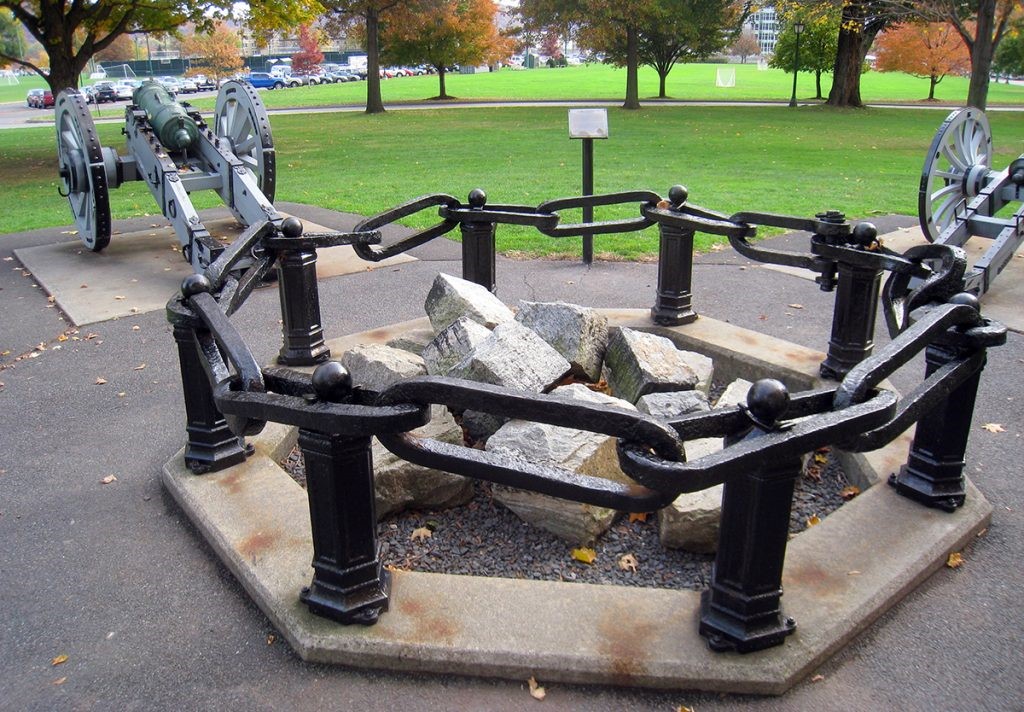
The Great Chain at West Point had an important mission. General Washington needed to prevent the British from taking control of the Hudson River and splitting the American colonies. If the British controlled the river, they’d have the ability to launch a major invasion from Canada and cut New England off from the middle and southern colonies—allowing them to win the war. Washington and the Continental Congress were not going to let that happen! They needed to keep the British fleet in New York, so they financed a giant chain to be forged and installed across the Hudson River at West Point—and it worked!

The chain was installed on April 30, 1778. It took 40 men four days to install it. The chain was supported by a bridge of waterproofed logs, like connected rafts that stretched across the river. There was a clever system of pulleys, rollers, and ropes, and midstream, there were anchors to adjust the tension to overcome currents and tides. Creative, right?

Consider these facts:

  • The chain consisted of 1,200 large links;
  • Each iron link was 2 feet long; and
  • Each link weighed 100 to 180 pounds.

As the British fleet approached the Great Chain at West Point, they were intimidated and retreated. Had they done so, the chain would have ripped a ship’s hull apart.

General Washington kept the chain a secret in all of his correspondence in the fall of 1778, referring to it as one of “several works for the defense of the river.” A tory spy did, however, report news of the chain to the British in New York City. Later, the Great Chain was dubbed “Washington’s giant watch chain” by newspapers in New York. It was certainly a special project of his – so much so that when they decided to take it down, Washington had to be on hand to oversee the operation himself. On the day after the Continental Army took it down, November 29, 1779, Lieutenant Reynolds, Aide to Colonel Timothy Pickering, The Adjutant General, U.S. Army, West Point, wrote the following to his wife about General Washington:

“The day started with breakfast of dried beef and talk of the upcoming battles and the need to keep the British Forces split between New York and Canada.  As assistant to Colonel Pickering, I got to sit in on all meetings and see the leaders at work.  Colonel Pickering is so very calm, which I believe he has learned from General Washington.  … The chain came out of the river yesterday and it was quite an operation to behold.  General Washington took his entire staff down to River Bank to the chain emplacement and oversaw the removal of the chain personally.

“It was quite a spectacle to see as the entire staff, General Washington on his great horse, Nelson, overseeing all the Soldiers and officers conducting the boat operation to retrieve the chain before the river would freeze over.  … Boats were used to maneuver the barges and raffs toward shore where the oxen could pull the great chain up on the bank of the river.  It took the entire afternoon and evening by torchlight to get the chain onto the shore and it was none too soon as the river had ice floating in it as we finished up last night.

“I will never forget seeing General Washington riding back and forth on that great horse talking to every Soldier, talking with the head of his honor guard and with his guests.  General Washington is always at his best when riding.  He becomes more animated and actually talks to almost everyone.  … General Von Steuben and The Marquis de Lafayette both commented to Colonel Pickering that General Washington is the right man at the right time for the American Army, as he is as noble as any aristocrat on horseback yet is truly an American Patriot in demeanor and leadership.”

Robert Skead is the author of Links to Liberty, the third book in the American Revolutionary War Adventure series, from Knox Press. Patriots, Redcoats and Spies, the first book in the series, features an adventure around an urgent spy letter from the Culper spy ring that needs to be delivered to General Washington. The second book in the series, Submarines, Secrets and a Daring Rescue, teaches about the American Turtle submarine. The stories were created by Robert and his father, Robert A. Skead (now 95-years-old) to inspire readers to do great things and celebrate the creativity of colonial patriots. The Skeads are members of the Sons of the American Revolution. Their ancestor, Lamberton Clark, one of the main characters in the stories, served in the Revolutionary War as a member of the Connecticut Militia and the Continental Army. Discover more at www.robertskead.com.

Does China Make the World Flat? Using Compelling Questions and Creating C3 Inquiries for the Social Studies Classroom

Does China Make the World Flat? Using Compelling Questions and Creating C3 Inquiries for the Social Studies Classroom

Starlynn Nance

Tension engulfs the room and faces begin to crinkle into frowns as a collective look of confusion crosses thirty seventh grader’s faces as they read the slide “Does China make the world flat?” Students look at each other and then back at the slide.  Several verbal exclamations of “what?’ and “the world is round!” bellows across the room.  Smiling sweetly, the teacher only states, “write it in your journal” before the bell rings and the bewildered seventh graders are dismissed from world history class. This exchange is the end of dimension one from the C3 unit titled Ancient China.  

National Council for the Social Studies: C3 Inquiry Framework

In How We Think (1910), Dewey discusses how important inquiry is to children.  He stressed that children need to learn by doing and trying different things not just memorizing and repeating the information to the teacher. 

Inquiry is simply, investigating.  In social studies, teachers should set up lessons of inquiry to include diverse historical content and let students ask questions, then investigate to find the answers.  Once a student has a firm foundation of the content, they can then begin to start connecting the past to the present. They may start to ask questions about their own community after learning about civil rights concerning injustice, voting rights in the community, or lack of representation on city council. Once that connection is made, students need guidance to develop skills to research, answer questions, and learn how, for example, to start a grassroots campaign for change.

An inquiry framework to teach these skill sets is called the College, Career, and Civic Life (C3) from the National Council for the Social Studies (NCSS).  The framework (2017) uses concepts, facts, tools, disciplinary and content literacies to successfully complete an inquiry in a social studies classroom (p. 17). It consists of four dimensions that build an inquiry arc and move the students through questioning, content, evaluation of sources, and eventual action to make change. Studying social studies, especially the four content areas highlighted in dimension two (history, civics, economics, geography), show students that the precepts of democracy have not applied to all people in their history book. This connection is key to inquiry. For students to learn to speak out against bullying, discrimination, systemic racism and other abuses against themselves or democracy, teachers need to use inquiry so students can learn skills to “take action”. 

That’s All Well and Good, But HOW Do I Create One?

            This article will feature a thorough explanation of creating C3’s in the social studies classroom.   Most teachers fit the C3 around a premade unit, such as the Ancient China unit in the introduction or create a C3 that is a stand-alone multiple day lesson plan like “Why Vote?” (This C3 can be found in Teaching the College, Career, and Civic Life Framework: Exploring Inquiry-based Instruction in Social Studies published by NCSS.)  The “Why Vote” C3 has been taught in a social studies methods course, tenth grade civics, ninth and tenth grade government, eighth grade United States history and other courses by teachers in the past several years in a midwestern state following their graduation from the social studies program.  

The C3 contains an inquiry arc and consists of four dimensions and subsections of those dimensions. The first dimension develops two types of questions, compelling and supporting. Questioning is a main component of inquiry and allows students to develop both styles of questions to increase critical thinking and knowledge of content. Dimension two is the mainstay of the framework and encourages multidisciplinary (history, civics, geography, and economics) content literacy to emerge. Students use relevant sources, in dimension three, to develop claims and counterclaims while dimension four supports inquiry and disciplinary literacy by retrieving and analyzing data, answering student developed questions, communicating conclusions, and taking informed action. Moving the students through these four dimensions can teach democratic skills and hopefully develop a more skilled, active, and responsible citizen. 

Dimension One

This dimension is instructing students to answer and develop questions that are compelling and supporting. A compelling question consists of a long-lasting issue, such as war, civil rights, or privacy while supporting questions include extracting answers from a source, finding definitions, or establishing a series of steps. An example of a compelling question would be “is the Revolutionary War really revolutionary?” Supporting questions deal with the content directly and help students analyze documents or any other sources. Supporting questions could be “is there bias in the document?”, “who wrote the document?”, or “how long did it take the Native Americans to move from X to Y in the removal process?” Supporting questions from all documents or sources help answer the compelling question by extracting evidence from all sources retrieved. 

Step 1: Selection of content.  As the title suggests, content is the first step to beginning dimension one. Gather the curriculum map, state standards, objectives, and premade unit or specific stand-alone topic to begin the C3 and develop dimension one.  Using the objectives, begin to create a compelling question and supporting questions for the unit.  Both are used throughout the C3 to develop students thinking and give substance to the essay written after dimension four. 

Step 2: The compelling question and supporting questions. From experience, creating a compelling question that has an element of good confusion gets the students to think.  As suggested by the C3 text, “is the Revolutionary War really revolutionary?” is a question that needs research to answer.  Just from presenting the compelling question, supporting questions begin to emerge from the students, like, “what is a revolution?” “have there been any other revolutions in history?” “when was the revolution?”, etc.  Students will use their textbooks, appropriate internet sources, etc. to find the answers to their questions.  The teachers will facilitate this activity and fill in gaps of content when necessary. 

Concerning compelling questions, the goal is not to have a textbook cookie cutter answer that all the students cut and paste from their notes or from an internet section of content.  The goal is for students to be able to answer yes or no and then develop their argument using sources that are given or gathered throughout the C3.  There is no correct answer, only evidenced based answers.  Compelling questions are asked after every dimension as a formative assessment to gather information about the students learning of the content and sources. At the end of dimension four, the compelling question essay is the summative or the authentic assessment.

Step 3: The hook. After the compelling question is designed, the teacher needs a hook to get the students interested in the unit topic.  Hooks can look different depending on the topic or content objectives pulled from the curriculum map.  Hooks can be a song, a poem, a picture, a painting, an excerpt of a primary source, a game, a simulation, or part of a movie/documentary.  Usually, the hook relates to the compelling question in some aspect.  The goal is to spark interest in a topic and connect it to the compelling question.  For example, to start a Cold War C3, one teacher used gamification to begin the unit where students became CIA agents trying to catch a Soviet sleeper agent in the United States.  The goal was to get the students to feel stress and tension while going through the gamification CIA missions.  The teacher asked the students about their feelings and one student exclaimed, “I was stressed!”  This led to a whole class grand discussion about tension between the two nations and eventually at the end of the class, the teacher displayed the compelling question, “How hot was the Cold War?”

Dimension Two 

Dimension Two is applying disciplinary concepts and tools using the four disciplines of history, geography, civics, and economics. In the framework (2017), teachers work with conceptual concepts, such as “explain the powers and limits of the three branches of government, public officials and bureaucracies at different levels in the US and other countries” rather than curricular content that would state, “identify every form of government” (p. 29). The curricular content will be found in the state standards and/or local curriculum maps. 

Step 1: Gather curricular and conceptual content.  Since each state and district is different, gather what you need for your unit.  This could include, pre-made units, state standards, district curriculum maps, lesson objectives and/or unit goals.  If you need to take the state standards and develop goals, objectives, etc.  please do that during this step.

Step 2: Disciplines.  Once you have what you need, make sure that the unit covers the four main disciplines of history, geography, civics, and economics inside the unit.  The C3 text has standards to help focus your unit and is found at https://www.socialstudies.org/standards/c3.    

Step 3: Create dimension two unit and lessons. Dimension Two is designed for the teacher to use content literacy to teach the facts, generalizations, concepts, etc. of the content required by the district and/or the state.  Teachers can use pre-made units containing different instructional strategies and activities for students to accomplish the objectives.  Display the compelling question before starting dimension two, so the students have a lens to “look” through as they learn about content and accomplish the objectives.  Remember to include all disciplines in the content.

Step 4 Assessment.  At this time in the C3, give the students a content assessment.  This could be your own test from the pre-made unit or the common assessment used by your data team.

Dimension Three 

This dimension is skill based by evaluating sources and using evidence. Students use the questions from dimension one to gather and evaluate sources that help answer those questions. After this is complete, students will develop claims (arguments) and counterclaims (arguments) using the evidence to support those claims. Students develop their own supporting questions and begin to gather evidence asking those questions along the way. This allows them to progress through the inquiry and begin to develop solutions to a problem they see in the community. Dimension three and four are student centered where the teacher becomes a facilitator. 

            Step 1: The primary sources and skill sets. Prior to evaluating the primary sources, teachers need to start with historical thinking skills of sourcing, close read, annotation, contextualization, and corroboration.  (Teacher tip: teach these skills at the beginning of the school year for students to use in every C3. More skills for historical thinking skills can be found at https://www.historians.org/teaching-and-learning/teaching-resources-for-historians/teaching-and-learning-in-the-digital-age/the-history-of-the-americas/the-conquest-of-mexico/for-teachers/setting-up-the-project/historical-thinking-skills)

            Step 2: Evidence. After students have mastered the historical thinking skills, the teacher will transition to dimension three by gathering resources for a balanced set of evidence or have a list of appropriate texts and websites for research.  This dimension is for students to take control over their learning to develop claims/arguments for compelling questions students create in addition to the compelling question from the beginning of the unit.  Focusing on the content from dimension two and the new sources presented or collected, the teacher will take a facilitator role asking students questions when students get in a bind, rather than giving any answers.

            Step 3: Writing an essay or other type of authentic assessment.  After completion of dimensions one through three, students are ready to write an essay (authentic assessment) about what their claim is to the compelling question and use evidence found and connect content from dimension two.  Many different methods can be found to help the students complete the essay but one, has been efficient in working with the C3 framework and is called the P.E.E.L.  One example from online can be found at, https://www.virtuallibrary.info/peel-paragraph-writing.html.   

Dimension Four 

Civic engagement is a very important part for students to encounter as a developing citizen. Dimension four is the authentic assessment for students to communicate conclusions and take informed action. In dimension four, the students usually show the connections from dimension two, curricular and conceptual concepts, to today and their own lives. Then they develop a plan and act on that plan to solve a problem they found with the school or local community. The teacher continues to facilitate during this dimension as the students gain agency and sophistication to solve problems in a democracy. 

Step 1: The essay and then the issue.  Using the essay as a jumping off point, ask the students to connect claims made in the essay to today’s current events.  Have the students discuss this in small groups, like Think, Pair, Share, four-to-five-member small groups, or as a whole class discussion.  The teacher, only a facilitator, lists the issues on the board, and all are considered equal.  Students discuss and narrow down the list of issues to one that works within school policy, time frames, COVID-policies, etc.  The students narrow the issue and then create a plan to implement to solve the issue/problem that has arisen from understanding the content in dimensions two and three.  For example, the seventh-grade class studying Ancient China decided that the world was flat because of globalization and trade as far back as the Silk Roads.  Students began to learn about economics and sweat shops in China.  After doing research, they wanted to bring the issues of unfair wages, bad working conditions, and child labor of sweatshops in China to their community. 

Step 2 Research, creating a plan, communicating conclusions, and implementing action.  After the students have decided on an issue, they need to research the issue.  Using dimensions two and three as a format, the students need to create a compelling and supporting questions concerning their issue.  Student research, answering their questions, and then create a plan to combat the problem/issue they chose.  This needs to be written in another P.E.E.L because it will be shared to groups or individuals that are stakeholders.  Then the students need to implement the action. 

For example, the seventh graders found what fair trade meant, how to find fair trade businesses and then began to list clothing they wore, stores they shopped at, and business in the town.  They then researched to see if these were fair trade or not.  After finding the answers, the class wrote a P.E.E.L and presented it to the teacher and principal.   The P.E.E.L described their compelling question and gave evidence of why they needed to create a public service announcement (PSA) for the community concerning fair trade.  Due to restrictions, the students decided to communicate through social media and tagged all the fair-trade companies for consumers to consider. 

Why Vote?: A C3 Example Lesson Plan for Teachers

            NCSS has published two bulletins titled Teaching: The College, Career, and Civic Life (C3) Framework: Exploring Inquiry-Based Instruction in Social Studies I and II. In the first bulletin, number 114, it states, “teachers will need to be intentional about making space in the curriculum, selecting sources, building in scaffolding, and incorporating related assessments in order to support students in this process…teachers will need to provide experiences that allow students to practice gathering information from sources and making claims supported with evidence” (p. 5). This bulletin is the perfect guide to assist teachers in making the space to practice inquiry and for students to develop an action plan and follow through to make change.  These C3 topics can be implemented in pre-made units or as stand-alone C3s to enhance a topic taught in the social studies classroom.

 A course taught at a midwestern university incorporates a chapter from this text to teach future social studies teachers how to implement the C3 Framework into units and practice the inquiry during a mid-level teaching observation and student teaching requirement. Student and first year teachers (from the program) have adapted this framework and taught it from middle school through high school. The chapter is titled Why Vote? Understanding Elections, The Candidates, and Why Any of This Matters and was created by the Mikva Challenge. The chapter moves the students through the four dimensions of the C3 Framework to answer the compelling question: Why Vote? The next few paragraphs will take the reader through the C3 as it was taught in the methods course and then in seventh through twelfth grade classrooms by graduates of the program.

Dimension One

Dimension One begins with a bell ringer on the first day of the unit titled Civil Rights. On the screen, a picture of two young men is shown to the students. The picture is black and white and shows one with his face painted white with VOTE on his forehead with the other standing behind him, holding an American flag. The students are asked to fill in a graphic organizer about the photograph. Then the students are asked to source the photograph. After finding the answer using a search engine, a grand conversation begins to discuss key questions about the photograph and the compelling question is displayed at the end of the class. The teacher facilitates another grand conversation, instructing the students to develop another graphic organizer to help map out the compelling question: Why Vote?

Dimension Two

Dimension Two consists of learning stations and curricular content. Teachers teach the local and state standards regarding the Civil Rights unit. This content is connected to examples from today about civil rights and voting through learning stations. The teacher uses primary sources to connect the past to the present. Different categories, such as, “I vote…because I care about issues,” are introduced in the stations. Students work in groups using the sources connecting the curricular content to the contextual content from both state/local and national standards.

Dimension Three

Dimension Three is more student centered. Students begin to ask other questions in addition to Why Vote? One of the most popular questions is: why do people not vote? This requires students to search for the answer to this question using data from different governmental sources. Then to check this data, the students create their own data set from the community they live in. From the data set, other supporting and compelling questions arise, and the students begin to find problems about voting in their community. The students write an essay answering the compelling question.

Dimension Four

Students develop an action plan and carry it out after completing dimension four communicating the conclusions found through their inquiry. The students then carry out their plan that answered the question: Why Vote?

Although the paragraphs seem to make the inquiry simple and quick, it is not. Inquiry is messy and sometimes very frustrating. Some questions that arise are hard to answer or cannot be answered. Students must have the space and time to follow the inquiry to the end. This does take many days but with the right amount of planning it will fit with pre-made units already in the curriculum.

As a side note, from the many classrooms I have observed, including my own, when this framework is presented, the middle or high school students love it. They get very excited to see their plan take root and feel pride in their accomplishments as developing citizens.  They also learn to compromise and evaluate their own thinking and work with others.  It is a truly a collaborative process.  A hard process, a learning process, but a very rewarding process.   

Conclusion

            C3 is an inquiry framework from NCSS that takes the students through a hook of interest to implementation of action in four dimensions.  Through the process, students learn a variety of historical thinking skills, collaboration, resilience, evaluation, writing, and how to develop questions and research answers.  Having the students move through this process is what Dewey may have envisioned in How We Think.  Getting the students attention, teaching content, facilitating student learning, and watching students complete a plan of action to implement it can be the spark students need to develop as a citizen and start to make change in home town communities.

References

Dewey, J.(1910). How We Think. Boston: D.C. Heath & Co.

Herczog, M. (2013) Social Studies for the Next Generation: Purposes, Practices, and Implications of the College, Career, and Civic Life Framework for Social Studies State Standards. Bulletin 113, National Council for the Social Studies, Washington, D.C. Retrieved from https://www.socialstudies.org/standards/c3

Historical Thinking Skills. Retrieved from https://www.historians.org/teaching-and-learning/teaching-resources-for-historians/teaching-and-learning-in-the-digital-age/the-history-of-the-americas/the-conquest-of-mexico/for-teachers/setting-up-the-project/historical-thinking-skills

P.E.E.L paragraph. Retrieved from https://www.virtuallibrary.info/peel-paragraph-writing.html

Swan, K and Lee, John (2014). Teaching the College, Career, and Civic Life Framework:

Exploring Inquiry-based Instruction in Social Studies, Bulletin 114. National Council for the Social Studies.

How to Avoid a Climate Disaster by Bill Gates

How to Avoid a Climate Disaster

By Bill Gates (2021)

Reviewed by Hank Bitten, NJCSS Executive Director

The New Jersey Department of Education has taken an important step in avoiding a climate disaster. Beginning in September 2022, every New Jersey student in Grades K-12 will be studying the causes and effects of climate change in their community, state, nation, and world. In Social Studies classes, students will be researching, debating, proposing, and implementing solutions to reduce their carbon foot print, propose strategies for a sustainable environment in their schools and community, propose solutions at the state and national level, and collaborate with students and professionals in other countries about global initiatives. The goal of changing behavior at this critical time is to educate students with an interdisciplinary model and approaches in all disciplines.

Bill Gates focuses on solutions to the impending climate crises regarding the harms of the 51,000,000,000 (billion) tons of greenhouse gases that 7,500,000,000 (billion) people contribute to every year!  Although on the average this is 70 tons a day, the per person contribution is significantly higher in the United States, New Jersey, and some other countries. Europe has a plan to become the first continent to become carbon neutral in 30 years. (What is the EU’s Green Deal? And could Europe become the first climate-neutral continent? | World Economic Forum (weforum.org))

The first application in How to Avoid a Climate Disaster is with the metaphors that will help students in the elementary grades to understand the effects of global warming.

For example: Imagine a bathtub of water with the drain closed that is slowly filling up with water. What will eventually happen? What will be the damage to the room or house? Why is it not enough to slow the amount of water filling up the bathtub? 

Imagine sitting in a car with the sun shining on the glass windows.  What happens to the temperature inside the car? Will opening the window half an inch make the car safe for passengers?  Why is the temperature of the earth increasing every year? What will be the result if it continues to increase?

These metaphors will help students understand that small changes in our behaviors are helpful but they are not likely to solve the problem for what is causing the earth’s temperature to continually increase. Teachers will find valuable resources for teaching young children how electricity and cars contribute to greenhouse gas emissions. (Page 55) For example, electricity contributes about 27% of greenhouse gases to our environment. For younger children, teachers need to help their students understand how much electricity (megawatts and kilowatts) one family contributes.  The average home uses 28 kilowatt hours of electricity per day. For example, my electric bill stated that our home consumed 630 kilowatt hours over 28 days or 23 kilowatt hours per day.

Ask your students to identify everything in their apartment of home that uses electricity. Then compare kilowatts to a cup or glass of water that would be emptied into a sink or tub with the drain closed. Have your students explain the effects of increasing and decreasing the amount of electricity consumed.  The more electricity used and the more people using electricity will generate additional greenhouse gases that will harm the environment.

Another important understanding for younger children is to understand that each item they identify as using electricity uses different amounts of energy. For example, a light bulb might use 40 watts but the hair dryer uses 1,500. The critical application for younger students is to understand that by reducing the amount of electricity consumed helps the environment. In this context, teachers should scaffold to a higher conceptual level by understanding the impacts of more people in the home, community, and world. Reducing greenhouse gases is very difficult which is why understanding that everything we do and everything we produce has a harmful effect on our planet.

The second application is the useful information to support middle school student debates on the solutions to reduce greenhouse gases at the local, state, and national levels.

Middle school students should understand how human activity is accelerating climate changes by warmer temperatures. The technology of renewable sources, (i.e., solar, wind, nuclear, geothermal) should also be familiar to most students. However, the cost, amount of space needed to produce energy for a city, and the durability of the equipment are important areas for student research, problem-solving, and debate.

In the United States we have replaced energy several times over the past century.  Many homes have fire places but wood burns quickly and heat is lost through the chimney. Coal and oil were more efficient resources to heat homes.  They were eventually replaced in many homes with natural or propane gas. In the 1950s and 1960s the government supported high-powered transmission lines for electricity and underground pipes for natural gas. In the 1970s we transitioned from leaded gasoline to a more expensive grade of unleaded fuel.  Understanding the processes of continuity and change over time for how people live is critical to understanding the societal costs of inexpensive fossil fuels.

In Zurich, Switzerland there is a DAC (direct air capture) facility operated by Climeworks which can remove (or absorb) carbon from the atmosphere as it is released.  The cost is $100 per ton.  Since the world is currently producing 51 billion tons of harmful carbon emissions EACH year, the cost is $5.1 trillion.  The United States has a per person carbon footprint of 15 tons per person. The cost would be $1,500 per person or $6,000 for a family of four. This would be the cost EACH YEAR and a very expensive solution.

There are interesting hypothetical scenarios in How to Avoid a Climate Disaster regarding a place near Seattle or a large city the size of Tokyo. In these scenarios, students will find enough information for them to ask probing questions or search for more research regarding the average number of days with sunlight or wind speeds, the impact of severe weather, the amount of space on land or in water to build an energy farm, the costs to transmit electricity over long distances, and how to store sufficient power for evenings and when energy supplies are less than what is demanded.

Another interesting topic for middle school students to debate or discuss is the impact of electric vehicles on home energy supplies. Students need to consider the impact of charging multiple vehicles per household and in a city with high-rise apartments.  The book also provides basic information that should motivate students to research the technologies of fusion, batteries, and nuclear power. The ITER project in southern France will likely be operational within this decade. Is fusion the magical answer for our goal of zero carbon emissions?  Teachers will find empirical evidence in this book regarding current technology and experiments which are essential when teaching students how to support their claims and arguments with evidence.

The third application is for high school students to determine proposals for reducing the one-third of greenhouse gas emissions that come from producing plastics, cement, and fertilizers.

The media focuses on emissions from the fossil fuels of vehicles and the generation of electric power. Two areas that may not be familiar to students are that 19 percent of global emissions come from the production and application of fertilizers and 31 percent from industrial production.  The combination of these two areas represents about one-half of the 51 billion tons of greenhouse gas emissions currently contributing to the increase in temperature.  When studying continuity and change over time, students visually see how communities and cities change over 100 years, 50 years, or less. For example:

Shanghai, China in 1987 (on the left) and 2013 (on the right) Source

New York City (1876-2013)

When studying the impact of land use on climate, students should explore the environmental costs to society from the use of cement, steel, glass, generation of electricity, loss of forested land, waste, and traffic. How to Avoid a Climate Disaster provides an opportunity for classroom exploration, research, inquiry, collaboration, and solutions.  The contribution of the social sciences to understanding the causes of greenhouse gas emissions, strategies for changing the way we currently are doing things, and analyzing the externality of societal costs is found in what students do best – asking questions, researching, debating private and public solutions, analyzing the costs and long-term benefits, and presenting information clearly and concisely in graphs, tables, maps, and images.

Examples of questions for collaboration, researching, and interviewing by students are:

  • How are we producing automobiles?
  • Is natural gas the most efficient method for cooking food and heating buildings?
  • What are the societal costs for raising animals for food?
  • How should we recycle food waste?
  • How would a Green Premium be calculated in analyzing the costs and benefits over time?
  • How significant are the societal costs of air-conditioning on a global scale?

Standard 6.3 for climate for high school students in New Jersey requires them to collaborate with other students on proposed solutions.

6.3.12.GeoGI.1: Collaborate with students from other countries to develop possible solutions to an issue of environmental justice, including climate change and water scarcity, and present those solutions to relevant national and international governmental and/or nongovernmental organizations.

The competitive advantage of Social Studies in learning about the biggest issue to impact our planet in history is with our ability to engage in problem solving, understanding perspectives from different cultures, historical lessons of strategies to address problems over time, the ability to analyze the economics of the problem and solutions, and to debate the effectiveness of public and private solutions. The Social Studies classroom, especially in grades 6-12, is a laboratory for analyzing the marginal costs and losses of incremental changes, preventative solutions, investments in research and development, and the cost of inaction.

“Climate science tells us why we need to deal with this problem but not how to deal with it.  For that, we’ll need biology, chemistry, physics, political science, economics, and other sciences.” (Page 198)

One of the best chapters in How to Avoid a Climate Disaster is the one on government. The perspectives on the electrification or rural America, installing natural gas lines, building the interstate highway system, implementing the Clean Air Act or 1970, the Montreal Protocol of 1987, and the Human Genome Project provide empirical examples of what the government of the United States has accomplished in the 20th century.  The lessons of innovation and the call to debate solutions for reaching the goal of zero carbon emissions are opportunities that should be integrated into the existing curriculum. The Sunshot Initiative sponsored by the U.S. Department of Energy to reduce the costs of solar energy is one example worth studying in Economics or U.S. History. Here are some examples:

  1. Will the steps taken to reduce carbon emissions in your community or average size city in New Jersey work in Tokyo with a population of 38 million, or Mexico City, New York, or Mumbai?
  2. Is the best strategy for reducing carbon emissions one that is implemented at the local or state level of government, through national or global commitments, or by incentives to private firms?
  3. Are there dangers in making immediate but small reductions by 2030 or will it be more effective to wait for new technologies from current research?
  4. If society delays implementing carbon emission reductions now, will the costs be significantly more expensive if implementation is postponed five or ten years?
  5. What are the most effective incentives to lower costs and reduce risks? (tax credits, subsidies, loan guarantees, carbon tax, cap and trade system, etc.)
  6. How important are the actions taken by citizens, consumers, and producers in taking the initiative in reducing carbon emissions?
  7. What lessons have we learned from the Covid-19 pandemic that apply to our response to impending warmer temperatures and rising sea levels from carbon emissions?

As teachers in New Jersey begin to implement the K-12 mandated curriculum standards on climate and environmental sustainability, they should consider an interdisciplinary model that includes learning in every grade focusing on causes, effects, and solutions at the local, state, national, and global levels.  Students who are age five in Kindergarten in 2021 will be 34 in 2050.  Teachers who are age 25 or 30 now will be 55-60 in 2050.  The curriculum that is planned and implemented will have a measurable legacy in the foreseeable future. In 1921, a nuclear bomb, sending a man to the moon, CT images, Global Positioning Systems (GPS) were impossible to imagine but by the middle of the 20th century they were in development of considered possible. Social Studies teachers must look beyond what is predictable today and teach students for a world that may be in conflict and crisis or one that can be safer and better.

Keep Sharp by Dr. Sanjay Gupta

Keep Sharp

Dr. Sanjay Gupta

Reviewed by Hank Bitten, NJCSS Executive Director

I selected this book with the intention of discovering a resource for Psychology teachers who need relevant information to support their teaching about the brain. As a history educator, I recognize my pedestrian level of understanding how my brain works. As I write this book review, I am using millions of brain cells or neurons but also rewiring my brain to adapt to a new subject area and audience.

The first new thing I learned from reading this book was a respect for my own brain.

My brain “weighs less than most laptop computers, yet it can perform in a way that no computer can or ever will.” (p. 30)  It is the power of my brain that enables me to think in ways beyond my basic survival instincts. My awareness of diet and nutrition is limited to my narrow perspective of fitness and weight control. In Keep Sharp, I became aware of the importance of nutritional foods in controlling the amount of inflammation in my arteries and blood vessels in my brain. The brain also thrives on oxygen and activity. There is a relationship between time spent on individual and team sports with memory and a positive learning impact. (p. 102) I also am more aware of getting outdoors for exercise and fresh air, even during cold and wet weather.

I have become more aware of how my brain regulates every part of my body regarding hormonal secretions, cognitive memory, and a daily cleansing ritual similar to how my anti-virus software deletes hidden files on my computer. The benefits of exercise and movement are critical in reducing the harmful effects of sugar remaining idle in our blood which causes dramatic fluctuations in glucose and insulin impacting brain structure and development.

“Without a healthy brain, you cannot even make healthy decisions. And with a healthy brain comes not only a healthy body, weight, heart, and so on, but also a stronger sense of confidence a more solid financial future thanks to smart decisions, better relationships, more love in life, and heightened overall happiness.” (p. 76)  

The second new thing I found of interest was the statistical or factual information presented in the book

For example, here are five observations:

  1. The brain uses 20 percent of my energy and oxygen intake. Since 75% of our brains are composed of water (similar for the heart) that dehydration affects our cognitive skills and attention immediately. (p.36)
  2. The brain is the last organ in our body to mature, which is why teenagers are vulnerable to risky behaviors and in need of emotional learning and support. For some of us, the brain does not reach maturity until about age 25.  There is also a difference between our chronological age and vascular age, which explains why people in their eighties are able to compete in marathons or swim across the English Channel as Otto Thaning, from South Africa, did in 2014 at age 73!
  3. “In 2018, researchers from Columbia University showed for the first time that healthy older folks can generate as many new brain cells as younger people.” (p. 67)
  4. By the age of eighty-five and older, about a third of the people have dementia. (p.95) “Two-thirds of Americans with Alzheimer’s disease are women, and we don’t have an understanding yet why this is the case or what causes women to be at a higher risk.” (p. 82)
  5. “Nearly 35 percent of all U.S. adults have what’s called metabolic syndrome, a combination of health conditions you don’t want to have, such as obesity, high blood pressure, insulin resistance, type 2 diabetes, or a poor lipid profile.  Since 2005, researchers have been finding correlations between diabetes and a risk for Alzheimer’s disease, especially when the diabetes is not controlled and a person suffers from high blood sugar.” (p. 58)

The third insight I enjoyed were the metaphors presented to illustrate in practical ways how the brain functions.

For example, the metaphors of understanding the brain as a town or a puzzle are useful illustrations for students:

“I think the brain is like a town.  The important structures such as the houses and shops are in nearly constant use, and they probably represent 10 to 20 percent of our brains. The rest, however, are the roads than connect all these shops and homes.  Without the roads, information could not get to where it needs to go.  So, while the roads are not in constant use, they are necessary.” (p. 82)

“When you recall a memory, it is like assembling a giant jigsaw puzzle from a few small pieces to get it started.  As the pieces come together, link, and define an image, they begin to tell a story, convey a picture, or share knowledge.” (p. 41)

Perhaps the most significant information I learned in Keep Sharp was in Chapter 6, “The Need for Sleep and Relaxation.” 

Sleep controls our hormonal cycles and our circadian rhythm.

“Sleep is essential for consolidating our memories and filing them away for later recall.  Research is showing that brief bursts of brain activity during deep sleep, called sleep spindles, effectively move recent memories, including what we learned that day, from the short-term space of the hippocampus to the “hard drive” of our neocortex.” (p. 137)

Dr. Sanjay Gupta references numerous research studies throughout the book. The University of Rochester study on the glymphatic system provided me with insight into how my brain functions by decluttering information I process during the day and removing dangerous metabolic chemicals preventing inflammation and reducing feelings of depression.  However, regular sleep is the process for the optimal performance of our brains on start-up upon waking up.

Many psychology teachers emphasize the relationship of nutrition to behavior.  This book provides useful information regarding the evidence of research studies in this area. For example, in 2014, the Finnish Geriatric Intervention Study to Prevent Cognitive Impairment and Disability reported that diet and exercise contributed to preserving cognition.  A similar conclusion was reached in the United States by the Alzheimer’s Association on reducing the amount of sugar in the blood. (p. 164). “Increasing fruit intake by just one serving a day has the estimated potential to reduce your risk of dying from a cardiovascular event by 8 percent, the equivalent of 60,000 fewer deaths annually in the United States and 1.6 million deaths globally. (p. 167) This is significant because hypertension and diabetes contribute to inflammation and plaque in the brain.  People with high levels of blood sugar, even if they are not diabetic and of normal weight, releases hormones and cytokines that cause cognitive deterioration.

Other areas in Keep Sharp that are related to the high school Psychology and Sociology curriculums are the role that loneliness from the divorce and the death of a spouse have on human behavior and the human body. Researchers at the University of Michigan found that married people are less likely to experience dementia as they age, and divorcees and those who are widowed or never-married are twice as likely to develop dementia! (p. 190) The demographics of this population is roughly 60 million Americans, or 20% of our population. (p. 192). It is the quality of relationships that appears to have an effect on our brains.

Conclusion

It is important to teach brain functions and brain health in high school because it supports behaviors for a longevity and cognition. According to the FDA, 99.6 percent of over 400 drug trials relating to Alzheimer’s Disease and dementia have resulted in failures.  The cost of care, supplements, and medications for dementia and Alzheimer’s are in the billions of dollars each year. By 2030, the millennials will begin turning 45, the Generation-Xers 45, and the baby boomers 85. This is a scenario for a major health crisis.

A Question of Freedom by William G. Thomas III, Reviewed by Hank Bitten

A Question of Freedom:

The Families Who Challenged Slavery from the Nation’s Founding to the Civil War

by William G. Thomas III

Reviewed by Hank Bitten, Executive Director NJ Council for the Social Studies

Having taught the colonial unit for decades as part of the U.S. History 1 course, I always dedicated time to Lord Calvert, the persecution of Roman Catholics in Maryland, the Toleration Act of 1649, and life of Charles Carroll of Carrollton. Although I would document his wealth and plantation, I never made the connection to his slaves or the role of the Roman Catholic Church in operating a tobacco plantation with slaves in Prince George’s County.

The history of slaves in Maryland and the role of the Society of Jesuits in conducting the business of a tobacco corporation in complicated.  As a result of reading A Question of Freedom, I have a new perspective and credible documentation of how slavery became rooted in the laws of our colonies, states, and national government.

The opening chapter is a compelling account of the life of Edward Queen who sued for freedom in 1791 because he was the son of a freewoman, his grandmother. (p. 3) The struggle for freedom by Edward Queen continued for 22 years until the decision in Queen v. Hepburn by the U.S. Supreme Court in 1813. His attorney was Francis Scott Key.

Teachers who are looking for the right questions to engage students in historical inquiry and investigative research will find the questions presented by Professor Thomas (University of Nebraska, Lincoln) a valuable resource. This book is filled with inquiry based questions that encourage exploration and debate. Here are some examples:

  1. Why did the Jesuits and other slaveholders fight so ferociously in court to hold on to the people they enslaved?
  2. What did people like Edward Queen hope to achieve, and what did they think was within their reach?
  3. Why did lawyers, like Francis Scott Key take these cases and how did judges, even those with moderate antislavery convictions, end up advancing legal principles in the trials that would ultimately uphold slavery?
  4. How did Duvall, Key, and Queen families know one another long before the case was argued in the Supreme Court in February 1813?
  5. Did the Queen case leave any lasting impression on the thinking of Francis Scott Key when he wrote the poem that would become “The Star Spangled Banner?’ (p. 5)

Professor Thomas discovered the name of Allen Bowie Duckett, Associate Justice to the Circuit Court of the District of Columbia in his research.  Justice Duckett’s father presided over a case for freedom by the Edward Queen family and ruled in their favor. In fact, this decision resulted in the freedom of twenty members of the Queen family. What Professor Thomas discovered through his research was that his grandmother’s family owned plantations adjacent to the area known as White Marsh on the Chesapeake Bay peninsula. He discovered that Elizabeth M. Duckett claimed slaves at the end of the Civil War. The document reported Henny Queen, age 35, and her five children ages six months to eight years old.

Teachers interested in teaching about Continuity and Change will see insights in Chapter 2 about how the aftermath of the Seven Years War and the American Revolution gave rise to the election of liberal and conservative members in the British House of Commons. In America, laws about slavery were limited to each colony before 1789 but in the case of England, its protection, importation, manumission, and abolition applied to a global colonial empire.

Did British Common Law Apply to its Colonies?

Even though the importation of slaves was legal in the United States until 1808, slaves who were brought to England were not compelled to leave according to a common law decision by Chief Justice Lord Mansfield in the decision of James Somersett.  James Somersett, a slave, was taken to England by his master, Charles Stewart, a customs officer in Boston. He ran away and was eventually tracked down and placed in prison. A writ of habeas corpus was issued for his release by the abolitionist Granville Sharp in connection with a pending case by merchants from the West Indies who wanted assurance by common law that slaves were a safe investment. The case of Somersett v. Stewart, 1772 became a landmark case that inspired hope for slaves held in bondage throughout the British empire.

The language of the Somersett decision indicates the complexities of the status of slaves as persons under natural and moral law or as property protected by laws. England will not abolish slavery for 60 years (1833) but without a specific law in England to sanction slavery, a person with the legal status of a slave in a colony could not be forced to leave England and return to slavery. James Somersett continued with his status as a slave but could not be forced to return to chattel slavery. The language is confusing in stating that slavery was odious but a temporary presence in England did not guarantee manumission, and questions would continue regarding if the common law ruling applied only to the definition of being in England or if being on a ship or at a port in the Tames River applied.

“Mansfield’s decision moved slavery entirely out of the reach of the common law and its moral protection.  Whatever slavery was, it was not sanctioned by English common law. As a result, Somersett v. Stewart wiped out the line of seventeenth century precedents that had once propped up slavery as a lawful form of property.” (p. 34)

Professor Thomas researched the case of Mahoney v. Ashton in Maryland. “In its length and complexity, Mahoney v. Ashton was like almost no other petition for freedom in American history.” (p. 88) Charles Mahoney and 40 of his relatives were owned by Charles Carrollton, Maryland’s leading politician and a signer of the Declaration of Independence.

The basis of the trial dated back to Ann Joice, grandmother of Charles Mahoney.  Ann Joice was a black indentured servant from Barbados who spent time in England before coming to Maryland to work for Lord Baltimore.  As an indentured servant, she should be entitled to her freedom, as should her 1,500 descendants who were slaves in Maryland. People of color born from a free woman were not slaves!  Unfortunately, it was difficult to provide evidence that she was in England. The research provided in this case, with its twists and turns, is worth your reading.  In the trial, the jurors heard testimony from hearsay of Mary Queen, a free black woman who came to Virginia from New Spain instead of the Popo region of West Africa as claimed by Benjamin Duvall, representing the slaveholders.

“The all-white slaveholding jury gave greater weight to the testimony of the Queen witnesses, followed the ruling of the general court in Edward’s case, and rendered a verdict in favor of freedom for Phillis Queen. The decision made sense.  A higher court determined Edward Queen was free, so surely his mother, Phillis should be also.  Since Edward’s grandmother, Mary Queen was “not a slave,” surely her daughter could not be a slave either.” (p. 76) “On May 12, 1799, the jury returned an unambiguous verdict: ‘Charles Mahoney is a free man.’” (p. 99)

As a result of this decision, twenty related lawsuits freed over fifty children and grandchildren. “The trials cost John Ashton and the Jesuits 6,795 pounds of tobacco in damages, court costs, and fees.” (p. 78) The year is 1796 and the cost was even greater since tobacco prices were depressed in the mid-1790s. In this same year, the Maryland legislature allowed manumission by last will and testament for individuals in good health, under the age of forty-five, who could support themselves. Unfortunately, legal precedents can change and Charles Mahoney’s family experienced their loss of freedom.

“On June 25, 1802, the High Court of Appeals reversed the May 1799 judgment freeing Charles Mahoney. The defeat was total.”  Setting a foot in England was no longer a basis for the right to life, liberty, and the pursuit of happiness for Charles, Patrick, and Daniel Mahoney or others. (p. 112)

What a teachable moment!

  1. Is this decision evidence that in the United States, slaves were defined as property because of the color of their skin?
  2. Is this decision a reaction against the popularity of the Jeffersonian Republicans after the Election of 1800?
  3. Did the ill-fated rebellion near Richmond, Virginia by Gabriel Prosser in 1800 and the French and Haitian Revolutions increase fears of mob rule and the loss of property?
  4. Is the decision valid based on the arguments of Robert Goodloe Harper that Somersett v. Stewart only suspended a slaveholder’s right to property?
  5. Is the position of the Democratic Republicans contradictory in its support for slavery on the basis of race while advocating for the freedom of specific individuals, like the Mahoney family?

These questions should motivate deeper questions by your students leading to evidence that legal precedents are being established in states that will support the basis of Roger Taney’s obiter dictum in Dred Scott v. Sandford in 1857. The Question of Freedom provides insights into why laws for voting based on the ownership of property were changed to qualifications based on race and skin color. (p. 115) States began to introduce legislation outlawing manumission and requiring free blacks to carry a certificate of freedom signed by the county court. Judges provided instructions to jurors that the burden of proof fell on the enslaved person to prove their freedom and that the color of their mulatto skin was white. “Judges and juries would observe their color, hair, and physical features.  Testimony about the racial features of their ancestors would give greater weight than what contemporaries said about their status as free persons.” (p. 132)

The Impact of the Domestic Slave Trade

The freedom case of Priscilla and Mina Queen (Queen v. Hepburn) offers unique insights into the slave trade, black market trade of enslaved persons, impact of bankruptcy on slaveowners and enslaved persons, and changing financial markets.  The case began in 1809 and a successful outcome depended on Priscilla and Mina Queen proving their grandmother was Nanny Cooper, the daughter of Mary Queen who was in England, and establishing that she came to Maryland as a free woman before 1715 (100 years ago).

John Hepburn, inherited over one thousand acres in 1775 and over the years overspent his fortune in a lucrative life style. As a result of filing for bankruptcy, his creditors could acquire slaves, sell them, and separate them from their children. Blacks, both free and slave, were in high demand to meet the labor needs for the construction of buildings and roads in the new capital city of Washington D.C. and to pick cotton to meet the international demand for cotton textiles.

The U.S. prohibited the international slave trade of slaves in 1808 but the domestic slave trade became a daily event at auctions.  “Former New York congressman John P. Van Ness advertised in the newspaper a year later that he had ‘A Negro Boy for Sale.’” (p. 166) When Catholic women joined the convent, their parents gave the Roman Catholic Church their dowries, which often included slaves. As a result of the increasing population of people of color in the new capital, strict black codes designed to limit freedom in the evening were enacted. (p. 162)

Chapter 5 presents the facts in a concise manner that offers teachers an opportunity to create a mock trial simulation of Queen v. Hepburn and Queen v. Neale. These cases have twists and turns regarding hearsay evidence, transcription errors in documents, and connections to shipping records and wills. Furthermore, the Queen’s lawyer is Francis Scott Key and one of the associate judges on the U.S. Supreme Court, Gabriel Duvall, had previous ruled in favor of Charles Mahoney.  There is also a map of Washington D.C. (1815) identifying the homes and offices of the major individuals in this story.  The research is splendid and the controversial issues for students to debate provide a powerful understanding of both systemic racism in the United States and the depth of individual freedom.  The arguments for the protection of property are real and the right to individual freedom is powerful. (pp. 169 -179

  1. William Cranch, Federalist and nephew of Abigail Adams is the chief judge of the circuit court in D.C. Although a Federalist, expert in property contracts, his decisions generally benefited slaves in their freedom suits.
  2. Francs Scott Key presented all the depositions from the 21 freedom suits of the Queen family that Gabriel Duvall had taken years before. The evidence that Mary Queen was an indentured servant was carefully explained.
  3. Fredus Ryland was a star witness and had previously given a deposition in 1796 stating that he met Mary Queen and heard her story first hand. His deposition clearly stated that she was ‘born free’ came from Guayaquil (Ecuador or New Spain) and was transported around the world and to England by Captain Woodes Rogers and lived in London for three years!
  4. Everyone who was literate in the United States was familiar with Daniel Defoe’s popular book, Robinson Crusoe, which is based on the account of Captain Rogers and includes a reference to a passenger Maria. Could this be Mary Queen?
  5. Francis Scott Key introduced the will of James Carroll bequeathing a woman named Mary to Anthony Carroll, John Carroll’s seven-year old nephew.
  6. The attorneys for Rev. Francis Neale, objected to the deposition of Fredus Ryland claiming it was based on hearsay.

Read the digital files of the freedom suits at The Georgetown Slavery Archive and University of Nebraska-Lincoln O Say Can You See Project

Students should ask questions about the rules of evidence in trials, especially in the case of slaves who lacked birth records and travel documents. In the 21st century lawyers and judges argue over what evidence is credible and what needs to be excluded.  Many judges were open to hearsay evidence in freedom trials, especially when it was supported by multiple individuals. With the rejection of hearsay evidence, Priscilla Queen and Nina Queen both lost their suit for freedom.  However, Nina Queen appealed her decision to the U.S. Supreme Court in February 1813.

In the context of the Fugitive Slave Law of 1850, I taught my students about the slave trade in Washington, D.C. and the market value of the price of slaves.  After reading Question of freedom, I realized this needs to be taught much earlier. Professor Thomas provides detailed research of the slave trade and prisons in our nation’s capital dating back to 1800 and the demand for laborers in building the U.S. Capitol, ships for our navy, and house servants for elected members of our government. It is a valuable resource for teachers, as is Solomon Northrup, Twelve Years a Slave, who want to teach about continuity and change and how the questions relating to slavery, property, and individual freedom changed in the first six decades of the 19th century.

“The men, women, and children were ‘bound together in pairs, some with ropes, and some with iron chains.” (Report from Dr. Jesse Torrey, circa 1815, p. 196)

Slave Trades in Washington D.C.

The locations of hidden slave pen on the upper floor of George Miller’s Tavern on F Street (between 13th and 14th), Williams Yellow House, and Robey’s Tavern on Independence Ave. between 7th and 8th Streets.

The story of Ann Williams captures the fear that every black person faced daily as the demand for labor intensified with the construction of roads and buildings and the cotton economy in the South.  Ann Williams and her two young daughters were taken from their home in Bladensburg, Maryland and marched in chains for seven miles to Washington D.C. She pried open a window and jumped three floors breaking her spine. George Miller, the tavern owner, kept her on a wooden pallet providing her with food and water. 

Engage your students in reflective thinking to determine if his motives were for humanitarian reasons or for profit from the children she would likely give birth to after she was healed. This is a powerful story that your students will never forget. Furthermore, the Circuit Court in D.C. issued a writ of habeas corpus to investigate the incident at the Miller Tavern only to have it rescinded on the grounds that Ann Williams was property and therefore a writ of habeas corpus could not apply because it is only for persons detained. Her story is even more important because on July 2, 1832, she received her freedom through a verdict from a jury in the District of Columbia Court – 17 years after she jumped from the top floor of Miller’s Tavern.

The questions presented by Professor Williams are at times clearly stated and they are also hidden in the perspectives. For example, the argument by George Miller that slaves were property and could be denied a writ of habeas corpus are of national importance.  This incident influenced the Missouri Compromise, Tallmadge Amendment, and the African Colonization Society. With every economic crisis in 1817, 1837, with the changing markets for labor, with burgeoning individual debts and personal bankruptcy, enslaved persons were vulnerable.

Henry Clay

Teachers must ask their students how did economics influence the principles of slaveholders such as Francis Scott Key, John Marshall, Roger B. Taney, Henry Clay and other prominent Americans who are also understood as reformers? The evidence illustrates the inequality of the United States of America in a way that the debate over a $15 minimum wage has arguments for maintaining wages below the poverty level and increasing profits for businesses above the expected rate of inflation. History is complicated!

However, the freedom suit filed by Charlotte Dupee in 1829 for her freedom from Henry Clay, Secretary of State, displays these conflicts.  Henry Clay is a founding member of the American Colonization Society (the chairperson), an aspiring candidate for president, former Speaker of the House of Representatives, and a senator from Kentucky.  Henry Clay stated, “free black confronted unconquerable prejudices resulting from their color and they never could amalgamate with the free whites of this country.” (pp. 200-201)

Henry Clay purchased Charlotte for $450 (a high price) in 1815. She married Henry Clay’s personal assistant and driver, Aaron Dupee. Charlotte and Aaron married and had two children, Charles and Mary Ann.  They lived with Henry Clay in his home (Decatur House) on Lafayette Square. Charlotte’s parents lived in Maryland as a free family and her family visited with them regularly. Charlotte and Aaron were well known and respected among the Washington political elites and likely very aware of legislation and debates relating to slavery.

Charlotte’s law suit was based on the fact that when she was born her parents were free and not slaves. However, she was born in 1787 and her father received his freedom in 1790 and her mother in 1792. She claimed her sale to Henry Clay was illegal.  After the Electoral College declared Andrew Jackson as president, Henry Clay would return to Kentucky with Charlotte and Aaron and their two children. They could be separated and sold at any time.

The case embarrassed Henry Clay and called into question his political reputation. In another interesting twist of research, Professor Williams observes that Charlotte remained in Washington D.C. because of her pending lawsuit and found new employment with Martin Van Buren, the new vice-president and political enemy of Henry Clay.  The Court decided in May 1830 in favor of Henry Clay with the statement “Charlotte Dupee was born a slave for life.” (p.227). Henry Clay instructed his attorney to inform Charlotte to return to his home in Kentucky at her expense.  Students will find Henry Clay’s letter to his attorney of interest:

“I approve entirely of your order to the Marshall to imprison Lotty (Charlotte).Her husband and children are here. Her refusal therefore to return home, when requested by me to do so through you, was unnatural towards them as it was disobedient to me.  She has been her own mistress, upwards of 18 months, since I left her in Washington, in consequence of the groundless writ which she was prompted to bring against me for her freedom; and as that writ has been decided against her, and as her conduct has created insubordination among her relatives here, I think it is high time to put a stop to it.” (p. 227)

Charlotte Dupee was taken to the D.C. City Jail and sent to Henry Clay’s daughter in New Orleans. Charlotte’s freedom suit was never reported in the newspapers. In 1840, Henry Clay emancipated Charlotte and her daughter Mary Anne. She was 53 years old. However, Henry Clay did not free Mary Anne’s children. Have your students examine slavery in America with snapshots taken in 1790 (ratification of the U.S. Constitution), 1800 (rise of Jeffersonian Republicans), 1810 (end to the importation of slaves), 1820 (Missouri Compromise), 1830 (Charlotte Dupee’s freedom suit), 1831 (Nat Turner’s Rebellion), and now in 1840 (Whig Party).

Fears Every Black American Experienced

There were more urban riots in the summer of 1835 than in any other year. The 1835 riots in Washington D.C. exploded in the Washington Navy Yard following the decision to bring thirteen slaves and three free black men to complete the work on the USS Columbia.   The fear of industrial slave labor might replace skilled white workers. After someone reported the theft of compression pins from the blacksmith shop, the white workers went on strike.

The diary (1813-1865) kept by Michael Shiner, one of the enslaved workers who was a literate carpenter reveals the fears of the black community and a unique perspective of the events in Washington D.C.  Michael Shiner was one year away from his freedom when the riots of 1835 happened.  Another event that shook America was the death of John Marshall on July 6, which was followed by the nomination of Roger B. Taney. The diary of Michael Shiner also recorded the arrest of a young African American, Arthur Bowen for the attempted murder of a notable white woman, which involved the U.S. marines to keep order and prevent the lynching of Arthur Bowen.  The U.S. district attorney was Francis Scott Key, a tough prosecutor and brother-in-law to Chief Justice Taney, who arrested Professor Reuben Crandall, a botany professor at Yale.  There are many factors related to these events in the summer of 1835 for students to analyze and each of them reveals engaging questions about abolition, the influence of the Ebenezer African Methodist Church on Fourth and G Streets, the inequality experienced by residents in the area around the Navy Yard (Northeast), the citywide Memorial Petition calling for the abolition of slavery in the District of Columbia, the slave trading corporation of Isaac Franklin and John Armfield with scheduled transports of slaves to New Orleans, Natchez, and other ports in the South. Some of the questions that intrigued me are:

  1. Is holding abolitionist literature and distributing a pamphlet to another person the same as publishing abolitionist literature?
  2. Francis Scott Key represented slaves in their request for freedom, is a founding member of the American Colonization Society, defended slave holders, owned seven slaves, freed four of his slaves, and facilitated the sale of 272 black men, women, and children for $115,000 to balance the accounts of Georgetown College. How should I teach my students about the life of Francis Scott Key?
  3. Did the rhetoric of the abolitionists, intended to end slavery, encourage slaves to become violent and become counter-productive to the cause of freedom?
  4. Was the decision to expand the U.S. Supreme Court in 1837 from seven to nine justices, motivated to protect the property of slaveholders or by the westward expansion of the United States? (President Jackson appointed seven of the nine justices)

System Racism

The evidence in Chapter 8 regarding the financial implications of how slaves were “assembled, sold, and transported,” the exponential impact of how the sale of a few enslaved persons affected the lives of hundreds, the importance of understanding how the panics or economic recessions of 1837 and 1857 contributed to the sale of enslaved persons and the breaking up of families, and the legal theories that were advanced by slaveholders and abolitionists is powerful and clearly articulated. The claims and arguments in this chapter regarding systemic racism in the United States are convincing.

  1. Enslaved persons were treated in every contract and sale as part of a “lot.” Individuals were clearly property and packaged in a way that mortgages are sold as bonds in today’s market. Individual slaves were sold as priced commodities based on their skin colors, genders, skills, histories, and ages. They were sold to different buyers in a similar way that odd lot purchases of stocks are bought and sold on today’s stock exchanges.  Slaves were chattel and appraised for their value. For example, Ann Bell lived independently in Washington D.C. from approximately 1825 to 1836. Unknown to her, she was privately bequeathed as estate property by Gerald T. Greenfield of Tennessee.

“Thirteen-year old Andrew was valued at $375. Caroline, now nine years old, was priced at $250.  Eleven-year old Mary Ellen and seven-year old George were valued at $200 each.  Five-year old Daniel and his three-year old sister Harriett were priced at $100 each.”  (p. 303)

2. After the expiration of the Charter of the Bank of the United States in 1836, state banks developed “property banking” to provide capital for land speculation in land and slaves. For example, the Union Bank of Louisiana arranged for slaveholders to leverage their land and slaves as collateral for expanding their cotton plantations. This was called “hypothecation.” (p. 281). Unfortunately, when supply was greater than demand, creditors demanded payments on loans in gold or specie, or the price of cotton, sugar, or tobacco declined, slaves were traded and sold. It was heartbreaking for families who were broken up.

3. Slavery was legally defined at the state level. For example, in Louisiana ALL Negroes of black color were “presumed to be slaves.”  Slaves could not be freed through a will because they were required to leave the state.  In Maryland, the General Assembly ratified a constitutional amendment in 1837 stating that “the relation of master and slave, in this State, shall not be abolished unless by unanimous vote of the General Assembly and with full compensation to slaveholders.” (p. 263) The reason for this new law was that fugitives were not being returned to Maryland from free states as required by the 1793 Fugitive Slave Act without a legal definition that slaves were property.

5. During the decade of 1831-1840, more than 285,000 slaves from Maryland and Virginia were sold through interstate trade – about 30,000 a year or about 80 a day. (p. 271)

6. The free black population in Maryland doubled between 1790-1800 from 10,000 to 20,000. Forty years later, the number of free blacks had more than tripled to 62,000, and four in every ten African Americans were free. (p. 316)

Slaves purchased on the market walked (perhaps 400-500 miles) to their new destinations in the Carolinas and Georgia or transported on vessels owned by Isaac Franklin and John Armfield, to New Orleans and Natchez.

“Their vessels, built in Connecticut, had been designed specifically for the slave trade, and their holds were similar to those in the ships that plied the transatlantic slave trade. Each captive had only about 36 cubic feet of space, (6x3x2) sometimes less, when more than 180 people were jammed into the tightly packed holds below decks.  Built for Franklin and Armfield’s in 1833, the Uncas carried thousands to New Orleans in the booming interstate slave trade. Franklin and Armfield typically separated the men and boys from the woman and girls on the voyage and heavily fortified the section of the ship holding the men.  Nothing prevented the captain or the officers from entering the women’s hold and seizing any of them for sex. The Uncas carried approximately 50 people.” (p. 290)

In 1850, the slave trade in the District of Columbia ended with the Compromise of 1850. The Fugitive Slave Act followed the neutral language in the Constitution of “persons held to service or labor” instead of slaves. Although these words could provide evidence that slaves were persons with basic constitutional rights of due process under the Fifth Amendment, they were seized without a warrant. Even Frederick Douglass, a runaway, was at risk of being returned to slavery!

Professor Thomas raises excellent questions for students to answer:

  1. Did enslaved persons have any rights under the Constitution?
  2. Was slavery a local condition without fundamental legitimacy in the law and therefore restricted to certain, specific restraints?
  3. Did enslaved persons lack any rights at all, and was slavery national in scope and legal authority under the Constitution?

The answers to these questions are difficult as reflected in the response of the abolitionist William Lloyd Garrison.  The Compromise of 1850 made Garrison choose between the U.S. Constitution and the moral evil of slavery.

“Their idealism was such that they would not participate in purchasing the freedom of a single enslaved person who fled bondage.” (p. 318)

One of the Performance Expectations for students in New Jersey public schools is to learn about free black communities:

6.1.12.HistoryUP.2.b: Analyze the impact and contributions of African American leaders and institutions in the development and activities of black communities in the North and South before and after the Civil War

Although Maryland had the third highest population of slaves in the United States with more than a hundred thousand people in bondage, (p.6), it was also the home to more than 8,000 free blacks living in communities, such as Annapolis and Baltimore and organizing institutions. (p. 42).  Forty years later, the number of free blacks was 62,000, and four in every ten African Americans were free. (p. 316) Students need to know this!

Another insight I learned from reading Question of Freedom was the diversity of Maryland regarding plantation slavery in the Chesapeake Bay area and the absence of slavery in Frederick County in northwestern Maryland. (p.91)

The evidence in A Question of Freedom, regarding the presence of systemic racism in the United States is convincing and it is presented over 240 years beginning with Mary Queen

For further inquiry and exploration, research the digital resources on the freedom suits of enslaved persons from Maryland.

The Georgetown Slavery Archive

University of Nebraska-Lincoln O Say Can You See Project